Minnesota’s Most Rural Diocese Diocese of New Ulm Vol. 40 No. 6 April/May 2026
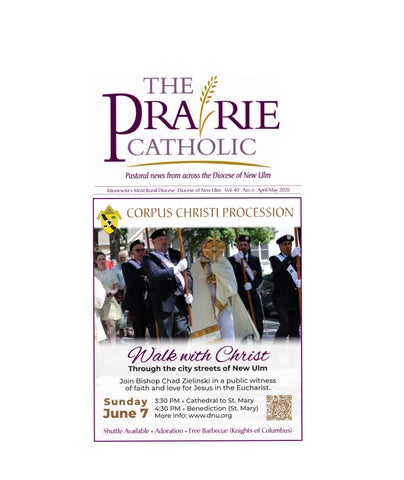
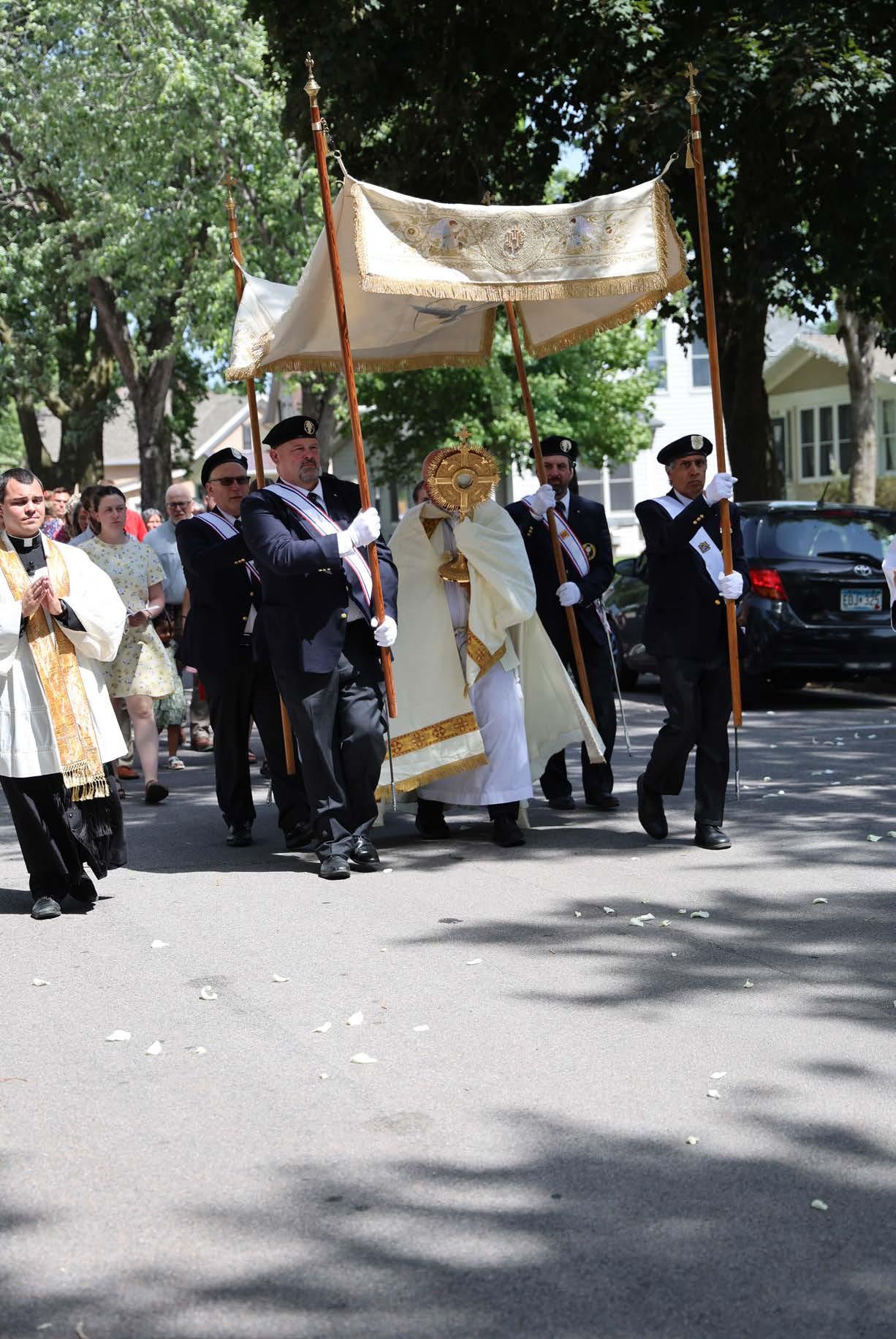
CORPUS CHRISTI PROCESSION
Sunday June 7 Walk
Join Bishop Chad Zielinski in a public witness of faith and love for Jesus in the Eucharist. Through the city streets of New Ulm
3:30 PM Cathedral to St. Mary
4:30 PM Benediction (St. Mary) More info: www.dnu.org
Shuttle Available Adoration Free Barbecue (Knights of Columbus)
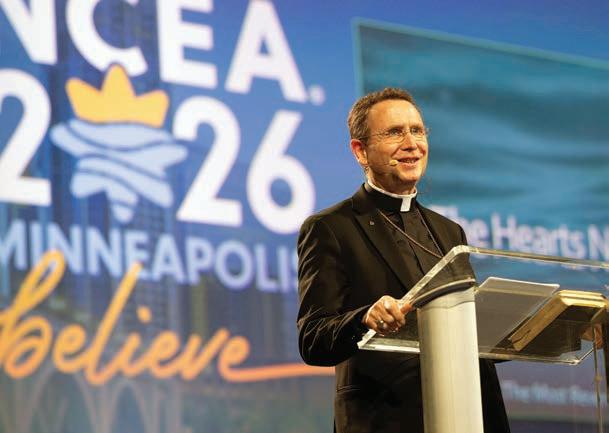
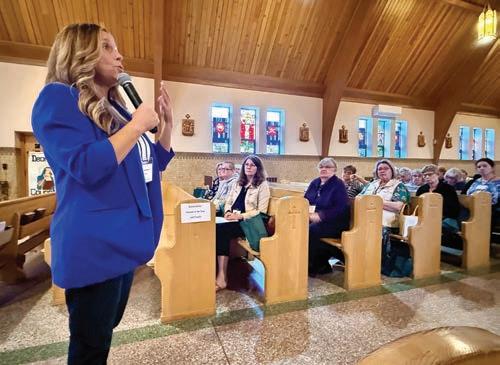
Bishop Andrew Cozzens of the Diocese of Crookston addresses those gathered for his April 7 keynote talk to begin the National Catholic Educational Association’s annual convention at the Minneapolis Convention Center.
(Read more on page 6.)
‘Something’s happening’: Catholic converts surge in many U.S. dioceses
by Matthew McDonald
Many U.S. dioceses have experienced heavy increases in people joining the Catholic Church at Easter 2026, including some with record highs, a survey by the National Catholic Register found.
“Something’s happening,” said John Helsey, director of communications for the Archdiocese of Oklahoma City, which expected a 57% increase in unbaptized people becoming Catholics at Easter — from 635 in 2025 to nearly 1,000 in 2026.
In most places, this year’s increases aren’t a one-off but follow significant increases in recent years.
One example is the Archdiocese of Newark, New Jersey, which had record highs attending liturgies several weeks ago that were meant to welcome would-be converts
Page 3
Bishop announces new clergy assignments
Page 5
Healing Ministry in the Diocese of New Ulm
Page 8
Diocesan Council of Catholic Women Convention Highlights
who have been preparing to enter the Church in recent months and to formalize their status.
Newark is expecting a 30% jump in converts in 2026 (at 1,701) over 2025 (at 1,305). The 2026 figure is 60% higher than the 1,064 converts in 2019, the year before the COVID-19 pandemic.
“Last year, we had no idea where all the people came from then; 2025 eclipsed every year we had had up to then. We thought it might be an anomaly,” said Father Armand Mantia, director of the archdiocese’s OCIA (Order of Christian Initiation of Adults) program that prepares converts to become Catholics. “And then, all of a sudden, we had our rituals for 2026, and 2026 blew away 2025, which we didn’t think was possible.”
That’s also the case in the Archdiocese of Mobile, Alabama, where the number of converts in 2025 (447) was the highest since at least 2014, and the number in 2026 (603) is 35% higher than in 2025.
The Register contacted all 175 Latin-rite territorial dioceses in the United States, seeking numbers of people planning to join the Catholic Church at Easter 2026. Seventy-one, or 40% of U.S. dioceses, responded.
Just five of the 71 dioceses expected a drop in converts this year, most of them slight. The remaining 66 are expecting increases — in many cases, significant ones.
Most dioceses that provided figures to the Register included both already-baptized Christians,
baptized and unbaptized); the Diocese of Providence has 76% more converts; and the Diocese of Norwich, Connecticut, is recording a 112% spike.
In Pennsylvania, the dioceses of Harrisburg (77%) and AltoonaJohnstown (84%) are seeing big increases. Across the country, the Diocese of Pueblo, Colorado, is expecting a 105% increase.
In addition to the cold statistics, diocesan officials described to the Register anecdotes that illustrate a surprising level of interest in the Catholic Church among nonCatholics.
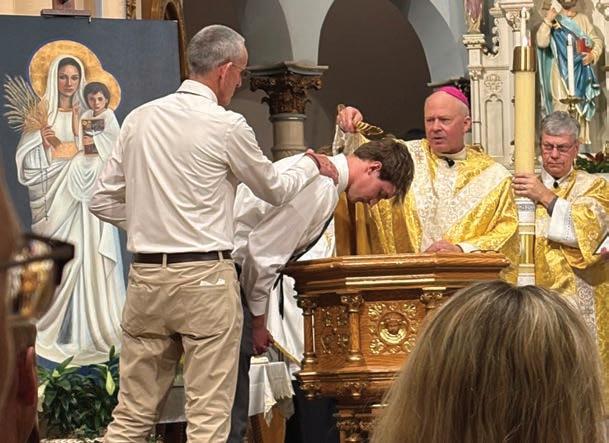
NEW ULM - Ethan Thompson, a catechumen from the Holy Cross Area Faith Community’s OCIA program, was baptized by Bishop Chad W. Zielinski during the Easter Vigil on April 4, 2026, at the Cathedral of the Holy Trinity. Accompanied by his sponsor, Dr. Terence Knowles, Thompson’s baptism reflects a growing national trend. This year, the Diocese of New Ulm welcomed 83 new members into the Church—13 catechumens and 70 candidates, nearly doubling the previous year’s numbers. Also pictured, Deacon Rick Christiansen of New Ulm.
known as “candidates,” and unbaptized people, who are known as “catechumens” for most of the preparation process and later termed “elect” at some point in early Lent.
Some dioceses track only unbaptized people before Easter. While the term “candidates” includes baptized Protestants, the figures may in some places also include people who were baptized in a Catholic church but weren’t catechized and didn’t receive Holy Communion or confirmation as a child.
In all cases, the Register has attempted to make apples-toapples comparisons, with the
(Photo by Jessica Griebel)
caveat that 2026 numbers aren’t set yet.
This year’s expected increases in converts in the United States include regions where the Church has been growing rapidly in recent decades, such as Florida, where the Diocese of St. Petersburg is expecting an 84% jump, and Texas, where the Diocese of Austin is expecting a 53% jump.
But it also includes highly secularized New England, where the Archdiocese of Boston has 55% more catechumens (unbaptized) this year than last year. The Diocese of Manchester, New Hampshire, reported a 54% increase (including already-
Edward Trendowski, director of the Office of Faith Formation for the Diocese of Providence, told the Register he has noticed an unusual spirit of inquiry among people he runs into, including the woman who cut his hair recently, who told him she was raised a Pentecostal but is thinking about joining either the Catholic or Orthodox Churches, and that she has been reading the writings of St. Thomas Aquinas.
“People seem to be more spiritually open,” Trendowski said. “We know deep down that there’s something more. I think people grasp that intuitively somehow. People are looking for something deeper.”
In the Archdiocese of Philadelphia, which expected a 60% increase in converts in 2026 over last year, a priest who oversees conversion programs said people seeking to join the Catholic Church tend to come to Mass and have an
(Continued on page 3.)
(photo by Dave Hrbacek/The Catholic Spirit)
by Bishop Chad W. Zielinski
A Fire has been ignited!
As Holy Week approached this year, I was struck by reports from several Catholic media outlets highlighting a significant increase in the number of catechumens and candidates being received into the Church at the Easter Vigil compared to the previous year.
Additionally, it was noted that many parishes and dioceses experienced a significant increase in the number of young people, particularly Generation Z, attending Mass or returning to practicing their faith.
What I found interesting about the reports on this “Good News” was that no specific program was being highlighted. Instead, it seemed to be a unique movement of the Holy Spirit present in each individual’s life, drawing them to an encounter with the living truth of the Risen Christ.
PTHERA RIE CATHOLIC
The Prairie Catholic, the official newspaper for the Diocese of New Ulm since May 1972, is published every six weeks, Sept.–June.
Publisher: Bishop Chad W. Zielinski
Editor: Christine E. Clancy
Publication office: Diocesan Pastoral Center, 1421 6th Street North, New Ulm, MN 56073; phone: 507-359-2966, Email: dnu@dnu.org Website: www.dnu.org
Postmaster: Send notice on Form 3579, “The Prairie Catholic,” 1421 6th Street North, New Ulm, MN 56073-2071. Periodical postage paid at New Ulm and additional mailing offices. USPS 926-760.
The Bishop’s Column: That they may have life
As reported on Page 1 of this issue of The Prairie Catholic, during this year’s Easter Vigil, the Diocese of New Ulm welcomed 83 individuals (catechumens and candidates) into its parishes. An increase of almost double. This notable rise in numbers was a topic of conversation at our recent diocesan priests’ retreat, where all the priests expressed excitement about the growth in participation.
As I reflected on the increase in people joining the Church, I spoke with individuals from different areas of our diocese to learn about their journeys to being received into the Church at the Easter Vigil. They have all given me permission to share their stories and names.
My question to each of them was, “What inspired their desire to enter the OCIA process to discern whether to join the Church. Was there a person, website, or app that influenced them?”
Brett Ruppe is 33 years old and is from the Danvers area. He was received into the Church at Sacred Heart in Murdock during the Easter Vigil. He expressed that he was “seeking the truth” and began his journey during the COVID shutdowns by researching his Lutheran faith. As he studied the Bible, he noticed inconsistencies in the Doctrine of Justification and Free Will, which led him to explore the teachings of the Catholic Church. The most significant influence on his journey were podcasts and articles from the Catholic Answers website, which provided insights that resonated with his understanding of Scripture.
Brett has a strong passion for his faith, and St. Isidore AFC is lucky to have him. As a farmer, he kept our visit brief to take advantage of the nice weather and resume planting crops.
Joey and Jordan Schreck are a young couple from the Church of St. John in Ortonville, along with their daughters, Everly and Audrey. Joey, who was baptized and confirmed as a Lutheran, attended Mass with Jordan during their engagement and felt a deep connection to its sacredness and the Eucharist. He said, “The Eucharist was the biggest factor in my decision to enter the OCIA and be received into the Church,” explaining that he learned Catholics believe it is truly the Body and Blood of Jesus, which
sparked a thirst for the Eucharist in him.
Jordan attended most OCIA classes with Joey, sharing, “This was a great refresher of my Catholic faith, and I learned a lot.” They both noted that discussing their faith throughout the week after class strengthened their marriage, and they feel blessed by the process.
Joey gave a “shout out” to Fr. Mike Schmitz and many of his podcasts. “He gets right to the point and clearly explains a certain Catholic teaching and how it is rooted in scripture. I continue to listen to his Bible in a Year podcast,” he said.
Eric Fliszar, 57, was welcomed into the Church during the Easter Vigil Mass at St. Mary’s Church in New Ulm, where he and his wife, Becca, were married. Despite moving around the U.S. for his career, they recently returned to attending Mass there.
Eric’s decision to enter the OCIA was influenced by various life events. Adopted in 1968 as an orphan, he was raised in the Lutheran faith by two loving parents. He discovered at the age of 47 that his biological family was Irish Catholic. Contacting some siblings who still practice their faith also played a role. His time in the Marine Corps introduced him to a devout Polish Catholic leader, which sparked his curiosity about Catholicism.
Now, Eric’s son, a soldier in the Army who takes his Catholic faith seriously, has further influenced him. He appreciates the two Handmaids who led his OCIA program for their nonjudgmental approach and patience in addressing tough questions. He noted that many young people view the Catholic Church as an anchor in a chaotic world. His wife has been a significant support, fostering discussions that have strengthened their marriage. He also gave a “shout out” to Fr. Mike Schmitz for his passionate zeal and articulate, concise explanation of the faith. He continues to use the Hallow app and its resources.
Jackson Goldberg is a sophomore at Gustavus College in St. Peter who was recently received into the Church at St. Peter in St. Peter during the Easter
Vigil. Jackson shared that he was baptized Lutheran and minimally practiced his faith during his growing-up years.
Shortly after arriving at Gustavus, he befriended guys on the baseball team and in his dorm. One friend invited him to a Bible study at St. Peter Church, where he learned about Catholic teachings that intrigued him. This led him to read more, listen to podcasts, and watch YouTube videos. Eventually, he attended Mass with a friend and shared that he was deeply taken by the order, structure, and sense of the holy and sacred. “People were very friendly,” he shared, and he eventually began regularly attending Mass with other college students.
After Mass on March 15, I joined Jackson and about 20 other Gustavus students for coffee and donuts, impressed by their commitment to their faith. Msgr. Douglas Grams, pastor of St. Peter, noted that this group has significantly grown over the past year, attending Bible study at 6:30 a.m. before classes. He shared that their youthful zeal and love for the faith and truth are most inspiring.
As you can see from these individuals, their stories are very different. However, every AFC has individuals with similar experiences. All of them express a desire and thirst for the truth, which they find in the teachings of the Catholic Church. Additionally, they encounter a welcoming community that is willing to journey with them patiently. All express a genuine encounter of the sacred and holy at the Mass.
As Jackson said, “The Mass is the single greatest influencer for me to join the Catholic Church. I know I am in the presence of God, something truly holy, and I am at peace.”
I would like to express my heartfelt gratitude to all our priests, deacons, Directors of Religious Education, and parish catechists for your dedication, time, and effort in guiding others towards the Catholic faith. A fire has been ignited in the hearts of those seeking clarity and connection to the Apostolic anchor of our faith. The Holy Spirit has an exciting plan for our diocese!
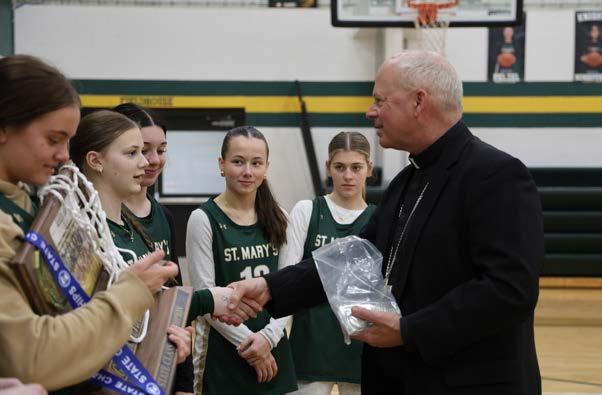
Bishop’s military experience benefits young students
ULM – On March 20,
visited the eighth-grade classes
Area
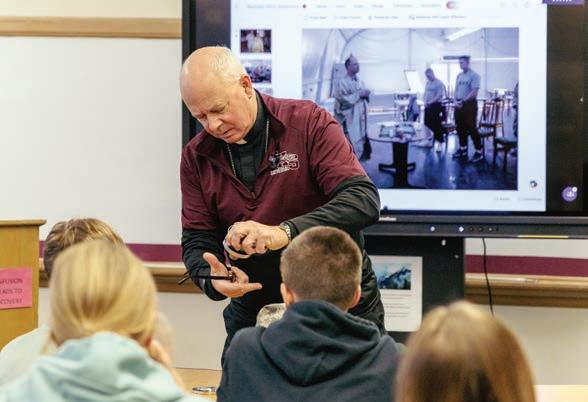
The bishop shared insights from his experience as an Air Force chaplain in order to help students better understand the spiritual needs of service members as they prepared to write letters of encouragement to soldiers and Army chaplains. In the visit, Bishop Zielinski demonstrated a chalice designed to be disassembled and carried in the field. A photo on the screen shows him celebrating Mass during his military service. (Photo by Christy Baker)
NEW
Bishop Chad Zielinski
of Walker Schouviller and Matthew Edens, teachers at New Ulm
Catholic Schools.
diocesan church
Bishop Zielinski announces new clergy assignments
NEW ULM – Bishop Chad W. Zielinski, after consultation with the Priest Personnel Board, has announced new clergy assignments.
Effective May 1, 2026:
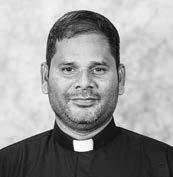
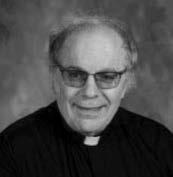
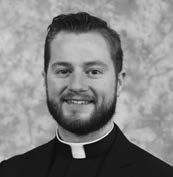
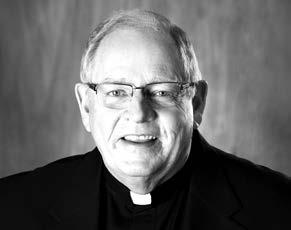
Rev. Thambi Kakarala O.S.B (Fr. Joseph) to serve as the parochial vicar of the John Paul II Area Faith Community (the Church of the Holy Trinity in Winsted and the Church of the Holy Family in Silver Lake).
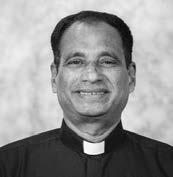
Rev. Ignaci Poulraj, O.S.B (Fr. Paul) to serve as the parochial vicar of the Heart of Jesus Area Faith Community (the Church of St. Aloysius in Olivia, the Church of St. Mary in Bird Island, and the Church of the Holy Redeemer in Renville).
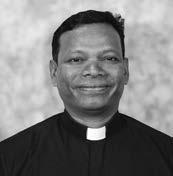
Rev. Sunit Kumar DungDung O.S.B (Fr. Gregory) to serve as the parochial vicar to the Church of the Holy Rosary in North Mankato and the Apostles Peter and Paul Area Faith Community
(the Church of St. Peter in St. Peter and the Church of St. Paul in Nicollet).
Effective July 1, 2026:
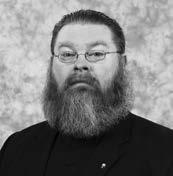
Rev. Paul van de Crommert to serve as the parochial administrator of the All Saints Area Faith Community (the Church of St. Willibrord in Gibbon, the Church of St. Andrew in Fairfax, and the Church of St. Francis de Sales in Winthrop).
Rev. Beschi Savarimuthu, O.S.B., to serve as a parochial vicar of the Mary, Mother of God Area Faith Community (the Church of the Holy Redeemer in Marshall, the Church of St. Mary in Tracy, the Church of St. Michael in Milroy, and the Church of St. Mary in Cottonwood).
Rev. Zachary Peterson to serve as the parochial administrator of the Holy Family Area Faith Community (the Church of St. Joseph in Montevideo, the Church of St. Andrew in Granite Falls,
Increase in Catholic converts
(Continued from page 1.)
active prayer life before they ever attend formal sessions with catechists, and that they tend to accept Church teachings earlier in the process than their predecessors did.
“I have noticed over the last several years that there is a greater commitment to conversion, a greater commitment to the Church, when they arrive,” said Father Dennis Gill, director of the Office for Divine Worship for the Archdiocese of Philadelphia and rector of the Cathedral Basilica of Sts. Peter and Paul.
‘Our numbers exploded’ Most dioceses hit their lowest numbers in recent times in 2021, the year after the coronavirus shutdowns, when Church activities saw a sharp decline. But the increases in the years since the virus suggest higher rebound than might have been expected.
“Everyone was worried, ‘Will we get back to pro-COVID numbers?’” said Laura Nelson, director of faith formation for the Diocese of Fort Worth, Texas, which expected a 37% jump in converts this year. “We are not just back to pre-COVID numbers. We’ve exceeded them.”
and the Church of St. James in Dawson).
Rev. Tanner Thooft to serve as parochial administrator of the Church of St. Peter in Canby and the Church of St. Leo in St. Leo, part of the Christ the King Area Faith Community.
At Sacred Heart Catholic Church in downtown Tampa, Fl., this year the parish’s program that prepares people to become Catholics for the first time had to split sessions into unbaptized people and alreadybaptized people because there were so many.
“Our numbers exploded this year,” said Barbara Ferreris, director of faith formation at Sacred Heart.
In early February, the parish received 35 Protestants into the Church (up from five in 2025), in addition to 15 people who had been baptized in a Catholic church but never confirmed.
Twenty-six unbaptized people are expected to be baptized at Easter (up from 21 in 2025, and 13 in 2019, the year before the virus). Many of them are in their 20s and 30s, most of them single, Ferreris told the Register.
“They have the career. They have the home, the car. They’re searching for more,” Ferreris explained. “They want more, and they know God is calling them. God is calling them and they’re responding.”
The young-adults theme came up repeatedly in interviews with diocesan officials. “There’s especially in young adults a strong
desire for solidity, stability, and objective truth. We live in a world where truth is evasive,” Nelson, of the Diocese of Fort Worth, told the Register. “Even if you don’t know and love Jesus, you can see that the Church has a solid foundation. We don’t change with the times.”
Other factors
As for why it’s happening, diocesan officials offered various theories. Immigration, particularly from the surge during the Biden administration, is a factor in some places. Some suggest the election in May 2025 of Pope Leo XIV, the first American pope, who describes Church teachings with a native accent unfiltered by translation, might also be a draw for some non-Catholics. Some diocesan officials shared a new emphasis on outreach to nonCatholics.
Bishop Frank Dewane, who leads the Diocese of Venice, Florida, which expected a 94% increase in converts, noted that some places outside the United States are also seeing big increases this year, including England and France.
He told the Register the Church is enjoying what he called “a golden age of Catholic resources,” including podcasts and other online sources that get information
Msgr. Douglas Grams to serve as pastor of the Church of the Holy Rosary in North Mankato in addition to his current assignment as pastor of the Apostles Peter and Paul Area Faith Community (the Church of St. Peter in St. Peter and the Church of St. Paul in Nicollet).
about the Church to people who would ordinarily never set foot in it, and yet come to find Catholicism unexpectedly attractive.
“Our modern culture has not borne good fruits, and I think people see that. They recognize that. They know that,” Bishop Dewane said.
But ultimately, he and other Church officials the Register spoke with attributed the bountiful harvest to God.
“It’s the Holy Spirit,” Bishop Dewane emphasized. “Yes, we follow promptings, also. But I think it’s the work of the Holy Spirit right now in society and in the Church.”
The recent increase in converts in certain places doesn’t mean the Catholic Church is growing in America. Indeed, surveys suggest it’s shrinking, which is borne out by declines in recent decades in baptisms, Catholic weddings, confirmations, and church attendance among young people.
In December 2025, Pew Research reported significantly more people leaving the Catholic Church than entering it. But it’s not all shrinkage. Like a north-south divided highway in a busy city
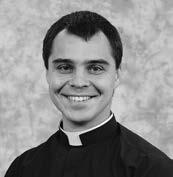
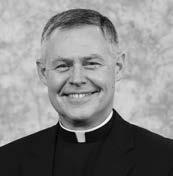
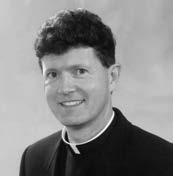
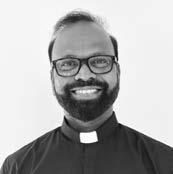
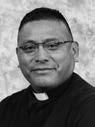
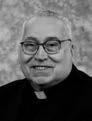
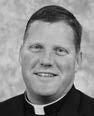
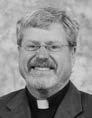
Rev. Andrew Michels to retire from active ministry.
Effective August 1, 2026: Rev. John Hayes to study at the Saint Paul University in Ottawa, Ontario, pursuing a Licentiate in Canon Law (JCL) for two years.
at rush hour, a lot of people are coming and going at the same time.
“While we may see a decrease in cultural Catholicism, we see an increase in people becoming Catholics by personal choice,” said Father Juan Ochoa, director of the Office for Divine Worship for the Archdiocese of Los Angeles, which expected a 54% increase in converts this Easter.
“The cultural Catholics in the United States may be decreasing, but the life of the Church in a different way is emerging.”
Trendowski, from the Diocese of Providence, made a reference to the papal apostolic exhortation Amoris Laetitiae, which celebrated its 10th anniversary April 10.
“Pope Francis said the Church is a family of families,” Trendowski said. “So when you have people coming to the family, so to speak, it’s a joyous occasion.”
Editor’s note: This story is reprinted with permission from the National Catholic Register, www.ncregister.com/.
Kakarala
Peterson Poulraj
Thooft
DungDung
Grams
van de Crommert Michels
Savarimuthu Hayes
¡Un fuego ha sido encendido!
por Bishop Chad Zielinski
A medida que se acercaba la Semana Santa este año, me llamaron la atención los informes de varios medios católicos que destacaban un aumento significativo en el número de catecúmenos y candidatos que fueron recibidos en la Iglesia en la Vigilia Pascual en comparación con el año anterior.
Lo que me pareció interesante de los informes sobre esta “Buena Noticia” fue que no se destacaba ningún programa específico. Más bien, parecía ser un movimiento único del Espíritu Santo presente en la vida de cada individuo, atrayéndolos a un encuentro con la verdad viva de Cristo Resucitado.
Durante la Vigilia Pascual de este año, la Diócesis de New Ulm dio la bienvenida a 83 personas (catecúmenos y candidatos) en sus parroquias. Un aumento de casi el doble. Este notable incremento en los números fue tema de conversación en nuestro reciente retiro diocesano de sacerdotes, donde todos los sacerdotes expresaron entusiasmo por el crecimiento en la participación.
Al reflexionar sobre el aumento de personas que se unen a la Iglesia, hablé con cuatro personas de diferentes áreas de nuestra diócesis para conocer sus caminos hacia los sacramentos en la Vigilia Pascual. Todos me han dado permiso para compartir sus historias y nombres.
Mi pregunta para cada uno de ellos fue: “¿Qué inspiró su deseo de entrar en el proceso de OICA para discernir recibir los sacramentos? ¿Hubo una persona, sitio web o aplicación que los influyó?”
Brett Ruppe tiene 33 años y es del área de Danvers. Fue recibido en St. Isidore the Farmer AFC durante la Vigilia Pascual en la Iglesia del Sagrado Corazón en Murdock. Expresó que estaba “buscando la verdad” y comenzó su camino durante los cierres por COVID investigando su fe luterana. Mientras estudiaba la Biblia, notó
diocesan church
Para que tengan vida
inconsistencias en la Doctrina de la Justificación y el Libre Albedrío, lo que lo llevó a explorar las enseñanzas de la Iglesia Católica. La influencia más significativa en su camino fueron los podcasts y artículos del sitio web Catholic Answers, que ofrecían perspectivas que resonaban con su comprensión de la Escritura.
Brett tiene una gran pasión por su fe, y St. Isidore AFC tiene la suerte de tenerlo. Como agricultor, mantuvo nuestra visita breve para aprovechar el buen clima y reanudar la siembra de cultivos.
Joey y Jordan Schreck son una joven pareja de la Iglesia de St. John en Ortonville, junto con sus hijas, Everly y Audrey. Joey, quien fue bautizado y confirmado como luterano, asistió a Misa con Jordan durante su compromiso y sintió una profunda conexión con su carácter sagrado y con la Eucaristía. Él dijo: “La Eucaristía fue el factor más importante en mi decisión de entrar en el OCIA y ser recibido en la Iglesia,” explicando que aprendió que los católicos creen que es verdaderamente el Cuerpo y la Sangre de Jesús, lo que despertó en él una sed por la Eucaristía.
Jordan asistió a la mayoría de las clases de OICA con Joey, compartiendo: “Esto fue un gran repaso de mi fe católica, y aprendí mucho.” Ambos señalaron que hablar sobre su fe durante la semana después de las clases fortaleció su matrimonio, y se sienten bendecidos por el proceso.
Joey dio un “saludo” al P. Mike Schmitz y a muchos de sus podcasts. “Va directo al punto y explica claramente una determinada enseñanza católica y cómo está arraigada en la Escritura. Continúo escuchando su podcast Bible in a Year,” dijo ella.
Eric Fliszar, de 57 años, fue recibido en la Iglesia durante la Misa de la Vigilia Pascual en la Iglesia de St. Mary en New Ulm, donde él y su esposa, Becca, se casaron. A pesar de haber vivido por todo Estados Unidos por su trabajo, recientemente regresaron a asistir a Misa allí.
La decisión de Eric de entrar en el OICA fue influenciada por varios acontecimientos de su vida. Adoptado en 1968 siendo huérfano, fue criado en la fe luterana por dos padres amorosos. Descubrió
a los 47 años que su familia biológica era católica irlandesa. Contactar a algunos hermanos que aún practican su fe también influyó. Su tiempo en el Cuerpo de Marines le presentó a un líder católico polaco devoto, lo que despertó su curiosidad por el catolicismo.
También dio un “saludo” al P. Mike Schmitz por su celo apasionado y su explicación articulada y concisa de la fe. Continúa utilizando la aplicación Hallow y sus recursos.
Jackson Goldberg es estudiante de segundo año en Gustavus College en St. Peter, quien recientemente fue recibido en la Iglesia de St. Peter en St. Peter. Jackson compartió que fue bautizado luterano y practicó mínimamente su fe durante sus años de crecimiento.
Poco después de llegar a Gustavus, entabló amistad con jóvenes del equipo de béisbol y de su residencia. Un amigo lo invitó a un estudio bíblico en la Iglesia de St. Peter, donde aprendió sobre enseñanzas católicas que lo intrigaron. Esto lo llevó a leer más, escuchar podcasts y ver videos en YouTube. Finalmente, asistió a Misa con un amigo y compartió que quedó profundamente impactado por el orden, la estructura y el sentido de lo santo y sagrado. “La gente era muy amable,” compartió, y finalmente comenzó a asistir regularmente a Misa con otros estudiantes universitarios.
Durante mi conversación con Jackson, me dijo: “La Misa es la mayor influencia para mí para unirme a la Iglesia Católica. Sé que estoy en la presencia de Dios, algo verdaderamente santo, y estoy en paz.”
Me gustaría expresar mi más sincero agradecimiento a todos nuestros sacerdotes, diáconos, Directores de Educación Religiosa y catequistas parroquiales por su dedicación, tiempo y esfuerzo en guiar a otros hacia la fe católica. ¡Se ha encendido un fuego en los corazones de aquellos que buscan claridad y conexión con el ancla apostólica de nuestra fe. El Espíritu Santo tiene un plan emocionante para nuestra diócesis!
Priest of diocese to mark Golden Jubilee in June
Fr. Jerome “Jerry” Paulson holds a unique place in the history of the Diocese of New Ulm. His ordination to the priesthood 50 years ago on June 6, 1976 at the Church of St. Mary in Sleepy Eye, marked the first priestly ordination by the Most Rev. Raymond A. Lucker, the second bishop of New Ulm (1975-2000). Before becoming a priest, Father Jerry served in the United States Navy from 1965 until 1971, retiring at the rank of Lieutenant.
Until his retirement from active ministry in 2021, he served as the senior associate at the Church of Our Lady of the Lakes in Spicer while also assisting in the Jesus Our Living Water Area Faith Community (which includes Clara City, Willmar, and Spicer) since 2011.
On June 6 and 7, the area faith community will host a cookies and lemonade reception to honor Father Paulson in recognition of his 50th Jubilee. This event will take place following the weekend Masses at the Church of Our Lady of the Lakes in Spicer.
Throughout his priestly service, Father Jerry served in the parishes of Willmar, Marshall, Springfield, Cathedral of the Holy Trinity in New Ulm, Searles, Arlington, Gaylord, Green Isle, Henderson, and Montevideo, as well as the Jesus Our Living Water AFC.
In 1988, he received a licentiate degree in canon law and was appointed assistant presiding judge of the diocesan Tribunal, On the bishop’s curia, he held a number of positions: Vicar General, Moderator of the Curia, director of Priest Personnel, Chancellor, supervisor of Pastoral Administrators, and diocesan Finance Officer.
For those wishing to send Father Paulson a card you may do so in care of the area faith community: Fr. Jerry Paulson, 713 12th St. SW, Willmar, MN 56201.
Celebrations of priestly jubilees
Father Samuel Perez will celebrate 25 years of priestly ministry on Sunday, May 31, with a Mass at 2:30 p.m. celebrated by Bishop Chad Zielinski at the Church of St. Michael in Morgan, followed by fellowship. Father Perez serves as parochial vicar of the Divine Mercy Area Faith Community (Comfrey, Morgan, and Sleepy Eye). He was ordained for the Diocese of New Ulm on June 2, 2001, at the Church of St. Anthony in Watkins by Bishop Bernard J. Harrington of Winona.
Father Joseph Steinbeisser will celebrate 40 years of priestly ministry with an 8:30 a.m. Mass on Sunday, June 7 at the Church of St. Aloysius in Olivia, followed by a social gathering until 1 p.m. Father Steinbeisser serves as pastor of the Heart of Jesus Area Faith Community (Bird Island, Olivia, and Renville). He was ordained on June 7, 1986, at the Church of St. Aloysius in Olivia by Bishop Raymond A. Lucker.
Father Anthony Hesse will celebrate 25 years of priestly ministry on Sunday, June 28 with a Mass at 3 p.m. at the Church of St. Anastasia in Hutchinson followed by a reception. Father Hesse serves as pastor of the Churches of St. Anastasia in Hutchinson and St. Boniface in Stewart. He was ordained for the Diocese of New Ulm on June 2, 2001, at the Church of St. Anthony in Watkins by Bishop Bernard J. Harrington of Winona.
Father Jeffrey Horejsi will celebrate 35 years of priestly ministry on Sunday, Aug. 23 with a Mass at 8 a.m. at the Church of St. Philip in Litchfield followed by a reception of coffee and rolls. Father Horesji serves as pastor of the Shepherd of Souls Area Faith Community (Darwin, Litchfield, Manannah, and Watkins). He was ordained on Aug. 24, 1991, at the Church of St. Anne in Wabasso by Bishop Raymond A. Lucker.
Paulson
social concerns
A profound sense of peace: Healing Ministry in the Diocese of New Ulm
by Deacon Ryan Pope Prairie Catholic correspondent
For over a decade, the Diocese of New Ulm has been providing a valuable ministry that many Catholics often discover during times of significant personal need. Under the direction of Deacon Mike McKeown, this ministry is dedicated to assisting individuals who carry emotional wounds, false beliefs, or spiritual barriers that hinder their ability to fully recognize God’s presence and grace.
Individuals often reach out for support regarding various challenges, including anxiety, depression, anger, shame, perfectionism, addictive behaviors, or a profound sense of unworthiness or loss of self.
According to Deacon McKeown, such inquiries frequently arise during critical moments in people’s lives. He explains, “It’s usually a time-of-need situation. People realize something keeps coming back, or something keeps troubling them, and they don’t know why.”
The ministry uses the Unbound model of prayer, centered on five Scriptural “keys”: Repentance, Forgiveness, Renouncing, Authority, and the Father’s Blessing. At its heart, however, Healing Ministry is simple: listening, prayer, and the work of the Holy Spirit.
“It’s an inner healing ministry,” Deacon McKeown explained. “We help people identify the obstacles in their relationship with God, with others, and with themselves.”
Session experience
A typical session consists of two main parts. First, a prayer team of two or three trained ministers listens to the person’s story, experiences, and struggles. This conversation takes place in a confidential, caring environment with no judgment.
The second part involves prayer, guided by five important steps. Those seeking healing are encouraged to talk about any negative patterns, wounds, or lies that have taken root in their lives—often starting from childhood—and to surrender those burdens with the strength they have gained through their faith. The session concludes with a prayer for the Holy Spirit’s healing and blessing.
Deacon McKeown is careful to clarify what the ministry is not: “It’s not dramatic or sensational— and certainly not what some bring to mind when they hear the word ‘deliverance.’ It’s simply helping people use the authority Christ gave them to reject what doesn’t belong in their lives and to receive the Father’s abundant love.”
Complementary to sacramental and therapeutic care
Healing Ministry is not a “substitute” for the sacraments of the Church, therapy, or spiritual direction. Rather, it “complements” the sacramental life of the Church and the work of mental health professionals and pastoral caregivers. “The most powerful place of healing is through the sacraments,” Deacon McKeown said. “But sometimes people need help being better disposed to receive the grace the sacraments offer.”
Catholic Charities counselors of the Diocese of New Ulm often refer clients to Healing Ministry, and the ministry refers people to counseling when ongoing therapeutic support is needed. “Healing Ministry is interventional when needs arise,” Deacon McKeown noted, “whereas therapy and counseling, spiritual direction, pastoral care, and of course the sacraments are repeatable and continually supportive.” In this way, Healing Ministry, the Church, and caregivers each support different dimensions of the whole person.
Fruits of healing ministry: peace, hope, and spiritual clarity
Jessie Collins, the director of Religious Education for the St. Isidore the Farmer Area Faith Community, first encountered the Healing Ministry nearly a decade ago. After her first session, she recalled, “I couldn’t stop smiling for two hours… I had an overwhelming sense of peace.” She spoke about generational trauma, forgiveness, and the tools she learned to pray, renounce lies, and move forward.
Collins also addressed a common sentiment: the temptation to say, “I can do this on my own,” or “I can pray this away.” Her encouragement is straightforward: “Don’t be afraid to be vulnerable. The number of things uncovered and addressed for me was unreal... It helps you become who God wants you to be.”
Nicholas Liese, the director of
Music at the Divine Mercy Area Faith Community and Sleepy Eye Saint Mary School, came to the ministry during a period of profound spiritual turmoil. “It was as if the clouds parted,” he said. “For the first time, I clearly heard God say, ‘Nicholas, I love you.’”
Liese described the clarity he experienced as “an intense grace,” because the ministry helped him find the deeper roots of his challenges. He admitted he approached the ministry with skepticism, but noted, “We tackled things I didn’t even know needed
healing... I received grace upon grace… go and do it.”
No one is beyond redemption
A common misconception is that Healing Ministry is only for people with dramatic trauma or severe spiritual struggles. In reality, the ministry is for anyone who desires greater freedom in Christ. As Deacon McKeown explains, “Most people who come are faithful Catholics who love the Lord and want to grow closer to him.”
Some individuals worry, “What
if I’m too far gone?” Without hesitation, Deacon McKeown reassures them: “No one is too far gone or out of reach; God’s healing is for everyone.”
Others harbor the opposite, often unspoken fear: “Is this only for people whose lives are really messed up?” The truth is that Healing Ministry serves ordinary people—like you and me—who simply want to remove obstacles that keep resurfacing in their spiritual lives.
The written testimonies shared with the diocese echo this theme. One person wrote, “I feel like a normal person now… my heart is soft so God can enter it more fully.” Another said, “A tremendous burden lifted. My family saw the difference immediately.” Together, these comments reflect what Deacon McKeown sees often: “God does the healing. We’re just the instruments.”
For further information concerning the Healing Ministry of the Diocese of New Ulm, visit the Diocese of New Ulm website, www.dnu.org/healing-ministry or call (507) 233-5310.
Mental health, mercy, and the witness of a saint
by Tami Behnke
May is designated as Mental Health Awareness Month, a time to shine a light on the importance of mental health. Catholic Charities of the Diocese of New Ulm is dedicated to supporting individuals facing mental health challenges. In the context of our Catholic tradition, we emphasize that mental health care is not solely a clinical issue but also a significant spiritual concern.
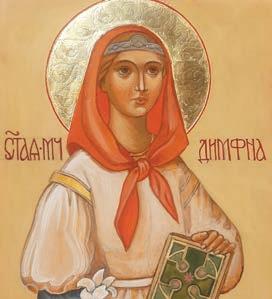
The Church offers a powerful companion in this work: Saint Dymphna, whose feast day is May 15, is the patroness of those who experience mental and emotional suffering. Though she lived in the 7th century, her story continues to resonate in a world still in need of compassion and healing.
Saint Dymphna, born in the 7th-century, is a notable figure in Christian tradition, recognized as a young Irish woman who exemplified faith and purity. At the age of 14, she consecrated herself to Christ and took a vow of chastity. After the death of
her mother, Dymphna’s father, a king of Oriel, was deeply affected by grief and mental turmoil. Exhibiting irrational behavior, he sought to force Dymphna to marry him due to her resemblance to his deceased wife. To escape this perilous situation, Dymphna fled to present-day Belgium, intending to live a life dedicated to God and preserve her vow of chastity. Unfortunately, her father tracked her down, and upon her refusal to comply with his demands to marry, Dymphna was martyred at a young age.
Due to the profound suffering she faced, particularly stemming from
deep-seated mental anguish and the traumas of her family, Saint Dymphna came to be revered as a patroness for those grappling with mental illness, anxiety, depression, and emotional turmoil. Over the years, a sacred shrine dedicated to her in the quaint town of Geel, Belgium, has transformed into a significant site of pilgrimage and healing for countless individuals.
In many ways, Saint Dymphna’s story reminds us that mental health struggles are not new, and neither is the call to respond with mercy. As we observe Mental Health Awareness Month, may we look to Saint Dymphna as both a source of intercession and an example. Her story calls us to create communities where individuals are not hidden in their suffering, but welcomed, supported, and loved.
Tami Behnke is the director of Catholic Charities of the Diocese of New Ulm. Trained counselors are located in New Ulm, Hutchinson, Marshall, and Willmar. Visit www.dnu.org or call 1-866-670-5163 if you or someone you know is struggling with mental illness.
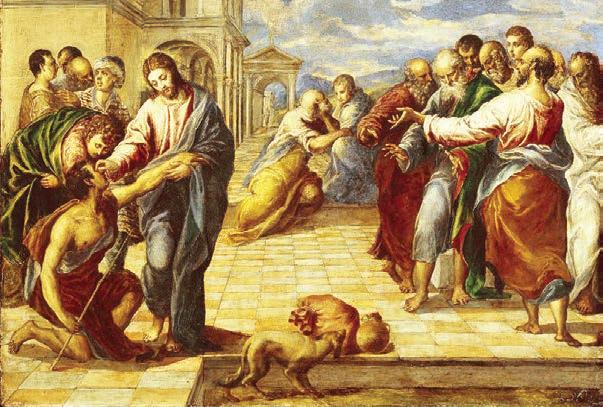
Artist El Greco (1541-1614): Christ Healing the Blind/Wikimedia Commons
Saint Dymphna
Educators must help heal the human heart, especially in youth, Bishop Cozzens says in NCEA convention keynote
by Josh McGovern The Catholic Spirit
MINNEAPOLIS – Opening the National Catholic Educational Association (NCEA) convention April 7, keynote speaker Bishop Andrew Cozzens of the Diocese of Crookston said too many people have wounded hearts and it is the job of Catholic educators to help heal them.
NCEA 2026 marked the first time in 17 years the conference was held in Minneapolis. Catholic and religious educators from around the country gathered at the Minneapolis Convention Center to exchange ideas and research related to education.
Steven Cheeseman, president and CEO of the NCEA, helped welcome about 3,800 educators to the April 7-9 conference. He said what people learn at the 2026 conference is not meant to remain in a notebook, but is meant “to be lived, meant to be implemented. It’s meant to be shared.”
Bishop Cozzens stressed that like a spiritual director or pastor, a Catholic educator’s vocation is rooted in helping heal the heart. He shared a video recording of the singer Gracie Abrams during one of her concerts, singing her introspective song “Camden.”
The video, Bishop Cozzens pointed out, showed a young woman who is talented, beautiful, successful and “seems to have everything going for her,” he said. But the lyrics Abrams sings speak to someone who is experiencing sorrow.
“The poetry that she sings about expresses the depth of pain that she carries in her heart, and what’s even more clear is that it resonates with tens of thousands of people in the stadium all her same age,” Bishop Cozzens said. “Many people in the stadium also feel like singing … . Brother(s), sisters, this is the height of popular culture. This is what our young people are singing about, the gaping wounds in their hearts.”
A great evil that comes from social media, Bishop Cozzens said, is that a person’s value comes from their social media
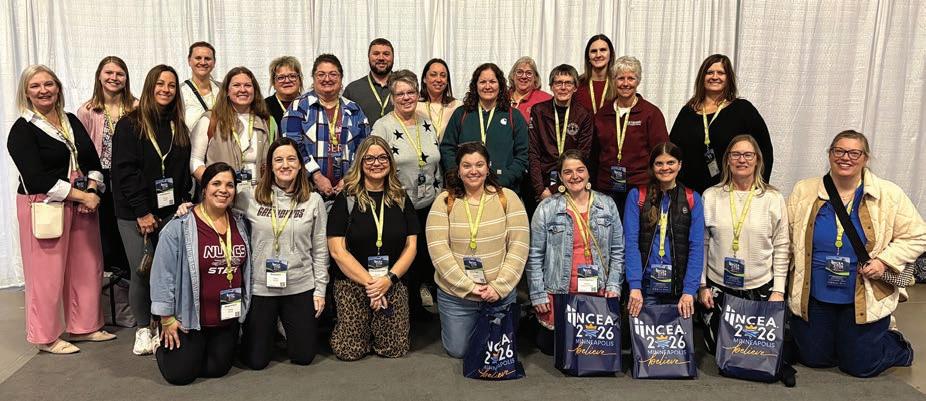
Diocese of New Ulm educators attending the NCEA National Convention April 7-9 are: front row, left Maggie Kohout and Melissa Mack (NUACS, New Ulm), Ashley Honetschlager (St. Mary’s Tracy and Holy Redeemer, Marshall), Molly Helget (NUACS, New Ulm), Kim Braegelmann and Emily Houles (School of St. Philip, Litchfield), Betty Kloss (St. Anastasia, Hutchinson), Beth Steffl (St. Raphael, Springfield). Row 2: Michelle Kramer (diocesan director of Catholic Schools), Crystal Ibberson and Angela Novotny (NUACS, New Ulm), Juli Neuman and Paul Dudgeon (Holy Redeemer, Marshall), Kristin Hillesheim, Karan Whitmyer, and Kayla Berg (NUACS, New Ulm), Stacey Lambrecht (St. Mary’s, Bird Island). Row 3: Mary Moritz (St. Mary’s, Sleepy Eye), Gretchen Peichel (St. Raphael’s, Springfield), Janelle Kopacek (NUACS, New Ulm), Justin Condelli (St. Mary’s, Tracy and Holy Redeemer, Marshall), Allison Hazuka (NUACS, New Ulm), Jaci Garvey (St. Edward’s, Minneota), Dana Peterson (Holy Redeemer, Marshall). (Photo submitted)
likes, and their identity is tied to how they are seen. At the center of his life, Bishop Cozzens said, are three words: relationship, identity and mission. The order is important, he said.
“The most fundamental thing in any person’s life is their relationship, and my identity comes from my relationship,”
Bishop Cozzens said. “I’m meant to know who I am, and I’m meant to experience my goodness, because I know I am loved by God. And then my mission comes from my identity. The problem is we get the order all messed up. We learn to take our identity from what we do, not from who we are. We start to take our value from our success and what other people think of us.”
Artificial intelligence can’t help heal the human heart, Bishop Cozzens said. Neither can technology, popular culture or politics. “In fact, it seems to be making it worse,” he said.
Bishop Cozzens asked, “How can we speak to that wound in their hearts?”
“Brothers and sisters, this is why Jesus came,” Bishop Cozzens said. “He cares about those tens of thousands of people in that stadium. He wants to speak to
hopes live, and also our deepest fears. It’s the place where we are meant to know ourselves. It can be the place where we love ourselves or the place where we experience shame or even embarrassment … . It can be the place of truth, where we see our dignity, who God created us to be, but it can also be the place where lies live about myself, half-truths, and based on how my heart is, what I believe about myself.”
Bishop Cozzens said there are three practical steps to teach young people that might lead to the healing of their hearts. The first is to understand that hearts are broken. The second is to open young people to the truth that love can heal their hearts. The third is to teach that “when their hearts are healed, they’ll find joy in making a gift of themselves,” Bishop Cozzens said.
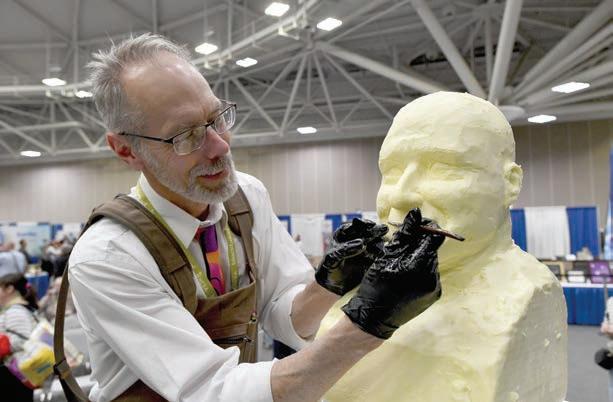
Gerry Kulzer, a member of St. Philip's parish in Litchfield, Minn. and a former Catholic school teacher, has been creating butter sculptures of the dairy princesses at the Minnesota State Fair since 2020. During the NCEA convention, attendees had the opportunity to watch as Kulzer sculpted a bust of Pope Leo XIV. (photo by Dianne Towalski/The Central Minnesota Catholic)
the wound in their hearts. He understands that wound because he created the human heart, and he knows why it’s wounded. He has an answer for it. In fact, brothers and sisters, this is why he opened his own heart.”
It is the job of Catholic educators to invite people to let their hearts be healed by an encounter with the heart of Christ, the one who reveals what it means to be human, the “God who became human to heal our humanity,” Bishop Cozzens said.
Bishop Cozzens said his talk was inspired by a quote from Pope Leo XIV when he spoke to Catholic educators in October 2025 during the Jubilee of the World of Education. Bishop Cozzens said Catholic educators need to know the truth of their own hearts in encounters with the Lord to be able to invite other people to encounter Christ.
“This first must begin with you,” Bishop Cozzens told the crowd. “(The heart) is the place where our deepest longings live, our deepest
Our hearts, Bishop Cozzens explained, are broken because they are affected by sin.
“Healing of the human heart has to happen by experience and it happens primarily through the experience of being loved,” Bishop Cozzens said. “We call it mercy: unearned love. It restores. It regenerates. It reveals the truth about ourselves. This is the love that our young people are longing for, that you and I are longing for, and that God is longing to give.”
To be redeemed is to discover “that I am loved, to discover my own value, because God found me valuable, and thinks I’m valuable, valuable enough to die for,” Bishop Cozzens said.
“You have the opportunity to teach your young people the value of their hearts,” Bishop Cozzens said.
Editor’s note: The NCEA convention serves as a platform for educators to network, learn from each other, and contribute to the ongoing mission of Catholic education. For further coverage on the convention visit The Catholic Spirit, www. thecatholicspirit.com/.
A lifetime of humble devotion - 90 years strong in faith
by Christine Clancy The Prairie Catholic
Father Paul Schumacher, a retired priest of the Diocese of New Ulm who turns 90 years old on May 3, credits his parents with a significant impact on his priestly vocation, describing them as “strong role models.”
“My mother was deeply faithfilled, and my father was incredibly generous,” he said, reflecting on his life as a young boy. “I think that helped guide me early on.”
Additionally, he recalls his parents having a strong friendship with the pastor of the family’s home parish, the Church of the Japanese Martyrs in Leavenworth, Minn.
“He [the pastor] spent a lot of time in our home. Although I was very young, I really think this was when the ‘spark’ got going, or I want to say, ‘the Call from God’ came to get on this path.”
During seventh and eighth grade, Father Schumacher attended Catholic school in Sleepy Eye, Minn., where he was greatly influenced by the teachings and presence of the Franciscan nuns from Rochester. He feels that their influence also played a crucial role in shaping his priestly vocation during that formative period.
Sharing his journey to the priesthood, Father Schumacher describes himself as a “lifer,” referring to the many years he spent in seminary formation. “I entered the seminary as a freshman in high school: four
TV Mass Leaflet available for the homebound
years in high school, four years in college, and four years in advanced theological studies, before I was ordained,” he said.
In total, he devoted 12 years to his priestly formation before being ordained, a commitment he reflects on with pride. “Throughout those years, somehow, God kept calling me, and I kept returning to the seminary,” he chuckled.
Reflecting on his years of priestly ministry, one can easily describe Father Schumacher as an altruistic and humble servant of God and humanity. This dedication was evident in the 24 parishes he served throughout the diocese. In the early part of his priesthood, he had a strong connection with young people, first as the director of the Newman Club at Marshall State College in Marshall in 1966, and a year later serving as the Chaplain at Southwest College in Marshall, a role he held for several years.
Feeling God’s presence
In 1974, Father Schumacher was appointed the director of Religious Education for the diocese. He describes this ministry as a time when he truly felt “God holding his hand.”
“That ministry was incredibly powerful,” he recalled, vividly remembering a particular moment when he was with Bishop Raymond Lucker, the second bishop of New Ulm. They were giving a talk in a parish that had recently experienced a teenage suicide—one of several such tragedies in the diocese at that
May 16-17, 2026
For over 40 years, the Office of Communications of the Diocese of New Ulm has provided a free Leaflet Missal for Catholics who are homebound and watch Mass on television. Produced by the American Catholic Press in South Holland, Ill., the Leaflet Missal, is funded primarily through donations to the annual United States Conference of Catholic Bishops Catholic Communication Campaign held in May in most parishes in the diocese. Half of all donations to this campaign remain in the diocese to support communication efforts, including The Prairie Catholic newspaper, the diocesan website, and social media initiatives.
If you or someone you know is homebound, unable to attend Mass, and would like to receive the Leaflet service, please send your name, address, and phone number to: Office of Communications, 1421 6th Street North, New Ulm, MN 56073; (507) 233-5317; or cbaker@dnu. org.
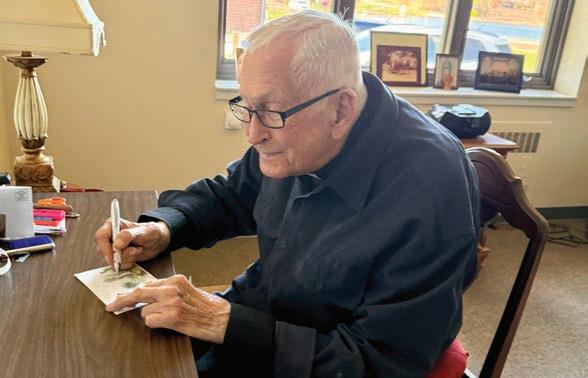
At the age of 90, Father Paul Schumacher remains full of life and spirit as he diligently writes letters and sends out Christmas cards, nurturing relationships with around 200 cherished friends and family members each year. (Photo by Christy Baker)
time. Describing the pain and sorrow within the community as palpable, Father Schumacher turned to the bishop and said, “You know, Bishop, I have not dealt with this before, but we must do something about it!”
This marked the beginning of Father Schumacher’s ministry in religious education. He began visiting parishes to train parish leaders on how to support one another in the event of a similar crisis. This vital work is now carried out by Catholic Charities of the diocese, addressing the evolving needs of the community and providing assistance to individuals and families in crisis.
Growth through ministry
As a young priest, Father Schumacher admitted that he thought he knew everything. “I had spent 12 years studying, after
all,” he said. “But God quickly humbled me!”
During the 1980s, amid the onset of the HIV/AIDS epidemic, Father Schumacher took on a groundbreaking role as the diocesan coordinator for HIV/ AIDS Ministry.
“It [HIV/AIDS] was such a secret thing amongst many families,” he explained.
“I would have funerals, and they would say to me, ‘You can’t mention why our kid died.’ Others would ask, ‘Please, we want you to say everything. . .’”
Reflecting on this ministry, Father Schumacher noted its profound impact on his personal and professional growth. “Those people I ministered to shaped me up!” he said. “Somehow this baby
priest discovered that he really needed to grow up!” They showed him how to be a better priest.
Father Schumacher devoted 30 years to the HIV/AIDS ministry, providing care and support to those in need. His retirement in 2018 marked the end of a remarkable journey of compassion and service.
Gratitude, wisdom, and legacy
Reflecting on his 64 years of priestly ministry, Father Schumacher expressed deep gratitude for the individuals God has brought into his life. “Since my ordination in 1962, I have been incredibly blessed by the people I’ve encountered. Those who have loved me, supported, and helped me become a better person and a better priest,” he said. He also mentioned that he continues to write letters and send Christmas cards, maintaining correspondence with around 200 people. “The friendships I have formed throughout my ministry have been a great source of love and hope in my life.”
If his life’s work is remembered at all, Father Schumacher hopes it is for his ability to listen, show compassion and mercy, and treat everyone with dignity. “Let God be the judge. Every person is made in the image of God – no exceptions.”
Editor’s note: For those wishing to send Father Schumacher a birthday greeting: Lake Villa Maria Apartments #18, 702 3rd Avenue NW, Sleepy Eye, MN 56085.
Pilgrimages to be guided by priests of the diocese
Franciscan Pilgrimage to Winona and La Crosse
Dates: July 17-19, 2026
Led by Father Shawn Polman, this pilgrimage commemorates the 800th anniversary of St. Francis of Assisi’s passing. It emphasizes the Franciscan spirit of prayer, simplicity, and devotion to Christ.
Alaska Pilgrimage and Cruise
Dates: September 4-13, 2026
Led by Monsignor Eugene Lozinski, this pilgrimage includes visits to Anchorage, Juneau, and other coastal communities along Alaska’s Inside Passage.
Pilgrimage to Lisbon, Fatima, Spain, and Lourdes
Dates: October 5-14, 2026
Led by Father Sam Perez, the spiritual director, this pilgrimage will visit Lisbon, Santarem, and Fatima— where the Blessed Virgin Mary appeared to three shepherd children. The journey will also include Salamanca, Avila, and Loyola, concluding in Lourdes.
Pilgrimage to Italy and Malta
Dates: October 17-29, 2026
Led by Father Mark Steffl, this pilgrimage encompasses many significant Church sites, including Rome, Assisi, Florence, and Venice, as well as Malta, where St. Paul preached after his shipwreck. Visit www.dnu.org/pilgrimage-opportunities for individual pilgrimage information.
catholic life
Morgan parish hosts Council of Catholic Women annual convention
Yvonne Girard
of Marshall named recipient of Woman of the Year award
by Jackie Finstad, NUDCCW Immediate-past President
MORGAN – The 65th Annual New Ulm Diocesan Council of Catholic Women (NUDCCW) Convention, held on Saturday, April 25, at the Church of St. Michael in Morgan, featured a significant highlight: the announcement of the 2026 NUDCCW Woman of the Year.
This year’s honoree is Yvonne Girard, a member of the Church of the Holy Redeemer in Marshall. Bishop Chad Zielinski presented the award to Girard.
Girard is recognized for her generous service and commitment to helping others in her family, church, and community. As a loving daughter, mother, and grandmother, she shows selfless love in all she does.
Every week, she spends several hours in Adoration, on top of coordinating rides to church for fellow parishioners, overseeing the annual Food Shelf Drive, serving on the Funeral Committee, leading Rosary prayers, and taking part in the Seven Sisters Apostolate.
A former member of the Eucharistic Revival Committee, her service extends to the Catholic Daughters of America (CDA) where she has served as a Regent and District Deputy. She currently chairs the local CDA seminarian program.
Year-round in her parish, Girard
helps maintain the church by replacing candles, watering flowers, cleaning, filling fonts, and recruiting volunteers to keep the church beautiful.
She also supports the local Christmas charity Angel Tree, which provide gifts to those in need during Christmas. In addition, she participates in the Backpack Blessings Tags, bakes and serves snacks for student meals weekly, and is involved with the Christmas Carolers. Girard volunteers with the Red Cross, dedicating considerable time to disaster-response training. She drives for Meals on Wheels, assists with the pro-life breakfast, manages a pro-life fair booth, and supports the local pro-life center. She has participated in a live nativity scene as a holiday fundraiser for hospice and has been active in the Jaycees.
The Council of Catholic Women (CCW) has also benefited greatly from Girard’s time and talent. She has served as the secretary for her parish CCW, played an active role in the New Ulm Diocesan Council of Catholic Women Convention Planning Committee, and chaired the Community Concerns Commission, organizing the CCW Relay for Life.
She has helped plan CCW and CDA Christmas parties and organized birthday celebrations at nursing homes. Girard regularly attends the Diocese of New Ulm deanery gatherings and
More Convention Highlights
Jessica Bartholomew, founder of A.C.T. United, was the convention keynote, addressing youth trafficking and juvenile sexual exploitation. She highlighted risky vulnerabilities like housing insecurity, financial instability, foster care involvement, and harmful social media trends and emphasized that most exploitation cases involve manipulation rather than abduction.
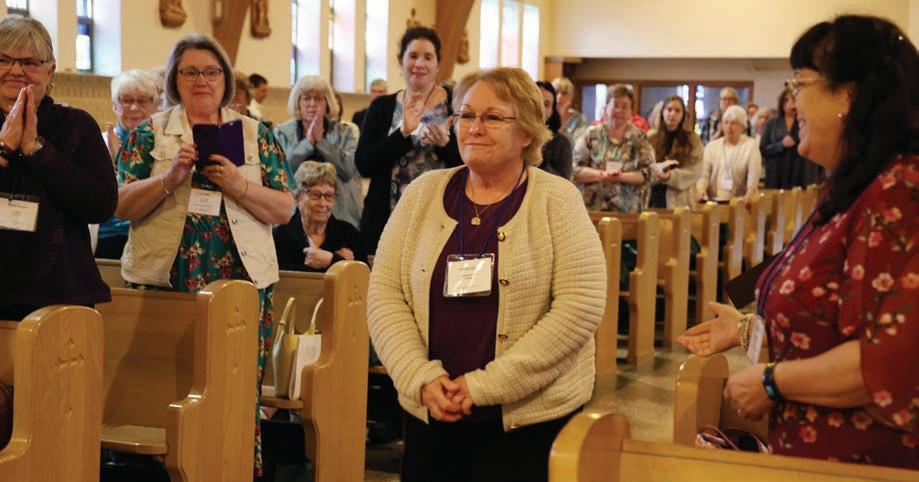
Yvonne Girard from Holy Redeemer Marshall received a standing ovation after being named Woman of the Year at the New Ulm Diocesan Council of Catholic Women’s Convention on Saturday, April 25 at the Church of St. Michael in Morgan. Girard was selected for her unwavering dedication and selfless commitment to uplifting those around her, impacting her family, church, and community.
conventions, participates in the salad luncheon and CCW Cookie Walk fundraisers, and can often be found on Saturday evenings preparing caramel rolls to be baked for her parish’s Sunday CCW fundraiser. She is an active participant in monthly CCW meetings, always willing to help in countless ways.
For more on the convention or to stay connected with the New Ulm Diocesan Council of Catholic Women, visit www.nudccw.org.
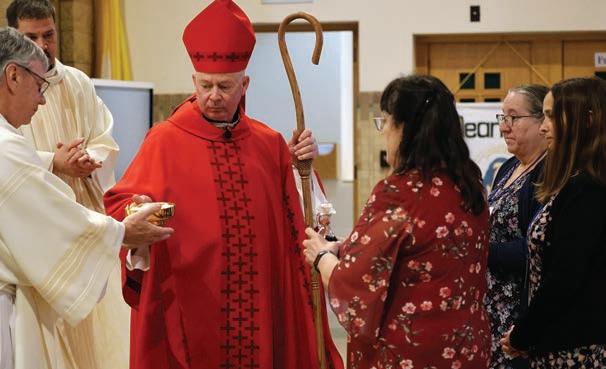
Incoming Council president Lori Timmerman of Marshall, (l) and outgoing president Sharon Illikman and immediate past-president Jackie Finstad, both of New Ulm, present the gifts to Bishop Chad Zielinski during Mass. Assisting are Deacons Richard Christiansen and John Hansen.
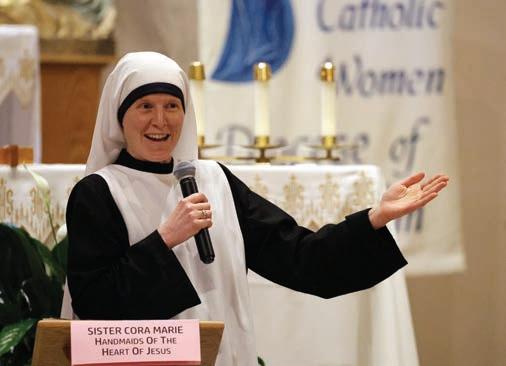
The afternoon of the convention featured Sr. Cora Marie of the Handmaids of the Heart of Jesus speaking on “The Genius of Women.” She reflected on the receptive and life-giving nature of women, both physically and spiritually, and on the sensitivity of a woman’s heart to recognize and respond to the needs of others in a beautiful and meaningful way.
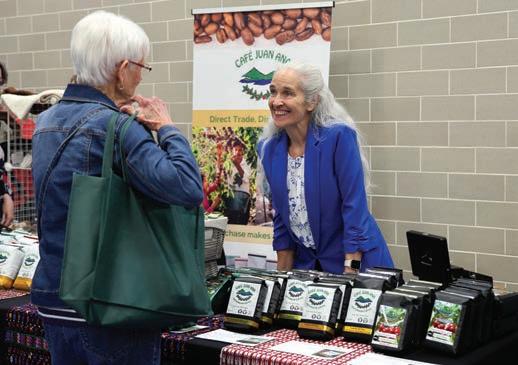
Throughout the day, convention goers had the opportunity to visit vendors and browse the silent auction. Among the numerous vendors was the nonprofit Friends of San Lucas (FOSL). Café Juan Ana is a fair-trade coffee ministry of FOSL that supports growers and families in Guatemala.
(photos by Christy Baker)
Spring gathering highlights keynote talk on “Road to the Priesthood”
by Elli Burmis Prairie Catholic correspondent
OLIVIA, Minn. – The annual Spring Gatherings of the New Ulm Diocesan Council of Catholic Women took place in March and April at the three deanery locations within the diocese.
On March 21, Deanery 3 held its Spring Gathering at the Church of St. Aloysius in Olivia. The event featured a special presentation by Fr. Joshua Bot, who spoke about the “Steps to the Priesthood,” detailing the various stages and experiences involved in becoming a priest. Father Bot, who serves as the Dean of Vocations for Deanery 3, also has pastoral responsibilities in the Jesus Our Living Water Area Faith Community, which includes Clara City, Willmar, and Spicer.
Father Bot began his presentation by humorously noting that it was a bit ironic to share the steps to the priesthood with a group of women. He quickly clarified, though, that his goal was to provide the audience with helpful tools and resources to support the young men in their lives who are considering becoming priests. He emphasized, “The seminary process helps [a man] to become who he is called to be, not just discern the priesthood,” and noted that although only one in three seminarians actually become priests, the seminary is still a gift even for those who discern out.
Steps to priestly formation As Father Bot explained, formation for the priesthood
involves four key areas: academic, pastoral, spiritual, and human. The goal is to “Become a bridge, not an obstacle to Christ,” he said.
During their time in seminary, aspiring priests regularly meet with formators, a spiritual director, fraternal groups for accountability and support, and an academic advisor. Father Bot emphasized that one of the greatest gifts of seminary life is fraternity. “Even men who discern out at times become best friends for life,” he said.
He said that the stages of priestly formation begin with an introductory phase lasting 1 to 2 years. After that, students progress through the college seminary or Pre-Theology phases before entering the major seminary. In the major seminary, students have greater freedom and responsibility along with increased pastoral involvement. They participate
in a program that places them in a parish to practice their ministry and receive guidance from an experienced priest. Additionally, they will engage in hospital ministry and rural life ministry. This is where the men “Encounter people more deeply, see God in hard moments, and better understand unique pastoral needs,” said Father Bot, noting that if a man already has a college degree, he will bypass the college seminary experience and instead enter Pre-Theology, which focuses on “scripture, Church teachings, and philosophical foundations.”
The ultimate goal of priestly formation is to cultivate individuals who “know themselves, love God deeply, under-stand the faith, and serve others as Christ the Good Shepherd,” Father Bot concluded. He encourages any man considering the priesthood to be open to the seminary experience, saying, “Even if you don’t become a priest, it’s still a gift. Go do what God is calling you to be.”
Answering the Call Young men considering a path to the priesthood should contact the Diocese of New Ulm Office of Vocations, jmichels@dnu. org, (507) 233-5302, where they will be guided to speak with one of the three Deans of Vocations.If a candidate wishes to pursue priestly formation, they begin the seminary application process. This includes answering questions about their life and faith, undergoing a psychological evaluation, and having a medical and dental check-up. Given that the diocese invests over $100,000 and requires a minimum of seven years of formation, applicants must be healthy and ready for long-term service.
Hope in Homes
Missionary married couple brings spark to faith in education
by Leonard Gutierrez
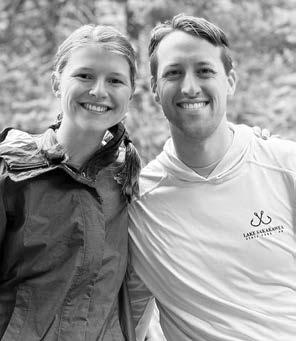
Most small towns in the Diocese of New Ulm carry a dozen or so total last names. One of the hallmarks that people love about small-town living is the tight knit community and the periodic gatherings that happen at church or the local ball park that bring so many together. It can be rare at times for a newly married couple to move into town, begin work at the Catholic local high school, and have a huge impact on so many who already seem to know each other. This is the story of Ben and Mary Moritz, two high school teachers at Sleepy Eye St. Mary’s Catholic School who love handing down the faith in and out of the classroom.
Ben and Mary met on day one while attending Benedictine College. With no intentions to meet their spouse right away, they immediately saw how “compatible” they were. They would laugh at the same things, shared the same faith, and both were part of the college band. What began as a simple first day of band camp, ended with the beginning signs of how God would continue working in their lives to increase their faith and bring them closer to each other.
Three years ago, Ben and Mary graduated with degrees in education, got married, and secured their ideal teaching job at a Catholic school in a rural town somewhere between Minnesota (where Mary is from) and Nebraska (where Ben is from). Describing their search for a teaching role, “Ben had sent out letters to a bunch of school leaders describing what they were looking for.” It turned out that Sleepy Eye St. Mary’s was a Catholic school in a rural town between Minnesota and Nebraska and also had the exact two teaching roles opening up that Ben and Mary were looking for: a science role and another for math and theology. It was a clear sign this was the right move for the newly-married couple.
Over the last three years, they have enjoyed attending basketball games, getting to know the parents and grandparents of their students, and teaching a morality unit together, where they were able to
help students come to a greater understanding of what the Church teaches in regards to various morality topics such as abortion. Mary shares, “It was our formation at Benedictine College that really helped to equip us to have these conversations with students and receive their counter arguments or questions.”
A memorable moment for them was witnessing the transformation in their students’ expressions, shifting from frustration to harmony and understanding after engaging in meaningful dialogue about important life issues. Recently, one of their former students, now in college, emailed to share that she had changed her major to education because of the profound impact they had on her.
The Moritzs’ are united not only in marriage but also in a shared mission to revitalize Catholic education. Their influence is already evident in the lives of individuals just a few years after they first met. The Church recognizes that a sign of growth in someone’s life is when they begin to make better life choices. This could mean significant changes, like switching majors, or smaller commitments, such as dedicating more time to their studies.
Regardless, Ben and Mary are a gift to Catholic schools. They credit much of their zeal and formation to their time in college where they were inspired by amazing faculty, joyful students, and prayerful Benedictine monks!
Leonard Gutierrez is the director of the Office of Evangelization for the Diocese of New Ulm, lgutierrez@dnu.org; (507) 2335361.
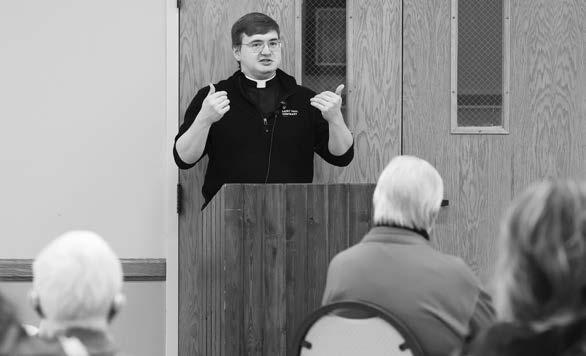
Father Joshua Bot, Dean of Vocations for Deanery 3 was the keynote at the New Ulm DCCW Spring Gathering in March.
(Photo by Christy Baker)
Mary and Ben Moritz
by Fr. Mark Steffl, STL, JCL
From the Code of Canon Law:
Canon 536 §1. If the diocesan bishop judges it opportune after he has heard the presbyteral council, a pastoral council is to be established in each parish, over which the pastor presides and in which the Christian faithful, together with those who share in pastoral care by virtue of their office in the parish, assist in fostering pastoral activity.
§2. A pastoral council possesses a consultative vote only and is governed by the norms established by the diocesan bishop.
Canon 537 In each parish there is
Ask a Canon Lawyer
This month’s question: My parish doesn’t seem to have a Parish (Pastoral) Council. Isn’t this required?
to be a finance council which is governed, in addition to universal law, by norms issued by the diocesan bishop and in which the Christian faithful, selected according to these same norms, are to assist the pastor in the administration of the goods of the parish.
Church Law provides for parishes to have councils that are advisory to the pastor (parish priest). The law requires each parish to have a “finance council” that assists the pastor to administer the “temporal goods” of the parish, and allows for (but does not require) a “parish council.” The same is true on the level of each diocese: a Diocesan Finance Council is required, and the diocese may have, at the discretion of the bishop, a Diocesan Pastoral Council.
The concept of these councils
is to provide the priest, who has the ultimate responsibility of administering a parish, with a formal way of consulting his parishioners on matters that relate to parish life. Such matters could include, for example, catechetical programs and questions that relate to the administration of buildings and maintenance that are central to providing a place for the Christian faithful to gather for public worship and the celebration of the sacraments.
The word “consultative” has a specific meaning in Church law, specifically to hear or listen to the concerns that are brought to him as a pastor, before making particular decisions. There are a number of such times in Church law that require, for example, a diocesan bishop to “hear” the members of his Presbyteral (Priests’) Council before making
decisions such as merging parishes or establishing new ones, although he is free to make a decision that may go against the advice that he has heard after listening to it.
In the case of parish pastoral and finance councils, there are no specific situations that the pastor is required to consult the councils about, but the law of the Church is there to remind the pastor that he is to act for the good of a parish after having deliberated carefully about decisions that significantly affect his parish and parishioners.
In the Diocese of New Ulm, as priests have become responsible to serve and administer multiple parishes in groupings that we call area faith communities, it was decided that what the Code of Canon Law requires as a finance council for each parish would have added to it any responsibilities that would have been formerly fulfilled by a separate
parish (pastoral) council. We refer to the finance councils of parishes in the diocese as “administrative councils” in their capacity of assisting the pastor (parish priest) in not only administering the temporal goods but also acting as a consultative body that can provide the priest with assistance in areas that he may require in acting for the spiritual good of his parishes and parishioners.
NEXT ISSUE: How does the Bishop decide which priest to appoint to a parish, or when to send a different priest to a parish?
Shielding kids from the harms of excessive social media use
A solution to the issue of minors spending excessive time on social media without parental guidance is gaining traction at the Capitol. It’s called the Stop the Harms from Addictive Social Media Act (H.F. 4138 / S.F. 4696). This bipartisan bill aims to alleviate the problems related to social media addiction through two key measures: 1) it would require verifiable parental consent for child accounts, and 2) it would mandate that social media platforms design their features to be less addictive for youth under 16. In practice, this means prohibiting features such as auto-play videos, infinite scrolling, targeted advertising, and others for youth accounts.
Consumed by social media
When, as a society, did we start allowing young, impressionable minds to spend nearly 20 percent of their time engaging with billion-dollar corporations?
Twenty percent of Minnesota high school students report spending time online between midnight and
5 a.m. five nights a week, and 97 percent of youth say they use their phones during the school day.
Between waking up to check their feeds in the middle of the night and receiving an average of 240 notifications throughout the day, one must wonder when children have the time for in-person friendships, rest, and the mental capacity to retain what they learn in school.
In no other context do we allow minors to enter a contract—not for sports, camps, or school outings. Yet they are allowed to sign over their data to Big Tech, and sometimes without their parents even knowing. The kids, then, become the products from which the platforms can profit.
Supporting parents
While some might argue that parents should simply do a better job of limiting their kids’ online time, the reality is that parents need assistance. Not all parents are in a position to monitor their children’s activities as closely as they would like; they may work long hours or be single parents just trying to keep up. Even those who do their best to protect their children online often
find themselves overwhelmed by rapidly-advancing technology and tech-savvy kids.
Ensuring that platforms are designed to be less addictive will benefit all children. When a parent provides consent for their child’s account, they can do so with the knowledge that the most addictive features will be unavailable. This levels the playing field for all children while simultaneously reducing the platforms’ addictive appeal.
Even the kids themselves recognize the challenges they face with social media use and have testified in support of this bill.
A 2025 Pew Research Study indicates that 48 percent of teens believe social media has a mostly negative effect on their peers, a 16 percent increase within just three years. Moreover, studies link Instagram usage, particularly among teenage girls, to issues with body image and selfworth. Instagram also has the highest percentage of adolescent users reporting experiences of cyberbullying.
Passing H.F. 4138 / S.F. 4696 would help mitigate some of the addictive qualities presented by
these platforms, which, in turn, could alleviate some of the mental health struggles faced by today’s youth while putting parents back in control of their children’s online experiences.
Both parents and kids are looking for a solution. Let’s urge the Legislature to take action: www.
Fr. Mark Steffl serves as judicial vicar of the Office of the Tribunal for the Diocese of New Ulm and is a canon lawyer, msteffl@dnu.org, (507) 233-5316.
mncatholic.org/protectkidsonline.
The Minnesota Catholic Conference has packaged this bill with two others, proposing a threetiered approach to protecting youth from gun violence. Learn more at www.mncatholic.org.
Advocacy visit to the Capitol
March 19, the bishops
Senate
issues
Minnesota met
and House
concern and to seek ways
Gov.
engage Minnesota elected officials in hopes of finding common ground for
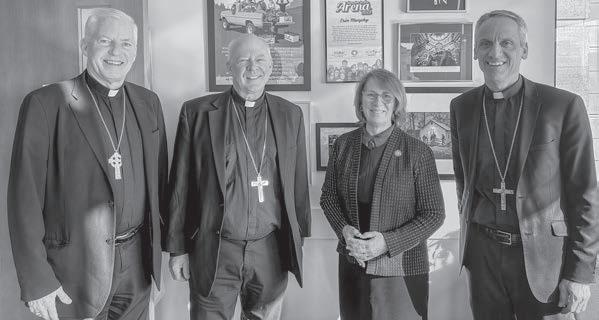
common good. Pictured with Senate Majority Leader Murphy are three of the bishops: Bishop Kevin T. Kenney, Auxiliary Bishop - Archdiocese of St. Paul and Minneapolis, (l), Bishop Chad W. Zielinski, Diocese of New Ulm, and Bishop Michael J. Izen, Auxiliary Bishop - Archdiocese of St. Paul and Minneapolis. (Photo submitted)
ST. PAUL – On
of
with
Tim Walz,
Majority Leader Erin Murphy,
DFL Leader Zach Stephenson on
of
to
the
March food distribution in Graceville serves over 500
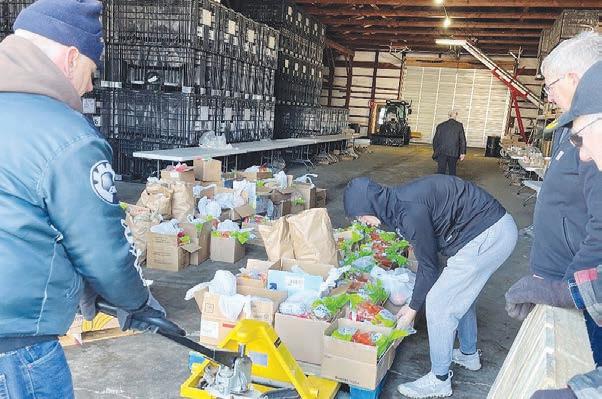
Youth and adult members of Holy Rosary parish in Graceville spent the morning of March 3 sorting a variety of food into boxes including meat, dairy, potatoes, rice, vegetables, and canned goods. Clint Gilsdorf of Graceville donated his warehouse space for the food distribution. (Photo Pam Stueve)
by Deacon Tim Dolan
GRACEVILLE – On Tuesday, March 3, local volunteers from the Church of Holy Rosary in Graceville, along with members of the Graceville community, gathered in the morning to receive a truckload of meat, dairy, potatoes, rice, vegetables, and canned goods from Second Harvest Heartland, a major nonprofit food bank and distributor in Minnesota and western Wisconsin. Over 500 individuals which include adults, children, and senior citizens facing food insecurity came to receive from this generous supply.
The biannual food truck distribution has been a collaborative effort among the Diocese of New Ulm and
the parish and community of Graceville since 2020. The diocese and parish, along with the Big Stone County Food Shelf and the Prairie Five Community Action Council, all join forces with Second Harvest Heartland in support of what is a national initiative aimed at delivering food to communities in need.
While these food distribution events have become a staple in the diocese’s social concerns ministry, it reminds us that Christ’s call is renewed daily—to love and serve our neighbor as ourself.
Editor’s note: Deacon Tim Dolan serves as the assistant director of the Office of Social Concerns for the Diocese of New Ulm, tdolan@ dnu.org, (507) 233-5326.
around the diocese
Way of Cross shrine gets new entrance sign
by Christine Clancy The Prairie Catholic
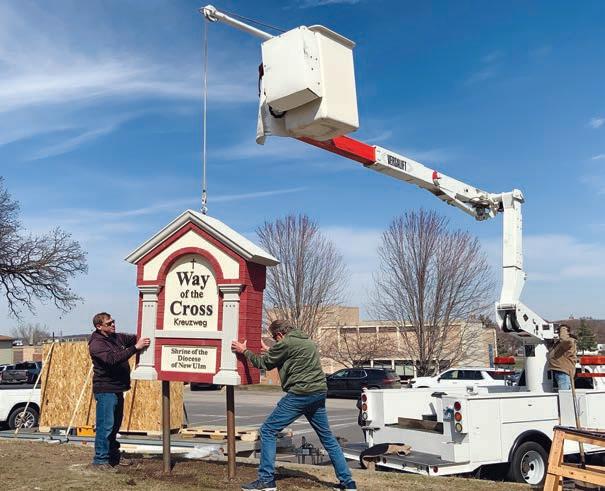
NEW ULM – The Way of the Cross, a shrine of the Diocese of New Ulm, has received a new sign to guide visitors. This update, funded by the local Knights of Columbus, private donations, and memorials, is part of ongoing upkeep, maintenance, and repairs led by the Way of the Cross Committee in collaboration with the Diocese of New Ulm.
“City of New Ulm Park & Recreation staff said many visitors to New Ulm did not see the smaller sign, so we decided to purchase a new, larger one,” said Way of the Cross Chairman Gary Neubauer.
Dating back to 1904, the Way of the Cross in New Ulm features 14 stations, each showcasing exquisite statues imported from Bavaria. This serene path gently winds upward for 700 feet towards a chapel dedicated to the Sorrowful Mother of Jesus. The tranquil setting offers a sacred refuge for prayer and reflection, standing as a powerful testament to the deep-rooted Catholic faith and rich German heritage of the New Ulm community. Pilgrims and visitors are invited to immerse themselves in the peaceful
The Way of the Cross shrine in New Ulm had new signage installed on March 31. Pictured, Chris DeLeo, left, and Gary Neubauer, who serves as the Chairman of the Way of the Cross Committee, assist in lowering the sign into place. In the background, Sid DeLeo is operating the crane. The German term Kreuzweg translates to “Stations of the Cross” or “crossroad” in English, referring to the series of events leading to the crucifixion of Christ, which are depicted in the 14 stations. (Photo by Christine Clancy)
atmosphere, contemplating the profound significance of each station along the way.
The site, located at 1500 5th North Street, behind the New Ulm Medical Center, is open daily with the chapel accessible from April to October. To learn more about
the history of the shrine which was added to the National Register of Historic Places in 2020, or to donate toward its upkeep and renovation efforts, visit the Diocese of New Ulm website, www.dnu.org/wayofthecross.
Historic win for Sleepy Eye Knights!
by Christine Clancy The Prairie Catholic
SLEEPY EYE – This year’s Minnesota State Basketball Tournament (March 11-14) was a historic moment for the Sleepy Eye St. Mary’s Catholic School girls’ basketball team. You could say the ball was truly in their court.
For the first time in school history, the Knights emerged as the State Class A Champions with a decisive 80-63 victory over Mountain Iron-Buhl. The championship game was held at Williams Arena and Maturi Pavilion on the University of Minnesota campus. The Knights, who finished the season with a record of 32-1, held a commanding 42-16 lead at halftime and were ahead by as many as 28 points during the game.
Head coach Bruce Woitas commented on the team’s performance, highlighting their
After their impressive victory at the MN State Girls’ Basketball Tournament in March, the Sleepy Eye St. Mary’s Knights received a special visit from Bishop Chad Zielinski, who came to the school to personally congratulate the team on becoming champions. Team members pictured, l-r, Natalie Fischer, Taylor Mathiowetz, Kylie Pelzel, Millie Lax, and Breanna Braulick.
strong defense in the first half.
“We’ve had many strong first halves all year, but in a state championship, we didn’t expect to have such a lead,” he stated in an interview with the New Ulm
Journal following the win. The team returned home to a warm celebration from supporters, commemorating their historic achievement.
(Photo by Christy Baker)
ROME - (EWTN/Vatican News)
On his return flight to Rome on April 23, following his 11-day apostolic journey to Africa, Pope Leo XIV spoke to journalists about his mission to proclaim the Gospel to all peoples, recalled child victims of the wars in Iran and Lebanon, condemned the death penalty, and insisted on respect for international law.
Asked about the chaotic state of negotiations aimed at ending the
conflict involving Iran, Israel, and the United States, the pope called for a new mindset rooted in peace rather than violence.
“Certainly, I would like to begin by saying that we need to promote a new attitude, a culture of peace,” he said.
“Many times when we evaluate certain situations, the immediate response is that we must enter with violence, with war, by
attacking, and we have seen that many innocent people have died.”
Leo said the key question was not simply whether a regime should change but how to defend important values without more innocent victims.
“Regime change or no regime change, the question is how to promote the values in which we believe without the death of so many innocent people,” he said.
Describing the situation as “very complex,” the pope said the backand-forth of negotiations had created “this chaotic and critical situation for the world economy,” while innocent people in Iran were suffering because of the war.
“Rather, I would encourage the continuation of dialogue for peace,” he said. “As Church, I say again, and as a pastor, I cannot be in favor of war, and I would like to encourage everyone to make every effort to seek responses that come from a culture of peace and not of hatred.”
Later in the exchange, responding to a question about reported
executions by the Iranian regime, the pope issued an unequivocal condemnation.
“I condemn all actions that are unjust, I condemn the taking of people’s lives. I condemn capital punishment,” Leo said.
“I believe that human life is to be respected, and that all people from conception to
said, in an apparent reference to natural death. The Holy Father continued: “their lives should be respected and protected. So when a regime, when a country, takes decisions which takes away the lives of other people unjustly, then obviously that is something that should be condemned.”
You can listen to Pope Leo’s inflight interview at ewtnvatican.
Bishop Chad W. Zielinski to ordain seminarian
Brent Garrett Sundve
to the Holy Order of the Diaconate for the Diocese of New Ulm
Saturday, May 16, 2026 11:00 AM Mass followed by a reception Church of St. Philip 821 E. 5th St. • Litch eld, MN 55355 Watch live: www.dnu.org/live-stream
Check out Real Presence Radio to listen to a recording of an on-air interview with Brent Sundve. https://share.miriamtech.com/RealPresenceRadio/episode/32571