May/Jun 2014
The Merchant’s Guide to Transactions, Cards & eCommerce
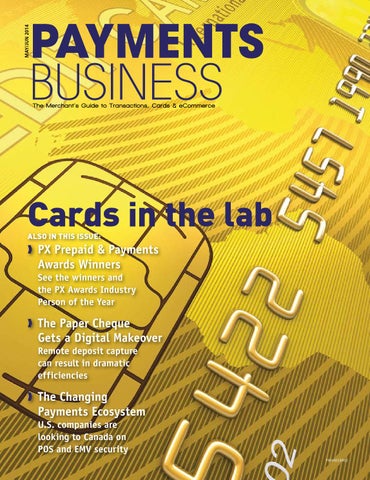
Cards in the lab also in this issue:
❱ PX Prepaid & Payments Awards Winners See the winners and the PX Awards Industry Person of the Year
❱ The Paper Cheque Gets a Digital Makeover Remote deposit capture can result in dramatic efficiencies
❱ The Changing Payments Ecosystem U.S. companies are looking to Canada on POS and EMV security
PM 4 0 0 5 0 8 0 3
Table of Contents
May/June 2014 Volume 5 Number 3 Editor Karen Treml karen@paymentsbusiness.ca Publisher Mark Henry mark@paymentsbusiness.ca
COLUMNS & DEPARTMENTS 6 News 32 Technology Update FEATURES
Contributors Catherine Johnston, Ray Wizbowski, Matthew G. Gniech, Richard Stoos, Thad Peterson, Steve Nogalo, Phil Hogg, Jason Oxman
8
Optimizing Your Card Program with Instant Issuance Several pain points faced by financial institutions and retailers can be directly addressed with instant issuance technology
Creative Direction Jennifer O’Neill jennifer@paymentsbusiness.ca Photographer Gary Tannyan Senior Account Managers Brent White brent@paymentsbusiness.ca
17
Return undeliverable Canadian addresses to: Circulation Department 302-137 Main Street North Markham ON L3P 1Y2 t: 905.201.6600 f: 905.201.6601 info@paymentsbusiness.ca www.paymentsbusiness.ca Subscriptions available for $40.00 year or $60.00 two years. 2014 Lloydmedia Inc. All rights reserved. The contents of this publication may not be reproduced by any means, in whole or in part, without the prior written consent of the publisher. Printed in Canada. Reprint permission requests to use materials published in Payments Business should be directed to the publisher. Made possible with the support of the Ontario Media Development Corporation
11
The Evolution of Physical Cards A look at functionality that allows us to change the way we use cards
16
Paving the Way to More Efficient Cheque Processing A look at how remote deposit capture eliminates costs of transportation, provides time savings, and reduces the costs of preparing deposits. May/June 2014
MAY 29TH | PANTA GES HOTEL | TORON TO
See the PX Prepaid & Payments Awards winners and meet Talbott Roche, PX Awards Industry Person of the Year
President Steve Lloyd steve@paymentsbusiness.ca
Publications Mail Agreement No. 40050803
2014
PX Prepaid & Payments Awards
Chantal Goudreau chantal@paymentsbusiness.ca
For subscription, circulation and change of address information, contact subscriptions@ paymentsbusiness.ca
34 Events 36 Association Spotlight
Media Sponsors
Media Partner
The Hunt Group
PX2014_8PInsert_PBMa
yJun2014_V2.indd
1
5/30/14 2:07:02 PM
25
28
26
30
Mobile imaging solutions are not only increasing in popularity for remote deposit capture (e-deposit), but also for mobile photo bill payment
A look at how remote deposit capture can result in dramatic efficiencies to the endto-end process
NFC Stickers – Enabling Nonintegrated Devices Vertical Market
Insider Report: The Evolution of Retail Payment The Paper Cheque Gets a Digital Makeover
PAYMENTSBUSINESS
3
Editor’s Desk
L
et me start by introducing myself. I recently joined Lloydmedia in the role of Editor, Financial Services Group — specifically Payment Business, Canadian Equipment Finance, Canadian Treasurer, and Financial Operations. My background is that of an editor and a writer and I’ve been wordsmithing for a very long time. It’s a good thing you’re only as old as you feel. Without a doubt, I am very excited about my role in these four magazines, as well as challenged — and that is a good thing as it is very motivating! While the learning curve is steep and largely one of baptism by fire, everything is coming together and is beginning to make some sense. In May, I had the opportunity of attending the CARTES America conference in Las Vegas, NV, which certainly helped me get a good grasp of the payments business space and gave me the opportunity to meet some people and develop a few contacts. June holds four additional conferences which I’m sure will assist in the baptism and will add not only information and knowledge, but also networking opportunities to get to know some of you. But enough about me! Let’s talk about the magazine. If you are looking for operational or cost savings, or to increase your product portfolio, our feature by Ray Wizbowski of the Datacard Group provides insight into these benefits and others that instant card issuance brings, while also providing increased card activation and customer retention. Our insider report talks about the evolution of retail payment, and Thad Peterson of the Aite Group takes a look at the alternative and emerging payments space from the perspective of the retailers. He touches on value proposition and on success through leveraging existing rails, along with other factors. And when Canada adopted EMV, who knew that one day U.S. companies would look to Canada for their compliance strategies? Phil Hogg at Pivotal Payments has delved into the U.S. situation on EMV and POS in our Technology Update. In our Pay Channel columns, Steve Nogalo at NCR discusses how cheques are getting a digital makeover that is introducing dramatic efficiencies to the end-to-end process. Similarly, Matthew Gniech of Cummins Allison points to how remote deposit capture eliminates costs such as transportation, while providing time savings and further cost savings that result in more efficient cheque processing. I hope you will enjoy this issue of Payments Business. As always, feedback is most welcome, as are editorial contributions. In closing, be sure to read our association spotlight on the ETA, the update by ACT Canada, and our events page so you’ll know who you should know and where you should be!
Until next time … Karen
Next issue… July/August — Payments at Point of Sale. The POS Issue – Insights, trends, and commentary from Canada’s top retailers and major independents
4
PAYMENTSBUSINESS
May/June 2014
MERCHANT-FRIENDLY PAYMENT SOLUTIONS Monetico, a result of the partnership between Desjardins Group and Crédit Mutuel-CIC Group.
NEWS
Datacard Group Introduces Card Validation Program Datacard Group has introduced a card validation program targeted to card manufacturers and suppliers that allows them to validate the compatibility of their EMV smart cards with Datacard® personalization solutions. Given the complexity and secure design of smart cards – including the data encryption element, personalization, and security keys – card manufacturers and suppliers need to ensure that their cards are working with personalization systems that are on the market today. With Datacard’s card validation program, card manufacturers and suppliers are able to receive verification that their smart cards work with Datacard hardware and software systems. If they are pre-validated, issuers will receive a discount on the pre-validated Chip Library for any issuers requiring those cards with EMV personalization. “Financial issuers who implement a new smart card program typically find that they have issues with the cards during the middle of the roll-out of their program,” says Jeff Davison, vice-president of global solutions and professional services for Datacard Group. “By then, they have already invested time and money into selecting the type of cards they want, as well as the personalization system and technologies that work within their budgets and/or needs. And, they do this without the proper validation that cards and personalization systems work well together.” Given the amount of investment it takes by financial organizations to implement a new smart card program, it is important for them to protect their investments. By partnering with card manufacturers to validate smart cards, Datacard Group will help resolve any issues prior to full production and mass roll-out of card programs. “As smart cards are sent through various systems to be personalized and issued, there could be problems with the personalization of the chip – ultimately resulting in slow down of operations and more costs associated with fixing the problem,” adds Davison. “With the launch of this program, financial organizations can feel more confident in their programs if the cards they are issuing have been fully verified by Datacard Group.” 6
PAYMENTSBUSINESS
eCommerce, POS, Targeted in Fraud Attacks Ecommerce and point-of-sale (POS) terminals were the primary target for fraudulent attacks on sensitive data in 2013, says a report by Trustwave, a provider of data and cybercrime protection solutions. Sensitive, confidential data was the top target in hacks, as well as credit card and debit card credentials. Data breaches sprang up as the security solutions provider’s researchers did 691 data breach investigations in 2013 – a 54 per cent increase over 2012, says the report, which analyzed breaches in 24 countries, including Canada and the U.S. Thirty-three per cent of the data breaches were based around POS terminals while eCommerce represented 54 per cent of the assets that hackers targeted. Retail represented 35 per cent of the investigations performed, making it the most targeted industry, followed by food and beverage at 18 per cent and hospitality at 11 per cent.
Mobile – An Increasingly Important Channel for Merchants When it comes to mobile adoption, the insurance and telecoms industries lag behind, says the annual Kount Mobile ‘Payments and Fraud Survey’. The survey indicates that these two industries are among the highestranked of those planning to add a mobile offering by the end of 2014. The study also shows that mobile is already an increasingly important channel for merchants, with 86 per cent of respondents saying they will have mobile capabilities in place by the end of 2014. Almost two thirds (63 per cent) already support mobile in some capacity and more than half (55 per cent) of merchants with annual revenues greater than US$50 million
currently offer a dedicated mobile website, while 66 per cent support a mobile app for online shopping. The data also shows that the sectors most actively supporting mobile at this time are mass merchants (91 per cent), gaming (82 per cent), and books/music/ video (76 per cent). On the other hand, sectors that are not currently as mobile friendly are insurance (50 per cent) and telecoms (63 per cent), with merchants surveyed in these sectors still only in the planning stages of developing support specific for mobile. Findings show that the most common obstacle cited by merchants embracing mobile was being able to ensure an easy transaction process for consumers. However, the survey results suggest that the mobile market is maturing, as concerns over the ease of transactions were down by almost eight per cent in 2013, while fraud and security concerns both showed similar shifts in the opposite direction. Overall, more than half (51 per cent) of merchants revealed that they viewed the fraud risk in the mobile channel as higher than standard eCommerce in a 20 per cent increase on the previous year. When it comes to mobile security, Don Bush, vice-president of marketing at Kount, says that the perception of risk can be greater due to the nature of certain products and service. Ease of payment is understandably a top concern, with merchants keen to avoid payments friction caused by slow payments processing and fraud prevention systems. In the digital age, customers want transactions to be instant and secure which requires a fast, reliable automated payment and fraud protection system.
May/June 2014
Feature
Optimizing Your Card Program with Instant Issuance Instant issuance directly addresses several pain points faced by financial institutions and retailers By Ray Wizbowski
8
PAYMENTSBUSINESS
An Established Opportunity There are new business challenges affecting financial organizations and retailers every day. These organizations face increasing security and risk requirements imposed by new regulations, pressures for new sources of revenue through
innovative offerings, and savvy customers that demand speed and convenience. The quest to acquire cardholders is one battle, but securing top-of-the-wallet position and driving card usage is yet another. Financial and retail organizations are constantly May/June 2014
being forced to re-evaluate their current business methods to improve security, increase efficiencies, deliver satisfying customer-service levels, and provide differentiating innovations in their card offerings.
Feature
How Instant Issuance Can Help The traditional model for centralized credit and debit card issuance is well established. Larger issuers tend to build efficient, high-volume operations and distribute cards through the mail after consumers have successfully completed application processes for new or replacement cards. Small issuers tend to outsource their programs to high-volume service bureaus and follow the same general ‘centralized’ process. From end-to-end, the process of personalizing and mailing cards, assigning PINs and activating cards typically takes up to twelve days. In recent years, however, there has been an emerging trend towards instantly issuing and personalizing payment cards at the branch or retail location, complementing the traditional central issuance distribution model. With instant issuance, consumers walk into the bank branch or retail store and provide application information to a staff member. That information is entered into their existing software and once the customer has been programmatically approved, a software program then drives the card personalization process to produce that card instantly. In addition, there are different print/personalization options that include embossed and unembossed personalization, as well as smart card capabilities with contact and contactless technology.
The Benefits of Instant Issuance The benefits of instant issuance directly address several pain
points faced by financial institutions and retailers. These challenges include retaining and attracting customers, building new and stronger relationships, launching new programs quickly and costeffectively, increasing portfolio performance, and ensuring secure issuance. In particular, instant issuance enables: • Positive Customer Experience: Consumers drive our business. Today, many want immediate purchasing power, immediate card replacement, personalization and form factor options, and convenient and secure issuance. With instant issuance, because customers can securely receive their cards immediately and can use them right away, it increases customer service levels due to the convenience it provides. • Emergency Card Replacement: Emergency card replacement (ECR) costs for centrally issued cards often include expensive mailing or courier charges. Financial institutions typically absorb these charges rather than passing them on to consumers. Instant issuance eliminates ECR shipping costs. These cost savings can be extraordinary in the wake of a large-scale data breach of a major retailer for example. • Operational and Cost savings: Instant issuance eliminates many of the traditional costs associated with card programs. Cards delivered instantly require May/June 2014
no mail packages, postage, or mail handling. Also, card pre-printing and inventory costs are greatly decreased. Desktop printing technologies allow banks and retailers to use blanks or simply preprint card stock to issue multiple card types. Card design elements that were once part of the long and expensive preprinting process can now be managed on demand. In addition, there is a reduced cost-per-card for small batch runs/ECRs and lower fulfillment costs (no PIN mailer). • Increase Portfolio Profitability: Instant issuance enables financial organizations to increase activation and usage by giving consumers immediate purchasing power. It is known to help attract new customers, improve activation rates, and grow transaction volumes by gaining loyalty through ‘top-of-wallet’ usage. In addition, because the instant issuance process is conducted in-person, service representatives have new opportunities to strengthen personal relationships with customers and cross-sell additional products and services. • Product Versatility. Instant issuance models accommodate multiple payment schemes. They provide complete personalization at the branch location that includes full name, expiry date, CVC code, graphics, custom photos, embossed
or unembossed options, and/or smart card or mobile payment personalization capabilities. • PIN Selection. A global consulting firm recently revealed results from a study that indicates cards are likely not to be activated or used if there is any PIN confusion on the part of the cardholder. Instant issuance allows cardholders to determine their own PINs and select them as they receive their cards. This results in higher activation rates and increased card usage. • Reporting and Management Tools. Instant issuance software typically includes a variety of custom and standard reporting tools that provide issuers with strategic insights into their card programs. In addition to providing complete audit trail information, these reports allow senior leaders to view important consumer trends and behaviors.
Secure and Scalable Infrastructures The central and instant issuance processes share many elements, including security protocols. This allows issuers who already have central issuance infrastructures in place to simply expand and add instant issuance at the branch or store level. There is typically little or no special training required for IT staff or customer service representatives. In most deployments, approval is virtually instant. Consumers typically choose a PAYMENTSBUSINESS
9
Feature
card design, which can include personal photos, co-branded logos, and other meaningful elements. Ready-to-use, fully activated cards are printed instantly and handed directly to the consumer. Information is retained in the system in
the event replacement cards are needed. Consumers are immediately able to use their permanent cards to make purchases or withdraw cash from ATMs. The flexibility of instant issuance infrastructure – or
hybrid issuance models – allows for fast, affordable, and secure issuance of a wide variety of card types, including debit, credit, prepaid, ATM, and gift cards. A variety of issuance technologies allow for embossed or flat
Finding The Right Partner
Each Click is a Residual Payment.
When considering an instant issuance system, it is important for financial institutions to consider all of their particular needs, as well as if the solutions will integrate easily into their existing backend systems. They should look for an enterprise-type system with single-server control for multiple desktops and seamless connection to host networks. The solution should be easy to implement at the branch level, while offering robust reporting, monitoring, and security tools for the management team. Ray Wizbowski is vice-president, financial vertical marketing for Datacard Group. For more than 15 years, Ray has been helping shape and promote companies that specialize in security and payment innovation. Currently he leads Datacard Group’s global financial vertical marketing. Prior to Datacard, he was the vice-president of strategic marketing for Gemalto’s Security Business unit helping drive the convergence of security controls with online transactions. Prior to Gemalto, Ray was the vice-president and general manager of ForeScout technologies – a leading pioneer of network access control technology as well as holding senior business development and marketing positions at MetiLinx, Positio Investor, and Public Relations and Action Foundation.
Authorize.Net has paid out more residual payments than any other payment gateway. Contact us to learn why. Call 1.866.437.0491 or visit www.authorize.net
©2013, CyberSource. All Rights Reserved.
10
PAYMENTSBUSINESS
(unembossed) cards and smart cards. Advanced instant issuance infrastructures also allow issuers to enter the mobile payment era. NFCenabled microSD cards can be personalized instantly with the same infrastructure. This allows banks/retailers to turn customer smartphones into mobile payment devices.
May/June 2014
Feature
The Evolution of Physical Cards There are two things we can all count on – technological advances will need good business cases to move them into the mainstream; and cards will be with us for a long time By Catherine Johnston
I
’ll leave it to the card manufacturers to tell you about all the latest advancements in the technology while we look at functionality that allows us to change the way we use cards. But first, let’s deal with the myth that cards are going to be replaced by mobile phones in the near future. There is no question that mobile is already a viable way to make payments, compare products and prices, and even order goods. Both functionality and popularity will increase as smart phones become ‘smarter’ and prices for phones and services decrease. But, that doesn’t mean that cards will go away anytime soon. History tells us that it takes a very long time for incumbent technologies to be replaced, which explains why credit and debit cards did not totally replace cash. Each new technology has to offer significantly more functionality than the old one if it is going to eliminate it. After approximately 70 years, we are finally seeing credit and debit cards, as well as mobile phone apps, replace cheques as companies and governments now see less advantage to using them. Will it take 70 more years to replace cards? No one knows, but we do know what changes would extend the lifetime of cards.
The Promise of MultiApplication Cards Twenty-five years ago, we said that there would be three stages to the card market. The first was that the card issuer would own the card and it would have one application (app). The second stage would be when the card would carry two or more applications, and the third would be when the consumer chose, bought, and owned the card. They would also choose and download their own applications and take responsibility for backups and some levels of security. You’ll recognize that third stage as what we do today with our computers and smart phones. Cards took a very long time to reach stage two. It was almost always technically possible to put multiple applications on a card, but it didn’t make sense to ask customers to bring their cards back so that the new apps could be loaded, nor did it make sense to pay to re-issue the cards in order to add apps. What was needed was a way for the customer to download the application to their own card. Today it is possible for a consumer to choose an application and download it to their card via a smart phone, depending on the card’s operating system. May/June 2014
Mobile phones gave us both stages two and three, so why is it important that cards can now deliver stage two?
Bridging the Gap To start with, hundreds of millions of cards sit in wallets across Canada. Issuers will want to leverage their card investments, both to reduce costs and offer customers applications that go beyond payment in order to bind the customer to them. Organizations, such as universities, are seeking means to offer one card that validates the holder as a student of the institution, provides access to authorized locations, facilitates student purchases of various kinds, and allows students to travel on public transit. There are many other logical pairings. Think about the cards in your wallets and PAYMENTSBUSINESS
11
Feature
you’ll come up with many combinations. Many retailers will want to issue their own loyalty cards and leverage their POS equipment, but today that may be an issue. Terminals need to be able to accept third party
applications, so merchants need to consider that when next upgrading. Consumers want fewer cards in their wallets but also want loyalty points. Multi-app cards could work for both the retailer and the consumer.
But isn’t mobile the answer? It will take time until consumers can choose any app, for any phone, regardless of the issuer or Mobile Network Operator, so multiapplication cards could bridge the gap until then, providing
value for many stakeholders.
The Rest of the Wallet In addition to credit, debit, and loyalty cards, our wallets carry a lot of other documents. You likely have your driver’s licence, health card, insurance papers, and plate permits. If you travel a lot, you may be carrying a Nexus pass. We are already seeing insurance companies offer mobile apps to replace paper certificates, but it is more difficult for governments to follow that path. Although some citizens might choose apps over paper, not all citizens have smart phones, so governments would have to support both – at a cost to taxpayers. A surcharge for mobile apps could be an option, but governments would want to know how many people would sign up for a paid service before investing in the development of each app. Some government programs, such as Nexus or passports, are high security and it will take time to determine what security is required if a mobile app were to be a choice. Then there are issues of liability that need to be worked through by government lawyers. All of this takes time, so cards remain a reality and multi-application cards become an attractive idea.
Who is working on MultiApp in Canada? Seventeen of ACT Canada’s members, including financial institutions, payment networks, lawyers, universities, suppliers, and Presto Transit are working together to define
Continued on page 34
12
PAYMENTSBUSINESS
May/June 2014
Reach marketers & financial executives Our magazines are must-reads for key executives in core corporate competencies.
Can you help our readers: • Create a strong financial structure and healthy economic ecosystem to ensure capital and cash flow keep their engines running? • Determine who their customers should be, how they can reach them most effectively, and how they can turn data-driven marketing into profitable sales? • Build efficient and effective financial systems to enhance payments and billings between their companies and their customers and vendors? • Convert all the data and information they collect from every contact point into tangible benefits that increase revenue and reduce costs? • Equip their companies with the tools, technology, systems and hardware needed to manage their operations, to create new services or products, and deliver them to their market? • Manage their customers with smoothly functioning support departments that are properly staffed and equipped to solve problems, foster loyalty and retain customers? • Make any or every step in that chain better, faster, cheaper, and more profitable?
We can help you tap into the ecosystem at the points that will drive your campaigns. To advertise or get more information and media kits:
905-201-6600 | 1-800-668-1838 | 302-137 Main Street North, Markham ON L3P 1Y2 Visit our websites:
Direct Marketing magazine, www.dmn.ca Contact Management magazine, www.contactmanagement.ca Payments Business magazine, www.paymentsbusiness.ca
Canadian Treasurer magazine, www.canadiantreasurer.com Canadian Equipment Finance magazine, www.canadianequipmentfinance.com Financial Operations magazine, www.financialoperations.ca.
Securing Mobile Life.
Creating Confidence. Giesecke & Devrient offers a comprehensive range of payment products and solutions based on the latest EMV, contactless and dual interface technologies. Our smart debit, credit and prepaid products are available on a wide range of platforms based on secure and highly flexible operating systems. Alongside the comprehensive portfolio of easily configurable card products and card solutions, we offer all services related to electronic payments including m-commerce and transit. Our services include personalization, system integration, project management and technical consulting from a single source. For more information, please visit: www.gi-de.com/ca
See G&D at Cardware 2014 June 17th & 18th, Niagara Falls, ON Exchange Place Booth #18
Pay Channel
Paving the Way to More Efficient Cheque Processing Remote deposit capture eliminates costs of transportation, provides time savings, and reduces costs for preparing deposits. By Matthew G. Gniech
A
lthough emerging payment forms, such as digital wallets and electronic person-to-person payments are rapidly growing in popularity, the paper cheque still remains a viable payment option for many Canadians. And while cheque volumes may be declining, the total value of cheque payments still remains high. In fact, ‘Examining Canadian Payment Methods and Trends’, an October 2012 study by the Canadian Payments Association, revealed that cheques and paper payments constitute 40 per cent of the total value of retail payments. Ease-of-use, availability, and willingness of merchants to accept cheques are all contributing factors to their continued use. As financial institutions, retailers, and other businesses work toward improving payments processing efficiency, they must keep a careful eye on technology advances that ensure that the handling and processing of cheques does not add an unnecessary burden to their operations. To that end, electronic cheque imaging is an excellent method of improving operational efficiencies while reducing risk 16
PAYMENTSBUSINESS
and the time it takes to process deposits.
Embracing Branch Capture and RDC The desire to reduce fixed costs, coupled with mandates from the Canadian Payments Association (CPA) to increase efficiency in payments processing, are driving financial institutions to explore a branch capture model for the processing and handling of paper cheques. This makes sense for two reasons – it significantly reduces institutional costs and it increases branch automation. For merchants and other businesses that accept cheques as a form of payment, remote deposit capture (RDC) is still an up-and-coming concept. Those organizations that have embraced RDC are already starting to reap the benefits, such as eliminating transportation, time savings, and reduced costs for preparing deposits, which allows for more time to be focused on their core operations. Electronic imaging allows these businesses to automate cheque processing, thereby eliminating timeconsuming and tedious manual processes, as well as errors.
Additionally, deposits can be prepared and delivered to the organization’s financial institutions faster and more accurately.
Selecting the Right Equipment While the benefits of branch capture and RDC are clear, they can be lost if the right equipment is not deployed. Selecting advanced cheque scanners that are feature rich, as well as hard-wearing and backed by excellent service, is critical. These highly capable scanners enable financial institutions to process deposits right at the teller line or at the back counter, reducing exception processing, errors, and adjustments. A cheque scanner that is future-ready and offers multiple capabilities beyond basic scanning, ensures a better return on investment. For example, today’s advanced cheque scanners are not only equipped with standard options like physical endorsing and franking, but can also be used for ID scanning and magnetic stripe reading. In light of the decline of cheque volumes, the ability to utilize scanners for additional branch or business needs May/June 2014
protects against equipment obsolescence.
Streamline Paper-Based Payment Processing Although cheque usage is on the decline, paper-based payments will not be phased out in the near future. Any organization – from financial institutions to merchants – that accept and process cheques must carefully implement strategies that make the processing and handling of paper cheques as streamlined as possible. Cheque imaging is an excellent method of improving operational efficiencies while reducing the time it takes to process deposits. For this reason, selecting the right cheque scanning equipment that can meet these needs, as well as future demands, is critical. Matthew G. Gniech is product manager, cheque solutions at Cummins Allison. With more than 25 years of experience in the financial institutions industry, Matthew is an expert in all facets of distributed capture image processing, branch, and treasury service operations. Matthew has partnered with many leading banks, processors, and clearing networks to enhance operations, product offerings, and increase the adoption of image clearing throughout various organizations. He is a current participating member of ECCHO, and previous member of The Clearing House and NCHA.
2014 MAY 29TH | PANTAGES HOTEL | TORONTO
Media Partner Media Sponsors
The Hunt Group
2014
Dear Colleagues and Friends, On behalf of the PX Community, it is my absolute pleasure to welcome you to the 3rd Annual PX Prepaid & Payments Awards. We are delighted to bring everyone together to honour and celebrate remarkable achievements, teamwork, collaboration, innovation, and best of class execution in everything payments, in Canada. Besides, can you think of a better reason to feel special than by dressing up in our elegant attire, rubbing shoulders with our peers, friends, and partners from our community, who are all at the top of their game, at an event that by nature is intended to recognize the achievements of the many, not just the award winning few?
Dave Hunt Chairman, Payments eXchange
Community achievement makes us all proud and we should all be proud of the work that we have done. Congratulations to all of you, particularly to those who shared their excellent work with the awards judges this year. Thank you to this year’s awards judges, who with the utmost of professionalism and integrity reviewed and scored all PX Awards submissions. To our sponsors and regular PX supporters, we thank you for your continued support, guidance, and leadership, without whom the community has no pulse. To our internal teams at PX, THG, and our Advisory Board Member support group – my heart felt love and admiration to you all!
President, TheHuntGroup
This year we are also are very pleased to introduce the Canadian Payments Hall of Fame, where we intend to recognize a select group of visionaries, leaders, and role models who have played a significant role in the conceptualization, development, and execution of payments offerings. Tremendous effort, love, and passion are poured into everything that we do at PX for and on behalf of the PX Community, so please enjoy every moment and let’s make it a habit to celebrate all of our efforts today and throughout the year.
Greg Gresh
David Hunter
CEO of ZNAP North America
Chief Executive of Ukash
Steven Kane
Prof. Dan Horne PHD
Group President, Gift Sales & Business Development Spafinder Wellness Inc.
Co-Founder and CKO of Global Prepaid Exchange & Research Professor, Providence College
Brian Dunne MBA | FCMA | FHCIMA
J.D. (Jacqueline) Shinfield Partner, Blake, Cassels & Graydon LLP
Managing Director, SVM Europe Ltd President, IMA Europe
We would like to thank and congratulate our judges for their great performance in analyzing this year’s submissions to determine the winners. Their professionalism and integrity is greatly appreciated and respected. We offer our congratulations and sincere thanks.
To see full bios of our judges, go to PaymentseXchange.ca/Awards
2014 Best Consumer-Funded Prepaid or Payments Program TimmyMe™ Mobile App The TimmyMe™ mobile app provides guests with a secure, convenient, and easy way to pay for any purchase at Tim Hortons by registering a Tim Card® on their mobile app and using the app’s scan-to-pay barcode or tap-to-pay NFC technology to complete their order. The app can be downloaded on the Android, iPhone, and Blackberry 10 smartphone devices. First Data delivers tap and scan payments through its mobile gateway technology. First Data makes it possible for registered Tim Card users to securely make mobile payments and view their Tim Card balance and transaction history. Using the TimmyMe™ Mobile App offers busy guests a convenient, easy, and secure way to pay for purchases at Tims and quickly be on their way. Guests looking for the fastest and easiest way to pay are encouraged to download the TimmyMe™ app.
RUNNER UP
Fairmont Hotels and Resorts Online Gift Card Program
Best Corporate or Government-Funded Prepaid or Payments Program Alberta Emergency Relief, InteliSpend Prepaid Solutions When catastrophic floods submerged a large portion of southern Alberta last summer, thousands of Canadians (including many First Nations people) suddenly found themselves homeless and in need of financial assistance. The resulting Alberta Emergency Relief Program was never a planned business initiative, but came instead out of last-minute team effort between InteliSpend and the Government of Alberta. When no other provider was able to meet the emergency timeline necessitated by such a disaster, InteliSpend proudly stepped in to deliver prepaid cards to flood victims within 48 hours. InteliSpend customer support representation was sent directly to a disaster response hub, where a successful partnership was established with the Government of Alberta’s own representatives to distribute two different denominations of prepaid cards to displaced populations in need of aid. Additionally, InteliSpend provided two custom Tip Sheets to educate government officials and card recipients, as well as a situation-specific area of the company website with valuable resources. One of InteliSpend’s key differentiators has always been gold standard customer service, and great pride was taken in helping get a much-needed currency solution into the hands of displaced Albertans as fast as possible.
RUNNER UP Great-West Life Health SolutionsPlus Visa® Payment Card Program For full Runner Up details, please go to PaymentseXchange.ca/Awards
2014 Best Prepaid or Payments Marketing Campaign Esso Fuel Savings for the Ultimate Hockey Fan, Exchange Solutions The Esso Fuel Savings for the Ultimate Hockey Fan campaign leveraged a strategic partnership between the Canadian NHL and ESSO whereby hockey-style foil packs were distributed, free of charge, to hockey fans across seven NHL arenas throughout Canada. These kits included an Esso Price Privileges fuel rewards card and an Esso Extra loyalty card. In keeping with the hockey theme, the look and feel of the promotional kits that were distributed was reminiscent of collector hockey cards, thus capitalizing on the fandom, engagement, and emotional affinity of the target audience. The purpose of the campaign was to generate awareness and educate the target audience, generate incremental fuel sales, and acquire new loyalty program members. Fuel companies sell an extremely commoditized and largely undifferentiated product to a consumer base that often makes its purchase decision based on price and price sensitivities. The campaign exemplified how the Price Privileges card, which offered recipients gas savings with cents off per litre, is a point of differentiation from competitors, and the Esso Extra loyalty card helped to increase Esso’s brand awareness and awareness about its affiliation with and sponsorship of Canada’s NHL teams. The in-game promotion generated enthusiasm and active participation from fans. Social media feedback indicates positive reaction and engagement to both the reward value and the card creative. One hundred per cent of consumers targeted for kit distribution were reached, and early indicators suggest redemption in excess of 65 per cent. At time of award submission, increased enrolment of new members into the Esso Extra Loyalty program was between five per cent and 10 per cent.
RUNNER UP
The Gift of Possibilities
Best Virtual or Mobile Program Mobile Payments and Rewards – PayWith, Carta International PayWith Worldwide Inc. (PayWith) provides merchants with a simple solution for transacting mobile payments, running rewards and marketing programs, and selling custom branded gift cards without any new hardware or software required. PayWith is focused on merchant profitability and quantifiable marketing exposure. At the core of the PayWith technology is a ‘Pay Per Result’ marketing system that tracks the return on investment of every promotion initiated by merchants. Consumers save money and earn rewards every time they pay with their smartphones and merchants receive relevant customer data and analytics that help drive more customers to spending more money, more often. PayWith’s mission is to make Canada the world leader in mobile payment adoption. This means getting businesses and consumers excited about using smartphones to transact. The benefits to businesses include lowering their transaction costs, removing the need for new hardware, software, or training, and creating tools to help them increase sales and communicate more effectively with their customers. For consumers, PayWith combines personalized rewards and communications with a secure and convenient way to pay with their smartphones.
RUNNER UP
Cash Alternative Payment Method
For full Runner Up details, please go to PaymentseXchange.ca/Awards
2014 Best Prepaid & Payments Innovation The Dell Advantage ePromotional Card The Dell Advantage ePromotional card is phase one of a long-term strategy of rewarding Dell customers with integrated virtual and plastic reward cards. The initial ePromotional card was launched to generate incremental purchase, increased loyalty, site visit frequency, and spend amongst Dell Advantage members (their most active Canadian customers), by providing them with a Dell virtual ePromotional card with a value of five per cent of qualifying purchases. After extensive research, Dell approved the Dell ePromotional card, a Restricted Authorization Network (RAN) product running on the MasterCard® rails, which is redeemable only at Dell.ca. This solution best suited Dell’s needs from an operational, system legacy, order processing, and settlement perspective. The Dell ePromotional card solution is available in virtual and physical card form factor to manage customer preferences. 1. Following a qualified purchase by a Dell Advantage customer, a personalized eMail is sent confirming they will be receiving the specified dollar amount on a Dell Advantage ePromotional card. 2. A 30-day processing period allows for adjustments, cancellations, and/or returns to be made to the original purchase. Immediately following this period, they receive another eMail containing a link which connects them to a secure, Dellcustomized webpage. 3.The customer must authenticate themselves before the virtual card is presented to them. A ‘Shop Now’ link drives them to Dell.ca to encourage immediate redemption. The program has been a huge success, with customer Growth Trend of 45 percent, whereas a typical Dell program launch is 27 percent. The Dell ePromotional card has driven an impressive 50 percent repurchase rate.
RUNNER UP Host Card Emulation (HCE) with Remote Secure Element (RSE) for NFC
Best Mobile Payments Application (Wallet, App, Feature, or Service) TimmyMe™ Mobile App The TimmyMe™ mobile app provides guests with a secure, convenient, and easy way to pay for any purchase at Tim Hortons by registering a Tim Card® on their mobile app and using the app’s scan-to-pay barcode or tap-to-pay NFC technology to complete their order. The app can be downloaded on the Android, iPhone, and Blackberry 10 smartphone devices. First Data delivers tap and scan payments through its mobile gateway technology. First Data makes it possible for registered Tim Card users to securely make mobile payments and view their Tim Card balance and transaction history. Using the TimmyMe™ Mobile App offers busy guests a convenient, easy, and secure way to pay for purchases at Tims and quickly be on their way. Guests looking for the fastest and easiest way to pay are encouraged to download the TimmyMe™ app on their mobile device and register a Tim Card to establish a payment balance in their personal account.
RUNNER UP
The Dell Advantage ePromotional Card
RUNNER UP
365 Mobile Redemption App
2014 Leading Prepaid or Payments Organization Peoples Card Services - Peoples Trust Peoples Card Services is the leading issuer of Visa® and MasterCard® prepaid payment cards in Canada. It also provides acquiring services allowing the organization to position itself as a ‘one stop solution’ for merchants in Canada. PCS was launched in 2004 and is a pioneer of prepaid and payment products in Canada. It was created to meet the increasing demands of prepaid payment products for businesses and consumers alike. Its success is built on a reputation of intimately knowing each client’s unique business need and crafting a plan to provide unmatched system reliability and ease of administration to run each program. Its strategic partnerships with the industry’s leading program managers ensure PCS will continue as the market leader in prepaid products. Whether through prepaid Visa® or MasterCard® cards, including marquee retail, payroll, travel, incentive, and reward cards, the company remains at the forefront of card technology, delivering cutting-edge payment tools and platforms to help its clients achieve greater integration, efficiency, and control. The total commitment and investment PCS has made in its program managers and partners is what truly sets it apart. PCS believes that opportunities are everywhere. As an organization, it seeks opportunities to develop new products, new partnerships, and incorporate new technologies. It is ever mindful of its responsibilities to its communities. PCS is not afraid to be different.
RUNNER UP
Buyatab Online eGift Cards
For full Runner Up details, please go to PaymentseXchange.ca/Awards
INDUSTRY PERSON OF THE YEAR Talbott Roche, Blackhawk Network Talbott Roche has been instrumental in Blackhawk becoming the market leader in prepaid product innovation, marketing, and merchandising. Since the company’s inception, she has been a key driver for some of the company’s most successful and innovative product offerings. When discussing Roche’s influence, it’s imperative to discuss the much wider influence of her work at Blackhawk Network. While she has led the company to success, this success has been the rising tide that has lifted all boats. The ground-breaking products and services she has spearheaded have grown not only Blackhawk Network, but also partners’ businesses and the prepaid category overall.
President
In addition to expanding Blackhawk Network’s product line to capitalize on the full spectrum of prepaid products, she has also helped to greatly expand the list of brands offered, as well as locations where products can be purchased. Roche has driven expansion across digital and mobile channels, bringing Blackhawk Network’s award-winning Gift Card Mall online, partnering with large etailer sites, and establishing GoWallet for online and mobile card management. But perhaps the most significant development for Roche and Blackhawk Network was the company’s successful IPO in April 2013, which brought the company to the NASDAQ with the symbol ‘HAWK’.
Payments eXchange Introducing the Canadian Payments Hall of Fame The Canadian Payments Hall of Fame has been created to recognize a select group of visionaries, leaders, innovators, role models, and luminaries who have made significant contributions to the development and advancement of the payments community both in Canada and internationally. Individuals who have played a significant role in the conceptualization, development, and execution of payments, offerings are considered for induction. In addition to those who have been more visible, the Canadian Payments Hall of Fame seeks nominees who have made crucial, behind-the-scenes contributions, including concept and vision. Initial inductees into the Canadian Payments Hall of Fame are past winners of the
PX Awards INDUSTRY PERSON OF THE YEAR - PREPAID AND OR PAYMENTS:
2012
2013
2014
Frank Monaco
Jeffrey Smith
Talbott Roche
Executive VP, GM International
President & CEO
President
The Canadian Payments Hall of Fame Advisory Board and a select group of past inductees are responsible for the final selection of inductees. Canadian Payments Hall of Fame Nominees are reviewed and screened to ensure they meet the nomination criteria and eligibility.
Why you should Connect with the PX Community
Payments eXchange
Whether from the gift or prepaid card, mobile or payments sectors, PX members are CONNECTED to the PX Community.
CONNECT with subject matter experts to share, learn & collaborate CONNECT with innovators and thought-leaders to develop the roadmap for Payments in Canada CONNECT with your peers, partners & mentors at our PXconnect networking evenings CONNECT with exclusive research, data & intelligence from Canada & around the world CONNECT with member-only website content & exclusive benefits, throughout the year Become a member: Go to PaymentseXchange.ca/Membership to get connected now.
2014 Congratulations to this year’s Winners & Runners Up - and to the entire PX Community for another outstanding year!
Join Us At Our Upcoming PX Events:
PXconnect Summer Mixer Join us on the patio for our PXconnect Summer Mixer at the fantastic Oliver & Bonacini Café Grill! PX events occur on the last Wednesday of alternate months, so save the dates now for September 24th and November 26th, 2014. Go to PaymentseXchange.ca/Events for full details and to Register.
Wednesday, August 27th, 2014 Oliver & Bonacini Café Grill Patio 33 Yonge Street, Toronto, ON (Yonge and Front)
Payments eXchange
Contact us for hosting, sponsorship and speaking opportunities at Events@PaymentseXchange.ca.
Segment Update
NFC Stickers — Enabling Non-integrated Devices By Richard Stooss
G
lobally, a large number of pilot projects for mobile phone based NFC payment systems are currently being implemented. Whether or not integrated NFC use in smartphones will meet the same safety standards as payments by conventional credit and debit cards remains to be seen. However, security and consumer confidence are essential for the success of payment applications. Despite that many mobile phones are not NFC capable, there are solutions available — NFC stickers — which when affixed to the phone combine the advantages of a contactless credit card with those of paying by means of an NFC mobile phone.
The Benefits Unlike software-supported NFC applications, NFC stickers do not require the download of an app or the set-up of ‘virtual’ credit cards. And even when the mobile phone battery is ‘dead’, the NFC sticker remains functional. As an offline solution, NFC stickers provide security as they are not exposed to malware or hacking risks. Conversely, integrated mobile wallet solutions require a secure element to ensure the security of the application. Various technical solutions are being used for this purpose but their compatibility has yet to be evaluated in the field. Full integration with the
mobile phone is one of the available options, the other is to integrate the secure element into the SIM or Micro SD card and use the phone’s antenna. This, however, raises the question of who is responsible for security – the telecommunications company, the mobile phone manufacturer, the bank, or the credit card company? NFC stickers can be customized to feature the issuing company’s corporate design or logo. This also serves to keep customers aware of the provider. The specialty label provides a ‘one-size-fits-all’ solution that consumers can use immediately, regardless of their type of mobile phone, provider agreement, or other variables. With the implementation of a sticker, the lack of NFC-enabled phones can quickly and cost effectively be circumvented. This allows for the generation of a critical mass of users in order to lay the foundation for future architectures of integrated NFC systems and creates an opportunity today for providers to secure market share in important future markets and gradually steer consumers toward mobile payments.
the sticker is applied to the phone itself, NFC payment is possible with any mobile phone. In terms of cost to the user, these stickers use established architectures of existing payment systems and do not require an internet connection, so there are no hidden charges for web use or roaming. Customer acceptance is key when it comes to the distribution of future market share, and convenience, security, and universal usability play a crucial role in this. Aside
from the payment function, NFC stickers can also cover other areas such as customer loyalty programs, access authorizations, and proof of identity or age. Richard Stooss is senior business development manager with Schreiner PrinTrust, a business unit of Schreiner Group GmbH & Co. KG, based in Oberschleissheim, Germany. The company develops specific label and card solutions for service organizations and companies. It’s portfolio is focused on customized self-adhesion products and services for PIN protection, NFC stickers for contactless payment systems, and RFID and security technology based access control using vignettes, stickers, and passes.
User Experience For consumers, NFC stickers are convenient and easy to use. Because May/June 2014
PAYMENTSBUSINESS
25
Vertical Market
Mobile Imaging Solutions Help Consumers Pay Bills Early adopters of mobile photo bill payment technology have seen increases in customer retention and stickiness By Karen Treml
M
obile devices are gaining a strong foothold in the payments space and mobile imaging solutions are not only increasing in popularity for remote deposit capture (e-deposit), but also for mobile photo bill payment. With mobile imaging software solutions, banking and credit union customers are able to pay bills with their smartphones and tablets. Mobile imaging technology provides a new way to pay bills and eliminates the need for manual data entry, a checkbook, or even a computer, says Scott Carter, CMO at Mitek Systems, a mobile imaging software solutions provider. According to a recent study by FiServ, a global provider of financial services technology, the number of households using mobile bill payments doubled in the last year. Sixteen million U.S. households paid a bill using an app, text, or mobile browser in 2013, up from eight million in 2012.
Seamless Integration Mitek’s ‘Mobile Photo Bill Pay’ easily integrates into a bank or credit union’s existing bill 26
PAYMENTSBUSINESS
pay application and enables a bank customer or credit union member to easily and securely pay a bill using the camera on their mobile device, says Carter. “After a customer takes a picture of a bill, Mitek’s technology automatically extracts relevant data from the paper bill and auto-populates the fields required to make a mobile payment.” Alex Carriles, director of self-service channels at BBVA Compass, whose mobile pay service utilizes the Mitek platform, says its ‘Picture Bill Pay’ is intended to make paying bills easier, faster, and a little more fun. “By simply taking a picture of a bill pay coupon, payee details – including name, address, and amount of payment – are entered directly to the bill pay feature in our mobile app, eliminating the need to type all of the information on a smartphone keyboard.” One of the biggest advantages of ‘Picture Bill Pay’ is that you can quickly and accurately add new payees and make payments to each without having to manually enter all the required information. This feature can be extremely May/June 2014
valuable to those who are moving accounts from one bank to another and, as a result, are having to reenter details for a large number of payees. Instead of having to sit down at a computer and retype all details, bank customers just have to take pictures of their bills and all the data is automatically read. All they have to do is review and confirm the uploaded data,” says Carriles. From an operational perspective, there is no added security risk with this process as it simply performs an optical character recognition (OCR) of information included in a bill and uploads that data for customers. The user is still responsible for reviewing and/or correcting any misread information before saving the data.
Vertical Market
Increased Customer Retention Following the launch of its ‘Mobile Photo Bill Pay’, Mitek has seen adoption by over 20 financial institutions, BBVA Compass, U.S. Bank, and most recently, a top 30 U.S. bank. Early adopters have seen increases in customer retention and ‘stickiness,’ says Carter, who adds that Allied Payments Network, for example, reports a 10 per cent increase in customer retention. In addition, some banks and credit unions have opted to utilize the service in order to generate additional fee income, in this case for expedited payments. Consumers enjoy the convenience of avoiding data entry on a tiny device or
having to deal with stamps and envelopes. For those many millions of consumers who still receive paper statements, this is a perfect ‘bridge’ technology to ease the transition from physical to digital channels, he says. BBVA says uptake of the mobile photo bill pay option by consumers is growing. “We’ve found that customers generally like the service and are increasingly using it. We get a great deal of feedback from customers who use the service regularly.
Enhancing User Experience With respect to evolution of the app, BBVA says it often shares customers’ suggestions for improvement with Mitek
May/June 2014
in an effort to enhance user experiences. For example, sometimes customers do not take the picture correctly. Knowing this, BBVA is working with Mitek to implement a new, improved way of taking pictures of bill pay coupons. As a result, Mitek’s ‘MiSnap’ will offer an improved picturetaking process. It works by enabling the camera in video mode and snapping a photo as soon as a suitable image
is detected. The service is expected to improve the photo capture process significantly and reduce image quality problems tied to user errors. ‘Mobile Photo Bill Pay’ is available either as a piece of on premise software that sits behind the bank’s firewall via Mitek’s software as a service environment which is fully PCI compliant, or through key strategic channel partners.
PAYMENTSBUSINESS
27
Insider Report
The Evolution of Retail Payment How retailers perceive alternative and emerging payments
W By Thad Peterson
hen looking at the current payment landscape, it is important to realize that since the beginning of time no form of currency has ever gone away — therefore, every emerging payment alternative that comes along is additive. This matters because there are natural barriers to adding new processes to a retailer’s queue and the barriers affect both smaller and larger retailers. Primarily, when considering adding a new payment process, retailers need enough consumer interest to support any given payment alternative. Once an alternative is added, it introduces another entire processing method that the retailer has to support from both a technological and physical perspective and from the more logistical perspective of implementation and employee training. In the current environment, it can be difficult to see from a retailer’s perspective how evolving payment methods have real value that benefits both the consumer and the retailer alike.
The Value Proposition For these very reasons, retailers have been very slow to adopt new payment technologies. If you look at the proximity payment 28
PAYMENTSBUSINESS
space and that of mobile payment and of customers actually going to the store and paying with their devices, that ecosystem has been very slow to evolve and everyone is trying to figure out how to further its evolution. Simply put, in order for it to evolve, the value proposition has to be there — not only for the consumer but also for the retailer. Retailers won’t adopt a payment alternative because it involves cool technology; they need economic incentive. Realistically, retailers care about three things — increasing the amount of sales; increasing the frequency of sales; and increasing the perceived value for the customer. So, it sets the criteria and if I’m coming with emerging technology, I need to ask, how am I helping the retailer with these three things? Thus far the answer is that there’s not that much there.
Leveraging Existing Rails The payment alternatives most likely to succeed are the ones that leverage the current platforms – either the credit or debit platforms. There is a very stable and robust set of rails in Visa and MasterCard and if a payment method can leverage those rails to move the transactions around, May/June 2014
then I think they have a head start. The ones that will have a real challenge are the ones that are not necessarily running those rails but are trying to develop new processes or new rails to run on.
HCE – The New Potential One of the important things that has come along in the last few months is Host Card Emulation (HCE). The idea of getting the secure element out of the device and into the cloud really does open the door to a lot of different alternatives. The potential of moving the payment process all the way down into an application is pretty powerful and really does change the thinking about NFC and how NFC can evolve going forward. So HCE is a pretty big deal. I think it is a fair statement to say that in the next two years or so, there’s going to be a lot more clarity around this and it has to do with the cloud being a viable alternative for security and for other pieces of the payment puzzle that weren’t there before.
Adding Value To What’s Not Broken The question still remains, though, what will make people leave their wallets at home and use their devices? While
Insider REport
security is a perceived issue that, especially after the Target breach, needs to be overtly and aggressively addressed, I don’t think it is the biggest obstacle. The bigger obstacle is that people are not adopting mobile because the payment methods they are working with are not broken. The value proposition for the customer just isn’t there at this point in time. The only way a customer will adopt a new technology or payment process is if there is enough value in doing it to overcome the hassle of having to change a behaviour. The problem right now is that there isn’t any tangible value at the present time, so it always defaults to a discussion about linking promotion and loyalty to the payment transaction. But the promotion and loyalty stage isn’t too broken either. There are lots of ways to deliver promotions and offers and there are just as many ways to make it more efficient and effective, but it doesn’t get to a point where it is so valuable and so different that you then change payment types. However, there is a way to potentially do this in the near term. It involves using the customer intelligence that retailers are collecting to deliver a different type of consumer experience that holds true value. There are processes starting to come together for that, such as low emission Bluetooth, big data, and NFC, and they are all starting to coalesce. If a retailer can really personalize the shopping experience to where he knows the preferences, interests, and needs of each individual customer, he can deliver offers at that point in
time that the customer can use at that moment in time. And if the retailer can then make those transactions happen without having the customer queue up and go through a payment terminal, then that’s something interesting. The customer can then see the value. The retailer is saving them time, is recognizing them as an individual, and is probably saving them money as well.
Third Party Providers Add Value Developing benefits for consumers requires a multifacetted approach that requires the retailer to adopt not just alternative or emerging payment processes but also other tools such as big data. This is where third party providers can come into play. An example of this is Shopkick, a shopping app that works with beacon technology. Shopkick is working with Macy’s, among others, and provides significant benefit to Macy’s without a lot of effort required from Macy’s other than installing beacons into their stores. If you start to think of third party providers coming in and adding value, then the retailer can more readily implement a multi-facetted approach. Nevertheless, when it comes to alternative and emerging payments, at this point in time there’s not much of a downside to waiting. The consumer is not clamouring for evolution and there is no significant incentive for retailers. Retailers are looking for the economic May/June 2014
benefit that mobile can bring and they have yet to find it. The same is true for the consumer.
Technology and Use Case In the end result, when the technology does finally go forward, it must endeavor to match the use case. For example, Starbucks has the highest penetration of payment tools out there and it is closely aligned with the retailer’s use case. The payment app is directly linked to the retailer’s loyalty program. It is a closed loop system that works really well because it fits the use well. At Starbucks, the customer is already standing in line and therefore has time to bring up the app. It is ideally suited for the Starbucks environment and
is a great message for those developing technology — make the technology suit the use case; don’t make the use case match the technology. Thad Peterson is a senior analyst with Aite Group, focusing on the evolution of the payment space, the customer payment experience, and merchant acquiring. Recognized as a global thought leader in payments, he has a proven track record of identifying and developing new opportunities and technologies in payments and financial services. He has relevant expertise in applying customer behavior to the payments ecosystem in both corporate and startup environments. His consulting background includes engagements on credit and debit cards, mobile payments, airline payment platforms, consumer and merchant loyalty, payment technology evolution, stored value, and product innovation. He holds patents in customer authentication and real-time mobileenabled loyalty.
PAYMENTSBUSINESS
29
pay Channel
The Paper Cheque Gets a Digital Makeover Remote deposit capture introduces dramatic efficiencies to the end-to-end process
T
By Steve Nogalo
he sound of a camera clicking on your smartphone is transforming the cheque deposit process in Canada. You’ve likely all seen the commercials; the person lines up a cheque, takes a photo of the back and front, and deposits it by pressing ‘send’. It is as simple as it looks and it’s pretty cool too. “No mailing in cheques and no leaving your home. You start earning interest on your money right away,” says client Charaka Kithulegoda, CIO of Tangerine, formerly ING.
A Few Simple Steps NCR has been developing the technology to enable cheque imaging via remote deposit capture (RDC) at its Global Payments Solutions facility in Waterloo, ON, for clients in the U.S. for close to a decade. Now 30
PAYMENTSBUSINESS
this transformative technology is available to Canadians. The multistep cheque deposit process has been reduced to a few simple steps on a smartphone, creating a huge leap in convenience for consumer and commercial clients. Most Canadians have no idea what happens once a cheque leaves their hands, but I can tell you it’s a long journey. When a cheque is deposited at a teller or is sent by mail, it has to be transported to the processing centre, taken out of the envelope, sorted, inspected for accuracy, then debited and credited to the appropriate accounts. Digitizing the cheque or remote deposit capture (RDC) eliminates the need to transport the physical paper cheque and allows the cheque to be cleared using the electronic image instead. This introduces May/June 2014
dramatic efficiencies to the endto-end process, while delivering convenience and a much more satisfying experience for the consumer. According to the Canadian Payments Association, one billion cheques are still processed every year in Canada (four million every day) with the approximate breakdown being 60 per cent by government, large corporations, and small to medium businesses, and 40 per cent by consumers. Eighty per cent of small business owners in Canada still pay by cheque, primarily because the cheque is a trusted payment method, is economical, and can be easily integrated into their accounting systems (Taskforce for the Payments System Report: Moving Canada into the Digital Age).
Pay Channel
Strong Client Demand CIBC was the first bank in Canada to deliver a mobile banking app to clients in 2010. That focus on innovation has continued with the introduction of mobile payments capability, and more recently with their new eDeposit service. Client demand has been very strong, with hundreds of thousands of deposits made by smartphone in just the few months since the feature was launched. “Our clients want the opportunity to bank wherever and whenever they want and adding the ability to deposit cheques through their smartphone is just one more innovation that gives clients greater access to their banking,” says Fraser MacKay, vicepresident, eChannels, CIBC. The bank has gone a step further by rolling out an extension of the eDeposit service for business clients who receive a higher volume of cheques. CIBC’s business clients can scan multiple cheques at once and deposit them to their account, which supports better cash flow and saves time associated with making daily trips to the local branch to make deposits.
Maintaining Client Relationships “Credit unions are focused on building relationships within their community and offering the latest innovation,” says Oscar van der Meer, chief payments and technology officer, Central 1, the central financial facility and trade association for the British Columbia and Ontario credit union systems. Their product, ‘Deposit Anywhere™’, which launched last spring, allows their
clients’ ATM receipt) and via online banking by scanning and depositing the cheque using a flatbed scanner.
Looking Ahead
clients to maintain those close relationships while providing member access to services even if they aren’t close to a branch. Currently 14 of their member credit unions are offering the service, and there are 35 more in the queue ready to launch in the next few months. “Since British Columbiabased Westminster Savings launched in April 2013 and Ontario-based Meridian followed in May 2013, volume has been almost five times higher than optimistic projections. Westminster Savings doubled the number of mobile banking app downloads within the first five weeks,” adds van der Meer. Since Tangerine launched its solution, ‘Cheque-In™’, in June 2013, a new feature of its existing mobile app, the bank has processed 200,000 cheques. “Prior to the launch, 70 per cent of cheques were processed at one of their ATMs and now 41 per cent of those cheques are now deposited through Cheque-In,” says Kithulegoda. Kithulegoda and his team at Tangerine were anxious to introduce RDC in Canada after witnessing its huge success in the U.S. after Check 21 legislation cleared the way for electronic clearing back in May/June 2014
2004. The legislation was introduced in part after the September 11 attacks on the World Trade Center when air transportation was temporarily grounded, creating havoc for payment processing. “We knew this could be a fantastic experience for our clients but the regulatory boundaries in Canada didn’t allow it. We believed mailing in a cheque was probably one of the most inefficient things for clients, Tangerine, and everyone involved in the process. We wanted to save clients time and give them the option of depositing from their couch if they wanted. We started developing the solution early because we knew the Canadian regulations were going to change and this happened while we were in development,” says Kithulegoda. The Tangerine deployment took three months in total, which illustrates how quickly a leading edge solution can be integrated into existing systems. The door is now open to offer Canadians remote deposit capture solution not only from their mobile devices, but also at the teller window at the branch, at the ATM (this RDC functionality even provides images of the cheque on the
So what does the future hold for cheques? “Over the past 40 years, we have seen cheque technology deepen in sophistication. It has transformed from an electronic cheque processor the size of a large desk, to a unit powered by microprocessor that sat on a desk, to what we have now, which is essentially imaging software that can be customized for many applications. We don’t see cheques disappearing anytime soon because they are a viable payment solution. Branch transformation is a huge issue around the world because of the changing preferences of consumers and the cost of maintaining a physical branch. The majority of transactions performed at bank branches in Canada and around the world are deposit and cheque related. “As we move from traditional to mobile payments, solutions like Deposit Anywhere help bridge the gap by merging the reliable cheque with the convenience and widespread use of mobile banking,” says Van der Meer. Ultimately, customer preference will drive the future, says Kithulegoda. “The best technology is designed to make life easier for clients – not dictate how they lead their lives.” Steven Nogalo is vice-president and general manager, global payments solutions NCR Waterloo, world leader in developing imaging, deposit, and payments solutions for banks, bank customers and national institutions.
PAYMENTSBUSINESS
31
Technology Update
The Changing Payments Ecosystem:
How U.S. Companies are Looking to Canada for ‘Lessons Learned’ on POS and EMV Security
I By Phil Hogg
32
PAYMENTSBUSINESS
n the United States, merchants ranging from national chains and big box stores to the local corner store are entering a perfect payments processing storm. The movement towards the EMV standard in the U.S., which had sat on the fence for years given the huge costs associated with the issuance of over one billion chip cards and the replacement of almost 15 million merchant magnetic stripe terminals, was suddenly reinforced thanks to a series of major data breaches. The sunset of hardware and software, combined with emerging industry trends and technologies, has project planners looking for
advice and guidance to combat this storm. Fortunately, a great deal of the heavy lifting has already been done by Canadian companies. The March 2011 deadline for EMV compliance in Canada, whereby merchants would be liable for any fraudulent transactions for cards processed on non-compliant terminals, meant major changes to the Canadian POS infrastructure, including the replacement of credit and debit cards as well as the issuance of new chip-enabled POS terminals. The October 15, 2015 date for the liability shift in the U.S. May/June 2014
has started the race to EMV compliance. U.S. consumers are finally getting chip card replacements for their traditional magnetic stripe cards. All of the key stakeholders in the payment processing ecosystem have a symbiotic relationship to ensure the success of EMV migration. Time is the biggest element facing CIOs, executives, and business owners. For that reason, experienced IT staff with a payments processing pedigree are working overtime to upgrade, modernize, and become compliant. Businesses in the U.S., like those in Canada just a few years ago, are looking to balance
Technology Update
these needs in a cost-effective manner. Wherever possible, initiatives and requirements are often combined. For example, rolling out a new POS system, with new hardware and cardacceptance accessories, could solve multiple problems at the same time. The solutions to these problems are not always simple and can’t be distilled into ‘one size fits all’ categories. However, from an information technology standpoint, there are many Canadian developers with recent experience in resolving such issues. In Canada as in U.S., the need to implement long lasting, farsighted changes, (as opposed to a series of ‘patches’) is at the heart of addressing such a diverse array of issues. Below are some factors related to EMV compliance and strategies Canadian businesses have adopted for resolving the problems listed above: • EMV – Agencies such as the Federal Reserve Bank of Atlanta reference the success of the Canadian experience for EMV migration as the standard. The increase in security brought on by the rollout of chip and PIN is noted to have resulted in a 30 per cent reduction in credit card fraud due to lost or stolen cards. Furthermore, Interac recently announced that debit card fraud in the country dropped by 62 per cent in 2013, decreasing to $29.5 million which represents 0.0093 per cent of domestic Interac volume. With the comfort and security of a well-established EMV program, debit card transactions represent 56
per cent of all card-based payments in the country. Behind the scenes, the rollout was accomplished by a convergence of MasterCard, Visa, and Interac committing to 100 per cent migration. Many of the hurdles to broad adoption since 2003 were related to technology and networking issues, the solutions for which are now a model for similar U.S. initiatives. Even prior to the Target data breach and other similar events, the Canadian roadmap to EMV offered guidelines and timeframes for the industry as a whole. This established a commitment on behalf of the entire POS ecosystem and ensured success. • PCI DSS – For PCI issues, an integrated payment solution whereby the payment processor also provides the middleware, significantly reduces the scope of PCI compliance. Instead of requiring an ISV to work with middleware providers, which adds another layer, a fully integrated solution significantly reduces the scope of card data from the POS software to the payment processor. Pivotal Payments’ ‘FlexPoint’, a hardware and software solution, was developed in part to reduce time to market from months to days and offers ‘push’ functionality that enables merchants to update their terminal software with minimal business downtime. • Contactless Cards – Canada leads the U.S. in RFID cards. Virtually every MasterCard in Canada is enabled with May/June 2014
RFID for the PayPass service. Many Canadian banks have been working with national telecommunications services providers to establish standards and NFC implementations. These same providers are also implementing their own digital wallet apps in NFC-enabled smartphones. Although the digital wallet concept and QR-code payments have yet to become popular, in order to futureproof the technology, many POS payment processors are selecting EMV card reader upgrades to include NFC readers and digital wallet compatibility in their hardware, offering business owners a kind of insurance policy in case new payment trends become popular. • POS Competition – In the U.S., one of the major differences between ‘business in a box’ solutions and traditional POS hardware/ software bundles is going to be EMV compliance, which is currently absent on most tablet-based systems that use the simple magstripe. When competing with cheaper offthe-shelf software, the value proposition of a major pointof-sale solution comes into play for bigger merchants and value added resellers (VARs) thanks to integrated payment processing capabilities and new cloudbased terminals. From the Canadian context, many payment processors have also offered merchants the ability to process payments through the use of a magstripe reader dongle. However, as noted earlier,
when 56 per cent of all card-based transactions are initiated through debit cards, many Canadian payment processors are investigating the implementation of mobile EMV-compliant terminals that access the merchant’s smartphone or tablet device via Bluetooth. Americans and Canadians share a thirst for enhanced payment system products and services. Due to timing considerations, Canadian payment processors, ISVs, and VARs have gained significant insight into the implementation of the EMV ecosystem and should be tapped for their advice and guidance. In the field of information technology and project planning, identifying potential roadblocks and choke points is the key to on-time delivery. Despite the fact that U.S. companies, banks, and software vendors have had EMV compliance plans on the back burner for some time, the implementation of the liability shift deadline to October 2015 has brought these projects to the forefront. An accelerated timeline for all of these requirements will call for the very experiences and know-how that were tested and proven in Canada. Phil Hogg is vice-president, partner channels at Pivotal Payments. He is responsible for the strategy, execution, and management of partner channels, including ISVs and VARs. Prior to joining Pivotal Payments, he held executive positions with Moneris Solutions. Phil is a recognized authority on partner management and strategic alliances, serving as president of the Association of Strategic Alliance Professionals (Toronto Chapter) and has co-written a ten-part monthly column entitled ‘Successful Strategic Alliances’ in the Financial Post, Canada’s preeminent business newspaper.
PAYMENTSBUSINESS
33
Feature
Continued from page 12
and adopt interoperable, multi-use standards to support a multi-app pilot. If you are interested in knowing more, or joining the group, please contact ACT Canada.
Conclusion In addition to multi-app, chip cards are capable of facilitating the use of biometrics in a privacy protective way, carrying a keyboard and a display and many more advancements. They are smarter and cheaper than ever before. What they will evolve into, we don’t know, but there are two things we can all count on – technological advances will need good business cases to move them into the mainstream; and cards will be with us for a long time. Join us at Cardware 2014: Payment and Digital ID Insights as we take a closer look at this and other strategic issues. www.actcda.com/calendar/actcanada-events/cardware2014/ Catherine Johnston is president & CEO, ACT Canada. Chairman, ISCAN – the International Smart Card Associations Network
2014 Industry Events
MAY May 5-7 WB Research eTail Canada 2014 Toronto, ON www.wbresearch.com May 5-8 IFO Fusion 2014 Forum & Expo Dallas, TX www.financialops.org May 13-15 Cartes North America 2014 Las Vegas, NV www.cartes-america.com/ paymentsbusinessevent May 28 7th Annual Prepaid & Payments Retreat Toronto, ON www.paymentseXchange.ca May 29 Payments Awards 2014 Toronto, ON www.paymentseXchange.ca May 2014 (TBA) Commercial Payments International Global Commercial Cards & Payments Summit 2014 New York, NY www.commercialpayments.com
June June 1-8 Credit Scoring & Risk Strategy Association 21st Annual Conference Niagara Falls, ON www.csrsa.org June 3-4 Smartcard Alliance NFC Solutions Summit 2014 Austin, TX www.smartcardalliance.org June 4-5 ATMIA Canada Annual Canadian Conference 2014 Niagara Falls, ON www.atmiaconferences.com June 4-7 Internet Retailer IRC & Exhibition Chicago, IL www.internetretailer.com June 5-7 FEI Canada Annual Conference Lake Louise, AB www.feicanada.org
34
PAYMENTSBUSINESS
June 11-13 NBPCA - Annual Congress-The Power of Prepaid 2014 National Harbor, MD www.nbpca.com June 13-14 Payments Source International & Cross Border Payments San Francisco, CA www.paymentssource.com June 17-18 ACT Canada Cardware 2014: Payment Insights Niagara Falls, ON www.actcda.com June 25-27 Canadian Payments Association Payments Panorama Charlottetown, PE www.cdnpay.ca June TBA EMV User Meeting EMVCo Location, TBA www.emvco.com
September TBA CUMA CUMA Ontario Annual Conference Montreal, QC www.cuma.ca
October October 2-4 Canadian Automatic Merchandising Association CAMA Expo 2014 Quebec City, QC www.vending-cama.com October 19-22 Sourcemedia ATM, Debit & Prepaid Forum 2014 Phoenix, AZ www.sourcemedia.com October TBA Everlink Client Conference CONNECTIONS 2014 Toronto, ON www.everlink.ca
November
August August 3-6 Retail Solutions Providers Association RetailNOW 2014 Orlando, FL www.gorspa.org August 18-20 tppEXPO 2014 The Pre Paid Press Expo Las Vegas, NV www.prepaidpressexpo.com
September September 14-16 IFO Canada 4th Annual Canadian Financial Operations Symposium Vancouver, BC www.financialops.org/ canada2014 September 23 Women in Payments™ Symposium & Women in Payments™ Awards Toronto, ON www.womeninpayments.org September 29-Oct 2 Sibos Annual Conference 2014 Boston, MA www.sibos.com
May/June 2014
November 2-5 Association of Financial Professionals AFP Annual Conference 2014 Washington, DC www.afponline.org November 12-14 BAI BAI Retail Delivery Conference 2014 Chicago, IL www.BAI.org November TBA Comexposium CARTES & Identification Exhibition 2014 Paris, FR www.cartes.com
December December TBA Members Meeting Smart Card Alliance Coral Gables, FL www.smartcardalliance.org
Visit us online
www.paymentsbusiness.ca
Association Spotlight
The ETA ensures regulators don’t prevent association members from deploying new products and services Through education, the ETA helps regulators to understand there is no need to reflexively add more burdens to mobile payments By Karen Treml
T
he Electronic Transactions Association (ETA) is the world’s largest trade association in the industry with more than 500 member companies, says Jason Oxman, its CEO. Founded in 1990, it is headquartered in Washington, DC, and operates as a nonprofit association. The ETA’s members represent the end-to-end ecosystem of the payments industry. They include segments such as credit card networks, financial institutions, processors, merchant acquirers, ISOs, equipment manufacturers, technology companies, and mobile network operators.
Areas of Focus The focus of the ETA includes three principal areas – networking events; advocacy; and education and credentialing, says Oxman. The association holds a number of networking events including the TRANSACT conference, the Strategic Leadership Forum (C-suite networking event); Silicon Valley Day; and others. The association is also the voice of advocacy within the payments industry and advocates with regulators and law makers around the world to ensure 36
PAYMENTSBUSINESS
they don’t do anything that will interfere with the ability of payments innovators to deploy new products and services. The ETA is very active in education and credentialing. It operates the industry’s only payments credentialing program which is called the ‘ETA Certified Payments Professional Program’ and represents the highest level of certification in the industry. As well, it operates the ‘ETA University’ which is the industry’s educational source for payments industry knowledge. It offers educational courses and credentialing throughout the year.
Today’s Issues At the present time, the association is involved in dealing with a very complex and heavy regulatory environment for payments companies. In the U.S., the industry is heavily regulated at both the state and federal level and around the world; regulators are looking to increase the burdens that they place on payment companies. There is a lot of attention paid to companies that move money around and in the current economic environment, there is a lot of regulatory attention paid to increasing the burdens. The association is very active in ensuring the regulators don’t
prevent members from deploying new products and services. To that regard, a specific area of focus is in mobile payments and the ETA is engaged in ensuring that in the movement from plastic to mobile around the world, the regulatory burdens are not increased. There has been a lot of talk and innovation surrounding mobile payment in the industry and a lot of education is necessary. The ETA is very focused and active in educating all constituencies – educating merchants about the benefits of upgrading their capabilities to accept mobile payments; educating consumers about the liability, safety, security, and the reward of using mobile payment; and educating regulators that there is no need to reflexively add more regulatory burdens to mobile payments beyond those already out there. The ETA is also active in law enforcement activities that help to prevent fraud by merchants. The association is very involved in and working cooperatively with law officials around the world to make sure there are no fraudulent activities or misrepresentations by merchants. Within the association’s areas of focus there is a lot of industry collaboration. Oxman says “It’s May/June 2014
a period of incredible, dynamic change. What is exciting about ETA is that we bring together the nation’s leading payment brands like Visa, MasterCard, First Data, Global Payments – all the big multinational payments companies – with the technology companies like Google, Amazon, PayPal, and Microsoft and we foster business relationships between them.”
Looking Forward The future for ETA is to continue to drive innovation in payments, making sure the regulatory environment and the business environment are conducive to the member companies growing their businesses, including through partnerships with new technology companies. Oxman says he sees a future where consumers and merchants continue to see the benefit of payments and continue to migrate their commercial activity away from cash and toward electronic payments. The growth of the industry has created a need for the ETA, says Oxman, because it’s the only place where payments companies and technology companies can come together and work collaboratively. “It’s certainly required the ETA to step up its game by adding more
Association Spotlight
staff, capabilities, and resources, and we’ve launched more programs – all in response to the growth of both the ETA and of the industry. It’s a wonderful opportunity for the ETA but also a challenge to always step up our capabilities to serve the ever increasing needs of our member companies.”
The Benefits “I’m very excited about the future of our industry and I encourage people to look at the benefits of participating in a trade association whether the ETA or any trade association,” says Oxman. “The real advantage of a trade association, because it is nonprofit, is that it is truly owned by the member companies and certainly with the ETA, everything we do is for the benefit of our members and everything we do on behalf of our members is because our members have asked us to run that program, or that event, or help them address that business issue. Everyone needs to realize the importance of trade associations.”
Jason Oxman brings two decades of technology and policy experience to ETA. He joined ETA from the Consumer Electronics Association, owner of the International CES®, where he served as senior vice-president of industry affairs. Previously, Oxman served as general counsel of a technology industry trade association and as vice-president of a Silicon Valley-based technology company. He also worked at the Federal Communications Commission to develop and implement technology and broadband policies.
ACT Canada Strategic streams, strategic foundations, and
the myths and realities related to secure payment and digital identity will complement the breakout sessions at Cardware
I
s strategy one of your responsibilities? Many of us wonder how to develop a five-year plan, when technology is evolving so rapidly. Add to that the endless amount of information available on the web and elsewhere and it seems impossible to build even a two-year strategy. That is what our members tell us. Our members are finding time saving value in working with other stakeholders in our market. Our Mobile, Customer Authentication, and Multi-App Issuance strategic leadership teams are all reporting on their work at Cardware 2014, June 17 to 18 in Niagara Falls, ON, before starting their next six-month terms. To help our members and other delegates develop and hone their strategies, we are focusing the program on the next 365 days. Issuers, retailers, acquirers, payment networks, and suppliers will all be attending for the presentations and networking. Guest speakers and panelists from the plenary track will tackle the things that are causing the market to shift. In breakout sessions we will look at ‘strategic streams’ – the mainstream products and channels that we will support in the coming year. ‘Strategic foundations’ focuses on fraud, regulation, and the challenge of hiring and retaining the right talent in this rapidly evolving market. Our final breakout addresses myths and realities related to secure payment and digital identity. Another change this year is the introduction of the Innovation Showcase. Qualifying companies will have five minutes to introduce their innovation to the audience. These take place throughout the event. The entire conference is designed to help busy delegates succeed in the coming 365 days. More information is available at www.actcda.com. I’m also happy to announce that we launched www.secure-gov-id.com as part of our Secure ID initiative and the related report is well underway.
May/June 2014
News for Start Up Companies and Retailers On the membership side, the board has approved a new membership level for start-up companies. We want to make it easy for them to connect with other stakeholders for the benefit of all. Details are available on our web site. Canadian retailers who are also interested in membership in the Merchant Advisory Group (MAG) may qualify for a bundled discount.
Join before July… The board has also approved our first increase in six years, to offset costs. They will not go into effect for new members until July 1, 2014 and existing member rates will not increase until January 1, 2015. Of course, members get large discounts for Cardware, so new members should sign up now.
Q3 and Q4 We are in the planning stages for our second workshop with Payments Business, our Innovation Awards, a fall Cardware Connections networking event and an official celebration of our 25th anniversary. Details for each will be available via our website and this publication. Rounding out our work on mobile and digital ID in Canada, we continue to monitor and assist with the EMV conversion in the U.S. Join us in Niagara Falls, ON, for Canada’s leading payment conference – it’s all about strategy! So until the next edition of Payments Business, we will continue to work with members to bring all the stakeholders together to drive the evolution of secure payment and digital ID. Join us. Catherine Johnston is president & CEO, ACT Canada. Chairman, ISCAN – the International Smart Card Associations Network
PAYMENTSBUSINESS
37
Service Directory
Card Manufactures
secure payment solutions Secure Solutions for Payment & Identification
Since 1852, G&D has been an integral partner that is solutions orientated and trusted by banks, governments and carriers. Our solutions are founded on trust, integrity and the creation of value through Confidence. • Contact, Contactless and Dual-Interface Smart Cards • Mobile Payment • On-line Secure Authentication • Enhanced Card Identification
www.gi-de.com
Toll Free: 1-800-387-9794 Integrated Payments Solutions
Apriva is North America’s Leading Wireless Gateway.
Integrated Payment Solutions and Services One of the most advanced and reliable payment delivery solutions in financial services technology.
www.everlink.ca
SECURE DEVICES | RELIABLE SERVICE | EXCEPTIONAL SUPPORT
To learn more call Paul DeRosse, Senior Vice President, Sales at 905.530.2351 or visit www.apriva.com.
Toll Free: 1.866.388.0076
EMV & NFC Consulting
Payments Business delivers news, insights, features, commentary, developments, trends and technology updates which help our readers make better and more informed decisions about their transactions, cards and EBPP strategies. To advertise in the Payments Business Service Directory Contact: Mark Henry mark@paymentsbusiness.ca
see youR company name here Contact Mark Henry mark@paymentsbusiness.ca 1800-668-1838 x 223
38
PAYMENTSBUSINESS
May/June 2014