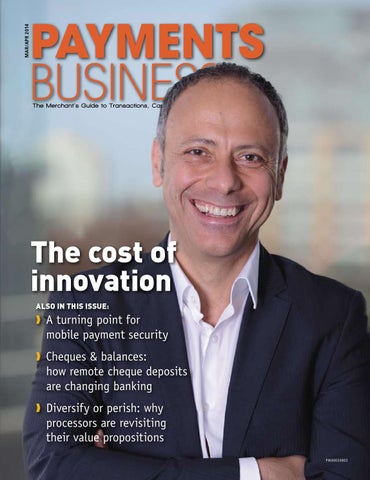
Mar/Apr 2014
The Merchant’s Guide to Transactions, Cards & eCommerce
The cost of innovation also in this issue:
❱ A turning point for mobile payment security ❱ Cheques & balances: how remote cheque deposits are changing banking ❱ Diversify or perish: why processors are revisiting their value propositions PM 4 0 0 5 0 8 0 3
Table of Contents
March/April 2014 Volume 5 Number 2 Editor Amy Bostock amy@paymentsbusiness.ca Publisher Mark Henry mark@paymentsbusiness.ca Contributors Rob Galaski, Xavier Giandominici, Michael Gokturk, Catherine Johnston, Josee Lyonnais, Amer Matar, Chris Matty, Denis Robert, Rodney G. Vesling Creative Direction Jennifer O’Neill jennifer@paymentsbusiness.ca Photographer Gary Tannyan Senior Account Managers Brent White brent@paymentsbusiness.ca Chantal Goudreau chantal@paymentsbusiness.ca President Steve Lloyd steve@paymentsbusiness.ca For subscription, circulation and change of address information, contact subscriptions@ paymentsbusiness.ca Publications Mail Agreement No. 40050803 Return undeliverable Canadian addresses to: Circulation Department 302-137 Main Street North Markham ON L3P 1Y2 t: 905.201.6600 f: 905.201.6601 info@paymentsbusiness.ca www.paymentsbusiness.ca Subscriptions available for $40.00 year or $60.00 two years. 2014 Lloydmedia Inc. All rights reserved. The contents of this publication may not be reproduced by any means, in whole or in part, without the prior written consent of the publisher. Printed in Canada Reprint permission requests to use materials published in Payments Business should be directed to the publisher. Made possible with the support of the Ontario Media Development Corporation
COLUMNS & DEPARTMENTS 4
News
28 Association Spotlight
FEATURES
6
The TEE A turning point for mobile payment security
11
NFC payments Are we there yet?
12
Ready or not? Widespread mobile wallet adoption will take a major shift in consumer behaviour
14
Cheques & balances Remote cheque deposits are changing the way banks make payment decisions
18
Innovation – are we getting ahead of oursleves?
8 20
The cost of innovation
Keeping ahead of fraud Assessing risk offers piece of mind
22
26
Dealing with uncertainty in the payments space
Canada’s changing payment landscape has payment processors revisiting their value proposition
Technology update
Diversify or perish
Next issue…
March/April — Cards in The Lab--What you need to know next about how physical cards are evolving with new technology and applications March/April 2014
PAYMENTSBUSINESS
3
News
Payza forms strategic partnership Payza, one of the world’s most versatile online payment platforms for e-commerce, corporate disbursements and remittances, announced today that it has formed a strategic relationship to provide credit and debit payment service to Canadian merchants based on its highly successful, fullyfeatured Payza as a Platform enterprise solution. The company announced its Payza Merchant Gateway service in the U.S. last month and an additional strategic partnership in the EU that will launch in a few months. Payza as a Platform is currently being used in nearly every country around the world by over 75,000 merchants. The service offers highly competitive pricing, a wide range of supported payment methods, built-in security and fraud protection, strong merchant support, and a host of tools, features, and reporting options. “This partnership is significant in the international expansion of our merchant gateway service not only because we can provide more options to our Canadian merchants, but also because it will allow us to roll out this service into Australia and Brazil in the very near future,” explains Firoz Patel, Payza’s Global Executive Vice President. The platform’s business payment module will enable businesses to accept major credit cards, with payments settled directly into their bank account. Canadian members will also be able to transfer funds instantly from their bank account with INTERAC® Online for added convenience. 4
PAYMENTSBUSINESS
The INTERAC® Online service is utilized by Canada’s large network of financial institutions. “We’re excited to be supporting INTERAC® Online,” said Ali Nizameddine, Executive VP of Product & Technology at Payza. “The INTERAC® network is almost universally adopted in Canada and is supported by every major bank. Canadians are already very familiar and comfortable with this service, and will now be able to take advantage of the convenience of using INTERAC® from the Payza gateway.” “Our upcoming payment processing module reduces friction in the online sales cycle by providing a seamless checkout process and the most preferred payment methods,” explains Patel. “Payza Merchant Gateway users throughout Canada will be able to accept credit and debit card payments as well as INTERAC® without the hassle of managing multiple accounts at multiple institutions.” Payza’s online payment platform also offers a recurring billing service for subscription based billing cycles, at no additional charge. The recurring billing feature has a variety of intervals and billing terms, and is created at a product level which allows for additional products to be added to the basic subscription. Unlike other payment processors and merchant accounts that charge monthly, gateway and other service fees on top of transaction fees, the Payza Merchant Gateway only charges for the processed transactions.
Creditron unveils unique virtual batching capability Feature eliminates presorting of mail and accelerates exceptions resolution
ROCKVILLE, MD, March 18, 2014 – Creditron, a leading provider of payments processing solutions, announced today that the company has expanded the functionality of its leading remittance automation platform with Virtual Batching capabilities. Creditron’s Virtual Batching eliminates the need for billers to presort remittances during mail opening using an Opex AS7200i device. Virtual Batching utilizes the configurable page-type classification on the Opex AS7200i to virtually ‘sort’ transactions into batches based on preset definitions for payment types (such as tax, water or utility payments) and payment method (cash, card, check). Creditron’s Virtual Batching expands on the functionality of the Opex AS7200i to electronically separate balanced transactions from exceptions
In addition, Payza’s Resolution Center, supported by a dedicated team of resolution specialists, reduces the risk of chargebacks by offering a quick and transparent way to resolve disputes. The platform is SSL encrypted and has PCI DSS Level 1 Compliance which, combined with Payza’s proprietary Fraud Matrix™ system, assures the highest level of security in the industry. The platform includes numerous developer tools March/April 2014
such as scan-line mis-reads, check-only transactions, unbalanced transactions, and correspondence. This automated balancing and batching feature is available today in the ItemAge Express software for any transport but can now be enhanced with the addition of multiple payment stream types detected by the Opex software. Virtual Batching is fully configurable by a Creditron Installation Specialist. “Today’s announcement extends the leading performance of our remittance automation platform with unique Virtual Batching capabilities,” said Creditron Founder and CEO Wally Vogel. “Virtual Batching eliminates the presorting of transactions during mail opening, and provides billers with faster visibility into exceptions, enabling quicker resolution and improved funds availability.”
including integration code, advanced button generation, and instant payment notifications. “Running your online business is not just about sales,” continues Patel, “It’s about making sure your customers come back for more. Our full suite of business tools includes a customer support module that makes sure customers can get the help they need when they need it, whether it be via email, phone or live chat.”
News
Banks stop criminals with latest SAS® Financial Crimes Suite Better customer risk ratings, smarter detection and investigation techniques deter more financial crime Getting away with financial crime just got harder. The latest SAS® Financial Crimes Suite arms institutions to detect potential suspicious activity more efficiently than ever. A new customer due diligence solution within the suite more accurately detects changes in a customer’s risk profile. Enhanced antimoney laundering and case management capabilities also make it easier to have a complete view of threats across an institution’s financial crimes investigation unit. “A comprehensive view of potential threats will help in efforts to thwart criminals from successful attempts of hiding illicit funds,” said James Wester, Global Payments Research Director at IDC Financial Insights. “A technology infrastructure with customer risk rating and high-performance analytics will help speed detection and investigation in all channels. Companies like SAS are bringing to market a full suite of modules to support money laundering compliance, customer due diligence and fraud prevention all within a unified framework and user interface for more efficient investigations.” Today’s rigorous regulatory environment requires banks to move quickly with confidence. SAS Financial Crimes Suite uses a visual scenario designer to recommend optimal detection models. The designer instantly assesses the impact of potential scenarios and
risk-rating changes. In-memory architecture speeds analysis of real-time testing environments, reducing guesswork through improved model efficiency. To identify potential money launderers and people funneling money to terrorists, institutions must constantly assess customer activity. The new SAS Customer Due Diligence does this by weighing all customer data to set baseline expectations. Data management features easily integrate key customer attributes from external sources and detect incriminating relationships. The regulatory reporting interface controls both workflow and investigations. Context-aware analytics intercept and assess events for possible risk. The resulting baseline customer score can be automatically updated with a new risk rating based on behavior changes. The solution streamlines the review process by: • Making financial institutions aware of changes in customer behavior faster than ever. • Providing a risk-rating feature to ensure adherence to standard policies, procedures and controls through flexible workflow. • Offering fully auditable case management that automatically tracks all aspects of investigations for consistent investigative and quality assurance processes. Time is critical in combating money laundering. SAS High-Performance AntiMarch/April 2014
Money Laundering speeds relevant information to investigators in minutes, rather than hours. By adding enhanced correspondent banking scenarios to the solution’s data model, SAS further strengthened the detection layer to zero in on potential criminals. The new relationship grid helps investigators review subjects faster by quickly assessing party details associated with possible delinquent behavior. To increase detection capabilities, a peer group anomaly component has also been added to SAS HighPerformance Anti-Money Laundering, which compares an entity’s behavior to its historical behavior and the behavior of its peer groups. Peer grouping has also been expanded, adding multiple peer groups and analytics to detect outliers on expected behavior. SAS High-Performance AntiMoney Laundering increases monitoring effectiveness and efficiency through rapid information from new scenario tests via live production data. SAS Enterprise Case Management has also been enhanced by replacing advanced querying with a single search field, encompassing all content included in the SAS solution. Information is captured and tracked through a central audit service, making investigations seamlessly auditable. More efficient investigations result from the new “to do” lists in the subject field of cases.
Number of mPOS devices to grow more than 95% globally in 2014 The number of mobile point-of-sale devices used by department stores, apparel and shoe stores will almost triple in 2014, recent findings indicate. According to a report from IHL Group, a global research and advisory firm for technologies deployed in the retail and hospitality industries, shipments of new mobile POS devices are expected to grow more than 95 % worldwide in 2014 and by more than 108 % in North America. The growth is being driven by how both retailers and consumers are becoming more accustomed to payments on mobile devices. According to IHL’s Mobile POS Vendor Database, iOS accounted for 47 % of total mobile POS shipments in 2013 worldwide while Android had 33 % of shipments and Windows 8 12 %. Also, the report revealed that Apple has a dominant share of mobile POS devices in the market, at 39.9 %. However, Motorola Solutions, Hewlett Packard and Micros are showing the greatest shipment growth potential in 2014, in some cases tripling the growth rate over the previous year. Finally, the report revealed that 64 % of current mobile POS devices are smartphones. The move in 2014 will be toward phablet and tablet sizes. For example, 64.6 % of all new mobile POS devices will be on phablet or larger screens in North America in 2014. PAYMENTSBUSINESS
5
Mobile Payments
The TEE:
A turning point for mobile payment security By Xavier Giandominici
N
ear field communication (NFC) presents many opportunities, particularly for the mobile payments marketplace. With trials, pilots, tests and live services rolling out in Canada, it is important that security is front of mind to ensure end users’ sensitive data is protected. Xavier Giandominici, Director of FIME America – an advanced secure-chip consultancy and testing provider – discusses the rise of mobile payments and how the trusted execution environment (TEE) can strengthen security by working in tandem with the secure element (SE) to mitigate financial risks.
Market potential Canada is fast becoming one of the most advanced countries in the world for cashless payments, according to a recent MasterCard report, as a result of its forward-thinking approach to new technologies such as 6
PAYMENTSBUSINESS
PayPass Tap & Go and the penetration of NFC terminals. There are currently 20,000 point of sale (POS) terminals enabled to accept contactless and NFC mobile payments due to Canadian banks now issuing EMV-compliant contactless credit cards to customers, although the market does still requires more NFC-enabled smartphones to drive usage. Canadian Banks are addressing this by partnering with mobile network operators (MNOs) to provide NFC payment services throughout the country. For instance, Canadian bank CIBC’s recently launched mobile payment app, with MNOs Telus and Rogers Communications, was a major step forward in utilising NFC technology for mobile payments. There is however, some way to go before there is widespread global deployment. This is mainly due to security, which remains a key talking point in the mobile payments ecosystem and has been one of March/April 2014
the major factors in why global deployment of NFC has taken so long to come to fruition. If we are to truly maximise the opportunities of NFC then the industry needs to work together to ensure it is protecting not only service providers but also consumers’ sensitive data. The key element in achieving this is the mobile device, it needs to be secure without compromising convenience, user experience and service delivery.
The mobile device security infrastructure To understand the security challenges associated with NFC mobile payments, you first need to understand the areas of the smartphone and their levels of security and functionality; • The rich operating system (Rich OS), • The TEE, • The SE. The Rich OS is software which provides an open environment
Mobile Payments
created for versatility and richness where device applications are executed. It is open to third party download after the device is manufactured so it cannot be trusted. In fact, Cisco’s 2014 Annual Security Report found 99% of mobile malware attacks were targeted at this area in 2013. At the opposite end of the spectrum sits the SE which offers high levels of security but low functionality. The SE is an evolution of the chip that currently resides in a credit or debit card which has been adapted to the requirements of the mobile community. It traditionally comprises a one-chip secure microcontroller that can store applications, as well as a mini operating system that can compute cryptographic data, usually combined with a JavaCard Runtime Environment (JCRE). This creates a tamperresistant, secure ‘platform’ which is able to host multiple applications. Although the compactness of this technology does mean it offers minimal functionality to embed applications. Sitting in between the Rich OS and the SE is the TEE. It offers the best of both worlds; a good balance between security and functionality. Comprising both hardware and software, the TEE creates a secure area which resides in the main processor of a mobile device. Its main purpose is to ensure that sensitive data is stored, processed and protected in a trusted environment. Unlike the openness of the Rich OS, the TEE offers protection, confidentiality, isolation and data access control to applications known as trusted
applications. This ‘security barrier’ makes the TEE the ideal environment to enable secure mobile payments using NFC.
Strengthening mobile payment security The increased risks associated with multiple applications from banking apps to games – each of which have varying security requirements – can be mitigated by the SE and TEE working in tandem to offer high levels of security without compromising functionality. By combining the capabilities of the SE and TEE, a more robust, sophisticated and user-friendly level of security can be achieved. In addition to the TEE acting as a filter for the applications stored in the SE, it can also provide a trusted user interface. This allows the end-user to validate that the details displayed on the handset screen come from an approved trusted application and are not corrupted. Within the context of mobile payments, when an end-user makes a transaction they will be presented with the trusted user interface, created by the TEE. It will display a summary of the transaction in a new window, ensuring that any non-secure applications stored in the Rich OS environment cannot interact or corrupt the payment details. The end-user is able to validate exactly what is shown on the screen and authenticate it by entering a PIN or password. As this authentication is carried out in the TEE, the activity is isolated within the handset and protected from unauthorised viewing.
Managing the TEE in a live environment Utilising the TEE on a smartphone to protect March/April 2014
sensitive data sounds ideal in theory, but there is still some work that needs to be done before this could truly work in practice. One area in particular that needs to be defined is the standards that all parties will work towards. The industry association for standardising the management of applications on secure chip technology, GlobalPlatform, has published specifications on how applications should reside on a TEE and SE. The body is bringing standardisation and clarity to this technical space to remove proprietary solutions in favour of interoperable product development. If NFC actors in Canada align to GlobalPlatform’s Specifications, they can ensure market consistency and interoperability of their products globally. It will also safeguard product investment as the association will work to advance the specifications to meet evolving market requirements as well as regulatory updates. Although GlobalPlatform is not a certification authority, its specifications are endorsed by certification bodies and seen as best practice.
Maximising NFC potential The adoption of NFC promises vast opportunities for the Canadian market and consumers. In particular, the evolution of payments is a gateway to delivering a number of value added services (VAS) such as loyalty, gifting and transit, which will be of significant benefit to the end-user. If NFC is to reach its full potential, however, risks need to be contained and the industry as a whole must not compromise security in place
of getting a product to market quickly. There needs to be adequate time to perform the rigorous testing cycles required by the payment sector before the product is launched. Working with a partner which understands the certification landscape, testing requirements and upcoming industry standards, not only ensures products achieve the highest levels of assurances quickly and effectively, but also offers significant competitive advantages. The mobile landscape is continually evolving and with recent announcements on HCE deployment, which has received support from the major payment systems, 2014 is certainly going to be an exciting time for NFC. Security however, does need to stay at the top of the industry’s agenda. By working together to align to set standards will futureproof NFC deployments not just regionally but also on a global level to ensure NFC’s possibilities are endless. Xavier Giandominici is Director of FIME America, an independent consulting and integration testing solutions provider for smart devices and secure-chip based applications. Xavier has more than 15 years’ experience in the industry, including supporting the first EMV migration pilots in Mexico and Central America with Gemplus (now Gemalto). He currently heads up FIME America which is working with key stakeholders to support US adoption of EMV chip payments technology. Reference materials: The TEE PP refers to two of GlobalPlatform’s Specifications: The TEE Internal API Specification v1.0 details how to interface trusted applications with a TEE in a consistent and secure manner. The TEE Client API Specification v1.0 outlines the communication between applications running in Rich OS and trusted applications residing in the TEE.
PAYMENTSBUSINESS
7
Mobile Payments
The cost of innovation
Amer Matar
8
PAYMENTSBUSINESS
Saving by innovating Payment technology is evolving at a rapid rate in response to customer expectations for quicker, more efficient and convenient payment experiences. Payment solution providers are swiftly expanding their product offerings to accommodate increased demands for payment innovation, while trying to get ahead of the game in developing the next best payment application or device. Payment solution providers must find ways to meet customer needs while managing the cost of new investment. Often, what innovation requires is less about capital, but more about having the right people on board with the right idea. This,
however, does not mean that there are no costs associated with new product development. Creating new payment software is labour-intensive and costly by design, not to mention the costs of commercialization and bringing the product to market. A viable go-to-market strategy, coupled with sales training and the operational support involved in product roll-out, are among the main activities that drive up expenditures. Payment solution providers can achieve both innovation and cost control by streamlining their internal processes to achieve efficiencies and savings, and reinvesting those saved funds in the development of new payment technology. March/April 2014
Being strategic in allocating resources A common misconception is that new technology is responsible for driving up costs. The reality is that, in many cases, it is the legacy piece of the business – the established processes and infrastructures – that impedes operational efficiency, making it more and more costly for the business to run. Cost-conscious payment solution providers look for new technologies that are better performing, cheaper, and simpler to operate. For example, they may choose to invest in modern commoditized hardware – such as a server specially fortified to run a business application – rather than paying to maintain expensive,
Mobile Payments
proprietary infrastructure. Cutting costs on core business components enables payment solution providers to invest more comfortably in their mobile and ecommerce environments. Calling on large specialized teams to drive innovation can be limiting and costly. Steve Jobs often turned to his top five Apple engineers when he needed to execute a new product idea. Small and agile development teams with past experience integrating technology into merchants’ work flows, can bring greater value to an organization than dedicated research and development professionals. These individuals are often isolated from, and less familiar, with the business. Having a consistent product development strategy is key. For example, if an organization’s strategy is to create payment software with omni-channel capabilities, this approach should be applied consistently across mobile, ecommerce and physical channels. A one-time deployment of software is not only efficient, but cost-effective, as it eliminates redoing work for each of the channels. Companies can easily save costs through the proper allocation of resources. For payment solution providers, sourcing software packaged technology solutions for non-core payment functions can speed up implementation and reduce cost. Non-core business functions, such as quality assurance and customer relationship management (CRM) solutions are best sourced through packages rather than built in-house. It does not make strategic or financial sense to
commit internal resources to developing competencies that third-party teams can execute much better.
The merchant perspective The key challenge for merchants with traditional payment models is balancing the adoption of new payment technology and managing costs. Typically, large investments have been made in existing infrastructure, software suites and long-time business relationships. Many merchants choose to experiment with extending their merchandising systems rather than replacing them whole. It’s an exercise in minimizing risk- if the new technology is not reliable, the entire enterprise is not compromised.
The future of payment technology Tomorrow’s payment technology will build on the trends seen today. Applications supporting the idea of the ‘consumer wallet’ will grow in popularity. ‘Mobile 2.0’ will continue its sweep of the industry. Transactions that are conducted online today may be facilitated tomorrow by simply scanning a photo with a mobile device. The recent data breaches in the U.S. will bring heavy demand for more evolved point-to-point encryption and tokenization technologies. As a result, card-on-file capabilities will see great growth. Merchants will increasingly desire ways of identifying a customer by something other than card data. This might mean that payments will be completed securely in the cloud - and card data referenced in the cloud – instead of bringing March/April 2014
the data into their systems. Despite current regulatory issues around security and secure devices, the physical implementation of payment solutions, including hardware readers, pin pads, and ECRs, will change. The identities of merchants and customers may be confirmed using cloud-based technology - rather than relying on a connection between devices. Key trend lines driving changes in future payment technology are the simplification and increasingly smooth implementation of payment transactions. New software will be designed to simplify the entire offer-based, transaction-based user interface. The current complexities we experience will be optimized for convenience. Consumers will be able to conduct payments in downtime rather than uptime only, wherever they choose. The evolution of payment technology is not expected to hit a plateau in the foreseeable future. The opportunities for greater efficiency and functionality are endless, which will keep the payments
business as exciting and dynamic as ever. Amer Matar is Chief Technology Officer at Moneris Solutions Corporation in Toronto, Ontario.
PAYMENTSBUSINESS
9
Mobile Payments
PayWith
introduces the revolutionary mCard Launch of simple, secure mobile payment solution a game-changer for payments industry
A
new method of mobile payment has arrived that will change how merchants and shoppers interact. PayWith Inc., a Vancouver-based company, has launched an innovative new smartphone app that simply and securely enables in-store transactions with mobile devices. PayWith has signed a North American licence agreement with a leading global payment network that allows PayWith to provide merchants and consumers with a highly secure and convenient smartphonebased payment, loyalty rewards, and commission sales solution. Over the last two years, PayWith created a new technology platform and developed the revolutionary mCard. Led by CEO David Strebinger and a consortium of leading businessmen and entrepreneurs, PayWith has invested over $10-million dollars to bring this mobile payments solution to market. “The mCard is a really simple way for shoppers to securely 10
PAYMENTSBUSINESS
purchase goods and services using nothing more than their phone. Merchants who sign up to use this PayWith technology will be able to offer a convenient and secure mobile payment platform and open a new door to marketing directly to their customers - with no new hardware or software required,” says Strebinger. With this license agreement, millions of merchants in North America who are able to process credit cards can choose to accept mCards and engage with their customers on a whole new level using the PayWith platform. PayWith’s suite of services includes mobile payment, loyalty rewards programs, customer acquisition campaigns, mobile gift cards, a range of social media marketing, fund-raising for non-profits and associations, as well as customer tracking and analytics for merchants. PayWith does not share data relating to the consumer’s purchase of a mCard with any third party.
“PayWith is out to solve the problem of mass merchant adoption of mobile payments. The largest barrier to entry PayWith sees with other mobile-based payment and loyalty rewards solutions on the market revolves around the merchant needing new hardware and software and the added fees, expenses and training required by merchants to participate. Using PayWith, merchants do not have any technical, financial or security related barriers to overcome,” says Strebinger. The easy-to-use, secure mCard combined with the PayWith platform opens the door for merchants to connect with current and future customers in ways never before possible. This gives shoppers a real incentive and a compelling alternative to cash and plastic cards. As mobile technology continues to shape the shopping experience, the value of the payments industry is set to increase dramatically. In North America, the mobile March/April 2014
payments industry is projected by Forrester to be a multi-trillion dollar industry in less than three years. Canada is primed for payment transformation like no other country in the world with the highest existing per capita use of mobile payment technology. With 80 per cent of Canadians now owning smartphones, PayWith estimates 90 per cent will be able to engage in mobile payments by 2016. “PayWith has successfully developed the first-ever platform for secure mobile payments combined with mobile marketing,” adds Strebinger. “With a North American licencing agreement in place, PayWith is uniquely positioned to take advantage of the transformation in payments and marketing which is well underway. The introduction of the mCard will help transform how merchants and shoppers interact by making the “mobile wallet” a reality, available to anyone with a smartphone.”
Mobile Payments
NFC mobile payments:
Are we there yet? By josée Lyonnaise
T
wo years ago, after collaboration among the country’s major financial institutions (FIs), guidelines were established to support development of mobile payments at the point-of-sale in Canada. The guidelines, called the Canadian NFC Mobile Payments Reference Model, outlined the guiding principles and required interactions of the different stakeholders, including FIs, mobile network operators (MNOs), payment associations and trusted service providers (TSMs), to manage cardholder information and ensure the development of a secure and open payment ecosystem. Since the guidelines were established, a few FIs and MNOs have announced the eminent release of mobile payment solutions or the introduction of mobile wallets. However, only two FIs have actually launched a NFC mobile payment solution to their customers. And even their offers are limited, either by the number of NFC mobile devices that support the solution or by the number of mobile operators that support the offer. The extended time to market and the limited options for mobile payment solutions available to date says a lot about the complexities of the offering - if it were easy, every FI would already have an offer in place. Is the delay related to business or March/April 2014
technical challenges? The answer, not surprisingly, is both. Initially, business models for mobile payment solutions relied on one-on-one business relationships between FIs and each MNO. To offer mobile payments across a number of MNOs, FIs would need to develop multiple relationships and multiple integrations to different infrastructures, a costly and timeconsuming process. In response, some FIs including Desjardins - are banking (no pun intended) on an aggregated TSM model which provides a one-stop shop to multiple mobile operator networks, with the advantage of one infrastructure integration. Despite the market and technical challenges, one thing is clear for any FI working on a mobile payment strategy and initiatives; everyone one involved in the NFC mobile payment landscape is gaining experience and learning from one another. This collective learning and a better knowledge and understanding of the ecosystem will help each party develop innovative and compelling offers to their members and customers.
Building the foundations of NFC Near field communication, or NFC, refers to a set of standards which allow mobile devices to establish radio communication
with each other or terminals by touching them or bringing them into proximity. It is a solution that has received a bad rap and many are still not convinced that it will have wings. The main source of that concern is often from our neighbor to the south - understandable given the fragmentation of the payment ecosystem in the US. However, the situation is very different in Canada; significantly, there are many fewer players involved. As well, the mass issuing of contactless payment cards and the increasing penetration of NFC terminal in merchant environments means there is higher awareness among consumers and merchants of the benefits of the technology. It will simply be easier to implement mobile NFC payments in Canada. The reality is that for in-store proximity payments, besides proprietary closed loop solutions such as that of Starbucks or those that cater to small ‘mom-and-pop’ shops, NFC is the only solution that can be quickly implemented across large retail and service chains. If the deployment rate of NFC-capable POS devices throughout top-tier, high-volume merchants and the number of card-based NFC transactions is any indication, the Canadian market is in a good
Continued on page 24
PAYMENTSBUSINESS
11
Mobile payments
Ready or not? Widespread mobile wallet adoption will take more than upgrades to technology and infrastructure; it will take a major shift in consumer behaviour.
E
By Michael Gokturk
12
PAYMENTSBUSINESS
very major player in mobile technology and payment related arenas – Apple, Google, Visa, Paypal et al – are running a high-profile race right now to release the one mobile wallet solution to rule them all. But while the buzz around mobile wallets in the media is steadily growing, consumer adoption in North America has not – and will not, in my opinion, until several issues are adequately addressed. Most people will not change their habits or adopt new technology unless it offers clear value in the way of savings (be it time or money) and convenience. We’ve seen this with mobile points of sale, which are rapidly replacing traditional cash registers in retail outlets of every
size. Mobile POS allows all of us – merchants and customers- to engage in commerce in a way that is different and ultimately better. Now we can take and make payments where and when we like while eliminating the cost of expensive cash registers. When a solution clearly benefits both parties it motivates rapid adoption of new technology; it presents an irrefutable improvement on the traditional alternative. Mobile wallets also aim to provide convenience, but I would argue that no application in North America seems to offer value above and beyond our current payment options. Credit cards and cash are fairly reliable, and replacing a card March/April 2014
swipe with a phone tap isn’t necessarily an improvement. With the infrastructure and options currently available, making payments with your phone may only replace just one or two cards in your wallet, but not the entire wallet itself. This means in many situations, cards must still be carried and used. In Canada the focus has primarily been on making purchases, and the many mobile “wallets” entering the market function more as individual pay options, just like having multiple cards in your wallet. A great example of this is the Starbucks mobile payment app, one of the most widely used in the US. Applications like these are great for processing
Mobile Payments
payments faster, mimicking an online purchasing experience and giving merchants useful information about their customers. But they only solve one piece of the puzzle. The mobile wallet will truly capture the North American consumer’s imagination when it becomes more streamlined and global in its application. Countries that have seen the most success with adoption are places like China, where over 1.5 trillion dollars are reported
awareness of their options is low. The nascent mobile wallet landscape is divided by carriers, banks, credit companies and hardware brands that are all currently competing to bring the right solution to market. For example, many Android and Blackberry devices support near field communications (NFC), and carriers like Rogers offer an app that can work with NFC to make mobile phone payments. But Rogers customers with iPhones have no mobile wallet
the card in hand, what is their motivation to spend time on setting up the app, when they will still have a normal wallet for all their other payment needs? Faced with a fragmented market, and a current payment system that works, most consumers are opting to stick with their debit and credit cards, rather than jump through hoops into unknown territory. Possibly, the greatest hurdle to widespread adoption of the mobile wallet is consumer fears
“Most people will not change their habits or adopt new technology unless it offers clear value in the way of savings (be it time or money) and convenience.” to have passed through mobile payments last year (although that number includes all kinds of mobile payments). There’s also Japan, where mobile wallets are used to keep digital versions of a person’s banking, healthcare, transit, and ID cards. Similarly, the Octopus app in Hong Kong can be used for transit, parking, leisure facilities, phone bills, self-checkout kiosks, online purchases and even identification and building access via an NFC-enabled mobile device and the Octopus Mobile SIM card. In all these places, these systems are widely adopted because the one device can now serve a variety of vital needs. A clear problem is being solved in this region, but in North America, the current path is just compounding the problem. One of the major barriers to adoption is that the market is still unclear, and more importantly, consumer
option because Apple products do not yet support NFC. On the side of the mobile wallet creators, a big problem has been a lack of an effective ignition strategy. Such a strategy solves the problem of how to coordinate adoption on both sides of the payment equation: buyers and sellers, consumers and retailers. Mobile wallet offerings continue to fail in the market because they have been unable to achieve a critical mass of users on both sides of the transaction. Some mobile payment solutions are dependent upon partnerships between a bank and a certain mobile provider, so unless you are a customer of both, the offering is essentially irrelevant. And then there are third-party solutions, like the ISIS app, which require users to enter, card by card, their various payment accounts – again, if they have an NFC compatible device. If an individual has March/April 2014
around security. While credit cards are prone to being lost, copied or stolen, the item itself carries no personal value and can be deactivated easily. Our phones carry such detailed personal information that many people are afraid of having their phones hacked or stolen. Studies show that consumer awareness of the security features that accompany existing mobile wallets is extremely low, suggesting these fears are somewhat exaggerated. On the other hand, it has been demonstrated that NFC transmissions are hackable, which speaks to the legitimacy of public concern over the security of mobile payments. It’s not necessarily that the credit card really is a more secure option; it’s just a system that we are accustomed to. Moving payments over to the mobile phone requires earning the trust of individual users, meaning companies
with mobile wallet solutions are going to need to learn how to clearly and comfortingly communicate exactly how they have secured their offering. There is no doubt that the mobile wallet will eventually be adopted. But, as some tech pundits are predicting, mainstream implementation may be as far as a decade away. Firstly, we’re still waiting on a mobile phone payment solution that offers an improvement on our current debit/credit/cash system. Ideally that solution would wrap in broader applications to become an invaluable and complete “wallet,” which we have yet to see in Canada or the US. But more importantly than this, what mobile wallets represent is a new mode of consumer behaviour. Changing the way the general public views their phone – more than a communication device, more than a camera, more than a music player – and instilling in them the trust and confidence to use it as a payment tool, is some of the heaviest lifting the industry has to do before it can succeed. Michael Gokturk is the Founder and CEO of Payfirma, a multichannel payment processing company and cloud-based payment platform. A thought leader and relentless entrepreneur, Michael has grown Payfirma from the first company to deploy mobile payments in Canada into a scalable solution for debit and credit card payments online, in-store and mobile. Prior to Payfirma, Michael founded VersaPay, one of Canada’s fastest growing companies which he took public on the TSX. With over a decade of experience as a game changer in payments, Michael has appeared on the cover of Profit Magazine and been honored with numerous awards including Best Business Person of 2012 and membership in Vancouver’s Top 40 under 40. Michael is also an active angel investor, mentor in the startup community.
PAYMENTSBUSINESS
13
Pay channel
Cheques and balances Remote cheque deposits are on the rise allowing banks to make payment decisions in real-time
M
By Rodney G.Vesling
14
PAYMENTSBUSINESS
obile technology has made banking anywhere, anytime a reality. But mobile devices are not only used to check account balances, receive account alerts or transfer funds. Mobile cheque deposit is an increasingly popular application. In fact, there was a 50 percent increase in the number of Canadians who would consider depositing a cheque via their mobile device in 2013. According to a September 2013 ING Direct survey: “Close to half (46%) of respondents who use mobile banking say they would consider depositing a cheque to their bank account using their mobile device, a number that’s more than doubled since 2012 when only 22% of Canadians said they would consider depositing a cheque through this method.” To meet this growing demand, banks are forced to strike a balance between offering the convenience of remote deposit capture without increasing their fraud exposure. The good news is that investing in real-time cheque fraud detection will serve you in other channels as well – The technology can also verify cheques deposited at imageenabled ATMs and at the teller. Considering the volume of cheques written by Canadians – an average of four million every business day1 – the use of instant cheque verification is warranted
and can help reduce your exposure to forged cheques as well as fraudulently altered and counterfeit cheques. While the Canadian Payments Association (CPA) provides a framework that allows clearers to exchange payments files containing images, participation is not mandatory. What can be in a bank’s control, however, is the instant verification of ‘on-us’ cheques, including personal, business/corporate, credit card convenience cheques as well as home equity line of credit cheques. By verifying cheque images in real-time, your organization will achieve three key benefits: 1) reduce fraud 2) improve customer service 3) and achieve operational efficiency.
Let’s explore each one. Fraud Reduction: Catching a fraudulent cheque at the time of deposit will obviously reduce your losses. It can also reduce your exposure to fraud downstream. Depositing a cheque is often just the start of a broader fraud scheme that can include depositing the same cheque in multiple channels and multiple bank branches. While the amount of each cheque may be low, the multiple deposits result in a more significant loss for your organization. Instant cheque verification also enables you to verify all items, March/April 2014
not just large value cheques, thereby expanding your fraud prevention. Customer Service: Making funds available immediately is important. If your bank offers remote cheque deposits, customers expect the money will be available. Eliminating payment delays will contribute to your customer service rating. Customers will also appreciate your ability to protect their assets by employing effective fraud prevention measures. Operational Efficiency: By catching fraud at the point of transaction, you can focus your back-office team on other fraud items processed through in-clearing instead of reviewing items already processed and paid. Your team will spend less time on downstream activities, such as customer service calls, fraud item reversals, and affidavits.
How it works? Making a pay/no-pay decision in real-time for a cheque deposited at an ATM, teller line or with a mobile deposit can involve the following: Signature verification: The signature on the cheque is compared, in real-time, with the signature in a reference database. A reference signature should include three examples
Continued on page 24
MERCHANT-FRIENDLY PAYMENT SOLUTIONS Monetico, a result of the partnership between Desjardins Group and Crédit Mutuel-CIC Group.
Securing Mobile Life.
Creating Confidence. Giesecke & Devrient offers a comprehensive range of payment products and solutions based on the latest EMV, contactless and dual interface technologies. Our smart debit, credit and prepaid products are available on a wide range of platforms based on secure and highly flexible operating systems. Alongside the comprehensive portfolio of easily configurable card products and card solutions, we offer all services related to electronic payments including m-commerce and transit. Our services include personalization, system integration, project management and technical consulting from a single source. For more information, please visit: www.gi-de.com/ca
Vertical market
Innovation - are we
getting ahead of ourselves? Is it time to ask ourselves if “we should” just because “we could” implement new technologies for mobile or online retailing and payment? Yes, we should ask, and for a number of reasons. By Catherine Johnston
P
ayment will always be an expense for merchants and the more technologies that need to be supported, the greater the impact on the bottom line. And that is true not just of merchants. Issuers and acquirers also have costs related to payment, so business cases might continue to be hard to build as we move forward. What factors need to be considered in the early stages? How do you balance risk and reward?
Consumers Let’s start by looking at consumers. You’ll always have innovators and early adopters who eagerly anticipate new technology, but traditionally they account for only 16% of the market. The next 34% are the early majority. With the speed that technology is evolving, by the time you get the remaining 50% of the market using your technology or application, several new ones are either 18
PAYMENTSBUSINESS
possible, in the planning stages or already deployed. When you are launching something that will help customers shop more, this curve is not an issue and you have a profit margin to put into your business case. However, if you are only looking at payment innovation, it is harder to build the same case unless you can leverage your investment in other ways. Will this payment innovation help bind the customer to you? Will it drive access to additional data that you can use for marketing? Are there other benefits from bringing it to market? There have been instances where issuers, both card and app, have invested in order to be the first to market. In some cases it was to build their profile to attract investors or even buyers. In other cases it was to enhance their reputation as an innovator. All of these can be good reasons that change a “could” to a “should”.
Payment myths and realities Every once in a while an optimistic business case is built on a mythical foundation. Here are two of the more popular market myths clouding the “could”, “should” scenario. 1. Consumers expect to be able to pay any way they want 2. Merchants need to accept every payment product Neither of these is true. Most Canadians have more than one way to pay in person and often online. Already, there are plans to provide many different ways to pay on mobile devices. It is fair to say that Canadians, and I expect most people around the world, want some choice but they don’t expect the range to be extensive. Today, not all merchants accept every form of payment. Not everyone accepts cash. Not every merchant accepts all major credit card brands. March/April 2014
Some don’t accept any form of debit and an increasing number of merchants no longer accept cheques at the point of sale. None of this has been a problem for consumers. So it is fair to say that for almost every payment product in the past and for those in the future, some people will want to use them. The trick is to determine whether the rewards of implementation or consequences of not implementing are great enough to warrant moving forward given the likely number of users. If you decide to go ahead, technology won’t be your challenge, but partnership may well be your complexity.
Partnerships The great myth is that every partner expects to see a financial profit from their involvement. The reality is that some have other motivations. They may want to expand their client base in order to sell core
Vertical market
products and services or they may have new ones that would benefit from a larger base. Customer stickiness may be their objective. One thing is clear. More and more partners are required to support m-payment and m-commerce and that is making the business case harder to build. There is also the risk that the time it takes to iron out the deal could cause you to miss your window of opportunity, taking you from a “could” to a “can’t any more”.
may be the hardest part of m-commerce.
Could and should Every deal is different but you can mitigate your risks by being clear about whether you are closer to “should” or “could”
for every new venture. May you always pick the “shoulds” and may your competitors pursue the “coulds”. Join us at Cardware 2014: Payment and Digital ID Insights as we take a closer look at this and other strategic issues.
www.actcda.com/calendar/actcanada-events/cardware2014/ Catherine Johnston is President & CEO, ACT Canada and Chairman, ISCAN – the International Smart Card Associations Network.
Each Click is a Residual Payment.
Privacy and security When it comes to m-commerce and payment, consumer trust strongly influences a buyer’s behaviour. Privacy and security are often thought of together, but they are two very different items. When it comes to all things mobile, the gap may grow even larger. Consumers are becoming more aware of the degree of scrutiny that they are under due to their use of technology. It is impossible to know whether they will rebel, which could jeopardize some m-commerce initiatives or whether they will decide that this is the new reality. Until we know which way they will react, both possibilities and the resultant consequences will need to be identified and monitored. My breaking point was when one hotel from a search I did for my next trip started to appear on every web site I visited, for days afterwards. Adding to my discomfort was that it wasn’t a pop-up, but appeared as though it was embedded in the sites I was visiting. Ask me if I now want merchants knowing that I am walking down the street they are on. Getting consumer privacy right
Authorize.Net has paid out more residual payments than any other payment gateway. Contact us to learn why. Call 1.866.437.0491 or visit www.authorize.net
©2013, CyberSource. All Rights Reserved.
March/April 2014
PAYMENTSBUSINESS
19
Security & Fraud
Keeping ahead of fraud Using predictive scores to assess risk
By Chris Matty
T
he damage of fraud is not only limited to fraudulent transactions or actions. Fraud can damage the brand reputation of many companies, and this damage far outweighs the monetary damages. One example is the recent issue Target experienced in the weeks before Christmas. With a breach at such a large company, millions of customer information was jeopardized. As a result, Target’s fourth quarter profits fell 46% according to the Washington Post. For a brand as large as Target, that’s a huge issue. For companies of all sizes - small and large, fraud, and its multitude of consequences, is a huge problem. But fraud’s tricky. It’s not relegated to only certain people. I received a credit alert and found that two credit cards were opened in my name fraudulently. The perpetrator had my social security number and address. The applications were already in process when I caught it. It was lucky that I did. 20
PAYMENTSBUSINESS
Thousands of credit cards are opened everyday fraudulently. There are even websites dedicated to the sale of stolen credit cards that are guaranteed to be active. You can actually buy stolen credit cards with a credit card. Thousands of transactions occur everyday using stolen credit cards, or cards that were opened fraudulently.
So how do you prevent fraud? The question you have to ask yourself is two-fold. Firstly, is your personal information, and the information of your company, safe? Have you taken the necessary precautions to catch any fraudulent activity? Second, when it comes to your business, is your customers’ information safe? Have you taken the necessary precautions to protect them as well? Are you taking the steps necessary to prevent the creation of fraudulent accounts and to prevent fraudulent transactions? Those who commit fraud are now able to bypass traditional systems. They have the ability to dupe traditional Knowledge Base Authentication Solutions because they know how to access that kind of data. Typical Knowledge Base Authentication Solutions can ask invasive questions like where did you live 5 years ago or what was a bank account balance at a particular time – and if a fraudster has enough information about
you, they surely have that information as well. In addition these systems result in attrition during sign up due to the poor consumer experience.
What if we could predict fraud with just an email address? This is where LifeData as a Predictor steps in. Since traditional knowledge based systems are being tricked and data “consortiums” and rulebased methods have inherent limitations, the future lies in predictive analytics. The key is that massive volumes of unique data are being generated by individual consumers each day in real life and this data can be fed into computer models to accurately predict fraudulent activity. Thanks to the proliferation of the Internet and growth of social media, there is a huge amount of information that is generated about a consumer in regards to their daily habits, activities, interests and behaviors – both online and offline. These new external data resources are being combined with enterprise data to increase the predictive accuracy of the underlying computer models. With the amount of information that’s compiled every day, it’s easier than ever for businesses to leverage and use this data to address their specific business needs, especially when it comes to catching and preventing fraud. March/April 2014
Predictive Scores are the outcome of powerful matching algorithms that enable predictive models to utilize a company’s enterprise data in combination with this unique LifeData. Deriving meaningful intelligence from complex assortments of data can be very challenging. Predictive Scores address this challenge. A predictive score is very similar to a credit score, but tailored to address specific business needs and objectives, such as preventing fraudulent accounts and transactions. Predictive scores can be developed to address multiple business objectives such as churn, environmental consciousness, or a person’s likelihood to donate. Rather than a business sorting through the information they gather themselves, they simply receive a score based on the information they want and needs. Predictive scores are especially beneficial to businesses because they are accurate and easy to access, and you don’t have to be a data scientist to interpret them. Enterprises don’t want another complex platform that requires support and training – they just want the answers to the questions that deliver ROI benefit and that’s exactly what a predictive score does. When it comes down to it, the data doesn’t lie. Predictive models that use unique LifeData to determine a fraud score are very accurate.
Security & Fraud
They can have a fraud capture rate as high as 85% and false positive rates as low as 4%. A FraudScore is an informational tool that helps companies gauge the risk involved with a new account opening, e-payment and order processing before approval by the system, by identifying the likelihood that a fraudulent identity is being used to transact. A numeric score is provided for each account indicating the level of risk associated with that transaction. This allows companies to quickly and easily determine potentially fraudulent accounts and take the steps necessary to prevent malicious acts and limit financial and brand damage. The beauty of a FraudScore is that it allows
a company to be proactive versus reactive; it’s easy to understand and very accurate. This helps organizations get in front of fraudulent activity before it occurs by predicting a fraudulent account before the fraudster is able to commit a fraudulent act. A fraudster who attempts to use a stolen credit card or create a new identity from a real SSN, often called synthetic fraud, will yield a high risk score and can be stopped up stream from traditional prevention methods. Because the predictive models use external LifeData, fraud can be predicted with as little input information as an email address – a piece of data that is very frequently capture during a new account registration. Essentially, a FraudScore
allows businesses to stop fraud before it becomes a stream of fraudulent purchases, protecting both your business and preventing further fraudulent activities. More importantly, you receive peace of mind in knowing the risks presented in each new account opened. The less fraudulent accounts are created, the less fraudulent transactions occur, the better for individual consumers, as well as businesses. No particular technology can guarantee to catch all instances of fraud or potentially fraudulent accounts or transactions. The decision to process a transaction or do business with a particular account is up to each individual business. However, being able to assess risk using as little as
an email address, businesses can use Predictive Scores and unique LifeData to help protect their business and their customers. With that piece of mind comes the capability to dedicate even more time and energy to your business. Chris Matty, co-founder and CEO, Versium (www.versium.com), has led a number of early stage tech companies in the Data, Internet, Mobile and SaaS industries, leading strategic initiatives in business development, sales and marketing. His latest venture is a data technology company that operates a real-life data services (LifeData) and predictive analytics scoring engine. These technologies enable organizations to be more data-driven by powering solutions that help optimize consumer engagement, improve marketing efficiencies and better understand, retain and find new customers.
Current FCAC compliance priorities to protect your organization The Canadian Institute’s 9 th Annual Forum on
PAYMENTS COMPLIANCE May 27 & 2 8 , 2 0 1 4 • In te rC on ti n e n ta l York v i lle • Toron t o
REGISTER NOW Call 1-877-927-7936 or Visit www.CanadianInstitute.com/PaymentsCompliance/PB Your priority service code is 217CX01 Supporting Sponsor:
Exhibitor:
March/April 2014
Media Partners:
PAYMENTSBUSINESS
21
technology Update
Dealing with uncertainty in the payments space
By Rob Galaski
22
PAYMENTSBUSINESS
E
ach week seems to bring another mobile payment product to market— another digital wallet, “tap to pay” tool or the like. Merchants and customers alike now have a bewildering array of payment technologies to choose from. Some are backed by traditional financial institutions, major telecom companies, or big technology companies. Others have been brought to market by ambitious start-ups.
The main reason there’s so much happening in payments is simple: There’s money to be made. Telecom, technology and retail companies look at the financial services sector and see better margins, higher profitability and an industry seemingly immune to major business cycle ebbs and flows. Capturing even a fraction of the transaction fees involved in processing millions of transactions every minute could March/April 2014
generate lucrative revenue for payments companies. It’s clear that the payments space will be fiercely contested in the years to come, as traditional financial institutions and aggressive new entrants battle over a sizeable profit pool. While it’s undeniably an exciting, innovative time for the payments sector, it’s also a challenging time for the many players involved with and affected by the payments system.
Technology Update
where competition will be the fiercest in the years to come, as traditional financial institutions battle to protect their territory against aggressive new entrants eager to seize market share and fee income for themselves. They stakes are high: By some estimates, payments—especially credit cards—are responsible for up to one-third of Canadian banks’ profits.
What we can expect to see in payments Of course, it’s impossible to predict with certainty which payments technology will prevail or which companies will emerge as winners. However, we are confident that we will see some developments come to pass: • Alternative payment methods will go mainstream. PayPal has evolved into a common payment method used by small businesses and even major retailers like Best Buy now offer it as a payment option. They may be one of the first, but they will by no means be the last.
It’s difficult to know whether the payments-related decisions made today will prove to be the right ones tomorrow. At Deloitte, we’ve long worked with Canada’s financial institutions to explore the changes affecting this industry—which inevitably affects Canadian businesses and consumers across the country. The payments space is the subject of much discussion, since it’s clearly
• Mobile wallets, digital wallets, e-wallets—whatever they’re called, they’re here to stay. Today’s on-thego, smartphone-wielding consumer will embrace tools that allow them to easily make purchases, especially for very small purchases. However, we’ll likely see significant consolidation in the mobile wallet space over the next five years, with two or three products dominating the market. We’ll probably see banks collaborate on a mobile wallet, an alliance of merchants develop another, March/April 2014
and “independents” outside the traditional banking space offering another option. • Non-traditional partnerships will jolt the market. Earlier this year, PayPal and Samsung announced a collaboration that will see fingerprint authentication used for PayPal password protection. The move makes PayPal the default payment app for Samsung customers— because it’s already installed and ready to use. • We’ll see more standardization over the next couple of years. In March, EMVCo released the first version of a tokenization standard that will be technology-agnostic and provide even greater security. Expect to see similar standardization initiatives around the world over the next three to four years. • Adoption of NFC (near-field communications) payments will grow in Canada. After Android and BlackBerry introduced the Host Card Emulation (HCE) feature, the NFC business model became easier, since banks no longer have to pay mobile network operators to store credit card credentials on the phone’s secure element. More banks are getting involved with NFC now, and transactions have doubled since last year. • Despite all the hype about “disintermediating the banks,” it’s unlikely that other payment providers will dislodge financial institutions from their place within the payments sector.
Responding to a world of rapid change Amid the rapid change and ongoing uncertainty around payments, it’s all too easy for companies to avoid making a decision for fear of making the wrong one. But this is not the time for indecision or inaction. First, don’t wait for the payments industry to settle on standards—or for the dominant players to emerge. Instead, embrace uncertainty. Adopt a range of new payment solutions and technologies on a trial basis to learn how they could benefit your business today and in the future as the market settles. Making several small bets today is a better strategy than making one big bet or not playing at all. At the same time, take steps now to standardize and reduce the complexity of your payments platforms in order to rapidly deploy new solutions. The new entrants in the payments space are incredibly nimble, releasing new apps seemingly at will—and companies that streamline their payment platforms will find it easier to trial these new products. If there’s one prediction about the payments sector we can make with confidence: payments will never be the same, and traditional players and eager new entrants will introduce innovation after innovation in their drive to seize market share. Merchants and other organizations should stay on top of these developments, exploring new products and solutions to find what’s best for their needs. Rob Galaski is a partner with Deloitte, based in Toronto.
PAYMENTSBUSINESS
23
2014 Industry Events
Mobile Payments
Continued from page 11
position to deliver a secure and easy mobile payment alternative through NFC. Though awareness of mobile payment is growing, there are very few consumers knocking on the doors of their FIs to request a mobile payment application or mobile wallet to make their purchases. To build and sustain the required enthusiasm around NFC payments, the pervasiveness of the solution will be essential. Budding payment solutions need to expand and grow into something much smarter and compelling than simply a payment medium. But we need to start somewhere; consumers need access to stable, simple and secure mobile payment options. There is no better place to start than by developing and deploying solutions that will transform and grow along with the awareness and excitement of consumers and merchants. The adoption of NFC mobile payments is dependent on many factors: accessibility, reliability, ease of use and value-added services to consumers and merchants, just to name a few. Building the foundation for an open, efficient and secure mobile payment ecosystem is a key factor for future growth and opportunity for every stakeholder involved in this exciting new arena.
Mobile payments are coming to an FI near you There’s no doubt that the next few months will see existing mobile payment offers evolve and many more 24
PAYMENTSBUSINESS
announcements and mobile payment solutions launched. It’s likely that these solutions will be NFC. There probably won’t be substantial market differentiation among the first iterations of the solutions provided by most Canadian FIs or mobile operators. However, this should not be seen as a lack of creativity or innovation. It is simply the result of the imperative to develop a common foundation on which stakeholders will build and integrate value to their mobile payment propositions. Then, creativity and innovation can kick in. Josée Lyonnais is the Strategic Business Advisor - Mobile payments and initiatives at Desjardins Payment Services and Business Partnerships Mouvement Desjardins
Continued from page 14
and be aged 60-90 days to provide an accurate reference. Capturing an electronic signature with a high quality input device can eliminate the aging process and the need for additional signature variants. The electronic signature is often of pristine quality and can be used as a reference immediately. Cheque stock verification: To verify the cheque stock, the software can take into account various elements, including the image of the cheque as well as the positioning of the cheque number and length of a signature line. Payee line recognition: The software can interrogate your bank’s blacklist or whitelist to automatically reject or process cheques. Standard payees, for example a utility company on
your whitelist, will trigger a pay decision. Leverage peripheral information: The software can also take into account information from your other fraud systems to come-up with a final, combined score. The rules and weightings used to derive the final score can be set by you, ensuring a more tailored fraud detection solution. Establishing a balance between security and convenience is not easy. When it comes to instant cheque verification of ‘on-us’ cheques, however, there is technology that can make that delicate equilibrium easier to attain. Rodney Vesling is President of SOFTPRO North America, an electronic signature and signature verification software provider used by 12 of the world’s 25 largest bank. SOFTPRO’s electronic signature technology can capture a secure esignature at account opening, both online and in-person, and complements the company’s signature verification solution, used to verify cheque images in real-time for mobile, ATM and teller deposits. www.softprona.com
March March 10-12 BAI BAI Payments Connect Conference Las Vegas, NV www.BAI.org
April April 6-9 NACHA, The Electronic Payments Association, Payments 2014 Orlando, CA www.nacha.org April 6-9 ICMA Annual Card Manufacturing & Personalization Expo Ft. Lauderdale, FL www.icma.com April 7-10 NAPCP 15th Annual Commercial Purchasing Card and Payments Conference Palm Springs, CA www.napcp.org April 8-10 Electronic Transactions Association 2014 ETA Annual Meeting & Expo Las Vegas, NV www.electran.org April 22-25 PaymentsSource 26th Annual Card Forum & Expo Orlando, FL www.paymentssource.com April 28-30 Finovate Finovate Spring Conference San Jose, CA www.finovate.com
JUNE June 1-8 Credit Scoring & Risk Strategy Association 21st Annual Conference Niagara Falls, ON www.csrsa.org June 3-4 Smartcard Alliance NFC Solutions Summit 2014 Austin, TX www.smartcardalliance.org
Visit us online
www.paymentsbusiness.ca
March/April 2014
Segment Update
Diversify or perish Canada’s changing payment landscape has payment processors revisiting their value proposition By Denis Robert
26
PAYMENTSBUSINESS
W
hile still predominantly dominated by traditional financial institutions and large size bank related acquirers, the Canadian payment landscape is constantly changing to adapt to the ever changing needs of merchants and consumers. In the past few year, fierce market competition lead to significant price compression in both transaction fees and merchant discount rates and has forced payment processors to revisit their value proposition. Another factor impacting payment processors is the ongoing introduction of new POS and MPOS technology and the proliferation ecommerce and multi-channel retail sales initiatives. Canada is a well-known leader in payment process implementation and benefit from a well-established and highly secure payment infrastructure. To this end, we have seen several new electronic payment products and processing methods come to market. Some product examples being, prepaid branded credit cards, loyalty cards and gift cards while new solutions includes bill presentment, direct debit transfer, Online debit payment, branded merchant ewallet and DCC (dynamic currency conversion) POS terminal applications. These product introductions are and will continue to modify the
types of transaction payment processors must manage. In addition, Canada is currently at the forefront development of mobile EMV and NFC/ contactless products that will quickly democratise highly secure payment transactions via the use of smart phone and have a significant impact on current POS hardware sales revenue model of Canadian processors. To survive on in a highly price driven market, payment processors now have to offer a clearly differentiating value proposition that responds to the need created by a complex transactional ecosystem that includes far more than capturing, authorizing and settling a payment transaction. In fact, for most large size retailers, payment is now a fully integrated process linking diverse matrix such as payment method, SKU level information, pricing, customer profile and purchasing frequency that leads to big data analytics. At term, the payment transaction now leads to the delivery of highly customized offerings that improve customer experience and loyalty while increasing customer value for merchants. The above leaves great opportunities for integrated front–end solution providers and non-traditional payment processors to take strong leadership in the market place as they are often better positioned March/April 2014
to quickly react to changing market dynamics. Personally, I believe that in order to succeed as a processor in a currently highly cluttered environment, one must have a dedicated client centric vision and provide merchants with turn-key agnostic solutions that ensure independence from technological constraints and acquirer dependencies while ultimately accessing complementary revenue streams aside from traditional per transaction. As usual, change brings challenges and opportunities and truly believes that the current market dynamics will benefit strategic and visionary players in the payments sphere. In fact, by levering emerging technologies that deliver concrete benefits to merchants and customers who will quickly adopt solutions like mobile scan & buy application, in-store line buster checkout, innovative ecommerce payment applications and real time loyalty management, processors will enable quicker payment procedures, improved customer experience and more cost efficient hardware and payment solution deployment. Denis Robert is the President and CEO of CT-Payment
Association Spotlight
NACHA leads industry toward ubiquitous, sameday ACH settlement Through phased approach and industry study, NACHA seeks to enable additional settlement windows for faster funds availability
T
he Electronic Payments Association® announced that it is taking initial steps towards a ubiquitous, sameday ACH settlement capability. Through a “phased approach” to implementing new functionality, NACHA seeks to move the ACH Network from today’s single, next-day settlement to multiple, same-day settlement options that would be available for virtually any ACH Network transaction. “NACHA has conducted extensive work over the past year to outline the parameters and requirements of a ubiquitous, same-day capability for the ACH Network that enables financial institutions, large and small, to provide value to their end-users,” said Janet O. Estep, president and CEO of NACHA. “A phased implementation enables us to introduce new capabilities more quickly, and then continue to build over time, creating value for all participants at each step along the way.” The phased implementation approach outlined by NACHA proposes incremental functionality that will provide greater value to end users. This 28
PAYMENTSBUSINESS
functionality would include multiple, new settlement windows, and greater certainty around faster funds availability; therefore providing a solid foundation on which to build innovative services into the future. As currently outlined, a first implementation phase would provide a foundation to better enable same-day ACH credits to support important use cases such as payroll, person-to-person (P2P) payments and expedited billpay. A second phase would introduce same-day ACH debits and enable a wide variety of consumer bill payment use cases like utility, mortgage, loan and credit card payments. A third phase would improve the service level across the ACH Network and reduce counter-party risk by adding a second same-day settlement and accelerating funds availability. “The concept of phased implementation is the result of thoughtful exploration of feedback we received over the past year,” said Estep. “This is the next step to help create a rule proposal for the industry to enable same-day ACH through the NACHA rulemaking process.” March/April 2014
To gather information to inform future rulemaking, NACHA is launching a study to assess the industry’s costs and potential transaction volume for same-day ACH. The study will delve into specific facts around RDFIs’ investment and operating costs as a result of receiving same-day payments. The study also will fully explore ACH volume potential through detailed interviews and inputs. The information gathered on implementation capabilities, costs and volume will then inform rulemaking that could occur as early as fall 2014. “ACH Network participants have always been supportive of the concept of same-day settlement, but all parties must fully prepare as businesses for implementation,” said Estep. “The study and phased approach provide the foundation needed to fully embrace and execute same-day ACH. The Network has always served as a foundation upon which we can build and innovate to meet the growing needs of today’s users and those of tomorrow. The time is right to move the industry forward.”
Association Spotlight
ACT Canada O
ur calendar is busy with Cardware 2014, strategic leadership team meetings and external events, but before we talk about those, let me fill you in on our recent trip to Ottawa. In February, we briefed 6 government organizations on Bitcoin and digital currencies. The terminology used by Bitcoin could mislead Canadian consumers to think that the security and safety we enjoy within our financial sector extends to Bitcoin. We believe strongly in the merits of digital currencies, but only when they are “minted” by a government and are “coin of the realm”. In the upcoming months, we are representing the association at a number of conferences. We will be at ETA’s Transact14 event in Las Vegas, April 8 – 10, for two presentations. First, we’ll provide an update on Canada, post EMV. As Americans work towards their 2015 conversion, they are interested in what we are doing, so that they can fine tune some of their options to support post EMV initiatives. We are also happy to be taking a panel of our members to talk about the top five issues and opportunities for merchants. Big Data, mobile commerce, EMV, customer authentication and keeping up with the technology are all on the table. In May we are participating in Cartes America. We’ll be in the exhibit hall, so please come to March/April 2014
see us. We are also chairing the Mobile Payment Ecosystem Views. Like you, we are wondering if spring will ever get here, but it isn’t slowing us down as we get ready to publish the Cardware lineup. Strategy for the next 365 days dominates the program with three of four tracks. Members have asked for information that deals with strategy to protect the very foundation of our businesses, so we will look at fraud, regulation, security and staffing. There is a track devoted to current products and channels and one that looks at strategic shifts. Crypto currencies, particularly with all the news about Bitcoin, are of great interest to both the financial and regulatory sectors, so we will be looking at both risks and opportunities. The mobile commerce world is shifting with customer authentication, trusted execution environments and host card emulation as key topics on the agenda. The fourth track explores myths and realities, answering delegates’ questions about cloud security, electronic pickpocketing, the viability of incentive programs, EMV in the US and Canada’s appetite for mobile payment. That is a lot of content, but there is also a lot of networking time built into the schedule for June 17th and 18th. ACT Canada’s Customer Authentication Strategic Leadership team is also working with ITAC, the Information and
Technology Association of Canada and DIAC, the Digital Identification and Authentication Council on a presentation for Cardware. I hope to see you there. Our fourth website, devoted to secure ID, will be launched in March as we move forward with our Secure ID Initiative and report. So until the next edition of Payments Business, we will continue to work with members to bring all the stakeholders together to drive the evolution of secure payment and digital ID. Join us. Catherine Johnston is the President & CEO, ACT Canada as well as Chairman, ISCAN – the International Smart Card Associations Network
PAYMENTSBUSINESS
29
Service Directory
Card Manufactures
Integrated Payments Solutions
Integrated Payment Solutions and Services
Secure Solutions for Payment & Identification
One of the most advanced and reliable payment delivery solutions in financial services technology.
Since 1852, G&D has been an integral partner that is solutions orientated and trusted by banks, governments and carriers. Our solutions are founded on trust, integrity and the creation of value through Confidence.
www.everlink.ca
• Contact, Contactless and Dual-Interface Smart Cards • Mobile Payment • On-line Secure Authentication • Enhanced Card Identification
Toll Free: 1-800-387-9794
Toll Free: 1.866.388.0076
www.gi-de.com
secure payment solutions
Secure Payment Solutions
Apriva is North America’s Leading Wireless Gateway. SECURE DEVICES | RELIABLE SERVICE | EXCEPTIONAL SUPPORT
To learn more call Paul DeRosse, Senior Vice President, Sales at 905.530.2351 or visit www.apriva.com.
EMV & NFC Consulting
Payments Business delivers news, insights, features, commentary, developments, trends and technology updates which help our readers make better and more informed decisions about their transactions, cards and EBPP strategies. To advertise in the Payments Business Service Directory Contact: Mark Henry mark@paymentsbusiness.ca
see youR company name here Contact Mark Henry mark@paymentsbusiness.ca 1800-668-1838 x 223
30
PAYMENTSBUSINESS
March/April 2014