jan/feb 2013
The Magazine of Transactions, Cards & EBPP in Canada
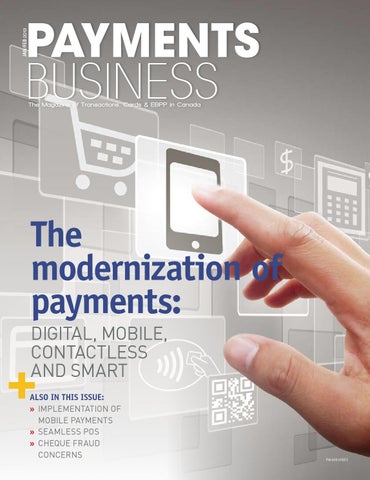
The modernization of payments: digital, mobile, contactless and smart also in this issue: » Implementation of mobile payments » Seamless POS » Cheque fraud concerns
PM 4 0 0 5 0 8 0 3
DRIVING PAYMENTS IN CANADA
#1 ISO in Canada
$10 billion annual transaction volume 350+ employees at your service
Ready to get on board?
Take your ISO to the next level Pivotal Payments offers advanced front-end processing solutions and provides the back-end support and technology platforms needed to drive your ISO’s growth forward. Receive application and statement branding, 24/7 merchant support and premium relationship management. Benefit from complete ISO programs that include aggressive buy rates, high revenue share and no liability. Focus on writing sales, while we take care of the rest. Pivotal Payments is the partner you keep.
PAYMENT PROCESSING
ACQUIRING SERVICES
HARDWARE DEPLOYMENT
CLIENT CARE & LEAD GEN
VALUE ADDED SERVICES
Call Murray MacGillivray at 1 877-669-5689 or visit DrivingPayments.ca
table of contents JANUARY / FEBRUARY 2013
COLUMNS & DEPARTMENTS 4
Editor’s Desk
6
Industry News
19 New & Notable
FEATURES
9
How should retailers implement mobile payments?
16
End of the line for POS How mobility will transform the consumer’s experience.
Mobile payment solutions for large retailers.
14
Payments modernized A look at the future of payments.
20
Sector scan Cheques are still popular despite fraud concerns.
5
Just payments Technical advances require new thinking. january / february 2013
PAYMENTSBUSINESS
3
Editor’s Desk
I Look AHead
n this issue, we’re considering the future of payments and the answer is clearly mobile payments. As Canadians become increasingly dependent on their smartphones, businesses would be wise to consider how to take advantage of this obsession. We’re so used to staring at our cellphones that we rarely bother putting them in our bags or pockets. We keep them in hand or on our tables in front of us. These little machines are constantly vying for our attention and we comply. Apps are being developed to urge consumers to walk into this café or drop by a favourite store for
a time sensitive deal. And we love savings. Consumers will download apps and put down their guards to get a discount on their favourite treats. It can be tempting to take advantage of a potential customer’s trusting nature. But there’s a fine line between adding value and getting one’s app deleted for pestering people. A recent survey by RadiumOne found consumers view push notifications as more invasive than SMS. Women between the ages of 35 and 54 are gravitating towards mobile coupons that offer efficiency, utility and ease-of-use. The survey’s findings urge developers to keep coupon programs simple by avoiding multi-step redemption processes. Tailor mobile coupon offers to everyday consumer products and push relevant offers to mobile shoppers via SMS. Leverage in-app loyalty programs that automatically redeem mobile coupons. And don’t worry if consumers are using their smartphones to price-match. A recent Pew Internet survey found that most mobile browsers ended up buying it in the store in which they did their mobile shopping. Of the cell owners asked, 30 per cent did not purchase the product at all, 46 per cent bought it at that particular store, 12 per cent purchased the product online while only six per cent bought the product at a different store. We’ll take a closer look at showrooming in the March/ April issue of Payments Business.
Next issue… march/April — North America - one market 4
PAYMENTSBUSINESS
january / february 2013
January/February 2013 Volume 4 Number 1 Editor Amie Silverwood amie@paymentsbusiness.ca Associate Editor Amy Bostock amy@paymentsbusiness.ca Publisher Mark Henry mark@paymentsbusiness.ca Contributors Adam Atlas, Nicolas Guay, Yves Desormeaux, Michael Loftus, Steven Nogalo, Juanita Gonsalves Creative Direction Demigroup demigroup.com Photographer Gary Tannyan Advertising Sales Rep Terry Coster terry@paymentsbusiness.ca President Steve Lloyd steve@paymentsbusiness.ca For subscription, circulation and change of address information, contact subscriptions@ paymentsbusiness.ca Publications Mail Agreement No. 40050803 Return undeliverable Canadian addresses to: Circulation Department 302-137 Main Street North Markham ON L3P 1Y2 t: 905.201.6600 f: 905.201.6601 info@paymentsbusiness.ca www.paymentsbusiness.ca Subscriptions available for $40.00 year or $60.00 two years. 2012 Lloydmedia Inc. All rights reserved. The contents of this publication may not be reproduced by any means, in whole or in part, without the prior written consent of the publisher. Printed in Canada Reprint permission requests to use materials published in Payments Business should be directed to the publisher.
Made possible with the support of the Ontario Media Development Corporation
just payments
Technical advances in payments require new thinking By Adam Atlas
A
s with other sectors of the economy, technical capacity in payments is ahead of business thinking and legal framing. I think we can expect this disparity to be a constant. For example, most Canadian banks are still building new branches and authenticating their new clients in face to face meetings that generate paper records. Meanwhile, those same people inhabit, spend and draw on their bank accounts by paperless electronic means. One wonders why a bank would bother to build a new branch (other than safety deposit boxes); they don’t serve much use in the contemporary setting. As we consider the future of payments, here are some key legal issues that may accompany the imminent de-coupling of this last hold out in brick and mortar.
Non-face to face authentication Over and above applicable law that may still mandate certain face to face moments, payment providers have an interest in knowing who they are servicing in order to prevent fraud, money laundering and the financing of terrorism. That said, a person’s online presence bears a closer connection to their true identity than their physical presence. As such, we should expect legislation to draw on the reality of things when setting the bar for cus-
tomer due diligence. For example, if I provide a Facebook, LinkedIn and Goodle identity that are all consistent and that are also consistent with my general profile as an applicant (all of which can be scrubbed by independent audit services), chances are I am who I purport to be. In contrast, stumbling into a bank branch with a faded drivers’ license will seem not only quaint but relatively insecure.
Cat and mouse over anonymity Believe it or not, there are people other than terrorists who prefer to carry out some anonymous payment transactions. This legitimate demand for some means of anonymous commercial activity will be the basis of a steady stream of innovations and counter claims by legitimate law enforcement needs to track back guys. Bitcoin is the best current example of this kind of innovation. Bitcoin is an electronic currency that permits for the more or less anonymous, free, secure and instantaneous transfer of value from one user to another. Let’s put it this way, if your employer paid you in Bitcoin, and you shopped only at merchants that accepted Bitcoin, you would never pay any banking fees, nor ATM fees, nor check fees, etc. The allure of the efficiency of that free system is offset by its attractiveness to drug dealjanuary / february 2013
ers and other illegal business operations wishing to transact anonymously. The future will bring more innovation of this kind and more worries for law enforcement that will have to work ever harder to monitor economic activity of criminals.
The end of fraud As it becomes ever easier to collect large amounts of data on each transaction, such as geolocation, biometric and other unique transaction identifiers, it is realistic to imagine a scenario where a lot of the current fraud is eliminated. Note that payment systems are designed to intentionally tolerate a certain amount of fraud so as to increase ease of use. If
we had to show a passport for every credit card transaction, our credit card processing volume would plummet.
The end of banks A typical payments start-up can acquire the same fraud screening tools as a typical bank. Payment processing should no longer need to rely on bank-owned infrastructure or guidelines. The EU has been proactive in this regard by legislating electronic payment services as a defined concept: unleashing considerable payments innovation. Adam Atlas is an attorney at law who can be reached by email at atlas@ adamatlas.com. None of the foregoing contains legal advice. Consult qualified payments counsel prior to accepting any legal terms binding on you. PAYMENTSBUSINESS
5
industry news
Movie theatres on cutting edge of payment technology Purchasing a ticket to a movie couldn’t be easier these days. Or warmer. At the turn of the 20th Century, Canada’s grand old movie houses had outdoor box offices. Movie-goers would line up around the block in rain, sleet and snow to purchase tickets to the latest Hollywood blockbuster. Today, not only do most theatre operators offer large, comfortable lobbies and indoor box offices – the payment process has never been easier. Cineplex Entertainment, Canada’s largest theatre operator, allows guests to pay for their tickets at the box office using Interac Flash – a contactless tender that enables smaller value transactions simply by holding an enabled card near a point-of-sale reader.
Cineplex and Canada’s second largest theatre operator, Empire Theatres, also allow movie-goers to purchase tickets through express kiosks at the theatre or online from the comfort of their home. There are no transaction fees, and guests can pay for their ticket purchase using a major credit card (or even PayPal at Cineplex). Cineplex and Empire both offer services that allow guests to print their tickets at home, skip the line at the theatre and go directly to a
ticket taker who will scan their print out and admit them to the movie. “Our goal is always to provide the very best guest service – and that means ensuring guests enjoy their stay from beginning to end,” said Pat Marshall, Vice President, Communications and Investor Relations, Cineplex Entertainment. “The advent of mobile technology allows us to move guests quickly and easily through the concession area and into the auditorium.” Cineplex and Empire also offer
movie-goers the opportunity to purchase tickets directly from their smartphones. Using the Cineplex Mobile App, Apple iOS 6 users can purchase movie tickets and store them in Passbook. When they approach the movie theatre, their ticket will automatically appear on the Lock Screen on their iPhone or iPod touch, making it even easier to bypass the lines. In addition, users can also add their loyalty card to Passbook and redeem it when making purchases at the theatre.
ICMA EXPO introduces expanded format and interactive roundtable sessions A non-profit association of plastic card manufacturers (ICMA) is holding a Card Manufacturing and Personalization EXPO to provide attendees an open forum to connect with potential clients and industry colleagues while learning about the latest card trends and techniques on June 4-7, 2013 at the Washington Marriott Wardman Park in Washington, D.C. Katty Kay, the lead anchorof BBC World News America, will serve as this year’s EXPO keynote speaker. Covering the full gamut of global affairs—reporting on global economies and world trouble spots—Kay will discuss how politics and culture influence global business practices in her presentation. The card industry is very much at a technological crossroads, where EMV migration in the U.S. and the growing use of mobile 6
PAYMENTSBUSINESS
payments are forces influencing the evolution of the physical card. To address these market shifts, ICMA has expanded its focus to include concurrent sessions about personalization and fulfillment, global manufacturing issues, advanced technologies and leadership, sales and marketing. The EXPO will also feature roundtable sessions to give attendees the opportunity to analyze and explore current and future card market dynamics as well as path-forward trends and innovations with their peers in a relaxed environment. In addition to the educational opportunities, the EXPO also provides Speed Networking sessions, giving card manufacturers or personalizers and exhibitors the ability to network with each other and meet new industry companies. january / february 2013
industry news
Wireless printers allow POS mobility In January, the National Retail Federation (NRF) held its 102nd Annual Convention and EXPO in New York City. Attendees gathered from around the world to see products and services, and mobile payments was one of the hottest topics. Forrester Research, Inc., an independent research company, is predicting big growth for the mobile payments market in a new report spanning 2013 to 2017. The market research firm is anticipating that the U.S. mobile payment market will see $90 billion spent in 2017, an incredible 48 per cent compounded annual growth rate over the $12.8 billion that was spent in 2012. Retailers, like Nordstrom, are pumping serious revenues into mobility. The luxury retailer plans an additional $1 billion investment, one-third of its capital expenditures, into mobile, e-commerce and digital technologies over the next five years. As demand for mobility skyrockets, so do choices in the number and variety of solutions out there and the world of printing technology is responding like never before. Manufacturers are designing printers to be lighter and more flexible for on-the-go mobile receipts – with connectivity options such as Bluetooth for iOS to interface with the hottest devices. At this year’s NRF show, printers hit a significant industry-first milestone as Epson America introduced receipt printers with built-in intelligence for next-generation POS printing. Designed
to meet the challenges of today’s retailers for more mobile, smart and connected stores, these solutions bring retailers the power of mobile, web-based printing, cloud-based services, peripheral connectivity and more - in one compact footprint, without upgrades to existing systems. Epson says its intention is to bridge the gap between traditional and mobile POS platforms, targeting retailers looking to implement a more customer-centric mobile POS model while protecting legacy and existing POS investments. These solutions can also act as a gateway to value-added, cloud-based services with no POS software integration needed. Two Canadian companies showed off cloud-based solutions on these new Epson devices at the NRF Show, including RewardLoop, a company focused on mobile loyalty and rewards and Livelenz, a provider of realtime, operational and consumer analytics for the retail and hospitality segments. With real-time access to valuable transactional data, the options for implementing payments-enhancing cloud applications through one of these smart printer devices are virtually limitless. The hottest new printing technologies open up an entire new world of options for retailers looking to update and enhance POS functionality. This technology represents a significant shift in what a POS printer is and what it can do. 2013 is expected to be a big year for new, smart, mobile and connected receipt printers. january / february 2013
PAYMENTSBUSINESS
7
industry news
CPA’s image project facilitates electronic cheque exchange in Canada T
he Canadian Payments Association leads its member financial institutions, businesses, government and the public in establishing the rules of Canada’s payments highway. And cheques are about to move into the fast lane. A detailed framework for Electronic Clearing Exchange (ECE) between Canadian financial institutions (FIs) is on the near horizon, marking another milestone in the CPA’s multi-year Image Rule Project. This is the last step in the journey for full end-to-end electronic image processing of paper items, such as cheques. ECE between Canadian FIs will also make it more efficient for financial institutions to extend Remote Deposit Capture (RDC) services over multiple channels. Of course, as with all proprietary services, decisions on whether and when to offer RDC services to its customers will be at each FI’s discretion. Data and image exchange between two CPA member FIs for the purpose of cheque clearing has been allowed since October 2012. However, it requires individual bilateral agreements between two participating FIs because the current framework does not set out detailed requirements for the exchange process between any and all FIs. Lacking the certainty afforded by standardization, FIs have been understandably hesitant to make these proprietary arrangements. The detailed, standardized ECE framework offered by the CPA will enable member FIs to participate in ECE with confidence, fully supported by a sound legal framework. The CPA’s 3-year Image Rule Project has offered incremental efficiencies in Canada’s inter-FI cheque clearing process, culminating in the proposed Electronic Clearing Exchange framework under consideration today. First, the Association created Image Rule A10. Implemented in June 2010, this rule permits member FIs to rely on official images of post-clearing (paid) items. It also introduced the ability for FIs to use image printouts to return certain dishonoured items. Under Canada’s Bills of Exchange Act (BEA), an FI can use an official image of an original payment item, such as a cheque, as though it were the original item, provided the image is created in accordance with CPA by-laws, rules and standards. Then, in June 2011, the CPA amended Rule A10 and introduced a new technical standard (Standard 013), allowing FIs to create and use Return Replacement Documents (RRDs). These image-based paper documents can
8
PAYMENTSBUSINESS
january / february 2013
be used to return some dishonoured payment items, including cheques. It’s more efficient than returning original items in terms of both time and money. It’s much faster and easier for an FI to locate and retrieve an image and the use of RRDs eliminates off-site storage and retrieval costs associated with the return of original items. As a third step, in October 2012, further amendments to Rule A10 and an additional technical standard (Standard 014) were introduced. These enable member FIs to expedite the forward payment journey of payment items such as out-of-region cheques. FIs can transmit images from various sites where cheques are collected (such as branches or ABMs), to data centers, where the images are printed as paper Clearing Replacement Documents (CRDs). The CRDs are then exchanged and presented to the FI that holds the account on which the cheque is drawn, for the “pay” or “no-pay” decision. “With the conclusion of the CPA’s Image Rule project,” explains interim President and CEO Ken Casey, “we are creating opportunities for FIs to streamline operations, reduce costs and credit risk and offer customers a broader range of image-based services.” The Association is consulting on the draft ECE framework with member FIs and stakeholders until March 16th. The consultation paper is publicly available on the CPA website (www.cdnpay.ca). The CPA operates Canada’s national clearing and settlement infrastructure - essential to the movement of hundreds of billions of dollars between financial institutions across the country each day. On December 17, 2012 alone, CPA systems cleared and settled payments worth a recordbreaking $311.1 billion dollars.
tech update
How should retailers implement mobile payments? By Nicolas Guay, Yves Désormeaux, michael Loftus
M
obility is the latest buzzword in the payments industry. But mobile payments mean different things to different people — from digital wallets for consumers, to payment acceptance apps for micro-merchants, to more sophisticated wireless chip card readers for larger retailers. There’s a lot of buzz around mobile payment solutions aimed at micro-merchants, which allow them to use a smartphone or tablet to process card payments. Typically the merchant downloads an app onto a mobile device, essentially turning it into a payment terminal, and pays a per-transaction fee. This opens up payment acceptance technology to more merchants, such as self-employed workers and mom-and-pop shops. Understandably, there’s a lot of excitement around these solutions, since it makes it easy and affordable for micromerchants to accept card payments. But, despite the buzz, these solutions aren’t necessarily suitable for larger retailers that need to integrate mobile payments with their current point-of-sale (POS) system. Typically a large retailer has hundreds of sites and each site has several cash registers that are part of the overall corporate POS system. Not only is the retailer accepting payments through this system but that information is also being fed into back-office systems such as customer relationship management and financial applications. Simple smartphone-based mobile payment solutions provide basic POS functionality that is not necessarily suitable for large
merchants or for merchant-specific retail segments. They typically don’t provide integration capabilities for a merchant’s existing systems and could force major changes in the merchant’s IT infrastructure. Another issue is the use of chip cards. Many of these mobile payment solutions originated in the U.S. and are now making their way into Canada. In the U.S., however, most retailers only accept mag-stripe cards that require a signature, while Canada has almost completely migrated to chip cards, which require a secure pin. As a result, most of the solutions that plug into a smartphone or tablet only support mag-stripe, not chip cards — and mag-stripe transactions are inherently less secure than chip transactions that require a pin. A merchant deploying one of these solutions should understand that they’re accepting a higher level of risk and could be liable for fraudulent transactions. Also, in Canada as with all countries, a merchant must be PCIcompliant and ensure that all customer credit card information is secure. With a smartphone-based mobile payment app, all of the components must meet those regulatory requirements. Merchants must also consider the total cost of ownership. A simple mobile payment solution may be an affordable option for a micro-merchant doing a small number of simple payment transactions but a larger retailer should understand how the total cost of processing the transactions compares to the rates
The Canadian Institute’s 2nd Forum on
ts en re m tu or op Fu it el d on ev an D 13 to M ew 0 s N or 2 nd f re T
May 7 – 8, 2013 | Marriott Bloor Yorkville | Toronto
Canadian Payment Innovations Securing Market Share Through Strategic Business Models
Register Now • 1-877-927-7936 • www.CanadianInstitute.com/PaymentInnovations Priority Service Code: 449PAYBUS
january / february 2013
PAYMENTSBUSINESS
9
tech update
they’ve already negotiated with their acquirer. Regardless of the challenges, mobility can provide in-store flexibility for retailers, allowing them to reduce fixed lanes and save space. Mobility can also enable clerks to assist customers and complete sales anywhere in the store. As a result, more retailers are experimenting with mobility. But if merchants want a mobile payment solution that supports chip cards, they require something more sophisticated than an app on a smartphone. This type of solution does exist but it’s more complex and expensive than the simple mobile payment solutions entering the Canadian market. This includes a “sled” device, which is hardware that physically attaches to a smartphone or tablet and can include a chip card reader and pin pad for secure transactions. But not all sled devices accept chip cards and acquirers don’t support all sled devices, so merchants have to do their homework before investing in this solution. There is also the risk of buying sleds made for specific form factors that may not be compatible with future mobile devices.
A specialized mobile card reader that uses a Bluetooth-enabled portable pin pad has already been deployed in restaurants, allowing servers to take credit and debit chip card payments at a customer’s table directly from the mobile card reader and pin pad, which connects wirelessly to the POS system. This could also be done on a tablet that integrates with the retailer’s POS system and separate wifi-enabled mobile pin pad (which could be worn on a belt or in a holster); it’s not necessary to have the pin pad physically attached to the tablet. But a merchant must decide if accepting payments on a tablet makes sense in their environment. If servers in a restaurant are only using tablets to accept payments, a mobile card reader and pin pad solution may be more economical than buying tablets (which might also be less durable). New solutions for large retailers are being piloted that will connect mobile devices to an existing POS system for a truly integrated solution — bringing the best of both worlds together. Nicolas Guay has over twenty years of experience in information technology including more than fifteen years in the area of payment. He has played a major role in the migration to chip and contactless technologies, working closely with banks, service providers and merchants. With more than 15 years of experience in payment solutions, Yves Desormeaux has developed a broad expertise in the implementation of transactional solutions. He has a thorough experience in managing the implementation of new payment solutions. Michael Loftus is actively involved in new areas of development and technology in the field of payment solutions. With his solid technical background, he leads all major sales initiatives at Tender Retail.
10
PAYMENTSBUSINESS
january / february 2013
S:7”
Mr. John Smith 7842 Winfred Cres. Toronto, Ontario Canada
Introducing AddressComplete from Canada Post. TM
7842 Winfred Crescent, Toronto 7842 Winfell Crescent, Calgary 7842 Winnol Crescent, Halifaxx
AddressComplete enables your business, no matter the size, to eliminate incorrect or incomplete customer address information. Now you can make the most of every customer.
Address it right the first time. C Capturing an accurate customer address is a competitive advantage for any t business. AddressComplete automatically eliminates any chance of human error when customers fill out your online forms, because they are leveraging Canada’s most accurate and up-to-date addressing database. A better online customer experience. By reducing the time and effort required for customers to complete your online forms, you remove a critical obstacle to online shopping success. Accurate address auto-fill improves sales and your bottom line by ensuring that what you send to your customers doesn’t come back.
Give your business a competitive advantage. Visit canadapost.ca/addresscomplete for a free trial. AddressCompleteTM is a trademark of Canada Post Corporation.
S:9.5”
Make sure what you send to your customers doesn’t come back.
Creating Confidence Since 1962. Confidence built on 160 years of experience. Giesecke & Devrient (G&D) was founded on June 1, 1852 in Leipzig, Germany, specializing in banknote printing and the supply of security paper and machines for banknote processing. Today, G&D is an internationally leading technology provider and from its headquarters in Munich, manages 58 subsidiaries, joint ventures and associated companies in 32 countries. In Canada, G&D proudly marks their 50th year of pioneering advancement and successful delivery in secure solutions for payment and identification. From the production of the first plastic Social Insurance Card in 1962, to currently leading the way in the quickly evolving mobile ecosystem, G&D remains committed to investing in the Canadian market and the integrity of secure solutions for a sustainable, smart future. www.gi-de.com/ca
Now Creating Confidence in Quebec! Introducing our new Personalization Bureau in Montreal.
Giesecke & Devrient (G&D) is proud to introduce the opening of our new Personalization Bureau in Montreal. With 50 years of Creating Confidence in the Canadian marketplace, G&D is well prepared for the investment and expansion of trusted service to the people of Quebec. The new Personalization Bureau allows G&D to offer increased regional support and efficiency for existing and new customers within the province. It will also play a key role in supporting the convergence of smart chip solutions for EMV, transit and government solutions for driver’s licences, health and identification. G&D looks forward to growing together in partnership and trust in the province of Quebec! www.gi-de.com/ca
cover
Payments modernized digital, mobile, contactless and smart By Amie Silverwood
I
n 2013, the question isn’t whether businesses should implement mobile payments but how to do it most effectively. Up until now, mobile payment systems haven’t offered enough of an incentive to convince consumers to change the way they pay. But all that is changing with new technology that is able to provide value for both consumers and merchants. According to Pierre Roberge, payments are long overdue for a modernization. Despite the new technologies that have been adopted over the years, the fundamental system remains the same. He says it’s time for payments to evolve to suit the world in which we live. “We are creating 21st century services using 50 year old technology and there is a disconnect there. When I pay you with a credit card, you don’t really know, why am I getting authorization, I may decide tomorrow that I will dispute the transaction.
14
PAYMENTSBUSINESS
january / february 2013
COVER
The money doesn’t go straight into your bank account. It’s expensive. “There’s all these attributes - why are we accepting those in a world of real time and worldwide and efficient and premium? The payment system has not really evolved the way the world has. And I think that’s creating some interesting challenges.” In 2013, Roberge predicts we’ll see more electronic payments and contactless payments will continue to grow since credit cards are finding greater penetration in smaller ticket items. With advances in contactless payments streamlining the use of credit cards, consumers are more apt to use their credit cards for everyday purchases. “Now you’re quite comfortable tapping your card at Tim Horton’s for a two dollar coffee. What this has done, it has effectively reduced the average transaction size if you look at it industry wide. And this will continue.” An increasing number of credit card transactions for smaller ticket items cuts deeper into merchants’ profit margins. Visa Canada and MasterCard Canada have recently communicated their plans to increase transaction fees for small merchants in the summer of 2013 by 20 per cent. Merchants are becoming more vocal about the cost of credit cards in an effort to inform consumers that their choice of payment has an indirect impact
on the cost of their purchases. Roberge predicts we’ll see new payment options in P2P transactions. This is something card associations and banks are looking at and it’s something digital cash is good at. Many of the P2P transactions done today involve sending money to other regions: parents sending spending money to a child in university or migrant workers sending money to family overseas. But as these transactions become easier, we’ll use them more for local exchanges. “If we want to split the bill or I owe you $25, we could use PayPal, I could use Interac money transfer but I think we will see other methods of payment that will allow that.” Shopping online is another trend that is growing at an accelerated rate in Canada. According to MasterCard’s SpendingPulse report, December online sales rose 26 per cent this year over last. “eCommerce is the new frontier for many Canadian companies looking to grow their base and put their products in the hands of consumers,” said Michael McNamara, VP of Research and Analysis for MasterCard Advisors SpendingPulse. “While online shopping shares typically peak during the holiday season, the size of the share in Canada this year is definitely a pleasant surprise for online merchants.” As Canadians do more shopping online, there’s a number of parties that are
A wallet can facilitate a whole bunch of demand generation both through loyalty and coupons.” january / february 2013
working to move consumers’ wallets to a digital format to make eCommerce and mobile transactions quicker, safer and easier for shoppers. Whether the information is stored in the cloud or on their smartphone, digital wallets are all the rage. MasterCard, PayPal, Google and a number of other companies are coming up with their own solution since they believe consumers will soon be willing to eschew their physical wallets for their phones or even just their phone numbers and a PIN. Miiscan is a Canadian innovator that has been able to marry its digital wallet with hyper-local and targeted couponing and loyalty programs; offering incentives for consumers and offering the merchant a whole gamut of services. It may not be a known name in the industry today but its forward-thinking has turned heads with patented technology that is ahead of the competition. In order for a mobile wallet to be adopted, it must offer the consumer something more exciting than simply scanning a barcode. At a recent meeting, Miiscan’s CEO, Mark Itwaru, demonstrated how they’re able to imbed inaudible tones into TV ads and radio commercials. When it plays, it transmits a sound to the consumer’s wallet and a message or a coupon pops up. The same technology can be used in a store so that an incentive is sent to the wallet as the consumer walks past a display. This coupon is then available to the consumer and the merchant at the POS so they’re reminded to use it. The consumer may also be offered another coupon to entice him or her to return.
Using geolocation to make coupons hyper-relevant and hyper-local to the consumer is one feature that shows promise for early adopters. A consumer’s wallet can plant the craving for a hot drink on a cold day as the customer approaches a favourite coffee shop. “Retailers don’t know a lot about the people who are in their stores. And so a wallet can facilitate a whole bunch of demand generation both through loyalty and coupons,” explains Darrell MacMullin, Managing Director, PayPal Canada. “We think the whole loyalty business, coupon business and payment business have been too isolated too long. And they actually should merge together in a lot of ways to start delivering a richer experience for both merchants and consumers.” McMullin is looking forward to the mobilization of the POS terminal itself – ending the need for consumers to wait in line. He uses Apple as an example of a store that provides each employee with a mobile checkout device to ease the speed of the transactions. “People more and more have smartphones and tablets on them. And so that is going to – whether they like it or not – change the way people shop and the way people pay. And the way they get things done in their daily lives. Consumers are changing, if they’re connected, how do we make that an interesting opportunity for merchants to be able to take advantage of? How do we make the whole commerce experience more interesting and more frictionless for everyone?” In 2013, consumers are ready to find out.
PAYMENTSBUSINESS
15
nd
16
PAYMENTSBUSINESS
End
january / february 2013
special report
of the line for POS By Steven Nogalo
R
estaurant patrons will no longer need to wait for the bill to be delivered to their tables. Instead, they will be able to use their smartphones to re-order menu items, alert their servers, save their usual orders and even complete comment cards digitally. The bills will be available for them to pay on their phones without the exchange of cards or cash. This isn’t a future concept that will be available once technologies have matured, networks have been replaced and digital wallets have replaced leather. It exists today. There are mobile pay products being used in restaurants that allow participating locations to accept smartphone payments. They’re accessible by a website or a QR code provided by the restaurant’s server, which takes diners directly to their bill on their mobile browser. What’s really fascinating about these new solutions is that they are providing a window into how the notion of “point of sale” is fundamentally changing and january / february 2013
PAYMENTSBUSINESS
17
special report
transactions from the screen of their smartphone using QR barcodes. They can activate their fuel dispenser, shop inside, save their customer preferences, pay and get an e-receipt. This technology is often integrated with leading loyalty providers to provide personally tailored marketing and coupons. At the grocery store, iPhone applications are taking self-checkout to the next level by allowing shoppers to scan their own items in the aisles with their iPhones as they shop to keep track of the cost of their purchases. Consumers then scan a QR code on their iPhones at the self-checkout to transfer their mobile shopping information and complete the check out.
transforming how consumers will pay along the way. Today’s consumers want to use their mobile device for everything and they want it seamlessly integrated into their everyday life. Historically, point of sale has meant paying at a fixed location. In today’s multi-channel, interconnected world, the “point of sale” begins well before a consumer even arrives at the store location. Purchases often start online, include social media and shift to mobile as consumers arrive at the physical locations. This swing to mobile and the growing preference of mobile as THE interaction mode presents outstanding opportunities to deliver a truly enhanced consumer experience. The notion of payment being disconnected and separate from the consumer shopping or dining experience is becoming a thing of the past. It’s being replaced by integrated solutions that leverage the mobile device to deliver a seamless experience. Mobile is unique in its ability to enable personalized, bi-directional, contextual interactions between merchants and consumers – and finally to facilitate secure, seamless payments. In the meantime, there is a growing concern Canada’s payments system is lagging behind other countries. According to the 2011 Task Force for Payments Systems Review: Moving Canada into the digital age: “Canada’s system has simply not evolved in step with the wants and needs of its users, and this stagnation is standing between each one of us and a better standard of living.” While the promise of NFC (near field communications) remains somewhat elusively on the horizon, we’re turning to other technologies to facilitate and integrate mobile payments. Additionally, while we may one day see the end of paper, the reality is that today, cash and cheques still make up the majority of payments in Canada. The challenge, and opportunity, is to provide solutions that deliver the next generation of productivity gains for business, while meeting consumer expectations for convenience, choice and security, all with technology that is easy to use and available today. Mobile pay solutions are transforming the payment channel and creating a foundation for industries such as banking, retail, hospitality and travel to integrate the latest payment options. When combined with loyalty programs, marketing and other services, they are building customer adoption for mobile payments. In banking, QR barcode technology is enabling mobile withdrawals at ATMs and mobile remote deposit capture allows cheques to be deposited without ever having to visit a bank or ATM. In the convenience industry, the latest solutions allow consumers to manage all of their 18
PAYMENTSBUSINESS
November / December 2012
What does all of this mean for our industry? The future looks fascinating for those of us who thrive on solving business problems and creating revenue growth for our clients. But it’s critical that we offer a seamless, integrated experience to deliver on the promise of more value for consumers and productivity gains for service providers. That’s not an easy undertaking and will require more than simply replacing today’s plastic cards with digital versions. I’m excited about the accelerated pace of innovation we are witnessing and the challenge and opportunities ahead. Working in partnership with all stakeholders, we can unlock innovation by integrating and connecting consumers with service providers to change the payment landscape in ways yet to be conceived. Steven Nogalo is the VP and general manager of Global Payments and Converged Channels of NCR Waterloo, a world leader in developing imaging, deposit and payments solutions for banks, bank customers and national institutions.
new and notable
Patent filings predict popularity of network technologies Analysis of the patent landscape surrounding a business can identify new areas in a competitive market. ClearViewIP recently studied how the intellectual property for the credit card industry has changed over time in reaction to significant cases of fraud, changes in social behaviour and other factors. In 2007, in one of the largest recorded credit card frauds in history, the TJX group discovered that the details of almost 46 million customers had been stolen from their servers in both the US and UK and used to create dummy cards. Since then, payment card countering fraud has been a driving force behind technological innovation in the area. ClearViewIP undertook a patent landscape to trace historic industry developments and predict what the future holds for credit card technology. Key findings showed that patent filings linked to card features and the magnetic strip have declined over the last 30 years, drastically in the case of features that emerged shortly before the materialisation of Chip&PIN. Filings for network technologies and authentication innovations have risen, by contrast. Chip patents and card features are maintaining a consistent rate of filings, suggesting that although not as key as the network factors, they will still form an important part of the process for some time. The consistent decline of the magnetic strip looks set to continue and is unlikely to provide any new security advantages. Patent filings relating to payments through contactless
and mobile methods now cover 30 per cent of credit card patents, up from just ten per cent a decade ago. This is more than any other category and, with that level of growth and coverage, it is a sign it will form a large part of the next dominant payment system. However, transition periods
january / february 2013
between technologies are often long and fraught with technical problems, with large numbers of people who may never switch from payment cards. Advances offering on-card authentication, biometric identification, multifactor authentication or even social media integration that provide enhanced security
for the crossover between current cards and a contactless payment ecosystem will have real value for the foreseeable future. This infographic traces the key findings of the report showing how intellectual property has shaped the credit card industry.
PAYMENTSBUSINESS
19
sector scan
Cheques still popular despite fraud concerns By Juanita Gonsalves
O
nly four per cent of all Canadian payment transactions took place in cheque or paper form in 2011, according to the CPA, but they represent forty per cent of the value of cleared items (including business cheques at less than $25 million). So where are cheques still being used? The Federal Government is a large issuer of cheques. Looking at consumer payments, cheques are still prevalent for paying rent, utility bills and municipal taxes but there is an apparent shift to electronic services such as preauthorized debits, P2P payments, telephone banking and online banking. That’s a very good thing, because the very act of mailing cheques can expose your business to inherent risk unless you take specific precautions. Consider that writing cheques exposes a substantial amount of personal information that can be used by the criminal element to commit fraud or identity theft activities including payor names and addresses, bank accounts, routing information and authorized signatures. Since 1875, many of Canada’s financial institutions have relied on Davis & Henderson (D+H) to supply cheque products and as a result, D+H indirectly services 20 million Canadian consumers and 2 million small businesses. D+H also provides value-added services to financial institutions which can be offered as part of account packages, credit card programs or a la carte to help fight against modern day identity theft and credit risk threats. “The payments industry is evolving,” said Serge Rivest, executive vice president of
A cheque is an ancient form of payment that represents a commitment to pay a specific amount by one party to another more securely and conveniently than travelling great distances with large quantities of precious metal and gemstones – or in modern times, cash. In the modern era, cheques evolved from the promissory note, a negotiable instrument payable to whomever presented the item (the “bearer’), to a paper item which included the actual payee’s name. As time has passed, cheques have continually evolved to improve operational efficiencies and to combat ongoing criminal activities such as counterfeiting, fraud and embezzlement. Let’s review this evolution. In 1717, the Bank of England produced the first pre-printed ‘cheque paper.’ By 1811, the Commercial Bank of Scotland produced the first personalized cheques which included the payor name. By 1830, the Bank of England introduced the cheque book: cheques bound together in book form. In 1875, Davis & Henderson (D+H) who became synonymous with cheques, was first formed to
20
PAYMENTSBUSINESS
provide the financial services industry with trusted service - earlier than the Canadian Banker’s Association (1891) and the Bank of Canada (1935). In the late 1950s, with cheque volumes rising on an international scale, it was clear that manual sorting and clearing of cheques would not keep up with demand. To address inefficiencies and climbing operational costs, the first automated system for processing cheques was developed. By the ‘60s, new ANSI standards had been adopted in Canada, the United States, Australia, the United Kingdom and other countries. Machine ink character recognition (MICR) bank routing and account information was added to the bottom of cheques which was both machine readable and human readable (unlike a barcode) and was key to automation. This drastically reduced the operational costs associated with manual sorting and clearing of rapidly growing cheque volumes. Cheque usage peaked in the ‘60s and ‘70s but volumes declined as customers began using bank cards to access cash
at newly deployed automated banking machines and with the rising popularity of credit cards. In 1980, the Canadian Payments Association (CPA) was created as a result of the Canadian Payments Act (CP Act) with a mandate to “develop policies and rules that support the safety and soundness, efficiency, accessibility, and innovation in Canada’s payment system.” This included setting cheque specifications, rules and security standards. The rollout of Interac Debit in the early to mid ‘90s caused Canadian personal cheque volumes to drop dramatically; real-time payments direct from your bank account with mag stripe and PIN was faster, more convenient and more secure than the cumbersome process of writing cheques. Unlike credit cards, there was no chargeback risk to the merchant. As the number of cheques dropped, the few remaining cheques resulted in a very high percentage of NSF instances which forced most retailers to stop accepting cheques by the mid ‘90s.
january / february 2013
service directory Card Manufactures
Integrated Payments Solutions Secure Solutions for Payment & Identification
Integrated Payment Solutions and Services One of the most advanced and reliable payment delivery solutions in financial services technology.
Since 1852, G&D has been an integral partner that is solutions orientated and trusted by banks, governments and carriers. Our solutions are founded on trust, integrity and the creation of value through Confidence. • Contact, Contactless and Dual-Interface Smart Cards • Mobile Payment • On-line Secure Authentication • Enhanced Card Identification
Toll Free: 1-800-387-9794
www.everlink.ca
Toll Free: 1.866.388.0076
www.gi-de.com
secure payment solutions
Credit Unions
Secure Payment Solutions
EMV & NFC Consulting
Apriva is North America’s Leading Wireless Gateway. SECURE DEVICES | RELIABLE SERVICE | EXCEPTIONAL SUPPORT
To learn more call Paul DeRosse, Senior Vice President, Sales at 905.530.2351 or visit www.apriva.com.
Ensure a successful NFC project with FIME’s consulting team! • EMV & NFC consulting • Test tools • Security evaluation • Certification www.fime.com infoamericas@fime.com
see youR company name here Contact Mark Henry mark@paymentsbusiness.ca 1800-668-1838 x 223
january / february 2013
PAYMENTSBUSINESS
21
sector scan
payment products and marketing programs at D+H. “Canadians are writing fewer cheques and the demand for mobile and electronic payments is increasing. D+H is evolving to meet that demand with products and enhancement services such as MyIdentityAssist and CreditDefend.” MyIdentityAssist provides consumers with the tools to protect themselves against identity theft. CreditDefend allows consumers to stay on top of their credit bureau and credit bureau activity to see what potential lenders see and receive immediate alerts – by email or text message – of any significant changes or activity. For many reasons, cheques are still a very prevalent payment method in Canada. These payments are controlled by human procedures and are therefore more easily manipulated by the unscrupulous; electronic payments can be protected by automated, machine controlled processes, are more difficult to interrupt and therefore less attractive. According to KPMG’s 2011 presentation to the FEI (Financial Executives International), cheques are the preferred target of criminals. Do your part to ensure your company is not the next victim. Here is a short list of best business practises that every company should adopt to mitigate cheque processing risks. ❱ Ensure all payment processes have adequate checks and balances. ❱ If you use pre-printed cheque stock, deal with a reputable vendor offering appropriate security features, endorsed by your financial services provider. ❱ Stock should be physically secured. Software printing processes should have adequate login rights only for those authorized to issue cheques. ❱ Employ dual custodian and access procedures. Where appropriate, require two signatories for every cheque payment. ❱ Review your books regularly. Segregate this responsibility to a party other than anyone authorized to write the cheque. Original paperwork must be readily available to support every payment.
22
PAYMENTSBUSINESS
❱ Keep cheque books secure. Never pre-sign blank cheques. Where cheque books are used, only use one cheque book so that cheques clear in sequence and any variation or duplication can be easily detected. ❱ When mailing cheques, especially in quantity, use secure post bags. Window envelopes should not reveal that a cheque is enclosed. It is better to use plain envelopes. ❱ Operate separate accounts for payables, receivables, and any outbound wire transfers. ❱ Use diligent hiring practises. Be aware of changing employee circumstances that could lead to a situation that leads to blackmail or an internal compromise. ❱ Devise a cash management strategy to migrate to electronic payments (payables and receivables) as soon as economically viable. Seek tools to automate and remove dependencies on human execution of procedure that can easily be compromised.
january / february 2013