Canada’s magazine of Corporate Finance
Summer 2016 • www.canadiantreasurer.com
Regulatory
HR Management
Introducing the Canadian Lenders Association
How improving business and employee health can be synonymous
8
18
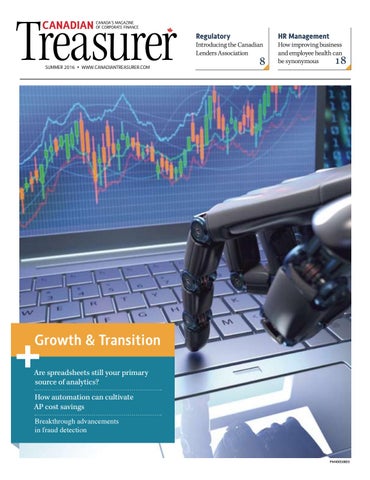
Growth & Transition Are spreadsheets still your primary source of analytics? How automation can cultivate AP cost savings Breakthrough advancements in fraud detection
PM40050803
SENDING PAYMENTS JUST GOT EASIER.
Now your business can save time and money by sending payments easily and safely to your customers and employees. Introducing Scotiabank Bulk Interac e-Transfer* service. Simply generate a payment file and upload it to Scotiabank. It’s the perfect business solution for refunds, claims, or other non-recurring payments. For more information, visit scotiabank.com/bulkinterac
CORPORATE AND INVESTMENT BANKING
CAPITAL MARKETS
COMMERCIAL BANKING
CASH MANAGEMENT
TRADE FINANCE
® Registered trademark of The Bank of Nova Scotia. * Interac e-Transfer is a registered trade-mark of Interac Inc. Used under licence.
Canada’s magazine of Corporate Finance
Summer 2016 • www.canadiantreasurer.com
Table of Contents Departments & Columns 4
Industry Watch
21
Events
Growth and Transition
8
10
78 per cent of Canadian business still using spreadsheets as primary source of analytics, study finds
14
How automation can cultivate accounts payable cost savings
16
Fraud detection learns in real time to stay ahead of the curve
Features 8
Regulatory Introducing the Canadian Lenders Association
18
HR Management Improving business and employee health can be synonymous
22
Your Team Collection lemonade: Making the best of the challenge
In the next issue:
14 Summer 2016
16
Total finance—A wholistic approach
CANADIAN TREASURER
3
Industry Watch
Aon survey: Risk and education top-ofmind issues for Canadian Pension Plans With risk in focus, sponsors put more emphasis on member education and income adequacy
Aon Hewitt, the global talent, retirement and health solutions business of Aon plc, has published new research that shows Canadian pension plan sponsors are acutely aware of—and concerned about—the risks to a secure postretirement income for employees. Amid a rapidly evolving retirement and pension landscape, including the recently announced expansion of the Canada Pension Plan (CPP) beginning in 2019, the majority of defined benefit (DB) surveyed plan sponsors (75 per cent) rank risk management as the top priority including the risks related to compliance, fiduciary and asset liability. Aon Hewitt’s Hot Topics in Retirement - Canada survey polled employers covering nearly 1.5 million pension plan members and revealed six key trends in the way employers are addressing the challenge of helping employees achieve their retirement and financial well-being: ◉◉ Canada Pension Plan: 87 per cent of respondents prefer an expanded CPP over Ontario Retirement Pension Plan (ORPP) as a better and more efficient vehicle to boost retirement savings for Ontario employees. ◉◉ Financial well-being: Almost three-quarters (71 per cent) of employers are likely to create or focus on employees’ financial well-being in ways that expand beyond retirement decisions. The top three financial wellness tools employers would like to offer are education on the basics of financial markets, financial planning and healthcare planning. ◉◉ Decumulation: 47 per cent of capital accumulation plan (CAP) sponsors are likely to encourage lifetime income, whereby they would support the process of allowing participants to convert account balances to lifetime income. Increased uptakes are expected in the future. ◉◉ Income adequacy: 43 per cent of CAP sponsors intend to measure the projected retirement income adequacy of their plan—an 18 per cent increase since 2013. When it comes to all plan sponsors, almost half (49 per cent) say they plan to measure members’ income adequacy in retirement. ◉◉ Focus on competitiveness and design: 63 per cent of employers said that they are likely to measure the competitiveness and design of their retirement program—a 10 per cent increase since 2013. ◉◉ Defined benefit plans sponsors are in it for the long haul: 75 per cent of DB plan sponsors are not expecting to make any design changes to their current plans. “Effective management of risk begins with awareness of the issues and a commitment to understanding them,” said William da Silva, senior partner and national retirement practice leader, Aon Hewitt. “While this year’s survey shows that plan sponsors are concerned, it also demonstrates their commitment to measuring plan effectiveness and retirement outcomes, as well as educating plan members. This is a huge leap forward, and bodes well for the financial security of Canadian pensioners in the future.” “Many respondents have indicated employee financial well-being is top of mind and any changes to the fundamental core of retirement will undoubtedly become important to these same employers,” said Deron Waldock, partner, legal practice, Aon Hewitt. “This week’s historic federal-provincial finance meeting in Vancouver resulted in an agreement in principle to begin expanding CPP in 2019. Pension plan sponsors will have to carefully assess the impact of CPP expansion—before it begins in 2019—on their overall retirement strategies.”
Summer 2016 Volume 25 Number 19 Publisher / Corporate Sales Mark Henry mark@canadiantreasurer.com Managing Editor Sarah O’Connor sarah@canadiantreasurer.com Contributors Kevin Deveau, Vice President and Managing Director, Canada, FICO Anthea Gomez, Director of Human Resources and Corporate Services, Express Scripts Canada
CANADIAN TREASURER
Scott Zoldi, Chief Analytics Officer, FICO
Brent Halverson, President and CEO of ecmarket Creative Direction / Production Jennifer O’Neill jennifer@canadiantreasurer.com Photographer Gary Tannyan President Steve Lloyd steve@canadiantreasurer.com For subscription, circulation and change of address information, contact subscriptions@canadiantreasurer.com Publications Mail Agreement No. 40050803 Return undeliverable Canadian addresses to:
Circulation Department 302-137 Main Street North Markham ON L3P 1Y2 t: 905.201.6600 • f: 905.201.6601 info@canadiantreasurer.com www.canadiantreasurer.com Subscriptions available for $40.00 year or $60.00 two years. ©2016 Lloydmedia Inc. All rights reserved. The contents of this publication may not be reproduced by any means, in whole or in part, without the prior written consent of the publisher. Printed in Canada Reprint permission requests to use materials published in Canadian Treasurer should be directed to the publisher.
Ontario Interactive Digital Media Tax Credit
4
Tim Paulsen, Author, Founder of ICPC
Made possible with the support of the Ontario Media Development Corporation
Summer 2016
Industry watch
Canada’s CFOs and senior financial executives applaud modest CPP expansion Financial Executives International Canada (FEI Canada), the country’s leading association for senior financial executives, applauds the federal government’s proposal to expand the Canada Pension Plan by raising premiums moderately over time. “We are very pleased. We’re happy this will start soon—the sooner the better,” said Tony Hooper, who serves as co-chair of the Pension Committee of FEI Canada’s Policy Forum, along with Kevin Sorhaitz. Sorhaitz said: “This looks like really good news for mid-career and younger Canadians, especially those without access to a workplace DB pension plan.” Hooper said Canada’s CFOs support the proposed incremental increase of the current 4.95 per cent contribution limit by one percentage point and the increase in the contribution limit to $82,700 by 2025. He said this was preferable to the Ontario government’s proposed pension plan, which he said would have been a steep hit to small business in particular. “We’re glad they’re getting on with it and they’re doing a phased-in approach,” Hooper said of the federal-provincial agreement, which will be phased during a seven-year period. “While the ORPP seems to have helped the CPP expansion debate, it was wise to back off the Ontario go-it-alone approach.” The federal proposal would provide a lower payout than the ORPP, but will be portable, universal and tax deductible. In the past, FEI Canada has publicly called for a modest expansion of Canada’s pension system, in its May 2014 white paper entitled “CPP Expansion: A critical part of the solution” as well as other measures to help Canadians finance their retirement. “It is still important for Canadians to plan for retirement, as failure to do so will eventually put additional burden upon taxpayers through increased taxes in the future,” said Norm Ferguson, chair of FEI Canada’s Policy Forum. “FEI Canada supports the significant steps taken to reach this milestone in support of labour mobility, adequate income for retired Canadians and the gradual approach to minimize impacts on Canadian businesses.” “FEI Canada has long encouraged the government to help Canadians plan for retirement by developing a national framework on adequate retirement income,” said Michael Conway, FEI Canada’s CEO and national president. “This agreement would help ensure long term solvency of pension funds while maintaining stable contribution rates and preserving a fair standard of living for Canadians in their senior years,” he said.
Marketing Association for Credit Unions votes to integrate their operations, events into CCUA The Marketing Association for Credit Unions (MACU) voted to fold its organization into the Canadian Credit Union Association (CCUA)—the national industry leader for Canada’s credit unions. The vote took place during MACU’s Annual General Meeting, in Ottawa, Ontario on Tuesday, May 31, 2016. “MACU was founded in 1988 as a way to help marketing professionals exchange ideas and best practices, and learn from other marketing industry leaders,” explained MACU Executive Director Rachel Cleland. “The decision to merge our operations will lead to increased collaboration and integration within the industry, and more operational efficiencies.” This change will also help to increase professional development opportunities for marketers across the country through key events such as the CCUA annual, national conference for Canada’s credit union leaders. CCUA’s next national conference will be held in Halifax, Nova Scotia on May 6-10, 2017. MACU members, which make up approximately 33 per cent of the system, will continue to have access to the industry research, thought leaders and industry-related webinars that their membership already gives them. A key benefit of membership is MACU’s annual Achievement in Marketing Excellence (AIME) Awards program, developed to recognize the best and brightest achievements in credit union marketing. These awards will continue to be presented to Canada’s credit unions; however at this time it is unclear if they will be merged into CCUA’s annual National Credit Union Awards program, or if they will be held separately. “This decision will enable CCUA to focus on expanding and elevating the marketing conversation across the country in a new and accelerated fashion,” explained Jennifer McGill, vice president, communications and marketing, CCUA. “It will also will help us to implement at a higher level, best practices within the system and present opportunities to leverage the insights of our peers.”
For breaking news and in-depth features,
visit our website at www.canadiantreasurer.com Summer 2016
CANADIAN TREASURER
5
Industry watch
Equifax Canada reports:
Major city analysis - Debt (excluding mortgages) & delinquency rates
Delinquency rate up for Millennials, seniors adding more debt The delinquency rate among young Millennials (18-25 years) hit 1.8 per cent in the second quarter of this year, an increase of 11.7 per cent from their 1.6 per cent rate in the second quarter of 2015. However young adults didn’t add much debt over the past year with the average change at $167, while the debt obligations of seniors (65+ years) increased by $1,134 (8.2 per cent) to $15,001 according to Equifax Canada’s Q2 2016 National Consumer Credit Trends Report. Total consumer total debt (excluding mortgages) also remains on the rise. As of Q2 2016, Canadian consumers owe $1.666 trillion, compared to $1.618 trillion in Q1 2016 and $1.568 trillion a year earlier, an increase of three per cent and 6.3 per cent, respectively. “While debt among seniors
6
Average
Average Debt
Delinquency
Delinquency
Debt
Change Year-
Rate
Rate Change
over-Year
Year-over-
(Q2 2016 vs.
Year (Q2 2016
Q2 2015)
vs. Q2 2015)
has increased, they are also the only age group that saw Calgary $28,572 1.2% 1.1% 32.2% its delinquency rate decrease over the past 12 months. They Edmonton $26,691 1.7% 1.4% 39.0% currently share the lowest delinquency rate, 0.9 per cent, Halifax $23,374 3.3% 1.5% 6.2% with the 55-64 age group,” said Regina Malina, senior Montreal $17,091 4.0% 1.3% -2.9% director of decision insights at Equifax Canada. “For the Ottawa $21,322 2.8% 1.0% -0.4% most part, older Canadians have always demonstrated Toronto $20,460 3.9% 1.3% -2.7% an ability to handle their spending and what they owe. Vancouver $24,267 3.5% 0.8% -9.1% Young people, and really everyone, should be reminded St. John’s $24,721 3.0% 1.2% 21.2% to practice good budget and money management habits. Major city analysis - Debt (excluding mortgages) & delinquency rates Great tips can be found on the Financial Consumer Agency of Province Average Average Debt Delinquency Delinquency Canada’s website”. Rate Change Debt Change Year- Rate On a debt classification Year-overover-Year (Q2 basis, installment loan, auto Year (Q2 2016 2016 vs. Q2 loan and mortgage sectors are vs. Q2 2015) 2015) showing significant increases of 7.8 per cent, 7.6 per cent Ontario $21,570 3.7% 1.1% -3.9% and 7.6 per cent year-overyear, respectively. Quebec $18,489 4.1% 1.1% -3.3%
Debt (excluding mortgages) & delinquency rates Age
City
Average
Average Debt
Delinquency
Delinquency
Debt
Change Year-
Rate
Rate Change
over-Year
Year-over-Year
(Q2 2016 vs. Q2
(Q2 2016 vs.
2015)
Q2 2015)
Nova Scotia
$21,963
4.3%
1.7%
2.0%
New Brunswick
$22,542
5.1%
1.7%
-1.6%
PEI
$21,822
4.6%
1.5%
5.4%
Newfoundland
$23,074
4.6%
1.3%
19.4%
18-25
$8,203
2.1%
1.8%
11.7%
Eastern Region
$22,382
4.6%
1.6%
3.8%
26-35
$16,841
2.8%
1.6%
9.7%
Alberta
$27,753
1.6%
1.4%
40.3%
36-45
$26,480
1.8%
1.3%
5.5%
Manitoba
$18,193
3.5%
1.2%
12.9%
46-55
$32,243
3.4%
1.0%
1.0%
Saskatchewan
$24,276
4.0%
1.2%
22.7%
56-65
$27,594
3.3%
0.9%
2.2%
British Columbia
$23,538
2.3%
1.0%
-3.3%
65+
$15,001
8.2%
0.9%
-2.4%
Western Region
$24,586
2.3%
1.2%
18.1%
Canada
$21,878
3.4%
1.1%
4.1%
Canada
$21,878
3.4%
1.1%
4.1%
CANADIAN TREASURER
Summer 2016
advertorial
Trade Relations: Challenges and Opportunities with US Trade
I
n an increasingly global marketplace, where trade is core to economic growth, it’s important to understand the issues and opportunities businesses face when trading with the US and other global markets. A new report from the Economist Intelligence Unit, in partnership with American Express, explores these trade relationships and the challenges Canadian businesses face. “Canadian firms continue to leverage see the US market as an intimate trading partner and its market a source for growth,” says Paul Roman, Vice President, Global Commercial Payments, American Express Canada. “While there are complexities in managing cross border payments, it is exciting to see the growing level of optimism Canadian companies have when asked about how the US factors into their growth plans,” in how their US activities will positively impact their business. “The results show there are some issues to be looked at, including cross-border payments, but it is positive to see optimism among a majority of Canadian firms that their trade with the US will increase.” As the world’s largest economy, and Canada’s largest trading partner, it’s hard to ignore the opportunities the US market presents. In fact, a huge majority (94%) of Canadian companies derive up to 30 per cent of their current global annual revenue from the US market – the same as the US’s other continental neighbour and NAFTA co-signatory, Mexico. In fact, the reliance on trade with the US is expected to rise, as 58 per cent of Canadian companies expect their trade with the US to increase in the next five years with around one-in-five (18%) seeing it grow by more than 10 per cent. However, Canadian businesses are looking beyond US borders for growth opportunities, with almost seven in ten (68%)
expecting their trade with other overseas markets to increase in the next five years.
Insight on International Payments Making payments was cited as a top challenge by four in ten (38%) Canadian businesses that trade with the US, and half of businesses that trade outside of the US market. Their top issues with making cross-border payments include currency fluctuation, banking hours, bank fees, limited or no terms, limited payment visibility, and process inefficiencies. These payment challenges have impacted Canadian businesses, resulting in unbalanced cash flows, increased foreign exchange exposure, shipment delays, and increased processing and payment costs. These challenges can have a large impact on business results, as over a quarter (28%) of businesses surveyed spend more than 10 per cent of their annual costs in purchases from the US, while the majority (82%) derive up to 10 per cent of their annual revenue from US-based customers. “Navigating international payments efficiently can be challenging” says Roman. “Our Global Currency Solutions solve many of the inefficiencies and hidden costs that come with traditional payment methods. We want to help our customers thrive when it comes to cross-border trade with their continental neighbour.” For businesses, imports and other international transactions represent an opportunity to streamline processes and achieve savings. Solutions, like American Express Global Currency Solutions, can help business control, manage, and simplify their cross-border payments, giving them full spend visibility, improving cash flow, minimizing foreign exchange impact and reducing transaction costs.
Paul Roman is Vice President of Global Commercial Payments at American Express Canada. In his role as leader of the Global Commercial Payments business Mr. Roman is a key leader in developing and driving the business strategy in Canada. He is responsible for strategically aligning Global Commercial Payments with other American Express Canada business units to deliver high quality products and services and maintain American Express’ leadership position in commercial payments in Canada.
Summer 2016
CANADIAN TREASURER
7
Regulatory
Introducing the Canadian Lenders Association
A conversation with Founder and Chairman of the Board Karl Sigerist By Sarah O’Connor
8
CANADIAN TREASURER
“I
’ve been in FinTech, as its now coined, for most of my career,” says Karl Sigerist, founder and chairman of the board of the newly minted Canadian Lenders Association. “I had the words ‘finance’ and ‘technology’ in my LinkedIn summary profile. I just never knew that if you shortened it to ‘FinTech’ the company would be worth more.” Sigerist is director, president and chief executive office of Crelogix Credit Group Inc., a provider of point of sale installment credit
financing considered Canada’s largest FinTech company. “As an operator of various non-bank businesses over my career in various roles, the use of technology to enable a more frictionless, more effective customer experience and more efficient internal processes is, I think, just at the root of any business leader, not even limited to just finance,” he observes. Earlier this year Sigerist read an article in the Financial Post by Barbara Shecter posted online on March 31 and titled “Debate over regulating
Summer 2016
Regulatory fintechs heats up in Canada and the U.S.” In the article Bharat Masrani, chief executive of Toronto-Dominion Bank, calls for increased oversight of FinTech companies and is quoted as saying “the need has become even more evident. Security breaches—service interruptions—and solvency issues have plagued a number of FinTechs… That’s why I believe it would be appropriate for policymakers to consider a regulatory environment that ensures the safety of customer information and the integrity of our financial system.” That article and quotation “really was the impetus for me first reaching out to all my peers in the industry, forming a LinkedIn group and now forming what we are calling the Canadian Lenders Association,” says Sigerist. “My thesis is that Canadian technology lenders and organizations run the risk of being marginalized if we leave the advocacy for and the education of our business models to others. Crelogix is quietly in the background enabling its business partners to become more successful, and so are many of my peers who are busy either helping small businesses or consumers get the lifestyle they want and business to achieve their business goals by providing credit products to them. “Many other forms of financial market participants, whether Canadian banks or the Payments Association or payday loans or mortgages or automobile and equipment finance, all have associations that represent their collective voice as an interest. Now, there was, prior to the global financial crisis a trade association for the consumer lenders but that industry association went away when those lenders went away.” Sigerist explains that following the global financial crisis there was a great deal of consolidation that changed the landscape of the industry. “Our particular niche, the consumer and small business space, was very scattered so we joined together: Crelogix, GoEasy, Dealnet, Thinking Capital and Lendified as the founding members, together with a lot of help from Blakes, a major law firm in the finance space, and McMillan LLP to form the association. “I read once: if you don’t have a seat
Summer 2016
at the table you’re more than likely to be on the menu. The association is intended for professionals in the industry—for founders, executives and investors interested in the Canadian consumer/ small business lending space. “The members will include small business and consumer financiers, and that can also include public companies, private and cooperatively owned banks or finance companies. We have a number of common interests and we want to advocate, converse, collaborate and educate to move the small business and consumer lending industry forward in Canada.” In response to the article that inspired the founding of the Canadian Lenders Association and the quote from Masrani of TD, Sigerist says: “We believe that regulation should be a collaborative process between both the regulators and the parties directly impacted by the proposed regulation. Both government, borrowers and the industry should work together to promote lending that helps borrowers meet their financial needs through affordable credit and the extension of credit must be affordable for both the lender and the borrower.” Sigerist attributes the speed from which the organization has gone from idea to reality to the very nature of the industry the association serves: “We’re entrepreneurs. Some of us have banking DNA in our blood when it comes to being prudential but we’re also entrepreneurs. We get things done. The response [from the industry] has been amazingly positive. “Credit is what attracts people to the Canadian dream in that we have a society that provides credit to you so that you can buy a car, you can buy a house. There are other countries where that’s not possible and its how we create an amazing society for all of us. “I think that our lawmakers don’t want to be the victim of unintended consequences. At the end of the day our lawmakers are elected by all of us and they want nothing more than the best opportunity for all their constituents. However, in the absence of information there’s a void and now you’re left to decision making based on opinion rather than evidence.”
“If you don’t have a seat at the table you’re more than likely to be on the menu.”
Fast facts about the Canadian Lenders Association Website: www.cla-apc.org Mission statement: The mission of the Canadian Lenders Association is to promote safe, ethical lending to responsible, informed borrowers and to improve and protect consumers’ and small businesses’ access to credit. Officers: Chair Karl Sigerist of Crelogix, Vice-chair Kevin Clark of Lendified, Treasurer Steve Forte of Thinking Capital and Secretary Kip Daechsel of McMillan The president’s position is currently open. Board of directors: Steve Goertz of GoEasy, Michael Hilmer of Dealnet, Jeff Mitelman of Thinking Capital, Kevin Clark of Lendified, Gary Fearnall of OnDeck Capital, Kip Daechsel of McMillan, Michael Burke of Blakes and Karl Sigerist of Crelogix
CANADIAN TREASURER
9
Growth & Transition
78 per cent of Canadian businesses still using spreadsheets as primary source of analytics, study finds By The Canadian Financial Executives Research Foundation
T
he vast majority of Canadian organizations still rely on spreadsheets as their primary tool of business analytics, which may be leaving them at a competitive disadvantage according to a new study by the Canadian Financial Executives Research Foundation (CFERF) and sponsored by SAP Canada Inc. The survey of 118 senior Canadian financial executives was carried out by the research foundation of Financial Executives International Canada (FEI Canada) to discover which data analysis tools Canadian organizations are using today, their level of satisfaction with those tools and the level of data integration within organizations. It found: ◉◉ 79 per cent of executives feel their current financial reporting and analytics tools only somewhat meet their business’s needs. ◉◉ 65 per cent of businesses do not use or have no access to real-time reporting tools. ◉◉ Only four per cent of executives consider themselves industry leaders in financial reporting. ◉◉ 29 per cent have plans to invest in financial reporting and analytics infrastructure this year. ◉◉ If only one aspect of financial reporting and analytics could be improved, 27 per cent of respondents want more advanced analytics (the highest ranked response).
10
CANADIAN TREASURER
At some organizations, the use of spreadsheets remains pervasive, even among very large enterprises. Gerard McInnis, partner, valuations, at EY, observed that one client has one million active spreadsheets tracking different sources of information within the organization. “We’re seeing this is an issue with all of our clients, where they have to backstop their accounting and formal ERP systems with spreadsheets,” he said. “There’s a disproportionate amount of manual effort.”
Stuck on spreadsheets “Spreadsheets have become the norm,” said John Forester, CFO, DBG Canada, in Mississauga. “Every person in our organization has their own version of a spreadsheet. I don’t know if the spreadsheet is updated, who has looked at it last and whether the data is current. The question is can we move away from spreadsheets into something which is more disciplined, more defined, a tool that everybody understands and is used consistently, as opposed to having each person come in a room with their own version of the truth?” Although spreadsheets are useful, there are risks associated with using them, said Craig Smith, CFO, McAsphalt Industries: “You face the challenge of people extracting incorrect or inconsistent information and arriving at the wrong conclusions,” he said. “We see that
Summer 2016
Growth & Transition analysis can result in disparate data sets from areas such as finance, operations, sales and human resources. The work is manual and can drain time and resources. It seems many organizations, including large, public enterprises with high revenues, continue to be heavily dependent on these disparate data sets in spreadsheet format, perhaps unnecessarily, given the availability of the many data analytics platforms in existence. The demands of business are extensive and growing, and analytics can help with tasks such as forecasting performance, market research, profit margin analysis, risk assessment and management, operations and product pricing.
Are spreadsheets like Excel your organization’s primary source of Business Analytics?
The CFO’s expanding role
periodically, which is why standard reports extracted from the ERP database are preferred. These reports are tested and vetted and placed in a repository to be drawn on as required.” Another tool used by financial executives, beyond spreadsheets, is Structured Query Language (SQL), a language used to run queries in databases. “SQL reporting is virtually real time for us,” said Smith, adding user requests have created SQL queries to get more customized and useful information outside of their regular sources. Niall Cotter, CFO, Kingsdale Shareholder Services, agreed spreadsheets are static. “In a business intelligence report, I can almost flick over all the various areas that I want to see. If I want to view metrics
by campaign, by person, by graph or whatever, I can do it without having to go to separate tabs; it’s all there, it’s in real time and I find that very powerful.” It should come as no surprise that the survey shows that financial executives are still married to spreadsheets. Finance departments have long used spreadsheets as their primary tool to plan, forecast and run scenarios, as spreadsheets offer the ability to quickly analyze a specific data set in a particular way. Many financial executives successfully use spreadsheets to make good business decisions that foster corporate growth and this isn’t likely to change soon. However, using separate sheets for budgeting, forecasting, reporting and
Given that CFOs are already masters of spreadsheets, as organizations move towards the integration of data with business intelligence and ERP systems it makes sense that the CFO would oversee this evolution. Further, the benefit to the CFO of taking ownership of analytics is that it enhances the strategic role of financial executives in the organization’s growth, whether it’s with their board of directors, their CEO, fellow executives and staff or with their clients. For a data analytics program to be effective, however, financial executives surveyed cautioned that there must be a “single source of truth”—in other words, data must be defined and consistent across an organization. A major challenge identified around analytics was that segments don’t equal
How would you describe your organization’s ability to:
Summer 2016
CANADIAN TREASURER
11
Growth & Transition If you could improve only one aspect of financial reporting and analytics in your organization, what would it be?
each other due to the lack of data integrity between disparate databases. It was also suggested that data analytics could offer more insight by integrating information from outside the organization, including industry benchmarks. By providing reliable, real-time information drawn from different areas of an organization, the financial executive using data analytics will become invaluable to other departments and a key driver of revenue. Rather than simply reporting on past results, the CFO and the finance team, with support from IT and other departments, can help answer immediate, pressing sales and operations questions on future pricing, inventory and supply chain decisions and even continue to enhance the role of the CFO as a strategic member of the c-suite. It should be emphasized that having outstanding IT tools such as predictive analytics and real-time reporting is only half the issue. Businesses require personnel capable of interpreting the data and leaders able to clearly define the data requirements and, again, this is where the senior financial executive can add value. One way the CFO can spark innovation in a company is by providing users in various areas of the organization—from operations to sales and marketing— reliable, consistent metrics offering insights that they can build on.
12
CANADIAN TREASURER
“Reliance on spreadsheets is symptomatic of broken systems, characterized by offline processes, redundant data and wasted human effort in data entry and reconciliations,” said Arthur Gitajn, CFO, SAP Canada Inc. “Today, when terabytes of data can be analyzed in seconds and accessed in real time on tablets and smartphones, it makes little sense to rely on static spreadsheets as analytical tools.” “The CFO is responsible for maintaining controls over the accuracy of financial information. In addition to providing
live information, integrated Business Intelligence tools help to safeguard system data as the single source of financial truth,” he said.
Organization size matters Breaking down the statistics by company size, 91 per cent of small businesses (<100 employees) and 76 per cent of mediumsized businesses (101–500 employees) predominantly use spreadsheets for business analysis, however that number fell to 50 per cent for organizations with more than $1B in revenue.
When do you anticipate your organization will invest in improving its financial reporting and analytics infrastructure?
Summer 2016
Growth & Transition “This continued dependence on spreadsheets today may be indicative of a lack of resources holding CFOs back from fully developing their data analytics capabilities,” said Michael Conway, president and CEO, FEI Canada. “Demands on businesses are extensive and growing, and real-time analytics can help with tasks such as forecasting performance, market research, profit margin analysis, risk assessment and management, operations and product pricing. “The problem with spreadsheets is that the information is often not timely or intrinsically insightful enough. Larger companies are embracing live analysis and moving away from spreadsheets at a faster rate than small- to medium-sized businesses; however, it seems almost all businesses have yet to eradicate the problem of disparate and static data sets slowing down operations and adding to manual workloads.” Most organizations, according to survey respondents, are using a combination of tools, such as both spreadsheets and accounting software, or spreadsheets and BI software, in tandem, to meet a range of different needs and to act as a check or confirmation of data from other parts of an enterprise. When it came to deriving insights from large volumes of data, many organizations
Does your organization leverage real-time reporting?
identified room for improvement. For instance: ◉◉ 33 per cent described their organizations as below average in deriving insights from large volumes of data. ◉◉ Large companies (revenues over $1 billion) were more likely to see themselves as industry leaders (10 per cent) compared to overall (average of two per cent)
When it came to deriving insights from real-time data, more than half of all organizations (52 per cent) felt they were below average, with higher results in the
mid-sized company grouping (60 per cent). Interestingly, a higher proportion of smaller companies (revenue under $100 million) felt they didn’t need real-time data or this wasn’t applicable to them (10 per cent) when compared to the total group of respondents (six per cent overall).
Analytics already Financial executives have long used spreadsheets as their primary tool to plan, forecast and run scenarios, Continued on page 15
Which statement best describes your organization’s ability to leverage real-time reporting?
Summer 2016
CANADIAN TREASURER
13
Growth & Transition
How automation can cultivate accounts payable cost savings
I By Brent Halverson
14
CANADIAN TREASURER
n today’s tough economy, competition among companies is intense. They face not only the need to rapidly and accurately meet customer and vendor demand but also to generate significant cost savings to remain competitive. It is crucial that they assess business processes and identify profitconsuming bottlenecks to ensure their longterm success. One area primed for this form of optimization is invoice processing. Most accounts payable departments still manually enter hundreds of invoices daily into their company’s system, while also managing numerous other important tasks. Balancing all these responsibilities, it is inevitable that costly errors are made and valuable savings missed. Improving the efficiency of this department is therefore critical in order to secure a company’s long-term success. One means of achieving this is through automation of the invoice process. Invoice automation solutions allow email, fax and print invoices to be treated like standard electronic documents, capturing critical data
with 100 per cent accuracy and without the need for employee involvement. Not only does this eliminate error-prone manual entry, but it also presents AP departments with the opportunity to cultivate real cost savings.
1. Why pay more? No one likes to pay more than needed. Yet, with manual invoice processing, this is exactly what takes place for many companies. Owing to the slow average manual processing time of 27 days, 12 per cent of invoices are paid late, incurring fees. While the occasional late payment might not be a major cause for concern, regular delayed payments and the additional costs they accrue can accumulate into an overwhelmingly large profit loss. However, this loss is only further compounded by the 60 per cent of early payment discounts missed when a company’s processes prevent it from paying in a timely manner, essentially leaving free money on the table. Implementing an invoice automation solution
Summer 2016
Growth & Transition eliminates the labourious manual entry at the centre of this bottleneck, accelerating invoice processing by 75 per cent and allowing companies not only to meet payment deadlines, but to benefit from the incentives that come with paying early.
2. Stop the mistakes With AP departments tackling hundreds of invoices daily, manually processing and matching them against purchase orders, on average 30 per cent of invoices are inevitably mishandled. Duplicate invoice payments, in particular, are a bigger issue than most are aware. In fact, at an average rate of 0.1 per cent for an organization with costs exceeding $1,000,000 annually, this can represent an enormous loss of $500,000 over five years. This is only exacerbated by the cost of recovery. While trustworthy suppliers often detect and help resolve these discrepancies, others require highly expensive recovery audits, costing on average $100,000 per $10 million spent. It is therefore crucial to company profitability that a system be put in place to catch these inconsistencies. While 64 per cent of companies still depend on unreliable ERP warnings and manual controls to identify violations, better accuracy can only be achieved by implementing a procedure of continuous monitoring, careful manual cross-checks and an invoice automation solution.
3. Cut costs Setting aside for a moment the cost of errors and delayed payments discussed above, in and of itself the transactional cost of manual entry is simply too high. With the outlay for paper handling, printing, sorting, computing, staff, and archiving, the average invoice costs $15 to process. When this figure is multiplied by the hundreds of invoices arriving each day, this expense can rapidly and subtly erode a company’s profit margin. Simplifying the process is a proven method of decreasing administrative costs. Reducing the number of steps involved and the amount of human interaction required for each invoice also reduces the resources needed to finalize the process. With invoice automation eliminating manual entry, decreasing
Summer 2016
the cost per invoice to three dollars and increasing process accuracy to 100 per cent, it is not only a significant step towards improving the efficiency of AP departments, but also a means of substantially boosting a company’s profitability. CAPP/USA is an excellent example of the cost savings cultivated through invoice automation solutions. A leading supplier of process instrumentation controls, HVAC and electrical and flame safeguards, they serve over 80,000 customers across numerous different markets. Faced with such diverse demand, they have over 1.8 million products in their inventory, introducing great complexity to their business processes. Before automation, their staff spent countless hours reconciling and processing a huge number of complex vendor invoices. With substantial costs for overtime in conjunction with an alarming number of late fees and errors, the need to improve AP department efficiency became paramount to achieving future success. Invoice automation proved to be the ideal solution. Capturing critical invoice data with 100 per cent accuracy and automatically processing it into their existing ERP system, it eliminated the need for labourious, time-consuming manual entry and reconciliation, significantly reducing transactional and staff overtime costs, while solving the consistent issue of errors and late fees they were experiencing. Thus, the introduction of an invoice automation solution will not only eliminate significant bottlenecks in AP departments, but also substantially reduce the costs associated with invoice processing. Staff time is liberated to focus on other crucial responsibilities, while expensive errors are reduced and transactional costs decreased by 80 per cent, ultimately ensuring a company’s long-term sustainability in a tough economy.
78 per cent of Canadian businesses still using spreadsheets as primary source of analytics, study finds Continued from page 13
as spreadsheets offer the ability to quickly analyze a specific data set in a particular way. Many financial executives successfully use spreadsheets to make good business decisions that foster corporate growth and this isn’t likely to change soon. That said, the research undertaken for this study indicates that many organizations, including large, public enterprises with high revenues, continue to be heavily dependent on disparate data sets in spreadsheet format, perhaps unnecessarily, given the availability of the many data analytics platforms in existence. “Data analytics in Canada” was prepared by the Canadian Financial Executives Research Foundation (CFERF), the research arm of FEI Canada, and was sponsored by SAP Canada. This study comprises the results of an online survey of Canadian financial executives which took place between October 16th – November 20th, 2015. The report encompasses the insights and opinions of 118 respondents to the online survey as well as November 12th, 2015 executive research roundtable, which was attended through a video conference linkage that connected 19 senior finance executives in Toronto, Calgary and Montreal. Visit FEICanada.org to read the full FEI Canada research report titled “Data Analytics in Canada.”
Brent Halverson is president and CEO of ecmarket, a cloud-based solutions developer and creator of Conexiom – a sales order and invoice automation solution.
CANADIAN TREASURER
15
Growth & Transition
Fraud detection learns in real time to stay ahead of the curve Advancements in behavioural analytics minimize false positives, improve overall customer experience
By Scott Zoldi and Kevin Deveau
16
CANADIAN TREASURER
R
ecent high profile data breaches, such as GoldCorp Inc. in April and the ransomware attack at the University of Calgary in June, have put cyber security and fraud detection at the top of company priority agendas. While such widely reported scenarios make fraud and security seem like new challenges to the general passerby, those in the payments industry have been grappling with these challenges for decades—analyzing the
threats and adopting new technology to block breaches and fraudulent activity, while striving for a safe and seamless customer experience. As the payments industry continues to experience healthy growth both in transaction volumes and options, it hides an unhealthy increase in payments fraud. The scope and scenarios of where fraud can and does happen is growing and changing alongside evolving payments technology and consumer behaviour.
Summer 2016
Growth & Transition The rise of mobile payments among the influential Millennial generation is well documented. According to a 2015 Accenture survey of 4,000 adults in Canada and the U.S., 23 per cent of Millennials make a mobile payment at a merchant location at least weekly, compared to an average across the population of 18 per cent. Meanwhile, a CPA Canada 2015 fraud study found online fraud in Canada jumped from six per cent in 2014 to 16 per cent in 2015. And that increase is significant when considering that money spent online shopping is increasing as well, with the same study finding that of those who shopped online, 49 per cent claimed they spend $500 or more per year in online purchases. Rising consumer expectations, increasing payments options and growing online commerce means financial institutions and FinTech companies need to expand fraud protection designed for credit cards and debit cards to newer digital payment solutions and channels. The good news is the latest innovations and applications of analytics and fraud detection that have been applied to the credit card and debit card industry in recent years can be extended to newer payment options entering the market. While customer experience remains the primary driver for retaining business, fraud detection is still a significant factor in consumers’ expectations when it comes to the payments options they use. The ability for payments organizations to accurately decipher what is fraudulent activity and shut it down, while eradicating actioned fraud “misdiagnoses” that disrupt the customer’s experience, is a challenging task, but it is central to retaining customers and maximizing transaction revenue. As the quantity and variety of data, whether it is finance records or tweets, being captured continues to expand, one of the most important things analytics can do for financial service providers is help them rapidly understand and anticipate change. The following outlines the analytics that represent a new breed of machine learning that is applicable to a wide range of consumer interactions, including in the evolving payments space.
Summer 2016
Building a comprehensive fraud detection framework At the heart of fraud detection is distinguishing typical from atypical behaviour of payment channel use for each respective consumer. While fraud detection has mainly focused on identifying potential fraud transactions, today, identifying non-fraud activity is equally as important. Identifying nonfraud reduces the rate of “false positives”— the number of incidences when transactions are incorrectly identified as fraudulent. Proximity correlation is one way to do this. Proximity services identify whether a credit or debit card being used in a transaction is in the same place as the cardholder’s mobile phone. If the transaction is taking place at the same location or recent location as the user’s mobile phone, it is more likely to be genuine, than if the transaction took place in a separate location or even another country.
Real-time learning analytics FICO has also developed an analytic technology we call behaviour sorted lists to reduce false positives. This technology can reveal insights such as preferred retail categories in spending, like sporting goods or electronics, and the amount spent within each respective category. For example, Sally’s consumer activity shows that she is an electronics buff—regularly purchasing the latest models of personal devices from mobile phones, tablets and electronic fitness trackers. While she may purchase this type of item in a different geographical area at some point, her purchasing behaviour would make the activity less likely to be fraudulent. Similarly, a larger than normal financial transaction at an ATM Sally frequently visits is less likely to be fraudulent. This advanced algorithm identifies these favourites in real time as the customer’s transactional patterns emerge and change over a number of transactions. With each transaction, it updates the lists and ranking of entries. The more frequent entries are ranked at the top of the list, while less frequent ones eventually fall off the list and are replaced with newer, more frequent transactions. As consumers
are constantly evolving in their purchase behaviour, this algorithm learns in realtime new consumer specific trends— adapting to changing behaviour that becomes the “new norm” for that customer. Collaborative profiles work handin-hand with behavioural sorting lists by identifying fraud based on shared behavioural patterns of other cardholders with similar characteristics. Archetypes are an integral component of this process. Archetypes of customers provide a more complete and textured perspective of customer behaviour. They are machine-learned by an algorithm that analyzes historical transactional data, both structured and unstructured. Using this technology, FICO’s fraud analytics can say that although a given transaction may be new for Sally, it is not abnormal for people that are similar to the archetype distribution that describes Sally’s transaction history. In this way, the technology anticipates first-time transaction behavior for Sally. Ultimately, the best way to stay ahead of the changing payments landscape is to improve the customer fraud experience. This can be achieved with an integrated analytical approach to anti-fraud technology. Today, consumers opt for payment solutions that combine security and convenience in standout ways. Financial institutions and FinTech companies that understand this imperative and establish ways to both protect and please consumers will remain strong contenders to retain and grow loyal customer bases in this changing industry. Scott Zoldi is chief analytics officer at FICO. He is responsible for the analytic development of FICO’s product and technology solutions.
Kevin Deveau is vice president and managing director, Canada, at FICO. He is responsible for growing FICO’s Canadian market share and strengthening client relationships. FICO is a leading analytics software company, helping businesses in 90+ countries make better decisions that drive higher levels of growth, profitability and customer satisfaction. The company’s solutions include the FICO Falcon Fraud Manager product, which protects about two-thirds of the world’s payment card transactions from fraud.
CANADIAN TREASURER
17
HR Management
Improving business and employee health can be synonymous T
By Anthea Gomez
“Employers might not be able to afford the prescription drug benefit and I don’t want to see that happen.”
18
CANADIAN TREASURER
he war on drugs. It’s a well-known phrase, usually reserved for illicit substances that wreak havoc on society. But for employers facing the tough financial balance of cost management and effective employee benefit programs, the war on drugs means supporting the health of their employees as Canadian prescription drug benefit costs continue to rise. Express Scripts Canada (www.express-scripts. ca) has served thousands of Canadian pharmacy patients over the past several years, as the company transforms the way organizations and employees think about and participate in their drug benefit plans. Their 2015 Drug Trend Report highlights that average national drug spending per private plan claimant increased by 3.9 per cent in 2015, more than double the national inflation rate. Specialty medications continue to consume an ever-larger portion of total prescription drug spending at 29.9 per cent, with expectations of that hitting 42 per cent by 2020. Martin Esterhammer is vice president, active pharmacy operations at Express Scripts Canada. Esterhammer, who has extensive specialty drug pharmacy and patient support experience over his 30-year career, deeply understands the Canadian healthcare landscape and the challenges facing employers. “The prescription drug benefit has become one of the most high-profile areas of an employee health plan, both from an economic and employee satisfaction standpoint. But, the day may come when employers might not be able to afford the prescription drug benefit and I don’t want to see that happen,” says Esterhammer. When asked about an aging workforce and
more disease states requiring management, Esterhammer comments, “spending on highcost prescription drugs, such as those used to treat chronic complex conditions like cancer and hepatitis C, are growing at alarming rates in Canada. Spending on traditional prescription medications, like drugs used to treat conditions such as diabetes and high cholesterol are also growing. Together, these spending increases will impact the sustainability of a benefit that many Canadians rely on.”
Great employee benefits are an effective recruitment tool While statistics differ, Canadian employers are competing heavily for the best talent they can recruit. ManpowerGroup’s 2015 survey notes that 32 per cent of Canadian employers are having difficulty hiring the employees they need. Workopolis cites their survey number at 62 per cent, with both stating that talent shortages are having a medium or high impact on an employer’s ability to deliver against client needs. “Talent shortages are real and are not going away,” says Kip Wright, senior vice president, Manpower North America. “As the struggle to find the right talent continues, and candidates with in-demand skills get the upper hand. Employers will be under pressure to position themselves as ‘talent destinations’ to attract the best workers that will drive their business forward.” Given the rising cost of prescription drug benefits, Esterhammer believes that a strong drug benefit program can support talent attraction and retention. “A favourable prescription drug benefit plan makes it
Summer 2016
HR Management Employers have choices
more possible to attract highly skilled employees, enhance engagement and productivity.” ManpowerGroup’s study confirms Esterhammer’s assertion, as one-in-five employers at the global level are enhancing their people practices to meet recruiting pressures, which includes enhancing employee benefits.
Cost containment with better health outcomes Express Scripts Canada’s research reveals that billions of dollars continue to be wasted on prescription drug spending each year. In fact, up to one in every three dollars spent on maintenance medications does not improve member health outcomes. Their 2015 Drug Trend Report also highlights that plan members with multiple conditions are less likely to follow their doctor’s instructions which can potentially lead to declining adherence, deteriorating health and more spending on prescription drugs. But what to do about it? Esterhammer is an advocate for using
Summer 2016
data to derive meaningful insights. “It’s not simply about dispensing prescriptions but rather structuring an employerunique solution that can help companies sustain their prescription drug benefits at an affordable cost,” he says. Express Scripts Canada tracks data points across countless metrics that balance plan investment against member outcomes. Small employers and jumbo-sized employers alike have means to reduce costs and increase the health outcomes for their employees and their families. “Member adherence metrics increase substantially under the unique Express Scripts Canada active pharmacy benefit management model. As a matter of fact, the percentage of members that were deemed to be adherent under their model increased from eight per cent to 45 per cent depending on the size of the employer plan and the specific disease being measured,” says Esterhammer. A deeperdive into the data shows the biggest area for health compliance improvement lies with large employers.
Brian Lindenberg is a senior partner and the health and benefits leader at Mercer Canada. Lindenberg recently wrote an article for Benefits Canada where he comments, “With the landscape changing so quickly, many new providers of health solutions are popping up each week, so the evaluation and identification of potential vendors is an ongoing, dynamic process. What’s clear is plan sponsors are facing a rapidly changing environment that’s creating tremendous opportunities for them to differentiate their benefit plans and potentially incorporate new providers into the mix.” Esterhammer takes it a step further saying that “more innovative solutions are still required to ensure sustainability of the prescription drug benefit in Canada. But, let’s not have a guesswork strategy. We need to turn data into thoughtful insights to design solutions proven to make the use of prescription medications safer, more effective and more affordable for both employees and their employers. I think that Express Scripts Canada has proven that if done correctly, we can materially control benefit costs and improve outcomes against industry benchmarks. “As healthcare leaders, we need to support employees in keeping their health conditions under control and help employers with a smart way to manage costs, productivity and employee engagement. It’s a win-win: employees experience better health outcomes and the business benefits from better cost management and improved productivity.” Anthea Gomez is director of human resources and corporate services for Express Scripts Canada. She oversees all leadership development, organizational development, change management and employee relations.
CANADIAN TREASURER
19
HAVE THE #1 AP AUTOMATION TEAM ON YOUR SIDE OVER 1 MILLION USERS RELY ON BASWARE TO AUTOMATE THEIR FINANCIAL PROCESSES. Start your own path to success with Basware. Visit us at www.basware.com to learn more.
Vendor Classified
Coming events
2016 Events
Integrated Payments Solutions September 11-14 RIMS Canada Resilience--Annual Conference Calgary, AB www.rimscanadaconference.ca September 18-20 CUMA CUMA Ontario Annual Conference Collingwood, ON www.cuma.ca September 20-21 Women in Payments Symposium Toronto, ON www.womeninpayments.ca September 21-23 Canadian Finance & Leasing Association Conference 2016 Niagara Falls, ON www.cfla-acfl.ca September 25-27 American Bankers Association Marketing Conference 2016 Nashville, TN www.aba.com September 26-29 Sibos Annual Conference 2016 Geneva, Switzerland www.sibos.com September 29 Tomorrow’s Transactions Unconference Toronto, ON www.chyp.com/thoughtleaders/unconferences
October 5-6 BAI BAI Beacon Chicago, IL www.bai.org/baibeacon October 13 Global Platform 4th Annual Trusted Execution Environment (TEE) Santa Clara, CA www.teeseminar.org October 17-18 Everlink Payment Services Inc. Connection 2016 - Payments Go Mobile Niagara, ON www.everlink.ca/connections2016 October 18-19 Smart Card Alliance Security of Things Chicago, IL www.sca-securityofthings. com October 23-26 Association of Financial Professionals AFP Annual Conference 2016 Orlando, FL an16.afponline.org October 23 -26 Money20/20 Las Vegas, NV www.money2020.com
Complex reports are hard. We make them easy. Over 60% of Fortune 500 companies use Wdesk and love our world-class customer experience. PRINTING CMS PRINTING SERVICE. For all your printing needs. Call 416-755-7761 ext. 227 mdavid@completemailing.com NEW LOWER PRICING!!!
Would you like to see your company name here? please contact:
Mark Henry, mark@canadiantreasurer.com
November 29 - December 1 Comexposium TRUSTECH 2016 French Riviera, FR www.trustech-event.com
October 4 Celero Solutions FinTech Conference Lake Louise, AB www.celero.ca
Visit us online www.canadiantreasurer.com
Summer 2016
CANADIAN TREASURER
21
your Team
Collection lemonade Making the best of the challenge of collecting receivables By Tim Paulsen
T
hink back to when you were a kid. What did you want to be when you grew up? One of the studies on the internet indicated that the largest group of women (about 11 per cent) wanted to be a teacher. From there it ranged down to veterinarians, writers, singers, nurses and paramedics. The largest group for men was athletes, followed by pilots, scientists, lawyers and astronauts. Doctors, police officers, fire fighters and others will make the list in different degrees, but have you noticed what is NOT on the list? That’s right. Nobody said, “When I grow up, I want to work in Accounts Receivable. I want to call people up and collect on past due invoices… I want to be a collector!” Just in the province of Ontario there are 4,320 collectors working for agencies and about the same number in British Columbia. Just three years ago, there were an estimated 136,100 collectors in the Unites States and that again is only third party. Add in the banks, credit unions as well as all of the commercial credit departments and we’re talking some big numbers. No matter how you measure it, that is a lot of people working in a field they not only didn’t plan for but many never knew about. So how did they get there?
22
CANADIAN TREASURER
They fell into the job, just like the rest of us. Sandy applied for a position in accounting. She didn’t even know about a position in ‘receivables.’ William was asked to fill in for a few months for an employee who went on maternity leave. Sofia wanted a job—any job. And what about Derrick? He was just “too abrasive for customer service so let’s move him over to the collection department where his attitude may work in our favour.” Yet, for me and many of us, it has become a profession, rather than ‘just a job’. If they are going to hand you a lemon, don’t just make lemonade— mix up and serve the best lemonade ever! Allow me to share with you some of the secrets my formula, tested and developed over 30 some odd years in many countries to different cultures and palates.
Secret recipe for best collection lemonade ever! Sugar: Why should your customers pay you rather than somebody else? What is in it for them? This means we have to go ‘walk about’ in their shoes and know the reasons before we make contact. The very best collectors demonstrate empathy. They can see through the eyes of the customer/debtor. Lemons: In successful collections as well as negotiations, the best
collectors will not take it personally. Yet, a bit of tartness (bitter lemon taste) is helpful. The taste buds stand up and pay attention to great lemonade! Good collectors can handle losing as despite their best efforts they will not always get paid, yet they very much want to win. Water: Sure, you can make lemonade with water from a tap or anywhere else for that matter, but why not filter and take out the impurities? Some of us in my business believe you can train anyone to be a reasonable collector in two days of training. It is ‘sort of’ true, it just doesn’t give the full story. Start off with candidates who have more of ‘what it takes’ to be a good collector. That means using selective criteria, something like the C.I.A. (Collectability Index Assessment). Cool to room temperature: The very nature of our business means we will often deal with customers who are under the influence or got up on the wrong side of the bed that morning. Nothing will give you as much of an advantage as keeping your cool when the other side loses their’s. Remove seeds: Allow the customer/debtor to be involved in the negotiation, work on the same side of the table as you rather than across, in general save face and none of the drink will stick in the teeth, it will be much easier to swallow, accept and keep commitments.
Garnish with a sprig of? This may say more about presentation than content— find a style that works for you. It may be something that sets you apart in the introduction or the closing. Look for it, find it and improve on it. Taste test your audience: How did you like our lemonade and how could we make it better? Perhaps you cannot ask the debtor the question but at the end of at least one call every day ask: What did I do that I should do more of? What should I stop doing, change or improve? Your lemonade can always improve: Read at least one collection book each year and attend one program or conference on the subject. There are plenty of them, live or online so money should not be an obstacle. No secrets: Share your formula with others. I for one, would love to hear about your recipe. Tim Paulsen is author of Paid in Full, Tipping the Scales and, recently, Sex, Lies & Negotiation Techniques. As the founder and managing director of ICPC (International Centre for Professional Collections) he consulted, trained and been keynote speaker across Canada and the United States and more than 20 other countries. Mr. Paulsen is the creator of SAGE – The Excuse Terminator and The CollectABILITY Index. He can be contacted at tim@trpaulsen.com or www.trpaulsen.com.
Summer 2016
Want to know more about regulatory issues and changes? Looking for insight into the changing role of financial executives? Interested in what products and services are available to ramp up your performance metrics?
Sign up NOW for a free subscription to Canadian Treasurer magazine. Visit our website at www.canadiantreasurer.com Canada’s Corporate Finance Magazine Canadian Treasurer is a Lloydmedia, Inc publication. Lloydmedia also publishes Financial Operations magazine, Payments Business magazine, Canadian Equipment Finance magazine, Direct Marketing magazine and Contact Management magazine.
© 2015 Citigroup Inc. All rights reserved. Citi and Citi with Arc Design are registered service marks of Citigroup Inc. The World’s Citi is a service mark of Citigroup Inc.
THE WORLD’S CITI. IT’S WHEREVER YOU ARE.
Every day, in cities around the world, people are doing amazing things. They’re creating, innovating, adapting, building, imagining. What about a bank? Shouldn’t we be equally ingenious? Strive to match our clients’ vision, passion, innovation? At Citi, we believe that banking must solve problems, grow companies, build communities, change lives. Citi® Payment Exchange is an integrated and highly flexible payment-digitization solution that helps our clients achieve significant cost savings by migrating from cheques to electronic payments. To find out more visit www.citi.com/paymentexchange
citi.com/progress