The Magazine of Risk Capital and Credit.
may / june 2012 • www.canadiantreasurer.com
The Euro Crisis
Temperature Gauge
Senior treasury and financial professionals weigh in
Why CFOs and audit committees may soon feel the heat
8
14
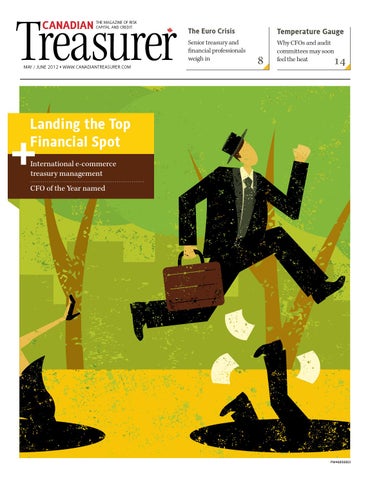
Landing the Top Financial Spot International e-commerce treasury management CFO of the Year named
PM40050803
Get it dry cleaned.
Clear advice to help you manage risk. KPMG’s Advisory Services in Risk Consulting. Visit kpmg.ca/risk for more.
5
16
8
7
Departments & Columns 4
Editor’s Letter
5
People
8
7
Hidden Costs Four key issues for international e-commerce treasury management
14
Is the euro crisis having a negative impact on Canadian businesses? Senior treasury and financial professionals weigh in
12
Features
Treasury Verdict
Mining for Hedging Strategies A look at some of the challenges mining companies face when it comes to managing commodity price risk
Temperature Gauge An FEI Canada study reveals why CFOs and audit committees may soon feel the heat
16
The Right Stuff An executive recruiter discusses what it takes to land the top financial spot within an organization
Regulatory Editor's letter news
W
May / June 2012 Volume 25 Number 8 Editor Leslee Mason leslee@canadiantreasurer.com Editorial Board Thomas L. Evans, CMA, ICD.D, Chief Agent & Business Leader, GE Employers Reassurance Corporation Ross Corcoran, MBA, Vice President Finance & CFO, GLOBAL Railway Industries Ltd. Ron S. Matthews, Manager Cash Operations, Treasurers Department, Imperial Oil Ltd. Dave Mason CIM FCSI, Vice President, McLean Budden Jonmichael Moy, Country Product Manager, PayPal Canada Samson Lim, B.Com, C.A., Chief
4
CANADIAN TREASURER
elcome to the latest issue of Canadian Treasurer, the magazine of risk, capital and credit. Have you ever stopped to consider just what it takes to excel at your job? Clearly, financial acuity is critical but so are many other, less obvious, capabilities. Take, for example, your ability to inspire confidence in those around you. How strong a leader are you? What about your ability to work well with others? Are you a team player? Do people like working with and for you? In our cover story, Ross Woledge, an executive recruiter at Odgers Berndtson, explores just what it takes to land — and keep — the top job. You’ll find the article on page 16. We also take a look at some of the issues currently on the minds of CFOs. On page 14, Laura Bobak, senior writer for the Canadian Financial Executives Research Foundation (CFERF), sums up
the results from The CFO and the audit committee report. Based on an online survey of 199 financial executives, CFERF’s study explores the CFO-audit committee relationship. According to the study, Canadian financial executives believe increased demands on audit committees will result in greater pressures on company CFOs. The euro crisis remains a hot topic for senior treasury and financial professionals. It was also the subject of Treasury Verdict, an electronic voting and discussion panel which took place at EuroFinance’s second annual Canadian conference on Cash, Treasury and Risk Management held in Toronto earlier this year. Information generated from the session was turned into a report. You can read an excerpt from it on page 10. These days the world feels like a smaller place. No doubt, the Internet has helped with that perception. It’s also helped many businesses to
expand their offerings outside their countries of origin. But when it comes to managing and growing an international online business model effectively, there are a number of challenges that treasury organizations face. Mark Frey of Cambridge Mercantile Group discusses four of those issues on page 18. Finally, the article Mining for Hedging Strategies explores some of the challenges that mining companies face when it comes to managing commodity price risk. Written by Reval’s Priya Kurian and Shane Randolph, you’ll find the article on page 12. On another note, if you have any comments or story ideas, or you’re interested in possibly contributing an article to Canadian Treasurer, please get in touch. I’m at leslee@ canadiantreasurer.com
Financial Officer & Vice President Administration, Peoples Trust Company Linda Hartley, Director, Ontario Corporate Global Transactional Banking, Scotiabank Bruce B. Curwood, CIMA®, CFA®, director of investment strategy with Russell Investments in Toronto
Creative Direction / Production Demigroup info@demigroup.com
Publications Mail Agreement No. 40050803 Return undeliverable Canadian addresses to: Circulation Department 302-137 Main Street North Markham ON L3P 1Y2 t: 905.201.6600 • f: 905.201.6601 info@canadiantreasurer.com www.canadiantreasurer.com
Contributors Mark Frey, Vice President, Cambridge Mercantile Group Ross Woledge, Senior Consultant, Odgers Berndtson Laura Bobak, Senior Writer, the Canadian Financial Executives Research Foundation (CFERF) Priya Kurian, Solution Consultant, Reval Shane Randolph, Solution Consultant, Reval
Photographer Gary Tannyan Publisher Mark Henry mark@canadiantreasurer.com Senior Account Manager Donna Gallant donna@canadiantreasurer.com President Steve Lloyd steve@canadiantreasurer.com For subscription, circulation and change of address information, contact subscriptions@canadiantreasurer.com
Leslee Mason Editor
Subscriptions available for $40.00 year or $60.00 two years. 2012 Lloydmedia Inc. All rights reserved. The contents of this publication may not be reproduced by any means, in whole or in part, without the prior written consent of the publisher. Printed in Canada Reprint permission requests to use materials published in Canadian Treasurer should be directed to the publisher. Made possible with the support of the Ontario Media Development Corporation
may / june 2012
People
Regulatory news
CFO of the Year named T
D Bank Group’s Colleen Johnston has been selected as Canada’s CFO of the Year for 2012. Presented annually by Financial Executives International Canada (FEI Canada), PwC and Robert Half International, the award honours and recognizes the quality, insight, direction and leadership of Canada’s senior financial executives. “Celebrating its 10th anniversary this year, Canada’s CFO of the Year Award recognizes a financial leader who demonstrated an outstanding fiscal performance in a complex business environment and exemplary contributions. Col-
leen Johnston is a true testament to this,” said Michael Conway, chief executive and national president, FEI Canada. “Ms. Johnston truly epitomizes the modern CFO by applying a strategic approach to the opportunities and challenges that arise while making significant contributions to her community. This makes her one of Canada’s top financial leaders.” Johnston was named Canada’s CFO of the Year by an independent committee, chaired by Peter Dey, chairman of Paradigm Capital, and Continued on page 6
190 Reasons to be a CPA Member Payroll is responsible for understanding and complying with the 190 regulatory requirements related to the $810 billion in wages and benefits, $250 billion in statutory remittances to the federal and provincial governments, and $90 billion in health and retirement benefits that Canada’s 1.5 million employers annually pay, as well as the 25 million T4s, 9 million T4As, and 7 million RL-1s they annually produce.
The CPA is committed to providing payroll professionals and their organizations with the payroll-related services required to keep compliant and knowledgeable!
For more information visit: www.payroll.ca/go/?ct
May / June 2012
� Unlimited Access to CPA’s #1 Service, Payroll InfoLine – This telephone and email ‘hotline’ answers over 32,000 inquires each year. � Member Pricing for Professional Development Seminars on 20+ topics and monthly web seminars � Payroll Resources at www.payroll.ca and other publications � Enhance your staff’s payroll knowledge through the only payroll certifications in Canada: ● Payroll Compliance Practitioner (PCP) ● Certified Payroll Manager (CPM) CONTACT US: 1-800-387-4693 or 416-487-3380
Professional Development Seminars & Web Seminars ext. 118 • register@payroll.ca
Membership ext. 118 • membership@payroll.ca
90 of Canada’s top 100 companies count on the CPA for their payroll education and knowledge
CANADIAN TREASURER
5
people
Hires »
Landdrill International Inc., a drilling company with full branch operations in Canada, Mexico and Mongolia, has appointed Roger Rogers, CGA, MBA as chief financial officer. Rogers replaces Derrick West, CA. Rogers’ prior experience includes senior financial and operational executive positions at Moosehead Breweries Ltd., most recently as the vice president of supply chain.
»
Phone service provider Telehop Communications Inc. has a new CFO. The company has hired Rob Cosman, a chartered accountant with
more than 10 years of senior-level financial leadership experience including over six years in audit services with KPMG globally. He has also held senior positions in banking, retail, telecommunications and consumer packaged goods organizations.
»
Forest Gate Energy Inc., a publicly listed oil and gas exploration and production and non-energy resource company, reports that Nancy Guitard has taken over as the company’s chief financial officer. Guitard has been handling Forest Gate’s accounting since 2004. She also worked in the accounting department of Blue Note Mining, a former subsidiary of the company. Guitard is a founder of Ledgers Solutions Inc., Montreal, an accounting consultancy and Finger Communications, a printing brokerage.
RBC Dominion Securities Inc.
Superior Cash Management and Wealth Management Solutions • Secure cash management solutions for larger account sizes • Highly competitive GIC rates • Professional and personal portfolio management including help with investment policy statements Investment Security
Canadian Interest Rates (%) Cash
1mth
3mth
6mth
1yr
GoC T-Bills
0.88% 0.97% 1.08% 1.15%
Bankers Acceptances
1.09% 1.13% 1.24% 1.31%
Commercial Paper
1.14% 1.18% 1.29% 1.46%
RBC Personal Savings Account* 1.50% RBC Corporate Savings Account 1.20% RBCDS Highest GIC Rates
1.50% 1.50% 1.60% 2.05%
Rates are from May 22, 2012 and subject to change *Corporate Accounts are restricted to a $7.5mm maximum in the Personal Savings Account
David Arnaud, Vice President, Investment Advisor 416-733-9508 | david.arnaud@rbc.com www.ArnaudGroup.ca
RBC Dominion Securities Inc.* and Royal Bank of Canada are separate corporate entities which are affiliated. *Member-Canadian Investor Protection Fund. RBC Dominion Securities Inc. is a member company of RBC Wealth Management, a business segment of Royal Bank of Canada. ®Registered trademarks of Royal Bank of Canada. Used under licence. ©2012 Royal Bank of Canada. All rights reserved.
6
CANADIAN TREASURER
»
Canadian-based investment and advisory firm, Medwell Capital Corp., has appointed Tami Reich, CMA, to the position of chief financial officer. Reich was most recently the chief operating officer at BAMM Ventures Inc., an Edmonton-based venture capital firm where she oversaw a staff of more than 60 people and offices throughout Alberta. Over the course of her career, Reich has also founded and operated two separate accounting firms focused on advising small to mid-sized businesses. Reich takes over for Brent Johnston who joined Medwell Capital as CFO in 2008.
»
Send your news to: leslee@canadiantreasurer.com
Continued from page 5
composed of some of Canada’s most prominent business leaders. Award candidates from a wide range of business sectors were nominated by CEOs, members of boards of directors, financial analysts and other senior executives. Judging criteria included: vision and leadership; corporate reporting and performance; social responsibility; innovation and business complexity. Now group head finance and chief financial officer (CFO), Johnston first joined TD Bank Group in March of 2004 as executive vicepresident, finance operations, after spending 15 years with Scotiabank in various senior positions. She was later appointed to TD’s top financial post in November 2005. After her appointment to CFO, Johnston restructured TD Bank Group’s entire finance department, seeking to focus less on numbers, more on playing key decision-making roles in the bank’s most important initia-
tives, including TD’s expansion into the U.S. “The CFO of the Year Award honours an industry leader in the finance sector that has demonstrated an exceptional amount of professionalism, passion and integrity within a business environment,” said Gino Scapillati, national managing partner, markets, PwC. “We applaud Ms. Johnston on her remarkable achievements and positioning her company for continued success.” David King, Canadian director of Robert Half Management Resources, added, “The CFO of a company is a multifaceted role within an evolving business landscape. This award recognizes a financial leader that exhibits the capacity to not only bring corporate governance and superior financial management skills to the table, but also encourages ethical business conduct throughout an entire organization.” Johnston was honoured at a gala dinner in early May in Toronto.
may / june 2012
Treasury management Regulatory news
Hidden Costs
lenge for what has been to this point, an underserviced payments market. When it comes to managing and growing an international online business model effectively, there are four key challenges that treasury organizations face, with solutions emerging almost as quickly as the problems are presenting themselves.
By Mark Frey, Cambridge Mercantile Group
Managing Transactional Growth
Four key issues for international e-commerce treasury management
E
-commerce business is soaring: Goldman Sachs, an investment banking and securities firm, predicts that retail web sales will increase to more than a trillion dollars in global commerce over the next year with the overall market growing at a rate of nearly 20 percent per annum. Indeed, many e-tailers are struggling to keep up with the rate of growth in their business from a treasury perspective. While that may fall under the category of “a nice problem to have,” the explosion in low value transaction growth online represents a chal-
may / june 2012
In the online world, micropayments — essentially high-volume, lower dollar-value transactions — are an important growth area for global payments. Managing those payments in a time sensitive and cost effective manner is a challenge for any treasury, but the matter is further complicated when the payments originate internationally, where variant regulations from disparate payment networks can strain a standard domestic processing model. The consolidation of payment types through Continued on page 18
CANADIAN TREASURER
7
eurozone discussion
Treasury Verdict Senior treasury and financial professionals discuss the euro crisis
I
s the euro crisis having a negative impact on Canadian businesses? That was one of the questions senior treasury professionals, bankers and advisers came together to discuss at the Treasury Verdict session, an electronic voting and discussion panel, at EuroFinance’s second annual Canadian conference on Cash, Treasury and Risk Management held in Toronto in early 2012. The results of the session were turned into a report, some of which is excerpted here.
Key findings ◉◉ The overall level of optimism in Canada is robust with 62% saying they were upbeat about their company’s performance in the next 12 months. That makes them more optimistic than their counterparts in China (52%) and Europe (50%), but less bullish than the Brazilians (85%). ◉◉ The euro crisis will impact 89% of respondents either now or in the future, with 46% already feeling some negative effect on their businesses. ◉◉ Of companies doing business in Europe, 61% are not convinced that their banks are prepared for the exit of a country from the euro. ◉◉ Fully 66% reckon that the Canadian dollar will stay around current levels against the U.S. dollar in the next year.
Question 1
Analysis ◉◉ Companies in Canada polled are resolutely upbeat about their company’s future performance in the next year. Fully 62% of respondents are optimistic. ◉◉ That contrasts sharply with the 14% who expressed pessimism over the next 12 months. ◉◉ However, nearly one-quarter (24%) remain uncertain.
Comment ◉◉ “We’re generally optimistic. Also, there are 25 major governments around the world that are going to be having elections this year. If history repeats itself, which it generally does, it will be a good year.” ◉◉ “Canadians have a lot to be optimistic about.”
Question 2
Analysis ◉◉ Stability is the watchword with the C$ against the US$ with the majority of commentators (66%) expecting the C$ to trade in a plus or minus 5% range against the US$. ◉◉ In the middle ground, the risks on the upside and downside are seen as being broadly matched. Some 16% of the participants say the currency will climb between 5% and 15% and the same proportion say it will fall by 5% and 15% against the US$. ◉◉ Absolutely nobody expected a greater than 15% currency appreciation against the US$.
8
CANADIAN TREASURER
May / June 2012
eurozone discussion Comment
Comment
◉◉ “The only thing one learns from trying to forecast FX is a healthy dose of humility so I agree [with the majority].”
◉◉ “It can go one of two ways. It can be either very orderly or very disorderly. There’s everything from individual sovereign default to individual counterparty failure to consider.”
Question 3
Question 5 16%
Analysis ◉◉ Around 46% of corporate treasurers in Canada are feeling some negative impact of the euro crisis on their business. ◉◉ A further 40% expect the impact to hit them some time in the future. ◉◉ Few (3%), though, are feeling a considerable impact. ◉◉ Taken together, the euro crisis hits 89% of respondents negatively either now or in the future, and only 11% say they expect to feel no effect.
Comment ◉◉ “Absolutely it’s having a big impact. Specifically on European vehicle volumes. Any time you have this much uncertainty overhanging economies it results in a retrenchment in consumer demand, particularly on big consumer durables.”
Question 4
Analysis ◉◉ The single biggest barrier to effective forecasting is that the rest of the business doesn’t communicate (picked by 34% of respondents). ◉◉ Technology tools come second, with 20% identifying this as a big barrier to forecasting. ◉◉ Volatility is another major barrier for 18% of respondents. Volatility here means sales, financial markets and internal volatility. ◉◉ Only 6% are satisfied with their forecasting a number in line with many markets that have been surveyed.
Comment ◉◉ “We have a deep forecasting culture. It’s not so much that business doesn’t communicate, rather it doesn’t communicate as well as it could. The biggest barrier is organizational complexity. Globalized processes are important.” ◉◉ “Technology and integration is important. Inefficient information is a huge challenge. It really comes down to culture and sponsorship within a corporate to drive the forecasting disciplines necessary. Treasury needs to measure the costs of inaccurate forecasts.”
Analysis
The Treasury Verdict report was generated via results from an audience poll
◉◉ Fully 62% of respondents doing business in Europe are not confident that their banks are prepared for a euro exit. ◉◉ 17% of respondents are confident that their banks are prepared. ◉◉ Just over one-fifth (21%) are not worried, because they don’t believe there’s going to be an exit from the euro.
at EuroFinance’s Cash, Treasury and Risk Management conference in Toronto
May / June 2012
in early 2012. The event was sponsored by J.P. Morgan Treasury Services. The report is excerpted with permission from EuroFinance, global provider of conferences, training and research on cash management, treasury and risk. The full report is available at www.eurofinance.com
CANADIAN TREASURER
9
Private Company Growth Creates New Risks Small to midsize companies encounter new risks as they grow. They evolve and their operating environment changes. Yet few of these private companies are prepared for the new risks that also come from these changes.
A recent national Canadian survey by Chubb Insurance revealed that private companies are getting more exposed to changing risks, but only one in four has taken action to protect themselves. The risks can come as employee head count increases; as new areas of the business grow; and, as the company expands into new jurisdictions which may have different legal requirements. Risk exposures related to employment practises liability, employee theft, errors and omissions and Directors & Officers (D&O) liability can become significant. These risks, even when managed through processes and procedures, can lead to allegations that alone are costly to defend. Evolving employment standards, growing employee bases, expanding partnerships with customers, suppliers and capital providers create new exposures for private companies. Allegations and potential lawsuits can come from investors, debtors, customers, employees, competitors and regulators.
The Chubb Survey showed an average cost of an employee practises loss of almost $60,000, with one case reaching up to $1 million. As the workforce grows in diversity, issues like sexual harassment or discrimination can add to the probability of allegations against the corporation. Expansion into the US, for example, can also significantly increase the risk of costly employee practises litigation. 10
CANADIAN TREASURER
As a Director or Officer of a company, your personal assets, if left unprotected, can be exposed to the liabilities you assume in either of those roles. The average loss disclosed in the Private Company Survey related to D&O liability (settlement, judgment and legal costs) approached $230,000. Smaller companies were less likely to purchase insurance coverage to protect themselves, despite the fact that even a small event could have major financial consequences. Workplace crime losses can be even greater. One recent private company loss was approximately $2.5 million. These kinds of losses and related legal costs can stagger a growing company. As the company grows, the addition of an employee benefit plan may be required. With it comes fiduciary responsibilities and added risks. Smaller companies should consider Fiduciary Liability insurance to protect themselves before the risk becomes too great.
Professional Errors and Omissions (E&O) also become more significant as the size of a company changes. The Chubb Private Company study revealed that 50% of companies that perform services for a fee reported costs associated with E&O allegations or claims with an average cost of $63,000. While all private companies are seeking to grow, companies should be aware of the risks they are acquiring with the rewards they seek. These risks include the cost of defense against actions and complaints. Company leaders should review the results of the Chubb Survey by visiting www.privatecompanies.controltheoutcome.ca and get a better understanding of their exposures. Get better informed of the risks and discuss them with your broker and trusted advisors to be in better control of your private company's success.
CO N T R O L the
OUTCOME may / june 2012
With our focus on growth we overlooked some of the personal risks that built up. But our broker understood the priorities of a private company like ours and had us covered by Chubb." Private company growth often takes you to the edge of control. You expect growth but you aren’t always ready for personal risks to directors or
CO N T R O L the
OUTCOME
officers, or even costly lawsuits. Your broker and insurance company expertise is critical to protecting you and reducing uncertainty. ForeFront by Chubb leads the way in Private Company insurance coverage. Better addressing your risks keeps you in control. Manage your risks with ForeFront by Chubb, insurance built specifically for Private Companies and their executives. Ask your broker.
www.privatecompanies.controltheoutcome.ca Chubb Insurance refers to Chubb Insurance Company of Canada. The precise coverage offered is subject to the terms, conditions and exclusions of the policy as issued. may / june 2012
CANADIAN TREASURER
11
Commodity Regulatory newsprice risk
Mining for Hedging Strategies A look at some of the challenges mining companies face when it comes to managing commodity price risk By Priya Kurian & Shane Randolph, Reval
M
uch of the focus on hedging commodities today is around the intensifying price volatility challenges consumers of commodities face. But for mining companies, which are commodity producers, special challenges around hedging commodity price risk factor heavily into hedging decisions. Those challenges are driven by the differing investment goals of debt holders and equity holders. As Canada is home to most of the top 100 mining companies in the world, it is worth taking a look at the special challenges mining companies face when managing commodity price risk, as well as some strategies to consider when structuring a hedging program that meets investor needs. In many ways, a mining company’s competitive edge is determined by meeting the requirements of both debt and equity holders, who have very different risk/reward profiles. For equity investors, investments in mining companies are one of the easiest, safest and least costly ways to invest in the commodity markets. For this reason, investors embrace and demand commodity price volatility. This pressure from investors drives mining companies to keep the sales prices of their products un-hedged in order to capture the underlying commodity price volatility. This is in stark contrast to most commodity consumers and corporate debt holders, who prefer to avoid commodity volatility at all costs. Lenders often encourage and sometimes require mining companies to hedge as hedging the price risk for a portion of forecasted revenue helps to ensure the availability of sufficient operating cash flows to service debt obligations. While opposing interests already create a challenge for mining companies’ hedging decisions, considering the stage of an organization’s life is also important. There are two primary stages that weigh into if and how a mining company should hedge: the initial bank financing stage, and the stage in which the company begins producing and generating income from sales.
Strategies for the Initial Bank Financing Stage To arrange initial financing including bank loans or debt to begin production, a producer is often required to guarantee that the revenue received from the production estimates will be sufficient to cover the principal and interest payments required by the financial institution(s) providing capital. For example,
12
CANADIAN TREASURER
May / June 2012
Commodity Regulatory pricenews risk if a mine requires USD $5,000,000 per period in operating revenue to cover operating and financing costs and estimates production at 2,000 Metric Tons (MT) per period, a minimum sale price of USD $2,500 per MT is required to cover the costs. Mining companies at this stage of their life cycle may prefer options in order to participate in favourable price movements. Two option strategies are common: a purchased floor strategy and collar strategy. With a purchased floor strategy, the option holder pays a premium for the right to sell the production at a minimum price but participate if the market becomes more favourable. Alternatively, a collar strategy allows the company to purchase a floor on the sale price but the company also sells the premium for a ceiling price. The amount received for the sold ceiling partially or completely offsets the premium paid for the floor, but the company only participates in the market price movements within a range of prices.
Strategies for the Income Generating Stage As the business matures, it will benefit the mining company to roll its strategy from a pure option-based strategy into a blended one that utilizes a combination of options, swaps, futures, and forwards. This is due to the initial premium required to be paid for an option contract combined with the removal of volatility cost from the hedging program. The roll-over will generally take place after an offtake agreement has been finalized. In an offtake agreement, the mining company enters into a contractual agreement to provide the mined concentrate to an investment grade partner who agrees to purchase specific quantities at specific times. This agreement eliminates the sales forecast risk and leaves the company with only price and production forecast risk. As with any hedging program, however, mining companies should first consider their fundamental abilities to hedge. They should ask themselves the following:
1. Can we accurately forecast and measure the exposure? The ability to accurately forecast the timing and amount of an exposure is paramount to any hedging program. With an accurate forecast and the proper use of derivatives, the results of a hedging program are locked in at inception. The biggest risk during this stage is over-hedging, which is considered by the investment com-
May / June 2012
munity as a speculative derivative portfolio. For this reason, many hedgers layer derivatives as the time until the forecasted production decreases and the forecasted commodity production becomes more likely to occur. This is a key factor during the initial financing stage of the company’s life cycle when the exact timing and amount of sales may be more difficult to forecast.
2. Is there a market to hedge? Regardless of the accuracy of the exposure, the company must still decide which financial products best fit its needs. Available derivatives that match the delivery location or the specific product grade can be limited, especially in certain metals markets.
3. Does the cost of hedging outweigh the benefit? For hedges of specific metal grades and types with longer maturities, the liquidity along the forward curve will drive a major portion of the cost of a hedging program. In some instances, the limited availability of exchange traded derivatives will force a company into the overthe-counter (OTC) market. The primary benefit of this market is the flexibility in structuring price index references, the settlement date, and other derivative terms. This flexibility also leads to the primary drawback of an OTC instrument which is the premium price paid over the futures contract associated with the basis risk and the credit risk. As the company progresses through the stages of its life, it will realize the benefit of using a blended strategy of OTC and exchange traded products to control the costs of its hedging program. Overall, hedging decisions for mining companies will be based on the business considerations outlined here. Mining companies should continually evaluate their market, learn what their industry peers are doing, and ultimately determine if a competitive edge can be achieved from hedging. In the end, their goal will be to create a flexible hedging strategy that can accommodate all potential scenarios encountered now and in the future. Priya Kurian is a Toronto-based solution consultant for Reval. She may be reached at priya.kurian@reval.com. Shane Randolph, also a Reval solution consultant for North America, can be reached at shane.randolph@reval.com. Reval is a global provider of a comprehensive and integrated Software-as-a-Service (SaaS) solution for Treasury and Risk Management (TRM). For more information, visit www.reval. com or email info@reval.com.
In many ways, a mining company’s competitive edge is determined by meeting the requirements of both debt and equity holders, who have very different risk/reward profiles. For equity investors, investments in mining companies are one of the easiest, safest and least costly ways to invest in the commodity markets. CANADIAN TREASURER
13
cfo/audit committee study Regulatory risk management news
Temperature Gauge An FEI Canada study reveals why CFOs and audit committees may soon feel the heat as risk, market turmoil and standards setters add pressure By Laura Bobak Canadian Financial Executives Research Foundation
C
anadian financial executives believe greater concern around risk management will increase demands on audit committees in the next 24 months, resulting in heightened pressures on company CFOs. Participants in The CFO and the audit committee, a new research study by the Canadian Financial Executives Research Foundation (CFERF), point to the turmoil in the capital and debt markets to explain this renewed emphasis on risk management. An online survey of 199 financial executives, some of whom also served on audit committees, formed the basis for the study which explores the current state of the relationship between the two and how CFOs communicate in order to assist the audit committee in fulfilling their agenda effectively. “The study shows that CFOs need to help board directors, and audit committee members in particular, better understand the business challenges that their organizations are facing, while demonstrating the fortitude to withstand the oversight of their performance by the audit committee,” said Michael Conway, chief executive and
14
CANADIAN TREASURER
national president of FEI Canada. According to survey results, 92 percent of respondents say greater concerns around risk management are expected to increase demands on the audit committee in the next 24 months, which will in turn translate into higher pressure on CFOs, while 83 percent cited greater turmoil in the debt markets as a factor. Eighty-seven percent of survey participants also expected audit committee testing and interrogation to increase as a result of great concerns around standards setters. Despite this increased scrutiny from the audit committee, overall, financial executives are confident when fielding tough questions and engaging in difficult conversations at audit committee meetings. A majority also agreed that their audit committee members request information in a reasonable time frame. “The nature of the CFOaudit committee relationship is clearly of strong interest to financial executives,” said Todd Buchanan, national leader, accounting advisory services, KPMG LLP. “The study shows that successful audit committee relationships feature trust, respect,
professionalism, collaboration, openness and transparency.” Carl Gauvreau, former CFO of Hartco Inc., which delivers IT solutions to private and public sector organizations, agrees transparency and communication between the CFO and the chair are key. “Make sure that you have good open communication; that you’re transparent, so all the issues are put on the table,” Gauvreau said. “Sometimes you may want to discuss some of those issues ahead of the committee meeting with the audit committee chair, concerning how to approach them, within the committee, to make better use of the time of the members and be proactive with that respect. That’s what has worked for me over the years.” For years, corporate directors were seen as being most effective when following the so-called “nose in, fingers out” philosophy. In other words, directors were supposed to provide oversight at a high level, but not actually usurp the manager function of operating the organization. Maintaining this delicate balance of oversight at arms’ length, without micromanaging or getting off-track, often depends on the audit committee chair’s ability and
skill in navigating the agenda. “It takes a focused chair, with a disciplined agenda — timelines assigned to discussion points to ensure that you navigate through the requirements of the meeting and don’t move off topic,” said
Study highlights include: ◉◉ Organizations expected to be at the forefront of increased demands on audit committees include accounting standards setters and securities regulators ◉◉ 90 percent of respondents reported the CFO of their organization had an excellent relationship with the company’s audit committee, a relationship that is based on trust and transparency ◉◉ 69 percent of respondents were happy with the approach of their audit committees, reporting the committees are neither over-involved nor underinvolved ◉◉ 83 percent disagreed with the suggestion that the CFO has an ‘us versus them’ relationship with their audit committee
may / june 2012
cfo/audit Regulatory committee study news Gordon Nelson, CFO of motion picture exhibitor Cineplex Entertainment. “For us it came down to working closely with the chair on agendas and timelines to ensure that we got through everything that we needed to do.” So what else can CFOs do to help audit committees be most effective? ◉◉ Try to think like a CEO: Work to understand all aspects of the business rather than focusing only on finance. ◉◉ Bring a holistic, integrated perspective: Consider all aspects of operations issues when bring enterprise risk issues to the audit committee table. ◉◉ Take the shareholders’ mindset: When examining issues relevant to the business and agree to expand discussion and debates at the audit committee table beyond compliance and regulatory issues.
but are not limited to the following guidelines: ◉◉ Be open to communication from the CFO between formal meetings. ◉◉ Do not hesitate to ask for information or clarification. ◉◉ Take adequate time to digest information thoroughly before meetings. ◉◉ Act as a sounding board for CFO. ◉◉ Have a good technical knowledge of finance and accounting. ◉◉ Take the time to thoroughly absorb information between meetings. ◉◉ Offer positive, not adversarial feedback, yet push for continuous improvement. ◉◉ Give the CFO adequate time to obtain answers to queries.
◉◉ Develop clear cut agendas and objectives for the year. ◉◉ Identify issues early and allow for plenty of time to think through particularly thorny issues.
Like any relationship, it would be ideal to have a twoway exchange between CFO and audit committee, based on a free flow of information, as well as mutual trust and respect. This comfort level must be balanced with the need for maintaining enough distance that the quality of the CFO’s data can still be critically assessed and tested. Most importantly, auditors should feel comfortable asking any question they feel they need to ask. “We learned early as
auditors that there is no stupid question in auditing,” said William Swirsky – corporate director; former VP of knowledge development at the CICA. “And somehow, even as a CA or FCA, we sometimes tend to forget how important that little mantra is. Ask the stupid question, because you never know what that’s going to uncover.” The CFO and the audit committee survey was sponsored by KPMG LLP, an audit, tax and advisory firm. Laura Bobak is senior writer with the Canadian Financial Executives Research Foundation, the research institute of FEI Canada, Canada’s national association representing senior financial executives. For more about FEI Canada, visit www.feicanada.org
According to survey respondents, the CFO should also personally try to abide by the following guidelines: ◉◉ Be open to email and phone requests between meetings. ◉◉ When the audit committee raises an issue or question, make their concerns a top priority. ◉◉ Conduct one’s self with utmost integrity and professionalism. ◉◉ Be open to advice from the committee. ◉◉ Be able to handle criticism, since it’s the audit committee’s job to focus on gaps. ◉◉ Be open about the reasons behind any perceived issues or flaws. ◉◉ Be open to an alternative course of action.
According to survey respondents, the responsibilities of the audit committee and chair include
may / june 2012
CANADIAN TREASURER
15
leadership
16
CANADIAN TREASURER
May / June 2012
Regulatory leadership news
The Right Stuff Executive recruiter Ross Woledge discusses what it takes to land the top financial spot within an organization
I
n these volatile economic times where every cent counts, the role the CFO plays is more important than ever. While tighter credit controls are hindering capital-raising efforts, not to mention the burden of unprecedented compliance, it’s no longer just a numbers game — it’s about leadership. Organizations need CFOs who understand the intimate details of their businesses, are entrenched in all areas of the finance portfolio and are fully up to speed with the needs of the end user. CFOs need to think strategically, envision tomorrow and ensure their organization is fully equipped to ride the economic cycles and come out ahead.
Focus on operations & strategy So, what does the aspiring financial executive have to do in this multi-discipline era to reach the top? For starters, focus your energies on the operational and strategic side of your business. Canadian finance practice leader at Deloitte Consulting, Steve McCaughey, believes fundamental to being recognized as a CFO of the future is developing a reputation in the business as a strategy catalyst. “You need to understand the underlying business and what that represents, to spur the business along,” he explains. According to McCaughey, while spending time within the reporting side of the business will help develop your ability to count the numbers, it is being able to tell the story that wins you plaudits among the senior team and the Board. Consequently, partnering with divisional leaders will elevate your awareness for how decisions are made and hone your persuasive skills as you seek to shape the strategy and drive stronger results. If the chance arises to move out of finance and into an operational leadership role, the advice from Harry Taylor, Mark’s Work Warehouse COO and former Holt Renfrew CFO, is “do it in a heartbeat.” A graduate of the Pepsi/Frito-Lay organiza-
May / June 2012
tion, Taylor witnessed firsthand how many of the high performers within finance would spend considerable time in the field to develop their ability to drive the financial performance of their business.
working group. As a result, this move led to improved collaboration and impressive financial results.
Get the right people on your side
Another critical success factor for modern day CFOs is being plugged into the Board agenda, where the risks associated with working capital have become major talking points. Stephen Kicinski, Sun Life financial treasurer, has seen a significant shift at the leadership table. “Treasury matters used to be a short agenda item, but it has evolved into an hour-long discussion at Board committee meetings as they consider capital and liquidity issues.” While becoming a technical expert is not necessarily required, developing a more in-depth understanding of capital markets and capital management has become paramount in today’s unpredictable economic environment. With a clear understanding of the relationship between capital and operations, you will be able to speak with authority around the table as opportunities are assessed through the risk lens. The true test of whether you will be viewed as an enabler and not a barrier will be your ability to partner with leaders in developing creative solutions to drive their businesses — all within the risk tolerance of the Board. The new economic reality has increased the demands on an already challenging and complex position. Consolidating and reporting the numbers is table stakes. Being a visible, credible voice in the organization, enabling and empowering others around you, and leading in the development and execution of successful growth strategies, is the portrait of the modern CFO.
The modern CFO is able to influence and show leadership, placing significant weight on the ability to build powerful relationships across all layers of the business. This is a marked shift from the past when CFOs may have been more accustomed to letting others enjoy the spotlight. While external relationships become more and more important the further you move up the chain of command, being a stronger internal presence and winning over key leaders in the business is pivotal to you being considered CFO succession material. Kay Brekken, CFO for Indigo Books and Music, agrees; “You might be the best finance executive in the company, but unless you have the relationships in the business it is impossible to build support and credibility.” While operational roles will help to elevate your visibility among senior leaders, you should also lead special projects on burning organizational issues. This will increase your time in front of key audiences, such as the CEO and the Board. According to Catherine Fels Smith, vicepresident of finance at the Toronto Board of Trade, one of these key relationships should include the technology group. While the two functions have often had a fractious relationship, finance depends on technology in order to be maximize their effectiveness in adding value to the business. “Finance needs technology to gain access to the data to help leaders run their businesses, and to educate the CEO and the Board on the direction the organization is moving.” Fels Smith tackled the problem when she was senior director, financial systems and process improvement at MDS Inc., by creating a joint finance/technology
Demonstrate capital management skills
Ross Woledge is a senior consultant at Odgers Berndtson, the largest executive search firm in Canada and a global leader. Woledge specializes in the recruitment of CFOs and senior financial officers to public and private companies.
CANADIAN TREASURER
17
treasury management Continued from page 7
batch processing of transactions in a single file format is an important element in streamlining payment file processing and reducing operational steps. Further, efficiencies can be gained if payments in multiple incoming currencies can be remitted in a single file with drill down capability to view individual line items.
Putting the Right System in Place Accounting, auditing and reconciliation of incoming transactions are critical processes in terms of supporting the growth of an online merchant enterprise — processes that are often overlooked until transaction volumes begin to take flight. There are a few key points to look for in a payments processor or partner in this regard. Integration between your processor and accounting system should be focused on delivering automated journal entries and detailed audit trails for the full life cycle of each transaction at the individual transaction level. A processing partner that has achieved SAS 70 standing should be able to deliver upon all of these transactional requirements, not to mention fulfilling one’s obligations with respect to the SarbanesOxley Act1 should it apply.
Driving Revenue Performance of International Sites In an increasingly global market, one of the first orders of business for many companies after launching a domestic online retail presence is to expand internationally. In doing so, most firms focus on ensuring their international clients receive the same front-end user experience as their domestic clientele, taking care to translate verbiage on the site, deal with cultural differences and even change the look and imagery of the site itself. Since the transaction experience for the end consumer is often different in one key manner as it relates to the currency their purchase is both denominated and processed in, e-tailers pay careful attention to ensuring latency issues and processing times for international sites are materially the same as the firm’s domestic platform Many e-tailers, especially with an initial launch to other geographies ignore cater-
18
CANADIAN TREASURER
ing to their customers’ preferences, when they continue to price their online wares in their own domestic operating currency, as opposed to the currency of choice for the consumer. For example, from the point of view of an Italian consumer in Milan contemplating a purchase on a site written in Italian but priced in U.S. currency, this is less than ideal for obvious reasons. Further, even if the retailer takes the step of displaying an estimated conversion price in Euro, the consumer will soon find out when she reviews her credit card bill that the estimate fails to take into account the various transaction fees and conversion rates that will be applied when the purchase hits her statement. The various charges and ultimate conversion could increase the cost to the consumer’s purchase in EUR terms by as much as three to five percent. That fact makes return business from that consumer to the firm’s site much less likely, that is if the consumer chooses not to abandon their online shopping cart in the first place. Driving conversion rates by turning browsers into buyers can be a key determinant of success. Ensuring consumers experience a positive end-to-end experience is equally important. That said, it is key for retailers to recognize that the full consumer experience does not end with completing the online transaction in terms of driving return business from shoppers, but more accurately, when the consumer checks her credit card statement to determine if what he thought she was paying for her purchase is what she actually ended up being charged. To this end, denominating product pricing in the local domestic currency where the site is being deployed and then processing transactions in that currency as opposed to leaving it to the credit card issuer to convert payment can, in our experience, drive not only revenue from repeat customers by as much as 50 percent but indeed first time shoppers by as much as 20- to 40 percent as well. Taking this a step further, integration of a site with a system that dynamically recognizes the purchaser’s domestic currency by IP address but still provides the shopper the ability to select their desired currency from a drop down list ensures that you provide local pricing, while still providing market-leading flexibility.
Foreign Currency Translation Risk The trade-off you accept when electing to price and process payments in multiple currencies is that the resultant increased revenue streams come with foreign currency translation risk embedded within them as opposed to offloading that risk to the customer. In terms of managing this ongoing transactional exposure, it is crucial to ensure that each transaction is protected over its full life cycle, so that even if an item is returned or there is a charge back from a credit card issuer, you won’t be in for any surprises. Further, this is important as it relates to protecting the financial integrity of the sales you register in terms of your operating currency, as a significant erosion of exchange rates will quickly impact your bottom line. Employing a partner or payment processor that can guarantee or hedge exchange rates for a full transaction cycle, inclusive of charge backs and returns not only reduces risk, but streamlines transaction flow and accounting. Such a process ultimately eliminates the need to establish local banking and payment processing relationships, while ensuring that full value is indeed collected and retained with respect to any relevant value added or sales taxes. Finally, full transactional reporting will be required to fulfill “hedge accounting” FAS 133 regulations as they relate to documentation and designation requirements. E-commerce, in all its forms, is unquestionably driving both consumer and business purchasing decisions and behaviour, and has quickly become a significant sales tool for even traditional bricks and mortar businesses. While online strategies focused on expanding a firm’s marketable universe can certainly win new customers in far-reaching geographies, the retention and expansion of that business to a profitable endeavor does require as much forethought from your treasury professional as it does your chief marketing officer. Mark Frey is vice president, corporate payment and risk solutions, Cambridge Mercantile Group. Cambridge is a full service global payments and foreign exchange organization. 1 More commonly known as Bill C-198 in Canada, the U.S.’s Sarbanes-Oxyley Act of 2002 created new standards of corporate accountability, including auditor independence, audit committee responsibilities, CEO and CFO accountability for financial reporting and internal controls, faster public disclosure, and stiffer penalties for illegal activities.
May / June 2012
BMO SPEND & PAYMENT SOLUTIONS
®
Client Driven Solutions. Powerful Results. Whether your goal is to improve financial controls, streamline processes, enhance compliance or realize significant savings, BMO can help you meet your objectives today and adapt to your evolving business needs tomorrow. Put BMO’s innovation and service expertise to work for you. • Custom tailored strategies • Broad range of payment solutions • Advanced consulting expertise and support
12-429
To learn more contact us at: 1-888-838-4401, bmo.sps@bmo.com or bmo.com/spendandpayment
Registered trade-mark of Bank of Montreal. * Bank of Montreal is a licensed user of the registered trade-mark and design of MasterCard International Inc.
® ®