The Magazine of Risk Capital and Credit.
january / february 2012 • www.canadiantreasurer.com
Industry Watch
Payments
Look to emerging markets, Canadian firms told
The time for electronic invoicing is now
6
21
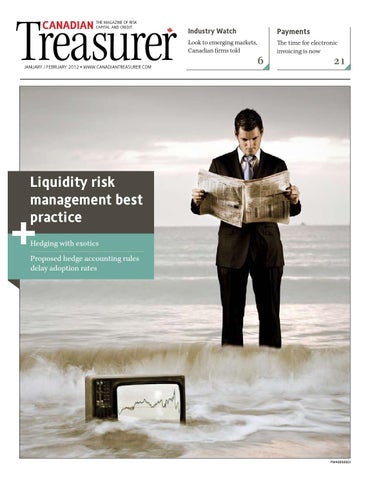
Liquidity risk management best practice Hedging with exotics Proposed hedge accounting rules delay adoption rates
PM40050803
Departments & Columns 4
Editorial
6
Industry Watch
10
New & Notable
19
Calendar
16 Features Risk Management 12
Liquidity risk management best practice
16
Risk management: head winds and tail winds
18
Building a solid foundation: deploying the right technology to maximize anti-bribery and corruption compliance
20
Proposed hedge accounting rules delay adoption rates
21
The time for electronic invoicing is now
By Jason Torgler, Vice President, Strategy, Reval
14
Hedging with exotics By Gilmore Bray, Solutions Director, Misys Global Managed Service
12 14
21
18
Regulatory Editor's letter news
Best practice in managing risk
W
elcome to the JanuaryFebruary 2012 issue of Canadian Treasurer, the magazine of risk, capital, and credit. The theme of this issue is managing risk. In our lead article, ‘Liquidity risk management best practice,’ Jason Torgler, Vice President of Strategy at Reval, warns Canadian treasurers that they can’t afford to be sanguine about the huge amount of cash they have built up in their war chests. Cash is an asset that must be rigorously tracked and riskmanaged, since bank relationships and fee structures change, counterparty risk exposures evolve, and foreign exchange markets continue to be volatile as the result of the Eurozone crisis,
January / February 2012 Volume 25 Number 5 Editor Robin Arnfield robin@canadiantreasurer.com Editorial Board Thomas L. Evans CMA, ICD.D, Chief Agent & Business Leader, GE Employers Reassurance Corporation Bruce B. Curwood, CIMA®, CFA®, director of investment strategy with Russell Investments in Toronto Ross Corcoran MBA, Vice President Finance & CFO, GLOBAL Railway Industries Ltd.
Newman, Executive Vice President at Accuity, urges corporations to deploy robust systems to ensure compliance with today’s very stringent anti-corruption and antibribery laws. Thomas M. Bohn, President and CEO of The Institute of Financial Operations (IFOP), in ‘The time for electronic invoicing is now,’ urges AP and AR departments to move to e-invoicing. Despite the overwhelming cost advantages offered by e- invoicing, fewer than half of firms surveyed last year by the Institute and its partner Basware had replaced paper invoicing with e-billing, and fewer than one in five had fully integrated their purchasing, AP, and AR operations. Our Industry Watch section includes an interview with Sal Guatieri, senior economist, vice president, BMO Capital Markets, Economic Research. In ‘Look to emerging markets, Canadian firms told,’ Guatieri says Canadian companies need to focus on fastgrowing emerging markets in Asia and Latin America. He encourages firms to take advantage of the strong Canadian dollar and
low interest rates to invest in productivity-enhancing equipment and technology. We also report on two recent AFP surveys. The first shows treasurers are increasing their due diligence on potential banking partners and delving deeper into the health of existing ones. A bank’s perceived health can make or break its ability to win corporate business or preserve corporate clients, the AFP says. The second AFP survey finds that companies now place a greater value on the role of their treasury department in managing cash and liquidity as a direct consequence of the current economic and credit environment I hope you are enjoying your subscription to Canadian Treasurer. Please send me any comments or ideas for contributed articles.
PayPal Canada
Creative Direction / Production Demigroup info@demigroup.com
Publications Mail Agreement No. 40050803 Return undeliverable Canadian addresses to: Circulation Department 302-137 Main Street North Markham ON L3P 1Y2 t: 905.201.6600 • f: 905.201.6601 info@canadiantreasurer.com www.canadiantreasurer.com
Samson Lim, B.Com, C.A., Chief Financial Officer & Vice President Administration, Peoples Trust Company Linda Hartley Director, Ontario Corporate Global Transactional Banking, Scotiabank Contributors Jason Torgler, Vice President of Strategy at Reval; Gurpreet Banwait, Director of Insight Solutions, Product Management at FINCAD; Gilmore Bray, Solutions Director, Misys Global Managed Service;
Ron S. Matthews Manager Cash Operations, Treasurers Department, Imperial Oil Ltd.,
Bruce Curwood, CIMA, CFA, Director of Investment Strategy at Russell Investments;
Dave Mason CIM FCSI, Vice President, McLean Budden
Brent Newman, Executive Vice President at Accuity;
Jonmichael Moy Country Product Manager,
4
Torgler says. Gilmore Bray, Solutions Director at Misys Global Managed Services, says in ‘Hedging with exotics’ that a Misys survey of its global clients has found a significant increase in the use of exotic options for hedging over the last year. Using more sophisticated hedging tools can help corporate treasurers to mitigate price, market, and interest rate risk during times of extreme market movements, Bray says. In ‘Risk management: head winds and tail winds,’ Bruce Curwood, CIMA, CFA, Director of Investment Strategy at Russell Investments, calls for the deployment of effective organisation-wide enterprise risk management (ERM) frameworks. Gurpreet Banwait, Director of Insight Solutions, Product Management at FINCAD, looks at the challenges involved in implementing hedge accounting in ‘Proposed hedge accounting rules delay adoption rates.’ In ‘Building a solid foundation: deploying the right technology to maximize anti-bribery and corruption compliance, Brent
CANADIAN TREASURER
Thomas M. Bohn, President and CEO of the Institute of Financial Operations.
Photographer Gary Tannyan Publisher Mark Henry mark@canadiantreasurer.com Senior Account Manager Jennifer Bishop jennifer@canadiantreasurer.com President Steve Lloyd steve@canadiantreasurer.com For subscription, circulation and change of address information, contact subscriptions@canadiantreasurer.com
Robin Arnfield Editor – Canadian Treasurer robin@canadiantreasurer.com
Subscriptions available for $40.00 year or $60.00 two years. 2011 Lloydmedia Inc. All rights reserved. The contents of this publication may not be reproduced by any means, in whole or in part, without the prior written consent of the publisher. Printed in Canada Reprint permission requests to use materials published in Canadian Treasurer should be directed to the publisher. Made possible with the support of the Ontario Media Development Corporation
January / February 2012
It’s been a challenging financial year So what’s next for treasury? Find out at EuroFinance’s Cash, Treasury and Risk Management Conference, 14 – 15 February 2012, Toronto, Canada www.eurofinance.com/canada
Be inspired by best practice treasury ideas from:
% 0 2 d
nt u o an isc
i anadeaders C r o f urer r ith Treas r online w CT te e Regis oking cod o b e h t
Andrew Marshall, Treasury Director, AstraZeneca Jennifer Ramsey-Armorer, Director, Treasury, Research In Motion Ltd, Dennis Tosh, Director - Global Trading & Automotive Risk Management, Ford John Crow, the former Governor of the Bank of Canada (current Chair at The Public Accountants Council of Ontario) Also hear from: Agrium, Bombardier, Bayer Material Science, Export Development Canada, Hydro One, Ontario Power Generation, TRW Automotive, Livonia and the Economist Intelligence Unit (EIU).
Industry Watch Regulatory news
Look to emerging markets, Canadian firms told By Robin Arnfield.
C
anadian companies need to focus on exporting to fast-growing emerging markets, Sal Guatieri, senior economist, vice president, BMO Capital Markets, Economic Research, told Financial Executives International Canada’s (FEI Canada) fourth annual SME conference on November 11, 2011. The good news for Canada’s small and medium-sized businesses is that the Canadian economy should continue to grow in 2012, interest rates should stay low, and inflation will likely recede, Guatieri said. “The bad news is that growth should remain modest, the Canadian dollar will stay strong, and consumers will be cautious in taking on more debt,” he said. “Elevated household debts
Global Economy Slowing... At Two Speeds (ann % chng)
World 10 11 12 13 GDP 5.1 3.6 3.2 4.0
Real GDP 12 9
10
Developing Developed
11 12 13
6 3 0 -3
China
India
Asia
(excl China, Japan & India)
Latin America
China Should Soft Land
US
Canada
Japan
Europe
Europe on Cusp of Recession
Ranked by 2012 Source: [2011-13] BMO Capital Markets forecasts © BMO Capital Markets
www.bmocm.com/economics
BMO advocates the benefits of corporate cards Businesses can generate a lot of value and efficiency by moving from cheque payments to corporate card payments, Eric Hart, director of corporate payment products at BMO Bank of Montreal, tells Canadian Treasurer. “A lot of small Canadian businesses underuse corporate credit cards,” Hart says. “They could use the card spending reporting tools that procurement cards (P-cards) provide to gain greater visibility about their purchases from different suppliers. If the reporting tools show that they are making a lot of purchases from one supplier using their P-card, for example, they can then negotiate a discount with this vendor.” “Using a P-card to make a purchase means that the supplier gets paid more quickly, which means that the supplier is more likely to offer discounts for future purchases,” Hart says. “Also, using P-cards instead of cheques helps with the buyer’s cash
6
CANADIAN TREASURER
flow, as it gives them longer to actually pay for the purchase. Another benefit is that corporate card programs enable firms to have more control over spending, for example by blocking certain types of purchases.” Making one payment for the entire outstanding corporate card balance each month reduces or eliminates the costs and processing burden incurred when using cheques. Hart cites data from RPMG Research Corp. to demonstrate the benefits of P-cards in terms of reduced costs and greater efficiency in payments. “P-cards offer a 76 percent reduction in administrative costs compared to cheques, and a 72 percent reduction in cycle time. With a P-card, a supplier gets paid in 4.9 days versus 17.2 days by cheque.” BMO’s corporate cards offering comprises procurement cards, fleet cards, T&E cards, and corporate prepaid cards, which can be used to man-
age a budget for a specific employee. As well as MasterCard-branded corporate cards, BMO also issues Diners Club cards. It acquired the Diners Club North America franchise in December 2009 from Citigroup. BMO processes Diners Club card transactions over the MasterCard platform. This means that, even if a merchant does not accept Diners, provided that they accept MasterCard, a BMO Diners cardholder can use their card at that merchant. BMO details Online is BMO’s corporate card program management tool, which summarises BMO clients’ corporate card activity including procurement cards, T&E cards and fleet cards. The dynamic web-based platform provides comprehensive transaction information and reconciliation, program administration, and reporting. Data from BMO details Online can be fed into external expense analysis systems such as those provided by IBM and Oracle.
BMO Approve2Pay is a flexible payment system that combines the benefits of a purchasing card program with the added control and security of a buyer-initiated payment system. It provides purchasers with the ability to pay any supplier electronically – whether they accept MasterCard or not – through multiple payment options, including direct pay using ACH (automated clearing house)/EFT (electronic fund transfer) and corporate cards. When a purchaser elects to pay a supplier via ACH/EFT, BMO automatically send a deposit into the supplier’s bank account via ACH/EFT for the amount of the approved invoice. The transaction is then debited to the buyer’s P-card. Both BMO details Online and BMO Approve2Pay are available to BMO’s Canadian and US clients.
January / February 2012
Regulatory industry watch news will restrain Canadian consumer spending on big-ticket items such as houses and autos, and curb discretionary demand.” According to the IMF, Canada’s real GDP will rise by 2.2 percent in 2011 and 1.9 percent in 2012, after rising by 3.2 percent in 2010. “On the domestic front, Canada’s high household debt levels, coupled with elevated house prices, are the main vulnerability,” the IMF said in a December 2011 report on Canada. Exports With Canadian consumer spending slowing, Canadian firms need to look abroad to fastgrowing emerging economies in Asia and Latin America, rather than to the domestic market or to advanced economies such as the US and Europe. Speaking to Canadian Treasurer, Guatieri noted that 90 percent of Canadian exports go to
advanced economies, which will grow slowly or be in recession. “The remaining 10 percent of Canadian exports go to developing economies, which have grown three times faster than developed economies in the past decade,” he said. According to BMO Capital Markets, the US accounted for 74 percent of Canada’s exports in 2011, while China, whose growth rate will be 8 percent in 2012 compared to 2.25 percent in the US, represented just 4 percent of exports. The fast growth rates seen in emerging markets are good for Canada, because of their demand for commodities such as base metals, which keeps prices strong, Guatieri said. “China accounts for 36 percent of the key base metals that Canada produces,” he said. “SMEs in Canada’s resourceproducing Western Provinces should outperform their
counterparts in other Provinces, benefiting from elevated commodity prices and continued solid demand from developing economies,” Guatieri added. Innovation “Canada cannot compete with emerging market countries on wages or on low-value added products,” Guatieri said. “My advice to Canadian firms is that they have to compete on highvalue-added products and on research and development and services. Therefore, there has to be an increased push on innovation, as Canadian companies fall short on R&D and on innovation.” Guatieri encourages companies to take advantage of the strong
Canadian dollar and low interest rates to invest in productivityenhancing equipment and technology. Speaking at FEI Canada’s SME conference, Tara Friend, BMO Bank of Montreal’s manager, corporate payment products, said that prolonged economic recovery creates an imperative for Canadian SMEs to implement effective costcontrol measures, eliminate waste, and tighten loopholes in order to create a sound financial footing for future growth. Friend added that a good corporate card program can help businesses take control of their spending and improve their cash flow.
“Canadian firms have to compete on high value-added products and on R&D.” Sal Guatieri, senior economist, vice president, BMO Capital Markets.
190 Reasons to be a CPA Member Payroll is responsible for understanding and complying with the 190 regulatory requirements related to the $810 billion in wages and benefits, $250 billion in statutory remittances to the federal and provincial governments, and $90 billion in health and retirement benefits that Canada’s 1.5 million employers annually pay, as well as the 25 million T4s, 9 million T4As, and 7 million RL-1s they annually produce.
The CPA is committed to providing payroll professionals and their organizations with the payroll-related services required to keep compliant and knowledgeable!
For more information visit: www.payroll.ca/go/?ct
January / February 2012
� Unlimited Access to CPA’s #1 Service, Payroll InfoLine – This telephone and email ‘hotline’ answers over 32,000 inquires each year. � Member Pricing for Professional Development Seminars on 20+ topics and monthly web seminars � Payroll Resources at www.payroll.ca and other publications � Enhance your staff’s payroll knowledge through the only payroll certifications in Canada: ● Payroll Compliance Practitioner (PCP) ● Certified Payroll Manager (CPM) CONTACT US: 1-800-387-4693 or 416-487-3380
Professional Development Seminars & Web Seminars ext. 118 • register@payroll.ca
Membership ext. 118 • membership@payroll.ca
90 of Canada’s top 100 companies count on the CPA for their payroll education and knowledge
CANADIAN TREASURER
7
INDUSTRY WATCH
CFA’s Canadian members cautiously optimistic for 2012 While CFA members from across the globe remain pessimistic about the prospects for capital markets in the coming year, Canadian CFA members are markedly more positive on Canada’s economic outlook, according to the CFA Institute’s 2012 Global Market Sentiment Survey. The survey (www.cfainstitute.org/gmss), which was conducted online in November 2011, measured the mood of 2,500 CFA charterholders and members on the outlook for world capital markets and the ongoing struggles associated with the global credit crisis. “Around the world, investors remain concerned about the prospects for market performance and ethics in 2012, and it’s difficult to envision a return to strong global performance without prompt attention to restoring investor confidence,” says Kurt Schacht, CFA, managing director for market policy at CFA Institute. “Industry participants must act to give investors reason to trust in the fairness of markets again, and regulators worldwide need to intensify efforts to deal effectively with ongoing systemic disruptions.” The CFA Institute says that 88 percent of Canadian respondents predict the Canadian economy will expand or stay the same in 2012, while only 11 percent predict Canadian economic contraction. A third (32 percent) of Canadian respondents forecast contraction for the wider global economy. Despite being optimistic about the Canadian economy, 57 per cent of Canadian respondents cited weak economic conditions as the biggest potential risk to local capital markets in 2012. Slightly more than 50 per cent of Canadian respondents believe the impact of the credit crisis will last three to five more years. Globally, 59 per cent of respondents predict that asset classes other than equities will be top performers in 2012. This number was even higher among Canadian respondents, at 64 per cent. However, US respondents were more bullish, with a majority predicting global equity markets to be top performers. Globally, 75 percent of respondents see no improvement in the current sovereign debt crisis in 2012. The CFA Institute says that the perception of the integrity of capital markets remains dismal. 75 per cent of global respondents see no imContinued on page 10
8
CANADIAN TREASURER
Treasurers value strategic bank support more than cost In reaction to the financial crisis and recession, treasurers are increasing their due diligence on potential banking partners and delving deeper into the health of existing ones. In fact, a bank’s perceived health can make or break its ability to win corporate business or preserve corporate clients, according a survey by the Association for Financial Professionals (AFP) in partnership with IBM. The 2011 AFP Treasury Benchmarking Survey, underwritten by PNC, found that over 70 percent of corporate treasurers consider a bank’s health to be a significant factor in initiating or maintaining a business relationship, and 19 percent changed banks in 2010 due to concerns about a bank’s health. Yet, companies put great value on the stability of their banking relationships - six out of seven respondents said that maintaining a stable group of banking partners is important. Among those surveyed, the average company maintains about five banking relationships, which endure about 10 years. “The instability of the financial system has caused companies to take a closer look at their banks and solidify relationships with the ones that can help them accomplish their business goals,” says Jim Kaitz, AFP’s president and CEO. “They are monitoring banks on their own, beyond information provided by rating agencies.” Other factors that treasurers consider when considering banking partners include strategic support, superior products and services, historical relationship, ability to provide access to credit, and the bank’s global footprint. Despite economic pressures, only half of survey respondents indicate that cost is an important consideration for establishing a bank relationship. Some technologies have greatly enhanced banking relationships, treasurers say. Nearly three out of five survey respondents indicate that electronic bank account management (eBAM) for bank account maintenance has been an important development, while 43 percent believe cross-bank zero balance accounts (ZBA) have also been an important. To view the results of the survey, which generated responses from 720 organizations, visit www. afponline.org/benchmark
Companies refocus on cash management, liquidity, metrics Companies today place a greater value on the historic role of their treasury department in managing cash and liquidity as a direct consequence of the current economic and credit environment, according to an Association for Financial Professionals (AFP) survey. At the same time, treasury responsibilities continue to expand to include critical finance activities ranging from accounting and SEC compliance to financial planning and analysis, and serving as a valued internal financial consultant to the firm. The AFP Strategic Role of Treasury Survey (www.afponline.org/strategic), underwritten by SunTrust and released at the AFP’s annual conference in Boston, Massachusetts in November 2011, found that over the last five years the role of corporate treasury has become more strategic than operational. Not surprisingly, companies are also keeping a close eye on how they measure financial performance. “At many companies, treasurers and their staff interact directly with senior management, including the board,” Jim Kaitz, AFP’s president and CEO, says. “Their expertise in forecasting
and budgeting is even required at the business unit level as companies seek to calculate ROI on a project basis. Time is also critical. Companies need to know how they are performing according to plan, so we are seeing an increased focus on financial metrics.” Eighty-one percent of senior-level financial professionals report that treasury is playing a greater strategic role in their organizations than it did five years earlier. Treasury’s greater strategic role is the result of: ◉◉ Increased importance of cash management and liquidity, given economic and credit market volatility (78 percent of respondents); ◉◉ Senior management and boards seeking increased visibility into liquidity and risk exposures (70 percent); ◉◉ Closer monitoring of financial metrics on projects and other activities (44 percent). The survey found that, in 87 percent of organizations, the treasury group acts as an internal financial consultant to other departments. This expanded strategic scope has occurred even while many treasury departments committed a greater percentage of resources to traditional cash management responsibilities. According to AFP, this dual expansion was able to occur due to automation, professional development leading to expanded employee skill sets, and by recruiting employees with broadened skill sets.
January / February 2012
FOUR MAGAZINES DELIVER YOUR AUDIENCE IN PRINT AND ONLINE
Treasurer Canadian
the mAgAzine of risk cApitAl And credit.
Payments The barriers to Canadian electronic payments
july / August 2011 • www.cAnAdiAntreAsurer.com
12
Survey Enterprise mobility review
27
DIRECT MARKETING Vol. 24 • No. 4 • AUGUST 2011
THE ART & SCIENCE OF PREDICTABLE MARKETING
FAST 2D barcodes: Beyond the hype forward
PRINTED ON 100% RECYCLED PAPER
Regional Report Mississauga
Editor’s letter
»3
Directives
»3
Directile dysfunction
»4
Champions of invention
The Magazine of Transactions, Cards & EBPP in Canada
Click! Email marketing
»15
• Nine ways to click with customers • Taking multichannel marketing to the next level
Coordinating mistake-free email campaigns
By Roehl Sanchez
»17
Rise of the Digital Wallet
By Matt McCabe
You DM creative checklist
»6
By Allison Taylor
Direct & Personal Rosalie McGovern: A champion of direct marketing
Managing working capital in today’s economy
Forensic tools equip AP/AR professionals against fraud
In the Mail DM superheroes get personal, keep it fresh
Vendors advise on treasury risk management
»8
»9
AWARENESS
contactmanagement.ca july /august 2011
» 11
Best practices for leveraging this effective communications tool BY STEVE MAST
What’s in a name?
JUL/AUG 2011
More than 57,000 prospects authorizing and approving expenditures in the boardroom, on the front lines, in the IT corridors, in the centres of support and fulfillment, on the road with delivery, and creating customer loyalty. Our readers link you to all the right executives and managers in FOUR KEY ROLES at the largest and fastest growing companies in Canada.
hether you recognize them as QR codes, dot matrix codes or 2D barcodes, the one thing that’s for certain is the fact that QR codes are on the rise with marketers in North America. The pixelated codes are finding their way onto everything from direct mail brochures, menus, business cards and high school yearbooks. Even financial institutions, real estate companies and TV networks are getting in on the action. Some say 2D barcodes are just marketing hype, but they can be an effective marketing and communications tool for your business—if they are used strategically. 2D barcodes are a mobile experience; they are scanned or read by apps using the camera of a user’s mobile phone, thereby connecting the physical world, via mobile, to online content. The technology presents a unique opportunity for marketers to engage with their audience. What’s important to remember is that there is no one-sizefits-all marketing solution. To successfully integrate 2D barcodes into a marketing campaign, marketers should first have a
W
deep understanding of their customers and their mobile behaviours. At Delvinia, we first used 2D barcodes in 2008 on a poster for RBC’s Next Great Innovator Challenge. When scanned, the code redirected users to a mobileoptimized site for additional information about the competition, which asked MBA and business students to submit ideas for new banking products and services. At the time 2D barcodes were something new in North America, but over the past year we’ve seen a vast increase in consumer awareness and use of this technology, which provides marketers with an opportunity to deliver engaging digital experiences to an increasingly receptive public. Through a recent AskingCanadians™ survey we discovered that while only 20 percent of smartphone owners surveyed in 2010 could correctly identify a 2D code, today that number is 86 percent—a greater-than-fourfold increase. Today almost 40 percent of smartphone owners have a reader or scanner app installed on their phone, one in five scan something every week, and 85 percent of
those who have scanned a barcode would recommend the experience to someone, suggesting the novel way of accessing mobile content is delivering some value to users. Of course, there still plenty of room to grow and improve. Given a choice, 62 percent of smartphone owners would still prefer to use a URL to access content via the phone, compared to only 20 percent who would prefer to use a QR code. This tells us that there is still a need to educate users and to improve the experience for them. Marketers can make it worth the effort by delivering something unique and of value. Last fall, Colorado’s First Bank launched a campaign that did just that. The bank’s We’re Here to Help You Save campaign offered travellers passing through Denver’s airport the opportunity to scan a QR code to download free books, crossword puzzles and Sudoku puzzles. Within the first few weeks there had been 750 downloads. The bank estimated the five-month campaign, created by TDA Advertising & Design, would result in more Continued on page 4
DM Landscapes Happy campers
» 12
How a host of industry players are aiming to put the leather wallet out to pasture
New Directions for Canadian Payments Direct Marketing – August 2011
Follow the money. WealthScapes 2011
Building a centre & brand from the ground up Employee engagement - a must for contact centre success Customer Service Report ▶ Emergence of social CRM ▶ Avaya rolls out multimedia products
The Payments Task Force tables a bold new vision for the future of the industry in Canada
Also in this issue: A passport to better cross-border payments
www.environicsanalytics.ca
CONVERSION
Find out how direct mail turns prospects into customers
PM40050803
TO LEARN MORE visit canadapost.ca/dmresources PM 40050803
FUND
SELL
PAY
SERVICE
CT is published bi-monthly and reaches more than 10,000 readers, in about 6,000 organizations, who are responsible for capital, credit and risk in all forms of financial operations. www. canadiantreasurer.com Readers are in charge of corporate finances and how funding is approved, obtained, budgeted, loaned, processed, allocated, and distributed. Follow the money from need to delivery. Inside our readers’ companies, you’ll reach the key people who control spending and who ensure their companies effective operations, from supply chain to fulfillment and delivery.
Published monthly since October 1988, DM is Canada’s magazine for interactive marketing and sales, reaching about 17,000 readers in marketing and sales at about 6,400 organizations. www.dmn.ca Readers who devise strategies, create campaigns, choose media, select tactics, implement programs, track response, analyze results, measure ROI, and generate sales for their companies. These readers are responsible for all aspects of customer acquisition, retention, expansion and development.
PB is published bi-monthly and reaches more than 20,000 readers in the transactions, cards and ebilling/epayments sector, including banks, credit unions, retailers, online sellers, and about 9,000 of Canada’s largest corporations. ww.paymentsbusiness.ca Readers who provide their companies with efficient, effective and cutting-edge systems to accept, process and clear payments in a wide range of channels, from traditional cheques to new mobile payments, from credit cards to debit cards, from pointsredemptions to gift cards, and every form of payments.
CM is published quarterly and reaches more than 10,000 readers in about 5,000 call centres in Canada which manage all forms of customer interaction and engagement, including outsourcers who conduct those activities on behalf of their clients. www. contactmanagement.ca Readers who manage all customer engagement programs, who ensure customer satisfaction, construct and outfit contact centres, evaluate and select technology and software, increase customer loyalty, solve problems and process inquiries, orders, sales and leads.
Finance & Credit Prospects via Canadian Treasurer
Marketing & Sales via Direct Marketing
TO ADVERTISE OR GET MORE INFORMATION AND MEDIA KITS
Transactions and Billings via Payments Business
Customer Service, IT & Fulfillment via Contact Management
(905)201-6600 | 1(800)668-1838 Mark Henry x 223 | Jennifer Bishop x 222 | Brent White x 224 Sarah O’Connor (613)421-5171
Lloydmedia, Inc, #302-137 Main St N, Markham, ON. L3P 1Y2
NEW & NOTABLE Regulatory news
AFP launches guide to treasury technology The Association for Financial Professionals has launched the first of a series of AFP treasury management guides, the AFP Guide to Treasury Technology (http://www.afponline.org/ techguide/), to help corporate treasurers navigate the choices of complex financial technologies available to them. The guide, which is sponsored by Wall Street Systems, arose as a result of trends observed by AFP and Wall Street Systems in the shifting role of the corporate treasurer. It provides case studies and articles about the challenges that corporate treasurers face and the specific solutions they have deployed to meet those challenges. The guide covers solutions ranging from treasury workstations to complex enterprise treasury systems, and includes turnkey solutions as well as configurable or even customdesigned solutions.
Kyriba upgrades treasury management platform
Source: AFP, 2011 AFP Strategic Role of Treasury Survey
Kyriba launched a new version of its Kyriba treasury management platform at the AFP annual conference in November 2011. Delivered as a complete SaaS solution, Kyriba 11.1 is SSAE16 (formerly SAS70 Level II) compliant, the San Diego,
California-based firm says. Additional functionality offered by Kyriba 11.1 includes: ◉◉ New risk management capabilities ◉◉ Expanded Mark-to-Market functions for all financial instruments
Continued from page 8
PwC New Zealand chooses FINCAD for derivatives valuations PwC New Zealand is to implement a customized version of Vancouver, BC-based overthe-counter (OTC) derivatives technology firm FINCAD’s Fair Value Insight system to calculate derivatives valuations for PwC clients in Asia, Middle East and Europe. Fair Value Insight is a Softwareas-a-Service (SaaS) platform that combines interdealer broker ICAP’s daily market data services with FINCAD’s industry-standard analytics, enabling firms to
10
CANADIAN TREASURER
accurately value financial trades and apply consistent pricing models independent of the number of clients or offices deploying the tool. Valuing thousands of trades for both external clients and auditors across the world, PwC New Zealand chose Fair Value Insight to value common trades via a dedicated, web-based solution. With detailed PDF reports that show the methodology used for its calculations, Fair Value Insight provides firms with the
◉◉ Increased support for scenario testing and sensitivity analysis, including yield curve modification ◉◉ Added hedge effectiveness module for prospective and retrospective effectiveness testing.
information their clients need to comply with fair value standards such IFRS 7 within minutes, FINCAD says. The customized version of Fair Value Insight enables easy management and tracking of individual engagements and associated valuations, which aligns very well with PwC New Zealand’s business, according to FINCAD. For information on Fair Value Insight, visit www.fincad.com/ insight.
provement in integrity in the markets in 2012. Of those surveyed, 22 per cent think the integrity of global capital markets will be worse in the coming year, while 22 per cent feel it will be better. Forty-three percent of Canadian respondents cited improved regulation and oversight of global systemic risk as the number one regulatory action most needed to improve trust in the global market. Twenty-two percent identified improved enforcement of existing laws and regulations, while 12 percent cited improved transparency of financial reporting, as the most urgently-needed regulatory action.
January / February 2012
NEW & NOTABLE
BofA Merrill Lynch Reval launches single launches Multi Bank SaaS platform Cash Concentration tool Bank of America Merrill Lynch has launched a Multi Bank Cash Concentration (MBCC) tool on its centralized technology hub, the Global Liquidity Platform (GLP). The enhanced capability enables companies which work with several different banks, both local and global, to automatically incorporate balances held by all of those banks into a single cash concentration structure operated by BofA Merrill. The GLP system enables clients to utilize BofA Merrill’s suite of liquidity products on a worldwide basis, regardless of their physical location. “We now offer through the Global Liquidity Platform a powerful tool that helps clients improve visibility and control over their global cash balances, maximizing the interest earned on their working capital,” says Greg Kavanaugh, head of Global Liquidity in BofA Merrill’s Global Treasury Solutions group. “In addition, MBCC helps companies manage their counterparty limits and sovereign exposure, which, in the current economic environment, continues to be a focus for many of our clients.” One distinguishing feature of MBCC is its flexible intraday settings, which means that funds can be moved during the business day using real-time balances and enhanced sweeping logic. MBCC transactions become visible on current day reporting through BofA Merrill’s proprietary treasury management portal, CashPro Online. Sweep transfer summary reports containing the details of the daily sweeps are provided monthly, also through CashPro.
New EMEA head at RBS Global Transaction Services The Royal Bank of Scotland (RBS) has appointed Neal Livingston as head of EMEA, Global Transaction Services (GTS), reporting to Scott Barton, chief executive at RBS’ GTS division. Livingston, who will be responsible for the growth of RBS’ cash and trade finance businesses across the EMEA region, joins from Standard Chartered Bank, where he was global head of client access in Singapore. Steve Everett, w ho previously led RBS GTS’s EMEA business, has been appointed global head of International Liquidity and Investment (i-LIM) and FX for GTS. In this position, he oversees the team that is responsible for the development and deployment of solutions and propositions to help RBS clients unlock and leverage trapped cash.
January / February 2012
Reval (www.reval.com) has launched version 11.1 of its Reval Software-as-a-Service (SaaS) platform for integrated enterprise treasury and risk management. The release of Reval version 11.1 marks the first time that complex risk and deep cash and liquidity functionality has been combined in a single SaaS solution capable of managing the treasury requirements of more sophisticated organizations, Reval says. Version 11.1 broadens Reval’s financial risk management SaaS technology with the integration of cash and liquidity management functionality developed by ecofinance, the treasury management system provider Reval acquired in early 2011. The combined offering meets the treasury requirements of all regions and addresses the global market need for a single, integrated solution that delivers deep and broad visibility for treasury and risk management across the enterprise, Reval says. “As the function of treasury continues to expand and evolve into the corporate financial nerve center, organizations are increasingly looking to SaaS technology to provide visibility and control of these critical financial operations, as well as a view of risk,” Laurie McCulley, managing director of consulting firm Treasury Strategies, says. Reval’s SaaS includes 12 new modules for key areas of treasury, offering flexible views for global cash management and liquidity, including funding, investing, transactions and payments. It provides a single platform for all instrument capture, covering derivative, debt and investment instruments, and offers a single sub-ledger for all treasury accounting entries. “Treasury organizations are in transition as they re-evaluate how technology can deliver the intelligence they need to support strategic decisionmaking,” says Reval chief operating officer Philip Pettinato. “Specifically, they are looking for better visibility and control into positions and exposures across business units and subsidiaries around the world.” In October 2011, Reval formed a partnership with Fides Treasury Services Ltd., a Zurich, Switzerlandbased multibanking service bureau for corporates. The Fides partnership, which involves Fides joining Reval’s STP Community, makes it possible for companies that use Reval’s SaaS platform to connect with any bank without leaving the Reval environment. “Through our STP Community, we proactively establish the connections for our corporate clients that make their lives easier and their workflow more efficient,” says Jim Gilbert, Reval’s vice president, strategic alliances. “With Fides, clients can stay in the Reval system, access their bank balances and statements, and avoid the cost and the hassle of connecting to multiple bank interfaces independently.”
ICD launches MMF trading and risk management portal At the 2011 AFP conference in Boston, Massachusetts, institutional money fund portal operator ICD launched ICD Portal, its institutional money market fund (MMF) trading and risk management platform. ICD is rolling out the new portal internationally for corporate clients spanning 25 countries featuring money funds denominated in six major currencies. The Internet-based ICD Portal, which is available at no cost to ICD’s clients, provides an end-to-end, institutional investing “best practices” methodology that includes portfolio diversification, exposure analytics, compliance management, portfolio optimization and dynamic reporting, ICD says. The portal is based on an open architecture that is designed to rapidly integrate with treasury management systems, treasury workstations, enterprise resource planning (ERP) systems and other treasury technologies. ICD Portal features Sestus™ multifactor user authentication security, SWIFT messaging, Verisign™, ICD’s expandable Trade Ticket system, investment policy monitoring, ondemand reporting and archival publishing. “The corporate treasury marketplace is migrating to portal systems with embedded exposure analytics,” Jeff Jellison, ICD’s CEO North America, says. “Without it, you’re truly vulnerable in today’s trading environment.”
CANADIAN TREASURER
11
Risk management
Liquidity risk management best practice By Jason Torgler, Vice President of Strategy at Reval
C
anadian corporations held C$476 billion dollars (C$325 billion of Canadian currency plus C$151 billion worth of foreign currency) as of the third quarter of 2011(1), an amount that has been building consistently since the financial crisis. This accumulation mirrors the record US$2.05 trillion in cash that US corporations held at mid-year 2011(2). This build up is, in part, a response to liquidity worries during the financial crisis, which caused companies to build war chests, and in part due to a lack of prudent utilization opportunities. When opportunities return, companies will deploy their cash, although balances will probably remain higher than normal. In the meantime, corporations cannot be sanguine about their cash: it’s an asset that needs to be rigorously tracked and risk-managed. This is particularly true as bank relationships and fee structures change, counterparty risk exposures evolve,
12
CANADIAN TREASURER
and foreign exchange (FX) markets continue to be volatile as the result of the Eurozone crisis, such as the Canadian dollar’s recent lurch from C$0.95 to C$1.05 against the US dollar. While a primary goal for treasury is to understand current liquidity levels, and to identify and determine the timing of future liquidity pitfalls, it will prove useful to review how some best practice organizations take liquidity risk management to the next level. Managing global bank accounts Whether it be organically or through acquisition, many global organizations experience growth spurts, which result in rapidly changing bank account activity. Without proper maintenance and management of bank accounts, treasury departments expose themselves to high levels of liquidity risk. Best practice organizations are taking back control. Centralizing control of bank account administration is
January / February 2012
risk Regulatory management news
“Cash flow forecasting has always been, and will continue to be, one of the most important tasks associated with minimizing liquidity risk. Best practice organizations confidently execute and deliver accurate cash flow forecasts.” Jason Torgler, Vice President of Strategy for Reval.
the first, key step. Centralized tracking of bank account activity such as openings, closings, electronic documentation storage and signor adjustments can help minimize potential for liquidity risks, such as large pockets of trapped cash, unknown cash, and internal and external fraud. Gaining real-time visibility into global cash balances Corporations typically have numerous banking partners and hundreds of bank accounts across the world. Treasury departments often spend a considerable amount of manual time trying to retrieve and consolidate prior day and current day bank data. This manual activity results in many treasury departments accepting far less than 100 percent cash visibility. Best practice organizations are leveraging technologies to help automate and schedule the retrieval of these bank statements across all banking partners. Bank file formats are also standardizing. For those banks that are not standardized, connectivity solutions can convert. Treasuries should be pulling down their bank statements automatically through a scheduled routine, before they start their business day. Having a complete and global view of worldwide cash is a must-have step in understanding an organization’s liquidity risk. Making informed decisions from flexible cash worksheets Once the bank data is retrieved, it is critical that treasury departments consolidate this data into a flexible worksheet. These worksheets need to be dynamic and allow treasury professionals to slice and filter various views of their cash on hand. Best practice organizations are able to quickly cut their cash data by cash flow categories, banks, bank accounts, currencies and organizational units or other business or notional hierarchies. Accurate and confident short-term liquidity decisions are made off of these worksheets. Therefore, cash and treasury professionals should be able to structure and predefine cash concentration and target balancing scenarios and even make money movement recommendations. Lastly, good
January / February 2012
worksheets have the ability to help simulate ‘what-if’ liquidity risk scenarios. Forecasting global cash flows Cash flow forecasting has always been and will continue to be, one of the most important tasks associated with minimizing liquidity risk. Best practice organizations confidently execute and deliver accurate cash flow forecasts, typically through five key disciplines: 1. Top down initiatives Senior executives need to mandate forecast performance and identify for key staff the strategic value of forecasting for the organization. Otherwise, forecasting will become too burdensome and staff will just go through the motions. 2. Data source identification It’s crucial that an organization identifies the most relevant data sources that become the inputs to the forecast. Common areas include: ◉◉ Subsidiary/business unit forecasts; ◉◉ Maturities of financial instruments (FIs); ◉◉ Historical actual transactions; ◉◉ System imports such as accounts receivable (A/R), accounts payable (A/P), budget systems, payroll, etc. 3. Automated data source consolidation Organizations often spend way too much time just trying to bring this information together. This leaves no time for validation and analysis. Automating the consolidation of many data sources into one cash flow forecast is key. 4. Reconciliation and performance testing Creating a forecast is just the first step. Forecast adjustments are critical and can only be done effectively with good intelligence into how your forecasting compares to what actually happened. Improvement can only be made when you realize what moved against you. About 80 percent of the time dedicated to forecasting should be spent on forecast accuracy testing and adjustments. 5. Scenario testing After forecasts have been checked against
actuals and the adjustment process has been honed, it’s time to run scenarios. This enables the organization to understand and plan for liquidity risk situations that may arise in the future. Common scenarios used by world-class forecasters include: FX shifts, interest rate shifts, best case/worst case shifts, adjustment up or down by a given percent, and shocking large inflows or outflows of the forecast. Improve decision-making for better use of credit facilities Credit facilities and bank lines are one of the most common sources of funds available to corporations in borrowing positions. Yet many treasury departments poorly manage the intricate activity of these facilities. Best practice organizations have proper tools and controls in place to perfect the borrowing decision-making process. They in turn will be optimizing utilization, improving notification timing and minimizing facility fees. By combining these practices along with the aforementioned areas of cash visibility, cash decision worksheets and cash flow forecasts, world-class organizations can truly minimize liquidity risk and lower their overall cost of capital. Conclusion Best practice organizations proactively manage their levels of cash and access to credit with a rigorous approach to tracking and managing liquidity risk. By establishing the structures necessary to improve visibility and make informed decisions, companies can avoid flying blind through the winds of change, taking their practice of liquidity risk management to the next level. 1. Statistics Canada: http://cansim2.statcan. gc.ca/cgi-win/cnsmcgi.exe?Lang=E&A ccessible=1&ArrayId=T1642&ResultTe mplate=CII\SNA___&RootDir=CII/&I nteractive=1&OutFmt=HTML2D&Arra y_Retr=1&Dim=-#HERE 2. U.S. Federal Reserve http://www. federalreserve.gov/apps/fof/DisplayTable. aspx?t=l.102 Jason Torgler is Vice President of Strategy for Reval, where he works with global teams to broaden the company’s SaaS (software as a service) offering across domestic and international markets. Jason offers deep experience in treasury and a strong understanding of the power of SaaS-delivered solutions. His experience in treasury technology includes growth initiatives at Thomson Reuters and Selkirk Financial, as well as Parametric Technology Corp. (PTC) and Automatic Data Processing, both of which trade on Nasdaq.
CANADIAN TREASURER
13
Regulatory risk management news
Hedging with exotics
By Gilmore Bray, Solutions Director at Misys Global Managed Services
C
orporate treasurers and risk managers use hedging as a means to reduce risk based on their view of exchange rate movements, interest rates or other market factors, such as commodity prices. Over the past year, we have seen a rise in the use of options and exotic options to hedge, as evident through the confirmation of these transactions in our Misys Confirmation Matching Service (CMS). Hedging is a key tool for corporate treasurers, accounting for half of all commercial foreign exchange (FX) trades globally as a means of reducing risk. Hedging can be viewed as protection for transaction risk, which occurs when buying or selling products or services in different currencies with a future settlement date. During periods of stable or moderate foreign exchange rate movements, a forward contract will minimize the risk. This means that, at the time of the transaction, a conversion rate is locked in until the actual settlement date. The downside of a forward contract is that, if rates move excessively in your favor, there is a loss of a significant opportunity gain. Of course, if rates move against you, a forward contract is to the treasurer’s advantage. Exotic options for volatile times During periods of volatility in exchange markets, a treasurer may want more flexibility and use a foreign exchange option instead of a forward to hedge transaction risk. A simple option (put or call) is a contract for future delivery of one currency for another where the option holder has the right but not the obligation to trade one currency for another at the predetermined price. If rates move in the treasurer’s favor, the option may not be exercised. If rates move against the treasurer or remain unchanged, the option would be exercised. Some treasurers are entering into barrier options or other types of exotic options to tailor the protection from a particular situation. This type of option is formatted over the SWIFT network as an MT 306, whereas a simple put or call option is an MT 305. Misys CMS is able to handle the confirmation of both instruments, which significantly reduces operational risk and enables straight-through processing (STP) with the treasury management workstation. Taken from the activity of 130 of our more than 1,000 global clients, including all of the top 10 foreign exchange banks, Misys analyzed the amount of
14
CANADIAN TREASURER
options matched through our CMS solution, and found that, from September 2010 to September 2011, there had been an increase in matched trades of over 100 percent. The rise in the volume of FX options is part of a broader trend of corporations updating their hedging strategies owing to the uncertainty in the Eurozone. FX options are now increasingly the strategy of choice as they provide much more flexibility and protection against the volatility. Volatility is the new norm Although this trend has been developing since the economic dislocation in 2008, corporate treasurers view currency market volatility as a continuing concern, which will grow over the next 12 months due to unstable global markets. Using more sophisticated hedging tools can help corporate treasurers to mitigate price, market, and interest rate risk during times of extreme market movements. Their activities are key to the pricing strategy of the firm, as well as revenue recognition. Through the prudent use of hedging, treasurers can minimize downside surprises by keeping the components or ingredients to a product priced appropriately, while ensuring that the future revenue streams have a downside limit and upside potential (should rates move in the treasurer’s favor). The primary concern for a corporate treasurer today is increasing exchange rate volatility both in amplitude and frequency. This is likely to continue into 2012. The need for automation Treasurers are becoming more sophisticated because they must. Interest rates are at all time lows in many countries, and exchange rates seem to move with increasing frequency as investors and speculators trade currencies as an asset class. This forces treasurers to become more sophisticated and to use appropriate hedging instruments to mitigate the increasing exchange rate risk. Exchange rate risk is reduced through hedging, but that is only half of the risk facing corporate treasurers. Operational risk, also known as post-trade processing risk, is a critical component that must be addressed and minimized as it occurs in the booking of the trade, its confirmation with the counterparty, and settlement of the transaction. In the past, all too often, trades were booked improperly on one counterparty side or the other. These “out trades” were not discovered for several days, while the manual confirmation process played out. Misys CMS enables trade confirmation often within minutes, and at most one hour, of the trade being executed for FX, money market, metals, FX options and exotic options. As the matching is done with both counterparties either viewing the other counterparty trade, the likelihood of fraud is eliminated. Misys CMS is the only confirmation matching service between banks and non-banks that is capable of
January / February 2012
risk Regulatory management news matching FX put and call options, as well as exotic options and other derivative instruments through customized templates. Reaping the benefits In order to make improvements to operational efficiency and reduce risk quicker, treasurers should look to third-party providers for these hedging sophisticated tools, rather than build them in-house. Some of the benefits include: ◉◉ Immediate access to all of the vendor’s banking relationships; ◉◉ No need to bear the cost of building an inhouse system and keeping pace with changing instruments; ◉◉ Utilize existing infrastructure, minimal investment required; ◉◉ Manual matching and updating an internal system is unnecessary; ◉◉ Eliminate the need to code to each bank’s system to receive properly formatted confirmation messages from the bank; ◉◉ Having an independent, trusted third party managing the matching between the two counterparties ensures security and independence in matching. Looking ahead As the current state of market volatility looks to be the new norm for 2012, we at Misys will continue to expand the use of options eligible for SWIFT messaging and utilize our customized OTC derivative templates for confirmation of derivative trades not deliverable over the SWIFT network. Our SWIFT infrastructure has been upgraded to SSA 7.0 and we will make available our SWIFTNet Service Bureau services to any corporation wanting to communicate with their banking relationships over SWIFT. We expect more corporations to consider settling through a continuous linked settlement system (CLS) and to use Misys CMS to enable the delivery of trade information to the CLS correspondent. Other value-added services offered by Misys CMS that the industry will benefit from include netting and appending settlement instructions to trades upon confirmation, saving time, and reducing errors and therefore cost. Electronic trading through multi-bank portals is now pervasive in the corporate market and is usually combined with an automated confirmation service to embed STP and operations management by exception in the treasury process. In other words, the confirmation process functions automatically without human intervention until an error or mismatch occurs. At that point, a treasury employee is required to investigate the exception. Gilmore Bray is Misys Global Managed Services’ Solutions Director. Misys provides integrated solutions for the financial services industry, employing 4,000 people worldwide who serve over 1,200 banking customers.
January / February 2012
CANADIAN TREASURER
15
risk management
risk management:
head winds and tail winds By Bruce Curwood, CIMA, CFA, Director of Investment Strategy at Russell Investments
O
ver the last decade, I have been a major proponent of institutional investment funds (pensions, endowments, insurance, etc.) analyzing their strategies and their risks in a more comprehensive and systematic fashion through enterprise risk management (ERM). Having read countless books and articles on the topic of risk management, it’s encouraging to see greater dialogue on the topic in the industry, but it’s also a bit exasperating to see so little action by most investment funds (apart from the mega funds)! True, it must be recognized that ERM is a newly evolving field, still in its infancy, and that the demands on investment committee time are increasing. That said, it seems quite obvious that conventional approaches to investment management haven’t worked well and seem to be failing us in the new
16
CANADIAN TREASURER
normal -this new market environment of greater austerity, low returns and high volatility. Table 1, created by Frederick Funston and Stephen Wagner, demonstrates some of the problems which conventional wisdom faces in an unconventional reality. In fact, as shown by the US$2.3 billion, rogue trader loss revealed at UBS in September 2011, we don’t even seem to learn from recent past errors (Soc GenKerviel, Barings–Leeson, etc.), where conventional wisdom should ensure compliance. The crux of the problem is the inequitable amount of time and resources that investors spend on return over risk. To remedy this requires an overhaul of the approach to risk management, and building an organization-wide risk management framework and culture or ERM. Perhaps plan sponsors and investment committees alike have failed to grasp the potential implications of this new normal, due to overconfidence, denial or pre-existing bias. Nevertheless, let’s examine the facts (see Table 2). From 1981 to 2007, world equity markets were fuelled by a series of inter-related, positive events that are probably now in the process of reversing. For example, there were several strong tail winds to
January / February 2012
risk Regulatory management news market growth: 1. inflation and interest rates steadily descended from their lofty heights of the early 1980s; 2. the deregulation of investment markets fostered a plethora of new and often complex investment vehicles (collateralized debt obligations, asset backed commercial paper and various derivatives), which lubricated the debt markets; 3. as consumer and government debt levels were at reasonable levels, these sectors expanded their purchases and borrowing capacity, often through leverage; 4. global trade expanded by leaps and bounds and was further aided by the end of the Cold War and cheap energy (world oil prices well below US$40 a barrel). No doubt there were market setbacks throughout this era, but the overlying trend was upward and positive, interrupted only briefly by short and sometimes dramatic downturns. Today, the global economy is a complex, tightly coupled non-linear system, that is turbulent, near impossible to predict, and very difficult to control. As Richard Bookstaber points out in his book, A Demon of Our Own Design, published by John Wiley & Sons, Inc., “the more complex and tightly coupled the system, the greater the frequency of normal accidents”. Looking forward, none of these positives (tail winds) is likely to continue as the proverbial head winds take hold. With governments printing money or devaluing their currencies to keep economies liquid and afloat, it’s only a matter of time before inflation starts to rise and interest rates bounce off their record lows. Heavily indebted nations (Portugal, Ireland, Italy, Greece & Spain – the PIIGS) are already feeling the pain of higher borrowing costs. Following the banking frauds and various market abuses during the global financial crisis, a plethora of new regulation has been legislated (Dodd-Franks, etc.) or is imminent in a host of countries. However, regulating a complex, tightly coupled system may worsen the problem rather than solve it. Government and consumer debt levels are now at shocking levels, threaten world economic growth, and must be reduced over time. As for oil prices, they have indeed fallen from their peak (US$150 bbl to near US$80 bbl as at early October 2011), but are still twice as expensive as they were in the recent past. Growth in the developing world (Brazil, India, Russia & China – BRIC) and their thirst for energy and resources is not likely to abate. So too there is a finite supply of oil with limited substitutes, as solar power and wind make up less than 5 percent of the energy grid. The sum of all these events is that the current picture for world markets is far less rosy than we have previously known and that investors face some strong head winds, for an extended period. In short, the rewards for effective risk management are greater than ever. It’s time for institutional investors to acknowledge the problem and take action
January / February 2012
Conventional Wisdom –a random walk
Unconventional Realities –random, with hops, skips & jumps
◉◉ factors affecting events will remain equal
◉◉ factors affecting events will change
◉◉ events are mildly random
◉◉ events can be wildly random
◉◉ extreme events are rare and should be treated as anomalies
◉◉ extreme events are more common than we think and should be treated as such
◉◉ forecasts are accurate and reliable
◉◉ forecasts are inaccurate and unreliable
◉◉ events are independent of one another
◉◉ events interact
◉◉ markets are efficient and rational
◉◉ markets are neither efficient nor rational
now. This is indeed the perfect time to talk about risk management because the memory of the roller coaster that was the global financial crisis is fresh, yet markets have recovered significantly from their March 2009 lows. Perhaps investment committees can now turn these potential market head winds into risk management tail winds!
Table 1 “Surviving and Thriving in Uncertainty: Creating the Risk Intelligent Enterprise”, by Frederick Funston & Stephen Wagner, 2010, John Wiley & Sons Inc., p34
1981-2007 Tail Winds
2008-2020 Future Head Winds?
◉◉ Interest rates steadily fall from 1981 peaks
◉◉ Short term interest rates are near all time lows & should rise
◉◉ De-regulation of investment markets
◉◉ Global Financial Crisis, fraud and various market abuses may lead to greater regulation
◉◉ Globalization of trade as Berlin Wall falls and Cold War ends - cheap energy
◉◉ Possible protectionism and tariffs? - expensive energy? - regionalism?
◉◉ Consumer and government debt levels reasonable
◉◉ Consumer and government debt levels (debt / GDP) elevated
◉◉ Leverage
◉◉ De-leveraging
◉◉ Falling Inflation
◉◉ Greater uncertainty as politics may lead to dichotomous outcomes (inflation or taxation)
Bruce B. Curwood, CIMA®, CFA®, is director of investment strategy with Russell Investments in Toronto, Ontario. He earned a BComm in economics from the University of Toronto and an MBA from York University. Contact him at bcurwood@russell.com.
Table 2 Market tail winds & possible future head winds. Source: Russell Investments
CANADIAN TREASURER
17
compliance Building a solid foundation
Deploying the right technology to maximize anti-bribery and corruption compliance
By Brent Newman, Executive Vice President at Accuity
A
s many US and internationally-based corporations have found out the hard way in recent years, governments in the US and UK have placed corruption, bribery and financial fraud at the forefront of their enforcement initiatives. For example, US watchdogs are aggressively enforcing the Foreign Corrupt Practices Act (FCPA), while the new UK Bribery Act has created tougher standards for bribery offenses and corporate negligence. As a result, the number of FCPA-related enforcement actions in the US jumped by 85 percent to 74 in 2010 with penalties totaling a record US$1.8 billion. In the UK, the new Bribery Act, which took effect on July 1, 2011, carries unlimited fines and is even wider ranging than the FCPA in dealing both with government bribery and corruption between commercial entities. While the number of enforcement actions in Canada lags the US, it appears the Canadian government is also moving towards more rigorous enforcement. The Corruption of Foreign Public Officials Act (CFPOA) prohibits giving or offering any advantage or benefit, directly or indirectly, of any kind to a “foreign public official” in order to obtain or retain an advantage in the course of business. In 2008, the RCMP opened an International Anti-Corruption Unit, with offices in Ottawa and Calgary. More recently, in June 2011 Niko Resources, Ltd., a Calgary-based oil company with assets in South Asia, was fined C$9.5 million after admitting it bribed a Bangladeshi minister in an attempt to “induce that official to influence the acts or decisions” of the state. However, despite the growing reality that compliance officers, executives and their companies can be faced with fines and possible jail time for failure to comply with regulations, many firms doing business in Canada, the US, the UK and elsewhere remain unconvinced of the need to implement a comprehensive compliance program. To effectively protect against potential bribery and corruption violations, intended or not, firms must do more than simply purchase an off-the-shelf solution, or check a few boxes and call it a day. Instead, a risk-based workflow solution must be implemented that addresses the need to screen across the organization and, if need be, around the globe.
18
CANADIAN TREASURER
January / February 2012
compliance
“Firms that take adequate steps and implement the right systems to ensure due diligence is being performed in key areas of their business where bribery could occur, have a solid foundation to minimize risk and maximize compliance.” Brent Newman, Executive Vice President at Accuity.
Regulatory news Calendar
February 5-7 Institute of Financial Operations Capture 2012 San Antonio, TX www.financialops.org
February 15-16 Identifying the necessary scope Developing a robust compliance program that monitors and detects the ethical quality of transactions - including all gifts and entertainment given and received, as well as facilitation payments - may not be simple or easy, but it is critical to mitigating the risk of violation and minimizing penalties. In order to properly implement the necessary due diligence and investigation activities to reduce risk and comply with bribery and corruption regulations, firms need a well-defined compliance program, including policies, controls, employee training and monitoring and a consistent case management strategy. As well, a risk-based Know Your Customer/Vendor/ Employee/Partner due diligence program must be implemented, while Politically Exposed Persons (PEPs) must also be identified in any business relationships as they are the most likely to involve bribery. For smaller firms, it may be enough for senior management to simply inform staff that bribery is not tolerated, and to document the necessary policies and procedures. But for larger firms with hundreds or even thousands of employees, the establishment and communication of policy will not be enough. A better system for better compliance For larger firms, or for firms with a global reach, technology lies at the heart of the ability to consistently gather and monitor gifts and gratuities, business entertainment, non-cash compensation and political contributions. Today, the growing complexity, more rigorous enforcement and increasingly globalized nature of regulatory regimes means that an effective compliance program must be technology-based. The program must also include an integrated and streamlined process for managing, preventing, detecting, reporting, enforcing, and resolving gifts and entertainment activities across a single platform. The best systems offer a means of implementing a risk-based approach to organizing, reviewing and analyzing potentially huge volumes of data to effectively isolate the vendors, intermediaries and other third-party business partners that must be subjected to heightened scrutiny. These systems should employ a set of key capabilities to maximize compliance and minimize risk, including: ◉◉ A full audit trail of current and historical requests, violations and resolutions, maintaining a complete history of all activity within the system; ◉◉ Pre-defined and configurable company risk
January / February 2012
◉◉
◉◉
◉◉
◉◉
policies, including conditions and rules to ensure all participants confirm knowledge of internal policies; Electronic forms and workbooks designed to meet regulatory requirements and mirror the firm’s policies and procedures; Data feeds that include customer information, order management, human resource and other critical information, driven by a rules engine to automate controls and produce critical management information; Case management and workflow processing to enable effective tracking of cases and discrete events; A specific “gifts and entertainment” function to report gifts, meals, entertainment activities and political contributions that can automatically test for gift value, individual and annual thresholds, number of gifts, gifting period, and donor/recipient criteria.
The right foundation for compliance The current regulatory environment has moved bribery and anti-corruption compliance requirements to the forefront of every firm’s compliance mindset. For firms working on a global scale, many emerging markets have already been flagged as problem areas for bribery and will almost certainly see an increase in scrutiny in the near future. Organizations that tap into these markets must be aware that bribery and “facilitation payments” are in the corporate culture of certain countries and that staff on the ground may easily fall prey to considering this behavior a cost of doing business. Firms that take adequate steps and implement the right systems to ensure due diligence is being performed in key areas of their business where bribery could occur, however, can enjoy a solid foundation to minimize risk and maximize compliance. Brent Newman is Executive Vice President at Accuity. In May 2005, he was named managing director at Accuity after serving as the director of product data since joining the company in 2000. In his current position, he oversees the operations of the product development and product management teams for Accuity and investment firm compliance specialist National Regulatory Services (NRS) as well as Accuity’s product data group. In November 2011, Reed Business Information acquired Accuity and NRS and merged them with its Bankers Almanac business to form Bankers Accuity
Canadian Institute 7th Annual Conference on Payment Compliance in Canada Toronto, ON www.canadianinstitute.com
March 11-14 CFO Magazine Leadership Summit (formerly CFO Rising) Orlando, FL www.cfo.com
March 12-14 BAI Payments Connect Conference Bank Administration Institute Las Vegas, NV www.BAI.org
March 14-16 PaymentsSource 16th Annual National Credit, Collections & Risk Conference New Orleans, LA www.collectionscreditrisk. com
March 25-27 Treasury Management TEXPO Dallas, TX www.texpoconference.org
April 17-19 Electronic Transactions Association ETA Annual Meeting & Expo San Diego, CA www.electran.org
CANADIAN TREASURER
19
compliance
Proposed hedge accounting rules delay adoption rates By Gurpreet Banwait, Director of Insight Solutions, Product Management at FINCAD.
F
INCAD’s 2011 corporate finance survey found that 73 percent of respondents conducted hedge effectiveness testing. However, 36 percent of those carrying out hedge effectiveness testing reported it as their biggest challenge - greater than accurate risk assessment or independent valuations. Why does hedge accounting continually rank as one the most difficult challenges faced by corporate finance teams? Some of the more common reasons include: ◉◉ Recent and proposed changes to hedge accounting under IFRS and US GAAP; ◉◉ Lack of knowledge within the company to deal with the complexities of hedge accounting standards, which leads to increased risk of financial restatements; ◉◉ The lack – or high cost – of potential solutions that simplify the process of complying with the existing standards; ◉◉ Changing requirements, such as the incorporation of credit valuation adjustments (CVA) in hedge effectiveness testing. It is likely that companies will face more than one of these issues in trying to carry out hedge accounting. It should also be noted that the above list is far from exhaustive. Although hedge accounting has been around for over a decade, there have been recent exposure drafts issued by both the Financial Accounting Standards Board (FASB) and International Accounting Standards Board (IASB) looking to update the standards. The proposals - such as ASC 815 (formerly known as FAS 133) and IFRS 9 - indicate that hedge accounting improvements are needed to better disclose: 1. Risks being managed; 2. How those risks are managed; 3. The outcomes of risk management activities. The challenge with updating hedge accounting rules has been profound. The original goal was to have the rules in effect beginning January 2013 with early adoption permitted. However, due to the complexity of the changes required and to ensure that the objectives of hedge accounting for companies are met, the IASB has requested an effective date of January 2015. Although the new rules will make it easier for companies to apply for hedge accounting, the uncertainty as to when they will become effec-
20
CANADIAN TREASURER
tive is challenging. In this current, volatile environment, having the ability to hedge risk is key. That being said, the last thing companies need is a set of rules that are as difficult to implement as the existing ones. Lowering risk When the new rules do become effective, the chance for companies to lower their overall risk will be too great to ignore. Today, many organizations choose not to comply with hedge accounting rules due to their complexity. This complexity leaves companies with a tough choice: organizations either don’t comply with the rules (thereby losing the ability to better manage their risk), or comply with the rules and try to find a solution that doesn’t make the task unmanageable (and one that their auditors would sign off on). Another area of concern for most companies is ensuring that they have the right level of knowledge required to comply with the regulations, as well as the appropriate systems and checks in place. This can be an extremely challenging problem to overcome, and is one of the main reasons why consultants are available. Some of the typical scenarios include: ◉◉ The knowledge is concentrated within one key person and, when that person leaves, an information hole opens up; -- The hedge accounting tool used is a collection of spreadsheets that were created some time ago, and someone within the organization feels that having such important calculations being managed in a spreadsheet is too risky. It is not uncommon to hear about organizations making errors with respect to their hedge accounting results. Many companies are challenged, because they are trying to perform their tasks with the least amount of resources or upto-date systems. As treasury and finance teams are still perceived as a cost centre, companies continue to rely on antiquated processes - processes that typically involve using multiple spreadsheets, which in turn are maintained by a single individual. This concentration of processes leads to a substantially high operational risk - a risk that is no longer acceptable.
What to do? With the uncertainty of the new rules, inadequate level of knowledge and/or antiquated processes, what should a company do? ◉◉ Should organizations wait for the new hedge accounting rules to be finalized? -- This is an extremely risky approach, given the current state of financial markets. Companies should be looking for a solution that can be cost-effective and used today, but be flexible enough to adapt to tomorrow’s standards. ◉◉ Are organizations looking for hedge effectiveness testing, valuations, risk of the hedge relationship, or all of the above? -- Companies must determine if outsourcing to a consultant makes sense, as asking for more information may end up adding additional costs. ◉◉ Is there a budget? If so, how much time do organizations have to implement and install a new solution? -- Consultants may seem like the right solution if you don’t have the time to implement (or learn) a new system. However, consultants are typically more expensive than an easy-to-use solution, and less flexible with what can be delivered outside of regularly scheduled dates. ◉◉ How are organizations going to ensure that their team has the appropriate level of knowledge, and therefore reduce the overall operational risk? -- The knowledge of how the process works must be communicated to multiple people within your organization. The advantage with outsourcing the whole process to consultants is that they will be your expert, and answer questions that might be raised. Alternatively, there may be system providers that provide the same level of knowledge that you require, with full information and support, for a fraction of the cost. Both of these potential solutions – external and internal - will help reduce the operational risk associated with spreadsheets. Independent of the solutions currently available, the FASB and IASB proposals are expected to play a critical role in overcoming concerns and increasing the number of organizations successfully applying for hedge accounting. Simplifying hedge accounting so that more organizations can comply is definitely a step in the right direction. For now, companies have to figure out what solution is going to work best for them. Gurpreet Banwait is Director of Insight Solutions, Product Management at Vancouver, BC-based FINCAD (www.fincad.com). Founded in 1990, FINCAD has become the industry standard in financial analytics.
January / February 2012
e-Invoicing
Regulatory news
The time for electronic invoicing is now By Thomas M. Bohn, President and CEO of The Institute of Financial Operations
L
ike a transforming wave, the revolution in digital record-keeping and web-based communications is sweeping through more and more sectors of the global economy and driving a massive shift toward a paperless platform for business-to-consumer transactions, healthcare records and other fundamental activities. But that wave has yet to reach many North American companies’ billing and accounts payable processes. That finding emerged from a recent report titled 2011 E-Invoicing Study: A Survey of AP, AR, and Procure-to-Pay Professionals. The survey of corporate finance professionals worldwide was conducted by The Institute of Financial Operations and sponsored by purchase-to-pay solutions vendor Basware Inc. Most respondents (81.8 percent) were located in North America, with 16.3 percent in Europe and the remainder in South America, Australia, and Asia. Despite the overwhelming and proven cost advantages offered by electronic invoicing, fewer than half of businesses surveyed have replaced paper invoicing with electronic billing, and fewer than one in five have fully integrated their purchasing, accounts payable (AP), and accounts receivable (AR) operations. The report, published in September 2011, did show a rise in the rate of e-invoicing among North American corporations over the past year. Many respondents also revealed plans to adopt the technology over the next 12 to 18 months. “In 2011, fewer than one-third of those who took part in the survey reported that their employers did not in any way use e-invoicing,” the report states. “That compares with…the 2010 survey, in which 58 percent responded that their companies used a manual data capture and approval process for receiving invoices. Almost half of 2011 respondents – 45 percent – indicated they can receive and process invoices electronically.” Disconnect “Nevertheless, it is clear that companies still have a long way to go in automating their invoicing processes,” Basware Vice President Bob Cohen says. “There is a disconnect when it comes to implementation.” “Organizations that have low levels of automation in capturing, transmitting, and processing invoices lack real-time visibility into expenses, making it difficult for them
January / February 2012
CANADIAN TREASURER
21
e-Invoicing to manage spending, cash flow, and working capital,” Cohen says. “Without visibility, it’s also hard for procurement and finance departments to share information, further clouding the financial picture.” Electronic invoicing is simply the delivery of invoices in an electronic format that can include EDI (electronic data interchange), email, an electronic invoice presentment and payment (EIPP) system, or any other paperless billing system. The technology isn’t new, but many firms have been slow to automate their purchase-to-pay processes. Paper invoices Another Institute of Financial Operations survey of finance executives, sponsored by Esker and published in July 2011, the 2011 AR Automation Study: A Survey of AR Professionals, found that 56.7 percent of respondents do not use e-invoicing in AR. What’s more, only 9.1 percent of respondents plan to implement e-invoicing technology within the next six months. This means that for a majority of North American companies, invoice production is still an internal mailroom function. The 2011 AR Automation Study indicates that US companies still generate more than four out of five invoices in the company mailroom. “EDI or electronic invoicing is still low in the industry,” says Laurie McGlashan, a 2011 E-Invoicing Study survey respondent who manages payroll and AP for Weston Foods Inc. in Canada. “I know our company still receives and sends the majority of our invoices manually.” The 2011 E-Invoicing Study survey also listed challenges respondents face in sending and receiving non-electronic invoices, including time spent entering and scanning, time spent on invoice approval, and time lost due to misplaced or lost invoices. Indeed, nine of 10 finance executives polled by The Institute of Financial Operations agreed that their invoicing programs weren’t fully modernized, including 41 percent who said those systems “could be improved significantly.” The relatively sluggish adoption of technology comes despite the fact that the top financial priority for businesses in 2011 was “improving operational efficiency,” Basware’s Cohen says. The sluggish adoption rate also comes despite the dramatic reductions in operational costs that electronic billing can generate. Indeed, a majority of respondents in The Institute of Financial Operations’ 2011 AR Automation Study indicated that during the past two years their companies have been spending more to send out paper invoices. On average, the
22
CANADIAN TREASURER
cost to process one paper invoice is US$14.30, compared with only 75 cents for an e-invoice. What’s more, notes the report, e-invoicing decreases invoice cycle times, as invoices are transmitted instantly and payments are delivered with reduced wait times. Fast delivery According to the report, submitting bills via an online platform is by far the fastest way to deliver an invoice at an average of 1.3 days. This can be compared with the 9.9 days, on average, that it takes to deliver a purchase order-based paper invoice. That message isn’t lost on CFOs, CEOs and other business leaders. “The great majority of organizations surveyed recognize the importance of e-invoicing in helping them achieve this [efficiency],” Cohen says, “and they also realize the negative consequences that come from primarily relying on manual processes.” When questioned about e-invoicing, financial operations professionals cite the lack of adoption of e-invoicing among their companies’ customers as the biggest obstacle to the rapid and universal embrace of the technology. These challenges can be addressed by establishing e-invoicing as the standard for conducting business with key suppliers and promoting cross-functional collaboration among key stakeholders. Other hurdles cited by survey respondents include the difficulty that companies face in integrating an AR automation solution with their current business applications. Support Many AR and AP professionals also cite a lack of internal support for process change. That support is critical. What’s needed is a senior-level advocate, whether a CFO or VP of finance, with the vision to grasp the potentially huge bottom-line benefits of transacting business electronically, and the decisionmaking authority to drive changes within the organization. Coupled with that is the need for a companywide focus to complete the migration of AR and AP processes beyond paper and onto an electronic platform – and to integrate that capability with the entire accounting process. Companies that have done it well, such as WalMart, have made it a priority, because they understand the tremendous value and savings of moving to an automated payment platform. When fully integrated, e-invoicing can mean millions of dollars in savings to a business. According to models developed by The Institute of Financial Operations, the greatest
cost-savings can be found in industries such as e-commerce that generate more than 20,000 invoices each month. In that case, a company sending 90 percent of its invoices via paper and 10 percent via fax can save US$13.6 million in the first five years following implementation of e-invoicing within the company. And thanks to speedier payment cycles, companies receive payments more quickly and begin earning interest on those payments faster as well. In the e-commerce model, companies billing digitally earned US$9,000 in interest payments during the first five years following implementation. Changing processes Migrating to an electronic AP and AR platform doesn’t have to mean expensive new investments in technology, says Charles Kaplan, vice president of marketing for technology solutions provider Brainware Inc. In many cases, what’s needed more is a change in workflow and accounting processes. “We have customers who have successfully moved to e-invoicing by using email to facilitate invoice delivery and processing, often in conjunction with or in place of more rigid methods such as EDI or EIPP,” he says. Kaplan cites one case of “a non-profit and worldwide leader in clinical care, research, and education” that handles roughly 1.1 million invoices per year. “Due to the non-profit organization’s broad and diverse supplier base, EDI is only appropriate for a very small number of highvolume vendors,” Kaplan says. “Through the course of an AP automation initiative, it successfully shifted 30 percent of its invoice volume to email, avoiding the challenges of vendor adoption.” As a result, the non-profit organization’s invoice backlog has been slashed from 14 days to less than 48 hours, and errors rates have been reduced by more than 300 percent, Kaplan says, citing research from the Hackett Group. “In addition, the average cost to process all invoices has been reduced to $2.32, putting the organization at better than ‘world-class,’” he says. Thomas M. Bohn CAE is president and CEO of The Institute of Financial Operations (http://www. financialops.org/). He oversaw the creation of the Institute as an umbrella association for the four organizations he leads: International Accounts Payable Professionals (IAPP), International Accounts Receivable Professionals (IARP), the National Association of Purchasing & Payables (NAPP), and The Association for Work Process Improvement (TAWPI).
January / February 2012
MAXIMIZING YOUR MOST VALUABLE ASSETS. People are any company’s most valuable asset. Your success today and tomorrow requires human capital to be aligned and integrated with overall business goals and objectives.
Imagine what your employees can do for your business when equipped with on-demand learning tools, 180/360 performance feedback and clearly measurable career plans? Ceridian’s Integrated Talent Management Solution efficiently integrates these activities and puts data-driven insight at your fingertips. It’s the only Canadian talent management solution with fully integrated, built-in content to save you time and let you get the most out of your investment in people.
Isn’t it time to measure return on your human capital as accurately as you measure return on other assets?
Find out more about how Ceridian’s Integrated Talent Management Solution can help your business and your people grow together. Call us toll free at 1-877-237-4342 Or visit www.ceridian.ca