summer 2016 • volume 4 • issue 2 | www.canadianequipmentfinance.com
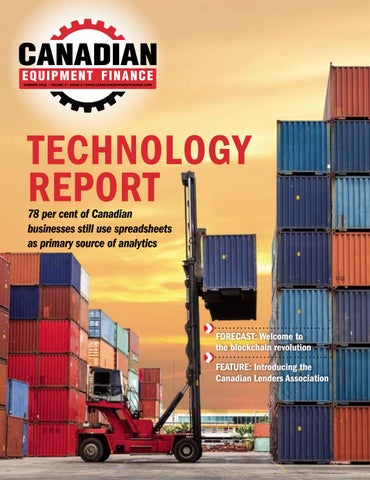
Technology Report 78 per cent of Canadian businesses still use spreadsheets as primary source of analytics
Forecast: Welcome to the blockchain revolution Feature: Introducing the Canadian Lenders Association
PM40050803
KEEP UP TO DATE AND INFORMED BY VISITING OUR WEBSITE DAILY. Canadian Equipment Finance magazine posts news, insights, updates and breaking stories as they happen. Stay Informed. Keep Ahead.
Visit us online at www.canadianequipmentfinance.com Canadian Equipment Finance is a Lloydmedia, Inc publication.
Lloydmedia also publishes Payments Business magazine, Canadian Treasurer magazine, Financial Operations magazine, Direct Marketing magazine and Contact Management magazine.
contents Summer 2016 Volume 4 Number 2 Publisher and Editor-in-Chief Steve Lloyd steve@canadianequipmentfinance.com Managing Editor Sarah O’Connor sarah@canadianequipmentfinance.com Creative Direction / Production Jennifer O’Neill jennifer@canadianequipmentfinance.com Photographer Gary Tannyan
Technology Report: 78 per cent of Canadian businesses still use spreadsheets as primary source of analytics, study finds »12 Case study: ENGS Commercial Finance keeps up with rapid growth, adds new sales tools using ASPIRE data features »16
Advertising Sales Mark Henry mark@canadianequipmentfinance.com For subscription, circulation and change of address information, contact
subscriptions@canadianequipmentfinance.com
Publications Mail Agreement No. 40050803 Return undeliverable Canadian addresses to:
Circulation Department 302-137 Main Street North Markham ON L3P 1Y2 t: 905.201.6600 • f: 905.201.6601 info@canadianequipmentfinance.com www.canadianequipmentfinance.com Subscriptions available for $40.00 year or $60.00 two years. ©2016 Lloydmedia Inc. All rights reserved. The contents of this publication may not be reproduced by any means, in whole or in part, without the prior written consent of the publisher. Printed in Canada. Reprint permission requests to use materials published in Canadian Equipment Finance should be directed to the publisher.
FORECAST
Also Publishers of Payments Business www.paymentsbusiness.ca Canadian Treasurer www.canadiantreasurer.com Contact Management www.contactmanagement.ca
Direct Marketing www.dmn.ca Financial operations www.financialoperations.ca
Your BUsiness
Welcome to the blockchain revolution
Lots of money, no deals available
FinTech leads the charge, but the equipment finance industry is sure to follow »4
NEWS »6 Feature
Private equity groups and hungry for investment opportunities »19
Your Team
Collection lemonade Making the best of the challenge of collecting receivables »22
Introducing the Canadian Lenders Association A conversation with Founder and Chairman of the Board Karl Sigerist »10
Made possible with the support of the Ontario Media Development Corporation Ontario Interactive Digital Media Tax Credit
canadianequipmentfinance.com | Summer 2016 | CANADIAN EQUIPMENT FINANCE
3
Forecast
Welcome
to the blockchain revolution FinTech leads the charge, but the equipment finance industry is sure to follow By Sarah O’Connor
ou’ve probably already heard the whispers. Blockchain—it’s new, powerful and very difficult to understand exactly what it is and how it may impact your business. This past March at the American Financial Services Association’s Vehicle Finance Conference in Las Vegas, Haskell Garfinkel, FinTech co-lead at PricewaterhouseCoopers, delivered a presentation entitled “Blockchain—What it is and what it could mean to you” wherein he posited that it is not a question of if but rather when the auto finance industry will be significantly disrupted by blockchain technology. “Blockchain is one of the areas that we think are going to be most impactful in financial services and in many other areas of our daily lives in the next five to 10 years,” began Garfinkel. He then outlined five circumstances where using blockchain technology has particularly exciting potential: ◉◉ Multiple parties share data; ◉◉ Multiple parties update data; ◉◉ There is a requirement for verification; ◉◉ Intermediaries add cost and complexity; and/or ◉◉ Interactions are time sensitive.
Y
Certainly these circumstances are familiar aspects of processes that characterize the equipment finance industry. “I can’t stand up here today and tell you that next month in the auto finance industry you will wake up and find your 4
job—the way you do underwriting, the way you do servicing—will change overnight from blockchain,” concluded Garfinkel, in a video of his presentation made available by the White Clarke Group. “What I can do is start by telling you that… people are already looking at processes and systems like the world of underwriting, like the world of credit reporting, like the world of payments— certainly getting a lot of traction in the world of blockchain. That in many areas of our lives blockchain will come to impact it, much like the early days of the internet. “This is definitely an area where I think people will wake up in a few years and say, ‘I’m glad I spent some time on this early. I’m glad my IT department started investigating this, running through some concepts, keeping an eye on the early innovators in the space and integrating these technologies into my organization.” Canadian Equipment Finance spoke with Canadian FinTech leaders who are already heavily invested blockchain technologies as they relate to financial services in order to get a sense of what the future may hold for the Canadian equipment finance industry.
Anthony Di Iorio of Decentral “When you think about back in the day what speech was when the printing press came about—people were so used to the government controlling how news was disseminated to the people,” says Anthony Di Iorio, president and
CANADIAN EQUIPMENT FINANCE | Summer 2016 | canadianequipmentfinance.com
founder of Decentral, an innovation hub for disruptive and decentralized technologies offering blockchain and FinTech consultancy services and software development. “And then you had a printing press come out and totally change what people were used to in terms of control over speech. And now, what’s happening with value… “I think people in the future are going to look back and say, ‘really? You tried to control value between countries? You tried to stop it between borders? It’s just information!’ It will be freedom of value, it will be global. We need to start thinking outside the box. In my opinion, it will be a big shift.” Decentral has announced the new integration of the ShapeShift API with its Jaxx fleet of blockchain wallets. By working with ShapeShift—an industry leader in blockchain asset conversions—Jaxx’s seamless crossplatform experience now offers the option to convert between bitcoin, ether and dao tokens, or any other tokens that Jaxx and ShapeShift integrate in future. This integration is part of Decentral’s long-term vision of Jaxx becoming the go-to wallet for all, including users of alternative blockchains. “The integration enables people to be able to switch, right now, between three different digital currencies,” explains Di Iorio, president and founder of Decentral, the makers of Jaxx. “I don’t like to use the word ‘currency’ because ether, which is one of the ones that we have integrated, isn’t really a currency, it’s a fuel that runs
Forecast the platform and it’s a requirement for a product to operate. So in the space where we are trying to define what digital currencies are, it gets really tricky to even call some of these things currencies. They are basically digital units of value, is what they are. Basically they are information. “I think in the future when we talk about goods crossing borders and value being exchanged across border—all it really is is information,” says Di Iorio. “Since we’ve digitalized everything, it’s all turning into information. “You think about cash crossing the border—you can’t take over $10,000 in cash or it has to be claimed. Well, I can have a wallet in my head now that can literally contain millions of dollars in digital value. We need to think outside the box—it’s not about paper, it’s about digitizing value… This is where we are getting away from currency and really thinking about what we are dealing with in the future and it’s digitalized value.”
Michael O’Loughlin and Cathy Pin of CGI “I think we’re going to look back in a few years at ourselves at laugh for the way we’re looking at [blockchain technology],” says Michael O’Loughlin, CGI’s director of consulting. CGI is a leading independent information technology and business process services firms. “We’re looking at it as though it’s the internet and the use case we’re all exploring right now is email when really there’s a large list of things we can really tap into. Payments is really one tip of the spear. “Blockchain isn’t the only thing that’s innovative in the market right now; however, it is one that has maybe an unending list of opportunities.” CGI has integrated Ripple’s distributed financial technology into the CGI portfolio of payments solutions. CGI’s clients will realize the benefits of instant international settlements such as greater cost efficiency, agility and speed to market. Specifically, financial services companies using CGI’s Ripple-enabled Intelligent Gateway can use their existing payments hub to access new protocols and services, and connect with multiple payment networks and clearing channels,
“Our clients, banks, need to get into this new technology for competitive reasons. Their lunch is going to be eaten if they don’t. They will become the Blockbuster to Netflix.” including the Ripple network ecosystem. “Our clients, banks, need to get into this new technology for competitive reasons. Their lunch is going to be eaten if they don’t,” says Cathy Pin, head of global payments solutions for CGI. “They will become the Blockbuster to Netflix. There’s a business need to really understand the technology, and do it now. So we sat back and said, how can we help our clients get into this innovation space quickly, and in a way that doesn’t disrupt their payment ecosystem?
Because those ecosystems have been built on years of processes.” “We’ve really embraced [blockchain],” concludes O’Loughlin. “We’ve researched it, we continue to research it, we will continue to research it. We realize that talking about it and writing whitepapers about it isn’t enough. And that’s why we, in April, announced the launch of this new product, the Intelligent Gateway which, in essence, connects banks to distributed ledgers in a safe, secure, efficient and agile manner.”
Definitions of blockchain: “A blockchain is a data structure that makes it possible to create a digital ledger of transactions and share it among a distributed network of computers. It uses cryptography to allow each participant on the network to manipulate the ledger in a secure way without the need for a central authority.” —Steven Norton, via The Wall Street Journal
“Though it sounds like a series of defensive maneuvers ripped out of an NFL playbook, the blockchain is actually a way to structure data, and the foundation of cryptocurrencies like bitcoin. This coding breakthrough—which consists of concatenated blocks of transactions—allows competitors to share a digital ledger across a network of computers without need for a central authority. No single party has the power to tamper with the records: the math keeps everyone honest. Forty of the world’s top financial firms are experimenting with the tech.” —Robert Hackett, via Fortune
“Blockchain is a technology for a new generation of transactional applications that establishes trust, accountability and transparency while streamlining business processes. It is a design pattern made famous by bitcoin, but its uses go far beyond. With it, we can re-imagine the world’s most fundamental business interactions and open the door to invent new styles of digital interactions. It has the potential to vastly reduce the cost and complexity of cross-enterprise business processes. The distributed ledger makes it easier to create cost-efficient business networks where virtually anything of value can be tracked and traded—without requiring a central point of control.” —via IBM, “What is blockchain?”
canadianequipmentfinance.com | Summer 2016 | CANADIAN EQUIPMENT FINANCE
5
News
Equifax Canada reports: Delinquency rate up for Millennials, seniors adding more debt The delinquency rate among young Millennials (18-25 years) hit 1.8 per cent in the second quarter of this year, an increase of 11.7 per cent from their 1.6 per cent rate in the second quarter of 2015. However young adults didn’t add much debt over the past year with the average change at $167, while the debt obligations of seniors (65+ years) increased by $1,134 (8.2 per cent) to $15,001 according to Equifax Canada’s Q2 2016 National Consumer Credit Trends Report. Total consumer total debt (excluding mortgages) also remains on the rise. As of Q2 2016, Canadian consumers owe $1.666 trillion, compared to $1.618 trillion in Q1 2016 and $1.568 trillion a year earlier, an increase of three per cent and 6.3 per cent, respectively. “While debt among seniors has increased, they are also
the only age group that saw Calgary $28,572 1.2% 1.1% 32.2% its delinquency rate decrease over the past 12 months. They Edmonton $26,691 1.7% 1.4% 39.0% currently share the lowest delinquency rate, 0.9 per cent, Halifax $23,374 3.3% 1.5% 6.2% with the 55-64 age group,” said Regina Malina, senior director Montreal $17,091 4.0% 1.3% -2.9% of decision insights at Equifax Canada. “For the most part, Ottawa $21,322 2.8% 1.0% -0.4% older Canadians have always demonstrated an ability to Toronto $20,460 3.9% 1.3% -2.7% handle their spending and what they owe. Young people, Vancouver $24,267 3.5% 0.8% -9.1% and really everyone, should be reminded to practice good St. John’s $24,721 3.0% 1.2% 21.2% budget and money management habits. Great tips can be found Major city analysis - Debt (excluding mortgages) & delinquency rates on the Financial Consumer Agency of Canada’s website”. Province Average Average Debt Delinquency Delinquency On a debt classification Rate Change Debt Change Year- Rate basis, installment loan, auto Year-overover-Year (Q2 loan and mortgage sectors are Year (Q2 2016 2016 vs. Q2 showing significant increases vs. Q2 2015) 2015) of 7.8 per cent, 7.6 per cent and 7.6 per cent year-over-year, Ontario $21,570 3.7% 1.1% -3.9% respectively.
Debt (excluding mortgages) & delinquency rates Age
6
Major city analysis - Debt (excluding mortgages) & delinquency rates City Average Average Debt Delinquency Delinquency Debt Change Year- Rate Rate Change over-Year Year-over(Q2 2016 vs. Year (Q2 2016 Q2 2015) vs. Q2 2015)
Average
Average Debt
Delinquency
Delinquency
Debt
Change Year-
Rate
Rate Change
over-Year
Year-over-Year
(Q2 2016 vs. Q2
(Q2 2016 vs. Q2
2015)
2015)
Quebec
$18,489
4.1%
1.1%
-3.3%
Nova Scotia
$21,963
4.3%
1.7%
2.0%
New Brunswick
$22,542
5.1%
1.7%
-1.6%
PEI
$21,822
4.6%
1.5%
5.4%
Newfoundland
$23,074
4.6%
1.3%
19.4%
18-25
$8,203
2.1%
1.8%
11.7%
Eastern Region
$22,382
4.6%
1.6%
3.8%
26-35
$16,841
2.8%
1.6%
9.7%
Alberta
$27,753
1.6%
1.4%
40.3%
36-45
$26,480
1.8%
1.3%
5.5%
Manitoba
$18,193
3.5%
1.2%
12.9%
46-55
$32,243
3.4%
1.0%
1.0%
Saskatchewan
$24,276
4.0%
1.2%
22.7%
56-65
$27,594
3.3%
0.9%
2.2%
British Columbia
$23,538
2.3%
1.0%
-3.3%
65+
$15,001
8.2%
0.9%
-2.4%
Western Region
$24,586
2.3%
1.2%
18.1%
Canada
$21,878
3.4%
1.1%
4.1%
Canada
$21,878
3.4%
1.1%
4.1%
CANADIAN EQUIPMENT FINANCE | Summer 2016 | canadianequipmentfinance.com
News
Managed solution transactions on the rise in equipment finance industry, according to new foundation study Managed solution transactions (MST) or MST-like structures are becoming a major new offering of equipment leasing and finance companies and are very likely to continue growing as a proportion of U.S. equipment leasing volumes, according to a new research study released by the Equipment Leasing & Finance Foundation. MSTs combine equipment with services into a single “bundle” that enable customers to make use of third-party service providers in order to avoid the hazards and obligations of equipment ownership and realize the benefits of aligning their costs more closely with their business demands through more flexible payment, pricing, termination
and re-financing terms. The study, Managed Solutions: Evolutionary or Revolutionary, examines these market drivers that will provide material growth and investment return opportunities for industry participants. The study findings indicate that MSTs will: ◉◉ Grow organically along a continuum of increasingly “bundled” equipment, financing and services; ◉◉ Present growth opportunities for captive, bank and independent lessors across a wide variety of industries; and ◉◉ Require a fair amount of rethinking and retooling of many individual industry practices, disciplines and functions which comprise the
overall business of providing equipment leasing and financing services today. The study, conducted by The Alta Group under a Foundation research grant, sought to research, analyze and report on the impact of this increasingly prominent business structure on the industry. “The research confirms that managed solutions will be major drivers for the growth and composition of the industry moving forward. In fact, The Alta Group estimates that MSTs in the next three to five years could generate 22 per cent or more of total equipment leasing and finance industry volumes,” said Alta CEO John C. Deane. “Every leasing organization has
the potential to benefit from this development, as there will be many opportunities in the marketplace to leverage MSTs for growth.” “The rapid growth of managed solutions is an important strategic trend in commercial finance. The Foundation has undertaken significant, rigorous research on this topic. This Foundation study represents the most comprehensive analysis of managed solutions completed to date by any independent party,” said Bill Verhelle, chairman of the foundation board of trustees. Managed Solutions: Evolutionary or Revolutionary is available for free download through the Foundation website.
LEAS
e
T EAM
canadianequipmentfinance.com | Summer 2016 | CANADIAN EQUIPMENT FINANCE
7
News
Equipment leasing and finance industry confidence improves in August The Equipment Leasing & Finance Foundation (the Foundation) has released the August 2016 Monthly Confidence Index for the Equipment Finance Industry (MCI-EFI). Designed to collect leadership data, the index reports a qualitative assessment of both the prevailing business conditions and expectations for the future as reported by key executives from the $1 trillion equipment finance sector. Overall, confidence in the equipment finance market is 54.8, an increase from the July index of 52.5. When asked about the outlook for the future, MCIEFI survey respondent Adam D. Warner, president, Key Equipment Finance, said: “There seems to be a general slowdown in capital asset acquisitions. There is enough negative overhang and fallout from the U.S. presidential campaign combined with continued concerns about Europe and China that have businesses unsure about investments in growth.” August 2016 survey results: The overall MCI-EFI is 54.8, an increase from the July index of 52.5. ◉◉ When asked to assess their business conditions over the next four months, 10 per cent of executives responding said they believe business conditions will improve over the next four months, a decrease from 12.1 per cent in July. Eighty per cent of respondents believe business conditions will remain the same over the next four months, an 8
◉◉
◉◉
◉◉
◉◉
increase from 75.8 per cent in July. Ten per cent believe business conditions will worsen, a decrease from 12.1 per cent the previous month. 13.3 per cent of survey respondents believe demand for leases and loans to fund capital expenditures (capex) will increase over the next four months, an increase from 12.1 per cent in July. Seventy per cent believe demand will “remain the same” during the same fourmonth time period, up from 57.6 per cent the previous month. Sixteen point seven per cent believe demand will decline, a decrease from 30.3 per cent who believed so in July. 13.3 per cent of executives expect more access to capital to fund equipment acquisitions over the next four months, a decrease from 15.2 per cent in July. Eighty per cent of survey respondents indicate they expect the “same” access to capital to fund business, an increase from 78.8 per cent the previous month. Six point seven per cent expect “less” access to capital, an increase from 6.1 per cent last month. When asked, 40.0 per cent of the executives report they expect to hire more employees over the next four months, an increase from 30.3 per cent in July. Fifty per cent expect no change in headcount over the next four months, a decrease from 63.6 per cent last month. Ten per cent expect to hire fewer employees, up from 6.1 per cent in July. None of the leadership
CANADIAN EQUIPMENT FINANCE | Summer 2016 | canadianequipmentfinance.com
evaluates the current U.S. economy as “excellent,” unchanged from last month. Ninety per cent of the leadership evaluate the current U.S. economy as “fair,” a decrease from 100 per cent last month. Ten per cent evaluate it as “poor,” an increase from none in July. ◉◉ None of the survey respondents believe that U.S. economic conditions will get “better” over the next six months, a decrease from three per cent in July. Ninety-six point seven per cent of survey respondents indicate they believe the U.S. economy will “stay the same” over the next six months, an increase from 78.8 per cent the previous month. Three point three per cent believe economic conditions in the U.S. will worsen over the next six months, a decrease from 18.2 per cent who believed so last month. ◉◉ In August, 40 per cent of respondents indicate they believe their company will increase spending on business development activities during the next six months, an increase from 36.4 per cent in July. Sixty per cent believe there will be “no change” in business development spending, relatively unchanged from 60.6 per cent the previous month. None believe there will be a decrease in spending, a decrease from 3.0 per cent who believed so last month. August 2016 MCI-EFI Survey comments from industry executive leadership:
Bank, small ticket: “I am concerned about slow to no growth in an election year with increasing delinquency and bad debt. Consolidation brings opportunities on a small scale and is challenging on a large scale,” said David Normandin, managing director, commercial finance group, Banc of California. Independent, middle ticket: “While the employment numbers look positive, the recent GDP number seems anemic. Growth in new business volumes has softened and there is a slight uptick in delinquencies, despite aggressive collections efforts. The outlook is unclear,” said William H. Besgen, senior advisor, vice chairman emeritus, Hitachi Capital America Corp. Bank, middle ticket: “We continue to see a pull-back in capital investment for the sectors we serve, especially the cash grain sector. We continue to see opportunities with solar and facility-based financing for those customers looking to take advantage of tax credits and growth opportunities for industries not impacted by low commodity prices,” said Michael Romanowski, president, Farm Credit Leasing Services Corporation. Bank, large ticket: Though the market remains competitive, we continue to see financing opportunities from our client base. Concerns over the outcome of the elections could impact spending in the short term,” said Thomas Partridge, president, Fifth Third Equipment Finance.
News
Overall new business volume grew 12.4 per cent in 2015, according to ELFA survey of equipment finance activity New business volume grew 12.4 per cent in the equipment finance industry in 2015, according to the 2016 Survey of Equipment Finance Activity (SEFA) released by the Equipment Leasing and Finance Association (ELFA). The rise in new business volume marked the sixth consecutive year that businesses increased their spending on capital equipment. The SEFA report covers key statistical, financial and operations information for the $1 trillion equipment finance industry, based on a comprehensive survey of 116 ELFA member companies. The report is available at www.
elfaonline.org/SEFA. ELFA also released a companion report to the 2016 SEFA called the 2016 Small-Ticket Survey of Equipment Finance Activity. The report, which focuses on small-ticket and micro-ticket equipment transactions among the SEFA respondents, found that new business volume in the small-ticket space grew by just 0.4 per cent in 2015. “The equipment finance industry saw positive growth overall in 2015, as reported in the 2016 Survey of Equipment Finance Activity,” said ELFA President and CEO Ralph Petta. “More recent data collected in the first two quarters of
2016 suggest the equipment finance industry is entering a period of slower growth as business confidence and global markets appear increasingly volatile. We are pleased to make this data available to provide comprehensive performance metrics for equipment leasing and finance companies.” Survey highlights: Key findings for 2015 as reported in the 2016 SEFA include: ◉◉ Overall new business volume grew 12.4 per cent. ◉◉ By organization type: Independents saw a 59.9 per cent increase in new
business volume, while banks saw an 11.6 per cent increase and captives saw a 3.3 per cent increase. ◉◉ By market segment: New business volume grew 2.8 per cent in the small-ticket segment, while middleticket grew 12.4 per cent and large-ticket climbed 33.9 per cent. ◉◉ From an asset perspective, the top-five most-financed equipment types were transportation, IT and related technology services, construction, agricultural and medical equipment. The
Canadian Equipment Finance: ¼ square (3.625” x 4.7 Continued on page 20
TOO MANY BALLS IN THE AIR? TOSS SOME OUR WAY. Juggling too much, trying to originate AND service leases? Let us help. We manage portfolios, provide Software as a Service, build custom Web portals and offer a variety of professional services. All at a price you can afford. Don’t let a single ball drop. Contact us today.
jdrsolutions.com
855-863-7676 #ServiceSupportSuccess s canadianequipmentfinance.com | Summer 2016 | CANADIAN EQUIPMENT FINANCE
9
Feature
Introducing the Canadian Lenders Association A conversation with Founder and Chairman of the Board Karl Sigerist By Sarah O’Connor
’ve been in FinTech, as its now coined, for most of my career,” says Karl Sigerist, founder and chairman of the board of the newly minted Canadian Lenders Association. “I had the words ‘finance’ and ‘technology’ in my LinkedIn summary profile. I just never knew that if you shortened it to ‘FinTech’ the company would be worth more.” Sigerist is director, president and chief executive office of Crelogix Credit Group Inc., a provider of point of sale installment credit financing considered Canada’s largest FinTech company. “As an operator of various non-bank businesses over my career in various roles, the use of technology to enable a more frictionless, more effective customer experience and more efficient internal processes is, I think, just at the root of any business leader, not even limited to just finance,” he observes. Earlier this year Sigerist read an article in the Financial Post by Barbara Shecter posted online on March 31 and titled “Debate over regulating fintechs heats up in Canada and the U.S.” In the article Bharat Masrani, chief executive of Toronto-Dominion Bank, calls for increased oversight of FinTech companies and is quoted as saying “the need has become even more evident. Security breaches—service interruptions—and solvency issues have plagued a number of FinTechs… That’s why I believe it would be appropriate for policymakers to consider a regulatory environment that ensures the safety of
“I
10
“If you don’t have a seat at the table you’re more than likely to be on the menu.” customer information and the integrity of our financial system.” That article and quotation “really was the impetus for me first reaching out to all my peers in the industry, forming a LinkedIn group and now forming what we are calling the Canadian Lenders Association,” says Sigerist. “My thesis is that Canadian technology lenders and organizations run the risk of being marginalized if we leave the advocacy for and the education of our business models to others. Crelogix is quietly in
CANADIAN EQUIPMENT FINANCE | Summer 2016 | canadianequipmentfinance.com
the background enabling its business partners to become more successful, and so are many of my peers who are busy either helping small businesses or consumers get the lifestyle they want and business to achieve their business goals by providing credit products to them. “Many other forms of financial market participants, whether Canadian banks or the Payments Association or payday loans or mortgages or automobile and equipment finance, all have associations that represent their collective voice as an interest. Now, there was, prior to the global financial crisis a trade association for the consumer lenders but that industry association went away when those lenders went away.”
Feature Sigerist explains that following the global financial crisis there was a great deal of consolidation that changed the landscape of the industry. “Our particular niche, the consumer and small business space, was very scattered so we joined together: Crelogix, GoEasy, Dealnet, Thinking Capital and Lendified as the founding members, together with a lot of help from Blakes, a major law firm in the finance space, and McMillan LLP to form the association. “I read once: if you don’t have a seat at the table you’re more than likely to be on the menu. The association is intended for professionals in the industry—for founders, executives and investors interested in the Canadian consumer/ small business lending space. “The members will include small business and consumer financiers, and that can also include public companies, private and cooperatively owned banks or finance companies. We have a number of common interests and we want to advocate, converse, collaborate and educate to move the small business and consumer lending industry forward in Canada.” In response to the article that inspired the founding of the Canadian Lenders Association and the quote from Masrani of TD, Sigerist says: “We believe that regulation should be a collaborative process between both the regulators and the parties directly impacted by the proposed regulation. Both government, borrowers and the industry should work together to promote lending that helps borrowers meet their financial needs through affordable credit and the extension of credit must be affordable for both the lender and the borrower.” Sigerist attributes the speed from which the organization has gone from idea to reality to the very nature of the industry the association serves: “We’re entrepreneurs. Some of us have banking DNA in our blood when it comes to being prudential but we’re also entrepreneurs. We get things done. The response [from the industry] has been amazingly positive. “Credit is what attracts people to the Canadian dream in that we have a society that provides credit to you so that
you can buy a car, you can buy a house. There are other countries where that’s not possible and its how we create an amazing society for all of us. “I think that our law makers don’t want to be the victim of unintended consequences. At the end of the day our
lawmakers are elected by all of us and they want nothing more than the best opportunity for all their constituents. However, in the absence of information there’s a void and now you’re left to decision making based on opinion rather than evidence.”
Fast facts about the Canadian Lenders Association Website: www.cla-apc.org Mission statement: The mission of the Canadian Lenders Association is to promote safe, ethical lending to responsible, informed borrowers and to improve and protect consumers’ and small businesses’ access to credit. Officers: Chair Karl Sigerist of Crelogix, Vice-chair Kevin Clark of Lendified, Treasurer Steve Forte of Thinking Capital and Secretary Kip Daechsel of McMillan The president’s position is currently open. Board of directors: Steve Goertz of GoEasy, Michael Hilmer of Dealnet, Jeff Mitelman of Thinking Capital, Kevin Clark of Lendified, Gary Fearnall of OnDeck Capital, Kip Daechsel of McMillan, Michael Burke of Blakes and Karl Sigerist of Crelogix
ERS OK D BR ANTE W
PROUDLY CANADIAN SINCE 1981 MEMBER OF THE CFLA
Specializing in New & Used Manufacturing & Construction Equipment
Advant Leasing is an independent family owned business that has participated in the Canadian Commercial and Industrial Lease Industry for over 35 years. We specialize in assisting all types of businesses to acquire the specialized commercial equipment required to be productive and grow their business.
NEW BROKERS WELCOME • Fast approvals • Flexible terms • Start-ups accepted
• Decisions made in house/no securitization • Customized financing solutions • Small business specialists
Get started today with Advant, helping you grow with the tools that you’ll need.
Please contact Jason Bonneville • jason@advantleasing.com 905-335-3301 ext 224 • www.advantleasing.com canadianequipmentfinance.com | Summer 2016 | CANADIAN EQUIPMENT FINANCE
11
Technology Report
78 per cent of Canadian businesses still use spreadsheets as primary source of analytics, study finds By The Canadian Financial Executives Research Foundation
he vast majority of Canadian organizations still rely on spreadsheets as their primary tool of business analytics, which may be leaving them at a competitive disadvantage according to a new study by the Canadian Financial Executives Research Foundation (CFERF) and sponsored by SAP Canada Inc. The survey of 118 senior Canadian financial executives was carried out by the research foundation of Financial Executives International Canada (FEI Canada) to discover which data analysis tools Canadian organizations are using today, their level of satisfaction with those tools and the level of data integration within organizations. It found: ◉◉ 79 per cent of executives feel their current financial reporting and analytics tools only somewhat meet their business’s needs. ◉◉ 65 per cent of businesses do not use or have no access to real-time reporting tools. ◉◉ Only four per cent of executives consider themselves industry leaders in financial reporting. ◉◉ 29 per cent have plans to invest in financial reporting and analytics infrastructure this year. ◉◉ If only one aspect of financial reporting and analytics could be improved, 27 per cent of respondents want more advanced analytics (the highest ranked response).
T
12
At some organizations, the use of spreadsheets remains pervasive, even among very large enterprises. Gerard McInnis, partner, valuations, at EY, observed that one client has one million active spreadsheets tracking different sources of information within the organization. “We’re seeing this is an issue with all of our clients, where they have to backstop their accounting and formal ERP systems with spreadsheets,” he said. “There’s a disproportionate amount of manual effort.”
Stuck on spreadsheets “Spreadsheets have become the norm,” said John Forester, CFO, DBG Canada, in Mississauga. “Every person in our organization has their own version of a spreadsheet. I don’t know if the spreadsheet is updated, who has looked at it last and whether the data is current. The question is can we move away from spreadsheets into something which is more disciplined, more defined, a tool that everybody understands and is used consistently, as opposed to having each person come in a room with their own version of the truth?” Although spreadsheets are useful, there are risks associated with using them, said Craig Smith, CFO, McAsphalt Industries: “You face the challenge of people extracting incorrect or inconsistent information and arriving at the wrong conclusions,” he said. “We see that periodically, which is why standard reports extracted from the ERP database are preferred. These reports are tested and vetted and placed in a repository to be drawn on as required.” Another tool
CANADIAN EQUIPMENT FINANCE | Summer 2016 | canadianequipmentfinance.com
used by financial executives, beyond spreadsheets, is Structured Query Language (SQL), a language used to run queries in databases. “SQL reporting is virtually real time for us,” said Smith, adding user requests have created SQL queries to get more customized and useful information outside of their regular sources. Niall Cotter, CFO, Kingsdale Shareholder Services, agreed spreadsheets are static. “In a business intelligence report, I can almost flick over all the various areas that I want to see. If I want to view metrics by campaign, by person, by graph or whatever, I can do it without having to go to separate tabs; it’s all there, it’s in real time and I find that very powerful.” It should come as no surprise that the survey shows that financial executives are still married to spreadsheets. Finance departments have long used spreadsheets as their primary tool to plan, forecast and run scenarios, as spreadsheets offer the ability to quickly analyze a specific data set in a particular way. Many financial executives successfully use spreadsheets to make good business decisions that foster corporate growth and this isn’t likely to change soon. However, using separate sheets for budgeting, forecasting, reporting and analysis can result in disparate data sets from areas such as finance, operations, sales and human resources. The work is manual and can drain time and resources. It seems many organizations, including large, public enterprises with high revenues, continue to be heavily dependent on these disparate data
Technology Report
Are spreadsheets like Excel your organization’s primary source of Business Analytics?
sets in spreadsheet format, perhaps unnecessarily, given the availability of the many data analytics platforms in existence. The demands of business are extensive and growing, and analytics can help with tasks such as forecasting performance, market research, profit margin analysis, risk assessment and management, operations and product pricing.
The CFO’s expanding role Given that CFOs are already masters of spreadsheets, as organizations move towards the integration of data with business intelligence and ERP systems it makes sense that the CFO would oversee
this evolution. Further, the benefit to the CFO of taking ownership of analytics is that it enhances the strategic role of financial executives in the organization’s growth, whether it’s with their board of directors, their CEO, fellow executives and staff or with their clients. For a data analytics program to be effective, however, financial executives surveyed cautioned that there must be a “single source of truth”—in other words, data must be defined and consistent across an organization. A major challenge identified around analytics was that segments don’t equal each other due to the lack of data integrity between disparate
databases. It was also suggested that data analytics could offer more insight by integrating information from outside the organization, including industry benchmarks. By providing reliable, realtime information drawn from different areas of an organization, the financial executive using data analytics will become invaluable to other departments and a key driver of revenue. Rather than simply reporting on past results, the CFO and the finance team, with support from IT and other departments, can help answer immediate, pressing sales and operations questions on future pricing, inventory and supply chain decisions and even continue to enhance the role of the CFO as a strategic member of the c-suite. It should be emphasized that having outstanding IT tools such as predictive analytics and real-time reporting is only half the issue. Businesses require personnel capable of interpreting the data and leaders able to clearly define the data requirements and, again, this is where the senior financial executive can add value. One way the CFO can spark innovation in a company is by providing users in various areas of the organization—from operations to sales and marketing—reliable, consistent metrics offering insights that they can build on. “Reliance on spreadsheets is symptomatic of broken systems, characterized by offline processes, redundant data and wasted human effort
How would you describe your organization’s ability to:
canadianequipmentfinance.com | Summer 2016 | CANADIAN EQUIPMENT FINANCE
13
Technology Report If you could improve only one aspect of financial reporting and analytics in your organization, what would it be?
in data entry and reconciliations,” said Arthur Gitajn, CFO, SAP Canada Inc. “Today, when terabytes of data can be analyzed in seconds and accessed in real time on tablets and smartphones, it makes little sense to rely on static spreadsheets as analytical tools.” “The CFO is responsible for maintaining controls over the accuracy of financial information. In addition to providing live information, integrated Business Intelligence tools help to safeguard system data as the single source of financial truth,” he said.
Organization size matters Breaking down the statistics by company size, 91 per cent of small businesses (<100 employees) and 76 per cent of mediumsized businesses (101–500 employees) predominantly use spreadsheets for business analysis, however that number fell to 50 per cent for organizations with more than $1B in revenue. “This continued dependence on spreadsheets today may be indicative of a lack of resources holding CFOs back from fully developing their data analytics capabilities,” said Michael Conway, president and CEO, FEI Canada. “Demands on businesses are extensive and growing, and real-time analytics can help with tasks such as forecasting performance, market research, profit 14
margin analysis, risk assessment and management, operations and product pricing. “The problem with spreadsheets is that the information is often not timely or intrinsically insightful enough. Larger companies are embracing live analysis and moving away from spreadsheets at a faster rate than small- to medium-sized businesses; however, it seems almost all businesses have yet to eradicate the problem of disparate and static data sets
When do you anticipate your organization will invest in improving its financial reporting and analytics infrastructure?
CANADIAN EQUIPMENT FINANCE | Summer 2016 | canadianequipmentfinance.com
slowing down operations and adding to manual workloads.” Most organizations, according to survey respondents, are using a combination of tools, such as both spreadsheets and accounting software, or spreadsheets and BI software, in tandem, to meet a range of different needs and to act as a check or confirmation of data from other parts of an enterprise. When it came to deriving insights from large volumes of data, many
Technology Report organizations identified room for improvement. For instance: ◉◉ 33 per cent described their organizations as below average in deriving insights from large volumes of data. ◉◉ Large companies (revenues over $1 billion) were more likely to see themselves as industry leaders (10 per cent) compared to overall (average of two per cent) When it came to deriving insights from real-time data, more than half of all organizations (52 per cent) felt they were below average, with higher results in the mid-sized company grouping (60 per cent). Interestingly, a higher proportion of smaller companies (revenue under $100 million) felt they didn’t need real-time data or this wasn’t applicable to them (10 per cent) when compared to the total group of respondents (six per cent overall).
Analytics already Financial executives have long used spreadsheets as their primary tool to plan, forecast and run scenarios, as spreadsheets offer the ability to quickly analyze a specific data set in a particular way. Many financial executives
Does your organization leverage real-time reporting?
successfully use spreadsheets to make good business decisions that foster corporate growth and this isn’t likely to change soon. That said, the research undertaken for this study indicates that many organizations, including large, public enterprises with high revenues, continue to be heavily dependent on disparate data sets in spreadsheet format, perhaps unnecessarily, given the
availability of the many data analytics platforms in existence. “Data analytics in Canada” was prepared by the Canadian Financial Executives Research Foundation (CFERF), the research arm of FEI Canada, and was sponsored by SAP Canada. This study comprises the results of an online survey of Canadian financial executives which took place between October 16th – November 20th, 2015. The report encompasses the insights and opinions of 118 respondents to the online survey as well as November 12th, 2015 executive research roundtable, which was attended through a video conference linkage that connected 19 senior finance executives in Toronto, Calgary and Montreal. Visit FEICanada.org to read the full FEI Canada research report titled “Data Analytics in Canada.”
Which statement best describes your organization’s ability to leverage real-time reporting?
canadianequipmentfinance.com | Summer 2016 | CANADIAN EQUIPMENT FINANCE
15
Technology Report
Case study: ENGS Commercial Finance keeps up with rapid growth, adds new sales tools using ASPIRE data features By Randy Haug
NGS Commercial Finance (ENGS) is one of the oldest and most respected lenders in the truck and trailer industry. Based in Lisle, Illinois, its industry-specific vendor finance programs are designed to help dealers and manufacturers achieve success—as measured by increased sales and retention of repeat customers. ENGS’ systems, policies and procedures are designed specifically around the industries it serves, with the goal of delivering best-in-class products and services to its customers. This philosophy is the backbone of its success and a key differentiator from others in our market. ENGS’ ongoing commitment to providing “service first” means they need to be able to make decisions quickly, anticipate their customers’ needs and be structured to be nimble and responsive. This has been an extremely successful formula for ENGS, but that success adds to the complexity of maintaining their customer-centric approach. Tremendous success equates to tremendous growth. In the last four years, ENGS has increased its portfolio size five-fold to over $500 million. In 2015, ENGS was recognized in the American equipment finance magazine The Monitor as the tenth largest independent finance company by originations.
E
16
The challenge As ENGS grew, their business model continued to be centred on offering the latest tools and technology to ensure best-in-class delivery of their products. However, in a constantly evolving industry with increasingly higher customer expectations, it was clear that if they were going to continue supporting their “service first” mission statement, they needed to find additional ways to empower their growing sales force. They also needed to find new ways to improve their customers’ experience and additional ways to provide value as a trusted partner.
and dealer experiences, they knew the solution lay within their technology and that the technology had to be quick, reliable and easy to use.
The solution ENGS decided the best way to move forward was by reviewing their operational processes and technologies to build a strategic plan in support of their goals. They started by dissecting their average sales call. Historically when an ENGS sales representative visited one of their clients, their conversation centred on what was working for the customer, what their challenges were, assessing
It was clear that if they were going to continue supporting their “service first” mission statement, they needed to find additional ways to empower their growing sales force. The challenge then became how can they take their already successful business model and evolve it? Although ENGS didn’t have the exact answer for evolving their partner collaborations, operational efficiencies and customer
CANADIAN EQUIPMENT FINANCE | Summer 2016 | canadianequipmentfinance.com
their current needs and then proposing solutions. This dialogue was very effective and this partnership approach led to the addition of over 400 new vendors and over 3,000 customers in the last four years. So what could they do to
Technology Report add even more value to their sales calls? To answer this question, ENGS turned to their lease / loan management solution, ASPIRE. Developed by LeaseTeam, ASPIRE is a robust, highly configurable system that is intended to drive incremental profits by promoting the efficient processing of transactions while offering the flexibility to meet the varying demands of your customers and business partners. As they began looking into their workflow and processes, they realized there was a wealth of data being captured and stored in a single database within their system. The data originated from credit apps, billing histories, contracts, etc. This was very rich data and they realized that, collectively, this data provided them an opportunity to derive powerful trends, analysis and statistics that could help both their sales team and their customers. This data would empower their sales representatives to make better-informed decisions, identify additional opportunities and provide very individualized solutions to their clients. This data would also provide their customers with a detailed snapshot of their business including valuable insight into their customer base—which in turn would help them make informed decisions leading to more and better quality deals. All of which would help ENGS achieve their goal of continuing to develop unmatched partner synergies, operational efficiencies and a best-inclass customer/dealer experiences. The only thing left was to identify the best way to mine, package and present the data. ENGS tasked their IT team with building a presentation layer that would easily and consistently deliver this information to their customers. For this to be successful, multiple data elements needed to be presented; the number of deals approved, declined and funded along with regional and national comparisons, customer performance, dealer trends, credit quality and equipment type all needed to included. Once the necessary data elements were identified, the next step was to develop a self-service dashboard that was userfriendly and easily accessible. ENGS decided to leverage their Microsoft platform and build their
reporting in Microsoft SQL Server Reporting (SSRS) with a presentation layer utilizing Microsoft Share Point 2013. They also created an interface with role level security preventing the user from seeing any data that wasn’t assigned to them. We then packaged the output into a single 8.5 x 11� page including key metrics and trending graphs. The dashboard was also accessible thru
E-link, an internal web-based tool. All of this made it possible to easily obtain this mission critical information, providing an opportunity for their business partners to benefit from this intuitive data. They called it their Dealer Dashboard.
Results and benefits The addition of the ENGS Dealer Dashboard completely changed the
canadianequipmentfinance.com | Summer 2016 | CANADIAN EQUIPMENT FINANCE
17
Technology Report
The data provided adds transparency into their business which directly enhances their ability to address gaps and identify growth opportunities. sales strategy to what is now called the Intelligent Sales Call. This strategy was met with great enthusiasm and the utilization of the dashboard has been consistent since the initial rollout. Every business development manager is required to present the ENGS Dealer Dashboard to all existing Dealers when conducting a sales call. To date, they have logged over 1,900 hits to generate dashboard reports. Utilization is tracked regularly using standard database auditing tools. Sales management has
18
a regular cadence of discussing these metrics with the sales team. The salespeople can now run personalized reports that focus on metrics relevant to the discussion points and the customer’s needs. Not only has the adoption rate been extremely high, but the feedback from ENGS’ customers is consistently positive. According to their customers, the data provided adds transparency into their business which directly enhances their ability to address gaps and identify growth opportunities.
CANADIAN EQUIPMENT FINANCE | Summer 2016 | canadianequipmentfinance.com
The result has further improved partnerships with existing customers toward achieving a common goal— writing and funding more business. The ENGS Dealer Dashboard project was driven from the top down as a ‘customer value add’ that every sales person could utilize. The powerful customer-centric data and analytics ENGS now shares with their customers, demonstrates their commitment to adding value and being a reliable and trustworthy partner. ENGS credits their success in meeting the challenge to evolve their partner collaborations, add operational efficiencies and add additional value to their customer and dealer experiences to the comprehensive data collected through their ASPIRE loan and lease management solution. Randy Haug has over 32 years of experience in the leasing and equipment finance industry and in 1989 co-founded LeaseTeam, Inc. Randy is also one of the founding members of NEFA and is heavily involved with the ELFA and the CFLA. Randy is a committee member, panelist and an invited industry speaker for the CFLA.
Your Business
Lots of money, no deals available Private equity groups are hungry for investment opportunities By Mark Borkowski
t this time, there is more money in the system than anyone can imagine. There is a shortage of companies to acquire or good projects to invest in. The theory that the Baby Boomers were selling their companies has proved false. The institutional investment and high-net-worth communities are crawling over each other to find projects. Over 66,000 manufacturing companies were closed or went bankrupt in the U.S. since 2003, leaving fewer prospects to chase for the finance community. Private equity groups have not been hard-hit by the credit crunch or the past stock market decline. They have capital to invest and are looking for business acquisitions or investments. One of the major market shifts for the acquisition of privately held companies has been the growth in the number of private equity groups (PEGs) over the last decade. These organizations number in the thousands in both the United States and Canada. Private equity firms generally manage money for insurance funds, pension funds, charitable trusts and sophisticated investment groups. Despite the downturn in the Canadian economy and the industry in general, the buyout and investment market for Canadian companies remains hot. Even early stage businesses are being sought out. PEGs have become key players in business acquisitions. They offer flexibility as a liquidity source, giving entrepreneurs the ability to take some cash off the table, recapitalize their company or simply sell and move on. Private equity refers to buyout groups that seek to acquire or invest in ongoing, profitable businesses that demonstrate growth potential. The private equity market had traditionally been restricted to acquiring or investing in larger companies. But increased competition for those larger operations, the greater growth potential
A
of smaller firms and an easier path to exiting the investment of smaller firms in the future have played a role in attracting PEGs to smaller companies. PEGs are typically organized as limited partnerships controlled and managed by the private equity firm that acts as the general partner. The fund invests in privately held companies to generate above-market financial returns for investors. The strategy and focus of these groups vary widely in investment philosophies and transaction structure preferences. Some prefer complete ownership, while others are happy with a majority or minority interest in acquired companies. Some limit themselves geographically while others have a global strategy. PEGs also tend to have certain things in common. They typically target companies with relatively stable product life cycles and a strategy to overcome foreign competition. They avoid leadingedge technology (this is what venture capitalists want) and have a preference for superior profit margins, a unique business model with a sustainable and defensible market niche and position. Other traits that appeal to PEGs are strong growth opportunities, a compelling track record, low customer concentrations and a deep management team that will continue to run the dayto-day operations while the group’s principals closely support them on the board of director level. Private equity buyouts or investments take many forms, including: ◉◉ Outright sale: This is common when the owner wants to sell his ownership interest and retire. Either existing management will be elevated to run the company or management will be brought in. A transition period may be required to train replacement management and provide for a smooth transition of key relationships. ◉◉ Employee buyout: PEGs can partner with key employees in the acquisition
of a company in which they play a key role. Key employees receive a generous equity stake in the conservatively capitalized company while retaining daily operating control. ◉◉ Family succession: This type of transaction often involves backing certain members of family management in acquiring ownership from the senior generation. By working with a PEG in a family succession transaction, active family members secure operating control and significant equity ownership, while gaining a financial partner for growth. ◉◉ Recapitalization: This is an option for an owner who wants to sell a portion of the company for liquidity while retaining equity ownership to participate in the company’s future upside potential. This structure allows the owner to achieve personal liquidity, retain significant operational input and responsibility and gain a financial partner to help capitalize on strategic expansion opportunities. ◉◉ Growth capital: Growing a business often strains cash flow and requires significant access to additional working capital. A growth capital investment permits management to focus on running the business without constantly having to be concerned with cash flow matters. PEGs have become a major force in the acquisition and investment arena. They can also be thought of as strategic acquirers in certain instances, when they own portfolio companies in your industry or a related area that addresses the same customer base. These buyers may be in a position to pay more than an industry or strategic buyer that does not have this financial backing. Mark Borkowski is president of Toronto-based Mercantile Mergers & Acquisitions Corp. Mercantile specializes in the sale of mid-market companies sold to strategic buyers or private equity firms. He can be contacted in confidence at mark@mercantilema.com or (416) 368-8466 ext. 232 or www.mercantilemergersacquisitions.com.
canadianequipmentfinance.com | Summer 2016 | CANADIAN EQUIPMENT FINANCE
19
News
Overall new business volume grew 12.4 per cent in 2015, according to ELFA survey of equipment finance activity top five end-user industries representing the largest share of new business volume were services, industrial and manufacturing, agriculture, transportation and wholesale/retail.
◉◉ Cost of funds climbed 17 basis points, due at least in part to the increase in the Federal Reserve discount rate in late 2015. This was the Fed’s first increase since 2007 and it translated into increased downward pressure on pre-tax spreads.
Dealing witth insurrance shouldn’t seem like eating broccoli.
We love broccoli.
◉◉ Assets under management climbed 10 per cent in 2015, while return on assets declined slightly to 1.5 per cent. ◉◉ Net income increased 1.2 per cent. Return on average equity decreased slightly but remained strong at 16.1 per cent. ◉◉ Overall, delinquencies remained steady, with less than two per cent of receivables over 31 days past due. Net full-year losses or charge offs increased slightly but remained at 0.2 per cent of average receivables. ◉◉ Credit approvals decreased slightly while the percentage of approved applications that were booked and funded edged up. ◉◉ Employment levels grew moderately by 6.8 per cent, with headcount in sales and marketing functions increasing at a similar level. As expected, there was a significant increase in headcount associated with compliance. PricewaterhouseCoopers LLP administered the 2016 SEFA. The results were compiled from surveys sent to 375 eligible ELFA member companies in the first quarter of 2016. A total of 116 companies submitted 2015 U.S. domestic lease and loan data.
Visit us online ‘
Specialty Servings: SLV Gap Insurance • Residual Value Insurance • Revenue-Generating Programs
Get a taste of working with Great American to handle your equipment insurance needs. We’ll make it easy for you to: • Protect assets • Expedite funding • Earn additional income • Maintain a healthy portfolio To learn more, contact us at 866-676-5677 or equipmentinsurance@gaig.com
www.GAIG.com/EquipmentInsurance Canadian Branch Head Office Scotia Plaza, Suite 2100, 40 King Street West Toronto, ON M5H 3C2
Policies are underwritten by Great American Insurance Company – Canadian Branch, a foreign registered insurer in all Canadian provinces and territories. ©2015 Great American Insurance Company.
20
CANADIAN EQUIPMENT FINANCE | Summer 2016 | canadianequipmentfinance.com
WHERE TO GO. WHAT TO SEE. Find out more about the conferences, exhibitions, seminars and meetings in your industry
www.canadianequipmentfinance.com/events.html
Continued From page 9
vendor directory Providing practical and cost-effective legal services to the Equipment Finance Industry for 20+ years
National Appraisal Services FAST. ACCURATE. COST EFFECTIVE.
877.463.8241 www.verusvaluations.com
905.940.8700 • 1.866.508.8700 • wvllp.ca
Northstar takes pride in offering fast approvals, competitive rates, and flexible terms, coupled with friendly, personal service. Please contact Bruce Collingwood or Wayne Gray at 705-737-5595 or toll free 1-888-678-2701. www.nstarleasing.com
Since 1983, Northstar Leasing Corporation has been meeting the needs of our business clients and Broker network across Canada.
ÂĄÂŒÂ’Â“Â? ŽŠ£“š‘ ÂœÂĄÂ?ÂœÂĄÂŠÂ¤Â“ÂœÂš
ÂŞÂŞÂŞá€”ÂœÂĄÂŒÂ’Â“Â?Â—ÂŽÂŠÂŁÂ“ÂšÂ‘á€”ÂŒÂœÂ˜ á šá€–á‚€á ˝á ˝á€–á żá šá şá€–á ťá‚€á şá‚€
CMS PRINTING SERVICE. For all your printing needs. Call 416-755-7761 ext. 227 mdavid@completemailing.com
At the core of your business
• Equipment, Vehicle, Any Asset Leasing • Business First™ Solutions • Simple or Complicated Let’s talk about your leasing software needs. 888-747-RYZN (7996) | info@ryzn.com | www.ryzn.com
NEW LOWER PRICING!!!
Get your ad on this page for as little as $185 per issue for all of 2016
Vendor Directory Advertising call Mark Henry at 905-201-6600 x 223 or email mark@canadianequipmentfinance.com canadianequipmentfinance.com | Summer 2016 | CANADIAN EQUIPMENT FINANCE
21
Your Team
Collection lemonade Making the best of the challenge of collecting receivables By Tim Paulsen
hink back to when you were a kid. What did you want to be when you grew up? One of the studies on the internet indicated that the largest group of women (about 11 per cent) wanted to be a teacher. From there it ranged down to veterinarians, writers, singers, nurses and paramedics. The largest group for men was athletes, followed by pilots, scientists, lawyers and astronauts. Doctors, police officers, fire fighters and others will make the list in different degrees, but have you noticed what is NOT on the list? That’s right. Nobody said, “When I grow up, I want to work in Accounts Receivable. I want to call people up and collect on past due invoices… I want to be a collector!” Just in the province of Ontario there are 4,320 collectors working for agencies and about the same number in British Columbia. Just three years ago, there were an estimated 136,100 collectors in the Unites States and that again is only third party. Add in the banks, credit unions as well as all of the commercial credit departments and we’re talking some big numbers. No matter how you measure it, that is a lot of people working in a field they not only didn’t plan for but many never knew about. So how did they get there? They fell into the job, just like the rest of us. Sandy applied for a position in accounting. She didn’t even know about a position in ‘receivables.’ William was asked to fill in for a few months for an employee who went on maternity leave. Sofia wanted a job—any job. And what about Derrick? He was just “too abrasive
T
22
for customer service so let’s move him over to the collection department where his attitude may work in our favour.” Yet, for me and many of us, it has become a profession, rather than ‘just a job’. If they are going to hand you a lemon, don’t just make lemonade—mix up and serve the best lemonade ever! Allow me to share with you some of the secrets my formula, tested and developed over 30 some odd years in many countries to different cultures and palates.
Secret recipe for best collection lemonade ever! Sugar: Why should your customers pay you rather than somebody else? What is in it for them? This means we have to go ‘walk about’ in their shoes and know the reasons before we make contact. The very best collectors demonstrate empathy. They can see through the eyes of the customer/debtor. Lemons: In successful collections as well as negotiations, the best collectors will not take it personally. Yet, a bit of tartness (bitter lemon taste) is helpful. The taste buds stand up and pay attention to great lemonade! Good collectors can handle losing as despite their best efforts they will not always get paid, yet they very much want to win. Water: Sure, you can make lemonade with water from a tap or anywhere else for that matter, but why not filter and take out the impurities? Some of us in my business believe you can train anyone to be a reasonable collector in two days of training. It is ‘sort of’ true, it just doesn’t give the full story. Start off with candidates who have more of ‘what it takes’ to be a good collector. That means using selective criteria, something
CANADIAN EQUIPMENT FINANCE | Summer 2016 | canadianequipmentfinance.com
like the C.I.A. (Collectability Index Assessment). Cool to room temperature: The very nature of our business means we will often deal with customers who are under the influence or got up on the wrong side of the bed that morning. Nothing will give you as much of an advantage as keeping your cool when the other side loses their’s. Remove seeds: Allow the customer/ debtor to be involved in the negotiation, work on the same side of the table as you rather than across, in general save face and none of the drink will stick in the teeth, it will be much easier to swallow, accept and keep commitments. Garnish with a sprig of? This may say more about presentation than content— find a style that works for you. It may be something that sets you apart in the introduction or the closing. Look for it, find it and improve on it. Taste test your audience: How did you like our lemonade and how could we make it better? Perhaps you cannot ask the debtor the question but at the end of at least one call every day ask: What did I do that I should do more of? What should I stop doing, change or improve? Your lemonade can always improve: Read at least one collection book each year and attend one program or conference on the subject. There are plenty of them, live or online so money should not be an obstacle. No secrets: Share your formula with others. I for one, would love to hear about your recipe. Tim Paulsen is author of Paid in Full, Tipping the Scales and, recently, Sex, Lies & Negotiation Techniques. As the founder and managing director of ICPC (International Centre for Professional Collections) he consulted, trained and been keynote speaker across Canada and the United States and more than 20 other countries. Mr. Paulsen is the creator of SAGE – The Excuse Terminator and The CollectABILITY Index. He can be contacted at tim@trpaulsen.com or www.trpaulsen.com.
Do you want to reach executives who make key decisions about financing and leasing for their companies?
Sign up NOW for a free subscription to Canadian Equipment Finance magazine. Visit our website at www.canadianequipmentfinance.com and learn more about the magazine Canadian Equipment Finance is a Lloydmedia, Inc publication. Lloydmedia also publishes Financial Operations magazine, Canadian Treasurer magazine, Payments Business magazine, Direct Marketing magazine and Contact Management magazine.
Spe cia lty • Co • Aut om • Re SLV G verag atic sid ap es
and ual V Insu In Volu alue ranc clud e: e nta ry P Insura rop nce erty Insu ran ce
Protecting your assets while building your business. It’s All About Balance.
For equipment leasing and finance businesses, it’s a tough job balancing between mitigating exposure and taking calculated risk. Tip the scale in your favor by choosing an insurance option to help customers easily fulfill their insurance requirement, expedite the funding process, and provide you additional revenue. And choose one of our solutions to assist you in maintaining a healthy portfolio. To learn more, contact us at 866-676-5677 or equipmentinsurance@gaig.com
www.GAIG.com/EquipmentInsurance Canadian Branch Head Office Scotia Plaza, Suite 2100, 40 King Street West Toronto, ON M5H 3C2
Policies are underwritten by Great American Insurance Company – Canadian Branch, a foreign registered insurer in all Canadian provinces and territories.