Sept/Oct 2014 • volume 2 • issue 5 | www.canadianequipmentfinance.com
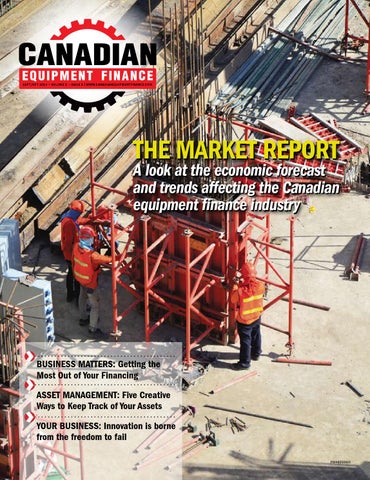
THE MARKET REPORT
A look at the economic forecast and trends affecting the Canadian equipment finance industry
BUSINESS MATTERS: Getting the Most Out of Your Financing ASSET MANAGEMENT: Five Creative Ways to Keep Track of Your Assets YOUR BUSINESS: Innovation is borne from the freedom to fail PM40050803
EXPERTISE, FLEXIBILITY AND SPEED We understand that cutting-edge equipment is key to your organization’s productivity and success. Let our financing team put their specialized expertise to work for you to allow you to acquire the equipment you need more readily and rapidly.
EQUIPMENT FINANCING SPECIALISTS Jean-Pascal Gagnon Account Manager Thierry Martin Senior Manager
To contact Business Services�: ��������������
Jérôme Thibeault Senior Manager
François Houde Senior Manager Thierry Langevin Vice-President
Sébastien Lemay Senior Manager Louis Dupuis Senior Manager
contents September/October 2014 Volume 2 Number 5 Publisher and Editor-in-Chief Steve Lloyd steve@canadianequipmentfinance.com Editor Karen Treml karen@canadianequipmentfinance.com Creative Direction / Production Jennifer O’Neill jennifer@canadianequipmentfinance.com
ELFA REPORT: The association recently mourned the passing of industry icon Michael J. Fleming, who served as its former president for 27 years »4
CFLA REPORT: Themed ‘Expanding New Horizons. Breaking New Ground’, the CFLA annual conference saw the ‘Member of the Year’ awarded and the release of the association’s new book. »28
Photographer Gary Tannyan
FEATURES
Advertising Sales Mark Henry mark@canadianequipmentfinance.com
THE MARKET REPORT Trends in Canadian Equipment Financing
For subscription, circulation and change of address information, contact
A look at the evolving Canadian finance market and the trends that impact it »14
subscriptions@canadianequipmentfinance.com
Publications Mail Agreement No. 40050803 Return undeliverable Canadian addresses to:
Industry News Circulation Department 302-137 Main Street North Markham ON L3P 1Y2 t: 905.201.6600 • f: 905.201.6601 info@canadianequipmentfinance.com www.canadianequipmentfinance.com Subscriptions available for $40.00 year or $60.00 two years. 2014 Lloydmedia Inc. All rights reserved. The contents of this publication may not be reproduced by any means, in whole or in part, without the prior written consent of the publisher. Printed in Canada. Reprint permission requests to use materials published in Canadian Equipment Finance should be directed to the publisher.
Also Publishers of Payments Business www.paymentsbusiness.ca Canadian Treasurer www.canadiantreasurer.com Contact Management www.contactmanagement.ca
Back in the Game The Economic Forecast The outlook is favourable for M&E capital spending »12
The trends that have increased the overall importance and visibility of the industry »18
NEWS »7 Business Matters Get the most out of your financing and get back to business »10
Technology report
Direct Marketing www.dmn.ca
Innovative collaboration gives insurers the edge. »20
Financial operations www.financialoperations.ca
Your Business
Made possible with the support of the Ontario Media Development Corporation Ontario Interactive Digital Media Tax Credit
ELFA survey takes the pulse of independents »16
Innovation is borne from the freedom to fail »24
Asset Management Keep track of your assets by keeping everything in its place »22
Observations Electronic engine management systems take the guesswork out of usage measurement »30
canadianequipmentfinance.com | September/October 2014 | CANADIAN EQUIPMENT FINANCE
3
EFLA Report
ELFA mourns the passing of industry icon The Equipment Leasing and Finance Association is mourning the passing of Michael J. Fleming, who served as the association’s president for 27 years. Mike passed away August 19 after a long but valiant fight with cancer. “Our members, volunteers and staff knew Mike as much more than a trade association executive,” says William G. Sutton, CAE, ELFA president and CEO. “He was incredibly knowledgeable about the industry, and truly dedicated to its success. Over the years, he established this trade association, its programs,
and its credibility. In the association world he was universally respected and a sought-after advisor. He was a thoughtful and caring leader who was always willing to help. All of us here at ELFA and ELFF loved and respected him and he was a wonderful role model and mentor. He is truly missed.” Mike served as ELFA president from 1979, when he established the association’s headquarters in Washington, DC, until his retirement in 2006. During his tenure, the equipment finance industry grew from a fledgling industry
to a major force in the U.S. economy and he transformed the association into the leading professional trade association representing the U.S. equipment finance sector. Most recently, Mike served as senior managing director of client relations for The Alta Group. In this role, he assisted clients in strategic consulting, market and competitive analysis, and unilateral and multilateral projects. Prior to serving as ELFA president, Mike managed state associations in Iowa and South Carolina. He was
devoted to the concepts of strong, active business leadership and believed that associations are most effective when they act in a proactive mode on behalf of their members.
ELFA selects winner of 2014 ‘Distinguished Service Award’ John Bober, global technical controller for GE Capital, is the recipient of the ELFA ‘2014 Distinguished Service Award’. The award honours individuals who have made significant contributions to the association and the equipment finance industry. “John Bober has played an instrumental role in representing the equipment finance industry in the decade-long effort to create a new lease-accounting standard,” says ELFA president and CEO William G. Sutton, CAE. “John’s tireless work on this issue has been essential to the success of our association’s advocacy and outreach activities. We are thrilled to present him with the ‘Distinguished Service Award’ in recognition of his dedicated service and outstanding contributions.” 4
“Being honoured by your peers is a humbling experience, especially when you recognize your efforts have been supported by the ELFA membership and the staff,” says Bober. “The accomplishments I am being honoured for would not have been possible if not for the active engagement and support of the membership and the Financial Accounting Committee, which has been a great vehicle for the sharing of ideas and for the analysis of the lease accounting proposals.” Bober has been a major contributor to the Financial Accounting Standards Board (FASB) and the International Accounting Standards Board (IASB)’s lease accounting project for a number of years. He is an active member of ELFA’s Financial Accounting Committee, as well as the association’s technical advisory group, which has been instrumental in
CANADIAN EQUIPMENT FINANCE | September/October 2014 | canadianequipmentfinance.com
analyzing issues related to the lease accounting project, providing input to the IASB, FASB, and staff regarding the impact of these issues on the industry and communicating to ELFA members. In addition, Bober is a member of the joint FASB and IASB international working group on lease accounting and he currently chairs the Accounting Committee of the Aviation Working Group and the Financial Executives International leases working group. He also has served on working groups of the FASB’s Emerging Issues Task Force and the American Institute of Certified Public Accountants’ Accounting Standards Executive Committee (now known as the Financial Reporting Executive Committee). Bober joined GE Capital in 1995 and has held various positions in finance, risk, and general management within GE Capital. He has managed
the group within GE Energy Financial Services responsible for the analysis of economic returns from equity and debt investments, project financings, partnerships, and large ticket leases, including lease pricing. Currently as the Global Technical Controller for GE Capital, Bober is primarily focused on the company’s activities related to the leasing and financing of equipment and real estate. For the past several years, he has managed for the General Electric Company all aspects of the FASB/IASB lease accounting project. Prior to joining GE in 1995, Bober was a partner with an international accounting firm, based in Jakarta, Indonesia and New York. He frequently speaks at industry conferences on matters related to current developments in finance and accounting.
Spe cia lty • Co • Aut om • Re SLV G verag atic sid ap es
and ual V Insu In Volu alue ranc clud e: e nta ry P Insura rop nce erty Insu ran ce
Protecting your assets while building your business. It’s All About Balance.
For equipment leasing and finance businesses, it’s a tough job balancing between mitigating exposure and taking calculated risk. Tip the scale in your favor by choosing an insurance option to help customers easily fulfill their insurance requirement, expedite the funding process, and provide you additional revenue. And choose one of our solutions to assist you in maintaining a healthy portfolio. To learn more, contact us at 866-676-5677 or equipmentinsurance@gaig.com
www.GAIG.com/EquipmentInsurance Canadian Branch Head Office Scotia Plaza, Suite 2100, 40 King Street West Toronto, ON M5H 3C2
Policies are underwritten by Great American Insurance Company – Canadian Branch, a foreign registered insurer in all Canadian provinces and territories.
EFLA Report
Equipment leasing and finance industry confidence eases The Equipment Leasing & Finance Foundation (the Foundation) ‘August 2014 Monthly Confidence Index for the Equipment Finance Industry’ (MCI-EFI) shows that overall, confidence in the equipment finance market is 58.9, easing from the previous two months’ indexes of 61.4. When asked about the outlook for the future, MCI-EFI survey respondent Thomas Jaschik, President, BB&T Equipment Finance, said, “The next two months will be very interesting for the equipment finance industry. Will the economy accelerate, as many economists have predicted? Will U.S. business feel confident in making capital investments? Or, will the economy continue its lackluster recovery? The next 60 days should tell whether this will be a year of exceptional or limited growth for our industry.”
6
The overall MCI-EFI is 58.9, easing from 61.4 the previous two months. ◉◉ When asked to assess their business conditions over the next four months, 18.2 per cent of executives responding said they believe business conditions will improve over the next four months, down from 28.6 per cent in July. 78.8 per cent of respondents believe business conditions will remain the same over the next four months, up from 68.6 per cent in July. Three per cent believe business conditions will worsen, unchanged from the previous month. ◉◉ 21.2 per cent of survey respondents believe demand for leases and loans to fund capital expenditures (capex) will increase over the next four months, down from 25.7 per cent in July. 75.8 per cent believe demand will “remain the same” during the same four-month time period, up from 68.6 per cent the
CANADIAN EQUIPMENT FINANCE | September/October 2014 | canadianequipmentfinance.com
previous month. Three per cent believe demand will decline, down from 5.7 per cent who believed so in July. ◉◉ 15.2 per cent of executives expect more access to capital to fund equipment acquisitions over the next four months, down from 25.7 per cent in July. 84.8 per cent of survey respondents indicate they expect the “same” access to capital to fund business, an increase from 74.3 per cent in July. No one expects “less” access to capital, unchanged from the previous month. ◉◉ When asked, 33.3 per cent of the executives reported they expect to hire more employees over the next four months, a decrease from 37 per cent in July. 57.6 per cent expect no change in headcount over the next four months, down from 60 per cent last month. 9.1 per cent expect fewer employees,
EFLA Report up from 2.9 per cent who expected fewer employees in July. ◉◉ 6.1 per cent of the leadership evaluates the current U.S. economy as “excellent,” up from 5.7 per cent last month. 87.9 per cent of the leadership evaluates the current U.S. economy as “fair,” a slight decrease from 88.6 per cent in July. 6.1 per cent rate it as “poor,” relatively unchanged from the last four months. ◉◉ 30.3 per cent of the survey respondents believe that U.S. economic conditions will get “better” over the next six months, an increase from 22.9 per cent who believed so in July. 66.7 per cent of survey respondents indicate they
believe the U.S. economy will “stay the same” over the next six months, a decrease from 74.3 per cent in July. 3 per cent believe economic conditions in the U.S. will worsen over the next six months, unchanged from last month. ◉◉ In August, 21.2 per cent of respondents indicate they believe their company will increase spending on business development activities during the next six months, a decrease from 25.7 per cent in July. 78.8 per cent believe there will be “no change” in business development spending, an increase from 74.3 per cent last month. None believe there will be a decrease in spending, unchanged from last month.
Comments from industry executive leadership: Independent, Small Ticket
“We continue to see somewhat slack demand from the small business sector as companies continue to be very conservative in their expectations of overall growth. The recent global economic news (Japan and Europe) doesn’t support a strong U.S. economy. Overall, we expect demand for capex expenditures to be in the low to moderate range.” David Schaefer, chief executive officer, Mintaka Financial, LLC Independent, Middle Ticket
“While employment seems to be improving, reflecting a slowly improving economy, the International issues could affect consumer sentiment and negatively impact growth.” William Besgen, president and chief operating officer, Hitachi Capital America Corp. Bank, Middle Ticket
“Customers are continuing to demand creative equipment finance solutions. This is a market where we can demonstrate the value we provide to our partners and customers.” Mike Romanowski, president, CoBank Farm Credit Leasing
canadianequipmentfinance.com | September/October 2014 | CANADIAN EQUIPMENT FINANCE
7
News
PayNet study highlights optimism for double-digit growth in 2015 A study by PayNet shows that equipment finance lenders can achieve double digit growth through a smarter application process. Although credit approval rates vary by lender and market segments, PayNet’s recent study addressing small ticket lenders showed an 86 per cent approval rate. ELFA forecasts the industry to grow originations volume 5.5 per cent in 2014 with sluggish growth continuing in 2015. This is against a backdrop of the S&P 500’s recent 6.5 per cent fall and zero growth in Europe. However, most equipment finance executives face expectations for double-digit growth in originations in 2015. The challenge for executives is to construct a business plan that can deliver double-digit growth. This study centered on the approval rates for A and B quality credits, which although high, still provide room for more expansion. Many of the declines in A and B quality approvals are due to a lack of information from “thin” information or insufficient analytics to assess the applicant’s credit quality. This study found that 2,363 additional credit applications could be approved as a result of thicker, more robust credit information and smarter analytics, producing a 6 per cent increase in originations volume from their current credit application process. Combining growth achieved through a smarter application of their credit process with the organic growth of 5.5 per cent means double-digit plans are viable for 2015. Hence, lenders facing a single digit growth economy can employ credit process improvements as a source of added volume. PayNet MasterScore® Version 2 formed the basis to increase approvals without going outside their credit box. PayNet MasterScore V2 is the newest empirically derived and statistically sound credit score developed specifically for commercial finance lending. In the development sample, MasterScore V2 has been shown to deliver 17.7 per cent more approvals of credit applicants for the same amount of credit losses. MasterScore V2 is able to deliver more approvals at the same loss rate because of its segmentation into 29 different industries and borrower sizes. “PayNet MasterScore V2 does a good job of delivering more credit approvals at the same risk profile. Our customers can buy deeper and buy smarter with this technology,” says William Phelan, president of PayNet.
2 8
Domestic economy will gradually improve GE Capital says in its ‘Fall 2014 Industry Update on Truck Transportation’ that through much of 2014, carriers have benefitted from a near “goldilocks ” supply/demand environment with profit tailwinds highlighted by strengthening freight trends, pricing leverage due to tight capacity and declining diesel prices. Additionally, GE economists remain optimistic that the domestic economy will continue to gradually improve and expect real U.S. GDP growth to accelerate from 2.1 per cent in 2014 to 2.6 per cent in 2015. However, the environment is not entirely absent of challenges. Highlights from the report include: ◉◉ ATA Truck Tonnage Index (Seasonally Adjusted) ◉◉ Cass Freight Index – Shipments ◉◉ FTR Truck Tonnage Index (Seasonally Adjusted) ◉◉ Transportation Services Index (Freight) ◉◉ Class 8 Capacity Utilization
Industry confidence steady in October The Equipment Leasing & Finance Foundation released the October 2014’ Monthly Confidence Index for the Equipment Finance Industry’ (MCI-EFI). Overall, confidence in the equipment finance market is 60.4, slightly better than the September index of 60.2, with survey participants indicating increasing or consistent demand tempered by U.S. economic concerns. The October MCI-EFI results included: ◉◉ When asked to assess their business conditions over the next four months, 23 per cent of executives responding said they believe business conditions will improve over the next four months, down from 36.4 per cent in September. ◉◉ 25.7 per cent of survey respondents believe demand for leases and loans to fund capital expenditures (capex) will increase over the next four months, down from 30.3 per cent in September. ◉◉ 11.4 per cent of executives expect more access to capital to fund equipment acquisitions over the next four months, down from 15.2 per cent in September.
To send press announcements, please direct them to Karen Treml, karen@canadianequipmentfinance.com
CANADIAN EQUIPMENT FINANCE | September/October 2014 | canadianequipmentfinance.com
Plan your media buy.
2015 Great rates. Brilliant results. Contact for rates and information Mark Henry, Corporate Sales Manager mark@canadianequipmentfinance.com 905-201-6600 x223
Canadian Equipment Finance is a Lloydmedia, Inc publication. Lloydmedia also publishes Financial Operations magazine, Canadian Treasurer magazine, Payments Business magazine, Direct Marketing magazine and Contact Management magazine.
Coming Soon Your guide to the world of telematics in Canada
Business Matters
How To Get the Most Out of Your Financing Your financing partner should look at your overall picture and examine various scenarios By Thierry Langevin
ntrepreneurs and decision makers have enough on their plates. When it comes to acquiring equipment, financing experts should make the task fast and simple so business people can get back to business. Upfront, your advisor should ask you questions such as: how long you do you plan to keep your equipment? What is your anticipated payback? Is the equipment servicing a short or longterm contract? What are your other related expenses? Your financing partner should look at your overall picture and examine various scenarios on how to best finance a given acquisition. They should consider valuation,
E
Thierry Langevin is Vice-President, Commercial and Equipment Financing at Laurentian Bank.
10
CANADIAN EQUIPMENT FINANCE | September/October 2014 | canadianequipmentfinance.com
specific use, even the evolution of the particular technology the equipment employs and the procurement cycle specific to your industry. They should identify your specific need – to pay less interest; to have more reimbursement flexibility because your revenues are contractually based or seasonal; or to manage your cash flow because of a planned expansion that will require your equity. Once that’s clear, they can focus in with great precision.
One size does not fit all If it sounds like a specialized field – well, it is. Bankers generally don’t get into the nitty gritty of the actual equipment. They tend to stick with a more traditional business cash-flow
Business matters approach to underwriting transactions. But when it comes to equipment financing, this cookie-cutter approach doesn’t cut it at all. The lending partner has to adapt solutions to a client’s needs using an asset-based approach that leverages the full potential of the equipment. That means understanding the business model, taking advantage of deep equipment knowledge and factoring it in to the financial structure, putting that insight to work to maximize value for the business. Put another way, a financing expert can’t work in a bubble. He or she not only needs a global perspective on the industry they operate in, but also needs to understand the more subtle details and underlying particularities that make it such a challenging environment. The lenders that inspire the greatest confidence are often the ones that adopt a specialized approach by industry rather than using a more generalist approach. That way, by covering the same industry day-in and day-out, it’s easier to focus in on customer needs and accurately identify the most suitable options for them. For businesses, there is definitely more added value in this approach. “When we look at an acquisition opportunity to help grow our business at Spectra Premium, our No. 1 concern in our selection process was finding a solid financing partner that understood the equipment on a production line,” says Denis Poirier, president of auto parts manufacturer Spectra Premium. “We wanted to deal with a team that understands our needs and can make us a complete proposal that even looks ahead to future improvements.”
With experience comes speed While industry-specific expertise is vital, when developing financing solutions a lender must never lose sight of simplicity and speed. Another tool at a lender’s disposal is pre-arranged acquisition financing, a product that delivers on both counts. To set it up, the advisor and customer sit down once a year or so and together have a look at the company’s anticipated equipment needs. After an application and approval process, the customer is armed and ready with a pre-
“The lenders that inspire the greatest confidence are often the ones that adopt a specialized approach by industry rather than using a more generalist approach…” arranged financing envelope they can use to rapidly capitalize on purchase opportunities that arise or to participate in a bidding process at the drop of a hat. “We needed to add to our fleet of trucks and trailers to ensure service quality for our customers, and we needed a partner we could count on to get us the financing we needed fast. Our number one criterion in choosing a financing partner was the speed with which the transaction could be completed. In our industry, the element of time is so often critical when it comes to buying new equipment,” says Ken Simpson, vicepresident of Star Van Systems.
Expertise you can count on When it comes to equipment acquisition, companies are faced with several important decisions they need to make. What’s preferable – lease or borrow? Finance on or off the balance sheet? Is it better to buy new or used? What are the fiscal and accounting considerations for each option? What are the advantages and drawbacks? Which option is the most tax advantageous? Should it be paid for up front or financed in instalments? Oftentimes there is no single obvious answer and customers need to rely on experienced advisors that can support them in the decision process, no matter what kind of financing they ultimately decide to use.
Strength in numbers For larger-scale financing, lenders often join with other lending partners to form bank syndicates. For the client, this not only provides access to more capital than a single bank may be willing to provide, it streamlines the
considerable administrative load of dealing with multiple lending partners. Consider the separate loan applications that must be made, the individual relationships that need to be established, and the days spent negotiating with each lender. Let’s not forget managing staggered maturities. The list goes on. The advantages of dealing with a single source are quite apparent.
M&E environment After a record year for machinery and equipment investment in 2013, and with the energy and construction sectors looking primed to invest again, more and more companies will be replacing used equipment or expanding capacity in the coming years. According to Statistics Canada, public and private organizations intend to invest over $112 billion in machinery and equipment purchases this year. It looks like the upturn will have a positive effect on corporate equipment financing in the coming years. For the majority of businesses, employing the latest equipment is essential to growing productivity and maintaining a competitive edge in the market. But purchasing new equipment can be a challenge for many companies because it represents such a large financial commitment, the financing options are many, and the evaluation process can be complex. Getting the financing right often starts with asking the right questions. Thierry Langevin is Vice-President, Commercial and Equipment Financing at Laurentian Bank. To better serve its business customers as they grow and to broaden its financial solutions offering, Laurentian Bank of Canada has established a team of seasoned equipment financing professionals with specific sector expertise, such as leasing and dealer programs, as part of its Business Services division. The new team is deployed and serving customers through its offices in Ontario, Quebec, and Atlantic Canada, and is planning a future expansion in Western Canada.
canadianequipmentfinance.com | September/October 2014 | CANADIAN EQUIPMENT FINANCE
11
market Report
The Economic Forecast The look ahead shows a favourable economic outlook for M&E capital spending in Canada By Sébastien Lavoie
he Canadian economy is going through a transition. Growth was led by household demand post-recession. Since 2013, growth has started to become more balanced as businesses reap benefits from strengthening U.S. demand. Private and public investment in machinery and equipment (M&E), another key pillar in Canada’s respectable economic performance, reached a record high of $108 billion in 2013 according to Statistics Canada. Public and private organizations intend to invest $112 billion on capital M&E this year, which represents a growth of four per cent from last year, far from the 10 per cent growth figures seen during the mid-2000s. Another survey by the Bank of Canada shows that the big picture is far from perfect: one-quarter of all firms surveyed plan to increase M&E investment in the next 12 months. It is the highest proportion in two years, but the focus is on replacing existing equipment. Despite the favourable cost and availability of credit and healthy profits,
T
companies have not grasped the opportunity of low interest rates to the same extent as households have – which, by the way, is a trend that is expected to increase in 2015. Disappointing global events experienced post-recession are holding back some companies from adding new capital. Moreover, two recent studies indicate that Canada has some catching-up to do on the international scene. The C.D. Howe Institute notes that nonresidential investment per worker on new capital in Canada is falling behind OECD (Organization for Economic Cooperation and Development) countries. The value of infrastructure stock also represents a lower share of GDP for Canada (58 per cent) in comparison with its peers (70 per cent), according to the McKinsey Global Institute. There is room for improvement. More importantly, there is an economic case to make that M&E investment will be driven to new heights in 2015-16. Our constructive outlook is based on two pillars: the acceleration in U.S. real GDP
“Despite the favourable cost and availability of credit and healthy profits, companies have not grasped the opportunity of low interest rates to the same extent as households have …” 12
CANADIAN EQUIPMENT FINANCE | September/October 2014 | canadianequipmentfinance.com
growth toward three per cent and the emergence of structural trends.
The U.S. economy is back: Let’s roll! Let’s start by looking at the main driver behind global growth, the U.S., which just happens to be Canada’s largest trading partner. The Federal Reserve has been able to foster financial and economic conditions. Appreciating asset prices, technologies boosting energy extraction, in-shoring, revamped consumer confidence, and lower unemployment are tailwinds pushing the U.S. into the fast lane. In turn, Canadian exports have increased at a healthier pace lately, up 3.5 per cent from a year ago. Since about two-thirds of U.S.-Canada trade moves by truck, growth in trucking activity has also accelerated so far in 2014, at approximately three per cent year-over-year. As foreign demand for a company’s products picks up steam, it absorbs unused excess capacities. Canadian industries are operating at 82.5 per cent of their production capacity, well above the 71 per cent trough and getting closer to the 85 per cent rate observed in the mid-2000s when M&E investment was soaring.
Market Report Firms will gradually move closer to the tipping point where enhancing production capacity is a must. For example, excess capacity in the manufacturing sector (81 per cent utilization rate) is greater than in the construction (84 per cent) and oil & gas (89 per cent) sectors. Manufacturing itself is a mixed bag. The auto industry faces more persistent competitiveness challenges due to labour costs in the U.S. and Mexico. At the other end of the spectrum, aircraft and food manufacturers are thriving. Manufacturers appear to be willing to boost workers’ efficiency gains, as they reported an above-average 4.7 per cent increase in investment intentions for 2014. The icing on the cake is that manufacturing exporters are likely to get a breather from a depreciating Canadian dollar. With policy rate hikes at the Federal Reserve on track to occur around mid-2015, the loonie is projected to reach 88 to 90 U.S. cents by year-end 2015. The upcoming devaluating currency also makes it a more profitable time to purchase new capital assets in U.S. dollar terms today.
budget included the largest national infrastructure commitment, $70 billion over the next 10 years. The Quebec government will spend $90 billion by 2024 on highways, hospitals, schools, etc. The Ontario government plans to invest $130 billion over 10 years, dedicating part of the funding for institutional infrastructures and road expansions for mining.
A more connected world All that being said, structural changes not attributable to the economic cycle or public funding are also supportive for the M&E outlook. One of them is the growing popularity of online shopping. Canadian companies recorded doubledigit growth in Internet sales in 2013 according to Statistics Canada. Twothirds of the $130 billion tally came from the retail, wholesale, and manufacturing sectors. With customers preferring to receive items at home, companies will need to adapt their logistics and truck transportation strategies to succeed.
Another game changer is the free trade agreement with the European Union, opening access to more than 500 million consumers. Expected to be effective in 2015, the deal will redefine trade flows. Finally, the shift to a greener economy will generate development programs related to cycling infrastructure, building materials, the purchase of environment-friendly technologies and the utilization of renewable energies. In summary, like baking a cake, the success of M&E investment for companies depends on the ingredients. Fortunately, all the ingredients are positive and the future shows a favourable economic outlook for M&E capital spending in Canada. Sébastien Lavoie is the Assistant Chief Economist at Laurentian Bank. To better serve its business customers as they grow and to broaden its financial solutions offering, Laurentian Bank of Canada has established a team of seasoned equipment financing professionals with specific sector expertise, such as leasing and dealer programs, as part of its Business Services division. The new team is deployed and serving customers through its offices in Ontario, Quebec, and Atlantic Canada, and is planning a future expansion in Western Canada.
ERS OK D BR ANTE W
Construct, rebuild, repair Prospects for construction activity are also bright, supported by seven per cent year-to-date growth in non-residential building permits. The spillover from the energy sector on non-residential construction remains robust. After bitumen oil, the development phase of the burgeoning Liquefied Natural Gas (LNG) sector is about to start with multi-billion dollar projects in BC. Asian markets need an abundant supply of clean energy. LNG terminals are also being considered in the Atlantic Region to serve Europe. In addition, infrastructure programs put in place by governments ensure increased activity in heavy equipment trucking for several years. Governments’ underinvestment in the 1970 to 2000 period led to a $145 billion chronic gap, according to the Canadian Centre for Policy Alternatives. Since governments are able to finance capital plans at low cost on the bond market, the numbers are impressive: the 2014 federal
PROUDLY CANADIAN SINCE 1981 MEMBER OF THE CFLA
Specializing in New & Used Manufacturing & Construction Equipment
Advant Leasing is an independent family owned business that has participated in the Canadian Commercial and Industrial Lease Industry for over 35 years. We specialize in assisting all types of businesses to acquire the specialized commercial equipment required to be productive and grow their business.
NEW BROKERS WELCOME • Fast approvals • Flexible terms • Start-ups accepted
• Decisions made in house/no securitization • Customized financing solutions • Small business specialists
Get started today with Advant, helping you grow with the tools that you’ll need.
Please contact Jason Bonneville • jason@advantleasing.com 905-335-3301 ext 224 • www.advantleasing.com canadianequipmentfinance.com | September/October 2014 | CANADIAN EQUIPMENT FINANCE
13
market Report
Trends in Canadian Equipment Financing “It is now very important to be able to respond to a North American marketplace …” By Karen Treml
hen looking at the equipment finance market, there is a clear trend toward increased capital expenditure. The data from Statistics Canada supports this trend, showing an uptick in capital expenditure that includes spending in transportation machinery and equipment; manufacturing machinery and equipment; and construction machinery and equipment. Statistics also indicate that the increased spending is apparent in companies across Canada. John Sadler, senior vice-president,
W
“Companies had dialed back capex and those businesses now have greater visibility in what they are doing…” corporate affairs and investor relations at Element Financial, says that a portion of the increased capex is as a result of many companies looking to replace equipment which, due to the financial crisis, was likely allowed to go past the ‘best before’ date. “Companies had dialed back capex and those businesses now have greater 14
John Sadler, senior vice-president, corporate affairs and investor relations at Element Financial,
visibility in what they are doing. Those businesses are starting to reinvest in their capital infrastructure and capital inventories, so what we are seeing is the acquisition of transportation equipment – trucks, trailers, that sort of thing. As well, they are investing in new machinery, equipment, and manufacturing.” This trend toward increased capex spending in Canada is as a result of a number of variables within the industry. The Canadian market is unique in some ways and offers such benefits as the ‘bought equity deal’, strong debt repayment statistics, and a clear opening for finance organizations stemming from regulated financial institutions maintaining a domestic focus.
CANADIAN EQUIPMENT FINANCE | September/October 2014 | canadianequipmentfinance.com
“One of the untold stories about the Canadian finance market is the ability to raise capital,” says Steven Hudson, chairman and CEO of Element Financial. “We’ve raised $10 billion dollars in capital in debt and equity in 48 months. In Canada, we have the ‘bought equity deal’ – something that Canadian companies have which U.S. companies do not. In Canada, if you are a junior listed company, you can walk into the banks and raise equity that night for whatever deal you want to do. In the U.S. you have to market your deal and hope that someone will buy the equity. The ability to raise capital in Canada is very supportive of the Canadian equipment finance business.” Hudson adds that because Canadians have a history of actually paying back
Steven Hudson, chairman and CEO of Element Financial.
Market Report their debt, it helps Canadian companies build a very strong balance sheet. And, as long as they keep their office in Canada, they can expand that into the U.S. or elsewhere in the world. During the financial crisis, there was a regulatory arbitrage that, while less prevalent, is still there, says Hudson. “At the time, if you were an Asian, or European, or U.S. bank, you could open up an equipment leasing company in Canada in 48 hours. As long as you didn’t raise deposits in Canada, you could have an equipment finance operation. That allowed the industry to be over 80 per cent dominated by foreign players. But when the credit crisis happened, they all went home, got small, or went bankrupt. Hence our path to coming back. What you are seeing is a re-emergence of an industry that was Canadian dominated 20 years ago and while that door is still open, foreign institutions are less inclined to come to Canada; they have enough opportunities on their balance sheet to deal with in their host market as opposed to coming back to Canada and competing here. Nullmeyer agrees and says it is now very important to be able to respond to a North American marketplace so it’s not just a Canadian domicile enterprise. “For example,” he says, “We have the ability to step across the border and efficiently execute for a client, like Tremcar, a manufacturer of stainless steel tanker cars, who sells into the U.S. as much as Canada. What they are looking for is a financing solution that works as easily in Canada as it does in the U.S. In order to do that you need to be able to go across
their core domestic markets. They are less inclined to step out into things that are marginal to their operations. This really leaves the field open to finance organizations. “The financial institutions are interested in participating in what it is we are creating,” he says, “but they are more inclined to participating in our funding structures than necessarily competing with them.”
The competitive disadvantage
Bradley Nullmeyer, president of Element Financial.
that border and efficiently execute a financing program for that manufacturer through their dealer network in Canada and the U.S. It’s not good enough to just have it in Canada. That’s where being a non-bank financial institution as a nonregulated financial institution actually works to our advantage. We may not have access to the relatively cheap cost of money that the banking industry has access to but what we do have access to is the ability to step across the border and execute in the American marketplace in a way that is seamless for those manufacturers. And that is very, very important.” The dynamic that has changed since the financial crisis, says Nullmeyer, is the propensity for regulated financial institutions to really stay focused on
“The financial institutions are interested in participating in what it is we are creating, but they are more inclined to participating in our funding structures than necessarily competing with them.”
One significant change, and one that results in competitive disadvantage, is the implementation of a tax policy that is very detrimental to the Canadian manufacturing industry. Under U.S. tax law you can depreciate 70 per cent of a railcar in the first five years. It’s called double MACRS. In Canada, the timeframe is 20 years which makes it very difficult to take a Canadian manufactured railcar and lease it into the U.S., says Hudson, adding that it’s a significant competitive disadvantage. “We’ve gotten to the point,” he says, “where leases are treated as loans. In the U.S. they are not. It has resulted in Canadian manufacturers and leasing companies having a competitive disadvantage in the integrated marketplace. You have to have tax depreciation rules that are relatively similar or you’re going to end up with manufacturing moving elsewhere. And that’s exactly what has happened. We now only have one Canadian manufacturer of rail cars and that’s National Steel Car in Hamilton, ON. We used to have others but they’ve moved south for manufacturing. That product is now gone.” Hudson also points out that a very big manufacturing opportunity within Canada has been lost. He explains that as a result of changing railcar compliance requirements following the railcar disaster in Lac Megantic, there is a three to five billion dollar economic opportunity that has resulted – three billion if the cars are modified, five billion if they are manufactured. However, Canada will see none of it, he says. “National Steel Car can only Continued on page 28
canadianequipmentfinance.com | September/October 2014 | CANADIAN EQUIPMENT FINANCE
15
market Report
Industry News: Around the Industry Survey takes the pulse of independents hat are top areas of interest and concern among independent equipment finance companies? A survey by the ELFA reveals insights into the independent market sector. ELFA’s Independent Middle Market Business Council Steering Committee conducted the ‘Survey of Independents’ in spring 2014. The survey was designed to take the pulse of the independents. Following are highlights from the 2014 survey.
W
Current business conditions Overall, independents responding to the survey had a positive outlook on business conditions: ◉◉ 79 per cent reported they had plenty of funding to do their deals ◉◉ 72 per cent saw a strong future for the independent leasing company ◉◉ 72 per cent expected business to be better overall in 2014 than in 2013 ◉◉ 72 per cent expected their receivables to increase in 2014 ◉◉ 71 per cent expected the economy to be stronger in 2014 than in 2013 ◉◉ Only six per cent planned to make their credit policies more stringent in 2014 ◉◉ A total of 14 per cent said credit decisions were taking longer than in the past ◉◉ Respondents were split on whether they expected their default rate to decrease in 2014 compared to 2013: 23 per cent expected a decrease, 48 per cent were neutral, and 29 per cent did not expect a decrease
Customer behavior Respondents reported the marketplace remains highly competitive: ◉◉ A majority (79 per cent) said they are 16
seeing more competition for their existing business. This figure is up from 73 per cent in 2013 ◉◉ A majority (66 per cent) said their company had more competition from banks than a year earlier ◉◉ A majority agreed that customers are: -- Focusing more on pricing (68 per cent); -- Actively seeking additional bids (64 per cent); -- More sophisticated in choosing their funding choices (59 per cent); and -- Taking longer to make decisions (53 per cent).
Technology Independents continue to invest in their IT operations: ◉◉ More than half (51 per cent) of respondents had increased or expected to increase their IT capacity in 2014. Of those, a majority (57 per cent) planned to expand front-end operations, while 37 per cent planned to expand in the area of accounting, 18 per cent in billing and 16 per cent in pricing. ◉◉ A smaller but still significant number of respondents (41 per cent) had bought or expected to buy new software in 2014. ◉◉ When asked what type of lease processing solution they use, almost half (47 per cent) had purchased a third-party solution, 37 per cent used a combination of a third-party solution and their own custom solution, and 13 per cent had created their own custom solution. ◉◉ When asked if their company’s internal technology systems help or hinder their business, respondents
CANADIAN EQUIPMENT FINANCE | September/October 2014 | canadianequipmentfinance.com
gave an upbeat response by a threeto-one margin. In the open-ended response section of the survey, a total of 34 respondents commented their technology helps their business, 10 said it hinders their business and 12 gave a neutral response. ◉◉ IT staff size varied, with a majority (53.1 per cent) reporting having one to three people on their company’s internal technology staff (not including outside consultants), 19 per cent reporting more than 10 such employees, 14 per cent reporting none, seven per cent reporting four to six and six per cent reporting seven to nine.
Lease accounting Changes in accounting rules that would bring all or most leases onto the balance sheet have been under consideration by the accounting standards-setters – the IASB and FASB – since 2006. Most independents responding to the survey (92.5 per cent) were aware of the proposed lease accounting changes and a majority (57 per cent) had concerns about how the changes would impact business. However, only 25 per cent were spending time and money preparing for the changes, perhaps because more than half (60 per cent) believed their IT systems would handle any potential changes in lease accounting rules.
External factors affecting business Many respondents – but not a majority – expressed concern about the impact of federal and state policy and regulations on business: ◉◉ Almost half (44 per cent) agreed that federal government regulations had
Market Report increased their company’s cost of doing business over the past year, and slightly fewer (42 per cent) agreed that federal fiscal policy uncertainty hinders their ability to plan for the future. ◉◉ About a third (29 per cent) agreed that state or local government regulations had increased their cost of doing business over the past year, and fewer (23 per cent) agreed that state and local policy uncertainty had hindered their ability to plan for the future. ◉◉ About a third (38 per cent) agreed that changes to banking regulations would help independent lessors.
Employee engagement Employee engagement, recruitment, and retention are clearly a priority for independents and efforts in these areas appear to be paying off. However, some challenges remain: ◉◉ Employees have a clear career path at their company, according to 63 per cent of respondents. ◉◉ Adequate training opportunities are offered to employees, according to a majority (63 per cent) of respondents. A third (30 per cent) planned to increase their training budgets this year. ◉◉ What motivates employees? Respondents said employees at their company are motivated by salary (75 per cent), team engagement/atmosphere (60 per cent), and bonus (56 per cent). Other factors are challenging work (30 per cent), flexible work schedule (30 per cent), recognition (27 per cent), additional perks
(food, entertainment opportunities, etc. (17 per cent), and telecommuting (one per cent). ◉◉ The chief reason employees leave the company are better opportunities elsewhere (56 per cent), poor fit (41 per cent), being asked to leave (33 per cent), or they don’t like their manager (10 per cent). ◉◉ Employee turnover was a concern for 18 per cent of respondents.
Hiring trends Employee recruitment is another critical area for independents and the independent sector is betting on business growth, based on their reported hiring trends: ◉◉ In a sign of strong optimism, 82 per cent had hired or expected to hire employees in 2014. Of those hiring, 89 per cent were hiring in originations/sales, 68 per cent in operations, 27 per cent in risk, 23 per cent in IT, and 16 per cent in administration. ◉◉ Only a third (34 per cent) said it’s easy to hire qualified, experienced employees, while 41 per cent disagreed. The areas in which respondents had the hardest time finding qualified employees were originations/sales (74 per cent), operations (21 per cent), risk (14 per cent), and administration (10 per cent). ◉◉ Companies use a variety of channels to find employees. Referrals topped the list (70 per cent use this method), followed by search firms (67 per cent), word of mouth (65 per cent), online job boards (48 per cent), and LinkedIn or other social media sites (36 per cent).
Business focus When asked to identify the primary industry focus of their business, independents indicated that technology continues to be the leader. The top five responses were high-tech/computers, medical, energy (oil/gas/ alternative), material handling and transportation (vehicles). A notable change from 2013 was the increased position of energy (from 21 per cent in 2013 to 45 per cent in 2014) and material handling (from 33 per cent in 2013 to 45 per cent in 2014).
Top areas of concern When asked, “What business issues keep you up at night?” independents focused their responses in four areas: ◉◉ Originations
◉◉ Access to funding ◉◉ Regulation/Government ◉◉ Increased competition
Treasured member benefits When asked what they see as the most important benefits of ELFA membership, independents ranked top benefits as follows: ◉◉ Staying informed on industry news, trends and market updates (80 per cent) ◉◉ Networking opportunities (66 per cent) ◉◉ Access to industry research and statistics (65 per cent) ◉◉ Business and professional development opportunities (54 per cent) ◉◉ Being represented in state, federal, and regulatory advocacy (50 per cent)
canadianequipmentfinance.com | September/October 2014 | CANADIAN EQUIPMENT FINANCE
17
market Report
Back in the Game A mid-term report card on equipment financing in Canada By Stan Prokop
he Canadian leasing industry continues to take part in a strong upturn with portfolios growing at a strong pace. As the industry came out of the 2008/2009 global financial crisis, it has raised its sights on new goals for growth and new market segments. These trends have increased the overall importance and visibility of the industry, as it maintains its ‘go to’ status in asset financing for companies in virtually every industry. A variety of financing mechanisms – i.e. going public, private equity, access to securitization facilities, etc., allow the industry to accommodate every need of the Canadian borrower. The ability to syndicate larger transactions or portfolios has allowed numerous players in the industry to seem – you guessed it – larger than they are! So, what is in effect happening in the industry? In many cases it’s a borrowers market as borrowing rates for lenders and lessees are at an all time low. There is some irony in the fact that while the lease finance industry is perceived by business borrowers as a quicker and easier way to finance new or existing assets, the reality is that there are complex issues that independent lessors
T
18
face everyday. They include: ◉◉ Taxation ◉◉ Changes in accounting (the near death of the operating lease) ◉◉ Capital structure requirements ◉◉ Entry of Canadian chartered banks into various segments that were previously the domain of non-bank lessors (sub-prime automotive, small ticket) Yet the old adage that ‘the more things change the more they stay the same’ seems to hold true, and business borrowers – from startups to major corporations – continue to view lease financing as flexible, convenient, easier to obtain with respect to credit approval, and as an alternate credit facility. That data has been in my PowerPoint presentations for 35+ years now! Certain segments of the market continue to enjoy what can only be called ‘ astounding’ growth. One of those is the automotive and truck sector where small and large borrowers alike are looking to conserve capital, lower fleet costs, and acquire and restructure assets. Element Financial has enjoyed what can only be termed a meteoric rise in this industry segment, and approaching a market capitalization of $4 billion dollars in only a few years. Simply speaking capital markets are ‘user friendly’ these days – and market players such as the
CANADIAN EQUIPMENT FINANCE | September/October 2014 | canadianequipmentfinance.com
life insurance companies continue to finance a large part of the industry via securitization facilities. Technology continues to be a key focus in the industry as firms struggle to integrate front and back office shops and stay on top of leading software and internet trends to deliver service in a timely and cost effective fashion. One other aspect of technology is that captive tech lessors such as HP Financial Services and IBM Credit Corp., deliver billions of dollars of hardware, software, cloud, and SAS solutions annually to the market. Vendor programs always have, and will no doubt continue to be a mainstay in the industry in Canada. They allow companies with products and services to differentiate themselves from competitors and use financing vehicles such as leasing as a competitive advantage. In summary the industry continues to put capital to work every day. That ‘open for business’ attitude satisfies micro, small, mid, and large ticket transactions in almost every industry in Canada. New and existing players alike are truly ‘long and deep’ in the Canadian economy. Stan Prokop is principal at 7 Park Avenue Financial and specializes in business financing for Canadian firms, such as working capital, cash flow, asset based financing, equipment leasing, franchise finance and Canadian tax credit finance. Founded in 2004, the company has completed in excess of $90 million of financing for Canadian corporations. www.7parkavenuefinancial.com
Technology Report
Innovative Collaboration Gives Insurers the Edge “In the cut-throat competitive world of insurance, using new collaboration tools in innovative ways can give insurance firms a competitive edge ...� By Andre le Roux
ollaboration is an integral part of the insurance business. But today, the need to rapidly assemble teams and capitalize on human expertise to provide faster, better decisions makes collaborating all the more important. In the highly competitive insurance market, where many of the products and services are fairly similar, the competitive differentiator must be customer service. And effective service begins with collaboration and communication. Collaboration among customers, producers, underwriters, and others in the current insurance environment is often hampered by inefficient communications, processes that are not integrated, and legacy tools that manage and share content. The right set of integrated capabilities can improve employee training, enhance enterprise knowledge managements, and capitalize on the expertise of subject matter experts. The ultimate goal is to get the right people working together, provide them with the right content, and give them options for communicating that optimize their interactions. Technologies such as chat, real-time video conferencing, SMS text messages, skills-based routing, and speech analytics are all effective collaboration tools, but they provide maximum value
C
20
for insurers when they are combined with foundational capabilities for process management, communications, and content management. Policyholders may have a range of preferences in terms of communication channels. With a full suite of integrated collaboration tools in place, the insurer can enable the policy holder to communicate across multiple channels. For example, a customer may initiate a website request to change their payment plan, but may reach a point where they require clarification. A real-time chat with a contact centre agent can help them make the right choice. In another example, when a policyholder is on a call with a contact centre rep, real-time speech analytics may determine that a supervisor or a subject matter expert should be linked in to better address the customer’s concerns. The contact centre rep may follow up with an SMS text message later to ask if the customer has made a decision. Or, in sales of permanent life insurance, face-to-face contact can be replaced with screen sharing and video conferencing technologies, allowing at-home or remote sales to clients. It is easy for the sales agent to share a screen so the prospect can see the financial calculator or illustration on his or her own personal laptop or tablet. If experts need to be consulted, they can be added to the conversation via a real-time video link for a 3-way conversation.
CANADIAN EQUIPMENT FINANCE | September/October 2014 | canadianequipmentfinance.com
Collaboration technologies are already being used to improve the claims experience; empowering field claims adjusters who are able to use SMS text messages, live video, and the sharing of digital images to leverage the expertise of individuals in other locations. For mid-sized or large commercial accounts, the role of the loss control engineer is vital. Collaboration technologies can enhance the value provided during on-site visits. For example, a loss control expert may be evaluating the exposures in an insured facility and may require a consultation with an expert back in the home office. Using real-time video sharing via a tablet device, the image of the machine and shop floor can be sent back to an industry expert who may have safety advice relative to that specific machine set-up. The loss control engineer in the field can provide immediate advice to the customer instead of having to go back to the office and send a report days or weeks later. New collaborative technologies and approaches also offer opportunities for insurers to improve productivity in their workforce. To get full value from new collaboration tools, insurers should: 1. Identify the high value business activities where real-time information sharing and conversations between Continued on page 28
Asset Management
Five Creative Ways to Keep Track of Your Assets Businesses benefit from making sure everything is in its proper place at the end of the day By Robert Lockard
very business has equipment that is extremely important to its operations and that employees need to have in order to do their jobs. For example, painters can’t paint without brushes and rollers, cashiers can’t accept customers’ money without cash registers, and programmers can’t program without some type of computer. It’s up to you and your employees to keep all of these essential assets accessible and functional. Here are five creative ways you can make this happen:
E
22
1
Have a system for checking items in and out
This might seem a little obvious, but having a system for checking equipment in and out is extremely helpful when trying to keep track of where all of your assets are. It might be as simple as signing one’s name on a clipboard, like they used to do for books in libraries. Or it could get a little more complex, like scanning a barcode on an employee’s name badge or entering a username and password into a program. By using a ‘check in and check out’ system, you can make sure everything is in its proper place at the end of the day. If anything is out of place, you have the name of the person who checked it out last, and you can ask them about it.
CANADIAN EQUIPMENT FINANCE | September/October 2014 | canadianequipmentfinance.com
2
Use GPS tracking devices
Want to get more sophisticated? Attach Global Positioning System (GPS) tracking devices to your equipment. It’s probably not practical to put a tracker on every asset in your possession, but it may be a good idea to put ones on fairly large pieces of hardware. The batteries for GPS tracking devices are still too big to allow those devices to be the size of microchips, but, even so, they’re usually not much bigger than a USB drive. This is an especially helpful option for companies that send employees to do work outside of their main facility, such as plumbers, lawn-care specialists, etc. If a tool gets misplaced or left behind, it’s much easier to track it down with a GPS tracker than by trying to retrace an employee’s steps through
Asset management their entire workday.
3
Inspect equipment on a regular basis
Your assets are going to receive some wear and tear as they’re used day after day. And eventually they’ll need to be replaced with something new. To remain apprised of your equipment’s condition, you should conduct regular inspections. Whether it’s on a weekly, monthly, semi-annual, or annual basis (or some other time interval) entirely depends on the assets and the cost-benefit analysis of assigning workers to this task. Large machines and other complex pieces of equipment that are critical to the success of your operations should be inspected more frequently than smaller, lesscritical tools. They may be so complex that they require outside specialists to come in and inspect them, so you’ll need to weigh that expense against the possibility of them giving out between inspections. The point is to avoid disruptions in your business’ operations by keeping everything in good shape.
4
Use asset tracking software
As its name suggests, asset tracking software helps you keep track of all of your assets, big and small. Simply assign serial numbers, lot numbers, barcodes, and/ or other tracking criteria to every asset your organization uses and you’ll be able to keep an eye on where everything is, who is using it, what projects it’s being used on, and when it needs to be replaced. Asset tracking software can be as big as a full Enterprise Resource Planning (ERP)
solution or as simple as Excel spreadsheets. There’s also a pretty wide area in between. Most medium-size businesses can’t afford to go the ERP route, nor do they need all of the features in an expensive ERP. On the other extreme, Excel usually doesn’t cut it because, even though it’s cheap to use, it can be inefficient and problematic to try to enter lots of data manually into Excel. That can lead to data errors and misplaced files. Plus, it’s hard to retrieve usable data from Excel unless you’re an expert. The most important thing is to find a system that meets your company’s needs right now and into the foreseeable future. You shouldn’t have to keep learning a new asset tracking system every few years once you outgrow an old one. Affordability is a key consideration, but so is longevity.
to congratulate people and reward them for their actions. The reward system doesn’t have to be elaborate or expensive. In fact, simply acknowledging employees’ good work is often a more powerful motivator than giving pay raises. It can be as simple as giving badges, like ‘Safest Worker of the Month’ or ‘The Put-away Champion’. Make it a team competition and it may catch on even more. You could offer gift cards, movie showings, meals, or other inexpensive rewards to the team that merits certain awards. Make it fun and focus on positive reinforcement over negative consequences for how your employees take care of your assets, and you should see some positive results.
Taking care of business Taking care of your equipment allows you and your employees to take care of business. Make sure you know who has which items checked out at any given time. Use GPS tracking devices to help you locate lost assets. Conduct regular inspections on equipment to keep everything running smoothly. Use some type of asset tracking software to store data on all of your assets. And get your employees on board with your efforts to keep everything functioning and in its proper place. By taking these steps, you’ll always be in control of your assets, big and small. Robert Lockard is a copywriter with Fishbowl, maker of Fishbowl Manufacturing and Fishbowl Warehouse, the #1 inventory control solutions for QuickBooks users. They are also popular among large organizations looking for a standalone asset tracking solution.
5
Incent employees to take good care of equipment
You can attach tracking devices to your assets, monitor their movements using barcodes and software, and take other steps to keep track of all of your stuff, but probably the simplest method to keep everything safe and well-ordered is to have your employees take good care of what they use. Offer rewards to employees who are particularly conscientious about caring for the equipment they handle on a daily basis. Call out people for putting tools away in the correct places after use, having the lowest number of damaged assets, and keeping hardware working the longest. Send emails to everyone in the company and/or hold events canadianequipmentfinance.com | September/October 2014 | CANADIAN EQUIPMENT FINANCE
23
Your Business
Safe to Fail Creating a culture of forgiveness and the freedom to fail By Angela Armstrong
Blunder. Error. Failure. Gaffe. Bungle. Faux Pas. Mistake. e all make mistakes – though we don’t enjoy it. In fact, we can be uncomfortable enough with admitting to them that we try to bury them. They can definitely cause pain. High performing businesses create internal cultures of forgiveness – freedom from the shame of being wrong, also known as the big, happy rec room called ‘safe to fail’ (which is an ironically parallel universe away from the mansion called ‘too big to fail’).
W
Mis-takes We’ve all been given a second chance at something. As a young manager I was carefully given leeway to build a business branch. With a tool box, but limited guidance, I spent fretful nights wondering how to extract myself from some haphazardly dug trench of my own making, into which it seemed that my leader had cheerfully watched me walk. Other than the therapy (kidding), the lessons are indelible and more effective than simply teaching someone all the intricacies of a well swung hammer. One misguided swing, and you’ll be WAAAAYYY more 24
CANADIAN EQUIPMENT FINANCE | September/October 2014 | canadianequipmentfinance.com
careful holding that nail the next time. A mis-take is just that – a badly taken swing and a bruised fingernail. Mistakes can be the result of too much speed, not enough reflection; too much action, not enough planning; too much trust , not enough process; or too much assumption, not enough questioning. Or, they can be the result of simply being too entrenched in what was. Henry Ford was a visionary. Yet, he was so committed to the original look of his Model T Ford that he failed to allow innovation in the face of an increasingly competitive vehicle market. Despite this, an intrepid designer created a new version of the iconic automobile, reflecting a newer, low-slung design, while Ford was on holidays. The boss literally shredded the model with his own two hands. A mistake indeed: Ford’s originally buoyant position in the market continued to slip and subsequently took decades to recover. Earlier in our business, as per our practice, we registered a PMSI; unfortunately, NOT as per our practice, we registered in the wrong province. The upshot was that the asset ended up being registered by another lender as collateral (in the correct province) and we ended up in second priority on the asset for which we had paid. By edict of Murphy’s Law, that client went into bankruptcy: luckily we managed to eke out a solution – but it could’ve been much worse.
Your Business How do these things happen? We’re not amateurs – we have processes, best industry practices, we hire and train good people, and we debrief problems. Perfection is a relentless goal.
Drilling down Why not just assume someone is to blame? A white paper on the subject of business mistakes postulates that most failures are perpetrated by not engineering process enough – too much reliance on people and not enough drilling down. Another good reason? Demographics: in the era of engagement, fomenting a culture of blame is antithetical (i.e. a lot of costly turnover). The researcher’s solution is to create a process map and encourage team members to log ‘live’ infractions, allowing a meaningful look into recurring mistakes (the ones that suck time, money, and energy) while taking the emotion out of the process. Factual, real time observations that attach to parts of a process remove the specter of ‘blame’ from the real need to solve the problem. A roll of paper and a stack of Post-it Notes can go a long way to using the collective to solve the collective problem. And dig deeper. Mistakes can also be the path to innovation. A business culture that’s intolerant of mistakes may also be slow to acknowledge and effect change. Imagine a team member trying to automate some laborious process. In doing so, they miss a critical piece which ends up creating a cascade of other problems. Do you address the cascade? Of course. And you take the innovation up the line,
encouraging the employee to collaborate with others because they’re exactly the kind of team member you’ve been looking for. Come down on them for stepping outside of bounds and you’ll end their innovation forever. Not to mention ridding yourself of the people that see truth (i.e. broken things in your business) and are brave enough to try and make change.
Generating truth At a recent business retreat, our team learned the strategy of ‘look, see, tell the truth, act’. This process generates truth tellers in the organization. Here’s how it works. 1. Look: the ask is that every member of the organization look around them – what’s working and what’s not. What’s habit and what’s helpful? Where are things going wrong and is it necessary? 2. See: the truth serum bit – honest reflection. What’s contributing (without judgment or emotion) to the problems? What could be at the root? How could things change if ‘such and such’ were respectfully dragged out in the open? 3. Tell the truth: someone has to be the whistle blower. But it’s not as dramatic as you might believe. This could be as simple as a front line person saying “Hey, you know, I’ve been noticing…” 4. Act: Simply put, show me the money. Words mean nothing without
execution. If you’re serious about effecting change (i.e. improvement) in your business, you’d better be prepared to act when someone tells the truth. If you can’t predict the future, how can you know that creating opportunities for mistakes on your team (aka innovation) will be successful? You can’t. But would you rather become the genteel but shabby house on the block?
Add in a parachute Find the folks in your organization who are willing to fail and give them a landing zone and a parachute, and let them do a few things no one else is doing. You still have to
watch where they’re landing and like Gene Hackman in ‘Behind Enemy Lines’ – sometimes you’ve gotta go get Owen Wilson back. The ones you rescue will do anything for you once they know that you’re in their corner and that you’re going to let them make a few mistakes in the name of innovation. Remember, I never promised you a rose garden – just a modular ‘safe to fail’ house that can grow when you need it to. But hey, it’ll be where all the cool kids on the block hang out. Angela Armstrong is the founder of the Prime Capital Group – a fantastic system of people who deliver more than the sum of their parts to a great portfolio of Canadian business clients. Prime specializes in equipment finance solutions. Angela specializes in truth telling and has a 28 year purposeful history of business growth. www.pcclease.com
CYBER THREATS ARE
REAL
An attack is inevitable...losing the battle shouldn’t be Attend this special presentation by Dina Kamal, Partner, Risk, Deloitte, you’ll discover the key findings of Deloitte’s Cyber Intelligence Centre (CIC) to help you manage cyber risks with integrated security services that deliver 24x7, businessfocused security for your critical systems and data. Identified as a Kennedy Vanguard Leader for having the most comprehensive competency strengths across the cyber spectrum, Deloitte provides security services to some of the world’s largest organizations.
November 27th | 7:30 am to 10:00 am | Toronto Attend this urgent Breakfast Briefing and get the tools you need. Presented by
Register today www.paymentsbusiness.ca canadianequipmentfinance.com | September/October 2014 | CANADIAN EQUIPMENT FINANCE
25
CFLA Report
CFLA 2014 Annual Conference Highlights eld at the Fairmont Chateau Whistler in Whistler, B.C., on September 10 to 12, the theme of the CFLA Annual Conference was ‘Expanding New Horizons. Breaking New Ground’. The conference saw the awarding of the association’s ‘CFLA Member of the Year 2013-2014’ award. The award recognizes as an individual, a volunteer from the membership who works for the association and shows commitment to the association’s goals. Eugene Basolini, CFLA chairman says that the volunteers are wonderful examples of those who are pleased to give back to their industry, adding that their generous efforts are a significant contribution to the association, its members, and to the industry. Basolini adds that the member of the year award gives the association an opportunity to recognize individuals who have made special contributions – not only to the association but to the industry as well, not just in the last few years but over many years too. This year, Moe Danis, vice-president of lease finance and Pacific & Western Bank of Canada, was the recipient of the award. The conference also saw the release of the associations new book titled ‘Unstoppable’, which tells the story of asset-based finance and leasing in Canada. Eugene Basolini, chairman of the association, says that working on a book like ‘Unstoppable’ serves as a reminder of many things and reminds everyone of the special contribution so many have made to the industry, as well as to its success. Basolini commented that capital is the lifeblood of the equipment finance business and added that capital has been called the industry’s inventory. Along with people it is the primary resource, he said, and access to reliable funding at a reasonable cost is essential to making the industry work.” He explained that over the 1980s and 1990s, the modern asset-based finance
H
26
and leasing industry grew dramatically. As the book Unstoppable reminds people, the industry grew through the combined effect of several global catalysts, which combined to propel the industry forward to become a significant provider of innovative financial services and products to business customers and consumers – both in Canada and worldwide. He identified securitization was one of those critical catalysts and says that the book points out that while Moe Danis did not invent securitization, he gets the credit for bringing the model to Canada and making it work. Basolini concluded by pointing out that for almost 30 years, Danis has been a presence in the industry, always willing to help where he could, and always a source of wise advice that has benefited many. In closing Basolini conveyed that he felt great pleasure in presenting the award to Danis, in recognition of his outstanding contribution to the development of the asset-based financing and the equipment and vehicle leasing industry in Canada, as well as for his participation in the work of CFLA.”
Past Honorees of the award include: ◉◉ 2012-13 Paul Zalesky (AllWest Insurance Services) ◉◉ 2011-12 Angela Armstrong (Prime Capital Consulting and Forest Leasing) ◉◉ 2010-11 David Dalziel, Deloitte & Touche LLP -- Rishi Malkani, Deloitte & Touche LLP Loraine McIntosh, Deloitte & Touche LLP ◉◉ 2009-10 The volunteer instructors of Canadian Lease Education Ondemand (CLEO) -- Angela Armstrong (Prime Capital Consulting and Forest Leasing) -- Kevin Bowman (Equirex Leasing Corporation) -- Michael Burke (Blake Cassels and Graydon LLP) -- Jason Cooper (PricewaterhouseCoopers LLP)
CANADIAN EQUIPMENT FINANCE | September/October 2014 | canadianequipmentfinance.com
-- Murray Derraugh (The Alta Group) -- Michel Lévesque (Group Credit Lease) -- Stuart Sherman ( Morrison Acceptance Corporation) -- Judy Smiley -- Hugh Swandel (The Alta Group) -- Michael Stewart (KPMG LLP) -- Steve Weisz (Blake Cassels and Graydon LLP) -- Robin Wilks (HKMB HUB International) ◉◉ 2008-09 Michael Collins (DealerTrack Canada, Inc.) ◉◉ 2007-08 The CFLA Education & Program Committee -- Chair: Richard McAuliffe (Key Equipment Finance Canada Ltd.) -- John Barraclough (Maxium Financial Services Inc.) -- Gary Batchelor (Travelers Financial Corporation) -- John Estey (Stonebridge Financial Corporation) -- Douglas McKenzie (BAL Global Finance Canada Corporation), and -- Alan Morgan (RBC Equipment Finance Group) ◉◉ 2006-07 Ford Motor Company of Canada Ltd. And Ford Credit Canada Ltd. ◉◉ 2005-06 Hugh Swandel (Swandel and Associates) ◉◉ 2004-05 Peter Freill (Securcor Group of Companies) ◉◉ 2003-04 Mark Robinson (DaimlerChrysler Services Canada Inc.) ◉◉ 2002-03 Diane Sekula (CIT Financial) and Bob Westlake (GE Capital Canada) ◉◉ 2001-02 David Chaiton (Chaitons, LLP), Tom Hopkirk (HKMB Capital Solutions) and Raja Singh (Pitney Bowes Global Credit Services) ◉◉ 2000-01 Brian Stevens (MFP Financial Services) ◉◉ 1996-97 Serge Mâsse (Crédit-Bail Findeq) ◉◉ 1995-96 Tom Simmons (Commcorp Financial Services) ◉◉ 1994-95 Greg Korsos (Sako Leasing Inc.) ◉◉ 1993-94 Tom Hopkirk (Barclays Bank of Canada Leasing Division)
Coming Soon
Your guide to the world of telematics in Canada
lication
Inc Pub s.com | A Lloydmedia,
www.canadiantelematic
The Insurance Issue for UBI?
ging the face • How Big Data is chan of auto insurance nnected car • Special report: The co
PR IS EM SU IE E R
• Are Canadians ready • Mobile’s role in UBI
To advertise or to get more information and a media kit: 905-201-6600 | 1-800-668-1838 | 302-137 Main Street North, Markham ON L3P 1Y2 Canadian Telematics is a Lloydmedia, Inc publication. Lloydmedia also publishes Financial Operations magazine, Canadian Treasurer magazine, Canadian Equipment Finance magazine, Payments Business magazine, Direct Marketing magazine and Contact Management magazine.
market Report
Continued from page 15
Continued from page 20
produce 10,000 cars a year. Meanwhile, seventy thousand cars have to be modified, rebuilt, or replaced in the next six months. That results in a big opportunity that is going south of the border.”
The positive note Despite the disadvantages, as a result of the contraction of foreign banks, more so in Canada, small to mid-sized companies have fewer options to raise debt capital or equipment financing and, therefore, the equipment finance industry has a meaningful role to play as a bonafide provider of that incremental capital, says Nullmeyer. “Access to capital is the only way you are going to finance a recovery and I think the industry has a big role to play in that because the banks, in some cases, have a decreased risk appetite – or regulators are saying ‘You don’t have enough expertise to do that.’ I think there’s a lot of opportunity – not so much in Canada because
Canadian banks have been there, albeit more modestly – but in the U.S. they’ve pulled back. We don’t see the key bank leasing companies in Canada, although there are a few, not many, subsidiary leasing companies here. So a big role can be played in providing small to midsize business with access to capital. “To develop and grow, the equipment finance industry needs to continue to make itself relevant,” says Nullmeyer. “Through the various cycles, the equipment financing industry needs to continue to make itself relevant in providing solutions because there absolutely is a very important need from the business community for that type of financing. We need to help our clients run their business and make their capital more efficient and execute on that.” At the end of the day, according to Hudson, it’s a great time for entrepreneurs to create Canadian-based finance companies.
FREE breakfast briefing in January Learn all about Better Drug Benefits For Less. Why You Won’t Believe It and Why You Should.
We know it’s hard to believe but it’s true.
EVENT DETAILS: January 27, 2015 • 7:30-10am The National Club 303 Bay St, Toronto M5H 2R1
SPEAKER:
Ms. Liz Galloway,
CFO SCI Logistics Plan Sponsor Case Study
Presented by
BRING YOUR TEAM.
SIGN UP AS MANY AS 3 INDIVIDUALS AT NO CHARGE.
Register now to reserve your seat at www.canadiantreasurer.com For more information, call Mark Henry (905) 201-6600 x223 or e-mail mark@canadiantreasurer.com
28
3.
4.
5.
CANADIAN TREASURER invites you to a
Come and learn how we have helped companies maximize the value of their existing drug benefit program without the need to change plans.
2.
CANADIAN EQUIPMENT FINANCE | September/October 2014 | canadianequipmentfinance.com
individuals will enhance the customer experience or improve the operational results. Determine what types of foundational technologies are in place or should be implemented for the management of content, processes, and communications. Explore collaboration technologies to determine where they accelerate and improve the high value business processes identified in step 1. Design a collaboration platform that integrates the selected technologies in the context of the broader IT architecture. Publish the platform and promote the use of collaboration technologies for new business uses across the company.
Leading insurers are already on the journey to building collaboration platforms and finding new, innovative ways to leverage the technologies for business advantage. One of the key elements of the journey that insurers should consider is the potential to capitalize on the power of the technologies already implemented in contact centres and throughout the enterprise. In many cases this will make deployment of these technologies easier so that they can be used to improve the customer experience and optimize operations. Andre le Roux is the African region Managing Director for Interactive Intelligence
vendor directory Providing practical and cost-effective legal services to the Equipment Finance Industry for 20+ years
National Appraisal Services FAST. ACCURATE. COST EFFECTIVE.
877.463.8241 www.verusvaluations.com
905.940.8700 • 1.866.508.8700 • wvllp.ca
Northstar takes pride in offering fast approvals, competitive rates, and flexible terms, coupled with friendly, personal service. Please contact Bruce Collingwood or Wayne Gray at 705-737-5595 or toll free 1-888-678-2701. www.nstarleasing.com
Since 1983, Northstar Leasing Corporation has been meeting the needs of our business clients and Broker network across Canada.
ÂĄÂŒÂ’Â“Â? ŽŠ£“š‘ ÂœÂĄÂ?ÂœÂĄÂŠÂ¤Â“ÂœÂš
ÂŞÂŞÂŞá€”ÂœÂĄÂŒÂ’Â“Â?Â—ÂŽÂŠÂŁÂ“ÂšÂ‘á€”ÂŒÂœÂ˜ á šá€–á‚€á ˝á ˝á€–á żá šá şá€–á ťá‚€á şá‚€
CMS PRINTING SERVICE. For all your printing needs. Call 416-755-7761 ext. 227 mdavid@completemailing.com
At the core of your business
NEW LOWER PRICING!!!
• Equipment, Vehicle, Any Asset Leasing • Business First™ Solutions • Simple or Complicated Let’s talk about your leasing software needs. 888-747-RYZN (7996) | info@ryzn.com | www.ryzn.com
Get your ad on this page for as little as $185 per issue for all of 2015
Vendor Directory Advertising call Mark Henry at 905-201-6600 x 223 or email mark@canadianequipmentfinance.com canadianequipmentfinance.com | September/October 2014 | CANADIAN EQUIPMENT FINANCE
29
Observations
Power-on Versus Engine-on Newer electronic engine management systems take a lot of the guesswork out of usage measurements By Rob Birnie
ast month, I received a call requesting an appraisal of a 2009 refrigerated trailer with 23,000 hours on it. Now think about that for a moment. The unit is five years old. There are 365 days in a year and 24 hours in a day – which means that the machine was only manufactured 43,000 hours ago. How is it possible that a reefer unit ran for more than 12 hours per day, every day, for the last five years? Unless someone is attempting to single handedly reverse global warming, something just doesn’t make sense! Accumulated operating hours are generally accepted as the equivalent of a vehicle odometer when it comes to measuring machine wear. Equipment has been fitted with hour meters since the dark ages and provides the basis for scheduling routine maintenance; however, that meter is only a single data point when determining wear. The meter reading must be considered in the context of the machine’s overall function in order to establish an accurate assessment of condition. Analog meters have always been subject to errors and since these meters are not subject to the same regulations as those applied to vehicle odometers, it is always important to objectively consider any reading. Has the meter been replaced? If it is an electric meter (as is most common), was it installed in a manner that it runs even when the engine is not operating? Surprisingly, this is more common than one would expect! An additional factor is the operating cycle of the machine. It is well known that the majority of engine wear occurs at the time of startup, when the oil is cold and has not yet circulated
L
30
throughout the engine to do its job. Machines that are started and shut down frequently clearly suffer increased wear in comparison to one which is constantly operated at a single engine speed. As it is impossible to accurately determine the operating history of a machine when an appraisal is performed, the only option is to compare the accumulated hours to other similar age units in order to estimate relative wear. One would not expect the same operating hour lifespan from a ‘short cycle’ machine like a forklift in a retail yard as that of a ‘continuous operation’ machine like a pipe layer in northern Alberta. Newer electronic engine management systems take a lot of the guesswork out of usage measurements. Modern computer systems record a tremendous amount of data and will even present the number of hours operated at each engine RPM, the percentage of load, the number of key on/key off cycles, and innumerable other parameters. These ‘black boxes’ typically require proprietary systems to download the data, making it impractical to obtain this level of detailed information during an appraisal of equipment. Fortunately, the information which is presented through on-machine digital displays is much more detailed and accurate than that indicated by analog hour counters. But there is a caveat – every manufacturer has a different way of presenting on-board computer information and pressing the right combination of buttons to extract the data can be a challenge. Those 473 page operator manuals that are delivered with each machine are rarely at your fingertips when you’re out in the field faced with a seemingly endless variety of computer display panels!
CANADIAN EQUIPMENT FINANCE | September/October 2014 | canadianequipmentfinance.com
In all cases, the data presented by meters must be considered in context. In the case of the reefer unit originally blamed for unseasonably cold temperatures in the Greater Toronto Area, navigation through computer displays identified that the machine had 23,000 ‘power-on hours’, but only 15,000 ‘engine-on hours’. A quick math sanity check indicates that the engine compressor ran for approximately eight hours per day – which makes a lot more sense and, although it indicates high utilization in the industry, it is reasonable for this type of equipment. ABOUT THE AUTHOR: Rob Birnie is a Certified Machinery and Equipment Appraiser (CMEA), Master Marine Surveyor (MMS Senior Business Analyst (SBA), and an active member of the Canadian Finance & Leasing Association. Rob has applied his hands-on experience in mechanical and marine repairs and more than 19 years of insurance damage appraisal, valuation and loss settlement experience to create and direct Verus Valuations.
At Element Financial we help North American businesses finance the essential capital equipment that makes them productive, profitable and powerful. Call us or visit us online today.
VENDOR FINANCE VENDOR FINANCE
877-534-0019
AVIATION FINANCE
RAILCAR FINANCE
FLEET MANAGEMENT
elementcorp.com