July/Aug 2014 • volume 2 • issue 4 | www.canadianequipmentfinance.com
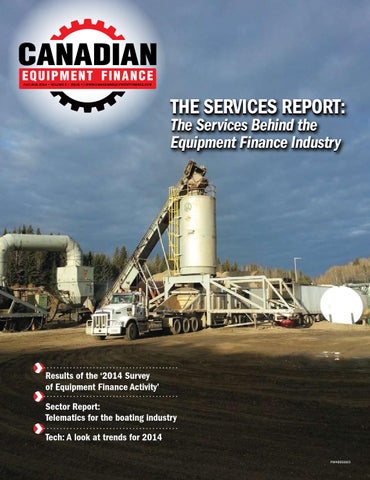
THE SERVICES REPORT: The Services Behind the Equipment Finance Industry
Results of the ‘2014 Survey of Equipment Finance Activity’ Sector Report: Telematics for the boating industry Tech: A look at trends for 2014 PM40050803
MAKING CAPITAL
WORK
VENDOR FINANCE
AVIATION FINANCE
WWW.ELEMENTCORP.COM
RAILCAR FINANCE
FLEET MANAGEMENT
TOLL FREE 877-534-0019
contents July/August 2014 Volume 2 Number 4 Publisher and Editor-in-Chief Steve Lloyd steve@canadianequipmentfinance.com Editor Karen Treml karen@canadianequipmentfinance.com Creative Direction / Production Jennifer O’Neill jennifer@canadianequipmentfinance.com Photographer Gary Tannyan Advertising Sales Mark Henry mark@canadianequipmentfinance.com Brent White brent@canadianequipmentfinance.com Chantal Goudreau chantal@canadianequipmentfinance.com
ELFA REPORT: “The foundation’s outlook report reflects a slowing in GDP and equipment investment growth due to a weak first quarter this year that resulted in part from the extremely cold winter,” says William G. Sutton, CAE, president of the foundation and president and CEO of the Equipment Leasing and Finance Association. »4
CFLA REPORT: ‘Expanding horizons, breaking new ground’ is the theme of the CFLA’s annual conference that is slated for September 10 to 12, 2014 in Whistler, BC. The first day includes opening of the trade exhibit along with an opening presentation, ‘How to stay motivated despite being at the top of what you do’, by five-time Olympic medalist Hayley Wickenheiser. »6
FEATURES Equipment Appraisal: Types and Considerations
For subscription, circulation and change of address information, contact
Whether for pre-finance, re-marketing, insurance, the key to effective appraisals is communication »10
subscriptions@canadianequipmentfinance.com
Publications Mail Agreement No. 40050803 Return undeliverable Canadian addresses to:
Using Unreserved Auctions as an Equipment Pricing Barometer Understanding the true value of your equipment is very important »14
Circulation Department 302-137 Main Street North Markham ON L3P 1Y2 t: 905.201.6600 • f: 905.201.6601 info@canadianequipmentfinance.com www.canadianequipmentfinance.com Subscriptions available for $40.00 year or $60.00 two years. 2014 Lloydmedia Inc. All rights reserved. The contents of this publication may not be reproduced by any means, in whole or in part, without the prior written consent of the publisher. Printed in Canada. Reprint permission requests to use materials published in Canadian Equipment Finance should be directed to the publisher. Also Publishers of
A major benefit in sale leaseback transactions is the redeployment of capital into other areas of the business. »16
NEWS:
INDUSTRY UPDATE:
The current size of leasing industry is understated »7
Results of the ‘2014 Survey of Equipment Finance Activity »24
FINANCIAL OPERATIONS:
SECTOR REPORT:
Payments Business www.paymentsbusiness.ca
The final lease accounting standard is expected by early 2015 »18
Canadian Treasurer www.canadiantreasurer.com
your Business:
Contact Management www.contactmanagement.ca
Direct Marketing www.dmn.ca Financial operations www.financialoperations.ca Made possible with the support of the Ontario Media Development Corporation Ontario Interactive Digital Media Tax Credit
Sales Leaseback Transactions
Working for the long horizon can pay off in spades – and there’s clearly more than one way to get there, but some ways work better than others. »20
TECHNOLOGY UPDATE:
While mostly associated with heavy equipment and on-road fleet management, telematics for the boating market is gaining popularity »26
EVENTS: Find out where to go and what to see in 2014. »29
Observations: An Appraiser’s Tale.
A guide to the key technology trends for equipment finance companies in 2014 »22
When a detailed description of equipment is not enough »30
canadianequipmentfinance.com | July/August 2014 | CANADIAN EQUIPMENT FINANCE
3
Association Report
Q3 Economic Outlook Revises 2014 Equipment and Software Investment Growth Forecast nvestment in equipment and software is expected to grow 2.6 per cent in 2014, says the Q3 update to the ‘2014 Equipment Leasing & Finance U.S. Economic Outlook’ by the Equipment Leasing & Finance Foundation. The Foundation revised its 2014 equipment and software investment forecast to 2.6 per cent, down from 4.2 per cent growth forecast in its Q2 update. The Q3 report expects equipment and software investment to have modest sector growth during the rest of the year after a weak start. The foundation report, which is focused on the $827 billion equipment leasing and finance industry, forecasts 2014 equipment investment and capital spending in the U.S. and evaluates the effects of various related and external factors in play currently and into the foreseeable future. William G. Sutton, CAE, president of the foundation and president and CEO of the Equipment Leasing and Finance Association, says, “The foundation’s outlook report reflects a slowing in GDP and equipment investment growth due to a weak first quarter this year that resulted in part from the extremely cold winter. The rebound in Q2 is slower than anticipated, as recent data from the Equipment Leasing and Finance Association’s ‘Monthly Leasing and Finance Index’ and the foundation’s ‘Monthly Confidence Index’ reflect. We do, however, anticipate that equipment investment will rise in the second half of the year as economic conditions improve and business confidence continues to recover.” Highlights from the study include: ◉◉ The U.S. economy is expected to grow 1.5 per cent in 2014, revised from 2.8 per cent.
I
◉◉ The downsides of the harsh winter, 4
which included a 2.9 per cent contraction in real GDP in the first quarter, should prove temporary, as the housing recovery, energy renaissance and accommodative credit markets support second-half growth. ◉◉ Equipment and software investment declined at an annualized rate of 1.8 per cent in Q1 2014, following the 8.9 per cent surge in Q4 2013. ◉◉ Credit supply continues to improve, and credit demand has held steady for all business sizes. ◉◉ Equipment and software investment is expected to steadily grow over the next six months across most verticals, according to the FoundationKeybridge ‘U.S. Equipment & Software Investment Momentum Monitor’. The monitor, which tracks 12 equipment and software investment verticals, forecasts the following equipment investment activity: -- Agriculture machinery investment will likely see slow growth, and potentially a contraction, through the rest of 2014, as both farm yields and commodity prices remain subdued. -- Construction machinery investment will continue to experience strong growth, and the year-over-year growth figures will begin to trend positive as multiple quarters of expansion take hold amidst the housing recovery. -- Materials handling equipment investment will experience stronger growth over the next three to six months.
CANADIAN EQUIPMENT FINANCE | July/August 2014 | canadianequipmentfinance.com
-- All other industrial equipment investment will likely see moderate growth over the next three to six months as the “re-shoring” of manufacturing continues to be a dominant economic story in 2014. -- Medical equipment investment will grow, but begin to level off near the end of the year. -- Mining and oil field machinery will experience improving growth through the middle of the year but will begin to level off at the end of the year. -- Aircraft investment will likely experience about long-term average growth for the year. -- Ships and boats investment will likely rebound to an above-average pace through the end of this year. -- Railroad equipment investment will improve from its recent contraction toward modest growth. -- Investment in trucks will exhibit high-single digit growth over the next three to six months as economic activity improves and competitive diesel prices keep trucking transport competitive. -- Computers investment will remain muted in the short-term after strong replacement demand over the past few quarters. -- Software investment will be moderate in the next three to six months as companies continue to make investments in software and cloud technologies.
Association Report
CFLA Annual Conference
Hayley Wickenheiser to share insights into keeping the desire alive when you are at the top of your game he CFLA is holding its annual conference, themed ‘Expanding horizons, breaking new ground’, on September 10 to 12, 2014 at The Fairmont Chateau Whistler in Whistler, BC. With the registration desk opening at 2:00 pm on September 10, the first day includes opening of the trade exhibit from 2:00 to 8:00 pm, along with an opening presentation, ‘How to stay motivated despite being at the top of what you do’, by five-time Olympic medalist Hayley Wickenheiser. Following that, Glen Hodgson, senior vice-president and chief economist of The Conference
T
Board of Canada will provide an economic update that is followed by a welcome reception. September 11 sees a full agenda that includes the trade exhibits from 8:00 am to 7:00 pm and such presentations as: ‘Synthetic identity fraud: The anatomy of a scam’ and ‘100% responsibility/zero excuses: how stepping up can change your company and the world’. Sponsored concurrent workshops include such topics as: ‘20/20 Vision: The Future of Business in 2020; Expanding the horizons of equipment remarketing and exchange’; ‘Benchmarking for Independent Leasing
Companies’; and ‘What’s New in Law?’ The evening hosts the Chairman’s Banquet and CFLA ‘Member of the Year Award’. September 12 offers a presentation titled ‘Where politics and business meet’. Guest presenters include Diane Francis, editor-at-large of the Financial Post; Rod Love, broadcaster, former chief of staff to Premier Ralph Klein; Vaughn Palmer, provincial affairs political columnist at The Vancouver Sun, in conversation with Huw Williams of Impact Public Affairs. Interested attendees can register and pay on-line at www.cfla-acfl.ca.
Security is EVERYTHING! Nationwide PPSA Solutions Technology
• Advanced web based system available 24/7 • XML system for high volume fully automated access • Customized reporting system • Import transactions from another provider • Real-time tracking of all your transactions
Validation
• Real-time validation conforming to Ministry guidelines. • Confirm missing information, incorrect or special VINs, invalid dates, and more before sending to the Ministry.
Single Sign-on
• Access all provinces through a single account • Only one password to remember. • Centralized reporting, management, and support • Add departmental accounts. Share data across departments.
Go Green
• No wasting paper. • A few clicks for easy document retrieval. • All data is retained, backed up and archived off-site, access your data anytime.
Bilingual and Friendly Support • Support available in English and French
PPSACanada SECURITY IS EVERYTHING
1 (800) 427-6793 • www.PPSACanada.com 6
CANADIAN EQUIPMENT FINANCE | July/August 2014 | canadianequipmentfinance.com
news
Industry Trends
Katsof launches ABL firm
In 2013, new business volume in the U.S. equipment leasing and finance industry increased – for the fourth consecutive year – to levels at or near pre-recession highs. However, the rate of increase slowed in 2013 compared to the significant increases experienced in the previous three years. This trend was not experienced uniformly by all market competitors, as some organizations saw business volume increases while others experienced modest declines. Along with top-line growth, the environment has been marked by heightened competition for deals, which has put pressure on margins. The credit picture, however, remains strong, with low levels of delinquencies and charges offs. The compensation trends in the industry mirror this uneven growth, with compensation linked to industry financial performance over the last year and since the recovery began.
International business leader Irwin Katsof has launched Katsof Financial, an outgrowth of Global Capital Associates, founded by Irwin Katsof in 2005 and Katsof Consulting, founded in 2012. In the first six months of 2014, Katsof assisted more than 50 of the nation’s leading private equity, venture capital, and real estate private equity funds to raise capital on trips to India, Hong Kong, Canada, and Israel. Katsof Financial clients tap into a rich worldwide network of institutional investors, family offices, and high net worth individuals Katsof Financial will focus on three verticals: asset-based financing for businesses and entrepreneurs, natural resource lending and hard money lending for real estate. Katsof has teamed with a group of family offices and is co-managing a pool of $200 million, which will be allocated to the three lending areas. The loans can be between $500,000 to $10 million dollars and are being placed at competitive rates. At the press conference announcing the launching of his new venture, Irwin said, “All entrepreneurs need capital to grow their business. We are setting up Katsof Financial to make it easier to launch new ideas, create jobs and help America maintain and continue to grow its competitive edge and continue to be the great country it is.”
canadianequipmentfinance.com | July/August 2014 | CANADIAN EQUIPMENT FINANCE
7
News
Compensation in the equipment finance industry mirrors business performance Finance Compensation Survey’ from the Equipment Leasing and Finance Association (ELFA) and McLagan. For the fourth consecutive year, a
Compensation in the equipment finance industry increased modestly in 2013, according to the ‘2014 Equipment Leasing and
year-over-year increase in new business volume contributed to increases in compensation, albeit at a slower rate than previous years.
o t y s a E se U Prof Optiitable ons
Exceedinngly good insurance options for you and your cusstomers.
d e d d A lue Va What’s best for your customers is often what builds your business. When you offer a convenient solution to help customers easily meet the insurance requirement of their finance agreement, your benefits pile high. Options include: • Automated • Self Serve • Customized System Choice is good—find out about all the choices for your business. 866-676-5677 or EFSquestions@gaic.com
www.GAIG.com Canadian Branch Head Office Scotia Plaza, Suite 2100, 40 King Street West Toronto, ON M5H 3C2
Policies are underwritten by Great American Insurance Company – Canadian Branch, a foreign registered insurer in all Canadian provinces and territories.
8
CANADIAN EQUIPMENT FINANCE | July/August 2014 | canadianequipmentfinance.com
The survey measures compensation rates for the 2013 fiscal year as reported by 60 equipment finance companies representing a cross section of the equipment finance sector, including independent, bank, and captive leasing and finance companies. Firms provide data for more than 90 executive, frontoffice and support positions, including a breakdown of salary (for 2013 and 2014), incentives (including cash bonuses and commissions), long-term awards and total compensation by company type. The survey is a collaborative initiative between ELFA and McLagan, a performance/reward consulting and benchmarking firm for the financial services industry. Highlights from the survey include: ◉◉ Total Compensation: On a ‘same-store’ basis (constant incumbents in multiple survey years), total compensation was flat (+/one per cent) at median for key originations functions from 2012 to 2013. Infrastructure received marginally larger increases at median, ranging from approximately three to six per cent. Notably, divisional management fared better than most other functions. The team leader / senior role experienced the greatest year-over-year variability, with many individuals receiving decreases of 20+ per cent, while others received increases of 14+ per cent.
NEWS ◉◉ Salary: On a same-store basis, origination roles tended to have slightly lower increases between approximately two to 2.75 per cent. Additionally, more than 25 per cent of incumbents in key origination positions did not receive salary increases year-over-year. Salaries tended to rise between two to four per cent for infrastructure roles. ◉◉ Differences by Level: Increases tended to be larger at the more senior levels (particularly in direct origination and
2
infrastructure). Notably, the team leader / senior level for the direct and vendor origination functions was flat (+/- one per cent). ◉◉ Differences by Firm Type: Generally, banks awarded higher compensation at median relative to captive and independents, particularly for senior roles. Median total compensation and salary compensation rates tended to be comparable (+/- five per cent) at lower levels for infrastructure and origination roles.
To send press announcements, please direct them to Karen Treml, karen@canadianequipmentfinance.com
Element poised to become fastest growing financial in Canada Element Financial the company is poised to become the fastest-growing financial company in Canada, says a report by the Globe and Mail. Citing comments from Davis Rea, the CEO of investment counsel that owns Element stock, the Globe and Mail says estimated annual earnings growth, excluding acquisitions, would be at a pace unlikely to be exceeded by the large banks, fund management companies or life insurance companies. Citing commentary from the president of an independent research firm, the Globe and Mail said, referring to Element CEO Steve Hudson’s previous presence in this market at Newcourt Credit, “This time around they’re focusing on the verticals they know are the most profitable and the verticals where they can achieve the highest organic growth rates.”
canadianequipmentfinance.com | July/August 2014 | CANADIAN EQUIPMENT FINANCE
9
Equipment Appraisal:
Types and Considerations of the Appraisal Market
Photos courtesy Verus Valuations Ltd
From pre-finance appraisals to remarketing appraisals, communication is essentially to best determine the true value of the equipment
10
CANADIAN EQUIPMENT FINANCE | July/August 2014 | canadianequipmentfinance.com
Services Report
Most appraisals are performed to substantiate the value of the equipent.
By Rob Birnie
quipment appraisals are obtained on a daily basis and are frequently considered to be ‘just another step in the process’ when completing a deal. Most challenges faced when obtaining a timely and accurate assessment of value can be attributed to one basic factor – communication. When clear channels of communication are open between all parties seeking valuations, the quality of the final appraisal is apparent. It is critical that this channel of communication be present at the onset of the assignment as it is important to clearly outline the purpose of the appraisal. Most equipment appraisals are performed to substantiate the value of equipment used as collateral to secure financing. If a clear understanding of the short and long term objectives of the equipment owner and other parties are understood by the appraiser, there is an opportunity to develop a thoroughly researched and supported independent assessment of many factors which then allows well-informed decisions to be made. In short, the appraisal can illustrate more than the typical ‘market value’ assessment. This is true with all types of
E
Appraisals must substantiate the current fair market value of the asset
appraisals, whether they are performed at time of purchase, at time of remarketing effort, or for any other purpose.
Purchase and pre-finance appraisals A pre-purchase (or pre-finance) appraisal must, at a minimum, substantiate the current Fair Market Value (FMV) of the asset. The intent is obviously to clearly outline the potential risk incurred by lenders by validating the reported value of the asset. In most cases, FMV can be substantiated by illustrating the number of comparable units presently available in the marketplace, as well as by documenting actual sales transactions that have recently been completed. When appraising equipment commonly used in the industry, this substantiation is quite straightforward. The challenges appear when industry unique assets, or those deployed in a newly emerging market, are included in the deal. In these situations, open discussions are tremendously beneficial. Appraising a unique asset – the illusive ‘serial number one (of one)’ – requires an adapted approach in substantiating market value. This approach frequently requires analysis of indirect market influencing factors such as industry trends, regulatory factors, manufacturing costs, equipment service life, as well as
competitive demand within the sector when reporting values. These conditions require a clear and open dialogue between all parties in order to fully document motivating factors which may not be readily apparent. Most purchasers are confident in their understanding of the factors that influence market value of their equipment, however the appraisal is an opportunity to independently substantiate and document those factors. If the appraisal is performed prior to the purchase of equipment, the detailed examination of the current market, including identification of similar specification equipment which is either currently available or recently sold within the market, will assist the purchaser with some additional information which can be used to negotiate the best terms of purchase. In some cases, the appraisal may even identify purchase options that are not readily apparent within the market.
Re-marketing appraisals The sad reality is that the re-market value of an asset following repossession is highly dependent on the care of the unit by the operator in the final days of ownership. Unfortunately, if a relationship has deteriorated to the point that recovery of the asset is warranted,
canadianequipmentfinance.com | July/August 2014 | CANADIAN EQUIPMENT FINANCE
11
Services Report equipment may be in extremely poor condition. Prior to recovery, particularly if the owner is experiencing cash flow issues, critical maintenance of the equipment may be delayed. In many cases accessories may be removed from equipment prior to recovery which further reduces value. While there are always options available to a lien-holder in these situations, it is beneficial to have independent third party verification of the condition and value of the asset at the time of recovery. The re-marketing appraisal assists the seller in making an informed decision as to how to maximize proceeds when re-marketing the item. Most re-marketing appraisals are performed to illustrate the current Fair Market Value as well as at least one liquidation value indicator. Although re-marketing will seldom achieve fair market value results due to the compressed time and limited marketing exposure, it is important to understand how the value of the equipment compares to similar units available within the open market. A significantly reduced FMV in comparison to industry averages may be an indication that further cost recovery against the debtor is required. Conversely, if the FMV of the equipment is consistent with, or exceeds that of real market indicators, a high confidence in realizing a strong sales return may be warranted. ‘Distress Sale Values’ are included in a re-marketing appraisal to project the ‘worst case’ sales scenario. The actual proceeds from re-marketing will be highly dependent on the market exposure and venue of the sale, however projected values will allow the seller to make informed decisions supported by independent data. Decisions related to transporting the asset to a market venue or determination of a potential re-marketing budget can be made based on the independent validation of sales proceeds presented in the appraisal report. Clear discussions about pending re-marketing efforts will allow the appraiser to perform research which best illustrates the factors which will directly influence sales proceeds. ‘Orderly Liquidation Value’ identifies the most probable selling price of the 12
unit when the unit is sold (typically by the original equipment operator) within a compressed and pre-defined time frame. The intent is to identify what proceeds the unit could realize if the current operator were directed to sell the machine within the next ‘x’ number of days. This value is based on the assumptions that the operator is motivated to maximize proceeds, that the operator may have contacts within the industry who know about the equipment and are interested in completing a purchase, and that the equipment is in substantially the same condition as described in the appraisal. A key value contributor is that the buyer has the opportunity to know the history of the equipment and perceives a ‘deal’. The expected result is an increased sale price when compared to forced liquidation. ‘Forced Liquidation Value’ identifies the rock bottom value of a unit. In this case, the equipment has been seized and there is no opportunity to obtain any details from the original operator. The unit may or may not operate and is typically presented in the market on an ‘as is, where is’ basis – frequently sold at public auction, at a specific date and location. Sales proceeds will be highly dependent on the buyer community present at that time and the location, as well as what other equipment crosses the block on the same day. In many cases, the relatively small buyer community can become saturated if multiple similar specification units are liquidated at the same venue. A clear understanding of the intended disposition of the asset allows research into that approach to be performed and documented by the appraiser.
Insurance appraisals Accurate identification of insurance policy coverage limits are an often overlooked benefit of obtaining an appraisal. Most insurance policy limits are based on the ‘Actual Cash Value’ (ACV) of the item at the time of loss. ACV settlements are based on the lesser of the pre-loss FMV and the declared policy limit. Accurately identifying the value of the asset avoids situations where under-insuring results in penalties and
CANADIAN EQUIPMENT FINANCE | July/August 2014 | canadianequipmentfinance.com
Appraising a unique asset requires an adapted approach in substantiating fair market value
financial exposure in the event of a loss while over-insuring the equipment results in increased premiums with no increase in benefit. ‘Post Loss Appraisals’ are frequently obtained by insurers in order to determine the pre-loss ACV (fair market value) of the equipment and thereby determining how the loss will be settled. It is of critical importance that all market value influencing factors are reflected in this appraisal and this information can only be obtained through clear and open communication between the insured, the underwriters, and the appraisal team. Maintenance records, upgrades, and accessories, as well as detailed usage history must be reflected in the report in order to ensure that an accurate pre-loss ACV is identified. A periodic assessment of equipment value and clearly documenting relevant market conditions and value influencing factors simplifies settlement in the event of a loss. In all cases, a clear understanding of the client’s objectives allows the appraiser to assess market value influencing factors and to provide the client with a comprehensive independent document which clearly substantiates current value. ABOUT THE AUTHOR: Rob Birnie is a Certified Machinery and Equipment Appraiser (CMEA), Master Marine Surveyor (MMS Senior Business Analyst (SBA), and an active member of the Canadian Finance & Leasing Association. Rob has applied his hands-on experience in mechanical and marine repairs and more than 19 years of insurance damage appraisal, valuation and loss settlement experience to create and direct Verus Valuations.
EXPERTISE, FLEXIBILITY AND SPEED We understand that cutting-edge equipment is key to your organization’s productivity and success. Let our financing team put their specialized expertise to work for you to allow you to acquire the equipment you need more readily and rapidly.
EQUIPMENT FINANCING SPECIALISTS Jean-Pascal Gagnon Account Manager Thierry Martin Senior Manager
To contact Business Services�: ��������������
Jérôme Thibeault Senior Manager
François Houde Senior Manager Thierry Langevin Vice-President
Sébastien Lemay Senior Manager Louis Dupuis Senior Manager
Services Report Crawler Tractors Being Sold On The Auction Ramp
Bid Catcher at Unreserved Auction
Using Unreserved Auctions as an Equipment Pricing Barometer By Ian Malinski
hen selling used equipment on your own you can list it for any price you want, but you need to make sure you’re not over or undervaluing your assets. Otherwise, you may end up listing your 2008 Caterpillar D8T crawler tractor for less than it’s worth ($100,000) and your 2009 Caterpillar 312DL hydraulic excavator for more than it’s worth ($300,000). Understanding the true value of your equipment fleet is very important. This value fluctuates every day based on age, condition, market demand, and a variety of other factors. So how do you ascertain an accurate value for your equipment? One of the best ways to get real world pricing comparisons is to pay close attention to equipment sales at unreserved auctions. At an unreserved auction, equipment is sold to the highest bidder, regardless of price – without minimum bids or reserve prices – so you know the equipment is selling for true market value. The prices are set by bidders, not the equipment owners or the auctioneer.
W
14
Having held unreserved auctions for more than 50 years, we believe that selling unreserved attracts more potential buyers – and therefore higher prices – than any other way of selling used equipment. “Having no reserves is the most important thing at an auction, whether you’re buying or selling,” says Peter Delaney, who owns a mobile crushing company in Australia. “I could advertise my equipment in a magazine but there’s no guarantee it will sell. I could put it in a regular auction but it may not meet the reserve price. When you sell unreserved, you know you’re going to get a result.” Hundreds of thousands equipment items are sold each year. Ritchie Bros. provides historical equipment pricing for free on its website which serves as a valuable resource for equipment owners who want to know how much their equipment is actually worth. For example, an accurate appraisal for the 2008 Caterpillar D8T crawler tractor you want to sell (depending on the hours, features and a variety of other factors) may be in that $250,000 to $400,000
CANADIAN EQUIPMENT FINANCE | July/August 2014 | canadianequipmentfinance.com
range based on recent sales. And that 2009 Caterpillar 312DL hydraulic excavator you want to sell? It may be closer to that $45,000 to $100,000 range. “When equipment is sold in an unreserved auction, the prices reflect true global market value – it’s based on facts, what equipment buyers are actually willing to pay,” says Doug Olive, vicepresident, pricing and valuations. “That’s why the historical equipment pricing data on our website is so valuable. It’s a reliable source, based on actual numbers, not theoretical values. Searching through our auction results is a quick and easy way for equipment owners to get accurate price ranges to compare against equipment in their fleets.”
The value of equipment appraisals Auction results from unreserved auctions are a great source of free information to help an equipment owner find price comparisons on like items in their own fleet. However, if an owner wants more exact numbers on their specific equipment items there is no
Services Report
Unused 2012 Caterpillar D10T crawler tractor with a four barrel ripper, A/C cab, rear view camera, and nine hours on the meter sold in Spain in June 2014 for €700,000
2004 Manitowoc 777 Epic Series II 200-ton crawler crane with Cummins six-cylinder engine, 1700’ six-section angle boom, 7,962 hours on the meter (crane) sold in Missouri in June 2014 for US$690,000
better way than an appraisal, which can either be done in conjunction with the sale of the equipment or through a paid appraisal. Appraisals require an inspector or salesperson to attend your property to photograph and collect equipment
2012 Kenworth T800 T/A Tri-Drive W/National NBT55102 boom truck equipped with a Cummins ISX15 600hp engine, a four-section 102-ft boom, and 26ft offset jib, sold with a 2012 LangFab S/A converter dolly and a 2012 Manac 35ft X 9ft T/A stepdeck trailer, 14,749 km on the meter, was sold in Alberta, in June 2014 for CA$675,000.
2008 Caterpillar 627G motor scraper with an A/C cab Tier 3 compliant, 897 hours on the meter sold for US$620,000 in Montana in June 2014.
details, including hours, specifications, condition, and more. Photos and equipment information is provided to valuation analysts – equipment experts who price individual pieces based on their wealth of knowledge and available pricing data. For paid appraisals, a
2013 Freightliner 114SD Tri/A hydro vacuum truck with a Detroit DD13 12.8L 500hp engine, a Ramvac HX-12 tank, hydraulic lift rear gate, hoist, hose reel, pressure hot water tank, Ram Vac HX12 Hydro Vac system, and 5,288 km on the meter sold at an auction for CA$370,000 in Ontario in June 2014.
complete detailed appraisal report is provided back to the customer. Recent auction sale highlights are shown above. Ian Malinski is Corporate Communications Lead at Ritchie Bros Auctioneers.
canadianequipmentfinance.com | July/August 2014 | CANADIAN EQUIPMENT FINANCE
15
Services Report
Sale Leaseback
Transactions
A look at the benefits of this alternative financing strategy By Stan Prokop
ale leaseback transactions are a unique aspect of asset financing in Canada that can prove very beneficial. Some people believe that the benefits depend on which side of the transaction you are on – the borrower or the lender – but from our perspective, when properly executed, sales leaseback transactions provide benefit for both parties.
S
Access to capital Let’s examine two major and important asset classes of leaseback transactions – equipment and real estate. The lessee’s perspective focuses on gaining access to alternative capital without giving up the use and long term ownership of the company’s key assets. In recent years, many companies and even financial institutions have focused on shedding ‘non-core’ assets as a method of employing capital for maximum return on investment (ROI). A good example of this are Canadian banks that use leaseback transaction options on prestigious bank office towers. Fundamentally, the transactions are quite simple and involve selling an asset to a third party then leasing it back with the option or ability to repurchase it at the end of the lease term. A major key benefit in sale leaseback transactions is the redeployment of 16
capital into other areas of the business. Depending on the value and original structure of the transaction, this method of financing can affect key operating and capital ratios and can alter debt/worth percentages, current asset ratios, etc. Often borrowers consider opting for leasebacks in order to achieve working capital or to effect cost effective upgrades to their technology. In certain cases it might be prudent to structure a transaction as a term or bridge loan based on specific aspects or issues surrounding the deal. Financing rates play a key role in the overall background to any transaction of this kind. Any original financing remaining on the asset, as well as current rates and any tax effects related to the deal must be taken into account.
Rationalizing ownership Owners and financial managers in companies that are considering a lease transaction are often confronted with ‘pride of ownership’ issues that must be properly rationalized. And looking at it from the lessor’s perspective, it is clearly important to ensure the transaction is not viewed as the proverbial ‘cash grab’. Simply speaking, it is prudent for the lender to satisfy itself with regard to proper use of the proceeds of the deal. We note that not all lessors, banks, etc. offer leaseback financing. In some cases their charters prohibit this type of financing. In other cases, the owners/ management of a lending institution
CANADIAN EQUIPMENT FINANCE | July/August 2014 | canadianequipmentfinance.com
may have simply decided they don’t have the expertise or risk appetite inherent in lease back transactions. Niche players in the industry frequently include firms that have both financing and asset expertise – and many firms employ key personnel with in-depth liquidation expertise in all categories of assets. Rates vary for this method of financing and ‘credit quality’ and ‘asset quality’ are ever-present considerations in sale leaseback transactions. Another consideration for borrowers includes the ability to return capital to owners and shareholders. Management that typically might be incented by key ROI and ROI metrics often looks to sale leaseback of assets as a method of ensuring that corporate objectives are attained. When refinancing interest rates align with corporate capital, conditions for a sale leaseback are viewed as being favourable. Lessors have the potential ability to offer both capital and operating leases as part of their financial offering in this segment of asset finance. Technology lessors make maximum use of the operating lease vehicle – allowing clients to maximize operating expense deductions, balance sheet enhancement, etc.
The papertrail We’ve focused mainly in key benefits and considerations of the borrower. Let’s look at these transactions from the asset lender’s perspective. Leaseback finance offerings require expertise in marketing
Services Report and legal issues, as well as due diligence. Lease contracts must be specifically designed to reflect the essence of the lease back. Key issues such as corporate searches and PPSA (Personal Property Search Act) issues must be tabled and addressed at the start of any negotiation. In essence, the leaseback must be properly ‘papered’ to reflect both the asset and the financial obligations of the lessee. As noted, asset valuation for the purpose of refinancing is key. It becomes prudent, almost mandatory, to engage asset appraisal expertise as the cornerstone of any successful transaction. Different asset categories have different intricacies that must be thoroughly considered. The proliferation of information via the Internet has greatly assisted owners and lenders in determining true asset value for the purposes of refinancing. Market data on almost any asset can be extremely valuable in initial negotiations
around deal value and risk pricing – and these days that data is literally up to the minute. Solid appraisals can significantly benefit key issues such as book value, fair market value, and impairment.
Accurate appraisals are crucial The important aspects of any appraisal include opinion, value, methodology, assumptions, and pictures or videos. Over the years, we’ve observed that many lenders rely solely on relationships they have built with specific appraisers. This is of concern to the lessee who recognizes the need for a third party valuation only to find that the appraisal firm they use is not recognized by a commercial lessor or bank. This results in money poorly spent. A point of note – it is safe to say that we have never run into a situation where owners of an asset have undervalued the asset in their own mind! That comment specifically relates to a key technical issue in asset valuation – the type of
appraisal that is utilized or required by the lessor. Key categories in this area are fair market value, orderly liquidation, and forced value liquidation. Lessors typically lend against a percentage of forced value, thereby highlighting the difference in owners’ perception of true asset value. The real secret to proper refinancing via a sale leaseback strategy is the combination of due diligence on the part of the lender and a well-informed borrower/lessee that has the necessary knowledge and understanding of the leaseback process. With due diligence and knowledge, the final decision, whether you’re the lender or the borrower, will become a much easier one and one that is absent of surprises. ABOUT THE AUTHOR: Stan Prokop is principal at 7 Park Avenue Financial and specializes in business financing for Canadian firms, such as working capital, cash flow, asset based financing, equipment leasing, franchise finance and Canadian tax credit finance. Founded in 2004, the company has completed in excess of $90 million of financing for Canadian corporations. www.7parkavenuefinancial.com
Customized Solutions for your Equipment Financing Needs Nations Equipment Finance provides equipment financing for a variety of equipment types including: • Oil & Gas • Construction • Rail • Tractors/Trailers • Aircraft • Manufacturing and Industrial Our investment professionals have decades of experience providing financing to small and medium sized businesses. With transaction sizes ranging from $1 Million up to $50 Million, NEF can craft a customized financing solution that provides you with the necessary capital to grow your business. We have locations across the USA and Canada.
Contact Ed Stolarski, Executive Vice President • Tel: 203-229-2224 Email: EdStolarski@nationsequipmentfinance.com • www.nationsequipmentfinance.com
canadianequipmentfinance.com | July/August 2014 | CANADIAN EQUIPMENT FINANCE
17
FINANCIAL OPERATIONS
The Evolution of Lease Accounting New rules expected in early 2015 here is still a lot of work remaining on the revamping of the lease accounting project; however, the ELFA anticipates a final standard early in 2015. The proposal, which has been through two exposure periods, was highly criticized by a variety of constituents in the latest public comment process that ended last fall. In assessing the feedback from the May 2013 Exposure Draft, the Financial Accounting Standards Board (FASB) and International Accounting Standards Board (IASB) agreed to reexamine most of the significant aspects of the model – and that work began in earnest in March of this year. So what progress has been made? In March, the boards tackled the most contentious issues including lessee and lessor classification. While they found some common ground, differences still remain that will need to be ironed out if a converged solution is desired. At this point, despite the overhaul of several areas, the ELFA does not expect another public exposure of the proposal. The boards believe that they understand the perspectives of users and preparers alike based on the significant volume of comment letters received to date and the other forms of public outreach performed. However, unsolicited comment letters are always an option if there are further concerns about the direction of the project. In June, as part of the ELFA’s Capitol Connections program, executives
T
18
representing 12 ELFA member companies met with the staff of the U.S. Securities and Exchange Commission’s Chief Accountant’s Office to discuss the latest developments and provide insight on the lease accounting project. The SEC reaffirmed the intention of the FASB and IASB to issue new lease accounting rules in early 2015. The takeaway from the meeting was that, despite disagreements between the two boards, the process of re-writing lease accounting rules continues to move forward. The FASB is siding with the position of the industry and association on critical recognition and financial reporting
matters; it remains to be seen how and in what form the final rules account for these discrepancies. The ELFA continues to closely monitor the project and provide useful information and input to the boards as they seek to finalize the new rules. More information on this topic is available on the association’s leaseaccounting page at www.elfaonline. org/Issues/Accounting/ and at the ELFA Lease and Finance Accountants Conference, Sept. 8-10 in Atlanta, where FASB and IASB Board members will discuss the convergence of accounting standards.
Did You Know? ◉◉ Changes in accounting rules that would bring all or most leases on balance sheet have been under consideration by the accounting standards setters – the IASB and FASB – since 2006. ◉◉ This initiative is the result of the U.S. Securities and Exchange Commission’s directive to eliminate off-balance-sheet financing and part of the overall effort to harmonize accounting standards worldwide. ◉◉ The new rules will dramatically change the way leases are accounted for. The rules will impact the balance sheets of every company subject to U.S. GAAP that uses leasing to acquire assets or as part of its asset management. ◉◉ Two exposure drafts have been released by the IASB and FASB on this matter – one in 2010 and one in 2013. Both drafts generated widespread criticism from the business community. ◉◉ A new lease-accounting standard is expected to be issued in the first half of 2015, with a possible effective date of 2018. ◉◉ The ELFA continues strong advocacy, communications, and outreach activities as the IASB and FASB drive toward the goal of adopting a new lease-accounting standard.
CANADIAN EQUIPMENT FINANCE | July/August 2014 | canadianequipmentfinance.com
YOUR BUSINESS
Systematically Getting the Golden Boot A successful organization is a system in which all the parts fit and interact well together By Angela Armstrong
lease forgive me for insinuating soccer into this article – I’m still suffering withdrawal from the World Cup. Player, coach, spectator – I love the beautiful game. I’m also an analytical person who loves innovation. When my high school computer science instructor learned my interest, he set me to work creating programs to help him evaluate our basketball team statistics (of which he doubled as coach). I guess for high school basketball, you could say we made an app for that. What intrigues me about international football isn’t the dramatic flourishes, bicycle kicks, or flying headers. Watching the talented Ronaldo dance the ball through a phalanx of defenders really IS beautiful, but what I rewind the PVR for is the play development. I love watching the buildup – i.e. how they get there. These aren’t the quick glorious counter attacks (although sometimes they create them) – they’re more like a slow burn.
P
It’s a system When the ball goes from forward to fullback to goalkeeper and does a slow parabola back and forth across the field, tantalizingly close to the 18 yard box but never in it, it can be frustrating if you’re only in for the one minute of goal, not the 89 minutes of play. You would have had to be literally under a rock last month to have missed some World Cup coverage. I’m sorry 20
if you haven’t got through YOUR PVR recorded match replays, but (spoiler alert), Germany won the Cup. I watched nearly every game (sadly, not IN Brazil). I noticed what made each team’s game plan unique and either gave it a competitive advantage, or became its Achilles heel. Let’s contrast Costa Rica, which became the first Central American team to ever make a quarter final, with Germany, which has qualified for EVERY World Cup they’ve been allowed to enter. Some comparative stats. Costa Rica
Population: 4.7 million Players: $61,000 Coach Salary: $400,000 Germany
Population: 80 million Players: $6.6 million Coach Salary: $3.6 million It doesn’t seem too surprising then, that Costa Rica was knocked out after 5 games, and Germany dominated the tournament with most goals scored. Germany was head and shoulders ahead of Costa Rica in goals, shots on target, and number of completed passes. But Costa Rica held their own – while they didn’t win matches by goals, they also didn’t concede games on goals. They committed more fouls defending their turf, but put on just as much distance as Germany, working hard to compensate for what should have been an underdog story.
CANADIAN EQUIPMENT FINANCE | July/August 2014 | canadianequipmentfinance.com
But in the end Germany prevailed. Makes sense. We all know that when it comes to sports – money DOES buy happiness.
Or maybe not Of the top 105 wealthiest professional football clubs by transfer budgets, only seven are from the Bundesliga (Germany). Those seven clubs claim an average budget of €10 million per team. By contrast, the 11 English Premier League teams within that top 105, have a transfer budget of €15 million per team – 30 per cent more. So what happened? I’m no sports analyst, but I can tell you what didn’t happen: effort and completion. England matched Germany’s passing completion, but on only 25 per cent as many passes. Los Ticos outran them, out-challenged them by a factor of 23x, and finished at more than twice the rate, (five goals compared with two for The Three Lions).
So if it’s not money, what is it? I’m going out on a limb here, but I believe it’s the system they use to develop their game, their team, and ultimately, their objective. Germany rebuilt its national football game plan from scratch after suffering a humiliating defeat in 2000. It threw out the entire book and started again, building home-grown talent from the toddler wading pool on up. Fourteen years of investment created a pipeline of coaches and players familiar with the system, used to their unique strategies, and prepared to play at home. The
YOUR BUSINESS outcome, other than Brazil 2014, is saving them time and millions of Euros by not having to screen for talent internationally. It’s literally right under their noses. Costa Rica has the opposite problem – population constraint (one per cent of the population plays soccer, compared with Germany’s eight per cent), and players that have to leave home to play. Statistically, they have no superstars and going into the FIFA 2014 matches were ranked 29th in the world. However, their coach built a team using what he was given – a group of players that were all focused on being the best they could be – as a group. While their very talented keeper performed consistently throughout, he had the support of a solid defense made up of some average players. The coach realized that together they were stronger. An average group of guys, engaged, pulled together to elevate a ‘have-not’ into a ‘has’ game. Money is clearly worth something, but Costa Rica proved that it could go a long way on a pretty thin budget, using a simple success strategy that we’re all embarrassingly familiar with, but seldom invest in. Make believers = make history. I know this article has been heavy on sports stats, (and hey, I’m a girl), but bear with me a little longer. Netflix started its operations in 1997 as a DVD mail order service. Here’s a fun factoid – Blockbuster turned down Netflix as an acquisition for $50 million in 2000. Netflix invested early in the digital streaming game, developing its vision and investing in its people (unlimited vacation time for salaried employees). They went from being a mail order DVD corner store with 925 titles, to being the largest single source of internet downloading in the U.S., in 14 years.
That’s not an overnight success story. But then, neither was Germany’s If you’re the type of business looking to make a fast buck, then telling you that your winner’s circle is 10 years away might not be the right locker room motivation for you.
Invest in top talent? Maybe. Ask Brazil – having a couple of star performers can get you down the road, but leave you mighty vulnerable when a wheel goes flat. Have big budgets? Not necessarily. Germany’s strategy includes having 50+1 per cent ownership in all local professional teams – otherwise known in business as ‘skin in the game’. More ‘commitment’ than ‘cash’. Personally, I believe quick fixes lead to quick breaks. But I’m not naive. You have to survive the turmoil of the market to prove your value and your vision, and to make believers of your customers and your crew. But if you do, that’s money in the bank. Just ask the 27-year-old Costa Rican keeper who’s heading, post World Cup, to the world’s most valuable football team, Real Madrid. Working for the long horizon can pay off in spades – and there’s clearly more than one way to get there, but some ways work better than others.
What’s your system? A patient, wellconceived commitment to the long-term? Building a team that believes they’re better together and acts accordingly?
Systems work Russell Ackhoff, thought leader on organizations as purposeful systems, opined that a successful organization is a system in which all the parts fit, and interact well together. You don’t mix a Ferrari motor and a Jaguar transmission ; they might both be great individually but there’s no guarantee they’ll combine to make beautiful engine music. Both Costa Rica and Germany focused on something bigger and more purposeful than the sum of their individual parts. I guess they got the (Golden) Boot. And they’re not complaining. ABOUT THE AUTHOR: Angela Armstrong is the founder of the Prime Capital Group – a fantastic system of people who deliver more than the sum of their parts to a great portfolio of Canadian business clients. Prime specializes in equipment finance solutions. Angela specializes in truth telling and has a 28 year purposeful history of business growth. www.pcclease.com
ERS OK D BR ANTE W
PROUDLY CANADIAN SINCE 1981 MEMBER OF THE CFLA
Specializing in New & Used Manufacturing & Construction Equipment
Advant Leasing is an independent family owned business that has participated in the Canadian Commercial and Industrial Lease Industry for over 35 years. We specialize in assisting all types of businesses to acquire the specialized commercial equipment required to be productive and grow their business.
NEW BROKERS WELCOME • Fast approvals • Flexible terms • Start-ups accepted
• Decisions made in house/no securitization • Customized financing solutions • Small business specialists
Get started today with Advant, helping you grow with the tools that you’ll need.
Please contact Jason Bonneville • jason@advantleasing.com 905-335-3301 ext 224 • www.advantleasing.com canadianequipmentfinance.com | July/August 2014 | CANADIAN EQUIPMENT FINANCE
21
TECHNOLOGY UPDATE
Technology Trends for Equipment Finance Companies The ELFA Software Guide looks at what technology solutions are trending s the U.S. economy continues to improve and new technology solutions enter the marketplace, equipment finance companies are modernizing their IT systems and using technology in new ways to solve problems and create opportunity. The ‘2014 Software Guide’ by the Equipment Leasing and Finance Association highlights the leading software solutions for the equipment finance industry. The guide outlines the following key technology trends for equipment finance companies in 2014:
A
◉◉ Integration: Integrating disparate systems is a goal for many equipment finance companies. Rather than managing multiple independent applications, companies are seeking to connect their systems and consolidate their data so they can see the big picture. ◉◉ Data Security: In an expanding regulatory environment, equipment finance companies are using secure solutions that protect customers’ information.
22
◉◉ Cloud Computing: Cloud computing is expected to increasingly be a factor in equipment finance companies’ software upgrades/acquisition. ◉◉ Business Process Outsourcing: Some equipment finance companies are looking to outsource business processes, such as their accounts payable, or having third parties automate certain processes, such as document creation. ◉◉ Efficiency: A new generation of software solutions is available to help equipment finance companies modify and manage their business processes more nimbly and effectively. ◉◉ Mobile Apps: Self-service mobile applications are starting to gain traction, allowing sales teams in the field to meet end-user customers and input data on-site using mobile tools such as tablets. In addition, the 2014 Software Guide notes that changes to the lease accounting standard, which are under development by the Financial
CANADIAN EQUIPMENT FINANCE | July/August 2014 | canadianequipmentfinance.com
Accounting Standards Board and the International Accounting Standards Board, will have an impact on equipment finance companies’ software upgrades/ acquisitions. The guide also reveals the top three IT-related initiatives ELFA member companies will undertake in 2014, and offers a Quick Quiz: How do you know when it’s time to upgrade your IT systems? Access the full 2014 ELFA Software Guide on the ELFA website or learn more about technology and the equipment finance industry at the 2014 ELFA Operations & Technology Conference, Sept. 8 to 9 in Atlanta, GA. The conference will be held concurrently with the ELFA Lease and Finance Accountants Conference. Both conferences will share a table-top exhibit showcasing technology-related processes and systems. Get details at www. elfaonline.org/Events/. About ELFA: The Equipment Leasing and Finance Association (ELFA) is the trade association that represents companies in the $827 billion equipment finance sector, which includes financial services companies and manufacturers engaged in financing capital goods. ELFA members are the driving force behind the growth in the commercial equipment finance market and contribute to capital formation in the U.S. and abroad. Its 580 members include independent and captive leasing and finance companies, banks, financial services corporations, broker/packagers and investment banks, as well as manufacturers and service providers. For more information, please visit www.elfaonline.org.
INDUSTRY UPDATE
Equipment Finance Activity Survey shows overall new business volume grew 9.3 per cent in 2013
ew business volume grew 9.3 per cent in the equipment finance industry in 2013, says the ‘2014 Survey of Equipment Finance Activity’ (SEFA) by the Equipment Leasing and Finance Association. The growth in volume was down from the 16.4 per cent increase reported for 2012 and the 16.5 per cent increased reported for 2011, but well above the 3.9 per cent increase reported for 2010 and the 30.3 per cent decline in 2009. The SEFA, which is based on responses from 109 ELFA
N
24
member companies, covers key statistical, financial, and operations information for the $827 billion equipment finance industry. ELFA also released a companion report to the 2014 SEFA called the ‘2014 Small-Ticket Survey of Equipment Finance Activity’. The report, which focuses on small-ticket and micro-ticket equipment transactions among the SEFA respondents, found that new business volume in the small-ticket space grew by 10.2 per cent in 2013.
CANADIAN EQUIPMENT FINANCE | July/August 2014 | canadianequipmentfinance.com
“We are pleased to present the 2014 SEFA and the 2014 Small-Ticket SEFA, which provide comprehensive performance metrics for the $827 billion equipment finance industry,” says William G. Sutton, CAE, ELFA president and CEO. “The data show the equipment finance sector continued to gain momentum as the economy improved in 2013. More recent data collected in 2014 indicate that growth is continuing amid a slow economic recovery, at a more tempered rate.”
Industry Update Survey highlights: Key findings for 2013 as reported in the 2014 SEFA include: ◉◉ Overall new business volume grew 9.3 per cent. -- By market segment: All market segments showed growth in volume, except for the smallest segment. New business volume fell 5.9 per cent for the micro-ticket segment but grew 14.3 per cent for the smallticket segment, 8.5 per cent for the middle-ticket segment and 6.8 per cent for the large-ticket segment. -- By organization type: After lagging for several years, independent equipment finance organizations led the industry in new business volume growth rates. Independents saw the strongest increase in new business volume (17.7 per cent), while captives saw their volume grow by
11.3 per cent and banks saw a 6.2 per cent increase. ◉◉ From an asset perspective, the top-five most-financed equipment types were transportation, computer equipment, agricultural, construction and medical equipment. The top five end-user industries representing the largest share of new business volume were services, agriculture, transportation, industrial/ manufacturing and wholesale/retail.
◉◉ Employment levels grew by two per cent, with headcount in sales and marketing increasing, while all servicing and collections categories lost headcount. ◉◉ Given the current financial markets, cost of funds continued to decline. However, competitive pressure drove pre-tax spreads still lower in 2013 compared to previous years, to three per cent, its lowest level in five years.
◉◉ Delinquencies remained steady between 2012 and 2013. Full-year losses or charge-offs also fell well below one per cent overall.
◉◉ Assets under management grew between 2012 and 2013. Return on assets dropped slightly in 2013 but remained healthy at 1.7 per cent.
◉◉ Credit approvals increased, and the percentage of those approved applications being booked and funded remained steady.
◉◉ Net income remained steady between 2012 and 2013 in dollar terms. Return on average equity also remained healthy at 16.8 per cent.
Lebovics and Tsiobanos Join Northstar Leasing
Northstar Leasing Corporation, a Chesswood Group Company, hired Danny Lebovics, President, and Bill Tsiobanos, VP Business Development to round out the company’s leadership team. Northstar is working hard to become the preferred funder for Canadian equipment leasing brokers in the small-ticket, non-prime segment. Here are some enhancements made to better serve our brokers and their vendors and customers:
✓ App-only credit decisioning up to $50,000 ✓ Electronic doc funding up to $25,000 ✓ Broker fees at market levels ✓ Streamlined processes ✓ New competitive pricing grid ✓ New programs: New Business/Start-up and Start-up Restaurant
DANNY LEBOVICS
BILL TSIOBANOS
Northstar, founded in 1983, is a non-prime commercial equipment finance company, located in Barrie, Ontario. Chesswood Group Limited (TSX:CHW) is a specialty finance company with operating businesses in both Canada and the U.S.
Contact us today toll free:
What has not changed is Northstar’s dedication to your business and our straight-forward and personal way of doing business. Call Danny at 888-678-2701 x3236, Bruce Collingwood at x3274 or Bill Tsiobanos at x3235 to talk about how we can be of service.
(888) 678-2701
• www.nstarleasing.com
canadianequipmentfinance.com | July/August 2014 | CANADIAN EQUIPMENT FINANCE
25
SECTOR REPORT
Taking Telematics to the High Seas Boat owners need telematics to monitor the status of their boats and onboard equipment in their absence
By Jayne DeMerchant
eople most often associate the term ‘telematics’ with heavy equipment and on-road fleet management. These industries have driven the need for more data, more convenience, and compliant reporting. With the lessons learned and systems in place, traditional telematics companies are branching out into other types of asset monitoring and are discovering new challenges and opportunities every day. Sometimes these opportunities come from the most surprising sources. Such is the case with our company. An owner/engineer drove his boat up the river to his summer cottage and moored it – only to discover the next day that it was at the bottom of the bay due to a fault in the bilge pump in conjunction with a
P
26
CANADIAN EQUIPMENT FINANCE | July/August 2014 | canadianequipmentfinance.com
SECTOR REPORT
Boating telematics require adaptation for accessories to match aesthetically and be non-corrosive as well.
small leak. After costly cleanup and retrieval fees – and a lost boat – he decided that he could easily modify our existing telematics device that was built for fleet and heavy equipment monitoring to notify him if there were issues with his new boat. Many local boat owners became interested in the idea and a new product was born.
Adaptations for boating use Telematics for the boating market is very different than that of land vehicles. From a hardware perspective, more emphasis went into design, aesthetics, and environment for boat telematics. For example: the black dual GPS and cellular antenna needed to be white to match the other accessories typically found on boats; packaging needed an upgrade as the boating product was more consumerfacing as opposed to B2B; and all screws and mounting brackets had to be stainless steel to prevent corrosion in salt water environments.
From a data and software perspective, the difference was even more dramatic. While traditional fleet managers want data, reports, and analytics to save costs, boat operators prefer simple access to key functionalities to feel secure. In their busy lives they just want to know at a glance that things like battery voltage, AC shore power, anti-theft, bilge levels, and geo-fencing were where and as they should be.
Product development Despite having over a decade of experience in fleet and asset management, we still found it best to talk with those people who truly understood the needs of the customer. Most times when stepping out of your comfort zone it is best to step into the comfort zone of an expert that will help you work out a lot of the kinks during the concept phases of your product. There are rewards to this approach – usually experts are enthusiasts of the industry; they rarely charge
you for advice; and if they believe in your idea, they become respected advocates of your product. Respect the past, be the future. That is what product development is all about. Establishing oneself in a new market requires finding the delicate balance between fitting in and leading the way. Often this presents opportunities for conflict in the development cycle where only those companies with a strong mission and vision succeed. From a cost perspective, telematics is about balancing cost versus value or in traditional terms, return on investment (ROI). The chances of a boat sinking while very costly, are very rare. More often than not, boat owners lose out on a
relaxing night because of a dead battery or they find a fridge full of spoiled groceries because someone unplugged their boat while at dock. Because of this, most boat owners or marina operators do not want or need minute by minute reporting of significant amounts of data and as such, pricing a product and its related monthly fees on these advanced types of features is not practical. Instead, a yearly service fee that equates to the cost of a fridge full of groceries is very attractive to the end user. ABOUT THE AUTHOR: Jayne DeMerchant is the CEO of The DPL Group/BoatLink+ headquartered in Rothesay, New Brunswick. The DPL Group has been in the telecommunications technology industry for 40 years. It delivers proprietary telematics solutions to the heavy equipment, fleet, ATM, marine assets, and many other commercial assets throughout North America. The DPL Group’s strength exists in its ability to listen to its customers and adapt its products and services to meet their unique needs.
FREE BREAKFAST BRIEFING Register now to reserve your seat at
www.dmn.ca
Interactive eStatements: Raising Your Customer Experience Game
Learn how eStatements can enhance the customer experience, providing information and analytics in an enhanced self-service environment that also drives adoption and reduces call centre and printing costs. A must-attend if you want to increase customer loyalty, better promote, target and sell your services and help your organization save money.
EVENT DETAILS: Sept 10, 2014 • 8-10am
SPEAKER: Peter O’Grady
Director, Business Intelligence Product Marketing, Information Builders Presented by
The National Club, 303 Bay St, Toronto M5H 2R1
BRING YOUR TEAM.
SIGN UP AS MANY AS 3 INDIVIDUALS AT NO CHARGE.
For more information and to register visit our website: www.dmn.ca Seating is limited.
canadianequipmentfinance.com | July/August 2014 | CANADIAN EQUIPMENT FINANCE
27
EVENTS
WHERE TO GO. WHAT TO SEE.
Find out more about the conferences, exhibitions, seminars and meetings in your industry April 9-12
May 7-9
Factoring Association 20th Annual Factoring Conference San Francisco, CA www.factoring.org
Equipment Leasing & Finance Association Public Sector Finance Forum Washington, DC www.elfaonline.org
April 23 Equipment Leasing & Finance Association ELFA Bank Best Practices Roundtable Chicago, IL www.elfaonline.org
April 23 Equipment Leasing & Finance Association ELFA Captives Best Practices Roundtable Chicago, IL www.elfaonline.org
April 23 Equipment Leasing & Finance Association ELFA Independent Best Practices Roundtable Chicago, IL www.elfaonline.org
April 23 Equipment Leasing & Finance Association ELFA 26th Annual National Funding Conference Chicago, IL www.elfaonline.org
May 1-3 Nat’l Assoc of Equip Leasing Brokers NAELB 2014 Annual Conference Orlando, FL www.naelb.org
May 4-6 Equipment Leasing & Finance Association ELFA Legal Forum Washington, DC www.elfaonline.org
May 14-15 Equipment Leasing & Finance Association ELFA Capitol Connections Washington, DC www.elfaonline.org
June 1-3 Equipment Leasing & Finance Association ELFA Credit & Collections Management Conference Cincinnati, OH www.elfaonline.org
June 1-8 Credit Scoring & Risk Strategy Association 21st Annual Conference Niagara Falls, ON www.csrsa.org
September 8-9 Equipment Leasing & Finance Association ELFA Operations & Technology Conference Atlanta, GA www.elfaonline.org
September 8-10 Equipment Leasing & Finance Association Lease & Finance Accountants Conference Atlanta, GA www.elfaonline.org
September 10-12 Canadian Finance & Leasing Association CFLA Annual Conference 2014
Whistler, BC www.cfla-acfl.ca
September 14-16 IFO Canada 4th Annual Canadian Financial Operations Symposium Vancouver, BC http://www.financialops.org/conferences
September 18-20 NEFA 2014 Funding Symposium San Antonio, TX www.nefassociation.org/
September 19-20 Pacific Heavy Equipment Show Abbotsford, BC www.PacificEquipmentShow.com
October 19-21 Equipment Leasing & Finance Association ELFA 53rd Annual Convention San Diego, CA www.elfaonline.org
November 12-14 Commercial Finance Association 70th Annual Convention Washington, DC www.cfa.com
2015 February 8-11, 2015 ABS Vegas 2015 Las Vegas, NV www.imn.org/
March 5-6 National Heavy Equipment Show Toronto, ON www.NHES.ca
April 30 - May 2 NAELB Annual Conference Phoenix, AZ www.naelb.org/
Visit us online www.canadianequipmentfinance.com/events.html 28
CANADIAN EQUIPMENT FINANCE | July/August 2014 | canadianequipmentfinance.com
vendor directory Providing practical and cost-effective legal services to the Equipment Finance Industry for 20+ years
National Appraisal Services FAST. ACCURATE. COST EFFECTIVE.
877.463.8241 www.verusvaluations.com
905.940.8700 • 1.866.508.8700 • wvllp.ca
Northstar takes pride in offering fast approvals, competitive rates, and flexible terms, coupled with friendly, personal service. Please contact Bruce Collingwood or Wayne Gray at 705-737-5595 or toll free 1-888-678-2701. www.nstarleasing.com
Since 1983, Northstar Leasing Corporation has been meeting the needs of our business clients and Broker network across Canada.
ÂĄÂŒÂ’Â“Â? ŽŠ£“š‘ ÂœÂĄÂ?ÂœÂĄÂŠÂ¤Â“ÂœÂš
ÂŞÂŞÂŞá€”ÂœÂĄÂŒÂ’Â“Â?Â—ÂŽÂŠÂŁÂ“ÂšÂ‘á€”ÂŒÂœÂ˜ á šá€–á‚€á ˝á ˝á€–á żá šá şá€–á ťá‚€á şá‚€
At the core of your business
• Equipment, Vehicle, Any Asset Leasing • Business First™ Solutions • Simple or Complicated Let’s talk about your leasing software needs. 888-747-RYZN (7996) | info@ryzn.com | www.ryzn.com
Canadian Equipment Finance magazine serves more than 7,000 individual executive readers, who are responsible for upwards of $102 billion in equipment financing across the entire Canadian industrial and commercial asset-backed marketplace. To advertise contact Brent White brent@canadianequipmentfinance.com
Get your ad on this page for as little as $185 per issue for all of 2014
Vendor Directory Advertising call Brent White at 905-201-6600 x 222 or email brent@canadianequipmentfinance.com canadianequipmentfinance.com | July/August 2014 | CANADIAN EQUIPMENT FINANCE
29
Observations
4Check, 4Check, 4Uncheck By Rob Birnie
s appraisers, a critical part of every assignment is to accurately identify the serial numbers of assets. In our business, we consider this to be the absolute top priority as the serial number forms both the basis for identifying the unit and securing financing. It is somewhat ironic that most requests for an appraisal omit this vital piece of information. It is common to receive incomplete or incorrect serial numbers in appraisal requests – and in many cases we find the purchase/ownership documentation lists incorrect information. Several weeks ago, we completed an appraisal of a classic car (a 1970 Plymouth Hemi GTX with only 9,000 miles on the clock) and reported the serial number found on the fender tag and door plate. Following publication of our report, a comparison of our serial number mismatched the collector car registration papers. As it turned out, the registration was wrong – and in this case it was pretty easy to explain to ICBC that the ‘6’ on their document was actually a ‘G’ on the vehicle. Last month I had the opportunity to experience Whitehorse hospitality during the completion of an appraisal ... and, due to some very unique assignment challenges, another member of my team got the opportunity to retrace my steps a few days later.
A
Just in case At the time of initial assignment, we received a complete list of assets and serial numbers. Most of the equipment was deployed to a construction camp located 300 kilometres east of the city. The fastest way to the site was by plane and I was a bit taken aback when our pilot introduced himself as the pilot, flight attendant, and tour guide – and 30
then proceeded to instruct each of us on how to activate the airplane’s emergency locator beacon, “just in case”. We then taxied onto the runway and set off across some of the most beautiful terrain I’ve seen. I wasn’t sure what to expect when we arrived at the camp, but ‘buzzing’ the highway to check for traffic and then landing in the middle of the highway was certainly a unique experience. A few hours of touring the site and inspecting assets saw the job complete and we set off for the return to Whitehorse. We published our report, only to find out that there was a last minute change in the scope of the assignment. Fourteen new pieces of equipment were now inscope and there were no serial numbers available for the additional equipment. As a result, Steve was on a flight back to Whitehorse the next day. When his flight landed, he reviewed the list of assets with the client’s lead mechanic and was told that four of the assets (two excavators and a pair of trailers) were stored “in the yard” south of the Whitehorse airport. To save time, after returning from the remote job site, he decided to get a head start on the next day’s inspection and drove south of the airport where he spotted two correct model excavators. The next morning, Steve called to confirm that he had the right location. “A Linkbelt 460 should be there.” 4Check.
CANADIAN EQUIPMENT FINANCE | July/August 2014 | canadianequipmentfinance.com
“A Linkbelt 230 should be there.” 4Check. “A Cat CS563 was dropped off earlier this week and should be there.” 4Check. “An old Terex rock truck is right next to the machines.” 4Check. All seemed correct except for one minor problem. Where were the two pony trailers? A number of phone calls back and forth finally outlined the cause of confusion – Steve was at the wrong yard!
Chances are … This is a classic example of where a detailed description of the equipment seems like more than enough to complete the appraisal. After all, what are the odds of two different companies having storage yards less than two kilometres apart, each having a Linkbelt 460, a Linkbelt 230, a recently delivered Cat CS563, and a Terex articulated rock truck? In Whitehorse, those odds appear to be extremely high – which simply reinforces the importance of verifying that sometimes illusive serial number! ABOUT THE AUTHOR: Rob Birnie is a Certified Machinery and Equipment Appraiser (CMEA), Master Marine Surveyor (MMS Senior Business Analyst (SBA), and an active member of the Canadian Finance & Leasing Association. Rob has applied his hands-on experience in mechanical and marine repairs and more than 19 years of insurance damage appraisal, valuation and loss settlement experience to create and direct Verus Valuations.
DIFFERENT STROKES FOR DIFFERENT FOLKS. Multichannel communications has never been more real. It literally gives your company the ability to manage, blend, and transition channels for every person in every role. You get multichannel notifications for claim status, self-service options for agent commissions, and the ease of doing business for policy services. Change the way people interact for the better when you provide options for choosing preferences and enhancing communications. And improve the customer experience – beginning with your internal customers.
www.inin.com/insurance Solutions for the Insurance Industry CONTACT CENTRE • UNIFIED COMMUNICATIONS • BUSINESS PROCESS AUTOMATION In the cloud or on-premises.