Fall 2016 • volume 4 • issue 3 | www.canadianequipmentfinance.com
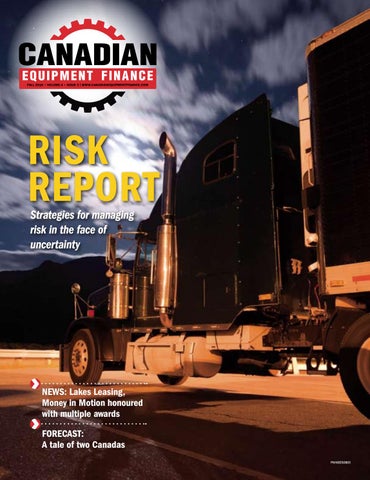
RISK REPORT Strategies for managing risk in the face of uncertainty
News: Lakes Leasing, Money in Motion honoured with multiple awards Forecast: A tale of two Canadas PM40050803
KEEP UP TO DATE AND INFORMED BY VISITING OUR WEBSITE DAILY. Canadian Equipment Finance magazine posts news, insights, updates and breaking stories as they happen. Stay Informed. Keep Ahead.
Visit us online at www.canadianequipmentfinance.com Canadian Equipment Finance is a Lloydmedia, Inc publication.
Lloydmedia also publishes Payments Business magazine, Canadian Treasurer magazine, Financial Operations magazine, Direct Marketing magazine and Contact Management magazine.
contents Fall 2016 Volume 4 Number 3 Publisher and Editor-in-Chief Steve Lloyd steve@canadianequipmentfinance.com Managing Editor Sarah O’Connor sarah@canadianequipmentfinance.com Creative Direction / Production Jennifer O’Neill jennifer@canadianequipmentfinance.com Photographer Gary Tannyan Advertising Sales Mark Henry mark@canadianequipmentfinance.com For subscription, circulation and change of address information, contact
subscriptions@canadianequipmentfinance.com
Publications Mail Agreement No. 40050803 Return undeliverable Canadian addresses to:
Circulation Department 302-137 Main Street North Markham ON L3P 1Y2 t: 905.201.6600 • f: 905.201.6601 info@canadianequipmentfinance.com www.canadianequipmentfinance.com Subscriptions available for $40.00 year or $60.00 two years. ©2016 Lloydmedia Inc. All rights reserved. The contents of this publication may not be reproduced by any means, in whole or in part, without the prior written consent of the publisher. Printed in Canada. Reprint permission requests to use materials published in Canadian Equipment Finance should be directed to the publisher.
NEWS »4
Considerations for small but growing businesses »13
Rising rates How interest rates may change the lending environment »16
Your Team
Lakes Leasing, Money in Motion honoured with multiple awards »8
Also Publishers of
Features
Currency planning
Best practices for using data to unify your sales and marketing departments »19
Events »20
Payments Business www.paymentsbusiness.ca Canadian Treasurer www.canadiantreasurer.com Contact Management www.contactmanagement.ca
Your BUsiness Direct Marketing www.dmn.ca Financial operations www.financialoperations.ca
Improve your debt collections tactics with real time data analytics and multichannel communications »10
FORECAST
A tale of two Canadas »22
Made possible with the support of the Ontario Media Development Corporation Ontario Interactive Digital Media Tax Credit
canadianequipmentfinance.com | Fall 2016 | CANADIAN EQUIPMENT FINANCE
3
News
Risks are rebalancing, but global economic activity remains weak: Scotiabank Economics’ Global Outlook TORONTO, ON -- Global economic activity remains weak. At roughly three per cent, 2016 represents the slowest year for global growth since the Great Financial Crisis. The reasons for this underperformance are now well known, though they vary by country. They generally involve the following elements: structural adjustments in many countries, efforts to reduce overcapacity in most, recurring natural disasters, repeated geopolitical events such as Brexit and upcoming national elections and potential policy changes in a number of major countries, including the United States. Despite this weak economic performance, there are tentative signs of a long-awaited investment recovery in the U.S. In addition, Chinese economic activity appears to be picking up following the weakness earlier in the year, oil prices have risen (a positive development for oil exporting countries like the United States and Canada) and the immediate impacts of Brexit have not been as pronounced as feared. “For the first time in a long
time, we are feeling more optimistic about our forecast, even though we have revised growth down for both Canada and the United States this year,” said Jean-François Perrault, senior vice president and chief economist at Scotiabank. “Taken together, the risks suggest a more balanced economic forecast.” Highlights of Scotiabank’s Global Outlook include: ◉◉ United Kingdom: Post-Brexit data for the UK suggest a much stronger economy than we had anticipated, but we remain of the view that Brexit will come with significant long-term costs for the UK economy. ◉◉ Europe: Eurozone growth will be above potential, at about 1.3 per cent in 2017 and 1.5 per cent in 2018. ◉◉ Canada: We expect growth to strengthen to an average of close to 2.0 per cent in 2017-18, supported by infrastructure spending, stronger exports and a gradual turnaround in oil & gas sector investment. B.C. and Ontario are expected to be the fastest growing
◉◉
◉◉
◉◉
◉◉
provinces next year. Alberta should come out of recession and grow by 2.1 per cent in 2017. United States: The stronger year-end hand-off, coupled with a further improvement in domestically generated spending, points to U.S. real GDP averaging a somewhat better 2.2 per cent rate in 2017. Latin America: A modest acceleration in economic activity is expected in the Pacific Alliance countries, reflecting higher prices for some commodities and stronger global growth. Asia: China is on track to meet the official real GDP growth target of at least 6.5 per cent y/y in 2016. Stimulus is supporting momentum in the short term, yet it is creating larger economic imbalances. Capital markets: We assume that the Federal Reserve raises rates at a moderate pace beginning with a 25 basis point hike in December. Scarcity of supply of tradeable fixed income instruments will get
worse in the medium term, moderating the impact of tightening U.S. monetary policy on the longer end of the yield curve. We expect Canadian government bond yields to remain below the U.S. ◉◉ Currency: We expect a 25bps Fed tightening in December to support the U.S. dollar (USD) and a further increase in U.S. rates to underpin broad gains well into 2017. We have lowered our British Pound to USD target to 1.20 for early 2017, but feel “overshoot” risks remain significant. ◉◉ Commodities: Accounting for faltering base-case fundamentals and the upside risk of an OPEC deal, we expect WTI prices to average $44/bbl in 2016 before gaining to $53 in 2017 and $57 in 2018. Metals are expected to find their bottom in 2016, though recovery dynamics between individual metals remain mixed. Read Scotiabank’s Global Outlook online at :http:// www.scotiabank.com/ca/ en/0,,3112,00.html
Axis Capital’s Mike Coon to serve as vice president for the NEFA board of directors GRAND ISLAND, Neb. -- Axis Capital, Inc. (Axis), one of the U.S.’s leading independent commercial equipment finance companies, is pleased to announce the company’s Vice President of Syndications Mike Coon has 4
been re-elected to serve on the National Equipment Finance Association’s (NEFA) board of directors for 2017. Mike will serve as vice president on the executive committee. NEFA is a highly regarded national association addressing the
CANADIAN EQUIPMENT FINANCE | Fall 2016 | canadianequipmentfinance.com
needs of small to mid-size independent equipment finance companies, lessors and brokers. “Mike is a respected industry veteran with a long-standing working relationship in the equipment finance industry,”
said NEFA Executive Director and CEO Gerry Egan. “Mike’s vast industry knowledge coupled with his can-do attitude makes him a great asset to NEFA and we are delighted that he has accepted this position on our Board of Directors.”
News Mike Coon said, “I am honoured to again be elected to the NEFA executive committee and look forward to continuing to help the association’s members succeed by encouraging best practices, and high standards of professional conduct while building solid and lasting relationships.” Axis is a nationally ranked top 10 independent equipment finance provider and a top 20 vendor channel origination company. The company’s leadership team is also extremely active and engaged on a continuing basis within the equipment finance industry.
National Funding extends use of Salesforce to continue driving growth SAN DIEGO -- National Funding, one of the largest private lenders of small business loans, has announced a three-year extension of its implementation of Salesforce. Since 2010, Salesforce Sales Cloud has been a key driver in National Funding’s rapid growth, helping the company achieve its position as one of the nation’s top 10 small business alternative lenders, according to deBanked Magazine. National Funding invests in technology that is nimble, flexible and scalable in order to respond to constantly changing customer needs and financial markets. The company first deployed Salesforce in 2010 and it quickly became a critical component of its technology. In 2016, National Funding signed a three-year extension to its rollout. “Salesforce has allowed our sales team to focus on understanding customer needs, educating them on the lending process and delivering the right loan solution,” said Geoff Howard, chief technology officer, National Funding. “The platform helps us seamlessly shift customers between digital and person-to-person interactions and deliver speed, simplicity and trust in our customer experience.” “The financial services industry is being disrupted by digital, social and mobile innovation,” said Rohit Mahna, GM of Financial Services, Salesforce. “We are thrilled that National Funding has chosen to extend its implementation of Salesforce and will continue to leverage the platform to meet the growing expectations of today’s digital clients.”
.com
LEAS
e
T EAM
canadianequipmentfinance.com | FALL 2016 | CANADIAN EQUIPMENT FINANCE
5
News
Equipment Leasing and Congratulations Jennifer Babe Finance Association’s Survey – CFLA Member of the Year 2016 of Economic Activity: Monthly Leasing and Finance Index September new business volume up 12 per cent year-over-year, 22 per cent month-tomonth and down four per cent year-to-date Washington, DC -- The Equipment Leasing and Finance Association’s (ELFA) Monthly Leasing and Finance Index (MLFI-25), which reports economic activity from 25 companies representing a cross section of the $1 trillion equipment finance sector, showed their overall new business volume for September was $9.4 billion, up 12 per cent year-over-year from new business volume in September 2015. Volume was up 22 per cent month-to-month from $7.7 billion in August. Year to date, cumulative new business volume decreased four per cent compared to 2015. Receivables over 30 days were 1.31 per cent, relatively unchanged from the previous month and up from 1.10 per cent in the same period in 2015. Charge-offs were 0.46 per cent, up from 0.44 per cent the previous month. Credit approvals totaled 76.6 per cent in September, down slightly from 76.9 per cent in August. Total headcount for equipment finance companies was up 3.8 per cent year over year. Separately, the Equipment Leasing & Finance Foundation’s Monthly Confidence Index (MCI-EFI) for October is 56.0, an increase from the September index of 53.8. ELFA President and CEO Ralph Petta said, “September new business volume was strong, showing the first double-digit increase in many months. Perhaps the Fed’s decision to keep interest rates low has contributed to this favourable environment for equipment investment by businesses. The uncertainty caused by the upcoming presidential election, which has acted as a drag on overall economic growth and low capital spending for most of this year, seems to have waned—at least in the short-term. It will be interesting to see if this scenario continues into the final quarter of 2016.” Stan Walker, managing director, JPMorgan Equipment Finance, said “the September MILFI-25 data reflected a nice bump in volume activity, although it’s yet to be seen if this is a trend or an anomaly. The lingering uncertainty around interest rate hikes and the upcoming presidential election have left many companies reluctant to move forward on capex spend, so this is definitely welcome news. Despite the unclear environment, our firm has seen strong volume growth for the year and our portfolio credit metrics remain solid. As we head through the fourth quarter there’s definite pent up demand for capital equipment investment, but given the unpredictable domestic environment along with the economic headwinds internationally we may continue to see this unevenness for several more months.” 6
CANADIAN EQUIPMENT FINANCE | Fall 2016 | canadianequipmentfinance.com
NIAGARA FALLS -- Last night, at the 2016 Annual Conference of the Canadian Finance & Leasing Association (CFLA), CFLA Chairman Tom Pundyk, president & CEO of National Leasing, announced the CFLA Member of the Year 2016: Jennifer Babe, partner in the law firm Miller Thomson LLP. This award recognizes members who work quietly for the association and are committed to its goals. “These members are wonderful examples of those who are pleased to give back to their industry,” said the CFLA Chairman. “Their generous efforts are a significant contribution to their association, to its members and to the industry as a whole.” “Most members look first and foremost to CFLA to advocate the views and support the interests of our industry with governments,” added Tom Pundyk. “This is inevitably a complex technical challenge. It is not enough to complain, we have to offer practical solutions. That is where our many professional supporters provide us with invaluable help.” Jennifer Babe has assisted CFLA on an important number of legal issues. But, remarked the CFLA Chairman, “her longstanding volunteer involvement in policy committees of the
Ontario and Canadian bar associations, her continuing participation on important government panels of experts tasked to improve the commercial law, have all put Jennifer Babe in a position to make sure our industry’s views are well heard and, more importantly, well understood.” Jennifer Babe is a Fellow of the American College of Commercial Finance Lawyers, past chair of the Canadian Bar Association’s national business section and the past chair of the Commercial Law Strategy Committee of the Uniform Law Conference of Canada. She is recognized in the 2016 and eight prior editions of the Lexpert Law Directory. She has been listed among the Best Lawyers in Canada, Equipment Finance Law, for the last three years. Each year, the Law Society of Upper Canada awards the Law Society Medal to selected lawyers who have given outstanding service within the profession. This year, Jennifer was one of the 10 recipients of Law Society Medal. As the Law Society said in its recognition of Jennifer, she “exemplifies leadership in the profession through her work with her clients, her teaching, her writing, pro bono legal services and community service.”
To send press announcements, please direct them to Sarah O’Connor, Managing Editor, at sarah@canadianequipmentfinance.com
News
White Clarke Group receives significant investment from Five Arrows Principal Investments LONDON -- Five Arrows Principal Investments, the corporate private equity business of Rothschild & Co, has made a significant equity investment in White Clarke Group, a fast-growing, global provider of specialist technology and software solutions to the automotive, asset and consumer finance markets. Having invested substantially in its innovative CALMS product range over the last few years, White Clarke Group has achieved considerable growth globally and has now reached a point where the business will benefit from greater scale to meet growing customer demand. At this inflexion point, Five Arrows Principal Investments will leverage its capabilities to support White Clarke Group in its transition into the next stage of growth. Five Arrows Principal Investments is part of broader
Rothschild & Co and has a focus on supporting software and technology platforms with recurring revenue streams underpinned by high customer satisfaction and retention rates. With more than 100 customers in over 30 countries, including some of the world’s most recognized brands, White Clarke Group has proved itself to be a world-class technology provider and is well-placed to take advantage of significant, global growth opportunities. As part of the transaction White Clarke Group has announced that Brendan Gleeson, currently executive vice president of the group, will take on the role of Group CEO. Ed White, currently president and CEO of the group, will transition into the role of Chairman. Commenting on today’s announcement, Brendan Gleeson, said: “Five Arrows
For breaking news and in-depth features, visit our website at
Principal Investments’ confidence in White Clarke Group and its CALMS product is a significant endorsement of our strategy and the way we have transformed the business over the last five years. The Rothschild & Co partnership will give us the platform we need to achieve the next phase of our growth strategy and help scale the business. I very much look forward to working with the leadership team to ensure White Clarke Group achieves its considerable potential. We will continue to invest in our people, our product and our customers to ensure this happens.” Commenting on today’s
announcement, Ed White, said: “With a strong executive leadership team and Brendan’s passion for this business, White Clarke Group is well-positioned to move to the next stage of its growth trajectory. I believe Five Arrows Principal Investments will be an ideal shareholder. Under their stewardship, the legacy of my late business partner, Dara Clarke, and myself—which bears both our names—will be protected and our business can move from strength to strength. I am very proud of what the people in our organization have achieved and grateful for our customers’ continued faith in us.”
Canadian Equipment Finance November-December issue JDR Solutions ad ¼ square (3.625” x 4.75”)
WORKLOAD TOO GREAT? IT’S TIME TO GO SHOPPING. You originate AND service leases. That’s a lot to do. If you think you can’t buy a break, think again. We’re your one-stop shop for portfolio management, Software as a Service, custom Web portals and professional services. Top-notch expertise that won’t leave you with sticker shock. The help you need is in stock. Contact us today.
www.canadianequipmentfinance.com
.com
jdrsolutions.com
855-863-7676 #ServiceSupportSuccess
canadianequipmentfinance.com | FALL 2016 | CANADIAN EQUIPMENT FINANCE
7
News
Lakes Leasing, Money in Motion honoured with multiple awards The Chisholm Family recognized for their business acumen and community service By Sarah O’Connor
his has been a banner year for the Chisholm family, owners of the Chisholm Family Trust whose companies include Money in Motion, a multi-million dollar equipment leasing origination group, and Lakes Leasing, a boutique equipment leasing company. Earlier this year Money in Motion was awarded the prestigious Chair’s Award at the 19th annual Bell Business Excellence Awards of the Sudbury Chamber of Commerce and then Lakes Leasing was ranked 60th in the annual PROFIT 500 ranking of Canada’s fastest growing businesses. Money In Motion (MiM) was the original company formed in 1989 by Alfred and Susan Chisholm. MiM has operated as one of Canada’s premier equipment finance intermediaries, placing clients financing needs with its syndicated lenders. Lakes Leasing (Lakes) was formed in 1991 to compliment the MiM business model by acting as one of MiMs funders carrying some of the leases and loans in house. In its infancy Lakes Leasing provided businesses throughout the North with commercial lending solutions to help them realize their longand short-term goals. Today, Lakes has roughly 11,000 customers nationwide with its head office still located in Sudbury Ontario. The two companies do not share employees but continue to work hand in hand to this day. “Although our group started in Northern Ontario and still operates its head office from this location we are truly a Canadian leasing group with clients across the country,” says Alfred. “We are and always have been clients first. We are in the relationship business first and the money lending business second. We have
T
8
been a consistent lender in the Canadian equipment lending space for over 27 years and during the ups and downs we have always been there for our clients.” Alfred and Susan’s children Kurtis and Erin have been working for the Chisholm Trust most of their lives and are now co-owners. They both hold key positions within the group with Kurtis involved in credit/marketing and Erin involved in the administrative functions.
The 60th fastest growing company in Canada “Companies become a part of the PROFIT 500 through innovative thinking, smart strategy and sheer grit,” says James Cowan, editor-in-chief of PROFIT and Canadian Business. “These firms demonstrate what Canadian entrepreneurs can achieve, both at home and across the globe.” Lakes Leasing was included in the list of the 500 fastest growing companies in Canada for the first time this year, ranking an impressive 60th. “Although we operate through Canada our original home was Sudbury and it is why it is still our head office to this day. We are very thankful that we have been able to bring our Northern Ontario mentality to a much wider audience,” says Alfred. “Having our head office [in Sudbury] has really been a plus versus a downfall to the business. Our partners and clients love our hands-on attitude and our relationship-first way of doing business. This has meant very long term relationships for us from both the supplier and client standpoint.” This success was built in part on economic hardships. When the financial recession in late-2008 into early-2009 hit, both U.S. and Canadian funders
CANADIAN EQUIPMENT FINANCE | Fall 2016 | canadianequipmentfinance.com
pulled out of the market, withdrawing their support of MiM and Lakes. This loss of funding was devastating for the Chisholm family, their employees and, most importantly, their clients. A majority of funders were crippled by these changes with core funding levels, and MiM and Lakes were left with a very small funding pool to service customers. Many might throw in the towel at this point and indeed many did but driven by the Northern mentality of strive and survive, the Chisholm family invested all of their personal resources and negotiated a much larger internal funding line with their bankers. Lakes ramped up to take on more business directly with clients to where MiM’s internal leasing company has now grown to be one of the larger independents in the country.
Special recognition for hometown heroes In our fast paced world of instant messaging, meaningful recognition is often hard to come by—being recognized for years of hard effort and community service even more so. Yet that was exactly the situation at the 19th annual Bell Business Excellence Awards of the Sudbury Chamber of Commerce when MiM received the prestigious Chair’s Award. Sponsored by the Greater Sudbury Development Corporation the Chair’s Award is the Bell Excellence Awards’ most prestigious honour. “These businesses are really the engine of the community,” said Debbi Nicholson, CEO of the Sudbury Chamber of Commerce. “They are the ones who take the risk and employ a lot of people in this community.” “This year’s award recipients represent
News
The Chishom family (from left to right): Todd McBain (Erin’s partner), Erin Chisholm (chief operating officer and Susan and Alfred’s daughter), Lisa Chisholm (Kurtis’s wife), Kurtis Chisholm (chief risk officer and Susan and Alfred’s son), Lindsay Showers (Susan and Alfred’s daughter), Susan Chisholm and Alfred Chisholm (president and CEO).
Alf and Susan Chisholm, co-founders of the companies.
the businesses and entrepreneurs that have built our community. They are visionary leaders and the reason why we continue to be inspired and see a bright future ahead,” says Karen Hourtovenko, Chair of the Board, Greater Sudbury Chamber of Commerce. “Business is the fabric of our community. These businesses and community leaders have really raised the standards when it comes to their ability to innovate, the quality of their products and services as well as their economic and community contributions. We need to keep recognizing these successes in our city,” adds Hourtovenko. Kurtis and Erin note that the company “has always been a strong supporter of our community here in Greater Sudbury. Our most recent venture and our most passionate has been our work for
pediatrics in Greater Sudbury.” “We were honoured to receive a Bell Excellence Award and we’re dedicated to continually striving for excellence with each and every transaction we make,” adds Kurtis. In May 2012, Kurtis’ newborn son was diagnosed with a rare genetic complex called Tuberous Sclerosis. After multiple trips to Toronto to Sick Kids Hospital, and seeing multiple families from the North, the Chisholm Family felt it was important to develop pediatric care and began to raise money towards a comfort room at Health Sciences North Pediatrics so that kids doing tests could feel more comfortable. In 2014 the raised $52,000 as part of the KICX for Kids campaign and since the launch of the NEO Kids foundation in 2015 have become proactive to make this a reality for the
children of Greater Sudbury. It’s an approach to business that has been with the company since its inception where Alfred and Susan envisioned a three-prong approach that included customer service to small businesses, work-life balance for employees and community involvement. It’s this focus on customers, on their clients, on people, that has and continues to allow the company to grow, in spite of the economy. “Our approach has become much more modern allowing people to work from home and on their schedules,” said Alfred. “We are building a new 9,000 sq. ft. facility at our head office in Sudbury. We have a great team of people and an absolute can-do attitude. We could not continue our success without the hard work of our employees and management teams.”
canadianequipmentfinance.com | Fall 2016 | CANADIAN EQUIPMENT FINANCE
9
Your business
Improve your debt collection tactics with real time data analytics and multichannel communication By Kevin Deveau
ver the past decade, technological, social and economic changes have had a profound impact on collections operations and organizations are being forced to adapt to the new environment in order to maximize recovered debt and revenues. Against this backdrop, companies, particularly those in hyper competitive industries like telecom and
O
10
banking, are simultaneously competing for share of debt payments and customer loyalty—including the loyalty of delinquent customers. While these changes present challenges, they also create opportunities to adopt collections approaches that are ultimately less costly and more effective. Innovative companies and their collections operations and partners are adopting intelligent, agile approaches to debt collection, using tools such as realtime data analytics and targeted customer
CANADIAN EQUIPMENT FINANCE | Fall 2016 | canadianequipmentfinance.com
communications, which can lead to higher contact rates, improved response frequency and faster repayments.
The changing debt collections landscape The role and focus of many debt collections organizations has changed considerably in recent years. Economic conditions and technology advances have forced many organizations collecting debt into a balancing act: Maximizing their returns from delinquent accounts
Your business while ensuring they maintain positive relationships and retention with customers, even while the collection process is in progress. Running parallel to this, a number of market and consumer dynamics have unleashed new challenges into the collections operations landscape. While economic conditions have continued to improve since the 2008 downturn, a recent report from Equifax revealed that Canadians are taking on more debt. This trend is particularly pronounced among the large consumer base that is Millennials—consumers aged 18 to 36—whose delinquency rate rose 12 per cent in the second quarter of 2016. Another factor complicating debt collection is evolving communications technology and the fragmentation of communication channels. For example, the move by consumers away from landlines and towards smart mobile devices makes it easier for consumers to avoid taking calls from collectors or to change their contact information. Collectors who do not maintain an ongoing relationship with delinquent and non-delinquent customers alike risk losing their up-to-date information in the rapidly changing telecommunication landscape. Furthermore, changing consumer preferences and attitudes toward debt have undercut previous best-practice wisdom. People are taking on more debt and have become more casual about repayment; yet at the same time they want more control over the payment and collections process, while expecting better service and flexibility from creditors. Traditional collection tactics, like repeated letters, harassing phone calls and one-size-fits-all SMS blasts, have become outdated and unproductive in the new landscape and can turn off customers who now expect a more convenient and personable approach.
it has never been easier to contact customers, with a number of new avenues to efficiently reach those with outstanding payments. The mass SMS blasts some creditors send every few days to all delinquent customers are not effective. It is important for debt collectors to use specific communication so the
customer feels like they are being treated individually. In many cases, without the right technology in place, the creditor has no perception as to whether these one-way outbound messages were even delivered to a valid number. FICO’s research indicates that customers actually prefer to deal with well-targeted automated communications
Intelligent and targeted debt collection communication The good news is that many of these challenges can be turned into opportunities that maximize collections success, contact agent efficiency and a positive customer experience. In particular, the explosion of mobile devices and internet technologies means canadianequipmentfinance.com | Fall 2016 | CANADIAN EQUIPMENT FINANCE
11
Your Business rather than live agents when it comes to their debt management, because it saves them the embarrassment of discussing their debt and gives them more control over their repayment plan. Tailored, automated contact also enables personal, secure and convenient self-service options for making a payment or even negotiating a payment plan. In fact, a recent survey conducted by a global digital engagement solutions software company shows mobile payment systems using two-way SMS communication resulted in a 78 per cent rate of repayment within 48 hours of receiving a payment-due alert, compared to 26 per cent achieved with traditional collection methods.
12
Maximizing collections performance and repayment through realtime data analytics Intelligent, agile multichannel communication is becoming increasingly important to collections organizations, as they look to leverage the gains in efficiency and success that can come from digital channels. The most effective platforms in today’s landscape are those which enable intelligent, automated, twoway communications for collections teams to reach out to customers in real-time, through voice, SMS, mobile applications and email. The future success of the collections organization and
CANADIAN EQUIPMENT FINANCE | Fall 2016 | canadianequipmentfinance.com
their ability to execute in the new environment is going to increasingly depend on how they manage, process and analyze their data. Data analytics software tools provide a wealth of valuable information on debtor profiles and are enabling collection teams to work smarter by identifying and prioritizing those with the strongest likelihood of short- or medium-term payment returns. They also facilitate broad access to data, including real-time updates, which enable collectors to track individual customer behaviour and preferences and to connect with customers over the right channel—whether via mobile application or voice, the most effective combination of communications channels and methods, tone and frequency are identified and utilized. Using these systems, the analytics directing each decision receive real-time data, so any customer contact is recorded instantly and customer-specific information is retained. The system recognizes positive contact from a customer and prevents further contact in the following days. Moreover, a customer who makes a payment via a web portal will not receive a collections call to their mobile 10 minutes later. In addition, because automated systems work 24/7 and cover all channels, there are no hitches when customers are contacted through one channel and respond via another, because the system can track all account activity. It can even recognize and record a customer’s preferred contact channel to tailor
future communication or track customer-specific information such as a disability, making future contact easier. Using customer information stored in the system, a company’s debt management platform decides every customer journey. For example, if a customer is flagged as a low risk, they would be sent a reminder letter and not receive a serious call. Leading companies and contact centres are also using analytics software to measure and improve the performance of their agents. FICO’s Engagement Analyzer tool provides real-time analysis of an agent’s conversation with a client and helps management understand the level of performance and identify where improvements can be made—and is able to help to boost agent productivity by at least 20 per cent. Organizations and their partners must rethink their debt collection communication strategies if they want to stay relevant and effective in a changing consumer and telecommunications environment. Treating debt like a personal problem and tailoring collection efforts to individual customers through integrated analytics are both key strategies for optimizing communication and maintaining customer loyalty without overlooking service in favour of debt collection. Kevin Deveau is vice president and managing director, Canada, at FICO. He is responsible for growing FICO’s Canadian market share and strengthening client relationships. FICO is a leading analytics software company, helping businesses in 90+ countries make better decisions that drive higher levels of growth, profitability and customer satisfaction.
Feature
Currency planning Considerations for small but growing businesses By Dave Dominy
t is an exciting time to be a small business owner in Canada. Global expansion and export levels are at an all-time high, with a recent McKinsey Global survey indicating that cross border electronic payments constitute 81 per cent of all payment flows worldwide. Evidently, the ideology that business size dictates global reach is obsolete. In fact, 54 per cent of business owners in Canada are planning to export to new markets over the next two years. For all of its opportunities, participation on a global scale carries inherent and unavoidable financial risks. One of these being in the impact of currency exchange on a small business’ bottom line. The fluctuation of global currencies is inevitable, thus, it is more important than ever for small businesses to plan ahead for their currency exchange and global payment needs in order to retain reach and autonomy on a global scale. Despite their growth, many small businesses are often too busy or lack the in-house expertise to properly plan for currency risks and volatility. All sorts of economic, political and emotional factors can impact the currency market. Key drivers can be from interest rates decisions, GDP, trade balances, unemployment rates, crude oil inventories and other commodities to unexpected events like Alberta forest fires and Brexit. Adequately monitoring the international market for all factors influencing rate changes would require a full time resource. Business owners, finance teams and controllers are often too busy to take this on, being focused on the operational and managerial matters of running a successful business. Fortunately, small businesses can eliminate the uncertainty of going global in partnership with currency specialists who understand and
I
anticipate trends that can influence currency rates, recognize the challenges that small businesses face when
expanding globally, provide competitive rates, and most importantly, can provide strategic counsel on how to
Dealing witth insurrance shouldn’t seem like eating broccoli.
We love broccoli.
‘
Specialty Servings: SLV Gap Insurance • Residual Value Insurance • Revenue-Generating Programs
Get a taste of working with Great American to handle your equipment insurance needs. We’ll make it easy for you to: • Protect assets • Expedite funding • Earn additional income • Maintain a healthy portfolio
www.GAIG.com/EquipmentInsurance
To learn more, contact us at 866-676-5677 or equipmentinsurance@gaig.com
Canadian Branch Head Office Scotia Plaza, Suite 2100, 40 King Street West Toronto, ON M5H 3C2
Policies are underwritten by Great American Insurance Company – Canadian Branch, a foreign registered insurer in all Canadian provinces and territories. ©2015 Great American Insurance Company.
canadianequipmentfinance.com | Fall 2016 | CANADIAN EQUIPMENT FINANCE
13
Feature mitigate potential monetary losses due to currency volatility. Currency experts allow business owners to make informed decisions about when to act by anticipating and planning ahead of market movement.
Why hedge currency? While some businesses are already making transactions in other currencies to expand their presence globally, small businesses often feel they do not get a competitive exchange rate when dealing with the cross border electronic payments that have become the global norm. The sheer number of options in the market can be overwhelming and many businesses explore just a single option. This often leads to noncompetitive rates, missed opportunities and potential financial loss. Partnering with a currency specialist organization with hedging expertise that monitors large scale events, global trends and factors on a daily basis is
a good move for any small business. Currency specialists, like FIRMA Foreign Exchange, provide businesses with the solutions needed to navigate currency markets and make strategic decisions on when to lock in currency rates that work best for them before anticipated global events occur. For example, after Britain voted to leave the European Union, the price of the British Pound dropped significantly, by as much as 11 per cent. Businesses exporting to the UK that had not planned for or anticipated the results of the vote lost millions of dollars in revenue due to the influence it had on the currency. Closer to home, the Fort McMurray forest fires had negative consequences not only on the residents of the town but also on the value of the Canadian dollar. Having a plan in place to lock in at a desired rate with a currency expert mitigates the risk of unnecessarily lost capital due to unexpected events.
ERS OK D BR ANTE W
PROUDLY CANADIAN SINCE 1981 MEMBER OF THE CFLA
Specializing in New & Used Manufacturing & Construction Equipment
Advant Leasing is an independent family owned business that has participated in the Canadian Commercial and Industrial Lease Industry for over 35 years. We specialize in assisting all types of businesses to acquire the specialized commercial equipment required to be productive and grow their business.
NEW BROKERS WELCOME • Fast approvals • Flexible terms • Start-ups accepted
• Decisions made in house/no securitization • Customized financing solutions • Small business specialists
Get started today with Advant, helping you grow with the tools that you’ll need.
Please contact Jason Bonneville • jason@advantleasing.com 905-335-3301 ext 224 • www.advantleasing.com 14
CANADIAN EQUIPMENT FINANCE | Fall 2016 | canadianequipmentfinance.com
Sixty-one per cent of Canadian small businesses report the fluctuating value of the Canadian dollar had a significant impact on export sales. Considering 95 per cent of those same business owners expect export sales to increase over the next six months, a fluctuation, no matter how slight, has immediate and longlasting impacts on finances.
Forward contracts A forward contract enables businesses to protect their future service commitments and mitigate the uncertainty associated with fluctuating markets by locking in today’s rates. By utilizing this option, businesses add certainty knowing that their global transactions only occur at the time and rate that they have agreed upon. In the Brexit example, a business could have locked in the value of the Pound’s rate through a forward contract at a price of $1.48 CAD before it fell by as much as 11 per cent in a matter of hours.
Spot orders Another option is a spot order. This allows businesses to buy funds now for immediate settlement. A foreign exchange company, like FIRMA, follows currency movements and works with businesses to find the rate at which they would like to make a purchase. Once that rate is reached, FIRMA then purchases and delivers their funds to where they are needed. Each of these hedging strategies can offer businesses a path to more business certainty. Just as important as the hedging strategies is working with a specialist firm to make it happen. With limited in-house resources coupled with the daunting task of managing day-today operations, small and medium sized businesses should consider these various currency planning options with the help of an expert that can provide strategic guidance on the right decision. Dave Dominy is the chief executive officer of FIRMA Foreign Exchange Ltd., a highly specialized currency and payments solutions provider to small and mid-sized businesses. Firma’s solutions are simple, one-on-one, and optimize client’s time and resources to take the uncertainty out of currency exchange and global payments. Firma believes business across borders can be less complicated.
Do you want to reach executives who make key decisions about financing and leasing for their companies?
Sign up NOW for a free subscription to Canadian Equipment Finance magazine. Visit our website at www.canadianequipmentfinance.com and learn more about the magazine Canadian Equipment Finance is a Lloydmedia, Inc publication. Lloydmedia also publishes Financial Operations magazine, Canadian Treasurer magazine, Payments Business magazine, Direct Marketing magazine and Contact Management magazine.
Feature
Rising rates How interest rate increases may change the lending environment By Jason Wang
here have been many discussions about whether Canadians have taken on too much consumer debt. Indeed, compared to the year before, as of the second quarter of 2016, credit cards, auto loans and installment loans saw balance increases of 4.7 per cent, 2.2 per cent and 2.7 per cent, respectively, all at a pace that is faster than GDP growth or inflation. One reason why Canadian consumers continue to borrow may be low interest rates, which reduces the cost of servicing debt; however, this raises the concern that when interest rates rise and monthly debt payment amounts increase, consumers may have difficulty in managing these higher payments. By analyzing how ready Canadians are for a rate increase, we can gather important insights into the scope and magnitude of the impact on consumers—how many Canadians may be impacted and how large could that impact be.
T
Who is exposed to a rate increase Not all loan products are created equal. Some have a fixed rate—think of an auto loan or an installment loan with a hypothetical fixed rate of 2.9 per cent for the duration of the loan. Throughout the full repayment period, the required payment will be a set amount each repayment period—monthly, biweekly or other. Consequently, when 16
policymakers increase interest rates, consumers who hold these fixed-rate loan types will not be impacted. Then there are the variable-rate loans, such as variable-rate mortgages and the majority of lines of credit. The interest rates on these loans fluctuate over time and are typically structured as “Prime plus a spread,” in which the Prime rate—currently standing at 2.7 per cent—generally moves in lockstep with the Bank of Canada Target Overnight Interest Rate, which is currently 0.5 per cent. When the Bank of Canada implements a rate hike, the Prime rate will increase, pushing up the effective interest rates on these loans. By investigating the anonymized credit files of all credit active consumers in Canada—26 million in total—we found that 27 per cent have a line of credit account or a variable-rate mortgage or both. In other words, approximately seven million consumers are exposed to potential impact from rate increases. This study refers to these consumers as the “exposed population.”
How big the payment shock could be When interest rates on variable-rate loans increase, the increase in periodic payment amounts for the consumer is referred to as a payment shock. Conceptually, calculating the amount of a payment shock is simple—multiplying the variablerate debt balances by the level of the interest rate increases. If the variable-rate
CANADIAN EQUIPMENT FINANCE | Fall 2016 | canadianequipmentfinance.com
balance is $10,000 and the rate rises by one percentage point, that translates to an annual increase of debt repayment obligations of $100. Divide by 12, and you get the monthly payment shock. Fortunately for the majority of Canadians, we estimate that the payment shock is not much of a shock. Under a 0.25-point interest rate increase, 56 per cent of the exposed population have a monthly payment shock of less than $10. For the exposed population overall, the median payment shock is only seven dollars. Only 15 per cent of that population face a monthly payment shock of $50 or more. When we simulated the impact of larger rate hikes—namely 0.5-point and one-point increases—30 per cent and 40 per cent of exposed consumers, respectively, would be dealt a payment shock of $50 or more.
How much payment shock can tip someone over The size of the monthly payment shock is only one side of the equation. For some, a $50 increase in their obligations may easily be managed by forsaking a couple of restaurant dinners a month, while for others, this may mean they are not able to fill their gas tank to get to work. Therefore, we need the other side of the equation: comparing the payment shock with consumers’ current cash flow. Trended data now available to lenders on consumer credit files provide the ability to assess consumers’ available
Feature Illustration of monthly CtA calculation Excess payments
Payment shock
CtA
Consumer 1
$1,000
$300
$700
Consumer 2
$100
$300
-$200
Number of consumers (in thousands) whose cash flows may not be enough to offset a payment shock Risk segment (score)
0.25-point interest rate increase
One-point interest rate increase
Super Prime (830–899)
239
298
Prime Plus (780–829)
112
163
Prime (700–779)
134
193
Near Prime (600–699)
132
184
Subprime (300–599)
101
133
Total
718
971
cash flow based on how much they are paying each month above the minimum due amounts on their debt obligations. A consumer with required minimum monthly credit card payments of $100 who is actually making payments of $400 may have $300 of excess cash flow that she could redirect to offset the payment shock. This insight enables the comparison between payment shock amount and a consumer’s available cash flow. We define a person’s capacity to absorb (CtA) as the difference between excess payments on loans and the size of the payment shock—calculated on a monthly basis: CtA = Excess Payment Amounts – Payment Shock As you can see in the accompanying “Illustration of monthly CtA calculation” chart, two consumers can have the same payment shock amount but may have different capacities to absorb that shock, simply because of different cash flow situations to begin with. In the case of the second consumer shown above, CtA is negative, meaning this consumer would have challenges meeting the increased debt repayment requirements. For each anonymized individual in
the exposed population defined above, we calculated his or her CtA amount using this method and found that with a 0.25-point interest rate increase, 718,000 consumers might have difficulty absorbing the payment shock. An additional 253,000 consumers might not be able to absorb the shock if the rate were to rise by a full percentage point. Among these consumers, more than 650,000 with strong credit—those whose credit scores are prime or better—may have difficulty absorbing such a payment shock.
What this means to lenders This is especially compelling news for lenders as hundreds of thousands of borrowers currently believed to be lower risk may suddenly become risky with an increase in interest rates and payment obligations. While lenders normally expect subprime consumers to be riskier, this potential change in the risk profiles of prime or better consumers may come as an unpleasant surprise. These findings are simulation results and reality might turn out to be somewhat different. First of all, cash flow based on credit files is a conservative
measurement and does not take into consideration potential savings or other sources of cash the consumers could draw on to help mitigate the payment shock. In addition, rate increases typically happen during “good times” when the economy is expanding, which usually benefits consumers’ cash flow through improved employment prospects and earnings. Finally, even though we identify nearly one million consumers who might struggle under a one-point rate hike, rate increases generally occur in 0.25-point increments; it could take a number of quarters to reach a one-point rate increase, giving consumers and lenders more time to adjust and adapt. Nevertheless, lenders may benefit from evaluating their own portfolios in a similar manner to determine who among their customers might be vulnerable to a payment shock and work with those customers to ensure their accounts remain in good standing. Jason Wang is the director of research and consulting for TransUnion, where he is responsible for leading research projects and industry analysis in Canada. Prior to joining TransUnion, Wang held management roles at American Express, CIBC and Citigroup. Jason received his MBA from New York University and his Bachelor degree in Physics from Peking University. He is a CFA charter holder.
canadianequipmentfinance.com | Fall 2016 | CANADIAN EQUIPMENT FINANCE
17
Your Team
Best practices for using data to unify your sales and marketing departments By Sharmin Kent
nterprise companies have come to rely on sales and marketing to drive innovation across organizations, which has compelled the two departments to work together more closely than ever before. Because sales and marketing teams haven’t always seen eye to eye, however, efforts to align them are often complicated. Aligning sales and marketing teams isn’t easy. But when those disjointed efforts are connected by data and clear communication at the leadership level, companies of any size can build a consistent and reliable sales process, as well as craft a better customer experience. These two outcomes can result in a faster sales cycle, more closed deals and longer customer relationships.
E
Why data has become the unifier between sales and marketing Despite the robust marketing technology market and the rapidly growing sales technology space, the gaps between sales and marketing systems remain. 18
It’s a reality that creates friction in the buying experience, contributes to an inconsistent and inefficient sales process and costs companies deals. Those gaps don’t just impact sales; they impact marketing as well. With marketers being saddled with the responsibilities of sales, tech or even finance executives, the traditional attributes of marketers—creativity, ability to craft and identify trends—are stifled. It’s a problem for creatives whose core job functions are being crowded out by more administrative tasks. Marketers don’t want to be told how to think or how to use marketing technology. According to Sean Brady, president of the Americas for marketing company Emarsys, larger companies need to take the lead in disrupting sales and marketing tech. “There’s going to be disruption,” he said. “You have these big companies that were not marketing-focused to begin with acquiring marketing technologies. But they expect the marketing customers to engage with them the same way the rest
CANADIAN EQUIPMENT FINANCE | Fall 2016 | canadianequipmentfinance.com
of their portfolio engages with them.” A positive customer experience begins with the team members who serve those customers—that means providing departments with overall guidelines but allowing for autonomy as well. Sales and marketing teams must also align their goals to ensure all viable opportunities in a pipeline are pursued both aggressively and consistently. Leveraging marketing and sales data can enable sales leaders to broaden their view of the sales pipeline and gain insight into every aspect of the process, from highlevel team progress to individual team member and deal progress. Applying data-driven knowledge can also help craft marketing content and messaging to attract the right buyers at the right time.
Using data to influence the customer experience As customer experience continues to become the centre of the sales process, the efforts of an aligned sales and marketing team are more important than ever. When sales and marketing employ
Your Team data to help them personalize customer experience throughout the sales cycle, a company’s efforts are more effective. According to a recent Forrester study, marketing automation software contributes 44 per cent of the sales pipeline via marketing programs, compared to 34 per cent from companies without it. If a company’s sales tech stack isn’t optimized to accommodate and leverage data from its marketing tech stack, the existing gaps between sales and marketing will only widen. Investing in tech and processes that use prospect data gives sales and marketing teams the power to deliver value with every interaction. Marketing automation software does more than just bridge the gap between demand generation and the handoff to sales; it offers valuable information that enables marketers to guide buyers—and the salespeople who serve them—further into the sales process. Benchmarking performance across shared sales and marketing metrics also
ensures that the overall sales process is both effective and efficient.
Using customer intelligence to help guide departments Although data will ultimately serve as the glue that holds sales and marketing together, it’s customer intelligence that will help the two teams work together seamlessly. Using prospect and customer data to inform companies on customer behavior makes it easier to personalize the sales and post-sale process and build long-term customer loyalty. But consistency is key: making customer intelligence an integral element of a sales and marketing platform is critical. Another purpose of using data and technology in sales and marketing is to help companies forecast the benefits of spending revenue. When determining which tech to choose, sales and marketing leaders must work together to answer the following questions: How do our customers engage with our products and on which platforms?
◉◉ Should advertising budget be moved to customer growth and retention? ◉◉ Which customers are spending, and how are they spending? How can we get our existing customers to move to the next level of monetary value? Answering these questions allows sales and marketing leaders to create a shared roadmap that guides both prospect efforts and the target buyer journey. While the battle between sales and marketing persists, engaging leadership in both teams and using data and analytics to create a common sales and marketing process will make it easier for team members to adopt the technology and techniques necessary to exceed customer expectations. It’s up to sales and marketing to work together and improve customer experience—that’s the most effective way to maintain a healthy business. Sharmin Kent is the content and communications manager at TinderBox. Find her on Twitter at @STMKent.
canadianequipmentfinance.com | Fall 2016 | CANADIAN EQUIPMENT FINANCE
19
EVENTS
WHERE TO GO. WHAT TO SEE. Find out more about the conferences, exhibitions, seminars and meetings in your industry
2016 February 21-22 Equipment Leasing & Finance Association ELFA Equipment Management Conference Scottsdale, AZ www.elfaonline.org
February 28-March 2 IMN (Information Management Network) ABS Vegas 2015 Last Vegas, NV www.imn.org
March 2016 TBA National Heavy Equipment Show (NHES) Toronto, ON www.nhes.ca
March 2-4 National Equipment Finance Association NEFA 2016 National Equipment Finance Summit New Orleans, LA www.nefassociation.org
March 6-8 Equipment Leasing & Finance Association ELFA Executive Roundtable Coral Gables, FL www.elfaonline.org
March 22 Equipment Leasing & Finance Association 14th Annual IMN/ELFA Investors Conference New York, NY www.elfaonline.org
March 29-31
May 18-19
20TH Annual AFSA Vehicle Finance Conference & Exposition Las Vegas, NV www.vehiclefinanceconference.com
Equipment Leasing & Finance Association ELFA Capitol Connections Washington, D.C. www.elfaonline.org
April 13-16 Factoring Association 22nd Annual Factoring Conference Scottsdale, AZ www.factoring.org
April 19-21 Equipment Leasing & Finance Association National Funding Conference Chicago, IL www.elfaonline.org
April 28-30 Nat’l Assoc of Equip Leasing Brokers NAELB 2016 Annual Conference Las Vegas, NV www.naelb.org
May 1-3 Equipment Leasing & Finance Association ELFA Legal Forum San Francisco, CA www.elfaonline.org
May 4-6 Equipment Leasing & Finance Association Public Sector Finance Forum Charlotte, NC www.elfaonline.org
May 12-13 FC Business Intelligence Analytics for Insurance Canada Summit Toronto, ON www.fc-bi.com
June 5-7 Equipment Leasing & Finance Association ELFA Credit & Collections Management Conference Denver, CO www.elfaonline.org
September 12-14 Equipment Leasing & Finance Association ELFA Operations & Technology Conference Baltimore, MD www.elfaonline.org
September 12-14 Equipment Leasing & Finance Association Lease & Finance Accountants Conference Baltimore, MD www.elfaonline.org
September 21-23 Canadian Finance & Leasing Association CLFA Annual Conference 2016 Niagara Fall, ON www.cfla-acfl.ca
October 23-25 Equipment Leasing & Finance Association ELFA 55th Annual Convention Palm Desert, CA www.elfaonline.org
Visit us online www.canadianequipmentfinance.com/events.html 20
CANADIAN EQUIPMENT FINANCE | Fall 2016 | canadianequipmentfinance.com
vendor directory Providing practical and cost-effective legal services to the Equipment Finance Industry for 20+ years
National Appraisal Services FAST. ACCURATE. COST EFFECTIVE.
877.463.8241 www.verusvaluations.com
905.940.8700 • 1.866.508.8700 • wvllp.ca
Northstar takes pride in offering fast approvals, competitive rates, and flexible terms, coupled with friendly, personal service. Please contact Bruce Collingwood or Wayne Gray at 705-737-5595 or toll free 1-888-678-2701. www.nstarleasing.com
Since 1983, Northstar Leasing Corporation has been meeting the needs of our business clients and Broker network across Canada.
ÂĄÂŒÂ’Â“Â? ŽŠ£“š‘ ÂœÂĄÂ?ÂœÂĄÂŠÂ¤Â“ÂœÂš
ÂŞÂŞÂŞá€”ÂœÂĄÂŒÂ’Â“Â?Â—ÂŽÂŠÂŁÂ“ÂšÂ‘á€”ÂŒÂœÂ˜ á šá€–á‚€á ˝á ˝á€–á żá šá şá€–á ťá‚€á şá‚€
CMS PRINTING SERVICE. For all your printing needs. Call 416-755-7761 ext. 227 mdavid@completemailing.com
At the core of your business
• Equipment, Vehicle, Any Asset Leasing • Business First™ Solutions • Simple or Complicated Let’s talk about your leasing software needs. 888-747-RYZN (7996) | info@ryzn.com | www.ryzn.com
NEW LOWER PRICING!!!
Get your ad on this page for as little as $185 per issue for all of 2016
Vendor Directory Advertising call Mark Henry at 905-201-6600 x 223 or email mark@canadianequipmentfinance.com canadianequipmentfinance.com | Fall 2016 | CANADIAN EQUIPMENT FINANCE
21
Forecast
A tale of two Canadas By Gordon Onley
aking economic predictions sometimes seems a bit like looking into crystal ball. While it is easy to criticize, I would suggest the job of an economist is not an easy one. There are innumerable variables that can impact economic performance, any of which can render previous predictions useless. For example: in July the International Monetary Fund (IMF) predicted Canada would become the second fastest growing economy in the G7 in 2017, behind only the U.S. Then, just few months later they had backed away from that position. Similarly last year the Bank of Canada’s (BOC) robust projections for the Canadian economy caused our major banks to project interest rate hikes of anywhere from 75 bps to 125 bps in 2016. Although making economic predictions is an imperfect science, we still rely upon these predictions to point us in the right direction. In the equipment financing sector we often look the Bank of Canada’s benchmark overnight interest rate as being a good leading indicator of both the cost of borrowing and general economic performance for the country. With our broader economic performance being just average the BOC’s rate has remained at 0.5 per cent throughout 2016. Looking forward to 2017, Canada’s growth is expected to remain modest so we should see the Bank rate stay at 0.5 per cent. This is good news for the cost of borrowing, but the potential volume of new business may be limited; however,
M
22
when we break down the numbers by province, opportunities appear.
Canada’s provinces—the good British Columbia’s economic run as the fastest-growing province will continue in 2017, with a projected growth rate of three per cent. Oil, gas and mining will still be in recovery mode, but forestry, construction and transportation will remain strong. Vancouver’s real estate market continues to defy reason, but it is hoped that the new 15 per cent tax on foreign real estate investors with allow their real estate bubble to deflate a bit, rather than burst. Agriculture-dependant Manitoba will increase growth to 2.6 per cent in 2017. In addition to agriculture, the services sector will lead the way. While to the east Prince Edward Island, Canada’s smallest province, will see the best results of any in the Maritimes. Manufacturing, tourism and housing will help P.E.I. see one per cent growth 2017. Ontario’s economy continues to chug along. Being closely tied to U.S. consumer demand and the U.S dollar, Ontario has seen unemployment return to pre-recession levels. With projected growth of 2.5 per cent, Ontario plans to eliminate its deficit in 2017. Similarly Quebec’s economy will also benefit from increased exports to the United States. La belle province should also see good growth numbers around the two per cent range in 2017.
Canada’s provinces—the not so good Alberta is the province everyone is watching. With oil dropping below $30 per
CANADIAN EQUIPMENT FINANCE | Fall 2016 | canadianequipmentfinance.com
barrel earlier in the year, Alberta’s economy contracted by two per cent in 2016 and unemployment hit a 20-year high. The Alberta government is predicting “a modest recovery” in 2017, supported by reconstruction in Fort McMurray and a rebound in oil production. The Fort McMurray fire, though devastating, will ironically help push Alberta back into positive growth numbers in 2017. Saskatchewan’s agricultural sector is growing but, like Alberta, it depends on natural resources. In addition to oil and gas, the province’s mining sector has been hit hard by low commodity prices. With a recovery in commodities the province could grow by one per cent next year. New Brunswick and Newfoundland and Labrador both experienced stagnant growth this year, with New Brunswick economy contracting by 0.4 per cent. A rebound in commodities will help New Brunswick’s mining sector and will increase Newfoundland’s royalties from offshore oil. Even with these challenges the outlook for 2017 is mainly positive. Let’s not forget that we continue to enjoy a very low interest rate environment and liquidity is good. A modest rebound in commodity prices coupled with postelection growth in the U.S. economy should translate into a good 2017. Gordon Onley is based in Calgary and is business development officer, Western Canada for J D Factors Ltd. J D Factors is one of the fastest growing financial firms in North America, with 15 offices in Canada and the U.S. J D Factors provides non-recourse invoice factoring and accounts receivable management services.
Reach marketers & financial executives Our magazines are must-reads for key executives in core corporate competencies.
Can you help our readers: • Create a strong financial structure and healthy economic ecosystem to ensure capital and cash flow keep their engines running? • Determine who their customers should be, how they can reach them most effectively, and how they can turn data-driven marketing into profitable sales? • Build efficient and effective financial systems to enhance payments and billings between their companies and their customers and vendors? • Convert all the data and information they collect from every contact point into tangible benefits that increase revenue and reduce costs? • Equip their companies with the tools, technology, systems and hardware needed to manage their operations, to create new services or products, and deliver them to their market? • Manage their customers with smoothly functioning support departments that are properly staffed and equipped to solve problems, foster loyalty and retain customers? • Make any or every step in that chain better, faster, cheaper, and more profitable?
We can help you tap into the ecosystem at the points that will drive your campaigns. To advertise or get more information and media kits:
905-201-6600 | 1-800-668-1838 | 302-137 Main Street North, Markham ON L3P 1Y2 Visit our websites:
Direct Marketing magazine, www.dmn.ca Contact Management magazine, www.contactmanagement.ca Payments Business magazine, www.paymentsbusiness.ca
Canadian Treasurer magazine, www.canadiantreasurer.com Canadian Equipment Finance magazine, www.canadianequipmentfinance.com Financial Operations magazine, www.financialoperations.ca.
Spe cia lty • Co • Aut om • Re SLV G verag atic sid ap es
and ual V Insu In Volu alue ranc clud e: e nta ry P Insura rop nce erty Insu ran ce
Protecting your assets while building your business. It’s All About Balance.
For equipment leasing and finance businesses, it’s a tough job balancing between mitigating exposure and taking calculated risk. Tip the scale in your favor by choosing an insurance option to help customers easily fulfill their insurance requirement, expedite the funding process, and provide you additional revenue. And choose one of our solutions to assist you in maintaining a healthy portfolio. To learn more, contact us at 866-676-5677 or equipmentinsurance@gaig.com
www.GAIG.com/EquipmentInsurance Canadian Branch Head Office Scotia Plaza, Suite 2100, 40 King Street West Toronto, ON M5H 3C2
Policies are underwritten by Great American Insurance Company – Canadian Branch, a foreign registered insurer in all Canadian provinces and territories.