Knowing trees, I understand the meaning of patience
For thousands of years, humanity has walked against uncertainty.
We have formed communities near and far.
We have lived off the land, and found our own way through the world.
We have sailed the seas, and sat beneath the stars.
Through our oldest habits and our newest journeys, our stories of persistence are as old as time.
FAIR WINDS
A floating community beyond conventional life
by Lilou Vanderheyden
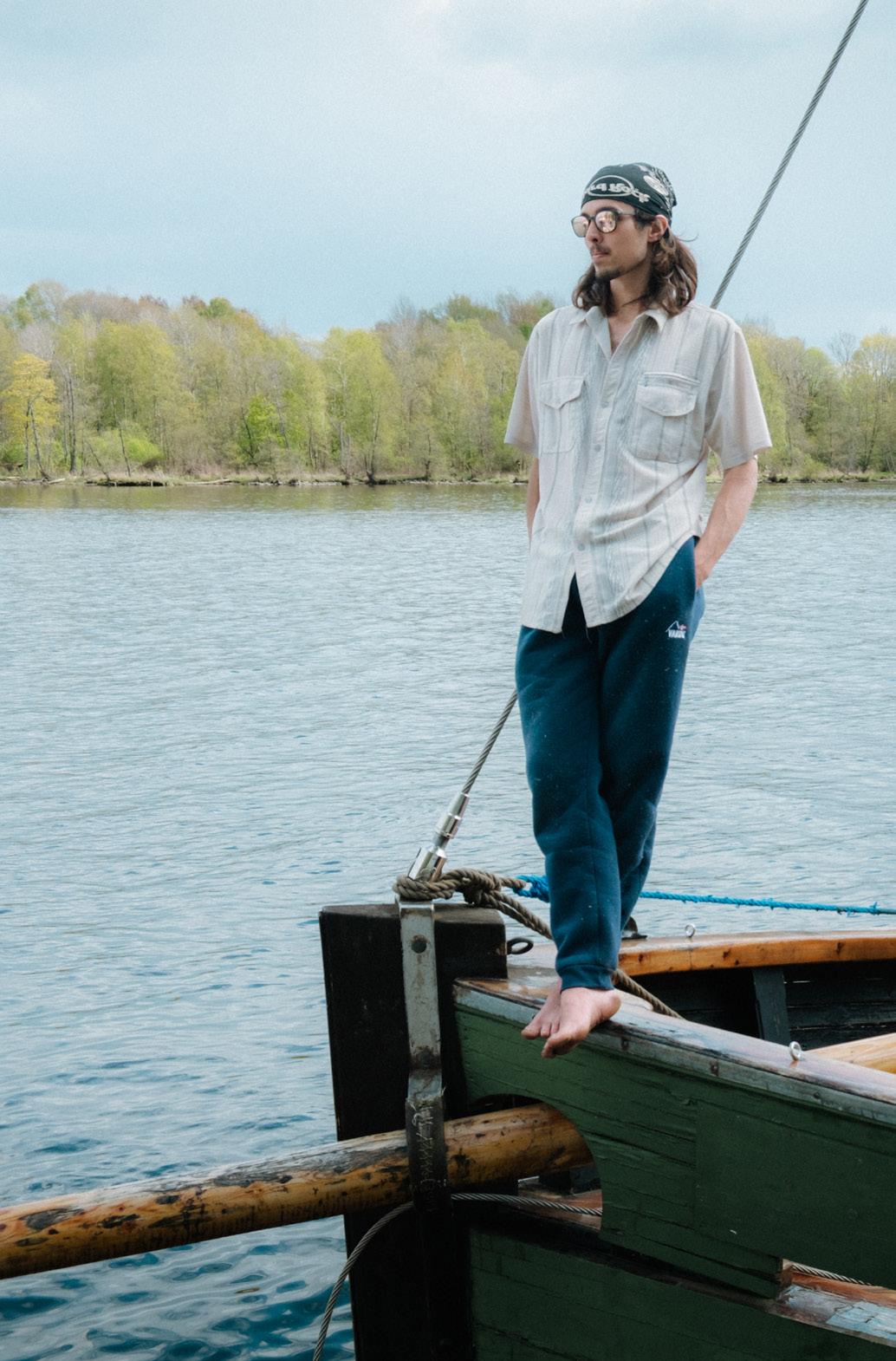
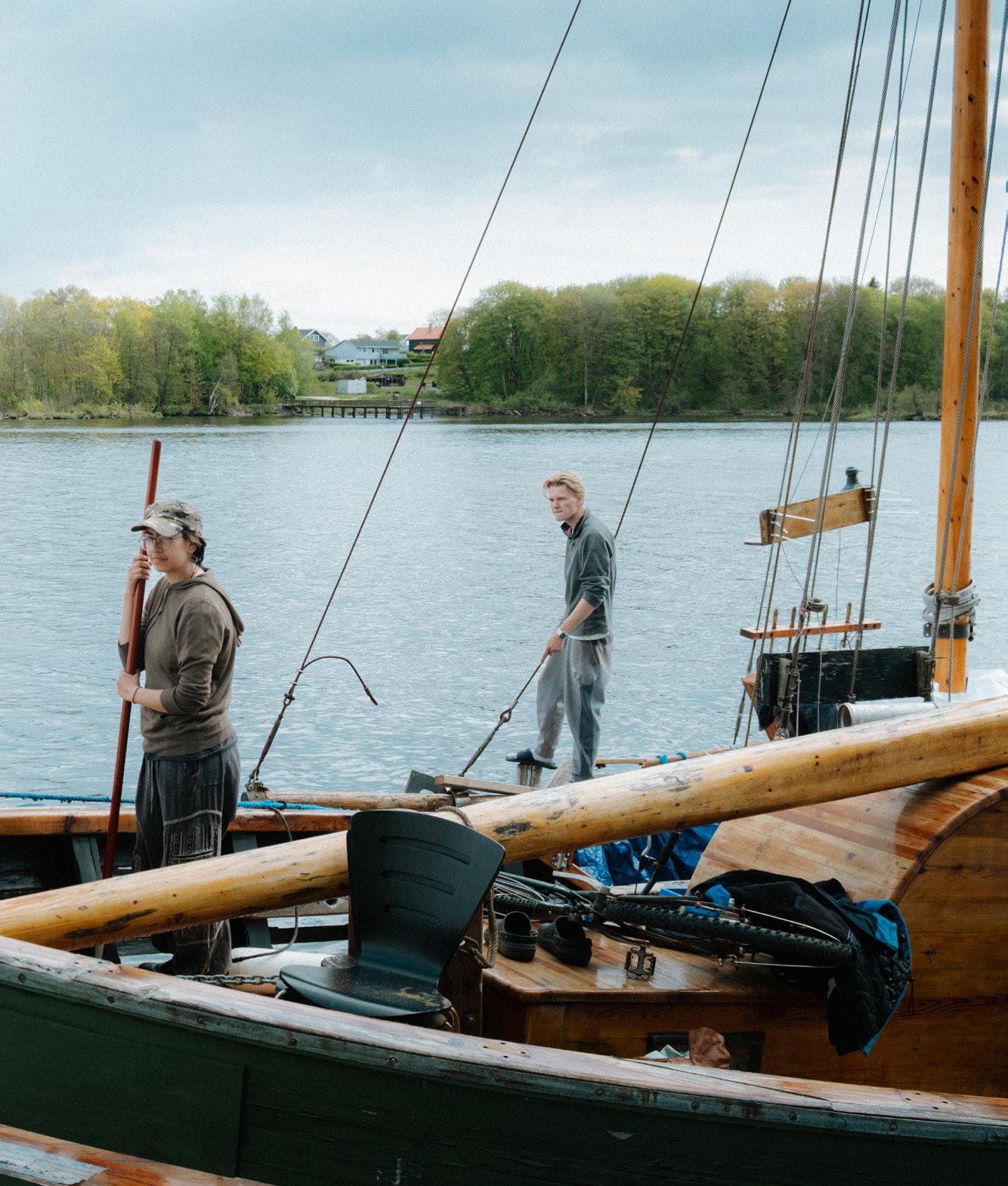
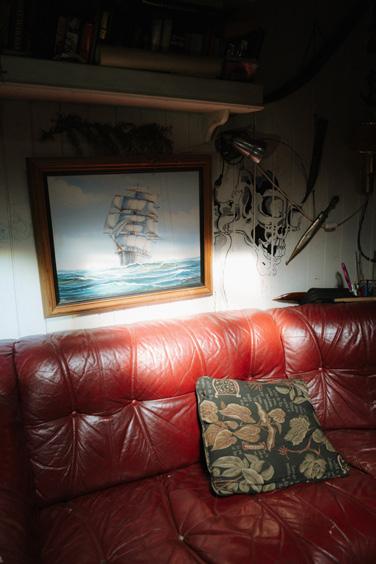
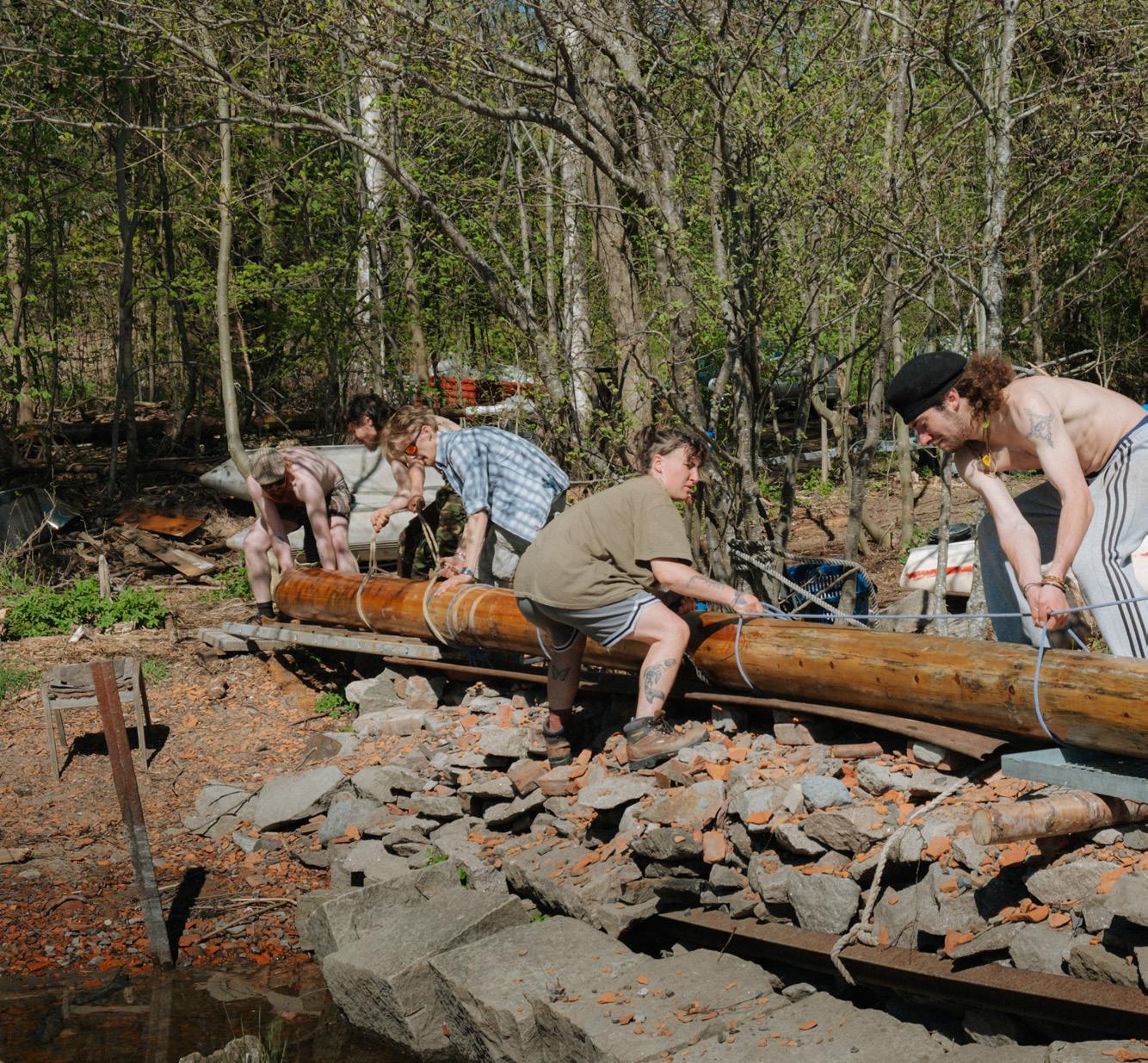
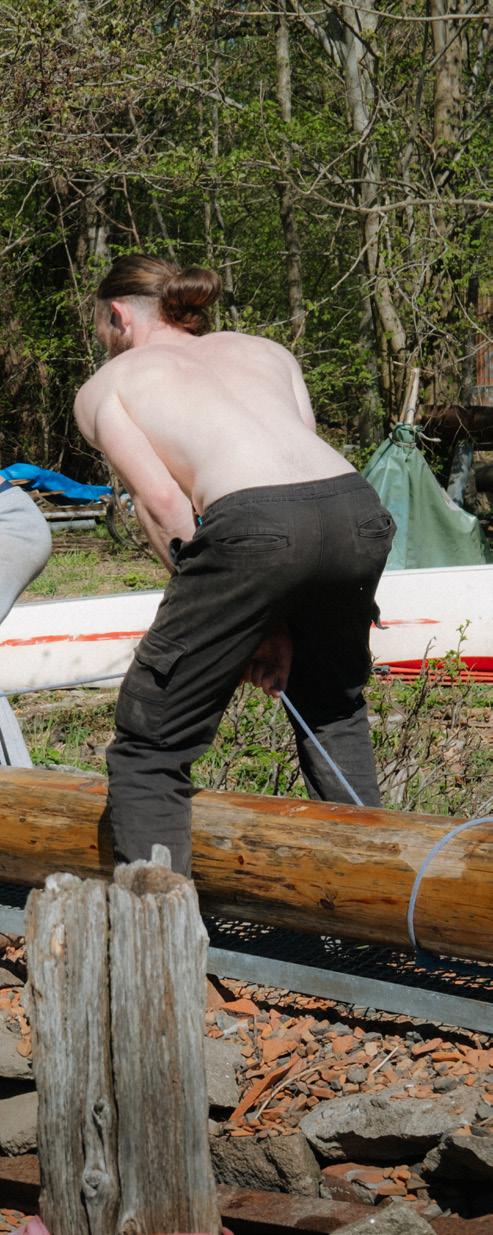
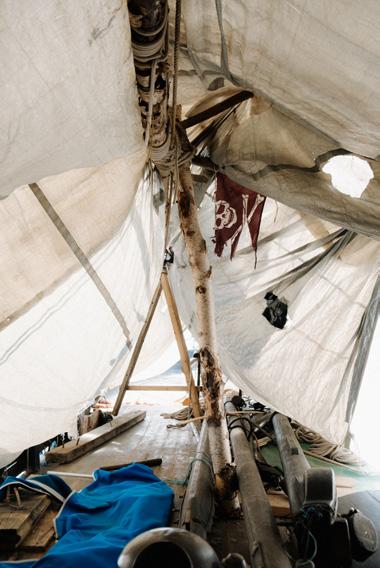
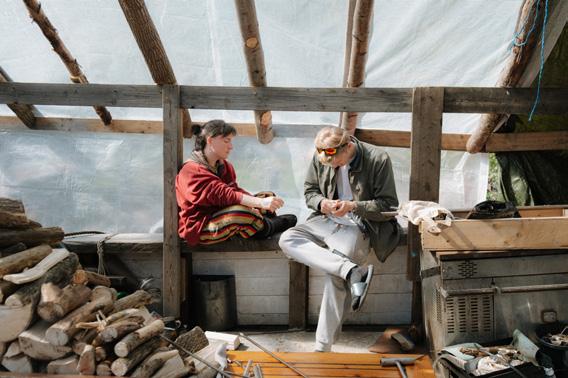
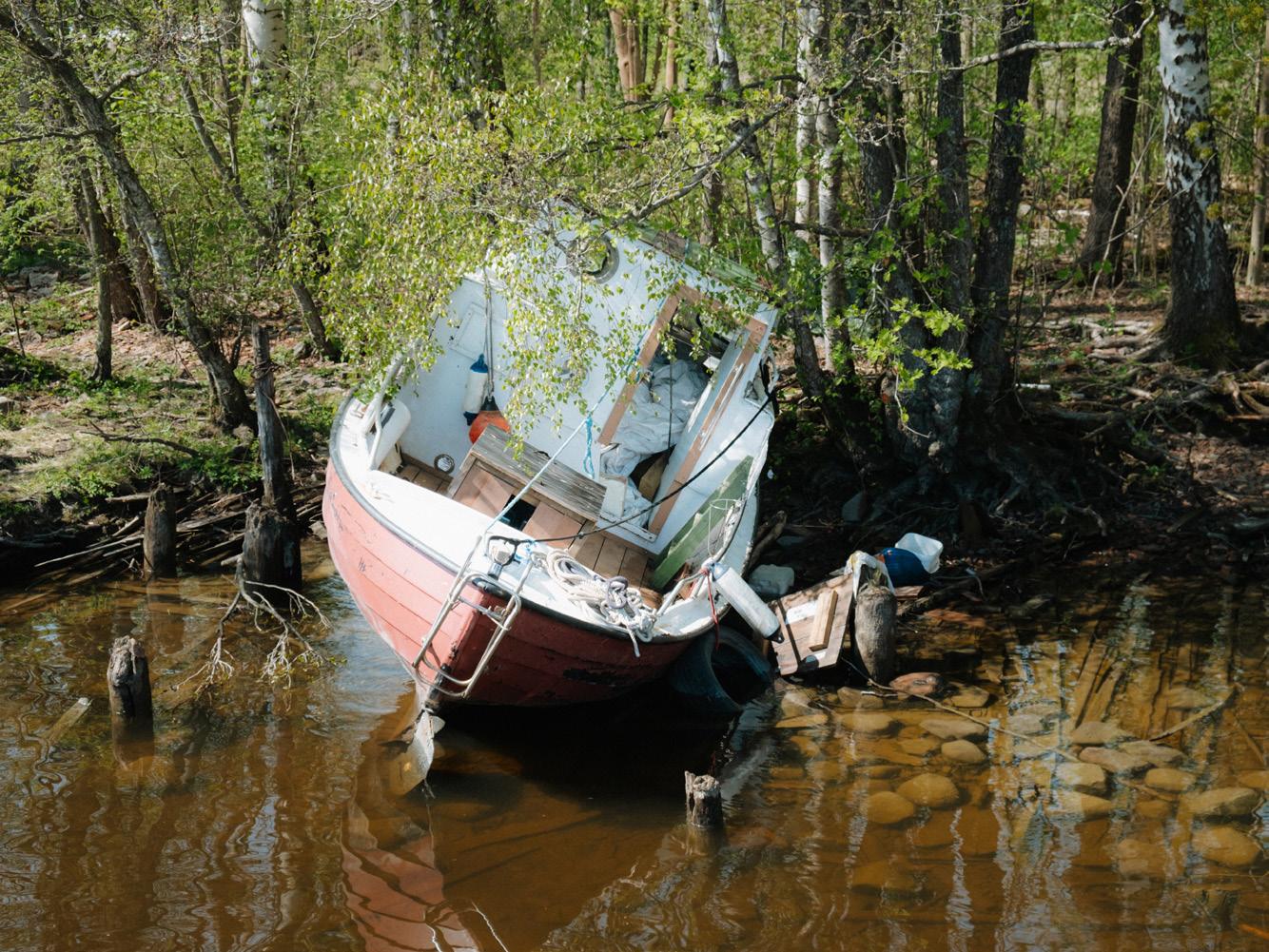
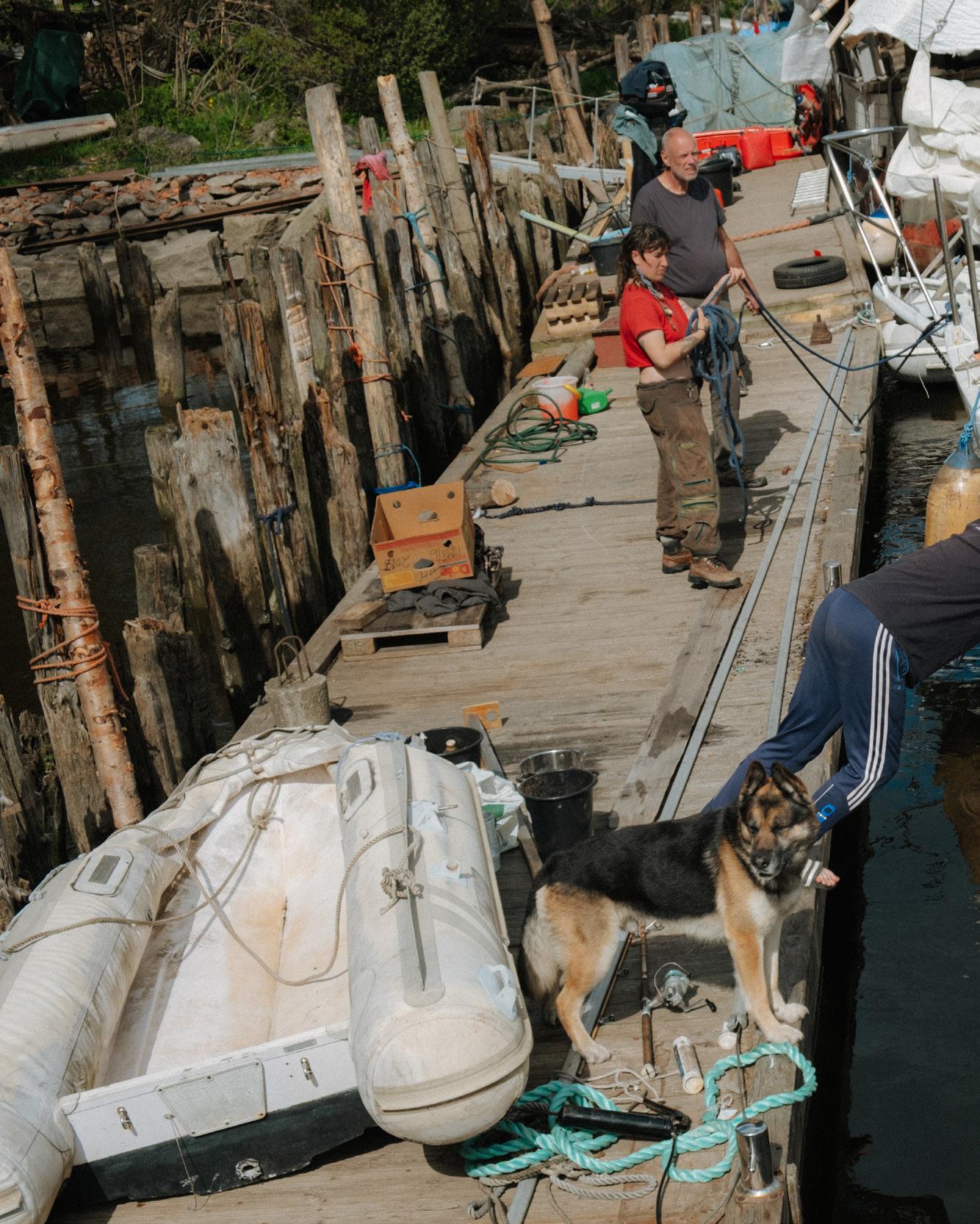
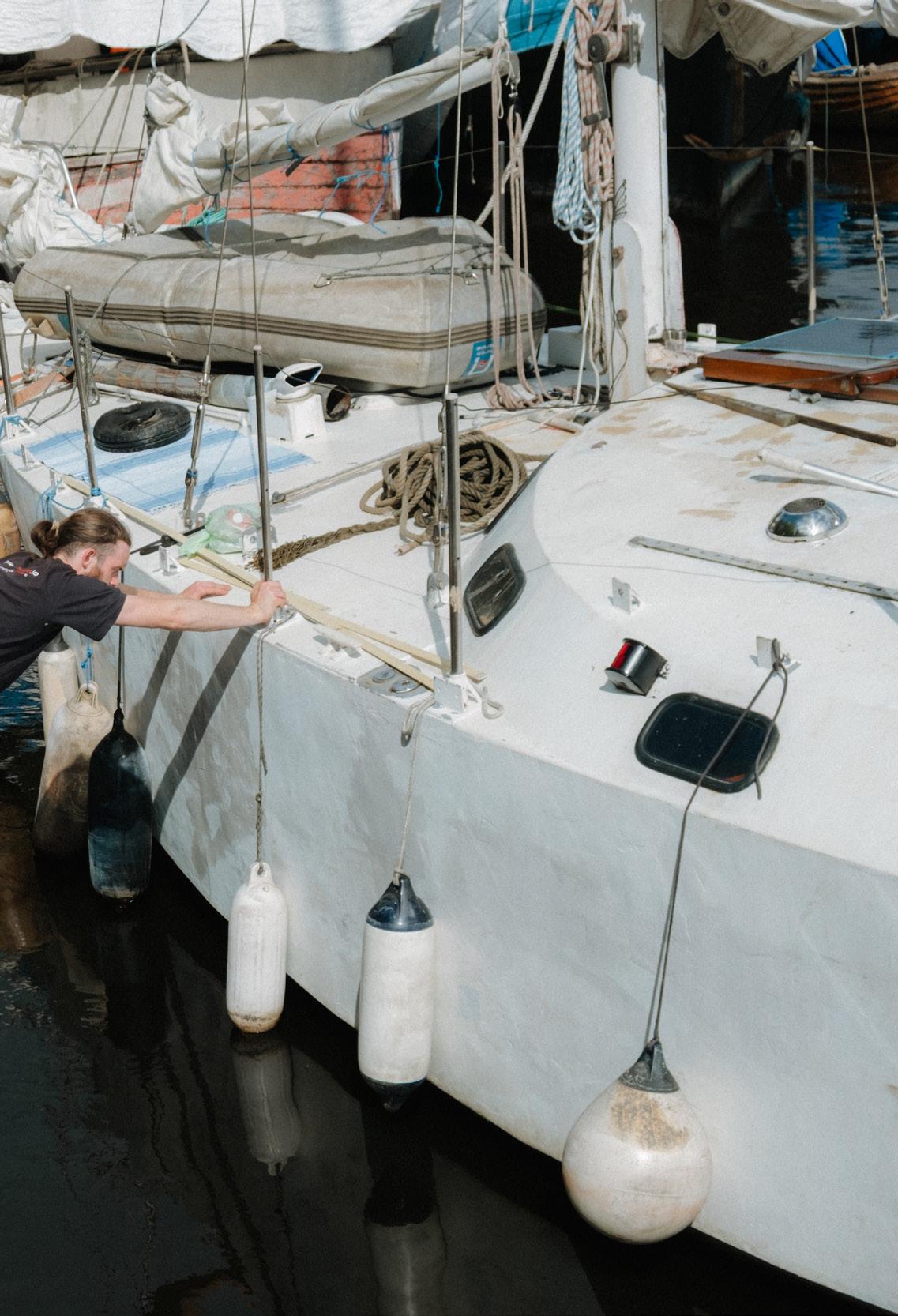
On the Glomma River in Fredrikstad, Norway, pleasure boats parade in an endless procession: yachts, speedboats, a display of wealth that comes and goes on spring afternoons. But a little further along the riverbank, nestled at the edge of a forest, something else is happening. 15 boats, mostly old and wooden, are tied together under tarps, forming a sort of floating camp. One boat functions as the camp’s shared kitchen, bathroom and living room, while the others provide beds. There is no display of wealth here, quite the opposite. The place is littered with all sorts of things: bicycles waiting to be used, a trailer full of rubbish waiting to be emptied, and masts waiting to be repaired. 150 metres away, a marina gleams with immaculate white hulls.
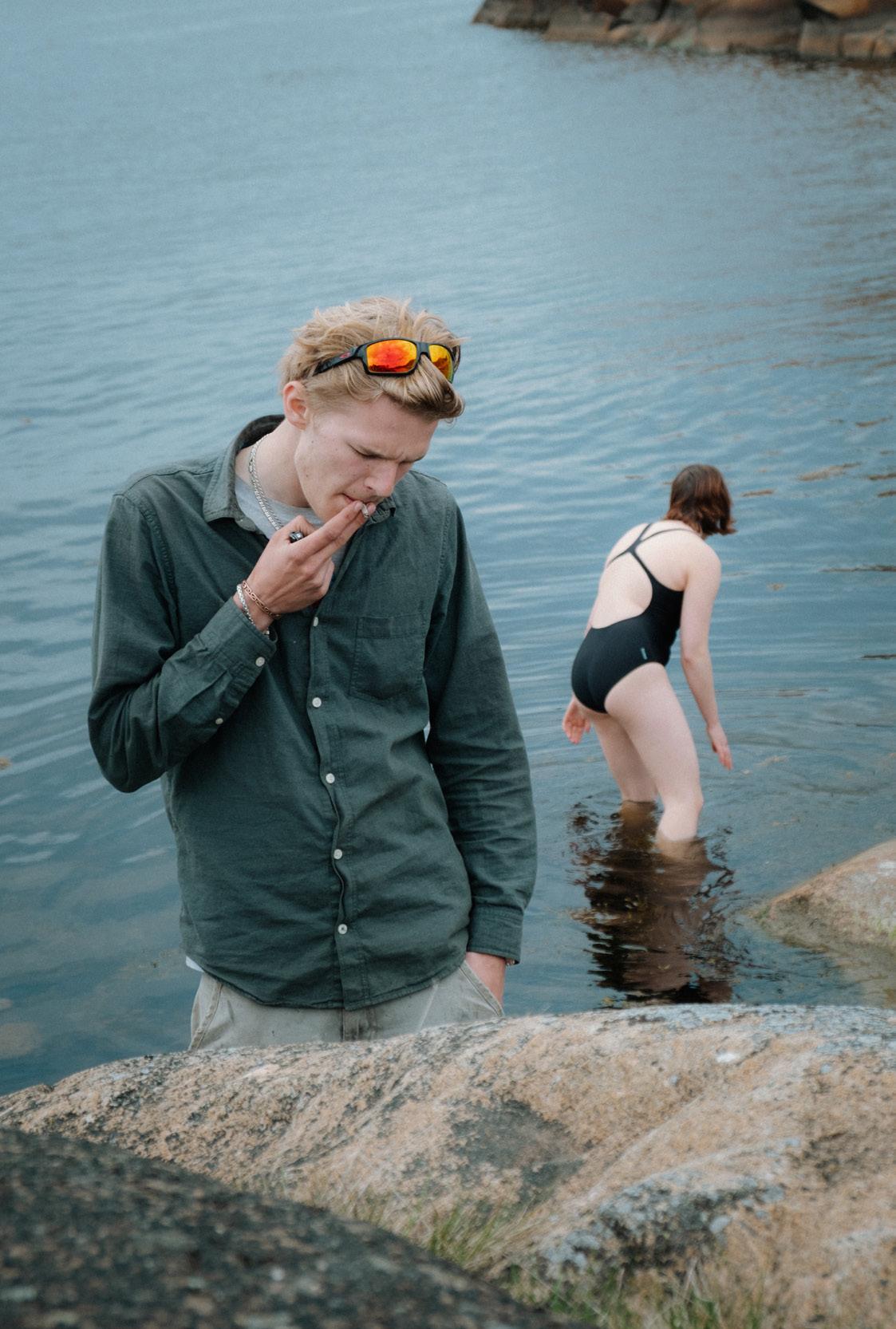
The camp welcomes volunteers from across Europe and beyond, who come to live aboard, help restore old boats and learn to sail. Some arrive tired of their jobs, because of loneliness, or the pressure of conventional life; others are simply curious about living closer to the sea and outside usual routines. At a time when many young Europeans speak of isolation and a lack of places to truly connect, this place offers something rare: the chance to slow down, share skills, and feel part of something collective.
The sense of community
Aisling Tobin is 25 and Irish. She has been travelling on and off for four years. After returning home and resuming her job as a barista, she realised she could no longer settle. “I was no longer content with the life I used to be content with.” She quit her job and flew to Norway, despite never having set foot on a boat before. What drew her here was not sailing itself, but the atmosphere around the boats. She says with a smile: “Pirates are cool.” She describes the appeal of the place less as an escape and more as a way of working towards something tangible, “this really free lifestyle that still has some kind of purpose.”
Life on a boat is probably not for her; she has no desire to buy one or learn about engines. But being surrounded by people who buy boats without knowing how to sail made her question the fears that had stopped her from pursuing her own dream of van life.
“You will always have fear in your life anyway. This kind of lifestyle uses your fear in a better way.”
It is late afternoon; the working day is over. On the decks of these old wooden boats, people are reading, while others chat about life as the river slowly darkens. Here, time seems to have stood still; a week feels like two, and people who were strangers three days ago already speak like old friends.
Aisling Tobin
“No one comes here intending to buy a boat, but many leave sailing one”
One boat became a camp
What began as the restoration of one old boat has slowly grown into a small community. The camp was founded by David O’Boyle, an Irish sailor aged 33, who has been sailing since the age of five. He never went to university; instead, he constantly searched for freedom through the various jobs he held in his twenties. Yet a strong desire always drew him back to the sea.
A few years ago, Black Betty appeared on his Facebook Marketplace: a 100-year-old wooden gaff-rigged ketch in Norway, for 500€.
“The second I saw the image on my phone, my whole body just started preparing. I just knew. My heart dropped because I knew it would be a challenge. I could feel the grief looking at the picture, but also the excitement.”
He flew over, bought her, and never quite left.
Betty needed work. A lot of work. So David launched a Workaway project, inviting volunteers from all over the world to come and live aboard, help with the restoration, and learn how to sail. Realising that the work required more than enthusiasm, he enrolled at a boatbuilding school in Fredrikstad. That is how Betty, David and some volunteers ended up here, on this abandoned stretch of land.
Life at the camp has its own rhythm and demands. You must empty the bilges, cook for everyone, clean the boats, chop wood and fill the water tank every two days. 14 people share a shower and a toilet. In winter, temperatures drop to minus 20 degrees, and the wood is often damp. The old wooden hulls take on water when it rains. This way of life isn’t always easy, but it doesn’t seem to bother anyone too much.
Living cheaply in a wealthy landscape
In Norway, there is nearly one boat for every six people. Because many can afford to replace them frequently, some are abandoned or sold for next to nothing. David salvages these boats, which become temporary homes for volunteers who help repair them. Every week, the collection seems to grow.
This project, which began with a single boat, now comprises a fleet of 15 boats. Almost everything in the camp has had a previous life: ropes, tools, engines, furniture, most of it found or donated. The group also survives largely through bin diving, collecting supermarket food that is still perfectly edible, reducing the food bill to around 600€ a month, enough to feed 14 people in one of Europe’s most expensive countries.
David works as a bartender after school to cover his car, boat repairs, water, electricity, and food for the volunteers. He has practically no free time and is often away from the camp. But the project has grown beyond anything purely practical. Since the beginning, about 150 people have come and gone, most staying for a few weeks, some for several months. They stay connected as a group on WhatsApp.
Come to be a pirate
“Come on, everyone, she’s here!”
No one expected her to arrive so soon. Jack and three others have been sailing through the night to bring her back. She drifts slowly up the river. Jack stands at the bow, watching the camp draw nearer, glad to have bought a new, bigger floating home. Ropes are thrown. People pull and adjust until she sits right, nestled against her wooden neighbours as if she has always been there.
Jack Geraghty calls it “boat fever” and describes it as something almost involuntary. He is 26 and Irish, like Aisling and David. He studied biomedical sciences for four years, then found work at a pharmaceutical company. “The only good thing about it was the money.” He quit, spent some time without direction, and discovered the Black Betty project. A photo of the boat.
Four words: “Come be a pirate.”
Last August, he packed his bags and flew to Norway with no plan. Within a few days, he had caught the bug, listening to others talk about boats bought for nothing, sailed with no experience, sunk, replaced, and put back into the water. He just bought a boat to sail first to Ireland, then further.
“I just want to work as much as I need and see how far I can go.”
A new beginning
The sun streams through the small windows of this century-old boat; the first vessels of the day sailing down the river make Black Betty rock from side to side. It is 10.30 and Finn is struggling to wake up; another day’s work is about to begin.
Finn Christian Martinsen is 21, half English, half Norwegian. His nightmare was spending three years in a classroom, so he trained as a mechanic to learn practical skills.
“I didn’t want to go to university. I ended up as a mechanic and, quite quickly, started doing crappy work and not enjoying it. I got stuck pretty much just smoking loads of weed in my garage every day, kind of in despair about what I am gonna do with my life.”
He arrived in Fredrikstad a month ago and is already planning to stay long enough to obtain his Norwegian passport.
“I wasn’t happy back home. Nothing has changed for me apart from where I am and who I’m with. But I’m happy now.”
Not made for the system
Finding a place to settle was not that simple for David.
“We’re living in a society that expects you to live in a very specific way. When you don’t, you can be seen as an outsider, or even an enemy of the system.”
He has been refused entry to traditional boatyards, told plainly that Betty did not fit the image they wanted to maintain.
“You’re either wealthy, with a nice-looking boat, or you’re not worthy of being in the harbour.”
Eventually, the group settled on a small plot of unclaimed land by the river. They pay a neighbour for electricity and water, but their growing “pirate camp” has not always been welcomed.
David has already faced pressure over their presence, and last winter, with temperatures dropping to minus fifteen, the electricity was cut off. For now, he simply hopes they will be allowed to stay until he finishes his studies in two years.
Black Betty is still not finished. She has no masts. The engine is not yet running. She sits in the water, enormous and patient, held together by work that is ongoing and will continue for some time yet. Jack has a vision of the day Betty finally leaves, with former volunteers converging from across Europe with their own boats; a convoy heading south.
“David will probably have 50 people wanting to sail with him,” he says.
150 metres away, the marina is settling into the evening. Everything there is polished, orderly, boats ready to leave at any moment. At the Black Betty camp, the boats lean into each other. A small new one has just appeared along the riverbank, tied beside the others, waiting to be fixed and start all over again.
Jack Geraghty is sending off one of the community boats.
becoming herself
by Lilly Vergnes
“Do you really think you would be happier as a woman?”
Rudy van Wijk asks across the garden table, where his child is seated. It’s late, and only a dim light by the door illuminates the backyard in Bussum, The Netherlands. Gosse answers immediately and confidently, “Yes.”
Rudy does not seem entirely sure about the conviction with which Gosse answered that question. Rudy does not think of himself as a man or a woman, just a person.
“But in society you are seen as one of the two,” says Gosse. “Isn’t that very superficial?” replies her father.
Gosse is disappointed that her parents may not fully realise how far she is in her transition. Hopefully, over time, they will understand that this has been the missing piece in her life. In any case, her parents will be here to support and love her. She knows that. Rudy says with a smile, faintly visible in the dark: “To me, it does not matter if you’re my son or my daughter; you will always be a little shit.”
A room of her own
At 24, Gosse van Wijk recently came out as a transgender woman after years of suppressing her gender identity through denial and drug use. Now sober and back on the waiting list for gender-affirming care in the Netherlands, she is navigating what it means to live as a woman and the reactions from family, friends and society.
Even though Gosse still lives at home, she has her own little world in her bedroom. It’s a small space, just big enough for a single bed, a closet, a desk and a whole bunch of paraphernalia.
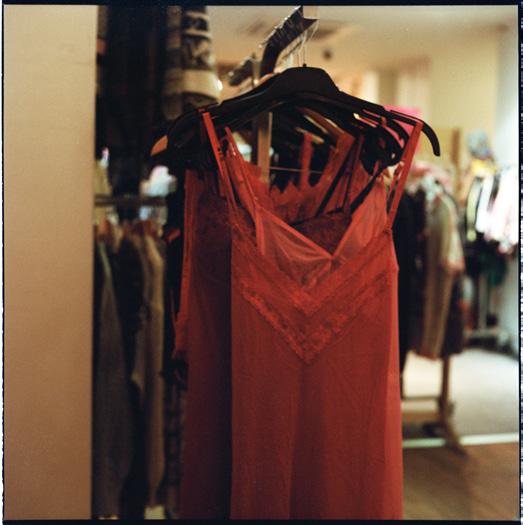
One wall is painted the colour of a greenscreen. There are old toys under the bed, and some drawings, cards and pictures of friends stuck to the wall. Gosse works four days a week at the local second-hand shop, hangs out with friends at weekends, and creates music in her free time. But her main goal at the moment is to become a woman.
Among friends
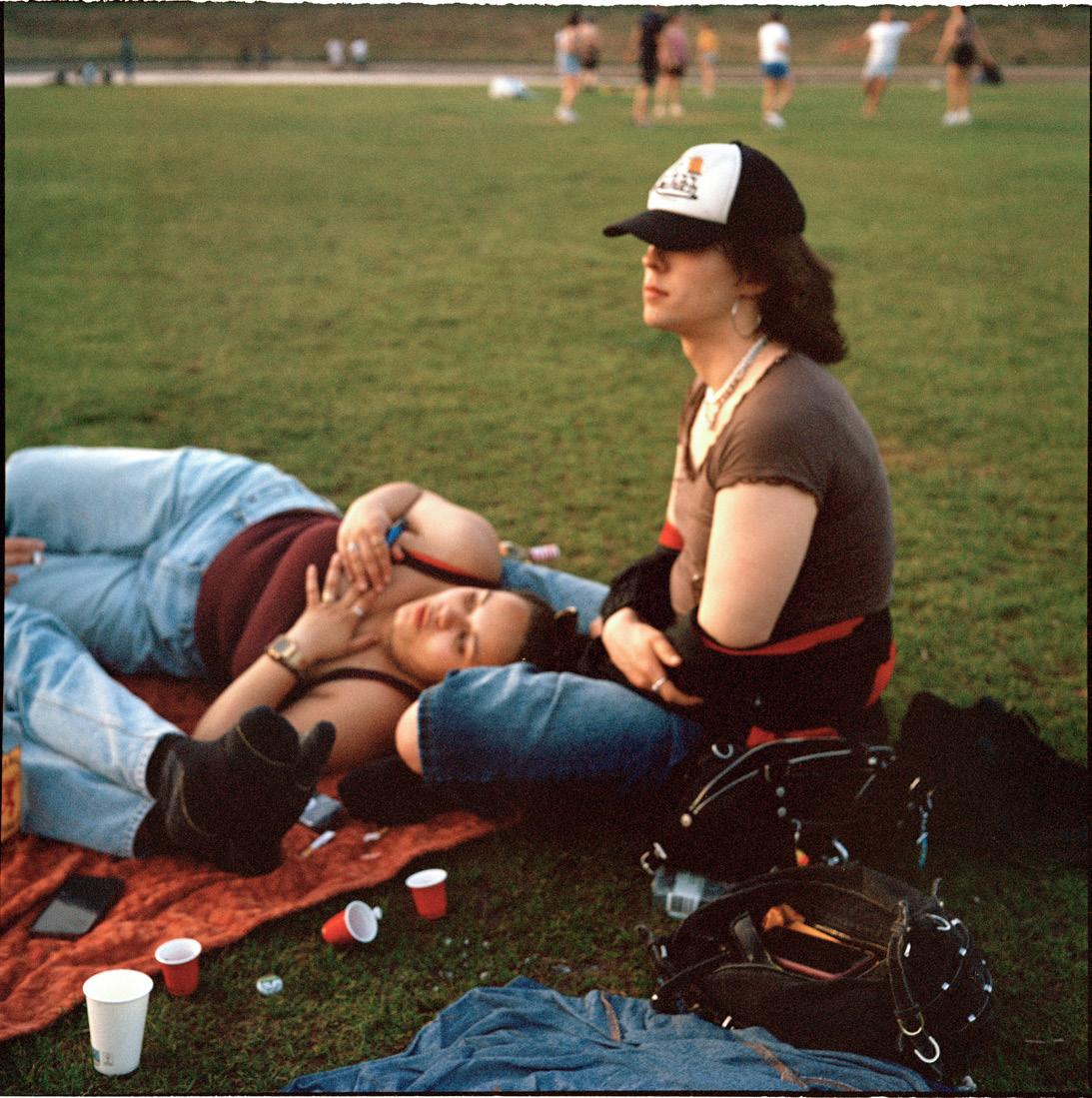
It is a beautiful, sunny Saturday afternoon, and Gosse is meeting some friends at Westerpark in Amsterdam.
“Most of my close friends are women. I have Luc and Luuk, but other than that it’s just girls.”
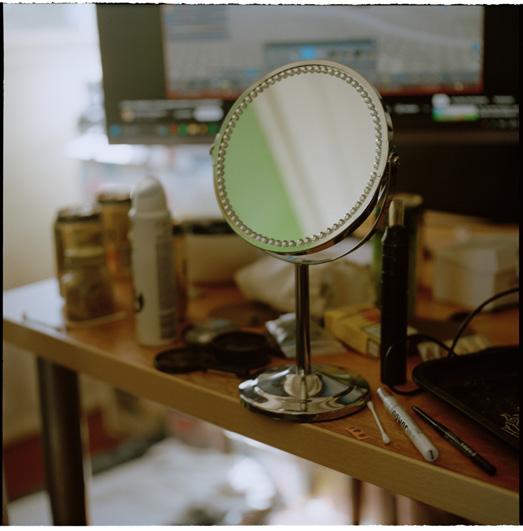
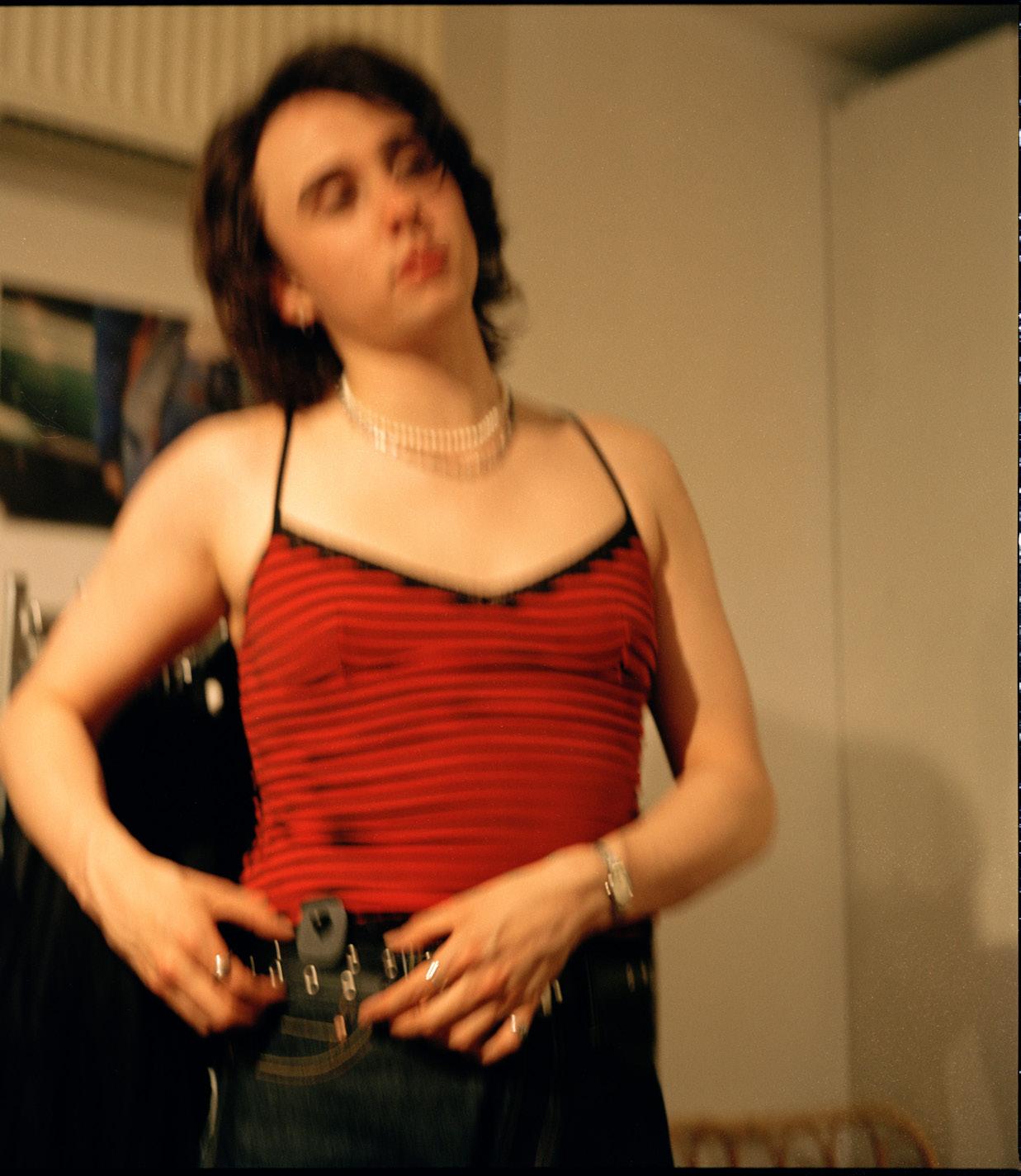
Gosse is meeting Elena, a girl she met in Utrecht. Luuk will also be there, with his girlfriend Kaylee. Before Gosse heads out, she puts on some make-up in the tiny mirror on her desk
and picks out an outfit, including a new top she got on Vinted. After taking the train there, she arrives at the park and meets up with the others. They spread out a blanket, sit in the sun and drink beer. Kaylee says she knows some people might be prejudiced against Gosse. She says that, as her friends, they feel the need to protect her in some way, “because there is only one of Gosse”.
They enjoy the sun as it lowers on the horizon, pack up their things and eventually all make their separate ways home.
Dealing with expectations
For most of her life, Gosse felt she needed to live up to expectations. The expectations of being a boy, a son, a boyfriend. But there was something she always wanted, something she longed to be. No one knew about this: she kept it completely to herself. When she was asked in an elementary school quiz, ‘This is who I want to be when I grow up’, she considered answering ‘a girl’ but was too scared to do so. The desire was there, but the realisation was not. After hearing a neighbourhood boy talk about how he saw a transgender woman on the news, Gosse’s first thought was ‘I did not know that was possible’.
Her second thought was ‘this is not meant for me’. It was something she might think about late at night, lying alone in bed, but not something that would be realistic to do. So Gosse went on with her life as a boy. After all, most of her interests as a kid were considered ‘masculine’. Lego, Star Wars, Warhammer. Nobody would ever notice that something was off.
A false start
It was not until Covid that Gosse seriously reconsidered her gender identity. With all that time spent at home and with the help of social media algorithms, Gosse decided in 2022 to apply to the Gender Clinic and was placed on the 5-year waiting list. At the Gender Clinic, she can receive gender-affirming care, which includes a range of interventions to support an individual’s gender identity, such as hormonal therapy and surgery. However, this decision did not last long. Shortly after, she returned to a friend group that brought certain expectations. “I came there as a specific person, and I felt like I needed to stay that person.”
By then Gosse started using more and more drugs. She became addicted to benzodiazepines and ketamine. Both of these substances are numbing, suppressing any emotions or anxiety.
“It relieved a pain I didn’t even realise was there.”
Gosse used drugs to avoid the reality of her inner deepest struggle and of all those feelings she had suppressed for so long. The drugs allowed Gosse to escape a body that never felt fully like her own. The constant high became a comfortable way to cope. One day, whilst being high on ketamine, she gave up her spot on the waiting list and told herself that she was not trans after all.
Back on the waiting list
Last year, Gosse’s family held an intervention for her. They did not know the full extent of her drug use at the time, only that it needed to stop. And so it did. Gosse entered an external rehabilitation programme and spent three months sober, from the end of October 2025 until January 2026. After those three months, she began occasionally smoking weed and drinking alcohol again, but she fully stopped using the drugs that had consumed her life. Sobriety was followed by severe gender dysphoria. But it also gave Gosse a certain clarity in her life.
“There was a moment when I knew I had to go through with my transition, otherwise I would die unhappy.”
It was no longer something to be doubted, no longer something to be pushed away.
After rehab, Gosse regained her place on the original waiting list and is now set to receive help at the gender clinic within a year. The first big step for her would be to start hormonal therapy. Right now, she is in the early stages of her transition, out to her family and friends but not at work.
“At workmI don’t really look like a woman yet, and I don’t want to constantly explain myself to people.”
One of the girls
One Monday, Gosse meets her best friend, Lonneke, in Utrecht for a day of shopping. They have been friends since they attended the same university course, which they both later dropped out of. “Lonneke has taken on the role of a big sister, helping me with things like make-up and clothes,” Gosse says. Today, they need to pick up some foundation and lip products. Whilst bent over the make-up displays, Lonneke offers advice on what would suit Gosse’s skin tone and which brands she prefers. Gosse listens carefully and applies a few swatches of lip gloss to her hand. They go from store to store until it’s time for lunch.
Over bagels and matcha lattes, they talk about their relationship. The first time Gosse went out in public as she/her was at a rave with Lonneke. Even though she had already known Gosse for a while, at the party Lonneke immediately recognised Gosse as a woman and found the switch easy. She bought the Zij/Haar pin (she/her in Dutch), which is still on display in Gosse’s bedroom. Gosse says she fondly remembers that night and felt so good about herself afterwards. Lonneke continues:
“It was funny. When Gosse came out to me and my boyfriend, the first thing my boyfriend asked was if he could still call her ‘bro’.”
They both laugh at the memory. After lunch, they continue their shopping day at the thrift store and end it by smoking a joint together.
Living as herself
Gosse is happy to be seen as one of the girls now, although her family and some of her friends are struggling with her pronouns. It’s still new and feels a bit strange, even to her. She thinks it will become more important later in her transition.
For now, Gosse does not mind the misgendering, though she really appreciates it when people refer to her as ‘she’.
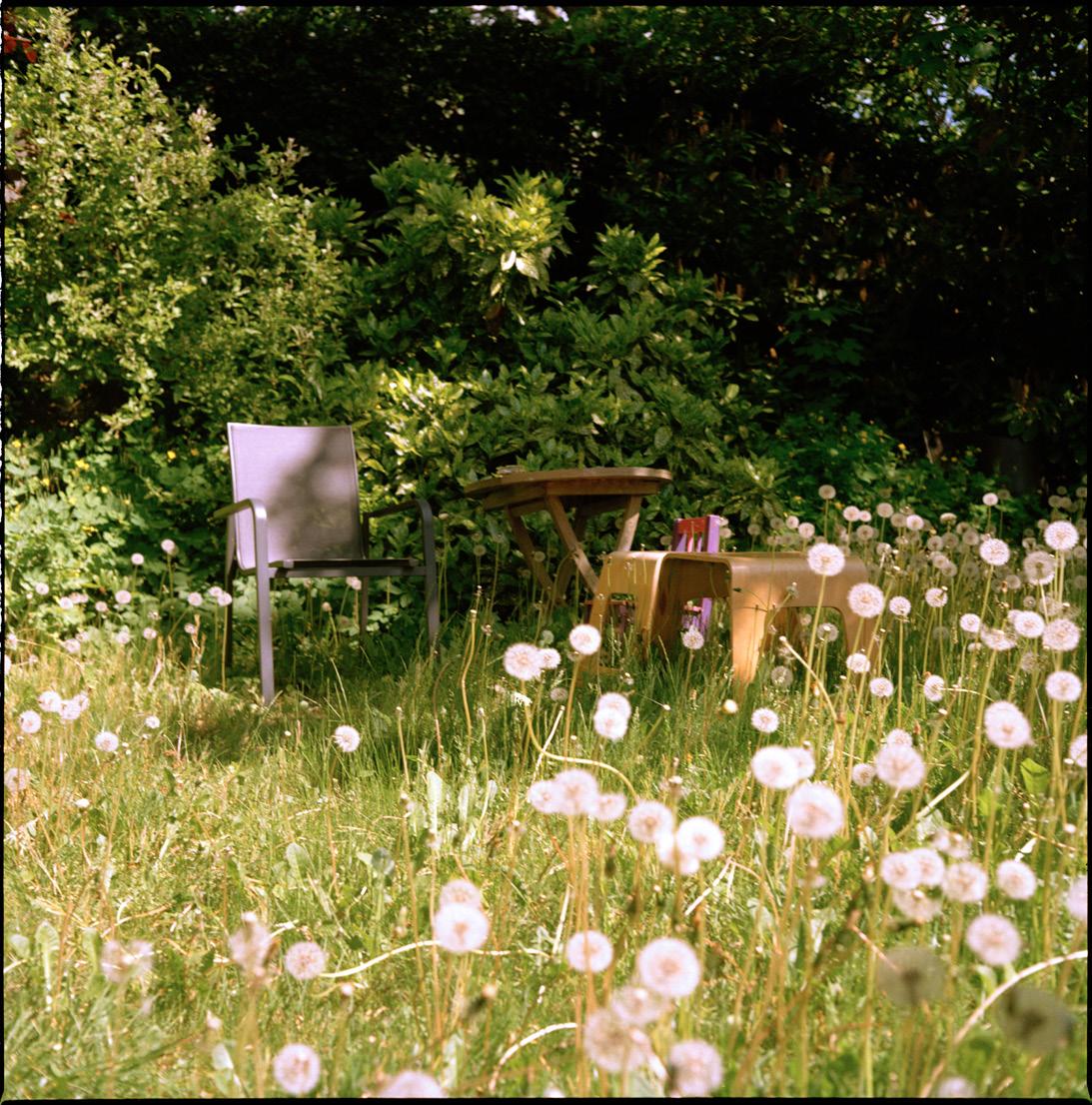
On the warm evening, after the conversation with her father, Gosse stays in the garden for a while and lights another joint. It was the first real conversation she’s had with her parents about her gender identity. It doesn’t usually come up at the dinner table. She knows this transition will not always be easy, but it is something she has to do for herself, no matter what everyone else might think. As a transgender woman, the world will be against her in so many ways.
“I live in a society where I’m not necessarily wanted, and on one hand, that’s demotivating, but on the other hand, it’s motivating too, because my existence feels like resistance in itself. It becomes a form of overcoming.”
She puts out the joint in the small ashtray on the garden table, heads back up to her bedroom, and pulls the door closed behind her.
Community by choice
by Cora Trinkaus
On a former farm in rural Denmark, two families share meals, work and everyday life.
For decades, Tranehøj has been built on the idea of community, sustainability and living close to nature. But keeping the community alive will be a challenge.
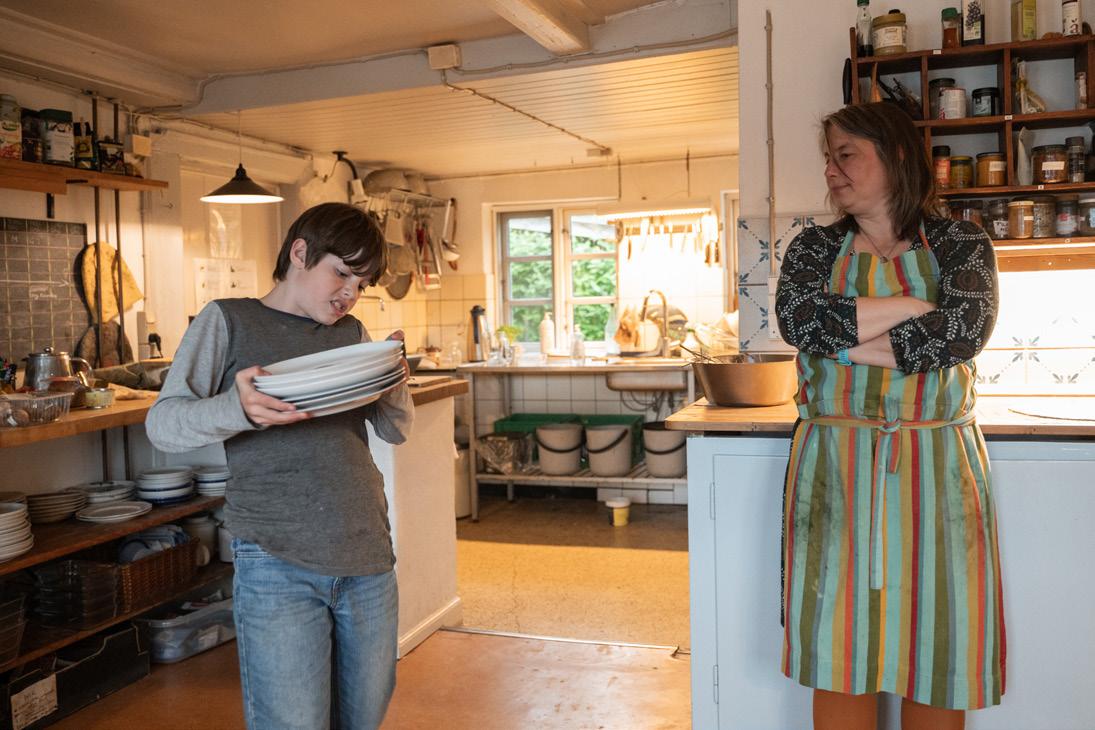
Colourful party streamers hang from the lamp above the dining table. On each plate lies a party streamer, and a wooden birthday train with six candles stands on the table. Today is Oskar’s birthday. There are homemade buns and pancakes which Oskar’s older brother Asbjørn prepared the evening before. It is 6:30. Breakfast at the Willi and Maria’s family home. Oskar comes to the table with bright eyes, still in his pyjamas. He talks without pausing, shifting back and forth on his chair. His gaze flicks between the two presents on the table. Then he chooses the larger one. Inside is a Lego set for the Black Pearl pirate ship. Soon, breakfast is forgotten. The pieces are spread out on the common living room table, and Oskar starts building the Lego set with Asbjørn.
As everyone slowly gets ready for school and work, a restlessness fills the house as the morning gives way to the day.
Doors open and close, shoes are searched for, lunch boxes are packed. Inside the house, it slowly grows quieter.
A community in transition
Tranehøj in Snertinge, Zealand, was originally a farm, later a care home (1930–1983). In 1984, a community of 15 adults and children bought the place and founded a communal living project and named it Tranehøj. In the late 1980s, it was run intensively, with biodynamic farming and the production of milk and cheese, but high costs and loans made the model unsustainable in the long term. In the early 1990s, the community stepped back from intensive agriculture. Since then, only small-scale farming continues: sheep, chickens, vegetables and fruit for their own use.
Today, Maria Lippert and Willi Christiansen live in one part of the house with their three children, Rune, Asbjørn and Oskar, and their Namibian au pair, Hally Sharon. They share about 600 square metres of living space with Gitte Jakobsen and her husband, Torben Vosbein.
Three apartments are empty. The last move-out was “very unpleasant”, as Maria puts it. It was an emotional rollercoaster, as there had been high hopes for the new setup, but in the end it did not work out. Because of these experiences, the community is not actively seeking new residents, but remains open if the right people come along.
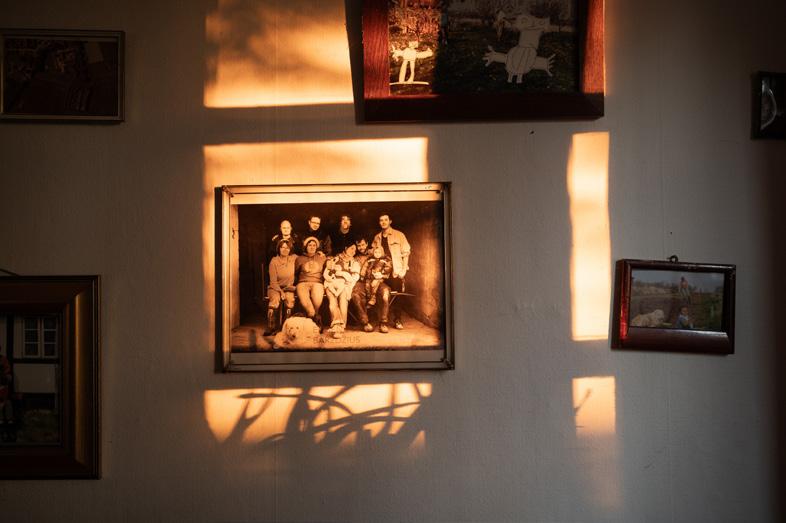
Top – On the wall in the common dining room hang old framed pictures from former times of the community Tranehøj.
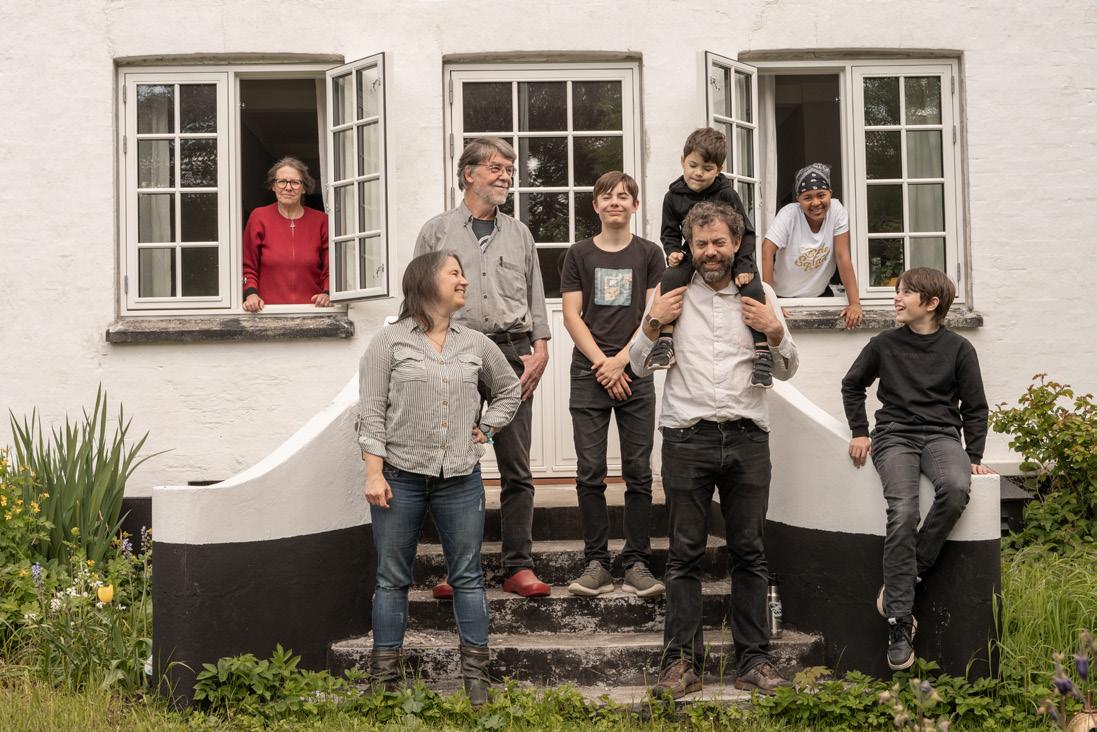
Bottom – from the left to the right: Gitte Jakobsen (70), Maria Lippert (46), Torben Vosbein (78), Rune (14), Oskar (6) and Willi Christiansen (45), Hally Sharon (20), Asbjørn (12)
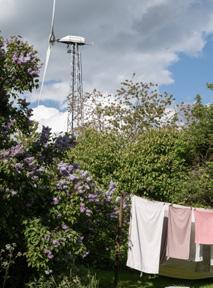
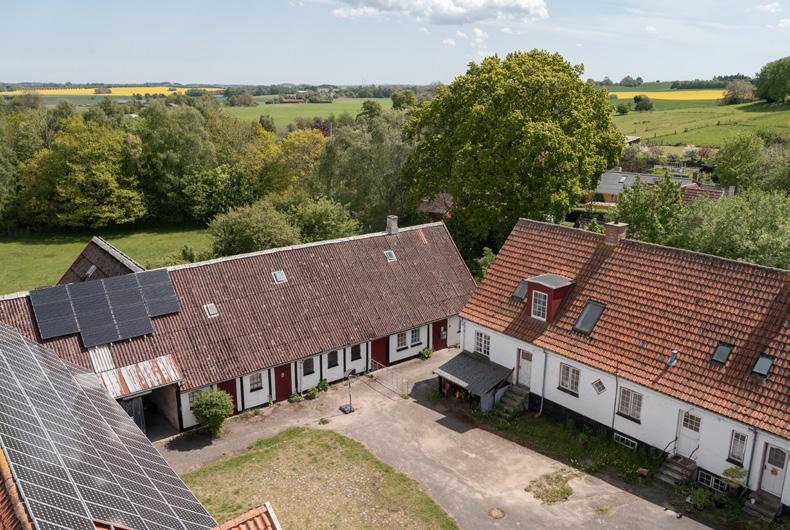
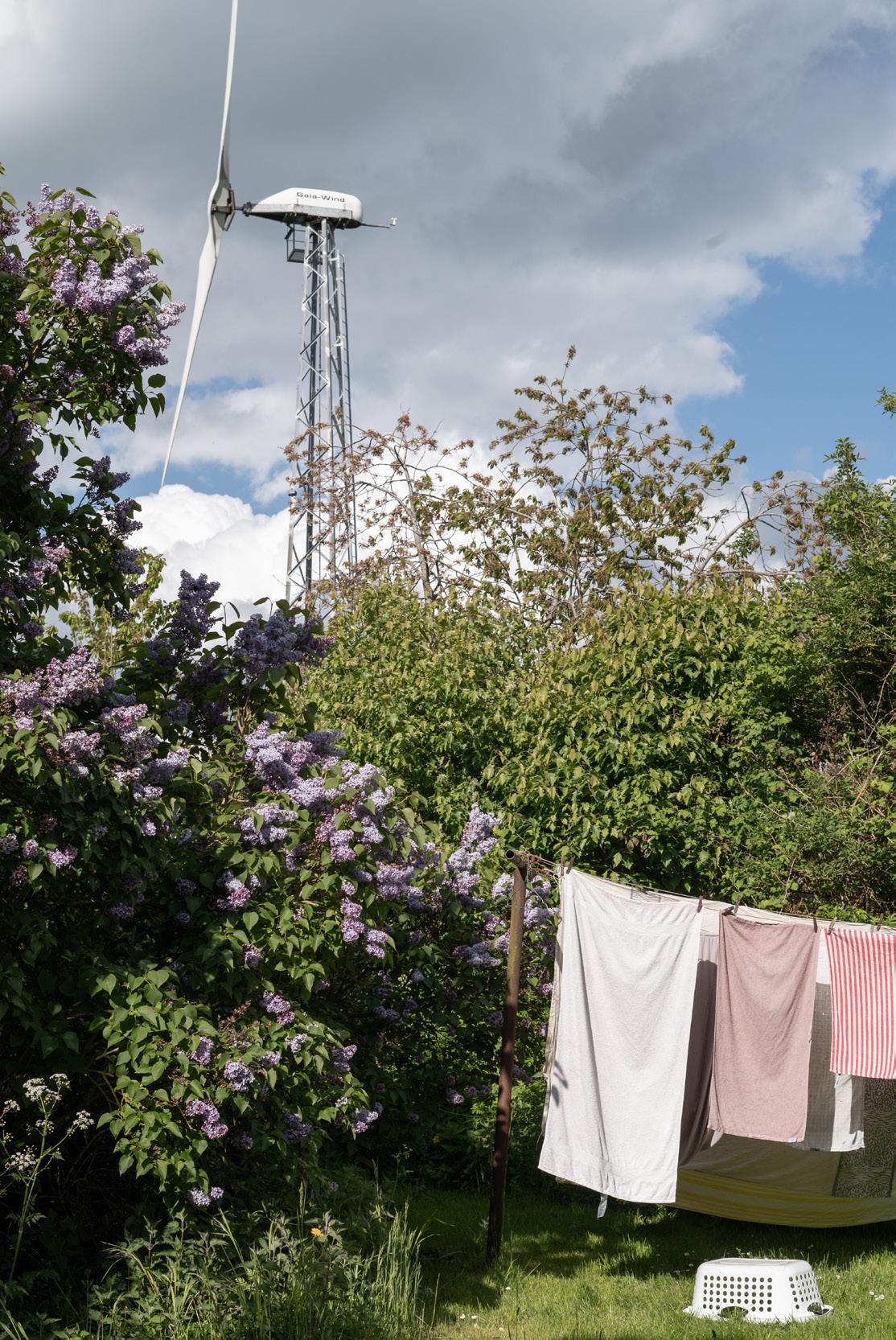
The area around Snertinge is deeply rural. Rich green fields stretch across the landscape, broken by bright yellow rapeseed fields beneath a clear blue sky. Small, single-storey houses line a narrow, deserted road. On the right, a long hedge runs, ending at a corner where a white-painted stone point you to the 3.2-hectare property of Tranehøj. No traffic, no voices, only the wind in the trees, birdsong, and the repeated cooing of a pigeon. At the end of the driveway lies the farm. It feels as if time has stood still since the house was first built in 1822. The roof is almost entirely covered with solar panels, a sole reminder that the old farm has shifted into the present day. Behind the house, a small wind turbine rises, turning almost silently in the rhythm of the wind.
From niche to established part of the housing market
As early as the 1970s, Denmark was regarded as the centre of the commune movement. Statistics from both Leeds and Aalborg University indicate that more than 1,000 communes existed as early as 1973 – more per citizen than anywhere else in the world. After many years of decline, communal living is now experiencing a new boom. By the end of 2025, Denmark has 613 co-housing communities with more than 18,000 homes. Senior co-housing communities make up the largest share, but mixed-age housing projects are also increasing again. Communal living is no longer a niche model but is becoming an established part of the Danish housing market.
The
easy season
While Willi and Maria are celebrating Oscar’s birthday in one kitchen, Gitte and Torben have breakfast in their own kitchen.
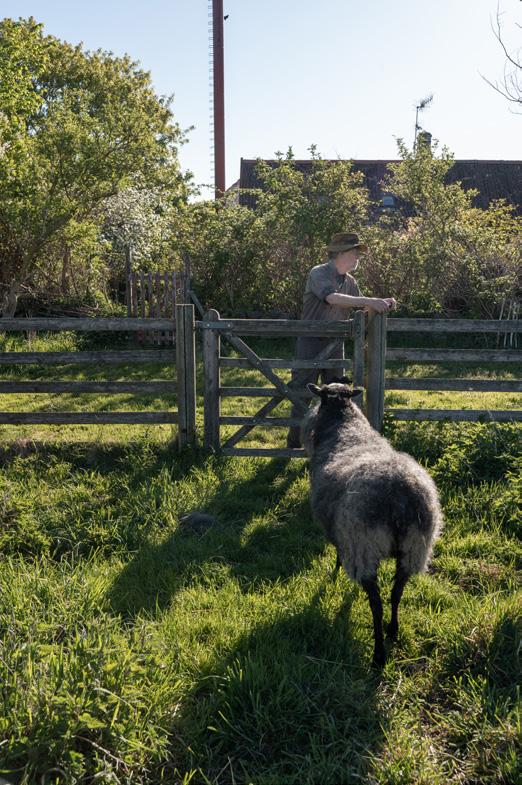
At 8:30 a.m., Torben goes out to tend the sheep. In summer, the pasture is quiet. Torben says there is not much to do, just check the water and look around once a day. The grass will last another one or two weeks.
“This is the easy season,” he says. One of the oldest sheep comes straight up to him. It is Günter, named after the German author Günter Grass, who died in the same year the sheep was born. Günter lets himself be stroked without fear. Since his birth, Torben has cared for him, bottle-feeding him in his first days.
“You get attached,” Torben says, “but at some point you have to let go. Günter is already eleven years old. We do not know how long he still has.”
Further back, the lambs lie in the grass, nine this year. They have no names, as they are raised for food and slaughtered each autumn for the community’s use. “Keeping sheep means accepting the whole rhythm of life and death. You raise them, slaughter them and eat them. If you do not have that connection, you cannot really have animals,“ Torben says. Two of the lambs have made it through the electric fence. Torben stops. “Something is wrong,” he says. The voltage is too low. He gets a measuring device and checks it. “Probably the grass is too high and wet,” he says. “Then the power in the fence drops.” It stays like that for today. The grass needs cutting, and a pole needs replacing. Both tasks are planned for the following work weekend.
On his way back, Torben looks towards the barn. The door is open so the swallows can come and go. Every year, they return and build their nests under the roof.
“Sometimes they even sit on the wind turbine when it is still. They always find their way back here,” he says.
A shift towards more stability
When Gitte and Torben moved in with their son Aslak in 1998, almost twenty people lived here. Families at similar life stages, many children, and a dense communal life. Torben describes the early years as open but without a clear direction. After two or three years, most of the original residents left.
“We had to sit down and make some basic decisions about what to do.” The idea at the time was to combine biodynamic farming with theatre and community life – two directions that inevitably drifted apart.
With new people, the ambience of the place changed.
“It was just living together and enjoying all the advantages, especially the economic ones,” Torben says. At some point, it became clear that it could not continue like that. It had to be either dissolution or rebuilding. When many residents left the community, Tranehøj had to sell parts of its farmland to repay departing members and to finance necessary renovations.
Each adult who joins the community contributes 50,000 DKK to the shared association and receives the same amount back when leaving. Gitte describes the development as a conscious shift towards a more stable community:
“We have tried to make it more of a lifelong community,” she says. Living here is a deliberate choice, not a temporary solution.
Work weekend and open house
The next morning, the cow bell rings at 7:30 for breakfast, a ritual from the commune’s early years that endures today.
A Saturday would normally start more slowly, but on monthly work weekends everything is scheduled. Willi, who prepared breakfast, is already seated at the long table in the common dining room, waiting for everyone to arrive. In a notebook, the day’s tasks are listed, and they divide them: Maria tends the herb garden, Willi and Torben take care of the sheep and manure, Gitte weeds the courtyard, and Rune prepares it for possible visitors, since Tranehøj has signed up for the Eco Villages open day.
“Maybe someone will come, maybe not,” Maria says. Maria pushes a wheelbarrow loaded with a shovel and other garden tools across the courtyard, then weeds the overgrown herb bed. Torben and Willi are out in the pasture, checking the fences and electricity.
At 11 am, they have their first coffee break in the courtyard. A guest has arrived. She is interested in living at Tranehøj and has come for the Eco Villages’ open day. Together with Gitte, she sits under the sunshades with coffee and dried apple rings, talking about life in the community and her old horse, which she can no longer ride. If she were to move in, she would want to bring the horse with her. But the community agrees that it would not fit into life at Tranehøj. The sheep already use the available pastures, and horses and sheep cannot share the same fields. Swallows fly between the courtyard and the barn. Torben has hung a sign on the barn door: “Luk ikke døren. / Don’t close the door”.
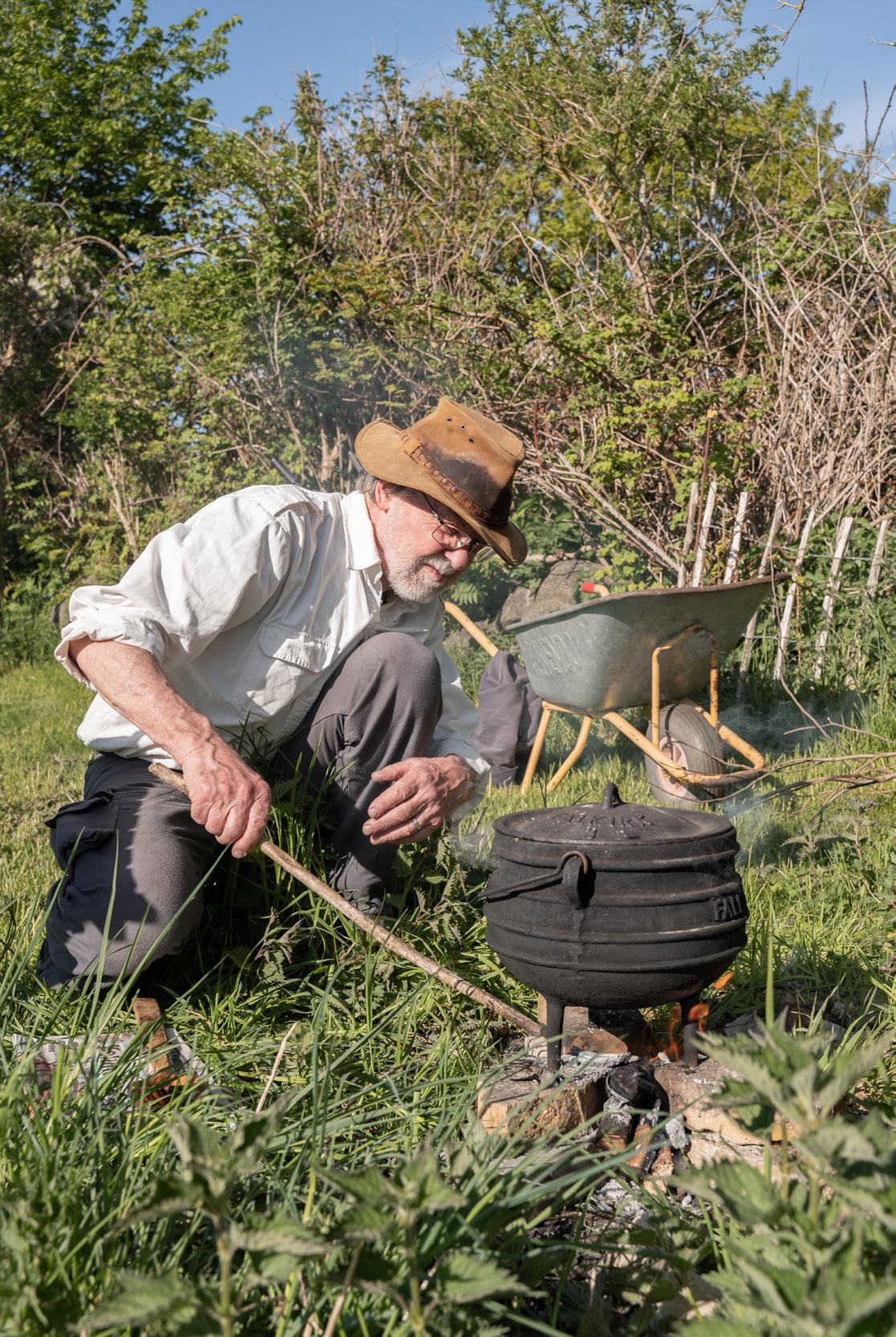
In the afternoon Torben cooks lamb and potatoes in a castiron pot, called “black pot“ on the meadow next to the sheep.
Gitte prepares the rest of the dinner in the kitchen, making a beetroot salad with mozzarella. The cowbell keeps bringing everyone together. During the meal, Torben talks about his and Gitte’s trips through Namibia in their Land Rover, about cooking everything in the same pot, about nights in the wilderness.
Cultural exchange
Gitte lived in Namibia with her son Aslak for three years, working for an NGO. Torben joined them for the last year.
Back in Denmark, they looked for a community and found Tranehøj. Both had lived in many communities before.
“I knew the people who started the first communes in Denmark in the early seventies. Since then, I have known that this was the kind of way I wanted to live,” Torben says.
Gitte and Torben both come from the NGO and alternative scene of the 1970s and 1980s. They became politically and socially active early on and met through this environment. Today, they both work for an NGO and media organisation that runs international cultural and educational projects, mainly between Denmark and Southern Africa. The focus is on cultural exchange, art projects and workshops with children and young people.
“We think that if you can make people meet, then they might change their perceptions because they realise that the other person is not just a stranger. It is a person with the same desires, the same hopes, the same wishes for his life,” Gitte says.
Through their work, Gitte and Torben regularly bring people from other countries to Tranehøj. Artists from Southern Africa stay on the farm for periods of time, run workshops in schools, or work on joint projects.
Cultural exchange has been part of everyday life in the community for years. Through Gitte and Torben’s engagement, Maria comes into contact with topics and perspectives that would otherwise not find space in her everyday life.
“My life is enriched in a way that would not happen if I lived alone,” she says. “I benefit enormously from this sharing.”
When Gitte and Torben are busy with their projects, Maria takes on more responsibilities in Tranehøj and helps keep daily life running. “That is how community works,” she says.
“We support each other when someone needs more time elsewhere.”
The importance of being a community
Maria comes from a small town in South Schleswig and moved to Denmark to complete her medical training as a gynaecologist. Her mother is Danish, and she grew up bilingual. Willi also moved from North Germany to Denmark for work,
aiming to develop his career in wind energy. At first, they lived in Copenhagen. But Willi, who grew up on a farm, wanted to return to the countryside. For Maria, it was especially important that they not just live as a couple, but as part of a community with other people.
Willi now works as a Project Director at Novo Nordisk, helping to build a new factory with a lower carbon footprint and has spent many years in the renewable energy sector. On the farm in Tranehøj, he has put this knowledge into practice.
“It is also a place where I can really explore and develop this side of myself,” he says, referring to his work with solar panels, a small wind turbine, heat pumps and the house’s overall energy system.
“But it is not a goal to become self-sufficient,” he says. It is more important to produce energy locally and integrate it
sensibly into the existing power grid. In this way, the farm also serves as a technical testing ground for him.
An open future
The future of Tranehøj remains uncertain. Gitte and Torben want to stay here for as long as possible. There is no plan B. But they are getting older. Major changes may come soon.
This summer, Willi will undertake an internship on his father’s organic farm near Schleswig in Germany and then decide whether to take over the farm. That decision could mean a move next year and a major change for the community. Maria says: “We actually need more people here. Young people.”
The community is small and therefore vulnerable, but her hope is that Tranehøj can one day be handed over to a younger generation so the community can continue.
FILM IS FRAGILE
by Agustín N. Calcagno
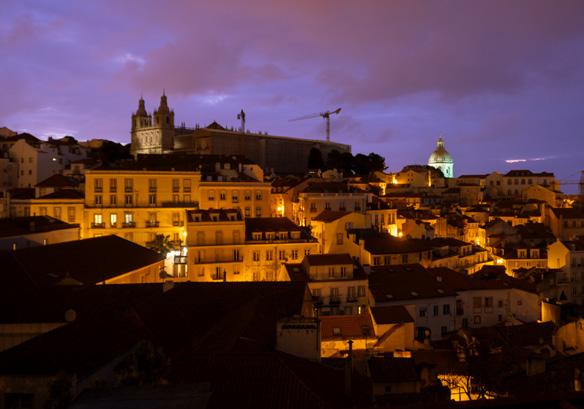
In a global context in which the film industry is dominated by North American productions, the local filmmaking scene in Lisboa, Portugal, stands firm behind their cameras, microphones, lights and institutions to keep local film production and their heritage alive.
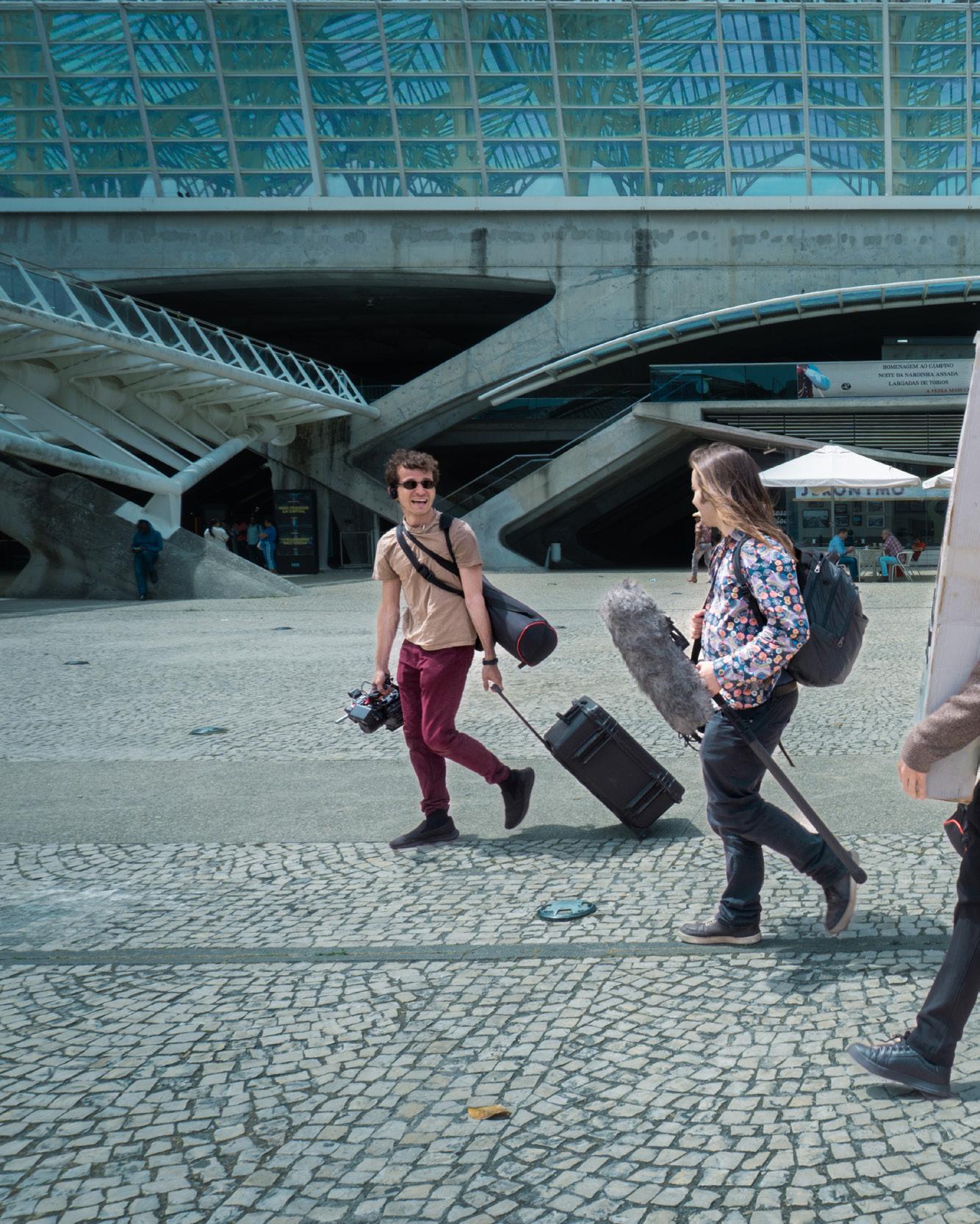
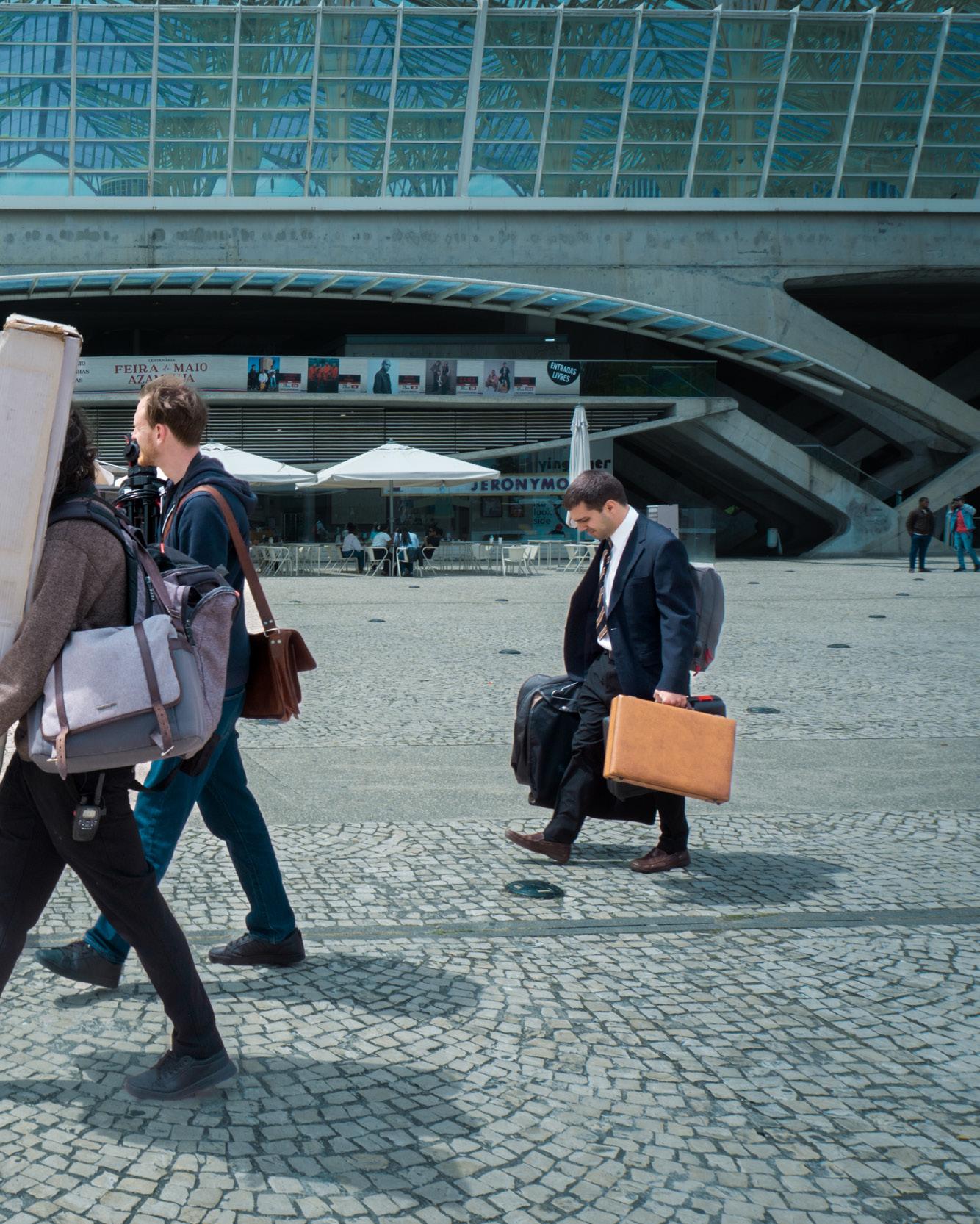
The brutalist concrete railway station building sets the tone for the film that local Portuguese filmmaker Nityam Prem is making: an eerie circular narrative heavily focused on everyday life.
“Três, dois, um, câmara, ação!” The director’s eyes are focused like the camera his crew is handling. Fiction has begun at Estação do Oriente, where Nityam creates local cinema. Children walking through the station look with amazement and curiosity at the crew’s work, while families hold their step and wait until the scene is done filming, showing interest and respect.
“Others just walk by and spoil the perfect shot,” says Nityam. The inventory: one large cinema line camera, a suitcase with more than 15 different lenses, a boom microphone, three tripods, and a set of walkie-talkies the team never turns off. These are the tools the crew carries around the station in their hands, on their backs, and balanced in their mouths to capture the multiple shots they need to complete today. A crucial scene is about to start on the second floor of the station. From across the street, the camera crew tries to frame the shot. People at the crosswalk think they are being recorded; the camera sparks different reactions. At the same time, Nityam is coordinating the actors and the elevator time, and asking passersby to step aside. Multiple attempts fail due to logistics,
but this is the moment; they are, right now, about to get the shot. And then… a two-floor tour bus pulls right into the frame, ruining the take.
Making independent cinema is never fast nor easy.
The current state of affairs
In 2025, 106 films were produced in Portugal, a figure that, on the surface, suggests a thriving industry. Yet beneath that productivity, a quiet retreat was underway: 32 cinemas applied to decommission their screens, with operators citing a collapse in demand and sheer financial unviability. In a global market where 70 percent of box office revenue is swallowed by the “Big Five” North American studios, the reality for domestic filmmaking is unforgiving.
While securing financing remains an uphill battle, the true bottleneck for Portuguese cinema is reaching the screen and people’s eyes. According to official data from the Instituto do Cinema e do Audiovisual (ICA), local productions are fighting a losing battle against the combined forces of Hollywood dominance, high inflation, and the ubiquity of streaming platforms.
It is a crisis of circulation. In 2025, distributors crammed a record 406 films onto the nation’s screens. Of those, 54 were Portuguese productions, yet they captured a meagre 2.1 percent of the total audience. Local films are technically being programmed, but they are suffocating in the margins, failing to actually reach the public.
A
filmmaker’s
youthful spirit
Opinions on the causes of the struggle are diverse, but on the west side of town, in the Misericórdia neighbourhood, a group of young filmmakers seem to identify the symptoms of the problem. They’re all sitting around a table in a dimly lit room, looking intensely at a storyboard as they plan their next project: a horror short film they’ll submit to MOTELX, a specialised horror film festival taking place in the city this summer.
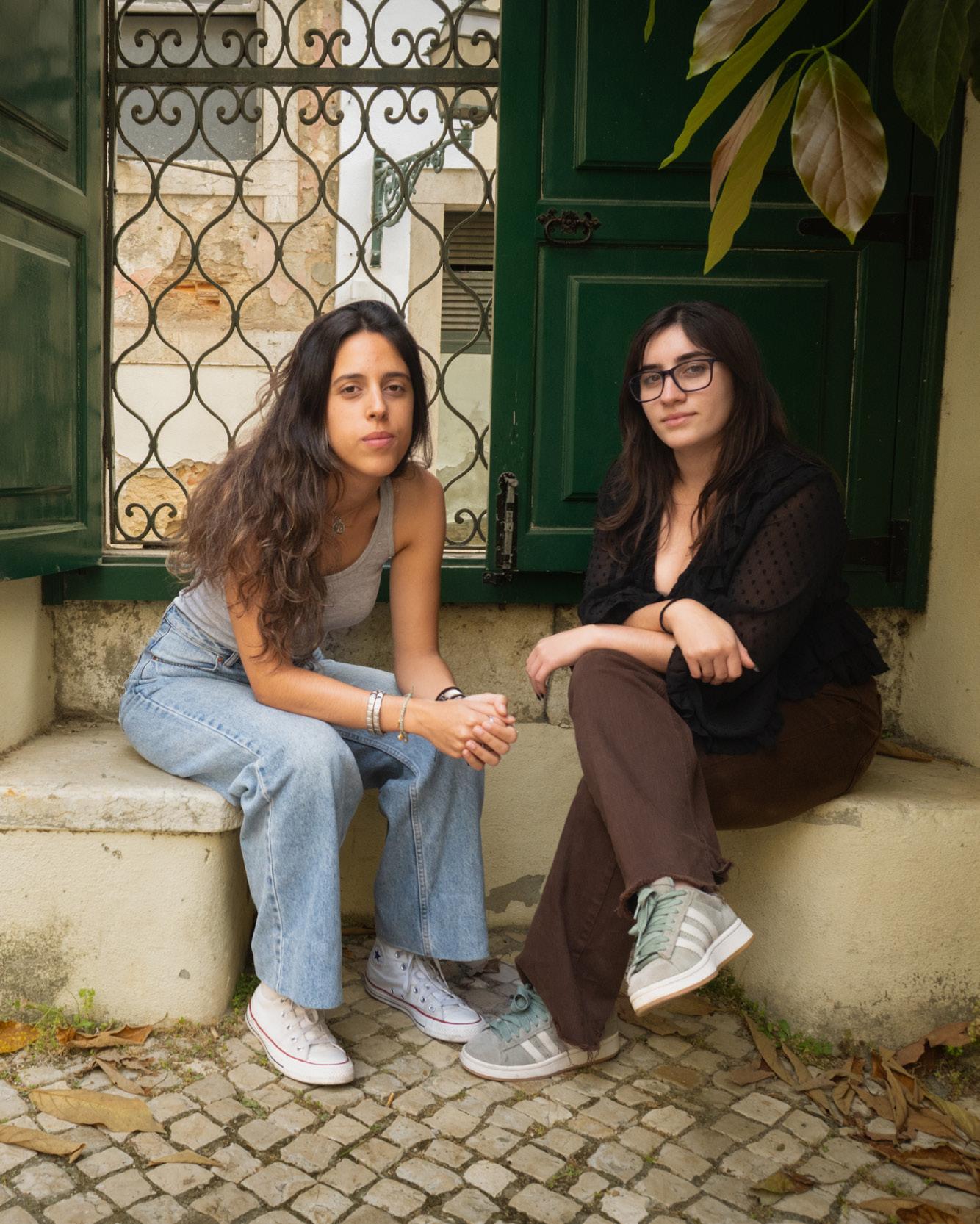
Rita Familia and Giovanna Domiciano, the two women directing this film, sit on the terrace under an old rubber fig as they discuss the current state of Portuguese cinema.
“If you do something here, Portuguese people won’t give you that much attention,” says Rita. For her, the main problem with local films is their content:
“Most of the movies done here want to show how daily life is in Portugal. But we live our life in this country; we know how it is, and it’s really not that interesting.” What is missing, she says, are the right stories.
“I think movies are a scape of life; we need more exciting narratives.”
They remain hopeful for the future.
“People give up because of a lack of motivation, money and interest from other people. We don’t want to be a part of that,” says Giovanna. However, they are not oblivious to current affairs and acknowledge that, to pursue their careers, they might ultimately have to move abroad. Still, a defiant youthful spirit remains: “If it’s not in Portugal, I would be very sad, but I believe that someone has to start doing things here and it might as well be us. I mean, someone’s got to do it, right?”
Lisboa’s endless week of film
A month rarely goes by without a film festival in Lisboa. Each night almost every week of the year, screenings light up projectors. Although they might appear to be a niche phenomenon, more than 12,000 festivals are celebrated worldwide each year, amounting to roughly 32 happening every day. In Lisboa, these encounters cover a broad spectrum of themes, ranging from independent cinema and documentary filmmaking to
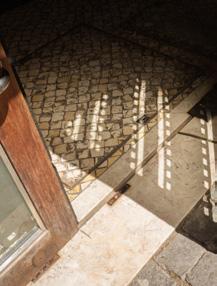
queer, political, and even a specialised motorcycle film festival. One of the city’s largest and most established festivals is Indie Lisboa, which this year celebrates its 23rd edition. Cinema halls are packed to maximum capacity, with more than 200 films screened and two distinct categories dedicated exclusively to Portuguese cinema. The volunteers’ orange T-shirts brighten the cinema halls as they welcome spectators. Outside, established and aspiring directors share cigarettes as ashes fall onto the grey Portuguese cobblestones below.
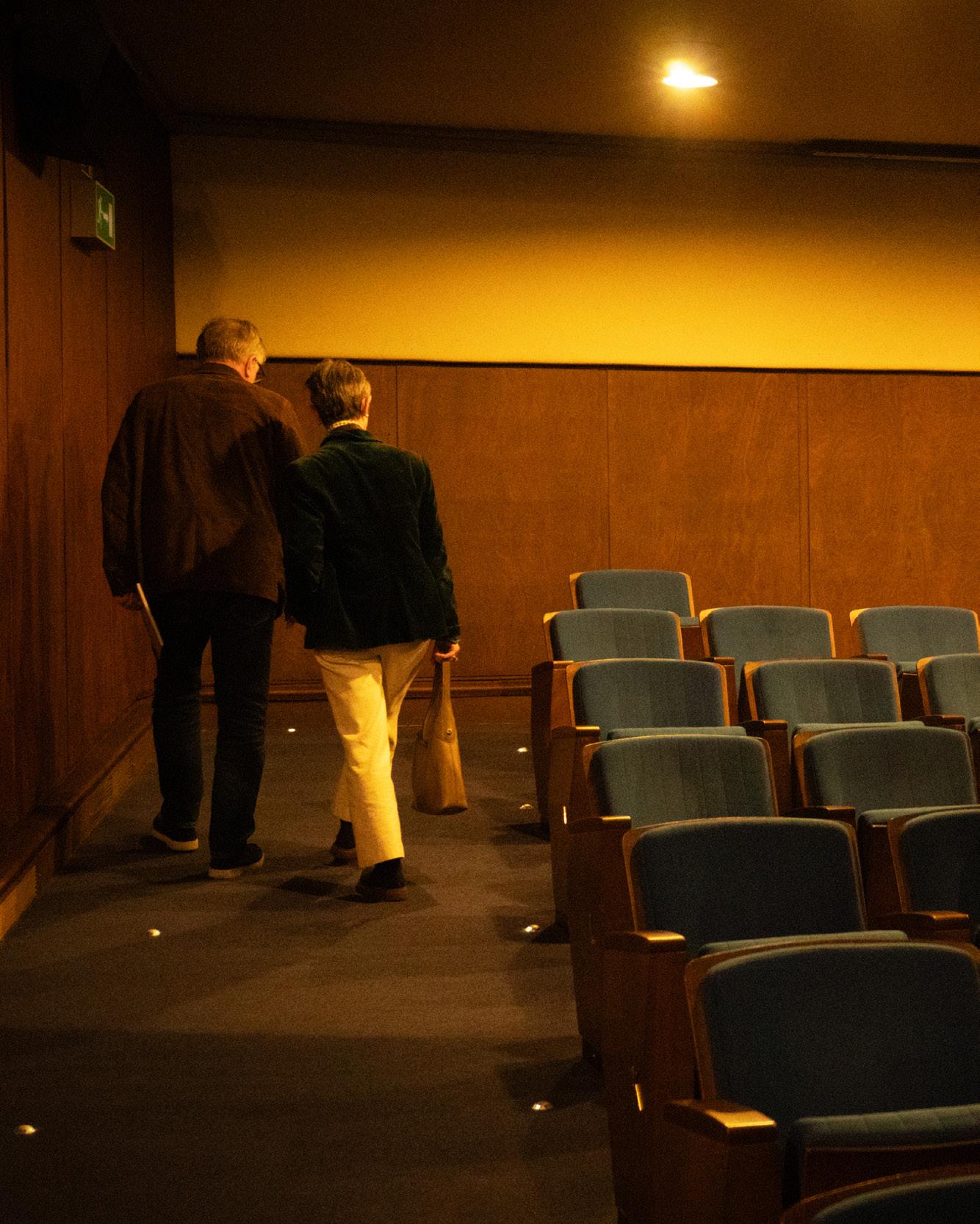
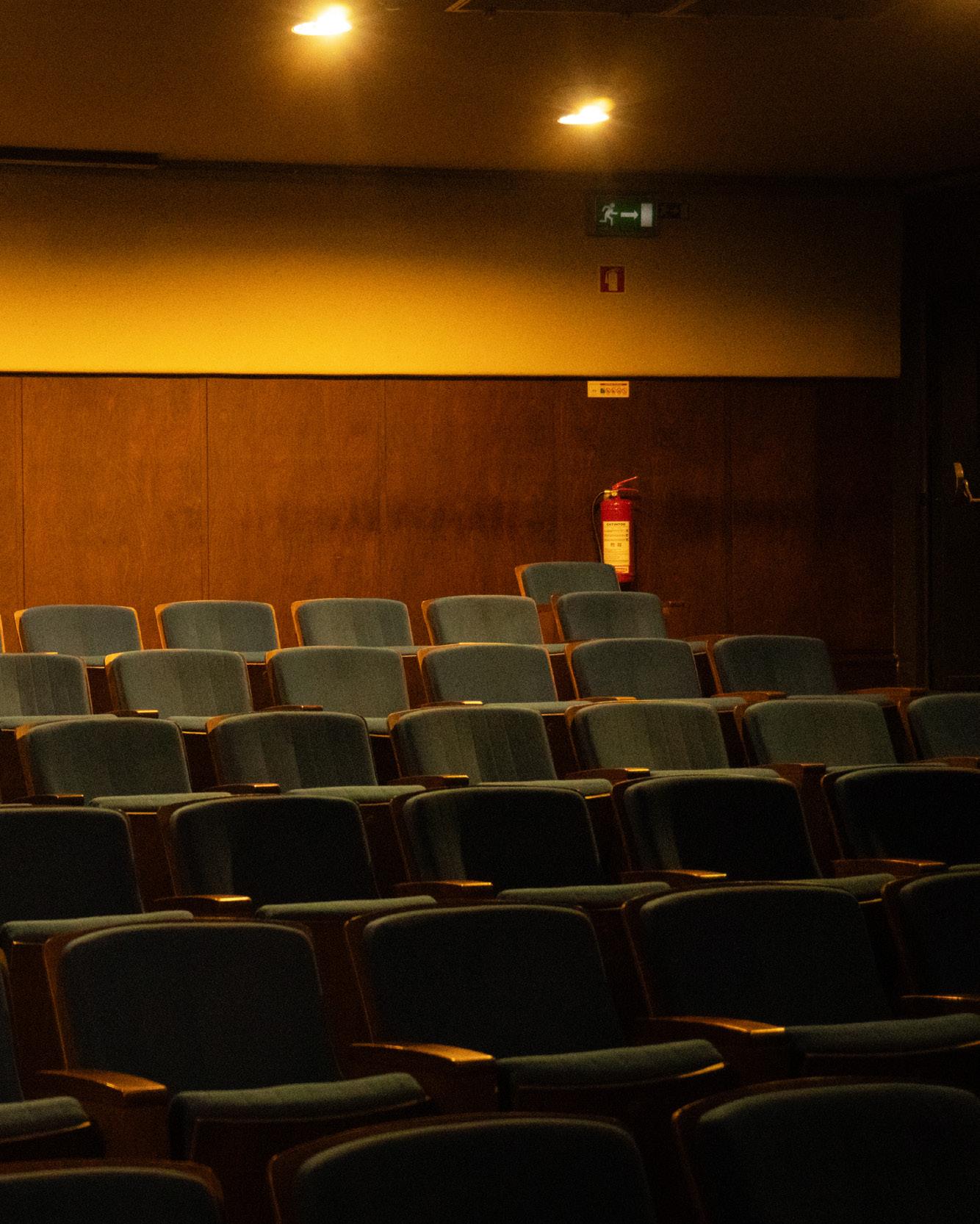
The audience at these screenings is unique; the films bring together seniors, young people, and teenagers to enjoy local cinema. Like a row of ants heading to their nest, crowds stream into the halls to find their seats. Watching local productions allow the public to see the world through their own eyes, whilst the luminous beam from the projector reveals dust particles floating through the dark air.
Safeguarding the Celluloid Heritage
In the middle of the city, two jacarandas flank the entrance to the Cinemateca Portuguesa, the main centre for the conservation and diffusion of cinema in Portugal. In his office, filled with film theory books, Nuno Sena, the current deputy director of the institution, sits at his desk with movie posters covering the wall behind him.
During his journalism studies, Sena knew he wanted to work in the film industry, but oddly enough, he had no desire to make films; he wanted to work with them. His first job was a modest position in the archives of the Cinemateca’s library, a period filled with film negatives that he looks back on with nostalgia. When asked about the importance of watching local films, Sena explains that it is about understanding cinema not merely as entertainment, but as a mode of knowing: a way of interpreting our world and seeing it through the eyes of those who live the experience.
The Cinemateca Portuguesa, founded in 1956, is responsible for safeguarding the nation’s film heritage and promoting cinema culture. The institution’s budget relies not only on public funding but also on a small percentage of revenue taxed from streaming platforms. The main challenge is time.
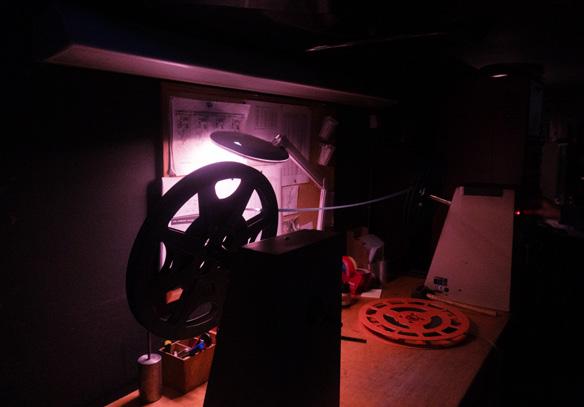
“Film in Portugal is still fragile,” Sena observes. The equipment required to conserve celluloid has largely been discontinued: “We are trying to be prepared for the next 50 years of keeping this heritage alive.”
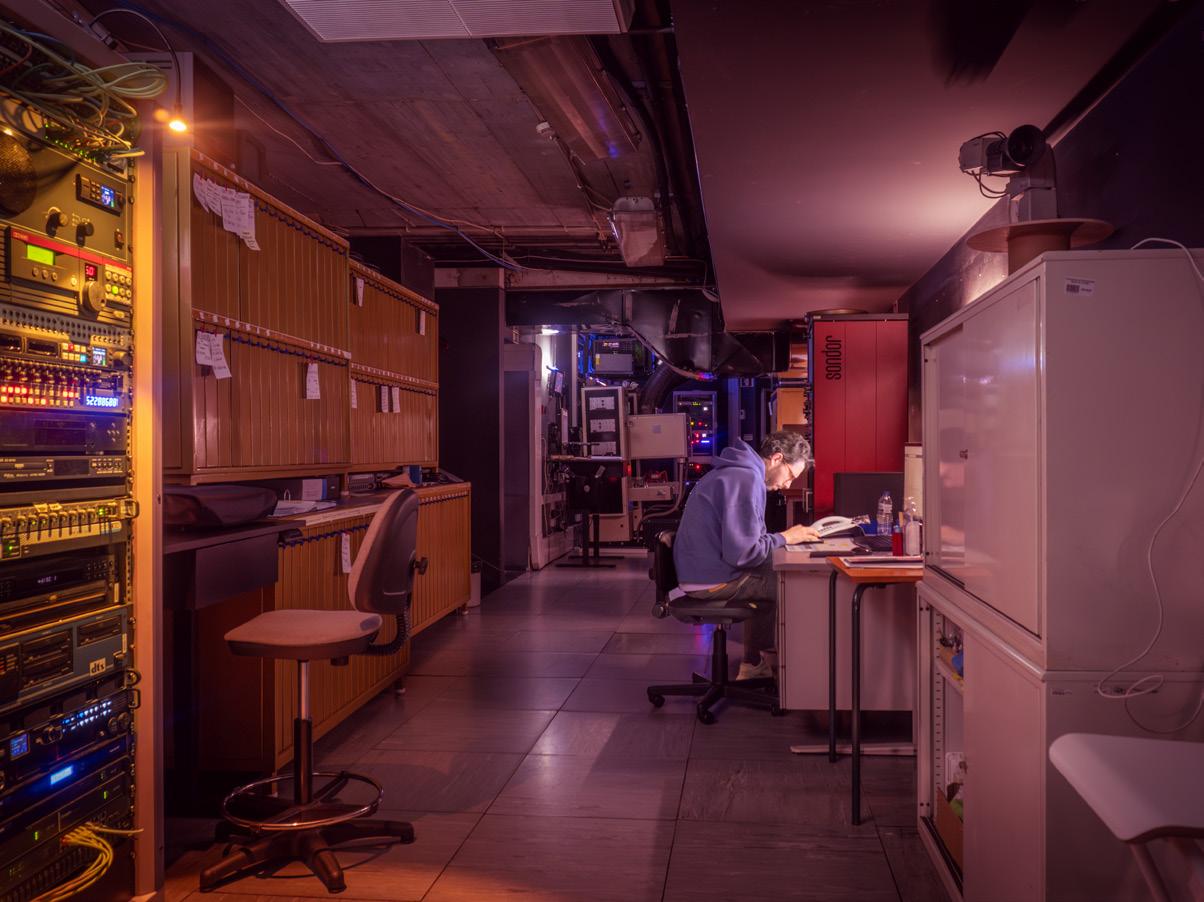
But the fragility is not confined to materials alone. A few years ago, the average age of the projection room staff was 65. With mass retirement looming, the Cinemateca orchestrated a vital generational shift: the older generation taught the art of celluloid projection to a new, young team, who now carry on the tradition and craft in their own hands.
Plan A, plan B, and the streets
It is dusk in Lisboa, and in the first-floor living room of a 140-year-old, four-storey cultural house downtown, a cascade of worlds unfolds. For the first twenty minutes, a fisherman mourns his drowned son in the Atlantic Ocean; for the next thirty, half-animal, half-human teenagers sprint through an enchanted forest; for the final ten minutes, a woman bathes in blood. All of it on screen, all of it through film.
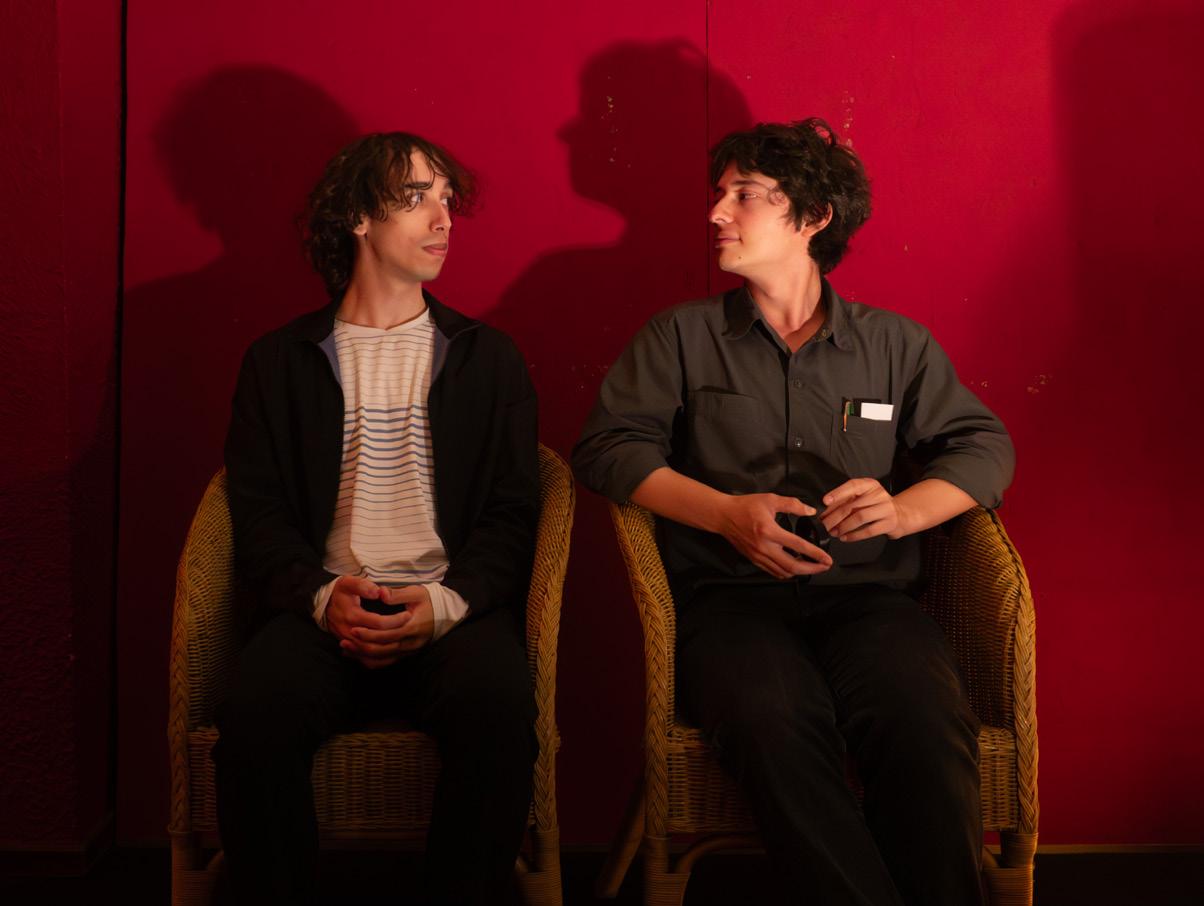
Charlie Chaves (23) and Valdir Neves (26) run Club Benares, a collective of young cinephiles who meet monthly to screen independent local cinema. Charlie explains that he is captivated by cinema’s unique power to unite strangers, to entice them into a dark room where they stare at a screen like rats. He is as invested in making films as in building a community around them.
“We don’t know if we will make it,” Charlie admits. “Our plan A is to direct films; our plan B is to make films. And if we end up on the streets, we’ll just start a film festival with the people out there,” the duo laughs in camaraderie, exchanging hopeful glances.
As cinemas across the city, including the Cinemateca Portuguesa, prepare for their final screenings of the day, Nityam and his crew pack up at Estação do Oriente. They take the underground back to his flat, preparing for the gruelling post-production process ahead. Rita and Giovanna iron out the final details for next week’s shoot, whilst Charlie and Valdir sweep the living room and pack away the chairs of their makeshift cinema.
The film industry in Lisboa is a clockwork system, a mechanism in which every disparate piece functions to keep the whole machine turning, bringing ideas from the mind to the screen through collective effort, through light.
KEEPER OF THE FLOCK
by Louise Joenen
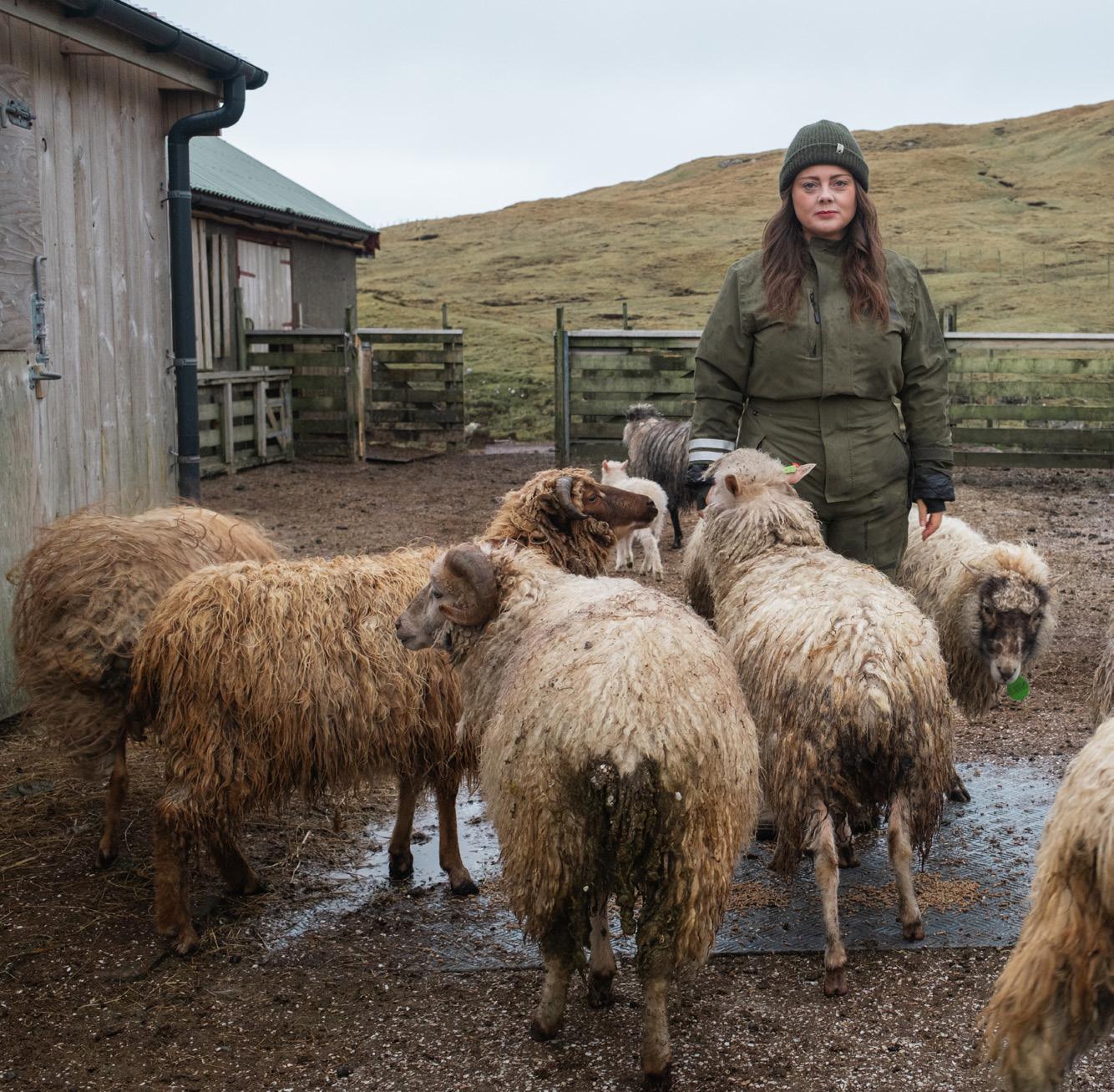
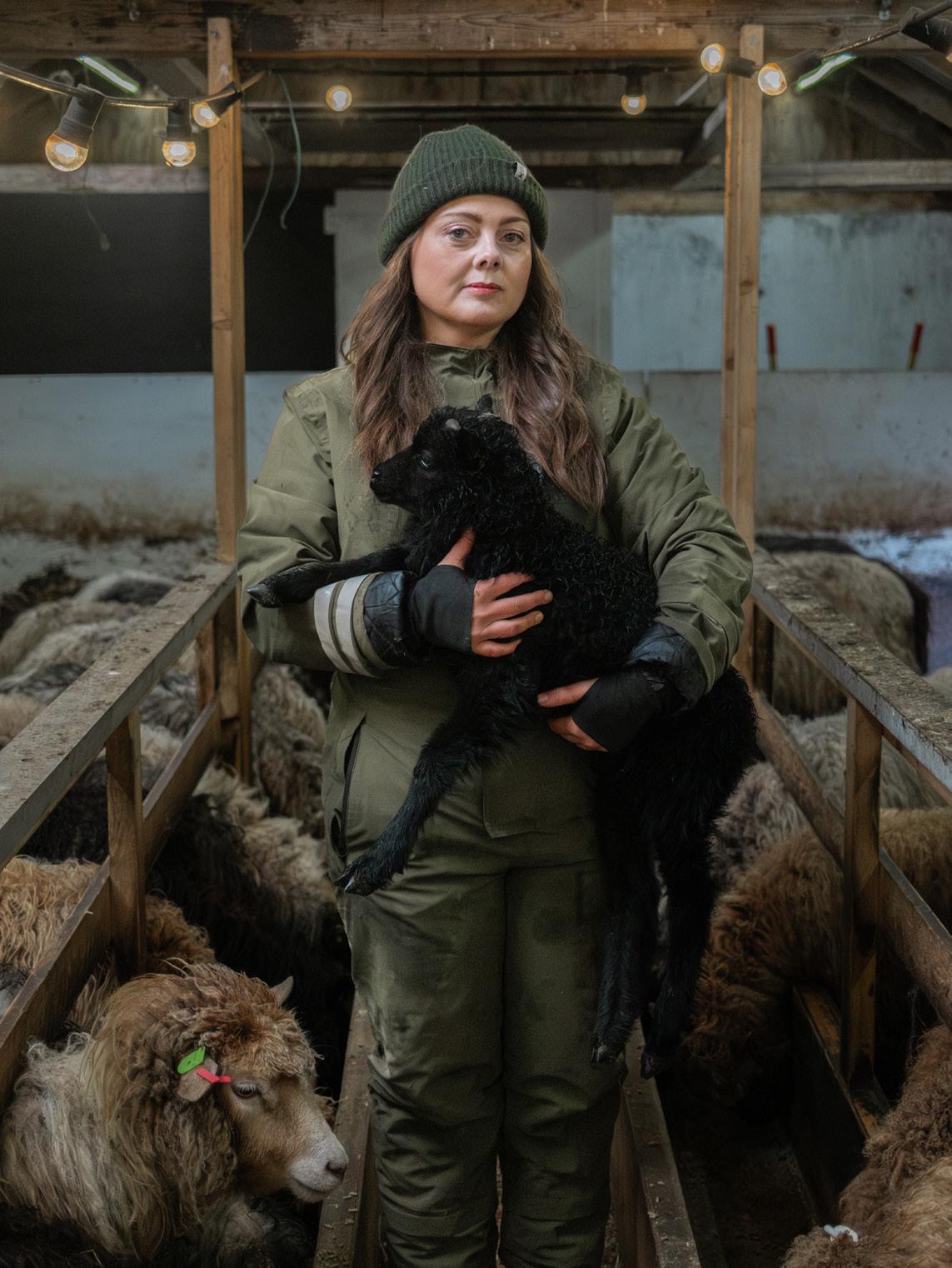
As the first woman to inherit her family farm, Harriet Olafsdóttir is modernising farming in the Faroe Islands while challenging deeply rooted traditions and fighting for her daughter’s future inheritance.
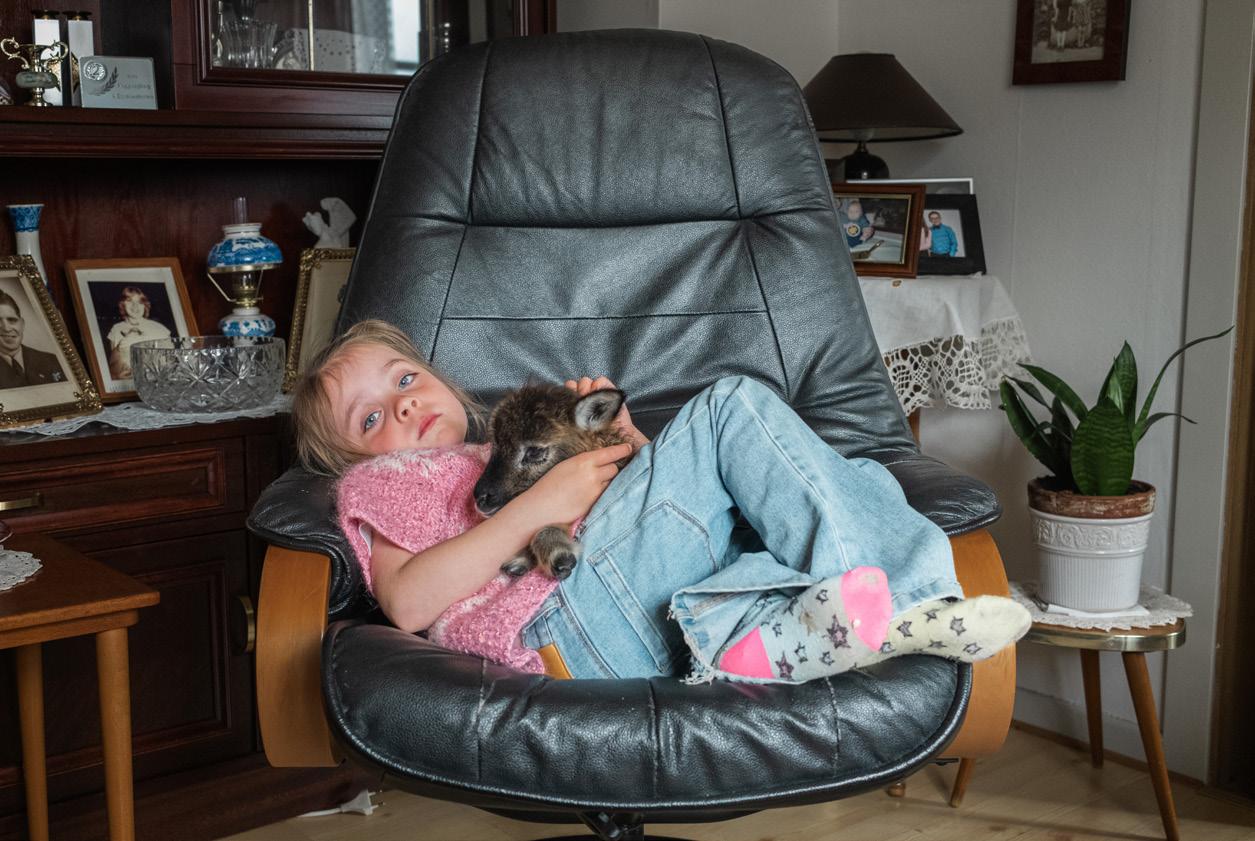
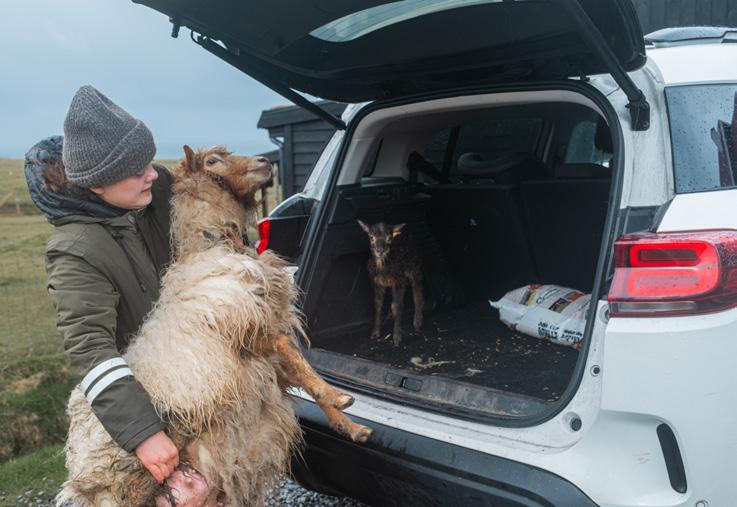
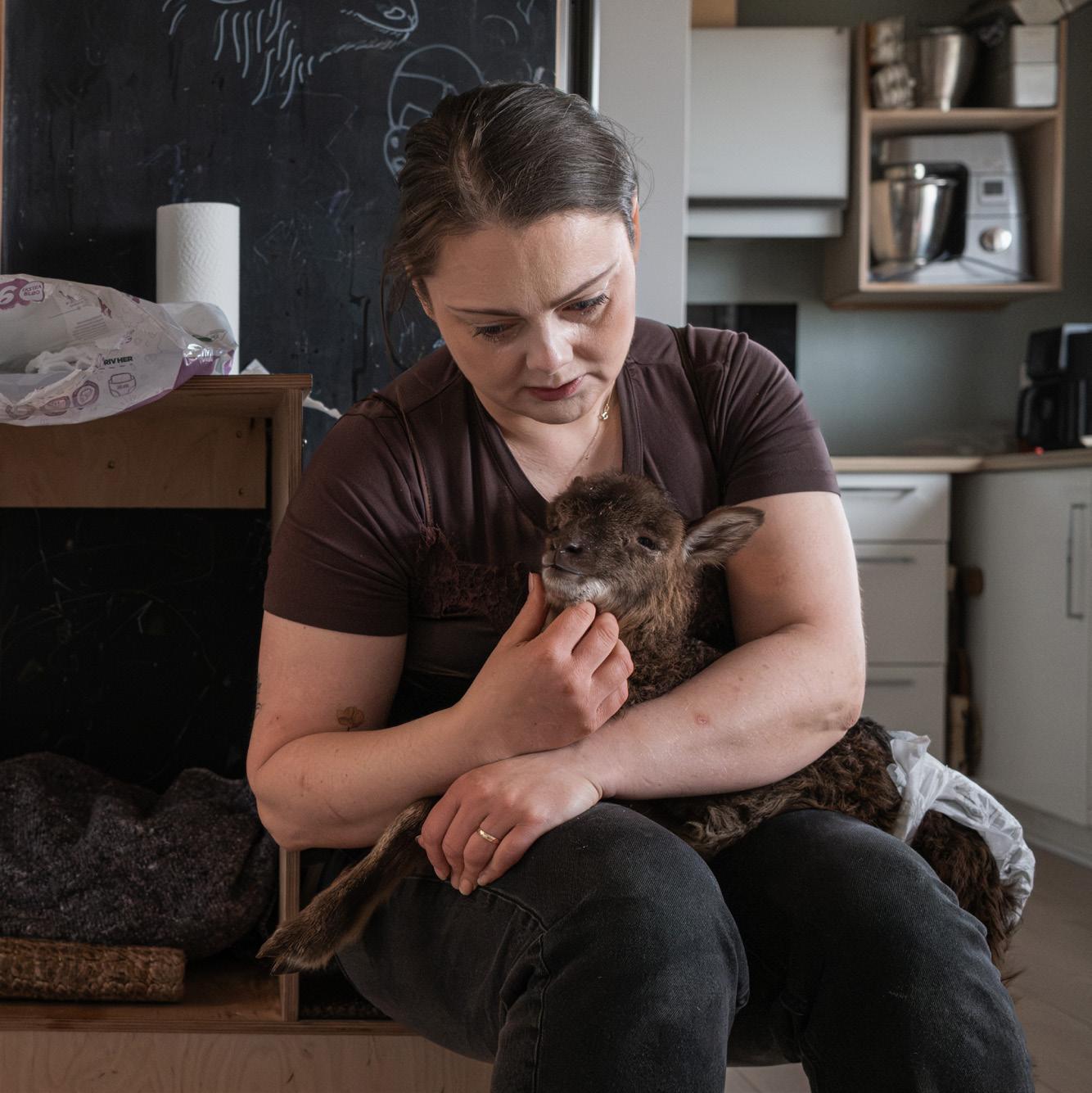
“Lift it up. Yes, just above her head. Okay, now take it off. Don’t forget to shake her belly.” Six-year-old Maja Lý is in the kitchen, concentrating hard as she feeds a three-day-old lamb she has named Maja. The animal wears a nappy, keeps sliding across the floor towards the bathroom, then settles again on the heated floor, exhausted. When people ask Maja Lý what she wants to be when she grows up, she doesn’t hesitate. “A farmer. Like mum.”
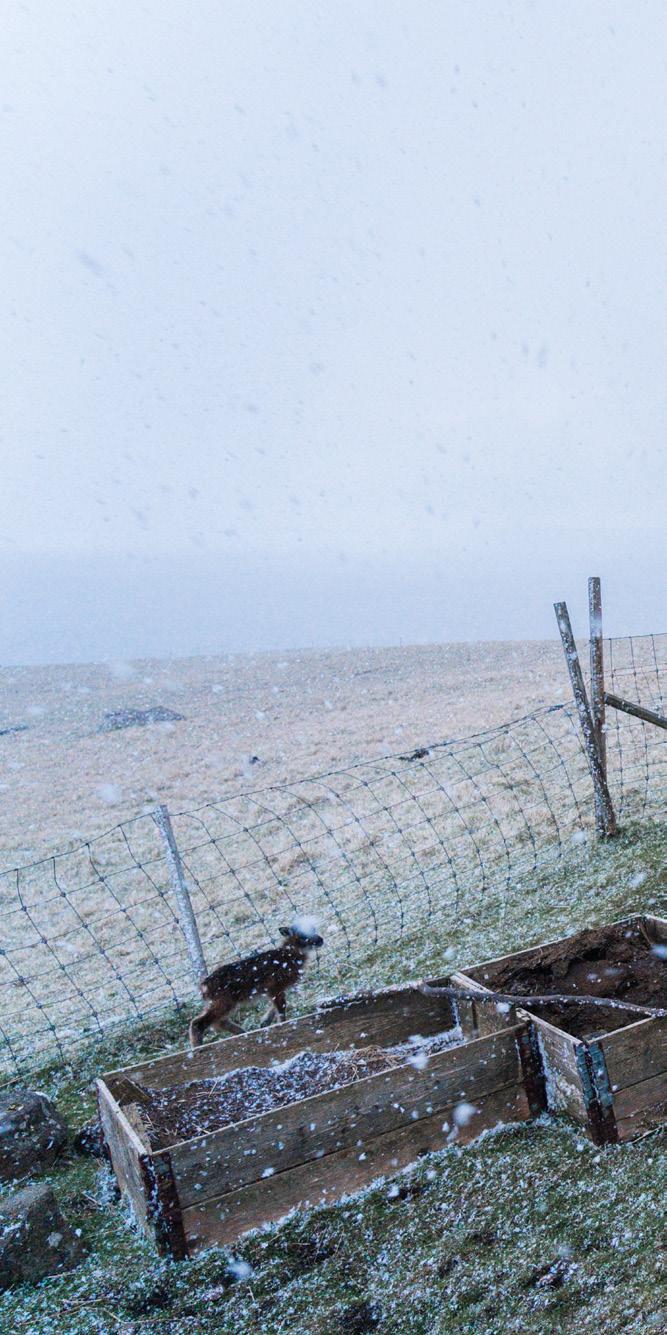
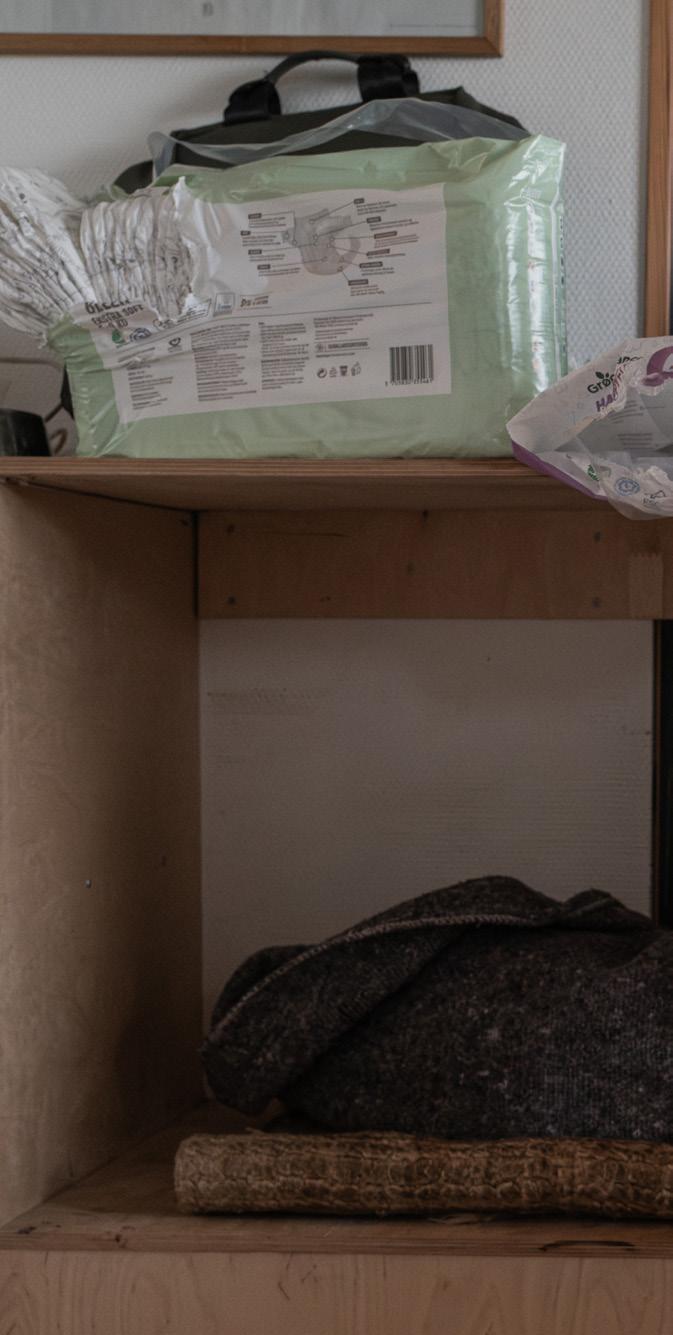
Lambing season has just begun in the remote village of Æðuvík and the house is already filled with milk powder, cleaning wipes and stocks of nappies. Maja was rejected by her mother shortly after birth, but Harriet refused to let her die and brought her indoors to bottle-feed her every few hours.
The first woman in line
Until 1989, women in the Faroe Islands could not legally inherit farms. Inheritance laws, dating back centuries, stated that farmland had to pass through the male bloodline. In 1989, when female inheritance became legal, Harriet Olafsdóttir was born. As a sixth-generation farmer, she is now the first woman in her family to inherit and run the farm.
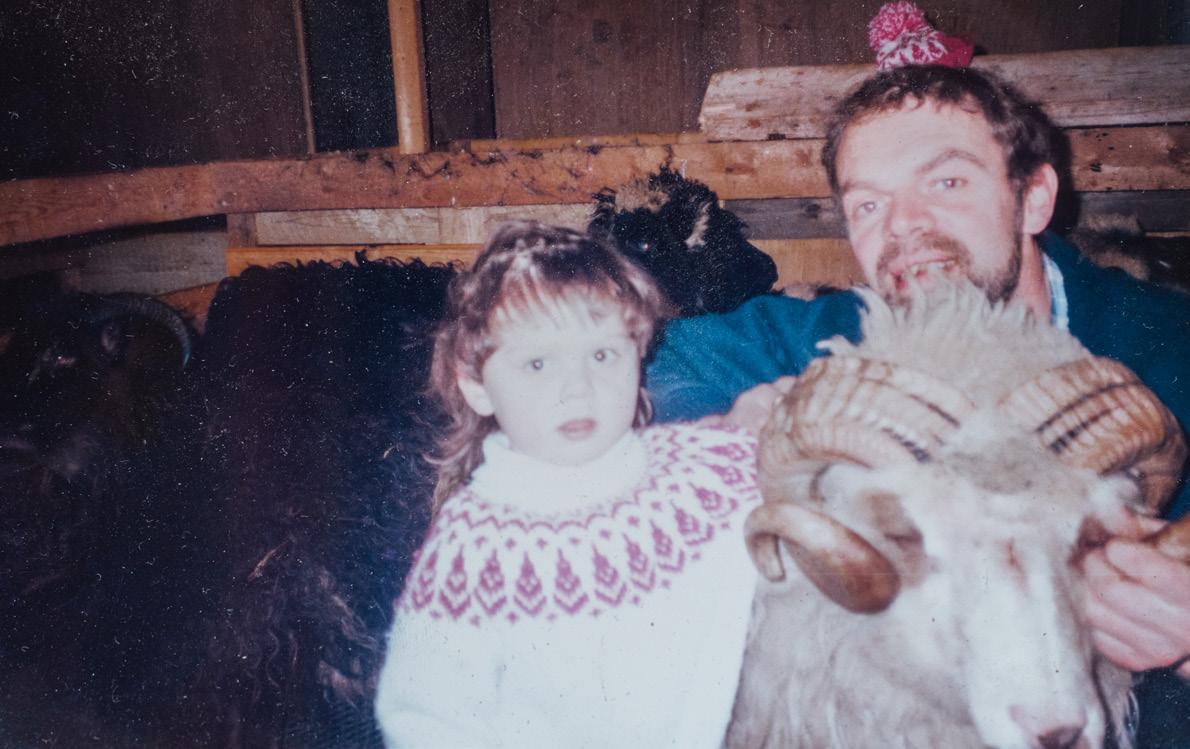
At the Bottom right - Harriet and her grandfather in the barn, 1993.
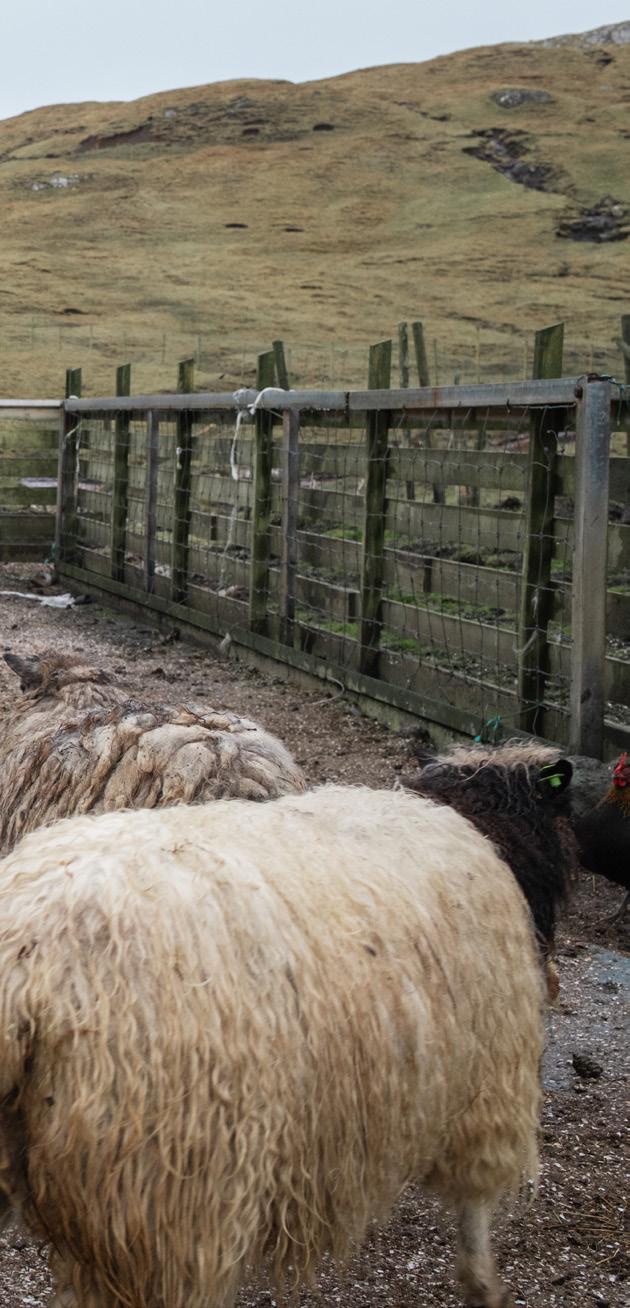
In this southern area of Eysturoy, the second-largest island in the Faroe Islands, she is also the only female farmer sharing the land with twenty men under Seyðabrævið (“The Sheep Letter”), a complex set of agricultural laws dating back to 1298 that still requires neighbouring farmers to collectively share and manage the unfenced grazing land.
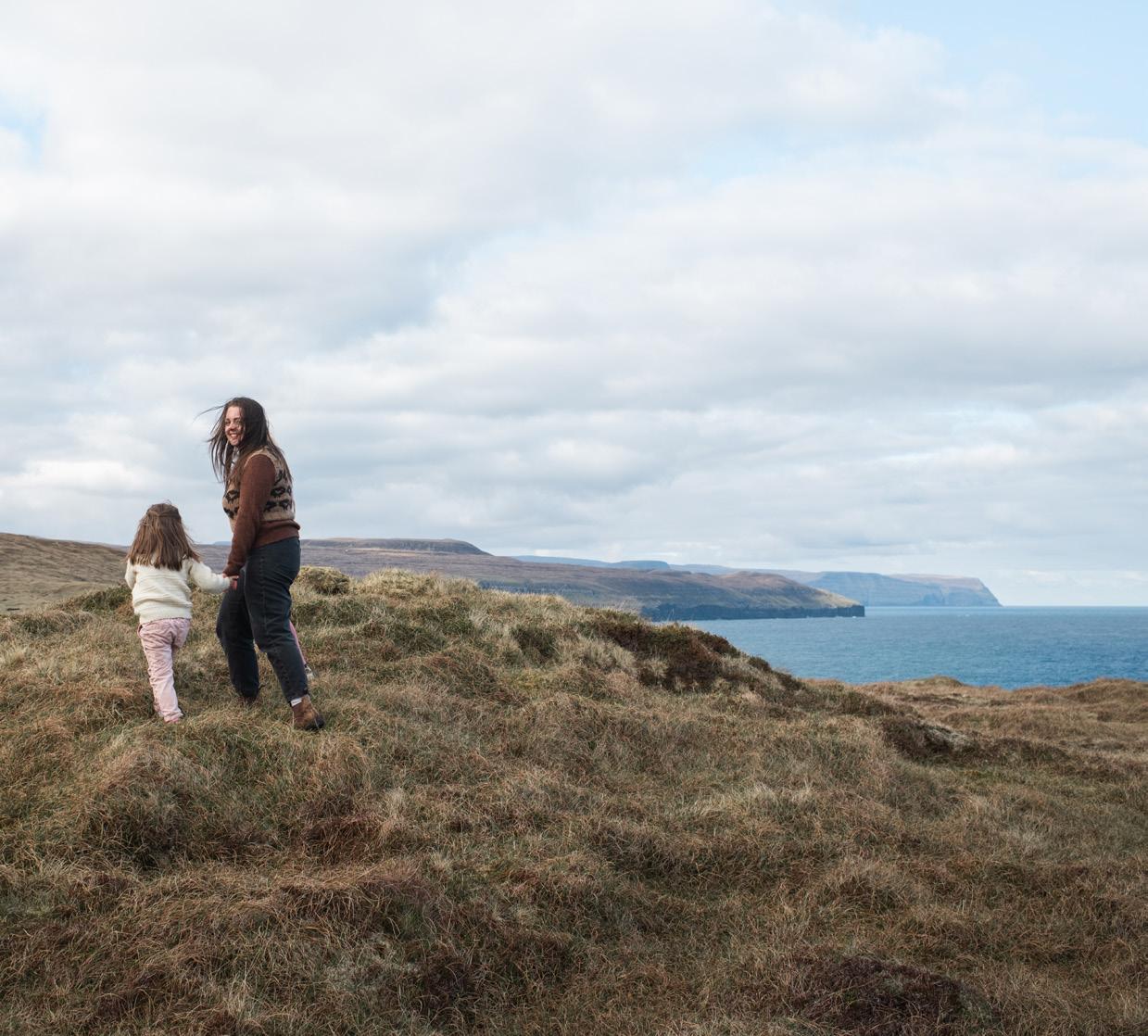
“Sheep have been my life since before I could walk,” she says, looking at an old photograph of herself and her grandfather in the barn in Æðuvík. As a child she spent more time with him in this small place cradled between rugged mountains on one side and the vast Atlantic Ocean on the other, than she ever did in kindergarten.
“He would teach me everything he knew about sheep, and I loved it. He was my biggest role model.”
But later, Harriet moved to Tórshavn, the capital, and worked in politics, convinced she would build a completely different future. Meanwhile, her father had grown exhausted by years of conflict with neighbouring farmers and was ready to give up the farm altogether. None of Harriet’s brothers wanted to take over. So, before the land would be sold, Harriet stepped in.
“My father gave me five years to prove I could make the farm survive,” she says.
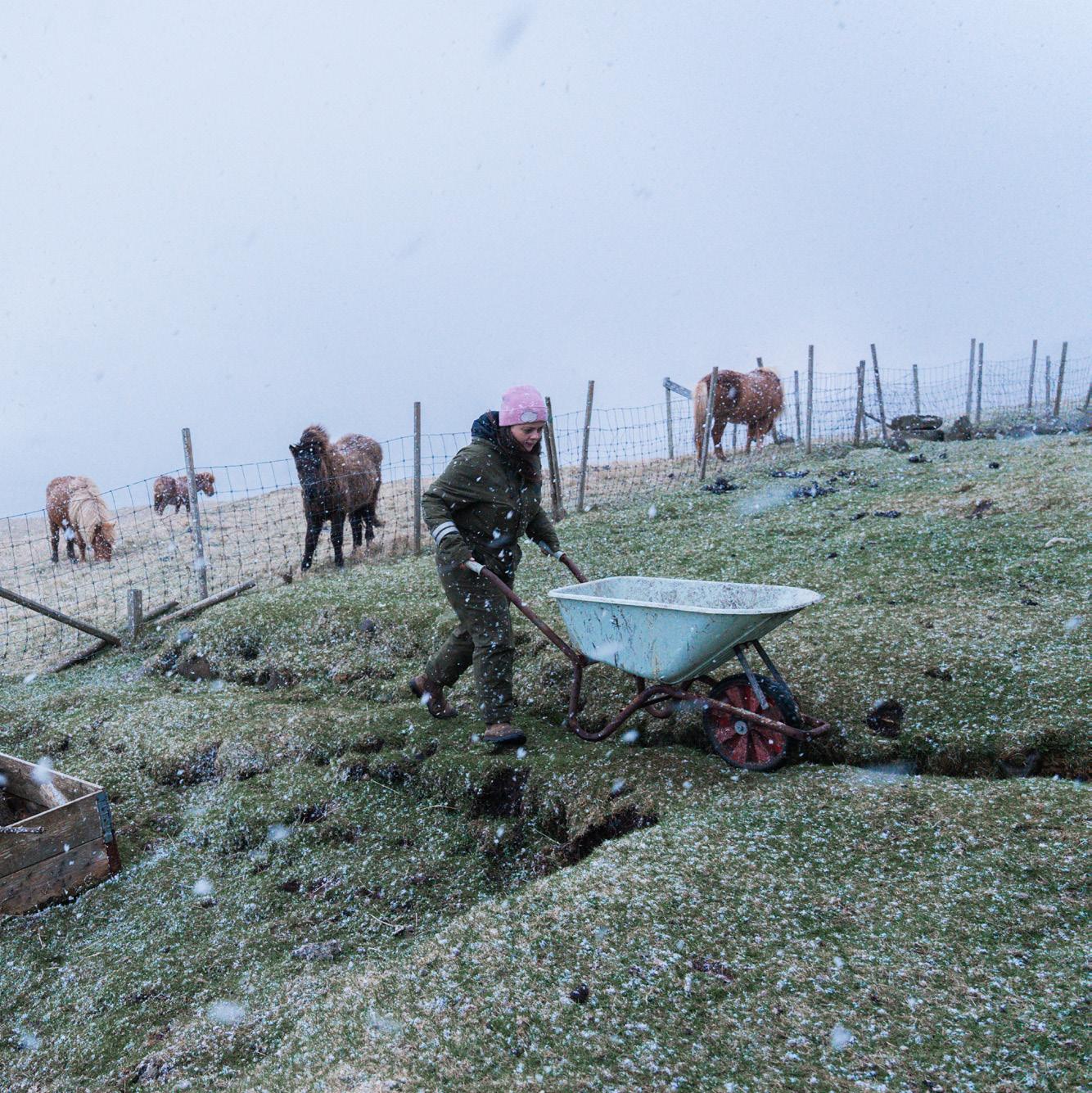
At first, many of her ideas sounded absurd to him: organic farming, naming sheep, photographing them with flower crowns, bringing tourists into the house and rescuing endangered Faroese horses.
But today, sheep alone are no longer enough to survive on. Strict grazing limits mean she can keep only around seventy sheep through winter. Wool, once central to the Faroese economy, has lost most of its value. Now the farm survives through a patchwork of dinners, farm tours, merchandise, social media, an Airbnb attached to the house, and seasonal events for tourists and families. More than thirty thousand people follow her daily life on the farm on Instagram.
The perfect excuse
The week after Maja, the lamb, was taken in, a few visitors come to the farm. Harriet shows them the horses and Elias, the farm’s best-known sheep, always pressing in for attention, while John, her husband, prepares a three-course dinner in the kitchen. After taking photos with Maja, who has almost doubled in size since the previous week, they sit down in the living room. The walls are filled with posters, keychains, postcards, colouring books and stickers.
On one of the shelves stands a portrait of Harriet, accompanied by a short text from an art exhibition in Tórshavn she took part in a few days earlier. She glances at it and smiles.
“My younger daughter wants her portrait on the shelf as well,” she says, amused, “she told me: ‘Mom, you have to tell people I’m the future farmer.’”
While she talks, John brings in a roasted leg of lamb with creamy potatoes.
“The meat has been slow cooking in the oven since this morning,” he tells the visitors. Harriet does not eat lamb.
She is allergic to it.
“A lot of people are like, oh, that’s very unfortunate. I’m like, no, I don’t think so,” she says while pouring red wine for the guests.
“Maybe it gives me the perfect excuse. It’s a double-edged sword, because I’m too attached to my sheep.”
The conversation quickly shifts.
“And what do you win with the horses?” someone asks.
“Nothing. They don’t bring money. They take it.”
Harriet explains how the costs never really add up: winter feed alone, then veterinary care, hoof trimming, dentistry, and constant upkeep.
“They eat up all of the money. Literally.”
When a friend asked her to take in one of the last remaining Faroese horses, she accepted without really thinking.
“I want to help preserve them.”
There are now only eighty-six Faroese horses left in the entire world. The breed has been in the Faroe Islands since the Vikings arrived and is one of the last native Faroese heritage breeds still alive today. Harriet now has four mares participating in the breeding programme. Surprisingly, the horses changed the farm in unexpected ways.
Since their introduction to the land, biodiversity has increased dramatically. Wildflowers that disappeared during Harriet’s childhood have returned. Rare orchids now bloom again near the hills. Bumblebees have reappeared.
She explains how horses graze differently from sheep and disturb the soil just enough to help older seeds rise back to the surface. She stopped using artificial fertilisers entirely and shifted towards organic restoration, despite knowing it could take up to twenty years for the land to recover fully.
For Harriet, the goal is no longer simply producing animals or maximising profit. It is leaving the land healthier than she inherited it. Even if the process remains slow, the changes are already visible in small signs across the fields. Around the table, the visitors have been listening keenly and asking
questions, but now the conversation gradually softens as the evening moves toward its final course: Harriet’s speciality, a chocolate cake and rhubarb compote from the garden produce.
A missing lamb
The next morning, Maja Lý and her older sister, Jona, hug the lamb at the front door before leaving for school and kindergarten. “Bye, Maja! See you later!”
Harriet leaves a few minutes later, and Maja automatically follows her outside, diapered and unsteady. It has become part of her morning routine. The lamb sits curled on the floor in the passenger footwell while Harriet drives slowly towards the barn. The road runs alongside the wet green slopes, carved by rain and wind, and descends so steeply towards the coast that the car seems to be driving straight into the raging ocean, where large waves crash against the rocks below. On the way, Harriet slows and points out small pink flowers blooming along the roadside.
“I think those flowers would look nice on Maja for my next poster,” she says, half smiling.
“But I’m not sure I want to do it. Every time I photograph lambs with flower crowns, they end up dying.”
At the barn, Harriet stops the car before fully turning off the engine.
“One lamb is missing,” she says before even lifting her binoculars. A ewe with twins stands on the slope, with only one lamb beside her. Harriet gets out and walks across the hill, scanning every ditch. After an hour, she finds the missing lamb in a low hollow, soaked through, but still alive. She lifts it into her jacket.
“The mother can’t take care of both. She didn’t even realise one was missing,” she says. The lamb comes home with her.
That same afternoon, a neighbour calls: a newborn lamb has been found alone. By evening, Maja, now big enough to jump onto the couch, is running around the living room with her two new sisters, Sólrun and Aslaug.
Bringing newborn lambs into the house is not approved of by neighbouring farmers.
“Traditional farmers would grab the lamb, smash its head onto a rock and throw it into a ditch.”
According to Harriet, that’s also how the professors at the farming school taught it. These differences between her methods and theirs create ongoing tension.
“Nobody wants me here. They think I should stay in the kitchen.”
Harriet says later while preparing bottles for the lambs.
Ongoing tension
When Harriet took over the farm, she genuinely tried to fit into the farming community. She attended farming board meetings and tried to approach disagreements calmly. But every conversation eventually turned into a fight.
“There’s only one-way communication,” she says, absentmindedly scratching Maja’s chin.
“We don’t see farming the same way. For them, it’s only about meat and profit, but I love my animals.”
At one meeting, she finally said it directly.
“I told them: ‘You don’t listen to me because I’m a young woman.’ They said that wasn’t true. And I said, ‘Really?’”
She pauses.
“And then nobody answered.”
After that, she stopped going to the meetings and sent John in her place. The tension predates her taking over the farm. Her father warned her off.
“He knew exactly what these people were like. That’s why he didn’t want me to take over,” Harriet says.
She believed she could do things differently. Instead, many of the same battles followed her. Last year, after the most horrible lambing season ever, with many losses, the pressure became so overwhelming that she started therapy.
“But the hardest part isn’t the work,” she adds. “It’s the people.”
The neighbours want Harriet to sell the farm. “They will do anything they can to make me leave.”
New perspectives
Outside, the Faroese horses slowly emerge from the fog behind the house. Harriet watches them for a moment.
“That’s why I think the heritage breed sanctuary would be better for us.” The idea has been growing in her mind for years. “I’ve asked the government to separate my farm from the others because we have nothing in common.”
One politician eventually suggested another possibility. “You can make it into a sanctuary for the horses. Then maybe you
could apply, and then maybe you could be separate.” Unlike the sheep, the horses are not tied to meat production.
Harriet would still keep a large number of sheep, but on a smaller scale than today. A sanctuary could allow the farm to survive through conservation, tourism, and the preservation of the Faroese horse itself, without constantly depending on selling animals she has raised by hand. It would also formally separate her from the farmers she has spent so many years fighting with.
Still, there are other things she carries from her family history.
“A lot of my ancestors were alcoholics,” Harriet says. Her family never discusses it openly. It’s a very sore subject.
Everyone is ashamed of it.
“But honestly, I understand them.” For centuries, farming in the Faroe Islands meant survival. Farmers carried physical and emotional pressure, often in isolation.
“Men weren’t allowed to talk about their feelings back then. Therapy didn’t exist. Alcohol became their medicine.” Harriet decided this habit would stop with her. “But after a really bad day, I allow myself one shot of Jägermeister.”
The next shot she had, was three days later.
Facing the fallout
While checking on the three lambs and changing their nappies in the morning, as she always does, Harriet immediately notices something wrong with Maja. Her stomach is hard with gas. Bloat is common at this age and can kill lambs within hours.
Harriet changes her morning plans without hesitation, messages the veterinarian, administers medication, massages Maja’s stomach with both hands, and tries to keep her moving through the house. Nothing changes. The swelling only worsens. As a last resort, Harriet reaches for a long hollow needle used to release gas. She carefully inserts it into Maja’s
belly to let the pressure escape. Maja screams and struggles against her. “I know she’ll make it,” Harriet says, still holding her tightly. A few seconds later, Maja collapses in her arms. Harriet stays on the bathroom floor without moving. For several long minutes, she slowly pets Maja’s head with one hand. Then, without a word, she places Maja back onto the grey carpet where she used to sleep, covers her carefully, and carries her into the kitchen, where she lays her on the wooden shelf she always climbed onto. She sits there, her gaze empty, letting a few tears fall without trying to hold them back. Sólrun comes over to her. She takes her in her arms and holds her tightly, as if clinging to whatever life she has left.
Harriet is used to death. With lambs, it is part of everyday life, even under careful watch. She knows that better than anyone. Last year, she bottle-fed nine lambs. Only four survived. She had promised herself she would never do it again. And yet, here she is, with three bottles beside the sink and two packs of nappies in the wardrobe.
“Maja was special. That’s what makes it harder. But the worst part will be telling Maja Lý. It was her lamb,” Harriet says before going upstairs in silence and wrapping herself in her sheets. Days pass without anyone in the house mentioning Maja directly. At night, Harriet barely sleeps. She keeps dreaming that Maja is dying again. A few days later, after the children have gone to bed, she finally says it out loud to John.
“I can’t really sleep anymore. I am so stressed,” she says, dark circles under her eyes.
“I keep thinking one of them will be dead when I wake up.” The nausea has become constant now, the kind that comes from stress more than illness, a tight pain sitting permanently in her stomach.
“I don’t think I’ve fully recovered from last year.”
After Maja died, Harriet wrapped her in a grey carpet and sat next to her. Sólrun stayed on her knees for a long moment, without moving.
A trip away from the troubles at home
By the end of summer, Harriet, John, Jona and Maja Lý will leave the Faroe Islands for a six-month journey across Europe. The farm will be taken care of by a friend of Harriet’s who already works for her as a shepherd on the top of the mountain. They have been saving for the trip through small side jobs, while hotel collaborations and volunteer jobs along the way will help cover accommodation costs. For the first time in years, they will step away from the farm entirely. Partly so the children can discover the world beyond their isolated home.
Partly because Harriet no longer knows how long she can continue living like this. Harriet explains that the neighbouring farmers still refuse to let the horses graze freely on certain parts of the mountain.
“In reality, the first thing I need is more land to take care of the horses. But the other guys don’t want the horses, and even though it’s my side of the mountain, they have a vote against it.” Her attempts to separate her land from the surrounding farms have gone nowhere politically. Some farmers have already told her they would never sell land to her “because then she wins.”
The conflict often feels endless.
“Once, the farmers asked me: ‘Why do you have to be so difficult?’” The answer felt obvious to Harriet.
“Because I’m doing it for my daughter. So she doesn’t have to do the same fight as I do.”
At six years old, Maja Lý already says she wants to become a farmer exactly like her mother. Harriet smiles when she talks about it, but never for very long.
“Sometimes I wonder if I really want that for her.”
But Maja Lý is not like her mother. And Harriet knows that.
“If someone yells at me, I cry. If someone yells at her, she laughs.”
At kindergarten, teachers describe her as stubborn, strategic and impossible to intimidate, the kind of child who keeps finding a way around a problem until she gets to where she wants to go.
Harriet still does not know what will happen after the trip. Maybe the sanctuary project will happen. Maybe nothing will change. Maybe the fighting will continue exactly as before.
But when she watches Maja Lý picking flowers in the backyard, she still allows herself a tiny bit of hope.
“Maybe she’ll be the one to end this fight.”
HOME IN MOTION
by Claire Nguyen
After spending a decade in Denmark, Azusa Tsujiuchi fills her days preserving the culture she left behind, by owning a restaurant, teaching Japanese, and spending time with her family
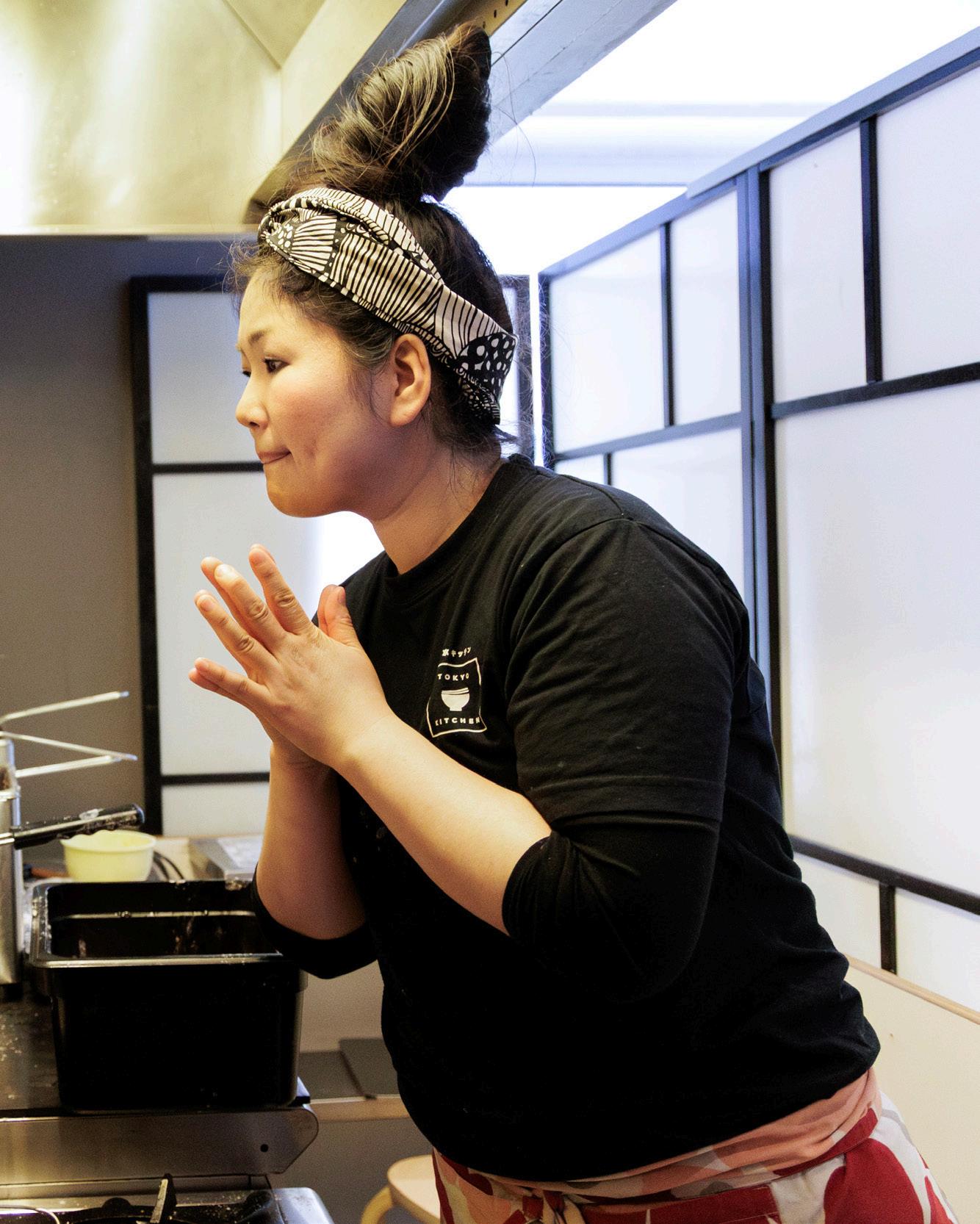
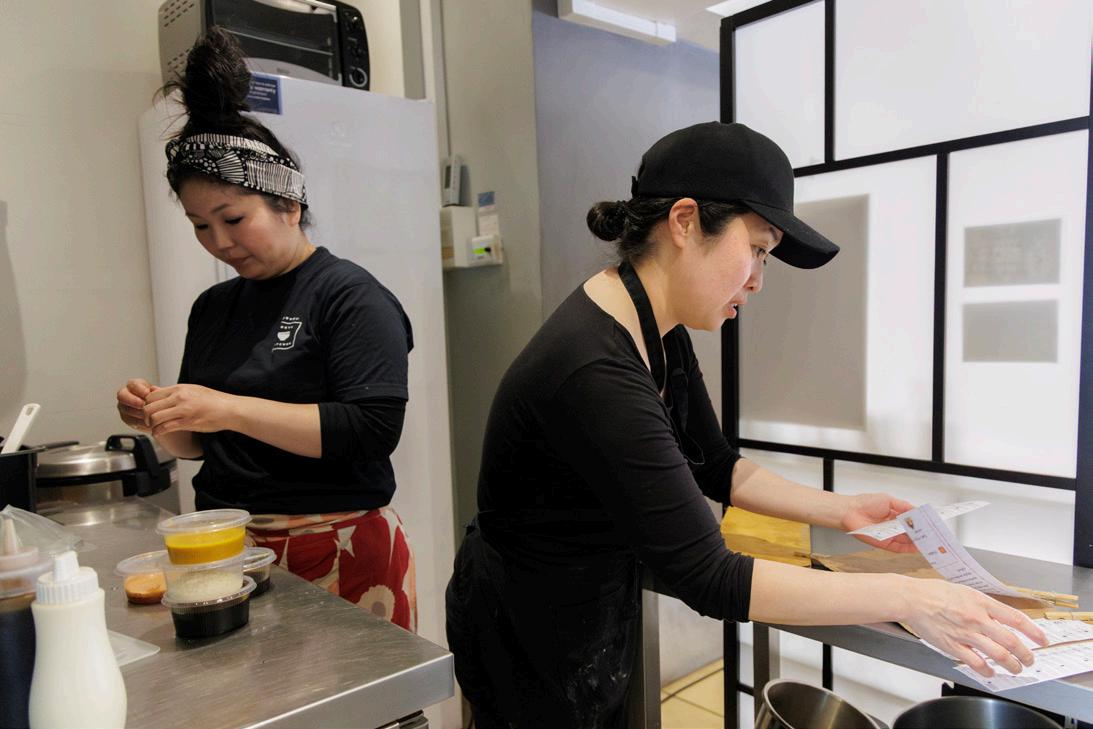
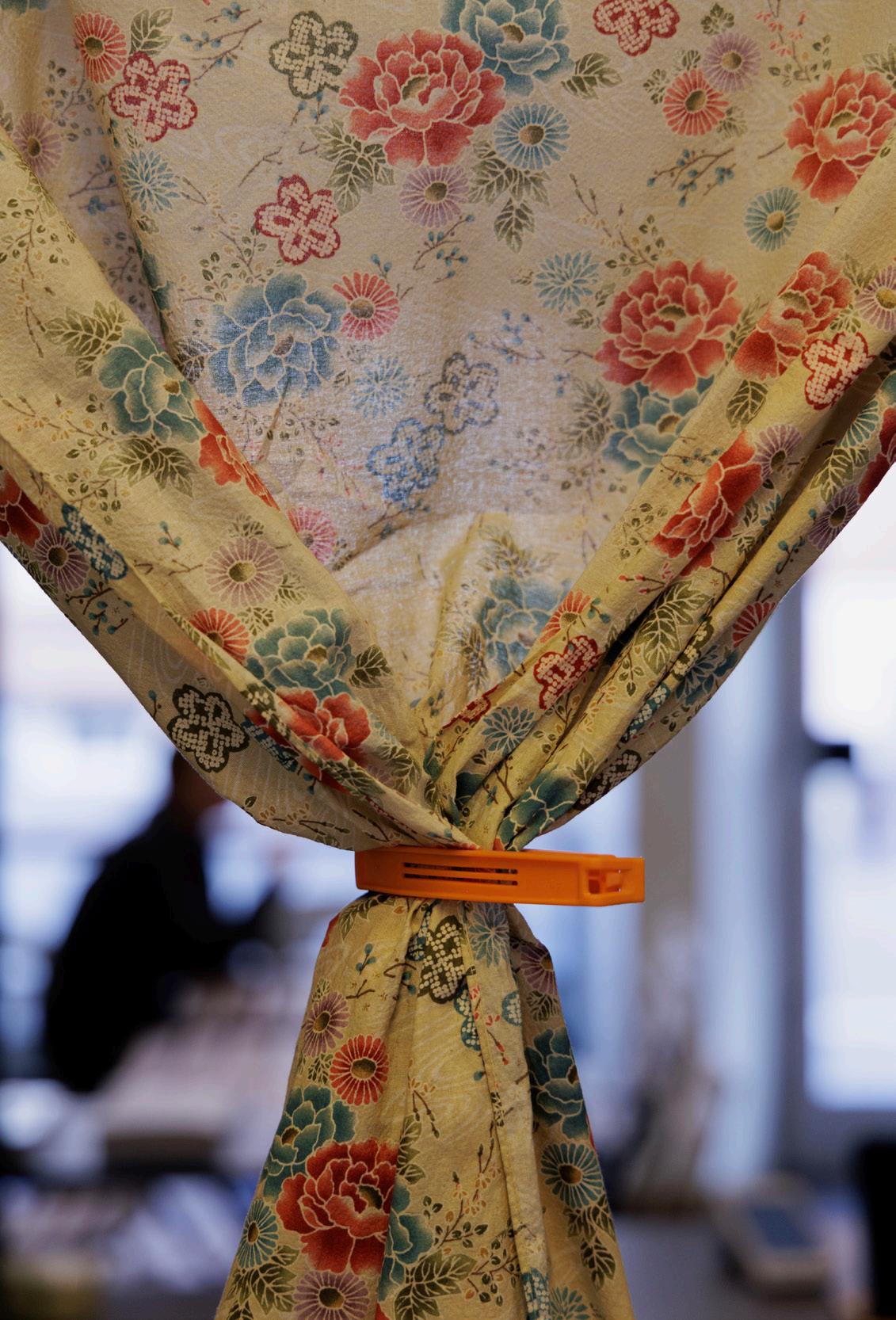
The sound of a knife chopping cabbage cuts through the stillness of Tokyo Kitchen in Trøjborg before the restaurant opens. Behind a floral curtain, Azusa Tsujiuchi hunches over a steel counter, preparing everything she can before the rush begins. Her hands move quickly. One moment she’s folding gyoza, the next she’s chopping chicken for karaage bowls. She moves constantly around the kitchen, switching between tasks. Her co-workers nickname her Senju Kannon, a Buddhist figure with a thousand arms.
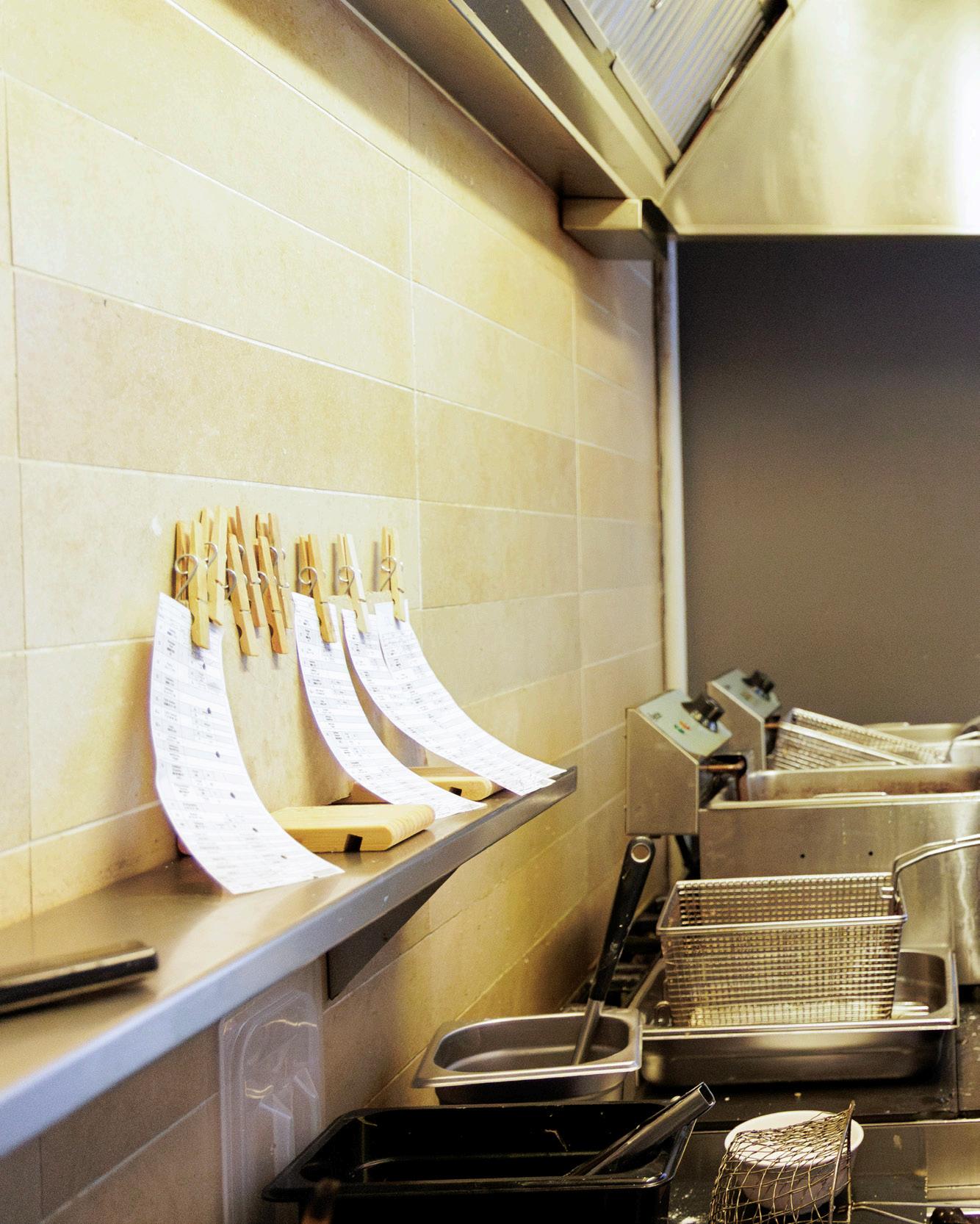
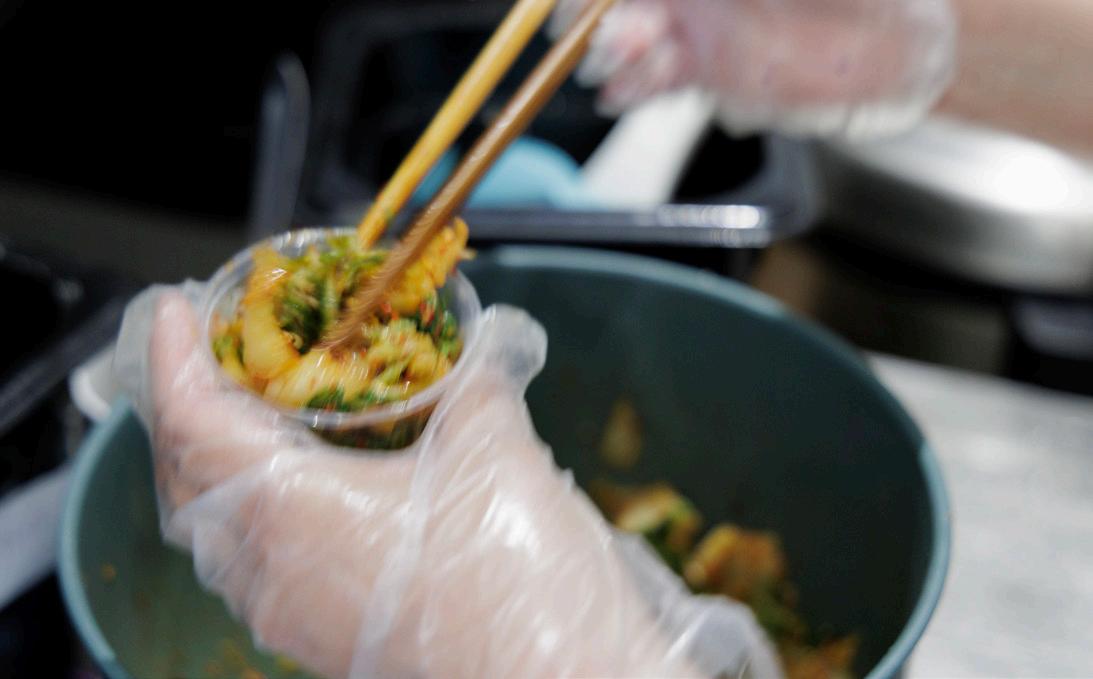
Once the restaurant opens, the smell of fried chicken fills the air, and oil bubbles between conversations. Half the kitchen is hidden behind wooden dividers, the rest behind the ordering desk. Orders come in by phone, and Azusa enters them and starts cooking immediately. The floral curtain never stops moving as she shifts between the front and back of the kitchen. Despite the pace, her commitment to food never wavers. Every dish is developed by Azusa and her co-owner and close friend, Aika Takahashi. Their aim is to bring Aarhus the kind of food Japanese people grow up with, not just ramen and sushi. “Food is our culture,” Azusa says. “It connects everything. In Japan, when there are events, there’s always special food. Food has a history to it.”
As dinner service builds, a co-worker arrives to help. Midori removes her cycling gear, stores it in the back, and hangs a towel in front of a window to block the light. Since moving from Nagano, Japan, she has become more sensitive to sunlight and now spends most of her time indoors translating video games from English into Japanese.
Orders continue to come in as Azusa and Midori talk in Japanese about family and daily life. Notes on the wall, customer details, and sake instructions are all in Japanese.
“I work in Japanese,” Azusa says. “I speak in Japanese. The shop feels Japanese, and there’s food I recognise. I don’t know how to explain it, but it feels like a second home.”
As evening falls, the restaurant slows. Midori finishes her shift. Azusa closes alone. Her son calls just before she locks up, asking when she’ll be home. “Soon,” she says.
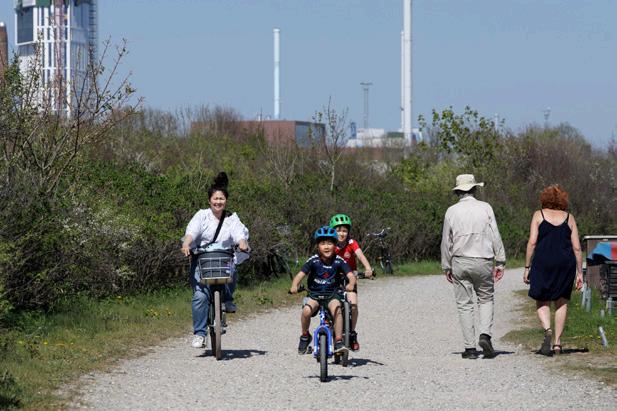
She washes the dishes, wipes the counters, flips the chairs, takes out the rubbish, and leaves notes for the next day. Then she leaves on her bike.
“Sometimes when I finish work and bike home, I think, ‘Oh my gosh, this is Denmark,’” she says. “Tokyo Kitchen feels like Japan.”
Continuing a dream
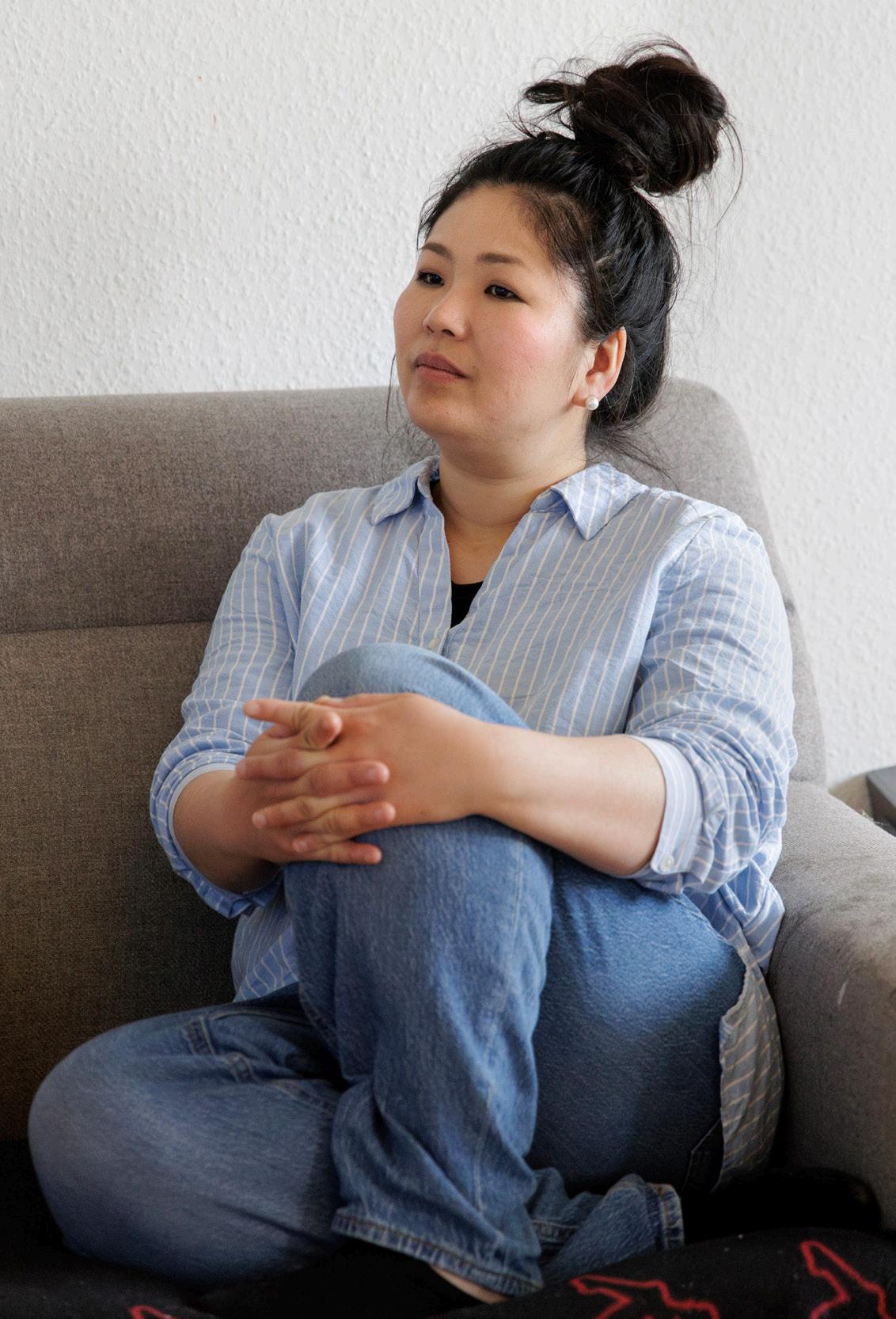
Azusa Tsujiuchi is 40 years old and has lived in Denmark since 2016. Before moving here, she was an English teacher in Japan. Then she fell in love with her Danish husband, who was working in Japan at the time, and after three years together, they decided to move to Denmark.
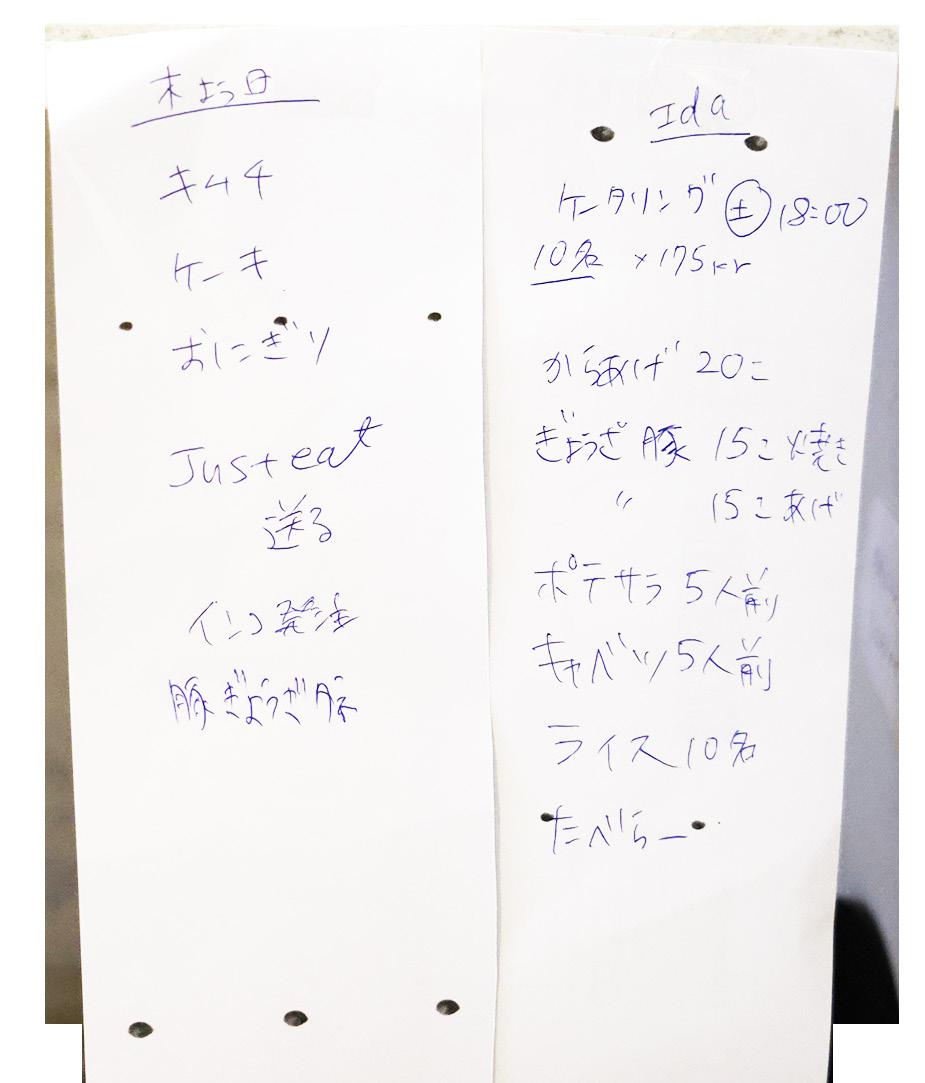
Notes written in Japanese taped next to the register at Tokyo Kitchen. On the left is a to-do list for the following day. On the right is a large catering order for the upcoming weekend.
Azusa knew she wanted to preserve her identity while being so far from home, so she found work as a Japanese teacher. She worked at Aarhus University and taught children on weekends. But after starting a family and a business, teaching became less central. She still teaches Japanese once a week, though, to adults with autism at Autismecenter Randers.
At 9 a.m., Azusa waits at Aarhus University for her husband to drive her to Randers. Usually she takes the bus, but her husband has errands to run in the area today. She watches passing cars while standing beside a cherry blossom tree.
“They look just like this in Japan,” she says.
When Azusa arrives at the Autismecenter, she sets up her computer and checks who else is in the building today. Her first student arrives at 10:30 and Azusa starts her out by reviewing an exercise from last week’s lesson. She adapts her teaching to each student. While one works independently, she moves to the other, shifting between them.
The rhythm mirrors her work in the kitchen.
At 2.30 p.m., she takes the bus back to Aarhus. The 45-minute ride is her chance to rest. She leans her head against the seat and sleeps until the bus reaches IKEA in the north of the city.
Later, after a few hours at Tokyo Kitchen preparing shipments, she cycles to Dokk1 to meet another student. Freja Kyng has studied Japanese on and off for five years, inspired by an exchange trip to Japan.
They sit in a study room overlooking the car lift, discussing musical instruments in Japanese. With a red marker, Azusa draws a diagram of a person playing instruments, adding Japanese labels. As Freja runs through Japanese words, Azusa nods in encouragement. By the end of the session, she has successfully translated a job advert from Japanese to English.
A slow-paced trip to the seaside
After weeks of wind and grey skies, the sun finally returns. Boats come back into the harbour as Azusa cycles into Marselisborg Lystbådehavn with her two sons. Her husband is at a climbing competition, so it is just the three of them today. The sun warms up their skin as they find a place to park their bikes.
“In Japan, sunshine was something I always had, so I never really thought about how valuable it was,” Azusa says. “But winters in Denmark are very long and dark, so when the sun comes out and the sky turns bright blue, it makes me genuinely happy.”
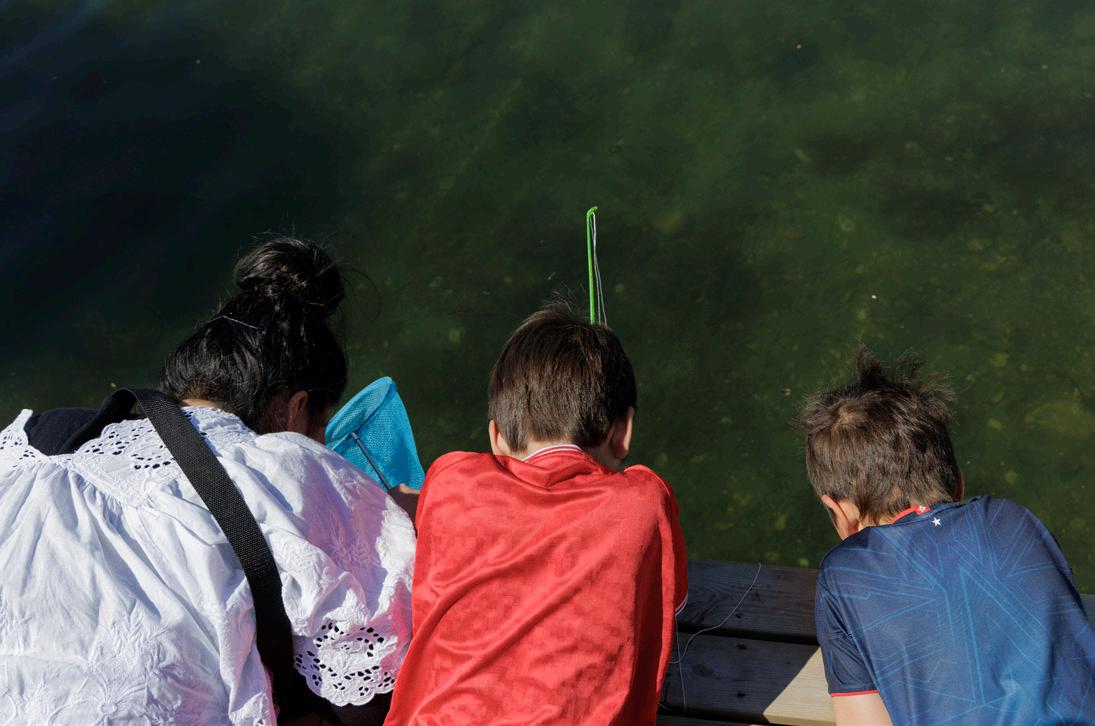
They lock their bikes and carry a bucket, a net, and a fishing rod to the dock. The boys watch the water closely, waiting. The youngest son attaches a slice of deli meat to the hook and lowers it into the sea. Excitement builds, but a flicker of fear crosses Azusa’s eyes.
“We’re all scared of getting the crab out,” she laughs. Eventually, a crab bites. The older son reels it in while the younger one cheers. Azusa steps in with a net, keeping her distance, and drops the crab into the bucket. They gather around it. The crab moves quickly through the water. The youngest boy feeds it small pieces of meat, then eats some himself. Azusa opens a bag of snacks. The gyoza wrappers with tomato sauce are her Japanese take on pizza. Soon, they catch a second crab. It joins the first one, but the moment turns tense as they briefly fight before settling. After a while, they release the crabs and go for ice cream, sitting in a small children’s boat as they eat. The youngest drops his ice cream, and they laugh it off. It is a day of relaxation.
“I used to work late back in Japan, and even on my days off, there were always so many places to go, restaurants to try, and things to do,” Azusa says. “After moving to Denmark, life became much more slow-paced.”
Home is where the day ends
The smell of Danish curry fills the house. After a late evening spent teaching and picking up her eldest son from football practice, Azusa is greeted at the door by her youngest son, her husband, and her mother-in-law. On busy days like this, when Azusa and her eldest son arrive late for dinner, the grandmother comes in to help with cleaning and cooking for the family. Long nights often mean Azusa has dinner on her own, so she savours every moment she has with her family.
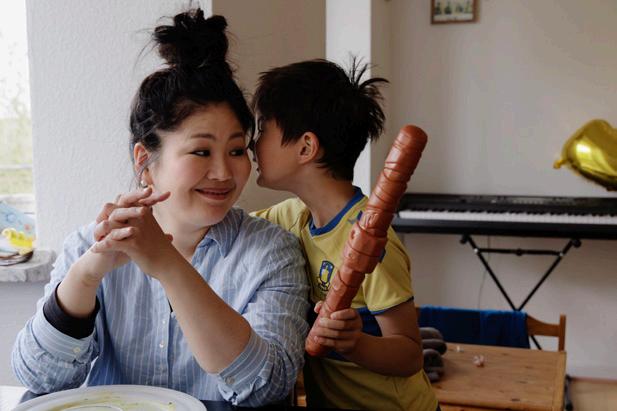
She sits at the table with her eldest son, eating curry. Her son speaks to her in Japanese, but effortlessly switches back to Danish when speaking with his grandmother and his father. “I don’t force my kids or put pressure on them to learn or talk in Japanese,” Azusa says. “I don’t want them to feel pressure and I don’t want them to dislike Japanese culture because of it.”
Despite claiming that she doesn’t know Danish, Azusa is able to speak with her mother-in-law in Danish with ease. With her husband she speaks in Japanese.
After dinner, her mother-in-law brings out a chocolate caramel cake. The youngest boy spins around the room with a stuffed panda, trying to get attention. The older one quietly passes pieces of caramel to his mother.
As evening falls, they thank the grandmother and say goodbye. The house begins to quiet, and Azusa curls up on the sofa while her sons eat Sun Lollies. The light in the room softens as the day comes to an end.
Finally, there is no kitchen, no orders, no movement between rooms and jobs. Just home.
IN EXILE YOU HAVE NO MEMORY
by Sadiq Al-Harasi
Beyond one of Europe’s most structured asylum systems, where people seek safety and a more sustainable future, lies a parallel, elastic world of time. It does not move forward. It sways in shared rooms, in corridors heavy with the scent of muted anxiety, and in train stations transformed into involuntary landmarks of encounters and farewells. In exile, memory loses its linear trajectory. The geography of home morphs into an archive of scents and absence, while the geography of the asylum camp becomes a precise architecture of what its inhabitants call a psychological prison.
The high-speed rail lines slice through the flat, manicured Dutch landscape, carrying passengers who cross borders in minutes. For Suhail and Sama, a married Yemeni asylumseeking couple in their thirties, the two-hour train journey between Zutphen’s eastern municipality and The Hague’s political urban area has become a chasm. Their geography is no longer defined by borders but by asylum appointments, train schedules, and reception centres, which have increasingly left them stranded in legal and emotional limbo. Tracing the human threads that bind Suhail and Sama reveals how deeply personal histories intersect with sharp, sudden shifts in European migration policy.
From protection to bureaucracy
While the Netherlands has long been a key destination for those fleeing conflict in the Middle East, its statistics show a sharp shift from systemic protection to rigid bureaucracy. According to Statistics Netherlands (StatLine), more than 9,000 Yemenis have applied for asylum in the Netherlands since 2015. Yet by 2025, first-time applications had dropped by more than half, a direct consequence of the Dutch Ministry of Justice and Security’s (IND) 2024 policy shift. The IND previously acknowledged that indiscriminate violence in Yemen was so absolute that proving nationality sufficed for accelerated protection. Drawing on a European Court of Justice ruling and citing an ongoing truce, the IND transitioned to strict, individualised assessments.
The collapse of personal freedom
Long before their cases entered the Dutch IND system, Suhail and Sama, despite their young age, were active in Sana’a, Yemen’s capital. They met in 2014 at a local event, with Sama studying clinical pharmacy and Suhail building a professional career. Their volunteer work soon intertwined. As Yemen descended into conflict in 2015, they led youth initiatives and organised community events together. Amid this shared commitment, an unspoken romance quietly emerged. Sama recalls, “We both knew we had these feelings, but we’d never said them out loud.”
Suhail eventually confessed his love in a small coffee shop, but turning their relationship into marriage proved a long struggle. Sama’s father opposed the union, doubting Suhail was a suitable match for his ambitious daughter because he lacked an academic degree. After three years of mediation by relatives and community elders, the couple finally married in 2020. Within a year, the worsening situation in Yemen made daily life unbearable, especially for Sama, who faced constant harassment outside her home.
“Yemen was no longer safe for a woman,” Suhail says. For them, the collapse of personal freedom and stability made leaving inevitable.
A fragile haven
In late 2021, Sama travelled alone to Cairo, Egypt, for training in creative writing, production, and voiceover.
The autonomy transformed her.
“Cairo made me realise how much of myself I’d buried,” she says. “Yemen no longer resembled me in any way.”
As NGO funding collapsed in Yemen, Suhail joined her, seeking a temporary haven to rebuild their lives and plan for the future.
For a year, Cairo became a fragile sanctuary of freedom and possibility. Sama was accepted into a master’s programme in Hungary and applied for Suhail as her partner so they could continue their life together in Europe. Her visa arrived within fifteen days; his was delayed for months. Refusing to leave without him, she waited, only to have her visa revoked after authorities claimed she had violated her academic timeline.
Financially exhausted and unable to return to Yemen, Sama moved to Saudi Arabia to take up a senior position. Suhail faced a different dilemma. His professional identity was rooted in Sana’a, yet the Gulf offered neither stability nor belonging.
“If I am going to start from the bottom,” he says, “I will do it in a place that guarantees a passport and a home.”
Seeking a long-term future beyond Yemen, Sama moved to Riyadh as a temporary step towards professional and financial stability, while Suhail travelled through Hungary to the Netherlands to seek asylum. They expected the separation to last less than a year.
A depersonalised machinery
In January 2026, after a gruelling long-distance separation that culminated in a profound emotional breakdown following the rejection of his initial asylum claim under the new individualised policy, Sama made a radical decision. Leaving behind her executive standing, secure salary, and independent life in Riyadh, she travelled to the Netherlands. There, she was ready to immerse herself in the asylum system, determined to stand by her husband’s side. Their fragile winter reunion collapsed within forty-eight hours of her arrival at the Ter Apel asylum centre. This high-density, high-stress central registration complex in the north stood in stark contrast to the large-scale civic events and professional autonomy they’d enjoyed in their
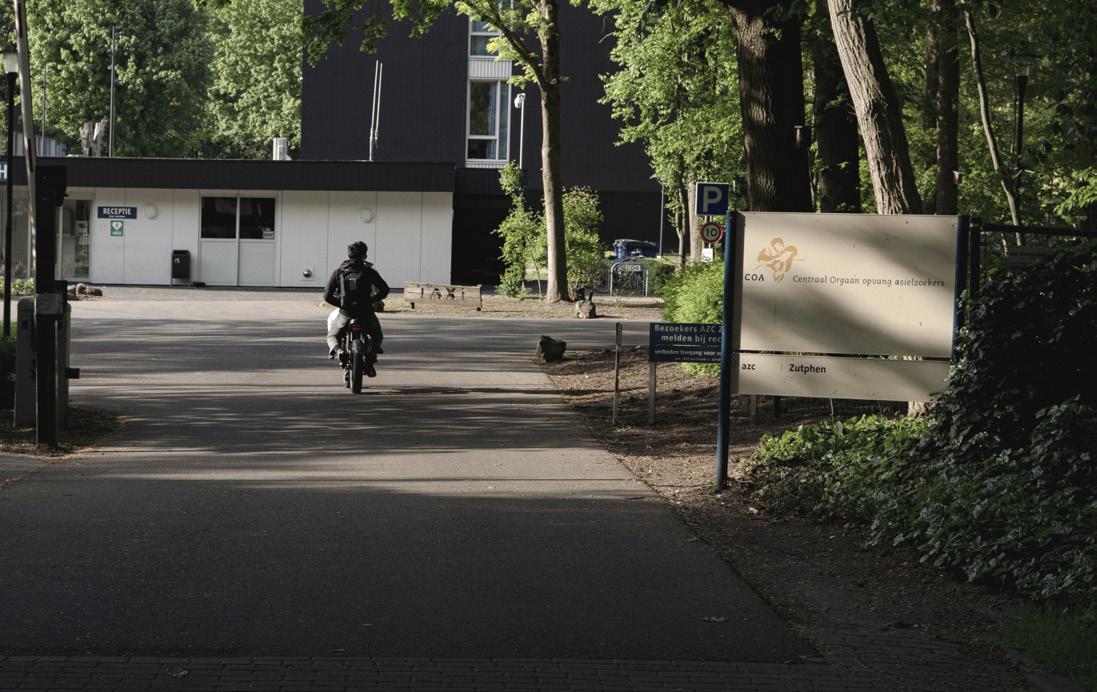
twenties. The transition into the regimented, depersonalised machinery of the Central Agency for the Reception of Asylum Seekers (COA) proved a crushing shock.
Forced amnesia
The structural weight pressing on Suhail and Sama echoes across the Dutch shelter system. Thousands of interrupted destinies are forced into close quarters, where Middle Eastern and African displacements converge into fragile subcultures of survival. The camps’ communal spaces become informal social and political forums. In cramped rooms, asylum seekers dismantle sectarian histories and negotiate the meaning of exile, seeking ways to reconstruct fragmented identities and imagined homelands.
Inside these walls, Suhail has developed a philosophy of survival shaped by the forced amnesia of waiting.
“I choose to forget,” he says softly. “Being away from home means we’ve become disconnected from many things in life. We don’t have the luxury anymore of just sitting and talking. We don’t even have time to discuss our current situation.”
At risk of deportation
Because Sama entered Europe on a Schengen tourist visa issued by French authorities, the Dutch IND rejected her asylum application on its merits under the Dublin III Regulation, which assigns responsibility to the country of first entry or visa issuance. France has already accepted her transfer, leaving her at risk of deportation.
Now, both of their futures remain suspended within the Dutch judiciary, awaiting court rulings. Their cases expose the harsh contradictions embedded in European humanitarian law. Their predicament reflects a wider structural crisis. For two months, hundreds of Yemeni asylum seekers have demonstrated in The Hague, carrying Yemeni and Dutch flags to protest policies that classify parts of Yemen as ‘relatively safe’ despite ongoing militia violence, collapsing infrastructure, and severe human rights abuses. Their protests reveal that Yemen’s fractured reality cannot be reduced to bureaucratic revisions.
Love across a railroad map
After Sama applied for asylum, they rented a black-market apartment for two months, a brief attempt to live together again. But the landlord reclaimed the property, and the Dutch asylum system separated them. Because their legal cases were assessed separately, the authorities dispersed them: Sama to a rural centre in Zutphen, while Suhail was already in a camp in Voorburg. Their marriage fragmented, reduced to long train journeys across provinces just to spend a few hours together in transit hubs, stations, and cafés. In these non-places designed for passing through, they tried to salvage the emotional fabric frayed by forced separation.
“We are still paying the price for that separation,” Sama says. “Sometimes I feel completely detached.”
Their meetings are carefully timed to align with train schedules and transit times. At Utrecht Central, Suhail moves through the crowd, searching for Sama. When he finds her, he rushes to embrace her, kissing her cheek with lingering cultural restraint. For a moment, the exhaustion of distance fades. They hold hands, then suddenly let go, a reflex shaped by years of Houthi-controlled Sana’a’s watchful conservatism. Their conversations quickly return to asylum decisions and the fragile lives around them: Somaya, Sama’s roommate, and Omar, Suhail’s friend, who recently attempted suicide. As departure boards flicker, time contracts again. They retreat to the edge of the platform, sharing a quiet grief neither fully articulates. In this limbo, vulnerability is rationed; true emotional breakdowns require a privacy they don’t have. Soon, they step into separate carriages, returning to different camps, exhausted by the effort of loving across a railway map.
A house called home
Ultimately, those within the Dutch asylum system lose not only a geographical homeland but also their sense of self. Exile erodes it. A creative director becomes a delivery driver, a pharmacist a construction worker, and a filmmaker an anonymous case number on an immigration officer’s desk. For Suhail and Sama, this limbo slowly consumes their inner lives. In a reception facility in The Hague, Suhail relies on forgetfulness to dull the ache of legal exclusion. In Rotterdam, Sama fills her notebook with memories of the light they once shared in Sana’a and Cairo. Their twelve-year relationship has survived war, family rejection, displacement, and separation across the Middle East. Now it faces its hardest test: the slow violence of bureaucratic waiting. Within these camps of transit and precarity, their relationship has become their last archive of belonging, and their longing to be together has become a reality.
As Sama says, “I need a house I can call home.”
Suhail and Sama are not their real names, as the characters prefer to remain anonymous for their safety. Their real identitites are known to the writer.
“Everyone has the right to seek and to enjoy in other countries asylum from persecution”
Article 14 - Universal Declaration of Human Rights
BUILDING SOMETHING FROM NOTHING
by Suman Nepali
He arrived with a dream and with the burden of his family’s expectations. But building a future abroad is not that simple, and Nepalese Prabesh learned it the hard way
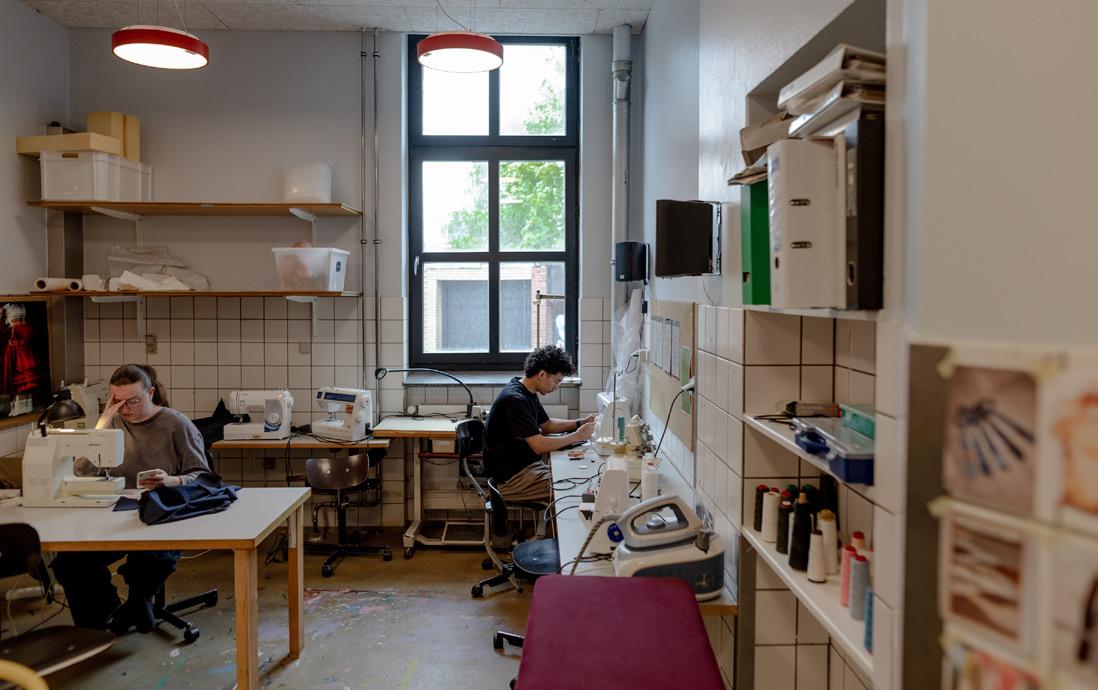
The alarm goes off at six in the morning. Outside the window, Aarhus is still asleep. Prabesh pulls on his jacket, laces his shoes, and steps out into the cold morning. There is a shift to complete, and later a lecture to attend. He is far from Kathmandu, far from his mother’s cooking, and far from the rooftop afternoons when his whole family would gather in the sun. He is in Lisbjerg, outside Aarhus. And he is trying.
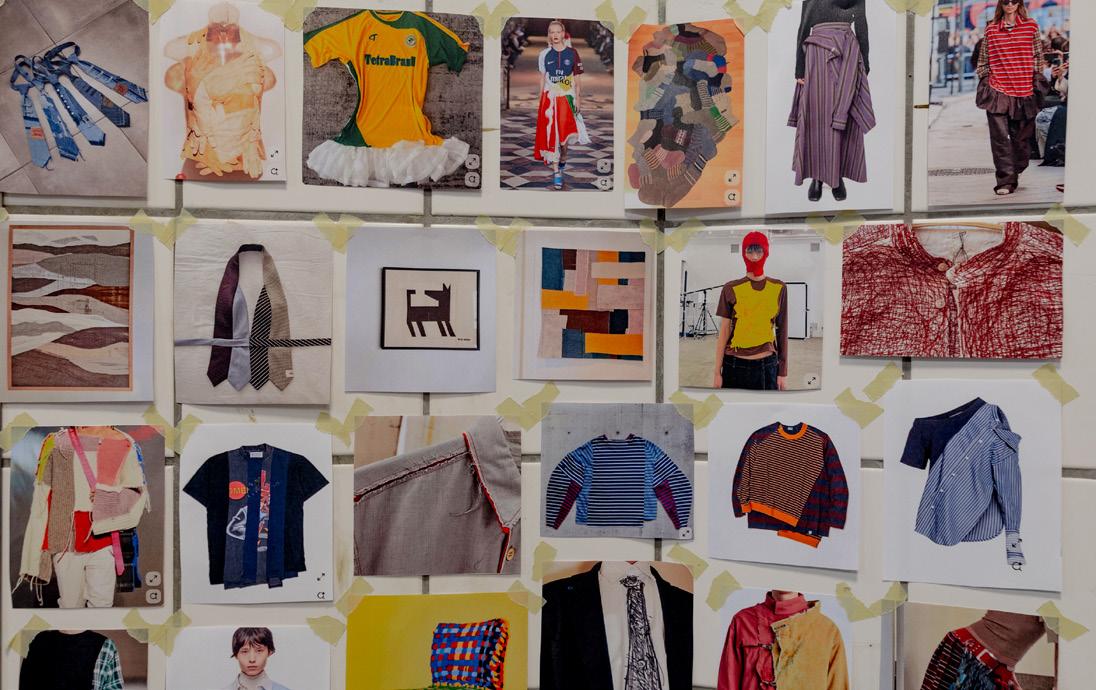
Prabesh arrived in Aarhus in 2022 with a quiet conviction that a degree from a Danish university would open doors that geography, through no fault of its own, had kept closed back home. He studies fashion design at VIA University, and he is the kind of student for whom international education was designed, yet his daily life looks nothing like the brochure.
Prabesh’s wife, Saina, came with him. She works full-time at a restaurant. During the week, their routine is the same: early mornings, long shifts, and exhausted evenings. Money is so tight that calling home has become complicated, not because they do not want to speak to their parents, but because the conversation always turns to the same unspoken question: how are they managing? And the honest answer is hard to say out loud.
Top - Pravesh working on his designs in a common student workspace where he usually come.
Bottom - A paper cut of inspirations for the designs that Pravesh plans to make.
“If it were not my responsibility, I would never have come to a foreign country,” Prabesh says. “I want to make my family proud and happy, so I can give them everything.”
The sentence sounds simple, but it isn’t. In Nepal, the decision to send a son or a daughter abroad is a family investment, both financially and emotionally. Savings are pooled, and loans are taken out. The unspoken contract is clear: go, succeed, come back and make it worth it. That weight does not leave when the plane lands. It follows the child onto the morning tram and sits in the lecture hall.
Denmark is not an easy country to arrive in alone. The winters are long and usually genuinely cold. The language is difficult. The social culture, warm once broken through, can feel sealed off from the outside. There are days when the city feels beautiful and foreign in equal measure.
Prabesh has a Nepali friend, Karan, who is also in Aarhus. They share a longing for the distinctive taste of Nepali food, the flavour no Aarhus grocery store can replicate. They both miss the group chats that now arrive three and a half hours late because of the time zones, and the laughter that used to spill out of tea shops until midnight, replaced now by the slightly delayed rhythm of video calls. They miss home more than anything. There is no drama to it. It is just how it is. What keeps them going, in part, is their friendship. Prabesh and Karan met in Denmark; two strangers from the same country, now a kind of family to each other. They celebrate Nepali festivals together and share practical knowledge of how to survive in a place not built for them. The Nepali community, scattered across Aarhus and Kolding, functions as a second home; imperfect, improvised, yet real.
“When travelling into the countryside around Aarhus, I feel like I am back home again”
Pravesh and his partner Shaina pose in a rapeseed field in their Nepali traditional outfit. The rapeseed fields remind him of home.
The Danish government has only recently announced new measures for international students from outside the EU. These include tighter verification of foreign qualifications, stricter monitoring of academic activity, and the removal of the right to bring family members. The package is a direct response to rising student numbers from Nepal and Bangladesh, and to concerns that some are using the student visa more as a work permit than as a study opportunity. The numbers are real: Nepali study permits rose from 152 in 2023 to 487 in 2024. The debate they have sparked is real, too. But policy language is clean and orderly. Real lives are messier. Prabesh is not abusing the system. He is immersed in the difficult, unglamorous process of building something from almost nothing in a country that is cold, expensive, and far from everyone he loves. He works because he has to. He studies because that was the point. He stays because going back would mean something he is not yet ready to name. But tomorrow morning at 6 a.m., when the alarm goes off, he is ready to work again.
Top - On a random Tuesday evening Pravesh is watching a Nepali movie on his television, while his partner Shaina and her friends are doing their makeup before going shopping.
Bottom - A typical Nepali meal, Daal Bhaat Power.
IT’S A PIG’S LIFE
Free-ranging pigs, open landscapes and a different vision of farming: Hestbjerg Farm is redefining sustainability from the ground up.
by Camilla Matteoni
It’s 6.30 am. The lights are on in the common room, and a strong scent of coffee lingers in the air. Sharing breakfast before the working day begins is an essential part of life at Hestbjerg, and the atmosphere is relaxed, filled with laughter and conversation. A perfect way to begin the day with colleagues. Soon, the workers will head out across the fields, where much of the farm’s daily work revolves not only around the pigs, but also around the land iself. At Hestbjerg, caring for the animals goes hand in hand with caring for the soil that sustains them. Working in the fields is hard and often solitary, but you’re never truly alone. There’s always time for a chat, a smile, or a quick break between tasks. Trust and respect shape the relationships among everyone on the farm: the workers, the owners, and visitors alike.
Marianne Hestbjerg, 54, sits at the table listening to the conversations. She is married to Bertel Hestbjerg, whose family has owned the farm for fifteen generations, with roots dating back to 1623. What was once a small family-run farm is now Denmark’s largest organic pig farm, located in Nørre Felding, just outside Holstebro. The farm has more than 1.200 pigs and employs 27 farmhands.
Pig welfare in practice
In the fields, one detail immediately stands out: long rows of poplars shape the landscape, offering the pigs shaded areas to rest on sunny days. Pigs are naturally forest animals. At Hestbjerg, the aim is to recreate that environment, with open spaces, trees, fresh air, and freedom to move. Here, the pigs can follow their instincts, run freely, explore, and live in conditions that support a healthier life than in conventional systems, where movement is often heavily restricted. As a result, organic pigs tend to have less fat and more developed muscles, largely because they are naturally active and wild animals.
“Pigs raised organically, and living their entire lives outdoors, tend to produce healthier meat with less fat, offering a highe quality product for consumers,” Marianne explains, getting closer to the animals to pet them. As you get closer, the sows and piglets come to greet you.
“Pigs are social animals,” Marianne says, “and it is important for them to live in small groups and interact with each other and with people as well.”
Curious and playful, they come closer, bump into you and then suddenly run away at the first loud noise.
The pigs’ welfare is Hestbjerg’s main focus. Piglets grow up in family groups and stay with their mothers for at least eight weeks, often longer, living together in the fields where they were born. In their early life, they are neither separated nor moved to indoor systems. They lead a more natural, outdoor life, learning from the start to interact with their surroundings and one another. During the first few days, the piglets are carefully cleaned and looked after by the farmers. They are kept inside the shelters for a short period, just long enough to recognise their mother’s scent and become familiar with their surroundings. After this initial stage, they can run freely across the fields without fear of getting lost, as they always know how to find their way back to their shelter.
Over time, a close relationship develops between the animals and the people working on the farm. The pigs are hand-fed and cared for daily by the farmers, which helps them become familiar with human presence. Maintaining a calm, trusting environment is essential to the farm’s routine.
“Every time we feed the pigs, we make sure to pet and interact with each one individually,” Louise Vandborg Kristensen says while feeding the animals. She has worked at the farm for two years. These daily interactions help the pigs feel safer and more comfortable around people, especially during medical treatments and vaccinations, Louise says.
A humane production system
Although the pigs live in conditions shaped by care and attention, it is important to remember that their lives remain part of a production system. When the time comes, the animals are transported for slaughter under conditions designed to minimise stress and prevent unnecessary suffering, Louise explains. Even at the final stage, the focus remains on respect and responsibility. Hestbjerg Farm does not seek to remove the reality of farming, but to ensure that every stage of life, from birth to death, is handled with as much care as possible. This is important not only for the pigs’ well-being but also for consumers’ health.
What defines Hestbjerg farm is not the absence of difficult realities, but the way these realities are approached and the continuous effort to handle them with care and consideration. This is evident in how sick and injured animals are treated. They are closely monitored and receive care and treatment for as long as there is a chance of recovery. At the same time, difficult decisions are not avoided when an animal’s condition no longer allows for a good quality of life. In these situations, the priority is to prevent unnecessary suffering and to act responsibly and respectfully towards the pig.
A living agricultural ecosystem
The morning mist still lies low over the fields at Hestbjerg farm as the first sounds drift in from afar. The animals move among the rows of poplar trees, enjoying the soft light of the sunrise. The air smells of soil, rain and fresh leaves, while the silence of the countryside is broken only by a gentle breeze and the distant calls of animals. When you walk around at Hestbjerg, it does not feel like being on a farm, but rather like discovering a small world where nature sets the rhythm and humans live in harmony with the land. Endless stretches of grass lie on one side, the forest on the other, and all around there are only the sounds of nature. The spaces are wide and open, designed to balance the life cycles of the pigs and the land. Each season, the pigs’ shelters are moved to new fields prepared the previous year. Ove Overgaard Villumsen, 65, walks down the path linking the farm to the fields. He has worked for the Hestbjerg family for two years and enjoys being in close contact with nature every day. He points out every detail around him, explaining everything he knows about the place. Here, the land is seen as something that needs time, care, and protection, not as an endless resource to exploit. Ove points down to the soil beneath his feet, something most people wouldn’t have noticed until that moment. The sandy soil around the farm, once considered less fertile, is now a key element. Crop rotation, tree planting and moving animals to different areas keep the soil healthy and productive. Some of the land around the pigs’ fields is left untouched to allow wild plants and fauna to grow naturally. The whole farm operates around this cycle. It benefits the land and the pigs, as well as the biodiversity within the farm’s ecosystem. Local flora grows throughout, supporting wildlife and the ecosystem. Vegetation helps absorb carbon, protects the soil from erosion, and creates the ideal habitat for wildlife. The landscape is an active part of the farm’s sustainable system.
Sustainability as a daily process
Biodiversity, human practices and zero waste all come together at Hestbjerg, where sustainability is not a final goal, but a continuous process of development. It is something that exists in the relationship between the pigs, the people and the land, rather than a fixed result. Marianne and Bertel Hestbjerg want to reflect this balance through the idea of the “poplars pigs”, where trees, open fields and animal life are combined in a shared landscape. Sustainability here is built on small circular practices: nutrients return to the soil, vegetation protects the land, and resources are reused within the system rather than lost. Even food that would otherwise go to waste, such as vegetables rejected by supermarkets, is brought back into the cycle and used as pig feed, turning surplus into value again.
It’s 3 p.m. The sun is still high in the sky, warm and bright. The machines are switched off, and the farm falls quiet. The working day is drawing to a close as the farmers return from the fields, tired after hours spent outdoors. Before heading home, they gather once more in the common room. There is still enough energy for a final cup of coffee, a few conversations, and a moment to relax together after the day’s work. Then the overalls are hung up, the barn doors are closed, and the farm slowly settles into silence. Tomorrow, the routine will begin anew, following the same rhythm that binds together the people, the animals, and the land.
THE TOLL OF CONSTANT LIGHT
by Samuel Cox
There are few places left in the world where the night sky remains untouched; in Czechia, there are none. As an astrophotographer, educator, and Dark Sky Delegate, Petr Horálek hopes to preserve the stars he has spent his life observing.
In the thin gap of the night when neither sun nor moon touches the Milky Way, Petr walks out of his cabin and down to the water. He knows precisely when the moon will fall 16 degrees below the horizon, when the Milky Way will wander out from behind the trees, and when all the lights in his small town on the side of Seč lake will shut off. He knows exactly when the sun, still beneath the horizon, will once again threaten the most pristine darkness.
“I once spent the autumn holidays with my grandparents. It was in a small town, Klokočov, near here, just on the other side of the lake,” Petr explains as he begins his 2 am drive around the water. “My grandmother was always trying to make me interested in nature. I thought it was boring. Why look at the sky? It’s nothing to care about.”
Petr mostly recalls being interested in his grandma’s homemade bread and honey. When she took him to see the Big Dipper for the first time, he didn’t understand why he should care about it.
“But at one point, I saw she was disappointed, and I liked her very much, so I told her, just after I finished dinner, ‘Please show me again.’ and suddenly, I saw a change. Dinner had taken maybe 20 minutes, and during those 20 minutes, the Big Dipper had shifted its position in the sky. It was a small change in the sky, but a big one in my life.”
He continues to recall his first encounter with astronomy as he drives along the lake’s perimeter, the Milky Way floating past him. “That was my first question, how the constellation had moved like that. So I had to get some books, and then another book, and then I started to take a course in astronomy. Even though I now have a master’s degree in astrophysics, I still have more questions, and I believe many people do.”
He parks at the edge of the water, the galaxy hovering above it, exactly where he predicted it would land after the short drive.
Light pollution on a nine-level scale
Petr works as an educator, public speaker, and as a delegate for the International Dark Sky Association. At night, he is often found photographing the night sky near his cabin or teaching others about the stars he hopes to protect.
For the second night in a row, he loads equipment into his car in the dead of night and makes his way into the Czech countryside. Once he’s out under the stars, he quickly assembles his telescope and pans to a seemingly empty patch of sky.
Petr frequently offers stargazing tours in his small town with his own telescope, a small but powerful lens that he fits in the trunk of his car. He quickly centres two superclusters, not visible to the naked eye, in the middle of the telescope.
“These are like a kindergarten for baby stars,” Petr says, before explaining how stars form, live, and die.
Next, he rotates the telescope towards two faint galaxies, nearly 49 billion light-years away.
“I always joke that if you can remember what you were doing 49 billion years ago, that’s what an alien from one of these galaxies would be seeing right now.”
Unfortunately, many of these details are becoming harder to see; a problem Petr recalls noticing at just 13 years old.
“I noticed very early on, after I started my astronomical passion, that there is a problem, and I realised that this is not just the problem of a small location, not a problem of only the Czech Republic. It is global.”
The most popular method of measuring this growing pollution is the Bortle scale, a nine-level scale established by American amateur astronomer John E. Bortle in 2001 to classify the visibility of well-known celestial objects. Class 1 is for skies that are truly preserved, and Class 2 is the cut-off for a true “dark sky” location. Across Czechia, the lowest you can typically find is Class 3, where light pollution has begun to affect rural skies.
“Thirty years ago, one could find truly dark skies within an hour’s drive of major population centres,” Bortle explained when introducing his scale.
“Today, you often need to travel 150 miles or more.”
Night light as a means of escape
Motivated by the decline of dark skies, Petr now serves as a Czech delegate for the International Dark Sky Association, helping to communicate the threat posed by light pollution. He is part of a large community of Czech astronomers and observatories across the country, where he frequently gives public talks on the importance of the night sky.
“Being under the sky gives us a perspective on our existence, our place in the universe, and our possibilities for the future,” Petr explains. “These experiences are very important. I think light pollution somehow cuts us off from a better future because are stuck in our small, illuminated world.”
In a 2025 study on the impact of the night sky on Generation Z, Holly McNiven, an MA from the University of Wales, elaborates on this effect: “The night sky can provide perspective, prompting individuals to seek deeper meaning and contemplate the bigger picture. Additionally, it can offer a means of escape from the stresses associated with contemporary life. This was highlighted in a 2018 study conducted by King’s College, London, which found that being able to see the sky has a positive effect on mental well-being.”
When asked about his own experience of truly dark skies, Petr says, “I was lucky to travel early on in my life, and I could compare not just the quality of the sky, but also the quality of nature, where the sky is dark and visible: their life, their nature in the dark places. It was very vivid, and it was as if I were in a different universe. You could feel that people had a completely different relationship with nature.”
Light pollution is a “slow“ issue
However, the benefits of the night sky aren’t purely psychological. Light pollution also has serious effects on our physical health and the environment, Petr explains.
“There are several studies showing that we need a period of light followed by a period of darkness,” he says, adding that light pollution and white light can harm the body’s production of melatonin.
“This affects not just us but all the life around us, including trees, insects, and the nocturnal side of nature. In the end, we will lose biodiversity.”
For plants, increased light pollution can make it hard to distinguish between day and night, disrupting their metabolism, their development, and their life programmes. Additionally, flowering and developmental patterns can be disrupted in short-day plants, reducing their ability to prepare for winter weather.
According to studies by Indian physicist Rasna Rajkhowa, light pollution can confound animal navigation, alter competitive and predator-prey interactions, and affect animal physiology. This confusion can be fatal for migratory birds that rely on horizon visibility for navigation, with hundreds, and even thousands, being injured or killed in a single night at one building.
“Many people don’t care about nature, unfortunately.” Petr says. “They care just in a very small way because they usually live in big cities. But this is actually very important because the big cities are the biggest producers of light pollution.”
He gestures towards the town from his office and explains that he’s lucky to live near a town that turns off the lights at night.
Petr suggests that cities be more thoughtful about when and why they use light. He also suggests using orange lighting and limiting lights that direct unneeded light into the air, though he feels that politicians don’t see the issue as urgent because it is a “slow issue” like climate change.
Instead, he hopes to make a difference by teaching the next generation about the importance of the night sky through his work as a university teacher and as a public speaker at places such as Czech primary schools.
Petr believes that the youngest generations are most important for making things right in the future. He teaches them to open their eyes and mind again and try to understand what exactly they see.
“All they need is to care and not ignore, because there are so many beautiful things around. It’s our natural heritage, and many people don’t even know we have it.”