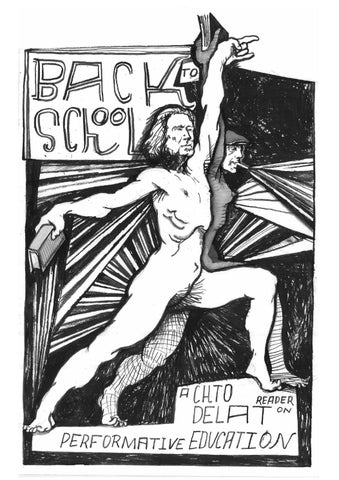
Creating the School From the editors One can always reduce any set of relations between people to the simple oppositions: boss/subordinate, friend/enemy, teacher/student, actor/viewer, class/ party, expert/non-expert, representative/people, oppressor/oppressed, man/woman, rich/poor, and so on. At the same time, it is clear that such static oppositions cannot describe real, dynamic relations. Participation in production, in political and artistic representation, in educational situations, in the transformations of gender, and so on—they all draw participants into complex processes of mutual interaction, in which roles that were once fixed are constantly shifting. This is because (if we take away all nuance) what is at stake in the struggle over these contradictions is always a redefinition of equality. The different approaches to sublating these contradictions revolve around one essential question. Some argue that we should begin with the assumption of an original equality, while others say that equality is precisely what must be constructed in the process of overcoming these oppositions. This is the ultimate question. On the one hand, it seems cynical to reject belief in original equality as a vestige of religious thinking (metaphysical equality before some “higher” principle), which masks the real formation and reproduction
of inequality. We all feel the moralistic pressure to recognize general equality as a basic constitutional principle: “all men are created equal and free in their pursuit of happiness.” Rhetorical foundations like this certainly stand as one of the high points of humanity’s political evolution. But in reality we see that this declaration hides flagrant, everyday inequality, as the strong, the rich, and the active set the rules of the game to their own advantage, so they can achieve a dominant position in the circle of “equals.” This is why the starting point of political struggle is always to lay bare, critique, and overcome real inequality, exposing the structure of power relations as relations of oppression, subjection, and exclusion. Yet, on the other hand, if we accept current conditions of inequality in order to overcome them, it becomes impossible to create relations of equality—the precondition for any genuine democratic communication—here and now. In truth, all such efforts depend on solving the paradoxical task of achieving equality within inequality. This is manifestly evident in the process of creating pedagogical institutions like a school. Education invariably ends up at the center of this conflict. Many thinkers and educators tell us to follow the principle that division into teachers and students is a priori false, that all students are intellectually equal, and that this equality must be recognized in the classroom. This hypothesis is certainly fair, but when one examines closely how schools are organized in practice, a number of questions arise. No group simply gets together on its own; there is always
an initiator or initiators who set the specific rules of the game—the school and its curriculum—and offer them to those who were not there to participate in the school’s creation. The community that arises as a result is inevitably constructed on the basis of these already constituted rules. How they are embodied in the life of the community in many ways depends on the clarity and political sensitivity of the initiator-educators’ gesture. In fact, a school is always a model form of collective, situated in a search for balance between structure (specific rules of participation, criteria for selecting students, the curriculum, and a number of other ethical and economic rules that regulate relations between teachers and students, as among the students themselves) and openness/improvisation (each participant’s spontaneous interpretation and co-creation of the curriculum, based on his or her individual abilities). An essential factor in the legitimization of a school is time—the students come and go, but the school remains (if it is able to establish a zone of responsibility and acquire its own unique place in society, which also becomes the political dimension of the project). Clearly, making decisions within the school collective must bring together students and teachers, and here a great deal depends on finding the right balance between tactics and strategies for making decisions. It is necessary for the school, as for any other political organization, to work out a developmental strategy. Tactics (i.e., carefully taking into account the opinions and positions of every participant in a concrete situation) are secondary to this strategy, though it does not remain unchanged (otherwise everything would be reduced to stultifying dogmatism), but is opened up again and again through the changing composition of students and teachers.
What comes of this is always impossible to predict, since the most radical experiment in equality can end up producing new forms of subjection, while calm acceptance of the need for discipline and the delegation of different productive functions can stimulate the formation of new emancipated personalities and creative methods. It seems to me that broad analysis of how schools (or art) are structured never provides generalizable conclusions, since it is necessary to understand what form of study will manifest equality in a concrete time and place and how it relates to the structures of inequality that are dominant beyond the borders of the school community. Concrete analysis of concrete educational practices is important—from the traditional model of the autonomous academy to radical initiatives that completely reject any pre-established positions.
*** In this issue of the newspaper we have collected fragments of different texts (some previously published in the newspaper, others taken from contemporary discussions about pedagogy), which address the multiplicity of educational practices and offer a compilation of ideas that we have discussed, tested, subjected to criticism, or embraced over the ten years we have been engaged in our own practices in the sphere of art-education. It is important to note that for us the topic of education is directly connected to our ideas about the performativity of knowledge and study. The situation of our School of Engaged Art is similar to one long learning play, extending over many years, in which we have taken on the role of teachers, and we give our young comrades the opportunity to try on the role of students. With every group the situation changes and gets out of our control, but the basic framework, the rules set for this play, which has no viewers but only participants, allow us to maintain a kind of overall coherence to the general project, as we observe with curiosity how it transforms and at times swap roles with our students. *** The specific reason for this publication is a commission from Creative Time to produce decorations for the Curriculum Summit as part of the Venice Biennale. As it turns out, the summit is dedicated to the question of education, and it has been interesting for us to engage the assigned topic on the basis of our experience. The idea for the scenery we produced is rooted in the tradition of Soviet Houses of Culture, which often staged events like local party and trade union meetings. The decorations for these events were designed to greet, encourage, and didactically instruct the participants about the agenda of the meetings. This time we have taken the main topic of the summit—Curriculum—and all its panel titles, and we are querying them with a language and visual game that actualizes their meaning from different intellectual, political, and aesthetic perspectives.
Chto Delat: Theses on Self-Education Study, study, and study again to learn communism in reality V. Lenin*
creative lack of knowledge is the point of departure for action; it needs to be founded upon a clear historical analysis of the moment and the experience of emancipatory projects in the past.
1. The theme of self-education flows from 3. We still do not know how to take acthe notion of self-organization. What do we mean when we talk about this notion today? Selforganization is a collective process of taking on political functions and addressing tasks that have been excluded from the field of real politics or pushed out of public space. Thus, the process of self-education is inseparable from the positioning of collective dissent with the existing order of things. It demands the transformation of the status quo. Self-organization searches for a form to express the voices of dissenting subjectivity.
2. Since self-organization demands some-
thing lacking in a concrete historical moment and a concrete local situation, its most important characteristic is the l a c k o f k n o w l e d g e . At the same time, the lack of knowledge does not entail the rejection of cognitive approaches that are already known. The state of a
tion, nor do we know what our actions could bring. This is why we begin by asking questions. The situation of questioning is comparable to the consciousness of a child who has no ready answers. But unlike a child, which needs to acquire everyday skills, we are forced to think the non-existent. This is precisely where I see the unbelievably provocative force of the Lenin-quote above. We need to learn how to learn communism, to learn something for which there are no ready recipes. Genuine education always set itself the goal of learning the non-existent. It demands the synthesis of rational methods of knowing the world and practices that anticipate other social relations.
4. The process of self-education departs
a clear awareness of its oppression, and aims at changing this state of affairs. Self-education is a process that draws in those who
identify themselves as the oppressed. Its goal is emancipation, dignity, and love. In other words, it searches for an answer to the question of how can we get beyond ourselves, breaking with our state of insufficiency and oppression, finally attaining equality. The only answer is to be found in the practices that make up our lives, which demonstrate here and now that we are not talking about the abstract categories of an ideal world in the future, but about the realities of our everyday existence. *Editorial note: This quote is actually apocryphal, and most likely, a posthumous condensation of Lenin’s view of the Soviet Union’s post-revolutionary transformation as a process of ardous self-eduation, which he voiced on innumerable occasions.
2006
published at newspaper Chto Delat #14: Self-Education
Marta Gregorčič Radical education: critical capacity to make choices There is no disjunction between life, work, struggle, politics or education when, in our theory and praxis, we move beyond static and fetishised notions of the world. Even if we have learned otherwise all human creativities develop mutually within the same processes. By considering work, art and education separately, as distinct segments of our lives, we create a fundamental antogonism which cheats us of both life and doing. But this interconnectedness can only be fully grasped by emancipated subjects who are ready to struggle, ready to challenge the enforced reality of day to day life. Paulo Freire’s Pedagogy of the Oppressed and Education for Critical Consciousness Murray Bookchin's and Daniel Chodorkoff Social Ecology , Ivan Illich’s Deschooling Society, John Holloway’s Change the world without taking power and Jacques Rancière’s The Ignorant Schoolmaster all offer authentic and responsible positions which open up our critical capacities to make choices and transform reality. The common starting-point for all these theorists is creativity – which can only be expressed by those who are engaging with the struggle to become emancipated and fully human. Their vision of education is truly radical as they regard it as inseparable from life and doing. This position is also inherently antagonistic to capitalism which, as the social ecologist Daniel Chodorkoff explains over simplifies life, or simplifies it to the absurd. It is now more important than ever to invent and re-invent our humanity and radical or alternative ideas of education are a very important step in this path. That is why education now cannot be reflected without also reinventing revolution. We are not interested anymore in the revolution by the intervention of deus ex machina nor in the avant-garde that imposes its will from the outside. There is no outside, as there is no inside: there is only in-out, flooding in, against, and beyond. Revolutions are taking place daily through multiple expressions of our creativity, imagination, insubordinations and disobedience, in the particularities which are moving and transforming us, in our palettes and our pockets, through spreading rhizomes and multiplicities of resistance. There are a multiplicity of bonds of solidarity, which have not yet been traversed, deconstructed or pervverted by capitalism. That is why alternative and autonomous education, struggle and life cannot be encountered within institutions which buttress the capitalist flow of doing. Some of the best theorists and practioners can be found in the struggles of Indigenous and precarious workers of Latin America such as Colectivo Situaciones and MTD de Solano in Argentina; Movimento Sem Terra in Brazil; the Zapatistas in Chiapas, Mexico; the Mapuche in Chile and so on. All mentioned movements are simultaneously expressions of alternative art, education, culture and politics, which rise beyond neoliberalism. Instead of separating, alienating and demolishing human beings they are creating new art of human existence and doing.
2006 fragment of the text published at the newspaper Chto Delat #14: Self-Education
Universal education through schooling is not feasible. It would be no more feasible if it were attempted by means of alternative institutions built on the style of present schools. Neither new attitudes of teachers toward their pupils nor the proliferation of educational hardware or software (in classroom or bedroom), nor finally the attempt to expand the pedagogue's responsibility until it engulfs his pupils' lifetimes will deliver universal education. The current search for new educational funnels must be reversed into the search for their institutional inverse: educational webs which heighten the opportunity for each one to transform each moment of his living into one of learning, sharing, and caring. We hope to contribute concepts needed by those who conduct such counterfoil research on education – and also to those who seek alternatives to other established service industries.
Ivan Illich Deschooling Society first published in 1971
Nikolay Oleynikov & Dmitry Vilensky Learning Time in Common. Prehistory of the local experiments in prolonged collectivity and mutual learning Drift: Narvskaya Zastava (Saint Petersburg, 2004) The methods developed in Drift were a continuation of the Leningrad-Petersburg tradition of strolling around strange places using situationist practices. Aside from researching the remnants of the constructivist urban environment during a two-day walk, an important component of this project was mutual learning, which affected the personal lives of the participants. Self-Education(s) (a series of seminars and an exhibition; National Center for Contemporary Art Moscow, 2006) In the course of the three days of seminars following the exhibition opening, participants discussed new means of constructing self-organized educational communities. Leftist Art. Leftist History. Leftist Philosophy. Leftist Poetry: 24Hour Communal Life Seminar. (Nizhny Novgorod, May 9, 2009) The first experimental communal life seminar (with this selfironizing title) took place in Nizhny Novgorod on May 9, 2009. The task of combining artistic, educational, and political elements in a single time and place seemed tempting not only to us, but also to the special police department for combating “extremism,” who as it turned out had been “following” our seminar from the moment the first information about it was published in blogs. Consequently, at the very beginning of the seminar, during a screening of Jean-Luc Godard’s film Sympathy for the Devil (One Plus One), the seminar space was invaded by an armed police detachment that proceeded to detain all the participants for several hours. Thanks to this incident, which it was necessary to reflect upon and make public, the idea arose to continue the seminar in the form of a three-day seminar whose goal was to make a new film, 2+2/Practicing Godard. To this end, some of the organizers (the screenplay group) returned to Nizhny Novgorod and engaged local participants. Aside from collective development of the screenplay and the shooting of the film itself, we also conducted educational workshops on film editing. Open 48-Hour Congress-Commune of Creative Workers (1st May Congress, Moscow, 29–30 of April, 2010) On the eve of May Day, we held a congress devoted to the problem of creative work under current social, economic, and political conditions. Several dozen
initiative groups participated in the congress. The attendees not only included artists, critics, university teachers, researchers, publishers, translators, writers, and other cultural workers, but also specialists in labor law, social and political activists, and trade unionists. Thematically, the event was divided into two parts: the changing concept of labor was discussed over the course of the entire first day, while the second day dealt with education and self-organization. The following morning congress participants joined the red-black bloc (anarchists, antifascists, and socialists) at the May Day demonstration. Living Politically: A 48-Hour Communal Life Seminar (Jan Van Eyck Academie, Maastricht, July 2–4, 2010) Living Politically was Chto Delat’s first international seminar in the “communal” format. Its goal was to pose to participants the question of how their political views affect not only their professional work, but also everyday life. The traditional forms of theoretical lectures and discussions were combined with dance and vocal performances. A 48-Hour Communal Life Seminar: What Struggles Do We Have In Common? (ICA, London, September 9–10, 2010) The ICA hosted the two-day event, which aimed to create intense relations between its participants through sleeping, eating, entertaining, performing and discussing together. The event brought together invited cultural workers who are part of different collectives from around Europe. This “commune” used the question “What struggles do we have in common?” as a starting point to focus on the problem of how to combine theory and education with a militant political life. Using the model of Bertolt Brecht’s “learning plays” and Augusto Boal’s “theater of the oppressed”, the discussions over the course of the two-day seminars and rehearsals led to the public performance of a play created by the participants.
2010
new version of the text first published at newspaper Chto Delat #6-30: Living, Thinking, Acting politically
Dialogue Nikolay Oleynikov: ….and let’s not forget to mention that later on we organized a few summer schools, critical laboratories, evening schools, exhibitions as school, and we continue to do the May Congress of creative workers and many other educational activities, all culminating in the twoyear experience of our School for Engaged Art. At this stage it would make sense to summarize the experiences we’ve had and try to examine the future possibilities for this experiment, which has offered different “creative workers” direction for defining their position in society (“which side are you on?”) as well as tools for self-education. Dmitry Vilensky: I think that your initiative (“seminar-commune” or * obshe-zhitie (literally being together) is a Russian word for describing an organic form of communal living. Often used by Marx (in the form of obshina) in his writings discussing organization of peasant society in Russia), which was immediately taken up by several collectives, has an important genealogy. It is clear that all this is directly related to the theme of education and how it is connected to the issues of collectivity. And that was no accident, for each of our seminars, learning play or school had the qualifier “communal life” attached to it. That is, we have arrived at the understanding that genuine creative education/becoming is possible only through collective practices. In the history of art we see many examples of artists uniting to share their vision of art’s development and challenge the existing system of art education and production.
But the most exciting events take place not at exhibition openings but in studios, kitchens, bedrooms and backstages, where we find an intensive, nonstop dialogue about how to make art, why we make it, for whom we make it, and whether it wouldn’t be better to reject art totally as an institutional practice and equate art and life. I think that this constant presence of collectivity, which is not formally organized in a determinate way, requires certain kinds of structures and at times a higher degree of intensity. This gives rise to all sorts of circles, seminars, summer schools, groups, movements, working and non-working groups, and so forth. NO: You’re right. The “48-hour communes” initiative is an heir to the tradition of art associations and experimental educational strategies. The duration of our seminars is capable, at first glance, of generating only an unstable, temporary community that disintegrates as soon as the time is up. But then, perhaps, it would make sense for us to regard this kind of organization not as a series of separate events, but as a consistent movement that unfolds in time in various places and is realized by various participants who take up the initiative and develop it. This approach gives us the opportunity to discuss the very different questions on the agenda for the very different ad hoc communities that emerge. Every time there are different constellations of theorists, activists, artists, critics, curators, members of collectives, and people with a background in individual work. This collective instability gives us the chance to return again and again to a discussion of key problems while also addressing the more urgent issues that arise. A network deployed in space and time thus arises, and a process takes place that dislocates both the notion of the traditional artistic group, activist cell, and academic milieus. Consequently, we get this picture of an endless nomadic commune where all the people interested in developing certain ideas eat at the same table (at different tables), doze off together in front of a big screen during nighttime screenings of political cinema, and are in constant dialogue. Here, as I see it, is where a phenomenon emerges: the production of communal learning time… DV: … and these exaltations for over 5 years lead us to the idea that we need something more stable and local which would have a duration not of 48 hours but a few years at least –– that’s why we are moving from exciting “affairs” to more “serious relations.” This happens to be a school but one based on the same idea of living together.
But if the implementation of a liberating education requires political power and the oppressed have none, how then is it possible to carry out the pedagogy of the oppressed prior to the revolution? This is a question of the greatest importance… One aspect of the reply is to be found in the distinction between systematic education, which can only be changed by political power, and educational projects, which should be carried out with the oppressed in the process of organizing them. Paulo Freire, Pedagogy of the Oppressed, 1968
Chto Delat’s School of Engaged Art
senseless machine of mass entertainment. Art, like authentic politics, is a common task. The ten-year activity of Chto Delat and the position of the Rosa Luxemburg Foundation (the institution supporting our initiative) have always been based on these assumptions; the time has come to affirm them in In our view, art can and must deal with all the painful pro- education. cesses of our transforming society. Today it is essential to practice art that does not hide in the safety of institutional and A central component of our school is the idea of collective pedagogical ghettos. We want an art that will tear itself free practice. We want to develop a range of models for collective of the formalist approach to political and social questions; an art production while of course continuing to discuss personal art that can appeal to a broad viewership (while still touching projects. We are convinced that a community of each viewer on an individual level), not a narrow group of pro- learners emerging in this way will have no place fessionals immersed in discursive and contextual nuances. for neutral, unengaged abstractions. And this is To achieve this we need to accrue knowledge from the widest why we have called our project the School for Enrange of disciplines and use it in the most unorthodox ways. gaged Art. Such a school requires all participants to take a position in this world, where fundamental battle lines are We need a hybrid of poetry and sociology, cho- drawn by developing a particular ideological/aesthetic movereography and street activism, political economy ment. and the sublime, art history and militant research, gender and queer experimentation with dramatur- In conclusion it is important to point out that our goal is not to gy, the struggle for the rights of cultural workers teach students how to make a career as an artist. Instead, with the “romantic” vision of art as a mission. we practice art as a vocation. We are not going to provide students with all the right “connections”—we simply want to The distinguishing characteristic of our school is its open introduce them to interesting, wonderful people. We don’t declaration of fidelity to the leftist tradition of modernist and promise anyone that they will become rich and famous — we avant-garde art and the simultaneous rejection of a dogmatic want them to share an experience of that fullness of being, approach to politics. We want to experiment with collective freedom, and becoming, without which no self-realization is egalitarian and emancipatory practices, which are still alive possible in the world. despite all the traps of the oppressive political situation. In order to do this, we have to demonstrate a viable alternative to the private interests of oligarchs and corporations and to the published at the bulletin of the School of Engaged Art №2 June 2014
2013
*From Soviet ABC-book: we aren't slaves / slaves don't speak (we aren't)
What does the teacher learn? The tutors’ experience in the Chto Delat School of Engaged Art, 2015 Olga Tsaplya Egorova When people ask me why we need a school, I tell them a story. The fact is that I really love to hunt for jellyfish. When I was a child, I remember you had to wait for a strong tide, when a wave gathers all the jellyfish in the area into a jellyfish soup and drags them toward land to die. Then you had to get into the thick of it and feel around with your hands for that slippery, disgusting, delightful mass (here it was also important not to grab the painful, stinging kind with a cross on the top) and then toss it onto shore. But when I got older I had to give up this pleasure. And it wasn’t just because a lady of my age plumping jellyfish down on the beach makes an unpleasant impression on the other sunbathers, but because I also started to feel uncomfortable about my desire for jellyfish. It’s strange to spend time on nonsense when there are more important things to do. It was a completely childish interest, something I should grow out of. And, of course, I know exactly what grandfather Freud would have to say about it. In a word, for a long time I didn’t toss jellyfish but hung back, watching the frolicking children. But then our daughter Asya started getting bigger, and to my good fortune she inherited my passion for jellyfish hunting. And, really, it’s probably a mother’s duty to have a jellyfish catch with her child from time to time. It’s a useful developmental game, a way to show your child you care; it’s even a kind of water therapy. So now Asya and I toss the fresh jellyfish the sea brings us back and forth—together, carefree, and happy. It’s the same with the School, which gave me the opportunity to experience the pleasure of my own development again. We are full-grown artists now, and a lot of things in our creative life happen automatically. You do something because you know it works. But why? The School was a reason to ask myself old, forgotten, and for this reason very fresh questions. A way to subject my past, when I was a young artist, to revision—to relive it, add to it, play it through again with our students. The School, to be sure, is the product of our artistic practice. But not in the sense of taking the position of mentors, sharing our experience with students who are expected to listen respectfully and develop accordingly. I think most of all our School resembles a collective performance called the “School,” which we make up as we go along. We invent our roles as “professors,” and our students invent the roles of “students.” Our performance develops over time, and we gradually find ourselves in our roles, but there’s never enough time to get stuck in them, because the dramaturgy changes and we change with it. We create the learning process together, we act it out, and so it is never boring. We can perform power, subjection, weakness, rebellion, love, mistrust, absorption. We can try out different things because we are creating a work of art and seeking its form. And it is here, I hope, that equality is found, because we are all equal before our common cause, our performance called the “School.” So this is how I answer the question of what I learned in the School: “Even if you don’t believe there is a single jellyfish left in the sea, you must concentrate, close your eyes tight, imagine it in your hands, and toss it to your comrade. Then we’ll see what happens.” ************************************************
Dmitry Vilensky The dream of creating our own School was born out of a desire to expand the narrow circle of our local community of friends and colleagues, who share our values and positions on certain ethical and political questions. This desire became a reality with the community of our students, graduates, and teachers, forming the space of equality and mutual assistance that we had dreamed of from the very beginning. One radical question stood before us as we set about creating this space. Is it possible to found a pedagogy—the creation of an art school as an institution—on the organization of relations of love, trust, curiosity, and conflict, and not those of suspicion, mistrust, and criticism?
From the very beginning of our educational experiments (the seminar-communes, learning plays, and summer schools), it became clear to us that any initiative of this kind has to find a way to overcome the opposition between teacher and student. However, we solve this problem in direct polemic with the ideas of Rancière, which have been so influential in art pedagogy. We cannot agree with his thesis that а community of emancipated students consists of separate individuals, each of whom conducts his or her own interpretative work and bears no responsibility for developing collective forms of life and creative practice. In taking up a Brechtian position, we, first of all, emphasize the fact that educational practices (like theatrical ones) can organize new forms of collectivity, and these do not emerge spontaneously but must be thought through so they flow organically from a desire to learn, alongside our students, how to analyze the causal connections at work in society and how to refute the truisms of power and violence. We remain dialecticians and accept the role of heretics within the realm of contemporary educational theory. During the time of our pedagogical experiment we were lucky to work with many different groups of students. Each of them is dear to us in its own way, but the most engaging forms of collective learning were nonetheless realized in those groups where our relations were based on mutual trust. Where the students delegated the development of the pedagogical method to the teachers and did not raise doubts about every suggestion we made, which would have closed down certain possibilities for the method’s development. To be sure, doubt and criticism are the foundation of any anti-hierarchical political process. But within the school (like any other political process) we must seek a balance between trust/delegation and mutual negative analysis; otherwise all possibilities for emancipatory education are blocked. It seems to me that without a foundation of trust for one another, without the necessary respect for the teacher’s competence, the process of education is completely impossible, or it follows the familiar pattern: “learn/do what you want, and then fuck off.” Of course, one can develop a libertarian educational project with absolutely no program (curriculum), using endless assemblies to discuss every detail of the learning process. This would be an interesting experiment, one that any group of students could initiate quite easily. It’s clear that such a project is not set up to include the participation of more experienced comrades, since here different mechanisms are being put into effect, but it is doubtful that such an experiment can be called a school. It is also curious that there are not so many initiatives like this, although they are the simplest to realize. For me a school is first and foremost a place for intergenerational dialogue. And this conflicted dialogue is possible only within the framework of a curriculum, which is developed even before the appearance of the students. In other words, a school, like art itself in fact, becomes truly radical only if it is prepared to turn to a non-existing community of learners and, in the process of its realization, crystallize it as a constituency. For those who are not interested in the questions and methods we offer up for discussion, there is probably no sense in joining our School; they should find another educational institution or start one themselves. Since we have an open call for participation in the School, we are able to gauge the degree and direction of potential students’ motivation, and this is an important filter for the selection of people prepared for collaborative work. It’s interesting to note that when you immerse yourself in the topic of pedagogy, it seems as if the whole basic discourse is produced by teachers, but with an orientation on some hypothetical emancipated student and assuming the teacher is some kind of vestige of the past that has no place in a system of emancipated equals. Strictly speaking, the very idea of teaching starts to look suspiciously like a form of repression, as does the possession of any kind of unique knowledge or experience. The idea of “ignorance” that is being advanced looks like the kind of virtue that hides a structural failure to understand
the nature of experience and technique, including the technique of being a teacher and not a stultifying taskmaster. All of this discourse, for me personally, after the experience of working in the School, smacks of hypocrisy and political irresponsibility, like all speculations about politics outside the structures of representation. It’s as if everyone has forgotten what the joy of teaching is, the joy of sharing knowledge you have worked hard to acquire, the joy of gaining a new perspective on things you have done in the past and reopening questions anew. Of course, mere repetition of the teachers’ experience is useless, both for the students and the teachers. This experience should be interpreted and developed anew. Teaching is a dialectic of gifts—you give and take at the same time. This is the real equality that can arise in the process of education. And this is what we, both teachers and students, at times experience in the School, when we are able to create this space where we both trust and delight in one another. **********************************************
Nikolay Oleynikov The Scars of Enlightenment There’s a Soviet film about the irony of fate (both accidental and forever) where a surgeon and a teacher of Russian literature meet and, quite naturally, recognize one another in themselves. “Surgery is the most conservative profession,” he says, “the mistakes of doctors are too costly for people.” “The mistakes of teachers,” she replies, “are less noticeable, but they are no less costly.” One participant in the School for Engaged Art, Elena Slobtseva, exhibited a work about a surgical operation she underwent while on holiday in Crimea (still in the time before its own “amputation”). In the center of the installation is a photograph of her surgical scar. For her the scar is not only a way to remember how she spent an unforgettable holiday in a Crimean hospital, and not only about the geopolitical operations now leaving giant scars on the people there. It’s also the depiction of a violent invasion into the body of the artist. And the traces left by this invasion will always be visible. Scars are like little pink monuments, notches on the body, crib sheets, and do-not-forget notes that never disappear and never let this event that is sown and grown into our body slip away. We all feel the pain that poisoned our life before the operation, we all feel the post-operative pain that comes next, when the wounds are healing, but the tissues don’t grow back together so quickly. We all still wake up at night, disturbed by our own groans, when in our sleep we touch these open sores that haven’t yet grown over with new skin. Something was taken from us, something was added, implanted, something was sown into us, and the stitches are still sticking out in places, and the blood is oozing with coagulant, leaving wonderful patterns on the gauze. Time passes. In places some roughness remains, a bump here and a pothole there. Over the years we’ve gotten a lot of cuts, giving off all the shades of pink, crimson, and claret in the sunlight. On especially cold nights and in moments of particular arousal, when the blood circulates more quickly, the cuts start to pulse, and we address each scar by name, loving each with a special love and caressing each with a special tenderness. Simply speaking, we have learned a lot and we are ready for more.
Me-ti said:
Every teacher should learn to stop teaching when the time is due. B. Brecht
Declaration of the Street University, Saint Petersburg Considering the repression and corruption in our universities, the growing commercialization of the educational process, and the fact that today’s students are alienated, demoralized, and depoliticized, a group of Petersburg university students, teachers, activists, researchers, and concerned citizens has initiated the creation of the Street University (SU). The goal of the SU is revive the traditions of student self-governance and create an effective network of researchers, activists, and sympathetic citizens who are united by the desire to form an alternative field for the production and distribution of critical knowledge. The name Street University refers to a place that is by definition open, the only place where this kind of counter-knowledge can be invented. In this sense, the SU is the heir both to the experience of the ancients (Socrates, the Cynics, Aristotle) and to the experiments of modern times (the Situationists, the Berkeley Free Speech Movement, Joseph Beuys, the perestroika-era Leningrad Free University). In addition, the SU has set itself the goal of putting the public back into public space by conducting classes on the streets of our city and by furthering ties between the academic community and various social movements and initiatives. The SU is a space for discussing current questions of social reality. Preference is given to such relevant themes as student movements; the international and Russian experience of alternative educational practices and counter-institutions; democratic artistic and research associations; civic resistance; the aesthetics and theory of avant-garde forms of creativity; and grassroots activism. The SU presupposes that forms of self-expression are freely chosen. An SU class might take the form of an academic seminar or an artistic or social action (a lecture or paper followed by a discussion; an open discussion on a stated theme; a sociological survey; a performance; a collective manifestation; a field trip; a meeting with activists from other communities or social movements). The SU sets itself two interrelated goals: the autonomy of the universities and the self-governance of students within the existing institutional structures, and the creation of an alternative network of counter-institutional practices. The SU opposes the practice of community, creative collaboration, and nonconformism to the individualistic values of careerism, professional success, and integration into the existing order. The SU is a space where self-education, daily practice, art and activism interact. The SU is an open, continuously expanding network of Petersburg students, university teachers, researchers, activists, and concerned citizens. It is constructed on the principles of openness, selforganization, and self-governance, and it is not bound to any organization or institution. The SU includes a Coordinating Council (CC) whose main function is to organize and publicize the work of the SU.
2008 published at the newspaper of Street Univercity “Knowledge in action�
Ultra-red Art, Collectivity, and Pedagogy Over the past few years we have met many students, teachers and curators who claim collectivity and pedagogy as critical alternatives to mainstream practices. Despite those aspirations, there is the risk that both will simply function like an art medium. They will become sites for an obsessive scramble for the new. Even under the rubric of "social practice", participation has become a venue for the production of authorships or art practices that can circulate within the conventional economies of the art world without radical consequence. The relational is easily affirmed as scored, scripted, and staged by the artist and the status quo is preserved. Sure, we can treat these spectacles of participation as yet another opportunity for the kinds of processes Rancière outlines, fashioning our stories from what we see of other’s lives. If we do not address our conditions of production, however, we should not be surprised that we constantly find ourselves returning to the same conundrum, which is to say, the problem of the relationship between artist and spectator. The problem is not the presence or absence of collectivity or relational practices. Rather, it is a question of what is at stake in that relation. Without clarifying what it is exactly that binds us in our relation, collectivity is easily repurposed for use by the status quo. Within the global north, at least, this is a status quo that believes that the entrepreneur, and not brutal monopoly, acts as the primary motor of capitalism. The artist as producer is happily accommodated as an entrepreneur and the stake in this accommodation justifies the very neoliberal revisions that are advancing within both the educational sphere and the art world. Liberal economics holds that the entrepreneur is the subject of economic competition, the creative force of capitalism. From this belief, the state claims to organize itself around the interests of the small-business owner. Artists are welcome to participate in this role of small-business owners, the so-called “engines of the economy.” The various apparatus of the state convince workers that their precarity makes them dependent upon the health of the entrepreneurs. To accommodate innovations by the entrepreneurial class, workers are encouraged to learn new skills, which is the primary role assigned to the education system. Educators, in turn, are required to correlate every aspect of their curriculum with the needs of the labor market. This is a pedagogy of the market. Thus, when the neoliberal state touts the artist as an entrepreneurial innovator, they are hailing the very political subject that aligns contemporary politics under capitalism. The entrepreneur plays the part of the ideological hero in capitalism. However, it is in fact the logic of accumulation that composes the whole mise-en-scène. Given these conditions, it is hard not to wonder at what point collectivity will be fully subsumed by the demand for (start-up) companies. As noted earlier, we can no longer assume a direct link between radical politics and working collectively. We were taught this lesson in the 1990s if we care to remember, when the early rush of new technology art co-operatives quickly cashed in their claims of a radical new creative culture to form small businesses. Echoes of this betrayal may perhaps be found in the correlation between the “over-production” of young artists with advanced degrees and the respectability of collectivity. As art school graduates expand the ranks of unemployed youth, so-called new practices in collectivity and pedagogy substitute self-sufficiency for any entitlement to public services. This is not to say that one resolves the problematic of collectivity by turning to "the political" or, by doing "political critique." It is nothing less than ironic that when the political appears in art discourse it often signifies a considerable distance separating the art practitioner from the organization of political movements in their tumultuous collectivity. For this reason, the unsettled relationship between the two fields of practice underscores the problematic itself and, as such, a theme to be investigated rather than an argument to be settled. How one goes about such an investigation would benefit from a discipline of deliberate recounting of experience, of sharing what was heard and seen or thought to be heard or seen in the dense forests of art and political activity.
2011 fragment of the text first published at the newspaper Chto Delat #8-32: Theater of accomplices
Luis Ignacio García Bertolt Brecht, Ignorant Master The mode of efficacy of <...>emancipatory art is taken directly from the principle of “intellectual emancipation” that Rancière developed in his 1987 book The Ignorant Master. In it, he reconstructs the eccentric educational practices of the French professor Joseph Jacotot who, in the early nineteenth century, asserted that an ignorant person could teach another ignorant person what he did not know himself, proclaiming the equality of intelligences, and calling for “intellectual emancipation” against the accepted ideas concerning the instruction of the lower classes. Like freedom, learning is not something you give, it is something you take. From this point of view, equality is not the ultimate purpose of teaching, it is its point of departure. As such, teaching does not assume that there is a preexisting inequality that has to be reduced –that is, the initial inequality between the teacher's knowledge and the student's ignorance, which is reproduced every time learning takes place–, but rather an equality to be verified each time: the equality of the
intelligences of the teacher and the ignorant student. The ignorant master, says Rancière, “does not teach his pupils his knowledge, but asks them into the forest of things and signs, to say what they have seen and what they think of what they have seen, to verify it and have it verified.” The ignorant master suspends the presumed difference of intelligences, thus countering “the logic of the stultifying master: the logic of the direct transmission of the equal.” Rancière suggests that the political efficacy of “critical art” must be based on this pedagogical presupposition of intellectual emancipation, that is, the equality of intelligences. “We don't need to turn spectators into actors. We do need to acknowledge the knowledge acting in the ignorant, and the activity peculiar of the spectator.” This brings us to the question: Does Brecht's proposed aestheticpolitical pedagogy
fall apart under this critique, as Rancière himself suggests? And so we return to the heart of the first part of this text: if we simply take the conventional reading into account, Brecht would certainly be just another “stultifying master.” But if we accept that his learning plays do not teach anything, shouldn't we see Brecht as an “ignorant master”? Assuming that the learning-plays were not conceived as thesis pieces but as laboratories for experimental experimentation, aren't they an attack on “the logic of the direct transmission of the equal”? Don't they invite “pupils” to “say what they have seen and what they think of what they have seen, to verify it and have it verified”? Isn't Joseph Jacotot's maxim “teach what you don't know” another way of putting what Brecht beautifully expressed as “the art of thinking in other people's heads”?
2011
fragment of the text first published at the newspaper Chto Delat #8-32: Theater of accomplices
from the discussion: Brecht's Lehrstücke Modernist Learning-Plays The central assumption <of this project> is that in theatre reality and play are fused. Like the Lehrstücke, performance is not the goal; the performances produced by the children become almost incidental. The tensions of collective work educate. There should be no direct influence from the director, he insists; there is no giving of ideology, only a mediated influence through the material provided or the lessons and performances that they are directed towards. Furthermore, the children's collective takes responsibility for any moral adjustments or corrections; the children take on an active role, determining where they go. The central idea governing this practice is observation. Benjamin understands children's actions and gestures as "signals." The pedagogical process is one of learning to observe more closely those signals among one another; this is understood as a creative, playful process: "It is the task of the director to rescue the children's signals out of the dangerous magic-realm of mere fantasy and to bring them to bear on the material" (1928). Rather than just playing out fantasies, they use their play to engage with the material that has been provided. He discusses the transformation of gestures into forms of expression: making props, paintings, paintings, recitals, dancing, and crucially improvisation. Through improvisation, the genuine "moment" of gesture becomes the most important thing, rather than the immortality of the product produced.
When this process finally is distilled and produces a performance, he understands that as a momentary release of all the tensions created in the educational process. He discusses the movement from educational training into the performance as "the radical release of play". He stresses that the proletariat cannot pass class interests onto the younger generation "through the unfair means of an ideology which is geared to suppress the child's suggestibility". Society should begin to discipline the children only when they are adolescents; the ideological class education begins with puberty. Thus: "Proletarian education proves its superiority by guaranteeing to children the fulfillment of their childhood" . He draws an analogy between the children and their performances and the ancient cults and their carnivals. The moment of the performances are carnivalesque because an inversion of roles takes place, whereby the children "educate their attentive educators". Benjamin claims that through this process of performance children grow "to be free" and fulfill their childhood "through playing". Finally, he suggests that such a project represents an advance not only on current theatrical practices, but also on the raising of class consciousness as practiced by the Marxists of his day; it is what we might term a messianic practice that is an instantiation of what Marx calls "the future in the present"
2004
from the on-line publication
Jacques Rancière The Emancipated Spectator This is the second key point: the spectators see, feel and understand something to the extent that they make their poem as the poet has done, as the actors, dancers or performers have done. The dramaturge would like them to see this thing, feel that feeling, understand this lesson of what they see, and get into that action in consequence of what they have seen, felt and understood. He sets in the same presupposition as the stultifying master: the presupposition of an equal, undistorted transmission. The master presupposes that what the student learns is the same thing as what he teaches to him. It is what is involved in the idea of transmission: there is something - a knowledge, a capacity, an energy – which is on one side, in one mind or one body- and that must be transferred onto the other side, into the other’s mind or body. The presupposition is that the process of learning is not only the effect of its cause – teaching – but that it is the transmission of the cause: what the student learns is the knowledge of the master. That identity of the cause and the effect is the principle of stultification. On the contrary, the principle of emancipation is the dissociation of the cause and the effect. The paradox of the ignorant master lies there. The student of the ignorant master learns what his master does not know, since his master commands it to look for and to tell everything that he finds out on the way and verifies that he is actually looking for it. The student learns something as an effect of his master’s mastery. But he does not learn his master’s knowledge. The dramaturge or the performer does not want to “teach” something, indeed. There is some distrust today regarding the idea of using the stage as a way of teaching. They only want to bring about a form of awareness or a force of feeling or action. But they still make the supposition that what will be felt or understood will be what they have put in their own dramaturgy or performance. They presuppose the equality – meaning the homogeneity - of the cause and the effect. As we know, this equality rests on an inequality. It rests on the presupposition that there is a good knowledge and good practice of the “distance” and of the means of suppressing it. Now the distance takes on two forms. There is the distance between the performers and the spectators. But there is also the distance inherent in the performance itself, as it stands as a “spectacle” between the idea of the artist and the feeling and interpretation of the spectator. This spectacle is a third thing , to which both parts can refer but which prevents any kind of “equal” or “undistorted” transmission. It is a mediation between them. That mediation of a third term is crucial in the process of intellectual emancipation. To prevent stultification there must be something between the master and the student. The same thing which links them must separate them. Jacotot posited the book as that in-between thing. The book is that material thing, foreign to both the master and the student, where they can verify what the student has seen, what he has told about it, what he thinks of what he has told.
2004 from on-line publication of the public talk in Frankfurt
Universidad N贸mada Mental Prototypes and Monster Institutions Universidad N贸mada is interested in tackling the possibility of constructing these new mental prototypes linked to the desired monstrosity, to the need to think and do another, different kind of politics based on education, self-education and research. We believe there are four basic circuits to be implemented, as follows:
(a) A circuit of educational projects, to be devel-
oped in order to allow the circulation of theoretical paradigms and intellectual tools suitable for producing these cognitive maps that can be used to (1) intervene in the public sphere by creating swarming points of reference and producing counter-hegemonic discourses; and, in addition, to (2) analyze existing power structures and dynamics, as well as potentials;
(b) A circuit of co-research projects, to be orga-
nized for the systematic study of social, economic, political and cultural life for the purpose of producing dynamic maps of social structures and dynamics that can be useful for guiding antagonist practices, redefining existing conflicts and struggles, and producing new forms of expression endowed with a new principle of social and epistemological intelligibility[13];
(c) A publishing and media circuit, to be designed
with the aim of influencing the public sphere, areas
of intellectual production and university teaching, for the purpose of creating intellectual-analytic laboratories and, consequently, new segments of reference and criticism of hegemonic forms of knowledge and ways of conceptualizing the social situation;
(d) A circuit of foundations, institutes and research
centers, to be devised as an autonomous infrastructure for the production of knowledge, which would constitute an embryonic stage for forms of political organisation by means of the accumulation of analysis and specific proposals. Its activities should link the analysis of regional and European conditions with the global structural dynamics of the accumulation of capital and of the recreation of the global geostrategic options that are favorable to the social movements. In some cases, the devices that make these tasks possible are already operating, and their manifestations can be found or intuited here and there, peppering the texts in the monograph we are extending with this short introduction. To finish off: we are talking about devices that are necessarily hybrid and monstrous: hybrid, because right from the start they make it necessary to create networks out of resources and initiatives that are very different and contradictory in nature, that appear strange and even seemingly incongruent among themselves; these resources and initiatives mix together public and private resources, institutional relations with rela-
tions of movement, non-institutional and informal models for action with forms of representation that may be formal and representative, and struggles and forms of social existence that some would accuse of being non-political or contaminated or useless or absurd but take on a strategic aspect because they directly give a political and subjectivity-producing dimension to processes of allocation of resources and logistical elements that end up being crucial for bursting onto nationalised and/or privatised public spheres and transforming them; monstrous, because they initially appear to be pre-political or simply non-political in form, but their acceleration and accumulation as described above must generate a density and a series of possibilities for intellectual creativity and collective political action that will contribute to inventing another politics; another politics, that is, another way of translating the power of productive subjects into new forms of political behavior and, ultimately, into original paradigms for the organisation of social life, for the dynamic structuring of the potential of that which is public and communal. Translated by Nuria Rodr铆guez
2008
full text was published at eipcp (european institute for progressive cultural policies)
The Copenhagen Free University, 2007 WE HAVE WON! By reclaiming one of society's central means of knowledge production, the machinery of the university, it was actually possible to create spaces that were not based on capitalist valorization. For us 'free' mean gratis and liberated. Everybody can open their own university, it is a simple action. By self-organising universities people can, in a very practical way, counter the free market restructuring of the official universities by re-appropriating the concept of the university as a place for the sharing of knowledge among students (as the first universities were defined). With the Copenhagen Free University we wanted to break into the university as one of the imaginary institutions of neoliberal society and create a new image, and a new potential path of the possible. To go back to the beginning, to go back to school, involves a great deal more than the desire to bring art into social life. Producing tangible results that move beyond commentary requires research, groundwork and a continuous process of involvement and production. Let’s call it homework. And a little bit of homework never hurt anyone.
Anton Vidokle, 2006
from the text Exhibition as School in a Divided City
many thanks to: all the authors, translators and friends who supported this publication and helped to develop its ideas This reader is based on many publications of Chto Delat dedicated to the topic of education. It is self-published in connection with Chto Delat’s contribution to the 7th Creative Time Summit, “Curriculum,” at the 56th International Art Exhibition of la Biennale di Venezia (10.08.-13.08.2015). The set for the Summit was realized by Nikolay Oleynikov and Dmitry Vilensky in collaboration with sewing co-operative “Shvemy” (Kiev-St.Petersburg). Editor and design: Dmitr y Vilensk y | Graphic works by Nikolay Oleynikov The graphics on page 2 is based on illustrations from the book “The interiors of houses of culture” ( K i e v , 1 9 7 5 ) . T h e e d u c a t i o n a l f l a g s a r e f r o m t h e i n s t a l l a t i o n “ S t u d y, s t u d y a n d a c t a g a i n ” a t R e a l l y U s e f u l K n ow l e d g e (Un s a b e r r e a l m e n t e ú t i l), Th e M u s e o N a c i o n a l C e n t ro d e A r t e Re i n a S o f í a . Fro n t Page: Brecht and Boal are going to School with their books. On the back: the quote from B. Brecht . Tr a n s l a t i o n : J o n a t h a n B r o o k s P l a t t all materials at this issue are available on- line in full length see more at www.chtodelat.org /// contact: info@chtodelat.org / dmvilen@gmail.com
Founded in early 2003 in Petersburg, the platform Chto Delat is a collective initiative that is aimed at creation and developing a dialogue between theory, art, and activism cc creative commons and about the place of art and poetics in this process.
отпечатано в типографии ПрофПринт / 194362, Санкт-Петербург, пос.Парголово, ул.Ломоносова, д.113 / Номера заказа: