T H E M A G A Z I N E O F T H E C AT H O L I C D I O C E S E O F K A N S A S C I T Y- S T. J O S E P H
October/November 2026 kcsjcatholic.org
From Russia with Christ’s love
INSIDE ON THE WAY
Weighing opportunity cost Page 4
MUSIC OF FAITH
Spiritual sisterhood Page 8
AWARENE SS
Breaking the cycle of violence Page 22
LEGACY
Expansion at St. Pius X Page 34
cannot spend it on something else, hence there is an opportunity cost.
The magazine of the Catholic Diocese of Kansas City-St. Joseph
6
October/November 2026 VOL. 6 | ISSUE 6 Bishop James V. Johnston, Jr. PUBLISHER
12
Ashlie Hand EDITOR
C OVER STORY Janna Stellwag GRAPHIC DESIGNER
To submit story ideas and news, send emails to hand@diocesekcsj.org Catholic Key (ISSN 2769-2353, USPS 024-190) is a membership publication of the Diocese of Kansas City-St. Joseph, published bimonthly (Feb/Mar, Apr/May, Jun/Jul, Aug/Sep, Oct/Nov, Dec/Jan) by the Diocese of Kansas City-St. Joseph, The Catholic Center, 20 W. Ninth St., Kansas City, MO 64105. Periodicals Postage Paid at Kansas City, MO and at additional mailing offices. POSTMASTER: Send address changes to Catholic Key, The Catholic Center, 20 W. Ninth St., Kansas City, MO 64105. ©2026 Catholic Key, Diocese of Kansas City-St. Joseph.
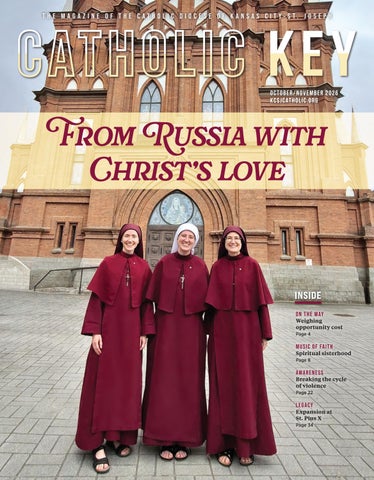
On the cover: The Sisters in Jesus the Lord stand in front of the Most Holy Mother of God Catholic Church in Vladivosok, Russia where they minister to the largest geographical Catholic diocese in the world. Photo submitted by Sisters in Jesus the Lord.
World Mission Sunday | From Russia with Christ’s love | Jay Sorgi It is 6,000 miles from the home of the Sisters in Jesus the Lord in the Diocese of Kansas City – St. Joseph, Missouri, to Vladivostok, Russia. That’s how far you would have to travel to find Mother Stella Whittier and her fellow sisters where they are currently ministering to the largest geographical diocese in the world. The World Mission Sunday collection on Oct. 18, celebrating its 100th anniversary this year, will help missionaries like Mother Stella actively participate in Pope Leo XIV’s theme for World Mission Sunday 2026, “One in Christ, United in Mission.”
4
On the Way: Weighing opportunity cost | Bishop James Johnston Since time is precious, it matters how we “spend” it. When we choose to use our time for one activity or purpose, it means we
Alvin Brooks Center for FaithJustice | Allison Vrooman Dedicated in 2025, the Alvin Brooks Center for Faith-Justice at Rockhurst University is a place where students, faculty, staff and community members can encounter one another, discern how they are called to serve and work together to address the needs of Kansas City.
8
Musical misfits ‘Of A (faithful) Feather’ | Jay Sorgi Kansas City has molded the lives of a recent convert and a cradle Catholic who hit the road and harmonize in spiritual sisterhood.
10
Life and Justice | Why foster families need a village | Karen Ridder Well-placed support can make a huge difference and improve the outcome for both foster parents and children in their care.
18
Following where God leads | Allison Vrooman For Father Lac Pham, pastor of St. James Parish in Liberty, trusting in God’s path for him has been a constant thread throughout his life.
20
To Serve and Lift | The next mile | Ashley Everett Through the Catholic Charities Cars4KC program, donating a vehicle becomes an opportunity to help support the thousands of people in need in our diocese.
22
Breaking the cycle, healing the soul: Community partners offer hope for victims of domestic violence | Sara Kraft Hope House’s mission is to break the cycle of domestic violence by providing safe refuge and supportive services that educate and empower those impacted by domestic violence.
32
St. Therese Little Flower Parish, ‘A work of love’ | Marty Denzer In May 2022, a strategic study of the northeast neighborhood parishes determined St. Therese Little Flower Parish to be unsustainable at its present level. Certain that they were welcoming, they set out to “open doors, minds and spirits.”
34
Expanding the Warrior legacy | Allison Vrooman In August, St. Pius X High School broke ground on a new three-story academic wing, marking the first phase of a $10.5 million campus improvement campaign.
E n E s pa ñ o l
25
El Campo de Misión en la Mesa Familiar | Por Leyden Rovelo-Krull
26
En el Camino | Sopesar el costo de oportunidad | Por Obispo Johnston
Marty Denzer
Ashlie Hand
Sara Kraft
Karen Ridder
JAY SORGI
Allison Vrooman
is a long-time writer in residence for the Catholic Key.
leads the Office of Communications for the Diocese of Kansas City–St. Joseph.
is a freelance writer in St. Joseph.
is a Catholic journalist, wife and mother of four in Liberty.
is a husband, dad and nationally published Catholic journalist.
is the communications specialist for the Diocese of Kansas City–St. Joseph.
3
on th e way
Weighing
opportunity cost By Bisho p James Johnston
“Teach us to number our days aright, that we may gain wisdom of heart.” – Psalm 90:12 One of the features of my smartphone is the provision of a weekly report on how much time I have spent on my phone on average each day that week. I appreciate this feature, but it often surprises me and makes me feel guilty. Granted, some of my weekly activities are related to my vocation: I sometimes use my phone for its Liturgy of the Hours app to say my daily prayers; it holds my calendar; I use it for communication, etc. But if I am honest, I also use it for things that are trivial and useless, when that time could be used for other, more significant things. The time spent on one thing rather than another is often referred to as “opportunity cost.” Most often we frame cost in terms of money, as in “how much something costs to purchase.” But time also ought to be thought of in similar terms. Time is in many ways more important because it cannot be increased. We can earn more money and we can save money, but we cannot add to the number of hours in a day or a week or a year. It is finite. Since time is precious, it matters how we “spend” it. When we choose to use our time for one activity or purpose, it means we cannot spend it on something else, hence there is an opportunity cost. I recently had a conversation with a family about this. Like many families, they have children in sports. One of their girls is pretty talented at soccer and so they have chosen to travel much of the summer and over many weekends throughout the year to play in travel leagues. Often one parent travels with the daughter for soccer, while the other stays with the other children at home. They believe that their daughter needs this continual play to develop her skills if she hopes to be successful at the sport. They have chosen to spend time as a family in this way, but they also shared
4
some regrets at the dislocation it has caused and the things they are missing by not staying home and spending time together — the common meals, the conversations not had, the other activities that are being forfeited. The Sabbath rest and worship of Sunday is also impacted. In other words, they see the opportunity cost. Opportunity costs can also be identified in the phone-based lives of many young people. Time spent scrolling is time not spent on other activities, many of which are critical for growth in social skills and experiences for adult life. I confess that I am sometimes guilty of not using the gift of time as well as I could. My phone app is a good reminder of that. It helps my examination of conscience and reminds me that every day from God is a gift, especially the time I have been given. My responsibility as a steward is not merely about how I use my money, but how I use my time. I first must use it for worship and prayer; I must use it for caring for myself and others; I must use it to fulfill the responsibilities of my vocation in life; I must use it for holy leisure; and all of these in right order and balance. Time will end at some point and then there will only be eternity — life with or without God without the passage of time. One of the mysteries of human existence is that we determine how we will spend our eternity in the tiny window of time that we are alive in this world through how we use our freedom and the choices we make. Jesus came from eternity into time to sanctify it, but also to give it a new meaning; namely, for us to choose salvation or reject it. As Saint Paul proclaimed to the Church: “Now is the acceptable time! Now is the day of salvation!” (2 Cor 6:2) As the days grow shorter during this fall season, it’s a good time for us to reflect on how we are using the gift of time as disciples of Jesus Christ.
Catholic Key • October/November 2026 • catholickey.org
Launching October 5, 2026, “On the Way” is a new podcast hosted by Bishop Johnston, exploring faith, modern discipleship and practical guidance for life’s spiritual journey. Watch the video podcast on YouTube at @diocesekcsjYT, or listen to episodes on Spotify, Apple Podcasts, Amazon Music and other major podcast platforms.
F ro m th e Bi s h o p Bishop James V. Johnston, Jr. is the seventh bishop of the Diocese of Kansas City– St. Joseph
5
f eatu r e
Alvin Brooks Center for Faith-Justice By A l l iso n V r o o man | Photos by Michael Hoga n
F
or Alvin Brooks, faith has always been inseparable from service. “What you do with your life is a ministry if you are a person of faith,” he said. “Everything I did and do now is based on my faith.” That conviction is at the heart of the Alvin Brooks Center for Faith-Justice at Rockhurst University. The center, dedicated in 2025, puts the Jesuit mission of a “faith that does justice” into action. It serves as a home for the university’s service, community outreach and justice-centered initiatives, while providing space for collaboration with community partners. It is a place where students, faculty, staff and community members can encounter one another, discern how they are called to serve and work together to address the needs of Kansas City. Connected to the center is the new Mabee Chapel, a 140-seat worship space. The chapel invites students and community members to gather in prayer and reflection, strengthening their call to serve as faithful agents of social change in the city and world. The chapel and center form a natural bridge between the life of faith and the work of justice. Brooks is a longtime servant of Kansas City who has dedicated
6
his life to fostering understanding and bridging divides. He was among the first Black police officers in Kansas City, Missouri, when he joined the force in 1954. He later worked for Kansas City Public Schools, established City Hall’s first human relations department and became the city’s first Black department head. He went on to serve as assistant city manager and as a member of the Kansas City Council and founded the Ad-Hoc Group Against Crime, which continues its work today. In 2006, Brooks was asked to welcome Father Thomas Curran,
Catholic Key • October/November 2026 • catholickey.org
SJ as Rockhurst University’s 14th president. The two quickly became, in Brooks’ words, not merely friends but “brothers.” When Father Curran moved on to his next assignment in 2022, the university’s trustees asked what legacy he wanted to leave at Rockhurst. His answer was a center on campus named after Alvin Brooks. For Brooks, that decision was more than a tribute. “It had to be
that the Holy Spirit entered into Father Tom’s decision,” he said. Today, the center carries forward what Brooks has spent a lifetime proclaiming through both words and action: faith is meant to be lived. His name on the building is not simply a tribute to his accomplishments, but an invitation to students and the broader community to put faith into action and work toward a more just world.
Photo by Michael Hogan
cat ec hi s m corner
What can we give the God who needs nothing? By Ma rc C a rda ro n e l l a
A
subtle temptation lurks in the Christian life. We pray, fast, perform works of mercy, make sacrifices, keep our devotions, resist temptation and try to live faithfully. All these things are important. Yet beneath them can lie a mistaken assumption: we often think that we have to do things to be worthy of God's love and to deserve being sons and daughters of God. But what does God really need? What can we finite creatures give the infinite God that he doesn't already have? Does God really need anything from us? The answer is nothing. God is perfectly complete in himself. He doesn't need anything from us. But what does he want? He wants our love, loyalty, obedience, and praise. In Psalm 116, the psalmist asks what he can do to repay all the great things God has done for him. His answer is not some great achievement or mortification but an act of worship: “I will raise the cup of salvation” and “offer a sac-
rifice of praise.” (12-13, 17) These are references to Old Testament sacrifices of thanksgiving. The “cup of salvation” is pouring out a libation of wine on the altar. The “sacrifice of praise” is the todah, or thank offering. This meal of bread and wine was celebrated in thanksgiving after the petitioner asked God to save them from a dire situation. The person did not simply feel grateful in private. He shared a sacred meal with friends and family to publicly proclaim what the Lord had done. In many cases, the todah was offered in anticipation of God’s saving action
as a sign of faith acknowledging that whatever happened was God’s mercy. This brings us to our Catechism quote (2638): “As in the prayer of petition, every event and need can become an offering of thanksgiving. The letters of St. Paul often begin and end with thanksgiving, and the Lord Jesus is always present in it: ‘Give thanks in all circumstances; for this is the will of God in Christ Jesus for you’; ‘Continue steadfastly in prayer, being watchful in it with thanksgiving.’” The word Eucharist comes from the Greek word for thanksgiving. The Eucharist is a todah, or thanksgiving, sacrifice. In the Mass, we offer bread and wine, and we remember God’s saving actions. We recall how Christ delivered us from sin and death through his cross and resurrection, and we offer his sacrifice to the Father in thanksgiving and praise.
Ma rc C a rda r o n e lla is the director of the Office of Catechesis and Faith Formation. St. John expresses the whole mystery in a single sentence: “In this is love: not that we have loved God, but that he loved us and sent his Son as expiation for our sins.” (1 Jn 4:10) What shall I return to the Lord for all he has given me? It’s not about what you do, like works of mercy, a regular prayer life, or great physical mortification. Again, that doesn't mean those things aren’t important. But the greatest thing is gratitude and thanksgiving for what he has done for you. That should lead you to give him your whole heart in love and worship, allowing him to live in you and move through you.
7
Musical misfits
‘Of A (faithful) Feather’ KAN SAS CIT Y H AS MO L D ED T H E L I V E S OF A R E CE N T C O N VERT AN D A C R AD L E CAT H O LIC W H O HI T T H E R OAD AN D HARM O N IZ E IN S P I R I T UAL S I ST ER H O O D By Jay So r gi | Photos by Michael Hogan
S
ometimes, God works at dive bars. That’s how solo musicians Kelly Hunt and Sara Morgan met, found kinship in music and eventually much deeper siblinghood in the Catholic Faith.
“We met at Knuckleheads for the first time,” said Kelly, a Memphis native and University of Notre Dame graduate who grew up in a Catholic family, lived in her mom’s hometown of Kansas City for a decade and still calls it a musical home. “We both realized we had the shared experience of being Southern girls who ended up in the Midwest; both musicians, both singer-songwriters; [and] there was just a connection right away.” Sara grew up three hours from Memphis in McGehee, Arkansas, in a Southern Baptist family before she and her mother moved to Kansas City. “I went to college and was studying biblical and theological studies in church history,” Sara said, “but I was getting ready to graduate and I just came to this point where
8
Catholic Key • October/November 2026 • catholickey.org
“Somebody came up to us last night and [said], ‘God had to have put you two together.’” I was like, ‘I don't believe in any of this.’” Sara’s husband grew up Catholic, but had not completed the full sacraments of initiation. Her inquisitiveness led to a revisiting of St. Augustine’s Confessions, which she called, “The only piece of faith that I had left.” “I met Kelly, and we would have these conversations about religion and faith, and I would go, ‘Why do you think that? How did you get there?’” Sara said, adding that Kelly was the first friend with whom she had deep exploration of the Catholic Faith. “I've had a complicated relationship with my faith,” Kelly added. “A beautiful part of our friendship is Sara revealing things to me about my Catholic Faith.” A journey to Rome during the latest Papal Conclave and the election of Pope Leo XIV cemented Sara’s decision to fully enter the Church. “[That was] the final straw,” she said. “I was like, ‘I see you. I hear you. OK, I'm in.’” She was able to remotely take part in OCIA while on tour this past year, and received her sacraments of initiation with her husband this past Easter. Kelly and Sara became the musical duo “Of A Feather” over the past two years, collaborating to create Americana roots music that they call Southern Gothic country. They consider themselves mutual “misfits,” having to find Mass “where we can find it” while on the road. It can feel like a lonely place, until the moments of vulnerability and truth on stage that become reciprocal with audience members whom they become friends with for a night of subtly sacred connection. “Where do I not see God in this stuff?” Kelly rhetorically asked with joy. “You lay your heart out for two hours. They come up and do the same to you [and] you impact each other in this very powerful way.” “It's an opportunity to go love people that you might not see on a Sunday morning next to you,” Sara shared. “Somebody came up to us last night and [said], ‘God had to have put you two together.’” Kelly and Sara, a pair of musical siblings in the Holy Spirit, won’t give any argument. “Being a musician, being an artist,” Kelly said, “the Spirit is that animating force.”
f eatu r e
On Giving Tuesday
MAKE A DIFFERENCE
RIGHT HERE IN OUR DIOCESE Whether your passion is Catholic education, parish life, outreach ministries or evangelization, you can make a meaningful difference. Find the mission that inspires your heart and make an impact this giving season.
Scan the code, find your passion and support the ministries that are transforming lives across our Diocese. National Day of Giving is Tuesday, December 1, 2026.
9
f e atu r e
Why foster families
d e e n a village
(and how you can be part of it) By Kar e n Ridder | P hoto su bmitted by K at h y W h i t e
T he
job of a foster parent can be as isolating as it is rewarding. When a foster child comes into the home, priorities change. Time commitments crowd. Foster parents often watch their own needs go untended. However, some well-placed support can make a huge difference and improve the outcome for both foster parents and children in their care. Jill and Joe Ybarra came to foster parenting when Jill was a volunteer at the Wyandotte Pregnancy Clinic and Gabriel Project. After going through foster training, they were asked to care for a 14-year-old girl in foster care who had become pregnant. “She wasn’t ready to be a mom. She was very young. She would run and not take care of her child. The child ended up coming into our care. We remained his foster parents, too,” said Jill.
10
They fell in love with the baby and it looked like they were going to be able to adopt him, but he was reunited with his birth family. “That was traumatic for us, but it changed our way of thinking. We realized, we’re here to do what we are asked to do, and that’s it,” Jill added. The Ybarra family accepted more foster children, including several troubled teens for a few years, before fostering and then adopting their two youngest foster children earlier this year.
Catholic Key • October/November 2026 • catholickey.org
Fostering included making time for visits from the social worker and the CASA worker, therapy appointments, doctor appointments and visits with biological parents, all on top of the normal school and activity obligations all families have to tackle. They found children in foster care often are additionally dealing with the trauma of experiences they’ve gone through, in addition to extra social and emotional diagnoses. Jill says it was a journey with a personal toll. While the experience can be exhausting, it also feels isolating because many people in their social network simply didn’t understand the challenges they had agreed to take on as foster parents. “It’s constantly about the foster children, and I think my friends just stopped asking me to do stuff and Joe and I stopped doing stuff,” she said. Kathy White has worked with foster parents in support service for many years. She and her husband Dan adopted a son through a connection at their parish. White agrees that one
Getty Images/Chondaen Piaoto
pletely m o c e H . t h ig l a t s was ju n o s r e t ys.” s a o f w t y s n ir a f r m u o s “O in e m e saved H . s e iv l r u o d e g n a ch of the hardest parts of taking a new child into your home through foster care or adoption is the way it can change community support. “Every foster family says their friend group changes because people don’t understand why you would bring a child into your home — especially one with big behaviors,” said Kathy. Kathy’s son had many challenging behaviors. It took time and her own education to be able to understand how to help him thrive. She says she’s grateful to people who stepped forward with support, particularly in those early years. She had friends who responded and offered their experience on behavioral, medical and parenting issues when she reached out for help. It made a big difference to their family. Kathy’s advice is to continue to be a support to any family fostering or adopting no matter what, and try to offer non-judgmental support.
director of Catholic strategies. It provides a person who has services or goods to offer a connection point to a family or person in “Realizing the crises. value of community for a family with Kathy calls the portal the “Uber” of need. foster children is very important,” she said. “It is a care-sharing technology for local chilAny step towards creating community dren and families in crisis. It takes people who can be helpful. The Ybarras’ help came in have needs and those who provide for needs part through a non-Catholic church group and connects them together,” she explained. in Topeka, Kansas, where the Ybarras used Not every parish member is to live. The program included going to be in the position to a type of mentoring-relationaccept foster children in their ship opportunity, including a home or adopt children into non-fostering couple from the their families, but anyone can church coming alongside the make a difference by simply family and kids. The church understanding the challenges sponsored free gatherings HE AR MORE and choosing not to be afraid. quarterly at the church for from Kathy White on Jill says it is also important to mentors and foster families. the Nov. 9 episode remember foster parenting has This included a respite night of the “On the Way” many rewards that make the out for foster parents. podcast with Bishop challenges worth it. “Our first Another option for helping Johnston. Tune in foster son was just a light. He is to consider joining the Care on YouTube, Spotify, completely changed our lives. Portal network at www.careAmazon Music or He saved me in so many ways,” portal.org. Kathy is now workApple Podcasts. she said. ing for the organization as the
c ov e r s to ry
Mother Maria Stella Whittier, CJD (far right) with Sister Faustina (far left) and Sister Mary Helen (center) are missionaries with Sisters in Jesus the Lord in Vladivostok, Russia, the largest geographical diocese in the world.
From Russia with Christ’s love, Mother Stella lives a world mission Her journey from Kansas City embodies the cause of World Mission Sunday, which the Church observes this year on Oct. 18 By Jay Sorgi | P hotos s u bmi t t e d by S i s t e rs i n J e s u s t h e L o rd 12
Catholic Key • October/November 2026 • catholickey.org
M
other Maria Stella Whittier, CJD and her God-given calling embody the very phrase “world mission.”
Co-foundress of Sisters in Jesus the Lord, based in St. Joseph, Missouri, her life is dedicated to reaching out with Christ’s love as a missionary, being present in the lives of people in a place with an extremely small Catholic population. That place is Vladivostok, Russia, on the Sea of Japan, 28 miles from the border of China, 80 miles from the border of North Korea and roughly 6,000 miles from Kansas City. “We're in the largest geographical diocese in the world,” Mother Stella said about the incredible span of the Diocese of St. Joseph in Irkutsk. It includes just 35 priests who cover about 3.8 million square miles, an area with a population that is less than 1 percent Catholic. “Our bishop is a four-hour flight northwest of us, and basically the diocese spans the entire eastern half of Russia, which is about the size of the continental U.S.”
She said that the sisters’ mission in Vladivostok, which is now in its 17th year, was born of prayer for the conversion of Soviet Russia, which barely allowed for any existence of the Catholic Faith within its borders. Mother Julia Kubista, MM, the founder of the Sisters in Jesus the Lord, got to know Father Myron Effing and Father Daniel Maurer of the Canons Regular of Jesus the Lord. They had already begun making inroads in the diocese, which began in 1991, when they were visiting their US Mission office. “She had been in Africa for many years, but always had a desire to do something to end communism, and so when she met them, she was just set on fire and thought, ‘How can I help you?’” Mother Stella said. “She found out that their greatest need was sisters to help them in their work here in far eastern Russia.”
The Canons Regular of Jesus the Lord established the mission in Russia in 1992, one which Mother Stella joined years later after her mother heard Father Maurer at her parish in Washington, D.C. “She just said, ‘You won't believe this, but this Catholic parish was closed for 65 years, [and] these priests have come and reopened it,” Mother Stella said. A pilgrimage to World Youth Day 2002 in Toronto led her to discern God’s will for her in religious life, and she asked God to direct her to a locale. “When I got home, I opened my mailbox, and there was the Vladivostok Sunrise. I had never received their mailing before,” she said. “There was an announcement saying ‘Missionaries needed, sisters needed, we're starting a new community to go to Russia, and I thought, ‘Wow, this is the day I've been praying for, [and] I think I'm supposed to go here.”
Sister Faustina and Misha, Catechesis of the Good Shepherd atrium, Vladivostok, Russia.
13
LE ARN MORE about Sisters in Jesus the Lord by visiting www.cjd.cc or sistersinjesusthelord.org
Pray every morning that you will have the grace to respond to the Holy Spirit, and you will become more and more aware of the Lord’s presence in your life.”
Sister Faustina and Mother Stella accompany Father Hubertus Yakobus, CJD, as he anoints a parishioner before surgery.
Mother Julia Mary Kubista, MM, foundress, with Sister Faustina Marie Goedken, CJD from Conception Junction, Missouri. Picture taken at Maryknoll motherhouse, New York.
Her community moved from Minnesota to the Kansas City area in 2009, leading to her eventual move to Vladivostok, a region of the world that had not been allowed to fully embrace the Faith for two-thirds of a century, especially under the reign of Joseph Stalin until his death in 1953. “Most people in Russia still have never met a Catholic,” she said. “They don't know anything about us. They think we're a sect. They're not even sure that we're Christian. They don't have any idea that our church has more than 1 billion believers throughout the world.” That truth fosters the mission Mother Stella and her sisters engage in, one of what the late Cardinal Francis George of Chicago called a
14
“mission of presence,” which includes a lot of personal healing. “A lot of our presence is actually just people getting to know us. ‘You mean you believe in Jesus? You want to go to heaven? Do you read the Bible?’” she said. She said that ministry of presence comes in ways ranging from retreats, conferences, international student nights, Catechesis of the Good Shepherd lessons, kids' camps and Rachel’s Vineyard, which ministers to women who have had abortions. “We just hosted a young adult conference that was for Catholics from as far away as Yakutia. It was 12 hours by taxi, plus three days by train, to get to us,” Mother Stella said. “The topic was love and marriage according
Catholic Key • October/November 2026 • catholickey.org
(L-R) Bishop Johnston, Sister Faustina, Mother Stella, Gracie Blevins, postulant, at the Sisters’ motherhouse in St. Joseph, Missouri, August 2025. (Cathedral Convent of St. Joseph)
to God's plan, with beautiful discussions, and people could ask any questions they wanted to.” The upcoming World Mission Sunday collection on Oct. 18, which celebrates its 100th anniversary this year, will help missionaries like Mother Stella actively participate with their very lives in Pope Leo XIV’s theme for World Mission Sunday 2026, “One in Christ, United in Mission.” The sisters have welcomed several priests from the Diocese of Kansas City-St. Joseph on mission trips to Vladivostok including Father Matthew Benjamin in 2012 and Father Stephen Hansen in 2014, as chaplains with FOCUS mission teams (Fellowship of Catholic University Students). Father Paul Sappington visited in the summer of 2019 while he was still a seminarian in Rome. “Sometimes, you can't physically go as a volunteer, but you're working hard, and you can donate part of that to missionaries who are there, and that's a way in which we're connected.” She also encourages people to join as prayer partners by offering their intentions via email, where her community will keep submitted intentions lifted.
As for the calling to be a missionary, she truly advises us all to be attentive to the movements of the Holy Spirit. “Pray every morning that you will have the grace to respond to the Holy Spirit, and you will become more and more aware of the Lord's presence in your life,” she said. “Our foundress learned from her own father that obeying the promptings of the Holy Spirit is the secret to holiness.” That includes holiness in just being present to people in great need, like a parishioner in Vladivostok who was near death, the kind of moment that’s universally understood. “Three of us went with one of our brother priests [and] her face lit up with joy,” Mother Stella said. “Father Edwin gave her the anointing of the sick, and she received communion. She kept saying, ‘I love Jesus so much, I love my family. I love Father Myron. I love Father Daniel. I love all of you. I have forgiven all my former enemies. I am ready to go.’ Her face shone with joy and peace. We sang her favorite hymns with her, and then she said she needed to rest.” And as Mother Stella shared, “She died one week later.”
FOR MORE INFORMATION on how to help World Mission Sunday, visit pontificalmissions.org. (L-R) Father Stephen Hansen, pastor of Cathedral of St. Joseph, Mother Stella, Gracie Blevins, Sister Faustina, and Father Daniel Maurer, CJD, co- founder of the Canons Regular of Jesus the Lord.
15
m a r r i ag e
D i n o D u ra n d o irreplaceable. In fact, “man would not exist were he not created by God’s love and constantly preserved by it; and he cannot live fully according to truth unless he freely acknowledges that love and devotes himself to his Creator.” (Gaudium et Spes, 19)
is director of the Office of the Domestic Church and Discipleship. He has been married to his best friend, Cathy, for 28 years and they have 10 children and two grandchildren.
THE ME ANI NG OF FAMI LY
Wisdom from Vatican II By D ino Dur ando
MY WO R K PL AC E I S A LIT T LE D IFFE RE N T T H AN MO ST. I S E RV E O N T H E CURIAL STAFF FOR BISHOP J O H N STO N , A N D HE H AS DIRE CT E D OUR M ON T H LY STAFF GATH E R I N G TO I N CLUD E LE ARN IN G ABOUT VAT IC AN II BY ST U DY I N G T HE DOCUM E N T S OF T H E C OUN C I L . TA K I N G I N S P I R AT I ON FROM T H IS, I PROVIDE H ERE A R EF L E C T I O N O N T H E W ISD OM FOUN D IN T H E VATI CAN I I D O CUM E N T T HAT DIRE CT LY SPE AKS ABOUT T H E FAMI LY A ND T HE M E A N I N G AN D M ISSION OF M ARRIAGE . God made us to love him and to love our neighbor. He created us to offer our love to him through worship and prayer. Family is the first place where we learn to do both. God is the source of love and the author of sacramental marriage and so his role in the family is
16
Catholic Key • October/November 2026 • catholickey.org
What is a family? More importantly, what is the Christian family? It is the loving union of one man and one woman with the purpose of the procreation and upbringing of children. In the Christian view, marriage is a sacrament, instituted by Christ (see Mt 19: 3-9), which serves not only the care of children, but also the unity and good of the spouses. Pope St. John Paul II helped write Gaudium et Spes, the council document which teaches about the truth of the Catholic family as the “domestic church.” In his work to implement the council, he wrote an apostolic exhortation in which he stated: “The Church is deeply convinced that only by the acceptance of the Gospel are the hopes that man legitimately places in marriage and in the family capable of being fulfilled.” (Familiaris Consortio, 3) Marriage consists in “mutual fidelity … consecrated by Christ’s sacrament [and] this love abides faithfully in mind and body in prosperity and adversity and hence excludes both adultery and divorce.” (GS, 49) The Gospel message regarding marriage includes Christ’s promise to help spouses with the grace necessary for them to persevere in fidelity to one another and to God. This is vitally important to understand in situations where marriage becomes difficult and may even seem impossible to live well. According to our human capacity, many circumstances of marriage may indeed be impossible. Here, God’s grace, his help, can enter in, should we cooperate and ask. In fact, “authentic married love is caught up into divine love and is governed and enriched by Christ's redeeming power and the saving activity of the Church, so that this love may lead the spouses to God with powerful effect and may aid and strengthen them in the sublime office of being a father or a mother.” (GS, 48) Because, “there is no family that does not know how selfishness, discord, tension and conflict violently attack and at times mortally wound its own communion” familial religious formation must focus on “family communion [which] can only be preserved and perfected through a great spirit of sacrifice. It requires, in fact, a ready and generous openness of each and all to understanding, to forbearance, to pardon, to reconciliation.” (FS, 21) To take on this spirit of sacrifice, spouses must approach their role as mother and father with humility and reliance upon God. Willingness to forgive and to ask forgiveness leads to reconciliation, peace, and unity in the home.
hispanic ministry
The mission field at the dinner table By L ey den R ov elo -Kru ll
I
n the Catholic imagination, mission fields are exotic lands and different languages. A stalwart missionary holding a Bible bravely facing who knows what for the sake of the Gospel. Lately though, the mission field looks like the kitchen table with homework pushed to one side, a teenager speaking a language you can't seem to understand, a toddler refusing vegetables and you trying to remember if anyone prayed before eating.
L ey den R ov elo - Krull is director of the Office of Hispanic Ministry.
The Church speaks often about mission, and rightly so. We are sent to proclaim Christ to the world. But for parents, the first mission field where the Gospel begs to be proclaimed is at home. More specifically, at the dinner table. Children learn the Faith first by watching what, and who, their family loves, what their family
gives thanks for and how their family speaks, forgives, serves and gathers. The dinner table forms because it repeats. Day after day, meal after meal, children absorb what matters. They learn whether gratitude is normal. They learn whether the elderly are honored, whether guests are welcomed, whether phones are more important than faces and whether prayer belongs in ordinary life. This is why the family table can become a small but real school of discipleship. That small school of discipleship matters because our children do not spend their days inside a Christian echo. Much of what they watch, scroll, hear and imitate does not proclaim the Gospel
or even assume it. Their friends may be kind and good, but many are also growing up in homes where faith is never named. In a post-Christian culture, parents are not merely adding the Faith on top of everything else. We are competing for the right to disciple the heart. The world, the flesh and the devil do not need a dinner bell; they are patient missionaries of their own. So when we gather at the table, we are not simply feeding a family. We are receiving baptized people back from the field, people moving through mission territory who come home to be fed, heard, strengthened and sent again. A family meal is not the Eucharist, and we should not confuse the two. But the dinner table can echo something of what the altar reveals. At the altar, we receive what we cannot give ourselves. At the dinner table, children learn that life itself is received. At the altar, Christ gathers many into one body. At the dinner table, a family learns again how to belong to one another. At the altar, thanksgiving is at the heart of worship. At the dinner table, gratitude can become a habit before it becomes a virtue. Many of us know the power of food to carry memory, identity, sacrifice and love. A pot of arroz, a
warm tortilla, abuelita's recipe, a crowded table after Mass — these are not small things. They teach children that Faith is not only something we study. It is something we receive, practice, taste and pass on. But culture alone is not enough. A beautiful meal can still leave the soul hungry. If our tables carry family stories but never prayer, if they preserve recipes but not reverence, if they gather bodies but not hearts, we have missed a holy opportunity. The good news is that this mission does not require perfection. It may begin with a simple blessing before meals. A question about the Sunday Gospel. A family intention offered for someone who is sick. A child invited to help serve. A guest welcomed. An apology made. A phone set aside. Small practices, repeated with love, teach more than we think. As October gives way to November and families begin moving toward the busy holiday season, perhaps the Church is inviting us to reclaim the table before the calendar runs away with us. Not as one more burden, but as a place of grace. The mission field may be closer than we think. It may be where we sit down tonight.
17
f e atu r e
Following
where God leads By A l l i s o n Vro o ma n | P h o t o by Mi c h a e l H o ga n
F
or Father Lac Pham, trusting in God’s path for him has been a constant thread throughout his life. From leaving Vietnam as a teenager to discerning his vocation and eventually serving as a missionary in his homeland, he has repeatedly stepped forward without knowing exactly what would come next, trusting that God would provide a way. Born in southern Vietnam as the oldest of eight children, Father Lac grew up in a Catholic family whose roots reach back to northern Vietnam, where the first Catholic missionaries arrived. On July 5, 1975, he arrived in Kansas City as a teenager, sponsored through the Catholic Charities refugee resettlement program. He had already entered minor seminary in Vietnam and hoped to continue his formation in the United States. Because he spoke little English, he was initially told to remain home to finish high school. Through the persistence of his sponsor, however, he connected with the Missionaries of the Precious Blood in Liberty, Missouri, where he learned English and continued his formation. Even then, he wasn’t certain that the priesthood was his calling. “I knew I was called to service,” Father Lac recalled, “but I wasn’t sure if I was called to ordained ministry.” At the completion of his studies at Rockhurst College, Father Lac decided to leave formation to pursue an opportunity to serve Vietnamese refugees. Almost immediately, however, the funding for the position fell through. He moved to Southern California, where he worked several jobs before returning to Kansas City in 1984 to celebrate the first commitment of some of his former Precious Blood classmates. There, he jokingly told the vocation director, “I’m ready to come back. Where’s my room?” A few weeks later, Father Lac rejoined the community. He was ordained a priest in December 1989 and served as associate pastor at St. Francis Xavier in St. Joseph until 1996, when he was led back to Vietnam. For the next 19 years, Father Lac served the Church through underground ministry. Without official permission to minister as a priest, he lived under close government observation. Because his birth certificate had been issued under the previous regime, he was not recognized as a Vietnamese citizen and had to renew a visitor’s visa every three months to remain in the country. Today, Father Lac serves as pastor of St. James Parish in Liberty. His journey from refugee teenager to missionary and pastor is a testament to trusting in God’s will, even when the path ahead is unclear. For those discerning their own path, Father Lac offers a simple message: “God will provide.”
18
Catholic Key • October/November 2026 • catholickey.org
f eatu r e
Catholic Scouting America, the new face of Scouting By Mar t y Denzer | Photos by Michael Hogan The National Catholic Committee on Scouting (NCCS) recently announced that, henceforth, it will be publicly known as Catholic Scouting America. This branding change marks a new chapter in Scouting’s century-old commitment to molding young people in faith, leadership and service. Scouting was founded in England by Lord Robert Baden Powell in 1908. Two years later, Chicago publisher William Boyce founded and incorporated the Boy Scouts of America in Washington, D.C. Boyce credited the founding to a courteous Scout guiding him through a thick London fog. On March 12, 1912, Juliette Gordon Low founded the Girl Scouts of the United States after meeting Lord Baden Powell. Scouting was founded for both boys and girls without basis on organized religion, simply on God and country. Catholic Scouting began in 1910, when the first Catholic-chartered Boy Scout troop was established in St. Paul, Minnesota. In 1922, the first official diocesan Catholic Committee on Scouting formed in New York. Today, there are more than 3,270 Catholic Scout troops across the nation and more than 98,000 Catholic Scouts. The public name “Catholic Scouting America” is designed to instantly clarify the organization’s mission to the Catholic families, parishes and dioceses it serves. This past April, Joe Rozell, chairman of the Catholic Committee on Scouting for the Diocese of Kansas City–St. Joseph, attended the National Summit. He said, “The National Catholic Committee on Scouting felt like the old title caused confusion for parents and the public regarding what the group does. The updated identity aligns with the broader name change of the Boy Scouts of America to Scouting America and emphasizes family-friendly clarity. The new logo continues to illustrate our partnership with Scouting America while weaving our Catholic faith into the fabric of Scouting. The new branding emphasizes that Catholic Scouting is a journey of ‘Faith, Family and Adventure.’ Our young Catholic Scouts hike that trail together to encounter the Gospel of Jesus Christ.” Catherine Baldwin, a member of St. Elizabeth Parish in Kansas City, serves as a member-at-large for the Catholic Committee on Scouting in the Diocese of Kansas City-St. Joseph. She is the mother of both Boy and Girl Scouts. Baldwin views the new identity as having a positive impact. “We’re really trying to be inclusive. There will be girl troops, boy troops and family troops of both boys and girls. There will still be Cub Scout ranks by grade, from kindergarten through grade 5.”
Members of the Catholic Committee on Scouting in the Diocese of Kansas City-St. Joseph include (top left) Thomas Jewitt, recording secretary, (lower center) Father Joseph Powers, chaplain and (upper left) Catherine Baldwin (center), mother of scouts and member -at-large.
CATHOLIC SC OUTING is a good option for families seeking opportunities for youth ministry. For more information, visit CatholicScoutingAmerica.org or CatholicScouting.com.
19
THE NE XT MILE
This van carried our family — and so many memories — to Glacier National Park.
My well-loved minivan has covered a lot of ground, carrying our sons around Kansas City to endless sport practices, Scout meetings, orthodontic appointments and Aldi milk-and-egg runs. It’s been a part of core memories: visits to grandparents and longdistance road trips to explore national parks. I can’t think about road trips in that van without remembering my one son who always got carsick in the backseat. That’s a core memory for all of us, especially those in the splash zone! Our good ol’ minivan has become a trusted part of our family. Now, with the older boys in college, we’re starting to think about parting ways with our old and well-crumbed — I mean well-loved — van. By Ashley Ev er ett, Director of marketing and communications at Catholic Charities of Kansas City-St. Joseph
Pho t o s by St ev e Hag elm a n, Videographer at Catholic Charities of Kansas City-St. Joseph
20
While the trade-in value might not be much on a van with 175,000+ miles, our van can still be used for good. Through the Catholic Charities Cars4KC program, donating a vehicle becomes an opportunity to help support the thousands of people in need in our diocese. Donating my minivan to Cars4KC actually helps a veteran find stable housing, or
Catholic Key • October/November 2026 • catholickey.org
provides food to families facing hard times. The proceeds from donated vehicles help make our mission possible. One question we hear often is, “Do you give the cars directly to families in need?” The answer is no. Every vehicle is evaluated by our trusted partner, Midway Auto, then, depending on its condition, it is sold
at auction or recycled for parts. Catholic Charities receives the resulting funds, allowing us to direct support wherever the need is greatest. While the car itself may have reached the end of its journey with you, it can begin a new journey of hope for someone else. What makes Cars4KC especially appealing is how easy the process is. After completing a short online form, a member of the Midway Auto team contacts you, answers any questions and schedules a pickup at a time that works for you. There are no towing fees, no seller fees, and no hidden costs. Trusted drivers come directly to your location, making the donation process seamless from beginning to
to s erv e and l i ft end. As an added benefit, your donation may also qualify as a tax deduction. No title? Midway Auto can still work with you. It is one of those rare opportunities where doing good is also surprisingly convenient! Recently, one donor shared that before donating their car they simply asked themselves what’s the best use of their old vehicle? After learning they could donate their car in support of Catholic Charities, they immediately knew it was the right choice. “I think I heard God telling me this is the right choice,” they said, “… paying it forward.” In many ways, that’s exactly what Cars4KC is about. Donations to Cars4KC can be more than just cars and trucks.
If you have any vehicle, boat, camper or trailer you no longer need, we invite you to consider Cars4KC. It is a simple way to transform something no longer serving your family into hope for another. Visit Cars4KC.org or call 816.282.6966 to learn more. The work of Catholic Charities has always depended on people of goodwill. Some volunteer their time sorting food, mentoring families, or making quilts for new moms. Others make financial gifts or include Catholic Charities as a beneficiary on their retirement plan. Some pray faithfully for our staff and those we serve. All these acts of love are the fuel that keeps us going. And maybe one of those acts of generosity looks like handing
over the keys to a car that has faithfully served its purpose and donating it for good. No act of kindness is too small when it is offered with love. As for our family, we’re still not quite ready to say goodbye to the family van. But when the time comes, it’s comforting to know that something woven into so many of our family memories can continue making a difference for someone else.
I think I heard God telling me this is the right choice … paying it forward.
WHAT ’ S HAPPENI NG AT CATHOLI C CHARI TI E S OF KANSAS CI T Y-ST. JOSEPH: Oct. 26 – Christmas Shining Star Program opens. catholiccharities-kcsj.org Oct. 28 – Trunk or Treat at the Serve & Lift Center! 4 p.m.-7 p.m. at 8001 Longview Road, Kansas City, Missouri One car. One driveway. A big difference. Thank you to this family for turning an unused vehicle into support for families across our community through Cars4KC.
Volunteers will park, decorate their trunks and hand out treats to our neighbors while enjoying burgers, hot dogs and more. Costumes encouraged! Email market@ccharities.com. Nov. 5 – Tickets and sponsorships open for Hope Ball. www.catholiccharitiesball.org Nov. 12 – Guardians of Hope Mass 5 p.m.-6 p.m. at Bishop Hogan Center, 416 W. 12th St., Kansas City, Missouri. March 6 – Hope Ball at Loews Kansas City Hotel
This car is headed somewhere new, and carrying hope with it.
21
f e atu r e TO VOLUNTEER AT HOPE HOUSE , schedule a presentation about domestic violence awareness, or donate, visit www.hopehouse.net. To access their 24-hour hotline, call 816.461.HOPE. To read the U.S. Conference of Catholic Bishops’ full statement on domestic violence, scan the QR code.
The Hope House Emerging Leaders young professionals group packing Mother’s Day bags for shelter clients.
Breaking the cycle, healing the soul
A shelter bed and a child’s drawing are signs of comfort for a family seeking protection from a domestic violence situation.
Community partners offer hope for victims of domestic violence By Sara Kraf t | P hotos su bmitted by H o p e H o u s e
Hope House's mission is to break the cycle of domestic violence by providing safe refuge and supportive services that educate and empower those impacted by domestic violence. Hope House helps around 3,500 survivors a year in Eastern Jackson County and Kansas City. A common misconception is that Church teaching on the permanence of marriage requires one to stay in an abusive relationship. One might even fear not being able to remarry in the Church. The Catholic Church teaches no person is expected to stay in an abusive marriage. “Violence and abuse, not divorce, break up a marriage. We encourage abused persons who have divorced to investigate the possibility of seeking an annulment. An annulment, which determines that the marriage bond is not valid, can frequently open the door to healing,” states
22
When I Call for Help: A Pastoral Response to Domestic Violence Against Women. “Organizations that serve survivors play an important role in helping individuals find safety, regain stability, and begin moving toward healing and independence,” explained Julie Ball, director of children and family services for Catholic Charities of Kansas CitySt. Joseph. “For our clients, having knowledgeable and trusted community partners to whom we can refer them can make a significant difference. It allows us to respond to the whole person and family by connecting them with specialized services that Catholic Charities may not provide directly.” Hope House is one such agency. Hope House offers many services, including a 24hour crisis hotline, emergency shelter, hotel placement, case management, transitional and permanent housing, therapy, court advocacy, civil law programming and a guardian program for supervised visits and monitored exchanges of custody. They also partner with the Independence Police Department. One of Hope House’s biggest services is court assistance for both shelter and outreach
Catholic Key • October/November 2026 • catholickey.org
survivors. “It’s not as easy as just saying ‘leave,’ explained MaryAnne. “That doesn’t ensure their safety.” Appearing in court for an Order of Protection can be scary for a witness or victim. Hope House helps prepare victims prior to going into court, so they know what to expect. Hope House also has contract attorneys to assist clients with civil issues including divorce and child custody. “We are very grateful for Hope House and the many other community organizations that stand alongside survivors and help ensure that individuals and families have somewhere to turn when they need support,” said Julie.
Hope House provides therapy, advocacy, shelter and legal help for its clients in Eastern Jackson County and Kansas City.
Getty Images/kampee patisena
“ W E SAV E L I V E S ,” SAID H OPE H O U SE C E O M A RYAN N E M E T H E N Y. “ D O M E ST I C V I O L E N CE IS OF T E N A L IF E A N D D E AT H SIT UAT ION .”
YES 3 ON
UNDERSTANDING AMENDMENT 3
On November 3, Missourians will vote on Amendment 3, which would roll back the most harmful provisions of the pro-abortion constitutional amendment that was narrowly approved in 2024.
A YES VOTE ON 3: FIVE KEY POINTS TO KNOW 1
Significantly limits the number of abortions by preventing abortion all nine months of pregnancy and including tightly written exceptions for medical emergencies, fatal fetal anomalies, rape, and incest. Currently, abortion on demand is legal for all nine months for almost any reason.
2
Ensures parental notification and consent for a minor child to have an abortion.
3
Bans transgender procedures for minors. In 2023, Missouri banned gender-transition surgeries, puberty blockers, and cross-sex hormone therapy for children. However, some of these provisions are set to expire in 2027; Amendment 3 would not only keep the current ban, but also enshrine it in the state constitution.
4
Reinstates health and safety standards and allows for inspections at abortion clinics. In 2018, the Planned Parenthood clinic in Columbia closed for health and safety violations of state rules, including mold on and in medical equipment. However, due to the 2024 amendment, the state lost its ability to conduct inspections.
5
Protects Missourians' ability to sue physicians or facilities for malpractice, injury, or death for abortion procedures.
Where can I verify this? Missouri State Constitution: Article 1, Section 36. Court Ruling: Missouri Circuit Court of Jackson County’s ruling in Case No. 2416-CV31931. Official Ballot Title and Language: Amendment 3 – Secretary of State Office.
Visit our website for more information: mocatholic.org Email: mocatholic@mocatholic.org Phone: 573.635.7239 Paid for by Missouri Catholic Conference, Jamie Morris, Exeuctive Director, PO Box 1022, Jefferson City, MO 65102
23
b l ack cath olic s p i r i tu a l i ty Bishop James Johnston with members of the Knights of St. Peter Claver and Ladies Auxiliary in the Diocese of Kansas CitySt. Joseph. Photo by Michael Hogan, 2025.
Fat h e r L e o n a rd Gi c h e r u, pastor of St. Monica Parish and chaplain to the Black Catholic Implementation Team.
BEYOND THE HISTORY BOOKS: The Black Catholics who built the American Church By Fat her Leo nar d Gicheru
W H AT I F S O M E O F TH E M OST IM PORTAN T BUILDERS OF THE CATHOLI C CH U R C H I N A M E R I CA ARE PE OPLE M AN Y CAT H O LI C S HAVE NE VER HE ARD O F ? T HE STO RY O F BL ACK CAT H OLIC S IN T H E UNI TED STATE S I S OFTEN TOLD AS A STORY OF EXCLUSION — AND CERTAINLY THERE WAS E XCL USI ON. B U T I T I S A L S O A STORY OF BUILDIN G. BL ACK CATHOLI C S BUI LT SCHOOLS, R EL I G I O U S C O M M U N IT IE S, PARISH E S, CH ARITABLE ORGANI ZATI ONS AND INST I T U T I O N S T HAT C ON T IN UE TO SE RVE T H E C HURCH TODAY. The U.S. Conference of Catholic Bishops estimates that there are approximately 3 million African American Catholics and 798 predominantly African-American Catholic parishes in the United States. Yet about 76 percent of Black Catholics belong to predomi-
24
nantly white parishes, a reality that may help explain why a distinct Black Catholic history can sometimes disappear from view. Consider Mother Mary Lange. In Baltimore in 1828, at a time when educating Black children was enormously difficult, she founded
Catholic Key • October/November 2026 • catholickey.org
in the nation for women of African ancestry. In New Orleans, Venerable Henriette DeLille and the Sisters of the Holy Family ministered among people society often ignored. They educated children, cared for orphans and the sick, served elderly people and assisted the poor. Remarkably, they even taught enslaved people when Louisiana law prohibited such education. Black Catholic laypeople were at the forefront. In 1909, amid segregation and exclusion from other Catholic fraternal organizations, Black Catholics helped establish the Knights of Peter Claver in Mobile, Alabama. Today, the Knights and Ladies Auxiliary has more than 17,000 members and roughly 1,000 local units, supporting scholarships, youth mentoring, charitable work and social justice ministries. And then there is Xavier University of Louisiana. Founded by St. Katharine Drexel and the Sisters of the Blessed Sacrament, Xavier remains the only historically Black Catholic university in the United States. Today, it is nationally recognized for educating Black students in STEM and health sciences and as a leading producer of African American graduates who go on to medical school. These are not side stories. They are American Catholic history. Celebrated each November, National Black Catholic History Month therefore invites the Church to do more than celebrate inspiring individuals. It asks a harder question: How can we understand the American Catholic Church if we do not remember the people who helped build it? Perhaps the task before us is not simply to add Black Catholics to the history books. It is to rewrite the story accurately enough to recognize that they were there all along.
Unsplash/joe-woods
St. Frances Academy, recognized as the first Catholic school in the United States established for African Americans. The following year, she founded the Oblate Sisters of Providence, the first women’s religious community
Mi ni s ter i o Hi spano
El Campo de Misión en la Mesa Familiar P o r L ey den R ov el o-Kru ll
E
n la imaginación católica, los campos de misión suelen parecer tierras lejanas e idiomas distintos: un misionero firme, Biblia en mano, enfrentando quién sabe qué por amor al Evangelio. Pero últimamente, el campo de misión se parece más a la mesa de la cocina: la tarea a un lado, un adolescente hablando un idioma que uno ya no entiende, un niño rechazando las verduras y uno tratando de recordar si alguien rezó antes de comer.
L ey den R ov elo - Krull, Oficina del Ministerio Hispano
La Iglesia habla con frecuencia de la misión. Somos enviados a proclamar a Cristo al mundo. Pero para los padres, el primer campo de misión está en casa. Más concretamente, en la mesa familiar. Los niños aprenden la fe observando qué, y a quién, ama su familia; por qué da gracias; cómo habla, perdona, sirve y se reúne. La mesa familiar forma porque se repite. Día tras día, comida tras comida, los niños absorben lo que importa. Aprenden si la gratitud es normal, si se honra a los mayores, si se recibe al invitado, si los teléfonos valen más que los rostros, si la oración pertenece a la vida ordinaria. Por eso la mesa familiar puede convertirse en una pequeña, pero verdadera, escuela de discipulado.
Esa escuela importa porque nuestros hijos no viven dentro de un eco cristiano. Mucho de lo que ven, deslizan en la pantalla, escuchan e imitan no proclama el Evangelio. Sus amigos pueden ser buenos, pero muchos crecen en hogares donde la fe nunca se nombra. En una cultura poscristiana, los padres no estamos agregando la fe encima de todo lo demás. Estamos compitiendo por el derecho de discipular el corazón. El mundo, la carne y el demonio no necesitan que se les llame a la mesa; son misioneros pacientes por cuenta propia. Así que cuando nos reunimos a la mesa, no estamos simplemente alimentando a una familia. Estamos recibiendo de regreso del campo a personas bautizadas, personas que se mueven por territorio de misión y vuelven a casa para ser alimentadas, escuchadas, fortalecidas y enviadas de nuevo. Una comida familiar no es la Eucaristía, y no debemos confundirlas. Pero la mesa familiar puede reflejar algo de lo que el altar revela. En el altar, recibimos lo que no podemos
darnos a nosotros mismos. En la mesa familiar, los niños aprenden que la vida misma se recibe. En el altar, Cristo reúne a muchos en un solo cuerpo. En la mesa familiar, una familia vuelve a aprender cómo pertenecerse. En el altar, la acción de gracias está en el corazón de la adoración. En la mesa familiar, la gratitud puede volverse hábito antes de
perdido una oportunidad santa. La buena noticia es que esta misión no exige perfección. Puede comenzar con una bendición antes de comer. Una pregunta sobre el Evangelio del domingo. Una intención por alguien enfermo. Un niño invitado a servir. Un invitado bien recibido. Una disculpa ofrecida. Un teléfono puesto a un lado.
volverse virtud. Muchos conocemos el poder de la comida para llevar memoria, identidad, sacrificio y amor. Una olla de arroz, una tortilla calientita, la receta de la abuelita, una mesa llena después de Misa: no son cosas pequeñas. Enseñan a los niños que la fe no es solo algo que se estudia. Es algo que se recibe, se practica, se saborea y se transmite. Pero la cultura por sí sola no basta. Una comida hermosa todavía puede dejar hambrienta el alma. Si nuestras mesas llevan historias familiares pero nunca oración, si conservan recetas pero no reverencia, si reúnen cuerpos pero no corazones, hemos
Las prácticas pequeñas, repetidas con amor, enseñan más de lo que pensamos. Mientras octubre da paso a noviembre y las familias se acercan al ajetreo de las fiestas, quizá la Iglesia nos invita a recuperar la mesa antes de que el calendario se nos escape. No como una carga más, sino como un lugar de gracia. El campo de misión puede estar más cerca de lo que pensamos. P uede estar donde nos sentemos esta noche.
25
Sopesar el costo de oportunidad Una de las funciones de mi teléfono inteligente es enviarme cada semana un informe con el promedio de tiempo que pasé usándolo cada día. Agradezco esta función, aunque a menudo me sorprende y hasta me hace sentir culpable. Es verdad que parte de ese tiempo está relacionado con mi vocación: a veces uso la aplicación de la Liturgia de las Horas para rezar; también consulto mi calendario y lo uso para comunicarme, entre otras cosas. Pero, si soy sincero, también lo uso para cosas triviales e inútiles, cuando podría dedicar ese tiempo a otras mucho más importantes. El hecho de dedicar tiempo a una cosa en vez de a otra suele describirse como un “costo de oportunidad”. Por lo general, cuando hablamos de costo pensamos en dinero: “¿cuánto cuesta esto?”. Sin embargo, conviene pensar en el tiempo de una manera parecida. En muchos sentidos, el tiempo es aún más valioso, porque no hay manera de aumentarlo. Podemos ganar más dinero y ahorrar dinero, pero no podemos añadir horas a un día, una semana o un año. El tiempo es limitado. Precisamente porque el tiempo es precioso, importa cómo lo “gastamos”. Cada vez que elegimos dedicarlo a una actividad o a un propósito, renunciamos a emplearlo en otra cosa. Esa elección tiene un costo de oportunidad. Hace poco conversé sobre esto con una familia. Como tantas otras, tienen hijos que practican deportes. Una de sus hijas tiene bastante talento para el fútbol, así que han decidido viajar durante buena parte del verano y muchos fines de semana del año para que juegue en ligas competitivas que implican viajar. Con frecuencia, uno de los padres viaja con ella por sus actividades de fútbol, mientras el otro se queda en casa con los demás hijos. Piensan que, si ella quiere llegar lejos en este deporte, necesita jugar de manera constante para seguir
26
Catholic Key • October/November 2026 • catholickey.org
Lanzado en octubre de 2026, On the Way es un nuevo pódcast presentado por el obispo Johnston que explora la fe, el discipulado moderno y la guía práctica para el viaje espiritual de la vida. Véalo en YouTube en @diocesekcsjYT o escúchelo en Spotify, Apple Podcasts, Amazon Music y otras plataformas.
Getty Images/Tony Anderson
“Enséñanos lo que valen nuestros días, para que adquiramos un corazón sensato.” Salmo 90,12
en el c am i no
D e l O b i s po El obispo James V. Johnston, Jr. es el séptimo obispo de la Diócesis de Kansas City–St. Joseph
desarrollando sus habilidades. Como familia han decidido dedicar así buena parte de su tiempo, pero también me hablaron con pesar de las complicaciones que esto ha traído a su vida familiar y de todo lo que se pierden al no estar en casa juntos: las comidas compartidas, las conversaciones que no llegan a tener, las demás actividades a las que renuncian. Incluso el descanso del domingo y la participación en el culto dominical se ven afectados. En otras palabras, son conscientes del costo de oportunidad. También podemos ver este costo de oportunidad en la relación que muchos jóvenes tienen con el teléfono. El tiempo que pasan deslizando una y otra vez la pantalla es tiempo que dejan de dedicar a otras actividades, muchas de ellas fundamentales para desarrollar habilidades sociales y vivir experiencias que los preparan para la vida adulta. Reconozco que a veces no aprovecho tan bien como podría el tiempo que Dios me ha dado. Ese informe semanal es un buen recordatorio. Me ayuda en mi examen de conciencia y me recuerda que cada día que Dios me concede es un regalo y que el tiempo que se me ha confiado es precioso. Como administrador de lo que Dios me ha confiado, mi responsabilidad no se limita a cómo uso mi dinero, sino también a cómo uso mi tiempo. Debo dedicarlo, ante todo, al culto y a la oración; al cuidado de mí mismo y de los demás; al cumplimiento de las responsabilidades propias de mi vocación; y también al descanso y a la sana recreación. Todo ello debe guardar el debido orden y equilibrio. El tiempo llegará un día a su fin y entonces solo quedará la eternidad: la vida con Dios o sin Dios, ya sin el paso del tiempo. Uno de los misterios de la existencia humana es que, en el breve tiempo que vivimos en este mundo, decidimos cómo pasaremos la eternidad por cómo ejercemos nuestra libertad y por las decisiones que tomamos. Jesús vino de la eternidad y entró en el tiempo para santificarlo, pero también para darle un sentido nuevo: en este tiempo podemos elegir la salvación o rechazarla. Como proclamó san Pablo a la Iglesia: “¡Este es el momento favorable, éste es el día de la salvación!” (2 Cor 6,2). Ahora que los días se hacen más cortos con la llegada del otoño, tenemos una buena ocasión para preguntarnos cómo estamos aprovechando, como discípulos de Jesucristo, el tiempo que Dios nos ha confiado.
27
f e atu r e
Building a home in Missouri INSIDE ST. JOSEPH’S CLOSE-KNIT FILIPINO C OMMUNIT Y By S a ra K ra f t “We are not just God-fearing but also God-loving,” explained Gerard Magpantay, president of the Filipino community in St. Joseph, Missouri. St. Joseph is home to a growing Filipino community, with approximately 300 members in the region. Of those members, around 70 Filipinos are attending Our Lady of Guadalupe Parish in St. Joseph. Many Filipinos choose to attend Our Lady of Guadalupe Parish due to their devotion to Our Lady of Guadalupe, the Celestial and ProLife Patroness of the Philippines. “The purpose of the group is to not feel alone. You are in a foreign country, and everyone needs to adjust,” Gerard stated. “Our goal is to let Filipinos feel like they have a family in America.” Five years ago, Gerard and family faced the pandemic as tourists visiting family in Arizona. After his wife passed her NCLEX nursing exam, they decided to stay in the United States and seek permanent residency. They settled in St. Joseph in 2023. Because of the growing community, access to Kansas City and work opportunities, Filipinos continue to settle in St. Joseph. There is work for teachers, nurses and their spouses. “People are really nice and lovely,” said Gerard.
Gerard Magpantay and members of the Filipino community in St. Joseph share fellowship and a strong devotion to Our Lady of Guadalupe. Photo submitted by Gerard Magpantay.
28
Catholic Key • October/November 2026 • catholickey.org
“They are a very joyful community,” explained Father Garrett King, pastor of Our Lady of Guadalupe Parish. “The Filipinos have a good sense of community at the parish and outside the parish. It’s an inspiration to all of us.” The Filipino community seeks to engage each other in faith, fitness, engagement and service. The Philippines boasts 75 percent of its population as Catholic. The St. Joseph community seeks to encourage each other in faith and traditions. Before each event, they pray as a group. There are also several Bible study groups. During Lent, the community follows Filipino tradition by going to all the churches in the area to pray as a group. Additionally, they celebrate Christmas, Thanksgiving and Independence Day as a community. New Year’s is spent at home, because it is considered a huge blessing to have the family together at New Year’s. The Filipinos enjoy fitness together, including basketball, pickleball and Zumba. The community also seeks to help new members assimilate to St. Joseph. Many arrive in St. Joseph by plane, so the community helps with used appliances, couches and TVs. They also educate new community members on items such as how to get a driver’s license, assist them in obtaining employment and just generally looking out for each other. Their shared Catholic Faith also influences them to help the greater St. Joseph community. “Being Catholic is all about serving,” explained Gerard. “We want to help and serve the community.”
parenti ng
The band director’s lesson on
D I V I N E DIRECTION By K a re n Ri d d e r
Getty Images/Jose Luis Pelaez Inc
MY SI X T H G R A D E R H AS JUST START E D BE GIN N ING BA ND. A C O U PL E O F M ON T H S AGO, W E WE RE INVI TED TO A S P E C I A L M E E T IN G FOR BAN D PARE N T S. “So, glad you’re here,” the jovial band director said. “I’m going to try to explain to you about your child choosing an instrument.” It is not the straight-forward process you might be tempted to expect. The band director knows that if everyone just went for their first choice, he would have 25 girls on flute, 35 boys on trumpet and 67 kids trying percussion. That would not be a band. It would be a mess. The band director has to be a bit more savvy, and it is complicated. Yes, some kids will play an instrument because a parent did and they happen to already have the instrument at home. That CAN be OK. Other kids may simply love the idea of playing a particular instrument and won’t budge. That also CAN be OK. The band director is willing to allow both these things. There is, however, another way — one he asked us parents to trust and try. It’s a harder process. It involves time. It involves experience. It balances preference with practicality. It considers the whole. Students will get their hands on the instruments first. They will experience what it’s like to make a noise on the mouthpiece. They will consider if they like the way the instrument sounds. Sometimes he dissuades. Sometimes, he persuades. The student still holds the ultimate choice,
but the result somehow becomes what is best for the individual AND the group. In the end, he has built a band. It mirrors life, doesn’t it? Just like those students, there are some things in life we’d all like to raise our hand to try. Maybe we want it because our parents did it. Maybe we just have our hearts determinedly set on something. Those things CAN be OK. God allows them, but there IS another way, too, he asks us to trust and follow. It is a process. It takes time. God puts things in our path to experience. He wants us to try things. He asks us to think about what we enjoy. We may be dissuaded from what we first thought was right for us. We may fall in love with something we had never considered. This “other” way is repeated again and again in scripture: Consider David, who was pretty good at being a shepherd but made to be a king. Or the frustrated fisherman, Peter, who Jesus called to become a “fisher of men.” Joseph was a carpenter who saved the son of God. Mary was a girl whose “yes” changed the world. I’m not saying God is just some big band director in the sky, but your life can be different, if you let God direct it. The choice is always yours. That’s the way this works, but if you trust the process, you may soon find yourself doing a lot more living than you ever imagined. Just join the band.
29
feature
Five young women receive the
Golden Rose Award
By Mar t y Denzer | P hotos by Michael Hogan
It is fitting that five young women received the Golden Rose Award on the feast of the Assumption of Mary. Dating back to the 11th century, it was awarded as a papal gift to Catholic royalty or churches showing deep devotion to the Faith. Today, the Golden Rose is awarded by Councils of Catholic Women to current or recently graduated high school girls for outstanding leadership, spirituality and service. or as a class officer), must be spiritual and reflect Gospel values in everyday life, must be an active member of her parish and participate in activities (attend Sunday Mass regularly, be in a youth group, a volunteer or in ministries), show leadership and go above and beyond in church or community service projects compared to her peers. Along with the rose, the girls received a certificate and a DCCW membership.
Alyson Lopez, of St. Sabina Parish in Belton. Nominated by Father Jeff Stephan, pastor, who described her as “mature, delightful, dedicated and kind.”
30
Catholic Key • October/November 2026 • catholickey.org
Journey Platt, of St. George Parish in Odessa. Nominated by Jill Strauss, who described her as “a devoted and joyful presence in our parish community.”
Lupita Portillo, of St. Regis Parish. Nominated by Robin Fisher, who described her as “a young woman of integrity, kindness and quiet strength; a true disciple of Christ.”
Getty Images/Kainam
The Kansas City-St. Joseph Diocesan Council of Catholic Women (DCCW) began awarding the Golden Rose in 2025. The 2026 Award Ceremony was held during the 4 p.m. Mass at Nativity of Mary Parish in Independence. Beverly South of the DCCW explained that to be eligible, a young woman must be 14-18 years old, have participated in school activities (sports, student government, clubs
Neylly Gonzalez, of St. John Francis Regis Parish in Kansas City. Nominated by Robin Fisher, past principal, who described her as “demonstrating a servant’s heart, has a deep commitment to her faith.”
Photo and caption submitted by Sister Connie Boulch, OSF.
R E LI G I O US W O M E N JUB I LI A R I A N S
2026
Maryn Smith, of St. Jude the Apostle Parish in Oak Grove. Nominated by Melissa Mauer Smith, who described her as “always willing to help; makes daily Mass a priority, shares her faith with others, is joyful and kind.”
Maryn Smith recently graduated from high school, exhibiting leadership as president of the Oak Grove Chapter of the Future Farmers of America (FFA), serving on an FFA Agronomy team and receiving certification from the Missouri Farm Bureau, as well as being a two-year member of the National Honor Society and earning a 4.0 GPA all four years, graduating magna cum laude. She plans on attending
Metropolitan Community College. A niece's birth is nearing and Maryn has been asked to be the baby's godmother. "I don't want to miss that!" Maryn’s Golden Rose is very special to her. “I’m pretty quiet, not doing things to get noticed,” she said. “When I started praying, it brought me closer to God. I’ll never forget receiving a good backbone of being Catholic, because it’s hard to be Catholic.”
A Mass and celebration of the 2026 religious jubilarians was held at Our Lady of the Angels Chapel of the Sisters of St. Francis of the Holy Eucharist on Aug. 23, 2026. We celebrate with gratitude the jubilee anniversaries of each sister pictured and those not present. Front row: Sister Paul Colette Bertrand, lsp (50), Sister Madonna Gieselman, OSF (80) and Sister Mary Alphonsus Curtayne, lsp (70). Row 2: Sister Andrea Kantner, OSF (70), Sister Teresita Romano, OCD (50), Sister Sharon Giemza, OSF (50), Sister Connie Boulch, OSF (50) and Sister Mary Clare Eichman, OSF (25). Row 3: Father William Oulvey, SJ, Bishop James V. Johnston, Father Charles Rowe, Father Derrick Weingartner, SJ. Jubilarians not pictured: Sister Ruth Stuckel, CSJ (70), Sister Wilmarie Ehrhardt, OSB, (60), Sister Jeanne Jannsen, CSJ (60), Sister Hildegard Zerwas, OSB (60), Sister Linda Barringer, MMB (50) and Sister Judith Neisen, OSB (50).
31
f e atu r e
St. Therese Little Flower Parish,
‘A work of love’ By Mar t y Denzer | Photo by Michael Hogan
In May 2022, a strategic study of the northeast neighborhood parishes determined St. Therese Little Flower Parish to be unsustainable at its present level. Several factors were identified as contributing to its situation: shifting demographics in the surrounding neighborhoods, declining sacramental activity, fewer registrations and dwindling financial contributions. Those factors compelled Bishop James Johnston to recommend the parish collaborate with St. James Parish at 39th Street in Kansas City, Missouri.
32
Catholic Key • October/November 2026 • catholickey.org
St. Therese parishioners got to work. Certain that they were welcoming, involved with the parish and confident in their “charismatic” pastor, Father Don Farnan, they set out to “open doors, minds and spirits.” One of the first moves made was to change the perception that the area was “dangerous.” Cups of lemonade, handed out after Mass by parish children, was a beginning. Parishioners started bringing a friend or neighbor to First Sunday Masses and word got around about St. Therese Parish’s “welcoming spirit.” A parishioner of 53 years, Treva Lee, said, “Would you drive over 30 miles to attend Mass at St. Therese if it was dangerous or unfriendly? We have Kansas folks who drive in from DeSoto, and Overland Park. Here, you get the sense, ‘I belong here!’” She added that she loves the parishioners’ diversity, saying, “This is a family here!”
Lee credits Father Farnan for increasing the number of Baptisms, First Communions and Mass attendance, saying he brings an energy to the parishioners, akin to the energy of the Holy Spirit. She said, currently, attendance is holding steady at about 125 at Mass every Sunday. Chloe Ramos, a new parishioner, has immersed herself in “the vibe“ she feels at Little Flower. After searching for a parish that would welcome and help her feel “belonging,” Chloe recalled, “I felt so much lighter after attending my first Mass at St. Therese. I believe God led me here.” Chloe follows St. Therese’s “Little Way,” working with teachers and staff at Our Lady’s Montessori School, around the corner from the church, and feeding the neighborhood poor through the parish’s emergency assistance and food pantry program that serves more than 100 neighborhood families monthly. B.J. Atkinson, director of St. Therese Little Flower Emergency Assistance, has served parishioners and neighbors in need since 1995. She said the parishioners are “discerning,”attracting younger people to St. Therese Little Flower Church. She said there is good public transportation to the neighborhood and the church. “If you want to come to St. Therese, you want to come to St. Therese.” Recently, Bishop Johnston informed the parish that significant improvements had been made and it will remain open for the foreseeable future. In many “Little Ways,” things are looking up at St. Therese Little Flower Parish.
f eatu r e
Expanding the Warrior legacy By A l l iso n V r o o man | Photos by Michael Hoga n
Diocesan and school leaders participated in a ceremonial ground breaking to kick off the $10.5 million campus improvement project at St. Pius X High School in Kansas City.
O
n Aug. 21, 2026, the feast of Saint Pius X, St. Pius X High School in the Kansas City Northland broke ground on a new three-story academic wing, marking the first phase of a $10.5 million campus improvement campaign. The expansion comes as the school experiences historic enrollment growth. This year, St. Pius X welcomed more than 500 students — the largest student body the school has seen since 1976. For more than 70 years, St. Pius X High School has prepared young men and women to lead lives of faith, service and excellence. The school emphasizes a well-rounded education that encompasses academics, faith, athletics, the arts and community. Its goal is to challenge and support every student while helping them reach their full potential. The construction project is part of the Warrior Legacy Campaign, a capital improvement initiative launched in May 2025 to prepare the campus for the school's fu-
34
ture. The original campaign included plans for a new commons area and kitchen, administrative offices, four classrooms, a severe-weather storm shelter and a training facility. As enrollment continues to grow, the school expanded the campaign to include a three-story academic wing featuring six classrooms, two science labs and a lecture hall. The original plans for the commons area have also evolved into a larger student union designed to become a central hub for student life. The redesigned space will feature an expanded commons and kitchen, an indoor concession stand, a bookstore and administrative offices. Safety and security are central
Catholic Key • October/November 2026 • catholickey.org
to the improvements on campus. As part of the project, the school is creating a dedicated visitor entrance near the main entrance. The secured entry point will strengthen visitor verification and provide greater oversight of guest access. The new entrance builds on other recent security improvements, including campus-wide perimeter fencing, badge-access entry doors and a daily police presence. Together, these measures are intended to provide a secure and welcoming environment where students can focus on learning and growth. St. Pius X is committed to completing the project without taking on debt. Support from the school community has allowed the campaign to raise the funds needed to begin construction. “This groundbreaking is the result of an incredible community coming together around a shared vision for the future of St. Pius X,” said Joe Ross, St. Pius X president and a member of the
Bishop Johnston celebrated Mass with students and faculty, then offered a special blessing on the campus grounds at St. Pius X High School.
class of 1989. “We are grateful to everyone who has helped us reach this moment, and we are excited to begin building a campus that will serve generations of Warriors to come.” The new academic wing and other campus improvements represent the next chapter of providing a Catholic education for students in the Kansas City Northland.
Diocese of Kansas City-St. Joseph The Catholic Center 20 W. Ninth St. Kansas City, MO 64105
~ This Is A Holy Place~
it is consecrated ground set aside as a meeting place for God and man.
We will begin offering space in our new mausoleums at Mt. Olivet and Resurrection Cemeteries in Kansas City soon. Special offers will be published in The Catholic Key and parish bulletins.
“Plan Today, Not Tomorrow ~ Together, Not Alone.” Mt. Olivet Cemetery - KC
7601 Blue Ridge Blvd. Kansas City, MO 64138 816.353.1900
Mt. St. Mary’s Cemetery
2201 Cleveland Avenue Kansas City, MO 64127 816.241.7663
Resurrection Cemetery
Mt. Olivet Cemetery St. Joseph
5001 NE Cookingham Dr. Kansas City, MO 64156 816.734.2356
26th & Lovers Lane St. Joseph, MO 64506 816.279.5005
Partnering with Catholic Cemeteries are two of Kansas City's most established and trusted funeral homes Steve Pierce 6800 Troost Ave Kansas City, MO 64131 (816) 444-2060
Serving Our Catholic Community Since 1954
family operated
www.muehlebachchapel.com
Charlie Passantino 2117 Independence Blvd. Kansas City, MO 64124 (816) 471-2844 Family Owned Since 1930
www.passantinobros.com
Before, During and After... We will be there in your time of need. cemeterieskcsj.org