August/September 2026 kcsjcatholic.org
August/September 2026 kcsjcatholic.org
PLAN YOUR RETREAT FOR SPRING 2026
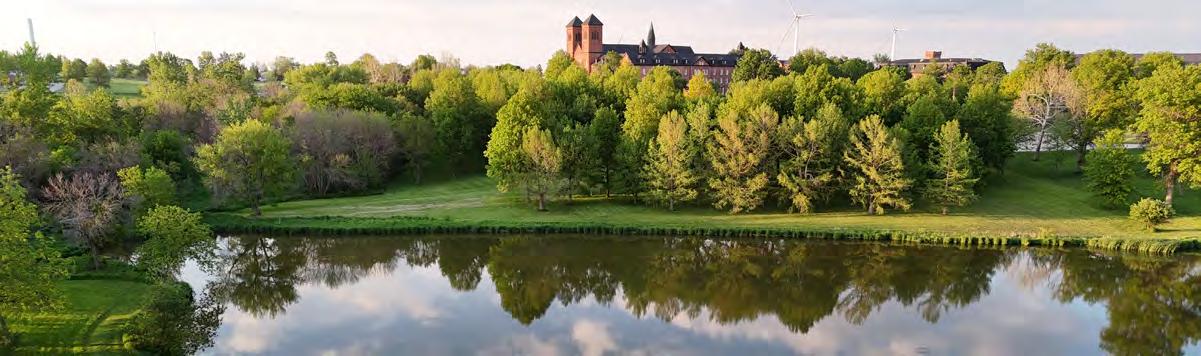
In Northwest Missouri, Conception Abbey’s Benedictine retreats draw from more than 1500 years of wisdom in the Benedictine tradition and are rooted in the principles outlined by St. Benedict in his Holy Rule.
Aug. 29–31, 2025
Oct.17–19, 2025
Nov. 21–23, 2025
Dec. 19–21, 2025
Jan. 23–25, 2026
Mar. 20–22, 2026
May 22–24, 2026
Aug. 22–24, 2025
Oct. 31–Nov. 2, 2025
Dec. 12–14, 2025
Jan. 16–18, 2026
Feb. 27–Mar. 1, 2026
May 8–10, 2026
May 29–31, 2026
Parish groups welcome! Visit conceptionabbey.org/guests or scan the QR code to view all of our retreat listings.
Four conferences given by a Benedictine monk, intended to lead the retreatant to encounter Christ
Participation in the Divine Office and Mass with the monastic community
Specific times for personal prayer and lectio divina
Adoration of the Blessed Sacrament and the Sacrament of Reconciliation
Silence and a technology “fast”
The magazine of the Catholic Diocese of Kansas City-St. Joseph
August/September 2026 VOL. 6 | ISSUE 5
Bishop James V. Johnston, Jr. PUBLISHER
Ashlie Hand EDITOR
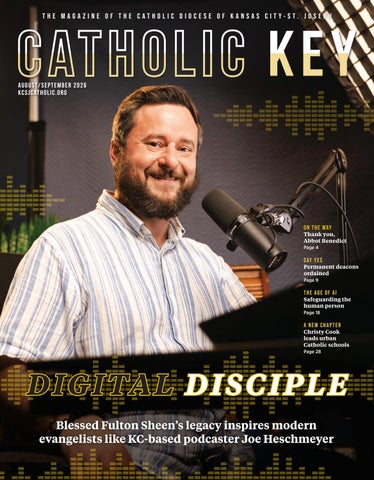
Digital disciple | Archbishop Fulton Sheen inspires today’s evangelists | Jay Sorgi
9
Say “yes” and see where God takes you | Bob Sandford
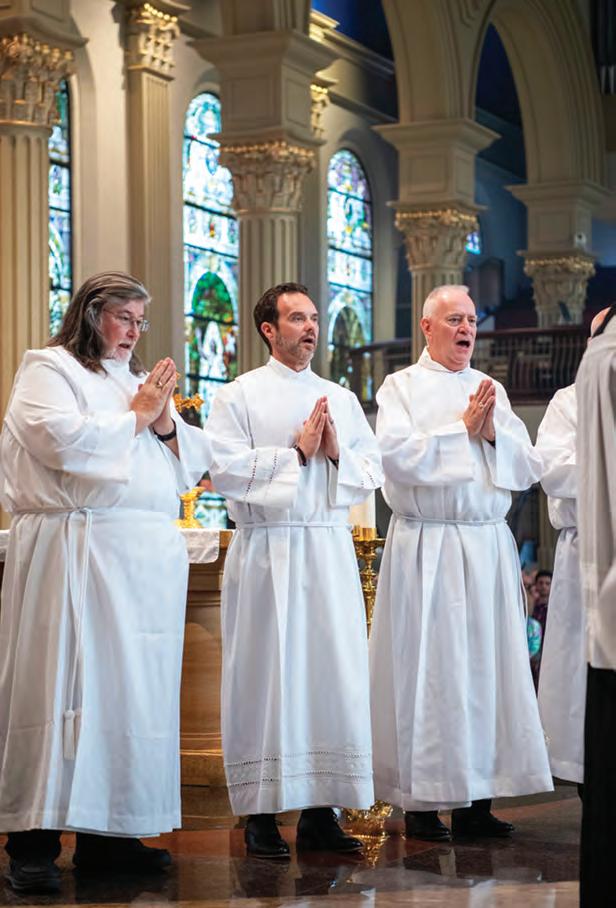
On June 20, five men were ordained to the permanent diaconate at the Cathedral of the Immaculate Conception. Deacon Eric Davis was among them.
10
Janna Stellwag GRAPHIC DESIGNER
To submit story ideas and news, send emails to hand@diocesekcsj.org
Catholic Key (ISSN 2769-2353, USPS 024-190) is a membership publication of the Diocese of Kansas City-St. Joseph, published bimonthly (Feb/Mar, Apr/May, Jun/Jul, Aug/Sep, Oct/Nov, Dec/Jan) by the Diocese of Kansas City-St. Joseph, The Catholic Center, 20 W. Ninth St., Kansas City, MO 64105. Periodicals Postage Paid at Kansas City, MO and at additional mailing offices. POSTMASTER: Send address changes to Catholic Key, The Catholic Center, 20 W. Ninth St., Kansas City, MO 64105. ©2026 Catholic Key, Diocese of Kansas City-St. Joseph.
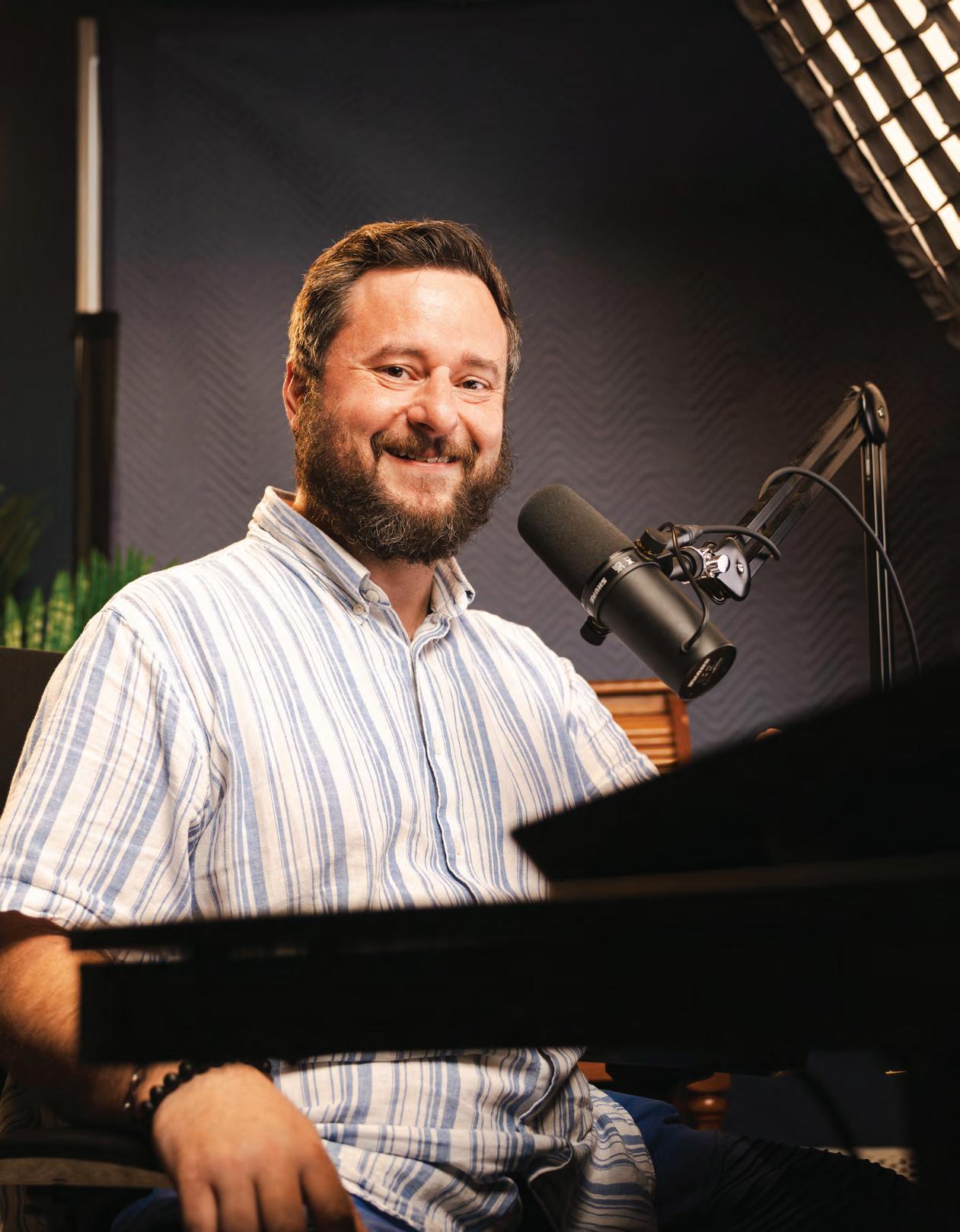
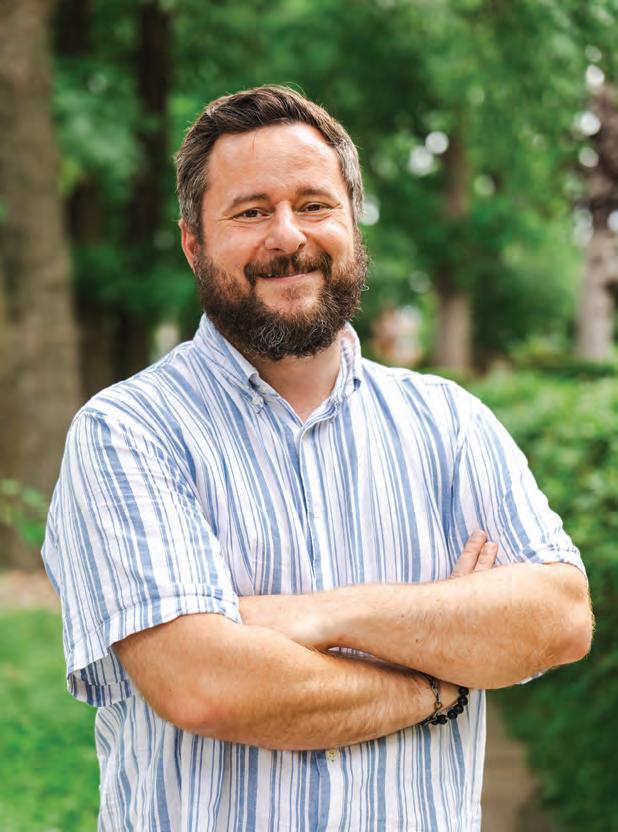
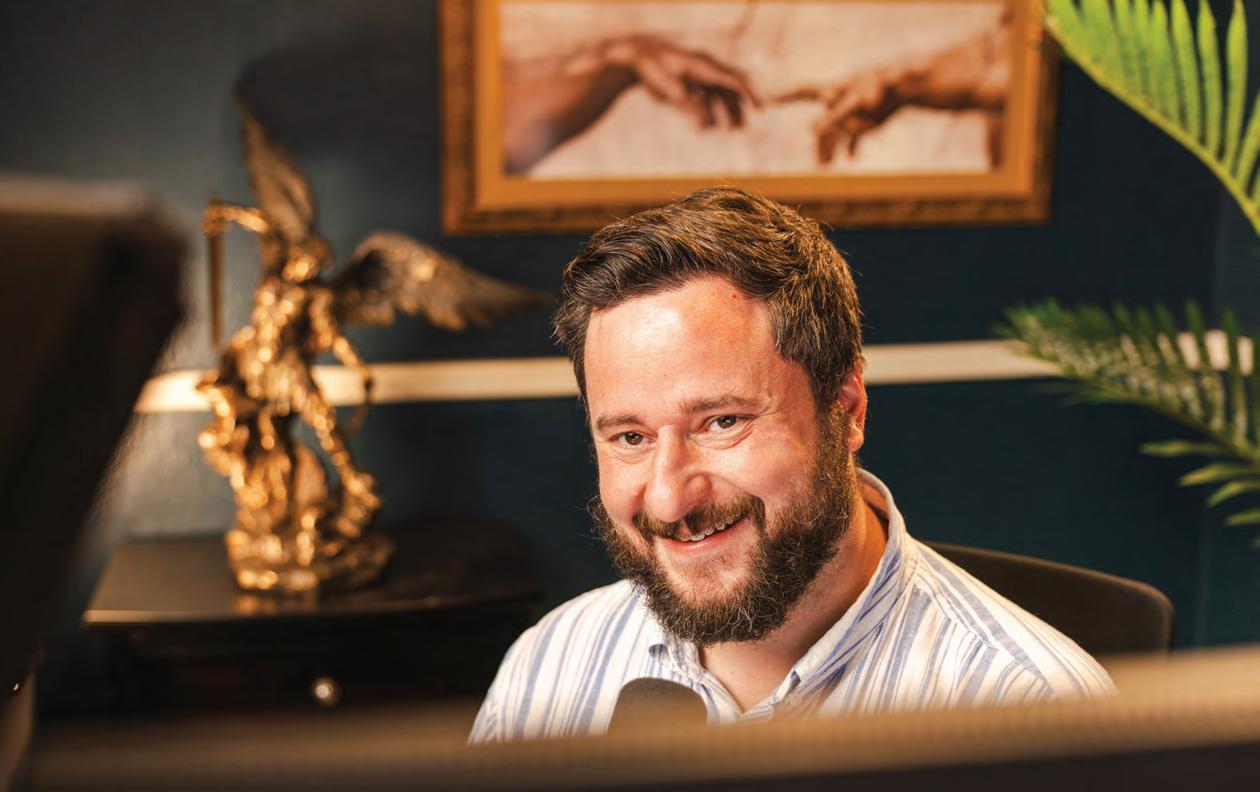
On the cover: St. Peter’s parishioner Joe Heschmeyer in his home studio where he records his regular podcast episodes for Catholic Answers. Photo by Michael Hogan.
Marty Denzer is a long-time writer in residence for the Catholic Key.
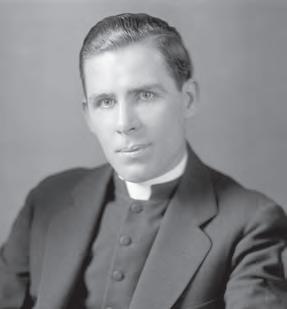
Joe Heschmeyer, a Kansas City-based apologist with Catholic Answers, spends much of his week explaining, defending and evangelizing the Faith on online platforms, much like Archbishop Fulton J. Sheen did as a missionary disciple known as “America’s Bishop” and “God’s microphone.” Heschmeyer sees how Sheen’s incredible gift of communicating Christ could corral the kind of audiences that are up to three times the size of top-rated prime time television programs today. Creating such an audience in a time of more than 25 billion content options worldwide, fed by algorithms that track consumers’ content habits, presents a new challenge for today’s apologists.
4 On the Way: Thank you, Abbot Benedict | Bishop James Johnston
I want to express my personal gratitude, as well as that of our entire diocese, for Abbot Benedict’s leadership and service to Conception Abbey and Seminary.

Ashlie Hand leads the Office of Communications for the Diocese of Kansas City–St. Joseph.

Sara Kraft is a freelance writer in St. Joseph.
Under new leadership, Holy Rosary Credit Union continues 80-year legacy of serving the underserved | Sara Kraft Since 1943, Holy Rosary Credit Union has helped underserved and immigrant communities access responsible financial services. Marquita Joshua, Holy Rosary Credit Union’s new president, is committed to carrying on that legacy.
18
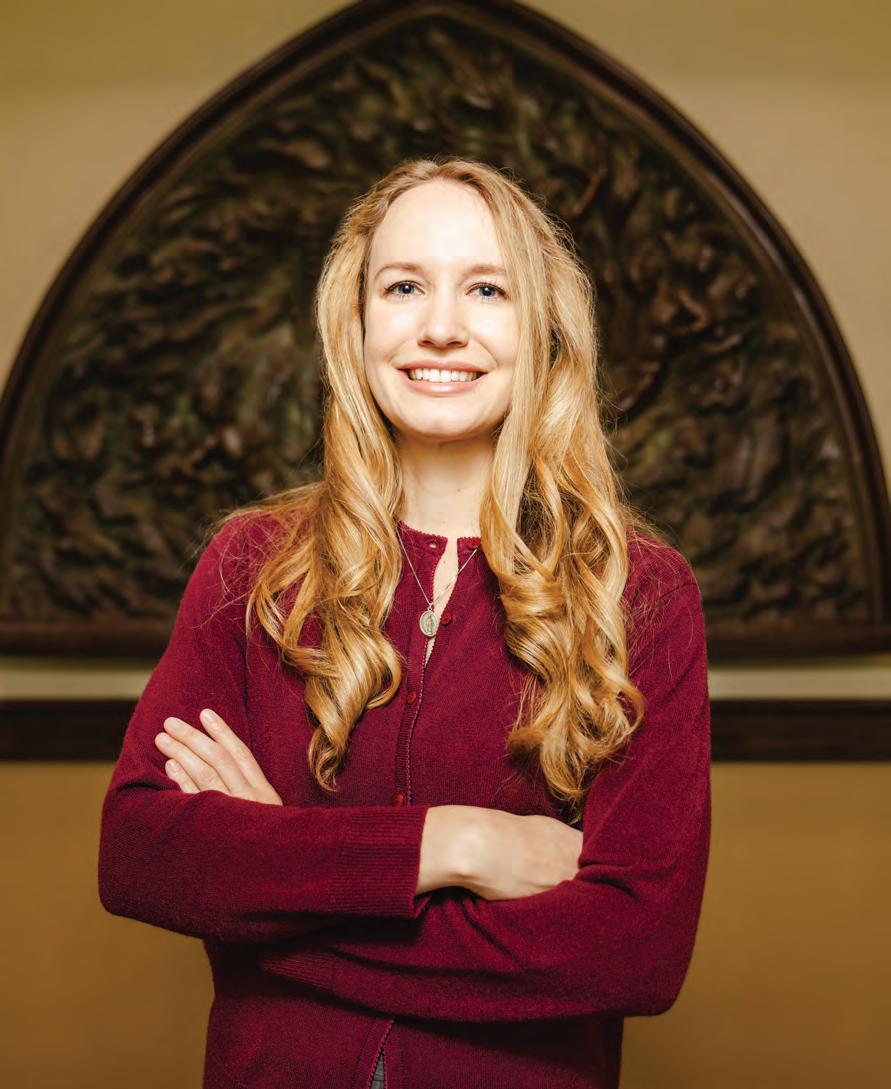
Still human: Safeguarding the person in the age of artificial intelligence | Karen Ridder Benedictine College in Atchison, Kansas, created the Center for Technology and Human Dignity, dedicated in September 2025 on the same day Saint Carlo Acutis was canonized. As Pope Leo issued his first encyclical; “Magnifica Humanitas: On Safeguarding the Human Person in the Time of Artificial Intelligence,” the center’s mission is proving to be poignantly relevant.
20
To Serve and Lift | Love of country, love of neighbor | Ashley Everett Service members are resilient by nature and deeply proud of their independence. But that same strength can make asking for help incredibly hard. At Catholic Charities of Kansas City–

Ridder is a Catholic journalist, wife and mother of four in Liberty.
St. Joseph, we see both the strength and the struggle of our veterans every day.
22
Cornerstones of Care and Catholic schools partner for student success | Allison Vrooman
When Cornerstones of Care opens its doors to its new home in the former Archbishop O’Hara High School building, the move will represent far more than a change of address.
28 A new chapter for urban core Catholic education | Allison Vrooman
For Christy Cook, the role of president of Bright Futures Schools feels like a door that God opened for her in his perfect timing and that her previous experiences had been preparing her all along.
32 Making a difference, helping those in need, one stitch at a time | Marty Denzer About 10 years ago, a group of women at Holy Trinity Parish in Weston organized a charity sewing group ministry, crafting handmade essential items needed both locally and globally.
25
¿Quién Está Formando a Tus Hijos? | Por Leyden Rovelo-Krull
26
En el Camino | Gracias, Abad Benedict | Por Obispo Johnston


BOB SANDFORD is a writer, woodworker and musician. JAY SORGI is a husband, dad and nationally published Catholic journalist.
By Bishop James Johnston
on the way
“The abbot must always remember what he is and remember what he is called, aware that more will be expected of a man to whom more has been entrusted. He must know what a difficult and demanding burden he has undertaken: directing souls and serving a variety of temperaments, coaxing, reproving and encouraging them as appropriate.”
On July 11, the Feast of Saint Benedict, the monks of Conception Abbey announced the election of their next abbot, Fr. Paul Sheller, OSB. I gratefully welcome Abbot Paul and look forward to many fruitful years ahead.
In late May, Abbot Benedict Neenan announced that he would be stepping down as the abbot after ten years.
I want to take this space in the Catholic Key to express my personal gratitude, as well as that of our entire diocese, for Abbot Benedict’s leadership and service to the monastery, and the seminary which Conception supports and operates as an apostolate. I want to thank him for the many ways the abbey contributes to and impacts our diocese.
In my time as bishop here, I have grown to realize just how blessed we are to have a monastic community like Conception in our own local Church. The proximity of Conception to so many of our clergy, religious and lay faithful allows for many fruitful interactions and encounters with God and others. A majority of our college seminarians, past and present, were formed at Conception Seminary. Our youth summer camp, Camp Savio, has flourished in partnership with the abbey, and it has introduced not only our youngest generation, but many of their parents, to a deeper spiritual life. Many find at Conception an oasis for retreats, including our diocesan priests. Our deacon formation is overseen by Conception Sem-
inary. We should all be grateful for Abbot Benedict’s and the monks’ desire and willingness to allow us to draw from the “living water” we find there.
The monks originally arrived at Conception over 150 years ago at the invitation of the first bishop of St. Joseph (and then Kansas City), John J. Hogan. Bishop Hogan began without much of anything in what was then a wilderness being settled. Without clergy, money or buildings and just a few people, he needed help. The Benedictine monks in Switzerland answered the call. They came to rural Missouri with both a monastic and a missionary spirit. From the outset, they helped to prepare men for the priesthood, something that continues today for not
only our diocese but many others.
Along with this important service, the monks helped the bishop with parish ministry. As the number of monks grew, Conception served parishes in neighboring dioceses as well. Today, that service continues in several parishes in proximity to the abbey and is a vital part of our Church history. Again, thank you Abbot Benedict. You embody the same missionary spirit of your predecessors. We are so grateful!
Let us pray for Abbot Benedict as he returns to the life of a monk without the burdens of the office of abbot. And if you have the opportunity, thank him for his wise and generous service which benefited not only the monastic community, but all of us.
Let us also pray for Abbot Paul, that God will bless him with an abundance of grace as Conception Abbey continues in prayer and work to give glory to God and bless his Church.
From the Bishop Bishop James V. Johnston, Jr. is the seventh bishop of the Diocese of Kansas City–St. Joseph
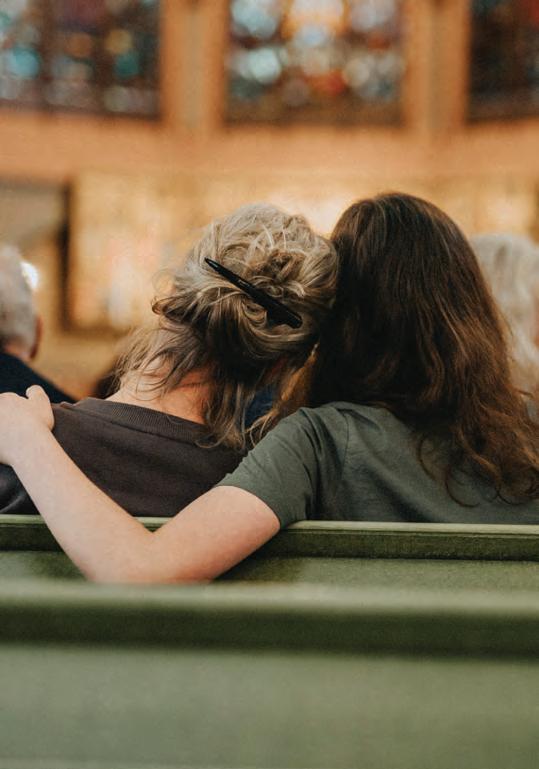

By Marc Cardaronella
LAST WEEK, I CAME ACROSS AN ARTICLE TITLED “THE MOST IMPORTANT YOUTH PASTOR? IT MIGHT BE DAD.” IT SHARED A NEW SURVEY FROM THE INSTITUTE FOR FAMILY STUDIES THAT SHOWS HOW IMPORTANT FATHERS ARE IN PASSING FAITH ON TO THEIR CHILDREN.
Out of 60,000 people surveyed, just 17 percent of fathers said they were mainly responsible for their children’s faith formation. The study also found that kids are much more likely to practice religion as adults when both parents are involved in their religious upbringing. These findings matter because the message is clear: parents make a difference. Children learn by watching what their parents care about. They see if Dad prays. They see if going to Mass is a priority or just an option. They notice if faith shapes family choices or stays separate from daily life.
A mother’s faith and devotion are a real gift to her children. But when a father is not interested in faith, it has a particular impact. If Dad is not involved in the family’s spiritual life, kids pick up the message — whether it’s said out loud or not — that religion isn’t really important.
I’ve heard similar statistics for 25 years. This isn’t new to me, or to the Church for that matter. The Catechism (1656) says, “In our own

Marc Cardaronella is the director of the Office of Catechesis and Faith Formation.
time, in a world often alien and even hostile to faith, believing families are of primary importance as centers of living, radiant faith … It is in the bosom of the family that parents are ‘by word and example ... the first heralds of the faith with regard to their children.’” And this is quoting a 1960s Vatican II document. Again, nothing new, but these words feel especially urgent today.
Religion doesn’t play the central role it once did. In the past, strong Catholic roots shaped daily life. Faith influenced how people saw the world, and the community supported Christian beliefs and practices.
That’s not how many young people experience things today. Many have grown up distrusting authority and established institutions. Religion is often seen as a personal choice or just a source of good advice, not as a truth that claims the whole person.
Even so, the family is still the one place that stands strong against doubt and mistrust. It’s where a child is first known, loved and cared for. That’s why the future of the Church depends on the family.
Our office created The Way: Youth to Young Adult Initiative in response to this reality. The goal is to help parents take back their God-given role and responsibility in helping their children know, love and follow the Lord.
As the study shows, this role is often overlooked, especially by fathers. Still, this responsibility is too important to ignore. Children need to be guided in truth.
Modern culture offers many appealing paths, but not all of them lead to real life. Some lead to confusion, loneliness and hurts that last for years. That’s why parents have a serious duty to help their children see the world clearly and recognize what is harmful. In this, the Church’s teaching isn’t a burden. It’s a gift.
The Church’s wisdom is old, but it’s not out of date. It stays fresh because the Holy Spirit continually renews it. The Church knows how to live in authentic human freedom and has the power to make it real in our lives. So don’t turn your back on this inheritance. Embrace it, share it with your children and watch them flourish.
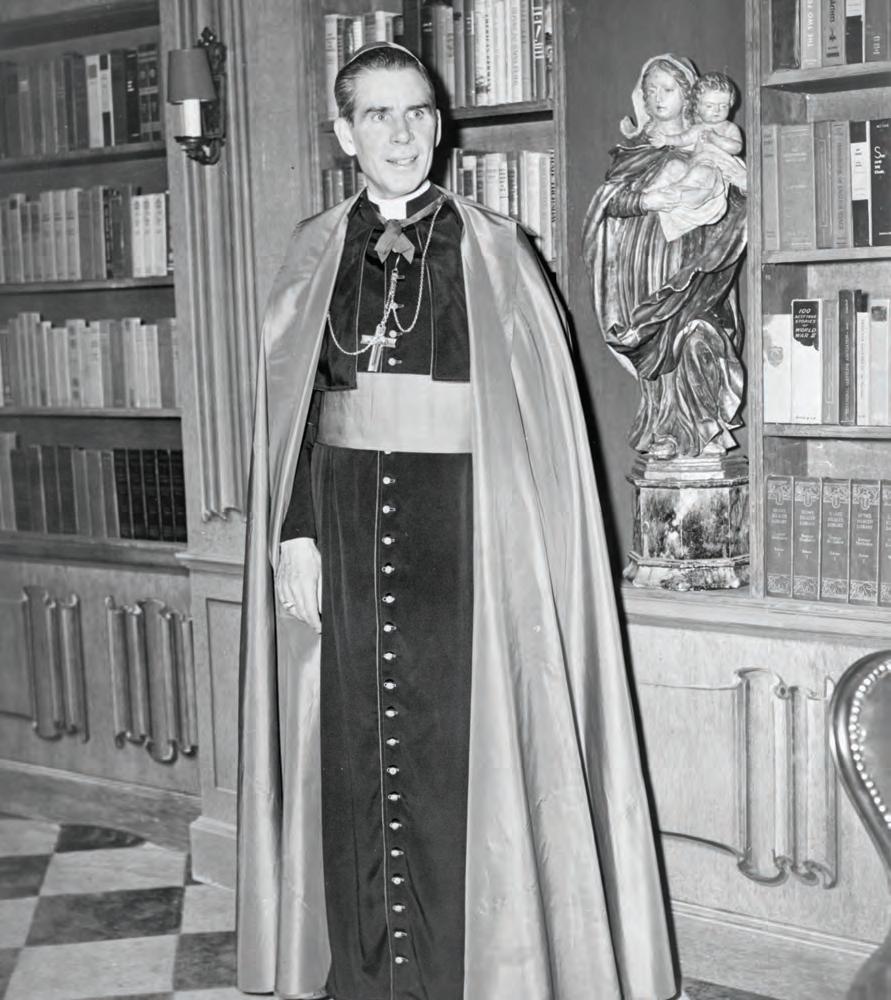
By Sara Kraft
“Archbishop Fulton Sheen transformed missionary efforts worldwide,” stated Father Charles Rowe, director of the Diocese of Kansas City–St. Joseph Mission Office. From 1950 to 1966, Archbishop Fulton Sheen was the national director of the Pontifical Mission Societies USA. During Archbishop Sheen’s time as director, two-thirds of the mission’s funds came from the United States. The Pontifical Mission Societies currently consists of four distinct societies that provide vital support to 1,130 mission territories worldwide where the Church is too young, too poor or too persecuted to sustain itself.
“We are all called to be missionaries,” explained Father Rowe. “Jesus commanded us to go forth and teach all nations … (Mt 28:19) This commission is addressed to every disciple. Most of us are not
missionaries in the field, but we are called to support their work.”
On Sept. 24, Archbishop Fulton Sheen will be beatified in St. Louis. Another miracle must occur and be approved following his
beatification for the pope to issue a decree of canonization.
Father Rowe believes Archbishop Fulton Sheen’s commitment to our missionary mandate is an example for us today. His life challenges us to step out of our comfort zone and bring the Gospel to those who haven’t heard it. “Archbishop Sheen was a genius at using the means of communication of the time — radio, television and revised print communication to deliver the Gospel in a way that resonated with people,” explained Father Rowe. Father Rowe challenges us to use our methods of communication, such as podcasts and social media, to spread the Gospel.
“I encourage everyone to pray for the Pontifical Mission Societies and the canonization of Archbishop Fulton Sheen. It would be a great honor for the U.S. Church and for the Pontifical Mission Societies to have him declared a saint,” explained Father Rowe.
Father Rowe also encourages the faithful to financially support the Pontifical Missionary Societies. One option is through the second collection on World Mission Sunday, the second to last Sunday in October. He also encourages the faithful to pray the World Mission Rosary, which Archbishop Fulton Sheen began promoting in 1953, assigning different-colored beads to represent the five continents in need of evangelization.
TO LEARN TO PRAY THE WORLD MISSION ROSARY , visit celebratesheen.com/world-mission-rosary. For more information on the Pontifical Mission Societies in the United States, visit pontificalmissions.org.
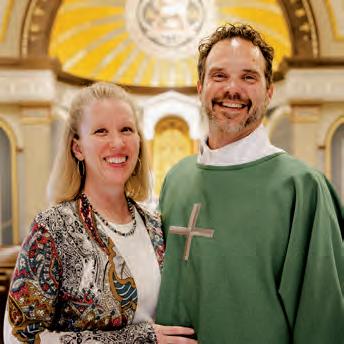
“Amy has been an amazing companion throughout formation. She is my constant sounding board, cheerleader, and grounding rod. Throughout this process, she has given voice to the Holy Spirit in exactly the times and circumstances that I needed to hear him.”
Say ‘yes’ and see
By Bob Sandford
Photos by Christy Gruenbaum
ON JUNE 20, 2026, FIVE MEN WERE ORDAINED TO THE PERMANENT DIACONATE AT THE CATHEDRAL OF THE IMMACULATE CONCEPTION. DEACON ERIC DAVIS WAS AMONG THEM. THIS IS HIS STORY, OFFERED TO THOSE DISCERNING A CALL, TO THOSE WHO WITNESS TO THE GIFTS OF OTHERS AND TO ALL WHO ARE SAYING “YES” AND TRUSTING GOD. ERIC WILL BE SERVING AT ST. MARGARET OF SCOTLAND IN LEE’S SUMMIT.
Eric and his wife, Amy, have been married 29 years and have four sons: Aaron (24), Ben (22), Connor (20) and Danny (18).
Eric grew up in the Reorganized Church of Jesus Christ of Latter Day Saints. He had a “profound conversion experience” in 1999-2000 and entered the Catholic Church at St. John LaLande in 2001.
“It was hard to leave my childhood church,” Eric recalls. His parents stayed. He is grateful that they are proud of him and recognize he is seeking God’s will for his life. They attended his ordination.
The first hint of Eric’s calling came when their son, Ben, had a stroke as an infant in 2004. “Ben’s miraculous recovery and the outpouring of support from people in the church really made me want to ‘give back,’” Eric said. “My wife, Amy, wisely counseled me that it might not be a good time. She was right as we had two more sons yet to arrive. The feeling never went away, though.” What others saw in him, what he saw in other deacons and his growing faith strengthened his call. His wife came to recognize how much need there was and how, in a unique way, a deacon can serve the people of God and with her encouragement, he applied to the permanent diaconate in the fall of 2021.
When new deacons radiate love for Christ and for others, they become living signs that the Gospel is alive and still calling people forward.”
– Deacon Jim Hall, director of the Office of the Diaconate
To those discerning a call to the diaconate, he offered, “It’s only natural to be afraid, but once you recognize it’s not your voice calling, it’s time to respond. I turned to the example of our Blessed Mother — her receptivity and her yes. I am not going to have it all figured out beforehand. I have what I need to move forward. You say yes and see where God takes you. This will be ongoing.”
INFORMATION ABOUT THE DIACONATE can be found on the diocese website at kcsjcatholic.org/office-of-the-diaconate.
Applications are being accepted July-September 2026 for the next deacon formation class.
Questions can be directed to Deacon Jim Hall, director of the permanent diaconate, at diaconateoffice@diocesekcsj.org or 816.714.2302.
Visit catholickey.org for a Q&A with Deacon Jim Hall regarding traits and blessings of being a deacon.
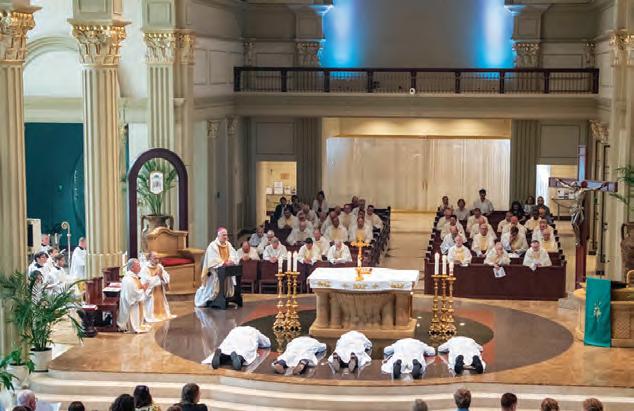
Eric says, “I keep returning to the line of a prayer by Deacon Greg Kandra. It goes ‘may I never forget that my service to you begins not in triumph, but lying on the ground, facing the earth, praying to the saints to pray for me.’”
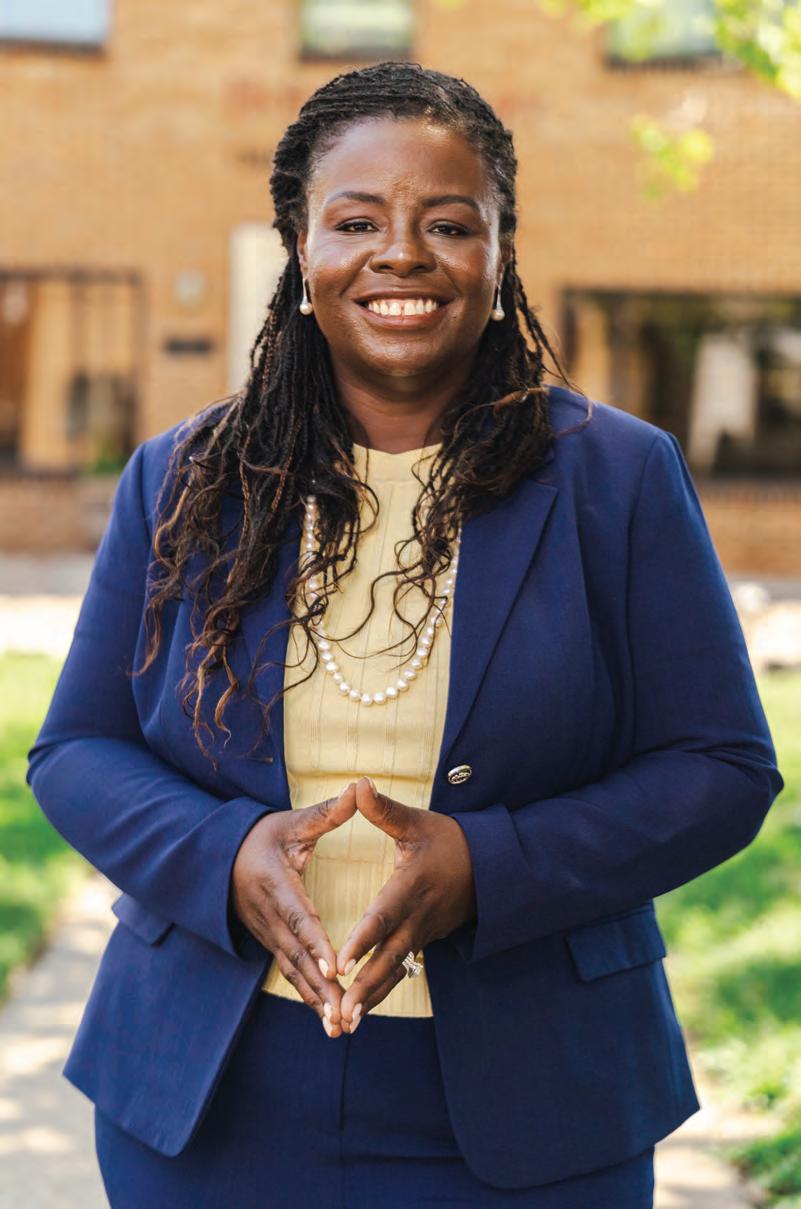
“Strong communities are built when financial success is accessible to more people, not less,” explained Marquita Joshua, Holy Rosary Credit Union president. Joshua took on her new role on June 1.
After spending six years on the Holy Rosary Credit Union Board, Joshua is excited to bring her expertise as a Kansas City business owner and accountant to serve the credit union’s members.
Since 1943, Holy Rosary Credit Union has helped underserved and immigrant communities access responsible financial services. Ninety-six percent of their members are from at-risk populations. It’s often called “the melting pot credit union.” Sixty percent of members are Hispanic, 20 percent are Asian and the other 20 percent of members are Black or white. These populations can be overlooked in traditional banking communities and experience barriers due to language and other obstacles. Holy Rosary Credit Union offers their 7,000 members services and documents in English, Spanish and Vietnamese. They have branches in Kansas City, Independence and St. Joseph and also offer video banking from home and in-branch to empower financial help.
A credit union is a member-owned, notfor-profit financial institution that utilizes voting rights to elect a board of directors. They offer many of the same services traditional banks do and require membership based on a common bond. Credit unions originated in Catholic parishes because Catholic leaders did not want their parishioners going to a loan shark when lending was necessary.
“Never judge people where they are because we never know where they are going to go,” Joshua reminds staff. “God is granting you the ability to help these people.”
Holy Rosary Credit Union seeks to help their members by giving them a better financial future. This includes helping members build credit, buy homes, and become stable financially. Members need help in many ways, including help balancing their checkbooks when accounts become overdrawn.
By Sara Kraft | Photos by Michael Hogan
“We aren’t going to offer something that isn’t in the best interest of the member,” Joshua explained. If they cannot help
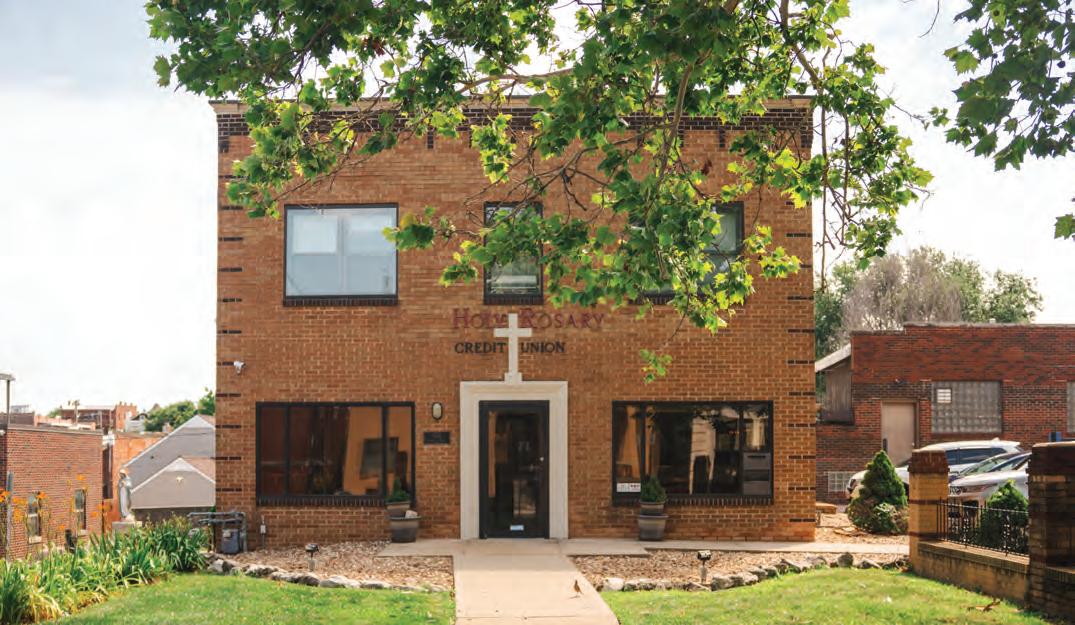
immediately, Holy Rosary Credit Union works to find a solution before lending. It may be a financial education program or a credit score analysis, but they work to see exactly what needs to happen to meet the members’ goals.
One customer had a job loss and got behind on their car payments. After they got a new job, Holy Rosary Credit Union was able to help them rework payments so they could keep their vehicle and thus their new job.
Some members decide to start a business. Holy Rosary Credit Union offers free business classes that teach how to write business plans and help members determine if their business can be successful before borrowing money. As a business owner for 25 years, Joshua’s personal experiences have inspired her to lead and serve this population.
“Faith is not just something we talk about. It is reflected in how we interact with others,” Joshua explained.
Joshua encourages all to support Holy Rosary Credit Union by becoming a member and opening a savings account, CD or investments. They offer competitive rates. “It allows us to go out and help even more people that need the help,” Joshua explained. This is because the credit union is required to maintain specific cash to loan ratios. An increased number of deposits allows Holy Rosary Credit Union to expand financial services. All parishioners of Catholic parishes in the Diocese of Kansas City–St. Joseph are eligible to become members.
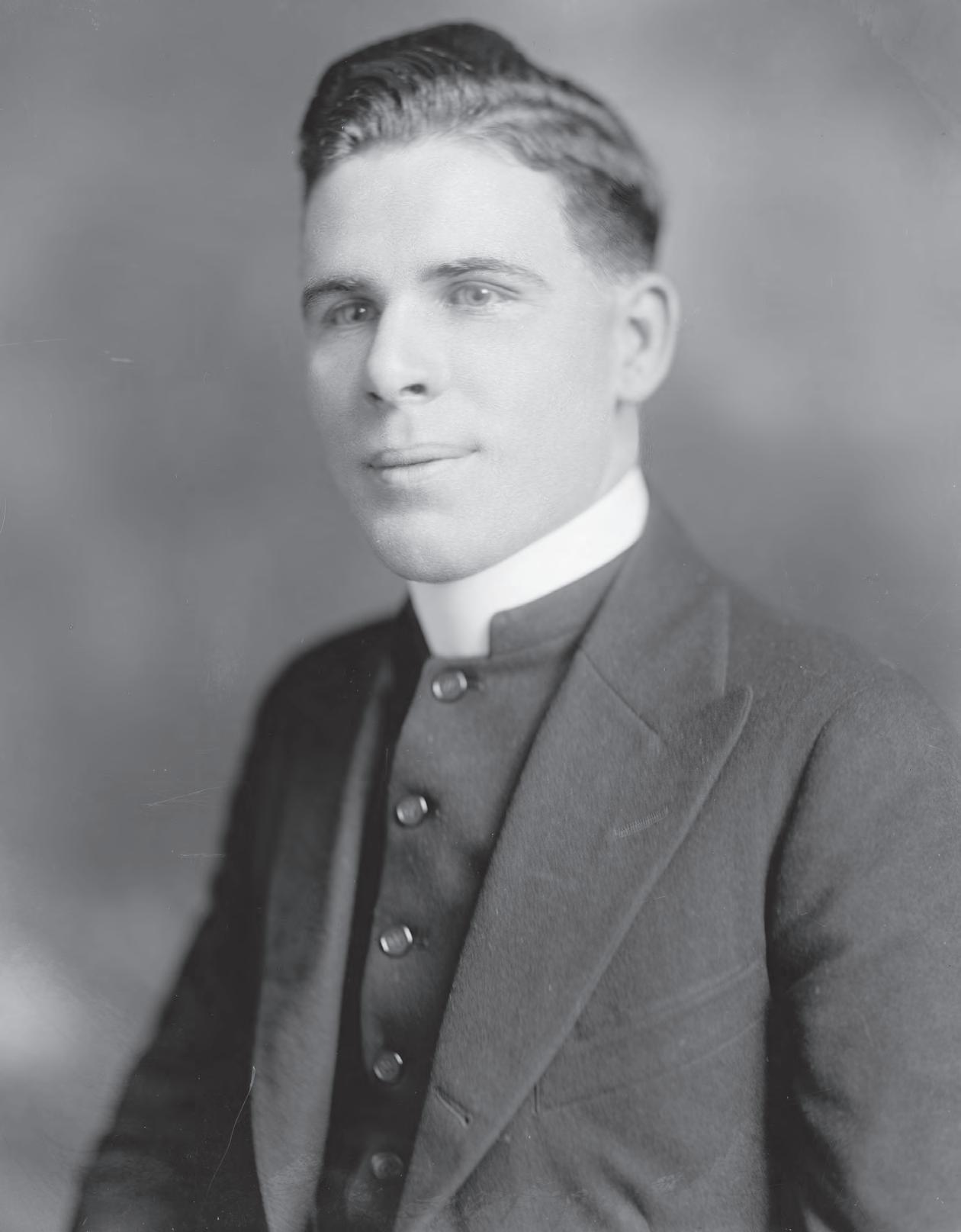
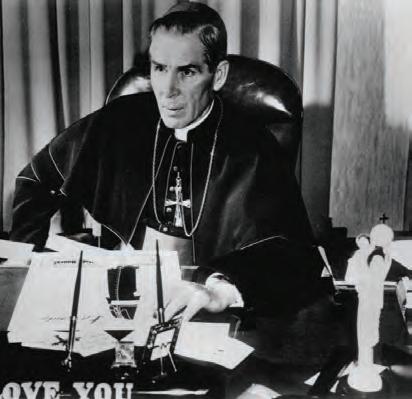
Many people may argue that television became America’s center of attention during the second half of the 20th century. Archbishop Fulton Sheen took that medium and directed people’s minds, hearts and souls to make God the center of their lives through the Catholic Faith.
St. Louis’ Dome at America’s Center will host the beatification Mass of the man now officially called Blessed Archbishop Fulton Sheen on Thursday, Sept. 24 at 2 p.m. It brings the journey to potential sainthood of the man known as “America’s bishop” and “God’s microphone” in person to tens of thousands in Missouri and around the world via livestream.
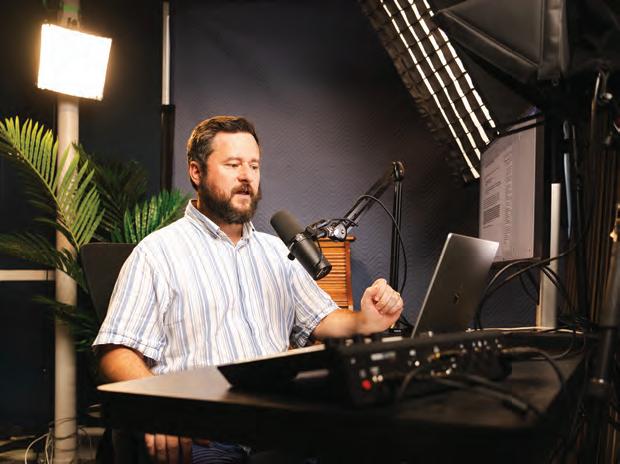
“Sheen gives us all a model to follow, (and) he took the best of rhetoric and the best of public speaking in the proclamation of the Gospel,” said Joe Heschmeyer, a Kansas City-based apologist with Catholic Answers who explains, defends and evangelizes
the Faith on online platforms in similar ways to how Archbishop Sheen did as a missionary disciple in the broadcast realm.
“For people who may have an intellectual bent the way that he did, the ability to explain even deep theological topics in a way that is understandable and accessible is something he was really a master of.”
A 34-year career of bringing Christ and the Catholic Faith through your radio and TV
Born in 1895 in El Paso, Illinois, east of Peoria, Archbishop Sheen was ordained a priest on
A STEP AWAY FROM SAINTHOOD, HIS EXAMPLE RESONATES AMONG CATHOLIC APOLOGISTS AND EVANGELIZERS IN THE DIGITAL AGE
By Jay Sorgi
Sept. 20, 1919. While teaching theology and philosophy at The Catholic University of America in Washington, D.C., he began “The Catholic Hour,” a national Sunday night radio show, in 1930. The show ran for 20 years and garnered an average audience of 4 million people.
He became auxiliary bishop of New York in 1951 and began a weekly Tuesday night prime time television show, “Life is Worth Living.” At its peak over the show’s seven-year run, it drew 30 million weekly viewers to understand the Catholic Faith and the depth of Christ’s love.
He operated “The Fulton Sheen Program” from 1961 to 1968, a similar show to “Life Is Worth Living,” while becoming bishop of Rochester, New York. He eventually was appointed to be archbishop of the Titular See of Newport, Wales.
“Radio was a tremendous medium when he first started out. He

had an incredibly popular radio show, and then he goes over to TV and has an even more popular TV show, and wins an Emmy award,” Heschmeyer said.
“It's kind of unthinkable to imagine today someone on television having a straightforward Catholic Christian program that is no. 1 in its time slot and that level of popularity.”
Archbishop Sheen accomplished all this while creating 50 written works, evangelizing in person all over the United States and beyond, serving on the Catholic Medical Mission Board and leading the Society for the Propagation of the Faith, an international missionary network, as its national director.
“You have written and spoken well of the Lord Jesus. You are a loyal son of the Church,” Saint John Paul II told Archbishop Sheen in 1979, months before his death on Dec. 9 of that year.
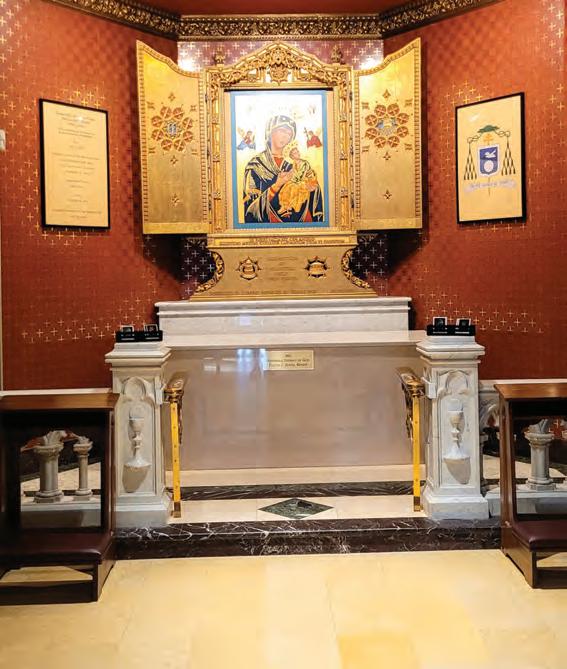
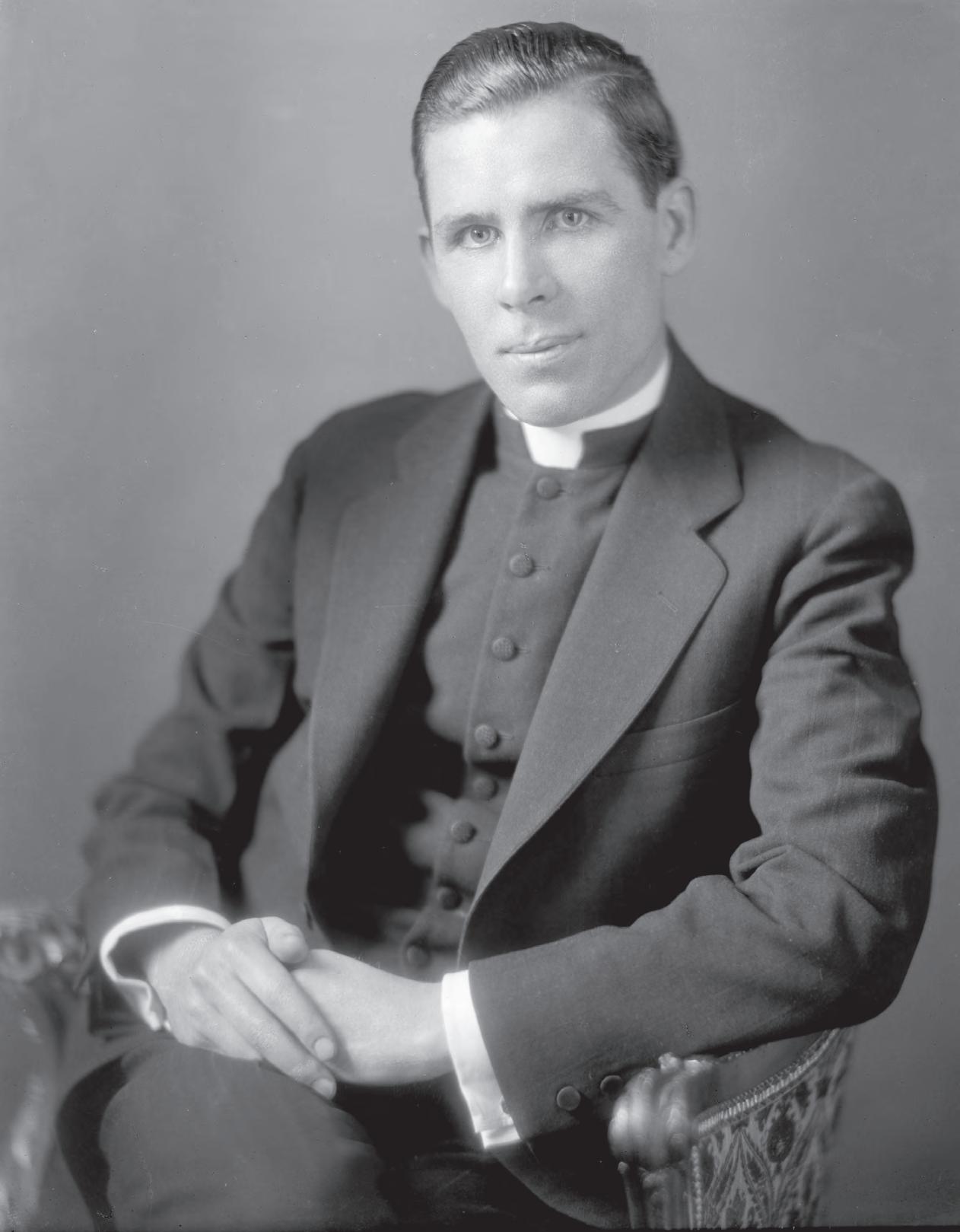
For the full schedule, tickets and pilgrimage opportunities, visit celebratesheen.com
How Sheen’s example can aid apologetics and evangelism in the digital age
Heschmeyer sees how Sheen’s incredible gift of communicating Christ could corral the kind of audiences that are up to three times the size of top-rated prime time television programs today. He admits the challenge of creating such an audience in a time of more than 25 billion content options worldwide, many often fed by algorithms that track consumers’ content habits.
“People have these astonishingly different media diets that are often carefully cultivated for their own personalities,” he admits, “and it can be very hard to present the Gospel in that way, simply because it's hard to get in front of the people you're trying to reach.”
Yet Heschmeyer sees a greater number of apologists than ever before because of the availability for anyone to create content.
“In terms of the number of people who know the Faith well, can carry on a charitable, good faith discussion and present the truth of Catholicism, there are more good options now,” he said. “We're seeing that bear fruit today.”
For fruit to come, however, Heschmeyer sees Sheen’s most effective trait of Catholic storytelling coming from the advice of Saint Paul, to present the truth in love.
“It's more than just having great evidence on your side. It's inviting people into viewing the world in a way of making sense of reality that is true, (and) Sheen was a great storyteller. Stories are a wonderful way of inviting people into that,” Heschmeyer said.
“For it to work, it has to be born out of an authentic love of the other person, that you have to love Jesus and the neighbor you're trying to convert to Jesus.”
The day of the Mass in St. Louis will include adoration and confession. Veneration of a relic of Archbishop Sheen will happen after the Mass on Sept. 24, at about 4 p.m.
The Mass will become the high point of a 12-day pilgrimage opportunity in both St. Louis and Peoria, beginning on Sept. 15. It includes a nine-day novena of Holy Hours leading up to the beatification Mass in St. Louis, and the 107th anniversary of his ordination.
Beatification in the Catholic Church signifies that the Holy
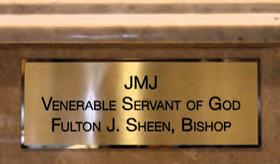
Father has decreed that there is evidence of someone already declared a Venerable Servant of God having interceded in a miracle that can solely be ascribed to God. The beatification Mass celebrates that miracle and the “Blessed” status of that individual, marking how they are one step away from sainthood.
A second miracle must be studied and proposed within the diocese where it is believed to have occurred. A Vatican commission then declares whether that intercession occurred and God performed a miracle through it, and the Holy Father would decide upon elevation to sainthood.
JOIN the Diocese of Kansas City-St. Joseph one-day pilgrimage on Sept. 24. Ticket for Mass and transportation included. Learn more at catholickey.org.
By Dino Durando
The results from a new study show the critical importance of parents in transmitting the Faith to children. The study, Passing the Torch: How Faith Moves Across Generations, was published in June 2026. It used data from four recent studies done within the U.S. population. The largest two studies had significant analytic sample sizes of 27,000 and 31,000 respondents. You can read the full report at communio.org/passing-the-torch-report.
These findings should come as no surprise to the faithful in our diocese familiar with The Way: Youth to Young Adult Initiative, which seeks to equip parents, through simple moments of conversation and guided activity, to form their child confidently in the Faith. Studies like this one reveal that children have the best faith outcomes when mom and dad are on mission together, working toward this common goal. Because of this, a strong emphasis is placed on the value of a healthy marriage.
This study concludes with five recommendations for parents to foster “lasting religiosity”:
• Be your children’s role model for faith
• Prioritize strong marriage and parent-child relationships
• Make faith formation a joint effort
• Build religion into everyday family life
• Make faith a regular topic of family conversation
One of the best ways for parents to establish this, if it is not already routine, is to have some thoughtful discussions together and then create a plan. Some helpful questions to consider:
• How can we make faith conversations a regular part of our daily life?
• In what ways can family prayer expand beyond attending Mass on Sunday or saying a prayer before meals?
• What are some ways we can set aside regular time for our marriage?

Dino Durando is director of the Office of the Domestic Church and Discipleship. He has been married to his best friend, Cathy, for 28 years and they have 10 children and two grandchildren.
To our single parents and guardians, a special note is offered here. While social science studies in recent decades have shown that children of divorce, those raised by grandparents or other relatives, mixed-faith households, and other similar situations can legitimately struggle with receiving the Faith, the good news is that with some extra intentionality and patience from the adults in their lives, these young people can grow into faithful adults on fire for Jesus! In addition to the suggestions listed, single parents and guardians may wish to consider:
• How can other extended family (aunts, uncles, etc) and friends play a role in transmitting the Faith to my child?
• Who is another family at my parish that I admire for their witness of faith, and how can we get to know each other better?
• How can I encourage my child to ask questions about God and faith?
The best starting point is to implement small changes, perhaps even just one or two at a time. Don’t try to jump in and go from zero to 60 in 3 seconds! A slow and steady approach builds a strong foundation for long-term mission success.
Research tells us that it is far more important that parents engage in the mission than that they do it perfectly. The adage applies, “Don’t let perfect be the enemy of good.” Parents praying with their children and talking about morality with them will exponentially increase the likelihood that their children will carry their Faith confidently into adulthood and will pass it on to their own children. And this is true even when parents don’t do it flawlessly.
THE WAY FAMILY PASSPORT is the new diocesan online learning platform created specifically to support parents as they embrace this sacred mission to transmit the Catholic Faith to their children. You can access The Way Family Passport at kcsj.leadlms.com.
By Leyden Rovelo-Krull
Who is my child's teacher?
What classes are they taking?
Did we buy the school supplies?
Did we sign up for sports?
But there is another question, one that rarely appears on a school registration form:
Catholic parents often hear that they must be the primary educators of their children. Usually, we mean this in the context of religious education, or moral formation. Yet the reality is that every child is already learning what matters, what is admirable, what is desirable and, ultimately, what is worth serving.
In other words, they are always being discipled.
The Christian tradition offers a surprising insight into the human person. We often imagine ourselves principally as choosers, making decisions and charting our own path. But perhaps it is
more accurate to say that the human person is not primarily a chooser, but someone made to love, serve and belong. And whatever captures the heart eventually becomes its master.
Jesus points to this reality when he says, "No one can serve two masters." (Mt 6:24) Notice that Jesus understands that we will serve. We must. We are made to do so. The question is not whether a person will give himself to something greater than himself.
The question is what that "something" will be.
This is true for adults. It is equally true for children.
Today's catechists are often not the people we expect. They are YouTube personalities, social media influencers, advertisers, celebrities, friend groups, streaming platforms and algorithms. Day after day, they offer answers to life's deepest questions.
What will make you happy?
What will make you important?
What will make you lovable?
What will make your life meaningful?
Every one of these voices is proposing a vision of “the good life.” Every one of them is teaching our children what is worth loving.
None of them are neutral.
The world is remarkably effective at discipleship.
This matters in a particular way for Hispanic parents. Many of us carry a deep desire to pass on heritage, and that desire is good. We want our children to know the language, the food, the stories, the songs and the family history that shaped us. But we should be careful not to confuse cultural memory with Catholic formation. Our children can know the foods, the flags and the family stories, yet still not know Christ. If we obsess over “Latin roots” without anchoring them in their Catholic identity, we risk having our children think identity is something they can choose rather than the inheritance God wants them to claim as his sons and daughters.
This is the heart of what the Church means when she says parents are the primary formators of their children. The task is not
simply to pass on information about faith. It is to help form the heart. To teach our children that their freedom is not separate from service. To help them discover a Master whose “yoke is easy” and whose “burden is light.” (Mt 11:28-30)
As children return to school this fall, Catholic parents will rightly think about grades, teachers, schedules and opportunities. These things matter. But perhaps the most important question remains:
Who is teaching my child what is true, good and beautiful?
Because if we do not intentionally form their hearts, someone else will.
Every heart will belong to something. Every life will be given in service to someone.
And the great question facing every child, and every parent, is ultimately the same: Who will be my master?

This includes turning the purpose of
Pope Leo calls the age of artificial intelligence a new industrial revolution which raises the efficiency of technology to a level which threatens human dignity. His first encyclical, released in mid-May, outlines the importance of the evangelical mission to protect the dignity of the human per-

By Karen Ridder | Photos by Michael Hogan
On the first day of his pontificate, Pope Leo XIV told the College of Cardinals he planned to focus on how artificial intelligence is changing our world. The folks at Benedictine College in Atchison heard the message and got to work. They quickly created the Center for Technology and Human Dignity, dedicated in September 2025 on the same day Saint Carlo Acutis was canonized. In recent months, after Pope Leo issued his first encyclical; “Magnifica Humanitas: On Safeguarding the Human Person in the Time of Artificial Intelligence,” the center’s mission is proving to be poignantly relevant.

Acutis said we should put technology through the vortex
technology over to Christ and acknowledging Christ as human life. Doing this changes our relationship with technology.
The center has Saint Carlo Acutis as a patron, along with Venerable Jérôme Lejeune and Saint Edith Stein. All three of these people serve as an inspiration for how to see aspects of the changing and developing world through the lens of Christ. Courtois says they try particularly to explore an approach Saint Carlo called the “Eucharisticizing” of technology.
“Saint [Carlo] Acutis said we should put technology through the vortex of Christ. This includes turning technology over to Christ and acknowledging Christ as the purpose of human life. Doing this changes our relationship with technology,” said Courtois.
Changing a relationship with technology requires teaching prudence and an awareness of the difference between how new technologies can improve our relationships, and when they can distance us from others.
“I think it’s important not to assume that technology is morally neutral. Technology is embedded in various structures that affect how we view ourselves and how we can interact with the world,” said Courtois.
Courtois explains most people can relate to Pope Leo’s new encyclical no matter how much technology they regularly use in daily life. She points to Pope Leo’s inclusion of the Magnificat — which showcases how each of us are called to follow Mary’s example in glorifying God and magnifying the grace of God in our lives. Technology can distract
from that, but all people have the ability to delight in the work God has done and remember God as the ultimate builder.
The other highlight for Courtois of the encyclical is a reminder of the importance of the gift of the incarnation. This gift from God demonstrates how precious and
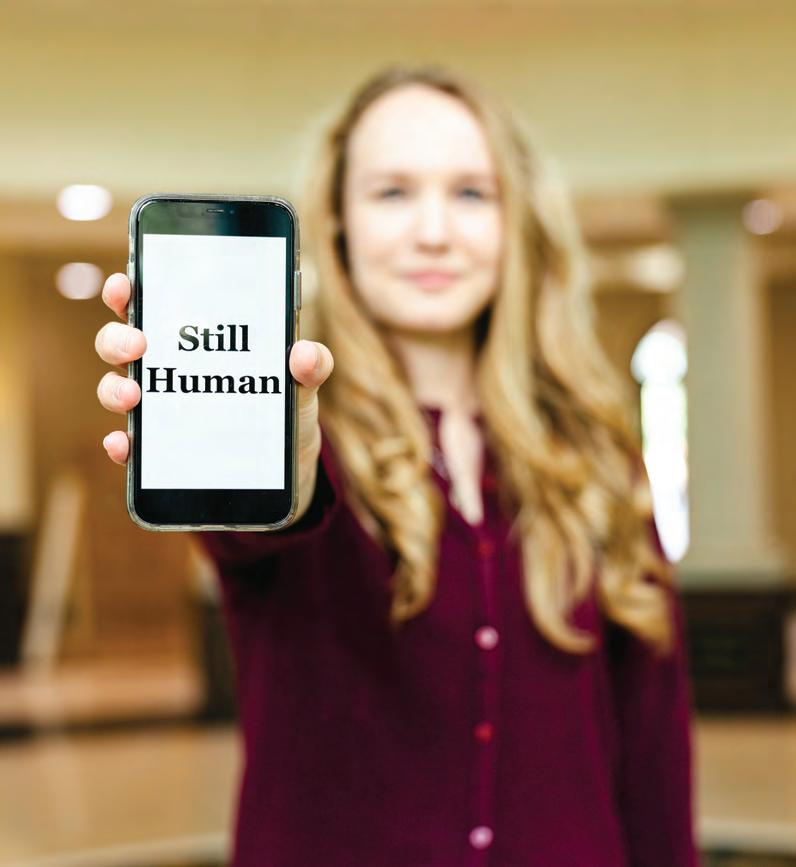
The Center for Technology and Human Diginity is producing a documentary series called “Still Human,” addressing issues of technology in the Faith.
significant the human person is over any advances in technology.
“It’s always worthwhile to be in relationship with a human person over a chatbot,” said Courtois. “Relating to each other allows us to relate to Christ.”
The Center for Technology and Human Dignity is producing a
documentary series addressing issues of technology in the Faith. The series, called “Still Human,” will tackle questions of Catholic social doctrine, technology, ethics, emerging technologies and transhumanism. Episodes will be available at media.benedictine.edu.
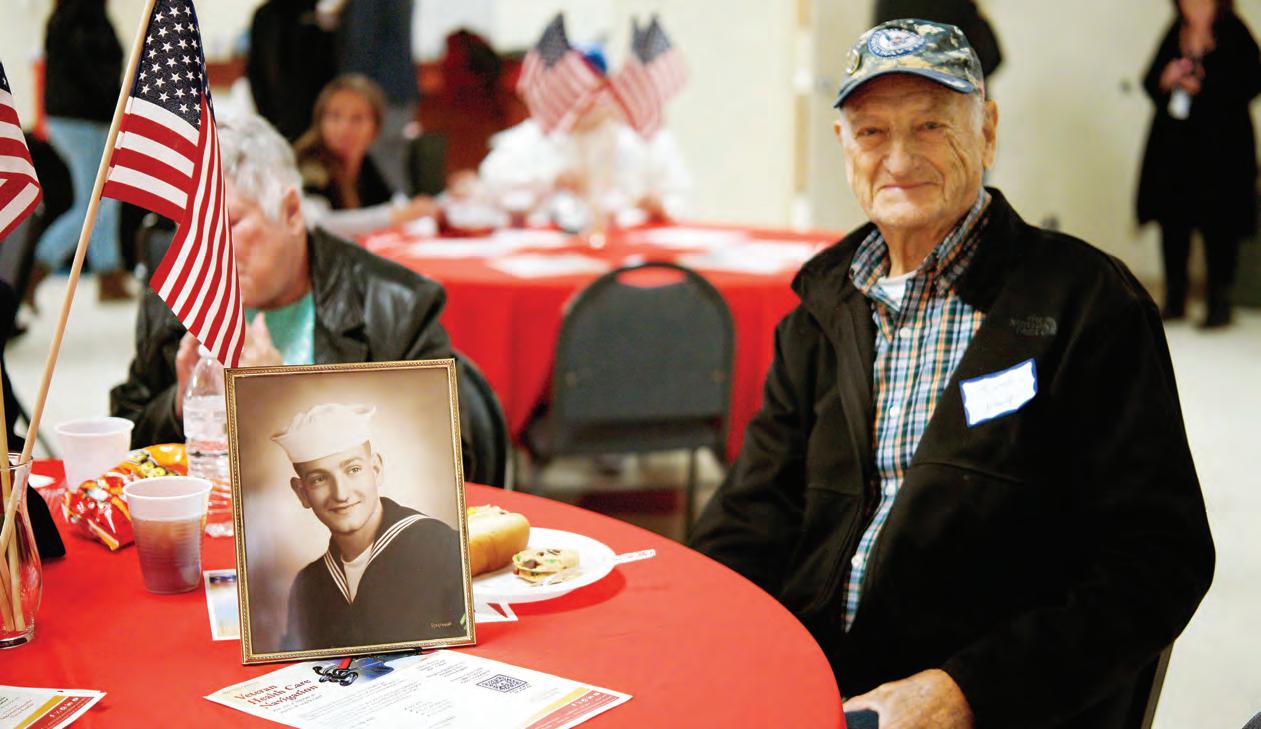

also remembering our veterans. In many ways, one cannot exist without the other. Veterans and their families may well be the most
patriotic among us. Their lives are shaped by service: orders, rank, early mornings for physical training, deployments, reunifications, uniforms and frequent moves across the country or world. It is a very structured life, one where expectations are clear and purpose is constant.
That is precisely why the transition to civilian life can be so difficult.
After years of being guided by the needs of the military, many veterans return home to a world where no one is telling them what comes next. The structure is gone. The mission is unclear. For some, this challenge is compounded by the weight of trauma they carry, often quietly and alone. Service mem-
bers are resilient by nature and deeply proud of their independence. But that same strength can make asking for help incredibly hard.
At Catholic Charities of Kansas City–St. Joseph, we see both the strength and the struggle of our veterans every day.
Recently, our Supportive Services for Veteran Families (SSVF) team helped house a veteran who had been homeless since 1991. For 35 years, he lived without a bed of his own or the certainty of where his next meal would come from. When he finally stepped into his new apartment, he was greeted with a fully stocked refrigerator — and one small birthday cupcake. A simple gesture, but one meant to say: You matter. We’re glad you’re home safe.
Stories like his need to be told, to remind us that service doesn’t end when a uniform is hung up. Our responsibility to care for those who have served continues.
The need is growing right here in our diocese. In fact, our veterans’ program has doubled in the last year, reflecting the urgent challenges our veterans face. We have already housed 769 veterans in this program this year — and are on pace to reach 1,000 by the end of 2026. Just in the last month alone, 57 veterans enrolled in the program, while 26 successfully graduated to stable housing.
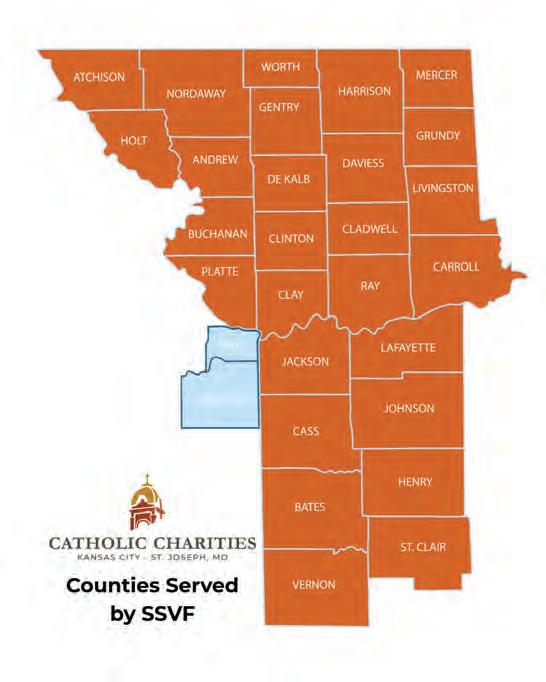
The SSVF program, funded by the U.S. Department of Veterans Affairs, provides critical support to very low-income veterans who are homeless or at risk of becoming homeless. Through this program, Catholic Charities offers case management, housing assistance and temporary financial support. Once a veteran in need is identified, the expectation is to place them in housing within 72 hours.
This is not meant to be permanent assistance. Rather, it is a bridge, helping veterans regain stability and independence. On average, veterans are enrolled in the Catholic Charities Supportive Services for Veteran Families for about 146 days, or roughly five months, as they work toward getting back on their feet. For those facing more complex challenges, our Shallow Subsidy program extends care up to 24 months, providing the extra time and support needed for lasting stability.
As we celebrate our country and the many blessings of being American, may we also remember those who have sacrificed so much to protect those blessings. If you know a veteran who is struggling, please help us reach them.
A simple connection can change a life.
WHAT’S HAPPENING AT CATHOLIC CHARITIES OF KANSAS CITY–ST. JOSEPH
Nominate a Catholic high school student for Our Lady of Hope Service Society
Deserving high school juniors and seniors will be presented to Bishop Johnston at the Hope Ball on March 6, 2027. Students need to complete 20 service hours. Nominations close Sept. 1, 2026. catholiccharitiesball.org/nominate
Free eye screening and prescription eyeglasses
Aug. 11, 2026, 10 a.m. to 2 p.m.
Serve & Lift Center, 8001 Longview Road, Kansas City, Missouri. No appointment needed.
Market Discovery Day
Aug. 29, 2026, 9 a.m to noon. Serve & Lift Center, 8001 Longview Road, Kansas City, Missouri.
Tour the Market, meet our team, and learn how you can make a difference. Sign up: catholiccharities-kcsj.org/market/

YOU CAN CONTACT our team at 816.659.8263 or email veterans@ccharities.com.
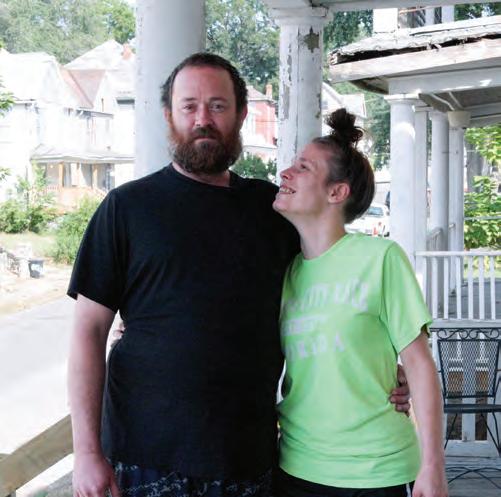
After experiencing homelessness, Dustin found stable housing with support from the SSVF program at Catholic Charities. Today, he and Sadie can enjoy the comfort, safety, and dignity of having a place to call home.
By Allison Vrooman
by Michael Hogan

WWhen Cornerstones of Care opens its doors to its new home in the former Archbishop O’Hara High School building, the move will represent far more than a change of address. It marks an expanded capacity to serve, a deepening partnership with the south Kansas City community and a renewed commitment to supporting the mental, emotional, and educational needs of children across the region.
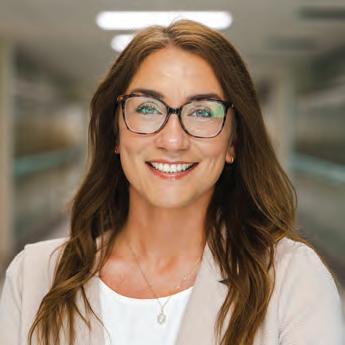
Cornerstones of Care is a behavioral and mental health nonprofit that serves children and families throughout Kansas and Missouri. The organization has three key services: youth and family support; foster care and adoption; and education and training. Their trained professionals utilize a certified model to identify, address, treat and monitor a variety of behavioral healthcare needs.
“Everything that we do is delivered through the lens of being trauma-informed,” said Sarah Scharinger, chief administrative officer. The organization is certified through the Sanctuary Model of Trauma-Informed Care, ensuring that therapeutic principles are woven into all its programs and services.
The move into the former high school facility creates new opportunities for growth. Previously, Cornerstones of Care operated two separate day-treatment schools serving students in grades K-8 and 9-12. Uniting under one roof will allow the organization to expand its reach and better serve its students.
“Being able to combine them into a single facility not only expands our capacity,” Scharinger said, “but it also gives us an opportunity to serve more school districts. What we are really excited about is that this is a 90,000-square-foot facility that gives us the opportunity to integrate academics, therapeutic, workforce, and professional development functions all under one roof. It is a 260 percent increase in space over what we have had previously.”
The two previous school buildings were a combined 25,000 square feet and were able to accommodate 115 students total. The new space will be able to welcome 150 students with adequate room for all its programs.

The need for services Cornerstones of Care provides continues to grow. According to the organization, one in four children today carries a mental health diagnosis, and schools are increasingly being called upon to address behavioral and mental health challenges within educational settings.
That reality has made the organization's partnership with diocesan Catholic schools especially valuable. Through its Behavior Intervention Support Team (BIST) program, Cornerstones of Care provides professional development and consultation designed to equip educators with effective behavior management strategies.
“Schools across the diocese have accessed the professional development and consultation services offered through Cornerstones of Care,” said Karen Kroh, superintendent of diocesan Catholic schools. “Some schools have expanded beyond the professional development and consultation services and contracted directly with Cornerstones of Care to provide services in their building.”
Kroh said access to organizations like Cornerstones of Care is essential for helping schools meet the diverse needs of students.
“Their partnership strengthens a school's ability to create safe, supportive, and inclusive learning environments where every child can thrive.” She later said, “Caring for students' social and emotional well-being is an important part of Catholic education because we are committed to developing the whole child, mind, body and spirit.”
In the past year, Cornerstones of Care served 137 students from more than 40 school districts in its therapeutic education programs. Among those students, 97 percent maintained or improved their academic performance, 61 percent improved their functioning and 55 percent reduced their severity of behavioral concerns.
“Our mission is to partner for safe and healthy communities,” Scharinger said. “We are very excited and grateful for the opportunity to be in this facility and to have partnered with the diocese.”
Caring for students’ social and emotional well-being is an important part of Catholic education because we are committed to developing the whole child, mind, body, and spirit.”
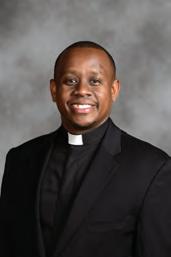
By Father Leonard Gicheru
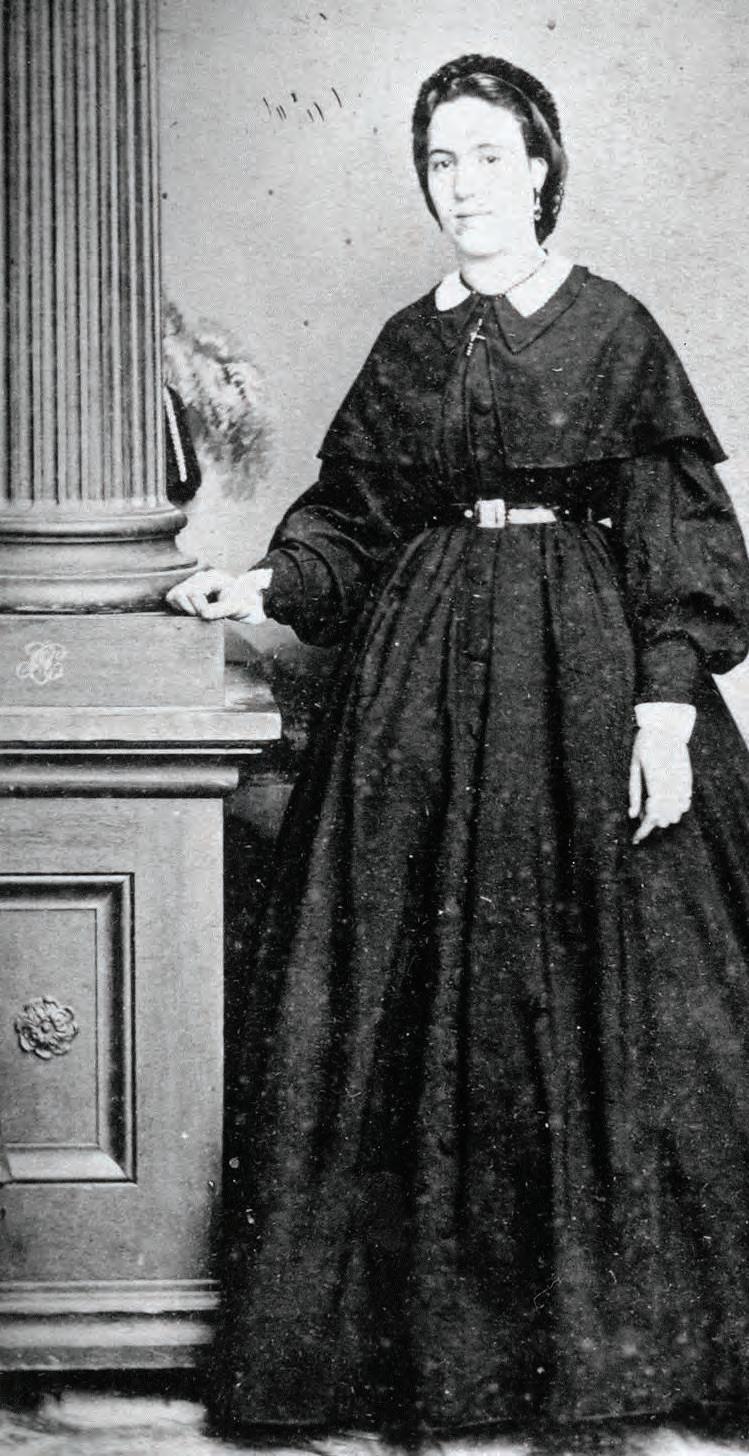
The Church's history is filled with men and women who responded to God's call with extraordinary courage. Among them stands Venerable Henriette DeLille, a pioneer of faith whose witness continues to inspire many Black Catholics today.
Born in New Orleans in 1813, Henriette DeLille grew up in a society marked by racial divisions and social inequality. As a free woman of color, she encountered barriers that limited opportunities for education, advancement, and religious life. Rather than allowing those obstacles to define her future, she discerned a deeper calling: to dedicate her life entirely to God and to the service of those most in need.
At a time when women of African descent were excluded from most religious communities, DeLille refused to abandon her vocation. Instead, she gathered like-minded women who shared her commitment to prayer, charity and Christian service. Together with Juliette Gaudin and Josephine Charles, she founded the Sisters of the Holy Family, one of the first religious communities in the United States established by women of African descent.
Their ministry was both courageous and transformative. The sisters cared for the sick, the elderly and the poor. They welcomed orphans, educated children and provided religious instruction to both free and enslaved Black Catholics despite legal and social restrictions. Through their work, they affirmed a fundamental truth of
the Gospel: every human person possesses God-given dignity and deserves to be treated with respect and compassion.
What makes Henriette DeLille's witness particularly relevant today is her unwavering trust in God's providence. She faced prejudice, rejection and countless challenges, yet she never allowed bitterness to take root in her heart. Instead, she responded with faith, perseverance and love. Her life demonstrates that authentic Christian discipleship is not measured by circumstances but by one's willingness to remain faithful amid adversity.
In an age marked by polarization, loneliness and social division, DeLille's example reminds us that holiness begins with recognizing Christ in others, especially those who are forgotten or marginalized. Her commitment to serving the vulnerable challenges all Catholics to become agents of mercy, justice, and reconciliation within their communities.
Declared Venerable in 2010, Henriette DeLille remains a powerful model of faith-filled leadership and sacrificial love. As the Church continues to pray for her canonization, her life invites us to trust more deeply in God's grace and to courageously answer his call wherever he leads us.
Por Leyden Rovelo-Krull, Oficina del Ministerio Hispano
Por Leyden Rovelo-Krull
¿Quién será el maestro de mi hijo?
¿Qué clases va a tomar?
¿Ya compramos los útiles escolares?
¿Ya lo inscribimos en deportes?
Pero hay otra pregunta, una que rara vez aparece en un formulario de inscripción escolar:
¿Quién le está enseñando a mi hijo lo que vale la pena amar?
Los padres católicos escuchan con frecuencia que deben ser los primeros educadores de sus hijos. Normalmente, entendemos esto en el contexto de la educación religiosa o de la formación moral. Sin embargo, la realidad es que todo niño ya está aprendiendo qué importa, qué es admirable, qué es deseable y, en última instancia, qué vale la pena servir.
En otras palabras, siempre están siendo discipulados.
La tradición cristiana ofrece una idea sorprendente sobre la persona humana. Con frecuencia nos imaginamos principalmente como personas que eligen, que toman decisiones y trazan su propio camino. Pero quizá sea más preciso decir que la persona humana no es principalmente alguien que elige, sino alguien hecho para amar, servir y pertenecer. Y aquello que captura el corazón eventualmente se convierte en su señor.
Jesús señala esta realidad cuando dice: “Nadie puede servir a dos señores” (Mt 6,24). Notemos que Jesús entiende que vamos a servir. Tenemos que hacerlo. Estamos hechos para ello. La pregunta no es si una persona se entregará a algo más grande que ella misma. La pregunta es qué será ese “algo”.
Esto es cierto para los adultos. Es igualmente cierto para los niños.
Los catequistas de hoy muchas veces no son las personas que esperamos. Son personalidades de YouTube, influencers en redes sociales, anunciantes, celebridades, grupos de amigos, plataformas de streaming y algoritmos. Día tras día, ofrecen respuestas a las preguntas más profundas de la vida.
¿Qué te hará feliz?
¿Qué te hará importante?
¿Qué te hará digno de ser amado?
¿Qué hará que tu vida tenga sentido?
Cada una de estas voces propone una visión de “la vida buena”. Cada una está enseñando a nuestros hijos lo que vale la pena amar.
Ninguna de ellas es neutral.
El mundo es notablemente eficaz para discipular.
Esto importa de una manera particular para los padres hispanos. Muchos de nosotros llevamos un profundo deseo de transmitir nuestra herencia, y ese deseo es bueno. Queremos que nuestros hijos conozcan el idioma, la comida, las historias, las canciones y la historia familiar que nos formó. Pero debemos tener cuidado de no confundir la memoria cultural con la formación católica. Nuestros hijos pueden conocer las comidas, las banderas y las historias familiares, y aun así no conocer a Cristo. Si nos obsesionamos con las “raíces latinas” sin anclarlos en su identidad católica, corremos el riesgo de que nuestros hijos piensen que la identidad es algo que pueden escoger, en lugar de una herencia que Dios quiere que reclamen como Sus hijos e hijas.
Este es el corazón de lo que la Iglesia quiere decir cuando afirma que los padres son los primeros formadores de sus hijos. La tarea no consiste simplemente en transmitir información sobre la fe. Consiste en ayudar a formar el corazón. En enseñar a nuestros hijos que su libertad no está separada del servicio. En ayudarles a descubrir a un Señor cuyo “yugo es suave” y cuya “carga es ligera” (Mt 11,28-30).
Mientras los niños regresan a la escuela este otoño, los padres católicos pensarán, con razón, en calificaciones, maestros, horarios y oportunidades. Estas cosas importan. Pero quizá la pregunta más importante sigue siendo:
¿Quién le está enseñando a mi hijo lo que es verdadero, bueno y bello?
Porque si no formamos intencionalmente sus corazones, alguien más lo hará.
Todo corazón pertenecerá a algo. Toda vida será entregada en servicio a alguien.
Y la gran pregunta que enfrenta todo niño, y todo padre, es finalmente la misma:
¿Quién será mi Señor?
“Nunca se debe olvidar el Abad de lo que es, y del nombre que tiene, debiendo saber, que a quien más se confía, más se le pide. Tenga presente cuan arduo y difícil es el empleo que ha tomado de gobernar las almas, y acomodarse a genios diferentes; porque ha de tratar a unos con halagos, a otros con reprensiones, y a otros con consejos, acomodándose de tal modo al genio y capacidad de cada uno, que no solo no padezca ningún detrimento en las ovejas, que se le han confiado, sino que pueda gozarse de los aumentos de virtud de su rebaño.” — De la Regla de San Benito, Capítulo 2: Cual debe ser el Abad
El 11 de julio, fiesta de san Benito, los monjes de la Abadía de Conception anunciaron la elección de su próximo abad, el padre Paul Sheller, OSB. Doy la bienvenida con gratitud al abad Paul y espero con alegría los muchos días fecundos que nos esperan.
A finales de mayo, el abad Benedict Neenan anunció que dejaría el cargo después de diez años de servicio como abad. Quiero aprovechar este espacio en The Catholic Key para expresar mi gratitud personal, así como la de toda nuestra diócesis, por el liderazgo y el servicio que el abad Benedict ha brindado al monasterio, al seminario que Conception sostiene y dirige como apostolado, y a tantas personas que encuentran fortaleza espiritual en el monasterio. Quiero agradecerle las muchas maneras en que la abadía contribuye a la vida de nuestra diócesis y la enriquece.
Durante mi tiempo como obispo aquí, he llegado a comprender cuán bendecidos somos de contar con una comunidad monástica como la de Conception en nuestra propia Iglesia local. La cercanía de Conception a tantos de nuestros sacerdotes, religiosos y fieles laicos favorece muchas relaciones fecundas y encuentros con Dios y con los demás. La mayoría de nuestros seminaristas universitarios, tanto de generaciones pasadas como actuales, se han formado en el Seminario de Conception. Nuestro campamento juvenil de verano, Camp Savio, ha florecido gracias a la colaboración con la abadía y ha acercado no solo a nuestros jóvenes, sino también a muchos de sus padres, a una vida espiritual más profunda. Muchos encuentran en Conception un oasis donde hacer retiros, incluidos nuestros sacerdotes diocesanos. El Seminario de Conception supervisa la formación de nuestros diáconos. Todos debemos estar agradecidos por el deseo y la generosa disposición del abad Benedict y de los monjes de permitirnos beber del «agua viva» que allí encontramos.
Los monjes llegaron originalmente a Conception hace más de 150 años por invitación de John J. Hogan, primer obispo de St. Joseph y, posteriormente, de Kansas City. El obispo Hogan comenzó su labor prácticamente sin nada, en lo que entonces era una región agreste que apenas empezaba a poblarse. Sin clero, dinero ni edificios, y con apenas un puñado de personas, necesitaba ayuda. Los monjes benedictinos de Suiza respondieron al llamado. Llegaron a la zona rural de Missouri con un espíritu tanto monástico como misionero. Desde el comienzo, ayudaron a preparar hombres para el sacerdocio, una labor que continúa hasta el día de hoy, no solo para nuestra diócesis, sino para muchas otras.
Además de este importante servicio, los monjes ayudaron al obispo en el ministerio parroquial. A medida que crecía el número de monjes, Conception también comenzó a atender parroquias de diócesis vecinas. Hoy, ese servicio continúa en varias parroquias cercanas a la abadía y constituye una parte vital de la historia de nuestra Iglesia. Una vez más, gracias, abad Benedict. Usted encarna el mismo
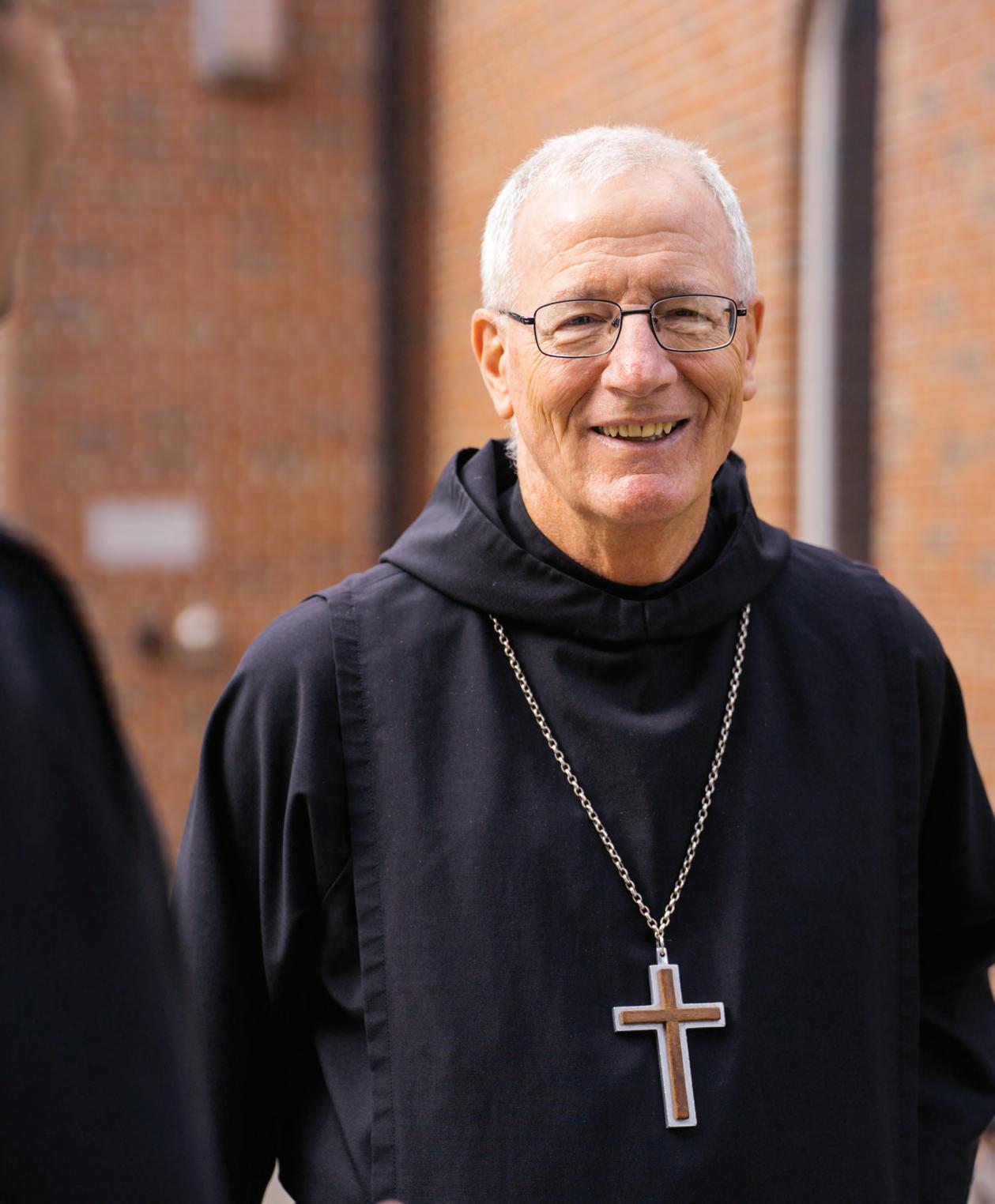
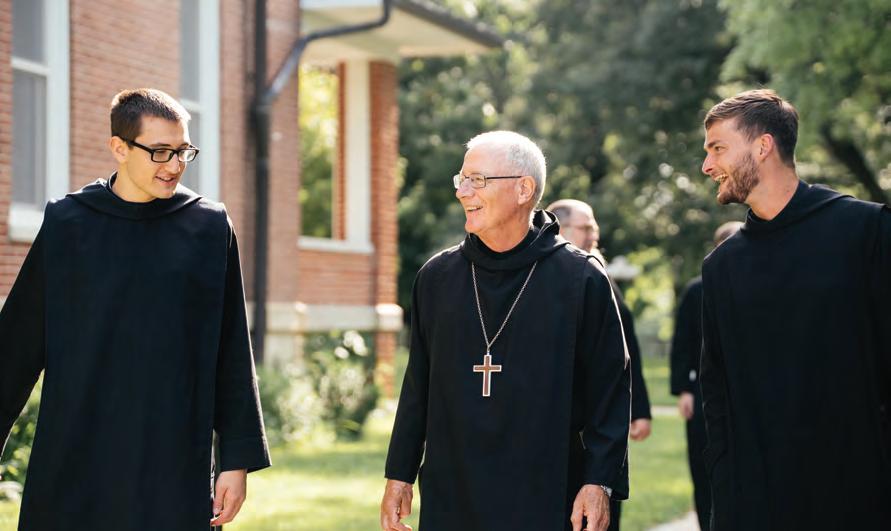
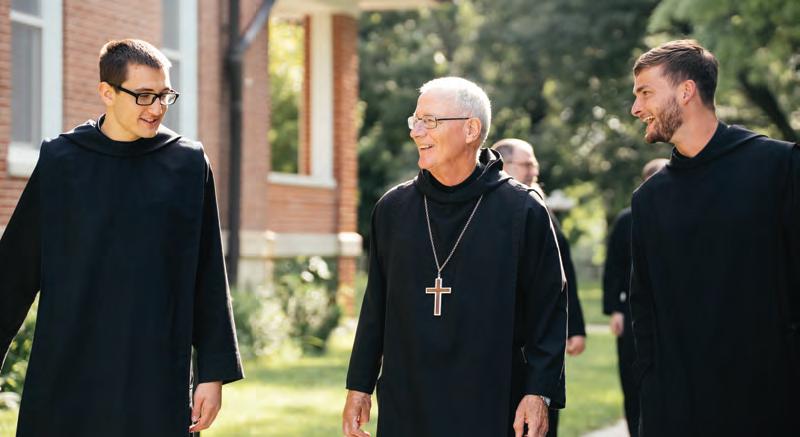
El abad Benedict Neenan (en el centro) anunció en mayo que dejaba su cargo como abad de la Abadía y Seminario de Conception tras diez años de servicio. Fotografía (aquí y en la pág. 4) facilitada por la Abadía y Seminario de Conception.
espíritu misionero que sus predecesores. ¡Le estamos profundamente agradecidos!
Oremos por el abad Benedict mientras vuelve a la vida de monje, libre ya de las cargas propias del oficio de abad. Y, si tienen la oportunidad, denle las gracias por su servicio sabio y generoso, que ha beneficiado no solo a la comunidad monástica, sino a todos nosotros.
Oremos también por el abad Paul, para que Dios lo colme de su gracia y para que la Abadía de Conception, mediante la oración y el trabajo, siga dando gloria a Dios y bendiciendo a su Iglesia.
Del Obispo
El obispo James V. Johnston, Jr. es el séptimo obispo de la Diócesis de Kansas City–St. Joseph en el camino
By Allison Vrooman
Photo by Michael Hogan
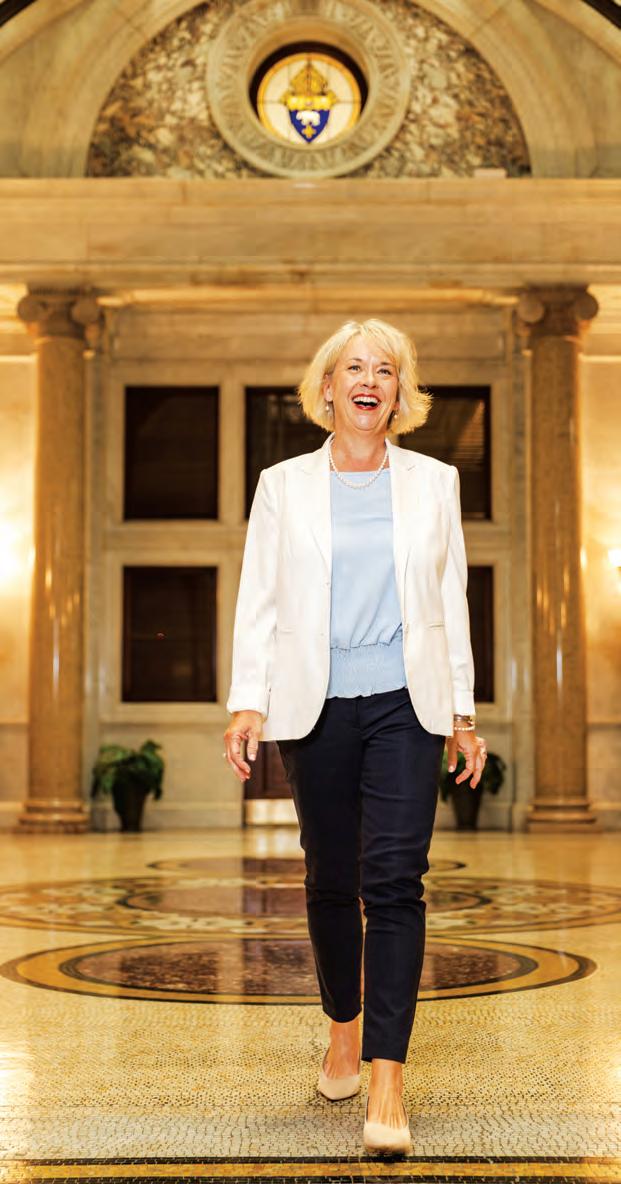
When the diocesan Catholic Schools Office created the new position of president of Bright Futures Schools, they sought a leader who could strengthen Catholic education by building relationships, expanding community support and ensuring the long-term vitality of four of its urban core schools. With nearly two decades in Catholic education and nonprofit leadership, Christy Cook has stepped into the role.
For Cook, this job feels like a door that God opened for her in his perfect timing and that her previous experiences had been preparing her all along.
"I always knew I wanted to [work again for] the Church; I just didn't know what that would look like," she said. "The Lord definitely had this in store."
Raised in a military family, Cook lived around the world before graduating from high school in Florida and earning a business management degree from the University of Florida. Her career has included 10 years as a Catholic educator in Texas and North Carolina, community outreach and development for a Catholic school in Omaha, business manager at St. Regis Academy in Kansas City and, most recently, serving as operations director for Warriors' Ascent, a Kansas City nonprofit supporting veterans and first responders experiencing post-traumatic stress.
Those experiences gave her both the operational expertise and the relationship-building skills that will serve her in the newly created role.
Karen Kroh, superintendent of diocesan Catholic schools, shared, “Christy has a remarkable ability to build relationships, bring people together around a common vision, and inspire others through her Faith and enthusiasm. I am confident that her leadership will be a tremendous blessing to the Bright Futures Schools, the Bright Futures Fund and the families they serve.”
Although the position is new, Cook embraces the opportunity to help shape it from the ground up. She hopes to help the broader Kansas City community see the Bright Futures Schools as an investment in the city's future.
"It's titled a Catholic school," she said, "but these are your community kids attending these schools. It's our responsibility as a community to care for them and support them."
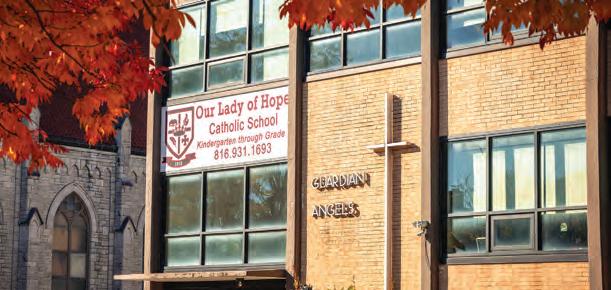
As president, Christy will guide the four schools currently supported by the Bright Futures Fund: Holy Cross, Our Lady of Hope, Our Lady’s Montessori School and St. Regis Academy.
LEARN MORE at brightfuturesfund.org.
OUR LADY OF HOPE SCHOOL is located off Westport Road near the state line and serves families in both Missouri and Kansas. Families choose the school because of its small class sizes, diverse and supportive community, and daily Faith formation. With the belief that every child deserves access to a high-quality Catholic education, tuition is determined based on each family’s unique financial situation and 100 percent of students receive scholarships. Our Lady of Hope School does not receive any parish subsidy and is fully dependent on the Bright Futures Fund and other outside support to remain open.
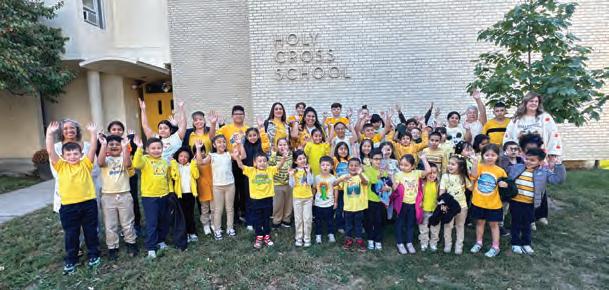
HOLY CROSS SCHOOL has served families in the Historic Northeast community in Kansas City, Missouri, for over 100 years. Educating pre-K through eighth grade students from a variety of nationalities, cultures and religious backgrounds, the school has dedicated itself to creating a welcoming environment to all families, while providing quality Catholic education. About 98 percent of students receive tuition assistance. Holy Cross School does not receive any parish subsidy and is fully dependent on the Bright Futures Fund and other outside support to remain open.
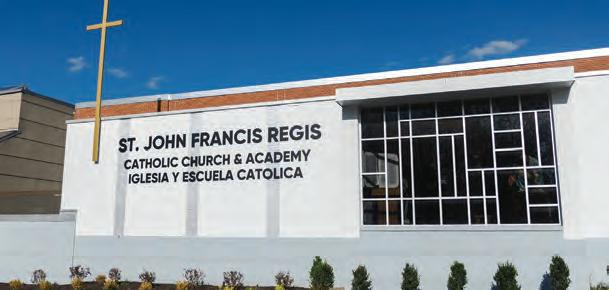
ST. REGIS ACADEMY became the newest Bright Futures School in the spring of 2026. The academy is supported by a hybrid model in which the Bright Futures Fund and St. John Francis Regis Parish partner to ensure ongoing enrollment growth and student support. Located in south Kansas City, St. Regis Academy is a K-8 school serving Catholic and non-Catholic families seeking a classical Catholic education for their children. The student population is very diverse and more than 50 percent of students qualify for free and reduced lunch.
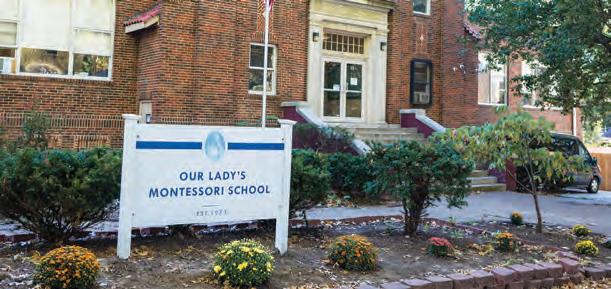
OUR LADY’S MONTESSORI SCHOOL is a small Catholic Montessori school, located in Kansas City, Missouri, near St. Therese Little Flower Parish. The school was opened in 1973 by the Society of Our Lady of the Most Holy Trinity, and moved into its current location in 2022 where it serves children ages 3 to 14. Our Lady’s Montessori School has received support from the Bright Futures Fund to help with building improvements, as well as scholarships for preschool students who do not yet qualify for state scholarships through the MOScholars program.

By Karen Ridder
Years ago, a friend of mine took a trip alone with her husband. Family members watched their four young daughters. They went to some sunny place. After their return, I asked how the trip had gone.
“We’re not doing THAT again,” she said.
I was confused. Her marriage is strong. Didn’t she enjoy the time away with her husband? “Of course,” she said. “But I just missed the kids like crazy. I don’t want to leave them like that again.”
It was a bit of a countercultural statement. As a mom, I’ve ALWAYS taken time for myself, believing it to be important. It is, but there was a truth in the way she said she missed her kids that shifted something in me. This parenting thing is a gift we often treat too blithely. We are encouraged to do so, and in that we miss something.
Once in the confessional I complained to the priest about not being able to offer my gift of hospitality to friends and neighbors much in this season of life. He responded, “Perhaps the hospitality you’re meant to offer in your home right now is to your children.” I realized he was right.
Jesus told his apostles, “Whoever gives only a cup of cold water to one of these little ones to drink because the little one is a disciple
— Amen, I say to you, he will surely not lose his reward.” (Mt 10:42)
To be a disciple means to be a learner or a follower. Our children ARE little disciples of us. We give them our homes, our tables, our resources, our energy, our today and our tomorrow. In it all, they learn and follow us. The reward for parents is becoming more like the Lord.
A second time, Jesus told us to be active in meeting the needs of others, saying, “To the extent that you did it for one of these least of these brothers or sisters of mine, you did it for me.” (Mt 25:40)
When we catch Jesus repeating himself — it’s best to pay attention.
I wonder if, during that week away, part of what my friend actually missed was the presence of Jesus mysteriously mirrored through the hospitality she was regularly offering her children at home.
Jesus is with us when we parent. It is good to remember this truth and be intentional about how we respond. Without hospitality in our hearts, it may be tempting to fall into resentment over what we’ve been asked to sacrifice.
The season of parenting children in your home is a gift that will come and go quickly. This month, I send my second of four children off to college. I no longer get to be Jesus to him and his brother with daily drinks of cold water. Others must come alongside now to offer that hospitality to them both. That’s OK, though, because it never really was me anyway. It was always Jesus. He just allowed me to be a part of the gift.




container is ready to leave, the dresses will be in it. She added that it takes four months for shipping pods to reach Umueje in rural Nigeria.
By Marty Denzer | Photos by Michael Hogan
Many people worldwide are in need, whether for food, clothing, shelter or medical care. About 10 years ago, a group of women at Holy Trinity Parish in Weston organized a charity sewing group ministry, crafting handmade essential items needed both locally and globally.
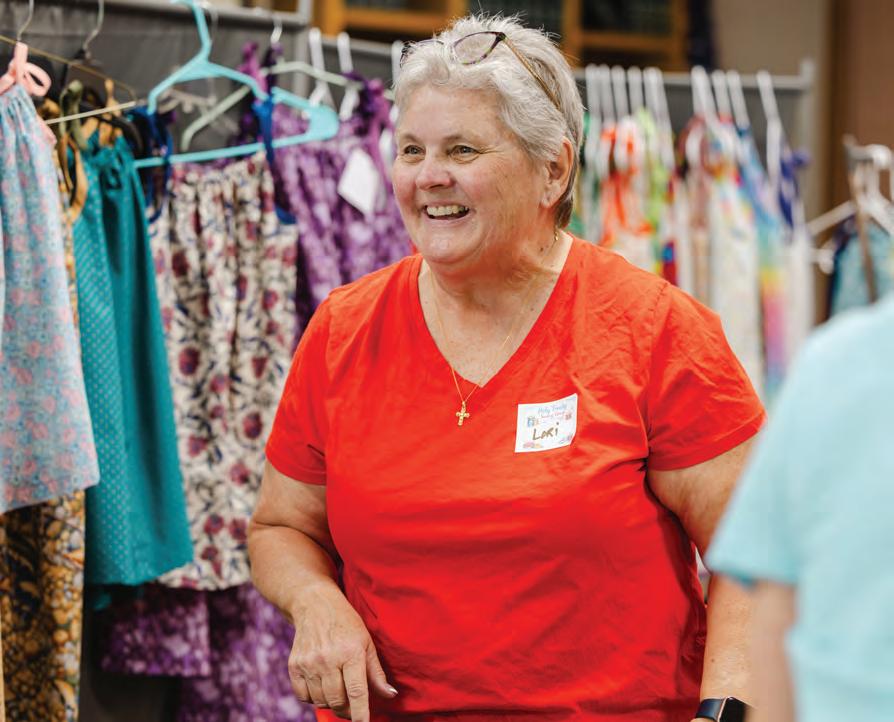
Coordinator Lori Mathews loves to sew, loves to give and loves to serve others. She enumerated projects the sewing group has completed, meeting once a month: quilts encased in pillowcases for Quilts of Valor; travel rollups and sleeping bags for the homeless made from donated blue jeans; lap blankets, walker bags
and clothing protectors for local retirement communities; baby quilts for Children’s Mercy Hospital and Parkville Women’s Clinic; quilts and sheet sets for the Sleep in Heavenly Peace program which donates bunk beds and bedding to kids age 3-17 to ensure no child has to sleep on the floor; baby doll quilts and learning softies for
Operation Breakthrough; and washable, reusable sanitary pads for young women in Africa. The group also makes items to sell at Weston events to fund material and sewing supplies.
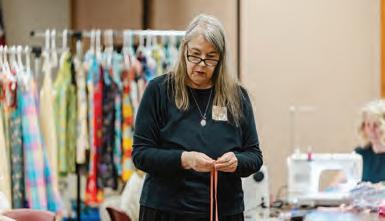
The sewing group is currently working on a request from an Immaculate Heart of Mary Sister at Maranatha Caring Mission Hospital in Umueje, Nigeria, for 500 dresses, sizes 2-12, and 400 pairs of boys’ shorts. The group began sewing the dresses in March; more than 300 are completed and vacuum sealed for shipping. Mathews said shipping has been slow, but as soon as the shipping
“Those kids have nothing,” she said, adding that Father Joseph Totton, pastor, blesses items before shipment. The shorts request will likely be filled next year, she added.
Mathews said the monthly meetings are fun, filled with their labors of love — sewing, pressing, conversing and sharing a meal. There has been a bit of competition in the speed a child’s dress could be made — from first cut to last stitch. The record so far is 35 minutes!
She said sewing skill or experience isn’t needed. Help is welcome for cutting and ironing as well as sewing. Each attendee brings a dish to share for lunch. The group also shares conversation and laughter, sewing tips and encouragement.
THOSE INTERESTED in supporting or volunteering may email lori.mathews4@gmail.com.
LEARN MORE at rootsandrounds.org.
By Marty Denzer | Photos by Michael Hogan
Many of us grew up hearing stories our grandparents or great-grandparents told about “the good ol’ days.” Today, demographers count seven generations going back to the Silent Generation (1928-1945). Unfortunately, often there’s a disconnect between older and younger people.
Roots and Rounds, Inc., a lay apostolate founded in 2019, recognizes and promotes multigenerational communication, acceptance and, according to Debbie Sheppard of our diocese’s Life and Justice Office, the realization that Catholic social teaching is based on the teaching, vision and example of older people.
Since 1978, National Grandparents Day has been celebrated in America on the first Sunday after Labor Day, this year on Sept. 13. In 2021, Pope Francis declared World Day for Grandparents and the Elderly to be celebrated annually on the fourth Sunday of July, alongside the Memorial of Saints
Joachim and Anne, Jesus’ grandparents. The USCCB approved the transfer, and a plenary indulgence may be earned for its celebration.
Roots and Rounds founder Christel Gollnick is Gen X and her husband Bruce is a Baby Boomer.
The program’s genesis lies in youth engaging the wisdom, learning and experience of older people, while they, in turn, value the younger folks. It’s the “Circle of Life.”
Gollnick authored Stone Soup: A Familiar Folktale Brings All Ages to the Table, a 21st century retelling of the ancient tale of hungry travelers tricking stingy villagers into sharing their food by making “stone soup” with hot water and
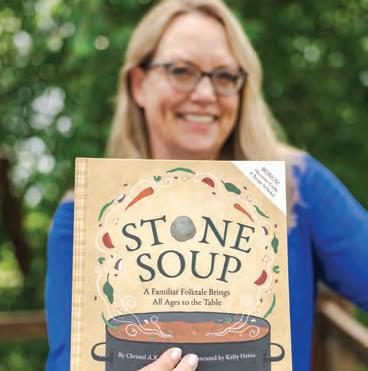
stones. Intrigued, villagers began contributing meat and vegetables, creating a communal feast.
Seen through the eyes of stranded campers in an area cut off from food delivery services, a stone symbolizes hope, inspiring them to pool their remaining supplies into a communal meal.
Gollnick’s version — complete with recipes and activities — shifts from an outlook of scarcity to abundance. Everyone brings something valuable to the table.
In 2022, Roots and Rounds applied for a diocesan Life and Justice Campaign grant, outlining its purpose, mission and vision. Its purpose focuses on the root prin-
ciples of inclusivity, respect and innovation to empower leaders and teams of all ages. The mission is to bridge the wisdom and energy of all ages in communities and workplaces through improved intergenerational communications and leadership, which can engender thriving communities led by people who value each other. Their project description says, “Age is the one diversity that all people share. Yet, young and older people … feel ‘less than’ for being born in a particular generation.”
Some may say, ‘So what?” The mission and vision answers that question. Roots and Rounds may be a stone of hope for the future.


By Marty Denzer
TEN YEARS AGO, FOLLOWING PROFOUND EXPERIENCES WITH CHRIST IN THE EUCHARIST, FATHER MATHIAS THELEN AND PATRICK REIS CO-FOUNDED ENCOUNTER MINISTRIES.
Ordained in 2010, Father Thelen currently serves as pastor of St. Patrick Parish in Brighton, Michigan. He earned his licentiate in sacred theology in 2016 from the Angelicum in Rome. Father Thelen is an author and speaker and has appeared in several documentaries.
Reis, executive director of Encounter Ministries, received his bachelor’s degree from Franciscan University, Steubenville, Ohio, and his master’s from Holy Apostles College and Seminary in 2014. An international speaker, minister and author, he has appeared in documentaries with Father Thelen. Reis is married and has six children. Encounter Ministries seeks to teach, equip and activate disciples to demonstrate God’s love through the power of the Holy Spirit in their spheres of influence. The Encounter School of Ministry, a two-year, part-time training program, is designed to take both clergy and lay people deeper into supernatural discipleship. The main campus is in Brighton, with numerous satellite schools around the world. The local satellite campus is at Holy Spirit Catholic Church in Overland Park, Kansas.
Holy Spirit’s campus and academic curriculum underwent a rigorous review by a team of Catholic theologians and was approved by Archbishop Joseph F. Naumann of Kansas City, Kansas, now retired, and Bishop James V. Johnston, Jr., of the Diocese of Kansas City–St. Joseph. The first graduations were in 2023. Katrina Schmitz, attended an Encounter Ministries Summer Intensive program last year, a four-night experience of learning about identity as sons and daughters of God, power and healing, growing in faith, hearing God’s voice more clearly and getting equipped to participate in Jesus’ ministry of “healing the broken hearted and and binding up their wounds.”
Schmitz, who calls herself a “real Catholic mom,” said, “Those four short nights, 12 hours, launched me into wanting more! The classes continue to point me back to my own relationship with Christ.” She now attends the school.
“It’s mostly for me,” Schmitz added. “Sharing testimony and experiences builds faith. My hope is to live more boldly, holistically in the Holy Spirit! Come to be encouraged and sent out to encourage others in faith. We all have difficult moments in life; inviting God and the Holy Spirit into every part of life is healing. Every time I give more, I get more. I want to pass my faith on to my three boys, a ripple effect. And, I want everybody to know about it!”