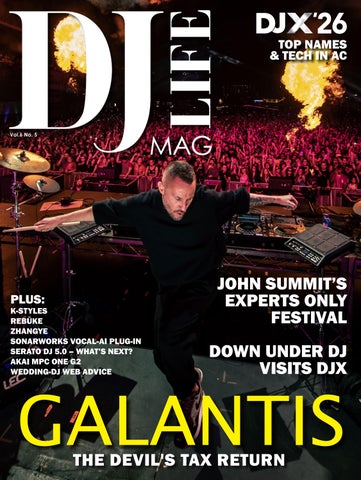
TOP NAMES & TECH IN AC
Vol.6 No. 5
PLUS:
K-STYLES REBŪKE ZHANGYE SONARWORKS VOCAL-AI PLUG-IN SERATO DJ 5.0 – WHAT’S NEXT? AKAI MPC ONE G2 WEDDING-DJ WEB ADVICE
JOHN SUMMIT’S EXPERTS ONLY FESTIVAL DOWN UNDER DJ VISITS DJX
GALANTIS THE DEVIL'S TAX RETURN
YOUR STAGE. YOUR SOUND.
JBL Portable PA Solutions deliver legendary performance, powerful sound, and pro-grade features across a complete lineup built for every event, crowd, and venue. Learn more at: jbl.com/portable-pa-systems
NEWS
Scratchin’: Sid Wilson & DJ ChedeRac.
By Jim Tremayne Atlantic City, N.J. – Back on AC’s famous Boardwalk, the 2026 edition of DJX brought legendary names, new events and the latest technologies to its annual industry gathering. Held this past Aug. 10-13 at the Hard Rock Hotel & Casino, DJX’26 once again brought the culture together for the industry’s largest, longest-running, and most impactful gathering of DJs in the Americas. The 36th annual show – produced by DJ LIFE and Hazan Media Group – presented its time-tested combo of DJ-related technology showcases, educational seminars, and sponsored After Dark parties. The Campus: DJX’26 delivered a packed schedule of showcases, seminars, and sponsored parties. The show saw participation from brands/sponsors like AlphaTheta, JBL, QSC, Electro-Voice, RCF USA, Carnival Entertainment, JetPack, BASSBOSS, Yorkville Sound, Both Lighting, Beat Junkies Institute of Sound, Blackmagic Design, German Light Products, AIAIAI, beyerdynamic, and Stop The Panic. Additionally, DJX presented its Summer Camp, Masterclasses, The EDIT, the brandboX section, which offers solutions to build businesses. Numbers: Ninety-one existing brands showcased; 12 retailers were represented; 16-percent were first-time attendees; 43 states plus Washington, D.C., attended; and visitors from nine different countries attended (USA, Canada, Australia, Brazil, China, Hungary, Poland, U.K., and Mexico). Education: Along with its schedule of 34 topical seminars geared toward mobile, club, streaming, studio, and beginner jocks, DJX presented a trio of special “Keynote Q&A” sessions with industry notables. On Aug. 10, mobile vet Mike Walter engaged in a lively discussion about his latest book, The Greatest Song Ever? On Aug. 11, the legendary Jellybean Benitez went down memory lane, as he detailed his diverse career in music, clubs, publishing, film, and retail with his new Jellybean’s Funhouse Record Shop. It was followed by a showing of Arthur Baker’s new documentary, Rockers Don’t Stop: The Revival of Rockers Revenge. On Aug. 12, Sid Wilson, the apparently erstwhile DJ for the world-famous metal act Slipknot, discussed his multifaceted career, which has included recording and touring with the platinum-selling band and as a solo act DJ Starscream, plus recent enterprises like his DJ-gear-making company Stop The Panic. Other sessions included: A.I.-related seminars from DJ Cova (studio and music), Scott King (mobile sales), and Alex Brown (mobile business); “The New Age of SEO for DJs” by Brian Lawrence; and “The Side-Hustle DJ” by DJ
John Hohman/Metromix
Closing Party: Kool DJ Red Alert.
Ronald Mungo
Ronald Mungo
DJX’26: TOP NAMES, UPLIFTING EXPERIENCES
At HQ2: Jellybean & Arthur Baker.
HAPA, plus sponsored seminars from AlphaTheta, Carnival Cruise Line, German Light Products, Mixware/ColorKey, SMPL, and Vibo. After Dark: DJX again presented the Sunset Sessions with networking events from QSC (Aug. 10) and AlphaTheta (Aug. 11), featuring music, food and drinks. For its opening party at HQ2 at Ocean Casino Resort on Aug. 10, DJX presented a double dose of classic club jams from legendary DJ/producers Arthur Baker and Jellybean Benitez. On Aug. 11, BASSBOSS and The MixHer presented PLY: The Pre-Game Party, an early-evening event that featured an allfemale DJ lineup that included DJ ReRe, Stephanie Stardust, Neeek Nyce, and ChiTown Shani. Later, on Aug. 11 at the VÜE Rooftop Bar at The Claridge, DJX presented “Respect the DJ Party,” which included Dook, DJ Tony-T, Frank Garcia, Lou Paris, Linda Leigh and Iron Mike. On Aug. 12 at The Balcony in the Hard Rock, DJX presented B2B parties. First up, the “Legacy of the Mix” party, co-hosted by Jake Jacobsen and Mike Alevras, presented a cavalcade of mobile-friendly talent. Sponsored by AlphaTheta, JetPack Bags, and RCF, the lineup included live acts Shyra Sanchez and Pretty Poison feat. Jade Starling, plus DJs Matt Dodge, DJ Larry D, DJ Stacie, DJ Kid Kasper, Todd Moffre and Big Daddy & The Family. Afterwards, Mell Starr & Friends threw down deep into the night. Sponsored by AlphaTheta and RCF, the event included performances from turntable master Melo-D, party rocker Matthew Law, and radio/mix-tape legend Kool DJ Red Alert – plus a surprise set by turntable pioneer DJ Cash Money. What’s New: On Aug. 10 and 12, Stop The Panic presented its World Scratch Invitational Regional Championship, which was won by Poland’s DJ ChedeRac. Also, Of Note: Jellybean’s Funhouse Record Shop & Listening Lounge; EVinyl Lounge & Crate Digger Awards; DJ Niam was the BASSBOSS-sponsored UpNXtDJ Winner; DJ Roosta of Albany, N.Y., won the DJX T-Shirt Design Contest; The DJ School’s Graduation Ceremony with The DJ Coach; and Show Décor Sponsors (Both Lighting, VibeCraft, ATA Photobooths & The Screen Works). The Prizes: On Aug. 13, Yolanda Spencer of Brooklyn, N.Y., won the Ultimate DJ Giveaway. The winning system included products from AlphaTheta, ColorKey, Crane, Headliner, Rockville Audio, ProX, JetPack Bags, Mo and Joe Electronics, and Ultimate Ears. Also, DJX offered daily giveaways from these brands, plus AIAIAI, beyerdynamic, Both Lighting, German Light Products, Vinylessence, Esstart, and Linsoul. VOL.6 NO.5 |
DJLIFEMAG.COM
3
IN THIS ISSUE
VOLUME 6 NUMBER 5
Scenes from DJX ’26
Sound Bites
Tech, Education & Parties from Atlantic City
Rebūke
By DJX Photographers
10
20
In the Studio With…
Big Apple Beats
ZHANGYE
12
4
DJLIFEMAG.COM
Mixing Music & Fashion, DJ K-Styles Juggles Genres With Diverse Schedule of Residencies By Jim Tremayne
26
|
VOL.6 NO.5
Cover Image by Neon Mafia-Satoshi Hoshino. Contents Image by Fredrik Egerstrand.
ON THE COVER The Devil’s Tax Return
On Christian Karlsson’s Latest Galantis Project, Everything Old Is New Again By Mark Mancino
14
8 Feedback
DJX’26: Exhibitor/Attendee Reactions
30 Festival Spotlight NYC’s Experts Only Fest
34 Playback
Serato DJ 5.0 Public Beta
36 Studio Session
Sonarworks SoundID VoiceAI & Akai MPC One G2
40 Mobile DJ Profile Down Under DJ Visits DJX
42 DJ Business
Wedding DJs, Do a Self-Exam
52 Gear
New Products from Denon DJ, Reloop & More
54 Tracks
Phat Tracks from Claptone, Todd Terry & More
56 Club Play Chart
The Hottest Records, As Reported by Our Top U.S. Record Pools
VOL.6 NO.5 |
DJLIFEMAG.COM
5
FROM THE EDITOR JIM TREMAYNE
AUDACIOUS PROJECT/DJX’26 REVISITED Galantis, this month’s cover subject, has been in our editorial sights for more than a decade. As DJ Times, we featured the act when it was the festival-rocking duo of Christian “Bloodshy” Karlsson and Linus “Style of Eye” Eklöw riding hits like “Runaway (U&I)” wwand “No Money.” But, for the past few years, Galantis has been a Karlsson solo effort, one of many different musical projects that he has pursued over his lengthy and successful career. This time around, he’s discussing The Devil’s Tax Return, a new EP concept, which finds him re-imagining, deconstructing and rebuilding a half-dozen tunes, based on originals from artists ranging from The Killers and The War on Drugs to Feist and Frankie Valli. Coming from a DJ/producer who’s already topped the pop charts and headlined major festivals, it’s an audacious artistic move. Our Mark Mancino recently caught up with the Swedish talent. This issue also offers a look back at DJX’26, which ran this past Aug. 10-13 at the Hard Rock Hotel & Casino in Atlantic City, N.J. The show brought performances and appearances from legendary jocks like Jellybean Benitez, Arthur Baker, Kool DJ Red Alert, DJ Cash Money and Sid Wilson from Slipknot, in addition to educational sessions tackling the industry’s most-pressing topics and a showfloor featuring the latest technologies. You can read the details on Page 3, take in the reviews on Page 8, and see the visual particulars starting on Page 20. Also on the DJX tip, for our Mobile DJ Profile, we visit with John Edney, who travelled more than 10,000 miles from Melbourne, Australia, to Atlantic City for the show. We discuss his market and what he learned about the North American DJ scene. (And next month, we’ll visit with another Aussie mobile company which made the same trip.) In DJ Business, Brian Lawrence explains how and why improving your website will make you the DJ your competitors can’t catch. In Sound Bites, we offer some international flavor. Mr. Mancino goes into the studio with ZHANGYE, one of China’s leading electronic-music DJ/producers, who discusses his career and his rather unique market. Meanwhile, new writer Anna Mirjam Halász connects with Irish DJ/producer Rebūke (aka Reuben Keeney) who’s made a career of rugged club tunes and immersive visuals. In a feature, we hit the Manhattan clubs with K-Styles, one of NYC’s busiest and most versatile open-format jocks. For the tech reviews, we have three entries. In Playback, new writer Chris Sweet (aka Just Chris) takes a look at what’s next from Serato, as he offers his comments on the public beta of version 5.0. Studio Session has two reviews: New writer Dylan Hazen handles the Akai MPC One G2 music production center, while longtime contributor Wesley King tests out Sonarworks’ SoundID VoiceAI plug-in. In Festival Spotlight, we take a look at John Summit’s Experts Only fest, which drew more than 60,000 fans to NYC’s Randall’s Island this past Sept. 19-20 to see such acts like Summit, GRiZ, Subtronics, Max Styler and more. And yes, we do have confirmed dates/site for next year’s show – DJX’27 will run Aug. 9-12 at the Hard Rock Hotel & Casino in Atlantic City, N.J. Hope to see you there!
editor-in-chief Jim Tremayne jtremayne@hazanmediagroup.com web editor and social media manager Mark Mancino mmancino@hazanmediagroup.com contributors Joe Berinato, Chris Caruso, Shawn Christopher, Paul Dailey, Reed Dailey, Chris Davis, DJ Deets, Tony Fernandez, Tommy D Funk, Lexi Ferguson, John Hohman, Wesley King, Brian Lawrence, Mike Márquez, Lily Moayeri, Jordan St Jacques, Jeff Stiles, Ashley Teffer, Danny Turner, Phil Turnipseed, Joshua Volpe, Travis Wackerly, Curtis Zack chart coordinator Dan Miller dmiller@hazanmediagroup.com creative director Janice Pupelis jpupelis@hazanmediagroup.com director of technologies and project management Steve Thorakos sthorakos@hazanmediagroup.com Chairperson & COO/Co-Publisher Robin Hazan rhazan@hazanmediagroup.com President & CEO/Co-Publisher Shawn Hazan shazan@hazanmediagroup.com
Cheers,
Jim Tremayne Editor, DJ LIFE
visit our website: djlife@hazanmediagroup.com 516.767.2505
Editorial and Sales Office: DJ Life, Oyster Bay, NY 11771. (516) 767-2505 • (Sales/all other business): (516) 767-2505 • djlife@hazanmediagroup.com. Editorial contributions should be addressed to The Editor, DJ Life Mag, Oyster Bay, NY 11771 or sent to JTremayne@hazanmediagroup.com. DJ Life Mag is published bi-monthly starting with the second month annually. Design and Contents: copyright © 2026 by DJ Life Mag and must not be reproduced in any manner except by permission of the publisher. Web: DJLifeMag.com, DJXShow.com and HazanMediaGroup.com Subscriptions: djlifemag.com/subscribe Email: djlife@hazanmediagroup.com Phone: 516-767-2505 ext. 502
6
DJLIFEMAG.COM
|
VOL.6 NO.5
FEEDBACK
DJX’26: BRAND/ATTENDEE REACTIONS Atlantic City, N.J. – DJX’26 ran this past Aug. 10-13 at the Hard Rock Hotel & Casino in AC. Produced by DJ LIFE and Hazan Media Group, DJX presented DJ-centric exhibits, educational seminars, and sponsored After Dark events. Here are responses from show exhibitors and attendees: “We at AlphaTheta always enjoy participating in DJX. This year it was great to see so many new faces and a lot of variety in terms of DJ style and age of DJs. We feel it is important to interact and communicate with the people who use our gear and DJX provides a perfect opportunity to do that.” – John Powell, AlphaTheta, Torrance, Calif. “JBL was thrilled to return to DJX Show in 2026! With so many opportunities to showcase our wide portfolio of loudspeakers, it served as a core activation for connecting with our customers and building relationships. Can’t wait until next year!” – Michael Doucot, JBL Pro, Northridge, Calif. “DJX feels like home, and we wouldn’t miss it for the world! It’s our time each year to see our DJ and industry friends old and new, connect with important partners in a relaxed atmosphere, and throw down some great tunes with fantastic DJs, both emerging and established. The location, the staff, and the attendees are all the best of the best. We’ll see you next year!” – Lian Amber, BASSBOSS, Austin, Texas
“From the education, new gear and showroom floor to the networking, hallway conversations, opportunities and incredible parties, DJX delivered another memorable experience.” – Jeffrey Powell, Alliance Entertainment Group, Dallas “DJX ’26 is more than a trade show for Electro-Voice. It’s where we connect directly with the people who live and shape DJ culture every day. It gives us the opportunity to listen to DJs, understand their real-world needs, and let them experience our products in an authentic environment. From the EV Vinyl Lounge to our presence on the show floor, we’re not just showcasing speakers, we’re building relationships, supporting the craft, and staying closely connected to the DJ community. That’s what makes DJX such a valuable event for our brand year after year.” – Marco Araujo, Electro-Voice, Burnsville, Minn. “The show was good for Mixware in strengthening our brands. The overall look and feel and production of the DJX show as a whole looked really great. We are looking forward to next year.” – Dave Arevalo, Mixware, Las Vegas “DJX’26 was such an amazing new experience for me. It was truly a DJ-family reunion. Thank you for the opportunity to experience it. I can’t wait to be involved in some kind of capacity soon… Salute!” – Jerome Hewlett (aka DJ Cash Money), Philadelphia
SOUND BITES
REBŪKE: SOUND, VISION & EVOLUTION Rebūke has built a reputation as one of the most forward-thinking producers in electronic music, constantly experimenting with the boundaries between techno, house, and rave culture since his breakout moment with “Along Came Polly” on Hot Creations in 2018. The track became a defining statement of his sound, showcasing his innate ability to craft a weirdly, wonderful slice of techno. Hailing from Letterkenny, Ireland, Reuben Keeney created Rebūke as a playful jab at predictable music. True to his word, he shakes up the scene by blending gritty techno, heavy house grooves, ’90s rave nostalgia, and melodic club vibes. In addition to other club faves like the massive “Syren” – his 2023 collab with Italy’s Anyma – he’s remixed a who’s who of electronic acts, including Underworld, Green Velvet and Chris lake. In 2022, Rebūke launched his ERA label/brand, which also includes his ERA Radio show and his immersive live show/audio-visual concept. His latest release, “Tears from Heaven,” is another change of pace, as it’s a tension-filled melodic banger on Cloonee’s Hellbent imprint featuring vocalist Hannah Boleyn. We caught up with Rebūke to discuss his journey, his shifting sound, and the future of his live experience. DJ LIFE: When did you first start DJing and producing? Rebūke: I started DJing when I was very young, around 12, 13 years old. It was before DJing was cool. Now, these days, everybody wants to be a DJ. Back then, where I come from, nobody really knew about DJs. The only one they knew was Tiësto. I started watching YouTube videos of Tiësto playing and then I was asking, “How is he doing this?” I realized that he was using vinyl, so I started learning to mix that way. One thing led to another; it became a bit of an obsession. Around two years after, the production stuff came naturally. I got frustrated that a lot of the DJs were playing the same music as me, so I felt that if I made my own music, then others couldn’t play it. Which is kind of funny because now it’s the opposite. DJ LIFE: What kind of tools did you learn on specifically?
Ireland’s Rebūke: Tough tracks, immersive visuals.
10
DJLIFEMAG.COM
|
VOL.6 NO.5
Rebūke: I actually started on DJing first with a pair of super cheap CD players. They had no pitch wheel, so the only way to get a track back in sync was by pressing two buttons over and over. You’d just go, “c-c-c-c…,” trying to keep the two tracks together. At my very first gig at a teenage disco with my friends, every time someone walked past the desk, the CD skipped because they didn’t even have anti-shock! I was only 13 and didn’t have much money, but it was enough to learn the basics and save up for better gear over time. Production came around two years later: I started out on Fruity Loops – now it’s FL Studio – before discovering Ableton Live, which became my DAW of choice and I’ve that used ever since. DJ LIFE: Do you play an instrument? Rebūke: I play a bit of keys; I played a little bit of guitar, took some lessons and a little bit of keyboard, but nothing really ever gelled. I’ve never been the traditional musician
in the sense where I could sit down and play a piano. It was more that I loved the idea of getting these ideas out of my head, and I didn’t really care how that happened. I was always a bit of a tech nerd as a kid. My dad owned a computer store, so I was always wrecking computers to see how they worked. When I realized that softwares like Fruity Loops and Ableton could turn that tech into music, I was hooked. Playing traditional instruments never appealed to me; technology was my way in. DJ LIFE: What do you consider your breakthrough moment for you as an internationally recognized artist? Rebūke: Probably in 2018, when I released the record “Along Came Polly.” Before that, I had some mini-breakthroughs here and there where cool things were happening, but I think that was the record that put me on the map and got me enough attention where people started to have eyes on me and then, I could express my other styles of music. DJ LIFE: You mentioned in previous interviews that you are moving back towards darker and rougher sounds. What inspired you this shift? And how would you describe the evolution of your sound since your debut album, World of ERA, from last year? Rebūke: Naturally, if you’re just a fan of music, you don’t tend to like the same songs for 10 years. We might all love dance music, but we go from listening to one genre to another, from one sound to another. And it’s the same as an artist. I’m always picking up new things, and I’m constantly watching people do things differently. I’m always like, “Oh, I quite like that.” I think this was the way my sound has always evolved, from the early days of doing more hard Creation stuff, to more drum-n-bass records, eventually it pivoted to more melodic techno music. Now, these days I’m getting really excited about more groovy kind of house music again. I just follow what I feel interests me, and I don’t try and stick to one lane. This freedom keeps things exciting for me and I guess for the fans as well. They never know what to expect. Unlike a lot of artists, I’m lucky enough to pivot sounds without losing my audience. It’s great, because when other artists chose another direction people are like “What the hell, man? Why are you playing this house record when you’re a techno DJ?” Right now, I’m loving going back to my house roots with a darker, clubbier feel, and the reception has been incredible. DJ LIFE: What genres are you most interested in at the moment? Rebūke: Right now, I like the weirder side of house music. Beltran and Mochakk are bringing back that original Dirtybird sound, which was massive when I broke through in 2018. It went away for a bit when things got too serious, but these Brazilian artists are making it cool again. I’ve always loved that sound, I even recently put out “I’m Just Calling” with Claude VonStroke. It was around four years old. We let it sit around for a while and now that we felt like this sound is making a comeback, so we released it. I’m hyped to be part of its comeback. DJ LIFE: You have a lot of exciting collaborations coming up, for example, with Patrick Topping. You’ve collaborated a lot with Anyma as well. How do you choose your collaborators?
Rebūke: Usually, it’s people that I genuinely like as individuals – they’re just really cool. I’ll work with them if I connect with them personally. I have a lot of respect for artists who create something original. If somebody is doing something a little different or something that tweaks my ear, I’ll always reach out and start a conversation. Patrick Topping, for instance, we’ve been friends for around 10 years, and we broke through in the same world back in the day. He’s also going back to his old style where he came from. We thought it was a good idea to come together and do something fresh. With Anyma, he first reached out three years ago – his sound felt so fresh and technologically forward. I also enjoyed the technology side of it and the sound-design parts of the work. Our collab was pure experimentation, what we called “chaos.” No traditional vocal hooks, just raw sound design and pitch bends. For me, the best collaborations are with anyone pushing boundaries and making me ask: “Oh, how did they do that?” Then that’s the kind of guy that I like to work with. DJ LIFE: About the audio-visual part of your productions, are you planning to continue that direction? Rebūke: Yes, I think so. Last year, it got to the point where it overtook the music a lot because I create my own visuals myself. Two years ago, I started to learn how to make visuals. I was working with a 3D animator very early on, but when I couldn’t fully express my vision to him, I got frustrated. Then, I decided to learn the basics myself only to be able to communicate with them on a level. At that moment, I got a bit carried away. Eventually, I was making the music, I was creating the visuals. I was doing the whole thing, which was just way too much. To put it into context, an Anyma show is up to 20 animators; I was doing it on my own. It’s a whole different world, and it just got too much, so we put the brakes on it this year. We’re going back just hard on the music and going back to clubs, being able to do festivals and playing cool lineup, which last year, I probably wouldn’t have been able to do that because we were focusing on the visual shows. We will go back to the visual format at some point, probably in a year or two. We will revise it and do something fresh. It was super-fun, though. I loved it. It’s great to see your vision come alive. That really tells a story more than just a piece of audio. DJ LIFE: How do you feel about your audience focusing on filming the visual production instead of just enjoying the music itself? Rebūke: I’m used to it now. In Ireland, where I come from, it’s the opposite; people are just losing their minds, going crazy, and fully immersing themselves in the experience. Then you play the visual shows, and it becomes a different experience. People have their phones in the air, but it’s to be expected because they’re admiring the production. For me, it’s OK, because I could always find a balance. I would play a visual show, then I would do a club show afterwards. If people pay their ticket and they want to use their phone all night, that’s their thing. I can’t tell them what to do and I can’t preach. I think it’s just the way the scene’s developing. You can’t stop it. – Anna Mirjam Halász VOL.6 NO.5 |
DJLIFEMAG.COM
11
IN THE STUDIO
ZHANGYE: CHINA’S EDM GODFATHER Widely recognized as one of the defining architects of China’s contemporary dance-music movement, ZHANGYE approaches electronic music with a refined sensibility shaped by years of disciplined study. Rather than treating classical motifs as an afterthought or a novelty sample, the Beijing-born DJ/producer builds dance records with a laser-sharp focus, attention to harmonic architecture, melodic progression, and dynamic emotional arc. ZHANGYE’s musical path took root early, first picking up the guitar around age 10 and discovering that melody could serve as a reflective vessel for emotion. That innate fascination eventually carried him abroad to high school in Russia and straight into the worldrenowned Moscow State Tchaikovsky Conservatory, where he immersed himself in the world – and demanding discipline – of classical composition. After a break from music, ZHANGYE returned to his work as a creative in 2020. However, electronic music wasn’t a drastic pivot, but more of a natural evolution of his sonic craft. The foundational disciplines of arrangement, structure, and harmonic development seamlessly merged with modern sound design, driving low-end theory, and the raw kinetic energy of live crowds. And then the impact arrived swiftly with breakout productions like “Own Way,” which racked up more than five billion streams on TikTok China, cementing his place at the forefront of the country’s commercial soundscapes. He quickly proved equally proficient on the global stage, operating as the
ZHANGYE: Classically trained, modern electronic sounds.
12
DJLIFEMAG.COM
|
VOL.6 NO.5
principal creative driving force on high-profile collabs with international heavyweights such as Steve Aoki on “Where Do We Go,” Grammy winner Libianca on “Don’t Say Sorry,” Bassjackers on “Nobody Else,” and Ummet Ozcan on “IUNU.” That momentum reached another career high with the arrival of “Dreaming,” a sprawling collaboration with the fivetime Grammy-nominated Skylar Grey. Released via Cyanhill Music, the track takes us back to the golden era of progressive house, while anchoring itself in punchy modern mix. Pairing driving basslines and uplifting melodic progressions with Grey’s iconic emotional delivery, the release demonstrates ZHANGYE’s knack for crafting stadium-scale records that bridge contemporary dance floors and arena-level pop. When it comes to his work behind the decks, ZHANGYE is reshaping China’s dance music scene through Cyanhill Music and his pioneering CHINA EDM initiative. After exporting Chinese electronic culture directly to European nightlife hubs like Amsterdam’s Escape deLux, he launched CHINA EDM Vol. 2 – a groundbreaking, all-female compilation designed to spotlight the country’s premier female producers and DJs. We recently caught up with ZHANGYE. DJ LIFE: How did music become part of your life? ZHANGYE: I was around 10 when I really started getting interested in music. I began to realize that music could hold so much – ideals, emotions, and the way I understood life. Later, I learned to play guitar, formed a band, and started writing my own songs. Music gradually went from being an interest to becoming an important part of my life. DJ LIFE: How did you become interested in electronic music? ZHANGYE: I really found my way back to electronic music later on. I went to Russia to study music in high school and later studied composition at the Moscow State Tchaikovsky Conservatory. After graduating and returning to China, I went into the investment industry, and from 2012 to 2020 I didn’t make music at all. For me, coming back to music felt very natural. My classical composition training taught me to pay close attention to melody, harmony, structure, and how a piece develops. When I discovered electronic music, I realized that sound, rhythm, space, and the energy of a live setting could all be part of the creative process. DJ LIFE: What do you believe makes you stand out as a DJ and producer? ZHANGYE: I think my background allows me to bring together several different worlds: classical composition, electronic music, and my perspective as a Chinese artist. A major part of my work is also about connecting Chinese electronic music with global audiences and creating collaborations across different cultures. DJ LIFE: What’s in your studio? ZHANGYE: I mainly use Ableton Live. There’s no particular reason – I started learning electronic music with it, so I just stuck with it. I tend to use [reFX] Nexus and [Native Instruments] Kontakt quite a lot. The huge range of sounds and instruments they offer often helps spark new ideas when I’m creating. DJ LIFE: What’s your process when you’re composing? ZHANGYE: I usually start with the melody. I often sit down at the piano and start writing. Usually, there’s a musical idea first, and then I gradually find the rhythm, sounds, and structure that work with it. I don’t usually start by deciding, “I’m going to make a certain type of EDM,” and then
build the track around a fixed formula. For me, the music itself should come first. Once that feels right, I can decide how I want it to take shape. Of course, when I’m working with a singer, the topline can sometimes be an important starting point. But wherever I start, I always pay close attention to the melody itself and whether it can carry a complete piece of music. To me, a track shouldn’t just sound good in one moment – the emotion should be able to unfold naturally over time. DJ LIFE: When you began to DJ, what were you using? ZHANGYE: By the time I got into the scene, DJs were already playing from USBs on CDJs – I’m not really a technical DJ. DJ LIFE: Describe your transition from studio producer to DJ/ performer… ZHANGYE: I see producing and DJing as two different skill sets. When I’m producing, I can go back and change the same eight bars over and over. But when I’m playing live, once the music starts, I have to respond to what’s happening in that moment. I think observation is one of the most important parts of being a DJ. You have to pay attention to the audience – when they’re getting into the music, when they need more energy, and when it’s time to pull things back. It’s not just about following a playlist you prepared beforehand. That’s what I find interesting about being a producer and a DJ. In the studio, I’m thinking about why the music works. Onstage, I get to see what that music does to people. DJ LIFE: What was the collab process like with Skylar Grey on the “Dreaming” single? ZHANGYE: “Dreaming” was about capturing the timeless feeling of the golden era of EDM, while bringing it into a modern progressive-house setting. Skylar has such a distinctive voice and emotional quality, and her vocals brought a warmth and depth to the record that complemented the cinematic production perfectly. DJ LIFE: You also joined forces with Steve Aoki on “Where Do We Go.” What was it like working with him? ZHANGYE: After working with Steve, one of the biggest things I took away was that a truly world-class artist isn’t just making music. They’re creating a whole system of energy around it. A lot of people might see Steve Aoki’s greatest strengths as his musical influence or commercial success. But after working with him, I realized that what really stands out is his understanding of how emotion moves through a live experience. DJ LIFE: How have you seen the electronic-music ecosystem in China transform? ZHANGYE: Chinese electronic music has continued to develop with more DJs and producers creating original music and looking beyond China to reach international audiences. Through Cyanhill Music and CHINA EDM, I’ve tried to help provide a platform for that talent and create more connections between China’s electronic music community and the global scene. DJ LIFE: How does the club/dance scene in China fundamentally differ from those in the U.S. and Europe? ZHANGYE: The biggest difference is simply the stage of development. Club and dance music culture in Europe and the U.S. has been developing for decades, and there’s now a relatively mature ecosystem connecting clubs, DJs, labels, festivals, media, and artists. China’s electronic music scene is much younger and is still evolving quickly. But that also means there’s more room to explore. – Mark Mancino VOL.6 VOL.6NO.5 NO.5 |
DJLIFEMAG.COM
13
14
DJLIFEMAG.COM
|
Fredrik Egerstrand
THE DEVIL'S TAX RETURN On Christian Karlsson’s New Galantis Project, EverythingOld Is New Again
By Mark Mancino
It’s been more than two decades since Swedish DJ/producer/songwriter Christian “Bloodshy” Karlsson began operating at the core of electronic/dance and pop music. Before the explosive rise of his Galantis project, Karlsson left an indelible mark on 2000’s pop culture as half of the production duo Bloodshy & Avant, alongside Pontus Winnberg. Together they sculpted career-defining records, including their Grammy–winning smash “Toxic” for Britney Spears – which earned Best Dance Recording honors – alongside chart favorites like Spears’ “Piece of Me,” well as high-profile work for Madonna and Katy Perry. Looking to escape the rigid formulas of major-label pop sessions, Karlsson pivoted to uninhibited artistic freedom by co-founding the indie-dance trio Miike Snow with Winnberg and Andrew Wyatt. This is where he had the chance to take hook-heavy pop and mix it with an eccentric edge, scoring platinum hits with “Animal” and “Genghis Khan.” As he began to play Miike Snow DJ sets at afterparties, he reconnected to the raw dancefloor culture that ultimately birthed Galantis. Over the course of four full-length studio albums – Pharmacy (2015), The Aviary (2017),
VOL.6 NO.5
Church (2020), and Rx (2024) – Galantis evolved into a global titan. Earning multiple Grammy noms under his own moniker, Karlsson built a sonic universe celebrated for its euphoric hooks and explosive energy, racking up more than 11 billion worldwide streams and 5 billion video views across hits like “Peanut Butter Jelly,” “Heartbreak Anthem,” and “Love on Me.” Additionally, decade-old bangers “Runaway (U & I)” and “No Money” have crossed into Spotify’s prestigious Billions Club, flanked by celebrated collaborations with the likes of powerhouses such as Dolly Parton, David Guetta, OneRepublic, and 5 Seconds of Summer. Now stepping away from the major-label ecosystem and inaugurating a new chapter with Ninja Tune imprint Counter Records, Karlsson is embracing creative liberation with The Devil’s Tax Return. Conceived as a distinct artistic branching out under the Galantis banner, the project sees him tackling an itch he long avoided: taking apart sacred, beloved songs from outside his catalog and rebuilding them entirely from the ground up. The biggest difference? Rather than relying on simple club edits or recycled master stems, he recreates every element with fresh instrumentation and original vocals to honor the original projects. On The Devil’s Tax Return: Vol. 1, Karlsson zeroes in on the indie and alternative touchstones from the late 2000s and 2010s that soundtracked his earliest days launching Miike Snow. The EP opens with a vibrant, synth-driven reimagining of José González’s “Stay Alive” (penned by Ryan Adams), turning an
introspective ballad into a soaring, hopeful dance anthem. The tracklist explores fearless stylistic range, flipping Feist’s iconic “1234” into driving synth-pop, channeling garage energy on The Killers’ “When You Were Young,” diving into U.K. funk via Kyla’s “Do You Mind,” and morphing The War on Drugs’ “Red Eyes” into a sweeping liquid drum-n-bass record, alongside an explosive take on Frankie Valli’s “Can’t Take My Eyes Off You.” On the live side, there’s a sense of organic connection that fuels Karlsson’s rapidly growing Midsommar brand events, an immersive live concept rooted in the traditional Swedish holiday celebrating life, light, and friendship. Having expanded from its original home at the Brooklyn Mirage to open-air venues like Red Rocks Amphitheatre, The Midway in San Francisco, The Salt Shed in Chicago, and The Rooftop at Pier 17 in New York, Midsommar has become a floral-draped community phenomenon designed purely for the joy of the gathering. These aren’t the only shows that Galantis is throwing these days either. In fact, Karlsson has spent most of the year on the road – and he won’t be slowing down anytime soon. Between testing unreleased VIP edits in his live sets, putting the finishing touches on a brand-new Miike Snow record, and preparing the rollout for The Devil’s Tax Return, Karlsson remains as energized and excited for what’s to come as ever – if not more than ever before. We recently caught up with him to discuss his latest projects. DJ LIFE: How did you get started in the music world? Christian Karlsson: I came from being a writer and producer for other people for a very long time. I came from being in bands, first punk rock and skateboarding culture. Then, remember when that culture clashed with hip-hop culture with House of Pain and everything? I became a rapper. I got signed as a rapper, did three albums, toured, opened for The Fugees, and all of that stuff. That got me into the industry, and I got to work with some big names. Remixing Jay-Z’s “Hard Knock Life” was one of the first really big gigs. Then I got into writing and producing for other people in pop music – Britney and all that stuff – for many years. DJ LIFE: So how did that change things for you? Karlsson: I always felt like I didn’t fit in that because every time someone wanted a song out of me for a specific project, I always missed the mark completely. I couldn’t be steered into doing something where it’s like, “We need this.” Most of the time, the big songs that I got on other big artists were always written for another artist. I wrote “Toxic” for Kylie Minogue, and it ended up on Britney. That just kept on following me. So I started Miike Snow and closed the door on working for other people because I felt everyone always wanted me to do something, and that’s not how I create my best music. I couldn’t be in a box being like, “We need this,” or “Not this.” I closed the door and didn’t know if Miike Snow would get anywhere, but this is what I wanted to do. DJ LIFE: Seems like a good move there… Karlsson: Miike Snow had really big success from the first single, “Animal,” and we started to tour heavily. I started to DJ the afterparties as Miike Snow DJ sets. At the exact same time, some close friends of mine – Steve Angello and Sebastian Ingrosso in their early days – always took me in when they were playing shows in Ibiza or wherever.
I showed them my first ideas for Miike Snow, and they remixed them, and that got me into that space. DJing the afterparties made me realize I needed to call it something else, because it slowly wasn’t sounding like Miike Snow at all anymore. That’s when I decided to start Galantis and have that as me doing it when it’s more dance than Miike Snow was. DJ LIFE: What gear were you working on then? Karlsson: It was CDJs, but an older generation of CDJs before all the sync buttons and stuff, actually burning CDs all the time. I always buy all the CDJs that come out and the mixers because I want to have at home the same generation that’s in the clubs. I keep on giving them to my brother when I have to switch. I was at his house the other day, and there were a lot of burned CDs that were in the CDJs that I haven’t listened to since. This was like 2009. It was really inspiring listening to what I was actually playing then. Some of it was like full circle, where I felt like I wanted to add it into the set now. And I also felt like we forgot how good some of this stuff was. It was kind of the time where blog house was a thing, the early days of Hype Machine and stuff like that. DJ LIFE: And when you got started DJing? Karlsson: I bought Technics 1200s during my hip-hop days as an artist, and I was scratching for hours. At that time, it was all about Mo’ Wax, trip-hop stuff, which actually brings me back to buying all the Ninja Tune stuff at the time. That’s why it’s big for me to be an artist on Ninja Tune today. DJ LIFE: And now you upgrade as they go? Karlsson: When I was performing with Miike Snow for hundreds of shows, I had a setup that kept on growing and changing with differ-
VOL.6 NO.5 |
DJLIFEMAG.COM
15
Neon Mafia-Satoshi Hoshino
GALANTIS ent things. When I did the afterparties, I kept on bringing the [Roland] SPD and some drums and stuff, and that’s something that I took into Galantis and I do today. Even at the smallest gig or the smallest club, I always have my SPDs, crashes, and some drums, and I use it all the time. I can’t do a show without it. When I get to bring whatever I want, I bring more, but even at the smallest scale, I always use a lot of trigger samples, layered things, uplifters, anything. I feel like I need to stay busy and be creative up there; otherwise, I go crazy. That has become my DNA of how I DJ. DJ LIFE: Let’s touch on studio sessions and your studio set-up… Karlsson: That has changed a lot over the years. I started forever ago on Cubase, then switched over to Logic, and I’ve been staying on Logic. Even if I wanted to switch, I don’t think I would ever do that, and I don’t think I should. I think it’s better to be really good at one thing. That has been a thing for me in production: too many choices and too many possibilities does not make better music. It’s actually less for me. I try to scale down and not have too many ways of creating music, because that’s just going to make me start two billion things and never finish anything. I definitely don’t need more ways of making music; I already have too many. DJ LIFE: What about the early days and Miike Snow music? Karlsson: Early on in Miike Snow, me and Pontus started 16
DJLIFEMAG.COM
|
VOL.6 NO.5
to have a rule that when we were working in different studios and different places on tour, we would use whatever was in the room. If there was a trumpet, we would use it. If it was a piano, we would use it, even if it wasn’t tuned. That has been something that I still do, where I try not to go back to creating the same way, because creating the best piece of music has always been when I’m not familiar, when I’m trying new things out that I don’t know how they work. Most of the time, it’s mistakes that I do that create it. DJ LIFE: Any preferred plug-ins or sample packs that fans should know about? Karlsson: I loved always getting beta versions of plug-ins that weren’t really working, and then when they fixed it, the magic was gone to me. It was always those mistakes. I used Melodyne – probably some of the first producers using it and having it heavily in music production, like on Britney’s “Toxic.” It was actually the way Melodyne sounded when it was working way too hard, so it was fucking up. And that was the thing I wanted. I didn’t want it to feel like it was just fixing the vocal; it was my time to invent my own vocoder or something. I kept on doing that in whatever I’m using, trying to not follow any rules. If I need help with detailing in a mix, there’s plenty of people that want to help me with that. I know that I need to stay in the big creative mode, because that’s where the value of time is way better spent. Any song that’s amazing and unique can have the shittiest mix on the planet and it will still do amazing. But if the song isn’t there and it’s the best mix ever, that’s not going to save anything. It’s not like I don’t like having my shit sounding good, but the priority needs to be on the right side there. DJ LIFE: Speaking of “Toxic,” is there a story behind that record? Karlsson: I was already in with Britney. I think I’ve produced and wrote over 25 songs for her. With “Toxic,” I was in the studio with her and working on some other songs that also came out. But I had done that track and never heard back from Kylie’s team, so I felt like, “Check it out, maybe it’s for you.” They were like, “Yeah, we want to put it on hold.” Then they wanted to record it, and we recorded it. They put out the album and had another song as the first single; “Toxic” wasn’t even considered to be a single. Then people started buying it on iTunes, and it sold way more than the single. I got the call and they said, “I think ‘Toxic’ is the dark horse, it’s the wild card, and we’re just going to switch from the first single over to ‘Toxic.’” It was a good decision. DJ LIFE: Let’s jump into the new project. You’ve mentioned that, even though it’s under Galantis, The Devil’s Tax Return is kind of its own thing. Could you elaborate? Karlsson: What sparked it was that I always felt like it was sticking my hand out touching other people’s work when you are a writer and producer – like you don’t do that. But it was an itch that kept on coming back, because that’s not what I do usually. That combined with an obsession: every time I found out that a song that I loved turned out to not be the original, you have to give props to whoever heard the original song and felt the urge to make their own version. DJ LIFE: An example? Karlsson: I thought “Tainted Love” was by Soft Cell. It’s not the original; the original came out 17 years before by Gloria Jones – this cool, funky, soul version. Marilyn Manson did a cover of Soft Cell. There are so many like that. I love the Gloria Jones original, but the Soft Cell version is mind-blowingly good as well, and I would never have known that song at all if it
THE DEVIL'S TAX RETURN
DJ LIFE: Where do these tunes fit into the today’s music? Karlsson: There are too many releases a day now – 100,000 to 200,000 a day. It’s an ocean of white noise, and it’s hard to figure out where to find music because there’s too much coming out. We need real people to guide you to the shit that you like, not algorithms. We already have hundreds of thousands of songs that people forget, or they’re too young to know. I’d much rather listen to something that has this magic in it that’s old than try to find something new most of the time today. There is so much amazing music coming out, but it’s hard to find it. DJ LIFE: What’s your take on AI in music these days? Karlsson: When I start using new technology, like the first beta version of Melodyne where it was faulting, I found a way for me to use it my way. I don’t want to be against anything if it’s a creative tool. You can do so much with it, but a lot of the AI stuff is trying to replace the actual creativity by completing the whole song. Why not focus on just doing one part at a time? DJ LIFE: How are you using it?
Fredrik Egerstrand
wasn’t for that. Finding these types of things made me want to touch the songs that I feel are amazing. I don’t want to beat it, because I can’t – it’s already the best thing ever. But what if I make a new version of it where maybe you won’t even recognize it? DJ LIFE: What were your concerns going into the project? Karlsson: The only thing that mattered to me was that it still had somewhat of the nerve and DNA that made me fall in love with it. If that’s still in there and it’s dressed up in new clothes, I hope it gives this amazing song new shine. Most of them are 20-years old, and maybe some of the younger generation doesn’t know these songs. It’s so much harder to go in and reimagine a song that someone else already made great than to write a new one. There’s so much to learn from pulling something apart that you love, seeing how the arrangement is 10 bars instead of 12 in a section. I kept on doing it for years and have probably a hundred songs. I called this one Volume 1 because it’s the first bundle that I felt proud of and wanted to release. DJ LIFE: Are you planning on doing a Volume 2? You mentioned 100 tracks… Karlsson: I’m going back into the folder and finishing them. I felt it was better to just do it that way instead of trying to find the perfect 10. I’m just going to keep on releasing them under The Devil’s Tax Return, so people understand that Galantis is going to continue doing original work – but under The Devil’s Tax Return, I’m redoing songs that I love in my way. DJ LIFE: Why The Devil’s Tax Return? Karlsson: I named it The Devil’s Tax Return because I felt guilty from the beginning touching these songs. If I tell the world that I’m the devil from the start, I already know what you’re going to say: “You can’t touch that.” DJ LIFE: Out of those 100, were there any songs that you liked so much that you felt you couldn’t touch them? Karlsson: Most of them! That made it hard. Most of them went back into the folder, and then I just had the itch: “I just want to do it, though. It’s so good.” This is a way for me to celebrate those songs. There’s a very big difference between making a remix of a big hit record, beefing it up to play in Vegas, and what this is. I haven’t used anything from the originals in terms of master rights, stems, or vocals. Everything is completely new. DJ LIFE: Have you been working these tracks into your live sets? Karlsson: I did, but I picked songs that weren’t obvious where people would know instantly. The first one that I dropped, “Stay Alive,” was the first one that I kept on playing in the sets. Most just assumed it was a new song and they liked it. Either they’re happy with the version I have, or they go check out José González’s version. That song was written 100-percent by Ryan Adams, but he gave it away to José González for a movie. Ryan Adams did his version way later. When something is great, I think there should be multiple versions of that piece. It deserves that.
GALANTIS Neon Mafia-Satoshi Hoshino
Karlsson: I’ve always been into sampling; that’s how I started my whole career in music production. It’s tough to clear stuff sometimes. What if I had small, chopped-up things and an AI helped me create new parts of those parts? I’m not using the master, I’m not using any melodies, it’s just a stab. Where I have been using it is when I try something that is completely wrong. I throw in a bassline to the AI to sing it. Booka did a version of The Temptations’ “My Girl,” and I remixed that. I was playing around trying to find some new voices, and I threw in the wrong part and got this amazing thing that is going through the whole song – a boy doing the bassline. That’s dope, because now I’m getting this deep voice basically singing the bassline. I looped that through the whole thing. That’s a creative tool that I could not do before. DJ LIFE: Are there other drawbacks? Karlsson: I can hear the AI and Suno vocals all the time, and it drives me nuts. It throws me off a bit. I know that was a prompt right there. If someone overuses Auto-Tune the exact same way on two billion songs, I would have the same feeling. I will always be for creativity, but you will always need a human to create the best stuff because the best stuff is always made from
18
DJLIFEMAG.COM
|
VOL.6 NO.5
mistakes, and humans make those mistakes better than AI. I’d rather have it focusing on one thing and not trying to create the whole thing. I love the creative part, starting new songs every day and new ideas. DJ LIFE: Looking back at your career, do any sessions or songs stand out as being the most memorable? Karlsson: Miike Snow is always going to be – we are finishing up the new album right now, actually. That space for Miike Snow is where we just do exactly whatever we want to do, completely non-judgmental. To do it with someone that you know really well has always been and will always be my favorite part. I created that with Galantis as well. I have partners that I’ve written with who are like my best friends, and I keep on going back to writing and producing with the same people. I work with Hook n Sling every day, and we’ve been doing it since the start of Galantis. When you get to come up with the worst and the best ideas with someone that doesn’t judge you, and then it becomes something, that is the absolute best. DJ LIFE: What about collab sessions? Karlsson: Madonna was absolutely amazing every time I was in the studio with her. She was all over the console, wanting more reverb and involved in everything. Working with Dolly Parton was a dream come true and something that I never ever thought was going to happen. When she called me and asked me to come to Nashville and be in the studio with her, I felt like she’s one of the best ever. We recorded a video, and she was involved in what kind of video we were going to make. She called me to ask if it was all right that she designed her own clothing for the video set. She is one of the best to ever do it. DJ LIFE: What is the Midsommar concept as opposed to a standard Galantis set? Karlsson: I started Midsommar because it’s the biggest holiday in Sweden where we celebrate love, life, and connection with other people. The celebration starts early in the day with as many people as possible: long table, food, a lot of alcohol, early morning, dancing, everyone’s involved. It’s something that’s in me; I’ve loved celebrating Midsommar my whole life. I got a gig in New York on that day five years ago, and I felt like I should bring it and try to show it at Brooklyn Mirage. I got as many flowers as I could possibly get in there and created an event that was my version of celebrating friendship, love, and connection. DJ LIFE: How has it evolved? Karlsson: Every year there was a new layer because people came and started dressing up. Now it’s its own thing, which is beautiful. It’s probably something that I’m the most proud of, out of everything I’ve done with Galantis. We did it for five years in New York only, and last year was the first time that I took it out of New York to Red Rocks, L.A., Chicago, and San Francisco. We’re doing Pier 17 in New York, and then Denver in October. It has become its own thing with the flower crowns and everything. I don’t even make any money from Midsommar – I just love doing it and seeing people put in the effort to come with flowers. DJ LIFE: Anything else you want to share with fans? Karlsson: It’s so full now with the release of the EP. I am more inspired than ever, both where I’m at making music and doing these shows, specifically the Midsommar events. I’m so proud of bringing this to life.
joindjfindr.com
No monthly fee
Back from DJX with new gear? Put it to work. DJfindr gives you a profile that gets you booked and one dashboard for requests,
A platform fee comes out of booking payments. Nothing up front, ever.
proposals, messages and payments. 1
Inbox
A request comes in Your dashboard
2
Send a proposal
Your DJ profile
3
Get paid
Sign up free in under a minute at joindjfindr.com
Get Started
Free to join, no monthly fee. A platform fee applies only to payments collected through DJfindr. Sample profile and data shown. © 2026 DJfindr LLC.
S C E N E S
F R O M
IN ATLANTIC CITY Photos by EJ the DJ, Ronald Mungo & John Hohman/MetroMix. Atlantic City, N.J. – DJX’26 ran this past Aug. 10-13 at AC’s Hard Rock Hotel & Casino. Produced by DJ LIFE and Hazan Media Group, DJX presented technology exhibits, educational seminars and sponsored After Dark events. It all looked like this:
Overhead View: Closing party at The Balcony. EJ the DJ 20
DJLIFEMAG.COM
|
VOL.6 NO.5
Legend: Kool DJ Red Alert on the mic. Ronald Mungo
Get Up! Mobile party gets lively. Ronald Mungo
Showfloor: Cypher Social gets crowded. John Hohman/MetroMix
Jade Starling, WKTU’s Bartel & Shyra Sanchez. John Hohman/MetroMix
We 3: Mell Starr, Arthur Baker & Shawn Hazan. John Hohman/MetroMix
DJX Keynoter: DJ/author Mike Walter. John Hohman/MetroMix
Presenter: Mark Imperial makes a point. John Hohman/MetroMix
In the Mix: Jellybean Benitez at HQ2. John Hohman/MetroMix
EVinyl Lounge: DJ QS on the decks. John Hohman/MetroMix
Battle Scene: DJ ChedeRac & Sid Wilson. Ronald Mungo
4
Showfloor Scene: 45-RPM DJs get busy. EJ the DJ 22
DJLIFEMAG.COM
|
VOL.6 NO.5
Beat Junkie: Melo-D rocks the closing party. Ronald Mungo
DJ WEEK AUGUST 9-12, 2027 ATLANTIC CITY
THE CULTURAL CROSSFADE THE LARGEST, LONGEST-RUNNING & MOST-IMPACTFUL GATHERING OF DJS IN THE AMERICAS
ONE WEEK. ONE CAMPUS. ONE COMMUNITY. ONE CULTURE. Connect with us on socials: @DJXShowOfficial #DJX27
+1 (516) 767-2505 X 519 djx@hazanmediagroup.com
Tech Talk: Jeffrey Powell drops the wisdom. John Hohman/MetroMix
DJ Babu: Beat Junkies Institute of Sound. DJ LIFE
Hands: Mell Starr at the closing party. Ronald Mungo
Scratch Invitational: DJ Vazee cuts it up. Ronald Mungo 24
DJLIFEMAG.COM
|
VOL.6 NO.5
Yolanda Spencer: Ultimate DJ Giveaway winner. DJ LIFE
BY JIM TREMAYNE
New York City – Earlier this year, I got a partypromo email that caught my eye. It was for “Wild Hearts: A Late Night Rock & Roll Party” at Le Poisson Rouge, one of New York’s more versatile venues, and I began to get one of those nagging mid-life moments. “Man,” I thought, “it was so much fun going to those rock-themed parties back in the day at clubs like Don Hill’s and Coney Island High. Do kids even like rock-n-roll anymore?” So, I reached out, got on the guest list, and was ready to check it out. I wasn’t expecting an evening of hipster fare. I simply wanted to kick back and hear a DJ spin a full evening of rock on a big, boomin’, nightclub system. Luckily, the evening turned out to be a pleasant surprise. Dispensing with all-too-obvious stuff – eg., no Journey tunes – DJ K-Styles leaned into mini-sets of indie, hair metal, punk, grunge, dance-rock, nu-metal, and classics. So, the evening went from The Hives to Def Lep to Ramones to The Strokes to Franz Ferdinand to Green Day to The Killers to Joan Jett, and so on. All popular songs, but truly tasteful and well-packaged to a youthful room that loosened up and lathered a bit over time. Yep, the kids are alright – it was a buncha fun. The next time I was on the Lower East Side, I figured I’d catch K-Styles’ act at Arlene’s Grocery, an open-format gig in the venue’s packed, sweaty basement. It was hip-hop, EDM, and pop tunes this time, and to a collegiate, very un-rockn-roll crowd. I stuck it out for an hour before I began to disintegrate from the heat, but it was clear that this DJ could easily read the crowd and served up the goods to keep the party going. Turns out, for Kate Styles, this was business
MIXING MUSIC & FASHION, DJ K-STYLES JUGGLES GENRES WITH A BUSY SCHEDULE OF DIVERSE RESIDENCIES
26
BIG APPLE BEATS DJLIFEMAG.COM
|
VOL.6 NO.5
as usual. Currently holding residencies for a variety of themed-parties at a half-dozen NYC venues, the Brooklynbased DJ juggles genres with aplomb. And, aside from dropping Big Apple beats, she’s getting into the fashion game with Bad Reputation NYC, her own clothing brand that she describes as “a line of upcycled, rock-n-roll-inspired gear.” Skills and taste matched with entrepreneurial spirit – now that’s a real DJ. We recently caught up with the ultra-busy K-Styles. DJ LIFE: What’s your background? K-Styles: I was born in Munich, Germany – my dad is German. I was bilingual when I was little, but not anymore. I moved to the States when I was about 3-years old. I grew up mostly in upstate New York in Cortland, a small town near Syracuse. They had songs like “She Thinks My Tractor’s Sexy” in the jukebox at the diner. So there’s that. But music was a part of my life, and I got into punk rock and hip-hop early on. DJ LIFE: Where does music really come into the picture for you? K-Styles: I always had older babysitters who turned me on to awesome music. As soon as I heard Nirvana and Green Day, I knew I loved rock-n-roll. When I heard Naughty By Nature and Warren G, I knew I loved hip-hop. The song that sealed the deal and made me fall all the way in love with hip-hop was “You Got Me” by The Roots. DJ LIFE: Any background with traditional musical instruments? K-Styles: I took piano lessons when I was little. At this point, I think I can still play chopsticks. I played guitar in high school and even had a cool all-girl band for a while called The Phenobarbidolls. DJ LIFE: Clever… what inspired the DJ route? K-Styles: I actually learned how to DJ on vinyl. I think it really helped me appreciate the craft. And over the years, I learned how to play on just about any setup that was put in front of me – turntables, CDJs, rotary club mixers, and controllers. I think realizing that I could do more than just listen to music – I could manipulate and control it – was the thing that made me love DJing. I could be more than just a music lover and a fan. I could be part of it. DJ LIFE: How did DJing begin for you? K-Styles: Basically, I fell into DJing because I hated working a 9-to-5 job. It was soul-crushing. I had a friend who was DJing and I thought it might be dope to have a creative outlet. I always loved music, so I took a couple classes at Scratch Academy – a DJ school founded by Jam Master Jay. J-Smoke from The Allies crew was my mentor there. He taught me a lot about turntablism and party-rocking. I thought it would just be a fun hobby. Then lots of months and lots of practice and lots of money invested in turntables and records later, it was taking over my life, and I was in love. I’m a perfectionist, so I waited a year or two before I was confident enough to play in front of actual people. But I was busy practicing and making mixtapes in my living room. DJ LIFE: How did the gigs start? K-Styles: My very first gig came from a promoter friend. It was at a spot called Serena’s, the lounge in the basement of the Chelsea Hotel. I was opening for DJ Hotday. I was so nervous. I think I brought three crates of records to play for one hour [laughs]. I kept playing any opening slot I could get, and eventually that turned into me getting
booked on my own. DJ LIFE: In which New York City venues do you have current residencies? K-Styles: Barlume, Arlene’s Grocery, Le Poisson Rouge, The Skinny, Mr. Purple, and The DL. DJ LIFE: Which kinds of parties are you playing? How do the audiences vary? K-Styles: At Mr. Purple and The DL, I’m mostly playing matinee parties. And there are different themes like “This is 40ish,” which is ’80s, ’90s and ’00s, or “Matinee 2K” which is a Y2K theme or “Friday Feeling,” which is hip-hop and R&B throwbacks, or at Joyface it’s a disco matinee. At Arlene’s and The Skinny, I’m playing straight-up open format. Barlume is throwback hip-hop and R&B. And at LPR there are Y2K nights, EDM nights, rock-n-roll nights, and throwback hip-hop nights. There’s a lot going on! DJ LIFE: Day parties seem to really be a thing now… K-Styles: Yeah, these matinee parties are specifically geared towards millennials – so, basically, 30-plus. Staying out till 4 a.m. was cool when you’re 25, but maybe not as much at 35 [laughs]. So, you can party like it’s 2 a.m., but still be in bed by 11 p.m. It’s definitely a win. DJ LIFE: At what point did you get gigs beyond clubs and bars? How did that happen? K-Styles: That first happened through Scratch Academy. They had a whole event-booking business, and hired a lot of the DJs that came up thru the school. I also had contacts from my corporate job, and they hired me for events. So I got to start doing brand events, private events, corporate events and weddings. Then, on my own, I wound up booking gigs in Atlantic City every weekend. I also got introduced to the radio scene from DJing on Beatminerz radio for a few years. DJ LIFE: Which Atlantic City venues? K-Styles: Oh man, so many. I played at XBar and The Pool at Harrah’s. I played at Ego Lounge and The Casbah in the Taj Mahal. I played at Revel. I played at a bunch of the beach bars. The last spot I played was Haven nightclub. DJ LIFE: You obviously pride yourself with musical versatility. Where did that skill come from? K-Styles: I actually genuinely like most genres. And to me, playing only one genre would feel limiting and boring. There’s so much good music out there! I love hip-hop and rock. But I also love pop music. And EDM. And dancehall. And Latin. Why can’t we hear them all? DJ LIFE: How does an open-format DJ best survive and thrive in the NYC club scene? K-Styles: I think NYC thrives on open-format DJs. They’re the most versatile and adaptable DJs. You can still surprise a crowd. How could you not want to play The Eurythmics, Lil Wayne, Panic! At The Disco and Britney in the same set? DJ LIFE: What are your favorite types of parties to play? K-Styles: Any event or club night when you have a crowd that’s ready to have fun and take this musical journey with you is the best. Like I said, lately I’ve been playing a lot of decade-themed matinee parties, and lemme tell you, those people come ready to party! I think I always have the most fun connecting with the crowd and jumping around and rocking out in the booth. DJ LIFE: In the DJ booth, what gear do you prefer? K-Styles: Man, if it works, it’s a win. Any given week I’m playing on three totally different [Pioneer DJ] setups, and I’m cool with it. One spot has turntables and a DJM-S9 mixer. One spot has an SRT-1000 controller. One spot has CDJ-3000s and a VOL.6 NO.5 |
DJLIFEMAG.COM
27
NYC DJ: K-Styles rocks six residencies.
DJM-A9 mixer – I think that’s my fave at the moment. DJ LIFE: How would you describe your style of DJing? K-Styles: I always describe my style as “everything you love to hear.” I’m all about party-rocking and reading the crowd. I like to drop in some scratching. And drop some unexpected tracks. And do some quick mixes and flips to keep the energy up. It’s all about reading the crowd and adapting to every party or event, while still staying true to my style. DJ LIFE: What have been your most memorable gigs so far? K-Styles: I would definitely say playing at Madison Square Garden for the Knicks. That was mind-blowing. Playing for a sold-out arena is some next-level shit. I recently opened for Mike Jones at LPR, which was pretty dope, too. I played at a billionaire’s party a couple summers ago that was in a legit bunker. So that was… interesting. DJ LIFE: What are some of your favorite places to play? K-Styles: Arlene’s Grocery and Le Poisson Rouge are at the top of that list for sure. They’re both like second homes to me. I’ve been playing at Le Poisson Rouge for over 10 years now with different parties and bands. And Arlene’s is basically family at this point. Sometimes a small room is just more fun because it’s intimate and you can really connect with the crowd. DJ LIFE: What are three tracks that are always in your DJ box? K-Styles: I think the point of an open-format set might be that there aren’t any set tracks ever. But, I will say that “We Found Love” never disappoints. As well as “Party in the USA” and “Mr. Brightside.” And “All I Do Is Win.” I know that’s four – but open-format has no rules! DJ LIFE: Which DJs do you admire? K-Styles: A lot of the DJs I admire are local NYC DJs. NYC is blessed with some absolutely amazing DJs, and I’m lucky enough to be friends with a lot of them. As an open-format DJ, I always looked up to A-Trak and DJ AM. I look up to DJ Goldfinger a lot as well, and he taught me a lot over the years. DJ LIFE: Have you gotten into production, editing or remixing at all? K-Styles: I made some remixes a while back. Some were 28
DJLIFEMAG.COM
|
VOL.6 NO.5
good and the rest were pretty OK at best [laughs]. My first love is really party-rocking. But I have been tempted to go back to it lately. For a while I thought I wanted to be an audio engineer, so I was nerding out. I learned Garage Band before I had access to any real software. Then I taught myself Logic. Then I moved on to ProTools, and now I use Ableton as well. DJ LIFE: Which producer/remixers do you most appreciate? K-Styles: Right now, the market is so saturated with “producers” and “remixers.” But some that I like are KidCutUp, MarkCutz, Trayze, Isaac Jordan, Serg Sniper and The Tall Boys. They make some dope club remixes that are super-creative – not just songs with an added 8-bar intro. DJ LIFE: In your time of living/spinning in NYC, how has the nightlife changed? K-Styles: As a millennial, I can confidently say that we were the last and greatest generation of nightlife. In the late 2000s and early 2010s, NYC nightlife was at its peak. Dancefloors were full. We were drinking our weight in alcohol – probably why I’m sober now, though [laughs]. People actually went out to hear the DJs and dance. Over time, that’s slowly disappearing. Today there’s a lot more standing around trying to look cool. You can drop certified bangers in the club and the reaction is minimal. People are drinking a lot less, in general – which is fine. But the level of fun seems to have drastically decreased, which is sad. How do you teach people to have fun? DJ LIFE: What’s the most challenging thing about spinning in NYC, as opposed to other markets? What’s the most gratifying? K-Styles: The hardest thing about NYC is how saturated the market is with DJs. There’s a lot of great DJs here, and there’s also a lot of mediocre ones. There was a shift maybe 10 years ago or so where clubs started hiring promoters as DJs because they could bring in numbers. And those are two very separate jobs. And being good at one doesn’t necessarily make you good at the other. The most gratifying part is that you’re a DJ in New York City – the biggest and best city in the country, a place with a history of legendary nightlife. DJ LIFE: What do you think a DJ’s job is? K-Styles: To take the crowd on a journey throughout the night. For a few hours, I’m trying to make you forget about all the shit that’s wrong in the world and let loose and be free and have fun. I’m trying to create a night that you and your friends will remember and look back on and be like, “Damn, that was the best night ever!” I want you to sing along at the top of your lungs and be like, “I love this song I haven’t heard it in forever!” Music is super-nostalgic and certain songs bring you back to certain times in your life, and that’s powerful! We all have the same songs to play, but it’s our job to read the crowd and play those songs in creative and unpredictable ways. That’s the difference between a DJ and someone who just presses play. DJ LIFE: What’s next for you? K-Styles: Right now I’m booked and busy, which is amazing and I’m so thankful for that. I’m always looking to do more brand collabs, especially with fashion and beauty brands. I’ve never been the type of person to have a five-year plan or anything. But I believe that bigger and better things are always on the horizon. I’m also focusing a lot on my clothing brand, Bad Reputation NYC – shout out to Joan Jett! It’s a line of upcycled, rock-n-roll-inspired clothing – think band tees transformed into flannels, jackets, throw pillows and other very cool, one-of-a-kind gear.
NYC SUMMIT PARTY By Mason Siegel New York City – After its successful debut in 2025, John Summit’s Experts Only Festival returned to NYC’s Randall’s Island this past Sept. 19-20, and delivered again in a big way. Produced by Medium Rare, Relentless Beats and EMW, the festival drew more than 60,000 fans to see some of EDM’s biggest stars and promising talents. On Day One, crowds gathered across three stages to see Max Styler and Adam Ten for a B2B set, OMRI., and Gabss, alongside rising bass acts Levity, Lyny, and Rsun. Experts Only label chief Summit closed out the opening night with a strong twoand-a-half-hour set. Day Two brought standout performances from Korolova and Innellea in a B2B set, Devault, Dansyn, and Will Clarke, along with special bass headliners GRiZ and Subtronics. The night ultimately closed with a B2B “Subjohnics” set featuring Summit and Subtronics. It all looked like this:
1 Gotham Scene: "Experts Only ’26. Jamal Eid 2 On Mic: John Summit lets loose. Jessica Licata 3 Largin’ It: Festival fans go nuts. | VOL.6 NO.5 Eid 30 Jamal DJLIFEMAG.COM
2
2
4
5
6
5
7
4 Subjohnics: Subtronics & Summit./Jamal Eid 5 Very Saxy: GRiZ blows his horn./Experts Only Fest
6 Daytime Scene: The crowd swells./Jamal Eid 7 Hands Up: A Summit Warner 31 VOL.6 moment./Cole NO.5 | DJLIFEMAG.COM
8
9
10
11
12 8 Throngs: Fans get closer to the music./Cole Warner 9 B2B: Max Styler & Adam Ten./Experts Only Fest 10 Day One: Soraya drops a beat./Jamal Eid 32
DJLIFEMAG.COM
|
VOL.6 NO.5
11 Subjohnics II: Sunday’s closing set./Emily Guzz 12 Blast-Off: Ka-boom & goodnight./Jamal Eid
DJ 300 PRO X DESIGNED FOR THE BOOTH. MADE TO ADAPT. Designed with a modular 2-in-1 system that lets you switch between on-ear and over-ear – depending on the environment, your setup or personal preference.
PLAYBACK
Serato DJ 5.0 What’s on the Horizon?
audio file may begin By Just Chris around 105 BPM and I’ve been using Serato transition into a section since 2007. Over that running at 128 BPM. The time, I’ve watched it BPM number displayed evolve from software in the library is almost that helped replace beside the point. What crates of records and matters is whether CDs into something that Serato understands the now sits at the center of tempo at the exact a complex DJ workflow. point in the track where For me, that includes I’m performing. stems, loops, cues, efIf I grab an eight-beat fects, pre-produced edloop in that 128 BPM its, large BPM transitions section, the grid needs and, depending on the to know the music is room, just about every now moving at 128. If it genre imaginable. doesn’t, the loop can After spending time drift or close incorrectly. with the Serato DJ 5.0 The same applies to public beta, the feature Beat Jump, quantized I’m most interested in cue points, Sync and isn’t necessarily the flashieffects that depend on est one. It’s the beatgrid. beat timing. That’s why Serato 5.0 introduces Lucid Beatgrids potenseveral significant tially matter far beyond changes, including Lucid Beatgrids: Most intriguing new offering. simply displaying a Open Streaming, Cue more accurate BPM number. Loops and the new Lucid Beatgrids analysis engine. I tested When It Works, You Immediately Get It: On the right tracks, the beta primarily on a Pioneer DJ DDJ-REV5 connected to Flexible analysis was impressive. Instead of forcing the entire an Apple MacBook Pro with an M5 Pro processor and 24GB song onto one rigid timeline, Serato maps tempo changes of memory, coming directly from Serato DJ Pro 4.0.6. throughout the track. It also marks the beginning of a This is still beta software, and there are areas I want more tempo change in red, so you can visually see where Serato time with before making definitive judgments. But, the Lucid believes that shift starts. That visual feedback makes the Beatgrids feature already has my attention. More imporchange easy to compare with what you’re hearing. tantly, after using 5.0 during practice sessions, I’ve noticed For open-format DJs, that could be especially valuable. that I actually miss the feature when I go back to 4.0.6 for live Country, rock, funk, disco and older pop regularly show performance sets. That may be one of the most telling things up in my sets alongside heavily quantized modern music. I can say about it at this stage. Irregular grids have simply been something DJs learned to work around. A Smarter Beatgrid: Serato describes Lucid Beatgrids as its A grid that more accurately understands the music unmost accurate and customizable beatgrid engine to date, derneath it could make loops, Sync and tempo-dependent with the ability to detect tempo changes and downbeats effects more dependable. There is, however, an imporacross both fixed- and fluctuating-BPM tracks. The key word tant caveat: Flexible analysis did not get every track right. there is fluctuating. Some tracks analyzed extremely well. Others came back In Serato DJ 5.0, DJs can choose between Fixed and Flexiwith grids that were clearly incorrect and required manual ble beatgrid analysis. Once I re-analyzed tracks using Flexible adjustment. mode — with the BPM analysis range set to None — I started That isn’t surprising for beta software, but I would not seeing what makes the system interesting. re-analyze an entire working library and blindly trust every Traditional beatgrids work beautifully when music stays at one steady tempo. But older disco, funk, rock and country re- result before a gig. For now: analyze, inspect and verify. Flexible analysis also puts a noticeable load on the comcords played by live musicians naturally push and pull. Even puter while it works, even on my M5 Pro MacBook Pro with small changes can move a static grid away from what the 24GB of memory. That reinforces my normal approach: anamusic is actually doing. lyze at home, check important grids and let the computer Then there are DJ transition edits. I use edits where one
34
DJLIFEMAG.COM
|
VOL.6 NO.5
focus on performance during the show. might bring in a track at a significantly different tempo, move Cue Loops – More Useful Than I Expected: Cue Loops the pitch control as far as practical, engage Sync to lock initially sounded like one of those features I would apprecithe tracks together, and then ride the tempo toward where I ate without necessarily changing how I DJ. I already use want the transition to land. loops extensively, so Cue Loops aren’t unlocking something If Serato now has more accurate information about local I couldn’t technically do before. What they add is repeattempo throughout a track, does that make those transitions ability and efficiency. smoother and more musiThere are records cal? Or does following a where I perform essenfluctuating grid introduce tially the same move behavior DJs need to every time — loopunderstand before relying an intro before a ing on it live? I haven’t blend, extending an tested that enough yet outro or using a speto give an answer. cific section to build The same goes for Auto a transition. Normally, Transition. It isn’t a feaI still have to execute ture I normally use, but that loop correctly in better knowledge of a real-time – and sometrack’s changing tempo times you miss. could theoretically give Cue Loops allow a automated transitions prepared loop to be better information to saved directly to a Hot work with. Those are Cue, so pressing that areas I still want to push cue can take me to the harder. section I want and actiMore Than Better vate the loop I already Analysis: What interests planned. That becomes me most about Lucid especially interesting Beatgrids isn’t simply that with wordplay. the analysis can be more A lot of wordplay accurate. It’s what that depends on hitting a accuracy could allow me Serato DJ 5.0 Public Beta: Open Streaming feature. specific lyric, phrase or to stop thinking about. If I vocal at exactly the right time, then repeating or combinhave more confidence in the grid, I can potentially have more ing it with another record. Cue Loops let me plan those confidence in the tools that depend on it — loops, Beat Jump, ideas more deliberately beforehand and execute them quantization, tempo-dependent effects and Sync. with fewer live steps. That gives me more freedom to be creative on the fly. Instead of spending performance bandwidth finding the Maybe I try a transition I didn’t rehearse beforehand. Maybe I section, setting the loop and making sure everything lands use an effect more aggressively because I trust the timing unaccurately, I can focus more attention on timing, phrasderneath it. Maybe I build a loop or wordplay idea in the moing and presenting the moment to the crowd. Cue Loops ment. Or maybe it simply frees up performance bandwidth. don’t create the idea for me. They make a creative idea Every DJ only has so much attention available while pereasier to prepare and more efficient to execute. forming. If I’m spending less of it compensating for a bad grid Open Streaming: Open Streaming is probably a bigger or thinking through technical workarounds, I can spend more addition for some DJs than it is for me. Serato 5.0 allows of it somewhere else. DJs to sign into multiple supported streaming services That might mean improving weaker skills, reading the room simultaneously and move between them through a unified more closely or simply engaging with the crowd without sacsearch workflow. It also displays BPM and key information rificing the technical moments that give a set its wow factor. for supported streaming tracks before analysis on Beatport, That’s where Serato DJ 5.0 becomes more interesting than a SoundCloud, TIDAL and Spotify. list of new features. My workflow is different. I rarely stream music during perLucid Beatgrids could potentially address problems I’ve formances, and when I do, Spotify covers what I need, so I been working around for years, while giving me more confihaven’t spent enough time with Open Streaming to give it dence in the tools built around the grid. They aren’t perfect a meaningful performance evaluation. yet. I’ve seen tracks analyze extremely well, and I’ve seen But for DJs who rely heavily on streaming, having those others get it wrong. services integrated more naturally into the library appears So I’m not ready to reanalyze 20 years of music and walk into to remove some unnecessary friction. Saturday night assuming everything is flawless. But I am already The Question I Still Want Answered – Sync. One of my big- noticing the Lucid Beatgrids feature’s absence when I return to gest unanswered questions is how Lucid Beatgrids behave 4.0.6. That may be the best compliment I can give the feature during more aggressive live tempo transitions. I use Sync during a public beta. It’s starting to feel less like something I’m selectively, particularly when making large BPM moves. I testing and more like something I want available when I perform.
Men of the Moment: Digweed & Tenaglia.
VOL.6 NO.5 |
DJLIFEMAG.COM
35
STUDIO SESSIONS
Sonarworks:
AI-Assisted Vocal Plug-In By Wesley King
AI has been barging into practically every corner of society in the past few years, music production included. Not a day goes by without some new headline noting a new AI frontier, or a newly realized AI failure. And there’s little question that the music industry has been turned on its head by products like Suno. Those of us who create music might understandably be wondering why we should bother; it’s certainly crossed my mind a few times. But, in general, I prefer to ponder the ways that AI might help those of us who are full of ideas and a desire to make music, but whose own musical chops in one area or another might be wanting. Which is perhaps why vocals are, in my view, where the conversation gets especially interesting. The appeal is obvious: the ability to sketch a vocal idea quickly, build harmonies without stacking endless takes, or hear a part performed with a different character (or by a different gender, even). The trick, of course, is separating novelty from something that can actually earn a place in a working studio. Latvia-based Sonarworks is hardly a newcomer to serious studio tools. Long known for SoundID Reference – the excellent studio monitoring calibration solution I’ve used for years, and previously reviewed here — the company has built much of its reputation around solving practical problems for people who make music. With SoundID VoiceAI, Sonarworks turns its attention from accurate monitoring to vocal transformation, offering a DAW plug-in that can convert a recorded voice into another singing voice, generate backing-style vocal layers, and even transform melodic vocal input into instrument-like results, all inside a conventional production workflow. It supports AU, VST3, and AAX formats, so it slots neatly into any modern studio setup. Sonarworks scores huge points with me in an area that I often grouse about in my reviews: The insistence by so many plug-in makers these days to roll-out software through a subscription model. The company gives you the option: A perpetual license path centered on local processing, and a separate pay-as-you-go cloud option for those who’d rather offload the compute. That split, as I discovered, turns out to matter not only for cost, but also for workflow and practicality in a home-studio environment, and given the pricing involved here (more on that later), this review is already a positive one without even talking about the software itself. But, of course, the software is important, so let’s dig-in. First Impressions: SoundID VoiceAI makes a smart first impression simply because Sonarworks has kept the concept razor-focused. It’s a plug-in meant to live in your DAW, capture a vocal performance, and turn that performance into something else – without forcing you to leave your session. The product is built around voice presets, creative or instrument-style, and, as I said above, two processing approaches: local or cloud. That licensing split is one of the more interesting aspects 36
DJLIFEMAG.COM
|
VOL.6 NO.5
SoundID VoiceAI: DAW-ready, pro-quality vocals.
Options: User choice of cloud or perpetual license.
of the product. The perpetual license is a one-time $99 purchase and unlocks unlimited local processing on your own CPU. The pay-as-you-go option, by contrast, uses cloud processing and token packs priced at $19.99, $39.99, and $69.99, corresponding to roughly 120, 300, and 600 minutes of audio processing. Cloud mode also includes the full preset catalog and expansion packs by default, while perpetual users get the factory library locally and can buy genre-focused expansion packs separately. The local-versus-cloud decision also affects performance, but not in the way I expected. Sonarworks says the perpetual mode is significantly faster than pay-asyou-go, and Unison Mode, the feature designed for AIpowered vocal double-tracking and stacked unison-style backing vocals, is available only in perpetual mode, not in cloud processing mode. Sonarworks also notes that local processing requires downloaded preset data and at least 4 GB of free RAM, while cloud mode shifts the heavy lifting off the machine. That’s the sort of distinction that actually
matters in the real world; some AI products hide the practical tradeoffs, while VoiceAI puts them right on the table. Hands-On: My first attempts at using VoiceAI weren’t particularly impressive. What I didn’t at first understand is that each “voice” in VoiceAI expects a specific input pitch center in order to perform well. That relationship between a singer’s natural vocal range and the pitch expectations baked into AI voice-conversion models is the key to getting good results. Taking a step back, and recalling that my own singing voice is a baritone, I decided to do a quick range check, something I’d not done in probably a decade or more. What I found is that my usable chest range is roughly between F2 and C4, with a natural vocal center almost exactly at C3. That number turned out to be surprisingly important, because it sits noticeably lower than the input pitch centers that the voices in VoiceAI suggest. That mismatch explained the artifacts that I initially heard when feeding my natural voice directly into VoiceAI. Many of the male voice models in the plug-in suggest an ideal input pitch around the mid-to-upper G3 area. With my own vocal center seven semitones below that, the system was being asked to stretch both pitch and formant relationships simultaneously. The result was the familiar collection of telltale AI vocal artifacts: metallic shimmer, unstable vowels, and occasional synthetic coloration. Once that relationship between input pitch center and model pitch center became clear, the solution was straightforward. I dropped an instance of Ableton Live’s Auto-Shift effect into the effects chain ahead of VoiceAI, and initially, bumped up my recorded vocal five semitones, moving my C3-centered performance into roughly the F3 region – close enough to the model’s expected G3 input that the AI no longer had to perform extreme reconstruction. The improvement was immediate. Running that pitchcorrected vocal through VoiceAI produced a result that sounded far less like a re-tuned version of my own voice, and much more like a completely different singer performing the same part. The phrasing, breaths, and timing remained recognizably mine, as expected with voice-conversion systems that preserve performance features, but the timbre itself was convincingly transformed. Even vibrato and sustained notes carried through naturally, suggesting that the plug-in tracks and preserves pitch modulation rather than attempting to synthesize it independently. In other words, the AI wasn’t correcting my performance; it was rebuilding the vocal identity on top of it. Pushing the experiment further, I raised the vocal a full octave using Auto-Shift, and tried converting it to a female model, a process that revealed both the strengths and limits of the technology. The transformation remained coherent, but enough of the original performance style persisted that it produced a voice that sat somewhere between clearly female and stylistically androgynous. That outcome illustrates a broader truth about current voice-conversion tools: they can convincingly replace vocal identity, but they rarely overwrite the musical character of the original singer. In practice, that’s not necessarily a flaw. It means the technology works best when treated as a performance translator rather than a magic voice
generator, aligning the singer’s natural pitch center with the model’s expectations and letting the AI handle the rest. In a crazy stress test, I rendered that audio out, and brought the render back into Live, once again pitching-up (about five semitones), and applying one of the higher female voices. As you might imagine, that introduced a lot of artifacting, in large part due to my low, male performance and vocal style simply not translating to a female voice two octaves or so higher. Nevertheless, the software actually performed pretty admirably. I used only local processing in my testing, and frankly, it was better than I expected. On my Apple M2-based Mac, processing typically took only a couple of minutes or so, which made experimentation feel practical rather than tedious. That matters, because VoiceAI encourages iterative work: capture, process, transpose, reprocess, compare. Sonarworks says cloud processing takes about 2.5x the duration of the source audio, while perpetual local processing is faster, and my own experience with local mode certainly supports the idea that the perpetual route is the more fluid one for people who intend to use the plug-in seriously. Honestly, I was surprised; in previous experiments with stem separation models local vs. cloud, cloud was always faster. In any case, I spent most of my time in the straight vocalconversion lane, but VoiceAI’s other modes do broaden its appeal. Unison Mode is designed to create up to eight AIpowered unison voices from a single take, with controls for pitch and timing variance and stereo spread. A quick pass through that side of the plug-in suggested a useful tool for thickening hooks and creating modern stacked vocal textures without cutting endless doubles. And the instrumentconversion side, where you turn humming, beatboxing, or melodic vocal input into instrument-style parts, is a genuinely clever extension of the concept, especially for sketching ideas when inspiration arrives faster than one’s willingness to reach for a keyboard. And one more thing that I have to add: Sonarworks is committed to the concept of Ethical AI, something I feel to be important as AI-based tools continue to seep into creative workflows. The company’s Katrina Cabule penned an interesting post on the subject, available on their website; it’s worth a read if you have concerns, as I do, around the topic. Conclusions: SoundID VoiceAI is one of the more practical AI music tools I’ve tried, precisely because it understands where it belongs: inside an existing studio workflow, serving the creator rather than trying to replace the musician. It won me over less as a gimmick than as a genuinely useful idea generator and production aid. The best results, at least in my experience, came when I treated it not as magic, but as a system with rules especially around pitch center and source preparation. VoiceAI won’t make every singer into every other singer (as much as I’d love to transform my own voice in a popfriendly tenor, and eliminate some of its roughness), and it doesn’t erase the fingerprints of the original performance. But used intelligently, it can do something arguably more valuable: translate an idea into a convincingly different vocal identity, quickly enough and well enough to keep the creative process moving. And in a modern production environment, that’s a trick worth having close at hand. VOL.6 NO.5 |
DJLIFEMAG.COM
37
STUDIO SESSIONS
AKAI MPC ONE G2 Rebuilt for Modern Production By Dylan Hazen For decades Akai’s MPC line has been at the core of beatmaking and hardware production. From the original MPC60 to today’s standalone systems, the MPC has become synonymous with sampling, sequencing and hands-on music creation. What started as a tool for building beats has evolved into a complete production environment capable of handling everything from initial ideas to finished arrangements and live performance. The MPC One G2 continues that evolution in a compact format. At first glance, the G2 looks almost unchanged from the original MPC One… but after spending some time with it the improvements start to become obvious. It doesn’t feel like a smaller version of a traditional MPC, it’s a complete production setup compact enough to fit on your studio desk. Hardware & Build: One of the first things that stands out about the MPC One G2 is the amount of functionality managed to fit into such a compact piece of hardware. The 4×4 pad layout is still the heart of the MPC experience. The pads have a responsive feel and make the G2 feel more like an instrument than a traditional computer controller. The dedicated controls surrounding the display also help keep common functions within reach instead of forcing you to rely entirely on touchscreen navigation. The 7-inch touchscreen is another important part of the hardware. Having the touchscreen alongside physical buttons, pads and Q-Link controls creates a good balance between visual navigation and hands on control. You can use the screen when precision is needed and reach for a physical control when you want a more immediate interaction. The overall design also makes sense for producers who move between the studio and live environment. It is small enough to transport without much hassle, but it does not feel like a stripped-down controller. That balance is one of the G2’s biggest hardware advantages. You get a substantial amount of control in a package that can easily become part of a larger studio or performance setup without requiring a huge amount of space. There is still plenty of room for experimentation, too. You can start with a basic drum pattern and continue building without having to commit to a rigid workflow. The ability to quickly try an idea, change direction and keep moving is especially useful during the early stages of production, when getting an idea down is often more important than having a perfectly organized session. The flexibility is what makes the system useful across different styles of produc38
DJLIFEMAG.COM
|
VOL.6 NO.5
MPC One G2: Perfect for every workflow.
tion, from sample-based music to electronic and live-performance workflows. Sampling is still one of the MPC’s biggest strengths, and the G2 makes that process feel immediate. You can record directly into the MPC, chop samples, pitch them, time stretch them, manipulate individual slices and map them across the pads without having to leave the hardware. Combined with MPC’s built in effects and instruments, the G2 gives you a lot of room to take a simple sound and turn it into something completely different. MPC3 Workflow: A major part of what makes the MPC One G2 is the MPC3 operating system. Previous MPC workflows were built heavily around sequences and patterns, which made the hardware excellent for creating loops, but could make building a complete song feel less intuitive. MPC3 moves the experience closer to a traditional production environment while keeping the hands on workflow that makes an MPC unique. MPC3 Standalone gives each track its own dedicated sequence. The addition of a more linear arrangement workflow also makes it easier to see how a track develops from beginning to end. Automation also becomes a more natural part of the process. You can make changes to effects, levels and other parameters as the arrangement progresses, giving the track more humanization and detail. You can play sounds directly from the pads, automate parameters, process them with effects and incorporate them into the arrangement without leaving the
G2: Great for any studio or live app.
project. Applications: The G2 also makes a lot of sense outside the studio. Both its standalone functionality and compact size makes it easy to bring into a live setup, and the pads give you a straightforward way to trigger drums, samples and loops. Alternatively, you can connect it to a computer over USB-C and use the MPC as a hands-on controller for Ableton Live. For producers who already have an established DAW workflow, this integration is a major advantage. You don’t have to choose between working entirely in the MPC or entirely in the box. The G2 can occupy whatever role makes the most sense for the project, whether that means being the primary production environment or the centerpiece of a larger hybrid studio. Akai now officially supports Live control mode on the G2 through USB-C which gives the much deeper computer integration than the previous One+. Akai lists 24-in/24-out USB audio and 32 channels of bidirectional USB MIDI on the G2. In practice, this means you’re not limited to sending a single stereo mix. You can have multiple individual MPC tracks routed into Ableton, while also sending audio from Ableton back into the MPC. That opens up some interesting possibilities for production and performance. Conclusions: At the time of writing, the Akai MPC One G2
Both its standalone functionality and compact size make it easy to bring into a live setup. retails for $799. Included with the unit is a 12V power supply, USB-C cable, MPC3 software, 64GB of internal storage and a collection of factory expansion content and plugins, including Hype, Organ, Odyssey, Solina, Mellotron and Fabric Select. The MPC can be the entire studio or just one part of it. The G2 isn’t trying to replace every piece of gear you already own. It doesn’t need to. Its strength is that it can be whatever your workflow needs it to be, a standalone production machine, a sampler, a controller, a studio centerpiece or a live instrument. VOL.6 NO.5 |
DJLIFEMAG.COM
39
MOBILE DJ PROFILE
Aussie Jock’s DJX Experience Bears Fruit By Jim Tremayne Melbourne, Australia – In The Land Down Under, “tall poppy syndrome” is a cultural phenomenon where individuals who stand out through success, wealth, or ambition are criticized, mocked, or “cut down to size.” In America, conspicuously striving for success and/or operating with confidence (earned or not) is just another day at the office. This past August, Aussie mobile John Edney made the long journey to DJX in Atlantic City and found that the cultural differences between Australia and the America needn’t impugn how he goes about his business or how he feels about its success. To hear him tell it, DJX had him thinking differently. After his long return home, we caught up with Edney. DJ LIFE: Tell us about your company… John Edney: I’m the sole operator of Edney Celebrations, a Melbourne, Australia-based wedding and entertainment company. I kicked things off when I was just 15-years old, back in 2005… so, somehow, I’ve now been doing this for more than 20 years. DJ LIFE: Where did you grow up and what got you first interested in music? Edney: I’ve lived in Melbourne my whole life and grew up with an array of musical influences, thanks to my parents. I have distinct memories of listening to The Rolling Stones and The Beatles, along with some awesome Australian bands, including INXS and Skyhooks. Alongside the music, I always had a fascination with audio equipment, making things loud, playing with EQ and manipulating audio. Bizarrely, one of the ways I learnt timing was censoring tracks in real-time! Looking back, I was probably learning some of the basic instincts of DJing before I even knew that’s what I was doing. DJ LIFE: Do you remember a song that inspired you? Edney: Around the time I became a DJ, I was really into tracks like Roger Sanchez’s “Turn on the Music” and Mylo vs. Miami Sound Machine’s “Doctor Pressure.” I was also listening to Ministry of Sound CDs, and hearing tracks properly mixed together, seemingly with no beginning or end, blew my mind. I couldn’t believe that was possible, and naturally I wanted to figure out how it was done. DJ LIFE: What got you into DJing? Did you have a mentor? Edney: During high school, a mate of mine, Tim Raines, who I still DJ with to this day, asked if I’d be interested in learning. He took the time to teach me what I needed to get started on a Pioneer CMX-3000. I also distinctly remember seeing Tiësto perform at the opening ceremony of the 2004 Athens Olympics and thinking, “I’d love to do that.” Twenty-two years later, I’m still working on the Olympics part! DJ LIFE: What’s the story behind your mobile company? 40
DJLIFEMAG.COM
|
VOL.6 NO.5
John Edney: DJ/ MC/celebrant/ advisor.
Edney: It was born in 2005 from a love of music and audio equipment. Interestingly, I was never the biggest partygoer myself, but I learnt pretty quickly that I loved being the person who could create the atmosphere. Around seven or eight years ago, I made a deliberate shift towards weddings and corporate events, and I’ve never looked back. DJ LIFE: Are you a full-time DJ? Edney: I’m now fully self-employed, although DJing is only one part of what I do. I’m also a marriage officiant, or, as we call it in Australia, a celebrant, and I MC weddings and corporate events. Outside of performing, I work with other small businesses to improve efficiency through workflow and systems management, and provide industry and product advice to software developers working within the wedding and events space. It’s become a pretty diverse career. DJ LIFE: How many events do you do each year? Edney: On average, around 60 to 70 events each year. Approximately, 80-percent of my weddings involve me combining the roles of celebrant, DJ and MC, which makes for some very long days, but I love being able to take responsibility for the energy of an event from the ceremony right through to the dancefloor. DJ LIFE: What’s your breakdown of events?
Edney: Around 70-percent of my workload is weddings, with most of the remainder being corporate work, plus the occasional private party or bar gig. DJ LIFE: How does your company market itself? Edney: I’ve had a very successful run on social media over the past few years, with many millions of views on my celebrant content across Instagram and TikTok. That’s become a huge driver of inquiries and has naturally led people into my DJ and MC services as well. Increasingly, people aren’t just searching for a celebrant, DJ or MC, they’ve seen my personality and work online and are specifically asking for me. Google, AI discovery, word-of-mouth and strong venue/vendor relationships are also crucial parts of my lead generation. DJ LIFE: What DJ gear set-up do you usually use? Edney: Right now, I alternate between a Rane Performer 4 and a Rane System One, but I’ve just recently been given access to the new Denon DJ PRIME 4 G2 and participated in the Australian launch alongside DJ YO! MAFIA. Once I’ve spent a little more time getting used to the Denon ecosystem, it’s fair to say I’ll be all in. My equipment is routed through a Soundcraft Ui24R digital mixer and an LD Systems MAUI 44 PA. I use Sennheiser HD 25 headphones, along with uplighting and movers from Both Lighting controlled through a SoundSwitch Control One. DJ LIFE: How has your business changed in the past few years? Edney: I’ve found more than ever that my vibe attracts my tribe. Putting myself out into the world through social media means people increasingly want me, rather than simply wanting any DJ who happens to be available. That’s awesome because I enjoy what I do so much more when I don’t have to push as hard to impress someone or squeeze myself into a box they’ve created for me. People have usually seen me online before they inquire, so they already have a pretty good idea of what they’re getting. It’s incredibly liberating. DJ LIFE: What have been its challenges? Edney: The flip side is that putting yourself out there can be intimidating. Australia definitely has a bit of “tall poppy syndrome,” and I’ve held myself back in the past because of that. Learning to stop worrying so much about what other people in the industry might think has probably been one of the biggest changes for me. DJ LIFE: What events do you most enjoy and why? Edney: I will never not love weddings. I’m also finding myself really embracing corporate and sporting events. They’re different rooms and require different skills, which I really enjoy. But there’s also something very cool about occasionally ending up in a local dive bar where people are more interested in the vibe than whether you’re going to play one of those songs you’ve already heard 100 times at weddings that year. DJ LIFE: What have been the three hottest songs for you in the last six months? Edney: A friend recently introduced me to HUGEL’s “Where She Come From” – what a banger! I’m loving Remi Wolf’s “Cinderella” as an early-in-the-night tune, and, although it’s a few years old, “Down Wid Da” by ATFC & David Penn remains a favorite. Really, though, anything David Penn and ATFC put out is pure magic to me.
At DJX, Edney found common ground.
DJ LIFE: Having visited DJX, what do you think are the main differences between the mobile-DJ scene Down Under and here? Edney: In Australia, we suffer from tall poppy syndrome, majorly! Our market can sometimes be afraid to really put itself out there through fear of judgement from peers. I’ve certainly held myself back for that reason in the past. One thing I found really refreshing in the USA was the confidence. People seem far more comfortable saying, “This is what I do, I’m good at it, and here’s what I’m building.” There’s much less holding back. From what I saw, DJs in the USA also seem to cover a broader range of events, many of them cultural. In Australia, DJs who specialize in weddings don’t always need to branch as far outside that market. With Australia’s population being less than 10-percent of the USA’s, the overall well of events is naturally more finite, too. What DJX reinforced for me, though, is that the two industries probably have far more in common than they have separating them. DJ LIFE: What did you take back to Australia from DJX? Edney: First and foremost: confidence. I’ll probably always have some level of imposter syndrome, but DJX gave me the opportunity to step outside my own market, look at what people on the other side of the world are doing and realize that I already get a lot of things right. Every session across the show gave me something. Sometimes it reinforced something I already believed; other times it completely changed my perspective. I came home thinking differently about networking, taking opportunities when you don’t already have something booked, collaborating with your peers, marketing yourself and being more deliberate about where you want your career to go. The conversations outside the sessions were just as valuable. I travelled halfway around the world knowing very few people and came home with genuine relationships in an industry that suddenly feels much smaller. I also noticed how many DJX presenters had written books, which got me thinking: Maybe it’s my turn to write one.
DJ BUSINESS
Each Wedding Is a One-Off.
Your Business Shouldn’t Be. By Brian Lawrence I read Seth Godin a lot. Have for years. Sometimes he points me somewhere I hadn’t been looking. And every so often I read one of his posts and think, “Seth, you think you’re writing about manufacturing. You’re writing about the wedding industry.” That happened again recently. Seth wrote about how businesses become more efficient, going back to factory floors, Frederick Taylor, and W. Edwards Deming. I read it and thought about DJs. Because our business runs on a contradiction. Every wedding is different. Different couple, different families, different venue, different energy. That individuality is the whole point. It’s why the work still moves me. But the business behind it is wildly repetitive. Someone finds you. They check your website, read your reviews, scroll your Instagram, maybe ask ChatGPT or Gemini who the best wedding DJs are. They inquire. You respond. They book. You plan, perform, follow up. They review you and, if you’re lucky, tell a friend. Then you do it again. And again. I spend my days on the front end of that loop. Websites, SEO, Google Business Profiles, AI visibility, the messaging that turns a stranger into an inquiry. And here’s what all these years have taught me: being great at weddings does not mean you’ve built a business that makes it easy to find, understand, trust and hire you. Sometimes the next level isn’t a new idea. It’s looking harder at the system you already have. Trust the room. Question the office. You need instinct to DJ. You look at a crowd and know the playlist you built two months ago is wrong for the people in front of you. That instinct is a gift on the floor. In the office, it lies to you. “Everybody goes to our gallery.” The data says they don’t. “Couples want all our equipment specs.” Maybe. But the page they keep reading right before they inquire is your About page. It’s a heat map, a Search Console report, the same three questions on every sales call. So walk it yourself. Search for your company. Ask an AI platform to recommend a DJ like you. Fill out your own inquiry form and read the email that comes back. Then ask, at every step: does this move someone toward the next one, or subtly ask them to give up? Couples find you, but don’t inquire – and that’s usually the website. They inquire, but never book a call – and that’s usually your response time. You pull in traffic, but attract $800 shoppers when your average is $3,500 – and that’s not SEO, it’s positioning. Would a couple care if you stopped? That’s the question I’d tape to the wall. There’s work that makes the couple’s experience better, and there’s work you keep doing because it became a habit back in 2017. Digging through texts for the father-daughter song. Answering questions on a call that your website should have answered before the inquiry came in. None of that makes you more personal. It makes you busier. I believe in personal service, probably more than most people in digital marketing do. That’s exactly why I want 42
DJLIFEMAG.COM
|
VOL.6 NO.5
technology handling the repeatable parts, so you can spend your personality where it counts. Give your visibility the same obsession you give Saturday night. I meet DJs who are meticulous about their craft and shockingly casual about being found. You’d never walk into a reception without checking your gear, but you haven’t opened your website on a phone in six months. You’d never ignore the planner mid-event, but there are Google reviews sitting unanswered. And now there’s a new layer. Couples are asking AI: Who’s the best wedding DJ in Philadelphia? Who’s great with multicultural weddings? Who won’t give us a cheesy MC? For a machine to answer with your name, it needs evidence. A website with real depth. Reviews with real substance. You can’t sprinkle “AI optimized” on your site in January and expect it to work. Reputation has always been cumulative. This is just the newest place it compounds. Your happiest clients already wrote your best copy. I’ve read thousands of wedding reviews, and I’m still struck by the gap between what companies say about themselves and what their happiest couples say. The reviews say: “They made us feel completely comfortable.” Or, “Our guests never left the dance floor.” The website says: “Providing professional DJ entertainment since 1998.” Guess which language I want to build a brand around. The couple already handed it to you. Improve one thing by next Saturday. You don’t have to reinvent the company. You improve one thing. One question on the inquiry form. One paragraph on the website. One follow-up that asks for the review while the couple is still glowing. I’ve built my whole business this way. See something, test something, learn something, make it better, keep going. It’s how SEO works, and how you become the DJ your competitors can’t catch. And when a booking slips away, resist the easy answer. Blame the market, the price shoppers, Google or AI, and there’s nothing left to fix. I’d look inward first. That’s the part you can actually change. A wedding should never feel like it rolled off an assembly line. To the couple, there will never be another day like it, and they should feel exactly that. But behind that one-ofa-kind night should be a business that learned from every wedding before it. A faster response. A clearer website. Better visibility the moment someone asks a search bar, or an AI, who to hire. That’s the beautiful part. The more intentional you get about the repeatable stuff, the more of yourself you have left for the parts that should never feel repeatable. The room. The emotion. The music. The couple in front of you, living one of the biggest days of their lives. Every wedding is a one-off. Your business gets another shot next Saturday to get a little better. Brian D. Lawrence is the co-author of “From Browsing to Booking” and owns a wedding and event industry-focused web-design and SEO agency.
GEAR
HOME/CLUB AlphaTheta has released the XDJ-AN, a 2-channel all-inone DJ system, designed to deliver a seamless transition from home DJing to club gigs. Featuring club-standard layout, the XDJ-AN supports playback from USB drives, DJ applications on mobile devices and PC/Mac, and streaming services. With StreamingDirectPlay compatibility, DJs can easily access and play tracks from supported streaming services. The system also supports rekordbox Cloud Library Sync, enabling DJs to sync tracks and playlists prepared on PC/Mac to the cloud. Using rekordbox CloudDirectPlay, DJs can then directly access and play tracks from their cloud-based libraries without needing to transfer files manually. As well as its XLR and RCA outputs, it features Bluetooth input/output. AlphaTheta Corp. 2050 W 190th St #109 Torrance, CA 90504 (424) 488-0480 www.alphatheta.com
TURN THE TABLES Germany’s Reloop, distributed Stateside by American Music & Sound, has introduced the RP-2000 MK4 and RP-2000 MK4 Silver direct-drive turntables for entry-level DJs. The decks feature two speeds (33-1/3 and 45 RPM), a plus/minus 8-percent pitch range with a center-click detent and a precision-engineered die-cast aluminum platter. The classic, statically balanced S-shaped tonearm with universal SME connection, anti-skating and adjustable tracking force completes the core technical features. An Ortofon OM Black cartridge system with pre-mounted headshell is provided. The reinforced chassis construction and shock-absorbing feet effectively reduce vibrations, preventing feedback and skipping needles. Reloop/American Music & Sound 310 W. Newberry Road Bloomfield, CT 06002 (800) 431-2609 www.reloop.com
PART 3 VirtualDJ has released VirtualDJ 2026 Part 3, the latest major update to the DJ-software platform. It introduces two new AI technologies – ShoutOut and AI Scripting. ShoutOut generates voiceovers or replaces lyrics on the fly. It brings generative voice technology directly into the DJ workflow. DJs can create custom voiceovers, or replace lyrics within a playing track, opening up new possibilities for personalized drops, live edits and creative announcements — without leaving VirtualDJ. AI Scripting customizes everything using natural language. Instead of learning commands or syntax, DJs can simply describe what they want in natural language. VirtualDJ’s AI can turn those instructions into working scripts, making it possible to customize controls, workflows and behavior in seconds. Atomix Productions 2221 NE 164th St Ste 1253 Miami, Florida, 33160 (510) 953-5280 www.virtualdj.com
44
DJLIFEMAG.COM
|
VOL.6 NO.5
GEAR MOBILE CANS The DT 275 PRO compact monitoring headphones are the latest release from beyerdynamic. Built for the mobile workflows of DJs, content creators and more, the DT 275 PRO combines high passive noise isolation, neutral sound tuning, and long-wearing comfort in a lightweight, travelfriendly design. Its highly flexible headband is made from carefully selected materials for reliable, long-term use. A standout feature is its special locking cable, which uses a secure bayonet connection designed to stay firmly attached. The cable can be connected to either the left or right earcup, allowing users to quickly adapt to DJ equipment without modification. To support durability, the cable, earpads, and headband padding are all user-replaceable, helping extend life and reduce downtime. beyerdynamic USA 56 Central Ave. Farmingdale, NY 11735 (413) 684-2341 www.beyerdynamic.com
PRIME TIME Denon DJ, an inMusic brand, has released the PRIME 4 G2, a 4-channel, 4-deck standalone DJ system. PRIME 4 G2 pairs industry-first, multi-zone performance pads with onboard Stems rendering, built-in lighting control, and full-size jog wheels with center visuals. With OmniSource system architecture, PRIME 4 G2 moves fluidly between saved media on USB drives, SD cards, or an optional internal SATA drive, and software sources including Serato DJ Pro, Algoriddim djay, and VirtualDJ, unifying standalone and softwarebased DJing in one system. Built-in Wi-Fi connects DJs directly to Amazon Music Unlimited, Apple Music, Beatport, SoundCloud Go+, and TIDAL onboard, while three dedicated Playlist Banks give instant access to favorite saved media, streaming, or software playlists. Denon DJ/inMusic Brands 200 Scenic View Dr. Cumberland, R.I., 02864 (401) 658-3131 www.denondj.com
VINYL RESTORATION For vinyl shops and vinyl DJs, Stokyo USA has released the ORB Audio DF-01iA+ Record Flattener. Every record shop has warped trade-ins, used stock that can’t go on the floor and customer records that need saving before they’re playable again. With the DF-01iA+ Record Flattener, your shop can recover warped inventory, restore valuable customer records, and offer premium in-house service for collectors who want to bring problem pressings back to life. It delivers reliable results with automatic temperature adjustment and even heat across the disc and it handles multiple formats, including 7-, 10-, and 12-inch records, plus heavyweight flat discs without groove guards. STOKYO USA 2390 Crenshaw Blvd STE E #411 Torrance, CA 90501 (310) 945-5777 www.stokyoworld.com
46
DJLIFEMAG.COM
|
VOL.6 NO.5
BASSBOSS
RULE BREAKERS
CEILING SHAKERS
Sublim8 8
THE COLUMN CRUSHER
True full-range rig that crushes every gig, with an 18" sub that will knock the lights out of the ceiling if you let it. Forget the common columns for dance floor mastery: they can’t keep up. With Sublim8, you can roll in, set up in minutes, and keep the dance floor bangin’ all night.
130 dB MAX SUSTAINED SPL
35 Hz +-3db TRUE LOW END
LET’S TALK GEAR
bassboss.com
GEAR
THE HOT FIVE KRK, a Gibson brand, has launched its V Series Five range of studio monitors, which is available in three models. The compact V4 features a 4-inch woofer and frequency response extending from 48 Hz to 40 kHz, with a maximum of 113 dB SPL. The V6 incorporates a 6.5-inch woofer, extends low-frequency performance to 40 Hz, and delivers up to 118 dB SPL. The V8 has an 8-inch woofer, frequency response down to 32 Hz, and peak output of 121 dB SPL, making it ideal for demanding mixing and mastering environments. The lineup introduces KRK Mesh technology, enabling wireless control of the monitors via the KRK Control App. KRK/Gibson Pro Audio 309 Plus Park Boulevard Nashville, TN 37217 (800) 444-2766 www.gibson.com
DAW-LESS PRODUCTION Akai Professional, an inMusic brand, has released the MPC Live III all-in-one production unit. The Live III features expressive MPCe pads, a dedicated 16-step sequencer, and a touchscreen Clip Matrix for real-time performance and arrangement. With builtin studio monitors, a condenser microphone, and rechargeable battery, the MPC Live III delivers four times the power and memory to truly earn its place as the most powerful MPC yet. Wi-Fi and Bluetooth connectivity enables wireless collaboration, file sharing, and direct sampling between smart devices. The MPCe pads feature 3D-sensing technology that goes beyond aftertouch and enables X/Y control of one-shot layers, seamless sample blending, and dynamic note repeats and articulations per pad. Akai Professional/inMusic Brands 200 Scenic View Dr. Cumberland, R.I., 02864 (401) 658-3131 www.akaipro.com
IN MOTION Fender Studio has announced Fender Motion, a line of professional creative controllers designed to spark inspiration for songwriters and producers of all genres. Available in 16- or 32-pads, the new Motion controllers are built for improvisation and exploring sounds. The built-in chord mode provides playable custom-voiced progressions and assignable scales, turning ideas into songs in seconds. Motion pairs natively with Fender Studio Pro DAW, giving users the freedom to write, edit and perform without breaking focus or leaving the instrument. Spanning songwriting, beatmaking, finger drumming, melodic sequencing, mixing, live performance and studio production, Fender Motion empowers creators. Fender Musical Instruments 4625 E. Paradise Village Pkwy N Phoenix, AZ 85032 (800) 856-9801 www.fender.com
48
DJLIFEMAG.COM
|
VOL.6 NO.5
You Can Mix. You Can Read a Crowd.
Now Give Them Something They've
NEW DESIGN NO PROJECTOR NO CALIBRATION HEIGHT ADJUSTABLE
One console. Music, video, digital mixing, karaoke, lighting — all through 55" transparent OLED your audience can see straight through...
Every DJ in your market can mix a song and read a room.
Almost none of them can make a crowd feel like they walked into the future... Packages, financing, and territory protection available — details at the link.
Scan the QR Code or Visit RhythmSystem.com/dj_controller
GEAR SPLENDID SPEAKERS Yamaha has released the DXR mk3 Series powered loudspeakers, the latest evolution of its DXR line. Designed for DJs, musicians, production pros, rental providers and venues, the third-generation series delivers higher output, enhanced sound quality, app-based control and advanced DSP processing in a powerful, portable package. Featuring a new 2,000W Class-D amp, up to 134 dB SPL output, and intuitive speaker control, the DXR mk3 delivers power and flexibility. New Bluetooth connectivity and a full-color LCD interface allow users to manage, tune, and adjust up to 10 speakers from a single mobile device. Users can recall room-specific presets, access feedback suppression tools, and make real-time adjustments. Available in 15-, 12-, and 10-inch tops, which can be matched with 15and 18-inch subs. Yamaha Corporation of America 6600 Orangethorpe Ave. Buena Park, CA 90620 (714) 522-9011 www.yamaha.com
IN THE WASH Eliminator Lighting has introduced the Mega Par Z Wash, a feature-rich LED wash fixture designed to deliver vibrant color washes, versatility and effects for a wide range of apps, including mobile entertainment. Driven by 19 high-output 15W RGBW 4-in-1 LEDs, the Mega Par Z Wash produces bright, even illumination with smooth color mixing, allowing users to create everything from rich saturated colors and delicate pastel hues to crisp white light. The fixture features three independently controllable RGBW color zones, allowing users to generate chases, color transitions, and pixel-style effects. Combined with its LEDs and electronic dimming, this provides dynamic visual possibilities for both live performances and permanent installations. Eliminator Lighting 6122 S. Eastern Ave Los Angeles, CA 90040 (323) 316-9722 www.adj.com
DOWN THE STREAM Audio-Technica has introduced the 20 Series USB Microphone Control Application, a Stream Deck plug-in designed to provide streamlined control of compatible Audio-Technica USB microphones directly from Elgato Stream Deck devices. Developed for streamers, content creators, podcasters, and audio production professionals, the application delivers fast access to essential mic functions through customizable Stream Deck keys, dials and foot pedals. The app allows users to mute and unmute microphones instantly, adjust microphone input levels, and, for AT2020USB-XP users, control Automatic Gain Control (AGC) and Noise Reduction (NR) functions directly from the Stream Deck interface. The plug-in integrates with the Elgato Stream Deck ecosystem through simple drag-and-drop configuration. Audio-Technica 1221 Commerce Drive Stow, Ohio 44224 (330) 686-2600 www.audio-technica.com 50
DJLIFEMAG.COM
|
VOL.6 NO.5
Nettuno 10 is a powerful 1000 W RMS modular PA system delivering clear, immersive sound and punchy bass. Its flexible design goes beyond a standard column PA, offering greater versatility for live events, DJs, and professional installations. 132.5 dB Max SPL 1000 W RMS Amplifier Dual 12” Subwoofer 2 × Column Tops with 6 × 3.25” Drivers Each 120° × 60° Wide Dispersion Advanced 28/56-bit DSP Bluetooth 5.0 + App Control Integrated 8-Channel Mixer with multi-effects
POWERFUL PORTABLE - MODULAR PA SYSTEM
O O
STEREO
Infinite Possibilities.
NETTUNO10
GEAR
AUTO TUNING FL Studio, developed by Image-Line, has launched AutoTune Go, a vocal tuning plug-in specifically for the platform. Created by Antares, the plug-in is available to all FL Studio users via the free tier of FL Cloud. AutoTune Go brings three decades of vocal innovation into a pitch correction tool designed for fast, flexible vocal tuning, with real-time visual pitch display and vocal range auto detection. Its streamlined design focuses on the essentials of vocal tuning, with key and scale selection, vocal range controls and four Retune Speed settings, ranging from subtle, natural correction to fast, tight tuning. The key and scale controls lock vocals to the Major, Minor, and Chromatic scales, while the vocal range can be selected manually or automatically with Auto Detect. Image-Line NV Franklin Rooseveltlaan 348 D B-9000 Gent Belgium 32 9 281 15 33 www.image-line.com
GET THE BEAT Bjooks Publishing has released BEAT GEMS: Drum Machines in Modern Music. Written by electronic instrument historian Oli Freke, the book is a 336-page journey through six decades of drum machines, rhythm boxes, and grooveboxes, from early home-organ accompaniment to the machines that ultimately shaped hip-hop, house, techno, and modern electronic music. The book opens with a foreword born from a conversation with Detroit-techno pioneer and drum-machine virtuoso Jeff Mills. Throughout the book, readers can explore around 100 rhythm machines and the artists, engineers, and ideas that transformed these boxes into instruments capable of defining entire genres. Bjooks Publishing Howitzvej 60, 1. 2000 Frederiksberg Denmark www.bjooks.com
GO APE Ape Labs has released the Marvel Pix Wash, a battery-powered 162W LED wash fixture built for DJs, event producers and lighting pros who need broad, even coverage without a tangle of power and data cables. Nine individually controllable 18W RGB + warm white + cool white + lime LEDs create smooth color blends across a 150-degree wash, while pixel-level control supports more dynamic looks for dancefloors and more. The fixture can be controlled through the Ape Labs CONNECT app, RF remote or CRMX wireless DMX, and Ape Labs’ DUAL-DRIVE technology provides flicker-free output for video and camera work. Its battery delivers up to eight hours at standard output, with longer runtimes available through power management, and the unit can also operate continuously from AC power. Ape Labs USA 12 Gloria Lane Fairfield, NJ, 07004 (888) 884-9027 www.apelabsusa.com 52
DJLIFEMAG.COM
|
VOL.6 NO.5
TRACKS “Beautiful Times” Claptone, MIRAMAR & Kurtis Wells Funkshway Masked house icon Claptone joins forces with California disco-house artist MIRAMAR and Berlin-based vocalist Wells for this warm and uplifting track. Aligning perfectly with Claptone’s pumpy rolling house style, MIRAMAR’s driving bouncey high-octane disco sensibility smoothed out by Kurtis’ emotive pouty vocals, this is feel-good house with a sophisticated, sunset-ready vibe that feels equally at home on a terrace, a beach club or on a peak-hour dancefloor – funky, catchy, and effortlessly cool. – Joe Berinato
“Every Night” Mark Picchiotti presents VRSE & Alex Mullins Blueplate Another big package from Mark Picchiotti on his Blueplate imprint. The pick of the mixes is “Mark’s VIP Mix,” which hits hard with a filtered piano, pumping bassline and big chord changes. On the flip, there’s the full vocal version, which provides a nice alternative. – Curtis Zack
Claptone
“Beautiful Day” Michael Moog & Janika Tenn feat. Kay Bridges Tenn Tonik Forthcoming on Janika Tenn’s own imprint, this is a beautiful track from the legendary Michael Moog and the supertalented Tenn. Great vocals, a great vibe and top-quality production, this could quiet easily be one of the standout tracks of 2026. – Curtis Zack Mixed to the Maxxx John Morales & Dave Lee Z Records A huge 20-track compilation of remixes from two of the best in the game. Personal favorites are Dave Lee’s update of his Brand New Heavies remix from 1992 for “Dream Come True” and John Morales’ take of Stephanie Mills’ “What Cha Gonna Do With My Lovin’.” However, that is just two of the 20 – so much more soulful, funky goodness to get your ears around! – Curtis Zack
Michael Moog
“Werk It” (Extended Mix) Sam Frandisco & Yomanda Toolroom Trax Rising star producer Sam Frandisco teams up with Yomanda, the alias of UK producer Paul Masterson, for this funky, driving house cut on Mark Knight’s Toolroom Trax. Chunky bass, infectious vocals and crisp percussion deliver a high-energy club workout, blending contemporary techhouse attitude with classic U.K. dancefloor DNA. – Joe Berinato “No More Games” N.W.N. & Emél Soulfuric Deep Hungary’s hardest-working producer makes a welcome appearance on the home of house, Soulfuric. As you would expect from its Deep offshoot, this takes the cut slightly deeper, but it still retains an abundance of soul. – Curtis Zack “On The Beat” Serge Funk Groove Odyssey As we have come to expect, high-quality house is the order of the day and delivered by Serge Funk. Choppy vocals, a simple, yet deadly piano line and chunky drums give you everything that’s needed – Curtis Zack
Janika Tenn
John Morales
54
DJLIFEMAG.COM
Dave Lee
|
VOL.6 NO.5
Mark Picchiotti
TRACKS “No One Like You” (Ridney Extended Remix) Todd Terry & Lyn Jada Freeze/InHouse Records This one gets the purest form of house remix from U.K. heavyweight Ridney, who makes sure he hits us with all the classic elements. A solid groove, infectious, soulful vocal and polished creation makes this dancefloor filler a perfect addition to Todd’s InHouse catalog. – Joe Berinato “Music Is The Way I Live” Revival House Project feat. Kathy Brown Fool’s Paradise A cover of the Patti Labelle track and heading straight for route one on this new Revival House Project release. Featuring the unmistakable Kathy Brown on vocals, this disco thumper will be huge on dancefloors across the world. – Curtis Zack “Love Me Right” J Paul Getto & Ugene Nght Fogbank The first part to emerge from a forthcoming album concept, East Coast DJ/producer J Paul Getto teams up with West Coast vocalist Ugene Nght to hit us with this beautifully vibey tune. J Paul’s jazzy soul bridges Ugene’s vocal gold, giving us a solid, laid-back vocal groover. Steady, sophisticated and oh-so warm. – Joe Berinato
track from S.K.O.D. is one you will be hearing lots of. – Curtis Zack
N.W.N.
“Summer Love” (Original Mix) DJ Vivona & Lina Ammor Sunclock Records For those holding on to a bit of summer, here’s a breezy, uplifting house track with a catchy vocal, warm melodies and a feel-good groove. A perfect soundtrack for a memorable season’s dancefloors, showcasing Vivona’s polished production alongside Ammor’s soulful vocal prowess. – Joe Berinato “Sex & Love Affair” (Rework) Kiko Navarro Discoterraneo A rework of a peak-time disco track that first appeared on Navarro’s “E-MA GIN” vinyl release, this takes all the best elements and gives it an extra sparkle. Still featuring has the fantastic brass hook and that haunting string line, this funky, nu-disco digital release should give it the attention it deserves. – Curtis Zack
Todd Terry
“Miracles” S.K.O.D. feat. Mishell Ivon People Watching Loosely based on the Jackson Sisters’ all-time anthem, this is yet another outstanding release for People Watching. Not as obvious as you may expect and definitely a track that bridges the commercial success of the original with a cool underground vibe, this nu-disco
Serge Funk
Kathy Brown
DJ Vivona
Paul Getto
Kiko Navarro
VOL.6 NO.5 |
DJLIFEMAG.COM
55
Compiled As of October 15, 2026
CLUB PLAY CHART
Listen to the DJ LIFE National Dance/Crossover Chart on SPOTIFY! LISTEN NOW!
National Crossover Pool Chart
1 2 3 4 5 6 7 8 9 10 11 12 13 14 15 16 17 18 19 20 21 22 23 24 25 26 27 28 29 30 31 32 33 34 35 36 37 38 39 40
Ultra Nate’, Hugel Movin’ To The Sun MTGD Fisher F/Florence Arman What A Life Catch & Release Ariana Grande Hate That I Made You Love Me Republic Madonna & Charli Xcx Danceteria WBR Tame Impala Dracula Columbia Ella Langley Choosin’ Texas Columbia Martin Garrix & Ed Sheeran Repeat It STMPD Teddy Swims Mr Know It All WBR Meek Fabulous BMG Inner City & Kevin Saunderson Pennies From Heaven Virgin Dominic Fike Babydoll Columbia Katseye Animal Geffen Gryffin, Bunt. & Inez World Away Spinnin’ Olivia Rodrigo Stupid Song Interscope Stella Lefty Boston Atlantic Outpost Alok & Jennifer Lopez Everything’s Fine Columbia Swedish House Mafia & Lykke Li Happiness Is So Sad Dansa Taylor Swift Patient Zero Republic Miley Bass Persuades Atlanic Jex Silver Lining Casablanca Steve Aoki & Ely Oaks & Sacha Gravity Dim Mak Ulta’ Nate & Hugel Free (You Got To Live) CR2 Gil Glaze F/ Stephen Puth Gravity Wall Olivia Rodrigo Drop Dead Geffen Anotr & 54 Ultra Talk To You No Art Shakira & Burna Boy Dai, Dai Sony Mau P Just A Little Bit More Interscope Gielle Caught In The Fire Boom Sir Ivan Love Is The Piece Peaceman Ian Asher Way Too Self Aware Insomniac Malcolm Todd Earrings Columbia The O’jays Love Train 2026 S-Curve DJ Goja / Jason Derulo / Melody Mi Chico Interscope Mia Takarabe & Steve Aoki Heartless Handcraft Baylee Littrell So Be It Brileigh Shab Perfume Javid Beats Gracie Abrams Hit The Wall Republic Ava Max & Bia Energy Atlantic Marshmello & Portugal the Man Phoenix Broke Meduza & Rani Silence Insomniac
Most Added Tracks 1 Cloonee & Prospa 2 Marshmello & Portugal The Man 3 Axwell F/ Bonn 4 Gil Glaze F/ Stephen Puth 5 Dom Dolla, Solomun, and Skepta 6 Allegra 7 L.P. Rhythm 8 Cyre 9 Cindy Valentine 10 Adéla
REPORTERS ■ Gary Canavo ■ DJ Sticky Boots ■ Manny Esparza ■ Howard HK Kessler ■ Randy Schlager ■ Alan Chasen ■ Brian Stephens ■ DJ Spawn ■ Peter K. Productions
Good Girl Phoenix Whatever Turns You On Gravity Danger Danger Messed Up How Ya Feelin’ Mystic Life (DJ Sama Remixes) Naughty To The Bone Ain’t In LA
National Latin Dance Pool Chart
1 Gary Vera Y Bomplenea ft Willie Torres 2 Karol G, Judeline, Rusowsky 3 Bad Bunny 4 Juan Luis Guerra y Manny Cruz 5 Ryan Castro y Feid 6 Ana Isabelle y Gilberto Santa Rosa 7 Karol G 8 Omar Enrique y Omar Acedo 9 Tony Fuego 10 Yenddy 11 Don Perignon & La Puertorriqueña 12 Farruko 13 Christian Alicea 14 Hilda Lamas 15 Cyre 16 Manny Manuel y Joseph Fonseca 17 Menteabierta Y Cali Flow Latino 18 Sir Ivan 19 Jaco 20 Miriam Cruz
Tengo Lo Mio BC BbY WOW Interscope DTMF Rimas Nieve En Verano LOMG Mentira Awoo Corp. Se Pasa Rico LOMG Matadora Bichota/Interscope Vida LOMG Los Moñitos TF Media Soldado Engañado ACR Music No se Equivocan DP Que Talento La 167 LLC Tropikete Rimas Ent. Caprichosa (Klub Bangers Remixes) CHR Mystic Life (DJ Sama Remixes) Yunfa El LOMG Rulay LOMG Love Is The Piece (Dannic Extended Remix) Peaceman Amor De Barrio LOMG Que Descaro El Tuyo LOMG
Most Added Tracks 1 2 3 4 5
Menteabierta y Ehshawnee Chiquito Team Band Wendy Luna y Andrés Waldemar La Paris All-Stars Orch. feat. Jose Berrios Boricua Legends feat Rodrigo Mendoza
Reporting Latin Pools ■ Latinos Unidos Record Pool ■ Salsamania Latin Record Pool ■ Lobo/Bass Record Pool ■ North East Record Pool ■ Mixx Hitts Record Pool ■ Ritmo Camacho Record Pool
Rica Y Apretadita Mientes Tan Bien Lo Que Encanta Son Pa Los Soneros Cada Ves Que Te Veo
LOMG LOMG Muzikvox Paris Classy Flow Ent.
■ Ritmo Internacional Record pool ■ DJ Latinos Record Pool ■ MassPool ■ Record Pool Latino ■ Latin Beat Chicago Record Pool ■ All In Music Pool
ATTENTION DJ LIFE READERS: DJ Life is currently looking for DJs that are interested in reporting to the DJ National Dance/Crossover chart and the DJ Times National Urban Dance chart. Reporterships are open to Record Pools and individual DJs. For more information contact: Dan Miller, dmiller@hazanmediagroup.com
Hellbent Broke Axtone Wall 360 Radikal Lost Property Yunfa Star Groomer Capitol
masspooldjs
Saugus,MA
The HyperMiXx
Syndicated
Nexus Radio
Chicago,IL
In The Mix With HK
Syndicated
KNHC 89.5FM
Seattle, WA
OMAP
Washington, DC
Mixxmasters
Atlanta, GA
Mix 93 FM
Los Angeles, CA
Peter K
Syndicated
Listen to the DJ LIFE National Dance/Crossover Chart on SPOTIFY! LISTEN NOW!