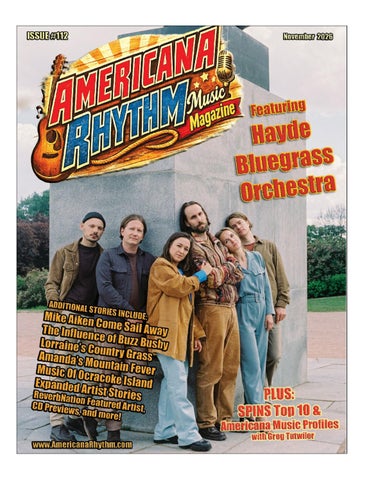
Issue 112
Ever wonder, Why do I do the things you do? Act the way I act? Ever said;
Who Am I?
Get your Personality Profile report and find out. Scan the QR Code here
TEXT 540.746.0360 Americana Rhythm is published six times a year. All correspondence should be sent to PO Box 45, Bridgewater VA, 22812 or CONTRIBUTORS email to greg@americanarhythm.com. Copies of Americana Ed Tutwiler Rhythm are made available free at various pick up locations within Wayne Erbsen the publication’s region. Subscriptions are available inside the United Donna Ulisse States (only) for $24 US currency made payable by check or Mike Aiken money order sent to, Subscriptions at PO Box 45, Bridgewater, Andrew McKnight VA, 22812. Foreign subscription requests should be sent to Dan Walsh greg@americanarhythm.com. Copyright 2022. All rights reRebecca Frazier served. Reproduction of any content, artwork or photographs DISTRIBUTION is strictly prohibited without permission of the publisher or origi- North River Publishing Integrated Music Media nal owner. All advertising material subject to approval. PUBLISHER/EDITOR IN CHIEF Greg E. Tutwiler Associate Editor Ed Tutwiler MARKETING & PROMOTION Mark Barreres (GrassRootsNetworking.com) Letters, Comm ents, Suggestions ADVERTISING greg@americanarhythm.com Business office 540-433-0360 advertising@americanarhythm.com www.americanarhythm. com
2
www.AmericanaRhythm.com
Issue 112
www.AmericanaRhythm.com
3
Issue 112
4
www.AmericanaRhythm.com
Issue 112
The Bluegrass Influencer By Edward Tutwiler
As we ponder this genre of music that many now label bluegrass, we lull ours elves into thinking that it is of Appalachian origin rooted in the V irginia, North Carolina, Tennes s ee, and Kentucky hills. While this is not in error, it is only true of its earliest renditions we now call old-time string music. Not until Monroe, the S tanley brothers, and many others changed the tempo and added some ins trument variations did it later become known as bluegras s style mus ic. However, while still known as country or hillbilly music in the 1940s and early 1950s , this country music moved to town. Country music’s media presence first appeared in Washington DC in the mid1920’s with the arrival of a s tring-mu s ic band from southwest Virginia by the name of Hillbillies. This group appeared on radio station WRC to great local response. Also, Jimmie Rogers, (often known as the Father of country music), was also based in D.C. at the time and appeared on WTFF in 1923. Throughout the 1930s, other area radio stations als o broadcas t country mus ic s hows . Neverth eles s , the war years and pos t war boom lured many folks from the rural, Appalachian south into the Washington DC and Baltimore metropolitan areas for jobs and opportunities. With thes e folks came their rural and country cultural traditions one of which was a love of country/hillbilly music. Thus this metropolitan area became saturated with bars, other venues, and radio s tations that featured this genre of musical entertainment. Musicians of ever skill level found side jobs playing the mus ic their peers craved to hear. Into this s wirling mus ic al mix came a young boy from Louisiana by the name of Bernarr Graham Busbice who could pick a mean mandolin and s ing in a high tenor voice. Bernarr Busbice became known professionally as Buzz Busby and that is where our story begins.
Credit To The Source Americana Rhythm magazine has maintained a relationship over the years with the folks at the Univers ity of Illinois Pres s. Whenever they publish a book whos e editorial content seems to dovetail with that of this magazine, we take notice. Recently, they s ent us a review copy of a b iography of a bluegras s entertainer by the name of Buzz Bus by (aka Bernarr Graham Busbice) It is a current release from their pres s with a 1926 copyright. It is written by Kip Lornell, a mus ic ia n with a long his tory with Bus by, and Tom Mindte, a res p ected mus ica l researcher and prolific writer about mus ical s ubj ects . Togeth er Lornel l and Mindte have painted a true and unvarnished story about an intelligent, talented, but troubled and flawed s oul who eventually became known as the Father of DC Bluegrass. Near the end of his professional career, Buzz Bus by recorded more that 60 hour-long cas sette tapes containin g his autobiographical anthology that he hoped would some day be the bas is of his biography. He entrusted Kip Lornell to be the keeper of these tapes. Subsequently, Lornell and Mindte did exactly that. The information on these tapes and information gleaned from research with Busby’s peers form the basis for this biography. While we reviewed this well written and in-
teres ting book for it’s literary merit, the Busby story kept coming to the forefront.
Saturday Night Influence Buzz Busby was born near Eros, Louis iana in 1933. He was the eighth of nine children born to a local cotton farmer/politician and his school teaching wife. While the family was certainly not rich, they lived comfortably enough for the area. As was typical with many rural families in the s outh, the
experience with the mandolin came when his neighbor, Allen Crowell, brought his mandolin to the Bus bice home to play. Greatly influenced by lis tening to Bill Monroe’s mandolin playing, Buzz would eventually settle on the mandolin as his instrument of choice and eventually developed the complex style he became noted for having.
Starting Early In the late 1940s, Busby started a band with high school friend and guitarist Rot Fuller and honed his mandolin and vocal skills by performing the mus ic of Bill Monroe around the area. (Unfortunately, this was also the era when Buzz first got the taste for alcohol, and his association of it and mus ic never wavered.) Buzz was a good student throughout high school and graduated in 1951as valedictorian of his class. The FBI was seeking gifted young people at that time and recruited Buzz to move to D.C. to begin a career with the FBI.
Busbice’s spent their Saturday nights listening to WSM’s Grand Ole Opry. A few of Buzz’s older brothers were musically inclined and performed locally from time to time for dances with other local musicians. (The most notable brother was Wayne Busbice who was destined to be Buzz’s stalwart supporter throughout his life.) It was not long before Buzz was recruited by his brothers to join them. Buzz picked up the guitar first, learning chords and simple runs from brothers , Wayne and Lemoyne. (These brothers were playing guitar-fiddle duets and singing Monroe Brothers harmonies around their community at the time.) Reportedly, Buzz’s first
www.AmericanaRhythm.com
Buzz relocated to Washington in August of 1951 at the age of 17 to begin work with the FBI. He also enrolled at George Was hington University, and eagerly started his new life in the big city. S hortly thereafter while still working his day j ob at the FBI, Bus by met S cotty S tonem an who was a member of the famous Stoneman family. S cotty was a talented fiddle player, and he and Buzz started a friendship that would last until Stoneman’s passing in 1973. Unfortunately, S toneman had the same addictive tastes that bedeviled Busby and alcohol and later pills would co-mingle with their musical greatness. S toneman introduced Buzz to Jack Clement (later to become a successful Nashville country music promoter). These three, along with several others , formed the Tennessee Troupers . (Roy Clark also joined the group for a while playing banj o. ) The Troupers stayed bus y playing locally four and five nights a week during 1951 and 52. Further, they did Continued on page 6
5
Issue112
Busby continued from page 5 s tints at WWVA in Wheeling, WVA and WCOP in Boston after which Clement returned home to Tennessee. By 1953, Buzz had given up on collage and quit the FBI j ob. He endeavored to play mus ic full time. Along the way he had gotten married and fathered two children. Buzz picked up a manager and a new musical partner, Pete Pike. They started a regular gig at the Pine Tavern and a regular radio gig in Maryland. It was at this point that, Buzz’s backing group became known as the Bayou Boys. Over the years, a revolving group of talented and later some famous pickers passed through this group.
And The Winner Is In the summer of 1954, Bus by, Pike and the band entered and won the National Country Music Championship. Shortly after the contest, WRC-TV in Was hington hired the band for a daily afternoon televis ion show. The show was very popular and featured bluegras s cent ric mus ic and newly developed video s pecial effects. The program aired from September 1954 to March 1955 until changes in corporate NBC management forced it off the air. When the television s how was cancelled, Busby auditioned for and was hired by the Louisiana Hayride at KWKH in Shreveport, Louisiana. His Bayou Boys featured Charlie Waller on guitar along with other talented players. The group performed every S aturday night on the Hayride and toured the S ou th during the week. As an as ide, Elvis Presley was also a member of the Hayride troupe at the s ame time. Busby and the Bayou Boys performed on the Hayride until May 1956. Busby, Waller and banjoist Vance Trull returned to Washington where they played club dates until July 1957.
6
ciates came by to visit often. Buzz died there on January 5, 2003.
Hampered By The Bottle More and more Buzz’s alcohol addiction became a serious road-block. On July 4, 1957, Busby, Trull and Eddie Adcock were involved in a serious automobile accident. Busby’s subsequent hospitalization left him and Trull unable to perform for an extended period. In order to fill scheduled club dates, Charlie Waller recruited John Duffey and Bill Emerson to join him. This band became the original Country Gentlemen. After he healed from the accident, Buzz continued to play locally in the Washington/Baltimore area. During this era, Bus by released Talking Banjo in 1958. This releas e marked the beginning of a flood of record releases from the D.C. based bluegrass artists many of whom counted Buzz Busby as an influence. Busby attempted to break into the Nas hville s cene during this period of his life but each attempt was marked by failure—often self-induced by addiction. He also did a very short stint with Jimmy Martin that did not work out.
in the fall of 1997 placed him in a nursing home. His health continued to decline although old asso-
During his declining years , Buzz Busby formed partners hips of varying length s with s everal known members of the bluegrass community including his brother Wayne Bus bice , and Dudley Connell of Joh ns on Mountain Boys and S eldom S cene fame. Busby and the Bayou Boys continued to play in and around the D.C. area until the early 1990s but by then Buzz’s health had become a hindrance. Needless to say, Busby’s entire later career was marred by alc ohol and drug abuse and estrangement from his wife and children. Lornell and Mindte tell us that Buzz Busby spent his final years in a cheap set of rooms until Parkinson’s disease
www.AmericanaRhythm.com
Buzz Busby is now remembered as the maj or influencer on and for the acceptance of the bluegrass genre of music in the Washington D.C. area. In s o doing, he became a major influence on the musical careers of folks s uch as Dudley Connell, Cha rlie Waller, John Duffe y and many more. His unrelenting mandolin playi ng and high lonesome vocal delivery certainly earned him the title: Father of Washington D.C. bluegrass music. If you are a fan of bluegrass music and especially the second wave of this genre that had its origins in the D.C. bars and clubs, you own yourself the pleas ure of reading this whole book as we have only s craped the s urface here. Find your copy on-line at many book retailer sites.
Over 400 Interviews
Issue 112
www.AmericanaRhythm.com
7
Issue112
FEATURE Lorraine Jordan & Country Grass ARTIST THIS MONTH’S FEATURE:
T here is som ething special that happens when a familiar country song is handed to a grou p of bluegrass musicians. The melody may remain recognizable, but suddenly the banjo has something to say, the m andolin adds another layer of u rgency, the fiddle changes the emotional landscape, and familiar lyrics take on a new character.
The Natural Choice “I have always loved John Conlee songs,” she explains. “‘Friday Night Blues’ is the perfect song to be a Cou ntry Grass song. It fits with Blu egrass instru m entation and harmonies.” That connection has already been tested on the road. Jordan says the song has becom e a favorite with au diences at Cou ntry Grass perform ances, where its familiar country roots meet the energy and instrumentation of bluegrass. At the center of the recording is Allen Dyer, who provides lead vocals and guitar. He is joined by Jordan on bass and lead and harmony vocals, Kent Dixon on mandolin and vocals, Garrett Newton on banjo and lead vocals, Tim Tew on guitar, dobro and harm ony vocals, Matt Hooper on fiddle, and Du ncan Stitt on dobro.
8
The Next Chapter The forthcoming Country Grass II continues that journey. The project expands u pon the original concept while introducing another collection of guest artists, including T. Graham Brown, Eddy Raven, Michael Martin Murphey and T.G. Sheppard, along with a special collaboration with North Carolina favorites T he Malpass Brothers. The new album is also a reflection of how far the Cou ntry Grass concept has tra veled since its beginnings. It is no longer simply a clever combination of two musical styles. It has become a recognizable sound and a touring identity with audiences of its own.
That is the idea behind Cou ntry Grass, the musical vision of Lorraine Jordan—and it is once again on display with the release of the group’s latest single, “Friday Night Blues.” The song, originally recorded by country hitmaker John Conlee in 1980, has been given a fresh bluegrass treatm ent by Lorraine Jordan & Country Grass. T he track is the latest preview of the forthcoming Country Grass II album, schedu led for r elease throu gh Pinecastle Records.
Country Grass simply brings those elements together in a different way.
The result is not an attempt to simply reproduce Conlee’s original. Instead, “Friday Night Blu es” becom es another example of what Country Grass has been doing from the beginning: taking songs deeply embedded in the American country m u sic traditio n and allowing blu egrass mu sicians to discover what else those songs can become.
Concept Became A Band The Country Grass story began with an idea that, on paper, seems simple: bring classic country songs together with au thent ic blu egrass instrumentation and harmony. The original Country Grass project, released throu gh Pinecastle Records, brought together Jordan and Carolina Road with an extraordinary collection of country artists. Among them were Crystal Gayle, Lee Greenwood, Jim Ed Brown, Lynn A nderson, T he Kentu cky Head hu nters, T .G. Sheppard, Edd y Raven, John Anderson, Jesse Keith Whitley, Marty Raybon and Ronnie Reno.
Songs that country audiences already knew—including “Rose Garden,” “Dixie Road,” “Diggin’ Up Bones,” “Common Man,” “Don’t Close Your Eyes” and “I’ve Got Mexico”—were given new arrangements built around the drive, instrumentation and vocal harmonies of bluegrass. The concept proved to be more than an interesting recording experiment. Audiences responded. What began as a recording project eventually developed into a live m u sical experience, and by 2024, Country Grass had become an independent tou ring entity in its own right, separate from Jordan’s long-running work with Carolina Road. That evolution says something about the enduring relationship between cou ntry and bluegrass. The two genres have never been as far apart as their separa te labels m ight suggest. Both grew from the same Am erican mu sical soil, and both place enorm ou s im portance on storytelling, musicianship and the em otional connection between performer and audience.
www.AmericanaRhythm.com
The band’s live schedule reflects that growth, with p erform ances at festivals and performing arts centers around the country. Country Grass has also appeared as the backing band for Larry Cordle, performing songs including “Murder on Music Row” and “Highway 40 Blues.” For audiences, the appeal is easy to understand. A familiar country song provides the doorway, while the bluegrass arrangement gives listeners something unexpected on the other side.
Force Behind The Sound At the center of it all is Lorraine Jordan. With 25 years of professional tou ring behind her, Jordan has established herself as a musician, bandleader, arranger and creative force within bluegrass. As the longtime leader of the awardwinning Caroli na Road and a Pinecastle Records recording artist, she has spent decades working within the traditions of the music. But tradition, for Jordan, does not appear to m ean standing still. Country Grass has becom e one of the clearest e xam ples of her willingness to explore what happens when traditional bluegrass musicians continued on page 9
Issue111 Issue112
www.AmericanaRhythm.com
9
Issue112
Country Grass continued from page 9 step ou tside the expected boundaries while remaining firmly connected to the music’s acoustic foundation. Jordan’s m usical story began in Eastern North Carolina, where she grew up near the Vanceboro and Atlantic Beach area. She started playing bass at an early age and eventually developed experience across multiple musical genres. T hat background is particu larly important to the Cou ntry Grass sound. Her bass playing has a distinctive forward-m oving quality that helps give the arrangements their bluegrass pulse. At the same time, her lower vocal range allows her to approach classic country material from a different perspective, including her interpretation of Anne Mu rray’s “Snowbird.”
10
On stage, Jordan also serves as the connective tiss u e between the mu sicians and the au dience. Her musicianship, vocals and emcee presence help tu rn Cou ntry Grass from a collection of accomplished players into a cohesive live experience.
For longtim e country fans, these songs provide a connection to another era. For blu egrass
With “Friday Night Blues,” Lorraine Jordan & Cou ntry Grass add another piece to that ongoing musical conversation. And with Cou ntry Grass II on the horizon, the story appears far from finished.
Perhaps the most interesting thing about Country Grass is that the project do esn’t requ ire listeners to choose between country and bluegrass. Instead, it as ks a different question: What happens when the two traditions are allowed to speak to each other?
There is nostalgia in the m usic, but there is also discovery.
That may ultimately be the m ost im port ant part of Lorraine Jordan’s vision. Country Grass isn’t simply revisiting yesterday’s music. It is finding new ways to keep those songs m oving forward.
Two Traditions, One Sound
The answer can be heard in the banjo rolls, fiddle lines, mandolin chop and close vocal harmonies surrounding songs that many listeners already know by heart.
an introduction to the musical history behind them.
audiences, the arrangements offer a new way to experience fam iliar material. And for younger listeners who may encounter some of these songs for the first time through Country Grass, the project becomes
www.AmericanaRhythm.com
Find out more about Lorraine’s Country Grass and her Bluegrass band, Carolina Road at www.carolinaroadband.com
Issue112
Mountain Fever Records: A New Chapter in the Virginia Mountains For nearly two decades, Mountain Fever Records has quietly built one of the mor e recognizable identities in contemporary bluegras s. Born in the V irginia mountains and grounded in a commitment to mus icians and the mus ic its elf, the label has become ass ociated with quality recordings, distinctive artists and a s ound that has earned recognition t hroughout the bluegras s community. Now, Mountain Fever is entering a new era. In Augus t 2025, founder Mark Hodges stepped away from day-to-day ownership and leaders hip , turning the company over to bluegras s artist and longtime Mountain Fever team member Amanda Cook. For Cook, the transition represents far more than a change in management. It is the continuation of s omething she admired long b efore s he ever became part of it.
Home Studio To Record Label The Mountain Fever story began with Hodges’ interes t in recording. What started as a modes t home-studio operation grew as musicians and local bands discovered the quality of the recordings being produced there. The equipment expanded, the projects became more ambitious, and eventually Hodges built a dedicated recording facility on his Virginia property.
ings that began attracting attention well beyond Virginia.
of all these artists that I really admired.”
other s tep in an unexpected career progress ion.
As the roster expanded, s o did the label’s reputation. Artists such as Volume Five, The Spinney Brothers and Nothin’ Fancy became important parts of the Mountain Fever identity. Over time, the roster grew to include artists and groups such as Junior S i s k, Alan Bibey & Grass towne, Justin Mos es, Mas on V ia, Breaking Gras s and East Nash Grass.
She also had a particular musical hero within the Mountain Fever family. “I knew Aaron Rams ey. He was a huge hero of mine as a
Hodges eventually placed radio promotion and artis t communication under Cook’s responsibilities. She became involved in getting music to broadcasters and maintaining r elations hips throughout the industry. That role expanded into production oversight and, ultimately, the position of Chief Operations Officer. By then, Cook had acquired an unus ually broad understanding of the company—from the artist’s perspective to recording, production, radio and daily operations.
The label’s catalog would eventually encompas s tr aditional bluegras s, contemporary and progres s ive approache s , gos pel and Americana-influenced roo ts mus ic. Along the way, Mountain Fever releas es earned numerous indus try ho nors and chart s uccesses , helping establish the company as a significant independent presence in bluegrass. The organization als o expanded beyond its original label operation, creating Mountain Fever Mus ic Publishing and, in 2019, launching Morning Glory Mus ic as a sister label devoted to gospel music.
Had Her Eye On It
Mountain Fever Studios opened in 2002, providing a professional recording envi ronment in the mids t of the Appalachian landscape. The combination of carefully des igned acous tics , advanced recording capabilities and the is olation of the mountains gave mus icians a place where the focus could remain on making music.
Long before Amanda became the person res ponsible for guiding the company, she was watching it from the perspective of an aspiring bluegras s musician. She grew up playing music with her father’s band and was already familiar with the Mountain Fever roster. The artists associated with the label represented the kind of musicianship she admired.
Several years later, Mountain Fever Records emerged from that environment. In its early days , the label worked with Southern Gospel and regional bluegrass artists, eventually producing record-
“Even when I s tarted playing bluegras s, with my dad’s band, I knew about Mo untain Fever bands,” Cook recalled. “Junior Sisk, Volume Five, Jason—I knew
Change At The Top
mandolin player,” she said. By the time Cook began developing her own band, she already had a clear idea of where she hoped the journey would lead. “When I started my own band, I had my eye on Mountain Fever from the very beginning, j us t becaus e of the quality.” That admiration eventually became a working relations hip. Cook joined the Mountain Fever roster as an artist in 2016. Three years later, she moved to Virginia and began working in the studio as a sound engineer and producer. Her role continued to expand, particularly during the disruption caused by the COVID-19 pandemic. “When COV ID happened, we couldn’t run the studio,” Cook s aid. “S o Mark, thankfully, allowed me to come in and work office work s o I could have groceries.” What might have been a temporary solution became an-
www.AmericanaRhythm.com
When Hodges b egan talking about retirement in early 2025, Cook initially didn’t take the idea seriously. “He had kind of started joking about he was wanting to retire,” she said. “But I thought he was just … you know, if you know Mark, to know him is to love him, and to know that he talks a lot of s mack.” Then the conversation became real. “Then literally in the beginning of July, he s aid, ‘Here’s the paperwork, let’s see if you can agree.’ And I did.” Hodges remained available in an advis ory role during the trans ition, but Cook was now responsible for the future of the company he had built. Even after officially stepping away, however, Hodges hasn’t disappeared from the picture. “I talk to him at least two or three times a week,” Cook said. “I’ve always called him the godfather of bluegrass.” There is an obvious affection in the way Cook talks about her predecessor. She describes Mountain Fever as his “baby” and continues to s eek his perspective when questions arise. “He’s 100% in to help me do anything to accomplish the goals that I set for the company,” she said.
continued on page 12
11
Issue 112
Mountain Fever Continued from page 11
That Mountain Fever Sound For Cook, taking Mountain Fever forward doesn’t mean abandoning what made the label successful. One of the challenges is preserving an identity that isn’t easily reduced to a particular tempo, ins trumentation or production formula. She describes it as the “Mountain Fever sound.” Part of it comes from the technical side of production—how recordings are mixed and mastered. But she believes the artists themselves are equally important. “The creative answer would be in the bands that we look for, that I look to add to the label,” she explained. “They’re very unique, and I think that’s the easiest explanation.” That individuality is intentional. Rather than assembling a roster of artis ts who all sound alike,
12
Cook s ays the l abel looks for musicians with their own mus ical personalities. “Each artist on this roster, if you look down this very long roster of artists that I have; every single one of them are very unique, and they have a very distinct sound in their own song selections.” For Cook, that combination—individual artists with strong identities , coupled with cons is tent production standards—is what ultimately creates the Mountain Fever identity. It is a philos ophy that also offers a glimps e into where the label may be headed under her leaders hip.
Still Making Music Even as Cook takes on the responsibility of running a record company, she has not abandoned her own career as a performer. In 2026, she has been touring in support of her seventh album, Love Through Time. The unus ual part of the process is that audiences have already heard much of the material during her live perfor-
mances while the complete album has remained under wraps. “It’s been almost a full year by the time it drops,” Cook said. A good portion of the record has already been introduced onstage, but she
says several songs are still being held back. “There’s still five or six tunes that are s till being held back,” she s aid. “So we’re still half—we still have more secrets to reveal.” That comment perhaps captures s omething larger about Cook’s new role at Mountain Fever. She is simultaneously an artist, producer, engineer, executive and now the s teward of a company with nearly two decades of history behind it.
www.AmericanaRhythm.com
Mountain Feve r Records was built in the Virginia mountains by an owner who believed that great music deserved a great place to be made. Under Amanda Cook, that story is continuing—but with a new voice at the helm. The cha llenge ahead is not simply to p res erve the Mountain Fever legacy. It is to understand what made that legacy meanin gful, carry those principles f orward, and give a new generation of artists room to create something distinctly their own. For Cook, the journey from admirer to artist, from artist to engineer, and from engineer to the leader of Mountain Fever has been anything but conventional. But perhaps that is fitting for a label whose identity has always been rooted in the belief that distinctive music—and the people who make it—are worth listening to.
Issue 112
Bluegrass Festival Begins a New Chapter For more than two decades, the Nothin’ Fancy Bluegra ss Festiva l h as been a September tradition in Buena Vista, Virginia, bringing together bluegrass musicians, devoted fans and campers from across the country and beyond. That chapter is now coming to a close. Fes tival organizers have announced that the event will move t o the Page County Fair grounds in Luray beginning in 2027. The festival has been held at Buena Vista’s Glen Maury Park s ince 2001, following its inaugural year at Virginia Military Institute’s Cameron Hall in 2000.
a nationally recognized bluegrass group with longstanding connections to Buena Vista and the surrounding Rockbridge area. The first festival took place in 2000 at VMI’s Cameron Hall, with legendary performer Ricky Skaggs among the featured attractions. The following year, the event moved outdoors to Glen Maury Park, where it establis hed a home that would last for more than 20 years . Over the years, the festival s tage has welcomed major names in bluegras s , i ncluding Rhonda Vincent and the Rage and Russell
Moore and IIIrd Tyme Out. The late Morris O’Shields, a Rockbridge-area resident and bus iness man, was also instrumental in helping organize and promote the festival during its early years. Aside from a temporary interruption during the COV ID-19 pandemic, the festival has returned to Buena Vista annually since its move to Glen Maury Park. And its audience has continued to expand. Wines s aid festivalgoers have traveled from 17 states, as well as Canada, France and New Zealand, demonstrating the reach that a regional bluegrass festival has developed over the years.
More Than Music The festival’s influence has extended well beyond the park itself. Visitors eat at local restaurants, shop in area busines ses and spend money on lodging, supplies and other necessities during their stay. The economic conneccontinued on page 22
According to festival coordinator and business manager Robyn Wines, the move is primarily about finding the physical space necessary for the festival to continue growing. “We’ve been here for 26 years, and it’s been great, but we’ve outgrown [Glen Maury Park],” Wines said. “The challenges are the space and parking – our ability to grow. The biggest thing is we’ve outgrown this venue.”
Growing Beyond the Venue
The festival’s increasing popularity has created logistical challenges at Glen Maury Park, particularly when it comes to camping and parking. This year, those challenges were more visible than usual. A softball field that has traditionally provided additional camping s pace was unavailable, reducing the number of sites available to festivalgoers. The festival also faced an unusual scheduling situation. In previous years, the Nothin’ Fancy event has had a weekend between it and the Rockbridge Mountain Music and Dance Festival, giving organizers additional time to prepare the grounds. This year, however, the Labor Day calendar left no s uch gap. When Nothin’ Fancy organizers arrived to begin their setup, portions of the previous festival were still being dismantled. While thos e circums tances cr eated s ome difficult ies , Wines stressed that they were not the reason the decision to leave Buena Vista was made. Fes tival organizers had already been exploring other locations, she said, and Page County officials had begun working with them well before this year’s event. “We were already pursuing another venue,” Wines said, noting that Page County representatives were “actively engaging us.” The 2027 festival will therefore represent a new beginning rather than simply a response to this year’s logistical challenges.
A Festival With Deep Roots The Nothin’ Fancy fes tival grew out of the popularity of the band for which it is named,
www.AmericanaRhythm.com
13
Issue 112
Haydes’ Nordicana There is s omething wonderfully unexpected a bout hearing bluegras s mus ic come from Norway.
filmed and posted online. What happened next was s omething none of them could have anticipated.
For Hayde Bluegrass Orchestra, however, the unlikely pairing of Norwegian mus icians and an American-roo ted mus ical tradition has become much more than a novelty. The seven-piece ens emble from Os lo has s pent more than a decade developing its own interpretation of bluegrass, Americana and Nordic folk
The video went viral, eventually attracting millions of views. “We mus t have had some kind of a belief that s o mething would happen,” band member S j ur Marqvards en recalled during a recent conversation. “Right after we met, we saw this movie about bluegrass, and then we thought,
music—an approach the band has come to call “Nordicana.” And now, after years of building an audience from thousands of miles away, Hayde is bringing that sound back to the country that helped inspire it.
okay, let’s do this . No one knew anything about it.”
The band’s story began almost by accident. S hortly after Hayde came together, the mus icians watched a film about bluegrass and became in trigued by a musical world that, for most of them, was largely unfamiliar. Some had heard a bluegrass song or two. One member was clas s ically tr ained. Another jokingly recalled as king whether there was s he et mus ic for bluegrass.
Wayfaring Stranger They found no s heet mus ic. Instead, they were told to listen to the soundtrack. That s imple introduction set the group on a remarkable pa th. Not long afterward, fiddler Moa Meinich invited the newly formed band to record the tra ditional s ong “Wayfaring Stranger” in her Oslo apartment. The performance was
14
www.AmericanaRhythm.com
The apartment recording became the beginning of something much larger. It led to a YouTube channel now featuring hundreds of live performances and more than 68,000 s ubs cribers, along with a substantial social-media audience. But the viral video was only the s park. Turning that moment into a sustainable career would require years of work.
Coming To America “We spent the next 10 years trying to build an American audience before our firs t ever American tour,” Marqvards en s aid. “S o now, when we did tour las t November, a lot of people showed up, traveling from all across the country. Our 10 years of building an audience has paid off.” That patience is an important part of the Hayde story. Unlike many American bluegrass bands, Hayde did not emerge from a longes tablis hed lo cal bluegras s continued on page 17
Issue 112
www.AmericanaRhythm.com
15
Issue 112
16
www.AmericanaRhythm.com
Nordicana continued from page 15 community. Norway has a popu lation of roughly five million people, and Marqvardsen estimates there may be only a handful of banjo players and perhaps around ten bluegras s bands in the country. “We’re 5 million people in Norway; that’s like a small state in the US,” he explained. “And I think there would be like 10 bluegrass bands here in Norway, and maybe les s than five banjo players.” That lack of a traditional bluegras s infrastructure might seem like a disadvantage. For Hayde, it has ultimately become part of the band’s identity. “We have coined this term, Nordicana, which is inspired by Nordic folk mus ic,” Ma rqvards en s aid. Ra ther than attempting to reproduce American bluegrass exactly, Hayde has increasingly embraced the differenc es between where the mus ic originated and where the band comes from.
Issue 112
debut album, Migrants, reached No. 4 on Billboard’s Bluegras s Albums chart and remained there for 11 consecutive weeks. The album was als o nominated for Norway’s Spellemannprisen, the Norwegian equivalent of the G rammy Awards . T he group s ubs equently received IBMA Momentum Awards nominations for Band of the Year in both 2022 and 2023, while Rebekka Nils son won the 2022 IBMA Momentum Award for Vocalist of the Year. The band’s American presence has continued to grow, including multiple appearances at MerleFest, where three packed performances drew a combined audience of more than 5,500 people, along with appearances and headline performances at maj or bluegrass festivals. For a band that once recorded in a living room in Oslo, the progres sion is remarkable. Yet Hayde’s members still maintain lives outside the band. Some are full-time musicians, while
others balance Hayde with teaching, theater and other profes s ional com mitments . Marqvards en des cribed the past year as a turning point. “It’s only j ust less than a year s ince we kind of unders tood that this can become something more than just a hobby,” he said. “It’s starting to click.”
Expanding Tour The band’s expanding touring schedule may be one of the clearest signs of that change. With the release of a new self-titled album, HAYDE, planned t hrough U.S . label Adhyaropa Records , t he group is prepar ing for an increasingly international schedule spanning the United S tates , United Ki ngdom and Norway. The musicians are even cons idering whether a more permanent presence in America might make sense. “We have asked ourselves if we could move here, s tarting within a year,” continued on page 18
“In the beginning we were afraid that we made a lot of mistakes and we didn’t know how it was,” he s aid. “But now it’s more like those mistakes are kind of our interpretation of the genre, and we’re leaning more into not trying to be American bluegrass, but leaning into just what we do.” That may be the most interesting thing about Hayde. The band is n’t trying to convince listeners that Norway has suddenly become Appalachia. Instead, its members are taking a mus ical language they discovered through American culture and allowing it to develop naturally through their own experiences and traditions. There is als o a historical connection between Norway and the United States that makes the relations hip less s urpris ing than it might initially appear. Large numbers of Norwegians emigrated to America during the 18th and 19th centuries , and that heritage remains deeply embedded in Norwegian culture. “Of course, a long time ago, half of the Norwegian population left for America,” Marqvardsen said. “So that heritage is still very strong. The music they brought over to the States is still very strong in Norway, and in a part of us.” American culture has also maintained a strong pres ence in Norway for generations . More recently, Hayde has noticed growing interest among you nger Norwegian lis teners in acoustic mus ic. “We don’t have a lot of the young audience yet,” Marqvardsen admitted, “but I think we will very soon be there. It’s s omething in the air. People are paying attention.”
Grammy Equivalent That attention has already translated into an impressive international career. Hayde’s 2021 www.AmericanaRhythm.com
17
Issue 112
Nordicana continued from page 17 Marqvards en s aid. For now, the plan is to continue moving between continents, with extended touring periods and larger festivals and venues.
Erin Lunsford Erin Lunsford had just begun to get her musical career, complete with a successful debut album. Enter the pandemic and, like many musicians, Erin’s career came to a grinding halt. Time away from the daily music along with life itself gave her a plethora of material to draw on for her next and latest project, Rhinestones. Erin now makes her home base in Richmond, Virginia, not far from her Appalachian roots where she grew up in Fincastle, VA. The University of Virginia grad moved to Richmond, VA six years ago. Her family still lives there, where her mom is a flat picking guitari st, her PaPa and an uncle play banjo, and another plays guitar – “So we did a lot of jamming and picking on fiddle tunes growing up,” s he recalled. “I went to fiddle conventions all the time, and feel really lucky that I got brought up in that kind of communal music.” Erin started playing guitar when she was 11, and said, “It’s really unlocked songwriting for me, and then I picked up the banjo at the end of high school.” But the band scene was not for her, she recalled. “I was kind of rebellious about my bluegrass at the time. My mom was in bands, and I went with her to festivals and conventions, but I was kind of a stick in the mud about it – but now looking back I guess I kind of regret not taking it more seriously – but it was just a part of me growing up at the time,” she recalled. However, Erin and her mom did play together publicly as a duo, playing jazz, gypsy jazz, pop, rock – “all kinds of music, depending on the setting,” she said. “I fell in love with performing and harmonizing with her, and when I went to college I started writing more of my own music, and eventually formed a band – that’s when it really took off and became so important to me.” To find out more, visit www.erinlunsford.com
18
American Blond American Blond is the next level effort from sisters, Nata and Tinka Morris (Natalia and Christina), who along with their sister Hannah, enjoyed some success as the teenage sister act, Southern Halo. After high school, the sisters did some personal soul searching about their future. Hannah had other artistic aspirations, while the two elder sisters desired to continue on in music. So they moved to Nashville – with the result being a Roots, blues, southern-rock vibe – already making headway in the Americana music scene. Delta Home is the latest offering from American Blond, and a pretty dramatic shift from their original pop/country platform. As young girls, they grew up in the Mississippi Delta, and were influenced by the music and culture of that part of the country. Unlike a lot of musicians, Nata shared that their parents actually never played an instrument. “They did have a very strong love for music however, and we grew up listening to all the classics on this really cool turntable in our kitchen,” she recalled. “Even in our diaper days, we would dance around to records by groups like the Mamas and the Papa’s, and the Beach Boys. Growing up in the Mississippi Delta, there was always music, everywhere, on every corner it felt like. That really inspired my sisters and I from the beginning.” Nata said the girls more fell into the band thing that actually planning it out intentionally. Their “little band,” Southern Halo, caught attention early, and led them to performances on national TV, major festivals here and abroad, and several top-25 tracks on the Music Row Country Break-Out Chart, before winding down the band after graduating high school. “At the time, I guess we really didn’t understand how well received we had been,” Nata recalled. But the love of performing was enough to inspire her and sister Tinka to want to chase the dream as far as it will let them. Delta Home is a straight driving Americana rock set of tracks that put American Blond right in the thick of this new surge of southern tinged, red dirt American rock music.
To find out more, visit www.americanblondmusic.com
www.AmericanaRhythm.com
And musically, the band isn’t interes ted in standing still. Hayde continues to explore the possibilities within bluegrass and Americana, drawing inspiration from artists who have expanded t he traditional bou ndaries of acous tic mus ic. The Punch Brothers , for example, have encouraged the band to think beyond conventional expectations, while an experience at MerleFes t watching Alis on Kraus s pe rform acapella mus ic left a particularly strong impression. “When we were at MerleFest, and we saw Alis on Kraus s, and they did these acapella numbers , we were all crying,” Marqvardsen recalled. “And thinking, we have to do an acapella song too.” That willingnes s to listen, learn and experiment may ultimately be what allows Hayde to continue growing without los ing the qualities that made the band distinctive in the first place. “We’re always learning something new,” Marqvardsen said. “We are getting to listen to so many different bands in this mus ic, when we’re around playing at fes tivals , and ther e’s always something new and interesting to us.” For Hayde, bluegrass isn’t a museum piece. It is a living musical tradition—one with enough his tory to provide a foundation and enough flexibility to allow musicians from another country to make it their own . That may explain why American audie nces have responded so warmly. “It’s amazing to hear what our mus ic has meant to a lot of people,” Marqvardsen said. Fans often tell the band they first discovered Hayde through YouTube or social media. Some are s urprised to learn that the musicians are Norwegian. “Your lead singer sounds just like an American,” they tell them. Then, perhaps unexpectedly, the next video appears—and the same musicians who just sang an American-rooted song are suddenly speaking Norwegian. That contrast captures something ess ential about Hayde Bluegrass Orches tra . They may have dis covered bluegrass through America, but they are no longer simply playing American bluegras s. They are taking the s ounds , traditions and influences that traveled across the Atlantic generations ago, adding their own Nordic musical heritage, and sending something new back in the other direction. For a ban d born from a few mus icians experimenting in Oslo’s apartment, it has become quite a journey. And if Hayde’s history is any indication, the journey is far from over.
Issue 112
www.AmericanaRhythm.com
19
Issue 112
Artist of the Year Molly Tuttle
Emerging Act of the Year Ken Pomeroy
Instrumentalist of the Year Mandy Fer
Lifetime Achievement Honorees
Fou nded in Nashville, Tennessee, the Americana Music Association, serves as a vital backbone of contemporary American roots music. As a professional non-profit trade organization, its mission is to advocate for, promote, and expand the global reach of a unique musical genre that traditional charts often overlook; Americana (Roots). The association defines Americana as a vibrant blend of diverse American musical heritage, weaving together elements of country, folk, bluegrass, blu es, R&B, and rootsrock. By uniting these sounds, the
20
Dolly Parton Robert Plant Tom Petty & The Heartbreakers
organization provides a dedicated hom e for artists who defy strict genre boundaries. Every September, the AMA holds it’s conference, exhibition, and awards show in Nashville, TN. This past September marked the 25 th edition of the annual event, held at the Rym an auditoriu m. Taking home nods this year:
Album of the Year “Snipe Hunter,” by Tyler Childers
Song of the Year “Returning to Myself” by Brandi Carlile (written by Brandi Carlile)
Duo/Group of the Year Gillian Welch & David Rawlings
www.AmericanaRhythm.com
In a recorded message prior to her passing, Dolly commented, “Roots music, or what is now called Americana music, is what I grew up playing back in the Smoky Mountains. It’s that same music that drew me back to East T ennessee in 1997 to write and record my album Hungry Again. And that project really opened the door to a series of bluegrass and acoustic albums that changed the cou rse of m y career in so m any ways.”
Issue 112
Hello from our fifth annual Friends and Fans Cruise aboard the Schooner, Grace Bailey, Penobscot Bay, Maine. After receiving the gentle reminder from our esteemed editor here at Americana Rhythm, reminding me of the approaching deadline, I was immediately inspired. As I write, this is the last full day of the cruise, and subsequently our last concert this evening. Tomorrow we will all leave the ship and go our separate ways, hearts full. The past week, spent aboard together, has been another unforgettable week of sailing, meeting old friends, making new ones and playing music. The experience is worth explaining, as the rhythm of the time aboard is so special. The Schooner Grace Bailey is part of the windjammer fleet in Penobscot Bay, Maine. She was built in 1882 (yes 144 years ago), and is designated a National Historic Landmark. As a 118’ two-masted, wooden schooner, she has been kept as a traditional,
period-correct, sailing vessel. After working most of her life as a cargo vessel, hauling pineapples , oysters; whatever would pay, she now carries people. Her current owner and Captain, Sam Sikkema, had the vision to bring music aboard and combine the experience o f sailing and e xploring Penobscot Bay, augmented by acoustic concerts on deck.
while I usually bring acoustic and resonator guitars. This is not a giant, modern cruise ship. This is a unique experience of traditional sail and roots music, generating a rhythm all its own. Grace Bailey boasts the finest Captain in the fleet, first mate, deck hands and galley crew unmatched; and of course the cutest ship’s cat.
By day, Grace Bailey sails among the islands, and by evening the awnings are set over the main deck, suspended from the boom and suddenly an intimate venue is created. The deck, seating and ‘stage’ are illuminated by oil lamps. Passengers and crew nestle around the ship deck to listen.
A different anchorage each night, a different backdrop to the venue each concert We’ve had seals singing nearby, as well as porpoises surfacing, and eagles looking down. The feel is magical, as are the acoustics. Without electricity, concerts are truly unplugged and acoustic. Amy sets up a snare, kick box and various percussion pieces
The food is simply amazing; prepared over a diesel-fired stove. While experiencing the bay, nature, sailing, and waiting for the evening concerts, you can choose to become a part of the crew and help hoist sails, or just lay back and watch. I always suggest helping, as it enriches your experience. The ship has cabins for 30 guests plus crew, so not a mass cattle-car event,
www.AmericanaRhythm.com
but rather, an intimate time to watch the world go by slowly. As long-distance sailors and touring musicians, Amy and I are available to talk about our experiences, to give songwriting seminars, to write songs with etc. This is not just a music week, but more a ‘lifestyle’ week, with hikes on uninhabited islands, lobster bakes on remote beaches, and sailing the second largest bay in the United States. Penobscot Bay is protected from Atlantic swells by all the islands dotting the mouth of the bay. This allows for smooth sailing with very little wave action or sea swell. It is breathtaking. It provides an exceptional and inspiring backdrop in which to perform. I hope this helps give a glimpse into our Friends and Fans Cruise. It is not the normal event, and brings out exceptional people with an appreciation for adventure, nature and music. This is why it suits Amy and me so well. Arrangements are underway for 2027. If this is of interest, let us know. We are always happy to talk about boats and music, and the rhythm they create. Until then, best to you from the road…and sea. Cheers, Mike and Amy
21
Issue 112
Nothin’ Fancy continued from page 13 tion between the festival and the Buena V is ta c ommunity was once demons trated in an es pecially memorable way. Wines recalled that the late Gary Farris, a Buena V ista resident and founding memb er of Nothin’ Fancy, once placed a bucket on the festival stage and encouraged attendees to dr op in receipts from purchases they had made locally. The resulting collection illustrated just how much money festival visitors were putting back into the community. “The many, many thousands of dollars that were being s pe nt,” Wines recalled. “They shop and they eat here.” Wines , who lives in Catawba in Roanoke County, said she personally s pends approximately $1,000 to $1,500 in the area during her time at the festival. Buena Vista Says Goodbye Buena Vis ta officials were disappointed to learn that the festival would be moving. City Manager Krystal Onaitis, who had only recently as sumed her position, said
22
the city had worked to accommodate the fes tival’s needs. Among thos e efforts was securing waivers from Virginia Department of Health regulations that allowed the event to provide additional primitive camping sites. Onaitis said she had spoken with Wines several times and intended to continue discussions about the fes tival and the circums tances s urrounding this year ’s event. Despite the logistical challenges, Wines des cribed the 2026 festival as a success. The event attracted 229 campers and more than 1,000 attendees . “The fes tival went great this year,” she said. For Buena V is ta, the departure marks the end of a long-running musical tradition. For Nothin’ Fancy, however, the move repres ents an opportunity to find a venue capable of accommodating what the festival has become. After years of growth, the fes tival has s imply rea ched the point where its future requires more room. The music isn’t ending. It’s moving. Beginning in 2027, bluegrass fans will make their way to Luray for the next chapter of the Nothin’ Fancy Bluegrass Festival.
www.AmericanaRhythm.com
Issue 112
www.AmericanaRhythm.com
23
Issue 112
Rhythm & Roots 25
By Greg Tutwiler
For 25 years, the Bris tol Rhythm & Roots Reunio n has t ra n s f o r me d the s tr eets of downt own Bristol into one of the region’s m o s t a nt ic i pa te d celebrations of roots mus ic. The 2026 fes tiva l, held S eptember 11– 13, marked the event’s s ilver a nnive r s a r y with three days of mus ic, his tor y and community along the Tennessee-Virginia state line. Es tablis hed in 2001, Bris tol Rhythm & Roots was created to celebrate Bristol’s unique place in American music history and its connection to the legendary 1927 Bris tol S es sions . Those historic
24
recordings hel ped launch the careers of The Carter Family and Jimmie Rodgers and are widely recognized as a defining moment in the development of country music. The 25th annivers ary lineup reflected both that history and the continuing evolution of roots
mus ic, with performances from artis ts including Old Crow Medicine Show, Marty S tuart & Hi s Fabulous S uperlatives, Del McCoury Band, The War and Treaty, Los Lobos and m any others . More than 1 00 artis ts participated acros s the festival’s stages and venues. Music has come a long way since those famous sessions in 1927, but one thing’s for sure, its ability to gather and hold crowds of peo ple together was evident in Bristol, in spite of s ignificant rain on S aturday. “We j us t take i t in s tride,” I overheard o ne attendee comment. While an official 2026 attendance fi gure was not released, recent reporting placed the crowds at roughly 35,000 people per day, demonstrating the fes tival’s cont inuing drawing power. Every time I attend, I come home with new mus ic in mind from artists I hadn’t s een previously. The Creekers, and Wilson Spring Hotel were a mong my new favorites, while a chance to hear Los Lobos again after 35 years was the highlight or my Friday evening. They did not dis appoint!
www.AmericanaRhythm.com
Beyond the mus ic, the festival’s mis s ion rema ins clos ely connected to Bris tol its elf. Produced by t he nonprofit Birthplace of Country Mus ic, Rhythm & Roots helps preserve the region’s mu s ical heritage while providing a platform for both es tablis h ed artis ts and emerging voices. For 25 years, Bristol Rhythm & Roots has demo ns trated that roots mus ic i s more than a genre—it is a living connection between history, community and the next generation of American musicians.
Issue 112
Ocracoke’s Howard Brothers and the Five Harmaniacs By Philip Hpoward My wife and I have been vacationing on Ocrac oke isl and in t he Outer Banks of North Carolina for over 20 years. We’ve wandered al l over the island, soaking in the history, culture, and resting on the shores of one of America’s top rated beaches. As the publ isher of Americana Rhythm for over 20 years, I was slightly surprised to stumble over some music history that I had yet to encounter on the island. Upon further investigation, it fel t relevant enough to the foundation of modern day Americana music that I wanted to share it with you. Much of this articl e – written by Philip Howard – appears on a blog post: https://www.vil l agecraftsmen.com/ the-ocracoke-howard-brothers-andthe-five-harmaniacs/, with many supporting pictures. – editor The family cemeteries on Howard S treet, acros s from the V illage Craftsmen gallery, bear silent witnes s to s ome of Ocracoke Island’s most colorful former residents and their his tory & heritage. One tombstone in particular stands out. Edgar Howard, the gre at-great-greatgreat-grandson of Ocracoke’s colonial owner, William Howard Sr, was born on the island in 1904. He died in 1990. His tombs tone with the epitaph, “You Ain’t Heard Nothin’ Yet,” and the image of a banjo elicits much interest and speculation.
Bound For NY City In the 1920s Edgar and his older brother Walter (b. 1897), both accomplished self-taught musicians, left home bound for New York City. In short order they made names for themselves on vaudeville stages in the Big Apple and other northern cities. Edgar played banjo, performing in well-known theaters that hosted national celebrities such as Al Jolson, Gene Autry, Cary Grant, Roy Rogers, and Milton Berle. In early 1925, Walter Howard made the acquaintance of the harmonica duo. S yd Newman, a brilliant mus ician, and David Roberts on, a vaudeville veteran, who were midtwenty-year-old performers from Brooklyn. Walt er Howard, S yd Newman, and David Roberts on formed a new group called The College Trio, playing j azzy pop songs. Their attire was sweaters and
neckties. The College Trio specialized in novelty instrumentals
provided harm onicas to the band in exchange for on-stage plugs. Among other venues, the Five Harmaniacs played at the 1800seat auditorium, Shea’s Theatre (Vaudeville & Photoplays), on East Second Street, Jamestown, New York. One playbill in the 1920s enthuses about the band,
Northeas t and Midwes t. Back in New York in 192 7, they re-cut “Sadie Green” and “Coney Is land Washboard.” They also recorded “What Makes My Baby Cry” with Walter Howard on voca ls , which Jack Norton, in his 2022 e-book, Cornstars: Rube Music in Swing Time, describes as “a showcase for their zany, experimental ins trumentation and novel approach to jazz.” Norton considers the music of the Five Harmaniacs as , “simply brilliant, exciting and full of early jazz influence.” By the s pring of 1927, the Five Harmaniacs wer e back on the vaudeville circuit, touring with the Loew’s chain of movie houses as openers for their feature films. But their touring days were s oon over. Moving picture s hows had replaced vaudeville. The band’s final performance was in late 1928.
and featured bluesy sharps and flats on harmonica. Walter played guitar, harmonica, jug, ukulele, and washboard in a vaudeville program of “Round-Up Tunes.” The succes s ful and popular band played cowboy and wes tern songs and ballads , as well as blues and vaudeville blues, also known as medicine s how music. They soon added cowbells, mus ical s poons , tin funnels , whistles , teapots, and other unconventional ins truments to their act. Promoter Ned Nestor added Roy King and Lou Pope and named the newly created novelty and cowboy band the Five Harmaniacs. In the fall of 1925, the Five Harmaniacs got their first big break, playing the Ros eland Music Hall, in New York City. Soon after, they were the featured act at Poli’s 2,476-seat Elm Street Theatre in Worchester, Massachusetts. By October they were headliners for the KeithBellevue/Keith-Albee vaudeville circuit, playing over four hundred vaudeville hous es throughout the Northeas t, the South (Asheville, Atlanta, Miami), and as far as the Midwest. In addition to novelty instruments, the band began adding vocals, comedy, and even tap dancing and s ofts hoe. The Hohner harmonica company
writing that it is, “positively the bes t vaudevi lle s how in Jamestown’s history,” “the greates t instrumental act in vaudeville,” and “an unmatchable assembly of five vaudeville entertainers , instrumentalis ts , and rollicking comedians.” In the mid-1920s the band cut several records in New York and Chicago for maj or recording companies. In September 1926 the Five Harmaniacs cut “Sadie Green (the Vamp of New Orleans),” and made the first ever recording of the now clas s ic “Coney Is lan d Was hboard” (compos ed by band members Wade Durand and Jerry Adams) for the Victor Recording Company.
Traveling With The Gin After their recording s es sion, Jerry Adams and Roy King left the band. Roy King had insisted on traveling with a suitcase full of prohibition-era gin. He was often s o drunk that the other band members had to carry him on stage. When the curtain opened he played brilliantly, but had to be carried off stage again after the curtain call. King was eventually for ced out of the band. Walter ’s brother, Edgar, and Arthur “Satchel” Sullivan replaced the m. The Five Harmaniacs continued to play on the vaudeville circuit in the
www.AmericanaRhythm.com
According to Jack Norton, in 1929 Syd Newman recruited Walter & Edgar Howar d and Dave Robertson to form a new band, the s hort-lived “C owboy Revels .” Three young ladies , Ethel and Marion Mann and Virginia Barrett, j oined them to dance, yodel and perform rope tricks. Walter and Edgar also made a number of radio appearances, including performing on the popular Texaco Star Theater, a comedy-variety radio s how that ran from 1938 to 1949. 1978 liner notes for a compilation of the Five Harmaniac’s tunes remarks that “the mus ic [of the band] transcended their era. While many of the best swing and early rock-and-roll bands sound hopeles sly locked into their res pective decades, the Harmaniacs remain as fresh and vital as ever.” Edgar and Walter Howard came home periodically to entertain their fellow islanders. At times, nationally popular entertainers followed the Howard brothers to Ocracoke, often playing at S tanley Wahab’s “S panish Casino,” a small venue near the present-day Back Porch Restaurant that included a stage, dance floor, and canteen.
Got Roy His Job
“You know, Edgar says he’s the one that got Roy Rogers his job. Yep. They had the same agent. Gene Autry and Edgar’s band had the continued on page 26
25
Issue112
Ocracoke Music
continued from page 25
same agent. So when Gene Autry went in the Army in World War II, his agent was traveling around drinkin’ a few beers one night and asked [Edgar] if he knew anyone who had a good voice. So Edgar said, ‘Well I know a guy from Cincinnati.’ Said, ‘He’s got a pretty good voice, you know.’ So, he said, ‘Well send him down.’ And a couple of days later when he auditioned, he did, and he hired him. That’s what he says. He couldn’t play guitar, couldn’t ride a horse, but he made a big star out of him.” [laughter]. In a personal interview, island natives, Fowler and Chloe O’Neal, commented on the Howard brothers’ talent and intelligence. They mentioned several long-forgotten songs that Walter and Edgar often played. Some of their songs were bawdy barroom tunes, but one, The Irish Jubilee, was a peppy and spirited ditty that reflected the island’s Irish heritage.
Between The Sound And The Sea In 1977 musicologist and folklorist, Karen Helms, collected sixteen examples of Outer Banks traditional music that were included on a vinyl record, Between the Sound and the Sea. This album was sold on the Sm ithsonian’s “Folkways” label. Edgar plays his banjo on four numbers.
[Between the Sound and the Sea is now available on CD and may be purchased at http://www.folkways.si.edu/between-the-sound-and-the-sea-music-of-the-north-carolina-outerbanks/am erican-folk/m usic/album/smithsonian. You can also listen to selections of the songs on the Folkways web site.]
26
taph, “You Ain’t Heard Noth ing Yet !” are the words that Al Jolson, selfbilled as “T he World’s Greatest Entertainer,” and one of the United States’ most famous and highestpaid vaudeville stars of the 1920s, told his audience before performing additional songs. We can only imagine what Edgar’s and Walter ’s encores will be. By the 1950s Walter stopped playing music professionally, and retired to Norfolk, Virginia. He r eturned hom e to visit Ocracoke periodically, where he was admired for his intelligence and prodigious vocabulary. He was especially remembered for his ability to recite Robert Green Ingersoll’s poem, “After visiting the Tomb of Napoleon.” Walter Howard died in 1960, shortly after moving to Miami. His ashes were scattered at sea. Edgar also retired to Miami, but returned home to Ocracoke in the late 1970s. He entertained islanders at variety shows, church events, and fundraisers. In April 19 79 E dgar ’s son, Ronn ie Howard, opened Howard’s Pub. It had been 50 years since alcohol had last been sold legally on O cracoke Island. The grand opening was the talk of the village. Edgar noted that “we’ll have hard-core hippies, hardcore Yankees, and hard-core Southerners. We’re going to mix them all and I hope they all get along.” The venture was an instant success, and Edgar was often present to entertain customers.
This article appears as a chapter in Philip Howard ’s new book, Sailors, Musicia ns, Lum inaries, a n d Weath ered Old Ra scals, a v a ila ble a t h tt p s://vi lla g ecraftsm en.square.site/.
SUBSCRIBE TODAY! Send us your name and address along with your check or money order for $20 for 5 issues, made out to Americana Rhythm, to PO Box 45, Bridgewater, VA, 22812. (PLEASE PRINT CLEARLY) Name: Address: City: State:
Edgar died in 1990, and was buried on Howard Street. His epi-
www.AmericanaRhythm.com
Zip:
PLEASE PRINT!
Stay up to date with us at www.AmericanaRhythm.com
Source: https://bluegrasscountry.org/festivals/
Issue112
some you would also enjoy. In no partucular order, here are the freshest ones that have come across my desk in the past few months! Please check them out, and if you like some, let the artist know how you found out about their music. As always, support them when you can, and help all of us help keep music live! Yay Spring!
Rita Bliss Got one you want us to consider? send it to:
Here you go! The Fall edition of SPINS. It’s our curated ten-pack of new music releases from some artists you may, or may not have heard of. Of the many we encounter throughout the year, we share what we think are
Uncle Woody The Spin Doctor, PO Box 45 Bridgewater, VA 22812
One More Winter
www.hayde.no This is the latest feature collection from the amazing Bluegrass band out of Norway. One of maybe 10 bluegrass bands in the whole country! Featured this issue on t he cover of Am ericana Rhythm, the seven piece, Hayde Bluegrass Orchestra will tour the US late in 2026, into 2027. Catch them if you can.
Nick Chandler and Delivered
Katie Cole
Daryl Mosley
Arrive
Forest
Little Moments
Doug Spears and the Flordia Cracker Collective Black Top Road
www.danielgrindstaff.com This is Doug Spears long awaited return to full-length recording since 2010. He’s spent 35 years performing at festivals, concerts, and living rooms, entertaining audiences with his authentic singersong writer charm and story telling.
www.katiecoleofficial.com Katie Cole learned determination and persistence while being raised by a single mom. Katie knew music was her passion, and eventually went on to open for Glen Campbel, record a duet with Kris Kristofferson, and travel as a tour musician with the Smashing Pumpkins. Forest is her latest solo project.
Hayde
www.ritabliss.com Although Austin Texas is now home for folk musician, Rita Bliss, her Rust-Belt heritage offers a unique flavor and accent to her old-time Appalachian banjo infused sound. She brings a soulful charm to her stories. One More Winter, is her sophomore project, featuring songs written over the past two years.
Eliot Bronson www.eliotbronson.com This is album number six for Eliot Bronson, who’s been heralded as a “folk singing wunderkind” by The Baltimore Sun. His own brand of American roots music has earned him quite a fan base over the years, and his latest project, Arrive, may just live up to it’s name. You’ll want to hear this one.
Hayde Bluegrass Orchestra
www.darylmosley.com Widely considered a “song writer’s songwriter,” Daryl Mosley has enjoyed a 30+ year career penning great songs for grea t artists - ear ning him Songwriter Of The Year four times, and more than 20 #1 hits. His latest, personal effort, Little Moments, features 10 new original tracks.
Look For Me
www.nickchandleranddelivered.com Western North Carolina is home for Nick Chandler and Delivered - a high energy bluegrass band that feels a lot like the bluegrass bands from the ‘80s. Their latest effort, Look For Me, reinforces why they have become a fan favorite at festivals across the country.
Bruce Humphries
Corrie Lynn Green
Whitey Johnson
and the Rockabilly Rebels www.bruchhumphries.com It’s a gritty blend of rockabilly, rock and roll that lands somewhere between Johnny Cash and the Violent Femmes. If you enjoy that edgy 60’s country rock flare, you’ll get a kick out of these guys. It’s their 9th year as a band - and traveling with some of greats like The Cleverlys and Brian Setzer.
Day 4 Of Living On The Edge
Live From Printers Alley
www.corrielynngreenmusic.com Corrie Lynn Green grew up in the Shenandoah Valley of Virginia. Encouraged by friends and family that she had a knack for sharing the music she grew up with, she took a chance and put it out there. An engineer “discovered” her music in 2019. Four albums later, she’s just getting started. This is good stuff!
www.AmericanaRhythm.com
www.garynicholsonmusic.com Who knew hit songwriter, Grammywinning producer, and Nashville Songwriters Hall Of Fame member, Gary Nicholson had an alter ego. Who knew? We do now - it’s Whitey Johnson, his inner blues side let out for this 11 song album recorded nearly a decade ago. Oh, this is good!
27