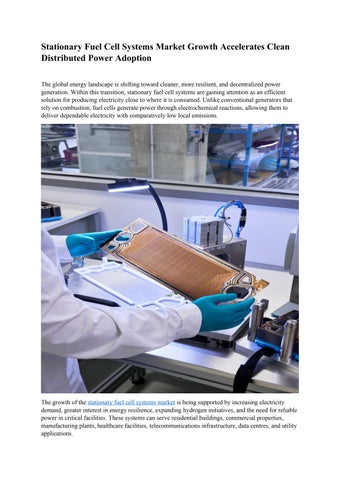
Stationary Fuel Cell Systems Market Growth Accelerates Clean Distributed Power Adoption The global energy landscape is shifting toward cleaner, more resilient, and decentralized power generation. Within this transition, stationary fuel cell systems are gaining attention as an efficient solution for producing electricity close to where it is consumed. Unlike conventional generators that rely on combustion, fuel cells generate power through electrochemical reactions, allowing them to deliver dependable electricity with comparatively low local emissions.
The growth of the stationary fuel cell systems market is being supported by increasing electricity demand, greater interest in energy resilience, expanding hydrogen initiatives, and the need for reliable power in critical facilities. These systems can serve residential buildings, commercial properties, manufacturing plants, healthcare facilities, telecommunications infrastructure, data centres, and utility applications.
As businesses and communities seek alternatives to conventional backup and distributed generation technologies, stationary fuel cells are becoming an increasingly important component of modern energy strategies.
Rising Demand for Reliable Distributed Power One of the strongest factors supporting market growth is the rising need for reliable electricity. Power interruptions can create significant operational and financial losses for industries, hospitals, data centres, and communication networks. Stationary fuel cell systems can provide continuous electricity for facilities that require dependable power around the clock.
Their modular design also allows systems to be deployed according to specific energy requirements. Smaller installations can support localized backup or distributed generation, while larger systems can supply substantial power to industrial and commercial facilities.
This flexibility strengthens the role of fuel cells in an energy environment where resilience is becoming as important as generation capacity.
Hydrogen Strengthens Long-Term Growth Potential Hydrogen is becoming an increasingly important part of the stationary fuel cell landscape. When hydrogen is used as the fuel, electricity can be produced without direct carbon dioxide emissions at the point of generation. This characteristic makes hydrogen fuel cells attractive for organizations pursuing lower-carbon energy strategies.
The expansion of hydrogen production, storage, transportation, and distribution infrastructure can further improve the practicality of fuel cell deployment. Green hydrogen produced using renewable electricity could provide an additional pathway for reducing the environmental impact of stationary power generation.
However, hydrogen availability and cost remain important considerations. Continued development of infrastructure and more efficient production methods will be essential for expanding adoption across different applications.
Data Centres and Critical Facilities Create New Demand
The rapid expansion of digital infrastructure is opening another important avenue for growth. Data centres require highly reliable electricity to maintain servers, networking equipment, cooling systems, and other critical operations. Conventional backup generators remain widely used, but increasing attention toward cleaner power alternatives is encouraging operators to evaluate fuel cell technologies.
Stationary fuel cells can potentially operate as primary, supplementary, or backup power sources. Their ability to provide steady electricity makes them suitable for facilities where power quality and continuity are essential.
Healthcare facilities, emergency response centres, financial institutions, telecommunications networks, and industrial plants can similarly benefit from dependable onsite generation. As organizations place greater emphasis on energy security, demand for technologies capable of supporting critical loads is expected to increase.
Technological Improvements Support Market Expansion Technology development is another important contributor to the expansion of stationary fuel cell systems. Manufacturers are working to improve efficiency, durability, power density, thermal management, and overall system reliability.
Different fuel cell technologies provide advantages for different applications. Solid oxide fuel cells can support high-efficiency stationary generation and combined heat and power applications, while proton exchange membrane systems can be suitable for applications requiring flexible operation and rapid response.
Advances in balance-of-plant components, control systems, power electronics, materials, and manufacturing processes are also helping improve overall system performance. Better monitoring and digital controls can enable operators to track system conditions, optimize output, and identify maintenance requirements before serious failures occur.
These developments can make fuel cell installations more practical for a wider range of users.
Integration with Renewable Energy The combination of fuel cells with renewable energy technologies presents another growth opportunity. Solar and wind generation can experience fluctuations depending on weather conditions and time of day. Fuel cells can complement these resources by providing controllable power when renewable output is insufficient.
Hybrid energy systems can combine solar panels, wind generation, batteries, hydrogen storage, and fuel cells to create more resilient microgrids. Such configurations may be particularly useful for remote communities, industrial sites, campuses, and critical infrastructure.
The ability to integrate multiple energy technologies gives stationary fuel cells a role beyond conventional backup generation. They can become part of broader energy-management systems designed to improve reliability, flexibility, and resource utilization.
Industrial and Commercial Adoption Expands Industrial facilities are another significant area of opportunity. Manufacturing operations often require continuous electricity and may also have substantial heating requirements. Combined heat and power configurations can use the thermal energy generated during electricity production, improving overall energy utilization.
Commercial buildings can similarly benefit from onsite generation, particularly where electricity reliability is important or grid capacity is constrained. Hotels, offices, retail complexes, educational institutions, and large residential developments can consider fuel cells as part of diversified energy systems.
As energy users become more focused on operational efficiency and emissions reduction, the ability to produce electricity and useful heat from a single system can strengthen the commercial case for adoption.
Challenges That Could Influence Growth Despite promising opportunities, the stationary fuel cell systems market faces several barriers. Initial installation costs can be higher than those of some conventional generation technologies. Fuel availability, hydrogen infrastructure, maintenance requirements, and system financing can also influence purchasing decisions.
Competition from batteries, solar power, natural gas generation, and other distributed energy technologies remains significant. Customers therefore increasingly evaluate technologies according to total lifecycle costs, reliability, emissions performance, installation requirements, and operating flexibility.
Reducing system costs and extending operating life will remain important priorities for manufacturers. Wider infrastructure development and supportive energy policies can also help improve the economic conditions required for broader deployment.
Future Growth Outlook The future of stationary fuel cell systems is closely connected with the development of cleaner and more resilient energy infrastructure. Growing electricity consumption, expanding digital facilities, industrial electrification, hydrogen development, and the increasing importance of energy independence can create sustained opportunities for fuel cell technologies.
Future systems are likely to become more modular, digitally connected, efficient, and easier to integrate with renewable generation and energy storage. Greater adoption of microgrids could further expand their role in distributed power networks.
Overall, growth in the stationary fuel cell systems market will depend on the ability of manufacturers, energy providers, infrastructure developers, and end users to overcome cost and fuel-related barriers. With continued technological progress and expanding demand for dependable low-emission electricity, stationary fuel cells are positioned to play a meaningful role in the evolving global energy mix.