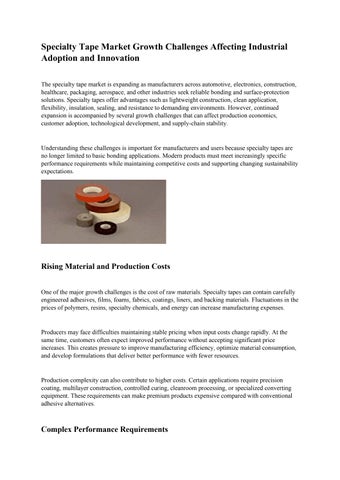
Specialty Tape Market Growth Challenges Affecting Industrial Adoption and Innovation The specialty tape market is expanding as manufacturers across automotive, electronics, construction, healthcare, packaging, aerospace, and other industries seek reliable bonding and surface-protection solutions. Specialty tapes offer advantages such as lightweight construction, clean application, flexibility, insulation, sealing, and resistance to demanding environments. However, continued expansion is accompanied by several growth challenges that can affect production economics, customer adoption, technological development, and supply-chain stability.
Understanding these challenges is important for manufacturers and users because specialty tapes are no longer limited to basic bonding applications. Modern products must meet increasingly specific performance requirements while maintaining competitive costs and supporting changing sustainability expectations.
Rising Material and Production Costs One of the major growth challenges is the cost of raw materials. Specialty tapes can contain carefully engineered adhesives, films, foams, fabrics, coatings, liners, and backing materials. Fluctuations in the prices of polymers, resins, specialty chemicals, and energy can increase manufacturing expenses.
Producers may face difficulties maintaining stable pricing when input costs change rapidly. At the same time, customers often expect improved performance without accepting significant price increases. This creates pressure to improve manufacturing efficiency, optimize material consumption, and develop formulations that deliver better performance with fewer resources.
Production complexity can also contribute to higher costs. Certain applications require precision coating, multilayer construction, controlled curing, cleanroom processing, or specialized converting equipment. These requirements can make premium products expensive compared with conventional adhesive alternatives.
Complex Performance Requirements
Different industries demand different tape characteristics. Electronics manufacturers may require electrical insulation and thermal management, while automotive applications can prioritize vibration resistance, temperature stability, and long-term durability. Healthcare applications may require skin compatibility and controlled adhesion, whereas construction uses may demand weather resistance and strong bonding.
Meeting these diverse requirements can increase research, testing, and production complexity. A formulation that performs well in one environment may not provide the same results under extreme temperatures, moisture, chemicals, mechanical stress, or prolonged exposure.
Manufacturers therefore need to balance multiple performance characteristics rather than focusing on a single specification. This can lengthen product-development cycles and increase validation costs.
Sustainability and Environmental Pressure Sustainability is becoming increasingly important throughout the adhesive and converting industries. Customers are looking for products that reduce material consumption, support recyclability, contain fewer environmentally problematic substances, or improve the overall environmental profile of finished products.
However, developing sustainable specialty tapes can be challenging. Some high-performance adhesive systems depend on combinations of materials that are difficult to separate or recycle. Replacing established components may also affect adhesion strength, temperature resistance, shelf life, or application performance.
Manufacturers must therefore innovate without sacrificing reliability. This requires investment in new formulations, recyclable structures, solvent-reduction techniques, and improved production processes. Smaller producers may find these investments particularly difficult to manage.
Supply Chain Vulnerabilities Specialty tape production depends on a network of chemical, polymer, film, paper, and equipment suppliers. Disruptions affecting any part of this network can influence production schedules and inventory planning.
Global transportation issues, shortages of specialized materials, energy constraints, and supplier concentration can create additional risks. Some advanced tape products rely on highly specific components that cannot be easily substituted without qualification and testing.
Building multiple supplier relationships can reduce exposure to disruptions, but maintaining additional sources may increase procurement complexity. Manufacturers need to balance inventory costs against the need for supply security.
Competition from Alternative Technologies Specialty tapes compete with mechanical fasteners, liquid adhesives, welding, screws, clips, sealants, and other joining technologies. Although tapes offer advantages such as fast application and reduced weight, they are not suitable for every situation.
Customers may continue using established joining methods when they already have compatible equipment, trained workers, and proven production processes. Switching to tape can require testing, redesign, surface preparation, or changes to assembly procedures.
For specialty tape producers, demonstrating measurable benefits is therefore essential. Improved productivity, lower component weight, simplified assembly, reduced noise, or better surface protection can help justify adoption.
Need for Advanced Technical Expertise Modern specialty tapes increasingly require technical knowledge during product selection and application. Factors such as surface energy, temperature, pressure, bonding time, environmental exposure, and substrate compatibility can influence performance.
If users select an unsuitable product or apply it incorrectly, the resulting failure may be attributed to the tape rather than the application process. Manufacturers consequently need stronger technical support, testing services, application guidance, and customer education.
This requirement can increase sales and support costs but also creates an opportunity for companies that provide comprehensive technical assistance.
Regulatory and Quality Requirements Industries such as healthcare, electronics, aerospace, automotive, and food-related packaging often operate under strict quality and regulatory expectations. Specialty tapes used in these environments may require extensive testing, documentation, traceability, and quality controls.
Compliance can increase development timelines and administrative requirements. Product changes may also require additional testing before customers can approve them for production.
Consistent quality is particularly important because small variations in adhesive coating, thickness, tack, or backing properties can affect application performance. Maintaining tight production controls is therefore essential for long-term customer confidence.
Innovation as a Response to Growth Challenges Despite these obstacles, innovation can help manufacturers address many of the barriers affecting the specialty tape market. Research into solvent-free adhesives, bio-based materials, thinner constructions, high-performance films, and recyclable components can create new opportunities.
Automation and digital manufacturing can also improve coating precision, reduce waste, and support consistent quality. Advanced testing technologies can help manufacturers identify performance problems earlier and shorten development cycles.
Another important opportunity lies in customized solutions. Instead of offering standardized products alone, manufacturers can develop application-specific tapes for demanding environments. This approach can strengthen customer relationships and create differentiation in competitive markets.
Future Path for Market Expansion The long-term development of specialty tapes will depend on how effectively producers balance performance, affordability, sustainability, and reliability. Growth is likely to favor companies capable of responding quickly to changing customer requirements while maintaining consistent product quality.
Manufacturers that strengthen supply chains, invest in material innovation, improve production efficiency, and provide technical support can be better positioned to overcome growth challenges. Collaboration with customers can also help identify application problems and create solutions that deliver measurable operational benefits.
As industries continue to seek lightweight, efficient, and flexible assembly technologies, specialty tapes can remain an important part of modern manufacturing. However, sustained expansion will require more than increasing production capacity. Addressing material costs, environmental expectations, technical complexity, regulatory requirements, and competitive alternatives will be essential for building durable growth.
Conclusion The specialty tape market has significant opportunities across diverse industrial applications, but its progress is influenced by several interconnected growth challenges. Rising input costs, complex performance expectations, sustainability pressures, supply-chain risks, alternative joining technologies, technical requirements, and regulatory standards can all affect adoption and profitability.
Companies that approach these challenges through efficient manufacturing, continuous innovation, stronger supplier networks, and customer-focused product development can create a more resilient business foundation. The ability to combine dependable performance with cost efficiency and environmental responsibility will increasingly shape the future direction of specialty tape solutions.