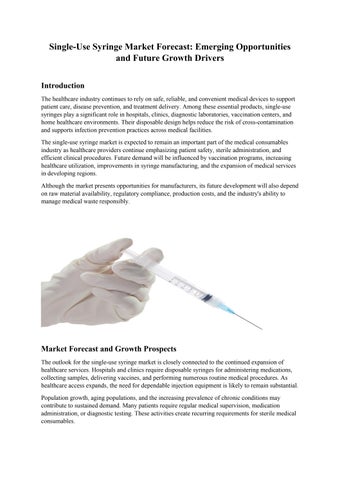
Single-Use Syringe Market Forecast: Emerging Opportunities and Future Growth Drivers Introduction The healthcare industry continues to rely on safe, reliable, and convenient medical devices to support patient care, disease prevention, and treatment delivery. Among these essential products, single-use syringes play a significant role in hospitals, clinics, diagnostic laboratories, vaccination centers, and home healthcare environments. Their disposable design helps reduce the risk of cross-contamination and supports infection prevention practices across medical facilities. The single-use syringe market is expected to remain an important part of the medical consumables industry as healthcare providers continue emphasizing patient safety, sterile administration, and efficient clinical procedures. Future demand will be influenced by vaccination programs, increasing healthcare utilization, improvements in syringe manufacturing, and the expansion of medical services in developing regions. Although the market presents opportunities for manufacturers, its future development will also depend on raw material availability, regulatory compliance, production costs, and the industry's ability to manage medical waste responsibly.
Market Forecast and Growth Prospects The outlook for the single-use syringe market is closely connected to the continued expansion of healthcare services. Hospitals and clinics require disposable syringes for administering medications, collecting samples, delivering vaccines, and performing numerous routine medical procedures. As healthcare access expands, the need for dependable injection equipment is likely to remain substantial. Population growth, aging populations, and the increasing prevalence of chronic conditions may contribute to sustained demand. Many patients require regular medical supervision, medication administration, or diagnostic testing. These activities create recurring requirements for sterile medical consumables.
Vaccination initiatives are another important factor shaping the forecast. Immunization campaigns require large quantities of syringes that meet strict safety and quality standards. Public health authorities and healthcare organizations may continue purchasing disposable injection equipment to support routine immunization and responses to infectious disease outbreaks. However, the pace of market growth will not be identical across countries. Healthcare expenditure, procurement policies, manufacturing capacity, and access to medical facilities can influence demand differently across regions. Manufacturers must therefore consider local healthcare priorities when planning production and distribution.
Key Factors Influencing Future Demand
Expansion of Healthcare Infrastructure
Investment in hospitals, primary healthcare centres, diagnostic facilities, and specialized treatment institutions can support demand for disposable syringes. New healthcare facilities require reliable supplies of essential medical equipment, while established institutions need regular replenishment to maintain daily operations. In developing economies, improvements in healthcare infrastructure may create additional opportunities for manufacturers. Greater access to professional medical services can increase the number of injections, diagnostic procedures, and preventive treatments performed.
Growing Emphasis on Infection Prevention
Infection prevention remains an important consideration in modern healthcare. Single-use syringes are designed for one-time use, helping reduce risks associated with the reuse of injection equipment when appropriate handling and disposal practices are followed. Healthcare providers increasingly consider safety features, packaging integrity, sterility assurance, and product consistency when selecting supplies. Manufacturers that maintain dependable quality systems and meet applicable regulatory requirements may be better positioned to serve institutional purchasers.
Increasing Need for Chronic Disease Management
Long-term conditions such as diabetes and other diseases requiring repeated medical intervention can contribute to demand for injection-related products. Patients may receive medications in hospitals, outpatient facilities, or home healthcare settings. This trend creates opportunities for syringe manufacturers to develop products that support accurate dosing, convenient handling, and dependable performance. Product selection will continue to depend on the intended medication, injection method, patient requirements, and healthcare professional guidance.
Technological Developments Shaping the Forecast
Technological improvements are expected to influence product development and purchasing decisions throughout the forecast period. Manufacturers are exploring designs that improve handling, dosing accuracy, and protection against accidental needle injuries.
Safety-engineered syringes represent an important area of development. Features such as retractable needles, protective shields, and automatic needle-disable mechanisms can help reduce occupational risks when properly implemented. Their adoption will depend on affordability, usability, and compatibility with existing clinical procedures. Prefilled syringes may also gain attention as pharmaceutical companies seek convenient drug-delivery formats. These products can reduce preparation steps for certain medications and support consistent dosing when appropriately designed and validated. Automation is another development area. Advanced manufacturing equipment, automated inspection systems, and improved quality-control processes can help producers maintain consistent product dimensions and identify defects. Greater manufacturing efficiency may also support higher production volumes and more dependable supply.
Regional Outlook 1. Asia-Pacific Asia-Pacific is expected to remain an important region for the single-use syringe market because of its large patient population, expanding healthcare infrastructure, and growing pharmaceutical manufacturing capabilities. Countries such as India and China have substantial healthcare systems that require disposable medical supplies for vaccination, diagnostic testing, and routine treatment. Investments in hospitals, public health initiatives, and domestic manufacturing may create opportunities for producers serving regional and international customers. However, manufacturers operating in the region must consider differences in purchasing power, healthcare access, regulatory requirements, and procurement practices. 2. North America North America is expected to maintain demand supported by established healthcare infrastructure, substantial medical expenditure, and the use of disposable devices across hospitals and outpatient facilities. The region's purchasing environment places considerable importance on product quality, regulatory compliance, and safety features. Suppliers may find opportunities in specialized devices, prefilled formats, and products designed to support efficient clinical workflows.
3. Europe European demand will continue to be influenced by healthcare spending, infection prevention practices, medical device requirements, and sustainability objectives. Manufacturers serving European customers must maintain appropriate quality documentation and demonstrate that their products meet applicable regulatory standards. Environmental considerations may also influence packaging choices, material development, and waste-management practices.
4. Latin America, the Middle East, and Africa
These regions offer opportunities associated with expanding healthcare access, immunization activities, and investment in medical infrastructure. Nevertheless, purchasing budgets, distribution limitations, import dependence, and uneven access to healthcare can affect demand. Suppliers that establish reliable distribution networks and offer products suited to local procurement requirements may be able to serve a wider range of healthcare providers.
Challenges That Could Affect Market Growth Despite the positive demand outlook, several challenges could influence the development of the single-use syringe market. Raw material price fluctuations may affect manufacturing expenses, particularly for producers that depend on medical-grade plastics and other specialized components. Changes in transportation costs, energy prices, and supplier availability can create additional uncertainty. Regulatory compliance is another important consideration. Manufacturers must maintain appropriate production controls, sterilization validation, product testing, and documentation. Meeting these requirements can require substantial investment, especially when introducing new designs or entering additional markets. Medical waste management presents a continuing environmental challenge. Disposable syringes provide important infection-control benefits, but their widespread use creates waste that must be handled safely. Improper disposal can expose healthcare workers, waste handlers, and communities to avoidable risks. Manufacturers may therefore explore material-efficient designs, improved packaging, and wastereduction initiatives. However, environmental improvements must preserve sterility, device performance, and patient safety. Competitive Landscape and Business Opportunities Competition in the single-use syringe market is expected to involve product quality, manufacturing capacity, distribution strength, pricing, and innovation. Established manufacturers may benefit from existing relationships with hospitals, pharmaceutical companies, and public procurement agencies. Smaller producers may find opportunities by concentrating on specific product categories, regional markets, or customized manufacturing requirements.
Potential business opportunities include: * Developing safety-engineered syringes with practical protective features. * Expanding production capacity to support healthcare procurement requirements. * Improving automated inspection and manufacturing efficiency. * Strengthening distribution networks in underserved healthcare markets. * Developing specialized syringe formats for pharmaceutical and clinical applications. * Exploring environmentally responsible packaging and material solutions.
Manufacturers that balance affordability with consistent quality and reliable supply may be positioned to address the varied needs of healthcare customers.
Conclusion The forecast for the single-use syringe market reflects the continuing importance of disposable injection devices in modern healthcare. Demand is expected to be supported by expanding medical infrastructure, vaccination activities, chronic disease management, and ongoing attention to infection prevention. Technological developments, including safety mechanisms, prefilled formats, and automated manufacturing, may create additional opportunities for product differentiation. At the same time, regulatory obligations, raw material costs, and medical waste management will remain important considerations. The future direction of the single-use syringe market will depend on how effectively manufacturers respond to changing healthcare requirements while maintaining product safety, affordability, and dependable supply. Continued investment in manufacturing capabilities, quality assurance, and practical innovation could help the industry meet evolving clinical needs throughout the forecast period.