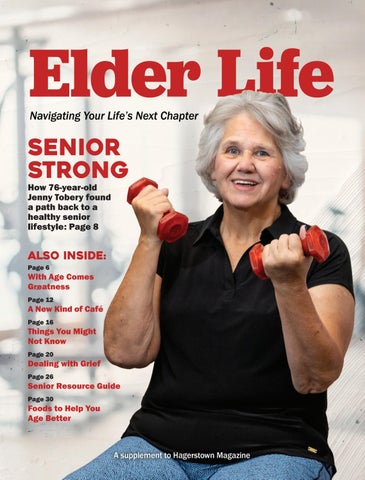
SENIOR STRONG How 76-year-old Jenny Tobery found a path back to a healthy senior lifestyle: Page 8
ALSO INSIDE: Page 6
With Age Comes Greatness Page 12
A New Kind of Café Page 16
Things You Might Not Know Page 20
Dealing with Grief Page 26
Senior Resource Guide Page 30
Foods to Help You Age Better
01_Cover_EL26.indd 1
8/24/26 1:39 PM
02-03_AdPages_EL26.indd 2
8/20/26 2:48 PM
CHANGES 3
02-03_AdPages_EL26.indd 3
8/20/26 2:48 PM
Elder Life Navigating Your Life’s Next Chapter
A SUPPLEMENT TO
PUBLISHERS Shawn Dewees Joseph Silovich
MANAGING EDITOR Jeff Thoreson
PRODUCTION MANAGER Joseph Silovich
GRAPHIC DESIGNERS Alexandra Barr Ian Sager
ACCOUNT EXECUTIVES
Chuck Boteler cboteler@hagerstownmag.com Terri Davis tdavis@fredmag.com Shawn Dewees sdewees@fredmag.com
DISTRIBUTOR
Josh Ensor alloutdist@aol.com
SUBSCRIPTIONS
Stephanie Dewees subcriptions@hagerstownmag.com
301-662-8171 FAX: 301-662-8399 www.hagerstownmagazine.com
Elder Life (ISSN #1555-337X), is an annual publication of Hagerstown Publishing, LLC. ©2026 by Hagerstown Publishing, LLC. All rights reserved. No part of this publication may be reproduced without the written consent of the publisher. The magazine is not responsible for unsolicited manuscripts or photographs. Subscription price: $18.87 per year which includes Elder Life. Single issues $3.71. Prices include 6% Maryland state sales tax. To subscribe, send a check or money order to the business office payable to Hagerstown Magazine, call 301-662-8171 or visit www.hagerstownmagazine.com. Periodicals Postage Paid at Frederick, MD, 21701 and at additional mailing offices. POSTMASTER: Send address changes to P.O. Box 2415, Hagerstown, MD 21741. Distributed through subscriptions, advertisers, and sold at newsstands and other locations throughout Washington County, Md., and Printed on the surrounding area. Recycled Paper
4 Elder Life
04-05_Masthead_Contents_EL26.indd 4
8/20/26 2:48 PM
04-05_Masthead_Contents_EL26.indd 5
8/20/26 2:48 PM
With Age Comes Great Success
A
ge is no barrier to monumental success, as these 10 extraordinary individuals proved by achieving worldaltering greatness after turning 65.
Colonel Harland Sanders (Sept. 9, 1890-Dec. 16, 1980, age 90) After a lifetime of failed career ventures, Sanders found himself broke at age 65. He used his first $105 Social Security check to fund a road trip across America, pitching a unique fried chicken recipe to restaurant owners. He successfully launched the global KFC franchise network, revolutionizing the fast-food industry well into his 70s. Grandma Moses (Sept. 7, 1860-Dec. 13, 1961, age 101) Anna Mary Robertson Moses was a rural homemaker who only took up painting at age 78 because arthritis made embroidery too difficult. Discovered by an art collector in a drug store window, her folk art captured international attention. She became a prominent American artist, eventually displaying her work at the Museum of Modern Art (MoMA) in New York City.
Nelson Mandela (July 18, 1918-Dec. 5, 2013, age 95) Mandela spent 27 years imprisoned for his anti-apartheid activism. Following his release and the subsequent fall of apartheid, he won the Nobel Peace Prize and was elected president of South Africa at age 75. His leadership during this period united a deeply fractured nation and solidified his legacy as a global symbol of peace. Laura Ingalls Wilder (Feb. 7, 1867-Feb. 10, 1957, age 90) Wilder spent most of her life working as a farm wife and local columnist. Encouraged by her daughter, she published her first novel, Little House in the Big Woods, at age 65. She wrote seven more sequels, creating the timeless Little House on the Prairie literary franchise that remains a staple of children’s historical fiction.
6 Elder Life
06-07_WithAgeGreatness_EL26.indd 6
8/20/26 2:49 PM
Benjamin Franklin (Jan. 17, 1706-April 17, 1790, age 84) While already a respected inventor and diplomat, Franklin achieved his most historic political feats in his senior years. He helped draft and signed the U.S. Declaration of Independence at age 70. He then negotiated the critical military alliance with France and remained in public service until age 82.
Fauja Singh (April 1, 1911present) Singh did not take up serious running until he was 81 years old to cope with the deaths of his wife and son. At age 89, he ran the London Marathon in under seven hours. At age 100, he became the
first centenarian to complete a full marathon by finishing the Toronto Waterfront Marathon. Peter Mark Roget (Jan. 18, 1779-Sept. 12, 1869, age 90) Roget spent his primary career working as a physician and mathematician. Upon his retirement at age 61, he began organizing an expansive catalog of words grouped by their meanings. He published the definitive Roget’s Thesaurus at age 73, completely transforming modern writing, education and lexicography. Masako Wakamiya (April 19, 1935present) Wakamiya bought her first computer at age 60 after retiring from a 43-year career at a major bank. Finding a lack of mobile applications designed for seniors, she taught herself how to code. At age 82, she launched Hinadan, a highly successful smartphone game centered on traditional Japanese culture. Yuichiro Miura (Oct. 12, 1932-present) Miura spent his younger years as a prominent speed skier, but achieved historic mountaineering feats much later in life. He successfully summited Mount Everest at age 70, age 75 and again at age 80. His final climb broke the world record for the oldest person to ever stand on top of the world’s highest peak.
You are never too “ old to set another
goal or to dream a new dream.
“
Frank McCourt (Aug. 19, 1930July 19, 2009, age 78) McCourt spent decades working as a high school English teacher in New York City. It was not until he retired at age 65 that he finally sat down to write about his impoverished childhood in Ireland. The resulting memoir, Angela’s Ashes, became an instant global bestseller and won the Pulitzer Prize.
—C.S. Lewis
Elder Life 7
06-07_WithAgeGreatness_EL26.indd 7
8/20/26 2:49 PM
A Fitting
Comeback Missing out on life, Jenny Tobery decided something had to change
By Jennifer Mellace
T
hree years ago, Jenny Tobery, then a 73-year-old breast cancer survivor, was 100 pounds overweight, had a number of health issues and could not walk the short distance to her mailbox. “I spent most of my time in a recliner, and the more you do that, the worse things get,” she says. “You get more depressed, your breathing gets worse, your diabetes numbers get worse—all those things.” The turning point came when her youngest grandson was graduating from high school. “I wasn’t sure if I was going to make it to the graduation,” Tobery recalls. “My older grandson walked very patiently with me. We stopped as I needed to, and I finally got there. I just remember thinking, I’m missing out on life.” And so, she did something about it. Now 76, Tobery has a new outlook on life— one that includes golfing, trying new things like ziplining and aerial yoga and sitting on the board of Prime Time for Women, a local nonprofit community that helps women in their prime be seen, be heard and live healthier lives. But the path to the new Jenny Tobery did not come overnight. It was paved with baby steps and an attitude that believes you are never too old. Start Where You Are A 2022 study by the National Council on Aging suggested that 79 percent of adults over 60 have two or more chronic illnesses, including diabetes, heart disease and high blood pressure. These are diseases that can impact a person’s length and
quality of life, as well as the ability to live independently. But what we also know is that small, regular movement like walking or even chairbased exercise can help reduce the risk of chronic conditions, preserve mobility and improve mood. For Tobery, this reality was a lifeline. Jamey Nystrom, Tobery’s daughter, started working out with Tina Fraley, the owner of Fit Minded Living in Hagerstown. Fraley offers personal training and holistic life coaching focused on building a healthier, more satisfying quality of life regardless of fitness level or location. In other words, start where you are. “My mom was overweight, diabetic and dealing with balance issues,” Nystrom says. “She had tried doctors and drugs and none of it was working. She knew she needed to do something to regain her life. She saw me working out and then my brother—who also got serious about getting healthy again—and out of nowhere she called Tina and asked if she could come to the house to help her.” Tobery’s initial goal was to be able to walk up the street to Nystrom’s house. “That was her motivation at that moment,” says Fraley. “It wasn’t about putting in practical nutrition or putting in burpees and broccoli, as I like to say. It was about figuring out who Jenny was, her life experience and what she felt she was missing from it.”
8 Elder Life
08-11_JennyTobery_EL26.indd 8
8/24/26 1:16 PM
Working within Tobery’s fixed budget, they started in her small living room doing stretches, and from there small walks from her house. Tobery remembers walking down the street to a baseball grandstand where Fraley had her do some gentle exercises. “As we’re walking back up what I call a hill—most people would call it a slant in the road—I couldn’t make it. I gently fell and sat there, and a lady came walking by and asked if I was all right. I said, ‘I’m all right. I’m just trying to get healthy.’” Fraley met with Tobery for 30-minute sessions twice a week. “That was really all she could handle emotionally, mentally and physically,” says Fraley. “There was a lot of movement anxiety—sometimes you’ll hear it referenced as exercise anxiety. When you live in a body that has let you down, you don’t trust it.” Tobery also struggled with what others thought of her. “It’s really hard and it doesn’t matter how old you are or how much you’ve done in your life,” she says. “You see people walking up and down the road briskly with their dogs and all, and here I am huffing and puffing.
08-11_JennyTobery_EL26.indd 9
8/24/26 1:16 PM
“But I got myself a fold-up cane that I could open into a saddle seat, and that became my security. I could open it up and just throw my leg over and sit. My husband would say, ‘People think that’s strange.’ But I got over that pretty quickly. None of us knows what life expectancy we have, but I decided that whatever life I had, I wanted to live it.” Overcoming Fears It took Tobery a good six months before she was comfortable enough to come into Fraley’s studio, where over time she learned all of the equipment and eventually started attending group classes. “She would come in and do one-on-one sessions with me and started learning about nutrition,” says Fraley. “She would also come in and share the wrestle moments when she had too many pieces of Dave’s bread—something we both love.” Tobery started opening up and having real, sometimes hard, conversations. “I gave her permission to come in and sit across from me while she’s on the recumbent bicycle and say—with certainty and courage—I’m really not okay today, and it’s all I could do just to show up,” Fraley says. “Those are the moments that build the foundation and allow courage and confidence. Giving a voice to the silent part of herself was what helped Jenny keep moving forward. Those are micro changes that literally changed the entire trajectory of that woman’s life.” Today, Tobery talks to young girls about things that she was afraid of when she was in her early 20s, and she is trying things she never thought possible. “I’ve tried things I would have never tried before,” Tobery says. “Chair yoga was one of the first things I tried, and I loved it. I’ve also tried aerial yoga—when I was trying to get into this kind of parachute-like thing, I thought, Oh, Jenny, what are you doing? You can’t do this. But, you know, once I got the feel of what it was like to pull myself up, it felt good. I’ve learned not to be so self-conscious of what others are doing and just make up my own steps.” Last year, for her 76th birthday, Tobery told her family that 10 Elder Life
08-11_JennyTobery_EL26.indd 10
8/24/26 1:16 PM
“And my grandson has started golfing with me. So, I have that connection.” Bernadette Wagner, founder of Prime Time for Women, recalls when she first met Tobery. “I remember her being scared and shy, and worried about being judged. I invited her and a couple other ladies to my house for a book club meeting. Since then, she’s facilitated our Book Club Extravaganza, joined our golf club and now sits on our board. Jenny is a remarkable woman—an inspiration. Her journey, showing that living life at this age is not all about falling apart, is inspiring.” Tobery turns 77 in September, and, at the time of this interview, Jenny Tobery (black shirt) and her fitness trainer Tina Fraley. she was trying to come she wanted a challenge—she wanted to go ziplining at Tree up with her next challenge. “My grandson wants me to jump Trekkers in Urbana, Maryland, even though she was afraid out of an airplane. But my daughter says no because I had of heights. knee surgery in the middle of all of this. She said she wasn’t “When I finally took off, I’m thinking, Wow, this is pretty going to take care of me if I hurt myself jumping out of an good,” she says. Then came the third station of Tree Trekkers. airplane,” she says with a laugh. Tobery remembers seeing the platform was slanted and throwing herself at it. “I did it wrong, and instead of landing Advice for Taking the Next Step on the platform, I threw myself backwards and slowly drifted Fraley and Nystrom both believe that Tobery is a great examto the middle of the line where I came to a dead stop hangple of what happens when you choose to live your life. ing upside down. They had told us if that should happen, you “An entire world has opened up for this woman. She is have to pull yourself hand over hand, army style back up to living every single breath possible, just by having the courage the platform.” to ask for the help,” says Fraley. “There are tools. There are After some time and lots of encouragement from her people. I’m not the only trainer who does stuff like this. But family, Tobery made it back up to the platform on her own. if you come to a roadblock, that’s not the end. It’s literally “In the past, I would have considered that a failure. But that just one of the answers that didn’t work, try again. Jenny is a day, it was not. I got myself to the platform, and I survived. walking, talking example of hope and resilience and what can I’m grinning now because it was a sense of accomplishment happen when you say ‘yes.’” and before that, I would have been embarrassed. I was proud Nystrom adds: “My mom is proof that you can become of myself.” whoever you want to be. She is such an inspiration to our whole family. I don’t know what the magic pill is other than Living Life to the Fullest Jenny woke up one day and decided to live.” The health changes Tobery has undergone have helped her Tobery became a great-grandmother this past year and diabetic and cholesterol numbers improve, but the mental recounts how thankful she is to be healthy enough to enjoy changes have had a significant impact, too. “I haven’t become her new great-granddaughter. a 40-year-old or even a 60-year-old. But I’m living my best “I hear people saying, ‘I don’t want to be a burden.’ Well, life right now. I still have little bouts of depression, but I to not be a burden, you have to try and be as independent as overcome it. I’m happy.” you can. I have a great life now. I wouldn’t have had the nerve She is making friends, joined a book club, sits on the board to speak to you before. I’m proud of myself, and more people of Prime Time for Women, works with Relay for Life and need to hear that. I want to share it because I think there are even started golfing last year. people missing out on what they could have. Remember, you “I’d never golfed before in my life and I love it,” she says. are never too old to begin again.” Elder Life 11
08-11_JennyTobery_EL26.indd 11
8/24/26 1:16 PM
A Caring
café
The Memory Café gives those dealing with dementia and their caregivers a special setting
By Laura Forrest Hopfauf
I
n Washington County alone there are at least 3,000 residents living with some form of dementia. While most of us are familiar with the late stage of dementia when a person may no longer know who they are, where they are or who their family and friends are, there are other stages, the early and middle, where people can live for years with mild symptoms and only occasional problems. Stigma around dementia and Alzheimer’s Disease along with fear and a lack of understanding often leaves this population isolated and alone in a time where social interaction can not just raise their spirits but contribute to their health. Engaging in social interaction has been proven to stabilize and slow cognitive decline. But finding a comfortable and safe way to do that as a person with dementia or as a caretaker of someone with dementia is easier said than done. John and Carolyn Right at Home of Washington County, Dementia Friendly Perrygo. Washington County and the Alzheimer’s Association are actively changing that in Washington County by facilitating Memory Café on the last Thursday of every month at noon in Otterbein United Methodist Church off Franklin Street in downtown Hagerstown. It’s a free event open to all people living with dementia and their caregivers. Memory Café’s mission is “to provide a safe space for those living with dementia, along with their care partners, for socialization and making connections without having to worry about the stigma of the disease,” says Steven Luber, one of the two lead facilitators of Memory Café and the community liaison officer of Right at Home of Washington County. A typical Memory Café lasts 60 to 90 minutes and has between —Carolyn Perrygo 15 and 25 attendees, though the group is continuing to grow, even welcoming attendees from Frederick County. After a round robin introduction to ensure everyone feels welcome, a lunch is provided by the sponsor of that month’s meeting who is typically part of the local senior community. During lunch everyone socializes and enjoys short videos on the past, like Christmas time in the 1950s or historical events that relate to the current season. After lunch the local sponsor will lead the group in an activity like painting, creating a floral arrangement, making ornaments or singing.
“Memory Café has brought joy, friendships, understanding, compassion, fun and laughter to all who attend.”
12 Elder Life
12-15_MemoryCafe_EL26.indd 12
8/24/26 1:52 PM
Amanda Crawford and Steven Luber run the Memory Café for area residents dealing with dementia. Having a space to gather with people who understand the intricacies of dementia is invaluable to this community. “There isn’t much that is better if you find yourself or your loved one on a dementia journey than to be in a room filled with others who completely understand,” says Carolyn Perrygo, a serving member of the Dementia Friendly Wash-
ington County steering committee and the care partner of her husband, John Perrygo, who was diagnosed with Alzheimer’s in 2014 and continues to thrive with meaningful and joyful years to his life post-diagnosis. That is in large part due to his continued and active social life. “Memory Café has brought joy, friendships, understanding, Elder Life 13
12-15_MemoryCafe_EL26.indd 13
8/24/26 1:17 PM
compassion, fun and laughter to all who attend. There is something magical that happens each month as we gather to support each other on our respective dementia journeys,” Perrygo adds of her and John’s experience as regular attendees of Memory Café. The Perrygos are far from the only members who feel that way. The event is vibrant, full of joy and understanding for all who attend. There is no judgement on forgetfulness or misunderstanding or difficulty. This is a group all on the same path as they celebrate triumphs and deal with grief in their battle with dementia. Terry Tillman, founder of Golden Girls Assisted Living in Hagerstown, says the senior women she cares for in her assisted living home look forward to the café every month. Tillman who opened Gold Girls Assisted Living after caring for her mother adds that Memory Café, “creates a community for dementia patients who are at home with family caretakers and are often on their own with no one like them.” Finding community, support and help can feel overwhelming for care partners and those living with dementia. But no one has to be alone. “Resources and support are available both locally and nationally for those caring for a loved one with dementia,” Luber says. “We are happy to help connect families to local and
Steve and Pam Johnson and Carlene and James Carr. national resources. You are not alone on your journey. If we can come together as a community, we can make our county a great place to continue to thrive as we age.” The Memory Café is certainly thriving with laughter, joy and peace. “I just feel like I’m close to home when I come here,” says a regular attendee named Luray. “I just relax. I can’t wait for this Thursday to come. I just love it here.” And in that single thought, Luray sums up what Memory Café means to everyone in the room.
14 Elder Life
12-15_MemoryCafe_EL26.indd 14
8/24/26 1:18 PM
12-15_MemoryCafe_EL26.indd 15
8/20/26 2:50 PM
DID YOU KNOW? Seniors in Washington County have access to several specialized, lesser-known programs that go beyond basic senior services to support independence, health and financial well-being. Finding information about these programs is as simple as visiting websites for the Washington County Commission on Aging or the Washington County Community Action Council. Farmers Market Subsidy: This program provides eligible Grocery Shopping Assistance: Registered volunteers older adults with direct financial vouchers or “farmers market through the Helping Hands initiative step in to do grocery money” specifically to buy fresh fruits and vegetables at local shopping for seniors who have no other regular means of farm stands and markets. obtaining provisions. SOAR Program: Administered by the Washington County Commission on Aging, Supporting Older Adults with Resources provides light-touch case management, minor safety-related home modifications, chore services and partial financial assistance for assisted living fees. Durable Medical Equipment Re-Use: A statewide program provides free, refurbished medical equipment like walkers, canes and tub seats to seniors, matching items to users with the help of physical therapists. Commission on Aging Home Repair: A specialized assistance program helps elderly homeowners specifically within the Hagerstown city limits handle critical home maintenance and repairs.
PER4M Educational Classes: This initiative provides free, highly structured workshops, including the Living Well Program, a six-week course for managing chronic illnesses like diabetes and arthritis, and dedicated fall prevention training. Community First Choice: The program offers specialized, personal assistance with activities of daily living, such as bathing and dressing, for Medicaid-eligible seniors directly in their own homes rather than an institution. Community Action Transit: Operated by the Washington County Community Action Council, CAT provides dedicated medical appointment transportation specifically tailored for elderly and low-income residents.
16 Elder Life
16-17_DidYouKnow_EL26.indd 16
8/20/26 2:50 PM
16-17_DidYouKnow_EL26.indd 17
8/20/26 2:50 PM
18-19_AdPages_EL26.indd 18
8/20/26 2:52 PM
18-19_AdPages_EL26.indd 19
8/20/26 2:52 PM
Hope
Providing
A local ministry provides comprehensive training for dealing with grief
By Laura Forrest Hopfauf
20 Elder Life
20-23_GriefMinistry_EL26.indd 20
8/24/26 1:19 PM
T
here is nothing easy about standing in a funeral home. Grief is an overwhelming burden that affects everyone differently. Finding the right words to say as a funeral attendee can feel daunting. Finding the strength to continue on as the bereaved can feel near impossible. We all face grief in our lifetimes, so why is so difficult to find the right words, the right ways, to support our friends and family after they have lost a loved one? Why is it so difficult to find the help we need after we have faced loss ourselves? Hope Beyond Our Grief (HBOG), a nonprofit established in 2011, has been serving in the grief community for the past 15 years by providing tools, training and compassion to prepare individuals and groups to support grievers in their darkest times. HBOG isn’t a support group itself, it is a comprehensive training for grief caregivers. Its mission is to help groups equip and train regular people to support grievers in their time of need. Developed by people closely acquainted with grief who saw individuals, churches and groups who wanted to help the grieving but didn’t quite know how, HBOG provides materials ranging from books to videos to blogs to newsletters that give guidance and direction to those who want to offer support to those grieving. Its materials are meant to train people to do the work themselves rather than focus on only a pastor or individual leader providing care. “The mission of Hope Beyond Our Grief is to help churches equip and train grief caregivers to provide comfort and healing to grieving people in their time of need. While we do offer resources for individuals who are grieving, our primary mission is to assist leaders in churches and other
organizations by offering educational written and video resources to inform and train people who want to care for those who are experiencing loss, as well as structured grief support group programs they can run,” Dr. David Baker, director of Hope Beyond Our Grief, says. In essence, HBOG works to make grief stewards out of anyone who wants to support someone in the midst of loss. The group provides effective training so that feeling of helplessness that often accompanies loss is replaced by wisdom and encouragement shaped by resources that acknowledge emotional aspects of grief. “Throughout my career as a health care chaplain and educator in Washington County and having lost my previous spouse, I was aware of this need in the faith communities to provide this kind of support and saw the opportunity to help churches and other groups meet this need by equipping people to minister to those at their most vulnerable time of grief,” Dr. Baker explains. Although, the Christian based HBOG has materials and resources that can be tailored to help any group learn to facilitate grief caregivers to provide hope, healing and comfort after loss. Pastor Kimberly Nunberg-Wadel of Zion Lutheran Church in Williamsport opted to use HBOG to help her congregation after a portion had gone through loss. Those losses ranged from spouses to friends to pets and HBOG provided them a great way to connect, share their feelings and gain support. Pastor Nunberg-Wadel says of HBOG, “it is a great resource that easily connects people going
Pastor kimberly nunbergwadel of zion lutheran church in williamsport.
Elder Life 21
20-23_GriefMinistry_EL26.indd 21
8/24/26 1:19 PM
through a similar experience. Grief is normal, natural and they are not alone in that process.” A practical example that Pastor Nunberg-Wadel took from the HBOG training that she continues to share is to plan a simple statement about what happened that can be repeated in the early days of loss to well-wishers who often accidently inundate the grieving with the question of what happened? That way instead of feeling overwhelmed and unsure of how to answer, a griever can have a prepared answer to help them get through those initial days of grief without facing the extra emotional toll of coming up with an answer each time they are asked. Over the past 15 years, HBOG has worked with more than a thousand different groups from churches to long-term care facilities to hospices and other organizations in the USA and Canada to provide the tools for them to help the grieving in their communities with compassion and wisdom themselves by creating their own overall grief care. It’s a cause and result that still leaves Dr. Baker feeling fulfilled when it happens. Advice Dr. Baker offers for someone wanting to support a loved one through their grief, “Be patient with them. Recognize that the grief process is unique to every person, and that how one grieves and how long it takes for them to get past the acute stage is individual. Be patient with them not just in the immediate time of loss, but in the weeks and months that follow. Offer practical help.” Hope Beyond Our Grief is doing just that.
Dr. David Baker
22 Elder Life
20-23_GriefMinistry_EL26.indd 22
8/20/26 2:55 PM
20-23_GriefMinistry_EL26.indd 23
8/21/26 10:49 AM
24-25_AdPages_EL26.indd 24
8/20/26 2:57 PM
“As a Seniors Real Estate Specialist, I’m passionate about helping older adults and their families navigate housing transitions with care, clarity, and confidence. I provide personalized real estate guidance and coordinate with other senior-focused resources to create a seamless and supportive experience every step of the way.”
24-25_AdPages_EL26.indd 25
8/24/26 2:04 PM
SENIOR RESOURCES From the Washington County Commission on Aging (www.wccoaging.org) LONG TERM CARE SERVICES & RESOURCES AGING IN PLACE: A local grant-funded program that supports seniors and those with disabilities to improve their quality of life through support measures such as education, medical device assessment, etc. APPLICATION ASSISTANCE: Maryland Access Point department can assist seniors and those with disabilities in completing a variety of applications. Contact the MAP department for details. BENEFITS CHECKUP: A secure online site that helps you find benefit programs to assist with paying for medications, health care, food, utilities and more. You can do it yourself from home in about 15 minutes or come into the office for assistance. www.benefitscheckup.org COMMUNITY FIRST CHOICE PROGRAM/ SUPPORT PLANNING: Provides a wide range of community services and support to enable older adults and people with disabilities who are financially and medically eligible to live in their own homes. Referrals made to partnering agencies. COMMUNITY OPTIONS COUNSELING: This service is provided through the MAP department to inform eligible recipients of community options and resources available to support seniors to live in their own homes. DEMENTIA CARE NAVIGATION: The Dementia Care Navigation Program offers personalized support to individuals and families affected by dementia, guiding them through the complexities of care planning, resources and services to enhance quality of life. ECONOMIC CHECKUP: Provides older adults experiencing economic distress with a comprehensive assessment of their situation, access to community referrals and follow-up. www.benefitscheckup.org GRANDPARENT/RELATIVE CAREGIVER SUPPORT GROUP: A support group for grandparents or relatives who are raising their grandchildren. The group meets monthly to receive information about community resources. NEW TO MEDICARE WORKSHOP: Are you about to turn 65 or are you new to Medicare? Then this workshop will be invaluable for you to learn more about Medicare. Workshops, which also cover sup-
plemental insurance, are held one day and one evening each month. MARYLAND ACCESS POINT (MAP): This program strives to be a single point of entry to assist with Medicaid, Medicare, prescription drug coverage, food assistance, home energy assistance, Supplemental Security Income and much more. Personal assistance is provided to help people through the maze of forms and agencies. MEDICARE PART D SUPPORT: One-to-one support offered during open enrollment to educate recipients on their choices. State Health Insurance Program provides continued support of Medicare Part D after open enrollment is closed. MOBILE OUTREACH: Our staff regularly travels to familiar locations throughout the county to reach seniors who, due to lack of mobility or resources, might not apply for benefits they need. Seniors can find out if they are eligible for assistance programs such as Supplemental Nutrition Assistance Program, Renters and Homeowners Tax Credit Assistance, the Maryland Senior Prescription Drug Program and services to help pay for Medicare premiums. Home visits are also available to the homebound by appointment. “MONEY FOLLOWS THE PERSON” OPTIONS COUNSELING FOR INSTITUTIONALIZED INDIVIDUALS: In 2009, the Maryland Medicaid Agency began operations under the federal “Money Follows the Person” initiative to identify Medicaid eligible individuals in nursing homes who wanted to transition back into the community. The options counselor goes to the nursing home, meets with the individual to discuss options for community living and assists with applications for home and community-based waiver programs. SENIOR ASSISTED LIVING GROUP HOME SUBSIDY PROGRAM: Provides low and moderate-income seniors with access to assisted living in small group homes, which are licensed by the Department of Health and Mental Hygiene for four through 16 residents. SENIOR CARE PROGRAM: Provides case management and funds for services for individuals 65 and above, who are financially and functionally eligible, who may be at risk of nursing home placement. Senior Care allows seniors to live with dignity and comfort in their own homes and at a lower cost than nursing homes. Assistance with housekeeping, meals and personal care is available for qualified applicants. Referrals made to community partners.
26 Elder Life
26-29_SeniorResources_EL26.indd 26
8/24/26 1:21 PM
SENIOR MEDICARE PATROL: SMPs empower and assist Medicare beneficiaries, their families and caregivers to prevent, detect and report health care fraud, errors and abuse through outreach, counseling, and education. SENIOR MENTAL HEALTH PROGRAM: The Washington County Commission on Aging makes referrals to partnering agencies for mental health services. STATE HEALTH INSURANCE PROGRAM: This program assists Medicare-eligible individuals and family members to understand all parts of Medicare. One-on-one assistance in navigating the Medicare Part D Prescription Drug Program, filing appeals and resolving delays on claims is offered. Long-Term Care Insurance information is also available, as well as personal help in filling out applications for state or local financial assistance. THE HOME AND COMMUNITY-BASED OPTIONS WAIVER: Also known as Community Options Waiver, this program provides community services and supports to enable older adults and people with physical disabilities, to live in their own homes or in a licensed assisted living facility in lieu of a nursing facility. Individuals must meet a nursing facility level of care, as well as financial criteria to qualify. Referrals are made to partnering agencies.
SUPPORT SERVICES ASSISTIVE TECHNOLOGY: We can provide referrals for devices that make life easier and may assist in retaining independence. Sample devices are available at the WCCOA offices. Referrals are made to MiHi (Many Individuals Helping Individuals), which offers Project Lifesavers, a program that provides a system to find people who have a tendency to wander or become lost. FRIENDLY VISITATION: Volunteers registered through the RSVP Program visit individuals who are ill, isolated and confined to their homes, in an attempt to provide a caring contact. GUARDIANSHIP OF PERSON PROGRAM: The WCCOA serves as guardian for qualified individuals who are incapable of making their own decisions concerning healthcare, food, shelter and clothing. GROCERY SHOPPING PROGRAM: Volunteers grocery shop for individuals who have no other way of obtaining provisions on a regular basis. Volunteers do not transport clients. MEALS ON WHEELS: A freshly prepared, noontime meal is delivered as scheduled on routes throughout the county to homebound individuals or couples who are 60 and older. MEDICAL EQUIPMENT PROGRAM: Medical equipment such as walkers, canes, tubseats and other assistive devices, are provided on a first-come, first-serve basis to persons with disabilities. NUTRITION SITES RECREATIONAL PROGRAM: At seven sites throughout the county, seniors are welcome to participate in recreational programs each weekday to enrich social contacts within the community. PERSONAL ACCOUNTING PROGRAM: Volunteers meet with individuals, generally twice a month, to help sort through mail, pay bills, write checks, set up simple household budgets and balance checkbooks. Volunteers do not transport clients, handle cash or perform bank transactions. Elder Life 27
26-29_SeniorResources_EL26.indd 27
8/24/26 1:21 PM
SENIOR CLUBS: Senior citizen clubs in Washington County meet monthly to discuss senior-related issues, service opportunities and socialization possibilities. SENIOR MEDICARE PATROL: SMPs empower and assist Medicare beneficiaries, their families and caregivers to prevent, detect and report healthcare fraud, errors and abuse through outreach, counseling and education. TELEPHONE REASSURANCE PROGRAM: Volunteers phone individuals who are ill, isolated or confined to their homes, in an attempt to provide a caring contact.
HEALTH & NUTRITION HOME DELIVERED MEALS: A freshly prepared noontime meal is delivered as scheduled throughout the county to medically homebound individuals or couples age 60 and older.
CONGREGATE NUTRITION SITES: Freshly prepared, noontime meals are delivered to congregate nutrition sites throughout Washington County where seniors gather to eat. Also offered at each of the congregate sites are opportunities for socialization, physical fitness and recreation, as well as health and dietary education. RECREATIONAL PROGRAM: At seven sites throughout the county, seniors are welcome to participate in recreational programs each weekday to enrich social contacts within the community. EXERCISE: Group fitness classes and exercise equipment are available at the Washington County Senior Center. HEALTH AND NUTRITION EDUCATION CLASSES: An ongoing series of classes is taught by a licensed nurse or professionally trained volunteer and takes place routinely at the senior congregate nutrition sites, the senior center and several other locations. The classes cover topics such as brain health, stroke, oral health, sleep, blood pressure, immunization, heart health, falls and fractures, healthy eating after age 50, arthritis, foot care and exercise.
28 Elder Life
26-29_SeniorResources_EL26.indd 28
8/24/26 1:21 PM
EDUCATION AARP MATURE DRIVING CLASSES: These classes held in different locations consist of four hours of classroom instruction intended to refine existing driving skills and develop safe defensive driving techniques. COMMUNITY OPTIONS COUNSELING: This service is provided through the MAP department to inform the eligible recipient of community options and resources available to support seniors to live in their own homes. FALL PREVENTION: The WCCOA partners with the Washington County Health Department and Meritus Medical Center to offer fall prevention classes that help seniors improve balance and avoid accidents. HEALTHY AGING PRESENTATIONS: A variety of programs are held throughout the county to support adults in making educational decisions about health and well-being. Topics include, but are not limited to, brain health, heart disease, exercise, fraud protection, etc.
LIVING WELL PROGRAM: A free, six-week workshop for people with chronic conditions such as diabetes, fibromyalgia, arthritis, heart disease, depression and COPD. Classes are offered in various locations throughout the county.
OMBUDSMAN & LEGAL LEGAL SERVICES: An attorney is available onsite, as scheduled by appointment, only to provide advice on general legal issues. Legal clinics are free and assistance with completion of advance medical directives (appointment of health care agent and living will) is available. LONG-TERM CARE OMBUDSMAN PROGRAM: This program assists residents of long-term care facilities and their families in maintenance of their legal rights and in retaining control over their lives and personal dignity. Longterm care facilities include nursing homes, group homes and assisted living communities.
Elder Life 29
26-29_SeniorResources_EL26.indd 29
8/24/26 1:21 PM
10 FOODS
THAT SUPPORT HEALTHY AGING
1 2 3 4 5 6 7 8 9 10
EXTRA VIRGIN OLIVE OIL Extra virgin olive oil is one of the healthiest oils on earth. It’s rich in healthy fats and antioxidants that help reduce inflammation and oxidative damage caused by an imbalance of free radicals in the body. GREEN TEA Green tea is high in antioxidants, which can help fight free radicals in the body. FATTY FISH Fatty fish is a highly nutritious food that can promote healthy skin. Salmon and other fatty fish are high in protein, necessary in collagen and elastin production. DARK CHOCOLATE OR COCOA Dark chocolate is a rich source of polyphenols, which act as antioxidants in the body. In particular, it contains flavanols, which are linked to a lower risk of heart diseae, type 2 diabetes and cognitive decline. VEGETABLES Most vegetables are extremely nutrient-dense and low in calories. Beta carotene is especially important and can be found in carrots, pumpkin and sweet potatoes. FLAX SEEDS Flax seeds contain lignans that may lower the risk of developing a chronic disease such as heart disease and breast cancer. POMEGRANATES They are high in fiber, potassium and Vitamin K, which help support a healthy heart. AVOCADOS They are rich in heart-healthy fats, fiber and several vitamins and minerals essential for good health. TOMATOES Contain lycopene that acts as an antioxidant. COLLAGEN PEPTIDES Collagen is the body’s most abundant protein. Protein-rich foods include chicken, tofu, fish and eggs. (Source: www.healthline.com)
30 Elder Life
30_FoodForSeniors_EL26.indd 30
8/24/26 1:22 PM
31_ParxCasino_Full_EL26.indd 31
8/20/26 2:58 PM
32_EasterSeals_Full_EL26.indd 32
8/20/26 2:58 PM