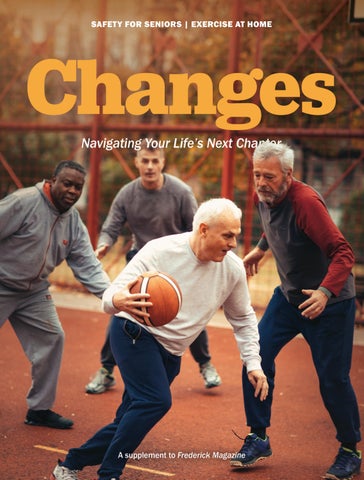
SAFETY FOR SENIORS | EXERCISE AT HOME
Cover_Changes_CH26.indd 1
9/23/26 3:35 PM
02-03_AdPages_CH26.indd 2
9/22/26 12:33 PM
02-03_AdPages_CH26.indd 3
9/22/26 12:33 PM
04-05_AdPages_CH26.indd 4
9/22/26 12:34 PM
04-05_AdPages_CH26.indd 5
9/22/26 12:34 PM
Changes Navigating Your Life’s Next Chapter
A SUPPLEMENT TO
PUBLISHERS Shawn Dewees Joseph Silovich
MANAGING EDITOR Nancy Luse
PRODUCTION MANAGER Joseph Silovich
GRAPHIC DESIGNERS Alexandra Barr Ian Sager
ACCOUNT EXECUTIVES Terri Davis tdavis@fredmag.com
Shawn Dewees sdewees@fredmag.com
DISTRIBUTOR
Josh Ensor alloutdist@aol.com
SUBSCRIPTIONS
Stephanie Dewees subcriptions@fredmag.com
301-662-8171 FAX: 301-662-8399 www.fredmag.com editor@fredmag.com Changes is an annual publication of Diversions Publications, Inc., 6 N. East Street, Suite 301, Frederick, MD 21701-5601 (ISSN 006-923). Periodicals postage paid at Frederick, MD. Subscriptions to Frederick Magazine, $24.95 per year, which includes Changes and all other annual guides (available through the business office). Back issues w/in the last 12 mo/$3.95. Prior to 12 mos. ago/$7. POSTMASTER: Send address changes to Frederick Magazine, 6 N. East Street, Suite 301, Frederick, MD 21701-5601. Customer inquiries to same address or call 301-662-8171. Distributed through mail subscriptions, home delivery, and sold at newsstands and other locations in Frederick, Upper Montgomery counties, and throughout the Central Maryland region. Advertising rates available on request. Manuscripts, drawings, and other submissions must be accompanied by a stamped, self-addressed envelope. Frederick Magazine is not responsible for unsolicited material. All rights to submissions, including letters and e-mail, will be treated as unconditionally assigned for publication and copyright purposes and as subject to Frederick Magazine’s unrestricted right to edit and to comment editorially, unless otherwise negotiated with the author. © DIVERSIONS PUBLICATIONS, INC. 2026. All contents of this publication are protected by copyright and may not be reproduced in whole or in part for any reason without prior approval of the publisher.
6 Changes
06-07_Masthead_CH26.indd 6
9/23/26 3:30 PM
CONTENTS CHANGES 2026
26
10
20
28
10 SAFETY FOR SENIORS
24 SENIOR RESOURCES
16 WITH AGE, SUCCESS
26 FACING WIDOWHOOD
18 MEMORY CARE KITS
28 EXERCISE AT HOME
20 WORKING LONGER
30 THOUGHTS ABOUT AGING
22 SENIORS VOLUNTEER
CHANGES Changes 7 7
06-07_Masthead_CH26.indd 7
9/22/26 12:36 PM
08-09_AdPages_CH26.indd 8
9/22/26 12:36 PM
“I Couldn’t Feel My Feet—And It Nearly Cost Me Everything” A Frederick County man was ready to give up. Then he found relief in the most unexpected place.
It was a quiet moment in the kitchen that changed everything. Tom had just poured himself a cup of coffee when the mug slipped from his hands and shattered on the tile floor. He hadn’t realized how numb his fingers had become—until that moment scared him. “I didn’t feel the mug sliding. My hands just… didn’t respond.” It wasn’t just frustrating. It was terrifying. That same week, Tom nearly fell stepping off the curb outside the grocery store. His balance was off. His legs didn’t move the way they used to. He had been battling tingling, numbness, and stabbing pain in his feet for over a year. The doctors called it peripheral neuropathy. They told him there wasn’t much that could be done—just medications to manage the symptoms. “The meds made me foggy. I stopped driving. I started isolating myself. I felt like I was disappearing.” Then a friend handed him a newspaper article—about a local clinic helping people with neuropathy. It sounded different. It sounded… hopeful.
Acupuncture Medical Clinic of Maryland A Clinic That’s Changing Lives
Tom made an appointment at Acupuncture Medical Clinic of Maryland. There, he met Jessica Miksa, LAc the acupuncturist that didn’t treat him like a collection of symptoms—but as a person with a life worth getting back. He listened. They explained. And they offered something different. “We use gentle, non-invasive treatments to stimulate nerve repair and blood flow,” explains Jessica Miksa, licensed acupuncturist and clinic director. “Our goal is to help the body heal
itself—without drugs or surgery.” Using a personalized combination of acupuncture, and ATP Resonance BioTherapy™, the clinic helps restore function in damaged nerves and relieve pain at the source.
feel it.” His wife says it’s like having her husband back. “He’s laughing again. He’s cooking again. He even went fishing last weekend. We both thought that part of our life was over.”
One of Many Success Stories
Personalized Treatments
“I can finally walk barefoot again.” —Donna R.
“I don’t need my walker in the house anymore.” —Harold S.
“I feel grounded in my body again.” —Evelyn G. A Turnaround That Felt Impossible
After just a few weeks of treatments, Tom noticed the burning pain in his toes had lessened. By his third week, he was walking more confidently. And after six weeks? I picked up a glass of water and smiled. Because I could feel it. I mean really
Tom’s story is just one of many at Acupuncture Medical Clinic of Maryland, patients of all ages—especially seniors— are experiencing real relief after years of struggle. Whether it’s burning, tingling, stabbing pain, or complete numbness in the hands and feet, the clinic’s unique approach is bringing back feeling, stability, and confidence. Many patients report improvements in: • Sleep quality • Balance and stability • Ability to walk without pain • Overall quality of life • And best of all: no side effects, no downtime, and no surgery.
Why So Many Are Turning to This Approach
Traditional medicine offers limited options for peripheral neuropathy. Painkillers. Anti-seizure meds. Nerve blocks. But these treatments rarely address the cause of the nerve damage—they just mask the symptoms. “When the body’s systems are supported, nerves can regenerate,” Jessica Miksa, LAc. explains. “We’ve seen it time and time again. The results speak for themselves.” If you’re tired of being told to just “live with it”… If you’re missing out on the things you used to love because of nerve pain or numbness… There’s hope. Let’s it starts with a conversation.
New patient offer:
Complimentary consultation ($250 value) until December 31, 2026
08-09_AdPages_CH26.indd 9
9/22/26 12:36 PM
10-15_SeniorSafetyFeature_CH26.indd 10
9/22/26 12:52 PM
HOME IMPROVEMENTS FOR HEALTHIER LIVING FOR SENIORS
A
ging is said to be undefeated, and the team is getting much larger. In Frederick County, the population of residents aged 65 and older, just 48,000 a decade ago, is expected to climb past 82,000 by 2030. Longevity in the county is over 80 years old, exceeded only by Howard and Montgomery counties in Maryland. So, how does that growing, aging group continue to live safely, whether they are staying in their forever home or moving into a retirement community? The good news is there is no shortage of innovative products and technology that can accommodate limited mobility and ability to ensure safety and security. There are also other home improvements that can be made, ranging from weekend projects to extensive renovations. But the best time to take on many of those plans is long before they are needed. “When remodeling, it’s worth thinking not only about how you live today, but how you may want to live in five, 10 or 20 years,” says Meredith Ericksen, owner/interior designer with Frederick-based Tuscan Blue Design. “A few thoughtful design choices now can help a home adapt to changing needs later.” Ericksen says many changes to improve mobility and accessibility can be made in concert with the cosmetic charm of the living space. “The best aging-in-place design decisions are often the ones you don’t notice,” she says. “Wider doorways, thoughtful lighting and accessible bathrooms can blend seamlessly into a well-designed home.”
• Ensure there is good lighting with light switches at the top and bottom of stairs and on each end of a long hall. Consider using motion-activated lights.
PREVENTING FALLS
OUTDOOR SPACES
Falls are among the greatest threats to seniors. To avoid falls, the National Institute on Aging suggests examining your home room by room, even space by space.
FLOORS, STAIRWAYS AND HALLWAYS
• Ensure there are handrails on both sides of any stairs and make sure they are secure.
• Check that all carpets are fixed firmly to the floor, so they won’t slip. Put no-slip strips on tile and wooden floors. • Don’t use throw rugs or small area rugs.
BATHROOMS
• Mount grab bars near toilets and on both the inside and outside of the tub and shower. • Place nonskid mats or strips on all surfaces that may get wet.
• Leave a light on in the bathroom at night or use a night light that turns on automatically in the dark.
BEDROOM
• Put night lights and light switches close to the bed. • Keep a flashlight by the bed in case the power goes out.
• Place a landline or well-charged phone near the bed.
KITCHEN
• Keep frequently used pots, pans and kitchen utensils in a place where they are easy to reach. • Clean up spills immediately.
• Prepare food while seated to prevent fatigue or loss of balance. • If there are steps leading to your front door, make sure they are not broken or uneven. • Add nonslip material to outdoor stairways.
In addition, technology can help in the case of a fall. One option is installing an emergency response system—a button on a special necklace or bracelet to alert 911. There is a fee for this service, and it’s usually not covered by insurance.
Changes 11
10-15_SeniorSafetyFeature_CH26.indd 11
9/22/26 12:52 PM
Another option is to always carry a well-charged cordless or mobile phone and have close friends and family on speed dial. Consider setting up a voice-activated smart home device that can quickly connect you to contacts or emergency response teams. Some smartwatches can be set up to make emergency calls at the push of a button and others can even detect sudden fall-like movements and automatically call for help.
RENOVATION TRENDS
“When I discuss aging in place with clients undergoing home renovations, the bathroom layout and design often receive the most attention,” Ericksen says. One of the big requests is curbless showers that remove a potential tripping hazard. The bathroom floor simply extends into the shower, with the same tile material. Clients are also requesting showers that have both fixed and hand-held shower heads and pivot doors that rotate rather than swing on traditional side hinges. These doors make access easier for those using wheelchairs and walkers. Grab bars are an obvious choice, but Ericksen says if you feel you are not ready for them yet, at least have a contractor install blocking inside the walls to support grab bars in the future. Tip: Measure and take photos of the blocking locations so they can be found years later when the grab bars are needed.
Elsewhere in the bathroom, comfort-height toilets and vanities at least 32 inches in height with an open space underneath that can accommodate wheelchair/ walker access are also popular, Ericksen says. For cabinetry in the bathroom (and elsewhere), consider adding pulls instead of knobs for easier, stronger grip. Throughout the house, Ericksen suggest 36-inchwide doors, ideal for ease of movement and accessing rooms. She also suggests pocket doors that slip into the walls, eliminating door swings and making movement easier with walkers and wheelchairs. “Designing for aging in place is really designing for flexibility,” she says. “Homes that accommodate changing needs tend to be more comfortable for family members and guests of all ages.”
KEEP IT LIGHT
Statistically, bathrooms, bedrooms and kitchens are the rooms in the home that pose the greatest challenges to safety and security for older adults and those with disabilities. Stairs are right up there, too. And moving safely throughout the home can be an even greater challenge for those with vision issues. Fortunately, there are relatively easily installed or modified additions to help mitigate or even eliminate these concerns. Indoor motion-detector lights, of which there are several varieties and styles, work on the same principle as similar exterior lights, and can activate everything from lamps to baseboard lighting ahead of the person entering the space. “Installing battery-powered or plug-in motion-sensor lights in hallways, stairwells and bathrooms to provide instant, hands-free illumination [ensures] seniors never have to fumble for switches
12 Changes
10-15_SeniorSafetyFeature_CH26.indd 12
9/22/26 12:37 PM
10-15_SeniorSafetyFeature_CH26.indd 13
9/22/26 12:37 PM
“Statistically, bathrooms, bedrooms and kitchens are the rooms in the home that pose the greatest challenges to safety and security for older adults and those with disabilities.”
10-15_SeniorSafetyFeature_CH26.indd 14
9/22/26 12:37 PM
in the dark,” says Melinda Grenier, senior home safety specialist with the Frederick office of Amada Senior Care, which provides in-home senior services nationwide. The use of multi-outlet remote systems or smart home apps to control lamps across a room from a single device or a wireless switch eliminates the need to cross a dark room to turn on a lamp. Dimmers can help by creating visual contrast when needed, and the installation of long-lasting light bulbs eliminates the potential fall risk of changing bulbs. Lauren Markham, manager at Amada Senior Care, says kitchens are another area of the home where lighting adjustments can be made easily improve comfort. She suggests “adding focused lighting over kitchen counters, to direct lighting to the work surface.” Like Ericksen, she also suggests swapping out the cabinet knobs for pulls. Outdoor lighting and doorbell cameras to add another level of security on the exterior. Knowing where to begin making changes can be a challenge, but in-home assessments can be provided by Amada’s certified staff to make sure flooring, lighting and plumbing is safely installed so clients navigate their homes easily and safely. “Many of our clients love their home and want to stay there as long as possible,” Markham says. “Their
home is familiar and feels safe. Change can be very alarming and disorienting, so staying home as long as possible helps our clients thrive.”
Changes 15
10-15_SeniorSafetyFeature_CH26.indd 15
9/22/26 12:37 PM
With Age Comes Great Success
A
ge is no barrier to monumental success, as these 10 extraordinary individuals proved by achieving worldaltering greatness after turning 65.
Colonel Harland Sanders (Sept. 9, 1890-Dec. 16, 1980, age 90) After a lifetime of failed career ventures, Sanders found himself broke at age 65. He used his first $105 Social Security check to fund a road trip across America, pitching a unique fried chicken recipe to restaurant owners. He successfully launched the global KFC franchise network, revolutionizing the fast-food industry well into his 70s. Grandma Moses (Sept. 7, 1860-Dec. 13, 1961, age 101) Anna Mary Robertson Moses was a rural homemaker who only took up painting at age 78 because arthritis made embroidery too difficult. Discovered by an art collector in a drug store window, her folk art captured international attention. She became a prominent American artist, eventually displaying her work at the Museum of Modern Art (MoMA) in New York City.
Nelson Mandela (July 18, 1918-Dec. 5, 2013, age 95) Mandela spent 27 years imprisoned for his anti-apartheid activism. Following his release and the subsequent fall of apartheid, he won the Nobel Peace Prize and was elected president of South Africa at age 75. His leadership during this period united a deeply fractured nation and solidified his legacy as a global symbol of peace. Laura Ingalls Wilder (Feb. 7, 1867-Feb. 10, 1957, age 90) Wilder spent most of her life working as a farm wife and local columnist. Encouraged by her daughter, she published her first novel, Little House in the Big Woods, at age 65. She wrote seven more sequels, creating the timeless Little House on the Prairie literary franchise that remains a staple of children’s historical fiction.
16 Changes
16-17_WithAgeGreatness_CH26.indd 16
9/22/26 12:53 PM
Benjamin Franklin (Jan. 17, 1706-April 17, 1790, age 84) While already a respected inventor and diplomat, Franklin achieved his most historic political feats in his senior years. He helped draft and signed the U.S. Declaration of Independence at age 70. He then negotiated the critical military alliance with France and remained in public service until age 82.
Fauja Singh (April 1, 1911present) Singh did not take up serious running until he was 81 years old to cope with the deaths of his wife and son. At age 89, he ran the London Marathon in under seven hours. At age 100, he became the
first centenarian to complete a full marathon by finishing the Toronto Waterfront Marathon. Peter Mark Roget (Jan. 18, 1779-Sept. 12, 1869, age 90) Roget spent his primary career working as a physician and mathematician. Upon his retirement at age 61, he began organizing an expansive catalog of words grouped by their meanings. He published the definitive Roget’s Thesaurus at age 73, completely transforming modern writing, education and lexicography. Masako Wakamiya (April 19, 1935present) Wakamiya bought her first computer at age 60 after retiring from a 43-year career at a major bank. Finding a lack of mobile applications designed for seniors, she taught herself how to code. At age 82, she launched Hinadan, a highly successful smartphone game centered on traditional Japanese culture. Yuichiro Miura (Oct. 12, 1932-present) Miura spent his younger years as a prominent speed skier, but achieved historic mountaineering feats much later in life. He successfully summited Mount Everest at age 70, age 75 and again at age 80. His final climb broke the world record for the oldest person to ever stand on top of the world’s highest peak.
You are never too “ old to set another
goal or to dream a new dream.
“
Frank McCourt (Aug. 19, 1930July 19, 2009, age 78) McCourt spent decades working as a high school English teacher in New York City. It was not until he retired at age 65 that he finally sat down to write about his impoverished childhood in Ireland. The resulting memoir, Angela’s Ashes, became an instant global bestseller and won the Pulitzer Prize.
—C.S. Lewis
Changes 17
16-17_WithAgeGreatness_CH26.indd 17
9/22/26 12:53 PM
MEMORY KITS AVAILABLE AT COUNTY LIBRARIES By Nancy Luse Using a Memory Care Kit now being offered by Frederick County Public Libraries, a woman in her 90s who was mostly non-communicative, “became very engaged, became verbal. It was very rewarding,” says Lenora Grackin, branch manager at the Myersville library, who is overseeing the kits. This is just one example of the positive feedback the materials are receiving since being introduced to the public this past summer. The kit, designed for dementia, Alzheimer’s or other memory loss conditions, relies on reminiscence therapy, which uses sensory cues such as photos, familiar music and games like “I Spy” to locate hidden objects. The client may then start to remember from the past, even as their short-term memory is fading. Experts say this type of therapy “lowers depression and anxiety by focusing on positive, meaningful life experiences.” Grackin says she learned about the kits while attending a library conference last year. “The owners of the company were delightful people,” she says, referring to METernally, a family and veteran owned small business in southeast Minnesota. “I knew that this was the type of resource we were interested in.” She brought the idea back home and library officials agreed. “Before the full launch of the kits we met with elder service providers such as SOAR, the Alzheimer’s Association and Daybreak, who were excited to use the kits with their clients.” Kelly Cambrel, FCPL communications manager, says
there are 15 different themes, including the four seasons of the year, pets, the great outdoors, farms and specific times in history such as “Remember the 60s.” Contained in a handy backpack are photo activity cards, a DVD, busy bottle and a coloring set. The company’s website says they are “simple tools that can create powerful moments of joy and recognition.” In the 1960s-themed kit, for instance, clients may recall the fashions of the day—bell bottom pants and tie-dye—as well as the songs that were popular on the radio. A “Menu and Memories” list in the packet recalls popular restaurant food and the prices back then—baked lobster thermidor for $4.25 and London broil for $3, for example. The menu could prompt a discussion of food likes and dislikes or favorite restaurants the person once frequented. “It encourages ongoing conversation between the caregiver or family member with the person who is experiencing dementia,” Cambrel says. MEternally has been creating reminiscence products since 2013, saying “we offer much needed, easy to use, professional grade activities for use by both professional and personal caregivers.” The kits are stored at the Brunswick branch library but can go out to all the other branches as requested. Cambrel says this is yet another example of how the library “tries to anticipate the community’s needs and provide the resources.” To check out or reserve a memory kit, stop by the information desk at your local library or visit www.fcpl.org.
18 Changes
18-19_MemoryCareKits_CH26.indd 18
9/22/26 1:00 PM
18-19_MemoryCareKits_CH26.indd 19
9/22/26 12:57 PM
82-YEAR-OLD KEEPS THE FLAGS FLYING By Karen Gardner According to the latest statistics, nearly 500,000 to 550,000 people in the United States are still working after celebrating their 80th birthdays. The experts go on to say that the share of people over 75 who stay on the job has doubled since the 1990s. Hugh Warner, 82, is a perfect example of a person who enjoys what he does and keeps doing it. The owner of United States Flag Service on Elmer Derr Road, he has been especially busy this year during America’s 250th anniversary. He has been filling orders at a rapid clip, including traditional flags, commemorative anniversary flags and specialty flags. Warner bought the business more than 50 years ago from a dealer in Brunswick. He had flag duties while serving in the U.S. military, learned the business was for sale and decided to take a chance. For 30 years, he ran U.S. Flag Service part-time, while working as an instructional assistant and driver’s education teacher in Frederick County public schools. “It was a decorator company,” he says. “I decorated Downtown [Frederick] for the Babe Ruth parade.” U.S. Flag Service now stocks flags of all sizes and shapes, including pennants, banners and buntings, and sells them to individual customers, military organizations, youth organizations, schools, communities and businesses nationwide. He emphasizes quality. “When you sell good quality, you get less problems,” he says. He gets his flags from American manufacturers. “My motto is I sell the Cadillac of the flag line.” The best flags have embroidered stars and closely spaced stitches with a high thread count. “I had to learn quality from the ground up,” he says. He joined the National Independent Flag Dealers Association and attended annual conventions. There, he learned the ins and outs of flag making. “I want my flags made with top-of-the-line sewing.” Most of his American flags are made with nylon or polyester. Cotton flags are also an option. Nylon flags work well in mild weather, are mildew resistant and are water repellent. Polyester is the strongest material for flags and is recommended to last
through heavy breezes and winter conditions. This year, U.S. Flag Service is selling 250th flags with the 50 stars spelling out 1776-2026 in the upper-left corner, flanked by the 13 red and white stripes. With anniversary events planned throughout the year, Warner expects demand will continue. The shelves at the business have all types of American flags: indoor, outdoor, stick flags and miniature flags. Indoor flags may be small enough to fly in a classroom or large enough to fly on an indoor flagpole. Outdoor flags can mount on the front of your home or can be hung from an aluminum or fiberglass flagpole. Warner has no plans of retiring, but he would sell the business to the right person. “They need to have a desirable interest in selling flags, keep the money in the business, and keep it running,” he says. “Don’t anticipate getting rich.”
20 Changes
20-21_HughWarner_CH26.indd 20
9/22/26 1:01 PM
20-21_HughWarner_CH26.indd 21
9/22/26 1:01 PM
VOLUNTEERING BENEFITS OLDER ADULTS Volunteers strengthen communities, but did you know that volunteer opportunities for seniors also have many benefits to a person who serves? According to www. vantageaging.org, this is especially true for older adults who spend time giving back. Volunteerism can improve your health, relationships and skillsets. Take a look at the benefits of volunteering for older adults. IT’S GOOD FOR MENTAL HEALTH
Volunteering keeps the brain active, which contributes to mental health. Meaningful and productive activities can help you feel happier and have a positive outlook on life.
IT HELPS PREVENT LONELINESS AND ISOLATION
The feeling of loneliness and few interactions with others can negatively impact a person’s health. Getting out into the community and volunteering promotes socialization.
IT GIVES A FEELING OF PURPOSE
As we grow older, our sense of purpose might begin to fade. Children grow up and move out of the house, we retire from our jobs, and some physical activities may become more difficult. Regaining a feeling of purpose through volunteering can help older adults feel recharged with a new zest for life.
IT HELPS YOU MEET NEW FRIENDS
Life changes, such as moving to a new neighborhood or retiring from a career, can make finding friends to spend time with difficult. Volunteering is a great way to meet new people with common interests.
IT PROVIDES CONNECTION TO LOVED ONES
Do you struggle to find new activities to do with your spouse or grandchildren? Volunteering is a great way to reconnect and strengthen your relationships. Together, you can learn, help others, and make meaningful memories to share with family members and friends.
IT INCREASES PHYSICAL ACTIVITY
Physical activity is highly important when it comes to staying healthy and independent as we age. Volunteering keeps you moving, whether serving meals at a shelter, helping to clean up local parks, or walking around the neighborhood with someone as a companion.
IT BRIDGES THE GENERATION GAP
By interacting with younger generations, older adults are able to share important life lessons. On the other hand, younger generations can teach seniors new ways of looking at life. By building a connection with each other, both generations can offer respect and affirmation.
IT HELPS YOU ENGAGE WITH OLD INTERESTS
Do you have an old hobby that has slipped to the wayside? It might be time to revisit it. Volunteer activities can align with almost any interest, including art, building, cooking, business and exercise. Do some research to find the one that best fits your interests.
IT HELPS YOU LEARN NEW SKILLS
Sometimes, monotony can make life a little dull. If you find yourself bored or with too much time on your hands, volunteering might be just what you need to spice things up. Take a look at opportunities that are a little outside of your comfort zone. You may develop a passion you never knew you had. 22 Changes
22-23_VolunteerOpportunities_CH26.indd 22
9/22/26 1:01 PM
PLACES TO VOLUNTEER AND ENGAGE AFRICAN AMERICAN RESOURCES CULTURAL AND HERITAGE SOCIETY (AARCH) A permanent center is at the corner of Carroll and All Saints streets. www.aarchsociety.org AMERICAN RED CROSS 141 Thomas Johnson Drive, Frederick | 800-448-3543 BLESSINGS IN A BACKPACK Feeds school children who are at risk of going hungry on the weekends. www.biabfrederickmd.org CELEBRATE FREDERICK Works in partnership with the City of Frederick to nurture a strong sense of community through the coordination of special events. 121 N. Bentz St., Frederick | 301-600-1450 | www.celebratefrederick.com ENCORE CREATIVITY FOR OLDER ADULTS Choral organization for those over 55. www.encorecreativity.org FREDERICK COMMUNITY ACTION AGENCY Provides food, shelter, medical care, housing and other forms of assistance to the low-income or homeless. 100 S. Market St., Frederick | 301-600-1506 | www.cityoffrederick.com FREDERICK COUNTY MENTAL HEALTH ASSOCIATION Through education, advocacy, empowerment and treatment, MHA helps everyone face their challenges and make lasting positive changes. 226 S. Jefferson St., Frederick | 301-663-0011 | www.fcmha.org FREDERICK OPTIMIST CLUB A worldwide volunteer organization made up of more than 2,500 local clubs. www.frederickoptimistclub.org
FREDERICK COUNTY PROMENADERS SQUARE DANCE CLUB www.frederickcountypromenaers.com FREDERICK SCHOOL OF RELIGION An ecumenical organization providing religious education. 1011 N. Market St., Frederick | www.frederickschoolofreligion.org FREDERICK WOMAN’S CIVIC CLUB 368 W. Patrick St. | www.fwccinc.org KIWANIS CLUB OF SUBURBAN FREDERICK 1612 Shookstown Road, Frederick | 301-228-2279 | www.suburbanfrederickkiwanis.org LIONS CLUBS Visit www.lionsclubs.org for specific contact and meeting information. LITERACY COUNCIL OF FREDERICK COUNTY Teaching adults the English language skills needed to provide for their families and contribute to the well-being of the community. 110 E. Patrick St., Frederick | 301-600-2066 | www.frederickliteracy.org PROJECT LINUS, FREDERICK CHAPTER Making, collecting, distributing blankets to children in need of comfort. www.projectlinusfrederickmd.org SLEEP IN HEAVENLY PEACE Works to assure that children have a bed to sleep in. www.shpbeds.org/chapter/md-frederick-co TOASTMASTERS CARROLL CREEK CLUB An international group to promote communication and public speaking. www.carrollcreektoastmasters.org FREDERICK CLUB www.frederick.toastmastersclubs.org UNITED WAY OF FREDERICK COUNTY A group dedicated to foster the health, education and financial stability of residents. 629 N. Market St., Frederick | 301-663-4231 WOMEN’S GIVING CIRCLE OF FREDERICK COUNTY Cultivates philanthropy among women in the area to support local nonprofits serving the needs of women. www.frederickwgc.org ZONTA CLUB OF FREDERICK www.zontafrederick.com Changes 23
22-23_VolunteerOpportunities_CH26.indd 23
9/22/26 1:01 PM
SENIOR RESOURCES ADVOCATES FOR THE AGING OF FREDERICK COUNTY Devoted to advocacy on behalf of the poorest and frailest older adults in the community. www.advocatesforaging.org ELDER SERVICES PROVIDER COUNCIL OF FREDERICK The ESPC consists of individuals from the Frederick community, including government agencies, local businesses and corporations, sharing information and resources on meeting the needs of seniors, their families and caregivers. www.espcfrederick.com ENCORE CREATIVITY FOR OLDER ADULTS Choral organization for those over 55. www.encorecreativity.org FREDERICK COUNTY DIVISION OF AGING AND INDEPENDENCE 1440 Taney Ave., Frederick 301-600-1234 MEALS ON WHEELS Meals on Wheels provides two meals a day to homebound adults age 60 or older, or adults of any age with a chronic health condition or disability who meet program eligibility guidelines, and live in Frederick
County. A hot meal is delivered at midday, accompanied by a cold meal that can be refrigerated and eaten later. Participants must be homebound due to illness or physical limitations, not able to prepare meals, and have no caregiver to assist with food shopping and preparation, or cannot safely prepare food due to physical, mental, or emotional impairment. 1440 Taney Ave., Frederick 301-600-1234 SENIOR CENTERS The 50-plus Community Centers offers a variety of fitness classes such as strength training, yoga, Zumba, and line dance. In addition, social, recreational, and educational programs are scheduled. These include discussion groups, book clubs, film club, drawing class and health and nutrition programs. Brunswick 12 E. A St. Emmitsburg 300 S. Seton Ave. Frederick 1440 Taney Ave. Middletown 101 Prospect St. Urbana 9020 Amelung St. SOAR (SUPPORTING OLDER ADULTS THROUGH RESOURCES) SOAR supports qualifying seniors with the financial resources and services they need to live healthier, safer more comfortable lives. They welcome requests from seniors who qualify and strive to find the solutions that will improve their quality of life. www.soarfrederick.org
24 Changes
24-25_Resources_CH26.indd 24
9/22/26 1:02 PM
24-25_Resources_CH26.indd 25
9/22/26 1:02 PM
Creating Your
New Future
Following the Loss of a Spouse
a new path forward after losing a W finding spouse can feel overwhelming, even imposhen the hole in your life feels like a chasm,
sible. You’re no longer sharing daily routines. Your movie or restaurant partner is gone. You must make decisions alone. Your social life, relationships, and even your vacation plans have changed. Constructing a new future requires coordinating many pieces. Your heart, mind and body are not the same. Your energy and enthusiasm may feel as if they’ve abandoned you. Where and how do you start to create a new version of your future? Consider picking up a small notebook and a pen or pencil to begin answering questions like these: What do you enjoy doing with your time? Where do you like to be? Who do you enjoy spending time with? What part of your life outside your home is important to you: a nonprofit, your place of worship, a community project, or a dream you want to pursue? Do you want to spend more time on a passion or hobby? What activities and practices will you cre-
ate or continue for active recreation? Would you consider taking a class or joining a book club to keep your mind active? Try something that brings you personal joy. Start practicing self-care to restore your heart and health. You could try yoga, join a hiking group, schedule monthly massages, take a daily walk, consult a dietitian, go to the steam room at the Y, or try something else. Restoring your inner balance after becoming widowed can take time. Setting an achievable goal helps restore your sense of control over your life. Choose something from the lists above to incorporate into a new daily routine. Focus on personal goals for the life you have now. Going places and attending events by yourself can be tough and scary, like walking into the Homecoming Dance alone. You may feel like you don’t belong or won’t be able to connect with anyone there. How can you minimize that feeling? The “Plan and Push” method is one way to become more active and get out of the house. Plan activities or engagements, then make an effort to push yourself out the door to participate. Sign up for a Learning in Retirement class at Frederick Community College or an arts class at the Delaplaine Arts Center. Everyone walking into the first class will be new, just like you.
26 Changes
26-27_Widowhood_CH26.indd 26
9/22/26 1:03 PM
Ways to Help a Widow or Widower
The authors of Widows Among Us: Stories and Insights, from left are Karen Smith-Recicot, Karen Justice and Rebecca LaChance There are always newcomers at the local 50-plus senior centers, whether for speakers, Tai Chi classes, or other program activities. Frederick County Senior Resources offers bocce, bridge, duckpin bowling, basketball, bicycling, book groups, hiking, lectures and picnics. A Facebook group called “Widowed in Frederick” shares information on its page. Members also meet for coffee or meals and plan group activities. You could volunteer with a community food bank, an art project, a public garden, a school, or a church. They all appreciate support and extra hands. You are also permitted to say, “No, not at this time.” Your life is yours now. You may choose how to spend your time and talents. You may choose what you want your new future to be and then create it. While you are writing your thoughts on that notepad, start doing some internet searches, talk to your friends, or call the senior centers. Pay attention to the ideas and suggestions that make your heart leap, or your face break into a smile. Those ideas and suggestions may be the steppingstones into your new future. Karen S. Justice, Karen Smith-Recicot and Rebecca LaChance are co-authors of Widows Among Us: Stories and Insights, in which readers find a collection of revelations about how life changed after the authors became widows. They learned that creating a new future also brings exciting surprises.
1. We are familiar with providing prepared food during the first week or month after a friend or family member is widowed. During that time, “Grief Groceries” can also be appreciated. They may include comfort foods, fun foods, or favorite foods, but in any case, remember to check dietary restrictions and preferences. 2. A seemingly ridiculous but much-appreciated gesture for a widowed single-family homeowner can be taking out or returning their garbage container for the first couple of weeks. 3. Quiet company is often needed and appreciated. Invite your widowed friend or family member to your home for coffee, wine or a meal. 4. Getting out of the house and into the world can be tough. Ask them to join you at a favorite café or restaurant or invite them for a walk or car ride. Seasonal landscapes are beautiful. 5. Invite your widowed friend or family member to attend an event with you, especially one you know they would have attended with their spouse. 6. Provide information and support for vehicle maintenance. 7. Provide information and support for home maintenance. 8. Remember important dates with your widowed friend or family member, Such as their birthday or their spouse’s, anniversaries, and perhaps Mother’s Day or Father’s Day, if appropriate. 9. Invite them to join you for holiday dinners. 10. Stay in touch! From the first week of widowhood until long after, call to chat when something reminds you of them or their spouse. Mail a card, send an e-card, text, or email to let them know you’re thinking of them. If you are curious about the recommended timing for these helpful steps, you can download a free chart with suggested timing from the checklist section at www.threewidows.com/store
Changes 27
26-27_Widowhood_CH26.indd 27
9/22/26 1:03 PM
AgeWell
Empowers Senior Exercise BY REBECCA LONG CHANEY
A
ging folks often say, “Getting older is not for sissies,” but here to lend a hand is a new local business helping seniors build their strength and endurance right at home. Katrina Wolf, professional physical therapist, founded AgeWell in 2018. “I worked as a
at Home
physical therapist assistant for more than 20 years, with 16 of those years spent in home health.” she says. “I’m also a certified personal trainer with certificates specifically related to senior fitness and functional aging.” Working in home health, Wolf witnessed firsthand what happened after people were discharged from physical therapy. “Once they no longer qualified for skilled care, there often wasn’t a good next step,” she says. “They still needed to get stronger, improve their balance and continue working on their mobility, but a traditional gym or personal trainer wasn’t always appropriate for someone with multiple medical conditions or significant physical limitations and getting out to a senior center wasn’t accessible to them.” The gap in need and service was all the inspiration Wolf needed to start AgeWell. She wanted to create something that could bridge the space between healthcare and traditional fitness. Many elderly no longer drive, or they use a walker, have balance problems, tire easily, or have medical conditions that make a typical gym environment intimidating or impractical, according to Wolf. “Being unable to get to a gym doesn’t mean someone can’t benefit from exercise,” she points out. “In fact, these are often the people who have the most to gain from becoming stronger and more physically capable. We also work with people who have finished physical therapy but aren’t ready to independently exercise. Physical therapy and fitness serve different purposes, and we aren’t a replacement for physical therapy.” AgeWell currently has 80 clients with a majority of them between the ages of 70 and
28 Changes
28-29_AgeWellFitness_CH26.indd 28
9/22/26 1:03 PM
90, with some as old as 100. “One of the things I love about this work is that age by itself tells you very little about what someone is capable of,” Wolf says. “We have clients well into their 80s and 90s who are still working hard to become stronger and maintain their independence.” Most clients have different goals, someone may want to simply be able to get up out of their favorite chair while others want to climb the stairs, get outside to their yard or continue to live independently. “We can work directly on the strength, balance and mobility they need to do those things,” Wolf says. “There is also an important relationship component. Our trainers get to know their clients very well.” According to Wolf, she and her 14 employees concentrate on strength training because maintaining muscle and strength becomes increasingly important as people age. “We also work on balance, endurance, flexibility, mobility and functional activities,” she says. “That could mean practicing sit-to-stands from a chair, working on stepping and balance, walking, using resistance bands or dumbbells, or doing progressively more challenging strength exercises. We don’t believe exercise for seniors should automatically mean very light or easy exercise. We meet people where they are and then safely challenge them from there.” People reach out to AgeWell with one goal in mind, to stay strong, maintain their mobility, reduce their risk of falling and continue doing as much for themselves as possible. Wolf believes that aging and exercise are evolving and changing. “Too often, physical decline in older adults is treated as inevitable,” she says. “Aging certainly brings changes, and medical conditions can create very real limitations, but there is still an enormous amount we can influence.” Aging is a journey and AgeWell is continually trying to help the older community. “Our goal isn’t to turn an 85-year-old into a 45-year-old,” she says. “It’s to help that
“Being unable to get to a gym doesn’t mean someone can’t benefit from exercise.” —KATRINA WOLF
85-year-old be the strongest and most capable version of themselves. For one person, success might mean continuing to travel or play golf. For another, it might mean being able to walk to the dining room instead of using a wheelchair. For someone else, it might simply mean being able to stand up from the toilet without assistance. Those are all meaningful goals.” Reaching those meaningful goals is really what AgeWell is all about, according to Wolf. “We use exercise as a tool to help older adults preserve their strength, function, confidence and independence for as long as possible,” she says. Frederick County is where AgeWell began. “It’s especially meaningful to have grown from one person seeing clients locally into a company with a team serving older adults across much of the region,” Wolf says. www.agewellseniorfitness.com
Changes 29
28-29_AgeWellFitness_CH26.indd 29
9/22/26 1:03 PM
THE FUNNY SIDE OF BEING A SENIOR “You are only young once, but you can stay immature indefinitely.” —OGDEN NASH
“I don’t feel old. I don’t feel anything until noon. Then it’s time for my nap.” —BOB HOPE
“Time may be a great healer, but it is a lousy beautician.”
“Old age is always —ANONYMOUS fifteen years older than I am.” “You’re never too old
to become younger.”
—BERNARD BARUCH
“Old age ain’t no place for sissies.”
—MAE WEST
“Aging seems to —GEORGE BURNS be the only —BETTE DAVIS —SATCHEL PAIGE available “Old age is like “Some guy said to everything else. “Your 40s are way to live a good. Your 50s are me: ‘Don’t you think To make a success great. Your 60s are you’re too old to sing of it, you’ve got to long life.” fab. And 70 is !*@ “By the time you’re 80 years old you’ve learned everything. You only have to remember it.”
rock n roll?’ I said: ‘You’d better check with Mick Jagger.’”
“How old would you be if you didn’t know how old you was?”
start young.”
—THEODORE ROOSEVELT
—CHER
“As soon as you feel too old to do a thing, do it.”
—HELEN MIRREN
—KITTY O’NEILL COLLINS
“You don’t stop laughing when you grow old, you grow old when you stop laughing.”
—MARGARET DELAND
“We don’t grow older, we grow riper.” —PABLO PICASSO
king awesome!”
—GEORGE BERNARD SHAW
“Do not grow old, no matter how long you live. Never cease to stand like curious children before the great mystery into which we were born.” —ALBERT EINSTEIN
30 Changes
30-31_SeniorAdvice_CH26.indd 30
9/22/26 1:04 PM
30-31_SeniorAdvice_CH26.indd 31
9/22/26 1:04 PM
32_HomeLifeCare_Full_CH26.indd 32
9/22/26 1:04 PM