Distance and Online Education
News
Volume 1, Issue 1, June 2016
In this Issue distance a wa nd Io
10 1 o
cation edu
The Univer sit y
ne li n
f o
YEAR
CH
EL
OR
O F AP
TU PL I E D S
E
S
BA
• The Bachelor of Applied Studies (BAS) Turns 10 •DCE Graduate Profiles • Instructional Designers and Faculty: Working Together
DI
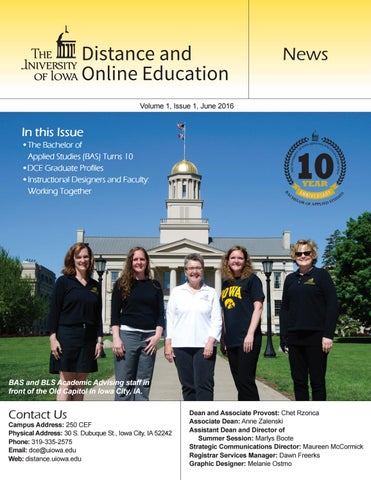
BAS and BLS Academic Advising staff in front of the Old Capitol in Iowa City, IA.
Contact Us
Campus Address: 250 CEF Physical Address: 30 S. Dubuque St., Iowa City, IA 52242 Phone: 319-335-2575 Email: dce@uiowa.edu Web: distance.uiowa.edu
Dean and Associate Provost: Chet Rzonca Associate Dean: Anne Zalenski Assistant Dean and Director of Summer Session: Marlys Boote Strategic Communications Director: Maureen McCormick Registrar Services Manager: Dawn Freerks Graphic Designer: Melanie Ostmo
BAS 10th Anniversary The Bachelor of Applied Studies (BAS) is celebrating its 10th anniversary. The first of its kind in the State of Iowa, the BAS was developed for community college students who had completed an associate of applied science degree (AAS), and wanted to complete a bachelor’s degree at a distance.
wa Io
an d
10 1 BA
Turning Vision into Reality
EL
OR
O F A PP L I E D
In 2005, 40% of community college graduates in Iowa came from technical fields. Additionally, there were a higher percentage of associate degree graduates in Iowa. Given this information, the Board of Regents created the 2+2 Council to enhance discussions between the Regent universities and Iowa community colleges regarding transfer articulation. The work of the Council contributed to the creation of a Bachelor of Applied Studies (BAS) degree at the University of Iowa. Today there are approximately 120 different technical programs in the 15 community colleges in Iowa. Each of these programs now has a pathway to a baccalaureate degree at The University of Iowa. Community college advising teams have contributed greatly to the growth of the BAS degree program by the knowledge they share with prospective students on their campuses.
Newsletter
Since its inception, 305 students have graduated with a Bachelor of Applied Studies from the University of Iowa, while remaining an active member of their hometown community. Distance and online degree and certificate programs E extend I the reach of the D ST U University—providing the same quality instruction found on campus.
S
The Univer sit y
YEAR
CH
o
ne li n
f o
cation edu
The BAS degree allows students to develop an individualized general studies program with selected distribution and emphasis areas. Additionally, course work may be completed entirely online, or by a combination of on campus and online courses. Throughout its 10 year history, adults balancing professional growth and busy lives have appreciated the flexibility to complete a degree at a pace that works for them.
“The University of Iowa continues to strengthen their commitment to high quality degree programs for Iowa community college students,” says Laura Riley, advisor at Kirkwood Community College. Riley adds, “The BAS degree provides an accessible, reputable, and affordable opportunity for significant student population within our State. Once a terminal degree, applied science programs now have an added value for those choosing to advance their studies.” distance
“The BAS is uniquely Iowa. The degree was approved by a proposal presented by our then Provost, Lola Lopes and Kim Lunduska, Vice President for Instruction at DMACC,” says Chet Rzonca, Associate Vice Provost and Dean of the Division of Continuing Education. “Since 2005, other new majors and degrees have been initiated to respond to the needs of community college graduates, yet the BAS from Iowa remains the one comprehensive approach allowing all place bound community college graduates to earn a baccalaureate degree.” Thanks to our community college partners and to the foresight of the original 2+2 committee members, the Bachelor of Applied Studies degree program continues to be a vital solution to distance students across Iowa.
Volume 1, Issue 1, June 2016
Employees at North Iowa Area Community College (NIACC) in Mason City, Iowa celebrate 10 years of the BAS degree during fall 2015.
Employees at Des Moines Area Community College (DMACC) celebrate 10 years of the BAS degree during fall 2015.
Employees at Kirkwood Community College in Cedar Rapids, Iowa celebrate 10 years of the BAS degree during fall 2015.
BAS and BLS enrollment increased 19.8% from 2014 to 2015. Newsletter
Volume 1, Issue 1, June 2016
University of Iowa Distance Education Student Dreams of being an Author When Tyler Hahn began his Bachelor of Applied Studies (BAS) degree with an emphasis in creative writing, he dreamed of working in a library. Not only has he achieved that dream, but is now working on his third draft of a novel called Savage’s Letter. Hahn completed a substantial portion of the first draft of this book in his undergraduate novel writing course. “The class focused on different dimensions of writing and each lesson built upon the previous one,” Hahn says. “The instructor always offered constructive criticism which greatly improved my writing over the semester.” Tyler’s novel tells the story of a young man from Savage, Minnesota who has traveled to Africa on a mission trip with his older brother before he goes off to seminary himself. The novel is written in epistolary (letters and correspondence) to the main character’s fiancée, his parents who funded the trip, and his childhood best friend. The story itself is about choosing one’s destiny rather than settling on what has been handed to you. Hahn’s own dream to be a librarian started in the first grade when he was struggling with
Newsletter
reading. His first-grade teacher recommended he visit the library over the summer and read. It was there, thanks to the children’s librarian at the Marcus public library that Hahn learned to love reading. Hahn graduated from Western Tyler Hahn • BAS Graduate • Spring 2015 Iowa Tech Community circulation of materials to other College (WIT) in Sioux City with institutions. He catalogs books an Associate’s degree before and digital materials for an choosing to attend The University ever-growing collection. of Iowa as a distance and online student. Working and continuing his education at the same time allowed “I chose the BAS degree program Hahn to apply tools and skillsets because it offered the flexibility from his classes on the job. I needed to complete my education. I was able to take “Having a bachelor’s degree led to the core courses I needed to a better life,” says Hahn. “I was develop my writing skills while able to get my dream job and work also building a career.” in a rewarding environment.” In his current position as a library specialist at WIT, Hahn oversees the interlibrary loan process for campus students and
Volume 1, Issue 1, June 2016
Matt Moore, BAS Graduate 2012 is Paying it Forward he prospects for new clients who will be a good fit for the advertising agency’s creative talents. Through these efforts, Moore has developed relationships that have led directly to business for the agency. Saturday Mfg. has large clients such Matt Moore, • BAS graduate • Spring 2012 as ARAG, the Principal Matt Moore is paying it forward Financial Group, and the Iowa in his role as mentor for the Finance Authority, but also seeks University of Iowa Venture School to help develop small business and in Des Moines. The Venture School nonprofit agencies. is designed to accelerate the startup process while increasing “Large contracts have given us the new business success. freedom to work with small businesses and startups like Thelma’s “Ventures don’t tend to fail from Treats where our package design a lack of business planning, they has won awards and international tend to fail because of lack of recognition,” says Moore. “We also customers,” says Moore. “As a work with many nonprofits and mentor, I open up my rolodex to have been involved with the Des connect them with interview Moines Music Coalition since their subjects, help the teams formulate inception, providing the creative their questions, and provide for 80/35, a music festival set in perspective on the answers downtown Des Moines.” they get.” While Moore’s career success was Moore is uniquely qualified to work satisfying, he had always hoped with Venture students. In his role to complete his undergraduate at Saturday Mfg. in Des Moines, degree from Iowa. “I left the
Newsletter
University of Iowa in 1995 and started working,” says Moore. “That bit of unfinished business bothered me, so when Iowa announced their partnership with DMACC, I jumped at it.” Moore first completed his Associate of Arts (AA) from DMACC in 2010 and continued on through Distance and Online Education at Iowa completing his Bachelor of Applied Studies (BAS) in 2012. As with many distance students, the flexibility of the program was key since Moore was working full-time while pursuing his degree. “The challenge was managing my time outside of work to complete course work and not become a stranger to my family and friends.” The entrepreneurial courses Moore took were particularly useful in his role as manager of Business Development. Knowledge gained about communicating effectively to decision makers has helped him grow at work and in his mentoring role. “Not only is it rewarding to help teams develop their business concept, I feel my education at Iowa continues on by being in the Venture School’s orbit.”
Volume 1, Issue 1, June 2016
From Instructional Design (ID) to First Day of Class What does it take to bring an on campus course to life online? It takes the collaborative efforts of distance education professionals working with the faculty member to bring virtual course content to students logging in from around the globe. Natalie Denburg, associate professor from the Department of Neurology took on this challenge in fall 2015 when she worked with the instructional development team to develop a course for health care professionals. Denburg had taught an online course before, but this was the first time she would be coordinating a group of health care leaders from five colleges including medicine, dentistry, nursing, public health and pharmacy. A landmark course, Introduction to Health Care Professions, makes perfect use of multimedia technology to present introductory material from a variety of guest speakers within a course format. Students are provided videos of leaders in the field discussing cutting-edge trends in health care. Online discussion boards on topics like the Patient Bill of Rights provide opportunities for students to engage with each other in much the same way they do in a face-to-face classroom. Denburg also utilized virtual office hours to stay connected with students and assigned readings to further the topics presented on the introductory media. These types of online technology tools bring the instructor’s content
knowledge to the forefront and provide accessible and engaging activities to the online learner. “It’s a unique Amy Oberfoell, Natalie Denburg, course that Instructional Designer Associate Professor provides the student with a survey of the main curriculum must be set up in health care professional fields,” advance. This aids in the overall says Denburg. “Students learn a lot quality of the course and allows about both the professions they the instructor more time during are interested in, as well as the the semester to support students. professions that they will no doubt Breaking down the course process come into contact with during their into manageable steps is one career in the health care field.” of the benefits of working with Working with an instructional designer is key to the online course process. Faculty members who are interested in developing an online course will first meet with an instructional designer to discuss the course goals and objectives, as well as the instructional strategies and technologies best suited to meet them. Amy Oberfoell, one of the instructional designers in Distance and Online Education says, “Our role in the process is to help the instructor organize their course content into manageable modules and make effective use of interactive tools that support the student’s learning.” Planning is key to the instructional design process. To ensure course materials are available to students on a timely manner, course
an instructional designer. Designers also prove to be excellent sounding boards for the instructor, providing an opportunity to strengthen course content and deepen the experience for the student. In Denburg’s case, course assignments were creatively developed in a way that allowed the student to manipulate the material to a much greater degree than she had originally outlined.
Introduction to Health Care Professions utilizes an innovative mock interview activity that provides a quick way to interview many professionals within limited time constraints. Virtual office hours serve as another technology tool bridging the gap between the online and on campus experience. Much like face-to-face office hours, holding virtual office hours for online students provides an
Continued on next page
Newsletter
Volume 1, Issue 1, June 2016
Instructional Design continued...
opportunity for them to speak to a distance instructor either by email or phone, and have the instructor’s undivided attention.
Introduction to Health Care Professions is now being offered a second time during the fall 2016 semester. Denburg looks forward to strengthening the course even further with the use of technology tools. “From the word choice on the syllabus to the presentation of content in the narrated
PowerPoints, as well as the creative use of classroom assignments; working with a designer made me stretch and think outside of the box in a way I am not used to,” says Denburg. “No doubt, it improved the final product by an immeasurable amount.” If you are a faculty member interested in developing an online course, please contact Associate Dean Anne Zalenski at anne-zalenski@uiowa.edu.
Chet Rzonca to Return to Teaching Chet Rzonca joined the University in 1972 with a joint appointment in the College of Education and the Program in Health Occupations Education, Division of Health Affairs. In this role, he provided staff development activities for the then developing community college health occupations program faculty including the development of an academic major in Health Occupations. Rzonca was appointed director of the program in health occupations education in 1978. He subsequently served the College of Education as a professor, coordinator of the higher education program, and as the departmental executive officer of Educational Policy and Leadership Studies. Rzonca was appointed Dean of Continuing Education in 2000,
Newsletter
and associate provost and dean of Continuing Education in 2005. During his tenure, the Division established partnerships with the 15 Iowa community colleges launching a first of its kind online transfer degree completion program for technical graduates. Changing technology and attitudes has allowed the University of Iowa Distance and Online Education mission to expand, providing 514 online courses, 15 distance degrees, and 10 certificate programs in 2015. Prior to joining the University, Rzonca held appointments at various institutions of higher education and was a public school teacher in Connecticut. His colleagues say they will miss his sense of humor and the calm demeanor that he brought to his work. We wish him well as he steps away from his position in Continuing Education and returns to the College of Education in a teaching role.
New Distance and Online Degree and Certificate Programs • Bachelor of Arts in Enterprise Leadership • Bachelor of Arts in Political Science • Bachelor of Science in Sports and Recreation Management • Master of Science in Business Analytics (Cedar Rapids location, Des Moines location starting in August 2016) • Master of Arts in Educational Measurement • Certificate in Business Analytics (Cedar Rapids, Des Moines locations) • Certificate for Interscholastic Athletics/ Activities Director (online certificate starts August 2016) • Certificate in Online Teaching • Certificate in Teaching English as a Foreign Language • Certificate in Writing Go to http://distance. uiowa.edu/programs for detailed program information. Volume 1, Issue 1, June 2016