The Future of Live Events
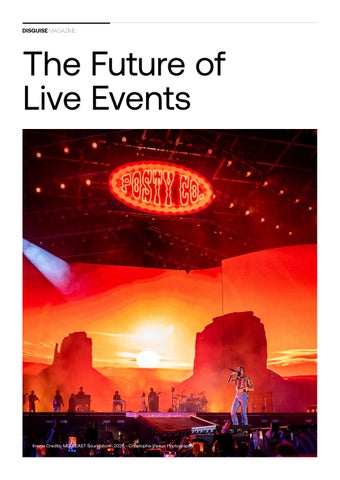
Image Credits: MDLBEAST Soundstorm 2025 - Christophe Viseux Photography
LIVE EVENTS
State of Play
PAGE 3
The rise of real-time
PAGE 5
What theatre can teach us about the future of live entertainment The future of live: where are we heading next? GX range: Power to respond Shaping the future of live events
PAGE 11
PAGE 15
PAGE 19
PAGE 25
Image Credits: MDLBEAST Soundstorm 2025 - Christophe Viseux Photography
www.disguise.one
STATE OF PLAY LIVE EVENTS
The next era of live entertainment We are living through a golden age of live entertainment. The ‘Taylor Swift Effect’ sparked a conversation about the way a single tour could shift an entire economy, but since then, something larger has taken shape. The scale, ambition and cultural reach of live shows has accelerated far beyond the landmark tours that first signaled this shift. In fact, live entertainment has become a global cultural force - and local fan favourites are increasingly going global. Genres such as K-Pop, J-Pop, Latin and Country music are topping global streaming and tour revenue leaderboards and filling arenas far from their original markets, drawing audiences across borders. Instead of waiting for their favourite artists to come to them, fans are now flying across continents, treating concerts as cultural events that connect them to something bigger than the music itself. At the same time, a second force is reshaping the landscape: the desire to share these experiences online. Younger generations in particular document everything, and a show’s impact is now often measured by how well it travels across social feeds. Live entertainment now sits at the intersection of culture, commerce and community - and that scale comes with new expectations. This raises an important question for anyone planning a major production: how do you meet an audience whose expectations keep climbing?
“Live shows now carry extraordinary weight. We’ve seen them move economies, shape culture and bring millions of people together across borders. With that scale comes responsibility. Our role is to ensure the creative community has the tools, insight and confidence to meet rising expectations and deliver experiences that feel bigger, bolder and truly unforgettable. After more than twenty years in live entertainment, we remain focused on one thing: enabling our customers to build what audiences will demand next.” Tom Rockhill COO - DISGUISE
PAGE 3
Live Events
LATAM: emerging global giants
K-Pop’s global influence
World economic impact
31.5B
90.4B
$8.27B
global streams generated by Bad Bunny in 2025 (Luminate)
global on-demand streams generated by Top 100 K-Pop artists (Luminate)
generated by the UK live events industry in 2023 (Access All Areas)
$490M
$228M
$407M
generated by Latin music in 2025 (Music Business Worldwide)
grossed by K-Pop acts on Billboard Top Tours (Billboard)
generated by Beyoncé’s Cowboy Carter Tour (Billboard)
$4.7B
50%+
19.2M
projected value of the LATAM market by 2033 (Market data forecast)
of respondents rate K-Pop as “very popular” in their country (Statista)
“music tourists” travelled to gigs and festivals in the UK (StandOut Magazine)
Image Credits: Fontaines D.C. - Andrew Whitton
PAGE 4
The rise of real-time Live events are growing. Stages are no longer simple backdrops but architectural environments, built from vast LED surfaces that wrap, tower and stretch across the audience’s field of view. This scale is made possible by advances in display technology, processing power and media systems that allow productions to deliver visuals at unprecedented resolution, night after night, across global tours. Despite that technical leap, the way content is delivered has remained largely unchanged. Pre-rendered video continues to be the backbone of most live productions. It offers control, consistency and reliability, which makes it the natural choice for shows that need to retain their look and feel from one city to the next.
Image Credits: Glass Animals - Evan Woodrum
PAGE 5
But as stages expand and visual ambition grows, new playback models are growing in popularity. To combat the challenge of larger screens, heavier content, tighter timelines, and less flexibility once a tour is on the road, real-time tools started to appear alongside traditional playback, first as enhancements and effects, and increasingly as a way to give shows more freedom to adapt if that’s the creative vision.
Live Events
The weight of the pixel There is a logistical reality driving a shift in the industry. As venues get bigger and screens get wider, the “data weight” of a tour is increasing. Filling massive LED surfaces with uncompressed video creates terabytes of data. And, as any operator knows, transferring 10 terabytes of footage across servers doesn’t take minutes, but days. Real-time technology offers a smarter way to handle this scale. Instead of carrying heavy video files for every second of the set, operators can generate content on the fly.
This unlocks a new level of touring agility. In the real world, no two venues are identical; a screen might be a wide panorama in a stadium one night and a tighter, boxier configuration in an arena the next. With real-time workflows, the content can simply be re-rendered to fit the canvas. The visuals can breathe and adapt to the specific geometry of the performance, ensuring the show looks bespoke to every venue without hours of re-editing.
“Flexibility has become a key priority for today’s show designers, and Disguise is committed to creating scalable, accessible solutions that help productions adapt seamlessly across different venues and budgets. The launch of our portable, software-only solution, X1, is a gamechanger for our users, allowing teams to retain creative quality while remaining agile on tour.” Raed Al Tikriti CPTO - DISGUISE
PAGE 6
How real-time is shaping the stage Innovative teams are already using real-time workflows to push the audience experience further. Here’s how distinct sectors are using this tech to elevate the show:
Image Credits: FISHER - High Scream
01
02
The enhanced camera feed (IMAG)
Electronic and club culture: the responsive ecosystem
For touring acts, the most immediate application is transforming IMAG. Rather than just displaying a standard camera feed of the singer on the side screens, productions are using real-time engines like Notch to treat the live video as a canvas. We are seeing particle systems that emanate from a performer’s movements, or digital lighting that re-lights the artist’s face in real-time. It blends the live human element with digital artistry seamlessly, ensuring that even fans in the back row feel intimately connected to the magic on stage.
In the electronic music space, the workflow is becoming fluid, turning the entire venue into a living organism. Features such as Variable Timecode Speed and integrations with DJ equipment are allowing visuals to truly jam with the artist. If a DJ slows down a track to build tension, the visuals slow down automatically. We saw this powerfully at Zillion in Belgium, where the team linked the lighting desk directly to the Unreal Engine environment. When the physical lights in the club turned red, the virtual world on screen turned red instantly. For the audience, this creates a total sensory wrap-around; they are immersed in a cohesive atmosphere where the lights, the beat, and the video feel like one single, breathing entity.
PAGE 7
Live Events
03
04
The purpose-built ecosystem
The future: spatial synergy
At the extreme end of the scale, venues like the Sphere are demonstrating what happens when real-time is baked into the architecture. These environments serve as testbeds for high-resolution generative art, proving that real-time content can hold up at 16K+ resolutions. They are pioneering “data-driven art,” where external variables - like local weather data or audience noise levels - can fundamentally alter the visual mood of the venue.
The next great leap for audience immersion is the convergence of real-time visuals with spatial audio. When a visual system and a spatial sound system listen to the same data, the result is total immersion. Imagine a sound swirling around the arena physically passing behind your head, while the visual environment ripples in the exact same trajectory across the screens. It turns a concert into a 360-degree world.
Image Credits: Glass Animals - Ed White
PAGE 8
Evolving real-time workflows for touring Touring shows still need to deliver flawlessly across venues, crews and conditions, with tight synchronisation between lighting, audio, automation and media remaining key. Real-time tools have reached maturity and are increasingly becoming more stable, better understood and easier to integrate into existing pipelines. What once felt experimental is becoming a practical part of the process - rather than replacing pre-rendered workflows, real-time content is finding its place alongside them, adding flexibility without sacrificing control.
9 Glass Animals - Evan Woodrum Image PAGE Credits:
Live Events
Image Credits: MDLBEAST Soundstorm 2025 - Christophe Viseux Photography
Bridging the gap When we look at the industry today, we’re seeing a gap in adoption. On one side, we have experimental club culture - agile and unafraid to improvise. On the far other side, we have purpose-built behemoths like The Sphere - venues designed specifically for high-resolution generative content. But in the middle, where most touring and live shows live, there is a massive opportunity waiting to be seized. What makes this shift especially powerful is how directly it changes the audience experience. When designers generate content in real-time, no two nights have to feel the same. Visuals can respond to the performance, the pacing of the set, or the energy in the room. A show becomes something lived rather than repeated.
That uniqueness carries weight beyond the venue. Moments that feel unrepeatable are the ones audiences share, talk about and travel for each year. In a world where live experiences are measured as much by memory as by reach, real-time content creates the kind of shows people actively seek out, return to and remember. As workflows stabilise and creative teams gain confidence, real-time content will move from the experimental edges to the centre stage of global touring. For artists willing to make that leap, the reward is the ability to create experiences that are not just bigger, but truly iconic, ultimately pushing your live event further than it has ever gone before.
PAGE 10
What theatre can teach us about the future of live entertainment We are living in a moment of extraordinary technical possibility, and theatre has quietly been leading the way. Long before digital tools became central to conversations about live entertainment, theatre makers were already working within a clear creative discipline: story first, technology second. This approach has shaped theatre for decades. Directors, set designers, choreographers, lighting and video teams have always shared a single creative space, building worlds collaboratively and allowing the narrative to dictate every technical decision. In theatre, technology has never been the headline. It exists to support pacing, emotion and atmosphere, and it only earns its place when it serves the story. What is changing now is not the philosophy, but the toolkit. As theatre productions increasingly adopt video, projection and digital systems, they are using them with remarkable restraint. Screens become architecture. Projection reshapes space. Video extends the physical set. In the most compelling productions, the audience rarely notices where the technology ends and the scenery begins. They simply accept the world unfolding in front of them because the technology makes the story so believable.
This makes theatre an essential reference point for the wider live entertainment industry. While other sectors might chase scale and spectacle, theatre demonstrates how technology can deepen immersion without overwhelming performance. It shows what happens when digital tools are woven into the fabric of a production rather than layered on top. In this section, we explore how theatre is using technology in this way, not to chase spectacle, but to deepen narrative. These productions offer a clear lesson for the wider live entertainment industry: when creativity sits at the centre, technology becomes incredibly powerful.
“On Maybe Happy Ending, we wanted to use video for storytelling purposes, as an extension of the on-stage elements. When Oliver and Claire leave their tiny box apartments, we go on a journey with them, and video supports their adventure the whole way through. At times subtly gesturing to the motion of a road and passing buildings, to a bustling ferry terminal and wide open landscapes. The content on the LED tiles combines with lighting and stagecraft to show the expansiveness of the scenery that surrounds them.” George Reeve Video Designer on Maybe Happy Ending
PAGE 11
Live Events
Image Credits: Maybe Happy PAGE Ending12- Matthew Murphy and Evan Zimmerman
In focus: How video is redefining theatre
Image Credits: Redwood - Matthew Murphy and Evan Zimmerman
Hercules the Musical
Redwood
In Disney’s Hercules the Musical, the challenge was pace. The production moves rapidly between the heights of Mount Olympus, the shadows of the Underworld and the familiar world of mortals. Video serves as the engine behind these transitions. It holds the dramatic rhythm of the production, allowing each new environment to appear with the immediacy of a page turning, providing a seamless transition for the audience.
To transport audiences into the stillness of the California redwoods, the creative team behind Redwood used video to reshape the physical architecture of the stage. Each scenic tile became part of an LED forest, shifting and breathing with the emotional tone of the show. The result is a set that feels almost alive, expanding and contracting with the story rather than sitting behind it.
PAGE 13
“We had to design a space that could transition between a forest and Jesse’s memories. We had this idea of an expansive, immersive forest filled with moving trees that could change or even shift into a city scene seamlessly. The answer to doing this was using LEDs.” Hana Sooyeon Kim Video Designer on Redwood
Live Events
Stranger Things: The First Shadow
Maybe Happy Ending
This theatre adaptation of Netflix’s popular franchise uses projection-mapped video to blur the boundary between the physical stage and the supernatural. Carefully sculpted projection warps walls, alters shadows and reshapes environments in real time. The video becomes part of the set rather than an effect layered on top of it, allowing the show to stage moments that feel impossible while preserving the integrity of the theatrical world.
In Maybe Happy Ending, video is used as an extension of the physical set. LED tiles expand the world beyond the apartment, carrying the audience with the characters as they move through streets, buildings and ferry terminals. Scenes shift fluidly, without breaking the narrative, allowing locations to appear and disappear in rhythm with the story. The technology stays subtle and integrated, broadening the stage while keeping the focus firmly on the characters and their journey.
Image Credits: Stranger Things: The First Shadow - Manuel Harlan
The future of the stage We believe that this level of video integration will define the future of theatre. The shift is already underway. Productions are finding new ways to weave digital elements into scenic design so closely that the audience experiences them as a single, cohesive world. This deepens the emotional connection between the story and the viewer. The technology is present, yet its presence is invisible. What remains visible is the world being created.
There is a broader message here for everyone working in live entertainment. As shows continue to grow in scale, and as audiences become accustomed to more ambitious visual experiences, the foundation of a powerful production remains the same. It begins with a clear creative vision. Technology plays its strongest role when it is used with intention, shaping the experience without overshadowing it.
PAGE 14
The future of live: where are we heading next? After exploring how real-time content is reshaping large-scale productions and how theatre is redefining the creative process, we turned to our own team at Disguise, and community, to understand what they believe will influence the next wave of live entertainment. These conversations revealed a set of themes that highlight where the industry is heading and how technology and creativity are likely to evolve together.
The shift toward IP workflows “One of the clearest trends is the gradual movement toward IP-based video systems. Lighting and audio made this transition years ago, while video has been slower to follow - largely because it is inherently the most demanding media format to transport over IP, with significantly larger data rates per second than lighting or audio. Touring environments demand reliability and simplicity, which is why SDI remains so common. Even so, the advantages of IP are becoming increasingly difficult to ignore, and the transition of video onto a single, unified production network is emerging as the logical next step for live shows and immersive experiences.
Ollie Newland Head of Customer Success DISGUISE
PAGE 15
An IP network allows media to move through a single system rather than through clusters of bespoke or dedicated hardware. By leveraging fibre-based video distribution, IP systems can carry significantly larger data rates over greater distances than traditional baseband signals. This enables higher resolutions, increased frame rates, and greater colour fidelity, while also allowing more signals to travel over fewer physical connections – reducing overall system complexity as production scales. The shift will take time, especially for shows that travel from venue to venue, but the foundation is being built now. Over the next few years, this approach will begin to feel less experimental and more like the natural progression of the workflow.”
Live Events
Human-led creativity in real-time production “I’m really excited by the greater shift toward realtime, generative, and interactive content. Instead of rigid timelines and using solely pre-rendered visuals, we’re now building flexible, responsive systems with deeper integrations between video, lighting, audio, and automation. These setups often now put the media server at the center of productions as a central show control engine generating visuals, tying in lights reacting to what’s happening on stage, the audience’s engagement and what’s being felt in the moment. While keeping artistic intent in human hands, AI, used thoughtfully, is beginning to enhance workflows, giving teams more control over a show’s look and freeing them to focus on creativity rather than managing the mechanics of making visuals a reality. It’s unlocking new levels of control, responsiveness and creative freedom within live events.”
Ellie Clement Video Designer on Radiohead’s 2025 Tour
A new pace for content creation “Advances in GPU performance and the rise of AI-assisted tools are speeding up the creative process in noticeable ways. Teams can now explore concepts, variations and refinements at a pace that was simply not possible a few years ago. Ideas that once required long render times or significant resources can now be shaped quickly, which gives designers more space to experiment.
Jason Clairy AMER Sales Director for Live Events DISGUISE
For emerging artists, this shift is particularly meaningful because it lowers the barrier to entry. For larger productions, it allows creative teams to refine details and push their ideas further without sacrificing time or quality. This new pace is beginning to influence both the scale and the ambition of the work being produced.”
PAGE 16
Why the fundamentals still matter Despite rapid change across the industry, one idea remains constant. The shows that resonate most are the ones built on strong creative foundations. Technology can elevate a story, but it cannot replace the thought, craft and emotional clarity that form the backbone of memorable work. Across every department - audio, video, lighting, and beyond - our teams return to the same principle: master the basics, collaborate with people who bring out the best in the work, and keep the story at the centre of every decision. Innovation becomes meaningful only when it strengthens the connection between the artist, the audience, and the collective team bringing the show to life.
Alexandra Coulson VP of Marketing DISGUISE
Extending the experience to the audience “Audience behaviour is increasingly shaping how live events create value for artists, promoters, and brands. Global tours from artists such as Taylor Swift and Beyoncé have demonstrated that a live show is no longer a single moment in time, but a cultural ecosystem that lives on across platforms, devices, and communities. This shift extends the life of a live event beyond the final cue. The performance becomes the starting point for an ongoing relationship that continues across phones, homes, and social platforms. For marketers, this mirrors what we’ve seen around the most culturally resonant tours: sustained conversation, repeat engagement, and brand alignment that travels with the audience long after the show ends. The result is a move from one-night visibility to sustained presence creating deeper engagement, measurable interaction and new sponsorship models built on participation and longevity, not just exposure.”
PAGE 17
The next era of live entertainment will grow from a combination of these influences. IP-based workflows will quietly reshape the technical infrastructure. Faster content creation will expand what is creatively possible. Data will blur the line between design and performance. Audience interaction will extend the show beyond the venue. Together, these changes point toward a future where technology serves creativity with more intention. The most exciting opportunities lie not in the tools themselves, but in how they allow artists to imagine, refine and share the worlds they want to create.
Image Credits: DJ Snake - High Scream
Live Events
Disguise’s new ambassador programme Creators Circle is Disguise’s global ambassador programme - built to connect, recognise and amplify the voices of our community. By bringing together experienced power users and emerging creators, the programme helps close the talent gap, accelerate shared learning, and champion diversity and inclusion across our industry.
Creators Circle members will have the opportunity to be featured in future editions of this annual magazine - sharing insights, experiences and work that inspire others to create.
Learn More
PAGE 18
PRODUCT SPOTLIGHT
Power to respond Real-time content only reaches an audience if something can render it, night after night, in a room that is never quite the same twice.
Everything in this magazine points in the same direction. Stages are getting bigger, content is getting heavier, and the shows audiences remember are the ones that respond to the room they are in. Real-time content is what makes that possible, and it asks a lot of the hardware underneath. Heavy generative looks have to render live, on schedule, in venues with different screen configurations, different
signal chains and different local suppliers every few days. That is the job the GX range was built for. It is our flagship hardware for live events, optimised for Notch playback and engineered for the kind of generative video processing that concerts, ceremonies and arena shows now ask for.
Sidebar: what is in the range
GX 3
GX 3+
The go-to media server for the world’s biggest live events of the past three years, including Eurovision and Coachella.
More generative power again, with lossless 10-bit playback, for the most demanding Notch work.
PAGE 19
Live Events
”As an avid Notch user, the GX range has always been my favourite. I think they generally provide the right balance between playback capabilities, output number, and generative power.” Michael Adefehinti Creative Director at Framesync
01. Generative content
02. Respond to the room
Every GX machine is tuned for Notch content and ships with a two-year Notch playback licence. Teams run heavier blocks, more layers and higher Notch marks without cutting the creative down to fit the server.
Render live from camera, audio, MIDI, tracking, automation data and interactive inputs. Content reacts to the performance in front of it rather than following a fixed timeline.
03. Built for the road
04. Scale into a system
A ruggedised build tested against touring conditions, built-in failover for the rare hardware fault, and Video Format Conversion (VFC) cards that connect the server to whatever signal chain a venue runs. IP-VFC carries the same idea onto an IP network.
Cluster several machines into a single session and one show can cover many surfaces at once, with frame-accurate playback across all of them.
Explore the GX range
Learn More
Every show on the following two pages ran on the same range. Talk to us about what show or project you are planning.
PAGE 20
In focus: the GX range on tour Four shows from the past year where GX carried the real-time workload on the road.
Radiohead: visuals in the round
Laura Pausini: an LED castle that travels
Kit: GX 3, Designer
Kit: GX 3+, Designer, X1
Radiohead’s return after seven years away ran entirely in Notch, with no pre-rendered content at all. More than 20 live cameras fed a kinetic sculpture of 12 moving LED panels suspended above the band, and tracking data resized the camera frames as those panels travelled and rotated. Universal Pixels and Video Screens Director Ellie Clement, quoted on page 16, chose GX 3 to handle the 4K camera inputs alongside the Notch integration. The tour broke attendance records at The O2.
The Yo Canto tour turned the stage into a threedimensional castle built from LEDs, designed to adapt to whatever LED configuration each venue offered. The team reached 100 Notch blocks in 10 days and 50 layers in Notch, running multiple camera feeds, IMAG effects, 8K particle simulations and background removal on a GX 3+. Previsualisation in Designer let them review the whole show in 3D with Laura before the screens were even installed.
Read More
Image Credits: JENSKI
PAGE 21
Read More
Live Events
Doja Cat: one system, five continents
Olivia Dean: live camera as scenic design
Kit: Two GX 3 servers, Designer
Kit: Three GX 3 servers, Designer
Tour Ma Vie crossed five continents with a multisurface stage: a flown cube above the band riser, a second cube wrapped around it, tiered ribbons and IMAG screens. Video Engineer Rebecca Gerhard used Designer’s Sockpuppet workflow to expose Notch parameters to a grandMA3 desk, busking IMAG live from the console, while Feed Maps absorbed the raster changes that arrived with every new local supplier.
On the sold-out The Art of Loving tour, FRAY Studio and 1826 Studio dropped conventional IMAG screens and projected cinematic camera feeds onto large curved drapes instead. Three GX 3 servers drove eight Barco projectors and four Notch Blocks, applying custom LUTs and real-time colour correction so the live image sat inside the lighting design. The team had 25 days from the start of the creative process to opening night.
Read More
Image Credits: Greg Noire
Read More
Image Credits: Anthony Mooney
Having that level of power under the hood just gives you total confidence in a smooth show. Rebecca Gerhard Video Engineer and Disguise Operator
PAGE 22
In focus: beyond the tour The same servers, working at broadcast scale, in stadiums and in permanent installation.
Eurovision 2026: IP-native playback
The BRIT Awards: nine surfaces, one session
Kit: Eight GX 3 servers, IP-VFC
Kit: Nine GX 3+ and two GX 3 servers, Designer
160 million viewers, 35 countries, and 42 seconds to transform the stage between acts. For the eighth year running, Creative Technology partnered with Disguise, this time on a fully IP-native SMPTE ST 2110 workflow. Eight GX 3 servers fitted with IP Video Format Conversion (IP-VFC) cards distributed more than 49 million pixels across a 500 square metre LED canvas over a redundant 100 Gb network, with live video on its own hardware path so file transfers never competed with playback.
The 2026 ceremony moved to Co-op Live in Manchester with a stage carrying nine display surfaces, each needing its own pixel map, format and aspect ratio. NorthHouse and Ogle Hog clustered 11 servers into a single session to distribute 91 megapixels with synchronised, frame-accurate playback, ingesting NotchLC media across 15TB drives and a 100Gb media network. The show drew four million views across platforms.
Read More
Image Credits: Alberto Morand
PAGE 23
Read More
Live Events
Lidl Final4: the world’s first full LED handball pitch
Saudi Arabia Pavilion, Expo 2025 Osaka: six months of daily shows
Kit: GX 3+, VX 4+, Designer
Kit: GX 3, EX 3+, Designer
Creative agency PlanValley turned the floor, jumbotron and ribbons of Cologne’s Lanxess arena into one interactive 3D canvas, working with ASB Glassfloor’s LED flooring. Kinexon trackers worn by performers drove Notch effects in real time, and a half-time game tracked spectators’ positions so the visuals dissolved under their feet as they jumped. The team had under 48 hours on site to integrate tracking, calibrate cues and rehearse. Twenty thousand people watched in the arena, millions more at home.
Framesync ran video programming and operation across more than seven spaces in the second largest pavilion at Expo 2025. EX 3+ servers handled the galleries built around pre-rendered, multi-surface playback. GX 3 took the spaces where content changed every week: the Saudi Courtyard, the Music Studio and live performances where visiting artists connected their own laptops. The pavilion welcomed more than two million visitors across the six-month run.
Read More
Read More
Image Credits: HBL
“The combination of scale, precision and reliability is what sets Disguise apart. At a show of this scale and profile, there is no margin for error.” Tom Bairstow Founder and Executive Producer/Director, NorthHouse
Explore the GX range Speak to our team today to find out more about how we can help power your show or project.
Learn More
PAGE 24
Image Credits: Brand New - Eye Garden
Shaping the future of live events Disguise helps artists, designers, producers and technical teams bring ambitious live experiences to audiences around the world. From creative development and pre-visualisation through to content, system design, media processing and playback, we support the production journey from the first idea to opening night and beyond.
PAGE 25
For live events, this means giving creative teams the flexibility to build shows that can scale, adapt and travel. Whether it’s a global arena tour, festival, concert, theatre production or one-off spectacular, Disguise brings together real-time technology, powerful hardware and flexible workflows to help teams deliver complex visual experiences with confidence.
Live Events
As live entertainment continues to evolve, the opportunities are getting bigger. New creative workflows, larger canvases and more responsive experiences are changing what audiences expect from a show. Disguise gives the people creating those experiences the tools to push further, while keeping control where it matters.
Take your next live experience further with our end-to-end solutions Learn More Visit: www.disguise.one
PAGE 26
Thank you for reading. For more thoughts and insights from Disguise and our community, download the full edition of the Disguise Magazine 2026.
Download Now Contact us: marketing@disguise.one www.disguise.one