New Reviews:
Flashback Review:
Pokemon Legends,
Phoenix Wright: Ace
Luminous Avenger iX,
Attorney Trilogy
and More!
GAME SELECT Issue 1 – February 2022
In This Issue 4. Preview Corner 6. Demo Disc 7. Elden Ring: Dark Souls 4 or Something More? 8. Monthly Review
(Empty page for formatting reasons)
=
Coming Soon to a Console (or Computer) Near You
5 – Post Apinkalypse
5 – Strategic Information
Kirby and the Forgotten Land Coming March 25
Nintendo Switch
HAL Laboratory
Nintendo
Nintendo treated us to a new trailer for Kirby’s first fully 3D adventure, showing off a number of new features along with announcing a release in late March and opening pre-orders. The trailer showed off new and returning copy abilities, a co-op mode featuring everyone’s favorite Bandana Waddle Dee, and a boss fight with Meta Knight. Less expected was a plot involving kidnapped Waddle Dees that Kirby can rescue to fill a (frankly adorable) village you can spend time in between stages. The game is looking to be a promising new direction for the pink puffball, after a decade of great, but similar games.
The game’s environments promise the best kind of beautiful apocalypse to explore.
Triangle Strategy
With votes cast for major decisions making every character important, the battlefield won’t be the only challenge you face.
Coming March 4
Nintendo Switch
Square Enix
Nintendo
Following in the visual style of Octopath Traveler, Triangle Strategy promises two things. The first is deep strategic gameplay, with emphasis being placed on terrain elevation and abilities that can interact with the world. The second is a “morality” system based around the three ideals of utility, morality, and liberty. This promises far deeper and more resonant decisions than many other attempts at video game morality systems. These systems are brought together with the characters. Decisions you make will sway characters’ opinions of you. Conversely, you can use the game’s social systems to persuade others to your cause. The game promises a lot, but if it can deliver, it has all the makings of a classic.
Demo Disc
Enchain Full Game Releases 2022 (Early Access) Devloped by mattlawr
Demo Platforms: Steam, itch.io Published by mattlawr
Enchain is a fast paced movement shooter, with a low-res gothic aesthetic. Instead of flashy sci-fi guns, you get a revolver and a shotgun. This puts the attention more on your other abilities, including a plethora of platforming skills. The real highlight, though, is the grappling hook, which not only allows for incredible mobility, but allows you to grab and throw your enemies for exciting combat.
Worth Trying!
Gloomwood Full Game Releases SOON Devloped by Dillon Rogers, David Szymanski
Demo Platforms: Steam, GOG Published by New Blood Interactive
A first person survival-horror/stealth game, Gloomwood also works in some of the trappings of classic immersive sims like Thief. The level design and gameplay shown in the demo are solid, if sometimes rather cruel. While the mechanics don’t come together into anything too exceptional in the short timespan, there’s potential for something really special here.
Keep an Eye on it.
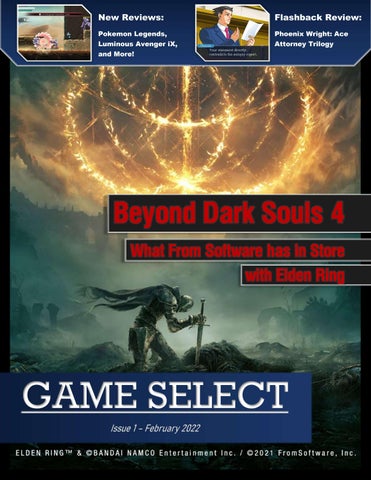
Dark Souls 4 or Something More? Elden Ring is easily the most anticipated game of 2022. At the same time, however, it has been clearly stuck in the shadow of From Software’s previous trilogy of games. Some of these comparisons are earned – like Sekiro and Bloodborne, the game clearly owes a lot of influence to From Software’s previous Dark Souls games. So to give you an idea what to look forward to, we’re giving you 4 ways it improves on the Dark Souls formula, and 4 brand new features, for 8 reasons to play Elden Ring when it releases on February 25, 2022. Dark Souls 4
Something More
1 – New and Improved Summons Summoned spirits return, but with a few new twists. They can now be summoned near any difficult encounter, not just bosses, and instead of simply being AI controlled players, they’re now far more complex and varied, with clear strengths and weaknesses for each.
1 – Mounted Combat In addition to using your mount to traverse the new open world, it’s an option for combat as well. From what we’ve seen so far, it is extremely powerful, but if you get knocked off it, you’re vulnerable for a long time. Thus, the tactic is powerful, but risky.
2 – Weapon Enhancement, Enhanced Weapons can now be upgraded by infusing them with new items, replacing their weapon arts, and also being the source of infusions to change damage types and scaling, adding more complexity to customizing your weapons.
2 – Hidden Mini-Dungeons In order to contrast the wide open areas, and avoid having them dominate the gameplay, there are smaller dungeons sprinkled throughout the world, hiding traps and treasure. While what we’ve seen so far isn’t too impressive, the concept holds potential to keep the game varied.
3 – More Defensive Options A new defensive technique seems to be a well-timed block that can be followed with a counter attack. Whether this replaces how parries work in Dark Souls, or serves as another option to make blocking more useful remains to be seen. 4 – Stealth Gameplay Okay, this is more “Sekiro 2” than Dark Souls 4, but the more involved stealth mechanics from Sekiro return. Furthermore, there is clear intend to integrate stealth with the variety of playstyles that Elden Ring’s RPG elements bring, with the main one shown so far being sleep arrows.
3 – A More Alive World To go with the open world, From Software has made attempts to make the world feel more alive than most games in the genre. Major enemies change locations depending on the time, and carriages pulled by strange, mutated humanoids move through the world. 4 – Strength in Freedom From Software’s previous games have always been famous for their difficulty, something that has always proven divisive. But with the large open world, more options than ever will be available to deal with the game’s challenges.
Monthly Review January 2022
The Game Select Rating System: 1 – Bad These games are probably not worth your time. There’s not much good to be found in them.
2 – Poor The game has some enjoyable parts, but it’s weighed down by the bad. Still, you might find something to like.
3 – Average
09 - Flashback – Phoenix Wright: Ace Attorney Trilogy 11 - Pokemon Legends: Arceus
The game is a pretty good time, but fails to make much of an impression. Worth checking out if it interests you, but it’s probably also a bit interchangeable, and you won’t be losing out on much if you skip it.
4 – Great These are games that stand out as something special. They’re not perfect, and not necessarily must-plays, but they’re worth the time you put into them, and are likely to make a strong impression.
5 – Masterpiece, or its Perfect Self
12 - Gunvolt Chronicles: Luminous Avenger iX 2 13 - Unsighted
Two types of game get the perfect score. The first are the rare few that can be called masterpieces, and will likely have influence on the wider culture of games for years to come. The second are those games that achieve everything they set out to do, and are hard to imagine being improved upon.
The Bloat Score
13 - Loop Hero
Let’s face it, we all know games are rated from about 6-10 by most publications. Which is why I felt the need to explain my scale. But people also like to compare and average scores. So for that, I introduce the Bloat Score (or BS for short), for you to use for these purposes, calculated with the following formula:
BS = 2.5 + [Actual Score] * 1.5
Phoenix Wright: Ace Attorney Trilogy Original Platform Developer Currently On
GBA, DS, 3DS CAPCOM PC, Switch, PS4, Xbox
Original Release Date 2001 (first game) CAPCOM Publisher Rating Today 4/5
The Turnabout Trifecta If you owned a Nintendo DS back in its heyday, you probably heard of the Ace Attorney games. They were never the biggest games, but they were wellregarded, and back in an era where visual novel games were extremely niche in the West, and old-school adventure games were mostly remembered by older PC players, they stood out quite a bit. Even those who never played them, such as myself, at least heard of “those lawyer games,” and would recognize them every time someone else mentioned them.
The Art of the Turnabout
games even work more interrogations into the investigation phases, asking you to gather evidence to grill someone for information. At its best, the game’s cases are satisfying murder mysteries, where you’re piecing together the crime yourself a few steps ahead of the game, and using this knowledge to pick holes in testimonies until you find the whole truth, often finding more than you might have initially thought you’d find. Unfortunately, the writing is not always this good, and in the first two games, there are sometimes sections where Phoenix simply bluffs his way through, and you have to find the right way to trigger this bluff, often feeling like a strange leap in logic. However, this is largely gone by the third game, where the cases are all well-written and logical.
While usually classed as visual novels today due to their Japanese heritage, in reality, these games hew closer to the classic adventure games, as finding Picking apart a witness’s case is often an intensely satisfying the right item to use in the right situation is the core logic puzzle. of the gameplay. The only difference is that, instead of using items on the environments to solve puzzles with sometimes questionable logic, you use the items on people to find their lies, or to find more information you can use. Typically, cases are split between investigation phases, exploring the scene to find evidence to use, and trial phases, where you crossexamine witnesses to find the truth, using the evidence you gathered as your weapon. The later
The Pinnacle of Turnabout
Phoenix starts as a novice, but he’ll improve through the games as you do.
A Troubled Turnabout While generally solid, the Ace Attorney games are sadly not without their flaws. Some of them are simple symptoms of the games’ age. For example, the first game feels a bit basic compared to its sequels, lacking features even as basic as being able to ask about specific people. Additionally, to put it mildly, there are some characters and jokes that really haven’t aged well. While this doesn’t apply to most of the games’ humor, it certainly does make things uncomfortable and a bit unpleasant when it does happen. To make things worse these are usually timed such that they make the least enjoyable cases in their respective games even worse. On the subject, pretty much every game has one case that’s not particularly good – and it’s usually the third case. The games tend to be best when you have some overarching story to the cases, and these usually do not have that, while also being on the longer side. Just to make it worse, these cases usually also are annoying to navigate for some reason or another. Fortunately, after you get over these cases, the games usually hit their best part, making these speed bumps frustrating, but temporary.
The third game, Trials and Tribulations, deserves special mention. The writing quality is top notch, the cases are engaging and rely little on the sort of leaps of logic or bluffs that ruined some cases in the previous games. There are also 5 cases instead of 4, with several of the cases including unique twists to keep the formula fresh. While the ending isn’t quite as satisfying as that of the first two games, it is an excellent conclusion to the trilogy. In fact, Trials and Tribulations on its own could be worthy of a perfect score. Despite this, it is still advisable to play the games in order. But if you only play one, it wouldn’t be the worst thing to play only the third game.
Your list of evidence is one of your sharpest weapons in court.
Turnabout Conclusions The Phoenix Wright Trilogy is a fantastic example of how an unconventional idea can turn into a star franchise. Ace Attorney games are still being made today. The games originally released on the GBA in Japan only, and it wasn’t until the DS ports that the games made it to other parts of the world. Surprisingly, for being a game so focused on a parody of the Japanese legal system, it continues to find fans all over the world. Furthermore, the Trilogy release is a great deal, with three games originally released for full price, available for half of a normal full price release. If you like visual novels, or just like old fashioned adventure games and don’t mind a bit of weird Japanese stuff, the Ace Attorney games are certainly worth your time today.
Pokémon Legends: Arceus Rating: 3/5 Developer: Game Freak
Bloat Score: 7/10 Publisher: Nintendo
Platforms: Switch After not playing a new Pokémon game since Platinum, Pokémon Legends: Arecus lured me in with a promising mix of classic Pokémon gameplay. The Pokémon series has always sold itself as an adventure, something that doesn’t always come across actually playing the games. So the change to an open world is, on paper, a great fit. The game starts with you, a modern human, being transported to a world in the distant past. Along with, for some reason, your smartphone. No, this isn’t original in the slightest. In fact, like many “transported to another world” stories, it pretty quickly starts to feel irrelevant. But ultimately, it doesn’t matter, as your goal still winds up to be completing your Pokédex – the first Pokédex, in fact. Rather than simply capturing one of every Pokémon, though, this is more involved, as learning about a Pokémon requires more interaction with it, including catching them, battling them, and performing more specific tasks. This does ensure that Pokémon don’t simply become something you ignore after you first catch them.
The game further uses the Pokémon themselves to reward exploration. There are a variety of species that can only be found in certain locations or under certain conditions, rewarding continuously searching the areas you come across. The best finds, then, are when you encounter a powerful Alpha Pokémon. These are substantially higher level than anything around, making them difficult to battle and catch, but this along with how they often know rare moves make them excellent additions to your team. Not all of the open world concepts work well, unfortunately. At times the open world can feel more like empty space that’s a chore to traverse, although this is mitigated early on when you can call a Pokémon to ride across the fields. Side quests, while not as inane as some games, can often feel like busywork, and can drag the game’s pace to a crawl. And of course there’s a side quest to collect 100+ random things scattered throughout the entire world. Crafting is also present, but in this case it’s actually quite unobtrusive. What holds the game back most is, unfortunately, the battle system itself. While the ability to use moves as “fast” or “strong” variants in a more flexible turn structure adds some depth, and the ability to freely equip moves removes a lot of
hassle, most of the other changes are to the game’s detriment. For the most part, Pokémon moves feel far more uniform and less unique, not helped by strange decisions such as turning stat raises into simple “offense” and “defense” boosts instead of specifically targeting physical or special stats. But the most baffling changes are the removal of two long-time features – held items and abilities. These systems created a lot of strategic depth for the series, so their removal is confusing, and really hurts the number of options available to the player. But natures and EVs, systems that only really added to things for competitive battlers, are still here. Despite some of these decisions meaning the game is not as great as it could be, Pokémon Legends: Arceus, is still an enjoyable experience. Exploring the world and collecting Pokémon is as enjoyable as it has ever been, if not more. While some changes need to be made, most notably restoring held items and abilities, Pokémon Legends: Arceus could be a strong prototype for future installments in the series. As it stands, it is still worth playing for fans of the series, whether you’re an older fan who has lapsed or a fan who has kept up with the series this whole time.
Gunvolt Chronicles: Luminous Avenger iX 2 Rating: 3/5 Developer: Inti Creates
Bloat Score: 7/10 Publisher: Inti Creates
Platforms: PC, PS4, PS5, Switch, Xbox One, Xbox Series X|S When I heard Gunvolt antagonist turned anti-hero Copen was getting a new game, I was expecting it to be more of his same gameplay from his spin-off and the second Gunvolt game. Instead, we get a radical departure that, while engaging, makes a few missteps in its efforts to find itself. The most iconic feature of Copen’s gameplay, the ability to chain air dashes together as long as you make sure each one connects with something, is gone. Instead, Copen gets only a single air dash before he has to reload, though in exchange he now reloads it the moment his feet touch the ground. This time around, Copen’s ground moveset takes center stage, with the powerful Razor Wheel making him deadly in close range combat, and the main way to rack up points is to score rapid kills using this new weapon. Furthermore, this new gameplay style leads to far more creative and varied EX weapons, such as a double jump or stopping time.
On the topic of score, Luminous Avenger iX 2 really does feel like it’s best played with a high score mentality. While the overdrive system (giving you a power up if you reach and maintain a certain score) and generally difficult gameplay have always encouraged mastering and replaying stages, this game feels like it really suffers if you don’t take the score attack approach. Firstly, when you have overdrive active, this game gives Copen his old multi air dash back, restoring the thrill of flying through levels, locking on and killing every enemy without even touching the ground. On the other side of the coin, boss weaknesses provide very little score, but make the fights incredibly trivial, to the point of feeling like a cheat code. And most powerfully, you can fully heal at any time – while it does limit your score, this only matters if you care about your score. So yeah, the game is trivially easy if you don’t care about score. But even if you do, while earning a top grade is difficult (in my time with the game I never saw an S ranking, much less the new X ranking), there are other options that trivialize it still. In place of the old, limited use “prevasion” auto-dodge power, Copen can unlock a skill to make him essentially invincible just by standing still, without any limits, trivializing even the most annoying boss patterns. As if this wasn’t enough,
upgrades to Overdrive can reduce damage and grant an auto-heal effect, removing any need to even consider the heal power. At the same time, the game has the usual difficult trial and error bosses. Not to mention the most hateful and miserable ice level I have ever played, and other levels where certain threats hit unreasonably hard. The end result is that the game’s difficulty feels confused – the features that make it easy ultimately win out, but only once you understand them. Unfortunately, the story also disappoints, by being completely irrelevant even to the Luminous Avenger iX continuity. While the ending implies some interesting twists regarding the alternate dimension the story is set in, the characters completely overlook these and just go on to live happily ever after. It’s a real disappointment, particularly after the satisfying twists of the first game’s ending made the previously confusing connections to the first Gunvolt game all make sense. Does this all make Luminous Avenger iX 2 a bad game? No. If you’re a fan of the Gunvolt series, you’ll probably still find this to be a fun, if easy, short and linear, experience, much like the first iX spinoff. And while it isn’t the strongest game in the series, there’s still Gunvolt 3 for fans to look forward to.
Unsighted Rating: 5/5 Developer: Studio Pixel Punk
Bloat Score: 10/10 Publisher: Humble Games
Platforms: PC, PS4, Switch, Xbox One Unsighted is a game that takes a lot of clear influences from obvious sources, but picks its inspirations well enough and mixes them with enough love and skill that the result is something beautiful. There are some influences from other games, such as Dark Souls or Metroid, but the clearest comparison is the old 2D Zelda games. But to describe it only by its influence would do Unsighted a grave disservice. The most unique mechanic of Unsighted, and the one that takes the game from a 4 to a 5, is that there’s a time limit on the lives of all characters – including the one you control. While you can extend one character’s life with Meteor Dust items found throughout the world, these are limited, and you likely won’t save everyone your fist time. The time limit is never oppressive, but always serves to provide an added pressure. While this makes your slip-ups hurt more, it That is not to say this is the only trick the game has going for it, as it also executes its own variation on the 2D Zelda format exceptionally. Firstly, it borrows some of the most commonly used elements from Dark Souls, such as bonfire-like checkpoints, and combat focused on stamina management and well-timed defensive actions. Additionally, the game executes on the common idea of new items opening new paths extremely well. It never falls back on old cliches of specialized switches that are only activated with a single item, and instead makes sure each item interacts with the environment in interesting ways. The items you get include a guided shuriken that can hit switches around corners, a frost grenade launcher to freeze paths across water, and a giant top you can ride on to glide along rails and smash stone blocks. Furthermore, some other items can fulfill these same functions, making the game world feel more alive and interactive – and opening up shortcuts and sequence breaks. If there's one weaker area, it's the story. For the most part, it seems to be a fairly simple story where humans are bastards, warring with and oppressing automata. Other elements start coming in later, but at least on a first playthrough, these don't quite amount to much. However, the story is not overly intrusive, only coming up periodically, and it works in this role, and despite the weak main story, the setting itself is fascinating, With its solid gameplay, engaging setting, unique mechanics, and fun to explore world, Unsighted manages to do everything it does exceptionally well. Nothing feels unnecessary, and the experience is one of the best indie games of 2021 - the fact it is not better known is tragic.
Loop Hero Rating: 4/5 Developer: For Quarters
Bloat Score: 8.5/10 Publisher: Devolver Digital
Platforms: PC, Switch, Linux, Mac Loop Hero continues the ongoing trend of mixing roguelike elements into every other genre, by this time taking from the idle game genre. It proves to be a well thought-out match, especially as both genres are great for playing in short bursts. While it’s a well-made match, it’s not without its flaws. Gameplay in Loop Hero is simple – your hero walks in a loop (who would have thought?), automatically fighting enemies and interacting with things as they go. You have a small handful of ways to influence this, and this is where the strategy is. You can place cards to add to the world, many of which interact in interesting ways. You can equip new items that your character finds on their journey, and pick special skills as they level up. And finally, you can choose to retreat, in order to save more of your spoils than you’d get if you died. The strategic experience this creates is sufficiently rich to entertain, and there’s plenty of upgrade and customization systems to sink your teeth into between runs. However, there are a few flaws that keep the game from being perfect. The biggest is simply that success or failure feels very random. While you can certainly improve your odds by learning and playing strategically, the game cannot escape the feeling that success and failure ultimately come down to luck – particularly with what sorts of randomly generated items you get. At the same time, the game avoids being too frustrating. When it’s so hands off, it’s hard to take a death personally. And furthermore, you still keep some resources when you die, so your next attempt is sure to be easier. While it’s not perfect, Loop Hero is an excellent roguelite that serves its role admirably – it’s a game you can boot up to kill a bit of time, and can be relied upon to be enjoyable for the duration.
NEXT ISSUE March 2022
EVEN MORE ELDEN RING
We’re going to provide some more launch coverage, a review, and maybe even comment on the game difficulty debate every From Software game causes.
FLASHBACK REVIEW: MONSTER HUNTER FREEDOM UNITE
We take a look back at the most classic Monster Hunter game, to see what the new games could stand to learn from it.
DYING LIGHT 2
After years in development, Dying Light 2 finally releases. Will it be worth the wait?
PREVIEWS APLENTY
March is looking to be a very busy month – get prepared as we outline all the hottest games for you to keep up with.