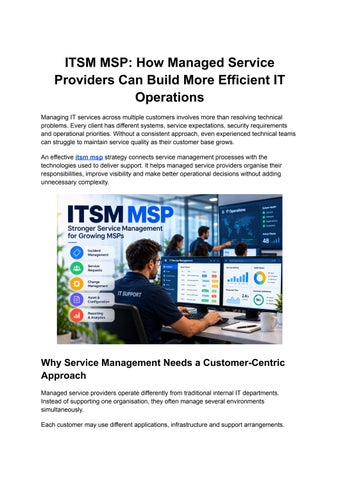
ITSM MSP: How Managed Service Providers Can Build More Efficient IT Operations Managing IT services across multiple customers involves more than resolving technical problems. Every client has different systems, service expectations, security requirements and operational priorities. Without a consistent approach, even experienced technical teams can struggle to maintain service quality as their customer base grows. An effective itsm msp strategy connects service management processes with the technologies used to deliver support. It helps managed service providers organise their responsibilities, improve visibility and make better operational decisions without adding unnecessary complexity.
Why Service Management Needs a Customer-Centric Approach Managed service providers operate differently from traditional internal IT departments. Instead of supporting one organisation, they often manage several environments simultaneously. Each customer may use different applications, infrastructure and support arrangements.
This creates challenges involving ticket ownership, service prioritisation, documentation and communication. A customer-centric service management approach helps technicians understand not only what has gone wrong, but also which business operations are affected. For example, an email outage affecting a small team may require a different response from a connectivity failure disrupting an entire customer location. Clear service priorities make these decisions easier.
ITSM MSP: Building a Practical Service Delivery Framework A reliable service management framework should establish consistent processes while allowing flexibility for individual customer requirements.
Define Service Responsibilities Every service arrangement should clearly explain which responsibilities belong to the provider and which remain with the customer. These may include: ● ● ● ● ● ● ●
Monitoring and technical support Incident investigation and resolution Service request fulfilment Infrastructure maintenance Change coordination User access administration Operational reporting
Clear responsibilities reduce confusion when incidents involve several teams or technology vendors.
Establish Service Categories Not every support request represents an incident. A failed business application may require urgent investigation, while a request for new software access may follow a standard approval process. Separating incidents, service requests and planned changes helps teams apply the appropriate workflow. It also makes reporting more meaningful.
Create Escalation Procedures
Some issues require specialist expertise or coordination with external vendors. Escalation procedures should identify when an issue needs additional attention, who becomes responsible and how progress is communicated. Without these arrangements, tickets may move between technicians without clear ownership.
Connecting ITSM With Everyday MSP Tools Service management processes become more effective when they connect with the tools technicians already use. For example, remote monitoring and management platforms can identify infrastructure problems, while service desk systems organise the resulting work. Asset management information can help technicians understand affected devices and applications. Documentation systems provide useful configuration details and troubleshooting procedures. However, integration alone does not guarantee better service delivery. Teams still need clear rules for creating tickets, assigning priorities and deciding which alerts require human investigation.
Why Customer Communication Deserves Attention Technical resolution is only one part of the service experience. Customers also need understandable updates, realistic expectations and clear explanations of what happens next. A useful communication process should establish: ● ● ● ● ●
When customers receive incident updates Who communicates during major disruptions How planned maintenance is announced What information appears in service reports How recurring problems are reviewed
Consistent communication can reduce uncertainty and unnecessary follow-up requests. It also helps customers understand the work being performed on their behalf.
Measuring Outcomes Beyond Ticket Numbers Ticket volume alone provides an incomplete picture of service quality.
A high number of closed tickets does not necessarily mean customers are experiencing fewer problems. MSPs can examine several operational indicators together, including resolution times, recurring incidents, ticket reassignment, service availability and customer feedback. These measures should be interpreted in context. For instance, a complex infrastructure incident may require more time than a routine password reset. Comparing them without considering their differences can produce misleading conclusions.
Using Technology Intelligence to Understand the ITSM Market Service management platforms also provide valuable information for B2B technology research. Software vendors, integration specialists and channel teams may want to understand which organisations are associated with particular ITSM technologies. Technology adoption intelligence can support: ● ● ● ● ●
Research into service management software usage Identification of relevant business segments Analysis of integration opportunities Market mapping and competitive research More focused company qualification
DiscoverMSPs provides B2B technology intelligence resources covering IT service management and other enterprise technology categories. Such information can help researchers understand technology environments, although software adoption alone does not confirm that an organisation intends to purchase another solution.
Conclusion Reliable managed IT services depend on clear responsibilities, consistent workflows and meaningful customer communication. A practical itsm msp approach should help technical teams organise service requests, coordinate incidents, manage changes and understand operational performance. Rather than introducing every available tool or process, providers should focus on the practices that address genuine service delivery challenges. Combining these practices with relevant technology intelligence can also support broader research into the evolving managed services market.
Frequently Asked Questions What is the main purpose of ITSM for managed service providers? It helps providers organise service delivery through consistent processes for incidents, requests, changes, documentation and customer communication.
How does ITSM differ from remote monitoring and management? ITSM focuses on service processes and responsibilities, while remote monitoring and management tools primarily support device monitoring, maintenance and technical operations.
Can smaller MSPs benefit from structured service management? Yes. Smaller providers can begin with straightforward ticket categories, ownership rules, documentation and escalation procedures before introducing more advanced workflows.
Which service management processes should an MSP prioritise? Incident management, service request fulfilment, change coordination and knowledge management are useful starting points. Priorities should reflect customer needs.
How can ITSM technology data support B2B research? It can help researchers identify organisations associated with service management platforms, study technology adoption and develop more relevant market segments.