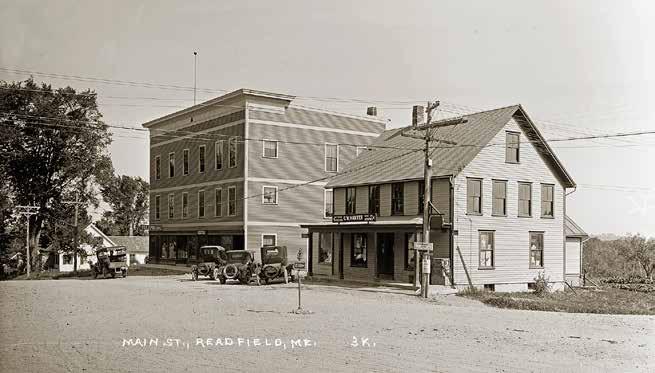
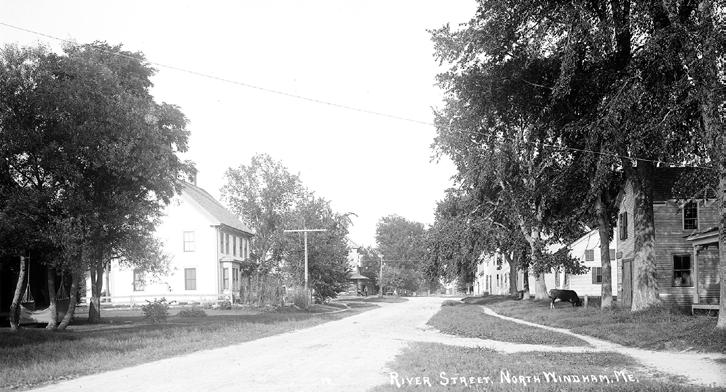
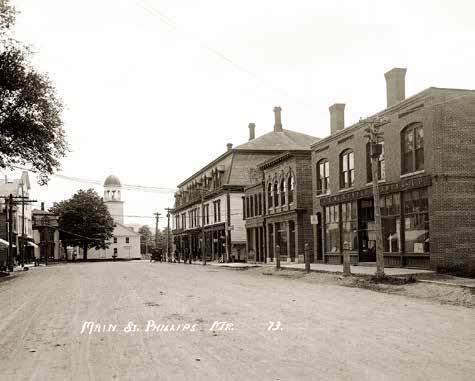
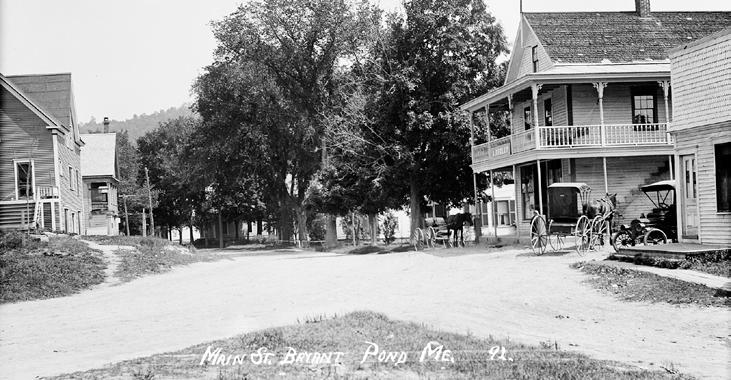
Discover Maine Magazine is distributed to town offices, chambers of commerce, financial institutions, fraternal organizations, barber shops, beauty salons, hospitals and medical offices, newsstands, grocery and convenience stores, hardware stores, lumber companies, motels, restaurants and other locations throughout this part of Maine. Front Cover Photo: Main Street in Readfield. Item # LB2007.1.102167 from the Eastern Illustrating & Publishing Co. Collection and www.PenobscotMarineMuseum.org
PART of this publication may be reproduced without written permission from Burch, LLC
2026, Burch, LLC
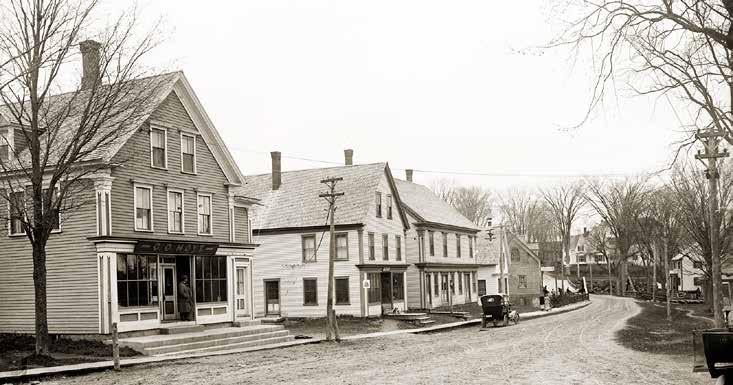
Brian Swartz All photos in Discover Maine’s Western Maine issue show Maine as it used to be, and many are from local citizens who love this part of Maine. Subscription form on page 66
IIt Makes No Never Mind
by James Nalley
f you time it just right, you can catch Western Maine in one of its most curious moods: April. At this time, the foothills of the White Mountains are shaking off winter like a groggy bear emerging from hibernation, snowpack is shrinking into streams of spring runoff, and the region’s small towns are stretching, yawning, and slowly coming back to life. Yes, it is still a transitional month — boots one day, sneakers the next — but this is exactly what makes April such a delightful time to explore this slice of Maine.
One of the joys of spring here is watching nature change not just week by week, but day by day. As higher elevations cling to their frosting of snow, lower trails begin to reappear from beneath winter’s blanket. It is this magical window where you can walk without snowshoes and without the company of summer crowds. Mt. Blue State Park in Weld and the Rangeley Lakes region are perfect for early birds hungry for scenic strolls. Trees are budding, songbirds are returning like vacationers who cannot stay away, and the views — well, you can brag about them without breaking much of a sweat.
As for something easy but dramatic, the Cascade Stream Gorge Trail
near Rangeley is the ideal warm-up for the hiking season. This mile-long path leads you to a 90-foot gorge with waterfalls that seem to be posing for spring’s first photoshoot. In this regard, April in Western Maine is waterfall season in its full, thundering glory. Screw Auger Falls near Newry, Rumford Falls, and Coos Canyon in Byron are among the region’s headliners. It is the perfect time to stand back, listen, and think, Ah yes… nature really is a better sound system than anything I own.
Wildlife lovers also get their moment. Spring migration is underway in the region’s lakes and wetlands. Lake Umbagog and the Rangeley Lakes area are prime seats in the avian theater. Birds of every feather arrive like guests at the world’s most punctual reunion. Moose also become more visible at dawn and dusk. If you spot one ambling through a wetland, it is not lost — it is just hungry and in no hurry.
Of course, spring weather here is about as predictable as a toddler with finger paint. One minute, it is sunny and mild; the next it is drizzling. Fortunately, Western Maine’s small towns know how to offer shelter with style. Bridgton, Norway, Farmington, and Bethel are scattered with cozy cafés, in-
dependent bookstores, and shops filled with Maine-made goodies.
But if your idea of “warming up” involves a pint glass, then you are in luck. Spring is when local breweries unveil early-season releases, including crisp lagers, small-batch ales, and experimental brews that might just taste like the woods after a rainstorm (in a good way). Norway Brewing Company, Steam Mill Brewing in Bethel, Sunday River Brewing, and Tumbledown Brewing in Farmington all offer friendly vibes and the kind of easy atmosphere that makes you think, Yeah, I could live here.
On this note, here is the following jest: A guy stumbles through the front door of a bar and orders a beer. The bartender says, “Sorry, sir, I can’t serve you — you’ve had too much.” The guy grumbles and leaves. Five minutes later, he bursts through the side door and demands a beer. “Still no,” the bartender says. Ten minutes later, he barrels through the back door and insists on a drink. The bartender repeats, “I’m really sorry, sir, but you’ve had too much!” The man blinks and says, “My God… how many bars do you work at?!”
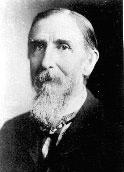
Vienna’s Milton Bradley Inventor of popular board games
by Wanda Curtis
Two centuries ago, when people spent more time at home, families played board games. The gentleman responsible for creating many of those games was Milton Bradley. The authors of the article Some Mt. Vernon & Vienna Notables, reported that Bradley was known as “the man who taught America to play.”
Milton Bradley was born in Vienna on November 8, 1836. He was the only child of Lewis and Fannie Bradley. They had a reputation for being a hardworking Christian family. Lewis operated the first potato starch mill in Maine, in Mercer, where starch was extracted from potatoes to use as a food thickener and for other purposes. The
— Milton Bradley —
mill later closed because of the potato blight. The family was forced to move more than once due to employment difficulties. They lived and worked throughout New England, eventually settling in Lowell, Massachusetts.
The University of Maine’s Raymond H. Fogler librarian, John Hutchinson, wrote in his online study guide that Bradley’s parents enjoyed playing checkers, chess, and other board games. His father was said to use apples and other objects to illustrate mathematical concepts for Milton. His parents reportedly believed that he could learn through play. Bradley excelled in math and science. He was also interested in art.
After Bradley graduated from high school in 1854, he went to work for a draftsman and patent agent. He sold stationery as a side job. He later studied technical drawing at Lawrence Scientific School in Cambridge, Massachusetts. However, he didn’t complete the two-year course. His parents moved to Hartford, Connecticut and he moved with them. He was unable to find work once he arrived there. So, he moved to Springfield, Massachusetts where he found employment as a draftsman for a locomotive company. The company experienced financial trouble which caused Milton to go into business for himself as a draftsman.
The New England Historical Society reported that Bradley was also interested in lithography. He bought a printing press and opened a lithography business. His first project was printing a picture of Abraham Lincoln, the Republican candidate for president.
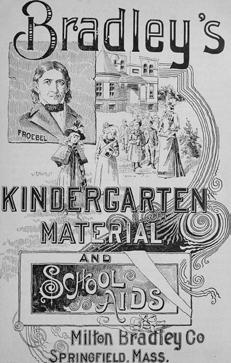
Bradley’s kindergarten material and school aids, 1896
The lithograph was made from an original photograph. The print was a big seller until Lincoln decided to grow a beard. Then the print no longer had any value because it was not an accurate representation. Like his parents who rebounded from business failures, Bradley searched for an alternative source of income.
According to the History of Milton Bradley for Kids, one of Bradley’s childhood friends (George Tapley) visited during that time and brought a game with him. The two men had fun playing it together which led Milton to think about inventing and printing his own games. He wanted to invent games that weren’t just fun but were also educational. His first game was called “The Checkered Game of Life.” It resembled a checkerboard but had red and white squares with words on them. Each square represented a different life choice. The game was played (cont. on page 6)
(cont. from page 5)
with a spinner. After spinning for a number, the player would decide which direction to take. Players who made right choices ended up on the square called “Happy Old Age.” If they made wrong choices, they ended up on a space called “Ruin.” Bradley traveled to New York and other states marketing the game and met with great success. He sold thousands of copies.
The author of that same article said that Bradley distributed the game to soldiers who were fighting in the Civil War. He’d noticed a group of soldiers who appeared to be bored. So, he assembled a bag with a small game board that could be used to play checkers, chess, or other board games. He also included “The Checkered Game of Life.” He first gave away the kits to soldiers and later sold them for $1 each. The soldiers liked having the kits that they could carry along with them, and many kits were sold.
Bradley was an influential figure in the kindergarten movement of that time. He created many educational games and materials for children. He gave away many materials for free. Like his parents, he believed that children could learn through playing. Bradley, his wife, and his father were the first kindergarten teachers in Springfield. The first kindergarten students in Springfield were Bradley’s two daughters. In 1860, the Milton Bradley Company was established. Milton created and marketed bestselling games such as “Battleship,” “Yahtzee,” and “Aggravation.” They also printed croquet manuals which contained rules for the game. Those became the standard rules for croquet, which was a very popular game at that time. He continued to produce games until 1984 when the company was acquired by Hasbro.
Discover Maine Magazine
has been brought to you free through the generous support of Maine businesses for the past 30 years, and we extend a special thanks to them.
Please tell our advertisers how much you love Discover Maine Magazine by doing business with them whenever possible. Thanks for supporting those businesses that help us bring Maine’s history to you!
Ossipee Ablaze
The fires of 1947
Iby Charles Francis
t was awesome to see the solid walls of roaring fire sweeping over the mountain and across level areas, consuming everything in their path. The smoke hung so thick and heavy for days over the area that it was difficult at times to determine just how near or far away the fires were. The sun did not penetrate through the thick wall of smoke for over ten days. Men using trucks, cars, and bulldozers had to use their headlights as much in the daytime as at night.
The above words describe the Waterboro Pine Barrens and the surrounding Ossipee Valley region in October of 1947. They were written by Austin Wilkins. Wilkins is, without doubt, one
of the greatest firefighters in the history of Maine. Shortly after the formation of the Maine Forest Service in 1927, he was named Supervisor of Forest Fire Protection in Organized Towns. He held the position in 1947. He would serve as Maine Forest Commissioner from 1958 to 1972.
1947 has gone down in Maine history as the year that Maine burned. That year, countless small fires and four major ones caused the greatest damage Maine had experienced up to that time. Two of the big ones began on October 17th — the York County fire, which included the Ossipee Valley fire, and the Mt. Desert Island fire. The two others,
the Washington County fire and the Oxford County fire, began on October 23rd.
All told two hundred and fifteen thousand acres of Maine were consumed by fire in 1947. Damages to property are given as thirty million dollars. Nine towns were completely destroyed and twenty-five hundred people lost their homes. The towns which suffered the worst devastation were in the Ossipee Valley or the region immediately adjacent to the valley. They included Parsonsfield, Limerick, Newfield, Alfred, Dayton, Waterboro, Lyman, and Wakefield in New Hampshire. In Waterboro, which was then known as South Wa-
terboro, every building on Route 109 for half a mile south of the town center was destroyed. Outlying villages experienced horrendous devastation.
The summer and early fall of 1947 were the driest in Maine history. For a one hundred and eight-day period starting in mid-July, no appreciable rain fell. The water table dropped, wells gave out, streams dried up, and shorelines receded. Maine became a tinderbox. Hardwoods dropped their leaves — leaves which crumbled at the slightest touch. The ground was so dry that the least puff of air raised a dust cloud.
Bad as the fires of 1947 were, history tells us that they could have been worse and would have been had it not been for the vigilance of the Maine Forest Service, firefighters under the supervision of Austin Wilkins, and their alert counterparts in neighboring New Hampshire. In fact, it was the New
Hampshire fire watchman stationed in the Ossipee lookout tower who was the first to report York County’s worst breakouts.
The first fire in York County to get going was the North Kennebunkport fire. It was reported by the New Hampshire fire watchman on the Ossipee lookout tower at 11:00 a.m. on October 14th. It was fought for several days and appeared to be under control. Then, on October 20th a new flare-up was sighted from the Ossipee tower.
The second York County fire was the Shapleigh fire. It was reported by the Ossipee tower at noon on October 17th. Local firefighters from the State Forestry Department at Alfred rushed to the Shapleigh Plains where the fire had been sighted. A thousand acres of mixed hardwood and softwood burned, but fire lines and trenches did their work in preventing the fire from ex-
tending its area of destruction. At this point, conditions were such that some firefighters were sent home.
The last fire reported by the Ossipee tower was at 10:00 on October 21st. It was in the town of Wakefield, New Hampshire just across the state line from Shapleigh. This, too, seemed controlled. What was to come, however, would prove to be one of the worst disasters in Maine history.
On October 23rd what was to become known as “the big wind” arrived. The Wakefield fire flared out of control. A wall of flame, sometimes reaching three hundred feet, raced a distance of eight miles, crossed the state line, and joined with the Shapleigh fire. This new fire turned in the direction of the North Kennebunkport fire. If it joined with it, most of York County would have ended in charred ruins. However, an unlikely hero stepped up — it was (cont. on page 10)
Nose and Ear
(cont. from page 9)
stopped by the Maine Turnpike which acted as a firebreak. Nevertheless, the devastation was terrible. Firefighters had to work ten days to get the fire under control. The smoke was so thick that vehicles had to use their headlights even at noon.
By the time the fire generated by “the big wind” was out, one hundred and thirteen thousand acres extending from Kennebunk to Brownfield and across the line in New Hampshire had burned. An area from Lyman to Alfred was described as “blackened earth and trees.” Austin Wilkins, in describing Newfield, said, “It is hardly conceivable that a settlement could be so completely destroyed.”
The years have dimmed the memory of 1947. Yet that was the year that Maine burned.
Arsène Cailler
Lawman of Lewiston
by Don Cailler
The image of the stoic lawman is a staple of American television — men like Matt Dillon on Gunsmoke or the polished heroes of the Wild Wild West who walked dusty streets and kept order with quiet authority. It took years for me to realize that this same brand of courage was part of my own family’s history. In the true-life account of Arsène Cailler, I found a man who embodied that same grit. An immigrant who arrived with nothing and rose to become the first Franco-American City Marshal of Lewiston. His frontier was the Androscoggin Valley at the turn of the twentieth century. The dangers he faced were not found in the Old West, but in a fast-growing
mill city shaped by industry, ethnic tension, and sudden violence. Born in Saint-Félix-de-Kingsey, Québec, Cailler came to Maine as part of the great Franco-American migration. Through steadiness and persistence, he earned trust in a city where newcomers were often viewed with suspicion. His appointment as City Marshal was more than a job; it was a milestone for an entire community. That trust was tested in the summer of 1908.
In July of that year, a lawyer repairing an old sheep barn in East Livermore lifted the floorboards to uncover a shallow pit. Inside lay the skeletal remains of a man, bound tightly with rope. County Attorney George Morey sum-
moned Marshal Cailler, who arrived by motorcar to a scene defined by the grim odor of decay. Someone had intended for this man — later identified as James Scott, a Rumford peddler —never to be found.
Cailler’s investigation was a masterclass in detective work. Finding a pair of rubber boots and a jumper with the body, he traced them to a local general store. The shopkeeper remembered selling them to Scott, who had been accompanied by two Albanian laborers: George Mone and Pascal Ligorasi. Within hours, Cailler arrested Mone in Lewiston as he was hurriedly packing to flee. But Ligorasi had vanished, sparking a pursuit worthy of any tele(cont. on page 16)
(cont. from page 15)
vision western. Armed with warrants, Cailler tracked his lead across New England. In Massachusetts, Cailler posed as a lime-kiln owner seeking skilled help to gain access to the labor camps where Ligorasi was hiding.
The chase ended late one evening in Taunton, Massachusetts. Faced with the relentless lawman who had tracked him across three states, Ligorasi confessed to the murder. He described a chilling betrayal: sharing whiskey at the farm before he and Mone strangled Scott for his money and buried him beneath the barn.
The trial in Auburn that November riveted the region. After eight hours of deliberation, the verdict came in: George Mone and Pascal Ligorasi were both found guilty of murder. When court adjourned, it was Arsène Cailler who carried out the law’s final orders, escorting the men back into custody.
There was no triumph in it — only duty.
For his efforts, the county reimbursed Cailler $420 in expenses, calculated at two cents per mile for rail travel. No amount could account for the weight of the case or the memories it left behind.
For Franco-Americans in Maine, Arsène Cailler’s career represented the strength immigrants brought to their new home. Like the marshals of legend, he stood between order and chaos, but his battles were fought in our own streets, and his legacy remains a permanent part of Maine’s history.
Whited Truck & Equipment Center has four locations throughout Maine, serving our loyal customers from Fort Kent to Kittery!
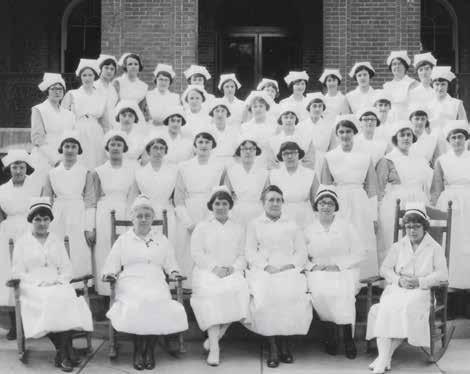
Nurses at Central Maine General Hospital
Out Of The Oven And Into History
History of the Maine whoopie pie
by John Murray
Every town and city deserves a good bakery. That was the business concept of Odilon Labadie, a Canadian baker who arrived in Maine by train in 1925. Upon arriving, Labadie immediately recognized that most of its population was working in the mills. These mills concentrated on cotton and shoe manufacturing and were ideally situated next to the Androscoggin River which provided waterpower. The workforce at the textile and shoe mills was largely comprised of French-Canadians who had migrated from the nearby border of Canada.
During the end of the 19th and the early 20th centuries was the peak of the mill industry in Lewiston. In this time,
thousands of French Canadians moved to Lewiston and were provided with steady work at these mills. Finding a sense of common community and heritage among their fellow Canadians, most of these immigrants lived right in the center of the city between the Androscoggin River and Libson Street.
With a large French-Canadian population present, this section of Lewiston would later become known as “Little Canada.”
Odilon Labadie possessed a strong work ethic like his fellow Canadians, but unlike his fellow immigrant neighbors, Labadie had no desire to work as a laborer in the mill complexes. Instead, Labadie decided to steer his life trajectory in the direction of what he did best, and that was baking. Labadie knew what he had to do to pave his own way in life. In the year 1925 with little fanfare, Odilon Labadie opened Labadie’s Bakery at 161 Lincon Street in Lewiston.
With the aroma of fresh baked
products drifting in the air throughout Lewiston, it was impossible not to be enticed by the baking magic that was occurring in the neighborhood bakery. The unknown bakery that initially appeared with little fanfare was rapidly being discovered by area residents. By supplying a quality baked product, Labadie’s Bakery was well received by the residents who quickly developed a hearty appetite for delicious bakery goods.
Initially, Labadie’s adhered to a sound business model and baked traditional products which included doughnuts and cream horns. With a creative baker at the helm of the bakery, the bakery undertook the task of creating a different product that wasn’t previously available on a commercial level. Shortly thereafter, a vastly different baked product would emerge from the warmth of the ovens. Although verifying records were lost in a fire that oc-
curred during the 1960s, it was at some point in 1925 when Labadie’s Bakery introduced a deliciously unique baked treat.
The baked treat was small enough to fit in the palm of the hand but effectively compensated for its small size with a soul filling heartiness. This baked product consisted of a sweet cream vanilla filling that was sandwiched between two dark chocolate cake rounds. Labadie had created a simple product that wasn’t as fancy as other renowned baked goods, but it overshadowed the simplicity by possessing a wonderful combination of sweet and rich flavors. This baked treat would ultimately be dubbed with the name of the whoopie pie.
With such a distinctive name, one must wonder why this creation was bestowed with this unique name. It’s speculated that the name whoopie pie was honored to be the chosen name-
sake of this delicious concoction due to the gleefully excited shouts of “whoopie” that erupted from happy consumers upon the first taste. In retrospect, this name choice makes perfect sense considering the deliciousness and pie shaped appearance of the whoopie pie. Sales were brisk for the whoopie pie and word of the baked product spread throughout the region. In a few years, Labadie’s Bakery produced hundreds of these whoopie pies daily and the popularity continued to grow. Even the passing of Odilon Labadie in 1960 along with a devastating fire at the bakery during the same period could not extinguish the popularity of the whoopie pie. The bakery was passed onto Odilon’s son Roland, and the bakery surged back into whoopie pie production with a gusto that rivaled previous years.
In the years that followed since Labadie’s Bakery opened its doors in (cont. on page 20)
(cont. from page 19)
1925, the bakery recognized the importance of a consistent product and never changed their time-honored recipe for the original whoopie pie. Labadie’s Bakery continues to create whoopie pies to this date and recently celebrated their one-hundred-year anniversary. The bakery has remained a family run operation throughout the duration of the business. Now a third-generation business, Labadie’s Bakery remains in the city of Lewiston and is headed by Fabien Labadie.
Sometimes fame creates some controversy. In the case of the whoopie pie, this controversy was linked to who first created the baked treat. With the resulting success and fame of the whoopie pie, three other nearby states would also claim the origins of the whoopie pie. Those states are Pennsylvania, New Hampshire and Massachusetts. This claim is based on the reasoning
that during this time when the whoopie pie was created, these other states produced a similar baked product. For example, in Pennsylvania, it is thought that the whoopie pie had its beginnings in the Dutch or Amish communities.
Regardless of the other state’s claim to the origin of the whoopie pie, it has been determined that Labadie’s Bakery in Lewiston was the first bakery to commercially produce and market the whoopie pie, beginning in 1925.
The people’s love for the taste of whoopie pies was profound in Maine. The fondness for whoopie pies would prompt the state of Maine to declare the whoopie pie as the official state treat in 2011. This state honor was a huge compliment for Labadie’s Bakery, and firmly cemented their position as a leader.
Having such a prominent public recognition bestowed upon Labadie’s
Bakery would be the catalyst for a tremendous resurgence in popularity for the whoopie pie. The famous whoopie pie has since been featured on national television in the format of cooking and baking shows. Along with that televised recognition, independent whoopie pie shops have been established in many different areas of the United States. All these whoopie pie shops have created their own version for flavoring of the whoopie pie, and certainly in this case, imitation is the greatest flattery.
With this resurgence, It looks as if the whoopie pie will continue to stay with us for many more years. When that first whoopie pie came out of the oven in Labadie’s Bakery in Lewiston, it was a historic event.
Honoring The Past, Celebrating The Future
Poland Spring Preservation Society Marks 50 Years in 2026
Poland Spring, Maine – (February 5, 2026): The Poland Spring Preservation Society is proud to announce its 50th Anniversary Celebration in 2026, marking five decades of preserving the 1893 Maine State Building and 1912 All Souls Chapel, and sharing the deep history of Poland Spring.
The Poland Spring Preservation Society has played a vital role in safeguarding the historic buildings, collections and stories that define this iconic destination. The milestone anniversary will be celebrated throughout the 2026 season with special events planned to
go along with our annual fundraisers and museum hours.
“The 50th anniversary of the Poland Spring Preservation Society is not only a celebration of our past, but a commitment to the future,” said Laura Brown, Director of Operations. “We look forward to welcoming longtime supporters and first-time visitors alike to experience the history, beauty and stories that make Poland Spring so special.”
The Poland Spring Preservation Society was founded in 1976, by Jim Aikman, former news director for local Maine news outlet, WMTW TV - Channel 8. WMTW’s studios were originally located on the grounds of the Poland Spring Resort. On July 3, 1975, a devastating fire consumed the elegant Poland Spring House, and WMTW broadcast the fire live from hundreds of feet away. After the fire, Aikman gathered like-minded individuals to form the Poland Spring Preservation Society which began a 50-year journey of ongoing maintenance and preservation to the Maine State Building and All Souls (cont. on page 22)
(cont. from page 21)
Chapel.
“The Poland Spring Preservation Society has done an excellent job of restoring these priceless buildings. The Maine State Building is now filled with amazing historic artifacts of the Ricker Family, the hotels and bottling company,” said Cyndi Robbins, current owner of the Poland Spring Resort.
Our Collection of Museums & History to Explore:
1893 Maine State Building located at 37 Preservation Way, Poland Spring, Maine
A visit to the Maine State Building begins with an overwhelming feeling of disbelief that a building of such design was built in the late 19th century! The Maine State Building was built for the 1893 World’s Fair in Chicago. At the end of the fair the Ricker family of Poland Spring bought the building, took it down piece by piece, put it on
a 16-car freight train and brought it to Poland Spring! And here it stands 125 years later! Now a museum about the history of Poland Spring Resort, the Ricker Family, golf course, life after the Rickers, and the Nettie Ricker Art Gallery including artist Cyndi Robbins and the Robbins family 50+ years at Poland Spring Resort.
The Togo Statue located on the grounds of the 1893 Maine State Building
Visit the life-size statue of Togo the Sled Dog on the grounds of the Maine State Building. Over 100 years ago, Togo led the diphtheria run to Nome, Alaska. He later retired and lived out his retirement at Poland Spring Resort. In 2025, Togo’s breed, the Seppala Siberian Sled Dog became the Official Maine State Dog.
All are welcome to visit the Togo Statue even outside of museum hours.
You can visit our website polandspringps.org for our hours.
1912 All Souls Chapel located at 37 Preservation Way, Poland Spring, Maine
The 1912 All Souls Chapel is made of Maine granite, quartered sawn oak and a floor of inlaid mosaic of beautiful and expensive design. You’ll be amazed at the hand painted windows, all reflecting stories from the Bible.
1906 Poland Spring Bottling Museum & Original Source located at 115 Preservation Way, Poland Spring, Maine
Owned by Primo Brands, the 1906 bottling facility and spring house was faithfully transformed into an informative museum featuring historic memorabilia and a dedication to the growth of the Poland Spring brand. Through scientific displays, a children’s play area and vintage memorabilia, the mu-
seum offers a close-up look at one of Maine’s oldest industries.
2026 Events:
Museum Open House | May 16, 2026
A special open house celebrating the Poland Spring Preservation Society’s golden anniversary and the official opening of the museums for the 2026 season will be held Saturday, May 16th Guests are invited to explore the buildings, enjoy a commemorative anniversary exhibit highlighting five decades of preservation to the historic Maine State Building and All Souls Chapel. This milestone weekend marks the beginning of a golden anniversary season and welcomes visitors back to one of Maine’s most treasured historic destinations.
Annual Maine Golf Heritage Scramble | June 2, 2026
The Fenn Ross Golf Tournament
to be held June 2nd at The Links at Poland Spring – an 18-hole Donald Ross Championship Golf Course located on the grounds of Poland Spring Resort at 37 Robbins Way, Poland Spring, Maine. This legendary day includes an optional period golf attire contest and optional play with the use of hickory shafted clubs! Proceeds from the Fenn Ross Golf Tournament support the preservation of the 1893 Maine State Building and the 1912 All Souls Chapel. To sponsor or donate, please contact Laura Brown, Director of Operations, at (207) 998-4142 or laura@polandspringmuseums.org.
Inaugural Bottle & Memorabilia Show & Sale | June 14, 2026 & A Weekend for Collectors | June 12-14, 2026
A brand-new event featuring antique bottles, historic advertising, ephemera, and collectible memorabilia tied to Po-
land Spring and Maine. Bottle collectors, antique dealers, and enthusiasts from across New England will enjoy a full weekend of events, all held at Poland Spring Preservation Park, home of Poland Spring Resort and Poland Spring Preservation Society, with educational presentations, guest speakers and a chance to see rare pieces of history. Spend the weekend exploring, collecting, and celebrating the rich heritage of Poland Spring.
Visit our historic museums all weekend long, catch a presentation by one of our guest speakers on Friday and Saturday, and get tickets to the special event Saturday evening.
The Inaugural Bottle & Memorabilia Show & Sale will be held on Sunday, June 14th from 9 a.m. to 2 p.m. with an Early Bird Ticket at 8 a.m.
For more information or to rent a table at the Inaugural Bottle Show & (cont. on page 24)
(cont. from page 23)
Sale, or to become a sponsor, please contact Laura Brown, Director of Operations, at (207) 998-4142, or laura@ polandspringmuseums.org.
Outdoor Summer Concert Series | Mondays July 13 through August 31, 2026
Live music returns to Poland Spring with our Summer Concert Series, a tradition that began over 40 years ago, featuring an incredible lineup of regional talent. Concerts begin at 6:30PM. The concerts are held outdoors at the Poland Spring Resort Gazebo, with the perfect backdrop of the sunset over Mount Washington! Bring a lawn chair, enjoy donated Poland Spring Water, grab a burger or hot dog under the tent or dine at Mel’s Hilltop Restaurant. Additional drinks and snacks available at The Maine Inn. Enjoy summer evenings filled with music and community spirit. The concerts are open to the public and all are welcome to attend! Friendly
pets on a leash are permitted to attend the outdoor concerts. Visit our website, polandspringps.org, for our concert schedule and list of performers.
Heritage Day | September 26, 2026
Mark your calendars for our most festive community event of the year to be held on the grounds of the historic Poland Spring Resort and Preservation Park on Saturday, September 26th from 10:00AM-3:00PM. Enjoy local vendors, food, music, historical displays and activities for all ages as. The event is sponsored in part by Poland Spring Resort, Poland Spring Water and the Town of Poland.
About Poland Spring Preservation Society:
Founded in 1976, The Poland Spring Preservation Society is a 501(c) (3) non-profit organization dedicated to preserving the unique historical architecture of the Maine State Building and the All Souls Chapel, one-of-a-
kind structures listed on the National Register of Historic Places. The Maine State Building was constructed for the World’s Columbian Exposition held in Chicago and returned to Maine by the Ricker family of Poland Spring, who had won an award for the purity of their Poland Water at the Exposition. It is one of only five buildings that remain and the only state building remaining from the Chicago World’s Fair of 1893. The All Souls Chapel opened in 1912 under the vision of Sadie Ricker for the guests and staff at Poland Spring. The museum buildings are available to book for private parties, weddings and events. For more information, please contact the Poland Spring Preservation Society at PO Box 444, Poland Spring, Maine 04274, call (207) 9984142, or via email at contact@polandspringmuseums.org.
Hiram’s Friendly River Music
Where guitars make history
by Brian Swartz
Guitar music has been played through Friendly River Music in Hiram for more than a half century.
Spending much of his youth in Waterford, John Barton developed an interest in guitars when he was young, while watching the TV series Zorro. “I was so intrigued and captivated by that Spanish guitar sound,” he recalled. “That was only reinforced by Elvis and the Beatles.”
He initially learned by practicing with a Harmony Stella guitar. John then borrowed a Fender Duo-Sonic, “a student electric guitar” that “was easy to play, and it sounded pretty good.” He played in regional bands in his teens
and, while attending the University of Maine at Orono, played in The Cumberlands, a university rock band immortalized by Stephen King.
One day in the early 1970s, John sought a guitar in a particular Maine music store. The staff ignored him, apparently because “I just didn’t have the cool factor. I thought I could do better than that.”
After meeting with a lawyer, he opened a music store at his Friendly River Farm at 40 River Road in Hiram in August 1974. He and his wife, Charlene (who sometimes played banjo), raised goats at the farm and enjoyed canoeing on the Saco River, which they called the “Friendly River.”
John “had some guitars that I put up for sale. We were not sure what to call our business at first.” The store soon became Friendly River Music, and he contacted manufacturers. England-based Marshall Amplification (Jimi Hendrix used its amplifiers) signed up, as did Paul Hamer. “Paul used to come here in a station wagon all the way from the Chicago area to sell me guitars out of the back of his car,” John said.
Fender Musical Corp. representatives “would visit me several times a year,” he said. “I was interested in vintage guitars especially,” and Fender trained him “to be a reasonably good technician” who could repair guitars and amplifiers.
John contacted both local and wellknown bands “to let them know what we had to offer. We gradually grew. It’s been quite an experience.” Friendly River Music has sold guitars to Kiss and basses to Malcolm Young of AC/ DC and Hutch Hutchinson of Bonnie Raitt’s band.
“Motley Crüe bought seven guitars at one time,” John recalled. Jackson Browne guitarist Kevin Barry purchased a rare 1937 Electar guitar and an amplifier. Commander Cody and the Lost Planet Airmen co-founder Bill Kirchen recently dropped by the music store.
“We’ve got hundreds of instruments now. We love guitars and amplifiers from the golden era of the 1950s and 1960s,” John said. His store carries vintage and reconditioned instruments as well as new guitars made by Fender, Taylor, Gretsch, and Maton, the last “an exquisite guitar made in Australia.
We are the only place in northern New England that carries [Ger-
man-made] Hofner guitars and basses” like Paul McCartney uses. Other guitars are made in Los Angeles by Lance and Lisa Lerman and by James Trussart. The store also carries acoustic guitars, banjos, and ukuleles, many of which are made in North America or Europe primarily by musicians.
A triple gold-rate service center, Friendly River Music “does a lot of repair work,” said John, one of the shop’s certified Fender technicians. “We have a cadre of folks,” guitar technicians who enjoy repairing instruments. “Everybody’s really good.”
“If you buy an instrument here, you get free service,” John said. “We offer the level of support to our customers that we feel they deserve. We do adjustments and repairs while you wait. You can watch. People are interested in their instruments, and they want to see what they can do on their own” for repairs.
“A lot of the younger musicians are knowledgeable about our vintage guitars,” John said, recalling a high school (cont. on page 28)
(cont. from page 27)
girl, a Jimi Hendrix fan, who liked to stop by the store and play a Fender Stratocaster “very much like” Hendrix used. She started making payments on the guitar. One day, after hearing her play it at Friendly River Music, a customer paid off the balance, and Charlene delivered the guitar to the girl at her workplace, a pizza shop.
One day a couple “came in with a guitar in a battered case” and asked John if he was interested in buying it for “$100 or $200.” He discovered “it was an old Martin guitar that needed some work” and “was worth $20,000 to $25,000. Occasionally somebody will bring in an instrument like that, and we always tell them what it’s worth.”
The music scene has changed considerably since the 1970s. Today “there are fewer local bands, and there are fewer venues for them to play,” John said. “When I was a teenager, I’d be
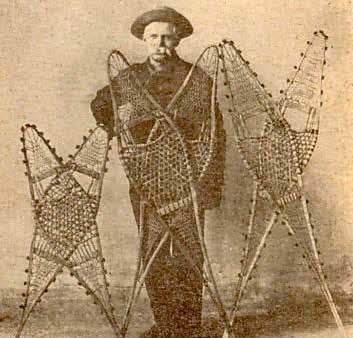
Mellie Dunham, a noted snowshoe maker and fiddler, ca.
the Maine Historical Society / MaineToday
Norway’s Mellie Dunham
Fiddler extraordinaire
Iby Charles Francis
n the not-so-distant past, thousands of people flocked to dozens of sites all over the State of Maine to listen to traditional fiddle playing. They attended fiddle contests like the Maine State Fiddle Contest, they attended bluegrass festivals, and they went to contra dances and other traditional country dances that featured fiddle playing. Traditional fiddle playing in Maine was an art that flourished as in no other part of the United States with the exception of the Deep South, and Maine fiddle players over the years won more than their share of national fiddle contests. The man who was perhaps the greatest traditional fiddle player of all time was a Maine fiddler — Mellie
Dunham of Norway. Whether playing at a country dance in Grange No. 45 in his hometown, before packed houses on the vaudeville circuit, or in a national fiddle
& Co.
contest, Mellie Dunham was a fiddler par excellence.
Fiddler “Mellie” Dunham was part of a tradition that came to Maine with the first settlers. After a long day of backbreaking work carving out homesteads amid the pines of Maine, the first residents often relaxed to the sound of fiddle music as one of them played out his feelings about the day’s accomplishments. And nothing could have been more appropriate because the word fiddle comes from Vitula, the ancient goddess of joy and victory.
As settlements grew into towns, people danced to the music of the fiddle. (Nearly all fiddlers were dancing masters.) They danced quadrilles, reels (cont. on page 32)
— Mellie Dunham, ca. 1910 —
(cont. from page 31)
and a unique New England dance of two facing lines called contras where they moved in intricate patterns forwards and back to the instructions of the fiddler. As the population of Maine increased, so did the number of fiddlers and fiddle contests — contests that Mellie Dunham dominated for over fifty years. Mellie Dunham was so prominent a fiddler and musician that George Thornton Edwards, Maine’s great music historian, said that Dunham brought a “greater amount of publicity to Maine than any other musician in a quarter of a century.”
Norway, when Mellie Dunham was born in July of 1853, was a typical New England village just beginning to industrialize. Situated at the south end of Lake Penneseewasee and on the Little Androscoggin River, Norway was fortunate to have an almost unlimited source of power. By the turn
of the century, the town was flourishing. There were eleven dams generating water power, and the Grand Trunk Railway had established its terminus there. There were shoe and woodworking factories as well as the largest ski and snowshoe factory in the world, the Snocraft Factory.
As a child growing up on a farm, Mellie attended country dances with his parents. He was especially taken with the fiddle playing he heard there, and at an early age he acquired a fiddle which he began to play by ear. He soon became so good that he was asked to sit in with the accomplished masters of the time. Mellie’s education stopped with the schools of Norway, and he took up farming as well as working in the woodworking factories in town. All the while he continued to develop his proficiency on the fiddle. His vocations were farming and woodworking. His
avocation was entertainer. Mellie played the reels and contras the country people loved. For a time he had his own orchestra, Mellie Dunham’s Orchestra. He was also a composer, writing such numbers as the Rippling Waves Waltz, Happy Hours Waltz, and Norway Schottische. His true fame, however, came outside the state. He won or placed in the top three of almost every fiddle contest he ever entered. Mellie began making snowshoes for the Snocraft Factory soon after it opened in 1900. Snocraft produced all sizes of snowshoes. Everything from one for children measuring thirty-two inches in length to one six feet long called the Peary. It was this shoe that Mellie designed and built of white ash and steerhide for Rear Admiral Robert Peary’s dash to the North Pole. Mellie Dunham’s greatest musical triumphs occurred in the 1920s. He
played with Uncle Steve Kimball of Lovell Center who, with a company of old-time dancers, filled the halls of Boston and other eastern cities to overflowing. In 1925 and 1926 he played the Keith Vaudeville Circuit to standing-room-only crowds. And he was chosen by none other than Henry Ford as champion old time fiddler.
One of the last times Mellie played in public was at Norway Grange No. 45. Picture him then — still trim and vigorous. A man with piercing blue eyes lined with the wrinkles of a long life. He has a white walrus mustache. His fiddle is under his chin, and his hands, gnarled with old age and a lifetime of hard work, make the bow leap and dance over the strings of his instrument.
Waterville’s Magnificent Library
by Brian Swartz
Although Waterville established a public library in 1896, a $20,000 grant made by Andrew Carnegie in 1902 made possible the magnificent library utilized by the public to this day.
Lewiston architect William R. Miller designed the building in the Richardson Romanesque style, named after the late architect Henry Hobson Richardson. Reflected in so many other Carnegie-funded libraries, the style incorporated “rounded arches, [a] distinctive roofline[,] and fancy stonework,” according to the Waterville library’s website.
Local contractor Horace Purinton & Co. started building the library in brick and stone in 1904. Purinton became
Waterville’s mayor the next year. Waterville residents dedicated their new library during a ceremony that began at 2 p.m., Friday, May 12, 1905. Sidelined by a stroke in 1902, famed Maine composer Robert Browne Hall (known as R.B. Hall) made his first public appearance since then to direct his orchestra, which performed inside the library. Addressing the crowd, Mayor Purinton accepted the library for the city and noted that “the history of libraries in our community dates far back … to the time before we became an incorporated town.” Waterville residents had desired a library “for more than a half century,” and he credited “the unselfish devotion” of those past and present in supporting the effort to build a library.
Purinton thanked Carnegie, “the great benefactor,” who although “himself a poor boy” had risen to become an American economic captain currently funding libraries across the United States. Purinton also cited how “many of our public-spirited citizens” had generously provided books for the library. The ceremony continued with a prayer offered by Reverend Charles W. Bradlee and a speech by Waterville Superintendent of Schools E.T. Wyman. He discussed the library’s various purposes and cautioned that the trustees had to carefully use their available financial resources to meet “the need of the people of Waterville.
“If special consideration is to be shown one class of readers over anoth(cont. on page 36)
(cont. from page 35)
er[,] it should favor those who have no means with which to secure a [home] library for themselves,” Wyman said. People “must not expect too much of our library at first,” and “only the magical touch of the hand of time can change a library from what this was in its crude beginning into what we would have it be.”
After Wyman finished speaking, six Waterville schoolchildren planted ivies outside the library. People then poured up the steps leading to the main entrance, which faced north. Touring the two-story library, an entranced newspaper reporter described its layout in exquisite detail. On the right downstairs was the 25-by-30-foot delivery room, located in the building’s center. Looking overhead, the reporter realized that “the first impression is a sense of the spaciousness of the interior[,] which the high ceiling enhances.”
Through “a beautifully execut-
ed archway” he walked east into “the stack room,” fireproofed and inaccessible to the public. The reporter noticed “the decorations,” the décor that Miller had spread throughout the library. “The dark woodwork finish, with a profusion of ornamental carvings, adds a richness to the whole that is very pleasing,” the reporter commented.
“South of the delivery room is the librarian’s office, with plate glass partitions,” and beyond the office was the reference room, accessible “by a wide passageway,” he said. “Here may be found all the leading dictionaries and encyclopedias, and reference works in many departments.” Particularly interesting to him was “the Encyclopedia Americana, which promises to be extremely useful.”
Throughout the library the “tables and chairs are conveniently placed,” and each table had two electric lights, the reporter noticed before stepping
into the general reading room fronting on Elm Street. “The windows are large and high, flooding the room with light,” and “a large fireplace on the northern side of the room” promised “cheeriness on winter days.” The children’s room was located off the north side of the delivery room. “The tables and chairs are of assorted heights for the convenience of little people of various ages,” the reporter said. “A large number of children’s books are shelved in this room.” Returning to the vestibule, the reporter walked upstairs to the rooms assigned to the Waterville Historical Society and the Women’s Literary Club. Then he checked out the basement, where the boiler and a public restroom were located. Another restroom was on the first floor.
The Waterville Public Library has changed considerably in both appearance and mission since its dedication. The building underwent renovations in
1959-1960 and again in 1975-1976; according to the WPL’s website, “a major renovation and addition project” undertaken in 2010-2011 transformed the building “into a community resource that includes the Waterville Public Library Business & Career Center.”
As happened across Maine in March 2020, Covid shuttered the Waterville library, although curbside pickup soon became available. The city launched a $910,000 renovation that according to the Morning Sentinel has addressed many issues, including insulating the attic, replacing the floors and radiators, repairing leaky roofs, and restoring the woodwork.
The library remained closed through 2021 and well into 2022. With the renovations completed and several people hired to fill part-time positions, the library reopened on Wednesday, October 26, 2022.
Farmington’s Lillian Nordica
North”
Sby James Nalley
he was born Lillian Allen Norton in a white farmhouse perched on a hill in Farmington and eventually left it to become one of the most celebrated dramatic sopranos of the late 19th and early 20th centuries. Yet, the public glow of “Madame Nordica’s” career, including her mighty top notes, fearless repertory, and international acclaim, ran alongside a private life marked by a succession of failed marriages. This tension between artistic triumph and domestic turmoil made her life story almost as operatic as the roles she sang.
Norton’s ascent was steady and purposeful, rather than meteoric. After training at the New England Conser-
vatory in Boston, Massachusetts, and later in Milan, Italy, she adopted the Italianate stage name “Nordica” (Giglio Nordica, or “Lily of the North”), at the urging of a teacher who believed that an Anglo-Saxon name would be a liability on European stages. In 1879, she made her operatic debut in Brescia, Italy. Over the following decades, she assembled a repertoire of remarkable breadth: Verdi heroines, French grand opera, bel canto classics, and the heaviest German roles of Richard Wagner. Contemporary critics not only praised the sheer size and clarity of her voice, but also her stamina and interpretive range. As Ira Glackens notes in Yankee Diva: Lillian Nordica and the Golden
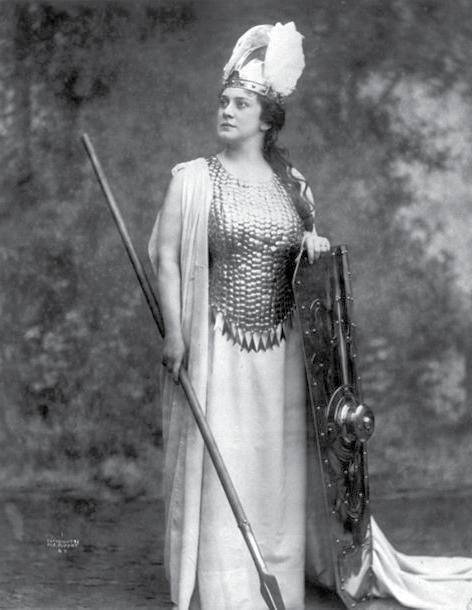
— Lillian Nordica as Brünnhilde in 1898 —
Days of Opera (1995), she sang everything from Violetta to Brünnhilde, toured Russia, Paris, and London, and ultimately became a mainstay of the Metropolitan Opera in New York. What set Nordica apart was how she balanced technical command with dramatic conviction. Observers described a voice of usual “power and flexibility,” capable of meeting Wagner’s heroic demands, while retaining the lyric warmth required by Italian repertory. Additionally, she was never merely loud. Instead, she shaped long, arching phrases with care and possessed a theatrical instinct that made her characters believable on some of the world’s largest stages. At a time when most sopranos specialized in certain roles, Nordica embraced an unusually diverse range of roles, secured her reputation as a bold and adventurous artist. As Glackens observes, surviving recordings, including early and imperfect Mapleson cylinders, still hint at a soprano who could
fill vast halls with apparent ease. If the stage rewarded Nordica lavishly, then her private life proved far less generous. She married three times, and each union ended in disappoint-
ment. Her first, in 1882, to Frederick Gower, collapsed almost immediately. Contemporary accounts describe Gower as controlling and determined to remove her from the stage. Nordica (cont. on page 40)
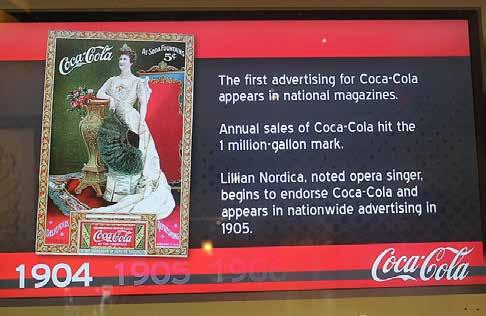
— Lillian Nordica’s Coca-Cola advertisement (Courtesy of Billy Hathom) —
(cont. from page 39)
briefly retired but soon returned to performance and filed for divorce in 1885. According to her biography by the New England Historical Society, “At one point, in a fit of rage, he burned her music and gowns, insisting that he had the right because he had paid for them.” Later that year, Gower vanished during a balloon ascent over the English Channel and was presumed dead, a bizarre and final coda to a turbulent union.
Her second marriage, in 1896, to the Hungarian tenor Zoltán Döhme, who was 10 years her junior, began as a meeting of artistic equals. It soon unraveled under the strain of professional jealousy and personal incompatibility, and by the early 1900s, the couple had divorced. In 1909, Nordica married George Washington Young Sr., a wealthy New York banker. Although the match initially appeared promising, it too deteriorated as Young’s business failures left him financially dependent.
The couple quietly separated, and Nordica returned once more to the relentless demands of her career.
These domestic upheavals were more than sensational fodder for newspapers; they exposed the constraints imposed on women who claimed public authority in a male-dominated world. In this regard, Nordica refused to relinquish her career, despite societal expectations that married women should retreat to the home. She demanded equitable pay, advocated for better treatment of artists, and lent her fame to the cause of women’s suffrage, speaking at related fundraisers and public events. As the Maine Women’s History Collection notes, in an era when frank discussion about work, money, or political rights could brand a woman as “unfeminine” or “radical,” Nordica’s assertiveness gave her biography a strikingly modern edge. Her public persona, defined by brilliance, candor,
and an uncompromising spirit, reflected conviction as much as ambition.
As for the end of Nordica’s life, it carried a tragic, almost mythic quality. In 1913, she embarked on a strenuous tour to Australia, even as her voice and health showed early signs of decline. On the return voyage, the steamship Tasman ran aground on a reef in the Torres Strait. Nordica endured days of exposure before rescue, an ordeal that left her severely weakened. She was then transported to Batavia (now Jakarta), where she struggled to recover, but never regained her strength. She died of pneumonia on May 10, 1914. Her cremated remains were later interred in the family plot at the Bayview-New York Bay Cemetery in Jersey City, New Jersey. Far from Farmington and the homestead that would later become a museum in her honor, the smalltown girl who had conquered Europe’s grandest stages was mourned across the
What endures, beyond the drama, is the music. Nordica left behind written vocal treatises and a handful of early recordings that allow scholars to glimpse a voice both powerful and meticulously crafted. Her repertory choices and insistence on artistic integrity shaped the generation of American singers who followed, proving that a young woman raised in rural New England could stand shoulder to shoulder with Europe’s finest. Today, the Nordica Homestead Museum in Farmington preserves her gowns, letters, and portraits, inviting visitors to step into the paradox that she embodied: an artist whose work demanded independence, even as her personal life often struggled to sustain it. Her legacy also lives on at the University of Maine at Farmington, where the Nordica Auditorium in Merrill Hall bears her name. A popular figure in her own time, she even posed for
a 1905 Coca-Cola advertisement, now prized by collectors.
Overall, Lillian Nordica’s life defies a simple moral. If there is one, then it is this: talent and determination can carry a person far, but the social and personal forces surrounding them, especially a woman asserting herself in a public sphere reluctant to accept her, shape
the cost of that journey. She shone brilliantly onstage yet struggled at home. Both truths are inseparable from her legacy. In remembering Nordica, we honor her voice, while acknowledging the price of a life lived boldly —artistically, politically, and, at times, heartbreakingly.
— Lillian Nordica’s birthplace in 1908 —
The G.H. Bass Shoe Company
The shoes known around the world
by Charles Francis
As late as 1900 some shoe companies were making shoes that were neither left nor right. They were interchangeable, and were made using the turn-shoe method. The shoe was assembled and stitched together inside out, with the flesh side of the leather facing outwards and the grain inwards. Shoes made with the turn-shoe method were formed on straight lasts. This meant they were perfectly straight. It was easier to make shoes this way, which meant a pair of straight shoes was cheaper than a curved pair, designed for the left and right feet.
For much of the history of shoemaking, shoemakers assembled their
product on blocks of wood called lasts. Lasts were hand-carved in the shape of feet. Since the blocks would become chewed up by tacking after a few hundred uses, there was a constant demand for new lasts. The first curved lasts for producing left and right shoes came into common use in the years following the Civil War. A mechanic by the name of Blanchard discovered that he could make a last that was a mirror image of its mate by reversing the cam on his lathe that created them. Most traditional shoemakers did not have their own lathes to make lasts, however. They bought them from last cutters who made them using traditional methods
that produced a straight foot-shaped block. Only large shoemaking establishments had the machinery to produce lasts formed for left and right feet.
G.H. Bass and Company was one of the very first companies in Maine to make its own lasts. Because of this, it was one of the first companies in the state to mass-produce left and right shoes. This manufacturing process contributed largely to the early success of G.H. Bass.
Bass was once the most famous brand of shoe made in Maine. The Bass shoe company didn’t even need to advertise its product because it was already widely known. One of the rea-
sons for this was that the most famous people in the world wore Bass shoes. When Charles Lindbergh flew the Spirit of St. Louis across the Atlantic in 1927, he wore a pair of Bass Aviation Boots. Admiral Byrd’s men wore Bass boots on their trek to the South Pole. All American soldiers wore Bass footwear in World War II. Because of those things, everyone knew the name. And not only did people know the Bass name, they knew the names of its lines of shoes, like Weejuns, which almost every high school student wore with pennies wedged in them.
G.H. Bass and Company was founded in 1876, incorporated in 1906, and named for its founder, George Henry Bass. At the time, Bass was sixty-three years old and already a successful businessman.
Bass got his start in the shoe industry as an apprentice in Croydon Bacheller’s Wilton tannery. Bass worked
for Bacheller for two years for the sum of fifty dollars a year. He then went to work in Woburn, Massachusetts in the largest tanning plant in the state in order to better learn the business. After six months he returned to Wilton to find his father, Seth, who was in the process of purchasing Bacheller’s plant. Bass then leased the plant from his father, and with just two hundred dollars in his pocket, went into business. The company’s chief products were calfskin and waxed upper leather for high boots.
Within a few years, George Bass was one of the most successful tanners in Maine. Then, in 1876 he made his first venture into the shoe manufacturing industry by buying a partial interest in F.P. Packard’s Wilton shoe company. Shortly after that, he bought out Packard’s interest in the jointly-owned company.
When Bass first manufactured shoes, lasts were still being made in Maine
in the traditional manner. Last cutters went into the woods and cut down the trees that had the hardest wood — rock maple. The rock maple logs were debarked, then sawed into sections approximately the length of a last. From this point on, the lasts were formed by hand. A person known as a “chipper” held a specially-designed ax over a section of maple where he wanted to create a split. Then a “rouser” hit the ax with a maul. This process continued until the block was in the rough shape of a foot. The final shaping of the last was done in the shoe shop. Traditional shoemakers carved the last so that it could be used to produce shoes using the turnshoe method. What George Bass did, however, was to purchase raw blocks of maple, then use a lathe to shape them into lasts for left and right shoes. The first shoes designed for left and right feet were sometimes referred to as “crooked shoes.” Because the name (cont. on page 44)
(cont. from page 43)
sounded a bit strange, the average shoe buyer tended to stick with the more traditional straight shoe. In addition, they were more expensive than straight shoes. Another reason crooked shoes were more expensive than straight shoes was the incorporation of toecaps. Traditional shoes were all made with soft toes so that they could expand and adjust to the larger big toe. For this reason, people bought shoes that were a bit too long for them. Shoes with toecaps were designed to accommodate big toes. However, when people began talking about how comfortable George Bass’ shoes were, the biases quickly disappeared.
Today, Bass shoes are one of the benchmarks in the history of quality shoe products. However, had it not been for George Bass’ use of differing lasts for left and right feet, Bass shoes might not have become the trademark name known around the world.
The Heart Of Western Maine
Stories and secrets of the Rangeley Lakes
by Lisa Mejorado
Nestled in the magical mountains of Western Maine, the Rangeley Lakes Region is more than a scenic escape; it’s a living archive of resilience and wilderness spirit. From high forests of spruce and pine to the waters that have drawn anglers for generations, the region’s identity is shaped by those who tamed the “boulder-strewn wilderness.” To truly understand this remote community, you must explore. Not just the area’s beauty but its unique museums, each preserving a chapter of Rangeley’s soul. Once you visit, the Rangeley Region will be in your soul, too.
Housed in Rangeley’s first commer-
cial brick building, the original Rangeley Trust Company, built in 1905, the Rangeley History Museum preserves the town’s legacy. In the summer of 2026, the museum will host “Rangeley History Makers” to honor America’s 250th anniversary, highlighting 20 remarkable individuals who shaped the region. Their stories and artifacts bring history to life in this historic space. You won’t want to miss this extraordinary exhibit!
In nearby Oquossoc, the Outdoor Heritage Museum, twice named “Best Outdoor Museum in New England”, pays tribute to figures who put Rangeley on the map, including Carrie Ste-
vens, the self-taught fly-tier behind the world-famous “Grey Ghost” streamer. Beyond vintage fly rods and trophies, the museum features the Vail Site exhibit, sharing a story 13,000 years in the making. This archaeological find proves humans have hunted and survived here since the last ice age, forging a deep, ancestral connection to the land.
One of the region’s most unexpected stories is that of Dr. Wilhelm Reich, a controversial psychoanalyst and student of Freud. Seeking a “sanctuary in the wilderness,” Reich founded his 200-acre estate, Orgonon, in Rangeley in 1942, believing the mountain air
crucial for his atmospheric research. Today, the Wilhelm Reich Museum’s exhibits are on display in the Orgone Energy Observatory, a Bauhaus-style building made of local fieldstone. The interior is preserved much as it was when Reich died in 1957, displaying his laboratory, library, and the “cloudbuster” he used in energy experiments. Here, science and controversy meet the silence of the Maine woods.
On the edge of town, the Maine Forestry Museum honors the “iron men” of the timber industry. The museum began in 1968, when logger Rodney Richard saved an old snubbing machine from destruction, igniting efforts to preserve the region’s logging heritage. The three-story museum is filled with artifacts of a hard-won life, from 19th-century logger letters to chainsaw carvings by the Richard family. It shows how the forest provided everything, from Wabanaki birch-bark canoes to the massive log drives that once filled the rivers with activity.
Through its remarkable museums and the stories shared within them, the Rangeley Lakes Region is a place where history isn’t just remembered, it’s cherished and woven into the community. Each artifact and tale passed down creates a living legacy, binding past and present. History here is a source of pride and belonging, a reminder of the enduring spirit that makes Rangeley special. Yet it’s not only the history that lingers — the breathtaking beauty of the lakes, forests, and mountains leaves a lasting sense of wonder and peace. The museums and the landscape together create an experience that is both moving and transformative. To truly understand Rangeley’s magic, you must visit and let it become a part of you!
Fly Fisher Carrie Stevens
Rangeley Lakes Region’s renowned
by Brian Swartz
Carrie Stevens and fly-tying are synonymous in the Rangeley Lakes Region.
The youngest of the six children of Albert and Nellie Wills, Carrie Gertrude Wills was born in Vienna in Kennebec County on February 22, 1882. She married Wallace Clinton Stevens in Farmington in May 1905. With Wallace now a Maine guide, the couple moved in 1919 to Upper Dam, built on the flowage between Mooselookmeguntic Lake and Upper Richardson Lake.
Author Wayne McLoughlin has described “that remote area, long popular with sophisticated fishermen” from
northeastern cities, as “the perfect environment for an outdoorsman as knowledgeable as Wallace, who by 1920, was one of the most sought-after guides.” While Wallace worked as a guide, Carrie worked from home as a milliner.
Among Wallace’s clients was fly fisherman Charles “Shang” Wheeler, described by the Oquossoc Outdoor Heritage Museum as a skilled “waterfowl decoy carver.” In 1920 he sent Carrie “a blue-and-white bucktail and feather streamer tied on a long-shanked English hook,” McLoughlin noted.
Wheeler told Carrie to try the fly against the brook trout at Upper Dam
Pool. Doing so with some success, she later wrote her friend Joseph Bates, “It is doubtful if I would ever have made a fly if Mr. Wheeler had not sent us one to try out.”
When Wheeler returned in 1921, Carrie “modified a fly” that he had tied, according to the Oquossoc Outdoor Heritage Museum. “The next day, when Shang used the fly at Upper Dam Pool, he caught eighteen fish. Carrie’s fly-tying skills were off to a strong start.”
While fishing the Upper Dam Pool from its apron on July 1, 1924, Carrie used her own fly made with gray feathers to resemble a smelt. This pattern she
called Shang’s Go-Getum. Casting for a little while on that sunny Tuesday, she caught a few fish, then suddenly felt a big fish take her hook. Angler and fish battled for an hour until Carrie netted a 6-pound, 13-ounce brook trout she had weighed at a nearby hotel. The trout was “the largest taken from the pool in 13 years!” according to McLoughlin, and her prize catch took second place in the “14th annual fishing competition” held by Field & Stream.
In its September 1925 issue, the magazine ran Carrie’s tale about landing the brook trout. “He was caught with a Thomas rod, nine feet in length, a Hardy reel, an Ideal line, and a fly I made myself,” she wrote. Anglers nationwide read the article, and orders started arriving for her flies.
Using feathers purchased from George Fletcher of Rangeley, locally obtained materials, and fishhooks primarily purchased from England-based
S. Allcock & Company Ltd., Carrie shortened her flies (also called “streamers”) so they extended a little bit beyond the hook. According to Wikipedia, Carrie favored longer shanks on her fishhooks and tied her “materials parallel to the hook.” She “used fly shoulders to imitate bait fish gill plates” and “pioneered the streamer by using new colors, structure, and less exotic materials, making it more effective and accessible.”
Carrie initially numbered her flies. As sales increased, she started naming them. Among her initial designs were Rangeley Favorite, The Green Beauty, The Stevens Favorite, and The Pirate. Later flies were the Witch, the White Devil, Shang’s Special, the Gray Ghost, the Water Witch, and many others. Carrie even designed a fly that she named General MacArthur.
Always working alone, Carrie operated her business, Rangeley’s Fa-
vorite Trout and Salmon Flies, from her home. Fishermen from around the world ordered her flies to try them in local waters, and her unique streamers gained popularity through the 1940s.
Suffering from declining health, Carrie tied her last streamer, called the Pink Lady, as George Fletcher and H. Wendall Folkins watched on December 12, 1953. Folkins bought Carrie’s business that same day. Graydon Hilyard purchased the Pink Lady, now displayed at the Oquossoc Outdoor Heritage Museum.
Maine Governor Ken Curtis proclaimed August 15, 1970 as Carrie Gertrude Stevens Day, and officials planned to honor her with a plaque placed near her Upper Pool Dam home. Unfortunately, Carrie died on August 3, but her memory lives on.
by Kenneth Smith
MLadies Of The Lake
Moosehead’s steamboat era
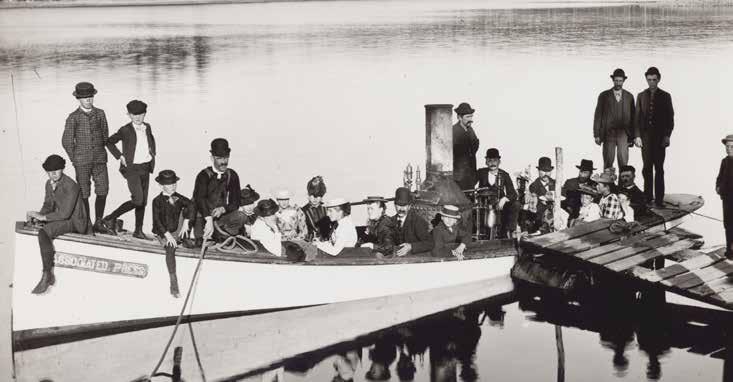
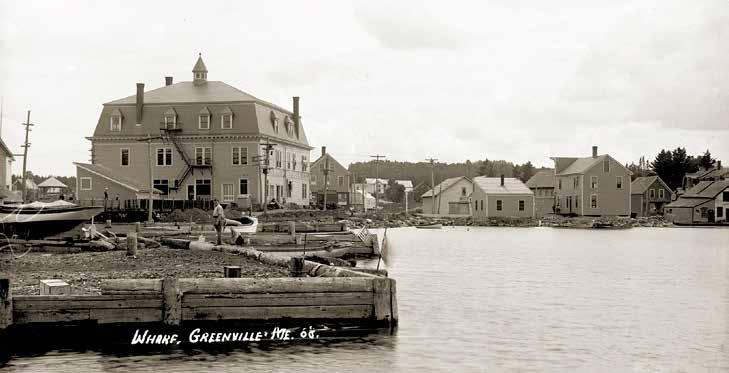
oosehead’s steamboat era was inaugurated one hundred and sixty years ago, when in 1836 a Mr. Hogan launched his steam tugboat Moosehead at Greenville. Although it was a revolutionary change in lake transportation, it wasn’t until 1856 when, thanks to Major Bigney, steamboats became a common sight. For the next quarter of a century, Bigney, starting with Moosehead II, launched a series of wood-fueled, walking beam side-wheelers.
By 1900 fleets of steamboats plied the big forty-mile lake, flying flags and pennants, trailing columns of white vapor, whistling at one another as they churned past. Crammed with people,
mail and freight, they must have been a bonny sight. Steamers bound uplake often towed great barges toting hay, milled lumber, horses, and even an occasional locomotive. Plain and ordinary, ornate and elegant, each had a style and grace of its own. These steamers blended with the lake environment like nothing man has since constructed.
On regular schedules until the late 1940s, these ladies of the lake did their service. Captained and crewed by some of the finest freshwater sailors in the country, they were never involved in a major calamity. At that time the highway ended at Greenville, resumed at Rockwood, and headed for Quebec. During the six-month open water sea-
son, steamers supplied the needs of those who worked and played lakeside, and the many north woods logging operations.
Two operators dominated the lake trade, supplemented by a slew of smaller ones. In 1892 brothers Abner and Philander Coburn, commonly referred to as the Lumber Kings of Maine, organized the Coburn Steamboat Company. These enterprising Yankees amassed a multi-million-dollar fortune, controlling seven hundred square miles (twenty townships) of Maine timberland. Coburn Steamboat Co. expanded rapidly, buying out most smaller competitors. Bangor and Aroostook rail lines connected with Coburn’s huge (cont. on page 52)
(cont. from page 50)
wharf at Greenville Junction, and another at Kineo Station. Operating eight large, ‘modern,’ coal-fired, prop-driven steamers, huge cargo steam barges, and countless dainty, smaller vessels which catered to sightseers, fishermen, and hunters, for fifty years Coburn did a land-office business.
Katahdin and Moosehead III were the flagships. Cornet, Twilight, Priscilla, Marguerite, Louisa, and Reindeer, while smaller “line boats,” were just as elegant and seaworthy. After being rocked and rolled from Philadelphia, New York, and Boston, summer rusticators must have delighted in dismounting from the hot, dusty rail coaches, walking fifty paces to the grand steamers, and cruising up Moosehead to palatial hotel accommodations. They could spend this part of the journey strolling the decks, enjoying the clean air, full sun, and splendid vistas.
The Coburn line was particularly proud of a less aesthetic, but more spectacular, steam barge tote, when they hauled a fifty-ton locomotive up lake to Seeboomook. As the Great Northern Paper Company and C.C.C. road systems expanded and improved, trucks and cars (many carried up the lake by Coburn steamers) became popular, and business declined. In 1938 Coburn sold Kate, its queen and last steamboat, to Great Northern.
From 1900 until their last Penobscot
FINE LINE PAVING & GRADING
River log drive in 1971, Great Northern Paper had what they proudly described as their “navy,” complete with an admiral. Mechanical superintendent O.A. Harkness bought, designed, and built all types of steam and gas-powered working watercraft. In earlier times, some Brewer-built steamers were trained to Monson, then hauled by thirty teams of oxen to the lake. These boats earned their keep on Eagle, Chamberlain, Chesuncook, Seeboomook, and Moosehead Lakes.
When Katahdin went to work for Great Northern Paper, she became their largest tow boat. GNP did alter Kate’s original appearance by cutting off the sweeping stem housing. This aided her towing capabilities, but cost Kate some of her style. Later Scott Paper Company bought her for the same purpose. Katahdin made her last working tow in 1975, hauling a log boom across Moosehead to East Outlet.
Kate, originally one hundred and twenty feet long, was too much work to haul out each fall. She spent winters frozen in the lake, but come spring, as ice rot began, she was soon shoving her steel bow into the flows. Her springs and early summers were spent hauling barge-loads of supplies to various logging camps, returning with huge log booms. Towing duties quieted down in July, which coincided with the summer folk trade.
The original Kate had burned while towing. A new Bath-built steel hull was hauled in sections via train to Greenville Junction. She was registered for five hundred passengers.
Katahdin weathered many a storm. Perhaps her most serious encounter occurred in early summer of 1930, off Sand Bar Island. Kate was under tow when a fierce thunder squall struck her, ripping the roof from the top deck, wrapping one lifeboat around her smoke stack, and hurling another overboard. Another near calamity occurred when the Kate was loading passengers at Greenville Junction. As boarding progressed, the steamer’s overhang caught on the dock. All of the passengers moved to the off side so the crew could pry her loose. They did, and Kate started to roll over. Thankfully, the dock lines held, averting a tragedy. Before too many months, Kate will continue her long and illustrious career. The queen of the steamboat fleet, the last of her kind, will resume her warm weather occupation as a daily cruise vessel. Sail aboard her this year, listen to stories of bygone times, and see Moosehead from a new, unforgettable perspective.
The Somerset Railway
The link between the Maine coast and the north
by James Nalley
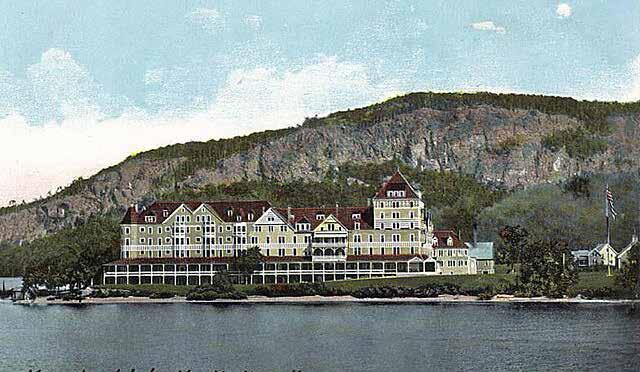
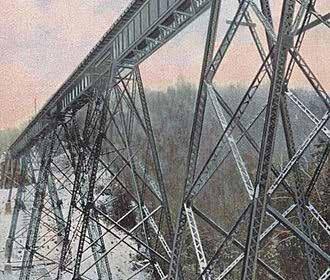
At the turn of the 20th century, Moosehead Lake stood as a natural marvel, while the vast northern forests of Maine formed the backbone of the state’s thriving lumber industry. In response, the Somerset Railway Company extended its line from Bingham to the shores of Moosehead Lake. By 1906, the company had constructed a grand resort hotel at the base of Mount Kineo, a dramatic, rocky promontory with 700-foot cliffs rising straight up from the lake’s surface. Visitors from eastern cities arrived in style aboard plush, upholstered Pullman cars, and then continued their journey by steamboat from Kineo Station to the hotel. Among the notable guests were Theodore Roosevelt and Henry David Thoreau, with the latter famously describing the lake as a “gleaming silver platter.” However, over time, the resort was demolished, the trestles were removed, and the tracks were dismantled, leaving only faint traces of an era when locomotives carried timber and travelers through the wild heart of Maine. Originally chartered in 1860 as the Somerset Railroad, the line was envi-
sioned to open the timber-rich upper Kennebec River valley and connect the region’s growing towns to markets further south. Substantial construction did not begin until after the U.S. Civil War, with the line reaching Norridgewock in 1873, Madison in 1875, and North Anson in 1877. These early accomplishments were notable, especially given the rugged terrain and limited financial resources. However, the company soon encountered financial difficulties. In 1879, it defaulted on its bonds, leading to a reorganization in 1884 as the standard-gauge Somerset Railway.
Once reorganized, the Somerset Railway pursued an ambitious northward expansion, reaching Solon in 1889 and Bingham in 1890. This extension opened vast tracts of Maine’s interior to commercial exploitation. According to the Moosehead Historical Society, the railway provided a vital link between these remote timberlands and the more populated markets to the south. In this case, rail transport proved faster and more reliable than the traditional river drives that had long carried logs down the Kennebec River.
Meanwhile, tourism emerged as an increasingly important source of revenue. In this regard, the railroad’s directors recognized the allure of Moosehead Lake, which was a pristine wilderness retreat that attracted wealthy vacationers from cities such as Philadelphia, Boston, and New York. In 1906, the line was extended to a grand terminal on the lake’s southern shore, where steamboats ferried passengers to the luxurious Mount Kineo House resort. This coordinated railand-steamboat system created a seamless journey from urban centers in the Northeast to the heart of Maine’s wilderness. As noted in The Old Somerset Railroad (2000) by Walter MacDougal, “The railroad had 15 plush upholstered Pullman coaches, nine baggage cars, and 12 combination smoking-baggage cars, with leather seats in the smoking section.” In this way, the Somerset Railway became more than a freight carrier; it played a central role in the early development of outdoor tourism in Maine.
During this period of prosperity, ownership of the railroad changed (cont. on page 54)
(cont. from page 53)
hands several times. In 1904, the line was sold to the Kennebec Valley Railroad Company, although it continued to operate under the name Somerset Railway. In 1911, the Maine Central Railroad (then actively consolidating many of the state’s smaller lines) acquired both the railway and the Mount Kineo House resort. Thereafter, the route was operated as the Kineo Branch of the Maine Central system. This acquisition reflected a broader trend in American railroad history: As large regional carriers expanded, they absorbed the smaller branch lines that had originally opened rural areas to transportation and commerce.
However, in the 1920s, the fortunes of the Somerset line began to decline. Maine’s old-growth forests had been heavily logged, and the remaining timber operations no longer produced the same volume of freight. As stated by the Moosehead Historical Society, the advent of new logging methods, especially the use of trucks and improved highway infrastructure, further reduced the reliance on rail transport. Passenger traffic also diminished, as automobiles increasingly became the preferred mode of travel for both tourists and local residents.
By September 1933, the last regular passenger train had run over the branch. As noted in Maine Central Railroad Company (1976) by Bradley Peters, the Mount Kineo House resort
was razed just five years later, in 1938, marking the end of the grand era of rail-steamboat tourism on Moosehead Lake. Abandonment of the northern portions of the line soon followed. For instance, the track north of Bingham was removed by the end of 1933.
Although the Maine Central Railroad continued to operate freight service on the southern segments for several more decades, the rise of highway trucking gradually rendered these operations marginal. By the late 20th century, only a few shippers, mainly in the paper and pulpwood industries, still relied on the route. According to the U.S. Department of Transportation, “The former Madison Paper industries paper mill at Madison was the last major customer on the branch originating
or terminating 3,000 carloads in 1973.”
Nevertheless, Pan Am Railways, the successor to Maine Central, maintained service between Oakland and Madison until around 2013, when the final customer closed and the last trains ran. This trajectory, i.e., initial expansion, peak prosperity, and slow decline, mirrored the fate of many rural branch lines across the United States.
Despite the end of rail operations, the physical and cultural legacy of the Somerset Railway endures. For example, portions of the former railbed have been repurposed as recreational trails, preserving the historical geography of the route. In 2021, the state of Maine acquired a 32-mile section of the old right-of-way from Oakland to Embden for development as a multi-use rail
— Mount Kineo House on Moosehead Lake in 1908 —
trail. These trails allow hikers, cyclists, and snowmobilers to traverse the same landscapes once admired by early passengers through the windows of plush Pullman cars. The story of the Somerset Railroad also lives on in historical archives. The Somerset Railway records (1866–1929), housed at the Maine Historical Society, include a wide range of corporate documents and operational records, offering valuable insights into the railroad’s development and day-today operations.
As for the Mount Kineo House resort, all that remains today is a scenic nine-hole golf course and a handful of historic buildings. Several of the Kineo cottages have survived and now serve as private residences. The Dormitory, built in 1909, still stands near the golf course, while the old Oak Lodge has been refurbished and now operates under its original name, The Oak Lodge, offering weekly rentals and bed-andbreakfast accommodations.
— Gulf Stream Trestle in Bingham in 1910 —
A Problem With Bears
by Brian Swartz
Bruin-beleaguered Rumford residents developed their own methods for dealing with a peculiar problem — black bears in the corn, black bears in the fields, black bears everywhere.
During the early 19th century, rural Rumford abutted virgin forests where black bears roamed unmolested. The farm fields bordering the deep woods afforded excellent feed in season for the bruins — an occasional sheep, pig, goat, perhaps a horse — and corn. Corn standing in its prime attracted bears to gorge themselves — while annoying the farmers who depended on the corn to feed their livestock the next winter.
In time Rumford farmers adopted a
simple policy toward marauding bears — shoot on sight. A farmer had to track down a bear before he could shoot it, however, and few bears hung around when the dogs were baying and men were yelling.
Rufus Virgin, an almost legendary figure in early Rumford history, was a millwright and farmer who apparently experienced his share of contact with black bears. He matched wits with a nocturnal raider one autumn.
The bear had plagued Rumford farmers for years, creeping into their corn fields after sunset to munch on sweet corn until dawn. This year, the bruin targeted Virgin’s cornfield alongside the Androscoggin River. Resting
across the river by day, the smart bear swam the Androscoggin by night and sampled Virgin’s sweet corn. A morning patrol would reveal the damage caused by the full-bellied bruin, which promptly departed the cornfield by sunrise and sought its lair across the river.
“What can I do about this bear?”
Virgin asked his friends and neighbors. Someone recommended that he speak with Henry Abbott, an old-timer who had placed many bears in his rifle sights.
Abbott and Virgin concurred that an armed sentry could not wait in the cornfield until the bear arrived. The bruin would have an advantage in the deep darkness where its keen olfactory senses would detect the human long before the sentry would realize the bear was upon him.
Abbott suggested Virgin rig a loaded rifle and aim it where the bear usually left the river and wandered into the cornfield. A line attached to the rifle
trigger and tied to a branch or a stake would fire the rifle if the bear bumped or broke the line.
“Great idea!” Virgin responded. He eagerly set a booby trap before nightfall, then gathered at his farmhouse with Abbott and some neighbors to await the bear’s demise.
A heavy dew settled on the corn stalks as the sun settled beyond the White Mountains. The men quietly chatted, peered into the dark, and wondered if they would trap the bear that night.
“Wham!” The rifle suddenly fired about 8 p.m. The men bounded across the cornfield and reached the booby trap.
The rifle had certainly fired. Gunsmoke still lingered around it. Virgin, Abbott, and the other men searched the field as far as the riverbank to find the bear.
They turned up nothing, leaving the men to scratch their heads as to why the
rifle had discharged. They theorized the dew-soaked line had begun to dry, then slightly shrunk and the added tension had tripped the trigger.
A plausible theory. The bear hunters could not credit the bear with enough brains to trip the rifle before raiding the corn. No bear could be that smart, could it?
Virgin reset his booby trap the next evening and again sat back and awaited the results. He probably fell asleep, because the rifle did not fire, but the marauding bear dined on more sweet corn.
The next dawn, bear tracks and mangled cornstalks revealed what had happened. The old bear, whether deliberately or blessed by luck, had stepped over the wire and raided the corn. Rufus Virgin probably rubbed his chin with his hand as he surveyed the damage.
“That’s one smart bear,” he likely muttered.
Figuring the third time was a charmer, Virgin relocated the trap that eve(cont. on page 60)
(cont. from page 59)
ning to another field ravaged by the bear. Sometime well into the night a loud ‘blam’ echoed across the Androscoggin, and Virgin, Abbott, and some other Rumford men walked across the field to see if they’d bagged a bear. They had. One shot, one bear. Another day Virgin was working in his fields when motion caught his attention. He saw a large dog walking some eight hundred feet up the road. The distance proved deceiving. As Virgin watched, the dog climbed a rail fence and headed across a field toward the woods.
“That’s a bear!” Virgin probably cried. He bolted for his house where he told his wife to run to the neighboring farms and roust the populace for a bear hunt. “Tell them to surround the woods,” he instructed. “The bear’s in there. We’ll flush him out with the dogs.”
Like peasants storming Franken-
stein’s castle, Rumford men raced to encircle the woods. The farmers brought their bear hounds, too. The baying dogs alerted the unsuspecting bear that the jig was up.
“Let ‘em loose!” someone called, and the farmers released their dogs. Several hounds immediately caught the scent where the bear had climbed the fence. Lifting their muzzles skyward, the dogs bellowed their discovery and raced into the woods. Other hounds gave voice to their excitement too, and tore into the woodlands.
The farmers waited nervously as the dogs plunged into the tree-line. Armed with whatever implements they could find, muskets, rifles, pitchforks, and clubs, the men hoped the dogs would tree the bear. If it bolted from the woods, a club would not stop it.
Howls and growls emanated from the trees. “Over here!” someone suddenly shouted as a rifle discharged.
Other firearms fired, too, and startled farmers waved their clubs and pitchforks at the charging bear.
It had bolted from the woods while en route to the Androscoggin. Hounds nipping at its heels, the bear rushed the farmers. Paul Simpson, a Virgin acquaintance, possibly lost his bowels as the frightened bear suddenly whirled and rushed past him. Simpson waved his hat to scare the bear. He later swore his chapeau brushed the bear as the animal fled past him.
The hounds pursued their quarry into the woods. Tightening the noose, the farmers edged nearer the tree-line, hoping the dogs would tree the bear this time.
Not so! The bear burst from the woods in a downhill charge at Virgin. He had loaded a one-ounce ball into his rifle. As the bear bore down on him, Virgin carefully aimed and squeezed the trigger.
The rifle fired. The bruin staggered, obviously struck by the heavy ball. Scarcely breaking stride, however, the bear plunged into a tree clump and clambered over the rail fence with the hounds still in pursuit.
Dropping into the road, the bear finally gained open space and turned on its canine tormentors. Claws connected, dogs flew across the road, and before the nearest farmers arrived the wounded bear ran for the deep woods.
Virgin and his companions would not follow the bear until the next morning. Appalled at the damage done to their dogs (unwounded hounds refused to resume the chase), aware that a wounded bear was a killer bear, the farmers decided to wait. If Virgin had severely wounded the animal, it would go to ground where its joints might stiffen, or the beast might bleed to death. Better to let nature take its course rather than risk more dogs and a man or two.
The Rumford farmers lost the blood trail the next morning. The bear had evidently gotten away.
One other bear did not when it encountered Jeremiah Richardson, a Rumford bear hunter. While splitting rails for a fence through his wooded property one day, he came between a sow and her twin cubs. Mother bear attacked. Richardson defended himself with his ax, not exactly the appropriate weapon for bear-slaying.
The sow slapped aside Richardson’s first blow and slashed at him with her paw. Barely missing the skin, her claws ripped away Richardson’s vest. The blow staggered Richardson. When the bruin hesitated, he struck her with his ax, landed another blow, and hit her again.
When the bear retreated with a cub on her heels, Richardson momentarily confused the sow by seizing the other cub and snugging it inside his frock. He bolted for home with the squalling cub captive in his arms. The sow did not chase him.
he North American X-15 was a hypersonic rocket-powered aircraft operated by the U.S. Air Force (USAF) and the National Aeronautics and Space Administration (NASA), as part of the X-plane series of experimental aircraft in the 1960s. The X-15 set both speed and altitude records, crossing the edge of outer space (defined as 62 miles above sea level, also known as the Kármán line) and returning with valuable data for future aircraft and spacecraft designs. Among the 12 test pilots in the program, one Maine-born man flew the X-15 a total of 34 times to a maximum speed of 4,649 miles per hour and a maximum altitude of 285,000 feet. He not only
flew the aircraft more than any other pilot but was also the second X-15 pilot to attain the astronaut rating (defined as exceeding an altitude of 50 miles above sea level).
Robert Aitken “Bob” Rushworth was born in Madison on October 9, 1924. He had one older brother, Cornell, who was killed in action during World War II. After attending Madison Memorial High School (where he was class president) and graduating in 1942, he spent one year at Hebron Academy. In June 1943, Rushworth enlisted in the U.S. Army Air Force (USAAF) and entered the Aviation Cadet Training Program (AvCad). He then earned his pilot wings and a commission as a
second lieutenant in September 1944. As for his first assignment, he served in the 12th Combat Cargo Squadron in the China-Burma-India theater in February 1945. According to The New York Times (March 1993), “He flew C-47 Skytrain transport combat missions from India throughout the Burma campaign and C-46 Commandos over the Himalayas to Shanghai and Beijing, China.” After release from active duty in January 1946, he became a member of the Air National Guard and studied mechanical engineering at the University of Maine.
After receiving his bachelor’s degree in 1951, he was recalled to active duty during the height of the Korean
War. He then served as a F-80C Shooting Star pilot with the 49th Fighter-Interceptor Squadron at Dow Air Force Base in Maine (currently the Bangor Air National Guard Base at Bangor International Airport). He then took the opportunity to study aeronautical engineering at the USAF Institute of Technology at Wright-Patterson Air Force Base in Dayton, Ohio. Upon earning his second bachelor’s degree in 1954, he served at the Directorate of Flight and All-Weather Testing on the base, specializing in the development and testing of experimental automatic flight control systems.
Noting his expertise in such systems, the USAF sent Rushworth to Edwards Air Force Base (California) in July 1956, where he attended the Air Force Experimental Flight Test Pilot School (Class 56C), graduating in January 1957. Afterwards, he flew F-101 Voodoos, F-102 Delta Daggers, F-104 Starfighters, F-105 Thunderchiefs, and F-106 Delta Darts. In 1958, he was selected as one of only 12 test pilots for the North American X-15 program, which was overseen by the USAF and NASA.
As for the X-15 itself, it was designed to be dropped from under the wing of a B-52 mother ship and rocket launched. As stated by the Armstrong Flight Research Center (February 2002), “Release of the X-15 took place at an altitude of approximately 8.5 miles (45,000 feet) and a speed of
around 500 miles per hour.” As for the fuselage, it “was long and cylindrical, consisting of heat-resistant nickel alloy. The retractable landing gear comprised a nose-wheel carriage and two rear skids.” Since the skids did not extend
beyond the ventral (lower) fin, the pilot was required to jettison the fin immediately before landing.”
Rushworth’s first flight in the X-15 was on November 4, 1960. According to the New Mexico Museum of Space (cont. on page 64)
Snow Blowers
Zero Turn Mowers
Push Mowers
Riding Mowers
Wood Splitters
Chain Saws
Trimmers
— Robert Rushworth in the X-15 cockpit in 1960 —
(cont. from page 63)
History (2021), “From November 1960 to July 1966, he flew the aircraft a record 34 times, topping out at a maximum speed of Mach 6.06 (4,649 miles per hour). This included a flight to an altitude of 285,000 feet in June 1963. Since it was more than 50 miles above sea level, he became the second X-15 pilot to attain the astronaut rating. He also earned a Distinguished Flying Cross for successfully landing the aircraft after the nose wheel was prematurely extended while flying at nearly Mach 5.
On July 1, 1966, Rushworth made his final X-15 flight, after which he returned to regular USAF duties. Meanwhile, during the buildup to the Vietnam War, he and many of his fellow pilots’ orders to Vietnam were waylaid, due to their specialized training/skills and importance on the home front. However, Rushworth still chose to attend F-4 Phantom II combat and survival training. In March 1968, he was sent to Cam Ranh Bay Air Base in the Republic of Vietnam, where he was assistant deputy commander for operations with the 12th Tactical Fighter Wing. From March 1968 to April 1969, he flew a total of 189 combat missions, many of which were extremely risky.
After returning from Vietnam, Rushworth became director of the AGM-65 Maverick program, which was an airto-ground missile designed for close air support. After serving in this position
from April 1969 to January 1971, he became commander of the newly organized 4950th Test Wing at Wright-Patterson Air Force Base. He was promoted to major general in August 1975.
Finally, after serving as inspector general for Air Force Systems Command, Rushworth was named commander of the Air Force Flight Test Center at Edwards Air Force Base. In this position, his responsibilities included major testing for the F-5, A-10, F-15, F-16, and B-1 programs. From October 1976 to his retirement in June 1981, he served as vice commander of the Aeronautical Systems Division at Air Force Systems Command, where he dealt directly with senior deputies and managers responsible for the development of the aircraft.
On March 18, 1993, Rushworth died of a heart attack at his home in Camaril-
lo, California. He was 68 years of age. He was subsequently buried at Forest Hill Cemetery in his hometown of Madison. As for his legacy, Rushworth has a long list of positions, including: a USAF major general; a combat pilot in World War II, the Korean War, and the Vietnam War (with a staggering 189 combat missions); a mechanical and aeronautical engineer; a test pilot; and an astronaut. However, his service in Vietnam was most representative of his devotion to the country. In this regard, a fellow officer stated the following after Rushworth’s induction in the National Aviation Hall of Fame: “Bob’s orders to Vietnam were waylaid, but he still wanted to find his own way there. He even managed to wrangle an airplane seat to Hawaii. God, I didn’t understand it. Here’s a guy literally hitchhiking to serve in Vietnam.”
— X-15 landing with its lower ventral fin jettisoned —
Skowhegan’s Free Public Library
Funded by former governor Abner Coburn
by Brian Swartz
Former Maine Governor Abner
Coburn ensured that Skowhegan would get a free public library before his death on January 4, 1885. That the library would also honor Skowhegan’s Civil War veterans, the town would ensure four years later.
Coburn had long presided over the Skowhegan Library Association overseeing the fee-based library located in the selectmen’s office. He established the nine-member Bloomfield Academy of Trustees to build a free public library and left $30,000 in his will to fund the effort.
The trustees hired Gardiner architect Edwin E. Lewis to design the library and purchased the Elm Street lot next to Hotel Coburn in June 1888. A local reporter described the lot as a “superior” location.
Lewis designed a 50-by-70-foot, two-story brick library “with red freestone trimmings, windowsills and steps, and a terra cotta band running around the building over the windows of the first story.” The roof would be slate, “the foundation granite,” and the trustees planned “to heat the building with steam and light it by electricity.”
After reviewing the plans in early 1889, the reporter took readers on an imagined library walk-through. “The Elm Street front presents a fine elevation, two stories high with an octagonal tower on the S. E. [southeast] corner, the main entrance being near the tower.” That entrance featured “large double doors” opening onto “the broad massive [exterior] steps.”
A visitor passing through the doors stepped into “a capacious vestibule” and then into an 18-by-22-foot “delivery room, from which the librarian’s desk and rooms open. In this room is
a fine large open fireplace in terra cotta by a marble bust of Gov. Coburn.”
Architect Lewis placed to the left of the vestibule a 20-by-28-foot “general reading room,” which would become a Memorial Room. In it Lewis proposed placing “a large memorial tablet of black marble” that, rising from floor to ceiling, would be inscribed with “the names of soldiers and sailors who entered the service” from Skowhegan during the Civil War. This room would feature “a large terra cotta fireplace of exquisite design” and a three-inch wood mantle.
At the rear of the Memorial Room, the reporter ventured in his mind “through folding doors” to enter the octagonal reference room. The 12½-by10-foot “librarian’s room” connected the reference room to the delivery room.” Running the remaining length of the building” behind the librarian’s room was “the book room,” to be equipped “with rows of well-arranged bookcases having a capacity of 15, 328 volumes.”
Of the multiple windows set in the building, many contained “panes of colored or leaded glass.” A stairway rose through “the octagon tower” to the second floor, which had a reception room and a parlor for “the Women’s Aid Society,” as Coburn had stipulated in his will.
The Brookfield Academy trustees “substantially accepted” Lewis’s plans with a caveat: the town must appropriate funds for the “Soldiers Memorial room.” Skowhegan provided $5,000, and the room became reality. The floorto-ceiling memorial tablet downsized to a tablet mounted above the fireplace mantle. Set above this tablet is another tablet indicating, “In honor of the of the men of Skowhegan who served their country on land and sea” did “the grateful town” erect “this tablet” and dedicate “this room in its public library.”
Across the room, a stained-glass window in the Elm Street wall depicts the goddess Victory (a potent Union art symbol during the war) holding a breeze-swept American flag with her left hand while resting her right hand on a shield emblazoned “In Memory Of Our Heroes 1861 1865.”
Outside, high above the library’s main entrance, “is a large terra-cotta semicircle bearing the words ‘Memorial Hall’ in runic, as well as a battery of shields and symbols,” the National Park Service states. These emblems include Union army corps badges and GAR symbols.
Library construction began in 1889. With Edith Stanwood Goodwin as the first librarian, Abner Coburn’s legacy opened to the public in May 1890. That marble bust of Coburn is there today.