
3 It Makes No Never Mind
James Nalley
4 Marguerite Thompson Zorach
Avant-garde fiber artist and her Maine connection
Kathy Claerr
10 The Story Of S.D. Warren From rags to riches
Charles Francis
14 Portland’s Cyrus Curtis Established publisher and philanthropist
James Nalley
19 When Portland Was The Capital A time of expansion and prosperity
Charles Francis
23 Lisbon’s Hannah Hanson Kinney Serial killer or innocent victim?
James Nalley
31 Georgetown’s Dahlov Ipcar From farm to jungle
Kathy Claerr
34 Gardiner Soldier Comes To The Rescue A “Maine at War” exclusive
Brian Swartz
38 The Ill-Fated Flying Scud Damariscotta clipper raised many eyebrows
Charles Francis
44 Carousel Comes To Boothbay Harbor Hollywood hits it big in midcoast Maine
Charles Francis
48 Thomaston’s Henry Thatcher U.S. Navy Rear Admiral
James Nalley
52 When Hollywood Came To Camden Mae West’s 1956 theatre performance
Brian Swartz
54 The Mount Battie House A lost social venue
Barbara F. Dyer
60 The Kennebec River’s Atlantic Salmon A thriving species in the 1700s
John Murray
64 Rum Running In Winterport A 1924 shoot-out with the feds
Brian Swartz
Publisher Jim Burch
Editor Dennis Burch
Design & Layout
Liana Merdan
Field Representative
Don Plante
Contributing Writers
Kathy Claerr
Barbara F. Dyer
Charles Francis
John Murray
James Nalley
Brian Swartz

by James Nalley
s all Mainers (and many visitors) know, the state includes a wide variety of ecosystems, ranging from rocky coastlines and maritime spruce/fir communities to tidal marshes and vast open fields. One of the defining seasonal charms is the springtime emergence of wildflowers, when the weather warms up and the snowfields melt. At the time of this publication, many fast-paced blooms, called “spring ephemerals,” will be putting on their spectacular shows before the trees have fully “leafed out.”
Regarding the mid-coast region, there are five major varieties blooming en masse. First, there is the Trout Lily (Erythronium americanum), usually found in wooded areas and ditches. These spring flowers, one of the earliest to bloom, include yellow flowers that curve downward. Their name refers to the appearances of its gray-green leaves mottled with brown/gray, which apparently resemble the coloring of brook trout. According to the Native Plant Trust, “The Cherokee often crushed the warmed leaves and poured the juice over wounds that would not heal.”
Second, there is the Lupine or Bigleaf Lupine (Lupinus). These flowers, with their tall spires of pink, white, and purple, are frequently seen along high-
ways and byways in the state. Interestingly, they are not native to Maine, but from the western United States. However, as pretty as they are, they are considered “controversial.” According to the National Park Service, “This plant was introduced as a landscaping plant, but quickly got out of control. In a nutshell, it is an invasive plant that can crowd native species out of their preferred habitats. Meanwhile, their seeds are toxic to animals if too many are consumed, which can threaten both grazing farm animals and native herbivores.”
Third, there is the Lily of the Valley (Convallaria magalis). These woodland flowering plants have sweetly scented, bell-shaped white flowers. However, as pretty as they are, they have a high concentration of cardiac glycosides, which are highly poisonous if consumed by humans or animals.
Fourth, there is the Little Bluet (Houstonia caerulea). These tiny plants, with their small white or bluish flowers with yellow centers, are striking in the late spring, especially when they flower in lawns, fields, roadsides, and other habitats. They are sometimes planted as a delicate, attractive addition to rock gardens. As stated by the Native Plant Trust, “The Cherokee used

an infusion of little bluet as a cure for bedwetting.”
Finally, there is Bloodroot (Sanguinaria canadensis). This perennial grows up to 10 inches tall and includes a single leaf coming from the base that, when the plant is young, hugs the stem (perhaps to protect the plant from damaging rain and wind). Like a solar panel, the leaf has the ability to tilt and follow the sun. The name comes from the red sap that leaks from the cut root, which has been used to produce natural red, orange, and pink dyes. Although the sap is toxic to herbivores and an irritant to humans, its sweet fleshy appendage attracts ants, which help distribute the plant over wide areas.
On this note, let me close with the following jest: A new business opens, and the owner’s friend sends him flowers for the occasion. When they arrive at the front door, the owner reads the card: “Rest in Peace.” Understandably, the owner is angry and calls the florist to complain. After he describes the obvious mistake, the florist replies, “Sir, I’m really sorry about this error, but rather than staying angry, you should imagine this. Somewhere, there is a funeral taking place today, and they have flowers with a note saying, “Congratulations on your new location!”


by Kathy Claerr
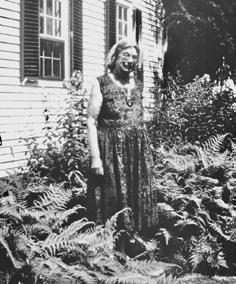
Maine can boast a strong connection with the prolific, avant-garde artist, Marguerite Thompson Zorach. Although a California native, she led a full, interesting, and influential life.
Marguerite was born in the then-outpost town of Fresno, California in 1887. Her well-to-do parents provided a strong liberal arts education, encouraging her talent in art. In 1908, along with a limited group of other women, she was accepted into Stanford University. But an aunt’s invitation to live with her in Paris led Marguerite to forgo further studies.
Her first day in Pairs proved trans-
formative. The liveliness of the modernistic paintings she viewed that day led her to reject the traditional art training expected of her. Maguerite enrolled at the avant-garde Académie de La Palette, meeting the likes of Henri Matisse and Pablo Picasso. Her artistic tendencies in modernism blossomed. Over the next years, she travelled with her exhibits throughout Europe, which culminated in a show at the prestigious, annual juried exhibition at Salon d’Automne.
In Paris she also met William Zorach, a Lithuanian sculptor who had immigrated to the US, but was then studying in Paris. Marguerite’s aunt
disapproved of the deepening relationship. William was Jewish, poor, and younger than Marguerite. Although born apart by only 2 years, that difference was too much for the times. The aunt took Marguerite on a tour of Asia, returning to California in 1912. An exhibit of Marguerite’s work in California the same year met with little support, especially from her family. In an auspicious decision, she left for New York City, married William Zorach the day she arrived in December of 1912, and launched her career.
In New York, her works received notice at two influential exhibits, the Armory Show of 1913, and the highly selective 1916 Forum Exhibition of Modern American Painters. Marguerite was the only woman exhibitor at the 1916 show.
Initially Marguerite painted, but soon her growing family claimed attention. The Zorachs first child, a son, Tessim, was born in 1915. A daughter,
Dahlov, followed in 1917. Interruptions from her children and family duties made painting difficult. She could more easily integrate embroidery and rug-making into her busy family life, and the wide range of bright colors in wool yarns appealed to her modernist style. Large tapestries and rugs, her self-described “paintings in wool,” became her niche. The status of fiber arts as craft — as opposed to traditional art — at the beginning of the 20th century, gained her little praise among critics. But the public responded to her works, and she gained much popular notoriety. The Rockefeller family commissioned Marguerite to produce a large tapestry for their home in Seal Harbor, Maine. This work was meant to capture the beauty of Mount Desert Island, keeping in line with the Rockefellers’ aim to preserve the beauty of the island for future generations. Sale of her tapestries accounted for the primary income for her family for many years.
The Zorach Collection website describes her artistic approach. “In her painting she developed a personal style utilizing complex color, texture, and patterns to focus on what she found beautiful around her in her everyday life: her family, her pets, her friends, the activities she saw taking place around her, and her natural surroundings. She had an eye for detail and for what others often overlooked. … She imbued almost every area of her life with her aesthetic sensibilities, including her hand-made and personally designed dresses, her cooking, her home furnishings, her captivating flower beds (a riot of colors, shapes, and fragrances), and the landscape of her home in Maine.”
Both William and Marguerite found inspiration in nature. Marguerite insisted that her family spend summers in the country, often in New Hampshire, but also in Maine. In 1923 the Zorachs purchased a farm on the Sasanoa River in the Robinhood area of Georgetown, (cont. on page 6)


(cont. from page 5)
Maine. Famous local artists frequently visited. This farm remained the family’s summering place until William died in 1966. The house, known as the Riggs-Zorach House, is an “excellent local” example of Federal/Greek Revival architecture from the early 1800’s. The house has been listed on the National Register of Historic Places since 1988.
Marguerite was prolific throughout her long life, working from 1910-1960. While her fame waned mid-century, more and more art historians are re-discovering her legacy. An art critic currently credits Marguerite as “one of the first American artists to fully embrace the ideas of Post Impressionism,” and called her a “pioneer of European Modernism” who shows a remarkable freedom of style and originality.
A list of internet search terms speaks to the range of her influence: batik artist, carpet maker, embroidery muralist,





watercolorist, oil painter, print maker, wood carver, and more. Bates College recognized these extensive accomplishments with an honorary Doctor of Fine Arts degree in 1964. Her works reside in notable collections of the Smithsonian American Art Museum (Washington, DC), the Metropolitan Museum of Art (New York), the Farnsworth Museum of Art (Rockand, ME), and more than 40 other museums across the US.
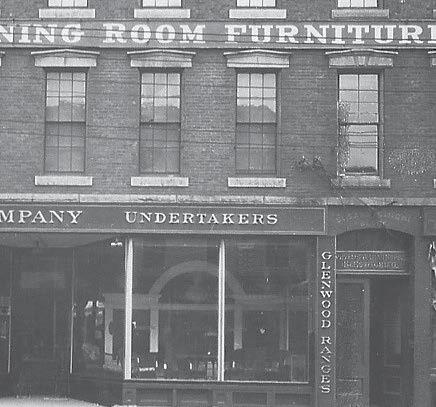
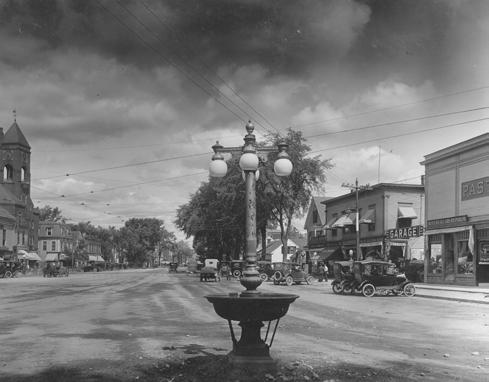
Marguerite passed away in 1968. But her artistic legacy lived on through her children. Tessim became a noted art collector. Daughter Dahlov Zorach Ipcar, lived and worked in Georgetown for many years writing and illustrating children’s literature. Maine Street in Brunswick. Item # 1990.156.269 from the Pejepscot History Center and www.PejepscotHistorical.org


“One
“The
If so, give us a call.
“A
“About














by Charles Francis
In February of 1889 the Eastern Argus, the most widely read and influential newspaper in the State of Maine of the period, carried a feature on the S.D. Warren wood pulp mill at Cumberland Mills. One paragraph of the feature presents a particularly telling story of the state’s largest single employer of the time. It reads as follows:
“Here friction between capital and labor is unknown, affording the best practical example of the true solution to the labor question; and would that it might be more generally followed. Among the other evidence of the good will of the company is a fine popular library to which free access is had every week. Thus do they aim for the mental

and moral improvement of the people.”
The final sentence of the paragraph which speaks to S.D. Warren’s concern for “mental and moral improvement” sounds more than a bit paternalistic today. However, paternalism was once thought to be the solution to the threat of the forces of anarchism and later communism that swept across Europe in the Industrial Age and even manifested itself in America with such examples of labor unrest as the Haymarket Riot, where troops had to be called out to restore order. In fact, it was this fear of labor unrest which led to S.D. Warren himself testifying before the United States Labor Committee in 1883.
At the hearing, Warren stated that
his company owned some one hundred fifty houses for which it charged its employees rent ranging from seventy-five to two hundred dollars a year. The houses were supplied with water and electricity. Should employees wish to purchase their own homes in the area, the company had its own mortgage program, and in fact, even lent money at exceptionally low interest rates so its employees could send their children off to school. The company even went so far as to build a community hall and a church.
S.D. Warren was the first of Maine’s great paper companies. While it never attained the magnitude of an International Paper or Great Northern, which







followed it, it was, under the leadership of its founder, the state’s first multi-million dollar company, and its early history is essentially the history of that one man.
Samuel Dennis Warren got his start in the paper industry working in his father’s rag business in Boston in the 1850s. At the time, almost all paper was made from rags, and the Warrens made their living by supplying them to paper manufacturers from Pennsylvania to Massachusetts. In order to acquire their rags, the Warrens went so far as to travel across the Atlantic on buying trips and even bought Egyptian mummy wrappings, which were turned into fine linen paper.
With the rise of big business and even bigger government after the Civil War, the demand for paper, which was the lifeblood of both, rose so sharply that the rag market could no longer meet it. What was needed was a new



fiber source for paper and that fiber was wood fiber. The first companies to attempt to produce paper made from wood pulp, including those in Maine, failed due to lack of capital as well as the cycles of recession and depression the country experienced as it industrialized.
S. D. Warren had opened his first paper mill on the Presumpscot at Cumberland Mills where the river dropped some twenty feet in 1853. By 1870, when the Cumberland Mills plant was producing rag paper estimated to value over a million dollars a year, it had become abundantly clear that the future of paper production lay with wood pulp. As a result of this, Warren purchased the Forest Fiber Company of Yarmouth in 1873. From that point on, his company turned almost exclusively to manufacturing paper from wood pulp.
Warren’s first source of wood for pulp came from local lumber mills
where he purchased trimmings and edges that were left over from the production of boards. Later the company began to purchase timberlands in the Brownfield area. Eventually the Presumpscot saw log drives which, while they never rivaled those of the Kennebec and the Penobscot, were impressive spectacles. In other words, S.D. Warren had switched over from the production of rag paper to paper from wood fiber at just the right time. In fact, Warren almost seemed to be able to foretell shifts in the economy so that neither his holdings nor his employees suffered hardships when other companies were laying off workers or even going bankrupt. The depression of 1873 to 1878 is a perfect example of this.
The depression of the mid part of the 1870s was one of the worst the country had experienced up to that time. However, while other companies were going under, S.D. Warren was prosper(cont. on page 12)




(cont. from page 11)
ing. The company kept seven machines running and produced some fifteen tons of paper a day. The only setback employees suffered were two relatively insignificant pay cuts brought about by a reduction in the price of paper.
When the depression ended S.D. Warren switched over to steam power and by 1880 had become the largest paper manufacturer in the world, producing in excess of thirty tons of paper a day. In fact, the demand for S.D. Warren paper was so great that the company went to the shift system, running three shifts a day. The fact that they were eight hour shifts made the company a forerunner in this area of time management.
It was also during this period of prosperity that S.D. Warren employees began to organize. However, rather than unionizing, they established, with Warren’s benevolent approval, the company’s Mutual Relief Society “to



aid and benefit such of its members as are, by sickness or accident, unable to work.” The Society provided financial assistance to incapacitated workers and death benefits as needed by directly assessing its members the sum of fifty cents.
Samuel Dennis Warren, the man who had literally gone from rags to riches, died in 1888. At the time of his death the company he had built into the largest paper producer in the world, and which the Senate Labor Committee had praised for its sense of community and concern for its workers, had experienced just one five-day spell of labor unrest when rag sorters had gone on strike. It was an enviable record that became a model for other Maine paper companies to follow.



















by James Nalley
In 1866, a young man’s family lost their home in the Great Fire of Portland. Due to their loss, the young man was inspired to leave high school after his first year and start working. Through his determination, he worked his way up in various newspaper and advertising jobs in Portland and Boston before starting his first publication in 1872. Eventually, he established his own publishing company, which produced two leading magazines: The Saturday Evening Post and the Ladies’ Home Journal. As for the latter, it became the leading magazine of its type, reaching a circulation of one million subscriptions. It was the first American
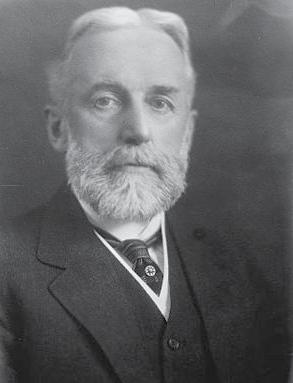
magazine to achieve this milestone. Cyrus H.K. Curtis was born in Portland on June 18, 1850, and raised in modest settings. As for his upbringing, he later admitted, “My father and mother had all they could do to keep the wheels going around without letting the neighbors know there was no oil with which to lubricate them.” According to the book The Life and Times of Cyrus H.K. Curtis (1957) by Walter Deane Fuller, “It came as no surprise that his mother refused to underwrite his yen for Fourth of July fireworks when he was 12 years old. So, with three cents in his pocket, Curtis bought the last three papers from the neigh-



borhood newsboy and quickly turned a nine-cent profit. He bought his fireworks. More importantly, he signed up for a paper route the next morning.”
Within a year, Curtis saved up enough money to purchase a small printing press, after which he began selling his own newspaper. However, as stated earlier, his operation and his family’s home were consumed in the Great Fire of Portland. For the next several years, Curtis worked as a clerk and salesman in Boston but returned to selling newspaper advertising in 1869. In 1872, with barely enough money to get it started, he published a weekly called the People’s Ledger. His publication did well for six years, until rising printing costs destroyed his profits. As stated by Louis Clinton Hatch in the book Maine: A History, “Curtis moved to Philadelphia, then a major publishing center, in order to reduce his printing costs.”

In 1875, Curtis married Louisa Knapp, who would play an important role in future publications. Four years later, Curtis and a partner founded Tribune and Farmer, a brand-new publication entirely devoted to agriculture. To boost its circulation, Curtis included a one-page supplement that he believed would appeal to women. However, according to Fuller, “Knapp hated it, deeming it a laughable attempt by men to come up with useful advice for homemakers. In response, Curtis challenged her to run it herself.” Subsequently, Knapp replaced the materials Curtis had been running with her own originals. “Within a few months, her column became a page, and soon the page evolved into its own supplement under her editorship.” In fact, it became so successful that Curtis sold his interest in Tribune and Farmer so that he could allow the supplement to be expanded as an independent publication,

with Knapp as the editor. In December 1883, the new Ladies’ Home Journal was released. Within the first year, circulation jumped to 25,000 and, as stated earlier, it became the first magazine to reach one million subscribers by 1900. By the 1930s, circulation had reached more than 2.5 million. Interestingly, Fuller stated that “despite its title, it also appealed to male readers. During World War I, it was the third most popular magazine among American servicemen overseas.”
Knapp continued as editor until 1889, when she was succeeded by Edward Bok. In 1896, Bok married Mary Louise Curtis and became the Curtises’ son-in-law. In this case, the importance of Bok was that he introduced changes that significantly increased circulation. For instance, Bok proposed low subscription rates, advertising to offset costs, and popular reading content. This approach was eventually adopted (cont. on page 16)


(cont. from page 15)
by men’s magazines more than a decade later.
In 1891, Curtis founded Curtis Publishing. In a move that proved to be successful, he purchased the struggling Saturday Evening Post for only $1,000. He then turned it into the wellknown periodical, with high-quality writing and illustrations that eventually reached three million subscribers. Curtis also founded a separate company, Curtis-Martin Newspapers, which con-

trolled several publications such as the Philadelphia Public Ledger, The Philadelphia Inquirer, and the New York Evening Post. However, due to poor management and uninteresting content, he had to sell all three newspapers at a significant loss.
As for his success, Curtis’s formula was simply to release publications for the growing American middle class and hire a team of trusted editors, including


his own wife and son-in-law. As Curtis once stated, “I don’t edit magazines…I edit editors.” He also paid top-dollar for writers and illustrators. Naturally, this attracted major names such as Louisa May Alcott, Mark Twain, Rudyard Kipling, Jack London, and Stephen Crane. Moreover, Curtis was the first magazine publisher to use color illustrations as well as the first to change covers on a monthly basis. For exam-




ple, the covers of The Saturday Evening Post became almost synonymous with the artist Norman Rockwell. For decades, the Ladies’ Home Journal was the most widely circulating women’s magazine in the country, while The Saturday Evening Post enjoyed the highest circulation of any weekly magazine in the world.
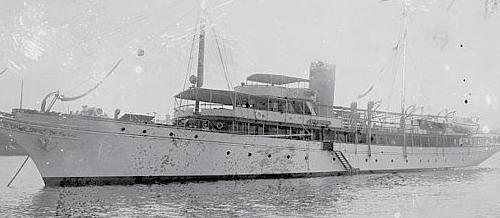
With his fortune of roughly $40 billion (adjusted for inflation), Curtis spent his money in two ways: yachting and philanthropy. As for the former, Curtis was much more than the average sailor. According to a 1922 New York Times interview, he stated “Yachting is not a hobby for me. It is a necessity. I spend half my time on this ship.” In this regard, Curtis had three large yachts over the course of his life: the 115-foot Machigonne in 1904; the 163-foot Lyndonia in 1907; and the 228-foot Lyndonia in 1920.
Regarding his philanthropy, Curtis, as one of the richest Americans in history, donated millions in various areas.

For example, he donated $2 million to the Franklin Institute in Philadelphia, $1.25 million to the Drexel Institute of Technology for the construction of Curtis Hall, and $1 million to the University of Pennsylvania. He also purchased a pipe organ that was displayed at the Philadelphia Sesquicentennial Exposition in 1926 and donated it to the University of Pennsylvania. Known as the Curtis Organ, it is one of the largest organs in the world. In fact, he donated many pipe organs to numerous venues, including the Kotzschmar Memorial Organ (in honor of his childhood music teacher, Hermann Kotzschmar) located in Merrill Auditorium in Portland, Maine. Moreover, Curtis was a major donor of the Philadelphia Orchestra (who paid off its debts in its early years) and the namesake of the Curtis Institute of Music, founded in 1924 by Curtis’s daughter, Mary Louis Curtis Bok.
In the summer of 1932, Curtis suffered a heart attack while on board his yacht, the second Lyndonia. As he re-
covered at Jefferson Hospital in Philadelphia, his second wife suddenly died. Curtis then remained in frail health until his death on June 7, 1933, just before his 83rd birthday. He was buried at West Laurel Hill Cemetery in Bala Cynwyd, Pennsylvania. On the day of his funeral, all the pipe organs that he donated across the country were played in his honor.

















by Charles Francis
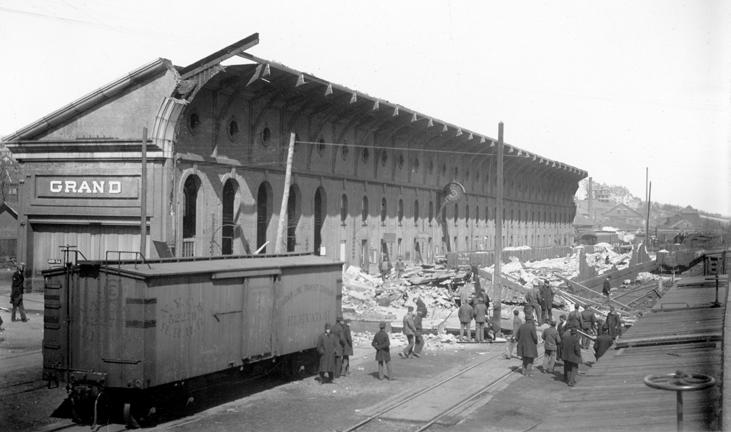
Many people do not realize that Portland was once the capital of Maine. Most, in fact, believe that Augusta, with its imposing name reminiscent of the glories of the Roman Empire in the time of the Caesars, was always the political center of the state. However, for the first twelve years of statehood, Portland was the capital of the state. And many felt that it should remain so because Portland was to Maine what Boston was to Massachusetts — the seat of the affluent and powerful. Meanwhile, Augusta was viewed as nothing more than a backwater town somewhere up the Kennebec. The Portland of today began to take shape in the years immediately fol-
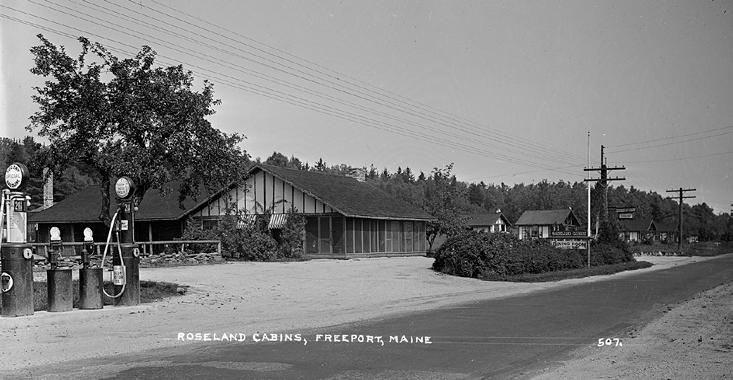
lowing the Revolution and as a consequence of the War of 1812. After the British burned the town of Falmouth — as Portland was then known — during the War for Independence, there were those that felt the fledgling commercial center of the District of Maine would be supplanted by one of the mercantile communities further downeast like Bath or Wiscasset. Freeport was also a serious contender for the capital at the time of statehood. But the burning of the wharves and buildings along Fore Street and elsewhere on the peninsula by the British in the fall of 1775, and later the economic depression brought about by Jefferson’s Embargo of 1807 did nothing but provide a stimulus for
the growth of the City.
Some of the most fascinating reading for those interested in local Maine history is to be found in the first accounts of the history of Portland, such as Willis’ 1865 History of Portland
The Willis work was written at a time when there were people still living who had a clear memory of what Portland was like during the first years of Maine statehood and it, as well as similar accounts from the period, have accurate descriptions of the construction of buildings which are now Portland landmarks. From such descriptions we can get a feel for Congress, Middle, Federal, and Center streets as they echoed to the footsteps of William King, William (cont. on page 20)




(cont. from page 19)
Pitt Preble, or Albion K. Parris, or of Market Square as it filled with throngs gathering to welcome Portland-born hero Commodore Edward Preble fresh from his victory over the Barbary Pirates, or of shoppers on the walkways in front of Boyd’s Brick Block on Middle and Exchange Streets.
From the time that Portland was incorporated as a town on July 4, 1786 it was clear that it was destined to be the center of commercial activity in Maine. In 1799 Maine’s first bank, the Portland Bank, was founded with a capitalization of $100,000. Prior to that, the same year that Portland was incorporated, Maine’s first true newspaper, the Cumberland Gazette, began publication. By 1800 Portland had a population of over 3700 and business was booming. Then came the Embargo of 1807-08 with Fore and Exchange streets eerily deserted. There were hundreds of suddenly unemployed workers
flocking to the charity soup kitchens of Market Square. Then the war brought renewed prosperity, and with peace even more prosperity came. Portland began to evolve as the mercantile center of Cumberland County.
The man who probably did more than anyone else to make Portland a shopping mecca in the early years of statehood was Robert Boyd, the creator of Boyd’s Brick Block. Robert Boyd and several of his brothers including Joseph Boyd, the first Maine State Treasurer, came to Portland from Newburyport shortly after its incorporation. In 1794 Boyd opened a store on Congress Street. In short order he bought up all the adjoining properties so that, as Willis says in History of Portland, he was able to construct a “large block of stores extending from the Canal Bank on Middle Street, round into Exchange Street.” The buildings must have been extremely impressive for the time for
not only were they four stories high, they each had wide bays for the display of goods. Boyd’s business, which continued on under the management of his sons after his death in 1827, handled all sorts of imported dry goods ranging from satins to fine linen from the Continent to exquisite gowns from Ireland. The descriptions of the various lines of Boyd goods conjures up images of today’s Old Port.
The years that Portland served as the state’s capital were some of the most dynamic in the city’s history. In 1828 the opening of the Cumberland and Oxford Canal acted as a major spur for Portland commerce. During that same period the city saw the construction of what are today some of its oldest landmarks.
In 1825 Military Hall, which was to serve as both a meeting hall and a market place, was built. It was soon surrounded by a variety of hotels, stores,








and taverns. In 1821 Henry Wadsworth Longfellow, who had grown up on Congress Street, went off to college in Brunswick. The next year the Maine Historical Society which is now housed in the poet’s childhood home was founded. In 1825 the First Parish Church, a successor to the city’s original meetinghouse, was built on Congress Street.
Then there were the activities associated with conducting the affairs of the new state. In 1818 Portland constructed a new brick courthouse. This was where the sessions of the Maine State Legislature were held. In June of 1825 the area in front of this temporary state capital was covered with a great awning for the ceremony held when Governor Parris and other dignitaries welcomed Lafayette to Maine.
The seat of state government moved to Augusta in 1832. When Governor Samuel Smith and the other members
of the state government left Portland for Augusta they must have found the change somewhat discomforting. Not only was there little in the way of housing for elected and appointed officials from across the state who had grown accustomed to the refined hotels of Portland, there was also nothing that came close to matching the variety of stores and taverns and restaurants whose services they had come to expect as their due as state officials. For that reason there was an almost immediate effort on the part of some to move the capital back to Portland. It was a movement that would continue sporadically until Governor Edwin Burleigh finally put it to rest in 1890.















by James Nalley
In 1840, a Lisbon-born woman was arrested for the murder of her third husband and transported back to Boston, Massachusetts, for trial. Based on the autopsy, arsenic was found in her husband’s stomach. Although she was eventually acquitted, questions emerged when public records showed that her second husband and his father both died of arsenic poisoning years earlier. As the news spread, the public deemed her guilty of all three murders. Although she defended her actions in an autobiography, her attempt proved futile and she disappeared from society.
Hannah Hanson Kinney (Hannah Hanson) was born in Lisbon, Maine, in 1805. Unlike many other notable

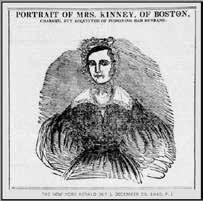
figures in history, details regarding her life prior to the murder charge are limited. However, at the age of 17, she met Ward Witham, and they were married in January 1822, in Portland. According to the book Life of Mrs. H. Kinney,
for Twenty Years (1842) by Witham himself, “After the first few months of marriage, Hanson was accused by two neighbors, Mr., and Mrs. Weymouth (who had been sharing a house with the newlyweds), of stealing their personal items.” Although Witham defended his wife at the time, he later suspected her of theft when he realized that she had been involved in an extra-marital affair. However, this was only the beginning of his troubles. In July 1823, Hanson gave birth to her first child, a daughter, after which Witham suspected that she was involved in another affair during the following winter. In 1825, Hanson gave birth to her second child, a son, after which Witham (cont. on page 24)



(cont. from page 23)
suspected her of having an affair with a young man. As stated in Witham’s book, “Rozilla Moddy, a ward of the Witham family, signed an affidavit in 1826, attesting that she witnessed another man in the Witham household during the previous winter.”
In 1826, Witham, Hanson, and their two children moved from Portland to Dover. Soon after, Witham moved to Boston on his own, and remained there for two years. After Hanson heard that Witham had begun a new life there, Hanson promptly moved to Boston. In 1830, they exchanged a series of letters, including the final one in which Hanson declared that she had no desire to live with Witham again. In March 1832, Hanson and Witham legally divorced on the grounds of adultery, although full custody of their children was awarded to Hanson.
Following their divorce, Hanson be-
gan supporting herself as a seamstress in Boston. In July 1832, Hanson visited Reverend Enoch Freeman, her cousin and minister of the First Baptist Church in Lowell, Massachusetts. According to the Handbook of the New England Agricultural Fair of 1871 with the History of Lowell (1871) by Charles Cowley, “In 1835, against the wishes of Freeman’s congregation, Hanson and Freeman were married. On the first anniversary of their wedding, Freeman grew ill and died. He was 37 years of age. Following Freeman’s death, Hanson was forced to leave town by the suspicious citizens of Lowell.”
Hanson subsequently returned to Boston and married her third husband, George Kinney, on November 26, 1836. As stated by Cowley, “Kinney was a well-known gambler and drunkard, and was five years Hanson’s junior. After their wedding, his business collapsed,
which forced Hanson to support her husband and three children through her work as a seamstress.” In 1840, Kinney was diagnosed with syphilis, which he had contracted through an affair with a mistress. According to the book Women Who Kill (2009) by Ann Jones, “On August 9, 1840, Kinney drank a cup of herbal tea and died painfully afterwards.”
In August of that year, Hanson was visiting some friends in Vermont, and was arrested for the murder of George Kinney. She was then transported back to Boston, where she was held in jail for four months until her trial. As stated by Jennifer Myers in The Lowell Sun (June 2011), “The cause of death in Kinney’s autopsy was arsenic poisoning. During the investigation, Rev. Freeman’s body was exhumed, and it was revealed (on record) that his stomach, too, contained arsenic.”


Hanson’s long-awaited trial began on December 21, 1840. Her defense attorneys, Franklin Dexter and George Curtis, argued that no proof had been found of Hanson purchasing and administering the poison to Kinney. According to Jones, “The prosecution called a servant who worked in the Kinney household as a witness, and she reported seeing a piece of paper in the kitchen with the word ‘poison’ written on it, but the testimony was not enough evidence to convict Hanson.” It was also confirmed that Kinney “had been treated for syphilis immediately before his death, and arsenic was a wellknown medication prescribed to treat venereal disease at the time.”
Based on the records from the Supreme Court of Massachusetts (1840), a total of 18 witnesses were called to testify, including: Dr. Martin Gay, a physician who confirmed the presence of

arsenic in Kinney’s stomach; Thomas Bradford, a local shopkeeper who sold arsenic, but could not identify Hanson as a customer; and Earnest Cheetham, a Boston citizen who described the rumors he had heard about Hanson. On December 25, 1840, Hanson was acquitted of the murder charge. The jury took a total of three minutes to deliberate. Upon her release, Hanson sold her millinery shop to cover Kinney’s gambling debt of more than $2,000, leaving her with $89. As stated by Jones, Hanson’s brother-in-law, Albert Leach, who had visited her while in prison, mortgaged his horse and carriage to get Hanson and her three children back on their feet financially.”
Despite the court’s ruling, the public in Boston and Lowell continued to believe that Hanson was guilty of murdering Kinney and Freeman. According to Jones, “Rumors had even begun to at-
tribute the death of Freeman’s father to Hanson, since he died suddenly when visiting the couple after their wedding.” In 1841, to put the rumors to rest, Hanson published her autobiography A Review of the Principal Events of the Last Ten years in the Life of Mrs. Hannah Kinney: Together with Some Comments Upon the Late Trial. In response, her ex-husband, Ward Witham, published his biography of Hanson (mentioned earlier) in 1842. Interestingly, although Witham accused her of adultery and slander, he surprisingly wrote: “In justice to Mrs. Kinney (Hanson), I will say that she never, to my knowledge, attempted my life by poisoning or in any other way; and I hardly think that, up to the time I finally separated from her, she ever harbored a thought of my destruction, for an instant.” Yet, most people of the time had believed that Witham had only escaped death by (cont. on page 26)








(cont. from page 25)
pure luck.
After the trial and attempt to redeem herself, Hanson disappeared from society, with no record of her death and whereabouts. Perhaps she had moved again, assumed a new name, and started a new life. However, according to Jones, this was yet another example of how one woman could not be saved “from the punishment of public opinion. In this case, everyone played along with the courtroom drama, but afterwards, in kitchens and bedrooms, people talked. In the courtroom orations, the lawyers proclaimed that ladies of society had no motive for murder; but of course, everyone knew.”


























by Kathy Claeer
When I was sick as a little girl, Mom tucked me in on the couch in the den to watch daytime TV. That was okay back in the 60s. Many hours on that couch during those long, little-girl days left me to study the distinctive pattern in the fabric of the cushions. I traced the patterns with my finger. I remember those patterns to this day. If you open Dalov Ipcar’s Calico Jungle, you’ll find a lot of memorable (and much more exciting) patterns. Calico Jungle’s story is about a boy being tucked into bed under a quilt, sewn by his mother, which sports vibrant, imaginative jungle patterns. Dahlov Ipcar, a Georgetown resi-
good
dent for many decades, is a nationally known author and artist. Her mother, Marguerite Zorach, was also a renowned artist. Marguerite filled their summer house in Georgetown with her modernist flowing designs from wall coverings and bedspreads to rugs, and clothed her family in imaginative, hand-sewn designs. Browsing through Calico Jungle you could imagine that the story — and the art that pulses throughout the book — echoes some things from Ipcar’s childhood.
Ipcar was born in Vermont in1917. Her parents had summered in New Hampshire, expecting the baby to be born soon. But it wasn’t until Novem-
a
beaches, boating, hiking, biking, lobsters, dining & shopping, hot breakfast “on the house,” indoor pool & hot tub, fitness, business center, convenient parking, free internet!


ber, 2 months past her September due date, that Marguerite gave birth — to her 11-month, 11-pound baby! She grew up in Greenwich Village, New York City, attended non-traditional schools where child-directed creativity was championed. There she explored her developing artistic talent. Her father saved all her paintings from that time, which testify to her early interest in drawing jungle scenes. Visits to the Natural History Museum and local zoos with her mother started the habit of watching animals, and capturing in her memory their colors, forms, and movements. In Maine, too, there was a nearby zoo with animals to feed her (cont. on page 32)





(cont. from page 31)
imagination.
People ponder where her ability to capture animal forms originated — as an adult, she rarely traveled. Having landed in Maine — permanently, it became in 1936 — she never left psychologically. She didn’t need to. The forms necessary to create her art were already locked in memory from her early days. By working from memory, rather than from observing immediately first-hand, she experienced relief from the ordinary, resulting in fantastically original, energetic motifs.
The jungle animals of her 1960 Calico Jungle came later in her artistic development. First came the farm animals.
Without many prospects elsewhere — the Depression was raging — Dahlov and her husband, Adolph, came to Maine. Adolph was hired to work at her father’s farm for $50 per month, enough for the couple. On that farm,

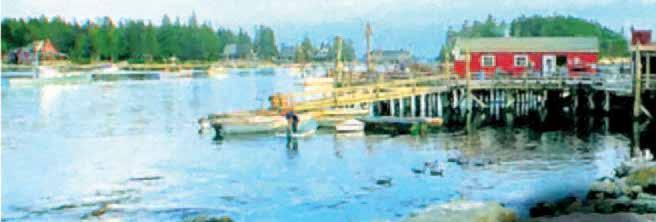
Calico Jungle endpapers. Copyright 2010, Dahlov Ipcar, per the copyright page of the Islandport Press edition of 2010.



Please check our
page or

the Ipcars believed they could make it. They had adequate housing. They could grow their own food. There was the harvest from the woods and sea. All could, and did, see them through hard times.
This property adjacent to her parents’ farm provided a rough living, though. They used oil lamps, wood for heating and cooking, and an outdoor privy. Ice had to be harvested. These city-grown folks needed to learn farming from the ground up. Neighbors pitched in on that. And they read old Department of Agriculture literature to fill in the gaps. They learned to run, successfully it seems, the 65-acre farm, producing vegetables to sell locally, as well as keeping a dairy herd. Only for haying in the summer did they hire help — two local boys. Their two sons were born there. It was for them a rich and rewarding life that they loved, Dahlov capturing farmyard scenes that ended
up in her paintings, although there was only a little time for that.
A breakthrough came with an assignment from New York contacts to illustrate Margaret Wise Brown’s The Little Fisherman (1945). Probably scenes from the front door looking toward Robinhood Cove provided inspiration. Her own Hide and Seek Animals (1947) and One Horse Farm (1950), both story and illustrations, followed.
In time, Ipcar needed to freshen her style to satisfy the changing art scene in New York. One of the first soft sculpturists (she gave a show in 1956) started out making cloth stuffies for her sons. The intricate patterns in old quilt fabrics, and calicos and batiks fascinated her. Her drive to capture the farm life at home waned. Fanciful, geometric scenes of colorful, stylized animals and plants emerged in her paintings, paving the way for Calico Jungle. Her style has been described as complex,
colorful, rich, playful, and pusling with energy.
Dahlov Ipcar passed not long ago in 2017. Yet she “lives” on in Maine. You can find people who knew her. You can see her works in murals at Patten Free Library in Bath, Mid Coast Hospital in Brunswick, Georgetown Central School in Georgetown, or Narragansett Elementary School in Gorham. And her works reside in permanent collections, not only in her beloved Maine, but also in The Metropolitan Museum of Art, the Whitney Museum of American Art, the Brooklyn Museum of Art, all in New York City.











by Brian Swartz
Amidst a near riot in East New York, a quick-thinking Gardiner soldier prevented a murder after being shot by a trigger-happy civilian.
According to the 1860 U.S. Census for Gardiner, Silas H. Taylor was a 30-year-old painter. He and his wife, Hannah, had three sons: Eben, age 5; Albert, age 2; and Asa, only five months old. Taylor stood 5-8 (about average height) and had blue eyes, black hair, and a dark complexion. For reasons unclear, he enlisted as a private in Co. I, 24th Maine Infan-
try Regiment, on September 10, 1862. Some 100 volunteers from Gardiner and Pittston comprised the company; Col. George Atwood of Gardiner commanded the regiment, which went to East New York and joined the 21st Maine Infantry at Camp Maine. The 28th Maine Infantry arrived at Camp Maine in late November.
Other regiments camped nearby. Friction developed between some local civilians and soldiers checking out the local dens of iniquity. In early December a civilian, identified by soldiers only as a “German” (no one apparent-



ly got his name), “had … fraudulently obtained” a rifled musket from a 28th Maine soldier. Taylor got into “a fracas” with the German; the firearm was recovered.
Against this background two privates from Co. C, 49th Massachusetts Infantry Regiment, left their camp near Centerville on Long Island on Sunday, December 7 and visited Camp Maine. William Stillfax was an Englishman with a wife and children living in Pittsfield, Massachusetts. His companion was John McDonald. Before reaching Camp Maine, the soldiers “stopped



once or twice in lager-bier saloons,” yet were not drunk when they chatted with some Maine soldiers. Stillfax and McDonald exited Camp Maine and “proceeded to the hotel and bar kept by a German” named Schellein. The soldiers sat nursing liquor until around 6 p.m., when McDonald suggested returning to their camp. Stillfax bought a pint of whiskey that he asked to be poured into his canteen.
Schellein, the bartender, poured what Stillfax said was a half pint. Schellein disagreed. “Harsh words ensued,” Schellein locked down Stillfax, and three or four Germans “playing cards at a table” joined the fray. One “struck Stillfax in the head with a slingshot,” and McDonald dragged his battered companion from the bar, only to be struck on the head, too.
The angry Stillfax returned to the bar and kicked open its door. Someone fired a musket through the door;
the shot missed the soldier. He turned and started running across the street. “Three shots were fired in succession,” the third bullet striking Stillfax in his back and dropping him dead at the far side of the street. McDonald and other soldiers carried away the body.
When “news of the homicide” reached the 49th Massachusetts’ camp at 8 p.m., angry soldiers boiled forth like angry hornets and descended on East New York. Schellein and his family had fled. After ransacking his hotel and bar, the Bay Staters burned it. The flames and noise drew a large crowd of Maine onlookers, including Silas Taylor.
Suddenly he spotted a familiar civilian. “Here’s the [expletive deleted], boys, that stole the gun!” Taylor yelled. Amidst the noise, nearby soldiers did not hear the last four words. Figuring Taylor had referred to Schellein, “the exasperated soldiery … made a rush
for the man[,] who would have been killed” on the spot.
Recognizing the error, Taylor shouted, “No, he’s not the man — don’t hurt him!” The German drew his pistol. Hearing him cock the weapon, Taylor “seized his hand and pressed it downward.” The German, “having slipped on the ice,” fell to his knees and pulled the trigger. The pistol fired and riddled “Taylor’s right leg, below the knee” with fourteen buckshot that shattered the leg bone. Men shouted, “Who’s shot?” “Taylor, in order to save the life of the German, who would have been immediately killed, were the facts known,” replied, “Only a citizen shot himself — no damage done.” In pain and bleeding, Taylor “hobbled off as well as he could.”
New York firefighters and police apparently responded to the fire, “and the German was subsequently arrested.” Taylor refused to press charges. (cont. on page 36)








(cont. from page 35)
He went into the Camp Maine hospital. While a surgeon was able to remove the buckshot and clean and close up the wounds, Taylor was damaged property, as far as the War Department was concerned.
The army issued him a medical discharge on January 15. The 24th Maine went on to Louisiana, where disease killed or crippled many Co. I members. Taylor returned to Gardiner and to working as a painter. He and Hannah added son Deforest and daughter Ada by the 1870 census. Eben may have died; he does not appear on the census, but Albert and Asa do.





Civic Center Drive │ Augusta, Maine 04330 207-623-1000 • 800-808-1188
• 99 Spacious rooms with refrigerator & microwave
• Complimentary deluxe continental breakfast
• Fully equipped exercise room
• Indoor heated swimming pool
• 99 Restaurant and Pub open daily for lunch & dinner
• Cable television • Free WiFi • Pet friendly comfortinn.com/hotel/me017



by Charles Francis
In the Golden Age of Sail one type of vessel stands out above all others as queens of the high seas, the clipper ships. And of those fabulous monarchs of the waves, three have gone down in history as the epitome of their class, the Flying Cloud, the Red Jacket, and the Flying Scud
The Flying Cloud, which was a Donald McKay clipper built in East Boston, is considered by many maritime historians to have been the peak expression of clipper design. The Red Jacket, which was built in Rockland, is usually identified as the fastest clipper ever built. Then there is the Damariscotta-built Flying Scud
That the Flying Scud was one of the

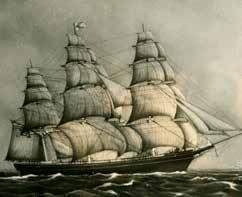
most remarkable clippers ever built has never been challenged. That she was possibly the fastest ever built has been acknowledged but never authenticated. That she was ill-starred almost from the




very beginning is a matter that has yet to be fully explored.
From the time she was launched in 1851, the Flying Cloud was the standard by which all clippers were judged. For Maine shipbuilders, however, she was something of an albatross they had to bear. Her designer came from Nova Scotia, and she had been built in Massachusetts. Therefore, when two of Maine’s premier shipyards launched clipper ships in November of 1853, many felt there were two new vessels which were sure to eclipse the speed of the Flying Cloud. One certainly did, the Red Jacket. As for the Flying Scud, it is a different matter altogether, with possible record runs being questioned,



with time lost due to malfunctioning compasses and adverse conditions, including being struck by lightning, and with having to transport homicides.
The biggest selling point a clipper had to offer was her speed. The fastest ships got the best press and, therefore, made the most money for their owners. When the Flying Cloud reached the equator from New York in the record time of seventeen days, it made the news. Setting a record made the headlines whether it was for a whole run or for a single day. Daily records made the best press.
In 1852 the Flying Cloud set a record of three hundred and seventy-four nautical miles in twenty-four hours. It did not stand long, however. She broke it again in 1856 with a four hundred and two-mile run in a single day. In January of 1854, though, the Red Jacket did four hundred and thirteen in a day. Then there is the Flying Scud Her log for November 6, 1854 reads four hundred and forty-nine nautical
miles. William H. Rowe, in The Maritime History of Maine, tells us that this figure was never viewed as official because the log was a temporary one. If it were to be accepted, however, it would stand as the all-time record for a single day’s run.
The Flying Scud was built at Damariscotta’s Metcalf & Norris shipyard for the New York market where she sold for a hundred thousand dollars.
The Metcalf & Norris shipyard was the pioneer clipper shipbuilder in Maine and for that reason, the Scud was expected to be a fast ship. From her very beginning, however, she was a disappointment. On her first voyage to Liverpool, England and back to New York, the Scud encountered abominable seas and winds and made the passage in an abysmal twenty-nine days. Misfortune and bad luck continued to follow her.
The Scud’s log shows her being subjected to a succession of lightning strikes in the Gulf Stream in 1854. While the ship was not materially dam-
(cont. on page 40)











(cont. from page 39) aged, her compasses were magnetized so they became attracted to the iron onboard. They then had to be rigged on poles which stuck out some eight feet from the ship’s hull. This was the same week she made her run of four hundred and forty-nine nautical miles in a day. On another occasion in the South Pacific, she was caught in what the log identifies as a whirlwind. The tempest tore off all three top gallant masts even though the sails were furled, and so badly damaged all the other masts and sails that she was left with a single spritsail to limp into port with. The notoriety of the Flying Scud’s streak of ill-luck, however, goes beyond what is found in her log.
Oleg Sanson, an authority of Pacific Ocean disasters, records an incident involving the Flying Scud in his 1982 In the Grip of an Island. According to Sanson, the Flying Scud picked up the survivors of a wreck in the Solo-

mon Islands. The ship carried them to Auckland, New Zealand. There it was learned two had been deliberately left behind by their comrades. Concerned Auckland residents then hired the Flying Scud to return and rescue the two who were left behind. When the Scud arrived back at the Solomons the two were found to have quarreled to the extent they refused to travel on the same ship together. Eventually, one of the Scud’s officers had to resort to force to get them on board.
Perhaps the strangest story involving the Flying Scud is that of murderers taking an oath of brotherly love on her deck. The episode appears in Old Province Tales by Archibald MacMechan, which was published in 1924. MacMechan treats the tale as part of the recent folklore of the sea. According to the tale, the Flying Scud had several murderers to transport.
The murderers, whom MacMechan

East Magazine Editor’s Choice for Best Antique Shop in Maine 2016 Automobilia • Vintage Toys • Advertising Military 18th, 19th & 20th Century Furniture • Nautical • And much more! 23 Indian Trail │ Newcastle, Maine Wed.-Sat. 9-5| Sun. 10-4 207-586-5000 | email: indiantrailantiques@tidewater.net indiantrailantiques.com
refers to as homicides, had to repeat the Lord’s Prayer in unison before the entire crew of the Scud and swear an oath on the Bible that they would act in a brotherly manner as a condition of passage.
While the Flying Scud had no authenticated record-setting passages to equal her unauthenticated one, she did establish an enviable record. Most of her work was on the Bombay, India to Liverpool, England run. While she was seven days shy of the record of ninety-seven days set during the celebrated Sweepstakes competition, it was a time surpassed by only a handful of other ships.
The Flying Scud passes from the pages of history in 1871. For those who value Maine heritage and traditions, however, she remains the only clipper that may have done a record four hundred and forty-nine nautical miles in twenty-four hours.


Original Downeast fudge made daily using New England family recipes from a blend of imported cocoa beans plus fresh cream and butter. We are the connoiseur’s choice.


See operating antique turn-of-the-century Kiss Wrapping Machine. Watch the Harbor’s only candy-maker cook, pull, flavor, design and wrap Maine’s nicest-eating Saltwater Taffy. Our Peanut Butter Kisses are World’s Best!








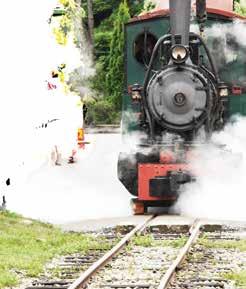
5/10 National Train Day Celebration
5/24–25 Museum Opens
6/15 Father’s Day Celebration
6/29–9/28 Cars & Coffee (LAST SUNDAYS)
7/5 Antique Engine Meet
7/12 Antique Auto Day
8/10 Children’s Day
8/17 Founder’s Day
8/23 Cocktails & Chrome— An Antique Auto Affair
9/27 Family Harvest Day
10/4–5 First Responders Weekend 10/11–12 Fall Foliage Festival 10/26 Railway Spectacular 12/6–21 North Pole Express (WEEKENDS)










by Charles Francis
My mother loved Gordon MacRae. Whenever MacRae made an appearance on TV (he always seemed to be showing up on Ed Sullivan’s Toast of the Town) she was sure to watch. When he had his own show, The Gordon MacRae Show, in1956, it was her favorite. The fact that The Gordon MacRae Show was canceled after just one season was one of my mother’s great disappointments in life.
In the mid-1950s I was caught up in the new music genre that was just beginning to be known as Rock ‘n Roll.



Gordon MacRae was not my thing, to say the least. As far as I was concerned, I thought he sounded like he had a mouthful of mashed potatoes. Nevertheless, when I saw Oklahoma, I was caught up in its color, song, and dance splendor like most everyone else, regardless of MacRae’s mushiness. Oklahoma was one of Gordon MacRae’s two great triumphs. The other was Carousel. Both were Rogers and Hammerstein musicals. Besides MacRae, both also starred Shirley Jones, who would later go on to play the lessthan-stellar role as the mother of the
Partridge family.
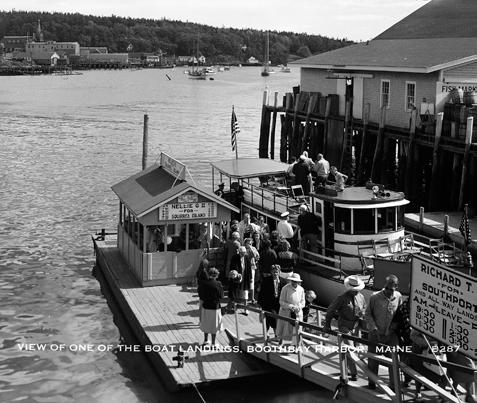
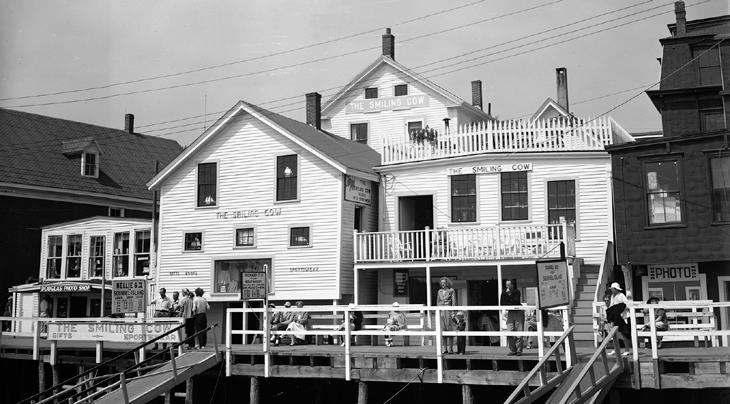
Today, Carousel is best known for songs like You’ll Never Walk Alone, If I Loved You, and June Is Bustin’ Out All Over. Carousel also has a special place in Maine of the i950s. It was filmed in Boothbay Harbor. The filming took place the same year that Oklahoma came out — 1955.
Having lived in Newcastle as a youngster, I was, and am, quite familiar with the environs where Carousel was filmed. Boothbay Harbor’s Carousel Marina, where much of the film’s action takes place, always fascinated me






when I was growing up. There always seemed to be so much going on there.
For some reason, Carousel does not seem to have stood the test of time the way its sister musical Oklahoma has. This is a bit odd, given the fact that a number of the great songs from the musical are still stock-in-trade for today’s singers. Nevertheless, Carousel does not appear on any of the various movie networks with the regularity of Oklahoma
Regardless of the dearth of Carousel airings today, it was a landmark film. Carousel was a 20th Century Fox movie, and it was that film giant’s first movie to use the trademark process of CinemaScope 55. Carousel is a landmark film for a number of reasons. It was the first blockbuster film to be filmed in Maine. It beats out Peyton Place by a year. Ironically, Carousel’s director, Henry King, had done a film in Maine a number of years before directing the Rogers and Hammerstein classic.
That film was Deep Waters, which was filmed on Vinalhaven in 1948. It had stars Dana Andrews, Jean Peters, and Cesar Romero in lead roles. Carousel’s director was, then, familiar with Maine and accustomed to working with bigtime talent.
Besides Gordon MacRae and Shirley Jones, Carousel’s cast included at least two actors whose names are recognizable even fifty-plus years since the film was made. The names are Cameron Mitchell and John Dehner. Both are now viewed as two of the greatest character actors of all time.
The weakest point of Carousel may be its plot. It is a simple vehicle for showcasing the music. Basically, Billy Bigelow, MacRae’s character, is sent down from heaven to make amends for a variety of ill-conceived escapades he engaged in while alive and while running the carousel that gives the movie its title. It is this background, however, that provides MacRae with his moment

of immortality.
Gordon MacRae’s landmark performance as a singer and actor comes with the song Soliloquy. In one of the greatest moments in music history, MacRae spends almost eight minutes speculating in song on the gender of his yet-tobe-born child. During the piece, MacRae’s emotional range runs the gamut from the elation of possibly fathering a son to the possibility that his unborn child may, in fact, be a girl that he can’t provide for.
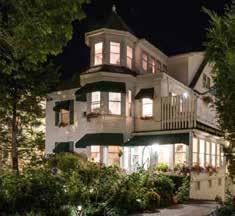
Gordon MacRae’s stay in Boothbay Harbor also provided him with another landmark experience of sorts. He was picked up for operating under the influence while working on Carousel If you’ve never seen Carousel, go and rent it. The performance of the song A Real Nice Clambake, with its downeast flavor, is worth seeing the movie for its sake alone. The rest of the music simply puts the movie into a class almost all by itself.















Iby James Nalley
n general, discussions regarding the end of the U.S. Civil War include the date of April 9, 1865, when Robert E. Lee surrendered the Confederate Army to Ulysses S. Grant at Appomattox Courthouse in Virginia. Although this would normally suggest a complete cease-fire, the war continued in some locations. For example, on April 26, General Joseph E. Johnston surrendered approximately 90,000 Confederate soldiers after fighting ensued in North Carolina, South Carolina, Georgia, and Florida. In Texas, the last battle of the Civil War was fought at Palmito Ranch on May 13. Several days earlier, on May 10, the Confederate naval forces in the Gulf finally surrendered to the Western


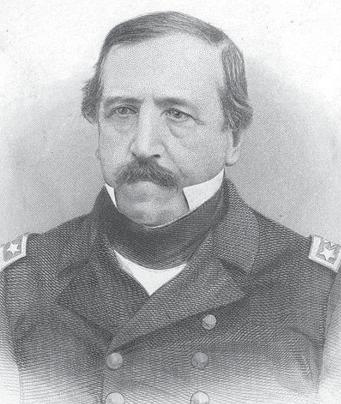
Gulf Squadron, which was commanded by a Maine-born U.S. Navy admiral. Henry Thatcher was born in Thomaston (then Massachusetts), on May 26, 1806. He was the son of Ebenezer Thatcher and Lucy Knox, the daughter of Major General Henry Knox (a senior general of the Continental Army during the Revolutionary War). After attending public schools in the area, he received an appointment to the U.S. Military Academy at West Point in 1822. However, he was forced to resign in April 1823, since he had been absent for most of his first year, due to illness. Despite this setback, he received an appointment as a midshipman in the U.S. Navy in the following month.





At the time, being a “midshipman” did not mean an appointment to the U.S. Naval Academy in Annapolis, Maryland, since it had yet to be established. Instead, it meant spending time training at sea. As stated by the Naval Historical Center of the U.S. Department of the Navy, Thatcher spent the next four years in the Pacific on board the frigate United States, a wooden-hulled, three-masted heavy frigate, and the first of the six original frigates authorized for construction by the Naval Act of 1794. Approximately six years later, in March 1829, Thatcher became a “passed midshipman” (also called a “midshipman, passed”), which was a term used in the 19th century to describe a midshipman who had passed the lieutenant’s exam and was eligible for promotion to lieutenant as soon as there was a vacancy in that grade. Subsequently, he served on the schooner Porpoise and the sloop-of-war Erie in

the West Indies.
On February 28, 1833 (roughly four years later), Thatcher was officially promoted to lieutenant, after which he served on the schooner Experiment in Chesapeake Bay. He then served on the frigates Delaware and Brandywine in the Mediterranean Squadron from 1834 to 1840. This squadron, composed of a series of rotating squadrons, was formed in response to the First (1801–1805) and Second Barbary (June 17–19, 1815) Wars. It was eventually renamed the European Squadron.
According to “The Records of Living Officers of the U.S. Navy and Marine Corps” (1870) by Lewis Randolph Hamersly, over the next 20 years, Thatcher continuously rotated from positions on land and at sea. First, he served aboard a receiving ship (a nonself-propelled ship used for various purposes such as supplies or barracks) in Boston, Massachusetts, from 1843 to
1846. Second, he served on the sloopof-war Jamestown, as part of the Africa Squadron from 1847 to 1850. Third, after duty at the Boston Navy Yard in 1851, he commanded the storeship (a ship that carries supplies to other ships in the fleet) Relief in 1852.
On September 14, 1855, Thatcher was promoted to commander, after which he served as Executive Officer of the Naval Asylum (a precursor to the U.S. Naval Academy in Annapolis) in Philadelphia, Pennsylvania. Then, from November 1859 to November 1861, he served as Executive Officer of the Boston Navy Yard, playing a significant role in the vast expansion of the Navy after the outbreak of the U.S. Civil War in April 1861. Later that year, Thatcher was promoted to captain.
In July 1862, Thatcher attained the rank of commodore and was appointed to the large sloop-of-war Constellation. In 1864, he commanded the screw (cont. on page 50)






(cont. from page 49)
frigate Colorado in the North Atlantic Blockading Squadron, which was part of the Union’s vital naval strategy to prevent the Confederacy from trading. From December 1864 to January 1865, Thatcher commanded a division of Admiral David Porter’s naval squadron at the two battles of Fort Fisher. This Confederate fort protected the vital trading routes from Wilmington, North Carolina, until its capture in 1865. In this regard, the Second Battle of Fort Fisher was the most decisive battle of the war fought in North Carolina.
Thatcher was then placed in command of the Western Gulf Squadron, after which he commenced operations in cooperation with Union General Edward Canby (commander of the Army of West Mississippi). Together, they captured Mobile, Alabama, followed by a successive takeover of major cities and ports in the south toward the end of the war. According to Hamersly, “Af-




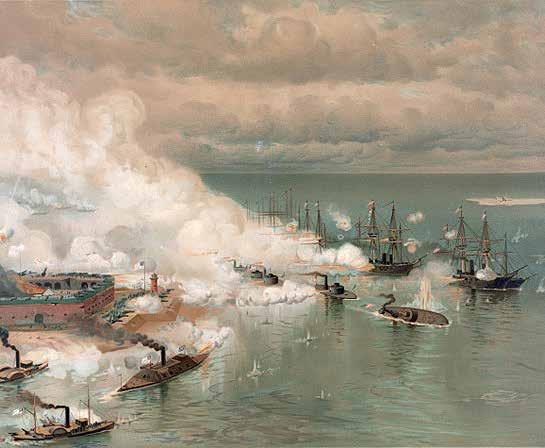





ter a brief and vigorous bombardment, Spanish Fort and Fort Blakeley were captured by the Union Army on April 9, 1865. With the key defenses of the city lost, the Confederate troops evacuated Mobile on April 12. A formal surrender was demanded by General Gordon Granger and Acting-Rear Admiral Thatcher, after which possession of the city was taken.”
On May 10, 1865, after the formal surrender of Robert E. Lee at Appomattox, the Confederate naval forces in the Gulf surrendered to Thatcher. As reported by Hamersly, “Sabine Pass and Galveston, Texas, the only remaining rebel-held fortified points on the Gulf Coast, capitulated on May 25 and June 2, respectively.”
Following the war, Thatcher remained in command in the Gulf until May 1866, after which he was officially promoted to rear admiral in July of that year. From 1867 to 1868, he com-
manded the North Pacific Squadron, where he was presented with a medal and made a Knight of the Order of Kamehameha I by King Kamehameha V of the Hawaiian Islands. He was one of only 43 recipients of the honor in its entire history.
Thatcher officially retired at the age of 62 on May 26, 1868. Subsequently, he settled in Winchester, Massachusetts, where he remained active in the community as a member and eventual president of the Massachusetts Society of the Cincinnati (a fraternal, hereditary society founded in 1783 to commemorate the Revolutionary War). In this regard, membership was restricted to descendants of military officers who served in the Continental Army. As for Thatcher, he was the grandson of Major General Henry Knox.
On April 5, 1880, Thatcher died at his home in Winchester. He was 73 years of age. He was subsequently bur-




ied at Forest Hills Cemetery in Jamaica Plain, Massachusetts. As for his legacy, aside from his 40-year naval career and his leadership in some of the most decisive battles at the end of the U.S. Civil War, two U.S. Navy destroyers have been named in his honor. The first U.S.S. Thatcher (DD-162) was a Wickes-class destroyer launched in 1918 and decommissioned in 1940. The second U.S.S. Thatcher (DD-514) was a Fletcher-class destroyer. Launched in Bath in 1942, the ship served in the Pacific, where she was actively involved (and damaged) in a battle with the Japanese destroyer Hatsukaze and the cruiser Sendai, both of which were sunk.



by Brian Swartz
When Mae West agreed to perform in the play Come On Up, Ring Twice at Camden in July 1956, the local Chamber of Commerce asked to review her script. “Might require censoring,” Chamber representatives hinted.
“Nothing doing,” Miss West responded.
Hollywood came to the Camden Hills Summer Theatre in the summer of 1956. While sex goddess Mae West drew the most attention, along with the most ink in the local press, actresses like Billie Burke and Gloria Vanderbilt also packed the theater.
Working with a cast that included 16
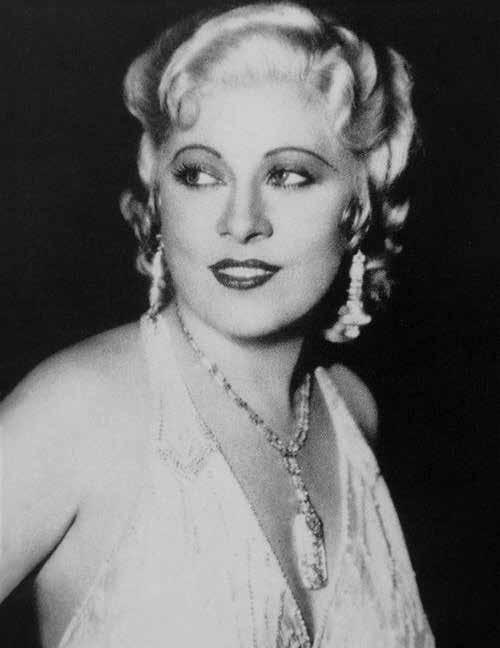
men and two other women — “neither offers any competition to the soft-spoken siren,” a coastal weekly observed — West appeared at the theater from July 16-21. Come On Up, Ring Twice” featured West as Corliss Dale, a professional entertainer charged with murdering a Latin American diplomat.
“Never fear, fans of Mae West, she swings and sways her way out of this one,” the newspaper reported, giving away the plot on Wednesday, July 11.
“The real culprit gets his just desserts.”
West’s appearance in the Midcoast caused some concern among the staid community leaders. The Camden Chamber of Commerce requested a
peek at the script, ostensibly because it might contain racy material. West politely declined the request while acknowledging why she attracted attention wherever she traveled.
“Let’s face it, sex as a commodity seems destined to remain,” she said. “It’s enheartening that people obviously still believe in my commodity ... and Santa Claus.”
To accommodate the numerous requests for tickets, the theatre rescheduled the play for two showings at 6 p.m. and 9 p.m., Friday, July 20, instead of the regular showing at 8:30 p.m. Tickets quickly disappeared as West’s fans hurried to catch her performance.
On July 30, Gloria Vanderbilt opened at the Camden Hills Summer Theatre in the premiere performance of The Spa. Scheduled to open on Broadway in autumn 1956, transposed from a Molnar play by Edward Chodorov, the play also drew solid crowds.
Vanderbilt, who performed in


Camden until August 4, debuted on Broadway with The Spa. She starred with Turhan Bey, who also intended his Broadway debut with the same play, and with Violet Heming. She had starred as the original Rebecca in Rebecca of Sunnybrook Farm in Portland in the past.
Among the other thespians appearing with Vanderbilt were Jonathan Harris, Stephan Schnable, Vladimir Sokoloff, Dana Elcar, G. Albert Smith, and Paula Lawrence. She was married to Camden producer Charles Bowden. The Spa was set in Austria-Hungary in the decades before World War I.
A Rockland radio station, WRKD, provided three actors for The Solid Gold Cadillac, a play written by George S. Kaufman and Howard Teichman. The play opened at the Camden Hills State Theater on Monday, August 20, and ran through Saturday, August 26.
H. Ridgely Bullock, the producer who brought The Solid Gold Cadillac

to Camden, convinced WRKD personalities Marian Lane, Richard Raney, and Ray Gross to “play typecast roles ... as newscasters and reporters.” The roles were tailor-made for Lane, whose morning show It’s A Woman’s World, drew a solid following in the Midcoast, and Gross, the WRKD newscaster and a reporter for United Press International. Raney played a role slightly out of his career; he had recently joined the radio station as a deejay.
Although Bullock cast other Midcoast residents into the play, he also went to Hollywood for a leading lady. Billie Burke, a well-known actress, agreed to perform in The Solid Gold Cadillac. For her, as for Mae West and Gloria Vanderbilt, the week spent in Camden would be her only appearance in Maine that year.




Iby Barbara F. Dyer
n 1897 Columbus Buswell built a toll road from the old Fay house, which was off Mountain Street, to the summit of Mount Battie. In consideration of “forty dollars, certain other agreements, and payment of diverse sums of money from time to time,” J.H. Fay, Elizabeth Fay, and Adeline Harris conveyed to Buswell the exclusive right to travel across their land for ten years.
The grantors had the right to free use of the road and received fifteen percent of the income collected from the tolls. Buswell had leased one square acre on top of the mountain from the Adams family. He had the privilege to purchase the land should they decide to sell it.
That same year, Buswell built the

Two years later, the Mt. Battie Association was formed, principally by summer residents, to hold and protect the mountain as a park. Due to the longrange vision of those people, thousands have enjoyed Mt. Battie and its breathtaking views. The association formed a corporation to purchase fifty-nine acres, including the top of Mt. Battie and the toll road. Local architect W.E. Swartz had designed a building, but when the corporation found they could also purchase the Summit House, they just remodeled it, changed its name, and opened it to the public during the summer.
On August 17, 1900 The Camden Herald stated the following about
the public reception held at the newly remodeled Mt. Battie Club House: “While people almost everywhere were sweltering in the intense heat Saturday afternoon, those who were on the summit of Mt. Battie were comfortable and cool in the refreshing breeze that Battie always furnishes on a day that is sultry at the base. But there were other attractions on Mt. Battie on that Saturday afternoon, for the members of the Mt. Battie Association were receiving friends, and they made that reception a pleasure indeed for their guests.
“The Club House, just remodeled, was thrown open. In the house and on the broad veranda, fair ladies devoted themselves to the pleasure of the visitors.


“Meservey’s Orchestra of Rockland provided music during the afternoon. The deft hands of the ladies had beautified the interior of the house by decorations of flowers, green boughs, and flags. Light refreshments were also served. More than one hundred guests enjoyed the hospitalities offered. The buckboards and public carriages were kept busy transporting the people up and down, and there would have been more guests had the extreme heat not deterred them.
“The affair was a great success and was a notable event for the town of Camden. Most of the guests saw the remodeled club for the first time, and the transformation from its former plainness was a revelation to them. The first thing noticed was the picturesque manner in which the dissimilar elements of the former structure had been grouped and combined, making a blending of the old and the new, which was very effective.
“Timothy Walsh, a former summer resident and owner of ‘Summerfold’
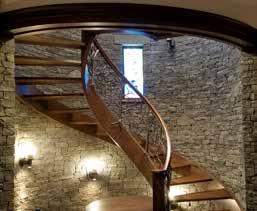
on Melvin Heights, was the architect and W.E. Swartz of Camden was the contractor. The architectural scheme involved first building the large terrace with walls of mountain stone, extending entirely around the building and permitting a continuous piazza. The fronts and ends of this terrace were finished with curved stone parapets, or bays, giving a castellated effect to the foundation. From the broad terrace rise the group of club buildings consisting of a picturesque Italian tower and two connecting buildings. The tower has three stories, the two upper ones being open galleries commanding the entire mountain view.
“Mr. G.D. Spaulding, the popular manager for the past two seasons, was the steward of the house and was assisted by Mrs. Spaulding, a competent cook, waitress, and a stableman, thus guaranteeing the best of service.
“There were eight chambers including those necessarily occupied by the help. A dozen guests can easily be accommodated overnight. These rooms

are open to the public when not engaged by the club members. The beds were brass and white enamel with the finest hair mattresses, blankets, and bedding, ensuring the comfort of those fortunate enough to spend the night on Mt. Battie.
“At 7:00 p.m., a large company of young people came up for a dance, the Association placing the house at their disposal. A supper was served and many of the afternoon guests remained over to watch the dances and enjoy the


(cont. from page 55) music and moonlight. At a reasonable hour, the young people and their chaperones started down the mountain in buckboards and private carriages, terminating what all pronounced one of the pleasantest social events in Camden’s history.”
It is interesting to note that house rates were $2.50 per day, dinner seventy-five cents, supper fifty cents, breakfast fifty cents and lodging one dollar.
In 1920 the Mt. Battie Club House was torn down because, according to the owners, it was not profitable. The present World War I Memorial tower was built on that spot from some of the mountain stones.
If by chance you have not driven to the top of Mt. Battie by the road built in 1965 from Route 1, do it today. The road, owned by the State of Maine Parks Service, is closed in the winter.
































by John Murray
he shortening of the fall days signified the beginning of a timeless event for the Native Americans of Maine. Soon the great silver fish would emerge from the vast Atlantic Ocean and travel into the fresh water rivers that emptied at the coastline. These fish were the Atlantic salmon, and they would arrive to spawn in many rivers, including the Kennebec. This was a significant event for the chief of the Kennebec Indians that inhabited Little Swan Island. This island is situated within the center of the Kennebec River between Augusta and Bath. In the
days before the Atlantic salmon entered the river, the chief would organize his people to intercept the arriving salmon, as the fish would help sustain the tribe through the long winter months.
The Native Americans did not know when the great fish first came to the river, and for as long as anyone could remember, the salmon were always there for the past ancestors of the tribe. The Kennebec Indians were a part of the river, and the river was a part of them. Enough salmon were harvested to feed the tribe, yet none were taken in excess.
When the first European settlers ar-

rived, they were amazed by the sheer numbers of Atlantic salmon that would enter the lengthy Kennebec. Atlantic salmon were also present in the smaller coastal rivers of Europe, but those numbers of salmon were dramatically less compared to the seemingly unending bounty the settlers witnessed here. It was estimated that the number of spawning Atlantic salmon which arrived yearly into the Kennebec River during the 1700s to be in the range of seventy thousand fish.
This migration of Atlantic salmon from the ocean to the river occurred for


the purpose of spawning, and the Kennebec River was used as a nursery for the juvenile salmon that hatched from the eggs which were deposited in the gravel of the river. Atlantic Salmon are an anadromous species, and thus are capable of living in both saltwater and freshwater. After the salmon eggs hatched, the juvenile salmon would remain in the river for about a year, and they would then begin to start a process known as smoltification, enabling them to survive in saltwater.
The physical changes during this smoltification process are profound. Rather than retain salt, the kidneys of the salmon change to excrete salt. The body color of the young salmon will transform to a silver color, so the salmon will be less visible to predators that reside in the ocean environment. Chemical changes also occur in the blood and the eyes of the salmon. After the smoltification process is complete,
a migration to the Atlantic Ocean takes place, where the salmon spend their adult life.
When the salmon reached spawning age, they would return to their river of origin, the location of which was chemically imprinted within their brain. Unlike other species of Pacific Ocean salmon, the Atlantic salmon did not die after spawning. When the spawning was complete, they would recoup their energy, return to the ocean, and spawn multiple times in the following years.
After the European settlers began to populate the land surrounding the Kennebec River, the settlers began to harvest the Atlantic salmon in earnest. Nets were strung across the width of the Kennebec River and connecting tributaries, and thousands of adult salmon were captured. Great numbers were processed and shipped back to Europe. Large unregulated harvests of Atlantic salmon continued throughout the 1700s




and through most of the 1800s as well. It was becoming evident that Atlantic salmon numbers were considerably lower than the tens of thousands which migrated into the Kennebec River in the previous decades.
Edwards Dam in Augusta was constructed across the Kennebec River in 1837, about 40 miles upriver from the Atlantic Ocean. Realizing the impact of the dam on migratory fish, fishery managers insisted that it was built with a fish ladder — a free-flowing narrow trench of water that was raised and elevated over the top of the dam allowing for upriver migration of spawning salmon. Unfortunately, the fish ladder on the dam was compromised and rendered ineffective after a high water flooding event shortly after its initial construction, and it was never repaired. Ultimately, a total of 140 dams would be erected on the Kennebec River basin as years went by.
(cont. on page 62)

(cont. from page 61)
Within a year after the construction of the Edwards Dam, it was profoundly clear that the number of Atlantic salmon in the Kennebec River had dramatically decreased. The dam also had a negative impact on other migratory species of fish, including shad, striped bass and herring. But still, the Atlantic salmon struggled for survival against increasingly adverse conditions that were created by the dam, and other dams as well. The resulting ponding of water above the constructed dams were raising water temperature, and the river was also starting to feel the effects of pollution from the newly created industry along the river basin. Atlantic salmon require clean cold water, and that required element was being removed.
The mid-1800s would see a large influx of sporting anglers flock to the Kennebec River in search of the Atlantic salmon, which had a reputation as a prized gamefish. State fishery manag-


ers continued to see a decrease in salmon numbers in the preceding years, and took action to preserve the migratory salmon. Nearly thirty years after the fish ladder on Edwards Dam failed, it was rebuilt, and other fish ladders were constructed on other dams to aid the migratory path of the salmon. Combined with increasing pollution and rising water temperatures, the situation for the salmon did not improve, and numbers of spawning Atlantic salmon continued to drop. Other coastal states in the northeast had populations of Atlantic salmon, but those states were also experiencing a declining popula-




tion base of salmon.
Edwards Dam was removed at the end of the 1990s, and it was hoped that this would have an immediate impact on the Atlantic salmon. No population rebound occurred however. In the year 2000, the Atlantic salmon was officially listed as a threatened species by the U.S. Fish and Wildlife Service, despite the restoration efforts on the Kennebec River and other rivers. In the year 2009, the grim status of the Atlantic salmon was elevated to an endangered species on the eight remaining rivers in Maine that have a migration of Atlantic salmon. Currently, the state of Maine is the only state that has a remaining, yet sparse population of migratory Atlantic salmon.
Since 2010, in a desperate attempt to aid the Atlantic salmon, up to one million fertilized salmon eggs were planted within the Kennebec river system every year. A considerable num-




ber of these fertilized eggs transformed into seemingly healthy juvenile salmon, which migrated downriver into the Atlantic Ocean. Fishery managers and biologists eagerly awaited for large amounts of adult spawning salmon to return. Disappointedly, only sparse numbers of adult salmon returned to spawn in the Kennebec River. In 2018, the official count of returning spawning Atlantic salmon present in the Kennebec was eleven fish. It is clearly obvious that something profoundly negative is occurring with the Atlantic salmon in the ocean, and the fish aren’t surviving to return to the freshwater rivers to spawn. Perhaps it has to do with temperature change in the Atlantic, or some other unknown environmental factor. Scientists are unsure of the reason, and for now, we have an unsolved mystery. The memory of huge spawning runs of migratory Atlantic salmon are all that remain.
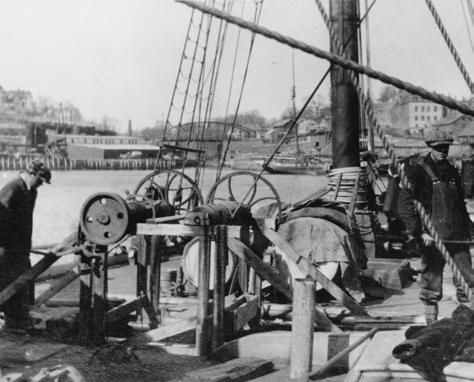


by Brian Swartz
Prohibition was in full swing in Maine (long a “dry” state) in midsummer 1924 and rum runners and federal revenuers played catand-mouse games throughout the state. On Monday, August 18, federal agents operating in the lower Penobscot Valley pulled over a Packard car packed to the gills with “200 cases of alcohol,” a newspaper reported.
Inside the Packard were Fred Spaulding of Belfast and Bernard E. Tracy of Bangor. When the men emerged from the car, the arresting feds probably said, “Hello, boys. Glad to see you again.”
Several nights earlier, federal agents led by State Field Supervisor Robert H.


Parking well away from the wharf, the agents carefully approached it, hid themselves, and soon saw a motorboat approaching the wharf,
where four vehicles were parked. Several individuals unloaded cases from the boat and piled them on the wharf. The agents swept up “Orland’s Unlucky Seven,” as the arrested men came to be known. Among them were Spaulding and Tracy, as well as Canadian citizen Nelson G. Riley, who was operating the motorboat. Hauled before a federal magistrate in Bangor on Tuesday, August 19, all seven men were charged with “conspiracy and unlawful possession of liquor,” according to the newspaper. Bail was set at $2,500 for each of them.
Soon after the raid, the feds released the four vehicles parked at the Orland




wharf. Among the cars was a Packard with a Maine license plate.
By Tuesday, of course, federal agents had re-arrested Spaulding and Tracy for transporting alcohol — and Prohibition Supervisor Moran was not feeling well himself.
Late on Sunday, August 16, he had fielded a tip from a reliable informant that “a man driving a Packard car had gone to Winterport on a rum-running expedition,” the newspaper noted. Moran and agent Lovejoy, another fed whose first name evaded attention in the press, hopped in a car and drove south looking for the Packard.
The two agents reached Frankfort without finding a car matching the description. Deciding to head north toward Hampden, Moran and Lovejoy drove through Winterport Village about 2 a.m., Sunday, August 17. On what is now Route 1A, two miles “upriver” from the village, they spotted a Packard pulled over beside the road. While searching the apparently abandoned

car, Moran and Lovejoy “became aware that lights were flashing about a farmyard a short distance away,” according to the newspaper. Moran wondered if someone was alerting the driver of the Packard that feds were snooping about his car.
Moran walked into the farmyard, inspected a Maxwell car parked there, and turned around to rejoin Lovejoy. Suddenly flinging open a farmhouse window, a man leveled a double-barrel shotgun and fired. Twenty buckshot pellets struck Moran, 11 in his right leg and nine in his left leg. Collapsing as the pain radiated into his body, the stunned Moran shouted his identity as a federal law officer. “Then come back here!” the shotgunner roared. “We took you for a burglar!”
Probably to avoid another shotgun blast, Moran stood, then bobbed and weaved unsteadily on his feet as he approached the farmhouse. He spoke with the shooter, who identified himself as George W. Paige and claimed he had (cont. on page 66)









(cont. from page 65)
chased from his house a man prowling through it “in his stocking feet, carrying his shoes in his hand,” the newspaper noted. The burglar had conveniently fled into the night about the time that Paige opened fire on Moran. Lovejoy arrived in the yard and helped the bleeding Moran return to the road. Only one vehicle remained there; during the few minutes that Lovejoy was absent, someone had slipped behind the wheel of the Packard and driven away. But the feds had scribbled down the car’s license plate.
Loading his wounded supervisor into the federal car, Lovejoy transported Moran to the home (and office) of a Winterport doctor; he patched the 20 buckshot holes sufficiently so Lovejoy could drive Moran to Eastern Maine General Hospital in Bangor.
Every law enforcement agency in the lower Penobscot Valley received
word by dawn on Sunday that the Packard belonged to Melvin R. Whitley of Stockton Springs. Law officers searched for him high and low — and two Bangor police officers quickly nabbed their suspect in a Queen City hotel later on Sunday morning. Whitley was in no condition to resist. Employed by the Maine Central Railroad, he had broken his left arm a few weeks earlier; when police officers arrested him, Whitley still slung his arm in a sling. Meanwhile, federal agents had swept up George Paige; with Whitley in tow, they met the Waldo County sheriff in Winterport and handed over the two men for prosecution. Bundled off to Waldo County Jail, the men were charged with separate crimes, Paige with assault with a dangerous weapon and Whitley for burglary. Seems he had left his shoes on the porch of the farmhouse — which Paige did not own. He
“was [just] ‘stopping’ there,” he told the feds, according to the newspaper account.
Despite their best efforts, federal agents could find no liquor in the Packard, in the farmhouse, or in the possession of Paige or Whitley. “The prohibition officers believe the shooting to be the work of rum runners, whom they interrupted in the midst of a job,” the press reported. Paige protested his innocence, but the Waldo County district attorney threw the book at him.
As for the Packard that the onearmed Whitley had allegedly driven from Winterport to Bangor, Moran and his agents soon scratched their heads and asked, “Where have we seen this car before?”
Oh, yeah: at Hutchins Wharf in Orland.

Discover Maine Magazine is published eight times each year in regional issues that span the entire State of Maine. Each issue is distributed for pick up, free of charge, only in the region for which it is published.
It is possible to enjoy Discover Maine year ‘round by having all eight issues mailed directly to your home or office. Mailings are done four times each year.
Name Address Phone

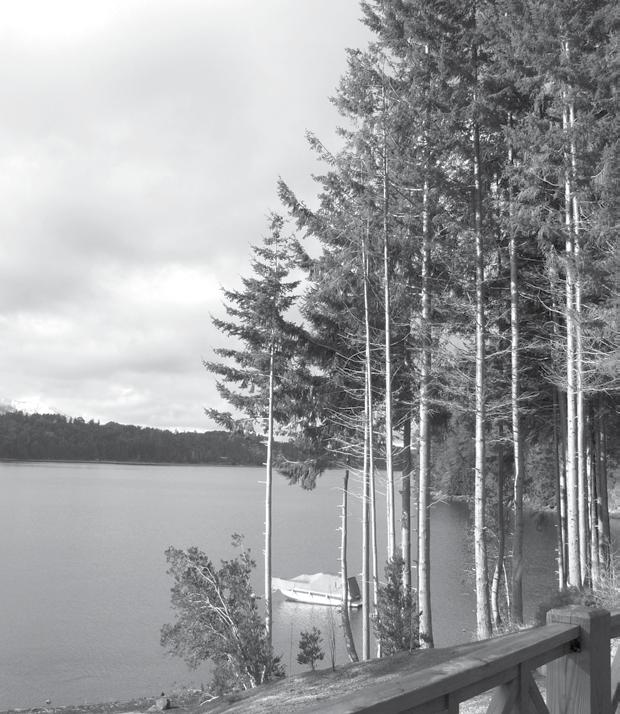

BUSINESS
Affordable Well Drilling Excavation & Forestry...................................12
American Awards Inc. .......................................................................35
Andy's Auto Repair.............................................................................65
Annabella's Bakery & Café.................................................................60
Artsake Custom Framing....................................................................38
A Twist of Moody’s............................................................................47
Azul Tequila Mexican Restaurant & Bar.............................................12
Backwood's Burger Shack..................................................................13
Bailey Island General Store................................................................30
Balmy Day Cruises..............................................................................42
Bart Flanagan Tree Service, LLC........................................................25
Barter Building Construction.............................................................62
Bath-Brunswick-Topsham Regional Chamber of Commerce...............26 Bay Wrap............................................................................................65
Beaulieu Garage Doors.........................................................................3
Belfast Area Chamber of Commerce.................................................58
Bell the Cat........................................................................................57
Best Western Plus Augusta Civic Center Inn.......................................36
Bin There Dump That.........................................................................10
Bob Temple Well Drilling...................................................................24
Bonnie's Place....................................................................................53
Boothbay Chamber of Commerce......................................................41
Boothbay Railway Village Museum...................................................42
Brillant & Son's Inc. Auto Repair & Restorations.................................7
Browne Trading Market.....................................................................14
Bruno's Restaurant & Tavern............................................................18
C&J Chimney & Stove Service, LLC....................................................5 Camden Harbor Cruises.....................................................................54 Camden Opera House........................................................................54
Capital
Cates
Aviation............................................................................16
China By The Sea................................................................................62
Clayton's Café & Bakery.......................................................................6
Coastal Car Wash & Detail Center......................................................48
Coastal Maintenance Painting...........................................................41
Coastal Prime.....................................................................................43
Colburn Shoe Store............................................................................57
Comfort Inn Civic Center....................................................................36
Copeland's
Gerard's
Goose
Gutter
Hagget
Haley
Hampton
Hampton
Harborside
Harborside Grill @ Holbrook's............................................................29
Harborside Treats by 1901.................................................................44
Harbour Towne Inn............................................................................47
Harraseeket Lunch & Lobster Company.............................................22
Harvest Time Natural Foods...............................................................35
Hatch Well Drillers.............................................................................62
Hawkes' Lobster & Gifts.....................................................................29
Heat Pumps Maine.............................................................................42
Indian Trail Antiques..........................................................................40
J&H Marine........................................................................................62
Jack's Property Service......................................................................22
Jensen's Pharmacy.............................................................................51
Jess's Market......................................................................................51
John's Ice Cream Factory....................................................................54
JW Awning Co. ....................................................................................5
Katahdin Cruises.................................................................................39
Ken's Place.........................................................................................21
Kirkpatrick's Service & Repair...............................................................8
Kon Asian Bistro.................................................................................16
L.R. Nadeau Inc. ...............................................................................34
Ladd's Plumbing................................................................................35
Laer Realty Partners - Julie Peacock Realtor/Associate Broker...........33
Lake Pemaquid Campground.............................................................39
Lakeview Lumber Co. ........................................................................61
Liberty Graphics Fine Printed T-Shirts...............................................15
Lincoln County Historical Society.........................................................8
Lucky Fortune....................................................................................39
Macomber, Farr & Whitten Insurance................................................61
Maine Association of Retirees............................................................10
Maine Historical Society.......................................................................5
Maine Instrument Flight....................................................................37
Maine Lighthouse Museum...............................................................51
Maine Lobstermen’s Association........................................................59
Maine Narrow Gauge.........................................................................14
Maine Pellet Sales LLC.........................................................................6
Maine State Music Theatre.................................................................28
Maine-ly Pawn Antiques, Furniture & More.....................................38
Maritime Energy................................................................................37
Marsh River Electrical LLC....................................................................8
McNaughton Construction.................................................................10
Metcalf's Submarine Sandwiches......................................................38 Mi Sen Thai Noodle Bar.....................................................................14