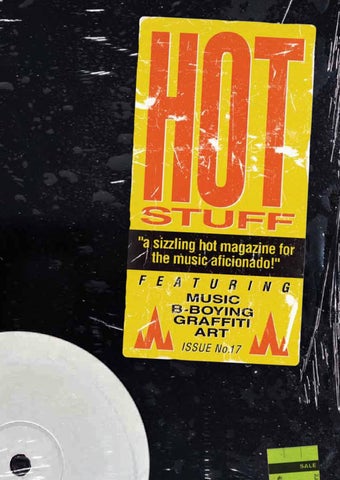
2
CONTENTS 1. New Yok State Of Mind 4 by Koe Rodriguez 2. Zagreb Rap Demo 1985-1992 16 by Falk Schacht 3. How Hemu Aggarwal shaped The Visual Identity 34 of Sugar Hill Records by Falk Schacht 4. Cranes, jazz& Disco balls. 56 Inside Elbjazz interview by Pat Vogt 5. Into The Void 66 by Markus aka @a_flock_of_wombats 6 Vinylcon..The Diggers Meeting Place 76 by Skeme Richards (The Nostalgia King) 7. Ultimate Breaks & Frites 82 by Willem Lamont 8. DJ Silver Spinner (Whistle) 86 interview by Jason Armitage (DR.J) 9. Be Kind Rewind 92 by Guillaume aka Wildstyle Guy 10. House Hunting Presents.. House History TRAX Records 102 by Aiden D’Araujo 11. Hype Stickers 112 by Spankie Dee (Sedgwick Records) and Tom Williams 12. “I ALWAYS FIND A WAY TO GO DOWN …” 122 Profile by Falk Schacht 13. The New Voice of Indonesian Bossa Nova 162 by Cleo Amadeo Singgih 14. Disco And Hip Hop Flyers 168
Cover Design: Tom Williams
New york state of mind KOE RODRIGUEZ
James “Koe” Rodriguez is a recognized visual artist, Hip-Hop scholar and an entrepreneur. His work has appeared in published books, domestic and international magazines, documentary films, group photo exhibitions and on lifestyle apparel. Over the years he has interviewed and captured such notables as: The Cold Crush Brothers, Rakim, LL Cool J; Jay-Z, KRS, Wu-Tang Clan; Kenny Dope, the TATS CRU and Sal Abbatiello of the Disco Fever. In 2005, Rodriguez curated his first group photo exhibition in Brooklyn, New York entitled ‘3 The Hard Way.’ The exhibition featured the works of renowned New York photographers, Joe Conzo, Ernie Paniccioli and Jamel Shabazz, and represented the first time all three photographers exhibited their timeless works under one roof. That year, Rodriguez would go on to pen a powerful afterword in Shabazz’s acclaimed book ‘A Time Before Crack’
4
before heading to Paris, France to helppromote the seminal sneaker documentary, ‘Just For Kicks,’ in which he co-starred. Rodriguez is the Owner / Founder of Koe Rodriguez LLC, a sole proprietorship specializing in creative representation and media licensing. The company represents a number of renowned clients, such as: Martha Cooper, Ernie Paniccioli, Joe Conzo; Jamel Shabazz, Henry Chalfant and Thirstin Howl the 3rd. In conjunction with his clients, Rodriguez has worked on a number of international lifestyle projects with Adidas, Montana Cans, Sony; Nike, TriStar Pictures, Puma; ESPN+, Beyond The Streets and the Rock & Roll Hall of Fame, to name a few. He is the owner / founder of the curatorial apparel and art brand ATW (www.atwcrew. com).
Rakim in D&D Studios, NYC 2007. Photo © Koe Rodriguez
5
New York has always been my muse. The Big Apple, The Center of the World, and The City of Dreams are just a few of the monikers given to the The City So Nice They Named It Twice. Although I’m a born and bred Jersey head, I’ve always felt at home on either side of the Hudson. My mother is a “Nuyorican” and my cousins are from the Bronx. In the early ‘70s, my parents would take my brothers and I to the Central Park Zoo in Manhattan. And during the ‘80s, my mother would show me how to get to popular shopping districts like Delancey Street, where New Yorkers and New Jerseyans went to cop the latest urban fashions. My mother introduced Nueva York into our lives very early; not just for the fun and excitement, but because she knew it was just too important to omit. Living in the Garden State and having the Empire State in my backyard was the best of both worlds. In 1985, I received a Kodak Disc 3600 camera for my 15th birthday. It was a modest camera — the kind you bought at a pharmacy or a local department store. Although the 3600 lacked the technological capabilities (and bragging rights) of a Canon AE-1 or a Nikon N2000, it served its purpose. By the late ‘80s, I graduated to a 35mm Minolta Freedom 50 and in the footsteps of my photographic mentors embarked on a multidecade journey of documentary photography. Over the years, my photos have been published in a number of media, including films, TV, books and magazines. When the Rock & Roll Hall of Fame inducted Jay-Z in 2021, it was my photo of the “Welcome to Marcy Houses” sign in front of his former home that was used in his video package. And when the Hall inducted DJ Kool Herc, it was my photo of him in Cedar Park in the Bronx that was used in the event’s induction program. 41 years after receiving my first point and shoot, and I’m still documenting anything kool or unique, especially in The City That Never Sleeps. Although I traded in my analog and digital cameras for my much handier iPhone Pro Max, I still shoot with heart and soul. In hindsight, the hardware is only as good as the person operating it. I hope you enjoy these photos (or apple slices) — all captured in a New York Minute. Words & Images © 2026 James “Koe” Rodriguez
6
ABOVE: Fun House club reunion with DJ Jellybean Benitez spinning in the iconic clown head, 2016 NYC. Graffiti OG’s Case 2 (R.I.P.) Part Soe,Joey (R.I.P.) Nic 707, Nic 1 and others photographed after the Wild Style: The Sampler book party in 2007.
7
8
ABOVE: The city that never sleeps. 24 HOURS sign in Times Square bka Forty Deuce. The 59th Street Bridge during golden hour. This image was from a photo shoot I did with MC Shan in Queensbridge for the Puma x Yo! MlV Raps collaboration.
ABOVE: Visionary Director One9 and celebrated photographer Joe Conzo Jr. chat on a rooftop in the South Bronx after a shoot. Once home to a wave of Italian immigrants and notorious mafioso, Little Italy remains a storied staple in NYC.
9
10
ABOVE: 3rd Bass train piece painted in the Brooklyn scrap yard for the “Steppin’ To The A.M.” video. MARTY piece by NYC graff artists (including Crash, Lady Pink, and TATS CRU) to celebrate famed photographer Martha Cooper’s 70th birthday.
ABOVE: Detail from R.I.P. mural in Staten Island for Wu-Tang Clan co-founder, Oliver “Power’ Grant by Osten, Echo and Will Power. One of the first graffiti pieces I captured in 1985 by artist and former Def Jam creative director, Cey Adams.
11
12
ABOVE: Wild Style director Charlie Ahearn and wife Jane Dickson at Summer Stage in Central Park, NYC 2007. The Gordon Parks of our era, photographer Jamel Shabazz in front of a Clark FLY lD mural utilizing some of his iconic street photography.
ABOVE: The koolest of‘em all, Kool DJ Red Alert after our lunch in Harlem. Legendary New York impresario Sal Abbatiello of Disco Fever and Fever Records gets a peck from Lisette Melendez backstage at a Madison Square Garden concert
13
ABOVE: Late great New York photographer Ricky ”The Lazy Hustler” Powell. I shot this photo of Ricky in Greenwich Village underneath a sign bearing his moniker. I always enjoyed chillin’ with him. He truly epitomized the New York state of mind.
14
ABOVE: This photo of New York icon Benjamin “Yellow Benjy” Melendez of the Ghetto Brothers was taken after we had lunch at one of his favorite restaurants in New York City, La Taza De Oro. Benjy was one of one and is sorely missed. R.I.P.
15
Zagreb Rap Demo 1985 - 1992 The Godfather of Croatian Hip-Hop by Falk Schacht
“It began in the South Bronx and continues in Zagreb-Retkovac. Sneakers, a tracksuit, white gloves and a large cassette player. That’s all you need. Thousands of young people, including some girls, move to the rhythm of the electro beat, stand on their heads, spin on their backs and balance on one hand. The kids from New York’s bouroughs infected the world”. Vladimir Drobnjak, article “Break Dance,” Vjesnik, Zagreb, July 1, 1984. Zagreb in non-aligned Yugoslavia, in the mid-1980s. While the Cold War divides Europe into two halves, Slavin Balen boards a rickety long-distance bus. As he does every week, he has a seven-hour journey to Munich ahead of him. The DJ’s destination is the WOM store, “World of Music.” His mission: to buy the latest Electro and Rap records from the US that are unavailable in Zagreb. Because he DJs in clubs for tourists who want to dance to the latest hits from back home while on vacation, he constantly needs fresh supplies from the West. The records also find their way into his radio shows and the magazine articles he writes. And so he brings bags full of vinyl back to Yugoslavia, along with entirely new sonic worlds. And although it was never his intention, he became the godfather of Croatian Hip-Hop culture. Today, when people talk about the early roots of European Hip-Hop, they instinctively look to London, Paris, Rome or Frankfurt. Yet the fact that an independent HipHop scene emerged in socialist Yugoslavia in the 1980s, one that would later, in the
16
1990s and 2000s, gain global recognition through collaborations with rap stars such as Xzibit and the Wu-Tang Clan, or through video games such as EA Sports, seems, at first glance, both bizarre and fascinating. But before Croatian HipHop reached the world stage, it had to take its first baby steps, and Slavin Balen was its midwife. The compilation “Zagreb Rap Demo 1985 - 1992” was conceived and compiled by HipHop archivist and curator Phat Phillie. It brings the early days of the Yugoslav HipHop scene into view for the first time and reveals the crucial role Slavin Balen played in its development. It tells the story of a scene built with shaky drum machines, cheap microphones, cassette recorders, and pause-button beats. In doing so, it also sheds light on the special position Yugoslavia occupied during the 1980s in the geopolitical struggle between the two systems represented by the superpowers, the US and the USSR. By then, the Cold War had already been going on for around 40 years. The socalled “Iron Curtain” divided Europe into two hostile power blocs.
World Destruction With the constant fear of World War III right on their doorstep, young people in Western Europe in the 80s distracted themselves with American pop culture, which dominated the everyday mainstream. The regimes in the Eastern Bloc, on the other hand, relied on statecontrolled cultural policies in the form of
Slavin Balen at Lap Club 1984
Jam On Crew 1983
17
strict censorship by officials and even surveillance by intelligence agencies, such as East Germany’s Stasi. The aim was to ward off any subversive influence from the imperialist culture of the West. Yet between these two blocs existed a political hybrid nation: Yugoslavia. In 1963, the New Yorker Magazine wrote of President Josip Broz Tito, who exercised comprehensive control over the state and the party for 35 years: “By Western standards a dictator, but loved by the people.” As early as 1948, he had set Yugoslavia on its own distinctive path by breaking with Stalin and positioning the country precisely between the two power blocs. This non-aligned stance gave the country a special position in Europe: politically clearly socialist, but independent of the Soviet Union and more culturally open. “Breakdancing crossed the ocean at breakneck speed, swept through old Europe, its cities and suburbs, and came knocking at Zagreb’s door.” Vladimir Drobnjak, article “Break Dance,” Vjesnik, Zagreb, July 1, 1984. One important difference from most other socialist states, for example, was the freedom to travel. Phat Phillie, curator and publisher of the compilation “Zagreb Rap Demo – 1985–1992,” remembers: “We weren’t trapped within the system; we could use our passports to travel abroad.” As a result, many Yugoslavs were able to work abroad without restrictions, send money home, and the country was also opened up to tourism. It was precisely this international exchange that encouraged the flow of and openness toward Western subcultures. This led to the development of an infrastructure that included, for example, clubs that Yugoslavs also frequented. “This helped make Western music, fashion, and youth culture significantly more present in everyday life than in most other socialist states.” The authorities in the Eastern Bloc countries surrounding Yugoslavia watched all of this with suspicion, while their populations looked at their Yugoslav neighbors and their freedoms with a mixture of sadness and envy. Nevertheless, the Yugoslav state maintained an official cultural policy
18
whose purpose was to create a shared sense of identity. Tito’s goal was to unite the different nationalities and religious communities of the six republics, Slovenia, Croatia, Bosnia and Herzegovina, Serbia, Montenegro, and Macedonia, within a common socialist state called Yugoslavia. “The cultural and religious diversity was both an enrichment and a challenge. Cultural policy was guided by the motto ‘Bratstvo i jedinstvo,’ meaning ‘Brotherhood and Unity.’” After World War II, the music scene in Yugoslavia was initially dominated by highly folkloric sounds with Turkish and Greek influences. Then, with a new generation, the first influences of 1960s rock began to arrive, followed later by New Wave from Belgrade and even Disco from Ljubljana. Numerous stylistic currents existed: “Dance Music was also big in the 80s because tourists demanded it in the clubs. That was an important driver of club and Dance culture in Croatia.” Western Pop influences also entered the country through the Eurovision Song Contest.
I Can’t Live Without My Radio 101 In the late 1970s and early 1980s, pressure grew within Zagreb’s state cultural institutions to establish a dedicated radio station focused exclusively on the interests of young people. But the power structures of the time repeatedly delayed the project. Only on the fifth attempt was the necessary approval finally granted, allowing the new youth station Radio 101 to begin broadcasting in 1983. The station brought together all the culturally progressive actors, as well as subversive pirate radio operators, in order to keep all of these forces under control in one place. Since the musical mainstream consisted predominantly of Rock, Pop, and folkloric sounds, the station’s sound and the way it addressed its listeners represented a revolutionary break with established listening habits. As a result, the station very quickly escaped the desired state control and developed a life of its own, becoming the most listened-to radio station among Zagreb’s youth within a very short period of time. Watched
suspiciously by officials, this independent existence was eventually tolerated after a few years. “If you have decided to try out your breakdancing skills right outside your front door, you’ll need to get hold of the right music, too. Even casual radio listeners have surely heard “Hey You, the Rock Steady Crew.” To start with, it’s enough to record this “break classic” and plunge into the adventure of street dancing.” Vladimir Drobnjak, article “Break Dance,” Vjesnik, Zagreb, July 1, 1984.
It was in this environment that the 28-year-old Slavin Balen launched a 1984 show “Electro-Funk-Premijera”. It was the first weekly program of its kind in Croatia and in all of Yugoslavia. From his childhood in the early 1960s, Balen was constantly surrounded by music. His brother Ranko Balen was around ten years older. He was the drummer and a founding member of Grupa 220, one of the pioneering bands in the early history of Yugoslav Rock. In 1968, they released the album “Naši Dani,” which the Croatian Encyclopedia describes as the first album of original songs in the country’s Rock music history.
Slavin Balen’s Kulušić Club membership card Radio 101 Logo
Zagreb Trade Fair 1987
19
First Electro-Funk Premijera radio show playlist (July 31, 1984)
19
20
Phat Phillie’s Sanyo Tape Deck (1985)
In the 1970s, Balen then began working as a DJ in tourist clubs. To make sure he could always present the newest and most up-to-date US import records, Balen did not only undertake his demanding bus trips to Munich. Once a month, he also flew to London to buy records at Groove Records, at the time Europe’s most important importer of US Electro, Hip-Hop, and House, genres that were virtually unknown in Yugoslavia in the 1980s. One of his young listeners of “ElectroFunk-Premijera” was Phat Phillie, who was only nine years old at the time: “I remember exactly when I first heard the show. They played the song ‘Roxanne, Roxanne’ by UTFO and immediately knew that this music was meant for me.” At the same time his Father made him a very important present: “My dad took me to a shop and bought me a ghettoblaster. It was a Sanyo tape deck that I was unbelievably proud of. I still own it today. I also bought blank tapes and started recording everything”. “The cassette players may not be as shiny as those in the Bronx, but there’s no shortage of enthusiasm or scraped shoulders ” Vladimir Drobnjak, article “Break Dance,” Vjesnik, Zagreb, July 1, 1984. The Breakdance boom had reached Yugoslavia by 1984, and “Beat Street” was playing in cinemas. Balen therefore opened his show with the song “Beat Street Strut” from the film’s soundtrack and mixed it with tracks from the thenbrand-new compilation “Street Sounds UK Electro.” Phat Phillie remembers: “Breakdance was the new hot shit, and the B-Boy battles between the Rock Steady Crew and the New York City Breakers in ‘Beat Street’ hit us like a bolt of lightning.” A first scene subsequently began to form in Zagreb: young people met up to organize Breakdance battles. “As soon as the kids saw the HipHop elements in films like ‘Wild Style,’ ‘Breakin’,’ ‘Beat Street,’ or ‘Body Rock,’ they already had those moves down as if they were from the Bronx,” says Phat Phillie and adds: “The Gypsy community were the first to break. I saw battles, it was like the
Bronx, only in Svetozarevo.” “Finally, we’ve got the biggest dance floor in the world: the street.” Vladimir Drobnjak, article “Break Dance,” Vjesnik, Zagreb, July 1, 1984. For the young kids, Balen quickly became their idol. It was not only the unheard fresh new music Slavin Balen played; his show also became one of the very few sources for getting access to this new music. “You couldn’t get the sound anywhere else, and you were not able to buy these records in Yugoslavia. For most of us, it was impossible to get hold of them because we were underage and couldn’t travel.” But “Electro-FunkPremijera” was not merely a kind of analog Napster of the 1980s. In a desert of information, Slavin Balen’s show became an oasis. “Imagine not being able to get any Rap information anywhere else for six months” says Phillie and ads, “and then every week there’s Slavin, opening a window into the HipHop world. We wanted to know everything about Breakdance, Rap, and Graffiti.” Balen read from Billboard magazine, NME, Melody Maker and other magazines on air, keeping his listeners up to date on upcoming record releases and events such as UK Fresh ’86 and the DMC Championships. Later, he also became the driving force behind DMC in Croatia. For Balen, the club and the radio were two completely different musical worlds. What he played on the radio he could not simply play at the clubs. According to his recollection, the new Electro sound was too “heavy” for Zagreb’s older club audience. Italo Disco, Pop, and Rock worked there. On the radio, however, he reached a much younger audience and could play Kid Frost, Egyptian Lover, or early Electro singles by Dr. Dre as early as the afternoon. For Balen, the club and the radio were two completely different musical worlds.
Please Listen To My Demo This bubbling source of information also became one of the centers of the developing scene because it offered young people the opportunity to participate:
21
Breakin in Yugoslavia was called Breakdance
22
Various Yugoslav Breakdance Compilations
Keops Sketch 1986
23
they got involved and sent hundreds of postcards to the station to vote for their favorite songs. Balen also called on his listeners to send in their own Rap demos, which prompted the first musical baby steps in the bedrooms of Zagreb. They used the simplest equipment: cassette recorders, cheap microphones, a keyboard, or a small drum machine. The finished demos were then either mailed in or dropped off directly at the studio. Slavin played them on the radio at night, always highlighting them with brief live comments that allowed flashes of his sharp-witted humor to come through. “Those few minutes of radio time meant everything to us,” Phillie remembers. “It was our only opportunity to be heard.” These early tracks were initially all rapped in English. Not as a calculated decision, but because at the time people thought that “real” Rap could only be made in English. But the young people quickly began to develop an identity of their own. In 1987, Master Keops performed the first Croatian-language Rap on the radio with his track “Number 1.” Around him, names such as M.C. Be-Bop Dodo, DIFFO, W.F.P., The Silent Bomb, and other groups regularly appeared on “ElectroFunk-Premijera.” Side by side with US Rap stars such as Grandmaster Flash, LL Cool J, and Run-D.M.C. For the young audience at the time, the kids from their own ranks were stars as well. But these HipHop figures, such as Keops, were very often not just rappers as Phillie explains: “Back then, almost all Hip-Hoppers practiced all of the elements. It was only later that these specializations emerged in HipHop, with people concentrating on a single element.” Master Keops thus also became one of the most important Graffiti writers in Zagreb, influencing many other writers. With the support of the radio show, more and more B-Boy crews began to form. The most important early crews were the Jam On Crew and the 101 Break Crew. Anyone breaking on the streets of Zagreb, however, had to expect trouble. The militia sometimes regarded the young people hanging around and dancing on the ground as suspicious gang members. If the B-Boys did not get away quickly
24
enough, they might also get slapped or beaten. That was why one member of the crew would often keep watch and give a signal as soon as the police appeared. Breakdance was also met with incomprehension by many adults: anyone spinning around on the ground was quickly regarded as strange and dirty. Just how much the new culture also led to conflicts with parents can be seen in M.C. Be-Bop Dodo’s early demo “How Fast Money Goes,” which can also be heard on “Zagreb Rap Demo 1985 - 1992.” In his adaptation of the song of the same name by the US group Divine Sounds, he raps about his parents, who cannot understand why their son scratches records and wants to devote his life to Rap and DJing. Phillie sums up the parents’ concerns about their children’s future with a Croatian proverb: “Od toga nema kruha” — “There’s no bread in that.” For them, HipHop was literally an art that could not put bread on the table. “The explosion of the dance turned into a profitable business. Film producers seized the opportunity. Breakdancing schools opened across America, the videocassette market was flooded with the new hit, and the record industry did not let the opportunity pass it by either. The young dancers quickly realized that the breakdancing moves they had performed on the street could earn them money.” Vladimir Drobnjak, article “Break Dance,” Vjesnik, Zagreb, July 1, 1984.
Breakdance Sensation ‘84 At the closing ceremony of the 1984 Olympic Games in Los Angeles, hundreds of breakers performed alongside Lionel Richie, and this also brought the new culture to the attention of the Yugoslav advertising industry. The Jam On Crew was hired for the soft drink Polo. And suddenly, the moves that young people had still been looked at for performing on the streets were being shown on television. But the Jam On Crew’s television appearance provoked other Zagreb B-Boys. Some doubted that the spectacular moves were actually real and had been
Master Keops & Elf G (Electro-Funk ArtE.F.A.)
Doc. Da’Reel (ET & The Silent Bomb) Jam On Crew 1983
D’Knock,DJ Hamed B & Boytronic
Elf G (Electro-Funk Art-E.F.A.)
Master Keops & Elf G (Electro-Funk Art-E.F.A.) ET a.k.a. Electro Team logo
Master Keops & Elf G & Zoran Zigic Ziga
First great Hip-Hop night in Yugoslavia with live Graffiti & videos 11/20/1984
Elf G (Electro-Funk ArtE.F.A.)
25
Zulu Beat by Keops
DWCDP 1988
Red Worms Crew
26
Froggy
Red Worms Crew
Keops
Froggy
Zweck 1986
DWCDP
Keops
Keops 1985
Photos taken by Luka Bekić
27
created using camera tricks. The Break 101 Crew therefore challenged the Jam On Crew to a battle. In the end, it was not just a handful of curious B-Boys waiting at what was then Republic Square. According to the recollections of those involved, between 2,000 and 3,000 people showed up, even though large parts of the audience probably did not even know what a “battle” actually was. Then the militia arrived and intervened with batons. The crowd dispersed, and in the end, no one knew who had actually won the battle. This marked the beginning of the popularization of Breakdance in Croatia. “The anthem of all dancers, including those in Zagreb, is Break Machine’s “Street Dance.” Other favourites include Rock Steady Crew’s “Uprock,” Shannon’s “Give Me Tonight,” Xena’s “On the Upside,” Ollie & Jerry’s “Breakin’,” and Baobab’s “Let’s Break.” Slavin Balen, “E-Funk 1984” (year in review), MOL, Zagreb, February 1985. Break 101 subsequently developed into one of the best-known B-Boy groups of its time and performed throughout Yugoslavia during the 1980s. Just how new and incomprehensible these movements still seemed at the time is illustrated by a story from one of their performances: a man came onto the stage with a broom and held it over the breakers’ heads because he wanted to check whether they were performing their moves using wires or other supporting contraptions. “The greatest appeal of breakdancing lies in the way it brings the streets to life, to the delight of the dancers and their indispensable audience. In fact, around twenty Zagreb kids have breathed more life into the city’s central square than all the stale projects intended to make it a livelier place.”
28
the radio broadcasts and the tapes became an analog network through which HipHop spread far beyond Zagreb. That’s why many call Slavin Balen “The Godfather of Croatian Hip-Hop.” says Phillie. After three years, the sound began to change. The electronic drum-machine Rap of the first half of the 1980s was increasingly being replaced by sample-based Rap. With albums such as Boogie Down Productions’ “Criminal Minded,” Eric B. & Rakim’s “Paid in Full,” and Public Enemy’s “Yo! Bum Rush the Show,” Rap moved increasingly to the center of Balen’s show. In 1987, he drew the logical conclusion and renamed “Electro-Funk-Premijera” to “Rap Attack.” Balen particularly loved hard Rap: Ice-T, N.W.A., and Ice Cube, and later British acts such as Silver Bullet, Overlord X, and Hijack. Blaring horns, sirens, and noise sounds matched his taste. Jungle Brothers, De La Soul, Monie Love, and Cookie Crew, on the other hand, were too soft for him and would sometimes be dissed by him as “Soft Rap.” Nevertheless, he played them. Balen did not see his job as merely reflecting his personal taste, but also as informing his listeners about what was happening in HipHop. Balen did not necessarily keep records he did not particularly like himself. Some he played only once or twice a year and then sold them to finance new imports with the money. In this way, many of his records found their way into the Yugoslav scene. Even today, they are easy to recognize: Balen marked his vinyl records with his own “Slavin Balen” stamp. “Everbody here got a stamped record from him” says Phillie. “Breakdancing has brought Zagreb’s gray streets to life.” Vladimir Drobnjak, article “Break Dance,” Vjesnik, Zagreb, July 1, 1984.
The First Lady of Yugoslav aerobics Vesna Mimica, “Break Dance,” Vjesnik, Zagreb, July 1, 1984.
Each One, Teach One
But the significance of “Electro-FunkPremijera” for Yugoslav HipHop history did not end at the limits of the Zagreb broadcasting area. Recordings of the shows made on cassette tapes circulated in Slovenia, Bosnia and Herzegovina, Serbia, Montenegro, and Macedonia. In this way,
In 1989, the 101 Press Club was opened in the basement of Radio 101. It was a listening room for young people to come and listen to radio DJs play in a club like atmosphere. After his radio show, Balen would go downstairs and play Rap records there for another two or three hours for around 30 to 40 young people. Among
Slavin Balen DMC Business card
DJ Slavin Balen at G.S.C. „KULUŠIĆ“ 1981
Phat Phillie’s Tape Mid 80’s
Slavin Balen & Phat Phillie
Ice T at radio 101
At Lap Club Zagreb 1984
29
Sketchbook from DJ Go Cut mid 80’s
30
TGB a.k.a.The Ghetto Breakers
TGB a.k.a.The Ghetto Breakers
31
them was Phat Phillie, who was able to meet Slavin Balen in person there for the first time. “As a kid, I often imagined that I would randomly run into him on the tram and tell him how much i love the radio show. I only knew his voice, and to me he was our Hip-Hop hero.” These collective listening sessions where important to the kids. They were allowed to come up to the DJ booth, touch the records, and look at the covers. For a generation without access to import record stores, the basement of Radio 101 thus became a small, walk-in Hip-Hop library. At the 101 Press Club, Phillie saw Kool Moe Dee, Steady B, and Schoolly D on vinyl for the first time. Through Balens record covers, this faraway culture finally acquired faces for these young people. The “Zagreb Rap Demo” compilation ends in 1992, precisely at the point when the Yugoslav War broke out. After Tito died in 1980, the political order that had held Yugoslavia together for decades slowly began to fall apart. The first years of Hip-Hop culture in Zagreb therefore coincided exactly with the final phase of a united Yugoslavia. After the guns finally fell silent again, it marked the beginning of a more professional and structured movement. Amid political and social upheaval, Hip-Hop once again became an anchor for many young people, a place of identification and resistance. By the early 1990s, Slavin Balen had grown somewhat tired of the constant hunt for new records. Rap was also becoming increasingly commercial and poporiented. So in 1992, he called on HipHop fans with their own record collections to contribute to the radio show. Phat Phillie, then 16 years old, had just returned from New York, where he had studied English in 1991. In his luggage: numerous new HipHop contacts and a crate of fresh US Rap records. For Phillie, a long-held childhood dream came true. He became part of the very show he had always recorded on his boombox as a child. As part of the radio show, he met DJ FRX, and shortly afterward, the two of them founded the now-legendary “Blackout Rap Show.” Just as he had learned from his role model Slavin Balen, Phillie began building new structures: he organized concerts, battles, and interviews with major stars of US Rap. As producer Koolade’s
32
manager, he secured beat placements with acts such as Masta Ace and Xzibit, as well as with major brands, television productions, and video games such as EA Sports. He was absolutely determined to keep Hip-Hop alive. “We had nothing, so we built it ourselves,” Phillie says, looking back. “That was our way of getting out of the trauma. And at the same time, it was our form of resistance.” The structures created by Slavin Balen and carried forward by Phat Phillie remain the foundation on which Croatian HipHop culture is built to this day. 35 years after the young Phat Phillie sat in front of his cassette recorder week after week to record the shows, he began digitizing his extensive collection of old tapes during the COVID-19 pandemic. This eventually resulted in the compilation “Zagreb Rap Demo 1985 - 1992”, a meticulously researched and curated time capsule. Phillie restored the tape recordings, had them professionally mastered, tracked down where the rappers from back then are today, and dug up stories and photographs. “I wanted to preserve the legacy of our scene before it was forgotten,” Phillie says. “I wanted to show that while my generation began professionally releasing Rap music in 1993, Zagreb had already started around ten years earlier. Just without an industry, without studios, without polish.” This compilation serves as a reminder of how passion, personal commitment, and a love of music can bring a culture to life through the people who dedicate themselves to it. In the end, Phat Phillie sums it up himself: “Our story proves that it often takes only one or two dedicated individuals to create movements that influence entire generations.” With the help of Dallas Records, Phat Phillie pressed and distributed “Zagreb Rap Demo 1985 1992” on vinyl and cassette. A few copies can still be found online, but the initial run of 300 LPs and 100 tapes has sold out, and a second vinyl pressing is being planned. Slavins old radio shows could be heard on DJ Phat Phillie’s soundcloud page and that Zagreb Rap Demo album is also available digitally. https://soundcloud.com/dj-phat-phillie/ sets/80s-rap-radio-slavin-balen https://bfan.link/zagreb-rap-demo
Slavin Balens Electrofunk Column Title 1984
Fax correspondence between Slavin Balen & Sophie Bramly - Host of the Hip-Hop Show - Yo on MTV Europe (circa 1988 - 1989)
Slavin Balen Club Press 101 Flyer 1989
Phat Phillie & Slavin Balen. Zagreb Rap Demo (1985-1992) release party 2025
33
“My optic presentation sizzles the retina” How Hemu Aggarwal shaped the visual identity of Sugar Hill Records. interview by Falk Schacht “In the leafy suburb of Englewood, New Jersey stands a large wooden building on the corner of West Street. But while local residents go about their daily business, behind its doors the most controversial, blistering dance music is being created. Welcome to the home of Sugar Hill Records, which moved out here from the area of Harlem from which it takes its name. It’s become the most energetic and forceful label of the 80s. Where under the wing of its creator Sylvia Robinson, rappers, singers, scratchers, musicians and engineers come from the Bronx, from Harlem, from places you thought only existed in films to make THEIR voices heard.” Record Mirror news editor Simon Hills, writing in the liner notes to Street Beat (Sugar Hill Records, 1984). The design principles, visual styles, and aesthetic codes of a new culture develop only over time. When HipHop was still in its infancy and no one could have imagined that it would one day become the most influential culture in the world, it first developed its own visual language through clothing and graffiti. But it would take many years before photographers, graphic designers, and art directors from within HipHop could fully translate the culture’s own aesthetic into the music industry. In the meantime, many of the early record covers through which listeners first encountered HipHop were designed by creatives rooted in other artistic traditions. These outsiders helped
34
shape how the young culture was perceived by the wider public. It was during this pioneering period that graphic designer Hemu Aggarwal joined Sugarhill Records in 1980, bringing with her a decade of experience in the music and graphic design industries. The independent label from New Jersey had just released the record that would carry rap music around the globe for the first time. As the number of releases continued to grow, the label decided to give out a design contract to Aggarwals full-time graphic design company. Having moved from India, Aggarwal became the sole designer behind the visual identity of Sugarhill Records and the Robinson family’s other labels, shaping their look from 1980 to 1995. At a time when album covers were still created entirely by hand using analog production techniques, she designed LP and 12-inch single covers, cassette packaging, logos, posters, advertisements, and a wide range of promotional materials. Her work included releases by The Sugarhill Gang, Grandmaster Flash & The Furious Five, The Sequence, West Street Mob, and many other artists. Among her best-known works is the cover for The Message. She not only designed the artwork but also photographed Grandmaster Flash & The Furious Five herself. For this interview, Hemu Aggarwal opens her personal archive and reflects on her journey from India to Sugarhill Records and her collaboration with Joseph and Sylvia Robinson.
35
How did you get into graphic design in India?
When and why did you move to New York to study?
Up until I was 15 years old, I’d never drawn a single line or done any art; then my father got transferred to a bigger city, and I went to a new school. This new school had an art teacher and art classes, and it was part of my curriculum. This art teacher discovered that I had some kind of talent. During that first year, I excelled quite a bit. That art teacher was a graphic designer. I was very much under his wing, and I wanted to do what he was doing. 2 years later, when it was time for college, I insisted that I wanted to go to school for art. I enrolled in the Faculty of Fine Arts, M.S. University in India. In those days, very few girls went into commercial art. The dean at my college tried to discourage me from going into commercial art, because he felt I was taking a boy’s seat. The general image of women at that time was that girls were going to get married after finishing their studies, and being a commercial artist would be wasteful.
After I got my B.A. degree in commercial art, I decided to go to other countries because in India it was very limited scope for girls to study further, particularly in that subject or get any kind of job in art. I applied to college in the USA and in France. I decided to go to the USA because my Sister was already in the U.S. I got accepted at colleges in New York, Florida, and an art school in New Jersey. I chose New York because that was the center of the commercial world. I enrolled in the City College of New York (CCNY), and I majored in graphic design.
What was your daily experience in college? The Professors’ and other male students’ attitudes were somewhat discouraging in the college. As an unwanted female student in the commercial art department, I felt I had to be twice as good as my male counterparts to gain any professors’ attention. I would spend countless hours late in the evening sitting at the railway station, a park, or the market, and drawing hundreds of sketches. I would finish my assignments early and eagerly wait for my teacher’s comments, but I often felt my work was ignored or not constructively criticized. Some professors may have thought I was merely fulfilling my hobby. They did not foresee my desire to build a career as a graphic designer. But I was determined, and there were only 2 girls in a class of over 200 boys.
38
What was your experience like in New York at that time? This was the late 60s when times were very different. The country was torn apart. The Vietnam War was still being fought, and I would go with other students to anti-war demonstrations. It was the beginning of the Hippie era of flowers, free love, anti-war marches, and acid tests. The youth across the U.S. and Europe began to “Turn on, tune in and drop out.” Fed up with the establishment, parents, schools, businesses, police, they went looking for a new way. At the same time, The Beatles had a great influence, and they went to India and brought back a lot of Eastern culture. It was a time when people wanted to know about Eastern and Indian culture. They embraced aspects of Eastern philosophy and championed sexual liberation. Many turned vegetarian and eco-friendly and promoted psychedelic drugs to expand their consciousness and create intentional communities or communes. Suits and ties were out. Torn jeans, long hair, and bare feet were in style. They incorporated alternative arts, street theatre, folk music, and psychedelic rock into their lifestyle, expressing their feelings and vision of the world. Street dance and graffiti became popular, especially in the Black commu-
40
41
42
nity. The Hippies opposed political and social orthodoxy, choosing a gentle and non-doctrinaire ideology that favored peace, love, and personal freedom, perhaps best epitomized by The Beatles’ song “All You Need Is Love” and John Lennon’s “Give Peace a Chance.” Did you specialize in graphic design for the music industry, or did you work across a broader range of fields? Right after graduation, I first worked as a book designer at Barnes & Noble in New York for 2 years. Then worked as a package designer. I designed toy packages for Buddy L, a prominent toy company making trucks for kids. I also designed packages for G.I. Joe and Romper Room made by Hasbro Corporation, as well as for Salada Tea, Welch’s Jam, Kleenex Tissues (Kimberly Clark), and Remington Hair Dryers for men and women. I designed brochures and catalogs for the food industry, Chemical Industry, and Fashion Industry. Before joining Sugarhill, did you work for a record label or an agency? Before I joined Sugarhill Records, I worked for a design firm, Farmlett and Barsanti, Inc. They were located in New York City on 5th Avenue. They had a contract with London Records and a short-term contract with Abkco (Allen Klein). I was put in charge of designing many albums for their labels and the artists such as Tom Jones, Mantovani, Engelbert Humperdinck, Frijid Pink, Marmalade, Brotherhood of Men, Ted Heath, Frank Chacksfield, Willie Mitchell, one of the last albums of the Beatles, plus singles for John Lennon and Yoko Ono. The front cover illustration I drew for the album “The Beatles’ Song Book” by Frank Chacksfield was very much influenced by Indian colors and style. I designed London Records’ catalog in 1971. After starting my design firm, AQ Graphics, Inc., and joining Sugarhill Records, I worked with other recording companies. One was Laurie Records and their subsidiary 3C Records. They were releasing music by Dion (& The Belmonts),
43
Richie Valens, The Chiffons, The ShangriLas, The Everly Bros., Del Shannon, Curtis Lee, The Skyliners, Inez Fox, Lenny Welsh, etc. I designed the 3C logo, and I handled their color separation and printing supervision. Same with Sugar Hill. Not only was I doing design, but I was also in charge of all of the printing, production, and placing ads in Billboard and other magazines. Color separation has totally changed now because of computers, but color separation was done much differently back then. “This is Sugar Hill Records, the only true independent label where everything happens under one roof. Artists sign their contracts there, they record there, they mix with other musicians, exchange ideas and come out with a music that kicks so hard you’ve got to dance.” Record Mirror news editor Simon Hills, writing in the liner notes to Street Beat (Sugar Hill Records, 1984). How did you eventually end up at Sugarhill Records? In June of 1980, I established my design firm, AQ Graphics Inc. I was looking for clients, and I sent out about 150 letters to different companies that were within driving distance. I received responses from several companies, including two record album companies, Laurie Records and Sugarhill Records, both in New Jersey. Sugarhill Records started in 1979; I started my company in June of 1980. I sent them a letter describing my work experience and requesting an appointment with Mr. Joseph Robinson. When I met him for the first time, I took my whole portfolio with me, but he wasn’t interested in seeing it. He refused to look at it. I asked him, “Please see my work”, and he said that he didn’t want to see my work, he wanted to see what I could do for him, then he would decide whether I was the right person for him or not. He gave me 3 albums to design. It took me about two weeks, and when I went back and showed him, he said, “You are going to work for me.” I stayed with him for a long time, 15 years or so.
43
44
45
46
By the time you started there, Sugarhill had already achieved a worldwide hit with “Rapper’s Delight.” Visually, many key decisions had already been made. Who established Sugarhill’s colorways, the sky blue and the colorful, rainbow-like palette? And who designed the Sugarhill logo? The colorways and the logo were already designed before I started to work for the company. I don’t know who did it. What was your general process for designing an album cover? How did discussions about a project typically unfold? Did you work independently, or did you collaborate closely with Joe Robinson and the artists? It were joint decision made during meetings. For example with The 8th Wonder, we focused on the seven wonders of the world. It seemed the Egyptian costumes were more doable. About six to eight weeks before an album release, a meeting was called among Mr. and Mrs. Robinson, the artists, myself, and sometimes Milton Malden. The title was discussed and approved. If a photo session was already done, the photos were displayed; if not, I was asked to do a photo session or come up with an illustration for the front cover, as was done for one of the Sequence, Trouble Funk, Positive Express albums. A week later, the album design and the mechanical were presented to Joe and Sylvia Robinson. Many times Sylvia was not present at the Sugahill’s office on 96th Street; then I was asked to take the design to her house, which was also in Englewood. Once everything was set, I would prepare it and order it for color separation, then send it to the printer. The Rap and hip-hop culture was still very new at the time. Could you personally relate to it? I was into the music of Tom Jones and The Beatles. Rap was very new for me. They
were talking rather fast, and I couldn’t understand all of their lyrics. But what I liked best was that these were young people full of energy and enthusiasm, and I knew they were bringing a new message to society. These kids were also rebellious. You have to keep in mind that I come from a country, during that time period, where they did not encourage women to achieve higher accomplishments, let alone send them alone to another country without marriage, so I was kind of a step up in that society. I was a bit rebellious and breaking that society’s norms and rules, and that is what these young people were doing, and I liked that very much. Mr. & Mrs. Robinson were very nice to me, and I would ask them for the lyrics so that I could understand what the artists were saying. Back then, people often claimed that rap was just a fad that wouldn’t last. What did people at Sugarhill think about that? Was it something that came up in conversation? Yes, sometimes it did come up. The music was very new to me & everyone was saying that it was a fad that wouldn’t last. But it wasn’t until the summer of 1979 that rap moved from its home in the New York ghetto and not only penetrated the heartland of America but went on to become an international success and a profound influence on popular music. No one expected it to become a world phenomenon. “Sugar Hill is delivering the sound of New York right into your home. It’s delivering the streets, the grime, the clubs, the good times and the hard times direct to your head and your feet. And don’t let anyone tell you it all sounds the same.” Record Mirror news editor Simon Hills, writing in the liner notes to Street Beat (Sugar Hill Records, 1984).
47
48
49
You worked closely with many of the artists. What memories stand out to you the most? Yes, I was with them all the time, whether it was going out to photo shoots together or waiting in the reception area for Mr. or Mrs. Robinson to be available. There were always artists hanging around. I used to talk to The Sequence girls, Blondie, Angie B, and Cheryl the Pearl, and to all of the Sugar Hill Gang members, Mike Wright, Guy O’Brien, and Hank Jackson. They all pooled their voices into a collective sound, one that was as interesting in ensemble as on solo rap passages. Big Hank was the most friendly. Joe and Sylvia Robinson had a reputation for being very tough figures in the music business. What was your experience with them? Joseph Robinson and Sylvia Robinson were extremely nice to me. They trusted me, like refusing to see my portfolio, but trusted my capabilities. Even after the stressful times during 1986, when they filed for Chapter 11, they kept a kind relationship with me and continued giving me work on their many other labels. They gave me the assignment to photograph their Sweet Mountain Recording Studio, design the logo for it, and a brochure which was never printed, but I have the photos. You spent a lot of time talking with artists such as The Sequence and the Sugarhill Gang. What kinds of things did you talk about? The only talks I vaguely recall are that they were more curious about me and India. They said I was the first Indian woman they had come across in the design field, and they had many questions about India. What was your relationship with Milton Malden, and what role did he play?
50
Milton Malden was a diplomat before his involvement with the Robinsons. I visited Milton in his office every time I went to Sugarhill. Sometimes I waited there for one to two hours watching him deal with the sales department, making calls to the distributors, and other staff members. He paid all the bills, including mine. All documents, labels, contracts, and shipping distributions went through him. He controlled the overall situation. He also had a side business of importing wine from Yugoslavia. I designed many labels for wine bottles for him, plus making a “No Trespassing “ sign for his property in upstate New York! I still have the letter with his signature that he gave me on an official Sugarhill Records letterhead, complimenting my designs at the company. While you were working there, graffiti on the New York City subway system was at its peak. How much did graffiti influence your work? I found the graffiti work very fascinating. I have used graffiti photos on the album Break Dance by West Street Mob. I have taken hundreds of photos of graffiti in the Bronx, N.Y., and in Europe - Switzerland, Germany, and France. For The Sequence, you created a fully illustrated album cover yourself. What inspired that artwork? If they did not have a photo of the artist and no time to arrange a photo shoot, I would do an illustration on the cover. I used a few of their photos to draw the likeness of their faces. “Just when you thought music was safe again, along came Sugar Hill to put it right back on the edge. If you don’t believe it… the proof is right in these grooves.” Record Mirror news editor Simon Hills, writing in the liner notes to Street Beat (Sugar Hill Records, 1984).
51
52
53
54
55
You’re now selling your Sugarhill artifacts. How do you feel about that?
live forever. I would like hip-hop fans who collect and appreciate them.
I have preserved those artifacts for nearly 50 years. They are part of the creation of Sugarhill Records albums. They include unique collections of items that no longer exist today. For example, in the 1980s, a Color-Key was a popular analog, overlaystyle color proofing material used in the printing industry to preview how a fourcolor (CMYK) offset print job would look before going to press. Each color-key has four transparent layers that were stacked and aligned (“registered”) precisely on top of each other over a white backing sheet to simulate a full-color composite image. Printers and clients used Color Keys to check layout accuracy, alignment (registration), and general color balance without the extreme expense of setting up a real printing press. The press proofs are sent to artists (me) for accuracy before they get assembled into jackets and cassettes. I was in charge of checking the color keys of each job before sending it to a printer. This is history. I am not going to
To purchase, contact: hyaggarwal@gmail.com, WhatsApp: +1-415-619-9002. Copyright for all pictures by Hemu Aggarwal. Graphic design, reconstruction and remix of Hemu Aggarwal’s Sugarhill ads: Falk Schacht. Thanks to René Goldenbeld & André Langenfeld for the photos and scans used to reconstruct the Crash Crew logo.
55
CRANES, JAZZ & DISCO BALLS. INSIDE ELBJAZZ. Pat Vogt talks to Nina Sauer, the cofounder of the ELBJAZZ festival in Hamburg, Germany.
Nina and I have been Insta friends since last November. It took me a while to figure out who was actually behind the profile spacegirl_hh. Nina came up with a festival idea, where harbor cranes with giant attached disco balls make the coolest, most surprisingstage sets in town, and jazz heads stand shoulder to shoulder with hip-hop kids, soul nerds and tourists. Since 2010, ELBJAZZ, which was invented by Nina, has grown into one of Europe’s most unusual jazz festivals. I got curious about my Insta friend, so I went to meet her in Hamburg on July 10 and 11, 2026.
56
Hi Nina! So here we are, actually sitting at the festival you started with Tina back in 2010. Every year around 20.000 fans come down to Hamburg harbor to enjoy the festival. And the whole thing started over a few glasses of wine at a party? Yep. It was basically a crazy idea fueled by wine. Tina and I met at a party in 2007. We got talking over a few glasses and she told me about her idea for a jazz festival at Hamburg’s Kunsthalle art museum. I thought: Great idea, just the wrong location. A festival like that should take place in the harbor, small stages, big stages, international stars, local bands, jazz and other related genres: funk, soul, hip-hop, blues, disco, electronic music. It just had to be groovedriven. All of the stages should be connected by small harbor boats, so even getting from one stage to another would become part of the experience, and Hamburg locals could feel like tourists in their own city. Our initial brainstorming at the party is basically still the blueprint for today’s festival. We spent two years pitching the idea around town, trying to find sponsors and getting the city and local politics on board. A more than challenging task, sincewe were total rookies in the festival and concert world. Two women, two rookies, and you’re basically telling Hamburg’s jazz world the way you think a major jazz festival should look like. How well did that go down? At first, the press and parts of the jazz scene definitely didn’t take us seriously at all. Back then, the jazz and concert business was still pretty much male-dominated, and here we were, two girls with the desire to create something new, infuse jazz with a different, new energy and turn up the party and groove factor. They didn’t take you seriously? Not at all. Even before the first festival took place, some newspaper articles that basically ridiculed the whole idea. One of the articles started with a line like: “A specter is haunting Hamburg: two women want to put on a new jazz festival. Can this possibly go well?” Another article called me a “harbor rat with great connections.” Thankfully times have
Tom Jones performing live at ELBJAZZ 2026
changed since then, and stuff like can’t be written any longer. Interestingly, some sponsors were different. A major German car brand and a Hamburg bank came on board for the very first festival, even though ELBJAZZ had never happened before. They simply believed in the idea. I thought that was pretty cool. Now, 16 years later, we’re quite proud of how all the energy and work we put in, eventually paid off. ELBJAZZ has become part of Hamburg and in addition has made a name for itself
57
58
Jamie Cullum performing live at ELBJAZZ 2026
59
If ELBJAZZ were a record crate, what would be in it? What does ELBJAZZ sound like? ELBJAZZ actually has a pretty distinct flavour. Jazz is the main dish, but there’s a lot of freedom when it comes to the sides. You might have jazz legends like Charlie Haden, John McLaughlin, Eumir Deodato, Hugh Masekela, stars like Gregory Porter, Joss Stone and Jamie Cullum, alongside artists like Robert Glasper, Kamasi Washington, Kokoroko or Nubya Garcia. Additional onstage ingredients can be acts like The Streets, Jungle, Greentea Peng, MEUTE or Altın Gün, while DJs take over the Mojo Club at night: Mousse T., Detroit Swindle, Nickodemus, Marc Hype, Claas Brieler, Emma Noble, Nappy G, Naughty NMX and many more. To me, jazz is diversity. ELBJAZZ stretches all the way from jazz legends and Hamburg local heroes, to the hottest, in-demand sounds coming out of London clubs. The only rule is: all of the participating artists need to have real musical depth and substance, and ideally, some serious groooove. I was thinking again about how we actually met. It was because of an African mask I posted on Insta. You contacted me via DM after noticing it. How does your love of Africa connect with your musical journey, and how did you end up where you are musically today? Exactly, your Songye mask from Congo. I love African masks, especially Yoruba masks. My father lived in Nigeria for 17 years, so West Africa became part of my musical DNA very early on. What he was listening to in the ’60/70s had a huge influence on me: Fela Kuti, Tony Allen, Ebo Taylor, Rob, Peter King, BLO, Kiki Gyan, incredible music. As a teenager, I listened almost exclusively to funk, soul and jazz, and a lot of rap. My very first concert was Whodini with Run-DMC. That was in 1983 during a school trip to Berlin. I still have the concert ticket. Oh yeah, I love everything about hip-hop culture. Still do. Speaking of hip-hop: if you had to choose, who would be your two favorite artists? If we’re talking ’80s and ’90s, definitely Eric B. & Rakim and A Tribe Called Quest. And a little Ice-T on the side. In the ’90s and 2000s, alongside US rap, I listened to a lot of German hip-hop, but also drum’n’bass, LTJ Bukem & MC Conrad for example. Nowadays I no longer listen to quite as much new hip-hop, except for Kendrick Lamar, obviously, and a few German things.
60
All concert tickets: Nina Sauer collection
61
And where does Hamburg come into your musical DNA? Besides my parents, it was really my friends and my hometown that shaped me. For me Hamburg has always been a laid-back Groovetown, with clubs like the former Soul Kitchen, Mojo Club and sooo many more live venues. And back in the day, it was mainly concert promoter Karsten Jahnke who brought all those amazing jazz, funk and soulinfluenced shows to Hamburg. And now it’s come full circle: today, that very same promoter, KJ, is the company behind ELBJAZZ, organizing and producing the festival. You’ve got Blue Note and CTI on the shelf, but you listen to plenty of European jazz too. Where does your heart beat a little faster, the US or Europe? That’s a tough one. Miles Davis, Donald Byrd, Jimmy Smith, Stanley Turrentine, Lonnie Liston Smith and company always work for me. What I love about American jazz is the fact that it’s deeply embedded and integral part of the African American experience and musical history: work songs, spirituals, blues, gospel, in combination with rhythm and groove. European jazz can open up completely different spaces. Sometimes it’s more strippedback, sometimes more electronic, sometimes more rooted in the classical tradition. I like both, everything from Blue Note to Nordic electro-jazz. But I’m out when jazz ventures into free / avant-garde territory. Most of the time, it’s just too abrasive for my taste. You could really hear that mix of US and European jazz in this year’s ELBJAZZ line-up. Exactly! Snarky Puppy, José James, Lizz Wright and the John Beasley Miles Davis special on one side, and British acts like Jamie Cullum, Fergus McCreadie and Joss Stone on the other.
62
A selection from Nina’s record collection
63
ELBJAZZ afterparty
ELBJAZZ harbor terrain with crane and disco ball
Nina Sauer
ELBJAZZ afterparty
ELBJAZZ main stage
64
Beyond the artists, what is it that makes ELBJAZZ unmistakably ELBJAZZ? Definitely the setting, Hamburg harbor and its industrial character. Most of the festival actually takes place inside a working shipyard. Even while the festival is happening, ships are still being built and repaired. Docks, cranes, shipbuilding halls, it just looks spectacular. At night, everything is lit up in different colors and the entire location feels completely psychedelic. The overall maritime vibe rounds out this truly unique atmosphere. On top of that the festival offers swing dancing, saxophone workshops, great food stands and wine served in actual glasses.
Okay, crate-digger question: what was the last record you bought? Pioniermanöver compilation from 1994, early East German hip-hop. Because of you, actually. You posted the album and I was like: What the hell is THIS? Bought it, done!
Even getting to the location is part of the experience. You can choose to take a small harbor boat across the river Elbe, or walk through the historic Old Elbe Tunnel. Seagulls, wind, ships horns, the sounds of the shipyard, and then suddenly you’re standing in front of a stage surrounded by cranes and docks. You really can’t copy that atmosphere. I have to ask about that giant disco ball, hanging from the huge harbor crane. Who came up with an idea like that? That was my idea. I always thought the cranes already look like they’re dancing. So the disco ball seemed like an obvious choice. What was the most surreal moment in 16 years of ELBJAZZ, one of those moments where you thought: This cannot actually be happening right now? In 2018, a massive storm rolled in. We had to stop the festival and evacuate thousands of people into the shipbuilding halls. And I remember standing there thinking: All we need now are DJs in every hall, then everyone could just keep partying. After 16 years, is there still that one moment during the festival when you look around and think: F**k, we actually did this? Every time. Seriously, every single time. I’ll be standing somewhere in the shipyard with a glass of wine in my hand, looking around, and that’s exactly what I think: F**k. We actually did this.
Okay, so I can say I’m at least responsible for one record in your collection. What artist or genre would anyone expect the least to find in your collection? One of the main things I collect is groovedriven German fusion, psychedelic Krautrock, German electronic music, modern German big-band sounds, and music from East Germany before reunification like rap from Electric Beat Crew from 1989, for example. There’s so much great, undiscovered music from here. A lot of it still flies completely under the radar, even most of Germans don’t know it. Last question. If you were to give Hamburg one new cultural idea, what would it be? Ha! Funny you should ask. I’m actually developing exactly that right now: a listening lounge, a record archive and a music café, all in one, in one of Hamburg’s most beautiful parks. I’ll tell you more about it sometime around early 2028. Deal. I’ll see you in the listening lounge in a year and a half.
65
INTO THE VOID. ELECTRONIC MUSIC, OUTER SPACE AND THE ART OF TOMORROW. Markus aka @a_flock_of_wombats
Markus is a lifelong music enthusiast turned music archeologist, record collector, graphic designer, living life between the “old” and the “new world”, nyc < > hamburg.
66 8
“Do you really need another one?” my mother once asked, as I stepped into my parents’ house, carrying a bag of newly acquired vinyl. Little did she know that the bag didn’t contain just one, but several records. “Of course I do!” I responded. Trying to explain these new purchases to her would have been pointless, as she herself never had the mindset of a collector. My obsession with vinyl started early. As a kid, I would sit in front of a cheap suitcase record player, listening to adventure stories, holding the record covers in my hands like treasures, studying them until I knew every detail by heart. The tinny sound of the speaker didn’t matter at all, as I felt I had stepped into a magical world, a world in which I could be immersed for hours. Eventually adventure stories were replaced by music. Soon first visits to record stores followed, purchases were limited by my allowance, and often it wasn’t just the music itself, but the artwork of an album that would lead to what I would pick up. The covers seemed like a promise of another, more exciting world. After years of discovering, enjoying and loving a wide variety of music, one genre in particular stood out to me — electronic music. Kraftwerk opened the door, followed by a new wave of mostly synth based sounds, in large parts hailing from the UK, Japan and Europe. It felt like an entirely new universe had all of a sudden opened up, one that pointed towards new kinds of future possibilities. This was very much in alignment with my lifelong fascination with sci-fi, and ideas about what the future could be like. Eventually this led to an interest in not just looking towards the future, but to look back, in order to find out more about the history of electronic music. What was of particular interest to me, was how these once new sounds were visually imagined and put into practice on a recorded album. Scientific imagery, abstract art, geometric shapes, mathematical precision, minimalism, all had become a common language to represent this new kind of music. In addition, one theme in particular stood out to me: space. From Louis & Bebe Barrons ‘Forbidden Planet’ soundtrack, to Detroit techno legend Jeff Mills’s latest, 2026 release ‘The Trip To Vega’, space is a recurring theme throughout the history of electronic music’s cover art. From rockets and alien planets, real life astronauts and the first moon landing, to the digital age and entirely synthetic worlds.
THE FUTURE IS OUT THERE 1956–1978 LOUIS & BEBE BARRON – FORBIDDEN PLANET OST 1956 / Planet Records LP 1976 Cover: Renate Druks The journey starts with a soundtrack that was already twenty years old by the time it became a record. Louis and Bebe Barron created their revolutionary soundtrack for MGM’s ‘Forbidden Planet’ in 1956, using homemade electronic circuits, tape manipulation and various effects. No synthesizers in the later sense, no conventional instruments – instead, machines squeal, breathe, pulse and appear to develop lives of their own. MGM called it “Electronic Tonalities.” The soundtrack, the first fully electronically created film score of its kind, wasn’t released on LP until the Barrons issued it themselves in 1976. Renate Druks’s fantastical painting takes us right into the film’s alien universe. Druks was a surrealist painter and filmmaker, part of LA’s avant-garde art scene, moving in circles that included filmmaker Kenneth Anger. Music and image say the same thing: Regular earthly rules no longer apply.
The following is a brief glimpse into the visual journey through futures once imagined. Destination: SPACE.
67
TOMITA – THE PLANETS RCA Red Seal, 1976 Cover: Stanislaw Fernandes After Wendy Carlos’s 1968 release ‘Switched on Bach’, Moog reinterpretations of pieces by J.S. Bach, had popularized these new sounds, Japanese synthesizer pioneer Isao Tomita took the technology to new, grandiose heights. He reimagined Gustav Holst’s early 20th century composition ‘The Planets’ as an orchestral electronic cosmos of synthesizers and studio effects. Sounds float, shimmer and mutate in ways no orchestra could. Stanislaw Fernandes’ sleeve matches the ambition: deep space rendered as lavish 1970s cosmic fantasy. ‘Forbidden Planet’ imagined what another world might sound like. Tomita shows what it might feel like to float through one.
PETER HOWELL & THE RADIOPHONIC WORKSHOP – THROUGH A GLASS DARKLY BBC Records, 1978 Cover: uncredited At the visionary BBC Radiophonic Workshop, the future was being built from tape machines, synthesizers and experimentation. Composer Peter Howell’s ‘Through a Glass Darkly’, still using traditional instrumentation in addition to a synthesizer, sits somewhere between electronic composition, progressive music and imaginary soundtrack. The studio itself had become an instrument.
MACHINES TAKE OVER 1982–1989 LOGIC SYSTEM – ORIENT EXPRESS EMI, 1982 Cover: Hajime Kobayashi Composer Hideki Matsutake, had been an assistant to Tomita and a synthesizer programmer with Yellow Magic Orchestra, before stepping into the spotlight himself as Logic System. ‘Orient Express’ is precise, melodic and confidently machine-made: sequencers, synthesizers and electronic rhythms are moving with mechanical elegance. Hajime Kobayashi’s design makes technology part of the journey. Space doesn’t necessarily have to be above us. It might already be all around us.
68
THE JONZUN CREW – LOST IN SPACE 21 Records, 1983 Cover: Geoffrey Chandler Boston’s Jonzun Crew turned science fiction into a joyful blend of electro-funk, by putting drum machines –in addition to live drums–, vocoders and synthesizers on a spaceship which was sent into orbit. Geoffrey Chandler’s cover art perfectly captured the essence and energy of the music. Dark space, exploding light and bold lettering hurtling towards us. After decades of serious visions of tomorrow, the future had discovered the party. Space now had a beat.
KRAFTWERK – ELECTRIC CAFÉ EMI, 1986 Cover: Hubert Kretzschmar, Rebecca Allen & CGI team In 1986, Kraftwerk had a very different idea — the computer had become the future. For Electric Café, pioneering computer artist Rebecca Allen and a team of CGI artists transformed the members of Kraftwerk into digital beings, constructed from visible polygons and geometric surfaces. Hubert Kretzschmar translated this imagery into the album design. Today those heads look charmingly retro, in 1986 they looked astonishingly futuristic. And that’s exactly what makes the cover so fascinating: the way yesterday’s image of tomorrow has dated so beautifully. Kraftwerk aren’t just looking at the machine any longer, they had become it.
808 STATE – QUADRASTATE Creed Records, 1989 Cover: Peek Design / Michael Peek Quadrastate is an album that helped show how electronic dance music could be machine-driven, atmospheric and strangely warm at the same time. Michael Peek’s cover design was based on photographs of Earth from space. Printing costs restricted the design to three colours. The restriction made the cover, and it seemed like the ultimate alien planet turned out to be our own.
69
70
Inside cover illustration of The Orb’s Moonbuilding 2703 AD album.
71
WELCOME TO CYBERSPACE 1991–2000 THE ORB – AUBREY MIXES: THE ULTRAWORLD EXCURSIONS Big Life, 1991 Cover: The Designers Republic / Kris Needs The rave had left the building. The Orb stretched electronic dance music into vast imaginary spaces built from dub, samples, voices and environmental sound. The Designers Republic visually constructed parallel realities, using typography, logos and information graphics as raw material. In this instance adding space imagery and referencing the past, with a friendly nod towards Pink Floyd’s famous ‘Animals’ album cover.
PETE NAMLOOK – AIR II 1994 Cover: art direction for the 2024 reissue by Juliane Hohlbaum Pete Namlook’s label always felt like a selfcontained universe in itself, and the album’s subtitle says it all: “Travelling Without Moving”. Namlook connected the heritage of German kosmische music with the ambient electronics of the 1990s. And the sleeve goes directly to the source: astronaut Edward H. White floating above Earth during America’s first spacewalk in 1965. No longer fantasy, science fiction had become reality by way of photography.
4HERO – PARALLEL UNIVERSE Reinforced Records, 1994 Cover: Lamb On Parallel Universe, 4hero served up breakbeat music that had mutated into jungle and drum & bass: rhythms fragment, accelerate and reorganize at seemingly impossible speeds. Lamb’s sleeve suggests exactly what the title promised – another dimension. Here, the abstract rendering on the cover leaves room for imagination, yet perfectly represents what was happening inside the grooves.
72
KEN ISHII – JELLY TONES R&S Records, 1995 Cover: art direction Yasunobu Yamashita Illustration: Koji Morimoto Techno meets manga. Ken Ishii’s ‘Jelly Tones’ arrived when Detroit techno, Japanese technology culture, anime and an increasingly global electronic scene were coming together. Yasunobu Yamashita’s art direction featured imagery by Koji Morimoto, the animator associated with Akira and Studio 4°C. For now, rockets and astronauts were gone, replaced by a future that had turned into an entirely synthetic visual world. Outer space has become cyberspace.
CONVEXTION – VENUS IN SPURS Tektile, 2000 / reissued as R-CNVX1, a.r.t.less, 2018 Cover: iIllustration by David A. Hardy Gerard Hanson, aka Convextion, makes deep, spacious techno that feels like a transmission received from somewhere way beyond Detroit. When this 12” was reissued in 2018, British space artist David A. Hardy supplied a perfect visual counterpart. Hardy had been painting scientifically informed imaginary worlds for decades. Classic space art meets futuristic dub techno. Old future. New future. Same universe..
FUTURES PAST 2008–2019 URSULA BOGNER – RECORDINGS 1969–1988 Faitiche, 2008 Cover: art direction Jens Reitemeyer And out of the blue the timeline runs backwards. According to Jan Jelinek’s Faitiche label, Ursula Bogner was a German pharmacist who privately experimented with tape and electronics from the late 1960s onwards. There has been much speculation as to whether she was actually a real person, rather than being a pseudonym for Jan Jelinek’s own sound explorations, but no definitive answers have been given. Jens Reitemeyer’s use of retro illustrations, draw on the visual world of the supposedly archival music itself.
73
LONE – GALAXY GARDEN 1991–2000 R&S Records, 2012 Cover: Konx-Om-Pax / Tom Scholefield Space becomes a living organism. Lone’s ‘Galaxy Garden’ is a hyper-coloured blend of rave memories, breakbeats, glowing synthesizers and liquid melodies. Tom Scholefield – aka Konx-Om-Pax – turned the sound into an equally wondrous ecosystem: fluorescent forms somewhere between coral reef, alien vegetation and digital life. Lone called the result “pure synaesthesia.” After half a century of rockets, robots and computers, the galaxy has turned organic. The future looks bright.
STILL TRANSMITTING… THE ORB – MOONBUILDING 2703 AD Kompakt, 2015 Cover: The Designers Republic Painting: Ian Anderson The Orb are still out there – this time heading for the year 2703 via ambient electronics, dub and psychedelic drift, and with them The Designers Republic return too. The people who helped electronic music imagine the future in the early 1990s, are now designing one that’s almost seven centuries away. Different visual approach, similar musical vision.
VARIOUS ARTISTS – LOST TRANSMISSIONS FROM THE OFF-WORLD TERRITORIES Invisible Inc., 2018 Cover: Gordon Mackinnon By now, the future itself had become something we collect: lost technologies, imaginary transmissions and science-fiction aesthetics from previous decades. The great Space Age dream has become an archive. And the archive is ready to be sampled.
74
ORFEÓN GAGARIN – VOCES A 45 Geometrik, 2019 Cover: Alonso Urbanos One last transmission. Orfeón Gagarin –the project of Spanish electronic musician Miguel A. Ruiz– has spent decades moving between synthesis, musique concrète, post-industrial electronics and science-fiction imagery. Even his stage name takes us back to Yuri Gagarin and the beginning of human spaceflight. Alonso Urbanos’ sleeve looks nostalgic, somewhat obsolete and yet it still hints at the future all at once. A good place to land.
Inside cover illustration of The Orb’s Moonbuilding 2703 AD album.
Inside cover of Pete Namlook’s Air II album.
RETURN TO EARTH Put these records next to one another and you don’t just see the future. You see different pasts imagining it. Alien landscapes. Psychedelic planets. Astronauts. Robots. Digital bodies. Parallel universes. Cyberspace. Some of those futures now look dated in the best possible sense. Others still seem strangely ahead of us. And then there is the Moon. In April of 2026, as I gathered these covers from my collection, four astronauts flew around the moon aboard Artemis II – the first humans to make that
journey in more than half a century. NASA is now targeting early 2028 for humans to return to the lunar surface. Which makes looking at these covers feel slightly different. For decades, electronic music and graphic design have been inventing places we couldn’t go to, technologies we didn’t have and worlds that didn’t exist. Now reality is catching up once again. So perhaps the most interesting question is no longer what the future used to look like. It’s what we’ll put on the cover next.
75
VinylCon.. The Diggers Meeting Place By SKEME RICHARDS (THE NOSTALGIA KING) America has had it’s fair share of record conventions over the years with both smaller local shows as well as long running, multi day ones like WFMU and Austin Record Convention which not only brings audiences from within the country but internationally as well to what has become yearly pilgrimages for those in need of getting their vinyl fix. With the exception of WFMU and ARC being larger shows, there really hasn’t been a new show of similar size to be introduced in years, that is until the debut of VinylCon in 2024. What started out as a 2-day show in Philadelphia, VinylCon has become the fastest growing record emporium here in the states which not only features both domestic and international dealers with a curated DJ lineup of vinyl DJ’s who dig deep into their crates to give diggers and dealers alike music that piques their curiosity and opens up their ears to dig even
76
deeper. VinylCon Philadelphia got it’s start in 2024 with both a spring and fall show and was met with great praise and was the first large, 2 day show that the city has had in years. With dealers packed in and sold out ticket sales, the inaugural show went over so well that both dealers an attendees wanted to know when the next one would be. There was obviously something special about VinylCon and as a DJ and record collector, the selection of dealers really hit every sweet spot. From longtime wantlist grails to crate staples and classics for the seasoned collectors to new pressings and vintage vinyl of classic artists that seem to attract the more casual and younger collectors. As someone who has been to quite a few shows over the years, VinylCon really seems to get a mix of crowds that you typically wouldn’t find at other shows that are usually filled with what we like to call within the community,
“grumpy old men” which is a good sign. A sign that the vinyl community is growing and that the medium is once again a choice means of listening for buyers especially in a digital era. For the inaugural event, I was booked along with a list of other DJ’s to create the soundtrack for the weekend which turned in a conversation afterwards with organizer Kobi Waldfogel who presented the idea of me being on board and handling the organization of the DJ lineup for future shows which I obviously said yes. Being a DJ and being connected to DJ’s globally, it only made sense that I should take on the roll and help present a lineup that felt special and different than what other record shows were focused on. I could give great attention to detail in curating a lineup that would feature amazing DJ’s who had great taste in music and especially records that you wouldn’t hear every day and of all genres. The goal was to give a broad mixture of styles and soundscapes which include funk, soul, psych, jazz, gospel, city pop and even house. One of the things that I stress upon featured DJ’s, both headliners and supporting guests is not to play what they are known for or would play in a club set. Give the people something special, so-
mething personal with their selections and music that they are into that most wouldn’t know they are. And because of that mindset is why I often get asked the question, “how did you get so and so booked to play that type of set”? As a DJ and collector myself, there is a mutual respect amongst DJ’s in that regard where we’re here to entertain a room full of people but at the same time give a proper balance to play for deeper heads as well. It keeps both dealers and diggers sharp and wanting to go deeper and unearth more than whats known. Over the last couple of years attendees have been treated to amazing sets by Cut Chemist, Gaslamp Killer, Thes One (People Under The Stairs), House Shoes, Double Peas, Easy Mo Bee, Arthur Baker, Diamond D, Edan and Boogie Blind to name a few. All unique in their own way with what they play and how they play but all equally entertaining and inspirational in every way. You never know who may show up at a VinylCon show and this past Atlanta show was something special with the appearance of John Manuel, drummer for the legendary group, RAMP. The amazing Back Pay Records brought John out to their booth to do signings and sell official RAMP merchandise for the weekend. It’s incredibly important that we preserve the
77
legacies of many of these artists that are still alive and thank them and show them that their music means the world to us. After a successful first year of what started out as a simple idea to do a show in the City of Brotherly Love quickly grew to also doing one right next door in the city of Baltimore, Maryland. Taking show on the road not only made sense, but it gave it wings to grow into something special and more than just a record show. Taking place twice a year beginning in Philadelphia and Baltimore, the show currently sets up shop in Los Angeles, Atlanta and New York. VinylCon has become more of a family reunion at this point as many of the dealers have stated and all seem to look forward to the next showing. But the stars of the show are without a doubt, the fully stocked bins of records that fill up the room traveling locally, cross country and internationally. Having gone to record shows quite often, the quality of records here seems to be really top notch especially in terms of higher end pieces that you don’t see often as well as mid grade gems that have dried up in recent years yet all somehow find there way to VinylCon. Being around records for as long as I have you see so many come and go but my excitement remains the same seeing rarities like The Har-You Percussion Group, Stark Reality, MIlton Wright, Turner Bros. and Rhythm Machine as it does when seeing crate staples like Roy Ayers’ Coffy,
78
Tarika Blue, Catalyst, Roy Porter and Mighty Ryeders on the walls and in bins. With a traveling show, you often see regional pieces that find their way to other cities which keeps digging interesting and exciting with discovery especially with the Los Angeles show which presents the crèm de la crèm of record bins and I would say is one of the best shows in the world. Having the opportunity to dig into bins of Panamanian Funk 45’s or Latin psych that almost never make their way to the states is what makes the LA show even more special especially with it’s proximity to Latin America. The show not only attracts the casual record collector but also has become known as a central hub for a who’s who cast of DJ’s, producers and serious record collectors to converge on for the weekend. Heavy collectors like Cut Chemist, Alchemist, Roc Marciano, Egon (Now Again), Easy Mo Bee, Supreme La Rock and others all get their record fix at VinylCon and walk away with rarely seen pieces to add to their collections. At this past Atlanta show, George Sulmers set up shop and had selected bins of PM Dawn’s Prince Be collection for sale that he had bought over the years from his years of travel and of course from his shopping adventures at the legendary Roosevelt Record Convention. Many of the pieces still with price tags from the 1990’s which shows just how much records have gone up in value over the years.
79
79
The price of records have obviously skyrocketed as is the case with most things collectible but VinylCon has found a way to balance things out and satisfy every taste and price point so that no attendee leaves empty-handed. It’s been great seeing the community that attends the show really grow in a short 2 years time and is a healthy sign that it will continue
80
to be around for year to come. So be sure to check the 2027 calendar schedule and if you’re in or around any of the cities and need to get your fix, VinylCon is the place to be!
81
81
ULTIMATE BREAKS & FRITES by Willem Lamont
Belgium, that weird Frankenstein-like country patched up with little bits of France, Flanders, Holland & Germany has an eclectic music tradition unlike any other place on earth. The overlap of the anglophile and francophile sphere made for the perfect blend of tastes; local music became a melting pot of influences and the vinyl output got collectors enticing many decades later.
Whoever is a sucker for percussion is in for a treat, there’s plenty of breakbeat action to be found in the national Belgian discography. That little breakdown were the drummer gets crazy and produces a 4 bar loop (or better) that can be used as the backbone for a hiphop track is the reason why so many men bring a portable player into dusty warehouses and old creaky attics. A couple of years ago the SVR label paid tribute to the classic compilation series Ultimate Breaks & Beats by getting a couple of tunes that were never reissued before spread out on a 10” slab of vinyl called Last Bongo In Belgium.
Looking for breaks in all the wrong places ? When the well was dry on the funk & disco tip, experienced diggers cast their net wider. Fuzzy psychrock had drums galore and so did library & soundtrack LP’s. And don’t forget about schlager, the Teutonic subgenre of shmaltzy showtunes that was the soundtrack for fairground attractions and working class pubs; out of nowhere bongo’s and toms appeared so in a parallel universe b-boys could bust a move on a strip of linoleum. Here are ten tunes that didn’t make it onto the compilation.
82
1. Will Tura - Arme Joe (1968, Palette) An essential one to buy in doubles so the beat can keep on going. Addictive pianostabs and driving horns... This was waiting to be sampled for ages until Nottingham rapper Scorzayzee used it to great effect on his fastfood anthem ‘Gangsta Wraps’.
2. Magenta - Als Je Iets Wil Doen, Dat Je Echt Doen Wil (1974, Philips) Dutch language progrock from Antwerp with cringy self-help lyrics. The snaredrums keep hinting at a climax until it fully well explodes into an orgy of skin beating.
3.Brian - The Rainmaker (1970, MCA) This British expat turned Aussie would pass by Belgium with a Rhodesian band for a couple of years to take full advantage of the flower power revolution. His take on a Harry Nilsson tune leaves the crispy drums intact on the intro.
4.Jan Cuyvers & Gyuri Spies - Drums On Fire (1982, Panky Records) Novelty label Panky could take a chance with anything back in the day when jukebox owners bought their output blindfolded so a full on percussion workout it was.
83
5. Luís Montez - Trafic (1973, Hebra Records) Hammond stomper with latin horns and jazzy keys. Alter ego for man of many talents Roland Thyssen. A working musician’s gots to stay busy, n’est-ce pas ?
6. Roland Thyssen - Blue Magic (1971, Hebra Records) Hidden on a loungy exotica album, final track on side one has a Les Baxter meets Black Sabbath vibe and the drummer gets some offcourse. To be found at many Salvation Army stores for peanuts.
7. Leslie Kent - Here I Come (1972, Columbia) Luxembourg transplant bagged his blues credentials into a flying carpet and made it to Brussels to morph into a psyched up hippie. Mind expanding.
84
84
8. Linda Lee - Wat Een Vreemde Wereld (1973, Golden Music) A stale Flemish pop song until halfway through all hell breaks loose with the perfect breakbeat, nobody sees this one coming. .
9. Cora Carnier - Je N’ai À T’Offrir Que Mon Amour (1972, Decca) Don’t Let Me Be Misunderstood cover with moody strings, break on the intro and soulful vocals. Miss Carnier later sang backup vocals for Johnny Hallyday and remains active until this day.
10. Marco Henrico-Drums Rythme LP (Fonorama Records) A beatmaker’s dream featuring twelve drumloops that could fill up many a floppy disk back in the day.
85
DJ Silver Spinner (Whistle) interview by Jason armitage (dr.j) Jason has been an avid collector of rap, disco and funk music since 1985 and continues to maintain an active DJ schedule in addition to his career as an educator. Here is his interview with DJ Silver Spinner of Whistle.
1. Tell me about your early connection to music and how you ultimately became a DJ. The first time I heard this thing called Hip Hop, I was a 13 year old kid in East Flatbush Brooklyn, NY. I just came back from a summer vacation in Jamaica, which is where I was born. My friends had been playing a tape of two guys rhyming over the break beat part of the song “Good Times” by Chic. The DJ kept on bringing the break beat part back and the two guys kept on saying these lyrics over what the DJ was doing. I WAS HOOKED! Two years later I was able to buy my own set of turntables and a mixer and my career as a DJ got started. There were many other crews around the same time that came out of East Flatbush, that included artists now known as UTFO, Full Force, Cult Jam, DJ Howie Tee, Chubb Rock and Special Ed, just to name a few. My crew was called The Silver Spinners. All of this talent was bubbling up under the surface, before we even knew what Hip Hop was. So I started making mix tapes and providing entertainment for local events. As my reputation grew, I expanded to performing at both public and private events throughout the New York City area. Then, after a couple of years in college, I became the stage manager
86
for the recording group UTFO. Kangol Kid from UTFO was one of my best friends in High school and he asked me to join them. So of course I said YES, and joined them as the success of their first hit single “Roxanne Roxanne” took off. During that time I was still in touch with a Junior High School buddy, Kool Doobie, which was one of the best rappers in the neighborhood. He teamed up with another well respected rapper named Jazzy Jazz. We all knew Kangol Kid and Howie Tee, so we got together as Whistle. I kept the name DJ Silver Spinner to honor the crew that I came from. We were cookin’ up some greatness in Howie’s basement, and out came “(Nothin Serious) Just Buggin”! The rest is history. 2. What is your background with the members of Whistle and how did you end up becoming a part of the group? Kool Doobie and I went to Junior High School together and stayed in touch throughout the years. Doobie was actually a member of UTFO and left to go to college before UTFO’s success. Jazzy Jazz was a well respected local rapper that both Doobie and Kangol knew, so they introduced us. I knew immediately that the three of us would make an awesome group. We got together and Whistle was formed.
87
3. In 1985 when (Nothing Serious) Just Buggin’ was released on Select Records, rap was beginning to branch out to a larger worldwide audience. Tell me about your experiences with the group during this early period. When I was UTFO’s road manager, I always knew I would be a part of something else. When we formed Whistle and cooked up Buggin’ in Howie’s basement, we knew immediately what we had. We took it to Select Records, they loved it and released it in late 1985. The first time it was played on the radio was around Christmas of 85. Kangol took it to Kool DJ Red Alert at Kiss FM, and he played it. Red doesn’t play anything he doesn’t like, so when he played it, we knew we had a hit and started freakin’ out! Hearing our music on the radio for the first time, is an out of body experience that I will never forget. 4. Were you surprised by the huge success of the first Whistle single? To this day it is still a timeless rap record that brings back great memories. We knew it was special when we made it, but it’s one thing to hear it amongst ourselves before we put it out to the public. Once the public heard it and loved it as much as we did, it was even more rewarding. 5. Discuss the creative process that was involved in putting together the first self titled Whistle album in 1986. At the time I was still UTFO’s road manager, so when we weren’t on tour, I would come home and get with Doobie and Jazz and practice like crazy. Buggin’ was our first recording and release, so it was now our turn to start touring to support the song. Meanwhile we had to write songs and routines while we were traveling all over the US and Europe. We had to schedule time off to record the album, because between Kangol with UTFO, Howie Tee with The Real Roxanne and our new found success, we were determined to ride this wave! We found the time and got it all done within a month.
88
6. Whistle’s sophomore album “Transformation” came out 3 years after the group’s first release. Why was there a significant delay between the 2 albums? The success of the Whistle album kept us going for a while with tours, dates and appearances. During that time we realized that we loved singing. Note that the Whistle album had a couple of successful songs with Barbara’s Bedroom and Chance For Our Love. So it made sense that we would be the FIRST AND ONLY rap group to TRANSFORM into an r&b group, that was still Hip Hop. So we added Kraze, one the dopest voices from East Flatbush to enhance our sound. The Transformation album actually came out two years later in 1988. The title track Transformation was produced by DJ Jazzy Jeff. 7. In 1988 rap music had changed significantly in terms of sound, production techniques, etc. What challenges were faced by the group in terms of adapting to these changes in the musical landscape? Did the group feel pressure to change their style/approach? We didn’t necessarily change our style and who we were as a group because of what was happening in the industry. We changed to show more of who we were as an artist. We did add Jazzy Jeff to our production team, because we all became friends and loved what he was doing for him and The Fresh Prince. 8. What were some personal highlights for you during your time performing with Whistle? Being onstage and performing songs that we created that audiences loved was amazing. There is nothing like being one with a crowd and you’re taking that ride together. That’s why I’m still a DJ to this day. Also, meeting other like minded individuals and artists that share the same passions we do. Meeting and performing with some of our idols was life changing.
89
9. How has your involvement in the music business shaped you on a personal level? Looking back is there anything you would have done differently? Everything I’ve done over the years has helped me in one way or another. I currently own a DJ company in the Dallas Tx area called Mobile DJ Services, and I apply all I’ve learned into making it successful. There are some regrets, and I’m a big believer in failure is what makes you successful. You have to know what failure is, in order to recognize it, so you can be able to receive the success when it comes. 10. Who are some DJs/rap artists that were influential in your growth/development? Locally it was DJs like Howie Tee, Grand Wizard Theadore and Grand Master Flash. Once rap music started taking shape it was artists like Run DMC, Whodini, Kurtis Blow and others from that era.
90
When we came out it was artists like Public Enemy, Eric B and Rakim, EPDM and many others. As a born Jamaican I loved my reggae artists, which by the way spawned hip hop. As a DJ I’ve always rocked all kinds of music from r&b and hip hop, to classic rock and house music. If it sounded good, I was rockin’ it! 11. Are you still involved in the music business? Whistle still get’s together every now and then to perform. As for me, my company Mobile DJ Services keeps me pretty busy. I still get to do what I love and I’ve trained my team of DJs to do the same. There’s still nothing like being one with a crowd!
91
BE KIND REWIND by
Guillaume aka Wildstyle Guy
Picture this. It’s Friday evening and you’re a teenager on your way to the video rental store. That’s how weekends often started in the ’80s. Tomorrow you may ride your BMX or hit the arcade with your friends, but tonight it’s family time in front of the small CRT TV. You walk in and immediately find yourself surrounded by walls of images staring back at you as you try to decide which one will be coming home with you. VHS tapes, neatly sorted by genre along endless shelves. Hundreds of them. Thousands, perhaps. Hollywood blockbusters and lowbudget cult classics, their front covers facing you, adorned with striking, hand-crafted artwork, while the backs offer a synopsis and a few stills from the film. You’re hoping that at least one copy of the latest release is still available. If not, you’ll have to be patient and put your name on the waiting list. I have fond memories of my late father taking me to those long-gone video stores and letting me pick a movie. I still recall the day he brought home Raiders of the Lost Ark, which he had seen in New York. The atmosphere. The experience. The feeling. Back then, it was all about renting. None of us ever thought about buying an expensive retail copy, just as none of us thought about watching movies in their original language, because where we grew up, everything was dubbed into French. For us, VHS and Betamax were essentially rental formats: temporary objects that came into our living rooms one day, only to disappear a few hours later. Watch the film, rewind the tape, put it back in its box and return it on time. We never imagined that cassettes would one day become nostalgic relics in their own right.
92
Things changed for me when I got into hip-hop. I became a collector before I even knew it. CDs, flyers, posters, books, tapes, vinyl records, T-shirts… pretty much anything I could afford that made this culture visible in a place where it seemed not to exist beyond my imagination. It was as if I needed proof. Proof that hip-hop was for real and that I was part of it. This was, of course, long before YouTube or Google, before you could type the name of a dancer, a song or a film into a search bar and instantly find countless videos and pages of information. If you wanted to see hip-hop, you had to hunt for it. Sometimes what you found was just a few seconds of footage recorded off the television. You actually had to go out looking for the perfect beat; you had to travel, meet people and make connections. And if someone you knew had one of those bulky Hi8 cameras, you could even capture the culture as it was taking shape. Once the breakdance craze had faded after 1984, finding any decent footage was extremely difficult in Belgium. So we used to record everything: a music video, a performance, a news report, a documentary… anything that happened to contain a move, a dancer or even the slightest glimpse of the culture. I can’t forget videos like Malcolm McLaren’s Buffalo Gals, Rock Steady Crew’s Hey you! or Gap Band’s Party Train. Hi-Tek 3’s Come On And Dance. Herb Alpert’s North on South St. Sidney’s Nation Rap live at Club Dorothée. We learned from whatever we could get. The first hip-hop movie I ever heard of was Breakin’ aka Breakdance aka Break Street 84. None of us had actually seen it, but according to local rumor, it was a
93
dangerous movie because someone had supposedly broken his neck after watching it and trying a windmill. I guess we small-town boys of the last century had a limited supply of reliable information, but an unlimited capacity for believing whatever wild story came our way. Months later, we finally got our hands on a copy of Breakin’ that we had to return as soon as possible. So we found a friend of a friend who happened to have two VCRs and could duplicate the tape for us. It was winter, and I had to walk a couple of miles through the snow, but at least we had it. The picture quality was terrible. Nobody cared. We watched the whole movie only once, but the dance sequences were on heavy rotation. And so was the soundtrack, recorded onto cassette straight from a scratched record (I still hear the skips on Ain’t Nobody). Pause. Rewind. Study. After all, this movie was dangerous, but only because of
94
its contagious impact on young wannabes like us. That tape was the first step towards what would become our NBS archive, built over years and, eventually, decades. A small step for most, a giant leap for me. Out of the blue, we got Beat Street. I had never even heard of it when a friend stumbled across the VHS in a rental store and put it on for me, right as the battle began. What a blast. And suddenly, we found them all: Breakin’ 2 aka Break Street 85, Dance Music aka Breakdance & Smurf, Delivery Boys, Flashdance… and a few others, but never as good as the holy trinity: Style Wars, Wild Style and Breakin’ ’N’ Enterin’… the only three I can still watch from beginning to end. Then came the era of underground tapes released by b-boys themselves in the ’90s. Just like the Bones Brigade had been doing with skateboarding, we finally had videos made by and for the
95
95
96
97
scene: breaking, nothing but breaking, with a heavy dose of hip-hop culture thrown in. Being the first to find a new video edited by Swift Rock could give you a serious advantage in competition. So, just as Bronx DJs would hide the labels on their breakbeat records, we b-boys kept original material to ourselves. And since you weren’t really in the game unless your video was out there, we shot ours. Even battles, growing in frequency and scale, found their way onto tape. Our art was alive and well, reaching audiences worldwide. Looking back, some of my favorite selfrecorded videocassettes were never just one film or one genre. They were visual mixtapes: a documentary from Channel 5 followed by a music video like LOTUG’s Chief Rocka, then a television performance by the New York City Breakers in front of President Reagan, an interview with Ice-T, perhaps a piece featuring Futura 2000 or a DMC contest, a snippet from The Warriors or 80 Blocks from Tiffany’s, and sometimes something completely unrelated because we had simply forgotten to press stop or had recorded over an old Spielberg movie. All things hip-hop and street culture. Altogether, these tapes became a per-
98
sonal archive. It didn’t necessarily make sense chronologically or historically. It reflected what we b-boys had managed to find, what we thought was worth recording and what we wanted to keep for posterity, unaware that something called the Internet would eventually exist. In that sense, my own collection reflects the typical journey of ’90s hip-hop heads trying to find their way. Of course, the world has moved on. I don’t even own a VCR anymore, which makes the whole thing ridiculous. I have shelves and boxes full of videos I can’t actually watch. And yet, I don’t really need to. Not anymore. I only have to look at the cover and I remember when and where I got it, who I watched it with, and the endless conversations it sparked. I recall the excitement of finding something fresh that could make us better b-boys. This is where streaming becomes useful. I don’t miss the lack of access, nor the NTSC vs PAL turf war. It’s important that underground flicks can be digitized, made available to anyone, anywhere, and preserved for future generations. A restoration of Style Wars in HD is obviously preferable to a third-generation copy. Preservation depends on access, and
99
99
technology has done an extraordinary job of making material available that might otherwise have been lost. And if it weren’t for the Internet, my collection would still be missing rare cassettes that I could only buy on eBay. You want all the versions of Wild Style from every region, in every format, from VHS and Betamax to V2000 and VHD? The world is yours. But availability changes the experience of discovery. When something was difficult to find, finding it became part of the story. Now, whenever I come across a holy grail online, it makes my day and the thrill stays with me. But when I end up browsing the overcrowded Netflix catalogue without actually watching anything, something’s off. And when I think of the unlimited flow of b-boy/b-girl videos easily available on Instagram, I just can’t picture any of them, no matter how great they maybe. When b-boy videos started to appear online around 2000, thanks to a French website called Style2Ouf, suddenly things that had been passed from hand to hand and by word of mouth could be watched effortlessly on a computer screen. Easy as one-two-three, simple as do-re-mi. It felt like the beginning of something and the end of something else. It already felt different when DVDs took over. A digital stream is very convenient, but it doesn’t carry the story of how you found it. It doesn’t remember the friend who gave you the tape or the jam you got it from. The film may be exactly the same, but the journey is gone. That is probably why I still keep the tapes. Not because VHS was better, and certainly not because analogue was somehow more authentic. I don’t miss tracking problems, jammed tapes, or having to rewind a cassette before returning it to the store. What I miss is the feeling that images had to be found, and that finding them was like a reward. Besides, in this digital age, I also miss physical objects that carry memories. Time capsules that smell like yesterday and bring me back. The film may be exactly the same, but the way I look at it is different. Not because technology has changed, but
100
because I have. For instance, my favorite scene in the 1995 French movie La Haine used to be the one with the b-boys getting down to Zapp’s More Bounce To The Ounce: Nabil Quintessence, Pascal Blaise, Xavier Plutus, Laurent Fly, Armel Malonga, Hichem… It was the first time I could see breaking on a cinema screen. Now it’s the sequence at the train station, when Saïd, Vinz and Hubert watch the news early in the morning and learn that their homie has just died, while François de Roubaix’s childlike theme from Chapi Chapo plays softly. That’s the moment they lose their innocence. We all have to grow up. And there’s no going back. Last year, my friend Basteo, from B-Boy Knowledge in France, borrowed my entire collection of VHS tapes and digitized everything. Every single minute. Months in the making. A true labour of love. Thanks to him, I saw stuff I hadn’t seen in decades but had never forgotten, as well as stuff I simply didn’t remember. And he saw things he could never have seen before: the kind of footage that was broadcast only once, 35 years ago, or events recorded live on the spot with legendary breakers. Bits and pieces that, on their own, are probably not that important, but that, taken together, show what b-boy life once was like in Europe. All these tapes are silent now, sitting on shelves without a machine to bring them back to life. But they now serve a different purpose. Once in a while, I look at one of those covers and I’m back there. A small town. A Friday night. A VCR humming in the background. A group of kids trying to understand what the hell they are watching. A windmill. A footwork. A beat. A piece of a culture coming from a distant world, but somehow making its way into our living rooms, into our lives. I don’t need to press play anymore. I just close my eyes and I remember when we were kings. IG : wildstyleguy_collection
101
101
HOUSE HUNTING PRESENTS… HOUSE HISTORY TRAX records by aiden d’araujo) So after harkin’ back to the house foundations laid by Chicago’s chief architects Jesse Saunders and Vince Lawrence in the earlier edition of House History, it’s only right we revisit the house that built TRAX.
So after harkin’ back to the house foundations laid by Chicago’s chief architects Jesse Saunders and Vince Lawrence in the earlier edition of House History, it’s only right we revisit the house that built TRAX. Founded in ’84 by cult Chicago figure Larry Sherman along with Jesse Saunders and Vince Lawrence, the legendary label epitomises everything about Chicago house whether it’s the primitive sound, raw aesthetic or the Windy City wild mid-west politics rife with rip-offs, bootlegs and blank cheques. Anyway, Jesse approached Larry to press up his house hit (and arguably the first house record) ‘On And On’ at his Precision Records Labs pressing plant after growing frustrated with Vince’s Dad procrastinating over releasing their ‘Fantasy’ record as Z-Factor on his Mitchbal stable. Though he usually pressed up 7-inches for Blues artists, with the potential demand for the record he agreed to press up 500 copies for Jesse’s last 800 dollars. The record sold outta its first run within days and Larry couldn’t
102
believe that they were back at the pressing plant ordering more as legendary record joint Importes Etc. (where you’d find Frankie Knuckles and Brett Wilcots of Gherkin fame behind the counter) were requesting reorders. Sensing an opportunity, he proposed that he’d press up the record for free in exchange for taking the cost of the record outta the profits also taking an additional percentage cut dependent on sales – giving you an insight into his by hook or by crook early wax wheelin’n’dealin’ that’d he become infamous for. The record sold in the thousands with Larry’s deal proving a shrewd move so wanting to capitalise on the house craze that he was helping facilitate he set up his Streetfire stable with Importes Etc. head honcho Paul Weisberg. They re-released Jesse’s next production ‘Funk You Up (Those Pretty Girls)’ which received heavy rotation on WGCI and WBMX and the track became the best-selling record in town even gettin’ into the billboard charts. As well as Streetfire, Larry had another
103
start up in the form of Precision Records which was a vehicle for Jesse’s productions including Gwendolyn’s ‘Come To Me’ and ‘Fresh’ as Dum Dum plus his infamous rip-off of Jamie Principle’s ‘Waiting On My Angel’. The story goes that Larry was so pissed that Jamie signed to Persona instead of Trax that as well as blocking the distribution and sabotaging the record in any way he could, he got Jesse to record and release a cover version. With Jesse’s deals Vince didn’t want to be left in the shadows so he proposed to Larry they release some basic productions and split the profits (naïve on that front) that could be produced, pressed-up and released quick’n’easy for the club kids who just wanted to hear these ‘tracks’ so this was the inspiration behind the name and Trax Records was born… At the time Vince was influenced by the industrial movement with acts like Ministry who released records on the label Wax Trax! which with his artistic instincts (he designed Jesse’s Jes Say Records logo) inspired the bold, off-
104
centre white TRAX text on black label design. They launched the label with ‘Wanna Dance’ by Le’ Noiz aka Jesse Saunders and Duane Buford of Dance Mania fame with the following releases being ‘Girls Out On The Floor’ by Jesse Velez (RIP) plus another Le’ Noiz 12” with ‘I’m Scared’. For Trax Records’ fourth release WBMX wizard Farley “Jackmaster” Funk was added to the roster with his ‘Jack The Bass’ EP – the first Trax release with the now iconic red-label that is synonymous with the stable. Farley releasing a record would prove to be beneficial as he was one of the Hot Mix 5 who with their ‘The Friday Night Jam’ and ‘Saturday Night Ain’t No Jive’ mix shows on WBMX had a listenership of half a million so could give the record and label further exposure. With Jesse’s house hit ‘On And On’ record selling by the thousands and having witnessed the lo-fi approach in laying down a track, Farley like many others felt they could do that and improve upon. Farley was already uti-
lising a TR-808 when playing his sets at The Playground to ‘boost the beat’ on records like ‘Dirty Talk’ by Klein & MBO and ‘Let The Music Play’ by Shannon which became known as ‘Farley’s Foot’. Farley collaborated with Jesse Saunders on the Prince-styling of ‘Real Love’ and launched his House Records label which released Chip E’s house holy grail ‘Jack Trax’ featuring the jack anthem ‘Time To Jack’ plus his ‘No Vocals Necessary’ LP and of course his UK Top Ten hit ‘Love Can’t Turn Around’. However, it’s his early primitive productions on Trax that do it for me including his ‘Funkin With The Drums Again’ EP (choice cuts on this include ‘Jack’n The Trax’ and ‘Farley Knows House’), ‘Sensuous Woman Goes Disco’ as Jackmaster Dick’s Reven-
This initiation proved to be his awakening, and though ridiculed by his Post Office colleagues for rinsing nearly 10k on loads of hardware he didn’t know how to play including a Korg EX8000 module, a Tascam four-track recorder and an armada of Roland gear including the 707, 808, 909 drum machines, TB 303 sequencer plus the JX8P keyboard, this derision fuelled his determination with him laying down his first track after just two days. His first record for Trax was ‘Ride The Rhythm’ featuring the late voice of house Kevin “Jack’n House” Irving on vox and he would release subsequent Trax anthems including the ominous ‘I’ve Lost Control’ by Sleezy D which Ronnie beat in the box (the dystopian acid-drenched rhythm an
ge (inspired Ron Hardy using the risqué accapella over Jesse Saunders’ ‘Funk You Up’) and the haunting ‘Give Your Self To Me’ which fellow house hero Sweet D lays down the stark synths and brooding bass that was later used by Master C & J for their ‘When You Hold Me’ record subsequently released on Trax.
accident as Marshall couldn’t program his TB 303), his Virgo EP which features ‘Free Yourself’ (a precursor to his mystical masterclass ‘Open Our Eyes’) and House Hunting fave ‘R U Hot Enough’, his huge house hit ‘Move Your Body’ featuring THAT infectious piano and catchy Curtis McClain vox plus the timeless mysticism of his Jungle Wonz joints with house poet Harry Dennis of ‘Donnie’ fame. Though a Trax mainstay Marshall wasn’t immune to Larry Sherman’s shady pressing practices when it came to releasing a record or being ripped-off – examples include not being credited on countless Trax cuts plus Larry pressing up ‘Move Your Body’ on Trax instead of Marshall’s ‘Other Side Records’
After Farley’s debut the next release (TX105) was by another member of the Chicago House hierarchy this time Marshall Jefferson. His baptism to house was listening to the Hot Mix 5 and getting christened by the late Frankie Knuckles and Ron Hardy in house sanctuaries such as the Music Box and The Warehouse.
105
– house trivia you can still get copies of the record where the Other Side OS002 catalogue label was scratched out with the Trax cat number TX117 inserted in the wax by Larry. Fast-forward a few releases and TX112 proved to be one another huge house hit with Adonis’ ‘No Way Back’. Though best known for this ubiquitous house anthem, prior to laying down this classic Chicago cut Adonis’ roots were in soul and jazz as in his teens he played in various funk and R&B bands – even rehearsing with
heads like Larry Heard and Mr Lee who also went on to become Chicago house heroes. However, Adonis’ friends introduced him to Jesse Saunders’ ‘On and On’ as they thought he could compose a better production and, though not initially interested due to rehearsing R&B, he finally came around to the idea and was confident he could produce something better. This joint was none-other than ‘No Way Back’ which, with a phat 303 bassline at its core complete with the stuttering claps, snares and hi-hats of the 808, showcased Adonis’ deftness with the Roland TBs. Add to this the ice-cold dystopian delivery of Gary B and his debut production was destined to get heads jackin’: “Release my soul, I’ve lost control… Release my soul, I’ve lost control… Too far gone, too far gone, too far gone… Ain’t No Way Back.” Upon hearing it, fellow house visionary
106
Marshall Jefferson wanted to include it on one of his EPs under his early Virgo guise and to entitle the EP ‘Virgo and Adonis’ with both of them laying down two tracks each. Subsequently, however, Adonis attended a party in which Larry Thompson (of House Jam Records fame) was playing and he handed him a tape which had ‘No Way Back’ on it. When Larry dropped the track the crowd lost their minds with everyone including the DJs wanting to know what the fuck that hot house joint was! Also in attendance was Larry Sherman who introduced himself and gave him his business card, inviting him to his pressing plant down on the South Side… Sensing he had further potential with the instantaneous reaction to the track and newfound attention, Adonis pulled ‘No Way Back’ and ‘The Final Groove’ (which ultimately never got released) from the Virgo EP. One of the last-minute replacements for the EP was ‘My Space’ which was co-produced by Adonis and has that dystopian feel akin to ‘No Way Back’ with the ominous bass and sinister synths that are definitely from another planet… So Adonis left Larry the tape recording of ‘No Way Back’ so he could listen and consider whether he would sign it. When he came back he was surprised that Larry was handing him test presses of the record – Larry loved the tape and recorded it from that straight to press. As well as ‘No Way Back’ also on the tape was ‘We’re Rocking Down The House’ which was released the same year in’86. On behalf of Adonis, Marshall Jefferson gave the tape of this to Ron Hardy and, with Ronnie droppin’ it at the Music Box, naturally it became an instant Chicago classic with its infectious bassline and catchy hook synonymous with the winning formula of ‘No Way Back’. As well as that there’s all his Jack Frost & The Circle Jerks joints on the Acid Trax series which are proper stone-cold jackers! Like so many before and after him, Adonis was another victim of Larry’s dodgy dealings that he became notorious for and were synonymous with releasing a record on Trax. Even though Adonis had his LP ready (‘Lost In The Sound’), disillusioned with Lar-
ry he left Trax and defected to DJ International and Jack Trax for his future releases. Still, he left a lasting legacy on Trax… Another legendary Trax 12” has to be Larry Heard’s jackin’ joint ‘Washing Machine’ which he released under his ‘Mr. Fingers’ moniker. Also on the EP is ‘Beyond The Clouds’ and the seminal ‘Can You Feel It’ which from its initial inception on a cold Chicago winter of ‘85 nearly 30 years later it still elicits euphoria when dropped on the dancefloor with that phat Roland Alpha Juno-2 baseline reducing grown men to tears – if you’re ever trying to articulate to someone what house is all about then no words needed just put this record on and it’ll all make sense… A few more Trax releases after this and Larry was also at the controls of Robert Owens’ anthemic ‘Bring Down The Walls’ with the straightup jackin’ rhythm perfectly complimenting Robert’s etheric vox that soars into space… On a more obscure tip he later released the ‘Mr. Fingers 2’ EP on Trax offshoot Housetime Records in ’91 with four instrumental cuts that though lacking polish typically have that majestic Mr. Fingers flow (if it was him as Larry Sherman had a habit of crediting more high profile house heroes to rinse more records). Regardless, this was the last release on Housetime so the perfect send-off…
Later that year Trax released the influential ‘Acid Tracks’ EP by acid auteurs Phuture which gave birth to acid house, spawning the UK’s ‘Summer Of Love’ and subsequent rave scenes. Like many of the primitive productions of the era, ‘Acid Tracks’ proved to be a happy accident when friends Earl “Spanky” Smith, Nathaniel Jones aka DJ Pierre and Herb J were foolin’ around with a TB 303. Unable to find inspiration in the hardware at their disposal, Spanky scored a 303 at a second-hand shop for $40 and brought it home to see if could elevate their productions. When he fired it up though he
107
could get a rhythm going he was unable to program it, so handed over to Pierre who instead of attempting to program it tweaked and twisted the knobs which created a low-end, squelching sound that was outta another dimension. They ran with this and recorded onto tape, taking it to Ron Hardy as they thought he’d be the only DJ bold enough to play it. Sure enough, he dropped it early doors which proved to be a floor-clearer. Undeterred, he played it again an hour later with the faithful halting their dance flow until the next track came on. At this point the Phuture posse presumed he wouldn’t
drop a third time as there had been no reaction just confusion. With the club full now he plays it again, and this time the crowd keep on dancing so though they’re unsure they keep going putting their faith in the Music Box messiah. By the time he dropped it a fourth time the crowd had lost their minds and became known as ‘Ron Hardy’s Acid Track’ – the inspiration for the track title. As it proved a major Music Box hit, Pierre took a tape to the Power Plant where Marshall Jefferson’s group On The House was playing in the hope he could give to Marshall as at the time he was helping Larry do A&R at Trax. He couldn’t get Marshall’s attention but On The House vocalist Curtis McClain clocked he was trying to get his attention so took the tape for him to pass on for Marshall. To Pierre’s disbelief Marshall called up the next day to arrange a recording session and mix the track for them. He tweaked the levels and slowed it down to a more club-friendly 120 bpm as the track was 128bpm which would be too fast for
108
clubs outside of Chicago – no-one could rinse it that hard like Ronnie! After Marshall adding his Midas touch ‘Acid Tracks’ was released on Trax with ‘Phuture Jacks’ and ‘Your Only Friend’ – again Marshall advised them to drop Pierre’s voice on this one and get Spanky’s low voice pitched down so felt like that the cocaine was talking. As well as their debut EP they released the ‘We Are Phuture’ EP and under his Pierre’s Pfantasy Club pseudonym Pierre released the anthemic ‘G.T.B.’ aka ‘Got The Bug’ to get you further lost in an acid house haze… Virgo Four are also worth giving a house holla with their consecutive Trax EP’s. Not to be confused with Marshall Jefferson’s records as ‘Virgo’ on Trax (although an easy mistake), Virgo Four comprises of Chicago duo Merwyn Sanders and Eric Lewis. As ever wanting to make a quick buck, the story goes that Larry Sherman adopted the ‘Virgo’ name for Merwyn and Eric to capitalise on the success of Marshall Jefferson’s earlier ‘Free Yourself’ 12” as Virgo. Though their debut ‘Do You
Know Who You Are’ EP on Trax has some distinction as they released it as ‘Virgo Four’ and their next ‘Ride’ EP was released with their initials ‘M.E.’, the tracks off these two EP’s formed their ‘Virgo’ LP under the name ‘Virgo’ when licensed to Radical Records – you still with me?! Anyway, regardless of the horoscope hoo-ha and despite the LP comprising of their two Trax EP’s, all the tracks have an amazing synergy and are a constellation of ethereal yet haunting rhythms that have an otherworldly feel. As well as the two Trax EP’s, they later released the forgettable
‘Winter Days & Summer Nights’ also on Trax however for the hardcore housespotters keep an eye out as some copies you may clock ‘It’s Hot’ on the B-side which is a killer cut and is more in the vein of their early records – also available via the later ‘Lost Trax’ EP. So that’s all the major Trax covered there… Fast-forwarding to the mid-nineties when the label’s direction went harderedged a la Relief with releases by the late Armando, DJ Rush, K-Alexi, Mike Dunn and Mystic Bill. As well as the main stable there were loads of Trax obscure offshoots including Demand, HipHouzzz, Housetime, Maad, Macadjous, No Labull, Saber, Streetfire, Zig-Zag and Zoneaphone. Though I’ve already covered some of the Housetime hotplates, other records worth a shout include Gene Hunt’s ‘Living In A Land’ and Armando’s ‘Overload’ however for me all about the late James “Jack Rabbit” Martin’s ‘Let Us Have Love’ featuring Pam White – leave the vocal and flip straight for the fierce acid mix that only he could do! Another one of the more prolific subsidiaries was Saber with the label roster housing Armando, DJ Rush, DJ Skull, Peter Black and Steve Poindexter – choice cuts including the deep majesty of ‘Let Your Body Talk’ by Ace & The Sandman aka Merle Sanders and Eric Lewis of Virgo Four fame plus the B-side bliss of Marcus Mixx, Victor Blood and Gitano Camero’s ‘Sweet Nectar’. Talking of Marcus and Gitano (Marcus’ engineer) they also
released the ‘Best of Ron Hardy Volume 1’ EP on Streetfire which houses the X-rated deepness of ‘Liquid Love’ (all about the New York Mix). Another of Marcus Mixx’s EP’s worth checking is the ‘Zig-Zag 2’ EP on Zig-Zag which wouldn’t sound amiss if housed in New York or New Jersey with joints like ‘Savoire Faire’ and ‘The Spirit In Me’. Steve Poindexter handed the A&R reigns to Marcus at the turn of the decade and Larry let him release his own records if he was selling the Trax catalogue well but, as many before him it was only a matter of time before he quit due to the standard practice of Larry not paying. So, he may have used recycled vinyl, released records that sound like pressed up on an ashtray, bootlegged thousands of records, not pay any royalties, rip off artists and screw over anyone he could, one thing you can’t deny is that if you took your tape to Larry he’d have it pressed up within a week with Trax launching a load of Chicago House careers in the process. The legacy still lives on with remastered represses released all the time for all the reissue renegades but y’know me I’ll stick to the checkered Chicago house history of the originals… Long live TRAX!
109
House Hunting Top Trax 1.BORIS BADENOUGH – ‘HEY ROCKY!’ I ain’t forgot Frankie but I’ll leave his more obvious mixes and to be honest I prefer the Persona pressing of Jamie Principle’s ‘Your Love’ with Mark ‘’Hot Rod’’ Trollan’s more melancholic mix. Personally, I like some of Frankie’s more obscure allure including his mix of ‘Hey Rocky!’ by Boris Badenough aka Dean Anderson (leave the naff vocal and head straight for the more punchy instrumental) which is allegedly a dig at DJ International’s head honcho Rocky Jones – this one always proved a head-turner early doors on the floor…
2. DOCTOR DERELICT – ‘DANCE DOCTOR’ Doctor Derelict was an alias of Wayne Williams who founded Chicago’s Chosen Few crew and incidentally is Jesse Saunders’ cousin proving to be the catalyst in inspiring Jesse to take up his DJing craft. This joint got a bit of an Italo flow that just relentlessly builds and builds complete with schizosynths and helium-induced vocals that is the perfect prescription for the dancefloor whether a warm-up weapon or peak-time primer…
110
3.JAMIE PRINCIPLE – ‘BAD BOY’ Though finding fame with ‘Your Love’ and following suit with hits like the sex, sleaze and sweat of ‘Baby Wants To Ride’ and the dystopian worldview of ‘Cold World’ with it’s haunting melody, glacial synths and stark serenade taking the dancefloor into a deeper void, for me it’s all ‘bout the B-side bomb ‘Bad Boy’. This was a reaction to heads labelling and stereotyping him so bit back with lyrics like “Well you might call me a queer, well you might call me a freak” complete with the chorus “You’re just a bad boy, beep beep” adding to the camp chintz…
4.SANTOS – ‘WORK THE BOX’ More Adonis acid ammunition under his Santos alias on ‘Work The Box’ with Ron Hardy which no doubt had been inspired by his formative years in the Music Box. Flip for the Frankie mixes with my choice cut being the ‘Beat The Knuckles’ mix which with its menacing bass and ominous synths takes you into a cavernous chasm that is deep for daze…
5.WILLIAM S – ‘I’LL NEVER LET YOU GO’ This William S wax one of my fave Trax records and features Chicago house heroes Sweet D on keys and Lidell Townsell at the controls. Though I have a soft spot for the vocal side it’s all about that instrumental a proper otherworldly Balearic builder that gets the spine tingling…
111
STICKY BUSINESS Stickers: ee Spankie D t: Layou ms m o T Willia
112
113
114
115
116
117
118
119
120
Iconic hip-hop imagery and logos were cleverly transformed for this modern R&B 7” from Japan by Naoko Sakai. Look up the artists and the video online!
121
“I ALWAYS FIND A WAY TO GO DOWN …” On the Book “Hip-Hop Made in Switzerland – From Secondo to Primo”: Four Decades of a Crazy HipHop Life.
profile by Falk Schacht
PAPA GRANDPA CRAZY A Hip-Hop jam in late August in Mainz, Germany. The round logo of the Breakin’ Newz Battles 2026 is stuck to the floor. A cypher has formed around it. On the wall, large B-Boy characters form part of a graffiti piece, with a DJ standing in front of it, playing classic breakbeats at thunderous volume. With a long stride, a breaker slides into the circle. He wears a red Kangol beret, a dark Adidas T-shirt and red Chucks with white soles. A redand-white bandana hangs from the side of his black trousers. This classic street look reflects the dancer’s slick grandeur. A happy smile reinforces the message in his bright eyes. With a spring in his knees, he begins his cross-steps and shows his toprocks. He seeks out the eyes of the women and men in the circle, his arms reaching far into the space around him. He turns, dances towards Speedy, the legendary dancer from Battle Squad, and gives him a high five. The ease with which he claims this space and draws the others into his dance shows how at home he feels here. The bandana follows him with a peculiar liveliness, reminiscent of the movement of fox tails on banana-seat bikes. The DJ cuts up the breakbeats, and the dancer goes down to the floor. One hand catches his weight, and his toprocks now become footwork. Even on the floor, he maintains his expansive body language. For a moment, his
122
body seems to tie itself into a knot. He draws his legs around his body in wide sweeps, bending them and extending them again. He folds himself down so low that his face comes to a standstill just above the floor in a freeze. A moment later, he elegantly releases the position and keeps turning. Every combo falls into place as though he has danced it a thousand times before. He comes back up onto his feet via his knee and leaves the centre of the circle free. The red bandana is still swaying in the wake of his movements when he is already back at the edge of the cypher. This man was already a breaker before most of the dancers at this Hip-Hop jam were born. He is 61-year-old Walter “Crazy” Petrongolo, showing his routines here at Haus der Jugend Mainz, with windmills and headspins as a natural part of them. This earns him enormous respect from the breaking community, from Asia to the USA. People write to him or approach him directly and tell him: “Perhaps you’re the only 61-year-old in the world who still does this.” This makes the Swiss breaker one of the most unusual Hip-Hop figures you can meet today, with an eventful history behind him. Where other Hip-Hoppers specialised in one element, Crazy practised the culture across its entire spectrum: he excelled not only as a breaker, popper and locker, but also took to the microphone as a rapper and beatboxer, played records as a DJ and painted graffiti, produced beats and organised events. Over the past few decades, he has also
123
been a sought-after judge at international breaking competitions in Europe, Asia and Africa, and at the Battle of the Year World Finals. Throughout his long career, he has won countless titles and trophies; one of the most recent was the “Pioneers of Hip-Hop Award” in Germany in 2024. Over the decades, he combined so many roles in one person that you could easily assemble the Hip-Hop Avengers from them. His 600-page English-language book, “Crazy – Hip-Hop Made in Switzerland or From Secondo to Primo”, shows that this is no exaggeration. It presents itself as a visual chronicle of part of his Hip-Hop journey and is arranged chronologically from 1983 to 2024. To make this possible, Crazy has kept everything connected to him and Hip-Hop since the early 80s: photos, flyers, videos, admission wristbands, merchandise, newspaper articles, contracts, certificates, trophies, graffiti sketches and event documents. “Anyone who only learned to do a somersault at school can hardly stop marvelling: wiry, well-trained young men perform pirouettes on a fist or even on their heads, spin around their hips three times, all to rap, a type of electronic music with rhythmic spoken vocals.” Unnamed author of the article “Breakdance - Compared to This, Rock ’n’ Roll Is Just a Tired Hop”, Carina, summer 1983. As you leaf through the book, you come across early Swiss press reports on breakdance from 1983 as well as later features on the Crazy Force Crew in the daily press or in the Hip-Hop magazines 14K or JUICE. Flyers reveal admission prices and who else was there, while contracts show artists’ fees and catering arrangements. In addition, more than 120 QR codes in the book lead directly to a YouTube playlist personally compiled and prepared by Crazy, featuring 595 mostly unreleased audio and video recordings dating back to 1985. The result is almost 600 pages of
124
a very impressive pioneering story, even though the book represents only part of his vast digital archive. In between, Crazy writes about his uncompromising dedication to all the elements of Hip-Hop and the question of how an artistic career spanning more than 40 years could be combined with family life as a dad and a full-time job. FROM SECONDO TO PRIMO It was by no means a foregone conclusion that the boy born in 1965 would become a cultural pioneer. The son of an Italian father and a Swiss mother, Crazy grew up in the 1970s as a so-called “Secondo”. The term means “second” in Italian and is often used in Switzerland as a derogatory term for the children of immigrants from southern Europe. As the only child in his class with a foreign surname, he repeatedly faced prejudice from his classmates, who made him feel that he did not belong. Yet these experiences led him to develop a strategy for life through which he hoped to earn respect: if he was denied an equal place in society, he wanted to fight his own way to the status of a “Primo” — a “first” — through iron discipline and outstanding achievement. And so little Walter eventually became Crazy, who, whenever he takes something on, immerses himself in it one hundred per cent, on every level, to understand all its mechanisms and, preferably, do everything himself. This is exactly how his book comes into being, although the impetus for it comes, surprisingly, from academia: Crazy had occasionally been invited to Swiss universities to discuss Hip-Hop with cultural studies scholars. During these discussions, he noticed how few of the academic authors had themselves been rooted in Hip-Hop culture. “Without wanting to be disrespectful: it’s nice that they engage with the culture and write something about it,” Crazy
1985 Dany D & Crazy
1984 Crazy doing the Smurf
1988 Thaid doing a handglide
1985 Crazy doing footwork
1984 Crazy doing a turtle freeze
1984 Kuki, Crazy, Ciro (RIP).
1985 Carlo, Adi, Dany D and Crazy in front of Gery Bucher’s dance studio.
126
1988 Magic, Dany D, Crazy, DJ Thaid. Photo session for the Crazy Force single “No Time”. Photo: Claudine Petrongolo
127
comments on his experiences. “But if they’ve never had their hands on the floor, if they’ve never held a microphone or a spray can, if they’ve never felt what that’s like, then they don’t know what we’re talking about and what we felt while doing it. Because it’s all about feelings.” When he pointed this out to his academic discussion partners, some would ask him: “Have you written a book yourself?” That was the point at which he always had to say “No”. It made him realise how important it is for the pioneer generation to document their stories from their own perspective for the generations that follow. Then, when his wife also asked what would happen to the enormous database in which he had logged every event he had attended or been active at since 1983, complete with photos and flyers, he decided to make a book. “But if I’d known back then exactly what that meant, I don’t know whether I would have done it,” he recalls today. “Here, too, there are plenty of young people who don’t feel all that differently from the ghetto kids. They’re fed up with school or work, they don’t get along with their parents, let alone their teachers. Breakin’ is a way to do something they enjoy. On top of that, the disco scene has changed lately: in the past, a bit of hanging around, a bit of making out, a bit of dancing was enough. Today, the disco is the place where you can show what you can do, who you are. Breakdance is ideal for that.” Arthur Bisig, co-owner of the Jazzeria dance studio in Zurich, quoted in the article “Breakdance - Compared to This, Rock ’n’ Roll Is Just a Tired Hop”, Carina, summer 1983. THE KID IS CRAZY Infected with the breakin’ bug, Crazy begins his Hip-Hop journey in 1983, initially alone on cardboard packaging taped together in his father’s garage in Littau near Lucerne. He eagerly soaks up every bit of information he can find about
Hip-Hop. From newspaper clippings and television reports from New York to cult films such as Flashdance, Wild Style and Beat Street. Looking for like-minded people, he meets other dancers from the area, including Dany D. From then on, they train together on the parquet floor of a room in a church in Lucerne. The breaksploitation wave sweeps across the globe and completely captivates the teenagers. In 1984, one breakdance sensation follows another for them. But as wonderful and exhilarating as that year is, the hangover is just as painful when, from 1985 onwards, the great breakdance wave rapidly recedes and the wider public loses interest. “People who had previously danced with me suddenly laughed at me and said: ‘It’s over, nobody cares about that anymore. Stop mopping the floor,’” Crazy recalls, continuing: “So you think nobody cares about it anymore? I don’t give a shit. I’m carrying on, no matter what everyone else thinks.” Just as little Walter had done before him, Crazy used the mockery and ridicule as motivation to prove everyone else wrong. “The breakdance wave has certainly subsided. That has to do with the fact that we lack the whole cultural background here; for the Swiss, it is something learned, something imported. They are not rooted deeply enough in this dance form. And when the big show no longer draws a crowd, people simply give it up. Others have realised that no major progress is possible without serious work on the foundations.” Arthur Bisig, co-owner of the Jazzeria dance studio in Zurich, quoted in the article “Rise and Fall … Is the Breakdance Wave Over?”, publication unknown, 1985. Over the following two years, he meets more dancers and joins a team that trains at the Gery Bucher dance school in Lucerne. With them, he dances at rock ’n’ roll events as well as at discos with mobile sound systems, known in Switzerland as “Wanderdiscos” (Wandering
Picture right page: “Crazy – Hip-Hop Made in Switzerland – From Secondo to Primo” book
128
Discos). This group also includes a certain Bobo, who will later become world-famous as the Eurodance act DJ BoBo. To be able to compete in national and international championships representing his own dance school, Crazy founds the “Dance Club Streetlife” dance school. He also aims to pass on his knowledge independently to the next generation. “A particular highlight was the performance by the breakdance and show dance group from the Gery Bucher dance school. The dancers, including the young talents Walter Petrongolo (Crazy), Adi, Carlo and other group members, demonstrated their technical skills and versatility. With rapid spins, and popping and locking elements, they drove the audience wild…” Thomas Bächler, author of the article “5,000 Guests Clapped to the Rock & Roll Beat”, AZ Luzern / WM Magazin, autumn 1985.
CALL ME CRAZY In 1987, Crazy and Dany D launch the Crazy Force Crew, later expanding it to include fellow travellers such as DJ Thaid One, Magic, Mike, Ice and Jens. He now deliberately adopts “Crazy” as his street name: to demonstrate that you have to be “crazy” in the best sense of the word to remain faithful to this culture when “nobody” seems interested in it anymore. At the time, Crazy and Dany D were among the few people in the Lucerne area interested in more than breakin’. They wanted to prove that it was possible to reach a good
130
standard in all four elements. The term “Force” represents the strength that body and mind must muster to keep going and continuously train in and master every element. And, not untypically for Generation X, there is probably also a little Jedi mind tricks and Star Wars saga in the idea. Can you feel the force? His first graffiti commission, which he secures himself in 1989, shows exactly what this means. Every day, Crazy passes a wall on which someone has painted the stoner joke “Bleib fit mit Shit” — “Stay fit with hash”. An invitation to stay fit by consuming hashish. He cannot relate to this at all, as he explains himself: “I’ve never smoked, never drunk alcohol and, logically, never taken any other drugs either, also so I can keep practising Hip-Hop for as long as possible, because it simply gives me so many positive emotions. It’s that simple.” This subject continues to occupy Crazy for years. “One problem for the younger generation of breakers is that, unfortunately, they often sink into the mire of drugs,” Crazy says in a 1995 interview with the Hip-Hop magazine Backspin. “Over the past four to five years, we’ve seen dozens of really talented young breakers go to ruin because they started taking various drugs.” For this reason, as early as 1989, Crazy is unwilling to simply leave the slogan on the wall as it is. So he tracks down the owner and offers to paint over the inscription with a colourful piece of graffiti. He prepares several sketches that reveal his methodical approach to graffiti. A grid of guidelines is intended to ensure that the proportions are preserved when transferring the design onto the wall. A technique already used in ancient Egypt. And this very careful preparation earns the owner’s trust: he chooses the lettering “SOUL”, giving Crazy his first official graffiti commission. His designs are documented in the book, alongside photographs and contemporary press reports on the creation of the SOUL piece. “Completing a piece of graffiti requires not only skill and imagination from the artist, but also a good deal of perseverance. For a full five hours, ‘Crazy’, who was the main protagonist that Saturday, barely put down his spray can. Despite all the serious dedication, the afternoon became a real happening for ‘Crazy Force’: their beloved ‘Hip-Hop’ played on the radio, and despite the heat, the three rappers repea-
1984 Crazy doing footwork
1989 Grey wall with stoner joke
1989-Used “Soul” sketch.
1989-Unused alternative “Run” sketch.
1989-Unused alternative “Cool” sketch.
1989-Unused alternative “Force” sketch.
1989-Unused alternative “History” sketch.
132
1989 Soul wall
133
tedly practised adventurous breakdance moves in between. And, of course, they kept having to answer the question from passers-by: ‘Excuse me, what’s that?’” Sandra Kühne, author of the article “With Spray Cans Against Grey Walls”, Tagblatt, August 1989. CRAZY MAD FLOW Since 1987, Dany D and Crazy have been writing short rap lyrics and regularly picking up the microphone to rap in clubs and discos, initially in English, later in Italian, Swiss German and French. After their performances, the crew are increasingly asked whether their music can also be bought on record anywhere. Since Switzerland had no Hip-Hop infrastructure at the time, nor any labels interested in rap, the crew decide in 1988 to break new ground once again by producing and releasing their first vinyl single, “No Time”, themselves. Because the group know nothing about either the music business or making music, Crazy has to work out every step himself. He acts as producer, composer, lyricist and rapper simultaneously, while organising his home studio with the precision of an engineer: using a CAD system, he draws up detailed wiring diagrams for the MPC60, the SY55 synthesiser, the turntables and the mixing desk. Crazy also creates the cover himself by hand. He takes photos of the crew, cuts out the individual members with a scalpel and assembles everything into a collage, as though he were an analogue version of Photoshop. In good old Hip-Hop hustler fashion, the crew handle the distribution of the 500 pressed records themselves, selling them straight from their backpacks after performances and on the street. It is not only the Crazy Force Crew’s first record; as becomes clear many years later, it is also the first Swiss rap record to emerge directly from the heart of Hip-Hop culture. “Hard to believe that there are only four ‘die-hard’ homeboys in Lucerne. But even
134
more astonishing is how much initiative these four show. Their name: Crazy Force. They dance and spray graffiti. They have even released a rap single, which is certainly remarkable. Go on Lucerne…” Ducal Daddy Fresh, author of the article “Lucerne, the City of the 4 Homeboys”, 14 K Hip-Hop Magazine, No. 6, Zurich, 1989. The crew thus attract more and more attention. The Swiss Hip-Hop magazine 14K writes about them, and appearances at the Swiss DMC Finals follow. March 1989 brings a particular highlight: at the Volkshaus in Zurich, they open for the legendary Fat Boys, and Crazy raps in Italian in front of the audience. In the years that follow, their stage programme develops into a Hip-Hop Gesamtkunstwerk - a total work of art - as they manage to bring the different Hip-Hop elements together in a live show. Their shows begin with a graffiti piece sprayed live and move seamlessly into rap, breaking and popping, through to beatboxing and DJ shows. I GOT CRAZY PROPHYLACTICS Why is he still doing headspins at 61? Crazy needs just one word to answer: “Love.” Dancing gives him a lot back, he says: “It’s so satisfying to finally master a movement after practising for a long time and then get a response from the others. And doing a headspin is an incredible feeling. You’re doing something that only a small proportion of humanity can normally do; you feel that freedom and that sense of floating.” But how does Crazy still manage such physical feats after more than four decades of breakin’? His astonishing longevity as a dancer stems from his holistic understanding of movement. As early as 1985, at the age of 20, he asked himself how he could put his body — the instrument he necessarily needed for dancing — under sustained strain while still protecting it. So he learns his breakin’ moves by breaking down the highly complex movements into their individual positions and sketching them on paper with the
1988 Crazy Force – “No Time” single
1994 Crazy Force Crew – “Waffe Weg” EP
1991 Crazy, Magic, Mike, Meta Def Ice
135
Equalizer Master
1991 Studio wiring diagram
2001 “Big Payback” album
136
General Information
1991 “Our World” EP CD
Song Structure
1989 CFC opening for the Fat Boys
1989 Crazy at the Volkshaus in Zurich 1989 Crazy & Dany D
1988 Dany D rapping
137
1991 Doin’ flares at Lucerne railway station
1995
1988 CFC DJ wall
138
1986 Crazy in Italy
1988
2008 BOTY Switzerland
2018 BC One
meticulousness of a polymath. “I made various small, so-called force diagrams by drawing static positions within rotational movement sequences,” he recalls. In this way, he takes every move apart, tries to understand the necessary patterns of momentum and centrifugal forces, and spends months training the individual static positions in isolation. The aim is to be able to perform the complete dynamic sequences later without pain. “And while the others were worn out after two years, I was doing my first combos without any problems,” he observes, adding: “I used my knowledge to train myself in movement sequences in a way that wouldn’t destroy my body through trial and error.” But where do the technical know-how and knowledge of physics that Crazy incorporates into his training method come from? He brings the foundations from his profession. “I trained as a mechanic, and basic specialist knowledge of physics is part of that training. Immediately after my apprenticeship, I also started working in a technical office, doing the work of technical draughtspeople,” he recalls of his beginnings in the 80s. “For my professional career, I then acquired whatever additional knowledge I needed along the way.” This do-it-yourself ethos, combined with the principle of learning by doing, runs like a thread through Crazy’s biography. His profession and his personal passion also complement each other perfectly: his technical understanding helps him analyse power moves, while dancing helps him arrive at technical solutions. “Through dancing, I developed a very good understanding of mechanics. Whenever I had possible solutions in front of me at work, I could tell relatively quickly whether they would work or not,” he explains. “Performing rhymes and dancing in public also gave me the confidence to stand in front of people and defend my views and opinions,” he adds. Crazy has always held the view that a regular full-time job and a professional artistic career need not be incompatible. For him, discipline and a thoughtful approach to managing his time are crucial. His persistence in acquiring knowledge for himself is also connected to the feeling that he always has to prove his worth through achievement first. The word “work” therefore has no negative conno-
139
tations for him. He thus attributes having achieved his goals less to his talent than to persistent training and the considerable amount of time he has devoted to it.
From B-Boy 2 B-Man Of course, Hip-Hop isn’t always a bed of roses either. There is always someone who has something to say, often behind your back. “At 48, I’d had enough,” Crazy says about the jibes concerning his background, his profession and his age that reached him within the breaking scene. In his own characteristic way, he finds a humorous, philosophical response to these comments and explains in English why he is not a B-Boy: “Some people are saying that I’m not a real B-Boy because I’m from Switzerland. Some people are saying that I’m not a real B-Boy because I have a regular job. Some people are saying that I’m not a real B-Boy because I’m too old. But the truth is, I’m not a real B-Boy because I’m not a boy. I’m a man. I’m a B-Man. To be man or not to be man, that’s the question.” ME AND MY CRAZY WORLD Once Crazy had decided to make his book, the computer became the centre of his free time for almost three years. He learned to use layout software, edited all the visual material and designed every page himself. Selecting the content alone was an enormous task. His database contains 2,600 entries, which he condensed into around 500 milestones for the book. When he looked into ways of publishing it, neither publishers’ terms nor print-ondemand convinced him. “Why should I earn so little from it when I’m doing all the work?” he observed matter-of-factly.
139
“Then I said, no, I’d rather put up my own money, like we used to, like with everything else we’ve produced.” And so Crazy paid for the printing out of his own pocket and had 400 copies produced. The physical toll the book would ultimately take on him became apparent as he put the entire print run away in his own home. He had underestimated the implications of the books’ combined weight: at 2.5 kilos each, the 400 copies weigh around a tonne in total. As he distributes the copies around his house, he develops physical problems that would stay with him for six months. His approach to distribution is as eccentric as his entire path through life. There is neither an online shop nor any advertising for the book, and he does not ship abroad because of the high postage costs for the recipient. Outside Switzerland, the book can only be bought directly from Crazy at a Hip-Hop jam. Anyone is welcome to message him through his social media channels and draw his attention to Hip-Hop events near them. If he decides to make the trip, he brings the books along. Since Crazy travels so much, he has already sold 210 copies since the book’s publication in mid-October 2025. LIFESTYLES OF THE YOUNG & CRAZY Over the past 40 years, the Hip-Hop scene has changed considerably. Crazy regrets that many younger people today encounter Hip-Hop culture under very different circumstances from those of his generation. Today, they experience breakin’ as a highly polished elite sport, danced at championships on large, clearly defined floors, possibly to music they don’t actually think is cool. He regrets that they do not experience the soul of the culture, “the feelings and the tension when you arrive somewhere unfamiliar, where you’ve never been before, and dance in a cypher with B-Boys you don’t know, without knowing what you’re getting yourself into,” he explains, describing the difference as he sees it. “You’re not dancing on command there, and the space isn’t big enough to conceal mistakes caused by a lack of technique.” It is precisely these unknowns that Crazy finds exciting and enriching. Back then, it was also about exchanging knowledge and experiences. Anyone who wanted to learn something had to go out and seek information themselves. For
142
30 years, Crazy therefore travelled around Switzerland and neighbouring countries to meet and get to know other dancers in the cyphers who were just as passionate about breakin’ and Hip-Hop as he was, and from whom he could learn about the culture, their styles and their different approaches. Many friendships developed along the way, and they had a good time together. As the Crazy Force Crew rap in Italian on their 2001 song “Breakdance”: “Eccovi la storia: nel 1984 tutta l’Europa partiva l’attacco per capire in meno tempo possibile dove mettere i piedi, le mani, sembra facile, Ma, era proprio strano: giovani in strada si tenevano per mano, giovani che prima non si guardavano, ma col nuovo hobby, amici diventavano.” Crazy Force Crew, lyrics from “Breakdance”, on the mini-LP Waffe weg, CFC Production, 1994. Translated, the lyrics read: “Here is the story: in 1984, all of Europe got going, trying to figure out as quickly as possible where to put their feet and hands. Sounds easy, but it was really unusual: young people in the street held hands. And young people who hadn’t even looked at one another before became friends through their hobby,” the crew rap about their first experiences with Hip-Hop. How well someone danced had always been secondary for Crazy. What mattered were the people and their respect for one another. At today’s competitions, he sometimes misses that closeness: you arrive, dance your rounds and go home again. In the past, even encounters with fierce opponents could lead to friendships that lasted 30 or 40 years. CRAZY DEF JAMS For Crazy, jams were always the places where the different elements of HipHop came together. He often misses this togetherness today, especially in commercialised breakin’. For him, it is the interplay between the disciplines that makes up the culture. He continues to find its soul at small jams. Behind this lies a conviction that shapes his life: Hip-Hop thrives on community. And the community is the crew. What matters is sticking together and supporting one another.
143
1997 Crazy Force Crew Logo by Meta Def Ice
144
145
That is exactly how it was in the 80s and 90s, when most crews had one or two well-known, particularly strong dancers but always presented a united front to the outside world as one crew. It is precisely this sense of togetherness that Crazy misses in today’s breakin’ formats, which mostly focus on the individual dancer. Often, there is no team, no crew. WE’RE ONE BIG CRAZY FAMILY This also becomes clear in the documentary “Styles” by Tomislav Mestrovic, which portrays the Swiss Hip-Hop scene and was shown in cinemas in 2001. In it, we see three members of the Crazy Force Crew sitting on a sofa. “What does a group like that, a crew like that, give you for your breakdancing?” the interviewer asks. “A crew? What does it give us?” Crazy repeats the question, slightly puzzled. Then he takes his fellow crew members’ hands and says: “Family, Unity. For us, a crew is quite simply the truest form of Hip-Hop activists pulling together in the same direction. From the beginning, it was always clear that we were a minority. So we said: together, we’re simply stronger. We try to use the creative possibilities we have within this culture to transform everything negative around us. We fought every obstacle we faced together.” Their understanding of a crew becomes particularly clear when they discuss a phenomenon that was becoming increasingly common at the time: breaking crews that function like supergroups, bringing together the best breakers from different crews. For Crazy and his fellow crew members, such alliances lack something essential: “Many who call themselves a crew bring together people from different cities to improve their chances, perhaps for a competition or a performance, but as a family, they often don’t work together at all. It simply isn’t what Hip-Hop was originally about for us.”
146
Aargauer Zeitung, 20 January 1996. CRAZY IN LOVE The key word is family. When Crazy talks about his long relationship with breakin’, he therefore also draws a comparison with his marriage. Whether a bond will hold, he says, only becomes clear when the enthusiasm of the first few years meets everyday life: work, children and all the responsibilities that come with them. “My wife and I have been together since we were 16. Still totally happy and content. We often feel like ‘aliens’ when we’re out somewhere holding hands,” Crazy says of everyday life with his wife, adding: “We have three grown-up children and are now grandparents. Being able to spend time with our biological family is a privilege we enjoy to the fullest!” In 2000, the documentary also captures this part of his life. The camera crew stands outside his white front door. Hanging on it is a willow heart made of woven brown twigs, decorated with red and white dried flowers. A romantic door decoration in a rustic country style, of the kind florists offered at the time and which could be found in many stairwells in Switzerland, Austria and Germany. This wreath promises hospitality, warmth and an open, loving home. Three children open the door. The two younger ones wear red shirts; behind them, the eldest looks over their heads. They laugh, look up at the reporter and call for their father: Walter. He appears with a broad, friendly smile, wearing his black Adidas shirt, his dark hair in curls, and welcomes the guest.
“The Crazy Force Crew have performed in many different European countries and in New York. Despite performing regularly, however, they all work full-time and have established families with several children. They have therefore by no means escaped everyday life in search of a rarefied existence as stars.”
Cut. In the kitchen, Crazy, his wife and the children sit close together at the table. Around his neck, Crazy wears a necklace of large white beads. On the light-coloured pendant, shaped like an Adidas Superstar, “CRAZY” is written in black letters. The camera shows him gently holding his wife’s hand among biscuit boxes and glasses of juice on the blue tablecloth. He gazes lovingly into her face as she talks about their life together. She says she thinks it is important that breaking gives Crazy a counterbalance to his job, adding: “That also means he comes home feeling content.” Crazy looks over at her, smiles and says: “Merci.”
CK, author of the article “Against Drugs and Violence”, Brugger Lokalpresse /
Beside them sits one of the children in a red top, face resting in both hands, fol-
147
1989 Claudine & Walter’s wedding
1987 Crazy in Love
2000 Heart woven from brown willow twigs
148
1989 Crazy at his wedding
1993 Wall for his kids Sandro & Nadja
1997 Sandro, Claudio, Nadja & Crazy in Hechtenloch
1996 Nadja, Claudine, Sandro, Claudio and Crazy in front of the “Home” wall.
149
1996 Various Crazy pieces
1998
150
1996
2004
1996
151
lowing the conversation. Crazy picks up on the idea of solidarity within a breaking crew. “The family is actually like a real crew,” he said. You have to clear obstacles out of the way together. But that takes people who get along with one another. I could see for myself that this is still the case when I meet Crazy and his wife at the Battle of the Year Homecoming Jam in Hanover in October 2026. After the event, I accompany them to the completely packed Burger King at Hanover Central Station to get something to eat. Among the hundreds of merrily tipsy football fans having something to eat here after Hannover 96’s home match, the two seem like a teenage couple in love. Travelling with a huge red rolling suitcase in which the books are kept. Crazy’s goal was always to reconcile work and the crew. Here it now becomes clear: the crew are not just the breakers; the family is crew too. In 2026, Battle of the Year carries the subtitle “Homecoming” because what is probably the most important breakdance championship for crews began here in Hanover and has taken place mainly on the Asian continent in recent years. But in the context of Crazy and his wife at this jam, the subtitle takes on another meaning. “FEELS LIKE I’M IN A CRAZY COMPETITION”. Thirty-six years ago, Crazy took to the stage at Battle of the Year in Hanover for the first time with the Crazy Force Crew. At this battle, still held under the name “International Breakdance Cup ’90”, the Swiss dancers of the Crazy Force Crew take second place at their first attempt. At a time when breakin’ was virtually dead in the USA and many crews in Europe were thinking of quitting, this competition gives the global scene fresh momentum. Under the name Battle of the Year and distributed on VHS tapes, the contest’s influence reaches far beyond Europe, from America to Asia. The almost dead US scene is revived, and Crazy takes the opportunity to travel to the culture’s homeland himself. In New York, he even won first place in the 1vs1 breakin’ contest at the 25th Zulu Nation Anniversary. And in the 90s, he becomes a fixture at Battle of the Year with the Crazy Force Crew, taking to its stage almost every year. What Crazy values about the event is its origins in breaking culture and the central role of the crew shows. For him, the choreo-
152
graphies developed together make a group’s cohesion visible. The routines, he says, were not circus acts but the result of collective work. They showed whether a crew truly functioned as a team. “At the jams, real B-Boys stand in a circle. Dancing for pain and sweat, because that is the first prize. I stand in the crowd, clap and see: The jacket says Crazy Force, the tracksuit says TDB.” Torch, lyrics from “Kapitel 1”, on the compilation album Alte Schule, MZEE Records, 1993. For crews in the 90s, however, it often remains unclear how the jury arrives at its scores. Crazy therefore plays to his strengths and, together with the BOTY head office team, develops a “Judging Matrix” in the early 2000s, in which the scores for each round are recorded according to set criteria such as synchronisation, toprocks, power moves and so on. This is intended to help crews understand how each judge assesses their performance. If a crew wants to improve and several judges rate its toprock lower than other areas, the crew knows what it can specifically work on. Parts of this Judging Matrix were later adopted by other breakin’ competitions internationally. GO SEE THE DOCTOR Today, Crazy begins every day before work with 30 to 60 minutes of strength and stretching exercises. He also trains in the evening twice a week and regularly attends events at weekends. Nevertheless, he estimates that he can now do around 60 to 70 per cent less than he could five years ago. That was when his back problems began, despite his mindful approach to his own body and the gentle training methods he had developed for himself. Decades ago, he was already warming up before battles, even though other breakers laughed at him for it at the time. To avoid the mockery, at some battles he even went outside where nobody could see him. When he then entered the room, he was fully prepared for all the action straight away. Doctors diagnosed him with osteoarthritis as early as 15 years ago. They said this had been foreseeable because of his bow legs and had nothing to do with dancing. Around
1997 Crazy Force Crew
1996
153
1995 Crazy Cows
1995 Crazi wall
2010 Old-school Crazy
154
1995 Sixth wedding anniversary panel
1994 CFC Colorate il mondo
1995 Oneliner Rose
1993 Force
1995 CFC Break
1996 CFC
155
the same time, he injured his elbow while carrying furniture during a move. Back then, the specialists doubted whether he would ever be able to dance again. He heard the same thing five years ago when his back problems suddenly began. In all three cases, Crazy responded in his own characteristic way. He looked for a solution that would help him keep dancing on the floor. He examined his health problems, explored them thoroughly to understand them, sought input from various physiotherapists and then began developing his own rehabilitation methods. For example, for months he hung upside down at home every other day to relieve the pressure on his knee joints and spinal vertebrae. Something he still practises to this day. And, as so often in Crazy’s life, his methods proved successful. His knee problems disappeared for almost two decades, his elbow is still “as good as new” today, and his back is cooperating again without complaint. The fact that he can still perform such acrobatic dance sequences astonishes his doctor every time. Fortunately, Crazy has so far been spared surgery. But his left knee now imposes clear limits after he partially tore his meniscus while climbing stairs four years ago. At 55, he was still dancing combos with five different power moves, he says. Today, discomfort in his left knee makes itself felt after two or three hours of walking or standing. Then, albeit reluctantly, he takes a painkiller. Electric boogie and toprocks allow him to put less strain on his knee joints while dancing than footwork in a crouched position. Nevertheless, he wants to preserve his ability to dance on the floor for as long as possible and works with alternative footwork. He learns from other breakers’ messages that he gives them hope. They, too, are a reason for him to keep going. INTORNO A QUESTA TAVOLATA ZERO SUCKERONI As we talk about his health, Crazy mentions what he does to feel good. “What I’ve always celebrated in the Hip-Hop context are tavolatas, as they’re called in Italian: you sit down together and share a meal.” I know these scenes from films and TV series, where large groups of people come together and eat, but Crazy’s description has made me curious:
156
what culture lies behind tavolatas? The term comes from Italian and translates as “a gathering around the table”. Its roots lie in the traditional communal life of extended families (La Famiglia). Several generations often lived under one roof or in the same village. On Sundays and holidays, grandparents, aunts, uncles and neighbours came together to eat. With 15 to 30 people, serving individual plates was impractical. Instead, huge platters were placed in the middle of the table so everyone could help themselves and enjoy the meal together. The idea is that all the work should not fall to one person, so all the guests bring something according to their means. They are guests and hosts at the same time, which changes their expectations and demands. Instead of one person being responsible, everyone is, and everyone is an important part of the whole. Each person brings whatever they can, according to their means. Those who have less simply bring less. Ultimately, it is about sharing not only the responsibility but also the food. Bowls pass from hand to hand, someone asks for the pasta, another recommends the white runner beans with capers and sheep’s cheese. This conversation around the table, with its passing, asking and tasting, breaks the ice and gets people talking. Everyone can eat what they like best. But the variety that naturally emerges also allows them to try things they do not yet know. They discover something new. New flavours, new recipes, new people. Sharing a meal thus becomes a kind of journey of discovery that enriches you. Eating together is therefore not merely about taking in food, but a practice that creates community and fosters belonging and solidarity. A community forms. A circle of friends. This strongly reminds me of the traditional Hip-Hop jams Crazy talked about. Everyone came together to enjoy the culture. Everyone contributed to making it work according to their means, because everyone was active in Hip-Hop in some way. Huge speakers were set up, and the turntables were placed in the middle of the table to supply everyone at the jam with breaks. Instead of dishes, the DJs brought the latest breaks, to which the dancers entered the circle and over
1997 Crazy
Battle of the Year judging matrix
157
1988 Hip-Hop Luzern sketch
158
1989 Hazyland sketch
1991 The Lucerne-based CRAZY FORCE CREW (active since 1986) spends most of its free time on HIP-HOP. And Hip-Hop means: Breakdance: Floor acrobatics; Electric Boogie: Mime; Rap: Music, rhythmic speech; Graffiti: Brightening up drab, grey concrete walls with colourful images.
159
which the MCs rapped. Instead of bowls, people passed around the microphone or the blackbook. The writers painted the stage backdrop and spruced up the area around the venue beforehand. People showed each other photos of their latest bombing missions and told stories about running away from the railway police. They exchanged information about the best spots to paint, the latest records and where to get an LA Raiders cap. Knowledge was passed on according to the principle “Each one teach one”. Phone numbers and addresses were exchanged so people could call each other or write letters, sharing the latest information about upcoming jams and personal matters. And those who could bring very little were still welcome to help themselves at the jam’s table until they had eaten their fill. Nobody had to earn their belonging through skill, background or reputation. This passing, asking and storytelling broke the ice and got HipHoppers talking to one another, and what individuals brought became something for everyone. Jams thus became places where a culture was passed on between people and generations. The jam was therefore more than mere entertainment or a pastime. From it grew a community. A circle of friends. A crew. Of course, this describes an ideal state of affairs. As at any tavolata, every Hip-Hop jam also has its rather grumpy or even downright difficult characters. At jams in the 80s and 90s, violence was indeed a problem, and outside, people were robbed of their sneakers and Starter jackets at gas-gunpoint. Zappzarapp. Yet this was not what the majority experienced. To this day, they describe precisely the spirit Crazy talks about. Many still seek that spirit at today’s jams. Because a proper jam is like a tavolata, a Hip-Hop gathering around the table. “So go crazy, go crazy, don’t let your body be lazy I said don’t stop the body rock till your eyesight starts to get hazy” Newcleus - Jam On It - 1984 Newcleus, lyrics from “Jam On It”, on the album Jam On Revenge, Sunnyview, 1984.
160
SO YOU’RE A PHILOSOPHER? What Crazy says about his health in the interview sounds rather dispiriting. But Crazy can teach us that the question is not: what problem do you have? Rather, it is: how do you deal with your problem? It is striking that Crazy always has a smile on his face when you meet him. “Because I have a good life, you know?” he observes. “But it’s also that everything has worked out the way I imagined it would.” Nobody can prevent illness and death, he adds. In many other areas, however, he sees the possibility of shaping his own life. He therefore prefers to invest his time in things that make him happy and allow him to approach others openly. And so, every year on his birthday, Crazy makes a video in which he looks back on the past year, dances a little and reflects on his life. On his 54th birthday, his main aim was to encourage others: “I made a little video and I hope it encouraged young and less young people to not give up. Believe in yourself. Treat your instrument, your body, well. For the less younger ones, be happy with whatever you’re able to do instead of thinking about what you were able to do when you were younger. Accept the change that your body is going through and make the best out of it. And the best means, and this is a general view that I have, the best means whatever makes you happy is good enough. That’s not depending on other people’s opinion or judgment. It’s up to you.” On the final page of his book, Crazy returns to this attitude. “Based on my experience, remaining active, using both body and mind in a healthy and challenging way, has an extremely positive impact on the quality of life. That’s why the Hip-Hop culture is the perfect instrument for stimulating everything that both body and mind need to avoid unnecessarily accelerating aging.” His final words are therefore not a farewell, but an arrangement to meet again: “Therefore see you soon...... Peace and love. Crazy” Graphic layout and collages by Falk Schacht.
1989 Crazy, DJ Thaid, Dany D.
2025-60th birthday piece by old Busy Bee Crazy.
161
The New Voice of Indonesian Bossa Nova An interview with Jo Soegono Interview and photographs by Cleo Amadeo Singgih
Joaquin Noah Soegono, officially releasing music under the name Jo Soegono, is the best kept secret of the current indonesian music scene. His music draws inspiration from latin-rock, Brazilian bossa nova, cumbia, hip-hop, to R&B. Popularized in the 1980s by artists such as Rafika Duri, Indonesian bossa nova emerged as a distinctive fusion of Brazilian jazz rhythms and Indonesian language, melody, and sensibility. Decades later, Jo Soegono is helping carry that tradition forward, while reshaping it through his own artistic lens. One of the ways he does so is by incorporating the Ambon language, a language closely tied to his family roots, spoken in eastern Indonesia, consisting of words from the colonial Dutch and Portuguese. Jo’s family lineage traces back to Maastricht, where her grandmother was living for a while. Due to her father’s service in the army, the family was stationed in different cities across the islands of Java, Sulawesi, and Maluku. As a kid growing up in Jakarta and tangerang, Jo was not particularly interested in making music, his first love was in sports; playing football and even joined a tennis academy under the coaching of
Photographed by Rendha Rais
162
professional indonesian tennis players. That quickly changed when he discovered his musical north stars of Erykah Badu, D’angelo, J Dilla and the Soulquarians. I’ve been following Jo’s musical journey since the start. We grew up playing in a band together, spent our adolescent years hanging around in the studio after school, experimenting with sounds, making beats, and slowly discovering what music could become for us. Jo began releasing music under his own name in 2021. His path into the industry started out through doing backing vocals, he steadily built a reputation that led to more live bookings and opportunities. The next chapter arrived in late 2025, when he signed with PLP Records and re-released his debut album, “Prof Jo”, a project that would prove to be a breakthrough moment in his career. That growth was on full display when i caught his set at the 2026 Java Jazz Festival. Commanding the stage with quiet confidence, Jo led his band through a set that balanced musicianship with genuine warmth. Between songs, he repeatedly
thanked the audience for their attention, emphasizing a message that has become central to his artistry, music is for everyone. if there was one thing he asked of festivalgoers, it was simply to stay curious and be rewarded by the wealth of talent emerging from across the archipelago.
sence is not just archival work, it’s more than that, its hip-hop”. Up front your music sounds very cohesive. People might not know that you use a lot of sampling in your musical journey. Can you tell me more about how important the references are in your songs?
I met up again with Jo Soegono at his office, PLP Studios, this time as an old friend to talk about his latest EP release “Rasa&Rasa”, his ambition to be a father in 11 years, and how the concept of sonder, sampling, and his love for Narcos impacted his creative outlook.
Jo Soegono: Oh a lot, sampling has influenced my producing a lot, it’s been my foundation, until now “Prof Jo” is hip-hop if i’m being honest. It’s me taking in how J Dilla produced, that’s my influence. And I try to give my spin on that, so I created “Prof Jo”, and a lot of people don’t know that.
Cleo: It’s been 6 months since your last full-length release, what has changed in life? Jo Soegono: A lot has changed over the last 6 months, I didn’t know it would have this big of a reach, I could say it’s overwhelming. You can say I’m an introvert, so with this amount of exposure I’m forced to be more extroverted. But it’s been fun, I’m grateful. Cleo: Hip-hop, there’s this one quote by one of my favorites, Arthur Jafa, “Hip-hop is not just archival work, sampling in its es-
That’s the art of sampling, especially when you have a lot of good underground 70’s-80’s references. And it takes you back like, wow, there’s a lot of great music. Like I want to make these melodies to take on a new life in this generation, and I don’t know how to say it, but yeah that’s the main part of it. There’s a big responsibility when doing this, reconfiguring music, but that’s the art of sampling. You just gotta roll with it. If we’re talking about doing justice to the music that was made before, with their
163
own intentions, I can’t say how to do justice,I just roll with it, the soul aligns with the sample and that’s how i roll. I hope i do justice; samples are my foundation. Cleo: Emphasizing on the feeling, you mentioned this is what you wanted to improve in your craft. Jo: I think the feeling, intuition, is the most important aspect of making anything, creatively, whether in playing, making music, videos, whatever, it’s the most important thing. Cleo: I’ve been reading recently this book about how writers write, and there’s this one passage that says, “sensitivity is the only skill that writers possess”. Your latest project, “Rasa&Rasa”, is it about desensitizing or sensitizing? Jo: It’s kind of both. The ultimatum, is it sensitizing/desensitizing? I don’t know how the reception will be. I think that’s how you find out, to see how your feelings align or not with the audience, but the important thing is making your own craft with feelings and your soul. Which takes both sensitizing and desensitizing, it’s a crazy topic. Cleo: Do you romanticize suffering? Jo: Nope. Absolutely not, but it happens. It’s life. You gotta do what you gotta do, and it’s always beautiful, turns out beautiful. But I’m not romanticizing it. Fuck suffering, but it’s part of life. Cleo: R&B, Pop, Rap, Bossa Nova, and Latin rhythm. You can say that it all stems from one source, yet you’ve touched all. How were you able to find yourself and move seamlessly through all these different genres? Jo: I don’t even know if it’s seamless, but I made “Loving so Smooth” in 2021, and I thought it was a good song. But life goes on and you get a lot of influences from life itself, suffering and what not. It’s just autobiographical, most of the songs were just different parts of my life
164
and that was the genre/medium/melodies that i was able to express myself in. Cleo: Now you can say the theme of your songs are rooted in Bossa Nova ? Jo: I don’t want to say that but, I guess. Cleo: As a student of the craft, overtime has been transmuted, shrinkrayed into the “chill vibes” playlist on every speakseasy and coffeeshop. How do you feel about that? Jo: It’s pretty normal to be honest, it is what it is. I appreciate it, I mean its sonder. Every being has its own complexities, and i think that’s how it made Bossa nova to land on those places. It’s beautiful, I appreciate it so much. Cleo: Music boils the water in your body, that 80% in your body. I remember watching your performance two years ago, it was just solo. Your voice and a guitar, no visuals, just you. Now you have a powerhouse you call your band, tell me how these individuals create the world that you present to the live audience. How does it affect your interaction? Jo: It changed a lot, and mostly for the good. It made me explore my feelings
as well, feelings that I didn’t know existed before. Feelings, rhythms, melodies that actually connect with the audience, I feel like. So i think it’s very important. Like I mentioned before, sonder. When a human being, with its own complexities, meets another one, meets another one, with their own sonder, and when you align its beautiful, that’s how I feel, it’s amazing. I’m thankful and humbled by how my music reaches these different places, and I want to continue to do so. My dream is to perform in Amsterdam one day, that would be amazing. Cleo: You create objectively good music, something that is hard to achieve. I love showing your music to my friends, and the median reception is either they like it or they like it so much. Is your music for everyone to hear? Jo: Oh man, thank you! Samba is freedom, whoever wants to celebrate, let’s go! Cleo: We’ve been friends for over 8 years now, and I know your relationship with music has not been a smooth sailing journey. what are the things you’ll put over music.
Jo: My family, I want to have a kid, a son when I’m 34, so 11 years from now. So that will probably be my priority Cleo: Family man. Jo: Yeah Cleo: Your songs, “Dunia”, “Awan Abu”, “hujan Deras”. These are all names of natural causes. The Dalai Lama once said there’s 2 types of problems in this world: human made, and natural suffering. Only one we can take control and responsibility of. Dunia, “andai kendalikan semua” (if only we can control it all , what can you say more about that? Jo: It’s not that deep, it’s just because I watched “ Narcos”. Pablo Escobar. And I thought to myself, woah, this is dope but it’s pretty dark. So, I translated it to “Dunia”, and i don’t really know how to say it but that’s how I flow. Flow state. Cleo: What would you like to reincarnate as? Jo: I’ll be a cat.
Photographed by Rendha Rais
165
165
166
E C A P S R
E N IN Soul
rd
eco R z z
Ja
nts
ese r p s
PRIVATE PRESS, RARE LIBRARY AND COSMIC SOUNDS 1978-87 Sauveur Mallia Klaus Schønning Steven Halpern Ose Michael Garrison
Hans-Joachim Roedelius Keith Mansfield Deuter Sven Torstenson Bernard Xolotl
Soul Jazz Records
Disco and hip hop Flyers
168
169
170
171
172
173
174
Here's a little story that must be told...
Press kits. Promo photos. Portraits piecing together the bigger picture of hip-hop's golden age. Artifacts from a lost world. Preserving the culture behind the lens and between the lines. A family album and a labor of love by The Press Kids, taking you back... way back... back into time.
FOR IMMEDIATE RELEASE The book of hip-hop press kits and promo photos. 300 pages, 100 copies. Available at select retailers.
175