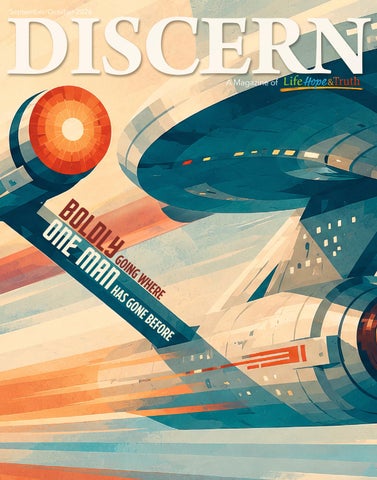
September/October 2026
A Magazine of
BO ON LDL E M Y GO AN ING WHE HA RE SG
ON
EB
EFO
RE
Articles
September/October 2026; Vol. 13, No. 5
A Magazine of
Discern magazine (ISSN 2372-1995 [print]; ISSN 2372-2010 [online]) is published six times a year in print, with six bonus digital issues, by the Church of God, a Worldwide Association, as a service to readers of its LifeHopeandTruth .com website. Free electronic subscriptions can be obtained at Discern’s home page: LifeHopeandTruth.com/Discern. Contact us at info@DiscernMag.com.
Postmaster: Send address changes to P.O. Box 3490, McKinney, TX 75070-8189
4 Boldly Going Where One Man Has Gone Before 9 Purpose Anxiety: Looking for Meaning in All the Wrong Places 12 A Message of Hope From an Ancient Festival
©2026 Church of God, a Worldwide Association, Inc. All rights reserved.
Publisher: Church of God, a Worldwide Association, Inc., P.O. Box 3490, McKinney, TX 75070-8189; phone 972-521-7777; fax 972-521-7770; info@cogwa.org; LifeHopeandTruth.com; cogwa.org
Ministerial Board of Directors: David Baker, Arnold Hampton, Mike Hanisko, Joel Meeker (chairman), Larry Salyer, Leon Walker and Lyle Welty
President: Jim Franks; Editor: Clyde Kilough; Editorial content manager: Mike Bennett; Managing editor: David Hicks; Senior editor: David Treybig; Graphic designer: Elena Salyer; Associate editors: Erik Jones, Jeremy Lallier; Kendrick Diaz; Assistant editor: Jordan Iacobucci; Copy editor: Becky Bennett; Social media: Hailey Brock
Doctrinal reviewers: John Foster, Bruce Gore, Peter Hawkins, Don Henson, Doug Johnson, Chad Messerly, Larry Neff The Church of God, a Worldwide Association, Inc. has congregations and ministers throughout the United States and many other countries. Visit cogwa.org/ congregations for information. Donations to support Discern magazine and LifeHopeandTruth.com can be made online at LifeHopeandTruth.com/donate or by surface mail to Church of God, a Worldwide Association, Inc., P.O. Box 731480, Dallas, TX 75373-1480. The Church of God, a Worldwide Association, Inc. is organized and operated as a tax-exempt organization in the United States according to the requirements of IRS 501(c)(3). Contributions are gratefully acknowledged by receipt. Unsolicited materials sent to Discern magazine will not be critiqued or returned. By submitting material, authors agree that their submissions become the property of the Church of God, a Worldwide Association, Inc. to use as it sees fit. All Scripture quotations, unless otherwise indicated, are taken from the New King James Version (© 1982 by Thomas Nelson, Inc.). Used by permission. All rights reserved. This publication is not to be sold. Free educational material.
2
DISCERN
1 6 Five Biblical Proverbs to Keep You From Getting Scammed 20 What Shall I Do to Inherit Eternal Life? 24 Six Characteristics of an Overcomer 28 God’s Looming Judgment for Our Sins
Columns 3 Consider This
What Does the Lack of Confidence in Organized Religion Mean?
32 Q&A
Answers to Your Biblical Questions
34 Wonders of God’s Creation
Cover image supplied by ChatGPT Image supplied by backup_studio via Adobe Stock
Staff:
Not to Be Confused With the Roseate Sporkbill
36 Walk as He Walked
Jesus Declares “I Will Build My Church”
39 By the Way
Let the Dead Rise!
September/October 2026
CONSIDER THIS
What Does the Lack of Confidence in Organized Religion Mean? In light of a recent poll revealing that only 36 percent of Americans have “a great deal or quite a lot of confidence” in organized religion, it’s time for something different. One would hope that institutions claiming to represent Jesus Christ would be among the most respectable bodies on earth. Yet a 2025 Gallup Poll revealed that only 36 percent of Americans have “a great deal” or “quite a lot” of confidence in church or organized religion. This continues a 50-year slide, with no signs the downhill trend will reverse. I suspect similar trends exist elsewhere, particularly in the Western, Judeo-Christian world.
An embarrassing lack of confidence
Until 1985 the church and organized religion rated highest among the institutions in Gallup’s annual “Confidence in Institutions” survey. But since then, it has slipped to sixth place, behind small business, the military, science, the police and higher education. Actually, the entire survey should dishearten Americans. What does it say about a nation when the large majority of its citizens lack faith in the institutions that guide and govern them? The presidency, banks, public school system, Supreme Court, criminal justice system, big business and television news fare even worse, and Congress ranks last with only 10 percent! But those institutions are different from religion— none of them claim to represent God. Why are the religious institutions suffering this embarrassing loss of respectability? One major reason is the string of horrific sins and scandals—from televangelists’ sexual escapades to priests’ molestation of children to the corruption of church cover-ups—that have devastated people’s trust, support, belief and faith. Religious leaders are supposed to help us rise above—not descend into—the worst weaknesses of human nature!
who acted very pious but were, as He called them, hypocrites, “whitewashed tombs which indeed appear beautiful outwardly, but inside are full of dead men’s bones” (Matthew 23:27). Their religious practices were highly organized, but their spiritual lives were chaotic. And long before Jesus’ time, God’s prophets repeatedly emphasized that while each person was culpable for the sins destroying Israel, much of the blame lay at the doorstep of the religious leaders. The Bible abounds with warnings about the damage done, including loss of credibility, when church leaders do not live up to the standards they preach.
If Gallup could survey God It’s easy then—and not entirely undeserved—to blame church leaders or “organized religion,” as some like to label it. But whether we are leaders, followers or outside observers, we have to take care not to look only at others. God also commands each of us to dig deeply within to examine our own hearts. So here’s a twist on “organized religion” in the form of questions we need to ask ourselves and honestly answer: 1. Is my—or my church’s—belief system truly organized according to God’s Word? 2. Is my personal life and behavior truly organized according to God’s Word? Or ask it this way: If Gallup could survey God, would He say He has a great deal of confidence that I truly represent Him and His way of life? What we really need is not a human-led revival of churches, but a Christ-led character transformation of each individual. One where we will be, as Paul described in Romans 12:2, “transformed by the renewing of your mind, that you may prove what is that good and acceptable and perfect will of God.” Only then can true Christianity begin to take its rightful place of spiritual leadership in the world. Clyde Kilough Editor
Jesus’ harsh words for hypocrites
There’s nothing new under the sun, though. Jesus aimed His harshest words at the religious leaders
LifeHopeandTruth.com
DISCERN
3
BOLDLY GOING WHERE ONE MAN HAS GONE BEFORE Star Trek turns 60 this year. The franchise made its debut with a hopeful vision for humanity’s future—but is utopia really attainable? By Jeremy Lallier
4
DISCERN
September/October 2026
P
hasers set to stun. An eyebrow raise from Mr. Spock. Dr. McCoy delivering the iconic (and obvious) news: “He’s dead, Jim.” A panicked Scotty shouting at Captain Kirk, “I cannae change the laws of physics!” For 60 years, Star Trek has had an outsized cultural impact, both through the characters it brought to life and the futuristic technology it imagined. Modern technologies like cell phones, iPads, personal computers and voice-powered AI assistants all appeared in some form in the Star Trek milieu before they ever became a reality. Multiple astronauts have cited the show as inspiration for their careers in space flight. But when Star Trek first aired in 1966, its beating heart was not transporter beams and Vulcan salutes, not tense standoffs between Klingons and Romulans. It
LifeHopeandTruth.com
DISCERN
5
From the Garden of Eden to the Tower of Babel to the woman riding the scarlet beast, humanity’s problems always begin with a desire to be like God instead of choosing to listen to God.
was a simple question that even modern sci-fi franchises rarely pause to consider: What if we get it right?
“I don’t believe in a no-win scenario”
Most sci-fi plays out against the backdrop of dystopian tragedy. For one reason or another, the future is grim and prospects are bleak: World governments have been replaced by ruthless, profit-driven megacorporations. Nuclear winter has ravaged the earth and left mankind nearly extinct (or else severely mutated). Our own brilliant technological innovations have risen up and enslaved us. Etc., etc., etc. Star Trek opted for a different setting: After a World War III that turned almost cataclysmic, the human race did the impossible. All the nations of the world set aside their differences to live peaceably under one unified, benevolent government. Wars became a relic of the past, along with poverty and racial inequality. Technological breakthroughs provided for every conceivable need. With global peace finally attained, humanity and other allied planets set out to explore the final frontier: Space. For three seasons, as the starship Enterprise navigated through the show’s opening credits, viewers were reminded of its five-year mission: “to explore strange new worlds, to seek out new life and new civilizations, to boldly go where no man has gone before.”
6
DISCERN
Unlike the vast majority of science fiction, Star Trek began with incredible optimism about what humanity has the potential to accomplish—if we can just make the right decisions on our way there. And for 60 years, that optimism has inspired multiple generations to think about what might be possible if we all pull in the same direction.
“Highly illogical, captain” But is it possible? Can the human race really find a way to set aside differences and build a utopia together? Or are we doomed to wipe ourselves off the map through centuries of bitter infighting and unbridled hubris? According to the Bible, the answer is no. To . . . both questions, actually. Humanity will, one day, find itself on the brink of self-extinction—but it will be powerless to pull itself back from the ledge. It will also, one day, find itself in a utopia—but not one of its own making. The reason for both these things is an element that rarely makes an appearance in sci-fi stories, but which plays an outsized role in our story: Divine intervention.
“We dared think of ourselves as gods”
It’s not that we’re incapable of uniting together and pursuing a common goal. It’s just that, historically, that common goal is self-destructive and foolish.
September/October 2026
All that effort, all that potential, poured into a completely fruitless project that ended in confusion.
“Mr. Scott, there was no deity involved”
Take the Tower of Babel. Back when the world was united with “one language and one speech” (Genesis 11:1), people set out to build something spectacular: a city with “a tower whose top is in the heavens” (verse 4). After the Flood, God had told Noah’s family to “be fruitful and multiply, and fill the earth” (Genesis 9:1). But here, seemingly in defiance of that command, Noah’s descendants set out to “make a name for ourselves, lest we be scattered abroad over the face of the whole earth” (Genesis 11:4). They were never going to reach the heavens with that tower, but their common ambition galvanized them to act as one single unit. And that one single unit was driven by a desire to be like God—to climb to His domain and to operate from His vantage point. It was the same desire that ended with God evicting Adam and Eve from the Garden of Eden. The first man and first woman ate from the forbidden tree in the hopes of becoming “like God, knowing good and evil” (Genesis 3:5). And, just like in the Garden, God put an end to Babel’s insurrection. “And the Lord said, ‘Indeed the people are one and they all have one language, and this is what they begin to do; now nothing that they propose to do will be withheld from them. Come, let Us go down and there confuse their language, that they may not understand one another’s speech.’ So the Lord scattered them abroad from there over the face of all the earth, and they ceased building the city” (Genesis 11:6-8).
LifeHopeandTruth.com
The Tower of Babel is the origin story of a kingdom called Babylon—a kingdom that will rear its head again before the end of our modern era. The spirit of Babylon, this desire to stand in God’s place and make our own rules, has resurfaced multiple times throughout our short history. It never lasts. (Read more in “What Is Babylon?”) The last book of the Bible, Revelation, communicates its message largely through symbols that offer a glimpse into future events. And in those symbols, we get a disturbing vision of Babylon’s final surge into prominence. The apostle John, who recorded the vision, wrote: “I saw a woman sitting on a scarlet beast that was full of blasphemous names, and it had seven heads and ten horns. The woman was arrayed in purple and scarlet, and adorned with gold and jewels and pearls, holding in her hand a golden cup full of abominations and the impurities of her sexual immorality. And on her forehead was written a name of mystery: ‘Babylon the great, mother of prostitutes and of earth’s abominations.’ “And I saw the woman, drunk with the blood of the saints, the blood of the martyrs of Jesus. When I saw her, I marveled greatly” (Revelation 17:3-6, English Standard Version). The 10 horns of the beast, we’re told, represent “ten kings who have not yet received royal power, but they are to receive authority as kings for one hour, together with the beast” (verse 12, ESV). With the spiritual impulses of Babylon leading the way, these aspiring end-time leaders will find power and authority in their unity, and they will use that power to create an empire where they live luxuriously while merchants become wealthy by trading, among other things, the “bodies and souls of men” (Revelation 18:9, 13). Unity . . . of a sort. But a far cry from utopia. The good news is that it won’t last either.
“Only a fool fights in a burning house”
This final version of Babylon will come to an end during a time the Bible calls “the great tribulation” (Revelation 7:14). It will be a time “such as has not been since the beginning of the world until this time, no, nor ever shall be. And unless those days were shortened, no flesh
DISCERN
7
would be saved; but for the elect’s sake those days will be shortened” (Matthew 24:21-22). God will pour out His wrath on Babylon and a world determined to oppose His perfect laws. It will be a catastrophic series of blows with the capacity to wipe the whole human race from the earth—relentless plagues and judgments poured out on a world that refuses to consider whether their own stubbornness might be contributing to their problems. Instead, “they [will blaspheme] the name of God who has power over these plagues; and they [will] not repent and give Him glory” (Revelation 16:9). But just when global annihilation seems inevitable, the whole thing will be cut short. Babylon will collapse after the heavens part and Jesus Christ descends with an army of saints to claim the earth as King of Kings. Even then, with the world smoldering and their empire in tatters, the leaders will attempt to resist: “And I saw the beast, the kings of the earth, and their armies, gathered together to make war against Him who sat on the horse and against His army” (Revelation 19:19). They will lose. But the world, careening toward selfdestruction, will instead receive a gift it could never deserve: The keys to utopia.
“We overcame our instinct for violence”
Later iterations of Star Trek would treat religion with the gentle condescension of a parent speaking to a child who can’t be expected to know any better. It was often presented as a hurdle holding civilizations back from reaching their true potential—useless baggage to be discarded in pursuit of a better future. The irony of it all is that rejecting God’s way of life is exactly what has always led the world down the path of self-destruction. From the Garden of Eden to the Tower of Babel to the woman riding the scarlet beast, humanity’s problems always begin with a desire to be like God instead of choosing to listen to God. After the final collapse of Babylon, the world will begin to rebuild—this time under the guidance of Jesus Christ and His saints. As survivors begin to turn toward understanding and obeying God, others will take note of the blessings that come with that obedience. “In those days ten men from every language of the nations shall grasp the sleeve of a Jewish man, saying, ‘Let us go with you, for we have heard that God is with you’” (Zechariah 8:23). And as the survivors of humanity’s darkest hour
8
DISCERN
continue to let God guide their way of life, God will guide them toward a future where “they shall not hurt nor destroy in all My holy mountain, for the earth shall be full of the knowledge of the Lord as the waters cover the sea” (Isaiah 11:9). In that future, “old men and old women shall again sit in the streets of Jerusalem, each one with his staff in his hand because of great age. The streets of the city shall be full of boys and girls playing in its streets” (Zechariah 8:4-5). Peace, protection and long life—all stemming not from our own brilliance or achievements, but from a personal relationship with God. And that’s just the beginning.
“It is not life as we know or understand it”
God’s plan even includes hope for the billions who don’t survive the Great Tribulation—and for the countless billions who have died throughout human history. Although Jesus will return to this earth as the King of Kings, His first appearance was as the sacrificial Lamb of God, who died so our sins could be forgiven (John 1:29). A lot of people have died without understanding or even knowing about that sacrifice. But God is not limited by death, and there is a hope for them. Every year, God’s people rehearse His plan by celebrating His festivals. Within those annual festivals are important reminders about what God has done, what He is doing and what He will do. Those festivals remind us, for instance, that Jesus Christ first came to the earth to become our “forerunner” (Hebrews 6:20), providing us with a sacrifice that allows us to “come boldly to the throne of grace” (Hebrews 4:16) and into the presence of God. The benefits of that sacrifice will one day be offered to billions and billions who died without understanding that hope. The end result will be a world with no more tears, sorrow or even death (Revelation 21:4). (Discover more about God’s holy day plan in From Holidays to Holy Days: God’s Plan for You.) Sixty years ago, Star Trek dared to consider, What if we get it right? But the Bible tells us we can’t. At least, not on our own. Even so, ahead of us is a story more epic, more hopeful and pointing toward a brighter future than any Star Trek writer ever could have imagined for the human race. But we can get there only by following in the footsteps of Jesus Christ—going boldly, we might say, where one Man has gone before. D
September/October 2026
PURPOSE ANXIETY
Looking for Meaning in All the Wrong Places Experts tell us to find our purpose, but what happens when our search yields disappointing results? What’s the real answer to purpose anxiety?
Image supplied by Archv via Getty Images
By Monica Ebersole
LifeHopeandTruth.com
L
ittle children don’t give much thought to their purpose in life. If you sat down with children and asked them why we exist, their answer might be amusing, entertaining or even surprisingly profound. But they’re unlikely to offer a full explanation for such a puzzling question. And yet, there’s something intriguing about how young children view life. Much of their identity is rooted in their place within the family, and for many children, the love they receive from their parents provides a sense of fulfillment and belonging they don’t yet fully understand. Nevertheless, it is enough. Over the years, something begins to change. As we enter adolescence and eventually adulthood, we’re introduced to the belief that life has a greater purpose. With this realization often comes a troubling fear—that we’ll never feel truly fulfilled until we discover and pursue that purpose. In his book The Meaning of Your Life: Finding Purpose in an Age of Emptiness, author Arthur C. Brooks relays stories of individuals whose experiences followed this pattern. As Dr. Brooks explains, the pursuit of one’s purpose is a worthy endeavor, often undertaken by high achievers who want to make a difference and live life to the fullest. But that doesn’t prevent discouragement from taking hold when dedication and years of hard work fail to produce meaningful results. Despite their many accomplishments, the men and women in Dr. Brooks’ book eventually had to admit that
DISCERN
9
Our ultimate purpose in life is to be sons and daughters of our heavenly Father forever.
something was still missing—that there was an emptiness they just couldn’t fill. This phenomenon has a name: purpose anxiety.
What is purpose anxiety?
Psychology Today provides a succinct definition of purpose anxiety as “the stress, insecurity, fatigue, and frustration that arise from trying to define and achieve one’s life purpose.” Purpose anxiety can be easily downplayed as less important than all of the other problems and challenges people face in life. But the distress we feel when we fail to identify our purpose shouldn’t be ignored. It’s a universal problem that directly impacts how we live our lives.
Why do we experience it?
Purpose anxiety takes root when the places we’re told to look for our purpose fail to provide a satisfying answer. The individuals Dr. Brooks interviewed were highly successful. They had accumulated impressive
10
DISCERN
accolades, earned coveted promotions and achieved career success. “Their lives look enviable from the outside,” Dr. Brooks explains, “but they feel empty on the inside. They are waiting for their purpose to find them, but it never does” (2026, p. 10). This uncovers an important truth: while physical pursuits can add great value to our lives, they can never fully define our purpose because they don’t answer the essential question of why we are here. Until we know why we were put on this earth, we cannot fully understand our purpose. So, where can we look for the answer to this nagging question? This is where self-help books and motivational videos, though well-intentioned, often miss the mark. Broadly speaking, they tend to present a few core areas in which people can derive purpose. But a closer examination of these areas reveals that each one, though important, supports our sense of purpose rather than defining it.
Career is not our ultimate purpose
It’s easy to recognize one of the more obvious areas in which we
can fall into this trap: our work. As we pursue our dream job, we know deep down that even the most rewarding career cannot provide an enduring sense of purpose on its own. The author of Ecclesiastes wrestled with this concept centuries ago, recognizing that everything we accomplish in our work is physical, limited and doomed to become obsolete (Ecclesiastes 1:3, 14). This doesn’t mean we should always just settle for jobs we dread. Pursuing meaningful work allows us to genuinely enjoy what we do, and that’s God’s intent for us (Ecclesiastes 3:13). But we cannot rely on it to define our purpose.
Our purpose is not just to “make the world a better place”
The world has so many existential dangers, it’s hard to see our efforts making any sort of meaningful difference. This doesn’t mean we sit back and refuse to contribute to the world around us. The Bible encourages us to “do good to all” as we have opportunity and to let our light shine before others (Galatians 6:10; Matthew 5:14-16). We should
September/October 2026
destination. Our purpose defines what type of growth we should pursue, why that growth matters and what the eventual outcome of our efforts will be.
Human relationships are important, but are not our purpose
strive to improve the lives of those around us whenever we can. And yet, we will discover that only God can provide lasting solutions to the world’s problems. He has not placed the responsibility of changing the world on our shoulders. (For a look at what the Bible says about what we can and can’t change now, and what God wants us to do, see “How Can Christians Change the World?”)
Self-improvement serves a greater goal
Self-improvement can take many forms, from tangible goals such as health and fitness, to weightier concepts like our character, which is inherently spiritual in nature. Striving to improve ourselves—especially in regard to our character—is a noble pursuit, and the Bible provides ample instruction for spiritual growth. But calling self-improvement our ultimate purpose would be incomplete. In using the Bible as our guide, we work toward our purpose. But we do not strive to grow merely for the sake of growing. Doing so would be like setting out on a journey toward an unknown
LifeHopeandTruth.com
Relationships add tremendous meaning and color to our lives. It’s safe to say that a life devoid of meaningful human connection would look very bleak. When we reflect back on our lives, our best memories invariably consist of moments shared with our loved ones—the times we encouraged and built each other up, gave and received heartfelt advice and bore each other’s burdens. As vital as these relationships are, and as much as they enrich our lives, by themselves they aren’t the reason for our human existence. But our family relationships can give us a taste of that deeper purpose.
What is our true purpose?
Our true purpose—the ultimate reason for our existence—is about relationships. It’s about being sons and daughters of God! Currently, the God family consists of God the Father and Jesus Christ. But that is going to change. Romans 8:29 says that Jesus Christ—God’s Son and heir—is “the firstborn among many brethren,” and 2 Corinthians 6:18 says that God will be a Father to us and we will be His sons and daughters. Just as our purpose as young children was to be sons or daughters of our human parents,
our ultimate purpose in life is to be sons and daughters of our heavenly Father forever. Our articles “What Is the Real Purpose of Life?” and “Children of God” expound on the beautiful future God has in store for us as His children in His perfect Kingdom yet to come.
Pursuing our eternal purpose in this physical life
With the knowledge of our true purpose as our foundation, we can shape and build the rest of our lives. Once we know why we exist, we can better understand how various aspects of life today prepare us for our future. For example, the relationships we build in this life teach us how to love one another and live together in harmony, as we will in God’s Kingdom. Similarly, the Bible makes it clear that we must develop righteous character by overcoming sin and growing. Understanding how these important facets of life impact the bigger picture is a gift in itself.
A cure for purpose anxiety
But those who know their true purpose receive an additional gift: freedom from purpose anxiety. Knowing we were created for something greater frees us from relying on physical goals to define our existence. Instead, we can take comfort in the knowledge that our loving Father has a purpose for us that far surpasses anything this life has to offer. What a tremendous gift it is to be His children! D
DISCERN
11
A MESSAGE OF
HOPE FROM AN ANCIENT FESTIVAL
Our world can’t seem to escape conflict no matter how hard it tries. But God’s plan for us promises a change. By Kendrick Diaz
12
DISCERN
September/October 2026
“T
his is now a war for peace,” wrote English novelist and social commentator H.G. Wells. “It aims straight at disarmament. It aims at a settlement that shall stop this sort of thing for ever.” Those words come from a piece explaining Britain’s choice to enter World War I. It was optimistic about what the war could accomplish, and soon the sentiment spread throughout Europe. That hope crystallized into an iconic phrase: the war to end all wars. Iconic—and ironic.
LifeHopeandTruth.com
The Second World War erupted only a couple of decades later. Then came other wars: the Korean War, the Vietnam War, wars in the Balkans, Iraq, Afghanistan, Iran and elsewhere. The past century has been marred by conflict.
How did we get trapped in an endless loop of war?
Why does our world replay war like a song stuck on repeat?
DISCERN
13
The Bible gives the answer within its first few pages: this is the age of human self-rule. Ever since our first parents made their dismal choice in Eden, humanity has been groping for the secret to a peaceful, flourishing society while ignoring God’s standards in favor of its own. Nothing we’ve done has worked. We have more history than ever to look back on and confirm that. Push God to the margins, run the show on your own, and you will reliably get unbridled selfishness, rampant social injustice and, sooner or later, war. Man, cut off from God, cuts himself into pieces. This is the “present evil age” Paul talked about (Galatians 1:4)—and for 6,000 years, it has played the same ruinous tune. But Scripture promises that things are going to change. One day, this old song will stop, and a different one will play.
An ancient festival foreshadowing a future age
That brings us, in a curious way, to an Old Testament passage that tends to collect dust in most Bibles: “The fifteenth day of this seventh month shall be the Feast of Tabernacles . . . When you have gathered in the fruit of the land, you shall keep the feast of the Lord for seven days” (Leviticus 23:34, 39). As one of God’s seven appointed festivals, the Feast of Tabernacles is a “shadow of things to come” (Colossians 2:17). It shifts our attention away from everything that’s broken in this world, and toward God’s promise to make it right—the end of one age and the beginning of another. This new chapter in humanity’s story is the Millennium. Its name comes from the six references to a “thousand years” in Revelation 20, a period in which Satan is bound and the glorified Jesus takes the world’s reins. And every year, at the Feast of Tabernacles, God’s people congregate to rehearse its fulfillment.
14
DISCERN
Micah gives us a glimpse of that new age: “They shall beat their swords into plowshares, and their spears into pruning hooks; nation shall not lift up sword against nation, neither shall they learn war anymore” (Micah 4:3). For a whole week, God wants us to spend extra time fixing our minds on prophecies like that one. Not delusions, not dreams whipped up by human imagination, but previews of a future reality. Micah saw the end of the arms race. He saw the time when feuds will evaporate and the art of war will give way to the art of peace. And it was only a sliver of the picture. No more war means no more dispossession. No more families being stripped of their homes. No more watching others take what you’ve spent years building. Instead, “they shall build houses and inhabit them; they shall plant vineyards and eat their fruit. They shall not build and another inhabit; they shall not plant and another eat” (Isaiah 65:21-22). The cessation of war is monumental, but so is the way its effects will ripple through society.
The light at the end of the tunnel
Of course, mankind won’t abandon its selfdestructive tendencies and proclivity for war on its own (Isaiah 59:8). So how exactly will this transformation happen? Micah brings us back to the thing that sets it all in motion: “Now it shall come to pass in the latter days that the mountain of the Lord’s house shall be established on the top of the mountains, and shall be exalted above the hills; and peoples shall flow to it” (Micah 4:1). In ancient times, God’s house was His temple. It stood in Jerusalem as Israel’s crown jewel, a visible reminder of God’s presence and rule. In the future, Jesus will return and rebuild it—not just for Israel, but for everyone. That’s the linchpin. Everything good about the coming Millennium flows from that one
September/October 2026
reality: God’s presence at the center of the world and at the center of our lives. When the present world runs its course— when humanity’s experiment in self-rule reaches its catastrophic conclusion—Jesus will descend to Zion and, joined by His glorified saints, usher in His long-awaited reign (Revelation 20:4). And when His Kingdom is set up, there will be a colossal pilgrimage to Jerusalem. “Many nations shall come and say, ‘Come, and let us go up to the mountain of the Lord, to the house of the God of Jacob; He will teach us His ways, and we shall walk in His paths’” (Micah 4:2). They’ll come to worship, they’ll come to pay homage to the King, and they’ll also come to learn. Jesus will launch the greatest educational effort the world has ever seen. In time, “the earth shall be full of the knowledge of the Lord as the waters cover the sea” (Isaiah 11:9). This knowledge will reach into every sphere of human existence, from individuals and families to communities and countries. Godliness will multiply and so thoroughly shape society that “they shall not hurt nor destroy in all My holy mountain.” When these changes take place and humanity finally accepts that God was right all along, “everyone shall sit under his vine and under his fig tree, and no one shall make them afraid” (Micah 4:4). These are big promises. They describe a world turned right side up after 6,000 years of being upside down. It seems too perfect to be true. But Micah assures us that it is true, “for the mouth of the Lord of hosts has spoken” (verse 4).
Keeping the end in mind
By now you should be able to see why the Feast of Tabernacles is so important to
LifeHopeandTruth.com
observe. But if you’re still not convinced of its value, maybe this short proverb will help: “Where there is no vision, the people perish” (Proverbs 29:18, King James Version). Other translations say without prophetic vision, the people “cast off restraint” (English Standard Version, New King James Version). There’s a reason God chose to preserve prophecy. There’s a reason we can look through the pages of Scripture and find dozens of promises about the world to come. God knows we need reminders. If we lose sight of what He’s working on behind the scenes—the world He’s preparing even while the present one is unraveling— then we’ll lose heart and maybe even lose out. That’s why the Feast of Tabernacles matters. It sharpens our vision. The Millennium will eventually give way to the abode of eternity, what the apostle John called “a new heaven and a new earth” (Revelation 21:1). In his final vision, he beheld a world utterly unlike anything humanity has ever known. To call it a “return to Eden” would be selling it short. He saw the fulfillment of everything Eden represented. John wrote, “I heard a loud shout from the throne, saying, ‘Look, God’s home is now among his people! He will live with them, and they will be his people. God himself will be with them’” (verse 3, New Living Translation). That’s ultimately what’s in store for mankind: total reconciliation with the Father in eternal bliss. And all the toil and heartache that defines our world now? The endless cycle of war and suffering? We’re promised in the very next verse: “There will be no more death or sorrow or crying or pain. All these things are gone” (verse 4, NLT). Unlike H.G. Wells’ false hope, this time they will be gone . . . Forever. Study this further in our online article “Hope for the Future Found in God’s Festivals.” D
DISCERN
15
TO KEEP
YOU FROM
GETTING SCAMMED
Image supplied by DFX via Adobe Stock
5
BIBLICAL PROVERBS
16
DISCERN
September/October 2026
Scams are everywhere and harder to spot than ever. Ironically, one of the best defenses against modern deceptions is familiarity with some ancient wisdom. By Jeremy Lallier
B
ack in the early days of the Internet, avoiding scams was a pretty straightforward process. The received wisdom of the time essentially boiled down to: “If a fabulously wealthy Nigerian prince offers you incredible financial compensation in exchange for sending him the small down payment he needs in order to access his rightful fortune . . . maybe don’t do that.” In those days, the bigger risk was clicking a harmlesslooking link and finding yourself watching the music video for Rick Astley’s “Never Gonna Give You Up”— again. But times have changed, and there are fates worse than getting Rickrolled. Bad actors are making use of emails, texts, phone calls, web pages and videos while posing as government agencies, courier services, friends and loved ones. As artificial intelligence advancements continue to roll out, they’re able to churn out these deceptions faster and more convincingly in the hopes that you’ll hand over sensitive information they can use for their own profit. The real trouble is that times keep changing, and quickly. Even if we laid out a detailed, step-by-step guide on avoiding some of the biggest scams out there, it would be obsolete by the end of the year (or maybe the
LifeHopeandTruth.com
end of the month, depending on how things go). If you’re looking for specific steps you can take to avoid scams, you can find helpful guides from institutions like the BBB, AARP and the FTC. But instead of talking about specific strategies, this article will focus on principles—principles far, far older than the Internet and even modern civilization itself. Following the wisdom of these five biblical proverbs won’t guarantee you never get scammed, but it will help you sidestep a lot of dangerous territory.
1.
Take a closer look at the claims
There’s one thing all effective scams have in common: They’re convincing. Before you can fall for a scam, you have to believe the scam—which means the most successful scammers are going to put in extra effort to make sure their traps look and sound believable, whether that involves posing as someone you know or promising some kind of reward. “The first one to plead his cause seems right, until his neighbor comes and examines him” (Proverbs 18:17).
DISCERN
17
A lot of scams will appear legitimate until you start to look closely and ask yourself questions. Why would this person need this information? What could a bad actor do with the information I’m about to hand over? Why contact me, specifically? Is this how things are normally done? Why am I being asked to call a number in Nigeria when the number on the back of my credit card is in the United States? Look for loose threads and don’t be afraid to tug on them. In most cases it is better not to engage at all. But if you feel you must reply, ask follow-up questions and be wary of answers that don’t quite make sense.
2.
Ask for advice from those you trust
No one knows everything. When you recognize you’re dealing with a system or a situation you don’t quite understand, ask for help. “Where there is no counsel, the people fall; but in the multitude of counselors there is safety” (Proverbs 11:14). It’s easy to get in over our heads and make unwise decisions when we can’t make sense of the playing field. Don’t be ashamed or embarrassed to seek out the advice of someone who can walk you through situations you’re unfamiliar with (and who can answer the questions our first proverb prompted). If you don’t understand what’s being asked of you and why it’s being asked of you, find someone you trust who does. This proverb is true even after you’ve fallen for a scam. It’s easy to feel embarrassed, but even trained security professionals can click the wrong link sometimes. A wise counselor might be able to help you with damage control or next steps.
3.
Avoid snap decisions
Scammers like to make you feel as if your window of opportunity is closing fast. If you don’t act right now, your package will be lost, your bank account will be closed, your profit margins will shrink, your computer will be infected—whatever the issue, you’ll lose out in a big way unless you do something fast. Very few issues in life are actually like that. But by tapping into our psychological fear of missing out (whether of obtaining a benefit or avoiding a negative
18
DISCERN
Attuning ourselves to the godly principles found in biblical proverbs can keep us from falling for most of those tricks . consequence) and pressuring us to act quickly, scammers can push us to forgo careful reasoning. By way of contrast, the Bible warns us, “A quicktempered man acts foolishly” (Proverbs 14:17). Committing to any decision without weighing the possible outcomes can often land us in all sorts of trouble, which is why we’re told that “the simple believes every word, but the prudent considers well his steps” (verse 15). Don’t let someone pressure (or threaten!) you into making a big decision quickly. Make sure you take the time to employ the first two proverbs we looked at— carefully evaluating the claims involved and seeking advice from people you trust. Better to consider your steps before you take them than to look back on them with regret!
4.
Be wary of shortcuts
There are absolutely effective, valuable shortcuts in life that can save you from wasting a lot of time and effort. But there are also a lot of dangerous dead ends disguised to look like shortcuts. Be wary of someone offering to show you a quick-andeasy shortcut . . . for a price. Even in our high-tech world, there’s still something to the old adage, “If it sounds too good to be true, it probably is.”
September/October 2026
Here’s how Proverbs puts it: “A faithful man will abound with blessings, but he who hastens to be rich will not go unpunished” (Proverbs 28:20). Faithful, diligent work often feels like taking the long way to a goal, but it lays a far more enduring foundation than rushing from one get-rich scheme to the next. Even when a shortcut looks plausible, consider what it proposes to bypass—and whether that’s something God wants you to bypass. (Emotions can play a big role in scams too. When we really want what’s being offered to us, it’s a lot easier to overlook some red flags. In 2024 alone, Americans reported losing nearly $700 million to romance scams, with an impostor posing as a potential romantic partner in need of financial assistance.) Scammers love to offer incredible returns for minimal contributions (I’m looking at you, Nigerian prince emails). Once they’ve gotten away with your money or your information, that’s when it becomes obvious that the shortcut was a dead end all along.
Image supplied by David Hicks
5.
Don’t put all your eggs in one basket
“Sure things” often . . . aren’t. Whenever a positive outcome is billed as a foregone conclusion in the world of finance, it’s time to get skeptical. As much as many of us would love a machine that just turns money into more money, it’s never that simple. But scammers sure would like to convince you it is that simple. The more you feel comfortable handing over money (or information)—because you’re sure you’ll get more in return—the more they can run off with. The book of Ecclesiastes advises us, “Give a serving to seven, and also to eight, for you do not know what evil will be on the earth” (Ecclesiastes 11:2). That might not offer an obvious insight into avoiding scams, but one way to interpret it is as a warning not to put all your eggs in one basket. The NET Bible interprets Ecclesiastes 11:2 this way: “Divide your merchandise among seven or even eight investments, for you do not know what calamity may happen on earth.” This requires you to make sure you keep back enough to feed yourself. In other words—don’t commit funds you can’t afford to lose, because loss is always a possibility. More than that, never tie your success to one single venture, because if that fails, you’ve lost everything.
LifeHopeandTruth.com
If someone tries to sell you a can’t-miss, slam-dunk, sure-to-win financial opportunity, assume they’re trying to deceive you (or else are deceived themselves). No one knows what calamity may happen on the earth, and there’s wisdom in spreading your finances out instead of gambling it all on one possible outcome.
Why are these proverbs still relevant?
The Bible was written long before anyone had to deal with emails from bad actors posing as foreign dignitaries in need of a little help, the IRS preparing to garnish your wages, investment opportunities with guaranteed results, the postal service preparing to reroute your package or the credit card company asking for your password to decline a suspicious charge—and yet it still has a lot of advice useful for navigating those situations. Why? Because times have changed, but people haven’t. Underneath the modern veneer, it’s still the same old kinds of people trying to pull off the same old kinds of deception. Attuning ourselves to the godly principles found in biblical proverbs can keep us from falling for most of those tricks—or at the very least, help us learn to navigate our way out when we do. For more financial insights, check out our articles “How to Deal With Financial Problems,” “What Does the Bible Say About Gambling?” and “Hard Work.” D
DISCERN
19
What Shall I Do
to
INHERIT
ETERNAL
LIFE?
Most throughout history have believed in some form of life after death. Yet how to receive eternal life and what it will be like are largely misunderstood. By David Treybig
20
DISCERN
September/October 2026
T
he concept of life beyond the grave is found in several passages in the Old Testament. Isaiah wrote, “Your dead shall live; together with my dead body they shall arise” (Isaiah 26:19). Job mused upon the same question: “If a man die, shall he live again?” He then answered, “All the days of my appointed time will I wait, till my change come” (Job 14:14, King James Version). Daniel was told that, at the end of this age, “many of those who sleep in the dust of the earth shall awake, some to everlasting life” (Daniel 12:2). Likewise, Psalm 133:3 speaks of “life forevermore” as a blessing from God.
Image supplied by Antonistock via Getty Images
A nearly universal belief
LifeHopeandTruth.com
Belief in an afterlife has existed in many cultures—not just among those who worship the God of the Bible. Ancient civilizations such as Egypt developed detailed ideas about life after death. The Egyptians believed that death was the beginning of a transition in which the soul traveled through the underworld to reach the Field of Reeds—a perfect version of earthly life. Egyptians believed in a moral judgment immediately after death, and corpses were mummified to give the soul a home. Tombs were packed with gold, food and tools for the deceased to take to the next world. Because belief in an afterlife is
so widespread, some conclude that all religions ultimately lead to the same destination.
Do all paths lead to eternal life?
If all beliefs led to the same outcome, it might seem logical to choose the easiest path. But does the Bible support this idea? No. The Bible consistently reveals that there is only one true God. As God told the ancient Israelites: “Now see that I, even I, am He, and there is no God besides Me” (Deuteronomy 32:39; compare Isaiah 43:10; 44:6; 45:5). Additionally, Scripture teaches there is only one defined way to eternal life. Jesus explained that there is only one path—a difficult path that few will follow—that leads to eternal life. “Enter by the narrow gate; for wide is the gate and broad is the way that leads to destruction, and there are many who go in by it. Because narrow is the gate and difficult is the way which leads to life, and there are few who find it” (Matthew 7:13-14).
What Jesus taught
During His earthly ministry, Jesus preached the “gospel of the kingdom” (Matthew 4:23). Central to this message is the promise of eternal life and the conditions required to receive it. On one occasion, a rich young man asked Him directly, “Good
DISCERN
21
The role of God’s commandments
When asked which commandments, Jesus started naming several of the 10 Commandments to confirm they were what He meant. Obedience to God’s commandments has always been God’s expectation of those who love and respect Him. All 10 were spoken aloud by God to the ancient Israelites at Mount Sinai (Exodus 20). And all 10 were kept by Jesus, the apostles and the Church that Jesus founded. Toward the end of the first century, after the Church had existed for approximately six decades, false teachers were saying that it was no longer necessary to follow these instructions from God.
22
DISCERN
John forcefully rejected this false teaching, writing, “He who says, ‘I know Him,’ and does not keep His commandments, is a liar, and the truth is not in him” (1 John 2:4). He also wrote, “For this is the love of God, that we keep His commandments. And His commandments are not burdensome” (1 John 5:3; compare 2 John 1:6).
What about the Sabbath?
Today some teach similarly mistaken ideas. In particular, the command to keep the seventh-day Sabbath is often described as no longer necessary. Some say the Sabbath was only for the Jews. Some say we only have to keep Jesus’ commandments, which they say are different from the 10 Commandments. And some say early Christians changed the Sabbath to Sunday in remembrance of Christ’s resurrection.
But a careful study of the Scriptures reveals that all of these teachings are false. If you would like to know what the Bible truly says about keeping the 10 Commandments, including the seventh-day Sabbath, see “The 10 Commandments for Today” and God’s 10 Commandments.
Did Paul change the requirements?
Some believe the apostle Paul taught a different path to salvation. However, Paul himself said his message was consistent with that of the other apostles (1 Corinthians 15:11). The final book of the Bible confirms the same truth: “Blessed are those who do His commandments, that they may have the right to the tree of life” (Revelation 22:14). Jesus summarized it plainly: “I am the way, the truth, and the life. No one comes to the Father except through Me” (John 14:6).
September/October 2026
Image supplied by krisanapong detraphiphat via Getty Images
Teacher, what good thing shall I do that I may have eternal life?” (Matthew 19:16). Jesus’ response was, “If you want to enter into life, keep the commandments” (verse 17).
(Of course, many died without knowing about Jesus or His message. God has prepared a way for all who have ever lived to have their opportunity to decide after a future resurrection to physical life again. See “Is God Fair?”)
How eternal life is made possible
Paul upheld the importance of God’s law (Romans 7:12; 1 Corinthians 7:19). But Paul did remind us of the hard truth that we have all sinned, and “the wages of sin is death” (Romans 3:23; 6:23). None of us could ever pay that penalty and then live. Yet God has made a way for us to repent and be forgiven. Jesus Christ paid the penalty for us! “For God so loved the world that He gave His only begotten Son, that whoever believes in Him should not perish but have everlasting life” (John 3:16; consider also 1 John 5:11-12; John 10:27-28). Those who believe will follow Peter’s instructions: “Repent, and let every one of you be baptized in the name of Jesus Christ for the remission of sins; and you shall receive the gift of the Holy Spirit” (Acts 2:38). Truly believing in Jesus is not simply accepting that He existed. The kind of belief that leads to eternal life includes commitment and obedience, empowered by the Holy Spirit. As Jesus said, “If you love Me, keep My commandments” (John 14:15). Of course, Jesus’ commandments were God’s commandments. The two were and are in perfect agreement with each other (John 10:30). Eternal life is ultimately a gift
LifeHopeandTruth.com
from God the Father that can be bestowed upon us through Jesus Christ (Romans 6:23).
What is eternal life?
Many imagine eternal life as going to heaven immediately after death and retiring to a nebulous existence of never-ending joy and happiness. While the Bible does promise a future without pain, sorrow or death (Revelation 21:3-4), it also reveals important details that are often overlooked. God’s Word describes eternal life as an inheritance. In multiple passages, the Bible speaks of people having the opportunity to “inherit eternal life” (Matthew 19:29; Mark 10:17; Luke 10:25; 18:18). A voluminous number of scriptures also show that God considers the gift of eternal life to be a family inheritance, meaning we can become part of His eternal family. God is our spiritual “Father” (Matthew 6:9), and if we respond to His calling, we have “the right to become children of God” (John 1:12). Likewise, Jesus refers to us as His brothers and sisters (Hebrews 2:11; Matthew 12:48-50). This means eternal life is not just endless existence—it also includes becoming a valued and productive part of the family of God. One of the first jobs God’s faithful people will have when they receive eternal life at Christ’s return is to rule with Him as kings and priests in the Kingdom of God (Revelation 5:10; Daniel 7:27). To learn more about God and His offer for us to become part of His eternal family, read our online article “Children of God.”
When can we receive eternal life? Scripture shows that people do not go to heaven or receive eternal life at death. Instead, it teaches that the dead are unconscious (Ecclesiastes 9:5, 10; Psalm 146:4). Jesus said, “No one has ascended to heaven but He who came down from heaven” (John 3:13). The Bible teaches that God’s faithful people will inherit eternal life at Christ’s return. Paul wrote in 1 Thessalonians 4:16, “The Lord Himself will descend from heaven,” and at that time “the dead in Christ will rise first.” God will “give life to your mortal bodies through His Spirit” (Romans 8:11).
The bottom line The Bible gives a clear and consistent answer to the question: What must I do to inherit eternal life? • Repent and believe in Jesus Christ. • Be baptized and receive God’s Spirit. • Obey God’s commandments. • Follow the narrow path He defined. Immortality is not automatic, and it is not found through many different paths. It is a gift from God that will be given to those who respond to Him in faith and obedience. If you want to inherit eternal life—a meaningful, joyful life without end as part of God’s family—Jesus’ instruction remains the same: “If you want to enter into life, keep the commandments.” For further study about how to find and follow the narrow path that leads to eternal life, download our free booklet What Is a True Christian? D
DISCERN
23
6 CHARACTERISTICS OF AN
In the Bible, Christians are exhorted to overcome a world that is increasingly overrun with sin and evil. What does it take to be an overcomer? By Jordan Iacobucci
24
DISCERN
September/October 2026
“T
hese things I have spoken to you, that in Me you may have peace,” Jesus remarked to His disciples that fateful night before He died. They were confused, perplexed by the foreboding statements He’d made. Yet here Christ offers encouragement. “In the world you will have tribulation; but be of good cheer,” Jesus continued, “I have overcome the world” (John 16:33). Roughly 2,000 years later, tribulations persist. Evil and sin dominate the world around us. Christians are called to follow in Jesus’ footsteps and “overcome evil with good” (Romans 12:21), but this seems nearly impossible in a world steeped in sin. Our human inclinations draw us toward evil, even when we try to follow God. How can we overcome when the odds are so stacked against us? Six key traits can help give us the strength to surmount the temptations and pressures of the world.
Image supplied by francescoch via Getty Images
1. Overcomers exercise humility
LifeHopeandTruth.com
To resist the temptations in the world around us, we must recognize that we can’t do it alone—we need to pray to God for help. The prophet Jeremiah called out to God, asking Him to guide him in the right way: “O Lord, I know the way of man is not in himself; it is not in man who walks to direct his own steps. O Lord, correct me, but with justice; not in Your anger, lest You bring me to nothing” (Jeremiah 10:23-24).
DISCERN
25
Humility is the first step on our path to overcoming sin. As Jeremiah points out, it isn’t part of human nature to resist evil. We need God to direct our lives. True humility comes into play when God helps us see our faults. Not only must we recognize them when He shows them to us, but we must also be ready to act. It takes a lowly attitude to repent and move forward. Someone who puts himself or herself above all else will not be able to see clearly enough to make the changes required of those who profess Christianity. Only when we are “clothed in humility,” as 1 Peter 5:5 exhorts, can we begin the process of overcoming. Psalm 51 is an excellent example of a humble heart before God. After committing a terrible sin, King David turned to God in sincere repentance, humbly asking for forgiveness and help. This passage is a perfect starting point for someone looking to ground himself or herself in humility while working to overcome sin.
2. Overcomers examine themselves
A reflective attitude goes hand in hand with a humble heart. Humility will take us only so far unless we also take the time to look carefully at ourselves in the mirror to assess how we measure up to the standard of Jesus Christ. God commands His people to examine themselves. This includes an annual spiritual checkup before the Passover (1 Corinthians 11:27-31), but also regular self-examination as we go about our lives. It is only when we reflect on our actions, words and thoughts that we begin to recognize where we’re doing well and where we’re coming up short. We can’t overcome our individual weaknesses if we don’t know what they are. Ask God for help in identifying your shortcomings, as David did in Psalm 139: “Search me, O God, and know my heart; try me, and know my anxieties; and see if there is any wicked way in me, and lead me in the way everlasting” (verses 23-24).
26
DISCERN
This can be a painful process, but it is an essential part of Christian growth.
3. Overcomers are diligent
Once we’ve identified our shortcomings, we must be diligent to bolster our defenses and increase our strength. A successful overcomer will be quick and methodical about combating sin in his or her life. Diligence is one of the traits that Paul commends in 2 Corinthians 7:11. After identifying a sinful situation in their congregation, the Corinthians diligently resolved the matter. Being diligent is about more than wanting to rid yourself of a sin or weakness. It is enacting useful strategies to do so. It might include deliberate action steps and prohibitions. For example, a diligent overcomer will say more than “I want to stop using foul language.” He or she will instead say, “To avoid using foul language, I will put a dollar in a swear jar each time I slip up.” An overcomer might even ask a close friend to be a partner to encourage and hold him or her accountable. Whatever the sin or weakness, diligence is key to rooting it out. An overcomer recognizes sin and does everything necessary to remove it. There will be setbacks, but diligence is a trait that endures through easy times and hard.
4. Overcomers practice self-control
Once we have identified points for improvement, we need self-control to help us in our endeavor. Sometimes, people treat self-control as something that one either has or doesn’t have. This defeatist perspective obscures an important trait that everyone needs. Self-control is a skill built over a lifetime. Like a muscle, it grows stronger when we exercise it—and weaker when we don’t. If we practice and perfect self-control consistently,
September/October 2026
day after day, we will find it easier to overcome temptations, even those that have troubled us in the past. A diligent perspective of self-control recognizes that it applies to more than just our actions. A follower of Christ is called upon to bring “every thought into captivity” (2 Corinthians 10:5). Thoughts lead to actions and, therefore, must be controlled with equal strength. More than that, our thoughts reflect our true character, and sins in our minds are just as deadly as the sins others can see. Proverbs 25:28 warns about a failure to control oneself, saying, “Whoever has no rule over his own spirit is like a city broken down, without walls.” Self-control is our first line of defense against sin. If we do not regularly exercise that spiritual muscle, then we will be overcome by temptation when it arises.
5. Overcomers persevere
Overcoming doesn’t happen overnight. It is a lifelong process with ups and downs. A successful overcomer exercises perseverance, not losing heart, even when the goal feels far away. Discouragement sets in when we aren’t overcoming sin at the pace we would like. Setbacks make it difficult to keep a positive outlook, leading to a cycle of discouragement and despair. Perseverance involves a patient, enduring attitude that recognizes that the suffering of the long trek is not worthy to be compared to the glorious end goal (Romans 8:18). With perseverance, an individual can weather any setbacks on his or her journey, knowing that it’s all part of a lifelong process. Overcomers focus on the end goal, not the arduous journey. Revelation 2 and 3 include several encouraging verses about the many blessings that God promises to those who overcome. In Revelation 3:21, Jesus promises, “To him who overcomes, I will grant to sit with Me on
LifeHopeandTruth.com
My throne, as I also overcame and sat down with My Father on His throne.” In Revelation 21:7, God says, “He who overcomes shall inherit all things, and I will be his God and he shall be My son.” In times of trouble and discouragement, meditate on the promises in store for those who persevere and overcome the world. God will reward those who fight the hard battle and endure to the end (James 1:12).
6. Overcomers have faith
Perhaps the most important trait needed to be an overcomer is faith. Working to overcome evil is difficult. Putting our faith in the promise of God’s help makes the job easier. God knows our weaknesses and we should ask Him to give us the strength to overcome them. In 1 Corinthians 10:13, we read, “No temptation has overtaken you except such as is common to man; but God is faithful, who will not allow you to be tempted beyond what you are able, but with the temptation will also make the way of escape, that you may be able to bear it.” No matter what temptations or trials we encounter, there is a path to victory. If we take God with us into battle, we will eventually emerge victorious. None of us has the power to overcome sin on our own. But we aren’t on our own. In God, we find the strength to prevail: “For whatever is born of God overcomes the world. And this is the victory that has overcome the world—our faith. Who is he who overcomes the world, but he who believes Jesus is the Son of God?” (1 John 5:4-5). The Christian commission to overcome the world is a tall order, but we are given the tools to succeed. With Jesus Christ fighting on our behalf, we have the power to overcome the world and its lusts, just as He did. Follow Him to victory! Study more about the spiritual equipment we need in order to overcome in our Bible Journey “The Armor of God.” D
DISCERN
27
God’s Looming Judgment for Our Sins
Today, our sins are spiraling out of control, threatening to bring judgment upon our nations. What’s coming if we do not change our ways?
28
DISCERN
Image supplied by Mary Salen via Adobe Stock
By Isaac Khalil
September/October 2026
“L
as Vegas has long been known as Sin City for its 24/7 access to all kinds of indecencies. “America is quickly becoming Sin Nation.” So begins a column on the Axios news site titled “Behind the Curtain: Scaling Sin.” It explores how societal vices like marijuana, gambling and pornography have spun out of control. It shows their devastating effects on our society and questions why government intervention is lacking. What are the societal repercussions of these vices? What does the Bible warn about impending judgment if we fail to change?
A substantial shift
Many believe the world is improving, with technological advances seemingly limitless. However, despite our rapid technological growth, in general, it seems our character is deteriorating. What was once considered lewd and shameful is now accepted and glorified. Activities once confined to the shadows of society are celebrated openly and even exported as enlightened values of an advanced society. And what once seemed good and healthy is now looked upon by many as backward and even hateful. It’s as the prophet Isaiah prophesied: modern societies call “evil good, and good evil” (Isaiah 5:20). This is most noticeable in the United States, the world’s leading nation, though it’s also present in many other developed and industrialized countries. (Learn
LifeHopeandTruth.com
more about what the Bible has to say about many modern nations in our booklet The United States, Britain & the Commonwealth in Prophecy.) Consider some examples.
Sexual immorality
Not long ago, marriage was considered the norm, and sexual relations outside it were viewed as wrong. Today, premarital sex is commonplace, and people remain unmarried for longer or choose premarital cohabitation instead. Having multiple sexual partners is no longer uncommon, and sexual lifestyles like homosexuality, polyamory and open marriage that are prohibited by the Bible are increasingly considered normal today. Our entertainment today often features scenes of sexual immorality and promotes homosexuality, even when it is unrelated to the plot. These scenes were unthinkable a few generations ago. Many of those who choose marriage no longer see it as a lifelong commitment. Divorce and remarriage are accepted as normal life events.
Pornography The Internet has made pornography a vice that is widespread and available on demand. The average age of exposure is 12, with half encountering it accidentally by clicking on a link to pornographic material. Worst of all, 52 percent of teens surveyed said they had viewed violent pornography, including
what appeared to be rape, choking or someone in pain. America not only allows such material but is also one of its biggest exporters.
Abortion Traditionally, marriage and family were the norm for raising children. However, the rise of premarital sex has led to more unwanted pregnancies and the subsequent termination of unborn lives. Abortion may have been promoted as a rare occurrence to be used in cases of rape or incest, but it has become common. Abortion pills have further simplified this procedure, being marketed as safe and effective, though many overlook the potential health and physiological risks involved. It is estimated that a quarter of women will have an abortion in their lifetime and that around 20 percent of all pregnancies in the U.S. are terminated. Around the world, the number is even higher, with 29 percent of all pregnancies ending in abortion according to WHO. What was once uncommon is now commonplace.
Drugs Many societies have shifted from a strict drug policy to one that values individual choice. Marijuana, once labeled a dangerous gateway drug (a drug that leads to harder substances), has been mostly decriminalized despite its well-documented detrimental effects on mental and physical health. In spite of the fact that modern marijuana is about five to 15 times stronger than it was in 1960,
DISCERN
29
Without the law of God in your life, sin will be widespread and wreak havoc.
many still promote it as safe for recreational and medical use. Our culture, reflected in movies, music, celebrities and social media, has normalized drug use and portrays it as a rite of passage for young people. However, some of today’s substances, like fentanyl, are lethal with just a single use, thus posing a much greater danger than drugs of previous generations. Despite the dangers and negative effects of drug use, some think decriminalizing it is the solution.
Gambling What was once considered a vice, a moral failing and a dangerous temptation has become widely normalized, commercialized and digitally integrated into everyday life. Now, you can use your device to place a bet on almost anything imaginable—anytime, anywhere. Since 2018, when the Supreme Court struck down the Professional and Amateur Sports Protection Act, sports betting has become embedded in mainstream culture, and broadcasters often discuss betting odds. The easy availability of gambling has led to addiction running rampant, tearing families apart as one member bets the
30
DISCERN
family’s money in a desperate bid to beat the odds and win big. And it’s not just sports. Gambling has expanded to prediction markets that track real-world events, such as death bets, where people wager on the suffering of others. These bets cover outcomes of wars, elections, assassinations, famines, pandemics, natural disasters, the death of a leader or celebrity and more. The growth of all of these vices demonstrates a significant decline in our society. What was once rare or engaged in secretly is now common and in the open.
Proud of our sin What was once shameful has become so normalized that many people no longer feel shame. We have become proud, prioritizing our self and personal desires over the needs of our families, societies and nations. These vices lead us into other sins and addictions that harm us and our families. The consequences are dire. The prophet Isaiah warned that people will “declare their sin as Sodom; they do not hide it.” The result? They’ve “brought evil upon themselves” (Isaiah 3:9).
Before ancient Judah fell to Nebuchadnezzar’s invading Babylonian army, God warned the people about their lack of shame for their wrong behavior. He asked, “Were they ashamed when they had committed abomination? No! . . . Nor did they know how to blush” (Jeremiah 8:12). Their inability to feel shame was deeply concerning, and it mirrors our society. When Adam and Eve sinned against God, they felt ashamed and hid themselves (Genesis 3:8). Yet many today feel no shame and openly celebrate their sins, even the same sins as those of Sodom. For example, a pride festival is being planned at the Dead Sea, near the location of ancient Sodom and Gomorrah, cities God destroyed for their open wickedness. God’s fearful judgment against Sodom and Gomorrah echoes today: “Turning the cities of Sodom and Gomorrah into ashes, [God] condemned them to destruction, making them an example to those who afterward would live ungodly” (2 Peter 2:6). God warns us against deceiving ourselves. He will not
September/October 2026
be mocked, and we will reap what we sow (Galatians 6:7). If we sow wickedness, we will reap destruction. Study more about God’s warnings and end-time prophecies in our booklet How to Understand Prophecy.
Where are our leaders?
As the Axios post highlighted, our leaders are not only silent about these evils, but many are also actively involved by profiting from them. Isaiah warned that our sins would result in a shortage of genuine leaders. Instead, we would be ruled by childish leaders who would lead us astray (Isaiah 3:1-4, 12). God prophesied that the situation would deteriorate so severely and the solutions would be so lacking that no one would want to rule over the ruins (verses 6-7). This is the trajectory our nations are on, and it will only worsen. God shows no favoritism in judgment (Romans 2:11). He punished ancient cities for their sins, so why should we think we would escape? With our leaders failing, we must consider our own individual responsibility. What role can each of us individually play in preventing these evils in our lives?
Dangers of neglecting God’s law
Even if governments do not regulate these vices—instead letting them spiral out of control— you can still govern your own life. The main reason these evils are increasing in our society is our lack of knowledge of God’s law. It is not just ignorance; often it is
LifeHopeandTruth.com
outright rejection of God’s law—not wanting to follow biblical rules that are seen as outdated and overly restrictive. But during its 250th anniversary year, isn’t America rededicating itself to God? While there is an organized movement pushing Americans to reflect on their religious roots and pray, such rededication will prove hollow unless the issue of sin is also addressed. It is surprising that the secular Axios website described some of these societal vices as “sin.” But what exactly is sin?
What is sin? Can you define sin? If you cannot, you are in good company. A 2019 survey found that only 3 percent of churches mentioned sin in sermons. Religious researcher George Barna commented on this statistic: “For an overwhelming majority of Christian churches to suppress the reality of sin, its consequences, and its solutions from the people those churches serve is a travesty.” The Bible defines sin in 1 John 3:4: “sin is lawlessness” (New King James Version), or “sin is the transgression of the law” (King James Version). Sin is the breaking of God’s law. The law of God is one of the most neglected teachings in the Christian world. Preachers often teach that it is done away with, leading Christians to downplay its role in their lives. Without the law of God in your life, sin will be widespread and wreak havoc. Living without the law means you do whatever you feel is right at the moment. However, living by the law reveals
sin, allowing us to repent and change. When we stop sinning, we avoid the negative consequences of sin. The lack of teaching about sin by our preachers—and our willingness to live without God’s law—has made sin prevalent and out of control in our society. The apostle Paul warned about how sin spreads using the metaphor of leaven: “A little leaven leavens the whole lump” (1 Corinthians 5:6; Galatians 5:9). The prophet Hosea recorded God’s warning about rejecting the law of God. “My people are destroyed for lack of knowledge. Because you have rejected knowledge, I also will reject you . . . because you have forgotten the law of your God, I also will forget your children” (Hosea 4:6). These are strong words that we must heed before judgment comes. The next verse continues to describe our society: “The more they increased, the more they sinned against Me,” and as a result, God will change our glory into shame (verse 7). That’s why judgment is coming! The prophet Isaiah warned us to “seek the Lord while He may be found, call upon Him while He is near” (Isaiah 55:6). God reveals a time when He will withdraw Himself from us until we acknowledge our sins (Hosea 5:6, 15). There is still time for you to seek God. The question that remains is whether you will heed this warning before it is too late. Take the next step by reading what the Bible tells us to do when we see the need to change. Download, study and act on our free booklet Change Your Life! D
DISCERN
31
Answers to Your Biblical Questions
Q: A:
Was the Bible not written for the African people?
The Bible was written for the benefit of all people, including the African peoples. The Bible mentions several individuals of African descent who played significant roles in key biblical events, including Hagar (Genesis 16:1), Pharaoh’s daughter (Exodus 2:5), Ebed-Melech (Jeremiah 38:7) and the Ethiopian eunuch (Acts 8:27). The Old Testament provides the history of all mankind, but focuses especially on the 12 tribes of Israel, which includes the Jewish people. God called them to represent Him as His holy nation. However, it has always been the plan of God to offer salvation to all peoples. In the New Testament, gentiles are included in God’s plan of salvation through faith in Jesus Christ, and that includes the African people. A gentile just means anyone who is not an Israelite by birth or religion. Therefore, the African peoples are considered to be gentiles. However, once converted we all become spiritual Jews (Romans 2:27-29). In the book of Acts, we read of Cornelius, a gentile God called to receive His Holy Spirit. Acts 10:45 states, “And those of the circumcision who believed were astonished, as many as came with Peter, because the gift of the Holy Spirit had been poured out on the Gentiles also.” This event marked a pivotal moment in the early Church, demonstrating that gentiles—and not just Jews—could now receive salvation and God’s Holy Spirit. This reinforced the fact that God shows no partiality (Acts 10:34; Romans 2:11) and that gentiles could be full participants in the Body of Christ.
32
DISCERN
God plans to eventually call all people to repentance (John 6:44; 2 Peter 3:9). In Romans 10:12-13, we read that anyone from any culture will be able to call upon God for salvation: “For there is no distinction between Jew and Greek, for the same Lord over all is rich to all who call upon Him. For ‘whoever calls on the name of the Lord shall be saved.’” God shows no partiality, and He desires that all men and women—including the African peoples—come to understand the truth of God. “For this is good and acceptable in the sight of God our Savior, who desires all men to be saved and to come to the knowledge of the truth” (1 Timothy 2:3-4). The Bible was written so all people—all races—could read, understand and come to follow the truth, and inherit eternal life. What a wonderful God we serve, who desires all people to follow Him and be a part of His family! We encourage you to continue reading the Bible, which was written for all of us. As you continue your journey, I highly recommend you explore some of our free literature on the topic of understanding the Bible: • “How to Study the Bible.” • The Journey Starter Pack (Bible study series).
Q: A:
I dream dreams, but when I wake up, I don’t remember them. What should I do?
Dreams are often an amalgamation of our memories and thoughts (Ecclesiastes 5:3, 7), and can include everything from physical objects to our deepest emotions. Our subconscious processes the things we experience, and dreams are often a part of this process. God has, in times past, used dreams to communicate with people. But in our current age, God usually communicates with us through His inspired Word, the Bible. Our article “Interpretation of Dreams” addresses this subject in greater detail. Most people do not remember the majority of their dreams, so not recalling them is nothing to worry about. This does not indicate a spiritual problem. If your dreams trouble you, pray to God and ask Him to give you peace of mind. Study more about this in our article “How to Pray” and related articles. You can rest assured that God will hear your prayers.
September/October 2026
Image supplied by Benjamas Deekam via Getty images
Q: A:
As we learned in your material, nobody is in heaven but the Father and the Son. So please explain how we are seated in heavenly places with Him?
You are correct that no human has gone to heaven except Christ. As John 3:13 says, “No one has ascended to heaven but He who came down from heaven.” (See more in our post “The Meaning of John 3:13: ‘No One Has Ascended to Heaven’?”) But Paul states in Ephesians 2:6 that God “made us sit together in the heavenly places in Christ Jesus.” To understand why this is not a contradiction, consider the context. In verses 4 and 5, Paul emphasized God’s great love for us, even when we were “dead in trespasses.” We weren’t literally dead. Rather, we were as good as dead because our sins require the death penalty. “For the wages of sin is death, but the gift of God is eternal life in Christ Jesus our Lord” (Romans 6:23). Eternal death is the ultimate consequence of our sins, unless we go through the repentance process outlined in the Bible. When we are called by God and we realize our sinful condition, the goodness of God leads us to repentance (Romans 2:4). When we align our lives with God’s ways and accept the sacrifice of Jesus Christ to cover our sins, we are to be baptized and receive the gift of the Holy Spirit. (See more in our free booklet Change Your Life.) Paul then stressed that God has “made us alive together with Christ” (Ephesians 2:5). We were symbolically dead, meaning our future without repentance and God’s forgiveness would be death. But, after repentance and baptism, our future changes, and we become alive with Christ! We now have the potential to inherit eternal life, as long as we remain faithful to our calling and the commitment we made at baptism. Paul wrote symbolically, once again, in verse 6 when he said, “And raised us up together, and made us sit together in the heavenly places in Christ Jesus.” We are not literally resurrected or sitting in “heavenly places” with Christ Jesus. However, He is literally in heaven with God the Father (Hebrews 12:2; 1 Peter 3:22) Symbolically, we do “sit” with Christ, as the Greek word can mean “to take a seat in company with” (Strong’s Concordance, G4776). Jesus said to His disciples that those who love Him and keep His Word will be loved by His Father, and He and the Father will come and make their home with them (John 14:23), as He works in us (Colossians 1:27). He also prayed that we
LifeHopeandTruth.com
would be at one with Him and the Father, just as He and the Father are at one with one another (John 17:11, 21). This was further underscored by the apostle John when he wrote that “truly our fellowship is with the Father and with His Son Jesus Christ” (1 John 1:3). These verses emphasize a harmony and oneness with one another in purpose and belief. One day, we will literally be in the presence of God the Father and Jesus Christ, for we shall “see Him as He is” (1 John 3:2). We get a glimpse of this in Jesus’ words: “In My Father’s house are many mansions [i.e., dwellings]; if it were not so, I would have told you. I go to prepare a place for you. And if I go and prepare a place for you, I will come again and receive you to Myself; that where I am, there you may be also” (John 14:2-3).
Have a question? Reach out to us at info@cogwa.org.
DISCERN
33
Wonders of
GOD’S Creation Not to Be Confused With the Roseate Sporkbill Like a flamingo, the roseate spoonbill often sleeps standing on one leg. Like a flamingo, the roseate spoonbill gets its pinkish hue from its crustacean diet. Unlike a flamingo, the roseate spoonbill appears to have a giant piece of silverware taped to its face. Why? Well, for . . . exactly the reasons you’d expect, honestly. A spoonbill forages for food by shoving its beak into the muddy beds found in shallow water. As it moves its head from side to side, the sensitive nerve endings in its bill make it easy to feel and clamp down on any prey unfortunate enough to be in the vicinity. Spoonbills aren’t born with a spoon-shaped beak. They spend their infancy eating out of their parents’ bills—but during that time, their beaks begin to flatten out and take on their iconic shape. Once it’s time for them to start foraging on their own, the transformation is complete— perfectly planned by a God who knows what He’s doing. Oh, and if you’re wondering what to call a group of these curious-looking waterfowl, the answer should feel a bit obvious: A group of spoonbills is called a bowl. Pictured: roseate spoonbill (Platalea ajaja)
34
DISCERN
Text by James Capo and Jeremy Lallier Photography by James Capo
September/October 2026
PA R E N T I N G
G O D ’ S WAY
Images supplied by fotostorm; skynesher via Getty Images
Parenting can be one of the most wonderful experiences—but it can also be frustrating. How can we increase the wonderful—and lower the frustration?
Download your free copy of Parenting God's Way
info.lifehopeandtruth.com/parenting-gods-way
LifeHopeandTruth.com
DISCERN
35
Walk as He
Walked
JESUS DECLARES
“I WILL Build My Church” While in a city known for pagan worship, Jesus revealed a vital truth that would mark a major change in how God would work through His people on earth. By Erik Jones
A
fter healing the blind man in Bethsaida, Jesus and the disciples traveled about 25 miles north to Caesarea Philippi, a mostly gentile city at the foot of Mount Hermon and one of the principal sources of the Jordan River. Here, far from the crowds of Galilee, Jesus revealed a truth that would shape the future of His followers for generations to come.
A brief history of Caesarea Philippi
After Herod the Great’s death in 4 B.C., the region north of the Sea of Galilee came under the rule of his son Philip, who renamed the city of Paneas as Caesarea Philippi in honor of Caesar Augustus and himself. The area had long been associated with pagan worship. The Greeks dedicated it to Pan, a god they depicted as having the legs and horns of a goat. A nearby cave, devoted to Pan, was believed to be an entrance to Hades, the realm of the dead, because it seemed bottomless. The Gospels don’t explain why Jesus brought His disciples there, but as we’ll see, it provided a setting for a pivotal conversation that changed the trajectory of their lives and marked a major transition in how God would work with and through His people.
Jesus asks the big question
After arriving in Caesarea Philippi, Jesus asked them a question: “Who do men say that I, the Son of Man, am?” (Matthew 16:13).
36
DISCERN
September/October 2026
Image supplied by Andry Djumantara via Getty Images
Though statements about Jesus’ identity are peppered throughout the Gospels, this seems to be the first time He directly asked the disciples to identify Him. The disciples shared some of the opinions they had heard from their countrymen—that Jesus was John the Baptist, Elijah, Jeremiah or another one of the prophets (verse 14). Many apparently believed He was a past prophet who had returned from the dead. But Jesus wasn’t just interested in the opinions of others. These 12 men had spent hundreds of hours with Him—witnessing miracles, listening to His teaching and observing His example. He also wanted to know where they stood. “But who do you say that I am?” (verse 15, emphasis added throughout). Peter, a man who rarely held back his thoughts, spoke up first: “You are the Christ, the Son of the living God” (verse 16). Peter was making two crucial declarations of faith and belief: 1. That Jesus was “the Christ.” The Greek word Christos means “anointed” and is the Greek equivalent of the Hebrew māšîaḥ (“Messiah”). Peter was declaring that Jesus was the fulfillment of numerous Old Testament prophecies foretelling a Savior who would deliver His people from their sins and ultimately rule the earth (Isaiah 53:5; 9:6-7). 2. That Jesus was the “Son of the living God.” Peter was acknowledging not only that Jesus was the Messiah, but that He was also the eternal and divine Son of God.
LifeHopeandTruth.com
After being with Him nearly three years, Peter and the others were now beginning to understand that they had found not only the Messiah—but the very Son of God. After commending Peter for accepting what God had revealed to him and answering correctly (Matthew 16:17), Jesus knew they were ready to receive one of the most significant revelations of His ministry.
“I will build My Church”
What Jesus said next would literally change the course of history. “And I also say to you that you are Peter [petros, a small stone], and on this rock [petra, a large mass of rock] I will build My church, and the gates of Hades shall not prevail against it” (Matthew 16:18). This involves three major revelations: 1. Christ would build a new spiritual entity apart from Israel. The word He used, ekklesia, would have been familiar to the disciples. It described a formally called-out assembly of people, usually in a civic context. The focus of God’s work would shift to an ekklesia—which the Bible shows to be a called-out assembly of people from all nations. 2. Christ would be the foundation. Simon, now called Peter, though often strong and fearless, would not be the central figure on which this Church would be built. Though Peter would play an important role, Christ would be its head and foundation.
DISCERN
37
3. This Church would never be destroyed. It would not be a temporary assembly that would appear briefly and then disappear. The “gates of Hades”—a synonym for death itself—would never prevail against it. Standing near a cave many associated with the realm of the dead, Jesus declared that neither death nor the powers of darkness would ever destroy this Church. Jesus then assured Peter and the disciples that they would play a vital leadership role in guiding God’s people within that Church. For a more thorough explanation of Jesus’ words and the purpose of the Church, read “On What Rock Did Christ Build His Church?” and “What Is the Church?”
The Church as “the body of Christ”
Jesus likely spoke these words in the late summer or early fall of A.D. 30, just months before His death on the Passover of A.D. 31. Though He revealed He would build the Church, it would not begin until Pentecost of the following spring. The establishment of that Church marked a significant turning point in God’s dealing with human beings. No longer would He work just through one physical nation, but He would now call people out of all nations into this new entity, the Church of God. Later in the New Testament, Paul wrote to the Church and described it in a unique way: “Now you are the body of Christ, and members individually” (1 Corinthians 12:27). Later, he wrote that the Father “gave Him [Christ] to be head over all things to the church, which is His body, the fullness of Him who fills all in all” (Ephesians 1:22-23). Of course, Jesus’ literal body was transformed to spirit at His resurrection, and He is now enthroned at the Father’s right hand in heaven. If Jesus is in heaven, how is the Church His body? During His 3½-year ministry, Jesus was active on earth, vigorously doing the work of His Father— proclaiming the gospel, modeling His way of life and training and preparing the disciples the Father had called and given Him. But those essential functions of His work would not cease after Jesus left and returned to heaven. Not long after His ascension, Christ began the Church. Through this new spiritual body, He would continue the work He had personally carried out during His earthly ministry. Instead of Christ being on earth and physically doing the work Himself, He would now accomplish it through the Church. In fact, He even declared that His Church
38
DISCERN
would ultimately do “greater works” than He did during His short ministry (John 14:12). Under His leadership, the spiritual Body of Christ would perform the same functions His physical body had performed while He walked this earth. • As Jesus had proclaimed the gospel message to those He could reach during His physical ministry (Matthew 4:23; Mark 1:14-15), the Church would now be responsible for spreading the same gospel to the entire world (Mark 16:15; Acts 1:8). • As Jesus had perfectly modeled God’s way of life by His example (1 Peter 2:21-22), the members of the Church would now be expected to live and model God’s way of life by their example (Matthew 5:14-16; 1 Peter 2:11-12). • As Jesus had trained and prepared His disciples for future leadership in the Church and in the Kingdom of God (Mark 3:13-14), the Church would equip its members for service and leadership both now and in the coming Kingdom of God (Ephesians 4:11-13; Colossians 1:28). As the Body of Christ, the Church continues the work and activities that Jesus fulfilled physically while on earth. It does so not by its own might or by human intellect, but under the leadership and through the power of Christ Himself (Ephesians 1:22-23; Colossians 1:18). Jesus Christ works through the Church to accomplish the Father’s work on earth.
The Church that walks as He walked The theme of this series is to examine various episodes in Christ’s life and highlight how we can learn from and follow His example. This particular moment in Christ’s life—when He declared that He would build His Church—shows us that following His example isn’t something God calls us to do in isolation. God is calling individuals out of this world to be part of something much bigger than themselves and together do the most important work on earth today. Those seeking that Church should look for the body that faithfully follows Christ’s example and carries on His work. (Study this further by downloading our booklet Where Is the Church Jesus Built?) Jesus is still building His Church, and its members are tasked with the most remarkable individual and collective mandate ever given to human beings . . . Walk as He walked. D
September/October 2026
BY THE WAY
Let the Dead Rise!
Image supplied by photogolfer via Getty Images
An army of 11th-century Saxon soldiers marched onto the large, sloping field. They carried long, colorful wooden shields, along with swords, axes and spears. They chanted “Godwinson,” the family name of their king, Harold, who led them into battle, surrounded by his elite housecarls. Across the field was an army of Norman invaders who had crossed the English Channel from western France in longships. Their army included cavalry, which would play a crucial role in the battle. Suddenly the Normans advanced up the hill and made contact. The sounds of weapons striking shields and galloping horses filled the air. Soldiers began to cry out and fall. It was all very thrilling to watch and hear, especially with the narration. This was the annual reenactment of the Battle of Hastings.
field was littered with bodies. The announcer explained how terrible the death toll had been in the actual battle. Then he said something that gave me goose bumps: “Let the dead rise!” At that, the reenactors on the ground stood upright.
When the dead will rise
I had that reaction because the next day would be the Last Great Day, also called the Eighth Day of the Feast. It is a separate festival with a separate meaning that announces a thrilling event. It points to a time when most of the people who have ever lived will be resurrected from the dead. Revelation 20:4-5 speaks of a first resurrection to immortality, for those who are Christ’s at His second coming. They will rule with Christ for 1,000 years. Parenthetically, it says, “But the rest of the dead did not A battle that changed live again until the thousand history years were finished.” This Depiction of the Battle of Hastings In a village named Battle, means there will be a second (from the 11th-century Bayeux Tapestry) 5 miles inland from the resurrection, not to eternal coastal city of Hastings, more life, but to physical life. This than 500 reenactors dramatized various phases of resurrection is for the masses who, through history, the battle, as the narrator explained each move over a lived and died without knowing God or being able to loudspeaker for the thousands of spectators. The body receive His gift of salvation. count rose as more and more soldiers were “wounded” They will then have the opportunity to meet and or “died.” know God. Jesus said every human being will be This was the very field where, on Oct. 14, 1066, after resurrected (John 5:28-29), and so it will be. To learn an all-day battle, the Saxons were defeated, Harold was more about this, read “The Last Great Day: The Final killed, and William became the new king of England. Harvest.” This momentous battle radically changed the history When that amazing and wonderful day arrives, of Great Britain and the world. The present royal Christ will speak the word, and billions of the dead family of the U.K. is descended from William, dubbed shall rise! the Conqueror. Joel Meeker I was able to attend this event because it fell during the biblical Feast of Tabernacles, which I was observing farther along the south coast of England. After a morning church service, we drove over to see the historic spectacle. By the end of the reenactment, the
LifeHopeandTruth.com
DISCERN
39