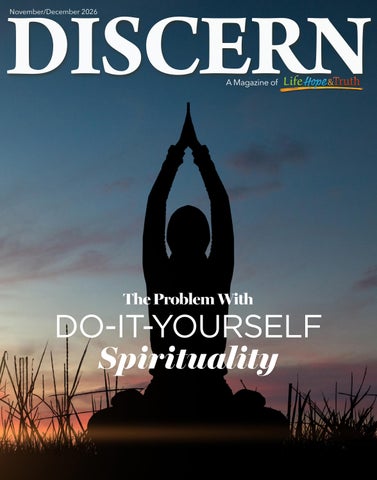
November/December 2026
A Magazine of
The Problem With
DO-IT-YOURSELF Spirituality
November/December 2026; Vol. 13, No. 6
Articles
A Magazine of
Postmaster: Send address changes to P.O. Box 3490, McKinney, TX 75070-8189 ©2026 Church of God, a Worldwide Association, Inc. All rights reserved.
Publisher: Church of God, a Worldwide Association, Inc., P.O. Box 3490, McKinney, TX 75070-8189; phone 972-521-7777; fax 972-521-7770; info@cogwa.org; LifeHopeandTruth.com; cogwa.org
Ministerial Board of Directors: David Baker, Arnold Hampton, Mike Hanisko, Joel Meeker (chairman), Larry Salyer, Leon Walker and Lyle Welty
Staff: President: Jim Franks; Editor: Clyde Kilough; Editorial content manager: Mike Bennett; Managing editor: David Hicks; Senior editor: David Treybig; Graphic designer: Elena Salyer; Associate editors: Erik Jones, Jeremy Lallier; Kendrick Diaz; Assistant editor: Jordan Iacobucci; Copy editor: Becky Bennett; Social media: Hailey Brock
4 Do-It-Yourself Spirituality 10 Deep Study in a Distracted World 14 The Mixing and Matching of Religious Beliefs and Celebrations 1 7 What Do Today’s Epidemics Mean for the Future? 20 Six Strategies to Bring Your Thoughts Into Captivity 24 The Problem With “Just as I Am” Christianity 28 Some Say Christmas Is Not Pagan— Is That True?
Doctrinal reviewers:
Columns
John Foster, Bruce Gore, Peter Hawkins, Don Henson, Doug Johnson, Chad Messerly, Larry Neff The Church of God, a Worldwide Association, Inc. has congregations and ministers throughout the United States and many other countries. Visit cogwa.org/ congregations for information. Donations to support Discern magazine and LifeHopeandTruth.com can be made online at LifeHopeandTruth.com/donate or by surface mail to Church of God, a Worldwide Association, Inc., P.O. Box 731480, Dallas, TX 75373-1480. The Church of God, a Worldwide Association, Inc. is organized and operated as a tax-exempt organization in the United States according to the requirements of IRS 501(c)(3). Contributions are gratefully acknowledged by receipt. Unsolicited materials sent to Discern magazine will not be critiqued or returned. By submitting material, authors agree that their submissions become the property of the Church of God, a Worldwide Association, Inc. to use as it sees fit. All Scripture quotations, unless otherwise indicated, are taken from the New King James Version (© 1982 by Thomas Nelson, Inc.). Used by permission. All rights reserved.
3 Consider This Have It God’s Way!
32 Q&A
Answers to Your Biblical Questions
34 Wonders of God’s Creation You Snooze, You . . . Don’t Lose?
36 Walk as He Walked
Cover image supplied by leolintang via Getty Images
Discern magazine (ISSN 2372-1995 [print]; ISSN 2372-2010 [online]) is published six times a year in print, with six bonus digital issues, by the Church of God, a Worldwide Association, as a service to readers of its LifeHopeandTruth .com website. Free electronic subscriptions can be obtained at Discern’s home page: LifeHopeandTruth.com/Discern. Contact us at info@DiscernMag.com.
“Get Behind Me, Satan”: Jesus Rebukes Peter
39 By the Way
Many Are the Plans
This publication is not to be sold. Free educational material.
2
DISCERN
November/December 2026
CONSIDER THIS
Have It Your Way! God’s
Over 50 years ago, one of the world’s largest fast-food chains sought to sell more burgers by rolling out a simple advertising slogan: “Have it your way.” The strategy behind this ad was not to highlight the quality of their hamburgers, but to tap into the basic human desire for individuality, control over our own lives. Unlike our competitors, this ad promised, we will personalize your burger to make it just the way you like it. And sell burgers they did! After a few years they dropped this slogan and experimented with a series of far less successful ones. Finally, in 2004 they returned to “Have it your way” and then later to variations on the theme. With outlets in over 100 countries, they had to adapt the slogan to different languages and cultures, but customers everywhere connected with having personalized options.
Image supplied by LordHenriVoton via Getty Images
Eating at the spiritual cafeteria
“Have it your way” was a great idea for ordering hamburgers. But is it a good idea for following God? Apparently, a lot of people think so. For years now, many church leaders have bemoaned the trend of “cafeteria Christianity.” The idea is that you build your beliefs the same way you select your food at a cafeteria—pick and choose whatever you want from a huge array of doctrines and practices, and avoid what you find less tasteful. As this issue’s lead article “Do-It-Yourself Spirituality” explains, more recently the cafeteria has expanded to offer more than just a variety of Christian doctrines. The “Spiritual-but-Not-Religious Cafeteria” is doing a booming business! People hungry for spirituality walk down the line and say, “I think I’ll have a bit of Eastern philosophy and some of that biblical faith. Hmmm, reincarnation looks interesting; I might try that! Oh, I like that part of the New Testament. I’m going to pass on anything meaty, but I’ll take a big helping of ‘whatever feels meaningful’!”
have grown disillusioned, for many reasons, with institutionalized religion. They can end up concluding, “I don’t trust what’s offered on the religious menu of my denomination, so I’ll have it my way.” What we then put together may be personally satisfying. We can consider ourselves spiritual. We can believe in God, pray, meditate, believe in the afterlife, etc. It’ll feel good, just the way we like it. But if you want your spirituality to be truly Christian, that poses a big problem. The problem is authority. Nowhere in the Bible has God ever presented His way of life as something we customize to suit our own tastes. But do-it-yourself religion does just that: it shifts the authority for establishing truth from God to us. “What does spirituality mean to me?” becomes more important than, “What does it mean to God?” Jesus said, “If anyone desires to come after Me, let him deny himself, and take up his cross, and follow Me” (Matthew 16:24). That sounds totally opposite to “have it your way”! He also said, “Difficult is the way which leads to life, and there are few who find it” (Matthew 7:14). When it comes to making your burger, choosing the ingredients you like makes perfect sense. But when it comes to finding truth and God’s way of life, having it your way is exactly the reason that few have found it. “Have it your way” may be a modern advertising jingle, but it’s a very old philosophy. It has sold a lot of hamburgers, but it has kept the world in spiritual darkness. I encourage you to ponder this article, which begins on page 4, and humbly set about seeking true spirituality with a different philosophy: Have it God’s way! Clyde Kilough Editor
Have it your way, or God’s? In some ways, I totally get it. Many people are genuinely seeking to find meaning in life but
LifeHopeandTruth.com
DISCERN
3
DO-IT-YOURSELF
Spirituality
4
DISCERN
November/December 2026
Designing your own spirituality sounds appealing, but is it acceptable to God? By David Treybig
T
hroughout history people have rarely rejected spirituality altogether. Instead, they have often reshaped it—selecting beliefs they like, ignoring those they don’t and blending ideas from multiple sources. Today this personalized approach is sometimes called do-it-yourself (DIY) spirituality. The appeal is easy to understand. Many people have been disappointed by religious hypocrisy, discouraged by institutional failures or convinced that authentic spirituality should be personal rather than organized. DIY spirituality promises freedom from rules, the opportunity to define truth for oneself and the flexibility to build a spiritual life that feels meaningful and fulfilling. Modern technology has made this approach easier than ever. A person can listen to one teacher online, read another author’s books, practice mindfulness, explore astrology or Eastern meditation, attend church occasionally and blend it all into a customized spiritual experience. Like creating a personal playlist, individuals choose what inspires them and simply leave out the rest.
Spiritual but not religious This trend is often summarized by the phrase spiritual but not religious. For many, spirituality becomes primarily about inner peace, personal authenticity and emotional well-being rather than discovering and
LifeHopeandTruth.com
DISCERN
5
This pattern of syncretism—blending God’s instructions with human ideas—became one of the defining sins of both Israel and Judah. It eventually led to the captivity of both kingdoms (2 Kings 17:11-18; Jeremiah 25:6-11). submitting to God’s revealed will. Feelings increasingly become the measure of what is true and right. This personalized approach has even influenced those who identify as Christians. While interest in Christianity has grown in the United States in recent years, many who are exploring the faith remain hesitant to commit themselves to a church or to accept biblical authority in every area of life. Instead, they adapt Christianity to fit their own preferences, combining Christ’s teachings with ideas drawn from other religions, philosophies and popular culture. The reasons for this trend are understandable. Distrust of institutions, negative experiences with religious leaders, a desire for individualism and the influence of social media have encouraged many people to chart their own spiritual course. Churches may be viewed as one option among many, and biblical teachings on sin, repentance and obedience are sometimes redefined or set aside in favor of personal authenticity. Some observers hope this renewed spiritual interest will eventually lead people toward a deeper commitment to biblical Christianity. Time will tell whether this proves true. But there is a far more important question than whether DIY spirituality is personally satisfying or culturally popular. What does God think about it? Who has the authority to determine how He should be worshipped—God or human beings? The Bible answers that question with clarity and consistency. From the Garden of Eden to the teachings of Jesus Christ and the apostles, Scripture repeatedly shows what happens when people substitute their
6
DISCERN
own ideas for God’s instructions. Every major biblical example points to the same conclusion.
DIY decisions in the Garden of Eden
The desire to decide for ourselves what is right and wrong did not begin in modern times. It began in the Garden of Eden. Appearing to Eve as a serpent, Satan challenged God’s instructions by suggesting that she could determine good and evil for herself. If she ate from the forbidden tree, he claimed, she would become “like God” without needing to depend on God’s guidance (Genesis 3:1-5). At its core, Satan’s temptation was an appeal to human independence. Instead of trusting God’s definition of right and wrong, Eve was encouraged to trust her own judgment. Adam followed the same course. As a result, both were driven from the Garden of Eden and lost access to the tree of life (verses 22-24). Humanity’s relationship with God was broken because our first parents chose their own reasoning over God’s clear instruction. From this point forward, the Bible records mankind repeatedly making the same mistake.
Ancient Israel’s experiment with a golden calf
After fulfilling His promise that He would bring Abraham’s descendants—the ancient Israelites—out of bondage in Egypt, God instructed them to worship Him alone and to make no idols (Exodus 20:2-6).
November/December 2026
Yet while Moses was on Mount Sinai for many weeks receiving God’s laws, the people concluded that he was not returning. Rather than patiently waiting for God’s direction, they took matters into their own hands. Drawing on religious practices they had known in Egypt, they made a golden calf and proclaimed, “This is your god, O Israel, that brought you out of the land of Egypt!” Aaron then announced, “Tomorrow is a feast to the Lord” (Exodus 32:4-5). Notice what happened. The Israelites did not abandon God completely. Instead, they blended the worship of the true God with pagan practices. It was an early example of religious syncretism—a do-it-yourself mixture of truth and falsehood. God rejected that mixture. He declared that the people had “corrupted themselves” and was prepared to destroy them, but relented after Moses’ appeal for mercy (verses 7-14). The lesson is clear. God does not authorize human beings to redesign the way He is to be worshipped.
“Everyone did what was right in his own eyes”
Before Israel entered the Promised Land, Moses repeatedly warned the nation against idolatry and reminded them that there is no God besides the Lord (Deuteronomy 4). During Joshua’s lifetime and the years immediately afterward, the Israelites remained generally faithful. But after that generation died, they gradually adopted the religious practices of the surrounding nations (Judges 2:10-12). As they abandoned God, He allowed neighboring nations to oppress them. When the people cried out, He mercifully raised up judges to deliver them. Yet after each judge died, they drifted back into the same sins (verses 14-19). This tragic cycle continued for more than three centuries. The book of Judges summarizes the underlying problem with these words: “Everyone did what was right in his own eyes” (Judges 21:25). When people become the final authority instead of God, spiritual confusion and suffering inevitably follow.
DIY worship during the times of the kings
Under David and Solomon, Israel experienced a period of peace and prosperity. The temple was built, worship
LifeHopeandTruth.com
was organized according to God’s instructions, and the nation reached its greatest influence. Late in his reign, however, Solomon compromised. Influenced by his foreign wives, he built pagan shrines and worshipped other gods alongside the true God. “His heart was not loyal to the Lord his God” and he “did not fully follow the Lord, as did his father David” (1 Kings 11:4, 6). God became angry with Solomon because of his sins and declared that most of the kingdom would be taken from his descendants (verses 9, 11, 31). After Solomon’s death, the kingdom split. Ten tribes formed the kingdom of Israel, while Judah and Benjamin remained loyal to the house of David. Sadly, the northern kingdom immediately embraced another form of do-it-yourself worship. King Jeroboam feared that if the people continued to make pilgrimages to Jerusalem, his political power could be weakened. So, he established alternative centers of worship. He made two golden calves and assured the people that these represented the God who had delivered Israel from Egypt (1 Kings 12:26-28). He also created his own religious festival, scheduling it on the fifteenth day of the eighth month to resemble God’s Feast of Tabernacles, which was observed in the seventh month (verse 32). Scripture says Jeroboam acted according to what he “had devised in his own heart” (verse 33). He retained selected elements of how God had instructed He be worshipped while changing others to suit his own purposes. This pattern of syncretism—blending God’s instructions with human ideas—became one of the defining sins of both Israel and Judah. It eventually led to the captivity of both kingdoms (2 Kings 17:11-18; Jeremiah 25:6-11). Once again, God rejected attempts to modify His instructions to satisfy human preference, convenience or political advantage.
The faith once delivered Throughout the Old Testament, God consistently warned His people not to add to or take away from His instructions (Deuteronomy 4:2; 12:32). That principle did not change in the New Testament. The book of Revelation closes with the same warning against altering God’s revealed truth (Revelation 22:18-19). Both sections of Scripture are in harmony with each other. One difficult-to-understand verse cannot cancel a clear command found in other passages.
DISCERN
7
In spite of the warnings not to add to or take away from biblical instruction, the desire to reshape God’s teachings persisted. Jude urged Christians to “contend earnestly for the faith which was once for all delivered to the saints” because false teachers had already begun corrupting the message of Christ (Jude 1:3-4). The New Testament identifies a number of individuals who promoted false teachings, including Simon the Sorcerer (often referred to as Simon Magus), Hymenaeus, Philetus, Alexander, Diotrephes and the false prophetess called Jezebel. Their errors varied, but the underlying problem was the same—they substituted human ideas for the teachings Jesus Christ had entrusted to His apostles. Today the challenge is often more subtle. Rather than openly rejecting Scripture, many people misinterpret it or selectively apply it to support beliefs and practices that appeal to modern thinking. Personal feelings and individual preferences can quietly become the final authority. Yet the question remains unchanged: Will we allow God to define true worship, or will we redefine it for ourselves?
The Bereans: testing God’s Word
Some point to the Bereans as an example of Christians independently deciding for themselves what to believe. Luke commended them because they “searched the Scriptures daily to find out whether these things were so” (Acts 17:11). God expects every Christian to study His Word carefully. Faith should never rest on blind acceptance of what any human says. But notice why the Bereans searched the Scriptures. They were examining Paul’s message to determine whether it agreed with God’s Word. When they found that it did, “many of them believed” (Acts 17:10-12). They did not use the Scriptures to create their own version of Christianity; they used them to verify the truth of the gospel that Paul preached. Their response also reflected God’s calling. Jesus explained that “no one can come to Me unless the Father who sent Me draws him” (John 6:44). As God opened their minds to understand the Scriptures, they willingly accepted His truth rather than insisting on their own ideas. The Bereans demonstrate the proper balance. Christians should diligently examine the Scriptures,
8
DISCERN
Human failure does not invalidate God’s instructions and authority. but they should do so with humble hearts that are willing to accept what God reveals.
A royal priesthood—not independent believers
Another passage sometimes cited in support of individualized Christianity is Peter’s description of God’s people as “a royal priesthood” (1 Peter 2:9). Coupled with the promise of the Holy Spirit to repentant, baptized believers (Acts 2:38), some conclude that each Christian is therefore responsible only to God and needs no spiritual guidance from others. While it is true that faithful believers will serve as kings and priests in God’s Kingdom when Christ returns (Revelation 5:10), the New Testament presents a different picture for God’s people now. Note that in anticipating the future, God sometimes “calls those things which do not exist as though they did” (Romans 4:17). Jesus established a Church, not merely isolated believers. Within that Church He appointed apostles, prophets, evangelists, pastors and teachers “for the equipping of the saints” so that Christians would mature spiritually and no longer be “tossed to and fro and carried about with every wind of doctrine” (Ephesians 4:11-14).
November/December 2026
These leaders were not intended to replace God’s authority or discourage personal Bible study. Rather, they were to teach God’s Word faithfully, protect the Church from false doctrine and help believers grow in spiritual maturity. The qualifications for such leaders emphasized sound doctrine, godly character and the ability to teach (1 Timothy 3:1-7; Titus 1:5-9). John noted that faithful believers should abide in the biblical truths they had “heard from the beginning” (1 John 2:24). Because they had received the Holy Spirit (“an anointing from the Holy One,” verse 20) after baptism, they had the ability to understand truth. John warned them about “those who try to deceive you” (verse 26). They didn’t need to have new teachers with new truths. Paul understood that his preaching and teaching were part of the commission Christ had given him and that this was the process by which God was calling people (1 Timothy 2:7; 2 Timothy 1:11). That is why he asked, “How shall they hear without a preacher?” (Romans 10:14). When gentiles accepted the gospel, Paul did not encourage them to establish their own independent forms of Christianity. Instead, they became “imitators of the churches of God which are in Judea in Christ Jesus” (1 Thessalonians 2:14). Though separated by geography and culture, they remained united in the same faith, the same teachings and the same pattern of worship. The New Testament consistently presents Christianity as a community of believers united by God’s truth—not individuals each determining for themselves what that truth should be.
Where DIY spirituality ultimately leads
Many people are drawn to DIY spirituality because they have been disappointed by religious organizations or leaders. Sadly, religious hypocrisy and abuse have caused many to distrust organized religion. Yet human failure does not invalidate God’s instructions and authority. A spirituality built primarily on personal feelings and individual judgment leaves people vulnerable to deception. Jesus warned that before His return “many false prophets will rise up and deceive many” (Matthew 24:11). Paul likewise foretold the coming of a great religious deceiver who would have power to perform “signs, and lying wonders,” misleading those who “did not receive the love of the truth” (2 Thessalonians 2:3, 9-10).
LifeHopeandTruth.com
Those who make feelings, experience or personal preference their guide are more likely to trust what seems right than what God has revealed is right. At its heart, DIY spirituality is not merely about choosing different religious practices. It shifts the source of authority from God to self. Instead of asking, “What has God commanded?” the guiding question becomes, “What feels right to me?” Throughout Scripture the results are consistent. Whether it was the forbidden fruit, the golden calf, the period of the judges, Solomon’s compromise or Jeroboam’s innovations, every attempt to redefine God’s worship according to human ideas ended in spiritual decline.
True Christianity True Christianity follows a different path. It begins with humble submission to Jesus Christ and His teachings rather than confidence in our own reasoning. Scripture reminds us that there is only “one faith” (Ephesians 4:5), that God’s Word is truth (John 17:17) and that “there is a way that seems right to a man, but its end is the way of death” (Proverbs 14:12). Christians are instructed therefore not to lean on their own understanding but to trust in the Lord (Proverbs 3:5), to assemble together with fellow believers (Hebrews 10:25), to learn from faithful spiritual leaders (Hebrews 13:7) and endure faithfully to the end (Matthew 24:13). The Bible presents one consistent message: God—not mankind—determines how He is to be worshipped. Whenever people substitute their own ideas for His revealed will, the result is confusion and separation from Him. Although God’s way may initially appear restrictive, it leads to something DIY spirituality can never produce—genuine peace, lasting hope and a relationship with Him founded on truth rather than human imagination (Matthew 11:28-30; Romans 15:13). Jesus promised that the Church He established would continue until His return (Matthew 16:18). It remains “the pillar and ground of the truth” (1 Timothy 3:15), faithfully preserving the teachings He entrusted to His followers. If you would like to learn how to identify the Church Jesus founded, download our free booklet Where Is the Church Jesus Built? D
DISCERN
9
Deep Study in a Distracted World In an age of endless distractions, how can we learn to slow down, think deeply and give God’s Word our full attention? By Monica Ebersole
Image supplied by FatCamera via Getty Images
10
DISCERN
November/December 2026
T
hinking deeply is a formidable challenge. Case in point, as I write this article, I push my mind to what feels like the outer limits of what it can handle. I agonize over each word, wracking my brain for ways to convey important concepts that I’m still trying to understand. Meanwhile, the distractions of modern-day life compete for my attention and threaten my focus. Yet I know I’m not alone in the struggle to think deeply and ponder important questions. Keeping one’s mind engaged in deep concentration is difficult.
The concept of “deep work”
In his now famous book Deep Work: Rules for Focused Success in a Distracted World, author and professor Cal Newport
LifeHopeandTruth.com
DISCERN
11
distinguishes between two types of work: deep work—which requires intense focus, freedom from distraction and prolonged mental stamina—and shallow work, which requires less concentrated effort and can often be completed in a more distracting environment. Writers are forced to set aside time to wrestle with big topics. They have to step away, block out distractions and become fully immersed in their work. But when I’m not writing, I float back to the surface, catch my breath and shift my attention to tasks that don’t require as much concentration. There’s certainly value to shallow work. There are always emails to answer, meetings to prepare for, phone calls to make and personal matters to attend to. These tasks need to be completed and count toward our daily productivity. But quite often, our day-today lives keep us in a state of continuous shallow work. What happens when our daily routine doesn’t ask something more from us? What if our lives are so filled with shallow tasks that they prevent us from engaging in deeper work? Does it really matter? Is the deeper type of work necessary for everyone? After all, not everyone works in a field that requires creativity or strategic planning, and even fewer are working on scientific or technological breakthroughs.
The value of “deep study” for Christians
Christians are called to do a different type of work, one that
12
DISCERN
requires time and intentional focus: study of the Bible. The Bereans provide an excellent example of what deep engagement with God’s Word can look like (Acts 17:11). They searched the Scriptures daily to familiarize themselves with God’s Word and learn to discern truth from error. Studying the Bible—and developing an intimate knowledge of what it teaches— provides insight into God’s mind and fosters a special connection and familiarity with our Creator. To know something well, we have to study it carefully and reflect on it. Likewise, to know God well, we have to thoughtfully study and reflect on His message to us. There is no shortcut. For those who desire a meaningful relationship with God, greater faith and stronger conviction, diving deeply into the Scriptures is a key to being made complete and spiritually equipped (2 Timothy 3:16-17). Whether or not we choose to pursue deep work in our occupations is an individual decision. But Christians through the centuries have found the need to become deep thinkers in regard to what matters most.
Deep study: what it is and how it’s done
But this isn’t exactly groundbreaking news, is it? Fundamentally, we understand how important it is to spend time reading and studying the Bible. We know the difference between skimming a few passages before we hurry out the door and truly
stopping to reflect on what those words mean. And we know how easily we can begin to drift. How do we become diligent students of the Bible in our hectic modern world? Here are a few principles we can apply to help us in our efforts.
1. Set aside nonnegotiable study time each day
One challenge of deep study is that it requires time. We can’t sit down and instantly make our minds engage with the text. The good news is that we get to decide when to fit this time into our routine. The time of day and amount of time will vary, but scheduling helps us make it part of our day. Scripture sets a high standard for our engagement with God’s Word. Joshua was instructed to “meditate in it day and night” (Joshua 1:8). Spending every waking moment reading the Bible might be impossible, but there’s great value in setting aside a regular and reasonable amount of time to do so. Our article “Budget Your Time for Spiritual Growth” has concrete ideas for how you can make this happen.
2. Develop a plan beforehand
Knowing what you plan to study allows you to dive straight in and maximize your time. This can be as simple as selecting a single passage or topic or developing a detailed plan to progress through the Scriptures. (If you’re looking for ideas, our free book Five Tools
November/December 2026
for Spiritual Growth has an entire section on Bible study methods.) Along the way, you’ll likely find verses or topics that steer your studies in a different direction. Whatever you choose to do, make a plan and see where it takes you!
3. Eliminate distractions
One of the greatest challenges to deep study is the slew of constant distractions around us. Notifications, alerts and the long list of daily tasks can easily crowd out time for Bible study. Our attention and focus can be constantly yanked in all directions. And the modern conveniences that are supposed to free up our time often serve as distractions themselves, while simultaneously creating the expectation that we should accomplish even more with our limited time. The struggle to eliminate distractions is a hard-fought but worthwhile battle. As much as possible, remove items that may vie for your attention. Consider leaving your phone in another room or relying on physical study aids rather than electronic ones. Our deep study time may be limited, but we can make it effective if we’re able to focus.
4. Slow down It’s easy to measure progress by how much we accomplish in a given period. But that isn’t always true of deep study. Rather than setting goals to read through the Bible at a certain pace, it may be more beneficial to
LifeHopeandTruth.com
slow down and read carefully and intentionally. Doing so allows us to ponder questions, seek answers and research words or phrases that draw our attention. In a fast-paced world that values speed and efficiency, moving slowly and taking time to contemplate biblical concepts feels counterintuitive. But it can unlock deeper meaning and insights that might be overlooked if we only skim the surface of Scripture.
5. Pray and meditate
Five Tools for Spiritual Growth says, “Bible study is one of the key ways we can hear from God. By adding prayer into the mix, Bible study becomes a two-way conversation we can be more involved in.” And one of the best ways to slow our pace as we study is to engage in meditation. Five Tools for Spiritual Growth also explains, meditation is “the act of stopping to think about God’s Word deliberately and intentionally.” It serves as a bridge between prayer and Bible study, allowing us to internalize the passages we’re studying and the lessons God wants us to learn from them. (Download a free copy of the book to learn more about prayer and meditation and to get a list of sample topics for personal meditation.)
6. Push yourself One of the main tenets of Professor Newport’s Deep Work is the need to push ourselves mentally. Conditioning our minds
to go beyond the superficial is similar to building physical muscle. The greatest growth comes when we push beyond our comfortable limit. As we do so, we’ll strengthen our mental muscles and find it easier to delve deeply into Scripture (Hebrews 5:14). At times, it will be uncomfortable. Deep study may prompt us to face difficult passages, ask challenging questions and address areas where our understanding is weak. But spiritual growth awaits on the other side of our comfort zone.
Deep study: a vital tool for every Christian
The concept of deep work is widely promoted as a tool for productivity. But a Christian’s responsibility to conduct deep study is about much more than productivity. It’s a vital tool for becoming firmly rooted in God’s Word, developing a relationship with Him and ensuring that we know how to live according to His will and His way. Deep work asks, “What can I accomplish if I concentrate?” Deep study asks, “What can I learn, understand and become if I give God’s Word my full attention?” The hectic pace of our modern world presents a challenging environment for Christians. Our world is geared to distract us, steal our attention and splinter our focus. But for those God has called, nothing could be more important than carving out time to deeply and intentionally study His Word. D
DISCERN
13
The
Mixing and Matching of
Religious Beliefs and
Celebrations When religions converge, beliefs and celebrations can evolve. This happened in ancient Israel and Rome. But is this really what God wants?
W
hen you think about religions mixing, perhaps you think of something like the scene National Public Radio described in 2024: “The home in Morristown, New Jersey, is lit up with a sparkly Christmas tree. It’s adorned with ornaments—a snowman, tiny homemade frames with pictures of the kids and something a little less common—two Stars of David made of blue-painted popsicle sticks.
14
DISCERN
“Hanging from the mantel are red Christmas stockings, next to what the kids call blue ‘Hanukkah stockings.’ There’s an Advent calendar and presents under the tree, along with menorahs and a collection of dreidels” (NPR.org, Dec. 23, 2024). Though this was in an article called “Interfaith Families Find Meaning in Chrismukkah,” the stories didn’t identify any specific meaning to these combined holidays.
November/December 2026
Image supplied by ChatGPT
By Mike Bennett
In fact, Emily, the wife in another interfaith marriage, said, “It was really important to us to have a child who was raised with both traditions and saw them as distinct and can choose one one day, can reject them both, can figure out how in his own way to integrate them or hold them together. Maybe not integrate, but hold them together.” Of course, individual families or small groups experimenting with mixed-up holidays like Chrismukkah are unlikely to start a new megaholiday with staying power. But the experience of these conflicted interfaith families does reflect larger trends that have shaped the evolution of Christianity and some of the cherished holidays of today. In fact, the mixing has been so extensive, it can be hard to discern any resemblance between modern holidays and the festivals commanded in the Bible.
Historical mixing in ancient Rome
The history of Christianity includes periods of amalgamation of doctrines and practices. When the Church of God began in Judea, it was part of the Roman Empire, which encompassed a wide variety of cultures and religions. Some religions were accepted, some were oppressed. Early Christianity suffered waves of persecution and pressures from the world around. Fractures appeared within Christianity even during the first century, and only widened over time. Over the centuries, the faction centered in Rome came to dominate, and eventually, with the support of Emperor Constantine, it took primacy. After driving other factions underground (including those who held firmly to the teachings and festivals of the Bible), it grew and spread. Having the approval of the emperor, this dynamic religion began to assimilate people and customs as it went.
LifeHopeandTruth.com
Historian Will Durant described this evolution as the religions of the empire congealed: “Christianity did not destroy paganism; it adopted it . . . “The Greek mysteries passed down into the impressive mystery of the Mass. Other pagan cultures contributed to the syncretist result. From Egypt came the ideas of a divine trinity, the Last Judgment, and a personal immortality of reward and punishment; from Egypt the adoration of the Mother and Child . . . “Christianity was the last great creation of the ancient pagan world” (Will Durant, The Story of Civilization, Vol. III: Caesar and Christ, p. 595). Dr. Durant summarized the inputs that shaped the Roman church: “As Judea had given Christianity ethics, and Greece had given it theology, so now Rome gave it organization; all these, with a dozen absorbed and rival faiths, entered into the Christian synthesis” (p. 618). Within all this melding, the seven festivals taught in the Bible (see Leviticus 23) were abandoned or changed, and a whole new slate of celebrations was introduced. Among them was one purporting to celebrate Jesus’ birth, even though the Bible doesn’t include such a celebration, and does not record the date of His birth. Read more in the article in this issue “Some Say Christmas Is Not Pagan—Is That True?”
Snowballing assimilation of customs
As Roman Christianity spread throughout the empire and beyond, celebrations like Christmas began to snowball, engulfing and absorbing more pagan customs on the way. “Winter festivals had existed worldwide since ancient times, and eventually many of those festivals’ traditions became linked
DISCERN
15
with Christmas. For example, the Germanic solstice festival of Yule featured banquets and celebration, and Celtic Druids held a two-day solstice festival during which they lit candles and decorated their homes with holly and mistletoe” (“How Christmas Has Evolved Over Centuries,” NationalGeographic.com). Of course, the Christmas celebrations of today have also been strongly shaped by the American melting pot of cultures and its unprecedented commercialism. The National Geographic article concludes: “Those who fear the holiday has strayed from its religious roots have a point. In 2019, more than nine in ten Americans polled by Gallup said they celebrate Christmas—but just 35 percent said they saw the holiday as ‘strongly religious.’ But with its mishmash of pagan and religious traditions, the holiday offers something—whether holy or not—for everyone who celebrates it.” But what about Christians who strive to follow the Bible?
Biblical warnings about religious mixing
What if religious beliefs and celebrations aren’t really a factor of feelings, but of truth? What if mixing isn’t just a harmless blending of cultures, but a corruption of pure religion that’s important to God—the one and only Creator God? That’s what the Bible teaches. You can prove to yourself that God exists, that the Bible is true, and that the Bible points us to a true Church where true Christians look to the Bible for their beliefs, practices and celebrations. You can find these free biblical booklets on our LifeHopeandTruth.com website: • Does God Exist? • Is the Bible True? • Where Is the Church Jesus Built? • What Is a True Christian? God commanded a set of seven annual festivals that the apostles and the early Church
16
DISCERN
of God continued to observe. Paul referred to them as shadows of things to come (Colossians 2:16-17). We see in them outlines of the plan of God, which they are to remind us of each year. But these celebrations have been replaced. What does God say about that? Deuteronomy 12:30-32 warns about other religions: “Take heed to yourself that you are not ensnared to follow them, after they are destroyed from before you, and that you do not inquire after their gods, saying, ‘How did these nations serve their gods? I also will do likewise.’ “You shall not worship the Lord your God in that way; for every abomination to the Lord which He hates they have done to their gods; for they burn even their sons and daughters in the fire to their gods. “Whatever I command you, be careful to observe it; you shall not add to it nor take away from it.” Sadly, Israel succumbed time and time again to the temptations of mixing in other forms of worship. These failures find a modern parallel in the celebrations that evolved from the mixing of Christianity with pagan religions. The mixing of other religious customs with those taught in the Bible might have occurred so long ago that they have become popular traditions, but they are still an affront to God. Tradition, convenience and even enjoyment are not good excuses for abandoning God’s commands and embracing what displeases Him.
Return to biblical Christianity
In a world that blindly accepts centuries of religious mixing, it is still possible to return to the true teachings and the meaningful festivals of God. But first you have to know what they are, and see how they illuminate the plan of God. Learn more by downloading and studying From Holidays to Holy Days: God’s Plan for You. D
November/December 2026
What Do Today’s Epidemics Mean for the Future?
It seems that outbreaks of frightening diseases now occur frequently and regularly. Is this normal? What do today’s epidemics mean for the future? By Bill Palmer
C Image supplied by Kong Ding Chek via Getty Images
overed from head to toe in protective clothing, doctors and nurses move slowly from patient to patient, tending those who need help. All the while they carefully avoid flesh-to-flesh contact with their patients. Why would medical professionals take such precautions? Because for some very deadly pathogens, contact with blood and other bodily fluids can transmit the infection. Ebola, with an average case fatality rate of 50 percent, is one of those diseases. Airborne pathogens are even more troubling because they are generally more contagious than bloodborne pathogens. Potential victims need only breathe contaminated air to become infected, rather than needing to come into contact with the bodily fluids of infected people.
LifeHopeandTruth.com
DISCERN
17
If you obey Him and trust Him, He will be there for you and with you. Some of these airborne pathogens also have high fatality rates. For instance, MERS, or Middle East Respiratory Syndrome, has a case fatality rate of 37 percent.
What do today’s epidemics mean for the future?
Ebola, MERS and a host of other diseases occupy the time of health-care officials around the world. They continually look for outbreaks, hoping to contain them before they become impossible to control. Any one of these diseases could become a nightmare epidemic. Unfortunately, the risk of a devastating global pandemic continues to rise. There are a number of factors that make the world vulnerable, generally linked to our growing global interdependence and increasing international travel, which open the door for the rapid spread of pathogens. Another risk factor, particularly in developing nations, is deforestation. This disruption of the natural environment puts humans and their livestock into close proximity with wildlife that may carry disease. Animal-based diseases that spread to humans are called zoonotic diseases. These pathogens, though already existing among animal populations, become new pathogens in humans. A third factor is global urbanization, which crowds the poor into unhygienic conditions, often with little or no access to health care. Together, these factors are a recipe for the swift spread of disease. Today’s world is vulnerable, far more vulnerable than we might imagine. In fact, the structure of modern society has increased the chances of global pandemics, in spite of medical advances.
Is a pandemic inevitable? In light of the potential for animal diseases to infect humans, it’s not surprising that 50 new pathogens were identified during the four decades between 1967 and 2007 (according to a 2008 article on the website of the U.S. National Library of Medicine).
18
DISCERN
That’s more than one new disease each year. The frequency of emerging diseases led epidemiologists to coin the term Disease X to refer to any future disease that has the potential to cause a serious epidemic or pandemic. Experts believe it is only a matter of time before the world faces a truly devastating pandemic. In 2019 the Global Preparedness Monitoring Board included this statement in its annual report: “If it is true to say ‘what’s past is prologue,’ then there is a very real threat of a rapidly moving, highly lethal pandemic of a respiratory pathogen killing 50 to 80 million people and wiping out nearly 5% of the world’s economy. A global pandemic on that scale would be catastrophic, creating widespread havoc, instability and insecurity. The world is not prepared.” If this statement is true, we are faced with another question. Why would a loving God allow such a horrible pandemic? For that matter, why has He allowed the epidemics and pandemics of the past?
Why does God allow pandemics?
The book of Deuteronomy includes a chapter that lays out the potential blessings in store for those who obey God. It also describes the dreadful consequences of disobedience. Through Moses, God warned His people that disobedience to His law would result in “plague.” They would be stricken “with consumption, with fever, with inflammation, with severe burning fever” (Deuteronomy 28:21-22). In some cases, as this passage indicates, God Himself strikes people with deadly epidemics. This happened four times during the 40 years Israel wandered in the wilderness (Numbers 11:31-34; 14:3637; 16:46-50; 25:8-9). At other times, disease is the natural consequence of sin. Humanity brings diseases on itself by disobeying God’s clear instructions about such things as what
November/December 2026
meats may be eaten, how to dispose of human waste and when to quarantine the sick. It’s important to recognize that individuals do not always suffer illness because of their own sins. Many of the diseases in our modern world are the result of countless generations of people failing to be good stewards of the earth, as God intended (Genesis 1:28).
What does the Bible say about future epidemics?
The most chilling prophecy about disease in the end times is in the book of Revelation. The passage describes four horses, each a different color (Revelation 6:1-8). The fourth is yellowish-green (Greek chlōros), described by Expositor’s Bible Commentary as “the paleness of a sick person” (Vol. 12, p. 474). Disease, together with war (the second horse), famine (the third horse) and beasts of the earth, will kill a fourth of the world’s population (verse 8). Based on the world’s current population, more than 2 billion people will die when the fearsome riders of these horses set out! Disease will be a major contributor to the death toll. This prophecy fits perfectly into what we know of the link between war, famine and disease. Famine and disease often follow in the footsteps of war.
Does this mean we’re closer to the latter days?
We cannot look at an isolated outbreak and declare conclusively that we are now entering the troubling times prophesied in Scripture. On the other hand, we should realize that disease will be one of the major causes of death in the end times. The fact that new pathogens seem to arise so frequently and that the world is so interconnected certainly indicates that we are approaching that frightening time. When we reach those days, the prophesied epidemic pictured by the “yellowish-green” horse will conform to the pattern provided in the book of Revelation. Remember that Death, the rider, is the fourth horseman, following false religion, war and famine. If the end-time pandemic follows the historical pattern, disease might end up being the leading cause of deaths attributed to the four horsemen of Revelation 6. The Spanish flu, following on the heels of World War I, killed three times as many people as the war itself.
LifeHopeandTruth.com
Is the world prepared for the next epidemic?
The modern world’s most recent experience with a global pandemic occurred when COVID-19 burst onto the scene. How the world responded to that outbreak is both enlightening and sobering. The first cases appeared in China at the end of 2019, but the general public in much of the world was unaware of the disease until January 2020. As widespread globally as COVID was, it was not as deadly as the worst epidemics in history. There is a way that COVID-19 will make future pandemics more challenging, however. Nations refused to cooperate with other nations in curbing the outbreak. Controversy among science, medicine, governments and corporations fueled distrust and animosity. What this suggests for the future is disturbing. It’s difficult to see our world coming together in a timely fashion to combat any future pandemic. In fact, what we are seeing in humanity today is reminiscent of what the apostle Paul declared about the last days: “For men will be lovers of themselves” (2 Timothy 3:2).
Can you personally do anything to prepare for epidemics?
Even though there is so much selfishness, distrust and anger among people, you don’t have to fear. There are steps you can take to be better prepared in the event of disease epidemics. You should begin by following biblical health principles, including eating the type of diet that will contribute to your overall health, enhancing your body’s ability to protect itself. For instance, Scripture specifies which meats are appropriate for consumption (Leviticus 11; Deuteronomy 14). Another important health principle mentioned in Scripture is sanitation (Deuteronomy 23:12-14). By practicing good hygiene, you will go a long way toward protecting yourself from pathogens. Most important, however, is having a real, committed relationship with God. If you obey Him and trust Him, He will be there for you and with you. As the apostle Peter wrote, “The Lord knows how to rescue the godly from trials” (2 Peter 2:9, English Standard Version). Learn more about what Bible prophecy predicts and how God wants us to respond in our free booklet How to Understand Prophecy. D
DISCERN
19
6
STRATEGIES TO BRING YOUR THOUGHTS INTO CAPTIVITY In 2 Corinthians 10:5 Paul talks about bringing “every thought into captivity.” But how can we do that when our minds are a spiritual battlefield?
By Jordan Iacobucci
20
DISCERN
November/December 2026
T
he human mind is a battleground. In Romans 7:23, Paul laments, “I see another law in my members, warring against the law of my mind, and bringing me into captivity to the law of sin which is in my members.” He, like everyone who strives to follow God, found that his human nature inevitably wandered toward sin. Yet Paul also says in 2 Corinthians 10:5 that he was “bringing every thought into captivity to the obedience of Christ.” These verses illustrate our ongoing struggle between sin and righteousness. Sin frequently originates in the mind, making it our job to govern our thoughts. And what about mental struggles like stress or anxiety? These aren’t necessarily sinful, but can be major stumbling blocks for Christians. The Bible provides us with a spiritual framework for better controlling what comes into our minds—and what stays. Combining Scripture with practical strategies to use in our everyday lives, we can grow in “bringing every thought into captivity.”
Image supplied by Deagreez via Getty Images
Strategy 1: Use God’s Holy Spirit as a foundation
LifeHopeandTruth.com
Practical strategies have their place, but we must recognize that this is ultimately a spiritual battle. When dealing with spiritual problems, we must begin by seeking spiritual solutions. To bring every thought into captivity, we need God’s Holy Spirit working in us. The Holy Spirit is the power of God, which works in our lives to
help us resist sin (Galatians 5:16). The only way to receive that Spirit is through repentance, baptism and the laying on of hands (Acts 2:38; 19:2-6). We can also pray for God’s protection from harmful or sinful thoughts. God is always ready to hear an earnest supplication for help from His children. Our other strategies have limited effectiveness until our spiritual lives are in order. With the aid of the Holy Spirit, each of our other strategies becomes that much more effective.
Strategy 2: Commit to the right priorities
“Bringing every thought into captivity” is a vague concept on its own. We must also know what we are bringing every thought into captivity to. The final words of 2 Corinthians 10:5 tell us: “bringing every thought into captivity to the obedience of Jesus Christ” (emphasis added). This indicates a lifelong pursuit of righteousness. Indeed, this is what Christ commanded in Matthew 6:33 when He said, “Seek first the kingdom of God and His righteousness.” To “seek first” God’s Kingdom and righteousness, we must prioritize them in our lives. There are endless distractions out there—work, school, entertainment, social media and other activities. Such things are not evil in themselves, but they must be enjoyed in balance. If they begin to take over our lives to the point where we are no longer focused on God and His Kingdom, then they have become our new “top priority.”
DISCERN
21
The Bible encourages us to turn away our eyes from “worthless things” (Psalm 119:37). Technology and social media have their appropriate uses. But there are natural consequences to abusing them.
To put it simply, if our focus is on worldly things, worldly thoughts will follow. If our focus is on righteousness, righteous thoughts will follow.
Strategy 3: Control your environment
Our thoughts don’t always come from inside our head. Mental patterns are often triggered by stimuli from our environment. Longtime smokers, for example, may be overcome with cravings when passing by their regular smoking spot. The cues that trigger negative thought patterns are often deeply ingrained and difficult to resist. As much as we may try to simply will thoughts into submission, external change is sometimes necessary to affect the internal. In Atomic Habits, author James Clear argues that perseverance and willpower come “not by wishing
22
DISCERN
you were a more disciplined person, but by creating a more disciplined environment” (p. 93). You don’t have to be struggling with an addiction to be affected by your environment. Does hanging around with certain friends make you likelier to use profanity? Does scrolling social media spur jealousy? If we want to fight sinful thoughts, we must change the environment that breeds them. Proverbs 6:27-28 asks, “Can a man take fire to his bosom, and his clothes not be burned? Can one walk on hot coals, and his feet not be seared?” If we remain in a tempting environment, we’ll get burned sooner or later. Better to avoid the situation altogether than to hope that willpower will prevail. We may have to make uncomfortable changes to enact the transformation God expects. For more, read our article “If Your Right Eye Causes You to Sin, Pluck It Out.”
Strategy 4: Limit digital overstimulation
Modern technology has many benefits. However, studies suggest that technology can also negatively impact our mental health when used in excess. A University of Texas article titled “Cognitive Overload: How Constant Stimulation Affects the Brain” explains that “digital overstimulation makes it harder for the brain to sort, store, and retain information.” This often leads to increased exhaustion, anxiety, brain fog and negative thoughts. The authors warn that excessive consumption of low-effort, fastpaced content (often associated with social media feeds) fosters “exhaustion, low mood, social withdrawal, [and] negative selfimage.” If we find hours of our day dedicated to endless scrolling, the
November/December 2026
brain fog and mental fatigue we feel later could be related. An overstimulated mind is a vulnerable mind. When our brains are overwhelmed, negative attitudes, behaviors and patterns of thinking can sneak in. We are then less equipped to battle these things and, as a result, can succumb to sin if we aren’t careful. The Bible encourages us to turn away our eyes from “worthless things” (Psalm 119:37). Technology and social media have their appropriate uses. But there are natural consequences to abusing them.
Strategy 5: Restructure negative thought patterns
Some negative thoughts aren’t sinful—they’re just unhelpful. Stress, anxiety, enduring guilt and the like can all get in the way of our spiritual growth. Cognitive restructuring is one way that psychologists help their patients who grapple with such things. Medical News Today describes this process as “a technique that involves slowly restructuring, or changing, a person’s beliefs and thinking patterns.” Its goal is to “reduce the impact that unhelpful thinking styles have on a person’s well-being.” People struggling with social anxiety, for example, might document their feelings in a journal: “I’m afraid that my coworkers don’t like me.” They would then write facts that challenge those feelings: “My coworkers are nice to me. One offered to get coffee with me sometime.”
LifeHopeandTruth.com
Christians may struggle with the “all-or-nothing fallacy,” saying “God doesn’t want to hear from me because I sinned again today.” They might then challenge that thought with facts they know from His Word: “God hates sin, but offers forgiveness when we repent. I can repent and do better with His help.” This process helps us mature in how we view ourselves, the people around us and even our relationship with God. When it comes to stress and anxiety disorders, there are situations where professional help is necessary. Readers are encouraged to seek qualified care where applicable.
Strategy 6: Replace the bad with good
It isn’t enough to push bad thoughts away. If that’s our only goal, they’ll return sooner or later. To win the war for our minds and bring “every thought into captivity,” we need to replace the bad with good. In Ephesians 4:28, Paul champions replacing sinful habits with righteous counterparts: “Let him who stole steal no longer, but rather let him labor, working with his hands what is good, that he may have something to give him who has need.” A person with a history of stealing is encouraged to practice hard work and generosity instead. In so doing, that person not only stops stealing but also learns how to give with a generous heart. When overcoming sin, we should seek righteous alternatives. If envy is a recurring
issue, we can practice generosity. If lustfulness persists, we can express godly love. This can be helpful in other areas as well. In times of stress, we can meditate on God’s promises. When anxiety arises, we can strive to remember how God has protected us in the past. Those negative thoughts may not disappear entirely, but their symptoms may become easier to manage with time and practice. Paul provides a list of positive thoughts to dwell on in Philippians 4:8. We can also find help in passages like Galatians 5 and Ephesians 6. Rather than just pushing bad thoughts away, we can dig deeper, meditating on what generates them and replacing them with righteous thoughts.
Bring every thought into captivity
These strategies are a great place to start for Christians looking to exert greater control over their own minds and, by extension, their entire lives. None of these strategies will solve everything overnight. Our minds are much like wagon wheels on a dirt road; they tend to fall into the same ruts along the way. They’ll continue to be drawn to the same patterns as before— until different ones are created. With time and dedication, those who fight to win the war in their minds will see change. Improvements built over a lifetime will yield tremendous results in our lives as we fight to bring “every thought into captivity to the obedience of Jesus Christ.” D
DISCERN
23
The Problem With
“Just as I Am”
Christianity
The hymn “Just as I Am” has become shorthand for a type of easy, feel-good religion. But what does the Bible really teach about becoming a Christian? By Erik Jones
24
DISCERN
November/December 2026
O
ver his long ministry, Billy Graham preached in packed stadiums around the world. His crusades typically concluded with an altar call while the choir sang the hymn “Just as I Am.” This hymn captured the essence of Mr. Graham’s theology, that people should come to Jesus just as they are. Some estimate that around 3 million people responded to these altar calls, but how many of those people remained committed churchgoers is unknown.
The story of “Just as I Am”
“Just as I Am” and feel-good religion
“Just as I Am” isn’t merely a song, but represents the approach of much of Protestant Christianity. The idea is that upon hearing the message of Christ, all a sinner has to do is come to Jesus in faith, without making any attempt to try to change or spiritually clean up his or her life first. In modern times, the “Just as I Am” approach has deeply infiltrated modern Protestantism and has led many churches to embrace an ultra-casual approach to their services—one that markets comfort, acceptance and belonging as its core selling points. Many churches teach and practice a feel-good message over a be-good message. Instead of focusing on commitment, struggle and character growth, many teach an easy form of Christianity. All one has to do is accept Jesus. Jesus loves you just as you are and just wants you to feel better about yourself. Becoming a Christian is portrayed as being as easy as coming forward for an altar call or repeating a short prayer for Christ to “come into your heart.” After years researching evangelical Christianity, psychological anthropologist Tanya Luhrmann summarized it this way in an interview with Christianity
Image supplied by filo via Getty Images
“Just as I Am” was written by Charlotte Elliott in 1835 and is one of the most recognizable hymns in Protestant Christianity. As the story goes, at the age of 33 she was visited by a Swiss preacher who asked her if she really was a Christian. She later admitted to him that the question greatly troubled her, and she told him, “I want to come to Jesus; but I don’t know how.” The preacher answered simply,
“Why not come just as you are? You have only to come to Him just as you are.” Years later, Miss Elliott penned the hymn “Just as I Am,” which eventually became a standard in Protestant hymnbooks. Each stanza begins with the phrase just as I am followed by Miss Elliott’s understanding of what it meant to come to Christ.
LifeHopeandTruth.com
DISCERN
25
Today: “What people want from faith is to feel better than they did without faith.” In simple terms, it’s all about feelings and experiences.
Jesus preached a very different message
If Jesus were walking the earth as a man today, would His ministry be anything like the modern evangelical approach? The message He proclaimed 2,000 years ago remains unchanged today (Hebrews 13:8). His followers today should closely follow His example, regardless of modern religious trends. Sadly, the modern evangelical approach neglects many elements of the calls to action Jesus actually taught. Jesus interacted with and taught people who were looked down on in society for their moral failings—tax collectors and sinners (Matthew 9:10). But, as we will see, His purpose was not for them to come just as they were—but to help them become entirely new people. Consider these elements of Jesus’ message that are often missing in the modern approach.
1. A strong call to real repentance
Modern evangelical Christianity emphasizes belief and profession. Believe on Jesus. Just accept Jesus. Give your heart to Jesus. Of course, believing Jesus in faith is a crucial part of Christianity—but genuine belief isn’t just an intellectual or emotional recognition that Jesus is Lord and Savior. Many scriptures show that true belief and faith must be married with action (Matthew 7:21; James 2:14-24). To align with Jesus’ approach and teaching, we must emphasize believing and acting upon what Jesus actually taught. There is an immense difference between just believing in Jesus—and actually believing Jesus!
26
DISCERN
Jesus Himself lamented that many people believed in Him (calling Him “Lord”), but did not believe or do the things He said (Luke 6:46). Jesus would associate with sinners and was even harshly attacked for doing so! But Jesus clearly explained why He did that. He likened Himself to a physician helping the spiritually sick (Matthew 9:12). He came to make people better—to raise them to a higher standard—to call sinners “to repentance” (verse 13). Jesus’ message was all about a call to repentance from sin (Mark 1:15; 2:17). That requires identifying exactly what sin is—“the breaking of law” (1 John 3:4, Holman Christian Standard Bible). That is why the 10 Commandments must be regularly taught. If churches don’t teach about God’s law, people won’t even know what to repent of! Teaching about God’s law and sin should produce guilt. Not the kind of guilt that debilitates and festers in our lives, but the kind of guilt—or “godly sorrow”—that motivates us to repent and change (2 Corinthians 7:10). The apostle Paul strongly taught that we must change: “Let everyone who names the name of Christ depart from iniquity” (2 Timothy 2:19). Unfortunately, in an effort to get away from the “fire and brimstone” messages of past preaching, many preachers today focus entirely on a feel-good, “just as I am” message. They often emphasize that God loves us— which is true—but leave out the fact that His love is all about helping us fundamentally change who we are and become more like Him. To learn more about this often-neglected message, study our articles on repentance.
2. The necessity of baptism
Many churches do practice baptism in various forms. Some practice full immersion; others, sprinkling or pouring. Others bypass baptism altogether and encourage new converts to simply make a verbal confession of Jesus Christ as Savior.
November/December 2026
But if we accept the premise that Christianity should be based on the example of Jesus (1 Peter 2:21), then we can easily cut through the confusing melee of modern practices. In Matthew 3 we read that Jesus came to John the Baptist and was baptized. That baptism was clearly by full immersion because Matthew describes Jesus coming up “out of the water” (verse 16, King James Version). Technically, Jesus had no reason to be baptized. Baptism is a symbol of repentance (verse 11)—and Jesus had no sins to repent of. But He did it to set an example and show the necessity of baptism. Just as His ministry began with His own baptism, His work on earth ended by giving His Church the command to make disciples and baptize them (Matthew 28:19). The rest of the New Testament shows many examples of the early Church following this command closely (Acts 2:38, 41; 8:12; 18:8). It is to modern Christianity’s shame that true repentance and baptism have been replaced with a shallow, spur-of-the-moment verbal confession of belief. Biblical baptism, instead of being a spontaneous confession of belief, should be pursued after one genuinely repents and has already shown a willingness to obey God (Matthew 3:8; Acts 3:19; 5:32; John 14:15-17). To learn more about biblical baptism, read “What Is Baptism?” and “Is Baptism Necessary for Salvation?”
Jesus said, “If anyone desires to come after Me, let him deny himself, and take up his cross daily [an analogy of self-sacrifice], and follow Me” (Luke 9:23, emphasis added). When Jesus talked about self-denial, He was describing a life of battling against sin and human nature. In one of His most shocking teachings, Jesus said that if our eye or hand causes us to sin, we are to “pluck it out” or “cut it off” (Matthew 5:29-30). This was a powerful word picture to show the importance of fighting sin. Our eyes and hands don’t literally cause us to sin; sin begins in the mind. If our mind is dwelling on sin, we have to remove those sins from our mind. If we are practicing sin through our body, we have to make drastic changes to our thinking and environment in order to stop. The Christian life isn’t built around just feeling good about ourselves and avoiding guilt. It is a continual, disciplined struggle against sin and a proactive effort to develop the character of Jesus Christ with the help of God’s Holy Spirit (1 Corinthians 9:27; Romans 13:14). To learn more about the necessity of building Christ’s character, read “Developing Christian Character” and “Eight Character Traits for Spiritual Maturity.”
3. Christianity is a struggle
The modern “just as I am” approach misses the heart of Jesus’ teaching. Christ’s message was not that God accepts you just as you are—but instead that God wants us to become just as He is. This means struggling, day by day and year by year, to inch closer and closer to becoming “perfect, just as your Father in heaven is perfect” (Matthew 5:48)! Jesus set the ultimate standard for Christians very high. Will you embrace His standard or stay just as you are? D
The acceptance of a feel-good, “just as I am” Christianity has also veiled another important part of Jesus’ message. Jesus did not describe Christianity as just feeling better about ourselves. He did not portray His Church as a place where Christians go to feel good and be entertained. Jesus described Christianity as a struggle—a lifelong battle against sin!
LifeHopeandTruth.com
From “just as I am” to “just as He is”
DISCERN
27
Some Say Christmas Is Not Pagan—
Is That True? Some have tried to refute the overwhelming historical evidence of the pagan roots of Christmas. Are such claims valid?
Image supplied by Mary Salen via Adobe Stock
By Isaac Khalil
28
DISCERN
November/December 2026
C
hristmas has long been recognized to have pagan origins, and most historical sources have acknowledged the similarities between its customs and traditions and those of pagan festivals. Even more importantly, Christmas and its prominent symbols aren’t taught in the Bible. But recently, some have tried to refurbish the reputation of Christmas as a Christian festival, arguing that its traditions were not borrowed from pagans but rather the other way around—that it was the pagans who copied Christians. But is that true? Can Christmas observance be supported by the Bible? Should a Christian celebrate or steer clear of Christmas?
Traditions vs. God’s commanded festivals
Image supplied by Lisa Haney via Getty Images
LifeHopeandTruth.com
Claim: There’s nothing wrong with keeping traditions. Christ Himself did so. Some point to the Feast of Dedication in John 10:22, arguing that Jesus’ presence at the temple during the festival shows He celebrated a traditional observance. They then conclude that celebrating Christmas and Easter is essentially the same thing. It is true that the Feast of Dedication is not a commanded feast of God, but is a memorial commemorating the rededication of the temple after it had been desecrated by Antiochus Epiphanes in the second century B.C. This festival can be compared to modern nations’ annual days of
remembrance, such as memorial days for those who died in wars and national independence days. These types of observances simply mark important dates in a people’s history. While not observances God commands, they are, nevertheless, not wrong since they are based on truth, not paganism. It’s important to note that keeping such traditions does not give anyone licence to ignore God’s direct commands. Jesus kept God’s feasts, including the seventh-day Sabbath (Luke 4:16), Passover (Matthew 26:19) and the Feast of Tabernacles (John 7:37), and the early Church did likewise (Acts 13:42; 18:21; 1 Corinthians 5:8). Christmas is not a valid tradition for Christians to uphold, but even if it were, that wouldn’t justify replacing God’s commands with human traditions. For example, most churches today observe the first day of the week—Sunday— instead of the seventh-day Sabbath, Easter instead of Passover and Christmas instead of the Feast of Tabernacles. They maintain their traditions rather than the commandments of God. They reject God’s commanded festivals as Jewish despite the fact that God calls them the “feasts of the Lord,” “holy convocations” and “My feasts” (Leviticus 23:2). Jesus warned that the religious people of His time “all too well reject the commandment of God to keep their tradition” (Mark 7:9). These words remain as relevant today as they were then. Verdict: Misleading and ultimately false claim.
DISCERN
29
So much effort has been put into defending what the Bible does not say while ignoring what God does teach us to observe. Did early Christians observe Christmas? Claim: Dec. 25 was kept by early Christians as an observance of Christ’s birth. One key objective for supporters of Christmas is explaining the origin of Dec. 25 as the date for Jesus’ birth. They argue that this date predates the fourth-century Roman Emperor Constantine, claiming it was celebrated by early Christians. What do they mean by “early Christians”? Certainly not the apostles or the Church in the first century. No, the earliest of these “early Christians” were some 200 years after Christ. The Catholic Encyclopaedia states, “Christmas was not among the earliest festivals of the Church. Irenaeus and Tertullian omit it from their lists of feasts.” There are no references to God ordaining Christ’s birthday as an observance. And the Bible doesn’t give a date for Christ’s birth. It does give evidence that it would not have been in winter, since the shepherds were still living out in the fields (Luke 2:8; see “When Was Jesus Born? Part 3”). The best hint we might have points to Jesus’ being born in August or September. That hint
30
DISCERN
comes from the likely dating of John the Baptist’s birth, based on when the “division of Abijah” served at the temple, and the indication that he was six months older than Jesus (Luke 1:5, 36; see “When Was Jesus Born? Part 1”). But some point to ancient writers who believed that Jesus was conceived on the spring equinox. These writers accepted the notion that the spring equinox (March 25 on the Julian calendar) was the anniversary of the creation of the world. From that assumption, they concluded that Jesus was conceived on March 25 and born, nine months later, on Dec. 25. However, nothing in the Bible supports any of those ideas. The Biblical Archaeology Society website credits Sextus Julius Africanus as being the first to propose in writing a Dec. 25 date for Christ’s birth—using the above theory that He was conceived on March 25 and born on Dec. 25. But note, he wrote about this in A.D. 221, almost two centuries after Christ’s death. Using such a speculative date for Jesus’ conception to arrive at Dec. 25 seems to be more of an exercise in reverse engineering than a conclusion drawn from historical or biblical evidence. The fact remains that first-century Christians did not keep Christmas,
and it is not an observance commanded (or even mentioned) in the Bible. Verdict: Unsubstantiated and ultimately false claim.
Do historians really believe the pagans copied the growing Roman church? Claim: The Christians didn’t copy the date of the pagan Sol Invictus celebration—it was the pagans who copied the date of Christmas. In his post “Christmas Isn’t Pagan,” Wes Huff admits there is a connection between Christmas and the pagan celebration of Sol Invictus. However, he points to an author who proposes it was the pagans who changed the date of their celebration to compete with the growing group who came to be known as Roman Catholics: “It is true that Sol Invictus, the festival commemorating the Roman sun God, fell on December 25th. However, our earliest inscriptions concerning this festival place it at the beginning of December not at the end. In his work The Origins of the Liturgical Year, historian Thomas Talley argues that ‘[i]t is more likely that the Roman Emperor Aurelian moved Sol Invictus to December
November/December 2026
25th to compete with the growing rate of Christianity’ (The Origins of the Liturgical Year, 88-91).” We could not find that quote in Professor Talley’s book, so perhaps Mr. Huff intended it as a summary of those pages. Either way, the idea is provocative and attractive to those who want to rehabilitate Christmas, but does history support it? Britannica notes that Aurelian did promote Sol Invictus: “He sought to subordinate the divergent religions of the empire to the cult of the Unconquered Sun (Sol Invictus) and so create the kind of religious unity that came only later with Constantine.” But Britannica also explains the origin of the Dec. 25 date this way: “In the 3rd century, the Roman Empire, which at the time had not adopted Christianity, celebrated the rebirth of the Unconquered Sun (Sol Invictus) on December 25th. This holiday not only marked the return of longer days after the winter solstice but also followed the popular Roman festival called the Saturnalia (during which people feasted and exchanged gifts). It was also the birthday of the Indo-European deity Mithra, a god of light and loyalty whose cult was at the time growing popular among Roman soldiers. “The church in Rome began formally celebrating Christmas on December 25 in 336, during the reign of the emperor Constantine. As Constantine had made Christianity the effective religion of the empire, some have speculated that choosing this date had the political motive of weakening the established pagan celebrations.” And Joseph F. Kelly, professor of History of Christianity at John
LifeHopeandTruth.com
Carroll University, wrote in his article “The Birth of Christmas” about the effects of Aurelian’s persecution of Christians: “Did their challenge to the Unconquered Sun push the Christians toward utilizing December 25 as Christ’s birthday? No Christian author said so explicitly, but it is probable because, where feasible, Christians would replace local pagan traditions with Christian ones, substituting veneration of a local martyr for that of a mythical hero.” This syncretism is well documented, but it goes against the teachings of the Bible. See more in our post “What Is Religious Syncretism? Does God Accept It?” More can be said about Christmas trees, holly, mistletoe and Santa Claus, none of which are taught in the Bible. (See the historical evidence in our online resources “Is Christmas a Pagan Holiday?” “‘Origin of Christmas’ on Trial” and related articles. So much effort has been put into defending what the Bible does not say while ignoring what God does teach us to observe. The fact remains that many respected historical sources, both religious and secular, have long recognized that the Roman festival of Sol Invictus predated and influenced the selection of late December as the date for celebrating Jesus’ birth. Ultimately, the debate over Dec. 25 is secondary to what the Bible does and does not command. Even if someone could prove beyond a doubt that the date had no pagan connection, Scripture still provides no command, suggestion or example that Christians should celebrate Christ’s birth as an annual holiday.
Verdict: Unsubstantiated and ultimately irrelevant claim.
A matter of the heart?
Claim: God looks at the heart, so I keep Christmas to honor God and Jesus my Savior. Some argue that observing Christmas is acceptable because it is a matter of the heart. But this overlooks the problems with Christmas, including its pagan associations, and focuses only on personal motives. But how does God view it? God warns us to not worship Him the way others worshipped their gods (Deuteronomy 12:2932). God defines what is clean and unclean, holy and not holy, and He expects Christians to discern (Leviticus 10:10; Ezekiel 44:23). On top of all the nonbiblical customs, it’s ironic that even a traditional food like Christmas ham is what God considers unclean (Leviticus 11:7). God does look on the heart, but He also warns us that our hearts are “deceitful above all things, and desperately wicked” (Jeremiah 17:9). So God seeks those who seek His will, not their own (Matthew 6:10; compare Matthew 26:42). Verdict: Only partly true. God does look at the heart, but that means we should strive to do the things the Bible says honor Him. Christmas is not one of them. Are you willing to abandon these traditional religious customs and follow God? God is looking for those who turn their hearts toward Him and put Him first (Matthew 6:33; 10:34-39)! Learn more in our free biblical booklet From Holidays to Holy Days: God’s Plan for You. D
DISCERN
31
Answers to Your Biblical Questions
Q: A:
When a person is baptized, who should do the laying on of hands to receive the gift of the Holy Spirit? Do all religions believe in the laying on of hands? If not, where do I get this step?
The Bible does give instructions about baptism and the laying on of hands, but not all churches follow these instructions. Those who are called by God the Father receive His Spirit after baptism and the laying on of hands of a minister of Jesus Christ. In Acts, when many people realized their part in the death of Jesus Christ, they posed a question to Peter: “Now when they heard this, they were cut to the heart, and said to Peter and the rest of the apostles, ‘Men and brethren, what shall we do?’ Then Peter said to them, ‘Repent, and let every one of you be baptized in the name of Jesus Christ for the remission of sins; and you shall receive the gift of the Holy Spirit’” (Acts 2:37-38). God’s command for His ministers to baptize is found in Matthew 28:19-20: “‘Go therefore and make disciples of all the nations, baptizing them in the name of the Father and of the Son and of the Holy Spirit, teaching them to observe all things that I have commanded you; and lo, I am with you always, even to the end of the age.’ Amen.” Baptism is such an important commitment, we believe it should be preceded by teaching regarding repentance, who Jesus Christ is, what sin is and how sins are forgiven. The result of the baptism and laying on of hands is that the person receives the gift of the Holy Spirit. Therefore, additional teaching should be provided regarding the Holy Spirit. Baptism and the receiving of the Holy Spirit through the laying on of hands represents the commitment of
32
DISCERN
the person to accept the calling by God the Father to Jesus Christ and to repent (change) and follow God’s way of life as detailed in His Word, the Bible. Notice that “teaching them to observe all things that I have commanded you” is an important part of baptism and the receipt of the Holy Spirit. The Bible specifically talks about the laying on of hands in Acts 8:14-17 and 19:2-6. In Hebrews 6:1-2 it is listed as a foundational doctrine. The Church of God, a Worldwide Association, which sponsors this magazine, offers the following helpful resources: • “Is God Calling You?” • “What Is Baptism?” • “Laying On of Hands.” • What You Need to Know About Repentance and Baptism.
Q:
We understand from passages like Daniel’s 70-weeks prophecy that the sacrificial system came to an end with the ultimate sacrifice of Jesus Christ (Daniel 9:27; Hebrews 10:10-14). His death fulfilled what those sacrifices pointed to; their limited role is no longer needed. That being the case, how should we understand Ezekiel’s vision of the future temple (chapters 40–48), where it seems that sacrifices—including sin offerings and burnt offerings—are resumed during what appears to be the millennial Kingdom? How should we reconcile these detailed instructions with the once-for-all sacrifice of Christ? Are these sacrifices symbolic, memorial in nature, or is there another way to understand their role in the Kingdom?
A:
You ask some good questions that many have wondered about. Yes, several passages indicate that there will be animal sacrifices in the Millennium. One of the most complete descriptions is found in Ezekiel 43:18-27. It certainly appears that this is a prophecy about the future millennial reign of Jesus Christ, when a physical temple will be constructed. Yet we are also told in the book of Hebrews that God didn’t desire animal sacrifices and that the death of Jesus Christ was “one sacrifice for sins forever” (Hebrews 10:12). So, why will there be a need for
November/December 2026
the reinstitution of a Levitical priesthood and animal sacrifices in the Millennium? Of course, we could also ask the question: Why will a temple be built and used in the Millennium, when Revelation 21:22 tells us that, after the Millennium, “I saw no temple in it, for the Lord God Almighty and the Lamb are its temple”? We can be certain that there is a reason, since God does not introduce things that have no purpose. Although we aren’t told why animal sacrifices will resume in the Millennium, it appears that they will indeed take place at least for a while and will be associated with a physical temple. Our booklet The World to Come: What It Will Be Like has a sidebar article (“Animal Sacrifices During the Millennium?” on pages 40-43) that examines this topic. It suggests that this might be to help those nations that were steeped in paganism to understand sin and to learn about God and His law. They will know very little about the true God, and worship at the temple and the reinstitution of sacrifices will help teach the value of Jesus’ sacrifice. Our most extensive coverage of this section of Ezekiel is in our article “When Will a Third Temple Be Built?” Although we’re not told exactly why there will be animal sacrifices in the Millennium, we do know that God always has a good reason for doing what He does, and someday we will understand more fully.
Q:
Did the apostles not gather on the Lord’s Day to break bread, pray and teach in the New Testament? I understand where your article mentions about Jesus speaking to His followers and how the apostles went to the synagogue, but weren’t Jesus’ followers Jews, and weren’t the apostles Jews as well? Where does the New Testament state that I, as a gentile believer, have to worship on Saturday?
A:
You may be referring to Acts 20:7 where it says, “on the first day of the week, when the disciples came together to break bread.” (The Bible does not use the expression Lord’s Day to refer to Sunday.) Many people have questioned whether Acts 20:7 proves that Sunday is the true day for worship. It’s a good question to ask and we appreciate the opportunity to address your concerns.
LifeHopeandTruth.com
For what purpose were the disciples assembled on this day? Our article “Was the Sabbath Changed to Sunday?” thoroughly examines this section of Scripture, including the topic of breaking bread. We encourage you to read the full article, especially the sections entitled, “The meaning of break bread” and “Not a Sunday worship service.” But here’s a short quote from this article: “The first assumption is that to ‘break bread’ means to have a communion service. While it is true that the breaking of bread is part of the Passover observance (1 Corinthians 10:16 and 11:23-24), when the phrase ‘break bread’ is used in Scripture, it is generally simply referring to eating a meal.” We hope this article brings clarity to this commonly misunderstood passage. There are other verses that are also used to try to prove that a change was made to the Sabbath day, but those, too, can be understood properly without any change being made to the day of worship that God made holy at creation (Genesis 2:1-3). You also mentioned Jews and gentiles in your message. As our article “Is the Sabbath a Sign of God’s People?” points out, the Sabbath was created for all mankind. Consider what the prophet Isaiah was inspired to write: “Also the sons of the foreigner who join themselves to the Lord, to serve Him, and to love the name of the Lord, to be His servants—everyone who keeps from defiling the Sabbath, and holds fast My covenant—even them I will bring to My holy mountain, and make them joyful in My house of prayer . . . For My house shall be called a house of prayer for all nations” (Isaiah 56:6-7). There are also various New Testament examples of gentile believers keeping the weekly seventh-day Sabbath. If you’re interested, you may also wish to read “Paul Preaches to Gentiles on the Sabbath” and “Did Paul Change the Sabbath?” Our free booklet The Sabbath: A Neglected Gift From God addresses some other passages that mention the first day of the week and are sometimes quoted to support Sunday observance. We encourage you to download this free booklet, which thoroughly explores God’s command to observe this holy time, even in today’s society. It also identifies when the change to Sunday occurred in traditional Christianity and why we believe that this change was not authorized or sanctioned by God. Read this with your Bible open and follow along with the scriptures we cite. It is a fascinating study!
Have a question? Reach out to us at info@cogwa.org.
DISCERN
33
Wonders of
GOD’S Creation You Snooze, You . . . Don’t Lose? Bears don’t technically hibernate. That may come as a shock, since bears are often the poster children for hibernation. But true hibernation is an extreme, low-energy state that some animals enter during long winter months, when body temperature drops near freezing and metabolism to under 5 percent of normal. Emerging from hibernation takes time. Bears, on the other hand, enter a state called torpor, which is more like an involuntary deep sleep with a more moderate drop in body temperature and heart rate. It enables bears to wake up quickly in case of an emergency—or to give birth, which mama bears do in their winter dens! Newborn cubs weigh about 1 pound. They rely completely on their mother’s rich milk until they emerge from the den three to four months later, weighing 11 to 15 pounds. Alaska’s biggest coastal brown bears can grow to 9 feet tall and weigh up to 1,500 pounds—and in preparation for six to eight months of torpor, they can eat up to 90 pounds of food every day. (That’s a lot of salmon.) During torpor, brown bears lose up to 40 percent of their weight while they stop eating and drinking. They also stop eliminating waste for months at a time. Incredibly, God gave bears the ability to recycle their waste during torpor, producing protein that keeps their muscles and bones from deteriorating during their months of inactivity. Pictured: brown bear (Ursus arctos)
34
DISCERN
Text by James Capo and Jeremy Lallier Photography by James Capo
November/December 2026
WHAT’S NEXT FOR THE UNITED STATES & BRITAIN?
DOWNLOAD YOUR FREE COPY
info.lifehopeandtruth.com/the-united-states-britain-the-commonwealth-in-prophecy
LifeHopeandTruth.com
DISCERN
35
Walk as He
Walked
“GET BEHIND ME, SATAN” Jesus Rebukes Peter
Image supplied by ChatGPT
Peter had the audacity to rebuke Jesus Christ—and he received a stunning response. What can we learn from Peter’s mistake and Jesus’ forceful correction?
By Erik Jones
36
DISCERN
November/December 2026
clarification. Peter was flatly rejecting what Jesus had just told him. He wasn’t merely disturbed by His Master’s words—he disagreed with them. In Peter’s mind, on this matter, Jesus was wrong and he was right.
P
eter’s confession that Jesus was the Christ and Jesus’ revelation that He would build His Church occurred sometime in the summer or early fall of A.D. 30. Knowing that less than a year remained in His earthly ministry, Jesus began to focus more intensely on preparing His disciples for the responsibilities they would assume after His departure. They would need to transition from followers and students to leaders and teachers. His focus now included speaking more openly about the suffering and violent death He would soon face. “From that time Jesus began to show to His disciples that He must go to Jerusalem, and suffer many things from the elders and chief priests and scribes, and be killed, and be raised the third day” (Matthew 16:21). But instead of seeking to understand and accept what his Master was telling him, Peter responded in a way that revealed how much he still had to learn.
Peter “corrects” the Christ Notice how Peter responded: “Peter took Him aside and began to rebuke Him, saying, ‘Far be it from You, Lord; this shall not happen to You!’” (verse 22, emphasis added throughout). The Greek word translated “rebuke” describes far more than a gentle objection. It means to admonish or correct sharply. Pause and consider the audacity of what Peter was doing. He wasn’t merely questioning Jesus or struggling to understand His words. Peter was telling Jesus Christ that He was wrong. After more than two years with Jesus, Peter had become thoroughly convinced that Jesus of Nazareth was not only the prophesied Messiah—the fulfillment of scores of Old Testament prophecies—but also the “Son of the living God” (verse 16). Despite knowing who Jesus was, Peter still presumed to correct Him. The words “this shall not happen to You” weren’t a plea for Jesus to avoid this fate or a sincere request for
LifeHopeandTruth.com
Jesus’ shocking response There were times when Jesus gently corrected mistaken ideas or simply let them pass. But the presumption to correct Him demanded a firm response, especially when it was from a man Jesus was preparing to become a leading figure in His Church. That Church would be built on unwavering submission to Jesus Christ as its Head. It could not be led by men who presumed to elevate their own judgment above His and, in effect, tell Him, “You are wrong.” Peter’s stunningly arrogant error demanded an immediate and forceful correction. Jesus turned toward Peter and responded with a rebuke every bit as forceful as Peter’s presumption was audacious: “Get behind Me, Satan! You are an offense to Me, for you are not mindful of the things of God, but the things of men” (verse 23). These words undoubtedly shook Peter to his core. Usually quick to speak, a seemingly deflated Peter stood silent before his Master. We can only imagine the stunned silence that fell over the group.
Why “get behind Me, Satan”?
Jesus’ words, “Get behind Me, Satan,” did not mean that Peter was Satan or that Satan had possessed Peter. Nor was Jesus implying that Peter had fully adopted Satan’s thinking. Rather, Jesus was calling Peter out for momentarily allowing himself to tap into Satan’s wavelength—his way of thinking. Nearly 30 years after this event, Paul explained how Satan influences human beings: “You once walked according to the course of this world, according to the prince of the power of the air, the spirit who now works in the sons of disobedience” (Ephesians 2:2). Satan primarily influences humanity through attitudes, thoughts and feelings. Just as the air around us can carry harmful agents we unknowingly breathe in, Satan’s way of thinking permeates the world around us. Unless we consciously resist it, we can easily absorb his attitudes and begin reflecting his mindset.
DISCERN
37
Though Peter didn’t realize it, at this moment he was unwittingly tuning in to Satan’s spiritual wavelength. How was Peter displaying satanically influenced thought? • By rebuking Jesus Christ, Peter was essentially saying, I know better than You. Satan’s rebellion against God was rooted in the audacious idea that he was better qualified to lead than God (Isaiah 14:1314). Peter’s attempt to correct Jesus reflected that same basic attitude of arrogance and self-will. • By disagreeing with Jesus Christ and claiming that what He said would never happen, Peter was essentially saying, God is wrong. Thousands of years earlier, Satan, speaking as a serpent, made the same basic claim to Eve: “You will not surely die” (Genesis 3:4). In other words, what God told you was wrong. • By declaring that Christ would not die, Peter was unknowingly opposing a crucial step in God’s plan of salvation. Had Christ not suffered and died as He foretold, there could have been no sacrifice for sin and no redemption for mankind. Jesus understood that this was a momentary lapse on Peter’s part, but He also recognized the spiritual danger of allowing even the slightest trace of Satan’s thinking to take hold. Left unchecked, tuning in to this wavelength could have led Peter completely astray. Jesus corrected Peter in the most startling and forceful way possible. Instead of simply telling him he was misguided, Christ confronted Peter with the sobering reality that, in that moment, his thinking aligned more with Satan’s than with God’s. Peter needed to be reminded of a disciple’s proper place—not elevating his own judgment above his Master’s, but humbly following wherever He leads.
A teaching opportunity Jesus was a master at turning circumstances and situations into teaching moments, and this was no different. He didn’t just call out Peter’s momentary lapse and move on. He used it to teach Peter and the other disciples the mindset and approach He expected them to develop. Jesus offered an incredible example of how to both firmly and lovingly correct. Jesus didn’t just leave it at how Peter’s thinking and approach were dead wrong; He immediately pivoted to the higher standard that both Peter and the others needed to adopt. Turning to the group, Jesus broke the tense and awkward silence: “If anyone desires to come after Me, let him deny himself, and take up his cross, and follow Me” (verse 24).
38
DISCERN
In that previous moment of weakness, Peter was not denying himself—He was denying Jesus’ words. He was not following Jesus, he was disagreeing with Him. Instead of tuning in to Satan’s thinking, driven by self-determination, self-will and self-preservation, Peter and the other disciples needed to develop the depth of humility to fully submit themselves to the will of their Master, Jesus Christ. Those who deny their own will and submit to and follow Jesus Christ will never challenge Him, never disagree with Him and certainly never presume to correct Him. They will recognize that this proclivity to resist is rooted in the thinking and mindset of Satan, and they will fight that proclivity with all their might. On the human level, the proclivity to resist God’s will is called “the carnal mind” (Romans 8:7). We all have it, and we all must dedicate ourselves to fighting it.
Peter—a work in progress Though Peter probably learned much from this incident, he didn’t immediately achieve the standard Jesus was teaching. Less than a year later, when Jesus’ words were being fulfilled and a mob came to arrest Him, Peter drew his sword and attempted to stop them (John 18:10-11). Peter and the others still expected Christ to establish the Kingdom at that time and struggled to understand that He first had to suffer and die. Thankfully, Jesus was extremely patient with Peter and continued working with him to get him to the place he needed to be. After receiving God’s Spirit at Pentecost, Peter matured into a man and leader who truly practiced Christ’s command to “deny himself, and take up his cross, and follow Me.” In fact, the elderly and spiritually seasoned Peter urged Christians to grow in these areas (1 Peter 4:12, 19; 5:6-7) and to remain sober and vigilant against Satan’s influence (1 Peter 5:8-9). He also came to fully understand that Christ’s suffering and death were essential to God’s plan (1 Peter 3:18). Peter wrote from personal experience, having learned these lessons through years of correction and spiritual growth. He serves as an example of a man who struggled with self-will and stumbled into Satan’s wavelength, but accepted correction, matured spiritually and helped others do the same. Like Peter, we must learn to deny our self-will, trust our Master’s judgment and always . . . Walk as He walked.
November/December 2026
BY THE WAY
Many Are the Plans
Image supplied by SundeepGoel via Getty Images
Akbar the Great was the third Mughal emperor of what is today northern India, Afghanistan and Bangladesh, ruling from 1556 to 1605. The Mughals were Muslim conquerors, descendants of Genghis Khan and Timur, who invaded and ruled Hindu populations. To differentiate them from other Mongols, historians have called them Mughals. Akbar is considered the greatest of the Mughal line, greatly expanding the borders of his empire and cultivating unity among his disparate subjects. He was one of the most powerful men on earth. His descendants ruled for hundreds of years. The Mughal Empire only ended during a rebellion against British influence in India in 1857.
cannot guarantee even our own future. Akbar planned for the future of a great dynasty. But his life came to an abrupt end, due to dysentery, at age 63. His grandiose plans for his mausoleum to be a monument to his dynasty were abandoned. Solomon mused: “The race is not to the swift, nor the battle to the strong, nor bread to the wise, nor riches to men of understanding, nor favor to men of skill; but time and chance happen to them all. For man also does not know his time” (Ecclesiastes 9:11-12). There is so much we do not and cannot know.
God’s perfect purpose
When it comes to our walk with God, however, we can be confident and certain that A great man with a our outcome will be good and grandiose plan joyful. Akbar’s mausoleum, in a • “And we know that all suburb of Agra, still stands things work together for today as a testament to the good to those who love greatness and the wealth of God, to those who are the the Mughal Empire. It is five called according to His stories, nearly 100 feet, high. purpose” (Romans 8:28). Akbar's tomb is the mausoleum of the Constructed of red sandstone, • “The steps of a good man third Mughal emperor Akbar. it is inlaid with white marble are ordered by the Lord, in intricate geometric and He delights in his patterns. The blending of Islamic and Hindu forms way. Though he fall, he shall not be utterly cast creates a uniquely impressive monument. It predates the down; for the Lord upholds him with His hand” more famous Taj Mahal, located less than 10 miles away. (Psalm 37:23-24). As we walked the grounds and contemplated the • “Many are the plans in a person’s heart, but it is the mausoleum, the guide explained that Akbar began Lord’s purpose that prevails” (Proverbs 19:21, New the construction, which was finished by his son after International Version). his unexpected death. He had planned it to be the Our plans may not come to pass, but God’s perfect final resting place for himself and his descendants, a purpose for our lives, into eternity, will prevail. testament to the power of his dynasty. Joel Meeker But after his death, his family and descendants formulated other plans. They didn’t want their burials to be just another tribute to Akbar. They built their own mausoleums. Only two family members are buried with Akbar, in spite of the magnificence of his monument, and the space set aside for others. This underscores an important lesson in life. We humans may plan for the future of others, but we
LifeHopeandTruth.com
DISCERN
39
If God is all powerful and all good, why doesn’t He stop every war, murder and tragedy? The Bible shows there is a time coming when He will. But why not now—and when will it be?
Why God does Al
Evil low Suf and fer in g?
WHY IS THERE EVIL IN THE WORLD?
FIND OUT
Scan or visit LifeHopeandTruth.com/Learning-center/Booklets