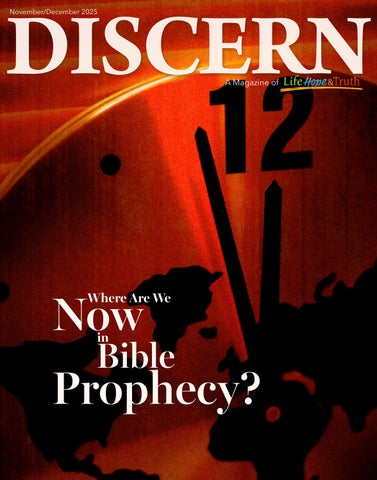
November/December 2025
A Magazine of
Now
Where Are We
in
Bible
Prophecy?
November/December 2025; Vol. 12, No. 6
A Magazine of
Discern magazine (ISSN 2372-1995 [print]; ISSN 2372-2010 [online]) is published every two months by the Church of God, a Worldwide Association, as a service to readers of its LifeHopeandTruth.com website. Discern’s home page is LifeHopeandTruth.com/Discern. Free electronic subscriptions can be obtained at LifeHopeandTruth.com/ Discern. Contact us at info@DiscernMag.com.
Postmaster: Send address changes to P.O. Box 3490, McKinney, TX 75070-8189 ©2025 Church of God, a Worldwide Association, Inc. All rights reserved.
Publisher: Church of God, a Worldwide Association, Inc., P.O. Box 3490, McKinney, TX 75070-8189; phone 972-521-7777; fax 972-521-7770; info@cogwa.org; LifeHopeandTruth.com; cogwa.org
Ministerial Board of Directors:
Articles 4 Where Are We Now in Bible Prophecy? 9 Is Christian Disobedience Ever Justified? 14 Choose Carefully: The Power of Faith-Filled Friendships 17 Standing in the Gap 20 Pray for the Peace of Jerusalem 24 Is God Calling You?
David Baker, Arnold Hampton, Mike Hanisko, Joel Meeker (chairman), Larry Salyer, Leon Walker and Lyle Welty
Staff: President: Jim Franks; Editor: Clyde Kilough; Editorial content manager: Mike Bennett; Managing editor: David Hicks; Senior editor: David Treybig; Graphic designer: Elena Salyer; Associate editors: Erik Jones, Jeremy Lallier; Assistant editor: Kendrick Diaz; Copy editor: Becky Bennett; Social media: Hailey Brock
Doctrinal reviewers:
The Church of God, a Worldwide Association, Inc. has congregations and ministers throughout the United States and many other countries. Visit cogwa.org/ congregations for information. Donations to support Discern magazine and LifeHopeandTruth.com can be made online at LifeHopeandTruth.com/donate or by surface mail to Church of God, a Worldwide Association, Inc., P.O. Box 731480, Dallas, TX 75373-1480. The Church of God, a Worldwide Association, Inc. is organized and operated as a tax-exempt organization in the United States according to the requirements of IRS 501(c)(3). Contributions are gratefully acknowledged by receipt. Unsolicited materials sent to Discern magazine will not be critiqued or returned. By submitting material, authors agree that their submissions become the property of the Church of God, a Worldwide Association, Inc. to use as it sees fit. All Scripture quotations, unless otherwise indicated, are taken from the New King James Version (© 1982 by Thomas Nelson, Inc.). Used by permission. All rights reserved. This publication is not to be sold. Free educational material.
2
DISCERN
28 Two Towels and a $10 Bill
Columns
3 Consider This The Stage Is Being Set
30 Q&A
Answers to Your Biblical Questions
31 Wonders of God’s Creation Meerkats’ Mob Mentality
Cover image supplied by he69 via Adobe Stock Image supplied by maramade via Adobe Stock
John Foster, Bruce Gore, Peter Hawkins, Don Henson, Doug Johnson, Chad Messerly, Larry Neff
32 Walk as He Walked Jesus Walks on Water
35 By the Way A Safe Place
November/December 2025
CONSIDER THIS
The Stage Is Being Set In 1992 my wife and I had the wonderful experience of seeing the Broadway stage production of Les Misérables in New York City. We were awed and inspired by the storyline, music and elite talent, and adding to the impact was the incredible staging that set each scene. As soon as the curtains were drawn to end each act, a flurry of activity unseen to the audience ensued backstage, with stagehands scrambling to arrange the props, scenery and lighting to ready the next act. This occurs in most stage productions, of course, but when you witness the highest level of professionalism, it’s truly amazing how the setting can so transform the backdrop for the next step in the story. More than 200 years ago this aspect of theatrical production gave rise to the expression, “the stage is being set.” We use that term to describe conditions that are setting up any kind of impending event. This turn of phrase can cover anything from wars to social changes to politics to storms to sporting matches.
Image supplied by Liudmila Chernetska via Getty Images
Today’s events and tomorrow’s prophecies
But today, the most important stage being set is for the last act in another “play”: the story of humanity governing itself. While many people have read the book, most remain blissfully unaware of how conditions are aligning to unfold on the world scene in what is described as “the end of the age” or “the last days.” That book, the Bible, is the story of God and man, past, present and future. A huge portion of God’s Word is prophecy, which, in essence, is history written in advance. And much of prophecy is yet unfulfilled . . . but the stage is being set! There are people, nations, political powers, social and moral changes, economic movements and religious forces that God is directing or allowing to happen behind the curtain. And when He determines the stage is set and it’s time to draw the curtains on that last act, nothing is going to stop the show! When we saw Les Misérables, I was basically
LifeHopeandTruth.com
unfamiliar with the plot, so I was watching the story unfold for the first time. But in God’s unfolding story we cannot afford to be oblivious to how events today are setting the stage for tomorrow’s prophecies. These prophecies will directly impact your life, and you need to see how the pieces are coming together! This issue’s lead article “Where Are We Now in Bible Prophecy?” will begin to give you insight into the major signs Jesus identified as the events leading up to His return.
The wise shall understand What is playing out today on the world stage is not fiction or entertainment. It’s real life, and you and I are not merely spectators watching from afar. We’re on the stage. The consequences affect our lives. God told Daniel, who recorded many landmark prophecies, that the words he had been given would be “closed up and sealed till the time of the end,” but eventually “the wise shall understand” (Daniel 12:9-10). They will understand that though they cannot control what is happening in the world, they can control how it affects them. Jesus warned of the time of the end coming on the world unexpectedly. Why? Because the unwise won’t see the stage being set, and “it will come as a snare on all those who dwell on the face of the whole earth. “Watch therefore, and pray always that you may be counted worthy to escape all these things that will come to pass, and to stand before the Son of Man” (Luke 21:35-36). Yes, the stage is being set. Be among the wise who understand! Clyde Kilough Editor
DISCERN
3
Now
Where Are We
in
Bible
Prophecy? Are we very near the end of this world—this age of human misrule? Is it possible to know? By Paul Luecke
4
DISCERN
November/December 2025
T
he Doomsday Clock is a symbol created by the Bulletin of the Atomic Scientists shortly after World War II to show how close humanity is to “midnight”—the end of the world. It is widely recognized as an indicator of how close mankind is to global catastrophe. Its initial setting was seven minutes before midnight. In January 2025 it was set at 89 seconds till midnight. Does the Bible indicate how close we are to “midnight,” as well as give hope about what will happen afterward? Yes, it does! Let’s look at those biblical indicators.
The Great Tribulation, the last 3½ years of this age
Christ’s disciples asked Him, “What will be the sign of Your coming, and of the end of the age?” (Matthew 24:3). Jesus answered by listing a series of events to unfold in the last days. The end-time prophecy in Matthew 24 is also found in Mark 13 and Luke 21. When we see the events Christ described coming to pass, we can know the end is near. Christ makes it clear we can—and should— have a good idea of our proximity to the end of this age. He said, “Now learn this parable from the fig tree: When its branch has already become tender and puts forth leaves, you know that summer is near. So you also, when you see all these things, know that it is near—at the doors!” (Matthew 24:32-33). At the same time, Jesus said we cannot pinpoint the exact timing of His return. “But of that day and hour no one knows, not even the angels in heaven, nor the Son, but only the Father” (Mark 13:32, emphasis added throughout). After revealing a sequence of major end-time signs, Christ said, “For then there will be great tribulation, such as has not been since the beginning of the world” (Matthew 24:21). This “great tribulation” is a major prophetic end-time event and is mentioned in many other prophecies throughout the Bible. In brief, they
LifeHopeandTruth.com
DISCERN
5
Time is short! But most people pay no attention to the Bible and assume that life as we know it will continue securely for many years.
reveal that the Great Tribulation will last 3½ years, culminating with the return of Jesus Christ. (To learn more about this time of great trouble, see the article “Great Tribulation.”) Since a number of specific events prophesied to occur during the Great Tribulation have not yet happened, we know we are not yet in that final 3½-year period.
• “Many shall run to and fro” (Daniel
•
What must happen before the Great Tribulation?
Our question then becomes, “How near are we to the start of the Great Tribulation?” To answer, we can look at a number of specific events and dynamics that are prophesied to be in place at the time of the end. These prophecies appear in numerous books in the Bible. Specifically, the time of the end is when all of the following prophesied circumstances will be in place. Looking at the list below, consider that these dynamics were not present throughout most of human history—or even the first half of the 20th century. But together, they give the picture of a world on the brink of the Great Tribulation. Reading through these identifiers, there now seem to be only a few details yet to materialize before the final 3½ years of this age commence.
6
DISCERN
•
•
12:4): This prophetic trend comes to mind whenever we’re on a crowded road or in a busy airport. There are now over a billion cars around the world, and millions of passengers fly rapidly through the skies every day. “Knowledge shall increase” (Daniel 12:4): The last few years have witnessed an explosion of knowledge, manifested in technologies such as artificial intelligence (AI), augmented reality (AR), selfdriving vehicles, wearable technology, cloud computing, 3D printing, quantum computing, instantaneous language translation, advanced robotics and many other jaw-dropping developments. The capability for humanity to destroy all life: “And unless those days were shortened, no flesh would be saved” (Matthew 24:22). The capacity for humans to destroy all life on the planet did not exist until after 1945, with the advent of the atomic era. Since then, the proliferation of nuclear weapons has made human annihilation possible— multiple times over. Increase in famines, disease epidemics and earthquakes: “And there will be famines, pestilences, and earthquakes in various places” (Matthew 24:7). Luke 21:11 calls them “great” earthquakes. There
November/December 2025
Image supplied by Johannes, A2Z AI, metamorworks, SKT Studio, deberarr via Adobe Stock Image supplied by Julio Ricco, Pixilated Planet, SeppFriedhuber via Getty Images
•
•
LifeHopeandTruth.com
have been food shortages, pandemics and earthquakes many times throughout human history. But Christ’s specific mention of them in the context of end-time events shows that they will become a much more notable, frequent phenomenon. Ability to view an event around the world: Revelation 11:3-11 reveals that shortly before Christ returns, His “two witnesses”—who will testify to the world from Jerusalem for 42 months (3½ years)— will be killed. “Then those from the peoples, tribes, tongues and nations will see their dead bodies three-and-a-half days” (verse 9). For people all around the world to view this, the technology will need to already exist. Not only is this now possible, most of us now see images from other nations daily via satellites and Internet networks. An army of 200 million can be fielded: Revelation 9:13-19 describes another event near the end of the 3½ years, during the sixth trumpet. Verse 16 shows that an enormous army will be fielded at that time: “The number of cavalry troops was 200,000,000. I heard how many there were” (International Standard Version). Furthermore, this comes after staggering numbers of humans have already died, as revealed in Revelation 6 through 9. The ability to field such an exceptionally large
•
army was not possible until recent times, when the populations of some nations (such as China and India, for example) or groups of nations grew so dramatically. Sacrifices at Jerusalem begin: Daniel 12 points specifically to events at the end of this age (verses 4, 9). Verse 1 calls it the worst time of trouble in human history, which coincides with Christ’s words in Matthew 24:21. How long until all these things are finished? Daniel 12:7 answers that it will be “ for a time, times and half a time.” This expression, also mentioned in other prophecies, equates with the final 3½ years (or 1,260 days) before Christ returns. Verse 11 gives even more details: “And from the time that the daily sacrifice is taken away, and the abomination of desolation is set up, there shall be one thousand two hundred and ninety [1,290] days.” In order for sacrifices to be taken away just before the final 3½ years, they will first need to be started again. At this time, a number of Jews are advocating and preparing for a restoration of the sacrificial system in Jerusalem. Thus far, those efforts have been stymied by both political and civil opposition. However, Bible prophecy makes it clear the day is coming when animal sacrifices will be instituted and then taken away. Read more in our blog post “Does Bible
DISCERN
7
Prophecy Require a Third Temple to Be Built?”
• Jerusalem surrounded by armies: “But
•
8
DISCERN
when you see Jerusalem surrounded by armies, then know that its desolation is near” (Luke 21:20). Verse 24 adds that Jerusalem will then come under gentile (non-Israelite) control. Matthew’s account adds the detail that the “abomination of desolation” (connected with the ending of sacrifices) will be part of this takeover of Jerusalem (Matthew 24:15). In Zechariah 12:3, which also refers to Jerusalem in the end times, God says, “And it shall happen in that day that I will make Jerusalem a very heavy stone for all peoples; all who would heave it away will surely be cut in pieces, though all nations of the earth are gathered against it.” If there’s any city on earth that’s in the news almost daily—as a focus of conflict, division, bloodshed and controversy—it’s Jerusalem. It is easy to see how military activity could quickly begin and escalate there at any time. For more about what the Bible reveals regarding Jerusalem, see our article “Jerusalem in Prophecy.” Final revival of the Roman Empire: Students of Bible prophecy know that God foretold the rise and fall of four great empires. The fourth was the Roman Empire, and the Bible shows that it would be revived again at the time of the end (Daniel 2:42-44). The end-time revival of the Roman Empire (which has always been centered in Europe) will be a union of 10 “kings” (or kingdoms or states) who agree to come under the authority of the “beast” spoken of in Revelation 17. “And the ten horns which you saw [in verse 3] are ten kings who have received no kingdom as yet, but they receive authority for one hour as kings with the beast. These are of one mind, and they will give their power and authority to the beast” (verses 12-13). These 10 “kings” will not be perfectly unified, but will cooperate to accomplish their mutual goals. This reality is pictured by the 10 toes of the image shown in Daniel 2:42-44. The 10 toes are referred to as “kings” that are together at the end
of this age, shortly before God sets up His Kingdom on earth. Today, multiple voices are encouraging Europe to stand on its own two feet and greatly increase its own military might. And eyes are now turning to Germany, expecting it to take on a greater leadership role. History and prophecy indicate Germany will have a leading role in this future European power.
What are we to do? Time is short! But most people pay no attention to the Bible and assume that life as we know it will continue securely for many years. Because of this, the Great Tribulation—which Christ said will be the worst time of trouble in man’s history—will catch many completely off guard. “For as in the days before the flood, they were eating and drinking, marrying and giving in marriage, until the day that Noah entered the ark, and did not know until the flood came and took them all away, so also will the coming of the Son of Man be” (Matthew 24:38-39). Therefore what does Jesus Christ tell us—His disciples—to do? “But take heed to yourselves, lest your hearts be weighed down with carousing, drunkenness, and cares of this life, and that Day come on you unexpectedly. For it will come as a snare on all those who dwell on the face of the whole earth. Watch therefore, and pray always that you may be counted worthy to escape all these things that will come to pass, and to stand before the Son of Man” (Luke 21:34-36). “All these things” constitute a great, terrible storm coming upon mankind. By staying spiritually strong and alert to the signs of the times, you can be protected during the coming prophesied storm. The good news is that following the storm, Christ will return to establish God’s Kingdom—a time of unprecedented tranquility and utopian conditions. This article focused on the storm. In order to be part of the calm after the storm, learn more about what we should be doing now in our free booklet The Book of Revelation: The Storm Before the Calm. See also our booklets How to Understand Prophecy, The Middle East in Prophecy and The World to Come: What It Will Be Like. D
November/December 2025
Is Christian Disobedience Ever
Justified? Christians shouldn’t go looking for conflicts with the government, but sometimes they find us. How should we navigate those situations?
Image supplied by Taiwo via Adobe Stock
By Kendrick Diaz
LifeHopeandTruth.com
DISCERN
9
T
he time frame was about 2,000 years ago. Judea was coming alive with movement and expectation. The longawaited Messiah was now being boldly proclaimed as Jesus—the One who was crucified for the sins of humanity, who died, yet was raised to life. The vehicles for that message were His apostles, who were in the midst of launching a movement that would, in time, turn the world upside down. But now, those same apostles stood in the custody of the religious leaders, arrested for spreading teachings that went against the grain. These leaders had real power. Some were members of the Sanhedrin, the highest governing council in Judaism. And with the full weight of their authority, they commanded the apostles “not to speak at all nor teach in the name of Jesus” (Acts 4:18). It was an attempt to shut down the movement before it really
10
DISCERN
got off the ground—and the religious leaders had no problem using their authority as a cudgel to make it happen. But what the apostles replied serves as a lesson for us: “Whether it is right in the sight of God to listen to you more than to God, you judge. For we cannot but speak the things which we have seen and heard” (verses 19-20).
A higher authority
Romans 13:1 is often the go-to passage when we talk about how Christians should relate to the government: “Everyone must submit to governing authorities. For all authority comes from God, and those in positions of authority have been placed there by God” (New Living Translation). In other words, we have a scriptural obligation to yield to the laws of the land. Or, as Jesus famously put it, we must render “to Caesar the things that are Caesar’s” (Matthew 22:21). Assuming that Christians should always be in conflict with human
authorities is a mistake—and it can land us in trouble with both man and God. As Paul went on to warn, “So anyone who rebels against authority is rebelling against what God has instituted, and they will be punished” (Romans 13:2, NLT). That said, there’s an important exception. Sometimes the government misuses its authority and mandates ungodly things. Sometimes Caesar commands what God forbids, and forbids what God commands. And sometimes the ruling council tells the apostles not to preach Jesus, a complete contradiction of His direct command (Mark 16:15). In moments like that, defying the government isn’t just a suggestion—it’s a moral obligation. The apostles understood this. Standing before the Sanhedrin the second time, they declared: “We ought to obey God rather than men” (Acts 5:29).
November/December 2025
1. Whenever
Images supplied by David Hicks
Putting God’s law first
The less-talked-about question when a government oversteps its boundaries isn’t what we should do, but how we should do it. God is clear that obedience to His laws should be our highest priority, regardless of what any government says. But the way we obey God during those times can look very different depending on our circumstances. Not every conflict between God and government calls for staring down the bad guys— and no conflict calls for a fullblown fight. The book of Daniel shows us there’s more than one way to respond in those moments, and each one honors the spirit of Acts 5:29.
LifeHopeandTruth.com
possible, work within the system When Daniel and his three friends—Shadrach, Meshach and Abed-Nego— were carted off to Babylon, they were given a special opportunity: a direct track to becoming members of Nebuchadnezzar’s royal court. But there was a snag in the road. “The king appointed for them a daily provision of the king’s delicacies and of the wine which he drank” (Daniel 1:5). God has given laws on what His people should and shouldn’t eat, and apparently some of the king’s delicacies—whatever they were— weren’t on the list of what they could eat. So the four friends found themselves at a fork in the road: do what man says or obey God. They didn’t hesitate. “Daniel purposed in his heart that he would not defile himself ” (verse 8). It was faith in action. It was the kind of resolve that pushes past fear, endless what-ifs, and says, “No matter what, I will obey God.” But here’s the part we sometimes don’t appreciate as much: Daniel handled the situation with tact.
He was humble— he made his way to the steward and made a simple appeal: “Please test your servants for ten days, and let them give us vegetables to eat and water to drink. Then let our appearance be examined before you” (verses 12-13). Vegetables and water. It was a middle ground— one that had a chance of satisfying Nebuchadnezzar, but more importantly, stayed true to God’s law. Put a different way, Daniel found a way to work within the system. No rebellion, no protest or storming out of the academy in an act of righteous defiance. He petitioned the one in charge for an exemption and then left the rest in God’s hands. And it worked: “At the end of ten days their features appeared better and fatter in flesh than all the young men who ate the portion of the king’s delicacies. Thus the steward took away their portion of
DISCERN
11
delicacies and the wine that they were to drink, and gave them vegetables” (verses 15-16). Two things can be true at once: you can be immovable on principle and eager to find an appropriate compromise if there is one. Brainstorming solutions that make God’s laws our top priority but don’t needlessly clash with the authorities should be our first recourse. Daniel and his friends weren’t going to budge. They were dead set on obeying God, but they wanted to do it without a fight. They wanted peace, if possible. 2. Quiet disobedience One of Darius’ first orders of business after Persia took control of Babylon was to organize the government. He appointed 120 leaders over the regions, and over them, three governors to oversee everything. Daniel was one of those governors (Daniel 6:1-2). Daniel was so exceptional in his role that Darius wanted to promote him even further—to make him administrator “over the whole realm” (verse 3). Politically, this
12
DISCERN
was bad news for the other leaders, who were jealous and desperate for recognition. So they started digging for dirt on Daniel— searching for anything that might discredit him or sabotage his future. There was only one problem: Daniel’s life was squeaky clean. Up against a wall, they switched their tactics. Their new plan was to leverage Daniel’s own righteousness against him. “So these governors and satraps thronged before the king, and said thus to him: ‘King Darius, live forever! All the governors of the kingdom, the administrators and satraps, the counselors and advisors, have consulted together to establish a royal statute and to make a firm decree, that whoever petitions any god or man for thirty days, except you, O king, shall be cast into the den of lions’” (verses 6-7). It was a clever move. They knew Daniel’s character. They knew if he were forced to pick between obedience to God or the government, he would obey God every time—even if it meant being
torn apart by lions. And just as he had done in his prior run-in with the government, Daniel didn’t flinch: “When Daniel knew that the writing was signed, he went home. And in his upper room, with his windows open toward Jerusalem, he knelt down on his knees three times that day, and prayed and gave thanks before his God, as was his custom since early days” (verse 10). Negotiation was out of the question for this one. The decree couldn’t be changed. But Daniel’s example reminds us there’s another way forward when the system can’t be reasoned with: quiet disobedience. He didn’t make a public spectacle out of his disagreement. He simply went to his house and kept right on with his daily practice of praying to God. It was
November/December 2025
disobedience, but it wasn’t overt. 3. Open disobedience Finally, when man’s demands clash with God’s commands, sometimes the only thing left to do is look the opposition straight in the eye and say, “No.” During his reign, Nebuchadnezzar erected a colossal image of gold and summoned officials from across the empire to attend its dedication— including Shadrach, Meshach and Abed-Nego. Then came the famous decree: when the music played, everyone was to “fall down and worship the gold image.” Whoever refused would be “cast immediately into the midst of a burning fiery furnace” (Daniel 3:5-6). For most of the crowd, this wasn’t an issue. They already worshipped a pantheon of gods—what was one more? But for Daniel’s friends, this was a life-or-death trial. There was no way to ask for an exemption, no way to go home and quietly disobey. This was the kind of edict you either obeyed or openly defied. When the music swelled and the crowd dropped to the ground in unison, Daniel’s friends were the only ones standing. It was impossible to miss—a sea of folded bodies, foreheads pressed to the ground, and three men upright. A simple but unwavering “No.” Nebuchadnezzar flew into a rage when word reached him about these three Jews. The men were dragged before him, but they were firm: “Our God whom we serve is able
LifeHopeandTruth.com
to deliver us from the burning fiery furnace, and He will deliver us from your hand, O king. But if not, let it be known to you, O king, that we do not serve your gods, nor will we worship the gold image which you have set up” (verses 17-18). And God did deliver them. The furnace blazed so hot that the men who threw them in were killed by the flames. But Shadrach, Meshach and Abed-Nego walked in and out of the fire unscathed—completely whole and without a hint of smoke on their clothes. Based on the three friends’ earlier history, it’s safe to say open disobedience wouldn’t have been their first option—but in fact, it was their only option. And when the moment came, they met it courageously. They refused to compromise their relationship with God—even when it meant standing out in a crowd, even when it meant making their disagreement awkward and public and even when it meant inviting their own execution. They said “No”—and they were unapologetic about it.
Forewarned is forearmed
If we ever needed proof that our world is under the influence of Satan the devil, all we need to do is look at the fact that faithful Christians down through history have suffered brutally at the hands of the state for their loyalty to God. The Bible calls
this behind-the-scenes demon-king the “prince of the power of the air” (Ephesians 2:2), “a murderer from the beginning” (John 8:44) and the one who makes wars against the saints (Revelation 12:17). And he’s not done yet. For now most of us can continue to enjoy and pray for a peaceful environment for worshipping and obeying God (1 Timothy 2:1-2). But Revelation 13 shows us a future time when government overreach won’t just be a regional or local problem. It will be worldwide. It will be a system demanding absolute loyalty from every person on the face of the earth—and whoever refuses to bow the knee will be killed (verse 15). Until that time—which will no doubt call for open disobedience—the skirmishes most Christians have with their governments are small by comparison. But smaller doesn’t mean they don’t exist—or that they aren’t real concerns to wrestle with. When we’re forced to choose between obedience to God and obedience to the government, we’re not locked into a single track. Sometimes we can find middle ground. Sometimes we can disobey without drawing attention to ourselves. Sometimes we must take a public stand. In every case, the goal is the same: put God first. Study the Bible’s approach further in our online article “Citizens of Heaven Under Governments of Men— Three Principles to Live By.” D
DISCERN
13
Friendship is a gift— but are your closest relationships helping you grow in faith? Faith-filled friends can help us build lasting spiritual strength.
U
nder the shadow of a foreboding golden image, three friends stood before the king, faced with a terrifying question: “Is it true Shadrach, Meshach, and AbedNego, that you do not serve my gods or worship the gold image which I have set up?” (Daniel 3:14). It was a matter of life and death. But in their collective faith, they had the courage to say, “Our God whom we serve is able to deliver us from the burning fiery furnace, and He will deliver us from your hand, O king” (verse 17).
Friends in the fire Shadrach, Meshach and Abed-Nego faced the ultimate test of faith—and we know how the story ends. Though they were willing to give their lives, God delivered them from the fiery furnace, proving His power to the king and all of Babylon. But God did something else for Shadrach, Meshach and Abed-Nego long before He delivered them from the flames of the furnace. As the three young men prepared
14
DISCERN
Choose Carefully The Power of Faith-Filled Friendships By Monica Ebersole
to face this trial, and other trials that preceded it, God granted them a very powerful gift— companions who shared their faith. While forced to live in a foreign land among people whose beliefs were in direct opposition to their own, they had each other. And while each of these young men demonstrated faith individually, they each undoubtedly benefitted from the others’ resolve to remain committed to God, even in such daunting circumstances. These young friends and the faith they demonstrated are a testament to the powerful truth revealed in Ecclesiastes 4:9-12: “Two are better than one . . . For if they fall, one will lift up his companion . . . Though one may be overpowered by another, two can withstand him. And a threefold cord is not quickly broken.” As the crowd bowed before the golden image, Shadrach, Meshach and AbedNego stood side by side. Strengthened by each other, they held their faith firm. Their threefold cord was not broken.
November/December 2025
David and Jonathan: a friendship rooted in faith When it comes to deep, meaningful relationships, few compare to the friendship between David and Jonathan. We’re told “Jonathan loved him as his own soul” (1 Samuel 18:1). Yet Jonathan had every reason to dislike David. David’s successes made Jonathan’s father, Saul, look on him as an enemy and a threat to Jonathan’s future (1 Samuel 20:31). But Jonathan didn’t let these things consume him as Saul did. Jonathan had faith in God, and this faith allowed him to see what his father could not. In the midst of a challenging situation that could have pulled them apart, David and Jonathan’s friendship flourished. Not only did Jonathan remain loyal to David— even while his father Saul was persecuting David—he also used his faith to encourage David during this long and disheartening trial. “So David saw that Saul had come out to seek his life . . . Then Jonathan, Saul’s son, arose and went to David in the woods and strengthened his hand in God. And he said to him, ‘Do not fear, for the hand of Saul my father shall not find you. You shall be king over Israel, and I shall be next to you’” (1 Samuel 23:15-17, emphasis added). Jonathan was a wonderful friend to David. But it wasn’t just his loyalty that made him such a valuable companion. Jonathan truly believed that God had big plans in store for David and would deliver him from Saul. Jonathan’s faith enabled him to support David in a profound way. He didn’t just offer comfort through kind words—he strengthened David with the truth of God. For David, this friendship wasn’t merely a comfort—it was a lifeline. The impact of Jonathan’s faith stayed with David for the rest of his life, and he honored Jonathan by caring for his son.
Image supplied by DragonImages via Getty Images
Spiritual compatibility: a vital ingredient in the most meaningful friendships
There’s no question that these friendships—and the many others found throughout Scripture— deeply impacted the lives of those involved. But why were
LifeHopeandTruth.com
DISCERN
15
they recorded for us? What can we glean from these relationships as we seek to build our own friendships? There are many important qualities to look for in a potential friend. Loyalty, trustworthiness, dependability, supportiveness, sense of humor and shared interests are just a few of the many traits we subconsciously search for when getting to know others. But how often do we stop to consider spiritual compatibility? As we face trials and hardships, can we look around and find friends who not only encourage us in our walk with Christ, but are also pursuing Christ with their whole heart? We recognize the importance of faithful friends. But what about faith-filled friends—friends who will be faithful to God no matter what?
Biblical examples challenge us to reflect on our own lives
Shadrach, Meshach and Abed-Nego and David and Jonathan shared something profound: a friendship grounded in mutual faith. While there were many factors that contributed to the strength of these relationships, it was ultimately their shared trust in God that laid the foundation of their deep bond. What about us? Do we have friends whose example we can lean on and learn from? If we find that we are lacking this type of faith-filled friendship, how do we foster these relationships?
Building friendships founded on mutual faith
Ask for God’s help: One of our Creator’s many admirable traits is His willingness to help us in every aspect of our lives. While asking for help in finding likeminded believers may seem too small a favor to ask, it is not. God cares about the type of influences we have in our lives, and He will guide us toward people who love His Word and desire to obey His law just as much as we do, if we ask. Exercise your power to choose: Proverbs 12:26 offers a vital piece of wisdom: “The righteous should choose his friends carefully.” It’s easy to settle for convenient friendships with others at school or work. But that may leave us without the deep, faith-centered connections we truly need. Be intentional. We don’t have to settle for relationships that slow—or worse, hinder—our spiritual
16
DISCERN
growth. The Christian walk is a lifelong journey, and we need the right companions along the way. This may mean stepping outside of our normal social circles, but the reward will be well worth the effort. Look for mentors: We may not always think to view friendship through the lens of mentorship, but there’s tremendous value in choosing friends whose spiritual character we admire and aspire to emulate. Just as the right mentors can help us grow in specific areas of life, friends who serve as spiritual mentors can help us refine our character and deepen our faith. The relationship between Paul and Timothy is a powerful example of spiritual mentorship in action. The books of 1 and 2 Timothy offer a meaningful glimpse into a friendship marked by growth, guidance and deep mutual affection. Don’t lose heart: While some friendships may last a lifetime, many people come into our lives only for a season. Relationships can ebb and flow, and it’s normal to feel alone during difficult or uncertain circumstances. The prophet Elijah felt the same way. Even after witnessing God defeat the prophets of Baal, Elijah battled feelings of isolation, fearing he was the only faithful person left: “I alone am left; and they seek to take my life” (1 Kings 19:10). But God reassured him that he was not alone (verse 18). Feeling alone doesn’t mean we actually are. In time, God will bring us back into fellowship with friends who share our beliefs and whose example we can look to for strength. Be the faith-filled friend you’d like to have: Seeking to establish meaningful, faith-filled friendships without first being a faith-filled friend simply doesn’t work. We must ensure that our own faith and conduct reflect the same standards we hope to find in others. When we let our light shine, we can help bolster others’ faith, just as they help bolster ours.
As iron sharpens iron God calls each of us to walk by faith. We can’t rely on someone else’s faith to carry us through. Yet, as Shadrach, Meshach and Abed-Nego so powerfully demonstrated, having friends who share our beliefs and commitment to God is one of the greatest gifts He gives us. Like David and Jonathan, when faithful people choose each other in friendship, the spiritual impact is mutual and lasting. As iron sharpens iron, let us seek friendships that strengthen our faith as we strive to do the same for others (Proverbs 27:17). Study this subject further in our online article “Six Characteristics of Biblical Friendship.” D
November/December 2025
Standing
Gap
Images supplied by Dmitriy Sechin via Adobe Stock
A passage in the prophetic book of Ezekiel tells us that God sought someone who would stand in the gap. Why? And what does this mean for us today?
the
in
B
ecause of its people’s sins, the destruction of Jerusalem was imminent. In faraway Babylon, some Jewish exiles came to the prophet Ezekiel to ask about the destiny of their nation (Ezekiel 20:1). In God’s response, spanning four chapters (20-23), He declared that He had searched among His people for someone who would “make a wall, and stand in the gap” (Ezekiel 22:30). Because He had found no such person, He would allow the Babylonians to destroy Judah and Jerusalem. What did God seek? What does standing in the gap mean?
Standing in the gap as a metaphor By Bill Palmer
LifeHopeandTruth.com
Ezekiel’s initial audience would have understood this expression immediately.
These words were a metaphor drawing on military imagery. In the ancient world, unwalled cities and villages were vulnerable to attack, but a walled city was a secure one. At times, however, portions of walls collapsed, either due to military conflicts or to natural aging. Any breach in the walls needed to be repaired, but while that was happening, soldiers had to be positioned at all these weak spots to make the city secure. For the people of that time, standing in the gap meant defending the city.
A literal fulfillment
More than a century after Jerusalem and its walls were destroyed by the Babylonians, Nehemiah spearheaded the effort to rebuild the city and its walls. He began this task with the authority granted him by Artaxerxes, the Persian king (Nehemiah 2:1-6).
DISCERN
17
Sanballat, a local official, opposed Nehemiah’s efforts to rebuild the city (Nehemiah 4:1). The biblical account does not specify Sanballat’s reason, but it may have been that he had hoped to govern the province of Judea himself and saw Nehemiah as an obstacle to be removed. Nehemiah, however, became aware of the plot of Sanballat and his allies to “attack Jerusalem and create confusion” (verses 7-8). It is this moment that provides us with a real-life biblical example of standing in the gap. Under the direction of Nehemiah, the returned exiles continued building the wall, but also took up guard positions wherever there were openings (verse 16). Half of the workers “loaded themselves so that with one hand they worked at construction, and with the other held a weapon” (verse 17). The other half stood guard “from daybreak until the stars appeared” (verse 21), which would have been unusually late, highlighting the zeal of the people. All of them were literally standing in the gap. There are other examples of standing in the gap as well.
Moses interceding for Israel
Psalm 106 describes Moses as someone who “stood before [God] in the breach” (verse 23). Standing in the breach has the same meaning as standing in the gap. In the incident described by the psalmist, Moses was reacting to God’s decision to destroy Israel for creating and worshipping a golden calf (verses 19-23). Exodus provides more detail regarding this incident. That account shows Moses pleading with God, pointing out that destroying Israel would lead the Egyptians to believe that God had “brought [Israel] out to harm them, to kill them in the mountains, and to consume them from the face of the earth” (Exodus 32:12). Moses could have become the father of a new nation (verse 10), but he was more concerned about God’s honor than his own status. As a result of the bold action of Moses, “the Lord
18
DISCERN
relented from the harm which He said He would do to His people” (verse 14). Moses had stood in the breach, saving his nation.
Phinehas standing in the gap
Another example of an individual taking action to save the nation is Phinehas, whose story is also a part of Psalm 106. The psalmist wrote that “Phinehas stood up and intervened, and the plague was stopped” (Psalm 106:30). This plague was the result of the gross immorality and idolatry of Israel. The people had “joined themselves also to Baal of Peor” (verse 28), a god worshipped through “harlotry with the women of Moab” (Numbers 25:1) and their allies, the Midianites. Phinehas intervened after he saw an Israelite man brazenly bringing a Midianite woman into the camp of Israel, presenting her to the people (verse 6). Phinehas followed the pair into the tent, plunging his javelin into both, executing them for their blatantly sinful acts. Phinehas’ zeal resulted in the plague being stopped (verses 7-8). Moses had interceded with God in conversation, whereas Phinehas took bold action to begin ridding the nation of those who would compromise with God’s law. What links these two brave men is their concern for God’s honor and His will.
Other biblical heroes standing in the gap
Scripture is filled with examples of men and women “standing in the gap,” though not generally describing them with these words. Here is a short list of some of these biblical heroes: • Abraham interceded for Sodom (Genesis 18:16-33). Concern for his nephew Lot, who lived among the Sodomites, was a factor, but it seems Abraham’s concern was also for God’s reputation. This is seen in his question, “Would You also destroy the righteous with the wicked?” (verse 23) and his follow-up statement, “Far be it from You to do such a thing as this” (verse 25).
November/December 2025
• Aaron intervened for the people of Israel
after they had complained about his and Moses’ leadership (Numbers 16:41-50). Aaron did so by standing in the midst of the people as a plague from God engulfed them. Censer in hand, Aaron ran into the midst of the people and made atonement for them. He literally “stood between the dead and the living,” stopping the plague (verse 48).
Why nations and empires fall
The history of the world is replete with stories of nations and empires rising and falling. Will and Ariel Durant, a well-known husband-andwife team of historians, addressed this issue in The Lessons of History. In their work, they attribute the decline of civilizations to the decline of morality. The lack of moral constraints is deadly, not just to individuals, but to nations. Cut off from such guidance, according to the Durants, “an unmoored generation surrenders itself to luxury, corruption, and a restless disorder of family and morals, in all but a remnant clinging desperately to old restraints and ways” (1968, p. 93). In the final days of Judah, God found no one standing in the gap. Scripture tells us that humans have a great deal to do with the downfall of nations. Ultimately, though, it is God who “makes nations great, and destroys them; He enlarges nations, and guides them” (Job 12:23).
It takes brave men and women to stand . . . • David faced Goliath, a giant from Gath (1
Samuel 17:23). David knew that killing this enormous man would bring him personal honor, but what really motivated him was the desire to remove “the reproach from Israel,” resulting from an uncircumcised Philistine standing before them to “defy the armies of the living God” (verse 26).
No one to stand in the gap
In the waning days of the kingdom of Judah, God sought righteous people among a population that had been in spiritual decline for years. They had consistently set aside His laws, and they had worshipped idols instead of the true God. Sadly, when the Jewish elders already in captivity asked Ezekiel to “inquire of the Lord” (Ezekiel 20:1) about their nation, God’s forthright response shattered their hopes for a restored kingdom. God proclaimed, “But I found no one” among them to stand in the gap (Ezekiel 22:30). God had looked for people who would work to rebuild the moral fabric of society and people who would bravely stand up for what is right. He had searched Jerusalem for “anyone who executes judgment, who seeks the truth” (Jeremiah 5:1), but He did not find what He was looking for.
LifeHopeandTruth.com
What this means for today’s Christian
Today, Western nations especially have witnessed a shocking decline in morality during the past few decades. Behaviors that shocked and disgusted most people not that long ago are now embraced in the name of tolerance. God expects Christians to resist social pressures to be more accepting of these behaviors. He expects us to live our lives in such a way that we glorify God, which will lead others to glorify Him when Christ returns (1 Peter 2:12). Like Moses, we can intercede with God through prayer. Like so many of God’s people, we can act boldly but always in accordance with God’s will. It takes brave men and women to stand against the tide of immorality, deceit and wickedness. Will you be among God’s people standing in the gap? D
DISCERN
19
Pray for th Peace of Jerusalem Images supplied by rrodrickbeiler via Getty Images
The city of peace has suffered an astonishing lack of peace. When will our longing prayers be fulfilled? By Jason Hyde
20
DISCERN
November/December 2025
he
m
E
ighteen years ago, my wife and I had the opportunity to visit Jordan and Israel. As a lover of history and student of the Bible, the prospect of visiting lands steeped in biblical and historical lore was exhilarating. In particular, I was thrilled by the prospect of visiting Jerusalem. This “city of peace,” as it’s often called, features in many biblical stories, as well as centuries of rich, vibrant events. Sadly, Jerusalem has often been marred by violence and conflict. Viewing the Temple Mount from a vantage point on the Mount of Olives—its own slopes crowded with thousands of graves—was profoundly moving. The sight of the gleaming Dome of the Rock and the prominent Al-Aqsa Mosque evoked the passions, ambitions and failures of centuries of human experience. Countless stories of individuals and generational legacies are bound up in that view.
LifeHopeandTruth.com
We wandered the labyrinth of narrow streets in the Old City crowded with vendors and bustling with people, inhaling the panoply of sights, sounds and scents. We could sense the weight of history. Beneath it all was a simmering tension. This tension echoes through history and radiates across much of the modern world. It is layered with discordant perspectives on religion, politics, ethnic and family allegiances, and religious and secular ideologies and practices.
A city of contradictions Jerusalem is a city of contradictions. A city of peace. A city of strife and war. An ancient, timeworn bit of real estate tenuously perched atop fractured ethnic passions, divergent religious zeal and diplomatic land mines. Is it any wonder a psalm attributed to King David urges believers to “pray for the peace of Jerusalem”
DISCERN
21
Real peace will require learning truth and living according to God’s righteous laws.
(Psalm 122:6)? Yet centuries of experience reveal that peace for Jerusalem has proven to be elusive. Is this prayer a pointless endeavor? Will this city, so mired by division and violence, ever experience real, lasting peace? Let’s consider what the Bible says.
A chosen city The Bible reveals that Jerusalem was chosen by God to be a beacon of hope and a city where peace, stability and righteousness could flourish. God declared, “I have chosen Jerusalem, that My name may be there” (2 Chronicles 6:6). Later, God affirmed Jerusalem as “the city which I have chosen for Myself, to put My name there” (1 Kings 11:36). King David established Jerusalem as the administrative headquarters of Israel (2 Samuel 5:6-9; 1 Chronicles 11:1-9). He relocated the Ark of the Covenant to the city, making Jerusalem the religious capital for the Israelites (2 Samuel 6:12-17; 1 Chronicles 15-16). His son Solomon built the magnificent temple in Jerusalem (1 Kings 5-6). This temple was the focal point of Israel’s connection with God and religious worship. Jerusalem experienced a brief period of peace and stability under David and Solomon. Sadly, Solomon did not remain faithful to God. His descendants, with rare exception, led the nation against God. As they rebelled, the short-lived peace evaporated.
A city in conflict Peace for Jerusalem has been frustratingly difficult to
22
DISCERN
achieve. At the crossroads of empires and as a central square in multiple religious traditions, Jerusalem has been besieged, occupied, overthrown, destroyed and rebuilt over and over again. In 586 B.C., the Babylonians conquered Jerusalem, destroyed the temple and relocated most of the Jewish inhabitants. Later, Cyrus the Great permitted Jews to return and build the Second Temple. Yet peace remained elusive. Alexander the Great overran Jerusalem. After the division of Alexander’s empire, the Seleucids (based north of Jerusalem in Syria) and the Ptolemies (based in Egypt) wrestled for domination of this special city. Eventually, Rome exerted control, initially through subordinate kings and rulers. But even Rome could not bring lasting peace. Jewish resistance led to brutal warfare. Jerusalem and its temple were razed to the ground. Josephus, a first-century Jewish historian, described the destruction: “The rest of the wall, it was so thoroughly laid even with the ground by those that dug it up to the foundation, that there was left nothing to make those that came thither believe it had ever been inhabited. This was the end which Jerusalem came to” (The Jewish War, Book 7, chap. 1, sec. 1, translated by William Whiston). After being rebuilt as a Roman city, Jerusalem was dominated by the Byzantine Empire, multiple Muslim dynasties and Crusaders before it was captured by the Ottoman Empire in 1517. The Ottomans controlled Jerusalem until the British captured the city in 1917.
November/December 2025
After the 1948 Arab-Israeli War, Jordanian and Israeli forces divided control of Jerusalem. In the Six-Day War of 1967, Israel established control over all of Jerusalem. But peace remains fleeting. Conflict, skirmishes, terrorist attacks, aggression and hostility are a regular feature of life in Jerusalem.
A search for peace Despite Jerusalem’s strife-ridden history and discouraging present-day conditions, David’s encouragement remains: “Pray for the peace of Jerusalem” (Psalm 122:6). Psalm 122 is a beautiful, hopeful song. It is categorized as “a Song of Ascents.” James Boice’s An Expositional Commentary: Psalms explains, “These fifteen psalms (Psalms 120-34) seem to have been used by pilgrims who were making their way to Jerusalem for the three major annual feasts. Joseph and Mary would have sung these psalms as they made their way to the city with the young Jesus (see Luke 2:41), and Jesus would have sung them himself when he went up to Jerusalem with his disciples” (Vol. 3, p. 1070). Pray for the peace of Jerusalem. This is a call of hope for this scarred city. Unfortunately, even this instruction has been wielded as a cudgel. Groups on all sides of the complex and brittle issues involving Jerusalem openly call for peace. But peace on their terms often means more war, division and violence. Isaiah observed, “The way of peace they have not known, and there is no justice in their ways; they have made themselves crooked paths; whoever takes that way shall not know peace” (Isaiah 59:8). The human family does not know the way to peace. Since the Garden of Eden, humans have chosen a lifestyle of sin. Isaiah commented, “Your iniquities have separated you from your God; and your sins have hidden His face from you, so that He will not hear” (verse 2). One result, as Isaiah noted, is that humans “shall not know peace.” Our separation from God must be healed before peace can be established—both in Jerusalem and around the world. Review our article “Sin Separates Us From God” for more information. The peace we long for is not coming in this age, when God’s instructions are largely dismissed and ignored. In fact, Jerusalem will be a focal point of end-time conflict (Zechariah 12:1-3; see “Middle East Conflict”).
LifeHopeandTruth.com
Peace is coming
Yet hope remains for Jerusalem. Peace is coming. Real peace. Lasting peace. Peace for all. Jesus Christ will return to a broken, corrupt, largely destroyed world. Read The Middle East in Prophecy for more details of prophesied events that will culminate with Jesus’ return. Jesus’ return as King of Kings and Lord of Lords (Revelation 19:11-16) will be a seismic event in the quest for peace. Zechariah describes this incredible future. Jesus will “stand on the Mount of Olives” and establish Jerusalem as the capital of His Kingdom on earth (Zechariah 14:14, 8). Jesus “shall be King over all the earth” (verse 9). Real peace is coming. Zechariah declares, “Jerusalem shall be safely inhabited” (verse 11). The tension and conflict will be erased and replaced with peace for all peoples, nations, tribes and families. God says, “I will return to Zion, and dwell in the midst of Jerusalem. Jerusalem shall be called the City of Truth” (Zechariah 8:3). God has great plans for Jerusalem. “Old men and old women shall again sit in the streets of Jerusalem . . . The streets of the city shall be full of boys and girls playing in its streets” (verses 4-5). Jesus will rule, and people will “dwell in the midst of Jerusalem. They shall be [His] people and [He] will be their God, in truth and righteousness” (verse 8). Real peace will require learning truth and living according to God’s righteous laws. This peace—and the way of living that builds it— will spread to all the world. “Yes, many peoples and strong nations shall come to seek the Lord of hosts in Jerusalem, and to pray before the Lord” (verse 22). Find out more about Jesus’ plans to bring peace in The World to Come: What It Will Be Like.
Pray for the peace of Jerusalem
Real, lasting peace will come when Jesus returns and establishes the Kingdom of God on earth. Like David, we should “pray for the peace of Jerusalem.” Jesus’ model prayer affirms this. “In this manner, therefore, pray: Our Father in heaven, hallowed be Your name. Your kingdom come” (Matthew 6:10). Praying for the Kingdom to come is praying for the peace of Jerusalem. Only then will Jerusalem, and the world, experience lasting peace. God speed that day! D
DISCERN
23
Is God Calling You? 24
DISCERN
November/December 2025
“The gifts and the calling of God are irrevocable” (Romans 11:29). But what is God’s calling, and how can you recognize it in your own life? By Jeremy Lallier
O
ne of the fundamental principles of Christianity is that no one becomes a Christian of his or her own volition. For a religion built around the instruction to “go therefore and make disciples of all the nations” (Matthew 28:19), that condition might seem a bit limiting—but Jesus was emphatic: “No one can come to Me unless the Father who sent Me draws him” (John 6:44). No one includes you and me. Oh, we can call ourselves Christians and go to a Christian church without God’s involvement, but the actual motivation to follow in the footsteps of Jesus Christ doesn’t start with us. And that distinction matters, because just looking Christian isn’t enough in the end. Jesus was emphatic on that point too: “Not everyone who says to Me, ‘Lord, Lord,’ shall enter the kingdom of heaven, but he
who does the will of My Father in heaven. Many will say to Me in that day, ‘Lord, Lord, have we not prophesied
LifeHopeandTruth.com
in Your name, cast out demons in Your name, and done many wonders in Your name?’ And then I will declare to them, ‘I never knew you; depart from Me, you who practice lawlessness!’” (Matthew 7:21-23). Many will say that to Christ. Not a few. Many. They’ll have done some impressive, Christian-looking things. They’ll have checked a lot of the boxes. But Jesus will call them out for “practicing lawlessness”—living a life that habitually disregards God’s standards and instructions. “Many are called,” Jesus told the crowds who followed Him, “but few are chosen” (Matthew 22:14).
What is a calling, exactly?
In Christianity, “called” and “calling” can take on an almost mystical aura: words laden with deep meaning but never clearly defined. But maybe you’re reading this article because you’ve found
yourself wondering, “Is God calling me?”
DISCERN
25
He lights the spark, but we still need to feed the fire. He draws, but we still need to step forward. He calls, but we still need to answer.
And if that’s the question on your mind, enigmatic jargon and fuzzy definitions aren’t much help. Paul’s writings remind Christians to “walk worthy of the calling with which you were called” (Ephesians 4:1), remembering that God “called us with a holy calling” (2 Timothy 1:9). It sounds important. It is important. But what does it mean? In a world where many are called and few are chosen—and where the seemingly straightforward act of coming to Jesus is a process that can be initiated only by God Himself—and where, ultimately, Jesus will openly disavow any connection with those who claim to be His followers but disregard God’s commandments—there’s a need for clarity when it comes to talking about a calling. In biblical Greek, to call someone is “to urgently invite someone to accept responsibilities for a particular task, implying a new relationship to the one who does the calling” (Louw and Nida Greek-English Lexicon, 33.312). The calling itself is an “invitation
26
DISCERN
to experience of special privilege and responsibility” (Bauer, Danker, Arndt and Gingrich, A Greek-English Lexicon of the New Testament, “klēsis”). When God calls us, He invites us to enter into a special relationship with Him, complete with new privileges and responsibilities. God’s calling is an invitation to live forever in His Kingdom as His sons and daughters. (Learn more in our free booklet The Mystery of the Kingdom.) Paul urged Timothy to “fight the good fight of the faith” and so “take hold of the eternal life to which you were called” (1 Timothy 6:12, English Standard Version). He said it is an “irrevocable” calling (Romans 11:29)—one which God will not retract once offered. He talked about “the hope of His calling,” anchored in “the riches of the glory of His inheritance in the saints” and “the exceeding greatness of His power toward us who believe” (Ephesians 1:18-19). God’s calling is huge, and it is precious, and how we respond to it has eternal consequences.
But we can’t initiate it. We can’t, through our actions, compel God to call us—or call anyone else, for that matter. We can only choose how we respond.
How can you recognize a calling?
So . . . is God calling you? That’s a great question. The bad news is that I don’t know the answer. The good news is that you probably do. God’s calling may not show up in our lives as a physical invitation in the mail, but that doesn’t make it some undetectable, unknowable thing. Remember what Jesus said? “No one can come to Me unless the Father who sent Me draws him.” That process of being drawn toward something—that’s something we experience. We feel it; we’re aware of it. God has to light the spark within us, but the flame that results is real and tangible. Do you find yourself asking questions about God you never wondered about before? Are you
November/December 2025
driven by a need to understand why you’re here and why the world is the way it is? Does the future you see on the horizon leave you feeling disconcerted or discontent? If those questions are pulling at you in a way they never used to—if you’re opening the pages of the Bible and finding yourself peering closer and pondering deeper—then there’s a good chance that’s all courtesy of the Father drawing you in.
Piercing the veil between spirit and flesh
Paul wrote about a spiritual barrier that naturally exists between us and God’s Word—an incompatibility between our natural human minds and the spiritual truths our Creator wants to share with us. “The outlook of the flesh is hostile to God, for it does not submit to the law of God, nor is it able to do so” (Romans 8:7, NET Bible). There’s a veil that exists between humanity and God,
LifeHopeandTruth.com
preventing us from seeing and understanding spiritual things. “Only through Christ is it taken away. Yes, to this day whenever Moses is read a veil lies over their hearts. But when one turns to the Lord, the veil is removed” (2 Corinthians 3:14-16, ESV). Without God’s intervention, none of us is inclined to turn to the Lord. But that all changes when He calls us and draws us. He begins to pull back the veil we didn’t even know existed and starts to show us truths we didn’t realize we were missing. But flesh is flesh, and spirit is spirit. The natural hostility of our human nature doesn’t just vanish. The incompatibility still exists between us and God. So what do we do? If it weren’t for God’s mercy, the answer would be “nothing.” There’s nothing we can do from our side to bridge that gap. But God provides us with a way forward: “Repent, and let every one of you be baptized in the name of Jesus Christ for the remission of sins; and you shall receive the gift of the Holy Spirit. For the promise is to you and to your children, and to all who are afar off, as many as the Lord our God will call” (Acts 2:38). The goodness of God leads us to repentance (Romans 2:4). After we acknowledge and repent of our sins—the “lawlessness” Jesus identified in those He “never knew”—the process of baptism opens the door to yet another gift from God: The Holy Spirit. His Holy Spirit, placed within us, slowly transforming us from the inside out—helping us to overcome our sinful habits, removing our human imperfections and
helping us to build perfect, godly character.
The unveiling Because of these needed changes, it can be a bumpy road when God begins to call us. This is the transformation He is drawing us toward, unveiling spiritual things by His Spirit (2 Corinthians 3:18). He wants to help you become like Him. Because He wants to offer you eternity. Never-ending life as His child. A future of beauty and hope and purpose. We can refuse, of course. God won’t strong-arm us into that future. He lights the spark, but we still need to feed the fire. He draws, but we still need to step forward. He calls, but we still need to answer. “No one can come to Me unless the Father who sent Me draws him,” said Jesus—but that’s not the end of the story. “No one can come to Me unless the Father who sent Me draws him; and I will raise him up at the last day” (John 6:44, emphasis added). Jesus had already told the crowds something similar: “And this is the will of Him who sent Me, that everyone who sees the Son and believes in Him may have everlasting life; and I will raise him up at the last day” (verse 40). If God is calling you, there’s a reason. He has a future and a hope to share with you. Want to dig deeper? Our free “Journey Starter Pack” will take you on a 28-day journey to explore who God is, what He’s doing with us, why it can be so difficult and what we need to be doing in the process. D
DISCERN
27
Two Towels and a $10 Bill A period of homelessness taught me about the kindness of strangers, God’s care and counting it all joy.
By Sonya Jeffords
E
very spring I’m reminded of 2011, when my daughters and I spent a week in a homeless shelter. My experiences that week could fill a book, but I’ll share just one here. From 8 a.m. to 3 p.m. each day the shelter was closed. We had to leave after breakfast and find somewhere else to be during the day. The only places to go where it was reasonable to spend several hours at a time were a large retail store, which was 2 miles away in one direction, and the library and a park, which were 2 miles away in the other direction. Either choice was a 4-mile walk round trip. More than once when we left in the morning, it was raining. On one such day, the rain was particularly heavy, and I knew walking 2 miles in it wouldn’t be a good idea. I had a little bit of money, so we went to a
28
DISCERN
small diner. My hope was that by the time we finished eating something, the rain might have stopped or at least slowed down. When we got there, I took my time. I looked at the menu for a long while, because I didn’t know when the rain was going to stop. I ended up ordering the grilled chicken: a breast, a thigh and a leg with two vegetable sides for about $8. While I wasn’t excited about spending the little money I had, I was glad knowing the meal would be big enough for the three of us to share. When the food came, I took my time. I don’t think I’ve ever cut food into bites so slowly. I took my time feeding it to my children. I’d give a single bite and then wait a minute or so before giving another. How they managed to be so patient that day at only 1 and 3 years old I might never understand. Meanwhile I kept looking out the window. The rain continued to pour. The skies were gray. My life felt gray. Our clothes were still wet as we ate.
November/December 2025
I still have those towels. I doubt I’ll ever get rid of them.
A $10 bill A short while later, we were almost finished eating. A man approached and told me he wanted to pay for our meal. He put $10 on the table and left. I don’t remember if the rain had stopped or exactly what we did for the rest of that day. It would be poetic to say the sun came out and a rainbow painted the sky, but I honestly don’t remember. What I do remember is how it felt to be so blessed. I don’t think I’ve ever been so thankful for two towels and a $10 bill as I was on that day. Altogether my children and I spent over 10 weeks in various states of homelessness. We lived in three different shelters. We lived in the back of a hair salon. We slept in spare rooms at churches. We slept on floors. We slept on beds. We were helped by strangers. We were looked down on by strangers. It was confusing. It was scary. It was upsetting.
Lessons worth keeping
Image supplied by Midjourney.com
Two towels Partway through our meal, a woman came up to me. She told me she had two towels in her trunk, and she asked if I would like to have them for my children. I don’t remember exactly what I said, but she told me she would be right back. I saw her go to her car and look in her trunk briefly as the rain poured down, but then she got in her car and drove away. I assumed she’d realized she didn’t have the towels after all and was perhaps too embarrassed to let me know. I shrugged it off and continued dividing the meal between us. I tried to keep my children entertained between bites so the meal could last as long as possible. I continued looking out the window, hoping the rain might stop. A little while later, the woman came back. She had gone to a store and bought two new towels. She gave them to me, and I thanked her. Acacia wrapped up in one, and Jasmine wrapped up in the other.
LifeHopeandTruth.com
But if I could go back in time and erase those experiences, I wouldn’t. I learned so much, and I wouldn’t want to lose those lessons. It helped me see how much I’d taken things for granted. It helped me see that having nothing isn’t really something to be afraid of. It helped me develop more compassion for others. It helped me learn gratefulness. It helped me see that, no matter what, God is there, watching me, helping me. I’ve faced a lot of difficult times, but I’m still here. Even when I had “nothing,” I still had enough. I remind myself of this when trials come in life now. My favorite verse is James 1:2: “Count it all joy when you fall into various trials.” Sometimes it is harder to count the joy than others, but it is always there. Sometimes I don’t find it until long after the trial has passed. Other times I can see it in the midst of the trial. There is joy in the lessons we learn from every trial. And that is one fact of many which enables me to keep pushing forward, no matter how tough life gets. Even when I can’t see the joy, I have faith that it’s there. I know I’m not the only one who has faced difficult times in life. But I hope we can all remember that no matter how dark things seem, and even if we can’t see it yet, there are reasons for joy in every trial. D
DISCERN
29
Answers to Your Biblical Questions
Q: A:
What does counting the cost mean?
Counting the cost means that we understand the challenges and commitments that are involved in following Jesus Christ. Before baptism, we should seriously reflect on whether we are fully willing and prepared to faithfully follow Him for the rest of our lives. In Luke 14:25-33 Jesus advised potential followers to carefully consider what it means to be His disciples. He used two examples: a king who considers going to war and a builder who plans to build a tower. Both illustrate the importance of preparing and being ready for the demands of discipleship. Jesus Christ often spoke about the need to put aside our personal desires and ambitions in order to follow Him. Counting the cost means being willing to let go of those things that may hinder our spiritual growth, such as status, material possessions and even relationships if they conflict with our commitment to Christ. However, “counting the cost” is not the only counsel Christ gave. He also promised those who did commit to following Him that He would never leave them or forsake them (Hebrews 13:5). Regarding this scripture, the NKJV Study Bible says, “This quotation is one of the most emphatic statements in the NT [New Testament]. In Greek it contains two double negatives, similar to saying in English, ‘I will never, ever, ever forsake you.’ Jesus uses the same technique to express the certainty of eternal life for believers (see John 10:28).” Learn more in our online article “Count the Cost.”
30
DISCERN
Q: A:
Should we celebrate Christmas?
Although many professing Christians celebrate Christmas, it is not taught in the Bible and, in fact, goes against biblical teachings. Christmas was originally a pagan celebration that was adopted by the Catholic Church in the fourth century in an effort to convince people to join their church. The Bible warns against adopting pagan practices (Deuteronomy 12:29-32). Additionally, Jesus was not born in December, and the Bible tells us to commemorate His death that made possible the forgiveness of our sins (1 Corinthians 11:23-26), not celebrate His birth. We have many resources on our website that give more information about Christmas, as well as about the biblical festivals God asks us to keep instead: • Four Reasons Christmas Is Not a Christian Holiday. • Is Christmas a Pagan Holiday? • 3 Reasons I Stopped Keeping Christmas. • From Holidays to Holy Days: God’s Plan for You (free downloadable booklet).
Q: A:
Is the American flag considered an idol?
We do believe it is very important to avoid idolatry (see our articles “Idolatry—Then and Now” and “Second Commandment: You Shall Not Make a Carved Image”). However, we do not believe that flags are inherently idols. As you may know, God used special insignia to represent each tribe of Israel as the Israelites marched and camped in an organized way. See Numbers 2:17: “And the tabernacle of meeting shall move out with the camp of the Levites in the middle of the camps; as they camp, so they shall move out, everyone in his place, by their standards.” Of course, someone can use a flag in an idolatrous way, but we don’t believe that flags are inherently idolatrous.
If you have questions, submit them at
LifeHopeandTruth.com/ask-a-question
November/December 2025
Wonders of
GOD’S Creation Meerkats’ Mob Mentality Cooperation is the name of the game for a pack of meerkats—as many as 50 that are collectively called a “mob.” Meerkats can work together in a single mob to excavate dirt as they dig out their elaborate underground burrows. Each meerkat can close its ears to prevent lose dirt from falling in, and its specialized claws make it a digging machine. But the meerkats don’t just dig together. Adults take turns watching over the young and a sentry stands tall outside, keeping a watchful eye on the horizon while the other adults forage for food. If the sentry spots a predator, a high-pitched squeal is enough to send the rest of the mob scurrying for underground shelter. A single meerkat couldn’t accomplish any of that on its own. God’s design for these creatures is a reminder that we can accomplish a lot more when we’re willing to work together. Pictured: meerkat (Suricata suricatta)
LifeHopeandTruth.com
Text by James Capo and Jeremy Lallier Photography by James Capo
DISCERN
31
Walk as He
Walked
Jesus Walks on Water After Jesus sent His disciples across the sea, they faced a fierce storm and saw a figure walking on the water. What did this experience teach them? By Erik Jones
A
fter Jesus miraculously fed over 5,000 people, He sent the multitudes home and commanded His disciples to row over to the other side of the Sea of Galilee without Him. Instead of joining them, Jesus “went up on the mountain by Himself to pray” (Matthew 14:23). John explains that Jesus did this because He sensed there was a movement simmering among the people to take Him by force and proclaim Him king of Israel (John 6:15). This wouldn’t have been merely a symbolic proclamation, but would have triggered a violent Jewish uprising against Rome. Since this was unequivocally not Jesus’ will or why He came to earth then, Jesus stymied a potential uprising by simply disappearing into the mountains for a while. He used this time removed from the crowds to pray to the Father—possibly seeking guidance on how to avoid this situation moving forward. Jesus had to use great wisdom to ensure His ministry wasn’t curtailed by this threat of being seized by those seeking to spark a military rebellion against Rome.
32
DISCERN
A storm erupts
After the disciples rowed 3 to 4 miles into the Sea of Galilee (which is 8 miles across at its broadest point), a mighty windstorm struck the sea, causing their boat to be “tossed by the waves” (Matthew 14:24). This occurred in “the fourth watch of the night” (verse 25)—sometime between 3 and 6 a.m. These men had already experienced a similarly violent storm and witnessed Jesus instantly calm it with a verbal command. But here they were in the same situation—except this time Jesus was seemingly far away. Perhaps they were terrified that, without Jesus near to save them, the boat would capsize and they would all drown.
A silhouette appears on the water
As they struggled to keep the boat afloat against the battering winds and waves, they suddenly saw a figure walking toward them on the waters. “When they saw Him walking on the sea, they supposed it was a ghost, and cried out; for they all saw Him and were troubled” (Mark 6:49-50, emphasis added throughout). Matthew adds, “They cried out for fear” (Matthew 14:26).
November/December 2025
Image supplied by HadelProductions via Getty Images
The word translated ghost is the Greek word phantasma (from which we get the English word phantom). This word can describe an apparition, a specter, a spirit or a mental image. Some translations simply render it “a spirit.” Though it’s tempting to project the modern meaning of ghost—a disembodied soul of a dead person—on the disciples’ choice of wording, that’s probably not what they actually feared. Belief in and fear of disembodied dead people (ghosts) was not something they would have learned in their Jewish upbringing or from Jesus’ instruction. It’s more likely they were using the term to describe a demonic spirit. They had encountered demons many times as they accompanied Jesus. They had already seen Him exercise absolute authority over the demonic realm. As the disciples saw the silhouette walking toward them on the water, they might well have leaped to the conclusion that a demon was approaching to harm them—seizing an opportunity while Jesus was nowhere in sight.
none other than their Master and Teacher: “Take courage, it is I; do not be afraid” (Matthew 14:27, New American Standard Bible). When we face fear or danger, we can pray for these three things: courage, God’s presence and the strength to confront the situation without being paralyzed by fear. Jesus’ presence reassured them that no harm would come to them. But He also wanted to teach them that God knows our needs before we even ask Him (Matthew 6:8). He didn’t need to be present with them in the boat to know of their predicament. In fact, Mark records that while Jesus was still on land, miles away, miraculously “He saw them straining at rowing” (Mark 6:48). This is a reminder of God’s omniscience— His perfect ability to see and know all things at all times (Hebrews 4:13). Through His connection to the Father, Jesus could be aware of things happening outside the limitations of human senses.
“Do not be afraid”
Upon hearing his Teacher’s voice, Peter was the first to respond and answer: “Lord, if it is You, command me to come to You on the water” (Matthew 14:28).
Before they did anything foolish, Jesus spoke to make it clear that the figure on the water was
LifeHopeandTruth.com
Peter leaves the boat
DISCERN
33
Seeing Jesus do yet another physically impossible act—walk on water—Peter asked for the same ability. Jesus had already shared certain elements of His power with them at various times, such as the ability to heal and cast out demons, so now Peter was asking for this ability as well. Jesus answered, “Come” (verse 29). Peter then gripped the boat’s edge, lifted both feet over and planted his full weight on the water—trusting it would support him as firmly as solid ground. And it did. It’s easy to be critical of Peter, knowing what happened next, but we should remember that all the others stayed safely inside the boat. It was only Peter who had the courage to step onto the water and, at least momentarily, trust God to allow him to do the impossible. However, that faith-driven courage lasted only a few moments. After a few steps, his physical senses took over. He looked around, took his focus off his Master and fixed it on the dangers of the raging storm and the impossibility of walking on water.
“Why did you doubt?”
“When he saw that the wind was boisterous, he was afraid; and beginning to sink he cried out, saying, ‘Lord, save me!’” (verse 30). Though Peter couldn’t sustain the faith to continue walking on the water, he still trusted that Christ could maintain His own footing and also pull him to safety. Understanding that Peter’s life was now in grave danger, “immediately Jesus stretched out His hand and caught him.” With Peter firmly in His grasp, Jesus asked a piercing question: “O you of little faith, why did you doubt?” (verse 31). Uncharacteristically, Peter had no answer. There’s no doubt Peter pondered and chewed on that question for the rest of his life—and so should we today. Jesus lifted Peter out from the water, and they got into the boat. Instantly, the storm ceased and a peaceful calm settled back over the waters.
34
DISCERN
As we’ve pointed out in past articles, when Christ entered a chaotic scene, the effect of His presence was restoration of peace and calm— which foreshadows the impact of His presence on earth after His return (Isaiah 9:7). Though we’re not told who exactly was in the boat with Peter, it appears there were some who were still unsure of Christ’s identity, but after seeing this, accepted and worshipped Him as the Son of God (Matthew 14:33).
Faith that makes the impossible possible
This incident took place during a period of Jesus’ ministry focused on training His disciples. His words to Peter were meant to help him, and the others, grasp the importance of replacing doubt and fear with faith and courage. They needed to learn that when we have strong faith in God’s power, things that seem physically impossible become possible. They also had to learn that the impossible must align with God’s will. Peter walked on water only because he asked and was granted Christ’s permission. That didn’t mean he could walk on water anytime he wanted, if only He could muster up the faith. Not long after this incident, Jesus reiterated this lesson: “If you have faith as a mustard seed, you will say to this mountain, ‘Move from here to there,’ and it will move; and nothing will be impossible for you” (Matthew 17:20). Though God could easily allow a person to move a mountain—just as He could enable a man to walk on water—He would do so only if it served His will and purpose. The Bible is filled with examples of God doing the impossible—parting seas, raining bread from heaven or giving people instant fluency in languages they never learned. But He performed these miracles only when the impossible was needed and aligned with His will. God isn’t interested in spectacle. What He is really seeking is people who faithfully live in alignment with His way and will. The most important thing to seek is not the ability to walk on water, but the faith to . . . Walk as He walked. D
November/December 2025
BY THE WAY
A Safe Place Stepping from the pooled water in the tight communication tunnel through which I had walked in a crouch, I stood erect in the summer sunlight that filtered through a canopy of tall trees. I kicked mud from my shoes, as hundreds had done before, as now I stood in a frontline trench. Here German and Canadian soldiers fought each other in bitter seesaw battles in the summer of 1916. Trenches dug by the allies were overwhelmed by German troops, who were expelled a few days later at great cost. Thousands of men were killed and wounded here in a sector named for a nearby city reduced to shattered rubble: Ypres, Belgium. The nearly continuous battles around Ypres from 1914 to 1918 may have caused more than a million casualties. Two facts marked my mind as I walked. First, the amazing preservation of the trenches. After the war, most trenches were filled in and flattened, the land returned to the plow. But the farmer who owned this wood preserved the trenches and tunnels. This is one of the few places in Europe where it is still possible to walk through Great War trenches that remain virtually untouched.
Image supplied by Joel Meeker Back cover image supplied by borchee via Getty Images
Sanctuary Wood The second arresting observation was the name this place had been given by the British army: Sanctuary Wood. Sanctuary, from the Latin, originally meant a sacred place, protected by ecclesiastical immunity. The meaning gradually expanded to indicate any place of safety. At the start of the war, this wood, far from the front lines, seemed a very safe place, a quiet, shaded position where the weary could rest and the wounded could be safely treated. But within a few months, it was in the worst of the fighting.
LifeHopeandTruth.com
It came to resemble a moonscape of shell holes, the sheltering trees reduced to kindling, the ground often a muddy morass where men who missed a step might drown. It was a sanctuary no longer, though the name remains to this day.
Longing for safety I pondered this. Because we’re mortal and feel pain, we long for safe places. We spend a great deal of thought and effort to find sanctuary, physically, emotionally, financially. Sadly, many people seek sanctuary in areas that offer false assurances. People look to political leaders to keep them safe; they trust in their riches; they prepare and stock bunkers. The Bible tells us not to seek ultimate safety from such quarters, though balanced planning and saving are certainly biblical. Rather, the Word of God states that He is the only true place of safety—a sanctuary in the original sense of the word. “Do not put your trust in princes, nor in a son of man, in whom there is no help . . . “Happy is he who has the God of Jacob for his help, whose hope is in the Lord his God, who made heaven and earth, the sea, and all that is in them; who keeps truth forever, who executes justice for the oppressed, who gives food to the hungry. The Lord gives freedom to the prisoners” (Psalm 146:3, 5-7). God is the only true place of safety. Joel Meeker
DISCERN
35
New Study Guide Now Available! Our merciful God has a step-by-step plan for us that begins with repenting and seeking to be baptized. This study guide is dedicated to helping you understand what real repentance is and the deep meaning and biblical method of baptism. Download it now to study what God wants you to know—and do!
LifeHopeandTruth.com/learning-center/study-guides/