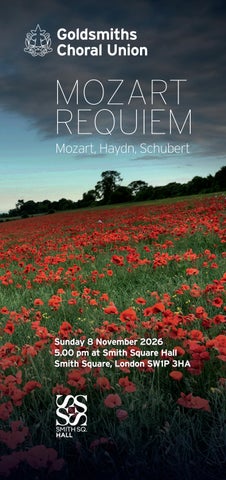
Goldsmiths Choral Union
MOZART REQUIEM Mozart, Haydn, Schubert
Sunday 8 November 2026 5.00 pm at Smith Square Hall Smith Square, London SW1P 3HA
1
Goldsmiths Choral Union is one of London’s leading choirs, giving quality performances of great choral works and contemporary music in London’s major venues, and rehearsing in central London. Goldsmiths Choral Union has brought the finest classical music to London since 1932. We’re a friendly choir with around 100 members, based in South Kensington. GCU promotes at least four concerts a year with professional soloists and orchestras and joins together with other choirs for special events. GCU’s performances of works from the traditional choral repertoire, ranging from Handel’s Messiah, Haydn’s The Creation and Bach’s B Minor Mass to Elgar’s The Dream of Gerontius, have been praised for their freshness, clarity and emotional commitment. Equally, GCU has performed less familiar works, such as Franz Liszt’s oratorio Christus and Sir Michael Tippett’s The Mask of Time. British premieres given over the years include Stravinsky’s Les Noces and Mahler’s Das Klagende Lied, and the first UK broadcast of Carl Orff’s Carmina Burana. GCU was founded in South London by Frederick Haggis at Goldsmiths College. At the outbreak of World War II the college was evacuated, but while other choirs disbanded, GCU continued to rehearse and perform in central London. Since then we have built up an enviable reputation, first under the baton of Frederick Haggis, later under Brian Wright and since 2022, with Jack Apperley. Patrons: James Burton, Simon Halsey CBE, Neil Jenkins, The Worshipful Company of Goldsmiths Music Director: Jack Apperley
Registered Charity number: 1044507 2
We present an afternoon of reflection, remembrance, and hope
MOZART REQUIEM Mozart Regina Coeli K276 Haydn Arianna a Naxos HobXXVlb:2 Schubert Stabat Mater D175 Mozart Requiem K626 (Levin version) Jack Apperley Conductor Ellie Neate Soprano Mercè Bruguera Abelló Alto William Searle Tenor Ben Hendry-Watkins Bass Goldsmiths Choral Union Affinity Chamber Orchestra
The taking of photographs and use of recording equipment is strictly forbidden without formal consent from Sinfonia Smith Square. Smoking or vaping is not permitted anywhere in Smith Square Hall. Please ensure that all digital devices are switched off. Bottled water and drinks purchased in our Footstool Café bar are permitted in the auditorium - please ask at the bar for a reusable cup when ordering. Booking Helpline: 020 7222 1061 sinfoniasmithsqu.org.uk Sinfonia Smith Square Charitable Trust. Registered Charity No. 1092461. Registered in England. Company No. 04335616
3
MOZART REQUIEM I first performed Mozart’s Requiem in Birmingham Town Hall conducted by Simon Halsey during my first year at university. I was playing viola on the back desk and there are many excerpts of the music that remain with me today because of that experience. I was handed the music and I just played it - no questions asked. It was not until I thought about planning a performance of the work to conduct that I realised how many questions there are to consider. Which edition to use: Süssmayr, Beyer, Levin, Arman or Maunder, among others? What about period instruments? At what pitch: A440 or A430? What Latin pronunciation: Italian or Germanic? I have chosen the edition by the American pianist and musicologist, Robert Levin, with period instruments similar to those in Mozart’s time, at A440 with Germanic pronunciation for the Latin, which adds further layers to the performance. That is all before considering tempi and style: slow, heavy and reverential, or brisker, lighter and Photo credit: Neue Vision hopefully still reverential but not too romantic? Like many people, I was first introduced to the legend and myths surrounding this work through Miloš Forman’s film Amadeus, based on Peter Shaffer’s play, which was inspired by Alexander Pushkin’s play Mozart and Salieri. It is a great film – and won eight Oscars – but it has arguably damaged the reputations of Mozart, his wife Constanze and Salieri. We don’t believe now that Mozart was a drunken spendthrift, Constanze a flighty money-grabber, or Salieri a poisoner. Having attended many performances of the Requiem completed by his assistant Süssmayr, I find the orchestration consistently thick, smothering the choir and not allowing the texture to breathe. This is largely because of the trombones doubling the choir parts throughout, which is probably not what Mozart intended, as he was one of the earliest composers to write independent trombone parts. Levin’s edition addresses this imbalance, along with the inclusion of an Amen double fugue at the end of the Lacrimosa. Levin also completes the later movements in a manner that is much more typical of Mozart, rather than Süssmayr’s rushed completion to honour Count Walsegg’s commission and enable Mozart’s widow to collect the final payment. This concert also features two smaller choral pieces, one by Mozart and one by Schubert. Mozart’s Regina Coeli is a joyous setting of the ‘Queen of Heaven’ text. Schubert’s Stabat Mater is a sombre piece, and at first glance seems 4
quite simple, with its homophonic choral textures, but as the piece develops, it becomes more harmonically complex, reflecting the deepening grief of the Virgin Mary surveying the body of her son on the cross. Haydn’s secular cantata Arianna a Naxos balances the mourning with drama and is effectively a one- woman show, depicting a painful romantic breakup between Arianna and her lover, Theseus, whom she helped to defeat the Minotaur. Whether this is your first performance of Mozart’s Requiem or one of many you have heard, I hope that you leave enriched and moved by one of the most famous and recognisable pieces of music ever created. Jack Apperley Music Director
Meet GCU’s new patron James Burton
We are delighted to welcome James Burton as our patron. James is an internationally renowned conductor, composer and passionate advocate of singing. He has conducted leading British and international orchestras and choirs, including the BBC Singers, Tenebrae, OAE, Handel and Haydn Society, RSNO, Ulster Orchestra, the Hallé, Aalborg Symphony and Mexico’s National Symphony Orchestra. James recently returned to the UK following an eight year tenure as the Boston Symphony Orchestra Choral Director and Conductor of the Tanglewood Festival Chorus, and he was also Director of Orchestral Activities at Boston University’s College of Fine Arts. From autumn 2027 James will be the Artistic Director of Ex Cathedra. James delighted members of GCU with his brilliant, informative, lively and inspiring rehearsals in preparation for our recent performance of Brahms’ Requiem. “It was a great pleasure to meet the singers of GCU earlier this year, and I was so impressed by their commitment to the group, to their singing and to the music they were rehearsing. I am honoured to be asked to become their patron and to be involved with the choir, and am looking forward to developing a relationship with them and their fantastic music director, Jack Apperley, in the coming years.” (James Burton, 2026). 5
Jack Apperley Conductor Originally from Stourbridge, Jack grew up playing the piano and the viola, and singing. After studying at the University of Birmingham under Simon Halsey CBE, he completed his master’s degree at the Royal Academy of Music with Professor Patrick Russill, graduating with distinction and winning the Sir Thomas Armstrong Leadership Prize. In 2025 he was made an Associate of the Royal Academy of Music. As the Associate Chorus Director of the London Symphony Chorus, Assistant Conductor of the NFM Choir in Wroclaw, Poland, and Music Director of Goldsmiths Choral Union and Concordia Voices, Jack has established a reputation for thorough rehearsals filled with energy, humour and precision, as well as compelling concerts, championing new works alongside classical mainstays. He is increasingly in demand as a choral director both in the UK and abroad. Recently, Jack has worked with the London Symphony Chorus, the City of Birmingham Symphony Chorus, BBC Symphony Chorus, Brighton Festival Chorus, University of Birmingham Voices and Royal College of Music Chorus. He has been engaged by some of the best choirs in Europe including the BBC Singers, le Choeur de Radio France, Balthazar Neuman Choir, Gothenburg Symphony Chorus and Vocal Ensemble, and the Hungarian National Choir. Jack is a prize-winner in several choral conducting competitions in Hong Kong, Latvia, Slovenia and London. He has also participated in several masterclasses with the BBC Singers, Berliner Rundfunkchor, Stuttgart Kammerchor, Hungarian National Choir and St Jacob’s Kammerchor.
Ellie Neate Soprano Ellie Neate trained at the Guildhall School of Music and Drama. Opera roles include Lisette La Rondine (her studio opera recording debut with Opera Rara and the BBC Symphony Orchestra, released in October 2026), Susanna The Marriage of Figaro directed by Danielle de Niese, cover Masha Four Sisters at The Royal Ballet and Opera, Dinner with Handel in the London Handel Festival, Rosmene Imeneo for Cambridge Handel Opera Company, Zerlina Don Giovanni at Teatro Lorenzo da Ponte and Waterperry Opera Festival, Papagena The Magic Flute Lite and cover Tytania in A Midsummer Night’s Dream for Opera North, Celia Iolanthe, First Daughter Akhnaten, cover Mabel The Pirates of Penzance, cover Elsie Maynard The Yeomen of the Guard for English National Opera, Elisa Il Re Pastore, Lisa La Sonnambula, and Cleopatra Marc’Antonio e Cleopatra at Buxton International Festival, Galatea Acis and Galatea, Milica Svadba, and Maria Bertram Mansfield Park at Waterperry Opera, Cunegonde Candide for Blackheath Halls Opera, and Gretel Hansel and Gretel for British Youth Opera. Upcoming projects include recitals for Opera Rara, Gretel Hansel und Gretel with the Cambridge Philharmonic Orchestra, Wild Arts Messiah, and cover Zerlina Don Giovanni Opera North. In concert she has performed at Oxford Lieder Festival, Barbican Hall, Wigmore Hall, for ENO Does Eurovision, appeared on BBC Radio 3’s In Tune singing Pauline Viardot, and recorded the soundtracks for Disney+ Rivals.
6
Mercè Bruguera Abelló Alto Mercè Bruguera is a Catalan singer based in London, pursuing a career as an international soloist both in the UK and throughout Europe. Well-acquainted with both operatic and song repertoire, she made her operatic debut as Orfeo Orfeo ed Euridice. Other roles include Cornelia Giulio Cesare, Dido & Sorceress Dido & Aeneas and Orlofsky Die Fledermaus. She was also the festival-opening Young Artist of the LIFE Victoria Festival 2021/2022 as well as winner of the third prize in Concurs Palet in 2021, semifinalist in the Tenor Viñas Competition 2023 and runner-up in the 2024 London Bach Singers Prize. Mercè also maintains a close connection with her home country, performing frequently across Spain. After her debut at the Palau de la Música Catalana as young artist of the Primer Palau 2023 scheme, she was awarded the Critic’s Award 2023 as well as joining the JM Spanish Network, performing a series of recitals in seasons 24/25. Mercè has established herself as a familiar face at the top of Europe’s bustling early music scene, both soloistically and as a member of some of the finest ensembles around the continent, including Jordi Savall’s La Capella Reial, Jonathan Cohen’s Arcangelo and the Monteverdi Choir & Orchestras. Recent highlights on the concert platform include Bach’s St Matthew Passion with Christoph Prégardien, a tour in Croatia and Ireland of Purcell’s Fairy Queen with the London Handel Players, and a touring staged production with the Netherlands Bach Society.
William Searle Tenor Anglo-Welsh tenor William Searle is enjoying the start of an international concert career, appearing in Handel’s Messiah at the Royal Albert Hall and with Manchester Camerata, in J. S. Bach’s Magnificat with the Royal Philharmonic Orchestra at Cadogan Hall, and in a world premiere at Carnegie Hall, New York, as well as in Haydn’s Nelson Mass with the Orquestra do Algarve, Purcell’s Dido and Aeneas at the Festival de Torroella and the Evangelist in J. S. Bach’s Johannes-Passion at the Festival Lyrique-en-Mer. He has also taken part in innovative collaborations with actors such as Toby Jones, Stephen Mangan and Mark Williams. He was a finalist in the 2025 Leach Competition for oratorio and English song and he has appeared with Graham Johnson as part of the Wigmore Hall Schubertiade. In the recording studio, he performed the tenor solos on Britten Sinfonia’s upcoming premiere of Richard Blackford’s The Black Lake and the soundtrack for the Disney+ series Rivals. On the opera stage, William has performed with English National Opera in the Pulitzer Prizewinning Angel’s Bone, played Ufficiale Il barbiere di Siviglia and covered Basilio Le nozze di Figaro and Circusmaster The Bartered Bride as an Alvarez Emerging Artist at Garsington Opera, and covered the role of Saint-Brioche in Scottish Opera’s The Merry Widow. Recent roles include Tamino The Magic Flute (The Merry Opera Company), Lensky [cover] Eugene Onegin (Buxton International Festival) and Raymond Gosling Rosalind (The London Mozart Players). He will return to Scottish Opera in spring 2027 to cover the role of Oronte in their upcoming production of Alcina.
7
Ben Hendry-Watkins Bass Ben is a current scholarship holder at the Guildhall School of Music and Drama, where he is studying on the master’s course in Vocal Performance. Recent highlights include a concert of French cantatas with the Academy of Ancient Music, a lecture-recital of the songs of Robert Schumann in collaboration with Graham Johnson, and solos in a performance of Bach’s St. Matthew Passion at Romsey Abbey. Further engagements this year include solos in Monteverdi’s Vespers with Ensemble Pro Victoria, Bach’s Mass in B Minor with Amersham Choral Society, and Elgar’s The Dream of Gerontius with Arundel Choral. Ben will perform as the vocal soloist at the OneVoice festival, in association with Glyndebourne Opera. Opera credits include Bartolo The Marriage of Figaro, Oxford Opera; Polkan The Golden Cockerel, Orchestra VOX; Erste Jäger Der Wald, Silvano La Calisto, and Le Roi Céphale et Procris, GSMD. Ben performed the title role in Marcello Palazzo’s Mount Herzog that debuted at Tête à Tête The Opera Festival 2024. In 2026, Ben made his debut with the Glyndebourne Festival Chorus for Britten’s Billy Budd and Monteverdi’s Orfeo, also covering the role of Second Mate Billy Budd. Ben is very grateful for support from the Countess of Munster Musical Trust, Sir Richard Stapley Educational Trust, the Hywel Davies Trust for Young Musicians, the Winship Foundation, the Wavendon Foundation, and the Kathleen Trust.
Affinity Chamber Orchestra The Affinity Chamber Orchestra is a professional London-based orchestra working in partnership with choirs, composers and event organisers. Founded in early 2022 by its current musical director, Matthew Down, it performed its successful debut concert with Goldsmiths Choral Union at Cadogan Hall, the programme consisting of Cecilia McDowall’s Da Vinci Requiem (2019), Joseph Haydn’s Mass in Time of War and Peter Warlock’s Capriol Suite. The orchestra’s players are highly skilled musicians, many of whom are respected teachers of their instruments, who perform with leading London and international orchestras, seasoned chamber groups and as soloists. The orchestra aims to showcase its musicians, bringing life to creative ideas and projects in all styles of music.
Matthew Down Musical Director In addition to being the founder and musical director of the Affinity Chamber Orchestra, Matthew has many years’ experience as a conductor, trumpet-player and teacher. He has a broad range of musical tastes, ranging from baroque to pop, performing music with great musicians and friends being at the heart of his musical life.
8
Joseph Haydn 1732 - 1809 Arianna a Naxos HobXXVlb:2 (1789) ‘The Father of the Symphony’. Haydn was the composer of the period: the most respected, the most honoured, and the one closest to the tastes of his public. In his long life, everything he wrote was in intellectual and emotional proportion. Composed relatively late in Haydn’s output, Arianna a Naxos quickly became one of his best-loved works. The story follows the Cretan Princess Arianna’s desertion by Theseus on the island of Naxos. She tricks herself into thinking that he will return, but upon realising that he will not, she gives in to despair. It was published in Vienna in 1790. A London performance by a soprano castrato took place to high acclaim the following year. When Lord Nelson visited Prince Esterházy’s palace in 1800, the cantata was performed by Lady Hamilton.
Short and dark, with a strangely shaped nose and a face pitted by smallpox, the famous Haydn never commissioned a portrait, although he liked to dress well, in a powdered wig with side locks. He had a sweet nature and an even temperament, and was industrious and honest. When Mozart’s name came up, he would say, ‘My friends often flatter me about my talent, but he was far above me.’ As Vice-Kapellmeister and later Kapellmeister to the Esterházy family for most of his career, he was responsible for directing the orchestra, composing music, and hiring and firing personnel. ‘I was cut off from the world; there was no one to confuse or torment me, and I was forced to become original.’ ‘I was never a quick writer, but composed with care and diligence.’ His favourite pastimes were hunting and fishing on the grand Esterháza estate. Haydn was one of the most prolific composers in history. Listings give 104 symphonies, 83 string quartets, 60 piano sonatas, many concertos, much chamber music and a large number of choral works, 23 operas, many songs, 4 oratorios, and many masses. He died at the age of 77 and is buried in the Esterházy chapel at Eisenstadt.
Franz Schubert 1797 - 1828 Stabat Mater D175 (1815) ‘I have come into the world for no purpose but to compose’. Neither a conductor nor a public instrumentalist, he seemed content to pour out page after page of music whether or not it was ever performed. Schubert lived around Vienna all his life. His father was a teacher (he ran a school in his own house), and his mother a cook. He was one of five surviving children in a music-loving family. Schubert, at the age of ten, could play piano, organ, violin and viola and wrote many compositions. In 1808, he joined the choir of the court chapel at the Imperial and Royal Seminary, and received a free education.
9
Among his teachers was Antonio Salieri (Mozart’s old rival) who gave him composition lessons, but said to the boy ‘You can do everything, for you are a genius’. He wrote Stabat Mater in G minor when he was 18, unhappily working for a few years as a teacher at his father’s school. Shy, chubby, short, nearsighted with sparkling eyes behind his glasses, he inhabited the music-loving, art-loving, intellectual world of bohemians and bourgeoisie of Vienna and its surrounds, and he composed music for his circle of friends. Schubert remained poor, never finding a rich patron or spending energy on securing a platform for promoting his compositions. In 1816, Schubert shared lodgings with his friend Franz von Schober, a law student and poet. Their evenings were often spent in the homes of wealthy friends, including the indispensable famous baritone Johann Vogl, thirty years his senior. Schubert presided at the piano, improvising and entertaining in intimate gatherings that came to be known as Schubertiads. Audiences were spellbound by masterpieces like Erlkönig and Der Wanderer. Schubert was always short of cash, and never had enough money to rent a piano - let alone buy one. If he needed a piano, he would go to a friend’s house. He could compose a whole work in his head and immediately write it down. Schubert was briefly employed for two separate summers, during which he taught the daughters of Count Esterházy, developing an unrequited romantic devotion to the younger Countess, Caroline, who became a muse to him. She once asked him why he had never dedicated a piece of music to her, and he replied, ‘Why do that? Everything is dedicated to you anyway.’
It was during a joyous holiday in 1819 with Johann Vogl in the mountains of Upper Austria that Schubert conceived the Trout quintet. Despite his prolific composition, especially of songs, it was not until 1821 that any of his music was published - a volume of songs, the cost of which was paid for by his friends. In 1827, whilst composing his great song cycle Die Winterreise, he visited the dying Beethoven, and, a few days afterwards, was one of the torch-bearers in his hero’s funeral procession. Schubert died a year later, aged 31, from a combination of typhoid and syphilis. At his own request, he was buried as near to Beethoven as was practicable. Other musicians and friends came across the piles of manuscripts, left forgotten, bundled up in cupboards and publishers’ cellars, and brought them to the attention of the musical world.
10
Wolfgang Amadeus Mozart 1756 - 1791 Regina Coeli K276 (1779) Requiem K626 (1791) How does a genius, in declining health in the last year of his life, produce 35 unbelievably rich and varied pieces of music? Two full-length operas, vocal works, concertos, chamber and instrumental music, suites of dance music for the Viennese court, and the inspired, but unfinished, Requiem.
Mozart had an exuberant, bubbly, irrepressible streak. He tried to make his music capture mood, situation and character, bursting with talent and ingenuity, and never afraid to bend the rules. He had broken free from his father Leopold’s influence having toured the European courts as a child prodigy and tried a period of work in his early twenties as organist and Konzertmeister at Salzburg where, among other works, he wrote Regina Coeli (Queen of Heaven) for cathedral and court-chapel use during Easter. By 1791, Mozart’s reputation as a composer was well-established. He was 35 years old, married to Constanze Weber and living in Vienna. Their rented first-floor apartment, on the corner of Rauhensteingasse, was well furnished, and Mozart was fond enough of billiards to keep a table in a room of its own, playing daily with Constanze. Mozart provided for a household of two servant girls, Karl aged 7, the new baby Franz ‘Wolfgang’ born in July, Constanze, and himself. (Of the couple’s six children, only these two survived, unsurprising given Vienna’s high infant mortality rate and poor sanitation.) He and Constanze dressed well to keep up appearances at his concerts and at the many court balls, where he conducted the orchestra playing his own compositions, and there was much entertaining besides. Mozart had his meals brought in from a local restaurant. Neither of them was extravagant, though they occasionally borrowed money, and lent generously to close friends when they had some to spare. Even so, there were large bills outstanding when Mozart died — a tailor’s, an upholsterer’s, and one from the Royal Court Apothecary. Mozart wore his own blond hair rather than a wig, as shown by the regular bills from his hairdresser for plaiting it into a pigtail. Constanze’s spa “cures” at Baden bei Wien, for her feet and other complaints, were expensive, Mozart had to rent ground-floor rooms there, and she was expected to be well turned out in the evenings. In May 1791 Mozart was anxious about Constanze’s health and missed her keenly whenever they were apart, writing affectionate letters throughout: “Adieu, I kiss you 1000 times, always your Mozart,” he signed off on 6 June; and on the 12th, “Dearest, best little wife! Why had I no letter from you yesterday evening? So that I had to live in fear because of the baths.” He joined her in Baden and while there, on 17 June, wrote the motet Ave verum corpus as a gift for Anton Stoll, choirmaster of the small parish church who had been looking after Constanze. The Requiem had a strange origin. Count Franz von Walsegg, a keen amateur musician, had a habit of commissioning works from composers, copying the scores out in his own hand, and passing
11
them off as his own, conducting them, or playing in the orchestra himself. When his young wife died, he sent a messenger to Mozart in July, anonymously, requesting a requiem in her memory. Mozart hoped to finish it in four weeks; it didn’t work out that way. Mozart composed The Magic Flute throughout the spring and summer of 1791, persuaded by his friend and fellow Mason, Emanuel Schikaneder, librettist, impresario and singer. It premiered to great success on 30 September at Schikaneder’s own theatre, the Freihaus-Theater in the Viennese suburb of Wieden, with Schikaneder taking the part of Papageno. Mozart was deeply involved with Freemasonry, and with the Masonic theories and symbolism surrounding death. He believed that death is the true goal of our existence, and in a letter written in 1787 to his father Leopold stated that he never went to bed without reflecting that, young as he was, he might not see the next morning. Work on The Magic Flute was interrupted by the coronation in Prague of the new emperor, Leopold II, as King of Bohemia, which sent Mozart into a frantic rush between July and September, to write La clemenza di Tito, delegating the recitatives to his assistant Franz Xaver Süssmayr. By the autumn his finances were recovering fast, buoyed by the fee for his opera La clemenza di Tito, income from The Magic Flute, and an advance for the Requiem. Contradictory myths have surrounded Mozart’s death, not helped by Shaffer’s play and film Amadeus, which cast him as a divinely gifted drunken lout hounded by a vengeful Salieri. The real Salieri, the Italian Kapellmeister, was certainly envious of Mozart and schemed to make his operatic career difficult, but the rumours that Mozart was poisoned are unsubstantiated. The more likely truth is that he came back from Prague already unwell, suffering fainting fits, worn down by driving himself too hard, and may have picked up his final illness at a meeting of his Masonic lodge on 18 November. There’s still no consensus on the cause of death. As a boy, Mozart had suffered repeated streptococcal infections, and the likely explanation is that, in an already weakened state, he developed rheumatic fever from a further infection, bringing on swollen joints, vomiting, fever, rash, and eventual kidney failure. An epidemic in Vienna producing the same symptoms was recorded at the time. Constanze’s younger sister, Sophie, had come to support the family and was in the house through his final days, and later recorded the details. On the morning of 4 December, Mozart summoned Süssmayr to dictate his last instructions for the Requiem. As his fever rose through the evening, the sisters called Dr Closset, who prescribed bathing his forehead with cold water and vinegar. He died in the early hours, with a final shudder, surrounded by manuscript pages of the Requiem. As was customary for the middle class in that part of Vienna, he was buried in a common grave at St Marx Cemetery; only aristocrats were buried in permanent private plots. Constanze, overcome with grief, wasn’t in a fit state to attend. After a funeral service held outside St Stephen’s Cathedral, no one accompanied the body on the hour-long walk to St Marx. By 11 December, barely a week after his death, Constanze had pulled herself together sufficiently to petition the Emperor for a pension for herself and their two sons. When Leopold II died the following March, succeeded by his son Francis II, she petitioned again, and received money from benefit concerts and memorial services. The only part of the Requiem Mozart finished in full orchestrated score before he died was the Introit. He left clear compositional direction of the Kyrie, the Dies Irae sequence, the first eight bars of the Lacrymosa, plus the Offertory. In order to retain the deposit and receive the full fee for the Requiem from Count von Walsegg, Constanze desperately approached Joseph von Eybler (who was overwhelmed by the task and handed it back) and then Süssmayr to finish Mozart’s composition. The completed Requiem was performed on 14 December 1793, at Wiener Neustadt, conducted by Count von Walsegg himself.
12
CONCERT Wolfgang Amadeus Mozart Regina Coeli K276 (1779) Regina coeli, laetare, alleluja. Quia quem meruisti portare, alleluja. Resurrexit sicut dixit, alleluja. Ora pro nobis Deum, alleluja. Queen of Heaven, rejoice, alleluja. For He whom you deserved to bear, alleluja. Has risen, as He said, alleluja. Pray for us to God, alleluja.
Joseph Haydn Arianna a Naxos HobXXVIb:2 (1789) Adagio Teseo mio ben, dove sei? Dove sei tu? Vicino d’averti mi parea, ma un lusinghiero sogno fallace m’ingannò. Già sorge in ciel la rosea Aurora, e l’erbe e i fior colora Febo uscendo dal mar col crine aurato. Sposo, sposo adorato, dove guidasti il piè Forse le fere ad inseguir ti chiama il tuo nobile ardor. Ah vieni, ah vieni, o caro, ed offrirò più grata preda ai tuoi lacci. Il cor d’Arianna amante, che t’adora costante, stringi, stringi con nodo più tenace, e più bella la face splenda del nostro amor. Soffrir non posso d’esser da te divisa un sol istante. Ah di vederti, o caro, già mi strugge il desio; ti sospira il mio cor, vieni, vieni idol mio. Adagio Theseus, my love! Where are you? I thought you were beside me, But it was only a sweet, false dream. The rosy dawn rises in the sky Pheobus tinges grass and flowers As he rises, golden, from the sea. Dear husband! Where are you? Perhaps the chase has called, Tempting your brave spirit! Oh, come, my love And find a sweeter prey for your snares. Ariadne’s loving heart, constant and adoring, Binds with ever tighter bonds And our radiant flame burns brightly with our love. I cannot be separated from you for a single moment Ah! I am seized, my love, with the desire to see you My heart sighs for you. Come, my beloved idol! 13
Aria Dove sei, mio bel tesoro, chi t’invola a questo cor? Se non vieni, io già mi moro, né resisto al mio dolor. Se pietade avete, oh Dei, secondate i voti miei, a me torni il caro ben. Dove sei? Teseo! Dove sei? Air Where are you my sweet treasure? Who tore you from my breast? If you do not come, I shall die, I cannot bear such grief. If you are merciful, oh gods, hear my prayer, And send my beloved back to me. Where are you? Theseus! Where are you? Recitativo Ma, a chi parlo? Gli accenti Eco ripete sol. Teseo non m’ode, Teseo non mi risponde, e portano le voci e l’aure e l’onde. Poco da me lontano esser egli dovria. Salgasi quello che più d’ogni altro s’alza alpestre scoglio; ivi lo scoprirò. Che miro? Oh stelle, misera me, quest’ è l’argivo legno! Greci son quelli! Teseo! Ei sulla prora! Ah m’ingannassi almen ... no, no, non m’inganno. Ei fugge, ei qui mi lascia in abbandono. Più speranza non v’è, tradita io sono. Recitative But, to whom do I speak? Echo alone repeats my words. Theseus neither hears nor responds Winds and waves silence my voice. He cannot be far away from me. If I climb that cliff that rises above the rest, I shall see him from there. What is this? Alas! Woe is me! That is the Argive ship! Those men are Greeks! Theseus! He is at the prow! Oh, I may be mistaken... No! There is no mistake. He flees, and leaves me behind, abandoned. All hope is gone, I am betrayed.
14
Recitativo Teseo, Teseo, m’ascolta, Teseo! Ma oimè! vaneggio! I flutti e il vento lo involano per sempre agli occhi miei. Ah siete ingiusti, o Dei, se l’empio non punite! Ingrato! Perchè ti trassi dalla morte dunque tu dovevi tradirmi! E le promesse, e i giuramenti tuoi? Spergiuro, infido! hai cor di lasciarmi. A chi mi volgo, da chi pietà sperar? Già più non reggo, il piè vacilla, e in così amaro istante sento mancarmi in sen l’alma tremante. Recitative Theseus! Hear me! But alas, I shall go mad! He is swallowed by wave and wind Forever before my very eyes. Oh! Gods, you are unjust If you do not punish the traitor! Ungrateful man! Why ever did I bother to save your life? For you to betray me? And your promises? Your vows? Faithless one! Deceiver! Have you the heart to leave me? To whom shall I turn? From whom seek compassion? I cannot stand, my knees tremble And the bitterness of this wretched moment Makes my heart quiver in my breast. Aria A che morir vorrei in sì fatal momento, ma al mio crudel tormento mi serba ingiusto il ciel. Misera abbandonata non ho chi mi consola. Chi tanto amai s’invola barbaro ed infedel. Air Oh! Would that death might come in this dreadful hour But heaven cruelly decrees My continued suffering. Poor abandoned one, with no one to console her, My beloved has fled, cruel and disloyal.
15
Franz Schubert Stabat Mater D175 (1815) Stabat mater dolorosa juxta crucem lacrymosa dum pendebat Filius. The sorrowful Mother Stood weeping next to the cross Upon which her son was hanging. Cujus animam gementem contristatam et dolentem pertransivit gladius. Whose anguished soul, Grief stricken and sorrowful, Had been pierced by a sword. O quam tristis et afflicta fuit illa benedicta Mater Unigeniti. O what sadness and suffering For she who was blessed to be Mother of the only-begotten One. Quae maerebat et dolebat pia Mater dum videbat nati poenas inclyti. Who grieved and lamented, The pious Mother, as she saw The torments of her Son.
INTERVAL 20 MINUTES
16
Wolfgang Amadeus Mozart Requiem K626 (1791) Introitus
Requiem aeternam Requiem aeternam dona eis Domine: et lux perpetua luceat eis. Te decet hymnus, Deus, in Sion, et tibi reddetur votum in Jerusalem. Exaudi orationem meam: ad te omnis caro veniet. Grant them eternal rest, O Lord: and let everlasting light shine on them. To Thee, O God, praise is met in Zion, and unto Thee shall the vow be performed in Jerusalem. Hearken unto my prayer: unto Thee shall all flesh come. Kyrie Kyrie eleison. Christe eleison. Kyrie eleison. Lord, have mercy upon us. Christ, have mercy upon us. Lord, have mercy upon us.
Sequenz Dies irae
Dies irae, dies illa Solvet saeclum in favilla Teste David cum Sibylla. Quantus tremor est futurus Quando Judex est venturus Cuncta stricte discussurus. The day of wrath, that day shall dissolve the earth in ashes as witnesseth David and the Sibyl. What trembling shall there be when the Judge shall come who shall thresh out all thoroughly. Tuba mirum Tuba, mirum spargens sonum Per sepulcra regionum, Coget omnes ante thronum. Mors stupebit et natura Cum resurget creatura Judicanti responsura. Liber scriptus proferetur In quo totum continetur, Unde mundus judicetur. Judex ergo cum sedebit directdesign.co.uk
17
Quidquid latet apparebit; Nil inultum remanebit. Quid sum miser tunc dicturus, Quem patronum rogaturus? Cum vix justus sit securus. The trumpet, scattering a wondrous sound through the tombs of all lands, shall drive all unto the Throne. Death and Nature shall be astonished when all creation rises again to answer to the Judge. A written book shall be brought forth in which shall be contained all by which the world shall be judged. And therefore when the Judge shall sit, whatsoever is hidden shall be manifest; and nothing shall remain unavenged. What then shall I say in misery? Whom shall I ask to be my advocate, when scarcely the just may be without fear? Rex tremendae Rex tremendae majestatis, Qui salvandos salvas gratis, Salve me, fons pietatis. King of awful majesty, who freely savest the redeemed, save me, O fount of goodness. Recordare Recordare, Jesu pie, Quod sum causa tuae viae, Ne me perdas illia die. Quaerens me sedisti lassus: Redemisti crucem passus, Tantus labor non sit cassus Juste Judex ultionis Donum fac remissionis Ante diem rationis. Ingemisco tamquam reus: Culpa rubet vultus meus. Supplicanti parce, Deus. Qui Mariam absolvisti Et latronem exaudisti, Mihi quoque spem dedisti. Preces meae non sunt dignae, Sed tu bonus fac benigne, Ne perenni cremer igne. Inter oves locurn praesta, Et ab haedis me sequestra, Statuens in parte dextra. Remember, blessed Jesus, that I am the cause of your journey, lest thou lose me in that day. Seeking me didst Thou sit weary: Thou didst redeem me, suffering the cross, Let not such toil be frustrated. 18
O just Judge of vengeance, give the gift of remission before the day of reckoning. I groan as one guilty; my face blushes at my sin. Spare me, Thy supplicant, O God. Thou who didst absolve Mary, and did hear the thief’s prayer, hast given hope to me also. My prayers are not worthy, but do Thou, good Lord, show mercy, lest I burn in everlasting fire. Give me place among Thy sheep and put me apart from the goats, setting me on Thy right hand. Confutatis Confutatis maledictis Flammis acribus addictis, Voca me cum benedictis. Oro supplex et acclinis, Cor contritum quasi cinis, Gere curam mei finis. When the accursed are confounded and condemned to the sharp flames, call me with the blessed. I pray, kneeling in supplication, my heart contrite as ashes, take Thou mine end into Thy care. Lacrimosa Lacrimosa dies illa Qua resurget ex favilla Judicandus homo reus. Huic ergo parce, Deus, Pie Jesu Domine: Dona eis requiem. Amen Lamentable is that day on which the guilty man shall arise from the ashes to be judged. Spare then this one, O God, merciful Lord Jesus, give them peace. Amen
Offertorium Domine Jesu
Domine Jesu Christe, Rex gloriae, libera animas omnium fidelium defunctorum de poenis inferni et de profundo Iacu; libera eas de ore leonis, ne absorbeat eas Tartarus; ne cadant in obscurum. 19
Sed signifer sanctus Michael Repraesentet eas in lucem sanctam: Quam olim Abrahae promisisti et semini ejus. O Lord, Jesus Christ, King of glory, deliver the souls of all the departed faithful from the torments of hell and from the bottomless pit; deliver them from the mouth of the lion, lest Tartarus swallow them; lest they fall into darkness. But let Saint Michael the standard-bearer bring them forth into the holy light: which Thou didst once promise to Abraham and his seed. Hostias Hostias et preces tibi, Domine, Laudis offerimus. Tu suscipe pro animabus Illis quarum hodie memoriam facimus; Quam olim Abrahae promisisti et semini ejus. To thee, O Lord, we render our offerings and prayers with praises. Do Thou receive them for those souls which we commemorate today; which Thou didst once promise to Abraham and his seed.
Sanctus Sanctus
Sanctus, sanctus, sanctus, Dominus Deus Sabaoth. Pleni sunt caeli et terra gloria tua. Osanna in excelsis. Holy, holy, holy, Lord God of Sabaoth. Heaven and earth are full of Thy glory. Hosanna in the highest. Benedictus Benedictus qui venit in nomine Domini. Hosanna in excelsis. Blessed is he that cometh in the name of the Lord. Hosanna in the highest.
Agnus Dei Agnus Dei
Agnus Dei, qui tollis peccata mundi: Dona eis requiem. Agnus Dei, qui tollis peccata mundi: Dona eis requiem sempiternam. Lamb of God, who takest away the sins of the world: grant them rest. Lamb of God, who takest away the sins of the world: grant them eternal rest. 20
Communio Lux aeterna
Lux aeterna luceat eis, Domine, cum sanctis tuis in aeternum, quia pius es. Requiem aeternam dona eis, Domine, et lux perpetua luceat eis, cum Sanctis tuis in aeternum, quia pius es. Let everlasting light shine upon them, O Lord, with Thy saints forever, for Thou art merciful. Grant to the departed eternal rest, O Lord, and let everlasting light shine upon them, with Thy saints forever, for Thou art merciful.
Thank you for attending this moving concert. If you have enjoyed this evening, please sign up to receive our regular newsletter which gives information about all our future concerts.
21
Goldsmiths Choral Union SOPRANOS Margaret BEELS Catherine COOKE Jane CORKILL Helen CRISP Camille DU BUISSON Elizabeth EDWARDS Adrienne FRESKO Inez GALLAGHER Siobhan HOMBARUME Tanya HUEHNS Hilary LINES Joyce LING Emma McLOUGHLIN Olivia MEARS Michiyo NAGOSHI Rachel NICHOLSON Sarah NYAKAZINGO Freya PETTY Corinne PIGNARD Amelia PORTER Anne RANDALL Sarah SAYSELL Celia SIMPSON Sue SPENCER Arisa TURNER Katherine TYRRELL Maria WALBY Jenny WU CONTRALTOS Lindsay ALLEN-MERSH Mary BOSWORTH-SMITH Rosemary BURKE Jayne CALVERT Liz ELLAWAY Hazel ELLIS Mariana FARAH Jane HOULDSWORTH Sherry HUTCHINSON Irene ILIAS Elin JONES Jenny LEACH Alison LEGGATT Sue LUSH Sue MILLAR Selina MILLS
Frosso MILTIADOU Kelly MORGAN Betty NEWBURY Sharon PIERSON Lynn QUEK Heather RAYNER Silvia RESEGHETTI Jess REYNOLD Judith SIMPSON Arabella STUART Margaret THOMAS Anna WALTON Victoria WARE Polly WATTS Naomi WEBER Lizzy WHEELER Rowena WINKLER Jenny YOUNG TENORS Sam CLIFTON Pablo Egerique GARCIA De La CONCHA* Peter ILMOLELIAN John LARNER André SERRA David WILLINGHAM Michael WOODS * denotes Tenor Choral Scholar BASSES John ALLINSON Charlie CARTER George COOPER Charles DU BUISSON Lewis DAVIES Mike DAY Gabriel DIAZ-EMPARANZA Oscar HEALY Stephen LAI Mark PAKIANATHAN James PIERCY Clive RICHARDS David ROE
Affinity Chamber Orchestra First Violins Sarah Moffat - leader Karin Bjork Sam Kennedy Emily Steinitz Second Violins Charlotte Fairbairn Oakki Lau Liz Macarthy May Robertson Violas Michael Bennett Dan Manante John Rogers Cellos Martyna Jankowska George Ross Double Bass Kate Brooke
Oboes Helen Barker Mark Radcliffe Bassett Horns/Clarinets Nicky Baigent Andy Harper Bassoons Alex Thorneloe Jo Turner Trumpets Mark Bennett Matthew Down Trombones Peter Crocker Paul Lambert Steve Turton Timpani Giles Harrison Chamber Organ Samuel Ali
22
JOIN US Goldsmiths Choral Union is a high-quality choir that is still small enough to feel welcoming and inclusive. We’re looking for singers with good voices and reasonable sight reading, who would relish the opportunity to perform wonderful music with top orchestras in fantastic venues. We’re welcoming new singers (all parts) or those who just want to give us a try and see if we might be the choir for you. Being part of Goldsmiths is a great way to continue your passion for music after you leave college or university, and an opportunity to meet like-minded people from across London and the South-east. www.goldsmithschoralunion.org/join-us
FRIENDS OF GCU The support of the Friends underpins some of the choir’s decisions to plan compelling concerts, hire exciting venues, engage ambitious soloists, and champion new works alongside classical mainstays. Thank you to all involved! HONORARY LIFE FRIENDS: Sarah Dorin, William Gould, David Hayes, Steve Jones, Dinah Nichols, Mike Lock, Jan Lowy, Ian Stephenson FRIENDS, SILVER FRIENDS, GOLD FRIENDS: Hamish Donaldson, Caroline Green, Joanna Kenny, Margaret Kingsley, Julian Kirwan-Taylor, Carole Lewis, Rebecca Rawlings, The Late Godfrey Rock, Jane Sawyer, Marylin Smith, Arabella Stuart, Leonore Stuart, Deb Tanner, Charles Thomson, Frances Walton and all those who wish to remain anonymous. Annual donations of a minimum of £50 (Friend), £130 (Silver Friend), £260 (Gold Friend) In return, Friends receive a programme, a Newsletter, and their name (if wished) in programmes for all four GCUpromoted concerts. Silver Friends’ additional benefits are one free ticket for every GCU-promoted concert, Gold Friends’ additional benefits are two free tickets per GCUpromoted concert. For details about how to become a Friend, please visit our website: goldsmithschoralunion.org or contact the Friends Membership Secretary email: gcufriends@btopenworld.com
SCHOLARSHIPS TENOR & BASS CHORAL SCHOLARSHIPS worth £1,350 We have an annual programme to support two young choral students. More information on our website: goldsmithschoralunion.org Please contact secretary@goldsmithschoral.org.uk 23
Goldsmiths Choral Union FUTURE CONCERTS GOLDSMITHS CHRISTMAS CELEBRATION Christmas music and carols with audience participation in aid of The Lily Foundation Holy Trinity Sloane Square Friday 18 December 2026 at 7.30 pm Tickets available from choir members, ordered from tickets.gcu@gmail.com, on the door, or via Eventbrite (booking fees apply)
BEETHOVEN SYMPHONY No. 9 Barbican Monday 29 December 2025 at 7.30 pm Book online at www.barbican.org.uk (booking fees apply)
TIPPETT - A CHILD OF OUR TIME Cadogan Hall Monday 22 March 2027 at 7.30 pm Tickets available from choir members, on the door, or www.cadoganhall.com (booking fees apply)
For more information about Goldsmiths Choral Union please visit our website at goldsmithschoralunion.org directdesign.co.uk
24