FALL 2026
EST. 1989
International Canada Magazine
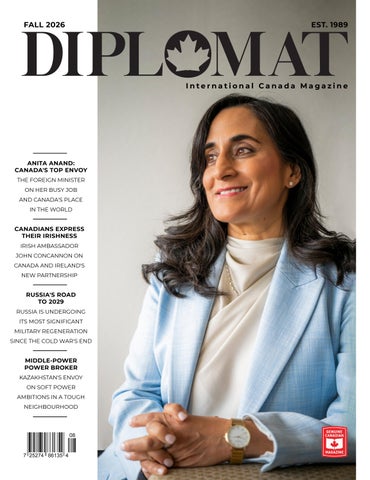
ANITA ANAND: CANADA'S TOP ENVOY THE FOREIGN MINISTER ON HER BUSY JOB AND CANADA'S PLACE IN THE WORLD
CANADIANS EXPRESS THEIR IRISHNESS IRISH AMBASSADOR JOHN CONCANNON ON CANADA AND IRELAND'S NEW PARTNERSHIP
RUSSIA'S ROAD TO 2029 RUSSIA IS UNDERGOING ITS MOST SIGNIFICANT MILITARY REGENERATION SINCE THE COLD WAR'S END
MIDDLE-POWER POWER BROKER KAZAKHSTAN'S ENVOY ON SOFT POWER AMBITIONS IN A TOUGH NEIGHBOURHOOD
Serving The Diplomatic Community Since 1989
Sold - Glebe
Reba Wilson, Realtor ® /Broker of Record Marilyn Wilson, Realtor ®
Broker of Record | Realtor
®
DREAM PR OPER TIES .COM
For Sale - Rockcliffe Park
*, Realtor ® **
From inspiring
MEETINGS TO LASTING MEMORIES
From Victoria’s storied Inner Harbour to Vancouver’s iconic skyline, Fairmont’s five Pacific Northwest hotels invite guests to discover awardwinning hospitality, exceptional dining rooted in local ingredients, an innovative cocktail culture, wellness experiences designed for restoration and renewal, and unforgettable harbour and city views that capture the spirit of the Pacific Northwest.
FAIRMONT HOTEL VANCOUVER | FAIRMONT PACIFIC RIM | FAIRMONT WATERFRONT | FAIRMONT VANCOUVER AIRPORT | FAIRMONT EMPRESS
FAIRMONT.COM
TheWorld WorldLives Livesin in Ottawa. Ottawa. The WeSpeak SpeakIts ItsLanguage. Language. We Servingthe theinternational international Serving communityinin15 15 community languages. languages.
Dow Honda Honda for for Diplomats: Dow Enjoy 33 years years of of free free Enjoy maintenance labour labour**:: maintenance wheel alignment alignment checks, checks, oil oil changes, changes, wheel tirerotations, rotations, and and video video inspections. inspections. tire *Availableto todiplomats diplomats purchasing purchasing aa vehicle vehicle at at *Available Dow Honda starting September 2026. Excludes parts Dow Honda starting September 2026. Excludes parts andaccessories. accessories.Contact Contact the the dealership dealership for for details. details. and
Award-winning Award-winning Honda Customer Honda Customer Service Since 1974 Service Since 1974
1 Colonnade Rd | dowhonda.com 1 Colonnade Rd | dowhonda.com (613) 237-2777 (613) 237-2777
Meet Ottawa’s Luxury Furniture Store & Meet Ottawa’s Luxury Furniture Store & Custom Design House Custom Design House
TREAT YOURSELF TO CUSTOM TREAT YOURSELF TO CUSTOM DESIGN, EXPERT DECORATORS DESIGN, EXPERT DECORATORS & QUALITY FURNITURE & QUALITY FURNITURE PROUDLY CANADIAN PROUDLY CANADIAN
DESIGN | CUSTOM FURNITURE | STAGING | COMMERCIAL DESIGN | CUSTOM FURNITURE | STAGING | COMMERCIAL FIND US daladecor.com FIND US
CALL US 613.693.0770 CALL US
TEXT US 613.209.5207 TEXT US
EMAIL US hello@daladecor.com EMAIL US
daladecor.com
613.693.0770
613.209.5207
hello@daladecor.com
FOLLOW US @daladecor FOLLOW US
VISIT US 1790 Woodward Drive Ottawa, ON. K2C 0P7 VISIT US
@daladecor
1790 Woodward Drive Ottawa, ON. K2C 0P7
CONTENTS
FALL 2026
14
NATO AT 77 YEARS OLD NATO is a senior alliance, so to speak. Diplomat performs a wellness check to see if it suffers from serious or chronic “health” problems.
64
20 FREE ADVICE A climate activist has advice for Canada’s COP31 team, in the face of Prime Minister Mark Carney’s environmental policy.
22 AIMING FOR A PRACTICAL SOLUTION Ninette Kelley's World Refugee and Migration Council is taking
44
providing humanitarian assistance in
CANADA'S TOP DIPLOMAT
forced displacement situations.
Anita Anand has been foreign
a context-specific approach to
minister since April 2025. She’s
32 NATO'S IMPORTANCE IS
travelled the world, pushing
ESCALATING
Canada’s agenda, building
The Italian ambassador on NATO,
partnerships and laying the
trade and cultural exchanges.
groundwork for expanded trade with partners new and old.
38 RWANDAN TOURISM AND INVESTMENT
56 TANZANIA'S PROGRESS
Rwandan High Commissioner
Located in the heart of East Africa
Prosper Higiro talks to Diplomat
sits Tanzania, which is working
of new opportunities in trade,
to further develop its economy,
investment, tourism, sport and
attract investment and nurture its
regional integration.
booming tourism industry.
DIPLOMAT | Fall 2026 | 6
'CANADIANS EXPRESS THEIR IRISHNESS' Irish Ambassador John Concannon offers Diplomat a wide-ranging interview on Prime Minister Mark Carney’s June visit to Ireland and Ireland's presidency of the European Union Council.
74 CANADA’S INTERNATIONAL STUDENT DEBACLE It was bound to happen, but the policy reset is affecting students and universities.
78 ARTIFICIAL INTELLIGENCE’S EDUCATIONAL UBIQUITY Governments are struggling with how to regulate this bold new technology so it can be a tool for learning, rather than a replacement for it.
132
82
RUSSIA'S ROAD TO 2029 Russia is working toward military regeneration and Arctic expansion and represents an emerging challenge to NATO.
94 MIDDLE-POWER BROKER Kazakhstani Ambassador Dauletbek Kussainov says his country has a lot in common with Canada, including big neighbours, lots of natural
110
JAPAN'S AMBASSADOR FAREWELL After four years in Canada, Kanji Yamanouchi leaves the Japan-Canada relationship in good shape.
FRIENDSHIP OFF THE FIELD
134 NEW ARRIVALS
The ambassador of Qatar reflects on
of mission
The diplomatic corps' newest heads
sports diplomacy and the Qatar–Canada relationship after
136 DIPLOMATIC CONTACTS
Canada co-hosted the FIFA World Cup.
Names and addresses for all of the heads of mission posted to Canada
116 A SEASON OF ABUNDANCE Enjoy fall flavours and dazzle your
140 EUROPE'S CULTURAL
dinner guests at the same time.
DIPLOMACY The European Union’s cultural fair
resources and a desire to exert
124 ROERO: THE UNEXPLORED
attracted thousands of visitors and
middle power influence for good.
GEM OF PIEDMONT
brought many of them a little closer
Roero is a storied wine region of
to their European heritage.
102 BEYOND THE FOOTBALL PITCH
Italy and one of a few appellations producing both red and white wines.
Canada, Mexico and the U.S. pulled
144 MEETINGS Engaging with the diplomatic
off a historic collaboration to host the
128 ROCK MEMORIES AND
FIFA World Cup across North America.
CHRISTMAS NIGHTMARES
We talk to Foreign Minister Anita
Diplomat takes a look at fine art and
146 EVENTS
Anand and the Mexican and American
performing arts events taking place
A photographic journey of events
ambassadors about what it all meant.
through the fall and early winter.
held across the country
community
DIPLOMAT | Fall 2026 | 7
Publisher and CEO Abdel Karim Awwad Editor Jennifer Campbell Contributing writers Tariq Ali Faraj Al-Ansari Ülle Baum Margaret Dickenson Janet Dorozynski Mick Gzowski Fen Osler Hampson
Alexia Wilkinson Naidoo Laura Neilson Peter Simpson Joe Varner Robyn Waite
Creative director Laura Cáceres Cover photo James Park Digital marketing manager Razieh Motiei Contributing photographers Ülle Baum Brigitte Bouvier Louis Dubé, Rideau Hall Ashley Fraser David Kawai Eduardo Lima Advertising and subscriptions • Stephan Pigeon, Ottawa market representative spigeon@taag.ca • Canada & International market advertise@diplomatonline.com (604) 657-8773 | (236) 818-1605 Editorial Jennifer Campbell, Editor Jcampbell@diplomatonline.com 613-291-2901 General enquires info@diplomatonline.com +1 236-818-1605 Website www.diplomatonline.com
©Diplomat International Canada 2026 is published by the Canadian Academy of Protocol & Event management. All rights reserved. No part of this magazine may be reproduced in any form without written permission from the publisher. The publisher is not responsible for unsolicited editorial material.
A MESSAGE FROM OUR
PUBLISHER Diplomacy is measured not only by the conversations that take place, but by the understanding and opportunities those conversations create. Over the past year, Diplomat has had the privilege of witnessing — and, in our way, contributing to — a renewed period of international engagement for Canada. Our summer edition, dedicated in significant part to Luxembourg, provided an excellent example of what modern diplomatic publishing can achieve. My sincere appreciation goes to His Excellency Jean Claude Kugener, the Grand Duchy of Luxembourg’s first resident
| Photo: Mohammed J. Alsaber
ambassador to Canada, for his openness, leadership and commitment to strengthening the relationship between
diplomatic community. Today, we are building on that legacy
our two countries. The ambassador works with energy and
with broader ambition: to be an independent Canadian
purpose, building connections with government, business,
platform for foreign relations that connects the diplomatic
academia, culture and the diplomatic community.
community with governments, business leaders, policymakers, institutions and Canadians across the country.
Our Luxembourg edition became more than a publication. Through the activities surrounding its release, the
The pages of this edition reflect that mandate. We cover
conversations they generated and the ambassador's
Canada's foreign policy and its evolving international
generous hospitality, it became a platform through which
partnerships, NATO, defence, trade, investment, cultural
Canadians could discover Luxembourg and understand
diplomacy and the perspectives of ambassadors
the depth and potential of this bilateral relationship. This is
representing nations around the world.
precisely the role we envision for Diplomat. Luxembourg demonstrated what can happen when That mission continues in this edition. We are honoured
diplomacy and communications work together. This fall
to feature Foreign Minister Anita Anand, whose extensive
edition carries that momentum forward. To Ambassador
interview shows Canada's place in a rapidly changing
Kugener, Minister Anand, the diplomatic community and
world. Minister Anand speaks about building relationships
all those who continue to open their doors to Diplomat, I
across continents and laying the diplomatic foundations for
extend my sincere gratitude. We are proud to tell Canada's
expanded trade, security and defence co-operation.
international story — and equally proud to provide a platform for the world to speak to Canada.
Her perspective is timely. We live in a world where traditional relationships are being tested, new partnerships are
Sincerely,
becoming increasingly important and middle powers are
Abdel Karim Awwad
being called upon to play more consequential roles.
Publisher, president & CEO Diplomat International Canada magazine
Our responsibility as a publication therefore carries greater
Canadian Academy of Protocol & Event Management
significance. Since 1989, Diplomat has served Canada's
awwad@diplomatonline.com
EDITOR’S
NOTE Anita Anand is the daughter of immigrants of South
Asian heritage who came to Canada from Nigeria. Anand grew up in Nova Scotia’s Annapolis Valley and credits her physician mother in particular for her ambition and her desire to serve.
Also in this issue, we interviewed Irish Ambassador John Concannon about Mark Carney’s recent visit to Ireland and the agreements that were struck. Concannon spoke about his job in Canada and about how Ireland holds a special place in the hearts of Canadians, particularly because of Canada’s large Irish diaspora. Our defence coverage includes a piece by Joe Varner on Russia’s military expansion and the expansion of its supply relationships with China, Iran and North Korea. “A growing number of Allied intelligence services now assert that Russia is not simply replacing battlefield
She spoke to Diplomat about how she sees her job as building relationships with as many nations as possible so that when Canada approaches each one to talk to them about a strategic partnership or a free trade agreement, the groundwork is already laid. Anand also spoke about Canada’s relationship with the United States, the importance of the Arctic, the situation in the Middle East and the Persian Gulf, the importance of Africa and the all-important Indo-Pacific. | Photo: Brigitte Bouvier
losses, but rebuilding military capabilities,” Varner writes, adding that intelligence evidence suggests Russia is “preparing for prolonged strategic competition with the West, extending well beyond the current conflict in Ukraine.” Writer Mick Gzowski spoke with Kazakhstani Ambassador Dauletbek Kussainov, who is working hard to further relations with Canada as both countries are Northern middle powers that are rich in natural resources and situated next to the world’s most assertive superpowers. We also address the subject of sports diplomacy, having interviewed Mexican Ambassador Carlos Manuel Joaquin Gonzalez and U.S. Ambassador Pete Hoekstra as well as Canada’s Anita Anand about what hosting The FIFA 2026 World Cup meant to each country. Further, Qatari Ambassador Tariq Ali Faraj Al-Ansari wrote about what it meant for Qatar to host in 2022. Up front, Fen Osler Hampson shares his assessment of the health of NATO at the age of 77 and Ninette Kelley, his colleague at the World Refugee and Migration Council, gave us an in-depth interview about her hopes for refugees and migrants worldwide. We also have content about the arts, food, wine and culture and much more on these pages. Please enjoy. Jennifer Campbell Editor, Diplomat International Canada magazine Jcampbell@diplomatonline.com
Make every journey your own. The 2026 Volvo XC60 is designed for whatever life brings. Crafted with care and built for safety, this smart midsize SUV delivers improved comfort and confidence on every journey. At Carling Motors, we are proud to carry a legacy of trust and quality that has been built over decades. Since 1956 we have been trusted cornerstone of the automotive community in the National Capital Region.
Carling Volvo | 1622 Carling Ave. | (613) 729-2222 | carlingmotorsvolvo.com
Proudly Canadian. Exceptionally Tailored. Canadian-Made Tailored Suits, Sport Jackets, Blazers, Dress Pants and Outerwear by
AVAILABLE AT
199 Richmond Road, Ottawa 613.829.8313 | erfisher.com FREE PARKING ON SITE & FULLY-EQUIPPED TAILOR SHOP
NATO AT
77 YEARS OLD
NATO is a senior alliance, so to speak. Diplomat drops by for a wellness check to see if it suffers from serious or chronic “health” problems. By Fen Osler Hampson
NATO is an old man among alliances. It is not as old as
Before offering a diagnosis, it is worth reviewing why
the Anglo-Portuguese alliance, a “sexcentarian” dating
alliances live or die. The first determinant is the severity
back to the 14th century, but most alliances are far more
of the external security threat. States band together and
short-lived. The historical record is littered with pacts
stay together when they face a serious, ongoing threat
abrogated long before their scheduled termination.
that affects all members equally. A common enemy is the
In that sense, NATO at 77 is an actuarial outlier. It is
glue that binds.
not yet on life support, but it does suffer from serious, and in some cases chronic, health problems. Are they
Second, effective alliances rest on robust leadership from
remediable? The answer is far from obvious.
the principal power. The leading state must accept a
For alliances such as NATO, a common enemy is the glue that binds, writes Fen Osler Hampson. | Photo: NATO
disproportionate share of the security burden, treating
to safeguard the freedom, common heritage and
it as a public good that compensates for the limited
civilization of their peoples, founded on the principles of
military capacity of lesser partners. If the leading state
democracy, individual liberty and the rule of law.” This
decides that the alliance has become a burden or turns
value-based commitment was reaffirmed in the New
on its members to extract punitive rents to finance
Atlantic Charter of 2021, which underscores the resolve
its own military adventures — as Athens did with the
of the transatlantic partners to defend democratic
members of the Delian League, or as Britain did with its
principles, values and institutions.
American colonies after the Seven Years’ War had drained the British treasury — alliances weaken or dissolve as
Fourth, successful alliances are bound together by
members withdraw support, hedge or actively turn
trade and commercial ties, which form what the late
against their benefactor.
Harvard political scientist Karl Deutsch called a “security community,” anchored in deeper social and economic
Third, alliances built on shared values are more likely to
ties. Article 2 of the treaty, known as the Canadian
endure. In the 19th century, for example, the Concert
article, because it was included at the insistence of
of Europe rested on a conservative commitment to
Lester B. Pearson over the objections of the British and
preserving the monarchical order and the territorial
the Americans, states that “The parties will contribute
and political status quo. NATO’s normative foundation is
toward the further development of peaceful and friendly
clearly articulated in the preamble to the North Atlantic
international relations by strengthening their free
Treaty, which states that the Allies “are determined
institutions, by bringing about a better understanding of
tankers and naval assets it would commit to the alliance in a crisis, as it shifts its strategic focus towards the Pacific and China. More recently, the Pentagon announced a plan to give up leadership of a U.S.-led NATO command in Germany that is in charge of coordinating military aid to Ukraine. Threat perceptions, it seems, are not shared to the same degree by the alliance’s putative leader. U.S. President Donald Trump’s tariff wars are just as corrosive to alliance unity and solidarity, and they show no sign of abating. Neither Canada nor the U.S.’s European partners have been spared the president’s wrath. The economic and psychological impact has been profound, harkening back to the era of the Smoot-Hawley tariffs of the 1930s, which raised import taxes on more than 20,000 goods ostensibly to protect U.S. farmers and factories — not least because, having been rebuffed by The Pentagon announced a plan to give up leadership of a U.S.-led NATO command in Germany that is in charge of co-ordinating military aid to Ukraine. | Photo: NATO
no less an authority than the U.S. Supreme Court over his earlier levies, he is now reaching for that very statute.
the principles upon which these institutions are founded,
In February 2026, the court ruled, six to three, that the
and by promoting conditions of stability and well-being.
International Emergency Economic Powers Act conferred
They will seek to eliminate conflict in their international
no tariff power on the president at all. In July, Trump
economic policies and will encourage economic
invoked the long-dormant Section 338 of the Tariff Act of
collaboration between any or all of them.”
1930 to impose 50 per cent duties on $20 billion (USD) of Canadian goods. The idea that the North Atlantic region
Such ties are stronger still when they are institutionalized,
still constitutes a genuine “security community” of the
with genuine opportunities for dialogue and consultation
kind Czech political scientist Karl Deutsch wrote about is
among members — the basis of Article 4, otherwise
cast in serious doubt.
known as the consultation clause. The “shared values” dimension of the alliance is equally in Until recently, NATO passed the wellness test across
question. Under Trump, the United States has deliberately
all four measures. Now it does not. The good news is
flouted the rules and norms of the post-war liberal
that Europeans and Canada are banding together to
international order built by his predecessors, notably
strengthen their defences, largely because of American
Franklin Delano Roosevelt and Harry Truman, who
pressure. However, the bad news is that Washington
established the United Nations, the Bretton Woods trade
is simultaneously downgrading its commitment to
and monetary system and NATO itself, alongside their
European security: withdrawing 5,000 troops from
war-time partners. At the same time, Trump is eroding
Germany, cancelling the rotation of a 4,000-strong
the foundations of American democracy: Mounting
armoured brigade to Poland, cancelling a long-range
broad attacks on press freedom and political opponents,
rocket and missile battalion earmarked for Germany and
attempting to manipulate the electoral system for
sharply cutting the fighter aircraft, strategic bombers,
partisan advantage and steadily undermining the rule
DIPLOMAT | Fall 2026 | 16
At left, Mark Rutte, 14th secretary general of NATO, speaks to U.S. President Donald Trump at NATO headquarters. | Photo: NATO
Until recently, NATO passed the wellness test across all four measures. Now it does not. The good news is that Europeans and Canada are banding together to strengthen their defences, largely because of American pressure. However, the bad news is that Washington is simultaneously downgrading its commitment to European security.
At the same time, members of the Trump administration, notably Vice-President J.D. Vance, have openly courted right-wing parties and their authoritarian leaders while attacking the European Union, which has long been the bedrock of European prosperity and stability. In April, just days before the national election, Vance visited Hungary and campaigned openly for then-prime minister Viktor Orbán, describing him as one of the few true statesmen in Europe and a defender of Western civilization. He omitted that Orbán had weakened human rights and democracy at home by undermining the judiciary,
of law by pressuring institutions meant to operate
tightening control over the press and changing electoral
at arm’s length from the White House, such as the
rules in a clumsy, ultimately unsuccessful bid to cement
Department of Justice and the FBI. By most measures,
his rule. Hungarian voters responded by handing Orbán a
the Westminster-style democracies of Canada and
landslide defeat.
the United Kingdom, and the parliamentary republics of Europe, are in better democratic health, and their
Worse still, the United States has turned against its
leaders show a stronger commitment to upholding
alliance members. Trump’s open and brazen threats to
democratic principles both at home and in their
take control of the territory of two allies — Greenland,
dealings with other democracies.
in the case of Denmark, and Canada, which he derides
DIPLOMAT | Fall 2026 | 17
NATO headquarters at night: The inconvenient truth is that, given current economic and social realities across much of the Alliance, increased spending targets are aspirational rather than grounded in reality, argues Fen Osler Hampson. | Photo: NATO
as the 51st state — have ruptured the trust that has
and economic security while scaling up spending on the
bound NATO together. U.S. behaviour has also raised
green transition, health care and pensions to meet the
grave doubts in European capitals and in Ottawa about
needs of ageing societies.”
whether the United States would honour Article 5 of the North Atlantic Treaty if one of its members were attacked.
That is a polite way of asking where the money will come from. Perhaps no better example exists than
Thus, by any standard measure, NATO belongs on the critical list when it comes to its own health. Its health problems, however, do not stop there. At their 2025 summit in The Hague, NATO leaders, including Canada’s, with broad smiles and much bonhomie, committed to raising defence spending to five per cent of GDP by 2035 — 3.5 per cent for core military requirements and up to 1.5 per cent for defence-related infrastructure and resilience. With characteristic understatement, the International Monetary Fund has warned that “the actual and projected buildup of defence spending entails significant macroeconomic trade-offs, particularly in an environment of elevated and rising public debt, where governments are already under pressure to invest in infrastructure, public services DIPLOMAT | Fall 2026 | 18
Canada. With anemic growth, a strained health-care
system, an economy still absorbing the shock of Trump’s tariffs, and the likelihood of more pain f rom a president who seems to relish attacking his northern neighbour, the arithmetic is daunting. Meeting NATO’s five per cent pledge implies a defence bill of roughly $150 billion a year, well above the $108 billion Ottawa now sends to the provinces and territories in major transfers. The parliamentary budget officer reckons that the core military component alone would reach some $159 billion by 2035-2036, surpassing the entire transfer envelope. The cupboard is just as bare in Germany, France,
United States finds itself in a similar bind: its steel mills,
the United Kingdom, Italy and elsewhere for similar
aluminum plants and defence firms lack the capacity
reasons. The inconvenient truth is that, given current
to produce the ships, aircraft, missiles and drones
economic and social realities across much of the
needed to equip our militaries.
alliance, these targets are aspirational rather than grounded in reality. To date, Spain’s prime minister
NATO leaders, including Mark Carney, hope that tax
is the only Western leader with the nerve to say, in
incentives and subsidies can help rebuild their domestic
effect, that this Emperor has no clothes: Spanish Prime
industrial base. They may well be right. But that takes
Minister Pedro Sánchez secured an exemption at The
time, and the needs of militaries starved for years are
Hague, arguing that Spain could meet its new NATO
pressing and far more immediate. Dressing up old-
capability target only at 2.1 per cent of GDP.
fashioned industrial policy as defence spending may go some way towards satisfying Donald Trump’s demand
Another quandary NATO countries face is that their
that the U.S.’s allies spend more, but it is also inefficient if
economies, with the possible exception of Germany,
key platforms — hulls for destroyers and icebreakers, say
which still has a strong manufacturing sector, are
— can be built elsewhere at lower cost.
largely services-based, with heavy industry and manufacturing having shifted to low-cost countries
This bleak picture should be tempered by the fact that, for
such as China and Southeast Asia, or to more cost-
the first time in many years, Europe’s and Canada’s leaders
efficient economies such as South Korea or Japan. The
are stepping up to the plate, and their publics recognize that the world is highly dangerous and that business as usual is no longer possible. But like Britain in 1938, after Hitler was handed the Sudetenland at Munich, the West is not yet armed or ready for war. The one piece of good fortune is that Russia is not either. After four and a half bruising years of war against a smaller defender, Ukraine has proved far more capable than Moscow ever expected. Fen Osler Hampson is chancellor’s professor and a professor of international affairs at Carleton University and a Fellow of the Royal Society of Canada. DIPLOMAT | Fall 2026 | 19
From left, United Nations climate change executive secretary Simon Stiell, Türkiye’s minister of environment, urbanization and climate change, COP31 president-designate Murat Kurum, and COP30 president André Corrêa do Lago, take part in a COP31 preparatory press conference in Istanbul. | Photo: UN
'HE HAS FAILED HIS
OWN TEST' A climate activist has advice for Canada’s COP31 team, in the face of Prime Minister Mark Carney’s environmental policy. By Robyn Waite
Keith Stewart has spent more than two decades
He points to the elimination of electric vehicle
as a prominent climate policy voice in Canada. A
mandates, the scrapping of the oil and gas emissions
senior energy strategist with Greenpeace Canada,
cap, the weakening of industrial emissions pricing
he has tracked every iteration of Canada's climate
and the gutting of the clean electricity regulation. The
commitments. A year ago, he was hopeful the world
government has also committed more than $30 billion
would see Prime Minister Mark Carney in his role as
in public money to a new pipeline, at a time when
climate champion. Today, his verdict is blunt: "It's really
oil is fuelling conflicts from Ukraine to Iran and new
been a disappointment for climate advocates. He rolled
war tactics have exposed how vulnerable fossil fuel
back every significant environmental policy we had."
infrastructure is to attack.
DIPLOMAT | Fall 2026 | 20
These decisions don't align with the version of Carney who
Climate Change Conference (COP31) in Antalya, Türkiye,
delivered a landmark "Tragedy of the Horizon" speech
in November with a straight face. But Canada is hardly
as Bank of England governor in 2015 and later served as
alone in contradictions. When asked what he would say
United Nations special envoy on climate and finance.
to Trump, who has threatened to penalize Canada for
Since Carney became prime minister, Stewart says, "We've
wildfire smoke drifting into the United States, Stewart
really seen the banker [half] and not the climate half."
explains climate change is the driver of this new reality, "and you are doing everything you can to make it worse.
Stewart's sharpest critique is that Carney has failed the
This is really a look-in-the-mirror moment." In other
very test he set for world leaders. In 2015, he warned that
words, a prime minister who built his reputation warning
continued investment in fossil fuels would create stranded
about stranded assets should not be creating new ones
assets and that climate change could collapse the global
while a president who blames his neighbours for smoke
banking system. Yet he is betting Canada's future on
should stop fanning the flames.
fossil fuel expansion at the precise moment countries are accelerating their shift to renewables. This "commitment
Stewart's message to every leader arriving at COP31 in
of billions of dollars to oil and gas rather than renewables,"
Antalya this November: Show up with credible plans
Stewart says, "is going to leave Canada's economy behind."
for a full, fast and fair phase-out of fossil fuels; support developing countries to leapfrog directly to renewables
“Carney has now admitted that this means Canada isn't
and end oil-fuelled wars.
going to reach its international commitments on climate change," leaving Stewart wondering how the Canadian
Robyn Waite is an independent consultant in global
delegation can show up at the 31st United Nations
health and the founder of Global Sentinels Movement. DIPLOMAT | Fall 2026 | 21
AIMING FOR A
PRACTICAL SOLUTION While Ninette Kelley says 'It's a pretty bleak picture overall,' her World Refugee and Migration Council is taking a context-specific approach to providing humanitarian assistance in forced displacement situations, and it's building on best practices from the past decade. By Jennifer Campbell
Ninette Kelley has been involved in refugee and immigration issues since she graduated from law school. She started a refugee resettlement program for the United Church of Canada and the Anglican Church of Canada in the 1980s. She co-wrote The Making of a Mosaic, a book on the history of Canadian immigration policy, with Michael Trebilcock of the University of Toronto, and was a member of the Immigration and Refugee Board, during which time she determined applications for refugee status and, later, of appeals from removal orders and refusals of family sponsorship applications. She then went to work internationally, with the United Nations High Commissioner for Refugees. She led one of the organizations' most complex operations in Lebanon from 2010 to 2015, and was director of the New York office until 2022. She has also published works on global forced displacement, citizenship and refugee protection. Kelley was named the chair of the World Refugee and Migration Council (WRMC) in December 2025. She is helping to guide the council’s strategic direction, engage policy-makers and civil society partners and champion pragmatic, protection-sensitive policies that address international forced displacement and migration challenges and reinforce international co-operation. Diplomat’s editor, Jennifer Campbell, sat down with her to talk about the situation of refugees and migrants worldwide. Diplomat magazine: What have been the consequences to date of the dramatic fall in humanitarian funding? Ninette Kelley: They've been severe, especially when you consider that the U.S., which was the backbone of humanitarian funding internationally, decreased its Ninette Kelley, chair of the World Refugee and Migration Council, says cuts to humanitarian funding have been "pretty severe." | Photo: Eduardo Lima
DIPLOMAT | Fall 2026 | 23
"[...] The effects of the drop in American funding would lead to 14 million additional deaths by 2030 and that [was] before the Iran conflict, which the International Monetary Fund has projected could lead to 45 million more people experiencing acute food insecurity." their reach. That also has ripple effects — and ripple effects for their families. And then, of course, there are governments themselves that are hosting large numbers of forcibly displaced populations. Most of them are in low- and middle-income countries. So what are they left with now? They are left with increasing vulnerabilities in their own countries. It's a A Lancet report suggests that the effects of the drops in U.S. humanitarian funding
pretty bleak picture overall.
will lead to 14 million additional deaths by 2030. This refugee camp is located in Turkana, Kenya. | Photo: Ninette Kelley
DM: Many people see today's humanitarian crisis
contributions by 57 per cent in 2025. And what's also of
primarily as a funding crisis. Why do you believe that's
concern is that other donors have done the same. Within
only part of the story?
the 33 members of the Organisation for Economic Co-operation and Development’s development
NK: Well, I think it's a big part of the story, don’t get
assistance committee, their cumulative contributions fell
me wrong, but I think that the humanitarian sector
as well by some 23 per cent. So it's having catastrophic
has suffered from chronic weaknesses for a long time,
effects in the field, especially for, and principally for,
and you have to remember that it was set up in the
those people who depend on humanitarian assistance
post-Second World War period, mainly to deliver aid in
for food, medication, shelter and other life-saving
emergency situations. And since that time, it's done a
interventions. They’re doing without and that is raising
staggering and impressive job. The reach, the number
their vulnerabilities exponentially. The Lancet published
of people that it’s helped, the specialized agencies that
a modelling study several months ago, which suggests
have been developed, their expertise, their capacities,
that the effects of the drop in American funding would
their ability to respond is totally impressive. But over the
lead to 14 million additional deaths by 2030 and that
decades, they have been responding to protracted crises
[was] before the Iran conflict, which the International
well beyond the short-term emergency role for which the
Monetary Fund has projected could lead to 45 million
system was designed. The aid delivery model that works
more people experiencing acute food insecurity. Those
in an emergency, when applied over longer periods, leads
are staggering numbers. So first and foremost, it's
to aid dependency because it's very much focused on
[catastrophic for] those who depend on it, but also
delivering aid, not equipping people with the skills and
it's had a shattering effect on all the humanitarian
abilities in order for them to build their own capacities
agencies, whether they be local or international. They’ve
and contribute to their own lives and to the communities
had to close offices, cut programs, cut staffing, limit
in which they live.
DIPLOMAT | Fall 2026 | 24
That's been a chronic weakness in the system. Add
is how do you rethink the way you do business to adapt it
to that the fact that funding in the humanitarian
to the different contexts in which you operate? And that's
system is yearly, and yet these crises go on for decades.
the opportunity we think that this funding crisis will
Donors insist on needs assessments, which is right,
bring. And if it's seized, we think we can make some very
but the needs assessments are weakened by lack of
positive impacts and create a system that's much more
consistency in data collection and reach. Also, donors
sustainable than the one from the past.
don't necessarily respect the needs as they are prioritized in these assessments. They fund their own programs
DM: What does the WRMC project aim to do that's currently
[according to] their own priorities, and so it creates a
not being done as part of the broader reform efforts?
mismatch between what's being funded and what's acutely needed. Moreover, you have a system that's
NK: It really is to take a more context-specific approach to
developed in a manner that has provided parallel service
providing humanitarian assistance in forced displacement
delivery in countries when there has been money to do
situations, and it's building on some very good practices
so, rather than equipping governments to provide those
that have come out over the past decade. For many
systems and relying on local organizations to deliver in
decades, humanitarians have worked entirely on their
a more sustainable and less costly manner. An added
own in forced displacement contexts. Development
challenge is competition among humanitarian agencies
agencies have worked to improve development prospects
for scarce resources, and often overlapping programs
of hosting populations, but this work was not inclusive
that complicate aid delivery.
of displaced populations, even though they are part of
DM: You’ve said that the crisis with financial aid should be viewed as a catalyst. What opportunities does that create? NK: I think it creates profound ones. You can already see it in the humanitarian sector. They're looking at a number of reform initiatives to focus on life-saving needs because they don't have money to do more. I'm not saying this is a good thing, to have to be so limited, but it's focusing attention on how to better determine what the priority needs are and to have continuity across agencies, which is positive. They're recommitting to do more through local partners, which is also a good thing. They've said they would try to move towards more delivery efficiencies. For example, look at artificial intelligence, which I think is going to provide new opportunities in areas such as human resource management, administration, procurement and delivery. Those are all very good things. They've also said they're going to reduce agency overlap. Whether that happens or not, I think remains to be seen. But a critical area that has not been sufficiently in focus
Ninette Kelley thinks the funding crisis can be viewed as a catalyst for change. Shown here is a Venezuelan refugee with her daughter fleeing on foot to Los Patios, Colombia. | Photo: Ninette Kelley
Village women in the Ouaddai district of Eastern Chad take part in a community meeting to discuss negotiating support from government as their 700-inhabitant village has been impacted by adjacent refugee camps with 80,000 people. | Photo: Ewen Macleod
the larger country context, often for decades. That gap
confined to areas and are able to move, to work and to be
started to shift, and it was brought on by the Syria crisis,
educated. And they've had some amazing results in places
where Europe started receiving a lot of refugees transiting
like Kenya and Ethiopia, Rwanda, Uganda and Colombia.
through Lebanon, Jordan and Turkey, all middle-income countries. Multilateral development agencies began to
What we want to see is that not be the exception, but
look at what host countries needed to manage the shock
expand that to many more operational contexts. And the
of these large arrivals and how to stabilize these situations
trick is how do we do that? Because the development
so people did not have to move onward and could live
community has changed, but the humanitarian one lags
productive and dignified lives.
behind. Humanitarian agencies tend to apply the same model to many different situations.
I don't want to imply it was simply a containment project because that would be inaccurate. But it was to finally
We see three different types of country contexts that
bring forcibly displaced populations into the development
require three different types of approaches. One is a
calculus and to see this is not just a humanitarian
country where they have the policies, they have the
problem. It is a development one, too. A lot of
institutions, but they do need a little additional support
development financing came on stream to work with host
to manage an inclusive agenda where refugees and IDPs
governments to provide a more inclusive environment for
can receive documentation, move freely, work and access
refugees and internally displaced persons so they're not
services. Colombia would be an example of that.
DIPLOMAT | Fall 2026 | 26
Then you have other countries that have the political will,
IDPs to move freely, to work, to be educated, to expand
but they don't have the policies or the institutions or the
their skills and provide productive opportunities not just
financial resources to put that into practice, and so that's
for themselves, but also the broader community.
why humanitarians and development actors have worked with countries like Kenya, Ethiopia, Uganda, Rwanda
DM: What process is the WRMC project following to help
and Chad. Great and interesting things have been done,
turn ideas into practical solutions?
and we'd like to see that continue. Then there are those countries that just refuse to engage, arguing that they
NK: Well, the aim is the practical solution. We’re going
don't want them to work or access services and saying
to start with an evidence base, and we're writing a paper
they’re the international community’s responsibility. Those
that articulates the problem and asks an important
are more difficult situations to influence as are countries
question: How do you begin to plan and think about
where there is no clear authority and/or ongoing conflict
transitioning out of an emergency to a more sustainable
and insecurity makes it impossible to have meaningful
response? Beyond the emergency phase, how can
dialogue. Sudan is an example of the latter.
humanitarian aid align more systematically with national development plans and what institutional reforms,
You're always going to have situations where you need
financing mechanisms and preparatory measures are
humanitarian response. There'll always be vulnerable
needed to transition to government-led systems? To
individuals that will need help. But what we'd like to see
that end, we're going to bring the best minds we can
is a move towards more countries enabling refugees and
find around the world, and we've already got a number
Refugees with local school children in the Kalumbila district of Zambia.
who are very interested in this. They are coming from
| Photo: Ewen Macleod
the humanitarian world, the development world, finance and include experts with lived forced-displacement experience. We’ll bring them together so we can work out these different scenarios, flesh them out and come out with very practical, concrete recommendations. That's the first stage. The second stage is we seek broader consultation among all relevant organizations and governments because we firmly believe that people will support what they've helped shape. Once our consultations are completed, we will fine-tune the recommendations. The next step is to bring those recommendations before governments representing donor and host countries, because it's politics at the end of the day that's going to run the show here. We need political commitment to embrace the vision and support it. In regard to donor countries, we are focusing on middle powers because while they're unlikely to be able to fill the gap of the United States at the moment, they do have important networks within the countries that have large forcibly displaced populations, providing development DIPLOMAT | Fall 2026 | 27
Another sign of success would be that when humanitarians go into a country, they apply a much more nuanced approach to their activities, tailored to what is required for that country, and in partnership with development partners there, which is not always the case now. It would be a much more systematic approach than the ones we have right now, and one that is government-led. So it's not humanitarians going in setting up parallel services, but working as much as possible through and with governments and local partners to enable that to happen. [We need the host governments because] it is their country and they have responsibility to ensure the security and well-being of those who reside within it. They are often wary of letting refugees work, concerned that they unfairly compete with locals for jobs, cost too much or end up staying forever. Humanitarian aid reassures them that the world is sharing the burden and signals that displacement is temporary. But it often is not. Ninette Kelley speaks to children in Arsal, Lebanon, when she worked for the UNHCR. | Photo: Compliments of Ninette Kelley
Displacements often last for decades, and the funding that accompanied the emergency phase diminishes.
and humanitarian support. If they work collectively,
So we need to prepare for that. Evidence points to the
middle powers could be the best chance of reforming
fact that an influx of refugees often is accompanied
the humanitarian response framework that preserves
in the short term by rising prices, stretched services
essential emergency response capacity while advancing
and depressed wages, but these diminish over time as
reforms aimed at reducing long-term dependence on
increased demand generates economic opportunities
parallel humanitarian and development systems.
in trade and services. When refugees can move freely, work and take part in the community, both sides tend to
DM: What does a transition from the current system to a
benefit. It costs less than long-term aid, refugees build
new system actually look like, and what does a successful
skills and savings, and those assets are useful whether
humanitarian response look like 10 years after a crisis
they stay or eventually go home. Right now, there’s a gap
begins?
between the evidence and the political willingness to move. That’s what we’re working to bridge.
NK: Well, quite simply, we have many situations in the world where refugees and internally displaced persons
You have to have a deep political economy analysis to
are not confined to camps, where they have the ability
know what's possible and what's not. And wherever
to move, to work, to be educated, where we can measure
it is possible, donor humanitarian and development
their contributions, both in terms of their own ability to
programs have to be aligned under overall government
be self-reliant, but also in the ways that their productive
direction and leadership. That's the goal.
labour benefits the host community. So that would be a sign of success. Again, we have seen this shift start
DM: How do host communities benefit when displaced
to happen elsewhere in countries like Colombia, Chad,
people become economically self-sufficient rather than
Ethiopia, Kenya, Rwanda and Uganda.
remaining dependent on humanitarian aid?
DIPLOMAT | Fall 2026 | 28
Syrian refugees at a camp in Arsal, Lebanon. | Photo: Ninette Kelly
Evidence points to the fact that an influx of refugees often is accompanied in the short term by rising prices, stretched services and depressed wages, but these diminish over time as increased demand generates economic opportunities in trade and services.
But it needs to be supported. It doesn’t necessarily just happen overnight. It needs supportive policies and work to go alongside it. And like I said, I'm not advocating for no more humanitarian assistance — not at all — just a much more targeted, context-specific, oriented and shaped policy than we have at present. The response to our project has been overwhelmingly positive. And the move towards integrated humanitarian-
NK: Well, it's definitely the case that initially, if it's a mass
development approaches tailored to each country’s
influx, it does create a shock to those communities.
political and socio-economic context is imperative.
So there are costs those communities bear. That’s
Shifting humanitarian institutional practice will not be
undeniable. But as I mentioned, there is ample evidence
easy, especially given the very complex environments in
across many different operational contexts to show that
which humanitarian aid is delivered. However, we think
over time, negative effects diminish, and overall, there is a
if we get the right people around the table, we can make
net positive effect. Because if those refugees are allowed
an impact. You can't discuss these things without people
to move to work, they bring skills, they bring demand,
who have real global experience working on the ground
they create markets, they add to tax revenues. There are
in these different contexts to say, ‘Hey, that sounds good,
all sorts of measures that show that allowing them to
but if you're going to have success, you need to consider
become productive members of society is far less costly
and account for these things,’ and that's exactly the kind
than trying to contain them in an aid-dependent model
of deep analysis we want.
where their productivity is stymied and not of benefit to themselves or to the communities in which they live.
DM: Do host governments need to play a much bigger role? DIPLOMAT | Fall 2026 | 29
NK: Absolutely. For a long time, when there's a large
moved forward for good and for bad. Donors have
influx, initially host governments say, ‘This is not our
their humanitarian and development programs, and
problem. This is an international problem. We can't
they are not always joined up. So what they're funding
manage this,’ and so the humanitarians come in,
on the humanitarian side is not necessarily linked
register the populations, set up camps, food distribution
to a larger development agenda, which we think it
networks and health facilities, which are often critical
should be. Moreover, as I mentioned, they do require
at the outset. These aid delivery mechanisms run
agencies to do needs assessments, but then they don't
independent of government-run services and become
necessarily follow those the needs with the funding
costly parallel mechanisms that are not sustainable for
that's required.
situations of protracted displacement that dominate the forced displacement landscape today.
Donors do not systematically co-ordinate among each other and you need that coalition to move things
So it is very important that planning beyond the
meaningfully in the field. And I think if they insisted on
emergency phase begins soon after with the government
impact assessments, at least for high value donations,
including all the implicated ministries such as those in
looking at the outcomes that are being achieved by this
charge of health, education, water, sanitation, labour,
funding, that would be enormously helpful to course
security and finance. This is where development partners
correct and also show the benefits of the funding
are key as they have partnerships with line ministries that
received. Currently agencies are required to report on
humanitarian agencies traditionally do not. I experienced
whether they did what they said they would do with the
the need for such broad government engagement acutely
money received and not necessarily the impact it had.
in Lebanon. It was particularly challenging as the ministers
This is often challenging to do, but impact assessments
came from different political factions, but it was absolutely
can also provide a critical gauge of aid effectiveness and
critical to have an open dialogue with all of them and
guidance on how to do better and they can bring greater
try to forge a united policy to move forward. It cannot be
accountability.
ignored — certainly not now, in the crises that we face. DM: You touched on this briefly, but can you expand DM: When it comes to donors, do they also need to
on what role middle powers can play in reshaping the
change how they work in forced displacement situations?
humanitarian response, both short and long term?
NK: Definitely. Humanitarians, development actors
NK: In the short term, they're not going to be able to
and donors are all implicated in how things have
fill the gap left by the decline in U.S. funding. A lot
Venezuelan refugees cross the border to Maicao, Colombia. | Photo: Ninette Kelley.
of middle power governments have strong relations with governments who host large numbers of forcibly displaced persons. They have humanitarian and development programs in those countries and diplomatic flexibility. If they co-ordinated their efforts, they could be a very formidable force of change in this sector, in a way that is badly needed, and would benefit from their concerted, consolidated engagement. DM: Is this ultimately a humanitarian conversation or a diplomatic one?
NK: I think it's both. It's definitely a humanitarian crisis that needs to be addressed, but it's not going to be addressed by humanitarians alone, and there needs to be a lot of voices around the table to move this ship in a different direction. There is a huge shortfall of humanitarian funding that is having a devastating impact on millions of lives. Alongside this, there is an opportunity to reshape humanitarian responses and align them more closely to sustainable development ambitions. It's important not to lose sight of the great achievements that have happened in the past and recognize the impressive and needed expertise that humanitarians bring in addressing both emergency and protracted situations. DM: How does this project fit in with the larger work of WRMC? NK: WRMC is an international council that draws leaders and practitioners from around the world who have a
This Rohingya refugee is showing her scars. More than one million Rohingya refugees live in congested camps within the Chittagong division of Bangladesh.
common commitment to address issues related to
| Photo: Ninette Kelley.
refugee and migrant protection in a very pragmatic and
remittances, and today, migration as a proportion of
policy-oriented manner, and it has a good track record.
the world population is three per cent. It's the same
Its recommendations were taken up by the UN Global
as it was in the 1960s. So the inflammatory discussion
Compact for Refugees and the Global Compact on
that goes around the topic distorts the discourse. The
Migration. It's been a leader in efforts to freeze foreign
World Bank several years ago came up with a major
assets of corrupt officials and repurpose those assets for
study on global migration management, and I think
those who have suffered as a result of that corruption,
it’s very helpful in seeing how we can move towards
both here in Canada and internationally. It's had very
better systems. Its recommendations include opening
strong input and influence in shaping responses to
more legal pathways for migrants whose skills match
climate migration in Latin America and South America,
what destination countries need. It also addresses
and also broader migration policy. So, this project is very
the situation of irregular migrants whose skills do
much an extension of that work and those commitments.
not match. Among its recommendations are having labour migration as an aspect of development plans
DM: Given your many years' experience, what would an
and programs, including building in-demand skills and
ideal global migration system look like? That seems to be
lessening remittance costs.
the big question. Our project addresses one aspect of global migration NK: I'm not sure there's an ideal one, but I think the
policy — focusing on those who have been forced to flee
current one does suffer because migration is often
and live in environments where their skills and capacities
portrayed as a threat overwhelming borders and yet
are not able to flourish. It’s a problem that will benefit
global migration is what the world depends on in
from gathering experts around the table to better
many respects. It’s transfers of skills, expertise and
elucidate and explore solutions. DIPLOMAT | Fall 2026 | 31
NATO’S IMPORTANCE IS
ESCALATING Italian Ambassador Alessandro Cattaneo, who has done two tours with Italy’s NATO delegation, says “better burden-sharing is in the interest of everybody.” By Alexia Wilkinson Naidoo
In the formal rooms of Italy’s official residence in Ottawa — a house that has served as a diplomatic landmark for 70 years — Ambassador Alessandro Cattaneo spoke thoughtfully about a bilateral relationship between Italy and Canada that has grown warmer and more deliberate. In the formal rooms of Italy’s official residence in Ottawa — a house that has served as a diplomatic landmark for 70 years — Ambassador Alessandro Cattaneo spoke thoughtfully about a bilateral relationship between Italy and Canada that has grown warmer and more deliberate. The ambassador, whose career has included postings in Israel and the United States as well as two tours with Italy’s NATO delegation, reflected on diplomacy as a vocation and on the expanding partnership between the two countries. That partnership is now guided by the Italy-Canada Roadmap for Enhanced Cooperation, first negotiated by then-prime minister Justin Trudeau and Italian Prime Minister Giorgia Meloni and later confirmed by Prime Minister Mark Carney and Meloni. The roadmap has helped structure practical work on energy, critical minerals, defence and innovation, and it underpinned the bilateral strategic consultations held in Ottawa in the spring.
DIPLOMACY AS A CALLING For Cattaneo, the foreign service is more than a profession. “It must be something that reflects your way of being, your priorities, your way of looking at life,” he says. “I believe it’s a calling.” Cattaneo studied law at Milan’s Università Cattolica del Sacro Cuore and entered the diplomatic service in 1998. Early assignments focused on migration and the Ambassador Alessandro Cattaneo's career has included postings in Israel and the United States. | Photo: Ashley Fraser
Ambassador Alessandro Cattaneo and his wife, Laura Locatelli, live in an Aylmer, Que., home that has served as a diplomatic landmark. | Photo: Ashley Fraser
general secretariat. His first overseas posting, in 2002, was to Tel Aviv, where he co-ordinated the economic, commercial and scientific office. He joined Italy’s Permanent Delegation to NATO in Brussels in 2006, later served in the general secretariat of the presidency of the Italian Republic and was posted to Washington as counsellor in 2013. After a second NATO tour and a period heading the NATO and strategic affairs office in Rome, he was promoted to minister in 2022, and served as deputy diplomatic adviser to the president of the council of ministers. Cattaneo presented his credentials as ambassador to Canada in December 2024. He found Canada easy to settle into. “Canada is such a welcoming place that it’s not difficult at all to adapt DIPLOMAT | Fall 2026 | 33
and settle down and enter the Canadian spirit,” he says, adding that an extra window into Canadian life comes through his 17-year-old son, who attends high school in Ottawa and who, Cattaneo says, lives the values of inclusion, respect and diversity with his schoolmates.
DISCOVERING CANADA’S RICH DIVERSITY Travel has been a priority. In his first year and a half, Cattaneo visited eight of the 10 provinces and hopes to complete the remaining provinces and the three territories before the end of his posting. The journeys corrected a common European assumption.
Seeing the provinces first-hand revealed how each reflects its own history, geography and spirit. That diversity, he argues, gives Canada the tools to relate more effectively to the rest of the world, including through its Indigenous cultures. Nature has left an equally strong mark. Watching huge blocks of ice float down the St. Lawrence in Quebec City one winter crystallized a difference he finds telling. “In Europe, you have the impression that humans took control of nature… Whereas in North America and in
“We [Europeans] perceive ourselves as extremely complicated and diverse… Whereas we look at North America… as a more homogeneous society, which is totally misleading,” he says. Seeing the provinces first-hand revealed how each reflects its own history,
Canada in particular, you have the feeling that nature is stronger than us.”
NATO, DEFENCE AND INDUSTRIAL CO-OPERATION As the global security situation worsens, U.S.
geography and spirit. That diversity, he argues, gives
Ambassador Donald Trump has asked other NATO
Canada the tools to relate more effectively to the rest of
allies to meet their spending commitments of two
the world, including through its Indigenous cultures.
per cent of GDP. Then, at the NATO Summit, member states agreed to increase that to five per cent.
He has visited Italian communities beyond the major
Drawing on his NATO experience, Cattaneo placed
centres. He says the smaller communities often left the
the discussions on spending and burden-sharing
deepest impression “because they really have their own
in historical context. “I believe president [John F.
soul, they really have their own humanity.”
Kennedy] is on record in the ’60s asking European
Ambassador Alessandro Cattaneo speaks to Diplomat's Alexia Wilkinson Naidoo at his residence. | Photo: Ashley Fraser
allies to do more, so I believe that burden-sharing and burden-shifting are fundamentally fair… I will not speak for Canada, but I speak for Italy. I believe it’s just a legitimate ask by the U.S. And also something that is in the interest of Italy and Europe.” The focus has become more urgent, he acknowledged, and Italy fully shares the remarks made by Carney. “A better burden-sharing is in the interest of everybody,” the ambassador says. The principle, he notes, is already embedded in the North Atlantic Treaty: Article 3, which calls on allies to maintain and develop, individually and collectively, their capacity to resist armed attack. For Cattaneo, the issue is ultimately about sovereignty — acquiring the capabilities needed to exercise it meaningfully.
The Embassy of Italy co-organized a round-table in Quebec City titled “Growth Strategies
The Italy-Canada Bilateral Energy Dialogue took place on the sidelines of the G7
for Italy in Canada.” From left, Ambassador Alessandro Cattaneo; Italian Deputy
energy and environment ministers' meeting. Shown here are Italian Environment
Prime Minister and Minister of Foreign Affairs and International Cooperation Antonio
and Energy Security Minister Gilberto Pichetto Fratin, and Canadian Energy and
Tajani and the minister’s chief of staff, Francesco Genuardi. | Photo: Embassy of Italy
Natural Resources Minister Tim Hodgson. | Photo: Embassy of Italy
Italy is already contributing in concrete ways. Roughly 250
Large projects typically involve networks of companies from
Italian troops — currently the country’s largest overseas
several countries, and Canada’s status as the first non-EU
deployment — serve under Canadian command in the
country admitted to the European Union’s SAFE defence
NATO Multinational Brigade in Latvia. This deployment
instrument further widens the scope for joint work.
forms part of NATO’s reinforced presence on the alliance’s eastern flank, a priority Italy and Canada share in the wake
TRADE AND ECONOMIC MOMENTUM
of Russia’s war against Ukraine.
“Both countries very much believe in free trade,” Cattaneo says. “We believe that free trade is good for our companies,
A few months ago, an Italian frigate visited St. John’s and
it’s good for our nations.” Both countries benefit, he says,
Halifax with Canadian naval officers on board for training.
from the Canada-EU Comprehensive Economic and
And Canadian fighter pilots have trained for years at
Trade Agreement (CETA), under which two-way trade has
the advanced flight-training school in Sardinia, which
expanded by approximately 70 per cent since its provisional
Cattaneo described as “arguably the best fighter-jet
application. Italy-Canada trade reached approximately $17.5
pilot school in the world” and one managed jointly with
billion in 2025, an 11 per cent increase over the previous year,
Canadian support: “Canada is not just the customer, but
with further growth expected in 2026.
also part of the architecture.” “We bet on success,” Cattaneo said of relations more broadly. Industrial opportunities span aerospace, the maritime
“We need to be patient… and we need to have a larger vision
domain, dual-use technologies beginning with
of the problems on the table and the issues at stake.”
artificial intelligence and broader defence projects.
Guided by the roadmap, co-operation is deepening in
Defence, he argues, should not be treated as a
critical minerals, energy and advanced technologies. The
standalone sector. “The defence industry is a powerful
bilateral energy dialogue has held sessions in Toronto
trigger for industrial development and technological
and Montreal. Italian energy company Eni recently made
development,” he says.
a significant equity investment in a graphite mining DIPLOMAT | Fall 2026 | 35
In 2024, the Italian embassy organized two major opera recitals at the Dominion Chalmers Centre. They attracted almost a thousand attendees. | Photo: Embassy of Italy
project in Quebec. “This is just the beginning,” Cattaneo
LIKE-MINDED MIDDLE POWERS ON THE GLOBAL STAGE
says. Italian firms are already active in supporting
Italy and Canada see themselves as middle powers
Canadian green electricity grids. He highlighted the value
that do not seek to dictate to the world, but that acting
of Canada’s diverse energy portfolio, ranging from hydro
together, can uphold the international order that has
and nuclear to oil and gas, wind and solar.
sustained peace, democracy and prosperity. They share a commitment to multilateralism, the rule of law and
On supply chains, he was concise: “Supply chains are
democratic values. The spring strategic consultations
the key to everything… Beginners speak about strategy,
confirmed that shared approach across a range of
professionals speak about logistics. So at the end of the
international issues.
day, everything comes down to the logistics.” The co-ordination for these initiatives occurs through the Priority commercial sectors include defence, energy,
United Nations, NATO and especially the G7. Cattaneo
critical minerals, industrial machinery, high-tech and
praises Canada’s 2025 G7 presidency for successfully
AI, cyber security, aerospace and traditional strengths
building on the priorities of Italy’s 2024 presidency before
such as agri-food, textiles, fashion and wine. A major
passing the torch to France. The G7, he says, remains “the
Canada-Italy Business Forum will take place in Toronto
house of like-minded democracies.”
this fall, expected to draw hundreds of companies from both countries. Practical support for mid-sized firms is
On challenges such as disinformation and foreign
available through the Italian Trade Commission offices
interference, Cattaneo warns: “When this conversation
and the Italian Chambers of Commerce in Toronto,
is shaped by foreign actors, or is injected with fake
Montreal and Vancouver.
information and narratives… it’s not anymore a healthy
DIPLOMAT | Fall 2026 | 36
Priority commercial sectors include defence, energy, critical minerals, industrial machinery, high-tech and AI, cyber security, aerospace and traditional strengths such as agri-food, textiles, fashion and wine. A major Canada-Italy Business Forum will take place in Toronto this fall, expected to draw hundreds of companies from both countries. democratic exercise, but it becomes something else,
each other, not only as friends, which is important, not only as good trade partners, which is also important, but as something more — hopefully, best friends and privileged partners.” He believes the material and deeper foundations for that closer relationship have now been built. On a more tangible level, plans are under discussion for a new Italian embassy in Ottawa that would become part of the capital’s physical and diplomatic landscape (the residence would remain where it is in Aylmer). When asked about construction timelines, he replied with characteristic realism, and a smile: “Rome was not built in a day.”
which does not enrich our democracy.” In an unsettled international environment, Cattaneo In diplomacy more broadly, he stressed the need to
offered a composed illustration of the steady strengths
distinguish short-term events from longer-term realities.
that can be found in partnerships grounded in shared values, practical co-operation and a clear-eyed sense of
CULTURE AS AN ENDURING BRIDGE
the long term.
Cattaneo says he is “really humbled by the love and admiration and friendship” that Canadians show toward
Alexia Wilkinson Naidoo is a journalist and consultant
Italian culture. Roughly one million Canadians visit Italy
based in Ottawa. She has held several leadership positions
each year, and more than 1.5 million Canadians identify as
in government, including at Global Affairs Canada.
having Italian ancestry.
The Montreal Museum of Fine Arts hosted the Torlonia collection with the support of the Italian Embassy in Ottawa, the Italian Consulate General in Montreal and the
Italy carries a particular responsibility in the cultural
Italian Cultural Institute in Montreal. From left, museum director Stéphane Aquin; Carlotta Loverini Botta, managing director of the Torlonia Foundation, Ambassador
field, he says, as the country with the highest number of
Alessandro Cattaneo; Jo-Anne Duchesne, director-general of the Montreal Museum
UNESCO World Heritage sites.
| Photo: Embassy of Italy
The embassy works closely with institutions including the National Gallery of Canada, the National Arts Centre and the Musée des beaux-arts de Montréal, which has hosted a major exhibition of sculptures from Rome’s Torlonia Collection. Cultural institutes in Toronto and Montreal sustain busy programs of music, opera, theatre and visual arts. For Cattaneo, culture remains “a language that connects people in a positive way. It creates bridges and not walls.”
LOOKING TO THE FUTURE Asked what legacy he hopes to leave, Cattaneo answers without hesitation. “I would like Italy… [and] Canada to see
of Fine Arts Foundation; and Montreal-based Italian Consul General Enrico Pavone.
RWANDAN TOURISM AND INVESTMENT Rwandan High Commissioner Prosper Higiro talked to Diplomat about how Canada and Rwanda can turn a long-standing relationship into new opportunities in trade, investment, tourism, sport and regional integration.
Diplomat magazine: What are the top export opportunities your country offers to Canadian businesses today? Prosper Higiro: The opportunity is to grow bilateral trade from a relatively small base, and Canada’s strengths align closely with Rwanda’s priorities. These include logistics and cold-chain systems, clean and renewable energy, agri-food processing, aviation and infrastructure services, information and communications technology, technical and vocational education, health, financial services and other professional services. Canada already has commercial experience in Rwanda in infrastructure, engineering, mining and energy. The next step is to broaden that relationship into more value-added activity. Rwanda is increasingly focused on processing, skills, technology and stronger supply chains so that more value is created locally. For Canadian companies, that creates an opportunity to bring expertise that responds to real demand and to build long-term partnerships with Rwandan businesses. DM: What are the top investment opportunities your country offers to Canadian investors today? PH: The headline sectors include agriculture and agriprocessing, energy, financial services, ICT, infrastructure, manufacturing, mining, health, education, real estate and tourism. I would particularly highlight financial services because it creates a natural bridge to Canada. Canada has large, globally active pension and institutional investors with long-term investment horizons, while Rwanda is actively deepening its capital markets and financial-services ecosystem. Rwanda’s financial-services agenda includes longterm financing, private equity and venture capital, fund management, collective investment schemes, wealth Rwandan High Commissioner Prosper Higiro spoke with Diplomat about his country's fast-growing economy in Eastern Africa. | Photo: David Kawai
DIPLOMAT | Fall 2026 | 39
The headline sectors include agriculture and agri-processing, energy, financial services, ICT, infrastructure, manufacturing, mining, health, education, real estate and tourism. local authorities, capital-market licensing, mining services, public utilities through the Rwanda Utilities Regulatory Authority, standards services through the Rwanda Standards Board, and other sector regulators. The investment framework also allows 100 per cent foreign ownership, and RDB states that there are no restrictions on capital flows, an important consideration for investors when moving capital and investment returns. For Canadians, Rwanda’s Commonwealth visa-waiver arrangement provides free entry for up to 30 days for visits other than employment, while longer-term investor and Registration for those who want to do business in Rwanda is 100 per cent online and can take as few as six hours. Shown here is the Kigali Convention Centre at night. | Photo: Courtesy of the embassy of Rwanda
work-permit services are facilitated through the One Stop Centre. Taken together, these measures are designed to make it easier to move from interest to implementation.
management, financial advisory and digital finance. That is relevant to Canadian institutional capital looking
DM: What role does regional integration play in
for long-term opportunities in growth markets. The
expanding trade in your country?
wider economic picture is also encouraging: Rwanda’s economy grew by 9.4 per cent in 2025, and the Rwanda
PH: Regional integration expands the scale of
Development Board reported US$2.62 billion in
opportunity available to a business established in
registered investments across 799 projects, expected to
Rwanda. Rwanda is one of eight partner states of the
generate more than 38,000 jobs.
East African Community (EAC), a region of more than 300 million people, and the EAC Common Market supports
DM: How is your government improving the ease of
the movement of goods, people, labour, services and
doing business and attracting foreign direct investment?
capital across the region.
PH: Rwanda has worked to make the investor journey as
Rwanda is also part of the African Continental Free
clear and efficient as possible. Business registration is 100
Trade Area, whose founding agreement was adopted
per cent online and free of charge, and the Office of the
and widely signed in Kigali in 2018. For an investor, the
Registrar General states that a compliant application can
important point is that Rwanda can be considered not
be completed within six working hours. The expanded One
only a national market, but part of a much wider East
Stop Centre at Rwanda Development Board (RDB) brings
African and continental economic space. Regional
together more than 23 licensing and facilitation services,
integration continues to deepen the possibilities for
connecting investors with immigration, construction and
trade, investment and cross-border value chains.
DIPLOMAT | Fall 2026 | 40
DM: How can small and medium-sized enterprises (SMEs)
within a relatively compact journey. We are known
better participate in trade with your country?
internationally for mountain gorilla trekking, but visitors can also experience the wildlife of Akagera National
PH: By starting with a solvable problem rather than
Park, the rainforest of Nyungwe, Lake Kivu, cycling
assuming that doing business in Africa requires a major
and hiking, and Kigali’s growing role as a host city for
capital project. An SME can enter through professional
international events.
services, technology collaboration, distribution, training, specialist supply chains, digital services or value-added
There is also a rich cultural and historical dimension:
production and grow from there.
the King’s Palace, the Ethnographic Museum, the Kigali Genocide Memorial, traditional Intore dance, Imigongo
The key is local understanding. Canadian SMEs should
art, crafts and heritage experiences all help visitors
identify credible Rwandan partners, test the market
understand Rwanda beyond its landscapes. Food and
carefully and adapt their product or service to local
hospitality are part of that experience as well. Kigali
demand. The Rwandan community in Canada can also
has a growing dining scene, the Kigali Cultural Village
serve as a bridge of knowledge and networks between
brings together local artisans and food vendors and
the two markets. For many SMEs, the first advantage is
coffee-washing stations and tea estates allow visitors to
not scale; it is learning faster than competitors.
experience two products closely associated with Rwanda.
DM: What makes your country a unique tourism
Sport has created another door into the country.
destination compared with others in the region?
Rwanda’s current global sports portfolio includes Paris Saint-Germain, Atlético de Madrid, Aston Villa, the
PH: Rwanda is a country that can be experienced
Basketball Africa League, the Los Angeles Clippers and the
through nature, history, culture, food and sport
Los Angeles Rams. Rwanda hosted the UCI Road World
Rwanda's economy grew by 9.4 per cent in 2025. | Photo: Schlawgclart
Volcanoes National Park encompasses a portion of the Virungas volcanic chain, one of the remaining habitats of the mountain gorilla. | Photo: Neil Palmer
Championships in 2025, the first edition held in Africa, and
DM: What infrastructure projects are most critical to
in May 2026, the RSSB Tigers became the first Rwandan
improving regional connectivity and trade?
club to win the Basketball Africa League championship. A Canadian fan may first encounter Rwanda through sport
PH: The most important projects are those that make
and later discover the conservation, history, culture, food
Rwanda and the wider region more connected, faster
and business story behind the name.
and more competitive. Air connectivity is central, as are reliable road corridors to the ports of Mombasa and Dar
DM: How has regional co-operation improved trade and
es Salaam, efficient border facilities, dry ports, storage
economic growth among East African nations?
and cold-chain infrastructure and modern freight and customs systems.
PH: Regional co-operation has given businesses a larger canvas on which to plan. The EAC Common Market has
A 2026 IMF analysis points specifically to the New Kigali
been in force since 2010, while initiatives such as the
International Airport, continued improvements in road
Single Customs Territory and one-stop border posts are
and rail connectivity toward Mombasa and Dar es Salaam,
designed to make the movement of goods and people
dry-port investments and customs modernization as
increasingly efficient across the region.
part of the longer-term connectivity agenda. These are practical areas where Canadian expertise in aviation,
The direction is toward larger markets, more connected
engineering, logistics, technology and infrastructure
infrastructure and more harmonized procedures. That
finance can find meaningful opportunities.
matters for companies making long-term investment decisions because they can increasingly think in terms
DM: What challenges continue to hinder African trade,
of regional supply chains, customers and partnerships
and how can governments and the private sector address
rather than one national market alone.
them?
DIPLOMAT | Fall 2026 | 42
PH: The next gains for African trade will come from
DM: What message would you like to share with
turning regional agreements into an even smoother
investors, entrepreneurs and travellers considering
day-to-day commercial experience. The remaining
opportunities in East Africa?
challenges are practical: Reducing logistics costs, making border procedures faster, harmonizing standards,
PH: Come with curiosity, with high standards and with a
improving payment connectivity, building skills and
long-term perspective.
increasing the value added to African products before they reach global markets.
Canada and Rwanda have had diplomatic relations since 1963. Our relationship has included development
Governments have an important role in simplifying and
co-operation, environmental protection, gender equality,
aligning systems, while the private sector can invest in
peacekeeping and engagement through multilateral
transport, storage, processing, digital platforms, energy,
institutions. Canada also brings deep expertise in
finance and skills. Rwanda’s approach is to treat these areas
technology, education, infrastructure and finance,
not only as issues to solve, but as part of the investment
including globally active pension and institutional
agenda — places where better systems can create both
investors whose long-term perspective is highly relevant
competitiveness and new business opportunities.
to Rwanda’s own investment ambitions.
That is the opportunity for Canadian partners as well: to
There are also connections that go beyond economics.
bring technology, long-term capital and expertise into
Hockey is Canada’s national winter sport, basketball was
areas that strengthen trade while building commercially
invented by Canadian Dr. James Naismith and Lester
sustainable businesses.
B. Pearson received the 1957 Nobel Peace Prize for his
Rwanda is known internationally for mountain gorilla trekking. | Photo: Dave Proffer
crucial contribution to the deployment of a United Nations Emergency Force after the Suez Crisis. Rwanda, for its part, is today one of the largest contributors to United Nations peacekeeping. Those histories are different, but they point to a common idea: Countries build influence by being useful, connected and confident about what they can contribute. Rwanda’s story is one of transformation. Following the tragedy of the 1994 Genocide against the Tutsi, Rwandans rebuilt their institutions, restored confidence and created new opportunities for their people and partners. Today, we invite Canadian businesses, institutions and investors — as well as Rwandans in Canada and across the diaspora — to be part of that next chapter by investing, building partnerships, sharing expertise and creating lasting value in both countries. Rwanda is small in size. Its ambition is continental and its outlook is global.
DIPLOMAT | Fall 2026 | 43
CANADA'S TOP DIPLOMAT Anita Anand has been foreign minister since April 2025, during which time
she’s travelled the world, pushing Canada’s agenda, building partnerships and laying the groundwork for expanded trade with partners new and old. By Jennifer Campbell
In her 10th-floor corner office at the Lester B. Pearson Building — home to Global Affairs Canada — Anita Anand is answering a question about Canada’s efforts to diversify trade when she breaks concentration, points and laughs. Across the room, a muted television set to CBC News
diplomatic relations. Her job is ensuring she’s building
Network is showing clips from earlier in the day, when
relationships with as many nations as possible, so that
Anand held a joint press conference with Türkiye’s
when Canada gets to the stage of talking about a strategic
foreign minister, who was in the capital to take part
partnership, or a free-trade agreement or greater economic
in meetings that will precede an anticipated prime
and defence co-operation, the stage is set to get to work.
ministerial-level visit to Türkiye. “I see my job as [laying] the foundations for the It seems it may still be a minor novelty for Canada’s foreign
diplomatic relationship that will give rise to a closer
minister to see herself on television, in spite of her very
relationship economically and in terms of defence and
public and very punishing schedule. The previous week,
security,” she says.
she had travelled to Bahrain for the Gulf Co-operation Council’s meetings and to Panama for meetings of the
ABOUT ANITA ANAND
Organization of American States before heading back
Anand’s parents immigrated to Canada from Nigeria in
to Canada for the first game of the 2026 FIFA World Cup
the early 1960s. They were one of very few South Asian
to be played on Canadian soil for the first time. Her staff
families who lived in Nova Scotia’s Annapolis Valley.
confides that for that entire week, she and her small travel
The middle child of three sisters, Anand was raised by
team didn’t settle in a single hotel, instead sleeping on
her physician parents — her mother, Saroj Daulat Ram,
planes when they could find the time.
an anesthesiologist, and her father, Sundaram Vivek Anand, a general surgeon. Her parents were both deeply
In addition to being the member of Parliament for the
committed to service and community. She credits her
Toronto-area riding of Oakville East, Anand juggles family
mother, particularly, with her ambition to succeed and
life as a mother of four adult children and her demanding
desire to serve.
portfolio as foreign minister for a G7 nation. Between February and July 2026, she travelled to Munich, Germany;
Anand followed their lead in the pursuit of higher
Rome and the Holy See, Mumbai, India; Ankara; London
education. She completed a bachelor’s degree in political
twice, Abbaye des Vaux-de-Cernay, France; Riyadh;
studies at Queen’s University, a bachelor’s (honours) in
Brussels; Muscat, Oman; Doha; Riga; Tallinn; Helsingborg,
jurisprudence at the University of Oxford, a bachelor of
Sweden; Manama, Bahrain; Panama City, São Paulo, Brazil;
laws at Dalhousie University and a master of laws from
Bucharest, Jeddah, Islamabad and Manila.
the University of Toronto. She was called to the Ontario Bar in 1994. She later worked as a professor of law at
As foreign minister, she’s responsible for Canada’s
the University of Toronto, and as the J.R. Kimber Chair
relationship with all of the countries with which it has
in Investor Protection and Corporate Governance, and associate dean. Over the course of her career in law, she
Foreign Minister Anita Anand sees her job as laying the foundations for the diplomatic relationships that will give rise to closer relationships economically and in terms of defence and security. | Photo: Ashley Fraser
also taught law at Yale University, Queen’s University and Western University.
innovation, science and industry for his first two months, and named her foreign minister soon after his Liberals’ electoral victory in late April 2025. Anand, who Maclean’s magazine called “Trudeau’s allround fixer” in 2022, married fellow Toronto articling student John Knowlton in 1995 and the two had four children over the course of five years, including a son, twin girls and their youngest, also a girl. Anand and Knowlton settled in Oakville 21 years ago and raised their children there. She didn't elude community involvement, despite her demanding professional and family responsibilities. Over the years, she has served on the board of directors of the Lighthouse Program for Grieving Children, the Oakville Hospital Foundation and Oakville Hydro Electricity Distribution Inc. “I love taking long walks with my dogs and family along our scenic trails, finding peace in nature and enjoying conversations with fellow community members,” she tells readers on mpanitaanand.ca.
TRADE AND THE ELEPHANT NEXT DOOR As Canada grapples with how to deal with U.S. President Donald Trump, who regularly suggests that Canada should become the 51st state of his country, Anand is clear: “Canada will never be the 51st state.” Foreign Minister Anita Anand speaks at the United Nations in New York. | Photo: United Nations photo
Despite the tariffs Canada’s largest trading partner
Anand ran for the Liberals in the 2019 election and
continues to arbitrarily impose, she says Canada and
became the first Hindu woman elected to Canada’s
the United States “share one of the closest and most
parliament, and, subsequently, Canada’s first Hindu
comprehensive partnerships in the world, built not only
woman cabinet minister. Her cabinet posts have been
on our deep economic and security co-operation, but
many given that she has only been an MP for seven years:
also on the enduring ties between our people, businesses
She was minister of public services and procurement
and communities.”
during the pandemic, when vaccines were in demand; minister of national defence for nearly two years, when
She notes that Canada works closely with the U.S. on
Russian President Vladimir Putin invaded Ukraine;
shared economic and defence priorities, such as Arctic
president of the Treasury Board for 18 months; minister of
security and NORAD modernization, for example.
transport and internal trade — all as part of then-prime minister Justin Trudeau’s cabinet. When Mark Carney
“In fact, I will be travelling to Anchorage this year to open
became prime minister, he appointed her minister of
a consulate as part of Canada’s Arctic foreign policy,” she
DIPLOMAT | Fall 2026 | 46
Anand ran for the Liberals in the 2019 election and became the first Hindu woman to be elected to Canada’s parliament and subsequently, Canada’s first Hindu woman cabinet minister. Her cabinet posts have been many given that she has only been an MP for seven years.
In response to the tariffs, Canada has not asked its exporters to move away from the U.S., but rather to expand their reach to the rest of the world as well, vowing to double non-U.S. trade over the next 10 years. One year into that commitment, Anand notes that Canada has successfully signed more than 20 new trade and security agreements across five continents, including a “landmark trade agreement with Indonesia.” It is also negotiating a Comprehensive Economic
says. “The Canada-U.S. partnership will continue to evolve
Partnership Agreement with India and became the first
and grow for generations to come.”
non-EU country to sign onto the EU SAFE agreement. SAFE grants preferential access to defence contracts
With respect to Canada’s careful balance of maintaining
financed through low-interest loans under the
good relations with the U.S. on files such as defence
agreement and, in June, Canada’s Marconi Technologies
and the Arctic with tariff policies it views as counter-
was the first Canadian company to win a contract under
productive and hostile, Anand says the approach her
the agreement. Through the contract, worth more than
government is taking is one of principled pragmatism.
$10 million, Marconi will supply tactical radios made in Canada to Poland’s military.
“We will always stand up for Canada’s interests and values,” she says. “Being principled and being pragmatic
Marconi’s contract is an example of the kind of
are not contradictory, they are complementary. We
diversification Carney’s government is working hard
can firmly defend Canadian workers, businesses and
to facilitate. In late July, Anand visited the Philippines,
industries while continuing to work with the U.S. on the
which holds the presidency of the Association of
many areas where co-operation is essential. This is what
Southeast Asian Nations (ASEAN), as Canada works
diplomacy requires.”
toward a free trade agreement with the 11-country bloc.
The fourth Canada-Baltics 3+1 foreign ministers’ meeting included, from left, Lithuanian Foreign Minister Kęstutis Budrys, Estonian Foreign Minister Margus Tsahkna, Canadian Foreign Minister Anita Anand and Latvian Foreign Minister Baiba Braže. | Photo: Global Affairs Canada
“Our goal to double non-U.S. trade over the next decade
Trump’s rhetoric about needing Greenland. Asked about
is ambitious, and we are already taking concrete steps to
her priorities for the region, Anand was firm.
build a stronger and more resilient Canadian economy,” Anand says, adding that infrastructure is a definite asset
“In order to defend and protect Canada, [we] have to have
for Canada.
our focus on the Arctic, in conjunction with Indigenous people,” Anand says. “This [was] a huge priority for me
“Canada’s infrastructure advantage is one of our
while I was in National Defence, and again now at [Global
greatest economic opportunities,” she says. “We
Affairs Canada] with other Arctic countries.”
have the resources, expertise and reliability to build the infrastructure of the future. We are an energy
As such, she’s been working with Sweden and Finland,
superpower, a leader in critical minerals and a trusted
the two newest members of the North Atlantic Treaty
partner for countries looking to diversify their supply
Organization. Together with those two countries as well
chains. The opportunity is to turn that global demand
as Norway, Denmark and Iceland — the Nordic Five —
into Canadian jobs and growth by opening new markets,
Canada has been working closely on Arctic defence and
attracting investment and ensuring Canadian companies
security.
are at the centre of major infrastructure projects.” “In Sweden, at the foreign ministers' meeting of NATO
THE IMPORTANCE OF THE ARCTIC
last month, United States Secretary [of State Marco]
While it has traditionally had a lower profile that it
Rubio joined the meeting, [making us the Arctic Seven,]”
deserves in current affairs, Canada’s Arctic comprises a
Anand says. “Together, we issued a joint statement all
full 40 per cent of the country’s land mass and 70 per
calling for greater defence and protection of the Arctic,
cent of its coastline, and certainly came into focus with
as we see the Russian threat moving further and further Canadian Foreign Affairs Minister Anita Anand stands alongside Greenland's Foreign Minister Vivian Motzfeldt and Denmark's Foreign Minister Lars Løkke Rasmussen aboard the Canadian Coast Guard Ship Jean Goodwill in Nuuk, Greenland, when Anand was there to open the new Canadian consulate.| Photo: Global Affairs Canada
“In order to defend and protect Canada, [we] have to have our focus on the Arctic, in conjunction with Indigenous people,” Anand says. “This [was] a huge priority for me while I was in National Defence, and again now at [Global Affairs Canada] with other Arctic countries.” and was a tangible example of our Arctic foreign policy at work," Anand says. "What we're doing is ensuring we have a footprint in the Arctic through consulates as well as through Canadian infrastructure developments that we will undertake in the Canadian North.” Those infrastructure developments are critical, with Arctic sovereignty under pressure and European allies demanding more burden-sharing. Anand says Canada’s comprehensive diplomatic strategy includes $73 billion over 20 years to bolster its year-round presence in the Arctic. Canada is also investing in the tools needed to operate year-round in the North, including icebreakers and critical infrastructure. Canadian Foreign Affairs Minister Anita Anand stands alongside then-governor general Mary Simon, in Nuuk, Greenland, when Anand was there to open the new Canadian consulate. They are flanked by officials who participated in the flag-raising ceremony. | Photo: Global Affairs Canada
“And we can’t forget about the largest procurement in
north towards the Arctic Circle. We all see the need for
will be built by the German and Norwegian company
NATO to have its focus on the North.”
TKMS [ThyssenKrupp Marine Systems]. At the same time,
Canadian history with 12 submarines we just announced
we are strengthening co-operation with NATO allies as Her government’s Arctic foreign policy was set in 2024
Arctic security becomes increasingly linked to broader
and she is now enacting it. Establishing a consulate in
global stability. In my many conversations with NATO
Nuuk, Greenland, in February 2026 was one concrete
Secretary General Mark Rutte, I regularly stress the need
action on that file.
for a NATO strategy for the Arctic — a priority that [U.S.] Secretary [of State Marco] Rubio and I share.”
“That was an extremely important symbolic moment, because we showed solidarity with Greenland and
CANADIAN SUPPORT FOR UKRAINE
Denmark at a moment where their territorial integrity was
Canada’s Operation Reassurance is based in Latvia, on
being challenged,” she says, adding that she was joined
NATO’s Eastern flank.
by then-governor general Mary Simon, her Danish and Greenlandic counterparts, and Natan Obed, president
“It is highly significant in terms of our contribution
of the Inuit Tapiriit Kanatami, which advances the rights
to NATO,” Anand notes. “It has been a long-standing
of Inuit in Canada, and more that 100 Inuit peoples. “It
commitment of the Canadian government, and we
remains one of the most poignant moments of my career
extended that commitment to 2029. I was just there [on DIPLOMAT | Fall 2026 | 49
Foreign Minister Anita Anand is surrounded by school children after meeting with Estonian Foreign Minister Margus Tsahkna in Tallinn and officially inaugurating Canada’s embassy in Estonia. | Photo: Global Affairs Canada
what] would have been my third or fourth trip to Latvia to
"The contribution that we're making on the Eastern flank
thank the Canadian Armed Forces.”
and in Ukraine is highly significant, and it's part not only of our defence policy, [but also] our foreign policy. The
She recalls speaking with a Canadian soldier who, like
two really go hand in hand.”
her, is also a mother, and she discovered this woman hadn’t been home for a year.
Anand says the future of Ukraine will be determined by the people of Ukraine, but that Canada’s position, both as
“She's so committed to the Canadian Armed Forces and
a NATO country and as a long time supporter of Ukranian
Operation Reassurance that she was just happy to serve
independence, has been consistent.
and happy to be there,” she says. “We will continue to support Ukraine’s sovereignty, Operation Reassurance became necessary when Russia
security and recovery for as long as it takes," the minister
invaded Ukraine in February 2022, a move the minister
says. "Ukraine will win this war, and Canada will be right
calls “unjustifiable and illegal."
by its side until it does."
DIPLOMAT | Fall 2026 | 50
More broadly, she says, security on NATO’s Eastern flank will continue to require strong deterrence, closer co-operation and sustained investment in our collective defence. “There is a reason I have been prioritizing visits to the Eastern flank,” she says. “Canada is doing our part and leading the multinational brigade in Latvia. We just reached the two per cent defence spending benchmark, and we are
“I was the first Canadian foreign minister to participate in the GCC in a decade for this very reason — to deepen co-operation with regional partners, to advance a durable peace, protect civilians and uphold international law,” Anand says.
on a credible path toward achieving NATO’s new defence investment pledge of five per cent of GDP by 2030.”
In 2024, Canada officially declared the Islamic Revolutionary Guard Corps a terrorist entity, but the
THE MIDDLE EAST AND PERSIAN GULF
countries have had no diplomatic relations since 2012
In June, Anand made her fifth trip to the Middle East,
when then-prime minister Stephen Harper’s government
that time for the Gulf Cooperation Council. Since January
closed Canada’s embassy in Tehran, ordered Iran’s
2026, she has visited Doha twice, Oman once, Saudi
diplomats to leave Canada within five days and formally
Arabia twice, and her most recent trip was to the Gulf
listed the Iranian regime as a state sponsor of terrorism
Cooperation Council in Bahrain in June.
under the Justice for Victims of Terrorism Act. Iran’s embassy has sat empty on the corner of MacLaren and
“I was the first Canadian foreign minister to participate
Metcalfe streets in Centretown since 2012. In 2023, the
in the GCC in a decade for this very reason — to deepen
City of Ottawa renamed a portion of Metcalfe Street after
co-operation with regional partners, to advance a durable
22-year-old Mahsa Amini, who was tortured and killed in
peace, protect civilians and uphold international law,”
police custody in Tehran in September 2022.
Anand says.
Qatari Foreign Minister Sheikh Mohammed bin Abdulrahman bin Jassim Al Thani met with Foreign Minister Anita Anand in Doha, where they signed a memorandum
Four of the five visits occurred in the heat of the regional war with Iran. “When I landed in Abu Dhabi on my way to Manama, we didn’t know if we could take off again because of the missile strikes,” she says. “And then we didn’t know if we’d be able to leave because they start again at night. My staff didn’t tell me this, but they had already started when we took off. That gave me a glimpse into what the people in the Gulf region have experienced every single day — retaliatory attacks by Iran on Gulf partners, many of whom are in OPEC and have relationships with Iran. [These] retaliatory attacks are putting citizens' lives at risk and putting infrastructure at risk.” Canada has condemned the attacks as well as the closure of the Strait of Hormuz, and the “absolute degradation and repression of the Iranian people.”
of understanding to establish a strategic dialogue between their two countries. | Photo: Global Affairs Canada
Anand notes that the Middle East as a region is
nearly seven per cent. Africa also has vast critical minerals
undergoing “profound” change.
resources, one of the youngest populations in the world and it comprises 54 countries, which can represent a
“Canada has an important role to play as a trusted
major voting bloc at international organizations such as
partner that can engage across the region, support
the United Nations, the World Trade Organization and
diplomacy, de-escalation and long-term security,” she
the International Monetary Fund.
says. “As we look to diversify our trade and economic partnerships, we also stand in solidarity with our
Anand explained Canada’s approach to Africa. “Canada’s
partners in the region as they defend their territorial
Africa policy is based on partnership, mutual respect
integrity.”
and shared interests,” she says. “The African continent is home to some of the world’s fastest-growing
AFRICA’S IMPORTANCE
economies and plays an increasingly important role
Africa is important for Canada for several reasons. For
in global security, trade and supply chains. We are
one, it is home to some of the world’s fastest-growing
focused on building long-term partnerships that deliver
economies with Ethiopia growing at 9.2 per cent; Guinea
tangible results for Canadians and for our partners in
at 8.7; Uganda at 7.5 and Rwanda at 7.2 and Benin at
Africa, whether through trade and investment, critical minerals, energy security, infrastructure or support for
Foreign Minister Anita Anand met with Indian External Affairs Minister Subrahmanyam Jaishankar in March, the day before Prime Minister Mark Carney
peace and security.”
and India Prime Minister Narendra Modi met. | Photo: Global Affairs Canada
She noted that her most recent travel in Europe has focused on deepening partnerships on the continent. “Canada is looking at the African continent not only through the lens of development assistance, but also by building partnerships based on economic opportunity, security co-operation and shared prosperity.” That said, many African nations have received development aid from Canada and the United States and when Trump shut down USAID, Carney said Canada would act if the U.S. wouldn’t. The Carney government subsequently cut official development assistance by $2.7 billion. Asked how she squares that, Anand says “Canada remains committed to being a reliable partner with an approach to international assistance that is focused, effective and aligned with today’s realities.” She says the Carney government has been forced to make difficult choices to ensure every tax dollar spent delivers the greatest impact for Canada and its partners.
Foreign Minister Anita Anand, when she was minister of defence, greets members of the Canadian Armed Forces during a troop visit. | Photo: Global Affairs Canada
“Canada is looking at the African continent not only through the lens of development assistance, but also by building partnerships based on economic opportunity, security co-operation and shared prosperity.” As an example, she says Canada provided $5 million in
Haiti, supporting maritime security and dismantling organized crime networks, advancing the peace process in Colombia and providing additional assistance for Hurricane Melissa disaster relief. She also announced Canada’s ratification of the Inter-American Convention on the Prevention, Punishment and Eradication of Violence Against Women (known as the Convention of Belém do Pará).
humanitarian assistance and will match up to $7 million in donations to those hit by the recent earthquake in
"Canada is committed to being a reliable partner in the
Venezuela.
hemisphere,” Anand says. “This is being reflected in our work to lead, in partnership with the United States, on
“We are prioritizing areas where Canada can make a
the security situation in Haiti. With the new support
meaningful difference, such as humanitarian assistance,
to address [its] security crisis, including $9.5 million to
health, food security and peace and security. We will
strengthen the Haitian National Police and support
continue to be a principled and engaged partner
the OAS in operationalizing the Multinational Gang
internationally.”
Suppression Force, we are working with trusted partners to secure our hemisphere. Canada also
CANADA’S ROLE IN THE AMERICAS
committed $17 million to help dismantle organized
Anand led Canada’s delegation to the General Assembly
criminal networks across the Caribbean and
of the Organization of American States (OAS) in Panama
$5.5 million in support for recovery and rebuilding
in June.
efforts in Jamaica. These commitments reflect Canada’s approach: Working with partners in the
She announced $35.3 million in funding that will go
region to deliver practical solutions that make
towards reinforcing the Gang Suppression Force in
communities safer and more resilient.”
DIPLOMAT | Fall 2026 | 53
THE ALL-IMPORTANT INDO-PACIFIC
The minister notes that Global Affairs Canada has also
When it comes to Canada’s Indo-Pacific strategy, Anand
increased this country’s diplomatic presence, including
says it is about “ensuring Canada is an economic and
through deeper engagement with ASEAN, participation
strategic partner of choice for countries in the region.”
in regional security initiatives and stronger partnerships to address shared challenges such as maritime security.
With China continuing to show signs of wanting to take Taiwan by force, and North Korean leader Kim Jong-un
“There is more work to do, particularly because building
remaining an unstable presence, security in the region is
lasting partnerships takes time, but Canada’s presence
important.
in the Indo-Pacific is stronger today and we are creating new opportunities for Canadian workers and industries,”
“One year into [Canada’s Indo-Pacific strategy], we have
Anand says.
strengthened security partnerships with key allies, including Japan and South Korea, expanded economic engagement
Carney struck a new partnership agreement when he
through the [Comprehensive and Progressive Agreement
visited in January — the first time a Canadian prime
for Trans-Pacific Partnership] and advanced co-operation
minister has done so since 2017. He and Chinese
on critical minerals, clean energy and resilient supply chains
President Xi Jinping agreed to collaborate in energy, clean
with partners across the region,” Anand says.
technology and climate competitiveness. As part of the
Foreign Minister Anita Anand and Canadian Prime Minister Mark Carney met with Ukrainian President Volodymyr Zelenskyy during the 8th European Political Community Summit. During the meeting, Carney announced $270 million in new military support for Ukraine. | Photo: Global Affairs Canada
Foreign Minister Anita Anand says public service requires her to miss important moments at home with her family members, but she knows they also understand that it's a privilege to serve one's country.
agreement, Canada agreed to allow up to 49,000 Chinese
"Public service at this level requires commitment, travel
electric vehicles to enter the market with a most-favoured
and being present when Canada’s interests are at the
nation tariff of 6.1 per cent. The leaders also agreed to
table. It is never easy to miss important moments at
a preliminary agreement-in-principle to remove trade
home with my family,” she says. “Every meeting and trip
barriers and reduce tariffs.
is about advancing Canada’s prosperity and place in the world. I am grateful for [my family] and for their support
“We will continue to engage with China where it advances
every day. It is a privilege to serve Canadians in this role,
Canada’s interests, while protecting our national security
and I know they see this, too.”
and working closely with our allies on areas of strategic importance,” she says. “Our government is working to
One thing that inspires her to continue on is her conviction
double non-U.S. trade in the next 10 years. As the world’s
about Canada’s ability to bring people together.
second-largest economy, China presents enormous opportunities for Canada in this mission. We are forging
“Our strength comes f rom being a reliable partner —
a new strategic partnership [with China] that builds on
one that contributes to collective security, strengthens
the best of our past, reflects the world as it is today and
economic resilience and creates opportunities
benefits the people of both our nations.”
through relationships,” she says. "Whenever I am abroad, I hear the same thing — ‘the world needs
LIFE BACK IN OAKVILLE
more Canada’ — our alliances, our world-class natural
Asked about the hardest trade-off she’s had to make in
resources, our highly skilled workforce. By being
her role — where values and interests were genuinely in
consistent and capable, we can shape outcomes that
tension — Anand says missing moments with her loved
advance our interests and contribute to a more secure
ones is hard.
and resilient world.” DIPLOMAT | Fall 2026 | 55
TANZANIA'S
PROGRESS Located in the heart of East Africa, one of the world’s fastest-growing regions, sits Tanzania, which is working to further develop its economy, attract investment and nurture its booming tourism industry. By Jennifer Campbell
Tanzania is home to some of the earliest recorded humanoid fossilized footprints, namely the Laetoli footprints, which were most likely made by Australopithecus afarensis, an early human whose footprint fossils date back to 3.6 million years ago. The country is also one of Africa’s main large wildlife tourist
exported $79.3 million in merchandise to Tanzania and
destinations with its Serengeti National Park boasting all of
imported $29.3 million from Tanzania.
Africa’s big five game animals — lions, leopards, elephants, black and white rhinoceros and African buffalos — as well
Tanzania and Canada are connected through
as zebras and giraffes. But Tanzania’s lions are unique in
development as Tanzania is one of the largest recipients
that they climb trees and nap on branches. In addition, the
of Canada’s international assistance. It received $141.1
Serengeti is famous for the Great Migration through which
million in funding in fiscal year 2023–24. Since Tanzania’s
millions of wildebeests, zebras and gazelles make an annual
independence in 1961, Canada has contributed $3.9 billion
trek across the plains.
in funding for development assistance.
Tanzania is also home to Mount Kilimanjaro, the tallest peak
And yet Tanzania is growing and today, the high
in Africa — a place where one can walk through a tropical
commissioner says, it offers Canadian businesses
rainforest, alpine meadow and Arctic summit in one hike.
significant opportunities in oil and gas, agriculture, mining, energy, manufacturing, ICT, health, education
Beyond those tourism-related assets, the country boasts
and infrastructure development.
natural resources; critical minerals and renewable energy, including solar, wind, geothermal and hydropower — and
Meanwhile, Canadians can source high-quality
Tanzanian High Commissioner Joseph E. Sokoine wants to
agricultural products such as coffee, tea, cashew nuts,
tell Canadians about them, and all the other opportunities
sesame, cocoa, spices, horticultural products, seafood
Tanzania offers.
and gemstones from Tanzania, Sokoine says. It will come as no surprise that agriculture is the largest source of
“East Africa is one of the world's fastest growing and
employment in Tanzania, with more than half of its
most dynamic regions, and Tanzania is proud to be at the
labour force working in the sector.
heart of that growth,” Sokoine says. “We invite investors to discover a stable, peaceful and business-friendly region
In terms of investment, Canadian technology, machinery,
with abundant natural resources, a young and talented
mining expertise, clean energy solutions, agricultural
workforce and access to regional and continental markets.
Williamson diamond mine in Mwadui, Tanzania, is an open-pit diamond operation set on one of the largest diamond-bearing volcanic pipes in the world.
“We equally welcome travellers to experience Tanzania's extraordinary wildlife, vibrant cultures, pristine beaches and the warm hospitality of our people.”
TANZANIAN-CANADIAN TRADE In 2024, two-way merchandise trade between Canada and Tanzania totalled $108.6 million, putting it well outside Canada’s top 50 trading partners. Canada Tanzanian High Commissioner Joseph E. Sokoine wants Canadians to know that his country has vast natural resources, critical minerals and renewable energy, including solar, wind, geothermal and hydropower. | Photo: David Kawai
| Photo: Hansueli Krapf
innovation, financial services and industrial investment
clusters and industrial estates. Innovation and technology
are welcome and ripe areas for development in Tanzania.
are also priorities and the government plans to expand its innovation and business hubs for youth. Tanzania has
“Canada is internationally recognized for responsible mining,
a very young population with a median age of 17.6 years,
advanced technologies and innovation, making it an ideal
which explains the emphasis on youth training.
partner for Tanzania's industrialization agenda,” Sokoine says. The industrialization agenda is a key component of The aforementioned industrialization agenda was
Vision 2050, which is a long-term strategic plan launched
launched in May as an ambitious, seven-point agenda
in June 2025 by Tanzanian President Samia Suluhu
for accelerating industrial growth. It includes continued
Hassan. It aims to transform Tanzania into a $1-trillion,
implementation of strategic industrial projects such
industrialized, upper middle-income country. It also aims
as the Mchuchuma coal project, Liganga iron and
to eradicate poverty and earmarks the private sector as a
steel project and the Engaruka soda ash project. Soda
vital driver of economic growth.
ash — also called sodium carbonate — is used in glass manufacturing, cleaners and detergents, pool and water
“Recently, President Samia S. Hassan reaffirmed the
treatments and cooking.
government’s commitment to working closely with the private-sector to transform the country to a prosperous,
The plan also calls for strengthening enabling
industrialized, knowledge-based and climate-resilient
infrastructure, including the construction of industrial
economy,” Sokoine says.
Agriculture is the largest sector of employment in Tanzania with half of the country's workforce engaged in that field. | Photo: USAID
The Benjamin William Mkapa Special Economic Zone is located in Dar es Salaam and is named after the country's third president. | Photo: TISEZA
Other investment opportunities for Canadian companies
INVESTMENT OPPORTUNITIES
in Tanzania include oil and gas, critical minerals such
“Today, an investor can register a business in 24 hours
as graphite, iron ore, nickel, copper; platinum group
[from] the comfort of their [homes.] TISEZA stands as
elements; rare earth elements; lithium, cobalt, helium
a one-stop facilitation agency, digitizing government
and gold. Renewable energy projects, including solar,
services, improving tax administration, strengthening
wind, geothermal and hydropower, also present
legal certainty for investors and promoting public-private
opportunities as do agro-processing and value addition;
partnerships,” Sokoine says, adding that the government
tourism infrastructure, including hotels, eco-lodges and
has invested heavily in building and modernizing
conference facilities and manufacturing under Tanzania’s
strategic infrastructure, including roads, railways, ports,
special economic zones. The latter require a minimum
airports and power-generation to increase efficiency and
capital commitment of $10 million and must create 100
reduce the cost of doing business.
jobs in return for a 10-year corporate tax exemption. The zones are open to local and foreign companies and
He further adds that Canadian small- and medium-sized
investment in the country has been climbing steadily. In
enterprises looking for opportunities in Tanzania can
2021, there were 252 registered projects valued at US $3.7
partner with domestic enterprises through joint ventures,
billion, now there are 915 registered projects, valued at
technology transfer, distribution partnerships and
US $10.95 billion.
investment in value chains.
Tanzania has positioned itself as a regional investment
The country also provides Canadian exporters with access
hub in East Africa and it seems to be paying dividends.
to a regional market that boasts 500 million consumers
Under the Tanzania Investment and Special Economic
through the East African Community and the Southern
Zones Authority (TISEZA), the country has endeavoured
African Development Community and access to an
to create a streamlined, efficient and more investor-
even larger market of approximately one billion people
friendly environment.
through the African Continental Free Trade Area. It also DIPLOMAT | Fall 2026 | 59
world-renowned white sandy beaches and turquoise waters is a tremendous tourist draw that continues to grow. In 1985, it attracted 19,000 and in 2025, that number was 917,000, according to the office of the chief government statistician. “Other attractions to mention include Zanzibar’s rich cultural heritage where Eastern and Western cultures meet and fuse,” Sokoine says, adding that Ruaha National Park, Tarangire National Park, Lake Manyara, Saadani National The annual wildebeest migration across the Serengeti takes place in October and
Park and numerous marine parks are also worth visiting.
sees millions of the animals making their trip across the plains. | Photo: Adobe Stock
has risk-free government securities that offer between nine and 13 per cent returns. “Tanzania is a vital logistic hub for seven landlocked countries that depend on Tanzania’s facilities for imports and exports,” Sokoine says. “East Africa is one of the world's fastest growing and most dynamic regions, and Tanzania is proud to be at the heart of that growth.” An economic assessment by the World Bank says “Tanzania [ran] a sustainable current account deficit, estimated at 3.3 per cent of GDP in 2025, mostly financed by increased levels of FDI and concessional finance.” It further states that in recent years, Tanzania has seen positive trade fundamentals because of strong prices for gold, “while also benefiting from strong exports of agricultural commodities and buoyant tourism.” It added, however that an “ambitious infrastructure agenda continues to limit available funds for public services for human development.”
BOOMING TOURISM SECTOR An enduring Tanzanian asset that takes us back to the beginning of this story is tourism. The country is home to seven UNESCO World Heritage sites, including the world-renowned Serengeti National Park, Ngorongoro Conservation Area; Kilimanjaro National Park, Selous Game Reserve, the Ruins of Kilwa Kisiwani, the Kondoa Rock-Art Sites and Stone Town of Zanzibar. Zanzibar’s DIPLOMAT | Fall 2026 | 60
Zanzibar also has business opportunities, which Canadians can explore through the Zanzibar Investment Promotion Authority and the Zanzibar State Trade Corporation. “We welcome travellers to experience Tanzania's extraordinary wildlife, vibrant cultures, pristine beaches and the warm hospitality of our people,” Sokoine says, adding that increased investment and trade are also welcome. “Together, Canada and Tanzania can build stronger partnerships that promote sustainable investment, trade, innovation and shared prosperity for both our nations." Tanzania is one of few African countries that is home to lions who climb trees. | Photo: Adobe Stock
CANADIAN ACADEMY OF PROTOCOL & EVENT MANAGEMENT
The strategic power of protocol in a globalized world
engage globally with impact, excellence and credibility.
Protocol is more than etiquette. It is the language of international respect and trust, and the
services, insight-driven programming and global best practices, the Academy equips
foundation of meaningful global relationships.
organizations, institutions, and professionals with the expertise required to navigate
In an increasingly interconnected world, international success requires understanding the power of diplomacy and human connection.
Through specialized training, advisory
today’s cross-cultural landscape with confidence and professionalism.
The Canadian Academy of Protocol and Event
Position your organization as the lead of
Management stands at the forefront of that
global engagement through the power of
mission, preparing leaders and institutions to
protocol and international excellence.
OUR CORE SERVICES CHAMPION EXCELLENCE AND INTERCULTURAL UNDERSTANDING • Protocol & Diplomatic Advisory
• Executive & Leadership Protocol Coaching
• International Event Management
• VIP & Delegation Management
• Cross-Cultural Communication Training
• Strategic Reputation & Intl. Relations Support
For more information on our training courses and consulting services, please contact:
+1 2 3 6 8 1 8 1 6 0 5 info@protocolandevents.com
S p o n s or ed content
YOUR HOME BASE IN THE NATION’S CAPITAL
Germain Hotels offers a distinctly Canadian approach to hospitality At Le Germain Hotel Ottawa, every detail contributes to a distinct sense of place. Guests experience it through curated works by homegrown artists, a bespoke fragrance in the lobby, locally inspired cuisine and a welcome that feels personal rather than prescribed. Together, these elements reflect the philosophy that has guided the Germain family for nearly four decades: hospitality defined by warmth, care, discretion and attention to detail. Inspired by a stay at a New York hotel, siblings Christiane and Jean-Yves Germain opened Canada's first boutique hotel in Quebec City in 1988. What began as a bold new vision for hospitality has grown into a family-owned hotel group with 20 properties across the country, including three in Ottawa. In 2025, leadership passed to the next generation when Marie Pier Germain, Christiane's daughter, and Hugo Germain, Jean-Yves' son, became co-presidents after spending nearly two decades growing into the role.
“Growing up, my family always came together to welcome people, take care of them and make sure they felt at home,” says Marie Pier. “That’s always been at the heart of what we do.” For international guests, that philosophy offers an opportunity to experience Canadian creativity, craftsmanship and culture firsthand. An Experience That Engages the Senses Germain Hotels has always prioritized showcasing exceptional talent. The family takes pride in seeking out local artists, artisans and entrepreneurs whose work evokes a sense of place. One example is the hotel's signature fragrance, developed in partnership with Montreal perfumer Ruby Brown. Today, the warm, inviting fragrance greets guests in all Le Germain hotel lobbies and can also be found in the bath products in every guest room. This commitment to local talent also extends to the dining experience. At Le Germain Ottawa’s Norca Restaurant, guests savour an elegant menu inspired by the Canadian terroir, while Jackson Café serves coffee roasted in Montreal and artisanal pastries from nearby Gatineau.
“We enjoy finding new products, supporting local businesses and introducing guests to the best that Canada has to offer,” says Marie Pier. Style, Comfort and Discretion in the Heart of Ottawa For diplomats, business leaders and international delegations, Le Germain Hotel Ottawa offers a rare combination: a discreet downtown address, refined comfort and an environment that feels distinctly connected to Canada. The property's 115 rooms, suites and meeting spaces combine contemporary design with abundant natural light. Among its most distinctive features are suites that can connect to adjacent rooms for travelling groups and delegations. “It’s essential that our guests feel safe when they stay with us,” says Marie Pier. “The adjoining suites create a private and secure environment.” The hotel’s downtown location places guests within walking distance of Parliament Hill, the Rogers Centre Ottawa, the National Arts Centre, the Rideau Canal and many of the institutions that shape life in the nation's capital. Reflecting the Germain family’s longstanding appreciation for the arts and craftsmanship, the hotel features curated works throughout. From digital murals by internationally recognized artist EEPMON in Jackson Café to installations by renowned
ceramicist Pascale Girardin on every floor, art is inextricably woven into the fabric of the hotel. Convenience and Connection at Ottawa’s International Airport This spring, Germain Hotels expanded its Ottawa presence with the opening of Alt Hotel Ottawa Airport. Connected directly to the terminal at Ottawa International Airport by an enclosed indoor walkway, the 178-room property is ideal for early departures, overnight layovers and travelling to the city for business. Guests enjoy bright, modern rooms—including king rooms that overlook the airport runways—and Sosta! Pizzeria, a full-service restaurant serving pizzas fresh from the oven and other Italian classics. “The hotel windows are four times the size you would expect, so you can watch the planes take off and land,” says Marie Pier. “And the soundproofing means you won't be disturbed by any noise.” Experience Canadian Hospitality From the heart of downtown Ottawa to seamless connections at the airport terminal, Germain Hotels invites you to experience a distinctly Canadian approach to hospitality: warm, thoughtful and rooted in a genuine sense of place. Visit germainhotels.com to plan your next stay in Ottawa.
‘CANADIANS EXPRESS
THEIR IRISHNESS’ Irish Ambassador John Concannon sat down with Diplomat for a wide-ranging interview on his time in Canada, Prime Minister Mark Carney’s June visit to Ireland and Ireland taking up the presidency of the European Union Council. By Jennifer Campbell
When eight ambassadors from the European Union descended on the Calgary Stampede in July, Irish Ambassador John Concannon called it “the friendliest European invasion in Canadian history." “We had France, Germany, Denmark, Netherlands, Latvia,
100 years earlier were also significant. Finally, there was the
Italy, Ireland, and the EU ambassador,” he says. “And all of
business component and the Canada-Ireland partnership
the ASEAN ambassadors were there, too.”
agreement that was struck.
At the stampede, Concannon hosted a reception with
“It's a joint partnership agreement whereby eight areas
the “European invasion” ambassadors as well as several
were identified for us to collaborate on, so trade and
politicians and dignitaries to usher in the Irish presidency
investment are an obvious one — specifically, how we
of the Council of the European Union. A few days later,
can maximize on [the Comprehensive Economic and
the ambassador and his wife, Mary Frawley, hosted a
Trade Agreement], which Ireland is now in the process
garden party and barbecue at their sprawling residence
of ratifying — and then all of the areas between, in terms
in Ottawa to mark the same occasion.
of trade, and how we can develop that,” Concannon asks, adding that Ireland is the 10th largest investor in
Ireland took over the rotating presidency July 1, and holds it
Canada. “Life sciences, bio-manufacturing and health
until Dec. 31, after which Lithuania will hold it for the first six
security are huge areas for us. Ireland is the third biggest
months of 2027, followed by Greece.
producer of pharmaceuticals in the world now. Also, for medical devices, we have a 75 per cent market share of
These events followed a successful June 13 to 15 visit to
the medical devices in the stent business, and, where I'm
Ireland by Canadian Prime Minister Mark Carney, which
from in Galway, you have 415 medical device firms. So,
the ambassador says had three dimensions.
there's a real sense that we can develop a pharmaceutical supply chain and a whole bio-manufacturing workforce
“First, was the context of our European Union presidency,”
engagement together.”
Concannon says. “That’s really important because obviously Canada is diversifying into Europe and building
Again on the business side, the two leaders exchanged
partnerships. The fact that the prime minister was coming
views on food security and agri-food systems. Ireland
to the [country that was the] incoming president of the
exports 85 per cent of its food and they discussed how
European Union, and talking about the partnerships with
the two countries might work together on agriculture
Ireland, Canada and Europe, was key.”
and innovation, particularly science-based approaches they could develop together.
Concannon says under the leadership of Taoiseach Micheál Martin, his country will host upwards of 270 events and
After that, it was all about climate and energy and clean
high-level meetings in Ireland over the next six months.
tech. Concannon sees some interesting energy transition green projects on which the two countries could co-
People-to-people links and the fact that Carney was
operate, including building grid resilience. Talent was
returning to the place from which his family emigrated
another topic of discussion.
During the Irish presidency of the European Union Council, Ireland will host 270 events and high-level meetings. | Photo: Ashley Fraser
DIPLOMAT | Fall 2026 | 65
Ireland is the third biggest producer of pharmaceuticals in the world now. Also, for medical devices, we have a 75 per cent market share of the medical devices in the stent business, and, where I'm from in Galway, you have 415 medical device firms. “I think the prime minister saw that this was going to be a big visit — a historic visit — but he stressed the need to have very substantive business engagement as well,” Concannon says. Canada and Ireland have a strong trading relationship with bilateral trade having grown 150 per cent in the past decade. Ireland is also a strong partner in investment, agriculture and agri-food, clean-tech and economic security — all areas with potential according to the ambassador. Canada and Ireland will also expand that relationship by partnering in artificial intelligence (AI), through Canada’s “AI for All” strategy and Ireland’s “Digital Island” strategy. Canada’s OpenText recently announced its investment Irish Ambassador John Concannon and his wife, Mary Frawley, started their posting in Ottawa in October 2024. | Photo: Ashley Fraser
of more than $160 million in Cork, Ireland, where it will establish its European AI hub.
“There's just so much richness [in Ireland], because our economy, and I reference medical devices,
Many other Canadian technology companies have their
pharmaceuticals, digital — all of that's based on really,
European headquarters in Ireland, including Shopify, Telus,
really strong activity within the university research
Constellation Software, Trulioo, Valsoft Corporation, Geotab,
centres. We think we can partner with Canada,
Kinaxis, Accenture, CGI and Clio.
particularly in the area of artificial intelligence, digital, quantum, using the Horizon Europe [funding] program.
“We already have a very deep commercialization and
That's something we're really going to activate.”
innovation base to [build on], but I think the key thing for us now is, how do we work together on joint research
In addition, the leaders spoke about international
programs, particularly in the area of quantum [physics],”
relations, security and defence. Concannon says Ireland
Concannon says. “Universities are a key dimension of the
wants to work with the Canadian Armed Forces on
agreement between Ireland and Canada.”
training, maritime security and Canada-EU co-operation. It also wants to enable and facilitate Canada's deeper
And, he says, there’s the wider context of the ethics of it all,
engagement with Europe, in addition to collaborating on
and the guardrails needed for AI to realize its full potential,
cultural exchanges.
without its potential for harm.
DIPLOMAT | Fall 2026 | 66
"It’s going to be a big focus for the government [during
LIKE-MINDED PARTNERS
our EU presidency] — technology and the sandbox, for
In an increasingly uncertain world, Canada and Ireland
want of a better word, that all this operates within. I
find themselves as middle powers with common goals.
think we have close alignment with Canada. AI Minister [Evan] Solomon met with Irish Enterprise Minister Peter
“We have been working together for a long time, and
Burke in November. Our feeling is that there are huge
Canada and Ireland have a really strong track record,”
opportunities and we’re too small to do it alone, so we
Concannon says. “If you look at both countries, we
want to collaborate.”
strongly support international law and have a shared
THE FOLLOW-UP
commitment to Ukraine.”
After Carney’s visit to Ireland, Concannon and the prime
He says both countries support multilateral institutions —
minister met to discuss how to tackle the action plan
the United Nations, the International Criminal Court, the
that came out of the discussions.
Human Rights Council and all of the associated bodies — believing that the two countries are better together.
“He asked me to come in to meet him in his office, and we had a really positive meeting,” Concannon says.
“Collaboration is the way we build strength and power, and particularly as a small country like Ireland, we're
Basically, Carney wanted to know which items they
deeply committed to the United Nations and multilateral
could deliver on in the short term, who would be
institutions, and I think Canada has been a leader there.
responsible for carrying out the work to make them
There’s a fundamental belief that we have to stand up for
happen, and on what timeline.
democracy — that international rules matter. This is where Prime Minister Carney just created huge momentum
“He was so impressive, so calm, but [he said], ‘OK,
around the world. This concept of middle powers coming
let's make it happen, let's do it’,” Concannon says.
together is a really positive and doable proposition, and we
“Essentially what we're seeing is this talk of middle
saw that in Ireland, when he came over. It was a wonderful
power alignment and we have identif ied these areas
visit, but also very focused, strategic and aligned.”
of solid collaboration and we're now going to have a joint action plan between Ireland and Canada,
Ireland itself credits its own peace to Canadian Gen.
where we're bringing our investment and our
(ret’d) John de Chastelain, who once served as Canada’s
research people all together to collaborate. So it’s all enormously positive.”
The residence of the Irish ambassador in Ottawa underwent extension expansion several years ago, to better acommodate Ireland's substantial diaspora in Canada during events. | Photo: Ashley Fraser
One thing the prime minister raised in the followup meeting was the idea of the Canadian Artificial Intelligence Safety Institute partnering with Ireland's AI office on developing trustworthy AI systems and also promoting and enabling Canadian institutions to be active partners within the Horizon Europe program. “It’s exciting, very much in our wheelhouse,” Concannon says. “I think Canada is really at the forefront of it, and we're delighted to be partnering so closely.”
ambassador to the United States, and started devoting
Carney’s grandparents left Aughagower in County Mayo
himself to the Northern Ireland peace process in
in 1925, heading for Canada.
1995. Between 1997 and 2011, he was the chairman of the Independent International Commission on
“There's a little note on the file at the Halifax Museum that
Decommissioning, the body responsible for ensuring
[mentions] their possessions — five pounds,” Concannon
the decommissioning of arms by paramilitary groups
says. “So the family arrived in Canada, with five pounds 100
in Northern Ireland. On Carney’s first day of his visit to
years ago, and then 100 years later their grandson comes
Ireland, he delivered the inaugural de Chastelain lecture
back to Ireland as the prime minister of Canada — and
at Trinity College in Dublin. The speech highlighted
not just the prime minister of Canada, but one of the most
de Chastelain and the relationship between Canada,
consequential world leaders of our time, who is giving
Ireland and Europe, noting that Canada and Ireland are
voice to so much integrity of leadership right now.”
bilingual and transatlantic countries that can “be pivotal, powerful and purposeful — a force for good.”
The Taoiseach articulated the pride that Ireland has in Carney and welcomed him “home.”
In his conclusion, Carney brought his remarks back to de Chastelain, who was in the audience with his wife. “He
Just like Carney’s grandparents, Irish people have been
imagined better possibilities that others did not see. He
immigrating to Canada for centuries, generally as
was ambitious. He understood the power of connection,
economic migrants, looking for a better life.
obligation and trust. For us, gathered here to honour his legacy, this is our charge: We must imagine better
“There are so many great stories of that, and you can
possibilities. We must recognize the importance of
track them back for centuries,” the ambassador says,
our shared world view and weave webs of connection,
adding that he hosted an event at the residence in June
obligation and trust across borders and generations. If we
with Ottawa Mayor Mark Sutcliffe to celebrate the 200th
can do this, if we build together and with his ambition, we
anniversary of Ottawa or “ByTown,” as it was known then.
can arrive at a future worthy of ‘those who are living, those
“About 80 per cent of the first residents of ByTown in
who are dead, and those who are to be born’.”
1826 were Irish, because there were many specialists who came to build the Rideau Canal, and many of them
IRELAND 180
stayed on.
There’s no denying that Carney’s heritage helped make the visit even more successful. At a state dinner the
“Of course, 1847 also stands out as the year of the Irish
evening of the lecture, the Taoiseach spoke about how
famine, the only country in Europe to suffer a famine,”
Prime Minister Mark Carney and Taoiseach Micheál Martin speak during Carney's visit to Ireland in June. | Photo: Government of Ireland
Concannon says. “Two million people either died of hunger or emigrated as refugees, so a huge number of refugees came across the Atlantic into Canada.” The city of Montreal had 50,000 people in 1847 and in the 10 weeks from the end of June to early September, 75,000 Irish refugees arrived into the city, completely overwhelming emergency services and health services. “And what did the people of Montreal do?” the ambassador asks. They opened their homes and brought
people in, and gave them somewhere to stay, gave them some shelter and passage.” So while 1847 was a deeply sad year for Ireland, it was an important year for Canada because it showed the world “the power of the human spirit, the power of humanity, kindness, of generosity. When we were on our knees as a country, when we were at our lowest ebb, Canada was there for us and we'll never forget that.” Canada-Ireland 180 will take place in 2027 and will remember the past, reflect on the intervening 180
Prime Minister Mark Carney and Taoiseach Michaeál Martin negotiated a
years and reimagine the future together. It will include
comprehensive expansion of bilateral relations. | Photo: Government of Ireland
hundreds of events across Canada and Ireland.
“It's going to be very, very special,” Concannon says.
“You’re going to see a huge amount of activity, with many
SPORTS DIPLOMACY
concerts and shows.
Although Ireland’s team didn’t end up playing in the 2016 FIFA World Cup, sports diplomacy remains very
“We're working through the program now, and it'll be
important to the country — so important, in fact, that the
launched and announced in the fourth quarter [of 2026], but
government just released a sports diplomacy strategy.
suffice to say, it's going to be a terrific boost to Irish-Canadian relations. It's an enormous cultural diplomacy initiative.”
“It’s about how we use sport to deepen our connection with our diaspora, deepen our connections around the
Among other events, including a show about the history
world,” the ambassador says. “One of the things that's
of the Cape Breton and Irish fiddles, Riverdance, the
very special to us is the Gaelic Athletic Association (GAA),
acclaimed Irish dance troupe, will undertake a national
which hosts global games of hurling and football.”
tour of Canada to celebrate the milestone. There will also be important First Nations programming, highlighting
The GAA has about 2,500 clubs around the world, mainly
a little known chapter in the history of Irish-First Nations
in Ireland, but there are 500 elsewhere, including 31 in
relations. Recent research from University of Toronto
Canada, two of which are in Ottawa.
professor Mark McGowan has shown that 12 First Nations sent money to Ireland during the famine. “As it was described then, they said it was ‘for our Irish brethren, to help.’ Now, at that time, these people were under a lot of pressure themselves, and some of them being moved off their lands, but they came together and said, ‘We're going to help and support the Irish in their time of need.’” Some of the programming will be musical collaborations with First Nations groups.
“...There’s a fundamental belief that
we have to stand up for democracy — that international rules matter. This is where Prime Minister Carney just created huge momentum around the world. This concept of middle powers coming together is a really positive and doable proposition, and we saw that in Ireland, when he came over. It was a wonderful visit, but also very focused, strategic and aligned.” DIPLOMAT | Fall 2026 | 69
“We think sports diplomacy is very important,” he says.
As an example, the government helps the Irish Seniors
He attended a Canada-Ireland friendly football game in
Group in Ottawa, which meets every Tuesday for a
Montreal before the World Cup launch.
potluck, some music or cards and a chat.
“Not only was it the perfect diplomatic result [a tie,
“We help them get a bus to get them to the event —
1 to 1], what really struck me was the passion with which
little things like that,” he says, adding that the fund also
people were singing the anthem, the opportunity to talk
supports musical groups.
about their identity positively. Sports diplomacy gives you all of that.”
“The whole diaspora is so important for us, because it's about our identity,” he says. “It's not just about living on
DEEPLY IMPORTANT DIASPORA
the island, it's about that whole sense of what does our
As the ambassador puts it, there are seven million people
Irishness mean?”
lucky enough to live on the island of Ireland, but there are also 17 million people around the world who identify as
Concannon wrote to all Irish groups across Canada to
having Irish heritage.
suggest they approach the embassy for funding for their Canada-Ireland 180 ideas.
“So there's an enormous diaspora, and we take it very seriously,” he says. “We have a national diaspora strategy
He notes that there have been six Canadian prime
that we just launched with our minister of [international
ministers of Irish descent, including Lester B. Pearson,
development and diaspora.] We have a program of
that the Canadian flag was designed by Irish Canadians
funding, so we support the funding of diaspora groups
and that Father of Confederation Thomas D’Arcy McGee
across Canada and around the world.”
was Irish.
Prime Minister Mark Carney signs the guest book at an official dinner in Dublin Castle on June 13. | Photo: Irish Government Information Service.
Irish Canadians and expats take part in the St. Patrick's Day Parade in downtown Toronto. | Photo: Dreamstime.com
Canada-Ireland 180 will take place in 2027 and will remember the past, reflect on the intervening 180 years and reimagine the future together. It will include hundreds of events across Canada and Ireland.
“Canadians are Canadian first, but they're very proud to express their Irishness and that's wonderful,” he says. “That is Canada — this notion of being more of a mosaic than a melting pot, that there's all these different cultures that come together. I think Ireland has a special place in the heart of Canada.”
“If you want to know how important Irish heritage is in
Asked if the Montreal parade was the thing that has
Canada, you just need to just arrive here in March,” he
surprised him most in his posting now that he’s been
says with a laugh. “In Ireland, St. Patrick's Day is a few
in Canada for two years, Concannon says what he
days, or a week. In Canada, my first event was in Montreal,
discovered on the Northern Tour, in which Global Affairs
Feb. 21, and then [the celebrations went on] right through
Canada takes a group of ambassadors to the Arctic, was a
to the start of April. We started with a parade in Ottawa
bigger surprise.
the first weekend, the second weekend we went to Toronto for a major parade. The third weekend was in
“You go from Tuktoyaktuk to Inuvik, from Resolute Bay
Montreal, and there was a snow storm and when we left
and Cambridge Bay to Arctic Bay and throughout it
the hotel, I said to Mary, ‘No one is going to be out; it’s
you're meeting many of the Indigenous peoples, the
-10 C.’ We walked up the street, turned the corner and it
navy of Canada, the Coast Guard, the army, the research
was packed. There were hundreds of thousands of people
centres that are up there. And you get a sense of the
there and there was an amazing celebration. Then the
vastness, the scale of Canada. It is an enormous country.
last week was in Quebec City.
It really helped frame for me what Canada really is.” DIPLOMAT | Fall 2026 | 71
The Royal Ottawa Golf Club: A Perfect Setting For The Diplomatic Community For members of Ottawa's diplomatic community, finding the right setting for an event is often a matter of location, elegance and character. Just across the river in Gatineau, a short drive from Parliament Hill and the embassies of the National Capital Region, The Royal Ottawa Golf Club has offered both for well over a century. Founded in the spring of 1891, The Royal Ottawa Golf Club is one of the oldest golf clubs outside of Britain. It began as the Ottawa Golf Club, organized by a group of the capital's business and professional figures, and was granted its "Royal" designation in 1912 by His Majesty King George V. Its course was originally designed by Tom Bendelow, and later amended in part by Willie Park Jr., the two-time British Open champion. Its Clubhouse has long been part of the capital's history. Governors General, Prime Ministers, and dignitaries have dined within its walls, and the Club has hosted high profile events such as G7 meetings. While the Clubhouse has been decimated by two devastating fires in 1909 & 1930,
the present Clubhouse, opened in 1931 by the Earl of Bessborough, still carries the character of its previous iterations. That history is not just a backdrop. For many readers of this magazine, The Royal Ottawa is already a familiar meeting place. Over the past several years, the Club has been pleased to host numerous events for AMB Canada, the association of more than 350 former Canadian Ambassadors, High Commissioners and Consuls General living across Canada and around the world. It is a relationship we value, and one that speaks to how well the Club suits the needs of the diplomatic community. Spaces For Every Occasion At the centre of it all is a Clubhouse built for gathering. The Dining Room is a large, bright and spacious setting for receptions and dinners of up to 120 guests, well suited for celebrations, and formal functions. For smaller occasions, the Alexa Stirling Fraser Lounge is an intimate space often used for cocktail receptions. Directly attached to it, the Sunroom is a bright, comfortable room seating up
S p o n s o r ed c o n t e n t
to 20 for lunch or dinner, with direct access to the Verandah and its views over the course. For private meetings and working sessions, the Founders Room on the second floor is a traditional and flexible space overlooking the golf course, perfect for gatherings of up to 20. The Boardroom, anchored by a large central table and framed by west-facing windows, is a comfortable setting for meetings of up to 12. Each of these spaces is available year-round and equipped with audio-visual capability. Our team provides catering across every room, with menus ranging from canapés and light lunches to full multicourse dinners, and mobile bar service with a good wine selection can be arranged to suit the occasion. Whether the plan is a private briefing, a seated dinner for a visiting delegation or an evening reception, the Club offers a comfortable and elegant setting. Membership Opportunities The Royal Ottawa Golf Club also extends a distinct welcome to the diplomatic community through its Privileged Membership category, reserved for Ambassadors, High Commissioners and other Heads of Mission accredited to the Government of Canada.
Those who enjoy the game can join as golfing Members, with access to 27 holes and our practice facilities. Those whose interest is in hospitality can join as Social Privileged Members, with year-round access to the Clubhouse and dining, and a setting in which to host colleagues, guests and functions throughout the year. In both cases, Members become part of a welcoming community. An Invitation More than 130 years after its founding, The Royal Ottawa Golf Club remains true to its heritage while offering the diplomatic community a warm and distinctive setting, minutes from the heart of the capital. We would be glad to welcome you. To learn more about Privileged Membership opportunities, please contact Membership & Communications Director Pascal Villeneuve pvilleneuve@rogc.com To discuss hosting an event, please contact us. Events Coordinator Laurie O'Brien events@rogc.com
The Royal Ottawa Golf Club · 1405 Chemin d'Aylmer, Gatineau QC · royalottawagolfclub.com
CANADA’S INTERNATIONAL
STUDENT DEBACLE It was bound to happen, but the policy reset is affecting students and universities. By Laura Neilson
Imagine saving for years to relocate to Canada to attend
While many students have succeeded, attaining advanced
university. You’ve been accepted to a good school, have
degrees, pursuing good careers and contributing to
the right paperwork, money for tuition and the $10,000
Canada, the International Student Program is becoming
the government says you need to live for a year. You
unsustainable, a condition noted by Immigration, Refugees
plan to find an apartment and a job and study hard. It’s
and Citizenship Canada (IRCC), which manages it. IRCC says
disappointing to realize you were misled. The recruiter
changes are necessary to “support sustainable population
back home exaggerated the availability of work and
growth in Canada and improve system integrity, while
accommodation in Canada. The money isn’t nearly
helping to ensure that international students have a
enough — the government hasn’t updated the amount
positive experience in Canada.” A policy reset is affecting
in years. No one advised you when you arrived.
students as well as post-secondary institutions.
This scenario isn’t fiction; it’s a compilation of international
International students mean big money for Canadian
students’ stories. It’s also the story of a broken system.
universities and colleges; changes to the program have
DIPLOMAT | Fall 2026 | 74
Under financial pressure, many universities and colleges became over-reliant on international students and increased their intake numbers to increase revenues. | Photo: Adobe Stock
huge implications. For example, the Council of Ontario Universities announced the changes would result in “financial losses of more than $300 million in 2024-25”
While many students have succeeded, attaining advanced degrees, pursuing
that would amount to “nearly a $1-billion financial impact
good careers and contributing to
in the first two years alone.” It’s no wonder universities
Canada, the International Student
and colleges are concerned.
Program is becoming unsustainable,
While the program applies to students at all educational
a condition noted by Immigration,
levels, including primary and secondary, post-secondary,
Refugees and Citizenship Canada,
private colleges and language schools, the policy
(IRCC), which manages it.
changes — and resulting issues — affect mainly postsecondary students.
International student policies were initiated in the 1970s with differential fees — international students pay higher
PROGRAM INCEPTION AND GROWTH
tuition than domestic students. Although students
Students from abroad have attended Canadian universities
could apply for immigrant status, Canada wasn’t ready to
since the 19th century, in small numbers and without a
embrace them as immigrants. In 1976, policy reform closed
formal policy. Following the Second World War, international
students’ immigration path, categorizing them as visitors.
students integrating into Canada’s educational institutions were considered temporary migrants, not immigrants.
With reduced provincial and federal funding through
That changed in 1971 when Canada shifted its immigration
the 1980s and ’90s, post-secondary institutions, realizing
perspective from “Anglo‐assimilation” to multiculturalism.
the impact of differential fees, changed their priorities. DIPLOMAT | Fall 2026 | 75
For example, in 1984, a University of Toronto task force
Between the late 1990s and 2021, the
suggested the university become “actively engaged… in
number of international post-secondary
recruiting outstanding foreign students,” partly because the university could not “afford to lose” the $6.6 million
students rose to nearly 420,000 up from
international students represented. Other schools
40,000. In 2023, that number increased
reached similar conclusions.
by more than 200,000, the largest annual increase ever.
Between the late 1990s and 2021, the number of international post-secondary students rose to nearly 420,000 up from 40,000. In 2023, that number increased
institutional support and inconsistent health-care
by more than 200,000, the largest annual increase
coverage. They also faced financial hardship — high
ever. As the Standing Committee on Citizenship and
tuition fees, a rising cost of living, part-time work
Immigration would report in 2026, the program was
shortages and exploitation by landlords.
becoming unsustainable due partly to internal failures,
•
Use of the program was shifting away from
such as government officials not considering the impact
education in some places toward what Immigration
of increasing numbers on housing, health care or jobs,
Minister Marc Miller described as “the diploma
and not considering whether the local economy could
equivalent of puppy mills.”
sustain more intake. Additionally, designated learning
•
A public frustrated with inflation, job shortages
institutions (DLIs) were slack in terms of tracking
and insufficient affordable housing had developed
students and permits, creating opportunities for fraud,
increasingly negative feelings toward seemingly
and immigration consultants were not supporting
unfettered immigration, including students, with no
students adequately.
apparent consideration for infrastructure.
IDENTIFYING THE PROBLEMS
CHANGES
In 2024, the government set a two-year intake cap,
Permit eligibility requires applicants to be enrolled in a
expecting to approve 360,000 international student
program that lasts more than six months and to meet
permits, 35 per cent fewer than in 2023. It ultimately
requirements that have changed to support the integrity
approved 485,000. IRCC announced the targets for
of the international student system.
new permits as 437,000 in 2025 and 408,000 in 2026. By January 2025, the cap had resulted in about 40
In addition to the caps:
per cent fewer new international students and eased
•
Effective January 2024, study permit applications
accommodation pressures in areas with high student
require a provincial or territorial attestation letter.
populations.
Exceptions include primary and secondary school students; advanced degree students; visiting or
A federal review in 2022–23 identified concerns beyond
exchange students at DLIs; in-Canada study and
the numbers:
work permit holders and their family members.
•
•
Under financial pressure, many universities and
•
To be eligible to work off-campus without a work
colleges became over-reliant on international
permit, international students must be studying
students and upped their intakes to increase
full-time in a post-secondary program or, in Quebec,
revenues.
a secondary-level vocational program that lasts six
Students were vulnerable, affected by inadequate
months and leads to a degree, diploma or certificate.
DIPLOMAT | Fall 2026 | 76
•
Eligibility for post-graduate work permits now
CONSEQUENCES
includes a field of study requirement that aligns
The policy changes involve compromises rather
programs with long-term labour needs.
than winners or losers. Increased oversight and
• “Proof of funds" limits were updated to show the
•
reporting will mean more program accountability and
true cost of living in Canada. Set at $10,000 for a
protection for students. Reducing student numbers
single person in 2023, the amount was reset in 2025
will ease pressure on services, housing and other
to $22,895 plus tuition and travel costs for a single
inf rastructure. However, local economies reliant on
applicant and more per person for applicants with
student spending may suffer. Universities relying
accompanying family.
on international tuition will feel f inancial pressure;
Students may work off campus up to 24 hours per
government may need to change how they f inance
week and during academic breaks. Open work
schools, such as having the provinces and territories
permits are only available to spouses and
contribute more.
common-law partners of students in graduate and •
• •
professional degree-granting programs.
Long-term, the outcome of the changes will depend on
DLIs must confirm every applicant’s letter of
how well Canada can move from a high-intake model
acceptance directly with IRCC or be subject to
to one attracting fewer international students who
non-compliance consequences.
are more academically prepared and labour-market-
Twice yearly, DLIs must confirm to IRCC that study
aligned, while maintaining the country's status as a
permit holders remain enrolled.
study destination.
Immigration consultants will be subject to increased oversight, with tougher penalties for misconduct.
Laura Neilson is an Alberta writer and researcher.
Between the late 1990s and 2021, the number of international post-secondary students rose from nearly 40,000 to almost 420,000. In 2023, that number increased by more than 200,000, the largest annual increase ever | Photo: Adobe Stock
AI’S EDUCATIONAL
UBIQUITY
Governments are struggling with how to regulate this bold new technology so it can be a tool for learning, rather than a replacement for it. By Amanda Joy
Imagine a classroom in which students use artificial
plans and offer feedback on writing. AI in education
intelligence tools to summarize assigned reading, complete
also includes adaptive tutoring platforms, automated
homework and write essays. Their teacher uses AI to grade
assessment tools, accessibility software and programs that
assignments, plan lessons and write lectures. AI is now
analyze student performance.
integrated into almost every part of teaching and learning. The use of LLMs is already widespread among students. A Across schools, colleges and universities, students and
2025 survey found that 73 per cent of Canadian students
educators are engaged in a kind of experiment. What
reported using generative AI for schoolwork, up from 59
happens when a technology built to generate text and
per cent in 2024 and 52 per cent in 2023. A 2026 survey in
simulate expertise becomes widely available to students
the United Kingdom found that 94 per cent of university
and teachers at the same time?
students had used generative AI to help with assessed assignments.
Much of the current concern around AI in education centres on large language models (LLMs) — AI systems
These tools raise existential questions about teaching and
trained on very large bodies of text. They identify language
learning models. What is the value of a class where the
patterns and use them to generate responses to prompts.
students and educators are outsourcing their roles to AI?
In education, they can summarize readings, explain
What are students learning? What do they need to learn,
complex ideas, draft essays, create quizzes, produce lesson
when AI is becoming ubiquitous?
A recent study of almost 27,000 students in China found
Canada’s approach remains fragmented. The Artificial
access to generative AI raised homework scores and
Intelligence and Data Act (AIDA), which would have
reduced completion times, but lowered exam performance.
created a broad federal AI regulatory framework, was
In other words, AI helped students complete assignments
halted with Bill C-27 in 2025. The federal government’s 2026
more efficiently, but weakened overall learning and recall.
AI for All strategy emphasizes AI literacy, skills and adoption, including access to trusted AI tools for post-secondary
This is sometimes referred to as “cognitive offloading,”
students, but does not offer any guardrails. Some provinces
or the shifting of mental tasks to external tools at the
have issued kindergarten to Grade 12 guidance, but
expense of skill-building. AI critics also refer to “cognitive
coverage is uneven; post-secondary institutions are largely
surrender,” when people uncritically accept AI outputs,
responsible for setting their own rules.
substituting machine reasoning for their own. Previous technologies like search engines reduced our need to
The result is that many educators are left to navigate
remember information; LLMs can reduce the need to
AI use on their own. In a single school, students may
think at all. However, although LLMs can summarize,
encounter very different expectations from one
analyze, draft and reason through a problem, they
classroom to another. One teacher may treat any AI
typically produce writing that sounds right but
use as cheating; another may expect students to use it
feels thin. LLMs work by predicting likely responses,
regularly.
generating answers that aim for the average, and are therefore not very original.
The central challenge ahead for educational institutions is to prepare young people for a future in which AI is part of
Governments and institutions have yet to reach a
daily life, while preserving the skills education is meant to
consensus on addressing AI in education. The European
develop. The most important capabilities may increasingly
Union has taken one of the clearest regulatory approaches.
be the most human ones: judgement, creativity,
Under the EU AI Act, some AI systems used in education
discernment, curiosity and the ability to build trust and
are classified as “high risk,” including systems used for
connection with other people.
admission and assessment. UNESCO urges governments to regulate generative AI in education in ways that protect
Amanda Joy is an anthropologist and futurist from
privacy, equity, human rights and human-centred teaching.
Ottawa.
A 2025 survey found that 73 per cent of Canadian students reported using generative AI for schoolwork, up from 59 per cent in 2024 and 52 per cent in 2023. | Photo: Adobe Stock
S p o n sor ed content
STAR MOTORS OF OTTAWA
Proudly Supporting the Diplomatic Community Since 1957 Enhancing mobility for diplomats through personalized service, multilingual expertise, and tailored solutions
Ottawa is more than Canada's capital. It is home
to embassies, high commissions, international organizations, and diplomatic missions that help strengthen relationships between nations.
Each year, diplomats and their families arrive in Ottawa to begin new assignments. Alongside their professional responsibilities come important practical considerations, including finding housing, enrolling children in school, adjusting to a new climate, and securing reliable transportation. In a city known for its challenging winters, dependable mobility is essential. Diplomats regularly travel throughout the National Capital Region for meetings, events, and official engagements, often while adapting to winter driving conditions unlike those in their home countries. Mercedes-Benz vehicles are renowned for their engineering, safety, and advanced 4MATIC all-wheeldrive technology, helping provide confidence and stability on snow- and ice-covered roads. As a result,
Star Motors of Ottawa proudly supports the diplomatic community with vehicles designed to help keep drivers and families safe throughout Canada's winter months. Understanding Diplomatic Life Diplomatic assignments often involve fixed-term postings, frequent travel, and the need to adapt quickly to a new environment. Having served Ottawa's diplomatic community for decades, Star Motors understands these unique circumstances. The dealership strives to be a trusted local partner for internationally mobile professionals establishing themselves in Canada. That commitment is reflected in the exclusive Star Motors Diplomatic Program, created to simplify vehicle ownership and deliver exceptional value to eligible diplomats and embassy personnel. A Program Designed for Diplomats Eligible diplomatic clients can access a range of exclusive benefits, including:
• Special Pricing on eligible Mercedes-Benz vehicles • 1% Interest Rate Reduction • Complimentary Vehicle Washes • $500 Collision Centre Credit • Diplomatic Pricing on Genuine Mercedes-Benz Parts and Accessories
diplomatic clients and provide guidance throughout the ownership journey.
These benefits are designed to provide convenience, savings, and confidence throughout the ownership experience.
Supporting Ottawa's International Community Diplomats and embassy staff contribute significantly to Ottawa's identity as a global capital through trade, cultural exchange, and international collaboration.
Personalized Service Support Beyond program incentives, Star Motors provides dedicated support through a team experienced in serving diplomats and embassy personnel. From vehicle selection and financing to ongoing maintenance and service, Star Motors ensures a seamless experience from arrival and purchase through delivery and ownership. Some team members also bring personal insight from growing up in diplomatic families and experiencing international postings firsthand. This perspective helps them better understand the unique needs of
To better serve Ottawa's diverse international community, the team offers support in 11 languages: Arabic, Cantonese, English, Farsi, French, Hindi, Mandarin, Persian, Portuguese, Punjabi, and Spanish.
Star Motors of Ottawa is proud to support this community through trusted service, multilingual expertise, and a program designed specifically for diplomats. “For those beginning a new chapter in Canada, mobility is about confidence, connection, and feeling at home in a new country. The team at Star Motors of Ottawa welcomes you to the Nation's Capital.” Yves Laberge Vice-President and General Manager, Star Motors of Ottawa
Meet Our Diplomatic Advisory Team Our dedicated professionals are committed to delivering an exceptional ownership experience.
Diplomatic Advisor Salah Ghadie
Diplomatic Advisor Mansour Qayomi
Diplomatic Advisor George Yin
Diplomatic Advisor Yannick Ntezirembo
Sales Manager Adam Asiri
Sales Manager Daniel Burstein
Sales Manager Luis Castillo
Business Manager Sam Feghali
Russia is working toward military regeneration, Arctic expansion and represents an emerging challenge to NATO. By Joe Varner
RUSSIA'S RO Available intelligence suggests that Russia is undertaking its most significant military regeneration since the end of the Cold War.
confrontation that could fundamentally alter the
While there is no evidence of a political decision to initiate
objectives. In the months following Russia's February
hostilities against NATO, the cumulative expansion of
2022 invasion, many Western analysts concluded that
Russian conventional, nuclear, Arctic and industrial
Moscow had suffered a strategic defeat from which it
capabilities indicates preparations for prolonged strategic
would require a generation to recover. Russian forces
DIPLOMAT | Fall 2026 | 82
European security environment by the end of the decade. The war in Ukraine has already fundamentally altered the European security environment and forced a reassessment of long-held assumptions about Russia's military power, strategic intentions and long-term
Russia is undertaking a significant military expansion and it has expanded its supply relationships with China, Iran and North Korea. Russian President Vladimir Putin is shown here with Chinese President Xi Jinping, left, and an interpreter. | Photo: Kremlin.ru
OAD TO 2029 experienced major battlefield setbacks, elite formations
Helsinki, Oslo, Copenhagen, London and Brussels, not
suffered heavy casualties, thousands of tanks, armoured
because intelligence indicates a planned attack, but
vehicles, artillery systems, aircraft and helicopters were
because Russia may by then have completed a significant
destroyed or damaged and Western sanctions were
phase of military regeneration, restoring conventional
expected to cripple Russia's defence industrial base.
combat power while expanding force structures,
Three years later, many of those assumptions are being
modernizing strategic capabilities and strengthening
reassessed by intelligence agencies across NATO.
military infrastructure along NATO's northern and
A growing number of Allied intelligence services now
eastern flanks. The central intelligence question is not
assert that Russia is not simply replacing battlefield losses,
whether Russia intends to attack NATO, but whether it is
but rebuilding military capabilities. The year 2029 has
developing the capabilities to do so should its leadership
emerged as a planning benchmark in Berlin, Warsaw,
decide to. Intentions can change rapidly. Capabilities DIPLOMAT | Fall 2026 | 83
require years to build and can be measured through
Ukraine have not removed the long-term military
force generation, industrial production, infrastructure
challenge. Instead, the conflict may be accelerating the
development, military exercises, deployment patterns and
transformation of Russian military power.
command restructuring. Across each of these indicators, the available evidence suggests Russia is preparing for
From Moscow's perspective, the war in Ukraine has
prolonged strategic competition with the West, extending
evolved into a broader confrontation with what Russian
well beyond the current conflict in Ukraine.
leaders describe as the collective West. President Vladimir Putin, Foreign Minister Sergey Lavrov, Security
This assessment has been reflected publicly by senior
Council Secretary Sergei Shoigu and Chief of the
Allied leaders. German Defence Minister Boris Pistorius
General Staff Gen. Valery Gerasimov have consistently
has warned that Europe must be prepared for the
portrayed NATO enlargement, Western military
possibility of confrontation with Russia before the
assistance to Ukraine, sanctions and political pressure as
end of the decade. The Danish Defence Intelligence
components of a sustained campaign against Russian
Service has assessed that Russia could pose a credible
interests. Whether that assessment is accepted in
military threat to one or more NATO members within
Western capitals is less important than the fact that it
approximately five years if the Alliance appeared
increasingly shapes Russian strategic planning. If the
politically divided or militarily weakened. Similar
Kremlin believes it has entered a prolonged geopolitical
assessments have been expressed by officials in Poland,
competition with NATO, then military regeneration is
Estonia, Latvia, Lithuania, Finland, Norway, Sweden
likely being designed not only to sustain operations
and the United Kingdom. While differing in emphasis,
in Ukraine, but also to prepare Russia for future
they reach the same conclusion. Russia's losses in
contingencies across the European theatre.
Military parades take place in Moscow. Since 2022, Russian military troops have increased from one million to 1.5 million. | Photo: Kremlin.ru
In spite of heavy battlefield losses in Ukraine, Russia has continued recruiting tens of thousands of personnel each month, allowing it not only to replace casualties, but also to establish new formations and regenerate existing units. | Photo: Kremlin.ru
Capabilities require years to build and can be measured through force generation, industrial production, infrastructure development, military exercises, deployment patterns and command restructuring. Across each of these indicators, the available evidence suggests Russia is preparing for prolonged strategic competition with the West, extending well beyond the current conflict in Ukraine.
Although actual force levels remain below that figure, the objective itself is significant. If realized, Russia would field its largest military establishment since the collapse of the Soviet Union. Western intelligence assessments indicate that Russia is more effectively amassing everything required to transform personnel and equipment into combat-capable units than anticipated. Rather than relying solely on large-scale mobilization, the Kremlin has combined generous financial incentives, regional recruitment campaigns, contract service, prison recruitment and patriotic messaging to attract volunteers. Despite sustaining heavy battlefield losses, Russia has
MILITARY REGENERATION AND FORCE EXPANSION
continued recruiting tens of thousands of personnel each
One of the clearest indicators of Russia's long-term military
month, allowing it not only to replace casualties, but
transformation is the expansion and restructuring of
also to establish new formations and regenerate existing
its armed forces. Before the invasion of Ukraine, Russia
units. The restructuring of Russia's command architecture
maintained approximately one million active-duty
reinforces this assessment. The re-establishment of the
personnel. Since 2022, President Vladimir Putin has
Moscow and Leningrad military districts demonstrated
approved successive increases in authorized strength to
a renewed strategic focus on Europe following Finland's
approximately 1.5 million personnel.
accession to NATO in 2023 and Sweden's accession DIPLOMAT | Fall 2026 | 85
in 2024. Intelligence reporting, supported by satellite imagery, indicates sustained investment in military infrastructure across northwestern Russia, including expanded airfields, logistics hubs, ammunition depots, transportation networks and training facilities near the Finnish border. The scale and permanence of these projects suggest preparations extending well beyond the immediate requirements of the war in Ukraine. Russia's defence industrial mobilization provides further evidence of long-term planning. Despite unprecedented
Since 2014, Russia has undertaken the largest Arctic military expansion since the Cold War. More than 50 military facilities have been reopened, expanded or constructed across the Arctic archipelagos. | Photo: Russian defence ministry
Western sanctions, Moscow has adapted its defence
important battlefield lessons from Ukraine, particularly
economy to sustained wartime production. Defence
in the employment of uncrewed systems, electronic
spending has increased to approximately 14.9 trillion
warfare, long-range precision fires, integrated air
rubles, representing a 30 per cent increase over the
defences, and the closer integration of reconnaissance
previous year and approximately 6.3 per cent of gross
with artillery and missile strikes. Although many
domestic product. Combined defence and security
shortcomings remain in command, logistics, and
expenditures now account for 40 per cent of federal
force quality, the cumulative effect is a military that
spending, reflecting the priority assigned to military
is becoming more experienced, more technologically
modernization. The industrial results are increasingly
adaptive, and better prepared for sustained high-intensity
evident. Russian factories are producing artillery
warfare. For NATO, the principal concern is not that Russia
ammunition, drones, armoured vehicles, cruise missiles,
is recreating the force that entered Ukraine in 2022, but
ballistic missiles, electronic warfare systems and loitering
that it is building a different and potentially more capable
munitions at rates exceeding many Western forecasts.
military shaped by four years of continuous combat
Estimates indicate annual production of several million
operations. The most visible manifestation of this military
artillery rounds, while expanded supply relationships with
regeneration is occurring along Russia's northern flank,
Iran, North Korea and China, combined with domestic
where Arctic infrastructure, naval modernization and
import substitution, have helped offset many of the
strategic nuclear forces have become central to Moscow's
effects of international sanctions.
long-term planning.
For NATO planners, these developments represent
THE ARCTIC AND THE NORTHERN FLEET
one of the most significant lessons of the Ukraine war.
Nowhere is Russia's long-term strategic planning more
Current evidence suggests that industrial resilience,
evident than in the Arctic. For Moscow, the region is
logistics and sustained recruitment remain decisive
not a peripheral theatre, but a core national security
components of modern warfare. The ability to replace
priority where economic security, strategic deterrence
combat losses while simultaneously expanding military
and military power converge. The Arctic contains an
capacity has become a central factor in Allied intelligence
estimated 13 per cent of the world's undiscovered oil and
assessments of Russia's military trajectory toward 2029.
about 30 per cent of its natural gas reserves, as well as
Beyond rebuilding capacity and equipment, Russia is
critical minerals and the Northern Sea Route. Its greatest
also adapting operationally. Intelligence assessments
strategic significance lies in its military role as the home
indicate that the Russian armed forces have incorporated
of the core of Russia's sea-based nuclear deterrent and
DIPLOMAT | Fall 2026 | 86
the principal gateway for military operations into the
constructed across the Arctic archipelagos, including
North Atlantic. Its greatest importance, however, lies in
Franz Josef Land, Alexandra Land, Novaya Zemlya,
its military value. At the centre of this architecture is the
Wrangel Island, Kotelny Island, Cape Schmidt, Rogachevo,
Kola Peninsula. Located adjacent to Norway and Finland,
Tiksi and Nagurskoye Air Base. Airfields have been
it hosts the Northern Fleet headquarters at Severomorsk
extended for strategic bombers and heavy transport
and the naval bases at Gadzhiyevo, Zapadnaya Litsa,
aircraft, early warning radar systems modernized and
Polyarny, Vidyayevo and Severodvinsk in the White Sea
S-400 air defence systems, Bastion coastal defence
Basin. Intelligence assessments estimate that 81.5 per
missiles and electronic warfare capabilities deployed
cent of Russia's operational sea-based nuclear deterrent
throughout the region. Together these installations create
is concentrated on the peninsula. Ballistic missile
an increasingly sophisticated anti-access and area denial
submarines based there provide Moscow with its most
network that enhances Russian surveillance, command
survivable second strike capability, making the defence
and control and power projection across the High North.
of the Kola Peninsula one of Russia's highest strategic
The Northern Fleet remains the most strategically
priorities.
important formation within the Russian Armed Forces. Its responsibilities extend beyond protecting Russia's
Since 2014, Russia has undertaken the largest Arctic
sea-based nuclear deterrent to securing the Arctic
military expansion since the Cold War. More than 50
approaches, maintaining freedom of action along the
military facilities have been reopened, expanded or
Northern Sea Route and contesting NATO operations
Arkticheskiy Trilistnik, Russia's northernmost permanent military base, is located at Alexandra Land. | Photo: Ministry of Defence of the Russian Federation
Members of the Russian airborne forces: Military intelligence suggests Russia is preparing for prolonged strategic competition with the West, extending well beyond the conflict with Ukraine. | Photo: Vitaly V. Kuzmin
in the Norwegian Sea, Barents Sea, Greenland-Iceland-
ships, intelligence collection platforms and auxiliary
United Kingdom-Gap, and North Atlantic.
support vessels. Naval aviation, including maritime patrol aircraft, anti-submarine warfare aircraft, fighters,
The fleet's most important assets are its Borei-class
helicopters and airborne surveillance platforms, provides
ballistic missile submarines, including the Yuri Dolgorukiy
reconnaissance, fleet air defence and anti-submarine
and the Knyaz Vladimir, each capable of carrying 16
capabilities. Ground forces assigned to the fleet include
Bulava submarine-launched ballistic missiles with
the 80th Arctic Motor Rifle Brigade, the 200th Separate
multiple independently targetable nuclear warheads.
Motor Rifle Brigade, naval infantry, coastal defence units,
These submarines are progressively replacing the aging
missile formations, and electronic warfare elements
Delta IV-class fleet and form the maritime leg of Russia's
specifically trained for Arctic operations.
nuclear triad. Supporting them are advanced Yasenclass attack submarines, including the Severodvinsk and
From an intelligence perspective, the Northern Fleet's
Kazan, now equipped with Kalibr, Oniks and eventually
significance extends well beyond the defence of Russian
with Tsirkon hypersonic missiles for anti-submarine, anti-
territory. In any confrontation with NATO, Russian
surface intelligence collection and long-range precision
submarines would seek to enter the North Atlantic
strike missions. Complementing these are Akula-, Oscar
to threaten transatlantic sea lines of communication,
II-, Sierra- and Victor III-class submarines, many of which
disrupt the reinforcement of Europe by North American
remain operational despite approaching the end of their
forces, target critical undersea communications
service lives. The fleet also maintains a capable surface
infrastructure and complicate Allied maritime operations.
force centred on the nuclear powered battlecruiser
The Greenland-Iceland-United Kingdom-Gap, or choke
Admiral Nakhimov, supported by destroyers, frigates,
point, therefore remains as strategically important today
corvettes, amphibious vessels, mine countermeasure
as it was during the Cold War.
DIPLOMAT | Fall 2026 | 88
NATO has responded by expanding anti-submarine warfare patrols, maritime surveillance, intelligence collection and multinational exercises throughout the Norwegian Sea, the Barents Sea and the North Atlantic, reflecting growing concern over increasingly capable Russian submarine operations. With Finland’s and Sweden's accession, NATO now shares approximately 1,340 kilometres of border with Russia, while the Baltic
While current intelligence provides no indication that Russia is preparing military operations against the Baltic states, the Suwałki Gap remains a central feature of NATO contingency planning because of its enduring strategic importance.
Sea has become increasingly dominated by Allied navies.
not only on national military capabilities, but also on
Moscow has responded by reinforcing infrastructure
NATO's ability to reinforce the region rapidly during a
throughout the Leningrad Military District, strengthening
crisis. At the centre of Allied planning is the Suwałki Gap,
logistics and command facilities near Finland, and
a corridor approximately 65 kilometres wide, linking
planning additional force deployments. Several European
Poland and Lithuania between Kaliningrad and Belarus.
intelligence services assess that Russia could eventually
The corridor represents the only continuous land route
station approximately 114,000 personnel along NATO's
through which NATO can rapidly reinforce the Baltic
northern approaches by the end of the decade.
states. Any disruption would complicate Allied logistics, slow reinforcement and increase pressure on Estonia,
Taken together, these developments indicate that
Latvia and Lithuania during the opening stages of a
Russia's military transformation extends well beyond the
conflict. While current intelligence provides no indication
requirements of the war in Ukraine. The modernization
that Russia is preparing military operations against
of the Northern Fleet, expansion of Arctic infrastructure,
the Baltic States, the Suwałki Gap remains a central
protection of Russia's strategic nuclear deterrent
feature of NATO contingency planning because of its
and reinforcement of the northern theatre all point
enduring strategic importance. Kaliningrad significantly
to preparations for prolonged strategic competition
amplifies this challenge. The enclave hosts one of
with NATO. While there is no intelligence indicating
Russia's most heavily militarized force concentrations
imminent military action against the Alliance, the
outside its mainland territory, including advanced S-400
cumulative evidence supports the assessment that
air defence systems, Bastion coastal defence missile
Moscow is building the capability to contest NATO
batteries, Iskander short-range ballistic missiles, Baltic
freedom of action across the Arctic and North Atlantic
Fleet naval assets, electronic warfare units and long-
while preserving credible options for escalation during
range surveillance systems. Collectively, these capabilities
future crises. While the Arctic secures Russia's strategic
create an extensive anti-access and area denial network
deterrent, the Baltic theatre provides the most likely
capable of threatening NATO air, land and maritime
arena in which regenerated Russian conventional forces
operations across much of the Baltic region.
could exert pressure against NATO. Alongside conventional military capabilities, NATO
THE BALTIC THEATRE AND THE SUWAŁKI GAP
intelligence services continue to assess that Russia will
Among NATO's regional defence challenges, the Baltic
rely heavily on hybrid operations to shape the strategic
theatre remains one of the Alliance's most vulnerable.
environment before any conventional military action.
Estonia, Latvia and Lithuania occupy an exposed position
Cyber attacks, sabotage, disinformation campaigns,
along NATO's northeastern frontier, bordered by Russia
influence operations, electronic warfare and interference
to the east and the heavily militarized Russian enclave
with critical infrastructure remain central features of
of Kaliningrad to the southwest. Their defence depends
Russian statecraft. Undersea communications cables, DIPLOMAT | Fall 2026 | 89
energy infrastructure, transportation networks, logistics
Belarus has also assumed greater importance within
hubs and military supply chains have all become priority
Russia's strategic deterrence posture. In 2023, Putin
intelligence concerns across Northern Europe. The
confirmed the deployment of Russian tactical nuclear
cumulative effect of these activities is to test Alliance
weapons to Belarus, marking the first permanent
cohesion, complicate military decision-making and
stationing of Russian nuclear weapons outside its
impose strategic costs while remaining below the
territory since the dissolution of the Soviet Union.
threshold of open conflict.
Although the precise number of warheads remains classified, Western intelligence assessments indicate
BELARUS AS RUSSIA'S STRATEGIC ENABLER
they are intended for delivery by dual-capable Iskander
If Kaliningrad provides Russia with a forward military
missile systems and modified Belarusian combat
bastion, Belarus increasingly serves as the operational
aircraft. Their principal purpose is strategic signalling
enabler of Moscow's western military strategy. Since
by increasing uncertainty within NATO planning and
the full-scale invasion of Ukraine, Belarus has evolved
demonstrating Russia's willingness to escalate during
from a close political ally into an increasingly integrated
periods of heightened tension.
component of Russia's military architecture. Under President Alexander Lukashenko, Belarus now provides
Russia has formally deployed its new Oreshnik
strategic depth, logistical support, intelligence
intermediate-range ballistic missile system to
integration and forward operating locations that
advanced operational bases inside Belarus. Belarusian
significantly enhance Russia's military posture along
infrastructure is also actively used for the launch of
NATO's eastern flank. Russian and Belarusian armed
long-range drone strikes and state-backed hybrid
forces now operate with an unprecedented level of
operations (such as electronic GPS jamming and border
integration. Joint exercises have expanded in both
sabotage) against Poland, Lithuania, and Latvia. For
frequency and scale. Air defence systems, intelligence
intelligence analysts, Belarus is significant, not because it
networks, command structures and logistical support
independently alters the regional balance of power, but
arrangements have become increasingly interoperable.
because it expands Russia's military options. It provides
Russian forces continue to rotate through Belarusian
additional launch points for missile forces, enhances
training areas and military facilities, while transportation
operational reach into Poland and the Baltic region,
networks and supply infrastructure have been upgraded
shortens warning times for NATO, and strengthens
to facilitate the rapid movement of personnel and
Russia's ability to sustain military operations along its
equipment. These developments reduce Russian
western frontier. Continued investment in Belarusian
deployment timelines and provide Moscow with greater
infrastructure, command integration and force posture
operational flexibility across Eastern Europe.
will remain among the most important indicators of Russia's long-term military intentions through the
Russia's military transformation extends well beyond the requirements of the war in
remainder of the decade.
Ukraine. Shown here is a fifth-generation stealth fighter. | Photo: Anna Zvereva
RUSSIA'S NUCLEAR MODERNIZATION While public attention remains focused on conventional operations in Ukraine, Russia continues to prioritize the modernization of its strategic nuclear forces. Intelligence assessments consistently indicate that the Kremlin views its nuclear arsenal as the ultimate guarantor of state survival, strategic influence and great
A Russian intercontinental ballistic missile (ICBM) launcher on display in Moscow's Red Square. Intelligence assessments suggest the Kremlin views its nuclear arsenal as the guarantor of state survival. | Photo: Presidential press and information office
power status. Despite the significant financial demands
with multiple independently targetable re-entry vehicles
imposed by the war in Ukraine, Moscow has continued
and improved countermeasures designed to penetrate
to fund long-term nuclear modernization programs,
ballistic missile defence systems. Development of the
suggesting that strategic deterrence remains insulated
RS-28 Sarmat heavy intercontinental ballistic missile
from broader defence budget pressures. Russia
continues despite past technical delays and testing
possesses the world's largest nuclear arsenal. Estimates
challenges. In May, Russia successfully conducted a
published by the Stockholm International Peace
test of the Sarmat and Vladimir Putin has announced
Research Institute and the Federation of American
that the Strategic Missile Forces are officially on track
Scientists indicate that Russia maintains 5,500 nuclear
to put the first Sarmat-armed regiment on combat
warheads, including 1,700 deployed strategic warheads
duty by the end of the year. Once fully operational, the
assigned to operational intercontinental ballistic
Sarmat will replace the aging SS-18 Satan missile and
missiles, submarine-launched ballistic missiles and
provide Russia with a significantly enhanced heavy
long-range strategic bombers. The remaining warheads
missile that can deliver large nuclear payloads across
are held in reserve, assigned to non-strategic systems
intercontinental distances. The naval component of
or awaiting dismantlement. Although the overall size of
Russia's deterrent is undergoing equally significant
the arsenal has gradually declined since the end of the
modernization. Borei-class ballistic missile submarines
Cold War, its qualitative capability continues to improve
carrying Bulava submarine-launched ballistic missiles
through sustained modernization across all three
are steadily replacing the aging Delta IV-class fleet.
components of the nuclear triad.
Concentrated primarily within the Northern Fleet on the Kola Peninsula, these submarines provide Russia
The Strategic Rocket Forces remain the backbone of
with its most survivable second strike capability and
Russia's nuclear deterrent. Older Soviet-era missile
represent the cornerstone of Moscow's sea-based
systems are being progressively replaced by the RS-24
nuclear deterrent. Their continued deployment explains
Yars intercontinental ballistic missile, which is equipped
the strategic importance Russia assigns to the Arctic DIPLOMAT | Fall 2026 | 91
The Wall of Remembrance of the Fallen for Ukraine features thousands of photographs and names of Ukrainian soldiers, volunteers and defenders who have lost their lives fighting against Russian aggression. | Photo: Wiki
and the extensive military infrastructure protecting the
the sovereignty or territorial integrity of Russia or Belarus.
approaches to the Barents Sea and North Atlantic.
The deliberate ambiguity surrounding these thresholds
Russia has also invested heavily in advanced strategic
enhances deterrence by creating uncertainty within an
systems intended to complicate Western missile defence
adversary's decision-making process.
planning. These include the Avangard hypersonic glide vehicle, capable of manoeuvring at hypersonic speeds
THE ROAD TO 2029 STRATEGIC ASSESSMENT
during its terminal phase, the Kinzhal air-launched
From an intelligence perspective, Russia's nuclear
hypersonic missile and the Tsirkon hypersonic cruise
modernization provides important insight into the
missile that is being integrated into naval platforms.
Kremlin's long-term strategic priorities. Nuclear forces
While the operational effectiveness of some of these
remain central to Russian military doctrine, offsetting
systems continues to be evaluated following their use in
NATO's conventional advantages while underpinning
Ukraine, they reflect a sustained effort to preserve Russia's
Moscow's status as a global military power. The
ability to penetrate increasingly sophisticated Western
continued investment of substantial financial, industrial
missile defence architectures.
and scientific resources despite the demands of the war in Ukraine demonstrates that the Kremlin expects
Russian nuclear doctrine continues to emphasize
strategic competition with NATO and the United States
deterrence while preserving strategic ambiguity regarding
to remain the defining feature of the international
the circumstances under which nuclear weapons could
security environment well into the next decade.
be employed. Western analysts continue to debate the concept commonly described as escalation management,
Intelligence collection through 2029 should focus on
whereby Russia could threaten or potentially employ
indicators that distinguish routine military regeneration
limited nuclear strikes to compel an adversary to
from preparations for offensive operations. These include
terminate a conventional conflict on terms favourable to
the formation of additional combined-arms armies
Moscow. Although Russian doctrine does not explicitly
within the Leningrad Military District, the permanent
endorse such a strategy, official policy reserves the right to
stationing of additional combat forces opposite Finland,
employ nuclear weapons in response to critical threats to
military production exceeding replacement requirements
DIPLOMAT | Fall 2026 | 92
in Ukraine, expanded ammunition and fuel stockpiles
inevitable. It does, however, support a moderate- to high-
in western Russia, larger strategic exercises involving
confidence assessment that, by the end of the decade,
the Northern Fleet and Belarusian forces, additional
Russia will possess greater military capability, operational
deployments of dual-capable missile systems in Belarus
flexibility and coercive options than it does today. Whether
and Kaliningrad and continued expansion of Arctic
2029 becomes a turning point in European security will
logistics, infrastructure and command facilities. Individually,
depend less on Russian intentions than on the pace of
these developments may reflect prudent modernization.
military regeneration, the resilience of NATO deterrence
Collectively, they would provide increasingly persuasive
and the willingness of Allied governments to recognize
evidence that Russia is transitioning from military recovery
that strategic warning is measured in capabilities rather
to enhanced coercive capability.
than declarations. For Canada, the Arctic can no longer be regarded as a secure strategic sanctuary. It is an increasingly
Taken together, the available evidence indicates that
contested theatre where enhanced intelligence, persistent
Russia's military transformation extends well beyond the
surveillance, NORAD modernization, maritime domain
requirements of the war in Ukraine. The modernization
awareness and credible military capability will be essential
of its nuclear forces, expansion of the Northern Fleet,
to defending Canadian sovereignty and contributing to the
militarization of the Arctic, integration of Belarus into
collective defence of North America.
its western military architecture and regeneration of conventional forces all point to preparations for prolonged
Joe Varner is the author of Canada’s Asia-Pacific
strategic competition with NATO. Intelligence reporting
Security Dilemma and a senior fellow at the
does not indicate a political decision to initiate hostilities
Macdonald-Laurier Institute and the Center for North
against the Alliance, nor does it suggest conflict is
American Prosperity and Security in Washington.
There is increasing evidence that Russia is transitioning from military recovery to enhanced coercive capability. | Photo: Vitaly V. Kuzmin
MIDDLE-POWER BROKER Kazakhstani Ambassador Dauletbek Kussainov says his country has a lot in common, including big neighbours, lots of natural resources and a desire to exert middle power influence for good. By Mick Gzowski
Kazakhstani Ambassador Dauletbek Kussainov wants his country to get closer to Canada as both countries are Northern middle powers, rich in natural resources and situated next to the world’s most assertive superpowers. A former British dominion, Canada
[They’re] our guest. And that's why
is the second-largest country on the
in our external policy doctrine, [we
planet and is bordered by the United
include] the establishment of reliable
States to the south and the northwest.
and predictable and constructive
A former Soviet republic, Kazakhstan is
relations with our neighbours.”
the ninth-largest nation in the world; its powerful neighbours include Russia
In May, Russian President Vladimir
and China.
Putin visited the Kazakh capital, Astana, to sign economic agreements
Both countries have concluded that,
that include a new 85 per cent
as Prime Minister Mark Carney said in
Russian-financed nuclear power
his highly regarded speech to Davos in
plant. Weeks later, the Kazakhstan-
January 2026, “a world of fortresses will be
Canada Business Council met in the
poorer, more fragile and less sustainable.”
Kazakh capital Astana to strengthen co-operation in digital innovation and
For both countries, this has meant
artificial intelligence.
building bridges and shifting to, as Carney said, “values-based realism,”
“This body is our leading platform of
building sovereignty while aligning
co-operation,” Kussainov says.
with like-minded others. The council is co-chaired by Canadian Kussainov describes Kazakhstan’s
uranium mining giant Cameco and
foreign policy as multi-vector,
Kazatomprom, Kazakhstan’s national
delicately balancing relations between
uranium company. Kazakhstan has
Russia, China and the West, while
rich oil reserves as well as zinc, chrome,
sending humanitarian food aid to
uranium, manganese, gold and much
Afghanistan and Gaza.
more, though geological surveys of those reserves remain ongoing.
“This comes from our traditions,”
Whereas in the past, the council
Kussainov says. “We are Kazakhstani,
has primarily focused on mining, at
a very hospitable people. We are very
the June meeting it also discussed
respectful to our neighbours, to any
agriculture, education, geological
guest who is entering our house.
surveys and new aviation routes.
Kazakhstani Ambassador Dauletbek Kussainov says Canada and Kazakhstan are both invoking Mark Carney's "values-based realism." | Photo: David Kawai
DIPLOMAT | Fall 2026 | 95
An overview of mining in Kazakhstan by resource. | Credit: Embassy of Kazakhstan
Kussainov describes Kazakhstan’s
Olzhas Bektenov and Chinese Premier Li Qiang discussed
foreign policy as multi-vector,
expanding co-operation in trade, investment, transport
delicately balancing relations between
and agriculture.
Russia, China and the West, while
AN IMPORTANT GEOPOLITICAL LOCATION
sending humanitarian food aid to
“Kazakhstan is becoming more and more important
Afghanistan and Gaza.
in terms of our geopolitical location,” Kussainov says. “Kazakhstan should be a country that is on the radar of
“We received almost 20 Canadian companies in
many countries. And our role is now growing as a bridge
Kazakhstan for the meeting,” Kussainov says. “More than
between Asia and Europe.”
100 people actually took part, including a main speaker and some officials from the corresponding governments,
“Kazakhstan's location allows us to trade with everybody,
and from the leading [Canadian] companies as well.”
with Asia, with Europe, with the Middle East, and without
“It's positive,” he adds.
any political [issues],” he says, adding that if something catastrophic happens in the world, companies located in
Kazakhstan is also furthering relations with Europe.
Kazakhstan will not generally be affected.
In June, Kazakh President Kassym-Jomart Tokayev was in Brussels signing bilateral agreements with the
Both Kazakhstan and Canada are major suppliers of oil
European Union (EU) on aviation and critical minerals.
and uranium, with 70 per cent of Kazakhstan’s oil being
And simultaneously, in China, Kazakh Prime Minister
exported to the EU.
DIPLOMAT | Fall 2026 | 96
In terms of uranium production, Kazakhstan leads the
who lived near the Nevada Test Site in the United States,
world, producing 39 per cent of global supply. Canada is
including elevated cancer rates and birth defects.
second with 24 per cent. But while Kazatomprom holds priority rights to Kazakhstan’s extensive reserves, much of
With that history, it is no surprise that Kazakhstan was
the uranium mining in Kazakhstan is done by Saskatoon-
wary of using nuclear power for electricity generation,
based Cameco.
despite both its desire to fight climate change and heavy reliance on coal and gas for energy.
Canada has a long, successful history of nuclear energy use with its highly safe CANDU reactor system, but
“Of course, there were some phobias among the
Kazakhstan’s relationship with nuclear technology has
Kazakhstani population when we're talking about a
been more complicated.
nuclear energy — a bomb, nuclear waste or something else,” Kussainov says. “But at the same time, there’s now
Togzhan Kassenova’s 2022 Stanford University Press book
a growing understanding in Kazakhstan that the next
Atomic Steppe: How Kazakhstan Gave Up the Bomb
[wave] of global energy will be uranium.”
tells the story of how Kazakhstan suddenly found itself in control of the world's fourth-largest nuclear arsenal upon the fall of the Soviet Union. With help from the U.S. as a negotiating partner, Kazakhstan returned the 104 intercontinental ballistic missiles to Russia for dismantling and destruction. The book also details how the former Kazakh province of Semipalatinsk oblast, the primary testing ground for the Soviet Union’s nuclear weapons program from 1949 to 1989, bore its horrific aftermath. Kazakh “downwinders” suffered a similar fate to those Copper mining is big business in Kazakhstan. | Photo: Adobe Stock
In terms of uranium production, Kazakhstan leads the world, producing 39 per cent of global supply. Canada is second with 24 per cent. But while Kazatomprom holds priority rights to Kazakhstan’s extensive reserves, much of the uranium mining in Kazakhstan is done by Saskatoon-based Cameco.
Besides increasing use of solar and wind power,
DEMOCRACY IS A WORK IN PROGRESS
Kazakhstan is now negotiating the construction of three
Kazakhstan made constitutional amendments approved
nuclear power stations to prepare for what it hopes
in the March 2026 referendum. More than 73 per cent of
will be continued booming economic growth, its GDP
Kazakhstanis participated in the referendum, with more
growing at an average annual rate of 6.08 per cent since
than 87 per cent voting in favour of the constitutional
2000. The first reactor will be built by the Russian state
reforms.
corporation Rosatom, with Chinese partners building the second.
Kussainov says the new constitution marked the next stage of Kazakhstan's ongoing political modernization, bringing
“Who will construct the rest? We're still open for
together reforms introduced over the previous seven
negotiations and this is a good chance for the international
years to further develop democratic institutions, improve
companies, including Canadian companies, to take part in
governance and expand public participation in political life.
the realization of this project,” Kussainov says. That process entered a new phase with the Aug. 23 Kazakhstan also hosts the International Atomic Energy
election of the newly established unicameral Kurultai, a
Agency’s Low Enrichment Uranium Bank, where nuclear
145-member legislature, replacing the former Senate and
fuel can be safely stored. In the summer, there was some
Mazhilis. Kussainov says the new parliament represents
discussion about storing Iran’s nuclear fuel there as part
a fundamental change in the country’s political system,
of a peace deal with the United States.
strengthening the role and responsibility of the legislature. The Kurultai is also intended to serve as a platform for
“This is the Kazakhstani contribution for maintaining
nationwide dialogue on key issues facing society and as a
global security and stability,” Kussainov says.
closer link between the state and its citizens.
U.S. President Donald Trump, right, meets with Kazakhstani Kassym-Jomart Tokayev in Washington. | Photo: White House Photo
Kazakh President Kassym-Jomart Tokayev, left, with Russian President Vladimir Putin in Moscow.
Kussainov says the new constitution marked the next stage of Kazakhstan's ongoing political modernization, bringing together reforms introduced over the previous seven years to further develop democratic institutions, improve governance and expand public participation in political life.
and that Kazakhstan has continued to take steps toward greater democratization. As examples, Kussainov points to reforms that limit the president to a single seven-year term, bar close family members from holding senior government positions to limit corruption and establish a unicameral parliament as previously mentioned. “This unicameral parliament,” Kussainov explains,
“You have to understand that we got independence
“will be more eff icient and faster in adoption, in
in 1991,” Kussainov says. “Some international human-
consideration of legislation and also helping to protect
rights experts are comparing us with 300-year-old
the interest of all people.”
democracies.” He says Kazakhs can participate in their democracy by Kussainov says Kazakhstan faced a severe economic
communicating on electronic government platforms
crisis when it left the Soviet Union, a new challenge for
with government off icials via their cell phones.
the country. He says its leaders looked to other countries such as France, Germany, the United Kingdom and the
Mick Gzowski is a parliamentary video reporter for the
United States for ideas on addressing those challenges,
National Post and a f ilmmaker based in Aylmer, Que. DIPLOMAT | Fall 2026 | 99
Kazakhstani Ambassador Dauletbek Kussainov is immensely proud of his country, where ping pong is such a popular sport, it warrants having a table at his embassy in downtown Ottawa. | Photo: David Kawai
THE AMBASSADOR’S STORY Dauletbek Kussainov was previously posted to Brussels,
the birthplace of the apple, and the place where horses
the United Kingdom and the United States. He speaks
were first domesticated. He also speaks proudly of the
fluent Kazakh, Russian, English and German, languages
Kazakh people as the descendants of the Golden Horde,
that support his diplomatic work across multiple regions.
a Mongol successor state founded in the 13th century by Batu Khan, a grandson of Genghis Khan.
While posted to Ottawa, the ambassador has visited British Columbia, Alberta, Nova Scotia and Newfoundland
“I would like to see you all in Kazakhstan as tourists,”
and Labrador, and regularly visits Toronto and Montreal.
Kussainov says. “Please visit us. Kazakhstan is [a] very nice
He and his wife and their three children feel at home in
country. You will definitely like our digital infrastructure.
Canada, this country of cold winters and vast forests very
You will like our restaurants. Very nice food, very nice cuisine
much like their homeland.
and, of course, we have very friendly people in Kazakhstan.
He is also immensely proud of his country — of its
“Please visit us. Please invest in Kazakhstan. Let's work
varied geography and peoples, its ancient history, as
together.”
DIPLOMAT | Fall 2026 | 100
UNDER ONE ROOF
Integrated Professional Services Tailored to You and Your Business In today’s fast-paced world, leaders—whether entrepreneurs, diplomats, or executives—face parallel demands: managing complex organizations and mandates while pursuing personal and legacy goals. Time, trust, and strategic alignment become invaluable. Recognizing this, Ottawa entrepreneur Andrew Abraham transformed his boutique accounting firm into TAAG—a multidisciplinary professional services group designed to serve a full spectrum of business and personal needs. TAAG offers a rare, integrated model that combines accounting, legal, marketing, and wealth advisory services under one roof. This holistic approach empowers small to mediumsized enterprises and high-net-worth individuals to streamline operations, protect assets, and accelerate growth—all with a single trusted partner. TAAG professionals work alongside you to establish strategic objectives, optimize core functions, and amplify your brand. Whether you’re building a business, a legacy, or both, TAAG is your advisor in prosperity. Accounting + Tax is the cornerstone of the TAAG ecosystem, forming the foundation upon which our integrated advisory services were built. We provide customized solutions in bookkeeping, payroll, financial statements, tax filings, and special advisory services. Our team goes beyond compliance to deliver strategic insights that support
your financial clarity and operational efficiency. For clients seeking deeper financial oversight, we offer a Virtual Chief Financial Officer (VCFO) service— reducing time and cost burdens while enhancing decision-making. We also specialize in estate planning, succession strategies, family trusts, and related tax matters, ensuring your personal and business interests are protected and aligned across generations.
plans that also uncover inefficiencies—such as poor design, missed opportunities, and unnecessary taxes or expenses. Our boutique model focuses on a smaller client base, allowing us to deliver deeper, more personalized service and strategic guidance not typically offered by traditional investment firms. We align every plan with your family’s long-term financial goals, ensuring clarity, confidence, and continuity across generations.
TAAG Law is North America’s pioneer of Entrepreneur Law,™ offering tailored legal services to business owners, investors, and high-net-worth individuals from coast-to-coast. We support entrepreneurs with day-to-day operations and long-term goals—capital raising, tax mitigation, and exit strategies. Our approach blends Bay Street sophistication with Main Street practicality, delivering responsive, proactive counsel. From selfincorporated professionals to real estate developers and manufacturers, we serve clients nationwide across industries. As your trusted advisor, we’re available seven days a week to ensure your corporate, commercial, and succession planning needs are aligned with your broader personal and business objectives.
Marketing + Design delivers tailored digital marketing, branding, web, strategy, content creation, graphic design, and niche publishing services. Our experienced creative and technical teams craft strategic marketing solutions backed by decades of agency and project expertise across diverse industries. We help clients reach and engage their audiences with precision—advancing brand visibility, accelerating growth, and achieving corporate marketing objectives. Services are available à la carte or through our flexible Virtual Chief Marketing Officer (VCMO) model, giving you access to seniorlevel marketing leadership without the overhead.
Wealth + Family Office provides sophisticated financial planning and wealth advisory services to high-net-worth Canadian families. Using state-of-theart analytics software, we create custom financial
To start a conversation, contact TAAG at reception@taag.ca, and visit us at TAAG.ca
BEYOND THE FOOTBALL
PITCH
Canada, Mexico and the United States pulled off an historic collaboration to host the FIFA World Cup across North America. We talk to Foreign Minister Anita Anand and the Mexican and American ambassadors about what it all meant. By Jennifer Campbell
In the way it unites the world, the FIFA World Cup,
charges. The tournament required a 5,000-vehicle
with its 48 competing nations, is comparable to the
fleet to shuttle one million pounds of team equipment
Olympics. And 2026’s tournament was like no other
to 104 matches.
before. Three host countries; three off icial languages; three different visa requirements for fans, players
For Canada, Mexico and the United States, it was a
and off icials; and several different mobile networks
major exercise in logistics and also a prime example of
demanding different SIM cards or massive roaming
sports diplomacy in action.
DIPLOMAT | Fall 2026 | 102
The first match of the FIFA World Cup 2026 took place at Estadio Azteca in Mexico City and featured Mexico against South Africa.
“The World Cup creates opportunities for connections that extend far beyond the football pitch,” says Mexican Ambassador Carlos Manuel Joaquin González. “… The direct contact between visitors and local communities is one of the most effective ways to demonstrate the true character of a nation. People travelling to attend the tournament will discover our cities, landscapes and infrastructure, but more importantly, they will experience first-hand the warmth of our people and the richness of our culture.” There are moments that will be remembered for years to come, including Cabo Verde’s tie against Spain in the round
“… The direct contact between visitors and local communities is one of the most effective ways to demonstrate the true character of a nation. People travelling to attend the tournament will discover our cities, landscapes and infrastructure, but more importantly, they will experience first-hand the warmth of our people and the richness of our culture.”
robin; Canada making it to the round of 16 and England beating Mexico in the storied Estadio Azteca, where Mexico
Cup 2026 football. When asked about the collaboration
had never lost a World Cup match.
between Canada, the U.S. and Mexico to pull off the successful international tournament, Anand grabbed
CANADA’S VIEW
the ball and started tossing it in the air, admitting that in
In the middle of the coffee table in Canadian Foreign
addition to playing piano and learning dance as a child,
Minister Anita Anand’s office sits an official FIFA World
she played football, or, as we say in Canada, soccer. DIPLOMAT | Fall 2026 | 103
“We have a growing relationship with Mexico, in terms
Anand says sport brings people together and it’s
of not just G to G [government to government], P to P
important not to underestimate sports diplomacy.
[people to people] and B to B [business to business],” Anand says. “On every level, we are working with Mexico.
“I was in Panama at the Organization of American States
And FIFA is just part of that. It complements this really
the evening that Panama was playing Croatia in Toronto,”
strong relationship.”
she says. “The Panamanians were ecstatic. There was FIFA paraphernalia, swag, flying around there. They had
When interviewed in late June, she added that her Mexican
visors and jerseys and balls, because of sports diplomacy.
counterpart would visit Canada in the weeks ahead.
It brings a smile to everyone’s face before we settle down
With respect to the U.S., she said the relationship
for really hard conversations.”
still functions on many levels and again, the FIFA collaboration was just one of those.
MEXICO’S VIEW Asked about what the three-country collaboration on
"There’s so much we do co-operate on that is under
FIFA hosting duties says about the relationships, Mexican
the radar,” she says. “With no pun intended, let's look at
Ambassador Carlos Manuel Joaquin González says “it was
security and defence — the NORAD relationship. NORAD,
no small feat to co-ordinate a tournament involving 48
where we work with the Americans on aerial surveillance,
national teams, 104 matches and an audience of billions”
is iron-clad. We have to remember that while there are
around the world.
these difficult conversations about federal tariffs, there are other aspects of the Canada-U.S. relationship that are
“This unprecedented partnership demonstrates that our
functioning well, and they need to function well.”
three countries can work together effectively toward a
Foreign Minister Anita Anand says sport brings people together and that it's important not to underestimate the power of sports diplomacy. | Photo: Ashley Fraser
common goal and that we are a dynamic region with shared values and aspirations. It reflects a relationship based on trust, mutual respect and a commitment to delivering a world-class event.” He added that the tournament has highlighted the benefits of “practical co-operation” among neighbouring nations. “Beyond the tournament itself, this partnership has strengthened institutional relationships, encouraged greater co-ordination among governments and created opportunities for collaboration in areas such as tourism, transportation, security, trade and cultural exchange. From Mexico’s perspective, the tournament [has reinforced] the idea that regional challenges and opportunities are best addressed through partnership.” The ambassador said the hosting duties have also been positive for tourism because the tournament has allowed the country to demonstrate the values that define it — hospitality, diversity, resilience and community.
Mexican Ambassador Carlos Manuel Joaquin González, centre in the green shirt, hosted watch parties at his residence during the tournament. | Photo: Embassy of Mexico
“Visitors have highlighted the extraordinary welcome
tournament possible, while the warmth and hospitality
they’ve received from the Mexican people and that’s
of our peoples gave it its spirit,” the ambassador says.
something that makes us especially proud,” he says.
“If visitors leave with a deeper appreciation for our
In Mexico, President Claudia Sheinbaum made it a priority
culture and with lasting f riendships that transcend
for the World Cup to be paired with a social legacy program
borders, that would be a legacy of which we could all
that included the recovery of more than 4,200 public
be proud.”
football pitches and the creation of more than 10,600 murals and urban art projects aimed at transforming public
THE U.S. VIEW
spaces into safer, healthier and more inclusive places for
U.S. Ambassador Pete Hoekstra says the first part of
children, families and underserved communities.
sports diplomacy is “just pulling it off” and he says
“Co-operation among nations made this historic
Canada, the U.S. and Mexico certainly did that.
“This unprecedented partnership demonstrates that our three countries can work together effectively toward a common goal and that we are a dynamic region with shared values and aspirations. It reflects a relationship based on trust, mutual respect and a commitment to delivering a world-class event.”
“I think that between Canada and the U.S., it's demonstrated the great partnership and the types of things that we can pull off together — just the logistics of people moving across the border, getting the stadiums ready, identifying and putting in place security protocols,” he says, speaking to Diplomat when only the bronze and gold medal games remained to be played. “To date, we've not seen any major security incidents. Obviously, there was a tremendous amount of planning that went on at DIPLOMAT | Fall 2026 | 105
The offical draw for the 2026 FIFA World Cup took place in Washington, D.C. in December 2025. From left, FIFA President Gianni Infantino, U.S. President Donald Trump, Mexican President Claudia Sheinbaum and Canadian Prime Minister Mark Carney. | Photo: Official State Department by Freddie Everett
all levels in terms of the logistics of handling a crowd of
“[Canada’s] management of the extra visitors and the
10,000 or 15,000 or 20,000 people.
extra spectators who never got into the stadium, but were partying in the streets, [was good,]” he says. “I think
“It's a great example of what our three countries can
they expected they were going to have more problems,
do together, and the kinds of tasks we can accept or
[but] they really didn't encounter any. The mayor of
challenges that we can accept, and the three countries
Vancouver [Ken Sim] was very articulate in terms of
responded in an outstanding way. And then we pass the torch on [to the next hosts.]” The next hosts, in 2030, are Spain, Morocco and Portugal, with special games to be played in Argentina, Uruguay and Paraguay to toast the 100th anniversary of the first FIFA World Cup. Hoeksta says he sometimes hears rumours about how difficult it is to get into certain countries, and he says the World Cup experience for people visiting the U.S. should have shown them to be myths. In addition, he says soccer fans had good experiences in the U.S. “Some people visited our national parks, and [would have noticed how] these things, in many places in the world, [are] not available,” Hoekstra says. “Especially if they’re coming from Europe. Canadians have great national parks, too.” Hoekstra says Canada’s co-operation with the U.S. on border security was “absolutely awesome” and he lauded the Canadian fans, and those who chose to visit Canada, for not causing mayhem outside stadiums. DIPLOMAT | Fall 2026 | 106
U.S. Ambassador Pete Hoekstra says Canada, the U.S. and Mexico demonstrated a "great partnership" in hosting the World Cup together. | Photo: U.S. Embassy
The next hosts, in 2030, are Spain, Morocco and Portugal, with special games to be played in Argentina, Uruguay and Paraguay to toast the 100th anniversary of the first World Cup.
On the sports side, Hoekstra says it was disappointing Canada and the U.S. didn’t go a little further in the tournament, but he says they nevertheless performed well. “We were hoping that Mexico, the U.S. and Canada would
talking about the financial benefit that he believes his
be three of the four semifinalists, and none of us made it
city will receive as a result of having the FIFA Cup there.”
that far,” Hoekstra says.
Hoekstra thinks some visitors will return to Vancouver
“But I think the teams were an inspiration to the
to visit and may even decide it’s a great place to start a
countries, and now they look forward to what's going to
business, especially given its extraordinary beauty.
happen in four years. I think they all believe they built a solid platform to move forward and [do] bigger and
“Everywhere you go [in Vancouver], there's connections to
better things next time.
FIFA — the stores, the different buildings and those kinds of things. I think they did an awesome marketing job and
Jennifer Campbell is the editor of Diplomat magazine.
they did an awesome technical execution. You do those
She rooted for all her favourite countries and several
things right, and it spells success.”
underdogs in the tournament.
Germany played the Ivory Coast at Toronto Stadium. | Photo: Wiki
Qatari Ambassador Tariq Ali Faraj Al-Ansari takes a selfie with FIFA president Gionni Infantino, Prime Minister Mark Carney and Diana Fox Carney. | Photo: Courtesy of Tariq Ali Faraj Al-Ansari
FRIENDSHIP OFF THE FIELD
The ambassador of Qatar reflects on sports diplomacy, partnership and the Qatar–Canada relationship after Canada co-hosted the World Cup. By Tariq Ali Faraj Al-Ansari
There are moments in diplomacy that are remembered
countries. In January, His Highness Sheikh Tamim bin
not only for what they achieve, but for the opportunities
Hamad Al Thani, Amir of Qatar, welcomed the Right
they create to bring nations and peoples closer together.
Honourable Mark Carney on the first official visit of a sitting
My arrival in Canada in January 2026 coincided with one
Canadian prime minister to Qatar. It was my honour to
such period — a remarkable convergence of political
participate in the official engagements surrounding this
dialogue, cultural exchange and international sport that
historic visit, which marked the beginning of a new chapter
has further strengthened the longstanding friendship
in Qatar-Canada relations. The visit reflected our shared
between Qatar and Canada.
determination to elevate bilateral relations into a new strategic partnership founded on dialogue, mutual trust
As I prepared to assume my duties as Qatar’s ambassador
and practical co-operation across a wide range of sectors. It
to Canada, I had the privilege of witnessing an important
also signalled a new level of ambition in a relationship that
milestone in the relationship between our two friendly
continues to grow in depth, confidence and purpose.
DIPLOMAT | Fall 2026 | 110
Only days later, I arrived in Ottawa to begin my mission at a time of exceptional momentum. The launch of the Qatar and Canada 2026 Year of Culture further reflected our shared belief that diplomacy is strengthened not only through political dialogue, but also through culture, education and meaningful people-to-people engagement. As the year unfolded, Canada welcomed the world to the FIFA World Cup 2026, offering yet another opportunity for our two countries to work together on one of the world's greatest international stages. It is perhaps this journey — from Doha in 2022 to Canada in 2026 — that best illustrates why sport has become one of the most effective instruments of modern diplomacy. It connects governments, institutions and communities. It creates dialogue where differences may exist. It reminds us that while nations compete on the field, they can work hand in hand beyond it in pursuit of peace, friendship and shared prosperity.
SPORT AS A PILLAR OF QATAR'S SOFT POWER Long before sport became widely recognized as an instrument of diplomacy, Qatar used its unique ability to bring people together across cultures, languages and borders. Over the years, Qatar has invested not only
Over the years, Qatar has invested not only in world-class sporting events, but also in the belief that sport possesses a remarkable form of soft power — one that creates dialogue where differences may exist, strengthens mutual understanding and builds lasting partnerships between nations and peoples. the UN General Assembly, sport has been recognized as an important enabler of peace, sustainable development, social inclusion and intercultural dialogue, as well as a meaningful contributor to the achievement of the UN Sustainable Development Goals. This internationally recognized agenda reflects a simple yet powerful principle: that sport possesses the ability to unite communities, create opportunities and inspire positive social change beyond the field of play. For Qatar, this has never been viewed only as a theoretical concept, but also as a practical responsibility — one that continues to guide our investments in sport, our humanitarian initiatives and our commitment to international partnership in support of a more peaceful, inclusive and sustainable future.
in world-class sporting events, but also in the belief
From left, Karim Morcos, ambassador of Canada to Qatar, and Qatari Ambassador
that sport possesses a remarkable form of soft power
| Photo: Embassy of Qatar
— one that creates dialogue where differences may exist, strengthens mutual understanding and builds lasting partnerships between nations and peoples. This vision complements Qatar's broader foreign policy, which is rooted in dialogue, mediation, humanitarian engagement and international co-operation. In this sense, sport has never been viewed as an end in itself, but as another pathway through which Qatar contributes to building bridges, encouraging understanding and advancing peace.
SPORT, PEACE AND DEVELOPMENT Growing recognition of the sport, peace and development nexus within the United Nations has further reinforced this vision. Through successive resolutions adopted by
Tariq Ali Faraj Al-Ansari came together to highlight sports diplomacy in Vancouver.
FROM VISION TO LEGACY
opportunities and delivered lasting benefits for current
When FIFA selected Qatar to host the 2022 FIFA
and future generations alike.
World Cup in December 2010, Qatar embraced the responsibility with a vision that extended well beyond the
Looking back, many Qatari citizens and the diverse
tournament itself. The opportunity was seen not simply
communities who proudly call Qatar home often speak
as the privilege of hosting the world's largest sporting
of how the FIFA World Cup accelerated the country's
event, but as a catalyst for national development and
transformation. The legacy of that journey is reflected not
long-term transformation. Guided by the objectives of
only in iconic landmarks such as Hamad International
the Qatar National Vision 2030, the journey accelerated
Airport and a modern transport network, but also in
investments in modern infrastructure, public
the quality of life, opportunities and connectivity now
transportation, digital innovation and sustainability
enjoyed by people from all walks of life.
while preserving the country's rich heritage, cultural identity and deeply rooted traditions. Throughout this
A BEACON OF HOPE THROUGH SPORT
transformation, Qatar demonstrated that progress
When the world arrived in Qatar in 2022, it encountered
and authenticity are not competing ambitions, but
far more than a football tournament. For millions of
complementary ones. The World Cup became a
visitors, it was a first encounter with the Middle East and
national project that strengthened institutions, created
the Arab world. The FIFA World Cup became a platform
When Qatar hosted the World Cup in 2022, part of the motivation was to capitalize on sport's "remarkable form of soft power diplomacy." Shown here is Khalifa International Stadium in Al Rayyan, Qatar, where some of the World Cup games were played. | Photo: Ahmad Dalain
through which Qatar shared the enduring values that define its society — hospitality, generosity, respect and openness. Visitors were welcomed not simply as guests attending a sporting event, but as friends invited to experience the warmth of Arab culture and the richness of our heritage. In many respects, the tournament became a beacon of hope, demonstrating how sport can challenge misconceptions, foster mutual understanding and bring people of different cultures, faiths and backgrounds together in an atmosphere of peace, respect and shared humanity. That, perhaps, remains one of the most enduring legacies of Qatar 2022.
THE PEOPLE BEHIND THE LEGACY No national achievement is realized without the dedication of its people. The success of the FIFA World Cup Qatar 2022 was made possible through the collective
A jet branded with Qatar's 2022 World Cup logo. Qatari Ambassador Tariq Ali Faraj Al-Ansari says that while nations may compete on the field, they can stand together in friendship beyond it. | Photo: Md Shaifuzzaman Ayon
efforts of Qatari citizens and residents from across the
Although separated by geography, Qatar and Canada
world, who worked side by side for more than a decade
have much in common. Both are committed to
to help transform an ambitious vision into reality. Their
international co-operation, constructive dialogue and
commitment, professionalism and resilience contributed
the belief that bringing people together remains one
not only to the successful delivery of the tournament,
of the most powerful foundations for lasting peace and
but also to the broader national aspirations set out in
mutual understanding. These shared values were evident
Qatar National Vision 2030. Their contribution forms
throughout the tournament, where governments,
an enduring part of Qatar's legacy — one that extends
institutions and communities worked hand in hand to
well beyond the stadiums and continues to benefit the
welcome the world.
country and its future generations. Throughout my time in Vancouver, I had the privilege
FROM DOHA TO VANCOUVER
of supporting Qatar's participation and engaging with
I would like to extend my sincere congratulations to
my Canadian counterparts, government officials and
the government and people of Canada for the excellent
members of the wider community. I was also pleased to
organization of this remarkable global event. Hosting a
meet with B.C. Premier David Eby, with whom I reaffirmed
FIFA World Cup requires years of careful planning, close
our shared interest in further strengthening the growing
co-ordination and commitment to excellence. Having
relationship between Qatar and British Columbia and
experienced Qatar's own journey in preparing for the
exploring new opportunities for future co-operation.
FIFA World Cup Qatar 2022, I developed an even greater appreciation for the dedication, professionalism and
One of the most rewarding aspects of the tournament
hospitality required to host such an event.
was witnessing the arrival of thousands of Qatari
DIPLOMAT | Fall 2026 | 114
The FIFA World Cup became a platform through which Qatar shared the enduring values that define its society — hospitality, generosity, respect and openness. Visitors were welcomed not simply as guests attending a sporting event, but as friends invited to experience the warmth of Arab culture and the richness of our heritage.
Equally significant was Qatar's contribution beyond the pitch. Building on the expertise gained through the successful delivery of the FIFA World Cup Qatar 2022, personnel f rom Qatar's Ministry of Interior and the Internal Security Force (Lekhwiya) were deployed to Canada in support of FIFA World Cup 2026 security operations, working in close co-operation with Canadian authorities. Their presence represented far more than operational co-operation; it demonstrated the enduring legacy of Qatar 2022 and the confidence placed in Qatari expertise by trusted international
supporters, many of whom were visiting Vancouver —
partners.
and Canada — for the very first time. Their admiration for the warmth of the Canadian people, the beauty of
During my visit to Vancouver, I was proud to meet
the city and the welcoming atmosphere throughout
the Qatari contingent and witness first-hand how
the tournament reminded me of the many visitors who
knowledge and experience gained through one
travelled to Qatar during the FIFA World Cup 2022.
World Cup could be shared in support of another — transforming expertise into practical international co-
Just as Qatar proudly opened its doors to the world
operation. That’s what friends are for.
four years earlier, Canada welcomed the international community with generosity and openness, reaffirming
If there is one lesson I will carry from Doha to Vancouver,
that the true legacy of a World Cup lies not only in
it is this: The final whistle may bring a match to an end,
the matches played, but in the connections created
but it should never bring dialogue to an end. If football
between people.
has the power to unite millions of people for 90 minutes, imagine what nations can achieve when they come
Ahead of the Qatar-Canada match, I was delighted
together and choose dialogue, co-operation and mutual
to join my dear friend and colleague Karim Morcos,
respect every day.
ambassador of Canada to Qatar, in a joint public video message celebrating the friendship between our two
It is my hope that the longstanding friendship between
countries and the unifying power of sport. It was a simple
the State of Qatar and Canada will continue to flourish
initiative, yet one that reflected the very essence of sports
well beyond the final whistle. Guided by the leadership
diplomacy: While nations may compete on the field, they
of Sheikh Al Thani, and inspired by the enduring vision
can stand together in friendship beyond it.
of his late father, Amir Sheikh Hamad bin Khalifa Al Thani, who brought the World Cup to Doha, I remain
On match day, I had the great pleasure of watching the
confident that the bridges strengthened between
Qatar–Canada match next to Canadian Prime Minister
our countries will continue to inspire even greater
Mark Carney. As the stadium came alive with supporters
co-operation, understanding and friendship for
from both countries, I was reminded that some of the
generations to come.
most meaningful diplomatic moments happen not only around a meeting table, but also through the shared
Tariq Ali Faraj Al-Ansari is the ambassador of Qatar to
experience of sports.
Canada.
DIPLOMAT | Fall 2026 | 115
A SEASON OF
ABUNDANCE Enjoy fall flavours while dazzling your dinner guests. By Margaret Dickenson
Fall is a season of abundance, inviting us to gather
the refrigerator or freezer. Whenever appropriate, I
around the table with family and friends while giving
also suggest store-bought products as alternatives to
thanks for nature’s extraordinary bounty. As such,
homemade preparations.
it remains one of the most rewarding seasons for entertaining.
I hope these recipes will inspire you to embrace the pleasures of fall entertaining, create memorable dining
In this issue, I have drawn inspiration from the finest
experiences and celebrate the season with gratitude,
farm-to-table ingredients and the last of my treasured
family and friends. Bon appétit!
garden-fresh herbs and edible flowers. The journey begins with a bocconcini tomato salad with fresh herbs, where the sweetness of vine-ripened tomatoes is elevated by fresh tarragon leaves and finished with aged balsamic vinegar. As evenings become cooler, few dishes are as memorable as a rack of lamb. Encrusted with an aromatic blend of seeds and complemented by a mustard-mint sauce, it offers elegance and dynamic flavours. Served alongside seasonal succulent sweet potatoes, makes for a presentation as striking as the flavours themselves. No fall menu would be complete without pumpkin. This season’s finale is a dessert designed to surprise and delight: Silky pumpkin nestled inside delicate chocolate cups, enveloped in a cloud of caramel mousse and crowned with caramel-coated hazelnuts. I have always sought to create recipes that offer a sophisticated interplay of flavours, colours and textures while remaining practical for today’s busy host. Many elements can be prepared in advance and stored in DIPLOMAT | Fall 2026 | 116
BOCCONCINI TOMATO SALAD
2. Garnish with sprigs of fresh herbs. *Note that fresh
WITH FRESH HERBS
basil or dill are also fine if you can’t find fresh tarragon.
Here is a versatile recipe where bocconcini, tomatoes
instead of the yellow tomatoes.
and olives are transformed into a truly delectable trio.
*Cubes of yellow and orange sweet peppers are an option
The subtle flavour comes from a generous infusion
MUSTARD HERB VINAIGRETTE
of fresh tarragon leaves as well as hints of balsamic
Makes 1½ cups or 375 mL
vinegar. Served with thick slices of fresh earthy bread, the salad makes a tasty light lunch for those “on
INGREDIENTS
the run.”
3/4 cup salad oil 1/4 cup olive oil
INGREDIENTS
1/4 cup vinegar
• 1½ cups red grape tomatoes, cut in half
2 tablespoons lemon juice
• 1½ cups yellow cherry tomatoes*, cut in half
1 1/3 tablespoons granulated sugar
• 1 cup mini bocconcini cheese, sliced
1 tablespoon chopped fresh dillweed
• 1 cup oil-marinated black olives, whole and unpitted
1 tablespoon chopped fresh parsley
• 1 1/3 tablespoons fresh whole tarragon leaves*
1½ teaspoons powdered mustard
• 3 to 4 tablespoons mustard herb vinaigrette
1½ teaspoons finely chopped fresh garlic
• 1 teaspoon balsamic vinegar
1½ teaspoons salt
• To taste, salt and crushed black peppercorns
1 teaspoon crushed black peppercorns
GARNISH
PREPARATION
Sprigs of fresh herbs (optional)
1. In a medium-sized bowl, whisk ingredients together well.
PREPARATION
2. Pour vinaigrette into a well-sealed glass jar and store
1. Just before serving, toss ingredients together in a
refrigerated for up to several weeks.
large bowl. Be generous with fresh tarragon leaves and crushed black peppercorns.
3. Stir well before using. DIPLOMAT | Fall 2026 | 117
SEED CRUSTED RACK OF LAMB WITH DELUXE CREAMY SWEET POTATOES The lamb with its seedy, slightly tangy coating, and its
• 2 teaspoons white wine vinegar • 1 teaspoon crushed dried mint • 1 1/3 teaspoons cornstarch • 2 teaspoons cold water
Mustard Mint Sauce, offers diners a rewarding culinary experience. Easy and rather quick to prepare, it remains
PREPARATION
a go-to favourite for entertaining.
1. To make the Mustard Mint Sauce, heat the mint jelly in a small saucepan over low heat, stirring regularly until jelly melts.
INGREDIENTS • 2 Frenched racks of spring lamb (each: about 1¼ lb)
2. Whisk in mustard and vinegar to form a smooth sauce.
COATING PASTE
3. In a small bowl, whisk cornstarch into cold water. Add
• 1/3 cup grainy Dijon mustard
1 tablespoon of the sauce and whisk thoroughly before
• 2 tablespoons balsamic vinegar
whisking it into the hot sauce. Whisk constantly until mixture
• 2 tablespoons freshly crushed coriander seeds
comes to a boil and thickens.
• 2 tablespoons chopped fresh rosemary leaves • 1½ tablespoons buckwheat honey
4. Remove from heat and whisk in the crushed mint. Whisk
• 1½ tablespoons finely chopped fresh garlic
sauce occasionally as it cools to incorporate mint. Once it’s
• 2 teaspoons whole mustard seeds
made, store the sauce in the fridge.
MUSTARD MINT SAUCE
5. To make the coating paste, mix together the ingredients
• 1 cup clear mint jelly (commercial)
listed. Apply paste evenly over lamb flesh, but not over
• 1 1/3 tablespoons Dijon mustard
exposed bones.
DIPLOMAT | Fall 2026 | 118
6. About 40 minutes before serving, depending on the
PREPARATION
size of the racks and the degree of doneness desired,
1. Scrub sweet potatoes clean; with tines of a fork, prick
arrange racks of lamb on a parchment paper-lined
skins in several places.
baking sheet, fat side up. Place in middle of preheated 450 F oven for 10 minutes. Reduce heat immediately
2. Bake until soft. As soon as potatoes are cool enough to
to 350 F and continue to roast lamb until the desired
handle, remove and discard skins.
degree of doneness is reached (medium-rare will be 135 F).
3. While sweet potatoes are still warm, mash flesh until very smooth. If the mashed sweet potatoes are fibrous,
7. Remove lamb from oven, tent with aluminum foil,
using a firm rubber spatula, rub the sweet potatoes
shiny side in, and allow to rest for 10 minutes.
through a coarse mesh sieve.
8. Arrange racks or chops artistically on plates or a
4. In a small skillet over medium heat, melt butter. Add
platter. Garnish with drizzles of Mustard Mint Sauce.
chives, ginger and garlic; cook until chives soften slightly.
9. Pass a bowl of Mustard Mint Sauce at the table.
5. Stir chive mixture into sweet potatoes. Add Dijon mustard, vinegar, salt and, if desired, sriracha. Blend well
10. Presentation Suggestion: Cut racks into 2-rib
with a fork, rubber spatula or spoon. Do not use a blender
sections. For individual servings, arrange two sections
as the potato mixture may become too soft and/or gummy.
on a plate facing one another, with bones pointing inward and interlocking together.
6. Serve warm.
DELUXE CREAMY SWEET POTATOES The magic in this sweet potato recipe comes from the touch of Dijon mustard and the dash of hot chilli paste that accentuate the infusion of sautéed chives, fresh ginger and garlic. Serve the sweet potatoes as an accompaniment for a myriad of main course dishes (lamb, chicken, turkey, duck, goose and game, for example). INGREDIENTS • 2 pounds sweet potatoes • 3 tablespoons butter • 3 tablespoons finely chopped fresh chives • 1½ teaspoons peeled and grated fresh ginger root
PUMPKIN AND CARAMEL
• ½ teaspoon finely chopped fresh garlic
MOUSSE CHOCOLATE CUPS
• 2 teaspoons Dijon mustard
Imagine a cloud of amazing light caramel mousse held
• ½ teaspoon raspberry or red wine vinegar
in a chocolate cup, with the occasional crunch from
• Salt, to taste
caramel-bathed roasted hazelnuts, followed by the
• 1/4 teaspoon sriracha (optional)
distinct taste of pumpkin, a fall classic. DIPLOMAT | Fall 2026 | 119
INGREDIENTS
9. To assemble the desserts, place 1½ to 2 tablespoons
• 8 2 ½-inch paper muffin cup liners
pumpkin pie filling in each of the chocolate cups. Add 2
• 4 ounces semi-sweet or bittersweet chocolate, depending
tablespoons of caramel mousse and a few caramel-coated
on your preference, coarsely chopped
hazelnuts. Top with another 1½ tablespoons of caramel
• 24 whole roasted hazelnuts, skinless
mousse and a few more coated hazelnuts.
• 2/3 cup caramel sauce (recipe follows, or commercial variety), chilled and divided
10. Secure filled chocolate cups on individual plates with
• 2/3 cup heavy cream (35 per cent fat), chilled
a touch of caramel sauce. Artistically drizzle plates with
• ½ cup pumpkin pie filling (homemade or commercial)
caramel sauce. If desired, poke a chocolate stick into each filled cup and garnish with edible flowers.
GARNISH • 4 chocolate sticks
EASY CARAMEL SAUCE
• Edible flowers
This is definitely a must-have recipe. Storing the caramel sauce in a plastic squeeze bottle makes it particularly
PREPARATION
convenient for drizzling on desserts and dessert plates.
1. Place 4 double-layered paper muffin liners into a muffin tin. INGREDIENTS 2. Put chocolate in a microwave-safe bowl, and place in a
• 1 cup granulated sugar
microwave set on defrost mode, (or melt chocolate over
• 3 tablespoons cold water
hot water in a double boiler).
• 2/3 cup heavy cream (35 per cent fat)
3. Heat chocolate in 30-second intervals, stirring between
PREPARATION
each, until the chocolate is almost melted. Remove from the
1. Place sugar and water in a medium saucepan over
microwave and stir until the chocolate is smooth, but not fluid.
medium heat. Stirring constantly, bring mixture to boil. With a pastry brush dipped in cold water, brush down
4. Spoon 1 tablespoon of chocolate into each of the
any sugar crystals on inside of saucepan. Without stirring,
4 reinforced paper muffin liners. Using the back of a
cook until it begins to turn the golden amber colour
teaspoon, evenly coat the sides and bottom completely.
desired — about 5 to 7 minutes. Immediately remove from heat. (Watch carefully so the syrup does not burn. It
5. Place the muffin tin in the freezer until the chocolate is
will continue to cook when removed from heat.)
firm — about 10 minutes. 2. Promptly but very carefully, add heavy cream. The 6. Carefully and patiently peel the paper from the
mixture will bubble dramatically. Whisk until sauce is
chocolate cups. Repair any cracks or breaks with extra
very smooth. If necessary, return saucepan to low heat
remaining chocolate.
and stir mixture until absolutely all sugar crystals have dissolved. If some sugar crystals still remain, pour the
7. To make the caramel mousse, whip the cream in a
sauce through a fine mesh sieve into a second saucepan
medium-sized chilled bowl with chilled beaters until soft
over low heat. Stir constantly for 1 minute.
peaks form. Add just 1/4 cup caramel sauce and continue beating until firm peaks form. Refrigerate caramel mousse
3. Allow sauce to cool. Pour into an airtight plastic
in its bowl until ready to use.
container and refrigerate until ready to use. The sauce may be stored refrigerated for up to several weeks or
8. Coat hazelnuts with about 1½ tablespoons of caramel sauce. DIPLOMAT | Fall 2026 | 120
frozen for months.
William Edwards ° Makira
The Art of Bespoke William Edwards presents fine bone china, featuring signature collections, and custom-tailored commissions. Designed for private dining, afternoon tea, and banqueting worldwide.
Sultan’s Garden Green
Hive Blue Steelite International Canada Ltd 26 Riviera Drive, Unit 2 Markham, Ontario L3R 5M1 800-465-4284 emarcoux@steelite-canada.com steelite.com
Diamond
Signature Collections & Whiteware
Burnished Gold
Classic White
Doyon Després 1314 Bank St Ottawa, ON K1S 3Y4, Canada 613-731-2866 candace.sutcliffe@doyondespres.com doyondespres.com
S p o n s o r ed co nt e n t
To explore Hotel Burnaby is to walk into a world of endless surprises. Inside the lobby of the Christine Sinclair Community Centre stands an elegant mahogany front desk inscribed in gold lettering “Hotel Burnaby”. Rooms on the third floor have vibrant, custom-painted murals on their walls, while the eco-friendly fifth floor features rooms adorned with verdant greenery. Room furnishings are sleek, elegant, thoughtful and lush. It isn’t quite what you’d expect from a hotel located in a community centre. “Accessibility and luxury don’t have to be mutually exclusive,” notes project manager, Kevin Sarmiento. “We wanted to create a space that was both welcoming and elegant.” Adding a hotel to an already bustling community centre was first approved by the City of Burnaby council in December 2025. Originally a training centre and guesthouse for elite athletes, the City acquired the space in January 2021 and opened its world-class facilities to the public. The lodging portion remained unused until the City approved $1.96 million in upgrades to transform the upper lodging to an independent, City-run hotel.
The hotel was envisioned as a viable and affordable place for visiting teams and organizations to stay while providing a sustainable revenue stream for the City. So far, this experiment has been working. The hotel has enjoyed near-full occupancy since its soft opening in May 2026, with the majority being large group bookings for sports teams, corporate clients and wedding parties. Feedback has been universally positive, with guests citing amenities like a twostorey gym, convenient onsite recreational activities and high-end room interiors as being especially impressive. Based on projections, the hotel is expected to offset initial costs within three years of operation, meaning all revenue from that point will fund programs and initiatives for the community. Perhaps the most surprising thing about Hotel Burnaby is that an initiative like this hasn’t been done before. An elegant hotel run by a municipality with revenue flowing back into community programs. But this highlights the innovative thinking that powers both the City of Burnaby and Hotel Burnaby. Ultimately, the true luxury of Hotel Burnaby isn't just its elegant design, but also the lasting investments it will make right back into the community it serves.
THE UNEXPLORED GEM OF
PIEDMONT
Roero is a storied wine region of Italy and one of a few appellations producing both red and white wines. By Janet Dorozynski
Last December I travelled to Piedmont for Nebbiolo
While many Italian wine lovers know and revere the
Prima, the annual release tasting of Barolo, Barbaresco
wines of Barolo and Barbaresco, fewer are familiar with
and Roero wines. Over the course of four days of intensive
the wines of Roero, the unexplored gem of Piedmont. The
tastings, technical seminars and vineyard visits, I tasted
Roero Denominazione di Origine Controllata e Garantita
more than 300 wines from the 2022 and 2023 vintages.
(DOCG) zone is separated from the neighbouring Langhe
This is a snapshot of this storied region, but I’ll also share
region by the Tanaro River, just north of the city of Alba.
some surprises and discoveries.
Whereas the Langhe hills of Barolo and Barbaresco
present a near-continuous patchwork of vineyards, and
Roero Arneis offers an exciting alternative to more
are largely a monoculture, Roero is a mosaic of forests,
internationally familiar whites. Typically vinified in
orchards, ravines and vineyards that support ecological
stainless steel to preserve its freshness, Arneis is all white
resilience and a balanced viticultural ecosystem. Roero is
flowers, orchard fruit and herbs, with a distinctly steely
also a visually stunning landscape to be sure.
edge. Top producers are increasingly exploring oak aging to add depth and longevity in Roero Arneis Riserva wines.
Roero is one of the few DOCG appellations in Italy that
If Arneis represents the region’s renaissance, Nebbiolo
have both white and red wines. Regulations allow for a
is its re-interpretation of tradition. Roero Rosso is a
small proportion of other local grape varieties, though
markedly different expression from Barolo or Barbaresco.
most producers focus on single varietal expressions of the white Arneis and red Nebbiolo. Arneis, which had
As a result of the region’s blue clay, sandy soils and
nearly disappeared from Roero, has been re-established
slightly warmer conditions, Roero reds have softer
as a defining variety and represents three-quarters of the
tannins, a spicy red fruit vibrancy and an appealing
DOCG’s plantings.
immediacy. The reds are an attractive option for collectors
While many Italian wine lovers know and love the wines of Barolo and Barbaresco, fewer are familiar with the wines of Roero, the unexplored gem of Piedmont. | Photo: Adobe Stock
Roero Arneis offers an exciting alternative to more internationally familiar whites. | Photo: Adobe Stock
willing to cellar them and for anyone who appreciates
experiment, refine and rediscover indigenous varieties
Nebbiolo’s perfume at a more accessible price point.
such as Arneis without the pressure of global scrutiny.
Roero reds remain a quiet overachiever and I was so
With vineyard area expanding and quality on the rise, the
impressed with many I tasted.
region is gaining recognition and its own voice within Piedmont.
Although winemaking in Roero dates back centuries, its official recognition only came recently. The area was
Janet Dorozynski is a writer, wine and spirits judge and
granted DOC status in 1985 and elevated to DOCG in
contributor to the Oxford Companion to Wine. She holds
2004. Since then, vineyard plantings have expanded and
the diploma from the Wine & Spirits Education Trust
quality has improved. The introduction in 2014 of officially
(WSET) and is a WSET-certified educator.
recognized subzones, Menzione Geografica Aggiuntivas or Italy’s version of cru growing areas, marked another step forward. This has highlighted the uniqueness of specific
ROERO WINES FOR YOUR RADAR
By producer name, vineyard, grape variety and region:
sites and a better understanding of the region overall. Reds In addition to vines, the landscape of Roero is
Quila Bric Sghijon Roero 2023
interspersed with formidable agricultural bounty: Canale
Ponchione Maurizio Roero “Monfrini” 2023
peaches, Madernassa pears, asparagus, hazelnuts and,
Cantina Bric Castelvej “Panera Alta” 2022
of course, the highly prized white truffles. Roero was
Cascina Chicco “Valmaggiore” 2021
declared a UNESCO World Heritage site in 2014 as part of
Matteo Correggia "Rocche d'Ampsej” 2016
the Vineyard Landscape of Piedmont: Langhe-Roero and
Malvirà "Trinità" Riserva 2015
Monferrato. Whites Despite the proximity to some of Italy’s most celebrated
Bruno Giacosa Roero Arneis Bianco Secco 2024
appellations, Roero has historically remained in
Bruno Giacosa Roero Arneis 2021
their shadow. But this relative obscurity has been
Vietti Roero Arneis 2021
an advantage. Lower land costs and the absence of
Monchiero Carbone "Renesio Incisa” Roero Arneis
entrenched expectations have allowed growers to
Riserva 2020
DIPLOMAT | Fall 2026 | 126
Celebrate our Foundation and Polio Legacy
with Valarie Wafer
Rotary International Vice President 2021-2022 Co-Chair, International Polio Plus Committee
Nov 4, 2026. 6 PM Saint Elias Banquet Centre
750 Ridgewood Ave, Ottawa, ON K1V 6N1
Tickets: Early Bird $75 until Oct 1st. $95 after Dinner: Chicken and Vegetarian Options Available
All proceeds go to Polio Eradication and the Rotary Foundation Please e-transfer to rotaryorleans2022@gmail.com For more information: the Director of Fundraising, Mashooda Syed, at 613-255-0870
Promoted with generous support from
Teresa Whitmore
Past District Governor Rotary International D7040 2024-25 Contact: 6138994776
ROCK MEMORIES AND CHRISTMAS NIGHTMARES Diplomat looks ahead to arts and entertainment opportunities in the fall and early winter. By Peter Simpson My ’90s Rock Photographs
the biggest stadiums in the world, with her camera in
Art Gallery of Ontario
hand.
Until June 2027 ago.ca
“My camera and my bass — they were my north stars amidst the chaos that came from traversing the global stage as part
There hasn’t been a lot of rock and roll in this column,
of the musical zeitgeist of our generation,” Auf der Maur told
visually speaking, but that hole can now be filled by
the gallery. “It was that chaos and the rise of corporate greed
Melissa Auf der Maur.
that I eventually ran away from. As an act of healing, and an offering to others who reflect on the impacts and lessons
Auf der Maur is the Montreal-born bass player who rose
of the last analogue decade, I have surveyed my archive of
to fame in the early 1990s with American rock bands Hole
more than 10,000 images to create this project in honour of
and the Smashing Pumpkins. Her exhibition at the Art
the sacred parts of that era: the undivided attention and the
Gallery of Ontario, titled My ’90s Rock Photographs, is “a
communion of music — in hopes to inspire more of that in
photographic love letter to the last analogue decade,” the
this new digital existence.”
gallery notes say. The exhibition includes more than 200 photographs, These are images from the final years before digitization
media and other forms. A hardcover book, of the same
and streaming rolled over the music industry like a
title, has been published and is widely available. My ’90s
tsunami. Amid this paradigm shift, Auf der Maur played
Rock Photographs continues until June 2027.
Melissa Auf der Maur, Self-Portrait with Hole, Lollapalooza, USA, 1995. © Melissa Auf der Maur
Infinity Mirrored Room – Let’s Survive Forever Art Gallery of Ontario Until Oct. 25, 2026 ago.ca Also at the AGO is Japanese artist Yayoi Kusama’s Infinity Mirrored Room, but only to Oct. 25. The exhibition, fully titled Infinity Mirrored Room – Let’s Survive Forever, is the late artist’s installation of mirrored spheres that are artfully arranged as to seem infinite to visitors standing among them. The piece has been so hugely popular in Toronto that the AGO purchased it for its permanent collection. Kusama died in late August, which perhaps makes her questions of infinity more profound. The artist can’t survive forever, but can the artist’s ideas?
Yayoi Kusama. INFINITY MIRRORED ROOM - LET'S SURVIVE FOREVER, 2017. © Yayoi Kusama, Courtesy David Zwirner, New York; Ota Fine Arts, Tokyo/Singapore/Shanghai; Victoria Miro, London/Venice. Photo: AGO. 2018/28
Inside Passage National Gallery of Canada Nov. 27, 2026 to April 18, 2027 gallery.ca There’s more of Japan’s cultural influence to be seen at the National Gallery of Canada, where Takao Tanabe’s Inside Passage opens Nov. 27. Tanabe, who at the time of writing was nearing his 100th birthday, was born in British Columbia, where he and his family were interned with other Japanese Canadians during the Second World War. Since then, he has become a star of Canadian art and this retrospective spans seven decades of his paintings.
Takao Tanabe, Strait of Georgia 1/90: Raza Pass, 1990. © Takao Tanabe. Photo: Courtesy of the Audain Art Museum
Sobey Art Award winners National Gallery of Canada Until Jan. 3, 2027 gallery.ca Also at the National Gallery is an exhibition that reveals a host of cultural and personal influences as seen through the work of six finalists for the 2026 Sobey Art Award. As there is no collective theme for the exhibition, the art on display will offer a variety of media and messages. The finalists are chosen by region and will share in $465,000 in winnings donated by the Sobey Art
Melaw Nakehk'o, Sinew Theory Pink, 2025. © Melaw Nakehk'o. | Photo: Pat Kane
Foundation. Among the finalists is Melaw Nakehk’o, a Dene/Dënesułińe artist based in Yellowknife. “Their practice spans Dene ways of knowing, through soft sculptures sewn with caribou hide, documentary films, installations, digital art and moosehide tanning taught within community settings.” Another finalist, Samuel Roy-Bois, is an artist and associate professor in sculpture at UBC Okanagan. His practice “encompasses installation, sculpture and photography, focusing on the built environment, vernacular practices and art as an emergent phenomenon.”
Lotus L. Kang, Azaleas II, 2025. © Lotus Kang. | Photo: Courtesy of the artist
Finalist Audie Murray is a Métis and Cree artist based in Regina. “Working across mediums such as beadwork, drawing, media and installation… expanding upon the multiplicities of contemporary Indigenous life.” Meanwhile, finalist Lotus L. Kang is a Canadian-born, Brooklyn, New York-based artist whose art “unfolds across sculpture, photography and site-responsive installation. . . [that] translate themes drawn from industrial and architectural forms, familial and social histories, poetry and non-human figures, among others.” Caroline Monnet is a multidisciplinary artist of Anishinaabe and French background. She lives in Montreal and has exhibited around the world. Shane Perley-Dutcher is a Wolastow (Maliseet) artist
Samuel Roy-Bois, It’s not me, it’s my central nervous system, 2021. © Samuel Roy-Bois. | Photo: Paul Litherland
and metalsmith from the Tobique First Nation in New Brunswick. He “transforms traditions of Wabanaki ash basketry by weaving metal splints into imaginative, mixed-media basket sculptures.” Azrieli Music Prize laureates Montreal Symphony Orchestra Oct. 15, 2026 osm.ca Prize winners are also the centre of attention with the Montreal Symphony Orchestra (MSO) on Oct. 15. Hana Ajiashvili, Adrian Mocanu, Dalit Hadass Warshaw and Nicholas Denton Protsack are all winners of the biennial Azrieli Music Prizes for composition, and their pieces will be performed by the MSO with conductor Asher Fisch and soloists.
Disney Tim Burton's The Nightmare Before Christmas in Concert National Arts Centre Orchestra Dec. 10 to Dec. 12 nac-cna.ca/en/event/40427 There will be a symphony of seasonal fun at the National Arts Centre in Ottawa in December. The NAC Orchestra, with conductor Erik Ochsner, will perform the soundtrack live during a big-screen showing of Tim Burton’s movie The Nightmare Before Christmas. The music was composed by Danny Elfman and the film was released in 1993. It’s the tale of Pumpkin King Jack Skellington and his wish to spread Christmas joy, only for his plans to go awry and plunge children, and Santa himself, into the titular nightmare. A Wicked Christmas Carol Regina Little Theatre Dec. 2 to Dec. 5 reginalittletheatre.com Finally, here is some theatre to get you in the Christmas spirit. The first is distinctly a holiday event as a sort of theatrical mash-up. A Wicked Christmas Carol plays at Regina Little Theatre Dec. 2 to 5. Written by Bobby Keniston, it borrows from Charles Dickens and L. Frank Baum. Here it’s the Wicked Witch of the West who gets a ghostly tour of past, present and future on Christmas Eve. Can the evil witch be redeemed? Anne of Green Gables Kelowna’s Rotary Centre for the Arts Nov. 26-29 and Dec. 3-5 rotarycentreforthearts.com Next is not a Christmas staple but does share the essential themes of love and redemption that suit the season. Anne of Green Gables, which has been performed for decades in the red-headed orphan’s home province of Prince Edward Island, will skip to the other side of the country for holiday showings with New Vintage Theatre at the Rotary Centre for the Arts in Kelowna, B.C. Lucy Maud Montgomery’s classic book comes to life in the stage production that is a treat for people of any age.
JAPAN’S AMBASSADOR
BIDS FAREWELL After four years in Canada, Kanji Yamanouchi leaves the Japan-Canada relationship in good shape. By Jennifer Campbell
The Sussex Beatles are looking for a new bass player. Or
Yamanouchi was a traditional diplomat in many ways,
is it a guitar player? Or a keyboardist?
but when the time called for it, he could think outside the box. Music and sports were both a cultural calling
Japanese Ambassador Kanji Yamanouchi completed a
for him so if the Ottawa Senators were in the playoffs,
four-year posting in Ottawa in July 2026, a couple of months
or Canada was competing internationally, he would be
early, in order to tend to his ailing wife. And that means the
sure to don the appropriate jersey and head to whatever
Sussex Beatles will need a new bandmate. Theirs was an
stadium or local bar was hosting or screening the game.
informal band made up mostly of Japanese diplomats —
With music, he enjoyed sharing Japanese diplomats’
including a keyboardist and a singer — and Yamanouchi's
talents with Canadians whenever they were offered gigs.
locally engaged chauffeur, who is also a professional
He plays bass, guitar and keyboards, and has always
bass player. On drums was Mario Wiesen, deputy head of
strived to play as many instruments as two stars he
mission for the Grand Duchy of Luxembourg.
reveres, Paul McCartney and Todd Rundgren.
Former Japanese Ambassador Kanji Yamanouchi was a member of The Sussex Beatles, a band he put together during his posting in Ottawa. | Photo: Ülle Baum
DIPLOMAT | Fall 2026 | 132
Japanese Ambassador Kanji Yamanouchi was a big proponent of sports diplomacy during his time in Ottawa. The ambassador left the city in July. | Photo: Embassy of Japan
“I have played the drums, but I am not a good drummer,”
Japan, being regularly ranking in the Top 100 sellers and
he says with a laugh.
sometimes reaching the Top 10.
A week before he left Ottawa, the ambassador sat down
Finally, he says, he’s proud that relations between Japan
with Diplomat to discuss his proudest achievements
and Canada are on a steep upward trajectory after his
while in Canada. No. 1, he says, was travelling to all 13
four years in Canada.
provinces and territories within the first 18 months of his posting.
“In the year 2022, the Canadian government issued its Indo-Pacific strategy, and the same month, the Japanese
“Not many ambassadors do that,” Yamanouchi says. “That
foreign minister and the Canadian foreign minister signed
was one of my [points of] pride.”
their what we call 'action plans' with six pillars and priorities,” he says. “That was a nice way to elevate relations.”
In addition, he secured a contract with a prestigious Japanese publisher to author a book about Canada.
But relations really took flight in March 2026 when Canadian Prime Minister Mark Carney visited Japanese Prime Minister
“I did my best to let the Japanese people know more
Takaichi Sanae, Japan’s first woman prime minister. The two
about Canada,” he says. “Every Japanese person knows
leaders signed an agreement to expand bilateral relations.
Canada, but [their knowledge] is just scratching the surface.”
“They issued a road map and there is so much advancement compared to four years ago,” he says,
He says his compatriots know about Niagara Falls, the
adding that he doesn’t want to take credit for it, but
Northern Lights of Yukon and Anne of Green Gables,
enjoyed being part of it.
but that’s as far as it goes. He says his book, which gives them a much fuller picture of Canada, is selling well in
Jennifer Campbell is Diplomat’s editor. DIPLOMAT | Fall 2026 | 133
NEW 2026 FALL
First four photos by MPO 2 Louise Dubé, Rideau Hall © OSGG, 2026
ARRIVALS Carmen Lucila Crexell Ambassador of Argentina Ambassador Crexell holds degrees in law and political science, as well as a master’s in gender studies. She
Agniola Ahouanmenou Ambassador of Benin
has also pursued post-graduate studies in energy, environmental affairs and the United Nations' 2030
Ambassador Ahouanmenou began her career in the
Agenda for Sustainable Development.
private sector, working as a junior auditor for Deloitte in Paris between 2010 and 2017. She then became the CEO
Prior to her appointment as ambassador, she served for
of Djantah Consulting in Cotonou, Benin, until 2020 when
12 years as a national senator representing the province
she joined McKinsey & Company in Lagos, Nigeria, and
of Neuquén. Throughout her parliamentary career,
Accra as a consultant.
she worked across a broad range of policy areas, with a particular focus on promoting legal reforms, modernizing
In 2023, she was named deputy chief of staff to the
existing legislation and legal codes, and advancing
foreign affairs minister in Cotonou. In 2025, she was
initiatives aimed at strengthening Argentina’s institutional
named ambassador of Benin to Washington and since
and regulatory framework.
July 2026, she has been jointly accredited as non-resident ambassador to Canada.
She introduced many bills on climate change, renewable energy and gender. She was appointed as ambassador to
The ambassador received a bachelor of commerce
Canada by Argentine President Javier Milei.
from the Desautels Faculty of Management at McGill University, a master’s in public administration from the
As a parliamentarian, she was a member of the
Kennedy School of Government at Harvard University and
interparliamentary union and an active promoter of
a master’s in business administration from the Wharton
parliamentary diplomacy.
School at the University of Pennsylvania.
Talal Mansour Alhajeri
Dahir Hassan Abdi
Ambassador of Kuwait
Ambassador of Somalia
Ambassador Alhajeri joined
Ambassador Abdi began his career as
the foreign service in 1992 after
a director for corporate consultancy
completing his bachelor's degree in
services at SIMAD University in
political science. In 1994, he joined
Mogadishu in 2003. In 2009, he
a training program at the Fletcher
trained in university-based peace
Ambassador Abdelhady is the
School of Law and Diplomacy at Tufts
curriculum development at the
first person to hold this post since
University in Medford, Mass.
Summer Peace Building Institute
Canada’s decision to recognize the
in Virginia. He then trained on
State of Palestine in 2025.
Feda Abdelhady Chief representative of the Palestinian General Delegation to Canada
From 1995 to 1999, he served in Qatar
labour rights at the UN International
and then in Belgium and at the
Training Centre in Turin, Italy, before
She began her diplomatic service
permanent mission to the European
rejoining SIMAD University as deputy
at Palestine’s mission to the United
Union from 1999 to 2003, during
rector. At the same time, he was CEO
Nations in New York in 1992. From
which time he became a second
of the Somali Education Research
May 2013 to May 2026, she served
secretary. From 2003 to 2006, he
Network. He then became rector
as deputy permanent observer of
was posted to Egypt and the League
for SIMAD University and served
Palestine to the UN. Prior to that
of Arab States, and became a first
as an executive council member
appointment, she served as first
secretary. He was posted to The
and member of the governance
counsellor, special adviser to the
Netherlands from 2006 to 2009,
council for the Association of Arab
foreign minister, first secretary and
and was promoted to the rank of
Universities. He also served as a board
special assistant to the ambassador.
counsellor. He then served in Tunisia
member for Morogoro University in
from 2009 to 2012, after which he
Tanzania.
The ambassador has a master’s degree from Rutgers University and
returned to headquarters to work in the department of Arab affairs.
He has bachelor’s and master’s
a bachelor's degree from New York
He was ambassador to Sudan from
degrees in business administration
University. She is fluent in English and
2013 to 2016, ambassador to Romania
and a PhD in peace, governance
Arabic and conversational in Spanish.
from 2016 to 2024, with non-resident
and development, the latter from
She is married, and the mother of two
responsibilities in Moldova for some
the University of Peace at the United
sons. She is also a Palestinian refugee
of that time.
Nations.
who was raised in the U.S.
DIPLOMATIC
CONTACTS AFGHANISTAN His Ex. M. Hassan Soroosh Y. 240 Argyle Ave., Ottawa, K2P 1B9 Tel: (613) 563-4223 contact@afghanembassy.ca
ALBANIA Her Ex. Artemis Malo 302-130 Albert St., Ottawa, K1P 5G4 Tel: (613) 236-3053 embassy.ottawa@mfa.gov.al ALGERIA His Ex Noureddine Sidi Abed 500 Wilbrod St., Ottawa, K1N 6N2 Tel: (613) 789-8505 info@embassyalgeria.ca ANDORRA His Ex. Joan Forner Rovira 2-United Nations Plaza, 27th Floor, New York, NY 10017 Tel: (212) 750-8064 contact@andorraun.org ANGOLA His Ex. Agostinho de Carvalho dos Santos Van-Dunem 2100-2108 16th St., NW, Washington, D.C., DC 20009 Tel: (202) 785-1156/7/8 info@angola.org ANTIGUA AND BARBUDA His Ex. Sir Ronald Sanders 3234 Prospect St. NW Washington, D.C., DC 20007 Tel: (202) 362-5122 embantbar@aol.com ARGENTINA Her Ex. Carmen Lucila Crexell 81 Metcalfe St., 7th Floor, Ottawa, K1P 6K7 Tel: (613) 236-2351 Fax: (613) 235-2659 ecana@cancilleria.gov.ar ARMENIA Her Ex. Anahit Harutyunyan 7 Delaware Ave., Ottawa, K2P 0Z2 Tel: (613) 234-3710 armcanadaembassy@mfa.am AUSTRALIA Her Ex. Kathleen Logan 50 O’Connor St., Suite 1301, Ottawa, K1P 6L2 Tel: (613) 236-0841 consular.ottawa@dfat.gov.au AUSTRIA His Ex. Andreas Rendl 445 Wilbrod St., Ottawa, K1N 6M7 Tel: (613) 789-1444 ottawa-ob@bmeia.gv.at AZERBAIJAN Mr. Vusal Suleymanov 1203-275 Slater St., Ottawa, K1P 5H9 Tel: (613) 288-0497 reception@azembassy.ca BAHAMAS Ms. Donyelle Shavonne Ward 415-99 Bank St, Ottawa, K1P 6B9 Tel: 613-232-1724 ottawa-mission@bahighco.com
DIPLOMAT | Fall 2026 | 136
BAHRAIN His Ex. Shaikh Abdulla Alkhalifa 3502 International Dr. NW, Washington, D.C., DC 20008 Tel: (202) 342-1111 ambsecretary@bahrainembassy.org BANGLADESH His Ex. Md. Jashim Uddin 1100-350 Sparks St., Ottawa, ON K1R 7S8 Tel: (613) 236-0138 mission.ottawa@mofa.gov.bd BARBADOS His Ex. Gline Arley Clarke 470-55 Metcalfe St., Ottawa, K1P 6L5 Tel: (613) 236-9517 ottawa@foreign.gov.bb
BELGIUM His Ex. Karl Dhaene 820-360 Albert St., Ottawa, ON K1R 7X7 Tel: (613) 236-7267 ottawa@diplobel.fed.be BELIZE 2535 Massachusetts Ave. NW, Washington, D.C., DC 20008 Tel: (202) 332-9636 belize@oas.org BENIN Her Ex. Agniola Anne Sophie Ahouanmenou 2124 Kalorama Road NW, Washington, D.C., DC 20008 Tel: (202) 232-6656 ambassade.washington@gouv.bj BHUTAN Permanent Mission of Bhutan to the UN 343 East 43rd St., New York, NY 10017 Tel: (212) 682-2268 bhutanmission@pmbny.bt BOLIVIA 415-130 Albert St., Ottawa, ON K1P 5G4 Tel: (613) 680-5730 / (613) 422-1312 bolivia@bolivianembassy.ca BOSNIA AND HERZEGOVINA Mrs. Daniela Colic 17 Blackburn Ave., Ottawa, ON K1N 8A2 Tel: (613) 780-9090 info@ambasadabih.ca BOTSWANA 1531-1533 New Hampshire Ave. N.W. Washington, D.C., DC 20036 Tel: (202) 244-4990 (Ext 215) info@botswanaembassy.org BRAZIL His Ex. Carlos Alberto França 450 Wilbrod St., Ottawa, ON K1N 6M8 Tel: (613) 237-1090/294-4530 (24h) brasemb.ottawa@itamaraty.gov.br BRUNEI DARUSSALAM Her Ex. Lay Ling Ang Acting High Commissioner 395 Laurier Ave. E., Ottawa, ON K1N 6R4 Tel: (613) 234-5656 ottawa.canada@mfa.gov.bn
BULGARIA His Ex. Plamen Georgiev Georgiev 325 Stewart St., Ottawa, ON K1N 6K5 Tel: (613) 789-3215 Embassy.Ottawa@mfa.bg BURKINA FASO Her Ex. Nandy Somé-Diallo 48 Range Rd., Ottawa, ON K1N 8J4 Tel: (613) 238-4796 ambassade.burkina@ambabf-ca.org BURUNDI Mr. Evariste Ngendankengera 81 Metcalfe St., Suite 500 Ottawa, ON K1P 6K7 Tel: (613) 569-6666 ambabuottawa@gmail.com
CONGO His Ex. Appolinaire Aya 105-1400 St. Laurent Blvd., Ottawa, ON K1K 4H4 Tel: 613-790-1416 info@ambassadecongocanada.org CONGO, DEMOCRATIC REPUBLIC His Ex. Joska Kabongo Ngoy 18 Range Rd., Ottawa, ON K1N 8J3 Tel: (613) 230-6582 / 291-1957 ambardcongocan@rogers.com COSTA RICA His Ex. Germán Serrano García 1002-275 Slater St., Ottawa, ON K1P 5H9 Tel: (613) 562-2855 embcr-ca@rree.go.cr
CABO VERDE Permanent Mission of Cabo Verde to the United Nations 27 East 69th St., New York, NY 10021 Tel: (212) 472-0333 capeverde@un.int
CÔTE D’IVOIRE His Ex. Bafetigue Ouattara 201-2713 Lancaster Rd., Ottawa, ON K1B 5R6 Tel: 613-236-9919 info@canada.diplomatie.gouv.ci
CAMBODIA His Ex. Chhea Keo Permanent Mission of Cambodia to the UN 327 East 58th St., New York, NY 10022 Tel: (212) 336-0777 camemb.un@mfa.gov.kh
CROATIA His Ex. Vice Skracic 229 Chapel St., Ottawa, ON K1N 7Y6 Tel: (613) 562-7820 croemb.ottawa@mvep.hr
CAMEROON His Ex. Ngole Philip Ngwese 170 Clemow Ave., Ottawa, ON K1S 2B4 Tel: (613) 236-1522 office@hc-cameroon.ca CENTRAL AFRICAN REPUBLIC His Ex. Martial Ndoubou 2704 Ontario Rd., NW, Washington, D.C., DC 20009 Tel: (202) 483-7800 centrafricwashington@yahoo.com CHAD His Ex. Bouroumdou Naloum 802-350 Sparks St., Ottawa, ON K1R 7S8 Tel: (613) 680-3322 info@chadembassy.ca CHILE Mrs. Claudia Andrea Araven Neira 1413-50 O’Connor St. Ottawa, ON K1P 6L2 Tel: (613) 235-4402 ecanada@minrel.gob.cl CHINA His Ex. Di Wang 515 St. Patrick St., Ottawa, ON K1N 5H3 Tel: (613) 789-3434,3513,8422/7623769 (24h) chineseembassy.ca@gmail.com COLOMBIA His Ex. Carlos Arturo Morales Lopez 1002-360 Albert St., Ottawa, ON K1R 7X7 Tel: (613) 695-0152 ecanada@cancilleria.gov.co COMOROS His Ex. Issimail Chanfi Permanent Mission of Comoros to the UN 418-866 UN Plaza, New York, NY 10017 Tel: 212-750-1637 Fax: 212-750-1657 comoros@un.int
CUBA His Ex. Rodrigo Malmierca Diaz 388 Main St., Ottawa, ON K1S 1E3 Tel: (613) 563-0141 Fax: (613) 563-0068 embacuba@embacubacanada.net CYPRUS His Ex. Stavros Hatziyiannis 1002-150 Metcalfe St., Ottawa, ON K2P 1P1 Tel: (613) 563-9763 ottawahighcom@mfa.gov.cy CZECHIA His Ex. Martin Tlapa 251 Cooper St., Ottawa, ON K2P 0G2 Tel: (613) 562-3875 ottawa@mzv.gov.cz DENMARK His Ex. Nikolaj Harris 450-47 Clarence St., Ottawa, ON K1N 9K1 Tel: (613) 562-1811 ottamb@um.dk DJIBOUTI His Ex. Mohamed Siad Douale 1156 - 15th St. NW, Suite 515 Washington, D.C., DC 20005 Tel: (202) 331-0270 embassy@djiboutiembassyus.org DOMINICA 3216 New Mexico Ave., NW Washington, D.C. DC 20016 Tel: (202) 364-6781 embdomdc@aol.com DOMINICAN REPUBLIC His Ex. Jose Alfonso Blanco Conde 1605-130 Albert St., Ottawa, ON K1P 5G4 Tel: (613) 569-9893 embadomcanada@mirex.gob.do ECUADOR His Ex. Esteban Jabier Crespo Polo 230-99 Bank St., Ottawa, ON K1P 6B9 Tel: (613) 563-8206 eecucanada@cancilleria.gob.ec
| EMBASSIES | HIGH COMMISSIONS | OTHER INTERNATIONAL REPRESENTATIVES
EGYPT His Ex. Ahmed Abdallah Ibrahim Hafez 454 Laurier Ave. E., Ottawa, ON K1N 6R3 Tel: (613) 234-4931 egyptembottawa@gmail.com EL SALVADOR Her Ex. Cindy Mariella Portal de Acosta Rodriguez 209 Kent St., Ottawa, ON K2P 1Z8 Tel: (613) 238-2939 elsalvadorottawa@rree.gob.sv EQUATORIAL GUINEA His Ex. Crisantos Obama Ondo 2020 16th St., N.W., Washington, D.C., DC 20009 Tel: (202) 518-5700 ERITREA 1708 New Hampshire Ave., NW Washington, D.C., DC 20009 Tel: (202) 319-1991 embassyeritrea@embassyeritrea.org ESTONIA 168 Daly Ave., Ottawa, ON K1N 6E9 Tel: (613) 789-4222 embassy.ottawa@mfa.ee ESWATINI His Ex. Kennedy Fitzgerald Groening 1712 New Hampshire Ave., NW Washington, D.C., DC 20009 Tel: (202) 234-5002 embassy@swaziland-usa.com ETHIOPIA His Ex. Tewodros Girma Abebe 908-350 Sparks St., Ottawa, ON K1R 7S8 Tel: 343-961-7212 ottawa.embassy@mfa.gov.et EUROPEAN UNION Her Ex. Geneviève Anne M. Tuts 150 Metcalfe St., 19th floor, Ottawa, ON K2P 1P1 Tel: (613) 238-6464 delegation-canada@eeas.europa.eu FIJI His Ex. Ratu Ilisoni Caucau Cabealawa Vuidreketi 200-1707 L St. NW, Washington, D.C., DC 20036 Tel: (202) 466-8320 info@fijiembassydc.com FINLAND Her Ex. Hanna-Leena Korteniemi 850-55 Metcalfe St., Ottawa, ON K1P 6L5 Tel: (613) 288-2233 embassy.ott@gov.fi FRANCE 42 Sussex Dr. Ottawa, ON K1M 2C9 Tel: (613) 789-1795 politique@ambafrance-ca.org GABON His Ex. Alexis Bengone 103-2283 St. Laurent Blvd., Ottawa, ON K1G 5A2 Tel: (613) 232-5301 info@ambassadegabon.ca GAMBIA (THE) His Ex. Momodou Lamin Bah 5630, 16th St., NW, Washington, D.C., WA 20011 Tel: (202) 785-1399 gambiaembassydc@gmail.com
GEORGIA Ms. Salome Kurasbediani 940-340 Albert St., Ottawa, ON K1R 7Y6 Tel: (613) 421-0460 ottawa.emb@mfa.gov.ge
ICELAND His Ex. Audbjorg Halldorsdottir 710-360 Albert St., 7th floor, Ottawa, ON K1R 7X7 Tel: (613) 482-1944 ottawa@mfa.is
KAZAKHSTAN His Ex. Dauletbek Kussainov 700-150 Metcalfe St., Ottawa, ON K2P 1P1 Tel: (613) 695-8623 ottawa@mfa.kz
GERMANY His Ex. Matthias Luettenberg 1 Waverley St., Ottawa, ON K2P 0T8 Tel: (613) 232-1101 info@ottawa.diplo.de
INDIA His Ex. Shri Dinesh K. Patnaik 10 Springfield Rd., Ottawa, ON K1M 1C9 Tel: (613) 744-3751 hoc.ottawa@mea.gov.in
KENYA 415 Laurier Ave. E., Ottawa, ON K1N 6R4 Tel: (613) 563-1773 balozi@kenyahighcommission.ca
GHANA Her Excellency Dora Francisca Edu-Buandoh 1 Clemow Ave., Ottawa, ON K1S 2A9 Tel: (613) 236-0871 ottawa@mfa.gov.gh
INDONESIA His Ex. Muhsin Syihab 55 Parkdale Ave., Ottawa, ON K1Y 1E5 Tel: (613) 724-1100 publicaffairs@indonesia-ottawa.org
KIRIBATI His Ex. Teburoro Tito Permanent Mission of Kiribati to the UN 1109-685 Third Ave., New York, NY 10017 Tel: (212) 867-3310 kimission.newyork@mfa.gov.ki
GREECE Her Ex. Ekaterini Dimakis 80 MacLaren St., Ottawa, ON K2P 0K6 Tel: (613) 238-6271 gremb.otv@mfa.gr GRENADA His Ex. Sylvester Quarless 1210 - 350 S Park St. Tel: (613)-515-8244 Ottawa, ON GUATEMALA Her Ex. Guisela Atalida Godinez Sazo 1010-130 Albert St., Ottawa, ON K1P 5G4 Tel: (613) 233-7188 embcanada@minex.gob.gt GUINEA Mr. Alhassane Diabate 483 Wilbrod St., Ottawa, ON K1N 6N1 Tel: (613) 789-8444 ambagui.canada@maegn.net GUYANA Ms. Cindy Maria Sauers 902-123 Slater St., Ottawa, ON K1P 5G4 Tel: (613) 235-7240 guyana@guyanamissionottawa.org HAITI Ms. Marie-Francoise Suzan 1110-85 Albert St., Ottawa, ON K1P 6A4 Tel: (613) 238-1628 info@ambassade-haiti.ca HOLY SEE His Ex. The Most Reverend Ivan Jurkovic Apostolic Nunciature 724 Manor Ave., Ottawa, ON K1M 0E3 Tel: (613) 746-4914 nuntiatura@nuntiatura.ca HONDURAS Mr. Aldo Federico Rosales Espinoza 504-130 Albert St., Ottawa, ON K1P 5G4 Tel: (613) 233-8900 assistant@embassyhonduras.hn HUNGARY His Ex. Miklos Lengyel Deputy Head of Mission & Chargé d’affaires, a.i. 299 Waverley St., Ottawa, ON K2P 0V9 Tel: (613) 230-2717 mission.ott@mfa.gov.hu
INTER-AMERICAN INSTITUTE FOR CO-OPERATION ON AGRICULTURE 1002-130 Albert St., Ottawa, ON, K1P 5G4 Tel: (613) 230-1044 iica.ca@iica.int IRAN 245 Metcalfe St. Ottawa, ON K2P 2K2 IRAQ His Ex. Abdulrahman Hamid Mohamed Al-Hussaini 189 Laurier Ave. E., Ottawa, ON K1N 7N3 Tel: (613) 236-9177 info@iqemb.ca IRELAND His Ex. John Concannon 1700-150 Metcalfe St., Ottawa, ON K2P 1P1 Tel: (613) 233-6281 ottawaembassy@dfa.ie ISMAILI IMAMAT Dr. Mahmoud Eboo Delegation of the Ismaili Imamat 199 Sussex Dr., Ottawa, ON, K1N 1K6 Tel: (613) 237-2532 akfc.info@akdn.org ISRAEL His Ex. Iddo Moed 1005-50 O’Connor St., Ottawa, ON K1P 6L2 Tel: (613) 750-7500 info@ottawa.mfa.gov.il ITALY His Ex. Alessandro Cattaneo 275 Slater St., 21st Floor Ottawa, ON K1P 5H9 Tel: (613) 232-2401 ambasciata.ottawa@esteri.it
KOREA, DEMOCRATIC PEOPLE’S REPUBLIC 820 Second Ave., 13th Floor, New York, NY 10017 Tel: (212) 972-3105 KOREA, REPUBLIC His Ex. Ki Mo Lim Minister & Chargé d’affaires, a.i. 150 Boteler St., Ottawa, ON K1N 5A6 Tel: (613) 244-5010 canada@mofa.go.kr KOSOVO His Ex. Adriatik Kryeziu 470 Somerset St. W., Ottawa, ON K1R 5J8 Tel: (613) 569-2828 embassy.canada@rks-gov.net KUWAIT His Ex. Talal M.K.H. Alhajeri 333 Sussex Dr., Ottawa, ON K1N 1J9 Tel: (613) 780-9999 info@kuwaitembassy.ca KYRGYZ REPUBLIC 2360 Massachusetts Ave. NW Washington, D.C., DC 20008 Tel: (202) 449-9822 kgembassy.usa@mfa.gov.kg LAOS His Ex. Phoukhong Sisoulath 2222 S St. NW, Washington, D.C., DC 20008 Tel: (202) 332-6416 embasslao@gmail.com LATVIA 1200-350 Sparks St., Ottawa, ON K1R 7S8 Tel: (613) 238-6014 embassy.canada@mfa.gov.lv
JAMAICA Her Ex. Marsha Monique Coore Lobban 910-350 Sparks St., Ottawa, ON K1R 7S8 LEBANON Tel: (613) 233-9311 His Ex. Bashir Tawk executiveassistant@jhcottawa.ca 640 Lyon St., Ottawa, ON K1S 3Z5 Tel: (613) 236-5825 JAPAN info@lebanonembassy.ca Mr. Hideaki Ishii 255 Sussex Dr., Ottawa, ON K1N 9E6 LESOTHO Tel: (613) 241-8541 His Ex. Malehlanye Constantinus info@ot.mofa.go.jp Ralejoe 1820-130 Albert St., Ottawa, ON K1P 5G4 JORDAN Tel: (613) 234-0770 Her Ex. Sabah Nizar Rashid al Rafie lesotho.ottawa@bellnet.ca 701-100 Bronson Ave., Ottawa, ON K1R 6G8 Tel: (613) 238-8090 ottawa@fm.gov.jo
DIPLOMAT | Fall 2026 | 137
LIBERIA 5201, 16th St. NW, Washington, D.C., DC 20011 Tel: (202) 723-0437 Amb.office@Liberianembassyus.org LIBYA Mr. Nouri F. M. Elkasah 1100-170 Ave. Laurier W., Ottawa, ON K1P 5V5 Tel: 613-842-7519 assistant@embassyoflibya.ca LITHUANIA His Ex. Egidijus Meilunas 1600-150 Metcalfe St., Ottawa, ON K2P 1P1 Tel: (613) 567-5458 amb.ca@urm.lt LUXEMBOURG His Ex. Jean-Claude Kugener 1014-222 Queen St., Ottawa, ON K1P 5V9 ottawa.amb@mae.etat.lu MADAGASCAR Mrs. Sahondra Harilala Rakotoniaina 3 Raymond St., Ottawa, ON K1R 1A3 Tel: (613) 567-0505 ambamadcanada@gmail.com MALAWI 2408 Massachusetts Ave. NW Washington, D.C., DC 20008 Tel: (202) 721-0270 malawidc@aol.com MALAYSIA 60 Boteler St., Ottawa, ON K1N 8Y7 Tel: (613) 241-5182 mwottawa@kln.gov.my MALDIVES His Ex. Abdul Ghafoor Mohamed c/o Embassy of the Maldives to the UN 250-1100H St., NW, Washington, D.C., DC 20005 Tel: (202) 516-5458 WashingtonInfo@foreign.gov.mv MALI Mr. Amadou Diallo 50 Goulburn Ave., Ottawa, ON K1N 8C8 Tel: (613) 232-1501 ambassade@ambamali.ca MALTA His Ex. Mark Anthony Pace 401-275 Slater St., Ottawa, ON K1P 5H9 maltahighcommission.ottawa@gov.mt MARSHALL ISLANDS 2433 Massachusetts Ave. , NW Washington, D.C., DC 20008 Tel: (202) 234-5414 info@rmiembassyus.org MAURITANIA His Ex. Djibril Niang 1200-81 Metcalfe St., Ottawa, ON K1P 6K7 ambarimOttawa@diplomatie.gov.mr MAURITIUS 1709 N St., NW, Washington, D.C., DC 20036 Tel: (202) 244-1491 mauritius.embassy@verizon.net
DIPLOMAT | Fall 2026 | 138
MEXICO His Ex. Carlos Manuel Joaquin Gonzalez 1000-45 O’Connor St., Ottawa, ON K1P 1A4 Tel: (613) 233-8988 infocan@sre.gob.mx
NETHERLANDS Her Ex. Grietje Landman 2020-350 Albert St., Ottawa, ON K1R 1A4 Tel: (613) 237-5031 ott-bb@minbuza.nl
MICRONESIA His Ex. Jackson T. Soram 1725 N St., N.W., Washington, D.C., DC 20036 dcmission@fsmembassy.fm
NEW ZEALAND Her Ex. Wendy Matthews 150 Elgin St., Suite 1401 Ottawa, ON K2P 1L4 Tel: (613) 238-5991 info@nzhcottawa.org
MOLDOVA His Ex. Sergiu Odainic 801-275 Slater St., Ottawa, ON K1P 5H9 Tel: (613) 695-6167 ottawa@mfa.md
NICARAGUA 1627 New Hampshire Ave. N.W. Washington, D.C., DC 20009 Tel: (202) 939-6570 embanic.ca@gmail.com
MONACO Her Ex. Maguy Maccario Doyle c/o Embassy of the Principality of Monaco 888 17th St. NW, Suite 500 Washington, D.C., DC 20006 Tel: (202) 234-1530 embassy@monacodc.org
NIGER 2204 R St., NW, Washington, D.C., DC 20008 Tel: (202) 483-4224 communication@ embassyofniger-usa.org
MONGOLIA Her Ex. Sarantogos Erdenetsogt 1620-130 Albert St., Ottawa, ON K1P 5G4 Tel: (613) 569-3830 ottawa@mfa.gov.mn MONTENEGRO His Ex. Jovan Mirkovic 1610 New Hampshire Ave. NW Washington, D.C., DC 20009 Tel: (202) 234-6108 Fax: (202) 234-6109 usa@mfa.gov.me MOROCCO Her Ex. Souriya Otmani 38 Range Rd., Ottawa, ON K1N 8J4 Tel: (613) 236-7391 sifamaot@maec.gov.ma MOZAMBIQUE His Ex. Alfredo Fabiao Nuvunga 1525 New Hampshire Ave. NW Washington, D.C., DC 20036 Tel: (202) 293-7146 washington.dc@embamoc.gov.mz MYANMAR Mr. Zaw Tun Oo 336 Island Park Dr., Ottawa, ON K1Y 0A7 Tel: (613) 232-9990 meottawa@rogers.com NAMIBIA c/o Embassy of the Republic of Namibia 1605 New Hampshire Ave. NW Washington, D.C., DC 20009 Tel: (202) 986-0540 info@namibiaembassyusa.org NAOERO Permanent Mission of Naoero to the UN 1601-300 E 42nd St., New York, NY, NY 10017 Tel: (212) 937-0074 nauru@onecommonwealth.org NEPAL His Ex. Bharat Raj Paudyal 408 Queen St., Ottawa, ON K1R 5A7 Tel: (613) 680-5513 nepalembassy@rogers.com
NIGERIA Mr. Abba Kawu Zanna 295 Metcalfe St., Ottawa, ON K2P 1R9 Tel: (613) 236-0521 chancery@nigeriahcottawa.ca NORTH MACEDONIA His Ex. Agron Budjaku 1006-130 Albert St., Ottawa, ON K1P 5G4 Tel: (613) 234-3882 ottawa@mfa.gov.mk NORWAY Her Ex. Hanne Ulrichsen 1300-150 Metcalfe St., Ottawa, ON K2P 1P1 Tel: (613) 238-6571 emb.ottawa@mfa.no OMAN 2535 Belmont Road NW Washington, D.C., DC 20008 Tel: (202) 387-198 washington@fm.gov.om PAKISTAN His Ex. Muhammad Saleem 10 Range Rd., Ottawa, ON K1N 8J3 Tel: (613) 238-7881 pahicottawa@mofa.gov.pk PALAU His Ex. Hersey Kyota 200-1701 Pennsylvania Ave. NW Washington, D.C., DC 20006 Tel: (202) 349-8598 info@palauembassy.org PALESTINE Ms. Feda Abdelhady 18 The Driveway, Ottawa, ON, K2P 1C6 Tel: (613) 736-0053 caemb@mfae.gov.ps PANAMA His Ex. Ricardo Jose Aleman Alfaro 803-130 Albert St., Ottawa, ON K1P 5G4 Tel: (613) 236-7177 embpanamacanada@mire.gob.pa
PAPUA NEW GUINEA 1825 K St. NW, Suite 1010 Washington, D.C., WA 20006 Tel: (202) 745-3680 info@pngembassy.org PARAGUAY 418-130 Albert St., Ottawa, ON K1P 1B1 Tel: (613) 567-1283 / 1005 embaparcanada@mre.gov.py PERU His Ex. Manuel Talavera Espinar 1901-130 Albert St., Ottawa, ON K1P 5G4 Tel: (613) 238-1777 embassy@embassyofperu.ca PHILIPPINES His Ex. Jose Victor Chan-Gonzaga 30 Murray St., Ottawa, ON K1N 5M4 Tel: 613-233-1121 embassyofphilippines@rogers.com POLAND 443 Daly Ave., Ottawa, ON K1N 6H3 Tel: (613) 789-6542 ottawa.info@msz.gov.pl PORTUGAL His Ex. Bernardo Fernandes Homem de Lucena 645 Island Park Dr., Ottawa, ON K1Y 0B8 Tel: (613) 729-0883 ottawa@mne.pt QATAR His Ex. Tariq Ali F. H. Al-Ansari 150 Metcalfe St., 8th Floor and 12th floor Ottawa, ON K2P 1P1 Tel: (613) 241-4917 Ottawa@mofa.gov.qa ROMANIA His Ex. Bogdan Manoiu 655 Rideau St., Ottawa, ON K1N 6A3 Tel: (613) 789-3709 ottawa@mae.ro RUSSIA His Ex. Oleg Stepanov 285 Charlotte St., Ottawa, ON K1N 8L5 Tel: (613) 235-4341 info@rusembassy.ca RWANDA His Ex. Prosper Higiro 404-294 Albert St., Ottawa, ON K1P 6E6 Tel: (613) 569-5420 ambaottawa@minaffet.gov.rw SAINT KITTS AND NEVIS His Ex. Samuel Alharjai Berridge 421 Besserer St., Ottawa, ON K1N 6H4 Tel: (613) 518-2447 mission@hcstkittsnevis.ca SAINT LUCIA 1250-1629 K St. NW Washington, D.C., DC 20006 Tel: (202) 364-6792 embassydc@gosl.gov.lc SAINT VINCENT AND THE GRENADINES Her Ex. Louanne Gaylene Gilchrist 704-1629 K St. NW, Washington, D.C., DC 20006 Tel: 202-364-6730 mail@embsvg.com
| EMBASSIES | HIGH COMMISSIONS | OTHER INTERNATIONAL REPRESENTATIVES
SAMOA His Ex. Paolelei Luteru Permanent Mission of Samoa to the UN 685 Third Ave. , 44th St., 11th Floor, Suite 1102 New York, NY 10017 Tel: (212) 599-6196 samoa@samoanymission.ws SAN MARINO His Ex. Damiano Beleffi Permanent Mission of San Marino to the UN 327 East 50th St., New York, NY 10022 Tel: (212) 751-1234 sanmarinoun@gmail.com SAO TOME AND PRINCIPE c/o Permanent Mission of Sao Tome and Principe to the UN 1807-675 Third Ave., New York, NY 10017 Tel: (212) 651-8116 rdstppmun@gmail.com SAUDI ARABIA Her Ex. Amal Yahya Almoalimi 201 Sussex Dr., Ottawa, ON K1N 1K6 Tel: (613) 237-4100 caemb@mofa.gov.sa SENEGAL His Ex. Gorgui Ciss 381 Kent St., 4th Floor, Ottawa, ON K2P 2A8 Tel: (613) 238-6392 info@ambsencanada.org SERBIA His Ex. Stefan Tomašević 21 Blackburn Ave., Ottawa, ON K1N 8A2 Tel: (613) 233-6280 communication.ottawa@mfa.rs SEYCHELLES Permanent Mission of Seychelles to the UN 400C-685 Third Ave., New York, NY NY 10017 seychelles@un.int SIERRA LEONE His Ex. Amara Sheikh M. Sowa c/o Embassy of the Republic of Sierra Leone 1701 - 19th St. NW, Washington, D.C., DC 20009 Tel: (202) 939-9261 hoc@embassyofsierraleone.net SINGAPORE His Ex. Chin Siong Tan c/o Ministry of Foreign Affairs, Tanglin Singapore 248163 Singapore Tel: +65 6379-8000 SLOVAK REPUBLIC Her Ex. Viera Grigova 50 Rideau Terrace, Ottawa, ON K1M 2A1 Tel: (613) 749-4442 emb.ottawa@mzv.sk SLOVENIA His Ex. Andrej Medica 2200-150 Metcalfe St., Ottawa, ON K2P 1P1 Tel: (613) 565-5781 sloembassy.ottawa@gov.si
SOLOMON ISLANDS Her Ex. Jane Mugafalu Waetara Permanent Mission of Solomon Islands to the UN 1105-685, 3rd Ave., New York, NY 10017 Tel: (212) 599 6192 simun@solomons.com SOMALIA His Ex. Dahir Hassan Abd: 1609 22nd. St. NW Washington, D.C., DC 20008
TANZANIA His Ex. Joseph Edward Sokoine 50 Range Rd., Ottawa, ON K1N 8J4 Tel: (613) 232-1500 contact@tzrepottawa.ca THAILAND His Ex. Darm Boontham Counsellor and chargé d'affaires, a.i. 180 Island Park Dr., Ottawa, ON K1Y 0A2 Tel: (613) 722-4444 contact@thaiembassy.ca
SOUTH AFRICA His Ex. Rieaz Shaik 15 Sussex Dr., Ottawa, ON K1M 1M8 Tel: (613) 744-0330 hc.ottawa@dirco.gov.za
TIMOR-LESTE His Excellency José Luis Guterres 504-4201 Connecticut Ave., N.W. Washington, D.C., DC 20008 Tel: (202) 966-3202 info@timorlesteembassy.org
SOUTH SUDAN 300-1015 31st St. NW Washington, D.C., DC 20007 Tel: (202) 600-2238 southsudan.official@gmail.com
TOGO Mr. Tchilabalo Abaki 12 Range Rd., Ottawa, ON K1N 8J3 Tel: (613) 238-5916 secretariat@hctogocanada.org
SPAIN His Ex. Alfredo Martinez Serrano 74 Stanley Ave., Ottawa, ON K1M 1P4 Tel: (613) 747-2252 emb.ottawa@maec.es
TONGA His Ex. Viliami Vainga Tone Permanent Mission of Tonga to the UN 250 East 51st St., New York, NY 10022 Tel: (917) 369-1025 tongaunmission@gmail.com
SRI LANKA Mr. Kiritharan Kumarasamy 1204-333 Laurier Ave. W., Ottawa, ON K1P 1C1 Tel: (613) 233-8449 slhcit@rogers.com SUDAN Mr. Bakhit Ismail Dahya 354 Stewart St., Ottawa, ON K1N 6K8 Tel: (613) 235-4000 sudanembassy-canada@rogers.com SURINAME His Ex. Jan Schalkwijk 400-4201 Connecticut Ave. NW Washington, D.C., DC 20008 Tel: (202) 629-4302 amb.vs@foreignaffairs.gov.sr SWEDEN Her Ex. Signe Fenja Burgstaller 350-377 Dalhousie St., Ottawa, ON K1N 9N8 Tel: (613) 244-8200 ambassaden.ottawa@gov.se SWITZERLAND 5 Marlborough Ave., Ottawa, ON, K1N 8E6 Tel: (613) 235-1837 ottawa@eda.admin.ch SYRIA 46 Cartier St., Ottawa, ON K2P 1J3 TAIWAN Harry Tseng Representative Taipei Economic and Cultural Office 45 O’Connor St., #1960 Ottawa, ON, K1P 1A4 Tel: (613) 231-5080 can@mofa.gov.tw
TRINIDAD AND TOBAGO 200 First Ave., 3rd Level, Ottawa, ON K1S 2G6 Tel: (613) 232-2418 hcottawa@foreign.gov.tt TUNISIA His Ex. Lassaad Boutara 515 O’Connor St. Ottawa, ON K1S 3P8 Tel: (613) 237-0330 tunisianembassycanada@diplomatie. gov.tn TÜRKIYE His Ex. Can Dizdar 197 Wurtemburg St., Ottawa, ON K1N 8L9 Tel: (613) 244-2470 embassy.ottawa@mfa.gov.tr TURKMENISTAN 2207 Massachusetts Ave. NW Washington, D.C., DC 20008 Tel: (202) 588-1500 turkmenembassyus@verizon.net TUVALU Permanent Mission of Tuvalu to the UN 1104-685, Third Ave., New York, NY 10017 Tel: (212) 490-0534 tuvalu.unmission@gov.tv UGANDA Mr. Allan Kajik 601-350 Sparks St., Ottawa, ON K1R 7S8 Tel: (613) 789-7797 ottawa@mofa.go.ug UKRAINE His Ex. Andrii Plakhotniuk 310 Somerset St. W., Ottawa, ON K2P 0J9 Tel: (613) 230-2961 emb_ca@mfa.gov.ua
UNITED ARAB EMIRATES His Ex. Abdulrahman Ali Almur Ali Alneyadi 125 Boteler St., Ottawa, ON K1N 0A4 Tel: (613) 565-7272 Ottawaemb.oa@mofa.gov.ae UNITED KINGDOM His Ex. Robert John Tinline 140 Sussex Dr., Ottawa, ON K1N 5A2 Tel: (613) 237-1530 ukincanada@fco.gov.uk UN HIGH COMMISSIONER FOR REFUGEES Ms. Tracey Maulfair 280 Albert Street, Suite 401, Ottawa, ON, K1P 5G8 Tel: 613) 232-0909, canot@unhcr.org UNITED STATES OF AMERICA His Ex. Peter Hoekstra 490 Sussex Dr., Ottawa, ON K1N 1G8 Tel: (613) 238-5335 URUGUAY His Ex. Gustavo Anibal Alvarez Goyoaga 800-55 Metcalfe St., Ottawa, ON K1P 6L5 Tel: (613) 234-2727 urucanada@mrree.gub.uy UZBEKISTAN His Ex. Furkat Sidikov 1746 Massachusetts Ave. , NW Washington, D.C., DC 20036 Tel: (202) 887-5300 info.washington@mfa.uz VENEZUELA Embassy of Venezuela 32 Range Rd., Ottawa, ON K1N 8J4 Tel: (613) 235-5151 consular@misionvenezuela.org VIETNAM His Ex. Vinh Quang Pham 55 Mackay St., Ottawa, ON K1M 2B2 Tel: (613) 236-0772 info@vietnamembassy.ca YEMEN His Ex. Jamal Abdullah Yahya Al-Sallal Embassy of the Republic of Yemen 54 Chamberlain Ave. Ottawa, ON K1S 1V9 Tel: (613) 729-6627 yeminfo@yemenembassy.ca ZAMBIA His Ex. Kennedy Mpolobe Shepande 900-130 Albert St., Ottawa, ON K1P 5G4 zhc@zambiahighcommission.ca ZIMBABWE His Ex. Cecil Toendepi Chinenere 332 Somerset St. W., Ottawa, ON K2P 0J9 Tel: (613) 421-1242 zimfaottawa@gmail.com
DIPLOMAT | Fall 2026 | 139
EUROPE’S CULTURAL
DIPLOMACY
The European Union’s cultural fair attracted thousands and brought many of them a little closer to their European heritage — without the jetlag. By Ülle Baum
On a Saturday in June, 5,000 people spent the day
Ireland, Italy, Luxembourg, Latvia, Lithuania, Malta, Poland,
with their friends and families at the European Union’s
Portugal, Slovakia, Slovenia, Spain and the EU Delegation
cultural fair at the Canadian Museum of History in
created an opportunity to experience the richness and
Gatineau. The initiative, which began in 2017 when
diversity of Europe in the National Capital Region.
Canada celebrated its 150th anniversary, has grown into a treasured annual tradition.
At the Danish embassy booth, children, together with parents and grandparents, were building and playing
The embassies of Austria, Bulgaria, Croatia, Cyprus, Czech
with Lego. “Lego diplomacy is always good and very
Republic, Denmark, Finland, Germany, Greece, Hungary,
special,” says Danish Ambassador Nikolaj Harris. The
In June, 5,000 people attended the European Union’s Cultural Fair at the Canadian Museum of History in Gatineau. The event began in 2017 when Canada celebrated its 150th birthday. It has since grown into an annual tradition for many. | Photo: Ülle Baum
The Toronto Gintaras Lithuanian folk dance ensemble performed at the EU event. From left, dancers Emma Zlatkus, Justina Zlatkus, Rūta Černiauskas, Greta Pacevičius, Ramona Kaminskas and Gabrielė Navickas. | Photo: Ülle Baum
children were invited to take home a Lego set as a gift
“Events like the EU Cultural Fair are an important
from the Danish embassy.
opportunity to promote the country’s heritage, strengthen ties with the local community and foster
Lithuanian Ambassador Egidijus Meilūnas says
greater understanding and appreciation of the rich
Lithuania's participation was a great success. Visitors
diversity of European cultures,” Meilūnas says.
could learn first-hand from members of the Lithuanian community, participate in the popular Wheel of Luck
Many Canadians, after all, have European heritage. The
quiz and win prizes. Guests could also taste Šakotis,
2021 Canadian census showed that 52.5 per cent of the
Lithuania’s traditional cake.
population identified themselves as having European ancestry.
In addition to their booths, the embassies and high commissions of Slovenia, Poland, Latvia, Greece, Bulgaria,
At this event, the embassies and high commissions of
Spain, Cyprus, Croatia, Ireland and Lithuania provided live
European member states brought Europe a little closer
music and dance on the main stage.
to Canada, showing that you don't need to travel far to get a taste of Europe and you can avoid the jet-lag.
The event ended with a performance by Toronto Gintaras, the oldest Lithuanian folk dance group in North America,
Ülle Baum is Diplomat’s staff photographer and a
followed by a well-received folk-dance lesson.
contributing writer. DIPLOMAT | Fall 2026 | 141
1
2
3
4
5
6
1. The Slovak embassy promoted tourism and culture at the EU cultural fair. At right, intern Giulio Lovato and a friend in front of the Slovak flag. 2. The embassy of Lithuania had a multifaceted booth. Lithuanian Ambassador Egidijus Meilūnas is flanked by his wife, Galina Meiluniene, and Jolanta Vitkauskaitė, then-councillor at the embassy. 3. The Slovenian embassy promoted its cultural heritage and natural beauty. Simon Konobelj, Slovenian deputy head of mission, and his spouse, Barbara. 4. The German embassy was promoting Germany's participation in the World Cup and celebrating 75 years diplomatic relations with Canada. From left, Muejgan Ekberli, then intern at the German embassy in Ottawa, and Valentina Goldmann, then head of the cultural and press department at the German embassy. 5. Finnish Ambassador Hanna-Leena Korteniemi and Maria Jussila, the Finnish embassy’s public diplomacy and communications co-ordinator, were on hand. Jussila holds a Muumi doll while promoting Finnish traditions and culture of the happiest country in a world. 6. A Toronto-based Lithuanian folk band played traditional songs. The band also accompanied Toronto Gintaras, a Lithuanian folk dance ensemble. | Photos: Ülle Baum
DIPLOMAT | Fall 2026 | 142
MEETINGS 2
1
5
3
6
4
7
1. Diplomat publisher, president and CEO Abdel Karim Awwad met with Mexican Ambassador Carlos Manuel Joaquin González in his office at the embassy in downtown Ottawa. 2. Italian Ambassador Alessandro Cattaneo met with Awwad in his office at the embassy. 3. Awwad met with Shahzad Hussain, consul general of Pakistan in Vancouver. 4. Nina Kurnia Widhi, consul general of Indonesia in Vancouver, met with Awwad. 5. Tanzanian High Commissioner Joseph E. Sokoine
DIPLOMAT | Fall 2026 | 144
8
met with Awwad at the offices of the high commission in Ottawa. 6. Awwad met with then-Egyptian ambassador Ahmed Hafez at his office in the embassy in Ottawa. 7. Vusal Suleymanov, chargé d’affaires at the embassy of Azerbaijan, met with Awwad in Ottawa. 8. Awwad met with, from left, Shawn P. Crowley, consul general of the U.S. consulate in Vancouver, and Nick Kahwaji, honorary consul of Lebanon, in Vancouver.
10
9
13
11
14
12
15
9. Foreign Minister Anita Anand met with Diplomat’s team in her office at Global Affairs Canada. 10. Luxembourg Ambassador Jean Claude Kugener and his wife, Pascale Barbier Saint Hilaire, hosted a reception at their residence to launch the summer issue of Diplomat magazine. 11. From left, Lebanese Ambassador Bachir Tawk, MP Ahmed Hussen and Bill Ayyad COO at TAAG met with Awwad in Ottawa. 12. Kuwaiti Ambassador Talal M. K. H. Alhajeri met with Awwad at the Kuwaiti
Embassy shortly after the ambassador’s arrival. 13. Kazakhstani Ambassador Dauletbek Kussainov met with Awwad at his embassy. 14. Rwandan High Commissioner Prosper Higiro met with Awwad at the Tanzanian High Commission in Ottawa. 15. Pakistani High Commissioner Muhammad Saleem presented Awwad with a FIFA World Cup 2026 football, noting that Pakistan produces approximately 70 per cent of the world’s footballs.
DIPLOMAT | Fall 2026 | 145
EVENTS HAPPY 250TH, UNITED STATES OF AMERICA U.S. Ambassador Pete Hoekstra and his wife hosted America’s 250th birthday celebration on Independence Day at Lornado. Some 3,000 guests attended, including former governor general David Johnston and his wife, Sharon. Photos: Ashley Fraser and Ülle Baum
DIPLOMAT | Fall 2026 | 146
FALL 2026
MOROCCO’S NATIONAL DAY AND FLAG-RAISING A Moroccan flag-raising ceremony took place at Ottawa City Hall to mark the 27th anniversary of King Mohammed VI’s accession to the throne. Later that day, Moroccan Ambassador Souriya Otmani and her husband, Merouane Sadqi, hosted a reception at the Westin Hotel. | Photos: Ülle Baum
DIPLOMAT | Fall 2026 | 147
LUXEMBOURG LAUNCH OF DIPLOMAT'S SUMMER EDITION AND THE COUNTRY'S NATIONAL DAY CELEBRATION Luxembourg Ambassador Jean Claude Kugener and Diplomat magazine’s publisher Abdel Karim Awwad hosted a reception at the ambassador’s residence in Rockcliffe Park to launch the summer edition of the magazine. A week later, the ambassador hosted a very well attended national day event at his residence. | Photos: Ülle Baum
DIPLOMAT | Fall 2026 | 148
INTERNATIONAL DAY FOR WOMEN IN DIPLOMACY Gowling WLG and the Women Heads of Diplomatic Missions in Ottawa (WHDMO) hosted a business forum celebrating the International Day for Women in Diplomacy. Under the theme of leadership equality, advancement and the pursuit of peace, the event explored the broader impact of women’s leadership. Representing all 32 women ambassadors in Ottawa, WHDMO exists to advance collaboration and elevate the role of women in diplomacy. Photos: Ülle Baum
DIPLOMAT | Fall 2026 | 149
GEORGIA'S INDEPENDENCE DAY To mark Georgia's independence day, chargé d'affaires Salome Kurasbediani hosted a reception at the National Arts Centre. | Photos: Ülle Baum
DIPLOMAT | Fall 2026 | 150
GOV. GEN. LOUISE ARBOUR’S INSTALLATION Louise Arbour, Canada’s 31st governor general, was installed during a ceremony in the Senate Chamber in Ottawa. Gov. Gen. Arbour then made her way to Rideau Hall, where she was welcomed by her family and staff members and the Governor General's Foot Guards. | Photos: Ülle Baum
DIPLOMAT | Fall 2026 | 151
ESTONIA VICTORY DAY Estonian Ambassador Margus Rava hosted a reception at the Estonian Embassy celebrating Victory Day as well as Jaanipäev, an important Estonian holiday. It was also a chance for the ambassador and his wife Tiina Väljaste to bid farewell. The ambassador also hosted an event for the Friends of the National Arts Centre Orchestra. | Photos: Ülle Baum
DIPLOMAT | Fall 2026 | 152
AN ITALIAN FIESTA Italian Ambassador Alessandro Cattaneo hosted a reception in the Great Hall of the National Gallery of Canada to mark his country’s national day. Photos: Ülle Baum
DIPLOMAT | Fall 2026 | 153
VIVA MEXICAN FASHION A gala and Mexican fashion show followed by EXPO México Mujer 2026 took place in Ottawa and showcased Mexican fashion, design, gastronomy, innovation, culture and export-ready products by women-led businesses. It featured 70 artists with 50 Mexican businesses participating. Photos: Ülle Baum
DIPLOMAT | Fall 2026 | 154
SWISS AMBASSADOR’S FAREWELL Moroccan Ambassador Souriya Otmani and Jordanian Ambassador Sabah Al-Rafie hosted a farewell dinner in honour of Swiss Ambassador Olaf Kjelsen at the Moroccan ambassador’s residence. Photos: Ülle Baum
DIPLOMAT | Fall 2026 | 155
EGYPT’S NATIONAL DAY On the occasion of Egypt’s national day, Egyptian Ambassador Ahmed Hafez hosted a reception at his residence. On an earlier evening, the Canada Egypt Business Council (CEBC) hosted a social networking event at the Rideau Club, bringing together diplomats, government officials and business leaders. Photos: Ülle Baum
DIPLOMAT | Fall 2026 | 156
SPECIAL LIQUEURS AND A FAREWELL On the occasion of his departure f rom Canada Japanese Ambassador Kanji Yamanouchi hosted a reception at his residence to bid farewell. On an earlier evening in the summer, chargé d'affaires Hideaki Ishii hosted a presentation by CHOYA on the history of Umeshu, umeboshi and Japanese liqueurs. Photos: Ülle Baum
DIPLOMAT | Fall 2026 | 157
A SOIRÉE IN FRANCE The Embassy of France’s Bastille Day garden party took place at the embassy and the residence of French Ambassador Michel Miraillet. The event included fireworks over the Ottawa River and was attended by 1,400 people. It was also a farewell to the Ambassador Michel Miraillet. Photos: Ülle Baum
DIPLOMAT | Fall 2026 | 158
JORDANIAN FLAG-RAISING Jordanian Ambassador Sabah Al-Rafie hosted a flag-raising ceremony at Ottawa City Hall to mark the 80th anniversary of the independence day of the Hashemite Kingdom of Jordan and, at a later date, an independence day event at the Rideau Club. Photos: Ülle Baum
DIPLOMAT | Fall 2026 | 159
PHILIPPINES INDEPENDENCE On the occasion of the 128th anniversary of Philippine independence Philippine Ambassador Jose Victor Chan-Gonzaga, together with the Canada-Philippines Inter-Parliamentary Friendship Group, hosted a reception in Ottawa. Photos: Ülle Baum
DIPLOMAT | Fall 2026 | 160
SERBIA-CANADA RELATIONS To mark the 85th anniversary of diplomatic relations between Serbia and Canada and the 170th anniversary of the birth of Nikola Tesla, Serbian Ambassador Stefan Tomašević and his spouse Nevena Tomašević hosted a reception and exhibition at the National Gallery of Canada. | Photos: Ülle Baum
DIPLOMAT | Fall 2026 | 161
PERUVIAN INDEPENDENCE To mark the 205th anniversary of the independence of Peru, Ambassador Manuel Talavera Espinar and Captain Juan José Roncagliolo Gómez, commanding officer of the Peruvian Navy Tall Ship B.A.P. Unión, hosted a reception on board the ship in Quebec City. Photos: Ülle Baum
DIPLOMAT | Fall 2026 | 162
MONGOLIAN FLAG RAISING On the occasion of the 2,235th anniversary of the establishment of Mongolian statehood, the 820th anniversary of the Great Mongol Empire, the 115th anniversary of the Restoration of National Freedom and Independence and the 105th Anniversary of the People's Revolution of Mongolia, Mongolian Ambassador Sarantogos Erdenetsogt presided over a flag-raising ceremony at Ottawa City Hall. Deputy mayor Stéphanie Plante and Joya Donnelly, directorgeneral of the North and East Asia division of Global Affairs Canada, spoke. | Photos: Ülle Baum
DIPLOMAT | Fall 2026 | 163
OTTAWA'S OWN "WORLD CUP" In advance of the FIFA World Cup, the Global Affairs Canada (GAC) Young Professionals Network held a football tournament at TD Place in Ottawa. More than 150 players f rom 18 embassies and high commissions participated. The tournament winner was the team f rom the embassy of Morocco, followed by Libya in second place and Serbia in third. Photos: Ülle Baum
DIPLOMAT | Fall 2026 | 164
CANADA EUROPE CONNECTS Ahead of CANSEC – Canada’s premier global defence and security trade show — Invest Ottawa, the Embassy of Estonia and CityAge co-hosted a seminar called “Canada Europe Connects: Transatlantic partnerships for security and defence.” The event took place at Bayview Yards in Ottawa and focused on collaboration in defence, AI, cybersecurity, space, robotics and semiconductors. | Photos: Ülle Baum
DIPLOMAT | Fall 2026 | 165
L O C AT I O N • H O S P I TA L I T Y • VA L U E
WHY BOOK A HOTEL ROOM
When you can have a Suite BOOK DIRECT FOR DISCOUNTS*
SuiteDreams.com Downtown Ottawa, walking distance to the Rideau Canal, Elgin Street shopping, restaurants, the Byward Market and all major sites.
BOOK DIRECT: 613.236.5000
180 Cooper Street | 1.800.236.8399 WE ARE PET FRIENDLY!
*Subject to availability
2026 PRESIDENT'S CIRCLE AWARD WINNER
Where Global Standards Meet Local Trust
The world-renowned excellence of Mercedes-Benz and the trusted service of Star Motors, proudly supporting Ottawa's diplomatic community. community.
Star Diplomatic Program: Exclusive privileges and long term benefits. 400 W. Hunt Club
613.737.7827
starmotors.ca/diplomat