
a lastai R s weeny on ‘peak oil’ s atya d as
George Fetherling on Canada’s man in Moscow
Fen Osler Hampson on the rise and fall of piracy
Jennifer Campbell’s Q&A with Cuba’s ambassador


a lastai R s weeny on ‘peak oil’ s atya d as
George Fetherling on Canada’s man in Moscow
Fen Osler Hampson on the rise and fall of piracy
Jennifer Campbell’s Q&A with Cuba’s ambassador
By John Charles
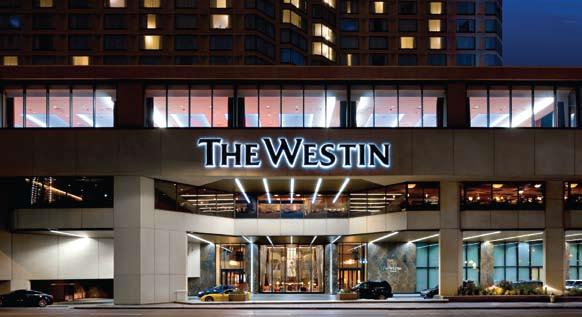

Even before entering the lobby, prospective guests sense in the transformed 496-room hotel a new sense of welcoming and openness. “Out front, just as throughout the hotel, we’re giving our guests a new sense of arrival, a sense of ‘hominess,’” says General Manager John Jarvis. “With the more extensive windows and heightened ceiling, you can see into the lobby with the replace and the beautiful chandeliers … and you quickly nd yourself relaxing from your travels. That is the Westin Experience.”
The new Westin brings an upscale sense of openness and light for a whole new lifestyle experience -- whether guests stay overnight in a lavishly-renovated guestroom, or come to the hotel for professional meetings, diplomatic functions or social events.
The Westin Ottawa announces a $35-million transformation. that offers guests a whole new lifestyle experience … whether they are staying overnight, or have come to the hotel for professional meetings, diplomatic functions or social events.
General Manager John Jarvis says the changes amount to “a
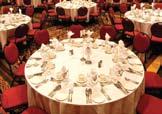
There’s a new and elegant , a beautiful lobby that now stands two stories high with elegant accoutrements and lighting, many meeting rooms, and a huge premium ballroom overlooking the Rideau Canal and the Parliament buildings.
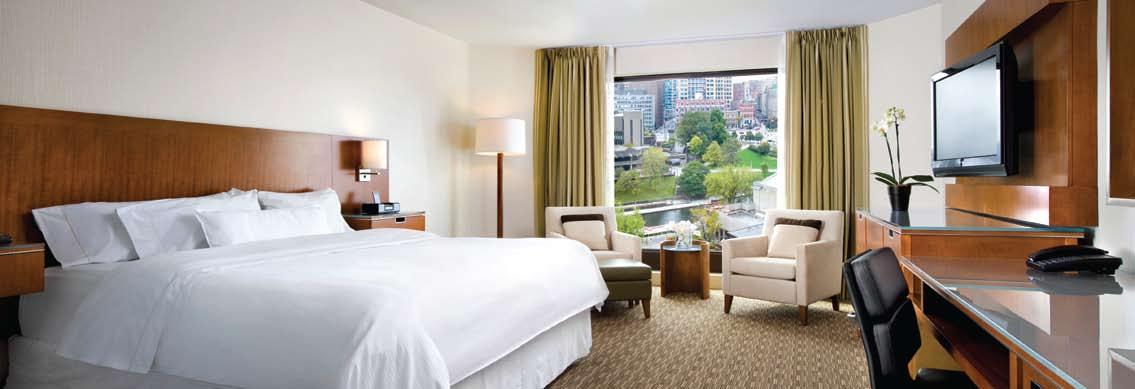
The guest rooms have been extensively renovated to give a contemporary and upscale sense of openness and light. And the ‘people experience’ of staying at the Westin has been brought to new heights.
says Mr. Jarvis.
That explains why his second
When guests arrive at the front desk, for example, they no longer speak across a long counter to a hotel agent. Instead, the agents step out from behind the counter and approach our guests to welcome them, shake their hands, and speak to them at an intimate distance.
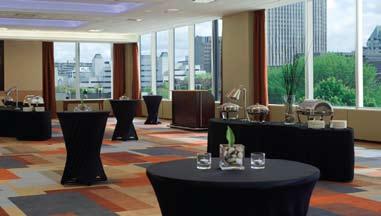
> The light-drenched Governor General ballroom promises to be a prime choice for diplomatic events and celebrations. The oor-toceiling windows give a view of Parliament, the Rideau Canal and the very core of the city. With a new convention centre attached to the Westin soon to be completed, with renovations to the Rideau Centre planned, and with the ByWard Market only steps away, the Westin has “the best location of any hotel in any G-8 city – and an ideal place from which to serve the entire diplomatic community,” says John Jarvis.
The guest rooms have been renovated at an average expense of $33,000, well repaid by the clean contemporary look, the large at-panel televisions and the glass-enclosed showers that many of the rooms now boast. “Our new look re ects our commitment to help our guests retreat from the rigours of the road and help them to perform at their best,” says General Manager John Jarvis.

William Verhey, Director of Protocol Events and Diplomatic Hospitality, says the Westin is anxious to re-establish its longtime connections with the diplomatic community. And with highly attractive new facilities, he is sure that the Westin will be more useful than ever to embassies planning National Day celebrations or holding other social events.
He is particularly proud of the Governor General ballroom
“When diplomats come over and see this beautiful room with its

For very large events, the hotel retains its Confederation Ballroom, host over many years to diplomatic functions. The Westin continues to offer top-level services as well as offsite catering to embassies and to DFAIT.
says Mr. German and Dutch, and is working on Spanish.













Do you hold in your imagination a picture of how luxurious your next home could be? Share what inspires you with us and together we will explore how Custom Homes by Minto can bring your vision to life. We currently have a limited number of sites – including the 7 lots of Butternut Creek in Manotick and waterfront lots on Winding Way –to build your amazing custom home.
To see the incredible homes we’ve built, and to learn more, visit customhomesbyminto.com, then contact Jeff Low at jlow@minto.com, or call 613.782.5749



Do you have a clear view of the people and organizations you deal with?
KPMG Corporate Intelligence can help you get the information you need quickly, thoroughly, discreetly and legally.
There’s lots of information out there, beyond the search engines, and we know where to look.
Our network is on the ground now— around the world—with access to the background information sources you need.
Mitigate your financial risks and reputational risks.
Get the whole picture.
Contact KPMG Corporate Intelligence: Peter Armstrong 416 777 8210 pearmstrong@kpmg.ca
www.kpmg.ca

PUBLISHEr
Donna Jacobs
ASSOCIATE PUBLISHEr
Neil Reynolds
EDITOr
Jennifer Campbell
ArT DIrECTOr
Paul Cavanaugh
ADVErTISING ADVISOr
Cu Van Ha cu@cuative com 1-613-262-4908
BOOKS EDITOr
George Fetherling
CONTrIBUTING EDITOrS
Don Cayo
CULTUrE EDITOr
Margo Roston INTErNS
Brook Simpson
Tim Stiles
CONTrIBUTING WrITErS
Donna Brown
Satya Das
Margaret Dickenson
Fen Osler Hampson
Paul McKay
Laura Neilson Bonikowsky
Ihor Ostash
Aaron Shull
Alastair Sweeny
Pieter Van den Weghe
Fred Donnelly
CONTrIBUTING PHOTOGrAPHErS
Ulle Baum
Larry Dickenson
Frank Scheme
Dyanne Wilson
BUSINESS MANAGEMENT
Jessie Reynolds
WEBMASTEr
Leslee McCabe
DIPLOPOrTAL WEB PArTNErS www diploportal com
Alastair Sweeny
Richard Evers
(Northern Blue Publishing)
PUBLISHEr EMErITUS
Lezlee Cribb
ADVErTISING INQUIrIES
Contact Neil Reynolds or Donna Jacobs info@diplomatonline com
SUBSCrIPTIONS
Diplomat & International Canada is published four times a year Subscription rates: individual, one year $35 70 For Canadian orders add 5 per cent GST U S orders please add $15 for postage All other orders please add $25
SUBMISSIONS
Diplomat & International Canada welcomes submissions
Contact Jennifer Campbell, editor, at editor@diplomatonline com or (613) 231-8476
DIPLOMAT & INTErNATIONAL
CANADA
P O Box 1173, Station B
Ottawa, Ontario Canada K1P 5R2
Phone: (613) 422-5262
Fax: (613) 422-7557
E-mail: info@diplomatonline com www.diplomatonline.com
Published by Sparrow House Enterprises Inc



on the international stage, it’s safe to say Canada’s had a roller-coaster few months . Throughout March, the country rode high as “the one to beat” after February’s gold medal success at the Olympics But as Canada looks ahead to its next high-profile job of hosting the G8 Summit, there’s little doubting a return of the dirty-Canada talk from the United Nations climate conference in Copenhagen That’s when the country was awarded the “Fossil of the Year” distinction by a network of some 400 environmental groups for its inaction on climate change
It’s been compellingly argued that Canada’s position was simply an honest one — that the current federal government was no longer willing to do what its predecessors had done in paying lip service to Kyoto promises they didn't keep . Either way, as Canadians are discovering, a lot of responsibility comes with having vast oil reserves in Alberta, and the technology to clean up the mess that extracting it produces By 2012, Canada will have proven reserves of 300 billion barrels or more of oil, writer Satya Das points out in an article written for Diplomat and based on his book, Green Oil . That gives the country serious, if not “super,” power, particularly as it’s the only fully democratic country among its oil-rich counterparts — Venezuela, Saudi Arabia, Iran and Iraq
We also excerpt from Alastair Sweeny’s new book, Black Bonanza, where he explains
up FR ont
how Canadian technology, developed by a late visionary named Roger Butler, solved the problem of dwindling reserves worldwide by coming up with a revolutionary process of extracting oil from the oilsands
And to address those inaction accusations flung Canada’s way, publisher Donna Jacobs sat down with Environment Minister Jim Prentice His priorities, in terms of cleanenergy production, he told her, are to get the Copenhagen Accord in place so Canada can “fulfill its responsibilities in support of the accord” and to harmonize Canada’s policy with that of the United States The full interview begins on page 25
Further on energy, author Paul McKay argues that it’s simply too risky to declare nuclear a safe energy source As he puts it, “a fissioned mass of plutonium the size of a stick of chewing gum destroyed the civilian city of Nagasaki in 1945 ”
In our books section, we learn about the life of R A D Ford, who was Canada’s ambassador to the Soviet Union for 16 — yes, 16 — years . He was there for Khrushchev’s tenure, as well as that of Brezhnev Books editor George Fetherling also gives us an illuminating look at the institution that is Canadian Who’s Who on its 100th anniversary
In wine, we look at the unique geographical properties of the Niagara region, the result of 200,000 years worth of glacier movement Then food writer Margaret Dickenson brings us an appreciation of the spring vegetation that will soon hit our plates, while culture editor Margo Roston takes us on a tour of the family home which Argentinean Ambassador Arturo Bothamley shares with his wife, Maria Angelica, in Rockcliffe Our Canadiana feature is about the way the border between Canada and the U S was drawn, a border with few adjustments since a 1907 survey.
We finish off with a Destinations feature about the storied Rosetta Stone, which now resides at the British Museum in London
We hope you enjoy our spring edition
Jennifer Campbell is Diplomat’s editor
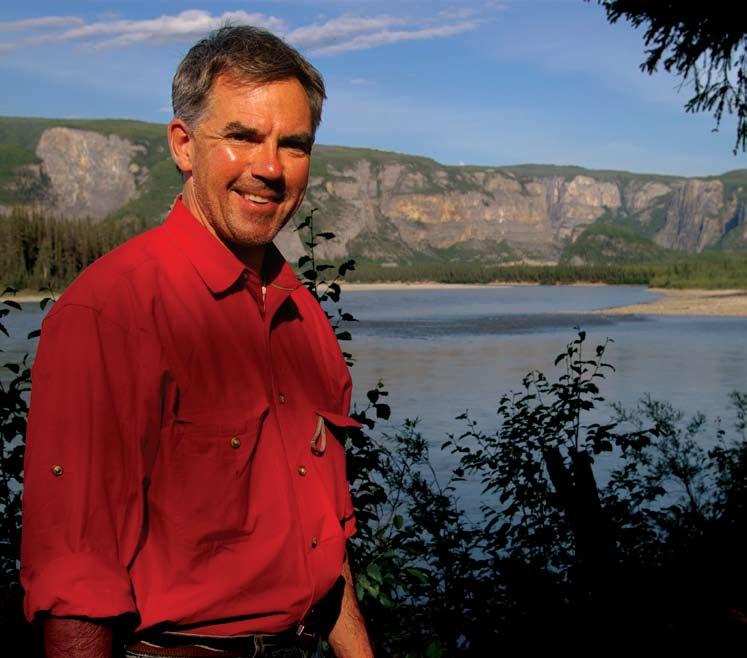
“Last year, our government increased the size of Nahanni National Park Reserve to six times its original size It now covers an area equivalent to the size of a country like Belgium,” said Frédéric Baril, Environment Minister Jim Prentice's press secretary, who took the cover photograph of his boss on the bank of the South Nahanni River At the time, Mr Prentice canoed the river, accompanied by a group of native Canadians and journalists .
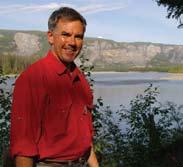
Paul McKay has won many of Canada’s top journalism awards for investigative reporting, business and feature writing . He is a past winner of the Atkinson Fellowship in Public Policy, and was the 2005 Pierre Berton Writer-in-Residence A series he wrote for the Ottawa Citizen was a finalist for the Governor General’s award (the Michener prize for public service journalism) He has also written four critically acclaimed books covering public policy, business biography and true crime subjects His feature writing has appeared in the Globe and Mail, Toronto Star, Vancouver Sun and Macleans Visit www paulmckay com to buy his latest book, Atomic Accomplice
donna Brown
Donna Brown, a federal customs officer in the Greater Toronto Area, has spent nearly 25 years studying human behaviour and interviewing techniques A certified body-language specialist, statement analyst, threatassessment specialist and author, she is considered an expert in reading people and detecting deceit . She has trained thousands of police officers, customs and immigration officers, compliance officers, auditors and investigators She gives lectures through her company Ana(lies) Enterprises (analiesenterprises@yahoo ca) She lives in Toronto with her husband, who is also in law enforcement, and three daughters .
this excerpt comes from a paper entitled Canada in the Medium Term: What is Shaping our Policy? by the policy Research initiative's thomas townsend and reviews the work being undertaken by the organization to highlight the issues that will affect policy-making in canada though 2015.
the paper was a centrepiece for discussion at the canadian international conference “the world in 2015: implications for canada,” which took place in ottawa in january.
the canada brand and the changing nature of media
Canadians like to see themselves as a positive force in the world and the world has tended to have a positive view of Canada
The Macleans Poll (How Canada is Seen by the World) in December 2007 suggested that Canada is seen as a tolerant nation, a peacekeeper and a leader on important issues that matter to the world Indeed, in that poll, Canada was seen as a leader in the climate change debate We are a country that has a policeman as a national symbol underscoring our commitment to the rule of law There are a number of symbols that reinforce our self-image as good
In the developing world, our image as a tolerant country and honest broker still continues as the prevalent narrative, but recent foreign media characterizations have created strains We are eager to increase our dealings with China and India, but (we) have been characterized in their media as somewhat slow and fitful . Climate change is potentially a significant sore point for Canada as it was characterized by environmental groups in Copenhagen What would have only a few years ago been exclusively domestic events are getting wider attention, in some cases based on a “back home” interest in how immigrants are getting along in Canada, and in other cases, along a line of focused interest .
A major influence on our image as we see ourselves and as others see us is new media There are an increasing number of examples where social media has shown its ability to mobilize public attention and opinion The Internet has created an important capacity for what is becoming known as “private politics . ” Issues we thought were local and domestic policy now have global feedback loops and
global influences can play on local issues in new ways Our brand becomes more important in a less steady world, where countries and important and influential non-state actors are trying to size up who is aligned and who to include in groups of the willing Canada, like all nations, will increasingly have to consider not just its conduct, but how that conduct is seen by others as portrayed in a whole new panoply of information channels News out of Canada targeted at specific ethnic and national audiences is no longer produced exclusively by state-licensed media and has the ability to shape the debate
On the other side, how will we embrace new media and organize non-institutional actors in the promotion of Canadian interests? Can we, as (former ambassador to the U S ) Derek Burney put it, light up the “hidden wiring” that is represented by a deep networked connection of Canadians and nodes of influence on a range of important issues we will face? Suddenly in a world of Twitter and Facebook, Canada’s million-strong diaspora become our ambassadors
New interest: Canada’s North has received much attention in the last few years Climatic change has made the possibility of an ice-free Northwest Passage during the summer, which has increased international interest in the region . Cli -
mate change has also made the Arctic much more accessible and, coupled with a global thirst for natural resources, the region is garnering attention as one of the last great potential reserves of oil, natural gas and a host of minerals
Canada’s northern people view the attention with both optimism, as their chance at a piece of the pie and, with concern, over the possible loss of environment and a way of life that remoteness has protected Northern policy will be one of the most difficult to get right as it vies for attention with a host of other competing preoccupations but is driven by many factors which the government will not be able to (anticipate) What is wanted is that northerners themselves can write the narrative That will be ensured through investments in education and leadership development Education has been identified as the area of critical short-term relevance as the North is the youngest of Canada’s regions .
Open waters: There is much in the media about international shipping using the Northwest Passage A clear passage could save between one and two weeks over current routes for ships moving between Asia and the eastern seaboard of the United States Those savings are attractive for the industry and trading partners Access to the passage is through a narrow channel controlled by Russia and the United States . The passage itself is more complicated . Canada considers the (Northwest) Passage internal waters, a position not held by the United States Filings of claims in the region will continue throughout the next five years and negotiations over the use and control of the waterway will intensify.
One important aspect of more open arctic waterways is the implications for national defence policy and operations in the region Inaccessibility and extreme conditions of the North has meant that the region could be managed with only modest investments These conditions are changing and the Canadian military is more visible in the region . But the North is an evolving story for the military and scaling operations in a synchronized way will be key
Development: Northern development is capital intense There is uncertainty about the availability and the cost of the capital needed to pursue large-scale development in Canada’s North . The government of Canada may be constrained as it deals with restoring fiscal balances and the private sector, in the absence of a

What does your daughter want to be? Who will she become? She can get there from here.
At Elmwood School, each girl is inspired to reach her full potential. In our all-girls environment she is encouraged to take on new challenges, develop her self-esteem and confidence, motivate others and of course, excel in the classroom.
Elmwood School Highlights:
Academically rigorous IB Programme
Outstanding graduate achievement
Inspiring, dedicated faculty
Small class sizes and supportive atmosphere
Creates compassionate global citizens Builds confident, caring leaders
For more information on the advantages of an Elmwood education, please visit elmwood.ca. To schedule a private tour, please call (613) 744-7783 or email admissions@elmwood.ca.
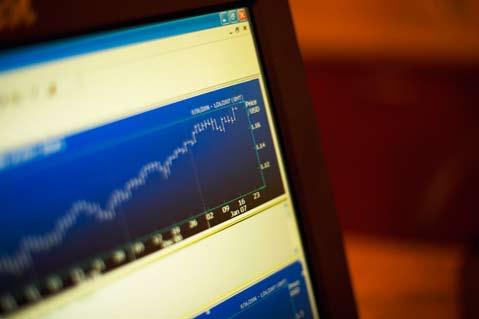
At Accu-Rate Corporation our team of highly experienced currency traders and foreign banking partners allow us to negotiate currency prices lower than any other currency dealer or commercial institution.

For your personal consultation please call: Marie Boivin Managing Director 613-596-5505 ext 101 marie@accu-rate.ca
strong government presence, may not be prepared to play first mover On the other hand, there is likely to be a significant increase in exploration to prove out the potential of the Arctic’s treasures It is likely that foreign-owned companies, including some that are wholly or partly controlled by sovereign wealth funds, will be interested in large exploration and development activities in Canada’s Arctic Walking the thin line between development, the environment and the traditional way of life in the North has never been easy A number of Canadian companies through decades of northern development have amassed knowledge and are sensitive to the special circumstances of the region . It will be a challenge to communicate this knowledge to new players It will also be new to regulate enterprises that have both corporate and political motivations
Government presence: The one part of the North that is likely to play a big feature in government budgets over the next few years is the extent to which climate change is affecting infrastructure, both existing and planned With respect to existing infrastructure, thawing permafrost (new oxymoron) is threatening structures that were expected to have a much longer lifespan Warming will require significant replacement of infrastructure over the next few years . New builds have to take into account a rapidly changing set of climatic conditions that will require a new set of planning assumptions Northern infrastructure is costly and the premature replacement of significant portions of the installed base will be another funding pressure for governments
The story in Canada’s North is rapidly evolving and the next five years will be a critical period that will set the direction for the next two to three decades . Like many other areas of Canada’s policy, there will be substantial external pressures based on other nations' ambitions in the region and the potential push to commercialize assets The timing is uncertain and the extent and source of the pressures unsure, but this will be an active policy space over the period .
Thomas Townsend heads the Ottawabased Policy Research Initiative, an organization that researches emerging issues for Canada’s federal government Information compiled by Tim Stiles, Diplomat magazine intern from Carleton University’s Norman Paterson School of International Affairs’ master’s program .
The growing threat of maritime piracy and what can be done about it
the American writer and satirist Ambrose Bierce called piracy “commerce without its folly-swaddles, just as God made it ” Piracy is one of the world’s oldest professions, certainly as old as merchant shipping itself Since ancient times, traders who have plied the seas have risked attacks from marauders and buccaneers . In the ancient world, Crete and the Lipari islands were pirate havens because of their proximity to key shipping lanes in the Mediterranean Pirates threatened the existence of both the Greek and Roman Empires for centuries Western Cilicia — now the southern part of Turkey bordering the Mediterranean — was also a key centre for piracy and posed a growing threat to the Roman Empire as it expanded eastward into the territories of Asia Minor Julius Caesar himself was captured by Cilician pirates and only released after his captives were paid a tidy ransom of 25 silver “talents ”
The so-called “Golden Age” of piracy, however, was the late 17th and early 18th Century when buccaneers, supported by the English crown, attacked Spanish and French galleons as they returned from the New World laden with gold and silver treasure Piracy played a key role in bringing the Spanish Empire to its knees One of the most famous buccaneers was Sir Henry Morgan who was rewarded for his efforts by gaining a knighthood and the governorship of Jamaica . Today’s buccaneers are a less glamorous, but no less lethal lot From the Malacca Straits of Southeast Asia to the Chittagong anchorages of Bangladesh to the waters off Lagos and the Bony River of Nigeria, mariners face the constant threat of attack . However, the most dangerous waters in the world lie off the coast of Somalia in the Gulf of Aden and the Indian
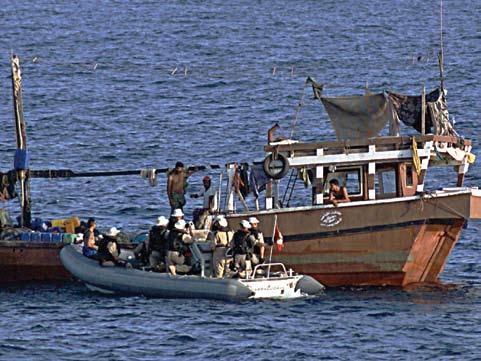
Ocean where Somali pirates have boarded and hijacked everything from oil tankers returning from the Persian Gulf to cruise ships to fishing trawlers to even small pleasure craft piloted by unsuspecting yachters Many of these attacks take place far out at sea at distances that exceed 1,000 nautical miles from Somalia’s coastal capital city of Mogadishu
In 2009, of the 406 reported piracy incidents worldwide, more than half (217) originated in Somalia . In some instances, captured crew and vessels have been held for many months until ransom has been paid for their release Ransom payments have soared into the millions of dollars Earlier this year, a Greek-owned oil tanker was only released after its owners agreed to pay more than $5 million . By some estimates, these attacks are costing the commercial shipping industry almost $100 million a year
With the escalating number of attacks, international naval, anti-piracy patrols in the region increased last year But the task has proven a daunting one Not only is the Somali coastline vast — almost 3,000 kilometres long — but if one includes the entire Horn of Africa and Yemen (which is also a growing source of attacks) — the
patrol area extends to almost 9,000 kilometres of coastline . It is also clear that Somali piracy is a booming growth industry with estimates placing the number of pirates at close to 2,000 who are members of some seven “syndicates” which are controlled, financed and brokered by “bosses” who operate out of Kenya, Dubai, Lebanon, Somalia, and even Russia . Although some, including Chantale Lavigne, CBC’s Radio-Canada reporter for The National, attribute Somalia’s piracy problem to overfishing by foreign fleets in Somali waters and the illegal dumping of toxic and radioactive wastes on Somalia’s shores, there is no real hard evidence that Somali pirates are former fishers who have lost their means of livelihood or that such dumping has occurred Most of the pirates are young men who come from one of Somalia's two major clans and/or were former members of the militia who fought in Somalia’s brutal internal civil war
There are two pieces of good news in this otherwise troubling picture The first is that Somalia’s pirates do not have ties — at least not yet — to al-Shabab, the powerful Islamic fundamentalist movement in the southern part of the country, which has links with al-Qaeda The second is that
although the number of pirate attacks is on the upswing, the proportion of successful attacks — where ships are captured and crews taken hostage — is falling
This is because, in 2009, a combination of intergovernmental, regional, state, and private actors mounted a collaborative effort to address this threat . Combined efforts to deal with piracy have involved joint, ad hoc naval coordination among key NATO, EU and Coalition Maritime Forces; a major parallel role of the private sector, especially among those companies whose ships transit these waters; the critical cooperation of Kenya in handling captured pirates; and the impact of more effective effort by distinct Somali non-state entities Although there is no unified command structure among the three naval contingents, there has been extensive coordination at the tactical level, to deal with Somali pirates
Another positive development is improved efforts by merchant shipping lines to protect their own vessels . Up to 70 percent of pirate attacks are now being defeated by merchant ships’ crews themselves As a consequence, pirates face significant risks and less likelihood of
thermore, Kenya has agreed to prosecute pirates who are apprehended, although other regional states lack the necessary legislation or political will to cooperate with international efforts to provide legal support for direct naval action against pirates .
One account summarized the picture this way: “In 2009, the combined maritime operations of NATO and allied forces disrupted 411 pirate operations of 706 encountered; delivered 269 pirates for prosecution under prevailing legal interpretations to Kenya and other jurisdictions (of whom 46 were jailed); and killed 11 pirates . According to the World Peace Foundation, the combined operations also destroyed 42 pirate vessels; confiscated 14 boats, hundreds of small arms, nearly 50 rocket-propelled grenade launchers, and numerous ladders, grappling hooks, GPS receivers, mobile phones, etc ”
At the end of day, naval operations are ultimately no substitute for greater efforts to tackle the socio-political and economic challenges within Somalia itself . Even here, there has been some modest progress as a result of encouraging political developments in the autonomous regions
officials and communities have taken to ostracizing those who engage in piracy and launching community awareness campaigns to show that piracy hurts local interests Does this mean the threat has diminished? It does not . However, there is something of an evolving cooperative network of global, regional, and state and non-state actors, at least in this part of the world, to address the piracy problem
The long-term challenge will be to sustain these efforts, especially to break the stranglehold of Somali warlords and “bosses” who bankroll and profit from piracy and to create incentives that strengthen the local Somali economy and provide alternative employment opportunities for Somali youths As Indonesia’s own successful efforts to combat piracy in the Straits of Malacca have shown, local authorities, alongside those of the international community, have a key role to play in curbing piracy and armed robbery in their littoral waters .
Fen Osler Hampson is Chancellor’s Professor and director The Norman Paterson School of International Affairs Carleton University

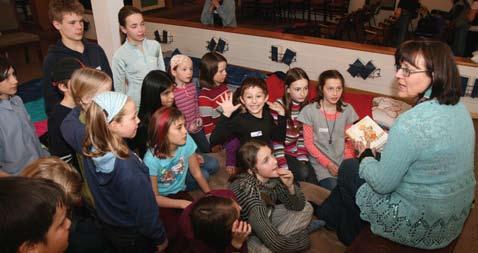
sabine Witschel recently spent the night sleeping on a mattress on the floor in a church with a bunch of children aged eight to 13 “You don’t often have the chance to sleep in front of an altar,” joked Ms Witschel, who is married to German Ambassador Georg Witschel
But the real reason she did it was to foster a love of reading in a group of children who also have an interest in improving their German . And, as a member of the congregation of the church, it’s something
The children listened intently for several chapters and then assembled in the church basement where they expressed their early impressions of the book through drawings and crafts based on its themes
“They were all quiet enough that I was able to continue reading,” Ms Witschel said
After some pizza and sweets, the children were getting tired so they crawled into their sleeping bags and Ms Witschel set up a chair and continued to read until about midnight when almost all the children were asleep
The next morning, the children insisted that the ambassador’s wife finish reading the book to them .
“It’s a very funny story about a crimi-

she plans to do again next year
The sleepover — dubbed the first German Reading Night for Kids — took place at the German Martin Luther Church in Little Italy and attracted 20 children, one of whom was Ms Witschel’s 12-year-old daughter, Christina
The children assembled early in the evening, at about 6:30 p m , and Ms Witschel started reading from a recently published, award-winning novel called Rico, Oskar und die Tieferschatten (Rico, Oskar and the Deeper Shadows) by Andreas Steinhoefel . The mystery draws on Erich Kästner’s classic novels The protagonist, Rico, who is investigating a crime, has been compared to a young Forrest Gump — a little bit slower than most people, but smart in his own way
“It’s based in Berlin so I brought a big map of Berlin and we had pictures of the street where the action takes place,” Ms Witschel said .
nal,” she said “They wanted to hear the end of it ”
More than half of the children were Canadians, Ms Witschel guessed, and all of them had some connection — often a German-speaking parent — to her native tongue “It was a lot of fun,” she said
Organizer Julia Hurrelmann said the event was a great success and they hope to do it again next year
In Germany, reading nights such as this have a long tradition . They usually combine public readings, a sleepover at an unusual location (such as a library, a school or a church) and activities such as crafting and cooking
“It can no longer be taken for granted that parents read to their children,” Ms Witschel said “Things get even more complicated if German immigrants try to raise their kids bilingual or trilingual . How can such kids find the quiet and peaceful moments needed to get lost in a book?” D

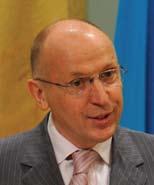
FiRst naMe: Ihor
last naMe: Ostash
citiZenship: Ukrainian
pResented cRedentials as aMBassadoR: Jan. 30, 2007
pRevious joBs: Member of Parliament in Ukraine
next year, Canada and Ukraine will mark 120 years of common history — that’s how long it’s been since the first Ukrainian immigrants arrived in Canada . Since that time, the Ukrainian-Canadian community, more than 1 2 million strong, has been contributing to Canada’s political development, prosperity and cultural diversity The latter moved into the mainstream of Canadian concerns in 1964 with the establishment of a Canadian policy on multiculturalism, written by Paul Yuzyk, a senator of Ukrainian descent This important human dimension gives UkraineCanada relations a special and even unique character Such common history, as well as our common values and interests, enhances our relations as partners and allies .
As such, it came as no surprise that Canada became the first Western country to recognize Ukraine’s independence in December 1991, following a vote by Ukraine's citizens in a referendum on independence
As Canadian Prime Minister Stephen Harper said, no Western country has closer ties to Ukraine than Canada, which has always supported freedom and democracy for Ukraine and will support Ukraine’s right to determine its own destiny, without interference from outside interests
Early evidence of our strong partnership began in 1992 when then foreign minister, Barbara McDougall, visited Ukraine, followed by a visit from then Governor General Ramon Hnatyshyn, another prominent Canadian of Ukrainian descent . That was followed by a visit of
the president, Leonid Kuchma, to Canada in 1994 .
In recent years, those relations have deepened We have achieved an intense political dialogue and major achievements in the social, humanitarian and economic spheres After an exchange of visits by foreign ministers in 2007, then president Victor Yushchenko, paid a state visit to Canada in 2008 and addressed a joint session of the House of Commons and the Senate . The same year, Canada recognized the Holodomor, the famine of 1932-33 brought on by Stalin’s policies, as genocide against the Ukrainian people That position was strengthened by Canada’s co-authorship of resolutions honouring the memory of its victims by the UN General Assembly, UNESCO and the Organization for Security and Co-operation in Europe .
Last year, we welcomed Gov Gen . Michaëlle Jean to Ukraine, a visit that was later followed by one from House of Commons Speaker Peter Milliken In September 2009, the heads of our foreign ministries resurrected the practice of annual bilateral meetings, and during the 64th Session of the UN General Assembly, they signed the Road Map of UkraineCanada relations It defined a new level of co-operation between our states, and after the signing ceremony, Foreign Minister Lawrence Cannon said Ukraine is for Canada a key European partner and Canada will strongly support Ukraine’s Euro-Atlantic aspirations We highly value Canada’s support in this regard, particularly clear statements made by Ms Jean and Mr . Harper .
Our high-level political dialogue in 2009 culminated in a December meeting between Ukrainian Foreign Minister Petro Poroshenko and his Canadian colleague, Lawrence Cannon, in Brussels
Bilateral economic co-operation has become a cornerstone in Ukraine-Canada relations with both sides paying close attention to bilateral business forums . The next of these is scheduled to take place
in Edmonton in June 2010 . The main topics for discussion will be cooperation in agricultural, nuclear energy, finance sectors as well as economic partnerships between the regions In March, we’re planning a Toronto Canada-Ukraine aerospace partnership and technology forum and in April, a seminar dedicated to cooperation in the pharmaceutical business
On the subject of cooperation in aerospace, I must mention a big bilateral project we started last year when the National Space Agency of Ukraine signed an agreement with Canada’s MacDonald, Dettwiler and Associates Ltd (MDA) to launch the first Ukrainian satellite com-
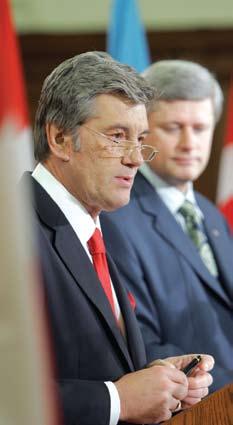
munication system Export Development Canada has contributed $254 million to this project The communication system, among the other things, will serve for broadcasting the 2012 Euro-Cup soccer championship to be co-hosted by Ukraine and Poland
But perhaps the most important recent
development was a decision to start negotiations about free trade agreement between the two countries, an idea cemented during a visit by then international trade minister Stockwell Day Two months later, our countries held preliminary consultations .
A free trade agreement would boost cooperation not only in trade but other fields such as nuclear energy, agriculture, and gas and oil production and transportation We are interested in Canada’s expertise in transportation of energy resources and gas pipeline maintenance, taking into account Canada’s responsibility for some of most important oil and gas pipelines in the world . Canadian companies could also take part in projects connected with condensed gas terminal construction and offshore production of oil and gas in the Black and Azov Seas
Today, we are striving to further develop cultural ties with Canada We have decided, for example, to open a consulategeneral in Edmonton, to strengthen the consular presence of Ukraine in Ottawa and Toronto At the same time, we also hope Canada will introduce a visa-free regime for Ukrainians, as our country did for Canadian citizens in 2005 This will promote not only the humanitarian but also the economic aspects of our relations
The federal government is a strong supporter of Ukrainian democracy, and this is reflected by the fact that more than 300 Canadian observers monitored Ukraine’s 2010 presidential elections
Following the election, Mr Harper congratulated president-elect Viktor Yanukovych on his victory, saying that Canada and Ukraine have a strong and significant relationship, based on the shared values of human rights, peace and democracy . He emphasized that Ukraine is a key partner for Canada in Europe, and has an important role in the development of democracy and security in the region
Canada’s value of friendship with Ukraine was marked by the participation of Peter Kent, minister of state of foreign affairs, in Viktor Yanukovych’s inauguration
Neither political developments nor economic difficulties can impede a deepening of Ukraine-Canada relations The solid background has been established and joint efforts should be further evolved for mutual benefit between two nations that really share common values and interests
Ihor Ostash is Ukraine's ambassador to Canada



For someone who comes from the Caribbean, Cuban Ambassador Teresita Vicente Sotolongo has had her share of relatively chilly postings. In addition to Ottawa, where she arrived in the fall of 2008, she has been posted to Finland, Sweden and Denmark. She joined Foreign Affairs in 1981 and was most recently Cuba’s ambassador to Switzerland before a five-year stint at headquarters, which led to her current position. She recently spoke with Jennifer Campbell, Diplomat’s editor.
Diplomat Magazine: Would you like to start by talking about the anniversaries (51 st anniversary of the Cuban Revolution and the th year of diplomatic relations with Canada) that you’re marking? v icente s otolongo: First, we will mark the anniversary of the revolution, which is our national day . And I would say that we are celebrating the passing of anniversary in (what was) a very hard year, coping with the international financial crisis but also keeping many of our advantages In Cuba, public health and education have required a lot of efforts from the Cuban people and the government . This was also a year of devastation . In December 2008, there were extreme hurricanes and the last one destroyed about a half-million houses In some areas, it was like a bomb had dropped We coped last year with the recovery of that, during an international economic crisis At the same time, we have made big efforts in foreign trade, to diversify relations with There were important delegation exchanges as well with Venezuela, China, and Canada, which is Cuba’s fourth largest trading partner (Spain is third )
In addition, last year was a year of consolidation of ALBA (the Bolivarian Alliance for the Americas), which is made up of Antigua and Barbuda, Bolivia, Cuba, Dominica, Ecuador, Nicaragua, Saint Vincent and the Grenadines, and Venezuela, and emphasizes mutual economic aid over trade liberalization) This is very important for the Cuban economic development and in Latin America also — not only politics, which is there — but also from the economic point of view . We now have a Bank of ALBA, we have foundations, we have funds for culture and it’s
working We have different projects in the Caribbean area and that has been an important subject . This was a difficult year for Cuba in terms of economics — for Cuba and the rest of the world — but we coped with that and we are working this year to complete the recovery and to go further in our relations with our Latin American neighbours and allies
I should say we are also now in preparations for the Congress of Communist Youth This is for good discussions among youth about their role in society, what they foresee for the future of Cuba This is very important because they are the future
dM: Are the youth fairly conventional or do they bring new ideas?
tvs: Oh no, youngsters are never conventional They have new ideas They want to be active in progressing economically, to be efficient, to know how they could do it in a better way . And, at the same time, they recognize that we have good things to give for the future, which is our independence and the level of society — what we have in terms of public health, pensions for old people Cuban society is getting older and this is a social and economic problem they will deal with .
dM: Did Cuba weather the international financial storm better than other countries in the region?
tvs : It was hard, but better (for us) because we had plans There is also no corruption Every single peso of aid is used in the correct way and this is important And, from the point of view of the economy, Canada has played a very important role . We receive almost a million Canadian tourists, most of them from Quebec but also from the rest of the provinces WestJet has started new flights to Cuba
I think we have a lot of things to be happy about Talking about the 65th anniversary of diplomatic relations between Canada and Cuba: In fact, our relationship goes back further . We’ve had trade for 100 years now The 65 years of a diplomatically mature relationship between neighbours is such a remarkable thing We’ve never had problems in our bilateral relations We can discuss any subject Even in families, sometimes fathers and children don’t always agree on everything but they can talk about things . I think we have a very solid, mature, stable relationship, no
matter about the international situation, no matter the internal situation in our countries, and this is more remarkable when you think that we have a neighbour in between us that is not capable of having such a mature relationship with Cuba In times where a lot of countries in Latin America and the Americas were cutting ties with Cuba, Canada said ‘No, we want to have a normal diplomatic relationship ’ It shows that Canada has its own position and its own interests We are now marking 51 years without diplomatic relations with the States, and keeping good ones with Canada Now we must further that relationship . Canada and Cuba are cooperating in food security, environment, and education There are Canadian Studies programs in seven different universities in Cuba We also want to attract more Canadian business to Cuba, and I’d like to see more Cuban products in Canada
dM: What products would you like to see more of?
tvs: More agricultural products — we are exporting some coffee but not enough, also juices of mango and other fruits There are juices from Asia here, but not from Cuba We have the means to do this These are the things that keep me awake (at night) and keep me busy
dM: What is Cuba’s place in the world?
tvs: I think we have achieved a place in international relations . It’s not because we want others to do what we did or what we are doing It’s because we’re an example of a country that is small, not very powerful from an economic point of view, but we’ve shown that you can develop economic resources to be present I think Cuba has a place because it shows how a small country can contribute at an international level to humanity . And, at the same time, can contribute internally to give people many options in life
d M: Surely the political system plays a role in what you see as Cuba’s example?
tvs : Not the political system We have never said that we want people to be socialists . We believe that this is the choice of the people Being socialist, if you are independent and you have the right policies, it benefits people, and it benefits your country and other countries Some countries get in trouble for having relations with Cuba but they are still there
dM: How do most Cubans feel about Fidel Castro?
tvs: I think they feel as I do I am proud of Fidel I think he’s brave I think he has sacrificed his life, his personal life for example, to do something he believed in I see him now, at his age, and he’s very


strong-willed to still be active in the way he can I see him as a father He’s healthy, he’s writing and I’m happy for that, that he’s still there, being useful I think most of the people in Cuba feel the same way



We are past the difficult times He didn’t throw in the towel, he kept working
dM: The Organization of American States has voted to lift the ban on Cuba’s membership Why does Cuba resist joining? tvs : We decided not to join and we think this is historical justice because Cuba was sanctioned because the U . S and Latin American countries cut relations with us Canada and Mexico said no — they were the only two countries that said no Now we have relations with every single country — except for one Frankly speaking, we aren’t interested in being part of the OAS because we don’t think the organization has changed enough We don’t see that the organization is capable of acting and obtaining results in the sense that Latin America needs We don’t trust the organization and there should be trust But it was an act of justice when they lifted the ban on Cuba There were a lot of countries that pressed for that .
dM: Relations with the U .S . under Barack Obama are less chilly but will they ever be warm?
tvs : Not better in the sense that some
people expected We had the expectation of so many different administrations — Democrats and Republicans We know what the blockade is and we know the forces inside the United States who are against lifting the blockade There are people who support the lobby against Cuba and they are active . And Mr . Obama has too many priorities and things to solve He could do things to show his will but he hasn’t He can approve some travel to Cuba
d
M: But it seems as though the healthcare debates have usurped the travel ban bills introduced last year in the Senate and House of Representatives (Some American politicians favour lifting a Cold War-era travel ban that is part of a 48-year-old U S trade embargo against Cuba The bills were introduced last year when President Obama was promising to improve relations with Cuba )
tvs: And it seems that it’s no longer on the political agenda of Congress . There are things (President Obama) could do, but no . He has said he’d prefer one good term to two bad ones so who knows what’s next? I cannot be optimistic at this moment It seems it is not progressing D



advance the interests of our clients, involved in all levels of government.
How We Can Help:
■ Representation at government tribunals and review boards, and before House of Commons Sub-committees and Senate Standing Committees
■ Advising on international trade law, including representation before national and international regulatory and advisory bodies
■ Monitoring and advising on political, legislative and regulatory issues

■ Assisting in drafting procedures for advisory bodies
■ Advocacy and regulatory matters, including competition law, foreign investment, commodity taxes, communications and procurement

By Donna Brown
By a man’s fingernails, by his coat-sleeve, by his boots, by his trouser-knees, by the calluses on his forefinger and thumb, by his expression, by his shirt-cuffs, by his movements — by each of these things a man’s calling is plainly revealed. That all united should fail to enlighten the competent enquirer in any case is almost inconceivable.
– Sir Arthur Conon Doyle’s Sherlock Holmes novel: A Study in Scarlet, 1892
to me, there is nothing sweeter than catching the bad guy In order to do that, you have to know how to read people
When it comes to reading signs and signals, some people appear especially sensitive . You could call it intuition . But I think it’s more based on what they experienced as children — when their physical survival depended upon a perceptive appreciation of ambient environmental cues (Has Daddy been drinking? Did Mommy slam the door?) Yet fortunately, most people can be trained to pick up a range of information communicated through non-verbal behaviour
I have spent 36 years in law enforcement — as a police officer (Toronto Police Service), as a private investigator and now as a customs officer with Canada Border Services Agency I’ve had the opportunity to work with some exceptional people and am fortunate to have studied the techniques for recognizing deception, spotting liars and identifying potential security risks
My training began early in my career with detectives telling me always to keep my eye on the people I was questioning and always to listen to them Keep them talking . Gradually, the same “strong indicators” (as police officers call them) appear over and over — and you soon become good at spotting behavioural cues
As a cop, I saw the best and worst in people; I saw first-hand the panic, fear, grief, happiness, contempt and guilt that are integral to human existence On occasion, I even saw regret and remorse It is an important skill to know when these emotions are genuine and when they aren’t . Part of this ability rests on simple

observation and curiosity (you have to be able to ask the tough questions and you have to heed your intuition ) But there is more to behavioural analysis than this It is an art . It is also science . Behavioural research has definitively established that certain character traits, nuances and cues mean certain things Ignoring these cues — the “strong indicators” — may leave people more vulnerable to criminal conduct than they need to be . Non-verbal behaviour, indeed, can
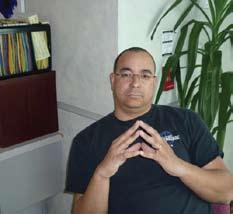
account for as much as 70 percent of our communication .
Knowing how to read these signs is important in many situations — for an employer interviewing a potential employee, for a student speaking to a professor, for a visa applicant, for a suspect being interviewed by a police officer, for a customs officer at the border, or a parent seeking the truth from a child . Indeed, a customs officer often has about 1/25th of a second to catch a crucial expression and decide to admit, turn away or investigate a person Getting to the truth can be a daunting task in the best of circumstances, partly because most people skilfully mask their emotions
People mask their emotions in various ways, using them as an invisible shield for their own privacy and to bolster their self-protection The stronger the shield, the harder it becomes to read the signals that people send Most child molesters, fraud artists, psychopaths and terrorists know how to penetrate people’s shields in a matter of minutes They know how to “read” people’s clothing, grooming habits, body language, housekeeping practices and even possessions, such as the car they drive
Human emotions have evolved over the millennia, part of our very genetic makeup and our autonomic nervous system (ANS) The ANS functions below human consciousness, controlling such life-sustaining processes as heart rate, respiration, digestion and sexual arousal . These processes are hard-wired in us . We can control them only with training and, even then, with limited result
Like every other aspect of our ANS, our emotions have developed over time for good reason On an individual basis, our emotions are organized to increase the chances of survival in a dangerous world . In a collective basis, they provide humanity with signalling devices that alert us to
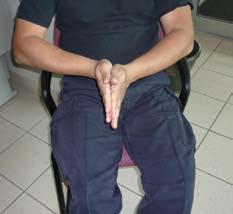
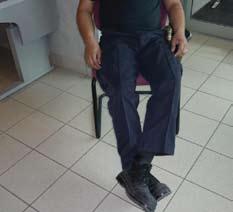
danger .
The most revealing of these emotions show up on our face Seven universal emotions are generally recognized — anger, contempt, disgust, fear, happiness, sadness, and surprise Each of these emotions is expressed culturally in the same
A b OUT TH e “ CHA r MING ”
MAN IN APT. 101, b UT
COULD NOT P e G WHY. I
FOLLOW e D MY INSTINCTS
S OON W e L e A r N e D THAT
OU r HANDSOM e D e VIL
WAS IN FACT OU r YOUNG
VICTIM ’ S r APIST AND MU r D erer.
way However, what prompts an emotional response can vary from one culture to another While emotions are universal, we are culturally trained to control them
Herein lies the critical opportunity to detect deceit in other people, to make “lie detection” possible Because emotions are hard-wired, we express them before we are aware of them Research by Dr Paul Ekman, a world-renowned Californiabased expert in micro-expressions, shows that they precede a person’s awareness of their facial expression by 1/25th of a
second . During this split-second opportunity to glimpse honest reactions, people display their emotion unprotected While it is currently impossible to know what a subject thinks (unless the person honestly discloses it), it is possible to detect what he or she feels
I’ve arrested all kinds of people from all walks of life, from the rich to the poor, from those in the public eye to the ‘untouchables ’ I’ve got the stories
the chaRMing MuRdeReR
I was a young police officer in Toronto back in the 1970s and it was a homicide that brought me to apartment 101 A young girl had been viciously raped and murdered in her apartment Our task, as rookie cops, was to canvas the neighbours in hope of obtaining information that would solve this heinous crime
It was a tall, dark-haired, handsome man who answered my knock I’m sure I was blushing as I showed him a picture of our victim and asked questions Did he know her? Had he seen her with anyone in the building? He looked quickly at the girl’s picture and said he had never seen her His skin colour went slightly white — evidence of fear — and his breathing pattern changed — evidence of higher anxiety But he was, after all, talking to the police and these were emotional indicators that we often saw
I thought the man “charming .” I should have thought of him as “a charmer,” which is a different thing altogether Devilishly handsome, he took complete control of our conversation and manipulated it As I left, I made a note beside his name “detective to return ” Naïve or not, I had felt uncomfortable about the charming man in apt . 101, but could not peg why . I followed my instincts Soon we learned that our handsome devil was in fact our young victim’s rapist and murderer
It is a simple fact; serial killers — N A
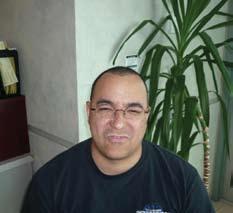
among them Ted Bundy, John Wayne Gacy, Jeffrey Dahmer and Paul Bernardo — were famously charming or more precisely charmers
Other signs: Criminal charmers are often glib and superficial, operate with a grandiose sense of self-worth and excel at pathological lying
White collar crime always falls to the bottom of the list when talking about serious criminal behaviour These criminals are also the most difficult criminals to catch I have often said: “If you want to see lies and deception, read someone’s resumé ”
Many white collar criminals hold, or have held, positions of power and trust . They can be famous publishers, heads of banks and investment firms, CEOs or senior government officials Some, when caught, show up in court wearing their Armani suits and Rolex watches Stealing, money laundering and keeping the proceeds of their crime — I have often wondered why, when we prosecute a fraud, we never seem to go after the proceeds of that crime?
From the smooth-talking to the difficult to spot, Garry Clement has seen them all The retired RCMP senior officer and exchief of Cobourg Police now runs his own consulting firm, White-Collar Consulting & Investigative Group (www wccig org) Considered one of North America’s leading experts in anti-money laundering, Mr . Clement says these criminals are “extremely aggressive in nature and could win an academy award for best con-artists — they do this all without any conscience at all ”
First working on money laundering with the RCMP in 1983, before legislation was in place, Mr Clement helped to develop indicators that would spot con artists . He says: “Audits and checks must be in place to catch these people The
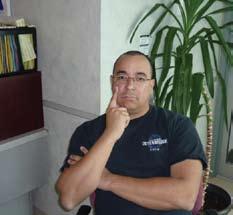
compliance officers need better training, including interviewing skills and the ability to read people And they need to learn to follow their instincts ” He adds mischievously: “It would be nice if we could keep the Rolex watches ”
peRsonal pRotection
U .S . airline pilot Robert Thompson doesn't know why he turned around and left the convenience store shortly after entering it to buy magazines Later, he read about the shootings He could not explain it himself What does the mind take in, in the blink of an eye? “It was a gut feeling” he later said
Perhaps Mr . Thompson did see the two occupants waiting outside the store in the car while the motor was running on that hot summer day Perhaps it was the look on the store clerk’s face, his darting glances, or did he notice the store clerk was focused on watching the man in the store — the man wearing the big heavy overcoat? Whatever it was, when his little voice told him to leave, he obeyed . Gavin de Becker, a leading U .S . authority on personal protection and survival, tells us this tale in his New York Times bestselling book The Gift of Fear (One of my favourite quotes: “Why is it when a man says No, it means No and when a woman says No, it is the beginning of a negotiation?”)
Mr . de Becker, a well-known psychologist, has listened to victims’ stories for years and has concluded that all the warning signs were there of a clear and present danger He says that we are surrounded by danger and the threat of violence every day We have to learn to trust and act on our gut instincts in order to stay safe If you read this book, it could one day save your life .
duping delight
Robert Chambers, better known as the
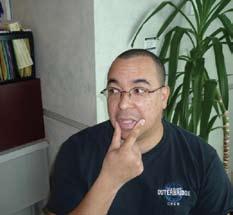
“preppie killer” who stole Jennifer Levin’s life, showed no remorse for his crime even after serving 16 years in jail During an interview on CBS’s popular crime series 48 Hours Mystery , Chambers held his hands in the praying position — fingers interlocked Perhaps if God were listening, he could get through the interview unscathed . Chambers jutted his chin out (defiance) and his vocals turned into a mere whisper (vocal deception) when he denied using drugs in jail
The most telling of “tells” was his “duping delight” — that certain smirk that says “I know something you don’t know ” Eventually he broke out into a laugh, just as Ted Bundy once did when asked if he had any intent on escaping from jail, one week before he did, in fact, escape
the Messages ouR Bodies send
We look to three main sources of information in body language — technically designated as emblems, manipulators and illustrators .
Emblems range from referee’s hand signals for “time out” to secret greetings by organized crime members These signals include: OK, stop, come here, be quiet, and peace to all mankind Coded hand language is how gang members can successfully communicate with one another and not say one word That is why I tell cops to separate their suspects at a roadside stop while the officers are interviewing them .
There is a danger in using body language of this kind in foreign countries because they are often culturally distinctive There is a famous story about President George Bush, Sr in Australia, where he flashed a V for Victory sign to the well-wishers outside his limousine Only problem was that he had his palms facing in so he showed the back of his hand, enthusiastically signalling “up yours” to the crowds Oops
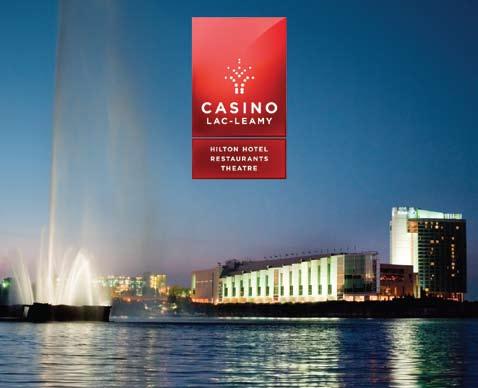


Manipulator’s expressions include touching one’s own body — scratching one’s face or arms or playing with hair
These habits can express deception, discomfort and anxiety Often when people are experiencing stress, they will fidget or attempt to touch objects . Illustrators are cues that include bodylanguage gestures that mimic the spoken word with expansive hand gestures for emphasis, such as telling a story with one’s hands or giving directions
MicRo expRessions
Dr Paul Ekman, who discovered micro expressions while carrying on research first discovered by Charles Darwin, found that the 43 muscles of the face can produce clearly visible, universally interpretable
He LOO ke D P e A ke D . I COULD S ee TH e WHIT e S OF HIS e Y e S – AN INDICATO r OF F e A r. H IS LIPS W ere D e HYD r AT e D AND THIN , Y e T H e MAINTAIN e D e Y e CONTACT. H IS HANDS
T re M b L e D AS H e GAV e M e HIS PASSPO r T. I T WAS HIS VOIC e THAT be T r AY e D HIM . He WHISP ere D HIS re SPONS e S TO MY q U e STIONS , AS THOUGH H e AND I SHA re D A S e C re T – HIS b ODY PAC k ING OF HASH OIL
emotions They are, as mentioned earlier, anger, contempt, disgust, happiness, sadness, surprise and the one we see lots of in law enforcement, fear We must be careful when distinguishing what is going on when these displays of emotions ‘leak’ out . A person can display fear, but it could be fear of not being believed that, nevertheless, looks the same as fear of being caught in a lie It is up to the interviewer to discover the truth
MoveMents
There are literally thousands of body language movements that can indicate many things . For example, re-arranging one’s hair or adjusting one’s tie are fix-
yourself-up grooming gestures Control gestures range from covering one’s mouth, to keep from speaking, to keeping one’s hand in one’s pockets
Whatever the movement, one must always think: Does the body language match the verbiage?
My young dRug Mule
He was a young man arriving back in Canada and coming off a flight from a tropical island I put him in his early 20s It was the profuse sweat I noticed first He looked peaked I could see the whites of his eyes — an indicator of fear His lips were dehydrated and thin, yet he maintained eye contact . His hands trembled as he gave me his passport It was his voice that betrayed him He whispered his responses to my questions, as though he and I shared a secret — his body packing of hash oil
Man vs Machine
Technology is not going to save us. Our computers, our tools, our machines are not enough. We have to rely on our intuition, our true being.
— Joseph Campbell, author and mythologist
No matter what walk of life you are in, reading people right or wrong can have serious consequences It’s not always about negotiations, interviewing for a job, or politics It can also be about keeping our country safe, and about our very own survival .
Machines are getting way too much hype these days We are losing our ability to read people If you don’t talk to strangers, if you don’t ask the right questions, how will you spot a potential threat?
Start with the basics — the interview Most people are at a loss due to inexperience in talking to people . They lack the ability of “getting to the truth .” Lies and deception are the wheels that turn communication and the truth is like islands in a sea of deception It is our job to discover those islands
The Israelis know this well They have engaged in counter-terrorism for a long time and are among the very best in the detection of risks . Tel Aviv Airport employs university students, working parttime, simply to observe passengers and to spot risks These students are thoroughly trained by experts in the field of detecting deception and potential pre-violence behaviour
On Christmas Day 2009, Nigerian Umar Farouk Abdul Mutallab made it all the way from Amsterdam to Detroit Indicators of potential risk — a cash passenger without luggage — went either unnoticed or ignored . Mr . Abdul Mutallab went through security, through the airport and onto the plane undetected until his bomb started to burn inside his pants It was a visual (and not mechanical) backstop Body scanners, bomb detection dogs and video security are great tools However, to rely on machines alone is wrong .
After all, it is only humans that send messengers of intuition — nagging feelings, apprehension, fear, anxiety, wonder, curiosity Who will assess the gait, who will hear the vocal intonations, who will register the all-too-human responses and physical signs? Who, except another human?
In our fast-paced, electronic society of Internet, Facebook and texting, we have lost our opportunity to develop our skills in reading people, which allows the predator easy access to his target
Donna Brown is a federal customs officer

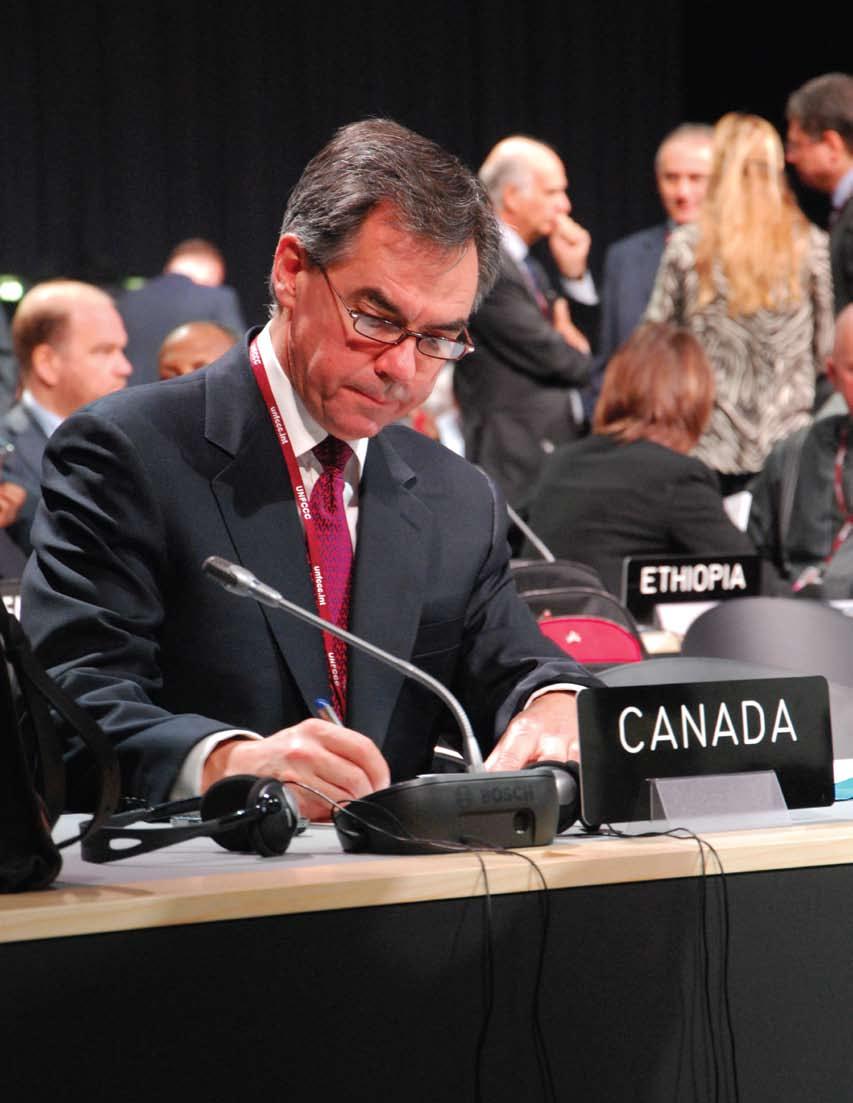
as environment minister and a calgary member of parliament, Jim prentice must reconcile two sides of his job — the problem of climate change with the economic engine that is the oilsands of alberta
By Donna Jacobs
environment Minister jim prentice is at home in his museum-like corner office in the confederation Building in downtown ottawa. Besides occupying the same space during his 18 months as indian affairs and northern development Minister, he furnished it from his own pocket and to his taste — “comfortable” — with brown leather predominating. his office doubles as a gallery where a personal collection of indian masks share wall space with art borrowed from indian affairs’ large collection in gatineau. near his desk, a totem pole faces entrants.
His whirlwind office tour takes you to the hockey corner — photos of his father, Eric, who was Toronto Maple Leaf’s youngest player ever, of his uncle, Dean, a 22-year veteran of the NHL, and of the Calgary Longhorns hockey team Minister Prentice played on In a great family photo befitting his preference for outdoor activities, he and his wife and three daughters pose beneath a sprawling tree And on the wall opposite is a photo cluster from his other great sport — politics . He and Prime Minister Stephen Harper grin from under huge white Calgary Stampede cowboy hats — not far from more intense photos of his political team during Question Period
The fit and affable minister is as happy to field sticky questions on the oilsands — they’re an economic blessing that also deserve environmental caution — to what books he reads at the end of a long day (history and mystery.)
Diplomat : In terms of clean energy production, what are your three most important environmental goals?
jim prentice: My first goal is to get the Copenhagen Accord in place — for Canada to fulfil its responsibilities in support of the accord, to (help) translate it from an agreement in principle into a full and binding international treaty
My second goal is to pursue the Clean Energy Dialogue with the United States with the view to achieving continental harmonization This is in keeping with our stated intent to secure an international agreement and then to harmonize continentally within that framework, setting the same targets as the United States
My third goal is to deal with the domestic policy framework within the overall international framework, going beyond Kyoto and approaching global emissions from a different perspective, namely from the Copenhagen perspective . This goal requires that we flesh out the policies that
we will need in Canada to harmonize with the United States and to fulfill our international obligations
d M: In your third goal, are you talking about regulations — hard regulations?
jp: One of the challenges at present is the uncertainty in the United States about whether they are prepared to embrace a cap and trade system or, alternatively, whether they will do something which is different — which is a regulatory approach to dealing with emissions
The entire issue of climate change and energy consumption and energy production for Canada are inextricably connected (with these decisions)
dM: What timeline do you have on these three goals? How fast can things move? Many people are very riled up by the Copenhagen Accord Some people think that life as we know it on Planet Earth is about the come to an end or that we are
entering an era of extreme climatic and social turmoil
jp : Well, Canada is not an island We need to move ahead in concert with our international partners and also with our continental partners The timelines are not simply driven by Canada’s objectives and preferences . Frankly, we’d like to see it done as soon as possible . But we’re mindful that the process of converting Copenhagen into an international binding treaty will take some time As I recall, Kyoto took almost three years I think that Kyoto was a learning process so presumably most of the work can be done in 2010
The process of harmonization with the United States will continue to evolve Our policy has been very clear that our economy, our environment, our link to the United States — we share the same economic space, we share the same environmental space and we share the same energy space . In fact, we occupy together the largest free market energy system in the world . We have to proceed on a continental basis That is the fundamental underpinning of our policy and that will not change
dM: What do you say to the people who are disappointed with the outcome of Copenhagen?
jp: Firstly, I don’t agree with them If one is acquainted with the facts, Copenhagen is a turning point from a regime that has not worked Empirically, Kyoto has not worked That’s demonstrable
But more than that, if you look at why it hasn’t worked, it’s clear that the unfulfilled promise of Kyoto really rests on the fact that the United States never ratified it And countries such as China, India and Brazil, which represent the lion’s share of future emissions, had no obligations to reduce their carbon output Frankly, it never could have worked
dM: So people shouldn’t be nostalgic for Kyoto?
jp: I don’t disparage Kyoto It was an important first step but it hasn’t worked . It couldn’t have worked . It’s important for the world to find a different approach . Canada has been quite outspoken on this for several years and has worked very hard, over the last year in particular, to replace Kyoto with a framework that does work By definition, this means something that applies to everyone who emits carbon . I think that the fundamental achievement with the Copenhagen
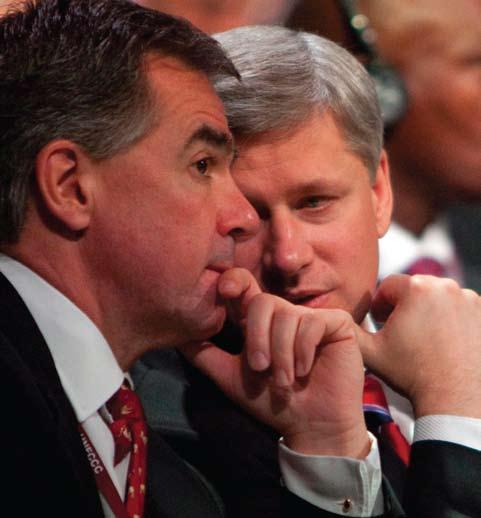
Accord is (the fact that) we’ve agreed in principle for the first time that everybody who emits carbon will have responsibilities to reduce their emissions
These obligations may be expressed slightly differently for a developed country as compared to a developing country But, all in all, everyone will have carbon reduction obligations It will be longerterm in focus It is essentially what has been described as a pledge-and-review model where countries will post their objectives, their targets, and eventually also their carbon-reduction plans . Then they will be reviewed internationally to judge their progress I think it’s a better approach, a better model I think it will work
dM: With the “Climategate” revelations, which suggest that some scientific evidence has been suppressed or misused, what is your take on global warming? jp: I was looking at some interesting poll-
ing data just a couple of days ago From my own perspective, personally, I am not a scientist I’m a lawyer I don’t approach this as a scientist I strongly believe in science; I strongly believe in empiricism . I read everything I can get my hands on about the science of climate change . I find the books published on this subject are quite fascinating My own conclusion is that the overwhelming weight of the science would indicate that man-made emissions are contributing to a build-up of carbon in the atmosphere and that the constructive thing to do, the wise thing to do, would be to reduce those emissions . I approach it as a good old-fashioned conservationist and say, ‘Let’s mitigate the risk Let’s reduce the emissions Let’s consume less energy Let’s green up our energy sources and reduce our consumption ’ And that’s the wisest policy
dM: There is also the precautionary principle — that, if you don’t know for sure,
you err on the side of caution .
jp : I don’t typically delve into the scientific debates I do find them fascinating I was reading SuperFreakonomics yesterday on the airplane (Written by Steven Levitt and Stephen Dubner, this best-selling book contains a chapter on the extraordinary complexity of climatechange science .) There’s a chapter on geoengineering and climate change which is quite interesting — but I will leave that to the scientists I think the overwhelming weight of the scientific evidence is pretty clear, that there has been an accumulation of carbon in the atmosphere
d M: Assuming the Americans are not going to get President Obama’s cap-andtrade legislation through the Senate, what is your policy — Canada’s policy — on cap-and-trade?
jp: We’re prepared to go down one of two roads on a continental basis The first is a cap-and-trade trade system which would essentially cap the emissions of carbon and gradually reduce them over time We’re prepared to go down that road with a continental cap-and-trade system . We clearly can’t go down that road unless the United States goes along as well And that decision is (pending) in the United States right now
The alternative road is a regulatory approach, represented in the United States by the regulations (proposed) by the Environmental Protection Agency. In the absence of capping carbon, we simply
bring in regulations that relate to all forms of carbon emissions
dM: And you set targets for each industry and each business?
jp: Correct
d M: Which you have to do anyway because you have to assign pollution credits .
jp: It’s fair to say that a cap-and-trade system incorporates a fair degree of regulation But absent the capping and trading of carbon, you are simply going down a more vigorous regulatory road And you’re quite right Some of that would happen anyway
You could go back to Turning the Corner, which was a policy of this government several years ago . Turning the Corner was a pure regulatory approach What the EPA is talking about is a pure regulatory approach As with cap and trade, the regulatory approach also underscores the need for harmonization It means you can’t have different regulations applying to energy emissions from computers in Canada as compared to the United States .
dM: You happen to be environment minister as well as an Alberta MP (Calgary Centre-North ) What is the outlook for the oilsands in terms of Canadian, and North American, energy self-sufficiency in the next two or three decades?
jp: Well, the oilsands are extraordinarily important to North America and to the
world in terms of energy and the supply and demand balance for oil . The oilsands are being developed at a rate which will probably see production increase from something in the order of 1 2 million barrels per day today to probably something in excess of 3 5 million barrels per day within 20 years Whether production can be taken beyond 3 .5 million barrels a day, up to what some people estimate could be as much as five million barrels a day, remains to be seen But I think a reasonable projection is something up to in the neighbourhood of 3 5 million barrels a day
That is really essential If you look at the work of the International Energy Agency or the Foreign Relations Council in the United States, or other authorities, it underscores the important contribution that oilsands will make to North American energy security At the present time, about 60 percent of production goes to the United States Most of the rest is consumed in Canada This balance may shift over time And certainly Canada may explore other international markets . But all things considered, the oilsands are being developed because they are economic at this point in time They’re needed And we have the technological capacity — and I would submit the environmental capacity — to develop this resource on a sustainable basis And it is the largest source of hydrocarbons on the planet that is in the ownership of a stable Western democratic country, and therefore open to market development .
d M: And Steam-Assisted Gravity Drainage (SAGD), a Canadian invention that uses horizontal drilling, will change the history of the world — or already has? (See Alastair Sweeny’s profile of SAGD inventor Roger Butler, page 37.)
jp: I think the short answer is yes SAGD will be the way most of the oilsands will be developed Only a very small percentage of the oilsands are developable through surface mining As I recall, it’s not more than 10 percent So 90 percent will be developed through SAGD or in situ development (This process) raises its own challenges but it involves less surface disturbance than the pictures that we see on National Geographic So it is more attractive in that sense It does, however, carry with it the prospect of increased carbon emissions because essentially you use electricity to heat the reservoir Depending on the source of electricity, your carbon footprint could actually increase on SAGD wells and in situ development .
dM: How do you feel when you open National Geographic magazine and see such an extensive pictorial exposé of the oilsands?
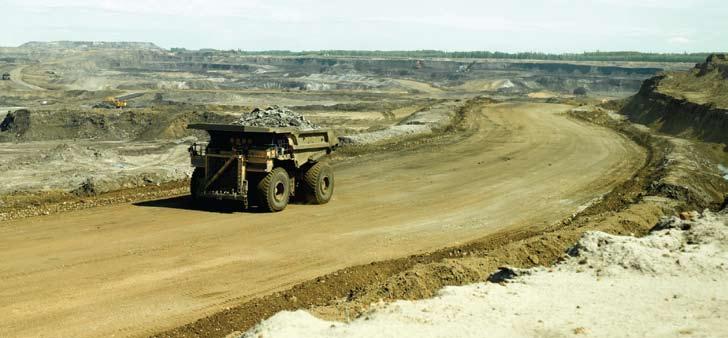
jp: Well, a couple of things I am an ardent subscriber to National Geographic and I have been since my father bought me a subscription when I graduated from university. I’ve subscribed since 1980 and I still do . You know the pictures of the oilsands were presented in a dramatic way. I have seen the oilsands, of course But the magazine photographs were snapshots of a large industrial facility
I worked in coal mines to put myself through university and law school (University of Alberta and Dalhousie University Law School) If you took pictures of the coal mines I worked at, they wouldn’t look a lot different In fact, the trucks you see in the pictures in the magazine are the kinds of trucks that I drove in the summers My jobs included every dirty job you could possibly do at the mine, including working under the coal bins
dM: Where did you work in coal mines? jp : In southern Alberta — Crow’s Nest Pass, just to get through university . So these are large facilities They’re not attractive The National Geographic photographs only show a snapshot in time They don’t show the reclamation work They don’t show the incredible progress we’ve made in terms of water-utilization
I think it’s important to note that the entire surface disturbance of the oilsands
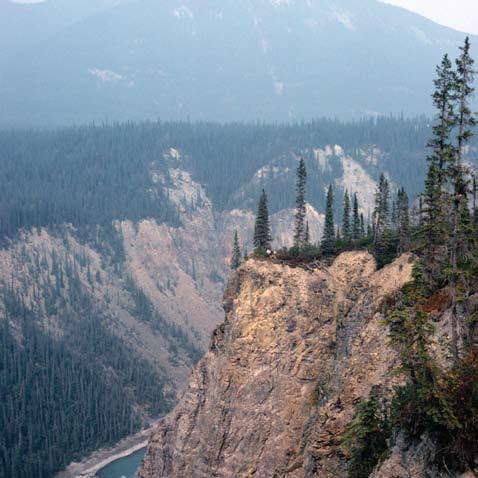
is 580 square kilometres . That’s the entire surface disturbance of the oilsands complex You’ll read some explanations that there will be a disturbance the size of Florida That just isn’t the case A very small portion of the oilsands is available to surface mining So 580 square kilometres compares to portions of suburbia in some of our cities . If you compare it to the scope and volume of the boreal forest in Canada, it’s a very, very small amount of land that is being disturbed on a surface basis
d M: Are you pleased with the decision of the Alberta government to get mining companies to speed the restoration of the tailing ponds? Did Ottawa push Alberta? How did you feel about former Alberta Premier Peter Lougheed’s concerns about too-rapid development of the oilsands? jp : I consider Peter Lougheed a kind of a mentor He’s been quite outspoken in saying that the oilsands are a resource that belongs to Albertans and to Canadians and that it needs to be developed in a measured pace and that it shouldn’t be developed at a pace analogous to the Gold Rush in the Klondike .
I do think we need to be careful about cumulative impacts . I think we do need to ensure that, as projects are brought on stream, they are evaluated through a highquality environmental process — and they are — and (that) the cumulative impacts are part of that equation And they are, as far as I’m concerned We work with the Alberta government . We maintain a number of monitoring sites on the Athabasca River We pay a lot of attention to what is happening up there and we’re working all the time with the Alberta government to make sure it’s done in an environmentally responsible way
Our government’s overall position on the oilsands is we want to see the oilsands developed . We think it’s an important strategic resource for our country. It’s extremely important to our prosperity It’s one of the driving engines of the Canadian economy, frankly But we also want to see it done in an environmentally responsible way We have attached to our country the moniker of being “the clean-energy superpower .” We believe in that . We believe that we should be — personally, as I express it — the most environmentally conscious
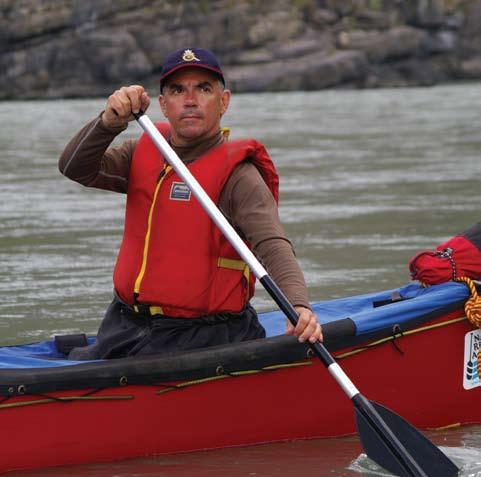
and environmentally responsible producer of hydrocarbons and all forms of energy in the world
dM: How fast can you clean up the tailing ponds? Only a very small percentage have been reclaimed so far, correct?
jp : They will be reclaimed over time They’re regulated by the Alberta regulators . The industry is trying to experiment with a dry tailing system and I understand they’re making great progress They’re quite pleased about that But I would just emphasize that we have a sound system of environmental regulation in Canada Regulating the oilsands is a complex and challenging subject We acknowledge that But, all in all, we do a good job of it . The technology is developing quickly. This is a technology that only 25 years ago was in a laboratory
d M: I read the work of David Schindler (The University of Alberta biology professor was part of a team studying polycyclic aromatic compounds (PACs), some of which can cause cancer, mutations and malformations The team found that lev-
els of airborne PAC particles increased in snowpack within 50 km of upgrading facilities PAC levels also increased downstream in Athabasca River tributaries and, seasonally, in the river downstream from facilities and tailings ponds Some PACs are released naturally in the region, as well )
There are reports of animal malformations . There are risks to humans . There are problems with the rivers You are monitoring these problems but how are you planning to fix them? What kind of priority is this for you?
jp: Well, it is extremely important that we ensure the river is not contaminated by the oilsands tailings ponds This is a responsibility that involves federal jurisdiction .
That’s why we’ve scaled up the monitoring we have on the river . I speak often with the department about this — about making sure we are doing all of the monitoring I’m aware of some of the accusations of health impacts I think it’s fair to say at this point that science doesn’t bear them out It doesn’t bear out the suggestion that the tailings ponds are leaching into the river and causing health
consequences But that is something that we need to be ever vigilant about It is a concern Absolutely
dM: Is it one of your priorities?
jp : Yes, to make sure that that is done properly, absolutely . I was raised in industrial communities, coal mining towns, mining towns in northern Ontario and in Alberta And I’m always mindful of the need to have a strong regulatory framework to make sure that these things are done properly, because industry cannot be allowed unconstrained, to develop a resource without environmental parameters dictated by government .
The key is to strike the right balance between advancing the economy on the one hand and being stewards of the environment on the other
dM: Some people want to shut down the oilsands but they still want to drive their cars
jp : We know who consumes carbon and we know who is responsible for carbon emissions . It is all of us, as consumers . The carbon emitted from the production of a barrel of oil from the oilsands is 15 percent Eighty-five percent comes from consumption
dM: What can Canadians do to conserve energy?
jp: The Canadian people need to be cognizant that it is the consumers — the reason our country is emitting carbon applies in part to all of us as consumers And so that affects the kind of cars you drive, the number of vehicles you have
(At press time, Mr Prentice was scheduled to announce new tailpipe emission standards for cars and light trucks .) We will bring in the first tailpipe emission standards that regulate cars based on their emissions of carbon which has been harmonized with the United States So government has taken steps to regulate the kinds of cars that we are selling, but it’s still up to consumers to make the choices
So it’s everything — from the kinds of cars you drive the flat-screened TVs you watch . We all make those kinds of choices . Whether you recycle — personally I’ve always been a fairly aggressive recycler — whether people do that is important It’s all of the individual little decisions
If people leave their BlackBerry plugged in 24/7, and 150 people do that all year, it consumes the equivalent of a ton of coal . All of us who are emitting carbon through electricity and gasoline consumption need
to be part of the solution
dM: Chinese companies have bought some of the Athabasca oil assets Will Canada be piping gas or diluted bitumen to the Pacific Coast? Will Alberta’s oil be moving west as well as south?
jp: Some of it does now . I can’t recall the precise volume but some production goes to the spot market off the Pacific Coast through Vancouver Port But you raise a very good point I think that one of the most important projects in the country is the (Enbridge Northern) Gateway Project to ensure that we have an open gateway to the Pacific for bitumen from the oilsands And that (twin pipeline) project (from Edmonton to Kitimat, B C .) is well along in terms of the design phase and the regulatory process It is an extremely important project
dM: Some conservationists think that the entire environmental movement has been hijacked by climate change — that no one discusses preservation of species or the really dangerous chemicals, especially the volatile organic compounds, the polycyclic aromatic compounds Money and attention has moved elsewhere What can Canadians who care about these environmental problems do?
jp: The international community has been very focussed on climate change and the Canadian context is difficult because we are not only a consumer of carbon Because of the nature of our industrial base, the nature of our climate, the nature of our geography and so on, we are also a producer of hydrocarbons We are one of the largest democracies in the world that actually produces hydrocarbons So it’s not surprising that a lot of attention has been focussed on climate change .
But you make a very good point . Our country does really extraordinary things in terms of the environment in many other areas Conservation, for example Take the National Parks system that we have Add the protected spaces we have as bird sanctuaries, as wildlife habitat Add the provincial parks system we have across the country . Add all the species-at-risk conservation measures that are going on through Ducks Unlimited and the Nature Conservancy of Canada Our record is second to nobody in the world It is one of the most incredible systems of conservation anywhere in the world We need to take pride in this (achievement) We need to continue to develop it .
One of the privileges of being environment minister is being responsible for
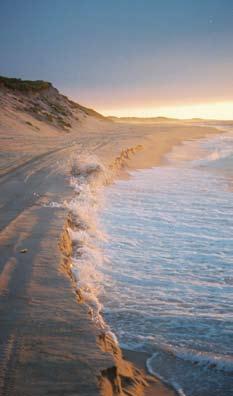
Mr. Prentice and his department have signed an agreement to investigate turning Nova Scotia's Sable Island, known for its wild horses, into either a park or a designated wildlife habitat.
Parks Canada It’s really a lot of fun but it’s also something I’m very passionate about Last year, we expanded Nahanni (National Park) six-fold . I just came back from Nova Scotia We signed an agreement to investigate turning Sable Island into either a park or a designated wildlife habitat We’ll work with the Nova Scotia government for the next three months to decide which of the two One or the other will happen . So Sable Island will be then be protected .
dM: And the wild horses, too?
jp: And the horses
The week before that, I was in the Queen Charlotte Islands (Giindajin Haawasti) Guujaaw (of the Haida Nation’s Raven clan) and I announced an agreement that has taken 18 years to reach with the Haida to bring in the Gwaii Haanas National Marine Conservation Area Reserve . It will be the first of its kind in the world For the first time, we (jointly) will protect from the ocean floor — where the continental shelf drops off — right up to the tips of the mountains The entire ecosystem will be protected as a national park, essentially
(In the joint announcement in January, Mr Prentice described “lush rainforests
on the lower slopes; the alpine meadows on the mountain tops; the nesting grounds of thousands of birds; and wildlife that includes species of black bear and ermine that are found nowhere else on the planet
“Nearly 3,500 marine species have been identified around Haida Gwaii . This is the habitat of salmon, herring and rockfish, of starfish, crab and abalone Grey whales swim through these waters on their way to the summer feeding grounds in the Bering Sea Twenty other species of whale and dolphin have been spotted in this aquatic Garden of Eden For hundreds of generations, the Haida Nation has lived in harmony with this environment . Today, this wealth of marine resources continues to sustain local communities as well as a recreational and commercial fishery ”
Three weeks later, Mr Prentice announced the new Mealy Mountains park reserve in Newfoundland-Labrador — at 10,700 square metres, the largest national park in eastern Canada . With the addition of a new adjacent provincial park, more than 13,000 square kilometres will be protected )
In other areas, we have taken our blessings for granted As an illustration, the government has published sewage regulations, wastewater regulations, for the first time This issue used to puzzle me before I came into politics In a country like Canada, one of the wealthiest democracies in the world, why would we pump our raw sewage into a natural environment in the 21st Century? Why are we doing this? I found out, after I became minister of the environment, that it’s basically because no one ever passed a law preventing it
(Since the interview, Mr Prentice presented Canada’s first national water regulations that will prohibit wastewater and raw sewage discharge into lakes, rivers, streams and oceans )
And so, for the first time, Canada will have a national set of regulations that apply to 4,000 municipal wastewater facilities across the country You can’t do this overnight . It will take some time . But it’s a big, big step forward in this country.
And so I would encourage people to talk to their provincial leaders, their municipal leaders These things need to be budgeted for The capital upgrades need to happen And every Canadian should be quite vigilant about the quality of the water we drink and the quality of the water we put back into the ecosystem . D
Donna Jacobs is the publisher of Diplomat magazine .
jim p rentice is a family man, a man who trades hobbies for time with his wife and three daughters. his eldest, christina, is a lawyer (specializing in corporate law) in c algary. c assia is in her second year at the university of toronto law school; she also has degrees in education and arts. his youngest, kate, is an artist who studies at the art i nstitute of chicago. his wife, karen, also a lawyer, sits on the alberta securities commission.
Diplomat magazine: How are mealtimes with four out of five family members being or becoming lawyers?
jim prentice: When I asked my family whether they thought that having so many lawyers at the dinner table leads to arguments, an argument ensued about the answer So, you can well imagine that you need to be resourceful to hold your own at our family dinner table .
dM: On a personal question, what time do you get up in the morning? What is your daily routine?
jp: Your life as a politician is heavily dependent on your travel schedule I do tend, though, to be a bit of a night hawk I tend to read before I go to sleep I tend to get up at 7 I’m functional by 8 I start the day with very strong coffee made in those Italian coffee makers you put on the stove . I make it jet black . It kick starts you into the day. After that, I have a Tim Hortons coffee with cream . And a cinnamon raisin bagel with cream cheese — unless I’m feeling guilty and then I scale down to butter
Ninety percent of my days start with Tim Hortons on the way to work If I’m here (in Ottawa), I have breakfast in the front seat of the car, with Mike, the driver And if I’m driving myself in Calgary, I eat breakfast in my own car
I tend to not eat large breakfasts unless I have the luxury of some time in the morning, in which case I do eat big breakfasts — steak and eggs over easy, brown toast .
I eat lunch at my desk I rarely go out for sit-down lunches — maybe once a week And the rest of the time, generally I prefer soup at lunch and a grilled cheese sandwich I don’t like cream soups I like tomato-based soups or pea soup It’s an old expression, the poorer the country, the better the soup
For dinner, I usually eat a little later in the night — at 7 or 8 — usually a pretty good-sized dinner . None of the nutritional health people suggest you do anything I’m doing in terms of diet . I love barbecued lamb, Italian pasta and lots of vegetables . I eat all vegetables I can get my hands on For dessert? I love chocolate ice cream absolutely When I’m in Calgary, I go to this great ice cream place in my riding every day I can
dM: And for exercise?
jp: I do a lot of outdoor things so I’m not as regimented about the gym as I should be I use the (parliamentary) gym twice a week when the House is sitting I run for about 30 minutes I try to do about 20 minutes of intervals when I run, then do bench presses — whatever I feel up to .
My own fitness is focused on doing outdoor activities I ski a lot I probably skied 10 days over Christmas — downhill I also do cross-country but I bought downhill equipment this year so I was using that and chasing teenagers I was skiing with young lads and I had them drag me all over the mountain for a day
dM: You survived . jp: (He laughs .) Barely.
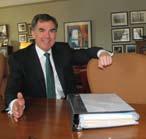
I still play hockey I played for a team called the Calgary Longhorns and I’ve refused to let them retire my sweater I confiscated the sweater so they can’t retire the number (17) . My dad was a hockey player . He was the youngest player to play for the Toronto Maple Leafs My uncle was a very good hockey player My dad was in the NHL only briefly but my uncle was there 22 seasons I was raised in a hockey family Until I was about 18, it was my entire life, really When I’m back in Calgary, I go out and pick up a game wherever I can .
And so I still play and, at this point, I play with our parliamentary team (On the hockey photos wall of his office, he points out a parliamentary team photo ) This is when I knew we were going to win the election — when we beat the Liberals at the Parliamentary Hockey League
dM: What are your top stress-management tips?
jp: Play hockey Ski Get into the outdoors — canoe, hike, do something you love . And I read everything I can get my hands on . I try to read something every night . I read history or mystery. I read a lot of mysteries . My favourite writer is (Irish crime novelist) Michael Dibdin, who has passed away
dM: And do you have a top time-management tip? Other than hiring excellent staff?
jp: As a politician, the biggest challenge is to manage your time I can tell you one thing I do I have something called the weekend reading binder, which is my own peculiar invention . Before I leave Ottawa every Thursday or Friday, I insist that I have a binder that has everything in it that is going to be relevant to the coming week It’s a big, thick, reading binder — an engine block, I call it And that is delivered to me on the weekend
I basically pound through it on airplanes there and on the flight back We spend so much time on airplanes I probably take 150 flights a year I am pretty regimented about it I get on an airplane and I read from the time I sit down until the time the plane lands . I’ve learned to try to sort of treat it as being the equivalent of sitting in my easy chair at home . That’s how I cope with travel and time demands
So that’s my personal management technique I’ll read the binder on the weekend and we start every Monday with what we call a “week-ahead meeting ” We go through every single thing in the binder For me, at least, as a minister, that’s what has allowed me to be efficient and organize my week And then I start Monday ahead of the game . And it’s the discipline — the Monday week-ahead meeting has the entire executive team of the department in the room . So there would be 40 people there and we meet at 8:30 or 9 basically for three hours to get the week defined
dM: How do you do this — 40 people in a meeting?
jp: (Laughs) Everybody is talking all the time
dM: Do you have hobbies?
jp: A politician doesn’t have much time for hobbies Besides the demand of keeping up with things and staying fit, you focus the time you have available on your family and your kids . D
canada has won a geological lottery but it must muster the strength and political will to become a responsible oil power, satya das argues
canada is about to become the world’s largest reservoir . Not one of the largest, not among the leaders, but No . 1 . Sometime in 2011 or 2012, the technology that’s making the Alberta oilsands cleaner, more sustainable and more accessible will give us proven reserves of 300 billion barrels or more In a world addicted to hydrocarbons, Canada is front and centre
Modesty is bred in the Canadian bone . We’ve neither asked nor sought to lead . Yet lead we must, if only because we are the only advanced democracy amongst the world’s large oil powers The other major petro-states — Saudi Arabia, Iran, Iraq, Venezuela — each in its own way, embrace a culture of violence They suppress their citizens and unsettle their neighbours . All too often, petro-wealth is used to pursue and foster the interests of an oligarchic elite We Canadians soon will stand alone in this club, as the one oil power committed to serving the common good, and to a matrix of societal development designed to nurture the common wealth on a foundation of “peace, order and good governance . ”
So are we ready to become the responsible superpower? It’s time to have that adult conversation At the Copenhagen summit on climate change last December, we Albertans saw the elegant pirouettes of the premiers of Ontario and Quebec as they showed what good lads they’ve been in going green The oilsands (and the government of Canada’s robust advocacy of this resource) were viewed as an unsightly embarrassment, like a blob of ballpark mustard on a bespoke Corneliani suit Why, these good premiers asked, should their provinces bear the cross for Alberta and its embarrassing oilsands pollution?
Because, like it or not, Canada won the geological lottery And if we set our minds to it, we Canadians can clean up past pollution, limit future harm to the biosphere, and use the wealth of the oilsands to

generate the cleaner and more sustainable sources of energy the world needs to fuel its aspirations for a better life
We have the technology to clean up the oilsands We need a strong regulatory framework, and citizens spurring the government to action, to ensure that best practices become mandatory, that early adopters of new technology get rewards
and incentives, and that laggards and polluters pay significant penalties . Yet making the oilsands greener and more sustainable doesn’t dilute the fact that nearly 90 percent of the emissions from a barrel of oil come out of exhaust pipes We need to accelerate our progress towards a clean-energy future
The deep cynicism of the developed world’s Copenhagen argument — “we got rich by devastating the environment but you have to stay poor to save the planet” — will not pass muster If all of humankind aspires to our lifestyle, we will need five planets, not one One answer — clean, abundant, renewable energy — will cost billions of dollars to develop
Dominique Strauss-Kahn, who leads the International Monetary Fund, reckons the planet needs a $100 billion green fund to limit climate damage and help nations develop cleaner energy We Canadians can provide the bulk of that funding, from our oil reservoir Yet to do so, we must be ready to become the responsible superpower
No more the easy comfort of ignoring the gold-medal winner of a track-andfield race while CBC dutifully interviews the plucky Canuck who finished eighth No more revelling in the fifth-place finish which the perky announcer tells us was the “best ever!” by a Canadian at this level of global competition
Proportionately, on a per capita basis, we are among the highest emitters of greenhouse gases in the world, and owners of what will soon become the world’s largest oil reservoir What does that mean in terms of our planetary obligations?
We start with the presumption that we have a duty of care to the planet, a duty of stewardship of our common wealth, and sustainability of the common good Energy development with scant regard for consequences is as unpalatable as a sudden and immediate halt to the fossil-fuel economy
As we move to entrench cleaner production from our oilsands, we need to use the energy wealth that production generates to pay for and help to build the green and sustainable energies of the future
That’s the only viable answer to the impasse evident at Copenhagen .
So why shouldn’t we Canadians show moral, ethical and fiscal leadership, as stewards of the world’s largest oil reservoir, in funding the sustainable and abundant energy the rest of the world needs to have even a modicum of our standard of living?
I’ve put this argument at the heart of a new book, which I offer as an “owner’s manual” for the citizens of the Canadian energy superpower Green Oil: Clean Energy for the 21 st Century? is meant to give citizen-owners the data and the background they need to give clear instructions to the political class, and to the energy companies that are tenants on our public lands
We are at least two decades away from any viable alternatives that would comprehensively replace fossil fuels as the planet’s primary energy source While we pursue those alternatives, we can make our production and use of fossil fuels more sustainable and less damaging to the biosphere
That is the theme and premise of Green Oil .
Even as we develop our energy resources, we are mindful of the larger context We must be seen to be models of democracy, of pluralism, of inclusive and welcoming societies We must demonstrate that our duty of care brings out the best in the human spirit in all of us Through our actions, we can pursue a sustainable life not for just the citizens of our democracy but for the entire planet .
Constitutionally, the oilsands belong to Alberta Yet we do not act like owners Alberta’s political leaders are goodhearted folk who came to politics through community service, mostly in small-town and rural Alberta They’re rooted in that fading culture where you know and look after your neighbours, your word is your bond, and you measure a person’s worth by what they give back to the community
These admirable values leave our senior politicians ill-equipped to deal with a winners-and-losers culture of big money and rampant egos, where the sharp-eyed denizens of sleek glass towers know exactly how far a law can be bent before it will break . When the keepers of this shark tank — some of whom pull down more money
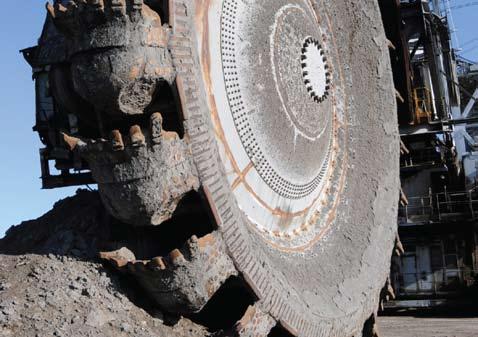
in three or four years than our politicians might earn in a lifetime — bullied and bamboozled our leaders with threats of ruined economies and a deserted oil patch, the government abandoned its exceedingly modest plans to collect a higher rent
The first task for citizens, then, is to encourage Alberta's provincial government to enforce its ownership . We cannot have credibility as an energy superpower, no matter how reluctant, if we the owners let ourselves be pushed around by surly tenants
We need reasoned discussion and dialogue if we are to move beyond the dissonance Some of that comes from government itself — from the professional civil servants and public-minded citizens who took on the task of stimulating economic growth in the context of environmental stewardship We know that it is challenging to be good stewards of the environment while growing the economy but we are willing to do what it takes to get there . This willingness does not necessarily translate into having the governance capacity to lead the appropriate development of the resource
Alberta, the owner of the resource, only has 3 7 million people We are stretched to fulfill the duty of care that appropriate development demands This is where we need collaboration and co-operation with global pools of talent, innovation, ingenuity, technological prowess, and capital to move forward . At the very minimum, we need willing and able co-operation from
our fellow Canadians, who reap most of the benefit of the oilsands, in federal taxes, jobs, procurement contracts, equipment supply and, of course, equalization payments
A clean environment and a robust economy must be complementary goals . They can’t be reduced to either/or . Environment and economy are really two sides of the same coin: yet to act on the implications of this insight, we will need a level of leadership so far lacking in Alberta and in Canada Unfortunately, because of our “reluctant superpower” tendencies, our political leadership seems hesitant to lead that future .
So give some thought to the possibilities and consequences of what it will mean, when we officially become the largest oil reservoir in the world We have a glorious opportunity to display our capability to be both a leader and a partner in the greening of the energy economy, despite our historical reluctance to accept such a dominant role .
We are stewards of a $15 trillion resource (at today’s reservoir size), one that benefits us all Do we have the courage and the vision to use it for the benefit of the planet?
Satya Brata Das is the founder of Cambridge Strategies Inc ., a consulting company based in Calgary. He is the author of Green Oil: Clean Energy for the 21st Century? He can be contacted at: Satya@ cambridgestrategies com
By Alastair Sweeny
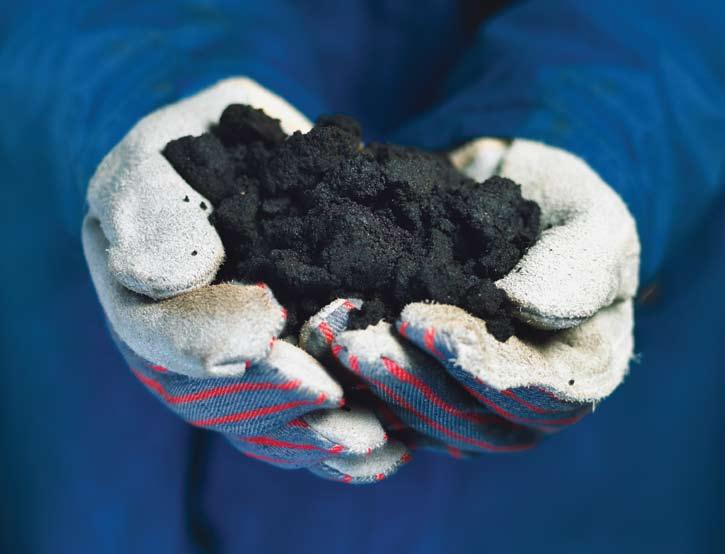
“Bitumen is some of the ugliest stuff you ever saw Ugly is contaminated, nonhomogenous and ill-defined Bitumen is five-per-cent sulphur, half a percent nitrogen and 1,000 parts per million heavy metals Its viscosity (stickiness) is like tar on a cold day. That’s ugly ” —Steve Kuznicki, University of Alberta told to the Edmonton Journal
Black Bonanza: Canada’s Oilsands And The Race To Secure North America’s Energy Future by Alastair Sweeny will be released this spring by John Wiley & Sons Canada, Ltd. The following is an edited excerpt.
it’s a windy October day in the mid1980s I’m sitting at the kitchen table of Dave Mitchell, president of Alberta Energy Company, at his ranch in the foothills south of Calgary To the west, the golden foothills roll away toward the green slopes and snowy peaks of the Rocky Mountains .
Mr Mitchell had engaged me to research and write a history of AEC’s early years I had driven out from Calgary after checking out the company’s archives and various operations, from the gas wells at Suffield military range, to the refinery and pipeline facilities at Edmonton and to the mammoth Syncrude oilsands plant north of Fort McMurray
We had tromped around the ranch and he proudly showed me a new cattle pen he had developed that was “easier on the animals .” Back in the ranch kitchen, we’re warming our hands with a cup of instant coffee . “You know”, he said, with what I thought was a twinkle in his eye, “there’s more crude oil in the tarsands than there is in the entire Middle East ” Indeed there is — about 3 3 trillion barrels — about half the oil left on the planet But this oil is in the form of bitumen, a heavy form of petroleum, and it is stuck to particles of sand . At the time I talked with Mr . Mitchell, whose company then owned
a big hunk of Syncrude, experts reckoned that we could get about 100 billion barrels out of the Athabasca Sands using strip mining The rest was simply too deep to get at But while Mr Mitchell was talking, he didn’t let me in on a secret, that a Calgary geochemist named Roger Butler had just figured out a way to extract hundreds of billions more barrels from deep in the oilsands by pumping down steam and pumping up crude Mr Mitchell, an oilman’s oilman who had spent his life drilling mostly dry holes, could hardly believe what he was hearing More oil than the Middle East Under northern Alberta
Big changes have happened since the 1980s . Back then Sheik Ahmed Zaki Yamani was Saudi oil minister, and head of the Organization of Petroleum Exporting Countries Saudi Arabia governed the price of oil for OPEC Today, Saudi oil minister Ali Al-Naimi laments that OPEC has lost control over prices to the New York Mercantile Exchange, NYMEX, which deals in “paper oil .” “Despite our best efforts, Saudi Arabia and OPEC have had little ability to curb the rapid rise in prices,” he says When pressed about who is to blame for high oil prices, Mr Al-Naimi says it’s not Saudi Arabia It’s “unwarranted pessimism”— Saudi Arabia has oceans of oil He puts the finger on “speculators” on the one hand and “Canada’s high-cost oilsands industry” on the other
So how did oil prices get so high?
hubbert’s peak
In September 1956, at a meeting of the American Petroleum Institute in San Antonio, Texas, Shell’s head geologist M King Hubbert shocked the delegates with his prediction that U .S . conventional oil output was going to peak in the early 1970s, and thereafter decline, making the United States increasingly dependent on foreign suppliers This was such bad news for the industry that Shell’s public relations department made a desperate attempt to stop the speech, and failed
Dr Hubbert was the first energy industry analyst to grasp the mechanics of oilfield depletion and the first to accurately assess recoverable oil reserves He was right on the money about America, formerly the world’s number-one oil exporter By 1972, U S production of petroleum (crude oil and natural gas plant liquids) reached Hubbert’s Peak, and in 1973, right on schedule, cruised over the top and started on the downward slope, as America began consuming more oil than it
Most oil analysts are reticent when dealing with the value of Canada’s oilsands, and cannot find much sympathy for this poor excuse for petroleum.
before 2007, Canada’s oil wealth was ranked lower than many other countries, and the bituminous Athabasca sands were regarded as “unconventional.”
Conventional oil is exploited by drilling, and needs simple refining to be useful. Unconventional oil, like Canada’s oilsands, need specialized extraction technology such as steam and/or solvents to recover the petroleum, and require upgrading before refining.
So how much oil is in the oilsands, and what is it worth? It all depends on what you mean by resources and reserves.
The best conventional reserves in the world are called 90 percent proven reserves (P90). These have a reasonable certainty (normally at least 90 percent confidence) of being recoverable under existing economic and political conditions, with existing technology. Proven reserves are the only type the U.S. Securities and exchange Commission allows oil companies to report to investors. These are, in a sense, investment-quality blue chip reserves, and are allowed to be held in trusts.
The problem with this formula is that very little exploration is needed to find oilsands like Canada’s. Canada has few geopolitical risks, and extraction is getting cheaper by the year, far cheaper than, for example, deepwater drilling in the Gulf of Mexico. In truth, there are very few secure low-cost P90
was producing
But Dr Hubbert was wrong in his other prediction, that global oil production would taper off after 2000, but only because he lacked clear statistics, and did not factor in Canada’s Athabasca Sands, which had started producing oil in 1967 . Dr Hubbert also reckoned without consid-
reserves left in the world. Attitudes are changing as the major oil companies invest more and more in the Athabasca oilsands. In 2007, the Society of Petroleum engineers (SPe), World Petroleum Council (WPC), American Association of Petroleum Geologists (AAPG) and Society of Petroleum evaluation engineers (SPee) adopted a more flexible system of evaluating petroleum resources by adding categories for contingent resources (oil deposits not yet recoverable due to cost or technology) and prospective resources (undiscovered or unevaluated deposits).
In the case of the oilsands, the deposits have been pretty well mapped and evaluated, so they are contingent. Some estimates put the amount of bitumen in the oilsands as high as 13 trillion barrels (D.C. Holloway, American Association of Petroleum Geologists Bulletin, 1993). The amount of 3.3 trillion barrels is more realistic, and not all of it is recoverable. And with new underground technology like SAGD now in use to tap into the 90 percent of the oilsands not available for mining, early returns show the probable recoverable amount is at least one trillion barrels. Some estimates are as high as 1.4 trillion barrels (Schlumberger), 1.6 trillion barrels (University of Calgary Institute for Sustainable energy, environment and economy), 1.7 trillion barrels (Council on Foreign relations), and 2.2 trillion barrels (Shell Canada).
In truth, nobody really knows how much oil can be recovered from the oilsands, and at what cost. Most oilsands operators are convinced it is the largest deposit in the world, and its long-term worth will total more than $100 trillion. D
ering 3 billion new players — the Chinese and the Indians — who were not in the market until the year 2000 And he had no idea that new technologies like horizontal drilling were going to utterly transform the industry
Dr . Hubbert liked to use a 10,000-year graph to show that humanity’s use of oil
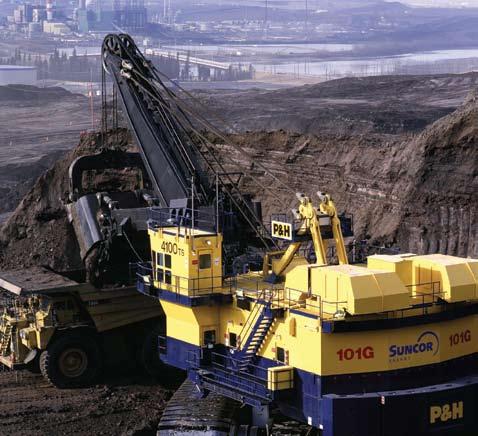
was simply a pimple, a “non-repetitive blip” in history He suggested that “when the energy cost of recovering a barrel of oil becomes greater than the energy content of the oil,” our fossil fuel-dependent society would come to a dead end
In the past few years, many new Hubbert disciples have emerged, writing a string of bestsellers warning that the world is now going through its own oil peak, and our oil-dependent industrial civilization is doomed . Some have also linked the peak oil theory to global warming, suggesting that the two crises together risk overwhelming human civilization
Many energy engineers and innovators refused to believe Dr Hubbert’s predictions, and saw in Canada’s Athabasca Tarsands a way out of America’s energy dilemma . One was J . Howard Pew, President of Sun Oil of Philadelphia, who built the first oilsands mine in 1967 Mr Pew saw the Sands as a kind of a salvation for the U S , then being held to ransom by OPEC while its own reserves went into decline
In 1973, with the OPEC embargo driving up oil prices from $3 to $11 per barrel, the U . S . Congress had passed an Emergency Petroleum Allocation Act, imposing
oil price controls and lowering highway speed limits But President Nixon wanted more, and he was determined to break OPEC’s hold on the American economy . He outlined his vision to the American public in what he called Project Indepen-
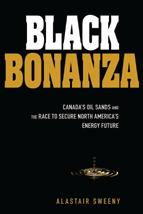
dence, declaring, “Let this be our national goal: At the end of this decade, in the year 1980, the United States will not be dependent on any other country for the energy we need to provide our jobs, to heat our homes, and to keep our transportation moving . ”
Well, not exactly There was one other country that could be depended on, and that was America’s northern neighbour, Canada Nixon’s Project Independence also stated, almost as an aside, that “there is an advantage to moving early and rapidly to develop tarsands production” because it “would contribute to the availability of secure North American oil supplies ”
In fact, Canada has recently surpassed Saudi Arabia as America’s number one oil supplier
With Canada rapidly becoming an energy superpower, with its high-priced, though readily available, synthetic crude oil, where does that leave other oil-producing countries?
I would argue that there is enough market for everybody, but that we will not see a return to $140-a-barrel oil anytime soon What really makes oil-producing countries nervous is technology, and the rise of flex fuels, fuel replacement, unconventional oil, and all manner of energy innovation In February 2009, Saudi Oil Minister Ali Al-Naimi predicted a “nightmare scenario” for the Kingdom if client countries started developing cheaper alternative fuels As far back as 1990, Sheikh Zaki Yamani said the same thing, calling technology “the real enemy for OPEC . ”
Right now, the price of crude is being held down by a supply glut, particularly in natural gas, caused largely by companies like Schlumberger and Halliburton developing new technologies like directional drilling and “fracing”— well fracturing using expanders and explosives to open up gas seams .
Directional drilling has also led to some incredible advances in Athabasca Oilsands development, turning peak oil predictions upside down
The International Energy Agency suggests Canada has about 175 billion barrels of proven reserves, and seemingly dismisses the Athabasca oilsands as a potential back-up solution
However, in the early 1980s, Roger Butler, a chemist working for Imperial Oil came up with a theory that heavy oil and bitumen located underground could be softened and brought to the surface by what he called “steam-assisted gravity drainage,” or SAGD D
Alastair Sweeny is an Ottawa historian, web publisher and author of BlackBerry Planet and Black Bonanza .
roger Butler’s legacy — inventing a system to extract oil from the oilsands — is changing
By Alastair Sweeny
“Roger Butler’s invention of steam-assisted gravity drainage (SAGD) has had a staggering economic impact. It will eventually change the whole geopolitics of oil in the world.”
—Tom Harding, head of chemical and petroleum engineering, University of Calgary
there are quite a few Canadian inventors who have changed the world Abraham Gesner’s invention of kerosene in 1854 killed the sperm whaling industry, lit the world for 50 years and gave birth to the Rockefeller fortune Canadian cable- and tool-drilling techniques helped open North America’s first commercial crude oil well in 1854, a year before Pennsylvania did, and decades before Canadian drillers struck oil in Iran for the Anglo-Persian oil company (today’s BP) in 1906
In 1892, Canadian botanist Charles Saunders invented frost-resistant Marquis wheat, perhaps one of the most valuable products in the world, which opened up millions of colder acres around the globe for wheat production Two Canadian crop scientists, Baldur Stefansson and Richard Downey, patiently developed the fabulous canola seed from rapeseed between 1958 and 1974, carefully breeding out the grain’s heart-clogging saturated fats Canola (from “Canadian oil”) is now a huge world crop . Canada’s Mike Lazaridis gave the world the BlackBerry, and Calgary’s James Gosling the Java programming language
But a Canadian invention that may prove more valuable than all the rest combined was steam-assisted gravity drainage, a method of getting heavy oil and bitumen out of the ground, perfected at Fort McMurray in 1987 by chemical engineer Roger Butler . His technique is usable anywhere in the world where heavy oil and bitumen are found
Since the oil industry could only access less than 10 percent of the Athabasca Sands using surface mining, early extraction was confined to the Athabasca River Valley where the overburden (soil and rock covering the deposit) was thin The arrival of SAGD in the 1990s meant that
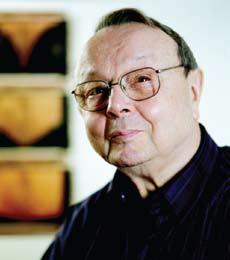
companies could now take out the majority of the Athabasca bitumen at a very competitive cost In the Athabasca Sands alone, the advent of SAGD makes at least 330 billion more barrels readily accessible, and will eventually yield more than trillion barrels of synthetic crude
It’s a colossal number to be sure But if Roger Butler’s invention can tap two thirds of the oilsands that are out of reach of mining, it can also help ramp up heavy oil production in places like Venezuela and Russia . In addition, it may have instantly tripled our planet’s known recoverable oil resources, making Dr Butler one of the true benefactors of humanity
Butler’s theory
Roger Butler earned his PhD in chemical engineering at London’s Imperial College of Science and Technology in 1951 He taught at Queen’s University in Kingston, Ontario, then joined Imperial Oil in 1955 Dr . Butler first pondered the SAGD process and developed his theory in about 1969 when he was working at Imperial’s Sarnia refinery At the time, the company had discovered a huge heavy oil deposit at Cold Lake, Alberta, near the Saskatchewan border
Dr Butler had already tinkered with a process for mining Saskatchewan potash, by injecting water down a well to dissolve
the potash and salt Gravity does the work “Heavy brine falls to the bottom and the light water rises to the top You end up with a turret-shaped cavity in which the heavy material keeps falling while the lighter water goes to the top,” Dr . Butler explained to Business Edge News Magazine in 2005 He calculated that “if we made the well longer, we could draw as much as 1,000 barrels a day We’d be in business
“I was really very impressed with the mechanism of this,” Dr Butler recalled
One day, he was having a beer with a friend when the thought struck him: Maybe his potash process could be applied to heat the molasses-like heavy oil at Cold Lake and create the same kind of steam chamber The heated oil would flow down to the bottom of the chamber where another well would collect it and pump it to the surface
Dr Butler wrote a patent memo on his gravity drainage concept in 1969, but it wasn’t until 1975 when Imperial Oil moved him to Calgary to lead their heavy oil research department that he was able to tackle the concept During the late 1970s, Imperial was testing a thermal cyclic steam stimulation (CSS) process, aka “huff and puff,” in the Clearwater formation at Cold Lake In this three-step process, you inject steam downhole at high pressure for several weeks, followed by several weeks of warming to reduce the oil’s viscosity, then you pump the oil up using the same well
Dr Butler’s radical notion for producing heavy oil by gravity drainage was at first scoffed at by the old hands at Cold Lake, but Dr Butler wasn’t deterred a bit He was after a more efficient system that used continuous heating and production, rather than the six- to 18-month cycles with CSS, and lost less heat
“Perhaps the steam will rise and the warm oil will fall,” he mused
He first tried injecting steam through one vertical well, letting the reservoir heat up and drain, then pumping the recovered oil to the surface through another vertical well . The results weren’t promising . He reckoned that the oil was trickling down through the sand in an ever-narrowing
SAGD is all about directional oil well drilling, which to some would be a form of rocket science. Today’s technology was first developed by Schlumberger and others to fracture (or “frac”) gas seams. It gives operators the incredible ability to drill down vertically and then, using a gyroscope and GPS, steer the drill bit, while watching above in real time, and then change direction and tunnel horizontally in any direction or angle they desire. At the same time, they can monitor on a computer screen the position and boundaries of the formation and make fine adjustments to stay inside the zone. but directional drilling is also a godsend for SAGD, which requires precision placement of the wells.
With the SAGD process, you drill two horizontal wells, one about five metres above the other, and lay down perforated pipe for distances of about 800 metres. You have to precisely control the positioning of these wells relative to each other and to the boundaries of the target formation. You then inject warm vapour into the upper well at constant pressure, but not high enough to fracture the growing steam chamber and escape. The heat rises and spreads, melting the surrounding bitumen off the sand. Then gravity takes over, draining the warm oil and water down through sand where it seeps into the perforations of the lower producer well. Submersible pumps designed to handle hot fluids then lift the bitumen and condensed water to the surface. Over several months, the chamber grows both vertically and laterally as the cycle continues until the chamber flattens out and clean sand remains in place.
You can recover between 25 percent and 75 percent of the bitumen using SAGD, and recycle about 90 percent of the water. And after recovery, you inject water into the bitumen-drained area to maintain the stability of the deposit.
For more on SAGD, visit Mr. Sweeny`s Web Support site at: http://www.alastairsweeny.com/blackbonanza/ and go to Maps & Charts – SAGD
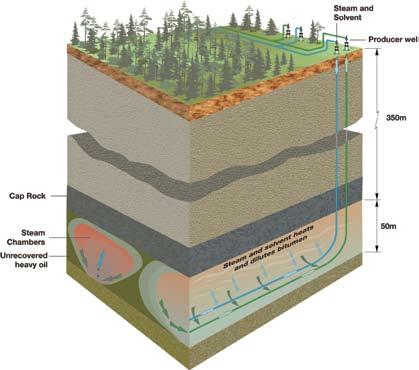
cone, and more sand was plugging up the well used to pump oil to the surface “When you’re extracting oil from in situ oil sands, the chamber (created by steam injection) is full of sand,” Dr Butler said “The oil has to move through the sand and gather on the bottom of the chamber . but gravity won’t assist the flow on a vertical well .” So Dr Butler had his “Eureka!” moment, that vertical well production rates were too low to make SAGD economically viable But a perforated horizontal well might be the ticket
Dr Butler then asked Imperial to drill a horizontal production well low in the reservoir, with numerous drainage points along its entire length to capture the oil . “I could get a thousand barrels a day out of one of these wells on my paper calculations ”
In 1978, Dr Butler had numbers to support his idea, but Imperial moved like molasses, prompting him to get up in a high-level meeting and exclaim: “What the hell’s the point of doing all this research if you fellas won’t do something in the field?”
Dr Butler finally persuaded Imperial to drill what was the world’s first modern horizontal oil well paired with a vertical steam-injection well The horizontal well was about 150 meters long, and “the oil came out at about the right rate — I felt pretty damn good . ” But 1,000 barrels a day from 45 metres was too marginal for Imperial Oil prices were dropping, most Cold Lake engineers were wedded to cyclic steam stimulation, and Imperial put Dr Butler’s project on the back burner
Dr Butler grew convinced that vertical wells were the problem, but with little further support from the company, he took early retirement and went to work at the Alberta Oil Sands Technology and Research Authority (AOSTRA) for about a year, where he convinced them to test and refine the SAGD process at the organization’s Underground Test Facility (UTF) near Fort McMurray In 1983, Dr Butler was appointed to the University of Calgary’s first Endowed Chair in Petroleum Engineering
Full steam Below
In their first SAGD experiment, in 1987, UTF engineers drilled three of Dr Butler’s proposed twin horizontal wells from mine shafts 200 meters down, just above a tunnel dug in the limestone underneath the Sands The first tests immediately proved that the twin well SAGD worked, and there was some quiet excitement in the
industry when the UTF crew found they could recover about 60 percent of the bitumen in place The UTF even went into the black in 1992, achieving positive cash flow producing at a rate of about 2,000 barrels a day from three well pairs
Several years of testing followed The engineers injected steam at various pressures, and then went under the wells to measure the actual results of their work They finally got the best results — over 60 percent extraction — when they injected steam at below fracture pressure This way it stayed contained within the depletion zone or steam chamber, which got bigger as the warm bitumen drained out, just like Dr . Butler’s old Saskatchewan potash well . This further enhanced SAGD’s heating efficiency They also found that the parallel orientation between the injector well and the producer well had to be precisely controlled, and kept about five meters apart Refining the process further, they also came up with ways to prevent sand and steam from getting into the producing well bore . Beginning in 1996, the UTF engineers moved up to the surface, where they drilled several well pairs, and found to their delight that they performed as well as those drilled from the tunnels
These AOSTRA tests gave far better results than expected and the timing of the SAGD discovery was perfect as well While Dr Butler was testing his process, oils service companies like Schlumberger were coming up with very sophisticated directional drilling technology using gyroscopes and GPS . Suddenly they could drill horizontal wells accurately, cheaply and efficiently So with this drilling revolution, lower capital costs and the very high recovery rates that Dr Butler’s process was showing, the majors as well as many independent oil companies started to move quickly in the direction of SAGD You could get into the oilsands business for as little as $30,000 per flowing barrel, compared to $126,000 per flowing barrel for an integrated mine and upgrader
was soon found that one of the keys to high profit SAGD production is to have thick cap rock (usually shale, as in the Kirby Lease) to keep in the steam Some companies were soon reporting high-end recovery rates of over 70 percent of the bitumen in place . The first SAGD bitumen made it to market in late 2001
1 10-03-13 2:37 PM
In 1985, Canadian energy company EnCana, already a fan of horizontal drilling for gas, was first off the mark, starting its own advanced SAGD projects at Foster Creek and Christina Lake with partner ConocoPhillips . Petro-Canada followed with its MacKay River project, ConocoPhillips had a SAGD operation at Surmount, Suncor at Firebag, and OPTI Canada/Nexen at Long Lake, not to mention over a dozen smaller operations It

So what of the inventor, the Father of SAGD? There are those in the engineering community who speak Roger Butler’s name with hushed reverence, but Dr Butler was always modest about his fantastic discovery He was quite proud of what he had done, and often cracked that Imperial Oil had missed the bucket by not continuing his research Dr Butler always showed visiting reporters and pilgrims to his home two bottles filled with sticky black liquid One contained the first heavy oil from Cold Lake; the second, a bottle he calls “more precious than all the finest scotch on the planet ” It held the very first heavy oil produced in the world using steamassisted gravity drainage

Dr Roger Butler, the inventor of the SAGD and related VAPEX processes, died in May of 2005 D
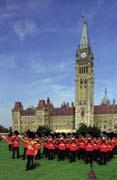


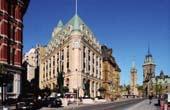




canada must truly become an honest broker and stop its deceit about nuclear power
By Paul McKay
With the clandestine nuclear weapons programs of North Korea and Iran underscoring the urgency of two pending summits to amend the Nuclear Non-Proliferation Treaty and secure Cold War weapons stockpiles, Prime Minister Stephen Harper has pledged a G8 leadership role in devising a diplomatic exit strategy from the perils of proliferation
It might be tempting to applaud this declaration as in keeping with Canada’s ‘honest broker’ tradition of decades past . But Harper’s deeds are underwriting an atomic armaments encore
Last fall, Mr Harper personally trolled for sales of Canadian nuclear reactors and uranium in Asia, with claims that such exports can solve crucial energy needs and forestall an imminent climate crisis . On the face of it, he has a compelling case . Nuclear plants can produce prodigious amounts of power while emitting zero carbon But a closer look confirms his cure may, at best, leave humanity effectively terrified for eternity, and, at worst, also kill the patient — our only planet
The reason is physics Every time uranium is fissioned inside a nuclear reactor, the deadly element plutonium is created . Aptly named after the Greek god of the underworld, only a plum-sized sphere weighing eight kilograms is needed to make an efficient atomic bomb A ‘dirty’ weapon might require 20 kilograms, but can be delivered by a single-engine Cessna, suicide SUV, or backpack bomber on a bicycle . Moreover, with a half-life of 24,000 years, plutonium is effectively immortal It is also virtually indestructible .
This means that plutonium created today will, for all intents and purposes, imperil world security forever It will outlast hundreds of future governments No country, no city, no species, no corner of the planet will be exempt from the shadow of terror it can cast .
A fissioned mass of plutonium the size of a stick of chewing gum destroyed the
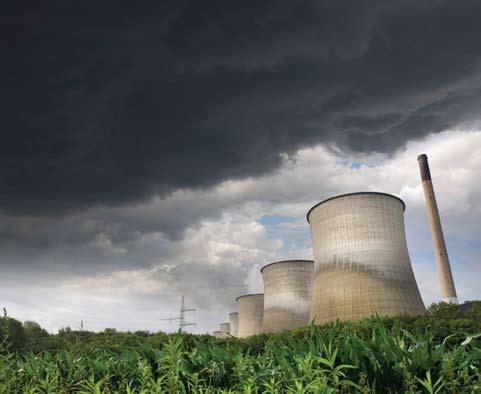
civilian city of Nagasaki in 1945 Along with enriched uranium-235, it is a core component in the atomic arsenals which exist today. Plutonium derived from civilian reactors has been fashioned into bombs since 1962 India covertly used plutonium from a Canadian-supplied reactor for its inaugural blast in 1974
Currently, enough plutonium is created each year by the world’s civilian power reactors to make 7,000 bombs . A cumulative 2,000 tonnes — or enough to make 225,000 workable weapons — now lies lurking in spent fuel rods Due to the risks of black-market deals, terrorist theft, and illicit diversion to rogue states and subnational groups, President Barack Obama has spearheaded a drive to lock down this inventory, and possibly destroy the stocks in special dedicated reactors yet to be built . On April 12 and 13, in Washington, he will host a global summit to counter
this ominous proliferation threat . From May 3 to 28, the Nuclear Non-Proliferation Treaty Review Conference takes place at the United Nations
Laudably, Canada has pledged $1 billion to help secure such Cold War plutonium stockpiles But last year, Saskatchewan uranium exports totalled 7 3 million kilograms When fissioned in any reactor of any make, model or purpose, this will transmute into some 19,000 kilograms of plutonium, or enough for 2,300 warheads annually . This exported uranium also contains 52,000 kilograms of the bomb ingredient uranium-235, or enough to make 2,600 warheads annually
During the next decade, if Canadian uranium exports continue at the same pace, enough plutonium and uranium235 will be dispersed across the planet to potentially make 50,000 atomic bombs — almost double the existing warheads
many world leaders and citizens now desperately seek to abolish
This is a fact of physics No Canadian prime minister, no premier of Saskatchewan, no scientist, no citizen can alter this deadly dynamic: fissioned uranium turns into plutonium . If this happens inside a CANDU reactor, the plutonium production rate is about 2 .5 grams per kilogram of uranium — among the highest of all commercial reactor models The CANDU’s unique on-line fuelling system also makes plutonium diversion harder to detect, and can be covertly manipulated to produce higher purity plutonium
So nuclear power is no ‘white knight’ solution to the climate crisis . It would replace deadly carbon today for deadly plutonium tomorrow And because nuclear power currently provides only five percent of world energy demand, doubling that portion to only 10 per cent would require the construction of some 450 new nuclear reactors . The combined 900 reactors would consume some 120 million kilograms of uranium annually, and produce enough plutonium to make 14,000 warheads each year For decades
No one not blinded by self-interest would knowingly court this calamity, or
prescribe nuclear reactors as the alternative to our carbon-imperilled Earth Yes, they do not emit carbon But they produce a different, equally ominous security threat in plutonium and uranium-235, as well as intensely radioactive, latently lethal wastes which will remain a threat to the biosphere for hundreds of centuries
It is unlikely these dirty details were mentioned during the recent trade missions of Prime Minister Harper and International Trade Minister Stockwell Day Despite India’s past nuclear betrayal of Canada, and its continuing refusal to sign the NPT or comprehensive test ban protocols, our foreign policy has been cravenly contorted to resume reactor and uranium exports to this nuclear weapons state, and its regional atomic arch-rival, Pakistan By contrast, Australia has refused to allow prospective uranium sales to India or Pakistan to trump its non-proliferation principles
Now Canada is courting Kazakhstan, which has a regime reportedly willing to covertly supply uranium to Iran in defiance of UN sanctions, and unofficially bless the sale of black-market nuclear materials to sub-regional terrorist cells and narco-chieftans Even if this proves un -
founded, every ounce of uranium Canada exports has a half-life of 4 4 billion years — which leaves an eternity for something sinister to happen with some of it somewhere, sometime, someplace
Despite belated, growing alarm about world stockpiles of fissile fuels, Ottawa continues to sell uranium as a commodity no less benign than wheat, wood or potash, and to pitch reactors which are also plutonium production machines
Yet physics tells us uranium and plutonium are as innately conjoined as fire and smoke, or the twisted double helix of DNA . By promoting a nuclear export policy which gives primacy to closing current sales while assuming future world security is irrelevant, Ottawa is compelling Canadian diplomats and consular officials to practice a brand of deep denial which is pathological, and promote a commerce without any conscience
Such deadly deceit has no place within Canada’s foreign and civil service, where the highest duty is to be truthful in advice and action
Paul McKay is an award-winning journalist and author His most recent book is Atomic Accomplice.

expert: similar u.s. law neither deters terrorism nor assures fair compensation
By Aaron R.W. Shull
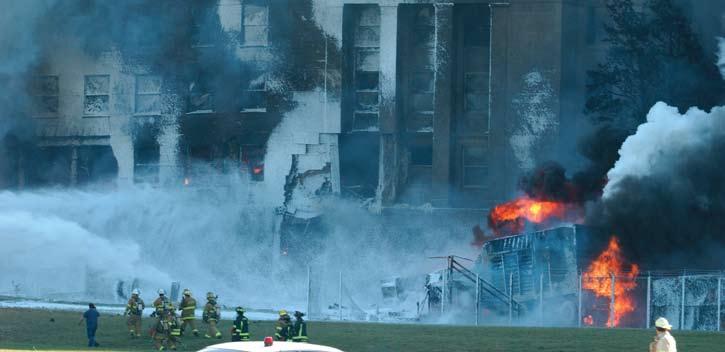
the concept of state immunity has long been part of the bedrock of international relations State immunity means that respect for the customs and laws of other countries — and mutual respect — overrides any thoughts of legal retaliation by foreign citizens .
Now the Harper government is proposing to follow the lead of the United States (and only the U S ) and allow Canadian victims of terrorism to sue states which support terrorists
In practice, state immunity buttresses sovereignty and renders any state immune from legal proceedings against it, or its officials, in another country. Traditionally, this broad immunity has been weakened only in the area of commercial transactions, where a foreign state or its agents are, in fact, liable for their contractually based obligations
However, with the federal government’s recent introduction of Bill C-35, the “Justice for Victims of Terrorism Act,” the sea may be changing The bill died on the
Order Paper with the prorogation of Parliament, but if reintroduced and passed, the bill would amend Canada’s State Immunity Act by removing immunity from any states that Canada labels as supporters of terrorism .
It sounds like a good idea in principle, considering the thousands of innocent people killed by terrorists eight years ago in New York, and the hundreds more lives taken by terrorist attacks in Spain, the UK, India … the list goes on
The bill clearly speaks to the outrage that explodes when such attacks succeed in their murderous purpose . If Ruritania or Zangora are on the proposed list of terror states, Canadian victims of a Ruritanian suicide bomber or a Zangoran nerve gas attack in a subway system could sue those states in a Canadian court
But Bill C-35, if it becomes law, would be a clumsy and weak tool for deterring terrorism and bringing compensation to its victims, at best a symbolic gesture . As well, the bill draws an artificial distinction
between state-sponsored terrorism, which it would expose to lawsuits by victims, and state-sanctioned gross human rights abuses, which would remain protected from such lawsuits .
And the bill may have unintended and harmful foreign policy implications . Under the proposed act, the federal cabinet itself would list state sponsors of terrorism, thus politicizing an important area of Canada’s international relations As such, some critics say this determination should be done through the courts The federal Liberals argue that any state with no extradition treaty with Canada should be on the list, because under the current bill, “whether a foreign state is listed will always be the subject of political negotiations between governments ” By way of contrast, the NDP thinks that the determination of which states should be listed is a determination best left to the courts .
The Conservative government believes that because listed countries will be able to make a written application for delisting,
there are “safeguards and review mechanisms built into this provision, striking the appropriate balance between accountability, justice and fairness ”
Nevertheless, there is the lurking potential for tit-for-tat retaliation If Canada makes a state liable under the jurisdiction of its civil courts, Canada itself, and conceivably Canadian organizations could easily face a comparable designation from the target state
This has been the United States experience to date It is the only country that has similar immunity legislation and tit-for-tat is already full-blown Cuba and Iran, both on the U .S . immunity exemption list, have allowed their citizens to file suit against the U S for “interference” in internal affairs or for violating human rights
deterring terrorism, helping victims Ottawa says the bill is intended to deter terrorism, and as a corollary, to provide financial compensation to victims But there are two flaws on the way to these noble goals . First, terrorists and their governments sponsors are unlikely to be deterred by a possible civil lawsuit in a Canadian court After all, these groups remain un fazed by the prospect of extremely serious criminal sanction
working in Beirut in 1985, was kidnapped and tortured over 18 months A default judgment was awarded against the Iranian government because, at trial, there was testimony that Jenco’s captors were members of Hezbollah, and further that Hezbollah was funded and controlled by the Iranian government .
Or, take the case of Wagner v. Islamic Republic of Iran, where a total of $316 million in damages was awarded, but just over $18 million paid In this case, a U S Naval officer was killed by a Hezbollah suicide bomber
The list goes on . That is not to say, however, that there are not examples of large damage awards and successful efforts at enforcement Rather, it simply underscores the reality that enforcement can be a difficult and resource intensive endeavour that, at times, bears little fruit
Ottawa2009:DeltaOttawa 12/16/08 9:18 AM Page 4
Ottawa2009:DeltaOttawa 12/16/08 9:18 AM Page 4
That said, the bill recognizes some of these difficulties and says the victim who can’t collect can get help from the ministers of Finance and Foreign Affairs . But under Bill C-35, their assistance would be entirely discretionary and the bill proposes no help at all in paying for what would
Perhaps the biggest critique facing the bill is that it allows for victims of state-sanctioned terrorism to sue, but not victims of state torture This is a particularly cogent issue in light of what happened to Maher Arar, Zahra Kazemi and William Sampson — Canadian citizens who faced gross human rights abuses at the hands of foreign governments
Given the heinous cruelty of their torturers, it is difficult to understand why the Canadian government would — under the terms of the new bill — do nothing if and when the facts emerge in future abuses
Deterring terrorism and providing compensation to its victims are incredibly important endeavours, and groups set on mass casualty terrorism may be deterred in future, but not by the threat of civil suits in Canadian courts
Aaron Shull is an international legal scholar, who publishes and speaks regularly on international security issues He is an associate in the Ottawa law firm of
Second, a favourable finding in a Cana dian court — undoubtedly at the end of an expensive, lengthy, harrowing experience for victims — could be hollow guarantee the judgment will be enforce able
When introducing the bill, then Public Safety Minister Peter Van Loan agreed that collecting damages from a terrorist group or a rogue state was iffy, but pointed out that collecting damages even in regular domestic lawsuits can be a challenge
However, Mr . Van Loan’s position could undermine one of the main reasons for the legislation: A family that has fallen victim to terrorism spends large sums of money to bring a case to court, testifies and relives terrible events a judgment that cannot be enforced U .S . experience has seen massive damage awards from the courts and much smaller sums actually collected

Indeed, according to a recent Congres sional Research Service Report, the en forcement of these awards — turning the court judgment into actual cash — remains a serious problem Examples include: v. Islamic Republic of Iran
$314 million in damages was awarded, but just under $15 million was paid this case, Lawrence Jenco, a Catholic priest





By George Fetherling
Here, in the West, there are fashions in historiography just as in everything else . Feminist history, social history and material history are among the dominant strains being studied and written about, with military history undergoing a major revival A generation or two ago, such a list would have included diplomatic history, but these days relatively few serious books based on research in diplomatic archives are being published Canada’s Voice: The Public Life of John Wendell Holmes by Adam Chapnick (now available as a UBC Press paperback, $32 95) is perhaps a partial example, because John Holmes (1910−88) did not limit his career to the old Department of External Affairs but was also at various times an academic, think-tank director and pundit . But then there is The Constant
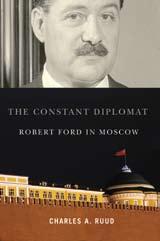
Diplomat: Robert Ford in Moscow by Charles Ruud (McGill-Queen’s University Press, $39 95) It fits the bill quite nicely R.A.D. Ford (1915−1998) was Canada’s ambassador to the Soviet Union for an astonishing 16 years, beginning in 1964 when Nikita Khrushchev was still in power and ending in 1980 when Leonid Brezhnev was still holding on Add to this two earlier postings in Moscow, not to mention five other ambassadorships, and his career begins to take on the look of an era or, at the very least, to elevate his importance in the storied age of Canadian foreign policy.
Ford was a native of London, Ontario, as was Holmes, who served under him
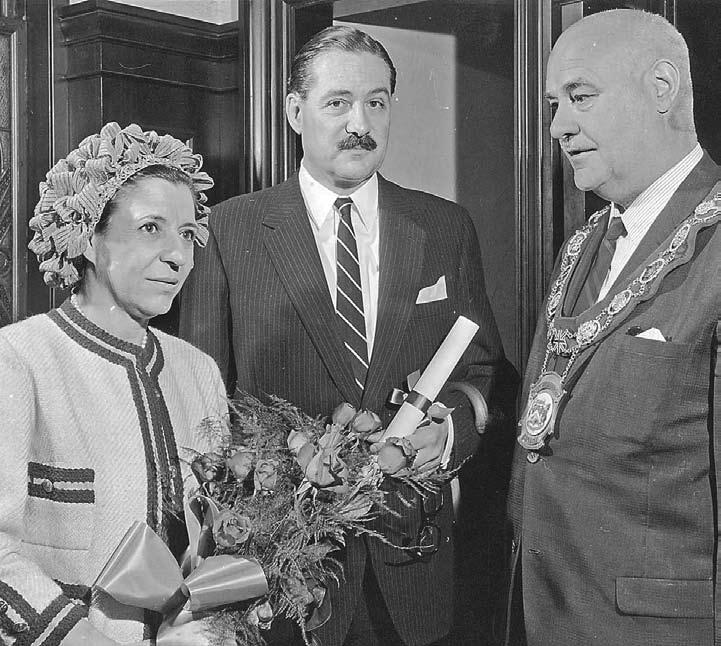
in Moscow He was also one of those lucky individuals who have the knack of mastering other languages (he knew five) Astonishingly, when he joined External in 1940 (and was immediately sent to the San Francisco consulate to process passport applications) he became, according to Prof Ruud, the department’s only EnglishCanadian officer fluent in French Less remarkably, he was one of only two who knew Russian The other was George Ignatieff It was felt, however, that Ignatieff, being the son of an exiled White Russian noble, might not be comfortable or welcome in the USSR .
The forced spirit of unavoidable cooperation that existed between the two countries during the Second World War had faded when Ford first went to Moscow in 1946 as second secretary Indeed, he had been compelled to linger at the High Commission in London for a time while Ottawa waited to see whether the USSR would actually sever relations with Can-
ada over the Igor Gouzenko spy scandal
One can read a certain symbolism into the fact that when Ford settled into the embassy, he found it infested with bedbugs (whereas, for the remainder of his long stay, the bigger worry was bugs of the electronic sort, even in Russian friends’ apartments) Of course he wasn’t the only one saddened or sickened, possibly both, by the culture of surveillance and what it represented For a decade beginning in 1973, Ford’s opposite number was Alexander Yakovlec, the Soviet ambassador to Canada . Prof . Ruud describes him as “an able, intelligent, and believing insider who rose close to the centre of power in Moscow (but) was becoming disillusioned (while) in Ottawa by the KGB and Central Committee dominance in the Soviet embassies ” Both east and west, it was a time of official paranoia about loyalty and espionage . In such an atmosphere, tragic incidents were not uncommon . For example, John Holmes, suspected of be-
ing a homosexual, was sacked In a better known instance, another colleague, Herbert Norman, the ambassador to Egypt, committed suicide when accused of being a communist
There is a kind of career diplomat who hopscotches the world on tiptoes . An example is Andrew Stuart . His memoir Of Cargoes, Colonies and Kings: Diplomatic and Administrative Service from Africa to the Pacific (H B Fenn, $30 50 paper) is surely one of the last of its kind, as it details how he presided over the granting of independence to quite a few British colonies and territories
Of particular interest is his unavoidably hilarious account of being Britain’s last resident commissioner in the New Hebrides during the joint Anglo-French arrangement known officially as the Condominium (and informally as the Pandemonium)
Then there are the heavily bureaucratic diplomats of all nations and the politically appointed ones who characterize the U S . diplomatic tradition . For his part, Ford was closer to the 19th-Century British and French school of scholar/diplomats who saw their task as comprehending, and even coming to love, the essence of the places to which they were sent, often showing by their example that this is the best means of understanding a government’s reflexes . Prof Ruud labels Ford, a serious lifelong student of the host society, “a consummate rationalist who studied Russian culture and Soviet politics from the outside and achieved the understanding of an insider ”
Travel was often difficult for him, because he suffered since youth from a degenerative muscular disease His refusal to let it circumscribe his workload or prevent him from going back and forth through the 11 Soviet time zones says much about the private man So does the fact that he was an ambitious collector of Russian art Or the fact that he, himself a published poet of what might be called anthology rank, was also an admired translator of the work of Russian writers, with a number of whom he entered into deep friendships . Buried in The Constant Diplomat is a vignette in which he invites some of the most famous Soviet writers round to the residence to meet the American playwright Lillian Hellman They didn’t care for her at all She was too much of a communist for their taste
The book crystallizes Ford’s view of Soviet-style Marxism as a system “artificially imposed on a Russia whose endur-
ing psychology and culture were rooted deep in the pre-Revolutionary past ” He never doubted that the leaders in the Kremlin were totally sincere in their principles . But unlike Kremlinologists of the day, the American ones in particular, he didn’t see Soviet ideology as a simple way of explaining all Soviet actions He felt that certain ghosts from tsarist times had become permanent if invisible invigilators in the halls where policy was made In the 1950s especially, this “angle of vision,” as the author calls it, gave Ford’s ideas a certain forensic power not only at External Affairs but also in the Western diplomatic community in general (perhaps disproportionately so in the capitals of western Europe, though Prof Ruud doesn’t become explicit on this point)
However much influence he came to have on the tone and style of foreign policy towards Russia that he himself was then charged with carrying out, he was also, of course, a strong agent of what many others also understood to be its two goals The first was to improve the world’s understanding of Canada as a moderate middle power, close to but not in the pocket of the United States, by trying to lessen Cold War tensions: promoting peace not only for its own sake but also to make Canada more useful—and more independent—in the world’s eyes . The second but always less important objective was to sell the Soviets wheat and other commodities The economic gain, however, would be in danger if the first effort worked so well that the U S would itself begin large-scale exports to the Soviets
In 1967, Ford wrote this to the undersecretary of state for External Affairs: “I have long been disturbed, as I am sure you have, at the extent to which management skills have supplanted expertise in foreign affairs and original thinking as major qualifications for advancement in the foreign service ” To which Prof Ruud appends this comment: “If Ford’s recommendations had been followed, there would be more poets and humanists—all widely read— among the diplomats in Ottawa . ” For indeed that is the kind of old-fashioned diplomat—or diplomatist, as people once said—that R A D Ford was He was an intellectual and a tireless writer
One of his books, produced after his retirement, was Our Man in Moscow (in which he writes of the need, when dealing with the Russians, “to resist the obvious retort, be patient, be adjustable, and wait for results”) Another project was a selection of his dispatches, for which he wished
to bring in an outside editor Eventually the job fell to Prof Ruud of the University of Western Ontario The two were able to make some tapes together, but following Mr . Ford’s death, the book took its present form as a fully written book rather than merely an edited one It skillfully draws on the interviews, dispatches and official telegrams (how quaint that sounds) as well as on other material from government and private files One especially rich source is an unpublished book-length memoir by the redoubtable Thereza Gomes Ford, a former Brazilian diplomat . Her sharp observations add much to the story of her husband, with whom, evidently, she frequently, and engagingly, disagreed
who’s who and wheRe and why
In the editorial offices of the University of Toronto Press, six floors above a donut shop on Yonge Street, staff were recently preparing two different books with the same title One was a facsimile reprint of the first-ever Canadian Who’s Who, originally published by The Times of London in 1910 . Even when padded with advertising, it ran only a few hundred pages The reprint costs $19 95 The second book is the 2010 edition of Canadian Who’s Who, a reference work the press has been publishing for decades It weighs three kilos, squeezes 16,000 people onto 1,500 triple-columned pages and sells for $225 (or $191 . 25 to the lucky inductees) . The annual volume has long been a staple for librarians, researchers, journalists and so on If there are any foreign diplomats in Canada today who study the country the way R A D Ford studied the Soviet Union, they probably use it too In certain ways, they could hardly find a more useful index to who makes up Canada and which way the society is trending . Whereas the 1910 Canadian Who’s Who is of course obsolete, the new one is merely obsolescent, at least in its present form Most of Canada’s important national reference-book megaprojects, such as The Canadian Encyclopedia or The Dictionary of Canadian Biography, have gone digital, as have a number of the highest quality regional ones such as The Encyclopedia of British Columbia No one is saying for certain but many suspect that the modern Canadian Who’s Who , which is already available as a CD as well, may migrate away from print entirely in the next two or three years
Canada’s population was only seven million back in 1910, when Montreal was the financial and cultural capital of
Canada and St James Street the capital of Montreal The original Canadian Who’s Who included those figures you would suppose to be there: Prime Minister Sir Wilfrid Laurier, the feminist Nellie McClung, the poetaster Robert W Service It was also made up of the types you’d expect: bankers, railway executives, and clergymen almost beyond counting . Nearly all of them were male and most of them had Scots, English or French names The fact that the country’s population has almost quintupled since then is, however, the least important change reflected in the Canadian Who’s Who we know today
Looking back on a generation’s worth of the University of Toronto Press Canadian Who’s Who , it comes as no surprise than the gender imbalance in the earlier editions has more or less evened itself out and that the geo-economic centre of gravity has been moving westward since the 1970s Without resorting to pointlessly minute research, it also seems to me that more Québécois are listed and perhaps fewer of them give their biographies in French Yet it also appears to be the case that there are still comparatively few First Nations persons Still other facts, while often less apparent, are nonetheless just as revealing In the 2002 edition, it seemed odd that Ward Elcock, then the director of CSIS (and more recently the coordinator of Olympic and G-8 security), gave the month and year of his birth but not the day But now, what with heightened awareness of identity theft, many choose to omit such details The fact that far fewer people than in the relatively recent past list their religious affiliation (or even fewer, their specific denomination or sect) doubtless underscores not only the declining importance of organized religion in mainstream Canada but also the heightened sensitivity of the whole subject
In the original volume of The Canadian Establishment in 1975, Peter C Newman, in noting that the financier J A (Bud) McDougald listed the numbers for his servants’ quarters and private stables in the Toronto telephone directory, ventured that he, McDougald, would undoubtedly be the last individual to do so . Quite . Today a number of people in CWW name the gyms to which they belong whereas only 20 years ago many gave their luncheon clubs The latter custom probably peaked with Conrad Black whose former CWW entry revealed that he belonged to four exclusive gentlemen’s clubs in London, four more in Toronto and one each in Montreal and Palm Beach
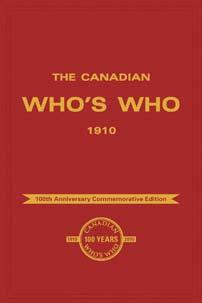
Who’s Who —the British one, which doesn’t have to qualify itself by including its nationality on the cover—began in 1849 . Its entries, which are brief, are written inhouse in a uniform style and include a token number of personages from elsewhere in the Commonwealth It’s hardly Burke’s Peerage—it’s not intended to be—but neither is it a meritocracy No Martian reading Who’s Who would understand just how multicultural a society contemporary Britain is, what with the book’s high percentage of white people who seem to be there because they possess some combination of inherited wealth, Oxbridge education and significant ancestors Who’s Who in America, founded a half century later and also written in-house, is heavy on business people, celebrities and office-holders, though it’s salted with a few figures intended to give it added freshness, utility or respectability. By contrast, Canadian Who’s Who is highly democratic in its way
Each year, 5,000 people in every conceivable field—selected, I once joked, on the basis of having been mentioned in the Globe and Mail not in connection with a major crime—are sent questionnaires . About 600 of them reply (As Elizabeth Lumley, the book’s editor, says, “People of accomplishment are always busy ”) Whatever they write on the questionnaire—however preposterous, pompous, mistaken or longwinded—is then printed in Canadian Who’s Who Let other reference books have their snobby gatekeepers Canadian Who’s Who is more like a call-in radio show Once chosen, people are free to self-identify, to tell us whatever they believe (or hope or wish) to be the truth about themselves That is, it
is already much more like the Internet that it may soon stop resisting
In any given year, the number of Canadian Who’s Who people who die or otherwise drop out exceeds the number who join . For a time, the book was able to remain almost constant in size by perfecting a truly bizarre maze of abbreviations that soon came to seem part of its strange allure Thinner paper and smaller type have also helped make possible a certain amount of expansion over the years But now CWW has reached the limit of its thickness if it is to be machine-bound rather than bound by hand, which would increase costs significantly The need for more space sits oddly with the need for more entries from particular sets of people A confidential in-house document prepared in 2009 lists job categories whose high-achievers have until now been shortchanged Please note that these include diplomatic and consular “Representatives of major countries only (and) Smaller countries (selectively)” as well as “Presidents of principal companies” in the public relations field And so on The memo goes on to state that directors of zoos, aquariums and botanical gardens have not been receiving their due in the printed Canadian Who’s Who either .
This desire for fresh blood may be another factor, along with rising costs and the trend by which printed books are losing their supremacy in many library systems, that helps make the future seem obvious The people who believe that this most charmingly eccentric of Canadian reference books will not hold out much longer against the web-based world of its contemporaries are likely correct, though as Ms Lumley says, “No one is writing an obituary ” While much will be gained in speed, ease and economy when a web version Canadian Who’s Who is available on everyone’s laptop and every public library’s computer terminals, much will be lost in terms of browsability. I’m thinking in particular of one famous Toronto author whose name I’m afraid to reveal here who spends who knows how many consecutive hours each year poring over the new CWW to determine which of his rivals are unfortunately still alive and what honours and prizes that he himself should have received have mistakenly gone to others For him, life in the future will be more difficult
George Fetherling’s latest book is the novel Walt Whitman’s Secret (Random House Canada)
When confronted with so many shelves holding countless bottles of wine, it’s easy to forget how unique and distinctive the conditions have to be so that a good wine can be made Every quality wine’s story includes skill and talent both in the vineyard and the winery, a fairly large amount of capital and the blessing of Mother Nature . How-
forth Not only did they leave behind complex soil compositions, but they shaped layers of sedimentary rock and ancient reef structures into one particularly important bit of physical geography: the Niagara Escarpment Rising some 335 metres above sea level, this north-facing cliff forma tion is the backbone of the area Its slopes and benches determine the vineyards’ exposure to sunlight and the influence of wind and lake effects . This diverse range of grape-growing conditions allows the Niagara Peninsula to produce 32 varietals in nearly 5,500 hectares of vineyards
Classic cool-climate varietals such as Riesling, Chardonnay, Gamay Noir, Pinot Noir and Cabernet Franc are produced particularly well . The appellation also boasts some 70 wineries producing more than 500 wines One of the best producers is the Pennachetti family’s Cave Spring Cellars, and, much like the glaciers of days long past, the Pennachettis have made their mark on the area . In the early 1920s, Giuseppe Pennachetti emigrated from his native Italy to work as a mason in the
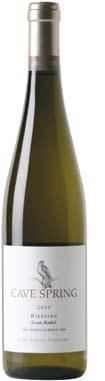
building of Niagara’s Welland Canal
Thanks to his Old World love of wine, Cave Spring today is built upon three generations of wine-making tradition .
The family is recognized as not only one of the greatest producers of Riesling in North America but as one of Canada’s finest wineries Giuseppe’s grandson Tom Pennachetti is the winery’s director of marketing and sales, and provides some interesting insights:
“Topography is critical Elevation and aspect dictate air flow,” Mr Pennachetti says “The Beamsville and Twenty Mile Benches, where all of our vineyards lie, provide the right elevation above Lake Ontario to give constant circulation of moderating on-shore breezes from Lake Ontario They are just close enough that these breezes reach them, and just high enough that they are exposed to warmer air currents off the lake in cooler months In warmer months, cool breezes are drawn up these slopes ”
Also, the soils of the Cave Spring vineyards are quite poor in organic matter when compared with the fertile sites beneath the escarpment However, besides
G r AP e- G r OWING
A re A IS TH e re SULT OF 200,000 Y e A r S OF GLACI er S G r INDING TH e I r WAY b AC k AND FO r TH .
ever, no matter what, a good wine is the result of good fruit, and, to get good fruit, you need the right place to grow it . There aren’t that many such places . Thankfully, Canada has a few
The one that highlights this rare combination of just the right criteria is Canada’s largest viticultural area, the Niagara Peninsula Stretching west from the Niagara River to Hamilton, this great wine grapegrowing area is the result of 200,000 years of glaciers grinding their way back and
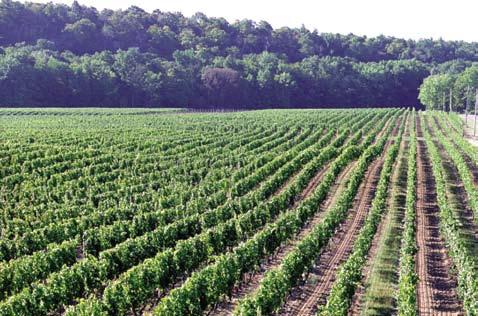
draining better because of their elevation, the soils are special as they are rich in eroded limestone and have a unique mineral character As a result, the vines are kept in check and do not produce excessive fruit Even for their entry-level wines, yields are generally 30 percent lower than those from the more fertile sites beneath the escarpment . Such lower yields deliver more concentrated and structured wines
Which Cave Spring wines particularly show this?
“Riesling best shows the uniqueness of our terroir,” says Tom Pennachetti “Our Estate and Niagara Riesling both show this in different ways . The Estate is made from 100 percent Cave Spring vineyard fruit and shows the great complexity that older vines can deliver And it ages like mad The Niagara is a bit softer and fruitier, but also ages well It shows an amazing range of tree fruit and also exhibits great minerality especially on the nose ”
The 2008 Cave Spring Estate Riesling is available through the Essentials program of Vintages while the 2008 Niagara Riesling is part of the LCBO’s general list Try either one and you’ll get to taste where a wine comes from
Pieter Van den Weghe is the sommelier at Beckta dining & wine
Diplomats and embassy employees may exchange their personal cheques without paying extra fees. Accu-Rate Corporation specializes in electronic and cheque payments in over 55 currencies. -
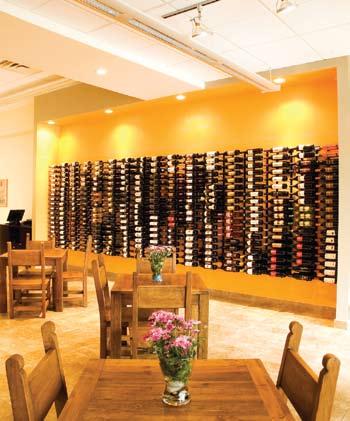
As winter sheds its chilly cloak, our anticipation of once again enjoying local, garden fresh produce escalates You must know the feeling
Many of us, taking a serious approach to the 100-mile diet, are amazed at the culinary wonders our regional root crops have provided us since last October . However, even the poorest math students can calculate that that’s still at least six months without locally grown fresh garden produce
Local flavours have caused a dramatic culinary rebirth, particularly in the last few years with chefs and home cooks alike rediscovering how much tastier they are The word “seasonal” has also invaded our culinary vocabulary and our social consciousness
Thanks to our new-found commitment to purchasing local produce as much as possible, we have been nourished with root vegetables during the last six months The experience has charmed cold-weather menus when comfort food dominates . Chefs have boiled, baked, caramelized, grilled and incorporated root vegetables into deeply satisfying soups, curries, stews and salads And because of the public’s interest in creative cooking and dining, often these dishes are presented in exciting, vibrant ways, and with more diverse flavours Indeed, the once humble root vegetable has become a focus of attention . Carrots, potatoes, beets, even turnips are now available in multi-colours and different sizes Many root vegetables appear on grocery shelves already washed, peeled, cut, diced and slivered And, let’s not forget the myriad of flavoured oils and vinegars which can conveniently add the perfect boost of flavour with one careful drizzle All in all, dining for month after month on local veggies (and apples) has not been an unhappy challenge .
But let’s face it, who among us has not been cheating on our vows to thrive strictly on seasonal and local produce? Although I look for the country, province or location of origin, and choose as locally as possible, I do not resist purchasing a strategic quantity of greens (from broccoli, asparagus, and kale to salad leaves and fennel) even if, to my despair, the only ones available have crossed the continent Practical compromises must be made during non-growing months especially when it comes to fruit And with berries of all kinds seeming to be a great bargain virtually all winter long, price-savvy consumers will, of course, pop them into their shopping carts
But as spring arrives, our anticipation of feasting on local fresh produce from farmers’ markets and our own gardens builds . First on the market will be fiddleheads, wild garlic and leeks In our own gardens, sorrel, icicle pansies, chives and rhubarb will bravely push their way through the earth’s cold (sometimes icy) surface The next taste of local to delight our palates will be asparagus and strawberries From then on, the eagerly awaited parade of summer fruits and vegetables will finally be ours once again to enjoy — if only for
another four months or so . Regardless of the time of year, I must admit that I adore luscious fresh flavours on my plates Fresh herbs and microgreens are the easiest way to achieve that Fortunately, some local growers offer an uninterrupted supply of these all year round And you, like I, may also have your own personal herbal “grow op” (as my husband calls it) under your skylights .
Over the years, I have also developed a versatile repertoire of tantalizing unique recipes on which I can depend to deliver a truly fresh and impressive impact regardless of the month Although very much dedicated to local and seasonal, I do not hesitate to put aside that commitment from time to time . My unique Smoked Salmon Stack with Avocado and Mango is one such example When available, I use local salad leaves and shoots but that’s not always possible
Enjoy this appetizer! Bon Appétit!
Margaret Dickenson is author of the international award-winning cookbook
Margaret’s Table – Easy Cooking & Inspiring Entertaining . See www .margaretstable .ca for more
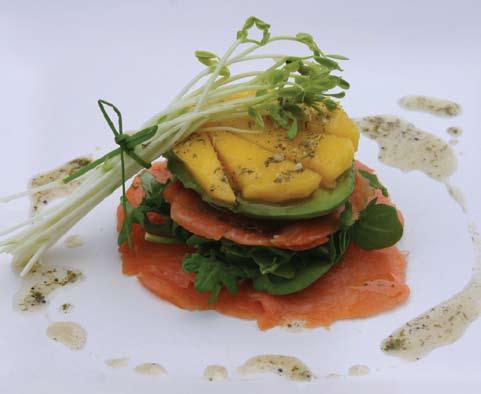
smoked salmon crispy stacks (with avocado and Mango) Makes 4 servings
Smoked salmon stacked colourfully together with crisp salad leaves, ripe avocado and mango, is a curious but beautifully delicate marriage of flavours and textures . The drops of “highly charged” lemon oil and the bouquet of young snow pea shoots, add the final touches of drama to the plate Not only is it a great appetizer, particularly for a dinner party, but it also could be the main feature for a brunch menu
8 oz (225 g) smoked salmon, sliced 1 avocado, ripe
1 fresh mango (medium size), ripe
3 cups (750 mL) crisp young salad leaves (e g , mâche rosettes, arugula or similar types)
1/3 cup (80 mL) mustard-herb vinaigrette (recipe follows)
Garnish (optional)
4 petit bouquets of fresh herbs (e g , chervil, coriander, dill) or shoots 1/4 tsp (1 mL) lemon oil
1 Divide smoked salmon slices into 8 equal portions; set aside
2 Cut avocado vertically in half and remove pit Keeping entire half of avocado intact, carefully remove peel Cut each avocado half vertically into oval slices (thickness: 1/3 inch or 0 .8 cm) . Choose 4 of the largest slices and set others aside for another purpose
3 Peel mango Similarly cut mango vertically into oval slices on either side of pit
Choose 4 attractive slices Leaving top of slice attached, cut each of the 4 mango slices in a fan-like manner
4 Use 4 dinner plates to make 4 individual servings . For each serving, place one portion of smoked salmon in a circular fashion (diameter: 4 inches or 10 cm) in centre of each plate
5 To facilitate the creation of a stack, position a metal cylinder/ring (diameter: about 3 1/4 inches or 8 5 cm) over the salmon and fill with 3/4 cup (190 mL) of salad leaves, packing the leaves gently . Leaving the cylinder in position, drizzle salad leaves with 2 tsp (10 mL) of vinaigrette; add another portion of smoked salmon Carefully remove cylinder


6 Gently top each stack with a slice of avocado and then a slice of mango Drizzle stack and plate with more vinaigrette (about 2 1/2 tsp or 13 mL)
7 If desired, garnish stacks with petit bouquets of fresh herbs or shoots .
8 . Cautiously and sparingly, add only 3 drops of lemon oil to the outer area of each plate beyond the stack
9 Serve promptly
Mustard Herb Vinaigrette
3/4 cup (180 mL) canola or corn oil
1/4 cup (60 mL) olive oil
1/4 cup (60 mL) vinegar
2 tbsp (30 mL) lemon juice
1 1/3 tbsp (20 mL) granulated sugar
1 tbsp (15 mL) chopped fresh dill weed
1 tbsp (15 mL) chopped fresh parsley
1 1/2 tsp (8 mL) powdered mustard
1 1/2 tsp (8 mL) finely chopped fresh garlic
1 1/2 tsp (8 mL) salt
1 tsp (5 mL) crushed black peppercorns
1 Whisk ingredients together and stir well before using (The vinaigrette will keep up to several months if refrigerated in a sealed glass jar)
the argentinean ambassador shows off his familial heritage at his Rockcliffe residence
By Margo Roston
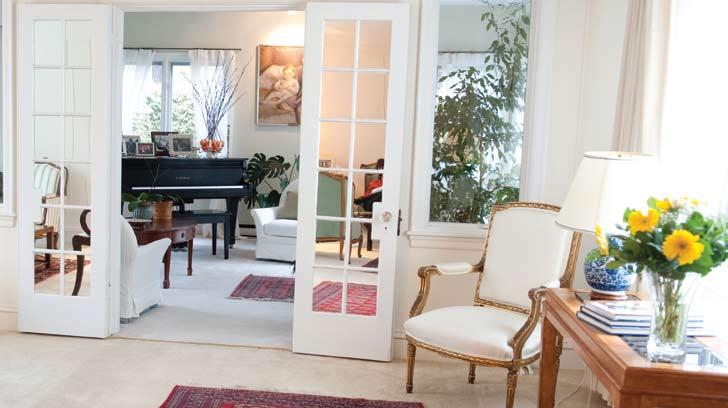
the best way to describe the official residence of Argentinean Ambassador Arturo Bothamley and his wife Maria Angelica Olmedo, is simply to say it is a large, very comfortable family home, the kind of house you find sprinkled around Rockcliffe Park Not the biggest and “not the best” as the ambassador says, it is located in the heart of the village on one of the most prestigious streets in the upscale area
And 699 Acacia Ave boasts one of the largest gardens in Rockcliffe, surrounded on three sides by some of Ottawa’s most historic, most elegant embassy residences The white stucco, three-storey house faces the grey stone Korean embassy across the street, as well as the fabled home of the Japanese ambassador on the north side Facing the back garden is the German embassy residence, while close by is the home of Canada’s Chief Justice Beverley McLachlin .
The house has an important pedigree It is one of just about a dozen designed by Allan Keefer, the great grandson of Thomas McKay and described by Martha Edmond in Rockcliffe Park: A History of the Village as “a society architect ” He was commissioned by civil servant Harry W Brown, then deputy minister of the then department of the militia, to design his house on the spacious, corner lot Although radically changed now from the original, it is one of only about a dozen Rockcliffe homes he designed in the 1920s and ’30s .
The house was purchased by the government of Argentina in 1966
“It is very pleasant to live in,” says the ambassador, who has made it his home for the past six years “And the land is very valuable ”
The first thing you notice in the main floor reception room is a table filled with pictures of the couples’ five children, a
charming touch of home
Several of the pictures show the wedding of one ambassador’s four daughters, who was married in Ottawa by Ambassador Bothamley’s friend and colleague, the former Papal Nuncio, Luigi Ventura
The main reception room is bright and comfortable with white carpeting sprinkled with colourful oriental carpets That room leads into a sunroom or “the piano room” as the ambassador calls it, from where might emanate the sounds of an Argentinean tango .
Argentinean paintings cover the walls, including works by landscape artists Encanto Del Bosque and Enrique Prins, on loan from the National Gallery of Argentina Also prominently displayed are two antique brass clocks, which the ambassador had repaired when he moved in .
The ambassador is a true cosmopolitan, he says, with a background that includes English, German, Italian and Swiss ancestors
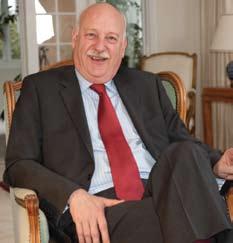
“My grandfather came from England, because Argentina was a land of promise in 1870,” he says With his background, putting the clocks in pristine condition was a duty, he adds A career diplomat, his last posting was as ambassador to Jamaica, St Kitts and Nevis
The large dining room across the central entrance hall features a cozy marble fireplace and a large bay window . The dining room seats 18 for a sit-down dinner, where guests might be treated to specialties such as Argentinean beef, alfajores cordobeses , a jam-filled cookie typical of the province of Cordobesesi, and dulce de leche , the thick caramel sauce the ambassador calls the “Argentinean passion . ”
Also on the main floor is a comfortable den, where the ambassador, an unrepentant smoker, retreats to smoke his cigars Perhaps the most amusing spot in the house is a tiny, picturesque, wine storage room, tucked into a corner near the kitchen When the basement was renovated and the staircase moved, this tiny space adapted perfectly as storage for some of the resident’s favourite vintages, although the ambassador has to crouch to retrieve his choices
Another feature of the house is a large picture window midway up the staircase overlooking the garden, which not only supplies a view but also an abundance of light The house has five bedrooms and staff quarters over the garage, but if they don’t have guests, the couple doesn’t need to use the third floor, two-bedroom suite .
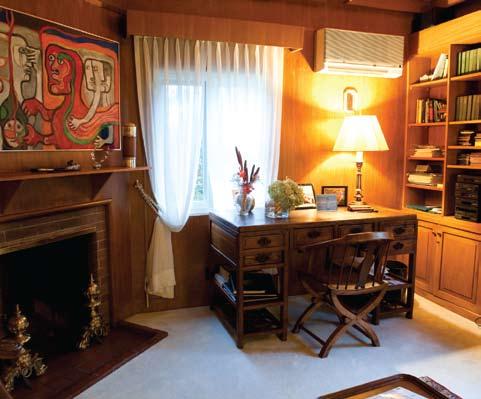
The house really comes into its own on May 25, the country’s national day, when a big tent in the lovely garden is a centerpiece for Argentineans, diplomats and Canadians to get together to celebrate the heritage and special flavours of the country.
Elite's talented team of designers and technicians can take on any project of any scale — from expertly handcrafted draperies to interior design to complete custom home renovations. Elite has the depth of experience and capabilities to make your dream project a reality.
By Laura Neilson Bonikowsky
since the events of September 11, 2001, Canadians and Americans have become increasingly aware of our shared border
At 5,000 km, it is the world’s longest undefended border, which has prompted the American government more than once to consider fencing it
Conceptualizing the enormity of such an undertaking affords some realization of the remarkable feat accomplished when the border was first established Diplomats settling British-American boundary disputes under the 1783 Treaty of Paris, having little knowledge of the relevant geography or history, produced a vague document with an airy reference to a latitudinal connection between Lake of the Woods and the Mississippi River . They determined the border as a line from the upper corner of the lake due west to the Mississippi The best geographer couldn’t make that connection
On Oct 20, 1818, a British-American
convention clarified the westward border “as a line from the farthest northwest part of Lake of the Woods to the 49th parallel and thence west to the Rocky Mountains ” Both Britain and the U S registered claims over the Oregon Territory, the region west of the Rockies and between 42 o N and 54 o 40’ N . The conflicting claims became an explosive issue in the 1840s . The Americans coveted a border at Russian Alaska—the British saw the Columbia River as the appropriate boundary
In 1844, James Knox Polk used the boundary dispute during the presidential election With the slogan “54-40 or fight!” he promised to go to war over the issue . Polk won the election but decided he would rather negotiate than fight and the British happily complied The Oregon Treaty of 1846 (in American history, the Treaty of Washington) extended the 49th parallel boundary to the Pacific Sketching a boundary on paper is

far simpler than marking it on the land . Both nations appointed independent commissions to map the frontier Lt-Col John Hawkins headed the British Commission; Archibald Campbell was his American counterpart They disagreed from the start Hawkins argued that boundary markers “in open ground” were required every mile . The Americans refused to bear their share of the cost but agreed to place markers wherever the 49th parallel crossed “streams of any size, permanent trails, or any striking natural features ”
The tension between the two men was in addition to disputes between their governments, the occasional military fracas, a series of aboriginal wars . It took four backbreaking years for Hawkins’ men to map the boundary and another half-century before the Hawkins-Campbell survey was officially recognized
When the British and Americans finally met to prepare official maps, they discovered, not surprisingly, some discrepancies The method of reconciliation was surprising — they split the difference, drawing a line between the originals . It seemed a good compromise at the time, but it only confused titles and jurisdictions when settlers moved into border areas to find multiple boundary markers and two or even three lines cut through the woods The authorities needed the original survey reports to rectify the maps but the documents were missing — from both commissions .
The Americans had postponed publishing their reports for economic reasons after the Civil War The British reports were found by Otto Klotz, of the Canadian astronomical service, at the Royal Observatory at Greenwich in 1898 when he glimpsed boxes marked “B . N . A . ” and had the janitor retrieve them . Both governments undertook a new survey between 1901 and 1907 New lines were cut, old ones cleared and missing markers replaced Remarkably, few corrections had to be made to Hawkins’ and Campbell’s original careful surveys .
Laura Neilson Bonikowsky is the associate editor of The Canadian Encyclopedia
































































close to home!





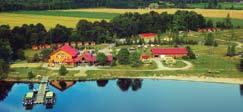








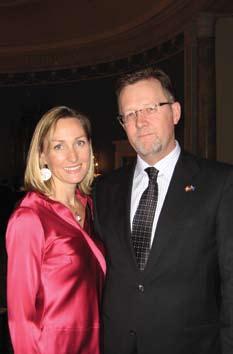
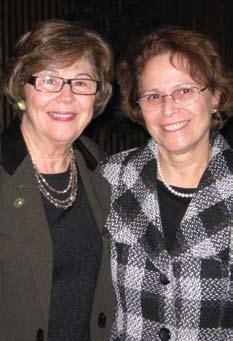
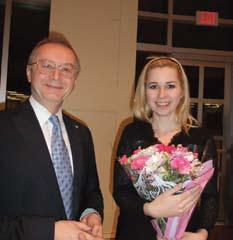
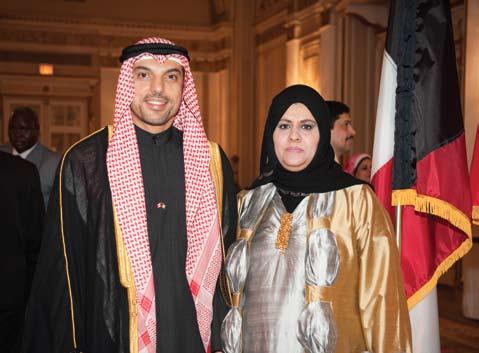
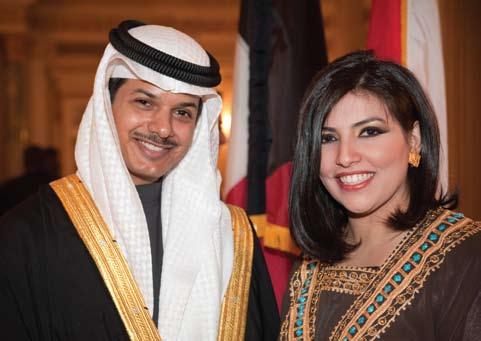
this page : 1. Australian High Commissioner Justin brown and his wife, Caroline Linke, hosted a national day event at the Chateau Laurier in late January. (Photo: Tim Stiles) • 2. To mark its national day, kuwait's chargé d'affaires Ali Al Dafiri and his wife, Tahani Al-Subaie, hosted a reception in February at the Fairmont Château Laurier. (Photo: Dyanne Wilson) • 3. Zeiad Alanbaie, Kuwait's first secretary, and his wife, Latifah Alotaibi. (Photo: Dyanne Wilson) • 4. Czech Ambassador Karel Zebrakovsky, Hungarian Ambassador Pal Vastagh, Polish Ambassador Zenon Kosiniak-Kamysz and Slovakian Ambassador Stanislav Opiela, together with the Czech and Slovak Association of Canada, and Ashbury College, hosted a charity concert for Haiti in February at the college. Mr. Zebrakovsky is shown with pianist, Zuzana Simurdova, after the concert. (Photo: Ulle Baum) • 5. As part of celebrations recognizing 60 years of relations between Israel and Canada, the Israeli embassy hosted a reception after a concert at the National Arts Centre in February. Israeli Ambassador Miriam Ziv, left, is shown here with evelyn Greenberg. (Photo: embassy of Israel)
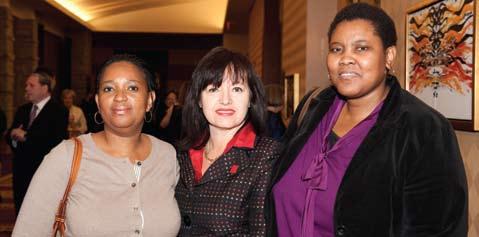

this page 1. The Ottawa Symphony Orchestra celebrated its Spring Symphony Soirée and fundraising auction at the Hilton Lac-Leamy in March. Shown: Sibongile rubushe, first secretary of the South African High Commission; Fabienne Nadeau, sales and marketing director at Casino Du Lac Leamy and Nompumelelo M. Sibiya , also first secretary for South Africa. • 2. The annual Viennese Ball took place at the National Gallery of Canada in February. Austrian Ambassador Werner brandstetter and his wife, Leonie-Marie, were honourary patrons. • 3. American Ambassador David Jacobson attended the Viennese ball, as did keiko Nishida (centre) and her husband, Japanese Ambassador Tsuneo Nishida. • 4. Young debutantes and cavaliers (high school students from the Ottawa area) always kick off the ball by dancing the Polonaise. • 5. The annual Snowflake Ball took place in February at the Hilton Lac-Leamy. German Ambassador Georg Witschel and his wife, Sabine, attended. (All photos: Dyanne Wilson)


this page : 1. Netherlands Major General de kruif, left, commanded ISAF forces in Afghanistan’s south and visited Canada in January to share his experiences. He took part in a wreath-laying ceremony at the Canadian War Museum with Netherlands Ambassador Wim Geerts. (Photo: W.e. Storey, CeF COM Headquarters) • 2. Cuban Ambassador Teresita Vicente Sotolongo hosted a reception at the end of January at the embassy to mark her country's national day. She’s shown between Miguel Frada, left, third secretary, and Antonio rodriguez Valcarcel, minister-counsellor.
notarehSerehw elpoep.rehtagetarbeleC rehtegothtiwtneve deroliatehtelytsdna setsatruoy.puorg-ffO etisgniretacelbaliava lacolseunevgnidulcni ehttnemailraP.sgnidliuB weiVelpmassunem .moc.awattonotarehs
tnageleesruoc-4 rennidmorf rep$nosrep 3168320051
this page 1. Lithuanian Ambassador Ginte Dasmusis (second from the left) hosted a national day reception in March at Library and Archives Canada. She’s shown from left with, from left, Latvian Ambassador Margers krams, Trade Minister Peter Van Loan, and riho kruuv, chargé d’affaires of Estonia. (Photo: Ulle Baum) • 2. German Ambassador Georg Witschel hosted a fundraiser Jan. 14 at his residence in support of Opera Lyra Ottawa's emerging Artists program. From left: Opera Lyra vice-chairwoman Patti blute, Mr. Witschel, co-host Sabine Witschel, pianist Judith Ginsburg and Tom Delworth, Canada's former ambassador to Germany.
sexaTdnaseitiutarg.artxesecirPtcejbus .egnahctcatnoCmoc.awattonotarehs@selasrof llufsmretdna.snoitidnoc0102©doowratSsletoH& stroseR,ediwdlroW.cnIllAsthgir.devreser
Biljana gutic-Bjelica ambassador of Bosnia-herzegovina

Ms Gutic-Bjelica has a degree in English language, literature and philosophy from the University of Nis She joined the foreign ministry in 2006, after previously holding positions within the ministry of civil affairs, and the ministry of communications and transport .
Her first job in the foreign ministry was at the rank of first secretary, within the department of UN and international organizations In 2008, she moved to the position of counselor in the cabinet of the deputy minister Prior to being posted to Ottawa, she worked in the sector for multilateral relations
Ms . Gutic-Bjelica, one of Ottawa’s youngest heads of missions at 38, speaks English and some French She is married and has one child
pedro lopez Quintana apostolic nuncio (holy see)
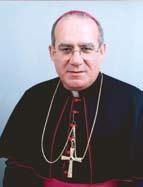
Archbishop Quintana was born in Spain and was ordained as a priest at the age of 27, for the Archdiocese of Santiago of Compostella Four years later, he entered the diplomatic service of the Holy See and served in Madagascar, Philippines, and India, as well as in a position as secretariat
of state in the section of general affairs In 1998, he was appointed assessor for general affairs of the secretary of state
Four years later, he became titular archbishop of Agropoli and was ordained bishop a few days later in January 2003 A month later, he became apostolic nuncio to India and Nepal .
He has a doctorate in canon law and speaks Spanish, Italian, English, French and Portuguese
andrea Meloni ambassador of italy
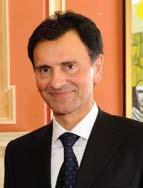
Mr Meloni joined the foreign service in 1975 with a job in the economic affairs department
Three years later, he became first secretary in Mozambique and took up the same position in Argentina . He was counselor in Pakistan from 1985 to 1987 and then returned to headquarters with portfolios on Latin America and development cooperation before going to Geneva as the deputy permanent representative to GATT and the WTO
He worked on Cambodia’s accession to the WTO for eight years, and then became consul-general in Buenos Aires . Before his posting to Canada, he was Italy’s representative to the political and security committee of the European Union
Mr Meloni speaks English, French, Italian and Spanish He is married and has three children
sheila ivoline sealy-Monteith high commissioner for jamaica
Ms . Sealy-Monteith is a career diplomat who has a bachelor of arts, an advanced diploma in international relations and a master’s of science in international relations, all from the University of the West Indies
Prior to coming to Canada, Ms SealyMonteith served as ambassador to Mexico, with concurrent accreditation to Belize, Costa Rica, El Salvador, Guatemala, Hon-
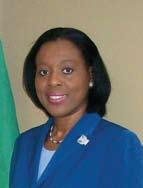
duras, Nicaragua and Panama She spent six years at Jamaica’s permanent mission to the United Nations where she dealt with economic and financial issues and served as head of chancery She also spent two years at the embassy in Venezuela and six years at headquarters, in charge of international organizations
Ms Sealy-Monteith is married and has two children
Bhoj Raj ghimire ambassador of nepal
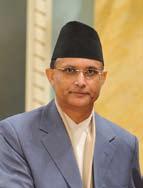
Before coming to Canada, Mr Ghimire, who has a PhD in economics, spent three years serving as secretary of the cabinet for the government of Nepal . His main responsibilities were in policy-making and monitoring policy implementation
Prior to that, he served as the secretary of different ministries of the government including finance, where he reconciled government resources and expenditures He also served as joint secretary in the finance ministry and drafted its policy on economic liberalization .
His previous diplomatic posting was as consul general in Kolkatta, India from 1998 to 2001
Mr Ghimire likes to write poems and songs He has written five books and recorded albums He is married and has one daughter .
andrew needs high commissioner for new Zealand
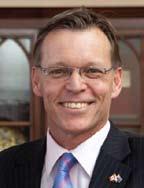
Mr Needs knows his new position well — he was deputy high commissioner in Canada from 2004 to 2008 But his most recent assignment was as foreign policy advisor to the minister of Foreign Affairs of New Zealand
Previous overseas assignments have included Canberra (1998-2002) and the Cook Islands (1991-1993) . He also served at the Pacific Forum Secretariat in Fiji and was seconded to Australia’s foreign and trade ministry in Canberra in 1990
Mr Needs has a bachelor of arts and a master’s degree In 2007, he completed an executive course at Carleton University’s Sprott School of Business in Ottawa
He was born in England, and arrived in New Zealand as a six-year-old . He lives with his partner, Bronwyn, and two school-age sons
Francisco carlo escobar ambassador of panama
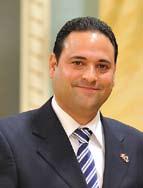
Mr Escobar finished a master’s in business administration from the University of Central Florida in Orlando in 1998 after completing a bachelor of science in finance from Louisiana State University in 1995
Before entering the diplomatic corps, he was general manager for a multinational logistics company headquartered in Miami . There, he learned about international
imports and exports, and legislation across the Caribbean and South America
As ambassador to Canada, he is especially interested in increasing tourism for both countries, and promoting direct flights between Panama City and major destinations in Canada .
At just 38, Mr . Escobar is a young ambassador He is married to Pily Castro Caceres with whom he has a two-year-old son, Carlo Emilio
Manuel shaerer kanonnikoff ambassador of paraguay
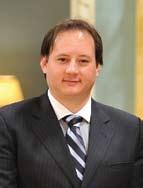
Mr Kannonikoff is a lawyer by profession He graduated in law from the National University of Asuncion and then did a master’s in international law at the Instituto de Estudios Superiores Monterrey in Mexico
He has served as a legal advisor and headed up the European Union and MERCOSUR sections of the customs department from 2005 to 2007 He was an associate lawyer with a firm for 18 months before becoming a member of the common market group of MERCOSUR (in the executive branch for commercial policies)
Most recently, he was a member of the commission for the MERCOSUR customs code and director of the department of international relations and negotiations in the customs department
Mr Kanonnikoff is married and speaks Spanish, English and Portuguese
Zenon kosiniak-kamysz
ambassador of poland
Mr . Kosiniak-Kamysz graduated from the department of organisation and management at the Technical University in Dresden and, from 1984 to 1986, he was a deputy contract chief at Krakbud, an industrial building company in Leipzig
For the next three years, he was a vicedirector in the Krakow office of the Polish Chamber of Foreign Trade He joined the diplomatic service in 1990 and became first secretary in Budapest . He returned to the
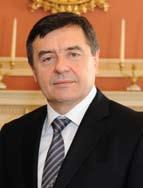
ministry until 1996 when he went to work as a commercial counsellor at the embassy in Berlin . From 2001 to 2003, he was an undersecretary of state in the ministry of internal affairs and administration and for the following four years, he was ambassador to Slovakia He had an 18-month stint as minister-counsellor in Berlin before being appointed undersecretary of state for armaments and modernisation in the ministry of national defence .
Mr Kosiniak-Kamysz speaks German, English, Slovak and Russian .
chitranganee wagiswara high commissioner for sri lanka
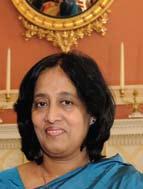
Ms . Wagiswara joined the foreign service in 1981 after having completed a bachelor of commerce at the University of Sri Jayawardenepura and a diploma in international relations at the Graduate Institute for International Studies in Geneva
Her first posting was to Italy as third, then second, secretary in 1984 She returned to headquarters before coming to Canada as first secretary in 1991 . Her next posting came in 1996 as deputy high commissioner in London, after which she became high commissioner in Singapore for three years In 2005, she took a threeyear posting in Paris before returning to headquarters as senior director general in political affairs She was appointed to Canada in December . Ms . Wagiswara is married .



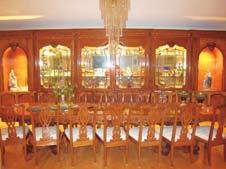
Afghanistan
ershad ahmadi
Minister-counsellor
and Deputy Head of Mission
Algeria
nakhla kechacha
Counsellor
bangladesh
Rahat Bin Zaman
Second Secretary
barbados
kereeta nicole
Whyte
First Secretary
Chile
Beatriz de la Fuente Fuentes
Second Secretary and Consul
Mauricio velasquez
Reyes
Defence, Military, Naval and Air Attaché
China
pengzhou song
Attaché and Viceconsul
Qingguo li
First Secretary
Bin Feng
Third Secretary
xiuhua chen
First Secretary
Dominican republic
Felix antonio gil
Blanco
Minister-counsellor
ecuador
gonzalo gilberto
gonzalez Fierro
First Secretary
adriana Maribel
trujillo hidalgo Attaché
ann Marlene Martillo pacheco Counsellor
Iran
Mousalreza vahidi
First Secretary hassan doutaghi
Second Counsellor
shahbaz solbi
Third Counsellor
Lithuania
vilija jatkoniene Counsellor
Mindaugas abaliksta
Assistant Defence, Military, Naval and Air Attaché
Mexico
edith jareth duarte
pedrote
Second Secretary
Netherlands
Martinus wilhelmus
Maria olde
Monnikhof Counsellor
russia sergey
Romanchenko
Attaché
South Africa Mogoruti joseph
ledwaba
Defence Attaché
Sri Lanka sumith priyantha dassanayake M.
Minister-counsellor
Sudan
john simon yor kor
Deputy Head of Mission
Thailand Ruamporn
Ridthiprasart
Second Secretary
Togo paneybesse alli
First Secretary
United States of America
leroy chester
Frazier
Assistant Attaché leslie williams
doumbia
Second Secretary and Vice-consul
daniel Ross harris
Second Secretary and Vice-consul

Mary Burke-Cameron Account Manager Embassy/ Not-For-Profit Markets 613-564-2951 mary.burke-cameron@rbc.com

Agnes Demers Account Manager Embassy/ Not-For-Profit Markets 613-564-2777 agnes.demers@rbc.com

Myriam Sepulveda Diplomat Account Manager 613-564-2784 myriam.sepulveda@rbc.com

AFGHANISTAN
His Ex Jawed Ludin
Embassy of the Islamic Republic of Afghanistan
240 Argyle Street
Ottawa, Ontario K2P 1B9
TEL 563-4223 FAX 563-4962 contact@afghanemb-canada net www afghanemb-canada net
ALBANIA
His Ex Besnik Konci
Embassy of the Republic of Albania
130 Albert Street, Suite 302 Ottawa, Ontario K1P 5G4
TEL 236-4114 FAX 236-0804 embassyofalbania@on aibn com
ALGErIA
His Ex Smail Benamara Embassy of the People’s Democratic Republic of Algeria 500 Wilbrod Street Ottawa, Ontario K1N 6N2
TEL 789-8505 FAX 789-1406 www embassyalgeria ca/eng htm
ANGOLA
Embassy of the Republic of Angola 189 Laurier Avenue East Ottawa, Ontario K1N 6P1
TEL 234-1152 FAX 234-1179 info@embangola-can org www embangola-can org
ArGENTINA
His Ex Arturo Bothamley Embassy of the Argentine Republic 81 Metcalfe Street 7th Floor Ottawa, Ontario K1P 6K7
TEL 236-2351 FAX 235-2659 embargentina@argentina-canada net www argentina-canada net
ArMENIA
Mr Arman Akopian
Chargé d’Affaires
Embassy of the Republic of Armenia 7 Delaware Avenue Ottawa, Ontario K2P 0Z2
TEL 234-3710 FAX 234-3444 armcanadaembassy@mfa com www armembassycanada ca
AUSTrALIA
His Ex Justin Hugh Brown Australian High Commission 50 O’Connor, Suite 710 Ottawa, Ontario K1P 6L2 TEL 236-0841 FAX 236-4376 www canada embassy gov au
AUSTrIA
His Ex Werner Brandstetter Embassy of the Republic of Austria
445 Wilbrod Street
Ottawa, Ontario K1N 6M7
TEL 789-1444 FAX 789-3431 www austro org
AZErBAIJAN
His Ex Farid Shafiyev Embassy of the Republic of Azerbaijan
275 Slater Street, Suite 904-C
Ottawa, Ontario K1P 5H9
TEL 288-0497 FAX 230-8089
BAHAMAS
His Ex Michael D Smith
Bahamas High Commission
50 O’Connor Street, Suite 1313
Ottawa, Ontario K1P 6L2
TEL 232-1724 FAX 232-0097
ottawa-mission@bahighco com http://bahamas com
BANGLADESH
His Ex A M Yakub Ali
High Commission for the People’s Republic of Bangladesh
340 Albert St , Suite 1250
Ottawa, Ontario, K1R 7Y6
TEL 236-0138 FAX 567-3213
bangla@rogers com www bdhc org
BArBADOS
His Ex Edward Evelyn Greaves High Commission for Barbados
55 Metcalfe St , Suite 470
Ottawa, Ontario, K1P 6L5
TEL 236-9517 FAX 230-4362
ottawa@foreign gov bb
BELArUS
Mr Pavel Pustovoy Chargé d’Affaires
Embassy of the Republic of Belarus
130 Albert Street, Suite 600
Ottawa, Ontario K1P 5G4
TEL 233-9994 FAX 233-8500
belamb@igs net
BELGIUM
Embassy of Belgium
360 Albert Street, Suite 820
Ottawa, Ontario K1R 7X7
TEL 236-7267 FAX 236-7882 ottawa@diplobel fed be www diplomatie be/ottawa
BENIN
His Ex Honoré Ahimakin Embassy of the Republic of Benin 58 Glebe Avenue
Ottawa, Ontario K1S 2C3
TEL 233-4429 FAX 233-8952 ambaben@benin ca
BOLIVIA
His Ex Edgar Torrez Mosqueira Embassy of the Republic of Bolivia
130 Albert Street, Suite 416
Ottawa, Ontario K1P 5G4
TEL 236-5730 FAX 236-8237 info@emboliviacanada com www emboliviacanada com
BOSNIA-HErZEGOVINA
Her Ex Biljana Gutic-Bjelica
Embassy of Bosnia and Herzegovina 130 Albert Street, Suite 805 Ottawa, Ontario K1P 5G4 TEL 236-0028 FAX 236-1139 embassyofbih@bellnet ca www bhembassy ca
BrAZIL
His Ex Paulo Cordeiro Pinto Embassy of the Federative Republic of Brazil 450 Wilbrod Street Ottawa, Ontario K1N 6M8 TEL 237-1090 FAX 237-6144 mailbox@brasembottawa org
BrUNEI DArUSSALAM
Her Ex Rakiah Haji Abdul Lamit High Commission for Brunei Darussalam 395 Laurier Avenue East Ottawa, Ontario K1N 6R4 TEL 234-5656 FAX 234-4397 bhco@bellnet ca
BULGArIA
His Ex Evgueni Stoytchev Embassy of the Republic of Bulgaria 325 Stewart Street
Ottawa, Ontario K1N 6K5 TEL 789-3215 FAX 789-3524 embgottawa@hotmail com
BUrKINA FASO
Her Ex Juliette Bonkoungou Embassy of Burkina Faso 48 Range Road Ottawa, Ontario K1N 8J4 TEL 238-4796 FAX 238-3812 burkina faso@sympatico ca www ambaburkina-canada org
BUrUNDI
Embassy of the Republic of Burundi
325 Dalhousie Street, Suite 815
Ottawa, Ontario K1N 7G2
TEL 789-0414 FAX 789-9537 ambabottawa@yahoo com http://ambabucanada le-site info
CAMErOON
His Ex Solomon Azoh-Mbi Anu’aGheyle
High Commission for the Republic of Cameroon 170 Clemow Avenue
Ottawa, Ontario K1S 2B4 TEL 236-1522 FAX 236-3885 cameroon@rogers com www hc-cameroon-ottawa org
CHILE
His Ex Eugenio Ortega Riquelme Embassy of the Republic of Chile
50 O’Connor Street, Suite 1413 Ottawa, Ontario K1P 6L2 TEL 235-9940 FAX 235-1176 echileca@chile ca www chile ca
CHINA
His Ex Lijun Lan
Embassy of the People’s Republic of China
515 St Patrick Street
Ottawa, Ontario K1N 5H3
TEL 789-3434 FAX 789-1911
www chinaembassycanada org
COLOMBIA
His Ex Jaime Giron-Duarte Embassy of the Republic of Colombia
360 Albert Street, Suite 1002
Ottawa, Ontario K1R 7X7
TEL 230-3760 FAX 230-4416 embajada@embajadacolombia ca www embajadacolombia ca
CONGO (ZAIrE)
Ms Louise Nzanga Ramazani Chargé d’Affaires
Embassy of the Democratic Republic of the Congo 18 Range Road Ottawa, Ontario K1N 8J3
TEL 230-6391 FAX 230-1945
COSTA rICA
Her Ex Emilia Maria Alvarez Navarro
Embassy of the Republic of Costa Rica 325 Dalhousie Street, Suite 407 Ottawa, Ontario K1N 7G2
TEL 562-2855 FAX 562-2582 embcrica@travel-net com www costaricaembassy com

CÔTE D’IVOIrE
His Ex Louis Leon Boguy Bony Embassy of the Republic of Côte d’Ivoire
9 Marlborough Avenue
Ottawa, Ontario K1N 8E6
TEL . 236-9919 FAX 563-8287 acica@ambaci-ottawa org www ambaci-ottawa org
CrOATIA
Her Ex Vesela Mrden Kora´c
Embassy of the Republic of Croatia 229 Chapel Street
Ottawa, Ontario K1N 7Y6
TEL 562-7820 FAX 562-7821 Croatia emb@mvpei hr www croatiaemb net
CUBA
Her Ex Teresita de Jesús Vicente Sotolongo
Embassy of the Republic of Cuba 388 Main Street
Ottawa, Ontario K1S 1E3 TEL 563-0141 FAX 563-0068 cuba@embacuba ca www embacuba ca
CZECH rEPUBLIC
His Ex. Karel Žebrakovský Embassy of the Czech Republic 251 Cooper Street
Ottawa, Ontario K2P 0G2 TEL 562-3875 FAX 562-3878 ottawa@embassy mzv cz
DENMArK
His Ex Erik Vilstrup Lorenzen
Royal Danish Embassy 47 Clarence Street, Suite 450 Ottawa, Ontario K1N 9K1
TEL 562-1811 FAX 562-1812 ottamb@um dk www ambottawa um dk
DOMINICAN rEPUBLIC
His Ex Jose Del Carmen Urena
Embassy of the Dominican Republic 130 Albert Street, Suite 418 Ottawa, Ontario K1P 5G4 TEL 569-9893 FAX 569-8673 www drembassy org
ECUADOr
His Excellency Franklin Chávez Embassy of the Republic of Ecuador 50 O’Connor Street, Suite 316 Ottawa, Ontario K1P 6L2 TEL 563-4286 FAX 235-5776
EGYPT
His Ex Shamel Elsayed Nasser Embassy of the Arab Republic of Egypt 454 Laurier Avenue East Ottawa, Ontario K1N 6R3 TEL 234-4931 FAX 234-4398 egyptemb@sympatico ca www mfa .gov eg
EL SALVADOr
His Ex Rafael Alfaro Embassy of the Republic of El Salvador 209 Kent Street Ottawa, Ontario K2P 1Z8 TEL 238-2939 FAX 238-6940 embajada@elsalvador-ca org
ErITrEA
Embassy of the State of Eritrea
75 Albert Street, Suite 610 Ottawa, Ontario K1P 5E7
TEL 234-3989 FAX 234-6213
ESTONIA
Rasmus Lumi
Chargé d’Affaires
Embassy of the Republic of Estonia
260 Dalhousie Street, Suite 210
Ottawa, Ontario K1N 7E4
TEL 789-4222 FAX 789-9555
embassy ottawa@mfa ee www estemb ca
ETHIOPIA
Ms Almaz Amaha Tesfay
Chargée d’Affaires
Embassy of the Federal Democratic Republic of Ethiopia
151 Slater Street, Suite 210
Ottawa, Ontario K1P 5H3
TEL 235-6637 FAX 235-4638 info@embassyofethiopia net www embassyofethiopia net
EUrOPEAN UNION
His Excellency Matthias Brinkmann
Delegation of the European Commission to Canada
150 Metcalfe St Suite 1900
Ottawa, ON K2P1P1
TEL 238-6464 FAX 238-5191
delegation-canada@ec europa eu www delcan ec europa eu
FINLAND
His Ex Risto Ensio Piipponen
Embassy of the Republic of Finland
55 Metcalfe Street, Suite 850
Ottawa, Ontario K1P 6L5
TEL 288-2233 FAX 288-2244
embassy@finland ca
FrANCE
His Ex Francois Delattre
Embassy of France
42 Sussex Drive
Ottawa, Ontario K1M 2C9
TEL 789-1795 FAX 562-3735
www ambafrance-ca org
GABON
His Ex André William Anguilé
Embassy of the Gabonese Republic
4 Range Road, P O Box 368
Ottawa, Ontario K1N 8J5
TEL 232-5301 FAX 232-6916 ambgabon@sprint ca
GErMANY
His Ex Georg Witschel Embassy of the Federal Republic of Germany
1 Waverley Street
Ottawa, Ontario K2P 0T8
TEL 232-1101 FAX 594-9330
info@otta diplo de http:/www ottawa diplo de
GHANA
His Excellency Richard Benjamin Turkson
High Commission for the Republic of Ghana
153 Gilmour Street
Ottawa, Ontario K2P 0N8
TEL 236-0871 FAX 236-0874 ghanacom@ghc-ca com www ghc-ca com
GrEECE
His . Ex . Nikolaos Matsis
Embassy of the Hellenic Republic
80 MacLaren Street, Suite 76
Ottawa, Ontario K2P 0K6
TEL 238-6271 FAX 238-5676
embassy@greekembassy ca www greekembassy ca
GUATEMALA
His Excellency Georges de La Roche Embassy of the Republic of Guatemala
130 Albert Street, Suite 1010
Ottawa, Ontario K1P 5G4
TEL 233-7237 FAX 233-0135
embassy1@embaguate-canada com www embaguate-canada com
GUINEA
Mrs Hawa Diakité Counsellor & Chargé d’Affaires Embassy of the Republic of Guinea 483 Wilbrod Street Ottawa, Ontario K1N 6N1 TEL 789-8444 FAX 789-7560 ambassadedeguinee@bellnet ca
GUYANA
His Ex Rajnarine Singh High Commission for the Republic of Guyana
151 Slater Street, Suite 309 Ottawa, Ontario K1P 5H3 TEL 235-7249 FAX 235-1447
HAITI
Ms Marie Nathalie Menos-Gissel Chargé d’Affaires
Embassy of the Republic of Haiti
130 Albert Street, Suite 1500 Ottawa, Ontario K1P 5G4
TEL 238-1628 FAX 238-2986 bohio@sympatico ca
HOLY SEE
His Ex Pedro Lopez Quintana Apostolic Nunciature 724 Manor Avenue
Ottawa, Ontario K1M 0E3
TEL 746-4914 FAX 746-4786
HONDUrAS Chargé d’Affaires
Embassy of the Republic of Honduras
151 Slater Street, Suite 805 Ottawa, Ontario K1P 5H3 TEL 233-8900 FAX 232-0193
HUNGArY
His Ex Pál Vastagh Embassy of the Republic of Hungary
299 Waverley Street Ottawa, Ontario K2P 0V9 TEL 230-2717 FAX 230-7560 www mfa gov hu/emb/ottawa mission ott@kum hu
ICELAND
Her Excellency Sigridur Anna Thordardottir
Embassy of Iceland
360 Albert Street, Suite 710 Ottawa, Ontario K1R 7X7 TEL 482-1944 FAX 482-1945 icemb ottawa@utn stjr is WEB: www iceland org ca
INDIA
His Ex Shashishekhar M Gavai High Commission for the Republic of India
10 Springfield Road
Ottawa, Ontario K1M 1C9
TEL 744-3751 FAX 744-0913
hicomind@hciottawa ca www hciottawa ca
INDONESIA
Embassy of the Republic of Indonesia
55 Parkdale Avenue
Ottawa, Ontario K1Y 1E5
TEL 724-1100 FAX 724-1105
info@indonesia-ottawa org www indonesia-ottawa org
IrAN
Mr Bahram Ghasemi
Chargé d’Affaires
Embassy of the Islamic Republic of Iran
245 Metcalfe Street
Ottawa, Ontario K2P 2K2
TEL 235-4726 FAX 232-5712 iranemb@salamiran org www salamiran org
IrAQ
His Ex Howar M . Ziad
Embassy of the Republic of Iraq 215 McLeod Street Ottawa, Ontario K2P 0Z8 TEL 236-9177 FAX 236-9641 media@iraqembassy ca www iraqembassy ca
IrELAND
His Ex Declan Kelly Embassy of Ireland
130 Albert Street, Suite 1105 Ottawa, Ontario K1P 5G4
TEL 233-6281 FAX 233-5835 Ottawaembassy@dfa ie www embassyofireland ca
ISrAEL
Her Ex Miriam Ziv
Embassy of Israel
50 O’Connor Street, Suite 1005 Ottawa, Ontario K1P 6L2
TEL 567-6450 FAX 567-9878 info@ottawa mfa gov il www embassyofIsreal ca
ITALY
His Ex Andrea Meloni Embassy of the Italian Republic 275 Slater Street, 21st Floor Ottawa, Ontario K1P 5H9 TEL . 232-2401 FAX 233-1484 ambital@italyincanada com www italyincanada com
JAMAICA
Her Ex Sheila Ivoline SealyMonteith 151 Slater Street, Suite 1000 Ottawa, Ontario, K1P 5H3
TEL 233-9311 FAX 233-0611 hc@jhcottawa ca
JAPAN
His Ex Tsuneo Nishida Embassy of Japan 255 Sussex Drive Ottawa, Ontario K1N 9E6
TEL 241-8541 FAX 241-2232 infocul@embjapan ca www ca emb-japan go jp
JOrDAN
His Ex Nabil Ali Barto Embassy of the Hashemite Kingdom of Jordan
100 Bronson Avenue, Suite 701 Ottawa, Ontario K1R 6G8
TEL 238-8090 FAX 232-3341
KAZAKHSTAN
His Ex Yerlan Abildayev Embassy of the Republic of Kazakhstan
56 Hawthorne Avenue Ottawa, ON K1S 0B1 TEL 788-3704 FAX 788-3702
KENYA
His Ex Simon Wanyonyi Nabukwesi High Commission for the Republic of Kenya
415 Laurier Avenue East Ottawa, Ontario K1N 6R4
TEL 563-1773 FAX 233-6599 kenyahighcommission@rogers com www kenyahighcommission ca
KOrEA, rEPUBLIC
His Excellency Chan-ho Ha Embassy of the Republic of Korea
150 Boteler Street
Ottawa, Ontario K1N 5A6
TEL 244-5010 FAX 244-5034 www emb-korea ottawa on ca
KUWAIT
His Ex Musaed Rashed Al-Haroun Embassy of the State of Kuwait 333 Sussex Drive Ottawa, Ontario, K1N 1J9
TEL 780-9999 FAX 780-9905
LATVIA
His Ex Mar ` gers Krams Embassy of the Republic of Latvia
350 Sparks Street, Suite 1200 Ottawa, Ontario, K1R 7S8
TEL 238-6014 FAX 238-7044
embassy canada@mfa gov lv www ottawa mfa gov lv
LEBANON
Embassy of Lebanon
640 Lyon Street Ottawa, Ontario K1S 3Z5
TEL 236-5825 FAX 232-1609 info@lebanonembassy ca www lebanonembassy ca
LESOTHO
High Commission for the Kingdom of Lesotho
130 Albert Street, Suite 1820
Ottawa, ON K1P 5G4
TEL: 234-0770 FAX: 234-5665
LIBYA
Embassy of the Great Socialist People’s Libyan Arab Jamahiriya
81 Metcalfe Street, Suite 1000
Ottawa, Ontario K1P 6K7
TEL 230-0919 FAX 230-0683 info@libya-canada org
LITHUANIA
Her Ex Ginte Damusis
Embassy of the Republic of Lithuania
150 Metcalfe Street, Suite 1600
Ottawa, ON K2P 1P1
TEL 567-5458 FAX 567-5315
MACEDONIA (rEPUBLIC OF)
His Ex Ljuben Tevdovski
Embassy of the Republic of Macedonia
130 Albert Street, Suite 1006
Ottawa, Ontario K1P 5G4
TEL 234-3882 FAX 233-1852
MADAGASCAr
His Ex Simon Constant Horace Embassy of the Republic of Madagascar
3 Raymond Street
Ottawa, Ontario K1R 1A3
TEL: 567-0505 FAX 567-2882
ambamadcanada@bellnet ca www madagascar-embassy ca
MALAYSIA
His Ex Selwyn Vijayarajan Das High Commission for Malaysia
60 Boteler Street
Ottawa, Ontario K1N 8Y7
TEL 241-5182 FAX 241-5214 malottawa@kln gov my
MALI
His Ex Mamadou Bandiougou Diawara
Embassy of the Republic of Mali
50 Goulburn Avenue
Ottawa, Ontario K1N 8C8
TEL 232-1501 FAX 232-7429 ambassadedumali@rogers com www ambamalicanada org
MEXICO
His Ex Francisco Javier Barrio Terrazas
Embassy of the United Mexican States
45 O’Connor Street, Suite 1000
Ottawa, Ontario K1P 1A4
TEL 233-8988 FAX 235-9123 info@embamexcan com www embamexcan com
MONGOLIA
His Ex Tundevdorj Zalaa-Uul
Embassy of Mongolia
151 Slater Street, Suite 503
Ottawa, Ontario K1P 5H3
TEL 569-3830 FAX 569-3916 mail@mongolembassy org
MOrOCCO
Her Ex Nouzha Chekrouni Embassy of the Kingdom of Morocco
38 Range Road
Ottawa, Ontario K1N 8J4 TEL 236-7391 FAX 236-6164
MYANMAr
Aung Ba Kyu Charge d'Affaires
Embassy of the Union of Myanmar 85 Range Road, Suite 902
Ottawa, Ontario K1N 8J6
TEL 232-9990 FAX 232-6999 meottawa@rogers com
NETHErLANDS
His Ex Wilhelmus J P Geerts Embassy of the Kingdom of the Netherlands
350 Albert Street, Suite 2020
Ottawa, Ontario K1R 1A4
TEL 237-5030 FAX 237-6471 Ott-cdp@minbuza nl
NEW ZEALAND
His Ex Andrew Needs
New Zealand High Commission 99 Bank Street, Suite 727
Ottawa, Ontario K1P 6G3
TEL 238-5991 FAX 238-5707 info@nzhcottawa org www nzembassy com/canada
NEPAL
His Ex Bhoj Raj Ghimire Chargé d'Affaires Embassy of Nepal
408 Queen Street Ottawa, ON K1R 5A7
TEL 680-5513 FAX 422-5149
NIGEr
Her Ex Nana Aicha Foumakoye Embassy of the Republic of the Niger
38 Blackburn Avenue
Ottawa, Ontario K1N 8A3 TEL 232-4291 FAX 230-9808
NIGErIA
Ex Iyorwuese Hagher
High Commission for the Federal Republic of Nigeria
295 Metcalfe Street
Ottawa, Ontario K2P 1R9 Tel 236-0521 Fax 236-0529
NOrWAY
Her Ex Else Berit Eikeland
Royal Norwegian Embassy 150 Metcalfe Street, Suite 1300 Ottawa, ON K2P 1P1
TEL 238-6571 FAX 238-2765 emb ottawa@mfa no www emb-norway ca
O/OF EASTErN CArIBBEAN
STATES
His Ex Brendon Browne High Commission for the Countries of the Organization of Eastern Caribbean States
130 Albert Street, Suite 700 Ottawa, Ontario K1P 5G4
TEL 236-8952 FAX 236-3042 echcc@oecs org www oecs org/ottawa
PAKISTAN
His Ex Akbar Zeb High Commission for the Islamic Republic of Pakistan 10 Range Road Ottawa, Ontario K1N 8J3 TEL 238-7881 FAX 238-7296 parepottawa@rogers com
PALESTINE
Mr Amin Abou-Hassira Head of the General Delegation 45 Country Club Dr , Ottawa, Ontario K1V 9W1
TEL: 736-0053 FAX: 736-0535 palestinegd@rogers com
PANAMA
His Ex Francisco Carlo Escobar Embassy of the Republic of Panama 130 Albert Street, Suite 300 Ottawa, Ontario K1P 5G4
TEL 236-7177 FAX 236-5775 embassyof panama@gmail com
PArAGUAY
His Ex Manuel Schaerer Kanonnikoff Embassy of the Republic of Paraguay 151 Slater Street, Suite 501 Ottawa, Ontario K1P 5H3 TEL 567-1283 FAX 567-1679 consularsection@embassyofparaguay ca
PErU
His Ex Jorge Juan Castañeda Mendez Embassy of the Republic of Peru
130 Albert Street, Suite 1901
Ottawa, Ontario K1P 5G4
TEL 238-1777 FAX 232-3062 emperuca@bellnet ca
PHILIPPINES
His Ex Jose S Brillantes Embassy of the Republic of the Philippines
130 Albert Street, Suite 606
Ottawa, Ontario K1P 5G4
TEL 233-1121 FAX 233-4165 embassyofphilippines@rogers com www philippineembassy ca
POLAND
His Ex Zenon Kosiniak-Kamysz Embassy of the Republic of Poland 443 Daly Avenue
Ottawa, Ontario K1N 6H3
TEL 789-0468 FAX 789-1218 Ottawa@polishembassy ca
POrTUGAL
His Ex Pedro Moitinho de Almeida Embassy of Portugal 645 Island Park Drive
Ottawa, Ontario K1Y 0B8
TEL 729-0883 FAX 729-4236 embportugal@embportugal/ottawa org
rOMANIA
Her Ex Elena Stefoi Embassy of Romania
655 Rideau Street
Ottawa, Ontario K1N 6A3
TEL 789-3709 FAX 789-4365 Romania@romanian-embassy com http://ottawa mae ro
rUSSIA
His Ex Georgiy Mamedov Embassy of the Russian Federation 285 Charlotte Street
Ottawa, Ontario K1N 8L5
TEL 235-4341 FAX 236-6342 rusemb@rogers com www rusembcanada mid ru
rWANDA
Her Ex Edda Mukabagwiza Embassy of the Republic of Rwanda 121 Sherwood Drive
Ottawa, Ontario K1Y 3V1
Phone: 569-5420/22/24 Fax : 569-5421/5423 generalinfo@ambarwaottawa ca www ambarwaottawa ca
SAUDI ArABIA
His Ex Osamah Bin Ahmad Al Sanosi Ahmad
Royal Embassy of Saudi Arabia
201 Sussex Drive
Ottawa, ON K1N 1K6
TEL 237-4100 FAX 237-0567
SENEGAL
His Excellency Issakha Mbacke Embassy of the Republic of Senegal 57 Marlborough Avenue
Ottawa, Ontario K1N 8E8
TEL 238-6392 FAX 238-2695 ambassn@sympatico ca
SErBIA
Embassy of the Republic of Serbia 17 Blackburn Avenue Ottawa, Ontario K1N 8A2
TEL 233-6289 FAX 233-7850 generalinfo@serbianembassy ca www serbianembassy ca
SLOVAK rEPUBLIC
His Ex Stanislav Opiela Embassy of the Slovak Republic 50 Rideau Terrace
Ottawa, Ontario K1M 2A1 TEL 749-4442 FAX 749-4989 ottawa@slovakembassy ca www ottawa mfa sk
SLOVENIA
Ex Tomaz Kunstelj Embassy of the Republic of Slovenia 150 Metcalfe Street, Suite 2200 Ottawa, Ontario K1P 1P1 TEL 565-5781 FAX 565-5783 vot@gov si http://ottawa veleposlanistvo si/
SOUTH AFrICA
His Ex Abraham Sokhaya Nkomo High Commission for the Republic of South Africa 15 Sussex Drive Ottawa, Ontario K1M 1M8 TEL 744-0330 FAX 741-1639 rsafrica@southafrica-canada ca www southafrica-canada ca
SPAIN
His Ex Eudaldo Mirapeix Embassy of the Kingdom of Spain 74 Stanley Avenue
Ottawa, Ontario K1M 1P4
TEL 747-2252 FAX 744-1224 embespca@mail mae es www embaspain ca
SrI LANKA
Her Ex Chitranganee Wagiswara High Commission for the Democratic Socialist Republic of Sri Lanka
333 Laurier Avenue West, Suite 1204 Ottawa, Ontario K1P 1C1
TEL 233-8449 FAX 238-8448 slhcit@rogers com www srilankahcottawa org
SUDAN
Embassy of the Republic of the Sudan 354 Stewart Street
Ottawa, Ontario K1N 6K8
TEL 235-4000 FAX 235-6880
SWEDEN
Embassy of Sweden
377 Dalhousie Street
Ottawa, Ontario K1N 9N8
TEL 244-8200 FAX 241-2277
Sweden ottawa@foreign ministry se www swedishembassy ca
SWITZErLAND
His Ex Werner Baumann
Embassy of Switzerland
5 Marlborough Avenue
Ottawa, Ontario K1N 8E6
TEL 235-1837 FAX 563-1394
ott vertretung@eda admin ch
SYrIA
His Ex Jamil Haidar Sakr
Embassy of the Syrian Arab Republic
46 Cartier Street
Ottawa, ON K2P 1J3
TEL 569-5556 FAX 569-3800 www syrianembassy ca
TAIPEI Economic & Cultural office
David Tawei Lee, Representative
45 O’Connor Street, Suite 1960
Ottawa, Ontario K1P 1A4
TEL 231-5080 FAX 231-7112 publicaffairs@on aibn com
TANZANIA
His Ex Peter Kallaghe
High Commission for the United Republic of Tanzania
50 Range Road
Ottawa, Ontario K1N 8J4
TEL 232-1509 FAX 232-5184 tzottawa@synapse ca www tanzaniahighcommission ca
THAILAND
His Ex Adisak Panupong
The Royal Thai Embassy
180 Island Park Drive
Ottawa, Ontario K1Y 0A2
TEL 722-4444 FAX 722-6624 thaiott@magma ca
TOGO
His Ex Bawoumondom Amelete
Embassy of the Togolese Republic 12 Range Road
Ottawa, Ontario K1N 8J3
TEL 238-5916 FAX 235-6425
TrINIDAD AND TOBAGO
Her Ex Camille Rosemarie Robinson-Regis High Commission for the Republic of Trinidad and Tobago 200 First Avenue, Third Level
Ottawa, Ontario K1S 2G6
TEL 232-2418 FAX 232-4349 ottawa@ttmissions com TUNISIA
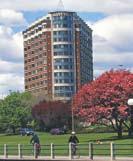
His Ex Mouldi Sakri Embassy of the Republic of Tunisia 515 O’Connor Street
Ottawa, Ontario K1S 3P8
TEL 237-0330 FAX 237-7939 atottawa@comnet ca
TUrKEY
His Ex Rafet Akgünay Embassy of the Republic of Turkey 197 Wurtemburg Street
Ottawa, Ontario K1N 8L9v TEL 789-4044 FAX 789-3442 turkishottawa@mfa gov tr www turkishembassy com
UGANDA
His Ex George Marino Abola High Commission for the Republic of Uganda 231 Cobourg Street
Ottawa, Ontario K1N 8J2 TEL 789-7797 FAX 789-8909 uhc@ugandahighcommission com www ugandahighcommission ca
UKrAINE
His Ex Ihor Ostash Embassy of Ukraine 310 Somerset Street, West, Ottawa, Ontario, K2P 0J9 Tel 230-2961 Fax 230-2400 emb_ca@ukremb ca www ukremb ca
UNITED ArAB EMIrATES
His Ex Mohamed Abdulla M Bin Mutleq Al Ghafli 125 Boteler Street
Ottawa, Ontario K1N 0A4 TEL 565-7272 FAX 565-8007 Consulate FAX: 565-1444 safara@uae-embassy com www uae-embassy com
UNITED KINGDOM
His Ex Anthony Cary British High Commission 80 Elgin Street Ottawa, Ontario K1P 5K7 TEL 237-1530 FAX 237-7980 www britainincanada org
UNITED STATES OF AMErICA
His Ex David Cary Jacobson Embassy of the United States of America 490 Sussex Drive Ottawa, Ontario K1N 1G8 TEL 238-5335 FAX 688-3088 www usembassycanada gov
UrUGUAY
His Ex Enrique Juan Delgado Embassy of the Oriental Republic of Uruguay
130 Albert Street, Suite 1905
Ottawa, Ontario K1P 5G4
TEL 234-2727 FAX 233-4670
VENEZUELA
Mr Juan Carlos Coronado Bogarín Chargé d’Affaires
Embassy of the Bolivarian Republic of Venezuela
32 Range Road
Ottawa, Ontario K1N 8J4
TEL 235-5151 FAX 235-3205
www misionvenezuela org
VIETNAM
His Excellency Duc Hung Nguyen
Embassy of the Socialist Republic of Vietnam
470 Wilbrod Street
Ottawa, Ontario K1N 6M8
TEL 236-0772 FAX 236-2704
YEMEN
His Ex Khaled Mahfoodh Bahah Embassy of the Republic of Yemen
54 Chamberlain Avenue
Ottawa, Ontario K1S 1V9
TEL 729-6627 FAX 729-8915
www yemenembassy ca
ZAMBIA
His Ex Nevers Mumba
High Commission for the Republic of Zambia
151 Slater St , Suite 205
Ottawa, Ontario K1B 5H3
TEL 232-4400 FAX 232-4410
ZIMBABWE
Her Ex Florence Zano Chideya Embassy of the Republic of Zimbabwe
332 Somerset Street West
Ottawa, Ontario K2P 0J9
TEL 421-2824 FAX 422-7403
info@zimottawa com visa@zimottawa com
www zimottawa com








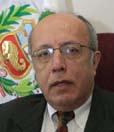
By AMBAssADOR JORGE CAsTEñEVDA
Around the world, when most people hear of Peru, they immediately think of the Incas and Machu Picchu. Very few know that my country not only has great cultural and archaeological treasures, vast natural resources and some of the world’s most fascinating fauna and flora but also a rich diversity of dishes and ingredients that makes up Peruvian Cuisine, simple or complex, depending on the region.
Peruvian cuisine can be summarized as a fusion of flavors lasting hundreds of years from traditional PreInca time to Incas-Quechua, spanish, African, Western European, Chinese and Japanese cuisines. Eating in Peru is one of the world’s exceptional gastronomic experiences. There are literally thousands of recipes for traditional or nouvelle Peruvian cuisine. The countless wonderful restaurants around the country offer a great variety of dishes of outstanding quality and flavor, making Peru the gastronomic capital of the continent. This appraisal is quickly spreading to the rest of the world, where many people now recognize the excellent quality of our cuisine. Argentina, Canada, Chile, Colombia, Mexico, spain and the united states, among other countries, now have access to Peruvian cuisine. The number of Peruvian restaurant franchises abroad is increasing every year. Our cooking has become not only a synonym for good taste, but also a means of opening new markets all over the world. Peruvian cuisine is already considered one of the most diverse in the world and competes
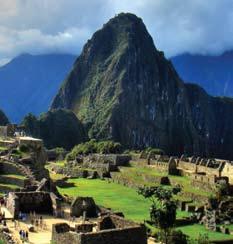
with the most popular cuisines on the planet, such as the french, Chinese and Italian. Consequently, Peru is now seen as an important gastronomic destination.
Gastronomy in Peru is boosting the country’s growth on two fronts. On the one hand, more foreigners come to Peru attracted by our cuisine, and on the other, the demand for Peruvian products required to prepare Peruvian dishes abroad has produced an important increase in our exports. Our goal is that one day, in a not distant future, at least one quality Peruvian restaurant will be found in each important city around the world.
Let me briefly introduce you to the Peruvian cuisine and its beverages from the point of view of Peru’s three geographical regions: the coast, the Andes and the Amazon. It is important to highlight that Peru holds not just a variety of ethnic mixtures but also 78 types of climate with 108 individual microclimates among them. The mixing of cultures and climates differ from city to city, so geography, climate, culture and ethnic mix determine the nature of the local cuisine.
Peruvian Cuisine is characterized by the variety of its ingredients, some of them found only in our country, and unknown beyond it. Other ingredients, though well known around the world, are used in unexpected ways, such as yellow
potatoes, which, when mashed, are often served cold with seafood, as appetizers.
Quinua is a very hardy, extremely nutritious small grain, which looks a little like millet. When cooked, the grains swell and become translucent. It has a slightly nutty flavor and is very versatile. It is good by itself with some butter or oil and seasoning, or as risotto. It is also used to add flavor and texture to soups, stews and desserts. first, before cooking, quinua needs to be looked over to discard any black grains, and then rinsed thoroughly in clean running water to get rid
“Eating in Peru, ladies and gentlemen, is a journey in itself. starting from the bountiful Peruvian sea, where our cebiches swim out, passing through the Andes with the hundreds of varieties of potatoes, and moving on to the Amazon, loaded with the exotic, for a natural and mysterious cuisine, we have just one great route that makes Peru a unique territory; it is the road that outlines our flavors.
“It happens, then, that Peru was gifted with lands and seas of divine abundance and we, the Peruvians, for centuries now, have given thanks for this gift by cooking and eating, creating just as the gods do.
“This is Peru, and it is the flavors themselves that invite you to get to know it.”
source: Peru Mucho Gusto
of any of the natural, bitter, detergentlike saponins.
Choclo is a variety of fresh corn with large white kernels. for centuries, it has been one of the staples of the Peruvian diet. The raw kernels are ground to produce the corn masa for making tamales and humitas Choclo is served as a side dish

for meat and fish and is also used in the preparation of stews, soups and pureés. It is the traditional accompaniment to ceviche (cold fish salad) as it complements the lime juice and ají (chili) perfectly.

Potatoes are grown in a staggering variety. The International Potato Center in Lima lists over 2,000 known species. Many species were also cultivated thousands of years ago in the Andes and have been lost to us. Peruvian potatoes come in a fascinating array of colors and shapes; from white and bright yellow through to purple and black. Others are variegated. Potatoes were a staple of ancient Peruvian cultures as they continue to be today. The papa amarilla is a very dry floury-textured potato, perfect for making pureés and the Peruvian potato dish causa (a cold layered potato dish).

Maiz morado (purple corn), is found only in Peru. It is dark purple and cannot be eaten raw or cooked. It is only used for making the fruity drink chicha morada and the dessert mazamorra morada. The corn is boiled with fruit and spices to extract the deep purple juice used in these preparations.

Lúcuma, is a dark green, thin-skinned fruit with yellowish orange flesh and one or more large dark brown shiny stones. The skin of the lúcuma will begin to wrinkle when it is ripe. The sweet aromatic flesh has a cake-like texture. It is used to flavor desserts and pies, and to make ice cream.
The local native cuisine of the coast can be said to have four strong influences: spanish-Moorish, European (Mediterranean), Asian (Japanese and Chinese) and African. It may be divided in two sub-regions: Lima and Central Coast, and Northern Coast.
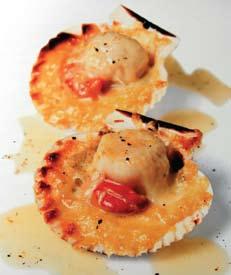
“Lima is known as the gastronomic capital of South America for a culinary legacy that inherited superb pre-Hispanic and colonial cooking traditions and was nurtured by the best Western and Oriental cooking.”
Source: Peru Mucho Gusto Throughout the centuries, this cuisine has incorporated unique dishes brought from the spanish Conquistadors and the many waves of immigrants: African, European, Chinese and Japanese. This, in addition to a strong internal flow from rural areas to coastal cities -- in particular to Lima -- has strongly influenced Lima’s cuisine with the incorporation of the immigrants’ ingredients and techniques. Creole and Chinese cuisine (known locally as Chifas) are the most widespread. Among them we can mention the highly-recommended causa, a cold chicken or shellfish potato pie with tomatoes and avocado; tamal, a hot dry corn mash filled with hot peppers and chicken or pork and wrapped in banana tree leaves for slow cooking; a chicken and cheese stew known as ají de gallina; escabeche or tangy marinated fried fish or chicken served a spice and herb sauce.
One of the most popular dishes in Peru is ceviche (or cebiche), the flagship dish of coastal cuisine. It is the quintessence of fusion: Andean chili peppers, onions and acidic aromatic lime. A spicy dish, it consists generally of bite-size pieces of white fish (such as corvina or white sea bass), marinated raw in lime or
lemon juice mixed with chilis. Ceviche is served with raw onions, boiled sweet potatoes (camote), toasted corn (cancha), and sometimes a local green seaweed (yuyo).
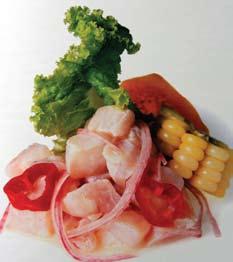
INGREDIENTs
2 lb. white fish
1 cup of lime juice
1 clove of crushed garlic
2 red peppers, diced
2 finely diced jalapeno peppers (to your preference)
salt and pepper to taste
1 large onion, finely chopped
Bunch of finely chopped cilantro
2 lettuce leaves per plate
12 to 16 corn on the cobs cut into 2-inch pieces, cooked as usual
3 or 4 sweet potatoes, boiled and peeled
6 to 8 lemons cut in half and placed in center of table
PREPARATION:
1. Wash and de-bone fish and cut in 1/2inch chunks.
2. season with lemon juice, garlic, salt and pepper. Let it marinate for ½ hour.
3. Add onion, jalapeno and red pepper and cilantro. Marinate for 1 more hour.
4. serve on a bed of lettuce and add two pieces of corn on the cob and a portion of the sweet potatoes.
It offers a difference in style from the central and southern varieties. This is not only due to the coastal native Indian influence (less Andean), the Moorish and spanish influence, the African and the
Gypsy influence (Hindustani); but also due the warmer coastal seas, hotter climate and immense geographical latitude variety. The widely different climates between Tumbes, Piura, Lambayeque and La Libertad contribute to the variety of dishes in these areas, such as chinguirito (dried and salted guitarfish); chabelo (stew prepared with shredded grilled beef and grilled banana plantains) and shámbar (a soup combining grains, pork and beef).
One of their main dishes is Seco de Cabrito
Goat stew (lamb, chicken or beef are often substituted) is made in a pot after marinating with chicha de jora (cornbased alcoholic drink) or beer and other spices including fresh coriander leaves (cilantro) and garlic. This is most popular in the northern coast especially in Piura and Lambayeque.
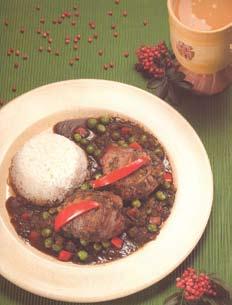
1 lb. goat chops
2 lb. goat leg
1 tbsp. ground anatto
1 bunch fresh cilantro
1/3 bunch fresh Italian parsley
1 tbsp. aji amarillo (yellow chili pepper) paste
1 tsp. aji panca (red chili pepper) paste
1 tsp. cumin
1 1/2 cup chopped onion
6 garlic cloves
1/2 cup chopped tomato
salt, pepper, oil
1 bottle pilsener type beer
1 lb. boiled yucca
Cut the goat meat in about 4-oz. pieces. for the marinade, mix 2 cloves of minced garlic, 1 tsp. anatto, 1/2 tsp. aji amarillo paste, 1tsp. aji panca paste, 1 1/2 tsp. salt, 1/2 tsp. ground pepper and 1/2 cup of beer. Mix together and add to the meat and combine very well. Let stand for 4 hours.
In a blender, mix cilantro, parsley, coarsely chopped onion, cumin, aji amarillo, appx. 1/4 cup broth or water. Blend until smooth. In a large pot, put 3 tbsp. oil and heat. When hot, add the goat meat pieces without the marinade juices, brown them evenly and set them aside. In the drippings (make sure there are no more than 2 to 3 tbsp. of them), fry the cilantro blend for about 1 minute. Add the meat, stir and cook for about 4 minutes in med-high heat. Add the juices of the marinade and 1 cup of broth (beef or chicken) or water and stir. When it comes to a boil, reduce heat to medium and simmer until meat is very tender.
Add more broth as needed. Check seasoning and then add the rest (8 oz.) of the beer. Let it come to a boil and boil for 2 more minutes. Reduce heat to low and add the yucca (or potatoes) so they absorb the flavour. serve with rice.
“Heated in an underground firewood oven, it gathers odors and flavors linked to earth. Meats, tubers, grains and herbs are used in a great variety of simple but tasty dishes.”
Source: Peru Mucho Gusto
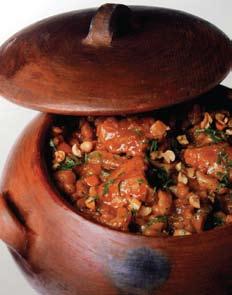
In the valleys and plains of the Andes, the locals’ diet continues to be based on corn (maíz), potatoes, and an assortment of tubers as it has been for centuries. Meat comes from indigenous animals, such as alpacas and guinea pigs, but also from such imported livestock as sheep and pigs.
Typical dishes include carapulcra, a pork and dry-potato stew, whose recipe includes chocolate, cumin, peanuts, port wine and coriander. Boiled potatoes are the base of two of the most popular Andean appetizers. Papa a la huancaína is made with a cheese, milk and hot pepper sauce. Ocopa is a sauce made with toasted peanuts, cheese, hot peppers and huacatay (a native herb). Pachamanca is made with beef, lamb, pork and guinea pig, cooked on hot stones with broad beans, potatoes and humitas (fresh corn cakes steamed in corn husks), in a hole covered with leaves and soil.
One of the best known dishes is rocoto relleno.
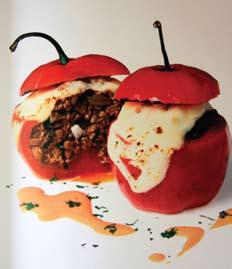
This Arequipa dish made from stuffed rocoto chilis. Rocotos are one of the very hot (spicy) chilis of Peru. They are stuffed with spiced beef or pork, onions, olives, egg white and then cooked in the oven with potatoes covered with cheese and milk. Red bell peppers work well as a substitute. you can increase the spiciness by including more hot peppers in the seasoned beef filling.
INGREDIENTs:
1/2 cup raisins
1 onion, chopped
1 clove garlic, minced
2 chili peppers (anaheim or similar)
3 tbsp. olive oil
1 tsp. cumin
1 tbsp. paprika
1 lb. ground beef
3/4 cup beef broth
1 cup queso fresco (crumbly cheese curds)
PREPARATION:
Preheat oven to 350 degrees f.
Place the raisins in a small bowl and cover with boiling water. Let them plump in the water for 10 minutes.
Remove seeds and veins from chili peppers. sauté the chopped onions, garlic, and peppers in the olive oil until soft and fragrant.
Add the cumin and paprika and cook 2 minutes more, stirring. Add the ground beef and cook until browned.
Drain the raisins and add them to the ground beef. Add the beef broth and simmer for 10 to 15 minutes more, or until most of the liquid is gone. stir in the hard-boiled egg and the black olives. season mixture with salt and pepper to taste.
Remove beef mixture from heat and let cool for 5 minutes. stir in 1/2 cup crumbled queso fresco
While the beef is cooking, bring a large pot of salted water to a rolling boil. slice the tops off of the peppers and reserve. Clean the inside of the peppers, removing the seeds and veins.
Cook the peppers in the boiling water until bright red and just tender, about 8 - 10 minutes. Drain peppers and blot dry with paper towels.
fill each pepper with some of seasoned ground beef mixture. Top with remaining queso fresco
Place the peppers on a baking sheet, with the tops alongside them (but not covering the filling). Bake for 10 to 15 minutes, or until the cheese is melted and the filling is heated through. serve warm.
New Andean Cuisine (Novo Andina)
A few years ago there was a “cultural recognition movement” from which the cuisine did not escape. It focused on a search for what our ancestors ate and how they cooked. In that effort, renowned chefs met with anthropologists and sociologists to create what is known nowadays as the novo-andina cuisine.
Peru Gourmet
This trend, which appeared in the 1980s, uses old Andean culinary tradi-
tions adapted to international cuisine preparation and presentation. Recipes are strict and food is very tasty and well-presented, with little spice and fat, and lightly cooked. Mediterranean flavors and techniques merged into local cuisines, producing wonderful paellas, exquisite Italian cuisine merged with Peruvian, spectacular french food and excellent meat restaurants which allow us to choose on the same menu between national, Argentinean or Canadian meats, but exquisitely prepared regardless of their origin.
We mention some of them: starters and soups, such as cheese and spinach rolls in a passion fruit sauce, fresh snail and quinoa salad, main courses such as grilled quinoa taboulé, pickled fish with carob syrup or desserts including quinoa imperial (with milk and passion fruit jelly), quinoa and guanábana (a flavourful fruit) mousse.
CUISINE OF THE AmAzON food in the Amazon is full of exotic delicacies, made with native ingredients. fruits and vegetables are the basis of the jungle diet. Although many animal species are hunted for food in the biologically diverse jungle, one standout is the paiche, one of the world’s largest freshwater fish.
Among the fruits of Peru’s jungle is the camu camu, which contains 40 times more Vitamin C than the kiwi fruit. Its signature dish is juanes: fowl, fish and wild meat are indispensable ingredients in preparing juanes (rice dough stuffed with chicken and wrapped in banana leaves for cooking), grilled picuro (delicious wild meat), apishado or pork cooked in a peanut and corn sauce, and patarashca fish wrapped in banana leaves and cooked over a fire.
Chifa
(Peruvian Chinese food - from the Mandarin word meaning “to eat food”)
Large Chinese migrations began to arrive from Cantonese regions more than a hundred and fifty years ago, and with them came a delicious cuisine that provided unknown vegetables and legumes to Peruvian cuisine and merged Oriental flavors with local ones. The Chinese restaurants (Chifas) give us varied and wonderful dishes that are not found anywhere else and which every visitor praises.
Peru Gourmet
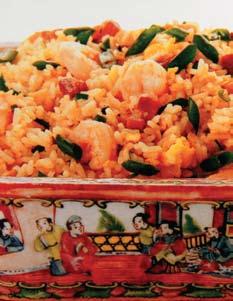
Arroz chaufa
Chifa reflects a fusion by Chinese Peruvians of the products that their ancestors brought with those that they found in Peru, and later cultivated themselves. Even some creole dishes such as tacu-tacu, lomo saltado and -- one of the main dishes - arroz chaufa, were influenced by the Chinese. In downtown Lima on Capon street is the barrio chino (Chinatown). The great variety of savory and sweet dishes, with different types of meats, vegetables and soups, created a new culinary alternative for Peruvians.
All Peruvian desserts spring from colonial times when a household was judged by the quality of the desserts served. They are not complicated but are often time-consuming and need to be prepared with love and respect for tradition. Those with a sweet tooth will not be disappointed with the desserts and sweets of Peru and here are many popular and delicious choices from which to select. Like most south Americans, Peruvians love their desserts. Here are some to try the next time you’re visiting the home of the Inca: suspiro limeño, arroz con leche; picarones and turrón de doña pepa
Made of milk, this classic criollo dessert is said to have been named by the famous Peruvian poet and author José Gálvez whose wife doña Amparo Ayarez was famous for her cooking. When asked what inspired the name, he reportedly replied ‘because it is soft and sweet like the sigh of a woman.’ In this case, it
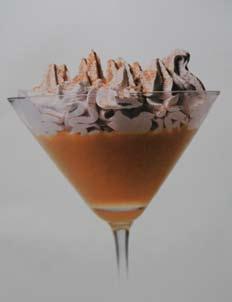
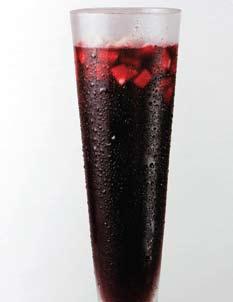
would be a woman from Lima, a Limeña.
INGREDIENTs
1 (14-oz.) can sweetened condensed milk
1 (12 fluid oz.) can evaporated milk
1 tbls. vanilla extract
2 beaten egg yolks
2 beaten egg whites
1 cup confectioners’ sugar
1/4 tsp. ground cinnamon (optional)
PREPARATION:
Whisk together the sweetened condensed milk, evaporated milk, vanilla, and egg yolks in a saucepan. Place over medium-low heat and gently cook until the mixture thickens, stirring constantly with a wooden spoon, about 30 minutes. Pour into a heatproof serving dish and set aside.
Whip the egg whites with confectioners sugar to stiff peaks. spread meringue on top of milk mixture. Refrigerate until cold, about 3 hours. sprinkle with cinnamon before serving.
Chicha Morada: is a beverage (soft drink) prepared from a base of boiled purple corn to which are added chunks of pineapple, sugar and ice as it cools.
Pisco: It is a strong alcoholic drink (40-45% alcohol), made from distilled grapes in traditional distilleries in south of Lima and Ica. The word ‘pisco’ derives from the word pisqu, meaning “little bird” in Quecha, the language of the ancient Inca. Pisco sour is our nation-
al drink. It is a cocktail made from pisco combined with lemon juice, egg white, ice and sugar. A good pisco sour is a first rate way to kick off a Peruvian meal. Drinking a “sipping” pisco is also a wonderful way to end one.
PISCO SOUR
INGREDIENTs:
7 ½ oz (or 3 parts) Peruvian Pisco
2 ½ oz (1 part) key lime juice
2 ½ oz (1 part) sugar syrup
1 egg white
Angostura bitters Ice
PREPARATION:
Pour the Pisco, key lime juice and syrup on a jar blender with enough ice to double the volume.
Blend on high. Add one egg white and blend again. serve. Pour a drop of Angostura bitters in each glass Tip: To make the sugar syrup, just put ½ cup of sugar in a pot with 3 tbs. of water, bring to a slow boil (always stir-
ring), and cook until all the sugar has dissolved. Let the syrup cool.
wines:
The wine industry is a long-established one, and some high quality vineyards and wineries do exist. The wines come from three producers, the best-known of which is probably Tacama, some of whose vineyards were established in the 16th Century and which can count the eminent Emile Peynaud of Bordeaux amongst their past consultants. Viña Ocucaje was founded in 1898, whilst Tabernero, founded 1857, also has a reputation for good quality.
sources (Texts, Photos and Recipes):
The Art of Peruvian Cuisine. Tony Custer Primicias de Cocina Peruana. Rodolfo Hinostroza
Perú Mucho Gustowww.perumuchogusto.com
Perú Gourmet - www.perugourmet.com
Sociedad Peruana de Gastronomía –www.apega.com.pe
Gastronomía Perú –www.gastronomiaperu.com
Comisión Nacional de Pisco –www.conapisco.org.pe
Peruvian Restaurants in Canada –www.theperuguide.com www.peru-travel-adventures.com http://southamericanfood.about.com
Ambassador Jorge Castañeda, former Ambassador of Peru to Canada (June 2008/March 2010) has been posted as Ambassador to Thailand and concurrent in Vietnam, Laos and the Philippines.
By Fred Donnelly
the Rosetta Stone, one of the best known of the world’s artifacts, is a black slab of thick quartz with blends of other minerals that caused it, until recently, to be mistaken for basalt Its reputation as the most famous chunk of rock in the world is based on its paramount importance in deciphering the hieroglyphic writing of ancient Egypt
The story of the stone’s discovery is a well-known tale bound up in the military confrontations of more than two centuries past In 1798, the French sent an army under Napoleon Bonaparte to conquer Egypt, a country then ruled by the Ottoman Turks This expedition had other nonmilitary objectives as Napoleon brought with him a team of more than 150 scholars, scientists and artists to document the civilization of ancient Egypt .
In 1799, a military engineer who was working on the repairs to a fort at Rosetta or al-Rashid, a small port near Cairo, found the Rosetta Stone built into a wall It had been chopped up and re-used as a building material The French immediately recognized the significance of their find . Here was a monumental inscription stone of great antiquity which, although damaged, could unlock the secrets of ancient Egypt
The stone had three texts cut into its surface and the lower one was recognizable Greek while the one on the top was Egyptian hieroglyphics, an undecipherable system of writing whose exact nature was unknown . It had little pictures instead of western-style letters, but what were the pictures? Were they representations of sounds or ideas? Perhaps the Rosetta Stone could be used to decipher Egyptian hieroglyphics Everyone had the same idea and copies of the stone’s text soon circulated widely in Europe
Then, in 1802, in an episode still unclear in the historical records, the Rosetta Stone fell into the hands of the British, who had intervened to defeat their French rivals in Egypt By 1802, the stone was placed in the British Museum in London and that city has been its permanent residence for more than two centuries with one exception In 1972, the stone was exhibited briefly in Paris . Today, it remains a centrepiece attraction of the British Museum’s collection of world heritage artifacts in
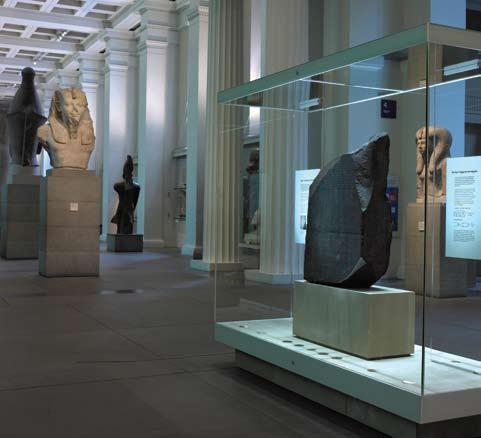
spite of occasional requests from presentday Egyptians to have it returned to its country of origin
As for the decoding of the hieroglyphics, it was a long-term international effort English scholar Thomas Young (1773-1829) made some significant breakthroughs by 1818 By then, the bottom part of the stone in Greek was well-known, the middle part written in demotic, another form of ancient Egyptian, had been worked on and the top part of hieroglyphs still eluded the scholars . Nevertheless, Young was able to work out the meanings for several words and proper names
Building on Young’s work, and using copies of the text, French linguist JeanFrancois Champollion (1790-1832) made the significant discovery that led to the decipherment of hieroglyphics By the early 1820s, he figured out that ancient Egyptian hieroglyphics were a form of mostly phonetic symbols . The little pictures usually, but not always, represented sounds in
ancient Egyptian To make matters confusing, hieroglyphics also contained symbols for concepts or ideas, called logograms by linguists In spite of this complexity Champollion was able to produce a workable alphabet for hieroglyphics enabling scholars to read many hitherto undecipherable inscriptions
It is interesting to note that Young and Champollion corresponded and cooperated in their efforts at times Then, at other times, the two were in a nationalistic rivalry in which they and their supporters presented exaggerated claims as to who did what first By 1832, both men were dead Champollion died at an early age with his work still incomplete It was left to others to finish the process of decipherment with scholars from England, Ireland and especially Germany making significant contributions .
What does the text of the Rosetta Stone state? It’s a monumental inscription of a decree of 196 B C granting privileges to
the priests of certain temples in exchange for their maintenance of a royal cult More interesting is its bilingual and diglossic nature Two of its texts are in ancient Egyptian, one, the formal and perhaps priestly hieroglyphics, and the other, in demotic or everyday Egyptian Meanwhile, the third section at the bottom is in Greek, the language of the then-ruling dynasty of Egypt, whose family members were descendants of the Macedonian-Greek general Ptolemy It’s a reminder of the cultural and linguistic complexity of a past civilization
What does the Rosetta Stone mean for us today? In the scholarly world, it’s the artifact that enabled us to unlock the hieroglyphic writing of the ancient Egyptians This allowed the recovery of at least part of a civilization that had been largely lost In popular culture the term “Rosetta Stone” has come to mean anything that provides the key to understanding a language, including a widely advertised American language training program .
And yet I see something else when I have visited the Rosetta Stone at the British Museum I see an artifact that also represents the successes, the failures and the contradictions of human endeavours

In popular culture, the term "rosetta Stone" has come to mean anything that provides the key to understanding a language.
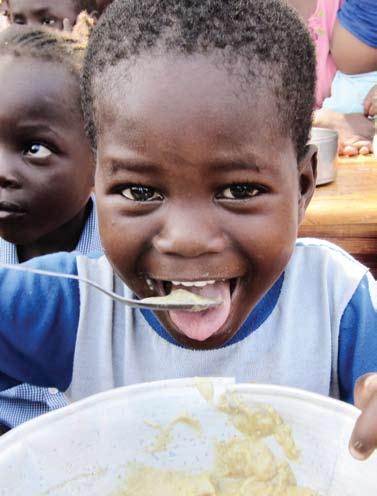
War is usually destructive of historical infrastructures and yet it was a war that led to the discovery of the Rosetta Stone Humans also have destructive tendencies when they need building materials We tear down the old, especially when we lack an understanding of its significance, and often recycle materials in new structures Sometimes we unwittingly preserve pieces of lost civilizations in the process and strikingly so in the case of the stone from the wall at al-Rashid
Sometimes we engage in unconstructive personal and national rivalries, then we turn around to act collectively to solve a common problem . At other times, we bemoan the linguistic and cultural complexities of our contemporary societies, seemingly oblivious to the precedents of similar complexities ivn our world’s heritage
For this reason, I think the Rosetta Stone is something more than an artifact used to make a great linguistic and cultural discovery. It’s an object that encapsulates in its story the diversities, complexities and contradictions of our cultural heritage
Fred Donnelly teaches at the University of New Brunswick in Saint John