Diplomat c
A Business, Diplomacy & Foreign Policy Publication
SEPTEMBER – OCTOBER 2019 • $7.95
The Premier Ambassador Magazine
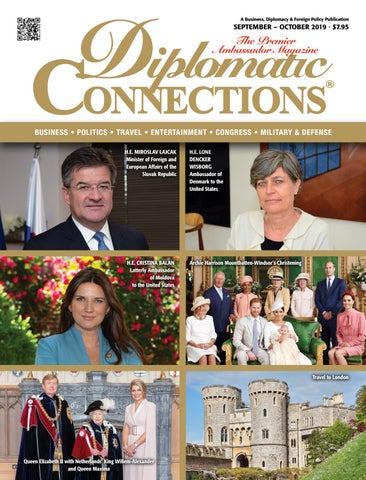
BUSINESS • POLITICS • TRAVEL • ENTERTAINMENT • CONGRESS • MILITARY & DEFENSE H.E. MIROSLAV LAJCAK Minister of Foreign and European Affairs of the Slovak Republic
H.E. CRISTINA BALAN Latterly Ambassador of Moldova to the United States
H.E. LONE DENCKER WISBORG Ambassador of Denmark to the United States
Archie Harrison Mountbatten-Windsor’s Christening
Travel to London
Queen Elizabeth II with Netherlands’ King Willem-Alexander and Queen Maxima
yslbeauty.com
PARFUM FLORAL
THE NEW EAU DE PARFUM
www.diplomaticlifestyles.com
DC DIPLOMATIC ACCOMMODATIONS
Superbly located just two blocks from the nation’s most important residential address, AKA White House offers distinctive one- and twobedroom furnished residences and stunning Penthouse terrace suites with spacious living rooms, fully-equipped kitchens, and spectacular lifestyle amenities including advanced Technogym Fitness Center; exclusive evening lounge; complimentary business center and executive board room; private cinema; and 24/7 Resident Services Team.
STAYAKA.COM
833.281.5272
WHITE HOUSE 1710 H STREET NW WASHINGTON DC NEW YORK PHILADELPHIA WASHINGTON DC LOS ANGELES LONDON
AWAKEN THE HEALING P O W E R O F L I F E P L A N KTO N â„¢ N E W B O R N P R I S T I N E S K I N I N 8 DAY S
www.diplomaticlifestyles.com
From the Publisher
Diplomatic
Dear International Reader: Diplomatic Connections’ subject matter is primarily interviews with extensive Q & A’s that lead to a greater understanding of nations worldwide. The Minister of Foreign and European Affairs of the Slovak Republic, H.E. Miroslav Lajcak, was kind enough to spend time with Diplomatic Connections highlighting his country’s global position. Lajcak’s accomplishments could easily be the length of this entire magazine. His resume is replete with noteworthy professional achievements demonstrating that he is a quintessential leader and the epitome of a consummate diplomat. Go to page 26 to read about his comprehensive career in successfully maintaining a range of politically influential roles on both the regional as well as the international world stage, such as: President of the 72nd General Assembly of the United Nations, Chairperson-in-Office of the Organization for Security and Cooperation in Europe (OSCE) and even served a year in the Presidency of the Visegrad 4, to name a few. Denmark is described by the World Bank as being one of the “easiest places to do business.” Ambassador Lone Dencker Wisborg explains why the cradle-to-grave social welfare system works for the Danes. It’s her first assignment to our nation’s capital, and she refers to it as the proverbial “jewel in the crown” for diplomatic postings. Wisborg talks about Denmark being quite satisfied as a member of the European Union (EU) and how it can “complement” their efforts in NATO. We interviewed the latterly Ambassador Cristina Balan from Moldova shortly before her term came to a conclusion. Moldova gained its independent status in 1992, following the collapse of the Soviet Union. They are going through quite a few changes; however, their economy is demonstrating some potential with a four percent growth rate. She explains that it’s a “case of improved collection of taxes.” This engaging conversation begins on page 42. London is the latest destination for our continuing travel series. See a variety of photos where the old meets the new. You may go there thinking there will be limited choices for dining; although today, London is abounding with a multitude of Michelin-starred restaurants and a vast variety of international cuisines. There’s plenty to do and see there as a tourist. If you would like your country to be featured in our tourism series, send an email request to: DParker@DiplomaticConnections.com Europe’s monarchies are alive and well. The generations are changing, and so are the mores. But recently, a traditional custom of pomp and circumstance, the Order of the Garter, was embraced as King Willem-Alexander of the Netherlands and King Felipe VI of Spain were invested. Our next Diplomatic Connections’ International Diplomat Appreciation Reception TM will be held at the newly opened, magnificent Conrad Washington, D.C. on October 24th. Looking forward to seeing you there! Warmest regards, Dawn Parker - DParker@DiplomaticConnections.com Publisher
6
W W W. D I P L O M AT I C C O N N E C T I O N S . C O M
EXPERIENCE STRONGER SKIN IN JUST 1 WEEK* ULTIMUNE POWER INFUSING CONCENTRATE.
www.diplomaticlifestyles.com
THE
SAVE DATE
Diplomatic EDITOR-IN-CHIEF Dawn Parker
October 3, 2019 THE PENINSULA
ASSISTANT JUNIOR EDITOR Annabelle Spezia-Lindner DIRECTOR OF BUSINESS DEVELOPMENT Evan Strianese
Chicago
JUNIOR ACCOUNT EXECUTIVES Peter Han, Zhichao Lyu, Yan Tang
October 24, 2019 CONRAD
DESIGN & CREATIVE Larry Smith Design
Washington, D.C.
November, 2019 location to be announced New York
DIPLOMATIC CORRESPONDENTS and CONTRIBUTING WRITERS Roland Flamini, James Winship, PhD, Michael D. Mosettig and Monica Frim DIPLOMATIC CONNECTIONS WEBSITE DESIGN & DEVELOPMENT IMS (Inquiry Management Systems) 304 Park Avenue South, 11th Floor New York, NY 10010 Marc Highbloom, Vice President marc@ims.ca Maria D’Urso, Project Manager Mariad@ims.ca CONTRIBUTING PHOTOGRAPHY Christophe Avril; Paula Morrison; Monica and John Frim, PhD; Slovak Foreign Ministry
2019
To contact an advertising executive
LOOK FOR OUR INTERNATIONAL DIPLOMAT APPRECIATION RECEPTION in your city.
TM
WWW.DIPLOMATICCONNECTIONS.COM
CALL: 202.536.4810 EMAIL: info@diplomaticconnections.com To order photos from the events go to: www.diplomaticconnections.com Send any name or address changes in writing to: Diplomatic Connections 4410 Massachusetts Avenue / #200 Washington, DC 20016 Diplomatic Connections Business Edition is published bi-monthly.
If your embassy, mission or consulate would like to host our next venue for the Diplomatic Connections International Diplomat Appreciation ReceptionTM please email us at: info@DiplomaticConnections.com
8
W W W. D I P L O M AT I C C O N N E C T I O N S . C O M
Diplomatic Connections does not endorse any of the goods or services offered herein this publication. Copyright 2019 by Diplomatic Connections All rights reserved. Cover photo credits: H.E. Miroslav Lajcak, Minister of Foreign and European Affairs of the Slovak Republic/Christophe Avril, Diplomatic Connections; H.E. Lone Dencker Wisborg, Ambassador of Denmark to the United States/Paula Morrison, Diplomatic Connections; H.E. Cristina Balan, Latterly Ambassador of Moldova to the United States/Christophe Avril, Diplomatic Connections; Archie Harrison Mountbatten-Windsor’s Christening, Chris Allerton/AFP/ Getty Images; Queen Elizabeth II with Netherlands’ King Willem-Alexander and Queen Maxima/Steve Parsons-WPA Pool/Getty Images; Travel to London Castle, Monica and John Frim, PhD, Diplomatic Connections
SKIN LOOKS RE-ENERGIZED & TRANSFORMED*
YOUR NEW FACE CARE BOOSTER!
Immortelle Reset Oil-In-Serum 50ml
* Skin looks rested, re-energised, firmer, more even and transformed for 100% of women. Consumer test results on 31 women after 28 nights in Asia.
www.diplomaticlifestyles.com
Diplomatic
D I P L O M AT I C C O N N E C T I O N S BUSINESS EDITION
SEPTEMBER – OCTOBER 2019
H.E. MIROSLAV LAJCAK MINISTER OF FOREIGN AND EUROPEAN AFFAIRS OF THE SLOVAK REPUBLIC
H.E. LONE DENCKER WISBORG AMBASSADOR OF DENMARK TO THE UNITED STATES
H.E. CRISTINA BALAN LATTERLY AMBASSADOR OF MOLDOVA TO THE UNITED STATES
ACCESSORIES AND LUXURY ITEMS Casio G-Shock . . . . . . . . . . . . . . . . 75 Costa . . . . . . . . . . . . . . . . . . . . .77 Diesel . . . . . . . . . . . . . . . . . . . . .93 Furla . . . . . . . . . . . . . . . . . . . . . 1 Seiko. . . . . . . . . . . . . . . . . . . . . .33 APARTMENTS, CONDOMINIUMS and HOUSING APARTMENTS AMPEER Residences DUPONT CIRCLE Washington, DC . . . . . . . . . . . . . . . .91 [The] Beekman Tower . . . . . . . . . . . . .92 Bozzuto – The Residences at Eastern Market . . 11 AUTOMOTIVE - CARS and LIMOUSINE SERVICES Admiral Leasing . . . . . . . . . . . . . . . .40 BMW of Rockville . . . . . . . . . . . . . . .25
YvesSaintLaurent . . . . . . . . . . . . . . . 2 HOTELS, DINING and ACCOMMODATIONS aka . . . . . . . . . . . . . . . . . . . . . . 4 [The] Concordia Hotel . . . . . . . . . . 66 & 67 CONRAD Washington, D.C. . . . . . . . . . . 70 [The] Dupont Circle Hotel Doyle Collection, Washington, D.C. . . . . . . . . . . . . . . .24 [The] Fairfax at Embassy Row . . . . . . . . .41 Fairmont Washington, D.C. – Georgetown . . . 91 InterContinental Cleveland Clinic . . . . . . . .53 InterContinental New York Times Square . . . .18 Lotte New York Palace . . . . . . . . . . . . .71 The Mayflower Hotel . . . . . . . . . . . . . 85 LIMOUSINES Presidential Luxury Limousines . . . . . 94 & 95
COMMUNICATIONS/TECHNOLOGY E-TEL now Comstar Technologies . . . . . . .23 ARCHIE HARRISON MOUNTBATTENWINDSOR’S CHRISTENING
CONFECTIONS GODIVA . . . . . . . . . . . . . . . . . . . .73 Haribo Gold-Bears . . . . . . . . . . . . . . .79 EDUCATION – INDEPENDENT SCHOOLS Wetherby-Pembridge School . . . . . . . . . 81
QUEEN ELIZABETH II WITH NETHERLANDS’ KING WILLEMALEXANDER AND QUEEN MAXIMA
TRAVEL TO LONDON
HEALTH & BEAUTY AXE . . . . . . . . . . . . INSIDE BACK COVER Biotherm . . . . . . . . . . . . . . . . . . . 5 Clarins . . . . . . . . . . . . . . . . . . . . 3 Diplomatic Lifestyles . . . . . . . BACK COVER John Frieda . . . . . . . . . . . . . . . . . .96 Lancome . . . . . . . . INSIDE FRONT COVER L’Occitane . . . . . . . . . . . . . . . . . . . 9 L’Oreal Paris . . . . . . . . . . . . . . . . . 87 P&G Professional . . . . . . . . . . . . . . .52 Revlon . . . . . . . . . . . . . . . . . . . . 83 Shiseido . . . . . . . . . . . . . . . . . . . . 7
TO CONTACT AN ADVERTISING EXECUTIVE
CALL: 202.536.4810 EMAIL: info@diplomaticconnections.com 10
W W W. D I P L O M AT I C C O N N E C T I O N S . C O M
F EAT URED ARTIC L ES AMBASSADORS to the UNITED STATES in Washington, D.C. DENMARK Ambassador Lone Dencker Wisborg 12 MOLDOVA Latterly Ambassador Cristina Balan 42 MINISTER of FOREIGN and EUROPEAN AFFAIRS of the SLOVAK REPUBLIC H.E. Miroslav Lajcak . . . . . . . . 26 ROYALS . . . . . . . . . . . . . . . . 68 TRAVEL London . . . . . . . . . . . . . . . 54
C APITOL H ILL’S MOST SPAC IOUS APARTM ENT HOM ES Effortless living with extraordinary amenities, premier concierge services to take care of you and your home, as well as Trader Joe’s and other convenient retail Last remaining apartments – offering up to three bedrooms with furnished options available 7 7 7 C S T R EE T S E, WA S H I N GTO N , D C 20 0 03 | 833 -568 - 45 42 L I V E E A S T E R N M A R K E T. C O M
H.E. LONE DENCKER WISBORG Ambassador of Denmark to the United States
12
W W W. D I P L O M AT I C C O N N E C T I O N S . C O M
Denmark:
"Easiest Place to Do Business" - World Bank A Conversation with Denmark's Ambassador Lone Dencker Wisborg Roland Flamini
Denmark, home of the Little Mermaid statue, Hans Christian Andersen, Legoland, and a glamorous future queen born in Australia - of all places - gets consistently top marks from international institutions for high living standards with few left behind, as well as high levels of trust and safety.
A recent report on Denmark (population 5.8 million) by the Organization for Economic Co-operation and Development (OECD) said “high and equally-distributed incomes translate into strong feelings of wellbeing, according to a range of measures.” As Lone Dencker Wisborg, Denmark’s ambassador to Washington, pointed out during an interview with Diplomatic Connections, her country is even number one in Europe on the World Bank’s “Ease of Doing Business Index.” A major element in this positive picture is
Denmark’s cradle-to-grave social welfare system, which has its origins in the 1870s, and which determines that all citizens have a right to free medical help, free hospitals, free education, and a pension independent of savings and employment (similar welfare systems are in place in the other Nordic states). Few things annoy Danes more than hearing American politicians labeling their country as socialist because of its welfare program, and it seems to be one of Ambassador Wisborg’s tasks during her time in the United States - to disabuse them of that notion. No silver lining is without its cloud, of course, and in Denmark that cloud is the now-familiar one of how to handle the influx of refugees. Europe proved unprepared for the frantic surge of asylum seekers that swamped the continent in 2015. As the crisis mounted, each country cobbled together its own emergency measures. Unlike the Hungarians, the Danish center-right government didn’t close the borders altogether, but the center-right government enacted the toughest immigration legislation in Denmark’s history.
D I P L O M AT I C C O N N E C T I O N S B U S I N E S S E D I T I O N | S E P T E M B E R - O C T O B E R
2019
13
Alex Halada/AFP/Getty Images
Meeting of the Joint Comprehensive Plan of Action (JCPOA) group, commonly known as the Iran Nuclear Deal, Abbas Araghchi (C-R), Political Deputy at the Ministry of Foreign Affairs of Iran, and Helga Schmid (C-L), Secretary General of the European Union's External Action Service (EEAS), take part in a meeting of the Joint Commission of the Joint Comprehensive Plan of Action (JCPOA) attended by the E3+2 (China, France, Germany, Russia, United Kingdom) and Iran on June 28, 2019 at the Palais Coburg in Vienna, Austria. Denmark fully supports the JCPOA.
Legislation to allow for confiscation of refugees’ jewelry was introduced, (although the ambassador says no pieces of jewelry are known to have been confiscated since the law was passed). A ban on burqa wearing went into effect, and there was a push to shift the emphasis from integration to repatriation. In July, the Social Democratic Party led by Mette Frederiksen and its center-left allies ousted the center-right government, but there was some doubt whether the tougher immigration policies would be relaxed. Frederiksen had supported them when she was in opposition. Denmark became a member of the European Union (then the European Economic Community) following a referendum in 1972, but the two other constituent components of the Danish kingdom – the Faroe Islands and Greenland – are not members. Greenland voted itself out of the EU in 1985, and the Faroe Islands were never members in the first place. Denmark is the only member of the EU besides the United Kingdom to have opted out of the euro and gotten away with it: its currency is still the kroner. To a large extent, Denmark joined the EU following the example of Britain’s entry (the two countries have close relations). But the Danes have no intention of following the UK out of the European Union, and Ambassador Wisborg says the polls suggest that the political chaos Brexit has caused in the UK has strengthened support for the EU. Diplomatic Connections: Ambassador, from your official bio I gather two interesting things: one is that you have not served in 14
W W W. D I P L O M AT I C C O N N E C T I O N S . C O M
Washington before, and that makes you a bit of a rarity because most ambassadors have at least on previous posting here; and the other is that you have spent several years inside the ministry dealing with policy at a senior level. Ambassador Wisborg: I have not served in Washington before, and this is my second ambassadorial post. I was ambassador in Spain. The number of positions I’ve held in the ministry are very much policy focused: I was state secretary for foreign policy, and for the last two years, I have occupied the position of chief operational officer, in charge of running the ministry as an organization. Diplomatic Connections: Now that you’re here as ambassador, what advice would you give about functioning in Washington to an incoming colleague who was about to take up an ambassadorship. Ambassador Wisborg: I would advise him or her to do what I’ve done. I did a plan for the first 100 days to meet as many people as possible. Diplomacy is partly networking, so you need to build up that network as fast as possible. So my advise would be to get the network up and running, you never know when you would need it. Diplomatic Connections: What are your impressions of the Washington post? Ambassador Wisborg: First of all, for me Washington is the jewel in the crown (of diplomatic assignments). When you work in security policy as I have, there’s no more interesting posting than Washington. So I’m super excited to be here. What strikes me is, because the U.S. is a world leader, everything that goes on here is of interest
to Copenhagen. As an ambassador everything we do, and every report we send back is just being swallowed at home, and that’s very motivating. Also, you can meet and talk to so many interesting people to form your own idea of what this country is, and what the policies are - really highly qualified, knowledgeable people, and they’re accessible. Diplomatic Connections: You’re saying there’s good access? Ambassador Wisborg: Access and size: when you come to the U.S. you’re struck by size. In Washington, the number of
Alain Jocard/AFP/Getty Images
think tanks, the number of people in the administration, in Congress, that you have the possibility to meet is impressive. Diplomatic Connections: You’re probably – inevitably – still asked what it’s like being a woman ambassador in Washington? Ambassador Wisborg: To be honest, I don’t really consider it an issue. If I think about it
Denmark's Defence minister Trine Bramsen (L) greets French President Emmanuel Macron prior to the annual Bastille Day military parade down the Champs-Elysees avenue on July 14, 2019.
Emmanuele Contini/NurPhoto via Getty Images
Danish Prime Minister Mette Frederiksen and German Chancellor Angela Merkel attend a press conference at the Chancellery in Berlin on July 11, 2019.
D I P L O M AT I C C O N N E C T I O N S B U S I N E S S E D I T I O N | S E P T E M B E R - O C T O B E R
2019
15
I would only say that it’s an advantage because diplomacy is about building networks, and getting to know people, so if there are fewer female ambassadors people tend to remember you. Diplomatic Connections: There are twenty-nine female ambassadors, and as I understand it, you have had good lines of communication. Ambassador Wisborg: We have. We do things together: we have an informal female club where we invite American stakeholders for working lunches. I don’t feel any disadvantages to being a woman, and I try to make it an advantage. Diplomatic Connections: But you come from a country where gender is not such a big issue. Ambassador Wisborg: We’ve come a long way in Denmark on women issues, and particularly in the Foreign Ministry, a lot of progress has been made. But we’re not there yet: we still need to work on it. Specifically, in the area of women leaders, in the private sector as well, CEOs and on boards, etc. Diplomatic Connections: What does being Danish mean today? Ambassador Wisborg: I would hesitate to answer for all Danes, but I can tell you what it is to me. Being a Dane means coming from a small, open, innovative country, where we have a highly developed welfare system. We’ve been trading with the rest of the world since the Viking Age, and I think that’s somehow in our genes – that we’re open towards the world, we’re curious about the world, we trade, we travel, and we also feel a global responsibility so we keep 0.7 percent (of GDP) in development assistance. We participate in international peace operations. There’s kind of a sense of responsibility; we want to defend our interests, but we also want to make the world a better place to live in. Diplomatic Connections: Denmark has been, and still is, a participant in several UN peace-keeping forces, for example in Cyprus. Ambassador Wisborg: Yes, in various places. In Africa as well. Diplomatic Connections: Denmark’s bi-lateral relations with the United States: What don’t the Americans do that you would like them to do? Ambassador Wisborg: First of all, there’s so much that unites us, and we happily cooperate on these issues. What is most important to us right now, the overriding foreign 16
W W W. D I P L O M AT I C C O N N E C T I O N S . C O M
policy priority would be to preserve and develop the international rules-based order that we’ve built up together since the Second World War. That’s a story that I keep telling here, in Copenhagen, and wherever I go, because sometimes I think that trans-Atlantic relations are taken for granted. We need to stick together because we share values and ideals, and if we don’t protect and preserve this world order we might end up with another world order that we don’t like, or even disorder. Diplomatic Connections: Regarding security cooperation, the Danes are in Afghanistan… Ambassador Wisborg: We have 155 soldiers there now. Diplomatic Connections: The Danes were in Iraq… Ambassador Wisborg: We’re still there with 214 soldiers. Diplomatic Connections: The U.S. runs military operations in Greenland on Thule Air Base? Ambassador Wisborg: Yes, that is correct. The Americans have an air base there, where they do missile warning and space control. They have also indicated an interest in strategic investments in airport infrastructure in Greenland, including in projects that may have dual civil and military benefits, which we very much welcome. Diplomatic Connections: To what extent is Greenland under Danish control? Ambassador Wisborg: Greenland is one of the three parts of the Danish Kingdom along with Denmark and the Faroe Islands. We are one country, one kingdom, but both the Faroe Islands and Greenland have extended self-government, and they decide on a number of issues – education, environment, and so on. But the Danish government and parliament decide foreign policy in consultation with Greenland and the Faroe Islands on matters of special concern to them. Diplomatic Connections: So Greenland is a member of the European Union? Ambassador Wisborg: No it’s not. It was originally, but then decided to leave (following a referendum), and the Faroe Islands were never EU members, but Denmark is. Diplomatic Connections: If Denmark had a referendum today about staying in the European Union, what do you think would be the result? Ambassador Wisborg: The opinion polls tell us that 77 percent of Danes would vote in favor of staying in, and that’s the highest number we have had, ever. We’ve always been very positive, but to be absolutely honest what is
Ilmars Znotins/AFP/Getty Images
(L-R) Sweden's foreign minister Margot Wallstrom, Poland's foreign minister Jacek Czaputowicz, Lithuania's foreign minister Linas Linkevicius, Germany's ambassador to Latvia Rolf Schutte, European Union Secretary General of the European External action service Helga Maria Schmid, Denmark's state secretary of European Affairs Carsten Gronbech-Jensen, Latvia's foreign minister Edgars Rinkevics, Estonia's foreign minister Urmas Reinsalu, Finland's foreign minister Timo Soini, Iceland's director for regional cooperation, Directorate for International and Security Affairs Emil Berki Hreggvidsson, Norway's director general for European Affairs Niels Engelschion, Russian deputy minister of Foreign Affairs Aleksandr Pankin and Council of Baltic Sea States secretariat Director General Maira Mora pose for a picture during the meeting of the Latvian presidency of the Council of the Baltic Sea States in Jurmala, Latvia, on June 3, 2019.
happening in the UK has had a lot of effect. That’s the most common analysis. Diplomatic Connections: What is the extent of opposition to the EU from the populist right? Ambassador Wisborg: For some time we’ve had groups skeptical of the European Union on both the right and the left side of the political spectrum, but both lost in the recent election. One of them has had a seat in the European Parliament for a number of years, and now no longer does. Diplomatic Connections: How would you assess Copenhagen’s relationship with Brussels? Ambassador Wisborg: If by Copenhagen you mean the government, or political thought, I think the feeling is that the benefits of EU membership are much bigger than the disadvantages for a small country like ours. Sometimes we think it’s not efficient enough, or that everything takes a long time. But when we speak within the European Union we are so much stronger, we can deal with issues that cross borders, like climate, and there are huge advantages for our economy – the single market, etc. A lot of jobs have been gained as a result of the (EU) single market. Diplomatic Connections: Are the Danes comfortable with the EU objectives of further integration – the unified budget, more centralization, and, as the Treaty of Rome states “an ever closer union?” Ambassador Wisborg: My sense is that most Danes are happy with the way it is now. Denmark still has our optouts (in its agreement with the European Union). When we had a referendum on the Maastricht Treaty we initially got a “No,” and so we negotiated some opt-outs, that have remained in place. One is on the euro, another is on defense, and then there is one on justice and home
getting rid of is on defense. On defense, we’ve seen a development not only in the European Union but also in the receptiveness of the Danes. Originally, when France and Germany were pushing for common European defense, Danes were skeptical and preferred NATO to take care of security matters. But now we understand that the intent is to develop European ability to shoulder joint security challenges, and opinion polls show a majority of Danes in favor of getting rid of that opt-out. But on the rest of them, I think most people are basically happy with where we are. In our view, it is not either or. Both become stronger. Because of the opt-out we are not part of the discussion on defense. We support the development of capabilities in the European Union, but we emphasize that it has to be complementary to what we’re doing in NATO. Diplomatic Connections: Denmark’s defense expenditure is currently 1.3 percent of GDP, which is short of the two percent commitment the Trump administration expects of alliance members. Is this something that causes problems for your bilateral relationship? Ambassador Wisborg: We’re fully aware of the defense commitment, and the importance that the administration attaches to it. We recognize that more needs to be done and the parliament has recently decided to increase defense spending, which has been appreciated by the U.S. government. At the same time, we continue to contribute significantly to NATO operations - be they in Afghanistan, Kosovo, Eastern Europe or elsewhere. Diplomatic Connections: How much uncertainty is there in Denmark, as there is in other NATO countries, that the present administration is not as committed to Art. 5 of the NATO Treaty (an attack on one member is an attack on the whole Atlantic Alliance) as other administrations have been in the past? Ambassador Wisborg: We saw the celebration of the
affairs. According to polls, the one that people favor D I P L O M AT I C C O N N E C T I O N S B U S I N E S S E D I T I O N | S E P T E M B E R - O C T O B E R
2019
17
THE
DIPLOMATIC EXECUTIVE PACKAGE BY THE INTERCONTINENTAL NEW YORK TIMES SQUARE
Rates Starting at $299.00 Complimentary Upgrade to SkyView Categories Complimentary High Speed WiFI in All Guest Rooms Breakfast included in the Rate for 2 guests Daily Complimentary Bottled Water *Same Subject to Avail. Valid until 12/31/19
To reserve please contact: Davonne Berry | Davonne.berry@ihg.com | 212.803.4916 18
W W W. D I P L O M AT I C C O N N E C T I O N S . C O M
Abby Payne | Abigail.payne@Ihg.com | 212.803.4590
Thierry Monasse/Getty Images
Danish Foreign Minister Jeppe Sebastian Kofod (L) is talking with the Spanish Minister of Foreign Affairs & Cooperation, nominee for High Representative of the European Union for Foreign Affairs and Security Policy Josep Borrell (R) prior to an EU foreign affairs Ministers meeting in the Europa, the European Union Council headquarters on July 15, 2019 in Belgium. European Union countries look to de-escalate tensions in the Persian Gulf area and call on Iran to stick to the 2015 nuclear deal, despite the pullout of the United States from the accord and the reimposition of U.S. sanctions on Tehran.
70th anniversary of NATO’s foundation as a strong signal of the commitment on the part of the U.S. Sometimes we forget that we’ve seen an increased U.S. military presence in Europe. There were initial worries about the U.S. commitment to Art. 5, but I think they have calmed down. Diplomatic Connections: The current administration has made Iran its number one enemy. How much concern is there in Denmark that things could get out of hand in the Gulf, and what do you think is the road back from this crisis? Ambassador Wisborg: Iran is one of the issues on which we, to a large extent, share the (U.S.) objective, but disagree on the methods. We are part of the European Union,
and still support the JCPOA (Joint Comprehensive Plan of Action), because we see it as important for our security. We continue to claim that it is the best way forward, and we do what we can to save the agreement. I think developments in and around Iran are very worrying, and steps should be made to de-escalate tension. Diplomatic Connections: The influx of refugees is a challenge in Denmark, as it is elsewhere in Europe. The previous government in Copenhagen had tightened up on the admission, processing,
Gregor Fischer/AFP/Getty Images
German Foreign Minister Heiko Maas and his Danish counterpart Jeppe Kofod shake hands after addressing a press conference following bilateral talks at Villa Borsig in north Berlin on July 1, 2019.
D I P L O M AT I C C O N N E C T I O N S B U S I N E S S E D I T I O N | S E P T E M B E R - O C T O B E R
2019
19
Ole Jensen - Corbis/Getty Images
Russian Floating Atomic Power Station Passes Through Danish Waters: The worlds only floating atomic power station, Akademic Lomonosov, passes under the Great Belt Bridge on its way to Murmansk in Russia in Korsoer, Denmark. The Akademic Lomonosov was towed out of St. Petersburg harbor; it’s built on a barge and has a length of 144 meters and a width of 30 meters. It is the first of its kind globally and is said to be capable of producing power for a town of up to 100,000 people. The Swedish and Norwegian governments have raised concerns about the risk of an accident at sea and Greenpeace has branded Akademic Lomonosov a 'floating Chernobyl' and a 'nuclear Titanic.' The towed barge is being followed by Danish Navy vessels and a Greenpeace ship on its way through Danish waters.
and treatment of refugees, limiting numbers, and other measures. To some extent traditional public tolerance of the influx is eroding. At the time, the center-left opposition, which is now the new government, did not oppose the new measures. So what prospects are there that the new government will reverse some of those earlier decisions? Ambassador Wisborg: The migration crisis in 2015 was really a shock to everybody – to the politicians, and to the
Danish population. We had refugees literally wandering on our highways, which in a very regulated country like ours, was almost inconceivable. The crisis led the government to tighten measures, with the support of the Social Democratic Party that is now in government, and a lot was done through the EU to strengthen external borders. The new government has issued a kind of political understanding with the three center-left parties supporting
20
W W W. D I P L O M AT I C C O N N E C T I O N S . C O M
Tim Kildeborg Jensen/AFP/Getty Images
A floating nuclear power plant, Russian "Academy Lomonosov" (C), passes by the island of Langeland, off the coast of Spodsbjerg in Denmark, as it is pulled through the Baltic Sea to Murmansk, in northwestern Russia, where its reactors will be loaded with nuclear fuel.
Alexei Druzhinin/TASS via Getty Images
them. On immigration, they suggest that a new EU asylum system should be negotiated because the current one has failed; they put emphasis on addressing root causes of migration – partnering with Africa is a big priority – they also emphasize further integration of the immigrants that are already in Denmark, and they say they are open to accepting some of the most vulnerable refugees as specified by the United Nations.
Russia's Foreign Minister Sergei Lavrov (L) and Russian Presidential Aide Yuri Ushakov (R) look on as Denmark's Ambassador to Russia Carsten Sondergaard and Russia's President Vladimir Putin pose for a photo during a ceremony at the Moscow Kremlin's Alexander Hall.
Diplomatic Connections: The European Union issued quotas of refugees for each member state. Did Denmark comply with this arrangement?
it doesn’t apply to us. If the EU were to legislate a redistribution of refugees, that would not apply directly to Denmark.
Ambassador Wisborg: There’s been a debate on the redistribution of refugees, without any conclusion so far, but since we’re not engaged in this part of the EU co-operation
Diplomatic Connections: When American politicians talk about the Scandinavian welfare state, as some presidential candidates are now doing, do they know what they are talking about?
Sarah Christine Noergaard/AFP/Getty Images
The Russian nuclear submarine Dmitrij Donskoj sails under the Great Belt Bridge between Jyutland and Fun through Danish waters, near Korsor, Denmark. The submarine is 172 meters long and is thus the largest nuclear powered submarine in the world.
D I P L O M AT I C C O N N E C T I O N S B U S I N E S S E D I T I O N | S E P T E M B E R - O C T O B E R
2019
21
Ambassador Wisborg: Some Americans think we’re Socialists. I’ve met numerous Americans who think that. I explain that we’re not Socialists; we have a liberal market economy and a private sector with a light touch on regulation, and that is combined with a welfare system, free education, free health care, and an allocation of wealth, basically, through our tax system. That is a concept that is maybe strange to many Americans. We try to explain our model, and we often refer to The World Bank’s Ease of Doing Business Index. Denmark is number one in Europe and number three in the world. It’s a well-functioning market economy with a soft edge, you could say. Diplomatic Connections: Is there a Danish diaspora? Ambassador Wisborg: There is. We have 1.2 or 1.3 million Americans of Danish descent. Most of them live in California, and in Utah. Diplomatic Connections: Does that mean they’re Mormons? Ambassador Wisborg: Well, the story is actually quite interesting. When Denmark adopted its constitution in 1849, we were one of the first countries to have freedom of religion. And so Mormons came to Denmark to practice their religion, and met Danes, and Danes traveled to Utah, so
Diplomatic Connections: In terms of the region, how close are the countries of the Scandinavian region? For example, is Denmark a member of NORDEFCO (Nordic Defense Cooperation), and what is it exactly? Ambassador Wisborg: NORDEFCO is a formalized defense cooperation, but it’s not an alliance, like NATO. We discuss policy initiatives. And talking about alliances, we have different positions: Norway, Denmark and Iceland are members of NATO and the others are not. Even though Sweden and Finland are cooperating very closely with NATO. (As Scandinavians) we feel a closeness in terms of mentality and history, and there’s cooperation in every area. At government level, there’s a Nordic Council of Ministers, which meets regularly. Diplomatic Connections: How much of a problem for Denmark is Russia’s current aggressiveness? For example, are there incidents of combat planes trespassing in Danish airspace? Ambassador Wisborg: There are some issues and incidents from time to time: we've experienced that. Diplomatic Connections: How concerned are the Danes about Russia?
former Danish Foreign Minister Anders Samuelsen, Iceland's foreign minister Gudlaugur Thor Thordarson and Governor Hannele Pokka pose for a picture during and Arctic Council summit at the Lappi Areena in Rovaniemi, Finland on May 7, 2019.
Mandel Ngan/AFP/Getty Images
Front row from left, Norway's foreign minister Ine Eriksen Soreide, Russia's foreign minister Sergey Lavrov, Sweden's foreign minister Margot Wallstrom, U.S. Secretary of State Mike Pompeo, Finland's foreign minister Timo Soini, Canada's foreign minister Chrystia Freeland, Denmarks's
there’s a link there. I’m told that the first foreign language translation of the Book of Mormons is Danish.
22
W W W. D I P L O M AT I C C O N N E C T I O N S . C O M
has joined Proudly serving the diplomatic community since 1988, Comstar delivers every solution that your business needs— from one provider you can trust.
Streamline your connectivity today. Ambassador Wisborg: We are worried about it, particularly what we’ve been seeing in Ukraine. Ukraine is a very high priority in our foreign policy, and we consider the Russian annexation of Crimea unacceptable. There’s also a Russian military build-up in the Arctic that we keep an eye on, as well as the violation of the INF Treaty. We support that NATO has taken action to reinforce its posture in Europe, so that’s one side of it. But we also claim that our Russia policy has to have two dimensions: so, firmness on one hand, but also the chance to meet and to talk. And the Arctic so far has been an area of low tension, and the Arctic Council has worked very well and has produced results, such as search and rescue, and protection of the environment: there are agreements being made in the Arctic Council.
Call us at 888.441.8444, or visit www.comstar-usa.com.
to information, why do we need diplomats, and I think that’s based on a misunderstanding of what diplomacy is. It’s not a news agency. My primary function is to fight for Danish interests abroad and explain Danish values and positions, and that requires a presence abroad. You can’t take human contact out of the equation; I need to meet with people and to try to convince people of the Danish position. I need to try to sense where the red lines are on the other side, or to identify issues where we could work together, and that you can’t get out of a newspaper. Diplomatic Connections: So you don’t think that you’re likely to be replaced in the near future by a hologram? Ambassador Wisborg: No, I’m not particularly afraid of that. ■
Diplomatic Connections: How has the practice of diplomacy changed in the current era of social media and instant news? Firstly, do you tweet? Ambassador Wisborg: I do. Diplomatic Connections: Does the embassy? Ambassador Wisborg: It does. To get back to your question, in modern times when everybody has access D I P L O M AT I C C O N N E C T I O N S B U S I N E S S E D I T I O N | S E P T E M B E R - O C T O B E R
2019
23
Timeless style, the warmest of welcomes and chic luxury in the Nation’s Capital 327 Guestrooms with 15 Luxurious Suites | Doyle Bar | The Pembroke Restaurant Dedicated Guest Relations Team | Expert Concierge Services
For inquiries, please contact our Director of Diplomatic Sales Jennifer G. Chan email: Jennifer_Chan@doylecollection.com direct: +1 202 797 0152 mobile: +1 202 894 0553 hotel website: www.doylecollection.com/dupontcircle 1500 New Hampshire Avenue NW Washington DC, 20036 United States
WORLD RENOWNED. LOCAL FAVORITE.
At BMW of Rockville, we’re proud to serve the diplomatic community and love the fact we can offer you an international favorite like BMW. We also offer: • Special diplomatic pricing • Special lease and finance offers through BMW Financial Services • State Department registration (or State garaged) • Experienced personnel to guide and assist you through the entire process Contact Nicholas Popovici, BMW Diplomatic Specialist at 240-283-8833 or npopovici@bmwrockville.com
BMW OF ROCKVILLE 1300 Rockville Pike, Rockville, MD 20852 301-984-8989 bmwrockville.com
Priority 1 Service. Ownership Simplified.
No appointment needed. Just drive in.
125 complimentary BMW loaner cars.
James A. Winship, Ph.D.
H.E. Miroslav Lajcak (ME-roh-slahv LYE- chahk), Minister of Foreign and European Affairs of the Slovak Republic, is a seasoned diplomat who began his career by entering the Foreign Service of the Czechoslovak Socialist Republic, then part of the Soviet sphere of influence, in 1988. A graduate of the Moscow State Institute for International Relations (MGIMO) during the Gorbachev years, Minister Lajcak also holds a law degree from the Comenius University in Bratislava. He recalls, “I always wanted to be a diplomat as far back as I can remember, from the time I was 9- or 10-years old when I read a book about diplomacy. It’s a fascinating field. It’s my lifelong profession and my passion.” Spanning more than three decades, Lajcak's diplomatic career has seen remarkable changes in the political structures of the world, in the global economy and especially in the political map of Europe. He has lived the diplomatic history of the late 20th century and the first decades of the 21st century. On his watch the Berlin Wall fell; the Soviet Union collapsed; the socialist republics of Eastern Europe, once Soviet satellites, achieved full independence; the Czech and Slovak Republic that emerged in 1989 separated into its component parts in 1993, becoming the two sovereign states – the Czech Republic and Slovakia; both the European Union and NATO have dramatically expanded their membership; and the Russian
26
W W W. D I P L O M AT I C C O N N E C T I O N S . C O M
H.E. MIROSLAV LAJCAK Minister of Foreign and European Affairs of the Slovak Republic
D I P L O M AT I C C O N N E C T I O N S B U S I N E S S E D I T I O N | S E P T E M B E R - O C T O B E R
2019
27
NATO Secretary General Jens Stoltenberg (R) welcomes President of the Slovak Republic Zuzana Caputova (L), ahead of a meeting at the NATO headquarters in Brussels, Belgium on June 25, 2019.
Federation under President Putin has reemerged as a central player in regional and global issues of politics and security. “In a way,” says the Foreign Minister, “I have lived in three countries: first, Communist Czechoslovakia; then, democratic Czechoslovakia; and now the Slovak Republic.” It is perhaps a product of the rapid pace of political change that Lajcak's official biography describes his professional life as “dedicated to diplomatic service representing both the Slovak Republic and the international community.” That commitment is exemplified throughout his career. So, too, the events that have shaped Slovakia’s emergence and Central Europe’s evolution have led him to be not only a career diplomat but also a politician as a member of the ruling coalition in Slovakia’s government. To borrow what is most often a sports metaphor, Foreign Minister Lajcak might be described as a “triple threat” diplomatic actor. A dictionary description of “triple threat” defines the term as “a person who is proficient in three skills or adept in three fields critical to their 28
W W W. D I P L O M AT I C C O N N E C T I O N S . C O M
activity or profession.” In international relations, it might be a diplomat working adroitly to represent his country, persistently involving himself and his country at a regional level, and productively offering leadership at the global level. That sort of multi-tiered diplomacy is evidenced throughout Foreign Minister Lajcak's career. He is currently serving his fourth term as Slovakia’s Minister of Foreign and European Affairs and served as Deputy Prime Minister from 2012-2016. From 2010 to 2012, a period during which he was not Foreign Minister, Ambassador Lajcak helped to shape the newly formed European Union diplomatic service, the European External Action Service, serving as its Managing Director for Europe and Central Asia. Concurrently, he served as the EU’s Chief Negotiator for the Association Agreements of the EU with Ukraine and Moldova, as well as the EU Representative for the “5+2 Talks” on the Transnistrian Settlement Process. That word “concurrently” appears frequently in Foreign Minister Lajcak's professional biography. On the diplomatic
that are members of both the EU and NATO intended to optimize cooperation between them, encourage democratic development, help shape both European and Transatlantic security architecture, and advance the process of bringing stability to that region. Slovakia also served a six-month term in the European Union Presidency (1 July – 31 December 2016.) All of these are rotating or limited-term presidencies, but each of them was fulfilled synchronously with Mr. Lajcak's responsibilities as Foreign Minister. This combination of roles attests not only to the administrative competence but also to the remarkable passion and boundless energy that animate his diplomatic life, not only at the center of Europe but at the core of global institutions. Diplomatic Connections was privileged to speak with him during a whirlwind visit to New York where he attended a meeting of past, present and newly-elected Presidents of the United Nations General Assembly. Diplomatic Connections: Your foreign service career has spanned an incredible era in diplomatic history, literally from the last days of the Cold War to the rise of new nationalisms, to the
Dursun Aydemir/Anadolu Agency/Getty Images
side he has served as the Slovak Ambassador to Japan (1994-1998) and later as his country’s Ambassador to the Federal Republic of Yugoslavia (2001-2005). Between those appointments he served as Director of the Cabinet of the Foreign Minister and concurrently served as Executive Assistant to the United Nations Secretary General’s Special Envoy for the Balkans. Building on these experiences he honed his mediation skills amid the post-conflict crises in the Western Balkans negotiating, organizing and supervising the referendum on the independence of Montenegro under the aegis of the European Union. Subsequently, he was appointed High Representative of the International Community and European Union Special Representative in Bosnia and Herzegovina. More recently, Mr. Lajcak was elected to serve as President of the 72nd General Assembly of the United Nations (2017-2018). He is currently serving as Chairperson-in-Office of the Organization for Security and Cooperation in Europe (OSCE) and recently completed a year in the Presidency of the Visegrad 4 (Slovakia, Hungary, Poland, and the Czech Republic) - an informal but quite active grouping of Central European states
D I P L O M AT I C C O N N E C T I O N S B U S I N E S S E D I T I O N | S E P T E M B E R - O C T O B E R
2019
29
Foreign Minister Lajcak: I have the opportunity to live in a fascinating era. The '80s were years of dramatic changes as the Communist regimes began eroding and finally fell apart. I saw those changes firsthand. Alongside those experiences, I also saw the opening of archives that were not available even to scholars before 1989. It was as if you were seeing the world with one eye. And then, all of a sudden the second eye opened up. I learned a great deal about my country and the system I was born and grew up in. That helped me to understand much more about the world. Diplomatic Connections: How has that access to the archives of World War II and the Cold War changed your historical perspective and impacted your world view? Foreign Minister Lajcak: That new knowledge offered critical insights that had been missing from my education. It helped me to understand more of the past and to think about the world in new ways. Slovaks have successfully transformed our country’s political, economic and social systems. We learned something that other people can only read about in books. As Slovaks we have lived on both sides of what was the East-West divide. We really used to be a closed society with no possibilities to travel, hoping that one day we might join the European Union. Today we have been members of European Union for 15 years and members of the Eurozone since 2009. But I still remember what it
was like to be on the other side. Now, we are attempting to use our practical experience to help those who hope to follow us, like the countries in the Balkans or former Soviet republics, who are trying to get closer to Europe. Diplomatic Connections: As Foreign Minister, what do you see as the major issues confronting Slovakia today? What are your greatest concerns for your country's political and economic security? Foreign Minister Lajcak: Slovakia is a small country of five and a half a million inhabitants. The most important thing for us is an international order that is stable and predictable, an order based on rules. That is the best protection of our independence, our integrity and our interests. Our biggest worry is that this rules-based order is now under attack. Diplomatic Connections: How so? Foreign Minister Lajcak: For the moment, the rules no longer seem to apply. Leading states that are more powerful believe they can bend the rules. In contrast, Slovakia speaks up in favor of respect for the rules. We support the multilateral system and the role of international organizations that were created by the international community in the years following World War II and that have evolved as the community of sovereign states has grown. Slovakia’s vital space is the European Union. We are deeply and committedly integrated into the EU. Our economy is open, export oriented, and we are members of the Eurozone. We want to see a healthy, active European
(L-R) Czech Prime Minister Andrej Babis is talking with the Hungarian Prime Minister Viktor Mihaly Orban, the Slovak Prime Minister Peter Pellegrini and the French President Emmanuel Macron prior to a Visegrad Group (Visegrad Four) meeting in the EU Council headquarters on May 29, 2019 in Brussels, Belgium. The Visegrád Group (Visegrád Four) is a cultural and political alliance of four Central European states (Czech Republic, Hungary, Poland and Slovakia) that are members of the European Union (EU) and NATO for the purposes of advancing military, cultural, economic and energy cooperation with one another along with furthering their integration in the EU.
30
W W W. D I P L O M AT I C C O N N E C T I O N S . C O M
Thierry Monasse/Getty Images
on-going search for a new international system. How has that panoply of events impacted your diplomatic career?
Mandel Ngan/AFP/Getty Images
NATO Ministers of Foreign Affairs (bottom row from L): Canada Chrystia Freeland, Bulgaria Ekaterina Spasova Gecheva-Zakharieva, Belgium Didier Reynders, Albania acting Minister of Foreign Affairs Gent Cakaj, U.S. Secretary of State Mike Pompeo, NATO Secretary General Jens Stoltenberg, United Kingdom Permanent Representative to the North Atlantic Council Sarah MacIntosh, Turkey Mevlut Cavusoglu, Spain Josep Borell, Slovenia Miro Cerar, Slovakia Miroslav Lajcak, (middle row from L) Crotia Marija Pejcinovic Buric, Czech Republic Tomas Petricek, Denmark Anders Samuelsen, Estonia Undersecretary of the Ministry of Foreign Affairs Paul Teesalu, France Jean-Yves Le Drian, Germany Heiko Maas, Greece George Katrougalos, Hungary Peter Szijjorto, Iceland Gudlaugur Thor Thordarson, Italy Enzo Moavero Milanesi, Latvia Edgars Rinkevics, Lithuania Linas Linkevicius, (back row, from L) The Supreme Allied Commander Europe (SACEUR) General Curtis M. Scaparrotti, the Supreme Allied Commander Transformation (SACT), and Foreign Affairs Ministers from Luxembourg Jean Asselborn, Montenegro Srdjan Darmanovic, Netherlands Stef Blok, Norway Ine Eriksen Soreide, Poland Jacek Czaputowicz, Portugal Augusto Santos Silva, Romania Teodor-Viorel Melascanu, North Macedonia Nikola Dimitrov, Chairman of the NATO Military Committee Air Chief Marshal Stuart Peach during a reception celebrating NATO's 70th Anniversary at the Andrew W. Mellon Auditorium in Washington, D.C. on April 3, 2019.
Union that cares for every citizen of the European space. We are actively trying to contribute to that goal. Diplomatic Connections: Do you feel that the security of the European space is under threat? Foreign Minister Lajcak: Slovakia wants to be part of a stable European region. We want to have good relations with our neighbors, which is the case. At the moment, there is a crisis in and around Ukraine, our biggest neighbor. We are trying to help stabilize that situation, both in our national capacity and also as the chair of the OSCE, so that people can focus on normal life, work, prosperity, and their families. Diplomatic Connections: Given your country's role, having been part of the Communist system, having been part of the Soviet sphere of influence, and now so deeply enmeshed in Europe, do you see Slovakia as having an opportunity or a responsibility to be a kind of bridge between the different portions of Europe? Foreign Minister Lajcak: I'm not a big fan of bridges. We are clearly anchored in our space, which is the European Union
and NATO. We have clearly decided that these are the best guarantees of our prosperity and also of our security. If you want to be a bridge, it looks like you don't belong anywhere. Bridges get burned. And this is not what we want. Diplomatic Connections: Ukraine has been under great pressure from Russia, in part because of the Russian annexation and integration of Crimea. How do you think Europe should try to deal with that situation? How should OSCE, and Russia as a part of OSCE, be responding to questions about the future of Ukraine? Foreign Minister Lajcak: We want to see Ukraine as a peaceful country within its internationally recognized borders. OSCE is very actively present in Ukraine with 1300 monitors committed to the special monitoring mission. We have identified confidence building measures, concrete steps, that the OSCE believes would help improve life of citizens who are affected by the conflict. OSCE believes that some momentum has been created
D I P L O M AT I C C O N N E C T I O N S B U S I N E S S E D I T I O N | S E P T E M B E R - O C T O B E R
2019
31
Eurogroup President and Portuguese Finance Minister Mario Centeno (L), European Commissioner for Economic and Financial Affairs, Taxation and Customs Pierre Moscovici (R) and Slovakian Finance Minister Ladislav Kamenicky (C) speak together upon their arrival to attend a Eurogroup meeting at the European Commission in Brussels.
with the recent election of President Zelensky. He is very serious about bringing an end to the war and about the unification of Ukraine. He deserves to have our international support. OSCE will continue its policy of refusing to accept or tolerate violations of international law
Diplomatic Connections: You have just recently published a book about your experience as president of the UNGA, the 72nd General Assembly (2017-18). Certainly in politics and diplomacy, one year is not a long time to have an effect. How did you seek to structure your presidency in order to make it effective and impactful in such a short span of time? How did you make your presence felt? How did you build your cabinet, your staff, all of whom you have to recruit from other countries? They all have to be seconded from their missions or from their foreign ministries.
Emmanuel Dunand/AFP/Getty Images
or annexation of parts of the territory of one country by a different country.
Foreign Minister Lajcak: The key is preparation. It was very clear that my staff and I needed to be fully prepared and ready to hit the ground running from day one. First, we had to agree on what we wanted to achieve. We tried to encompass this with the theme of my presidency – “Focusing on people: striving for peace and a decent life for all on a sustainable planet.” Often the link between the work of diplomats or the work of international relations and the life of real people
Olga Maltseva/AFP/Getty Images
Slovak Prime Minister Peter Pellegrini shakes hands with Russian President Vladimir Putin during a plenary session of the St. Petersburg International Economic Forum (SPIEF) on June 7, 2019.
32
W W W. D I P L O M AT I C C O N N E C T I O N S . C O M
© 2019 Seiko Watch of America. SSG021 D I P L O M A T I C C O N N E C T I O N S B U S I N E S S E D I T I O N | S E P T E M B E R www.diplomaticlifestyles.com - OCTOBER 2019 33
Diplomatic Connections: How did you go about the task of assembling your leadership team? Foreign Minister Lajcak: Earlier we made a very good decision by seconding our diplomat into the offices of two of my predecessors to learn more about the General Assembly’s work. We identified good people from the previous presidencies and from other missions. It was very clear to me that we had to be balanced when it came to geographic regions. And, I was concerned to have gender balance on the staff as well as youth representation. More than 70% of my team were women, and we had a very young team. Diplomatic Connections: All of this is being done before the General Assembly session started, is that right? Foreign Minister Lajcak: Exactly. I interviewed, personally, every person who was proposed to me to be on my team. And every member of the team knew exactly what their role was, what their responsibility was. We established a very clear organizational structure, light on the top but
heavy on the bottom. This is probably the best team I’ve ever worked with. I'm very proud of it. Diplomatic Connections: You are here in New York to meet with the newly elected president, as well as the current president of the General Assembly. Is there a mechanism to assist the Presidents of the General Assembly in learning from each other along the way? Foreign Minister Lajcak: The out-going President of the 73rd General Assembly, Maria Fernanda Espinosa (Ecuador), has undertaken to bring together former presidents of the General Assembly. It is recommended by various UNGA resolutions, but it has not been common practice. Learning from the successes and the mistakes of your predecessors is the best preparation there can be. And, that learning process is in the best interest of the United Nations itself. Diplomatic Connections: One of your special interests, whether at the United Nations, the European Union or the Organization for Security and Cooperation in Europe has been on the work of peacekeeping. Is the world’s approach to peacekeeping changing? Foreign Minister Lajcak: In recent sessions, the United Nations has added a new expression to its lexicon, “sustaining peace.” The idea seeks to put greater emphasis on dealing with peace not after the peace is lost, which is the usual model, but trying to preserve peace and prevent conflicts. Diplomatic Connections: This is a significant addition to the UN’s traditional language of peacekeeping, or peacebuilding, peacemaking. Peacekeeping operations have never been busier than they have been during the last two decades, and monitoring those multiple operations has presented significant challenges. (L-R) Slovak Prime Minister Peter Pellegrini, French President Emmanuel Macron, Polish Prime Minister Mateusz Morawiecki, Czech Prime Minister Andrej Babis and the Hungarian Prime Minister Viktor Mihaly Orban are posing for a Visegrad Group + France group photo prior an European Council Summit in the Europa Building in Brussels on June 30, 2019. The Visegrad Group (Visegrád 4 or V4) is an informal group of four Central European countries: Hungary, Poland, the Czech Republic and Slovakia. These countries are all Member States of the European Union.
34
W W W. D I P L O M AT I C C O N N E C T I O N S . C O M
Thierry Monasse/Getty Images
is missing. My goal was to emphasize that we are only doing a good job when people can see it, people can feel it, and people appreciate it. If we are locked in our organizational bubbles fighting over language and punctuation, believing that this is real accomplishment, then we are doing something wrong. The goal of our efforts is the practical impact of our work on real people and how they perceive those efforts. Beyond that our theme also sought to emphasize a balanced approach to all three pillars of the UN’s work – peace and security, development and human rights.
In his role as Chairperson-in-Office of the Organization for Security and Cooperation in Europe (OSCE), Foreign Minister Lajcak visits with members of the European Monitoring Mission (EUMM) along the Administrative Boundary Line between Russia and Georgia. Unarmed civilian EU Monitors have been in place since the 2008 EU-mediated Six Point Agreement ended conflict along the border with Abkhazia to ensure that there is no return to hostilities and to ensure a safe return to normal life for local communities on both sides of the administrative boundary.
How do you think peacekeeping operations and the work of peacekeepers should evolve? Foreign Minister Lajcak: Peacekeeping is one of the most important, and also the most visible and noble activities of the United Nations. Peacekeepers, under the blue flag of the United Nations, are very often the last best hope for so many people who suffer. We need to pay close attention to peacekeeping operations and the difficulties they encounter. We have to make sure that they are properly funded and have a mandate that is both realistic and achievable. But too often when peacekeepers are sent to a certain area, there is no peace to be kept. They are coming into a conflict where peace has been lost, where violence has already occurred and where only a tenuous ceasefire may be in place.
preventing conflict, addressing the root causes of conflict and trying to deal with them before they turn into real conflict. It means not ignoring the flashing warning lights. Conflicts don't happen overnight or all of a sudden. Normally there are signals, but we either ignore them or misinterpret them. It is critical to deal with the conflict phase, but our peacekeepers must be better equipped, better trained and better disciplined. Beyond that, we must pay greater attention to the post-conflict healing of the society, which is central to assuring that the conflict will not recur. The goal is not only to address conflicts, but also to address all that led into the conflict and to make sure
Diplomatic Connections: That is a very different mission than what it was originally anticipated peacekeepers would be expected to do. How should organizations putting peacekeepers into the field respond?
Sergei Karpukhin\TASS via Getty Images
Foreign Minister Lajcak: The concept of “sustaining peace� tries to look at peace in its full cycle. That begins with Presidents of the United Nations General Assembly gather to offer their insights based on experience as preparations for the 74th General Assembly, opening in September begin. (L to R): H.E. Mr. Joseph Deiss (Switzerland), President of the 64th General Assembly; H.E. Foreign Minister Miroslav Lajcak (Slovakia), President of the 72nd General Assembly; H.E. Foreign Minister Mrs. Maria Fernanda Garces, currently President of the 73rd General Assembly; H.E. Ambassador Prof. Tijjani Muhammad-Bande, Presidentelect of the 74th General Assembly; and, H.E. Ambassador Peter Thomson, President of the 71st General Assembly.
D I P L O M AT I C C O N N E C T I O N S B U S I N E S S E D I T I O N | S E P T E M B E R - O C T O B E R
2019
35
composition of the delegations Slovakia sends abroad, recruiting more women diplomats and naming more women as ambassadors. Diplomatic Connections: Has your leadership of the General Assembly also impacted your leadership role in the Organization for Security and Cooperation in Europe (OSCE)? Foreign Minister Lajcak: The focus on people is one of the priorities of Slovakia’s term as OSCE Chairperson. Our three key words for our OSCE leadership are people, dialogue, and stability. These give rise to three priorities. The first is prevention of conflicts, as it was during my time as UNGA President. The second is greater investment in securing a better future. And the third is pursuing effective multilateralism. My fundamental priorities have not changed because, if you believe in these principles, then you try to promote them in various international platforms.
Deputy Secretary General of the United Nations, Mrs. Amina J. Muhammed (Nigeria) welcomes Foreign Minister Miroslav Lajcak, President of the 72nd United Nations General Assembly, to New York as the work of the 73rd General Assembly moves toward its conclusion and preparations begin for the approaching 74th General Assembly opening in September.
that, once we stop the fighting, it will not recur after the peacekeepers are withdrawn from the area. The role of diplomats is to guarantee peace because once peace is lost there is not much to do for diplomats. It's the military people who are dealing with the conflicts then. Transitioning from violence underway back to diplomatic initiative is never easy. Diplomatic Connections: Now that your year is over and you have had time to reflect, how did your experience as President of the UNGA impact your continuing work as your country's Foreign Minister? Has the United Nations experience changed you in any way? Foreign Minister Lajcak: It would be very strange if that was not the case. First, I became more global after the year at the United Nations. The idea that we are all global citizens became much less abstract. I gained a deeper understanding that - by the way we behave, by the way we act, by the way we consume - we are all either improving or destroying our planet. Second, I became more sensitive to gender balance. Since returning from the United Nations, I have paid particular attention to the
36
W W W. D I P L O M AT I C C O N N E C T I O N S . C O M
Diplomatic Connections: That said, one of the most difficult problems the world faces right now is the rise of a very vehement, sometimes virulent, nationalism. We see it in many places in Europe. We see it here in the United States. We see it in the Middle East. We see it certainly in Russia. How do you think the world of multilateralism, in which you've spent so much of your career, should respond to this rising nationalism? Foreign Minister Lajcak: Multilateralism must deliver for people. People must believe that the international system created after World War II, which is based on multilateralism, on rule based order and on the central role of international organizations, is working and making their lives better. Unfortunately, this trust in the system has been shaken because of a series of crises, short-term and long-term, happening around the planet. But, I am absolutely certain that renewed nationalism is not an alternative to multilateralism. States and nationalities should not be locked in their own bubbles. Diplomatic Connections: How will the future of multilateralism unfold? Foreign Minister Lajcak: I'm afraid that we are moving in the direction of creating new spheres of influence. This is not good because the majority of the countries on this planet are small and medium-sized states. For them, the most important principle is that rules must be respected and obeyed by everyone. Falling under the sway of regional hegemons will significantly limit smaller country’s independence and freedom of action. The rules governing international order should be made by the international community, not by the most powerful.
S
V LO
AKIA
Diplomatic Connections: Is it difficult for you to switch back and forth between your role as Foreign Minister and your multilateral organization roles? You seem to have boundless energy for the work. You always speak about it with a marvelous smile and enthusiasm. But is it hard sometimes? Foreign Minister Lajcak: Yes, it is. It is hard because, to be honest, when you come from a small country, you are expected to listen and follow rather than to offer your own opinion. Second, I truly believe in dialogue. Dialogue is the most powerful and most essential tool for diplomats. But I see the space for dialogue reducing. We are more and more talking at each other or about each other and not to each other. If we want to solve problems, we must talk to those who do not share our feelings, try to listen to each other, understand where we differ, identify areas of agreement and seek compromise where there is disagreement. That has always been the essence of diplomacy.
environment. Each successful presidency or chairmanship adds to respect for the professionalism and integrity of our foreign service at home and abroad. That is an investment in Slovakia’s future. Second, I want to show that smaller countries also have their role and their say. They should be listened to. They can be part of the solution. Third, I'm trying to actively promote what I believe in: respect for rules, a multilateral system, and dialogue as a basic principle of diplomacy. Diplomatic Connections: After 30 years as a diplomat, and now four terms as foreign minister, what have you learned along the way that you wish you'd known when you were a young junior diplomat? Foreign Minister Lajcak: That would take another interview! I remember what I once heard from one experienced elder statesman who said, "You have to be relevant if you want to be useful." There is a great deal of wisdom in that. OSCE Chairperson-in-Office and Slovakia's Foreign Minister Lajcak meets with Russia's Foreign Minister Sergei Lavrov
Diplomatic Connections: What do you want to be your legacy as foreign minister? What lessons would you offer for future generations of your country and the world's leaders, based not just your decade as Foreign Minister, but your decades as a diplomat? Foreign Minister Lajcak: First, I am committed to the principle that countries like Slovakia need to have a strong voice and exert influence because diplomacy is like a second army as it pursues the goals of security and stability. That is why I try to be so active in multilateral diplomacy. This is an opportunity to put my values and my diplomatic service to a test in an international D I P L O M AT I C C O N N E C T I O N S B U S I N E S S E D I T I O N | S E P T E M B E R - O C T O B E R
2019
37
Diplomatic Connections: That is a marvelous note to end on. Mr. Foreign Minister, thank you for your very pointed and insightful answers. And, thank you for adding this interview to what was already a very full schedule in New York. â–
Vladimir Simicek/AFP/Getty Images
Participants attend a plenary session during an informal meeting of OSCE member states' foreign ministers on changing security context in Strbske Pleso, the High Tatras mountains, July 9, 2019.
38
W W W. D I P L O M AT I C C O N N E C T I O N S . C O M
Vladimir Simicek/AFP/Getty Images
Slovak Foreign Minister Miroslav Lajcak (L) gives his thumb up as participants arrive for a picture during an informal meeting of OSCE member states’ foreign ministers on changing security context on July 9, 2019 in Strbske Pleso, the High Tatras mountains.
D I P L O M AT I C C O N N E C T I O N S B U S I N E S S E D I T I O N | S E P T E M B E R - O C T O B E R
2019
39
E M B A S S Y R O W, D. C .
Life Is No Longer One Dimensional You’re invited to visit our NEWLY renovated space
E M B A S S Y R O W, D. C .
· American small plates and cocktail-centric menu · Dinner served 5PM to 10PM. Bar open to Midnight. · Sign up at www.thesallydc.com
E M B A S S Y R O W, D. C .
· Grab & Go or Sit & Sip for breakfast, lunch, or lite fare and beverages in the evening · Breakfast and/or Swing’s coffee 6AM. Lunch at 11AM. Service until 10PM
· Relax by the fireplace and unwind, read a book, work on your computer, play a game
Join us where Classic Elegance Meets Modern 2100 Massachusetts Avenue, NW | Washington, D.C. 20008 (202) 293-2100 | www.fairfaxwashingtondc.com
H.E. CRISTINA BALAN Latterly Ambassador of Moldova to the United States
42
W W W. D I P L O M AT I C C O N N E C T I O N S . C O M
FROM LATIN TO CYRILLIC AND BACK: Moldova’s Alphabetical Story Roland Flamini
Diplomatic Connections talks to departing
Moldovan Ambassador Cristina Balan When Moldova was absorbed into the Soviet Union in the lead-up to World War II its alphabet was forcefully switched from Latin to Cyrillic, and Moldovan school kids got a free course in Russian literature and culture in place of the Romanian culture they had shared for centuries with their larger neighbor as descendants from the same Dacian/Roman origins. Then, in 1992, following the Soviet collapse, Moldova was formally recognized as an independent country by the international community and its Latin alphabet restored. However, in many ways Moldova, like the other countries of Central and Eastern Europe and the Baltics, is still nursing the political and security hangover caused by the demise of the Soviet empire. In Moldova’s case, for example, there’s separatist Transnistria, a thin slice of the country running along its border with Ukraine which the Russians contrived to retain and which proclaimed itself an independent country. It is, however, unrecognized as such by the U.N. and the rest of the world, and not even fully accepted as a sovereign state by Russia, its protector. Ambassador Balan told Diplomatic Connections in a recent interview just prior to the conclusion of her Washington assignment, that unsettling political shifts still beset her country even after nearly three decades since the fall of the Soviet Union. Moldova was the first post-Soviet state where, after gaining its independence in 1992, a communist party returned to power in 2001 – and held it for two four-year terms. But in 2010, mass protests led to new elections in which the conservative and Western oriented Democratic Party emerged victorious.
D I P L O M AT I C C O N N E C T I O N S B U S I N E S S E D I T I O N | S E P T E M B E R - O C T O B E R
2019
43
Dmitry Astakhov\TASSviaGetty Images
(L-R) Russia's Deputy Prime Minister Dmitry Kozak, Russia's Prime Minister Dmitry Medvedev, Russia's Agriculture Minister Dmitry Patrushev and Moldovan Parliament President Zinaida Greceanii (3rd R) talk during a meeting.
In February of this year, new parliamentary elections triggered a major political crisis. No party won a working majority, which led to months of dangerous uncertainty while the parties squabbled over forming a viable government partnership. The final outcome: an unlikely coalition of the Socialist Party, that favors closer ties with Moscow, and the ACUM bloc, fervently pro-European Union. ACUM’s leader, Mala Sandu, a Harvard-educated former adviser to the World Bank, was named prime minister. The Democratic Party was shut out altogether. Russia, the U.S., and the European Union have expressed satisfaction with this political pairing of opposites, but observers tend to be skeptical about how long the arrangement can last. Moldova’s economy is showing promise, with a four percent growth rate. The European Union is its leading trading partner and wines from Moldova’s undulating hills have penetrated European and U.S. markets. But some nasty Russian habits have crept into the system to undermine the country’s good reputation. In 2018, the European Parliament declared Moldova a “state captured by oligarch interests.” This happened in part because between 2012 and 2014, three banks were involved in embezzling 44
W W W. D I P L O M AT I C C O N N E C T I O N S . C O M
$1 billion, around 12 percent of Moldova’s GDP, out of the national budget. Washington was Ambassador Balan’s first diplomatic assignment. Before coming to D.C., she had been a business executive for multi-national corporations. A decade ago, she was the on-site manager of a USAIDfunded agri-business program; and most recently, she held office as the vice-president of the Democratic Party, which spring-boarded her to Washington as ambassador. Recalled following the Democratic Party’s loss of the government, she paused in winding up her tenure to reflect on her diplomatic experience, her small country’s complicated relationship with Russia, and Moscow’s anxieties over the EU’s advance into the old Soviet bloc. Diplomatic Connections: This is a two-part question. The first part is what is it like for you being a diplomat, and the second part is, what is it like to be a diplomat serving in Washington? Ambassador Balan: To be a modern diplomat, especially in the United States, you need good orientation skills, to understand who’s who from the start. It’s very difficult to put a small country like mine on the radar - I have more than once been told, of course in a joking manner, that
unless you have, like a nuclear bomb, or an open conflict in your country, nobody wants to hear about it. Fortunately, we’ve got neither, but this means that I have had to be very creative and persuasive in my actions - especially when I go to the Hill. They are very busy, so you can’t speak for hours as diplomats used to in the past. Now, all you get is 15 minutes, and a successful meeting is when someone says in the end: “OK, what can I do for you?" Diplomatic Connections: Have you enjoyed it? Ambassador Balan: More than anything I’ve ever done. In my party I used to be known as a crisis manager; therefore, I am well equipped for complexity. Diplomatic Connections: I’m sure you’re asked all the time whether being a woman in what is essentially still a male environment works to your advantage or not? Ambassador Balan: I’ve been confronting this problem since I was in my early twenties. I dealt with rooms full of men The CIS Summit and Supreme Eurasian Economic Council in Saint Petersburg
Mikhail Svetlov/Getty Images
Russian President Vladimir Putin (R) shakes hands with Moldovan President Igor Dodon (L) during a meeting in Saint Petersburg, Russia just six months ago. Leaders of exSoviet states - Russia, Kazakhstan, Belarus, Kyrgyzstan, Azerbaijan, Moldova, Turkmenistan, Tajikistan and Armenia gathered in Saint Petersburg for the summit.
D I P L O M AT I C C O N N E C T I O N S B U S I N E S S E D I T I O N | S E P T E M B E R - O C T O B E R
2019
45
Diplomatic Connections: There are currently 27 female ambassadors here, and apparently they form an unofficial support group. Ambassador Balan: Yes, we support and engage each other as well as exchange information; I can tell you the women ambassadors in Washington are very focused. Shortly after I arrived, my first experience with them was an invitation to lunch. We started chatting, they were asking if I had settled in, had I found a hairdresser, the normal stuff. I was confused – ‘oh, my gosh, is this what we’re going to talk about?’ All of a sudden they all laughed, and the discussion switched to Iran, Syria, and all the issues. I’ve seen tough women ambassadors here, and I’ve seen weak male ambassadors. Diplomatic Connections: Your country seems to me to be both a dangerous neighborhood, and a complicated one as a result of its history. For example, what’s the correct name of your country, Maldavia or Moldova? Ambassador Balan: When we became a part of the Soviet Union, the name of the country was changed, and became Maldavia, in Russian. Our alphabet was changed from Latin to Cyrillic. So imagine, our language is identical to the
Romanian language, and that was changed as well. The Russians invented some new words, which don’t exist in Romanian, and we had this funny Russian accent. Diplomatic Connections: But that belongs to an earlier generation. What about the younger generation – the postSoviet generation – has that generation returned to the original Romanian linguistic roots? Ambassador Balan: Yes. My children, for example, speak beautiful Romanian. They chose not to speak Russian. I did not force them. Diplomatic Connections: Do you speak Russian? Ambassador Balan: Yes. It was actually my first language, because there were no Romanian-language junior schools in my area, I had to go to a Russian one. There was no access to Romanian literature; everything that I was reading was Russian. Diplomatic Connections: So, what happened in Moldova following the collapse of the Soviet Empire? Ambassador Balan: There was a huge wave of nationalism. People were on the street promoting their cultural values. It was a very beautiful awakening for our people. Unfortunately, it has slowed down – I say unfortunately because I think we need that still. Diplomatic Connections: The transition from communist regimes in Eastern and Central Europe was quite subdued. The only Communist leader to have a violent end was Nicolae Ceaucescu. Otherwise, Todor Zhivkov (Bulgaria) died in his bed. Gen. Jaruzelski (Poland) passed relatively recently after years of house arrest, writing detective novels --
Southeast European Cooperation Process (SEECP) summit: President of Turkey, Recep Tayyip Erdogan (Far C-R); Chairman and Serb member of the tripartite Presidency of Bosnia and Herzegovina Milorad Dodik; Bosniak members of Bosnia's tripartite Presidency Sefik Dzaferovic; Zeljko Komsic, President of Montenegro; Milo Dukanovic, President of North Macedonia; Stevo Pendarovski, President of Albania; Ilir Meta, Prime Minister of Serbia; Minister of Bulgaria, Boyko Borissov along with Romanian, Croatian, Greek, Moldovan, Slovenian and EU officials attend the Southeast European Cooperation Process (SEECP) summit at Termag Hotel near Sarajevo, Bosnia and Herzegovina on July 09, 2019.
46
W W W. D I P L O M AT I C C O N N E C T I O N S . C O M
Ambassador Balan: There was no internal revolution in Moldova. What happened to the (pro-Soviet) leadership? Some of them converted and became politicians dedicated to Moldova and its re-birth, even though many people of my generation think they didn’t change their methods, and that they were still working according to the old system. With time, we
Mustafa Ozturk/Anadolu Agency/Getty Images
and I’ve never felt intimidated. If you are a professional, and you really want to deliver, and you have something to contribute, I believe you can overcome any difficulties. Here in Washington, I see much more tolerance towards women compared to the Eastern Europe, where the situation is much worse.
Vadim Denisov\TASSviaGetty Images
EU Commissioner for European Neighborhood Policy and Enlargement Negotiations Johannes Hahn and Moldova's Prime Minister Maia Sandu hold a joint press briefing in Chisinau, Moldova on June 19, 2019.
had new generations of politicians, but there was no postSoviet revolution, nobody was killed, there was no blood. Moldovans are very tolerant as a nation. On the other hand, Transnistria’s separatism triggered a bloody armed conflict in 1992. And another violent manifestation happened in April 2009, when the young people went to the central square and demonstrated against the communist party. After the collapse of the Soviet Union, we had a nationalist movement, and then the communists took over. They had two terms for eight years, and then there was this smallscale revolution and the situation changed. In the recent parliamentary elections, the communists didn’t even reach the threshold to qualify for parliamentary representation. Diplomatic Connections: But your socialists, including the president, are in favor of an alignment with Moscow? Ambassador Balan: Yes. The current president, and the current chairperson of the socialist party both come from the communist party.
Diplomatic Connections: And in the February elections, the socialists won more seats than the government. Doesn’t this suggest that the population is divided? Ambassador Balan: Most definitely. There are several reasons why some people still look towards the East. Firstly, we have multiple ethnic minorities, including a Russianspeaking minority. Secondly, we used to have 26 television channels broadcasting directly from Russia. Concurrently, social problems still persist, despite the country’s significant economic development, and retired people who have to make a living on their small pensions are nostalgic for the old days under the Soviets. Under the Soviets everybody was equal – equally poor. Now there are differences, we’re still in the process of building our economy, and still building a middle class. Diplomatic Connections: Your country has been described in a recent article as – and I quote – “the last stage for rivalry between Russia and the West.” Do you agree with that?
D I P L O M AT I C C O N N E C T I O N S B U S I N E S S E D I T I O N | S E P T E M B E R - O C T O B E R
2019
47
Ambassador Balan: It’s hardly the last, unfortunately. Thankfully, we now have an Association Agreement with the European Union and are building a strong partnership with the U.S. Both partners play a key role in the strengthening of our institutions and building our resilience, thus supporting the independence of the Republic of Moldova. In 2014, Russia imposed sanctions on Moldovan products following that agreement. Many companies suffered. But it was a blessing in disguise because now about 76 percent of our exports go to the European Union, which is great for us. We are still reliant on Russia for natural gas, but the situation is no longer that critical. Diplomatic Connections: If Moldova should hold a referendum on whether or not to join the European Union, what do you think would be the result?
Ambassador Balan: We are polling all the time to measure the public preference. Right now, the polls show that 60 percent of the population thinks Moldova’s future is in Europe. Diplomatic Connections: What is the Moldovans’ greatest fear? Ambassador Balan: According to what I see in regular polling, and avoiding the word “fear,” which I really don’t like, people are very much concerned with economic problems – with their wages, their salaries, and the future. They are tired of politics. The polls show they want their standard of living to increase. Diplomatic Connections: What is your economic growth rate? Ambassador Balan: Good. It’s about four percent every year. In 2015, it was minus 0.5 percent, but now it’s a stable, annual four percent, which is pretty significant for the
48
W W W. D I P L O M AT I C C O N N E C T I O N S . C O M
Dursun Aydemir/Anadolu Agency/Getty Images
Prime Minister of Moldova Maia Sandu and NATO Secretary General Jens Stoltenberg hold a joint press conference in Brussels, Belgium on July 3, 2019.
region. One of the ways to achieve economic success was by cutting costs initially.
of the public services.
Diplomatic Connections: In other words, you introduced an austerity program, and it’s working.
Ambassador Balan: Yes, we do, as does most of Eastern Europe.
Ambassador Balan: Not austerity. The government just changed the management in the customs service and in the tax service, and the state revenues went up 30 percent. It was a case of improved collection of taxes. Imagine 30 percent of our state revenues were going into someone’s pockets. The government introduced measures to cut corruption at the highest level. Then the administrative costs were cut, after the government decided to reduce the size of its own apparatus - from 16 government ministries in a country of 4 million, to nine. With this money saved, the government could afford to increase the salaries of
Diplomatic Connections: Do you have a big migration?
Diplomatic Connections: To where, Germany? Not Russia? Ambassador Balan: Out of 4 million people, roughly 800,000 work abroad, and they send remittances home. Half of these people are in Russia, half are in Italy, Spain, and Portugal, where they can learn the language fast. They go to Russia because they speak the language, and work in construction sites because construction is booming, especially in Moscow. Diplomatic Connections: So despite improvements in the economy, Moldovans haven’t yet started to return home?
public sector employees, and therefore increase the quality
D I P L O M AT I C C O N N E C T I O N S B U S I N E S S E D I T I O N | S E P T E M B E R - O C T O B E R
2019
49
Daniel Mihailescu/AFP/GettyImages
50
W W W. D I P L O M AT I C C O N N E C T I O N S . C O M
Vadim Denisov/AFP/Getty Images
Milestii Mici, Moldova: A gallery of oak barrels with wine at the Milestii Mici vineyard, 25 kms north from Chisinau city. The wines stored here are made of various years' crops, dating as far back as 1968. The "Golden Collection" of Milestii Mici contains over two million bottles wines dated from the period of Moldovan winemaking prosperity.
Ambassador Balan: The returnee factor hasn’t started to kick in yet. We have a very good IT school – a technical university in Moldova. We are known for good mathematicians, scientists, and now good IT engineers. So now we have Moldovans who graduate and leave for jobs in Western Europe and the United States. San Francisco and Silicon Valley have a huge Moldovan population. In attempts to keep these people at home, we created a fiscal package for IT graduates: they pay a flat seven percent tax. We have no natural resources, only human resources, and we cannot afford to do nothing about the brain drain phenomenon. Diplomatic Connections: So would joining the European Union be a solution to your problems? Ambassador Balan: In the long run this is the only solution. We’re a small country; it’s the only way that we can survive. Diplomatic Connections: What about NATO? Ambassador Balan: Only 16 percent of the population is in favor of joining NATO. Diplomatic Connections: In terms of bi-lateral relations with the United States, what doesn’t the U.S. do that you would like it to do?
increasing the economic cooperation – more investment in both directions. A strategic dialogue is continuously maintained with the United States, and we made an inventory of all the opportunities and all the problems that we have to solve, and a great deal of work is being done in this area. I organized the business community. There are many U.S. companies that are present in the region, and are present in Moldova, and they came and said, “How can we support you because doing business in Moldova is good.” So, we organized the AmericanMoldovan Business Council to raise Moldova’s profile in Washington. I come from a business background, and I understand that business is the engine. Diplomatic Connections: What about tourism? Ambassador Balan: Moldova is beautiful, we have fresh air, we have beautiful people, and everyone who comes to Moldova falls in love with it. But if you want to attract tourists, for example, from the United States, you have to provide good infrastructure, so that’s what we are working on. ■
Ambassador Balan: There is a lot of help and mutual support in many areas. There is some work to be done in
Pierre Crom/Getty Images
Crocmaz, Moldova: A wine tasting from a barrel in the Et Cetera Winery cellar.
D I P L O M AT I C C O N N E C T I O N S B U S I N E S S E D I T I O N | S E P T E M B E R - O C T O B E R
2019
51
INTERCONTINENTAL CLEVELAND. WORLD-CLASS HOSPITALITY ON CLEVELAND CLINIC’S MAIN CAMPUS.
World-class hospitality meets world-class care. We are connected to Cleveland Clinic via skywalk and just minutes from museums, sports, shopping, theater, galleries and unique dining destinations. When you stay with us, you’ll experience exceptional accommodations and guest services that are unparalleled in the area. We welcome guests from across the country, and around the world, every day.
• 27 Spacious Suites • Multilingual Staff • Concierge Services • Club InterContinental® • 24 - Hour In-Room Dining • Award-Winning Table 45 Restaurant and Bar • Complimentary Fitness Center
Do you live an InterContinental life?
• Valet Parking
For more details, please call 855.765.8709 or visit hotelsclevelandclinic.com
Windsor Castle is the oldest and largest occupied castle in the world. Its Norman Gate was added during the reign of Edward III (1327-1377) and refers to the four Norman Kings, starting with William the Conqueror in 1066 and ending with Stephen in 1154.
Monica Frim
54
W W W. D I P L O M AT I C C O N N E C T I O N S . C O M
Return to
No one ever tires of London. Visitors eager for a royal fix of ceremony, pomp and history flock to London’s ancient monuments by the millions. One doesn’t need to have royal or aristocratic connections to follow in the footsteps of kings and queens that go back a thousand years: many castles and palaces are open to the public, including Buckingham and Windsor. In addition, a slew of museums, churches and galleries teem with royal relics and heirlooms, often with changing exhibits, so there is always something new for repeat visitors to enjoy. I lived on the outskirts of London for nearly two years and thought I had seen every angle of every castle, church and gallery. But that was 30 years ago, before a wave of gentrification swept the gritty Docklands off the Thames and catapulted cloud-busting glass spires into the sky. Shiny modern buildings with cutesy monikers like Onion, Gherkin and Shard have shimmied in next to venerable favorites like the Tower of London and Westminster Abbey and contorted the landscape into a geometrical configuration of old and new. People either love or hate the combo but still they come in droves—more than 30 million international visitors a year—making London one of the most popular tourist destinations in the world. In fact, TripAdvisors’ 2019 Travelers’ Choice Awards named London the best destination in the world. With much to see and multiple ways to get there, it can be difficult to streamline the choices. Then there are the dining options. Thirty years ago no one came to London for the food, which was limited to fish and chips or bangers and mash with a side of mushy peas - unless you had your own private chef who knew how to cook sausages without having Photography by John and Monica Frim D I P L O M AT I C C O N N E C T I O N S B U S I N E S S E D I T I O N | S E P T E M B E R - O C T O B E R
2019
55
Long lines of visitors at Westminster Abbey’s Great North Door. Almost a thousand years separate London’s most famous towers, the 11th century castle and fortress known as the Tower of London and the glinting glass of the 21st century Shard.
them burst open or “bang” (hence the name). Now the city ranks among the best in the world for fine dining with an array of Michelin-starred restaurants and an outstanding mix of international cuisines, historic restaurants and quirky eateries where adventuresome diners can have their pick of opera-singing servers, tabletop circus acts, flamboyant decor, goofy themes or crazy foodstuffs like python carpaccio or cricket and worm salad. Seriously, there are at least half a dozen restaurants that serve creepy crawlies, so one must presume that, in the hypercompetitive field of food, there’s a demand for these alternative sources of protein. Trying to fit food, transportation and attractions into a defined London stay can be a challenge. One company has found an innovative way to simplify the process. They feed and lead patrons past the iconic landmarks in one fell swoop, the whole time wining, dining and intertwining stories of the monuments from a beefed up double decker bus! For real, Bustronome London is no ordinary meals on wheels, but a sophisticated multi-course dining experience with wine pairings served under a 56
W W W. D I P L O M AT I C C O N N E C T I O N S . C O M
glass-domed ceiling that allows for hemispherical views of passing attractions. We boarded the bus at Embankment on the River Thames and ascended the stairs into an elegant dining room set with tables bearing multiple knives and forks, magnetically held to the placemats, and a special acrylic rack for keeping wine glasses upright. A unique audio pen for listening to commentaries through sensors embedded in a map completed the table setting. Just touch the pen to the icon of any monument on the map, hold it to your ear and, presto, you will hear things you never knew. Here’s an interesting tidbit: the popular traffic junction and meeting place, Piccadilly Circus, takes its name from the piccadil, a collar worn during Renaissance and Medieval times. The bus began its slow amble among monuments and landmarks while the sun danced on the Thames and skittered along streets lined with plane trees. Somehow all the places I had seen umpteen times before—the Royal Courts of Justice, St. Paul’s Cathedral, The Tower of London, Westminster Abbey, Buckingham Palace and many of the glorious old arches and towers—took on a whole
Bustronome, a luxury double decker bus, offers refreshing views and high-end dining under a glass-domed ceiling.
At night the London Eye casts a glowing red loop over the illuminated buildings that twinkle along the River Thames. Tower Bridge is a major crossing of the Thames and one of London’s most iconic landmarks.
D I P L O M AT I C C O N N E C T I O N S B U S I N E S S E D I T I O N | S E P T E M B E R - O C T O B E R
2019
57
the first stone castle and most important fortress in England, - possibly as radical to early Norman sensibilities as today’s monoliths of glass appear to die-hard retrophiles. But who could deny the beauty of City Hall at night, its bulbous crystalline orb reflected in the obsidian surface of the Thames like some diaphanous planet floating in space? Or that of all the other pulses of light that
City Hall is one of several modern glass and steel structures that have redefined London’s traditional architectural landscape.
new splendor when viewed through the glass ceiling of a mobile dining room in between bites of mackerel ceviche or venison in chocolate sauce. The presentation was as beautiful as the monuments—classic French savoir faire but with English fixings. With each new morsel, the world outside took on a penumbral glow until it splintered into billions of lights that winked and shimmered as water, land and sky seemingly melted into each other. Once the lifeblood of London, the Thames meandered east and west, its banks aglow with architectural relics of a gilded past that somehow resigned themselves to sharing a futuristic world of crystalline architectonics. By nightfall, London’s lodestar tower, the sky-piercing Shard, stood like a giant inverted icicle thrust into a galaxy of stars. As we crossed the Thames at Tower Bridge, the Tower of London loomed in a resplendence that belied its history as a formidable fortress and ghastly prison. Now a repository for the Crown Jewels and other royal relics, it is one of London’s most visited attractions. A thousand years ago, it was a trailblazing piece of architecture, 58
W W W. D I P L O M AT I C C O N N E C T I O N S . C O M
glinted under the vigilance of the centrally located London Eye? At night, this giant observation wheel cast a dramatic red circle into the sky, looking to the entire world like a giant abstract piece of art. Bustronome succeeds in doing the seemingly impossible: serving up a moveable feast (with apologies to Hemingway) while simultaneously compressing a thousand years of London’s finest moments and mementos into three hours. London is like that—a taster’s menu of bite-sized morsels to be savored in one go or a fulsome feast that can go on for as long as you like. Weeks? Months? For me, two years of living there were not enough. The city still holds many bucket list attractions that I hope to see before I leave this planet. While architectural attractions run the gamut from stately castles to sky-strung crystals, there’s no doubt that it’s London’s internationally beloved royal family that elicits the most interest. For all the days I spent strolling through royal parks and castles when I lived within commuting distance, I couldn’t believe I missed Kensington Palace, the childhood home of Queen Victoria and one of the city’s most accessible royal residences. But that was before the Duke and Duchess of Cambridge (William and Kate), one of the world’s most idolized royal couples, made it their prime residence and fortuitously heightened Kensington’s public appeal. While none of Kensington’s royal residences (extended members of the royal family occupy the neighboring
apartments) are open to the public, visitors can walk in the footsteps of royalty in certain historic chambers where the opulent décor and valuable artworks offer a glimpse of the aestheticism of bygone monarchs. In the King’s Gallery and the Queen’s Apartments the spirit of William and Mary lives on in the venerable Oriental furnishings, paintings of the royal family and period costumes. There is scarcely a visitor to London who has not seen Buckingham Palace or witnessed the Changing of the Guard, a uniquely British experience that’s as famous as the Queen herself. During the summer, when the Queen is not in residence, the palace opens the doors to all 19 State Rooms and parts of the garden. From the grand staircase with its gilded balustrade to the chandeliers and magnificent artworks, the palace oozes with an expected majesty that somehow still manages to astound. If you are unable to visit in the summer, take heart. In any season royal grandeur unfolds at a number of sites scattered throughout the city. As part of the Buckingham compound, the Queen’s Gallery presents a changing exhibition of Her Majesty’s vast collection of artworks. Nearby, the Royal Mews houses the royal carriages including the diamond-encrusted Diamond Jubilee Stagecoach and the Gold Stage Coach that was built for
The Gold Stage Coach is one of several royal carriages on display at the Royal Mews.
George III in 1762 and used in every coronation since 1821. This coach is so heavy it requires eight horses to pull it. A short walk away, the Household Cavalry Museum is dedicated to telling the story of the Queen’s mounted guard. The Household Cavalry is the British Army regiment that serves as the Queen’s official guard. Outfitted in colorful jackets and plumed hats, and riding shiny black horses, these soldiers are charged with escorting the Cavalrymen strike a ceremonial pose during the Guard Inspection at the Household Cavalry Museum.
The Queen Victoria statue in front of Kensington Palace was sculpted by her daughter, Princess Louise.
D I P L O M AT I C C O N N E C T I O N S B U S I N E S S E D I T I O N | S E P T E M B E R - O C T O B E R
2019
59
Queen to the State Opening of Parliament and other special events. If you’re not in London at the time of a parade, you can still catch a moment of pageantry and ceremony during their Daily Guard Change. Twenty-two miles from London, Windsor Castle is Queen Elizabeth’s weekend retreat. It’s been the home of kings and queens for almost a thousand years, making it the oldest and largest occupied castle in the world. Its sumptuous State Apartments are open every day except December 25 and 26, unless there’s a special event (like Prince Harry and Meghan’s wedding in 2018) or a state function taking place. This is, after all, a working castle, and closures can happen at short notice. Windsor Castle is its own small town comprising 13 acres and 1000 rooms. One of the most glorious buildings on the premises is the Chapel of St. George. During services the chapel is closed for tours, but anyone may attend a service, which is how I found myself sitting in the quire for Evensong in one of the stalls of the Knights and Ladies of the Order of the Garter. This is the oldest and most senior Order of Chivalry in Britain, with the Queen as Sovereign of the Order and St. George as its patron saint. King Edward III founded the Knights in medieval times, reputedly inspired by tales of King Arthur and his Knights of the Round Table. As I followed the program that I had been handed upon entry, the reverberating cross-rhythms of the organ and the beautiful contrapuntal harmonies of the choir filled the chapel with breathtaking music, truly fit for a Queen. That I was sitting where centuries of royals had sat felt oddly surreal. When the service ended, I tried to sneak a furtive peak at the marble slab that marks the burial of Henry VIII, one of ten monarchs buried in the chapel. Alas, the worshippers politely swept me up in a coordinated exit, ensuring that any exploration of the chapel would have to take place during a subsequent visit. While Windsor Castle was one of Henry VIII’s principal residences, his greatest pleasure palace was at Hampton Court. Visitors can wander through the palace’s Great Hall where theater, dance and feasts took place against a backdrop of gold- and silver-threaded tapestries, and look for abstruse details such as Henry and Anne Boleyn’s monograms tucked subtly among the high cornice scrollwork. So stocked is the palace with reminders of Henry’s wives (he had six), that one could trace the history of the palace simply through his wives. There in the gilded ceiling of the Great Watching Chamber is the personal badge of Jane Seymour… there, under the life-size painting of Henry VIII in the Processional Gallery, 60
W W W. D I P L O M AT I C C O N N E C T I O N S . C O M
the ghost of Catherine Howard is said to run through the hallway … and there, in the Privy Closet, the intellectual Catherine Parr became Henry’s sixth and final wife… Subsequent monarchs have added their own decorative flourishes, most notably in the impressive waterworks and formal gardens. Charles II dug the canal known as the Long Water and lined it with lime trees. Queen Anne planted yew trees alongside the three straight paths in the Great Fountain Garden that lead to the canal. The fountain is the only remaining one of 13 installed during the reign of William III and Mary II. The Orangery also owes its existence to Queen Mary, who had it built for her extensive collection of exotic plants. The gardens also include a Royal Tennis Court, the Great Vine (grapes),
a Rose Garden, Kitchen Garden and a Maze that’s as confusing today as it was 300 years ago. If the extravagance of Hampton Court Palace leaves you breathless and craving simplicity, rest assured there’s a palace that offers a rare look into the quiet side of 19th century regal domesticity. Surrounded by London’s most famous botanical gardens, the red-bricked Kew Palace— royalty’s smallest—is easily missed by most people who come to Kew specifically for the flora and art. The fact that Kew Palace was once the country retreat of George III (the
Windsor Castle serves as the weekend home of Queen Elizabeth. Hampton Court Palace is most associated with the reign of Henry VIII (1509-1547), the king known mainly for his six wives, legendary girth and the Reformation.
Feeding the ducks and swans of Hyde Park’s Serpentine is a favorite London activity.
The Queen’s Garden at Kew Palace is a formal display of 17th century plants and statuary.
D I P L O M AT I C C O N N E C T I O N S B U S I N E S S E D I T I O N | S E P T E M B E R - O C T O B E R
2019
61
Kew Palace was the country home of George III and Queen Charlotte. It is one of the most intimate royal homes in Britain. The Great Pagoda at the southern end of Kew Gardens was built for the royal family in the 18th century.
“mad” king) was reason enough for me to seek it out. But when I gushed over its historical significance to a native Londoner, she responded with, “There’s a palace at Kew? I’ve lived here all my life and I’ve never seen it.” Her loss. The palace with the princesses’ bedrooms upstairs and the king’s time-rusted bathtub in the basement kitchen was a splendid repository of Georgian customs and design. If anything, I learned that the crazy king had a kindly side. Reputedly he took his bath in the kitchen so the servants wouldn’t have to carry his water. London is so vast and so rich in history that one really can live there for years and never run out of new things to see. London can also be about what you don’t see. Or so I concluded as I ended my stay sitting in total blackness in a quirky little restaurant called Dans Le Noir, where all the waiters were blind and patrons literally stabbed in the dark for their food without having a clue of what they were about to put into their mouths. 62
W W W. D I P L O M AT I C C O N N E C T I O N S . C O M
I have always considered food to be an integral part of travel and have never shied away from trying a new culinary experience, whether for taste or visual appeal. At Dans Le Noir, with the visuals gone, my taste buds went into overdrive. Was that a pumpkin mousse or a cheese soufflé? Asparagus or artichoke? Custard or cheesecake? I knew only that I had opted for vegetarian fare (the other choices were meat or fish) and that at the end of the meal, which in true French style turned out to be superb, I would discover what had been hidden in the dark via pictures in an upstairs room. Meanwhile, I found myself paying close attention to the conversations around me and trying to guess at the appearance of my tablemates. For all I knew the person next to me could have been sitting there in a bathrobe… or top hat and tails. It was pitch black, after all, and the restaurant does not enforce a dress code. For a brief moment you can break from decorum. You can sniff your food, eat with your fingers, lick you plate and talk with your mouth full, knowing that no one is watching. Everyone needs a good diversion from royal fever once in a while. ■
A Right Royal Stay in London Diplomatic Connections thanks Bustronome and Dans Le Noir for their support.
Bustronome
Coach Bay 40B Victoria Embankment, London WC2N 6P8 020 37 445 554 www.bustronome.com/en/london/
Dans Le Noir
30-31 Clerkenwell Green EC1R ODU London 020 7253 1100 https://london.danslenoir.com/en/about-us/
St. Paul’s Cathedral is located on the highest point in the City of London. Designed by Sir Christopher Wren after the Great Fire of London in 1666, the Cathedral has been the site of many royal weddings and state funerals.
D I P L O M AT I C C O N N E C T I O N S B U S I N E S S E D I T I O N | S E P T E M B E R - O C T O B E R
2019
63
The Rubens at the Palace and Red Carnation Hotels 39 Buckingham Palace Road London, SW1W OPS www.rubenshotel.com bookrb@rchmail.com Location. Location. Location. Yes, the real estate mantra is a cliché, but if you’ve been invited to a royal event at Buckingham Palace, you might want to stay as close as you can. The Rubens at the Palace is directly across the street from the Royal Mews of Buckingham Palace, popular with royal guests, or anyone eager to revel in the regal ambience and perhaps catch a glimpse of the royal carriages leaving the Mews. But even if you missed out on an invitation to Buckingham Palace, The Rubens at the Palace is a marvelous place to stay. Recognized by its Edwardian façade and gigantic living wall, the Rubens is one of six London-based hotels in the award-winning Red Carnation Hotel Collection. The Rubens’ Westminster address places it within walking distance of some of London’s most iconic landmarks. St. James Park, Trafalgar Square, Downing Street, the Houses of Parliament, the Royal Banqueting Hall, Westminster Abbey and Big Ben are all nearby. Imperial motifs and services abound—from the redtunicked doormen outside to royal-themed afternoon teas or gin and tonic tastings. It happens that gin and tonic is one of Queen Elizabeth’s favorite libations. In tribute, the Rubens offers a plethora of gin-inspired cocktails served in spaces with regal names like Cavalry Bar and Palace Lounge. You can dine like a royal in the English Grill with whiteglove service and roasts carved tableside while you peer into a glass-walled open kitchen to watch the preparation of classic British dishes like Cornish plaice or chicken pot pie. Other venues offer international twists: sushi and jazz in the Leopard Bar, gin and snacks in the New York Bar, and some of the best Indian food on the island in the Curry Room. I am thrilled to report that I found the tasters’ menu, with its combo of curried chicken, prawns, lamb and beef, divine.
64
W W W. D I P L O M AT I C C O N N E C T I O N S . C O M
The InterContinental London One Hamilton Place, Park Lane London WIJ 7QY www.ihg.com/intercontinental/hotels/us/en/ london/lonhb/hoteldetail London@ihg.com There’s fierce competition among the exclusive hotels of Mayfair, one of London’s most affluent areas bordered by parks and studded with museums, galleries and elegant Georgianstyle houses. With its primal address—One Park Lane—the InterContinental lets you know right from the get-go that this hotel stands at the forefront of excellence and singularity. Overlooking Hyde Park and Wellington Arch, and within sight of Buckingham Palace and Apsley House, the InterContinental also boasts royal connections. It was built on the site of Queen Elizabeth’s former childhood home before her father assumed the throne as King George VI and the family moved into Buckingham Palace (1937). During World War II, the house fell victim to the Blitz and was replaced in 1974 with a hotel befitting its royal history and location. Grandeur and finesse run through the InterContinental’s traditional furnishings but with nods to modern comforts and style. In the Wellington Lounge the traditional afternoon tea takes inspiration from the travels of the Queen. Along with conventional British scones, served au fait with Devon clotted cream and strawberry preserves, other food stuffs are staples of commonwealth countries: Canadian maple syrup, Caribbean jerk chicken, Indian mango mousse and other imported aliments. Culinary creativity manifests itself in the hotel’s restaurants as old conventions give rise to novel percepts. High coffee now parallels high tea, but with open sandwiches and savories paired with specialty coffees like salted caramel espresso martinis. Modern Mexican dishes in Ella Canta contrast with rustic Italian fare by Chef Theo Randall, and special gin cocktails and all-day menus are available at the Arch Bar. The hotel’s veins may be British, but its epicurean heart is the world.
The Colony Grill Room at The Beaumont Hotel Brown Hart Gardens 8 Balderton Street Mayfair, London WIK 6TF www.colonygrillroom.co reservations@colonygrillroom.com One doesn’t need to be a guest at the Beaumont Hotel— although I’m sure the experience would be lovely—to enjoy fine dining at the hotel’s Colony Grill Room. The restaurant is popular for locals and visitors alike—from casual strollers to event attendees and West End theater goers. This gem of 1920s and 1930s inspiration is tucked into a small fivestar hotel at the edge of a raised garden square. Its pride is its intimate atmosphere and old world elegance near, yet shielded, from the buzz and whir of Mayfair’s renowned Oxford Street. As I slid into a burgundy leather banquette overhung with jazzy lampshades to match, the retro décor reminded me of a New York art deco restaurant, but with sport-themed murals and caricatures of 1930’s celebrities by San Francisco-based John Mattos. The American connection extends to the food, reminiscent of sophisticated New York Grills. The menu’s 36-ounce tomahawk steak was a dead give-away. But the restaurant also offers fish and seafood, and British comfort food like shepherd’s pie and chicken pot pie. Other hearty dishes have roots on both sides of the Atlantic, which is what makes this place so universally appealing. Be forewarned: the portions are large and the desserts are to die for. I almost had to be rolled out at the end of the meal.
JW Marriott Grosvenor House 85-90 Park Lane London W1K 7TN +44 20 7499 6363 www.marriott.com The name Grosvenor is practically synonymous with Mayfair. Through marriage the Grosvenor family acquired vast rural lands in the 1600s then developed them into upperclass housing. JW Mariott Grosvenor House stands on the site of Gloucester House, the home of the Duke of Gloucester, brother to King George III. After the Duke sold the house to Robert Grosvenor, it became known as Grosvenor House. The house was demolished in 1928 but the name lived on in the extravagant hotel that opened in 1929—the largest in Britain and the only hotel at the time with a bathroom for every bedroom and a swimming pool. Today’s Great Room was originally an ice rink, where Queen Elizabeth skated as a child. Extensions and refurbishments have culminated in a synthesis of British history and contemporary elegance. The latest renovation, completed in 2019, incorporates elements of Hyde Park—butterfly wall art, leafy carpet patterns and floor-to-ceiling windows—along with travel-related artwork evocative of early 20th century London, New York and Paris. As befits the hotel’s brand as a JW Marriott flagship property, American flourishes are integrated into decidedly British traditions. Visitors can sip on single batch bourbon in the popular Bourbon Bar or partake of creative gin cocktails in the intensely hued Red Bar; order prime cuts in the JW Steakhouse or nibble on traditional scones and dainty pastries during afternoon tea in the Park Room. Whatever your indulgence, know that you’re in good company. Kings and Queens have danced in the Ballroom, Queen Elizabeth and the Queen Mother among them. Churchill parleyed with Eisenhower in the Great Room, and the Beatles performed in the Ballroom. Eminent American guests, from first ladies Eleanor Roosevelt and Jacqueline Kennedy Onassis to entertainers Ella Fitzgerald and Sammy Davis Junior laid their heads on Grosvenor House pillows. A list of all the international and British-born dignitaries and celebrities who graced these rooms and corridors would stretch from one end of England to the other. Just don’t ask the hotel staff about any juicy tidbits. Discretion is their decree.
D I P L O M AT I C C O N N E C T I O N S B U S I N E S S E D I T I O N | S E P T E M B E R - O C T O B E R
2019
65
M
M M
M
M
No Sign of the Sun Setting on
Europe’s Monarchies A Remarkable Survival Story
In June, King Willem-Alexander of the Netherlands, and King Felipe VI of Spain were invested with the Order of the Garter, Britain’s oldest chivalric order at Windsor. Both monarchs, along with their respective spouses, took part in the pomp and splendor of the annual Garter Day, on which the Order’s knights in their regalia, led by Queen Elizabeth, attend a service at St George’s Chapel and then walk in procession to Windsor Castle (these days, the 92-year-old queen rides in an open coach).
Ben Stansall-WPA Pool/Getty Images
King Willem-Alexander of the Netherlands, Queen Maxima of the Netherlands, King Felipe VI of Spain and Queen Letizia of Spain and Queen Elizabeth II leave the Order of the Garter Service on June 17, 2019 in Windsor, England. The Order of the Garter is the senior and oldest British Order of Chivalry, founded by Edward III in 1348. The Garter ceremonial dates from 1948, when formal installation was revived by King George VI for the first time since 1805.
68
W W W. D I P L O M AT I C C O N N E C T I O N S . C O M
The Order was founded in 1348 by King Edward III to honor UK citizens for distinguished public service. However, Garter knighthoods are also sometimes conferred on foreign monarchs. The Economist magazine recently argued, “if monarchy did not exist, nobody would invent it today.” However, the inclusion of the kings of Spain and the Netherlands in Garter Day was a reminder that the royal House of Windsor is not the only reigning monarchy in 21st century Europe. In fact, it is one of ten, including seven monarchies, a principality, and two duchies.
One third of the population of the European Union lives in states that are monarchies, and at the same time some of the most advanced democracies in the world, including Denmark, Sweden, and the Netherlands. There are organized groups in every one of the European monarchies that argue that the monarchic system of government is an anachronism that perpetuates exclusion in leadership and is not calculated to achieve good governance. But such groups are a minority; Europe’s crowned sovereigns enjoy national popularity ratings ranging from 60 percent to 80 percent. A conference on European monarchies organized earlier this year by the Constitution Unit, a research body at University College, London, that studies constitutional change, concluded “monarchy provides stability and continuity in a rapidly globalized world.” But warned that, “despite its high popularity ratings, (monarchy) remains a fragile institution: its survival depends on continuing popular support,” which in turn, must increasingly rely on “celebrity culture and the popularity of the individual monarch: support has to be renewed in each generation.” A new generation of monarchs has recently ascended the throne: for a variety of reasons changes are foreseen soon in other European royal houses, which makes now a good time to look at the survival mechanism – planned or intuitive – that keeps these ancient institutions consistently acceptable, not to say popular, in countries often associated with otherwise progressive societal structures. Queen Victoria, who had nine children and 42 grandchildren, supplied spouses to royal houses all over Europe, from Belgium to Czarist Russia. Even today, Europe’s current royals are all related to Britain’s Queen Elizabeth, and to each other. But the era of dynastic marital alliances that had its heyday between the two world wars is now a thing of the past, as one European prince and princess after another has married outside the royal circle, and in all but one instance even outside the aristocracy. Marriage to a “commoner” was not unheard of in Europe, but a rarity. The argument that such a union strengthens the bonds between a monarch and his or her people was not very likely in Danish Crown Prince Frederik’s mind when he met Australian attorney Mary Donaldson in a Sydney bar during the 2000 Summer Olympics in Australia. They were married in 2004, and the Danes have taken to Princess Mary. Crown Princess Victoria of Sweden’s gym instructor, Daniel Westling, ended up at the altar with his royal client. And in the case of Spanish television news caster, journalist, daughter of a taxi-cab driver, and divorcee
D I P L O M AT I C C O N N E C T I O N S B U S I N E S S E D I T I O N | S E P T E M B E R - O C T O B E R
2019
69
EMBRACE THE UNEXPECTED
950 New York Avenue, NW Washington, DC 20001
Centrally located in the heart of Downtown DC, the brand new Conrad Washington, DC combines groundbreaking contemporary design with exquisitely elevated service to offer an experience unlike any other in the nation’s capital. Alina Obgolts Director of Diplomatic Sales, Alina.Obgolts@ConradHotels.com, 202-844-5931 950 New York Avenue, NW, conradwashingtondc.com
was h i n g t o n d c
Steve Parsons-WPA Pool/Getty Images
Queen Elizabeth II with King Felipe VI of Spain and Queen Letizia of Spain
Queen Elizabeth II with King Willem-Alexander of the Netherlands and Queen Maxima of the Netherlands
A LEGACY OF L U X U RY O N M A D I S O N AV E N U E 455 MADISON AVE, NEW YORK, NY 10022 1.800.804.7035 WWW.LOTTENYPALACE.COM
SNEZANA ZARIC D I R E C TO R O F D I P LO M AT I C SA L E S 917-202-7702 SZARIC@LOTTENYPALACE.COM
D I P L O M AT I C C O N N E C T I O N S B U S I N E S S E D I T I O N | S E P T E M B E R - O C T O B E R
2019
71
Archie’s Christening: Prince Harry, Duke of Sussex, and his wife Meghan, Duchess of Sussex, holding their baby son, Archie Harrison MountbattenWindsor flanked by (L-R) Camilla, Duchess of Cornwall; Prince Charles, Prince of Wales; Ms. Doria Ragland; Lady Jane Fellowes; Lady Sarah McCorquodale; Prince William, Duke of Cambridge; and Catherine, Duchess of Cambridge in the Green Drawing Room at Windsor Castle, west of London on July 6, 2019. Prince Harry and Meghan had their adorable baby son Archie christened at a private ceremony.
72
W W W. D I P L O M AT I C C O N N E C T I O N S . C O M
single mother and her son in downtown Oslo, before she eventually became his wife. By the time Prince William, second in line to the British throne after his father Prince Charles, married Katherine Middleton in 2011, the trend of marrying commoners had been well established in European monarchies, which may well have made the union more easily acceptable at Buckingham Palace. Seven years later, William’s brother Prince Harry crashed through all the remaining barriers
Chris Allerton/AFP/Getty Images
Letitia Ortiz Rocasolano, a couple of interviews with then Prince Felipe, heir to the Spanish throne, and now King Felipe VI, led to friendship and eventually a royal wedding. In 2002, King Willem-Alexander of the Netherlands, then the Prince of Orange and heir to the Dutch throne, married Maxima Zorreguieta Cerruti, an Argentinian-born banker working in New York. Norway’s Crown Prince Haakon met Mette-Merit Tjessen Hoiby at a rock festival, and caused raised eyebrows when he moved in with the
www.diplomaticlifestyles.com
Peter Nicholls-WPA Pool/Getty Images
Mitel And MLB Present London Series 2019 The Invictus Games Foundation: Prince Harry, Duke of Sussex, and Meghan, Duchess of Sussex, join the Boston Red Sox in their Clubhouse and receive gifts for Archie ahead of their match against the New York Yankees at the London Stadium on June 29, 2019, in London, England. The historic two-game "You Just Can’t Beat The Person Who Never Gives Up" series marks the sport’s first games ever played in Europe and The Invictus Games Foundation is the official charity of Mitel and MLB London Series 2019.
Recently, she and Prince Harry personally visited the London Stadium where the New York Yankees and Boston Red Sox played a game in support of the Invictus Games Foundation. In turn, both teams gave them a baby outfit for Archie. Furthermore, they met Beyonce and Jay-Z at continue through to page 80 Prince Harry, Duke of Sussex, and Meghan, Duchess of Sussex, pose for a photo with the New York Yankees before their game against the Boston Red Sox at London Stadium on June 29, 2019, in London, England. The game was in support of the Invictus Games Foundation.
Chris Jackson/Invictus Games FoundationviaGetty Images
marrying a divorced American television star, Meghan Markle. As members of the royal family, international diplomacy is on an entirely different platform. Markle, a duchess now that she is married to Prince Harry, is demonstrating some pretty remarkable plenipotentiary skills and talents herself for someone whom has been thrust into an arena where all the rules are unfamiliar.
74
W W W. D I P L O M AT I C C O N N E C T I O N S . C O M
2019
76
W W W. D I P L O M AT I C C O N N E C T I O N S . C O M
C O ST A S U N G L A S S E S . C O M ©2019 COSTA DEL MAR, INC. ALL RIGHTS RESERVED.
D I P L O M AT I C C O N N E C T I O N S B U S I N E S S E D I T I O N | S E P T E M B E R - O C T O B E R
2019
77
Prince Harry, Duke of Sussex, meets the hospital's mascot, Theo the bear, during a visit to Sheffield Children’s Hospital on July 25, 2019 in Sheffield, England.
Chris Jackson/Getty Images
Prince Harry, Duke of Sussex, plays with one year old Noah Nicholson, during a visit to Sheffield Children’s Hospital.
78
W W W. D I P L O M AT I C C O N N E C T I O N S . C O M
the European Premiere of Disney’s “The Lion King” in London. This marriage has given the proverbial “special relationship” just a bit more significance. So much like his late mother, Princess Diana, Prince Harry is often representing the royal family in some of the most productive and charitable ways, including his recent visit to the Sheffield Children’s Hospital. He lit up the room with his good-humor and joy-filled personality quickly bringing a smile to those little faces who are confronted daily with physical challenges and life-threatening illnesses. Another relevant topic and important development is the calculation of some of Europe’s reigning monarchs that stepping aside to make way for a new generation is an effective way of breathing new life into the monarchy. In the past decade, the monarchs of Spain, the Netherlands
Prince Charles, who will be 71 in November, is the oldest king-in-waiting in British history, and the British succession is piling up, with Prince William, and his son and daughter, Prince George and Princess Charlotte also in line. Broadened horizons are another way Europe’s royals adjust to the demands of a changing world. No longer do they live sheltered lives. For example, every new monarch or crown prince or princess (with the exception of the British princes) has attended university in the United States. Princess Victoria graduated from Yale, and then spent time working in her country’s Washington embassy, and at the United Nations in New York. King Felipe earned a master’s degree at the Georgetown University School of Foreign Service. Denmark’s Prince Frederik spent a year at Harvard; Norwegian Crown Prince Haakon got his BA in political
and Belgium have abdicated in favor of the next in line. Term limits have not been set on how long a king or queen can rule, but abdication is openly discussed – for example, in Sweden and Denmark. “I don’t want my son to grow old waiting, like Prince Charles.” Is what Spain’s King Juan Carlos has been quoted giving as his reason for quitting the throne. It is also true that the one-time hero of Spain’s return to democracy following the death of the dictator Francisco Franco has slipped in the polls following a series of scandals. But Juan Carlos had a point. Queen Elizabeth is a hale and hearty 93,
science at Berkeley. King Willem-Alexander took courses at the Northwestern’s Kellogg School of Management, and King Philippe of Belgium spent what he called “the two best years of my life” at Stanford. Ironically, what European monarchs don’t do is as much a factor in their continued popularity as what they do, and what they don’t do is interfere in their respective country’s political activity. Nowhere is this transcendence of politics more evident than with Queen Elizabeth II. Aside from one public appeal for unity - to quote a recent example the queen has steered clear of the current political chaos continue through to page 84
Chris Jackson/Invictus Games Foundation via Getty Images
An Invictus Games Competitor observes the National Anthems at the opening match between the Boston Red Sox and the New York Yankees at the London Stadium on June 29, 2019, in London, England. The historic two-game "You Just Can’t Beat The Person Who Never Gives Up." The Invictus Games Foundation has been selected as the official charity of Mitel and MLB London Series 2019.
80
W W W. D I P L O M AT I C C O N N E C T I O N S . C O M
Thomas Lovelock/MLB via Getty Images
Legend Alex Rodriguez is seen supporting MLB Baseball Clinic at London Stadium in London, England.
For boys and girls Nursery to Grade 8
Join our Autumn Open Houses Tuesday 8th October, 9:00am - 10:30am Thursday 24th October, 6:00pm - 7:30pm Wednesday 30th October, 9:00am - 10:30am * Please note that registration is required
For more information: info@wetherbypembridge.org | 646-213-3400 www.wetherbypembridge.org | 7 East 96th Street, New York
D I P L O M AT I C C O N N E C T I O N S B U S I N E S S E D I T I O N | S E P T E M B E R - O C T O B E R
2019
81
Niklas Halle'n-WPA Pool/Getty Images
Prince Harry, Duke of Sussex, and Meghan, Duchess of Sussex, arrive to meet cast and crew, including Beyonce Knowles-Carter and Jay-Z as they attend the European Premiere of Disney's "The Lion King" at Odeon Luxe Leicester Square on July 14, 2019 in London, England.
82
W W W. D I P L O M AT I C C O N N E C T I O N S . C O M
created by Brexit, and it’s anyone’s guess whether she favors remaining in the European Union or leaving it. Other European royal families share the same constitutionally mandated combination of studied aloofness from political activity and the role of nominally presiding over it as heads of state. Put another way, royal families have survived because some nations find the continuity of monarchy more acceptable to the often messy, periodic exercise of choosing a president. ■ Photos continue through to page 90
Beyonce Knowles-Carter and Jay-Z attend the European Premiere of Disney's "The Lion King" in London.
Gareth Cattermole/Getty Images for Disney
British television and radio host Maya Jama attends the European Premiere of Disney's "The Lion King" at Odeon Luxe Leicester Square on July 14, 2019, in London, England.
84
W W W. D I P L O M AT I C C O N N E C T I O N S . C O M
Exactly Like Nothing Else A vibrant social hub in the nation’s capital since 1925, our historic hotel features updated premium rooms and suites filled with luxury amenities and impeccable service. Allow our comfortable accommodations and convenient location to set the stage for a remarkable Washington, D.C., experience. L E A R N M O R E B Y V I S I T I N G M A R R I O T T. C O M / W A S A K
T H E M AY F L O W E R H O T E L . C O M
T H E M AY F L O W E R D C Š2018 9 Marriott International, Inc. All Rights Reserved.
T H E M AY F L O W E R H O T E L D C
Patrick van Katwijk/Getty Images
Belgium King Philippe (center inside right), Queen Mathilde (center inside left), Princess Elisabeth (second inside left), Prince Gabriel (far left), Prince Emmanuel (second inside right) and Princess Eleonore (far right) attend the National Day of Belgium on July 21, 2019 in Brussels, Belgium. Catherine, Duchess of Cambridge; Queen Maxima of the Netherlands; Camilla, Duchess of Cornwall; Queen Letizia of Spain; Sophie, Countess of Wessex attend the Order of the Garter service at St George's Chapel on June 17, 2019, in Windsor, England. The Most Noble Order of the Garter is the oldest and most senior Order of Chivalry in Britain, established by King Edward III in 1348. This year saw the installation of King Felipe of Spain and King WillemAlexander of The Netherlands as Supernumerary or Stranger Knights of the Garter.
86
W W W. D I P L O M AT I C C O N N E C T I O N S . C O M
Earn rewards. Join now at: lorealparisusa.com/worthitrewards
“
I OWN
“
THIS BLONDE. AMBER HEARD
©2019 L’Oréal USA, Inc.
81/2A LUMINOUS, FADE-DEFYING COLOR. LIQUID GEL FORMULA. FOR INCREDIBLE DIMENSION. LASTS UP TO 8 WEEKS.
BECAUSE YOU’RE WORTH IT.™
Carlos R. Alvarez/WireImage
Spain King Harald V and Queen Sonja (front), Crown Prince Haakon (back row second left), Crown Princess Mette-Marit (back row center), Princess Martha Louise (back row left), Princess Ingrid Alexandra (back row right), Maud Angelica Behn (far right), Prince Sverre Magnus (front left) in Makeroy (Magero), near Tjome in Norway.
Norway 88
W W W. D I P L O M AT I C C O N N E C T I O N S . C O M
Lise Aaserud/AFP/Getty Images
King Felipe VI, Queen Letizia, Princess Leonor (right) and Princess Sofia (left) pose for a family picture at the Marivent Palace on August 4, 2019 in Palma de Mallorca, Spain.
5:17PM
The moment you found a venue that everyone could agree upon.
Host your next event at the Fairmont Washington, D.C, Georgetown, and be among the first to experience our magnificent transformation. All 413 of our spacious guest rooms and suites, including our Fairmont Gold guest rooms and lounge, have been completely redesigned. The Kennedy Ballroom provides a modern yet elegant option for banquet events of up to 250 guests. And our vibrant new lobby lounge and outdoor courtyard debut in January, offering the perfect venues for groups to unwind after a busy day. Ask about our Revitalize Meeting Package when you call +1 202 429 2400, visit fairmont.com/washington or contact washington@fairmont.com
Michael Campanella/Getty Images
Sweden
King Carl XVI Gustaf (center); Queen Silvia (far right); Princess Estelle, Duchess of Ostergotland (far left); Prince Carl Philip, Duke of Varmland (second inside left); Prince Oscar, Duke of Skane (third inside right); Crown Princess Victoria (second inside right) attend a celebration of King Gustaf’s 73rd birthday anniversary at the Royal Palace on April 30, 2019 in Stockholm, Sweden.
Patrick van Katwijk/WireImage
King Willem-Alexander, Queen Maxima, Princess Amalia, Princess Alexia and Princess Ariane during their annual summer photo session at the Huis Ten Bosch Palace on July 19, 2019 in The Hague, Netherlands.
Denmark 90
W W W. D I P L O M AT I C C O N N E C T I O N S . C O M
YOUR WASHINGTON DC ADDRESS
Beyond Just a Building
Ampeer Residences offers fully furnished studio and 1 bedroom residences. Whether you are here for a night, a week or longer, we would love to be your home away from home while in Washington DC. Located in the heart of Embassy Row on Dupont Circle, Ampeer Residences puts you steps away from the best that Washington has to offer. Beautifully appointed public spaces are available for the use of to our residents and their guests. Enjoy complimentary grab and go breakfast Monday-Friday and evening Hors d’ oeuvres Sunday – Thursday.
AMPEER RESIDENCES DUPONT CIRCLE 15 Dupont Circle Washington DC 20036 sales@ampeerresidences.com 202.851.3102 www.ampeerresidences.com
www.diplomaticlifestyles.com
PRESIDENTIAL STYLE. DIPLOMATIC LUXURY. Trust Presidential Luxury Limousine to provide a flawless chauffeur-driven transportation experience. When you need something more exclusive, secure, and reliable, Presidential Luxury Limousine is the only company to call to ensure access to professional, vetted chauffeurs capable of safely transporting VIP passengers in New York, Los Angeles, Miami, London, and in all of the major markets worldwide through our trusted affiliates. We understand the nature of your position requires specific risk management. We’ve been providing transportation for the Diplomatic community for the past 25 years. Look to us for late-model armored vehicles (B4-B8) and late model German and American regular standard vehicles including sedans, SUVs, Mercedes Sprinter vans, and buses capable of accommodating 3 to 56 passengers. Let us transport you. For additional information or a private consultation, call (212) 938-1000 or (855) PLL-6066 or email sales@plimos.com.
presidentialluxurylimo.com
THE NEXT GENERATION OF PRIVATE AVIATION HAS ARRIVED Look to Presidential Airwayz to help you travel smarter, faster, and safer than ever before. As a Diplomat, we realize you have a need for privacy and security, and we can help you experience private jet travel at its best. Presidential Airwayz offers simple, flexible, on-demand travel with no membership fees, upfront costs, or fractional ownership. Receive a quote in 15 minutes and arrange a jet in 3 hours to take you to an important meeting, on a family vacation, or wherever you need to be quickly and efficiently. Go private and leave the hassles of flying commercial, dealing with long security lines, and navigating crowded airports behind. We’re setting a new standard for private jet travel. For additional information or a private consultation, call (212) 606-2FLY or email kb@plimos.com
pairwayz.com
Better scents.
Get the new Axe Gold Collection
www.diplomaticlifestyles.com
Serving the diplomatic community for generations.