Diplomat c
A Business, Diplomacy & Foreign Policy Publication
JULY – AUGUST 2019 • $7.95
The Premier Ambassador Magazine
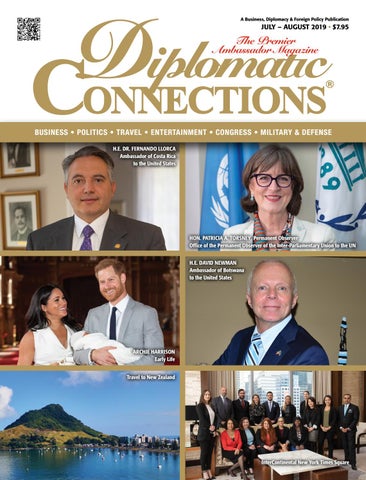
BUSINESS • POLITICS • TRAVEL • ENTERTAINMENT • CONGRESS • MILITARY & DEFENSE H.E. DR. FERNANDO LLORCA Ambassador of Costa Rica to the United States
HON. PATRICIA A. TORSNEY, Permanent Observer Office of the Permanent Observer of the Inter-Parliamentary Union to the UN H.E. DAVID NEWMAN Ambassador of Botswana to the United States
ARCHIE HARRISON Early Life Travel to New Zealand
InterContinental New York Times Square
PRESIDENTIAL STYLE. DIPLOMATIC LUXURY. Trust Presidential Luxury Limousine to provide a flawless chauffeur-driven transportation experience. When you need something more exclusive, secure, and reliable, Presidential Luxury Limousine is the only company to call to ensure access to professional, vetted chauffeurs capable of safely transporting VIP passengers in New York, Los Angeles, Miami, London, and in all of the major markets worldwide through our trusted affiliates. We understand the nature of your position requires specific risk management. We’ve been providing transportation for the Diplomatic community for the past 25 years. Look to us for late-model armored vehicles (B4-B8) and late model German and American regular standard vehicles including sedans, SUVs, Mercedes Sprinter vans, and buses capable of accommodating 3 to 56 passengers. Let us transport you. For additional information or a private consultation, call (212) 938-1000 or (855) PLL-6066 or email sales@plimos.com.
presidentialluxurylimo.com
THE NEXT GENERATION OF PRIVATE AVIATION HAS ARRIVED Look to Presidential Airwayz to help you travel smarter, faster, and safer than ever before. As a Diplomat, we realize you have a need for privacy and security, and we can help you experience private jet travel at its best. Presidential Airwayz offers simple, flexible, on-demand travel with no membership fees, upfront costs, or fractional ownership. Receive a quote in 15 minutes and arrange a jet in 3 hours to take you to an important meeting, on a family vacation, or wherever you need to be quickly and efficiently. Go private and leave the hassles of flying commercial, dealing with long security lines, and navigating crowded airports behind. We’re setting a new standard for private jet travel. For additional information or a private consultation, call (212) 606-2FLY or email kb@plimos.com
pairwayz.com
THE QUINTESSENTIAL
New York Stay
The Benjamin Hotel, a New York City Landmark, exudes the ambiance of a Private Club. Originally designed as a residentially-styled, Neo-Romanesque building, The Benjamin was recently re-imagined by famed interior designer Lauren Rottet, and the guest rooms restyled in partnership with acclaimed Sleep Expert in Residence, Dr. Rebecca Robbins. Steps from the United Nations, we invite you to experience The Benjamin. Newsweek – “...making sure guests get a good night’s sleep.”
Sleep program by famed Dr. Rebecca Robbins • Tranquil Day Spa by Sanatio • The National Bar & Dining Rooms by Celebrity Chef Geoffrey Zakarian
125 E A S T 50 T H S T R E E T • N E W Y O R K , N Y 10022 • 866.222.2365 • W W W.T H E B E N J A M I N .C O M
CUSTOMIZE YOUR OWN FOUNDATION FROM 8000 SKIN TONES. BLENDED FOR YOU AT THE LANCÔME COUNTER.
Choose your color, coverage and hydration level.
Ampeer Residences offers fully furnished residences with flexible accommodation terms, from 30 days to 12 months. Perfectly situated in the heart of Historical Dupont Circle, you are steps away from the best that Washington has to offer. Beautifully appointed social spaces are available exclusively to our residents and their guests. Enjoy breakfast in our Social Kitchen and evening hors d’oeuvres in our Grand Ballroom with cocktails crafted by our inhouse Mixologist.
The InterContinental New York Barclay
Where 20th Century Luxury meets 21st Century Intelligence.
Settled in the heart of Manhattan’s most powerful and prestigious district, the newly renovated InterContinental New York Barclay combines sophistication, contemporary design, and long-standing history to create a distinctive modern escape in New York City.
Please visit intercontinentalnybarclay.com
Ana Nistor Director of Specialty Markets and Diplomatic Sales +1 917-940-0323 • ana.nistor@ihg.com Greg Murphy Assistant Director of Specialty Markets +1 917-254-2913 • greg.murphy@ihg.com
From the Publisher
Diplomatic
Dear International Reader: Our primary content is highlighting conversations with ambassadors from around the world, and we have three fascinating interviews for you to read in this magazine. Educated at the highly regarded, internationally known McGill University and subsequently becoming a parliamentarian and venerated multilateral diplomat, meet the Hon. Patricia Torsney, Permanent Observer of the Inter-Parliamentary Union to the United Nations (IPU). Learn about the significant role the IPU serves on the global stage as they unendingly pursue noteworthy efforts “to safeguard peace and drive positive democratic change through political dialogue and concrete action.” Costa Rica’s Ambassador to the United States, Dr. Fernando Llorca, shares the main objectives of his nation’s mission while in Washington with one of those being “to interest the U.S. in Costa Rica’s production of medical devices.” His appointment seems befitting based on that he is a “medical doctor and London trained specialist in health policy and finance.” Llorca explains why their citizens are happy as he details some of the implemented policies that make them proud to call Costa Rica their homeland. Changing topics to another reason this small nation seems to gain international attention is tourism. Traversing through their tropical jungles is on the list of many American globetrotters, tourism still serves as a crucial component of their economic equation with more than 1 million tourists visiting from the U.S. alone last year. If you are thinking about making a trip to this country resplendent with nature’s charm, you can see photos of Costa Rica’s tourism featured from pages 34 to 39. Moving on to Prince Harry’s beloved Botswana. I haven’t been there, but it really must be something! Our next conversation is with the Ambassador of Botswana to the United States, David Newman. He gave up his British citizenship to become a citizen of this beautiful country. He states, “You get Africa in the blood.” Newman started his extraordinary career practicing law, but as fate would have it, he has successfully transitioned into diplomacy representing this country rich in a variety of aspects, one being nature’s dwelling place brimming with bountiful wildlife. Take a virtual safari by viewing the pictures of this majestic destination starting on page 48 and ending on page 59. Speaking of Prince Harry, he and Meghan Markle are cherishing every moment as new parents doting on Archie Harrison or otherwise known as their “bundle of joy.” Shortly thereafter, Lady Gabriella Windsor, one of his relatives, married Thomas Kingston at St George’s Chapel in Windsor Castle. Prince Harry attended without Meghan as she was on maternity leave. View some of the portraits of this royal event from page 86 through 93. Travel to New Zealand with Diplomatic Connections and have a glimpse into what makes this country so enchanting. See aerial views of the beautiful Bay of Islands from a Salt Air Helicopter. Meander through the pictures to see how the old landscape meets the new skyline. Read about how Sir Peter Jackson, the writer, director and producer of the Lord of the Rings has made Wellington a famous place for tourists to visit and how you can take a studio tour. Consider why the Lonely Planet donned Wellington as the “coolest capital in the world.” Diplomatic Connections wishes to formally thank Garine Ferejian-Mayo, Joe Kelly, Matt Tobin, Patty Spencer, Teresa Bryant, Shannon Schneider, Carla Cannonito and Ana Nistor of the InterContinental for cohosting our semi-annual International Diplomat Appreciation Reception TM in New York. Should you have a potential interest in holding your national day reception or UNGA delegation meetings at this splendid property in the middle of the world-renowned Times Square, feel at liberty to contact me directly, and I will personally facilitate a proper introduction. If you would like to have our travel journalist visit your country to have a tourism article featured in a future magazine, send an email to: DParker@DiplomaticConnections.com Our next Diplomatic Connections’ International Diplomat Appreciation ReceptionTM will be held at the newly opened, magnificent Conrad Washington, D.C. on October 24th. Warmest regards, Dawn Parker - DParker@DiplomaticConnections.com Publisher
6
W W W. D I P L O M AT I C C O N N E C T I O N S . C O M
DIPLOMATIC AFFAIRS AT LINE DC INTIMATE 220-ROOM SETTING WITH 19 SUITES ENTRANCE FOR VIPs PRIVATE ROOFTOP TERRACE FOR MEETINGS ABILITY TO SECURE ENTIRE GUEST FLOOR, IDEAL FOR DELEGATION VISITS MONUMENT MASTER SUITE IDEAL FOR SMALL RECEPTION WITH PANORAMIC VIEWS OF DC 24-HOUR ROOM DELIVERY 24-HOUR IN-HOUSE SECURITY DIPLOMATIC RATES INCLUDE DAILY BREAKFAST FOR ONE CAMERON NEZAM BUSINESS TRANSIENT & GROUP SALES MANAGER CNEZAM@THELINEHOTEL.COM
1770 EUCLID WA S H I N G TO N
STREET DC
NW 20009
THELINEHOTEL.COM/DC
THE
SAVE DATE
Diplomatic EDITOR-IN-CHIEF Dawn Parker
October 3, 2019 THE PENINSULA
ASSISTANT JUNIOR EDITOR Annabelle Spezia-Lindner DIRECTOR OF BUSINESS DEVELOPMENT Evan Strianese
Chicago
JUNIOR ACCOUNT EXECUTIVES Peter Han, Zhichao Lyu, Yan Tang
October 24, 2019 CONRAD
DESIGN & CREATIVE Larry Smith Design
Washington, D.C.
November, 2019 location to be announced New York
DIPLOMATIC CORRESPONDENTS and CONTRIBUTING WRITERS Roland Flamini, James Winship, PhD, Michael D. Mosettig and Monica Frim DIPLOMATIC CONNECTIONS WEBSITE DESIGN & DEVELOPMENT IMS (Inquiry Management Systems) 304 Park Avenue South, 11th Floor New York, NY 10010 Marc Highbloom, Vice President marc@ims.ca Maria D’Urso, Project Manager Mariad@ims.ca CONTRIBUTING PHOTOGRAPHY Christophe Avril; Paula Morrison; Monica and John Frim, PhD; Inter-Parliamentary Union to the United Nations; HOC-CDC; Christian Diotte, House of Commons Photo Services
2019
To contact an advertising executive
LOOK FOR OUR INTERNATIONAL DIPLOMAT APPRECIATION RECEPTION in your city.
TM
WWW.DIPLOMATICCONNECTIONS.COM If your embassy, mission or consulate would like to host our next venue for the Diplomatic Connections International Diplomat Appreciation ReceptionTM please email us at: info@DiplomaticConnections.com
8
W W W. D I P L O M AT I C C O N N E C T I O N S . C O M
CALL: 202.536.4810 EMAIL: info@diplomaticconnections.com To order photos from the events go to: www.diplomaticconnections.com Send any name or address changes in writing to: Diplomatic Connections 4410 Massachusetts Avenue / #200 Washington, DC 20016 Diplomatic Connections Business Edition is published bi-monthly. Diplomatic Connections does not endorse any of the goods or services offered herein this publication. Copyright 2019 by Diplomatic Connections All rights reserved. Cover photo credits: H.E. Dr. Fernando Llorca, Ambassador of Costa Rica to the United States, Christophe Avril/Diplomatic Connections; Hon. Patricia Ann Torsney, Permanent Observer, Office of the Permanent Observer of the Inter-Parliamentary Union to the United Nations, Christophe Avril/Diplomatic Connections; Duke and Duchess of Sussex, Dominic Lipinski-WPA Pool/ Getty Images; H.E. David Newman, Ambassador of Botswana to the United States; New Zealand, Monica and John Frim/Diplomatic Connections; InterContinental New York Times Square, Christophe Avril/Diplomatic Connections
EMBRACE THE UNEXPECTED
950 New York Avenue, NW Washington, DC 20001
Centrally located in the heart of Downtown DC, the brand new Conrad Washington, DC combines groundbreaking contemporary design with exquisitely elevated service to offer an experience unlike any other in the nation’s capital. Alina Obgolts Director of Diplomatic Sales, Alina.Obgolts@ConradHotels.com, 202-844-5931 950 New York Avenue, NW, conradwashingtondc.com
was h i n g t o n d c
Diplomatic
D I P L O M AT I C C O N N E C T I O N S BUSINESS EDITION
J U LY – A U G U S T 2 0 1 9
H.E. DR. FERNANDO LLORCA AMBASSADOR OF COSTA RICA TO THE UNITED STATES
HON. PATRICIA A. TORSNEY, PERMANENT OBSERVER OFFICE OF THE PERMANENT OBSERVER OF THE IPU TO THE UNITED NATIONS H.E. DAVID NEWMAN AMBASSADOR OF BOTSWANA TO THE UNITED STATES
ARCHIE HARRISON EARLY LIFE
TRAVEL TO NEW ZEALAND
INTERCONTINENTAL NEW YORK TIMES SQUARE
APARTMENTS, CONDOMINIUMS and HOUSING APARTMENTS AMPEER DUPONT CIRCLE Luxury Residences . . . . . . . . . . . . . . . 4 [The] Beekman Tower . . . . . . . . . . . . .45 COMMUNICATIONS/TECHNOLOGY E-TEL now Comstar Technologies . . . . . . .46 CONFECTIONS GODIVA . . . . . . . . . . . . . . . . . . . .77 HEALTH & BEAUTY Vaseline . . . . . . . . . . . . . . . . . . . 71 HOSPITALS & MEDICAL CENTERS Cleveland Clinic . . . 96 & INSIDE BACK COVER HOTELS, DINING and ACCOMMODATIONS aka White House Washington, D.C. . . . . . . .85 [The] BENJAMIN New York . . . . . . . . . . . 2 [The] Concordia Hotel . . . . . . . . . . 54 & 55 CONRAD Washington, D.C. . . . . . . . . . . . 9 [The] Dupont Circle Hotel Doyle Collection, Washington, D.C. . . . . . . . . . . . . . . .41 EQUINOX HOTELS - Hudson Yards, NYC . . BACK COVER EVEN Hotels Midtown East New York . . . . . .38 [The] Fairfax at Embassy Row . . . . . . . . .25 Fairmont Washington, D.C. – Georgetown . . . 94 InterContinental Cleveland Clinic . . . . . . . .96 InterContinental New York Barclay . . . . . . . 5 InterContinental New York Times Square . . . .80 Kimpton Hotels & Restaurants . . . . . . . . .39 [The] LINE DC . . . . . . . . . . . . . . . . . 7 Lotte New York Palace . . . . . . . . . . . . .47 The Mayflower Hotel . . . . . . . . . . . . . 11 TRANSPORTATION – CARS (Leasing & Purchasing), LIMOUSINES & JETS Admiral Leasing . . . . . . . . . . . . . . . .24 BMW of Rockville . . . . . . . . . . . . . . .95 Presidential Airwayz . . . . . . . . . . . . . . 1 Presidential Luxury Limousines . . INSIDE FRONT COVER
TO CONTACT AN ADVERTISING EXECUTIVE
CALL: 202.536.4810 EMAIL: info@diplomaticconnections.com 10
W W W. D I P L O M AT I C C O N N E C T I O N S . C O M
F EAT URED ARTIC L ES AMBASSADORS to the UNITED STATES in Washington, D.C. BOTSWANA Ambassador David Newman . . . . 42 COSTA RICA Ambassador Dr. Fernando Llorca . . 26 PERMANENT OBSERVER of the Inter-Parliamentary Union to the UN The Honorable Patricia Ann Torsney 12 DIPLOMATIC CONNECTIONS INTERNATIONAL DIPLOMAT APPRECIATION RECEPTION in NEW YORK . . . . . . . . . . . . . 72 ROYALS in the news . . . . . . . . . . . . . 82 TRAVEL New Zealand . . . . . . . . . . . . 60
Exactly Like Nothing Else A vibrant social hub in the nation’s capital since 1925, our historic hotel features updated premium rooms and suites filled with luxury amenities and impeccable service. Allow our comfortable accommodations and convenient location to set the stage for a remarkable Washington, D.C., experience. L E A R N M O R E B Y V I S I T I N G M A R R I O T T. C O M / W A S A K
T H E M AY F L O W E R H O T E L . C O M
T H E M AY F L O W E R D C Š2018 9 Marriott International, Inc. All Rights Reserved.
T H E M AY F L O W E R H O T E L D C
Hon. Patricia A.Torsney Permanent Observer Permanent Observer of the Inter-Parliamentary Union to the United Nations James A. Winship, Ph.D.
The Honorable Patricia Ann “Paddy” Torsney is a Canadian politician and former member of the Canadian Parliament who has become a multilateral diplomat as the Permanent Observer of the Inter-Parliamentary Union at the United Nations in New York City. Her parents and sister emigrated from Ireland to Canada in 1957. Hon. Torsney was born a Canadian citizen in Burlington, Ontario, Canada and educated at McGill University in Montreal, Quebec. Canadian citizen, parliamentarian and multilateral diplomat though she may be, inside Paddy Torsney beats the heart of a grassroots politician and a lover of Irish “craic,” the art of conversation that moves back and forth between information, humor and political discourse. That grassroots identity served Ms. Torsney well as an MP representing all the voters in her home district – the riding of Burlington – for over twelve years, as Parliamentary Secretary to the Minister of the Environment and later to the Minister of International Inter-Parliamentary Union Cooperation, and as President of the For democracy. For everyone. Canadian Group of the Inter-Parliamentary Union. Strikingly, her maiden (first) speech before the Canadian House of Commons on March 9, 1994 not only described her political philosophy but also foreshadowed her multilateral career. “There is an amazing difference," she noted, “between the communities we represent as well as within these communities. I think our society can only be enriched by such diversity. We are not divided by our differences but by our silences.” Those words addressed to her Canadian counterparts at the time are equally fitting for the work of the Inter-Parliamentary Union, which describes itself as “the global organization of national parliaments [working] to safeguard peace and drive positive democratic change through political dialogue and concrete action.” Today, the IPU – based in Geneva, Switzerland – has 179 Member Parliaments and 12 Associate Members, representing regional parliamentary bodies like the European Union. Its Secretary General is Martin Chungong of Cameroon. The organization shares many of the goals of the United Nations and works closely with it. Because it is national parliaments that are represented at the IPU, those delegations should represent the various parties and points of view of their members, including 12
W W W. D I P L O M AT I C C O N N E C T I O N S . C O M
HON. PATRICIA A. TORSNEY Permanent Observer Office of the Permanent Observer of the IPU to the United Nations
D I P L O M A T I C C O N N E C T I O N S B U S I N E S S E D I T I O N | J U LY - A U G U S T
2019
13
balance of power, the appearance of several new nationstates, and the weakening of old empires emerged a German centered dynamic balancing effort shaped around the statesmanship of a single personality, Prussian Chancellor Otto von Bismarck. While 19th century Europe managed to escape major warfare for an extended period of time, partly because leading states were distracted by extending their global colonial reach, it was nevertheless the case that there were frequent skirmishes on the fringes of empire that threatened to expand into more severe conflicts. Britain, France, Prussia and Russia along with the Ottoman Empire became the leading powers of the age, coexisting and competing in a series of shifting alliances whereby each kept the others from achieving dominance. Bismarck’s calculus of economic industrialization coupled with confrontation culminated in the Franco-Prussian War in 1870, which left France defeated and a consolidated German state shaping the heart of Europe. IPU Standing Committee on UN Affairs meeting 140th Assembly in Doha, Qatar, April 9, 2019.
14
W W W. D I P L O M AT I C C O N N E C T I O N S . C O M
The European stability that emerged, however, was very much Bismarck’s handiwork, dependent on his personality and diplomatic finesse. The militarization of industrial development on land and at sea that accompanied Germany’s rise produced a continuing concern about the destructive potential of interstate conflicts that was paralleled by the search for new forms of pacific settlement of disputes before they reached the critical mass that might end in warfare. This effort resulted in the founding of the InterParliamentary Union, a mechanism whereby members of various national parliaments could talk to each other directly rather than through their national governments. Founded in 1889 by British parliamentarian Randal Cremer and French parliamentarian Frédéric Passy, the IPU is today the world’s longest standing multilateral political organization. The organization’s earliest efforts resulted in the creation of the International Court of Arbitration in 1899, which would become a model for subsequent international courts and the development of international law. IPU would later be instrumental in the development of the League of Nations.
©IPU/J Sheakoski
appropriate respect to gender and youth. “By bringing parliaments together,” insists the IPU, “we bring people together.” And, in fact, more than 6.5 billion of the world’s 7 billion people live in states whose parliaments are members of the IPU. In many ways, the story of the Inter-Parliamentary Union – celebrating its 130th anniversary in 2019 – offers a lesson in modern diplomatic history and the development of multilateral diplomacy. Out of the turmoil of post-Napoleonic Europe, various attempts at establishing and maintaining a stable
Following the political trauma of World War I, the IPU refocused its efforts on creating a safe political space where parliamentarians from across the globe can meet, discuss issues and learn from each other. Today, IPU’s goal of finding negotiated resolutions to political problems has been expanded to include broad remits in areas such as human rights, sustainable development, gender equality, youth inclusion, and global governance with special emphasis on protecting the rights of parliamentarians. Paddy Torsney kindly made time in her busy and peripatetic international schedule to speak with Diplomatic Connections at her New York office, just across the street from the United Nations headquarters and very much in the swirl of United Nations activity. Diplomatic Connections: Normally, diplomacy is thought of as occurring between governments — executive-to-executive, foreign ministry-to-foreign ministry, but the IPU employs a term of art to describe its work — “parliamentary diplomacy.” Explain for us what is meant by that formulation. Hon. Paddy Torsney: The term really covers several related meanings. First, it is the ability for parliamentarians to talk to each other in order to represent their people’s points of
view and to form personal relationships that will facilitate communication. Often there are critical cross-border issues, or more information is needed, or there is legislation in one country that might be usefully considered in another country. It is an opportunity to build relationships and to work on shared or complementary issues. Second, while in most diplomacy it is one part of a country’s populace speaking—generally the voice of the executive branch represents one political party or a majority coalition of parties—in the IPU’s format we make a conscious effort to have representatives from all parties in a country’s legislature in the delegations to our assemblies. That effort provides a better sense of how issues are unfolding and a more localized insight into the range of public feeling. IPU represents an opportunity to say, “Let’s work with each other. Let’s see what the commonalities might be.” When we look at the big world issues right now, there is a need for people to work multilaterally – on climate change, on migration, on a wide variety of issues. Parliamentarians often understand their shared experience quite differently than does the executive authority of their country. Diplomatic Connections: Could you offer some concrete examples of how that kind of inter-parliamentary communication works in practice? Hon. Paddy Torsney: In the Cold War years, for instance, communication between East and West
D I P L O M A T I C C O N N E C T I O N S B U S I N E S S E D I T I O N | J U LY - A U G U S T
2019
15
Representatives from the two Koreas came together in 2017 and started a discussion well before the executive branches and heads of state had their meetings last year. Diplomatic Connections: Is any parliamentarian from any place in the world welcome at your meetings, or are there official memberships in the IPU as a parliamentarian? Hon. Paddy Torsney: IPU has 179 member parliaments. Those parliaments choose to send delegates to our meetings and assemblies, which are like conventions, and to our training programs. Each country’s parliament has its own system for IPU Parliamentary meeting: The Honorable Patricia Torsney speaking at the Commission on the Status of Women, United Nations Headquarters in New York, March 13, 2019.
ŠIPU/J Sheakoski
was difficult and often fraught with emotion. It was nevertheless the case that parliamentarians were talking to each other across the Iron Curtain and across ideological divides. They were discovering where opportunities for cooperation and agreement might be. Most recently, the IPU has been working in Korea where the government authorities - South and North - have often been at loggerheads.
selecting members of its IPU delegation. Often it is the Speaker of the parliament who chooses the delegation. But, there is an obligation under IPU’s rules to make sure that different political parties are represented and to make sure that they have women and young people represented among their delegates. Diplomatic Connections: Are there standards that a parliament must meet before it can consider
16
W W W. D I P L O M AT I C C O N N E C T I O N S . C O M
IPU Parliamentary meeting: Hon. Torsney, a member of the panel, at the Commission on the Status of Women, United Nations Headquarters in New York, March 14, 2019. IPU Parliamentary meeting: Julie Ballington, UN Women and Hon. Torsney holding a side conference.
Guests were encouraged to ask questions.
D I P L O M A T I C C O N N E C T I O N S B U S I N E S S E D I T I O N | J U LY - A U G U S T
2019
17
recommendation that all members include women and men in their parliaments. Each year, we monitor and report on women’s participation in each parliament in the world.
membership in the IPU? Parliaments, after all, are quite different in various places around the world. Hon. Paddy Torsney: IPU does have a variety of parliaments represented. Some of these bodies are appointed. Some are elected and elected under many different systems. But, if the parliament and such legislative bodies go by many different names and are possessed of widely varying powers — is recognized as the national legislative body of a recognized nation-state, then it is eligible to join and participate in the Inter-Parliamentary Union. There are conditions, however. It is our strong
18
W W W. D I P L O M AT I C C O N N E C T I O N S . C O M
Hon. Paddy Torsney: These parliamentarians actually are directly in the policymaking line. They are involved in recommending policy directions and in shaping policy going into their next election campaigns. They are making policy in terms of the laws they propose, the legislation they pass and the budgets they approve. While parliaments may not have the final say in adopting laws for their country, they are nonetheless “lawmakers” by definition. Through our process these parliamentarians from different countries and systems are discovering and understanding more deeply some of the possible legislative options available to them. Our goal is, among other things, to offer a means for studying and learning from “best practices” around the globe. Here in New York and in Geneva my colleagues and I work on inserting parliamentary perspectives into the United Nations processes with the goal of helping to make better policy at the multilateral level. We also work to help parliamentarians understand what their executive
©Inter-Parliamentary Union
IPU Committee on UN Affairs: Hon. Torsney, a member of the panel, at the IPU 138th Assembly in Geneva, Switzerland, March 27, 2018.
Diplomatic Connections: How does the IPU function with such a varied and widely dispersed membership? There is a cross-fertilization of ideas going on between parliamentarians involved in the IPU’s activities, but how do these parliamentarians relate back to their specific central governments?
and the United Nations leadership, is committing to—how they can contribute to these discussions, and also ensure commitments are honored.
practices, and develop their own parliament’s plan to help implement the goals. IPU’s goal is to help parliamentarians be an effective part of the solution.
Diplomatic Connections: That is the theory underlying IPU’s work at the UN. Could you offer an example of how this works in practice?
Diplomatic Connections: Might we move momentarily into a discussion of your own career and background? How does a Canadian woman end up in her country’s parliament? What led you from parliament to this kind of a position where you are dealing with parliaments and parliamentarians from all over the world?
Hon. Paddy Torsney: The Millennium Development Goals (MDGs) offered a great example of how this can work. One goal was to get more girls to school, but how to make that happen? Parliament may need a piece of legislation that says girls must go to school. But, it is also necessary to appropriate a budget to hire additional teachers and to build additional schools. That is the work that parliamentarians do. They need to hold their government accountable for fulfilling the commitments made in international agreements. Diplomatic Connections: That has been particularly the case with Convention on the Elimination of all Forms of Discrimination Against Women (CEDAW). Once that convention is signed by a government, then the effort has to refocus on getting the provisions of that agreement enacted into national law and enforced by that country’s legal system and law enforcement agencies. Hon. Paddy Torsney: That is exactly right. In the Millennial Development Goals it became clear that about five years of potential progress was lost because parliamentarians were not deeply involved. Efforts have been made to avoid that error with the Sustainable Development Goals (SDGs). There were two years of dialogue in advance of adopting the SDGs, and parliamentarians as well as the IPU were part of those consultations. We participated in shaping what the goals would be. IPU is running a series of parliamentary seminars on the SDGs implementation around the world. We are producing handbooks and toolkits for parliamentarians to help them understand their government’s obligations, to share best
Hon. Paddy Torsney: I have always believed that there need to be more women and young people in parliament. In 1992, I was thinking about what was next in my life, and I decided to run for office out of concern that we needed a more effective parliament that included young people and women, one that would make a greater difference for Canadians. Being an MP was an amazing opportunity, and I encourage young women particularly to run for office. To serve your community and your country as a parliamentarian is a remarkable experience. Diplomatic Connections: How did you first encounter the IPU? Hon. Paddy Torsney: Within four months of becoming an MP I was sent to my first IPU meeting in Paris in 1994. There I got to speak about the environment and to start networking with parliamentarians from around the world. Then, in 1998, Canadian MPs engaged even more
D I P L O M A T I C C O N N E C T I O N S B U S I N E S S E D I T I O N | J U LY - A U G U S T
2019
19
energetically with the IPU because we used our presence to encourage support for the land mines treaty. The Canadian group looked to the IPU as a vehicle to engage with parliamentarians from all over the world. IPU represented a sort of diplomatic one-stop shopping situation for us as we sought to gain support and have ratificated what a year later (1999) would become the “Convention on the Prohibition of the Use, Stockpiling, Production and Transfer of Anti-Personnel Mines and on their Destruction,” known as the “Ottawa Treaty.” Today that convention has 164 states parties, though some of the largest states are missing from that list. I was eventually elected president of the Canadian group of the IPU. I was on the steering committee of the IPU, EU, World Trade Organization group within the IPU where we had yearly meetings. When I left parliament in 2006, I was doing work in government relations when I saw an opportunity to come here to New York with the IPU. Working for the IPU in a staff role has given me the opportunity to devote myself to building bridges between parliaments across sometimes divisive issues that I find very rewarding. Diplomatic Connections: What is the relationship between the United Nations and the IPU? What does it mean to be a “Permanent Observer” at the United Nations? Ambassadors at the United Nations are formally the “Permanent Representative” of their country, but what does “Permanent Observer” status confer?
Hon. Paddy Torsney: All of the member States have to agree to grant an organization Permanent Observer status. Permanent Observers have a right to speak at all official meetings but the main difference is that, unlike Member States, they do not participate in negotiations. In practical terms, after the member States have had a chance to speak, the Permanent Observers also have a chance to speak. We have rights to listen in and participate in most UN meetings, and we can circulate IPU documents at the UN. We have a special relationship with the United Nations bodies and all the associated UN agencies. IPU was granted Permanent Observer status in 2002, in light of its unique inter-state character. The United Nations has done a great deal of work over the last several years to engage more directly with business and civil society organizations. It took some time, but now the UN is beginning to recognize that parliamentarians are a critical link in the response of national governments to UN-sponsored initiatives. It is also true that parliamentarians do not remain in office forever. But, when you have the institution of parliament involved then you have some continuity. Governments may change stripes, but you have a core group of people who continue working on and following through on the legislation needed to respond to multilateral initiatives and commitments.
©Inter-Parliamentary Union
IPU 137th Assembly in St. Petersburg, Russia.
20
W W W. D I P L O M AT I C C O N N E C T I O N S . C O M
Diplomatic Connections: IPU holds something called “parliamentary hearings” here in New York once a year in conjunction with the President of the General Assembly (PGA). How do these hearings relate to the broader work of the UN? Hon. Paddy Torsney: What we try to do is to have input on important issues that reflect what is happening within the formal UN institutions. Our goal is always to bring parliamentarians together to share ideas and to insert them into the UN institutional framework. We carefully link these hearings to the main processes of the UN. This year there has been a great deal of concern about what is happening to multilateralism, so we did a special hearing on that. We’ve also done hearings on migration, drugs, climate change and on the SDGs several times, with the aim of bringing a parliamentary contribution to the global talks on these issues. The report of the meeting is circulated by the PGA as an official document. Diplomatic Connections: One of the primary emphases of IPU is encouraging greater numbers of women serving in parliament. What is the process and how has IPU tried to advance that concern? Hon. Paddy Torsney: There are several different ways. Most basically, we started tracking the data. For over 20 years we have produced a map together with UN Women that graphically depicts the number of women in each country’s parliament. Every year we do an analysis of all the national parliamentary elections that have taken place
in the previous year. That allows us to see where women MPs have made gains and where they have suffered loses. It helps us ascertain what policies or practices are working and which ones are not working. IPU believes strongly that parliaments need to be representative of their people. That means that when 50% of the population are women, sometimes more, women need to be part of your parliament and of your IPU delegation. From my personal perspective, when you have difficult problems to solve you need more ideas, not fewer ideas. Having people of diverse backgrounds with various experiences and different genders represented gives you a much better quality of discussion and a greater scope of ideas from which to generate solutions. Diplomatic Connections: In recent years the world has seen a rise in virulent strains of nationalism that go far beyond national pride and national interest to something that is much more conflictual. That nationalism seems to be competing very directly with what has always been at the heart of IPU, the commitment to multilateralism and communication across boundaries. How has IPU tried to step into that issue? Hon. Paddy Torsney: IPU sees its role as trying to overcome barriers and bridge divides. We try to bring people together in order that they might see each other as human beings who share many of the same goals and values, though these may be expressed in quite varied and sometimes apparently conflicting ways. Our hope is always to find a base of commonalities upon which deeper understanding can be built. IPU does
D I P L O M A T I C C O N N E C T I O N S B U S I N E S S E D I T I O N | J U LY - A U G U S T
2019
21
not deny the reality of disagreement that can sometimes spill over into conflict and violence. But, we try to separate fact from fiction with the goal of sharing an agreed upon set of facts. That, in itself, is no easy accomplishment. An agreed set of facts is the critical basis for understanding and any meaningful negotiation. Then, IPU seeks to show people that there are different ways to approach problems and to share previous efforts that have been made, with varying degrees of success, to solve similar problems in other parts of the world. Sometimes we bring in guest speakers who have grappled with similar issues. IPU brought in an amazing young man to speak to the young parliamentarians. That was Tareq Hadhad, himself a refugee from Syria and with his family an immigrant to Canada. He talked about his family’s experience and how they are now established in Nova Scotia and recreating their family business as chocolatiers. Their company is called “Peace by Chocolate.” It is an amazing story. He reminded his audience that, “No one chooses where they are born.” He spoke directly to the
Fourth IPU Global Conference of Young Parliamentarians in Ottawa.
22
W W W. D I P L O M AT I C C O N N E C T I O N S . C O M
parliamentarians saying: “You did not choose. I did not choose. Let’s make sure that we are working to understand our basic human rights and our human needs.” Diplomatic Connections: Imagine for a moment that you are the guest lecturer at the Canadian Foreign Service Training Institute or anywhere in the world. You have this parliamentary experience—in what IPU rightly terms “parliamentary diplomacy.” You are training young diplomats. What would you want them to know about interacting with parliamentarians wherever their assignments might be? Hon. Paddy Torsney: I’ve actually done that. If a diplomat wants to highlight an issue or bring greater public awareness to a specific matter, work with the parliamentarians. They are deeply involved with civil society and often offer the clearest most sensitive bridge to grassroots people and public opinion. Parliamentarians have managed to get themselves elected, and they often have built-in networks back in their constituencies that can help unpack the human impact of particular concerns. They can be very effective in amplifying an issue and in helping find the solutions.
Christian Diotte, House of Commons Photo Services
Panel discussion during the Fourth IPU Global Conference of Young Parliamentarians in Ottawa. Hon. Torsney, Tareq Hadhad as well as Paul Heinbecker, Former Canadian Ambassador and Permanent Representative to the UN were on the committee.
Parliamentarians immerse themselves into society in ways that diplomats rarely get to do. Engage parliamentarians in conversation. Utilize the information they are willing to share as lessons that can be learned to advance your (shared) goals. Diplomatic Connections: Now that you have been here in New York, you have seen the operation of the IPU and how it interacts with the United Nations. You have the Permanent Observer status that allows you to track the work of UN institutions and agencies closely and sometimes offers a voice in UN discussions. What would be the one thing you wish you could change? Hon. Paddy Torsney: One of the things that is tough here at the United Nations is the set speeches where often people are not listening to each other. The UN is working on different models of communication that go beyond the formalities of foreign ministry drafted statements in some of the more engaging meetings. In a recent meeting on universal health care questions were put up on an internet site, and people were asked to vote on them using their cell phones or tablets. The questions with the highest votes were pursued in plenary. This is a way of being more interactive and of allowing multiple voices to be heard simultaneously. The meeting organizers also had panelists put away their formal notes and staged moderated discussions with time limits, summaries and questions back
and forth. The net effect was much more engaging than a procession of pro forma statements. That is exactly what IPU tries to do at our meetings. We try to facilitate meaningful discussion and interactions that go beyond the official government line. "Tell us what you think. Listen to each other." That makes for good debate, better discussion, more exciting idea generation and deeper learning. Diplomatic Connections: That makes a perfect place to bring this interview to a close. Thank you for your political insights and your multilateral experience with the Inter-Parliamentary Union. Your real world experience truly does provide a bridge between two worlds – national politics and international diplomacy. ■Tareq Hadhad, a refugee from Syria, speaking at the Fourth IPU Global Conference of Young Parliamentarians in Ottawa. Hadhad shared his story about the arduous journey he and his family ventured on to get from Syria to Nova Scotia with the help of some magnanimous sponsors. He gave a heartfelt, poignant speech about the challenges they faced along the way. Moreover, giving the sweet taste of chocolate a whole new meaning as he described transferring the knowledge of their family business, Peace by Chocolate, from Syria to Canada.
D I P L O M A T I C C O N N E C T I O N S B U S I N E S S E D I T I O N | J U LY - A U G U S T
2019
23
E M B A S S Y R O W, D. C .
Life Is No Longer One Dimensional You’re invited to visit our NEWLY renovated space
E M B A S S Y R O W, D. C .
· American small plates and cocktail-centric menu · Dinner served 5PM to 10PM. Bar open to Midnight. · Sign up at www.thesallydc.com
E M B A S S Y R O W, D. C .
· Grab & Go or Sit & Sip for breakfast, lunch, or lite fare and beverages in the evening · Breakfast and/or Swing’s coffee 6AM. Lunch at 11AM. Service until 10PM
· Relax by the fireplace and unwind, read a book, work on your computer, play a game
Join us where Classic Elegance Meets Modern 2100 Massachusetts Avenue, NW | Washington, D.C. 20008 (202) 293-2100 | www.fairfaxwashingtondc.com
How to Stay Peaceful and Democratic in Today’s Political Climate A Conversation with the Ambassador of Costa Rica to the United States, Dr. Fernando Llorca Roland Flamini
Costa Rica has always danced to a different tune than the rest of the Hemisphere. In 1949, when Latin American countries were typically run by military juntas, Costa Rica voted to abolish its army, and instead spend its money on a social program of free public health care and education that remains unique in the region. At the time, Costa Rica was the only Latin American nation with a democratically elected government. For years, foreign tourists have flocked to the country for its serene beaches, lush wildlife, and lively cities – over 1 million of them U.S. citizens in 2018, according to the U.S. State Department, of whom 120,000 are permanent residents. Part of Costa Rica’s attraction is continued good care of its ecological birthright. According to press reports, President Carlos Alvarado has proposed banning fossil fuels to make Costa Rica the first de-carbonized country in the world. Not that the silver lining doesn’t have a few clouds, as Fernando Llorca, Costa Rica’s ambassador explained in a recent one-on-one interview with Diplomatic Connections. The need for revenue to finance his country’s social welfare programs is constant, and the new center-left government, the country’s first coalition, recently passed a long needed tax reform bill to combat chronic tax evasion and make other changes in the financial system. Ambassador Llorca, a medical doctor and London trained specialist in health policy and finance, says part of his mission is to interest the U.S. in Costa Rica’s production of medical devices and the high quality, as well as affordable (by U.S. standards), health care sector.
is 11.7 per 100,000 inhabitants in the country (the worldwide average is 5.3). Currently the government is – with U.S. help – retraining the country’s police to a higher standard to tackle rising crime. Reversing the 1949 decision on the army is not considered an option, says the ambassador. The other perennial problem is the influx across its open borders of refugees from less stable neighbors, such as Nicaragua, and Panama, and more recently Venezuela. Numerous Nicaraguans
Costa Rica The lack of a military has encouraged organized crime and drug trafficking and, the homicide rate
26
W W W. D I P L O M AT I C C O N N E C T I O N S . C O M
from earlier conflicts were assimilated into Costa Rican society, but there are new arrivals. The ambassador’s main worry, however, is a major Venezuelan influx if the crisis there is not resolved. Diplomatic Connections: You have a medical background, including holding the cabinet post of minister of health. What led to your appointment as your
H.E. DR. FERNANDO LLORCA Ambassador of Costa Rica to the United States
D I P L O M A T I C C O N N E C T I O N S B U S I N E S S E D I T I O N | J U LY - A U G U S T
2019
27
country’s ambassador to Washington? Ambassador Llorca: Costa Rica is seeing more investment in the production of medical devices. That’s a very strong export sector and we want to continue that line. One of the questions I’m frequently asked in the six months that I’ve been here is why Costa Rica doesn’t produce the caravans (of immigrants) like other Central American countries. And the main answer is that in the past we developed strong social welfare policies and our citizens are happy in their own land. Diplomatic Connections: Your own professional background includes periods in London, where you attended the London School of Economics, and then Madrid. Ambassador Llorca: Exactly. I trained as a medical practitioner in Costa Rica, but then I studied health policy and financing at the London School of Economics and the London School of Hygiene and Tropical Medicine. Diplomatic Connections: And you actually worked for the British National Health service. Ambassador Llorca: My wife and I lived in London for about four years, where I worked as a medical practitioner, and for the Department of Work and Pensions, not the National Health, as an analyst. I would determine whether specific pensioners were entitled to certain benefits offered by the British Government. Diplomatic Connections: Your official biography, issued by the
embassy, states that because of “your experience in developing social and health policy, financing health care services and insurance options” you intend to “apply your knowledge” in your role as ambassador. Could you expand on this, please? Ambassador Llorca: One of the main problems that all societies have is how to finance the health care that we need almost everywhere. In Costa Rica, we have developed a universal-coverage health care system, which is primarily public, but also has a private sector. However, we need to improve the way we finance it, and definitely one way would be to export health care services to some other countries. Costa Rica is very efficient, and we offer high quality services to our patients. We believe we could offer it to some other countries, including the U.S., and maybe American insurance companies could explore its possibilities. Diplomatic Connections: Is that happening already? Ambassador Llorca: In some specific areas, yes, like aesthetic dental services, but we would like to expand that for the rest of the health care field. Diplomatic Connections: That’s an unusual priority for an ambassador, is it not? Ambassador Llorca: My experience is not only dealing with health care. I used to lead huge multilateral programs with the World Bank, for example, and the Inter-American Development Bank. These were mainly social programs, so
UN Photos/Laura Escobar Pérez
U.N. Secretary-General António Guterres and Carlos Alvarado Quesada, President of the Republic of Costa Rica, visit the Buenaventura Corrales School in San Jose, Costa Rica.
28
W W W. D I P L O M AT I C C O N N E C T I O N S . C O M
U.N. Secretary General António Guterres (back row, right), Carlos Alvarado Quesada (back row, center), President of the Republic of Costa Rica, and Claudia Dobles Camargo (back row, left), First Lady of Costa Rica, pose for a photo with students at the Buenaventura Corrales School in San Jose.
I’m familiar with multilateral cooperation projects, and to improve the bilateral cooperation in that field. For example, I used to promote bio-medical research in Costa Rica, and that’s an opportunity we have to cooperate with such organizations as the National Institute of Health in the U.S. We contributed substantially to the development of some vaccines actually being used in the rest of the world. We believe that Costa Rica is in a position to develop products together with well-recognized health institutions in the United States. So that’s another field that we are also trying to develop. Tourism, of course, continues to be promoted – more than 1 million tourists are received from the United
States per year, and building that up is a priority. Great attempts are made to promote some traditional products too, like bananas. Exporting coffee in a different way is one of our goals as well. We don’t want to be the cheapest coffee; our objective is world recognition as the highest quality coffee. Diplomatic Connections: Would you describe Costa Rica as a welfare state? Ambassador Llorca: I would say we are recognized as a regional leader in that area. Strong institutions have been developed, our social security system recently marked 77 years of activity, and the ministry of health is 90 years old.
U.N. Secretary General António Guterres (back row, center) poses with Alice H. Shackelford (third from left), UN Resident Coordinator for Costa Rica, and other UN staff members, during his visit to the country last year.
D I P L O M A T I C C O N N E C T I O N S B U S I N E S S E D I T I O N | J U LY - A U G U S T
2019
29
A nutritional program has been maintained for children throughout the whole country for 66 years, yet we still confront the problem of child obesity. To answer your question — yes, ours is a strong welfare state. Diplomatic Connections: How does that compare with the Scandinavian welfare states? Ambassador Llorca: The fundamental difference is that European countries are rich, so they can afford to support better welfare programs. Costa Rica manages its welfare programs with a limited amount of resources, but maintains a good cost-benefit relationship. Diplomatic Connections: Costa Ricans justifiably boast of the quality of life in their country, with its free public health care and
Ezequiel Becerra/AFP/Getty Images
Pharmacy students at the University of Costa Rica. Five students developed a sun screen using a combination of natural ingredients that doesn't pollute the ocean.
30
W W W. D I P L O M AT I C C O N N E C T I O N S . C O M
education systems, life expectancy higher than it is in the U.S., and a renowned ecological footprint. So where’s the reality check in this description? What remaining problems are there left to be solved? Ambassador Llorca: Quite a few still require attention. For example, plastic, which is actually affecting the sea, our rivers and lakes. That is something that we’re trying to deal with and we haven’t yet been able to solve the problem. Diplomatic Connections: But so does everybody. Ambassador Llorca: Yes, it’s a huge international problem and its damaging our oceans. There’s something that a good ambassador should be doing, sharing his country’s experience while seeking bilateral and international cooperation. Diplomatic Connections: Do you also have a water shortage problem? Ambassador Llorca: Historically, water was thought of as an unlimited resource; now we recognize that it is not. It’s something we have to take care of, definitely, to regulate and protect our water sources. Diplomatic Connections: There’s an OECD report from 2018 that says the government needs to prioritize dealing with what it calls labor market informalities, and the need to add more women to the workforce. Ambassador Llorca: Yes, that report shows some of the issues we are experiencing in Costa Rica, such as the informal labor market, mainly among young people, and also the shortage of working women, both of which are not good. We developed some projects, such as a special insurance for entrepreneurs—and you will find that most of those entrepreneurs are women and young people. We are also trying to guarantee health care and insurance for people who are at high school, university, and in technical schools, because it is understood that improvements are necessary concerning the capability of our human resources. We want to become a bilingual society (Spanish and English). Great efforts continue to be made towards training teachers to higher levels, but none of these projects are easy, and will take several years to reach our target. Diplomatic Connections: You have been minister of health, but are you a politician, have you ever stood for election? Ambassador Llorca: No. I started as deputy minister of health and then I became minister. I would say I’m a technocrat in the health care and social development fields.
Diplomatic Connections: Does Costa Rica have a centrist government? Ambassador Llorca: Costa Rica has been recognized as a politically stable country. The main parties are the Social Democrats, but the Christian Democrats are also a huge party, well organized. At the moment, we have our first coalition government, and it is center-left. But in the past we’ve had different political parties running for government, including with religious support. But the main parties are the Social Democrats and the Christian Democrats, with smaller parties including the Liberals and also some Communists. Diplomatic Connections: Would that be the Cuban influence? Ambassador Llorca: I wouldn’t say Cuban influence, although we do have some Communists. Their showing in elections is small. Right now, we have a coalition led by our president, Carlos Alvarado, who also studied abroad (in the United Kingdom). He realized that a coalition was needed to be able to face all the current challenges. For example, we used to have a huge fiscal problem, and President Alvarado introduced a new fiscal (tax reform) law. Because it was supported by the coalition, it was approved in a very short period of time. We’ve been waiting for it for 20 years. He was able to unlock the situation. Diplomatic Connections: Your economy isn’t doing badly, though. The growth rate is – what, 3.7 percent? Ambassador Llorca: Well, 3.6 percent. Our exports picture is healthy; for instance, medical devices have become a strong part of that sector. At the same time, we spend a lot. We have a huge government, and one of our main missions is to reduce spending as much as possible. This new tax reform will increase revenue somewhat, but mainly the way we implement the taxation has changed. Some tools will be introduced that will assist us with the whole process, and of course, at the end, the goal is to improve the way taxes are collected. Diplomatic Connections: In other words, tax evasion is going to be reduced. Ambassador Llorca: Yes, but we’re also going to reduce the fiscal problem that we have. Diplomatic Connections: How does Costa Rica, a stable country, manage to survive in your insecure and unpredictable neighborhood? Ambassador Llorca: Good question. We recognize that the region is very dynamic, let’s say, with changes taking place
D I P L O M A T I C C O N N E C T I O N S B U S I N E S S E D I T I O N | J U LY - A U G U S T
2019
31
Kike Calvo/uig via Getty Images
Banana bunches hanging from conveyor belt to be processed for shipment.
Edwin Remsberg/vw pics/uig via Getty Images
Green, unroasted coffee beans are piled in burlap sacks and await distribution at a coffee processing plant in Aquires, Costa Rica.
32
W W W. D I P L O M AT I C C O N N E C T I O N S . C O M
View of windmills in Los Santos, San Jose province, Costa Rica. The National Decarbonization Plan presented by Costa Rican President Carlos Alvarado aims at transforming the economy with the basis of an electric matrix of renewable resources by 2050. It aspires to have industry, agriculture and cattle raising operating with non-polluting energy resources, and to increase forest areas to 60% of the national territory, from the current 50%.
in the government of each country. In the past, there were civil wars with not necessarily democratic solutions. Now most of these countries are officially democratic, but with a lot of persisting social problems, and constant changes of government. Costa Rica has tried to remain stable, and to promote the wealth and the economic growth at levels that will keep the population happy and staying at home. We’re not the country with a migration situation: I don’t like to call it a problem because immigration is a phenomenon that is actually all over the world. Costa Rica, for instance, has U.S. citizens living there, and tourism is thriving. Diplomatic Connections: Do you mean U.S. citizens living in retirement? Ambassador Llorca: Retirees as well as young people. It’s one of the most important, colonies let’s say, in Costa Rica. Some have second residences. Diplomatic Connections: Can you make a general observation about what is happening in that part of the world? Ambassador Llorca: Because we abolished the military 70 years ago, it was imperative to develop strong international relationships. That’s the best way that I can explain that we’ve been able to survive in a very dynamic and changing
political environment. Diplomatic Connections: You don’t have a military, so how do you deal with security issues? Ambassador Llorca: That’s one of the most important problems we have. We’re trying to fight organized crime and drug trafficking; this is when not having an army, which is good in some ways, becomes a problem in dealing with security issues. We’ve had to invest a lot in diplomatic activity—and also we resort to international law when we have a specific problem. But we have to recognize that crime has been increasing in Costa Rica, mainly linked with international drug trafficking. We’ve been trying to improve our police forces, training them in a better way, and raising the intelligence capability to face the problem. Diplomatic Connections: If you have a rise in security problems, has this created any public call for the re-introduction of the military? Ambassador Llorca: That debate is already solved in Costa Rica, and there are no second thoughts because we recognize that removing the army was the best decision to be able to invest in health and education. The money that we once spent on the army was what financed our
D I P L O M A T I C C O N N E C T I O N S B U S I N E S S E D I T I O N | J U LY - A U G U S T
2019
33
Wolfgang Kaehler/LightRocket via Getty Images
Tourists white water rafting at Pozo Azul near Virgen de Sarapiqui in Costa Rica.
Rica. All the tools made available to us through the international organizations were utilized, but we ended up at the international court of the Hague, so it became an international issue. Diplomatic Connections: How would you characterize Costa Rica’s relationship with the United States?
Yuri Cortez/AFP/Getty Images
social programs. And, in the end, it is strongly believed that the army doesn’t make the difference when you have an international issue, like the ones that we have had. For example, not too long ago, Nicaragua invaded our territory. We acted through the international community and we were able to win that fight. The Nicaraguans withdrew and the occupied territory returned to Costa
34
W W W. D I P L O M AT I C C O N N E C T I O N S . C O M
residents in Costa Rica. There is a lot of activity in reviewing trade agreements at the moment. A regional trade agreement is successfully maintained with the United States – the Central American Free Trade Agreement (CAFTA) – and we’d like to keep it that way. Diplomatic Connections: Is Costa Rica in any of the hemispheric economic organizations, such as Mercosur?
Ezequiel Becerra/AFP/Getty Images
Jon G. Fuller/vw pics/uig via Getty Images
A man feeds a large crocodile on the banks of the Río Grande in Tarcoles, 110 km southwest of San Jose. In Tarcoles, tourists can embark onto a boat to sail along the river, swarming with crocodiles to see them in their natural habitat, and watch the men who disembark to interact with the huge reptiles that can be up to seven meters long.
Ambassador Llorca: We have agreements, yes. Bilateral agreements with China, Chile, and Mexico are also upheld. There is a regional one with the European Union, and recently we signed an agreement with South Korea. Diplomatic Connections: How big is the Chinese presence in Costa Rica? Ambassador Llorca: Costa Rica was one of the original countries in the region to establish relations with China, more than ten years ago. At the beginning, the relationship was very strong. The
Ambassador Llorca: Costa Rica has a strong relationship with the United States. Many common goals are shared – the fight against drug trafficking in the region, a robust relationship in terms of trade and commerce; the U.S. is our leading foreign trading partner. Also, there are a lot of Costa Ricans in the U.S., and a combination of American tourists and D I P L O M A T I C C O N N E C T I O N S B U S I N E S S E D I T I O N | J U LY - A U G U S T
2019
35
Lucy Cooke/ Barcroft Media via Getty Images
Chinese invested a lot, and developed different projects, mainly infrastructure. There were some good experiences and also some less than happy experiences involving corruption; we recently needed to stop some of those projects. Nevertheless, there have been some successful endeavors. There is the Confucius Institute in Costa Rica. What I’m trying to say is that we still have the relationship with China, but it’s not as strong as it was previously. Mainly, we now have some cultural and academic pursuits that are of interest to both countries. Following the corruption cases, we definitely try to avoid further projects because Costa Rica, along with the United States, is trying to fight corruption. Diplomatic Connections: Is there a Costa Rican diaspora in the United States? San Josecito, Costa Rica: Two doe-eyed sloths learn to climb by scaling and then swinging from the back of a rocking chair. The wildlife rehabilitation center uses a rocking chair to help teach orphaned baby sloths how to climb as the swaying motion is similar to a tree.
Tourists photographing a capuchin monkey sitting on a branch in the rainforest of the Manuel Antonio National Park located at the Pacific coast of Costa Rica.
Ambassador Llorca: There is a group around New Jersey, and others in California. But that’s not the huge numbers like some others from the region, with a significant impact on their economies (from remittances), but not Costa Rica.
Ana Zaragoza Garcia/Contributor
continue to page 40
36
W W W. D I P L O M AT I C C O N N E C T I O N S . C O M
DeAgostini/Getty Images
Suspended forest canopy provides aerial walkway in the jungle, Manuel Antonio National Park, Costa Rica.
Wolfgang Kaehler/LightRocket via Getty Images
Two very colorful Scarlet Macaws, Ara macao, sparring in a tree in Costa Rica.
D I P L O M A T I C C O N N E C T I O N S B U S I N E S S E D I T I O N | J U LY - A U G U S T
2019
37
Book your next stay with us for yourself or your group and keep your good thing going.
EVENâ„¢ HOTELS MIDTOWN EAST
221 East 44th Street New York, New York 10017 P. 212.230.0002 www.evenhotels.com\midtowneastnyc
EVEN Hotels.com
Hector Retamal/AFP/GettyImages
San Juan del Sur beach, 140 km from Managua, Costa Rica.
38
W W W. D I P L O M AT I C C O N N E C T I O N S . C O M
Harald Slauschek/ASAblanca via Getty Images
Diving Adventure into the Dark COCOS ISLAND, COSTA RICA: Mini submarine Deep See diving into the deep of the sea; diving adventure organized by the Undersea Hunter Group.
A DIFFERENT WAY TO STAY At Kimpton, it’s personal. Your stay starts with the most genuine of smiles and ends with a promise to “see you next time.” Because to us, it’s all about making your experience memorable. Discover a different way to stay with our 12 uniquely styled boutique hotels in Washington, DC, Alexandria, VA, and Baltimore, MD. We’ll be waiting for you. Kimpton Mason & Rook Hotel Kimpton Hotel Monaco Washington D.C. Kimpton George Hotel Kimpton Hotel Palomar Washington D.C. Kimpton Carlyle Hotel Dupont Circle Kimpton Donovan Hotel Kimpton Glover Park Hotel Kimpton Hotel Madera Kimpton Rouge Hotel Kimpton Topaz Hotel Kimpton Hotel Monaco Baltimore Kimpton Lorien Hotel & Spa
1 (800) KIMPTON KimptonHotels.com/CapitalRegion
D I P L O M A T I C C O N N E C T I O N S B U S I N E S S E D I T I O N | J U LY - A U G U S T
2019
39
Diplomatic Connections: You do have refugees coming into your country from neighboring countries.
Diplomatic Connections: How do Costa Ricans respond to the influx of refugees?
Ambassador Llorca: Absolutely. Although, that’s not new. Refugees have been coming in from the whole region of Central America for a very long time, mainly Nicaragua. In the past, we’ve had as many as 500,000. Those that stayed in Costa Rica obtained citizenship long since. There are approximately 80,000 new refugees from Nicaragua, and at least 5,000 from Venezuela. Nicaraguans come south because it’s close and we have an open border. Most Venezuelans go to neighboring countries, Colombia, Brazil, Chile, and I would say Panama. Our concern is that the three million refugees that have left Venezuela can easily become six million in very short period of time if we don’t something about the current situation.
Ambassador Llorca: Due to our strong welfare and social programs, we can absorb some of the refugees. For example, children are accepted at our schools, which is good for the kids because the worst thing is for them to remain outside the educational system. Refugees with serious medical problems – chronic illnesses, accidents, pregnancies – are always accepted in the public health system. We have some ability to cope, but if the refugee situation becomes huge, additional assistance is going to become necessary. We are already receiving some cooperation from the U.N. refugees agency and also the European Union, but more support may be required.
Diplomatic Connections: Is the situation in Venezuela moving towards a resolution? Ambassador Llorca: Costa Rica is one of the countries seeking a resolution through dialogue, but in the end we recognize that the Venezuelans need to resolve their own crisis. Costa Rica has been strongly urging Venezuela to go back to the democratic process.
Diplomatic Connections: These are not transit refugees going north to join caravans. Ambassador Llorca: No. Four years ago a lot of Cubans went through Costa Rica. There have been many Asians who pass through from Brazil, and from African countries as well. The caravans from Guatemala and Honduras don’t touch Costa Rica. Diplomatic Connections: Thank you for speaking with Diplomatic Connections, Ambassador Llorca. ■
40
W W W. D I P L O M AT I C C O N N E C T I O N S . C O M
Arnoldo Robert/AFP/Getty Images
The European Union foreign policy chief Federica Mogherini (C-L), Costa Rican President Carlos Alvarado (C) and representatives of more than a dozen European and Latin American countries pose for a picture during the III Meeting of the International Contact Group for Venezuela in San Jose, on May 6, 2019. The International Contact Group of 13 countries--including Britain, France, Germany and Venezuelan President Nicolas Maduro's ally Bolivia--met in Costa Rica to discuss Venezuela's simmering crisis.
Timeless style, the warmest of welcomes and chic luxury in the Nation’s Capital 327 Guestrooms with 15 Luxurious Suites | Doyle Bar | The Pembroke Restaurant Dedicated Guest Relations Team | Expert Concierge Services
For inquiries, please contact our Director of Diplomatic Sales Jennifer G. Chan email: Jennifer_Chan@doylecollection.com direct: +1 202 797 0152 mobile: +1 202 894 0553 hotel website: www.doylecollection.com/dupontcircle 1500 New Hampshire Avenue NW Washington DC, 20036 United States D I P L O M A T I C C O N N E C T I O N S B U S I N E S S E D I T I O N | J U LY - A U G U S T
2019
41
AMBASSADOR DAVID NEWMAN REPRESENTS
BOTSWANA’S SUCCESS STORY AND ITS UNIQUE CHALLENGES IN WASHINGTON James A. Winship, Ph.D.
Ambassador David Newman is an adoptive son of Africa, a child of the United Kingdom who in the process of building a legal career in southern Africa chose to renounce his British citizenship and become a citizen of Botswana. “You get Africa in the blood,” he explains. “It is really a case of choosing to serve the country that I had come to love.” Newman’s appointment as Botswana’s 12th Ambassador to the United States in 2015 represents the culmination of a legal and judicial career devoted to developing Botswana’s modern, post-colonial economy and its legal system. After graduating from the University of London with an LL.B. degree and being admitted as a barrister in London’s Middle Temple, Newman briefly practiced law in London. Fate and fortune, however, combined to lure him to Africa with the offer of a position teaching law at the University of Malawi. Though his plan was to return to London after completing his initial 2-year academic appointment, Newman stayed in Malawi for six years teaching law and writing a textbook on criminal procedure and evidence. The offer of an appointment as senior lecturer in law at the University of Botswana in 1982 led him to Gaborone and soon thereafter to the private practice of law as an attorney and conveyancer, a legal specialist trained in all aspects of property law. Subsequently he would become managing partner in Collins Newman & Co. (CNC), a leading Botswanan firm that focused on corporate and commercial law dealing with corporate finance, mining industries and financial exchanges. The firm describes itself as, “acting for a broad spectrum of financial institutions, multinational and national corporations, and most state enterprises.” The firm has also served as legal advisor and counsel to the Government of Botswana. After twenty years of legal practice Newman found himself at what he calls a “watershed” moment in his life. The Chief Justice of the High Court in Botswana inquired whether he would do a short stint on the bench of the High Court. “I agreed to do a temporary term on the bench first to see 42
W W W. D I P L O M AT I C C O N N E C T I O N S . C O M
H.E. DAVID NEWMAN Ambassador of Botswana to the United States
D I P L O M A T I C C O N N E C T I O N S B U S I N E S S E D I T I O N | J U LY - A U G U S T
2019
43
August 23, 1950 in London: Seretse Khama (1921-1980) with his wife Ruth (nee Williams, 1923–2002).
Ambassador David Newman with his family.
whether the judiciary liked me and I liked it. If so, I told him, then I will commit to a full term on the bench. And, that’s precisely what happened.” A decade on the High Court bench followed. Today, Ambassador Newman is the diplomatic face of a remarkable African success story and a model of political and economic stability that is too easily taken for granted. Botswana gained its independence in 1966 and since then has maintained a stable majority-rule democratic government; developed and diversified its economy to reach upper middle income status; responsibly managed its valuable natural resources; worked to meet the challenges posed by its semi-arid environment; met the public health challenge of HIV/AIDS head-on; balanced a once volatile political environment in southern Africa with its own model of interracial harmony; and offered the world remarkable insights into the natural world of Africa’s interior through the development of eco-tourism combined with the protection and preservation of the geographically unique Okavango Delta. Botswana, because it is small and stable, often gets 44
W W W. D I P L O M AT I C C O N N E C T I O N S . C O M
Ambassador Newman: Let me try to explain it in terms of solitude versus engagement. Being a judge required me to live a life of solitude. A judge is present on the bench to hear cases before the court. Much of the work of the court, however, is done in chambers interacting with judicial colleagues and law clerks. Beyond that a judge doesn’t really interact with people. There are always concerns about potential conflicts of interest, and the deliberations of the court are very closely held until formal decisions are written and released. The result is an inevitable isolation. My personality was actually changing in response to the demands of judicial life, and that was a concern to me. In a conversation with the Chief Justice, we agreed that after ten years on the court I would step down. That is exactly how events unfolded. At that time the then President of Botswana inquired as to my intentions. My response was that I would be very happy to continue in the public sector in some capacity if my public service could add value. Lo and behold, that conversation eventuated in me being named Botswana’s Ambassador to the United States. Diplomatic Connections: Recently Botswana caught the attention of the entertainment world but also of the public more generally with the film, “A United Kingdom,” that retells the love story between Botswana’s first President, Seretse Khama, and his English born wife, Ruth Williams. They faced great opposition to his return to Bechuanaland (later to become Botswana on independence) because of their inter-racial marriage. What were the obstacles they faced, and how did they overcome them? Ambassador Newman: It was immediately after World War II and at a time when the South African government was establishing its formal apartheid policies. Seretse Khama went to London to study law. He was a barrister when he met his future wife and fell in love. The dynamics of the situation were that Bechuanaland, as it was then known, was surrounded by white minority governments – Rhodesia to the north; apartheid South Africa to the south; and
Marvin Joseph/The Washington Post via Getty Images
Diplomatic Connections: Having made the transition from legal practice and teaching to the judiciary, how did you then make the transition from the bench to diplomacy? What have you found are the greatest differences between being on the bench and being in a diplomatic role?
Fox Photos/Getty Images
lost in the midst of Africa’s vastness and its complex political, economic and environmental dilemmas. But, Botswana has an important story to tell, and Ambassador Newman recounts it most effectively.
Southwest Africa (Namibia) to the west. When Seretse and Ruth went back to Bechuanaland as a married couple they encountered resistance from within his tribe, where Seretse’s uncle had been serving as longterm Regent in his absence and where tradition expected that the heir to the throne would marry a designated tribal princess. The South African government of the day also pressured the United Kingdom to take action against this interracial marriage lest it stir unrest in South Africa. The British government kept Seretse and Ruth in exile in the United Kingdom for over five years. That is why their eldest son, who later became Botswana’s President, was born in the United Kingdom. Diplomatic Connections: It was, in other words, a far more complex political situation than their marriage simply being rejected by tribal tradition or because of race alone. Ambassador Newman: When they returned to Bechuanaland the obstacles were effectively overcome because the tribe had accepted the situation and wanted Seretse to come back home and lead them. Obviously, the South African government was not happy at all, but they were confronted with a fait accompli.
Of course, the condition under which the couple was allowed back was that he would not be involved in politics. That did not last. The winds of change and independence from colonial rule were blowing throughout the African continent. Diplomatic Connections: Ambassador, you are the only white Ambassador representing an African state in Washington, D.C. If I can quote your wife, she has noted of Botswana’s experience that: “It’s not just a love story; it’s history. It is just amazing to feel that Botswana is at the center of what democracy means, what interracial relationships mean, what love means.” In this current age of heightened nationalism, often a racialized nationalism, what does Botswana’s experience have to teach the world? Ambassador Newman: To answer that you have to draw on the traditions of Botswana custom. This pre-dates any colonial experience at all. One word particularly comes to mind - botho. It is difficult to translate directly, but it has to do with living in community. Roughly it says, “I am because you are.” It means offering respect to common humanity, our shared humanness. It was often said that the people of Botswana came to respect Ruth Khama because, as they said, she was “walking the road with them.” These concepts emphasize the importance of
has joined Proudly serving the diplomatic community since 1988, Comstar delivers every solution that your business needs— from one provider you can trust.
Streamline your connectivity today. 46
W W W. D I P L O M AT I C C O N N E C T I O N S . C O M
Call us at 888.441.8444, or visit www.comstar-usa.com.
empathy and compassion. Diplomatic Connections: Is that part of what attracted you to Botswana? Ambassador Newman: I arrived in Botswana 12 years before Mandela’s release in South Africa. That was still 8 years before Namibia’s independence. The regional situation in southern Africa was very tense – civil war in Angola; civil war in Mozambique. Botswana was an oasis surrounded by chaos, conflict and racial separation. South Africa had said throughout all the apartheid years that, “You cannot have a black majority ruled government. It will not work. It cannot work.” And, yet, here was this country – Botswana – right next door having a black majority ruled government that functioned quite well and peacefully, the very thing that white South African leaders insisted could never work. Diplomatic Connections: Could you explain the symbolisms and the philosophy underlying Botswana’s flag and coat of arms? These symbols of the nation include both the importance of your country’s natural environment and its economic development. Ambassador Newman: The flag has an azure blue background with a broad horizontal black stripe paralleled by two narrower white stripes. Botswana has a semi-arid
environment. The blue of the flag represents water, the most precious of commodities and a critical priority for us. Diplomatic Connections: It should be said that the Kalahari Desert represents a significant portion, roughly 70% of your country. Ambassador Newman: The black and the white represent racial harmony. That comes back to how important it was for our first president, Seretse Khama, and our national leadership to be able to show what can be done if diversity is embraced. Diplomatic Connections: Your country’s coat of arms has the word "pula" emblazoned across the bottom, and that is also the name of Botswana’s currency. That word means “rain,” which comes full circle to the importance of water to your country. Ambassador Newman: The coat of arms centers on the traditional shield of our people. Inside the shield are three waves, again representing water. Above that are three mechanical cogs, representing industry. The symbolism also includes the long-horned cow, representing the beef industry that is so important to our economy. Outside the shield and adjoining it is a sorghum plant, representing agriculture, on one side and on the other side, representing tourism, is an elephant tusk. Further continue through to page 52
A LEGACY OF L U X U RY O N M A D I S O N AV E N U E 455 MADISON AVE, NEW YORK, NY 10022 1.800.804.7035 WWW.LOTTENYPALACE.COM WITH INQUIRIES SNEZANA ZARIC D I R E C TO R O F D I P L O M AT I C S A L E S 1.917.202.7702 SZARIC@LOTTENYPALACE.COM
D I P L O M A T I C C O N N E C T I O N S B U S I N E S S E D I T I O N | J U LY - A U G U S T
2019
47
Marka/UIG via Getty Images
48
W W W. D I P L O M AT I C C O N N E C T I O N S . C O M
Marka/UIG via Getty Images
Elephants in the Savuti Camp area, Okavango Delta, Botswana.
Marka/UIG via Getty Images
Savuti Camp, Okavango Delta, Botswana.
D I P L O M A T I C C O N N E C T I O N S B U S I N E S S E D I T I O N | J U LY - A U G U S T
2019
49
Marka/UIG via Getty Images
DeAgostini/Getty Images
Impalas and Blue wildebeest or White-bearded wildebeest in the Okavango Swamps, Botswana.
Giraffe in the Savuti Camp safari area.
Marka/UIG via Getty Images
Zebras in the Savuti Camp area, Okavango Delta, Botswana.
50
W W W. D I P L O M AT I C C O N N E C T I O N S . C O M
Jennifer Weitbrecht/Oneworld Picture/UIG via Getty Images
Okavango Delta, Botswana: African controls Mokoro, a four-meter-long dug-boat, with a large stick as he takes two tourists, sitting in the front section of the boat, on a ride through the swamp.
Marka/UIG via Getty Images
Sighting a lion while taking a Safari through the Jao Camp area in the Okavango Delta, Botswana.
D I P L O M A T I C C O N N E C T I O N S B U S I N E S S E D I T I O N | J U LY - A U G U S T
2019
51
on the outside, framing the shield, there are two zebras, Botswana’s national animal. They represent our rich wildlife heritage. But they also represent in black and white the heritage and the harmony of our racial diversity. The one thing missing from the flag and from the coat of arms is diamonds. Diamonds had not been discovered in 1966 when we gained independence and when our national symbols were conceptualized. Diplomatic Connections: Botswana is landlocked, and it is a semi-arid country. How does the government seek to deal with those issues of water availability and water quality that are critical to human and animal life but also critical to most industrial operations? Ambassador Newman: Let me correct what I believe is a misnomer. Think of Botswana as “land-linked,” not landlocked. For many years we had to be landlocked because we needed to keep outside forces from infiltrating our borders. But, now, we live in a different setting that enables us to be land-linked. Diplomatic Connections: When you say Botswana had to protect against infiltration you are referring both to military or paramilitary forces that threatened your country’s security and intellectual forces that represented a physical and a philosophical threat to Botswana’s stability and its professed values? Ambassador Newman: Both of those things. Today, however, Botswana is cognizant of the dramatically changed circumstances that prevail in the Southern Africa region where majority ruled governments are in power. To understand the importance of being land-linked, it is necessary to understand just how critical the ideas of regional security and regional economic development are to Botswana. Diplomatic Connections: How is the concept of being landlinked related to water issues? Ambassador Newman: Water is a constant concern. Over 20% of our development budget this year is allocated to improving water supply and water management. Botswana goes from drought to drought. We recognize the necessity of becoming water secure. That requires us to look at ways of expanding our water supply. We are working with the United States on identifying partners who might assist us. Botswana’s Minister of Water and Land Use recently made a tour of the United States looking at water technologies, water treatment, and desalination in California. Roughly 500 miles away from 52
W W W. D I P L O M AT I C C O N N E C T I O N S . C O M
Botswana, a potential desalination plant on the Atlantic coast of Namibia in Walvis Bay is under consideration. That would require running a pipeline similar to what California has done. Another long term project might bring water from the Lesotho highlands through South Africa. Yet another possibility might redirect water from the Zambezi in the north of Botswana. Diplomatic Connections: It is usually thought that an Ambassador to the United States serves as liaison to the federal government and its various institutions. But, there are 50 states out there. Many ambassadors to the United States are doing quite a bit of outreach directly to the states without going through the federal government. Is that the case for Botswana? Ambassador Newman: It is very important. Fifty U.S. states, effectively for us 50 countries, require substantial investment of time and effort. Botswana’s population is 2.3 million. Many of the states we deal with have a larger population than we do. There is more synergy and much more potential for engagement and collaboration when we deal with specific states and even localities. Diplomatic Connections: The diamond industry represents an enormous share of your country’s economy. What difference did the discovery of diamonds make for Botswana? Ambassador Newman: The discovery of diamonds transformed Botswana. Diamonds were officially discovered in 1967. The economic transformation was almost immediate. At independence Botswana was one of the poorest countries in the world. From that point on, for over 40 years until the 2008 global financial crisis, Botswana’s economy grew by over 10 percent annually. For a period it was the fastest growing economy in the world, albeit from a low base. We transformed from the lowest of the low income countries at independence to 20 years later being listed as lower middle income. Twenty years later, roughly 2004, Botswana transitioned from lower middle income to upper middle income. That is where we are today. Our objective in Botswana’s Vision 2036 agenda is to attain high income status. Diamonds have played a critical role in that story. Diplomatic Connections: How much of role did De Beers itself play? Ambassador Newman: The important thing with diamonds is that in Botswana there was no expertise, not only in 1966 but for many years after that. De Beers brought us their expertise. But, the great thing is that DeBeers continue through to page 56
Marka/UIG via Getty Images
Leopard sighting in the Mombo camp area, Okavango delta, Botswana.
Marka/UIG via Getty Images
Sighting a Leopard while taking a Safari in the Vumbura Camp area, Okavango Delta, Botswana.
D I P L O M A T I C C O N N E C T I O N S B U S I N E S S E D I T I O N | J U LY - A U G U S T
2019
53
M
M M
M
M
entered into a 50/50 joint venture with the Botswana government that has endured for 50 years and is still going strong. That agreement has changed in shape, but it is fundamentally an excellent example of a public/private partnership (PPP) between a government and a private company. And that is true globally. You would struggle to find any example of a PPP that has been more effective and more profitable than the agreement between Botswana and De Beers. This is where Botswana shines at the story’s end. It is not just the fact that diamonds were discovered and revenue came in. The question is: what happened to that revenue? It went into the development of the country and the people. It went into education. It went into public health. As, indeed, it does today. In this year’s budget 2019-2020, 43% of our projected revenue will go into education and public health. In the past that number has sometimes exceeded 50%. Diplomatic Connections: How did Botswana avoid what is sometimes called the “resource curse,” the problem of the revenues from the development of a country’s resources ending up in the hands of a small elite, often including government officials, who become very rich while the development of their country languishes? Ambassador Newman: It comes back to the traditions of the Tswana culture. It boils down to good leadership, strong government and a commitment to build and strengthen the institutions of governance that deliver critical services to the people. Those intermediary agencies within the government have been valued and carefully nurtured. Diplomatic Connections: Will the diamonds run out at some future time? Ambassador Newman: We have to recognize that the diamonds quite probably will run out at some point in the future. Having managed the initial benefits of our diamond riches, Botswana must now begin diversifying the economy to reduce our dependence on mining. Diplomatic Connections: What progress is Botswana making to develop the various stages of production that are inherent in the diamond industry as rough stones move through the transformation process that turns them into commercial diamonds of industrial or jewelry grade? Ambassador Newman: Diamonds were mined in Botswana, but they were immediately taken back to London where they traded. In London, the diamonds would be sorted,
56
W W W. D I P L O M AT I C C O N N E C T I O N S . C O M
aggregated by class and quality, and sold. In turn, the diamonds would go to various places around the world – whether it was Antwerp or Israel or India – where they would be cut, polished and resold. This was the supply chain through which diamonds moved. But, Botswana was not benefiting from the processing of the raw stones for the global market. That has changed as a result of renegotiating our contracts with De Beers. We have reached a situation where the diamond trading center is now based in Botswana. London’s trading center essentially moved to Gaborone. The diamond sales now happen in Botswana before the stones leave the country. We now have cutting and polishing factories in Botswana. We are capturing more of the value added at the various stages of commercial diamond production downstream. In fact, we now have diamond and jewelry designers in Botswana. We even have our own specific diamond cut, Tswana cut. Diplomatic Connections: Could you tell us about the role of tourism in the economy, notably the safari business? How has Botswana sought to develop tourism as an industry and, at the same time, to protect the wildlife and habitat that make the safari experience possible? Ambassador Newman: Eco-tourism, particularly, is something that Botswana is very proud of. Botswana was ranked this year as the #1 country globally for conservation, and with good reason. We have adopted, over a number of years, very sound policies in relation to conservation and
sustainability of our natural environment. Botswana’s Okavango is the third largest river in southern Africa. The Okavango Delta represents a unique ecosystem, which is now one of the most sought after wilderness destinations in terms of animal life and natural beauty. It is the largest intact inland delta in the world and offers tourists the opportunity to go deep into Africa’s relatively unspoiled interior. Diplomatic Connections: In fact, the U.S. Congress recently passed legislation dealing with the Okavango Delta, did it not? Ambassador Newman: There is a new DELTA Act, whose title has a double meaning. The acronym stands for the “Defending Economic Livelihoods and Threatened Animals Act,” but that also reflects the fact that the bill is named after Botswana’s Okavango Delta. The bill was passed by Congress and signed into law by President Trump on December 23, 2018. It deals with Angola, Botswana and Namibia. There is a very close relationship between conservation and tourism embedded in that legislation. It focuses on sustainable natural resources and wildlife management, protecting migration routes for elephants and other endangered species, combating poaching and trafficking, addressing public health needs and catalyzing economic growth – especially in tourism and the safari business. Diplomatic Connections: While preparing for this interview, it was striking to discover that the elephant population of the region has more or less discovered the natural equivalent of political refugee status by migrating into Botswana because they sense that they are safer there than in neighboring countries. Ambassador Newman: That is true. There are believed to be less than 450,000 remaining elephants on the globe. Botswana hosts, does not own, roughly 130,000+ of those elephants. The population varies with time. Elephants are very bright, and they remember. Moreover, they seem to be able to pass on information to the next generations. They know where they are safe, and they know where they are not safe. Diplomatic Connections: Could we talk about the darker side of that coin, meaning poaching and the international ivory trade? How does that impact the elephant population? How do you attempt to protect the elephants? Ambassador Newman: We endeavor to protect the elephants with all our resources. Our Botswana Defense Force doesn’t protect our borders against infiltrators from other countries coming into do harm to our people or to
take over the country. They are on our borders to protect various wildlife species from poachers. The situation has been that the poachers will go where they see the least resistance and where they perceive low-hanging fruit. Botswana has put all our resources – not just our Botswana Defense Force but our police force protects part of the border, our prison guards also provide personnel to help stop poaching. Many of our agencies work alongside our wildlife rangers to protect and conserve our natural flora and fauna. Botswana’s resources are overstretched. We need to work closely with our neighbors to coordinate our efforts to stop poaching by pooling regional financial and human resources. The U.S. government has been working very closely with us on this through the DELTA Act. That law is designed to assist with regional efforts, to protect the Okavango watershed, to protect the waters that flow into and create the Okavango Delta, and to create new livelihoods, like eco-tourism, for communities that are impacted. Diplomatic Connections: You have had a long career in law, business and diplomacy. What do you understand today, based on your several careers and your diplomatic experience, that you wish you had understood when you were a young barrister? Ambassador Newman: Diplomacy is changing, constantly. Today economic diplomacy is the focus. That was not always the case. In other times the focus has been on security and political issues. The point is that you must be adaptable to changing circumstances and conditions. Here in the United States, certainly the agendas and the issues change. When I brought a delegation to the Department of Energy in late 2016, the DOE staff only wanted to talk about renewable energy. Two years later, after the Trump administration had taken office, that same department now wanted to know about Botswana’s fossil fuels. We have a lot of coal in Botswana. So, instead of talking about the sunlight that we have, and we do have a lot of that, they were now interested in the fact that Botswana is estimated to have the greatest reserves of coal on the African continent. Diplomats must adapt. You can be dealing with the same people, but under different circumstances they are speaking a different language. They are focused on different concerns. Diplomatically, you have to change your strategy if you are to have any possibility of achieving what you hope to accomplish for your country.
D I P L O M A T I C C O N N E C T I O N S B U S I N E S S E D I T I O N | J U LY - A U G U S T
2019
57
Diplomatic Connections: This has been a fascinating and revealing conversation. Thank you for your time, your thoughtful responses, and for the obvious appreciation – dare we say love – you demonstrate for your adopted country, which is your home.
In the northern part of Botswana, a Hippopotamus (Hippopotamus amphibius) is found in a river near Chitabe in the Okavango Delta.
Wolfgang Kaehler/LightRocket via Getty Images
Ambassador Newman: Pula! (Literally this Setswana word means “rain” but that transmutes to connote “wealth” or “blessings.” This is also the cheer that goes up when a Botswana team scores a goal. The same term is shouted at political rallies. Here it serves as a benediction on the conversation.) ■
58
W W W. D I P L O M AT I C C O N N E C T I O N S . C O M
Beverly Joubert/Contributor
Tourists watch a White Rhinoceros while on a safari.
Rhino Conservation Botswana/Kensington Palace via Getty Images
Prince Harry, who is the Patron of Rhino Conservation Botswana, joined an RCB operation to fit electronic tracking devices to critically endangered black rhinos, which had been translocated to the Okavango Delta. The vet needs access to the black rhino as soon as it succumbs to the sedative in order to start monitoring its vital signs. Often this means the RCB team needs to clear vegetation and roll the rhino onto its side. Since this adult female weighs 1.5 tons, everyone lends a hand. Prince Harry also keeps the rhinos head steady.
D I P L O M A T I C C O N N E C T I O N S B U S I N E S S E D I T I O N | J U LY - A U G U S T
2019
59
New Photography by Monica and John Frim
Maurice Shadbolt, the enigmatic writer whose works of fiction and non-fiction greatly illuminated New Zealand culture and social history, wryly didn’t seem to care for the cities of his homeland. In the 1950s, he wrote that New Zealand’s cities “were among the most joyless in human history.” Now, some 60 years later, I’d venture he’d eat those words. We were meandering about the city of Auckland reminiscing about the change that had taken place since our first visit more than 30 years ago. At that time, Auckland was partway through a major facelift that had many residents and onlookers scratching their heads in dismay. The new developments took place with little architectural and design control. While some historical buildings were lovingly restored and refurbished, others fell to the wrecking ball to be replaced by a shuffle of mismatched high rises that elicited complaints about newly created shadows and wind tunnels. Maurice Shadbolt’s sentiments persisted. Auckland is again engaged in an ongoing building project—as the ubiquitous construction cranes will attest—with ten more years to go. The plan involves turning the city into a vibrant international metropolis with sky-piercing architecture on par with the rest of the world. Unlike the previous building boom, this one has been carefully planned. Under the auspices of Auckland Council’s Auckland Design Office, the city will receive a totally new skyline, revamped wharves, and increased recognition of the city’s Maori heritage. The lava dome of Mauao, known locally as The Mount, rises above the resort town of Mount Manganui , a suburb of Tauranga on New Zealand’s North Island. 60
W W W. D I P L O M AT I C C O N N E C T I O N S . C O M
Z
ealand Cities by the Sea
By Monica Frim
Splayed across some 50 volcanic cones that taper into a skinny neck of land flanked by two large harbours, Auckland is defined by its volcanic bumps and watery indentations. The dormant volcanoes have been turned into city parks like Eden Hill, One Tree Hill, and the Auckland Domain. Protected from development, these lush green parklands provide panoramic views over the city and harbor. If a city can be both lax and urbane, Auckland is it. Artsy shops, swanky restaurants and world-class museums and galleries co-exist among parklands and walking trails that spider along the waterfront and up the slopes of Auckland’s extinct volcanoes. One of Auckland’s most iconic streets is Parnell Road. It cuts through Parnell Village, Auckland’s oldest suburb but, paradoxically, it’s trendiest. This is the heart and soul of the city, but with a quiet vibe. Quaint Victorian houses, fragrant rose gardens, outdoor cafés, and high-end boutiques serve as social levelers for browsers and buyers from all walks of life. Former President Bill Clinton is said to have gotten his chocolate fix at Parnell’s Chocolate Boutique during a visit in 1999. At the top of the road, the modern Holy Trinity Cathedral is a consolidation of two very different styles. Its roofline mimics the roof of neighboring St. Mary's Church but with a sleek contemporary feel. Stained glass windows feature a Polynesian Christ with colorful Pacific motifs, and 18 side windows incorporate both traditional and Polynesian designs. The overall effect has been deemed “Pacific Gothic,” a newly minted design term that may only apply to this cathedral.
D I P L O M A T I C C O N N E C T I O N S B U S I N E S S E D I T I O N | J U LY - A U G U S T
2019
61
Auckland Auckland’s Maori heritage is its pride. The language has been revived and incorporated into everyday greetings, place names, even city protocols and customs. Maori art is everywhere—decorating buildings, in parks, in the collections of galleries and museums, and in Parnell’s pricey shops. But for cultural and historical authenticity, the somewhat misleadingly named Auckland War Memorial Museum houses a phenomenal collection of Maori art and artifacts including an intricately carved marae (meeting house) and giant waka taua (war canoe). The museum occupies a prominent place on the crater rim of the Domain, Auckland’s oldest park. Its Winter Gardens boasts a changing collection of tropical and temperate plants in two barrel-vaulted Victorian glass houses that open onto a courtyard with a sunken pool. Open green areas give way to leafy walkways shaded by a mix of exotic and native trees,
and large abstract sculptures lend a sense of urbanity to nature’s green spaces. Of course, like modern cities everywhere, Auckland has its token Sky Tower. After a full day of sightseeing, we stopped at the foot of the tower to contemplate how the city has changed—and continues to change. For one thing, 30 years ago no one was jumping off high buildings tethered to a wire. Despite the new construction Auckland remains a great walking city—even when construction cranes hover overhead and heavy hydraulics encroach on the sightlines. If Shadbolt were still alive, I think he’d be pleased, although I wonder how he’d feel about the Tolkien tourism that’s defining other parts of the country. If some people think of New Zealand as a Middle Earth shire peopled with fantastical characters with names like Gandalf, Baggins and Frodo, they’re not completely wrong. Hobbiton near Matamata drives a thriving tourist trade, with guides leading fantasy fans along walkways through The Shire with its colorful hobbit holes and two-arched bridge. The tours end with a drink at the iconic Green Dragon.
Auckland’s Sky Tower features an andrenalin boosting “SkyJump” from its observation deck. A cable guide protects jumpers from colliding with the tower in the event of wind gusts.
62
W W W. D I P L O M AT I C C O N N E C T I O N S . C O M
But the real film magic takes place more than 300 miles south in the Weta Workshop, a design and manufacturing facility named for a cricket, that’s made Wellington the center of New Zealand’s film and special effects industries. The Weta conglomerate, which includes Weta Workshop and Weta Digital, is co-owned by Sir Peter Jackson, the writer, director and producer of the Lord of the Rings and Hobbit trilogies. Visitors can take studio and workshop tours to see how the magic that’s earned Wellington its nickname of ‘Wellywood’ is made. There’s nothing like a touch of whimsy to juice up the traveling spirit, but it’s Wellington’s historical and cultural tie-ins that define its personality. For a capital city, Wellington maintains both smalltown charm and big-city sophistication, which explains why Lonely Planet designated it the “coolest capital in the world.” Squished in on all sides by either mountains or sea, and dangled over by a cable car, the city is evocative of San Francisco or Porto, complete with colorful homes and gardens that spill down the hills to a central area. A lovely path winds through the Botanic Garden among trees,
Wellington
Holy Trinity Cathedral dominates the hill in Parnell, a tony suburb of Auckland.
flowers and gargantuan statues down to the city center. But for the best views over the harbor and the city, the hike up to Mount Victoria at the southeastern end of the city is nonpareil. Wellington’s heart and heritage unfold along its waterfront where the old brick sheds that once housed shipping goods have been turned into museums, galleries, shops and restaurants. We walked the entire shoreline from the Railway Station all the way to Oriental Bay Beach at the foot of Mount Victoria, stopping to admire the street art and the impressive
Wellington’s historic Waterfront Shed 11 now houses the New Zealand Portrait Gallery.
D I P L O M A T I C C O N N E C T I O N S B U S I N E S S E D I T I O N | J U LY - A U G U S T
2019
63
historical exhibits at Wellington’s top museums. The Museum of Wellington City & Sea houses a trove of artifacts and displays related to Wellington’s Maori, maritime and colonial history. But for a comprehensive collection of Maori artifacts, art and innovative displays, the Te Papa Museum of New Zealand carried the day. Wellington’s location at the convergence of several fault lines means this city sure can shake. Some 15,000 seismic tremors a year take place in New Zealand, with about 150 of them strong enough to be felt. So the cities have learned to roll with the punches. But in the days prior to strict new building
The Executive Wing of the New Zealand Parliament Buildings is affectionately known as the Beehive.
The Bucket Fountain on Cuba Street is one of Wellington’s quirkiest landmarks.
codes and the 1970’s invention of base isolators (a special bearing system made of rubber and steel), rebuilding was the only recourse. The city of Napier, midway between Auckland and Wellington, was almost entirely rebuilt after the Hawke’s Bay earthquake of 1931 destroyed almost the entire city. The earthquake uplifted the land and dramatically altered the shoreline, adding fill to Bluff Hill, which was once an island, and turning it into a fully integrated part of the city. New buildings were simultaneously erected in the Art Deco style of the day. Today Napier rivals Miami for having some of the best-preserved Art Deco architecture in the world, along with a seemingly endless stretch of sandy shoreline. Norfolk pines, sculptures, water fountains and flower-filled parks and gardens line its Marine Parade, the road that separates the downtown from the sea. Napier is unmatched by any other city in New Zealand— consummately Kiwi but with international counterparts. Its Six Sisters cottages on the city side of Marine Parade are evocative of San Francisco’s
napier Wellington’s pedestrian friendly waterfront provides a great walking and sight seeing route along the harbor.
64
W W W. D I P L O M AT I C C O N N E C T I O N S . C O M
Painted Ladies, and the delightful sculpture of Pania on the Reef is Napier’s answer to Copenhagen’s Little Mermaid, but with a Maori storyline. You can wander fluidly among contiguous attractions—from one end of Marine Parade, then loop around the downtown with its splendid streetscape of restored art deco buildings. The best examples are on Emerson and Tennyson Streets. About 179 miles north of Napier, the city of Tauranga on the Bay of Plenty is one of New Zealand’s fastest growing cities. It recently bypassed Napier and Dunedin to Auckland teems with cranes and construction sites as new residential buildings and commercial towers become the fifth largest city in New Zealand continue to reshape the skyline. and largest exporting port. As container ships leave the port loaded with cargos of logs, dairy products and kiwi (the fruit, not animal), incoming cruise liners disgorge passengers who use the port predominantly as a springboard to places like Hobbiton and Rotorua. Paihia Wharf is the departure point for boat tours of the Bay of Islands.
Vintage car tours with local guides dressed in jazz era costumes are a fitting complement to Napier’s Art Deco heritage.
D I P L O M A T I C C O N N E C T I O N S B U S I N E S S E D I T I O N | J U LY - A U G U S T
2019
65
Some find their way to the city center six miles away—a pretty place, compact and walkable, but not nearly as popular as the surrounding suburbs with their shops and beach resorts. Mount Maunganui is one of the most favored suburbs with expansive white beaches, rocky islands and reefs that attract divers and devotees of wildlife. While sand, surf and hilly trails are the main highlights, Mount Maunganui’s tiny downtown core is full of atmospheric cafes, bars, restaurants and high-end fashion boutiques. At the end of the town, a large lava dome known as Mauao is Mount Maunganui’s most prominent feature. Although it looks intimidating, it takes only about 45 minutes to walk the base track around it or climb to the top for an incredible view of the peninsula with Pilot Bay on one side, and the wild Pacific surf rolling into the Bay of Plenty on the other. The city of Dunedin as seen from Signal Hill.
St. Paul’s Anglican Church in Paihia was erected in 1925 on the site of the original mission church, a hut made of bulrushes in 1823. Dunedin’s Baldwin Street is the steepest residential street in the world, according to the Guinness World Record.
Dunedin
66
W W W. D I P L O M AT I C C O N N E C T I O N S . C O M
mOUNT mAUNGANUI For an even easier climb, Mount Drury, in the heart of the city, offers ancient burial caves and lush terraces that attest to early Maori occupation. Mount Drury was once a separate island but now forms a scenic buffer between the downtown and Moturiki, a “tied island” attached to the land by a sandbar. Moturiki pokes a rocky finger into the Bay of Plenty and offers an easy walk with scenic lookouts to Mauao on one side and the wide sandy beaches that stretch like golden tapestry all the way to Maketu, 25 miles away, on the other. It takes only 15 minutes to walk the entire length of the island to the blowhole at the end and more amazing views. But to catch the spume, you need to time your visit with the incoming tide. Regrettably, we didn’t. No matter their size, New Zealand’s cities find common ground in walkability and kinship to other places, whether by heritage or design. Nowhere is this more evident than in Dunedin, New Zealand’s oldest city, whose Scottish connections go well beyond its name (Gaelic for Edinburgh). Lording over the Octagon (Dunedin’s central plaza) and the literary tributes of Writer’s Walk, the statue of Scotland’s patron poet, Robert Burns, also has a coincidental tie-in to one of the city’s founding fathers: The Reverend Thomas Burns who was a nephew of the poet. But it’s Dunedin’s Victorian and Olveston Historic home Edwardian architecture that really defines the city. Built in the 19th century after the economic boom of the Central Otago Gold Rush, Dunedin’s grandest buildings bear distinctive dark basalt exteriors with light Oamaru stone trimmings. The Dunedin Railway Station and University of Otago (New Zealand’s oldest) are considered to be the finest examples of Dunedin’s characteristic architecture,
although a walk through the city will reveal many other praiseworthy heritage buildings. The Olveston Historic Home is one of the finest Edwardian houses to grace the city. Built in the Jacobean style for English-born merchant David Theomin, the house was deeded to the city after both Theomin children died without heirs. Tours of the home reveal the family’s sophisticated tastes with collectibles from all over the world, and give insight to how the wealthy of New Zealand lived in the early 1900s. The home was one of the first to incorporate advanced technological conveniences such as central heating, an intercom and a service elevator into the design. For history buffs and anyone who appreciates fine art and innovative period architecture, this opulent home is an exemplary timepiece of the early 20th century. Turn to page 70 for contact information for the Olveston Historic Home and Salt Air, the helicopter service used to view the Bay of Islands. A collection of Japanese weaponry adorns the Vestibule of the Olveston Historic Home.
D I P L O M A T I C C O N N E C T I O N S B U S I N E S S E D I T I O N | J U LY - A U G U S T
2019
67
It’s easy to be awed in Dunedin. With world-class galleries and museums like the Otago and the Toitu Otago Settlers Museums, local culture and history unfurls in standout displays. We did our best to cram as many exhibits into our too short stay as possible, still leaving time to take in the outdoor attractions and vistas: Signal Hill for the views and Baldwin Street for its muscleaching steep grade. Listed in the Guinness Book of records as the steepest street in the world, there’s tourist pride in conquering the ascent. When it comes to suburban flair, the tiny laidback tourist town of Paihia on the Bay of Islands doesn’t exactly fit the mold. Yet as New Zealand’s spiritual home—gateway to the birthplace of New Zealand and
the meeting of two cultures—it’s the country’s most honored place. Today the Wiatangi Treaty Grounds where the signing of the first accord between the British Crown and the Maori people took place is a protected site on the outskirts of Pahia, revered by both Maori and non-Maori alike. The Grounds house the historic Treaty House, a carved marea, a 70-year-old waka and the new Museum of Waitangi, the latter erected in 2016 to showcase the story of Waitangi and surrounding areas through artifacts and a powerful audio visual show. Paihia is also the gateway to some of the north’s most spectacular scenery, much of it unreachable by road. One hundred and forty-four islands dot the bay, some so wild and rugged that one wonders if any
A helicopter flight over the Bay of Islands offers a marvelous perspective of island topography.
Boats line Pilot Bay near the cruise ship berth of Tauranga and Mount Maunganui.
68
W W W. D I P L O M AT I C C O N N E C T I O N S . C O M
human ever set foot on them. We followed the wake of Captain Cook and the early explorers in a helicopter courtesy of Salt Air, a local operation. As we flew over the historic towns of Russell and Pahia with their breathtaking beaches and secluded coves, and out to the Hole in the Rock off the tip of Cape Brett, the glorious islands that led Captain Cook to land appeared like colossal jewels sprinkled across a shimmering sea. For the first settlers, this was where their story began. For us it was a beautiful ending. â–
Bronze statue of a marlin at Paihia Wharf.
If you would like to learn more about the Olveston Historic Home and Salt Air Helicopter and Airplane tours, turn to page 70 for contact information.
A custom built V8 Chev provides a memorable way to explore Paihia and the Bay of Islands.
D I P L O M A T I C C O N N E C T I O N S B U S I N E S S E D I T I O N | J U LY - A U G U S T
2019
69
Diplomatic Connections thanks Olveston Historic Home and Salt Air for their support. Olveston Historic Home and its furnishings were gifted to the city of Dunedin in 1966 by Dorothy Theomin. Guided tours operate at set times daily, but on Christmas Day only by prior arrangement.
Contact information: 42 Royal Terrace Dunedin 9016 New Zealand Phone: 64 3 477 3320 reception@olveston.co.nz www.olveston.co.nz
Green and blue jewel tones, lush landscapes and secluded powderwhite beaches are some of the hallmarks of the Bay of Islands best appreciated from the air.
70
W W W. D I P L O M AT I C C O N N E C T I O N S . C O M
Salt Air is a family business that offers a variety of scenic tours by helicopter or airplane around the Bay of Islands. Its company slogan is: Northland – Best seen from above. Headquarters are at the Paihia waterfront on the Bay of Islands.
Contact information: Marsden Road PO Box 293 Paihia 0247 Bay of Islands New Zealand Phone: 64 9 402 8338 info@saltair.co.nz
DRY SKIN with long lasting hydration
www.diplomaticlifestyles.com
• DIPLOMATIC CONNECTIONS •
International Diplomat Appreciation Reception™ held at the
INTERCONTINENTAL NEW YORK TIMES SQUARE
Diplomatic Connections wishes to formally thank Garine Ferejian-Mayo, Regional Vice President - New York Region Joe Kelly, General Manager Matt Tobin, Director of Sales & Marketing Patty Spencer, Catering Sales Manager Teresa Bryant, Catering Sales Coordinator Shannon Schneider, Director Groups and Meetings, Government and Association, Global Sales Americas Carla Cannonito, Key Account Director and Global Sales Americas Ana Nistor and Greg Murphy for co-hosting our semi-annual International Diplomat Appreciation Reception™ in New York.
72
W W W. D I P L O M AT I C C O N N E C T I O N S . C O M
Upper left: Joe Kelly, General Manager, InterContinental New York Times Square
InterContinental New York Times Square Representatives: Tim Rangi, Christine Weiher, Patty Spencer, Sandra Schoeffler, Davonne Berry, Teresa Bryant, Lauren Tidey, Stephanie Zorrilla, Christina Pan, Maria Sorrentino, Bruno Bignozzi, Andreas Caperonis, Gabrielle Polemeni, Christine Farewell, and Matt Tobin.
D I P L O M A T I C C O N N E C T I O N S B U S I N E S S E D I T I O N | J U LY - A U G U S T
2019
73
74
W W W. D I P L O M AT I C C O N N E C T I O N S . C O M
D I P L O M A T I C C O N N E C T I O N S B U S I N E S S E D I T I O N | J U LY - A U G U S T
2019
75
76
W W W. D I P L O M AT I C C O N N E C T I O N S . C O M
www.diplomaticlifestyles.com
78
W W W. D I P L O M AT I C C O N N E C T I O N S . C O M
D I P L O M A T I C C O N N E C T I O N S B U S I N E S S E D I T I O N | J U LY - A U G U S T
2019
79
THE
DIPLOMATIC EXECUTIVE PACKAGE BY THE INTERCONTINENTAL NEW YORK TIMES SQUARE
Rates Starting at $299.00 Complimentary Upgrade to SkyView Categories Complimentary High Speed WiFI in All Guest Rooms Breakfast included in the Rate for 2 guests Daily Complimentary Bottled Water *Same Subject to Avail. Valid until 12/31/19
To reserve please contact: Davonne Berry | Davonne.berry@ihg.com | 212.803.4916 Abby Payne | Abigail.payne@Ihg.com | 212.803.4590
D I P L O M A T I C C O N N E C T I O N S B U S I N E S S E D I T I O N | J U LY - A U G U S T
2019
81
Naming Names:
ARCHIE HARRISON’S
EArLYLIFE
Chris Allerton/Sussex Royal
Did Prince Harry and his wife Meghan Markle really name their firstborn Archie after a ginger-haired American comic strip teenager? That and other questions surround the naming of the much awaited Sussex arrival. The traditional span of first names chosen for British royal babies is a narrow one, with a proliferation of Elizabeths, Annes, Georges, and Edwards. So the couple’s choice of Archie Harrison Mountbatten-Windsor came as a surprise to many. It turns out, however, that the name Archie – short for Archibald – is currently popular in the United Kingdom for baby boys. It was listed 18th among the most popular names of 2017, according to the British Office for National Statistics, and Harrison was 34th. But if anything the baby’s first name is more likely to remind the British of Archie MacDonald, the lead character in a long running, popular television series of the early 2000s, Monarch of the Glen rather than his American comic namesake. As for Harrison, it means Son of Harry.
photos continue through to page 93 82
W W W. D I P L O M AT I C C O N N E C T I O N S . C O M
Prince Harry and Meghan, Duke and Duchess of Sussex, are joined by her mother, Doria Ragland, as they show their new son, born on May 6, 2019 and named Archie Harrison Mountbatten-Windsor, to Queen Elizabeth II and Prince Philip, Duke of Edinburgh at Windsor Castle.
D I P L O M A T I C C O N N E C T I O N S B U S I N E S S E D I T I O N | J U LY - A U G U S T
2019
83
Dominic Lipinski - WPA Pool/Getty Images
Prince Harry and Meghan, Duke and Duchess of Sussex, pose with their newborn son Archie Harrison Mountbatten-Windsor during a photo call in St George's Hall at Windsor Castle on May 6, 2019 in Windsor, England. The Duchess of Sussex gave birth at 5:26 a.m. on May 6, 2019.
The addition of Mountbatten-Windsor is a tribute to Prince Philip, Queen Elizabeth’s 96-yearold husband, but is also a reminder of a long family conflict involving the queen, her spouse and successive British prime ministers. He was born Prince Philip of Greece, but of German origin on his mother’s side, and the brother of three sisters all married to Germans. When he joined the Royal Navy and obtained British nationality he took the name of his uncle and mentor, Louis Mountbatten (later Earl Mountbatten of Burma). But Mountbatten was an Anglicized version of the German Battenburg, which was also his mother’s maiden name. The problems began when, as the husband of newly crowned Queen Elizabeth II, a Windsor, he expected his own children to take his name and, in effect, to start the House of Mountbatten. But he had reckoned without Winston Churchill and the residual anti-German feeling of the British 84
W W W. D I P L O M AT I C C O N N E C T I O N S . C O M
population, still making an arduous recovery from World War II. Prime Minister Churchill warning that adopting Prince Philip’s name would be unpopular with the British public swayed the young queen. She agreed to a proclamation in 1952 that her family “should continue to bear the family name of Windsor.” A furious Prince Philip complained to friends: “Am I the only man in the country not allowed to give his name to his children? I’m a bloody amoeba.” But the rule stuck, despite Earl Mountbatten pressing for a name change on his nephew’s behalf. And almost a decade later Queen Elizabeth agreed to a grudging compromise. Males in the family could style themselves Mountbatten-Windsor – with the provision that the change would not apply to her or her children, or any royal who qualified for the title His (or Her) Royal Highness (HRH), such as her
DC DIPLOMATIC ACCOMMODATIONS
Superbly located just two blocks from the nation’s most important residential address, AKA White House offers distinctive one- and twobedroom furnished residences and stunning Penthouse terrace suites with spacious living rooms, fully-equipped kitchens, and spectacular lifestyle amenities including advanced Technogym Fitness Center; exclusive evening lounge; complimentary business center and executive board room; private cinema; and 24/7 Resident Services Team.
STAYAKA.COM
833.281.5272
WHITE HOUSE 1710 H STREET NW WASHINGTON DC NEW YORK PHILADELPHIA WASHINGTON DC LOS ANGELES LONDON
first cousins, the royal dukes. So HRH Prince Harry was correct in naming his son Mountbatten-Windsor, even though the prince didn’t qualify to use it himself; and it was seen as a sign of respect to the monarch’s aged husband, his grandfather. In a departure from royal usage, Prince Harry and the Duchess of Sussex followed their own plan in giving birth to their first child, keeping details private. It later emerged that their plans for a home birth had changed, and their son was born at Portland Hospital in central London. “That meant that the strange British circus of journalists, photographers, royal superfans and bemused passers-by gawking at a hospital door for days on end would not happen,” commented the BBC. Prince Harry took time off to make what to many was a surprise appearance at the wedding in the Royal Chapel Windsor of Lady Gabriella Windsor, daughter of Prince and Princess Michael of Kent, to Thomas Kingston. Prince Michael is Queen Elizabeth’s first cousin, and both the monarch and her husband Prince Philip headed the collection of royal relations at the nuptials. It was the third royal wedding in the 15th
century church in less than a year, including Prince Harry’s own to Meghan Markle. Lady Gabriella wore a gown by the Italian designer Luisa Beccaria, and a fringe diamond tiara called the Kent City of London Fringe tiara and worn by her grandmother Princess Marina at her own wedding. Commenting on the birth, Prince William welcomed his brother “into the sleep deprivation that is parenting,” But the arrival of the child impacts Meghan Markle’s position, too, within the closed, rarified, and still somewhat rigid institution of the British monarchy. From being the wife of a royal prince she is now also mother of the seventh in line to the British throne consolidating her place in the royal family. The royal succession: Prince Charles, his son Prince William, William and Kate’s children in the order they were born - Prince George, Princess Charlotte, Prince Louis, baby Archie’s own father, Prince Harry, then Archie himself. Meghan Markle has also earned a special place in English history as the mother of the first mixed-race child born to a senior member of the royal family in centuries, reflecting Britain’s multiracial population. In addition, royal experts also
UK Press Pool/UK Press via Getty Images
Lady Gabriella Windsor with her father, Prince Michael of Kent, being driven to her wedding held at St George's Chapel on May 18, 2019 in Windsor, England.
86
W W W. D I P L O M AT I C C O N N E C T I O N S . C O M
Chris Jackson/Getty Images
Newlyweds Mr. Thomas Kingston and Lady Gabriella Windsor on the steps of the chapel after their wedding at St George's Chapel on May 18, 2019 in Windsor, England. D I P L O M A T I C C O N N E C T I O N S B U S I N E S S E D I T I O N | J U LY - A U G U S T
2019
87
Pool/Max Mumby/Getty Images Chris Jackson - WPA Pool/Getty Images
Lady Gabriella Windsor leaves St George's Chapel after her wedding to Thomas Kingston on May 18, 2019 in Windsor, England.
Lady Gabriella Windsor’s hair detail. 88
W W W. D I P L O M AT I C C O N N E C T I O N S . C O M
Victoria Jones - WPA Pool/Getty Images
Bride, Lady Gabriella Windsor, arrives with her father Prince Michael of Kent for her wedding to Thomas Kingston at St George's Chapel, Windsor Castle on May 18, 2019.
theorize that baby Archie can have both British and U.S. citizenship. Prince Harry and his American wife have opted not to give Archie a title, when he could have been styled Earl of Dumbarton, acquiring one of his father’s titles. This was seen as a sign that the child’s AngloAmerican parents want him to have what Prince Harry once called “a relatively normal life.” But what can be termed normal in that particular circumstance has yet to be seen. The Archie Harrison Mountbatten-Windsor story is just beginning. ■
D I P L O M A T I C C O N N E C T I O N S B U S I N E S S E D I T I O N | J U LY - A U G U S T
2019
89
Frank Augstein/AFP/Getty Images
Britain's Queen Elizabeth II speaks with the Right Reverend David Conner after the ceremony. Prince Edward, Earl of Wessex; Princess Anne, Princess Royal; Lady Frederick Windsor; and Prince Harry, Duke of Sussex attend the wedding of Lady Gabriella Windsor and Thomas Kingston at St George's Chapel on May 18, 2019.
90
W W W. D I P L O M AT I C C O N N E C T I O N S . C O M
Steve Parsons/AFP/Getty Images
(L-R) Michael and Carole Middleton, Pippa Middleton and James Middleton arrive at St George's Chapel in Windsor Castle, west of London, on May 18, 2019, to attend the wedding of Lady Gabriella Windsor to Thomas Kingston. Lady Gabriella, is the daughter of Prince and Princess Michael of Kent. Prince Michael, is Queen Elizabeth II's cousin.
D I P L O M A T I C C O N N E C T I O N S B U S I N E S S E D I T I O N | J U LY - A U G U S T
2019
91
Alizee Thevenet and James Middleton, brother of Catherine, Duchess of Cambridge
92
W W W. D I P L O M AT I C C O N N E C T I O N S . C O M
Mark Cuthbert/UK Press via Getty Images
Mark Cuthbert/UK Press via Getty Images
Sarah Ferguson, Duchess of York, mother of Princess Beatrice
Princess Beatrice, daughter of Prince Andrew
Pool/Max Mumby/Getty Images
Mark Cuthbert/UK Press via Getty Images
Lady Amelia Windsor and George Gilman
D I P L O M A T I C C O N N E C T I O N S B U S I N E S S E D I T I O N | J U LY - A U G U S T
2019
93
5:17PM
The moment you found a venue that everyone could agree upon.
Host your next event at the Fairmont Washington, D.C, Georgetown, and be among the first to experience our magnificent transformation. All 413 of our spacious guest rooms and suites, including our Fairmont Gold guest rooms and lounge, have been completely redesigned. The Kennedy Ballroom provides a modern yet elegant option for banquet events of up to 250 guests. And our vibrant new lobby lounge and outdoor courtyard debut in January, offering the perfect venues for groups to unwind after a busy day. Ask about our Revitalize Meeting Package when you call +1 202 429 2400, visit fairmont.com/washington or contact washington@fairmont.com
WORLD RENOWNED. LOCAL FAVORITE.
At BMW of Rockville, we’re proud to serve the diplomatic community and love the fact we can offer you an international favorite like BMW. We also offer: • Special diplomatic pricing • Special lease and finance offers through BMW Financial Services • State Department registration (or State garaged) • Experienced personnel to guide and assist you through the entire process Contact Nicholas Popovici, BMW Diplomatic Specialist at 240-283-8833 or npopovici@bmwrockville.com
BMW OF ROCKVILLE 1300 Rockville Pike, Rockville, MD 20852 301-984-8989 bmwrockville.com
Priority 1 Service. Ownership Simplified.
No appointment needed. Just drive in.
125 complimentary BMW loaner cars.
INTERCONTINENTAL CLEVELAND. WORLD-CLASS HOSPITALITY ON CLEVELAND CLINIC’S MAIN CAMPUS.
World-class hospitality meets world-class care. We are connected to Cleveland Clinic via skywalk and just minutes from museums, sports, shopping, theater, galleries and unique dining destinations. When you stay with us, you’ll experience exceptional accommodations and guest services that are unparalleled in the area. We welcome guests from across the country, and around the world, every day.
• 27 Spacious Suites • Multilingual Staff • Concierge Services • Club InterContinental® • 24 - Hour In-Room Dining • Award-Winning Table 45 Restaurant and Bar • Complimentary Fitness Center
Do you live an InterContinental life?
• Valet Parking
For more details, please call 855.765.8709 or visit hotelsclevelandclinic.com
195 countries on earth. People from 161 have come to us for world class care. Same-day appointments available.
clevelandclinic.org /global
COMING JULY 2019 HUDSON YARDS, NYC
IT’S NOT FITNESS IT’S LIFE has grounded Equinox — and
fuelled a cultural movement — for more than 25 years. Now we introduce Equinox Hotels as a true culmination of our brand promise that will redefine travel as the world knows it. We have obsessively pursued our enduring mission of life maximisation, becoming iconic by bringing luxury to a place where none existed.
Now we are redefining luxury experience once again as a seamless extension of a life well-lived, elevating fitness, contemporary culture, and community for those who rest and play as hard as they work. The result is a place that matches the scale of our ambitions and the ambitions of the very people for which we built it. That place is Equinox Hotels. This is the complete manifestation of high-performance living. This is a place where compromise does not exist.