AUGUST 2015 HUF 1710
EUR 6
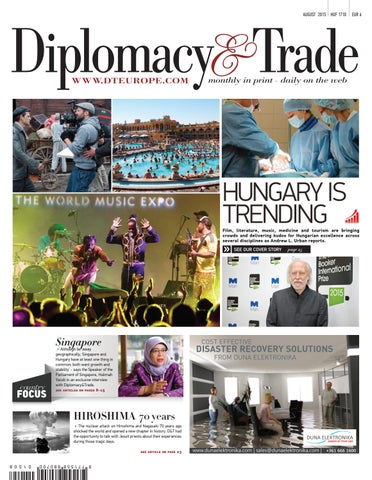
HUNGARY IS TRENDING
Film, literature, music, medicine and tourism are bringing crowds and delivering kudos for Hungarian excellence across several disciplines as Andrew L. Urban reports. SEE OUR COVER STORY
page 25
Singapore
country
FOCUS
'Although far away geographically, Singapore and Hungary have at least one thing in common: both want growth and stability' - says the Speaker of the Parliament of Singapore, Halimah Yacob in an exclusive interview with Diplomacy&Trade. see articles on pages 8-15
HIROSHIMA 70 years The nuclear attack on Hiroshima and Nagasaki 70 years ago shocked the world and opened a new chapter in history. D&T had the opportunity to talk with Jesuit priests about their experiences during those tragic days.
01 cover.indd 7
see article on page 23
8/3/15 6:48 PM
02 applikacio.indd 30
8/3/15 6:06 PM
03 duna elektronika.indd 30
8/3/15 6:07 PM
letter from the publisher
contents page 29
07 POLITICAL ANALYSIS
25 COVER STORY
8-15 SINGAPORE FOCUS
26 EU Presidency
US-IRAN nuclear deal
Leading diplomats on bilateral relations | Companies on economic prospects and new services
16-22 AMERICAN FOCUS - 2. Interview with large investors, business personalities and leaders of AmCham
Peter Freed PUBLISHER
23 HISTORY - Hiroshima and Nagasaki - a special view
AND DON’T FORGET
monthly in print - daily on the web
www.dteurope.com
Jesuit priests recall the day of bombing of Hiroshima and Nagasaki page 23
24 BUSINESS INTERVIEW
Alex Hemingway and his business approach | Kristóf Kovács, producer and restaurateur
Hungary is trending Luxembourg's plan
27Witty Leaks
A Swedish garden in Budapest
28 SPEAKING PICTURES
Immigrants, Budapest Pride
29 WHAT'S ON
Festivals, exhibitions and concerts
31 WINE REGIONS
Tokaj and its surroundings
ITALY FOCUS – SEPTEMBER 2015
• Diplomacy & Trade is preparing a special Focus section on Italy, NEWSSTAND PRICE: HUF 1,710 or EUR 6 - Subscriptions are
a vailable for an annual fee of EUR 60 in Hungary, or EUR 90 to all other destinations. - SEND REQUESTS AND INQUIRIES TO DUAX KFT. - Budapest, III. Bécsi út 60. H-1034 TELEPHONE [+36-70] 320-3051 FAX [+36-1] 350-5660 E-MAIL editor@dteurope.com ADVERTISING adsales@dteurope.com PUBLISHER I Peter Freed DEPUTY PUBLISHER I Andrew L. Urban TRADE EDITOR I Nándor Mester DIPLOMACY EDITOR I Ádám Lázár CULTURE & BEST OF BUDAPEST EDITOR I Réka A. Francisck COPY EDITOR I Joyce Freed PHOTO EDITOR I Dávid Harangozó DESIGN & PRODUCTION I Tamás Külkey SALES & MARKETING DIRECTOR I Tamás Varga DISTRIBUTION MANAGER I Tibor Ocsenás ADMINISTRATION I Judit Ludányi ASSISTANT I Ágnes Rapaport
CONTRIBUTORS
Sándor Laczkó, Tamás Magyarics, Réka A. Francisck PHOTO CONTRIBUTORS
Ildi Hermann, nanka/Shutterstock.com, Andrew L. Urban, Jacob Crawfurd/ Crawfurd Media, The Man Booker Prizes (Cover), János Mattis-Teutsch, AP, Hungarian Embassy in Washington, Parliament of Singapore, Singapore Tourism Board: www.wahiao.com, Rory Daniel, Nándor Mester, Patec, Cellum, Singapore Airlines, Martin Joppen, Hungarian-American Fulbright Commission, Business Lease, Budapest Marriott Hotel, Air France, KLM, Delta, Tamás Varga, www.eu2015lu.eu, Embassy of Sweden, Ákos Stiller/ UNHCR, Imre Nagy, Balázs Boda, Sándor Csudai, Paloznak Jazz and Wine Picnic, Budapest Summer Festival, Jewish Cultural Festival, www. kormany. hu, Tamás Kaunitz/www.afstudio.hu, Can Stock Photo Inc: Eyesee10, Orla, Shutterstock.com: Rawpixel, Dreamstime.com: Vincentho, Maocheng, Evryka23, MTI Photos: Lajos Soós, Mihály Majtényi/Major's Office, Boglárka Bodnár
Copyright 2004-2015 Duax Kft., all rights reserved | ISSN 1589-8075 This magazine is produced by Duax Kft. The opinions published in the magazine do not necessarily reflect the opinions of Duax Kft.
4 04-05 letter, contents, on the record.indd 4
with highlights of EXPO 2015 in Milan and plans of the Italian Cultural Institute in Budapest. • The Focus explores the relationship between Hungary and Italy: the strength and health of diplomatic ties, trading connections, Italian companies operating in Hungary and our usual table of Facts Compared. • Notable cultural events include concerts by Andrea Bocelli and Ennio Morricone in Budapest.
INDUSTRY FOCUS
OFFICE FURNITURE
We are preparing a special supplement on the active business involving Office Furniture. Latest trends in design and office space development will shape this section.
We welcome inquires for advertising in this issue. PLEASE CALL TAMÁS VARGA FOR FURTHER INFORMATION +36 209350250 - tvarga@budapestweek.com A U G U S T
2 0 1 5
|
D I P L O M A C Y
& TRADE |
w w w . d t e u r o p e . c o m
8/3/15 6:07 PM
photos by LAJOS SOÓS/MTI, MIHÁLY MAJTÉNYI/MAJOR'S OFFICE/MTI, CAN STOCK PHOTO INC./EYESEE10
Unknown aspects of Transylvanian art
photos by JÁNOS MATTIS-TEUTSCH, COURTESY OF HUNGARIAN EMBASSY IN WASHINGTON, AP
Hungary is hot – in more ways than one. Much of the country sweltered in heatwave conditions in July, but the bigger story is that film, literature, music, medicine and tourism are bringing crowds and delivering kudos for Hungarian excellence across several disciplines as Andrew L. Urban reports in our Cover Story, Hungary is Trending. Singapore, the subject of our Country Focus, looks to Hungary as an important gateway to other European countries, says Halimah Yacob the Speaker of the Singapore Parliament in an exclusive interview with Nándor Mester. Non-resident Ambassador MPH Rubin tells us that Singapore is preparing for a visit to his country by our Prime Minister Viktor Orbán within the next two months. We continue our Focus on the USA, this time leading with the Hungarian view from Washington, thanks to Hungarian Ambassador Réka Szemerkényi, and we learn how the American Chamber of Commerce is fine tuning its policy platforms. On a historical note, we remember Hiroshima on the 70th anniversary of the event. Coinciding fatefully with the anniversary of Hiroshima comes the nuclear agreement with Iran. Are we in the clear, now the nuclear deal with Iran is signed? Or not? Foreign policy analyst Tamás Magyarics has his doubts. In WittyLeaks, Swedish Ambassador and self confessed foodie, NICLAS TROUVÉ, started with cucumbers, planted a vegetable garden and now has a jungle at the residence. He stayed for the summer in Budapest to enjoy it. Two restaurant enterpreneurs in different markets, Alex Hemingway of Hooters (traditional American fare) and Kristóf Kovács of Déryné (modern Hungarian cuisine), reveal their recipes for success to Andrew L. Urban, while Nimród Kovács, who makes premium wines in Eger, tells Réka A. Francisck that his wines are increasingly enjoyed internationally.
Ambassador Szemerkényi on US-Hungarian relations page 16
on the record AUG
NAV PRESIDENT ILDIKÓ VIDA RESIGNS
UPCOMING NATIONAL DAYS 1 Switzerland 6 Bolivia 9 Singapore 14 Pakistan
EVENT National day Independence day Independence day Independence day
15 15 17 20 24 25 27 29 31 2 7 8 16 18 21 21 23
Independence day National day National day National day Independence day Independence day Independence day National day National day National day Independence day Independence day Independence day National day National day National day National day
Ildikó Vida, President of the Hungarian Tax and Customs Administration (NAV), submitted a letter of resignation to Prime Minister Viktor Orbán on 20 May 2015. As the law stipulates a two-month period of notice, her legal relationship as NAV president has ended on 20 July. Until the new president is named, NAV Deputy President Árpád Varga is to take over the position.
SEP
India South Korea Indonesia Hungary Ukraine Uruguay Moldova Slovakia Malaysia Vietnam Brazil Macedonia Mexico Chile Malta Armenia Saudi Arabia OTHER EVENTS
photos by LAJOS SOÓS/MTI, MIHÁLY MAJTÉNYI/MAJOR'S OFFICE/MTI, CAN STOCK PHOTO INC./EYESEE10
photos by JÁNOS MATTIS-TEUTSCH, COURTESY OF HUNGARIAN EMBASSY IN WASHINGTON, AP
BUDAPEST BIDS FOR 2024 OLYMPICS
2015
DATE
SEP
OCT
Budapest has officially submitted a bid to host the Olympic and Paralympic Games in 2024. In their letter to the International Olympic Committee, Budapest Mayor István Tarlós and MOB head Zsolt Borkai cited a unanimous decision by the city council and MOB's assemblies as well as support from the Hungarian government. Parliament has voted to support the bid.
EBRD DELEGATION IN BUDAPEST
NOV
ORGANIZER
NAME/TOPIC
VENUE
to be Hungarian announced government
European conference on migration
Budapest
23-27
Hungexpo
OMÉK (agriculture)
Budapest
12
EUCHAM + BIBCA
Investment Summit Central&SE Europe
Budapest
12-15
ITU
ITU WORLD CONFERENCE
Budapest
28-30
Hungexpo
Automotive Hungary
Budapest
Hungarian government
Conference on Latin America
Budapest
Minister for National Economy Mihály Varga held talks with the delegation of the European Bank for Reconstruction and Development. The parties discussed the implementation of the Memorandum of Understanding (MoU) concluded in February this year and the EBRD’s upcoming Country Strategy Update on Hungary. The government wants to bolster the country’s financial system and ease bank sector consolidation. Under the agreement, the Government committed itself to gradually and significantly reduce the bank tax as of 2016 and pledged not to introduce any new regulation that might harm banks’ interests but consult with sector representatives before the introduction of any planned new regulation. The EBRD considers the MoU to be a major progressive step that contributes to bank sector consolidation. EIB Vice-President László Baranyai and Minister for National Economy Mihály Varga signed a loan agreement for EUR 500 million. The loan will help EU funds made available for Hungary to reach a higher number of beneficiaries and improve economic growth and the living conditions of people. In the 20142020 programming period, the EIB provides a framework loan of EUR 1billion for Hungary to help co-finance EU priority projects. Hungary is entitled to draw tranches of the loan from the facility on the basis of case-by-case loan contracts. The amount made available through the first contract, EUR 500 million, can be utilized within the next three years. w w w . d t e u r o p e . c o m
04-05 letter, contents, on the record.indd 5
|
EIB LOAN TO HUNGARY
D I P L O M A C Y
SUPPORTING SERBIA’S EU ACCESSION PREPARATIONS Hungarian support for Serbia’s European integration efforts was the main topic of discussion during bilateral talks between Hungarian Minister of Agriculture Sándor Fazekas and Serbian Minister of Agriculture and Environmental Protection Snežana Bogosavljević Bošković. The main topics of expert cooperation include funding for small scale producers, fisheries policy, the national beekeeping program, food trademarks and EU integration processes. The Hungarian Ministry of Agriculture would also like to reinforce its cooperation with Serbia on GMO-free food production. As for animal husbandry, new propagation material export opportunities have become available to Hungary on the Serbian market - the ministry added in its official note.
& TRADE |
A U G U S T
2 0 1 5
5 8/3/15 6:07 PM
company briefs ALFÖLDI TEJ TO DEVELOP FACTORIES
Alföldi Tej has plans to expand its capacities with the development of two factories in Debrecen and Székesfehérvár – the executive director announced early July. The government recently signed its 60th strategic agreement with the dairy producer which has realized investments worth HUF six billion over the last ten years., Alföldi Tej is owned by more than 100 Hungarian milk producers and contributes 26 % of the country’s whole milk production. The group was founded in 2003 with 23 members in Hajdú-Bihar county, which two years later bought a dairy under liquidation in Székesfehérvár. Monthly revenues that totaled HUF 500 million in 2003 have risen to HUF 3 billion. The company has recently acquired FrieslandCampina’s dairy plant in Debrecen, which has a processing capacity for 60, 000 liters of milk daily. Currently Alföldi Tej has 700 employees and indirectly provides jobs to 10 thousand people.
CBA STORES EXPLOIT SUNDAY OPENING LOOPHOLE Two CBA stores near Lake Balaton have been declared outdoor traditional markets because they sell goods in their parking lots, Hungarian online daily origo.hu reported in early July. The designation allows those stores to stay open on Sundays, when their competition must close. In line with Hungarian laws, a notary can grant a store special outdoor market status for a year. Many players in the retail industry oppose the Sunday closing law, which was inroduced in March. Critics have charged that the law, which is also unpopular with most customers, hurts foreign-owned hypermarkets while providing a boost to local supermarket chains like CBA. (origo.hu)
DANONE CLOSES PLANT IN BUDAPEST French dairy producer Danone shut down its plant in Budapest at the end of June. Several other facilities were also closed across Europe in a move to cut costs and work more efficiently. As for the Budapest plant, the company claimed both weakening demand and low efficiency were behind the decision. Sales revenues decreased 20 % between 2011 and 2013. Danone however reaffirmed that all its brands will continue to be available in Hungary.
BUDAPEST AIRPORT IN THE TOP LEAGUE
JOHNSON ELECTRIC TO SEEK MORE LOCAL SUPPLIERS
We Buy Quality Cars at Fair Prices.
Turn to us with confidence to sell your car without any burden.
Professional service to handle Electronic parts manufacturer Johnson Electric wants to widen its supplier base in Hungary, the Director of European Operations announced after the meeting with the Government's representative in mid July. Laurent Cardon pointed out that the strategic agreement recently signed with the government creates good base for increasing production and assists in the inclusion of more local suppliers. The Hong Kong-based company, which has plants in Ózd and Hatvan, currently employs 1,500 workers in Hungary.
6 06 company news.indd 6
all documentation and inspection quickly and efficiently.
JÓ AU –TÓTH KFT. | RITA PALÁSTHY | ph: +36 30 282 5086 | joautoth@freemail.hu A U G U S T
2 0 1 5
|
D I P L O M A C Y
& TRADE |
photos by BOGLÁRKA BODNÁR/MTI, DÁVID HARANGOZÓ, LAJOS SOÓS/MTI
Budapest Airport has received the “highly commended” award at the ACI Europe (Airports Council International) annual conference held in the Czech Republic. Budapest Airport was ranked in its category (airports with 5-10 million passengers) among the best three in Europe, not only in passenger service but also in management, commercial achievements and community relations. ACI Europe is the largest international umbrella organization of airport operators on the continent, with 461 airports and heliports all over Europe as members. The Europe Best Airport Awards are decided by a jury of renowned aviation industry representatives and key institutional stakeholders, including the European Commission, EUROCONTROL and others.
w w w . d t e u r o p e . c o m
8/3/15 6:08 PM
analysis OPEN QUESTIONS AND CLOSED NUCLEAR FACILITIES?
illustration by VINCENTHO/DREAMSTIME.COM
BY TAMÁS MAGYARICS
Iran’s secretive nuclear policies have caused quite a headache in a number of countries from Israel and the Sunni Arab states in the Middle East through the Europeans to the United States. Though the official Iranian position has always been a flat denial about the intent and extent of the country’s nuclear programs, undeniable facts pointed towards Tehran’s attempts to join the ”elite club” of countries with nuclear capability. Even if we discount some of the extreme rhetoric used by such leaders as former President Mahmoud Ahmedinejad, the balance of power in the region would be dramatically changed if Iran acquired nuclear capability. In a broader context, the impact of an Iran with nuclear tipped short- and medium-range missiles would bound to be felt well beyond the region, and may even have global implications. Besides the likely geopolitical consequences of such a scenario, Iran’s nuclear ”breakout” would also question the basic precepts of such international regimes as the NonProliferation Treaty (NPT). As US Secretary of State John Kerry summed up the global importance of the question, ”the last thing we need is a new nuclear power.” In fact, one may add that if Iran became a nuclear power, the world would possibly acquire two or three other newcomers in the ”club”, including Saudi-Arabia, Turkey, and Egypt. (The U.S. and the Europeans might have an uphill battle to discourage these countries from going nuclear.) A nuclear arms race in the otherwise extremely volatile and combustible region is a recipe for a predictable disaster on a scale one can only guess. That may have been one of the reasons that such great powers as China and Russia, which are doing everything in their capacity to soft-balance the U. S. (the West) have been willing to cooperate, though they have also done their best to water down the agreement on some points. The deal constraining Iran’s nuclear program is a classic framework agreement; much depends on how the participants will interpret some of its provisions. However, above all, the effectiveness will largely depend on the international inspectors’ ability to detect and uncover cheating by Iran – the sceptics (or realists) predict that the question is not whether Iran will try to cheat, the real question is how and when. Their scepticism is based to a large extent on the omission of an ”anytime, anywhere” provision from the agreement. The deal requires a 24-day notice before inspectors are allowed to visit suspicious facilities – the period may be long enough for the Iranians to remove items which they are unwilling to show visitors. Second, Iran will for all intents and purposes retain its threshold status. It is true that the agreement imposes significant limitations on the quantity and quality of the centrifuges and w w w . d t e u r o p e . c o m
07 magyarics.indd 7
|
enriched uraniam alike; the number of the former has to be cut from 21,000 to 5,000; while the latter must be reduced from 20% to 3.7%. At the same time, the heavy-water plant at Arak has to be restructured so that it will not be able to produce plutonium. Moreover, Iran is not supposed to build any additional heavywater reactors for 15 years. These limitations clearly extend the ”breakout” time, but they do not prevent Iran from resuming efforts after the expiration of a few years: in the case of the centrifuges, it is 10 years, while uranium enrichment is 15 years. In other words, the deal in effect ”kicks the can down the road,” and in a decade or so there is a good chance that the whole story will start all over again. Iran has undermined the universality of the NPT too, insofar as the Non-Proliferation Treaty is openended, while Iran is constrained only for a limited period of time. Third, the promised lifting of economic and financial sanctions imposed on Iran over the years in recognition of Tehran’s compliance is bound to have some unintended consequences beyond the economic and financial areas. Estimates put the sum Iran receives after the ”Implementation Day” around USD 150 billion. Is is true that the economic sanctions have seriously hurt the country, and experts calculate that at least USD 600-700 billion is needed for insfrastructural investment alone. However, Iran will be able to realize substantial profits on the sale of oil and gas alone, while international investors are lining
D I P L O M A C Y
& TRADE |
A U G U S T
2 0 1 5
up to take advantage of the opportunities which open in Iran. Having said that, it is fairly safe to predict that Tehran will be able to spend (much) more money on financing its clients in the region from President Assad of Syria to the Hezbollah. As the arms embargo will be lifted in 5 years, the capabilities of Iran’s military will be enhanced, and so will those of its allies to make mischief. The consequences will be an arms race of sorts in the greater Middle East. Another potential weakness in the treaty is the socalled snapback provision, which is to reinstate the sanctions in the case of Tehran’s non-compliance within 65 days. The hitch is that the sanctions can only be reimposed by the UN Security Council, where Russia’s and China’s willingness to do that is more than unlikely. A ”West” versus the ”Rest” scenario cannot be excluded under the circumstances with a number of potentially dangerous consequences, among others enhanced religiously motivated terrorist activities with even more capable sponsors than they have right now. Finally, the deal may cause serious domestic political splits in the two most important actors in this story. Throughout the negotiations conflicting signals came from the secular and religious leaderships in Iran, with the latter being the hardliners. Ajatollah Ali Hosseini Khamenei, the supreme religious leader is seriously ill. The potential successors may want to establish and prove their credentials by taking a hard line in the nuclear issue,
which is seen as one of the most important manifestations of national pride and sovereignty – besides lending Iran a regional great power status. While President Barack Obama declared that the deal ”cuts off all of Iran’s pathways to nuclear weapons,” others – including the majority of the Republicans and the national security hawk Democrats are not so sure about it. The issue may become a toxic one for Hillary Clinton during the presidential campaign, as the Cold War stereotype about the Democrats being ”soft” on national security matters may be revived. Israel and the Jewish voters may come into the picture: Prime Minister Netanyahu and the majority of the Israelis believe that the deal is a mistake of historic proportions. If most of the Jewish voters in key battleground states such as Florida subscribe to this idea, Hillary Clinton’s chances of becoming the first woman president of the U.S. will diminish. Despite all the legitimate concerns about the deal, it must also be acknowledged that the current deal may be the best that could have been achieved under the circumstances. The world has bought time, about a decade or so, and as former British Prime Minister Harold Wilson once observed, ”A week in politics is a long time.” Let us hope that in the forthcoming decade the international situation will change for the better and, next time, a truly consequential deal can be struck between the parties involved. Tamás Magyarics is a foreign policy analyst
7 8/3/15 6:08 PM
Exim to step in
Cellum in action
PATEC to expand in Hungary
Hungarian companies in Singapore
Singapore Airlines
Hungarian EXIM Bank opens a new credit line to help Hungarian companies in export effort.
Mobile payment provider Cellum sets up a regional arm in Singapore and plans to expand from there.
Automotive supplier builds new facility, adds 400 jobs and widens cooperation with the university of Miskolc.
How to make money and attract venture capital.
The national carrier introduces a new class and cooperates with Changi Airport to serve transit passengers.
. . . . . . . . . . . . . . . . . . . . . . . . . . . . . . . . . . . . PAGE 10
. . . . . . . . . . . . . . . . . . . . . . . . . . . . . . . . . . . PAGE 11
. . . . . . . . . . . . . . . . . . . . . . . . . . . . . . . . . . PAGE 12
.. . . . . . . . . . . . . . . . . . . . . . . . . . . . . . . . . . . PAGE 14
. . . . . . . . . . . . . . . . . . . . . . . . . . . . . . . . . . . . PAGE 15
'WE BOTH are COMMITTED to GROWTH' EXCLUSIVE INTERVIEW WITH THE SPEAKER OF THE PARLIAMENT OF SINGAPORE, HALIMAH YACOB 'Although far apart geographically, Singapore and Hungary have at least one thing in
BY NÁNDOR MESTER
Diplomats involved in bilateral political and economic talks are very busy these days in Hungary and Singapore. The two countries’ Heads of State, Parliamentarians, Ministers and trade representatives exchange visits frequently, preparing political agreements and promoting trade. Diplomacy & Trade had an exclusive opportunity to ask Halimah Yacob, the first woman Speaker of the Singapore Parliament about her rescent visit to Budapest in June. "Hungary is developing very fast, I saw tremendous changes, plenty of new and renewed buildings, friendly people and an astonishing countryside" - that was how she started her
8 08-09 speaker.indd 8
summary, referring to her last visit 15 years ago when as a tourist in Hungary. This time she went to see Lake Balaton, the pottery manufactory in Herend and the historic Pannonhalma Archabbey. "This mini tour was an important addition to my political talks education think politicians cannot pursue their job perfectly if they do not have direct contacts with members of local communities. I also think that apart from top level contacts, we must encourage the so called people-to-people relations too.", she said. Halimah Yacob had talks with several officials of the Hungarian Parliament, including Speaker László Kövér, the Deputy Speaker and the Chairman of the Foreign Affairs Committee. She also met MP-s of the Hungary-Singapore Friendship Group, formed last year within the Hungarian
Parliament. She described bilateral relations exceptionally friendly and warm. "Although Singapore and Hungary are far away from one another we have a lot of similarity in terms of the drive, hard work and discipline of the people. Leaders of both countries are committed to growth and ready to exchange experiences and that helps", she added. Singapore has earned a very good reputation globally; it is considered as one of the fastest growing countries in the world. Some even say Singapore could be an example for Hungary's future. On the other hand, some politicians consider Hungary as a "Potential Singapore" in Central Europe, as it undertakes a special political and economic course. Asked if she shares this view the Speaker Halimah emphasized: "We can learn a lot from one another and exchange
photo by PARLIAMENT OF SINGAPORE
▶ CONTINUED FROM FRONT PAGE
A U G U S T
2 0 1 5
|
D I P L O M A C Y
& TRADE |
w w w . d t e u r o p e . c o m
8/3/15 6:09 PM
photos by SINGAPORE TOURISM BOARD: WWW.WAHIAO.COM, RORY DANIEL, DÁVID HARANGOZÓ
common: both want growth and stability' - says the Speaker of the Parliament of Singapore, Halimah Yacob in an exclusive interview with Diplomacy&Trade.
singapore focus ASEAN-CONNECTION
photos by SINGAPORE TOURISM BOARD: WWW.WAHIAO.COM, RORY DANIEL, DÁVID HARANGOZÓ
The Speaker highlighted the importance of ASEAN countries. This region represents a market of some 600 million people, with a combined GDP of about USD 2.5 trillion and upwards of USD 1.5 trillion in trade flowing throughout the region. She also spoke about the ASEAN Economic Community (AEC) which seeks to transform ASEAN into a single market and production base, a highly competitive economic region, a region of equitable economic development, and a region fully integrated into the global economy.
experiences. Your music, and your culture are famous and the pre-school education is advanced. One thing is sure -, we do not have 14 Nobel laureates as Hungary has: even one would have been perfect for us. Singapore is very centrally placed and can serve as a gateway to the other countries of Southeast Asia. That is certainly unique. We can also share our experiences on how to deal with the neighboring countries." The Speaker of Singapore acknowledged the achievements of Hungary in terms of economic growth, saying that Hungary is one of the fastest growing countries in the region and, therefore, the leaders of Singapore and top businessmen look at Hungary as an important gateway to other European countries and markets. "Hungary is perfectly located, has a very good infrastructure, logistics services and well trained labor force. These are exceptionally important factors and provide excellent opportunities for business.", she said. These factors made the big players in the automotive sector to come to Hungary over the last two decades. PATEC from Singapore is one of them. It is a well known manufacturer of precision metal formed components and subassembled components for leading automotive
HALIMAH YACOB
Halimah Yacob was elected Speaker of the Singapore Parliament on January 14, 2013. She is the ninth Speaker since the First Legislative Assembly of 1955 and Singapore’s first woman Speaker of Parliament. She has been a Member of Parliament since 2001 and is one of the MPs serving the Jurong Group Representation Constituency. She previously served as the Minister of State in the Ministry of Social and Family Development. She was a Member of the Public Petitions Committee before taking over the role as Chairman in the Committee of Selection, Committee of Privileges, House Committee, Public Petitions Committee and Standing Orders Committee in the 12th Parliament.
and electronics companies throughout the world. PATEC established a component production unit in Miskolc in 2008 and recently announced the extension of that facility. As a result of this new investment more than 400 jobs will be created in the city. While Hungary is waiting for more such investments from Singapore, some of the fastest growing Hungarian SMEs are very proactive in attracting venture capital and private investors based in Singapore. The Speaker recalled a recent forum organized by the newly established Hungarian Trade House Singapore (HTHS) together with the Hungarian National Trading House.
"It was a successful event, titled European Innovations from Hungary (EIH)". I was informed that 12 startups could be presentimg their business plans to promote the export of
Hungarian know-how. The Singapore Government is very supportive of our SMEs too. We have several institutions for that purpose, one of which is International Enterprise (IE) Singapore, which provides all sorts of vital information on a certain market or country. We have told Singaporean companies repeatedly that Hungary provides good infrastructure and incentives for investors, so it is up to them to capitalize on that.", she argued. Activity of private Singaporean companies in Europe is determined by various international agreements, such as the EU-Singapore Friendship Agreement, approved earlier and the Free Trade Agreement (FTA) which is being ratified.The Speaker firmly believes this agreement would help boost trade for mutual benefit. "All my counterparts in Hungary have expressed several times that they are very much for the acceleration of the process. Once it is ratified, more investment would come to Hungary and other EU-countries", Halimah Yacob pointed out. Exporters of electronics, pharmaceuticals, chemicals, and processed food products will especially benefit from ratification of the FTA. EU officials reiterated that this is a comprehensive agreement, which will help boost economic growth, investment, and job creation in the EU. It will help open the door for Europe to the Association of Southeast Asian Nations (ASEAN) market with 600 million consumers. "We are open to a broader cooperation with EU-countries and I hope this will help Singapore to keep its speed in developing", she said, while expressing she would love to return to Hungary to know more about the country.
FACTS COMPARED
HUNGARY SINGAPORE 93,028 sq km 697 sq km AREA 110 192 country comparison to the world: 9,919,128 (July 2014 est.) 5,567,301 (July 2014 est.) POPULATION 90 116 country comparison to the world: -0.21% (2014 est.) 1.92% (2014 est.) POPULATION GROWTH RATE 214 57 country comparison to the world 9.26 births/1,000 population 8.1 births/1,000 population BIRTH RATE 214 221 country comparison to the world 75.46 years 84.38 years LIFE EXPECTANCY AT BIRTH 93 4 country comparison to the world 1.34 migrant(s)/1,000 population 14.55 migrant(s)/1,000 population NET MIGRATION RATE 55 8 country comparison to the world $24,300 (2014 est.) $81,300 (2014 est.) GDP - PER CAPITA (PPP) 73 7 country comparison to the world 7,1% (2014 est.) 2.0% (2014 est.) UNEMPLOYMENT RATE 77 9 country comparison to the world 11,580,000 (2012) 8,063,000 (2012) TELEPHONES - MOBILE/CELLULAR 67 92 country comparison to the world 41 (2013) 9 (2013) AIRPORTS 104 158 country comparison to the world Source: World Factbook
w w w . d t e u r o p e . c o m
08-09 speaker.indd 9
|
D I P L O M A C Y
& TRADE |
A U G U S T
2 0 1 5
9 8/3/15 6:09 PM
singapore focus
ORBÁN TO VISIT SINGAPORE THIS FALL
Officials are preparing the next round of bilateral talks between Hungary and Singapore: Prime Minister Viktor Orbán is due to visit Singapore in October or November this year - Non-Resident Ambassador to Hungary Justice (Ret.) MPH Rubin told Diplomacy&Trade. He also spoke about Singapore’s legal system and gave a short summary of the political scope in his country.
EXIM PROVIDES FAVORABLE RESOURCES
EXTENDED FACILITIES, UPGRADED SERVICES State-owned Hungarian Export-Import Bank Plc. and Hungarian Export Credit Insurance Plc. (under the common brand of EXIM) will continue to provide a variety of financial resources to help Hungarian exporters in Asia. EXIM makes every effort to have access to more opportunities in this region via providing different risk mitigating tools and also some “education” about these markets based upon its experience – Zoltán Urbán, CEO of EXIM said in an exclusive interview with D&T. Zoltán Urbán, CEO of the Hungarian Export-Import Bank Plc. and the Hungarian Export Credit Insurance Plc. (the two institutions operate under the common brand “EXIM”), focused on how EXIM, under the control of the Ministry of Foreign Affairs and Trade, could help Hungarian exporters strengthen their
10 10 ambassador, exim.indd 10
export activities in Asia. Introducing the mission and operation of EXIM, the official export credit agency of Hungary, he pointed out that EXIM’s aim is to deploy efficiently the allocated government resources to stimulate export growth and to promote the sales of Hungarian goods and services in foreign markets.
"As the next important step in the development of our relationship, Prime Minister Viktor Orbán is to visit Singapore in October or November this year. We look forward to his visit and hope that it will give another push to the dynamic development of bilateral political and economic cooperation" - Ambassador Rubin said in Budapest in the middle of June when he accompanied the Speaker of the Singaporean Parliament Halimah Yacob on her official visit to Hungary. No details have emerged yet about the Prime Minister's visit but the Ambassador was sure Orbán and his counterparts would focus on economic cooperation. He noted that a group of businesspeople will probably join Orbán as in the past when the Prime Minister has visited a country which is a target in his government's Eastern Opening strategy. Speaking about the history of Singapore and the current social and legal system, Rubin emphasized that the impact of Great Britain has been very important. Under British rule a stable legal system was established. Meanwhile, Singapore became a
medium sized city with a big port which was the magnet for commercial vessels across the region. Much of the British Empire earned independence after the Second World War, Singapore did it in an union with Malaysia in 1963. "But this did not last long, leaders of the two countries had different views on the future, subsequently our state was founded in 1965" - he recalled the separation gently. Referring to the first months of the young state he said:"Everyone outside Singapore expected a sharp economic downturn and many of Asian politicians were even convinced that Singapore would soon disappear. But the leaders of our country decided to build factories and invited people from outside; a lot of immigrants came to us. Foreign companies also entered the market, as they were offered a business friendly tax and labor system. So that is how we managed to start building a new life." Though ethnic Chinese form the majority of Singapore’s population, it has kept the English language as the most important and that helped to attract international investors too. The four languages that are recognized
by the government are: English, Malay, Mandarin, and Tamil, English is commonly used. The legal system was also familiar to many foreign investors as Singapore inherited it from the English with only slight modifications. "We have a strong legislative, executive and judicial system that is based on English common law but in the case of corporate law, we did not mind borrowing from Australia and our Criminal Law was borrowed from India and Sri Lanka. To give you another example of our advanced legal system, our Arbitration Law is recognized by all states and Singapore has become an arbitration center in Southeast Asia", he explained. Concerning political life in Singapore, the ambassador pointed out that though the leading party has been ruling for many decades, elections are fair and no outside official body has ever questioned this since the 1960s. "There is no manipulation of results and we are proud that in Transparency International's Corruption Index Singapore has been among the top countries for long, practically not having corruption at all", - he added.
According to Urbán EXIM shows dynamic growth; the loan and guarantee portfolio at end of year 2014 totaled EUR 1,800 million with a further 30% increase for this year. EXIM provides a wide range of highly competitive financial, lending and insurance services to exporters and foreign investors (for export related domestic investments). EXIM’s current product range covers all phases of the financial and insurance direct export transactions. The products are designed to provide financing opportunities directly to the exporter or to the exporter’s buyer, or indirectly through Hungarian or foreign credit institutions. Urbán emphasized that apart from traditional European export relations, regions included in the Government’s Eastern Opening and Southern Opening Strategy play a significant role in EXIM’s activity. As the major foreign economy policy institution of the Hungarian State, EXIM places emphasis on bi- and multilateral relations and cooperation. The connections with the World Bank Group and its members were highlighted by the CEO as well. He expressed the importance of the multilevel cooperation with IFC through which Hungarian businesses can gain access to substantial international tenders and development projects.
„By joining the Asian Infrastructure Investment Bank (AIIB) – of which Singapore is a founding member – Hungary intends to strengthen its external financial and economic relations in the region and promote Hungarian companies' business activities in the Asian markets. The economic importance and financial influence of AIIB rest on the close cooperation of its Members with a potential to generate a dynamic and
coordinated regional action plan in line with broader development mandates and national strategies. The Hungarian membership enables EXIM to participate in development projects – financed by the institution – further strengthening and fostering Hungary’s export capacity”, he argued.
A U G U S T
2 0 1 5
|
D I P L O M A C Y
For more information, please visit EXIM’s website: www.exim.hu/en
& TRADE |
photo by DÁVID HARANGOZÓ, EXIM
NON-RESIDENT AMBASSADOR TO HUNGARY MPH RUBIN ON SINGAPORE'S UNIQUE MODEL OF DEVELOPMENT
w w w . d t e u r o p e . c o m
8/4/15 10:26 AM
singapore focus LEGACY of LEE KUAN YEW TIGER IN SUCCESS AND CRITICISM ACTION
As Singapore's Prime Minister from 1959 to 1990, Lee Kuan Yew, who died in March 2015 at the age of 91, presided over many of Singapore's advancements including independence from Malaysia in 1965. During the three decades in which he held office, this mini state grew from a developing country to one of the most developed nations in Asia. Lee often stated that Singapore's only natural resources are its people and their strong work ethic. Here are some of the main achievements under Lee’s leadership. Economicly: Gross National Product per capita rose from USD 1,240 to USD 18,437. The unemployment rate dropped from 13.5% to 1.7%, external trade increased from USD 7.3 billion to USD 205 billion in 1990. In other areas, the life expectancy at birth for Singaporeans rose from 65 years to 74 years. The population increased from 1.6 million to 3 million. The number of public flats rose from 22,975 to 667,575. The Singaporean literacy rate increased from 52% to 90% in 1990. Telephone lines per 100 Singaporeans increased from 3 to 38. Visitor arrivals to Singapore rose from 0.1 million to 5.3 million. World leaders praised Lee. Henry Kissinger once said that Lee was "One
of the asymmetries of history". Former British Prime Minister Margaret Thatcher praised “his way of penetrating the fog of propaganda and expressing with unique clarity the issues of our time and the way to tackle them". On the other hand, many Singaporeans have criticized Lee as authoritarian and as intolerant of dissent, citing his numerous – mostly successful – attempts to sue political opponents and newspapers who expressed an unfavorable opinion. Reporters Without Borders, an international media pressure group, requested Lee and other senior Singaporean officials to stop initiating libel suits against journalists. In addition to being authoritarian, Lee was accused of promoting a culture of elitism among Singapore's ruling class. Michael Barr wrote in his book The Ruling Elite of Singapore: Networks of Influence and Power claims that the system of meritocracy in Singapore is not quite how the government presents it; rather, it is a system of nepotism and collusion run by Lee's family and their crony friends and allies. Barr claims further that although the government presents the city-state as multiethnic and cosmopolitan, all the networks are dominated by ethnic Chinese, leaving the minority Malay and Indian ethnic groups powerless.
Since gaining independence in1965, the Singaporean economy has grown rapidly and as a result the country now claims one of the highest GDP per capita in the world: USD 36,900. GDP Growth Rate averaged 5.12 % from 2007 until 2015, Statistics Singapore reported. Due to the ongoing dynamic economic development, this average rate is expected to increase to USD 38,800 in 2020. The economy depends heavily on foreign trade; both from port activities and from exports of electronic components and refined oil. The country is a leading foreign direct investment recipient due to its status of one of the freest, most competitive and most business-friendly economies in the world. Fiscal policy is directed primarily at promoting long-term economic growth, rather than cyclical changes or distributing income. As a result of its healthy fiscal position and consistent budget surpluses over the years, Singapore has attained a high level of foreign reserves and the strongest sovereign credit rating for long-term foreign-currency debt in Asia. Over the years, the composition of Singapore's exports has evolved from labor-intensive to high value-added products, such as electronics, chemicals and biomedicals. The importance of
services to the Singapore economy also grew, as evidenced by the increasing share of the financial and business sectors of the economy. Singapore is also an important financial center. The domestic banking and insurance industries have been liberalized to attract more foreign investors. Various initiatives have been implemented to give fund managers greater access to domestic funds, to develop the debt market and to overhaul corporate governance. These initiatives together with Singapore's political and macroeconomic stability, excellent telecommunications and infrastructure, strategic geographical location and a skilled and educated workforce have contributed to Singapore's rapid development into a dynamic business and financial hub in Asia.
CELLUM TO SET SAIL IN SINGAPORE
photos by MAOCHENG/DREAMSTIME.COM, SINGAPORE TOURISM BOARD, CELLUM
ASIAN EXPANSION CREATES MORE BUSINESS OPPORTUNITIES FOR THE MOBILE PAYMENT PROVIDER "Asian markets seem especially interested in our solutions, and we see enormous growth potential there. Our Singapore center focuses on APAC, including Japan but excluding China. It is a vibrant market, the state of Singapore has an ambition to turn the country into a mobile transaction hub, similarly to how they turned it into a logistics and trade hub in the previous half century. I am very happy to announce that we have concluded our first deal and will launch in 2016." - János Kóka, CEO of Cellum confirmed when D&T asked him about the reason of setting up a new unit in Singapore. Cellum has signed the first contracts in Indonesia with two large players:
FESTIPAY by Cardnet , a Cellum company,
is the number one festival card solution in Hungary: leading festivals like Sziget, VOLT, Balaton Sound, Gourmet and EFOTT are all using it. Visitors of Delta Festival in Marseille, France and Untold Festival in Cluj, Romania can also enjoy the benefits of Festipay services. In 2016, Festipay will continue to grow in the European market, and also develop solutions using wearables like watches and wristbands, which can be integrated with venue access functions. w w w . d t e u r o p e . c o m
11 tiger cellum lee.indd 11
|
Anabatic, a leading technology company, and Evercoss, the country’s no. 1 manufacturer of affordable smart devices. Cellum expects to launch services there in 2016. In Thailand, they have been operating a mobile wallet with great success for almost a year and are in talks with some key banks and merchants on launching further services. China is a special case. Cellum has started mapping out opportunities and tailoring products for that market. Some 600 million people are expected to gain access to m-commerce services in the next 5 years, that is an unbelievable number. 'We think the secure platform and white-label business model that we offer to banks and merchants will be a key competitive edge." - Kóka added. Security is among the leading priorities at Cellum too. The company has developed a unique, patented card vault technology called Split Secret. Kóka said proudly: "Nowadays people are talking about how Apple Pay and similar services use tokenization to protect card data – we have been doing that for a decade. But our real breakthrough
D I P L O M A C Y
& TRADE |
has been a data fragmentation method which stores sensitive information in multiple physical locations. This way, there is no single database that could be hacked, an attacker would need to find and penetrate all locations and steal all fragments. And even then the
A U G U S T
2 0 1 5
data is still encrypted.This is a truly revolutionary technology that has successfully maintained a zero percent fraud rate for a decade." Innovative companies in the IT business are under constant pressure to materialize their R&D efforts. Engineers
at Cellum have produced many remarkable inventions. An example is motionQR, which received high publicity when first unveiled it in Las Vegas two years ago. It allows the secure storage of picture IDs and similar documents as an animated QR code.
11 8/3/15 6:10 PM
singapore focus
PATEC TO EXPAND in MISKOLC THE NEW FACILITY HELPS TO SERVE LARGE CUSTOMERS IN THE EUROPEAN AUTOMOTIVE SECTOR
"Skilled labor force is crucial for such a big investment" ▶ G EN ER AL M AN AG ER : Kelvin Wee "This is our huge site, a perfect place for our new facility" - Andy Wong, PATEC’s Assistant General Manager said greeting us at the company’s warehouse on the outskirts of Miskolc. According to an official announcement, made during the visit of the Hungarian Minister of Foreign Affairs and Trade Péter Szijjártó in Singapore in May, PATEC - as part of a EUR 5 million project - will establish a 15,000 sqm production facility in the coming year. The new facility will enable the company to serve its main customers from the automotive sector more effectively. This announcement is very good news for Miskolc and surrounding areas as the company will create some 400 jobs
▶ AS S I S TAN T G EN ER AL MANAGE R: Andy Wong
in a region where unemployment is relatively high. PATEC is not a newcomer in Miskolc, it has been running a small component production unit there since 2008. But the current upswing of the automotive sector may have been considered by the Singapore headquarters as a huge opportunity and the central management probably wanted to capitalize on that. When asked about the company’s reasons for choosing Hungary, PATEC’s Miskolc General Manager Kelvin Wee proudly said: "In Hungary we have an easy access to Western Europe, the infrastructure is advanced compared to other countries in Central and Eastern Europe, such as Slovakia or Romania and thanks to the motorways, we also have access to Eastern Europe." Skilled labor force is crucial for such a big investment but PATEC is in a relatively good
position as it has already developed production related cooperation with the local Technical University in Miskolc. Some of the students are involved in testing for PATEC and later may join the company. However, PATEC has to face a minor shortage of engineers as many of the new graduates are approached by other players of the sector too. "Yes, there is a shortage of quality engineers in the region but do not forget: PATEC is a long term player and provides a good platform for young, dynamic talents who want develop their skills in our field". - the General Manager argued. Over the course of my visit to Miskolc we could not miss one point which we ask every company we visit in this sector: When asked about setting up a Research and Development site or a Service Center in Hungary, bearing in mind that apart from its core component manufacturing business, PATEC is famous for its integrated engineering solutions, which rely on sophisticated work of in-house experts, Kelvin Wee explained:. "For now it is too early because it requires a lot of experience. Even at our plant in China it took about 15 years to start a R+D center. I think it will take another 5-10 years to start training local people here but I do not exclude to establish such a center on the long run. I also think that it is good to have R+D centers in different countries within our global network as different people can bring in different ideas which may result in better quality".
QUALITY PROGRAM In line with the core belief for internally-driven improvements, and to conform to industry and customer requirements, PATEC is committed to regularly evaluating the level of services and products provided to customers. To facilitate this process, a management system meeting the requirements of ISO / TS 16949, ISO 14001: 2004 has been documented and implemented. The objective to meet industry and customer requirements, on top of complying with all applicable laws, regulations and standards is mandatory for all staff and partners representing PATEC, emphasising on prompt customer service, reliable delivery and quality products. A key feature of the integrated management system is the improvement of the environmental performance commitment. In the course of operations, they seek to always strive for the most well-balanced environmental management practices. In this context, they make important efforts in order to minimise waste generated during the production, and effectively manage negative environmental impacts, through proper industrial waste storage, recycling and disposal. The company expects staff to play an active role in fulfilling the objectives of PATEC, and the consistent renewal of the PATEC quality and environmental management system, so as to cater to the ever-evolving needs of the industry.
QUALITY DIRECTIVE
- Practicing Total Quality Management (TQM). - Focusing on Six Sigma strategy for continuous improvement. - Continuous pursuit of achieving 0 ppm for all deliveries, through manufacturing quality improvements.
GLOBAL SUPPLIER
Applications for automotive components include engine transmission systems, exhaust systems, brake and safety systems. Applications for electronic components include consumer electronic products, mobile devices and HDD (Hard Disk Drives). Through the years, PATEC strengthened its core competencies in the development of integrated engineering solutions, by constantly seeking to understand and exceed the demands of the metal forming industry. With an in-house global manufacturing infrastructure, PATEC provides a full suite of metal forming expertise, specializing in fine-blanking, cold forging and metal stamping. Coupled with in-house tool/die design and fabrication facilities in Singapore and China, PATEC supports customers who require concept testing, process conversion evaluation, turnkey manufacturing and series manufacturing. Today, PATEC Group employs more than 1000 staff in 2 research locations, 5 production sites, and 6 service centers worldwide.
12 12-13 patec.indd 12
A U G U S T
2 0 1 5
|
D I P L O M A C Y
& TRADE |
photos by NÁNDOR MESTER, PATEC
Incorporated in 1992 and headquartered in Singapore, with research and development centers in Japan and China, PATEC started as an Original Design Manufacturer (ODM) of high performance mechanical press machines (Link Motion) and robotic systems. In 2001, the company diversified into components manufacturing and subsequently established manufacturing facilities in China, Indonesia and Hungary. These subsidiaries supply precision metal formed components and sub-assembled components to leading automotive and electronics companies throughout the world.
w w w . d t e u r o p e . c o m
8/3/15 6:10 PM
12-13 patec.indd 13
8/3/15 6:10 PM
singapore focus MAKING MONEY IN SINGAPORE PRACTICAL ADVICE FOR HUNGARIAN EXPORTERS AND SERVICE PROVIDERS Singapore is a good place for Hungarian companies to make money locally and elsewhere in South-East Asia. Diplomacy&Trade asked Miklós Horváth, president of the Hungarian Foreign Trade Association (HFTA) how to prepare successful business deals in this city state. Hungarian companies follow two strategies when seeking business in East Asia: 1. They either go to a less congested part of a country to avoid competition. For instance: in China instead of Beijing or Shanghai they go to another big regional city. 2. Or they find a good hub and cover a wider region from there. Miklós Horváth suggests they choose the second option, he thinks there are three such hubs in SouthEast Asia: Singapore, Hong Kong and Taiwan. These locales are very far away from Hungary which means it is not an option to travel a lot to and
from to manage the business. It is better to establish a local company with a representative person or staff and coordinate the business from Hungary – Horváth argues. He suggests businesses approach professional associations first and make direct contact with a given company later. In Singapore there are plenty of such organizations, they know their members and are able to provide orientation to a foreign company. Singapore Enterprise Federation is one of these associations, representing practically every major profession. Exporting products to South-East Asian destinations is not an easy job but Singapore is an ideal gateway
WHO WILL FOLLOW PATEC IN HUNGARY?
Singaporean automotive components manufacturer PATEC established a plant in Miskolc seven years ago and announced its intention to extend that facility shortly. That is a good news for Hungary. Who will follow this company? We do not know yet. But there is a very effective state organization in Singapore, Enterprise International, which has a special program to support local companies start their investment in a foreign country. Tailored primarily to small and medium size companies, the Market Readiness Assistance program helps to conduct market research and provides the necessary business information on the country targeted. Experts say some of the manufacturers in the automotive and electronics sector may consider relocating their production to Europe in the future and Hungary can be on their shortlist too.
for Hungarian companies. There is an excellent logistic infrastructure, including professional distributors,
based there and active in the region. However, the head of HFTA argues for services to export rather than compete
with China or India on the production side. "Hungarian IT companies can make good business deals in Singapore exporting their complex IT systems and softwares for corporate use. Companies in certain service sectors, such as MICE (Meetings, Incentives, Conferences and Exhibitions) or pre-school education can also make a fortune there as they have excellent knowledge and experience.”, he added. Asked about practical issues, concerning business negotiations, Horváth emphasized: "Time management is crucial. It is not really a problem to have several appointments in a single afternoon, local businessmen are used to that. They will come to your hotel's lobby for the first meeting. Good hotels are centrally located but expensive. However, do not forget they can serve as your temporary office as well. Apparel is also important, please take care about the appropriate cloths, because of the heat and humidity.”
ATTRACTING VENTURE CAPITAL On a recent business tour to Singapore a group of Hungarian technological startups were given a chance to attract local venture capital firms and meet high ranking officials of the state administration. The feedback was positive, and preparations are now underway to make business deals in the upcoming months. Hungarian Trade House Singapore (HTHS) and the Hungarian National Trading House (HNTH) organized a successful event titled European Innovations from Hungary (EIH) in the Fusionopolis event center to promote the export of Hungarian know-how. The date of the event was chosen to match the timing of the Hungarian Minister of Foreign Affairs and Trade, Péter Szijjártó’s Southeast Asian tour in late May. Participants of the event were: seven startups from the Hungarian private capital sector (5L, Aeroglass, Buxa, Cursor Insight, Rabbit, Slamby, Waterscope), six companies with several years of successful operation and constant development (Abseira,
HELPING HUNGARIAN SMEs
Cellum, Comforce, Holografika, Intelilight, Multipass) and one venture capital company (Primus Capital). Most of these companies are active in the IT sector. State institutions were represented by partner companies and presentations were made by Péter Szijjártó, Gábor Kun, Deputy General Manager of HNTH, Endre Spaller, Vice President of National Research, Development and Innovation Office and Domonkos Lakner, Head of Department at the National Investment Promotion Agency. In his opening remarks Péter Szijjártó highlighted the global necessity of constant development and its implementation and also revealed, that to support innovations, the
Hungarian Trading House Singapore (HTHS) was established in 2014 to support economic and trade efforts of Hungarian enterprises aimed at South-East Asian countries. HTHS cooperates with small and medium-size Hungarian firms, helps start up and operate local activities and locate competent and reliable partners for them in the ASEAN region. Apart from market knowledge HTHS offers mediation of business partners, B2B lead generation and business consulting.
14 14 making money, venture.indd 14
participants found it very effective and promising to have been given the opportunity to meet Hungarian experts who are able to present world class, innovative and cost efficient solutions. HTHS organized a 2-day preliminary program for the Hungarian companies before the EIH. On the first day, the delegation visited Infocomm Investments, Singapore’s biggest startup investor with a capital of SGD 200 million. Participants negotiated with local startups and local investors, and were given the opportuntiy to present innovations for some of them. On the second day, companies took part in an informal B2B meeting initiated by the founder of Tigerspike, a mobile technology corporation. This also ensured a good chance to meet directly with the Singaporean startup ecosystem. Hungarian government had doubled the financial resources for research and development activity in Hungary. HTHS signed a memorandum of understanding with the Singaporean Intellectual Property Intermediary (IPI). The main goal of this agreement is to help HTHS in the market launch of Hungarian technologies in Singapore. IPI’s network connects nearly 10, 000 persons and companies, which A U G U S T
is a major resource when it comes to increasing the chances of successful business matching. All in all, 37 Singaporean companies were represented by over 50 participants, including state and private investors, managers of local startups, IT vendors and venture capital companies, all whom showed great interest in Hungarian solutions. Based on their prompt feedbacks, 2 0 1 5
|
D I P L O M A C Y
STRONG ECONOMY
Singapore is Hungary’s largest export partner in Asia after China, the United Arab Emirates and Japan. Agreements on investment protection and the prevention of double taxation entered into effect in 2002. Since than, bilateral trade has grown rapidly. Today more and more Hungarian exporting companies use Singapore's port which is the second busiest globally.
& TRADE |
photos by RAWPIXEL/SHUTTERSTOCK.COM, CAN STOCK PHOTO INC./ORLA
HUNGARIAN HIGH TECH FIRMS' FORUM IN SINGAPORE
w w w . d t e u r o p e . c o m
8/3/15 6:11 PM
singapore focus SPECIAL LIVERY
SMILES PAY OFF
Singapore Airlines is celebrating the nation’s Golden Jubilee by having two Airbus A380s in a special livery, featuring a large Singapore flag-themed design on the fuselage. The A380s will be in the livery until the end of 2015, with the aircraft serving Beijing, Hong Kong, London, Mumbai, New Delhi, Shanghai, Sydney and Zurich routes. The A380 is the world’s largest aircraft and the special livery features a 10m-tall and 47m-long Singapore flag-themed design on both sides of the fuselage.“Singapore Airlines’ success is closely tied to the success of Singapore. What better way to celebrate the 50 years of our country than by proudly flying the national flag around the world on the world’s largest aircraft,” said Singapore Airlines CEO, Goh Choon Phong.
SINGAPORE AIRLINES ADDS A NEW CLASS, MORE DESTINATIONS AND UPGRADED SERVICES, ALWAYS WITH A SMILE
photos by SINGAPORE AIRLINES, MARTIN JOPPEN
Long haul flights are typically boring; the best one can usually hope for is to relax and sleep well. Fortunately, some airlines have a friendly approach; they give their customers something free and much appreciated: a smile. Singapore Airlines (SIA) has no shortage of smiles, from check-in to the traveler’s final destination.
Product development is a familiar concept to business travelers and it is the cornerstone of an ongoing process which drives every company in the service sector, including airlines. Carriers are under constant pressure to renew their seating offers: years ago they had only three classes (economy, business and first), but today
LARGEST PARTNERSHIP OF SIA
Singapore Airlines (SIA), Changi Airport Group (CAG) and Singapore Tourism Board (STB) have stepped up efforts to jointly promote inbound travel to Singapore and Changi Airport, in the largest collaboration among the three partners to date. Under the new two-year partnership, the three parties will jointly invest SGD 20 million to collaborate in amplifying the Singapore experience to leisure, business and MICE audiences in more than 15 markets worldwide. A key highlight of the program is the introduction of the Singapore Stopover Premium package. Targeted at both premium leisure and business travelers, this package includes stays in selected five-star hotels with breakfast and Wi-Fi, priority hotel check-in services and private transfers, exclusive privileges such as spa discounts or shopping vouchers, and access to a variety of premium leisure experiences across the island. Another feature of this partnership is the enhanced Free Singapore Tour, a perennially popular program that brings transit passengers on a free guided tour of Singapore’s vibrant landscape, best heritage attractions and city skyline. w w w . d t e u r o p e . c o m
15 singapore airlines.indd 15
|
D I P L O M A C Y
& TRADE |
one can hardly find solid network carriers to keep this offer alive. Singapore Airlines has unveiled its new Premium Economy Class seats with in-flight offerings available to customers this month. Following a two-year development program and an investment of approximately SGD 80 million, the new seats provide a contemporary and stylish design. Each seat has a width of either 18.5 or 19.5 inches, depending on aircraft type, with an 8-inch recline and a seat pitch of 38 inches. Together with active noise-cancelling headphones and a sleek 13.3-inch full HD monitor which is the largest in its class, travelers can enjoy an enhanced in-flight entertainment system. Other features include a full leather finishing, calf-rest and foot-bar for every seat, individual in-seat power supply, two USB ports, in-seat reading light, cocktail table, and more stowage space for personal items. “Many of our customers have been asking for a Premium Economy offering and we are confident that what we are delivering will exceed their expectations,” said Singapore Airlines Executive Vice President Commercial, Mak Swee Wah. Since in-flight experience is not limited to comfort seating and entertainment, Premium Economy Class will provide an extensive range of food and beverage, which includes the Premium Economy Book the Cook
A U G U S T
2 0 1 5
▶ H E A D O F R E G IO N A L P R A N D M A R K E T IN G : Peter Tomasch
service, enabling advance ordering of a selection of main courses. Premium Economy Class will be progressively introduced on 19 Airbus A380s, 19 Boeing 777-300ERs and the first 20 Airbus A350s. It enters commercial service on 9 August 2015 to Sydney, before being introduced to other destinations such as Beijing, Delhi, Hong Kong, Frankfurt, London, Mumbai, New York, Shanghai, Tokyo and Zurich. Referring to the growing competition for travelers in Budapest, the Head of Regional PR and Marketing Peter Tomasch said: " Competition is growing in the field of aviation constantly, not just in Hungary. SIA is not afraid of this because we know the strength and quality of our products and services." Business passengers of SIA may also benefit from the wide range
of offers to other destinations in South-East Asia using the services of its regional arm, SilkAir. There are new destinations in Indonesia, such as Denpasar (capital of Bali island), and Cairns (Australia). Speaking of Changi Airport, (best airport in the world, according to airline industry experts and passengers) Peter Tomasch emphasized: it is the perfect hub to travel from Europe to Asia or to Australia / New Zealand. On top of that, every passenger traveling with SIA and beyond Singapore with SIA or SilkAir, can collect a Changi Dollar Voucher (CDV), SGD 40 value, that is redeemable at the airport for cosmetics and other goods. The CDVs are valid for one-time use at more than 510 retail, food and service outlets in the transit and public areas of Terminals 1, 2 and 3. They can also be redeemed for one-time access to the Ambassador Transit Lounge at Terminals 2 and 3 for up to four hours. Services at the lounge include showers, light refreshments and a wide range of reading materials. Travelers can also look forward to amenities such as airportwide complimentary WiFi, movie theaters and themed gardens while transiting at Changi Airport, where a convenient Skytrain transport system provides easy access to all three terminals.
15 8/3/15 6:11 PM
american focus
SHARED VALUES OF FREEDOM, DEMOCRACY AND HUMAN RIGHTS HUNGARIAN-AMERICAN RELATIONS AS SEEN BY A HUNGARIAN DIPLOMAT BY DR. RÉKA SZEMERKÉNYI, HUNGARY’S AMBASSADOR TO THE UNITED STATES OF AMERICA
Multiple pillars Our bilateral ties rest on multiple pillars. Defense cooperation within NATO constitutes the bedrock of our security. Hungarian soldiers have served shoulder to shoulder with their American allies in joint missions from the Balkans to the Middle East and Afghanistan. The latest chapter in our joint efforts to promote global peace was on April 14 this year when the Hungarian Parliament supported the government proposal to send Hungarian combat troops to Iraq to join the international coalition in fighting the terrorist group ISIL. Friendship among nations has many faces, but probably the most telling one is the commitment and resolve to fight together. As a security policy expert, having worked in the Ministry of Defense since the very first years of our newly free and sovereign Hungary after 1990, I value highly our cooperation in the military field and believe that the TransAtlantic cooperation is the strongest anchor of Hungary's and indeed Central Europe's future and stability. The military and security cooperation may be the most strategic aspect of our cooperation, but it is not the only one. Yet another driving force in our relations is the traditionally strong
cultural ties along with academic and scientific cooperation underpinned by a web of personal friendships. I highly appreciate the value of this and will strive to build on this rich and fruitful tradition, and to help identify opportunities to further strengthen these ties. The successive generations of Hungarians who have been accepted and welcomed in the U.S serve as a vital bridge between our two countries. The commitment, enthusiasm and resourcefulness of these Hungarian-Americans have produced most impressive and admirable projects and organizations across the U.S.. Their help and support are invaluable assets in further strengthening our bilateral relations, and offer unique possibilities that I treasure very much and fully intend to rely on. I have been doing and will continue to do my utmost to reach out to the Hungarian diaspora across the United States, to work together with its members and to further strengthen ties between Hungarians and Americans.
Common values and interests It is in the sphere of political issues where we have to deepen our dialog significantly. I very much believe that in the spirit of friendship and openness, all outstanding issues can be addressed. Even if one accepts differences in approach, experience or opinion, we must acknowledge and be aware that our two countries' guiding political principles and values are the same. One special field of cooperation is in energy security, the strategic importance of which has been highlighted by Russia’s aggression in Ukraine. Hungary has always promoted regional energy security and cooperation and we continue to work closely with our American partners for our common goals. The dynamically growing economic ties provide
▶ AMBAS S ADOR S Z EME RKÉ NY I WITH FORME R FULBRIGHT STU D E NTS
16 16 szemerkenyi.indd 16
shared prosperity between our two countries. The U.S. is Hungary’s largest export market outside the European Union, having overtaken China thanks to the growth we have seen in bilateral trade in recent years. In the first quarter of 2015, Hungarian exports to the U.S. have increased by close to 20% over a year ago. We appreciate this and shall continue to further strengthen this trend.
Hungary open for business Hungary has achieved a remarkable economic turnaround in the wake of the global financial crisis. While in 2010, it was seen as one of the most vulnerable counties in the region with government debt levels reaching 85% and a budget deficit at 7% of GDP with no economic growth to speak of, by 2014, the debt level stood at 77%, the budget deficit at 2.6% of GDP and the economic growth rate was one of the highest in the EU at 3.6 %. All of these numbers suggest that Hungary is open for business. There is probably no better indication to what this means in our bilateral ties than the fact that out of the fifty biggest US companies, forty are present in Hungary. A majority of these companies have increased their presence by reinvesting in Hungary in these past several years – indicating their satisfaction with their Hungarian investments. All together there are over 1,700 Americanowned companies operating in Hungary today, employing more than 80,000 people. Their investments in Hungary exceed USD 9 billion, but their contribution is greater than this. They have helped create a sophisticated business A U G U S T
2 0 1 5
|
D I P L O M A C Y
culture and they brought much needed knowhow to Hungary. As recognition of the vital role these investors play in the Hungarian economy, the Hungarian Government has entered into a strategic alliance with twelve of the largest U.S. based companies in Hungary. Investments and the flow of know-how have not been in one directional, however. The U.S. is not only an important source of Hungary's imports, but some of the most successful Hungarian companies are also large investors in the U.S. Particularly promising is the new breed of highly competitive globally minded Hungarian startups such as Prezi, or LogMeIn. The strong presence of these companies in places like Silicon Valley or Boston also strengthens the ambition of Budapest to remain among the top European startup and innovation hubs. I am committed to exploring ways to strengthen the presence of innovative Hungarian startup companies in Silicon Valley. This May, in New York City, I was honored to take part in opening the first Hungarian Trading House in North America with the aim of expanding bilateral economic ties and encouraging U.S. companies to find business opportunities in Hungary. Our economic ties have never been stronger, but my ambition is to keep this strong momentum going and strengthen all aspects of our economic partnership.
Transatlantic alliance The world today is increasingly multipolar and that is why I look forward to working with my American partners to advance our global economic competitiveness and support the creation of the Transatlantic Trade and Investment Partnership (TTIP) that serves the interest of all members of our alliance. The main goal of the TTIP agreement is improving the market access of goods, services and public procurement and reducing the regulatory barriers to trade and investments, as well as strengthening the regulatory cooperation of the parties and coherence between the regulations. Hungary as one of the most open economies in the world is pro-free trade, because our success depends on reducing barriers and bureaucratic burdens to ensure fair competition. Thus, we have an open-minded and supportive attitude towards the negotiations supporting a balanced agreement that serves Hungarian interests. In a favorable scenario, TTIP could trigger 15-20% increase in Hungarian-US exports in the medium term, 0.2-0.3% of GDP growth and 20,000-30,000 new jobs. I am convinced the transatlantic alliance is more relevant now than ever. As Hungary’s Ambassador to the United States of America, I am committed to further strengthening and deepening our friendship.
& TRADE |
photos by HUNGARIAN-AMERICAN FULBRIGHT COMMISSION, COURTESY OF HUNGARIAN EMBASSY IN WASHINGTON
The United States is Hungary’s most important ally, the bonds linking Hungary and the United States are strong and they are supported by the long history of friendship between our people. This relationship rests on the shared values of freedom, democracy and human rights. We collaborate closely on our common goals of promoting stability and democracy in the Balkans and in the EU’s Eastern Partnership Countries, as well as addressing common global challenges.
w w w . d t e u r o p e . c o m
8/3/15 6:11 PM
american focus
TIGHTER FOCUS on HOT ISSUES LEADERS OF AMCHAM ON HOW TO DEVELOP HUNGARY TO BE MORE COMPETITIVE It pays to belong, AmCham Chief Executive Officer Irisz Lippai-Nagy and President Ferenc Pongrácz tell Diplomacy&Trade. What we have also learnt is that AmCham is doubling its effort to represent members' interests and to have more impact on certain issues. depth papers on one specific topic. We have published 11 PBs to date and plan to continue this tradition in the coming years.
AmCham issued its first Policy Agenda Roadmap in June 2015, "To achieve a 10-spot World Competitiveness Ranking improvement in 10 years for Hungary with CEE.” How will that help a) your members and b) Hungary?
You said in your Journal in May 2015 that AmCham is operating from a new playbook now, with a tighter focus on policy advocacy: how will that translate into the way you communicate with the various departments of the Hungarian Government?
Our Policy Agenda is principally based on the pillars of the World Competitiveness Ranking (WCR) report. AmCham chose those areas where it is most critical that they be improved, and where the biggest impact can be made. The four focus areas are: Investment; Talent; Innovation; and Healthy Nation. When selecting these focus areas, we also took into account the areas of expertise of our members and of course the interest of the country. Let me give you an example. For instance in the area of healthcare there is a plethora of issues to deal with, many of these are discussed heavily in the media and in the parliament. These issues are important to the country, however, many of these we cannot influence. Therefore we picked a different perspective and identified commitments, where our membership can contribute. As our members represent 160,000 employees, launching an employee health awareness program this Fall - the 10,000 steps initiative - was a natural choice.
With the very clear focus and mandate that we have now with the Policy Agenda, we can identify more easily the relevant government partners for each area – competitiveness, investment, talent, innovation, healthy nation - and also it is more clear for government when to contact us. Our strategy is not to complain, but to cooperate. We are looking for long-term partnerships, believing that our common interest is to help Hungary become an even better place for investment, than it is today. To date we have signed a strategic partnership with the Ministry of Justice and the Hungarian Investment Promotion Agency and have an active working relationship with the Ministry of Foreign Affairs and Trade, the Ministry for National Economy and the Ministry of Human Capacities.
photo by DÁVID HARANGOZÓ
How is the Policy Agenda different from the heavily researched Position Briefs you have previously presented to your business community?
Our primary goal with the Policy Agenda was to create a roadmap for our advocacy efforts for the next two years. We have been actively representing member interest in the past 26 years in a multitude of matters; however, we felt that a streamlined itinerary will help us concentrate efforts for better results. In order to support the Policy Agenda we created our so-called ‘Policy Task Forces’. These professional groups – incorporating the brainpower of our 360 expert members – drive the Policy Agenda commitments in close cooperation with the AmCham Hungary Board of Directors and our Committees. The Position Briefs are more in-
w w w . d t e u r o p e . c o m
17 amcham.indd 17
|
What are the hotter issues that are coming to the surface in your Business Forums, which put your members face to face with ministers and other key Government representatives?
These forums have been arranged by AmCham since the early 1990s and we have had the privilege hosting all prime ministers, dozens of ministers and also international business leaders, including Bill Gates and Jack Welch. Our guests are invited to speak on a topic pertinent to the Hungarian economy and answer questions posed by the participants. It is typical for members to pose questions; however, these meetings always have a friendly atmosphere. To give you a more specific answer, at recent Business Forums members were interested in the newly introduced EKAER system; the need to boost financial education in the country; the government’s
D I P L O M A C Y
& TRADE |
perspective on the growth potential of the service sector and how the government will guarantee transparency in state-owned enterprises. What is AmCham's policy stand on exposing and combating corruption in either private or public spheres? And how is the Government cooperating with AmCham in this area?
Let me start by saying that as an organization we are guided by the American business values of competitiveness, transparency, free enterprise and open partnership with all stakeholders and we advocate for these values to be shared by all members and partners. Over a decade ago we established the Corporate Governance Committee (today: Governance & Transparency Committee) to champion these efforts, with the mission to “improve the governance, transparency and integrity of non-profit, private and public sector practices…”. The G&T Committee has created and manages numerous projects that support its mission, for instance the annual Integrity Conferences,
A U G U S T
2 0 1 5
Corporate Governance Glossary or Guidance and Principles for Unlisted Companies in Europe. AmCham, and especially its G&T and Regulatory Committees continuously monitor related legislation, such as for example the public procurement act. This Spring, the Prime Minister’s Office has prepared a new public procurement legislation, which AmCham has reviewed in the public consultation period and prepared an AmCham position in which we suggested several modifications to the text in order to increase the transparency impact of the new legislation. The G&T Committee’s members have been represented in the Government’s regular anticorruption working group meetings (Open Government Partnership) since 2012, which is a partnership organized by the Ministry of Interior’s National Protective Service. Also, in 2012 AmCham presented to the government its opinion about the draft anti-corruption program. This welcomes the fact that the government regards corruption as
a significant danger to society and plans to take actions, however, it expresses that the proposed anti-corruption program does not take enough steps to deal with the fundamental problems What are they key alerts you advise potential American investors and companies looking to do business in Hungary - and how much such interest are you experiencing, either from large or small to medium companies?
Although AmCham is among the first contacts a new US or other international investor will look up when arriving to Hungary, but HIPA (Hungarian Investment and Trade Agency) is giving superb guidance to these companies, we come in at a later stage, usually helping them meet investors from the same sector or with similar issues. We have seen some large US companies show interest in coming to Hungary. However, we have seen just as many success stories when it comes to reinvestment: ALCOA, GE, GSI, National Instruments, MSD, Opel or Procter&Gamble, just to name a few of the many.
17 8/3/15 6:11 PM
american focus 'WE MAKE THIS REGION VISIBLE GLOBALLY' INTERVIEW WITH PETER STRACAR, GENERAL ELECTRIC'S CEO FOR CEE Peter Stračár thinks it is the task of his team to make the region, including Hungary, visible within the global company while also promoting the benefits of free trade to stakeholders in this part of the world. He believes that Central Europe has a future as the next technology innovation hub in addition to its manufacturing prowess, if partners work together on a cross-country and cross sector basis to reposition it. Many say that big companies abuse their power, and there is a debate about what role they play in Central Europe. What is your view on this? In my opinion, responsible investors, like GE, have played a role as accelerators. The industrial investors have helped to build a 21st century manufacturing base, one we should all be proud of. Those who live here should emphasize more that some of the most industrialized European countries – with more than 25% industrial share in their GDP – are Poland, the Czech Republic, Slovakia, Hungary and Romania. On top of that, their industrial output is expected to grow by three per cent! Industry plays a major role in a modern economy, as it can foster innovation. It is difficult to retain qualified people if you don’t manufacture, preferably for export. GE has made very good strategic decisions in its history. It launched aircraft engine manufacturing at the end of WWII, and today produces over 70 per cent of commercial aircraft engines. These good decisions are reflected in our investment portfolio in CEE. We have many manufacturing locations in this region (Hungary, Poland, the Czech Republic and Romania). In Poland we have a 2,000-strong Engineering Design Center that started with GE Aviation and then expanded to four other businesses. These manufacture or develop technologies for global markets. From Hungary, for example, we export 99% of the production. These plants are big players and our Veresegyház energy technology manufacturing site has played a major role in enabling GE to fulfill recent Egyptian and Algerian mega deals for gas turbines. Also, 15 years ago our company entered the oil and gas industry, a sector that has grown sharply in subsequent years. It is no surprise that we have an oil and gas technology production facility in Fót, Hungary.
18 18 GE.indd 18
The critics of US Ex-Im Bank claim that the government nonsensically supports the socalled corporate wellness of huge enterprises. They speak about unfair help to corporations such as yours and Boeing. This is one of the myths surrounding the whole topic. Let me give you an example from CEE, one that I am focusing on right now. GE has 21 manufacturing plants here and over 6,200 suppliers – we source for them in the amount of USD 1.7 billion. This is not just GE as a big corporation we are talking about. It is an ecosystem of suppliers, contractors and employees.
LED and GE Healthcare’s Predix software, the basis of the Industrial Internet for that business. Has CEE been able to close the gap with the more developed part of Europe? The world is the playground, though
we talk about Central and Eastern Europe as a region of significant scale, its countries are small individually. You can read more about how we view and stimulate the region on geforcee. geblogs.com. GE’s partnership with Hungary has helped reshape its, and the region’s, industrial and economic landscape, while also contributing to their successful reintegration into the global economy. Partnership with GE means a win-win for both parties. GE just celebrated, in Hungary’s Parliament building, our 25th anniversary with AmCham Hungary and the 500 key stakeholders who influence the
economic and political relationship between the US and Hungary. This was a moment that demonstrated that this country is a key player in GE’s regional growth plan.
ECONOMIC DEVELOPMENT
has come a long way since the system change in 1989, when GE entered the region through Hungary. Today GE is the biggest US investor in Central Eastern Europe, generating USD 7.7 billion in exports and providing 16,500 industrial jobs, Hungary’s employed share is 10,500.
How about the Transatlantic Trade and Investment Partnership (TTIP)? I read the interview with the US Ambassador to Hungary in the latest issue of Diplomacy&Trade mentioning TTIP as one of her areas of strategic focus. I agree, as I think it is high time for Europe to strengthen its global position through more free trade. There are 500 million people living here and the EU has the largest unified economy in the world. I think we on this continent don’t always fully utilize this position to increase our own competitive strength. GE considers itself a European player not just a global one with 90,000 employees in Europe. This role will be strenghtened by the acquisition of French company Alstom. What is the next area CEE and Hungary should focus on? GE’s mission is to invent the next industrial era; to build, move, power and cure the world. R&D is a crucial part of this and there is huge potential for CEE to become an innovation hub – the education is strong here, though it needs more resources allocated to it especially in engineering and IT by governments. GE currently has five technology centers employing 2,600 engineers and the technologies they have developed here range from ultrafibre water purification through A U G U S T
2 0 1 5
|
D I P L O M A C Y
& TRADE |
w w w . d t e u r o p e . c o m
8/3/15 6:12 PM
american focus
MORE CONNECTIONS, COMFORT AND QUALITY SERVICE AIR FRANCE-KLM/DELTA/ALITALIA JOINT VENTURE AN EXCEPTIONAL EXPERIENCE
photos by DÁVID HARANGOZÓ, AIR FRANCE, KLM, DELTA
There is no better start to an interview than the interviewee asking a question to the interviewer. It instantly provokes a vibrant, open minded and straight forward atmosphere. This is exactly what occurred when D&T sat down to interview Dror Harel, country manager of Air France-KLM in Budapest.
As the interview began, Dror Harel surmised: "I guess your first question would be on the benefits we offer to the customers in Hungary". He was right. According to him, the Air France-KLM, Delta, Alitalia joint venture (JV) provides more than 250 daily transatlantic flights with numerous benefits: a more varied choice of destinations with more frequencies and adapted schedules across the Atlantic; close to 300 destinations in North America; competitive fares; harmonized ground and in-flight services; earning miles on all flights operated by the four airlines; the largest network of lounges and dedicated call centers in Europe and North America. Concerning the recent enhancements of the main European hubs (Paris CDG, AmsterdamSchiphol), Dror Harel pointed out that the Group is continuously investing in upgrading the check-in experience, facilitating the baggage drop-off process, boarding and lounge facilities. Air France and the Paris Airport ADP have invested USD 743 million in concentrating JV flights closer together, opening pedestrian connection channels, and additional amenities. Thanks to new channels, 100% of transfer customers within the "Schengen" zone no longer need to pass through a second w w w . d t e u r o p e . c o m
19 air france klm.indd 19
|
security check. The SkyPriority check-in zones have been remodeled to gain rapidity and clarity. KLM is upgrading its long-haul lounge and will shortly begin the installation of new check-in desks for Premium customers at AmsterdamSchiphol airport. KLM was the first airline to use iBeacon technology to offer transfer passengers a service that guides them to their next boarding gate. The route to the gate is shown on a map of the airport including the time needed to get there on foot. When customers arrive or depart from Delta’s key U.S. hubs, they do so through much improved facilities. Delta’s international terminal in Atlanta offers highly efficient check-in, security and
D I P L O M A C Y
SOCIALIZING ACTIVELY
Social media platforms offer Air France KLM the opportunity to meet and service its customers and fans in their own timeline and become part of their world. It is an unique opportunity to build up very strong connection with them. Air France KLM has 13.2 million friends on Facebook and 1.6 million followers on Twitter. A customer/fan can ask anything all year round, they answer in 14 languages; Chinese is next on to the list. KLM has earned EUR 25 million on social media last year.
& TRADE |
A U G U S T
2 0 1 5
baggage services. And in New York, Delta has just unveiled phase two of its expansion at JFK Terminal 4. The latest improvements add 11 new gates and 75,000 square feet of space. This has allowed the airline to relocate Delta Connection flights at JFK from Terminal 2 to Terminal 4 to streamline transit for onward travelers. As to the new features in the cabins and on board services, Air France-passengers may enjoy the new "Feel at home atmosphere" cabins on long-haul flights. La Premiére cabin provides exclusive suites with three square meters each;totally or partially isolated thick curtains; individual cloakroom; numerous storage area; large fully-flat bed (2,30m length); direct aisle access; large table and ottoman for guests; window blinds and a state-ofthe-art HD 24-inch screen. An unforgettable culinary experience is guaranteed thanks to internationally-renowned French chef, Paul Pairet. La Premiére class is available on the following destinations: New York, Boston, Houston, Sao Paulo, Doula/Malabo, Dubai, Tokyo, Shanghai, Singapore/Jakarta. In Air France’s new Business cabin, the company has created a real cocoon in the sky for increased privacy and comfort. The 3F concept includes: 1. Full Flat (The seat converts to a horizontal bed for crossing time zones without fatigue. With a length of 1.96m, this is one of the longer full flat seat on the market). 2. Full Privacy (A true bubble of privacy in the sky; IFE Last generation: HD screen) 3. Full Aisle Access (Direct access to the aisle, regardless of the seat’s location in the cab) The seat adapts to the shape of each individual, from seating position to a true bed close to two meters long. At the heart of the curved structure, each passenger creates their own space, enveloping and protective, according to their desires. Hungarian customers will also discover the enhanced Premium Economy class offering 40% more space. Air France unveiled the first Boeing 777 equipped with its new long-haul cabin classes in 2014. One year later, the company is reaping the rewards of its efforts with a significant increase in its customer satisfaction ratings. The La Première cabin product has also won accolades, with two Skytrax awards for the La Première lounge at Paris-CDG. "Air France was committed to bring the French ‘l’art de vivre’ to passengers, just as KLM is loyal to its Dutch heritage: Holland - The Original Cool. There is no other airline which can copy the strong heritage of both carriers and we offer customers
a touch of it, which is embodied in the new Air France and KLM cabins and services today." - said Dror Harel. KLM launched the deployment of its new World Business Class cabin and full flat seat with modern "feel-at-home" ambience in summer 2013. This renovation is accompanied by investment in new seats and in-flight entertainment systems consistent with the best industry standards. " Feeling comfortable is not the same as experiencing comfort” said Dror Harel while introducing the new KLM World Business class. It is now available on all Boeing 747-operated flights, including to
JOINT FORCES
On the North Atlantic, the Air France-KLM Group has implemented a joint-venture with its partners Delta and Alitalia since 2009. Some 250 daily flights link the 9 principal hubs: Paris, Amsterdam, Rome, Atlanta, New York, Detroit, Minneapolis, Cincinnati and Salt Lake City. Air France-KLM serves 19 destinations in North America on departure from Paris-CGD and Amsterdam-Schiphol. Air FranceKLM has increased capacity to Vancouver from Paris and KLM has resumed flights to Edmonton from Amsterdam-Schiphol.
Chicago, Houston, Los Angeles, Mexico City, and New York-JFK. The redesigned cabin features full-flat seats that recline to 180° and are the longest in the sky (2,07m), extra storage and other enhancements like privacy screens. More space has been created with increased leg room, resulting from a decrease in the number seats from 45 to 35 seats in the Business class cabin on Boeing 747s. New “fully flat-bed seats” are available in Delta One cabins on all trans-Atlantic services. The seats are in a one-two-one configuration and all face forward. This creates “cubes” of personal space for more privacy and, with each customer enjoying direct aisle access, they don’t disturb others when moving around the cabin. The seats turn into flat beds at the touch of a button and, combined with full-size pillows and luxury duvets created by Westin Hotels and Resorts, help ensure a great night’s sleep. For those who want to work, the ergonomic seats provide lumbar support for comfortable posture. Large side tables allow electronic equipment and documents to be easily set to one side while dinner is served. And, with universal and USB power adaptors, tablet computers, laptops and MP3 players can be recharged.
19 8/5/15 12:20 PM
american focus CURRY DIPLOMACY RICK ENDERS, GENERAL MANAGER OF BUDAPEST MARRIOTT HOTEL ON THE WAY THEY CARE FOR THEIR MANY INDIAN GUESTS
BY ANDREW L. URBAN
The young Indian woman in a sari walks through the lobby café of the Budapest Marriott with her husband, winding their way through a scattered group of Indian men and women. They are just a few of the 450 Indian guests staying at the 360 room hotel on the day of our interview with General Manager Rick Enders. “There are a lot of double occupancies,” explains Enders, “in these groups on incentive travel holidays. Men sharing with male colleagues, women also, and some, those that are major winners, can bring their wives or husbands and children.” India is a significant and growing source of business for this Duna-side hotel, the only one in Budapest that offers a view of the famous river from every room. Adjacent to the verdant Vigado square, named after the famous theatre and with spectacular views across the Danube to Buda and its crowning monuments, the Marriott does everything it can to make sure the flow continues. “We tailor make menus for the groups,” says Enders, “we have installed special kitchen equipment like pots to cook tandoori and Indian bread, and large pots to make great quantities of curries. The Indians prefer to cook on gas, whereas we have mainly electricity for cooking, so that too …” To maintain Indian incentive tours as a source of business, “we must understand their culture and their behaviours and perhaps most importantly their expectations,” says Enders, who has been to India
20 20 marriott.indd 20
at least once a year for the past five years. “Food is an extremely important factor for Indians, and you could say their mantra is ‘to eat is a necessity, to dine an experience’ … and it’s always family style.” Enders himself loves Indian food, and has his share when in Mumbai, New Delhi or Bangalore. And it’s not just as an amateur foodie: Enders began his hospitality career as a chef, back on October 14, 1988, at the Marriott Bethesda in Maryland, and after 18 months moved to the celebrated Grosvenor Square property in London. He stayed in the kitchens of Marriott hotels in Frankfurt and Bremen, where he had his first executive position as Sous Chef and then catering manager. Three days after arriving in Dubai as Food and Beverage Manager in January 1997, he was asked to team up with the chef of the hotel’s renowned JW Steakhouse (“the best in the UAE, full every night”) for that year’s Salon Culinaire competition – held the following month. The challenge was to create and serve a three course meal from a surprise basket of meat (it was lamb) and whatever ‘surprises’ they found in the fridge. They won the Silver Medal. While at the Dubai Marriott, Enders managed to open eight new F&B outlets, bringing the hotel’s total to 14. “It was big,” he says wryly. A year into his Budapest post after 8 years in Prague, Enders regards Hungarians as very friendly and already speaks Hungarian “kicsit” after 17 lessons and regards the language as “incredibly difficult”. But otherwise, running the Budapest Marriott is no different to any other Marriott hotel. “We have our own Standard Operating
Procedures which we follow everywhere. “All my front of house people speak English and perhaps another language, so the major challenge is communicating with back of house staff, like chefs, housekeeping and engineering.” The hotel employees are now referred to as ‘hosts’, taking after the first General Manager, Bill Marriott (son of founder ) who ‘hosted his guests’. “The hosts make a difference,” says Enders, “that’s where we can really excel. We emphasise our culture as a company and we like to educate our hosts in Marriott culture. We like to say we take great care of the hosts so they may take great care of the guests.” Many more guests are to be catered for as the group doubles its European bed capacity over the next five years, predominantly with expansion in Eastern Europe. Even in Budapest, evolution is the mantra, with the group’s Ritz Carlton brand replacing the Le Meridien brand.
A U G U S T
2 0 1 5
|
D I P L O M A C Y
“We will support the Ritz Carlton and help them but it will not be part of the Marriott cluster of hotels, at least initially,” says Enders. “They will have their own sales, PR, HR, Reservations and so on, and we will have ours.” (The cluster includes the Budapest Marriott Hotel & Millenium Court, Marriott Executive Apartments and Courtyard by Marriott Budapest City.) With 2015 “exceeding our expectations, thanks to the general boom in tourism to Budapest,” Enders is looking forward to the August 14 launch of #MarionettCraft Beer House that is the first example of the hotel’s Canvas initiative. As we reported in June (p 31), Canvas is a competition for entrepreneur restauratuers who can enter with a new concept for the Marriott’s Danube promenade and the winner receives USD 30,000 worth of fit out, plus USD 10,000 cash to get it started. The winner becomes a Marriott host, as the manager of the new venue.
& TRADE |
photos by DÁVID HARANGOZÓ, BUDAPEST MARRIOTT HOTEL
Thousands of Indians are coming to Budapest each year on corporate incentive tours, encouraged and welcomed by the Budapest Marriott, whose General Manager Rick Enders has even adapted his kitchen for the curry consuming guests. It’s helping to build a social bridge between the cultures.
w w w . d t e u r o p e . c o m
8/3/15 6:12 PM
american focus
BUSINESS LEASE PRESENTS TESLA in HUNGARY
photos by BUSINESS LEASE
LOWERING THE TOTAL COST OF MOBILITY IS A HIGH PRIORITY "It is not just a car, it is joy and entertainment. Moreover, it is a totally new concept which perfectly fits to our way of doing business. It represents high quality, high service, innovation and sustainability" Vincent van der Meijden, Managing Director of Business Lease in Hungary (BLH) said, recalling his first ride in the brand new Tesla Model S. Currently BLH is the first leasing company that can offer Teslas in collaboration with Tesla in a market that they have no representation. "BLH have the first launch, later Business Lease Slovakia and Czech Republic will follow as I have agreed this for three countries. We make every effort to attract more high end corporate customers to use our complex electric mobility solution." - he added. The manager has been involved in the electro mobility business since 2009 when Tesla was not on the map at all. He recalled those earlier times when a lot of concessions had to be made: "The first electric cars were not on the quality level of conventional cars, ranges were very short, everybody was unsure about batteries, charging facilities and the comfort did not reached the expected level. Engineers and designers worked very hard in the following years and the overall picture became much brighter." Business Lease provides a complex offer for Tesla-users: operational lease (including leasing fee, insurance,taxes, maintenance, road assistance ), a charger unit with all components, a replacement car if necessary and certainly an access to Tesla supercharging grid across Europe. "A growing number of CEOs, CFOs and COOs are approaching us. More and more senior managers understand and accept our electric mobility concept. Moreover, by using electric cars they can show their environmentally conscious way of doing business. So it is a very good CSR message too." - van der Meijden argued. Offering Tesla and the related services is not a large part of BL's overall service, - he admitted, but added: "We do not expect a large volume of that, but we think it is an ultimate proof of what BL can do for its high end customers." The Total Cost of Mobility (TCM), a primary concern of corporate customers, has become an important factor in business planing, as every minutes lost, related to a car problem, can cause large damages to a company. Therefore reliability is a high priority."Offering this high end service package we differentiate ourselves from our competitors. This service means the TCM will be lower, compared to average fleet management offers in the market, while our customers are offered a high end car which is innovative and environmentally friendly", - he said. Business Lease Hungary more than doubled its fleet size, increased its service level, established a used car location in Budapest and invested in the staff over the last 3-4 years. It is witnessing a moderate growth of the leasing market and plans to add to its fleet in the upcoming period. w w w . d t e u r o p e . c o m
21 business lease.indd 21
|
TESLA MOTORS INC.
Last year Tesla Motors Inc. produced more than 22,000 cars; this year it is on track to build about 35,000. With Model X on the horizon, Dual Motor Model S now in production, and increasing global demand, Tesla recently decided to pause production temporarily to increase capacity at the its factory in Fremont, California. Tesla Motors Inc. delivered 11,507 Model S sedans in the second quarter, a 52% increase over a period a year ago and a record for the company. However, there are questions hanging over Tesla: 'We still do not know whether demand for its Model S will wane, and whether the launch of its newest offering, the Model X SUV, will be delayed.', - marcatwatch.com quoted automotive analysts in a recent article
D I P L O M A C Y
& TRADE |
A U G U S T
2 0 1 5
21 8/3/15 6:13 PM
american focus HUNGARY? WINE? REALLY? INTERVIEW WITH NIMRÓD KOVÁCS BY RÉKA A. FRANCISCK
22 22 kovacs nimrod.indd 22
Why Eger
reaches for a certificate that reads ‘Aranykalászos gazda’- something we agree to translate as ‘gentleman farmer’. “You see, my interest in agriculture is not limited to winemaking,” he concludes.
Undiscovered Hungarian Wine In Hungary, Kovács first invested in the wine-merchant company Monarchia. He is also a 33% partner in Starry Night Winery, based in San Rafael, California that initially helped in the distribution of Kovács Nimród Wines in the USA. Now, it is Nimrod Wines LLC, that promotes Hungarian wines in the U.S. "Promoting Hungarian wines abroad became a pet-project of mine," Kovács says. "The idea was to seek out second-tier Hungarian winemakers who were making high quality wine but lacked the marketing means. A few difficulties we faced at the time we started the business included the fact that Europeans remembered the nearly undrinkable Bull’s Blood blends that were mass produced for decades,
during the Communist era. It is a bad heritage. So, in the European market, there were lots of preconceptions to battle with, while in the U.S., there were none – because they didn’t really care about Hungarian wine. Based on our experiences, cheap was not cheap enough; expensive was not good enough for them. This is still a general view on Hungarian wines that needs to change,” Kovács acknowledges. “A 5 USD Chilean wine is way better than a 5 USD Hungarian wine, for sure. So, we need to conquer the world with quality. Both with the wines Nimrod Wines LLC distributes, and those that Kovács Nimród Winery (KNW) produces in Eger.” According to Kovács, when the right quality is at hand, a few marketing tricks are also needed to trigger the emotions of those who haven’t heard of Hungarian wines before. “Giving pronounceable names to the wines is definitely a winning idea, concerning the American market.” A U G U S T
“As I have been spending more time in Hungary, I became intrigued with the region of Eger,” says Kovács, who today divides his time between Budapest and this NorthHungarian town that, as he put it, was a Sleeping Beauty for a long time. “Since this is a cool climate region, similar to Burgundy or cooler climates of California, we planted varieties that feel very much at home, and are capable of producing world class wines. In addition to these international varietals which include Chardonnay, Pinot Noir, Syrah, Merlot and Cabernet Franc, we also proudly feature traditional Hungarian varietals, such as Furmint and Kékfrankos. “I have discovered great potential of these two local varietals, both of which are capable of producing world class wines,” he notes, adding that since Eger is the home of Bikavérs (Bull’s blood) and Cuvees, blending
international varieties with local ones can create intriguing wines. So, the Kovács Nimród Winery features both single varieties such as; Battonage Chardonnay, Pinot Noir, Syrah , Pinot Gris, Furmint and Kékfrankos and blends such as; Egri Csillag, Rhapsody, Superior Bikaver and NJK. “In carefully selecting which varietals the winery will use, the objective is to create wines that represent the best aspects of the region as well as hold their own in a very competitive international market.” Kovács has three tracts of land in the region: 10 hectares in Nagy Eged (Eger), 8 hectares in Nyilasmár (Noszvaj) and 12 hectares in Nagyfai (also in Noszvaj). “I'm trying to build KNW into a worldclass winery,” Kovács says, knowing that things don’t happen overnight. “We are still refining our wines and moving to the next phase of quality. I think Hungary also has to try harder and harder to show what she can do in the world of wine. I’m certainly trying my best in Eger.”
KOVÁCS NIMRÓD WINERY Situated on the historic Verőszala Street in Eger Hungary, KNW is nestled among the oldest cellars in the city, dating back to the 18th century. At that time, cellars existed all around the city of Eger, protected by the city's fortress. Traditionally, wine-press houses were erected above their respective cellars to facilitate on-site processing of the grapes, as is with KNW. The winery currently produces approximately 80,000 bottles annually, in 3 product lines. At the top of the pyramid, is the Nagy Eged hill with its Grand Cru characteristics where high quality, haute couture, unique, not mass market wines come from, targeting collectors. In the middle of the pyramid are the Estate Selection wines while they also make everyday wines called EGRI for the bottom of the pyramid with purchased grapes that will sell at hypermarkets and large retail outlets. In Budapest, up to 30 restaurants sells Kovács Nimród Wines, including the Michelin star Onyx and Costes.
www.nimrodwines.com | www.kovacsnimrodwinery.hu photos by DÁVID HARANGOZÓ
“How does a country that up until 25 years ago did not even know what the global market was, make a hit internationally in the wine business?” the question bursts out of me the moment I meet Nimród Kovács, whose great mission is to put Hungarian wines on the world stage. “Hungarian wines express national pride. Many Hungarians refer to the ‘world famous Hungarian wines’ without any real experience of tasting what the world has to offer. The truth is that the international arena is brutally professional. Hungary, when promoting its wines, has to view and re-view quality and put things in an international context,” the answer comes promptly from the person, whose winery ships wine to 18 states in America, and also exports to Austria, China, Germany, Japan, Poland, Scandinavia and Switzerland. “I am delighted to see that my wines are being well received abroad, as well as in the Hungarian market. This is a result of hard work that is still in progress. This is a result of hard work that is still in progress.” Hard work and making progress is somewhat natural to Kovács. The phrase ‘dream big and make it happen’ coming from him, are not just empty words, considering that he had the strength, at the age of 21, to leave his native Hungary, and start a new life as a dishwasher in the U.S.A. He did so by swimming the Adriatic to Trieste, spending months in various refugee camps in Italy, finally, ending up in Colorado. In his credo that you can read at his website, Kovács says he is a “retired international business guy.” That is a short and humble statement of a former advertising and telecommunications executive, who was the Executive Chairman of UPC Central Europe Group and who introduced, among other channels, HBO to Hungary. Kovács has worked in many locations around the world, and spent half of his life in the U.S. In 2009 he retired from the corporate world to focus on his long time passion, wines. “Life has been very good to me; I’ve been able to travel the world and behold its wonders, including dining in fine restaurants and drinking great wines. I developed a love for wine,’” he explains, adding that he mastered this talent at Budapest’s Wine College (Borkollégium). “And, most recently, I’ve become a peasant, officially,” he adds, to my great surprise and amusement. Also laughing, he
2 0 1 5
|
D I P L O M A C Y
& TRADE |
w w w . d t e u r o p e . c o m
8/3/15 6:13 PM
history
SURVIVING ENOLA GAY'S MISSION JESUIT PRIESTS RECALL THE DAY HIROSHIMA AND NAGASAKI WERE BOMBED The nuclear attack on the two Japanese cities 70 years ago shocked the world and opened a new chapter in history. Adam Lazar had the opportunity to talk with Jesuit priests about their experiences during those tragic days.
includedas residents of Hiroshima, the victims included Koreans who were in Japan as forced laborers, and American prisoners-of-war who were imprisoned in Hiroshima. The blast destroyed more than ten square kilometers of the city. The intense heat of the explosion created many fires, which consumed Hiroshima and lasted for three days, trapping and killing many of the survivors of the initial blast. Thousands of people were made homeless and fled the devastated city. Hiroshima was chosen because it had not been targeted during the US Air Force's conventional bombing raids on Japan, and was therefore regarded as a suitable place to test the effects of an atomic bomb. It was also an important military base. The Allies feared that any conventional attempt to invade the Japanese home islands would result in enormous casualties, and the bomb was seen as a way of bringing the war against Japan to a swift conclusion. In addition, it may also have been a way of demonstrating American military superiority over the Soviet Union. On the morning of August 9, the Americans dropped a second, bigger atomic bomb. The original target was Kokura, but this was obscured by cloud coverage so the bomb was dropped on nearby Nagasaki, an
photos by TAMÁS VARGA, AP
Japan’s devastating surprise aerial attack on the U.S. naval base at Pearl Harbor on Oahu, Hawaii, on December 7, 1941, capped a decade of deteriorating relations between Japan and the United States and led to an immediate U.S. declaration of war on 8 December. Japan’s ally Germany, led by Adolf Hitler, then declared war on the United States, turning the war raging in Europe into a truly global conflict. Over the next three years, superior technology and productivity allowed the Allies to wage an increasingly one-sided war against Japan in the Pacific, inflicting enormous casualties while suffering relatively few. By 1945, in an attempt to break Japanese resistance before a land invasion became necessary, the Allies consistently bombarded Japan from air and sea, dropping some 100,000 tons of explosives on more than 60 Japanese cities and towns between March and July 1945 alone. By August 1945, the Allied Manhattan Project had successfully detonated an atomic device in the New Mexico desert and subsequently produced atomic weapons based on two alternate designs. On the morning of August 6,1945 a American B-29 bomber, the 'Enola Gay', dropped the first atomic bomb used in warfare on the Japanese city of Hiroshima. The bomb was dropped by parachute and exploded 580 m above the ground. Between 60,000 and 80,000 people were killed instantly. The heat from the bomb was so intense that some people simply vanished in the explosion. Many more died of the long-term effects of radiation sickness. The final death toll was calculated at 135,000. Victims
w w w . d t e u r o p e . c o m
23 hiroshima.indd 23
|
D I P L O M A C Y
& TRADE |
EMPEROR'S ADDRESS TO THE JAPANESE NATION important port. About 40,000 people were killed instantly and a third of the city was destroyed. The final death toll was calculated at least 50,000. Roughly half of the deaths in each city occurred on the first day. During the following months, large numbers died from the effect of burns, and other injuries, compounded by illness and malnutrition. In both cities, most of the dead were civilians. Father Dr. Péter Nemeshegyi is a Hungarian Jesuit priest who lived and worked in Japan for 37 years. A few years after the nuclear attacks at Hiroshima and Nagasaki he met some of those priests who were close
▶ The shadow to remember to the bombing sites and survived. We asked the 93 years old priest if he could recall what he heard from the Jesuits whose church was a few hundred meters from where the bomb in Hiroshima dropped and lived? “These were German Jesuits. Yes, I used to know them. When I was working in Japan we lived in the same monastery. They were in their friary at the time of the explosion. If you look at pictures taken after the explosion at Hiroshima, you see that everything is flattened except their church. The church still stood. Later, following some further bombings that caused fires, this building also burn down. But the fathers who were there all lived for many more decades. I also met Father Pedro a SpanisJesuit
A U G U S T
2 0 1 5
Surprising most of Japan, Emperor Showa of Japan announced his intention to surrender to the Allies unconditionally over public radio on 15 August 1945. It was the first time Japanese commoners heard an Emperor's voice, and most of them did not understand his Imperial court dialect, adding to his mysteriousness. His message, however defeated, did not once include the word "defeat", perhaps reflecting his refusal to face the reality that Japan had lost the war. Extracts of the Emperor’s radio address follow: “After pondering deeply the general trends of the world and the actual conditions obtaining in our Empire today, we have decided to effect a settlement of the present situation by resorting to an extraordinary measure. We have ordered our Government to communicate to the Governments of the United States, Great Britain, China, and the Soviet Union that our Empire accepts the provisions of their joint declaration. Indeed, we declared war on America and Britain out of our sincere desire to ensure Japan's self- preservation and the stabilization of East Asia, it being far from our thought either to infringe on the sovereignty of other nations or to embark on territorial aggrandizement. But now the war has lasted for nearly four years. Despite the best that has been done by everyone-- the gallant fighting of the military and naval forces, the diligence and assiduity of our servants of the state and the devoted service of our 100 million people--the war situation has developed not necessarily to Japan's advantage, while the general trends of the world have all turned against her interest. Moreover, the enemy has begun to employ a new and most cruel bomb, the power of which to do damage is, indeed, incalculable, taking the toll of many innocent lives. Should we continue to fight, it would not only result in an ultimate collapse and obliteration of the Japanese nation, but also it would lead to the total extinction of human civilization. Therefore, how are we to save the millions of our subjects, or to atone ourselves before the hallowed spirits of our Imperial Ancestors? This is why we have ordered the acceptance of the provisions of the joint declaration of the powers. All you, our subjects, we command you to act in accordance with our wishes.”
who was at Nagasaki at the time of that attack. He told me that on the morning of August 9, 1945 the air raid alerts started. Everybody looked up but saw only one aircraft in the sky, so they thought it was a false alarm and nothing serious would happen. A few seconds later he saw an enormous flash, heard a deafening bang, then some indescribable power just threw him across the room. After that roof tiles, and plaster started showering down. Their monastery was not far from where the bomb dropped but it was behind a small hill that lessened the force of the explosion. He ran outside
the building. Wherever he looked he saw only devastation, desolation, dead, horribly burnt bodies. Before he became a Jesuit he studied medicine. He wanted to help. So he carried back some 150 survivors to the monastery where he nursed them for days. “ On August 15, 1945, just days after the bombing of Nagasaki and the Soviet Union’s declaration of war, Japan announced its surrender to the Allies. On September 2, it signed the instrument of surrender, effectively ending World War II. The bombings' role in Japan's surrender and their ethical justification are still debated.
23 8/3/15 6:13 PM
business interview
SELLING BURGERS with ATMOSPHERE ALEX HEMINGWAY ON HOOTERS GIRLS, GUESTS AND DRESS CODE
Europe." He is scathing about the lack of differentiation in the restaurant business, which mostly offers a similar menu - gulyás, schnitzel, pizza, pasta - and has a similar environment to their competitors. Not so Hooters. "This fills a unique slot in the restaurant space, offering classic American fare like chicken wings and burgers. Its motto is 'delightfully tacky yet unrefined', which signals how unpretentious it is. But," he adds with emphasis, "a lot of people have
a misconception about the place and about the girls. First of all, they spend six months training before they serve customers. They are chosen for their ability and willingness to converse with the customers." And they make a lot of money doing that; once a year Hooters advertises for applicants and over 1,000 apply. The 800 sq m property boasts 52 tv monitors, including the largest screen in Hungary-, and six satellite dishes delivering every sport that is televised. "If we didn’t have the girls, we would still have the best sports bar in Hungary," he boasts. "But honestly, it's more important how they behave than how they look." The atmosphere generated at Hooters is critical to its success, and Hemingway is proud of the fact that when it opened the place averaged just 10% female customers. "We now average about 30%, because they enjoy the atmosphere. It's a relaxed place, no dress code, you can wear anything from suits to shorts." When asked if the Hard Rock Cafe, another American brand with a signature style, is a major competitor, Hemingway is clear: "they cater primarily to the foreign tourists, whereas we like to have a mix of locals and expats as well as some tourists." As for the food, Hemingway says he happily puts his burgers up against any competition. "We get our meat specially made for us...the quality of our food is essential."
It wasn't his work on American tv shows that built his reputation but Hungarian projects, notably the most successful show of its type (late night talk show), Esti Showder with Sándor Fábry, which ran unbeaten for an unrivalled 15 years in Hungary. That explains why the poster of Sándor dominates the office. Kovács boasts, with some justification, that for a decade Primetime used to be the only tv production company to have produced shows for both RTL Klub and TV2. Both his roles as producer and as restaurateur require him “to motivate my teams, to keep the creative fire going ... from the big ideas to the little details, I take responsibility for it all.” The very reason why Kovács came back to Hungary nearly 20 years ago after collage is
the same reason he gives for recommending others – from US or Europe - to start a business in Hungary: in short, it’s a country of opportunity. “In Hungary there is a different dynamic between employer and employees … Here, unlike in the US for example, people will find ways around rules. They always think they can do things better and quicker; in the US they don’t even think that. If you understand this and you don’t expect Hungarians to be like Americans or Germans, you will make it. You can be strict, but draw on any good ideas that might come up. You can really get ahead of the game here, there are lots of opportunities, notably in restaurants." “ With Déryné, I trust we are on the right track, almost 10 years in a row in its 101 years of history.”
BY ANDREW L. URBAN
Here's a tip for entrepreneurs from a man who has made a success of being one: this is an excellent time to invest in the Hungarian restaurant industry. California raised Alex Hemingway is about to do so himself, again, aggressively, "both in terms of money and outlet numbers," he says expansively as we sit at a table outside his 300 seater flagship franchise outlet, Hooters, in Budapest's Liszt Ferenc pedestrian mall and restaurant hub. It's the only Hooters in the country and he wants to keep it that way. He has fine tuned the operation so that the operating systems run smoothly and he merely nudges it along. But the first six months are always crucial and demanding, he says. Between 1998 and 2006, Hemingway ran a franchise based business of 180 venues in four countries, all fast food brand name outlets. He set up a similar business in China, then sold it; likewise in the US, and sold that too. Four years ago he launched Crown Restaurants in Hungary as a joint venture with NASDAQ listed Chanteclier Holdings, to operate Hooters. Now he is working with different partners to seek new opportunities - specifically in Eastern Europe.
"In most normal markets, 70% of the restaurants offer middle of the road dining, the rest divided between high end and low end. Hungary's market is defined by the lowest common denominator... Look at all those places offering three or four euro lunch menus, for example. That's unsustainable. Nearly 30% of the price is tax! "People don't understand the markets here," he explains, "and costs are well below those in Western
BUSINESS CONSERVATIVE WHO ALWAYS WANTS TO WIN BY ANDREW L. URBAN
From young program coordinating producer on The Tonight Show With Jay Leno in Los Angeles to owning and running the iconic, 101 year old Déryné Bistro and Grill in Budapest, is not an average career path. Nor is 41 year old Kristóf Kovács an average sort of tv producer or indeed restaurateur. Kovács and his 2 year old dog, Sári, occupy the executive offices above the famous corner cafe, bistro, bar and restaurant and the recently opened adjacent Déryné Grill. His casual dress should not be mistaken for a casual attitude to business. He loves it, but he is in it to make a profit. On the morning of our interview, he had been up at 5am with a mission: to scour three different markets to track down 15 varieties of tomatoes that would be served in salads by lunchtime. "I bought out the lot," he says as part of his explanation for what makes him tick as a businessman. "I always want to win." Yet Kovács is a business conservative, his business strategy being to develop a business from within, giving it depth and longevity. "I model it on those European hospitality business that are run by families over a long time. I don’t believe in expanding and spreading for the sake of it."
24 24 kovacs kristof, hooters.indd 24
Having invested EUR 3 million in the Déryné business eight years ago, he is quick to point out that its not just a restaurant but an institution. "Anyone can hire a Michelin chef and maintain a restaurant with a Michelin star for a few years. I see things another way. I love to build an institution rather than a business. One that provides benefits to its neighbourhood, indispensable on the market, educates its clientele ... and remain true to itself for 20 or 30 years ... just as Déryné did in its day." He sees nothing special in being a restaurateur at the same time as a tv producer. "All humans are capable of doing different things. You can be good at two things, or even more. And the magic of showbiz is not too dissimilar to the magic of the restaurant, both are highly energized trades, a backstage or kitchen, and a stage or dining room, front of house, with lighting, design, lots of magic ... and you sort of need the same determination and charisma to run either one..." But as Kovács points out, his television business (Primetime Entertainment, since 1997) is much simpler than the restaurant. With a core team of five, he would produce a low cost pilot of a new idea, which he pitches to a tv station. If they buy the concept, as much on his reputation as the pilot, they pay for the production and the rights, and a team is hired to make the project. There is no risk capital involved.
A U G U S T
2 0 1 5
|
D I P L O M A C Y
& TRADE |
photos by DÁVID HARANGOZÓ
KRISTÓF KOVÁCS, PRODUCER AND RESTAURATEUR ON THE WAY HE MOTIVATES HIS TEAM
w w w . d t e u r o p e . c o m
8/3/15 6:14 PM
cover story
photos by JACOB CRAWFURD/CRAWFURD MEDIA, ANDREW L .URBAN, ILDI HERMANN, THE MAN BOOKER PRIZES
BY ANDREW L. URBAN
When the world music industry turns up for the first World Music Expo (Womex) to be held in Budapest (October 21-25), it will be a symbolic fanfare that celebrates Hungary as an especially popular place to visit these days - not only for musicians but regular as well as incentive tourists, conference attendees, professional & scientific visitors. Over 3,000 international participants plus 320 artists from 90 countries, along with 1,260 music companies are expected to flock here for the Womex week alone. Womex to the max, as it were. Womex will take over the Palace of Arts, the A38 concert boat and the iconic Whale recreational centre, all on or adjacent to the Danube, supported to the tune of HUF 327.2 million by the Human Resources Ministry. It looks like a good investment. Music is also the driver for the hundreds of thousands of individual visitors coming to attend the many festivals held around the country, from the biggest of them all, Sziget on Óbuda Island in Budapest, to the equally energetic festivals in regional centres such as Veszprém. Sziget alone attracts some 200,000 international visitors, just under half the total number who attend this major event. Even Australians are hopping over for it. Trending in medicine, too. Hungarians, along with Australian and US physicians, are the founders of the World Institute of Pain, whose annual Advanced Interventional Pain Conference & Practical Workshop at the end of August (this year will be the 20th) in the Kempinski Corvinus Hotel and at the Semmelweis University attracts the world's most eminent specialists and medical industries involved in pain management. Dr Loránd Erőss, the head of Hungary's first Functional neurosurgical Department and Center of Neuromodulation in the National Institute of Clinical Neurosciences is on the advisory board. He says one of the main attractions of this event for the profession is that "as well as intensive theoretical courses, this training conference also offers participants practical hands-on courses in pain management, using fresh corpses, which is extremely rare and possible because we are a forensic institute with ready access. It provides a poweful learning experience in minimally invasive pain management techniques." Dr Erőss' department is a centre of excellence in the neurosurgical and neuromodulative treatment of pain, epilepsy, spasticity and movement disorders, which started offrering practical surgical experience training courses five years ago, with participants coming from all over the world. "We started with one course a year for intrathecal Baclofen therapy in spasticity, and now we are having to run five a year, including spinal cord stimulation courses for drug resistant pain." he says. Professional medical tourism, such as these events generate, is not so much about large numbers (though that too) but about the prestige and respect they generate for Hungary as a country of medical and scientific excellence. In September, for example, there will be at least three quite different international medical conferences (on biology, on leukemia and a clinical update in medicine) and three more in October. This month, the Hungarian Kidney w w w . d t e u r o p e . c o m
25 hungary is trending.indd 25
|
HUNGARY IS TRENDING VISITORS SHOW GROWING APETITE FOR MUSIC, NATURAL PARKS AND MEDICAL EXCELLENCE
More than just superficially trendy, Hungary is trending – that’s the phenomenon when a topic in online and social media or a stock on the sharemarket shows high levels of public interest and activity.
Foundation celebrates its 25th anniversary and delivers its 22nd Budapest International Nephrology School (Aug 26 – 31) at the Semmelweis University. It will be held in conjunction with the 13th International Symposium on Wine and Health, coinciding with the 10th World Kidney Day. Hungary is trending strongly in film and literature, with a Grand Jury Prize for László Nemes' uniquely envisioned Holocaust drama, Son of Saul at the Festival de Cannes in May this year and the sought after Man Booker International Prize for fiction (GBP 60,000) to László Krasznahorkai, for his body of work. His latest novel, The Melancholy of Resistance, also displays his signature style, as the judges pointed out: ˝’what strikes the reader above all are the extraordinary sentences, sentences of incredible length that go to incredible lengths, their tone switching from solemn to madcap to quizzical to desolate as they go their wayward way; epic sentences that, like a lint roll, pick up all sorts of odd and unexpected things as they accumulate inexorably into paragraphs that are as monumental as they are scabrous and musical.’ Budapest has always been the major attraction for international visitors to Hungary, but the Hungarian National Tourist Office is trying to develop foreign interest in the rest of the country, developing promotional tools such as the brochure (online and multiple languages in print), A Dozen Reasons to Visit Hungary, which promotes several regions, including Őrség, Hortobágy National Park, Írottkő Nature Park, Lake Tisza, Mecsek and Kaposvár and the Zselic area which are all are part of the European Destinations of Excellence (EDEN). It also promotes the Norther regions of the country, all the wine regions, medical tourism and Lake Tisza. As early this year as February, the number of guest nights spent in Hungary by foreign visitors had increased 11 per cent, and actual guest numbers by 13%, as reported by the Central Statistical Office. Hungary welcomed a hefty 42 per cent more guests from Great Britain, 11 per cent more from Italy and 5.4 per cent more from Austria than in the same period in 2014. The increase follows visitor growth in 2014, a record year for the Hungarian hospitality industry, with filming crews alone spending 100, 000 guest nights in the country. (Not necessarily alone …) Hungary, it seems, will continue to trend.
BOOMING TOURISM
The total contribution of travel and tourism to Hungary’s GDP (including wider effects from investment, the supply chain and induced income impacts) was HUF3,255.3bn in 2014 (10.3% of GDP) and is expected to grow by 5% to HUF3,417.7bn (10.5% of GDP) in 2015, according to the World Travel and Tourism Council. In 2014, the total contribution of travel & tourism to employment, including jobs indirectly supported by the industry, was 9.8% of total employment (415,500 jobs). This is expected to rise by 4.4% in 2015 to 434,000 jobs and rise by 2.1% pa to 535,000 jobs in 2025 (12.7% of total).
D I P L O M A C Y
& TRADE |
A U G U S T
2 0 1 5
25 8/3/15 6:14 PM
european union A EUROPE FOR ITS CITIZENS THE LUXEMBOURG PRESIDENCY OF THE EUROPEAN COUNCIL
▶ X AV I ER BETTEL , Prime Minister of Luxembourg and Martin Schultz, President of the European Parliament
In the second half of this year, Luxembourg holds the Presidency of the European Council. The country’s Ambassador to Hungary, Janine Finck explains to Diplomacy Trade that “my country is one of the six founding members of the European
Union. The current Presidency of the European Council – just like any of our 11 prior Presidencies – has been carefully prepared during the last 18 months. This is our first presidency under the Lisbon Treaty which has brought a number of institutional changes, such as
the permanent President of the Council, the High Representative for Foreign Affairs and Security and Defense Policy and others.” She adds that as a resident Ambassador in Rome and accredited to several postings outside Italy, the EU Presidency requires that she stay in close contact with her host countries, especially at the beginning of the mandate. Thus, her job included presenting the Presidency priorities to the relevant authorities of the respective host countries, including Hungary, in early July. “On a personal basis, a Presidency always requires maximum involvement and attention to every-day events,” she stresses. The Lisbon Treaty has introduced the concept of the Trio, three countries which chair the EU over 18 months in continuity. Luxembourg is the last leg of the Trio initiated in 2014 by Italy, then followed by Latvia in the first half of this year. A Trio works out a common working program which all three members will adhere as much as possible. The Ambassador says, Luxembourg – under the motto ‘A Europe for its Citizens’
New Chinese Ambassador
– will follow the work started by Italy and continued by Latvia on a number of issues that may cover a large spectrum of topics, ranging from industrial policy to ECOFIN issues to agricultural questions to environmental subjects, and of course, defense, foreign affairs and JHA (Justice and Home Affairs). Luxembourg is a small country and therefore, has a relatively small number of officials. “For each of its presidencies, all the administrations of the Luxembourg civil service (i.e. ministries) are giving their very best, which is, of course, often not enough. In order to be able to manage the sixmonth period of the Presidency, all administrations must recruit in large numbers,” she explains how her country copes with the formidable task. As for cooperation with Hungarian
officials she says, they cooperate either in Brussels at their Permanent Representation or in Budapest with the non-resident Luxembourg Embassy. “I am also helped and advised by other EU Embassies based in Budapest. As the Ambassador, I stay in close contact with Hungarian officials of those administrations I will work most with during our Presidency, i.e. Foreign Affairs, Prime Ministers’ Office, Parliament – and of course, my Hungarian colleague here in Rome.” Ambassador Finck says she sincerely hopes that “our Presidency, together with the other member states, including Hungary, will be able to work out appropriate solutions to a number of important issues currently on the table, such as migration or environmental problems.”
THE PRIORITIES OF THE 2015 LUXEMBOURG EU PRESIDENCY 1. Stimulating investment to boost growth and employment 2. Deepening the social dimension of the EU 3. Managing migration, including freedom, justice and security 4. Revitalizing the Single Market by focusing on its digital dimension 5. Placing European competitiveness in a global and transparent framework 6. Promoting sustainable development 7. Strengthening the EU’s presence on the global stage
Bastille Day FRENCH AMBASSADOR HOSTS celebration at the gardens of his residence: Roland Galharague mingled with invited guests from the diplomatic corps and politics to mark the anniversary of the storming of the Bastille in Paris, on July 14, 1789.
AMBASSADOR JIELONG DUAN presented his credentials to President János Áder after arriving in Budapest to take up his post
USA Independence Day photos by WWW.EU2015LU.EU, DÁVID HARANGOZÓ
US AMBASSADOR COLLEEN BELL HOSTED a special Independence Day celebration at her residence on July 4, with guest of honour Hungarian Foreign Minister Péter Szijjártó. Several other Ministers and past Ministers were invited, together with senior members of the diplomatic corps.
Belgian farewell A MB A S S A DO R JO HA N INDEKEU of Belgium gave a farewell party for diplomatic colleagues prior to leaving Budapest after almost four years.
26 26 european union, society.indd 26
A U G U S T
2 0 1 5
|
D I P L O M A C Y
& TRADE |
w w w . d t e u r o p e . c o m
8/3/15 6:14 PM
diplomacy & life WITTY
IN OUR SERIES, DIPLOMATS GIVE THEIR PERSONAL ACCOUNT
LE A K S
OF THE EXPERIENCES OF THEIR “EXCURSIONS”
to Hungarian culture, art, gastronomy & landscape.
IT'S UBORKA SEASON!
...AND MY HUNGARIAN 'KERT' TURNS INTO A JUNGLE! BY NICLAS TROUVÉ, AMBASSADOR OF SWEDEN TO HUNGARY
My Hungarian friends told me that this time of the year is often referred to as "uborka (cucumber) season" in this country. A season when, yes, the uborkas are ready to harvest, but not much else really happens. A lazy summer month when the diplomats travel back home – and all Hungarians seem to migrate to Lake Balaton... I decided to stay here in July to experience the uborka season. Why? Because lazy summer days in the sun somehow attract anyone from a northern country like Sweden. But there is another reason, as well... I always liked uborka. They add taste and substance to almost every salad I like. They are essential in the greek tsatsiki with fokhagyma (garlic) that I adore. And they fit well with lime into most summer drinks. But now, I will reveal my most secret addiction to all readers of Diplomacy & Trade. I am addicted to kovászos uborka, these small, pickled salty, slightly fermented cucumbers, often spiced up with garlic and chili. My passion for these green darlings started 20 years ago when I was posted to Finland. I used to find the ’kurkku’ at the central market hall at the square outside the Embassy. My addiction grew even stronger when posted to Estonia a few years later. I will never forget the kind lady who helped me with the cleaning and laundry - and who used to bring me her homemade ’kurk’ occasionally. When serving in the Middle East, I used to take the car from Amman to Jerusalem and Tel Aviv over the weekend. When returning back home, the trunk was normally filled with cans of pickled cucumbers.
photos by COURTESY OF EMBASSY OF SWEDEN
My own vegetable garden Last year, I arrived in Hungary. One of the first things I decided to do was to set up a vegetable garden at the residence. It was soon to multiply into three small gardens, including one for spices and another one for potatos. In Sweden you have to work quite hard to make the plants grow and give the desired reward because of the harsher climate. I was soon to find out that this is not the case here in Budapest. My little garden is by now a veritable jungle, with all the zöldség (vegetables) that I could possibly ever wish for. To a foodie like, me it is, indeed, like walking into a little Garden of Eden when I take a morning stroll down the lawn to inspect my Hungarian kert. In fact, one of the vegetables even sounds like paradise: paradicsom. Combining business with pleasure is a vice to w w w . d t e u r o p e . c o m
27 witty leaks.indd 27
|
some people and a virtue to others. I belong to the latter category. Probably, that's part of the reason I became a diplomat some 25 years ago. There are few other professions that allow you to enjoy the culture, history, culinary treats and wines from different countries, meeting new interesting people every day, and still being able to call it work. In fact, you wouldn't do your work as a diplomat very well at all without these crucial insights. I admit that the gastronomic and viticultural parts of this argument should be exercised with certain moderation unfortunately. How do I combine business with pleasure? Well, to start with, every trip to my little kert to pick zöldség stimulates my effort to learn the Hungarian language. In fact, apart from bor and sör, the different zöldség and gyümölcs (fruits) were the first words I tried to memorize in Hungarian. It gives me particular satisfaction to dig up my burgonya (potatos) in the kert and even to be able to occasionally vary my vocabulary and call the small darlings krumpli instead. My gardening therefore has become an alibi for learning Hungarian. You have to guess yourself what part I consider business, and what part is pleasure – the gardening or the grammar...
of training... And then, finally, a few months ago, I found a lovely little zöldség market – just a hole in the wall really – on my way home from the office where the sellers have patience with my brave efforts to explain the kind and quantities of vegetables and fruits I would like to buy. I will keep this secret to myself. No one will ever steal ’my’ Hungarian uborkas...
Not only uborkas Uborkas apart, Hungary really has a lot to offer in terms of food and wine. I have decided to only serve Hungarian wines at my residence – again, a conscious effort to favour local production. I enjoy learning about the different wine districts and tasting the interesting
varieties and getting to know the winemakers. And the grey cattle and mangalitsa make excellent complements to my uborka. So far, I have not considered breeding grey cattle or mangalitsa pigs in the residence garden. I treasure good neighbourly relations too much for that... Goose liver and pálinka are not my kind of taste, but if someone offers me Hungarian csípős kolbász or a glass of Tokaj, I find it hard to resist. I look foward to the Bocuse d'Or competition in Budapest next year. I am confident that the promotion of Swedish gastronomy and its fusion with Hungarian ingredients will give me more opportunities to combine business with pleasure. Bon appétit and Happy uborka season!
Home-grown produce for the guests Of course, my little Hungarian kert also gives me the possibility to offer the many guests who come to the residence for lunches, dinners and receptions some locally produced food – grown roughly 50 meters from the dining table... A small contribution to our common struggle to tackle climate change – and a good example as a conversation piece when we discuss the important Paris Climate Summit this coming autumn. I still have to work a little longer with the locally produced desserts however. My orange, lemon and fig trees on the terrace are still too small to feed any number of guests, but they are beautiful to watch and have a divine fragrance in the evening. The lavender and the olive trees surrounding my terrace make me feel well. I hope they also make my guests feel comfortable and at home. Wellness promotes good work and fruitful dialogue. Business and pleasure combined again. Back to my addiction to kovászos uborka. At first, I failed to find the quality I looked for. I remember with horror and disappointment the day last autumn when I bought the wrong kind of cucumber, the édes ecetes uborka, took a big bite and discovered it was sweet rather than salty. That jar went directly to the garbage, sorry... Believe me, I have a sensitive nose and tongue for the right kind of uborkas after years
D I P L O M A C Y
& TRADE |
A U G U S T
2 0 1 5
RW_127x160.indd 1
27
26/06/15 11:55
8/3/15 6:15 PM
speaking pictures Guide, Petőfi-fun, refugee: I'm fond of Hungary
Nanny, refugee: Children have no prejudice and are full of trust
Cricket player, Hungarian internaional, refugee: I want to play for this country
IMMIGRANTS ADD VALUE Most immigrants are happy to live here in Hungary. They work in all walks of life - healthcare, hospitality, sports, economy, tourism, transport - and are integrated successfully into society. The United Nation Refugee Agency (UNHCR) conducted a billboard campaign to demonstrate that.
Thousands marched in Budapest City Center during
COLORFUL LIFE
this year's Budapest Pride, a special event of LMBTQ community. There were
no major incidents or
clashes between members of this community and extremists, as happened in earlier years.
28 28 speaking pictures.indd 28
A U G U S T
2 0 1 5
|
D I P L O M A C Y
& TRADE |
photos by ÁKOS STILLER/UNHCR, DÁVID HARANGOZÓ
Entrepreneur, mother, refugee: We want to live here and that is the reason we have opened our restaurant
w w w . d t e u r o p e . c o m
8/3/15 6:15 PM
what's on
3
BUDAPEST SUMMER FESTIVAL THROUGHOUT THE SUMMER OF 2015
Budapest's annual open-air summer festival of opera, music and dance is staged at two open-air theaters, one on Margaret Island and one in Városmajor Park, on the Buda side of the city. In August, the varied repertoire of the fest includes several concerts, a dance production entitled ‘The adventures of Marco Polo’ by the Hohhot Ethnic Performing Arts Group, Puccini’s Tosca and much more. Visitors can get to Margaret Island by a special Theater Boat Service before the performances, and a standard scheduled boat service operates 5 times a day. Visitors to the island and audience members can enjoy the unique sights of Margaret Island, including the 104 year-old Water Tower and the Open-air Theater located in the triangle of a several hundred year-old giant Platanus tree, the Saint Margaret Ruins as well as the monument of the Premontre Monastery. www.szabadter.hu
6
photos by IMRE NAGY, BALÁZS BODA, SÁNDOR CSUDAI, PALOZNAK JAZZ AND WINE PICNIC, BUDAPEST SUMMER FESTIVAL, JEWISH CULTURAL FESTIVAL
LAST CHANCE TO SEE
1 2
This exhibition introduces lesser-known, or completely unknown aspects of Transylvanian art. It presents some 430 works, with different sections demonstrating the various features of the seven decades of Transylvanian Hungarian art. In addition to the artworks (paintings, sculptures, drawings, prints, posters and illustrations), visitors are also encouraged to watch portrait films, etudes and brief reports about individual artists and groups. This comprehensive exhibition greatly relies on works loaned from more than eighty public and private collections in Transylvania and Romania. www.mng.hu
29TH FESTIVAL OF FOLK ARTS AUG 20-23 AT THE CASTLE DISTRICT
This festival is the most significant forum for living folk culture in Hungary. Renowned Hungarian artists and craftsmen from all over the country will introduce skills handed down through generations. In the historic atmosphere of the Buda Castle, visitors will be welcomed by leatherworkers, candle makers, beading masters, potters, woodcarvers, egg painters and gingerbread makers. The special guest country this year is Spain, while the special theme in focus is the aspects of the everyday lives of shepherds. Besides the workshops and exhibits there are folk dances and folk music concerts. Gastronomy of the Hungarian countryside will also be on offer. The Festival of Folk Arts is an ideal family program. www.mestersegekunnepe.hu
4
SZIGET 2015 AUGUST 10-17 AT HAJÓGYÁRI SZIGET
Sziget Festival, recently crowned Best Major European Festival, hosts a wide range of programs for 22 years now: all genres and art forms are represented during the 7 days of non-stop partying. The festival is organized on a beautiful green island in the middle of Budapest in mid-August. Nearly half a million people come every August to the 'Sziget' also dubbed the ‘Island of Freedom’ for a week of music and entertainment. This year's program series will present Day-1 headliner Robbie Williams while the End Show on the Main Stage will be hosted by Martin Garrix, who is currently number four on the Top 100 DJs list. In addition, the international line-up includes Alt-J, Florence and the Machine, Jamie Woon, The Ting Tings, the Passenger, Ella Eyre, the Milky Chance, the Jungle, the Infected Mushroom and Avicii. Fado celebrity Mariza, the Russian underground legends Leningrad, Che Sudaka, Goran Bregovic and the Wedding and Funeral Band and the Canzoniere Grecanico Salentino will perform at the MasterCard World Music Stage. www.sziget.hu
5
PALOZNAK JAZZ AND WINE PICNIC AUG 7-8 IN PALOZNAK
There are very few of life’s pleasures that are as simple yet enjoyable as having a picnic at a beautiful spot. If you combine it with great music – it’s even better. A picnic is about bonding, relaxing and having some fun, and this picnic outing comes complete with great entertainment. Soak up the fabulous atmosphere of the 4th annual Jazz and Wine Picnic, in Paloznak, a picturesque little town at Lake Balaton. This fest is all about quality music and gastronomy. 12 international and Hungarian jazz musicians will entertain guests with music from various branches of the jazz genre from swing through fusion projects to mainstream jazz. Most of the major events will be held at the Paloznaki Tájház (Paloznak Village House), in the center of the village. The host and main organizer of the festival is the local Homola Winery. Friday’s performers: Amoeba, Fábián Juli & Zoohacker, Jazzanova Marosi Zoltán Band, Pribojszki Mátyás and his band, Little G. Weevil. Saturday’s performers: Infinity, Soul Surge, Candy Dulfer, Myra Monoka, Gubás Gabi and her band, Barabás Lőrinc Quartet
w w w . d t e u r o p e . c o m
29 whatson.indd 29
|
D I P L O M A C Y
& TRADE |
A U G U S T
AUGUST 6, 13, 20, 27 AND SEPTEMBER 10 AT THE DOHÁNY STREET SYNAGOGUE
Every Thursday throughout August, Budapest’s Dohány Street Synagogue will host a series of concerts, starting at 7 PM. The unique repertoire of the most varied concerts have one thing in common: they all have Jewish relevance. Either the composer is of Jewish origin, or the theme has to do with Jewish culture. The program will feature Rossini, Verdi, Mendelssohn, Josef Stein, Gershwin and Seress masterpieces, the Moses terzetto, the Arie Jerusalem, the worldwide crooned hits from ‘Fiddler on the Roof’ and the famous ‘Hava Nagila’, performed by well-known Hungarian singers, a chamber orchestra and the choir of the Synagogue.
DESTINY AND SYMBOL. HUNGARIAN ART IN TRANSYLVANIA 1920-1990 UNTIL AUGUST 23 AT THE HUNGARIAN NATIONAL GALLERY
CONCERTS AT THE SYNAGOGUE
2 0 1 5
7
JEWISH CULTURAL FESTIVAL AUG 30-SEP 6 AT MULTIPLE VENUES
Organized annually by the Jewish Tourism and Cultural Centre, the Jewish Summer Festival in Budapest is a great opportunity to find out everything about Hungarian Jewish culture. Klezmer music, cantor concerts, classical music concerts and light music concerts are on the list of programs every year, in addition to film screenings and theater programs. Performers in 2015 include the Budapest Bár, the Budapest Klezmer Band, András Kern, Judit Hernádi, Barbara Hegyi, Béla Fesztbaum and Gábor Heilig, the Muzsikás ensemble, Ferenc Snétberger and the Ferenc Liszt Chamber Orchestra, László Fassang, the Budafok Dohnányi Orchestra, György Ferenczi and the Rackajam, Babos Makrokozmosz and pianist János Balázs, to name only a few. www.zsidokulturalisfesztival.hu
8
ST. STEPHEN'S DAY AUGUST 20 AT MULTIPLE LOCATIONS
August 20th is the greatest national holiday for Hungarians, celebrated with day-long festivities followed by spectacular fireworks throughout the country. St. Stephen's Day commemorates the foundation of the Hungarian state, as Stephen I, the first king of Hungary was canonized on this very day. Festivities in Budapest usually start at 8.30 AM with the raising of the Hungarian flag in Kossuth Square and continue all day long, culminating in a spectacular fireworks display over the Danube. The main events include the procession of St. Stephen's Holy Right Hand around the Basilica, the Court of St Stephen, a historical playhouse, a water parade and an air show along the embankments of the river Danube. St. Stephen's Day also marks the festival of the new bread celebrated in cities and towns across the country, when traditionally, the first bread from the new harvest is baked. The Bread Blessing ceremony will start at 3.30 PM at Clark Adam Square. Cardinal Péter Erdő will bless the bread at 5 PM in the Basilica.
29 8/3/15 6:16 PM
gastronomy
MORE CHINESE at CULTURAL SITES in HUNGARY HUNGARY AT THE DUNHUANG SILK ROAD INTERNATIONAL TOURISM FESTIVAL
Hungary hopes to welcome more tourists from China compared to previous years. Cultural sites may see thousands of visitors from that country too. To boost the inflow of Chinese visitors a special delegation attended the Dunhuang Silk Road International Tourism Festival. Hungary participated as a special guest at the 5th Dunhuang Silk Road International Tourism Festival in China, organized on June 16-18 in Jiayuguan, Gansu province. The tourism delegation of the Hungarian Ministry for National Economy was headed by Minister of State for Public Administration Judit Gondos and composed of Deputy State Secretary for Tourism Ádám Ruszinkó and Hungarian Tourism Ltd. CEO Péter Faragó. The delegation also visited Xi’an to participate in the 7th UNWTO International Meeting on Silk Road Tourism and the 1st Tourism Ministerial Meeting of Countries along the Silk Road Economic Belt. The Silk Road Economic Belt and the 21st Century Maritime Silk Road are currently among the largest Chinese strategic projekt in the tourism industry
and they are planned to be realized by a Chinese Silk Road Fund and by the assistance of countries situated along the ancient Silk Road route. The fact that the first signatory of the agreement on the establishment of a 21st century Silk Road on June 6 had been Hungary shows the dynamism of Hungarian-Chinese relations. As a consequence, Hungary’s participation at this year’s Silk Road Festival and the subsequent professional conference gained special significance. In addition to a promotional speech on Hungary delivered by Péter Faragó, the Hungarian delegation held talks with representatives of Gansu province on bilateral tourism cooperation including the issue of the joint marketing of the Silk Road as a thematic tourism route. In Xi’an, the delegation met with
the president of the China National Tourism Administration and leaders of the United Nations World Tourism Organization to discuss HungarianChinese tourism relations. Currently, China is the world’s number one sender country and therefore Chinese tourists are a prioritized target group for
every country. Hungary hopes that the growth trend of inbound Chinese tourism traffic the volume of which soared by some 20 percent last year – underpinned also by the Beijing-Budapest flight launched in May this year – will remain in place and even improve.
VÁR: A SPEIZ
Authentic Japanese Restaurant
1014 Budapest, Hess András tér 6. +36 1 488-7416 speiz@speiz.hu | www.speiz.hu
Where taste and harmony meet in a special environment. Become acquainted with our restaurant, Sushi Sei where you can gain an impressive gastronomic experience touching all your senses in the heart of Óbuda, and where the unique taste of the Japanese cuisine revives in a pleasant location…
RECOMMENDATIONS •
Address: H-1036. Budapest, Bécsi str. 58. Table reservation: +36/1 240 4065, +36/30 435 0567 info@sushisei.hu
www.sushisei.hu
• •
www.facebook.com/sushiseietterem
• • • A5-3.indd 2
30
30 gastronomy.indd 30
2015.07.14. 7:39:39
A U G U S T
2 0 1 5
|
D I P L O M A C Y
Foie gras terrine with pearl onions and rhubarb sauce Chili-lime coconut soup with chicken Trout with dill summer squash and nut crumbs Pan-fried duck breast, duck liver and ratatouille Strawberry tiramisu with coffee ice cream black forest cake with cherry sorbet
& TRADE |
photos by WWW.KORMANY.HU, TAMÁS KAUNITZ/WWW.AFSTUDIO.HU
If you think this city cannot be gastronomically exciting, think again and take into account the restaurant near Mátyás church, located on Castle Hill. There you will find Speiz: a restaurant which combines homemade cooking style with the culinary expertise of the grand European restaurants. They serve modern Hungarian food, the kind that is guaranteed to bring satisfaction. Vár: a Speiz is not about culinary deception, they are about tradition. Speiz at the Castle: better than home....
w w w . d t e u r o p e . c o m
8/3/15 6:16 PM
wine regions
TOKAJ WINES to TARGET U.S., CHINA and UK THE TRADING HOUSE IMPLEMENTS A HUGE INVESTMENT PROGRAM
A strategy designed to rejuvenate the Tokaj Wine Region was developed on the basis of a global survey involving 62,000+ respondents from 10 countries and consultations with prominent players of the wine region, the Tokaj Wine Region Development Council announced.
According to the strategy, only quality sweet wines, in particular Eszencia and Aszú should carry the name Tokaji going forward, with low-priced wines being deprived of the name ‘Tokaji’ and the Tokaj region designation. Drawing from data gathered through multiple survey methodologies, studies found that the primary foreign markets of the wines produced in one of the world’s oldest wine region are the United States, China and the United Kingdom along with the wellestablished markets in Central and Eastern Europe. “In 2013 we committed ourselves to launching a comprehensive reform of the wine region by introducing more stringent regulations to significantly improve the general quality of Tokaj wines and by restructuring Tokaj Trading House, which plays an integrator role in the wine region, to ensure that all producers can benefit from the quality rejuvenation. In addition, improvements will be extended “over and beyond the vineyards" and
coordinated by the Tokaj Wine Region Development Council and its work group. We also undertook to identify the global markets where Tokaj products could be sold best. I believe that we have achieved palpable results in all areas”, said András Tombor, Chairman of the Tokaj Wine Region Development Council at a press conference earlier this summer. A consortium led by global brand consultancy company Claessens developed strategic guidelines built on the results of a survey involving 62,000 respondents from 10 countries as well as feedback and proposals from a range of local producers. The implementation of the guidelines can help make Tokaj wines a worldwide success. “While the implementation of the guidelines will bring major changes, this is the only way to ensure long-term competitiveness for the Tokaj Wine Region and the wines produced here and to attract high numbers of tourists into the region”, the Chairman added.
Strictly controlled bottles According to the proposed guidelines, only Eszencia and Aszú should be marketed under the name ‘Tokaji’ going forward. Late Harvest wines and the same category Szamorodni should also be marketed as ‘Tokaji’ but under a new, grand-sounding name that has a positive marketing effect in global markets. Furthermore, dry Furmints and off-dry wines, which are gaining increasing popularity worldwide, should use the designation ‘produced in the Tokaj Wine Region’, while formerly produced “semi-sweet” wines should not carry any of the above designations. As part of comprehensive quality rejuvenation efforts, regulations have previously been made more stringent in the wine region. To improve general quality, a comprehensive survey of terroir and vineyards was also launched in the region; the latter has already been completed at the buying areas of the Trading House and data will be available for the entire wine region by July. “The regulations introduced in 2013 create a clear and transparent image of Tokaj wines and help strongly improve their general quality. It can be further strengthened by the wine region's translating the recently drafted strategic guidelines into the regulations”, András Tombor pointed out.
photos by EVRYKA23/DREAMSTIME.COM, D&T ARCHIVE
Sweet or dry?
ABOUT TOKAJ WINE REGION DEVELOPMENT COUNCIL
Tokaj Wine Region is a prominent region in Hungary and the creation of programs and development plans that fit in with its socio-economic status and environmental conditions is very important. To this end, based on the amendment of the Act on Regional Development and Planning in February 2014, the Ministry for National Economy initiated the foundation of the Tokaj Wine Region Development Council. The Council’s priority task is to ensure that the Tokaj Wine Region receives a fair share of EU funds available in the 2014–2020 development period in line with the Government’s intentions. The BOR-VIDÉK Tokaj-Hegyalja National Program set forth a number of development goals for the Tokaj Wine Region. The most important development priorities include comprehensive infrastructure development, the launch of complex training programs in the wine region, the retention of jobs and creation of new jobs, development of small- and middle-sized enterprises and retention of young people in the region. The 12 key projects developed so far require grants in the value of HUF 13.7 billion. w w w . d t e u r o p e . c o m
31 tokaj.indd 31
|
D I P L O M A C Y
& TRADE |
A U G U S T
2 0 1 5
According to speakers at the press conference, dry Furmints may take a flagship role alongside Aszú wines going forward as there is an increasing demand for dry Furmints in the global markets. According to estimations, by 2020 Furmints will account for 60 to 65 percent of total production in the Tokaj Wine Region and about 52 to 57 percent of total produced value. By the same date, Aszú and Late Harvest wines will cover 13 to 18 percent of total production, but because of their higher prices they will account for 27 to 35 percent of revenues. The survey clearly identified the markets where most profits can be generated: these are the United States, China and the United Kingdom. In the Asian country sweet wines have a broad fan base, while in the two Anglo-Saxon countries experts expect good results from both sweet and dry Tokaj wines. According to the comprehensive survey, due to differences in tastes, 40 percent of Tokaji Eszencia and 30 percent of Aszú intended for export could
be sold in China. Sales for these products could be 25 percent and 10 percent respectively both in the United States and in the United Kingdom. China is one of the most important target markets as 20 percent of Chinese sweet wine consumers are already familiar with Tokaji Aszú. In addition, the Chinese have sufficient buying power since, of the countries surveyed, wine consumers in China spend the highest amount of money – about EUR 90 per month – on wines bought for home consumption.
The integrator of Tokaj Concurrently with the regional restructuring, the biggest winery of the region (accounting for about 40 percent of the wine region's total production) will also be renewed. As a result of an investment program being implemented at the Trading House, the state winery will use the most cutting edge wine making technology in Central Europe, which is a proof of its ability to make wines in consistently high quality. The improved general quality will then “pull along” the entire region, since quality improvement at the winery present in the global market with the highest sold quantity can directly shape the quality image of Tokaj, helping to increase the sales price and grow the profitability of quality wines produced in the region.
Extensive consultations The Tokaj Marketing Board, currently under formation, will be responsible for translating the regional strategy related guidelines proposed by the Claessens-led consortium into the practice of the wine region. “There is a broad agreement in that the Tokaj product line is far too complex and it should be systemized in a process driven by quality improvement. During the consultations we are working to incorporate the elements of the strategic proposal into our daily operations and also into the regulations, if required”, László Mészáros, Estate Manager of Disznókő Vineyard and member of the Tokaj Marketing Board said. During this summer, the Board will engage in consultations and discussions with the players of the wine region to further refine Claessens recommendations for product strategy and the use of the Tokaj brand name. The consultations across the wine region and the preparations for further changes in regulations will be coordinated by Board Members of the Mountain Village Council of the Tokaj Wine Region László Mészáros and Péter Molnár, Managing Director of Patricius Winery.
31 8/3/15 6:17 PM
Singapore Airlines
Business Class The most spacious the world has ever seen Relax in your personal space as you unwind in the world’s widest Business Class seat that transforms into a fully flat bed. En route, enjoy KrisWorld, your personal entertainment system as well as the inflight service even other airlines talk about.
Available onboard the Singapore Airlines Airbus A380-800, A340-500 and Boeing 777-300ER.
32 hirdetes.indd 31
8/3/15 6:17 PM