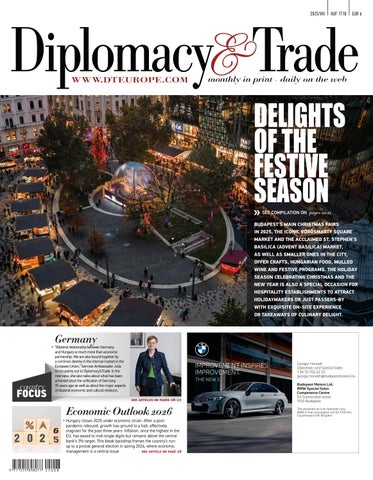
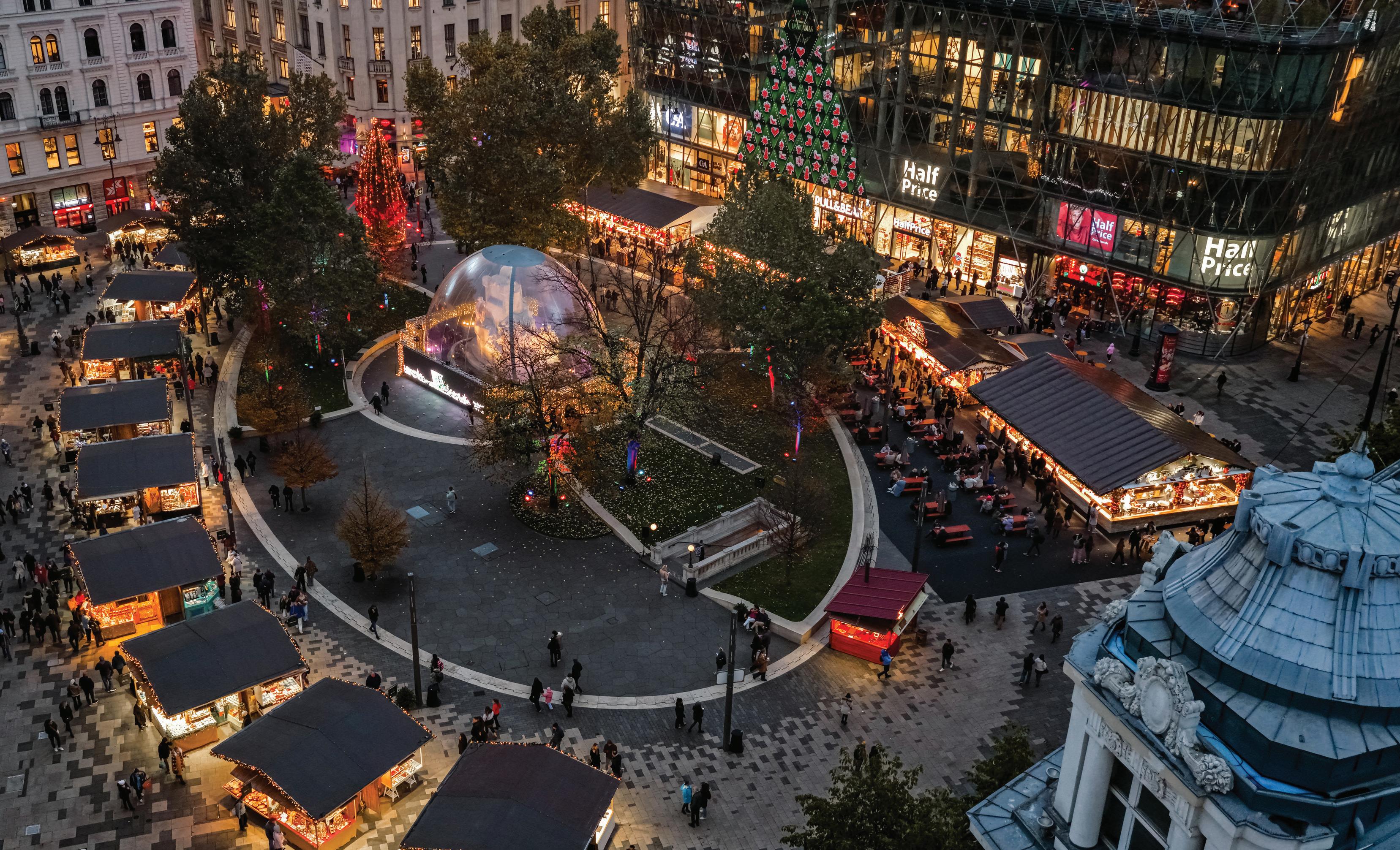
DELIGHTS OF THE FESTIVE SEASON
SEE COMPILATION ON pages 20-21
BUDAPEST'S MAIN CHRISTMAS FAIRS IN 2025, THE ICONIC VÖRÖSMARTY SQUARE MARKET AND THE ACCLAIMED ST. STEPHEN'S BASILICA (ADVENT BASILICA) MARKET, AS WELL AS SMALLER ONES IN THE CITY, OFFER CRAFTS, HUNGARIAN FOOD, MULLED WINE AND FESTIVE PROGRAMS. THE HOLIDAY SEASON CELEBRATING CHRISTMAS AND THE NEW YEAR IS ALSO A SPECIAL OCCASION FOR HOSPITALITY ESTABLISHMENTS TO ATTRACT HOLIDAYMAKERS OR JUST PASSERS-BY WITH EXQUISITE ON-SITE EXPERIENCE OR TAKEAWAYS OF CULINARY DELIGHT.

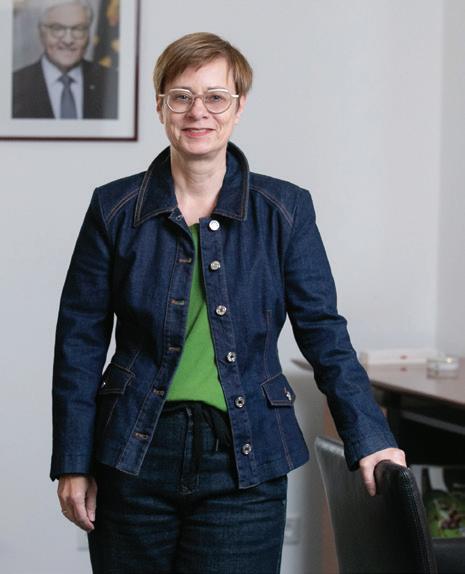
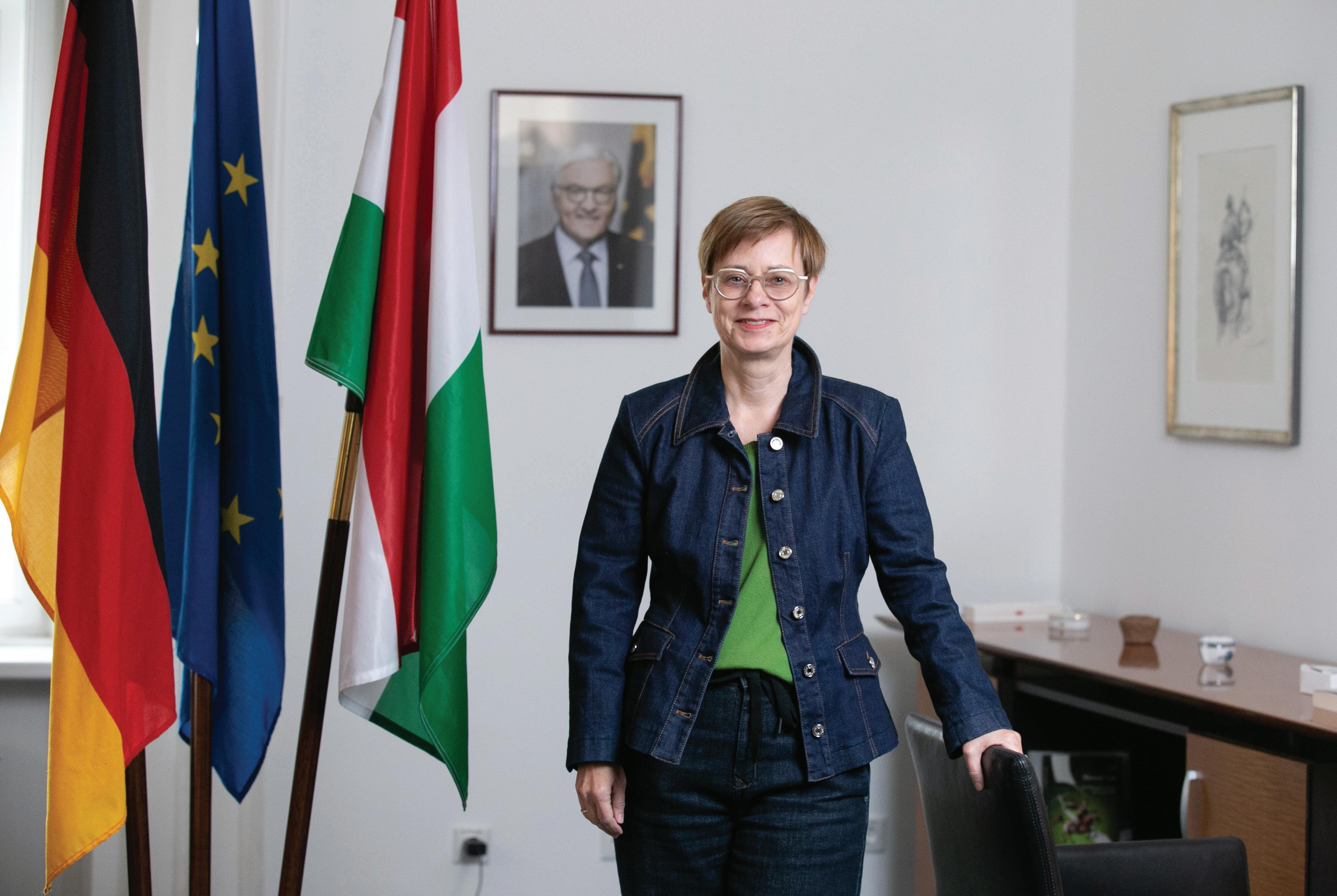
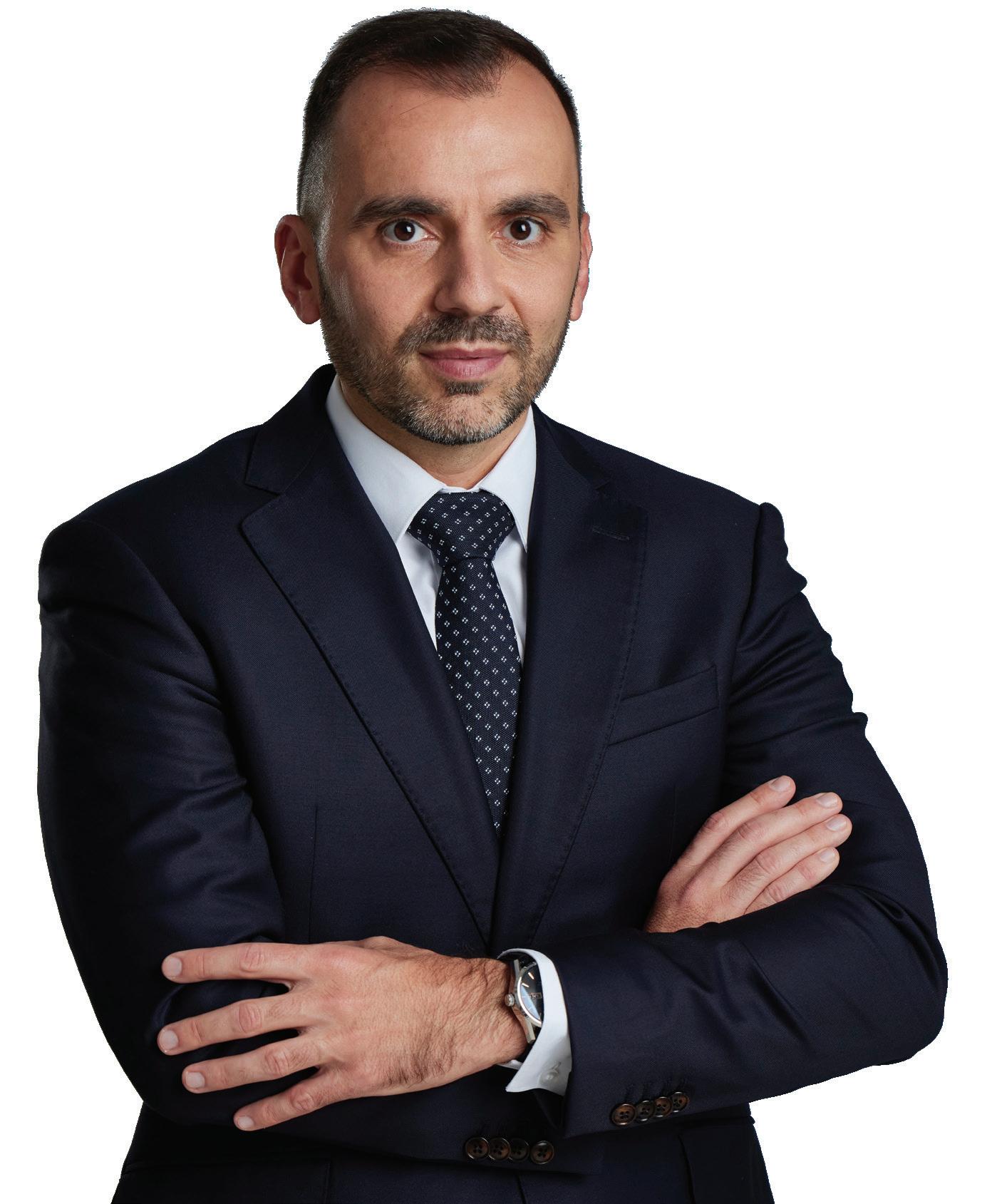
“Bilateral relationship between Germany and Hungary is much more than economic partnership. We are also bound together by a common destiny in the internal market in the European Union,” German Ambassador Julia Gross points out to Diplomacy&Trade. In the interview, she also talks about what has been achieved since the unification of Germany 35 years ago as well as about the major aspects of bilateral economic and cultural relations.





















see articles on pages 08-17
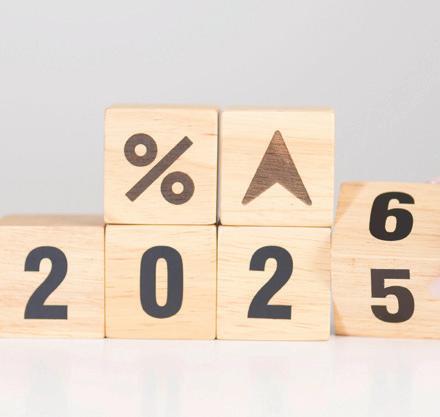
Hungary closes 2025 under economic strain. After a postpandemic rebound, growth has ground to a halt, effectively stagnant for the past three years. Inflation, once the highest in the EU, has eased to mid-single digits but remains above the central bank’s 3% target. This bleak backdrop frames the country’s runup to a pivotal general election in spring 2026, where economic management is a central issue. see article on page 18

letter from the publisher
With another year drawing to a close, Budapest has already embraced the Advent season. Christmas markets are once again bustling with tourists and locals alike, while the city’s leading hotels have adorned themselves with exquisite festive decorations, doing their utmost to infuse the season with timeless elegance and holiday spirit.
The focus country in this final edition of the year is Germany, Hungary’s largest trading partner and foremost foreign investor. Around 3,000 German companies operate in Hungary today, employing approximately 300,000 people. In our interview, the German Ambassador to Hungary reflects not only on the strength and diversity of the German business community here, but also recalls the historic Pan-European Picnic in Sopron in August 1989, when Hungarian authorities allowed East Germans to cross to the West –an event that contributed directly to the fall of the Berlin Wall and, ultimately, to German reunification 35 years ago. Our Germany Focus also highlights the work of the GermanHungarian Chamber of Industry and Commerce, the Goethe-Institut, and the Hungarian Investment Promotion Agency in strengthening bilateral ties. As always, German companies operating in Hungary are given the opportunity to introduce themselves in these pages.
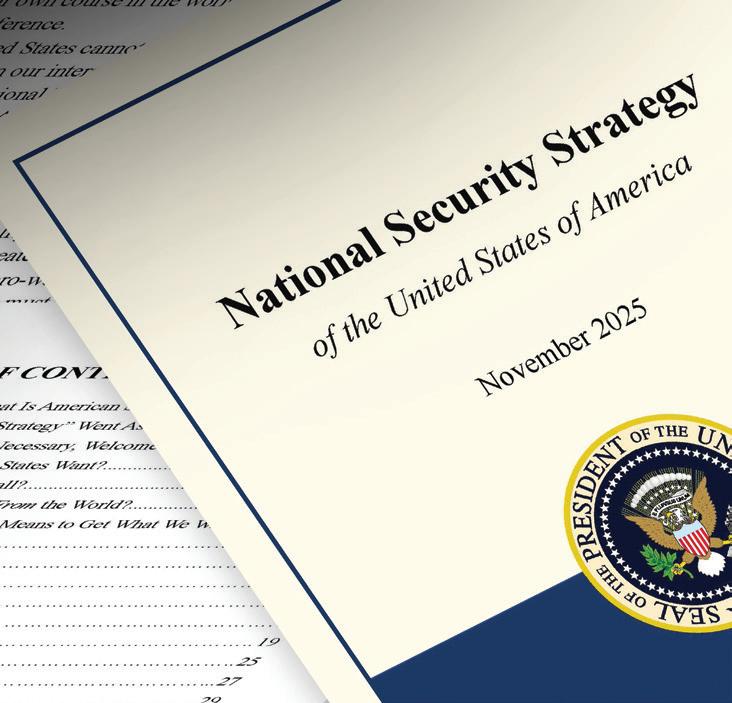
Our international analyst examines the public version of the United States National Security Strategy, published in November 2025, which appears to shift strategic emphasis toward the defense of the Western Hemisphere. In contrast to previous approaches, the Trump administration’s strategy places less focus on containment or competition with peer rivals – particularly China and Russia – and directs a sharper tone of criticism toward Europe.
Hungary will hold parliamentary elections next spring. In the run-up, populist measures are likely to contribute to a widening budget deficit, stagnating growth and higher inflation. These challenges – outlined in our Economic Outlook for 2026 – will confront the next government, whether newly elected or returning to office.
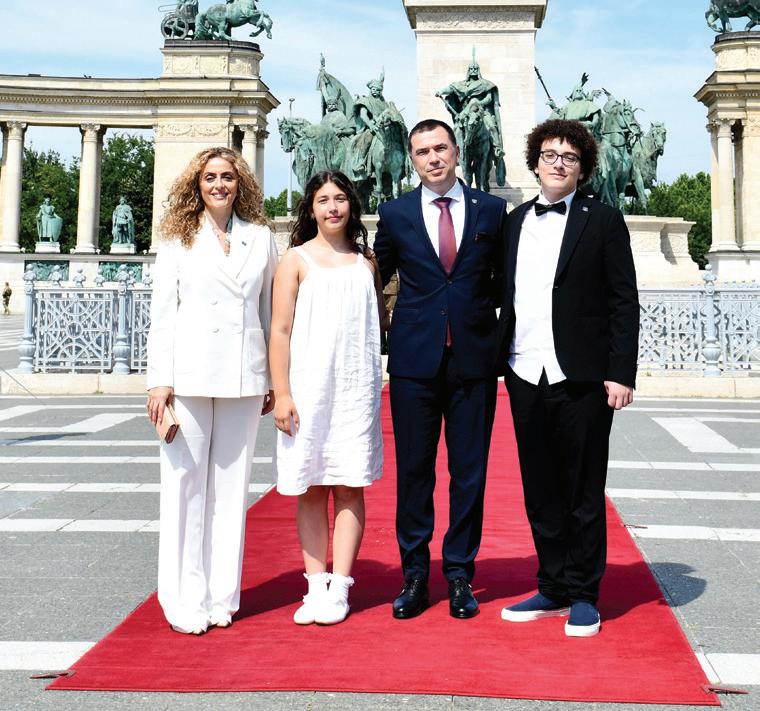
This issue’s WittyLeaks column is authored by the Ambassador of Kosovo, who describes Hungary as a second home, having been here as a tourist, student, and diplomat over the past more than two decades before assuming his current post last year.
As we close this edition and the year itself, we thank our readers, partners, and contributors for their continued trust and engagement. We wish you a peaceful holiday season and look forward to welcoming you again in the new year with fresh perspectives, insightful analysis, and inspiring stories from Hungary and beyond.
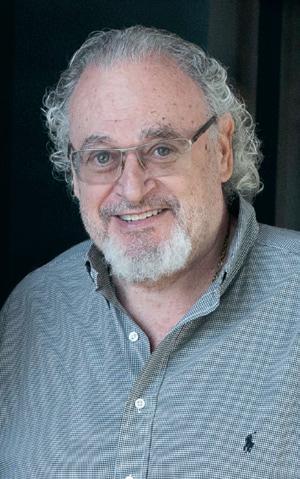
Peter Freed PUBLISHER
PUBLISHER: Peter Freed PHOTO EDITOR: Dávid Harangozó
ADMINISTRATION: Blanka Szalontai
CONTRIBUTORS: Sándor Laczkó, Tamás Magyarics, Edith Balázs, Matteo Di Vora, Delfin Pllana
PHOTO CONTRIBUTORS: Vörösmarty Classic Xmas (cover), depositphotos.com, David Parry / The Booker Prizes, dreniknd.com, vajdapapir.hu, Zoltán Sárosi, HIPA, Ferenc Csárdás, janprerovsky.com, DUIHK/Pelsőczy, Szénási Event, Képszerkesztőség, Porsche Hungária, Emil Chalhoub, Kempinski Hotel Corvinus Budapest, Krisztián Bódis @ budapestimages, Aria Hotel Budapest, Matild Palace, a Luxury Collection Hotel, Budapest, Embassy of the Republic of Kosovo in Hungary, Museum of Fine Arts Budapest, Live Nation

03 ON THE RECORD 04-05 COMPANY BRIEFS 06 ANALYSIS
The National Security Strategy of the United States 08-17 GERMAN FOCUS
Interview with German ambassador Julia Gross; HIPA; E.ON Hungária; Kempinski Hotel Corvinus Budapest; German-Hungarian Chamber of Industry and Commerce; Goethe-Institut; Porsche Hungaria
18 ECONOMY
2026 economic outlook for Hungary 20-21 TOURISM
Christmas in Budapest’s luxury hotels 22 WITTYLEAKS by the Ambassador of Kosovo 23 WHAT’S ON Concerts, festivals, events and exhibitions in and out of Budapest

BRITISH FOCUS – COMING SOON
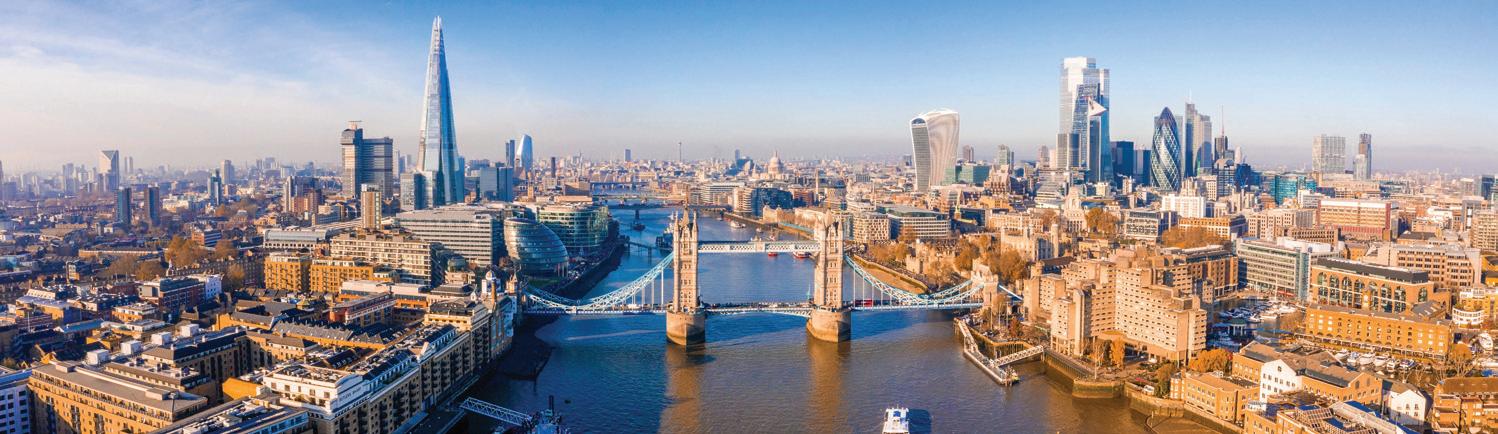
In an upcoming issue, Diplomacy&Trade is going to present, in cooperation with the British Embassy in Budapest, a special focus section on relations between Hungary and the United Kingdom. According to the Hungarian Ministry of Foreign Affairs and Trade, investments from Great Britain play an important role in sustaining Hungary's economic growth. British companies provide jobs for more than 50,000 Hungarians. An interview with the recently appointed British ambassador to Hungary, Justin McKenzie Smith will focus on the main aspects of bilateral relations. The compilation will also present the British Chamber of Commerce in Hungary, the embassy's International Trade and Investment Department and the British Council as well as British companies present here.
Event guide to the Hungarian capital page 23
A rather unorthodox and puzzling strategy page 06 Hungary as second home for the Kosovar ambassador pages 22

HUNGARY’S ECONOMY STALLS AS ELECTION LOOMS
Hungary is limping toward next year’s general election with growth stuck near zero, fragile confidence, and a worsening inflation outlook. Industry weakness, labor-cost pressures, and election-year fiscal constraints leave little room for policy error, and few signs, yet, of a self-sustaining recovery.
Third-quarter GDP posted no quarter-on-quarter growth, a negative surprise that “keeps the economy trapped in stagnation,” according to a new research note from ING Bank’s Budapest economists. The bank cut its forecasts to 0.5% growth for 2025 and 2.3% for 2026 (both down 0.2 percentage points), arguing that hopes for a quick rebound remain elusive without fuller order books and a broader revival in sentiment.
Retail sales are the lone bright spot, while agriculture, industry and construction continue to drag. After a brief July uptick, industry slipped again in August, with output 4.6% below last year and 8.2% below the 2021 monthly average; only electronics showed resilience, ING notes. Vehicle manufacturing fell sharply, and weak German orders pointed to thin export pipelines ahead. Headline inflation has plateaued at 4.3% and remains above the central bank’s tolerance band despite renewed priceshield measures (margin freezes on food and household items, now expanded). ING has overhauled its inflation path: it sees a temporary dip to an average 2.2% in the first quarter of 2026, followed by a re-acceleration toward 5% year-over-year by late 2026 as measures roll off and firms reprice. Average inflation is now 3.6% in 2026, rising to 4.3% in 2027.

HUNGARIAN POPULATION FALLS UNDER 9.5 MILLION
Preliminary data show the number of births falling by 10% in October compared with the same month of the previous year, while deaths declined by 6.8%, the Central Statistical Office (KSH) said this November. Altogether, Hungary's population fell below 9.5 million.
5,979 children were born in October and 10,333 people died, while the natural decrease in the population was 4,354 people, compared with 4,424 in October 2024. Altogether 4,149 couples tied the knot in October, up
on the record
14% compared with the same month the previous year. In January-October, 41,437 couples got married, down 0.9% year on year.
60,304 children were born in January-October, 7.1% fewer than in the same period of the previous year, while 102,748 people died, 2.2% fewer than a year earlier.
The balance between births and deaths, i.e., natural population decline, was already 42,444 between January and October this year. This latter figure is also important because, with this decline, the population of 9,539,502 on January 1 has now fallen below 9.5 million, which has not happened since 1952.
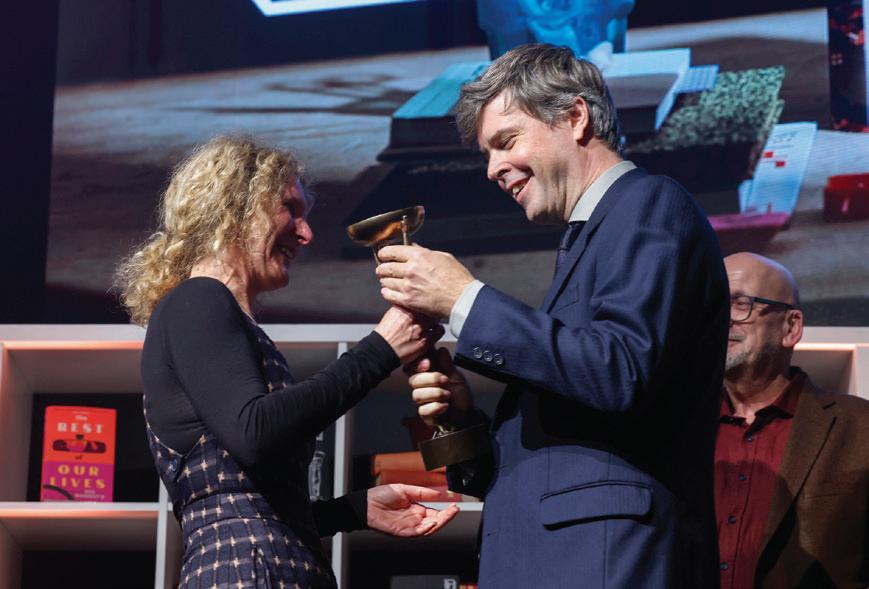
DAVID SZALAY AWARDED THIS YEAR'S BOOKER PRIZE
Canadian-born Hungarian-British writer David Szalay has been awarded this year's Booker Prize, Britain's most prestigious literary award, for his new novel 'Flesh'.
The five-member jury, led by 1993 Booker Prize winner Roddy Doyle and including Kiley Reid, Chris Power, Ayobámi Adébáyo and Sarah Jessica Parker, announced the decision late Monday evening in London.
The shortlist, announced in September and selected from 153 works, included David Szalay, Kiran Desai, who is of Indian origin and won the Booker Prize 19 years ago, with her work 'he Loneliness of Sonia and Sunny', as well as British author Andrew Miller ('The Land in Winter') and three American writers, Susan Choi ('Flashlight'), Katie Kitamura ('Audition') and Ben Markovits ('The Rest of Our Lives').
Born in Canada in 1974, raised in England, educated at Oxford, and now living in Vienna, David Szalay – whose father is Hungarian and mother is Canadian – wrote the novel ‘Flesh’ about a young Hungarian man István, who grew up in Hungary, came into conflict with the justice system, served as a soldier in Iraq, then worked as a security guard, and later experienced the lifestyle of London's upper class up close as a chauffeur for a wealthy London family.
David Szalay was also nominated for the Booker Prize in 2016 for his novel 'All That Man Is'.
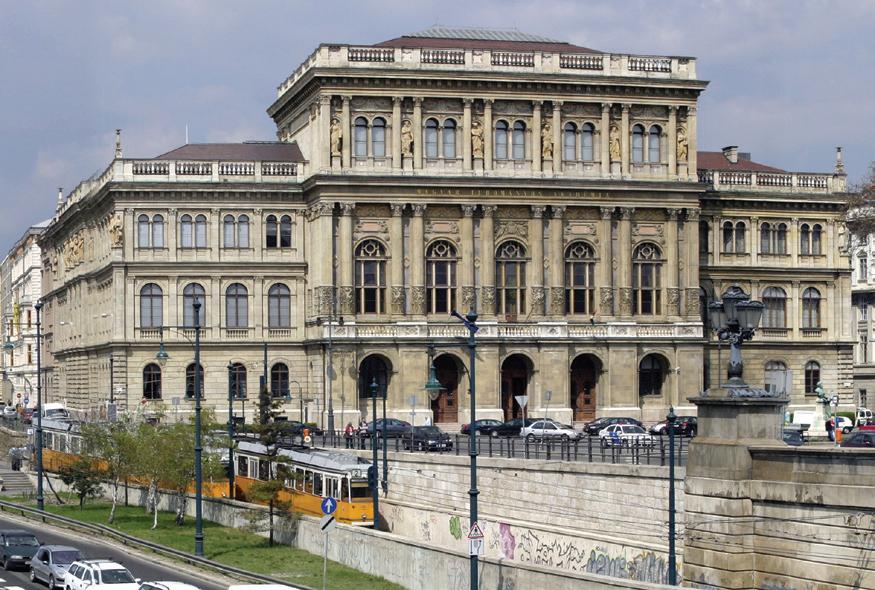
200TH ANNIVERSARY OF THE HUNGARIAN ACADEMY OF SCIENCES
On the occasion of the 200th anniversary of the founding of the Hungarian Academy of Sciences (MTA), an international conference was held this November at the Academy's renovated headquarters in Budapest,
UPCOMING
attended by more than fifty academic leaders and heads of international research funding agencies.
According to a statement by MTA, 51 academic leaders and heads of national research funding agencies from 36 countries participated in the conference entitled 'The Past, Present and Future of Scientific Societies: The Changing Role of Academies in the 21st Century'. Among them were Wim van Saarloos, President of the European Academies' Science Advisory Council (EASAC), and Paweł Rowiński, President of the All European Academies (ALLEA).
The first part of the program on November 4 focused on the rich history and renewed mission of the 200-year-old Hungarian Academy of Sciences. This was followed by a panel discussion entitled 'The Changing Role of Academies in the 21st Century', in which the leaders of national academies and the international scientific organizations that bring them together sought answers to questions such as how academies respond to social change and scientific progress, how they support the careers of the new generation of scientists, what challenges they face in terms of misleading information and maintaining public trust, and how they are transforming their research activities and providing scientific advice.
In the afternoon, Academy President Tamás Freund and Paweł Rowiński jointly welcomed the participants of the high-level workshop organized jointly by ALLEA and SAPEA, the SAPEA program being one of the pillars of the European Commission's Scientific Advice Mechanism (SAM). The event focused on the theme of 'Preserving the integrity of scientific advice: principles and challenges', the MTA statement says.
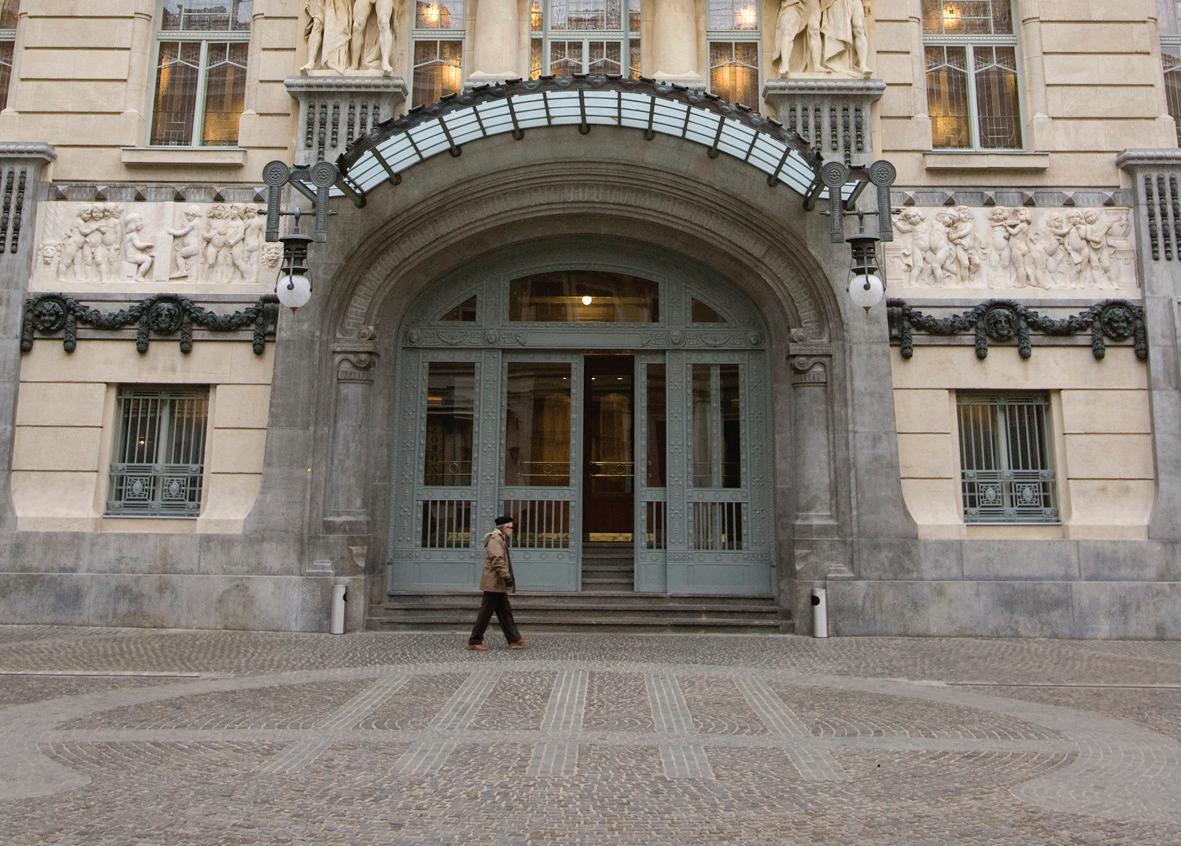
LISZT ACADEMY IN BUDAPEST CELEBRATES 150 YEARS
Hungary’s first and unique higher music education institution opened its doors 150 years ago, on November 14, 1875, under the name National Royal Hungarian Academy of Music, with Ferenc Liszt as President and Ferenc Erkel as Director. The institution soon became an internationally renowned citadel of Hungary’s music education, and has maintained its high standards over the decades.
On the occasion of the anniversary, a series of lectures and legendary concerts were once again staged within the walls of the Music Palace, and an exhibition recalls the past and present of this diverse institution, the University and Concert Center, and provides an insight into all the eras of the Academy’s history through the memories of the generations of musicians who grew up here.
World-famous musicians who have performed in the academy's concert halls and taught in its classrooms, outstanding teachers who have worked for the flourishing of Hungarian music and the development of future generations, as well as their students testify to what the Liszt Academy has given them.
company briefs
DRENIK REINVESTMENT IN SZOLNOK
Serbia-based hygiene paper manufacturer Drenik Group has announced a new investment project in Szolnok, involving the expansion of its existing plant and the construction of a biomass power plant supported by the Factory Rescue Program. With this decision, the company, operating in Hungary for a decade, will increase its total investment value to EUR 110 million and is expected to create 55 new jobs.
According to a report by the Hungarian Investment Promotion Agency, the Serbian Drenik Group has become a key player in the production of hygiene base paper and finished products in Southeast and Central Europe. Its Hungarian production unit, located in Szolnok, E Hungary, was established in 2015, and over the past decade, it has grown into one of Hungary’s largest tissue paper manufacturers and one of the region’s most significant industrial investors.
Drenik Hungary specializes in the production of paper and a wide range of household paper products, including tissues, paper towels, toilet paper, and napkins. The company’s next reinvestment project includes a major capacity expansion and the establishment of a biomass power plant in JászNagykun-Szolnok County under the Factory Rescue Program. With a total investment value of EUR 60 million, nearly a quarter of which is covered by Hungarian taxpayers in the form of state subsidies, Drenik will implement a modern and sustainable base paper manufacturing development, installing new paper machines and constructing an 8,000-square-meter production hall. The integration of innovative boiler and water filtration technologies will substantially lower the environmental footprint and operational costs of the plant.
In connection with the capacity expansion, a biomass power plant will also be built. Implemented under the Factory
OTP MARKS 30 YEARS ON BUDAPEST STOCK EXCHANGE
OTP Bank, Hungary's biggest commercial lender, celebrated the 30th anniversary of its listing on the Budapest Stock Exchange at an event this November.
OTP chairman Sándor Csányi said the success of the lender and of the bourse were "inseparable", noting that OTP accounted for around 60% of share turnover, making it one of the most liquid shares in Europe.
Bourse CEO Tibor Tóth said the exchange's transparency and investor requirements had contributed to OTP's success. He added that the lender's shares had great growth potential as well as the biggest market capitalization and share market turnover.
Mihály Varga, the governor of the National Bank of Hungary, which owns the bourse, was of the view that household savings, with the right scale and structure, played a key role in maintaining the stability of the financial system and economic balance as well as supporting sustainable development. He added that Hungarian households, with net financial assets equivalent to 114% of GDP,
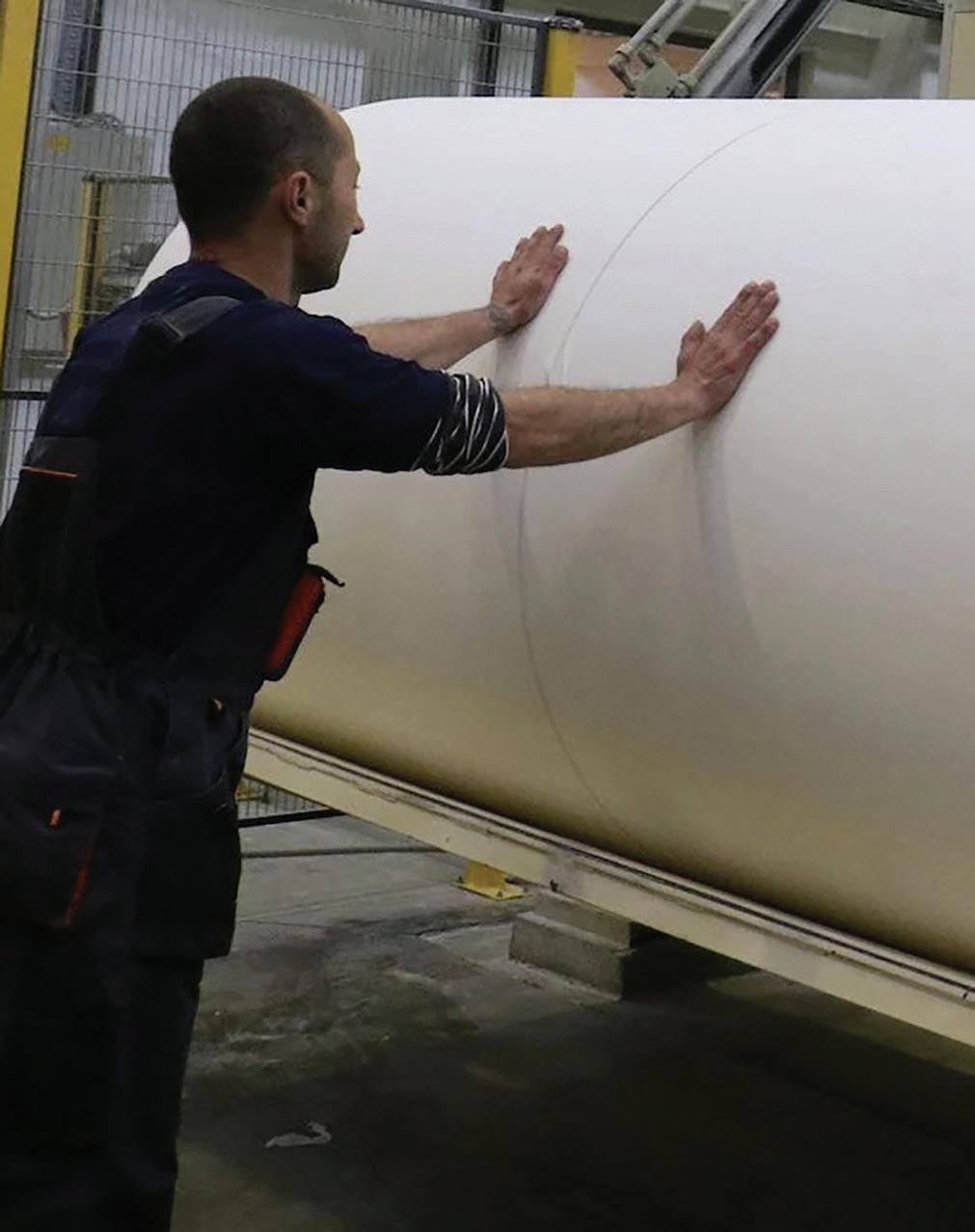
Rescue Program, the project will ensure Drenik’s complete energy self-sufficiency from renewable sources, making the company independent from natural gas and the electricity grid. With an investment of nearly EUR 50 million, the new facility will provide at least 32 MW of thermal capacity, playing a key role in Drenik’s environmentally conscious approach and economic sustainability. Altogether, the two projects are expected to create 55 new jobs.

could participate to an even greater degree in the companies listed on the bourse. OTP's share price averaged HUF 1,150 when it was listed in 1995. Since then, the share price has risen by a factor of 270, adjusted for the impact of a ten-for-one stock split.
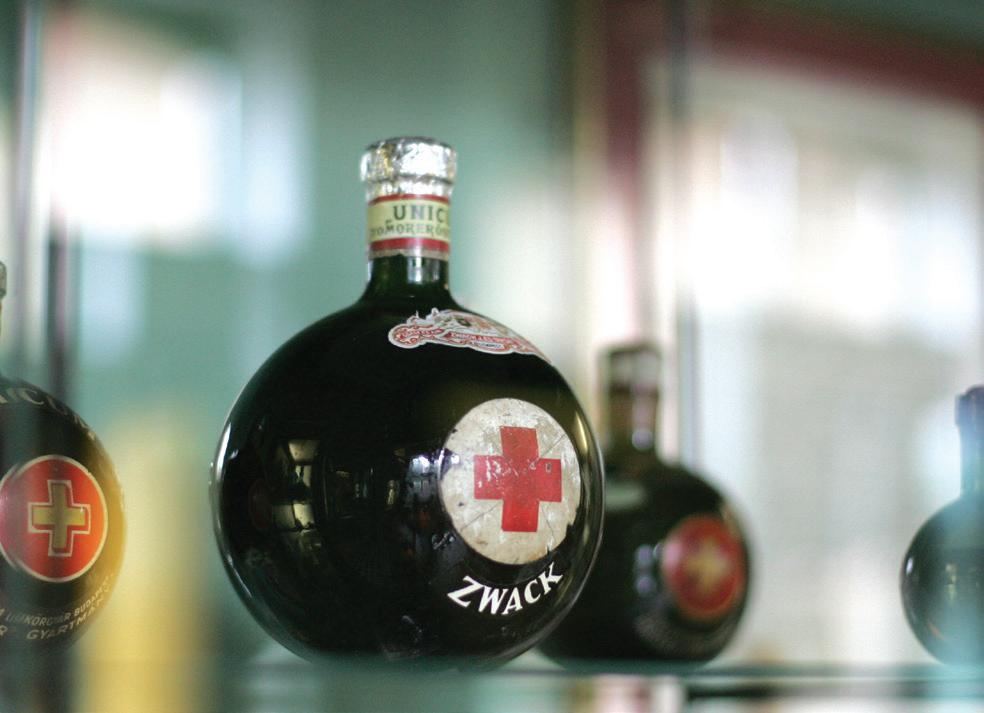
SALES UP AT ZWACK UNICUM PLC.
Zwack Unicum Plc., the biggest player in Hungary’s spirit market, had total gross sales of HUF 18.993 million in the first half of the 2025–2026 business year – a year-on-year increase of HUF 759 million (4.2%). Net sales (that is, sales revenues minus excise tax and revenue from the Deposit Return System’s deposit fee) were HUF 11 874 million, a year-on-year increase of 5.2% (HUF 585 million).
According to the Management report approved by the Board of Directors of the company and published on the website of the Budapest Stock Exchange, net domestic sales of products had a year-on-year increase of HUF 9,750 million (4.5%). Net sales of own-produced goods in the domestic market had a year-on-year increase of HUF 539 million (7.4%) (HUF 7,779 million instead of HUF 7,240 million).
RICHTER EARNINGS SLIP AS FINANCIAL LOSS WEIGHS
Net income of Hungarian pharmaceutical company Gedeon Richter fell 7% year-on-year to HUF 163.3bn in Q1-Q3, dropping on a financial loss, according to an earnings report posted this November.
Revenue rose 7% to HUF 680.2 billion and operating profit climbed 8% to HUF 204.5 billion.
A net financial loss of HUF 9.5 billion, after a net gain of HUF 5.8 billion in the base period, weighed on the bottom line. FX losses came to HUF 24.7 billion in Q1-Q3, including HUF 18.9 billion in Q3 alone, mostly due to the weaker dollar and the stronger forint, Richter said.

Richter also noted the negative impact of a "slightly higher" effective tax rate, boosted by deferred tax expenses. Earnings per share came to HUF 893.
North America was Richter's biggest market in Q1-Q3, generating turnover of HUF 200.8 billion, up 9%. Royalties from sales of Vraylar, the brand name there for Richter's antipsychotic cariprazine, came to HUF 181.0 billion, an increase of 10%.
Richter adjusted its full-year guidance for pharmaceutical revenue, at constant exchange rates, to "close to EUR 2.3 billion". Operating profit, adjusted for one-offs and at constant exchange rates, is expected to grow 8-10%.
Pharma sales reached EUR 1.67 billion in Q1-Q3, while the segment's clean operating profit rose nearly 8% to EUR 534m. At a press conference after the release of the report, CFO László Kovács said the innovative, neuropsychiatric and women's health segments continued to show robust growth, but the generic products segment faced challenges and in the biotech segment, CDMO revenues remained below expectations due to US regulatory changes.
In the next 12 months, Richter plans to launch 4 products and 3 biosimilar molecules, he added.
R+D spending fell 3% in Q1-Q3. It declined 20% in the biotech segment but increased in the women's healthcare segment. László Kovács said Richter came close to two major acquisitions in the women's healthcare segment during the period but its last-round offers stalled. He added that the profitability outlook is positive and the dividend rate could increase further next year.
Broken down in more detail, sales of premium products increased by 11.5%, while the sales of the quality products came down by 4.9%. Taking a closer look at the premium category: the sale of the Unicum product line grew. After Unicum Orange Bitter – the most recent flavor version of Unicum brand – had been introduced into the on-trade channel in autumn 2024, in April 2025 it hit the off-trade channel too and that visibly pushed upwards that brand’s sales figure in the first half of the business year. In the quality category the sales of the St. Hubertus brand went up while the sale of Kalinka vodka decreased considerably – which led to a downward trend in the overall performance of the category. Net sales of traded products had a year-on-year decrease of 5.7%. Broken down in some detail, the revenues of the Diageo portfolio went down by 9.5% while the revenues of the other traded products increased by 16.4%. In the latter category the revenues of mineral water and prosecco increased.
company briefs
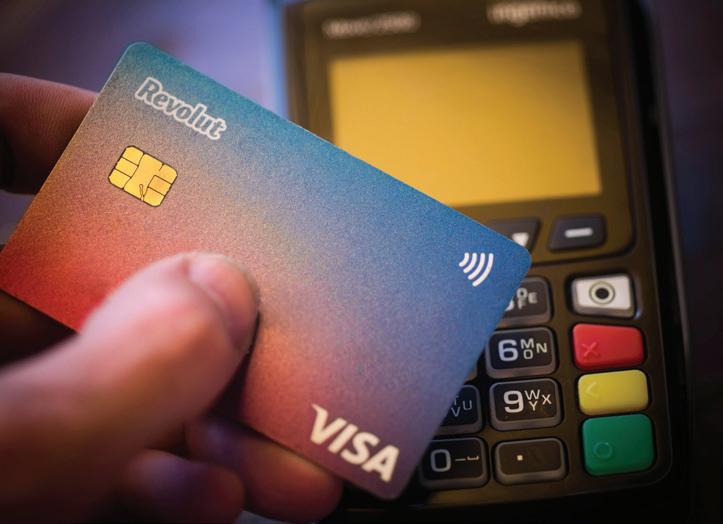
REVOLUT OPENS HUNGARIAN BRANCH
The global financial technology company
Revolut has officially opened a bank branch in Hungary. Revolut Bank UAB has been listed in the Hungarian National Bank's institution finder as a cross-border credit provider entity since February 14, 2022 (after receiving an EU banking license in Lithuania). Now, however, Revolut Bank UAB's Hungarian branch has also appeared with an
MOL Q3 EARNINGS SLIP
Third-quarter net income of Hungarian oil and gas company MOL fell 15% year-on-year to HUF 94.8 billion as revenue dropped, an earnings report released early November.
Net sales declined 8% to HUF 2,268 billion. Operating profit slipped 7% to HUF 163.0 billion.
MOL noted that EBITDA, at current cost of supply and adjusted for one-offs, rose 15% to USD 974 million.
Upstream EBITDA, excluding one-offs, edged up 2% to USD 285 million and downstream EBITDA, at current cost of supply and cleared for one-offs, climbed 51% to USD 452 million.
EBITDA of the consumer services business rose 28% to USD 317 million, lifted by strong fuel sales.
Earnings per share came to HUF 127.
In guidance, MOL put full-year EBITDA, at current cost of supply and adjusted for one-offs, at around USD 3.0 billion, after reaching USD 2.491 billion in Q1-Q3.
Addressing recent operational developments, MOL said that damage assessment following a fire at its Danube Refinery on October 20 was ongoing. One of three atmospheric vacuum distillation units there was severely damaged in the fire, but other parts of the refinery were unaffected. As the units not affected in the fire have been successfully restarted, the Danube refinery is expected to run at around 50-55% capacity until the affected unit is repaired, equivalent to about 250,000-300,000 tons of lost processing capacity per month.


identification number and is listed as a bank (branch). The opening of the branch is important because Revolut will now offer customer service and the handling of complaints in Hungarian. Customers will receive a Hungarian bank account number, making it easier to use Revolut as their primary banking provider. As a result of opening a branch, the company may be able to offer local features such as instant payment or payment requests in line with Hungarian standards, as well as QR code payments. However, there may also be disadvantages for the company due to stricter local control, as Hungarian regulations prescribe a
VAJDA-PAPÍR ACQUIRES HOUSEHOLD PAPER BUSINESS
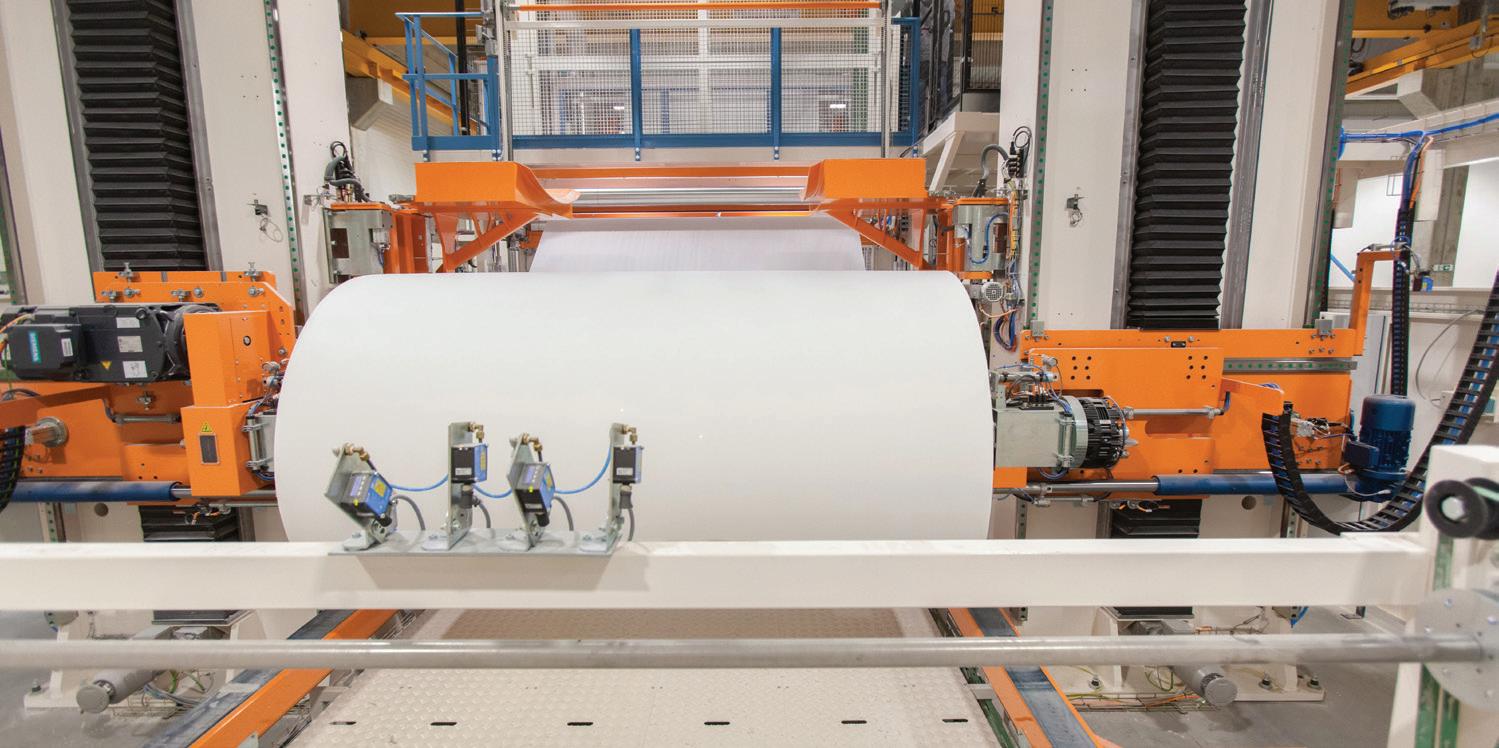
Vajda-Papír Group, Hungary's leading manufacturer of hygiene paper, is acquiring Sofidel Hungary's household paper business. On November 7, 2025, the company signed a purchase agreement with Sofidel Hungary Ltd. to acquire Sofidel's Hungarian household paper processing business, subject to certain conditions (including approval by the Hungarian Competition Authority). The financial closing of the transaction is expected in the second quarter of 2026, following the acquisition of the necessary regulatory approvals. With the planned acquisition, Vajda-Papír will further strengthen its presence in the regional household paper market and expand its production capacity and product portfolio.
According to Vajda-Papír's previous announcement, the group's net sales in the first half of 2025 increased by 11.8% and its pre-tax profit by 17% compared to the same period last year. In the first six months of the year, consolidated sales revenue was HUF 38 billion, compared to HUF 34 billion a year earlier,
wide range of strict requirements for local financial service providers, and there are also some levies and taxes that Revolut will now be required to pay. From the perspective of the National Bank of Hungary and Revolut's Hungarian customers, it is a disadvantage (at least compared to a Hungarian subsidiary bank) that the existence of the branch still does not mean that the Hungarian deposit guarantee will cover Hungarian customers' funds deposited in Revolut accounts. Should a problem arise, Hungarians will still have to contact the Lithuanian supervisory authority.
and EBITDA was around HUF 4.1 billion, close to last year's half-year figure. Consolidated pre-tax profit rose from HUF 3.2 billion in the first half of 2024 to HUF 3.7 billion. In the first half of 2025, the company sold 27,519 tons of finished goods, 16% more than a year earlier. While the domestic consumer market declined slightly by 1%, export volume increased by 34% and public sector sales by 13%.
The Vajda-Papír Group is present in Central and Eastern Europe, the Baltic States and Scandinavia, exports its products to more than 30 countries, employs more than 700 people at group level, and has three sites in Hungary and one in Norway. With an annual production capacity of 140,000 tons, Vajda-Papír, which is 100% Hungarian family-owned, produces 55-60% of domestic demand and exports 60% of its production abroad. In addition to European countries, it also exports to Asia and the Caribbean. Sofidel Hungary, which has a plant in Lábatlan, west of Budapest, employs 177 people, and its net sales at the end of last year exceeded HUF 11.86 billion, following HUF 12.6 billion in the previous year. The Sofidel Group is headquartered in Porcari, Italy (in the province of Lucca) and is one of the world's leading manufacturers of hygiene and household paper products.
SOLAR PARK INAUGURATED AT ELI-ALPS IN
SZEGED
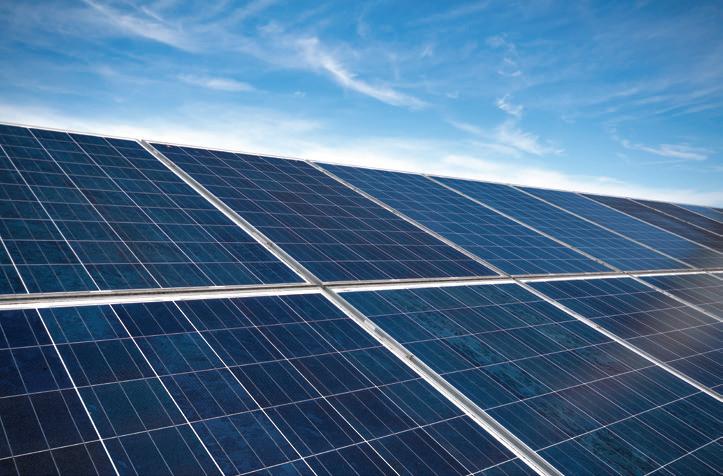
340 hours this year when the price of electricity was zero or negative, which is why it is necessary to build energy storage capacities, the minister said. ELI-ALPS managing director Gábor Szabó said renewables meet 35% of the institute's energy needs





A HUF 2 billion solar park was inaugurated at the ELI-ALPS Laser Research Institute in Szeged (SE Hungary) this November. Speaking at the ceremony, Energy Minister Csaba Lantos said the government had ploughed HUF 25 billion, so far, into infrastructure at ELI-ALPS and the University of Szeged's Science Park. Hungary currently has 8,200 MW of solar power capacity in operation. From April to the end of September, when solar panels produce large amounts of electricity, the country has a surplus of electricity during the day. This year, Hungary was a net electricity exporter on 15 days. At the same time, there were
analysis

BACK TO THE PAST?
THE NATIONAL SECURITY STRATEGY OF THE UNITED STATES
BY TAMÁS MAGYARICS
The publication of the public version of the National Security Strategy of the United States in November 2025 has created not only ripples, but also huge waves in international life. (The NSS always has a longer, more detailed classified version; what can be read on the homepage of the White House is a redacted, shortened version of the original one.) True to Donald Trump’s personality, it is a rather unorthodox and puzzling document, and it has given rise to interpretations along a wide spectrum. There are claims that it is a blueprint for U.S. isolationism, while others believe that the decade-long American commitment to lead the world ’from the front’ (in Hillary Clinton’s words) still constitutes the core of American foreign and security policies. It is underlined by the call for robust military and deterrent capabilities with a robust industrial base and energy sector. The reindustrialization of the U.S. is sometimes seen as a step backward in the age of another communications revolution and artificial intelligence (AI). However, it has its role in national security as it concentrates key sectors vital for the defense industry in the country, not even speaking of shortening supply chains at a time of uncertainties in international trade.
Shifting the main attention
What seems to be the underlying principle is the admission or realization that the global commitments assumed in the past decades by the U.S. can no longer be sustained. The NSS does not say so in so many words, but the
global distribution of power has changed in the 21st century – and not necessarily in favor the U.S. – or the West in a broader sense. Therefore, the NSS of 2025 shifts the main attention to the defense of the Western Hemisphere. A part of it is the ’full control of the borders’; that is, migration is to be stopped rather than facilitating it. In a rhetoric reminiscent of the Monroe Doctrine, the NSS demands the prevention of foreign actors from meddling with the ’Americas’ – as they were referred to in 1823. The idea may even be dubbed as the Trump Corollary to the Monroe Doctrine. There are other phrases bringing previous U.S. strategies to mind. The notion of ’peace through strength’ is clearly Reaganesque, though negotiating from the position of strength may go back to each post-World War II president except for the potential exception of Jimmy Carter in his first years in office. (His attitude ultimately changed with the Soviet invasion of Afghanistan.)
New primary target of criticism
While the previous National Security Strategies were concentrating on the containment of and/ or competition with the peer rivals, especially China and the Russia, the current one is rather muted in their criticism. In contrast, the primary target of criticism is Europe. The rather skeptical view of Europe’s future is not new in the Trump administration: Vice President J. D. Vance painted a bleak picture of Europe’s future at the Munich Security Conference in mid-February. He claimed, in harmony with the NSS, that Europe is fast losing its identity because of the mistaken immigration policies since 2015. In fact, President Trump echoed similar sentiments in a recent wide-ranging interview with Politico, in which he singled out former German Chancellor
Angela Merkel as the main culprit for the massive immigration into Europe from Asia and Africa in the first place. The almost apocalyptic vision painted by the NSS claims that Europe will cease to be the civilization as we know it if it does not do something to reverse the current liberal immigration policy. Further warning shots across Europe’s ’bow’ included a call for more equitable burden-sharing as well as a reference that NATO is not a perpetually expanding organization. If we are reading between the lines, both indicate an American intention to lessen its security commitments in Europe, while the latter comment is a direct warning to Ukraine that it should not count on the U.S. support in her endeavor to join the military organization. In fact, one can even interpret this more than a cautious approach to NATO expansion as a Realpolitik turn in U.S. foreign and security policy: America’s ’unipolar moment’ has gone and, instead, we live in a multipolar world. As Finland’s President Alexander Stubb put it in one of the recent issues of the Foreign Affairs, there are three major blocs in the world: the Global West, the Global East, and the Global South. In other words: the U.S. is no longer a global hegemon, and defining national interests more in line is simply acknowledging this reality (and closing the socalled Lippmann-gap between means and ends).
Support for conservatives and patriots
Liberalism itself is attacked by the NSS – which is rather startling in view of the tenor of the previous NSSs. The current U.S. administration believes that the nation states constitute the current and future basic units in the world, and as the EU (Brussels) is working hard to do away with the sovereignty of the individual states in
an effort to create a federalistic ’superstate’, ’Brussels’ is also trying to swim against the current. At the same time, the NSS of 2025 promises assistance to countries mostly on the eastern and southern periphery of the European Union in their efforts to fight back against the centralizing policies of the EU. The support is not to be restricted exclusively to various policies, but also to the intellectual/spiritual efforts of the conservative and patriotic forces. In this, it amounts to a U-turn regarding the previous public positions of former administrations which promoted liberal values and forces around the world – if not always in deed, at least in words.
A document of transactional nature
What amounts to a real Copernican turn is a return to balance-of-power approach to international relations in place of a centurylong rules-based one – though here, it must also be noted that the various presidents from Woodrow Wilson to Joe Biden interpreted the rule of law, national self-determination, the freedom of seas, etc., rather ’liberally’ at times. Another important difference is the transactional nature of the document; it is more like a blueprint for everyday business than a strategic document. Some suggest that it might have been written at the time of William McKinley and Theodore Roosevelt more than a hundred years ago when the U.S. interests were pursued in a more naked form without paying lip service to pious ideas. Hopefully, the events in the future will not be a repeat of those followed by the presidencies of McKinley and Theodore Roosevelt.
Tamás Magyarics is a foreign policy analyst

BY SÁNDOR LACZKÓ
It is now 35 years that German unification took place. When asked what conclusions she would draw from these three and a half decades for Hungary and for GermanHungarian relations, the German Ambassador to Hungary, Julia Gross tells Diplomacy&Trade that she believes a lot has been accomplished over this period. “The two parts of Germany have managed to shape a common future to grow together in very many respects, but you certainly still see the differences between former East and West Germany. However, it's a task we're working on and I think that in some areas, we share experiences with Hungary because the eastern part of Germany, just like Hungary, was on the other side of the Iron Curtain.” She believes people in Eastern Germany had the experience that their expertise and everything they had contributed to their own country was not valued enough and “I think it's taken some time to change that notion. The same goes maybe for the Eastern members in the European Union. Before we started
growing together, of course, the whole historical moment of tearing down the Iron Curtain had to happen first. That's a shared experience because Hungary played a pivotal role in that by taking the first stone out of that wall, as Chancellor Kohl once said. It was last year that we remembered 35 years of the Sopron picnic when East Germans were allowed by the Hungarian government to cross from Hungary to Austria – that really is a moment that emotionally binds Hungarians and Germans together.”
More than economic partnership
Germany is Hungary's most important economic partner. As one can often hear from current government officials in Hungary, the Hungarian economy highly relies on the well-being of the German economy. However, Ambassador Gross believes the connection goes much deeper than that.
“It's much more than an exchange of goods because we have some 3,000 German companies investing in Hungary, employing about 300,000 Hungarians. So, we don't just buy goods from Hungary and the other
VARIETY
INTERVIEW WITH THE AMBASSADOR OF GERMANY, JULIA GROSS
way round, but German companies are engaged in production and do research and marketing in Hungary. We are also bound together by, let's say, a common destiny in the internal market in the European Union. Whatever impacts one of our economies impacts the other as well. Anything that is detrimental to the German economy has an impact on the Hungarian economy and in a smaller degree, but certainly it is also valid vice versa.”
Businesses need predictability
She adds that for German investors, Hungarian workforce is an attractive factor: German businesses see Hungarian employees as very skilled, highly trustworthy and highly reliable. “That certainly was a major factor that pulled investors to Hungary. We will have to look how it develops in the future because there might be a shortage of labor as elsewhere in Europe. German businesses are, of course, talking to the Hungarian government about this – as well as about the need to invest in education and training, as certainly that is one of the very important factors. They also see it
positively that the Hungarian government welcomes foreign direct investment and created very conducive and positive conditions for investors, for instance through the HIPA agency that is a highly important partner for German business. And it's not only one area or around the capital in Budapest, but most of the regions of Hungary have attracted investment from Germany and thus, these conditions prevail throughout Hungary and have been seen as very positive.”
Speaking more in detail about investment conditions, the Ambassador notes that German investors who come here benefit, of course, from the EU single market and also from the fact that “we are all working on the same standards and values within the European Union. So, whenever we see measures by the Hungarian government that impact the workings of the single market that has a direct negative impact on our business community. That is something we try to talk to the Hungarian government about. Corporate actors always tell me, and that goes for Hungary as well as Germany, that business needs predictability, planning security, rule of law and all these things. Stability in these respects is very important and anything that kind of shakes these parameters up is not conducive to the success of doing business and to their work in Hungary.”
Diverse business community
As regards the German business community in Hungary, the Ambassador is of the view that it should not be seen as a homogeneous group. “We have the automotive sector, for instance, that finds extremely good conditions in Hungary. You just saw the big BMW plant opening in Debrecen and in Kecskemét, Mercedes is investing in new production. Audi in Győr has recently opened a new production line. So, for automotive, things are going extremely well. In other sectors, we have seen some problems or, let's say, things to be discussed with the government in Hungary, for instance, in the case of retailers like Aldi, Lidl or Penny. Pharmaceuticals have had some topics to be discussed – as has construction. So, in different sectors, you have different conditions and different dialogues to be had with the Hungarian government. But overall, I think Hungary is a location where investors feel welcome and they also try to give something back to the country and its people. They employ a lot of Hungarians and try to provide good working conditions for the Hungarian employees. German companies also try to be a productive and constructive part of the communities where they live and work. For instance, they invest in schools, they invest in education. They try to be an active part of the, let's say, social life of their communities. So, I think that's a cooperation that works very well from both sides.”
Looking after the interests of the German business community is always an important part of any embassy's work. “Whenever a German business has something to discuss with the government and they think it's useful for us to participate in this, we are very happy to do that. We are always in very close contact with our whole business community in order to know what's going on there, what their concerns are and what topics are of relevance. That's a very important part of my task and of my colleagues' task
german focus
in the economics department but, of course, we're not the only ones to do that. There is also the GermanHungarian Chamber of Industry and Commerce, the largest international chamber of commerce in Hungary, so they take an active role. Whenever we can, we join forces. We're also happy that the German business community sees us in that role and makes use of us in that respect. We also try to join efforts with international partners who may have the same kind of sectors present in Hungary, thus, often we've joined up with the Swiss and Austrian embassies and chambers of commerce,” Julia Gross adds.
Assisting partnerships
Germany also supports German-Hungarian academic exchange as well as German schools and universities in Hungary. The Ambassador stresses that “it is a very intensive cooperation. We have the German Academic Exchange service offering opportunities for Hungarian students to go to Germany and study in German but also in courses taught in English. There are more than 500 university partnerships with exchanges and research programs. Also, we have a lot of partnerships between schools and twin towns. So, this peopleto-people interconnection is really important. In the future, we would like to increase the number of Hungarian students going to Germany because we sometimes find that the opportunities that are provided by the German Academic Exchange Service
could be used a little bit more by Hungarian students. Maybe the language barrier is one of the motives for people having second thoughts. But, as I say, you can study in Germany in English as well. So, we would like to increase this exchange wherever possible. And, of course, we have a lot of German students in Hungary as well, mainly for medicine.” She also mentions the German-speaking Andrássy University in Budapest where one can find students from Germany, Switzerland, Austria – Hungarians and a lot of third country students.
Germans in Hungary
There are over 400 German minority self-governments in this country, but the German community also includes students, ex-pats working for German businesses as well as diplomats. “A lot of German citizens are moving to Hungary for various reasons, like for retirement around the Lake Balaton region. And, of course, you have the German minority which is a long-standing part of Hungary. Most of them came in the 18th century, under the reign of Queen Maria Theresa, who tried to bring settlers to Hungary in order to import, let's say, skills and people who could be a valuable factor for economy in Hungary. Since then, the German minority has been present in most areas of Hungary and I think contributed to agriculture and to trade and to various branches of expertise,” she points out.
After the Second World War, these people were made responsible for the crimes that the Nazis committed and a large part of the German minority was expropriated and had to leave Hungary. “We are really grateful to the Hungarian government that they introduced a day of commemoration January 19 as for that. In the decades following World War II, I think it was a very difficult time for the remaining German minority in Hungary because they were not allowed to speak their language or openly live their culture. Fortunately, this has changed and I think now the German minority is a very well respected, totally integrated and very well embedded part of Hungarian society,” she adds.
Promoting German culture
As for other aspects of bilateral cultural relations, Ambassador Gross mentions the Goethe Institute, which is the cultural institute working for German language and culture worldwide and it has been in Budapest as well for almost four decades now. “We try to promote German language as foreign language in this country. For the last five years, we have had a festival of the German language called Wunderbar Festival, which is a cooperation of the German, Austrian and Swiss embassies and cultural institutes – a kind of unique even, not something that is done by the other embassies and cultural institutes. We had some 2,000 separate Hungarian contributions last year all over Hungary with films and literature and dance festivals and flash mobs and this was really impressive. There's a real interest in Hungarian society to participate in this.”
A country of great variety
Julia Gross has been here as Ambassador for three years now. Speaking of her most interesting impressions, private and professional, over this period, she says she tries to make a point of traveling outside of Budapest as “living in Budapest is just a real privilege because it's such a great city to live in. What I really, really cherish about Budapest is the amount of culture that you can experience here, especially, for instance, in music and film and cinema. Theater is a bit more difficult for me because of the language barrier, of course, but this is just amazing. But I think it's very important for us also to look beyond Budapest and to travel in the whole country. My recent trips included ones to Debrecen and Szeged but I've been to many, many other places, I mean the larger cities and very tiny places as well. “What we realize is that while Hungary is not such a big country but it is a country of great variety. For instance, you go to Pécs and that is totally different from Debrecen, different cultures. There are different, let's say, literary strands, there are different expressions in music, there are even different culinary universes. So, that is one of the really pleasurable parts of my job to get to know all of this and whenever we go to all of these places, we try to meet with different parts of the community. We want to meet the mayor, of course, and the representatives of the local community, with the German minority. We try to visit schools and talk to students, including those at universities. We make a point also of meeting religious communities – as well as the local media, civil society, NGOs to get the whole picture,” she concludes.
german focus
GERMAN FIRMS COUNTING ON HUNGARY
THE COUNTRY CONTINUES TO BE VIEWED AS A COMPETITIVE INVESTMENT LOCATION
“Germany has traditionally been the largest investor in Hungary. Approximately 2,400 German companies employ around 235,000 people here. This number has increased by 55% since 2010, that is, one in every 14 employees in the Hungarian corporate sector now works for a German company,” government commissioner and CEO of the Hungarian Investment Promotion Agency (HIPA) István Joó highlights to Diplomacy&Trade, describing German economic presence in Hungary.
German companies have invested more than EUR 20 billion in Hungary in terms of the equity capital of their Hungarian subsidiaries (as of December 31, 2023). However, based on actual expenditures on tangible assets (machinery, equipment, buildings), the value of investments is several times higher. Since its establishment in 2014, the Hungarian Investment Promotion Agency (HIPA) has been involved in 324 German projects until the first half of this year, with a total investment value of around EUR 18 billion. Last year, decisions were made on ten investment projects with German companies, making Germany the most active foreign investor community of the year in terms of the number of new projects.
Offering favorable business environment
Regarding HIPA's role in promoting German investment in Hungary, István Joó stresses that “we are in a favorable position because German companies are well aware of Hungary's strengths. They know that they will find perhaps the best business environment in Europe here. The highly competitive tax system, a well-trained workforce with a work culture similar to that in Germany, the country's favorable location and developed infrastructure all speak in our favor.” He adds that HIPA's task is to encourage as many German companies as possible to take advantage of these opportunities and invest in Hungary. Therefore, together with foreign trade diplomats, the agency is proactively seeking new German companies whose activities and technologies can be easily integrated into domestic ecosystems in Hungary.
“We encourage German companies already operating here to expand their capacity and to locate activities that create the highest possible intellectual added value in Hungary. This is supported by the continuous fine-tuning of the VIP cash subsidy system, based on individual government decisions, in which we have shifted
the focus from job creation to higher value-added projects and are giving priority to encouraging research and development (R&D) and innovation,” the CEO points out.
Mercedes-Benz R&D project
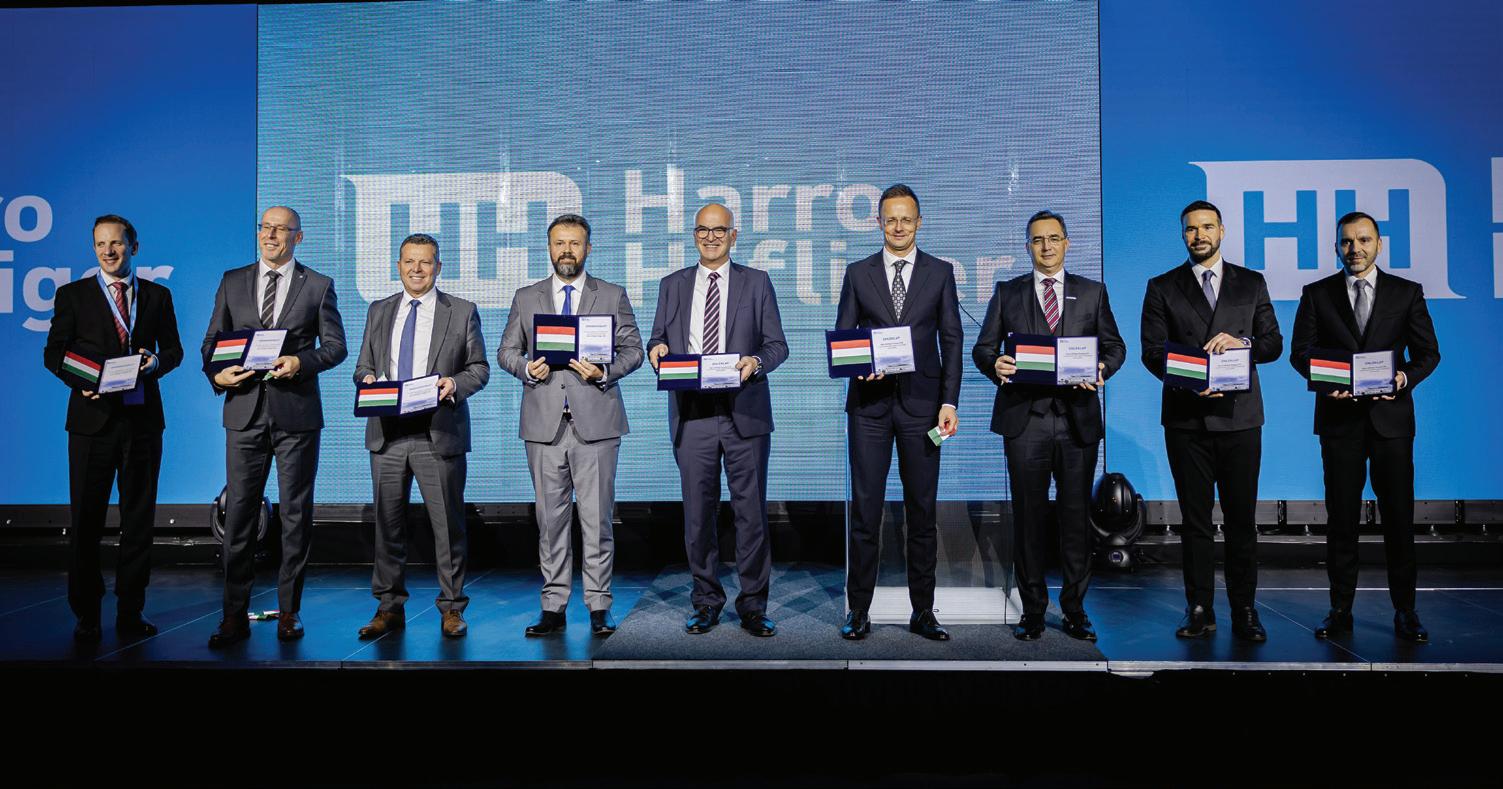
The latest German-related news in Hungarian investment relations is the expansion of Harro Höfliger's investment in Debrecen, but a much larger project is the Mercedes-Benz research and development investment in Kecskemét, both announced this November.
István Joó underlines that Mercedes-Benz's latest investment in Kecskemét is particularly significant because it is the first time the company has launched an R&D project in Hungary. A prototype development center is being set up in Kecskemét, which means that this town will not only be a production base in the company's global network, but also a location for strategic innovation.
“There was fierce competition within the company to win the project, and Kecskemét's success is a significant recognition of Hungarian engineering expertise. The EUR 54.4 million investment is
being made with the support of HIPA and will contribute to raising the technological level of the domestic automotive industry in the long term, as it will not only create 25 R&D jobs, but also allow engineering students to participate in the work in cooperation with the company and Neumann János University, and experience what innovation means in practice,” he says.
The government is supporting the investment with EUR 10.9 million through HIPA. The center will focus on optimizing the production of new models, striving to identify manufacturing imperfections at an early stage, and applying the solutions developed in Kecskemét to the production of electric cars based on new platforms.
German firms counting on Hungary
The automotive industry is currently showing signs of crisis. The HIPA CEO acknowledges that it is indeed undergoing a major transformation globally. The transition to electromobility and market uncertainties are putting serious pressure on manufacturers, including German ones. However, he is of the view that all this represents an opportunity rather than a threat for Hungary,
and in recent years as the largest German players in the sector relocated their strategic activities to Hungary one after the other.
“Today, we can say that all three major German premium brands – Audi, which arrived in 1993; Mercedes-Benz, which has been manufacturing in Kecskemét since 2012; and BMW, with its plant in Debrecen that opened this fall – have significant capacity in Hungary, including in the production of electric cars. BMW has built its most modern plant in Debrecen, where it is producing the first model in the Neue Klasse series, which marks a new era in the company's history, while Mercedes-Benz is creating Hungary's largest car manufacturing base in Kecskemét with a capacity expansion investment, which includes the construction of a battery assembly plant. These are all investments made with the help of HIPA, so we see every day that German companies are counting on Hungary for the long term and are constantly strengthening their presence here, even in an uncertain global environment,” he explains.
Competitive investment location
This fall, important German investments were in the news, such as the expansion of Siemens Mobility's R&D center in Budapest, Rheinmetall building a development center in Zalaegerszeg and the already mentioned handover of BMW's plant in Debrecen. As to what brings new projects here, István Joó points to surveys conducted by the German-Hungarian Chamber of Industry and Commerce that are “very helpful in mapping the prevailing opinions among German investors. Since 1997, this series of surveys has asked whether they would choose Hungary again as an investment location. Looking at the average over almost 30 years, 79% of respondents answered yes. This means that the vast majority of German investors are satisfied with our country and continue to view Hungary as a competitive investment location.“
German investors are particularly satisfied with the infrastructure, which exceeds the regional average, but they also traditionally rate labor regulations, employee skills, the vocational training system, and the quality of Hungarian suppliers as good.
Environment-friendly technologies
Nowadays, sustainability is an important element of any serious investment, serving not only to protect the environment but also to reduce costs.
The HIPA CEO stresses that this is also characteristic of German investments. The Audi plant in Győr, for example, operates one of Europe's largest rooftop solar parks, which clearly shows that German companies are not only following but also shaping the green transition in Hungary. HIPA supports this process through its investment promotion tools, with sustainability being a key consideration in the development of support agreements.
“At the same time, our experience shows that German companies not only meet sustainability expectations, but often test and introduce technological innovations here that later become standard in their global production network. This is demonstrated by BMW's investment in Debrecen, which follows the so-called iFactory concept that combines Industry 4.0 and sustainability, implementing energy-efficient, data-driven, flexible manufacturing that significantly reduces environmental impact.”
photo by ZOLTÁN
SÁROSI, HIPA
german focus
BUILDING THE GRID OF THE FUTURE: WHY EVERY STAKEHOLDER HAS A ROLE
GUNTRAM WÜRZBERG ON HUNGARY’S ENERGY TRANSITION AND EUROPE’S CHANGING LANDSCAPE
As Europe accelerates toward a greener, more digital and increasingly electrified energy future, one challenge stands at the center of strategic debate: developing the networks needed for this transformation. According to Guntram Würzberg, Chairman and CEO of E.ON Hungária Group, building modern, flexible grids is a responsibility shared not only by energy companies, but also by policymakers, regulators and –through smarter choices – even consumers themselves.
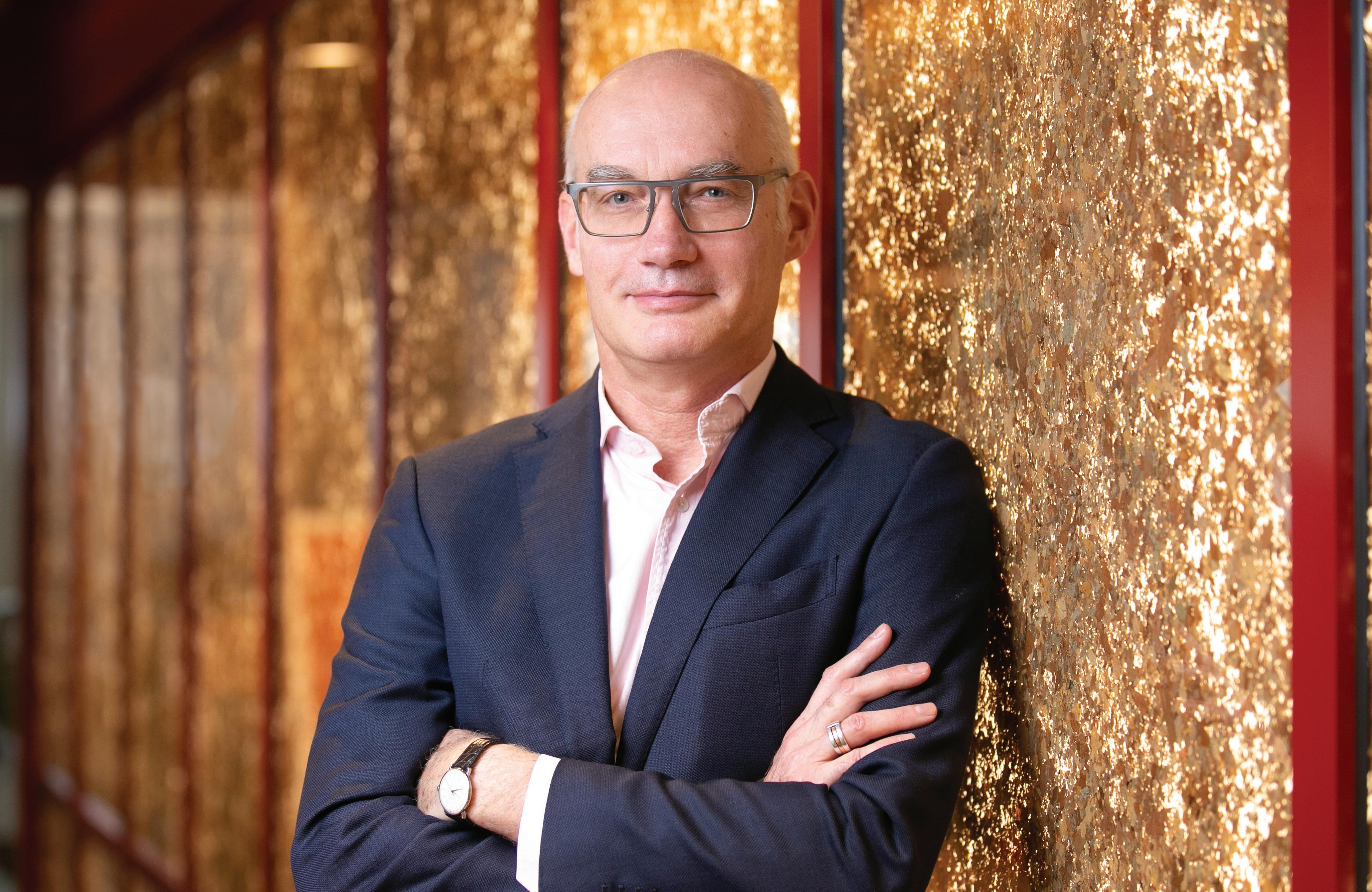
“Energy transition will only succeed if we can afford it. No single market player can manage this alone – not the suppliers, not the regulators, not the politicians. We all have a duty,” Würzberg emphasizes.
In an interview with Diplomacy & Trade, Würzberg outlines how E.ON – Europe’s largest energy network operator – sees its role in Hungary’s rapidly evolving energy landscape and what must be done to keep prices predictable in an era marked by volatility and geopolitical shocks.
A ‘playmaker’ in Europe’s energy transition
With around 47 million customers across the continent, E.ON is increasingly positioning itself as the backbone of Europe’s green transformation. Hungary is no exception.
“Renewables and clean energy are the foundation to the future energy system and someone needs to connect them. That is our job. We are the playmaker of the European energy transition because we operate networks that tie everything together,” Würzberg says.
In Hungary alone, E.ON operates an 88,000-kilometer electricity network and has invested HUF 540 billion in modernizing it over the past four years, far exceeding initial plans. The goal: to build a modern, flexible network
that can support household solar systems, electric vehicles and industrial consumers.
As renewable capacity surges – especially solar, where Hungary has demonstrated fast growth – smart digital tools are becoming indispensable.
One of the most transformative is the smart meter.
E.ON has already installed over 500,000 of them in Hungary, with plans to reach 800,000 by 2030.
“Smart meters put customers in control. They can be more flexible in their consumption, thus propelling digitization on the customer side forward and supporting the transition to a flexible, digital grid,” Würzberg explains.
On the grid side, digital substations and automated load management allow the company to locate outages and failures remotely and manage increasing fluctuations in the system.
E.ON is also piloting new battery-based storage solutions – still small compared to power plants but essential to future grid stability.
Ukraine
war: a wake-up call on energy security
While E.ON’s long-term strategy predates the Ukraine war and is still solid, the conflict reshaped Europe’s priorities overnight.
“Before the war, the focus was almost exclusively on price. After the war began, Europe realized security of supply cannot be taken for granted,” he says.
Wholesale energy prices spiked to three- or four-times pre-war levels, affecting the entire sector. Governments faced the challenge of shielding consumers from extreme volatility.
Although prices have returned close to pre-war levels, Würzberg says one lesson is clear: Europe must diversify its energy sources. Hungary, too, is expected to expand wind power as part of its 2030 national strategy, complementing its booming solar sector.
For Würzberg, affordability is the product of four interlocking responsibilities. Suppliers must provide solutions that reduce dependence on the grid such as time-of-use tariffs or heat pumps. These can lower bills and reduce exposure to market swings. Decision makers
must ensure smart, targeted regulation.
“Regulation must reward the right investments. If grid operators are pushed to build capacity where it’s not needed, customers ultimately pay the price,” he notes.
Grid operators must continue developing the energy networks, and E.ON is ready to take its share, committing EUR 43 billion in investments across Europe between 2024 and 2028, of which EUR 35 billion is dedicated to the grids. Finally, customers also have a role to play: choosing renewable energy products or flexible tariffs helps support the transition while easing strain on the system.
“Building the energy system of the future will require smart decisions from every stakeholder. The success of the transition is, in the end, our shared responsibility,” he says.
E.ON HUNGÁRIA: PROVIDING ENERGY FOR 25 YEARS IN HUNGARY
Celebrating its 25th anniversary this year, E.ON is one of Hungary’s largest energy companies, serving around four million customers. The company operates the electricity networks of Budapest, Pest County and the entire Transdanubian region, and is also responsible for gas grid operation in six counties in the South-West.
Beyond its extensive energy infrastructure, E.ON offers a broad portfolio of innovative solutions – including household and industrial PV systems, e-mobility and charging services, smart energy management tools, and modern retail products for businesses, municipalities and communities nationwide.
With long-term investments and a strong commitment to digitalization, safety and reliability, E.ON plays a key role in driving Hungary’s green energy transition.
german focus
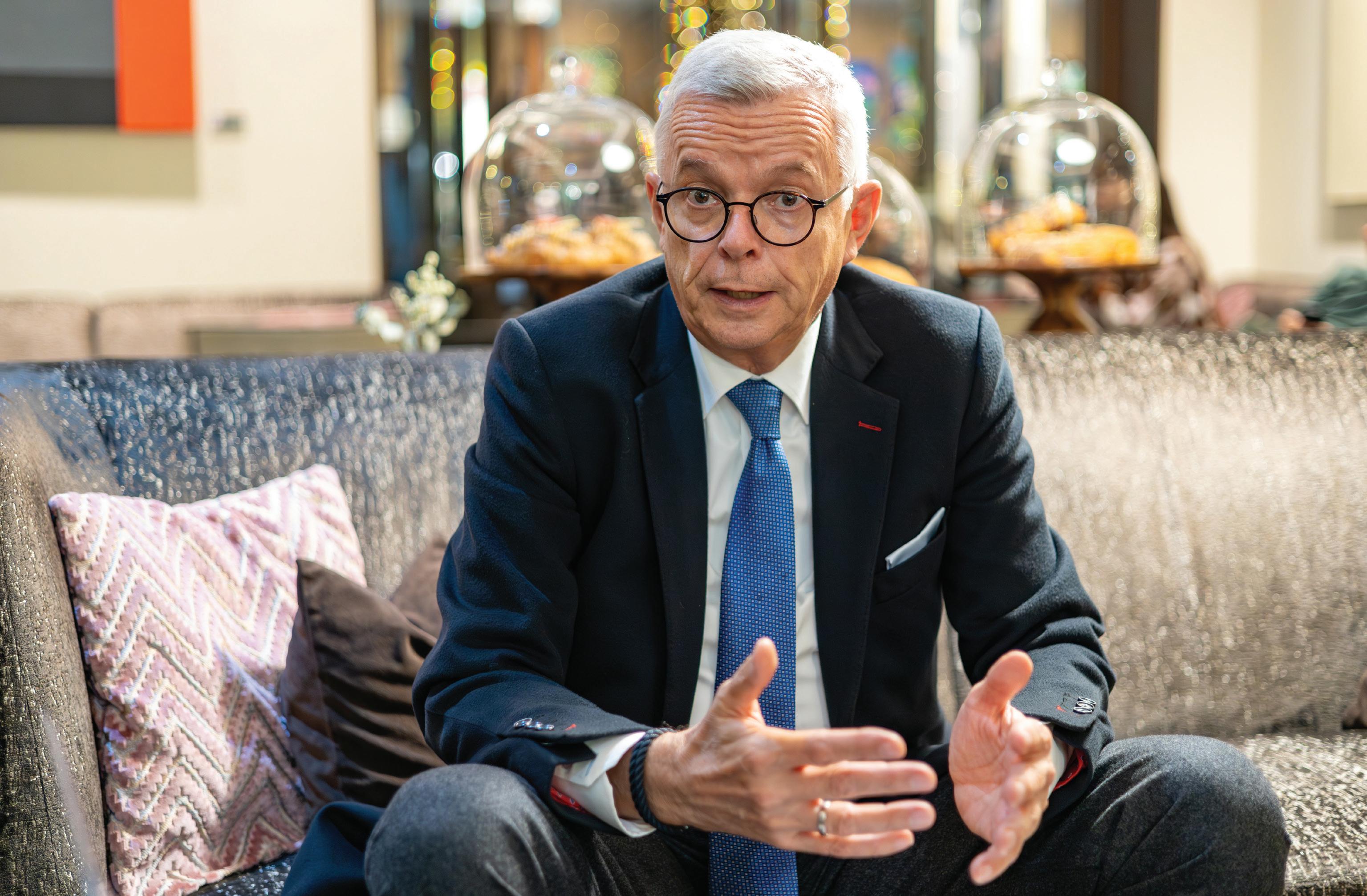
FROM MUNICH AIRPORT TO BUDAPEST: A CAREER WITH PURPOSE
INTERVIEW WITH KEMPINSKI HOTEL CORVINUS BUDAPEST’S GENERAL MANAGER STEPHAN INTERTHAL
In December 1993, Stephan Interthal accepted his first Kempinski GM position at Munich Airport. Some four years later he moved to Budapest for his first tenure to take over as General Manager of the Kempinski Hotel Corvinus Budapest – a role he held until mid-2004.
In late 2014, he returned as Area General Manager to the post, reaffirming both his commitment to the Kempinski brand and his deep attachment to the Hungarian capital.
Budapest’s transformation – from volume tourism to quality experiences
When Stephan Interthal returned to the Hungarian capital in 2014, he found a dramatically transformed city. Infrastructure had improved, the culinary scene had
flourished, cultural life was vibrant, and a wave of architectural renewal was reshaping the urban landscape. Over time, this evolution helped Budapest emerge as one of Central and Eastern Europe’s most compelling destinations.
Today, Interthal believes the key challenge is not increasing visitor numbers, but shifting toward quality tourism: delivering premium, memorable experiences tailored to discerning travelers rather than focusing solely on volume and occupancy.
Kempinski’s staying power: a culture rooted in people
From its opening, Kempinski Hotel Corvinus has maintained a leading position in Hungary’s luxury hotel market. Its resilience – despite changing consumer expectations and
increasing competition – is no accident. The foundation, Interthal says, is continuous renewal and a strong, people-centered organizational culture.
Kempinski was one of the first international hotel brands to enter Budapest in the early
1990s, and its influence on the development of Hungary’s hospitality workforce has been significant. Many former colleagues rose to leadership roles across the industry. Staff retention at Corvinus remains exceptionally high: several team members have been with the hotel for decades, while new generations bring fresh energy.
For Interthal, especially in the post-pandemic era, leadership sets the direction – but collective effort delivers success.
Renewal in the face of growing luxury competition
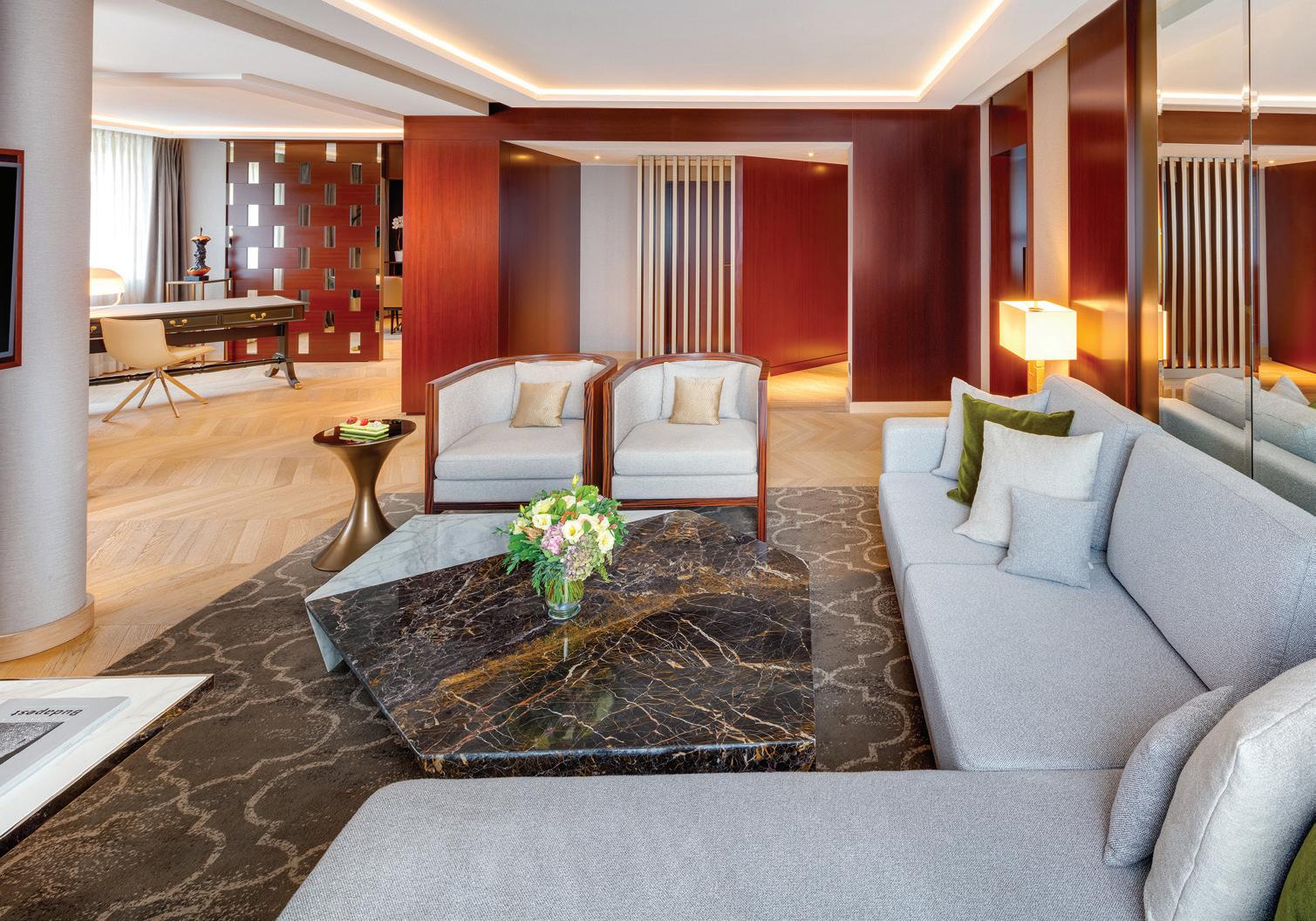
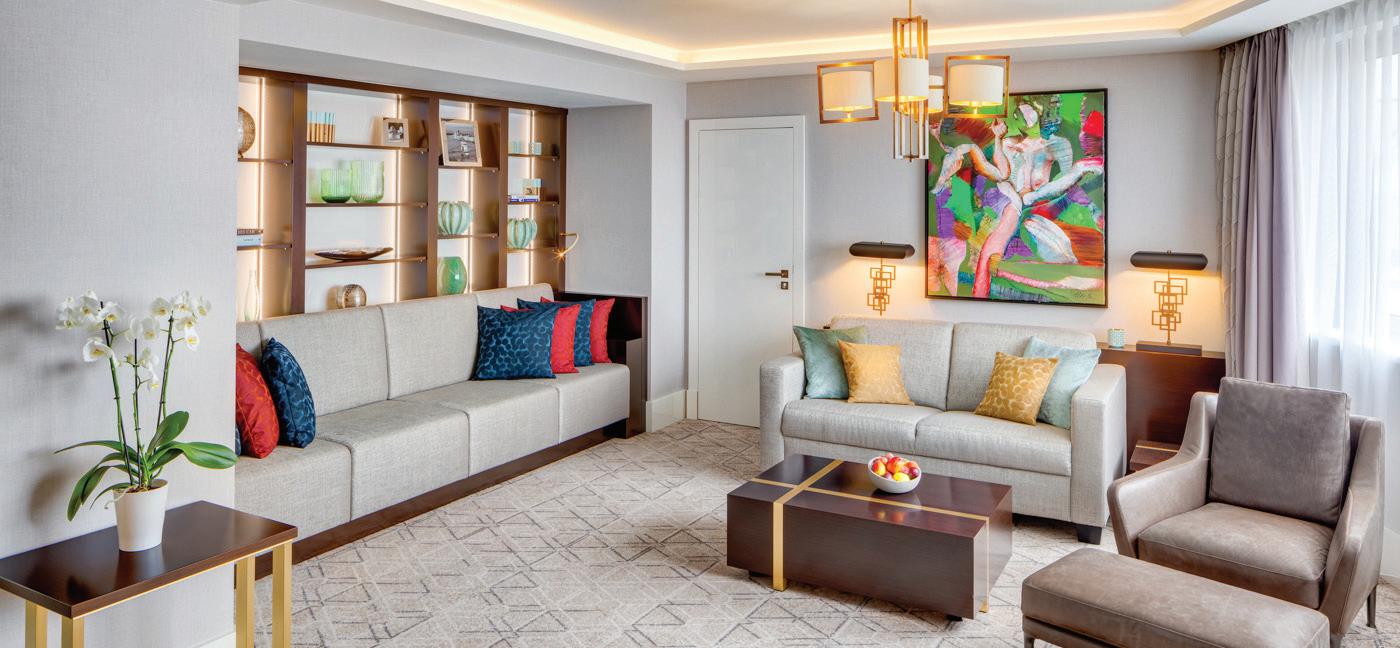
Started already in 2018 but more after Corona during the years 2022 to 2025, Kempinski Hotel Corvinus underwent a comprehensive EUR 30 million renovation. Every room and suite was stripped down to its structure and rebuilt, the Spa saw a full renovation and so other public areas within the hotel, all hotel kitchens are currently being modernized, and a redesign of the signature restaurant ÉS is now underway.
For Interthal, this was far more than refurbishment – it was a strategic investment to safeguard competitiveness as Budapest’s luxury hotel market expands.
Despite the rapid arrival of new high-end properties – sometimes within walking distance – Corvinus remains a benchmark. Interthal views the growing number of luxury
german focus
beds not as oversupply, but as a sign of increasing investor confidence in the Budapest hospitality market.
Capturing high-end travelers –what Budapest still needs
To attract more luxury guests, Interthal argues the sector must adopt confident pricing strategies and position itself boldly within the premium segment. Large international events are critical drivers: last year, concerts by global stars filled every hotel bed in the city. While Budapest now competes with cities like Prague and Vienna in terms of gastronomy, culture and hotel quality, it still lags in one crucial area: high-end retail. For many Asian


travelers – particularly from Japan, China and Southeast Asia – luxury shopping is a core element of the travel experience. Improving retail offerings, Interthal stresses, is primarily a matter for private investment rather than public-sector intervention.
Living the Kempinski brand: people, culture, values
In a European hospitality landscape marked by chronic staff shortages, Kempinski Hotel Corvinus stands out for its stability and team cohesion. During the most difficult months of the pandemic, the hotel retained 165 employees on payroll for 18 months. Every staff member – including Interthal – accepted
a 20% salary reduction to preserve the team. This solidarity paid off: when demand returned, many employees came back and today, the hotel operates with a stable team of 300 and an experienced executive committee. For Interthal, the formula is simple: “Happy staff, happy guests.” Guest satisfaction begins with employee satisfaction, and he considers it the highest compliment when returning visitors tell him they “just feel good” about the hotel – even if they cannot fully explain why.
Art is another defining aspect of the Kempinski identity. Since its opening, the hotel has supported Hungarian contemporary artists. Over the years, the collection has grown to more than 1,000 works – 600 of which are on display – complemented by rotating exhibitions refreshed four times a year. The result is a living, evolving cultural environment unique among Budapest’s hotels.
A personal commitment to Budapest
For Interthal and his wife, Budapest is more than a workplace – it is home. The city’s climate, culture, convenience and charm offer everything they need. As General Manager, Interthal sees his role not merely as management, but as brand ambassadorship: upholding the heritage of Europe’s last independent luxury hotel group through unwavering service, authentic hospitality and a continuous focus on the guest journey.
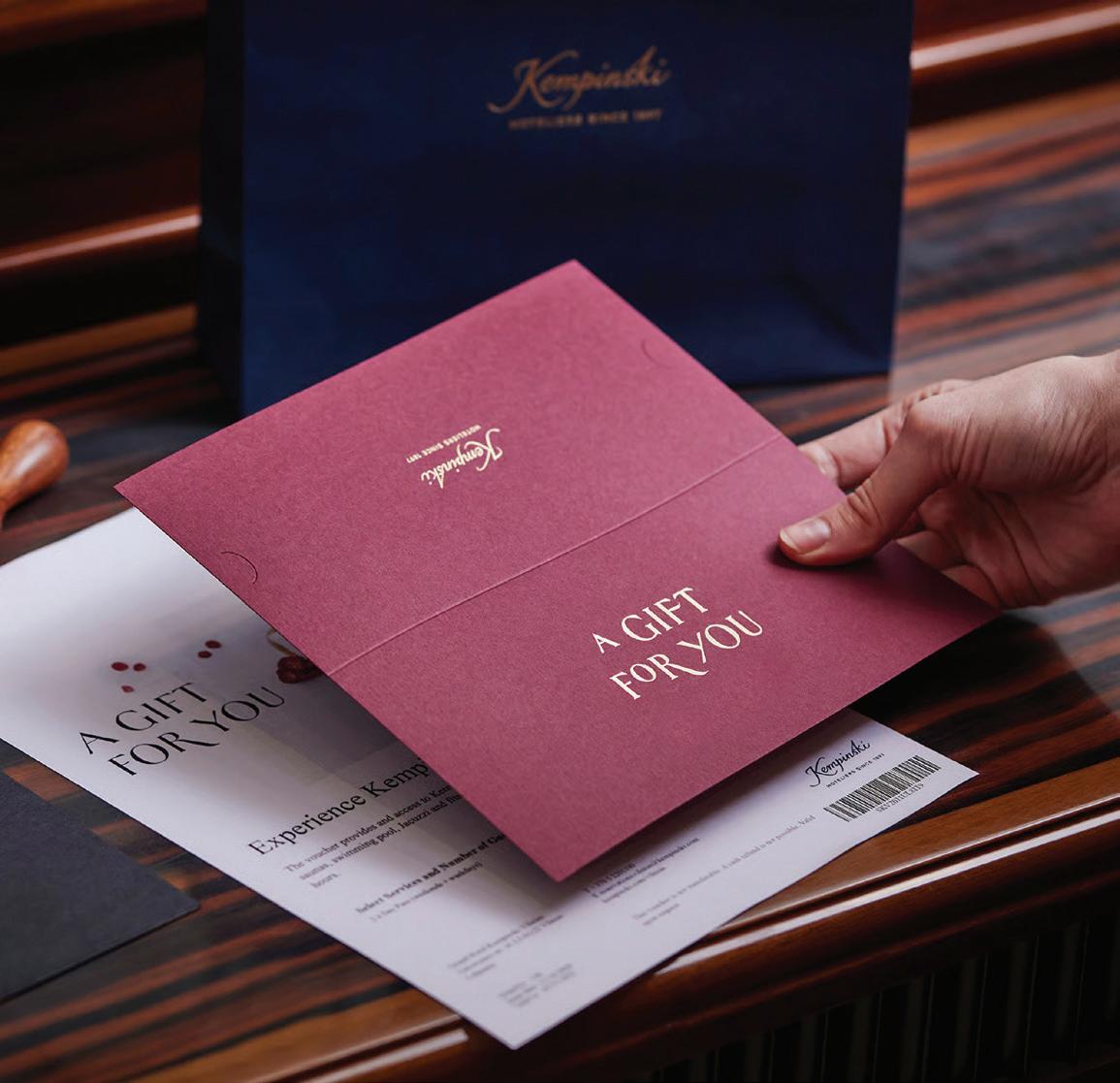
THE PERFECT GIFT awaits at Kempinski Hotel Corvinus Budapest
Are you searching for the perfect gift for someone special? Look no further. Our exclusive online voucher shop offers a wide selection of refined experiences to suit every taste and every occasion. Give the gift of unforgettable moments – a seamless blend of time and joy – ideal for the festive season, anniversaries or any special celebration.
It is simple and effortless:
Choose your favourite
Customise your selection
Order effortlessly
Send or print instantly
Mix and match to create a truly personalised gift

DISCOVER MORE:

german focus
OFFERING HIGHQUALITY BUSINESS SERVICES
CHAMBER TO STRENGTHEN PARTNERSHIP BETWEEN GERMAN AND HUNGARIAN COMPANIES
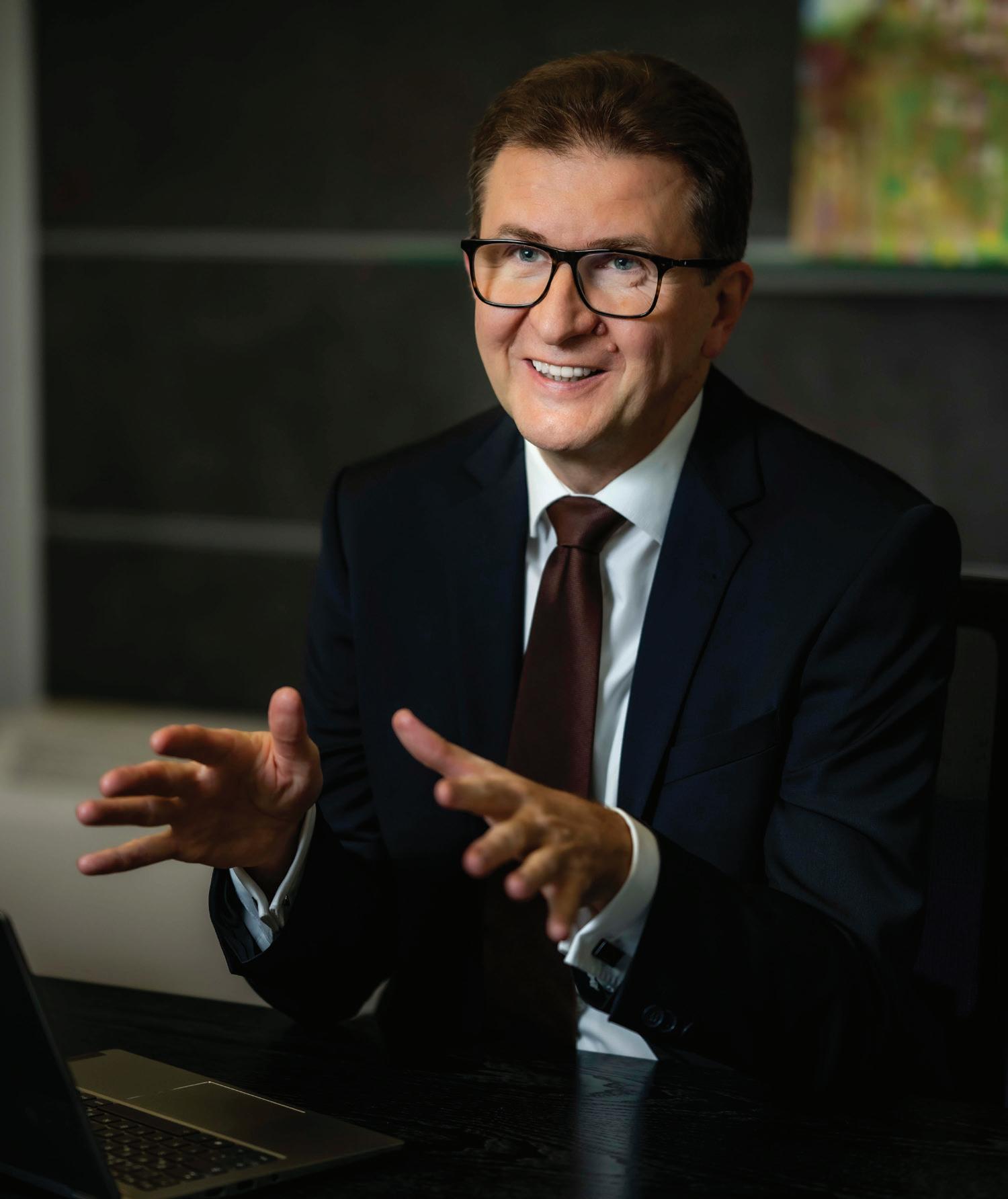
It was at the end of May this year that the German-Hungarian Chamber of Industry and Commerce (DUIHK) elected Dr. Róbert Keszte as its new President. He emphasized that he would work in this position to ensure that the opinions and initiatives of the DUIHK are heard and taken into account in the dialogue with economic policy makers as well as provide optimal support to the highly diverse membership in their business activities and represent their interests effectively.
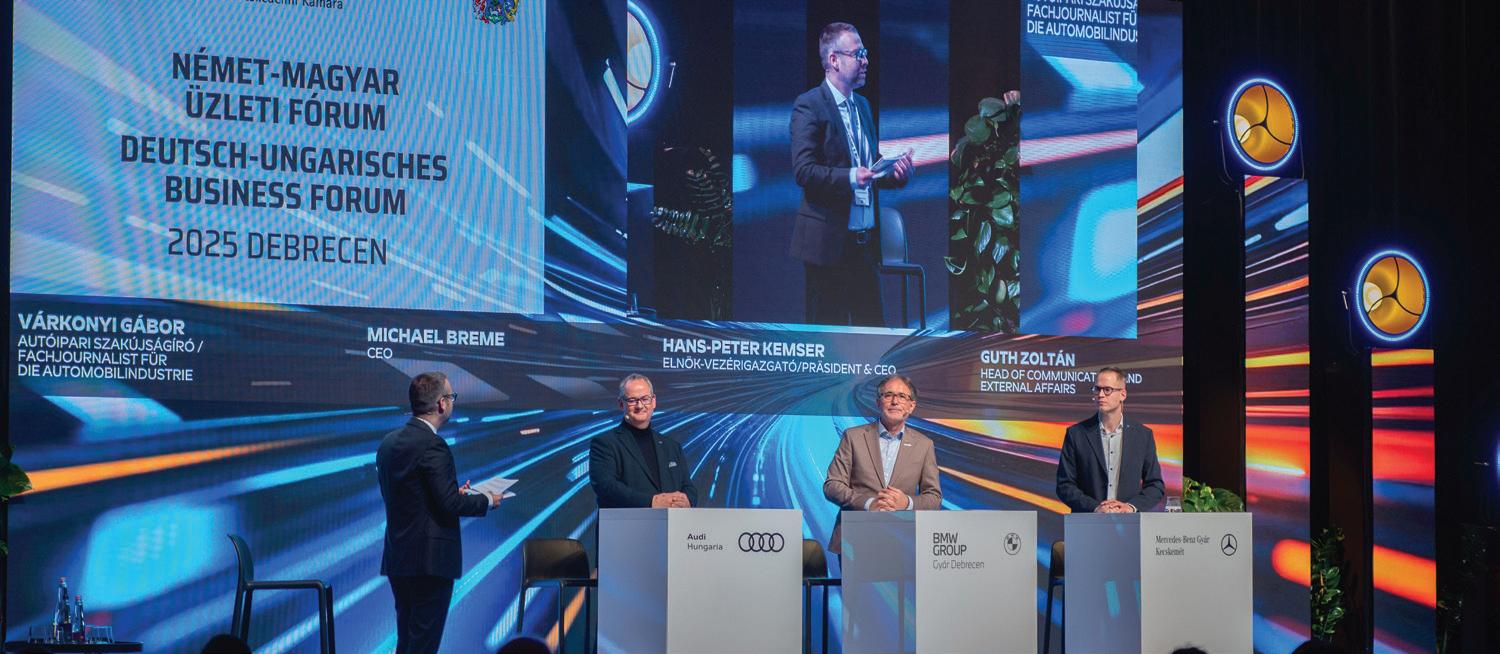
This November, the DUIHK held a large-scale German-Hungarian Business Forum in Debrecen, E Hungary. Explaining the location, the President highlights to Diplomacy&Trade that in recent years, the DUIHK has become increasingly active in key industrial regions outside Budapest. “After all, around 40% of our members are based there, and with the regional branches of companies from central Hungary, the figure is even higher. Debrecen is the center of one of Hungary's most dynamic economic regions.
A large ecosystem of manufacturers, suppliers and service providers has sprung up around the recently opened BMW plant. German companies are strongly represented in the region, with 30 Chamber members active in the three eastern counties alone.”
He adds that they received strong support from the city, Mayor László Papp was personally committed to the forum, and the city’s development agency EDC was a very professional partner in organizing it. The main aim of the forum was to strengthen networking between companies, economic development institutions and educational and research institutions from both countries. Vehicle manufacturing was naturally an important topic, but the forum also focused on strengthening SMEs, cooperation with suppliers and the role of regional industry clusters.
No noticeable recovery expected
Commenting on the results of the latest DUIHK economic sentiment survey, also published this November, the President says member companies expressed very cautious expectations regarding
their business in the coming year. On average, they do not anticipate any noticeable recovery in their own business operations, and thus, investments and employment are only expected to stabilize at current levels, rather than seeing a significant upturn. “In other countries in the CEE region, some reported a notably more optimistic sentiment, but others perform similarly poorly as Hungary. Companies see weak domestic and foreign demand as the greatest risk to their business, but the rapid rise in labor costs as well as economic policy are also among their key concerns,” he points out.
Readiness to innovate
DUIHK has recently hosted a sourcing tour of German companies to Hungary. Róbert Keszte emphasizes that connecting and matching German companies with suppliers and production partners in Hungary has for decades been a key element of the Chamber’s activities. “We do this for individual companies, but also as part of large events such as our sourcing tours. This gives German companies an insight into the Hungarian economy and the Hungarian procurement market and allows them to present themselves to potential partners, followed by one-on-one meetings to explore possibilities of business cooperation in more details. At the most recent event, procurement managers from seven German companies conducted over 100 meetings with around 80 Hungarian companies. Visits to production sites and relevant stakeholders in Hungary are also part of such events, with the range of industries covered extending from the metal industry to mechanical engineering, electrical engineering and electronics to the plastics industry.”
Regarding the German buyers' expectations, it has been found that they focus increasingly on suppliers' capabilities and readiness to innovate – they should no longer be mere contract manufacturers but should drive product innovation themselves and work with customers to jointly increase competitiveness, he says.
Study trips to Germany
There are study trips regularly organized by DUIHK to Germany as part of its activities to promote Hungarian-German business opportunities. “We bring Hungarian participants into direct contact with important players in the respective industry in Germany. The trips always focus on a specific industry or technology and are often combined with a visit to one of the many international trade fairs in Germany. The trips allow participants to learn about innovative technologies and manufacturing solutions, for example during company visits in
Germany. At the same time, they have the chance to establish direct contacts with potential business partners. This year alone, we have organized eight such study trips, e.g. in booming industries such as defense, aerospace, recycling and waste management and energy, but also on topics such as supplier development,” the DUIHK President notes.
Training programs
Education and dual vocational training are another important activity at the German-Hungarian Chamber of Industry and Commerce as well-skilled, motivated staff is a key factor for the success of companies. That is why vocational training and adult education have always been extremely important to the DUIHK, according Róbert Keszte. The Chamber’s Knowledge Center (DUWZ) therefore offers companies a wide range of training programs, particularly in the areas of management and soft skills, vocational training, courses for industrial professionals as well as on energy efficiency, ESG and industry standards. “Our focus is on practical relevance and tangible benefits for companies. Our newest trainings include courses on AI management, digitalization and the usage of AI in industry. In our energy management courses (Eurem), participants can implement cost-saving projects in their own companies already during the training period. Companies especially appreciate the fact that we use proven and certified German teaching content and formats and provide graduates with certificates according to German standards,” he adds.
Providing optimal support
Róbert Keszte was elected Chairman of DUIHK some six months ago. Regarding his first experiences at the top of the Chamber and his priorities for his term, he underlines that he had been a member of the Chamber's Board already since 2024, “so, when I was elected President, I was able to draw on my experience of working on the Board and on a motivated and well-coordinated team of board members. As President, you naturally have a different perspective and bear more responsibility for the whole organization. However, my key ambition did not change: to provide optimal support to our highly diverse membership in their business activities and to represent their interests effectively. During my term, I would like ensure that member companies find the best possible conditions for sustainable investment. This also includes raising awareness of the paramount importance of German companies and the German economy as a whole for the Hungarian economy. And finally, we will continue to offer companies in both countries high-quality business services – for market entry, training activities and increasing their long-term competitiveness.”
The new Audi Q3.

The combined fuel consumption of the new Audi Q3 models is 5.3–10.04 l/100 km, and their combined CO₂ emissions are 137–227 g/km. The stated values were determined during type approval with the factory equipment and are valid at the time of publication of the advertisement. These figures are measured according to WLTP, do not refer to individual vehicles, and are not part of the product information; they serve to compare different vehicle types in accordance with the current provisions of Regulation (EC) No 715/2007. The values may be influenced by certain additional equipment, accessories, as well as driving habits and other non-technical factors (e.g. environmental conditions). The car shown in the image is an illustration and may include optional equipment.
german focus
GOETHEINSTITUT: AMBASSADOR FOR THE GERMAN LANGUAGE
GERMAN CULTURAL INSTITUTE MOVES TO A NEW BUILDING IN BUDAPEST AFTER ALMOST TWO DECADES
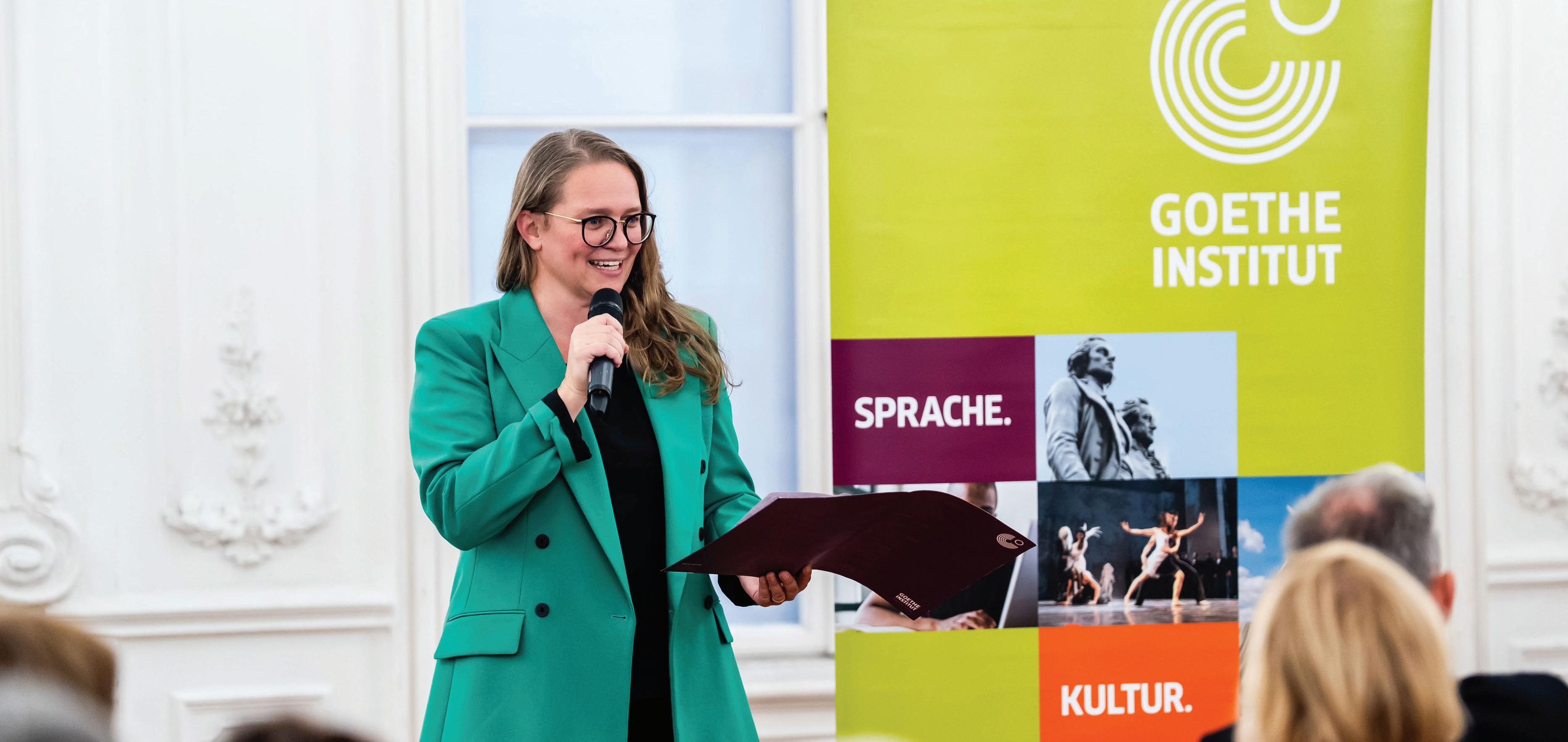
Named after German poet and statesman Johann Wolfgang von Goethe, the Goethe-Institut is a nonprofit German cultural organization operational worldwide with 150 cultural centers across 99 countries. One of those is Hungary where the Institute has been present since 1988. Its goal is to promote the German language abroad and encouraging international cultural exchange.
“The one in the Hungarian capital is among of the first Goethe-Institutes to have been established before the fall of the Berlin Wall in this part of Europe – and we're very delighted for having been here for such a long time,” the Director of Budapest GoetheInstitute, Miriam Bruns tells Diplomacy&Trade. She adds that their mission and vision are basically very much the same as at the beginning: promoting international cultural exchange and understanding. “We do that through language courses, cultural programming, one-on-one exchange and bringing people together on a people-to-people exchange basis basically or through the programs and courses. We really hope to establish that interpersonal connection between the people here in Hungary and Germany, including Germans living here.”
Bubbles
She points out that international understanding has always been at the core of what the Institute is doing. “In recent times and political developments, I think it is more and more clear that, as our secretary general now says, cultural exchange plays a vital role also in international security as it is stated in the United Nations Sustainable Development Goal No. 16. Apart from that, we traditionally do the exchange of artists or bring German artists and experts over, bring them together with Hungarian artists to see what the discussions of the current times, what the artistic practices are. We also have a focus recently on freedom of media and media literacy. Learning becomes more and more important in this current,
very political ambience where the rise of social media and resulting bubbles that people seem to be in – not just in private life and social interaction that you stay in your bubbles, but also in political interaction. In the old days, we brought people together, sit at the table, come to a workshop, discuss together and you get people from all walks of life and political affiliation. Nowadays, you have this added dimension of the social media and the tendency that we are more and more in our own bubbles where we only get exposed to certain similar opinions or similar experiences and people are increasingly exposed to the rise of fake news.”
New location, new inspiration
The Goethe-Institute has recently moved to a new building, after almost two decades, in the Hungarian capital. The Director hopes that this new space will bring some new inspiration and some new opportunities for the Goethe-Institut as they are now close to some other international cultural organizations and other European cultural centers that are in the vicinity. “In the first half of 2026, we will have a grand opening with larger space for the public, larger auditorium and some open library space because we're currently in an interim space, at the same address though. Everything will be in-house.”
Language education
Similarly to other foreign cultural institutes, language education is one of the signature activities at the Goethe-Institute. “It's also the core of what we do. We have a very stable and
very successful language program with a little over 1,500 course participants and about 5,000 exams every year. We also have some of our language exams in schools. We have a very active teacher training workshop department where we do it in-house here and all over in Hungary. We're happy to welcome students here and classes with their teachers here at our location, but we also go to them and assist them and work with them in their language classes. We have active partner schools all over Hungary, and we're very happy to engage with them,” she adds.
Library of Things and others
The Goethe-Institut in Budapest is renowned about its special library that has a unique collection in Hungary. “Many of our library books are available even in the interim space, which is mostly the current German literature and newspapers. A very special as part of the library is what we call a ‘Library of Things ’where you cannot only check out books but also things such as a JBL speaker, etc. It's mostly objects that you wouldn't necessarily buy for yourself because you need it once in a year or once every other year. It is part of the sustainability ideas that we have at the Goethe-Institute.” Another very special feature of this particular library is what the Director calls ”check out a story.” They often organize events such as a ‘living library’ where they have eyewitnesses, say, for example, from the fall of the Berlin Wall. “We had some amazing people that were here and you could engage them in a conversation. May not be the correct term but we could “check them out” for 20 minutes to get
that story, a life story interaction. So, you would basically talk to a person or more for 20 minutes, listen to their stories, ask them questions, and that is an event we do quite regularly.”
Not just in the capital
As to how much Budapest-centered are the activities of the Institute, Miriam Bruns reiterates that they have partner schools and even partner libraries all over Hungary and whom they regularly do workshops and programming together with these. “We also work very closely with some of the cultural organizations all over this country, and we reach out in some of our programming as well. So, for example, we have a film festival that reaches out to university cities like Debrecen Szeged and Pécs. We also have our teacher training workshops throughout Hungary as have – together with other organizations in the spring – a week of highlighting German language and culture, which we make sure that it's not only in Budapest.”
Cooperation in promotion
Bound by the common language, there is close cooperation here with the Austrian Cultural Forum and the Swiss Embassy. A fine example of that is the longstanding German language Sehenswert film festival that has been around for 15 years already. The same goes for their participation at the International Book Festival in Budapest, always with a joint presentation. The Director highlights that in 2026 German will be the ‘guest language’ of that event next year. Another annual program of cooperation is the Wunderbar Festival. “During that week, we are promoting German language, German culture together not just with the aforementioned partners but also with others like the German Embassy, with the remote learning university FernUni Hagen and other partners such as the German Academic Exchange, putting up a week of workshops and other events in schools.”
german focus
A MARKET AT A TURNING POINT: CHALLENGES AND GROWTH OPPORTUNITIES
INTERVIEW WITH PORSCHE HUNGARIA LTD. MANAGING DIRECTOR, TAMÁS WACHTLER
In Hungary’s automotive sector, annual new vehicle registrations are total around 150,000 units – comprising 120,000–125,000 passenger cars and roughly 25,000 light commercial vehicles. Based on new car registrations per capita, Hungary is positioned in the lower third of the European ranking.” Yet this stagnation also signals room for expansion, especially as the economic environment improves.
New car registrations in Hungary have remained stable at 120,000–130,000 units annually in recent years.
A strategic priority going forward is to bring Hungary closer to the European average in new registrations per capita – an achievement that would mark a significant step forward for the domestic market, Tamás Wachtler tells Diplomacy&Trade.
Strategic adaptation to inflation and high interest rates
Rising interest rates have had a strong cooling effect on household loans, directly influencing car sales. In response, the company introduced highly competitive financing schemes, including 0% offers, ensuring that vehicle purchases remain accessible even under tightening macroeconomic conditions. “These incentives have played a key role in maintaining and stimulating demand, enabling the brand to preserve strong market performance despite economic headwinds,” the Managing Director points out.
Global disruptions, technological transition and market pressures
Over the past few years, the automotive sector has faced unprecedented disruption: the COVID-19 crisis, semiconductor shortages, energy price spikes, and global supply-chain instability. At the same time, manufacturers are accelerating the shift toward hybrid and fully electric powertrains, driven in part by strict EU CO₂ emission targets. Electric vehicle (EV) distribution is expanding throughout Europe. While Chinese manufacturers offer competitive prices, challenges around residual value depreciation, after-sales support and supplychain reliability limit the immediate threat, they pose to established European brands. “As the market consolidates and technologies advance, competition will intensify, reducing performance gaps between brands and reshaping the competitive landscape,” he predicts.
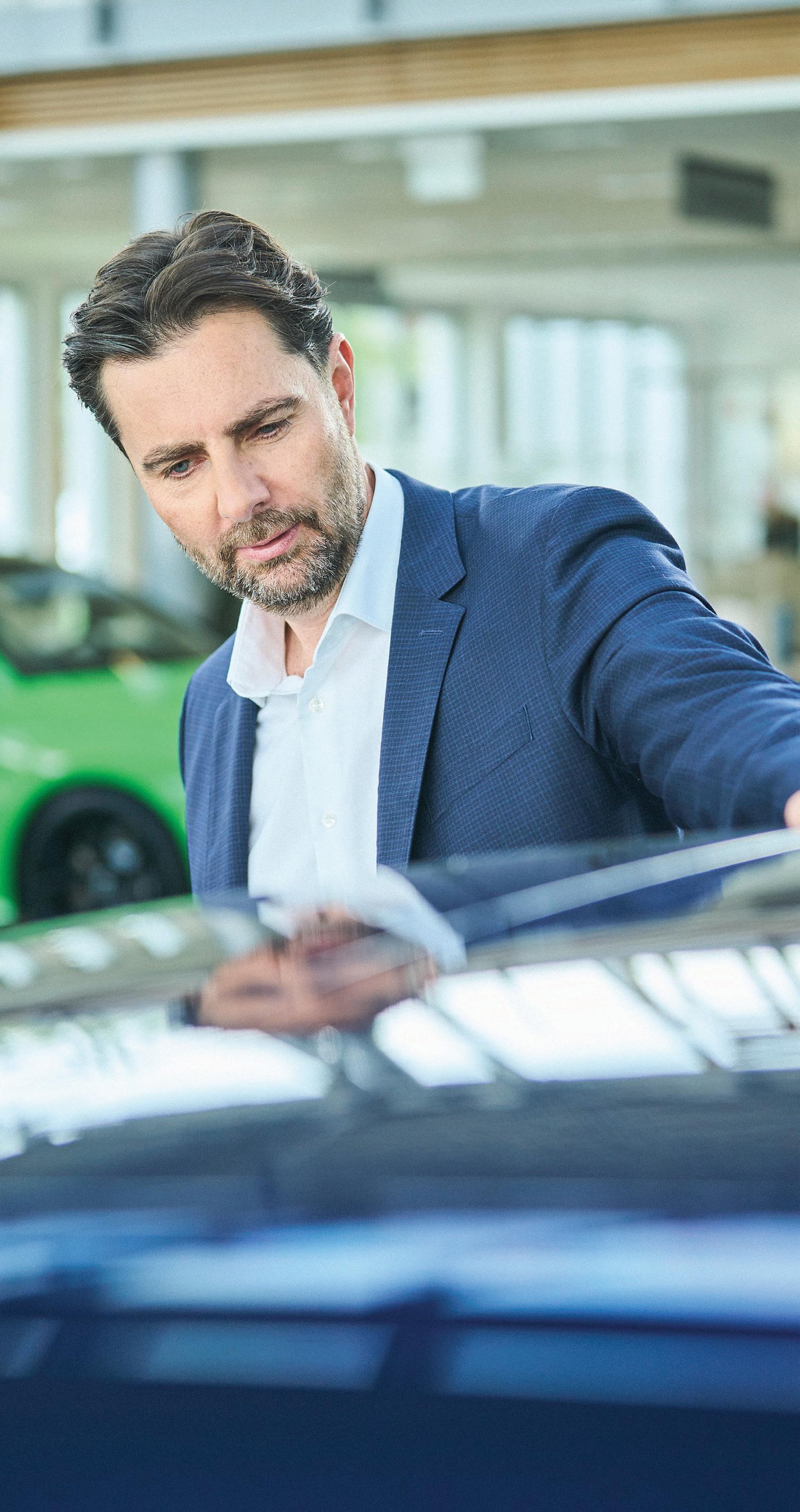
Stabilizing
supply chains and expanding parts availability
A Tamás Wachtler explains, “in order to strengthen service operations, the company has invested heavily in parts logistics, operating and expanding large-scale spare-parts warehouses. This allows most customer needs to be served within standard delivery times. Temporary supply-chain disruptions can still affect faster repair and replacement services, but overall availability continues to improve as global production normalizes.”
Vehicle life cycles and shifting residual values
The average life cycle of a passenger vehicle is 8–10 years, during which manufacturers must continuously adjust to technological and regulatory change. Currently, residual values for electric cars are lower than for internal combustion engine (ICE) vehicles – primarily due to rapid battery innovation and market uncertainty. However, as technology stabilizes and charging infrastructure expands, EV residual values are expected to rise substantially.
Electric mobility in Hungary: strong momentum, significant distance ahead Electric vehicles represent roughly 9% of Hungary’s fleet, the highest share in the region but still far below the 18% European average. The Managing Director stresses that achieving the EU’s longer-term decarbonization goals – such as the planned 2035 transition –remains a major challenge. Norway, where EV adoption climbed from near zero to almost 100% in a decade, demonstrates what is possible with the right incentives. “In Hungary, corporate fleet benefits and tax advantages continue to drive uptake. With around 3,500 charging points currently in place, infrastructure expansion and technological progress are expected to accelerate adoption significantly in the coming years.”
The rise of Chinese manufacturers: growth potential and structural limitations Chinese brands are gaining visibility in Europe, supported by aggressive pricing strategies. Yet concerns over residual values, spare-parts availability, long-term reliability, and brand trust still prevent them from displacing established European players in the near term. Tamás Wachtler is of the view that a gradual market consolidation is expected, which will intensify competition but also help balance technological differences among global manufacturers.
Strengthening market leadership in Hungary
“Porsche Hungaria continues to maintain a stable and dominant market position in Hungary and aims to reinforce this leadership in the years ahead. The company’s long-term strategy focuses on growth, adaptation, and technological transition, while addressing economic, regulatory, and environmental challenges. By combining flexible financing, robust service infrastructure, and a strong electrification roadmap, the brand intends to remain at the forefront of the Hungarian automotive market’s transformation, the Managing Director concludes.
economy

AN UNCERTAIN ROAD AHEAD
HUNGARY’S ECONOMIC OUTLOOK FOR 2026
Hungary closes 2025 under economic strain. After a post-pandemic rebound, growth has ground to a halt, effectively stagnant for the past three years. Inflation, once the highest in the EU, has eased to mid-single digits but remains above the central bank’s 3% target. This bleak backdrop frames the country’s run-up to a pivotal general election in spring 2026, where economic management is a central issue.
Prime Minister Viktor Orbán’s government has rolled out pre-election fiscal measures aimed at boosting household consumption. These policies, alongside caps on some prices and fees, seek to ease the cost-of-living burden and spur growth. However, they come at a cost: budget deficits are widening just as growth has stalled.
International observers are wary. Fitch Ratings recently cut Hungary’s outlook to “negative,” citing fiscal loosening ahead of the 2026 election amid a lack of progress unlocking EU funds in a third year of economic stagnation. Fitch estimates the 2026 deficit could hit 5.6% of GDP, well above the government’s official 5% target. Rating agencies warn that frequent revisions of fiscal targets have hurt policy credibility, and that political imperatives may limit budget tightening even after the vote.
For 2026, international institutions paint a cautiously optimistic but subdued picture. The European
Commission’s latest outlook forecasts Hungary’s GDP growth rebounding to roughly 2.3% in 2026 after near-zero growth in 2024–25. Similarly, the IMF projects around 2% growth in 2026 as investment gradually recovers, and the OECD anticipates about 1.9%. All see domestic consumption – propped up by wage gains – as the primary engine of whatever growth Hungary manages next year.
Government optimism
In contrast, Hungary’s own authorities offer a far rosier outlook. The Economy Ministry’s projections peg growth at 4.1% for 2026. The National Bank of Hungary (MNB) has likewise issued an optimistic forecast range, suggesting GDP could expand 3.7–4.7% next year if all goes well. These domestic forecasts bank on a strong consumption boom –fueled by tax cuts, rising real wages and new investments (for example, large automotive and battery factories due to start production) – to pull the economy out of its slump.
Inflation and monetary policy
Inflation in Hungary is finally on a downward path, but the pace of disinflation is a key uncertainty for 2026. Official forecasts (both domestic and international) converge on consumer price inflation easing to around 3.5-3.7% in 2026 –a marked improvement from this year’s ~4.5%, and a far cry from last year’s extreme highs. Even so, prices will still be rising slightly above the central bank’s target range.
The National Bank of Hungary has therefore kept monetary policy tight. Its base interest rate remains at 6.5% – the EU’s joint-highest – after aggressive hikes in 2022 to tame inflation. The central bank emphasizes a “careful and patient approach” going into 2026. Most analysts expect no rapid rate cuts before the election, as core inflation is still sticky and fiscal stimulus is pumping demand. In fact, the MNB does not expect to hit its 3% inflation target until early 2027.
Post-election outlook
The April-May 2026 general elections could prove a turning point for economic policy. If the incumbent government wins another term, it may face pressure to pivot from pre-election pump-priming to post-election consolidation. Rebuilding fiscal credibility might mean belt-tightening measures after the vote, especially if the country hopes to finally unlock EU funds by addressing governance concerns.
On the other hand, a change in leadership could bring a shift in priorities.
An opposition-led government would likely seek a fresh start with Brussels, aiming to unblock EU monies and signal a more orthodox economic course. However, any new administration will inherit the same fundamental dilemma: how to boost growth and investment while keeping inflation in check and debt on a downward path. Looking ahead, Hungary’s economic outlook is one of cautious hope tempered by significant risks. 2026 will be a year of economic crosscurrents for Hungary: an inflection point where prudent policy and a bit of political will could turn a bleak starting point into a gradually brightening horizon.


christmas
DELIGHTS of the FESTIVE SEASON
According to a comprehensive analysis by Tollwayr's European travel experts, Vörösmarty Classic Xmas proved to be Europe's most popular Christmas market in 2025, ahead of Strasbourg and Vienna. The downtown market features festive food stalls with mulled wine, roasted chestnuts and gingerbread as well as handcrafted gifts and local art.
The Advent Basilica has won the title of Europe's most beautiful Christmas market four times already. Domestic craftsmen, potters, designers, jewelers and leatherworkers await visitors to the Advent Festival with their unique offerings. In addition to authentic winter flavors, there are Hungarian specialties and real culinary delights for gastronomic adventurers.
At the Óbuda Christmas Fair, features cozy, local atmosphere with handmade crafts, local honey, mulled wine, an open-air skating rink and live folk performances and other family-friendly programs.
The City Hall Park market, visitors can enjoy a craft fair, gastronomy, light painting and an ice rink in the heart of the city with Christmas delicacies, domestic handicrafts, mulled wine, roasted chestnuts and a festive atmosphere that evokes the spirit of Christmas preparations.
The Buda Castle District market offers unique handmade goods from local artisans, mouthwatering delicacies and soul-warming drinks along with uplifting melodies, Christmas dance performances and fun family programs ensuring a great atmosphere. All this, combined with the sparkling lights of the historic surroundings and the breathtaking panorama of the Danube.
Four Seasons
Hotel Gresham Palace Budapest
The iconic hotel facing the Danube unveils a spectacular festive installation celebrating art
Budapest's main Christmas Fairs in 2025, the iconic Vörösmarty Square Market and the acclaimed St. Stephen's Basilica (Advent Basilica) Market, as well as smaller ones in the city, offer crafts, Hungarian food, mulled wine and festive programs. The holiday season celebrating Christmas and the New Year is also a special occasion for hospitality establishments to present their expertise and attract holidaymakers or just passers-by with exquisite on-site experience or takeaways of culinary delight.
INSPIRING OFFERS BY HUNGARIAN HOTELS FOR THE YEAR-END HOLIDAY PERIOD
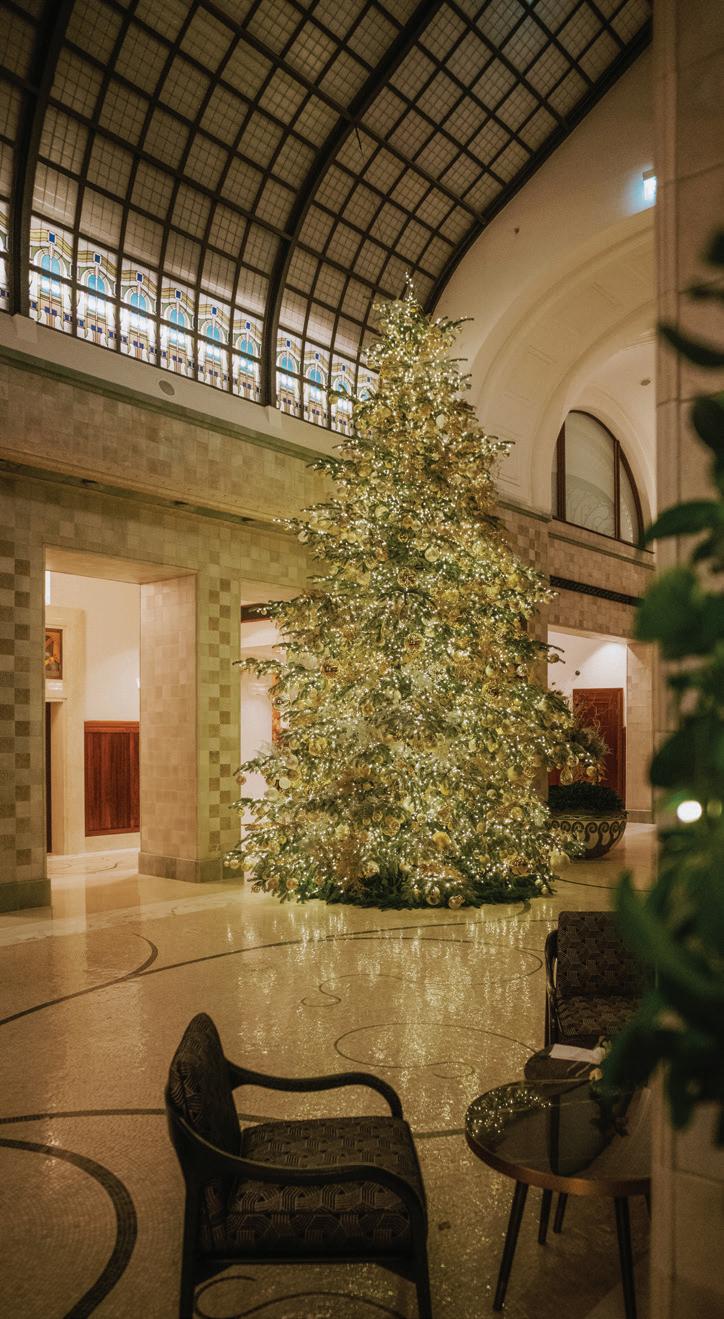
nouveau heritage and local creative excellence. Its 2025 festive collaboration unites the creative vision of Edina Németh, Founder and Creative Director of Edina’s Paper, and Katja Schaeffli, Owner of Arioso. Together, they present a breathtaking seasonal installation that celebrates both the Art Nouveau grandeur of the historic Gresham Palace and the exceptional craftsmanship of two leading Budapest creatives. Renowned for its architectural beauty and timeless elegance, the Gresham Palace stands as a defining landmark in the heart of

Budapest. Continuing its tradition of showcasing local artistry, Four Seasons Hotel Budapest once again partners with Edina’s Paper, the internationally acclaimed Budapestbased studio known for its cutting-edge, hand-crafted paper installations that captivate audiences around the world. Reflecting on the collaboration, Edina Németh shares her enthusiasm by highlighting that “as the Gresham Palace has always been one of my favorite façades in my city, collaborating with Four Seasons Hotel Budapest on a festive installation that inspires both children and adults is an honor and a joy.”
A paper-crafted tribute to Budapest
Drawing inspiration from the intricate Art Nouveau motifs woven throughout the Palace, Edina and her team have designed a festive paper installation that captures the essence of the historic landmark. The majestic peacock, a signature motif found in the Palace’s celebrated ironwork, once again takes center stage – its colors, curves, and symbolism connecting this year’s creative concept. A highlight of the 2025 installation is the large paper photo spot showcased near KOLLÁZS Brasserie & Bar, featuring a detailed paper façade of the Gresham Palace surrounded by Budapest’s most recognizable landmarks.
Arioso Christmas Tree – Elegance at the Heart of the Palace
Complementing the paper installation, Gresham Palace unveils a magnificent Christmas tree designed by Arioso, Budapest’s renowned floral atelier under the creative direction of Katja Schaeffli. This year’s tree features Arioso’s signature festive ornaments, inspired by the Palace’s Art Nouveau architecture and crafted to reflect the shimmering elegance of the historic interiors.
Craftsmanship without compromise
Every paper façade showcased in the lobby is the result of remarkable artistry and dedication:
• Over 300 hours of design work, from sketching architectural details to sculpting layered compositions
• More than 1,000 hours of hand assembly executed by Edina’s Paper studio
Each building is laser-cut, layered, and meticulously hand-assembled to create a three-dimensional interpretation of Budapest’s architectural heritage.
A Celebration for All Four Seasons Hotel Gresham Palace Budapest, together with Edina’s Paper and Arioso, invites guests, travelers, and the local community to discover this year’s festive installation - a magical celebration of creativity, craftsmanship, and the enduring beauty of Budapest’s Art Nouveau heritage.
Kempinski Hotel Corvinus Budapest
This year, the downtown luxury hotel, located some 100 meters from the Vörösmarty Square Christmas market, features an approximately seven-meter-tall Christmas tree that arrived from Zala County, SW hungary on a special vehicle during a night early December. It is adorned with 1,000 glass and plastic ornaments and illuminated by 14,000 lights. Ten people took part in decorating it, working for six hours on this project. The color theme changes each year; this season, the tree shines in classic red, gold and green hues.

christmas
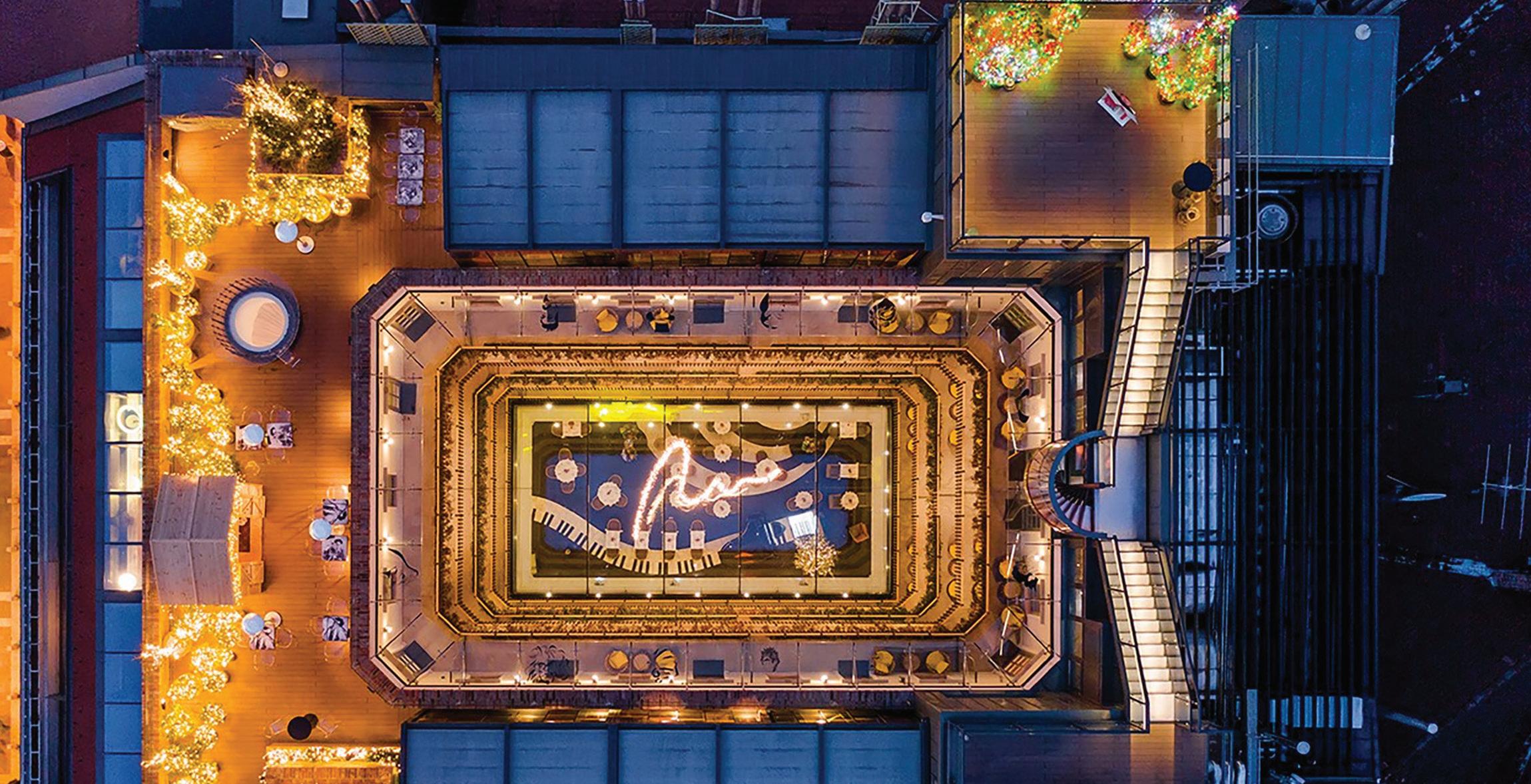


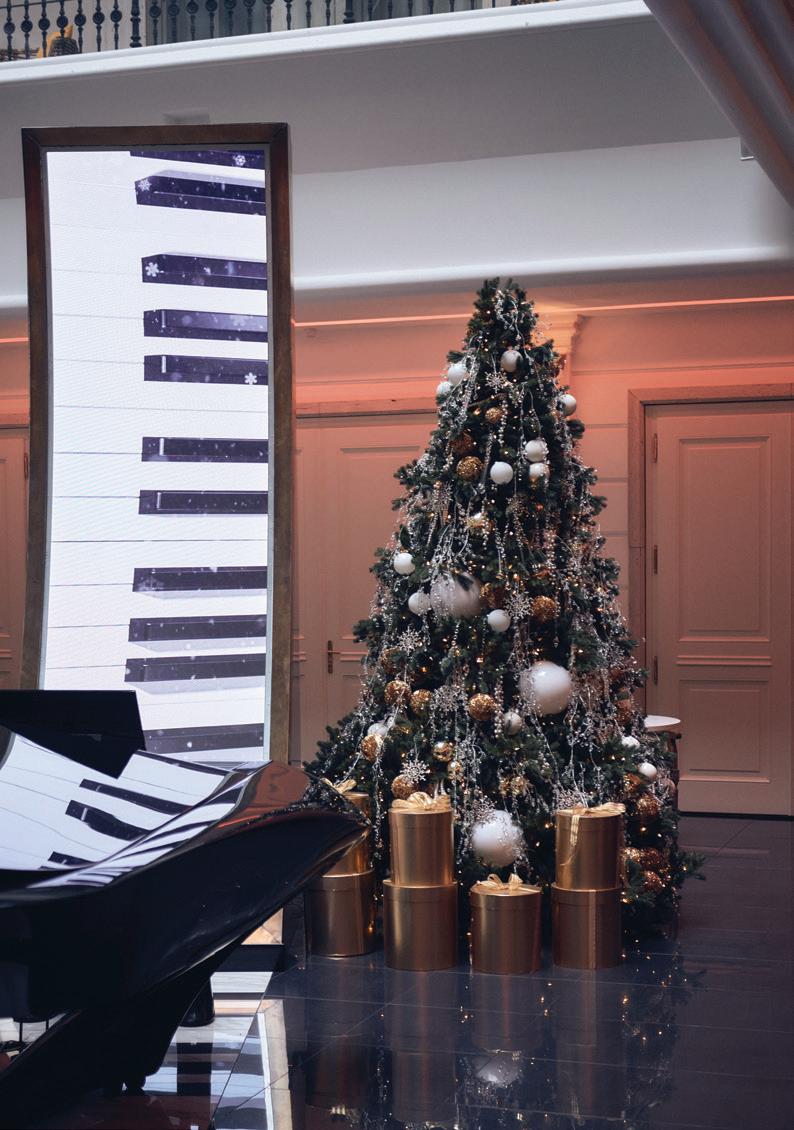
Aria Hotel Budapest
Christmas at the Aria Hotel Budapest near the Basilica is defined by the property’s signature music concept, which turns the holiday season into an intimate cultural experience. This year’s celebrations began with a special Advent performance by Hungarian singer Caramel in the Music Garden, where he lit the Christmas lights together with the real Santa Claus from Lapland, Joulupukki. Throughout December and January, guests can enjoy daily live music and weekend cinema screenings of ‘The Nutcracker’ by the Royal Ballet & Opera, complemented by a festive breakfast in the Café Liszt. As Andrea Rost, honorary curator of the hotel's Opera Wing and former Covent Garden soloist notes, “the camera captures the artists up close – allowing the audience to see details they would never notice in the theater, where even the front row is 10–15 meters from the stage.” Her reflection captures the spirit of the Aria shaped by in intimate musical experiences. During the holiday season,
this philosophy turns the hotel into a sanctuary of elegance, warmth and artistic immersion. For both travelers and locals, Christmas at the Aria becomes a celebration elevated by music.
Matild Palace
This year’s Christmas décor at Matild Palace, a Luxury Collection Hotel, Budapest holds a special significance, as it was conceived and brought to life entirely by the hotel’s own management and their dedicated team members. Rather than relying on external designers, the team chose a deeply personal approach, decorating the palace with the same care, dedication and festive spirit they would devote to their own homes.
Weeks of thoughtful preparation preceded the transformation. Exclusive decorative elements were carefully selected and ordered to harmonize with the palace’s timeless elegance and historic grandeur. The chosen palette of soft whites,
champagne gold and subtle shimmering accents creates a refined festive atmosphere that enhances, rather than overwhelms, the architectural beauty of the building. The design phase focused on balance and symmetry, ensuring that each Christmas tree, ornament and light installation found its perfect place within the majestic interiors. Tall, elegantly decorated trees line the palace spaces, their gentle glow accentuating the ornate columns, arches and sculptural details, while warm festive lights softly reflect on the marble floors. Finally, the decoration itself became a shared experience. The entire team came together to adorn the palace, transforming its halls into a welcoming, festive setting filled with warmth and understated luxury. The result is a Christmas atmosphere that feels both grand and intimatea celebration shaped by those who know Matild Palace best and who infused every corner with their personal touch and pride.
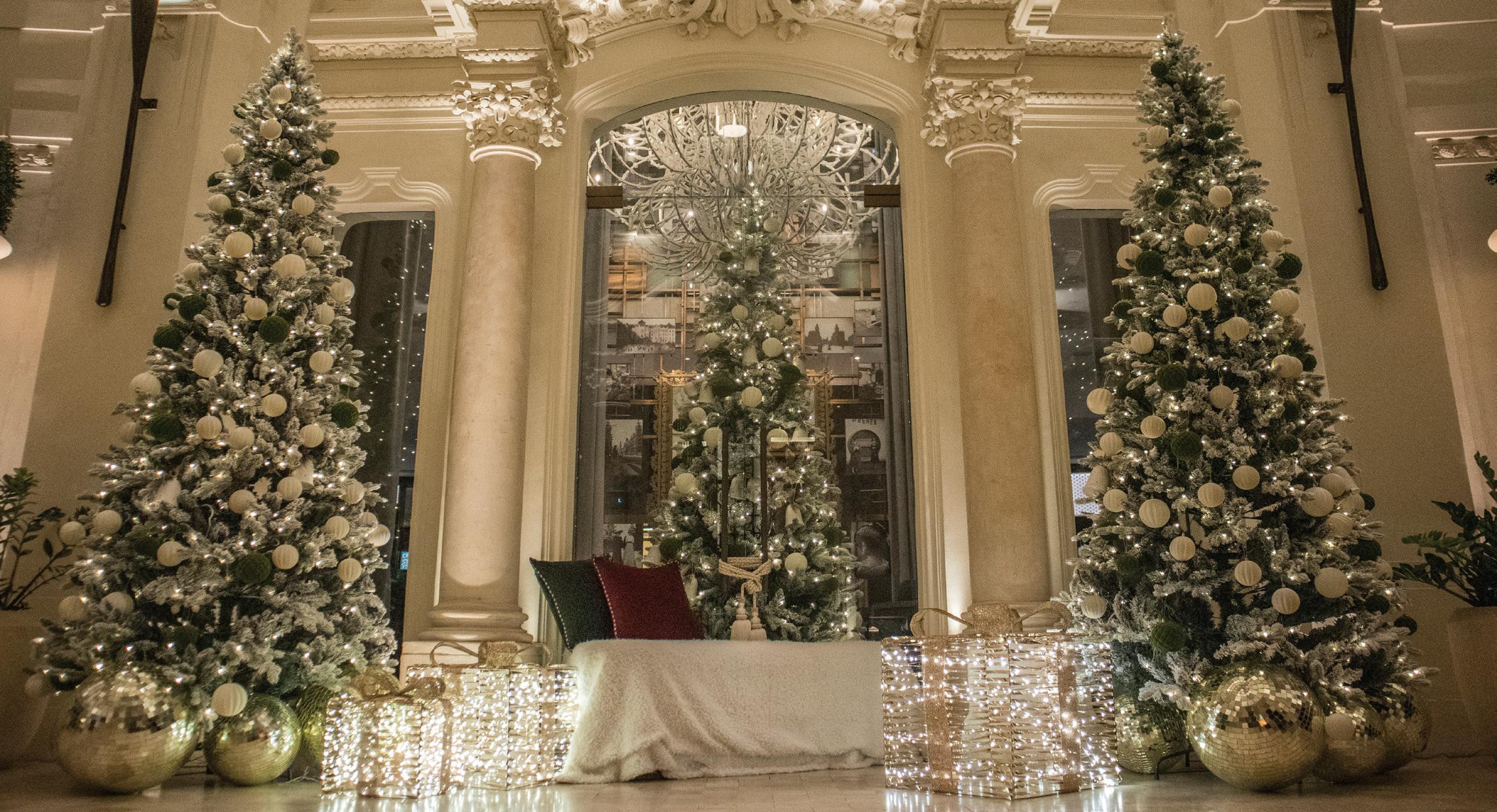
photo by
witty leaks
WITTY
L E A K S
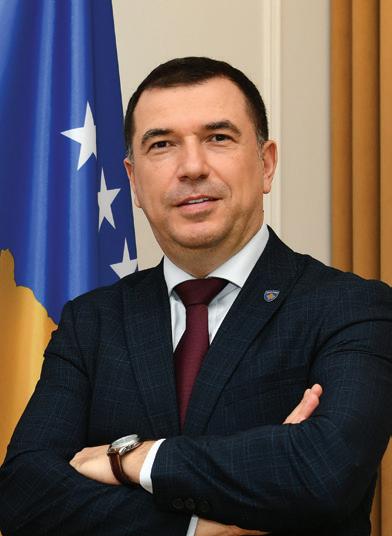
From Uncertainty to
Welcome: the first encounter
IN THIS SERIES, DIPLOMATS SHARE PERSONAL ACCOUNTS OF THEIR EXPERIENCES ON “EXCURSIONS” into Hungarian culture, art, gastronomy & scenery.
HUNGARY, REMEMBERED AND RENEWED
AN AMBASSADORIAL REFLECTION
BY DELFIN PLLANA, AMBASSADOR OF THE REPUBLIC OF KOSOVO
There are countries one comes to know through professional duty, and there are others that enter one’s life quietly, long before titles, responsibilities or ambitions take shape. Hungary belongs to the latter category for me. It did not present itself as a destination of immediate consequence; rather, it revealed itself gradually, patiently, through moments that accumulated meaning over time. What began as a youthful encounter evolved into education, then into service and family life, and ultimately into a renewed sense of responsibility. Hungary did not simply accompany my journey – it became part of its formation. My first encounter with Hungary took place in the summer of 1998. I arrived as a boy, not yet eighteen, traveling with my parents through Budapest, Lake Balaton and cities whose names would later become enduring points in my personal geography – Szombathely, Veszprém and Sopron, to name a few. Hungarian cities at that moment carried the unmistakable atmosphere of transition. Their streets reflected both historical continuity and forward-looking ambition; their buildings bore the dignity of centuries, while their people moved forward with quiet determination. It was a country rediscovering itself through openness, private initiative, and confidence in a freer future. I was coming from a land standing on the threshold of war. Against that backdrop, Hungary offered something profoundly human: stability, order and the reassurance of everyday life continuing. It became the place where together with my parents, we reunited with part of our family living in Western Europe, and through that reunion, Hungary acquired emotional depth. It was no longer simply a country visited, but a space associated with safety and connection. What remains most vivid are not only monuments or landmarks, but gestures – unassuming kindness in cafés, modesty in small shops, and brief conversations in public spaces
marked by calm courtesy and mutual respect. Without fully realizing it at the time, I began to feel at home.
Where Ideas Took Root: the academic years
Years later, Hungary welcomed me again – this time as a student. Between 2005 and 2007, I returned to pursue a Master’s degree in International Relations through Corvinus University Budapest and the Institute for Social and European Studies in Kőszeg, in cooperation with Savaria University in Szombathely. This period proved formative as it gave structure to curiosity and depth to professional orientation. The academic environment was demanding yet generous, shaped by scholars whose intellectual authority was matched by moral clarity and international relevance: Tamás Szentes, Ferenc Miszlivetz, Jody Jensen, Elemér Hankiss, Zoltán Pogátsa, Philippe Schmitter, Attila Pók, Tibor Palánkai, Attila Eralp, James M. Skelly among others.
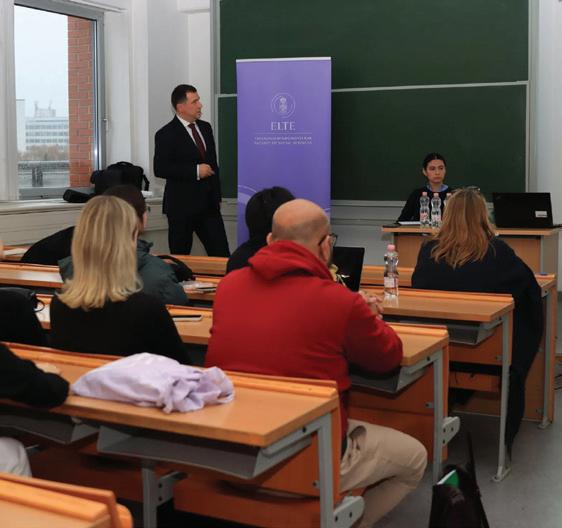
Yet the richness of that experience extended beyond lectures and libraries. Students arrived from across continents – from North America to East Asia, from Eastern Europe to the Western Balkans – bringing with them diverse histories, convictions and aspirations. Exchange flourished not only in classrooms, but in shared spaces and long conversations. Kőszeg itself – quiet, dignified and embraced by unspoiled nature – offered a rare setting for reflection. Removed from the urgency of capitals, it allowed ideas
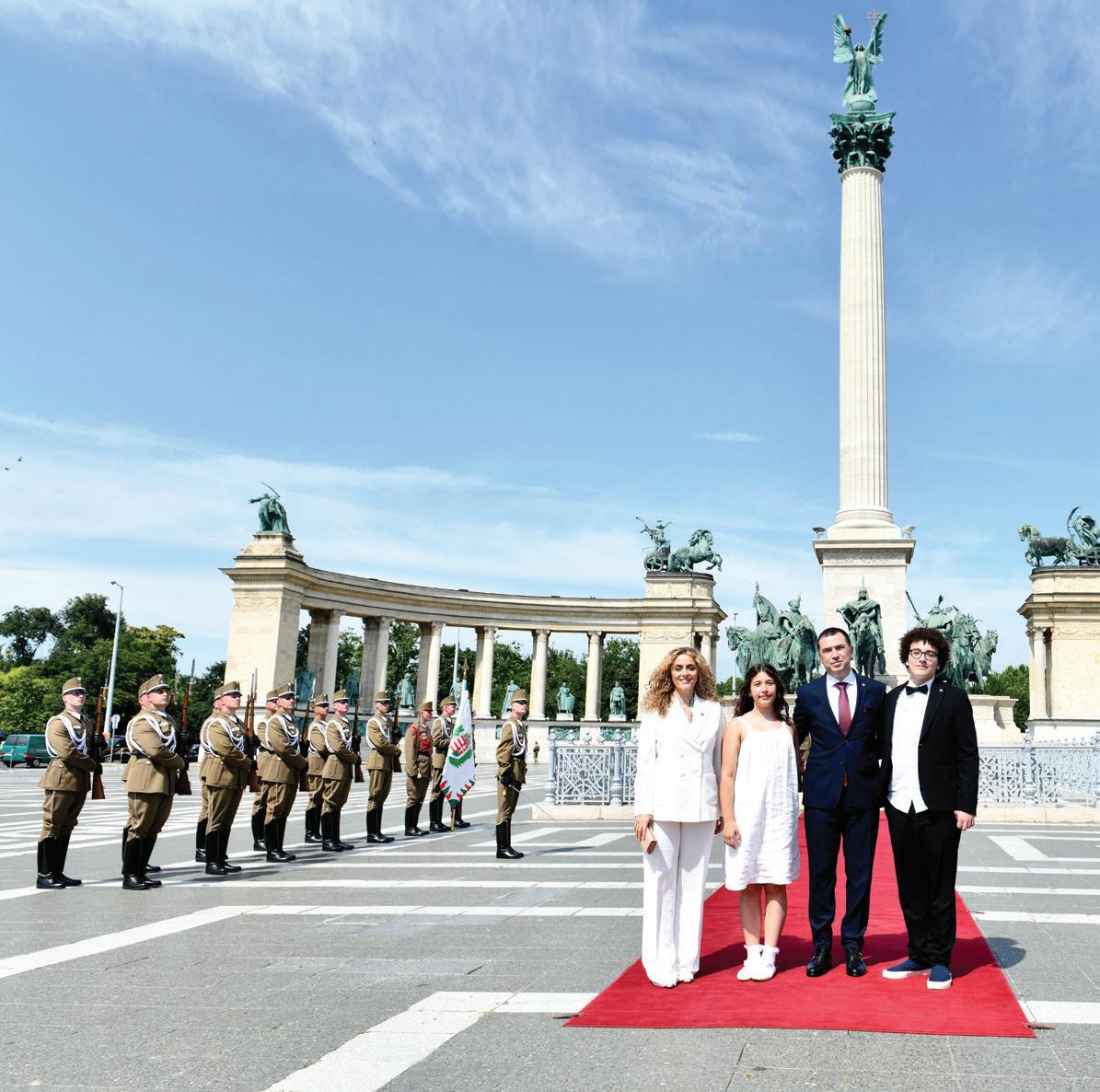
to take root, friendships to form and a worldview to mature. Hungary became a place where thinking was encouraged not merely as an academic exercise, but as preparation for responsibility.
Service and Family:
the personal anchoring of home My third return to Hungary marked a decisive turning point. In January 2010, I came back not as a visitor or student, but as a diplomat – among the first representatives of the Republic of Kosovo. Together with the then Ambassador, I was entrusted with the task of establishing Kosovo’s first diplomatic mission in Hungary. For Kosovo, this represented an important step in diplomatic consolidation; for me, it was the privilege of serving my country in a place that had already become deeply familiar. Diplomacy, however, rarely unfolds only in official settings. Life continued alongside duty, and Hungary became the setting for defining family moments. My wife, Mimoza, and I welcomed our son, Rron, in 2010, and our daughter, Dëbora, in 2013, both born in Budapest. These events anchored us profoundly. Few bonds are stronger than those formed in the places where one’s children are born. Hungary ceased to be merely a post of service; it became a second home, woven into our family’s earliest memories. Professionally, the years between 2010 and 2014 were defined by patient dedication and careful construction. The Embassy worked systematically to advance bilateral relations through high-level visits, bilateral agreements, and initiatives in economic and public diplomacy. Progress was achieved through consistency rather than just ceremony, and during this period, Kosovo–Hungary relations entered a stable and promising phase, grounded in mutual respect and shared interests.
Return with Responsibility: ambassadorship, continuity, and the maturity of partnership
When I returned to Hungary in June 2024 as Ambassador Extraordinary and Plenipotentiary of the Republic of Kosovo to Hungary, it felt less like a new beginning than the continuation of an unfinished conversation. A decade had passed, yet Budapest greeted me with the same familiarity. The city had grown more confident, Hungary more developed, but its essential character remained unchanged – the warmth of its people, the quiet dignity of everyday life, and the openness that first captured my attention decades earlier.
Over the past fifteen years, relations between Kosovo and Hungary have matured into a partnership of substance. Hungary still stands as a friend and a supporter of Kosovo’s Euro-Atlantic aspirations, and as a contributor to peace and stability through its participation in NATO forces stationed in Kosovo. Economic cooperation has developed steadily, yielding tangible outcomes while offering further potential. I was privileged to witness Hungary’s Presidency of the European Union once again, as I had followed it closely in 2011, and to see Kosovo represented with dignity and equality within the Western Balkans framework. The official visit of President Vjosa Osmani Sadriu to Hungary on June 17 this year reaffirmed the depth of this relationship. Received with the highest state honors by President Tamás Sulyok, the visit reflected mutual respect and a shared commitment to addressing contemporary challenges, particularly through enhanced political dialogue and intensification of economic cooperation. President Sulyok’s reciprocal visit to Pristina on December 8, including
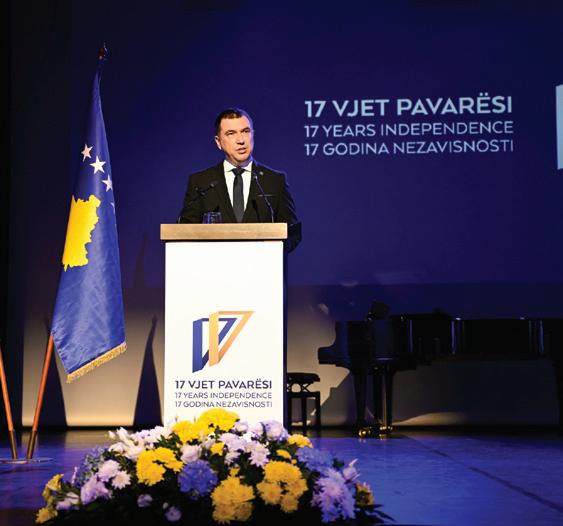
his engagement with Hungarian troops stationed in Kosovo, further confirmed the continuity and sincerity of this partnership. Looking back, Hungary is not simply a place where I currently serve; it is a country that has accompanied some of the key stages of my personal and professional life. It was present during uncertainty, learning, family formation, and diplomatic responsibility. In international relations, continuity is rare and trust is hard-earned. Hungary offered both. This chapter is not merely a reflection on a bilateral relationship. It is, above all, a personal testament to how long-standing encounters between countries – and between people – can quietly and patiently shape a life. Through years of return and renewal, Hungary became intertwined with my own story, teaching me that partnership is not built only through agreements and visits, but through trust accumulated over time, shared moments, and a sense of belonging that grows almost unnoticed.
TERRACOTTA WARRIORS
UNTIL MAY 25, 2026,
MUSEUM OF FINE ARTS, BUDAPEST
The Museum of Fine Arts, Budapest presents a major exhibition focused on one of the world’s most famous archaeological discoveries – the Terracotta Army – and the age of the First Emperor of China, spanning more than a millennium of Chinese history. The Civilization of the Qin and Han Dynasties. The First Chinese Emperor’s Terracotta Warriors features over 150 ancient artefacts, including spectacular archaeological finds, weapons, ritual objects and symbols. The exhibition, including ten original figures from the emperor’s terracotta army, presents the results of half a century of research, providing a more detailed and comprehensive picture of the first imperial dynasty and the functioning of the ancient Chinese empire than ever before. Thanks to the carefully selected archaeological material, the exhibition reveals a defining era of China’s dynastic history: the centuries in which the Chinese Empire was born, consolidated and institutionalized. The soldiers of the first Chinese emperor’s army were first seen in Budapest nearly forty years ago, in the spring of 1988, but at that earlier stage in the excavations, only a much smaller and more modest selection could be shown. szepmuveszeti.hu

ONEREPUBLIC CONQUERS
BUDAPEST AGAIN
JUNE 25, 2026, BUDAPEST ARENA
The American pop-rock band will take over the Budapest Arena next June with their hits and explosive energy.
So far, OneRepublic has visited Budapest three times, most recently in the spring of 2022, shortly after Covid restrictions were lifted, as one of the first major international acts to return, delivering an unforgettable show. The band’s lead singer praised Budapest both on stage and in his Instagram stories, so their return is long overdue. The GRAMMYnominated OneRepublic consists of singer-songwriter and frontman Ryan Tedder, guitarists Zach Filkins and Drew Brown, keyboardist Brian Willett, bassist and cellist Brent Kutzle, and drummer Eddie Fisher. Since forming in 2002, the group has amassed more than 5 billion streams on Spotify alone, and their hits have dominated radio and streaming charts. Their debut album, Dreaming Out Loud, was released in 2007 and sold 20 million copies, featuring the record-breaking hit 'Apologize', which shattered digital sales and radio airplay records and earned them a GRAMMY nomination. livenation.hu
THE SCORPIONS CELEBRATE 60 YEARS IN BUDAPEST
JUNE 20, 2026, MVM DOME, BUDAPEST
The legendary German rock band Scorpions celebrated their 60th anniversary this year with a massive concert in their hometown of Hanover, and next year, they will once again embark on a tour to honor these magical, success-filled six decades. Over these years, the world has changed tremendously in every sense: the city has been beautifully rebuilt, and Scorpions have become a source of national pride for Germany, just like their famous brands such as Mercedes or BMW. The godfathers of classic rock have always been open to adventure – and fortunately, the world has welcomed them with open arms: they have played thousands of concerts in all corners of the globe. In 1988, they became the first Western rock band to play five consecutive sold-out shows in Soviet-era Leningrad, and they were among the first to perform in China and Southeast Asia, opening doors for other Western bands. The band has also sold more than 100 million records and has been a regular on the world’s most prestigious charts since the beginning –keeping track of their gold certifications is nearly impossible. Their mega-hit "Rock You Like a Hurricane" alone has been covered more than 150 times by various artists. This proves that the legacy and influence of Scorpions on rock music are indisputable. Even beyond their 60th anniversary, the members are driven by performing together, touring, and the love of their audience. livenation.hu
PITBULL TAKES OVER THE PUSKÁS ARENA
JULY 21, 2026, PUSKÁS ARENA, BUDAPEST
Mr. Worldwide, a.k.a. Pitbull, is coming to Hungary for the first time! With his trademark bald head, sunglasses, and sharp suit, the superstar is a true icon who got the whole world moving with hits like Give Me Everything and Timber. Pitbull’s I’m Back! tour promises the ultimate party atmosphere – and he’s invited us to join the party: on July 21, he’ll bring a massive show to Budapest’s Puskás Arena, joined by none other than Lil Jon. Dale!
Following the hugely successful SOLD OUT high-energy European Party After Dark tour, igniting arenas across the continent and drawing massive crowds – including a viral explosion of fans proudly wearing bald caps and dubbing themselves "The Bald E’s” in honor of the artist’s signature look and larger-thanlife persona. This fan movement has taken social media by storm, celebrating Pitbull's iconic image with humor, creativity, and unity. The I’m Back! tour guarantees to continue to celebrate this culture and bring the unstoppable pure party energy for fans. Set to be on an even bigger stage with highly stunning visuals, explosive pyrotechnics, and Pitbull's signature performance. With a fusion of music, lights, and special effects – alongside his band, ‘The Agents’, and dancers, ‘The Most Bad Ones’ – the show will deliver an unforgettable, one-of-akind high-energy party for everyone to enjoy. livenation.hu
Big or small, it pays off
Favorable electricity and gas offers, smart meter tariffs for businesses