
HUNGARIAN ARTWORK FOR ANDREA BOCELLI
SEE INTERVIEW ON page 22
THE WORLD-RENOWNED
ITALIAN SINGER HAS RECEIVED FOR HIS RECENT BIRTHDAY
A SPECIAL PAINTING BY HUNGARIAN FINE ARTIST DALMA GÖNCZ – WITH A SMALL BRAILLE PLAQUE ON THE BACK.


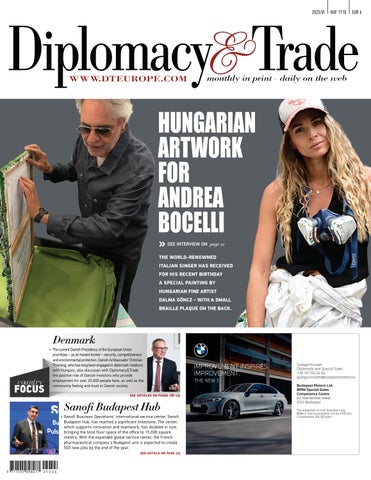
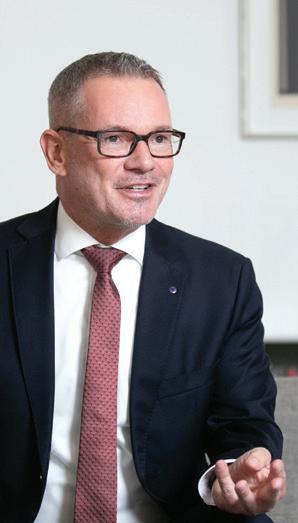
The current Danish Presidency of the European Union prioritizes – as an honest broker – security, competitiveness and environmental protection. Danish Ambassador Christian Thorning, who has long been engaged in diplomatic relations with Hungary, also discusses with Diplomacy&Trade the positive role of Danish investors who provide employment for over 20,000 people here, as well as the community feeling and trust in Danish society.























see articles on pages 08-15
Sanofi Budapest Hub
Sanofi Business Operations' international service center, Sanofi Budapest Hub, has reached a significant milestone. The center, which supports innovation and teamwork, has doubled in size, bringing the total floor space of the office to 15,000 square meters. With the expanded global service center, the French pharmaceutical company's Budapest unit is expected to create 500 new jobs by the end of the year.
see article on page 19

letter from the publisher
Art is the most universal language - and who would understand it better than artists themselves? For his recent birthday, the world-renowned Italian tenor Andrea Bocelli was surprised with a unique gift created by Hungarian fine artist Dalma Göncz, who shares with our readers the story behind this special artwork – one that is, quite literally, readable for the singer.
Squeezed between Ukraine and Romania, Moldova is not a country whose political orientation might seem decisive for either the EU (or the West in general) or Russia. Yet both sides have made determined efforts to support their respective allies – the pro-European and pro-Russian political parties – in the country’s parliamentary elections. Pro-European forces gained a clear majority, which, as our analyst argues, represents a symbolic victory for Europe (the West) over Russia, demonstrating the power of values over sheer interests. “Welfare and competitiveness in Europe” – this is the main objective of the current Danish EU Presidency, which offers a timely opportunity to focus on Hungarian–Danish relations in this issue. Danish companies employ more than 15,000 people in Hungary, and bilateral economic cooperation has developed steadily over the four years since our previous Danish Focus. In this edition, we speak with the Danish ambassador to Hungary, introduce Denmark’s export promotion organization, and showcase several of the Danish firms active in the country.
On the business front, we explore how the present and future of the EU economy appear from the perspective of one of Japan’s most prestigious business research institutes. Meanwhile, Hungary’s business services sector – one of the largest in Central Europe –continues to expand, marked this October by the enlargement of the French pharmaceutical company Sanofi’s regional hub.
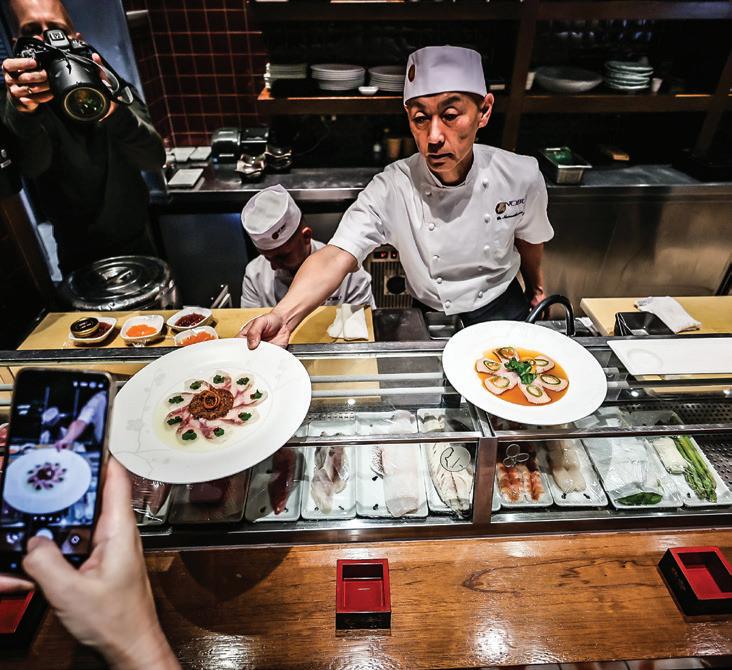
Our gastronomy section features an interview with a renowned American chef of Japanese descent who visited the Hungarian capital to lead a sushi masterclass celebrating the 15th anniversary of Nobu Budapest.
The popularity of traditional Japanese sports and culture continues to grow in Hungary, much to the delight of the ambassador of the Land of the Rising Sun. She shares her thoughts in this month’s WittyLeaks column.
As we embrace autumn, filled with fresh energy and inspiration from the summer months this issue celebrates the creativity, resilience and collaboration that connect nations and cultures.
Enjoy the read!
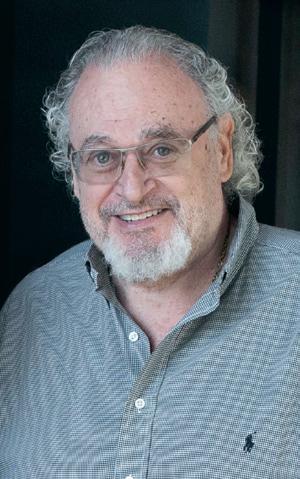
Peter Freed
PUBLISHER
PUBLISHER: Peter Freed PHOTO EDITOR: Dávid Harangozó
ADMINISTRATION: Blanka Szalontai
CONTRIBUTORS: Sándor Laczkó, Tamás Magyarics, Hikariko Ono
PHOTO CONTRIBUTORS: Courtesy of Dalma Göncz (cover), Gábor Nemes (cover), Krasznahorkai László Facebook, bahart.hu, depositphotos.com, Gabriel Szabó, Flatlight Creatives, grundfos.com, HelloParks, miho.hu, Jan Prerovsky, Ferenc Csárdás, Grundfos, Embassy of Japan, Tamás Varga, Sanofi Budapest, pixeltaster, Courtesy of Dalma Göncz, Gábor Nemes, Dávid Bíró - Light Art Museum Budapest, Live Nation, Luke Fontana, David T Kindler
cont en ts
03 ON THE RECORD 04-05 COMPANY BRIEFS 06 ANALYSIS
Pro-European majority at Moldova elections 08-15 DANISH FOCUS
Interview with Ambassador Dr. Christian Thorning; The Trade Council; Nilfisk; Grundfos 16 WITTYLEAKS by the Ambassador of Japan
18-19 BUSINESS
Senior Economist at the ITOCHU Research Institute; Budapest Sanofi Hub expanded 20 GASTRONOMY
Nobu Budapest celebrates 15 years 22 CULTURE
Fine Artist Dalma Göncz 23 WHAT’S ON Concerts, festivals, events and exhibitions in and out of Budapest
GERMAN FOCUS – COMING SOON
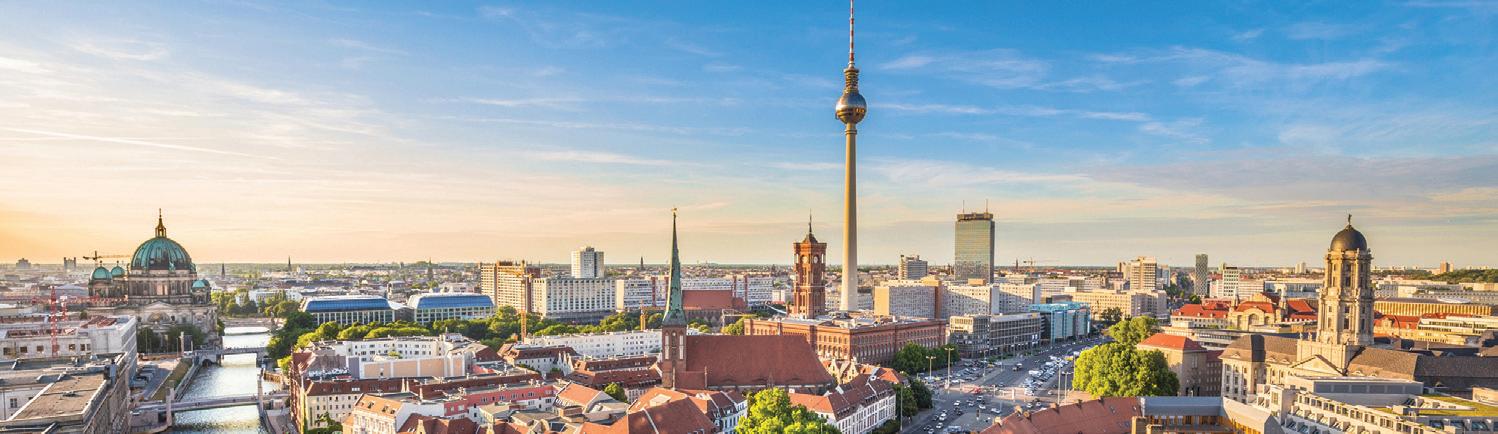
In an upcoming issue, Diplomacy&Trade is going to present, in cooperation with the German Embassy, a special focus section on Hungarian-German relations. Economic ties between Hungary and Germany are traditionally very intense and Germany is Hungary’s most important trading partner with about a quarter of Hungary’s foreign trade done with Germany. About 3,000 companies with German ownership background employ roughly 300,000 Hungarians. The leading article of the compilation will be an interview with the German ambassador to Hungary, Julia Gross about the main aspects of bilateral relations. We also present the activities of the GermanHungarian Chamber of Commerce in Budapest, the Goethe Institute and several German ventures operating in Hungary.
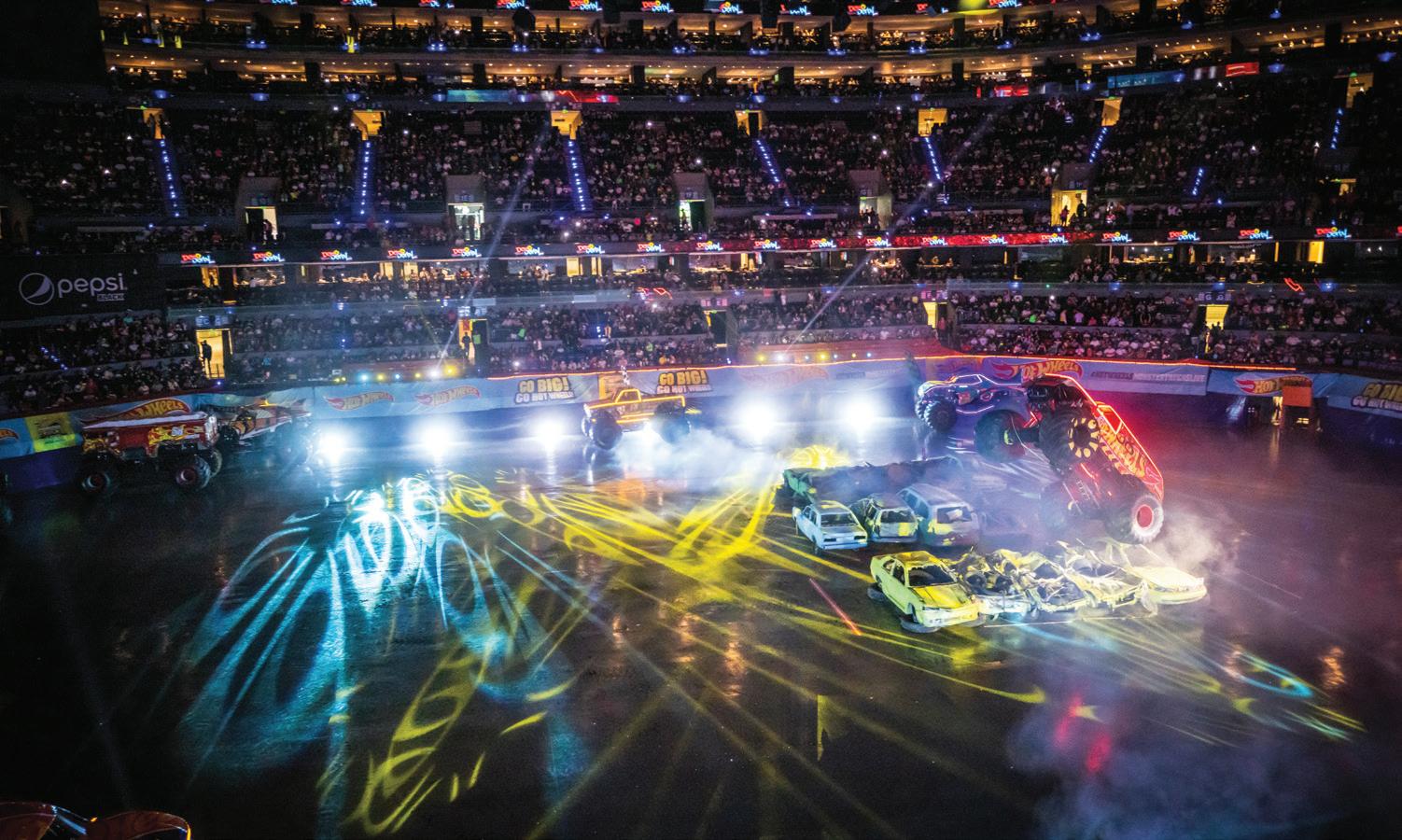
Event guide to the Hungarian capital page 23
Sushi masterclass at 15-year-old Nobu Budapest page 20
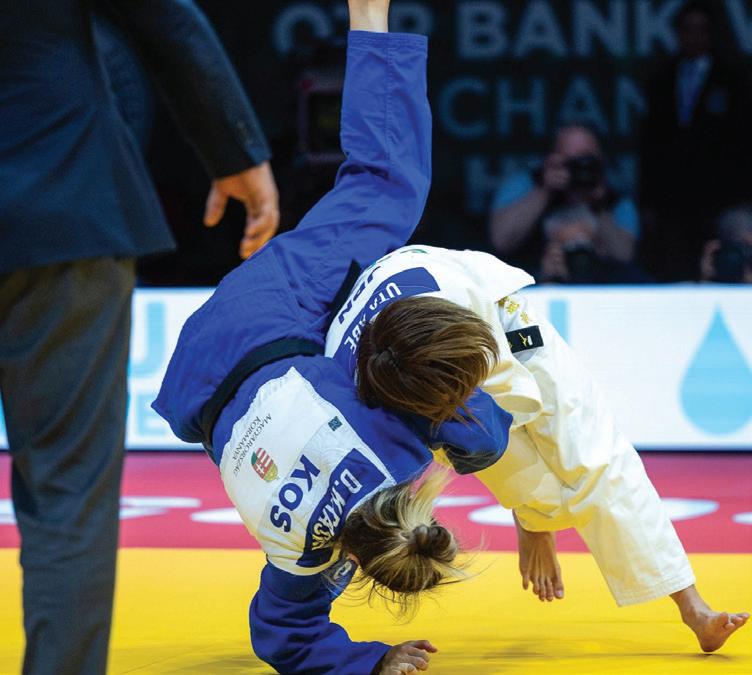
WittyLeaks by the ambassador of Japan page 16
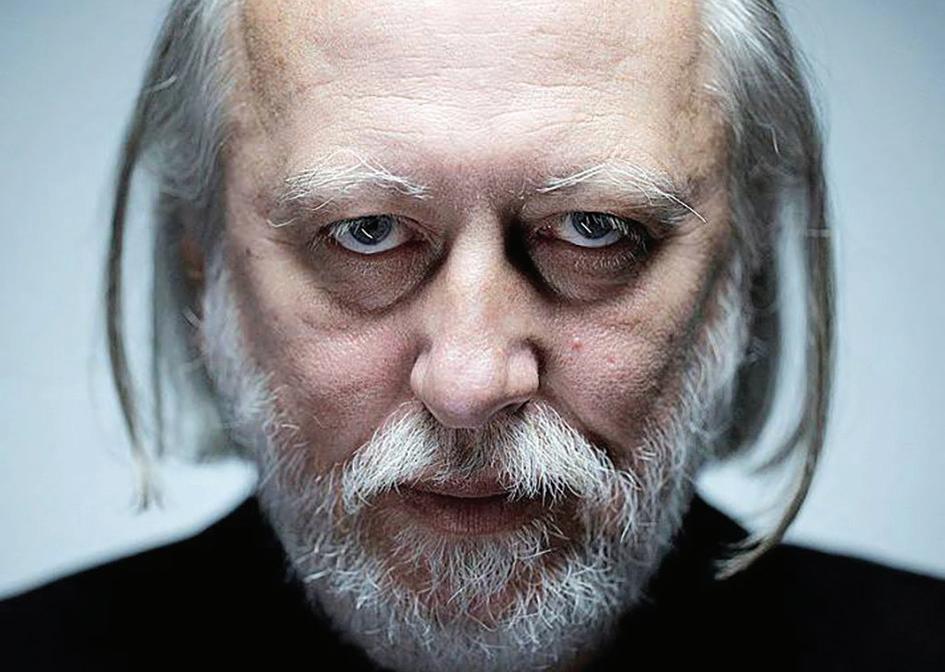
NOBEL PRIZE IN LITERATURE
FOR LÁSZLÓ
KRASZNAHORKAI
The Royal Swedish Academy of Sciences awarded the Nobel Prize in Literature to Hungarian writer László Krasznahorkai. According to the official statement, Krasznahorkai received the award for his visionary works, which demonstrate the power of art even in the midst of apocalyptic terror. This is the first time since 2002 that a Hungarian author has won this prestigious literary award. The Academy awarded Krasznahorkai "for his compelling and visionary oeuvre that, in the midst of apocalyptic terror, reaffirms the power of art," Mats Malm, the secretary of the academy, said in his laudation.
"László Krasznahorkai is a great epic writer in the Central European tradition that extends through Kafka to Thomas Bernhard, and is characterized by absurdism and grotesque excess. But there are more strings to his bow, and he also looks to the East in adopting a more contemplative, finely calibrated tone," the academy said in the statement.
The 71-year-old author's first work was published in 1977 in Budapest and his works have been adapted into films by director Béla Tarr.
Krasznahorkai, 71, will receive 11 million Swedish crowns (EUR one million) along with the prize, which is traditionally handed over on Dec 10, the anniversary of prize founder Alfred Nobel's death.
All in all, people of Hungarian origin have won 15 Nobel Prizes, the first having been awarded, in 1905, to Fülöp Lénárd in Physics. The only other Hungarian Nobel laurate in literature is Imre Kertész who was awarded in 2002.
US LIFTS RESTRICTIONS ON HUNGARY’S ACCESS TO VISA WAIVER PROGRAM
The United States has restored full access for Hungarian citizens to its visa-waiver program, rolling back limits introduced under the Biden administration. From September 30, Hungarians are once again able to apply for Electronic System for Travel Authorization (ESTA) visas valid for two years and multiple entries, according to an announcement by US Homeland Security Secretary Kristi Noem. The previous restrictions, imposed in 2023, had cut the validity period to one year and reduced ESTAs to single
on the record
use, citing security concerns. Earlier in 2021, DHS revoked already-issued ESTAs of Hungarian passport holders born outside Hungary and denied new applications from the same group.
Assistant Secretary Tricia McLaughlin said the decision underscored Washington’s confidence in Hungary’s security standards. “The United States and Hungary have a strong security partnership, and that commitment is reflected in the actions Hungary has taken to meet the requirements of the Visa Waiver Program,” she said.
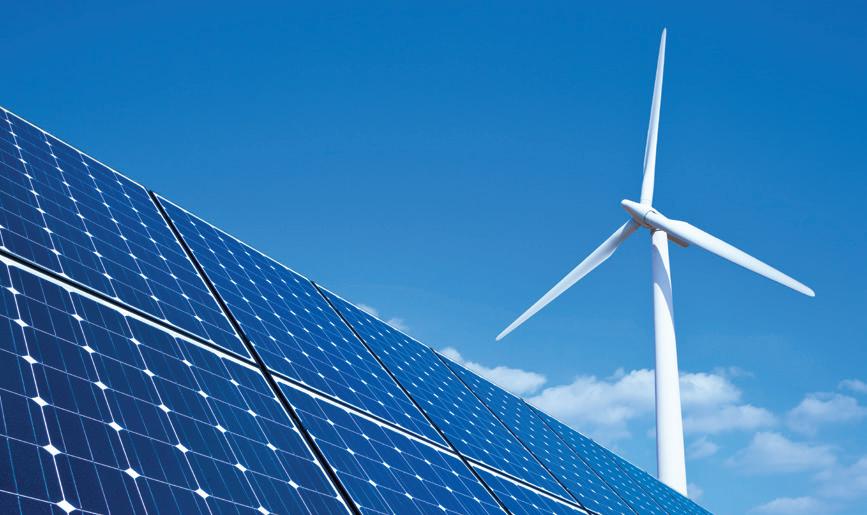
DOMESTIC GREEN ENERGY CAPACITY EXCEEDS 9 GIGAWATTS
According to data from MAVIR, Hungary's energy management company, the total installed capacity of renewable energy producers in Hungary exceeded 9,000 megawatts by the beginning of September, the Ministry of Energy announced on its official Facebook page. Solar systems lead the way with 8,116.5 megawatts, followed by biomass-biogas (444.5), wind (325.1), water (62.49), waste (49.4) and geothermal (2.7).
The capacity of domestic solar power plants reached 8 gigawatts in the summer. The number of household solar panels exceeded 300,000 in the spring. Together with industrial facilities, more than 316,000 systems were producing clean electricity by the beginning of the fall. According to statistics from the International Renewable Energy Agency (IRENA), between 2015 and 2024, Hungary's installed renewable capacity grew at the fastest rate in Europe, increasing more than eightfold.
The ministry emphasized that Hungary is playing a leading role in green energy production and storage. Our country is a world leader in that a quarter of the electricity produced last year came from solar power plants. The government is also supporting the increased use of biogas and geothermal energy, as well as renewable-based district heating, through the Jedlik Ányos Energy Program tenders in order to make further progress, the EM post added.
FAVORITE HUNGARIAN DESTINATIONS FOR TRAVELERS IN THE FALL
According to data from the booking website Szallas. hu, the most popular destinations for domestic travel in the fall are Budapest, Eger and Pécs, with the majority of guests planning a two-night stay.
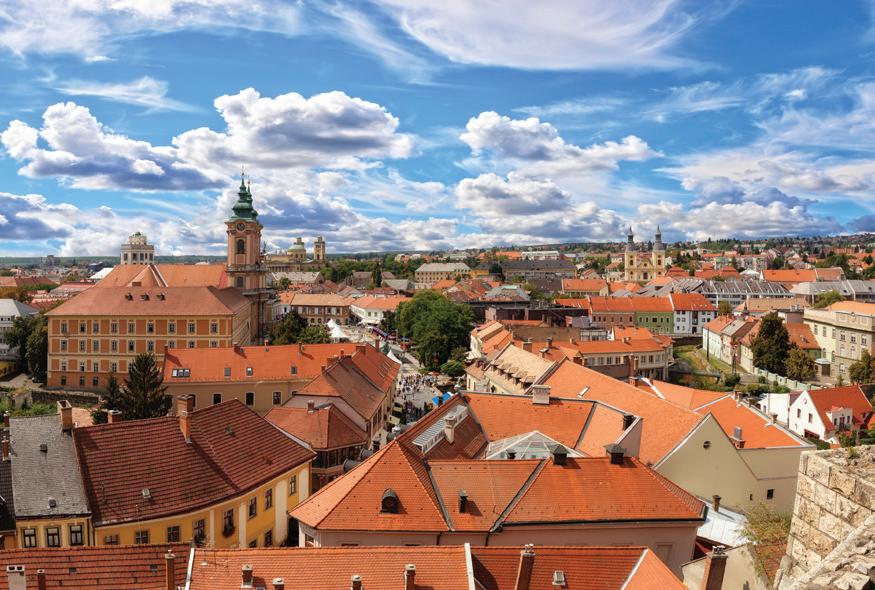
According to the analysis by the accommodation booking portal, Northern Hungary leads the regional rankings in this time of the year, with every fifth domestic booking going to the region. Lake Balaton ranks second with 15% of bookings, followed by Budapest and its catchment area and Western Transdanubia (13% each).
One-third of the season’s bookings are for hotels, while 27% of travelers chose apartments. Guesthouses account for 24% of autumn bookings, bedand-breakfasts for 13%, and other types of accommodation for 4%. Szallas. hu data also revealed that about one-third of guests requested meals with their accommodation, most often breakfast or half board. Among hotels, the 4- and 3-star categories are the most popular.
According to data, the most popular attractions this fall include the Nyíregyháza Zoo, the Sárvár Spa and Wellness Center, the Budapest Zoo and Botanical Garden, the Eger Castle and the Gyula Castle Baths, but many also visit the Zalakaros Bath, Hungarospa Hajdúszoboszló, Visegrád Castle, Esztergom Basilica and the Festetics Castle in Keszthely.

PEAK SEASON RECORD NUMBERS IN BALATON
SHIPPING
Balaton Shipping Co. (BAHART) closed this year's peak season with record numbers. The number of passengers traveling on ferries reached 1,220,000, while the number traveling on passenger boats on Lake Balaton approached 820,000, meaning that BAHART exceeded the two million passenger mark earlier this year than last year, on August 29.
Compared to last summer, almost 5% more passengers, a total of 1,630,000, used the shipping company's services between June and August this year. The outstanding result is due to a more frequent schedule, a more colorful program offering, and, last but not least, new family discounts, according to the announcement.
Ferry service traffic during the summer months increased by 34,000 to 904,000 passengers compared to last year, representing an increase of approximately 4% compared to the same period last year. BAHART passenger ships carried 726,000 passengers in June-August, 42,000 more than last year, representing a 6% increase. August was the busiest month of the summer, with more than 708,000 passengers boarding a BAHART ship. Last year, this number was 665,000. Most passengers traveled with BAHART on August 9, the day of the Balaton swim, with 21,000 choosing the shipping company on that day.
company briefs
BUDAPEST STOCK EXCHANGE H1 NET PROFIT OVER HUF 2.5 BN
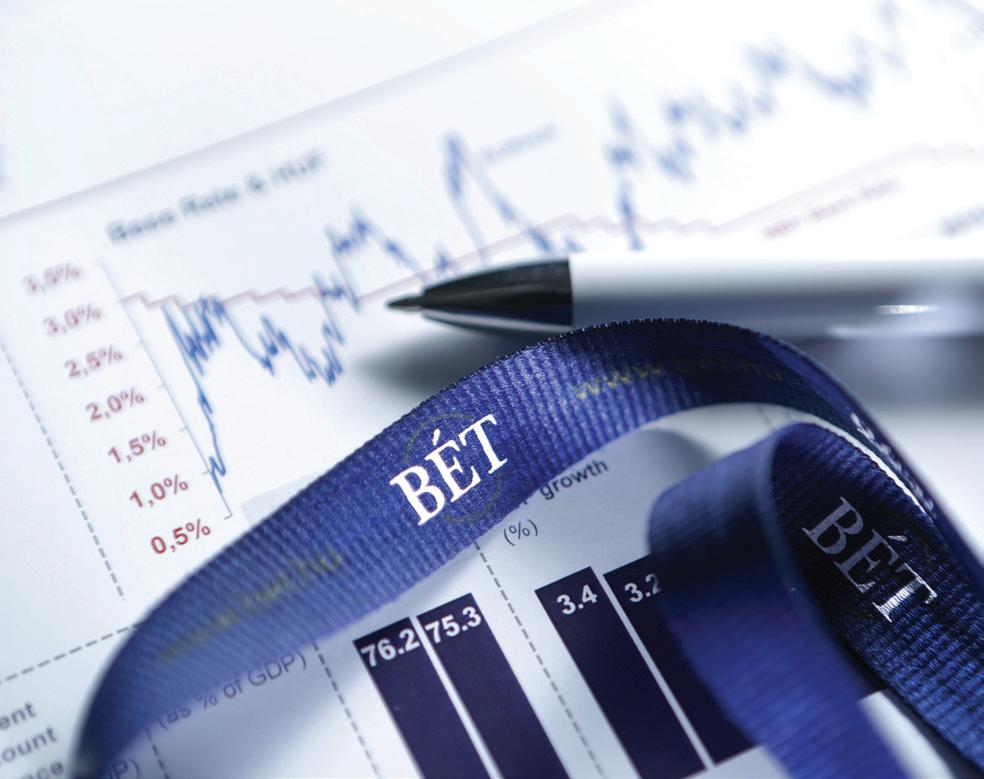
The net profit of the Budapest Stock Exchange (BSE) for the first half-year of 2025, which includes the BSE's share of the KELER Group's results, is HUF 2.67 billion, BSE reports on its website.
The EBITDA value in the first half-year of 2025 was HUF 879 million, which is 31% higher than the value achieved in the same period of 2024. The revenues of the Budapest Stock Exchange amounted to HUF 2 208 million in the first half-year of 2025, which is 20% higher than the revenue generated in the same period of the previous year.
In 2025 trading revenues grew 51% compared to the same period of last year. Issuer fee revenues are 3% higher than in 2024 H1, while information services revenues grew 8%.
The average equity market turnover in the first half-year of 2025, amounting to HUF 19.3 billion, exceeded the full-year average of HUF 11.8 billion in 2024. Compared to the same period in 2024, the turnover in the first half year is nearly 80% higher than the HUF 10.83 billion recorded a year earlier.
As of the end of June 2025, the Budapest Stock Exchange lists the securities of 155 issuer companies.
In the first half-year, the shares of one new issuer, Glia Nova, were listed on the Xtend market, while Goodwill Pharma transitioned from the Xtend market to the Standard category of the regulated market. In the debt section listed corporate bonds grew by HUF 534 billion and mortgage bonds grew with HUF 44 billion. The business line generated revenues of HUF 659 million in the first half-year, representing a 3% increase compared to the first half-year of 2024.
The information services business line generated HUF 668 million in revenue during the period, which is 8% higher compared to the first half-year of the previous year.
In the first half-year, expenses amounted to HUF 1 327 million, which is HUF 151 million (+13%) higher compared to the same period of the previous year.
The result of financial operations amounted to HUF 150 million during the reporting period. The higher amount of interest income was countered by unrealized exchange rate losses.
In the first half-year of 2025, the KELER Group achieved a pre-tax profit of HUF 4,96 billion, supported by better-than-expected fee income and interest revenue, as well as savings in operating expenses.
profit was HUF 221.8 billion, compared to HUF 222.0 billion in the same period last year. According to the energy company's halfyearly report, earnings before interest, taxes, depreciation, and amortization (EBITDA) increased to HUF 478 billion from HUF 450 billion in the first half of last year.
Natural gas storage and sales revenues are higher during the winter heating season, and annual peak loads on the electricity system generally occur in winter, but the use of air conditioning systems is already generating increasing electricity consumption in the summer; seasonal effects must be taken into account when analyzing half-yearly financial information, they indicated.
Protracted trade and geopolitical tensions continued to cause uncertainty in the global economic environment in the first half of 2025. The terms and expected real economic effects of the customs agreements that have been concluded or are in the pipeline vary significantly from region to region, and their impact on Hungary is uncertain but likely to be negative, they emphasized.
GRUNDFOS COMPLETES R&D PROJECT IN HUNGARY
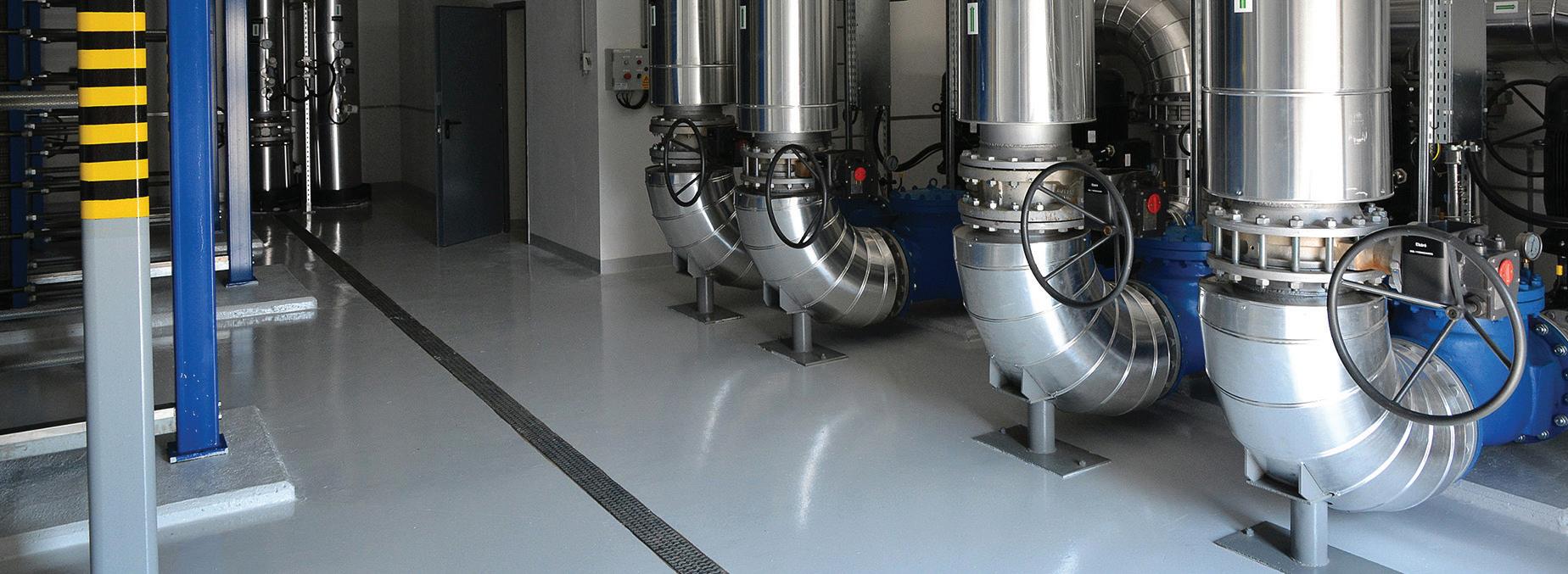
Danish pump manufacturer giant Grundfos successfully complemented its latest research and development (R&D) project in Hungary, aimed at improving the efficiency of entire product families, the Hungarian Investment Promotion Agency (HIPA) reports.
Implemented with the support of HIPA, the EUR 3.47 million investment created 40 new high value-added jobs at the company’s product development center in Székesfehérvár.
Over a period of three years, the Hungarian team worked on developing next-generation electric motor technologies and structural innovations to enhance the reliability and lifetime of Grundfos pumps. Innovations include premium-efficiency motors that significantly reduce electricity consumption and modified pump design that lowers the risks of clogging and failures.
As a result, the company can meet both market demand and serve the goal of environmental sustainability with more economical and more reliable products.
Outside Denmark, Hungary is the most important base in Grundfos’s manufacturing network that spans 60 countries. The Hungarian workforce of 3,000 employees operates, among others, four production facilities and a financial and IT service center (BSC). The roots of Grundfos itself goes back to 1944. Founder Poul Due Jensen developed the first pump – the Foss 1 model – in the basement of his home in Bjerringbro after failing to find a product that met his needs. Just five years later, the company was already producing for export. It adopted the name Grundfos in 1967. The company is owned jointly by the founder’s family, employees, and a foundation. In the most recent financial year, 2024, it employed around 20,000 people worldwide and generated revenues of EUR 4.45 billion.
The MVM Group achieved consolidated sales revenue of HUF 2,015 billion in the first six months of this year, following HUF 2,156 billion in the first half of last year, and its after-tax
HELLOPARKS: FIVE YEARS, 500,000 SQUARE METERS
The industrial property developer HelloParks, member of Futureal Group, is celebrating the fifth anniversary of its founding and will complete the development of more than 500,000 sqm of warehouse space in the Budapest metropolitan area this year. The founders recognized the opportunity in the growing demand for modern and green industrial facilities during the pandemic and supply chain crisis, and the company now competes with the world's largest warehouse developers in the domestic market.
When HelloParks was founded in 2020, the pandemic and subsequent supply chain disruptions presented significant challenges to industrial property developers. Storage methods evolved, and demand shifted toward modern industrial facilities. Tenants sought environmentally friendly, high-efficiency warehouse buildings.
The slow European economy also reduced the domestic outlook, as Hungary's trade exposure and deep integration into the global supply chain reduced export opportunities, the report said. The group serves the entire domestic universal natural gas and electricity supply market, primarily residential customers.
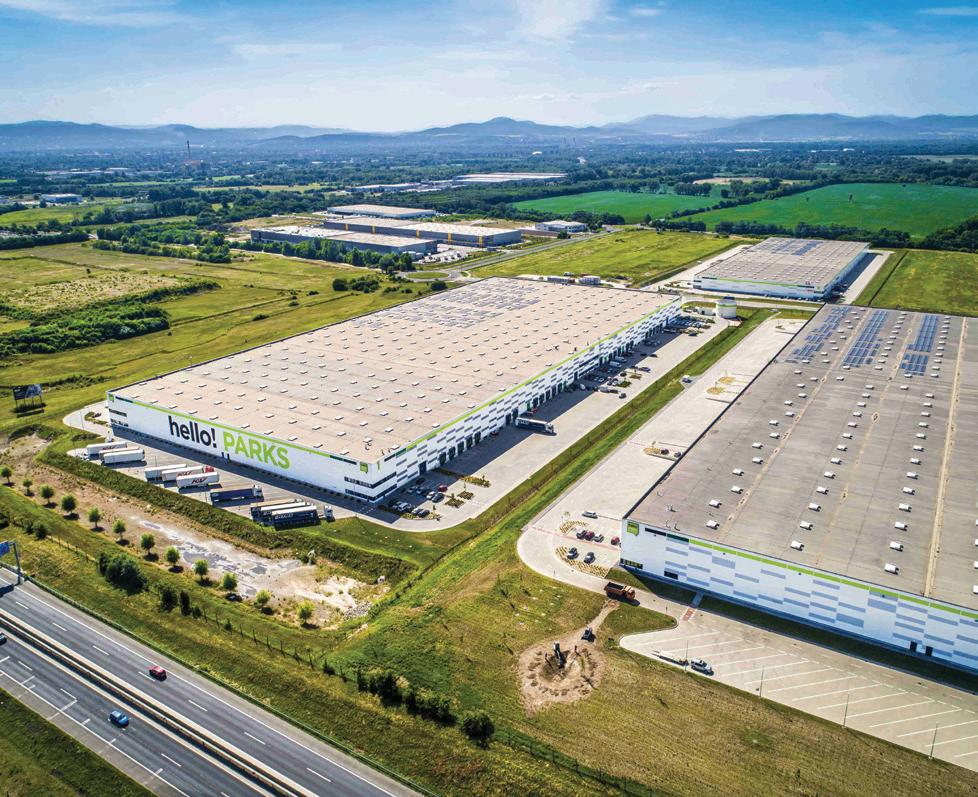
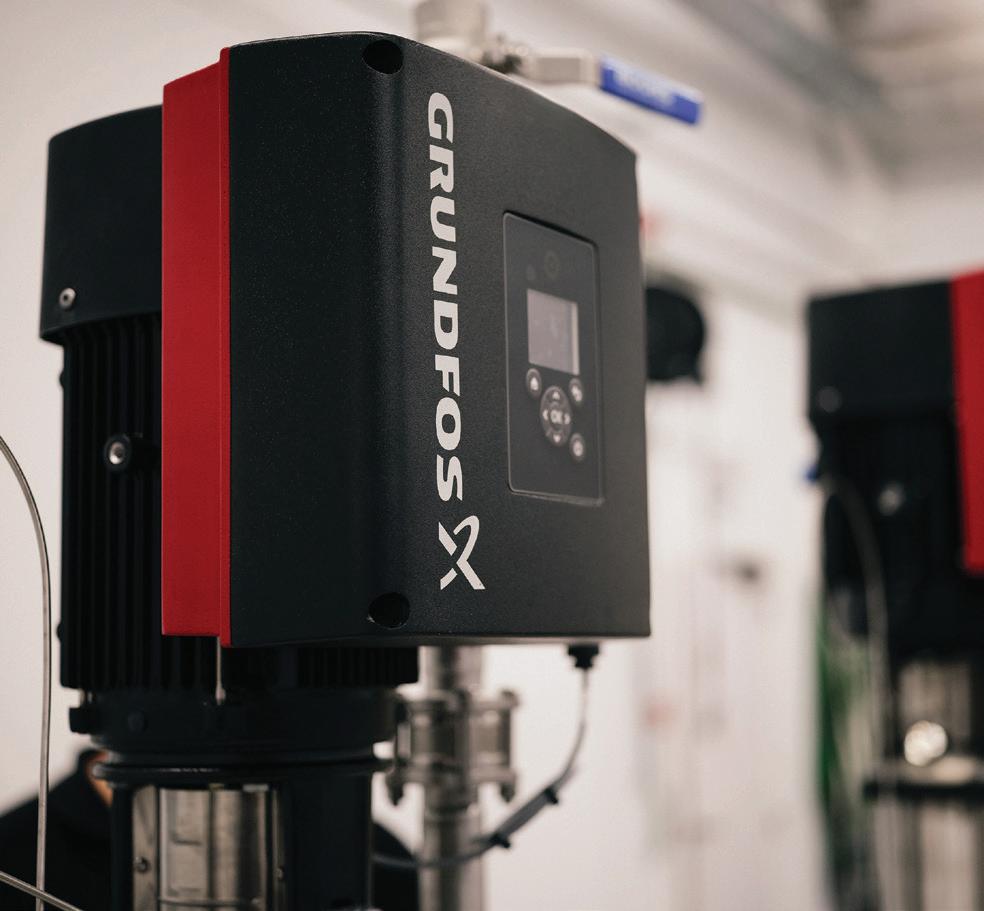
HelloParks recognized this market trend early and began developing industrial and logistics business parks in 2020 at three strategic locations around Budapest – in Fót (Budapest North), Maglód (Budapest Airport), and Páty (Budapest West).
Following the preparatory work, the company delivered its first two warehouses in 2022 with a total area of 92,000 sqm, which reached 100% occupancy within just two months.
Construction advanced at a dynamic pace. By the end of 2023, the team had delivered four additional warehouses, covering approximately 174,000 sqm. Also in 2023, HelloParks started building another warehouse in Alsónémedi (Budapest South), a fourth important commercial hub in the capital’s agglomeration. In 2024, the team completed two more warehouse facilities, totaling 102,000 square meters. HelloParks’ warehouse developments continue in 2025: the FT3 in Budapest North and PT5 in Budapest West are expected to be completed this year, marking a significant milestone for the company, which will have developed more than half a million sqm of logistics and industrial space in five years.
company briefs

VISA LAUNCHES DIGITAL PAYMENT PROGRAM IN HUNGARY
Following seven other countries in the region, Visa has launched its digital payment program in Hungary, which aims to support the digitization of Hungarian micro and small businesses already operating in e-commerce or intending to enter the market and make them more competitive. They explained that the program supports businesses
STRABAG BUILDS ASPHALT MIXING PLANT IN OROSHÁZA
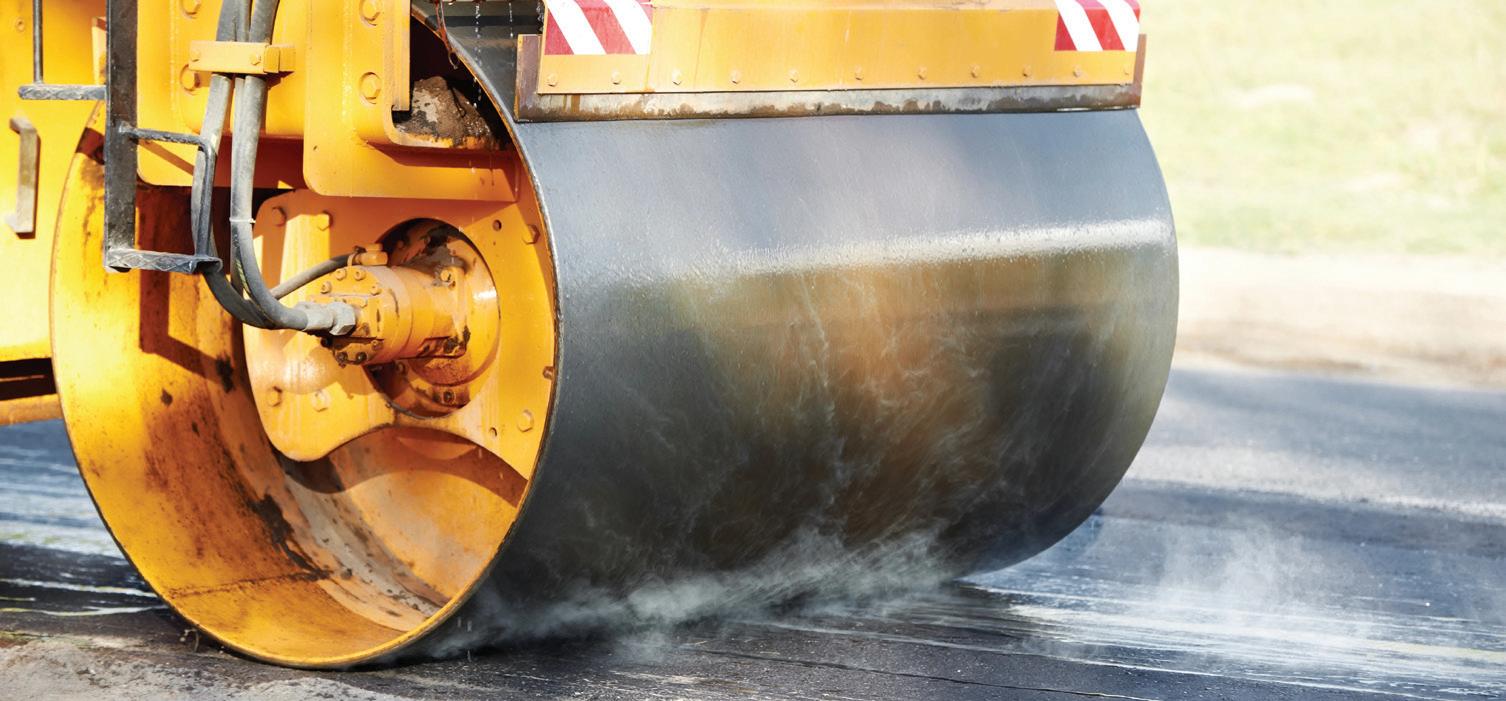
Strabag has opened an asphalt mixing plant in Orosháza, Békés County, with the brownfield investment costing more than HUF 950 million. The original plant opened in 1998 but was closed following the 2008 world economic crisis. The new asphalt plant and service units, such as the hall, depot, raw material storage facilities, and offices, were built on the site of the original plant.
The plant has a nominal capacity of 240 tons of asphalt per hour, which means it can fill nine semitrucks with asphalt per hour. The fully automated machine is suitable for dispensing foamed bitumen and producing reduced-temperature, moderately warm asphalt, they wrote. They noted that while the old plant mixed 270,000 tons of asphalt in
that have not accepted online card payments in the past 12 months or are just starting their e-commerce activities.
Merchants can take advantage of free online card acceptance for six months, while the program also supports e-commerce start-ups and expansion with invoicing, web store creation, inventory management, courier logistics, and digital advertising solutions, discounts, and educational materials.
The three-year initiative is being implemented in cooperation with merchants active in Hungary
PANNERGY GROUP: CONSOLIDATED HEAT SALES EXCEEDING PLANS
In H1 2025, the PannErgy Group focused mainly on the successful commissioning of the third production well of the Miskolc Geothermal Project. Primarily due to this successful integration, PannErgy achieved record heat input in Q1 2025, exceeding both base quarter heat sales and the target for the period.
and partners offering e-commerce solutions. Citing studies, they wrote that Hungarian e-commerce grew by an average of 25% annually between 2018 and 2023, with the total market value expanding to 4.1% of GDP, or around EUR 8 billion.
At the same time, payment habits have also shifted towards digital: while in 2020, barely half of Hungarians (48%) preferred electronic payment, this figure had risen to 69% by the end of 2024. At the same time, consumers expect seamless payment services as well as security.
the PannErgy Group's consolidated heat sales for H1 2025 amount to 982 TJ, which is about 6% higher than the 927 TJ consolidated heat sales figure in H1 of the previous year and 4% higher than the projected value of 941 TJ.
PannErgy indicated in several of its previous disclosures (quarterly production reports) how the new district heating regulation structure, effective from 1 October 2024, will change the Company's business and how it will affect the weighting of the profitability of each half of the financial year compared to previous periods.
Diplomacy-n-Trade.ai 1 2017. 02. 27. 11:22:30
Diplomacy-n-Trade ai 1 2017 02 27 11:22:30
11 years, the new one, operating continuously throughout the day, would accomplish this in 110 days. The site also has a 1,200-square-meter covered raw material storage facility equipped with solar panels. The solar panel investment, costing nearly HUF 46.5 million, was made with two objectives in mind: to reduce the moisture content of the raw material, resulting in energy savings during drying, and to increase the plant's own green energy production. All this contributes to lower specific energy consumption in the manufacturing process. An important sustainability feature of the plant is the possibility of cold recycling of recovered asphalt. The technology allows old asphalt to be mixed into the new product as a secondary raw material up to the maximum ratio specified by standards. This reduces the use of primary raw materials and lowers the demand for bitumen, thereby reducing the carbon footprint of production, i.e., its environmental impact, according to the announcement.


In addition to this capacity expansion in Miskolc, Q2 performance was also positively affected by the significantly more favorable weather conditions in terms of heating potential compared to the base period.
Based on the prevailing weather conditions and capacity assumptions for the period under review,
As of October 1, 2024, in contrast to previous regulation and practice, the Decree set district heating producer tariffs for PannErgy's subsidiaries subject to the district heating price regulation not only in the form of a sales heat tariff for the heat volume sold, but also in the form of a split heat supply tariff for the heat volume sold, and a monthly supplier base tariff, i.e. using a so-called two-element pricing system.
HUNGARY'S BEST HOTEL SPA
Kempinski Hotel Corvinus Budapest has announced that its 'Kempinski The Spa' has been honored with the esteemed title of 'Hungary's Best Hotel Spa' in the World Spa Awards 2025.
Spa Manager Katalin O’Nagy conveyed her profound appreciation for this honor by stating that "we are privileged to receive this recognition for the fifth time in our history. It is a true reflection of the exceptional skill and dedication of our therapists, coupled with the exemplary professionalism and warm hospitality extended by our reception team. Together, they orchestrate the seamless and inviting experience that defines Kempinski The Spa. This prestigious award serves as a true inspiration to deliver exceptional care and unforgettable moments of wellbeing for our guests in the heart of Budapest."
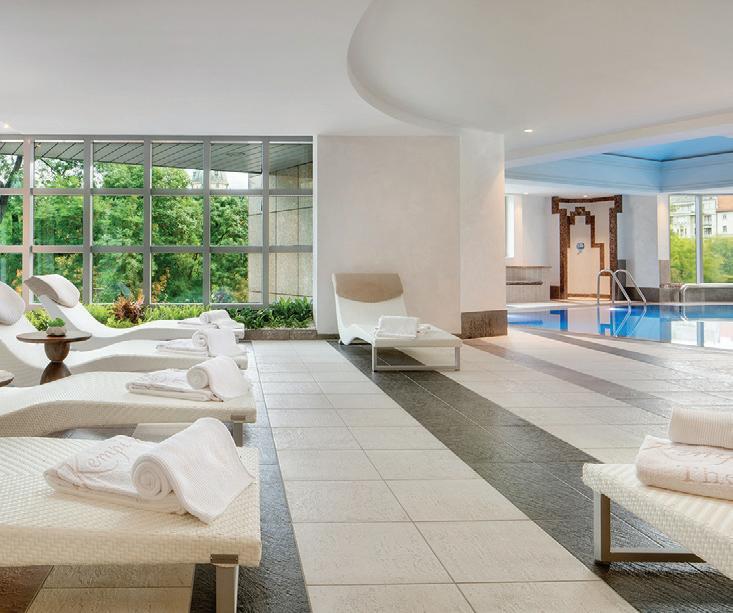



The statement issued by the hotel says that this remarkable accolade underscores the spa's unwavering commitment to curating unparalleled wellness journeys. It not only brings immense prestige to the spa but also further solidifies
Kempinski Hotel Corvinus Budapest's continuous efforts to set new benchmarks for excellence within the luxury hospitality sector. Following a comprehensive and sophisticated redesign in the fall of 2023, Kempinski The Spa has firmly established itself as Budapest's premier destination for luxury wellness. Situated ideally on the second floor, amidst the vibrant pulse of the city, The Spa offers an intimate and tranquil haven, with a curated selection of signature treatments that are available to both hotel guests and discerning walk-in clientele.
analysis
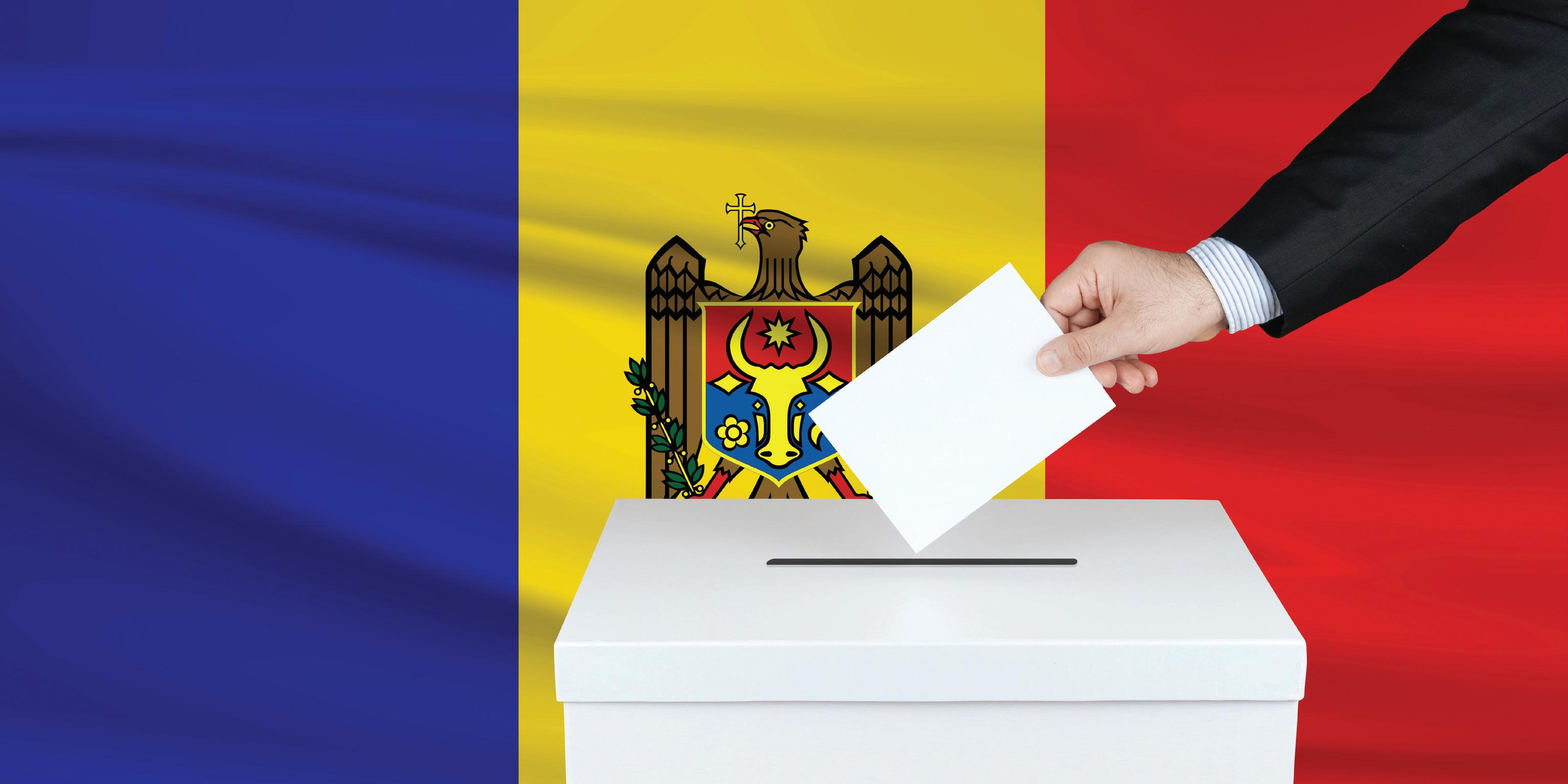
ELECTIONS IN A SMALL COUNTRY –WITH BIG CONSEQUENCES?
PRO-EUROPEAN MAJORITY IN MOLDOVA GIVES GROUND TO EURO-ATLANTIC ASPIRATIONS
BY TAMÁS MAGYARICS
The recent elections in Moldova have received relatively little attention in the international press. The country is ’hidden’ in the southeast corner of Europe, and is in the shadow of the Russo-Ukrainian war. However, Moldova is at the crossroads of the Russian and the EU contest for the control of a territory, which is actually having strategic interests of its own of sorts. It is squeezed between Ukraine and Romania, and its political orientation makes it even more important by the fact that its breakaway province, Transnistria, with some 1,500 Russian troops on its soil, and with the straightforward pro-Russian majority, is bordering it in the east. Moldova is not a country whose political orientation would be a game-changer for either the EU (the West in general) or Russia, but it is important enough for both sides to have made some extra efforts, financially and otherwise, to help support the pro-Europe and the pro-Russian political parties respectively in the parliamentary elections held on September 28, 2025.
Pro-European majority
The outcome of the elections seems to be unequivocal. The pro-European forces gained a clear majority in the 101-member Moldovan Parliament. The strongest party, the Party of Action and Solidarity (PAS) won a bit over 50% of the votes – which translates into 55
seats. The similarly pro-European Alternative Party won 7.47% of the votes, that is, 8 seats, which means that the pro-European forces are enjoying a comfortable majority of 63 seats. The major opposition party, the Patriotic Electoral Bloc (BEP), an alliance of four parties received only some 25% of the popular votes, and 26 seats in the new Parliament. Moreover, the President of Moldova, Maia Sandu also comes from the PAS. Nevertheless, as a word of caution, one should remember that only just a bit over 50% of the people of Moldova voted in favor of EU-membership in a referendum in October 2024. So, the contest for the ’hearts and minds’ of the people of Moldova seems to be rather open-ended, with a tilt towards the pro-Europe sentiments at the moment.
Playground for outside forces
Moldova, unfortunately, also seems to be a playground for outside forces. The election campaign was full of accusations from both sides that the other side was being supported financially and through the social media by ’Europe’ and Russia. The pro-Europe forces were talking about EUR hundreds of millions poured into the coffers of the pro-Russian parties by Moscow, as well as a Russian disinformation campaign. (It goes without saying that Moscow is denying any interference in the Moldovan elections …). They claimed that their electoral victory is more precious because it was
achieved in a strong headwind. At the same time, the leader of BEP, Igor Dodon claimed that there were election frauds committed by the ruling PAS aided by President Maia Sandu.
Geopolitical considerations
The PAS, with the strong support of President Sandu, aims to join the European Union within the next five years. The membership prospects of Moldova are likely to be strongly affected by the EU strategies towards Ukraine. For all intents and purposes, the European Commission, headed by Ursula von der Leyen, seems to be putting all eggs into the basket of a relatively quick Ukrainian accession to the EU. The accession of the Balkan countries seems to be pushed into the back burner. The EU leaders and those of the major member countries are in agreement that the most urgent task before the European Union is to settle the Ukrainian question. In reality, they are right in essence. Ukraine is geopolitically a pivotal state in Eurasia; if Russia is denied gaining control of her western neighbor, then she would be relegated to a regional power. On the other hand, if the EU is expanded with a country of the economic and other potentials like Ukraine, then it might compensate the loss of the United Kingdom to some extent, and may definitely acquire a stronger position in the world as one of the most important power centers besides the U.S., China, and Russia. Conversely, the accession of the Balkan countries
which are not yet members of the community (for instance, Serbia besides Moldova), may be a significant step in uniting Europe, but the countries in the region do not possess the geopolitical weight Ukraine is enjoying.
Euro-Atlantic aspirations
Not only does Moldova wish to join the European Union, it has also been working on becoming a member of NATO for decades: it joined the North Atlantic Cooperation Council in 1992. The Moldovan aspirations to join both major Euro-Atlantic organizations are giving headaches for Moscow. Moldova’s membership would strengthen Ukraine’s geopolitical positions in the southwest, while it is bound to weaken the positions of the Russian client breakaway entity, Transnistria. The EU leaders and various other European politicians welcomed the results of the election; they interpreted them, almost to a man, as a defeat for Russia, and an example for others how Russian interference and pressure can be neutralized and/or countered successfully. In a struggle between two adversaries, it is not only the main front line that may decide the outcome, but the events on the ’flanks’ may also have a significant impact. Viewing the elections in Moldova in this light, Europe (the West) scored against Russia by demonstrating the force of values over the naked interests.
Tamás Magyarics is a foreign policy analyst
FOR A STRONG EUROPE IN A CHANGING WORLD
INTERVIEW WITH THE AMBASSADOR OF DENMARK, DR. CHRISTIAN THORNING
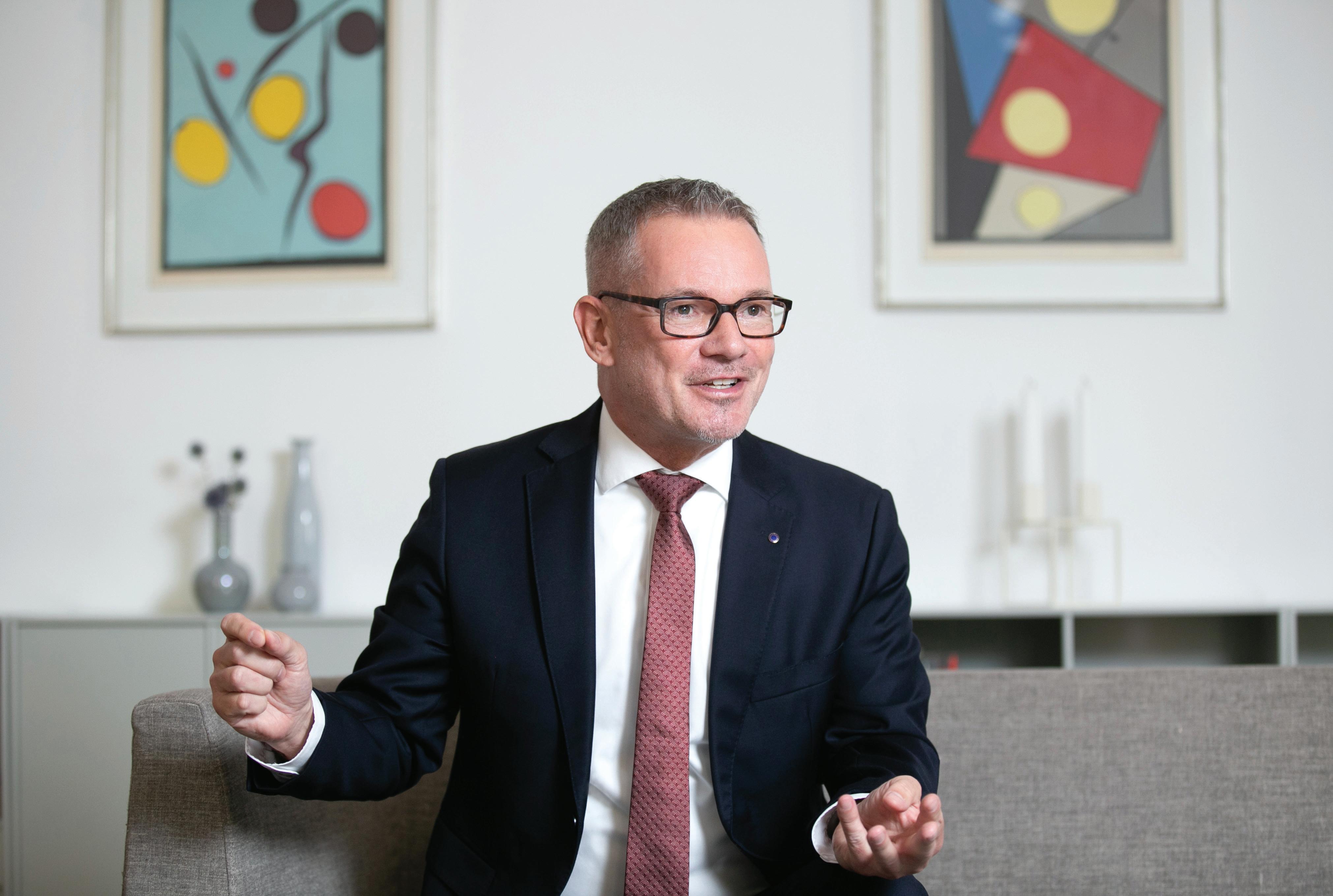
BY SÁNDOR LACZKÓ
In the second half of this year, it is the Kingdom of Denmark that holds the rotating Presidency of the Council of the European Union with overarching priorities such as a secure Europe and a competitive and green Europe. It is totally understandable why security, competitiveness and environmental protection are the most significant issues on this continent in 2025.
Honest broker
As to what sort of means the Danish EU Presidency has at its disposal to promote these most important aims, Ambassador Thorning highlights to Diplomacy&Trade that the slogan of the Presidency is ‘A strong Europe in a changing world’. “You can see that a changing world is a given circumstance. It's the new geopolitics we are living in. However, a strong Europe is by design, our common European design. So, this is basically what our Presidency is about: making Europe strong. This is the 8th time Denmark holds the Presidency. So,
we've tried it before, but we are not complacent. It's not a presidency business as usual because times are as they are. One of our goals is taking on the role as honest broker, which means to broker compromises, to find solutions, to be the chair of everybody. We have tried it before, it's tested, that's how we approach it. And we wish to do all that in close cooperation with the European Commission with which we have good and close cooperation. This is also because now, it is time for action.”
On the Danish presidency agenda is a double summit in Copenhagen, an informal meeting of EU heads of state or government, followed by the seventh meeting of the European Political Community (EPC), which is broader than the European Union. It will be similar in early October to what took place during the Hungarian Presidency in Budapest in the fall of 2024, he notes.
The European Union is an increasingly important player on the global scene. Regarding the Danish Presidency view of the external relations of the EU vis-à-vis the United States, China and others, the Ambassador reminds that “it is a changing world,
Europe's global weight is shrinking. Our relationship with the United States is under certain challenges. Again, this is a given circumstance. But ‘never let anything go to waste’ as we say. So, I think it's interesting to see that there are quite a lot of third countries that would like to enter into association agreements with the EU and particularly now: the good old stable European Union is an attraction. We should not forget that, and we should use that to our advantage. And this is also very much in the DNA of Denmark and therefore, of the Danish Presidency.”
Ensuring continuity
That of Denmark is part of the EU presidency trio that also includes Poland and Cyprus. Ambassador Thorning stresses that they see the trio as very important, because it ensures continuity. “This is what it is, because as one country only holds the presidency for six months. And you always stand on the shoulders of your predecessor. We stand on the shoulder of Poland as Cyprus will stand on our shoulders at the beginning of next year. This is essential because it ensures that we are not in a vacuum, there's continuity. Another thing with this trio worth noticing is it also ensures a north-southeast-west balance as well as that of smaller and bigger countries since Poland is a big country while Denmark and Cyprus are not.”
Particular honor and pleasure
Dr. Christian Thorning presented his letter of credentials in Hungary in September last year. When asked about the preparations for his tenure here, he recalls his personal story from over 30 years ago when he started his diplomatic career in the headquarters of the Ministry of Foreign Affairs in Denmark. “Very shortly after I embarked on this new diplomatic life, I was appointed Desk Officer for Hungary. That was at a time when our bilateral relations were very much focused on Hungary's entry into NATO and the European Union. Actually, when we subsequently held the rotating presidency of the EU in 2002, I was put in charge of the so-called drafting group in Brussels, a group of lawyers that drafted the accession treaty to the European Union of the then ten acceding countries, including Hungary. So, you see, for me now returning as His Majesty's Ambassador to Hungary is a particular honor and pleasure. It is kind of like the circle is completed. That's how I see it. Now, I sit here as ambassador in the Hungary that I knew so well 30 years ago.”
He adds that at that time, Hungary was about to enter into the EU institutions. “Now, of course, it is a full-fledged member and has been for a long time. Bilateral cooperation between Denmark
danish focus
and Hungary is very much encircled around the European Union and NATO but also around economic ties because there is a very fundamental presence of Danish business life here. I take it as my mission to visit as many Danish firms in this country as possible. They are scattered all over Hungary in many different sectors, from Nyíregyháza to Tatabánya. I have already had the chance to visit several of these companies, but there are many others to go to. So, this is my mission because that is how I get a feeling of what Hungary is really like.”
The Hussar connection
Another aspect, as he puts it, in his own little private mission as ambassador here, is to engage with the newly reestablished Hussar regiment in Hungary.
“As you might know, just a few years ago, a Hussar regiment of mounted soldiers was set up again as a unit within the Hungarian Army as a continuation of a long and proud history of the Hussars. Having been dismantled after the Second World War by the then regime, it has now come back to life. And there's a connection, of course, because we have the Guard Hussar Regiment of the Royal Danish Army. One of the units of this is the Guard Hussar Regiment Mounted Squadron, which provides mounted escorts for the Danish royal family and carries out ceremonial services with the Royal Danish Army. Interestingly enough, this is the oldest regiment in the Danish army. It dates back to 1614, the time of King Christian IV, who established it, and it has been in existence ever since. Speaking of their use for ceremonial reasons, for instance, when the Hungarian ambassador presents credentials to the King in Copenhagen, it is this guard of Hussars escorting the ambassador.”
Positive role by Danish investors
Discussing economic relations between Denmark and Hungary, Ambassador Thorning says he characterizes them as very solid. “I just looked into the figures: Danish exports to Hungary over the last several years have gone up a good 4% while Hungarian exports to Denmark have increased by more than 5%. As for Danish investments in Hungary, there are over a hundred Danish units, entities, businesses, which are either subsidiaries of Danish companies or otherwise owned by
Danish investors operating in this country. They are generating employment for more than 20,000 people, which is remarkable. These businesses bring here more than just economic activity, it is also high added value and environmentally friendly technologies. What they also bring is a kind of a Danish HR approach on personnel as to how to do business with your employees. And last but not least, they also engage in the local communities where they are based. As mentioned before, I've already had the chance to visit some of these places and have spoken to the mayors there. They are testifying that there's very good interaction between the Danish businesses and the local communities in many respects.”
Regarding how satisfied Danish companies with the Hungarian business environment are, the Ambassador’s experience is that “what I hear in the Danish Business Club that we have here in Hungary is that they are by and large satisfied. The testimony to that is that many of them were established 30 years ago or more and they are still here. Actually, some of them even started before the regime change in 1989. Just recently, I went to a 25-year anniversary of one of these companies. This fall, I will go to another one that has consolidated itself and yet another 25 years anniversary coming up. These businesses are not only still here, they're thriving, they are expanding. That's the impression I have.”
Community feeling and trust Civil society in Denmark is very strong. “You normally say that if you put three Danes in a room, they will immediately create some sort of association and they will elect a president, a vice president and a secretary of the committee. This is a kind of Danish characteristic, that's in our DNA. It has been so, well, basically for many decades, possibly centuries. We approach it in Denmark with a very strong feeling. I think Hungary has a different tradition and history in this respect and that's also why –as I see it – you cannot implement one in one the Danish way of doing it. That is because such a thing has to be done organically within Hungary. But of course, you can see how we have developed it and nursed it for many, many decades in Denmark. You could consider doing the same. One example I would like to mention is that in Denmark helping each other in the community is very much something, which is on the grassroot level. For instance, there are absolutely ordinary citizens who – in their spare time – are also football trainers and so forth for the young guys and girls in their local community. When I grew up, I was taking swimming lessons and it was the fathers and mothers of my peers who were the swimming teachers. That's the way we do it, and of course, what it creates is this community feeling – and trust. Because trust perhaps is another thing when everybody is looking to Denmark and say, ‘why are you so happy and content?’. It's about trust. I mean, the state of Denmark is us. It's not something else. The state is us. The state is the local sports football club or whatever that we are all part of,” the Ambassador explains.
Hungarian household name in Denmark
When talking about bilateral relations in culture, another personal experience of his own comes to his mind. “I remember how I learned about Hungary in my childhood years. And that was very much down to one person, Péter Eszterhás, born in 1940, who is a very well-known stage director, movie and television director in my country. He became a very acclaimed translator of Hungarian literature into Danish. I remember him because he then also made it to television and thus, he became a household name in Denmark. He is a child of 1956 because that is when he and his parents emigrated to Denmark as refugees. And then, as I said, he became an important figure in Danish cultural life. So, you can see sometimes one person can have that wider impact that, for me, very much encapsules what Hungary is.”
danish focus
CREATING VALUE FOR DANISH COMPANIES
DANISH EMBASSY IN BUDAPEST STRONG IN ECONOMIC DIPLOMACY
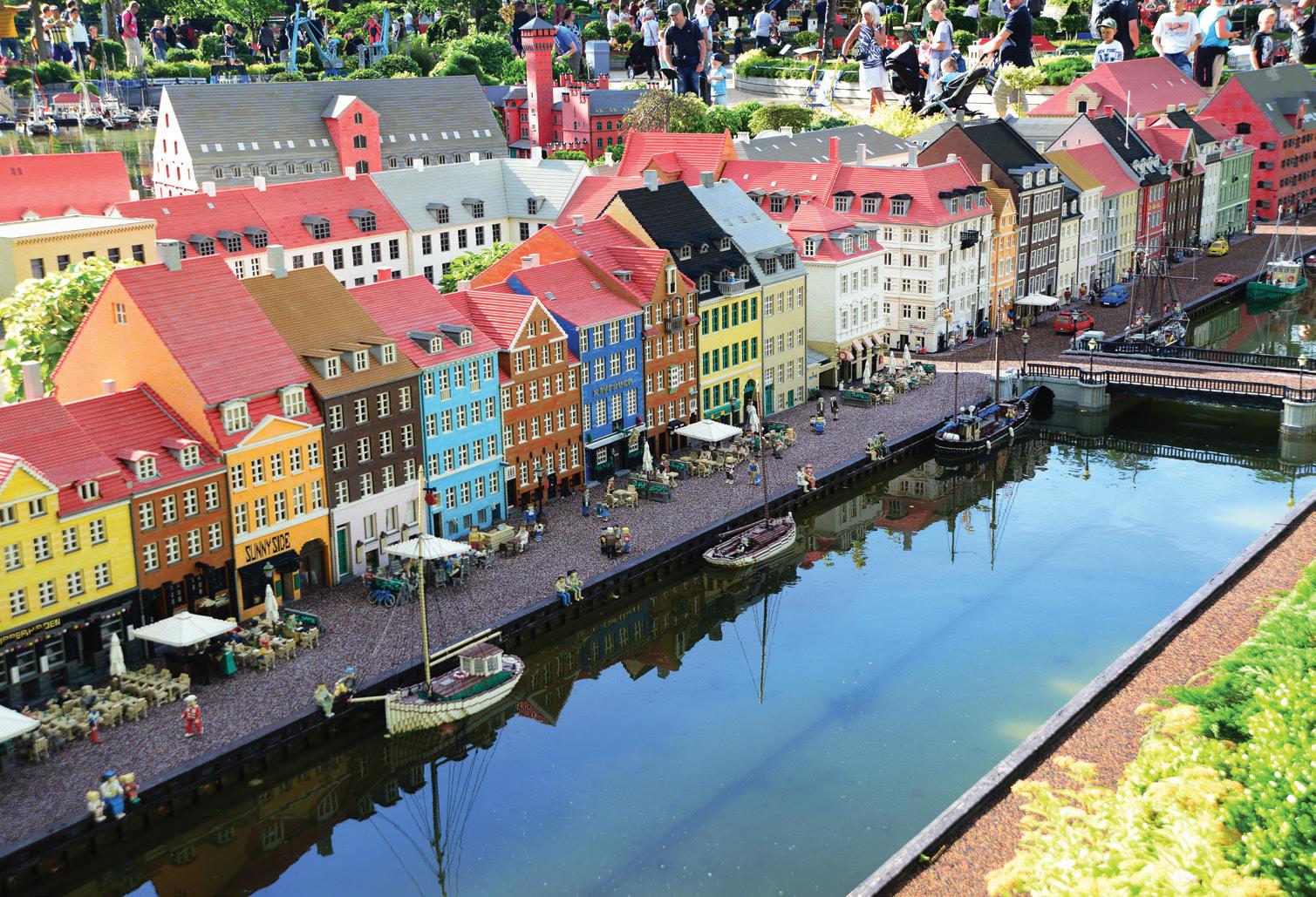
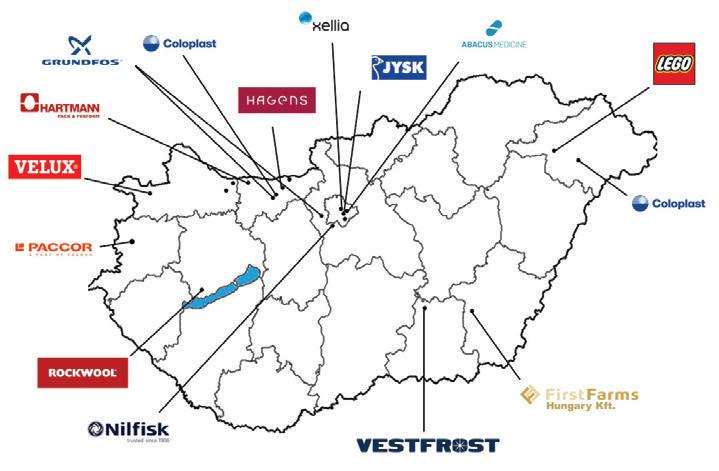
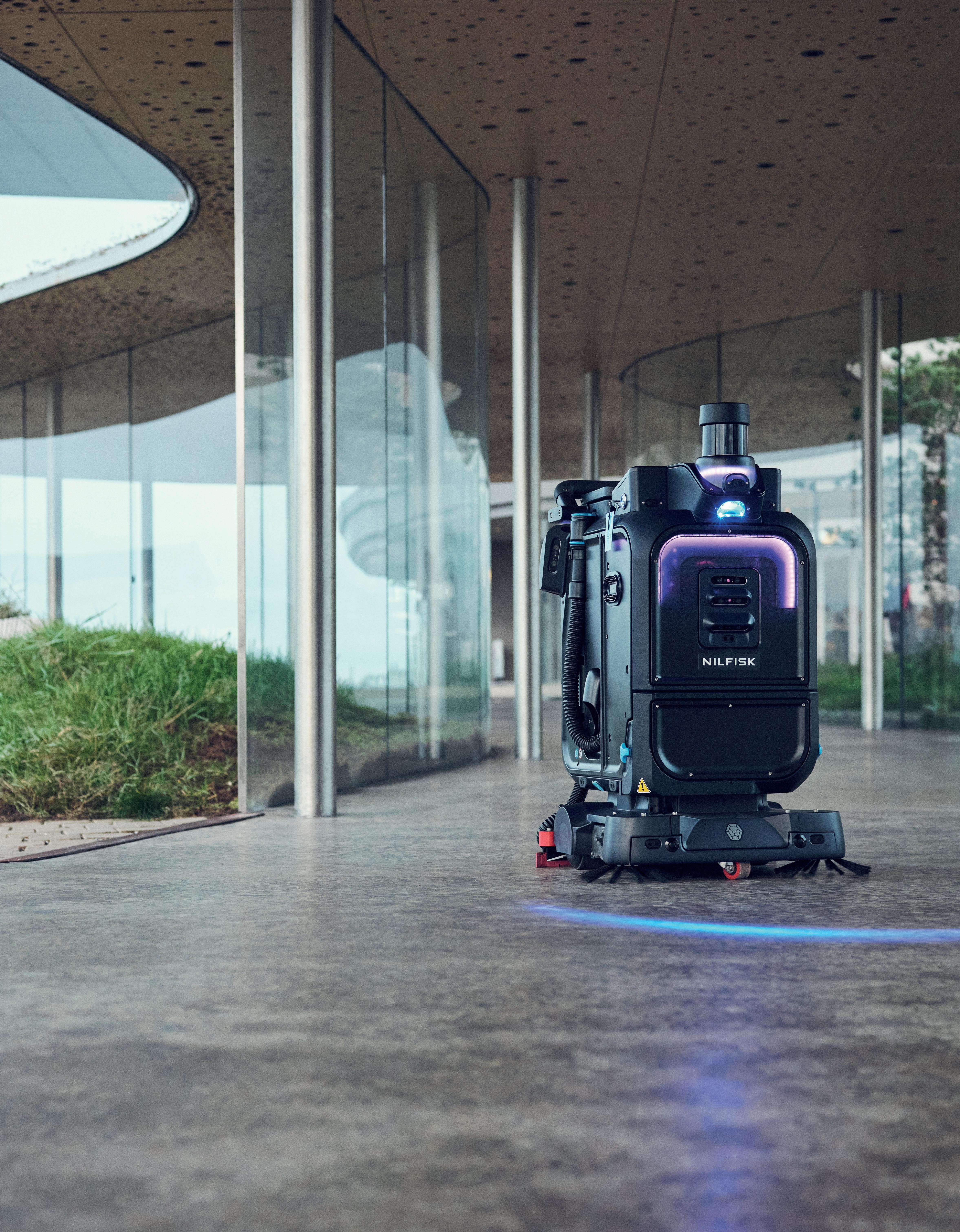
The presence of Danish firms in Hungary is widespread, both in terms of sectors and geographic locations. Among the big manufacturing facilities, Dániel Péter mentions Coloplast, which is making ostomy bags and advance wound care products; one of the biggest LEGO factories in the world is located in Nyíregyháza, NE Hungary; Nilfisk producing industrial cleaning machines; and Grundfos, the renowned pump producer has a significant presence in Trans-Danubia. An example for smaller factories is Hagens, which is making smaller springs for different kind of industries. “We have the roof window specialist Velux, of course, which is not only the oldest Danish, but the oldest Western European company in Hungary. They came even before the change of the political system here in 1989-90. There is also Paccor, a producer of packaging material, which was acquired by a Danish company a few years ago. Also making packaging materials, specifically egg holders here, is Hartmann. Rockwool is producing insulation for buildings. In the pharmaceutical industry, we have Xellia making Active Pharmaceutical Ingredients (APIs), while Abacus is engaged in parallel imports of prescription medicine from other countries. In SE Hungary, we have Vestfrost, a leading producer of commercial cooling appliances and, a little odd one out, a Danish owned pig farm in Gádoros,” he highlights.
Bilateral trade
According to the latest summary, exports from Hungary to Denmark include mostly vehicles, machinery and electronic equipment as well as some pharmaceutical products. “What these Danish companies produce in Hungary usually go for the European markets in general, not specifically for Denmark or for Hungary. When it comes to the flow of trade from Denmark to Hungary, the biggest category is machinery and mechanical appliances as well as some kind of plastic products. This has mostly been the same trend in the past few years. If you look at the actual numbers, you will see that the export from Hungary to Denmark is much bigger than the
Advisor notes.
Economic diplomacy
The Trade Council is part of the Ministry of Foreign Affairs and assists Danish companies with export and investment promotion services.
Dániel Péter, who is also a representative of The Trade Council at the Embassy of Denmark, points out that in recent years, there has been a new strategy trying to integrate The Trade Council more into the general diplomatic activities of the embassies, as part of a broader concept of economic diplomacy. “At the same time, they want to keep The Trade Council as a trademark because it has been a well-known brand for the past 20-30 years. It is important to mention that our local activities are aligned with the global strategy of the MFA and, more specifically, with the region-specific goals. The Central Eastern European region that we are in is quite big. It's not only Poland, Czechia, Slovakia and Hungary but also the Balkan countries as well as Romania, Moldova, Ukraine, Georgia and Armenia. We have a regional coordinator in Prague and he helps put together common projects. I'm trying to get involved in these as well with specific market and sector knowledge, or by putting together a delegation from Hungary. Of course, each trade advisor in each country has their own goals and their own bilateral relations with the companies as well.”
He also stresses that The Trade Council works, in a way, like a consultancy agency. “The companies pay for the services that we do for them. On the other hand, we have the advantage that we, as part of the Embassy, have a long-term and active relationship with the government, the ministries
and the local business community, and it really helps to open doors, especially if the Ambassador is the one who's initiating a meeting. Thus, it really combines the best part of diplomacy and commerce.”
Business clubs
The Danish Embassy in Budapest is trying to get together the Danish subsidiaries in Hungary plus every organization or company that has some kind of interest in doing business with a Danish company or Denmark, providing platforms for such meetings. Originally called the Danish Business Forum, established at the Embassy’s initiative in 2006, the Danish-Hungarian Business Club offers an excellent platform for networking, knowledge sharing and market information. In addition, members are invited to cultural activities organized or supported by the Embassy. Its programs are headed by the Ambassador and the Trade Advisor. “We have members in the Business Club that are not Danish subsidiaries but have Danish clientele or some kind of a personal relationship with Denmark. So, I would say that we are very open to have companies and organization join, they don't have to be specifically Danish. The concept is that, as Denmark doesn't have a chamber of commerce in Hungary, we are also trying to cover that area and represent these companies towards the government. We organize networking events, usually business breakfasts, three or four times a year at the Embassy or at the Ambassador's residence. We invite a guest speaker, either an expert or a government representative, and then we have a very informal discussion with them,” Dániel Péter explains. He adds that “there is also a second, more tailored platform, called the Executive Business Club, for leaders, CEOs, CFOs, country managers
There are between 100 and 110 Danish subsidiaries in Hungary and these companies employ over 20,000 people altogether, while in bilateral trade, Hungary has a surplus, Dániel Péter, Commercial Advisor at the Danish Embassy tells Diplomacy&Trade. He also details the activities of The Trade Council that assists Danish companies with export and investment promotion services.
of the biggest Danish subsidiaries here in Hungary. For them, we organize exclusive lunches at the Ambassador's residence. Again, the goal is to invite people who might be of relevance to these company officials with their unique insights. Of course, what we also do is trying to build up a good cooperation with other chambers of commerce in Hungary or other business clubs. If they have an event that might be relevant for our members, we also share it.” The Danish Embassy is also a partner in the Nordic Business Forum, held every year. Each time, it is organized by a different Nordic embassy or chamber of commerce in Budapest. Its goal is to bring together the biggest subsidiaries of companies from all the Nordic countries for a very high-level networking reception. It's usually organized in the end of the year.
Creating more value for companies
In the second half of this year, it is the Kingdom of Denmark that holds the rotating Presidency of the Council of the European Union. As Dániel Péter puts it, “this Presidency doesn't concern the trade agenda per se, but it certainly helps that Denmark is more in focus. Most of our initiatives are directly aligned with one of the Presidency’s goal: ‘a competitive and green Europe’. In the end, what we do together with the Ambassador is help our companies become more competitive and energy-efficient in the Hungarian market.
In the long term, my personal goal is to make the Danish-Hungarian Business Club more attractive, and get new members to join for the benefits and added value we provide, not only with the networking events, but with market assistance, and active B2G relations.”
opposite direction. So, Hungary has a surplus,” the Commercial
A cleaner future
danish focus
CUSTOMIZED SOLUTIONS TO LOCAL CHALLENGES
GRUNDFOS PUMPS OFFER
CUSTOMERS UNMATCHED QUALITY, DURABILITY AND RELIABILITY
Over eight decades of its existence, the Danish company Grundfos has become the world's largest manufacturer of pumps and submersible pumps since its founder, Poul Due Jensen came up with his first pump model. Its philosophy has been about persistent innovation and striving for the best since 1945. Internationally, Hungary is one of the main production sites of Grundfos, supplying the global market with critical products and components.
The company’s Country Director Hungary, Olivér Szundy highlights to Diplomacy&Trade that “the key to our growth has been that we have never been satisfied with the status quo and trying to achieve the best has been in the company's DNA since 1945.” That aspiration involves continuous development of technology, especially in the areas of energy efficiency, reliability and intelligent control. “We have grown from a small pump manufacturer to a global market leader because we have always anticipated customer needs and offered state-of-the-art solutions. Our main driving force behind all this is our instinct for change and optimism about the future, in the spirit of action in which Grundfos was founded. We recognized early on the importance of international expansion, which has enabled us to be present all over the world and offer customized solutions to local challenges. Unmatched quality and durability have made Grundfos pumps reliable for generations.”
Grundfos in Hungary: not just production Grundfos Manufacturing Ltd. was founded in Tatabánya, west of Budapest, in the year 2000, but now has two additional sites in Hungary. Olivér Szundy, who is also the Plant Director of the Tatabánya factory, stresses that production by Grundfos in this country has undergone tremendous development. “From a single site at the beginning, we have now become a complex network operating in Tatabánya as well as in nearby Székesfehérvár and Páty. Our capacity and product range have continuously expanded from the initial smaller motors and components to the production of high-performance, complete pump systems.” The sites have been continuously modernized, introducing automated manufacturing processes that play a key role in Grundfos’ global production. Strengthening its knowledge base, and with the
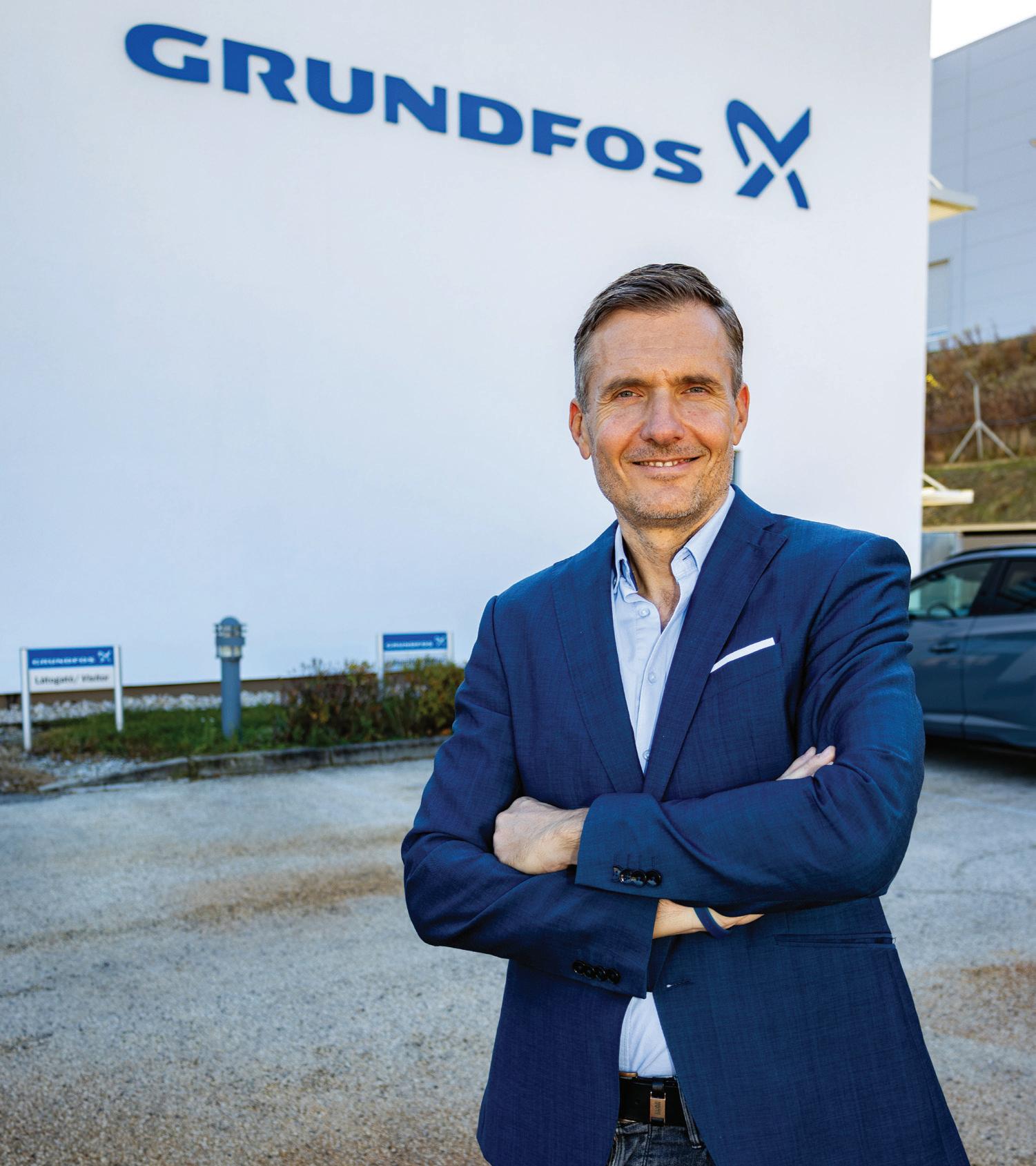
launch of R&D activities in 2007, the Hungarian unit is now not only a manufacturer but also a knowledge center.
“In addition, let me point out that production has indeed been going on for 25 years in our country this year, but our sales and service center has been operating since 1996 under the name Grundfos South East Europe Ltd. Since 2010, one of the company's key service centers has also been located in Hungary, namely the Grundfos Shared Service Center. As a result, the total number of employees at Grundfos companies in Hungary now exceeds 3,000,” he says.
Hungarian intellectual capital
Speaking more in detail about research and development, the Country Director underlines that R&D activities of Hungarian experts are highly recognized within the global organization of Grundfos. “The Hungarian R&D center contributes significantly to the latest energyefficient pump and motor developments, especially in the areas of intelligent control and Industry 4.0 solutions. The work of Hungarian engineers and scientists is considered among the best internationally, they lead and support
DIVERSE AREAS OF USE
Grundfos pumps are sold worldwide and used in a wide range of industries and applications of which the most important where the company’s solutions play a critical role are:
• Building services (heating, air conditioning, water supply): ensuring energy-efficient water circulation and pressure boosting in homes, office buildings, and public buildings.
• Water supply and water treatment: drinking water supply systems, wastewater treatment and disposal. This area is essential for global water security.
• Industry (processes, cooling, dosing): manufacturing processes, industrial cooling systems, and precision fluid dosing in various industrial sectors.
• Agriculture and Irrigation: sustainable irrigation solutions to meet growing food demands.
numerous innovative projects. Our R&D activities are directly aligned with the group's global innovation strategy, ensuring that technological developments are quickly made available to the entire group. In this way, Grundfos Hungary is actively shaping the future of water treatment and pump technology.”
The activities in Hungary are a key link in the Grundfos Group's global operations, which span 55 countries and manufacture around 17 million pumps annually. Hungary is one of the main production sites, supplying the global market with critical products and components. The Hungarian sites are models of quality and efficiency, he adds.
Day-to-day ‘green’ practices
Environmental protection is a priority in the company's operations, and this is recognized in the business world. This year, at the annual event of The Business Council for Sustainable Development in Hungary (BCSDH), Grundfos received the Green Future Innovation Award in the Biodiversity Restoration category. The company was also recognized a year earlier when Károly Nyári received the Change Leader Award. As to how the ‘green’ approach manifests itself in the company's day-to-day activities, Olivér Szundy emphasizes that “for Grundfos, environmental protection is not just a marketing slogan, but the cornerstone of our daily operations. We are very proud of these BCSDH awards that recognize our efforts and achievements in sustainability.” Going into detail of the company’s ‘green’ practices, he notes that the fundamental goal of Grundfos product innovations is to minimize energy consumption. Grundfos pumps are designed to significantly reduce operating costs and carbon dioxide emissions.
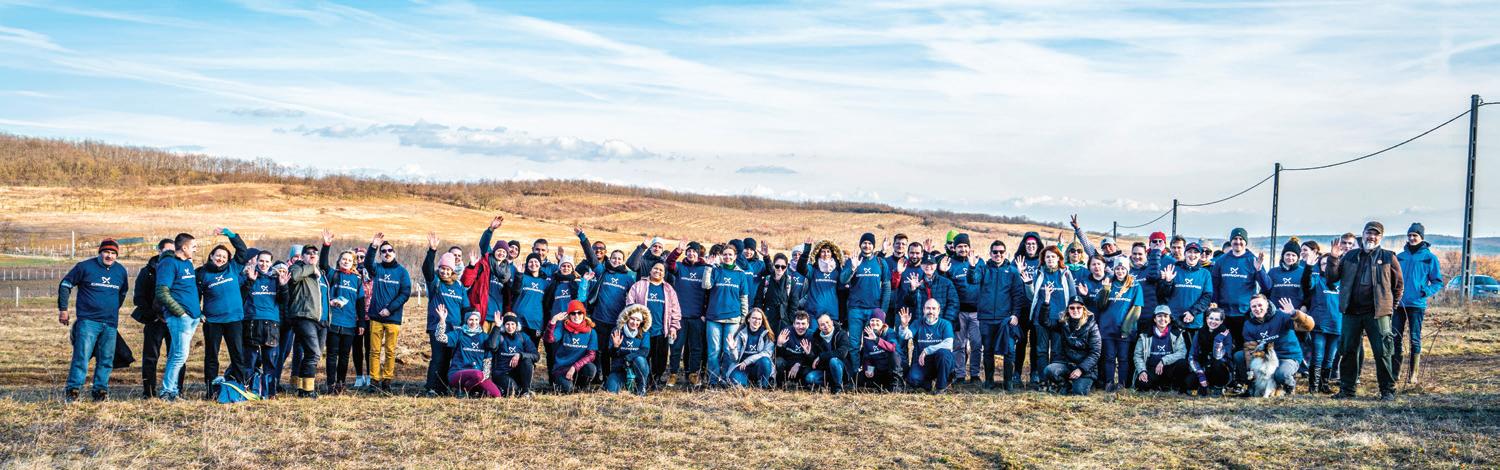
“At our sites, including our factories in Hungary, we are continuously reducing our own energy, water and raw material consumption, as well as our waste production. We strive to apply the principles of the circular economy. As part of our awardwinning Biodiversity Restoration project, we are actively working to restore ecosystems around our factories and increase local biodiversity, involving our employees and local communities. In line with this, Grundfos Hungary employees have planted a forest next to our factories in Székesfehérvár, created a self-sustaining rain garden in collaboration with the city, and participated in the national tree planting project in the spring.”
Support for people and the environment
It may not come as a surprise that water and sustainable environmental technology are at the heart of the CSR activities of Grundfos. As the Country Director puts it, Grundfos' CSR activities naturally focus on these fields, reflecting the company's main area of activity and global challenges.
The most significant element is the global projects supported by the Grundfos Foundation (Poul Due Jensen Foundation), which aims to provide clean, safe drinking water to disadvantaged communities around the world.
“This is not just about donations, but about installing sustainable water treatment solutions.”
In education and professional training, there are long-term partnerships with local educational institutions, support for vocational training programs to increase interest in engineering and technology professions, thereby contributing to the training of future sustainability professionals.
“We also support communities around our sites in Hungary, primarily through initiatives related to water, environmental protection and health. These activities also reinforce Grundfos' commitment to the UN Sustainable Development Goals (in particular Goal 6: Clean water and sanitation),” he concludes.
year legacy of BANG & OLUFSEN
witty leaks
L E A K S
IN THIS SERIES, DIPLOMATS SHARE PERSONAL ACCOUNTS OF THEIR EXPERIENCES ON “EXCURSIONS” into Hungarian culture, art, gastronomy & scenery.
A DEEPENING BOND FORGED THROUGH BUDO
THE POPULARITY OF TRADITIONAL JAPANESE SPORTS AND CULTURE IN HUNGARY
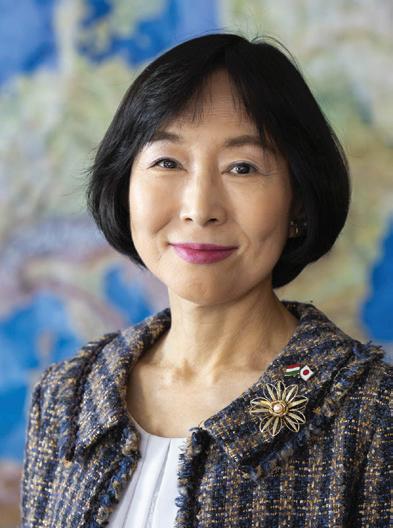
BY HIKARIKO ONO, AMBASSADOR OF JAPAN TO HUNGARY
It is incredibly exciting to witness the amazing cultural exchange between Japan and Hungary. Despite the geographical distance separating our nations –a considerable 9,000 kilometers apart, Japan and Hungary are far from being distant or unfamiliar entities to each other. Japanese restaurants are practically ubiquitous – I’ve lost count, and sushi is a supermarket staple. Similarly, Japanese novels, including the translated works of literary giants like Yukio Mishima and Haruki Murakami, and its popular comics (Manga) grace Hungarian bookshelves. Indeed, Japanese culture is deeply interwoven into the fabric of daily Hungarian life. The enthusiasm among the Hungarians for all things Japanese both delights and occasionally surprises me. Upon my arrival here, I was deeply impressed to find that events such as Haiku (Japanese poem) Day and Japanese Garden Festival are held every year here in Hungary.
The Budō boom: a deeper connection
In particular, the dedication of Hungarians to budō, traditional Japanese martial arts, truly captivates me. In a nation with such
a strong equestrian heritage, the embrace of budō is extraordinary. From judo and karate to kendo, aikido, kyūdō (archery!), sumo, iaidō (sword drawing), naginata (pole weapons), and even kobudō (classical martial arts), the range of practiced disciplines is truly impressive. Dojos and clubs are scattered across the country, from bustling Budapest to peaceful rural towns, filled with practitioners of all ages and genders. What accounts for this budō boom?
Let's delve into the connections.
Karate's popularity: beyond the playing field
The remarkable popularity of karate stands out in Hungary. While football reigns supreme as the most popular sport, closely followed by basketball and handball, karate secures a remarkable fourth place. With approximately 50,000 practitioners, Hungarian karateka have achieved notable international success, culminating in an Olympic medal at the 2020 Tokyo Games. The diversity of karate styles practiced here is equally impressive. I had the privilege of attending an international tournament of full-contact Kyokushin karate in Szolnok, witnessing firsthand the
skill and dedication of Hungarian karate practitioners. Incredibly, karate is integrated into the physical education curriculum in as many as 250 secondary schools in Hungary. The annual ‘Okinawa Day’ event, celebrating the origins of modern karate with visiting Okinawan karate masters and Ryukyu (old name of Okinawa) dancers provided our embassy with a valuable opportunity to showcase the Hungarians’ profound engagement with karate as well as charms of Okinawa prefecture, consisting of Japan’s southernmost beautiful islands.
Kendo's legacy: honing skill and spirit
My own childhood experiences with kendo – the satisfying thwack of the shinai (bamboo sword), and the occasional, slightly less satisfying, thwack received – give me unique insight. Hungary is a leading kendo nation in Europe, with a vibrant 40-year history, hosting annual tournaments like the Sakura Cup and Hungary Cup. This year's visit by Koji Onda, a Hanshi 8th Dan (a rank held by only 0.07% of Japanese kendo practitioners), was a momentous occasion. His lectures at ELTE
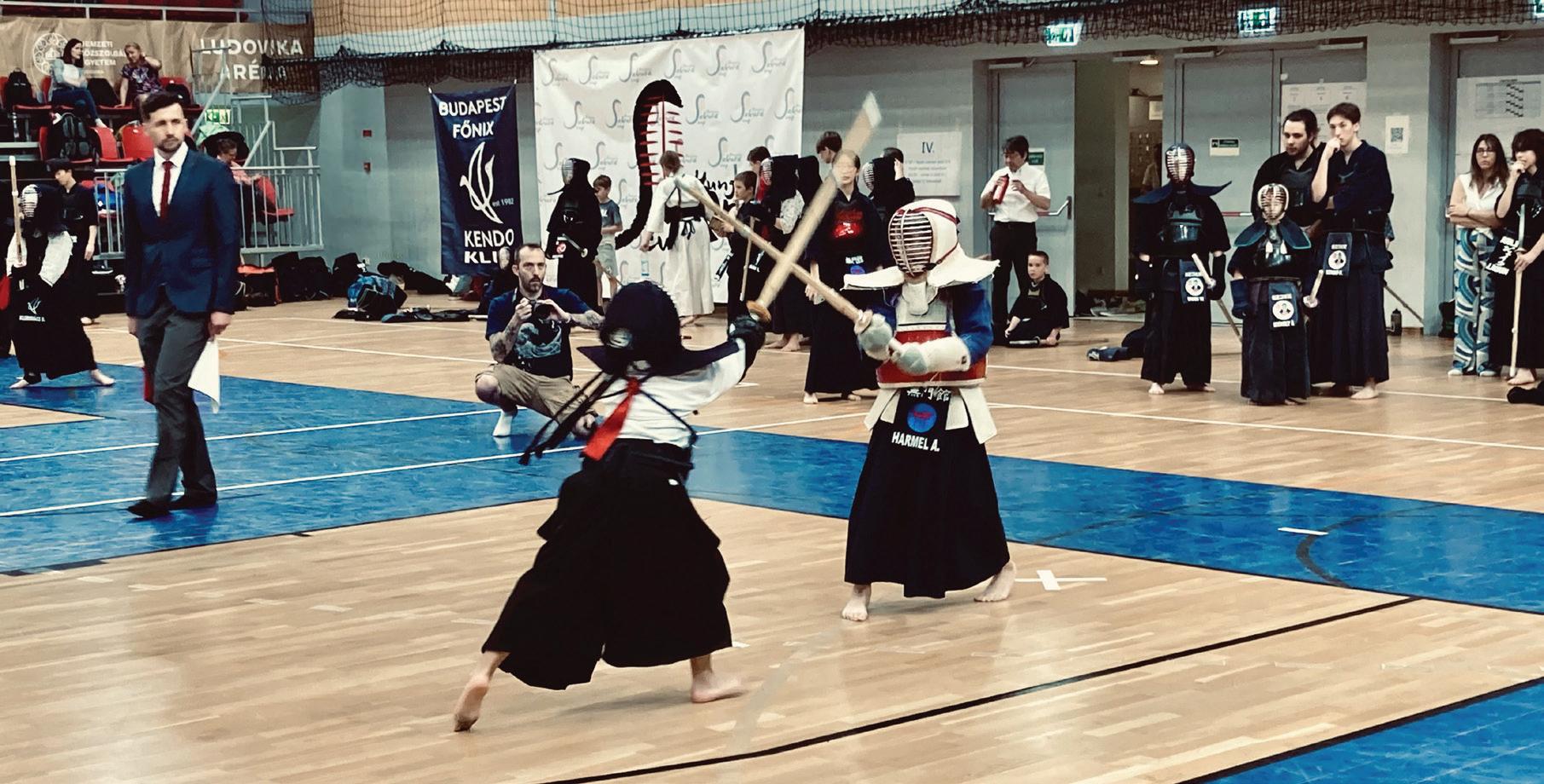
University eloquently emphasized that budō transcends sport; indeed, it's a journey of personal development, a path from jutsu (technique) to dō (the way). The spiritual depth Mr. Onda conveyed resonated profoundly with the Hungarian audience.
A Century of Connection: Judo's Global Stage
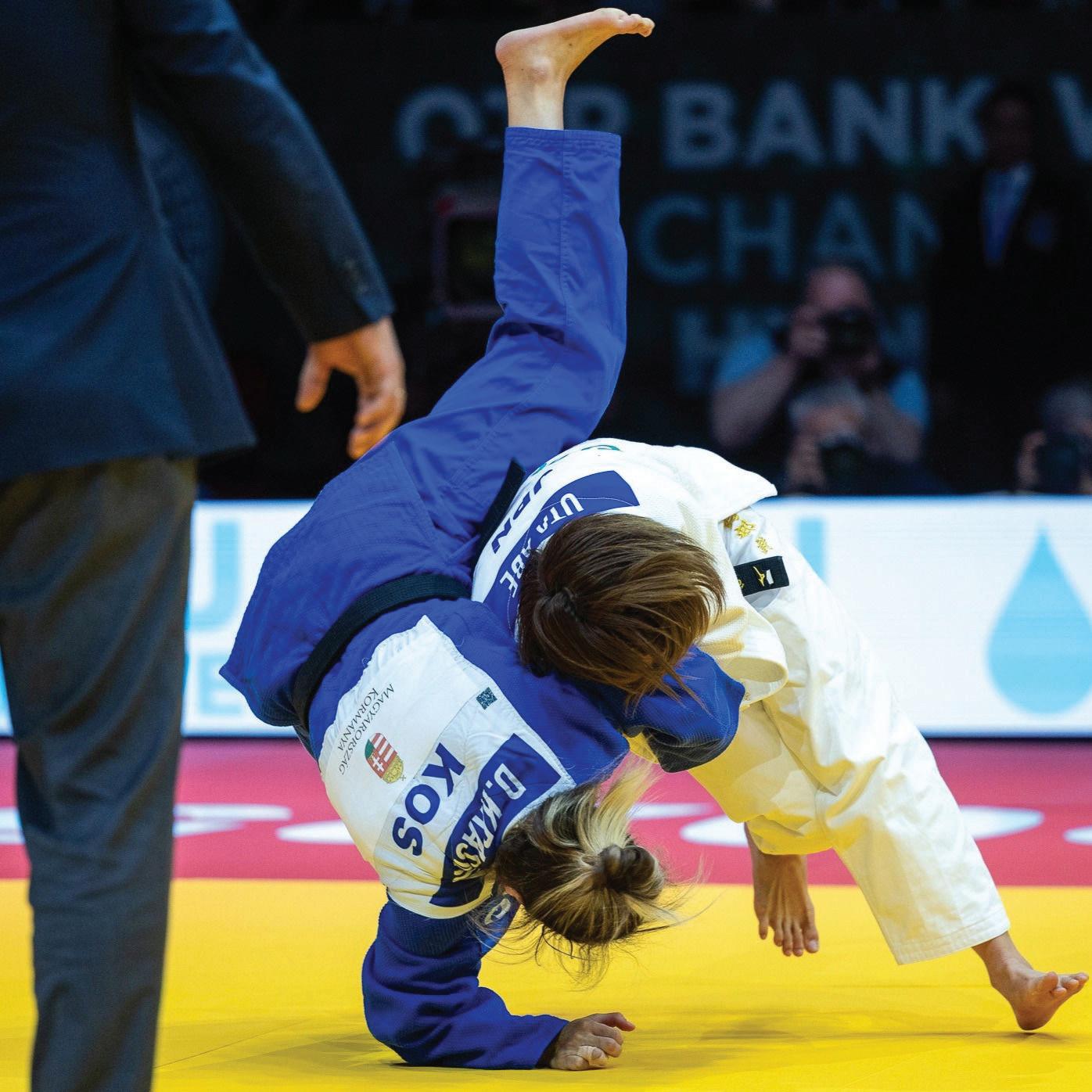
The budō connection between our countries spans over 120 years. In 1906, Kichisaburo Sasaki introduced judo to Hungary at the invitation of the AustroHungarian Empire. His publication of a Hungarian-language book, ‘Djudo’, was a testament to the early enthusiasm for Japanese culture in Hungary. This legacy continues to flourish, particularly in judo, the only budō discipline constantly featured in the Olympic Games. Hungary’s position is increasingly significant in the world judo community with hosting the International Judo Federation headquarters. This year's World Championships in Budapest, attended by dignitaries including President Tamás Sulyok of Hungary and Her Imperial Highness Princess Tomohito of Mikasa of Japan, were a resounding success with strong competitors from all around the globe.
Sumo's enduring charm: a teacup of friendship
And the story continues… Hungary's unique connection with sumo wrestling deserves special mention. The winner of Grand Sumo Tournament has been awarded the
Hungary Friendship Cup, a tradition celebrating its 40th anniversary this year. Redesigned as an exquisite teacup by the renowned Herend Porcelain Manufactory in 2019 to commemorate the 150th anniversary of our diplomatic relations, it serves as a great symbol of this enduring bond between the two countries. Sumo, embodying Japanese culture of harmony and spiritual strength also enjoys significant popularity in Hungary. As we have witnessed a great success of European Sumo Championships in Szigetszentmiklós this year, I encourage everyone to visit next year’s sumo tournament in Veszprém and experience the spectacle of this captivating sports.
A shared resonance: respect, growth, and harmony
What is the extraordinary connection between Hungary and Japanese budō? I believe it stems from shared aesthetic sensibilities and values. Budō's emphasis on respect, spiritual growth and harmony of mind and body deeply resonates with traditional Hungarian values. As the Japanese Ambassador to Hungary, I sincerely hope that the philosophical depth of budō, which extends far beyond the realm of sport, will continue to attract Hungarians in the years ahead.
I also firmly believe that stepping onto the dojo mat to experience budo's transformative power for the mind and body will undoubtedly further strengthen the wonderful bond between Japan and Hungary.

business
EU ECONOMY EXPECTING A RECOVERY PHASE
JAPANESE EXPERT ON THE OUTLOOK OF EUROPEAN BUSINESS OPPORTUNITIES
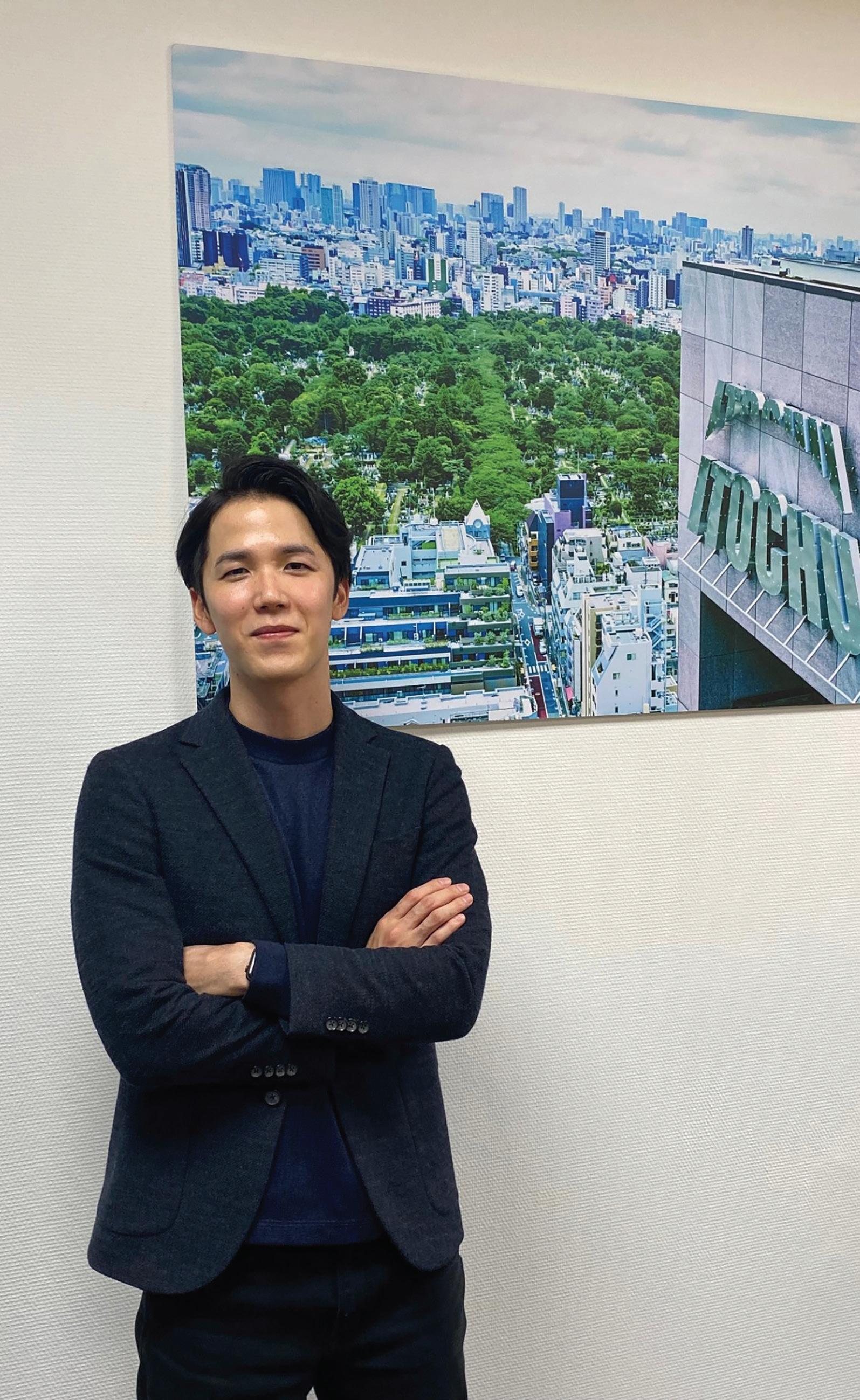
The world economy is on the downturn phase right now. Almost all the developed countries, including EU members, will see their economy, say, stagnated for at least this year, mainly because of the various tariffs imposed on different countries and sectors by the Trump administration. That is how Senior Economist at the Center for Macroeconomics at the ITOCHU Research Institute Inc., Sota Takano, also Certified Member Analyst of the Securities Analysts Association of Japan, describes the current economic outlook to Diplomacy&Trade.
The downturn phase in the global economy began its impact this summer and it is likely to last for a year or so. After that, because of the base effect, the economy will experience a recovery again next year, the expert predicts. Of course, all this affects the EU economy as well. “Right now, the automotive sector in Germany and other manufacturing sectors in the EU are facing difficulties. These were about to get into the recovery phase from the start of this year but, because of the Trump tariffs, they face difficulties again.” He expects the recovery of the EU economy and specially the manufacturing sector from the middle of next year.
Germany as reference
The strongest economy in the European Union is that of Germany. Hungarian government officials often claim that Hungarian economic difficulties are due to the German economy doing worse than expected. In that respect, Sota Takano is of the view that for the rest of this year, Germany will be behind countries like France or Italy, Spain, mainly because Germany's economy largely depends on the automotive sector and the Trump tariffs will impact the automotive sector the most compared to other services and other consumption. “However, conditions are likely to improve from the end of this year or early next year because the German government changed their fiscal policy, turning more onto the spending stance, especially for the defense sector and also infrastructure. So, that will boost the German economy from next year for the upcoming three or five years. Thus, Germany will be in a better situation compared to France or any other countries.”
Higher defense spending
Due to the Russian aggression in Ukraine and the growing Russian threat to the security of EU member countries on the eastern flank, the European Union has begun putting more emphasis on defense, which means higher spending. The economic expert believes that even though, the conflict is likely to end peacefully sooner or later, the importance of the defense sector will be getting bigger and bigger because with its transactional approach, the current
administration of the United States does not really want to put money and any resources to defend the EU and European countries. Thus, European countries will have to defend themselves and the way to do that is to develop their defense sectors, which obviously means investing more money in this area. He notes that even if they are using American technology or American weapons, that will cost money as President Trump charges them even if that does not exactly fall in line with NATO solidarity.
Economy and politics
During the conversation with Sota Takano, the name of President Trump, and the tariffs in general, come up several times as his frequently changing policy are likely to have an impact on the European economy or the European Union as a whole. “I can imagine how difficult this situation may be for EU officials because it's really different from the traditional Western way to negotiate or cooperate. That is because 27 EU countries have to agree on what to do with US only, of course, in itself. Naturally, the tariffs are not really good for the economy, but this policy also affects the political association. As you know, in the European countries, there are so many far-right political parties, they are getting more powerful and gathering more support from the citizens. That doesn’t make the situation easier, either.”
New global situation
Speaking of more political lines formulating in the world, one can see Russia, China, and somewhat surprisingly, India, forming a kind of possibly economic alliance as opposed to the West. As to how these different political and economic lines could possibly work out from the perspective of the European Union, Sota Takano notes that the case is the same as the relationship with President Trump and his policies. “It's not really comfortable for the European Union and its leaders because, at least for now, the EU is possessing a considerable power in making new rules in the world in many ways, including the environmental or AI policies. But as you know, from the perspective of economic size and also the population, the European Union – just like the United States and Japan – is losing power in the world, not only in terms of economic balance but
also politically, making the rules. Others like India, China, and less of, let's say, global South countries like Africa, South America, they will definitely have larger power. I think it's not something the EU can change but it needs to have to adjust more to the new global situation. But it's not the only one to do that.”
Hungary welcomes Japanese business
These volatile international circumstances require day-to-day monitoring of the situation on the part of Japan as well. As to how the economic expert sees the present and future of Japanese business relations with the European Union and with Hungary in particular, he points out that “globalization is slowing down, mainly because of President Trump and his policies, but as I mentioned, others, like China, are also having more power and influence. Both the European Union and Japan are in favor of free-trade. They
believe that free trade is profitable for all parties involved. So, we can strengthen our relationship, not only in the economic area, but also politically – on the field of rulemaking or any other.” He adds that this will also, of course, affect the business sector, the private sector in a good way and it is really much easier to do business in the different economic fields this way. Regarding Hungary, he believes there is a very big chance from the Japanese business perspective. “The past two years have not been really going well in this respect but the Hungarian economy is currently growing faster than EU average and doing much better than the Japanese. I think lots of Japanese business are seeking new markets outside of Japan and Hungary is, of course, one of the countries with big opportunities for doing new business with the government really welcoming foreign investments with incentives.”
business
TUNED FOR THE FUTURE
SANOFI BUDAPEST HUB STRENGTHENS INNOVATION AND FUTURE-PROOFING WITH EXPANDED OFFICE SPACE
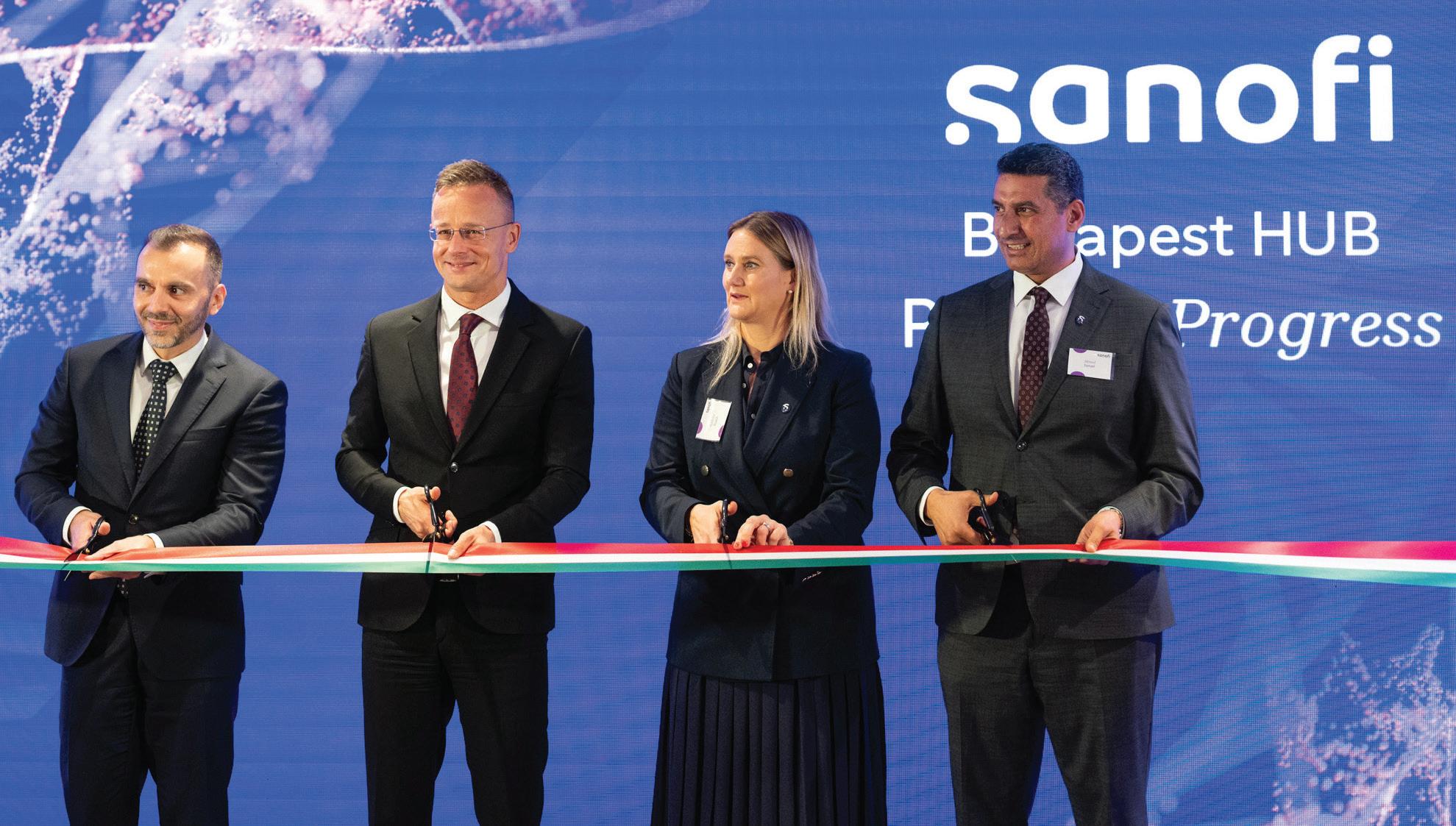
Sanofi Business Operations' Budapest Hub, has reached a significant milestone. The Hub, which supports innovation and teamwork, has almost doubled in size, bringing the total floor space of the office to 15,000 square meters. With the expanded global business service center, the French pharmaceutical company's Budapest unit is expected to create 500 new jobs by the end of the next year, bringing the total number of employees to 2,200. The company is serving its growing workforce with new office spaces that meet the technological and ergonomic requirements of the future in terms of both size and readiness. With this expansion, the company is also strengthening Hungary's role on the global pharmaceutical and innovation map.
Hungary has one of the largest BSC (business service center) sectors in the Central and Eastern European region, which, according to the 2024 report of the Hungarian Investment Promotion Agency (HIPA), contributes approximately 3% to the country's GDP. One of the most significant players in this dynamically developing sector is the Sanofi Budapest Hub that saw its office expansion inauguration ceremony this October attended by the Hungarian Minister of Foreign Affairs and Trade, the French Ambassador to Hungary, the CEO of HIPA as well as Sanofi's Hungarian and international leaders.
Driving force behind transformation
With this latest investment, the Sanofi Budapest Hub has been expanded by approximately 8,000 square meters to accommodate workstations equipped with state-of-the-art technology, bringing the total floor space of the office to 15,000 square meters.
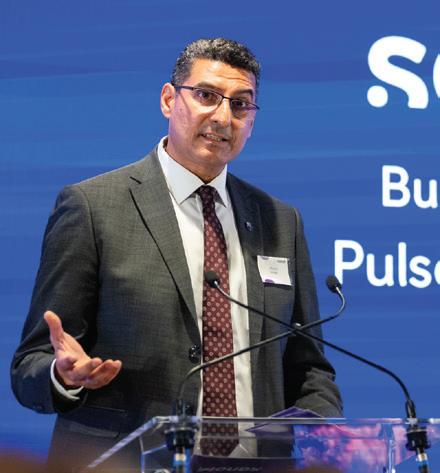
At the opening ceremony, Ahmed Ismail, Head of Sanofi's Europe Hubs , said that the development was necessitated by the dynamic expansion of the Budapest center in recent years, as well as Sanofi's intention to make its operations future-proof by using the most advanced technologies available: "The Sanofi Budapest Hub
is one of the driving forces behind Sanofi's artificial intelligence-supported transformation, which is making the company a leading innovator in the biotechnology sector. We are fundamentally transforming medical practice with scientific research results and digital innovation."
Ahmed Ismail, Head of Europe Hubs emphasized that the Budapest Hub plays a key role in healthcare innovation and drug development processes. Thanks to the cutting-edge technology operated by the Hub and its fast and efficient workflows, it contributes significantly to
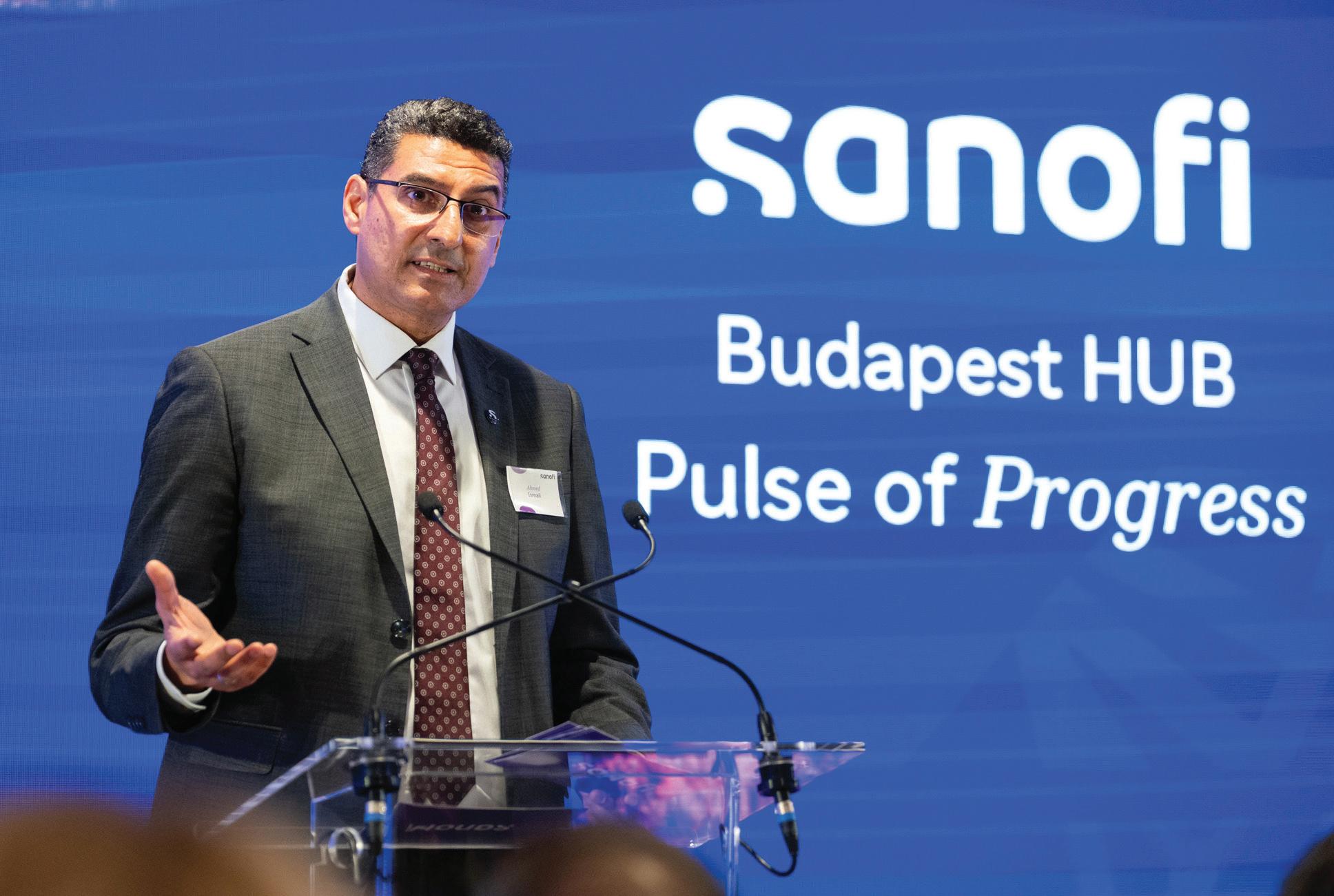
accelerating drug development processes. "Our work supports the company's mission to improve lives of millions of people by developing breakthrough medicines and healthcare solutions; this noble goal is a strong motivation for all of us. The Budapest Hub is expanding dynamically: our current team of 1,700 professionals will grow to 2,200 by 2026, further strengthening our innovative impact."
Confidence in Hungarian workforce
The Hungarian Minister of Foreign Affairs and Trade, Péter Szijjártó emphasized that "Sanofi has great confidence in the knowledge, talent and expertise of the Hungarian workforce. The employees at the Sanofi Budapest Hub make a valuable contribution to world-class drug development." He highlighted that "the growth of the Sanofi Budapest Hub in recent years is a good example of the dynamic development that the entire domestic BSC sector has undergone, resulting in the creation of some 40,000 new jobs in Hungary in recent years."
Fostering a culture of innovation
"As the proud heir to [the renowned Hungarian pharmaceutical company] Chinoin, Sanofi can look back on more than 115 years of history in Hungary. Over the past thirty years, the company has invested hundreds of billions HUF in its Hungarian operations, demonstrating our commitment to promoting Hungarian healthcare and economic development," Madeleine Roach, Executive Vice President and Head of Business Operations, stated at the opening ceremony. "The Sanofi Budapest Hub, established six years ago, reinforces this commitment. We have established a service center in Budapest that supports our employees worldwide with a wide range of services requiring a high level of expertise. It contributes to our company’s readiness for the future by fostering a culture of innovation," she added.
An important economic player in Hungary
The Ambassador of France to Hungary, Jonathan Lacôte stressed that "the pharmaceutical industry is a key export sector for both Hungary and France, with a history dating back centuries in both countries. Sanofi is continuing this tradition, combining French expertise with Hungarian pharmaceutical innovation," adding that Sanofi stands out among French economic players in Hungary for its industrial and R&D weight. France is currently the fourth largest foreign investor in Hungary, contributing EUR 5.14 billion in investments and creating approximately 49,000 jobs in the domestic labor market. "Sanofi's development is a good example of how French companies contribute to the growth of the Hungarian economy and the strengthening of innovation," the Ambassador pointed out.
Diverse workforce
The composition of the Sanofi Budapest Hub workforce reflects exceptional diversity: while three-quarters of them are Hungarians, the remaining quarter represent no fewer than 66 different nationalities. This international team supports drug development departments around the world with its expertise in finance and accounting, human resources, medical affairs, procurement, digital, research and development, manufacturing and supply.
gastronomy
SUSHI MASTERCLASS AT 15-YEAR-OLD NOBU BUDAPEST
WORLD-RENOWNED MASTER CHEF PRESENTED A HANDS-ON EXPERIENCE SESSION
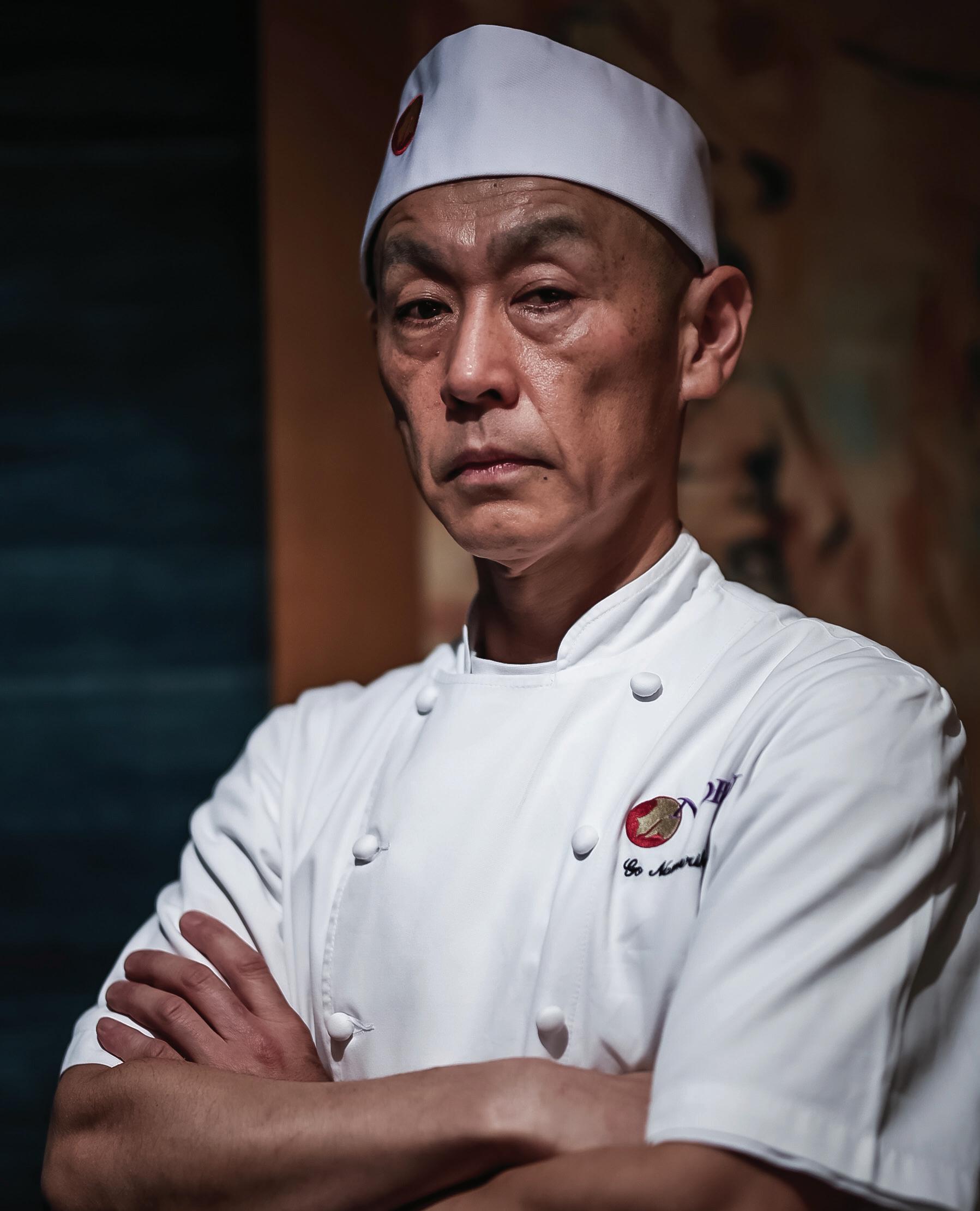
The Nobu Budapest Restaurant and Sushi Bar celebrated its 15th anniversary this October with memorable events, one of which was an exclusive Sushi Masterclass led by Go Namerikawa, Nobu’s Corporate Executive Sushi Chef to elevate the culinary skills of the limited number of participants.
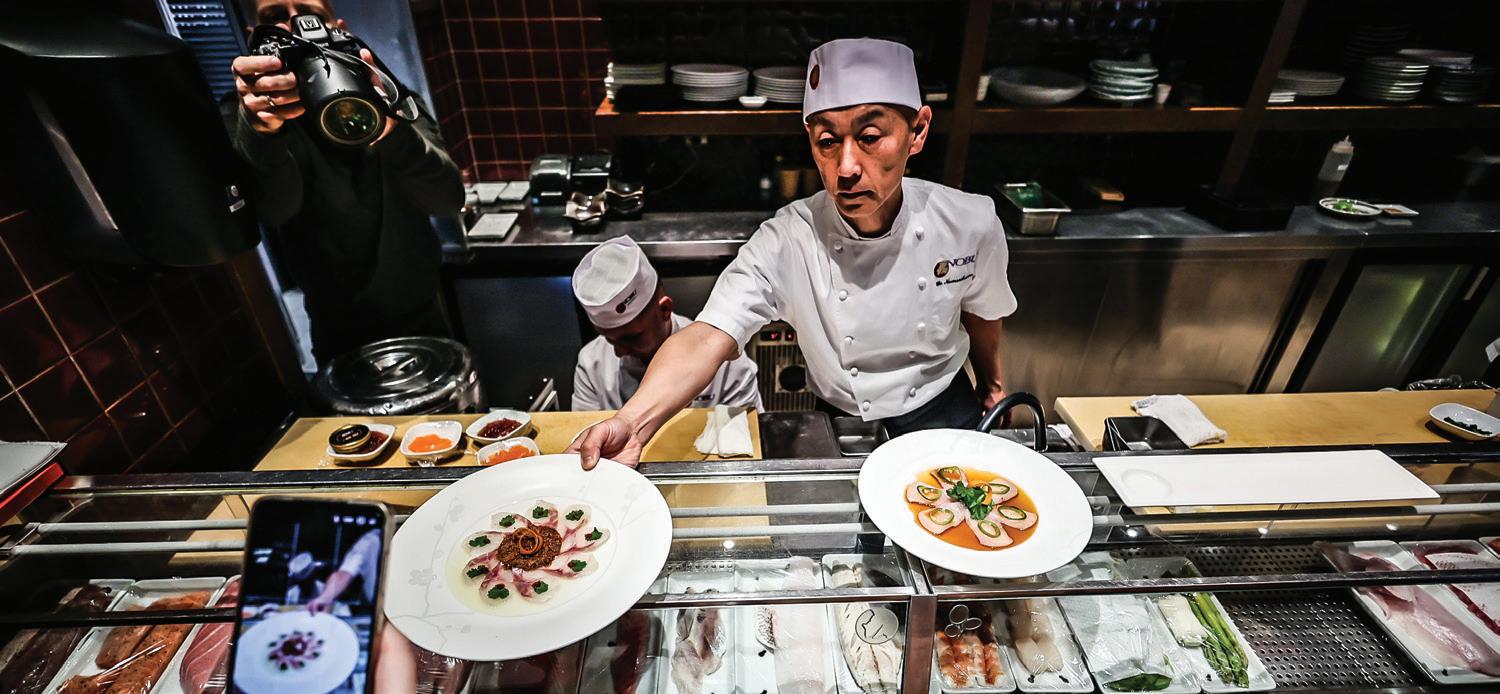
This special masterclass has been designed for both aspiring sushi enthusiasts and seasoned gourmets eager to deepen their appreciation of Japanese culinary artistry. Participants had the opportunity to immerse themselves in the refined art of Japanese cuisine at this one-of-a-kind experience at Nobu Budapest and to embark on a gastronomic journey showcasing the traditions, precision and creativity that define authentic sushi. The limited number of participants were offered an insightful introduction to the revered techniques and meticulous attention to detail behind sushi making and gained invaluable knowledge on achieving the perfect harmony of flavor, texture and presentation.
The highlight of the session was a hands-on experience, where Chef Namerikawa personally guided each participant in preparing classic sushi forms, from delicate maki rolls to perfectly crafted nigiri. Using premium ingredients and authentic tools provided by Nobu, guests could enjoy a seamless and enriching culinary adventure and had the opportunity to create their own sushi.
Recommended to anyone
Explaining to Diplomacy&Trade what this masterclass is about, Chef Namerikawa first mentions the Sushi Plus approach where participants are shown the basic skills, the Nobu dish, Nobu technique and Nobu philosophy, among others. “We make three signature sushi rolls, we show how to make sushi, how to make a hand roll. I recommend such masterclass to anyone who loves Japanese food, to those who want to run a sushi bar or want to be sushi chefs. So, I can recommend it to anyone.”
Also, in this master class, the chef promises that participants can experience what Nobu lifestyle means in international gastronomy today. Describing it, the chef highlights that ‘Nobu lifestyle’ respects Japanese tradition that is clean, has taste, quality and beauty. These are the most important characteristics.
What is also needed is a skillful chef to combine the ingredients into tasty food. “For me, Nobu was very surprising first because in Japanese food is quite different from Peruvian food used as ingredients at this restaurant. Japanese food is more focused on the characteristics of the ingredients, like a natural flavor of taste to make it simple. The Peruvian food has broader taste, it is more spicy, more aromatic. But Nobu is making the best balance of the different cultures,” he stresses.
A very iconic dish we have between the Peruvian and Japanese fusion is a dish called tiradid or tiradito as is known in Peru. When preparing Sea Bass Sashimi, we put the soy sauce (Soy Salt) on the fish and add the Peruvian chili, the coriander for the Peruvian flavor. Finally, we pour the yuzu and the lemon juice. This is a very good example for a Japanese food item with Peruvian flavor. We don't say fusion, but Peruvian-Japanese mixed dish, instead.
Making guests happy
The Nobu restaurant is bearing the name of Nobuyuki "Nobu" Matsuhisa, a Japanese celebrity chef and restaurateur known for his fusion cuisine blending traditional Japanese dishes with Peruvian ingredients. Chef Namerikawa recalls meeting him by saying that Nobuyuki Matsuhisa “takes work very, very seriously, he is a humble and precise person but sometimes warm. He always makes guests happy. I believe his secret of success is the food he prepares – that makes people happy. This is his personality. Teamwork is very, very important here. So, we all work together to give the best experience for our guests at the sushi bar. As an organizer, Mr. Matsuhisa is always making the sushi from the bottom of his heart – the guests can feel that.”
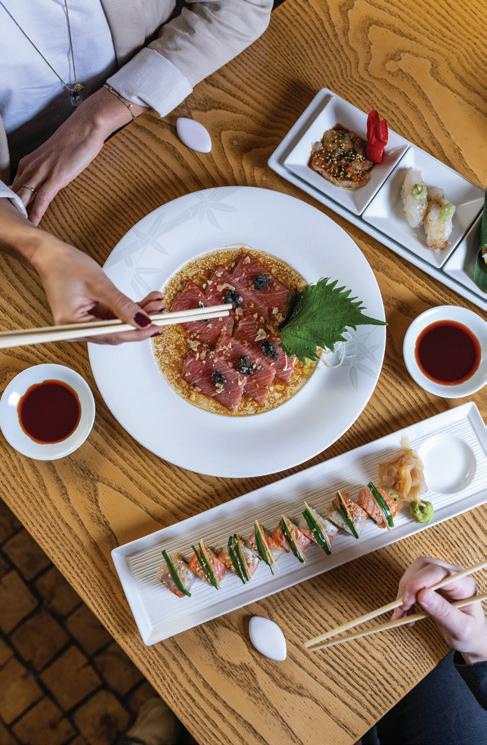
“At Nobu, guests have the opportunity to share a number of dishes with each other. This exclusive event offers a rare chance to immerse yourself in the refined world of Japanese culinary craftsmanship.”
Tasty food from different ingredients
There are Nobu restaurants all over the world.
As to what is different in the one in the Hungarian capital, Go Namikawa notes that “at these various branches around the world, we have a special menu in each location depending on what they can get hold of as the highest quality of ingredients. For example, the specialty we offer to guests here in Budapest is foie gras sushi.”
The use of local ingredients is very much in line with the philosophy of Japanese cuisine that the sushi masterclass participants gain insight into. Summarizing this philosophy, the chef says Japanese cuisine emphasizes seasonality and natural flavor of the ingredients, respecting nature and season and they need respect for the ingredients as well. In the preparation of Japanese dishes, it is the simple and clean procedure what is important.
Constant evolution worldwide
As for the secret of the worldwide success of sushi, why this kind of Japanese food is popular all over the world in different cultures, Go Namerikawa confirms that sushi is the most key food item in the Japanese cuisine outside of Japan. I believe this is because people can eat sushi much more easily than larger pieces of Japanese food. That is why many countries have developed their own sushi depend on their culture and local ingredients – that is what makes sushi a global dish. Many people create whatever version they want. Tradition is important, but I think that, the worldwide evolution of this dish is also important for us.”
Chef Namerikawa cannot emphasize enough how important tradition is in Japanese cuisine. Naturally, this is also one of the most important features here at Nobu Budapest. In reply to the question whether guests are still likely to experience change or new trends in the years to come, he underlines that there is constant evolution is dishes. “We always get new ingredients, apply new techniques around the world and we are opening new locations from time to time. That applies to Europe too. So, yeah, it is important to respect the ingredients, the traditions, but we are evolving. Therefore, customers can expect something new to come all the time – so, it's worth returning here.”


culture
SPEAKING THE LANGUAGE OF ART BEYOND BORDERS
FINE ARTIST DALMA GÖNCZ SURPRISES ITALIAN SINGER
ANDREA BOCELLI WITH A WORK OF ART
Art is the most universal language, one that can convey both emotion and responsibility. That is the credo of Hungarian sculptor-painter Dalma Göncz. She has been creating continuously since she was a child and she has long been on a path toward responsible creation. This fall, she reached a milestone in her career when one of her special paintings was presented to Andrea Bocelli as a birthday gift.
Dalma Göncz is a versatile fine artist whose exact genre in that field is not easy to figure out for art lovers, let alone everyday people. She tells Diplomacy&Trade that existing on the boundary between painting and sculpture is not only a technical but also a philosophical question for her. “I have always been intrigued by how a painting can become an object, and how an object can become an emotional carrier. At the beginning of my career, my focus was on experimenting with materials, exploring how art can give new life to what the world has already discarded. Working with industrial materials, waste and other discarded elements is, for me, not merely an aesthetic choice but a conceptual one: a path toward responsible creation.” She adds that one of her most important works, ‘Ominous Shadow’, was born from this approach. It’s a 2×3 meter, essentially zero waste painting made entirely from repurposed materials like leftover paint tubes, gloves, brushes and packaging, all of which she integrated back into the piece. “Nothing was thrown away; everything found new meaning. This idea of the circulation of materials and human responsibility continues to define my artistic journey to this day.”
Birthday present for Andrea Bocelli As Dalma Göncz highlights, “a family friend of ours, Roland Horváth is a well-known promoter and manager in both the Hungarian
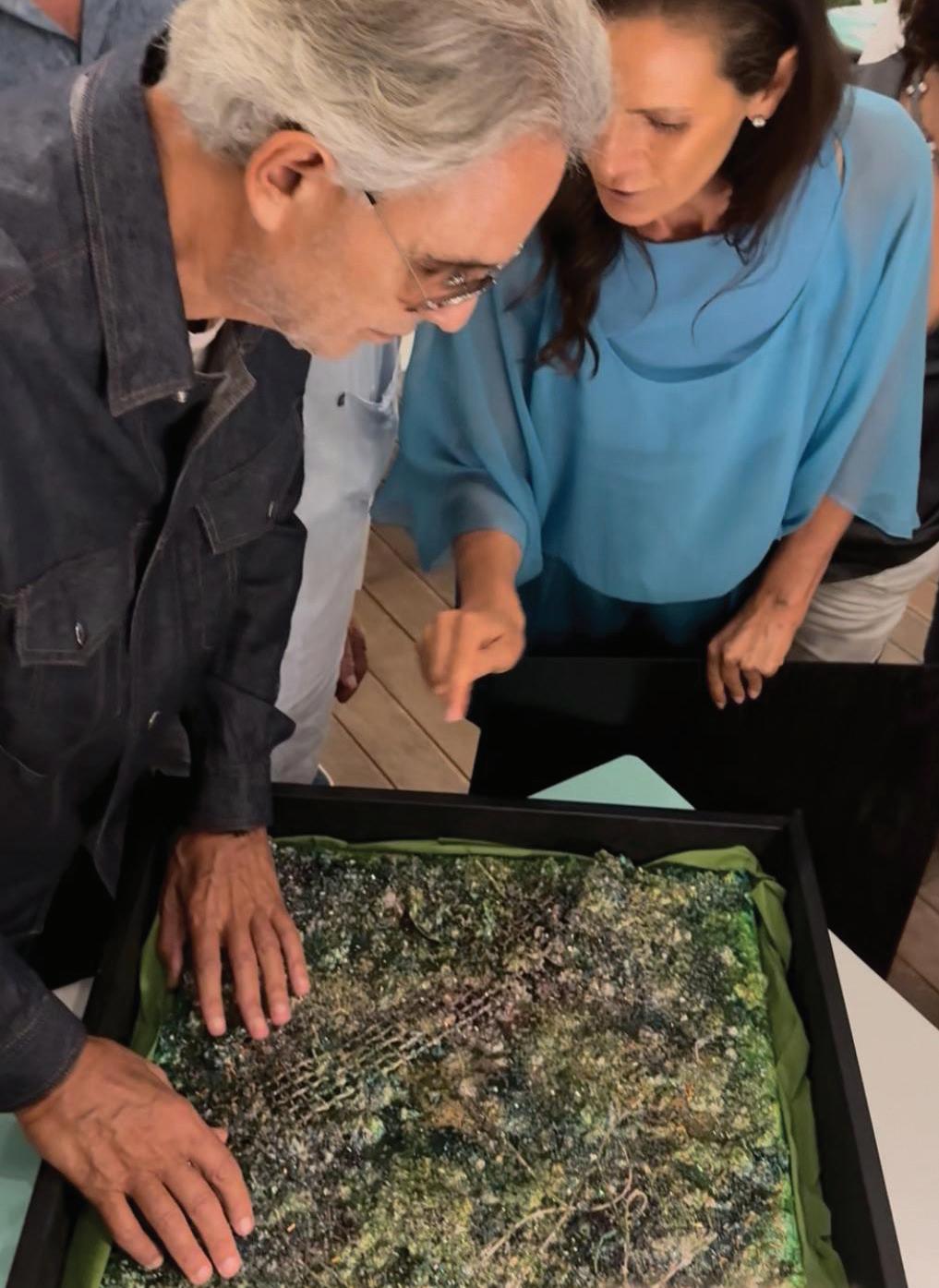
and international classical and crossover music scenes, working with artists such as Matteo Bocelli, Ludovico Einaudi, André Rieu, Jodokcello, Il Divo or Marcelito Pomoy. Roland, who has a longstanding friendship with the Bocelli family, visited one of my exhibitions. When he saw one of the pieces from my four-part ‘Fragmented Reality’ series, he was deeply moved by its visual language and conceptual depth. He was just about to travel to the Tuscan seaside town Forte dei Marmi to visit the Bocellis and suggested it would be a beautiful gesture to gift the artwork to Andrea for his birthday, especially since the painting is not purely two-dimensional, and thus, Andrea could actually feel its texture through touch.” In order to make it ‘readable’ for the world-renowned singer, she created a small Braille plaque on the back of the artwork, describing her thoughts for him. One of the four pieces now belongs to Andrea, another to his wife Veronica, the third to Roland Horváth and the fourth will be part of a charity auction for the Andrea Bocelli Foundation.
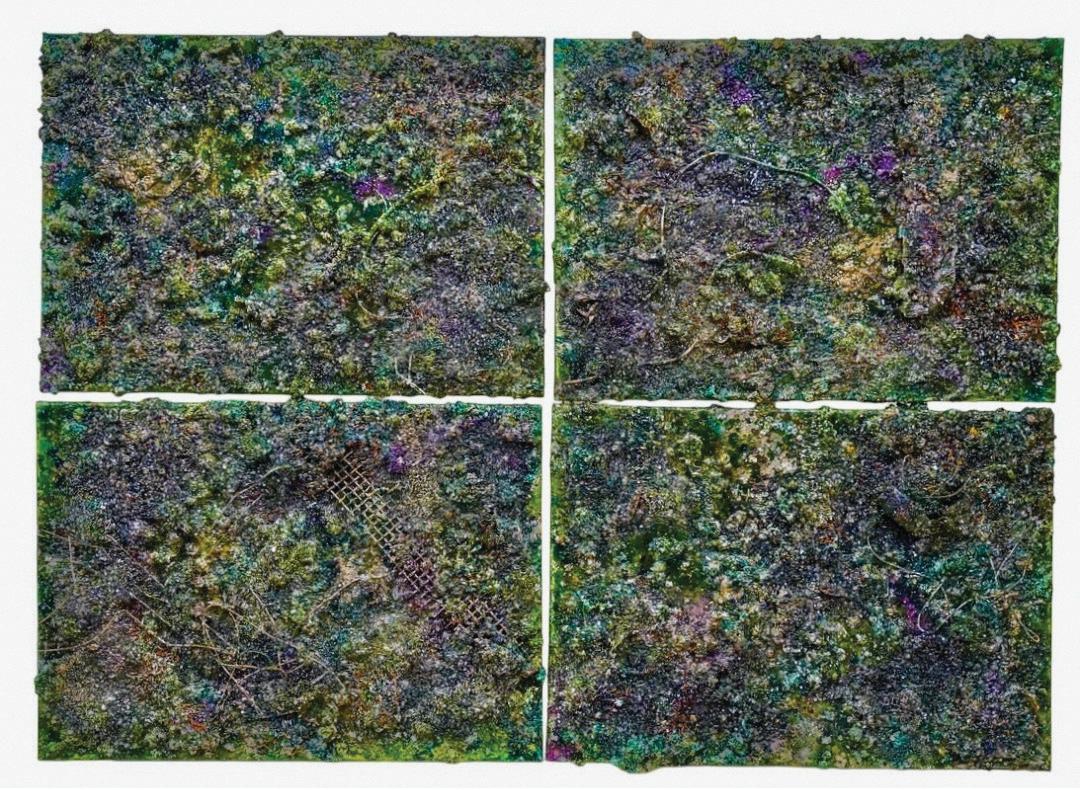
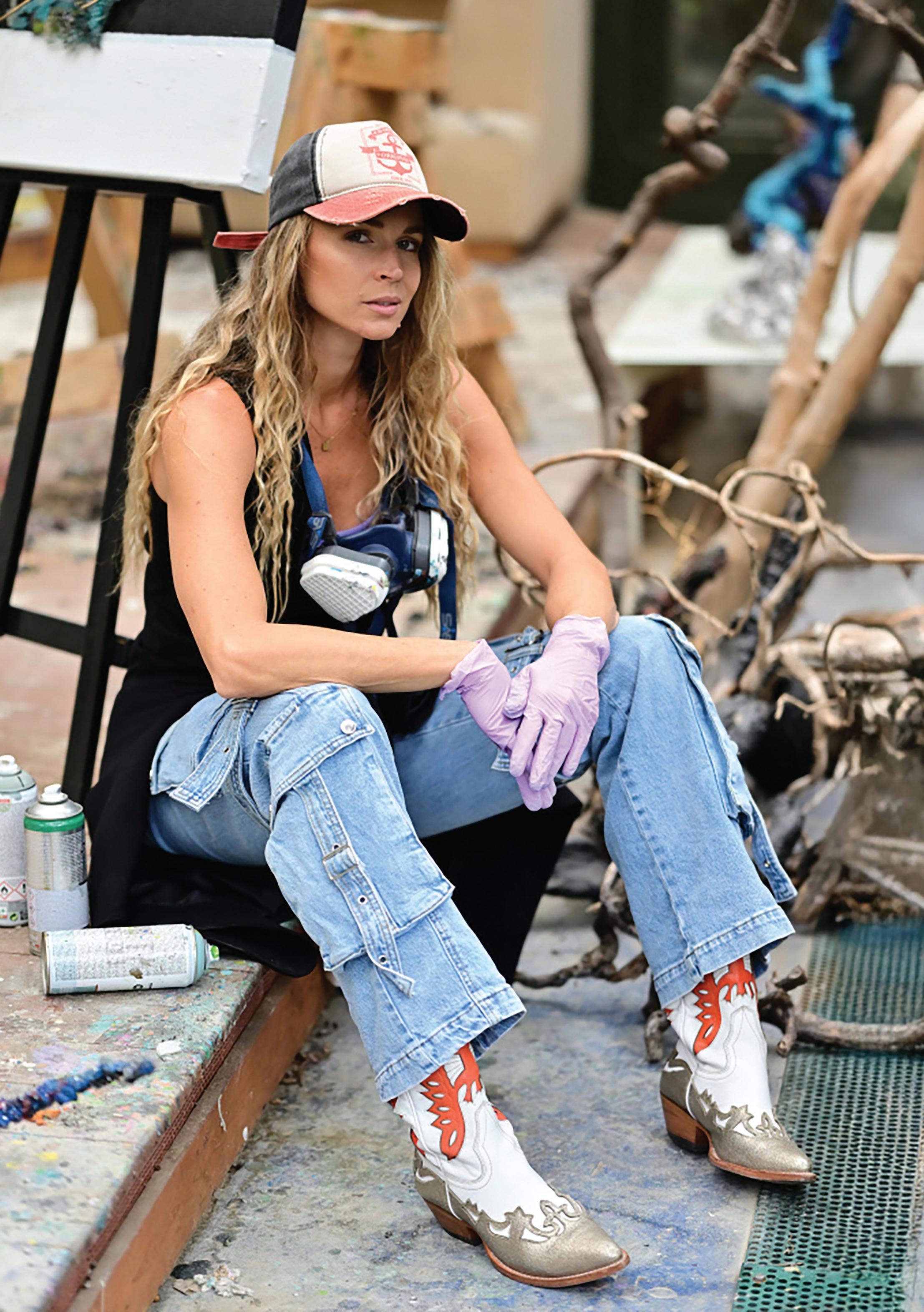
Never-fading passion for art
She has been fascinated by art since childhood. She grew up in Kaposvár, in the heart of Somogy County, in southern Transdanubia where nature and local craft traditions deeply shaped her perspective.
Until the end of high school, she studied drawing and painting with several local artists, some of them award-winning ones. Later, she attended an art-focused secondary school where she studied drawing and art history.
the intersection of contemporary painting and material research. The institution’s focus on ecology, craftsmanship and philosophical reflection perfectly aligns with my own artistic thinking.”
The most universal language
Regarding her personal philosophy of art, she believes art is the most universal language, one that can convey both emotion and responsibility. “For me, art is not an escape but a form of connection to nature, to humanity and to the dialogue between past and future.
She adds that “Roland has continued to support my work internationally, most recently presenting it at the Tatler Ball in Singapore, among that magazine’s global audience. He is also collaborating with Tatler Magazine to produce an international publication about my art. Soon, a collaboration with a gallery in Taiwan will also begin.”
Active source of inspiration
As to how music appears in her art, Dalma Göncz stresses that music is not a background element for her but it is an active source of inspiration. “Often, the rhythm of a melody guides my brushstrokes, the placement of materials or the pulsation of colors. The process becomes almost meditative. Sounds transform into visuals; the painting itself gains rhythm.
I am drawn to music, regardless of genre, where classical discipline and emotional depth are in perfect harmony. That same balance is what I seek in the visual field.”
“Although, due to family expectations, my academic path took another direction for a short period of time, my passion for art never faded.
After finishing my studies, I built my artistic career independently and have now been working professionally as an artist for almost ten years.
Over the past years, my works have been featured in numerous international exhibitions and art fairs, including those in Hong Kong, Miami, Padua, Vienna and, of course, Budapest, as well as recently in my hometown, Kaposvár.
This December, I will exhibit again in Hong Kong, and I am currently working on several Asian and American collaborations,” she highlights.
Last year, she opened Goentz Atelier, her own exhibition space in downtown Budapest, where she curated shows in collaboration with contemporary Hungarian and international artists. However, when she was accepted into one of the world’s leading art universities, the Royal College of Art (RCA) in London, she decided to temporarily pause her curatorial activities to focus on her studies. “At the RCA, I am exploring
I am interested in how we can reinterpret our relationship with materials and our environment: how waste can become a symbol, how the discarded can regain value, and how fragility can turn into strength. Duality is always present in my work harmony and dissonance, order and chance, human creation and the power of nature. I don’t think in terms of ideologies but rather in how art can reconnect us with what we have forgotten, nature, sensitivity and each other.”
Art is a conversation
When asked the question ‘if you could send another artwork to someone today, who would that be and why?’, she says it would be probably to someone dedicated to healing and restoring the world, whether in nature, community or the human spirit; someone who believes that beauty and responsibility can coexist. Every gesture in my art is about connection, that moment when two worlds meet: artist and viewer, human and nature, material and thought. Because, ultimately, all art is a conversation.”
photo by COURTESY OF DALMA GÖNCZ, GÁBOR NEMES
MORE THAN HUMAN
FROM SEPTEMBER, 2025, LIGHT ART MUSEUM, BUDAPEST
Featuring nearly forty works, the exhibition presents spectacular installations, projections and immersive creations by world-renowned artists. It takes visitors into realms that provoke thought and fundamentally challenging their anthropocentric worldview, offer inspiring alternative perspectives ranging from the beginnings of evolution to speculations about the future, from the molecular to interplanetary scales.
At the heart of More Than Human, as in previous years, are projects at the intersection of art and science. These works create breathtaking visual experiences, while being underpinned by extensive scientific research and often realized using cuttingedge technology. They explore the meaning of the world and of existence in a way that transcend conventional human thinking, one that is far more open and multifaceted.
The exhibited artworks adopt a new sensitivity to life forms that have previously been overlooked or undervalued. They help visitor to discover the intricate connections between humans, plants, animals, fungi and even geological processes. They also reveal relationships that extend beyond the traditional boundaries of biology, embracing artificial intelligence and man-made entities. lam.xyz

ERIC CLAPTON COMING TO HUNGARY NEXT MAY MAY 02, 2026, MVM DOME, BUDAPEST
After 20 years of waiting, Hungarian fans can look forward to Eric Clapton's second concert in Budapest next spring. This October, guitar legend Eric Clapton announced a series of European concerts for 2026, with performances scheduled in Poland, the Czech Republic and Hungary.
In addition, Bushbranch/Surfdog Records revealed they will release a remastered special edition of Clapton’s iconic 1989 album Journeyman, featuring four new bonus tracks uncovered from the original sessions. Journeyman: Deluxe Edition breathes new life into the classic album, including three previously unreleased tracks from the original sessions plus an additional bonus track.
It features timeless hits such as ‘Pretending’, ‘Bad Love’ and ‘Running on Faith’, with guest appearances from George Harrison, Phil Collins, Chaka Khan, Daryl Hall, Robert Cray, and more. As Clapton himself states, “Journeyman... It’s what I want to be known as; I like to think I’m a craftsman. I think I’m always working on mastering my craft.”
The currently announced European concerts follow his successful 2025 U.S. tour, which included a sold-out show at Madison Square Garden. livenation.hu
PENTATONIX TO KICK OFF THEIR TOUR IN BUDAPEST APRIL 07, 2026 MVM DOME, BUDAPEST
The five members of Pentatonix have redefined the a cappella genre with their popular covers and original songs. Since their formation, the group has sold over ten million albums, generated billions of streams, collected three Grammy Awards, and enchanted millions worldwide with their vocal talent and creativity. Just as they captivated Hungarian audiences in 2023, fans will once again have the chance to experience the group live, as Pentatonix kicks off their spring tour next April in Budapest.
The 2026 spring UK and European tour of the three-time Grammy Award-winning group will bring their stunning harmonies, brilliant a cappella arrangements as well as an unforgettable stage presence to 16 major cities across the UK and Europe. The tour launches in Hungary and continues through the Czech Republic, Austria, Poland, Germany, France, the UK, Belgium, the Netherlands and Norway, concluding in Sweden. The group last visited the continent in 2023, marking their very first performance in Budapest too. livenation.hu
HOT WHEELS MONSTER TRUCKS LIVE™ GLOW-N-FIRE
FEBRUARY 07, 08, 2026, MVM DOME, BUDAPEST
Following the success of Glow-N-Fire in 2025, which won the Pollstar Family Show of the Year award, Hot Wheels Monster Trucks Live™ is thrilled to continue the momentum into 2026 by introducing an all-new truck to the tour: Rhinomitethe dynamite Rhino themed truck. Charging horn-first into challenges, Rhinomite explodes on the scene with a mission to destroy the competition. This exciting new experience will feature never before seen stunts performed by the Hot Wheels Monster Trucks, as well as the all-new No-Handed Front Flip performed by the FMX riders! Get ready for more heat and action as Hot Wheels brings the ultimate monster truck show to fans at MVM Dome in Budapest next February. The show brings fans’ favorite Hot Wheels Monster Trucks to life including Mega Wrex™, Tiger Shark™, HW 5-Alarm™, Bone Shaker™, Bigfoot®, Skelesaurus™, and also includes FMX riders performing high-flying stunts and a fire-breathing, car crushing robot dinosaur. livenation.hu