A Safari of South African Banking
We are happy to continue offering services and patronising our valued customers in South Africa since 1997 Acceptance of Certificates of Deposit | Trade Finance Syndicated/Bilateral Loans | Corporate Finance | Allied Services in Foreign Exchange
Johannesburg: Sandton City Twin Towers, East Wing, 2nd Floor, Sandton, Johannesburg, Ph: +27 11 784 0715 / 23, E-mail: ce.sa@bankofbaroda.com, joburg@bankofbaroda.com
Durban: Cowey Park, 91/121, Cowey Road Berea, Durban, Ph: +27 31 209 0133 / 41 E-mail: cm.durban@bankofbaroda.com, durban@bankofbaroda.com
Australia | Bahamas | Bahrain | Belgium | Botswana | China | Fiji Islands | Ghana | Guyana Hong Kong | Kenya | Mauritius | Malaysia | New Zealand | Seychelles | Singapore | South Africa Sultanate of Oman | Tanzania | Thailand | Trinidad & Tobago | UAE | Uganda | UK | USA | Zambia
Conditions Apply
Correspondent Banking Business | Remittances
C
o
n
t
e
n
t
s
•
Foreword...............................................................................................................6
•
Relationship Between India and South Africa to Continue to Flourish in Post-Madiba Era..............................................................................8
•
Minister of Agriculture of India and Department of Agriculture, Forestry and Fisheries of South Africa meet in Pretoria......................................10
•
20 Years of Global Participation..........................................................................12
•
First Rand Bank - Our History.............................................................................16
•
Madiba: 95 Years of Life in Pictures..................................................................18
•
Memorial and Condolences................................................................................24
•
Mandela, the Movie: A South Africa-India Journey..............................................26
•
South African Consulate General in Mumbai Celebrates Nelson Mandela Day...........................................................................................30
•
Twenty Years of Democracy and Freedom.........................................................32
•
A Celebration of 20 Years of Freedom and Democray........................................36
•
Connecting Culture, Talent in South Africa .........................................................38
•
Undisputed Leader in Business Events on the African Continent..........................................................................40
•
South Africa’s Multilateral Approach....................................................................42
•
The JSE in Africa.................................................................................................44
•
Blue Label Telecoms ..........................................................................................48
•
Mahindra Celebrates 10 Years of Success in South Africa.................................50
•
Agro Outward Selling Mission to India, 23-27 September 2013.........................53
•
South Africa Scoops Gold at the 33rd India International Trade Fair 2013 (Iitf)....................................................................54
•
The 4th Agro Protech, Kolkata 28-30 November 2013.......................................56
•
Investment and Trade Initiative (ITI) from South Africa to India, February 23-28, 2014..................................................................58
•
Report on Progressive Business Forum’s Visit to India......................................60
•
Capital Equipment Outward Selling Mission to India..........................................62
•
Economic Diplomacy in Action High Commissioner Morule’s Visits to Key States...............................................................................64
•
South Africa’s Biggest Pizza Brand Hits Indian Shores.......................................67
•
Looking Back on South Africa’s Achievements During 2013...............................68
•
Rising Graph of India’s Popularity in Africa.........................................................70
•
Initiatives for 2014 by South African Tourism in India .........................................72
•
Expat Golf Cup Tournament - New Delhi, India...................................................74
•
Message from Indian Staff at the South African High Commission.....................76
•
Zomato: A Bite of South Africa............................................................................78
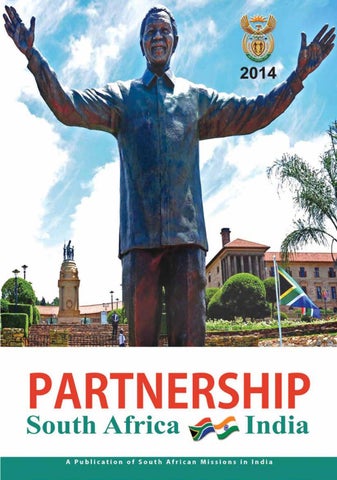
2014 Edition
PARTNERSHIP
South Africa and India Published by South African Missions in India • Delhi High Commission of the Republic of South Africa B-18, Vasant Marg, Vasant Vihar, New Delhi - 110 057 Tel: +91-11-2614 9411-19 Fax: +91-11-2614 3605 Website: www.sahc-india.com • Mumbai Consulate General of the Republic of South Africa Gandhi Mansion, 20 Altamount Road Mumbai, 400 026 Tel: +91 22 2351 3725 / 2352 3726 Fax: +91 22 2351 3730 / 2352 1158 E-mail: sacgmumbai@saconsulate.in • Kolkata South African Honorary Consulate General 225-D, AJC Bose Road Kolkata - 700 020 Tel: +91 33 2240 0950, 2247 4107 Fax: +91 33 2240 2439 Editor
Nicole Pillay
Managing Editor
Harun Riaz
Editorial Committee (Delhi) Diplomatic Staff of the High Commission of the Republic of South Africa Editorial Committee (Mumbai) Consular Staff of Consulate General Project Co-ordinator R.K. Verma Marketing
Ajit Thakur
Layout & Designing Hari Sharma Photographs • South African High Commission, New Delhi / SA Consulate General, Mumbai • SA Tourism, Mumbai • Kapoor Photographers Produced by Krest Publications, New Delhi (India) Tel: +91-11-4653 9323 Fax : +91-11-4610 5603 Email : editor@diplomacy.in Printing Rave India, New Delhi
Platinum Sponsor Disclaimer : Partnership 2014 is a special publication. The magazine is produced to promote South Africa-India ties. Every effort has been made to print an error free magazine. For additional information, kindly contact the officials of the South African Missions in India. The journal has no commercial value and is not for sale. It is for private circulation only.
High Commissioner’s Desk
Foreword
I
begin my tenure in India on the cusp of amazing changes happening in both India and South Africa. Celebrating 20 years of Freedom and Democracy marks a milestone that few would have believed possible of South Africa.
Twenty years ago, on 27 April 1994 South Africans of all races and creed participated in a historic moment of voting for the H.E. Mr. France K. Morule first time in democratic, free and fair elections. Until this moment, few South Africans voices could be heard. Twenty years ago, we expressed our solidarity and unity as a nation by choosing our own path and destiny and ultimately deciding the journey that our country would take to prosperity. My personal experience with the struggle for liberation in the country has made this moment so much more than a milestone. It has become a pinnacle of hope for generations of South Africans, it illustrates what endurance, persistence and hard work can achieve. Our path to equality and freedom was not a sprint, there was no quick solution, and it was a long, torturous road filled with obstacles. It was a marathon of hard work and compromise to ensure the freedom of our people. South Africa has made great strides in a mere 20 years. Few countries can boast of a GDP 83% larger than it was in 1993, of hosting world class sporting events such as AFCON and FIFA World Cup, of hosting multilateral conferences such as COP17/CMP. Our leaders are respected and their opinions are requested. Our experiences in transition was heralded across the world and many other nations often approach us to give guidance. Domestically, the university enrolment has doubled, 9 million more people have access to safe and clean water, and 83% of our households have access to basic sanitation. We have not completed our journey. Our country has a long road to go, but thus far, as a united
Partnership 2 0 1 4 South Africa & India
6
and diverse society, based on the democratic principles we fought so hard for, we have done well. As President JG Zuma recently stated in his State of the Nation address, “We have a good story to tell.” South Africa has not forgotten her friends when our story was not a good one. As much as this is the 20th Anniversary of our freedom, we should never forget the sacrifices that were made for that very liberation. It was a time of darkness for our country. It was in this time that true friends came to the fore and proudly became the voices for the oppressed. India was, and will always be, a strong ally and a good friend. India strongly advocated that a collective global stand be taken against apartheid and supported international sanctions against South Africa. India also provided a haven for South African, and many other liberation movements throughout continent, providing unity that was required to fight the good fight. South Africa and India have a shared vision for her people. We have similar goals, affordable healthcare for her citizens, eradicating poverty, equal access to education, and a foundation to create a population that is prosperous. Now India and South Africa’s relationship has evolved into a flourishing, mutually beneficial and successful partnership. Our trade has increased in the past ten years. We have cultural exchange programmes, educating our youth. Indian pharmaceutical companies provide affordable medicine to our citizens. We exchange expertise and resources, knowing that we both have to achieve success. We formed IBSA, a practical formation specifically focussing in innovation, technology, agriculture, education and health. South Africa joined BRICS, with the full support from India, and completed a trend that showed countries of the South, where consistent growth patterns and emerging economies, are the way of the future. This year, as we celebrate 20 years of Freedom and Democracy, I am honoured to participate in this joyous occasion with a country that has illustrated its devotion to democracy and freedom.
Bilateral Ties
Relationship Between India and South Africa to Continue to Flourish in Post-Madiba Era
The then Prime Minister, Dr. Manmohan Singh pays tribute to the former President of South Africa, Mr. Nelson Mandela, and writes message in condolence book, at South African High Commission, in New Delhi on December 09, 2013.
H
osting the largest diaspora beyond the subcontinent, India’s destiny has long been tied to that of South Africa. The leadership in both countries post-independence and apartheid have worked to achieve the shared ideal of an equitable society. With Madiba’s death, the existing relations and the way forward have come under the spotlight. The multi-dimensional involvement of India in South Africa’s evolution, and the latter’s reciprocation of it through diverse
Pa rt n e r s h i p 2 0 1 4 South Africa & India
channels has always been a formidable phenomenon, and is expected to grow by leaps and bounds. Stronger economic cooperation along with an upswing in healthcare and pharmaceutical ventures bode well for a profitable collaboration for both countries. Current Indian President Pranab Mukherjee and his South African counterpart, Jacob Zuma, forecast that both countries will flourish economically. Former Indian President Pratibha Patil showed unequivocal confidence in
8
attaining the ambitious objective of the two nations successfully reaching the previous trade target of US$ 10 billion by 2012. Corroborating a similar vision of achieving a trade target of US$ 15 billion by 2015, the present leaders of the two states predict exponential growth in the industrial, manufacturing and energy sectors. The repertoire of prominent Indian companies investing in South Africa includes the likes of Mahindra, Ashok Leyland,
Bilateral Ties
The South African Minister of International Relations and Cooperation, Ms. Maite Nkoana-Mashabane meeting the then Indian Minister of Commerce and Industry, Mr. Anand Sharma, in New Delhi on November 13, 2009. Bank of Baroda, Godrej, Marico, Apollo Tyres and Cipla Medpro, amongst many other companies, with wide-ranging profiles. In the post-Mandela regime, the South African government has also been keen to involve India in its ambitious infrastructure development plan. The alliance extends beyond the joint initiative for liberation, traditional boundaries of monetary treatises, company investments and financial transactions. India and South Africa have strikingly similar objectives, be it business or cultural objectives. In 2003, India, South Africa and Brazil joined hands and formed the IBSA Dialogue Forum after the G8 summit that encourages dynamic tripartite development in diverse spheres of agriculture, technology, poverty issues and similar matters of concern, such as health-care and nuclear energy policies. Today both countries are also members of the formidable
BRICS formation. Through such partnerships, India and South Africa - and other likeminded countries of the south are actively working for the holistic reformation of the global political and financial architecture. On the lighter side, the entertainment sector has always enjoyed immense popularity in South Africa, with the latter offering their exotic landscapes for shooting movies. South Africa looks forward to making film-making a more memorable experience for the Indian industry. Jacob Zuma’s era promises to carry forward Madiba’s legacy, extending more opportunities for establishing a stronger relationship between our countries. South African Trade and Industry Minister Rob Davies consider the current bilateral trade target to be a very attainable one; simultaneously the focus is also directed towards key areas of science, technology and education.
9
Cultural exchange programmes, maritime co-operation and increasing participation in peacekeeping operations are some of the trajectories that would be followed. There is hope that India would be able to aid the development of more small-scale companies, fostering excellent economic ties in South Africa. Post the declaration of the ‘strategic partnership’ in 1993, India has maintained its position in the South African trade circuit as one of the largest investors. The future augurs well for many fruitful co-operation agreements, escalating interest in other business verticals, establishing Information Technology firms, and mutually beneficial associations. The symbiosis between India and South Africa is expected to become more powerful and valuable to the developmental agenda of both countries.
Pa rt n e r s h i p 2 0 1 4 South Africa & India
Multilateral Diplomacy
Minister of Agriculture of India and Department of Agriculture, Forestry and Fisheries of South Africa meet in Pretoria
M
inister Tina Monica Pettersson met her Indian Counter Part on the sidelines of the BRICS Ministerial meeting at Sheraton Hotel together with members of Senior Management. The focus of the discussion was to review progress made since the signing of the Memorandum of Understanding on Agriculture Cooperation on 04 June 2010. Both parties noted that the Joint Working Group has begun their work in as far as the removal of Technical Barriers to Trade (TBT) to allow free flow of fruit and processed foods from South Africa to India. New products like mangoes, persimmons, Rooibos and processed hides, skins and pork are likely to enter the India market before the end of 2014/15
Pa rt n e r s h i p 2 0 1 4 South Africa & India
financial year. The deadline of March 2014 to measure progress made towards the removal TBTs was welcomed by the Ministers. The Ministers further noted that the current trade balance on Agriculture, Forestry and Fisheries favours India although South Africa has a positive balance when it comes to Forestry products. The Ministers agreed that South Africa should explore the possibility to bring Veterinary Science Students to India. The Ministry of Agriculture, Government of India was willing to persuade Indian Technical and Economic Cooperation Special Common Wealth Assistance for Africa Programme (ITECSCAAP) for study opportunities once South Africa has decided to
10
bring students on board. A group of technical experts from South Africa will visit India before the end of 2014 to explore veterinary science study opportunities. Other projects identified for acceleration was on trade on goods of common interest. India is of the view that the two countries could identify ten products that both countries export. Wheat and pulses were cited as an example. Since South Africa imports wheat and has a potential to export pulses targeting part of the population that depends on vegetable protein. Both Ministers agreed that this matter will require engagements with the Ministers of Trade and Commerce in their respective countries.
We offer you 8.5% on your savings account *
FRB Saving Account offers the highest interest rate in country. • Free from all ATMs • Dedicated relationship manager
Why wait? Contact us on 1800 266 8888 or frbcustomercare@frb.co.in * Rate applicable for a balance exceeding
25,00,000.
International Diplomacy
20 Years of Global Participation
A
fter 1994, South Africa faced the task of repositioning itself in the region, on the continent and in the world,with a shared interest in peace, stability and prosperity. The new Constitution enjoined the building of a united and democratic South Africa that would take its rightful place as an independent, sovereign state in the family of states. The values espoused in the Constitution,including equality, non-racialism, nondiscrimination,liberty, peace and democracy, are central to South Africa’s national identity, and find expression in the country’s foreign policy. South Africa had to demonstrate to its own people and
to the world that its democracy would be durable, that it would work to uplift the poor and redress past injustices at home, and that it would be a responsible member of the international community. South Africa had to demonstrate that it was a peaceful and responsible neighbour, committed to regional, continental and global development and
Pa rt n e r s h i p 2 0 1 4 South Africa & India
economic cooperation. After 1994, inspired by the notion of Ubuntu, South Africa’s foreign policy approach was characterised by cooperation,collaboration and the building of partnerships rather than conflict and competition. All departments that represented South Africa internationally were transformed within the first decade of democracy. These departments went from preserving apart rest in peace, stability and prosperity. The new Constitution enjoined the building of a united and democratic South Africa that would take its rightful place as an independent, sovereign state in the family of states. The values espoused
in the Constitution,including equality, non-racialism, nondiscrimination,liberty, peace and democracy, are central to South Africa’s national identity, and find expression in the country’s foreign policy. South Africa had to demonstrate to its own people and to the world that its democracy would
12
be durable, that it would work to uplift the poor and redress past injustices at home, and that it would be a responsible member of the international community. South Africa had to demonstrate that it was a peaceful and responsible neighbour, committed to regional, continental and global development and economic cooperation. After 1994, inspired by the notion of Ubuntu, South Africa’s foreign policy approach was characterised by cooperation,collaboration and the building of partnerships rather than conflict and competition. All departments that represented South Africa internationally were transformed within the first decade of democracy. South Africa is now a respected member of the international community and has enjoyed successes in furthering its own interests, as well as those of the African continent and the SADC region. South Africa’s reintegration into the global community has seen its diplomatic, political and economic relations expand rapidly to include countries with which it previously had no relations. By 2012, the number of foreign diplomatic missions, consulates-general,consulates and international organisations in South Africa had increased to 315. This is the second-largest number of diplomatic offices accredited to any country after the USA. South Africa’s missions abroad increased from 36 in 1994 to 125 in 2012. South Africa contributed to two tangible elements of the African renaissance during the first decade: namely, the transformation of the continental political architecture with the transition from the Organisation of
International Diplomacy African Unity (OAU) to the African Union (AU) and the adoption of the New Partnership for Africa’s Development(NEPAD) as the social development blueprint for Africa and the framework for its engagement with the north and other international actors. In the second decade,operationalisation of the AU and implementation of NEPAD became key focus areas, including, in particular,improving the climate for development and investment in Africa. Acting together with its African partners,South Africa used its engagement with the Group of Eight (G8) countries to ensure the adoption of an Africa Action Plan as the framework for the G8’s partnership with the continent. STRENGTHENING THE AFRICAN UNION South Africa joined the Organisation of African Unity in 1994 and chaired the African Union from June 2002 to June 2003. The Durban Summit in June 2002 saw the launch of the new African Union, (which replaced the OAU) and the adoption of the New Partnership for Africa’s Development (NEPAD). As the Chair, South Africa played an integral part in the formation of the AU's institutions,policies and procedures, including the creation of the Pan-African Parliament and the AU Peace and Security
Council. Pursuing the African Agenda required establishing and strengthening bilateral relations with almost all African countries. South Africa’s involvement with the AU has primarily focused on the following: • P r o m o t i n g t h e A U a s a continental institution of governance and development • Helping to establish and strengthen the AU Commission to implement decisions by the AU Assembly and the AU Council • Hosting the Pan African Parliament (an institution of the AU) since 2005, NEPAD Agency and APRM Secretariat since 2001,and the African Commission on Nuclear Energy (AFCONE). • C o n t r i b u t i n g t o t h e establishment of the AU Peace and Security Council, which deploys peacekeeping missions, among other activities • C o n t r i b u t i n g t o t h e establishment of the Economic, Social and Cultural Council,which has become a vehicle for civil society to present its position on major issues • Contributing to capacity building by training diplomats as well as other civil servants from the continent. The former Minister of International
13
Relations and Cooperation and Home Affairs, Dr. Nkosazana Dlamini Zuma,was appointed as the AU Commission’s chairperson in July 2012. Key priorities for her term include greater internal efficiency and effectiveness within the AU Commission as an executing agency of the AU collective. The importance of Africa in South Africa’s foreign policy is reflected in the growth of South African representation in Africa which increased from 17 in 1994 to the current total of 47 missions. Strengthening SADC and regional integration South Africa prioritised strengthening SADC and regional integration after 1994. South Africa supported the Regional Indicative Strategic Development Programme, one of the elements of the restructuring of SADC, which sought to provide SADC states with a coherent, comprehensive development agenda on social and economic policies,with clear targets and time frames over the decade that followed. South Africa has sought to nurture regional integration at three levels: SADC, the Southern African Customs Union (SACU)and the Tripartite Free Trade Area (TFTA)between the Common Market for Eastern and Southern Africa (COMESA), the East African Community
Pa rt n e r s h i p 2 0 1 4 South Africa & India
International Diplomacy (EAC) and SADC. The TFTA seeks to combine the three major regional economic communities as building blocks towards continental integration and could contribute to economies of scale, the building of new distribution channels, value addition and manufacturing in Africa. Although tariff liberalisation within SADC has progressed, member countries(other than South Africa) are largely still primary producers, with limited industrial development or diversification. In the short to medium term, the region needs to focus on the following: • Consolidating the SADC free trade agreement • Cooperating on industrial development by developing regional value chains • Addressing non-tariff barriers • Promoting trade facilitation • Cooperating on improving the quality and standards of products • Cooperating on trade-related infrastructure. South-South cooperation Democratic South Africa has always valued partnerships with countries of the global south, regarding them as important for the development of the country and the continent, and for creating solidarity in the global struggle against poverty,underdevelopment and the marginalisation of emerging economies. To strengthen ties with other developing countries, South Africa has joined the following structures: • Non-Aligned Movement • Group of 77 and China • Indian Ocean Rim Association for Regional Cooperation • New Asian-African Strategic Partnership • India-Brazil-South Africa Partnership Forum(IBSA) • Brazil, Russia, India, China
Pa rt n e r s h i p 2 0 1 4 South Africa & India
and South Africa(BRICS) Intergovernmental Forum. IBSA The IBSA Dialogue Forum celebrated its 10 years of existence in 2013. This wideranging trilateral cooperation is underpinned by three pillars: political consultation and coordination; multi-sectoral, trilateral cooperation (16 Working Groups and various peopleto-people fora); and concrete projects of cooperation and partnership with less developed countries through the IBSA Facility for Hunger and Poverty alleviation(IBSA Trust Fund). Intra-IBSA trade has reached a figure of US$ 23 billion. The common positions that IBSA member states fostered on global issues, especially with regard to the reform of institutions of global governance, such as the United Nations Security Council (UNSC), and on security, conflict, trade negotiations and human rights, positively influenced global discourse on these matters. All three IBSA countries collaborated as non-permanent members of the UNSC in 2011, e.g. on advancing the African Agenda in the UNSC. BRICS The formation of the BRIC Forum in 2009 signalled a continuation of the shift in global power to the advantage of developing countries. South Africa identified with the BRIC agenda of global reform and cooperation within the developing world,and joined the forum in 2011. South Africa’s invitation to join the BRIC grouping was recognition of the country’s contribution in shaping the socio-economic regeneration of Africa, as well as our active involvement in peace and reconstruction efforts on the Continent and the responsible role that South Africa has been playing in the international community.
14
Since 2011, the country has worked to consolidate its position as a BRICS member,use its position to identify opportunities to further its developmental goals and the African Agenda, and influence discussions in the Group of 20 (G20) – a critical institution for international economic cooperation. South Africa’s standing in BRICS and other groupings indicates that the country is regarded as a significant emerging power,worthy of attention in global decision making. In 2011, South Africa ensured that infrastructure development and industrialisation in Africa was on the agenda at the BRICS summit in Sanya, China. The summit expressed support for such development in the context of the NEPAD framework. In March 2013 South Africa hosted the fifth BRICS summit and for the first time invited African regional leaders to an inclusive BRICS-African Leaders dialogue on infrastructure development. The Summit also decided to establish a BRICS-led development bank for infrastructure and sustainable development projects in BRICS and other developing countries. Agreements have also been signed under the auspices of the BRICS Interbank Cooperation Mechanism to provide, among other things,proposals for extending credit to member countries in their local currencies. AFRICAN MULTILATERAL PARTNERSHIPS Africa-European Union Partnership This partnership focuses on peace and security, trade and investment and human resource development. The African focus is on socioeconomic development whilst the EU focuses on conflicts on the continent. Africa-Arab Partnership This partnership focuses on
agricultural development and food security, migration and economic cooperation.
project. The Indian government has opened numerous training institutes throughout the continent.
Africa-South America Partnership
Africa-Japan (TICAD) Partnership
The partnership focuses on political solidarity and enhancing SouthSouth cooperation. However, the Partnership is yet to yield concrete results regarding implementation of its diverse action plan.
The Japanese government has made great strides through the TICAD process to partner in addressing Africa’s development challenges. Key areas of intervention include promoting the private sector, and trade and investment as engines of development; strengthening sectoral bases for growth; driving African development through gender equality and women’s empowerment;ICT (technology transfer) and enhancing peacebuilding.
New Africa-Asia Strategic Partnership (NAASP) The partnership is based on the 1955 Bandung principles that support South-South cooperation. Political solidarity and a common developmental agenda have driven this partnership. Programmes and projects for the Palestinian cause have been a success story of this multilateral framework. Africa-India Partnership The focus of this partnership is on supporting the African Agenda through capacity building,infrastructure development, agro-industries and other initiatives such as the E-Africa satellite connectivity
Africa-China (FOCAC) Partnership The FOCAC partnership has made numerous in roads in the continent via increased investment in a diverse range of sectors aimed at regional and continental integration and promoting peace, security and development in Africa. Africa-Turkey Partnership The partnership has great
15
potential for furthering Africa’s developmental goals in the fields of tourism,vocational training in agriculture and water resource development. Africa-Korea Partnership This partnership furthers development cooperation aimed at infrastructure development, human capacity building and rural development, increased trade and investment and cooperation in the field of peace and security. African and its Diaspora South Africa hosted the Global African Diaspora Summit in May 2012. The summit aimed to create a sustainable partnership between African states and the African Diaspora through a joint Programme of Action(PoA). The PoA included creation of a skills database of African professionals in the diaspora; establishment of the African Diaspora Volunteers Corps; activation of an African Diaspora Investment Fund; the establishment of a development marketplace for the Diaspora; and the establishment of an African Remittances Institute.
Pa rt n e r s h i p 2 0 1 4 South Africa & India
Business Write up
First Rand Bank - Our History Our History With a history dating back to 1838, FirstRand is a fully integrated financial services group and one of the big four South African retail, commercial and investment banks. Through its ownerships of brands like First National Bank, Rand Merchant Bank, Wesbank and Ashburton, the group today operates in almost every area of the financial services arena. As part of its international expansion strategy, FirstRand Bank has identified India as a key market for future growth. FirstRand Bank set up its Representative Office in Mumbai, India in January 2008. A year later, it received its banking license, becoming the first South African bank to open a branch in India. FirstRand India currently has an office in Mumbai and has the distinction of being the only bank from Africa to have a presence in India. In India we trade under the name FRB Below is an Illustration of FirstRand Bank’s history
Our Strategy in India FirstRand’s strategy is to be the African financial services group of choice; by creating long term value both for the customers and the shareholders. India being not only a market of corridor importance but also of strategic importance. In India, FirstRand Bank (FRB) positioned its Corporate and Investment Banking (CIB) division as the “banker of choice” in the Indo/Africa corridor for trade and investment activity. CIB focuses on large corporate clients with offerings on Trade Finance, Fixed Income, Currency and Commodity products as well as Debt Capital Markets and other structured products. Additionally on the Investment banking side, the bank continues to build on relationships with corporates and Institutions on both sides of the ocean. We work proactively with our target clients in identifying opportunities and where ever feasible provide them with structuring and funding solutions. Spurred on by our early successes, in October 2011 FRB opened a Commercial Banking desk, providing similar services, as CIB, for companies in the Mid Market segment. The combination of an on-the-ground presence in India and our group’s strong African footprint allows the bank to provide a comprehensive range of, financial and transactional banking products and services to both
Pa rt n e r s h i p 2 0 1 4 South Africa & India
16
Business Write up
African and Indian customers – particularly those looking for opportunities to maximize the many potential benefits of the strong Indo-Africa trade and investment corridor. FirstRand India offers banking services to Indian companies with Africa interest especially where FirstRand has a presence or to companies wanting to establish businesses in Africa or wanting to partner with companies in Africa. It offers similar services to African corporates with India interest. With CIB and Commercial banking firmly under its belt, FRB recently kicked its Retail Banking strategy Retail Banking has been split into two divisions, namely Personal Banking and Easy Banking FRB’s strongest traits are innovation and disruption to existing norms. With that in, mind, our Personal Banking now offers one of the country highest interest rates on a Savings Accounts. We offer customers an extraordinary savings rate of 8.5% on balances above a threshold amount. In keeping with our theme for creating value for the customers, FRB’s next stop was to bring value to Indian Mass Market customers. With socio - economic profile of the retail customer in Africa similar to that in India, its philosophy was to leverage its innovation and technology lead banking platforms in India. Mass market consumer is a market waiting for a breath of fresh air. These customers need banking solutions that are tailored specifically to their socio-economic needs. By 2030, it is predicated that approx 590 million Indians would be living in cities. The demand for banking and other financial services among lower income groups can only grow. This excluded population, comprising socio-economically and geographically disadvantaged individuals, resorts to informal savings and credit systems. As a strategy our goal in this segment, is to be “Bankers of Choice of the financially excluded segment”. To make delivery of banking to low-income groups sustainable, FRB has leveraged its South African experience in technology, risk management framework and innovative products to offer unique personalized financial services products to customers at a fraction of the cost. FRB through its Business Correspondents not only opens bank accounts but also helps to impart financial literacy and educates the customers. Branded as Easy Banking, the segment services more than 50,000 customers in Mumbai in a very short time. The simple act of opening back accounts for these customers is much more than providing a financial service. It is an act of liberation and these customers, some for the first time in their lives, are able to join the main stream economy. The pride we feel in delivering these services to customers is immeasurable. Customer empowerment is the real success story. As you can see, in India, FirstRand Bank provides diverse services to a diverse set of customers, whether they be investment banking services to corporate clients or personal banking services to retail customers or microbanking services to the unbanked, one thing remains constant - A commitment to deliver solutions tailored to the customers’ unique needs. FRB’s customer centric approach has been instrumental in gaining customers from existing players and in creating new markets. FRB hopes to contribute to the further strengthening Indo- South Africa relationship for the benefit of people from Africa and India. Our presence in India signals a massive leap forward for the bank, but also a new era of cooperation between India and South Africa.
17
Pa rt n e r s h i p 2 0 1 4 South Africa & India
Great Human
MADIBA: 95 Years of Life in Pictures EARLY YEARS…………..
THE STRUGGLE ………………..
IMPRISONMENT …………………………. Pa rt n e r s h i p 2 0 1 4 South Africa & India
18
FREEDOM ……………
Pa rt n e r s h i p 2 0 1 4 South Africa & India
20
Great Human
THE DAY THAT CHANGED THE COURSE OF HISTORY………..
THE STATESMAN……………………………….
A GIANT AMONGST GIANTS …….......................
21
Pa rt n e r s h i p 2 0 1 4 South Africa & India
CELEBRATED BY THE WORLD
Pa rt n e r s h i p 2 0 1 4 South Africa & India
22
THE ICON …………………………………
23
Pa rt n e r s h i p 2 0 1 4 South Africa & India
Mandela Tribute
Memorial and Condolences
O
n December 5, at the age of 95, South Africa lost a hero and a father. Tata Madiba was more than just an icon; he was an inspiration, a man who somehow, through his humility and gentle nature, managed to become larger than life. Our nation was mourning and yet celebrating, as only South Africans can do, a life that was well lived. The South African High Commission prepared to ensure that all who chose could pay their respects at the High Commission.
On 6 December the flagwas lowered in commemoration as per the statement made by President Zuma. The High Commission gathered on the afternoon of the 6th, under the direction of High Commissioner Morule to share the passing of Madiba. A “Table of remembrance� was set up outside the Mission by Spouses of Officials. This was a focal point for everybody visiting the Mission, to place cards, flowers, messages and to gather around to pay their respects. The table included; a picture of Madiba, flowers and candles that burnt for the duration of the week.
Pa rt n e r s h i p 2 0 1 4 South Africa & India
24
Mandela Tribute
The High Commissioner also addressed an impromptu rally outside the High Commission of about 70 well-wishers arranged by the Communist Party of India. The Book of Condolences was officially opened on 9 December 2013. The first person to pay his respect was the Prime Minister of India, Dr. Manmohan Singh. Thereafter, the Dean of the Diplomatic Corps in India H.E. Mr. Jonathan Watawunashe, as well as the Deans of the Africa Group (DRC) and SADC Missions (Malawi) signed in the Book of Condolences. In addition, all the SADC Heads of Mission in New Delhi visited the Mission, en mass, to sign in the Book. There were also representatives from 7 states in India that visited the Mission to meet with the High Commissioner and pay their respects. Memorial Service – “A tribute to Dr Nelson Mandela” The Mission held a memorial service at Springdale’s School in New Delhi. This venue was chosen because of the special relationship between Madiba and Springdale’s. Theschool is synonymous with the struggle for freedom in South Africa and has a long history of interaction with Madiba. Further, it was
reported in the Indian Media that he (Madiba) would often receive greetings from wellwishers across the world. But the ones he cherished the most were always from children. Some of the main supporters of Madiba were students from Bluebells and Springdale’s schools in New Delhi, who sent letters, paintings and poems to Nelson Mandela in prison. It was also reported that Madiba not only saved each one of them, but made sure that every one of them was replied to - individually. In addition, when Madiba visited India in 1993, on a private visit after his release from Prison, it was the children atSpringdale’s that he visited first. The Missions’ Memorial event received support from Mr. Padma Mr. Vikramjit Sahney who is the Honorary Consul of the Republic of South Africa for Northern India and President of SAARC Chamber of Commerce & Industry. A private South African in New Delhi, who owns a catering company (Open Hand) also, provided refreshments for the evening. Special guests at the memorial service were, Dr Farooq Abdullah, Minister of New and Renewable Energy, the Dean of the Diplomatic Corps of New Delhi, His Excellency Mr. Jonathan
25
Watawunashe of Zimbabwe, Mr. Vikramjit Sahney South Africa’s Honorary Consul, and Ms Ranji Kumar, founder of the Springdale’s School and its Africa Club. The event was attended by approximately 400 people, including friends of South Africa and members of the Diplomatic Corps in New Delhi. During the proceedings, there were choir performances from the two Springdale’s schools in New Delhi, as well as a dance presentation celebrating the impact of Madiba and also recognising the role of such icons as OR Tambo, Walter Sisulu, Govan Mbeki, in the liberation struggle in South Africa. The Missions structured the programme so that Dr Farooq Abdullah, His Excellency Mr. Jonathan Watawunashe, Mrs Ranji Kumar and Prof Sohas Borker, delivered short memorial addresses. The Mission also ensured that the official Obituary was read. Mr. Sahney was accorded the honour of delivering the vote of thanks. The Key note address was given by High Commissioner France Morule. The book of condolences was also available for signing at the Memorial Service.
Pa rt n e r s h i p 2 0 1 4 South Africa & India
Mandela, the Movie: A South Africa-India Journey The making of ‘Mandela: Long Walk to Freedom’ mirrors the longstanding relations between the peoples of South Africa and India mirrored the sentiments of another November evening, this time in Durban, four years earlier. Art and Sport
O
n a warm November afternoon in Goa three years ago, the 42nd International Film Festival of India was abuzz with the news of a film about prison football. The movie was called ‘More Than Just a Game’, a documentary from South Africa, listed for screening that evening in a special package of films based on football from countries like Brazil, Germany, Argentina, Spain and France. The film had attracted the attention of the football-crazy people of Goa and the festival delegates from
Pa rt n e r s h i p 2 0 1 4 South Africa & India
the rest of India because of talks about Robben Island, where the story of the movie happens. For the audience who streamed into the screening of ‘More Than Just a Game’, Robben Island meant only one person: Nelson Mandela. For the land of Mahatma Gandhi, who knew well about prisons in the British-ruled South Africa, the film was like a trip down the memory lane---its own freedom struggle against the British Raj. The emotions evoked by the film in its first-ever screening in India on 29 November 2011
26
On 25 November 2007, the city of Durban played host to the preliminary draw of the South Africa FIFA World Cup. Amid the excitement enveloping the event, five frail footballers from the Apartheid era of South Africa caught everyone’s attention. They were Mark Shinners, Anthony Suze, Lizo Sitoto, Sedick Isaacs and Marcus Solomon, who had come to watch ‘More Than Just a Game’, that was to be premiered at the World Cup preliminary draw ceremony. The movie was based on the game of football these men had played as prisoners on the Robben Island in the ’60s and ‘70s. ‘More Than Just a Game’, a 90-minute documentary about how prisoners on Robben Island used the game of football to keep their spirits alive under oppressive circumstances, immediately struck an emotional chord with the audience of the high-profile event. Three months before, the mandarins of FIFA had descended on the Robben Island in an unusual gesture to grant its membership to the Makana Football Association, formed by the prisoners on the island in 1966. The blessings of the Durban audience, which had a sizeable number of Indians thanks to the city’s reputation as the ‘largest Indian city outside of India’, did matter to Anant Singh,
Cinematic Tribute
a resident of Durban, who had co-produced ‘More Than Just a Game’. However, his actual reward for releasing the spirit of the game much before the ball began to roll on the majestic green top of the Soccer City stadium in Soweto on 11 June 2010, was revealed much later after South Africa had organized the first World Cup in the African continent, and arguably the best in history. The reward was the making of a movie based on the life and time of Nelson Mandela. Mandela, who spent 18 of his 27 years in prison on the Robben
Pa rt n e r s h i p 2 0 1 4 South Africa & India
Island, never played or watched a game of football by his fellow inmates. South African President Jacob Zuma, who was imprisoned on Robben Island for a decade, was one of the match officials under the Makana Football Association, named after Makana the Prophet, a freedom fighter against the British rulers from a previous century. “I had been seeking the permission of Nelson Mandela for several long years to make a movie on his life,” Singh told his audience at the Toronto International Film Festival in September last year after the world premiere of ‘Mandela: Long
28
Walk to Freedom’. The screening of the film to an international audience in Toronto coincided with the release of Mandela from hospital after 87 days. The feature film, directed by British filmmaker Justin Chadwick, has long moments from Mandela’s imprisonment on the Robben Island, with the camera peeping into his cramped cell. “After the film was completed, I took some scenes and stills of the film on an iPad with me for showing to Madiba,” Singh said. “When Idris Elba (the British actor who plays Mandela), appeared on the screen after his release from prison, he asked, ‘Is that me?’ recalled Singh, adding he immediately knew “it was a rubber stamp” from Mandela. Instant Acclaim If it was a much-anticipated world premiere in Toronto, it was a long journey too for Singh, who wrote several letters to Mandela persuading him to agree to make a movie based on his extraordinary life. Finally, Mandela relented and asked Singh, known for making movies such as ‘Countdown to Freedom’ (about the first democratic election in South Africa), ‘Prisoners of Hope’ (reunion of 1,250 former political prisoners led by Mandela on Robben Island), ‘Hero For All’
Cinematic Tribute
The film, based on Mandela’s autobiography ‘Long Walk to Freedom’, starts with Mandela’s childhood as a member of the Thembu tribe of the Xhosa nation in the Eastern Cape province and touches on his early days as a lawyer in Johannesburg, ending with his inauguration as the first democratically elected President of South Africa
(on Mandela’s farewell visit to the United States as he stepped down from South African Presidency) and ‘Viva Madiba: A Hero For All Seasons’ (90th birthday tribute) besides blockbusters like ‘Zarafina’ starring Whoopi Goldberg, and ‘Cry the Beloved Country’, to go ahead. The film, based on Mandela’s autobiography ‘Long Walk to Freedom’, starts with Mandela’s childhood as a member of the Thembu tribe of the Xhosa nation in the Eastern Cape province and touches on his early days as a lawyer in Johannesburg, ending with his inauguration as the first democratically elected President of South Africa. According to Chadwick, his direction of the film focused on portraying Mandela as a man, “a human being”. “He is an icon of his times, but he has a family and children,” Chadwick explained to film critics at the Toronto festival where the film was a big draw, echoing the words of Mandela himself that he was a “human being with a beating heart and flesh and blood, who had all the foibles of human beings and didn’t wish to be treated like a saint”. The international audience latched on to the 152-minute film and its depiction of landmark events in the history of South Africa’s anti-apartheid struggle like the Sharpville massacre of
1960. British actor Idris Elba, who was praised by critics for a stellar performance as Mandela, has since confessed that he was nervous and cautious about his role. Elba, who locked himself up for a night in the same cell where Mandela was imprisoned on the Robben Island to prepare for the role, famously said that there was “only one chance and there was no messing up with it”. That was a decision, which drew awe from his colleagues on the movie set. “When he came out of the prison cell the next day, we knew he was the man to play Nelson Mandela,” said actor Riaad Moosa, who plays the role of Mandela’s fellow prisoner and African National Congress leader Ahmed Kathrada in the film. Another actor, Naomie Harris, who plays Winnie Mandela, has described her experience on working on the sets of the film as “more about learning the life of Mandela than Winnie”. “Mandela faced so many challenges in his life. Most of us would have retaliated, but he elevated his nature and responded with compassion, understanding and reconciliation,” Harris said in a true reflection of the film’s message. Mahatma and Mandela Even as an international cast and crew made ‘Mandela: Long
29
Walk to Freedom’ happen, much of the beginnings of the movie’s plans belonged to Durban, where Mahatma Gandhi arrived in 1891 as a barrister. Sitting not far from Mahatma Gandhi’s Phoenix settlement, it was another Indianorigin South African activist and leader, Fatima Meer, who gave Singh the manuscript of her forthcoming biography of Mandela (‘Higher Than Hope’, the first biography of Nelson Mandela) to read. After he read it, Singh saw a motion picture in Meer’s manuscript. It was also no coincidence that Meer had authored another book, called ‘Apprenticeship of a Mahatma’. It was also not surprising that Ahmed Kathrada walked into the Cape Town Film Studios during the making of the movie, saying that May 28th, the day Singh started the film’s shooting, was the day when the Robben prisoners were pulled out of their cells at midnight, stripped and humiliated. Singh promptly included the brutal scene in the script. Kathrada, who spent 26 years on a Robben Island prison cell next to Mandela’s, reminded Singh that he hoped the movie would go beyond Madiba and highlight his legacy, what he stood for. In many ways, the honesty and simplicity of the movie on Mandela’s life is similar to the parable from the football field on the Robben Island in ‘More Than Just a Game’. Just as Mandela discarded the weight of history to demand a better future for everyone, the football players executed a moral triumph by just deciding to step on to the pitch, as players not prisoners. Faizal Khan is a culture and travel writer based in New Delhi. He was the curator with artist Riyas Komu of ‘Soccer in Cinema’ films package at the 42nd International Film Festival of India, Goa, 2011 and wrote from Soweto on sports and society during the 2010 FIFA World Cup.
Pa rt n e r s h i p 2 0 1 4 South Africa & India
Freedom
South African Consulate General in Mumbai Celebrates Nelson Mandela Day
N
elson Mandela Day Celebrations is a very auspicious day on the South African social calendar. On this day, 18 July, South Africa as a Nation and the World at large have the opportunity to reflect on the life of the remarkable former President of South Africa, Dr N. Mandela, and to pledge 67 minutes towards community development initiatives. His courage, forgiveness, idealism and life’s teachings demonstrated over 67 years are legendary and unquestionable. In India, Nelson Mandela Day has a further special significance since it is widely accepted and advocated that Nelson Mandela was influenced by the philosophy of non-violence and reconciliation as espoused by Mahatma Gandhi
Pa rt n e r s h i p 2 0 1 4 South Africa & India
and the first Prime Minister of India, Jawaharlal Nehru. In addition, Mr. Gandhi’s affinity towards South Africa and the role that South Africa has played in the determining his views and the role that those views have played in the Indian struggle against British domination, is well known. On a visit to India in 1995, Dr Nelson Mandela received unprecedented welcomes throughout New Delhi and Calcutta. During this visit
Madiba said this regarding India “To come to India for us is a homecoming, a pilgrimage to the shrines of great leaders and a great people who we shall always admire”. Nelson Mandela therefore occupies a special place in the thought and philosophy of India. The Nelson Mandela Day Theme for 2013, i.e. Take Action, Make Every Day a Mandela Day with
“To come to India for us is a homecoming, a pilgrimage to the shrines of great leaders and a great people who we shall always admire”. Nelson Mandela therefore occupies a special place in the thought and philosophy of India
30
Freedom
the subthemes of food security, shelter and literacy, played an important role in the decision which local NGO will be supported by the SACG.
the children to unnecessary and intrusive media scrutiny
With these themes in mind, it was eventually decided to support the NGO, “Bombay Teen Challenge” (BTC), a NGO with 20+ years of experience in caring for the poor. Currently, it is estimated that over 100 000 women and children are trapped in the red light districts of Mumbai and it is their aim of intervening to rescue, rehabilitate and to bring relief to suffering women and children and thus to empower them to change the trajectory of their lives. Under the very capable leadership of the founders of BTC, Mr. & Mrs Devaraj, the BTC runs a number of HIC Clinics as well as feeding stations, educational programmes and shelters.
Since the children are often very traumatised and in need of attention, SACG staff spend time with them and the programme was developed with the aim of education and forgiveness in mind. Therefore, the programme included a short Power Point presentation on South Africa and the importance of Nelson Mandela Day, a Choir performance by the children in the shelter and hand painting in order to promote unity. The programme was followed by “pizza evening”, and desert. Apart from the Consulate General, First Rand Bank, a subsidiary of FNB, Tata Consultancy Services,a subsidiary of the TATA Group of companies as well as the Oberoi Hotel Group, participated in the event and shared their experiences and aims with the children.
The Nelson Mandela Day function was held at the Jeevan Jyoti night shelter, which cares for 50 children, some who have been abandoned on the streets of Mumbai and some whose mothers still work in the red-light districts. Care was taken not to subject
It was indeed a rare privilege and honour for the Staff of the Consulate and our South African partners to interact with the Staff and children of Jeevan Jyothi. Their unconditional love, sincere smiles and friendliness was truly a humbling and rich learning
31
experience for all of us. We were enthralled with the talented performances of dance and song by the children, so wonderfully expressed, and their most touching gesture of presenting each one of us with beautiful hand-made cards, replete with so much love and creativity, indeed left us emotional and encouraged by their spirit and individuality. The SACG would again like to express our heartfelt gratitude to Mr. & Mrs Devaraj. May you and the Bombay Teen Challenge team be richly blessed as you continue to selflessly nurture, encourage and build the values and education of these endearing children. You all truly live up to the mantra of Making every day a Mandela Day “Be the change you want to see in the world”. Dr Nelson Mandela Nelson has inspired many – young and old, black and white, at home and abroad through his steadfast, dignified and disciple character. Mandela Day once again served to give hope and direction to those less fortunate and to implore them to follow in the footsteps of the great President and to live out the values for which he stood.
Pa rt n e r s h i p 2 0 1 4 South Africa & India
Special Contribution
Twenty Years of Democracy and Freedom Mrs. Rajni Kumar, Chairperson Springdales Education Society
Nelson not only lived but came out of prison years later full of resolve to turn that ideal into reality. He and the creators of the reborn Republic, all wonderful human beings were well aware of the deep feelings of racial hatred, bitterness rancor and pain which would be harbouring in the minds and hearts of people both black and white who had been living under a racist regime for so long. And that living together in peace and harmony would not be easy. So while destroying the old structures and laying the foundations for a new order the human problem had to be tackled.
T
his year on April 27th, 2014 South Africa will be celebrating the 20th Anniversary of Democracy and Freedom after waging successfully one of the most glorious liberation struggles of all times. All of us in India who loved and admired Madiba feel deeply saddened that the celebrations will begin without his physical presence but we know that he will be there in spirit as a constant source of inspiration. 2014 is a landmark year in the growth of South Africa as a Rainbow nation and I would like to convey on behalf of Springdales our warmest congratulations on the amazing progress the country has made in these first twenty years.
Pa rt n e r s h i p 2 0 1 4 South Africa & India
Apartheid was a crime against humanity and therefore on that day of April 27th, 1994 there was rejoicing not only in South Africa but all over the world and of course in India whose friendship is time tested, to see the old apartheid structures demolished and replaced by those required for building up the country into a free and democratic one. In 1964 at his Rivonia trial Nelson a young and fearless freedom fighter at that time had told his juniors that his idea was to see a South Africa where people of all races would live together in peace and harmony. It was, he said, something he wanted to live for but if so be it, he was prepared to die.
32
By setting up the Committee for Peace and Reconciliation a healing process was put into motion. This helped to a great extent in avoiding blood-shed and civil war which has occurred in many other countries during periods of transition and has torn them apart. This was a major achievement in the early years to stabilize the newly created Republic on the same high moral grounds that had always been a part of the liberation movement. It did not take long for the country to emerge, revitalized democratic and free, with everybody having the right to vote, a well framed Constitution guaranteeing human rights to all, a strong ANC Government which has remained in power throughout and the country firmly on the road to progress. At the same time tackling as best as it could the gross inequalities ingrained in the system – the legacy that apartheid left behind as colonialism did in India.
What counts in life
IS NOT THE MERE FACT THAT WE HAVE LIVED.
IT IS WHAT DIFFERENCE WE HAVE MADE
TO THE LIVES OF OTHERS that will determine the significance of the life we lead. NELSON MANDELA
Nelson Mandela Foundation
Tel: +27 11 547 5600
Fax: +27 11 728 1111
NelsonMandela
www.nelsonmandela.org
NelsonMandelaCentreOfMemory
@NelsonMandela
Special Contribution
In 1999, the Africa Club of Springdales which had been a part of the solidarity movement was invited through the South African High Commission to visit South Africa to meet the veterans of the struggle to see the places connected with it. The visit was historic. It opened their eyes to the history and greatness of the country and its people who had suffered such indignities and persecution and yet were showing such vitality and love of life, always ready to dance and sing inspite of adversity and to take
Moola had been honoured by the Government with the National Order of the Baobab for his services to the country. Visiting Robben Island in the company of Dr. Ahmed Khadrada, who was imprisoned there along with Madiba, made a tremendous impact on the minds of the students, as it must on the thousands of tourists who visit. Wondering at the indomitable courage and spirit of those fighters for freedom to withstand such bleak conditions and isolation
when he spied the delegation in the gallery. He stopped his speech, spoke to the Parliamentarians about the role the Club played and they received a standing ovation. Such is the respect that the South African leaders and people have for all those who stood by them in their freedom struggle. Earlier in India at the President’s banquet when the children sang in Zulu about the country’s freedom fighters he was visibly moved and left the banquet in the middle of his dinner to meet the children and shake hands with each one. His love of children was so great that he spent his last years promoting their cause worldwide. In 2003, another youth delegation visited the country but this time, from three different schools, Springdales, Bluebells and Carmel Convent arranged by the then High Commissioner for South Africa Mrs. Maite Mashabane, to develop bonds of friendship between the youth of our two countries.
life with a smile. They were deeply impressed with all those they met and all that they saw. Among others they interacted with were Mr. Mosie Moola and his wife Zubie, and Mrs. Agnes Msmaing who had been the representatives of the ANC in the 70s in India. Mr. Moola’s stories of the Treason Trial in which he was an accused with Nelson Mandela, his escape from prison and his flight into exile were all thrilling moments for them. All of us in India were overjoyed last year when we heard Mr.
Pa rt n e r s h i p 2 0 1 4 South Africa & India
from life for so many long years and then come out seemingly unscathed and unembittered to take the country forward into the future. The children were delighted to find some of the Birthday cards and petitions for Mandela’s release sent by the former Club members decades ago now forming a part of the memorabilia in the Prison Museum. The highlight however was their visit to Parliament in Cape Town, President Mandela was speaking
34
According to the Report by South African News from the Government of South Africa, an additional eighteen million children have been enrolled in schools imparting good quality education They visited schools in different Provinces stayed in school hostels, acquainted themselves with the education being imparted and the life styles of the students. They found many things in common including a love of sport. Also a
Special Contribution
great love for India. South Africa has come a long way since the days of the Bantu Education meted out to black students during apartheid. According to the Report by South African News from the Government of South Africa, an additional eighteen million children have been enrolled in schools imparting good quality education. This would have gladdened the heart of the late Dr. Oliver Tambo for we both shared the same view of the importance of education and that it lies at the core of development. He visited Springdales in Delhi twice and loved all that he saw there. To receive the “National Order of the Companions of O R Tambo” in 2012 was overwhelming for me for Oliver had a always been an icon in my life. After visiting the ANC Headquarter in Lusaka in 1984 he sent me to the Solomon Mahlangu educational complex in Tanzania to see and to advise him on the education being given to those in exile, to prepare them with the knowledge and skills required for the new South Africa after freedom was won. I feel sure that many of the trainees I met there must have put their skills to good use in these last 20 years. I have had the privilege of visiting South Africa a number of times and each time I find something impressive. In 2004, the 10th Anniversary of Freedom and Democracy I was invited on International Women’s Day as the representative from India for the Opening of the Freedom Park in Pretoria by the then President of South Africa Mr. Thambo Mbeki and all around were hoardings bearing the words “FREEDOM DID NOT COME FREE”. It was to remind the youth of the enormous sacrifices that had been made so that they could enjoy the fruits of freedom. I think
South Africa won its freedom with the weapons of unity of purpose, exceptional will power, exuberance of spirit, oceans of sacrifice and self denial
it is very important to display such messages because the past can so easily be forgotten by those who never experienced it. Another thing was that the park was not being named after any leader of the struggle but dedicated to the memory of all those countless men and women who had fought relentlessly for the freedom of their country but remained unrecognized. Huge boulders had been brought from each Province on which the names of these heroes and heroines would be inscribed. This again showed the kind of values that underscored the South Africa liberation movement. Every time one visits South Africa one cannot fail to note the important role that women are playing in the building of the country. They are occupying so competently very high level Ministerial berths in Government, in industry, in development and as entrepreneurs and professionals and they bring to their work that same exuberant spirit that they exhibited during the freedom struggle. As many as 44% of Parliamentarians are women compared with 11% in India even after 60 years of freedom. This irrepressible spirit of the women was most noticeable at the 50th Anniversary Celebrations of the march of the women of all races to Pretoria in protest against the imposition of the passes law on women. Over 20 thousand women had gathered from all over the country to re-enact the event and
35
their enthusiasm knew no bounds. It was followed by the Women’s Congress at Bloemfontein in the Free State on the theme of Unity for Progress with the focus on building a unified women’s movement under the leadership of the ANC in preparation for a Pan-African Women’s movement. Twenty years is a very short time in the history of a country which had been reborn after such a long period of social ostracism and isolation, South Africa can rightfully feel proud of its many achievements as well as the place it now enjoys in the comity of nations and in the world generally no doubt, much remains to be done. But a country that made possible an impossible dream will surely find the way to remove even the most complex of problems. South Africa won its freedom with the weapons of unity of purpose, exceptional will power, exuberance of spirit, oceans of sacrifice and self denial. Let those same strengths come forth today to root out inequalities, disunities, self generating interests and unethical practices wherever they may exist and South Africa will surely lead the world into the future as a Super power with a difference. The people are the strength of a nation and South Africans have proved that. As the country marches into the future let its voice resound with the slogans of yester-years. Amandla Matla Luta Continua.
Pa rt n e r s h i p 2 0 1 4 South Africa & India
Celebration
South African High Commission, New Delhi National Day Celebrations 27 April 2014 - Taj Palace Hotel
“A Celebration of 20 Years of Freedom and Democray”
T
he Year 2014, is a significant day in the history of South Africa, as it represents a landmark 20 Years of Freedom and Democracy in South Africa, when in 1994, for the first time all South Africans were able to participate in democratic elections
after decades of oppression, suffering and struggle, which claimed the lives of thousands of brave South Africans. This theme was very much at the forefront of the National Day celebrations hosted by the South
African High Commission at the Taj Palace Hotel in New Delhi, on Sunday 27 April 2014. The evening event was attended by over 500 Ambassadors, High Commissioners and Senior Diplomats based in New Delhi,
as well as captains of industry and other eminent person, such a Mrs Kumar from Springdale’s school in New Delhi. The Master of Ceremonies for the evening was South Africa’s Consul General in Mumbai, Mr. Pule Malefane. The High Commission was indeed honoured that the Chief Guest from the Indian Government was Minister Anand Sharma. Minister Sharma was one of the leading personalities from India in the fight against Apartheid. He gave a moving key note address on the support from India for the anti-
Pa rt n e r s h i p 2 0 1 4 South Africa & India
36
Celebration
Apartheid movement, including personal recollections of his time in the anti-apartheid struggle. The welcome address was delivered by High Commissioner France Morule, who emphasised the meaning of freedom and democracy to all South Africans. He also stated that equally important to South Africa, is not only the past and the achievements of anti-Apartheid stalwarts such as Nelson Mandela, but also the importance of the future and the need to fulfil the aspirations of all South Africans in terms of jobs, provision of healthcare and by creating a country in which all can achieve their full potential.
The High Commissioner also referred to South Africa’s growing stature in international relations, including within BRICS, IBSA and at the United Nations. Following this stirring message, the High Commissioner presented, to all honorary guests, a copy of a publication entitled “Expressions of Freedom – A tribute to Nelson Mandela”. This publication was brought out under the INDIAFRICA “a Shared Future initiative” which is aimed at bringing together, young people from across the African continent
and India, through design and business competitions. (The programme was conceptualised and is managed by Delhi based firm – the IdeaWorks.) After the book presentation, a vote of thanks was given by South Africa’s Honorary Consul for North India and Chairman of the Sun Group, Mr. Vikramjit Sahney. As is the tradition with South African National Day celebrations, the evening was capped off with a memorable party, led by none other than South Africa’s own international celebrity, Ms Gloria Bosman, with her blend of African Jazz and through the energy
of her highly talented dancers. These performances had the audience dancing and jiving late into the night. What also made the evening memorable, was the presence of South African “pap”, “boerewors”, “samp” and “babotie”, all washed down with proudly South African beer and fruit juice from Ceres. However, this evening would not have been possible without the incredible support of the National day sponsors namely; Tata Consultancy Services, India Steel (Pty) (Ltd), The Sun Group, VFS
37
Global, SAB Miller and Ceres. The evening would also not have been possible without the excellent support from the dedicated team at the Taj Palace Hotel. There is no dout that as the last guests left the Taj Hotel, memories of a great evening had been made and also, a realisation of the impact of 20 Years of Democracy and Freedom on South Africa and indeed, India. All photos: Kapoor Photographers
Pa rt n e r s h i p 2 0 1 4 South Africa & India
Business Initiatives
Connecting Culture, Talent in South Africa
W
ith 76 years of rich Larsen & Toubro (L&T) culture in our DNA; we at L&T Infotech, a wholly-owned subsidiary of USD 14 billion engineering & construction organization, are committed to the South African growth story. Ranked amongst the top 10 software & services providers from India by NASSCOM, L&T Infotech has invested over USD 5 million in various programs and initiatives in South Africa to build talent and improve employability of the youth.
Retail & Pharmaceuticals; Auto & Aerospace and Plant Equipment & Industrial Machinery. Its service offerings range from Testing, Mobility, Infrastructure Management Services, Business Intelligence/Data Warehousing, SAP, Oracle & Microsoft, Enterprise Integration to Manufacturing Execution Systems. The three-pronged value proposition of L&T Infotech
“L & T Infotech is proud to have begun operations in South Africa. In this context, in keeping with the L & T Group’s culture of creating talent pools from freshmen, we have begun training software professionals in the right earnest. As we progress, we have every intention of scaling up this activity Mr. V.K. Magapu, MD, such that most of our L&T Infotech skill requirements for providing services to South African entities will be met through this source. We find youngsters whom we have started training to be highly enthusiastic and dedicated to learning higher skills”, said Mr. V.K. Magapu, Managing Director, L&T Infotech.
• Business-to-IT Connect: L&T Infotech's IT solutions, driven by business context and rooted in domain knowledge, deliver new efficiencies and advantages to our clients. • Engage the Future: Our thought partnership around technologies and approaches that have the potential to disrupt traditional business models, help navigate changes in next-gen technologies. • Execution Excellence: We provide greater transparency and predictability around large, complex programs; clarity around return on investments; and flawless, world-class & consistent execution. Initiatives in South Africa Khula Sangam 'Khula' is a South African term meaning 'To grow' and 'Sangam' is a Hindi term meaning 'Confluence' or 'Together', thus leading to the term 'KhulaSangam' which means 'Growing Together.' L&T Infotech in collaboration with FirstRand Bank South Africa launched 'KhulaSangam', a six months training and grooming program for ten South African interns in April 2013.
Based at Fourways Golf Park in Johannesburg, L&T Infotech is the first Indian IT Company in South Africa to set up a near-shore development center. The Company provides services to some of the leading banks and insurance companies in South Africa.
The curriculum of the program included software basics, specialized software testing skills and certification. The interns were also trained on soft skills.
L&T Infotech has more than 800 employees (onsite and offshore) working for the South Africa market and aims to double this number by end of the current financial year (2014-15). The Company also has presence in Malawi (a south-east African country) and a representative office at Nairobi in Kenya.
The closing ceremony of 'KhulaSangam' in September 2013 was held in Navi (new) Mumbai in the presence of senior management from FirstRand Bank and L&T Infotech. It was preceded by a visit from the High Commissioner of South Africa, His Excellency Mr. F.K. Morule along with His Excellency Mr. Pule Malefane, Consul General for South Africa, to our Mahape Center in Navi (new) Mumbai, where the training was being conducted.
The Company provides end-to-end IT solutions and services to industries including Banking & Financial Services; Insurance; Travel & Logistics; Media & Entertainment; Healthcare; Energy & Process; Utilities, Engineering & Construction; Hi-tech & Consumer Electronics; Consumer Packaged Goods,
Pa rt n e r s h i p 2 0 1 4 South Africa & India
38
Business Initiatives
South African High Commission’s delegation poses with L&T Infotech team at Mahape Center in Navi (new) Mumbai During his address at Mahape Center, Mr. Morule Corporate Social Responsibility (CSR): mentioned about strong bilateral relations and L&T Infotech focuses on discharging its Corporate similarities between South Africa and India. Social Responsibility (CSR) through '1 Step – creating He expressed concern over the dual challenge of fulfilling moments' wherein our employees volunteer unemployment and shortage of rare skills faced by the to spend time with the less fortunate sections of two countries and felt that skill building programs like the society. The volunteers contribute by teaching 'KhulaSangam' would go a long way in strengthening community students, visiting orphanages and old age homes, organizing medical camps, and helping bilateral relations. non-governmental organizations (NGOs) sell their products and artifacts. IT Graduate Internship Program L&T Infotech runs a 15 month internship program for graduates to provide them workplace exposure and prepare them for the job market. The internship program largely comprises of on-the-job training and coaching. It also offers mentoring, soft skills and technical training to complement the practical skills base.
It is due to this uniqueness of these activities that we prefer to call it as Individual Social Responsibility (ISR) to promote sustainable community development for a more inclusive society.
L&T Infotech South Africa is committed to contribute to social causes and has assisted initiatives like the 'Makea-Difference-Home-Build-Week', wherein over 100 In 2013-14, the Company had more than 30 interns houses were built for the disadvantaged communities under the internship program. While the first batch in the Lawley area of Drieziek, Johannesburg. is fully employed, the second batch is undergoing L&T's 'Sustainability Report – Future Now', has been training. recently recognized as the best corporate report by the World CSR Congress for its extensive coverage, high degree of transparency and engagement. The award L&T Infotech South Africa Learning Center was set up was part of the 'Global Sustainability Leadership to create a pool of employable graduates with relevant Awards 2014' instituted by the World CSR Congress. IT technical skills and competencies. The Center aims at building a platform for the youth to participate and ****** contribute efficiently to a sustainable and competitive South African economy. L&T Infotech South Africa Learning Center
39
Pa rt n e r s h i p 2 0 1 4 South Africa & India
Undisputed Leader in Business Events on the African Continent
A
s government continues to focus on tourism as one of the key job-creating sectors, we continue to recognize business-events tourism as an area with significant growth potential. Our decision to invest in businessevents tourism was informed by our strategy to diversify our offerings and source markets. The international leisure market is always volatile in times of global economic uncertainty. That is why we balance our investment in domestic and long-haul tourism, in leisure and business tourism, and a portfolio of both mature and emerging source markets. Tourism is a leading sector of the South African economy. Last year,
Pa rt n e r s h i p 2 0 1 4 South Africa & India
international tourist arrivals grew by 10,2%, which is more than two and a half times the global average of 4%. The business-events industry has been an important contributor to this success. Government has launched the South African National Convention Bureau (NCB) to show how serious we, as a country, are about the business-events industry and its contribution to tourism growth. We have delivered on that promise. The NCB has been extremely successful in aligning our efforts, and in helping our destination to secure 88 major bids for the period 2013 until 2017.
40
Jointly, these bids will attract no less than R2,6 billion to the tourism economy. These meetings will bring an estimated 200 000 delegates to the country. One of the biggest will be the 21st International AIDS Conference, which will be held in 2016 in Durban – indeed impressive achievements. The meetings-and-events industry worldwide mirrors the state of the global economy. Following the economic downturn, the road to recovery in the business-events market was volatile. However, we seem to have turned the corner. According to analysts of the European Incentive and Business Travel and Meetings Exhibition, buyers are successfully adapting to the “new normal�.
Growth Strategy that South Africa hosted last year amounted to a third of all the meetings hosted on the entire continent. However, there is still much work to be done. Although we are the undisputed leader in business events on the African continent, we have to work hard to attract and host more regional association conferences. Furthermore, Africa as a whole still has a long way to go when it comes to attracting international association meetings. For example, Africa hosted just 2,7% of the 11 000 international meetings held globally in 2012. It is only through hosting conferences that can rotate on the African continent that we can become more competitive in the ICCA ranking. African association meetings are therefore a big focus of the Department of Tourism, the broader tourism industry and the NCB.
Even in world regions characterised by low or no economic growth, we can still look forward to another period of moderate expansion in meetings, events and business travel. That applied equally to volume and spend in 2013. Most indicators pointed to at least a modest increase in demand and prices in 2013, while in those world regions with fast-expanding economies, such as ours, much greater growth was expected.
bring them new members.
Africa is the continent at the forefront of global growth. According to the International Monetary Fund growth forecast for 2011 to 2015, seven of the world’s fastest-growing economies are African. Africa has the world’s fastest-growing population and the fastest-growing middle class. The African Development Bank predicts that by 2030, Africa’s middle class will have rapidly grown. Consumer spend in Africa are also expected to sky-rocket from US$680 billion in 2008 to US$2,2 trillion by 2030.
We have come a long way. The success of the South African business-events industry is reflected in the fact that the International Congress and Convention Association (ICCA) has ranked South Africa 37th on its list of the world’s top businessevents destinations, and 15th on its list of long-haul destinations, while we have come out tops as the number-one business tourism destination in Africa.
Professional organisations are attracted to destinations that will
There is not a business or sector that can afford to miss out on the African opportunity. And we want the world to be part of it – to share in, and profit from, our growth. That is why we are inviting the world to bring their events to South Africa – the biggest economy in Africa and a gateway to the continent.
South Africa’s track record shows we mean business. The 97 international association meetings
41
When one part of the continent wins, we all win. Collaboration and competition spur growth, build capacity and boost global competitiveness. For most associations, meeting and conference organisers, Africa for many is not the tried and tested option, yet. To get to that point we have to actively support the industry in taking that step. The new business-events tourism campaign, “Rise with Us”, is about shifting to a higher gear. Through the campaign, we are asking the world to “Rise with Us”, because South Africa: • offers value for money • is economically and politically stable • has a proven track record • is a safe and secure destination. In 2013, we joined SAACI in celebrating 26 years of collective determination to build South Africa’s conference sector; 26 years of encouragement and mentorship, of fostering healthy competition, and of cementing partnerships.
Pa rt n e r s h i p 2 0 1 4 South Africa & India
Global Development Agenda
South Africa’s Multilateral Approach By Ambassador Kingsley Mamabolo South Africa’s Permanent Representative to the United Nations Department of International Relations and Cooperation
The international community has reached a critical junction on the road towards sustainable development.
A
summit of world leaders in September 2015 will under the auspices of the United Nations (UN) General Assembly chart the way forward on how best to formulate a single, global development agenda. Past attempts that travelled a similar road focussed on either the environment, social development or economic development – the three pillars of sustainable development – in a separate and independent manner. Whether it was the Rio Plus 10 Conference; the Johannesburg’s Plan of Implementation through the World Summit on Sustainable Development, which started a move toward integrating the three pillars; Agenda 21; the millennium development goals (MDGs), which are set to expire in 2015; or the most recent Rio Plus 20 – the UN Conference on Sustainable Development – the global architecture on sustainable development had fallen short of adopting an integrated approach that included addressing the three pillars of sustainable development simultaneously, namely environmental protection, social development and equity and economic growth and development. The recent Rio’s “Future We Want” document makes it clear that the formulation of the sustainable development goals should be “coherent with and integrated into the UN development agenda beyond 2015, thus contributing to the achievement of sustainable development and serving as a driver for implementation and mainstreaming of sustainable
Pa rt n e r s h i p 2 0 1 4 South Africa & India
development in the UN system as a whole. “The development of these goals should not divert focus or effort from the achievement of the millennium development goals.’’ The Millennium Declaration, upon which the MDGs were predicated, is stated within the MDG framework as a foundation for any future global development programme. The Millennium Declaration recognised certain global values such as peace, security and disarmament, development and poverty eradication, protecting common environment, human rights, democracy and good governance and protecting the vulnerable groups. South Africa has recognised that the post- 2015 UN development agenda has become a major issue in the UN system. It is our view that this should not distract from the attainment or financing of the MDGs in the remaining period prior to 2015. The MDGs provide a very clear way to measure progress for the poorest, and there has been significant progress on all the key MDGs in countries across the globe, including in Africa. The MDGs were a framework agreed upon by the world leaders in 2000 as a global effort to extricate millions of people from poverty and to measure progress in this regard until 2015. The Millennium Summit, held from 6 to 8 September 2000, adopted the UN Millennium Declaration, which enshrined the MDGs.
42
So far, there have been two reviews to consider progress towards the achievement of the targeted MDGs. One was held during the World Summit, from 14 to 16 September 2005, thereby adopting the World Summit Outcome, which reaffirmed commitments made at the abovementioned Millennium Summit. New commitments to meet the MDGs were also announced at a high-level event convened by the Secretary-General on 25 September 2008. The second review was held in New York during the 2010 High- Level Plenary Meeting of 20 to 22 September 2010. This Plenary Meeting reviewed progress made towards achieving the MDGs and adopted a resolution entitled: “Keeping the Promise: United to Achieve the Millennium Development Goals”. Paragraph 79 of this resolution reads as follows: “We request the General Assembly to continue to review, on an annual basis, the progress made towards the achievement of the Millennium Development Goals, including in the implementation of the present outcome document. We request the President of the General Assembly at its 68th session to organise a special event in 2013 to follow up efforts made towards achieving the Millennium Development Goals.” On 11 January, the President of the 67th General Assembly, Vuk Jeremić, appointed the permanent representatives of Ireland and South Africa to co-facilitate
On 25 September 2013, the President of the United Nations General Assembly hosted a special event to follow up efforts made towards achieving the millennium development goals (MDGs). In the outcome document adopted by member states, world leaders renewed their commitment to meet the MDGs’ targets and agreed to hold a highlevel Summit in September 2015 to adopt a new set of goals. The goals will build on the foundation laid by the MDGs and also respond to new challenges. They will balance the three elements of sustainable development – providing economic transformation and opportunity to lift people out of poverty, advancing social justice and protecting the environment. preparation of the 2013 special event. This was the final review of the progress made towards achieving the MDGs before the set date of 2015. South Africa viewed the 2013 special event as a critical milestone as we approach the target date of 2015 for the achievement of the MDGs. The special event was the last chance and most opportune time for the developing countries whereby their political leaders, at the highest political level, were able to seize the opportunity to collectively renew their political commitments and rededicate everyone to the achievements of the MDGs by 2015. The MDGs have provided a common vision and contributed to remarkable progress. The years since the Millennium Declaration have seen the fastest poverty reduction in human history. In the Millennium Declaration, the international community committed to “take special measures to address the challenges of poverty eradication and sustainable development in Africa, including debt cancellation, improved market access, enhanced official development assistance and increased flows of foreign direct investment, as well as transfers of technology.
capacity to tackle the spread of the HIV and AIDS pandemic and other infectious diseases”. It is against this backdrop that Africa has consistently called for the acceleration of efforts to meet the MDGs by the target date and that any envisaged future development framework should “build” and draw lessons from the MDGs while prioritising poverty eradication and the provision of means of implementation. SubSaharan Africa remains the only region of the world that is not on track to meet all the MDG targets by 2015. Given the different levels of development among, especially countries of the global South, as well as the momentum developing from the developed North to push the post-2015 development agenda in a particular direction, there will as a consequence be an intense competition over resources and means of implementation at a time when development assistance, including towards Africa, continues to dwindle. It is important that any debate on the post- 2015 UN development agenda ensures that all previous international agreements are honoured, particularly in fulfilling obligations on the Means of Implementation.
Global Development Agenda areas, and address social and economic development as well as environmental protection in a balanced manner. What should be seen as a significant shift in the concerted global efforts post- 2015 is to integrate the three dimensions of sustainable development – something that has been a “grey area” since the 1992 Rio Conference. It is in this context that the idea of sustainable development goals was conceived to give concrete expression to sustainable development, building on the MDGs beyond the 2015 target date. The current streams of work at the UN on the sustainable development goals formation process remain the centre of gravity for any global future development framework – it is the only intergovernmental platform that seeks to incorporate the views of UN member states through an open, inclusive and transparent process. It is the only credible and legitimate process through which member states can influence the development debate to inform the post-2015 development architecture. It is through this process that member states, including South Africa, will reflect upon and draw lessons from the MDGs with a view to develop a stronger development framework post-2015 in pursuit of sustainable development.
We further believe that it must address inequality in all
The Declaration also mentioned that the international community would “help Africa build up its
43
Pa rt n e r s h i p 2 0 1 4 South Africa & India
Business & Economy
The JSE in Africa By Geoff Rothschild Head: Government and International Affairs Johannesburg Stock Exchange
From listings destination to sustainability advocate
well aware of the huge potential that exists in Africa. On 19 November 2012, Namibia issued its first government bond worth R850 million as part of the medium-term note programme of R3 billion on the JSE. The JSE welcomed Namibia’s listing on its bond market and saw this as a positive development to drive a listing venue for Africa across the Government, stateowned enterprises, and corporate and infrastructure sectors. Industry associations
T
he JSE Ltd is licensed as an exchange under the Securities Services Act, 2004 (Act 36 of 2004) and is Africa’s premier exchange. It has operated as a marketplace for the trading of financial products for nearly 125 years. In this time, the JSE has evolved from a traditional floor-based equities trading market to a modern securities exchange providing fully electronic trading, clearing and settlement in equities, financial and agricultural derivatives and other associated instruments. JSE as a listings destination African exchanges fulfil important roles in their local economies but given their size and their relative inaccessibility to global investors, there is scope for regional cooperation with larger exchanges to give issuers access to more investors and wider pools of capital.
Pa rt n e r s h i p 2 0 1 4 South Africa & India
The JSE seeks to partner with other African exchanges and proposes a dual-issuance model. This model would mean listing debt or equity on both the JSE as well as the local market – allowing African issuers access to the deep capital pools that South Africa offers while benefiting from local market participation and international investment into the domestic market. The JSE continues to seek dual listings, particularly in quasiequity instruments such as disaster recoveries (DRs) and exchange traded funds (ETFs). Twelve “African” (ex-South African) companies are listed on the JSE. The JSE is also working with issuers to cross-list ETFs on benchmark indices of other African exchanges on the JSE, thereby giving South African investors easy access to the African growth story. The JSE is
44
The JSE’s work with organisations such as the Committee of Southern African Development Community (SADC) Stock Exchanges (CoSSE) and the African Securities Exchanges Association (ASEA) is critical as they work to develop capital markets on the continent. The JSE has been a founding member of both associations and currently runs the CoSSE Secretariat. These two organisations’ activities are focussed on: • systematic mutual cooperation, including the exchange of information, mutual assistance and joint programmes between members • promoting the establishment of securities exchanges in all African countries • promoting the development of common standards of training and rofessionalism among members of the association and other market players
TM
s o
c u
l F
5 1
e D
-l 2
a ic
s n
5 2
With Best Compliments from:
en
c i s
5 2
2 l a
e
s n
a ic
-l 2
5 2
Business & Economy
• assisting members in the promotion and development of the range of services associated with capital markets • studying and research on matters of mutual interest to members • disseminating information; producing material in all media; holdingconferences, seminars and exhibitions; and conducting other public education activities relevant to the interests of members. In 2012, the JSE launched the African Financial Markets Capacity-Building Seminar, which was attended by 150 delegates from the SADC region as well as delegates from Uganda, Kenya, Ghana, Rwanda and Tunis. The exchange will be working with ASEA to increase and broaden attendance at the seminar. Other JSE involvement on the continent In December 2012, the JSE secured the approval from the South
Pa rt n e r s h i p 2 0 1 4 South Africa & India
African Reserve Bank to offer trade in Zambian grain traded and cleared in United States dollar in collaboration with the Zambia Agricultural Commodities Exchange. The Zambian grain derivative contracts, aimed at being introduced by the end of 2013, will allow investors and traders access to an established trading platform that will improve price discovery and provide market participants with reduced basis risk while considering local supply and demand factors when hedging their price risk. New Partnership for Africa’s Development (NEPAD) Business Foundation (NBF) The JSE’s work in development projects is primarily through its membership of the NBF. The JSE has played a role in the NBF since its inception in 2002, believing that African businesses need to coordinate their efforts to provide corporate support to the most needed and wanted development projects on the continent. The JSE
46
is particularly proud of the work that the NBF has accomplished in the Water Resources Group Initiative partnership with the World Economic Forum and the Department of Water Affairs of South Africa. Partnered with Transnet, the NBF has further established the Africa Infrastructure Desk (Afri- ID) that envisions an African continent that is enabled by high-quality infrastructure that promotes regional integration, intra-African and international trade and development. The Afri-ID aims to establish a multistakeholder platform where the private sector, multilateral development agencies and publicsector partners cooperate to expediently develop regionally integrated infrastructure in Africa. The value add of the Afri-ID is the accelerated identification, development and implementation of regional infrastructure projects that translate to concrete business opportunities for the Afri-ID members.
Business & Economy The JSE’s involvement in BRICSMART
Proposed BRICS Development Bank
In a move to further enhance investment in the Brazil, Russia, India, China and South Africa (BRICS) countries, in October 2011 the various BRICS exchanges announced their intention to collaborate. This milestone agreement formed the BRICS Alliance and brought together the BM&FBOVESPA from Brazil, the Russian MICEX RTS Group, the BSE Ltd from India, Hong Kong Exchanges and Clearing Limited (HKEx) – as the initial China representative – and the JSE from South Africa.
The proposed BRICS Development Bank signifies a rebalancing of global economic power and points to the infrastructure requirements of emerging market economies.
It is important to note that this was not the creation of a platform for the sharing of ideas, but rather a working group tasked with a series of goals to accomplish.
Other developments with BRICS nations
One of these goals is the launch of a single index, giving investors exposure to all five markets. Launched in early 2013, this composite index will allow for the creation of derivatives, exchangetraded products and other financial products. To be called BRICSMART products, these would be listed on the respective countries’ exchanges and traded in the local currencies. This development follows on from the first phase of the initiative, which saw the exchanges cross-list their benchmark equity index derivatives on the various exchanges in March 2012. This meant that for the first time, investors could get exposure to other emerging markets in their local currency. Apart from cross-listing products, the BRICS Alliance will be actively exploring other opportunities to promote greater development and understanding between the respective markets. Despite the increased investor appetite for emerging markets’ exposure, there is still less understanding of these regions and the listed companies within these markets. Much of the work of the BRICS Alliance will focus on creating a greater awareness of the investment potential within each country.
While the JSE does not have a view on whether or not the BRICS countries need a development bank, such an institution could help to address this development gap and become a catalyst for change.
In August 2013, the JSE signed a letter of intent for an index product licence with Chinese fund manager, GF Fund Management Co, to create ETFs based on the FTSE/JSE Top40 Index. The letter of intent, which signifies closer ties between South Africa and China’s financial markets, was signed during the inaugural South Africa-China Market Forum, held at the JSE on 8 August 2013. The FTSE/JSE Top40 Index, an index within the FTSE/JSE Africa Index Series, consists of the 40 largest companies on the JSE by market capitalisation. This will allow for the first direct launch of an exchange-traded product in Asia and give Chinese investors exposure to South African companies. The JSE and sustainability As a responsible corporate citizen understanding the sustainability challenges which can no longer be ignored, the JSE has actively sought to put the sustainability agenda firmly on the tables of its listed companies since 2004. While the JSE had always sought to promote the highest levels of corporate governance and has incorporated the King Codes of Corporate Governance into its listing rules on an “apply
47
or explain” basis, including the requirement for integrated reporting, it is also active in other areas related to sustainability. The JSE’s Socially Responsible Investment (SRI) Index has been in existence since 2004 and is the first of its kind for a developed market globally, and is the first such exchangesponsored index. Assessing the FTSE/JSE All Share Index companies on their environmental, social and governance performance, the index is incremental in nature, taking a “carrot” and not a “stick” approach in encouraging listed companies to make efforts to incorporate sustainability thinking into their businesses. If the JSE-listed companies are not sustainable and do not create value for the communities in which they exist, or ensure that they behave in a manner supportive of sustainable growth, then the future of the companies as well of the exchange itself may be at risk, not to mention the future value of current investments. The JSE is also an active advocate for greater awareness in sustainability and related matters for issuers and investors sitting on many related panels and providing input where applicable. It has looked at the establishment of a carbon market to the extent that such a market can help mitigate climate change and also researched the creation of an Impact Investment Board. The JSE salutes its fellow BRICS exchanges for their efforts to support sustainable development and note that in fact, globally, it has seemed that the emerging market exchanges have led the quest for incorporating sustainability thinking and action into their markets. This is an important area in which huge potential exists for future collaboration between BRICS nation.
Pa rt n e r s h i p 2 0 1 4 South Africa & India
Business Writeup
By Mark Levy, CEO Blue Label Telecoms Limited
Versatile payment solutions offfering key to future business expansion in India
Innovation is key to building these networks, and it is South Africa’s history that has given this country’s businesses the rare insight, advantages and skills to grow,compete and lead the way in a number of emerging markets. Blue Label’s first offshore investment was in India, where we partnered with Oxigen Services (India) Private Limited, based in Gurgaon, headed by the Chairman and Managing Director, Pramod Saxena. More recently the business model has again been Mark Levy, CEO Blue Label Telecoms Limited replicated with the establishment of Blue Label Mexico.
A
s South Africa seeks to export goods which are valuable globally, we at Blue Label Telecoms have responded to our unique conditions and history with a different method of exporting. We’ve designed and delivered a virtual railway, which presently distributes virtuale-goods and services in South Africa, India,Mexico and the United Kingdom.
Pa rt n e r s h i p 2 0 1 4 South Africa & India
Blue Label’s entry into prepaid services was a response to the real needs of society. Prepaid is a simple and effective way for poorer people, more often than not the unbanked or badly banked, to access services from which they have traditionally been excluded: • We take the product to the people, • Prepaid allows people to buy
48
first world products in a manner that suits them,whether in cash, EFT, debit or credit, and at a time that is convenient to them, • People need to manage their expenditure and can’t afford surprises anymore - prepaid offers them a way of forced budgeting and disciplined spending, • The friction points for buying products are reduced, as people can buy the various products more conveniently, which in turn, stimulates spend. That is why we built the virtual railway analogy. Whereas locomotives power traditional railways to move their cargo our technology architecture and framework do exactly the same for transactions. We started by virtually selling airtime recharge, whilst building our proprietary AEON platform, the enabler for transactions and which is hardware and product agnostic and therefore acts as a ‘neutral aggregat or’. Then we rolled out a vast network of various types of points of presence to allow for seamless vending of all our products across each country. With the engine ready, each additional product is but another carriage on the train, thereby costing very little incrementally. After prepaid airtime recharge and starter pack distribution come a number of categories of products
Business Writeup
Blue Label Telecoms Virtual Distribution Train
Pramod Saxena, Chairman and Managing Director of Oxigen Services (India) Private Limited
and services, including prepaid electricity, event and transport ticketing, merchant acquiring, money transfers and financial services, to name a few.
In India the newest carriages added to our train are money transfers and money remittances. Domestic remittances are forecast to touch $20 billion this year, with a key driver being the 75 million local migrant workers sending money home every month. International remittances into India already touch $70 billion on account of the large number of migrant workers primarily in Gulf countries remitting money back home. India tops the list of migrant international remittances, followed by China and then Mexico and the Philippines in a tie. Just months after its introduction, Oxigen Services already transacts over $1.5 million in remittances per day.
49
We foresee our business in India expanding into versatile payment solutions, as agreements with the State Bank of India, ICICI Bank and the National Payments Corporation of India, amongst others, now underpin our financial services offering. Whilst our business started out with a simple idea to improve distribution to the masses through innovation, Blue Label has expanded into a distribution network that has become our hallmark of today. The informal sector is key to our distribution channel in South Africa, India and Mexico, and the virtual railway has enabled Blue Label’s revenue in fiscal 2013 to grow in excess of $2bn.
Pa rt n e r s h i p 2 0 1 4 South Africa & India
Success Story
Mahindra Celebrates 10 Years of Success in South Africa Mahindra SA has earned a good reputation for itself by offering added value to customers, which is positive for its brand image. In fact, a recent survey conducted by the company has revealed that Mahindra owners rate their vehicles very highly and have a high propensity to buy another Mahindra. Since 2012, Mahindra SA has also been responsible for the sales, marketing and servicing of SsangYong products in SA following the takeover of the South Korean vehicle manufacturer by the Mahindra Group. Annual sales have risen each year as more and more buyers select a model from the growing Mahindra and SsangYong model ranges for their toughness, durability and low running costs; it is a choice that makes good economic sense, particularly in these times of growing financial pressure.
M
ahindra is celebrating its 10th year in South Africa during 2014. For a new brand in a country with a plethora of global brands, it is certainly a heartening success story. From small beginnings in 2004 with two products – the Bolero pick-up and seven-seater Scorpio SUV – and four dealers, there are now more than 25 000 Mahindra vehicles on Southern African roads.
Last year, sales in SA exceeded 4 000 Mahindra and SsangYong vehicles, which was an improvement of 4% on the 2012 figure. In 2012, Mahindra was declared the fastest growing brand in South Africa. This was revealed in an edition of Moneyweb, where RGT SMART, the Port Elizabeth-based automotive market intelligence company, plotted each automotive brand’s year-on-year sales growth. (RGT SMART collates and analyses SA vehicle sales statistics for a number of clients).
The company made a conscious decision from the outset to establish a subsidiary in South Africa instead of following the easier route of appointing an importer or distributor. This was due to the long term aspirations of the Mahindra Group to become an increasingly significant player on the African continent rather than looking for short term profitability.
The Mahindra SA product range has grown to 10 models over the years, made up of the Mahindra Bolero and Genio pick-ups, Scorpio pick-up and SUV,
Commenting on this milestone, Dr. Pawan Goenka, Chairman, Mahindra South Africa, said “We are particularly proud of our achievements at Mahindra South Africa which truly epitomise the Mahindra Group’s Rise philosophy of Alternative Thinking, Driving Positive Change and Accepting No Limits. This approach has helped make us one of the fastest growing automotive brands in the country. He added, “I am confident that we would continue to grow strongly in the future backed by our diverse range of products that offer accessible technology and excellent value to our local customers.” Danie Marais, Scorpio Pickup Owner says “Very good bakkie, very good for working purpose and fuel consumption is very good”
Pa rt n e r s h i p 2 0 1 4 South Africa & India
50
Success Story
Quanto SUV, XUV500 SUV, Xylo MPV, Ssangyong Actyon Sport, Korando and Rexton W.
Winston Kleb, Bolero Owner says “Vehicle is perfect for working conditions, good shape and fuel consumption”
The current range of modern Mahindra and SsangYong vehicles feature a number of important safety features, while most models have service plans and certain derivatives also have extended warranties, all adding up to excellent value for money.
the five best distributors outside India, with our special strength being the strong bonds we have with our dealers.”
The fact that this 10-year period for Mahindra in SA included the global economic meltdown of 2008/9 meant challenging times for the fledgling local subsidiary of the multinational Mahindra Group. However, CEO Ashok Thakur says it turned out to be a time for character building which has strengthened the company going forward.
CEO Thakur explained that Mahindra had been aware from the outset of the demands that the African continent makes on vehicles and had undertaken rigorous local testing before launching new models. This was the case initially when the Bolero and Scorpio SUV underwent three years of evaluation in SA before the launch of Mahindra SA in 2004.
He added that Mahindra was better able to weather the economic upheavals in SA because it was a subsidiary of the powerful and financially resilient Mahindra Group which views business from a long term perspective.
These models were instant successes as they were affordable entrants in their respective categories, with the Scorpio SUV proving it was unnecessary to spend over R300 000 to buy a seven-seater SUV while the rugged Bolero has proved a real workhorse. The Mahindra SA dealer network has grown exponentially since 2004 and there are now 57 outlets providing excellent coverage countrywide. Many of these dealerships are multi-franchise operations, which make them viable, while most sell both Mahindra and SsangYong vehicles. After-sales support to both dealers and customers is critical to the Mahindra SA growth strategy. Recent examples are the opening of a dedicated technical and management training centre in Centurion and a new, state-of-the-art, paperless, parts distribution centre in Jet Park to ensure consistent parts supply to the dealer network.
L to R: Mr. Ruzbeh Irani formerly Chief Executive – International Operations, Auto & Farm Equipment Sectors, Mahindra & Mahindra Ltd., Dr. Pawan Goenka - Executive Director & President (AFS), Auto & Farm Equipment Sectors, Mahindra & Mahindra Ltd., Mr. Ashok Thakur, CEO, Mahindra South Africa Ltd., Mr. PN Shah- Chief Executive - Automotive Division, Mahindra & Mahindra Ltd, Mr. Hans Greyling, Product & Sales Manager, Mahindra South Africa Ltd. “This was a time when we supported and encouraged our dealer network to overcome the tough trading environment and laid the foundations for an outstanding partnership between Mahindra SA and the network,” explained Thakur. “In fact, only recently we were honoured at an international Mahindra conference as being among
Mahindra, a diverse Indian group, started manufacturing vehicles (initially the Willlys Jeep) in 1945 but was largely focused on India for many decades. Now, however, it has global ambitions and is
51
Pa rt n e r s h i p 2 0 1 4 South Africa & India
Success Story
2004, and since then, the company has sold a total of approximately 16 000 vehicles. www.mahindra.co.za About The Mahindra Group The Mahindra Group focuses on enabling people to rise. Mahindra operates in the key industries that drive economic growth, enjoying a leadership position in tractors, utility vehicles, information technology and vacation ownership. Mahindra has a presence in the automotive industry, agribusiness, aerospace, components, consulting services, defence, energy, financial services, industrial equipment, logistics, real estate, retail, steel and two wheelers.
Mahindra South Africa at Johannesburg International Motor Show 2013
A USD 15.9 billion multinational group based in Mumbai, India, Mahindra employs more than 144,000 people in over 100 countries. In 2011, Mahindra featured on the Forbes Global 2000 list, a listing of the biggest and most powerful listed companies in the world. Dun & Bradstreet also ranked Mahindra at No. 1 in the automobile sector in its list of India’s Top 500 Companies. In 2010, Mahindra featured in the Credit Suisse Great Brands of Tomorrow. In 2011, Mahindra acquired a majority stake in Korea’s SsangYong Motor Company.
expanding operations rapidly with Mahindra products now exported to more than 100 countries. Growth in Africa is very much part of the group’s future strategy. “We are fully committed to building on our strong foundations in South Africa established over the past 10 years and our main objective will be to continue to provide reliable vehicles which have low running costs to the motoring public of this country,” concluded Mahindra SA CEO, Ashok Thakur. “Our efforts are strengthened by proven products backed up by an enthusiastic dealer network offering outstanding sales and after-sales support.”
For further information, please visit www. mahindra.com
About Mahindra SA
Connect with us on www.facebook.com/mahindragroup
Mahindra SA is a fully-owned subsidiary of Mahindra & Mahindra of India, which was established in 1945. The company is a fully-fledged organisation operating in South Africa, leveraging on the strength of its Indian roots and 64 year history.
About Ssangyong Motor Company Ssangyong Motor has come a long way since its establishment in 1954. Its world class manufacturing facility in Korea produces a full line up of SUVs such as Rexton, Kyron, New Korando, Actyon and Actyon Sports along with Chairman W sedan and Rodius MPV. Ssangyong’s 5,000 are aligned to its vision to be the “Most Innovative and Respected Korean Automotive Company”.
The company has dealers in all nine provinces of South Africa, which are fully-fledged facilities that handle sales, service and spare parts. With over 42 dealerships, in cities and in towns across South Africa, Mahindra has a growing national footprint that is moving ever deeper into communities as they continue in their drive to offer value-for-money products and services to their customers.
Ssangyong achieved 113 000 sales in 2011, which is 40% increase from 2010. Ssangyong has a mid/long term plan to increase its sales to 160 000 units by 2013 and 300 000 units by 2016.
The company has also expanded into other subSaharan countries, currently exporting vehicles to Zimbabwe, Zambia, Botswana, Swaziland and Namibia. Mahindra SA is also well represented on the agricultural front with a range of tractors currently available in the country.
Ssangyong has a global presence in 92 countries with 1 200 dealer points. It is developing its global network in Middle East, Africa and South America along with China and Russia. Sales in India will commence in second half of 2012 In 2011, M & M acquired 70% stake in Ssangyong Motor. Both companies are cooperating on synergy areas such as platform development, global sourcing and development of international sales network.
Mahindra South Africa also has a powerful network in place to ensure the effective and efficient distribution of all parts in all areas of South Africa. Mahindra South Africa has achieved significant growth in the country since its establishment in October
Pa rt n e r s h i p 2 0 1 4 South Africa & India
www.ssangyong.co.za
52
Trade & Economy
Agro Outward Selling Mission to India, 23-27 September 2013
I
n the past, the Missions of South Africa in India participated in various exhibitions focused on the processed food industry and received good responses from the importers. The responses thus received motivated them to plan a more focused mission to India which resulted in the Outward Selling Mission (OSM) comprising food and beverage exporters from South Africa. The Mission comprises 6 companies
good opportunity for Indian food importers to meet the potential exporters from South Africa under one roof. The seminar received a good response from the Indian business and approximately 110 business people attended the seminar in the morning and interacted with the company delegates from South Africa in the afternoon during the B2B meetings. from South Africa representing the Agro Processing sector.
of site visits, a seminar and B2B meetings.
The reputation gained by South Africa as supplier of good quality food and beverages has clearly drawn the attention of India’s food importers, retailers, consumers and thus created the opportunity for the focused marketing approach in the form of the said OSM.
The High Commission viewed that the proposed Outward Selling Mission at large presented an opportunity for South Africa to make use of its well-developed food and beverages industry for catering to the demand for quality food and beverages created by India’s growing middle class.
The planned activities for the Mission included: Visit to Mumbai (23-24 September) and New Delhi (25-27 September)
With this in mind the Economic Office organized a Seminar and B2B meetings in partnership with PHD Chamber of Commerce and Industry in New Delhi on 26 September 2013. This presented a
A three day programme was planned for New Delhi comprising
53
The site visits included visits organized for understanding the retail scenario in India to food retailers such as Modern Bazaar, La Marche and Godrej’s Nature Basket. A meeting was also arranged with officials of Field Fresh Pvt Ltd, a subsidiary of the Bharti Group. The delegates from South Africa benefitted greatly from the exposure they received during the events that were held. The learning and building of contacts with the Indian counterparts provided a sound platform in their search for new markets for their products into India.
Pa rt n e r s h i p 2 0 1 4 South Africa & India
Trade & Economy
South Africa Scoops Gold at the 33rd India International Trade Fair 2013 (Iitf) November 14 - 27, 2013, New Delhi
T
he India International trade Fair (IITF) was held between from 14 to 27 November 2013 at the PragatiMaidan, New Delhi. The IITF is one of the largest integrated trade fairs, in terms of exhibitor and visitor participation, targeting both trade visitors and the general public. It offers participants from different segments of the industry adequate visibility for their products and services. Products displayed range from leather, textiles and handicrafts to jewellery, furniture and furnishings. More than a
million people visited the IITF over the 14 days duration of the fair. South Africa participated as the Focus Country at IITF 2013. Thirty five South African crafters exhibited their products under the banner of a South African National Pavilion at the event. The fair was inaugurated by President of India, Mr. Pranab Mukherjee on 14 November 2013.
Pa rt n e r s h i p 2 0 1 4 South Africa & India
Ms Elizabeth Thabethe, Deputy Minister for Trade and Industry of South Africa, attended the occasion as one of the Guests of Honour. In her address the Deputy Minister highlighted the relevance of the theme of the event, namely INCLUSIVE GROWTH to the economic situation in South Africa. In fact the theme echoed South Africa’s economic and industrial development vision of “A dynamic industrial, globally competitive South African
economy, characterised by inclusive growth and development, decent employment and equity, built on the full potential of all citizens”. She indicated that the handicraft sector was one that supports the South African government’s national priorities such as women empowerment, rural and urban development, small enterprise development, export promotion and local beneficiation of products. It was
54
for these reasons that the craft sector has been identified as a strategic sector in the country’s Industrial Policy Action Plan which focuses on scaling up efforts to promote long term industrialisation and industrial diversification beyond the current reliance on traditional commodities and non-tradable services. She concluded by saying that as India was a great friend of South Africa, India would assist our crafters to find new markets. She also inaugurated the Pavilion where 35 South African companies were exhibiting their products under the banner of the South African Handmade Collection. At the conclusion of the event the South African Pavilion was accorded the Gold Medal award as the best foreign pavilion at IITF 2013. Ms Thabethe was thrilled with being awarded the best foreign pavilion at the show, “This award belongs to South Africa as a country in general. For us to be crowned the best foreign exhibitor in an international trade fair in which about 6000 exhibitors including 250 from foreign countries are participating is a great achievement. We are all proud of this award as it shows that we as a department have been good ambassadors for the country. It also means that the quality of the companies that were exhibiting in our stand created a good impression among the judges and the visitor”. She added that she was highly impressed by the warm reception with which the Indian government and the organisers of the fair welcomed the South Africans, and the high status which was accorded to South Africa as Focus Country at the event. As a result, South Africa was put under the spotlight and this resulted in visitors flocking to the pavilion in droves.
Consulting
Trade & Economy
The 4th Agro Protech, Kolkata 28-30 November 2013 better meat in terms of quality and quantity than other goats and small stock. The goat meat (chevon) has less fat, fewer calories and a higher level of protein and iron than beef, pork, mutton and chicken meat.
T
he Department of Agriculture, Forestry and Fisheries (DAFF) on invitation from the Indian Chamber of Commerce and Industries (ICCI) participated at the 4th Agro Protech India Conference from 28-30 November 2013. At the event the South African High Commission had an agricultural exhibition stall displaying information about the strength of South African Fruit Industry as well as information about the Perishable Products Export Control Board and Perishable Food Export Forum. Numerous DVDs on the State of South African Citrus Industry demonstrating the quality of oranges, lemons and grape fruit to the potential importers from the North Eastern States of India.
Pa rt n e r s h i p 2 0 1 4 South Africa & India
Besides displaying the strengths of the South African Agriculture, the Minister Counsellor Agriculture Affairs delivered a paper titled: The South African Goat and Fish Industry –Opportunities and Strengths. Asian and Middle Eastern countries are known for their high levels of consumption of goat meat (chevon) as compared to sheep meat (mutton). As part of the DAFF market access strategy the region of Asia and Middle East is targeted as a destination for the South African goat meat. India as part of Asia can take advantage of the availability of this commodity. In terms of this paper the audience was informed about the Boer Goat. The Boer Goat is indigenous to South Africa. It is rated by the United States Department of Agriculture (USDA) as having
56
The second part of the presentation was on fisheries. Information about investment opportunities in the area of aquaculture with a focus on high value species like abalone was projected as good areas for investment in South Africa. Abalone currently fetches US$100/kg in the export market and the demand far exceeds the supply. Investors from North Eastern States were encouraged to take advantage of the South African Government Aquaculture Development and Enhancement Programme (ADEP). The incentive is available to South African registered entities in primary, secondary and ancillary aquaculture activities in both marine and fresh water under fish hatcheries, fish farms, processing and preserving of aquaculture fish. The grant is provided to approve applications for new, upgrading or expansion projects. The programme offers a reimbursable cost sharing grant of up to US$4.5 million per project focusing on machinery, equipment, bulk infrastructure etc. The aquaculture sector has a high potential for growth in South Africa and the demand for fish protein and Omega 3 fatty acids makes the sector even more attractive to investors.
Trade & Economy
Investment and Trade Initiative (ITI) from South Africa to India, February 23-28, 2014
T
he South African Deputy Minister of Trade and Industry, Ms Elizabeth Thabethe led a 39-member business and official delegation to India to participate in the 5th ITI
programme held in Chennai and Mumbai during the week of 24 February 2014. Deputy Minister Thabethe was accompanied by a 28 member business delegation representing a variety of sectors including agro-processing, capital equipment, automotive components, clothing and textiles, mining and energy. The annual ITI is one of the flagship programmes of the Department of Trade and
Pa rt n e r s h i p 2 0 1 4 South Africa & India
Industry (the DTI) and its main objectives are to promote and sell value added products from South Africa, create awareness and to enable the companies to take advantage of export opportunities that the Indian market offer.
The ITI programme in Chennai on 24th and 25th included a seminar, B2B meetings and sectoral focused site visits. The South African High Commission jointly with the Southern Indian Chamber of Commerce and Industry (SICCI) organized an ITI seminar on “Doing Business with South Africa” on 24th February in
58
Chennai. More than 150 business people attended the seminar. The Programme Director and Minister Counsellor (Economic) Mr. Stefanus Botes, provided a brief of the ITI which was held for the second time in Chennai following the successful one in 2012. The President of SICCI Mr. Jawahar Vadivelu in his welcome address briefed the audience about the excellent bilateral relations between the two countries and exhorted businessmen to take advantage of these ever growing relations in expanding trade and investment. Ms. Pumla Ncapayi, Deputy Director-General of Trade and Investment South Africa, a Division of the DTI and Mr. Dean Hoff, Director: Services gave presentations on South Africa, its growing economy, opportunities in trade and investment, incentives and invited Indian businesses and in particular business from the state of Tamil Nadu, to explore the many opportunities that South Africa offer. In her address Deputy Minister Thabethe indicated that the ITI to India this year was part of South Africa’s 20 years of freedom celebrations to further cement the strong ties between the two emerging economies. According to Deputy Minister Thabethe, India’s emerging economy was expected to play an important and growing role in South Africa and the global economy in coming years. “World trade patterns are changing, and trade with India is of growing importance to South Africa. Since establishing bilateral relations in 1993, trade between
Trade & Economy
In her address Deputy Minister Thabethe indicated that the ITI to India this year was part of South Africa’s 20 years of freedom celebrations to further cement the strong ties between the two emerging economies.
India and South Africa has grown steadily and consistently. The potential of India’s economy and the country’s growth trajectory is forecast to recover to previous levels in the coming years. This is good news for South Africa,” said Thabethe. Thabethe said South Africa’s trade with India has doubled over the last five years, with minerals such as gold, diamonds and platinum, base metals, chemical products and machinery making up the bulk of exports.
“India has been one of our top 10 trading partners for the past few years and is now our fifthlargest export destination and sixth-largest source of imports, according to the latest data,” she added. The Deputy Minister also expressed the hope that India would be able to aid the development of more small-scale companies, fostering excellent economic ties in South Africa, based on its own dynamic sector. Deputy Minister Thabethe stated: “Both South Africa and India have recognized that the
59
Small and Medium Scale Industry is the key to unprecedented growth in emerging economies. The contribution of this industry to the GDP of the country is immense and we hope to attract the Indian entrepreneur to South Africa”. The seminar was followed by some 156 B2B meetings organized for the delegates during which they had the opportunity to meet with Indian counterparts discussing business opportunities. On the second day, the delegation was divided into sectors and visited various sites having business interests in infrastructure and environment management, renewable energy including solar, agro industry and a self help group managed by women entrepreneurs in micro financing. The bilateral trade between India and South Africa during 201213 dropped to US$ 13.9 billion from a high of US$ 15.7 billion in 2011-12.
Pa rt n e r s h i p 2 0 1 4 South Africa & India
Trade & Economy
Report on Progressive Business Forum’s Visit to India
A
30-strong Progressive Business Forum (PBF) business delegation visited India 9 Mumbai and Chennai) from 16-21 November this year. The delegation was led by PBF Co Convenor Renier Schoeman and accompanied by Deputy Minister of Finance, Nhlanhla Nene. Co-hosted by the Confederation of Indian Industries (CII) and in collaboration with the State Bank of India, an interactive business seminar, followed by business to business meetings took place in Mumbai on 18 November 2013. This seminar was attended by more than one hundred Indian and South African business representatives. In his keynote address, the Deputy Minister of Finance, Nhlanhla Nene referred to the PBF as economic ambassadors and said that it is playing a key role in strengthening South Africa’s trade and business linkages globally. Deputy Minister Nene added “South Africa is one of the most sophisticated, diverse and promising emerging markets globally. Our attractiveness as an investment destination is due to the market opportunities that lie within our borders as well as the opportunity that exists through our role as a gateway to the rest of the continent, a market of approximately 1 billion people”. South Africa was ranked first in the world in the financial market development pillar, highlighting the potential as a financial
Pa rt n e r s h i p 2 0 1 4 South Africa & India
gateway to Africa. Already, a number of South African finance firms have significant presence and experience in sub-Saharan Africa, offering key financial services reliably to firms in other sectors looking to invest in Africa, Deputy Minister Nene said. On South Africa and India ties Deputy Minister said South Africa and India have in common a rich legacy of triumph over adversity and oppression. Both countries overcame oppressive rule to establish flourishing democracies where all people are treated equally. Both have successfully navigated through challenging periods of global economic turbulence, and have emerged as strong voices calling for reforms to the global financial system. It comes at now surprise then that our two countries have enjoyed a strong political and economic partnership over the past two decades. We have continued to strengthen our co-operation in recent years to tackle poverty and push for reforms to financial markets, both regionally within the BRICS forum and at broader forums such as the G20 and the UN. We have also seen over a significant increase in trade and investment between our two nations over the past decade. There remains significant room to build on these strong foundations; to increase bilateral trade to the US$15 billion target set in 2011, to diversify our trade,
60
and importantly, to increase investment, said the Deputy Minister. Deputy Minister of Trade and Industry, Elizabeth Thabethe, who was visiting Mumbai on DTI business, also addressed the event briefly and focused on the historic links between South Africa and India. She referred to Mahatma Gandhi and reminded the audience of the words – “You gave us a lawyer - we gave you a Mahatma!”. This was very well received by the audience. Other speakers included Mr. Ninande Karpe, Chairman of the CII Maharashtra State Council, who chaired the event, Mr. Pule Malefane, South Africa’s Consul-General in Mumbai and Mr. Prashant Kumar, General Manager of the Mumbai Circle of the State Bank of India and Dr SK Ghosh, chief economist of the State Bank of India . In his remarks, the PBF Co Convener, Renier Schoeman said that the PBF gives India a high priority within the context of BRICS but also in its own right and the current visit will give further impetus to work done in the past. At the welcoming function hosted by the PBF, the South African High Commissioner to India, HE Mr. Morule, gave his full support to the endeavors of the PBF to improve and expand the South African/Indian trade figures and committed the High Commission to assist South African businesses in their efforts.
Trade & Economy
Chennai The PBF business delegation participated in an intensive business seminar and business to business meetings in Chennai on 19 November. The event, co hosted by the Confederation of Indian Industries (CII) and the State Bank of India, was addressed by Deputy Minister Nene who said the following ia: The National Treasury expects gross domestic product to expand by 2.1 per cent in 2013. The moderate rate of growth at present reflects the subdued demand in key trading partners, weaker commodity prices, infrastructure constraints, (particularly electricity production), maintenance related production stoppages, and labour disputes. Some of these factors have also contributed to a widening of South Africa’s current account to above 6 per cent of GDP. Growth in South Africa over the medium term will be led by investment expenditure, composed largely of public sector investments into infrastructure projects that will reduce further supply constraints and crowd-in private investment. Our infrastructure investment programme of over R3 trillion, with key investments in energy, transport, communications and social infrastructure is well underway. Consumption expenditure growth will also pick up pace as employment levels recover and consumer confidence rises. We also share a number of challenges at present. We both face levels of poverty, inequality and underemployment that are too high, and continue to suffer the adverse effects of volatile portfolio capital flows.
It comes at now surprise then that our two countries have enjoyed a strong political and economic partnership over the past two decades. We have continued to strengthen our co-operation in recent years to tackle poverty and push for reforms to financial markets, both regionally within the BRICS forum and at broader forums such as the G20 and the UN. South Africa is one of the most sophisticated, diverse and promising emerging markets
Co-hosted by the Confederation of Indian Industries (CII) and in collaboration with the State Bank of India, an interactive business seminar, followed by business to business meetings took place in Mumbai on 18 November 2013.
globally. Our attractiveness as an investment destination is due to the market opportunities that lie within our borders as well as the opportunity that exists through our role as a gateway to the rest of the continent, a market of approximately 1 billion people. South Africa’s strong institutions, well developed infrastructure and global leading capital markets and financial institutions make it
61
a natural gateway to the African continent and even further. The seminar was chaired by Mr. Pradipta Mohapatra, senior representative of the Confederation of Indian Industries, who underlined the CII’s commitment to further strengthening its links with the PBF and South Africa. In her address, the Chief General Manager of the State Bank of India, Ms Warsha Purandare, echoed this sentiment as well as outlining the role of the State Bank of India. A detailed briefing on the economy of India and its support for SMME’s was given by Mr. S Krithivasan, General Manager of the Bank. Both senior representatives of the State Bank of India met with Deputy Minister Nene and the Co Convenor of the PBF, Renier Schoeman, to discuss further linkage and synergies with South Africa, especially the SMME sector. The formal seminar events were followed by a lengthy business to business engagement between the South African and Indian business representatives present. Links with the Indo-Africa Chamber of Commerce and Industry: Earlier, in Mumbai, Deputy Minister Nene, Renier Schoeman, and the South African ConsulGeneral in Mumbai, Mr. Pule Malefane, met with Ms Sunanda Rajendran, Secretary-General of the Indo-Africa Chamber of Commerce and Industry, to discuss future collaboration, given South Africa’s strategic role in respect of investment in Africa. It was agreed to meet again soon to discuss modalities of closer cooperation arrangements, which were agreed to in principle.
Pa rt n e r s h i p 2 0 1 4 South Africa & India
Trade & Economy
Capital Equipment Outward Selling Mission to India
T
he visit of a seven member Outward Selling Mission (OSM) for capital equipment from South Africa to India in June 2013 was one of the flagship projects whose primary objective was to explore the Indian market for exports of its capital equipment including machinery, technology and expertise and forge alliances with interested Indian counterparts to promote business. The delegation visited New Delhi on 24th June, Kolkata, West Bengal from 25th to 27th June and Bhubaneswar, Odisha on 28th June 2013. The
seven companies represented a wide range of business interest which includes mining machinery such as dragline, GIS remote sensing, geological engineering, environmental management, safety equipment, engineering consultancy and risk assessment at the mining operation. In New Delhi, the South African High Commission jointly with CII organized an interactive session with Indian businesses
Pa rt n e r s h i p 2 0 1 4 South Africa & India
followed by business to business (B2B) meetings. About thirty companies participated in the session. Presentations were given by visiting officials of the Department of Trade and Industry (DTI) and the High Commission on areas of business opportunities offered by South Africa. A total of 35 B2B business meetings were conducted in the afternoon following the seminar. The South African High Commission and the CII, Eastern region jointly organized a seminar followed by B2B meetings on
25th June 2013 at Kolkata. Representatives of nearly 100 companies attended the seminar. The Chairman, Africa Committee of the CII, officials of the DTI and the High Commission gave presentations highlighting India– South Africa business relations, the vast and untapped business opportunities in South Africa and also touched on the scope for setting up joint ventures in South Africa. More than 115 B2B meetings were organized.
62
The Indian Chamber of Commerce (ICC), Kolkata organized yet another similar seminar on 26th June followed by B2B meetings. 160 representatives of the companies participated at the seminar and also took part in the interactive B2B meetings. Presentations were made to showcase South Africa as a potential source for importing equipment and machinery, technology and expertise particularly for mining and infrastructure projects in India. 112 B2B meetings were held whilst the delegation also had the opportunity to conduct a few factory visits. From Kolkata the delegation departed for Bhubaneswar, Odisha. On 27th June, CII together with the High Commission organized a business seminar and B2B meetings. About 70 senior officials of several companies participated in the seminar. Officials of the DTI and the High Commission gave presentations on South African economy and scope of doing business with India in general and Odisha in particular. 45 B2B meetings were organised. Utkal Chamber of Commerce and Industry (UCCI) also organized an interactive meeting with its members on 28th June. The delegates from South Africa were unanimous in their assessment that India was indeed a good place for them to do business. They undertook to follow up on the leads generated during the business engagements whilst the Economic Office at the South African High Commission would support and facilitate such endeavours.
Economic Diplomacy
Economic Diplomacy in Action High Commissioner Morule’s Visits to Key States High Commissioner, Mr. France K. Morule embarked on a tour of several Indian states, focussed on informing the relevant authorities of the great opportunities offered in South Africa. The tour was to the following states: Gujarat, Punjab, West Bengal and Andhra Pradesh, in what would be an informed and highly successful working visit for both South Africa and India. GUJARAT On 22 January 2014 the High Commissioner Morule set off to Gujarat. His visit began with a courtesy call on the Chief Minister of Gujarat, Mr. Narendra Modi. The meeting was part of the scheduled meetings during the working visit of the South African High Commission (SAHC) to the Indian States of Goa and Gujarat that took place from 20-24 January 2014. The High Commissioner was accompanied by Mr. Padma Mr. Vikramjit Singh Sahney, Honorary Consul of South Africa, Mr. Luthando Maranjana, 3rd Secretary: Political and Mr. Ravi Issar, Economic Advisor at the South African High Commission. The purpose of the meeting was
to promote trade and investment, tourism and strengthen relations between South Africa and the State of Gujarat.
one of the foremost producers of rough diamonds and Gujarat is known for their diamond processing-polishing.
The Chief Minister extended an invitation to South Africa to participate as a Country Partner in the next edition of Vibrant Gujarat Global Investors Summit scheduled to be held in 2015. The High Commissioner welcomed Mr. Modi’s plan to commemorate Mahatma Gandhi’s 100 years return to India from South Africa as a yearlong centenary celebration in 2015.
During his visit, the High Commissioner went to the Entrepreneurship Development Institute of India (EDI) in Gujarat. Mr. Morule was pleased to learn that the students from South Africa were studying at the institute.
The need for co-operation was stressed the between South Africa and India, particularly Gujarat, for the development of diamond industries. South Africa remains
The High Commissioner informed the Chief Minister of the proposed Pan-African Development Centre by the Entrepreneurship Development Institute (EDI) to South Africa to cater for training and entrepreneurship development of African SMMES. He requested the Chief Minister assist with prioritising this proposed institution by the Ministry of External Affairs. Punjab On 27 and 28 January 2014, the High Commissioner visited the Indian State of Punjab to promote South Africa as a country primed for investment and superb tourism destination. The delegation, once again, included our Honorary Consul for Northern India Mr V. K. Singh Sahney.
High Commissioner Morule with Mr. Narendera Modi the then Chief Minister of Gujarat and now Prime Minister of India
Pa rt n e r s h i p 2 0 1 4 South Africa & India
64
During this visit, the delegation paid a courtesy call to Mr. Prakash Singh Badal, Chief Minister of Punjab, as well as Honourable Mr. Shivraj Patil,
Economic Diplomacy with the governments of the region, and participates in the policy formulation from time to time.
High Commissioner Morule paid a courtesy call on Honourable Mr. Prakash Singh Badal, Chief Minister of Punjab Governor of Punjab and met with Mr. A Singh, Chief Secretary of Punjab. The delegation also attended a business seminar organized by Punjab, Haryana, Delhi Chamber of Commerce and Industry (PHDCCI) and met with Mr. Punet Gupta, CEO, L-Com Impex (Pvt) Ltd. The visit attracted the attention of the local media.
expertise in all of the above and is more than willing to begin what promises to be a thriving relationship. Further opportunities presented itself in mining projects and coal for power projects on a more long-term basis.
South Africa is perfectly position to assist Punjab in agricultural food processing, agri-logistics, management of game parks and tourism. Companies in Punjab could be invited to set up commercial establishments in South Africa in the fields of textiles, hosiery and machine tools. This would allow Punjab to take advantage of the large markets offered by South Africa because of the Free Trade Agreements with European countries, Americas, BRICS, IBSA and ongoing India-SACU-Preferential Trade Agreements.
A seminar was organized by the Punjab, Haryana, Delhi Chamber of Commerce and Industry (PHDCCI). PHDCCI is the apex and a leading business organization in Northern India. The organisation works closely
Opportunities in food processing, management of game parks, promotion of tourism as well as in properly equipping vital factories were offered. South Africa has
The Interactive Session with the PHD Chamber of Commerce
Mr. S Seghal, Vice President, underlined that South Africa and India enjoys excellent political and economic relations and that there was a genuine need for the two countries to redouble its efforts to strengthen economic cooperation to even greater heights. The Vice President indicated that there are members of the Chamber who were looking forward to exploiting trade and investment opportunities in South Africa and that such sectors include food processing, IT, electronics, machine tools, textiles & hosiery, logistics, tourism and renewable energy including solar energy. High Commissioner Morule gave an overview on the political and economic relations between India and South Africa. The pivotal role played by South Africa and India in multilateral foras, like the United Nations Organisations (UNO) and World Trade Organisation (WTO) as well as BRICS, IBSA and Southern Africa Customs Union (SACU) and the mutual benefits the two countries could derive. On the bilateral front, the High Commissioner urged the participants to increase the current bilateral trade which
High Commissioner Morule during interactive session with PHD Chamber of Commerce business people
65
Pa rt n e r s h i p 2 0 1 4 South Africa & India
Economic Diplomacy reflects US $14.77 billion. There were immense opportunities offered by the two countries and participants were called upon to trade and invest in South Africa hence provide such opportunities to expand their businesses with other parts of the world, including Africa, Europe and America, as South Africa enjoys several bilateral and multilateral agreements with these markets. South Africa is the gate-way to Africa, America and Europe and the participants should take advantage of such vast opportunities that are available. West Bengal and Andhra Pradesh The High Commissioner, Mr. France Morule, accompanied by Mr. Stefanus Botes, Minister Counsellor Economics and Mr. Luthando Maranjana, Third Secretary Political, visited the States of West Bengal and Andhra Pradesh, from 13 – 17 January 2014. During the visit of these States, the delegation met with the South African Honorary Consul to West Bengal, Mr. A.K. Rungta, members of the Bharat Chamber of Commerce and Industry, West Bengal, Federation of Andhra Pradesh Chamber of Commerce and Industry and leading Industrialists. The objective of the visit was to create a climate conducive to attracting Foreign Direct Investments, increasing South Africa’s exports in value added products as well as the promotion of tourism. During this visit, High Commissioner attended a seminar hosted by Bharat Chamber of Commerce and Industry. The seminar focused on South AfricaIndia business opportunities with special focus on West Bengal. More than 150 participants attended the seminar from a range of economic sectors. Mr. Sajjan Bhajaiti, President of the Bharat Chamber of Commerce and
Pa rt n e r s h i p 2 0 1 4 South Africa & India
Industry pointed out that trade between South Africa and India has increased remarkably and predicts a considerable growth. The President stressed that South Africa is positioned as the gateway to Africa and America. Mr. Bharat remarked that South Africa has demonstrated its influence in developing countries and is a member of IBSA and BRICS. He requested the South African High Commission to lead a business delegation from South Africa to West Bengal. South African Honorary Consul in West Bengal and Mr. S. Botes Minister Counsellor Economics gave a presentation on the advantages of doing business in South Africa and the availability
South Africa has one of the most sophisticated and promising emerging markets, offering a unique combination of highly developed first world economic infrastructure with a vibrant emerging market economy, one of the world’s 26 industrialized nations & 27th largest economy. The country accounts for approximately 25% of the continent’s GDP. According to the World Bank, South Africa ranked 35th out of 183 in the world for the ease of doing business in 2012. The JSE Securities Exchange is Africa’s largest and most developed Securities Exchange and one of the world’s top 20 exchanges. The South Africa remains the
High Commissioner during interactive session with business people in Hyderabad of opportunities. He further gave categories of incentives that are offered by the government to attract Foreign Direct Investment (FDI). The Federation of Andhra Pradesh Chambers of Commerce and Industry (FAPCCI) organized an Interactive Meeting on “Economic Environment & Opportunities in South Africa” on January 17, 2014 at JS Krishnamurthy Hall, FAPCCI. His Excellency Mr. F.K. Morule, High Commissioner of South Africa was the chief guest for this occasion.
66
world’s top producer of minerals such as gold, platinum, rhodium, chrome, manganese and vanadium. South Africa holds 80% of global manganese reserves, 72% of chrome, 88% of platinum-group metals (PGMs), 40% of gold and 27% of vanadium. South Africa is ranked #1 for the regulation of securities exchange, strength of auditing & reporting standards by WEF’s Global Competitiveness Report 2011/12. South Africa scored well in various categories according to the 2011/12 WEF’s World Competitiveness Report.
Business News
South Africa’s Biggest Pizza Brand Hits Indian Shores
S
outh Africa’s most celebrated Debonairs Pizza’s Indian debut was no less star-studded than a world cup final, with popular South African Cricketer Jonty Rhodes tucking into his favourite Triple Decker amidst much fanfare at Mumbai’s first store in Andheri in 2013 marking the pizza chain and Famous Brands’ (the parent brand and South Africa’s leading Quick Service and Casual Dining Restaurant franchisor) first foray into the Indian Market. Eight months into its Indian story, the pizza chain has already expanded to two stores under the operational expertise of Diwa Hospitality, a subsidiary of the Parekh Group conglomerate (that specialises in shipping, logistics and hospitality for the last 50 years), that has obtained the Master Franchisee mandate for the pizza giant in the Indian subcontinent. Innovating especially for the Indian markets, Diwa Hospitality and Debonairs Pizza have created a special Indian menu to better suit the local taste buds. The tempting menu at will serve local customized pizzas like the Chicken/PaneerMakhani, Cheese and Chutney Pop-Itz (smaller pizza puffs), as also Debonairs Pizza’s USPs in the form of Triple Decker and Filla (Double-decker) pizzas. Commenting on bringing the popular South African brand to India, Mr.Yogesh Parekh, Director, Diwa Hospitality, says,
“We are extremely excited about partnering with South Africa’s biggest pizza brand and serving their favourite pizzas in India. Diwa Hospitality and Famous Brands are confident in the export of the ‘Debonairs Pizza’ concept to India, having pre-decided on a bespoke trading format which factors in access to retail trading space in high density markets such as Andheri, where we have opened two outlets already. Indepth research has shown that the model must be relevant from day one, and be re-engineered to fit the Indian market. In this regard, our Debonairs Pizza offering in Mumbai is all about a customised menu – with a strong vegetarian bias; local flavour profiles developed in conjunction with our partners; and innovative product offerings designed to support the cost yet
67
quality conscious ‘grab-and-go’ Mumbai consumer. Marrying Famous Brands’ expertise and their techniques with our local insights, we are optimistic of having the perfect product mix that is high on quality, with innovations such as ‘Makhani’ pizzas that cater specifically to the Indian palette. Being the master franchisee for Debonairs Pizza in India, we plan to launch over 10 more outlets in Mumbai over the next one year, following which we will concentrate on other Tier I and Tier II cities.” Mumbai is of the most lucrative markets in the Food and Beverage space pan country, and slowly and steadily, Debonairs Pizza is taking the pizza space by storm by getting everyone to try something truly amazing and inviting everybody to tuck in!
Pa rt n e r s h i p 2 0 1 4 South Africa & India
Economic Progress
Looking Back on South Africa’s Achievements During 2013 that 63% of the South African companies in the Global 500 achieved disclosure scores of over 90%. This ranks South Africa amongst the top five countries in the world. The annual CDP Global 500 Climate Change 2013 report analyses the climate strategies of the world’s largest 500 listed corporations and reveals the best performers. Out of the eight JSElisted companies that featured in the Global 500, Kumba Iron Ore achieved the highest disclosure score. Tax incentive for energy efficiency
A
s a country, South Africa made substantial progress in the fields of environmental protection, provision of health services and in the field of science and technology. These advances will benefit South Africans across the country now and in the future. Some of the highlights for 2013 include: 1) ENVIRONMENTAL PROTECTION STRATEGIES Strategies to mitigate impact of climate change Johannesburg hosted the C40 Cities Climate Leadership Group Mayors’ Summit from 4-6 February 2014. On 28 January, Johannesburg mayor Parks Tau, said action taken today could have
Pa rt n e r s h i p 2 0 1 4 South Africa & India
big implications for the future. The city has also introduced green transportation through the Rea Vaya BRT, energy efficient buildings, including solar geysers, insulated ceilings and energy saving light bulbs; it already has installed compact fluorescent lamps and solar water heaters for low-income households. In Cosmo City, it installed 940 solar water heaters and 26 850 in other low-income areas. Rain harvesting tanks have also been installed in various areas, with community green education and awareness campaigns such as tree planting. SA companies excel in climate report The Carbon Disclosure Programme’s (CDP) 2013 Global 500 Climate Report has revealed
68
Tax incentives are being introduced for businesses that can show measurable energy savings. Businesses would have to register with the SA National Energy Development Institute (Sanedi) to qualify for the tax cuts, director general Nelisiwe Magubane said in Johannesburg. The Private Sector Energy Efficiency Project (PSEE), collaboration between the department and the National Business Initiative, was also launched to promote energy efficiency. The expected tax relief would be a 45c deduction on taxable income per kilowatt hour of energy saved. SA making strides in environmental protection The Deputy Director-General: Climate Change and Air Quality at the Department of Environmental Affairs, Judy Beaumont, said the country was making strides in transitioning into the green economy. Beaumont was speaking at the 16th International
Union of Air Pollution Prevention and Environmental Protection Association (IUAPPA) in Cape Town held in October 2013. Developed over a period of six years, the policy gives the country a clear roadmap for responding to the urgency of climate change as it pushes towards a green economy. 2] HIV/AIDS REDUCTION Focus on fight against HIV From 2011 to the beginning of 2013, more than 300 000 men have undergone medical male circumcision, decreasing their risk of HIV infection. Although it remains high, the overall HIV prevalence among 15-24 years old dropped from 31% in 2009 to 25.5% in 2011. The South Africa HIV Estimates from 2004– 2012 and projections until 2016 reaffirm that the country has taken exemplary steps towards reaching the UN High Level Meeting (HLM) political declaration’s ten targets for 2015. Successful active screening and testing for TB and HIV in a South African prison The TB/HIV Care Association has been supporting the Department of Correctional Services in South Africa since 2008 by providing HIV counselling and testing
(HCT) and TB and STI (sexually transmitted infection) screening, mentorship for TB/HIV care including nurse-initiated and managed antiretroviral treatment (NIMARt), intensified TB case finding and isoniazid preventive therapy, supporting the tracking of referrals to the Department of Health and medical male circumcision since 2012. The proportion of new prison admissions screened for TB increased from 88% in April 2013 to 100% from July to October 2013. All 246 people were initiated on appropriate TB treatment. Change made visible through public testing On World AIDS Day (WAD), 1 December 2013, Deputy President of South Africa and chairperson of SANAC, Kgalema Motlanthe, took a public HIV test at the WAD key event in Piet Retief, Mpumalanga. On October 23, the government took the fight against HIV and AIDS to Parliament where Deputy President Kgalema Motlanthe and Health Minister Dr Aaron Motsoaledi launched the HIV Counselling and Testing (HCT) campaign for parliamentarians and all parliamentary staff. At a SANAC meeting last April, Motsoaledi announced plans to re-launch the HCT campaign citing the need to move away
69
from sporadic testing campaigns to a more sustained programme. 3] STRIDES IN SCIENCE AND TECHNOLOGY Young S African set to be first black African in space 25-year-old Mandla Maseko has landed a coveted seat to fly 103km into space next year, after winning a competition organised by a US-based space academy. He beat one million other entrants from 75 countries to be selected as one of 23 people who will travel on an hour-long sub-orbital trip on the Lynx Mark II spaceship. The former civil engineering student — who was forced to put his studies on hold because he could not pay the fees — will experience zero gravity on a journey that normally costs US$100,000 and is on course to become the first black African to enter space. He secured his seat on the rocket after gruelling physical and aptitude tests in the contest organised by AXE Apollo Space Academy, which is sponsored by Unilever and space tourism firm the Space Expedition Corporation. These highlights emphasis the strides South Africa has made in the sciences, innovation and technology in the last year.
Pa rt n e r s h i p 2 0 1 4 South Africa & India
Feature Story
Rising Graph of India’s Popularity in Africa January 26, 2014 By Vijay Naik
A
s India and South Africa celebrate the centenary of Mahatma Gandhi’s last Satyagraha in South Africa this year, both India and the continent of Africa, comprising 53 nations, are ready to forge political, economic and strategic ties in practically every field of human activity. Ruled by colonial powers for over a century, India and Africa were bound by their proximity of thought to fight against the forces of imperialism. African Leaders Kwame Nkruma (Ghana), Haile Selassie (Ethiopia), Samora Machel, (Mozambique), Jonas Savimbi, (Angola), Jomo Kenyatta, (Kenya), Nelson Mandela, (South Africa) Julius Nyerere (Tanzania) and Leopold Sedar Senghor (Senegal) had close and friendly ties with India’s first Prime Minister Jawaharlal Nehru and later with Indira Gandhi. Their struggle for freedom created a common bond of friendship. India has made a conscious effort to recognize the services rendered to mankind by the towering statesmen and women leaders of Africa. South Africa’s first (post apartheid regime) President Nelson Mandela was awarded Jawaharlal Nehru Award for international understanding in 1979 and ‘Bharat Ratna’, India’s highest civilian honour soon after his release from 27 years of imprisonment in 1990. Julius Nyerere, First President of Tanzania and South African cleric and activist Desmond Tutu were honored with Gandhi Peace Prize in 1995 and 2000
Pa rt n e r s h i p 2 0 1 4 South Africa & India
respectively. Among the recipients of Indira Gandhi Peace Prize are the first President of Namibia Sam Nujoma (1990); 12th President of Nigeria Olsegun Obasanjo (1995); 7th United Nations Secretary General Kofi Annan (2003); Kenya’s Environmental and Political activist Wangari Maathai (2006) and President of Liberia Ellen Johnson Sirleaf (2012). The foundations are not only enduring, but have become a bridge for future cooperation. That these ties were not translated into economic partnership for the last few decades has been a matter of worry. India and Africa with a combined population of 2 billion can achieve many a goal of making the world a place to live with a sense of equality and sustainability. Africa which imports most of its food from the West has a potential to become world’s food basket in the years to come. India can certainly play a pivotal role in transfer of technology in the field of agriculture, software, pharmaceuticals, communications etc. The buzz word for India in Africa today is ‘capacity builder’. It is often debated whether India is engaged in competition or in a race with China in Africa. The answer is negative. India is going its own way, steady and sure to help African nations in their path of economic development. It is gratifying to note that a number of countries in Africa today have an enlightened and visionary leadership, which is
70
aware of the dangers of economic colonization. When asked about his apprehensions, Foreign Minister of Mozambique Oldemiro Baloi speaking in Maputo and Ambassador of Ethiopia to India Ms. Genet Zewdie speaking in Delhi expressed near similar opinions. Mr. Boloi said, ‘’We are aware of the danger, but we have learnt from the past and would not allow any country to re-colonize Africa. We see large opportunities in cooperation with India, a trusted friend.” Ms. Zewdie added, ‘’We do not see India as a land grabber.” However, while China’s investment in Africa stands at staggering $140 billion, India’s investment stands at around $50 billion, thus giving a vast scope for India to expand its economic cooperation. In the last few years, during visits to Ethiopia, Sudan, South Africa, Tanzania, DR Congo, Mozambique, Egypt and Kenya, I came across marvels (tangible assets) that China has built in Africa like roads in Kinshasa, ministerial buildings in Maputo, huge stadiums in some countries, an impressive building housing headquarters of African Union in Addis Ababa etc, but as one travels to the interiors of these countries, one finds tremendous goodwill created by Indian companies in the remotest parts, as they continue to assist local people to become self sufficient in their trades and vocations. There is a realization and recognition in the government quarters about India’s ‘Africa friendly’ policy and about
Feature Story the encouragement that it is giving to the private sector to expand its trade and business relations with the emerging continent. While Kirloskar is a household name for the African farmers for the last half century or so, roads of many capital cities today are dotted with billboards of Tata, Bharati (Airtel), Reliance, Godrej, Karuturi, Birla, Jindals, State Bank of India, Bank of Baroda, etc. Farmers from Punjab have helped farmers in Burkina Faso to enhance their yield of crops; another company Omika distributed cycles to the farmers making them mobile in the remotest parts of DR Congo; gave them improved varieties of seeds which increased their yield. Prominent PIO (Person of Indian Origin) Jose Prankyan who launched Mozambique Holdings Group of Companies employ 1100 workers, including 100 Indians. I remember, ONGC Videsh gifting footballs to the schools and colleges in Khartoum as a gesture of goodwill, when it was engaged in construction of a pipeline in Sudan. The second and the third generations of Indian Africans have contributed their might for over a century to the economies of many African countries. When a team of Indian journalists called on Foreign Minister of South Africa Ms. Maite Mashabane in April 2011 in Pretoria, she said that she has a dream of connecting the entire continent by a road network form north to south and east to west. A continent with Indian and Atlantic oceans touching its shores is ripe to take a leap, and the prospects thereof are making the phrase already in vogue ‘’Scramble for Africa’’ more and more popular. India continues to extend cooperation to the comity of nations to fight the scourge of piracy by Somalia’s armed groups to secure sea lines for cargo and passenger ships. During the visit of President of Puntland (a region in north-eastern Somalia) Abdi-
rahman Muhamud Farole to India in May 2012 both sides discussed joint measures to deal with piracy. That India is an important ally of Africa in fighting growing terrorism was evident when India supported the French and Malian troops in their fight against alQaeda linked militants in Mali.
When a team of Indian journalists called on Foreign Minister of South Africa Ms. Maite Mashabane in April 2011 in Pretoria, she said that she has a dream of connecting the entire continent by a road network form north to south and east to west. The two way cooperation is a work in progress. Apart from bilateral ties and regular dialogues with number of African countries, India hosted a foreign ministers conference of 48 least developed countries in February 2011. Out of these there were as many as 35 countries from Africa. Extension of Lines of Credit, Africa- E Connectivity Project and other development assistance initiatives were discussed. At the fourth International Conference on LDCs held in Istanbul in May 2011, India offered a credit line of US$ 1 billion; 250 additional Indian Technical and Economic Cooperation (ITEC) scholarships and a grant of US$ 5 million to support the Istanbul Programme of Action. Among the landmark conferences, the first-ever India Africa Forum Summit held in Delhi in April
71
2008 and a follow-on second summit held in Addis Ababa in May 2011 stand as shining examples of India’s commitment to Africa. In the second Summit, Indian Prime Minister Dr. Manmohan Singh announced a US$ 5 billion credit line to Africa for the next three years. He also declared India’s support to the development of a new EthiopiaDjibouti railway line to the tune of US$ 300 million. In addition, India offered an additional US$ 700 million to establish new institutions and training programmes in consultation with the African Union and its institutions. Following the success of the Pan-African E-Network, as a next step, India also announced the proposal to establish an India-Africa Virtual University. Another landmark initiative is the proposal to establish an ‘IndiaAfrica Institute of Foreign Trade’ in Kampala, Uganda. However, it is my view that Banjul Formula under which these summits take place needs to be amended to allow more countries (from 14 countries to at least 20 at a time) to take part in the Forum Summits. Setting up of ‘Africa - India Editors Forum’ in Addis Ababa in 2011 was a step forward in enhancing connectivity amongst media. ‘Africa Connect’ portal run by the Indo Asian News Service with the help and encouragement of the Ministry of External Affairs of India has also picked up momentum and continues to exchange news and views about important developments, thereby giving strength to India’s Africa policy in order to create mutual trust for a better tomorrow. (The author is a member of AfricaIndia Editors Forum and Consulting Editor of Sakal Papers based in New Delhi and can be reached at vijay.p.naik@gmail.com) (This is special article commissioned by External Publicity Division of Ministry of External Affairs on the occasion of 65th Republic Day)
Pa rt n e r s h i p 2 0 1 4 South Africa & India
Tourism Promotion
Initiatives for 2014 by South African Tourism in India Article by: Ms. Hanneli Slabber, Country Manager, South African Tourism
2
014 has started on a promising note for South African Tourism in India with our key initiatives receiving a tremendous response in the country. We are extremely happy with the response garnered at the roadshow this January which was attended by over 1200 Indian travel agents in Kolkata, Delhi, Chennai and Mumbai in the presence of 65 South African suppliers. We are pleased to announce that as per the latest arrival figures of September 2013, 84,202 Indian tourists have visited South Africa between January 2013 to September 2013 which is an increase of 6.2% visà-vis the same period last year. We are hopeful and optimistic of achieving our target of 1, 33,000 Indian arrivals from the country for 2013. India is the third largest market in Asia and seventh globally for South African Tourism, hence we will put in our continued efforts in promoting the beauty and diversity of the Rainbow Nation among Indian travellers. Witnessing the humungous tourist
comprised of an exciting 60-second video showcasing the stunning landscapes and thrilling experiences offered in South Africa. The advertisement announced the launch of the second season of the muchawaited contest “Take Me to South Africa 2.0” featuring our brand ambassador, Jonty Rhodes. The unique campaign was launched at major cinema halls across Ahmedabad, Bangalore, Chennai, Delhi, Hyderabad, Kolkata and Mumbai targeting 94 screens.
Ms. Hanneli Slabber, Country Manager, South African Tourism arrivals from the country, South African Tourism has targeted tier two and mini metro cities as well for its campaigns this year apart from targeting the key metro cities. We have kick-started our annual Cinema Campaign in January, but this time with an innovative approach; a first of a kind initiative. The advertisement
Up Close with Elephants at Tintswalo Safari Lodge, South Africa
Pa rt n e r s h i p 2 0 1 4 South Africa & India
72
The advertisement reeled during the screening of three of the most awaited Bollywood movies of 2014, Dedh Ishqiya, Jai Ho and Gunday. With the ever increasing influence of Bollywood in India, South African Tourism in association with our joint marketing partners Thomas Cook, Kulin Kumar Holidays, Kuoni and Club7holidays planned an out-of-the-box initiative of setting up special kiosks at these select cinema halls to sell holiday packages to South Africa which received a good response among Indian audiences. We also launched our all new outdoor advertisement campaign across 22 key cities in India this year. The campaign ‘Meet South Africa” highlights multiple experiences offered by South Africa to Indian travellers. The extensive campaign which commenced on January 17th, 2014 has been executed by outdoor partner DDB Mudra Max. The innovative creative of the outdoor campaign captures the diverse offerings of South Africa such as adventure,
wildlife, luxury among others. Keeping in mind the various interests of the Indian outbound traveller segments, South African Tourism’s OOH outreach targets all major metros as well as key Tier II cities like Pune, Ahmedabad, Goa, Chandigarh, Kochi amongst others. In addition, the campaign includes media mix comprising of large format hoardings, bus shelters, mobile vans and ambient media like malls in strategic locations to further enhance consumer outreach. As we move further in 2014, we will see a bigger and better Jonty campaign, Take Me to South Africa 2.0. This is our biggest consumer outreach programme which will give another chance for Indian travel enthusiasts to go on a South African sojourn with Jonty Rhodes as their personal guide and host. We would be happy to share more details on the initiative closer to the trip, but as of now I would like to highlight that we have received a tremendous response on entries from travel junkies across the country. We are extremely ambitious to take this campaign to on a larger platform this year. We also have a robust plan to further develop our relationships and engagements with the Indian
travel trade in the coming year with multiple activities planned. Learn South Africa, our popular annual classroom training programme for frontline staff of travel agencies will be undertaken this year as well but we are considering of organizing the same in South Africa, giving the key travel trade an opportunity to ‘Meet South Africa’ and gain hands on training in the country. This is still in the planning stages; more details on this will be shared closer to the launch. Last year during Learn SA, we held a lucky draw contest where we shortlisted 28 winners who are soon going to get a chance to visit South Africa this month. The lucky winners have an exciting trip with loads of adventure, wildlife, luxury experiences in store for them. South African Tourism India has opened application for the biggest travel trade event for Africa in South Africa, INDABA 2014. Like every year, we will be hosting key travel trade to be a part of INDABA 2014 giving them an opportunity to meet the diverse tourism offerings of the country. South African Tourism will also be hosting 43 Indian trade partners for Meetings Africa in February 2014 which will offer a great platform for Indian
73
travel community to engage with South African product owners and suppliers to explore business opportunities. Apart from trade events, South African Tourism will be hosting popular travel agents for familiarization trips to South Africa through the year in association with South African suppliers such that the key influences of the travel market will be able to sell the destination more effectively to the end consumer. South African Tourism will be entering into joint marketing agreements with leading travel companies in India to launch attractive travel packages for Indian consumers. Our research has given us key insights into the unique needs of today’s evolving Indian traveler and these products are well crafted to cater to their discerning demands. Our 360 degree trade and marketing initiatives aim to build an aspiration around South Africa as an ideal holiday destination catering to diverse interests of Indian travellers. With the Indian outbound market expected to grow at a massive rate in the coming years, we will continue to woo Indian audiences with our unique and innovative consumer and trade initiatives in 2014.
Pa rt n e r s h i p 2 0 1 4 South Africa & India
Sports Diplomacy
Expat Golf Cup Tournament New Delhi, India 12-13 October 2013
T
he Mission hosted, in conjunction with its usual partners, Sports and Leisure Worldwide, the 9th edition of the annual Expat Cup Golf Tournament on Saturday 12 October 2013 at the Golden Greens Golf Course. The prize giving gala dinner linked to the tournament took place on
Morule to attend the tournament as he was yet to present his credentials. The tournament attracted 120 golf enthusiasts from more than twenty countries including Lesotho, Ghana, Zi m babwe, Kor ea, Japan, Germany, Singapore, Malaysia, Kazakhstan, Sri-
by companies like the South African Airways (SAA), First Rand Bank, SABMiller, De Beers, Sun International and Ceres. The tournament affords the Mission the opportunity to market South Africa as a preferred business, tourist and sporting destination. The involvement of South African companies like First Rand Bank, Ceres and SAA gives the tournament a large South African trademark and serves to market these companies locally. The 9th edition of the Expat Cup was very successful in terms of high attendance by a diverse local and international community, corporate support and meeting its key objective of profiling South Africa as an ideal business, tourist and sporting destination.
Sunday, 13 October 2013 at the Lalit Hotel. The South African ConsulGeneral, H.E. Pule Malefane officially opened the event and did the ceremonial tee-off. H.E. Malefane was requested by the South African High Commissioner designate (at the time), H.E. F.K.
Pa rt n e r s h i p 2 0 1 4 South Africa & India
Lanka and United Kingdom. Participants are, amongst others, drawn from the diplomatic corps, international organisations, the sporting fraternity and, local and international civil society organisations. As has become traditional the tournament was fully sponsored
74
The Expat Cup Golf Tournament serves to benefit South Africa in numerous ways i.e. market South Africa as a preferred business, tourist and sporting destination; market the South African business companies that are associated with the tournament and afford Mission officials the opportunity to meet and interact with local and international decision makers from different walks of life.
The Route of the African Sun. A once in a lifetime experience that discovers Africa's great landscapes, whilst following in the footsteps of early explorers who unlocked the Mysterious Continent. Beginning at the famed Table Bay Hotel in Cape Town, journeying through the fabled Palace of the Lost City at Sun City in the Pilanesberg and ending at the magnificent Royal Livingstone Hotel in Zambia by the thundering Victoria Falls, this journey, enjoyed in 5-star resorts, will leave you breathless,awe-struck and filled with a lifetime of memories.
For any further queries, call : 011-49505050, or email: info@suninternational.in www.suninternational.com
20 Years of Freedom
Message from Indian Staff at the South African High Commission Mr. Kundan Singh My journey with South Africa started during the struggle days itself, when I first worked with ANC office in New Delhi, India. I was honoured to be part of the many activities undertaken by the various ANC office bearers in India towards getting support for the struggle in India. I have not witnessed the Indian National Movement, but owing to my association with ANC’s liberation struggle, this has brought about a humility in me to respect and preserve the independence thus gained. I joined the South African High Commission in 1998 and can confidently say that the time spent with the Mission is among the best of my life. I am also thankful to the South African government for inviting me to visit South Africa in recognition for my services rendered during the struggle days and for inviting my wife and I to visit South Africa as recognition for my long service. Both, my wife and I have some wonderful memories of South Africa and we will always cherish the same all through our lives. My family and I wish South Africa all the best on their 20th National Day.
Mr. Ashok Kumar I, together with my wife visited South Africa in September 2009, for this my thanks goes to the South African High Commission for giving me this life time opportunity. It is a very beautiful country. I have been working for the High Commission since 1994 and it holds a very special place in my heart and I am truly happy to be working there.
Mrs. Rajeshwari Rao There is a name that is destined to be famous as being listed among the most coveted nations in the world....these are my true feelings for the country – the name I take pride and gratitude in...South Africa! My childhood memories connect South Africa with Mahatma Gandhi and they matured through knowledge of the “Mahatma of South Africa”, His Excellency Nelson Mandela, who left for a heavenly abode,but first giving us the fragrance of his life and mission. This mesmerizes me, since I am fortunate to be part of this great nation that is South Africa. I shall continue to serve the highest office of South Africa in India and strive to give my best years with total dedication and commitment.
Mr. Manoj Nair My first introduction to South Africa was in 1990, when Nelson Mandela visited India. I was one of the many school children who gathered on either side of India Gate to wave Indianand South African flags on Madiba’sarrival. As a 13 year old, little did I know that I wouldspend one of the longest periods of my career working for the South African High Commission in Delhi. It is difficult to work with South Africans and remain untouched by their warm and friendly demeanour. My years in this Mission have shattered many of my misconceptions, one of them being that size is inversely proportional to dancing skills. However, after watching South Africans of all shapes and sizescavorting to music with aplomb, I was left with no choice but to change my opinion. My best wishes to South Africa on completing 20 successful years of freedom.
Pa rt n e r s h i p 2 0 1 4 South Africa & India
76
20 Years of Freedom
Ms. Priyanka Sarin After spending many years in the IT industry,I was looking for a more challenging role in a completely different environment industry. So, when I was offered a position at the South African High Commission, I grabbed it with both hands. The Mission provides the right mix of multi-cultural work atmosphere I was looking for. The three years I spent in the Mission have been very satisfying professionally and am fortunate to be a part of the Mission whilst it is celebrating its 20 years of Freedom and Democracy. I am sure with the quality of people and leadership available in the country South Africa is headed for greater heights.
Mr. Deepak Dig Chatry
Mr. Ravi Issar
I have witnessed a
I will be completing 18 years of service in
complete transition of
the High Commission in May 2014,and it
the Republic of South
feels like yesterday that I joined. It was a
Africa, during my
beautiful journey with great learning. During
service with the South
my time at the High Commission, I have had
African High Commission from 1994
the opportunity of working with leading individuals and
until date. I also had the opportunity
officials, who have played and are playing a great role in
to visit SA with my wife in 2009, and
shaping the beautiful and colourful country, South Africa.
will always be grateful to the High
I really feel proud of my association and am committed to
Commission for this. I like working
continue rendering services for bettering the relations between
with the Mission and look forward to
the two great countries and too keep the legacy of Mandela
still serving the High Commission for
and Gandhi alive. I wish South Africans many wonderful
many more years, before retirement.
years ahead.
Sau Bona
AMANDLA!!! Mr. Bikash Shankar I congratulate South Africa on its 20 years of freedom. I have been working at the High Commission for the last 8 years and will continue to strive to work harder to serve the Mission better.
Mrs. Jhuna Mishra Confucius rightly said “Choose a job you love, and you will never have to work a day in your life”. The seventh day of April 2008, as I entered the gate, I could not believe that I was in the South African High Commission, which is considered to be one of the most prestigious work place for everyone. I was a ‘caterpillar’ on that day, but now I am a young butterfly who wishes to fly higher and higher. Moreover, I am also privileged to be a staff member of the High Commission which is associated with the greatest personality of the century, Dr. Nelson Mandela. Through this article I would like to thank each and every person who has given me support in my journey these last six years.
77
Pa rt n e r s h i p 2 0 1 4 South Africa & India
New Business
Zomato: A Bite of South Africa Pooja Khanna - CEO, Zomato South Africa
F
ood has become synonymous with venturing out of the house to discover new cuisines and delicacies from around the world. And whether people are out shopping, strolling in a mall or at work, everyone wants to be able to access information about their neighborhood food joints in the here-and-now. With the growth of working professionals, eating out with family, friends and co-workers has only grown exponentially. To cater to this intrinsic behavior in an amplified online social setting is what Zomato was created for. Founded in 2008 by Deepinder Goyal (Founder and CEO) and Pankaj Chaddah (Co-Founder and COO) with the simple intent of helping people look for great places to eat at, we understand very well that with great food comes great responsibility. Today people visit Zomato to search for places to go out for a meal, get home delivery, catch up at a cafe, or enjoy the local nightlife. Our core strength is the exhaustive and rich content covering all the restaurants in every city that we are present in. We currently list over 227, 300 restaurants globally with curated restaurant information such as photos, menus, geo coordinates as well as user reviews and ratings. After all, social validation from
Pa rt n e r s h i p 2 0 1 4 South Africa & India
trusted sources go a long way in helping decide where to eat and in exploring different cuisines. Now with a strong social angle Zomato brings users together by letting them build networks of foodies they trust. With over 16 million monthly users globally our highly targeted platform makes it convenient not just for users but also for restaurateurs to interact with their customers and market their product as well. This is what really sets us apart from the other players out there. By creating a platform that allows restaurateurs to reply to user reviews, it helps connect with existing (as well as potential) customers and show that you really care about them. Customer feedback is one of the best ways to know where one can improve, and we’re glad to be able to bridge that gap between restaurant and customer. With a strong commitment of connecting people over their shared love for food; this most basic love has been the impetus propelling us to go global. We introduced our product to the South African market via a vibrant and cosmopolitan Johannesburg in April 2013 with an initial listing of 2000 restaurants. Today, we cover 5,500 restaurants in Johannesburg, Cape Town, Durban and Pretoria. Zomato currently sees 750, 000 monthly
78
traffic in South Africa and an average growth of 10% month on month. South Africa offers a demographic that is active on smartphones and the internet. Additionally, a growing restaurant industry and the encouraging feedback from the restaurant community makes it a great market for our product. With a number of local chains sprouting up on a regular basis, South Africa is an essential hub for us. Our focus has always been on ensuring we are a value addition to our markets and our users - responses from the user community in South Africa has given us the confidence in achieving what we set out to do. With the right team in place, we have grown from a two- person company working out of a living room to having 22 offices across 12 countries in a five-year span. With plans to expand to a further 21 countries over the next two years we have a focused desire to excel and take Zomato to diners across the world. We’d be lying if we said it has been an easy food journey; we had the jitters when we first started our international expansion, however, all along we remained confident of our product offering. From day one, we wanted to create a valuable product that people would love to use, and we intend to continue in that direction.
Opportunity is liberated when powerful partnerships are forged
The business flows between Africa and India provide many opportunities for Indian companies seeking to operate in Africa. FirstRand, the only financial services group from the African continent with a branch in India, is uniquely positioned as a business gateway between Africa and India.
FirstRand Bank Limited (India Branch) +91 22 6625 8665, FirstrandIndiaSales@firstrand.co.in