October 2007 Comm e m o r a t i v e
I s s ue
o n
F i n a n c e
M i n i s t e r ' s
V i s i t
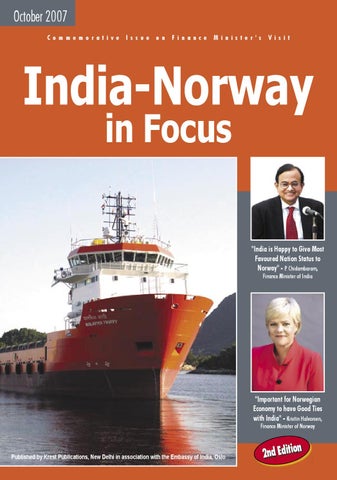
India-Norway in Focus
"India is Happy to Give Most Favoured Nation Status to Norway" - P. Chidambaram, Finance Minister of India
"Important for Norwegian Economy to have Good Ties with India" - Kristin Halvorsen, Finance Minister of Norway
Published by Krest Publications, New Delhi in association with the Embassy of India, Oslo
2nd Edition
������������������� �����������������
������������������������������� ��������������������������������� ���������������������������������������� �������������������������������������� ����������������������������������������� ����������������������������������������� �������������������������������������������� �������������������������������������� ���������������������������������������� ����������������������������������������� ��������������������������������������������� ������������������������������������� ��������������������������������������� �������������������������������� ��������������������������������������������������������������������������������������������������������������������������������������������������������������������� ������������������������������������������������������������������������������������������������������������������������������������������������������������������ ������������������������������������������������������������������������������������������������������������������������������������������������������������������ ��������������������
�����������
C O N T E N T S
Exclusive Interview with Finance Minister of India
6 A Brief Report on Indian Economy
10 India-Norway Trade Statistics
12 Location of Norwegian Enterprises in India
13 Exclusive Interview with Finance Minister of Norway
14 DNV: Following The Path To Growth
18 “India at 60 Represents Both Our Past and Future” – Foreign Minister of Norway
20 Interview with the Ambassador of India
22 A Report on Norwegian Education Minister's Visit to India
26 India’s First Scientific Expedition To Arctic
28
Interview with the Ambassador of Norway
32 India-Norway Commercial Ties
35 India Attracts Norwegian Entrepreneurs
36 Business Interview with the MD of Great Offshore
38 India and Norway's West Coast
40 Business Interview with MD of Aker Kvaerner
44 EDB‘s Win-Win Vision Of Outsourcing From Norway To India
46 Norway India Partnership Initiative (NIPI)
48 Business Interview with the MD of Norscot
52 Indo-Norwegian Cooperation in Fisheries
54 India’s Policy on Climatic Change
56 A Report on 'INMEX India 2007'
60 Last Word
62 Published by: Krest Publications, New Delhi in association the Embassy of India, Oslo Editor: Harun Riaz • Project Coordinator: R.K. Verma, Marketing: Ajit Thakur • Asst. Editor: Shilpy Arora, Designing: Hari Sharma, Arjun Mishra, Photographs: Zzebra, Mumbai, Sandeep Roda, Delhi Contact Details Tel: +91-11-66304701/2/3, Fax: +91-11-66304700, Email: editor@diplomacy.in Printing: Rave India
Disclaimer: It is our goal to publish an error free magazine. Every effort is made to check, recheck and verify the authenticity of the information. However, we assume no responsibility for inadvertent mistakes. The views expressed in this publication do not necessarily represent the position of the Publisher.
MINISTER'S INTERVIEW
“India is Happy to Give Most Favoured Nation Status to Norway” – Finance Minister The Finance Minister of India, Mr. P. Chidambaram in an exclusive interview with Harun Riaz reveals why Norway is an important trading partner and what New Delhi is doing to take the economic ties to a higher level Mr. Finance Minister, what concrete results do you envisage from your official visit to Norway, a first by a Finance Minister of India? We have good relations with Norway. The Norwegian Prime Minister visited us sometime ago and since then we are exploring new opportunities to forge better closer ties with Norway. There is scope for collaboration in oil exploration and downstream activities.
“I expect that the Norway visit will give stimulus to better economic ties”
Mr. P. Chidambaram, Finance Minister of India
Can we expect any new agreement or treaty during your visit to Norway? We are discussing the bilateral investment promotion and protection and avoidance of double taxation agreements. I don’t think they will be ready during this visit, but we are making progress. In the last week of March 2007, you had a meeting with Norwegian Finance Minister, Mrs Kristin Halvorsen in Mumbai. What issues were discussed during this meeting? We discussed India’s fiscal reforms, India’s strategy for rural
6
India-Norway in Focus
development, poverty alleviation, environment protection and the oil prices. These issues concern Norway the most. Maritime cooperation is one of the major success stories between Norway and India, but Oslo is also keen to develop hydro power in India, given its expertise in this area. Are you likely to take up this sector during your visit? Anyone wishing to collaborate and develop the hydro power in India, that company and country is welcome, but there are complex issues to deal with. There are issues of environment to deal with, ecology, and displacement of people, resettlement and rehabilitation, issues we have to address ourselves. No one from outside can help us in this. But if these issues are resolved and the hydro electric or hydro project takes off the ground, we would welcome capital investment or technical collaboration. Where will you place Norway in the Indo-EFTA trade pact which is expected to be initiated by the end of 2007? EFTA consists of four member countries of which Norway is one. There is a proposal which is being actively pursued at the Trade and Commerce Minister’s level to conclude an Indo-EFTA
MINISTER'S INTERVIEW
Free Trade Agreement. The Study Group has not yet given its report. It will be premature to comment on the likelihood of the Agreement. Once the report is received the Ministers of EFTA will meet and discuss the matter further. According to India-Norway tax treaty, India has reduced the rate of tax for royalty and fee for technical services from 20 per cent to 10 per cent.
from 20 to 10 per cent. We are very happy that the rate came down to 10 per cent. And any reduced rate of tax will indeed boost the flow of technology, intellectual property and technical services. We are very happy to give Norway, the MFN treatment. Can your visit to Norway be linked to the fact that more and more Norwegian
qualified professionals and India is definitely a source. Like in any other country, I expect the number to grow. Our work on India-Norway relationship in the past two years has indicated that while there are number of Norwegian success stories in India, same is not true about Indian companies in Norway. Do you think Indian
“The business delegation accompanying me to Norway represents key segments of the Indian economy”
How will it help boost trade between India and Norway? See, we have to give most favoured nation (MFN) treatment to Norway, because the MFN clause is there in the IndiaNorway Tax Treaty. If we give 10 per cent to any other country, we are obliged to give 10 per cent rebate to Norway also, that’s how the rate of tax for royalty and fee for technical services came down
8
India-Norway in Focus
companies are taking keen interest to enter the Indian market and at the same time, skilled Indian manpower is being hired by the Norwegian companies? Well, I do not know the exact number of Indian professionals who are now working and settled in Norway. I have been informed that the number has increased in recent years. Norway needs highly
companies are reluctant to enter North European market including Norway? As of today, there are several high level visitors from India to other countries. Prime Minister Dr. Manmohan Singh has travelled to Nigeria and South Africa. The External Affairs Minister, Mr. Pranab Mukherjee has travelled to Russia and now I travel to Norway. It is not the number that matters
MINISTER'S INTERVIEW
“UNCTAD put out a report in October 2007 that next only to China, India is the most attractive investment destination� in a business delegation. Sectors which are represented matter. We do our best to ensure that as large as possible, a business delegation travels with us, when we visit these countries.
of success. Is there a need for India to run a similar programme in Norway to promote business linkages?
The business delegation accompanying me to Norway represents key segments of the Indian economy. I expect that the Norway visit will give stimulus to better economic ties.
We are no longer in a position where we have to sell India as an investment destination. This story has already been sold. UNCTAD put out a report in October 2007 that next only to China, India is the most attractive investment destination.
For sometime, the Norwegian organization Innovation Norway has been running a matchmaking programme in India with some degree
As a destination and as an opportunity, I think the leading businesses of the world know about India. Our diplomatic missions overseas today have full
time officers devoting their full time to economic and commercial matters. What is important is that having sold India as an investment destination, when investor comes to India, we must be in a position to explain to the investor the policies and practices in India and convince that the environment is friendly for investment. Your comments about huge potential of Norwegian Pension Fund and its investment in India? Pension Funds can invest in India. One of the largest Pension Fund in United States is investing in India. I would certainly tell the Norwegians to invest part of its Pension Fund in India. We are open to foreign Pension Funds investing in India.
INDIAN ECONOMY
Indian Economy on the Roll There is a sense of optimism that Indian economy will become world’s fifth largest economy in the next decade if it keeps up its current pace of expansion...
W
ith GDP close to US $ 500 billion, India today enjoys a robust growth trajectory and boasts a stable eight plus annual growth rate. Looking at the statistics, the macroeconomic situation of the country seems strong and positive with the Gross Domestic Product (GDP) in the fourth quarter of 2006-07 grew at an impressive rate of 9.1 per cent. In addition to the above-mentioned macroeconomic indicator, higher disposable incomes, emerging middle class, low cost competitive workforce, investment friendly policies and progressive reform process all contribute towards India being an appropriate choice for investors. The Indian Government is committed in its efforts to maintain the eight plus growth rate and provide a conducive policy environment to the enterprises, both public and private, to invest and grow their business in the country. To this end, the Government has liberalized the foreign investment regime substantially over the last decade. Today, foreign direct investment is allowed in almost all sectors barring a few sensitive areas such as defense. Owing to this, countries from Europe are emerging as key investors in India and Norway is one of them. In fact, in the past six years, bilateral trade between India and Norway has increased by more than 100 per cent. The main drivers are machine and ship exports from Norway. To increase market access and trade flows, governments of Norway is
10
India-Norway in Focus
encouraging an EFTA Free Trade Agreement with India as well as a bilateral maritime agreement.
•
Why India Being one of the largest economies of the world, India possesses several favourable factors for Norwegian investors. Let’s have a look at few of them: • India is the fourth largest economy, in terms of purchasing power parity and tenth most industrialised economy • India’s foreign trade up by 31 per cent in 2006-07 and
• •
•
•
there is growing demand for shipping and maritime assets Three major and many minor offshore discoveries in India have fuelled the need for offshore assets Global hub for IT and ITES outsourcing 400 Foreign Institutional Investment, including four from Norway Political stability and broad consensus on reforms. Liberal and transparent foreign investment regime Well developed banking system and vibrant capital
The macroeconomic situation of the country seems strong and positive with GDP in the fourth quarter of 2006-07 grew at an impressive rate of 9.1 per cent
Advantage India • Progressive movement towards delicensing and deregulation. • India is the world’s largest democracy. • The gross domestic product grew by 8.9 percent in the first quarter of 2006-07 • Large pool of young skilled labour force, cost effective production facilities, large domestic market. • Capacity upgradation in infrastructure, industrial base and intellectual capital. • Progressive tax reforms. • Progressive opening of the economy to FDI. • Portfolio investment regime liberalized. • Liberal policy on technology collaboration. • Investor friendly policies. • Acceleration of the privatization process and restructuring of public enterprises. • Good network of research and development. • Economic and political stability.
INDIAN ECONOMY
•
•
• •
•
market. National Stock Exchange third largest and Bombay Stock Exchange fifth largest in terms of number of trades Among the highest rates of returns on investment. Profitability of US investments in India: 19.33 per cent in 2000 (according to US Department of Commerce) Skilled and English speaking man-power and professional managers are available at competitive cost Second largest technical pool in the world Strategic location – Easy access to markets of the other nations belonging to the South Asian Association for Regional Cooperation, such as Bangladesh, Bhutan, Maldives, Nepal, Pakistan and Sri Lanka Large and rapidly growing consumer market- Up to 300 million people constitute the market for branded consumer
In the past six years, bilateral trade between India and Norway has increased by more than 100 per cent
•
• •
•
products. Demand for several consumer products is growing at over 12 per cent per annum Abundance of natural resources (has a huge coastline), and agricultural self-sufficiency Sophisticated legal and accounting system Acceleration of the privatization process and restructuring of public enterprises Good network of research and development
Source: www.indiainbusiness.nic.in
MACRO ECONOMIC INDICATORS Population
1,112 Million
GDP at Factor Cost (current prices) Q1 of 2007-08
US $ 840.11 billion (Est.)
Composition of GDP
Services: 55.1% Industry: 26.4% Agriculture: 18.5%
Industrial Growth (April- July 2007)
9.6 per cent
Inflation (for the week ended September 22nd , 2007)
3.42 per cent
Broad Money (M3) growth (y-o-y) as on July 20th 2007
21.7 per cent
Forex Reserves
$247.762 billion for the week ended September 28, 2007
Cumulative amount of FDI inflows (August 1991 to March 2007)
US$ 54,628 million
Exchange rate INR/1 USD
Rs 39.55 (As on October 9, 2007)
Food grain stocks (As on June 1, 2007)
23.91 million tonnes
Exports April-August, 2007
US$ 59483.99 million
April-August 2006
US$ 50255.50 million
Imports (April--August 2007)
US$ 91986.78 million
(April--August 2006)
US$ 70181.41 million
Average literacy rate (census 2001)
64.84%
Life expectancy for males
63.87 years
Life expectancy for women
66.91 years
Note: The financial year for India is April 1st - March 31st
India-Norway in Focus
11
BILATERAL TIES
Brief Overview of India-Norway Commercial Ties
I
ndia’s economic and commercial ties with both Norway are on the upswing. There has been a spurt in trade, investments, transfer-of-technology and other contacts. A Norway-India Chamber of Commerce and Industry (NICCI) www.nicci.no was inaugurated on January 26,2007 in Oslo.
The current growth in Indo-Norwegian eco-commercial ties is fuelled by complementarities of interests, in sectors such as deep off-shore, shipping, hydro-electricity, Information Technology, Bio-Technology and light consumer goods. Embassy of India in Oslo, together with our Honorary Consuls in Reykjavik, Akureyri, Bergen and Trondheim give high priority to promotion of bilateral eco-commercial contacts. All possible help is rendered in facilitating these possibilities. Approximate Exchange Rates on October 08, 2007: : Norway: NOK 1 = 7.19 Indian Rupee
INDIA-NORWAY BILATERAL TRADE FROM 2000-2006 (In US$ Millions)
Year Norway’s Imports from India Norway’s Exports to India Total
2000
2001
112.4 69.2 181.6
96.9 48.3 145.2
2002
2003
2004
2005
212.8 104.6 134.0 176.6 200.2 66.4 69.4 128.8 413.0 171.0 203.4 305.4 Source: Statistics Norway dated During 2006 the bilateral trade between India and Norway grew by 37.5%
2006 233.2 334.5 567.7 06.07.07
$ millions
Norway's Trade with India 200-2006
Year
[Source: Embassy of India, Oslo (Norway)]
12
India-Norway in Focus
BILATERAL TIES
Norwegian Enterprises in India
India-Norway in Focus
13
MINISTER'S INTERVIEW
"Important for Norwegian Economy to have Good Ties with India" In an elaborate tete-é-tete the Finance Minister of Norway, Ms. Kristin Halvorsen shares the Norwegian strategy to galvanise its economic ties with India on the occassion of first ever visit by an Indian Finance Minister. An interview with Harun Riaz and Shilpy Arora. Indian Chambers of Commerce and Industry and with the Confederation of Indian Industry. A Norwegian-Indian Chamber of Commerce and Industry was opened this year, on the initiative of India’s Ambassador to Norway, Mr. Mahesh Sachdev. All of this leads me to believe that business ties will continue to strengthen in the years to come. Are you happy with the US $ 600 million bilateral trade between Norway and India?
“According to our statistics, the total value of bilateral trade increased by 128 per cent from the year 2000 to 2006”
Madam Finance Minister, how will you describe Norway-India business relationship 11 months after the visit to India by HRH Crown Prince Haakon and Crown Princess Mette-Marit? Norway and India have increasingly stronger bilateral economic ties. Trade is growing fast, both in goods and in services, and a string of Norwegian businesses have opened operations in India. Furthermore, direct business ties are also developing. The Confederation of Norwegian Enterprise has signed co-operation agreements with the Federation of
14
India-Norway in Focus
If I may rephrase your question, I think I would begin by saying that I am very happy that trade has grown vigorously over the past few years. According to our statistics, the total value of bilateral trade increased by 128 per cent from the year 2000 to 2006. I expect the bilateral trade to continue to grow in the years to come. First, the rapid economic growth in India should in itself be a force for increased trade. Second, several bilateral initiatives will make trade and investment easier: We are working towards revising the Double Taxation Avoidance Agreement, and we are working on a Social Security Agreement. These two initiatives should make cross-border establishment and exchange of personnel easier. Furthermore, Norway, together with the other countries in the European Free Trade Area (EFTA), and India, has recently completed
The then Governor of Rajasthan and now President of India, H.E. Mrs. Pratibha Patil with HRH Crown Prince Haakon and HRH Crown Princess Mette-Marit of Norway on November 3, 2006 at Jaipur, Rajasthan, India
India’s Minister for Health and Family Welfare, Dr. Anbumani Ramadoss meeting with the Prime Minister of Norway, Mr. Gens Stoltenberg, during his visit to Geneva to attend the 60th World Health Assembly at Geneva on May 15, 2007
The Minister of State for External Affairs Mr. Anand Sharma with the Foreign Minister of Norway, Mr. Jonas Gahr Store in New Delhi on December 15, 2006
MINISTER'S INTERVIEW
a study on a possible future EFTAIndia Free Trade Agreement. If we manage to complete such an Agreement, this will of course provide a major impetus for increased trade. In March 2007, during your visit to India, Madam Minister you met with the Indian Finance Minister. What was discussed during the breakfast meeting and how will you describe your visit?
achieving post-Kyoto solutions. We aim to discuss several issues in Oslo: First, how to strengthen bilateral economic ties. This includes the process towards a revised Double Taxation Avoidance Agreement, which I think will be important for both Indian and Norwegian businesses operating in the other country. It also includes the process towards a possible EFTA-India Free Trade Agreement. Norway attaches
Our meeting in Mumbai in March was very productive, and was conducted in a friendly and cooperative atmosphere. Several topics were discussed, and I would like to highlight two issues: First, we discussed ways in which we can work towards improving bilateral economic relations. Here, we focussed on the revising of the bilateral Double Taxation Avoidance Agreement, and on the process towards a possible EFTA-India Free Trade Agreement, which was at that time just initiated. Secondly, we discussed how to improve our bilateral co-operation on issues related to climate change, including the use of the Clean Development Mechanism under the Kyoto protocol. These are of course issues that we will follow up on during our meeting in Oslo. The Finance Minister of India, Mr. P. Chidambaram is coming on an official visit to Norway. What can we expect from the visit in terms of new initiatives and breakthroughs? India is a coming important global economic actor. Therefore, it is very important for a small open economy like the Norwegian one to have good relations with India. Furthermore, regarding one of the major future global challenges, namely climate change, India will be central when it comes to
16
India-Norway in Focus
Mechanism (CDM), and the Bali meeting for Ministers of Finance in December where we both are invited. The Finance Minister of India will be accompanied by a 17member business delegation. This is after the participation of over 30 Norwegian companies in Inmex 2007 in Mumbai. What are the reasons for this
“Norwegian companies’ interest is in my view simply due to the fact that India is a large market”
great importance to this work. We will also discuss the Norwegian Government Pension Fund. As you may know, the global part of the fund is now approaching 350 billion US dollars, all of which is invested abroad in financial instruments. Finally, we will discuss climate policies, both bilateral cooperation on the so-called Clean Development
growing interest among Indian, Norwegian companies? Norwegian companies’ interest is in my view simply due to the fact that India is a large market with a strong growth potential, which is increasingly open to business. It should come as no surprise that Norwegian companies seek opportunities in India. As for
MINISTER'S INTERVIEW
Indian companies’ interest in Norway, I think this reflects the overall growth of Indian businesses, which are becoming increasingly international in outlook and ambition. As Indian businesses are making their presence felt in more sectors, I think it is only natural that they also take interest in the Norwegian market. I believe, the Norwegian Government has prepared an Action Plan to intensify its interaction with India and take the bilateral ties to a higher level. Can you describe this programme and what is the time frame to achieve this objective? Yes, it is correct that Norway has a Plan of Action aimed at intensifying our bilateral cooperation with India. The plan sets out objectives and measures for strengthening the partnership between our two countries on the basis of common interests. The plan focuses on the following five areas of priority: Political dialogue and co-operation; Private sector co-operation; Co-operation on environmental and climate issues; Cultural co-operation and Co-operation on research and education. The plan was adopted in 2005 and was designed to guide our efforts for a five year period. A sixth priority area has been added later, based on an agreement between our two Prime Ministers: A partnership to collaborate towards the reduction of child mortality in India. Madam Minister, your thoughts on Indian economy and which are the sectors where Indian and Norwegian companies can find common ground to do business? Rapid economic growth in India should in itself be a force for increased trade. First, because
“Like our neighbours, Norway is also actively promoting its businesses in India” the growth means India will need inputs that Norwegian companies are well placed to deliver, such as ships and machinery for its maritime sector. Growth also implies changing consumer habits. The rapidly growing Indian middle class will consume an increasing variety of goods, including, Norwegian fish. Second, the rapid growth will entail new production of Indian goods and services, which will be increasingly competitive in the Norwegian market. This should lead to increased growth in imports from India to Norway. The Nordic countries, Sweden and Finland this year have launched an aggressive marketing campaign in India to promote ties, business, cultural interaction and awareness. What kind of competition you expect from these countries to capture business in India? India is one of the world’s fastest growing economies, and it is to be expected that our dynamic Nordic neighbours move to take part in the opportunities offered by the growing Indian market. I believe that there is room for all of us in the Indian marketplace. To a large extent, Swedish and Finnish businesses operate in fields that are complementary to, rather than competing with, our business interests. Like our neighbours, Norway is also actively promoting its businesses in India. The state-owned company Innovation Norway assists Norwegian businesses in their internationalisation and profiling activities. Its Delhi office is located in, and actively co-operating with, the Norwegian embassy, and specialises in sectors such as oil
& gas, hydropower, maritime and the food sector. More and more Indian skilled professionals are being hired in Norway. Do you expect this trend to continue and what is it that makes skilled workers from India absorbed by the Norwegian companies? The Norwegian economy is experiencing its strongest expansion in thirty years, with annual growth in mainland-GDP averaging more than 4.5 per cent annually over the past four years. The favourable development in the economy has contributed to a very strong increase in the demand for labour, especially in different business sectors. Inflow of workers from other countries has been important to reduce labour shortages and skilled labour from India has contributed to secure high activity in different sectors in the labour market in Norway. At the end of September 2007 almost 1200 Indian had a work permit in Norway and the number of new work permits has increased strongly the last year. More than 1/5 of all issued skilled labour permits have been given to Indian applicants in 2007. This is the largest share outside Europe. Skilled workers from India mainly work in consultancy related to ICT and manufacturing and also in service activities in the oil and gas sector. In a situation with high labour demand and low unemployment and prospects of a continued high growth in the economy, companies will certainly need qualified labour from other countries, hereby from India, in the years ahead.
India-Norway in Focus
17
BUSINESS PROFILE
DNV: Following The Path To Growth Krishnakumar N.R. has no doubts about his objectives for DNV in India. “My mission is to give our customers first-class support and through that expand DNV’s business in this growing market. We consider India as a real growth area,” says DNV’s Country Chair and Regional Manager for DNV Industry. By Stuart Brewer, DNV Corporate Communications
R
isks are increasingly becoming a part of everyday life. As one of the world’s leading classification societies, Norway-based Det Norske Veritas (DNV) is internationally recognized as a leading provider of risk managem ent ser vices. The company manages risks by
presents great opportunities for DNV. “In India we are developing rules for how ships should be built,” he says. “We are involved in the building and surveying of the ships and verify that they are meeting the minimum requirements that we set for safety.”
Hungry for oil and gas DNV is also involved in oil and gas activities in India. Its main services are offshore-oriented and include verification projects for companies such as Reliance, ONGC, Cairn Energy and British Gas. It is also working for some of the majors in the downstream
"We are increasing our commitment to India as more and more clients are expanding their business in this fast growing economy,” says Krishnakumar N.R. DNV’s Country Chair and Regional Manager for DNV Industry India. certifying the quality and safety of processes and products in the shipping, energy and manufacturing industries. Ship classification has been a foundation of the company since its establishment in 1864. Today, DNV is involved in all phases of the ships’ life, through ship classification, statutory certification and fuel testing. This maritime tradition has attracted new opportunities in growth markets throughout the world, not least India. Booming shipping sector According to Mr. Krishnakumar, India’s rapid expansion in shipping
18
India-Norway in Focus
Indian shipping is booming. Though growth is not as fast paced as it is in China, India is posting high single-digit annual growth and is helping to fuel the growing demand for shipping. This development has unleashed a new wave of ship orders by Indian owners. Norwegian owners such as Golden Ocean, Sea Tankers, Nor Lines and Sea Cargo are also placing orders at Indian yards, who are vying to bag a larger share of the shipbuilding market. Currently, DNV has close to 50 percent of the newbuilding market in terms of vessel numbers and 45 percent in gross tonnage.
sector as well as the clean energy (wind) segment. “The rising oil and gas prices have also increased the need for DNV’s energy-related services,” says Mr. Krishnakumar. He believes the thrust on exploration and development by oil companies will create even more work for DNV. “Stronger balance sheets, improved oil company cash flows and a matching regulatory regime with a clearly defined focus by the government on oil security would lead to more business,” he predicts. While DNV is known for its expertise in shipping and offshore, the company’s other main
BUSINESS PROFILE
business in India is derived from its certification business. It started doing “inspection work” for the general industries back in 1984 and is now recognized as one of the leading certification bodies India. Rising demand for certification services “The demand for certification of management systems is rising as companies seek to ensure quality products and services that can be trusted in the national and international markets,” says Mr. Krishnakumar, adding, “we now provide a full range of services for managing and integrating safety, health, environmental and quality systems across the industrial spectrum. Our customers include Cisco Systems, HSBC, CAT ( Caterpillar) logistics, Suzlon Energy, Wipro, Dr. Reddy’s just to name a few.” “Business is going well but there is so much more to be done so we are increasing our commitment to India as more and more clients are expanding their businesses in this fast-growing economy,” adds Mr. Krishnakumar. Service differentiation Despite the positive business developments, Mr. Krishnakumar points out that certification services have to a certain extent become “standard practices” and, as a consequence, it has become increasingly important for DNV to differentiate itself from the competition. In order to do this, DNV must rely on the assets it can offer its customers, which extend beyond products and focus on more service-oriented operations. According to Mr. Krishnakumar, its people are what set DNV apart from its competition. “I want our customers to choose
us because we are service-minded, have good, competent people and a uniform way of meeting our customers’ needs. We are trying to be innovative as regards what’s happening in the market and on adding value to our classification, certification and consultancy services,” he emphasises. Commenting on future plans, Mr. Krishnakumar firmly believes that DNV will grow significantly in the years ahead because there
responsibility, governance, enterprise risk management and sustainability reporting. “At DNV, we recognize that risk management is becoming increasingly important for companies across all industries, which is why we remain committed to developing our core competencies to identify, assess and advise on how best to manage technical and business risks. By providing business with tools to manage risk, we strive
Rapid expansion in India’s shipping, energy and general industries, springing from sustained economic growth, is offering new opportunities for DNV. Here, a DNV auditor is seen carrying out a periodic audit on a road project in Navi Mumbai.
is a growing demand for DNV’s services beyond the general market growth. “There are several strong forces and trends that further increase this demand,” he explains. “Environmental concerns, globalization, corporate social responsibility and sustainable growth are direct business drivers for DNV. Many of these market drivers are related to what takes place in India.” Managing risk Areas where DNV is providing value-adding services in India include climate change, corporate
to help our customers maintain a safe and sustainable business and, in the process, go some way to realising our purpose to safeguard life, property and the environment in India.” As Mr. Krishnakumar says, “It is a very large market and the potential is there, but it is also a very challenging market. To succeed, we just have to be better.” But then, as he also concedes, that has been the challenge for DNV ever since it opened its first office in India back in 1972.
India-Norway in Focus
19
ADDRESS
“India at 60 Represents Both Our Past and Future” – Jonas Gahr Støre In an unprecedented gesture, Norwegian Foreign Minister, Mr. Jonas Gahr Støre participated at the flag raising ceremony on India's 60th anniversary on August 15, 2007 in Oslo. Following is the text of his speech on this occasion; the domain of economics as in that of politics and deep-rooted human values. Pluralism of religion and language is a cornerstone of the Indian republic. India is a land of rich diversity and variety. It works on a deeply ingrained democratic approach that has given it an identity over the past half-century. This inclusive spirit has helped the country to stay democratic, tolerant and open-minded. India takes pride in being a country for all. So, indeed, I think the message from me should be that we all should look to India.
The Foreign Minister of Norway, Mr. Jonas Gahr Støre participating in the flag hoisting ceremony on August 15, 2007 at India House in Oslo
I
t is a great pleasure for me to congratulate India on its Independence Day and to take part in celebrating its 60th anniversary. Freedom came to India on August 15, 1947. On that day, the first Prime Minister of India, Jawaharlal Nehru captured the mood of his nation when he referred to “a moment which comes rarely in history, when we step out of the old to new, when an age ends, and when the soul of a nation, long suppressed, finds utterance.” Looking back today, 60 years later, how do we view this moment? How has India fared in its endeavour to give voice to its soul?
India has done so – to all observers outside and within the country – to an impressive degree. In many ways, India is a country of continental proportions. Ancient Indian civilisation has excelled in arts, humanities and science, and also – as Amartya Sen reminded us in The Argumentative Indian – in philosophical discourse. India still tops many other fields. Modern India is an established regional power and the second most populous country of the world. Day by day, millions of Indians are being brought out of poverty. However, the real success story of the modern India lies perhaps not so much in
”Ancient Indian civilisation has excelled in arts, humanities and science, and also – as Amartya Sen reminded us in The Argumentative Indian – in philosophical discourse”
20
India-Norway in Focus
Here I would also like to say that one thing that matters the most is mindsets. Mindsets shape the way we see the world and our place in it. If we want to build globally integrated, open societies for the 21st century, we must strengthen constructive dialogue between peoples, cultures and religions. In my view, it is diversity that gives humanity its promise – as India proves. A Cambridge historian, F. W. Maitland reminded his students in the following words that “What is now in the past was once in the future.” India at 60 represents both our past and our future. In the past it has reproduced the conflicts that often arise in a modernised and industrialised society. It is the future in that it anticipated, by some 50 years, our present effort, also in Norway, to create a truly multi-religious and multi-ethnic community. And I am delighted that Indians in Norway are so well integrated. Again, it is my pleasure, on behalf of the Norwegian Government to congratulate you and your country on its 60th Independence Day.
AMBASSADOR'S INTERVIEW
"First Ever Visit of Indian Finance Minister Holds High Significance” The Ambassador of India to Norway, H.E. Mr. Mahesh Sachdev spells out the enormous benefits, the Indo-Norwegian Ties will accrue from the high profile visit by Mr. P. Chidambaram, the versatile Indian Finance Minister. An interview by Harun Riaz.
Your Excellency, to whom you will attribute the impressive growth in bilateral trade between India and Norway in the past two years? I believe the total trade turnover in 2006 was plus 500 million US dollars.
contacts are all hopeful signs. Further, on going joint Indo-EFTA study could pave the way for a Free Trade Area by 2010. Besides, US dollar is not what it used to be!
the Finance Minister of India to visit Norway on an official visit, as is the case with Mr. P. Chidambaram? Indian Finance Minister’s visit to Norway is taking place within seven months of Norwegian Finance Minister’s visit to India. I would not call it “so long!”
According to official Norwegian data, bilateral trade between India and Can you describe Norway reached NOK a s to why Indian 3644 million or $ 568 p rofessionals are million in 2006, which being preferred by the is nearly double of $ Norwegians, which 304 million recorded has led to them being in 2004. This healthy number one in the growth reflects increasing list of foreign skilled Ambassador of India to Norway, H.E. Mr. Mahesh Sachdev awareness among the workers in Norway? stake-holders on both sides that bilateral commerce “Even as bilateral contacts This question should be best was mutually advantageous. answered by the Norwegian are held in a continuum, This was especially true in such employers. I would let also the Minister-level visits sectors as offshore, shipping and facts speak for themselves: The shipbuilding. punctuate them and number of Indian highly skilled professionals given permits to provide them visibility” work in Norway has gone up Do you think, the current nearly 12-fold from 24 in first trend will continue and the All these factors provide ground half of 2005 to 289 in first half bilateral trade may cross 1 for optimism that bilateral trade of 2007. billion US dollars by 2010? could cross a billion dollar mark From my perspective, this We already traded around $ by end of this decade. But even phenomenon is natural outcome 567 million last year – a figure if this happens, it would be less of a critical skill-shortage in that was nearly double of 2004. than half a percent of Norway’s Norway and availability of a Extrapolating January – September current global trade. Its fraction large pool of experts in India. figures, the bilateral trade is likely of India’s global trade would be This is especially true of sectors to hit $ 650 million mark in 2007. even smaller. such as deep offshore and IT This and other ongoing trends software. Our professionals are including expansion of the trade Why it has taken so long for also preferred for their global basket and growing business
22
India-Norway in Focus
AMBASSADOR'S INTERVIEW
“The number of Indian highly skilled professionals given permits to work in Norway has gone up nearly 12-fold from 24 in first half of 2005 to 289 in first half of 2007”
the fast moving IndoNorwegian economic space. In fact, the business delegation accompanying Indian Finance Minister includes three bankers, two of them being CMDs.
competence, international outlook, knowledge of English language and social adoptability. Indian involvement in such high visibility projects as designing Orman Lange sub-sea platform has also showcased the capabilities of our experts.
I also hope that the signing of a new bilateral Double Taxation Avoidance Agreement in near future would also spur movement in this arena.
Norway, apart from its expertise in maritime, fishing, oil and gas is also a leading player in banking, insurance, services and expert consultancy. Is there scope for India and Norway to forge cooperation in these areas? Norwegian financial services providers are increasingly allured to India’s growth story. These services are not only natural facilitators of the big ticket transactions, they are indispensable for making them sustainable. Besides, such service providers are also force multipliers as they reduce the time and costs of such transactions. But this story is not one-sided! India’s banks and financial services providers are also interested in
24
India-Norway in Focus
What are your expectations from the visit by Finance Minister, Mr. P. Chidambaram, the second major ministerial visit from India to Norway after last year’s trip by Science, Technology and Earth Sciences Minister, Mr. Kapil Sibal? Even as bilateral contacts are held in a continuum, Minister-level visits punctuate them and provide them visibility. In this sense, first ever Norway visit by Indian Finance Minister acquires unusually high significance. It does not only validate the ongoing bilateral economic momentum, it provides a political context to it. The official discussions are expected to underline the shared wish to promote economic
AMBASSADOR'S INTERVIEW
synergy and to extend it to other areas such as CDM. We also hope that other extensive engagements during this relatively short visit would deepen understanding of the current Indian economic perspectives that has attracted global attention. The cutting edge Norwegian technology is being used more and more by Indian offshore companies. What are the possibilities of technology transfer to India? Application of Norwegian technology in India’s booming off-shore space has been a key driver of the current bilateral economic surge. This technology is already moving towards India for natural reasons. Given its complexity and everincreasing costs, it’s sensible to be close to the Indian endusers. Further, transferring their technology-set to India also allows
Ambassador of India to Norway, H.E. Mr. Mahesh Sachdev with the Foreign Minister, Mr. Jonas Gahr Støre of Norway
“Bilateral trade between India and Norway reached NOK 3644 million or $ 568 million in 2006, which is nearly double of $ 304 million recorded in 2004” Norwegian companies to leverage dynamism and lower costs of India’s knowledge economy. Tourism seems to be a low key sector between the countries with low awareness about each other’s culture, history and geography. How can India attract more Norwegian tourists? Average Norwegian is a prolific tourist, making two foreign trips annually. Their interest in travelling to India for tourism has been increasingly in evidence.
Indian embassy in Oslo and Government of India Tourist Office in Amsterdam have worked together to promote tourism from Norway. Participation in events such as Reiseliv 2007 and focused awareness campaigns among potential tourists, tour operators, media and airlines, etc have paid dividends. We have also simplified visa procedure and added consular staff. The results have been encouraging- The number of visas granted by Indian Embassy Oslo has gone up by 43 per cent during last two years and we are issuing more than 1000 visas a month these days.
What has been the impact of November 2006 visit to India by HRH Crown Prince, Haakon and Crown Princess Mette-Marit? The Royal visit to India last year being an important benchmark in bilateral history, it is perhaps too early to assess its full impact. There is no doubt, however, that this important event showcased Norway to Indians in a multifaceted and fascinating manner. HRH Crown Prince Haakon and Crown Princess Mette-Marit led the delegation in a very impressive and professional manner. In addition, the Royal visit also included over 130 strong business delegation – the largest ever to leave Norway for a single destination. Much of the bilateral economic spurt can be traced can be traced back to them.
India-Norway in Focus
25
BILATERAL COOPERATION
India, Norway Set to Sign Education Pact
India's Minister of Science, Technology and Earth Sciences, Mr. Kapil Sibal met with visiting Norwegian Minister of Education and Research, Mr. Øystein Djupedal in June 2007 in New Delhi
N
orway and India signed an Agreement for increased bilateral cooperation in the areas of Science and Technology in November 2006. To follow up on that Agreement Minister of Education and Research of Norway, Mr. Øystein Djupedal along with a delegation visited India in June 2007.
held during the visit of Mr. Djupedal to India. During the meeting, Mr. Djupedal and joint working group discussed the focus areas to start the operations. Mr. Djupedal also visited various research institutes of Delhi, Bangalore and Goa and received a memento from the Indian Institute of Technology, New Delhi
During his visit to India, Mr. Djupedal met with Deputy Minister for Higher Education of India and a Memorendum of Understanding (MoU) between India and Norway in the field of higher education was discussed. It is expected that MoU will be signed during the year 2007. Norway and India signed an Agreement for cooperation in the field of Science & Technology in December 2006. A Joint Working group on Science and Technology was also established. The group held its first meeting in Oslo in 2006 and second meeting was
26
India-Norway in Focus
Norwegian Minister of Education and Research, Mr. Øystein Djupedal visited various research institutes of India
SCIENCE & TECHNOLOGY
India’s First Scientific Expedition To Arctic Owing to the treaty with Norway that allows access to Svalbard, India conducts its first ever scientific experiments in Arctic. A report by Dr Rasik Ravindra, Director of National Centre for Antarctic and Ocean Research (NCAOR)
A
new vista in India’s research endeavors in the Polar realm was opened on August 5, 2007 when the first
Sciences, the expedition was led by the Director of NCAOR, Mr. Rasik Ravindra who is a known polar scientist. The other members
hallmark of polar expeditions, the International Arctic Research Base at Ny-Ålesund (78° 55´ N: 11° 56´ E) served as a base
The Minister for Science, Technology & Earth Sciences, Mr. Kapil Sibal (fourth from left) handing over the Indian Tricolor to the Leader of the First Indian Scientific Expedition to the Arctic, Dr. Rasik Ravindra on the launching of the Expedition at New Delhi on August 3, 2007, in the presence of Secretary of MoES, Dr. P. S. Goel, Scientists, Dr. S. M. Singh, Dr. C. G. Deshpande and Dr. S. Shivaji (far left), and Dr. Dhruv Sen Singh (right)
Indian Scientific Expedition to the Arctic was launched by the Indian Minister of Earth Sciences, Mr. Kapil Sibal at an elegant ceremony in New Delhi, in the presence of Dr. P. S. Goel, Secretary to the Government of India, Ministry of Earth Sciences. Organized by the National Centre for Antarctic and Ocean Research (NCAOR), an autonomous Research and Development (R&D) wing of the Ministry of Earth
28
India-Norway in Focus
of this multi-institutional national endeavor were Dr. S. Shivaji from the Centre for Cellular and Molecular Biology, Hyderabad, Dr. C.G. Deshpande from the Indian Institute of Tropical Meteorology, Pune, Dr. Dhruv Sen Singh from the Department of Geology, Lucknow University and Dr. Shiv Mohan Singh from NCAOR. In the true spirit of international co-operation which is the
station for the Indian scientists. Situated 1231 km south of the North Pole on the west coast of Spitsbergen, the largest island in the Svalbard archipelago (Norway), Ny-Alesund is the home to around 30 scientists and logistics persons from 15 countries serving the research station over a year. During summer, the number of people goes up to 130. The research base is owned and managed by Kings Bay, a
Indian flag hosted at highest altitude of the Earth by Expedition leader Dr. Rasik Ravindra and his team on August 15, 2007
Norwegian Public Corporation. Kings Bay also manages all necessary services in the community such as the provision of food, electricity and water. Moreover, it is responsible for the maintenance of buildings and roads, the disposal of sewage, ensuring proper functioning of post office, hotels and local stores as well as Ny-Ålesund’s airport and quay.
Ambassador of India to Norway, H.E. Mr. Mahesh Sachdev (second from left) with the Indian scientists at Ny-Alesund. In the background is the 20-meter Very Long Baseline Interferometry (VLBI) antenna which contributes to the International VLBI Service as a network station. The VLBI technique is one of several observations carried out at the SpaceGeodetic Observatory at Ny-Ålesund
During a month-long stay, the Indian team initiated three novel scientific projects in the realms of atmospheric science, microbiology, earth science and glaciology. The atmospheric science experiments comprised simultaneous and continuous measurements of atmospheric electrical field, conductivity, concentrations and size distribution of atmospheric aerosols. The biological studies, on the other hand, were directed at an inventorisation of microbes from various habitats of Arctic, and an evaluation of their population dynamics as biological indices of change in season, anthropogenic factors etc. An understanding of the diversity, distribution and survival strategies of the cold loving micro-organisms in the Arctic is crucial for understanding how life forms adapt in such a low temperature. The geological investigations were primarily two-fold in nature- one, directed towards a
India-Norway in Focus
29
SCIENCE & TECHNOLOGY
Following the strong presence of Indian scientists in the Southern continent of Antarctica, it is the first step taken by India in the northern realm
of the first Indian Expedition to the Arctic.
Ambassador of India to Norway, H.E. Mr. Mahesh Sachdev interacts with the Indian and Norwegian scientists at the Sverdrup Research Station of the Norwegian Polar Institute at Ny-Alesund
The second phase of the Indian endeavors in the Arctic region during 2007-08 is proposed to be initiated in the year 2008, when the following four projects with multi-institutional linkages would be taken up:
gross understanding of the geological and structural characteristics of the area, and another is a study of glacial landforms of the area. One of the most pleasant experiences for the Indian scientists was the official visit of the Ambassador of India to Norway, Mr. Mahesh Sachdev to NyAlesund on September 3, 2007. The interest shown by Mr. Sachdev in the various scientific activities conducted by the Indian scientists and his enthusiasm certainly went a long way in ensuring the success International Arctic Research Base at Ny-Alesund
30
India-Norway in Focus
SCIENCE & TECHNOLOGY
Water sampling for microbiological studies
Ny-Alesund, situated on the West Coast of Spitsbergen, the largest island in the Svalbard Archipelago (Norway) where the International Arctic Research facilities have been established
Indian scientists taking biological samples at Spitsbergen Island, Svalbard
• Snow pack production of carbon monoxide and its diurnal variability • Sea ice microbial communities project • Carbon-cycling in the near-shore environments of Kongsfjorden • Understanding the link between the Arctic and tropical Indian Ocean climatic variations
Gerdein’s apparatus installed by Indian scientists at Ny-Alesund for measuring atmospheric electrical conductivity
Following the strong presence of Indian scientists in the Southern continent of Antarctica, it is the first step taken by India in the northern realm. It is expected that this expedition would certainly facilitate the much-needed bi-hemispherical approach to the polar sciences.
India-Norway in Focus
31
INTERVIEW OF NORWEGIAN AMBASSADOR
“Education and Research Key to Boost Norway-India Ties” The newly appointed Ambassador of Norway to India, H.E. Ms. Ann Ollestad in an interview with Harun Riaz reveals the Action Plan to put Norway-India ties on high pedestal How would you define India-Norway bilateral relationship? The relationships between India and Norway have been very cordial. Recently, I have been to a
of Indian Minister of Finance, Mr. P. Chidambaram to Norway, is CDM. So I would say that cooperation in all the sectors including business, technology, research and environment is strengthening our relationship.
one of the important sector that has reinforce the India-Norway relationship in recent times. What are your expectations from the visit of the Finance Minister of India, Mr. P. Chidambaram to Norway as this is the first ever visit by Indian Finance Minister to Norway? I expect that the tax agreement will be approached and negotiations will take place in this regard. I think CDM will be an important issue because Indian science is very much interested in CDM. Another important issue is to find out ways to attract more Norwegian businessmen to India. Here I would like to mention that Indian and Norwegian Trade communities are planning to conduct a seminar during the visit of Indian Finance Minister to Norway.
Ambassador of Norway to India, H.E. Ms. Ann Ollestad
shipping event, INMEX India that took place in Mumbai and noticed that business communities of India and Norway have very positive approach and commercial ties are picking up very quickly. I think we can enhance cooperation in business, technology, research and environment sector, particularly in Clean Development Mechanism (CDM) which is important to reduce global warming. I think one of the important issues that will be discussed during the visit
32
India-Norway in Focus
We are also emphasizing on the other potential sectors, such as tourism. Two countries have also signed an Action Plan NorwayIndia and a research agreement in 2006. Here I would like to mention that research is the
You have just mentioned about Action Plan, research cooperation, areas of business promotion, environment, CDM and technology. Do you have time frame to implement Action Plan and by when you expect rise in bilateral trade?
“The Norwegian companies are keen to invite Indian students to Norway and educate them in ship-building industry and then send them back to India so as to build a sought of know-how relationship”
INTERVIEW OF NORWEGIAN AMBASSADOR Well, I can’t give you the exact time frame but I would say that opportunities in business and other sectors have been promising and we will soon reach to the Action Plan because our embassy is working hard and we have clearer strategy for the Action Plan. So I would say that Action Plan will be implemented soon. Today, maritime and oil and gas sector are dominating Indian trade and little is known that Norway also has expertise in banking, insurance and specialized consultancies. Why those areas are not being talked about? I would say that maritime is an important part of business in Norway. As compare to India, Norway is very small country geographically but we have expertise in various sectors that India wants to develop. Security is one of the crucial issues in India and our country, Norway has developed expertise in this area. So I think it is essential to promote cooperation in such areas. Recently, Hydro has signed an agreement with Oil and Natural Gas Corporation Ltd. (ONGC) and Aker Kvaerner has signed contract with Reliance. So cooperation in business sector already exists and these are actually, building blocks of our relationship. However, it is essential to have more cooperation, especially in research and education sector. The Norwegian companies are keen to invite Indian students to Norway and educate them in ship-building industry and then send them back to India so as to build a sought of knowhow relationship. Here I would also like to say that Norwegian companies are also building ships for Indian companies in Norway. So, shipping is a booming sector where two countries can have
The Ambassador of Norway to India, H.E. Ms. Ann Ollestad presents her credentials to the President of India, Mrs. Pratibha Devisingh Patil at President House in New Delhi on September 26, 2007
“Norway is very much in need of skilled and qualified labour, particularly in technology sector and our goal is to get more Indians to Norway” more cooperation while enhancing cooperation in other sectors. I would also like to mention that we have already signed a research agreement and both countries are going to sign educational agreement soon. We are also expecting our Prime Minister to conduct teleconferencing and communicate with Indian authorities about the education agreement as well as growing
business relationship between India and Norway. Latest figures indicate that large number of skilled professionals in Norway are from India. What makes Indian professional adapt language and lifestyle of Norway? Norway is very much in need of skilled and qualified labour,
India-Norway in Focus
33
INTERVIEW OF NORWEGIAN AMBASSADOR main problem is lack of awareness about each other. Large part of the Indian people don’t know anything about Norway. I think Innovation Norway which is a part of our embassy can play an important role in this regard. As an education destination, Norway is not as popular as its neighbours i.e. Denmark and Sweden. What are the major steps taken by Norwegian government to increase the student flow from India?
Ambassdor of Norway to India, Ms. Ann Ollestad being interviewed by Editor Harun Riaz
“According to a recent survey conducted by a Norwegian newspaper, ‘India is a dream destination for most of Norwegians” particularly in technology sector and our goal is to get more Indians to Norway. As I said India and Norway are going to have educational agreement soon that would help us to have a political umbrella over this. It is, however not easy to invite Indian students to the country like Norway that is entirely different in culture and language. But, on the other hand, it has a lot to offer. It is one of the most beautiful places on earth and country also offers high wages. You mentioned that Norway is very clean, attractive and peaceful country. That means potential exists in tourism sector as well. So what are you doing to enhance cooperation in tourism sector and how
34
India-Norway in Focus
affordable is the country by way of hotel rates, food, transportation, etc.? According to a recent survey conducted by a Norwegian newspaper, ‘India is a dream destination for most of Norwegians’. Indians are also looking to Norway, for business opportunities, studies, research cooperation as well as tourism. I think the major concern is to see how we could increase resources to get more Indian tourist into Norway. I have noticed that number of Indian tourist in Europe is increasing day by day and I would like to tell them that Norway is one of the most attractive places in Europe. So far as cost is concerned, I don’t think cost is major problem. The
Yes, Norway has a great potential in education sector. Two countries are working on education agreement and we want governments of both the countries to develop a master programme in this regard. Our goal is to bring trained professionals to the shipping and maritime sector. In fact, expertise in Norway is very much in need for Indian students. As far as Norwegian students are concerned, they have good financial package to go to India. Today, everybody is looking at India, even the students in England are eager to come to India because country’s economy is booming. I think interest from Norwegian side is developing quickly but we have to make sure that students from India should get enough incentives to study in Norway. It is also important to encourage them to study in Norway. It is, therefore important to strengthen cooperation in other sectors.
GUEST ARTICLE
Indo-Norwegian Commercial Relationship Surge to Unprecedented Heights By Per Reinboth
F
or decades, the level of commercial activities between India and Norway has been at an unprecedented level. More than trade, which in itself has seen a tremendous growth, it has been the level of contractual and collaborative co-operation between Indian and Norwegian enterprises that has seen an exponential growth.
suppliers, which started with their involvement in various downstream petroleum projects in previous decades, has developed into large scale collaborations in deep sea offshore oil and gas exploration activity. Norsk Hydro, now part of StatoilHydro (Norway’s largest company), has joined hands with ONGC to collaborate in burgeoning
Innovation Norway has assisted more than 50 Norwegian companies in exploring business possibilities in India through the Norad funded matchmaking program and other supporting channels Innovation Norway, the agency entrusted to promote Norway internationally, established its office in New Delhi in 2005 and has acted as a catalyst to this cooperation. In a short span, it has assisted more than 50 Norwegian companies in exploring business possibilities in India through the Norad funded matchmaking program and other supporting channels. It has also been involved in profiling Norway in India, be it through organising promotional events or focussed seminars and workshops. Norwegian industry excels in deep sea oil and gas extraction, maritime, hydropower, power trading, aquaculture etc. In recent years, the level of contact between the companies in Norway and India has been growing rapidly. The relationship between Norwegian technology
oil and gas exploration activities in India. Aker Kvaerner through their Indian subsidiary is providing cutting edge services to the oil and gas exploration activities in Krishna Godavari Basin. Now, this interest in India has diffused into a number of smaller Norwegian companies. Rig Management Norway, a very small company has been entrusted by the largest exploration companies in India to manage exploration rigs for them. Norway has been known for the breadth of its maritime sector. This sector has been relying heavily on Indian shipbuilders. Estimates reveal that more than 40 Norwegian ships are on order from various Indian shipbuilders. Many of them were delivered recently and many more orders placed at these yards. At the same time Norwegian ship equipment
suppliers have been doing more and more business with these shipbuilders. The commercial activities in aquaculture are being built over a number of research collaborations which have taken place since 90’s. Recently, Innovation Norway signed an agreement with Marine Products Export Development Agency to expand the benefits of collaboration commercially in new areas. It is expected that in future this will expand into a fruitful Public-Private partnership. The commercial activity, in terms of number of enterprises, is most widespread in Information and Communication Technology (ICT) sector. Norwegian ICT companies and even non ICT companies are looking to benefit more and more from Indian software capabilities. This sector is expected to be a front runner in bilateral commercial collaboration between India and Norway in future. The commercial section in the embassy is actively looking at consolidating on the good work done in these sectors and initiate focussed work in new areas like health, biotechnology, Institutional Research collaboration and Clean Development Mechanism related assistance to Norwegian companies. It will be fair to say that sky seems to be the limit. (The author is Commercial Counsellor at Royal Norwegian Embassy in New Delhi)
India-Norway in Focus
35
GUEST ARTICLE
India Attracts Norwegian Entrepreneurs By Lars B. Hasle Eksportfinans ASA
Gearing up to meet its insatiable demand for new technology in almost all the sectors ranging from Shipping to Communication, India has a lot to offer ...
A
t the time of writing, the United States Federal Reserve has reduced the Prime Rate by 50 b.p., the Northern Rock bank in the United
Norwegian business which is focus of this article, apart from highlighting that companies that have shown faith in India are now making big money.
Mr. Lars B. Hasle
Kingdom has been subjected to panic withdrawals (the first run on a British bank since 1866) and there are lot of discussions on serious havoc in the financial world. All this is predominantly concentrated to the western hemisphere and Asia seems to be, at least for now, spared from the most serious effects of the upheaval. The above off course deals with the big picture but it reflects a shift in the conception of how we view the future of world in Asia. It is also true that above instances do not influence the Indo-
36
India-Norway in Focus
Currently, shipping and oil & gas are being explored as major areas of business between India and Norway. These are the areas with a strong Norwegian dominance and where Norway has a tremendous edge internationally. When exploration started in the deep waters of the Bay of Bengal, Indian industrial giant Reliance looked to Norway for new technology and signed several contracts with Aker Kvaerner, a Norwegian company that provides engineering and construction services to oil & gas industry, refining industry, chemical industry and so on. Moreover, Indian companies like Great Eastern, Great Offshore and Garware Offshore Services turned to Norwegian yards like Havyard Leirvik and Aker Brattvaag for building vessels and
For decades, Indo-Norwegian business community has seen little to cherish upon but it is now that both the countries are starting taking interest in each other after identifying the major areas of cooperation Eksportfinans is one of the companies that reap the rewards of its stronghold in the Indian market for the past 30 years. For decades, Indo-Norwegian business community has seen little to cherish upon but it is now that both the countries are starting taking interest in each other after identifying the major areas of cooperation.
other equipments. On the other hand, Norwegian businesses like Seadrill has turned to Indian yards for new buildings and several Indian yards, such as ABG Yard which is currently building vessels for Norwegian companies, contributing to a great extend to the Norwegian equipment and ship design companies that contract substantial supplies of
GUEST ARTICLE
Garden Silk
technology and know-how to India. Figures reveal that the Indian merchant fleet, in order to meet the current standards will have to undergo a major repair, with extensive scrapping of older vessels and the replacements by either second hand tonnage or new buildings. This is where Norway has a role to play. Second hand Norwegian vessels are no doubt a profitable venture but the new building scene in India is far more vibrant, and the construction of new yards and beefing up of existing ones is a high priority. One of the excellent examples is TTS and MacGregor, which are master in providing new technology to the Indian industry for the development of yards. Apart from shipping and oil & gas industry, Norwegian suppliers are competing in the energy sector (hydropower and gas/ diesel fuelled generators) and communications sector. A company called UNITEAM, producing easy to assemble hospitals, homes, prisons,
The Norwegian food giant Orkla bought a production company in India
kindergartens based on a container concept have set up their own business in Chennai to take care of aspects of their international business from there. There are several Information and communication technology (ICT) firms in Norway doing the same in Bangalore, Hyderabad and Chennai. The Norwegian food giant Orkla bought a production company in India. Though Indian domestic market is big enough for the company, Orkla also plans for exports. Norwegian Indo Chamber of Commerce and Industry (NICCI) which has started its operations in January 2007, is the another organization that not only highlights the lucrative market conditions in India but also enhances cooperation between Indian and Norwegian businesses. Eksportfinans has had the privilege of being involved in Indian business since the early eighties and having seen good and bad times in nearly three decades of existence. It is the major long term lender in terms of exports and is willing to participate in all kinds of business mentioned above. Companies that had been in touch with Eksportfinans are aware of the fact that we had been little weak in our lending activity owing to the tax regulations. But, now to some extent, we have been able to come up of that situation and we wish to find out a final solution to this impasse by the imposition of the 1986 Double Taxation Treaty between the Ministries of Finance in New Delhi and Oslo in October 2007. Despite of the current tax situation, we hope for good future in India and we are committed to paving way for the future Norwegian exports in particular and Indo-Norwegian trade in general.
India-Norway in Focus
37
BUSINESS INTERVIEW
“India Can Replicate Norway’s Experience in the Maritime Sector” Over the last two decades, Norway has made tremendous strides in the maritime sector. The Managing Director of Great Offshore, Mr. Vijay Sheth has been dealing with Norway for more than 24 years. He has developed a remarkable passion and understanding of the country. In an interview with Editor Harun Riaz, he explains how India could learn from Norwegian experiences. Mr. Sheth, how would you describe your business relationship of 25 years with Norway? Succinctly put, “veldig fint” very fine. Norway has been an important partner of Great Offshore over the years.
Earlier, Great Offshore was a part of Great Eastern Shipping, and the offshore division of Great Eastern, which is now Great Offshore, was a pioneer in the area of oilfield services. In the last 24 years of operations, our company has shown a strong and sustained growth. We had started our operations with smaller offshore support vessels (low-end AHTSVs), but today we have broadened our area of operations and we now operate an array of platform supply vessels, anchorhandling tug supply vessels, multi-support vessels, fire-fighting supply vessels, etc. Besides, we have diversified into port and terminal activities that support the operations of various ports in India. In a nutshell, we have grown and matured in the last two decades.
38
India-Norway in Focus
Photo: Zzebra, Mumbai
Great Offshore is the first private sector company in this area of business. What has changed since 1983, when you entered the offshore business?
Managing Director of Great Offshore, Mr. Vijay Sheth
“The Norwegian expertise (in recent times) has been in cutting-edge technology, particularly with reference to deepwater and its related frontier technologies” Despite maritime business between India and Norway, it is only now that the two countries have started exploring other areas of business. Why has it taken more than 20 years for this development to happen?
First of all, you have to understand that the two countries have looked at each other differently because opportunities within their own segments were different. India was not looking at the areas where Norwegians were making their presence felt. The Norwegian expertise (in recent times) has been in cutting-edge technology, particularly with reference to deepwater and its related frontier technologies. Given the success of Oil and Natural Gas Corporation Limited and Reliance Industries Limited in deepwater activities, India has now come to appreciate this state-of-the-art, cutting-edge technology. Thus, today, the fit in such advanced technology could benefit India.
BUSINESS INTERVIEW
Furthermore, the high oil and gas prices can only help things further. I think there is immense potential for cooperation and we should work jointly to take it forward. Is there any scope between the two countries in the other areas than maritime and oil and gas? I think there are two areas where there can be more cooperation; and these areas are in tourism and hydroelectricity. Norway’s economy continues to perform well and it is b e i n g s a i d t h at N o r w ay can outsource its business to Indian companies. What is your opinion about the offshore outsourcing? This kind of cooperation is already taking place, particularly in the maritime sector. Today, many Indian seafarers are working on Norwegian ships. I think
”We can replicate what they have done in the maritime sector for the benefit of our country-India” this maritime influence will continue for a long time because a lot of maritime potential exists in Norway. But, we should understand that it is not just in shipping and oil and gas, but in fact, it spreads across every branch of maritime business including banking, insurance, service providers, manufacturing, yards and in specialised consultancy. Norwegians are one of the top consultants in the oil and gas business. Some of the best banks and insurance companies that understand maritime business are Norwegian. The cooperation, therefore, can be much wider. What are your expectations from the visit of the Hon’ble Indian Finance Minister, Mr. P. Chidambaram to Norway?
We would like him to see the country and look at how it has progressed in the maritime business and how India can replicate that because like Norway, we too have a huge coastline. We also have a huge demand for coastal shipping and for the oil and gas business. So, we can replicate what they have done in the maritime sector for the benefit of our countryIndia. Can you elaborate on your current and future business propositions with Norway? We have been buying vessels and technology from Norway for many years now and shall continue to do so in the future. We will also continue to look towards new areas of cooperation.
BUSINESS PROMOTION
India and Norway's West Coast
Photo : T. Carlsen
The Consul of India in Bergen and CEO of Norway India Chamber of Commerce and Industry (NICCI), Mr. Svein Lang speaks on his vision for the future of Indo-Norwegian business ties
Consul of India in Bergen, Mr. Svein Lang
I
n January 2006 the then President of India, Dr. APJ Abdul Kalam signed the appointment of a new Honorary Consul for the West Coast with an office in Bergen. Half a year later the Norway India Chamber of Commerce and Industry (NICCI) was inaugurated at a formal ceremony where State Secretary, Liv Monica Bergen Stubbolt from the Ministry of Foreign Affairs and the Ambassador of India to Norway Mr. Mahesh Sachdev were the main speakers. NICCI’s main office is in Bergen which is led by Svein Lang who is also India’s Consul for West Norway. These two establishments came about as a result of two years intensive effort to establish active forms of business and cooperation between India and Norway at a
40
India-Norway in Focus
place where a lot of Norway’s economic growth takes place. Over 60 per cent of the creation of economic values in Norway occurs in the region between Stavanger and Trondheim. The Honorary Consulate is a representational agreement between Norway and India. It can represent Indian citizens living in West Norway as well as function as a coordinating body and build networks within trade and industry. Contact with the local Chamber of Commerce was a natural and inspiring way to work.
For several decades there have been strong clusters of industry and knowledge within IT, offshore, shipping, fisheries, mechanically advanced industries as well as in the furniture industry from Stavanger in the south to Trondheim in the north. In global and international contexts, these conditions are small, but through hard international competition these industrial societies have managed to take advantage of their competitive edge in an impressive manner. The tasks of both the consulate and NICCI have always been to connect companies actively together and the most important method of achieving this is to stimulate Norwegian companies to visit the Indian market. Partly to open new markets, but just as much to strengthen innovation and product developing processes in Norwegian enterprises. Large Norwegian companies have the resources to do this themselves, but many others will need to have network support and guidance in the beginning when they enter the large and complex Indian market Compared with India, Norway is a new nation and is culturally very homogenous with a large degree
NICCI has a mission to make the possibilities visible that India holds for Norwegian companies through spreading information and knowledge about India
BUSINESS PROMOTION
that this could create a win-win situation for both parties. Enterprises that comprehend the depth of this statement and are able to find the most relevant companies in the different states, will probably be able to hone their competitive edge at home and abroad, develop strategic and tactical alliances where your competent supplier can carry out your tasks better than you, and concentrate your own resources on areas where you have possibilities for improvement and can get the best returns.
Photo: StatoilHydro
This is where the Chamber of commerce has a mission: to make the possibilities the country holds for Norwegian companies visible through information and knowledge about India. There is an important catch in this picture concerning timing. Just a few years ago there were very few North European companies that were looking towards India, something the statistics illustrate very well. Every one who came was welcomed with open arms. Today India can pick and choose between good alliances and exciting markets to a much larger degree. Norwegian companies might end up not having enough
Sleipner Gas platform in the North Sea
of social equality. Most of us can say with a great degree of accuracy what Norway is.
In his salutational speech during the inauguration of the Norway India Chamber of Commerce and Industry, NHO’s president Erling Øverland said that India and Norway complement each other in business matters and
Photo: StatoilHydro
Norwegian companies that travel to India meet a civilization that includes a number of different nations, traditions and cultures. Until a few years ago Norway had bilateral development cooperation with India that influences the opinion of many people about the country. What is happening now is that India has an economic growth that results in quick changes and a focus on new constellations.
Workers at the Heidrun field in the Norwegian Sea
India-Norway in Focus
41
BUSINESS PROMOTION
Several establishments have already come about as a result of this new work. One of the examples is I-bruk AS that has established a daughter company in Mumbai that develops documentation within offshore and industry. This came about as the result of the lack of available Norwegian competence, shortage of qualified labour and European competition as far as cost was
Photo: Tormod Carlsen
time to establish long term bonds because others get preference. To add to this picture we also have a future free-trade agreement between EFTA and India, as well as more efficient handling of applications for businessvisas and work and residence permits, which are a hindrance for productive development of trade and industry.
The Oster Fjord, North of Bergen, known for its fish farms
Honourary Consulate can represent Indian citizens living in West Norway and function as a coordinating body that builds networks within trade and industry concerned. Moreover, a satellite communications enterprise, Ship Equip AS in Ålesund that established itself in Mumbai in January this year, at the initiative of Norway-India Chamber of Commerce’s representative in Ålesund, Helge Bjørnseth.
Illustration Statoil Hydro
None of these firms is large in the traditional way, but they made use of the competence that exists in local environments in Norway about India. The systematic work that is being carried out as a result of networks will increase in the years to come.
Illustration of subsea installations at the Vigdis field in the Norwegian Sea
42
India-Norway in Focus
www.nicci.no info@nicci.no www.india.bergen.no consul@india.bergen.no
Expertise in building
Tankers Bulk Carriers
Offshore Supply Vessels
Port Crafts Building the first
Aircraft Carrier for Indian Navy. UNDERTAKES
Repairs / Upgradations to Offshore Structures Naval Vessels
Tankers Bulk Carriers other
Commercial Ships / Port Crafts.
COCHIN SHIPYARD LIMITED Contact:
Chief General Manager (Ship Repair): 98957 65848 Assistant General Manager (Marketing): 98957 65834 info@cochinshipyard.com www.cochinshipyard.co.in
BUSINESS INTERVIEW
“Chidambaram Visit will be a Milestone in Marketing of India” The Managing Director of Aker Kvaerner in India, Mr. Paul Pothen says that Aker Kvaerner is setting a trend by designating India as one of it sourcing hubs. An interview with India-Norway in Focus.
Aker Kvaerner is one of the oldest Norwegian companies in India. What prompted your to enter Indian market at the time when the growth rate of Indian economy was as low as 3.5 per cent? It was obvious that India, a large and populous nation, blessed with an intelligent and hard working human resource, had all the necessary ingredients for becoming an industrial power house. As far as we were concerned, it was just a matter of time before its full potential for fast track growth was unleashed; something which ultimately happened when the “liberalization process” was initiated in 1991 and Indians at last got the freedom to choose their destiny. For us, this extended wait from the time we set up our operations in the sixties, gave an opportunity to build up a strong project execution skill set and a very loyal client base. The HRH Crown Prince Haakon during his visit to India in 2006 brought business delegation of 130 companies from Norway. What do you think is the significance of this and why is India attracting so much attention from Norway? Today, India is a land of opportunities and both the countries have much to gain from the strengthening of trade
44
India-Norway in Focus
Managing Director of Aker Kvaerner in India, Mr. Paul Pothen
“Today, India is a land of opportunities and both the countries have much to gain from the strengthening of trade relations”
BUSINESS INTERVIEW
relations. Norway with its unique capabilities in shipping, ship building and offshore oil and gas field development, is very well placed to play an important role in India’s development programme. Similarly, India with its large human talent pool and strong presence in services industries such as IT and engineering can play a role in expanding the global business reach of Norwegian enterprises. Many might not remember that the IndoNorwegian Fisheries Project of the sixties was one of Norway’s very first overseas initiatives. So there is a long history to bank on! The Norwegian Finance Minister, Ms Halvorsen had paid a visit to India in March 2007 and now Finance Minister of India, Mr. Chidambaram is visiting Norway. Are these merely political visits or do they really help in boosting business ties? In today’s scheme of things, finance and business are like inseparable twins and busy Finance Ministers don’t travel long distances just to say hello to their counterparts and meet with the Central Bank chiefs. In fact Ms Halvorsen did a wonderful job of projecting Norway’s image and I am sure that she also looked at ways to invest a little more of the huge oil fund in India’s fast growing economic machine. I am certain that Mr Chidambaram too has a packed agenda and the marketing of India story will be a key item in it. Aker Kvaerner offers services for many sectors, including Oil & Gas, refineries, petrochemicals, agrochemicals and mineral and metal sector. What are your future plans?
“Norway with its unique capabilities in shipping, ship building and offshore oil and gas field development, is very well placed to play an important role in India’s development programme” Our current portfolio is pretty broad for an E&C company and so our intension is to focus on increasing the depth of our participation and the building up of new competencies in these very sectors. We are also expanding our operations at a fast pace, not only for servicing the growing Indian market but also for supporting our group companies in the global market place. You have bagged contracts from Indian Giants, such as Reliance, Larsen & Tourbo Ltd. and Vedanta. How will you describe your relationships with these companies? Has it been tough for Aker Kvaerner to bag projects in India? We feel privileged to be the E&C Company of choice of a number of well known Indian as also overseas organisations. That, as much as 80 per cent our business in the recent years has come from our customer base, probably a record of sorts, is something that gives us much pride. We do try very hard to make every project of ours, a success story, and every relationship an honest and predictable one. Our clients seem to like it, and see in us a partner they should hold on to. As an offshore entrepreneur, how do you view the Indian market? What are the promising sectors in India for investment and why? None can really afford to overlook the fast growing Indian market and the opportunities on offer.
For offshore entrepreneurs, it is a pretty transparent market place which offers a fair rate of return commensurate with their performance. For us at Aker Kvaerner, both the Oil & Gas, and manufacturing sectors look promising. As a matter of fact we are proud of our current involvements in the development of India’s very first deep water natural gas field, the setting up of one of the largest polymer manufacturing facilities in the world and the concurrent execution of a number of oil refinery units. We see ourselves as a committed nation builder.
What are the real possibilities of Norway outsourcing its business to Indian companies? There are many ways in which Indian service providers and manufacturing companies can work with Norwegian businesses. In the case of Aker KvaernerNorway, apart from obtaining a wide range of services from its Indian operations in Mumbai and Pune, also sources hardware and capital goods as also services from a number of vendors in India. Realising that this represents just a fraction of the business potential, Aker Kvaerner has designated India, one of its sourcing hubs and recently appointed a Country Manager, making India one among six nations to have such a position. It is probably appropriate to say that Aker Kvaerner is setting a trend.
India-Norway in Focus
45
BUSINESS ARTICLE
EDB‘s Win-Win Vision Of Outsourcing From Norway To India By Endre Rangnes CEO of EDB Business Partner ASA
G
lobal sourcing can only reach its full potential when the IT service providers pay close and individual attention to each business being served. This is the key finding of a survey carried out by EDB
viewpoints on important issues facing the industry. In September 2007 EDB published a survey based on in-depth interviews with CIOs in large Nordic companies. In this article you can get updated on important trends from this survey, and key drivers affecting Global Sourcing, especially from India. EDB Business Partner has several years of experience in using highly certified IT-professionals from India. In accordance with increased awareness and interest from Nordic customers, we are now stepping up our Global Sourcing delivery significantly and our Indian operation in particular. The best global sourcing is local
Endre Rangnes CEO of EDB Business Partner ASA
Business Partner. The survey also reveals that global sourcing is increasing in importance in Norway and throughout the Nordic countries. As a major player in the Nordic IT industry and a key partner to our customers, EDB is not only committed to providing highquality services, but also strives to be a source of new insight and
46
India-Norway in Focus
One of the most prominent current trends today is the rise of Global Sourcing. Our survey found that more than 80 percent of the respondents have made Global Sourcing decisions. This is a much higher than EDB found in a survey carried out in 2006 in Norway. Another key finding of the survey is the clearly expressed need for IT service providers to pay close and individual attention to each customer being served.
Almost all respondents, both non-users and those who have already made global IT sourcing decisions, underline the fundamental requirement of having a supplier that understands their business and the importance of close co-operation with the IT service provider. Likewise, local knowledge and knowledge of the core business of the customer is the top selection criterion when choosing a global IT sourcing partner. This requirement is much more evident in the answers in this Nordic research than in similar research from other regions. All respondents that have made global IT sourcing decisions stress the importance of a seamless service delivery structure as well as global unified reporting. Reflecting this view, the global IT service providers are seen as delivering multinational IT services – but not global IT services. The respondents state reduced cost, access to more resources and increased strategic flexibility as the main benefits of having made Global Sourcing decisions. EDB’s recommendations to customers The most striking finding in our survey is the very strong emphasis on the need to understand the business of the customer and the context in which the global IT services are provided. On this basis, EDB has developed a set of guidelines that we believe will be of help when developing an approach to Global Sourcing.
BUSINESS ARTICLE
• Select a partner for global IT sourcing that has local in-depth knowledge of your business and can demonstrate valid references from similar projects implemented for other Nordic customers. • Create a win-win partnership in the setup. Consider a strategic partnership with shared risk/reward with a trusted partner. A long-term global IT sourcing agreement will inevitably change its focus and scope over time. Therefore, be sure to make contractual arrangements that are balanced and that give both parties strong incentives to work well together. Many respondents pointed to various forms of centre of excellence or shared service centre (internal or external) as a useful setup. • Ensure that the ser vice provider has implemented the right incentive schemes that support the global delivery of IT services to you. Almost all global organisations are organised according to geographical boundaries for natural reasons. However, this creates problems when supporting global customers, because the incentive schemes are counterproductive in terms of support for global customers. • Apply a stepwise approach. EDB’s research clearly indicates the complexity of buying services from low-cost countries. Before making any global IT sourcing decision, you must gain control of the service you are planning to outsource. Identify a stable environment and seek to reap benefits from global IT sourcing of such services. When that has proved successful, and your company has acquired a track record for making use of global IT sourcing, then start expanding the service
EDB Business Partner has several years of experience in using ITprofessionals from India. In accordance with increased awareness and interest from Nordic customers, EDB is now stepping up its operations in India.
by introducing such options in more dynamic environments. EDB strategy for Global sourcing Based on the knowledge discussed above, and a large number of ITprojects using Global Sourcing, EDB has developed a clear Global Sourcing strategy for the coming years: • EDB will continue to build strong local partnerships with Nordic customers • India will be an important part of our Global Sourcing delivery model. By year-end 2007 we will expand our presence significantly. • EDB has established an ITservice unit in Ukraine with more than 600 employees. We have access to resources that strengthen our competitiveness in the Nordics as well as providing our customers with local knowledge in Ukraine and other parts of Eastern Europe.
About EDB EDB Business Partner is a leading IT group for the Nordic region. The group has 4,300 employees, and more than half the workforce is outside Norway. Annual revenue of the group is NOK 6.5 billion. EDB delivers solutions that cover the entire range of business critical IT services from application services and industry-specific solutions through to IT operating services and network solutions. EDB is committed to being a close and attentive IT partner that helps its customers operate more efficiently and achieve their business objectives. EDB Business Partner is listed on the Oslo Stock Exchange. For further information see www.edb.com.
India-Norway in Focus
47
BILATERAL COOPERATION
A Global Fairy Tale
Norway India Partnership Initiative (NIPI) By Prasanna Hota Director NIPI-UNOPS
A
skeladden is the joyous, clever small boy of Norwegian folk/fairy-tales. He has got quite a reputation for taming demons and giants and helping others if they are in distress. Lately, he looked with interest the Globe model on his study table as he was to speak in his school
Mr. Prasanna Hota Director NIPI-UNOPS
about Global Demons which still threatened the children of the world. He rolled the globe and asked his elder brother to close his eyes and touch any point on the globe. The globe was rolled twice and the finger stopped at India. Askeladden was thrilled. His brother asked, ‘My God that is India. Do you want to go to India’? Askeladden said, ‘off course, I want to. It is quite some time since I ventured out of our place’. The two elder brothers laughed and said, ‘Don’t be ridiculous, do you know how far India is? It is in another continent’. Askeladden replied in his usual style, ‘So what? Is it not on this planet? Are we not trying to do anything about the demons of disease and infection which kill so many children there each year?’ Askeladden packed his little knapsack and landed in a village in Madhya Pradesh, a large and important State in India. He wandered around a village and was fascinated to see a large number
48
India-Norway in Focus
NIPI Action States
of children playing on the street, some with clothes and other without clothes. He approached a little boy and said, ‘I am from Norway and my name is Askeladden, what is yours?’ The little boy ran away screaming. Askeladden went a little further and found the school. He told the teacher about his adventures and asked if he could make any friends in the village. The teacher told him that he could find Tara, who had moved into the village after three years of studies in a city school and could speak some English. Tara did not go to school that day because her six-month old baby sister was ill and her mother requested her to look after the baby so that she could go to work. When Askeladden reached her house, Tara was crying, softly cradling the baby in her arms. She told Askeladden that, the baby had high fever and refusing to drink the cow’s milk that her mother had requested her to give. She told Askeladden that, she lost another sibling two years back due to high fever. ‘I am very scared that this baby will also die’. Askeladden got worried. He never faced a situation like this in all his wanderings and quest of adventures.
BILATERAL COOPERATION
Causes of death in children < 5 years
However, he volunteered to sit with Tara to look after the baby. In the evening, the mother returned and said that she would take the baby to the doctor first thing in the morning. Askeladden and Tara had rice gruel and slept on the mat on the floor. The next morning baby was taken to the Primary Health Centre, a government health facility located 15 kilometers away. Transport was a problem and it took sometime to reach the hospital. The doctor told that the child was suffering from pneumonia and required immediate medical attention and directed her to take the baby to the district hospital, located about 50 kilometers away. The baby could hardly breathe at night. When she reached hospital the next day the doctor said that it was too late and within one hour the baby died. Askeladden was shocked. He felt depressed. He along with Tara met the teacher and told her about the baby. The teacher felt sad and explained the situation to them. She said that in their village about 100 babies out of 1000 did not survive the first five years of their life as compared to about four in Norway. Almost 20 to 30 per cent of all the babies that died in India did so in the first two days of their
lives. Askeladden jumped up and said, ‘Let me kill those Demons that kill these babies’. The teacher said, ‘Calm down, it is not that easy. ‘Let me explain. There are variety of factors or Demons as you call them, including low birth weight, hypothermia, diarrhoea, measles, pneumonia, asphyxia and infections, that cause child death. Sometimes, it is combination of the above that kill the babies. Many of the peripheral health posts are not well equipped to treat the sick newborn babies; many a times parents do not know the gravity of the condition of the child and fail to take the child to hospital on time resulting in deaths most of which are avoidable’.
BILATERAL COOPERATION
She then told Askeladden and Tara that the situation was not peculiar to that village. In India, large numbers of such villages would be found specially, in the five Northern States of India namely, Bihar, Orissa, Rajasthan, Uttar Pradesh and Madhya Pradesh. These together constitute 40 per cent of India’s population and account for about 60 per cent of child deaths in India. They have below par health system, in terms of skilled manpower as well as public health infrastructure. She also told them that this situation would be found in several countries of Asia, Africa and Latin America with poor income, poor health infrastructure combined with cultural practices that might exclude certain preventive measures. She then added, ‘Do you know that all the countries in the world have pledged to reduce the infant and maternal mortality drastically by the year 2015, known as Millennium Development Goal (MDG4)? India is also a signatory to this UN document.’ Askeladden said ‘Oh that is interesting. That means both India and Norway must be part of that?’ The teacher said, ‘You are right. The Prime Minister of Norway met Prime Minister of India in December 2005 and the seeds of the Norway-India Partnership Initiative (NIPI) were sown, focusing on the issue of reducing child mortality and improving child health to attain the MDG4 by the year 2015. Some Simple Interventions can prevent death of children • Exclusive breastfeeding • Complementary feeding • Clean delivery & newborn resuscitation • Extra care of low birth weight infants • Community management of neonatal sepsis & pneumonia • Oral dehydration therapy in diarrhea • Routine immunization • Zinc supplementation Tara was also curious. She said, ‘Will that mean we will have big hospitals in our village?’ The teacher said, ‘Not necessarily, big hospitals are not necessary in each case for saving the lives of newborn babies. Simple and timely care at home by parents and trained person from the village can reduce the death of newborn babies and infants considerably. This method has been tested in several contexts in India and seems to work. However, we do need big hospitals, to take care of very sick babies, like your baby sister was yesterday.
50
India-Norway in Focus
NIPI’s initial focus will be on increasing access to home-based care in the districts with high infant mortality rate from the five states. Askeladden said, ‘Teacher, will NIPI bring doctors from Norway to India to save the babies?’ The teacher laughed and said, ‘Oh, No. We don’t have to bring doctors from Norway for care of newborn babies at community level. NIPI will use a cost-effective, community- based model, known as Home-based Newborn and Child Care (HBNCC), which will be implemented with support from the Government health system. NIPI will assist the state governments to train the already available cadre of community health workers, known as Accredited Social Health Activists’ (ASHAs). ASHA in Hindi means ‘Hope’. These ASHAs are from the village itself and can visit the newborn or sick babies frequently and help the mothers immediately. They are the new hope of India’s primary health care as 70 per cent of Indians still live in villages.’ The teacher continued, ‘Don’t you think it is better to improve skills of local people to attend to their own problems? Under NIPI, ASHAs will get trained in care for newborn children, diagnosis of sickness, and treat other simple childhood illnesses at the community level. Of course, if the babies become too ill, then they will send them to the hospitals’. Tara immediately said, ‘Can I become an ASHA? I will make sure that no baby dies in my village’. The teacher laughed and said, ‘Of course you can, when you become 18 years of age. Now you focus on your studies’. Askeladden said, ‘I wonder if we have ASHAs in Norway?’ The teacher said, ‘I am not sure. Maybe someone equivalent was there in the beginning of 20th century as Nurse or midwife when so many hospitals were not there in Norway’. Teacher added, ‘NIPI will work within the government of India program known as the National Rural Health Mission (NRHM) that has taken a number of steps to improve the child and maternal health. For example, there is a Safe Motherhood scheme, known as ‘Janani Suraksha Yojana’, which has increased access to hospital care for pregnant women for delivery and immunization for the newborn’. NIPI will function as a flexible resource available to the governments. Tara asked, ‘Is there any other activity that NIPI will undertake other than HBNCC’? Teacher said’ It will need a book if I narrate all the activities. However, whatever they do, they will have to do with love and humility. The first one will give them patience and the second will make them adjust to local conditions and varieties for seeking success.’
BILATERAL COOPERATION
NIPI activities • Home Based Newborn and Child Care (HBNCC) o Training of 15000 ASHAs, strengthening communication, performance monitoring • Improving referral & facilities for Child Health in Block/ District hospitals • Developing a National Registry for Knowledge & Information Platform on Child Health • Developing a Management Information System on Child Health • Develop database on child health and disease burden • Collection and dissemination of information on child health • Facilitation of cost-effective research and innovations • Initiate public discourses on diverse child health and related maternal health • Establish distant learning courses for health personnel on Child Health Askeladden told the teacher, ‘Well, it is seems like huge effort. What is the role of Norway in all these? Role of Norway • Contribution of NOK 500 million over five years • Technical support & Advocacy for MDG-4 • Fund routed through UN Agencies Askeladden said ‘how do we ensure that NIPI works according to the need of India and not only on its own ideas?’ The teacher smiled and said ‘Working together is always a challenge, but a great advantage.’ • • • • • •
Management Joint Steering Committee’ (JSC) - the highest decision-making body for NIPI Secretary Health, Government of IndiaChairman Norway Ambassador to India- Co-Chair Secretary Biotechnology of India- A renowned pediatrician Director of National Rural Health Mission Other renowned Public Health experts of Norway & UN Agencies
Tara said, ‘Teacher, who in NIPI is responsible for implementing the decisions of the JSC and how will they know where to go and what to do in the states?’ The teacher said, ‘Good question. UNOPS has established a NIPI Secretariat that implements the various decisions of the JSC, under the leadership of the Director.
The Prime Minister of Norway met Indian Prime Minister in 2005 and the seeds of NIPI were sown, focusing on the issue of reducing child mortality and improving child health to attain the MDG4 by the year 2015 NIPI Secretariat does not know all the villages, people and the child health issues in the states. But it will take the support and advice of the State governments, Panchayats, local administration, medical colleges, government hospitals, training institutions, nongovernment organizations and international agencies, who are working in the states. NIPI will only be a catalyst and assist the states to develop their own child health plan and will not be doing everything by themselves.’ Strategies for improving Child Health Providing flexible, catalytic role and managerial support to make State Public Health Systems • Working with State Governments • Other stakeholders o Panchayats, local administration, medical colleges and government hospitals, training institutions, non-government organizations and o International agencies like UNICEF, WHO, CARE, PATH, etc. Askeladden looked at his watch and said, ‘Oh, no, it is already time for me to get back home. But I have so much to learn from you’. The teacher said, ‘Well, we will talk more on this when you visit next time.’ On his way back, Askeladden thought and thought and realized that the Demon killing young children in India was still very powerful in some States. Many persons like him from different countries and from India had tried at different times in different manner to kill the Demon. But these efforts had been attempted in a piecemeal manner. Periodically, the Demon would get wounded or restricted but never sufficiently tamed. Askeladden realized that he should join hands with people of India and all those who meant well for Indian children, and all of them should attack the Demon together in a well-planned manner. He decided that there should be a Shared Child Health Platform to fight the Demon that killed so many young children of India so that the demon would die once for all. Like all unique fairy- children, he came in the dream of the visionary Prime Minister of Norway and persuaded him to launch the Norway India Partnership Initiative as a model of working for child health all over the world.
India-Norway in Focus
51
BUSINESS INTERVIEW
“Win-Win Situation For Norwegian Companies in India” In conversation with Harun Riaz and Shilpy Arora, the Managing Director of Norscot, Mr. Ola Peter Tollefsen reveals that India presents a vast potential for overseas investment in oil and gas sector UK as General Manager from 1990 to 1995 when I left to set up Norscot Oil & Gas (UK) Ltd. and from then I have brought four Drillships and two semisubmersible drilling rigs, plus
Photo: Zzebra, Mumbai
Mr. Tollefsen, though you have been travelling to India since 1985, which is more than two decades, yet you established Norscot Trading (India) Private Limited in
Managing Director of Norscot, Mr. Ola Peter Tollefsen
2000. Why did it take so long to establish business in India? In 1985, I came to India to market a deepwater DP Drillship on behalf of the Norwegian Drilling Contractor Jebsens Drilling, but at that time Oil and natural Gas Cooperation (ONGC) was not ready to start drilling in deepwater. However, I was involved in several other projects in India before 2000. In fact, I brought DP Drillship to India in 1989 through my previous firm AJ Drilling. I headed Transocean Drilling International from the
52
India-Norway in Focus
several landrigs to India on behalf of other Drilling Contractors. How has been your experience in India’s commercial capital Mumbai, in terms of business? It seems this city has attracted large number of Norwegian entrepreneurs and experts.
Can you explain the reasons? Mumbai is the center of all business in India and it is also the operational headquarters of major oil companies such as ONGC, British Gas and Reliance. As Indian economy is growing at 9 per cent annually, the demand of energy is immense and with oil and gas imports of approximately 75 per cent, there is a ‘desperate’ need to find more oil. This leads to increased oil recovery methods from existing producing fields and more drilling exploration in deep water. This is where Norwegian technology has something to offer as Norway has been fortunate enough to develop this technology and can offer their expertise to India. However, India is also helping Norway to develop new fields in Norwegian waters through its vast pool of world class engineers, so it is a win – win situation for both the countries. You have large contacts in India’s oil and gas sector covering the government and the private sector. How will you describe these relationships with companies like ONGC, Reliance, Essar Oil and Bharat Petroleum? How difficult it is to bag oil and gas contracts in India? Is there tough competition?
“India is also helping Norway to develop new fields in Norwegian waters through its vast pool of world class engineers, so it is a win – win situation for both the countries”
BUSINESS INTERVIEW
The high profile visit by the Crown Prince Haakon to India in November 2006 got wide media coverage and attention on Norway-India business ties. So far what impact has it had on increasing business partnerships, technology transfer and awareness about business opportunities? It may be difficult to measure the exact impact of this high level visit, on business development, but undoubtedly it has attracted Norwegian businessmen to India who were less aware of the opportunities that exist in India. Apart from the Royal visit, we also have an active organization called ‘Innovation Norway’ backed by the Norwegian Government which is actively engaged in identifying business partnership between Indian and Norwegian companies. There is also the newly established Norway India Chamber of Commerce and Industry (NICCI) that works hard to assist Indian and Norwegian companies to join forces. Here I would also like to mention that Norscot is also the representative of NICCI in Mumbai. Recently, Norscot bagged a contract from ONGC. Could you provide details of this contract and what impact it will have on your companies’ balance sheet?
Photo: Zzebra, Mumbai
India is a tough but very fair place to compete for oil and gas contracts. However, most contracts are awarded only after a bidding process where the success of lowest price bidder is based on a closed tender system. This leaves little scope for negotiating contract terms, but eliminates any underhand bidding. Though the most contracts are fair and profitable, it is better to work for Indian operators than the Western operators.
“I believe we have only ‘scratched the surface’ as far as opportunities between India and Norway are concerned” Norscot has bagged several contracts from ONGC and British Gas recently and it has certainly strengthened our balance sheet, but due to company’s policy, I can’t give more information on such contracts. Because of the boom in Norwegian oil and gas industry, your country faces a shortage of skilled workforce. According to the latest figures, India has emerged as the number one country provider of skilled foreign workforce in Norway. Your comments? There is an acute shortage of graduate engineers in Norway and other European countries. This gives an opportunity for Indian Engineers either to work in Norway, or outsource work to India like Aker Kvaerner Powergas has done. I believe India educates more skilled engineers than any other country in the world and they have tremendous opportunities in India as well as abroad.
As an expert on oil and gas, do you think there are more business opportunities between Norway and India in the energy sector? And what role Norscot can play in this area? I believe we have only ‘scratched the surface’ as far as opportunities between India and Norway are concerned. Norscot has been and will continue to develop business partnerships between India and Norway. We are one of the 40 specialist oil and gas companies in the region and we act as technical advisors for new technology to ONGC and Larsen & Toubro, India’s largest private heavy engineering company. We have also established ourselves as a drilling contractor operating offshore rigs and landrigs. In addition, we have a services department operating downhole tools and these are the areas where we plan to expand further in the near future.
India-Norway in Focus
53
MARITIME
Indo-Norwegian Cooperation in Fisheries Sector Ready to Scale New Heights (Inputs: The Marine Products Export Development Authority & Shilpy Arora)
I
ndo-Norwegian Cooperation in Fisheries Sector dates back to 1952 when the first bilateral fisheries development project in the world was initiated by Norway in Kerala, India. Since then, Norway has supported numerous fishing projects in India and extended its support to the fisheries development through the transfer of latest technology.
“Enterprises in Norway are quite appreciative of the high quality human resource available in India and the ability of Indian enterprises to engage in quality manufacture and value addition” says Director of Sathguru Management Consultants, Mr.Vijayaraghavan, who led the delegation of Chief Executives of leading Indian companies to
Norway in August 2007. This Indian delegation interacts with Norwegian leaders to explore opportunities for forging strategic partnerships in the area of aquaculture and fishery sector. “It was indeed a very productive trip for me. Indian aquaculture sector can certainly benefit from knowledge and expertise
India is the second largest aquaculture producing country in the world, and the present attempt to diversify the coastal aquaculture efforts is expected to raise the fish production further in the years to come. Thus, there is more room for a stronger Norwegian involvement as Norway has a great deal of experience in fishing, fish processing, fish farming and aquaculture, combined with knowledge and updated technology. Aquaculture at Thanjavur, Tamil Nadu, India
developed in Norway” says Mr. Santhana Krishnan, CEO of Maritech, Chennai. Indian aquaculture has the potential to significantly move up in the value chain. The Marine Products Export Development Authority (MPEDA), an autonomous body under the Ministry of Commerce and Industry of India proposes to embark upon a new mission to develop cage culture for marine fin fishes with technological support from the country like Norway which is established in this field. Norway is well known
54
for commercial cage culture operations for several years and MPEDA proposes to develop bilateral relationship with Norway in this sector. In this context, Chairman of MPEDA has signed a Memorandum of Understanding (MoU) with Innovation Norway, a company owned by the Norwegian Government. The objectives of this new collaboration project are: • A detailed survey over the potential sites in India for cage farming of marine fin fishes • Short listing the selected sites along the inshore regions - establish pilot scale commercial demonstration farms to prove the techno-
Norway is well known for commercial cage culture operations for several years and MPEDA proposes to develop bilateral relationship with Norway in this sector economic feasibility of such projects under Indian conditions • Development of off shore cage culture on a turn key basis • Development of suitable health management package for cultured species • Marketing of Indian brands of the cultured products in the international market, using value added branding especially in the European Union
The modalities of cooperation under this MoU include a detailed survey of the sites by the Norwegian experts in order to study the hydrographical and environmental parameters apart from an environmental impact assessment. The Norwegian agency will arrange demonstration of sea cage culture in India and a road map for future developments will be drawn. The proposal will also study the feasibility of land based recirculation system for marine finfish culture. A component to include a package for fish health management to initiate a programme for fish vaccination is also planned. In future, India can reap big benefits from the novel Norwegian technologies in fisheries sector that can significantly enhance the shelf value of the aqua products and manufacture of high value therapeutic products with active ingredients drawn from fishery products.
India-Norway in Focus
55
ENVIRONMENT
India’s Policy on Climatic Change While world waits for the west to reach some form of agreement on climatic policy, India has done a bid to lessen the emission of GHG, especially in Capital Delhi where government has transformed entire public transport fleet to a less polluting CNG
B
uoyed by its success in improving Delhi’s air quality through introducing the Compressed Natural gas (CNG), Indian government is now taking up major initiatives to tackle the affects of climate change in the world.
As India is entering the phase of higher economic growth, its stand on investment in energy system will have an important impact on global climate change in the near future. Owing to the increased emission of Green House Gases (GHG) from South Asia, western world has been pressurizing India to cut down its pollution levels, resulting which Indian government has taken major efforts to lessen the level of GHG from its skies. Today, India with 17 per cent of the world population has only 4 per cent of global GHG emissions.
56
India-Norway in Focus
Moreover, in per-capita terms, India’s GHG emission of 1 ton/ annum is just about a quarter of the global average of 4 tons per annum (4 per cent by the US, 12 per cent by EU and 15 per cent by Japan).
Minister of India, Dr. Manmohan Singh.
There has also been effective delinking of energy sector growth from economic growth. Currently, the primary energy consumption growth rate is 3.7 per cent per year, against Gross Domestic Product (GDP) growth exceeding 9 per cent. It is worth noting that this is in contrast to the developed countries and even a few major developing countries where higher growth has followed the traditional pattern of increased use of energy.
• The process of burden sharing must be fair. It should take into account where the primary responsibility for the present levels of GHG concentration rests and not perpetuate poverty among developing countries. • No strategy to deal with climate change should foreclose for developing countries the possibilities of accelerated social and economic development. • The principle of common but differentiated responsibility and respective capability is very important. • The time is not ripe for developing countries to take quantitative targets as these would be counter-productive for their development processes. • The determination of any particular stabilization goal and the time-frame in which it should be achieved needs to be made at the United Nations Framework Convention on Climate Change (UNFCCC). • Adaptation is the key for developing countries. It needs to be adequately resourced without diversion from funds meant for development, which, in any case, is the best form of adaptation.
India strives not only to reduce energy intensity of GDP but also to take care of the disposal to allay fears of any mercury contamination. The share of renewables in total primary energy is still at 34 per cent. “India has made it clear that its per capita GHG emissions will at no stage exceed those of developed countries even while pursuing policies of development and economic growth” says Prime
According to the Indian government, the India’s future policy is based on following guidelines:
ENVIRONMENT
Prime Minister Dr. Manmohan Singh’s Intervention on Climate Change at the Heiligendamm Meeting of the G-8 "I must thank you for raising this issue, of such significance for our future generations and us. We all have a vested interest in making our planet secure for our children and grand children.
Adaptation is the key for developing countries. It needs to be adequately resourced without detracting funds meant for development, which, in any case, is the best form of adaptation.
India’s Green House Gases (GHG) emission is among the lowest in per capita terms. Moreover, being only around 4 per cent of the world’s emissions, action by us will have a marginal effect on overall emissions.
The determination of any particular stabilization goal and the time frame in which it should be achieved needs to be made at the United Nations Framework Convention on Climate Change.
Nonetheless, we recognize wholeheartedly our responsibility as a developing country. We wish to engage constructively and productively with the international community and add our weight to global efforts to preserve and protect the environment.
This should be preceded by a scientific consensus on impacts at different levels of GHG going beyond the current IPCC findings, which still document many uncertainties.
We are determined that India’s per-capita GHG emission is not going to exceed those of developed countries even while pursuing policies of development and economic growth. We must work together to find pragmatic solutions which are for the benefit of entire humankind. These should include mitigation and adaptation strategies with fair burden sharing and measures to realize sustainable patterns of consumption and production. The process of burden sharing must be fair. It should take into account where the primary responsibility for the present levels of GHG concentration rests and not perpetuate poverty among the developing countries. No strategy should foreclose for them the possibilities of accelerated social and economic development. The principle of common and differentiated responsibility and respective capability is very important. The time is not ripe for developing countries to take quantitative targets, as these would be counter-productive on their development processes.
It is important that critical and promising clean technologies are made affordable for developing countries, where there is a large reliance on fossil fuels. The IPR regime should balance rewards for innovators with common good for humankind. We also believe that the carbon market has a significant role to play in tackling climate change and that we should spur private sector involvement in climate related technologies and investment. The Clean Development Mechanism (CDM) has worked well and needs to be expanded to include approvals for programmatic approaches. Enhanced level of GHG abatement commitments by the developed countries would significantly stimulate CDM projects. Let us leave Heiligendamm determined to continue our exchanges and to invigorate the existing for a where these issues are being negotiated. In the meantime, our representatives could continue informal discussions to carry forward our dialogue and to build on what we believe in common."
Climate Change: Prime Minister Sets Up Panel The Prime Minister of India, Dr. Manmohan Singh has set up a high level advisory group on climate change issues in June 2007. The Prime Minister’s Council on Climate Change will include the following: • Government Representatives:- Minister of External Affairs, Finance Minister; Minister of Environment & Forests, Minister of Agriculture, Minister of Water Resources, Minister of Science & Technology, Deputy Chairman, Planning Commission, Dr. R. Chidambaram, Principal Scientific Advisor to PM,Mr. V. Krishnamurthy, Chairman of NMCC, Dr. C. Rangarajan, Chairman of EAC, Mr. Ajay Mathur, Chairman of the Bureau of Energy Efficiency, Foreign Secretary, Secretary, Environment & Forests and Principal Secretary to PM
58
India-Norway in Focus
• Non-Government Members:- Dr. R.K. Pachauri, Chairperson, TERI; Dr. Prodipto Ghosh; Dr. Nitin Desai; Dr. Sunita Narain; Shri Chandrashekhar Dasgupta (Retd. Diplomat); Shri Ratan Tata, Chairman, Investment Commission; Shri Raj Chengappa, Executive Editor, India Today; Dr. R.Ramachandran, Science Editor, The Hindu. The Council will coordinate national action plans for assessment, adaptation and mitigation of climate change. It will advise government on proactive measures that can be taken by India to deal with the challenge of climate change. It will also facilitate inter-ministerial coordination and guide policy in relevant areas.
• Encompassing many small islands within its territory, India is entirely sensitive to the very serious concerns of the small island developing countries that arise out of climate change and imperative to fully assist them in tackling it. • The resources required for adaptation are of similar order of magnitude as for GHG mitigation. For this we should realize resources from the entire carbon market. • It is important that promising clean technologies are made affordable for developing countries, where there is a large reliance on fossil fuels. • The IPR regime should balance rewards for the innovators with the common good of humankind. • Many needed technologies based on resource endowments of developing countries (e.g. biomass) do not yet exist, or are too expensive. Collaboration between research and developmental institutions of developing and developed countries can address this gap. • The Clean Development Mechanism (CDM) needs to be expanded to include approvals for programmatic approaches. Enhanced level of GHG abatement commitments by the developed countries would significantly stimulate CDM projects. • India believes that the carbon market has a significant role to play in tackling climate change and that we should spur private sector involvement in climate related technologies and investment. How Delhi Did It? Like many other cities straddling the divide between the developed and developing world, India’s capital city, Delhi has suffered
“India has made it clear that its per capita GHG emissions will at no stage exceed those of developed countries even while pursuing policies of development and economic growth” – Prime Minister of India, Dr. Manmohan Singh for decades from declining air quality. In the late 90’s, the city had gained dubious distinction of being the world’s fourth most polluted cities, with vehicles accounting for 70 per cent of polluting emissions. In year 1998, pollution levels exceeded World Health Organisation standards by nearly five times. A turnaround seemed impossible. But then, the Supreme Court stepped in and some significant changes were made. In response to a public interest lawsuit filed in 1985 by M.C. Mehta, the Indian Supreme Court issued a series of orders, the best known of which required tens of thousands of commercial transport vehicles to switch to CNG. Today, Delhi is a showpiece of making air quality safe with a less polluted fuel- CNG and holds as much as 80,000 CNG vehicles including 9,000 buses. The city’s apparent progress in improving its air has been noted by its neighbours in the developing world, many of which face the same challenges- high levels of pollution and disappointing legal and policy implementation.
Owing to the Delhi’s air quality turnaround, similar lawsuits have been filed in Pakistan, Bangladesh, Malaysia, Indonesia, Nepal, Sri Lanka, and Philippines. The present state of greenhouse gasses concentration in the atmosphere is the result of over a century and a half of unabated emissions by the developed countries, which even today are at extraordinarily high levels. The developed nations have created an ‘irreparable rift’ in the ‘metabolic interaction’ between man and nature by appropriating the global commons and the carbon absorption capacity of the biosphere to their benefit. Now, it is essential to address not just the symptoms but the cause. It is, therefore important to bring sustainable development that requires sustainable patterns of production and consumption. Invigorated negotiations under the provisions of the UNFCCC encompassing GHG mitigation at a significant level in developed countries along with their cooperation with developing countries can result in pragmatic solutions for the survival of humankind.
India-Norway in Focus
59
INMEX INDIA
‘INMEX India 2007’ Turns Spotlight on Norway’s Maritime Potential The exhibition was a leading maritime event in India
T
he largest shipping and maritime event, INMEX India 2007 which took place from October 3 to 5, 2007 in Mumbai, was an International Exhibition on Shipbuilding, Marine Equipment, Dredging, Ports & Port Technology, Ocean Engineering and Marine Offshore Technology. “Shipping, trade and commerce are sectors of the highest priority for Norway. INMEX India is an excellent occasion to meet and learn more about opportunities for strengthening Indo-Norwegian relations in the shipping sector,” said the Norwegian Ambassador, Ms. Ann Ollestad who inaugurated the event.
60
India-Norway in Focus
INMEX INDIA
“Shipping, trade and commerce are sectors of the highest priority for Norway. INMEX India is an excellent occasion to meet and learn more about opportunities for strengthening IndoNorwegian relations in the shipping sector.” – Norwegian Ambassador, Ms. Ann Ollestad
Norway was showcased as the feature country in this event. Thirty three Norwegian companies including, Kongsberg maritime, TTS, Eksportfinans, Ulstein Group and Havyard Group, participated as exhibitors, which is the largest delegation of Norwegian shipping and maritime companies in India so far. Bharati Shipyard, a large Indian private shipyard promised to send enquiry of five of its upcoming ships to Mariteam Norway, a group of eleven Norwegian
small suppliers to shipbuilding industry.
and well respected in the Indian maritime sector.
India’s shipping and maritime sector are booming with the growing economy. Indian shipyards are having an order booking position of USD 3.7 billion presently and are poised to touch USD 20 billion by 2020. Norwegian companies have also placed order for around 50 ships on Indian yards. Norwegian suppliers are also well known
INMEX India exhibition has, therefore opened new avenues by showcasing the cutting edge technology and products from Norway. The exhibition was a leading maritime event in India that provides an ideal platform for the maritime industry to interact with key customers and decision makers. (Source: Embassy of Norway, New Delhi
EDITOR'S SPACE
My Visit to Oslo Harun Riaz
N
orway visit in winters of 2006 was my second trip to a Scandivanian country after Denmark trip seven years back. Although unhappy at being able to spend mere four days in Oslo, I managed to meet Norwegians involved in the promotion of bilateral ties at a short notice, thanks to an efficient local transportation, transparent government apparatus and genuine desire of Norwegians to meet a journalist from India. I also found growing interest in India among Norwegians, cutting across people. The focus on India in the media has fuelled the curiosity. As an Indian, I could notice the instant reaction, be it positive or negative, wherever I phoned for meetings or interviews. No wonder a recent survey by popular dailyAftenposten- resulted in Norwegians wanting to discover unknown India.
On a chilly morning, while having breakfast at Hotel First situated at Oslo’s famous City Centre, Aftenposten coverage of Commerce Minister, Kamal Nath’s meeting with Norwegian Trade and Industry Minister, Dag Terje Andersen was glimpse of things to come. I simply doubled my intake of milk, and had a toast of my country’s arrival in Norway with élan. Any visitor to Oslo from India, can’t stop appreciating the highly efficient local transport. Be it regular train or underground metro, the bus service or the trams, coupled with radio taxi service, makes the city an envy to travel around. For the sake of experience, I tried them all including the fast airport train service linking the city centre to Oslo Airport. Simply breathtaking! Since Norway has only few thousand Indians, I didn’t encounter my countrymen and women on the streets of Oslo. Meeting scientist Rajinder Bhasin at Norwegian Geotechnical Institute (NGI) and IT professional Rajeev Mohan at EDB Business Partners was indeed heart warming. They have been there for decades and made Norway their home. It is only now that more and more Indian professionals are finding their way into this country, known for its wealth and cutting edge technology. A definite credit for galvanizing this relationship also goes to Indian Ambassador, Mr. Mahesh Sachdev who after assuming the charge in April 2005 has turnaround the business and political contacts with sheer dynamist and dedicated work. The Ambassador reaches out to people, is available when required, responds to communications and epitomizes Indian diplomacy at its best. I look forward to travel back to Oslo. Have a deeper probe into fast developing Indo-Norwegian relationship. I missed out making local friends last time around. Hope I can share drinks with fellow journalists at the Oslo Press Club next time to know more about Norway, its culture and what makes Norwegians so efficient.
62
India-Norway in Focus