We acknowledge Aboriginal Peoples are Australia’s first peoples and the Traditional Owners and Custodians of the land in which we live the joy of the Gospel and share it with the world. We are in the country of the Worimi, Gamileroi, Wonarua, Wiradjuri, Darkinjung, Biripi and Awabakal peoples. We respectfully acknowledge their Elders, celebrate their continuing culture and the living memory of their ancestors.
To live the joy of the Gospel and share it with the world.
MISSION
The Diocesan Synod of 1992-93, acting on behalf of the diocesan community, resolved to embrace and promote the Vatican II understanding of the Church’s mission contained in the following:
The Church, because it is the People of God and the Body of Christ enlivened by his Spirit, is called to be a sign and instrument of communion with God and of unity among all people (LG1).
The Church exists to promote the Kingdom of God on earth (LG5). This it does by proclaiming Christ – the Good News of God’s love for all people – and by working in the world for justice, peace and reconciliation.
This mission finds its source and summit in the Eucharist (LG11) which, when lived in everyday life and celebrated in the liturgy, is both the living symbol of Christ’s life, death and resurrection and celebrates the deepest identity of the Church as a communion of life, love and truth (LG9).
All those who, through Baptism, have been initiated into the community of the Church have the right and duty to participate in its life and mission as a response to the Spirit in their lives (LG3). We are called to live out the commandment of Jesus: ‘Love one another as I have loved you’ (Jn 15:12).
THEOLOGICAL PRINCIPLES
f Seek First the Kingdom of God (Mt 6:33)
f The Equality of All Believers
f Faith Development is a Life-Long Process
f The Dignity of the Human Person
f Diversity of Gifts
f Diversity of Ministries, Unity of Purpose
f Servant Leadership
f Decision-Making by Discernment
f
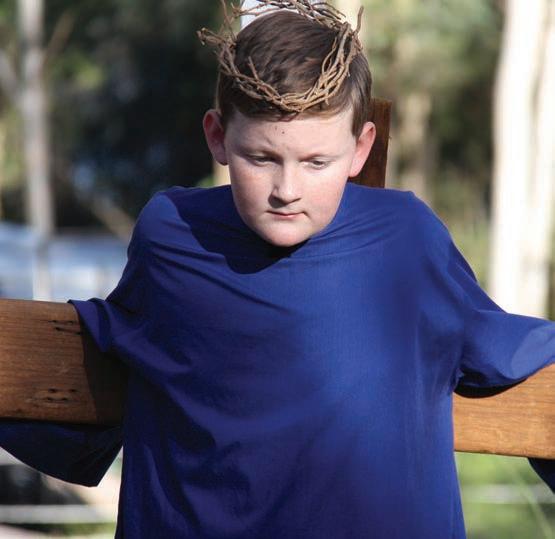
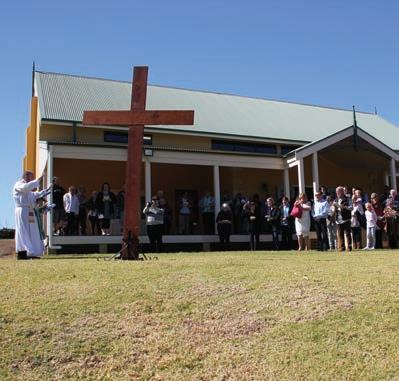
"Jesus" on the cross at Way of the Cross, Kilaben Bay
DIOCESE IS OFFERING RELIEF WHERE IT’S NEEDED
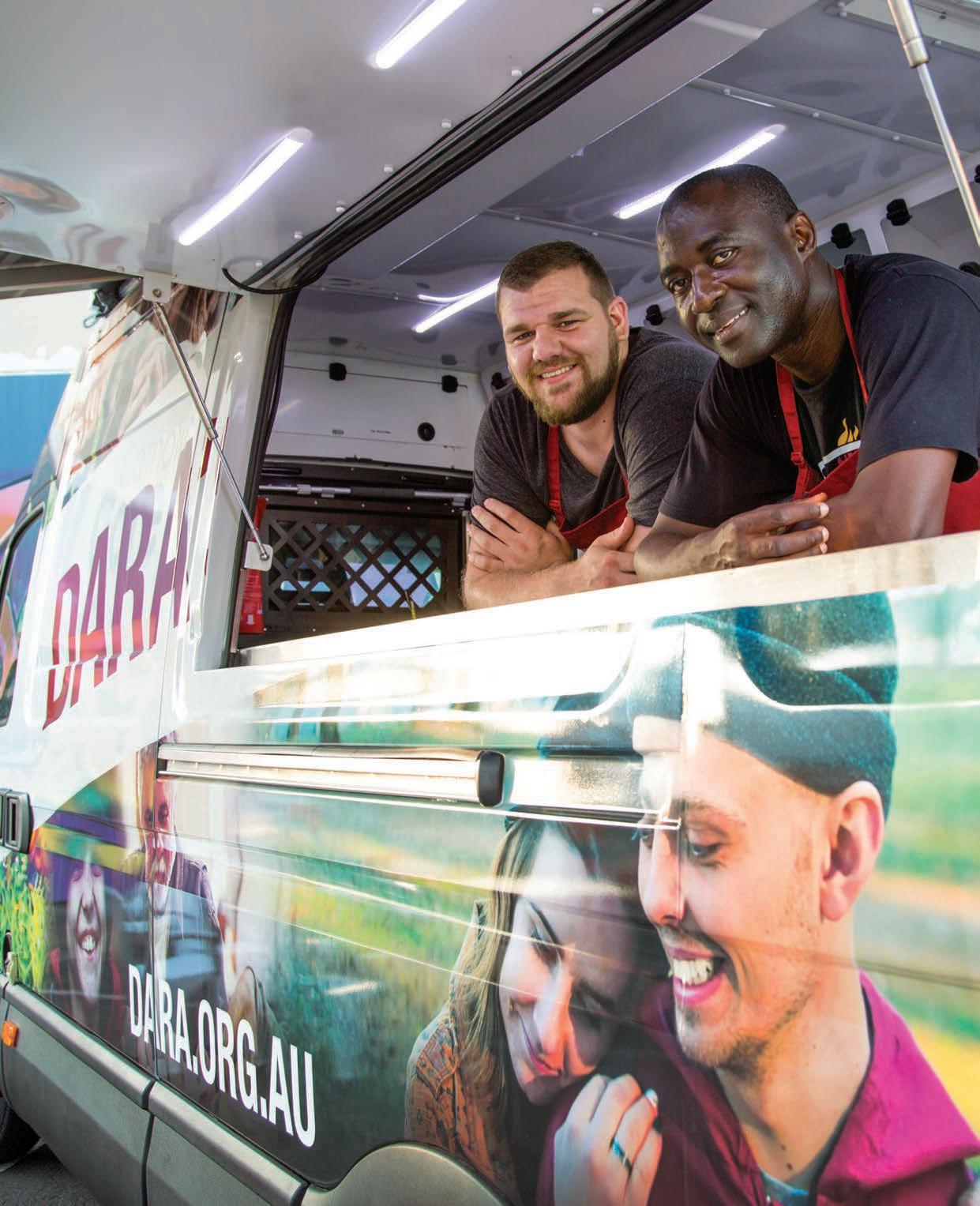
In July this year Bishop Bill advised the establishment of a new agency, the Development and Relief Agency (DARA).
BY BARRY URWIN
DARA’s purpose is to support those in our community who suffer distress, alienation and helplessness resulting from social disadvantage in its various forms.
DARA has responsibility for two key outreach services:
f DARA’s Van, formerly Community Care Van, and f Refugee Hub, formerly Penola House and Refugee Service.
Through these services DARA seeks to provide:
f practical assistance in response to immediate daily needs
f an opportunity for socialisation to reduce the effects of isolation and loneliness
f a caring, supportive and respectful environment to help restore and build self-worth
f access to educational and life skills programs to improve the ability to deal with day to day issues as well as self-development.
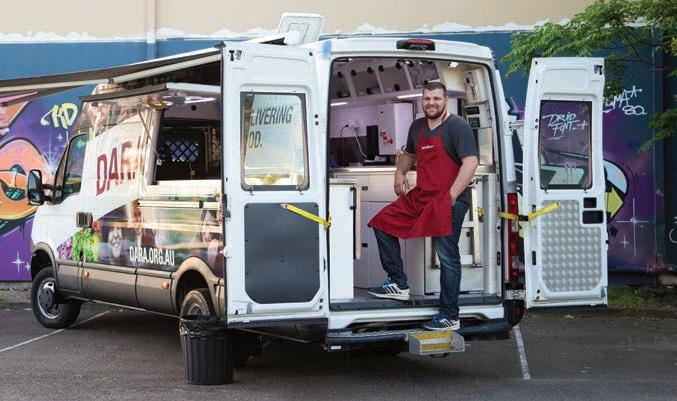
The van that is now DARA’s Van – with the help of generous volunteers – has been supporting those who are homeless or in difficult circumstances each Saturday afternoon at Islington Park. This service is well known amongst the community members who seek its services.
In its expanded role DARA’s Van extends the provision of food to those in need in other areas, including Anna Bay, Raymond Terrace and Maitland, with more services to be introduced.
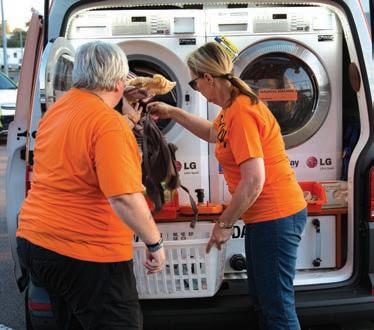
There have been two important developments with DARA’s Van this year; firstly, the sponsoring of Orange Sky Australia with its dedicated Laundry Van which provides free mobile laundry services to the homeless community in the region. Secondly, Baden Ellis, whom many
will know from his work with the youth of the diocese and the pastoral placement program, has been appointed permanent Van Co-ordinator. Baden has commenced managing the logistics of the Van and food supply and co-ordinating volunteer teams and site supervision.
DARA’s Van provides a volunteering opportunity for those who feel they could assist. Vacancies exist in Raymond Terrace and Maitland.
The mobility of both DARA’s and Orange Sky’s Vans enables service to areas not served by existing fixed services. It also allows the provision of services outside business hours.
I’ve been impressed by the wonderful reaction to the expansion of these services and the encouragement from businesses, councils, local Police Commands and the community generally. Many are keen to volunteer and the clients are now starting to see the services on site regularly and to attend in increasing numbers.
Refugee Hub continues to support the many and varied needs of newly arrived families as they attempt to resettle in a new country and culture.
Dedicated staff and volunteers have for many years offered a place of welcome and assistance. They have been able to resolve challenges confronting clients from small issues to complex matters.
One of the major obstacles to assimilation is the language barrier. This has major implications for employment-seeking and dealing with the various challenges that occur in life.
Refugee Hub volunteer tutors have for many years run classes that assist with conversational English to support students of the AMEP/SEE programs − the formal classes provided as part of resettlement packages.
A review of the existing programs has been undertaken to ensure they are meeting the identified needs of the refugee and newly arrived community. From this review a number of new programs is being introduced and planned for the future. A language program more focused on the needs of those seeking employment is a priority.
The need for advocacy and case work continues and keeps staff very busy.
For more information regarding opportunities to assist with DARA’s Van or the Refugee Hub, please visit www.dara.org.au or phone (02) 4979 1142.
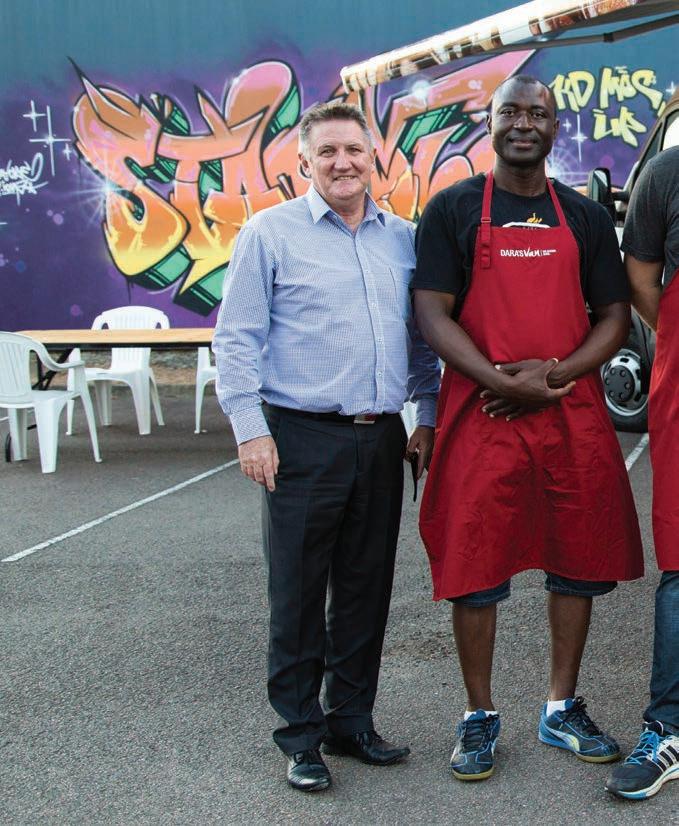
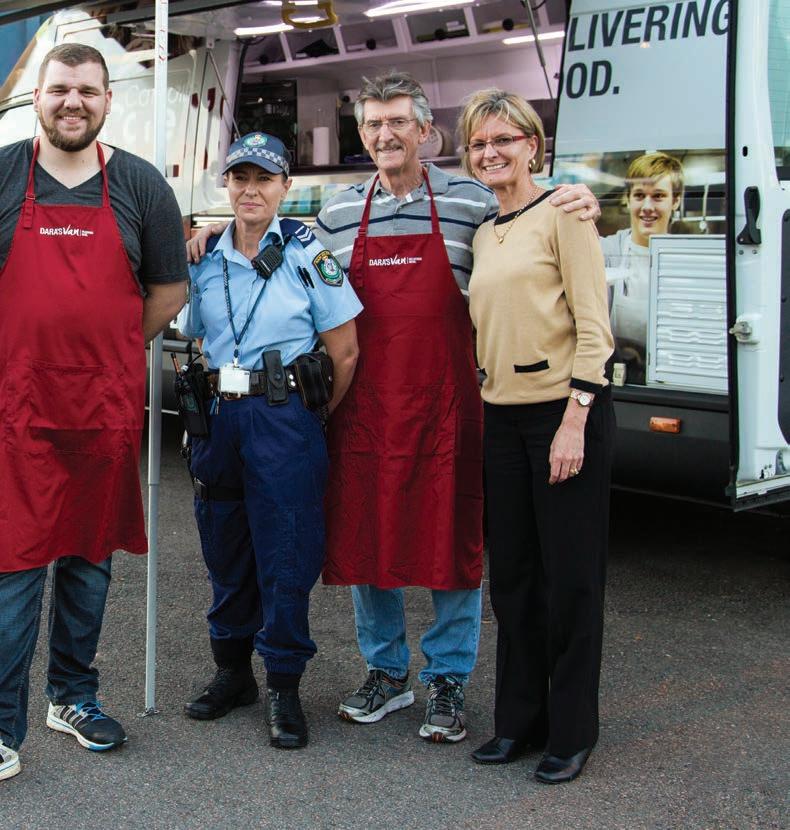
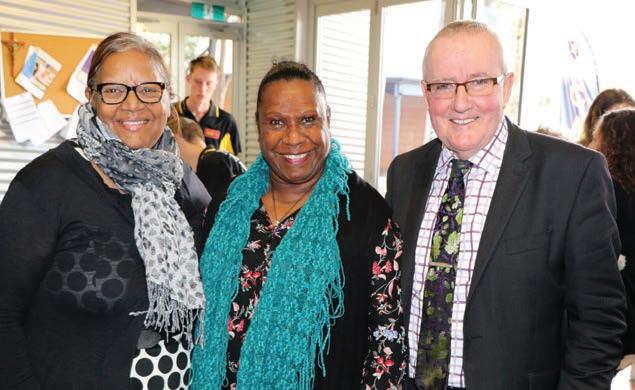
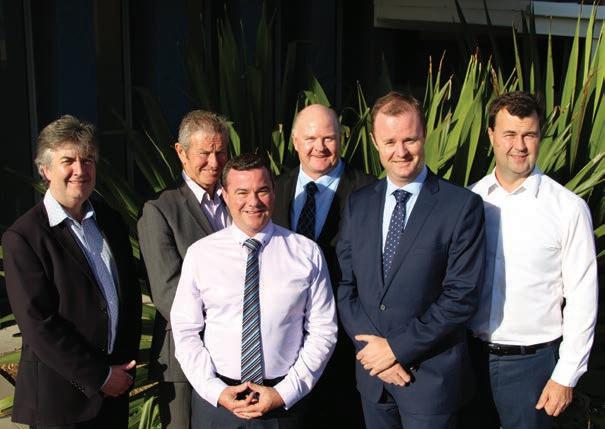
Stewart Murrell, General Manager, MarketPlace Raymond Terrace; John Sandy, Project Officer, Refugee Hub; Baden Ellis, Van Co-ordinator; Snr Constable Alison Stewart, Raymond Terrace Police; Barry Urwin, Manager, Business and Community Engagement; Colleen Mulholland-Ruiz, Centre Manager and Marketing Manager MarketPlace Raymond Terrace
Orange Sky Laundry volunteers
Van Co-ordinator, Baden Ellis with DARA's Van
Dedicated staff and volunteers have for many years offered a place of welcome and assistance. They have been able to resolve challenges confronting clients from small issues to complex matters.
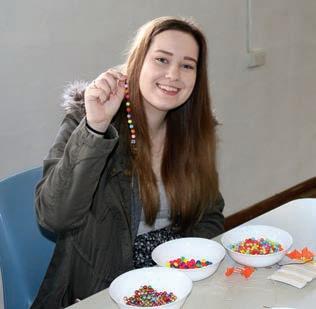
1. Being creative at ‘Be Grow Show’
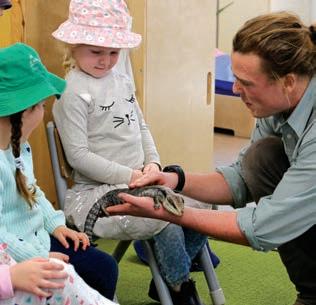
2. A reptilian visitor at St Nick’s, Newcastle West
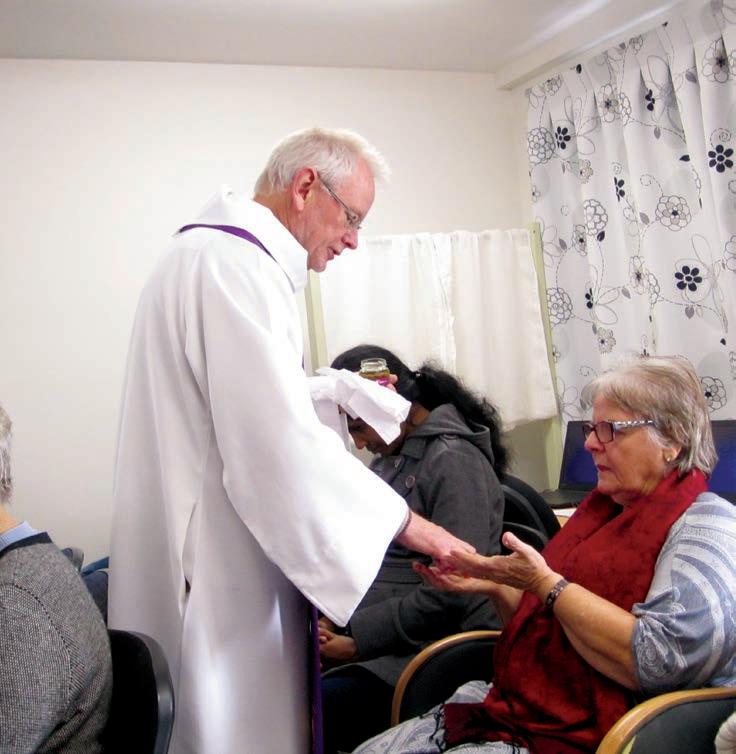
3. The Missionary of Mercy visited parishioners at Old Bar
4. St Joseph’s High School hosted an Upper Hunter Summit at Aberdeen
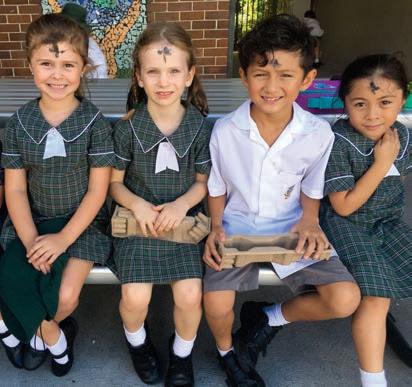
5. Students at Corpus Christi, Waratah, observed Ash Wednesday
6. Sam, Ellen, Teresa and Brooke met to promote the Magdalene Award
7. Helene O’Neill assists at the Family Faith Forum
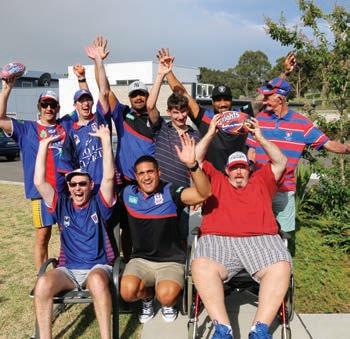
8. Participants from CCSS’ Supported Accommodation Program are keen Knights supporters
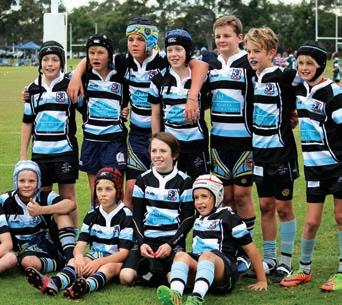
9. The rugby team from St Michael’s Nelson Bay played in the Primary Schools Rugby 7s State Finals at The King’s School, Parramatta
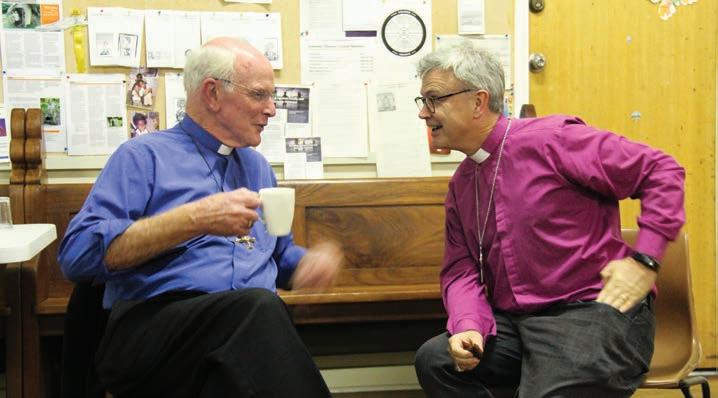
10. Bishops Bill Wright and Peter Stuart taking a break at the Two Bishops Dialogue
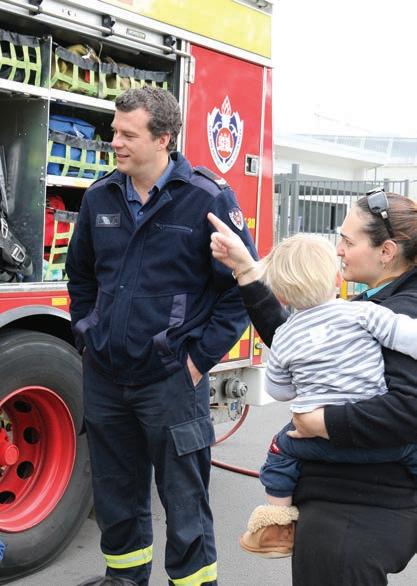
11. Members of the SES visited St Nick’s at Newcastle West
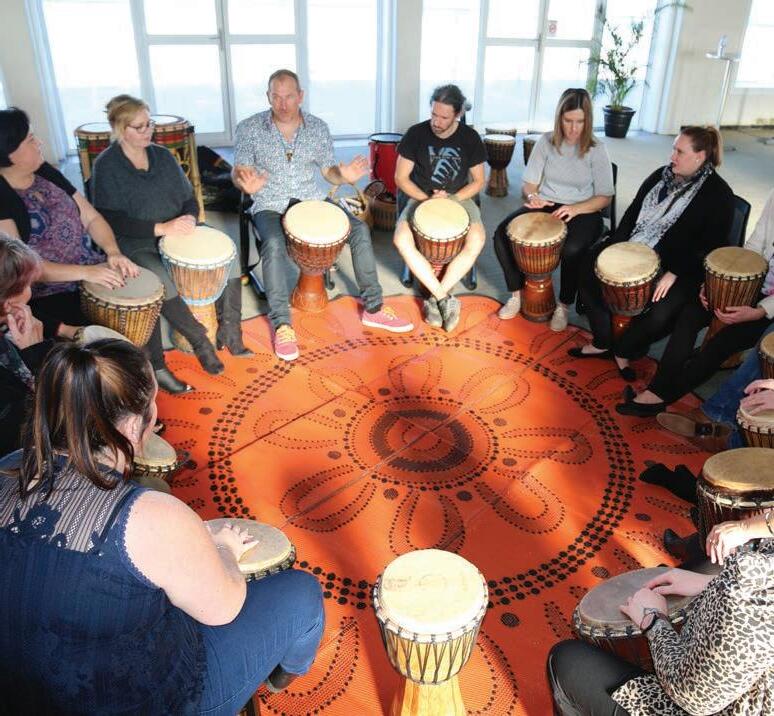
12. Participants at CatholicCare’s annual indigenous art and cultural program
COMMUNITY COMES TOGETHER FOR LINA’S PROJECT
BY JOANNE ISAAC
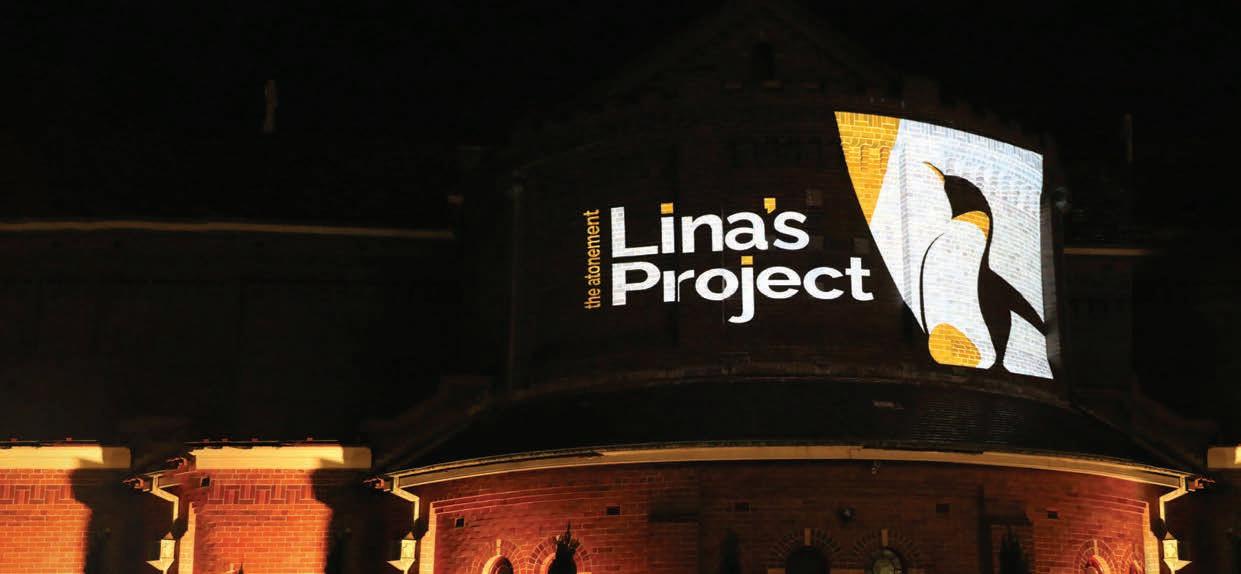
In September the launch event for The Atonement: Lina’s Project took place at Newcastle City Hall.
It was arguably the first time a Catholic diocese had facilitated a project conceived by a victim of child sexual abuse.
Lina, who was abused by a member of clergy in the Diocese of Maitland-Newcastle, devised The Atonement: Lina’s Project as a way of rebuilding her own trust in “my Church” and bringing some healing to the “average, ordinary human beings” whose skin had been “burnt, scorched and blistered” by the actions and inactions of the church.
Lina hoped that by admitting its criminal history and cover-ups at the launch event and then projecting images onto the façade of Sacred Heart Cathedral, the diocese might take a step towards atonement with the community.
The audio-visual presentation has been viewed over 1,600 times, so clearly, people are engaging with Lina’s message. You can watch it on the Lina’s Project website, www.linasproject.com.au. The projection onto the cathedral also saw a significant number of people watching each evening.
Around 500 people attended on Friday 15 September. Victims, survivors, families and friends, clergy, religious, principals, teachers, diocesan staff and many others sat together. The mood was, as Pat Feenan described, “quiet, respectful and sad, which was exactly as it should be”.
ABC presenter, Juanita Phillips, welcomed all and explained how Lina’s Project came to be.
A 16-minute presentation was shown. The focus was the naming of perpetrators of abuse, as well as those who concealed their crimes, but Lina’s voice and words anchored the film and − along with statements from other victims and survivors who lent their voices − gave the presentation its compass.
The silence during the presentation was moving. One person described the event as “beautifully sensitive and heartbreakingly truthful”.
People were invited to attach a piece of ‘shell’ to an ‘egg’ on the stage. This ritual linked to the symbol of the King penguin and egg, devised by Lina and used to promote the event.
Once pieces were attached to the egg it was clear the shell was replaced, but still broken. We can come together and support each other, but must always remain aware of the brokenness of those
affected by abuse.
As so many took part in this ritual, it was clear Lina’s Project had struck a chord.
Guests then shared refreshments and conversation, many acknowledging Lina’s bravery in conceiving the event. One wrote, “Thank you Lina for calling our diocese to a deeper sorrow and determination to help in the healing of all our community.” Chairman, Clergy Abused Network, Bob O’Toole, described the presentation as “difficult to watch but very necessary if healing is to occur”. Deputy NSW Ombudsman and Community and Disability Services Commissioner, Steve Kinmond, and Assistant Ombudsman, Julianna Demetrius, said Lina’s Project was “a wonderful example for the nation”.
Lina’s Project brought some measure of vindication for people who have longed for the diocese to acknowledge its criminal history and cover-ups. There were brave – and understandably wary and sceptical − people in that hall (and watching online). The fact that they put themselves in that vulnerable space spoke volumes about the human heart’s ability to hope; to believe that maybe this time something positive would happen. There was also great community support; one that has been impacted immeasurably by the “obscenities”, as Lina referred to them, revealed in the Special and Royal Commissions. Apologies have been made, but as Bishop Bill acknowledged, “a formal apology can never really be adequate…but it still needs to be said over and over.” The diocese can beg for forgiveness, but its actions moving forward will reveal the genuineness of its intent.
Bishop Bill committed the diocese to hosting regional Lina’s Project events and consulting with survivors and the community to plan a permanent memorial in the grounds of Sacred Heart Cathedral. From 2018, 15 September will be a perpetual day of remembrance and the diocese will also be working with schools, particularly sites of abuse, to plan events of acknowledgement. There is a form available on the Lina’s Project website and everyone is invited to share suggestions for events and projects that may help individuals and the community find a measure of healing. These ideas will be published on the Lina’s Project website early in 2018. Listening and collaborating will be the key to bringing atonement.
Without Lina, none of this would have been possible. Lina’s being brave enough to trust the diocese to facilitate her ideas allowed the diocese to take a step in the right direction.
LOOKING FORWARD –LOOKING BACK
BY SEAN TYNAN
For those responsible for the management and oversight of child protection services in the Diocese of Maitland-Newcastle, 2017 feels incomplete.
At the time of writing this article, mid-November, we await the publication of the reports into case study #43 (Vince Ryan and certain Marist Brothers) and #50 (the so-called ‘Catholic Wrap Up’). It was expected that these reports would be published prior to the Royal Commission submitting its final report to the Governor-General on Friday 15 December; however, that may not be the case. We understand that the Commonwealth Attorney-General’s Department will have the responsibility to manage the Royal Commission’s legacy issues, so publication of these case studies may be managed by the Attorney-General’s Department and occur some time in 2018.
This is unfortunate, as I expect both case studies will provide the diocese with intelligence, an independent and expert critique of our current practices. Please don’t misunderstand, Case Study #43 will be grim reading. It is expected that the diocese will be the subject of adverse findings for its historic failures to stop Ryan’s sexual abuse of multiple victims and possibly, some of our former leaders’ conduct towards the Police investigation headed by then Police Officer Troy Grant. It is also expected that the Royal Commission will have analysed the evidence submitted by the diocese and statutory authorities and provided by survivors and their families as to how the diocese now conducts itself and the systems in place for the protection of children today. It is important intelligence to assist diocesan leaders in taking our practices into the post-Royal Commission phase that begins in 2018.
What might that look like? Based on historical models, notably NSW after the ‘Paedophile Inquiry’ conducted by Justice James Wood c. 1994-7, there will be a period of government activity in the first year or so, including the circulation of multiple discussion papers to help inform the implementation of the Royal Commission’s recommendations, followed by revisions to existing and new legislation being introduced to parliament. Assuming passage of the legislation, this will then trigger a period of changes to existing − and potentially construction of new − child protection infrastructure. However, whereas previous changes have been localised to state or territory, what should be different now is the community’s expectations that the Commonwealth, state and territory governments finally action
a national child protection framework and, amongst other things:
1. establish a national compulsory pre-employment screening scheme for people who are seeking to work (as employees, contractors or volunteers) with children,
2. allow for the exchange of child protection information by community agencies across state and territory boundaries, and
3. establish a comprehensive, national ‘employment-related child protection oversight system as per NSW’s Ombudsman’ scheme.
In 2018 the people of the diocese will still be rocked by the criminal trials of trusted and often beloved leaders and we will still need to address claims for compensation for harm caused by abuse. Bishop Wright has been consistent and clear. As a diocese we will continue to atone for our terrible history, we will continue to work with survivors and their families to find more effective ways of supporting their individual healing journeys and develop ways of acknowledging this reality. Equally, we understand our failure to protect children is not the whole of our history and is not our future.
The year 2018 will be the beginning of the next phase of child protection in the diocese, where we will be challenged to integrate the multiple findings and recommendations from the Royal Commission and continue to work to rebuild the trust that the community has lost in our institution. There is no expectation that trust will return in the foreseeable future; equally it is expected that the diocese will continue to be the subject of adverse and critical coverage by some media. None of that devalues the importance of the work undertaken to date nor the commitments we have made to promote the safety, welfare and well-being of children in the diocese. In the end we can − and must − stay true to our purpose, open to new learning and sensitive to critical assessment but not discouraged by inevitable criticism. The work of Zimmerman Services is unending and just as vital today as when Bishop Malone established the centralised specialist child protection model in 2005. I expect that the prominence of Zimmerman Services will begin to fade over the coming year, as it should, to become one of the vital but every day and expected functions of the institutional church.
MESSAGE FROM BISHOP BILL
As readers would know, a 2017 ‘Year in Review’ message needs to be reflected on and composed well before the end of the year, for all sorts of reasons.
As I’m reflecting (and with just a little pressure to actually write!) my thoughts are very much dominated by the Lina’s Project event of 15 September. As I have said elsewhere, we welcomed more than 500 people to come together and witness the diocese admit, with shame, the crimes of church personnel and the church’s cover-ups and failures to report allegations of child sexual abuse.
Since that evening, other related initiatives have occurred and it’s my hope that, over time, the wider community will begin to understand that the church in this region continues to seek healing, and specifically, to engage in dialogue about how that can best be facilitated.
There are many areas in which the diocesan church longs to do better and to this end, significant decisions have been made around the foundation of Leadership & Structure. Some of you will know that members of my executive, with some external support, have been working towards greater alignment of the various ministries that are co-ordinated from Cathedral House. The Curia – the members of the executive with whom I work closely – have looked at ways of helping staff to work more co-operatively and with less duplication. This project has been named “Many parts. One body. One mission.” and while it has not been without its stumbling blocks, I remain committed to its implementation and to greater collaboration across agencies and ministries.
One reason for this determination is the scope of expansion of works and ministries across the diocese. New schools, new St Nicholas Early Education Centres and affordable housing in a number of areas have increased the diocesan footprint, not merely in terms of assets and works, but more importantly, in terms of contributing to the community, especially in serving the vulnerable and marginalised. An unintended consequence of this development, satisfying as it is, can be an increasingly disparate organisation. So while there are Many parts, it is very much my desire that there be One body. One mission.
While seeing new schools move from drawing board to ground-breaking to blessing and opening is also very satisfying, it has been a year of celebrations of significant anniversaries in a number of our schools. St Mary’s Campus, All Saints College, Maitland, marked the sesquicentenary of the arrival of the Dominican Sisters in 1867, and San Clemente High School and St Columban’s Primary, both at Mayfield and both owning a strong Dominican heritage, have celebrated
centenaries. St Kevin’s Primary at Cardiff is also marking one hundred years of Catholic education. I have enjoyed participating in various celebratory occasions, particularly observing the ways in which the founding charisms continue to thrive.
It was a pleasure to meet the young founders of Orange Sky Laundry, Nic Marchesi and Lucas Patchett, at the launch of both Orange Sky Laundry and DARA’s Van. DARA is the diocese’s Development and Relief Agency, which is working in partnership with Orange Sky Laundry to provide the opportunity to wash and dry clothes, to enjoy a hot drink and a meal, and just as importantly, to sit down and chat to friends who are non-judgemental and genuinely committed to outreach that is not aligned to any church or cause other than that of humanity.
On the national scene, a Plenary Council will be held in 2020 and a number of preparatory steps have been taken. Such structures are of course necessary to ensure an effective event, but just as necessary will be a collective willingness to be open-hearted, to be willing to hear more than the usual voices and views, to work towards strengthening a truly Australian church and to echo, in as many ways as possible, the vision of Pope Francis for a “field hospital” church.
It is my strong hope that here in Maitland-Newcastle we, as a diocesan community, will contribute to the Plenary Council in ways that will build up our local church and help us regain some of our earlier vim and vigour.
These are not easy times. The church has lost much of its credibility and responses to a variety of recent legislative proposals have demonstrated that at best, the church’s voice is just one among many. Often, it’s a voice derided.
Nevertheless, I commend to you the voices of this review!
This is important: to get to know people, listen, expand the circle of ideas. The world is crisscrossed by roads that come closer together and move apart, but the important thing is that they lead towards the Good.
Pope Francis in an interview with Eugenio Scalfari of La Repubblica , 2013.
Most Reverend William Wright Bishop of Maitland-Newcastle
2017 Leadership Team
FATHER BRIAN MASCORD
VICAR GENERAL
There is a saying, “How time flies when you’re having fun.” I can’t say it’s all been fun, but 2017 has certainly flown. This year has posed many challenges, and many blessings, as we recognise how to work in the ‘bigger picture’ context of the Church, without losing sight of each of our local communities.
f We have celebrated, recently, the 500th anniversary of Martin Luther’s placing his 95 Theses upon the door of the Wittenberg Cathedral, challenging much of what the Church was teaching at the time.
f Bishop Bill has led dialogue with our brothers and sisters from different faith traditions and Christian churches.
f Lina’s Project was an initiative that offers us all an opportunity to move together towards healing and atonement.
f We have celebrated those who have ministered among us, especially Fr Richard Shortall sj, who has moved around our diocese offering a listening ear and a prayerful heart to many in communities which no longer have a resident priest and others who felt distant from the Church.
f Diocesan pilgrims spent 15 days in the Holy Land, walking in the footsteps of Jesus. One of the highlights was the celebration of Mass in the empty tomb, which for many, was a powerful experience of recognising that the tomb is empty, and in the angel’s words, “He is not here, he is risen.”
This year I celebrated my silver jubilee of priestly ordination. Twenty-five years ago I took as my motto, from St Paul’s letter to the Thessalonians, “For all things give thanks” − and I do. This has been a time to look back, to remember, and to dream where we may be in the future. Both experiences are rather scary! I look at the possibilities at a time when vocations to the priesthood are not so forthcoming. As a priest of our diocese I have had many wonderful – and many painful –experiences. Through it all I have been conscious of the presence of God. I am grateful to those who have supported and challenged me over the years.
The Church I was ordained for has radically changed. The community is diminishing and ageing and we are continually confronted with the question, “Where are our people?” Society has changed in so many ways
Loyalty to an institution, and I don’t necessarily mean the institution of the Church, is no longer valued, and people serve the community in many different ways, not necessarily in the church of their childhood.
too. Loyalty to an institution, and I don’t necessarily mean the institution of the Church, is no longer valued, and people serve the community in many different ways, not necessarily in the church of their childhood.
Yes, we do have men in formation for priesthood, but the majority are not Australian-born, a significant development. This, however, is where we stand today. We are a Church of many cultures, many gifts and many people, all belonging to that which we call the Catholic Church, all sharing in the mission that belongs to Jesus. The mission is not ours − it is God’s mission. When we renew our baptismal promises, we recommit ourselves to the mission of God.
Recently I spent three days with the senior leaders of six of our secondary schools, an amazing group of young people. Whilst we were together I spoke to them about their role as leaders in the diocese, not just in their schools. At first it was difficult for them to see past their ‘patch’, but as the days unfolded this group began to speak in a voice arising not from a small territorial space, but from a much bigger place.
We too can become very territorial in our attitude toward, and our place in, the church. We share something very profound. We are many parts of the one body, sharing the one mission of Jesus and this is what we celebrate every time we gather as a faith community. We celebrate the empty tomb, the listening ear, the prayerful heart and the conversation that leads to understanding between people. I believe that God is in all these experiences.
Rev Brian Mascord Vicar General of Maitland-Newcastle
FATHER MATTHEW MULLER CHANCELLOR AND CANONICAL ADVISOR
This time last year I was just beginning my new role. I would like to take this opportunity to share some of the achievements that have occurred since then.
In co-operation with Teresa Brierley, Fathers Brian Mascord, Peter Rees and Tony Brady, we have worked to finalise a religious house in the diocese for six Sisters from the Congregation of the Immaculate Heart of Mary, Nha Trang (Vietnam). At the moment Sisters work in Wallsend-Shortland and Sugarloaf Parishes.
The clergy and the lay leaders involved in parish leadership have developed a draft handbook on faculties and instructions. This booklet clarifies their responsibilities, delegations, permissions and accountabilities and will assist them in their ministry. The process we used in developing this draft handbook utilised workshops, individual contributions and open forum discussions to achieve a wide level of agreement and support for the document. It is hoped to finalise the document in 2018.
The clergy in partnership with the Trustees of the Diocese, the Council of Priests and the College of Consultors also worked through a similar consultative process to draft a set of statutes that define how each of these bodies will operate. These statutes allowed new members of these
bodies to be appointed in February 2017. Given recent civil law changes and the development in civil law to place more responsibility on the Trustees of the Diocese for civil law compliance, such clarity is essential. I am grateful to Nicola Arvidson (our in-house legal counsel) and Peter Owens, for their civil law support in this process. To assist the Trustees in understanding the change in their responsibilities, especially within Catholic Education, a training day on Catholic education governance was organised. The Trustees will continue to work with the compliance officers in each of the diocesan agencies to ensure compliance with all government legalisation.
Workshops were run throughout 201617 to assist those in parish leadership to understand their role in complying with civil legislation. These workshops included topics such as child protection, human resources and volunteers, professional supervision, ongoing formation processes, workplace health and safety, outcomes from the Royal Commission, bequests and wills, and school-parish licence agreements. The next step in this process is a planning day involving all parish leaders to develop a formation plan for 2018-19.
I look forward to continuing this ministry and working with all concerned in the coming year.
Rev
Matthew Muller Chancellor and Canonical Advisor
Being a disciple means being constantly ready to bring the love of Jesus to others, and this can happen unexpectedly and in any place: on the street, in a city square, during work, on a journey.
Evangelii Gaudium - The Joy of the Gospel n127
WHAT IS CANON LAW?
Canon Law is the system of law and legal principles that the Catholic Church utilises to assist in the salvation of souls. Thus the laws direct the structures, systems and procedures of the Church to this end. It is also the way in which the Church articulates and protects the rights of all the baptised. The current Code was issued by Pope John Paul II in 1983.
SEAN SCANLON
VICE CHANCELLOR ADMINISTRATION
This past year has seen a great deal of change within the diocese and this is likely to continue for the foreseeable future. The Bishop’s Many Parts. One Body. One Mission. Project has seen an intense focus on the way the many parts of the diocese work together and collaborate to deliver more effective services. The project seeks to utilise the full array of skills across the church and leverage the benefits of being a diverse church. We want to do more with the limited resources available whilst satisfying the governance requirements of the funds entrusted by the Catholic community, government and other funding sources. Developing centres of excellence in the support services that are common to all agencies should improve services and free up resources to help our schools, CatholicCare, St Nicholas Early Education and parishes do what they do best – support our communities.
Governance has been and is likely to remain an area of continued expectation for the diocese. There is no doubt
that the community has heightened standards which need to be met. This will mean greater transparency and disclosure. We have taken steps in recent times to provide the community with more information regarding church finances and activities. This has been welcomed and will continue, even though at times it is uncomfortable.
Meeting the diocese’s obligations to survivors of abuse has been extremely challenging over the past year. The Royal Commission has been an intense time for the people affected and this has meant greater support to meet this need. This responsibility has been met but has put pressure on other activities. The finances of the central Curia are having to be closely managed to ensure that services continue whilst meeting the significant obligations of compensation.
The finances of schools and CatholicCare remain strong and well resourced. The challenge is to ensure that these services are well connected to each other and the broader diocese.
On a more uplifting note a further two affordable housing projects have been delivered in Maitland and at Booragul. The Mount Hutton project is close to finalisation. This will bring the number of dwellings available to 86.
The Catholic Development Fund (CDF) continues to provide an important funding source for the diocese and its many projects. In the past year it has funded the building of childcare centres, housing, school projects and the purchase of new CatholicCare offices at Muswellbrook. The CDF has put off seeking a licence from APRA in favour of an Australian financial services licence (AFSL). This will strengthen
The demand for the high quality child care provided by St Nick’s has been overwhelming
the compliance and security for supporters of the CDF. This means some changes to the arrangements of lay depositors but the personalised service will remain unchanged.
St Nicholas Early Education has been an outstanding initiative. The demand for the high-quality child care provided by St Nick’s has been overwhelming. We can’t build centres fast enough! In late 2017 three new centres at Cardiff, Lochinvar and Chisholm will be ready to open. The model of linking St Nick’s centres to Catholic primary schools has proven a huge attraction to families. The single drop-off and transition programs make the St Nick’s offering convenient and an earlier starting point for building Catholic communities. More centres are being readied and we expect that families will soon be able to access services at Maitland, Branxton, Gillieston Heights and Raymond Terrace. A training centre is also being planned.
We also launched DARA (Development and Relief Agency) with the community van being relaunched and established a groundbreaking partnership with Orange Sky Laundry. These revitalised activities assist the most marginalised in our community. We expect that these initiatives will bring greater community engagement and participation.
Overall the past year has seen many highlights. The positives have provided a source of great encouragement. The green shoots of regrowth have given everyone involved a sense of expectation and satisfaction. The work will be in delivering even more projects at a faster pace.
Sean Scanlon Vice ChancellorAdministration
TERESA BRIERLEY
VICE CHANCELLOR PASTORAL MINISTRIES
Th e pastoral works of the Catholic Church in the Diocese of Maitland-Newcastle take place in our parishes, schools, hospitals, aged care facilities, community aged care programs and with the St Vincent de Paul Society. I am responsible, with Bishop Bill, to ensure that the pastoral ministries outside these areas are addressed. Our five diocesan Councils ensure that most of these are identified and actioned.
During 2017 the Ecumenical and Interfaith Council has held conversations with people of other Christian variants and faith traditions to facilitate understanding. The Hunter Interfaith Network has provided opportunities for the people of the Abrahamic Faiths to support each other and to stand in solidarity around the belief that ‘faith matters’, particularly in a time of skepticism regarding faith and religion.
The Social Justice Council held a Forum to look at Hunter Youth Future Employment and the 2017-18 Social Justice Statement released by the Australian Catholic Social Justice Council invites us to consider Everyone’s Business: Developing an inclusive and sustainable economy. This council has highlighted supporting those struggling in the area of mental health. As part of the Hunter Ecumenical Social Justice Network, we took part in the Give Us a Sign Campaign focusing on Australia’s First Peoples. In May it was 50 years since the Referendum which voted to
improve the services available to Indigenous Australians. The Social Justice League attempts to give a social justice platform to young adults.
Since the 1992/93 Diocesan Synod the importance of people being formed in their faith has been emphasised. This is the key task of the Adult Faith Formation Council, a role that until this year was shared with the Sisters of St Joseph and the Tenison Woods Education Centre (TWEC). In May, the work of TWEC was handed to the diocese in a ceremony acknowledging the dedication of the Sisters of St Joseph in forming people, individually and communally, for mission and ministry. Throughout the year we have been blessed to have great theologians share their expertise – Fr James McEvoy, Massimo Faggioli, Richard Gaillardetz and John May. Over 50 years since the Second Vatican Council, Catholicism as a way of life is still being revealed, particularly through the words and actions of Pope Francis.
Liturgy is a public action, a ritual action and a symbolic action. In the proclamation of the Word, God speaks to us; in the breaking of the bread, we recognise Christ. We participate by responding, singing, listening and gesturing. This understanding of sacred liturgy accounts for the work of the Liturgy Council across our diocese. This council looks at our many liturgical expressions and seeks to serve, form and prepare those who are engaged in bringing others to full participation in our church.
When one gathers with a group of committed Catholics, the greatest concern is the lack of young people present. The Diocesan Council for Ministry with Young People (DCMYP) meets monthly to foster and support a diocesan community that provides formation, faith-filled life experiences and evangelisation for young people. In October 2018, Pope Francis will hold a Youth Synod in Rome on Young People, The Faith, and
we remove our sandals before the sacred ground of the other
Vocational Discernment. Our participation in this Synod process has involved about 800 young people participating in an online survey and a number attending Focus Groups, resulting in a diocesan report being compiled and sent to ACBC. A great deal of energy has gone into organising the Australian Catholic Youth Festival to be held in Sydney in December. The DCMYP continues to hold regular events – Pints with a Purpose, Seven at Sacred Heart, Be Grow Show Retreat and Praise and Worship events.
The Diocesan Pastoral Council has been engaged with Bishop Bill, seeking to discern the way forward for the diocese. There has been some discussion around a diocesan Synod.
Apart from the work of the Councils, those involved in Chaplaincies (clergy, CatholicCare, hospitals, prisons, port, university, aged care, armed services and industry) provide face-to-face encounters or spiritual accompaniment with those in the various settings.
This year we have also been blessed with the continuing ministry of Fr Richard Shortall sj as our Missionary of Mercy. He has presented Prayer in Everyday Life and Discernment in a number of parishes. Many have been renewed because of Fr Richard’s gentle, merciful presence.
Pope Francis reminds us in Evangelii Gaudium (n169) that we are in dire need of Christ’s closeness and his personal gaze. We must all be initiated into the art of accompaniment which fosters a proper disposition towards others so we “remove our sandals before the sacred ground of the other”. (Ex 3:5)
Teresa Brierley Vice Chancellor Pastoral
Ministries
MICHAEL SLATTERY DIRECTOR OF CATHOLIC SCHOOLS
Catholic schools in the Diocese of Maitland-Newcastle have continued in 2017 to experience growth and success in delivering high-quality Catholic education in a caring, pastoral environment.
I am proud of the contribution of Catholic schools to the life of the diocese and the local parish communities. Some 20,000 students have benefited greatly from faithfilled staff who have worked with parents and parish clergy to form them for life.
Our Catholic schools are a service to the Church and the community as they support the growth and faith of the students in a world full of challenges. Schools have continued to work collaboratively with communities to develop the faith and learning opportunities of our students.
I am drawn to the prayer of Teresa of Avila that suggests that school communities are developing individuals who recognise that Christ has “no hands but yours” and refer to the important work of being Christ-like, taking a counter-cultural view of secular society and working for the greater good
of the Kingdom. We are a values-driven system of schools and certainly countercultural, refusing to accept the societal norms of racism, sexism, homophobia and violence toward women. Our schools challenge those who don’t strive to assist others. They encourage giving to the poor in handfuls, working to be more tolerant, and accepting diversity within our Australian culture – whilst practising reconciliation and forgiveness. The generosity shown by school communities was evident in the $45,162 contributed to Caritas’ Project Compassion, St Vincent de Paul Society and Mercy Week appeals and other charitable works that were supported by individual schools.
Catholic Schools Week was a real highlight with a celebratory Mass and the announcement of the Bishops’ Awards to several schools and individuals. It was a joyous event with the cathedral full of clergy, teachers, students and parents –each celebrating a special moment.
The learning agenda remains a key feature of Catholic education and 2017 saw the launch of the Learning Framework for Catholic educators in our schools. This framework represents many hours of collaborative work steeped in best practice from leading world educators. It will serve our teachers well and improve learning outcomes for our students.
and refurbishment works to support pedagogical provision in the classrooms.
Our annual Vivid campaign showcased the mission and identity of our schools and the wonderful programs on offer in our primary and secondary schools. Also showcasing the talents of our teaching staff and students was DioSounds and ASPIRE’s
The Hoarders Next Door . These events placed on display a unique array of musical and theatrical talent. The performances had audiences spellbound.
Catholic education in Maitland-Newcastle prioritises a school improvement agenda in a highly-visible and accountable manner. One can observe the promotion of equity and excellence to create young people who are sound learners, faith-filled and compassionate people, and active and informed Australian citizens. It is impressive to visit our schools and observe the living examples of programs which enhance faith, diverse student-learning needs, literacy and numeracy, leadership, early learning and social justice.
Christ has no body but yours, No hands, no feet on earth but yours.
Memorable aspects of the year include the preparation of Gateshead and Lochinvar communities for the inclusion of Stage 6 education and the Higher School Certificate. Construction of St Bede’s Catholic College at Chisholm has begun and planning for Catherine McAuley Catholic College, Medowie, is underway. Several other school sites have experienced significant capital
The Catholic Schools Office and our schools have embraced the Many Parts. One Body. One Mission. initiative which aims to unite the agencies of the diocese as never before. These include the Chancery, Zimmerman Services, St Nicholas Early Education and CatholicCare Social Services. There has been remarkable progress in this initiative with strong outcomes for all agencies within the diocese.
Michael Slattery Director of Schools
GARY CHRISTENSEN
DIRECTOR, CATHOLICCARE SOCIAL SERVICES
t is with great pleasure that I report for the Year in Review. Throughout the last 12 months, the social services sector has been in the midst of some of the most significant reforms the sector has seen in both the out-of-home care and disability services spaces. The changes in the sector have led to a considerable period of change at CatholicCare. This has given us the prospect of new beginnings as well as great opportunities to grow and improve so we can continue to deliver services to vulnerable people in our local communities.
CatholicCare is an agency that provides a diverse range of supports, encompassing early-intervention child protection, permanency-support programs, disability services, mental-health programs and counselling and psychology services. As I reflect on the year I am encouraged by, and proud of, the selfless work of our dedicated team of staff, foster carers and volunteers, every day, in supporting vulnerable children, families and individuals.
The professionalism and commitment of the staff and carers who do this work has been recognised this year as we received a new five-year funding agreement from NSW Family and Community Services for our permanency support program (OOHC). We were also successful in our application
to participate in the Safe Care three-year pilot as part of our Brighter Futures earlyintervention child protection program.
In addition, I am pleased to report that CatholicCare was granted a new threeyear funding agreement for our integrated family and domestic violence program in the Manning region. One in six Australian women, and one in 20 Australian men have, since the age of 15, experienced physical or sexual violence from a partner they have lived with, according to Australian Bureau of Statistics (2013). CatholicCare is committed to working in partnership with NSW Family and Community Services, other non-government agencies and the wider community to implement strategies to prevent domestic and family violence, intervene early with individuals and communities at risk, support victims, hold perpetrators to account and provide community education that assists in changing attitudes, social norms and structures that contribute to domestic and family violence.
I would also like to acknowledge with gratitude the dedicated volunteers at the Taree Community Kitchen who have served over 5,000 meals to friends in need in the local community over the last year. The Taree Community Kitchen is a collaboration between church and community that has made a significant impact on those in need in the Manning Region. None of this would be possible without the generous support and donations provided by local businesses from the area every week. For this, I say a heart-felt thank you.
Being responsive to local needs is at the heart of everything we do at CatholicCare. It is our strategic intention to ensure that we have a footprint in each part of the diocese and this intention saw us expand our services in the Upper Hunter with new offices at Muswellbrook and Singleton
I am proud of the selfless work of our dedicated team of staff, foster carers and volunteers.
and a new satellite office co-located in the offices of Holy Name Parish, Forster, on the mid north coast. In addition, we formed collaborative partnerships with St Clare’s High School, Taree, and St Mary’s College, Gateshead, in an effort to provide support and programs to students in these locations.
As we embrace this time of change it seems fitting that we have just finalised our new three-year strategic plan that will take us through to 2020. This plan sees us focus on ensuring that children and young people have a safe home for life, people with disabilities have choice and control over the supports they receive and we continue to seek to provide individual and integrated support services, aligned to local needs.
In closing, I would like to acknowledge and thank the members of the CatholicCare Advisory Board for the ongoing support, advice and expertise they provide to ensure CatholicCare meets its governance obligations and continues the provision of high quality social services in the community on behalf of the Diocese of Maitland-Newcastle.
Gary Christensen Director, CatholicCare Social Services
In 2017 there were 58 Catholic Schools in the Diocese of Maitland-Newcastle
19,235
is the total number of Catholic school students enrolled in 2017
1,643 followers
17,980 views
Primary students 8,488 Secondary students 10,747 programs offered through CatholicCare Social Services Hunter-Manning
21
Social media for mnnews.today
236 followers
286 followers
Social media for the CSO 5,005 followers 295 followers 677 followers 31,900 views
Social media for CatholicCare
495,000
1,145 followers 163 followers 11,058 views Copies of Aurora were distributed between February & December 2017
There are currently
159,151
Catholics in the region (National Church Life Survey)
Parishes in the Diocese of MaitlandNewcastle 38
39
Ministries of the diocesan church
64 Clergy
24 incardinated, 10 international, 1 religious, 1 on loan, 18 retired and 10 deacons
13 Religious congregations
926,959
Unique website visitors: mnnews.today, diocesan, CatholicCare, CSO, CDF, St Nicholas Early Education, Lina’s Project & DARA websites
THE FIVE FOUNDATIONS
(ACTS 2:42-47)
The ve foundations inform the ways the people of God in our diocese are disciples. The stories and images on the following pages are representative of people working across parishes, schools, social services, religious congregations and chancery ministries. We acknowledge the myriad ways in which the Catholic Church provides vital outreach within our communities. At the centre of each story is Jesus. The following pages, and the quotations from Pope Francis on this page, illustrate just a fraction of the many ways in which the people of the Catholic Diocese of Maitland-Newcastle live their faith every day.
WORSHIP & PRAYER
GATHERS PEOPLE FOR PRAYER, SACRAMENT AND LITURGICAL CELEBRATION... IS EUCHARISTIC IN LIFE AND WORSHIP.
“Often, in face of a burden of life or a situation that pains us, we try to talk about it with someone who listens to us, with a friend, with an expert... It is a great good to do this, but let us not forget Jesus! Let us not forget to open ourselves to Him and to tell Him about our life, to entrust people and situations to Him.”
Angelus 9 July 2017
MISSION & OUTREACH
ENGAGES PEOPLE IN THE TRANSFORMATION OF SOCIETY - OUTREACH THROUGH MERCY AND JUSTICE - TO BUILD THE KINGDOM OF GOD.
“I prefer a Church which is bruised, hurting and dirty because it has been out on the streets, rather than a Church which is unhealty from being con ned and from clinging to its own security. I do not want a Church concerned with being at the centre and then ends by being caught up in a web of obsessions and procedures.”
Evangelii Gaudium n49.
IDENTITY & COMMUNITY
FOSTERS COMMUNITY, HOSPITALITY, WELCOME AND RESPECT... AN IDENTITY GROUNDED IN COMMUNIO.
“Jesus fell in love with our smallness and it is for this reason he chose us. He chooses the smallest - not the greatest, the smallest - and reveals himself to the little ones. We have been chosen because of love and this is our identity. If you want to understand something of the mystery of Jesus, lower yourself.”
Feast of the Sacred Heart 2017
FORMATION & EDUCATION
FACILITATES SPIRITUAL GROWTH AND PROMOTES EMPOWERMENT THROUGH EDUCATION AND FORMATION.
“I invite all Christians, everywhere, at this very moment, to a renewed personal encounter with Jesus Christ, or at least an openess to letting him encounter them; I ask all of you to do this unfailingly each day. “
Evangelii Gaudium n3.
LEADERSHIP & STRUCTURE
FOSTERS EFFECTIVE CHRISTIAN LEADERSHIP, COMMUNICATION, ORGANISATIONAL AND MAINTENANCE STRUCTURES.
“Pastoral ministry in a missionary key seeks to abandon the complacent attitude that says: “We have always done it this way”. I invite everyone to be bold and creative in this task of rethinking the goals, structures, style and methods of evangelization in their respective communities.”
Evangelii Gaudium n33.
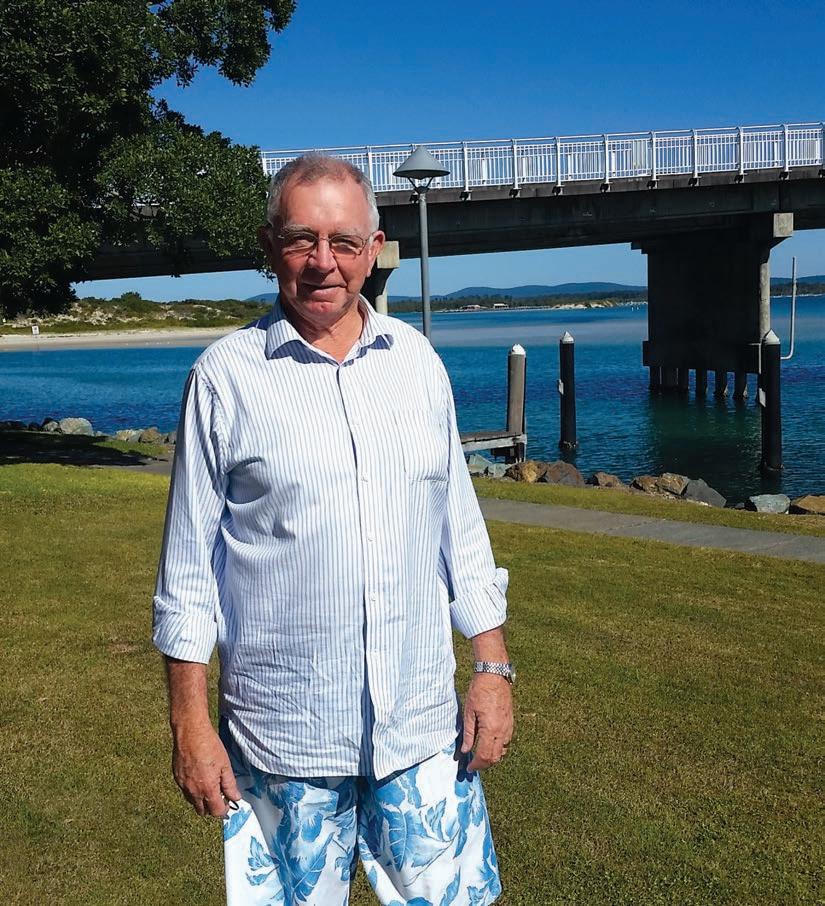
A semi-retired (business shirt and board shorts) Forster Tuncurry parishioner at the Forster Tuncurry Bridge
AGREG BYRNE: AN ENQUIRING MIND, AN OPEN HEART
For 17 years, until June 2017, Greg Byrne served as Pastoral Associate in the parish of Forster Tuncurry. He has made an impact on our community and on the lives of so many individuals.
BY ANNE MOLONEY
s parish priest, Fr Tony Brady welcomed Greg to the parish 40 years ago. Greg accepted Fr Tony as a mentor, seeking to know more about God whilst developing a commitment to service. They shared a vision of church.
When driven to make sense of things, Greg reads, he studies, he attends conferences, he plans and then puts pen to paper so he can encourage others to embark on the journey to discover their faith. Many parishioners remember those shared experiences as we too were all fired up to put our faith into action –Church for a Better World, Hearts on Fire, Marriage Encounter, Family Groups, Antioch and Cursillo.
Greg is a man of faith. I began to know him when I was welcomed into the Byrne family home to join a faithsharing group. Groups still meet there. I learned from the example of Greg and Lauranne that it was possible to put God first in my life as it was obvious that God was an important part of their marriage. When Lauranne passed away in 2015, the community shared the family’s grief.
Faith without action is nothing and Greg has been able to support so many, sharing their joys and their sorrows. Some came to know Greg when he visited them when they were sick or prayed with them as the death of a family member approached. I witnessed
Greg’s approach one day when we visited a friend in the nursing home. His ability to calm her in her state of anxiety was remarkable. He held her hands and talked to her so gently that she was able to steady her breathing and become settled.
Greg takes his vocation seriously and accepted the challenge of further study. The Tenison Woods Christian Formation and Ministry Course was offered in our parish and Greg brought an enquiring mind and open heart to this enriching time. He later went on to join a National Committee for Priests and Pastoral Associates and has been involved in associated conferences.
In the early days Greg was involved with the St Vincent de Paul Society locally and later as Diocesan President. He has a strong awareness of social justice issues and responds in action and in word. Greg knows the value of sitting in the gutter with someone who needs someone to listen and he was resourceful in helping people who knocked on the door of the parish office.
Greg Byrne has given us great leadership in our parish community, always attending to commitments generously and offering respect and compassion in an inclusive way. Greg has now retired from his position but he will still be spreading the Good News as a disciple of Jesus.
FUND SUPPORTS DEVELOPMENT THROUGHOUT THE DIOCESE
BY ANNE CAMPBELL
The Catholic Development Fund Maitland-Newcastle (CDF) has had another successful year in supporting the schools, parishes, agencies and associates of the diocese.
In late 2016, the Australian Government regulations under which the CDF operates were changed. These changes were introduced from 1 January 2017 with a transition period to 31 December 2017. These changes will affect how some clients invest with the CDF.
In conjunction with these changes, the CDF is now in the process of acquiring an Australian Financial Services Licence (AFSL) which will allow it to continue offering services to the wider community and the opportunity for clients to continue to support the mission of the Church.
The CDF helps the diocesan schools with funding of capital projects, with a current focus around new schools and augmentation of existing schools. Some of the works completed for 2017 are the construction of new facilities at St Patrick’s Primary, Lochinvar; multi-purpose hall, trade training centre and kitchen at St Joseph’s College, Lochinvar and upgraded facilities at St Pius X High School, Adamstown. In addition, loan funding has been provided to enable the purchase of land for future school purposes in Gillieston Heights, Aberdeen, Waratah and The Junction.
In addition, CDF had provided funding for the purchase of land and development of Early Education Centres for St Nicholas Early Education. Current developments in progress are at Cardiff, Lochinvar and Chisholm.
The CDF continues to provide support to CatholicCare Social Services with its projects and services to the community. CatholicCare continues to expand its reach to the Upper Hunter and to the disadvantaged.
The coming year will see the CDF updating its website, enabling you to be kept up to date with our products and services.
New multipurpose hall, St Joseph’s College, Lochinvar
Members of the communities of St James’ Muswellbrook and St Thomas’, Aberdeen
COMMUNITY ALIVE AND WELL AT MUSWELLBROOK AND ABERDEEN
BY CAROL BOWEN
The parishioners of St James’ Muswellbrook, and St Thomas’, Aberdeen, engage in a busy round of social and liturgical occasions throughout the year. Sometimes they join their local Anglican parishioners; for example on Shrove Tuesday each year, the two communities celebrate an ecumenical liturgy followed by the burning of the palms and a Shrove Tuesday feast.
In 2017 Fr Richard Shortall sj led the retreat, ‘Praying in Everyday Life’ in Denman, Merriwa, Scone, Aberdeen and Muswellbrook.
The Keegan/Wood family group has been a fixture in the parish for over 20 years, with monthly activities organised in January and July. The group has had up to 44 members with numbers fluctuating over the years.
A regional gathering was hosted at St Thomas’ Aberdeen, in June with parishioners from Merriwa, Cassilis, Denman, Scone, Murrurundi and Muswellbrook. Fr James McEvoy concelebrated Mass with Fr Peter Thaoi of Scone. Fr McEvoy, a priest of the Archdiocese of Adelaide and a lecturer in Systematic Theology, gave a presentation on ‘Living Good News in our Time’.
There are regular Anointing Masses, prayer group gatherings and school Masses, and students of St James’ Primary participate as proclaimers of the Word, cantors and musicians at intervals.
THE PRICELESS GIFT OF FAMILY LIFE
BY ELIZABETH SNEDDEN
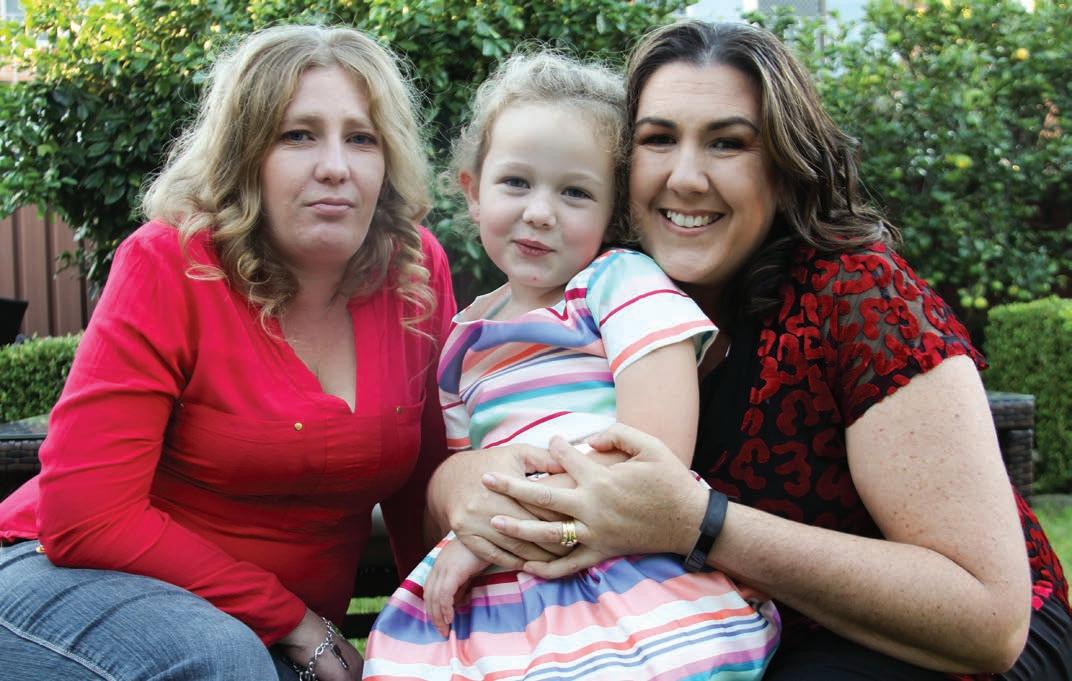
Sitting down to afternoon tea with Belinda, Crystal and Lily was like most conversations involving a five-year-old − plenty of questions, laughter and cake crumbs on the floor. Yet in many ways the discussion that unfolded was anything but typical. For me it was truly enlightening. My heart swelled as I saw firsthand the positive and life-changing impacts of permanency planning, the strength that comes from unity and a type of love I’d never witnessed.
Just weeks earlier, Belinda and her husband Darren had become the adoptive parents of Lily. For the Waratah West couple it had been a long road, with Crystal first offering the opportunity to adopt Lily whilst she was pregnant and had realised she would be unable to care for her.
With six other children in foster care at the time, Crystal said she couldn’t bear the thought of another child “getting lost in the system”.
“I wanted her to go somewhere she’d be loved and get what she needed,” Crystal said.
It was a selfless move and one that would provide Belinda and Darren the opportunity to parent together, after losing their three-week-old son, Jack, in 2007.
Since Lily was four days old, Belinda and Darren have cared for her, providing her with a loving and safe home. With the support of CatholicCare Social Services Hunter-Manning, they have raised a friendly, caring and outgoing daughter and nurtured her ongoing relationship with Crystal and other members of her biological family.
Like CatholicCare, Belinda and Darren support the NSW Government’s plans to make it easier for foster families to adopt or become guardians of children in their care. This type of security is exactly what children and young people need to thrive. Open adoption and guardianship can deliver to children, young people and their foster families a sense of openness and a better chance of maintaining good relationships with birth parents when restoration is no longer possible.
Reflecting on their jour ney and the open adoptions process, Belinda said, “To be able to give a child like Lily a stable home for life is priceless.”
To enquire about adoption please phone (02) 4979 1120.
GAIL MABO VISITS SFX
For three days during NAIDOC Week, Gail Mabo, daughter of celebrated land rights activist, Eddie Mabo, engaged with the students of St Francis Xavier’s College, Hamilton, sharing her wisdom, stories and life experiences.
THE TREE BELONGS TO THEM AND THEY TO THE TREE
BY HELEN WHALE
Each year at the Opening School Mass of St Joseph’s Primary School, Merriwa, we pray for:
God’s blessing upon us all, that like a young tree , we will grow, not just through the learning and wisdom we receive, but especially through the love, care and support we give to one another in our community at St Joseph’s School and as part of St Anne’s Parish.
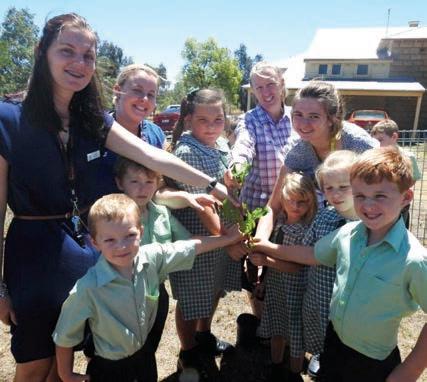
After Mass, one ornamental tree is planted by the new Kinders, new teachers and any student new to the school during the preceding year. Each year the avenue of trees grows larger.
This has become a much-loved tradition, wherein the cohort that planted the tree each year takes responsibility for the tree and cares for it. Students share the duties such as watering, mulching, providing guards and fertilising. The tree belongs to them and they to the tree. This small tree holds the hope and promise of new life and growth, just as we, in our community, hold the same promise of new life and growth together.
Stage 3 students of 2017 explained that they love this treeplanting tradition because they feel they are making the environment healthier; that over the years they have learned to be responsible for the life of the tree. They feel a constant sense of achievement as their tree grows. Some students felt they were making history and they look forward to showing their own children their tree in years to come. They feel they are leaving the school a better place. One student was quite emotional when she explained that she remembers the night she planted her tree and how meaningful it was − and is − for her. She looks forward to sharing that experience with the new members of the community at each opening school Mass.
The trees chosen for these occasions are large ornamental types that will provide shade for the classroom and for children to enjoy. They will make a vivid statement as they change colours with the seasons and with age.
Being a school focused on the environment, we have also been planting native trees each year at our combined Grandparents Day/National Tree Planting Day. The school grounds, the parish grounds, the local railway museum, and numerous community spaces have been planted by our school community as needed.
BISHOP'S STAFF DAY 2017
Staff from the across the diocese braved a chilly morning to take part in the Bishop’s Staff Day pilgrimage walk. Over 130 members of staff completed the 13 kilometre journey from Corcoran Parish Centre, George St, Morpeth to St John the Baptist Chapel, Cathedral Street, Maitland. Volunteers from Morisset provided enormous support to the walkers.
Crystal, Lily and Belinda, enjoying the priceless gift of family life
Louise Campbell, Gail Mabo and Tony Kelly at St Francis Xavier’s College, Hamilton
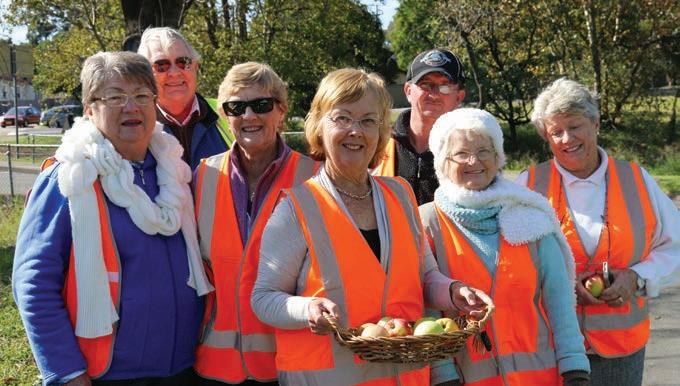
Volunteers assisting at Bishop’s Staff Day pilgrimage from Morpeth to Maitland
Ornamental tree planted by the new Kinders at St Joseph’s Primary School, Merriwa
Bishop Bill
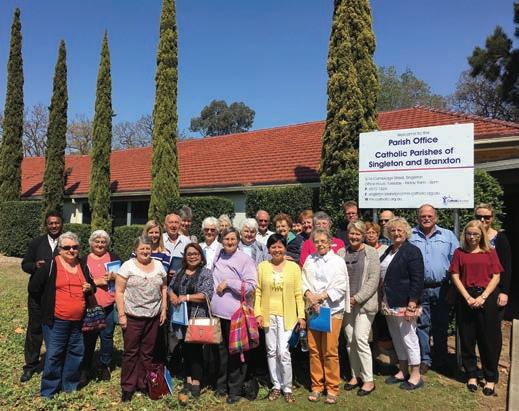
Parishioners from Singleton and Branxton attended a volunteers workshop
INAUGURATING THE MAGDALENE AWARD
BY HELENE O’NEILL
“We need to create still broader opportunities for a more incisive female presence in the Church….This presents a great challenge for pastors and theologians, who are in a position to recognise more fully what this entails with regard to the possible role of women in decision-making in different areas of the Church’s life.”
Pope Francis, Evangelii Gaudium, n103/104.
With Pope Francis’ words resonating through the minds of members of the diocesan contact group for the Council for Australian Catholic Women (CACW), the inaugural Magdalene Award was conceived. The brief was to recognise a woman who is an active member of her parish community and has made a positive contribution within the diocese to one or more areas of decision-making, leadership, active service and lay pastoral ministry.
NEW OFFICE FOR SINGLETON AND BRANXTON PARISHES
BY ERICA JANSSEN
For many years the Singleton and Branxton Parish Office has been successfully co-located with St Catherine’s Catholic College but with the addition of Fr Peter Street as the Assistant Priest and the need for meeting space for the parishes, a move “across the road” was facilitated.
A special award called for a special trophy. Master blacksmith Will Maguire created an evocative figure of steel and stone, a woman standing tall with wide open arms. The figure has an abject beauty, inviting contemplation and quiet reflection. According to Will, the uncomfortable stance also alluded to “the difficult history and contemporary issue of women’s recognition in the church”.
Following Mass at Sacred Heart Cathedral with Bishop Bill as presider on International Women’s Day, the Toohey Room was filled with friends and family of the 25 nominees. Each is living her life in ways that reflect the gospel values of mercy, peace, justice and compassion.
Bishop Bill offered his congratulations to all candidates, adding that he did not envy the judges as the gifts and talents of these women were so diverse it was like “comparing apples with harbour bridges!”
And the inaugural winner is − Rutherford’s Margo Nancarrow. After a lifetime of service to the church, in liturgy, schools, Special Religious Education and membership of various councils and groups, Margo accepted the award to great applause. “This is indeed an honour and I am deeply humbled and appreciative that a lifelong commitment to working for my Church and for the advancement of women was recognised. The theme of this year, ‘Be Bold for Change’, should resonate for us all.”
Nominations are open for the Magdalene Award 2018! Phone Ellen Hazelton 0407 513 813.
At the beginning of July 2017 the Parish Office for Singleton and Branxton Catholic Parishes moved to the St Patrick’s Commercial Centre in Cambridge Street, Singleton. This property was originally St Francis Xavier’s Catholic Primary School and then was redeveloped into office units as the St Patrick’s Commercial Centre. The Centre enjoyed busy tenancies until the downturn in the mining industry four years ago. Since then some of the offices have been vacant.
The new space is well equipped with an office for Frs George Mullappallil and Peter Street, a large meeting room for parish committees and training and desk space for a volunteer.
CatholicCare Social Services Hunter-Manning has moved in next door to the parish office and Bishop Bill officially opened and blessed the two offices on 22 October.
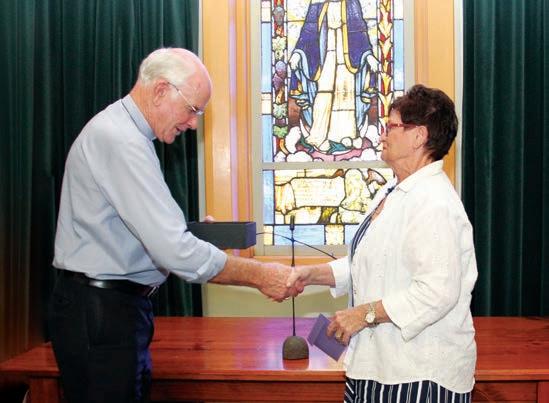
presents Margo Nancarrow with the inaugural Magdalene Award
MEET MR & MRS MUSIC!
Basil and Annette Morrow’s lives, and their music ministry, have settled on the Diocese of Maitland-Newcastle.
BY MICHAEL O’CONNOR
Life and music have taken them to many parts of NSW, but since 2001 this is where they are grounded.
Basil was in formation at Mittagong to be a Marist Brother at the time of the Second Vatican Council. Latin Gregorian liturgies were giving way to contemporary English. While treasuring the beauty of the past, Basil was even more affected by the changes which facilitated “full, conscious and active participation in liturgical celebrations”. It set a course for life and ministry to come.
I asked Basil to tell me about himself first, before we ventured into his music. He went straight into music. He continued to talk about music and self throughout our conversation in such a seamless way that I was left with the impression that “you can’t have one without the other”.
Basil’s Marist training, and especially some exemplary Marist Brothers, fortified his faith and dedication to mission. Of one – Les Brogan, now directing liturgical ministry at St Patrick’s, Wallsend – Basil composed a song with the words, “You’re a legend in our time for those you moulded in your prime.” Les moulded a young Basil Morrow to traverse the aisle in his home parish church at Granville, strumming his guitar and encouraging the assembly to join in wholeheartedly with the celebration.
At that time in the Church it had virtually been ingrained in congregations not to sing. Pre-Vatican II congregations had been accustomed to an individualistic, passive and quiet celebration of the Mass. Some lamented the change, while others were delighted. If the passive were to participate they needed music that was approachable and contemporary, thought Basil. This is what he set himself to seek out and also to compose.
Basil had left the Novitiate in May 1969. On his first day of training as a public servant in Sydney, on 1 September, he “saw a stranger across a crowded room”. (The “crowd” consisted of two others, Basil admits.) Annette was to share his life and music from that moment. Annette was a convert from Presbyterianism who was currently singing in a church
band. Basil poached her. Together they sang the parts of the Mass composed by Basil for their wedding.
The couple has lived and ministered at many locations, including St Mary’s in Sydney, Coffs Harbour, Goulburn, Moree and Jindabyne. They have produced four sons and two daughters while providing music to engage congregations in celebrating the liturgy. Since 2001 the Hunter has been home.
While Mayfield West, Kotara, Wallsend, the Cathedral and others have experienced Morrow-led music, it is in St Brigid’s, Raymond Terrace, their home parish, where they chiefly worship. Especially for home Basil has composed a “Mass of St Brigid of The Terrace”.
Though not obvious, there is “a sense of Gregorian” in Basil’s compositions. He avoids “hymnising” by making his music fresh and lyrical with an easily recognised beat, simplicity, beauty and “a bit of passion”. In order to invite and encourage all to join in, Basil sees his role “not as a performance, but you need to use all the qualities of a performance” to serve the celebration.
Basil and Annette have conducted numerous workshops far and wide and produced four albums of liturgical song. Among Basil’s compositions is a commission from the Sisters of St Joseph lauding Fr Julian Tenison Woods, called “Celebrating the Memory”. Our diocese’s commemoration of 150 years in 2016 brought forth a song entitled “Take Heart, God is Among Us”.
What are his future goals? Basil has composed, and routinely sings, responses to the psalms used after the first scripture reading every Sunday. He intends to record and publish these responses for broader use. He is happy and grateful for the opportunities life has afforded him to create, share, and inspire – and for the joy of experiencing with Annette “our voices blending beautifully”. With her, Basil intends “to continue until we can’t”.
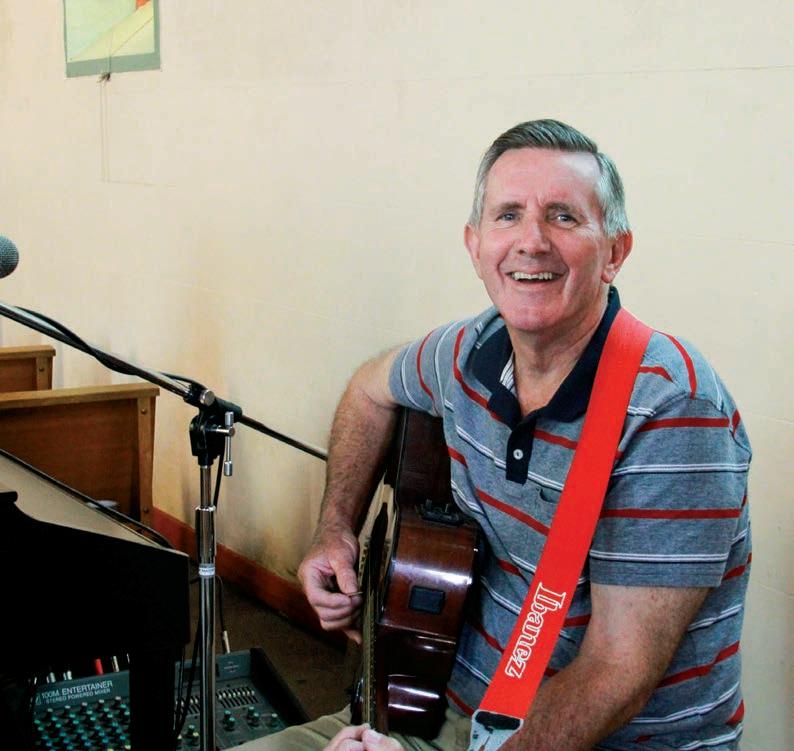
‘Mr Music’, Basil Morrow, at St Brigid’s Church, Raymond Terrace
COMING TOGETHER AS PEOPLE OF FAITH
BY ALYSON SEGROTT
For members of the diocesan community, 2017 has been a year of discovering what we have in common and forming new friendships with members of other faiths, through participating in four Interfaith Forums.
The purpose of the forums was to explore others’ faith, so as to increase and improve the Church and wider community’s understanding of the religious beliefs, symbols, structures and practices of different groups in our community.
Four Abrahamic faiths − Jewish, Catholic Eastern Rites, Muslim and Evangelical Christians − were invited to take part in a forum. The invitation was accepted by Ruth Jacobs from the Jewish faith, Fr Paul Berezniuk from the Catholic Eastern Rite Ukraine Church, Forugh Dorani from the Islamic Centre Mayfield Mosque and Captain Stephen Oliver from the Salvation Army.
A forum was held each term in the evening and a representative of one of the faiths was asked to present aspects of beliefs, symbols, structures, membership and practices (rituals). An outcome of each forum was that those who attended were invited to join adherents of the presenting faith at their usual worship service during that week.
The forums provided an opportunity to learn what we had in common, and to understand the church as founded in the Gospel. After each presentation and attendance at another faith’s place of worship, we realised that what we had in common was greater than what divided us. We also learned more about what we understood − or misunderstood − about each other.
Many friendships have been formed and joint services and celebrations have been held during the year, again offering opportunities to come together.
Hopefully 2018 will offer further opportunities for developing knowledge and understanding among different faiths in our region.
BLESSING OF THE LAND AT CESSNOCK
BY CHRIS PARKER
The 7th annual Blessing of Our Land at Pokolbin brought bright sunshine and almost 100 participants on 27 August. Many of those attending from a variety of faiths were impressed with the sense of community they experienced and expressed their desire to attend future blessings.
ST NICK’S NEWCASTLE WEST VISITS SACRED HEART CATHEDRAL
BY KATE BERRY
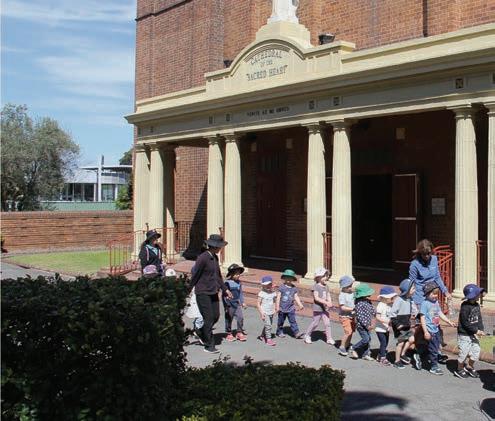
The children of Mowane Room at St Nick’s, Newcastle West, visited Sacred Heart Cathedral. Before leaving St Nicholas, there was a discussion about the church − it’s a place for ‘quiet thinking’ and we needed to use our soft inside voices. The wagon was packed with drink bottles and lunch boxes, and Helene O’Neill accompanied the children as well as their teachers.
As the children moved inside the church, they were fascinated that there was so much to see, especially the windows. They had an opportunity to sit in the pews and ask questions.
Before leaving, the children saw the dome that had fallen off the top of the church during the 1989 Newcastle earthquake, and heard the story of its becoming a memorial to those who lost their lives.
The visit to the cathedral was about exposure to, and respect for, the local community. Children gain a better understanding of their world by being immersed in, and involved with, what’s around them.
OPPORTUNITY’S KNOCKING FOR FORMATION IN SCHOOLS
BY BERNADETTE GIBSON
My role of Education Officer in Spirituality and Formation emerged in 2015 from a recommendation in the review of the Teaching of Religion in Secondary Education in 2012.
The philosophy underpinning the role is grounded in the Catholic Schools Office Vision Statement: At the heart of everything, there is always Jesus Christ. My role aims to provide opportunities for staff across 58 Catholic schools and the CSO, to engage in an exploration of the mystery and the grandeur of God in the
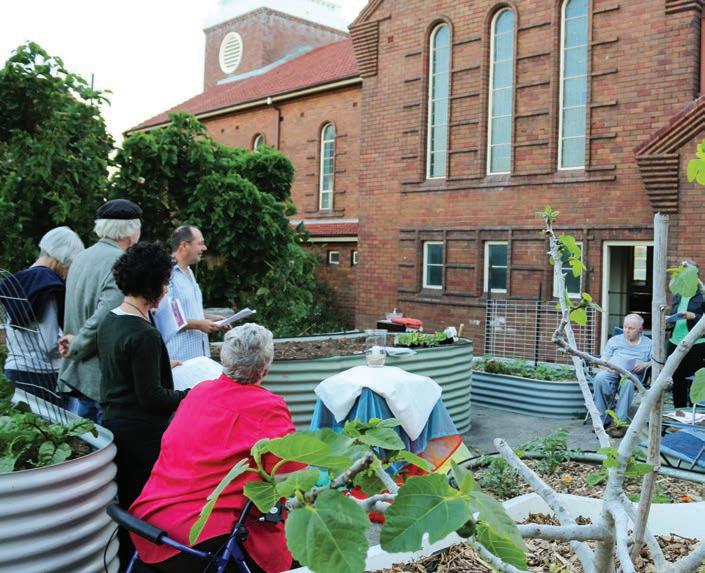
Participants at an Interfaith Service in the Immaculate Heart of Mary Church, Tighes Hill, community garden
Participants at the 7th annual Blessing of Our Land at Pokolbin in October
The children of Mowane Room at St Nick’s, Newcastle West, visited Sacred Heart Cathedral
Michael Slattery and Kate Drake at one of the teachers’ retreats
world. The programs form the heart of an emerging framework which hopes to provide encounters with the person of Jesus in a regular, systematic and relevant way.
A snapshot of a 10-week period has me on retreat almost weekly with school/s, or running specific retreat program/s aimed at targeted groups. The “Doorways Retreat” for beginning teachers and “We are Called” for newly-appointed school executive members, are two examples. Working with school executives to develop a strategic and purposeful plan for
Formation in Mission for the schools is also a large aspect of my work, as is delivering formation at staff meetings, researching and writing further programs.
I am privileged to accompany people on their faith journeys, to witness some of their sacred moments. I do not take God to them, they already have God.
This role can only exist because of the commitment of Bishop Bill and the CSO to the importance of the formation of all staff, to nurture the nature and purpose of Catholic education.
One significant obstacle to formation is the lack of an appropriate place and space in the diocese where retreats can be held.
My vision for this role is two-fold: the development of a formal Formation for Mission Framework which captures the diverse formation opportunities which are beginning to emerge, and the investment in key personnel across schools to nurture and grow simultaneously the magnificent spiritual inheritance currently in our schools, at a time of great challenge in the Australian Church.
HITTING THE RIGHT NOTE AT MORPETH
BY TRACEY EDSTEIN
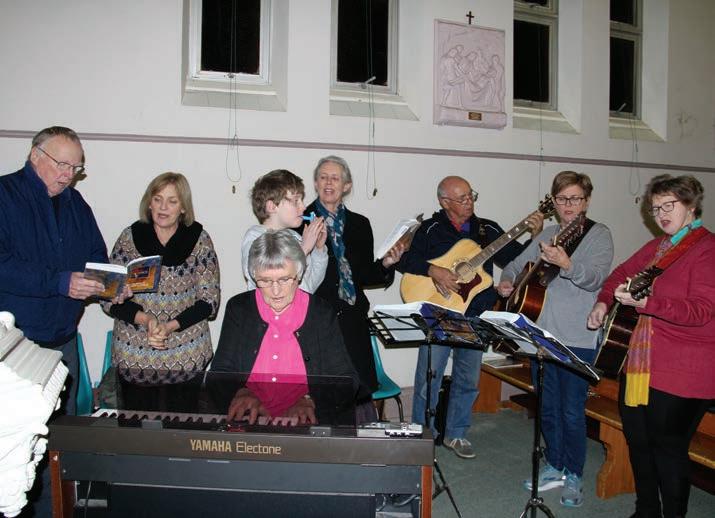
Morpeth’s Edith Walz could be called the matriarch of the music ministry team at Immaculate Conception Church, since she’s been playing the organ there for 61 years. She sees her contribution as complementing the vocalists and guitarists who now minister with her at Mass every Sunday.
Each member of the group – comprising Loretto Austin and her son Joseph, Kate Bartlett, Christine Eagar, Margaret Hoffman, Kevin Mills and Brian Murphy – sees the ministry as enhancing the parish worship and echoing the liturgy of the Word and of the Eucharist.
Kevin, Kate and Christine are guitarists and Loretto, Margaret, Brian and Kate lead the community in singing. Joseph provides percussion as well as lowering the average age!
Selection of hymns is an important dimension of any music ministry, and while Edith has the main responsibility here, there is collaboration. It’s not unheard of for a change midway through Mass, as Loretto says, “Sometimes in the homily, you can almost hear the song in the back of your mind, and we all look at one another…”
As well as playing and singing every Sunday, there are special feasts and occasions. Kevin says, “We go on the road once a year” – to the cemetery, for Mass during November, the month of the holy souls.
Christine nominates the friendship that the group embodies as a great gift and it’s obvious that they enjoy each other’s company and the mutual support that’s developed over time. This means that the commitment to regular practice, extending the repertoire and planning for feasts and seasons is enjoyable.
Chisholm Pastoral Region’s Fr Paul O’Neill says, “Every time I preside at Sunday morning Mass at Morpeth, I find the music ministry wonderful. The music is played with great enthusiasm and energy and the people really respond. As St Augustine said, ‘Sing once, pray twice!’ The singing at Morpeth certainly helps us to pray well together.”
It’s not unusual for members of the congregation to express their appreciation for the way in which the music enhances the liturgy, and visitors are sometimes surprised, given that it’s no mean feat to bring a congregation to full voice at 7.15am, especially in winter!
As Edith says, “It’s a really good community.”
ART BECAME PRAYER
BY GABRIELLE SUTHERLAND
Religious Studies Co-ordinator and practising artist from San Clemente High School, Mayfield, Rose McAllister, and CSO Education Officer (Religious Education and Spirituality), Bernadette Gibson, led participants in an Art and Spirituality Day at Kilaben Bay.
One participant shared her thoughts, saying, “When I got here this morning I wasn’t just completely tired, my spirit was exhausted. Today has rejuvenated me, it has inspired me and I feel that there has been some really gracious intervention....my faith journey was reignited....the whole day has been a faith leap, not just a step....my spirit was completely wrung out.”
COME AWAY TO A QUIET PLACE
BY TRACEY EDSTEIN
"A peaceful and holy space to draw aside from the busyness of life and connect with God."
These words, written by a participant in a two-day reflection program at Mercy Spirituality Centre, encapsulate the vision of Program Co-ordinator, Anne Ryan rsm. The Centre is a ministry of the Sisters of Mercy and she says her hope is to “offer a place where people can come to an awareness of what’s going to support them most in their spiritual journey”.
The Centre is located lakeside at Toronto and the beauty and peace of the setting go a long way towards encouraging rest, reflection and prayer. Indeed, creation is not an added extra, but integral to the Centre’s offerings. Regular presenter Helen Baguley rsm believes, “If we are of God, then so is creation. I can’t be wholly me until I learn to relate and honour all the life around me.”
One participant was initially surprised, then delighted, to learn that sitting in beauty can be a prayer. The Centre provides plenty of spots where one can sit in beauty and retreat from the everyday cares of life.
One of the essentials, Anne believes, is ensuring “really well qualified professional facilitators offering a variety of theologies because not everyone is from the one religious tradition”.
Having said that, there is an implicit acknowledgement that the wisdom emerges from the individuals who assemble, not only from the facilitator.
In Anne’s experience, “I’m sure some people are enriched because they walk away with questions …it’s certainly not a place that tries to provide any answers, but rather, challenges everybody to that maturity to explore with God, not to be told…”
Hospitality is integral to Centre programs, welcoming participants, putting them at ease and enhancing the more formal aspects of programs.
As someone who listens professionally, Anne has a heightened awareness of the difficult chapters in many people’s stories. Some of those difficulties have been inflicted, or at least not alleviated, by the church itself. She feels the Centre is a place “that can offer immense quiet and opportunities for reconnection, not necessarily with the church, but with the self”.
So much given. So much received. Thank you.
Sr Anne Ryan rsm at the Mercy Centre, Toronto
Morpeth’s musicians and singers are a vital element of worship in their community
Teachers participated in an art and spirituality day led by Rose McAllister
...art and religion are connected; both are ways to interpret beliefs and make meaning.
WALKING IN DOMINICAN FOOTSTEPS
Rose McAllister attended San Clemente High School, May eld, from Years 7-10 but it was not until she returned as a teacher that her interest in the charism of the Dominican Order was ignited.
BY MONICA SCANLON
Rose is passionate about understanding the Dominican identity. She is a Dominican Associate and meets monthly with others who share the spirit of Dominic.
The Dominican motto is Veritas − truth. Rose describes truth as “unique to individuals and a real sense of respect for, and understanding of, others. The motto of truth is not one way of thinking or being. Acceptance of truth makes the world a more harmonious place. Dominic’s truth was to get back to the bare bones of what Jesus was like by treating everyone with respect and dignity no matter who they were.”
This year marks San Clemente’s centenary. Rose feels that the Dominican Sisters left a strong foundation of truth. She acknowledges that each generation of the diverse community is different but each carries on the charism of Dominic. Rose is proud that students can recite the Dominican blessing.
In 2016 Rose participated in a pilgrimage to ‘the lands of Dominic’ − Spain, France and Italy. The final unit of her Masters in Theology explored Dominican spirituality and the pilgrimage spurred her to strengthen the Dominican character of San Clemente.
As Religious Education Co-ordinator, Rose discerns a strong link between curriculum and faith life and she believes that the work of the school’s ministry team is Catholic education in action. Rose is immersed in the culture of the school, chairing the Student Representative Council and leading initiatives such as Caritas’ Project Compassion and Catholic Mission events.
Rose initiated “Globally Called”, linking a Lenten justice unit with a HSIE globalisation unit. Students focused on a project to raise money for Project Compassion as well as researching the underlying issues. The students became Caritas ambassadors and Rose presented the initiative at a Caritas Conference.
Rose chaired the school’s Centenary Committee which invited former students to visit the school to share their memories and to attend a Black and White Ball and an open day, including a celebratory Mass.
Prior to her teaching degree, Rose studied art. Eight years ago she initiated a biennial community art exhibition, “Veritas” because she believes art and religion are connected; “Both are ways to interpret beliefs and make meaning.”
Rose sculpted statues of St Dominic for St Columban’s Primary (also celebrating its centenary) and San Clemente. She commissioned an artistic representation of the pillars of Dominican life: community, service, prayer and study.
Sometimes inspiration for art and prayer – and sacramental moments − arise when Rose rides pillion with her husband on their motorbike. “Once you get over the fear factor, there’s an opportunity to think, stop and look.”
In 2016 Rose participated in the Australian Camino, walking 200km in seven days in St Mary MacKillop country. This year she travelled to Israel on a “Walk with Jesus” pilgrimage organised by the Catholic Schools Office. Rose’s thirst for knowledge and experience continues unabated!
Artist Rose McAllister at work in her studio
DIGGING DEEPER TO FIND MEANING
BY SAMANTHA HILL
Small groups have always played a strong role in the life of the Church. Parish evangelisation cells are simply an extension of this. A Parish Evangelisation Cell (PEC) is a fortnightly gathering of 7-14 people, coming together for 90 minutes in a structured way. The fortnightly cell meeting provides an opportunity for prayer, teaching and discussion, sharing, mutual support and nourishment in the faith journey. The members of each cell also share with each other how they are managing to evangelise and communicate their faith with others and how God is working in their lives.
In May this year, after 18 months of planning, a trip to Italy to attend an international seminar on the PEC system, parish assemblies sharing the vision with parishioners, leader training sessions and lots of prayer, the PEC system commenced cell meetings in the Chisholm region. Initially there were four groups meeting fortnightly in various host homes. Some 40 people participate in these cell meetings, each looking to a deepening relationship with Christ. A highlight of the cell meeting and a major component for discussion is a 10 minute video teaching from parish priest of the Chisholm Region, Fr Paul O’Neill, on various topics. This is proving to be a great source of formation for cell members with discussion questions leading members to dig deeper to find meaning.
The PEC system is a tool being used in conjunction with the Chisholm Pastoral Region pastoral plan as a way of evangelising – both to those within our parish communities and those who are not present at Eucharistic celebrations. Part of the idea of the parish cells is that people can come to a small gathering and be supported in their faith journey, whether they are engaged Catholics or not. The cell meeting is low key in a friendly and welcoming environment.
Why is it called a parish cell rather than a group? We are all called to evangelise, therefore each parish cell member is tasked with the responsibility to go out and evangelise to the oikos − the people we interact with in our daily lives through family, friends, work, sport and social circles. The life of the cell means that the group grows in numbers by inviting people to come and join a parish cell. When the cell reaches 12-14 people, it becomes two new cells and the process begins again.
Participants in one of the Chisholm Region cell groups
Fr James McEvoy with parishioners at Raymond Terrace
CHURCH DIALOGUING WITH THE WORLD IN A SECULAR AGE
BY FR ANDREW DOOHAN
“Christians see themselves handing on the faith of previous generations to the following generation, and so faithful to it in that way, but always open to what is new. I heard somebody contrasting the lazy tradition that simply repeats what’s said previously to the real tradition that brings the faith to life for a new generation, grasps the very heart of it and hands it on and brings it to life. And that’s what tradition most deeply is. It’s not simply a bland repetition.”
So said Rev Dr James McEvoy of Australian Catholic University, speaking to Margaret Coffey on Radio National.
James McEvoy was the guest speaker at this year’s Cathedral Lecture in June at Sacred Heart Cathedral. The annual Cathedral Lecture offers the opportunity for engagement between the Church and Society on contemporary Catholic themes through the opportunity to listen to lecturers of significant standing in Australia and internationally. This year’s title was “Christian Faith in a Secular Age”. There was no bland repetition!
The Cathedral Lecture Series was launched in 2016, the 150th anniversary of the arrival of the Diocese of Maitland-Newcastle’s first resident bishop, James Murray, and the inaugural lecturer was Rev Dr Richard Lennan.
James McEvoy lectures in systematic theology and is a priest of the Archdiocese of Adelaide. His current research studies the place of religion in the contemporary West and the church’s understanding of its role and social relationships in that context. He has published numerous journal articles as well as a book, Leaving Christendom for Good: Church-World Dialogue in a Secular Age (2014).
‘ONE-STOP’ CATHOLIC EDUCATION’S
ON OFFER AT CHISHOLM
BY TRACEY EDSTEIN
Chisholm’s Alison and Darren Jackson are the proud parents of three sons – William, Mitchell and Christian.
William and Mitchell are students of St Aloysius Catholic Primary School at Chisholm, in Years 5 and 2 respectively, while young Christian is 4 years old.
Asked about their choice of school, Alison said: “We decided to enrol our boys at St Aloysius for the opportunity to attend a custom-built school with a 21st century approach to learning. The addition of the new St Bede’s next door is icing on the cake!”
William and Mitchell Jackson will be among the first students to complete their primary schooling at St Aloysius soon, Christian will experience his own milestone – he will belong to the first cohort at St Nicholas Early Education in Chisholm, opening early in 2018.
For Alison and Darren, this offers “the opportunity to engage with and make friends with other children who will most likely continue into kindergarten with Christian in 2019. Also the immediate proximity to St Aloysius will allow for a seamless transition from preschool to ‘big school’.”
St Bede’s Catholic College will open in January 2018, so there’s a lot happening on one convenient site at Chisholm.
Meanwhile, William and Mitchell are enjoying being at St Aloysius, and they look forward to Christian setting off with them next year. The Jacksons agree: “We’ve been extremely happy with our experience at St Aloysius so far. As a founding family, we’ve seen the school grow and the community become established.
“Our boys are very happy and settled. They look forward to going to school every day which is all we can ever really ask for!”
Principal of St Aloysius, Suzanne Fern, says her staff are delighted by the fact that soon, families will have ‘onestop’ education on offer. “Parents and carers will be able to drop off pre-schoolers, primary and secondary students, and older children will be able to keep a friendly eye on the younger ones. Also, the three campuses – St Nick’s, St Aloysius and St Bede’s – very much sit within the wider community and maintain parish connections to Morpeth.”
Alison Jackson reflects, “St Aloysius provides lots of opportunities for extra activities for the boys to engage in, depending on their interests, and I’ve always found the staff approachable and considerate.”
In 2018, parents of children at St Nick’s and St Bede’s will, no doubt, have exactly the same experience.
MEMORIES AND MOVEMENT
BY TRISH BOGAN
On Sunday 28 May, the official handing over of the governance and ministry of the Tenison Woods Education Centre (TWEC) by the Sisters of St Joseph to the Diocese of Maitland-Newcastle took place. Many of the Sisters, friends of TWEC and members of the community participated.
Everyone was able to chat and reminisce while drinks and nibbles were provided and TWEC areas were open for the last time. There were countless hugs and handshakes; the chatter was loud and frequently interspersed with laughter.
In a poignant Ritual of Entrustment held in the chapel at Lochinvar, there were tears and amusement as memories were shared, prayers prayed and ritual actions marked the handover as a new chapter began.
Congregational Leader, Sr Megan Brock, represented TWEC in the symbolic exchange with Bishop Bill Wright. Recipients of the Sisters’ 24 years of devotion, passion, wisdom and love through TWEC symbolically handed over important items to representatives of the diocese. Co-ordinator of Adult Faith Formation, Vivien Williams, will continue the fine tradition of adult faith formation and education.
On entering and exiting the Chapel, everyone processed past a beautiful photo of Sr Colleen Carney, the much-loved leader of TWEC for many years, who passed away late last year.
Sr Ellen Royan spoke delightfully of the history of the Sisters but also the formation of TWEC and its growing family of ‘Twecians’. Sr Ellen’s verse concluded, “But now the torch is handed on to younger hands and hearts grown strong who’ll keep the fire of faith alive, who’ll live and learn and multiply.”
At the close of the ritual, Bishop Bill and Sr Megan guided the assembly through the grounds of St Joseph’s College to share afternoon tea. Although there was sadness at the end of a crucial era for the Josephite Sisters, the transition brings excitement and expectation too. The diocesan ministry is now known as the Tenison Woods Education Centre: Spirituality, Formation, Mission.
After 24 years under the auspices of the Sisters of St Joseph, it is encouraging to see the TWEC name honoured and preserved.
VALUES AND VISION COLLIDE
Staff of CatholicCare Social Services participated with enthusiasm in a gathering at the Crowne Plaza Hunter Valley in June. An important part of the day was responding to questions and issues around the 2017-2020 Strategic Plan, particularly in terms of the values espoused by CatholicCare Social Services Hunter-Manning.
At the end of the day, Director, Gary Christensen, expressed his gratitude. “It is an absolute privilege to work with such a committed and inspirational team of people. Your passion for the work you do was evident throughout today.”
CCSS staff participated with enthusiasm in a gathering at the Crowne Plaza
Valley in June
Participants at the TWEC transition liturgy filing into the chapel at Lochinvar
Mitchell, William and Christian Jackson with Mum Alison at St Aloysius Primary, Chisholm
Hunter
IN THE FOOTSTEPS OF ST MARY MACKILLOP
BY BERNADETTE GIBSON
This year, CSO staff, principals and teachers stepped out in faith in the footsteps of St Mary of the Cross MacKillop and walked the ‘Aussie Camino’ from Portland to Penola.
Mary MacKillop is significant because of her links to education and our many Josephite schools. She was a woman of integrity and courage, prepared to stick to her principles in the face of great opposition. She was also a woman of great heart and forgiveness.
Mary was a pioneer and we became pioneer pilgrims, traversing the frontiers of our endurance and spirit.
Pilgrimage takes people out of their comfort zones and into liminality: the place where heaven meets earth, the place where Jesus waits. It strips you, at each stage, of yet another piece of unnecessary baggage, until, lighter, we walk more gently.
The experience can ravage, soothe, surprise and challenge. No one went unchallenged. It was in our stride that we rose to new challenges each day, in hope and self-belief.
Living the Paschal Mystery − travelling through pain, fatigue, a myriad of small deaths to the luxuries of blister-free feet, pack-free backs or privacy; encountering humanity at its very best; walking with humility as pilgrims shared astounding stories of grief or hardship and joy, then falling into bed and rising again full of optimism in the new day − was extraordinary.
Walking through the Australian landscape was an experience of the scripture of this great land with its breathtaking and wild coastline, the wide open spaces of stock routes and pine forests. It was a place of deep silences, never-ending sands, roaring winds and hail, a place of forged friendships, tears, prayer and laughter.
Walking for kilometres on end, staring at the neverending horizon, you have hours on your hands to collect your thoughts and engage in conversations you don’t normally have in everyday life. Whilst we may have experienced self-doubt, fear and anxiety at times, it was the anticipation, deep conversations and moments of fellowship that truly made this experience one to remember.
Buen Camino!
ST DOMINIC’S RESPONDS TO COMMUNITY NEED
From 2018, St Dominic’s Centre, Mayfield (formerly St Dominic’s Centre for Hearing Impaired Children), will begin to offer a schooling option for students diagnosed with Autism Spectrum Disorder. This decision is a direct response to local community need.
ST MARY’S GARDEN PARTY
The garden party held at St Mary’s Campus, All Saints College, on Sunday, 10 September, to mark the sesquicentenary of the arrival of the Dominican Sisters in Maitland, was a sign of deep gratitude for the eight Sisters who sailed from Dun Laoghaire on the “Martha Birnie”, who offered education in the Dominican way almost immediately and whose charism continues in several diocesan schools.
ST KEVIN’S CELEBRATES 100 YEARS OF CATHOLIC EDUCATION
Bishop Bill, former students, past principals, teachers, students and special guests came together to celebrate 100 years of Catholic education at St Kevin’s Primary School, Cardiff. After a barbecue lunch, the students enjoyed playing old fashioned tabloid games such as knuckles, quoits, French cricket, marbles, cats-cradle, red rover and hopscotch.
Students of St Kevin’s at Cardiff were photographed to mark the school’s centenary Ladies at the garden party held at St Mary’s to mark the sesquicentenary of the arrival of the Dominican Sisters in Maitland
ACTING JUSTLY, LOVING TENDERLY & WALKING HUMBLY
Assisting with monitoring the General Election of 1994 in South Africa is just one outcome of Patricia Banister’s commitment to social justice.
BY SHIRLEY MCHUGH
Patricia was born in Morpeth, educated at St Joseph’s College, Lochinvar, and has been a parishioner of St Paul’s, Rutherford, for over 50 years. Patricia and her husband, Adrian, reared four children while immersing themselves in parish affairs. Patricia has served on parish and diocesan Pastoral Councils and been involved in faith formation, Special Religious Education and Meals on Wheels
As the family grew, so did Patricia’s passion for social justice. Before long, she became a voice to be reckoned with in the affairs of women as Chair of the Council for Australian Catholic Women. In 1989 she was invited to become a member of the Australian Catholic Bishops Social Justice Council and subsequently to be part of the Bishops’ delegation to monitor the General Election of 1994 in South Africa.
Social justice took on an even broader perspective when, as Patricia’s term with the Social Justice Council concluded, she was invited to become Caritas Australia Diocesan Director and to join the Caritas National Council. She served there for nine years, concurrently with her position as Diocesan Director.
Patricia says that it was during her visit to Africa and thence to Zimbabwe in 1994, where she saw Caritas-funded projects such as dam building, micro businesses and refugee camps’ food programs, that she experienced a “significant change in my life”. Patricia said.
I asked how she saw the focus of social justice in her life. She
responded by saying: “It’s very simple, social justice is like a slice of bread where you use both sides.” She then proceeded to explain that concept in terms of Caritas operations. “Caritas looks at the strengths of the people and what they have – and then we begin to work with those strengths to make communities whole. This is all possible because of the support Caritas receives from the people of Australia. The people we support are always less fortunate than we are and all is so gratefully received.”
Patricia spoke fervently about the work of Caritas, both in Australia and in developing countries. She explained Caritas’ multi-level involvement with schools and communities, in infrastructure and health development. She said the Caritas website is a wonderful exposition of the principles of Catholic social teaching complemented by geographical and social science perspectives.
I asked Patricia what encouraged her to keep going. “One of the things that inspires me is the Caritas staff, those people who work in Caritas offices, people from varied backgrounds − they have inspired me in different ways I can’t wholly explain, but they just ‘get it’. Somehow or other, they just know what social justice is all about. They are wonderful people.”
And finally, I asked this lady to share her spiritual philosophy. “Just this, Shirley, to act justly, love tenderly and walk humbly with my God.” Now, that’s not too hard, is it?
Patricia Banister
A WHOLE NEW WORLD ON THURSDAY ISLAND
BY COURTNEY WRIGHT
Back in June, we said goodbye to our families and piled onto a minibus with trepidation in our minds and exhilaration in our hearts. We were beginning our journey to Thursday Island, taking 4 flights, 2 buses, taxis and a ferry. The aim of the trip was to broaden our understanding by immersing ourselves in cultures different from our own and remaining open-minded. We undertook this challenge whilst fulfilling the important Christian teaching of service to others.
Little did we know that in a week we would have surpassed any hopes or reservations we had. Soon we were on our first flight of the trip. It was incredible to watch the familiarity of Newcastle drift away and be replaced with views of Brisbane, then Cairns.
We were struck by the expansive beauty of aquamarine waters surrounding the tropical island. On our first night we were treated to traditional song and dance performed with such enthusiasm by the students. At school the children immediately ran up to us and began chatting away. It was so beautiful to see their grinning faces and openness to the somewhat apprehensive strangers − apprehensive only because it was a new and exciting role for us. Our job within the school was mainly to assist the teachers, and this morphed into games at recess and lunch. I’ve never played Duck, Duck Goose so many times in my life!
On Hammond Island we tried weaving and were shown the magnificent stone church that stood over the top of the school. The under 8s carnival was a favourite among the group and activities such as face painting, mobile making and biscuit decorating proved very popular among the kids. We visited a pearl farm on Friday Island and were treated to a meal of sushi, sashimi, tempura and rice pudding.
I know that we will never forget the memories that we have made and will treasure the stories we have created forever.
Courtney was one of a group of students of St Mary's Campus, All Saints College, Maitland.
FALLING IN LOVE IN CAMBODIA
BY KIM WILSON
For Kim Wilson, Assistant Principal at St Mary’s Primary in Scone, an immersion experience in Vietnam and Cambodia in 2013 was a turning point.
I had always wanted to see the work of Catholic Mission. For years we had raised money at school and I had contributed to Teachers Helping Teachers. In both cases I wondered about the impact of the funds.
Once in Cambodia, I fell in love with the people. I was shocked by their living conditions, yet they were all so happy. The people
SAN CLEMENTE WELCOMES A SPECIAL VISITOR
BY ROSE MCALLISTER
Sr Mary Goretti Nakajubi visited the Student Representative Council at San Clemente High School, Mayfield under the auspices of Catholic Mission. Sister Mary is the Sister-in-Charge at the St Luke Health Centre in Bujuni, a small village three hours west of Uganda’s capital, Kampala. Sr Mary spoke to the students about the lack of resources, which is currently the biggest challenge facing the centre. “Without vital equipment, such as an ultrasound and an ambulance, many women are being referred to larger hospitals, where they must pay fees they cannot afford. “Sometimes, the journey is too difficult and some women and babies do not survive.”
The San Clemente community has been a long-time supporter of ‘socking it to social justice’ during World Mission month in 'Socktober'. The students appreciated meeting Sr Mary and knowing how the funds raised will be used.
ROSARY PARK BANDS TOGETHER FOR TEACHER WITH BRAIN CANCER
BY ALYSSA FAITH
Nineteen Year 4 students of Rosary Park Catholic School, Branxton, proudly shaved their heads in support of their teacher, Ben Lott, who has been diagnosed with a rare form of Stage 4 brain cancer. When the students in Mr Lott’s Year 4 class heard about their teacher’s condition, they immediately wanted to help and began raising funds for the Rosary Park shave event.
“The students have raised $12,500 to put towards Mr Lott’s overseas treatment and Mark Hughes also sent the boys a beanie and a personal letter each for their efforts,” says Rosary Park Religious Education Co-ordinator, Amie Ward.
“Ben is a respected member of the Hunter Valley community and is adored by his students – we are all rallying behind him.”
welcomed us warmly and offered so much, although they had nothing to spare. I knew I could help these people, and I thought that if I spread the word about life in Cambodia, my family, friends and colleagues would want to help.
I came home in October 2013 and spoke to my (then) school community of St James’, Muswellbrook. I asked for muchneeded educational and personal hygiene supplies and we had an overwhelming response. People were so generous that the issue became − how to get goods to Cambodia? I realised I would have to take them myself. A group of 11 formed and in April 2014 we visited some of the schools and villages I had visited earlier.
Once the connections were made and strengthened, I have continued to support these places. I have returned in 2016 and 2017 with friends and colleagues. The teachers have raised money and
St Mary’s students on Thursday Island
Students of Rosary Park, Branxton, are supporting their teacher, Ben Lott
Members of teacher Kim Wilson’s group in Cambodia
awareness in their schools and sometimes parishes.
Since moving to St Mary’s Scone, the parish has been very supportive of my efforts. Fr Peter Nguyen is happy for me to speak at Mass regularly. I think a big part of our success is due to the fact that I give each contributor a personalised photo to show how their money has helped.
We raise funds and then we visit villages and schools and help out with their ‘wish list’. Wherever possible, we buy the goods in Cambodia. It’s cheaper, transport isn’t an issue and it helps the Cambodian economy.
A wonderful outcome of all this has been that the children in my school are very aware of the need to act like Jesus and think of others less fortunate than themselves.
KINDNESS AND COMPASSION ARE CATCHING ON AT SINGLETON
BY ADETTE SMITH
Since the beginning of the year staff in the Learning Lions room at St Nicholas Early Education in Singleton, have encouraged children to demonstrate small acts of kindness towards their friends and carers each day. Our aim in promoting kindness was not only for the children to show kindness and compassion within our centre but to spread kindness into our community.
With this goal in mind, we were overwhelmed when one of our pre-schoolers randomly approached staff and shared her concerns for less fortunate children and their families. She then came up with the idea of raising money for a charity that helps people who are homeless or struggling to put food on the table. Sharing her idea with the rest of the children, the Lions all agreed this was a great idea too, sparking the beginning of our Kindness Project!
Since May, we have spent many weeks discussing what a charity is and how they help people, before asking for family input in researching local organisations and charities. After much deliberation, we invited Tracey Paget from the Singleton Neighbourhood Centre to speak to the children about the work the Centre does in helping our local community. After listening to Tracey and learning that the Centre provides food hampers, blankets and clothes to homeless and struggling families, we decided this was the organisation we wanted to help!
We planned and hosted a second-hand book fair on 6 September to raise money for our local Singleton Neighbourhood Centre. On the day, the Lions worked hard manning the tables for three hours and were responsible for collecting the money during the fair. We are so proud to say we raised $517.50, an incredible achievement!
The highlight was visiting the Singleton Neighbourhood Centre the following week to hand over the money the Lions raised. Here the children could see first-hand the wonderful work this organisation does for the less fortunate and how the money we donated will help local families.
We are so proud of this amazing group of kind and compassionate four and five-year-olds wanting to make a difference in our community.
SCHOOLS RAISE AWARENESS FOR POVERTY AND HOMELESSNESS
Students of St James’ Primary School in Muswellbrook, wore their pyjamas to school in support of Principal Niamh Marzol, who once again represented the Diocese of Maitland-Newcastle in the St Vincent de Paul Society’s CEO Sleepout event. Students raised funds through a gold coin donation.
“YOU’RE DOING A GOOD JOB, SISTER!”
BY TRACEY EDSTEIN
As a Dominican for some 60 years, Maureen Rigby has ministered in a variety of areas, always open to the promptings of the Holy Spirit – and the congregational leader!
Educated at St Columban’s and San Clemente, Mayfield - both schools celebrated centenaries in 2017 − a young Maureen felt drawn to the Dominican charism. She had felt the love and care of the Sisters who taught her and wanted to extend those gifts to others.
Most Sisters became teachers, and Maureen found her many years of teaching in Waratah, Mayfield, Hobart, Canberra, Brisbane, Tamworth, Branxton and Strathfield rewarding. There were opportunities for further study and for spiritual renewal and eventually Maureen moved from classroom teaching to working with children with special needs.
Becoming a companion in the Seasons for Growth program, and training others to fulfil that role, signalled a new direction. Other opportunities Maureen had taken along the way - Clinical Pastoral Education, a program titled “Towards a Spirituality of Ministry”, Diploma of Counselling, not to mention a Masters in Christian Spirituality − can be seen, with the wisdom of hindsight, to have equipped her for her role of Chaplain at Maitland Hospital, Calvary Mt Carmel Retirement Community and Benhome at Maitland.
Maureen reflects: “The ministry of Chaplain/Pastoral Care Worker came as quite a surprise to me. I had never seen myself visiting the sick and dying in hospital or elderly in care. However, while teaching, I had often visited families with children who were very ill or where a parent was dying. I feel these experiences prepared me for my present ministry.”
Maureen’s duties are simple but her ministry is profound. “Each morning when I arrive at Maitland Hospital, I receive a list of Catholics who have indicated they would like a visit from a Pastoral Care-worker. I visit all the wards, and most patients are very accepting and show their gratitude, often saying: ‘You’re doing a good job, Sister!’”
While Maureen’s ministry may begin with a list of Catholic patients, it doesn’t end there. Staff, whom she finds welcoming and encouraging, will often direct her to a patient who “needs some spiritual care”. Sometimes staff themselves are in need of support and then there are the families of patients who are seriously ill.
Maureen will ask dying patients if they would like to be anointed. If the answer is yes, one of the local priests will attend. Sometimes a patient who is not seriously ill is troubled by some real or imagined offence and only a priest can offer solace.
For Maureen, bringing holy communion to hospital patients and residents is a deep privilege, and an important connection for people who can no longer worship as part of the parish community.
Maureen Rigby was born in Maitland. While she has lived in many places, she has now come full circle. She regards herself as “blessed” and looks forward to many years of continuing ministry in the Dominican way.
Students of St James’ Primary School, Muswellbrook, wore their pyjamas to school in support of Principal Niamh Marzol, who once again represented the Diocese of Maitland-Newcastle in the St V incent de Paul Society’s CEO Sleepout event
Learning Lions at St Nick’s Singleton raised money for the Singleton Neighbourhood Centre
Sr Maureen Rigby op
The youngest of nine, Roisin left school at 15; “bright, but never engaged”. Roisin began work as a cleaner before becoming a make-up artist. One of her older sisters encouraged Roisin to finish her education. She went to TAFE, then university to complete a degree, followed by a Masters in History and then her teaching qualification. In her ‘first year out’ she was awarded a national teaching award.
With two siblings in Sydney, Roisin travelled to Australia. She first worked with the Patrician Brothers in the south-west. She recalls, “92% of the kids had English as a second language, 25% were refugees and 20% came to school without shoes.
“It was the best teaching experience. A lot of the kids had nothing but they were hungry to learn. There was a real moral obligation to those kids in the school’s culture. It helped me learn that Catholic education isn’t about what we do or how we do it – it’s why we do it that’s most important,” said Roisin.
In 2010, Smarter Schools funding allowed the Catholic Education Office to create 14 ‘Leaders of Pedagogy’. Roisin was one and, with a Masters of Educational Leadership, she was soon working in schools in low socio-economic areas of Sydney.
“We were teacher educators. We worked solely with teachers on pure pedagogy – what does authentic leadership and learning look like? The results were tremendous,” said Roisin.
The program ended in 2013 and Roisin was offered the role of Director of Teaching and Learning at SCECGS Redlands. However, she “longed to get back to Catholic education.”
The St Paul’s role became available. Despite never having visited Newcastle, Roisin applied and was appointed.
Her dedication to being a lifelong learner is evident with Roisin recently completing a Masters of Theology.
Roisin’s parents loom large in her stories about people who have had
SHAPING LIVES THROUGH EDUCATION
Roisin McVeigh is the Assistant Principal at St Paul’s Catholic College, Booragul. Hailing from Belfast, Roisin’s career path is inspiring. Central to the story is her passion for learning and Catholic education.
BY JOANNE ISAAC
a positive impact. Her mother was part of the peace movement in Northern Ireland and her father, a boxer, encouraged her to ‘stay off the ropes’ and ‘get back in the ring’. She credits them with building her fortitude and courage. She credits many of the nuns who taught her for understanding “the power of education for women.
“My role involves building capacity in teachers. How do we upskill and practise our craft?” she said.
Roisin is creating professional learning communities and at the term four professional development day, teachers led 11 different workshops.
“No profession shapes a life like a teacher’s. My role is to support teachers in doing that job,” explained Roisin.
“The children are so beautiful at St Paul’s. They’re happy here and I have been amazed by the kindness of the school community.”
While it’s wonderful for all students to see a woman as Assistant Principal, Roisin says it influences girls positively, with many saying they’re glad to have a female deputy. She teaches Year 11 and 12 Catholic Studies which “energises” her. She’s on the playground daily, giving the girls make-up tips and saying things like ‘Connor McGregor’ to the boys because they love to hear her accent!
Despite St Paul’s not having an official charism, Roisin believes one exists.
“We have St Paul’s charism – the complete transformation of a human being. So whether you’re a child, a teacher or a leader, you have the capacity for complete transformation for the betterment of others and yourself,” said Roisin.
Roisin’s email signature highlights this: “If you are a light to those in darkness, a corrector of the foolish, a teacher of children, having the embodiment of knowledge and truth, then you who are teachers of others, will you not teach yourself”? (Romans 2:17-29)
St Paul’s High School’s Roisin McVeigh in action
PROPERTY TEAM’S BUILDING COMMUNITY
BY TRACEY EDSTEIN
As many members of the broader community would have observed – in Chisholm or Cardiff, Branxton or Booragul, Lochinvar or Mount Hutton − the Diocese of Maitland-Newcastle, through its property staff working through schools, parishes, early education, CatholicCare and the region as a whole – is building community, literally and metaphorically.
2017 has been another year of planning for what could be and making it happen, in ways that serve people, respect the environment and build on the patrimony of the church in the region.
Property staff are exercising God-given gifts and vision in creating centres that enhance lives − through St Nick’s early education centres, affordable and supported housing, schools and parish facilities.
The first St Nick’s Early Education Centre opened at Newcastle West in May 2016 and since then, centres at Singleton, Cardiff and Lochinvar will begin offering parents of pre-schoolers sound, age- and stage-appropriate learning opportunities in environments that are warmly welcoming and created with sustainability as a focus.
It’s not just about the little ones though!
Catholic schools throughout the diocese are practising what they preach in terms of environmental education encompassing recycling, planting trees and gardens, managing power supplies wisely and using tanks to capture rainwater.
These principles will only be enhanced at the schools in development: St Aloysius Primary and St Bede’s Catholic College at Chisholm, St Mary’s Catholic College at Gateshead and Catherine McAuley Catholic College at Medowie.
The thrust of Pope Francis’ encyclical letter, Laudato Si’ – On Care for our Common Home, is unequivocal. “Young people demand change. They wonder how anyone can claim to be building a better future without thinking of the environmental crisis and the sufferings of the excluded….All of us can cooperate as instruments of God for the care of creation, each according to his or her own culture, experience, involvements and talents.” (n13)
In terms of what Pope Francis calls “the sufferings of the excluded”, and at a time when belt-tightening would be understandable, the diocese is marshalling its resources to respond to the demand for affordable housing. These developments can fly under the radar, although their street names betray their origins.
At Mount Hutton, the Assisi Affordable Housing development provides 25 well-equipped three-bedroom homes for couples and families on limited incomes, while at Booragul, the Manresa Affordable Housing development (names which echo Pope Francis’ commitment), include 18 one - and twobedroom dwellings.
The Little Hunter Street Affordable Housing development at Maitland, comprising 9 double storey townhouses, has been a boon to residents for whom the financial support of reduced market rent can make a huge difference in their ability to get ahead and to maintain optimism.
As Head of Assets, Property and Housing, Ray Bowen, whose background is in commercial development, says: “The diocese is using both newly-acquired and existing assets to provide facilities and services which enrich the lives of as many sectors of the community as possible. We will continue to do so, with the support of the parishes and wider community.”
MANNING LEADERSHIP CONFERENCE
In September, 130 Year 6 students from schools throughout the Manning region attended the fifth annual Leadership Day Conference at St Clare’s High School, Taree. This year’s theme, Women in Leadership, welcomed the keynote speakers, Sr Libbey Byrne rsc, Rebecca McKenna, Olivia Middlebrook and Bec Willis to share their stories and inspire and motivate students to change the world.
Aerial view of Manresa Affordable Housing development at Booragul. Photo provided by Novascape Landscaping Pty Ltd
“WHEN SCHOOL LEADERSHIP LISTENS TO THE VOICES OF PARENTS, GREAT THINGS HAPPEN.”
BY TRACEY EDSTEIN
When Giavanna Angeli’s eldest child, Eulalia, was in kindergarten, Giavanna attended her first Parents and Friends meeting at St James’ Primary, Kotara. She was asked by some parishioners to “come along and see what happens at the Federation meeting”. In no time she was the St James’ delegate to the Federation of Parents and Friends, and looking back, she realises: “That’s such an important part –acknowledging the gifts of other people and saying ‘you can do this’.”
Giavanna is a researcher at the Mothers and Babies research centre at Hunter Medical Research Institute and also a member of the Development Team. Most importantly, she is the wife of Robert, a teacher at St Catherine’s Catholic College, Singleton and mother of Eulalia (Year 12 at St Francis Xavier’s College), Joachim (Year 11) and Serafina (Year 9 at St Pius X High School).
Giavanna firmly believes “the best outcomes happen when parents get involved” and she is committed to Catholic education. “My mother raised four children on her own. I’ll always be grateful for the opportunities I was given in Catholic schools − I met wonderful teachers who became mentors to me.”
Giavanna is now President of the diocesan Federation of Parents and Friends. She explains that each school can nominate a Federation delegate and a group of councillors provides leadership at diocesan level. “That group decides what the issues will be, engages in forward planning, works with the Parent Liaison Officer and engages with the Director of Catholic Schools and the bishop. One councillor is a delegate to the Council for Catholic School Parents so parents have a voice at state level.
“It’s definitely an advocacy role – we’re speaking to parents, finding out what the issues are and advocating. We’re very proud of the Special Needs Working Party which supports in a practical way children with special needs.
“Parent education is important – we survey parents to find out what they’d like to know. Anxiety was a big issue for many parents so we had a series of talks by child psychologist Dr John Irvine.
“Many years ago parents raised concerns about religious education in the schools and the initial push for a review (which occurred in 2012) came from conversations with the director. I’m proud of the Bishop’s Award for young people which arose from a conversation I had with Bishop Bill.”
In October the inaugural parents’ retreat, offering a variety of wellbeing opportunities, was offered at Monte Pio, Maitland.
“I strongly encourage parents to come along and get involved – you’ll always find something of interest to learn about, and often you will meet a group of people who think the same way. Our Catholic schools have such a great resource in parents – come forward and start using those skills and make schools the best they can be! Research shows that people are at their happiest when they’re giving so we can all give of our time and our talent.
“When school leadership listens to the voices of parents, great things happen.”
AN EXCITING AND SCARY ENTERPRISE
BY MICHAEL O’CONNOR
Conversing with Brendon Mannyx about his life journey so far, it is hard to push away images of Abram setting off from home to a foreign land or of Ruth leaving all behind to accompany Naomi to an unknown destiny. Harder still, when Brendon tells of his pilgrimages and faith adventures overseas, to dismiss the soundtrack of leaving boats behind on familiar shores to “follow you again, my Lord”.
Now settled – indeed liturgically “installed” – at St Joseph’s Parish, Toronto, Brendon is officially and canonically the Parish Leader.
“What” many will ask, “is a Parish Leader?”
Not a parish priest! There are none at Toronto. There is a Priest Supervisor/Sacramental Priest, Fr Geoff Mulhearn, for those services that only ordination can provide.
Brendon and Fr Geoff were jointly installed in their respective roles by Bishop Bill at Mass celebrated at Kilaben Bay on 22 July. After individually announcing the offices each would assume, Brendon and Geoff together declared an Oath of Fidelity to carry out the duties incumbent on them – apostolic activity in union with the Church.
“Geoff and I were appointed ecclesiastically as a team,” says Brendon. “We work well together and I sound him out on many things, often.” No two days are alike in this new ministry it seems despite much thinking through of the challenges and situations anticipated, there is a fairly regular refrain of: “We haven’t thought about that yet.”
Learning together, following the call to collaboration and coresponsibility and “relying on the teams and talent around me”, Brendon exudes confidence that the “exciting and scary” enterprise will be blessed by the Lord.
Sharing the exciting and the scary is Brendon’s wife, Claire, and their young children. With Claire’s wholehearted support “we are serving as a family”. Brendon sees families in his parish and knows that his ministry “will only work if I share my vulnerability”.
What has Brendon’s tenure as leader at Toronto taught him so far? It has taught him that there is a broad spectrum of humanity within the parish – differences in experience, understanding, habits and expectations. One role for him is to bring this spectrum into unity, “to connect the dots in this community” so that it will “write a new story for who we are as the People of God”.
“Intentionally stepping back” is a practice Brendon employs to foster growth in his parish. As leader he is not the one to do all, and be responsible for everything. Stepping back, leaving a space, allows others to step into that space to exercise the baptismal and priestly responsibility and privilege they share with him.
“Who does the school pick up today?” is the issue Brendon and Claire decide when she phones during our interview session. Shared family tasks are part of it all.
Claire is more aptly the ‘Ruth’ to Brendon’s ‘Naomi’. She left her native Malta to be with Brendon wherever he goes. Did she ever imagine her husband as an antipodean Parish Leader? No, but faith-filled and wholeheartedly she accompanies him, and together they experience life in the Church as, in Brendon’s words, “the most exciting adventure”.
Brendon Mannyx in the grounds of St Joseph’s, Kilaben Bay
Giavanna Angeli
DIOCESAN LEADERSHIP PROGRAM
IS GROWING AND DEVELOPING
BY SOPHIE SCANLON
The 2017 Senior Secondary Student Leaders gathered together on four occasions. They collaborated with each other, Bishop Bill and other diocesan leaders.
We, the elected leaders of senior secondary schools, arrived at Riverwood Downs in Term 4 2016 for a two-night retreat. Initially we were worried about the lack of phone signal and the thought of living with complete strangers. Little did we know that these fellow students would be the ones who would help, not only to shape their schools, but also to play a role within the diocese in supporting one another.
We shared ideas and initiatives from our respective schools and were immersed in sessions which helped us learn not only about ourselves as leaders but also explored faith in relation to leadership. We entered as students of six schools and left as united leaders within the diocese. This bond continued for the rest of the year.
We reconnected at the Catholic Schools Week Mass early in 2017 where representatives from each primary and high school came together. This was a chance for us, as senior school leaders, to meet those who hadn’t been on retreat, whilst welcoming in the new school year. Following the Mass, we sat in small groups with a member of the Catholic Schools Council and had an open and honest conversation about our schooling. It was a great opportunity to have our voices heard.
In June 2017 the leaders gathered for dinner at the diocesan offices where we were addressed by diocesan leaders. We shared a meal and had conversations with Bishop Bill Wright, Fr Brian Mascord, Dr Michael Slattery and others who provided insight into the people who are leading this community. As we were more than half way through our leadership journey, it was an opportunity to look back on the challenges and triumphs of our roles.
We were blessed to be given the chance to create relationships with other schools and to grow as leaders. At our final meeting in September 2017, we gathered as a group at Tarro for a liturgy and a barbecue. We reflected on the lessons we had learned whilst leading our respective schools and how the connections we made through the Diocesan Leadership Program had contributed to making our experiences throughout the year so positive.
ADVISORY BOARD SUPPORTS CATHOLICCARE
BY ELIZABETH SNEDDEN
Determined to ensure CatholicCare Social Services Hunter-Manning was fulfilling its vision for ‘inclusive, just and strong communities’, a decision was made by Bishop Bill Wright in 2014 to appoint an Advisory Board.
CatholicCare continues to thrive with guidance from the Board of 10 independent people providing non-binding strategic advice to support the organisation’s growth.
Chair of the Board and electrical engineer, Greg Skinner, has 15 years of management experience. He has long enjoyed volunteering at his children’s sporting events and playing an active role in the community. When the opportunity to belong to an Advisory Board committed to assisting the vulnerable presented itself, he was eager to take on the challenge.
“I’ve never worked in social services but I have a passion for ensuring people are well supported. That may mean the vulnerable in our community having access to services that can assist them live fuller lives or by supporting staff, ensuring they have access to quality resources, policies and procedures that enable them to be effective. In this way, I feel my experience has been valuable to CatholicCare and is well complemented by other members who bring their own strengths and experience in areas such as law, accounting, social services and education,” Greg said.
When asked the purpose of an Advisory Board, CatholicCare’s Acting Director Gary Christensen said, “Advisory Boards are generally created to focus on the big picture – strategic issues, industry and market trends. I’ve been very grateful to our Advisory Board which has provided fresh insights on issues in the out of home care and disabilities sectors in particular. It’s also played a pivotal role in developing our 2017-2020 Strategic Plan, often adopting the role of devil’s advocate and supplying high quality, objective advice.”
Greg’s enjoys the Chair’s responsibilities. “I’ve been buoyed by CatholicCare’s commitment to the community and providing quality services in line with local needs. The opening of the Taree Community Kitchen, Gloucester, Singleton and Muswellbrook offices and purpose-built Supported Accommodation for people with disability have been highlights for me, as we are ensuring greater community access to essential social services.”
Members of the CatholicCare Advisory Board
Statement
the year ended 30 June 2017
CATHOLIC SCHOOLS SYSTEM
Income Statement
For the year ended 31 December 2016
The financial information provided above is an extract of Audited Special Purpose Accounts and as such cannot be seen as representative of audited financial accounts.
CATHOLICCARE SOCIAL SERVICES
Income Statement
For the year ended 30 June 2017
CatholicCare is endorsed as a Deductible Gift Recipient under the Income Tax Assessment Act 1997, upon winding up or dissolution of CatholicCare, or if the deductible gift recipient status is revoked, any property or income must be transferred to another deductible gift recipient and is therefore restricted.
Catholic Diocese of Maitland-Newcastle 841 Hunter Street
Newcastle West NSW 2302
P: (02) 4979 1111 E: enquiries@mn.catholic.org.au www.mn.catholic.org.au OF MAITLAND-NEWCASTLE