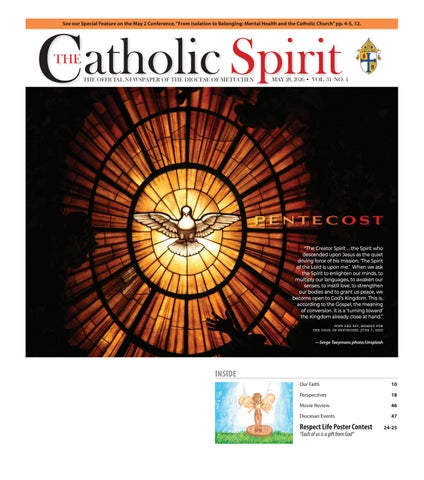
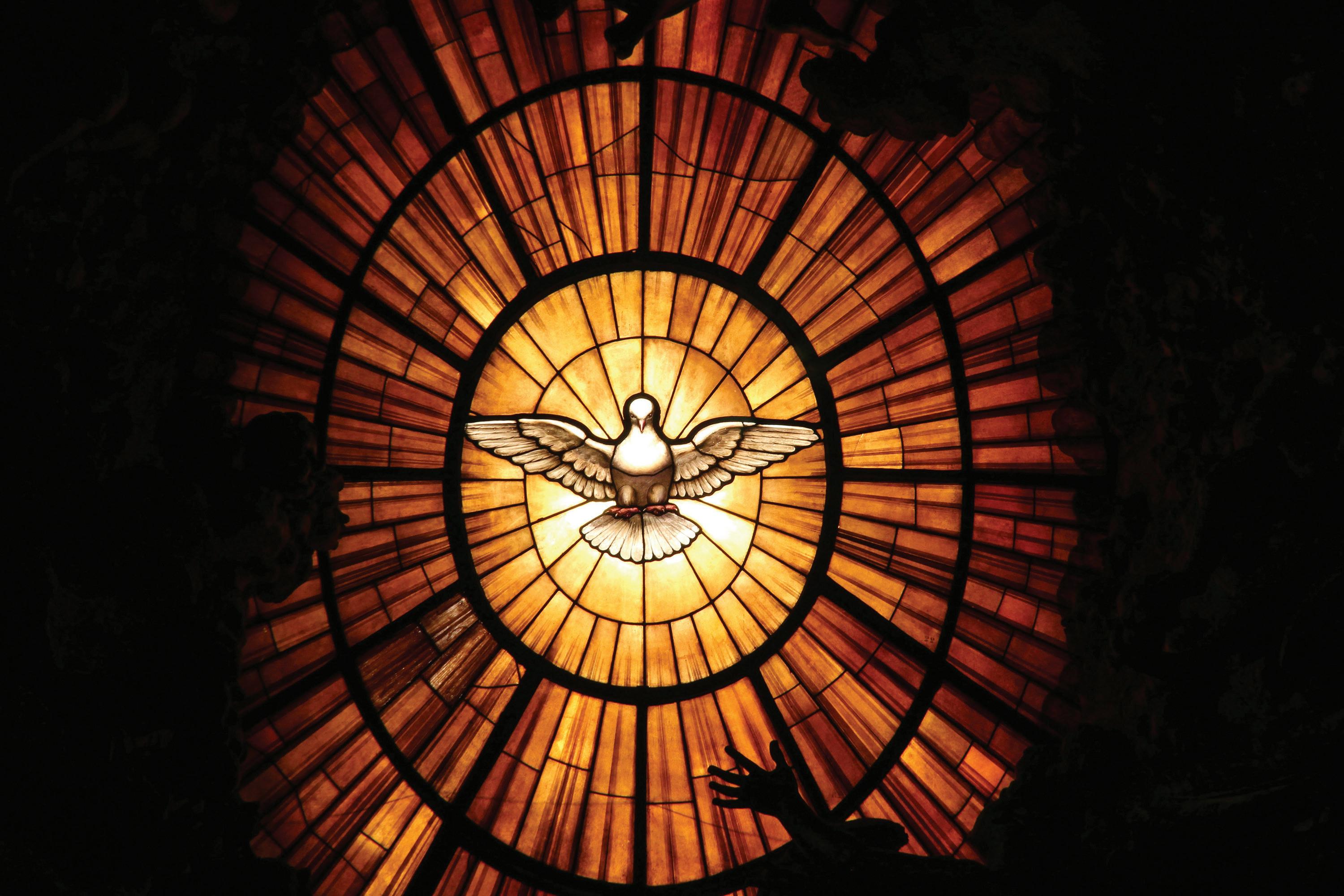
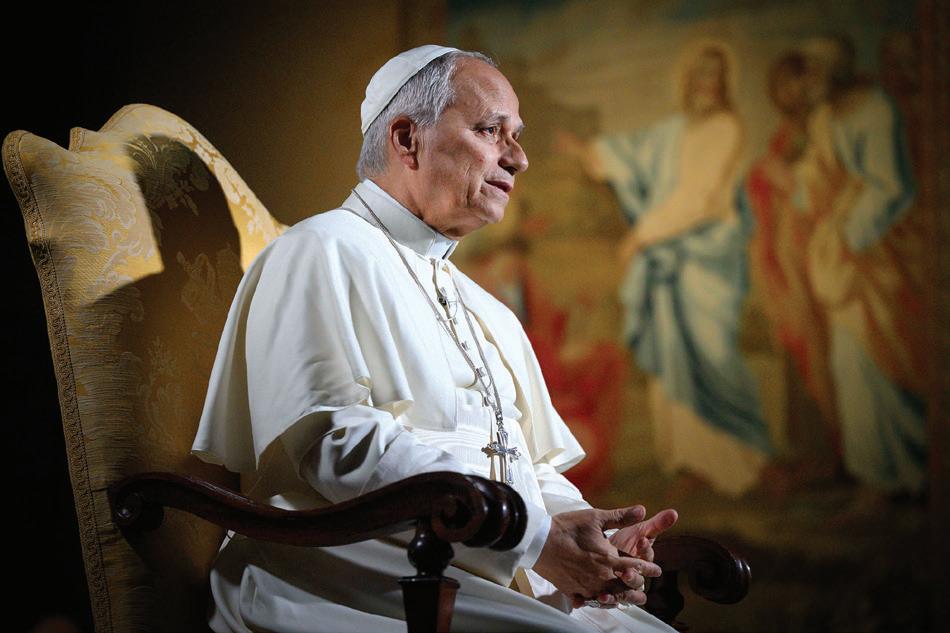
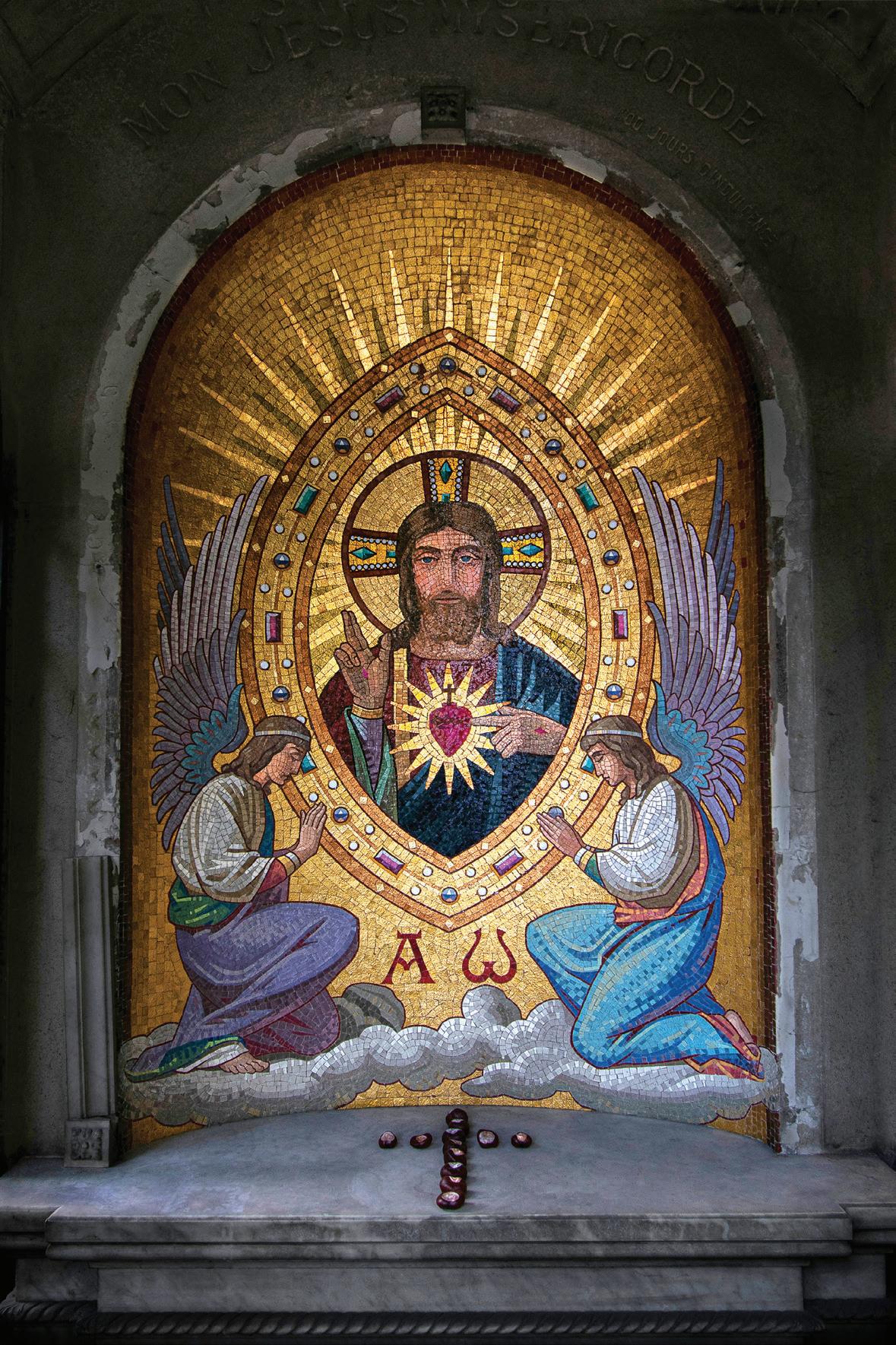
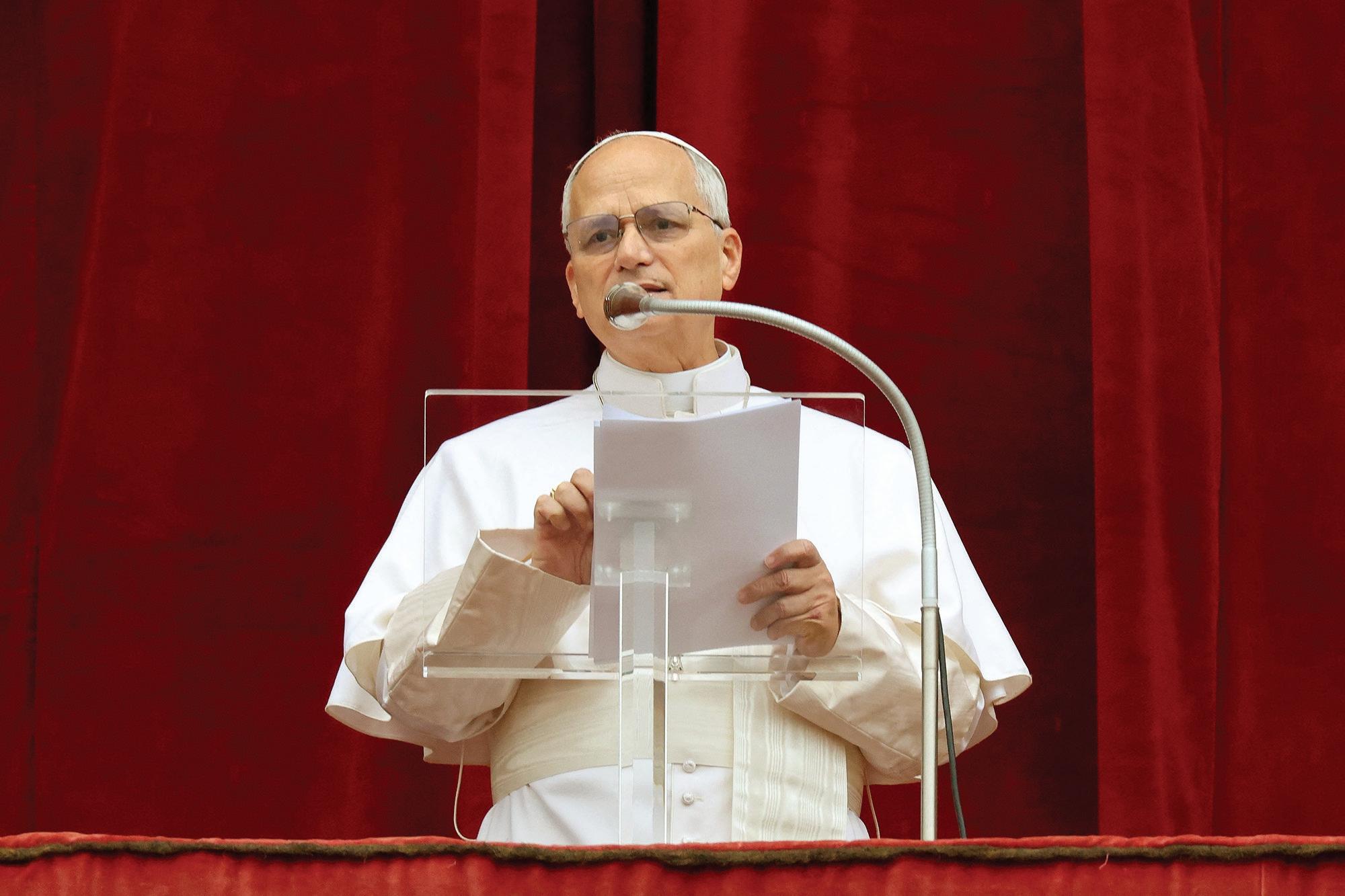
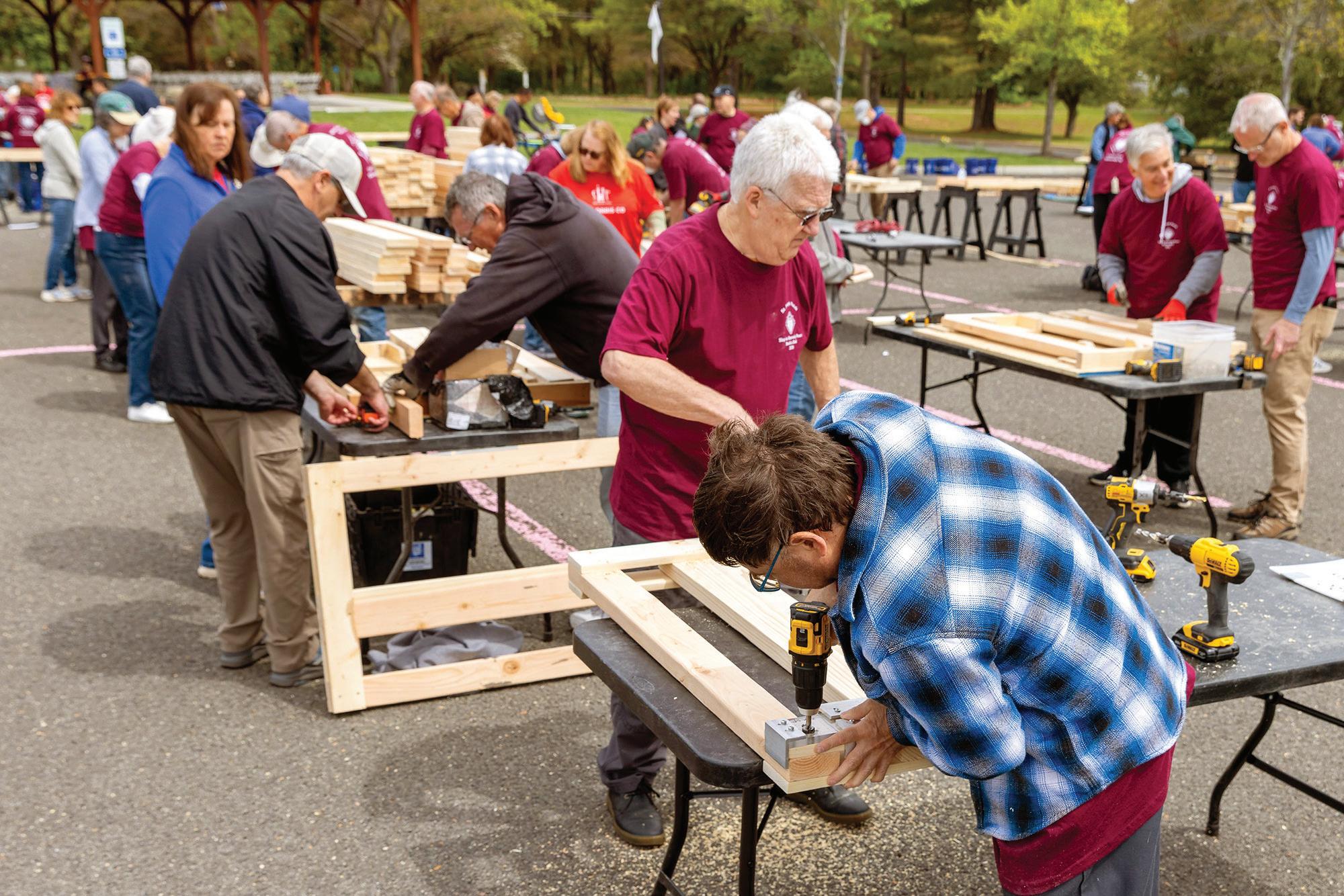
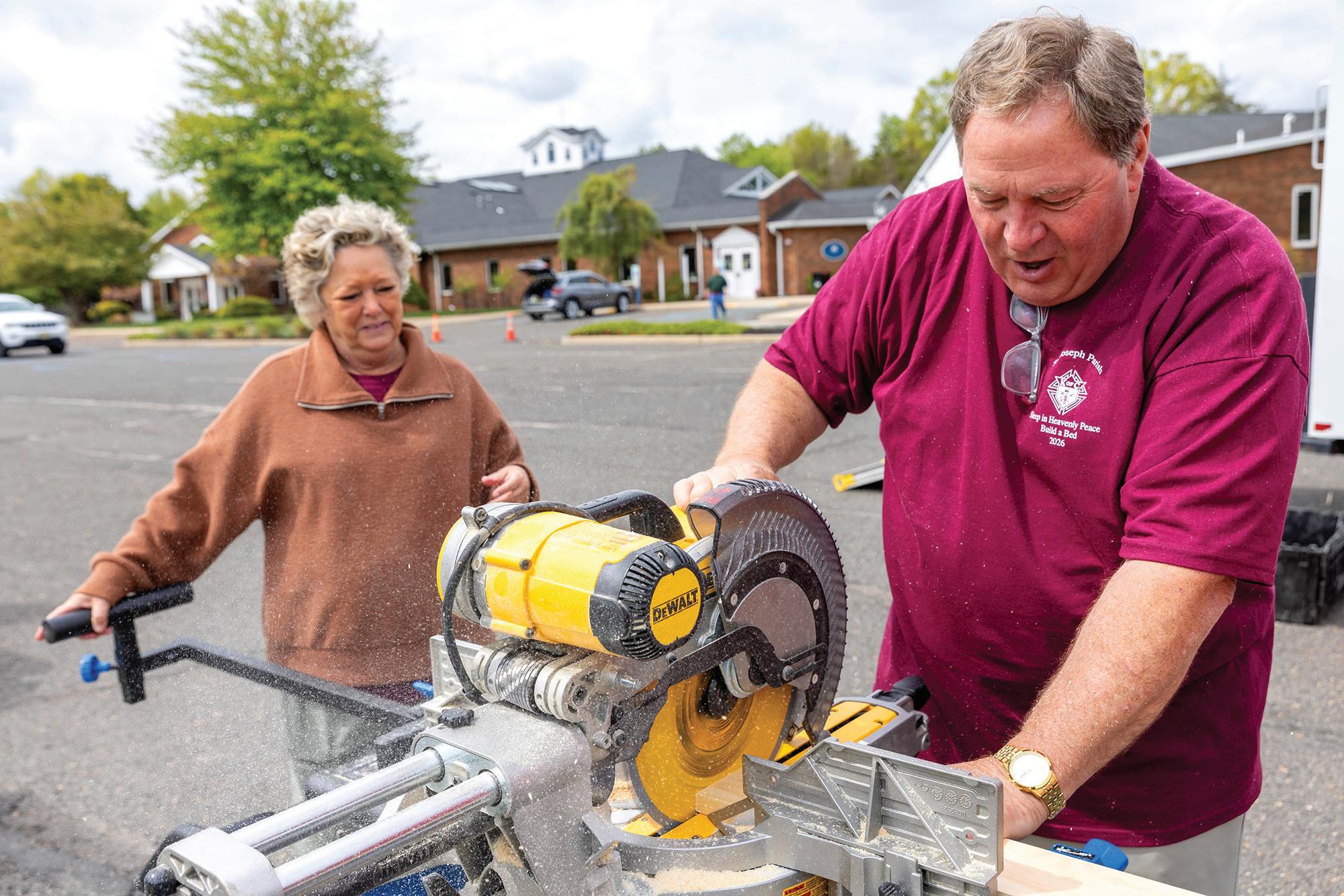
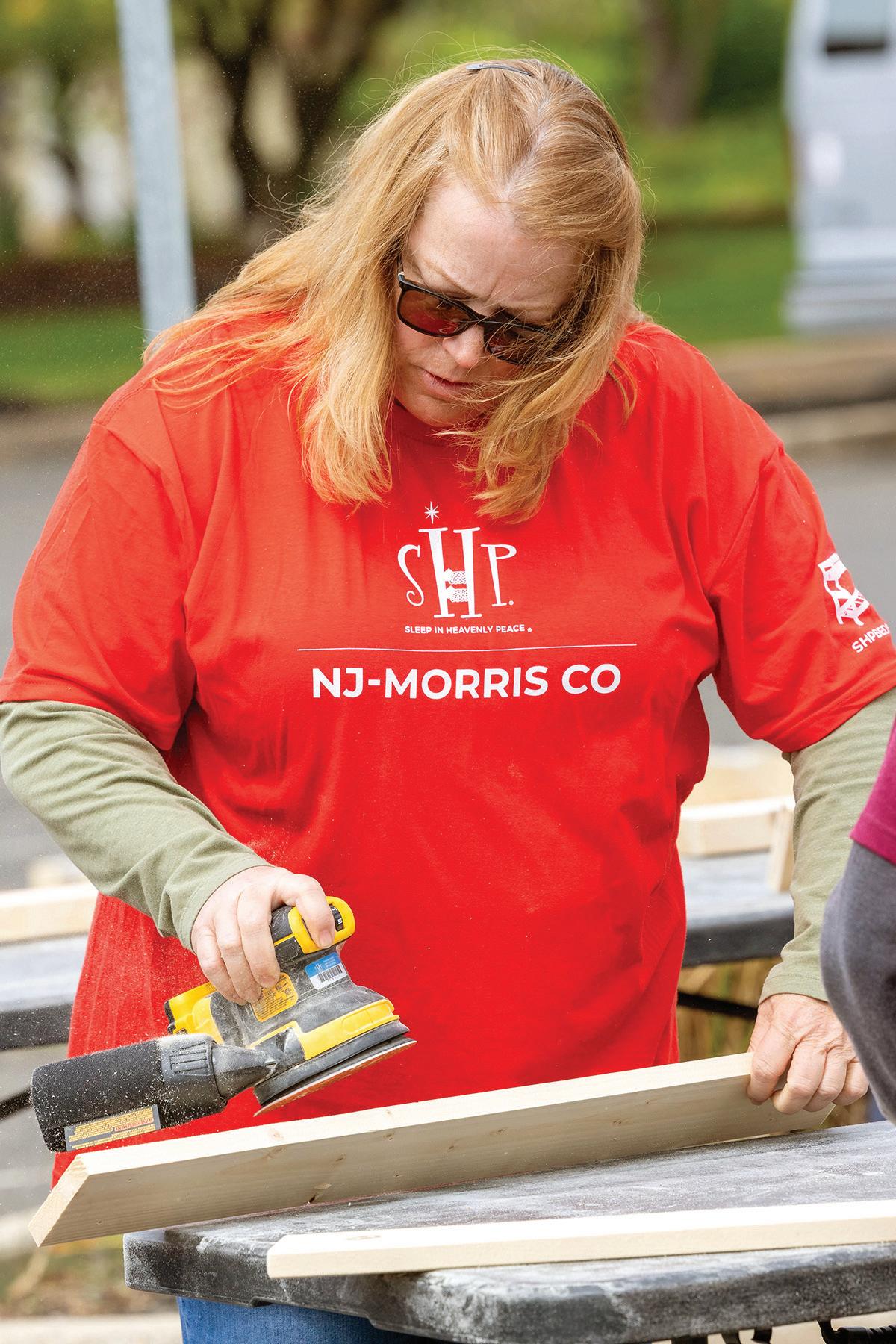
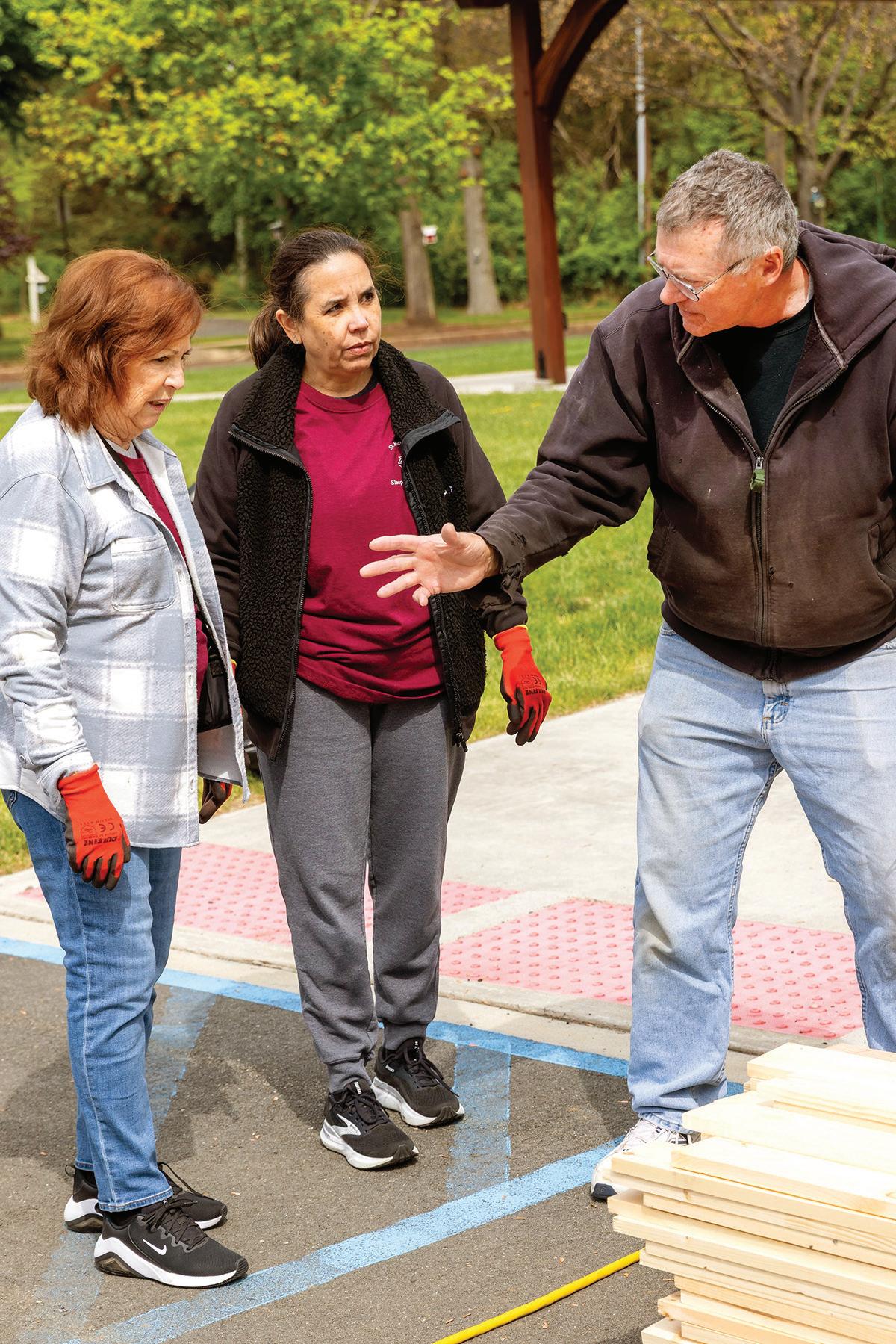
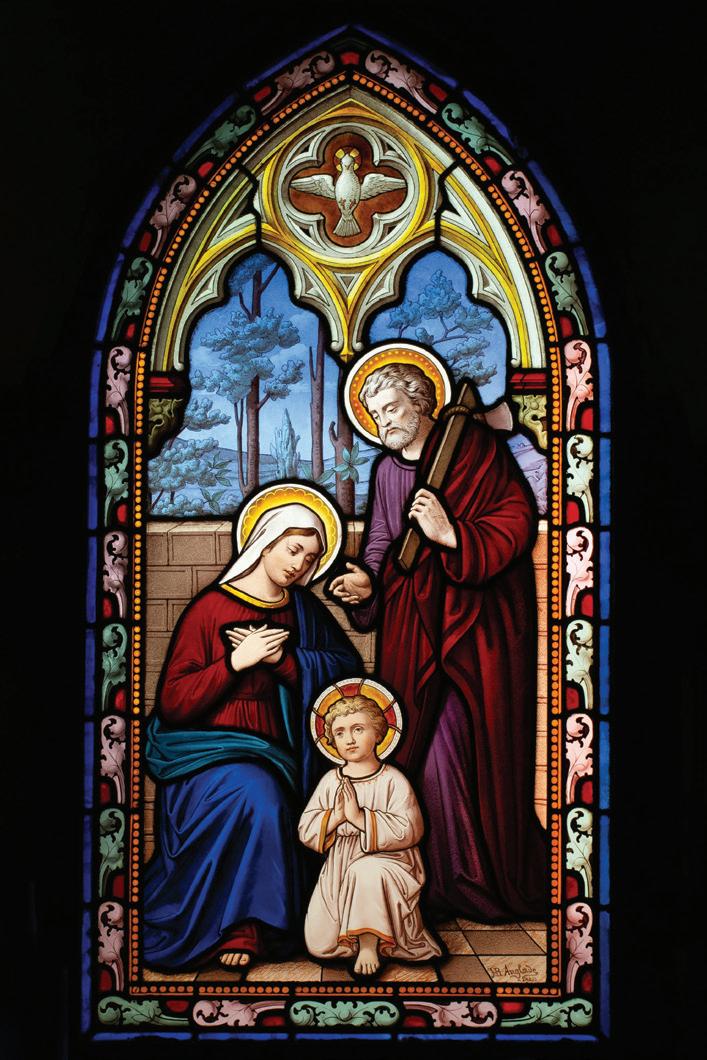
“The Creator Spirit … the Spirit who descended upon Jesus as the quiet driving force of his mission: ‘The Spirit of the Lord is upon me.’ When we ask the Spirit to enlighten our minds, to multiply our languages, to awaken our senses, to instill love, to strengthen our bodies and to grant us peace, we become open to God’s Kingdom. This is, according to the Gospel, the meaning of conversion. It is a ‘turning toward’ the Kingdom already close at hand.”
Pope Leo XIV, Homily for the Vigil of Pentecost, June 7, 2025
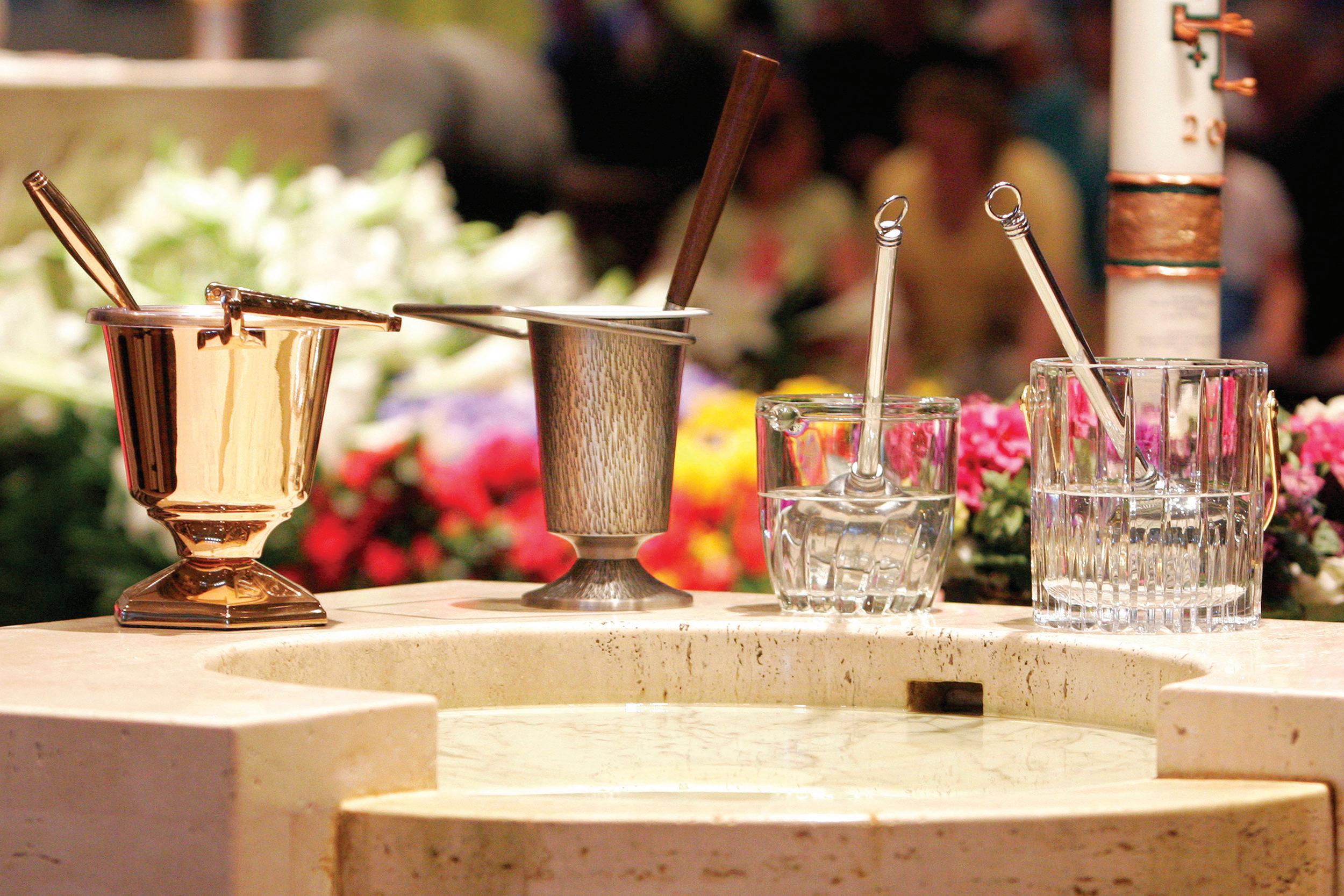
—Serge Taeymans photo/Unsplash
Spring is a time of waiting in joyful hope – for new spiritual fruit, new priests and a new bishop
Dear brothers and sisters,
The celebration of Pentecost concludes the Easter Season, and I hope the season was good for you. After the restrictions that penitential Lent provides, so many see Easter as the end of self-discipline and so lose out on the opportunity to take what was temporarily practiced in Lent and turn it into more permanent spiritual practices.
Springtime by its nature makes us more optimistic with the longer hours of daylight and the milder weather. If that wasn’t enough, we add to it the upbeat celebrations found in many parishes such as First Holy Communions, May Marian Devotions, and Confirmations. Graduations are coming, and even our diocesan ordinations to the Diaconate and Priesthood, which will come on June 20. There have been and continue to be lots of good
have been without a bishop. While it would be easy to get upset at the time it is taking, I like to see it as the evidence of the amount of thought and information-gathering that goes into the selection of a bishop. I would also point out to you the most recent diocese in our country that had an administrator and now has a bishop, the Diocese of Belleville (Illinois), was without a bishop for 10 months, so we are still within a reasonable period of time.
You may have heard it said that things work in God’s time, not ours. Hang in there and be patient. Look at it this way: We can presume that new bishop (whoever he is) will be with us between fifteen and twenty years, which can make these few months of waiting seem short. As we hear after the Our Father prayer at Mass, let us “wait in joyful hope”.
A few weeks ago, we celebrated Mother’s Day, and a few weeks from now it will be Father’s Day. Like many of my brother priests, I blessed mothers at the end of my Masses on Mother’s Day weekend, and I’ll do the same for Father’s Day.
played in my vocation as a priest.
My mother was a registered nurse who had an almost 50-year career in nursing and management in various New Jersey hospitals. From her I think I learned organization skills and empathy for those struggling or suffering. I think I also learned a change of assignments every few years isn’t a bad thing.
My father was a police officer for a few years before I was born, and so I suppose I learned from him a love of public service and the law. However, I have no doubt that the far bigger contribution he made to my priesthood came not from the police force, but when he bought a local Perth Amboy bar, owning it for 30+ years until his death. Looking back on almost 28 years of priesthood, nothing prepared me more to be a better listener as a priest than the interactions and listening I did in my years working as a bartender. Almost three decades a priest, and I still think I did more counseling and heard more confessions as a bartender.
My point here is not to talk about my family, but to show how priests come
every category you can imagine. I know priests who felt the call to serve the Lord as small children, and I know priests who had careers in the world before hearing God’s call. We need them all.
There has been a media buzz in the last few months about the surge in young Catholic adults making a return to regular Mass attendance. It’s wonderful news, but it cannot be the end of the story. Now that they’re in the pews, what now? What’s next? What can we as the clergy and laity of the Church do to keep them engaged to the point that they ask themselves the question, “Where is this leading to, Lord? What are you asking of me?”
Let’s try to figure out what we can do in the Diocese to keep this a steady trend and not just a passing fad. We could certainly use more young Catholic couples along with more priests, deacons, and religious brothers and sisters.
Finally, as I’ve done in the past, while we are in the final days of the month of May, may I ask you to ask Our Blessed Mother to intercede for our Diocese, asking the Holy Spirit to enlighten and inspire Pope Leo in his choice for our next
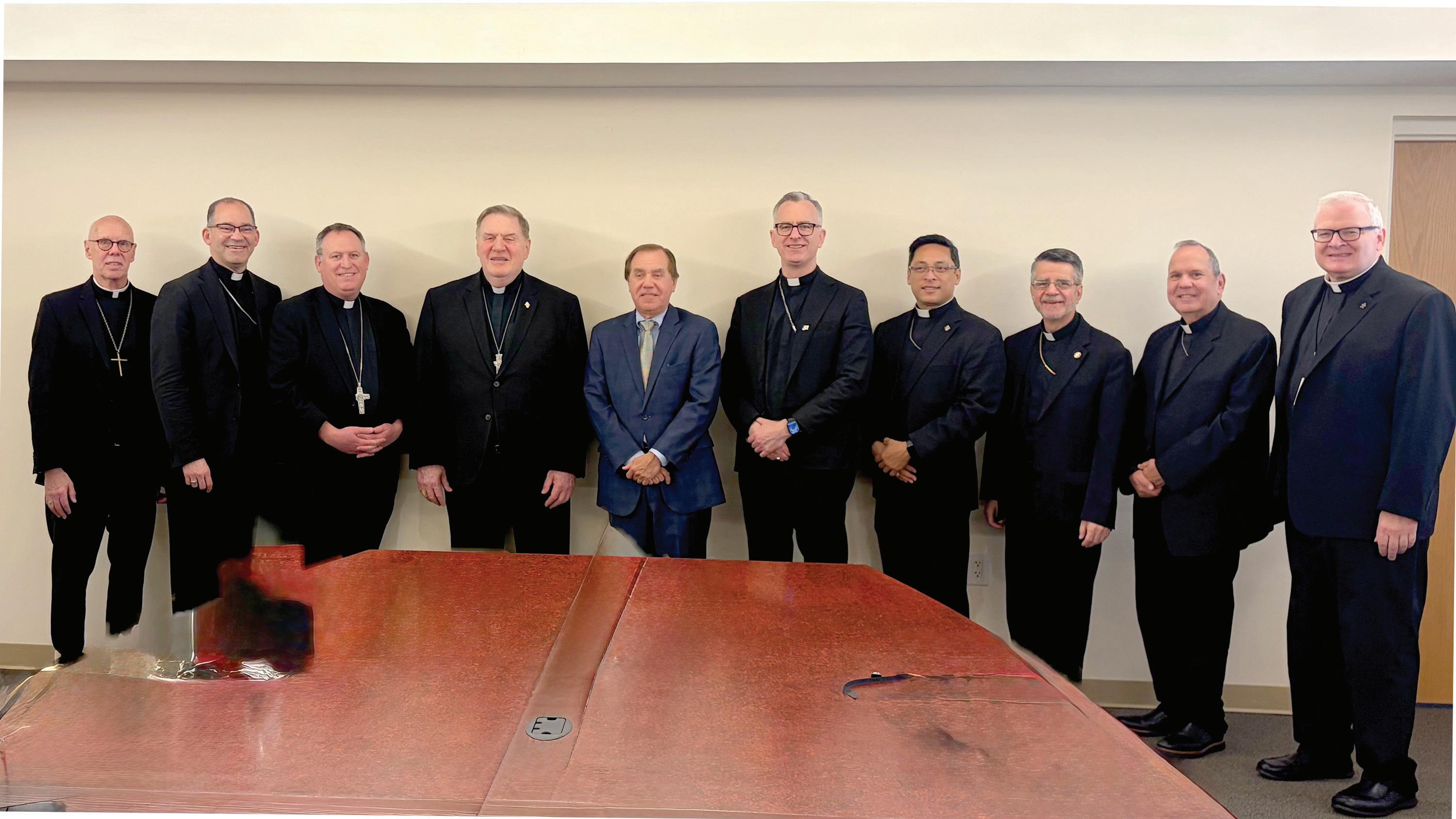
On May 5, the Diocese of Metuchen Pastoral Center hosted a meeting of the bishops of New Jersey with the Hon. Craig J. Coughlin, Speaker of the New Jersey General Assembly. The bishops have regular meetings to discuss issues of importance to Catholics in our state, and the meeting with Speaker Coughlin covered a number of topics on the state level. Pictured in the photo (from left) is Most Rev. Gregory J. Studerus, retired Auxiliary Bishop of Newark; Most Rev. Michael A. Saporito, Auxiliary Bishop of Newark; Most Rev. Kevin J. Sweeney, Bishop of Paterson; His Eminence Joseph Cardinal Tobin, Archbishop of Newark; Speaker Coughlin; Most Rev. Joseph A. Williams, Bishop of Camden; Most Rev. Pedro Bismarck Chau, Auxiliary Bishop of Newark; Most Rev. Elias R. Lorenzo, OSB, Auxiliary Bishop of Newark; Most Rev. Manuel
Pope Leo XIV’s encyclical on artificial intelligence is coming: Here’s what he has said on AI so far
By Courtney Mares, OSV News
ROME (OSV News) – As the world awaits Pope Leo XIV’s first encyclical on artificial intelligence, expected to be signed May 15 and released by the Vatican by the end of the month, here is a look at what the Pope has said on AI since his election a year ago.
The first American pope and a former mathematics major, Pope Leo has returned to the subject of AI again and again in speeches, messages and interviews since his election in May 2025, leading Time magazine to include him on its 2025 list of the world’s most influential people in artificial intelligence.
Pope Leo has already addressed AI in a wide range of contexts, telling teenagers gathered in a sports stadium to use AI “in such a way that if it disappeared tomorrow, you would still know how to think, warning priests not to use chatbots to write their homilies, calling on the media to preserve “human voices and faces,” and telling legislators from 68 countries that AI is a tool meant to serve humans, not replace them.
From a speech in central Africa on AI’s potential to change humanity’s “relationship with truth” to a message to tech developers gathered in Rome, Pope Leo has emerged as one of the most prominent global voices on the ethical challenges posed by artificial intelligence even before the publication of his much-anticipated encyclical.
Words of wisdom to young people on the use of AI
One of the Pope’s most direct and memorable statements on AI came in response to a high school student from Honolulu, who asked Pope Leo about young people’s use of ChatGPT and other AI tools for homework from writing an essay to solving a math problem.
“Use it in such a way that if it disappeared tomorrow, you would still know how to think,” Pope Leo said.
He urged the student to “be careful
field of artificial intelligence that pose new challenges for the defense of human dignity, justice and labor,” Pope Leo XIV said, two days after his election.
In his first interview after his election, Pope Leo warned of “extremely rich people” who are investing in AI and totally ignoring “the value of human beings and humanity,” adding, “I think the Church needs to speak up.”
Pope Leo XIV answers a question posed by a high school student at the National Catholic Youth Conference in Indianapolis as he joins the gathering via livestream from the Vatican Nov. 21, 2025. —CNS photo/ Vatican Media
that your use of AI does not limit your true human growth,” underlining the importance of knowing “how to think, how to create, how to act on your own, how to form authentic friendships.”
The Pope spoke via video link to a crowd of 16,000 young people gathered in Indianapolis for the National Catholic Youth Conference in November.
“AI can process information quickly, but it cannot replace human intelligence,” Pope Leo told the students. “And don’t ask it to do your homework for you. It cannot offer real wisdom. It misses a very important human element: AI will not judge between what is truly right and wrong. And it won’t stand in wonder, in authentic wonder before the beauty of God’s creation.”
Pope Leo has also expressed concern for AI’s potential effect on children’s “intellectual and neurological development,” adding “we must pause and reflect with particular care upon the freedom and inner life of our children and young people.”
“The ability to access vast amounts of data and information should not be confused with the ability to derive meaning and value from it. The latter requires a willingness to confront the mystery and core questions of our existence,” he said.
“It will therefore be essential to teach young people to use these tools with their own intelligence, ensuring that they open themselves to the search for truth.”
AI and the job market
Pope Leo expressed interest in the issue of artificial intelligence and the dignity of work since the first week of his pontificate, telling the College of Cardinals days after his election in May 2025 that he took his name partly in honor of Pope Leo XIII, who wrote the social encyclical “Rerum Novarum” in 1891 in the context of the first industrial revolution.
“In our own day, the Church offers to everyone the treasury of her social teaching in response to another industrial revolution and to developments in the
Speaking to legislators from 68 countries gathered at the Vatican for the Jubilee of Governments in June, the Pope said, “it must not be forgotten that artificial intelligence functions as a tool for the good of human beings, not to diminish them, not to replace them,” adding that AI can “be of great help to society, provided that its employment does not undermine the identity and dignity of the human person and his or her fundamental freedoms.”
In a December 2025 speech to participants in an AI conference in Rome, the Pope asked, “How can we ensure that the development of artificial intelligence truly serves the common good, and is not just used to accumulate wealth and power in the hands of a few?”
“This is an urgent question, because this technology is already having a real impact on the lives of millions of people, every day and in every part of the world,” the Pope added.
Co-workers in creation, not passive AI consumers
“Human beings are called to be co-workers in the work of creation, not merely passive consumers of content generated by artificial technology,” Pope Leo said in the same December speech.
“Artificial intelligence has certainly opened up new horizons for creativity, but it also raises serious concerns about its possible repercussions on humanity’s openness to truth and beauty, and capacity for wonder and contemplation,” he added.
The pope expanded on his idea in his message for the 60th World Day of Social Communications, published in January, warning that AI systems “have increasingly taken control of the production of texts, music and videos,” putting “much of the human creative industry at risk of being dismantled and replaced with the label ‘Powered by AI,’ turning people into passive consumers of unthought thoughts and anonymous products without ownership or love.”
The masterpieces of human artistic genius, he added, are being reduced to “mere training grounds for machines.”
“Renouncing creativity and surrendering our mental capacities and imagination to machines,” Pope Leo wrote, “would mean burying the talents we have been given to grow as individuals in relation to God and others.”
The Pope has urged priests to resist “the temptation to prepare homilies with artificial intelligence.”
“To give a true homily is to share faith,” and artificial intelligence “will never be able to share faith,” the Pope told priests of the Diocese of Rome.
‘Preserving human voices and faces’
Pope Leo titled his 2026 communications’ day message focused on AI “Preserving Human Voices and Faces.”
“Faces and voices are sacred,” he said. “God, who created us in his image and likeness, gave them to us when he called us to life through the Word he addressed to us.”
By simulating human voices, faces, emotions, and relationships, he added, “the systems known as artificial intelligence not only interfere with information ecosystems, but also encroach upon the deepest level of communication, that of human relationships. The challenge, therefore, is not technological, but anthropological. Safeguarding faces and voices ultimately means safeguarding ourselves.”
The Pope has also spoken about deepfakes – AI-generated videos, images and audio – and their capacity to deceive.
Pope Leo recalled how only a few days into his pontificate someone asked him if he was OK after falling down a flight of stairs. “I said: ‘No, I didn’t,’” he recalled, “but there was a video somewhere where they had created this artificial pope, me, falling down a flight of stairs as I was walking somewhere, and it apparently was so good that they thought it was me.”
He also disclosed that someone had approached him with a proposal to create an AI version of the pope, so that visitors to a website could participate in virtual papal audiences. His response was unequivocal: “I said, ‘I’m not going to authorize that.’ If there’s anyone who shouldn’t be represented by an avatar, I would say the pope is high on the list.”
Chatbots as an ‘oracle of all advice’
Pope Leo, the first pope to be an active Twitter user before being elected as a successor of Peter, has observed that “as we scroll through our feeds, it becomes increasingly difficult to determine whether we are interacting with other human beings or with ‘bots’ or ‘virtual influencers.’”
Chatbots based on large language models, he noted, “are proving to be surprisingly effective at covert persuasion through continuous optimization of personalized interaction.” Because they are “excessively affectionate, as well as always present and accessible, they can become hidden architects of our emotional states and so invade and occupy our sphere of intimacy.”
The danger, he wrote, is when people substitute AI systems for real human relationships, they create “a world of mirrors around us, where everything is made ‘in our image and likeness,’” robbing themselves of the “opportunity to encounter others, who are always different from ourselves, and with whom we can and must learn to relate.”
Courtney Mares is Vatican editor for OSV News. Follow her on X @catholicourtney.
Healing the Hidden Wounds A statewide Catholic response takes shape
By Mary Morrell, Editor-in-Chief, Diocese of Metuchen and Jennifer Mauro, Managing Editor, Diocese of Camden
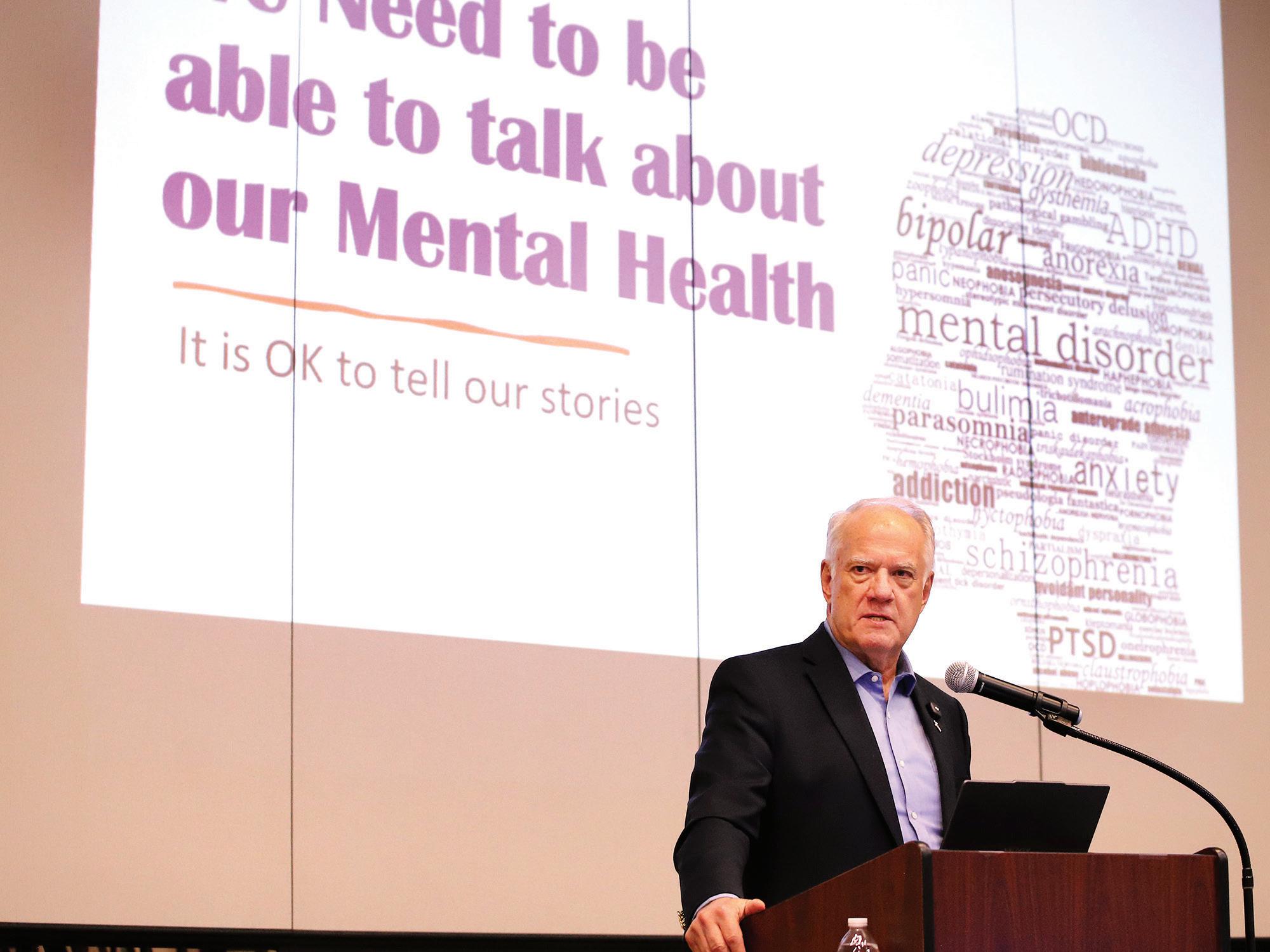
The doors of the Church, Pope Francis has said, must always remain open – especially for those carrying unseen wounds. On May 2, that call took concrete shape as more than 200 clergy, religious, educators, mental health professionals, ministry leaders and more gathered with a shared purpose: confronting the growing mental health crisis not from the margins, but from the heart of the faith community.
“Struggle is not a failure of humanity. Silence is. When we treat addiction or mental illness as something that must be concealed or explained away or endured alone, we unintentionally transform human suffering into spiritual isolation – and isolation is where despair grows,” said Bishop John Dolan of the Diocese of Phoenix, the keynote speaker for the New Jersey Catholic Mental Health Conference held at the St. John Neumann Pastoral Center, Piscataway.
“One of the hardest truths to face is that a person can be deeply loved but still feel completely alone,” he said. “That’s why presence matters. Not abstract care, but real encounter.”
Hosted by the Diocese of Metuchen, the conference, titled “From Isolation to Belonging: Mental Health and the Catholic Church,” brought together participants from all five New Jersey (arch) dioceses, as well as leaders from multiple
religions. The daylong gathering blended pastoral reflection with practical strategy from Bishop Dolan and leading Catholic voices and experts in the field.
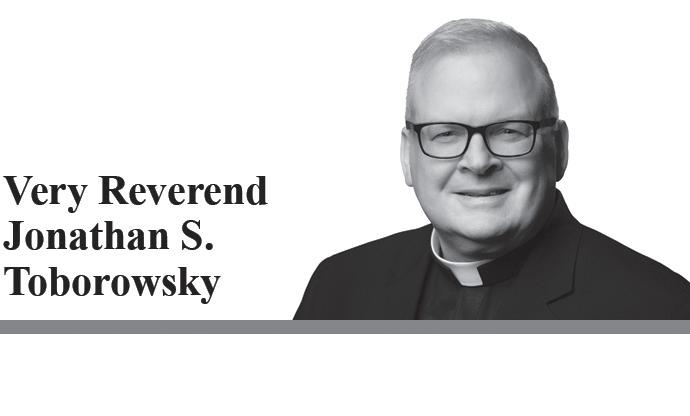
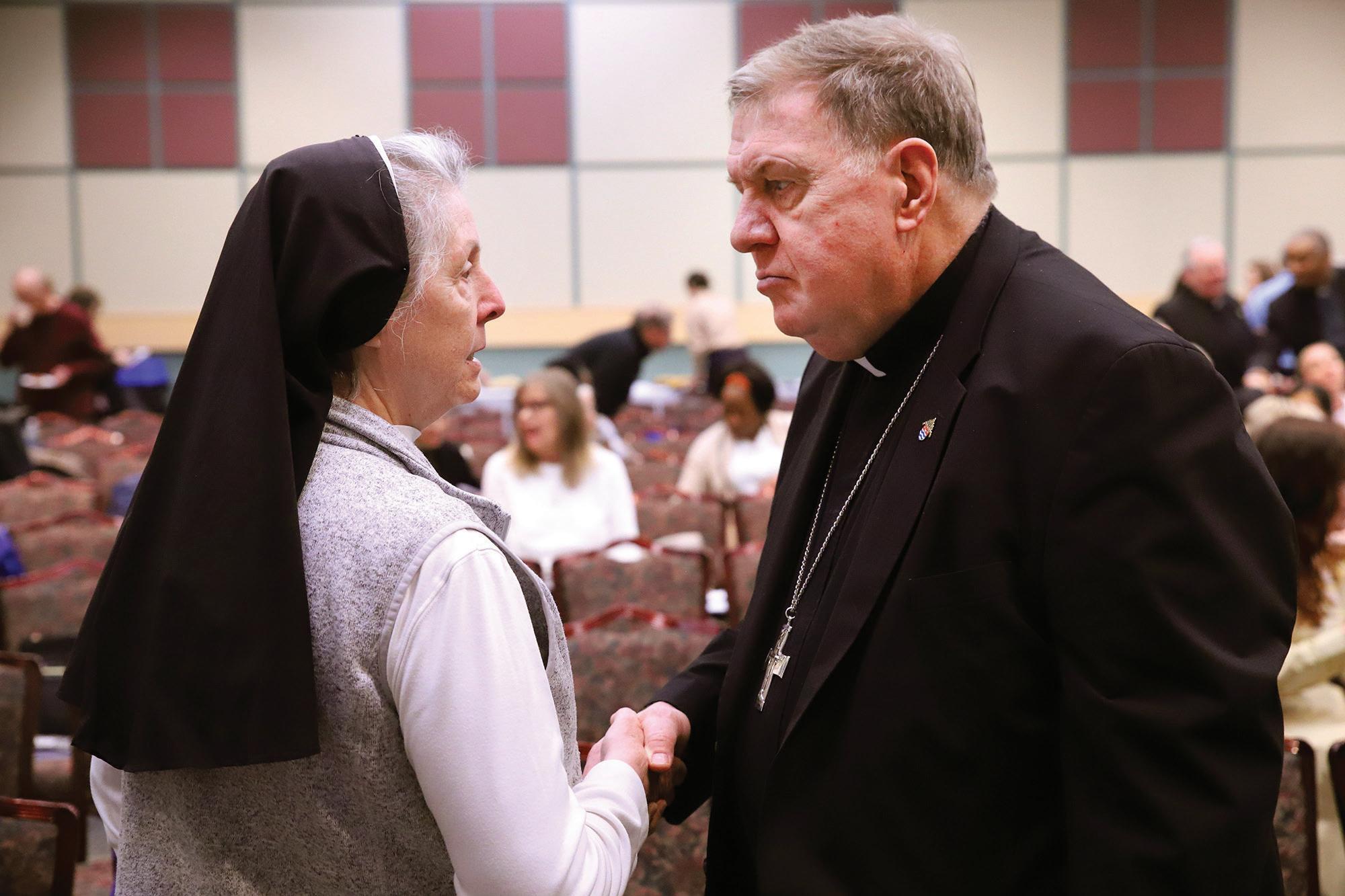
The day started with Mass celebrated by Cardinal Joseph Tobin of the Archdi ocese of Newark. Concelebrating were: Bishop Joseph Williams of the Diocese of Camden; Father Jonathan S. Toborowsky, administrator of the Diocese of Metuchen; Bishop Dolan, and Father Tim Graff from the Archdiocese of Newark.
he invoked Pope Francis’ vision of the Church as “a field hospital after battle.” The image, he suggested, is more than metaphor. It is a directive – one that calls the Church to move toward those who are wounded, to listen without judgment, and to build communities where isolation gives way to belonging.
Suffering in Silence
Coordinated by the New Jersey Catholic Conference in partnership with the state’s dioceses, Catholic Charities agencies and the Catholic Healthcare Partnership of New Jersey, the conference reflected a growing recognition among Church leaders: the mental health crisis is not only a clinical concern, but a pastoral one.
That message was echoed in Cardinal Tobin’s opening remarks, where
In his keynote, Bishop Dolan, a survivor of suicide loss, spoke on the effects of isolation and the importance of accompaniment. He cited a 2023 report from the U.S. Surgeon General that found how chronic loneliness can increase the risk of premature death to a level comparable to smoking up to 15 cigarettes a day. In addition, chronic loneliness can raise the risk of dementia in older adults by roughly 50%.
“One of the hardest truths to face is that a person can be deeply loved but still feel completely alone,” he said. “That’s
why presence matters. Not abstract care, but real encounter.”
A person can be in a room and still be distant. One can be surrounded by people and still feel alone. To be with someone is to be present in a way that acknowledges the other and allows that person to matter. Show up. Stay. Listen.
“That is why the word ‘with’ carries such weight,” Bishop Dolan said. “It points to something deeper than proximity. It speaks of relationship. It speaks of identity.”
Being present for others is especially important in a world in which humanity is connected more than ever before, while true communication is lacking.
“I have come to say clearly: Isolation kills but communion heals. I say that because I’ve seen it and I’ve experienced it,” he said, explaining that five of his family members have died by suicide.
“There is a silence that follows this kind of loss. It’s different,” he explained.
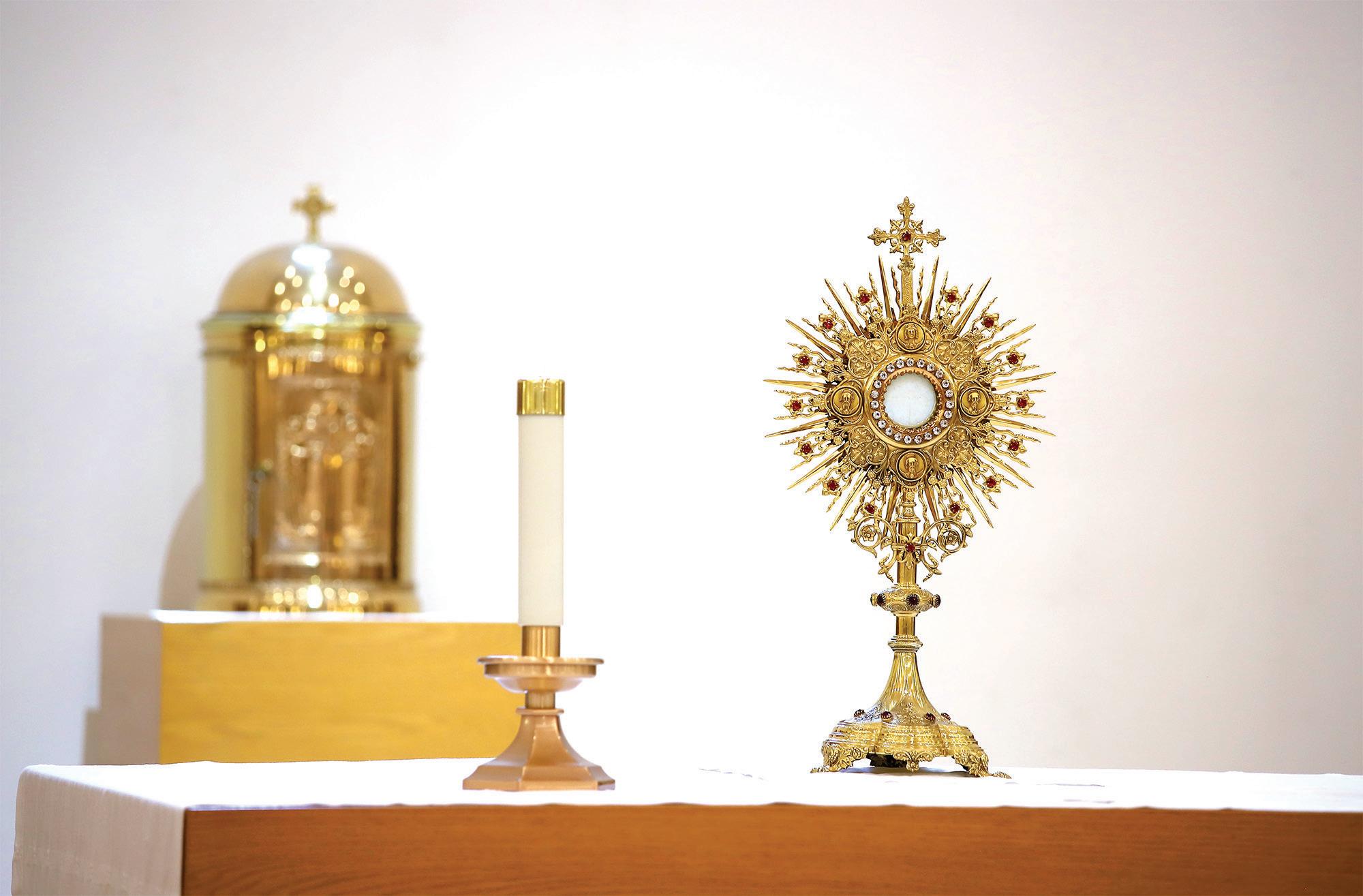
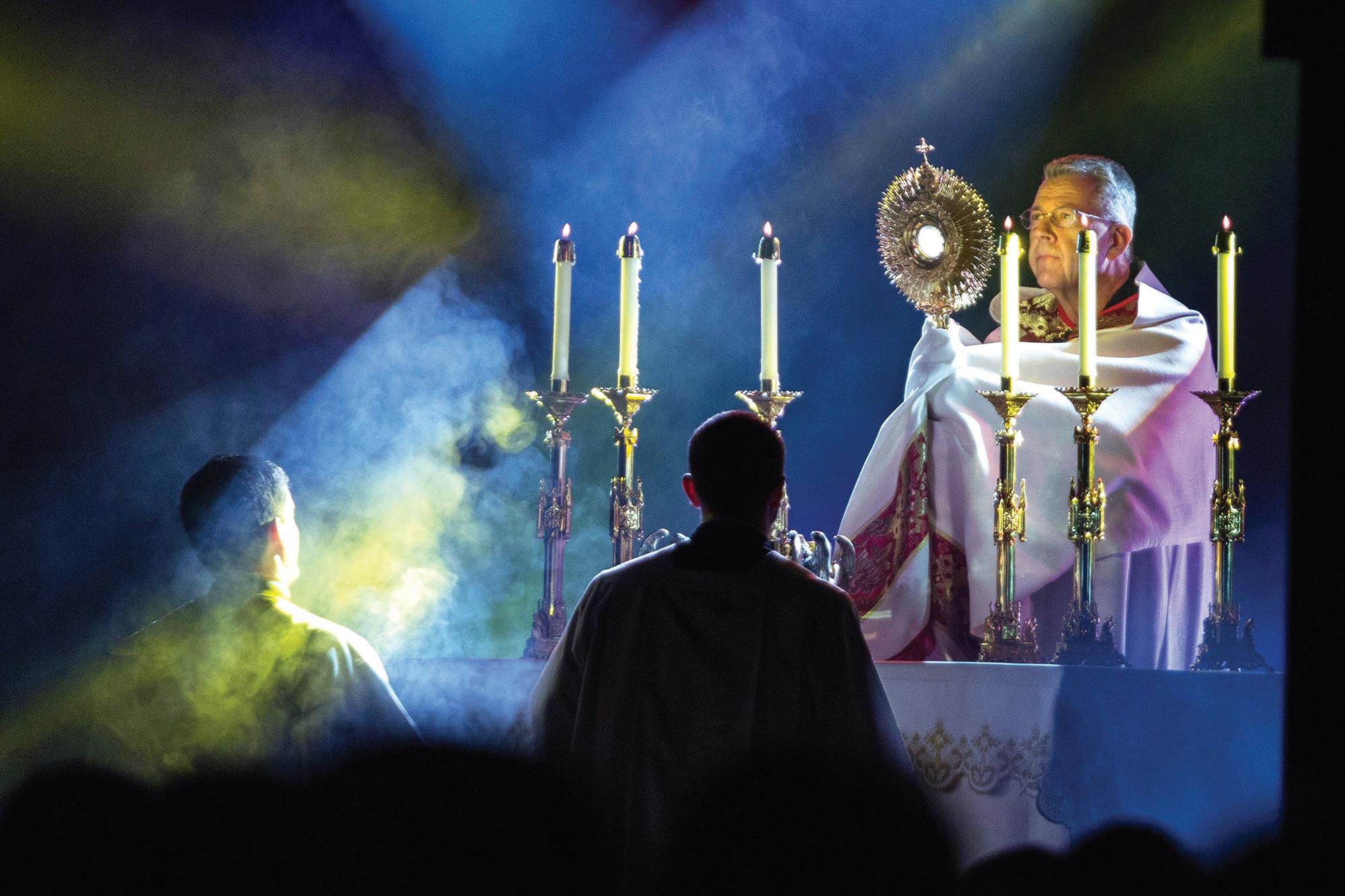
1. Adoration of the Blessed Sacrament offered throughout the May 2 Mental Health Conference, served as a time for reflection on the pressing issue of mental illness.
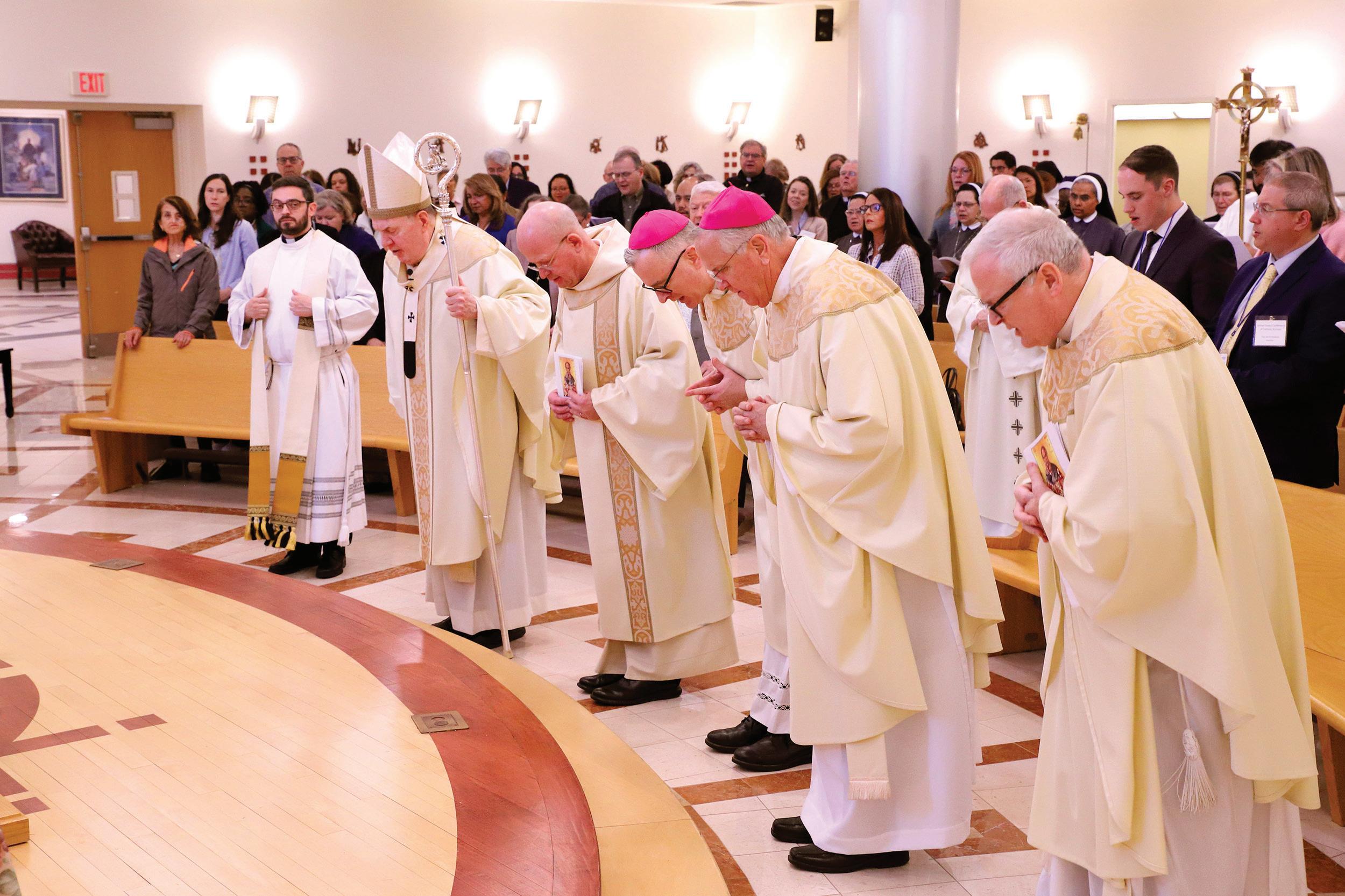
2. Cardinal Joseph W. Tobin, second from left, serves as principal celebrant for the May 2 Mass. Pictured from far left are Father Anthony Palombo, Archdiocese of Newark, Cardinal Tobin’s emcee, along with Deacon John Radvanski, and concelebrants Bishop Joseph Williams, Diocese of Camden; Bishop John Dolan, Diocese of Phoenix, and Father Jonathan S. Toborowsky, Diocese of Metuchen administrator.
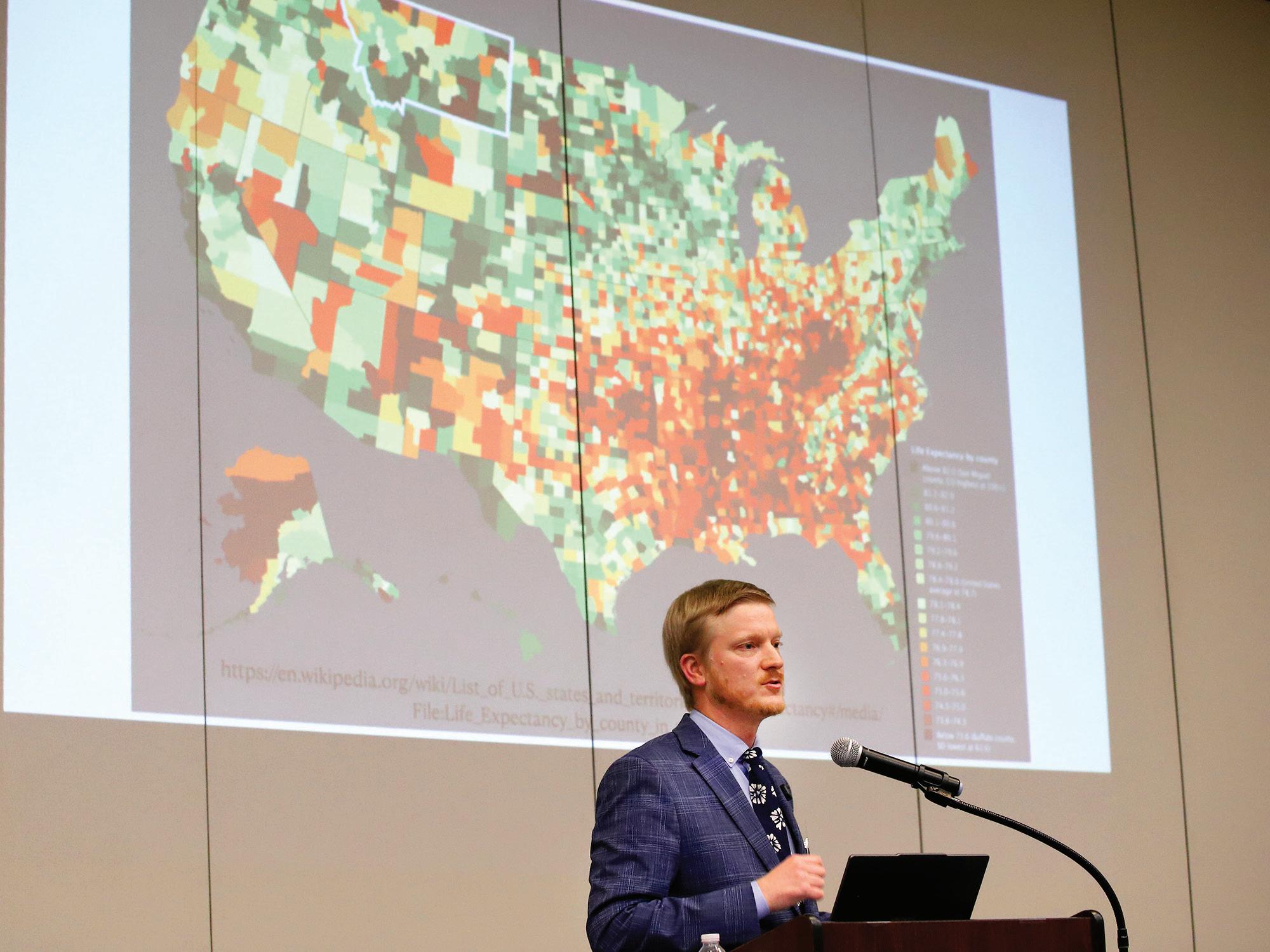
3. Ben Wortham, vice president for Behavioral Health Integration at Catholic Charities USA, stresses the importance of collaboration when addressing mental health issues.
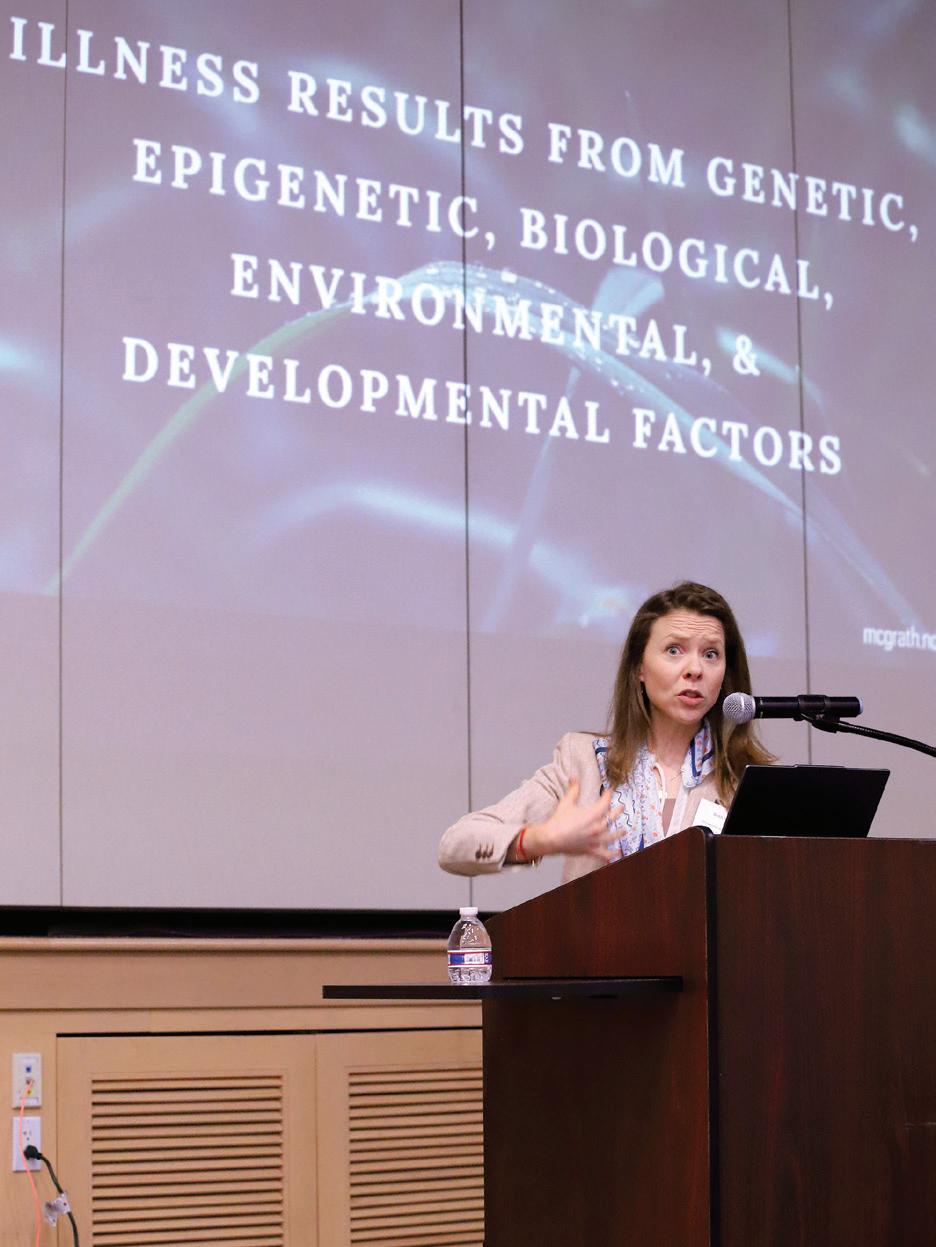
4. Beth Hlabse, program director, Fiat Program on Faith and Mental Health at Notre Dame University’s McGrath Institute for Church Life, discusses prevalence of mental illness in American adults.
5. Deacon Ed Shoener, founder of the International Association of Catholic Mental Health Ministers, shared the experience of writing his daughter’s obituary after she died by suicide.
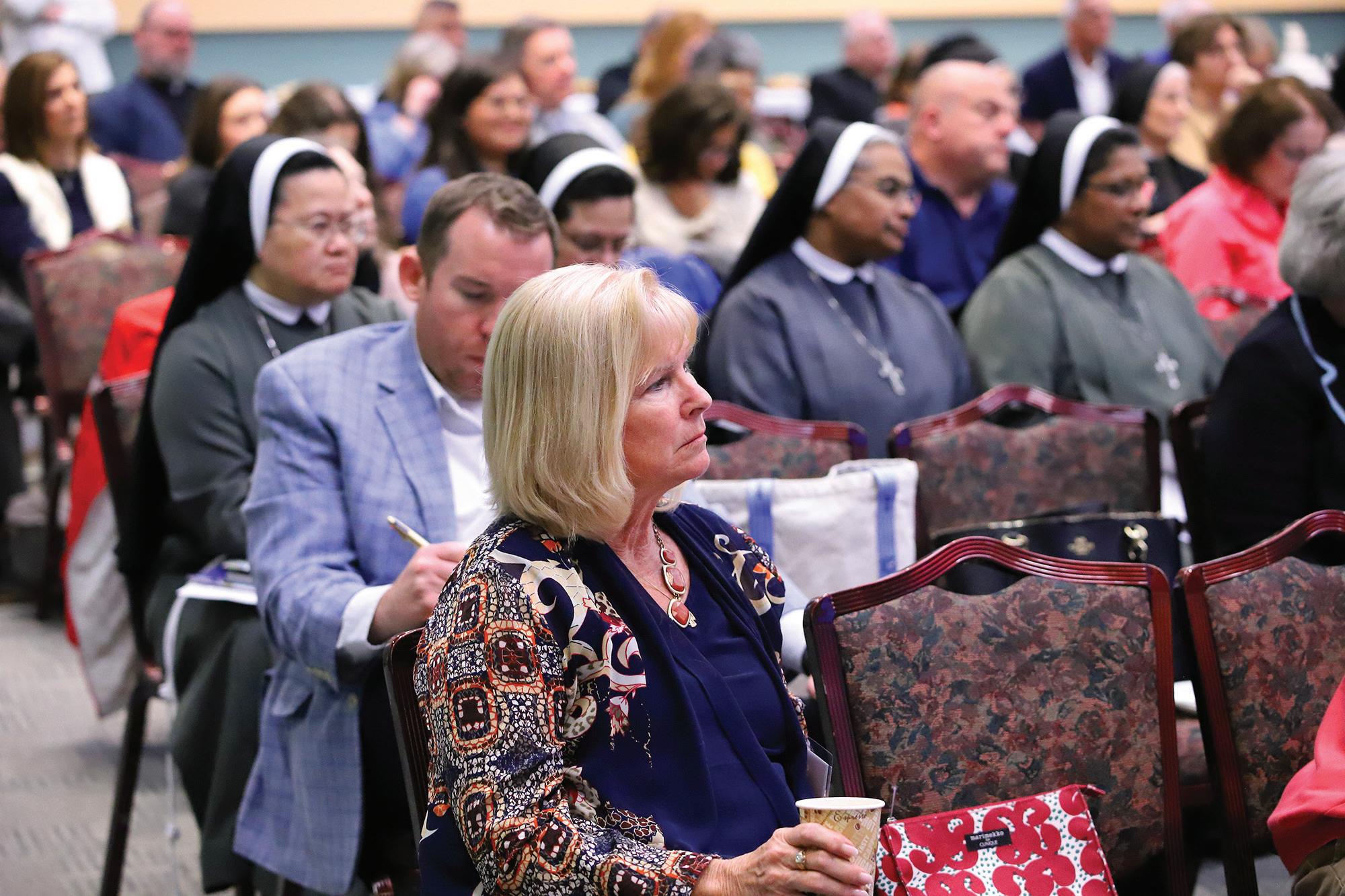
6. Jennifer Ruggiero, Secretary, Secretariat for Family and Pastoral Life, and member of the NJCC planning committee, joins some 200 attendees focused on learning about the role of the Church in addressing mental health issues.
—John Batkowski photos
“There are questions that don’t always have answers. You find yourself wondering, ‘What more could have been done? Where did I go wrong? Why wasn’t I there? How may I have made a difference?’”
This is also true among leaders of faith, Bishop Dolan said. “I’ve met priests who waited years before seeking help, years of quiet anguish, because they feared disappointing their bishop, their community or their people. I’ve met women religious who believe their vows required endurance without expression. Endurance is not the same as holiness. Suffering in silence is not a sacrament or religious virtue.”
Hope and Healing Accompaniment was among the first topics that Beth Hlabse, program director of the Fiat Program on Faith and Mental Health at Notre Dame University’s McGrath Institute for Church Life, discussed in her presentation.
Overcoming mental illness “is not just a matter of willpower,” she stressed, urging anyone accompanying a loved one to look at is as a “journey of working with [that person], rather than compounding the shame by saying it’s only a matter of willpower – because it’s not.”
“Remember, your role is not to diagnose,” she said. “[It is] to encounter each person according to their uniqueness, to discern their level of suffering and to ask the Lord, ‘Lord, how am I called to walk with this person? How am I called to support them in accessing a broader network of resources beyond what I and our immediate community can offer?’”
With more than one in five American adults living with a mental illness (23.4%), and more than one in 20 U.S. adults living with a serious mental illness (5.6%), she also addressed contributing factors, including illness, and biological, environmental
Q&A:
Addressing the Need for Mental Health Ministry
By Deacon Patrick Cline, Correspondent
Throughout the Mental Health Conference, participants were encouraged to submit questions on index cards, some of which were then posed to one or more of three presenters. Questions included:
How do you deal with a situation where an individual refuses to recognize or admit that there is a mental health issue?
Deacon Ed Shoener replied that there is a medical term, anosognosia, which describes that a person is not aware of the illness; they are not in denial, they believe they are ok. He recommended what he considers to be an excellent book, titled, “I AM NOT SICK, I Don’t Need Help! – How to Help Someone with Mental Illness Accept Treatment.”
Beth Hlabse added that there are limitations as to what can be done in certain situations, and sometimes the therapist hits a wall. But the person’s lack of insight might be impacting his or her family and community as well. She suggested that it might be possible to help and support the family in light of a denial, and this could be especially helpful in the context of a faith community.
Looking at it from a Catholic Charities lens, Ben Wortham spoke about case management and a personal care plan, noting that, while we may think we know exactly what a person needs, if we start where the person wants to start, “it’s amazing what can happen and what can be addressed later on.”
Why do people tend to avoid someone suffering from any type of mental illness? Is it simply not knowing what to do or a fear of doing or saying the wrong thing?
Shoener said there is a stigma in society around mental illness, and he believes it is partially due to a lack of mental health literacy. If someone has cancer or diabetes, people understand they can talk about it. He suggested that as a start, people increase their knowledge about mental illness and become more comfortable talking about the issues.
Hlabse added that people have good intentions and want to be present to someone and yet get stuck. People don’t like to be uncomfortable in these situations and so tend to move directly into problem-solving mode, offering advice instead of just listening. What listeners need to do in these uncomfortable situations is slow down, breathe and pray for the grace of the Holy Spirit.
Several questions dealt with how to start a mental health awareness ministry in a parish.
Shoener said one of the main reasons he came to the conference was to encourage people to start such a ministry, so he was pleased to hear people were interested in exploring the first steps. He recommended going to the website Catholic Mental Health Ministers for information about starting a local health wellness ministry in a parish. He emphasized that it is important to get the pastor’s agreement to begin this ministry.
How can parishes engage young people when trying to develop this ministry?
Shoener recommended the website of Sanctuary Mental Health Ministries, which has developed a series for people between ages 12-15. He stressed that in programs for this age group, the parents must be involved. Offering mental health programs for parents and inviting the children to attend with their parents is a suggestion.
Hlabse suggested that a parish’s Confirmation prep program could be a way to introduce a discussion regarding some to the challenges the candidates are facing: loneliness, searching for something more, searching for meaning or other topics.
How can parishes structure an invitation to become part of a program of this nature without making it sound negative?
Hlabse said it’s not a one size fits all situation. She suggested sponsoring speakers on mental health issues or personally inviting people to talk about daily challenges. She also suggested providing parishioners who are already involved in ministry with an introductory course on mental health, since they are already touching lives in the parish on a day-to-day basis.
Shoener said people might feel uneasy attending a session on mental health issues during usual parish meeting times, so he schedules them on Saturday morning or Tuesday evening, times when fewer parishioners would be around, and he refers to them as Spiritual Support programs.
Visit the International Association of Catholic Mental Health Ministers at https://catholicmhm.org. Visit Sanctuary Mental Health Ministries at https://santuarymentalhealth.org.
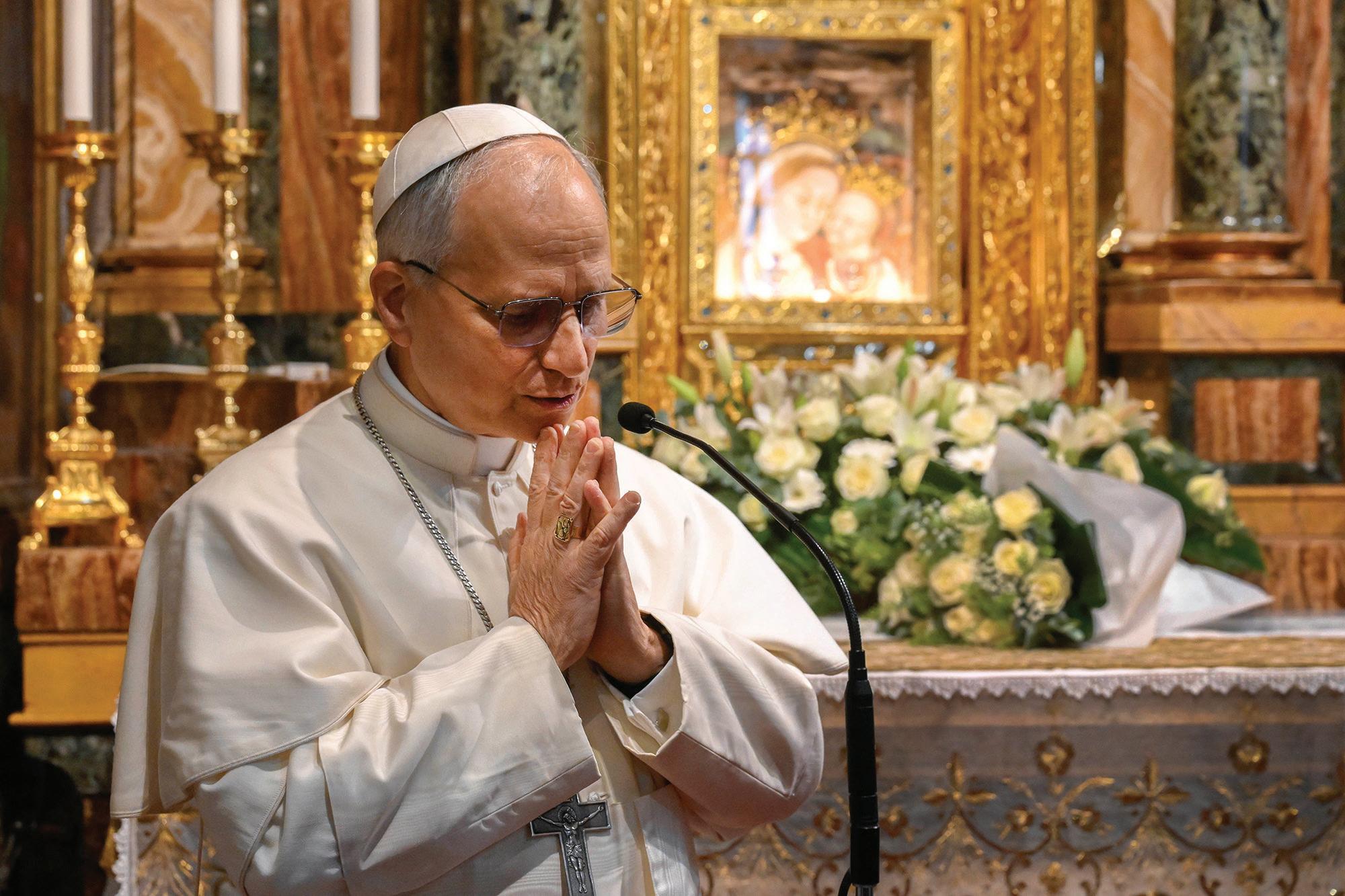
Pope Leo XIV leads prayers at the Shrine of Our Lady of Good Counsel in Genazzano, Italy, southeast of Rome, May 10, 2025. The shrine, with a famous image of Mary, is run by the Pope’s Augustinian confreres. —CNS photo/Vatican Media
Jesus Christ.” But the very first descriptor he used to articulate his vision for the Church was “a united Church.”
At Pope Leo’s inauguration Mass, he went on to say, “Brothers and sisters, I would like that our first great desire be for a united Church, a sign of unity and communion, which becomes a leaven for a reconciled world.”
‘Peace be with you all’
Pope Leo’s first words were a roadmap for his first year
By Courtney Mares, OSV News
ROME (OSV News) – When Robert Francis Prevost stepped onto the loggia of St. Peter’s Basilica one year ago May 8, he carried with him a piece of paper on which he had carefully written the first words he would utter as Pope Leo XIV. His first speech was, in ways that would only become clear over the year that followed, a preview of what was to come.
“Peace be with you all,” the newly elected Pope Leo said.
Peace would become perhaps the most visible theme of his first year, as war flared in the Middle East and Pope Leo became a persistent and sometimes lone voice of moral authority for restraint and dialogue. But the eight-minute speech that followed also contained many of the other major themes of his early pontificate: a vision of “a united Church,” theological rootedness in St. Augustine, the Pope’s missionary heart and a prioritization of God above all else.
One year on, the first words with which Pope Leo chose to introduce himself to the world merit a close reading.
‘God loves you all and evil will not prevail’
Not only was “peace” the very first word of Pope Leo’s pontificate, but it was one of the most used words in his first speech. He highlighted “the peace of the Risen Christ” that “comes from God, God who loves us all unconditionally.”
“Peace,” however, was not Pope Leo’s only most frequently used key word that day. That distinction belongs to “God” and other references to the Trinity. “The world needs his light,” he said of Jesus.
Pointing the world to God is a priority that Pope Leo has since felt compelled to clarify to journalists who sought to frame his papacy in political terms. His primary focus, he said, is not politics, but God, the source of peace. “The
message of the Church, my message, the message of the Gospel: Blessed are the peacemakers,” he emphasized to journalists traveling with him in April.
From the loggia May 8, 2025, he told the crowd gathered in St. Peter’s Square that “God loves us, God loves you all, and evil will not prevail.”
“Christ goes before us. The world needs his light. Humanity needs him as the bridge that can lead us to God and his love,” Pope Leo added.
Over the year that followed, Pope Leo put significant effort into elevating the signs of faith – he offered more than 65 public Masses, carried the Eucharist in procession through the streets of Rome on the feast of Corpus Christi, and then carried the cross for two key events: first through a crowd of one million young people during the Jubilee of Hope, and then through the darkness of night for all 14 Stations of the Cross on Good Friday in the Colosseum.
He also leaned into personal acts of devotion. The Pope noted in his first speech that he had been elected on the feast of Our Lady of Pompeii, and he invited everyone to pray a Hail Mary with him. His first year included several papal pilgrimages, from Genazzano, Italy, where he prayed before Our Lady of Good Counsel, to the ancient site of Hippo Regius in Algeria, where St. Augustine once served as bishop.
Pope Leo has now chosen to mark the anniversary of his election with a pilgrimage to the Pontifical Shrine of the Blessed Virgin of the Rosary of Pompeii, where he will offer yet another public papal Mass.
‘A united Church’
From the loggia, Pope Leo outlined his vision for the Church in a cascade of descriptive phrases: “a missionary Church,” “a Church that builds bridges,” “a synodal Church,” “a Church that always seeks peace,” “a faithful Church of
Twelve months on, it is clear Church unity has continued to be a key goal for the first American Pope. Pope Leo has gone conspicuously out of his way to avoid isolating many theological or political factions within Catholicism. He has moved slowly in his handling of the Roman Curia, choosing not to rapidly overturn his predecessor’s key prefect appointments or signature decisions. And he has cited not only his immediate predecessor, Pope Francis, but he has also frequently quoted Popes Benedict XVI and St. John Paul II.
The results of Pope Leo’s prudence, at least by one measure, appear to have landed. According to recent polling, Pope Leo has emerged as one of the most popular Americans in the world. His focus on Church unity has also extended to ecumenical outreach from praying with the King of England in the Sistine Chapel to standing side by side with Orthodox leaders marking the 1,700th anniversary of the Council of Nicaea.
‘A disarmed peace and a disarming peace’
Pope Leo defined the “peace of the Risen Christ” that first spring evening as “a disarmed peace and a disarming peace, humble and persevering.” The phrase captures both the content of what would go on to be some of Pope Leo’s strongest statements, such as “lay down your weapons” as the Pope’s home country launched a war in Iran, as well as the Pope’s style of communicating his peace message, “humble and persevering.”
But even before the Iran war began, Pope Leo prayed publicly for peace at nearly every Sunday Angelus or Regina Caeli address throughout the year: for “an authentic, just and lasting peace” in Ukraine, for relief from “a dire humanitarian situation in Gaza,” and for an end to violence in Myanmar, Nigeria, Haiti and many other parts of the world, frequently invoking Mary under her title Queen of Peace.
The theme reached its most concrete expression during his apostolic journey to Africa, where Pope Leo presided over a peace meeting in Bamenda, Cameroon, a region scarred by ongoing conflict, and where, on the papal plane, he pointedly responded to harsh words from U.S. President Donald Trump by saying “Blessed are the peacemakers.”
A ‘son of St. Augustine,’ a missionary at heart
Two aspects of Pope Leo’s personal identity emerged unmistakably in that first speech. When he finally spoke of himself, about halfway through his ad-
dress, he did not begin with his nationality or other biographical information. He identified himself with his religious order and spirituality as “a son of St. Augustine,” an Augustinian friar who had given decades of his life to missionary work in Latin America.
“’For you I am a bishop, with you I am a Christian,’” he said, quoting St. Augustine directly in the first of many such citations of the fifth-century doctor of the Church frequently woven into his speeches and writings throughout the year, from invoking the “City of God” in a meeting with an African dictator to addressing young Catholics in Chicago via video message.
His missionary identity has shone in his first year through his linguistic range, delivering speeches, homilies and Masses in Spanish, Italian, French and Portuguese, in addition to his native English, and offering greetings in Arabic and even Kimbundu, a language spoken in Angola. His very first speech gave a preview of this as well when the Pope broke into Spanish to offer a warm greeting to the diocese of Chiclayo, Peru, where he had served both as a missionary and as a bishop.
What the first speech did not reveal
Not everything was foretold on the loggia.
Pope Leo spoke in Italian, then Spanish, but notably offered no word of English, and no acknowledgment of his American roots. That reticence was reflected, in part, throughout his first year, in which he did not visit the United States, did not meet the American president, and appeared, at first, to be deliberately careful about wading into American domestic politics until the U.S. president criticized him by name.
American Catholics, for their part, were not so restrained in their enthusiasm – sending him Chicago pizza, custom White Sox jerseys and pumpkin pie. And as the year went on, Pope Leo appeared to begin to recognize the singular reach that comes with being the first native-born English speaking pope in the 21st century: a statement in English outside Castel Gandolfo or aboard the papal plane can land on every major news outlet around the world within the hour.
Pope Leo’s first speech notably omitted any reference to technology, artificial intelligence or Catholic social teaching, an interest that he revealed later in his first week when he explained why he had chosen the papal name Leo as a reference to Pope Leo XIII, the pope who addressed the upheavals of industrial capitalism in the landmark social encyclical “Rerum Novarum.”
The first encyclical from Pope Leo XIV, addressing artificial intelligence ethics, is now widely anticipated as the defining document of the start of the second year of his pontificate.
Courtney Mares is Vatican editor for OSV News. Follow her on X @ catholicourtney.
USCCB calls for adoration hours, works of mercy to celebrate America’s 250th anniversary
By OSV News
WASHINGTON (OSV News) – As the U.S. prepares to commemorate the 250th anniversary of the signing of the Declaration of Independence on July 4, the U.S. Conference of Catholic Bishops has encouraged Catholics to participate in initiatives including a collective 250 Hours of Adoration and 250 Works of Mercy.
To celebrate the occasion, “America 250,” the initiatives encourage prayer for the unity and healing of the U.S., according to a resource guide the USCCB has published. The conference previously said the U.S. bishops will consecrate the United States to the Sacred Heart of Jesus in June.
In his encyclical “Dilexit Nos,” Pope Francis “instructs us to ‘nourish our lives with the strength of the Eucharist’ in Holy Communion and Adoration, so that we might understand Christ’s love for all more deeply and live out this love ourselves,” the guide stated. “Our contemplation of the Sacred Heart leads us deeper into the mystery of our salvation and deeper into our love for Christ found in the faces of our sisters and brothers -- especially those most in need.”
The guide said parishes can participate in 250 Hours of Adoration by offering a Holy Hour on a weekly or monthly basis leading up to the nation’s July 4 anniversary. It noted that this could include continuing current practices or inviting new people to join. It suggested similar efforts to carry out 250 Works of Mercy.
It includes resources for Holy Hours for life, peace, marriage, religious liberty, vocations, an end to racism, as well as a Sacred Heart Holy Hour.
“Consider hosting a holy hour or series of holy hours at your parish using the templates provided. ... You may have other ways to invite members of your community to spend some time in prayer for our country with Jesus truly present in the Blessed Sacrament,” the guide said. “To prepare for the Consecration of the United States to the Sacred Heart, parishes can also incorporate the Litany of the Sacred Heart of Jesus into their Holy Hour.”
As examples of works of mercy, the guide encouraged parishes to find ways to assist women who are facing a crisis pregnancy; donate to food pantries and clothing closets, and community beautification programs; raise money for an overseas development project; sponsor a
refugee family; tutor children; or volunteer at homeless shelters.
“The seven Corporal Works of Mercy come to us directly from the Scriptures in the Gospel of Matthew,” the guide said. “Rooted in our lives of faith, the actions that Jesus calls us to in feeding the hungry, giving drink to the thirsty, sheltering the homeless, visiting the sick and imprisoned, burying the dead, and giving alms are central elements of our Catholic identity.”
It quotes from Pope Leo XIV’s apostolic exhortation “Dilexi Te,” which itself draws on Pope Francis’ “Dilexit Nos”: “As we contemplate Christ’s love, ‘we too are inspired to be more attentive to the sufferings and needs of others, and confirmed in our efforts to share in his work of liberation as instruments for the spread of his love.’”
To view resources visit https://www. usccb.org/250-hours-adoration
A file photo shows young people praying as a priest holds the monstrance during adoration in Nashville, Tenn. As the United States prepares to commemorate its 250th anniversary July 4, 2026, the U.S. Conference of Catholic Bishops is encouraging Catholics to participate in initiatives including a collective 250 Hours of Adoration and 250 Works of Mercy as part of anniversary preparations. —OSV News photo/courtesy FOCUS
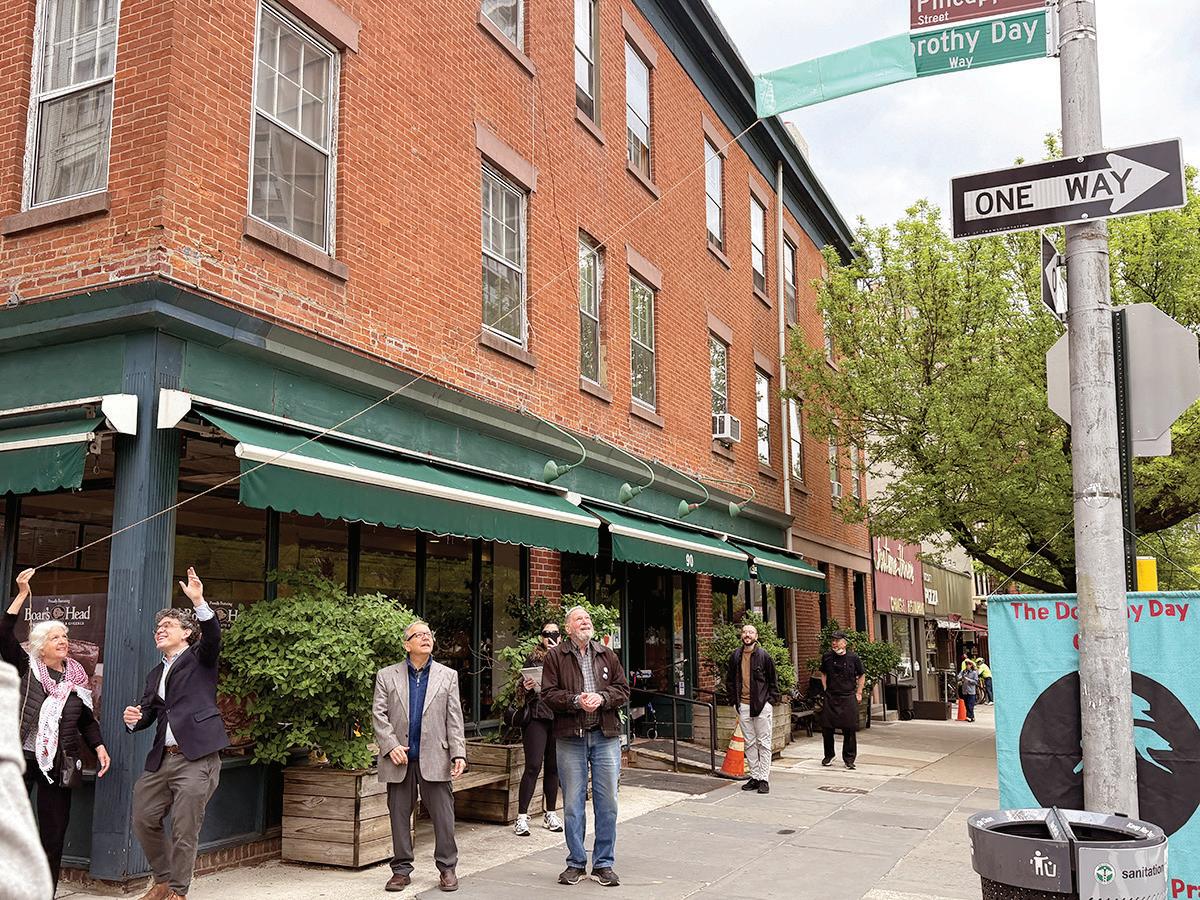
New sign on a street corner in Brooklyn, N.Y., honors legacy of Dorothy Day
Martha Hennessy, granddaughter of Dorothy Day, unveils the “Dorothy Day Way” street sign in the Brooklyn Heights section of New York City May 2, 2026. Hennessy says it’s “very surreal” to be part of a family of someone being considered for sainthood. —OSV News
photo/Paula Katinas, The Tablet
On May 1, 1933, she co-founded the Catholic Worker Movement with Peter Maurin – a faith-based organization that urges members to perform the corporal works of mercy and work for peace and justice. Day also began publishing a newspaper, The Catholic Worker, which is still published today.
Day’s life of faith inspired others, said Father Anthony Andreassi, administrative vicar for the Brooklyn Oratory Parishes in Brooklyn Heights.
“And maybe by learning about her,” Ahern said, “they can be inspired by her to live their life a little … and make the world a better place.”
Alex Avitabile, a guild board member, spearheaded the drive to have the street corner named for Day, whom he met in 1970. He asked Restler to sponsor legislation.
By Paula Katinas
BROOKLYN, N.Y. (OSV News) – Dorothy Day’s extraordinary life began in Brooklyn, and now a street corner near her birthplace has been named after the legendary co-founder of the Catholic Worker Movement.
The intersection of Pineapple and Henry streets in the Brooklyn Heights neighborhood is now officially called “Dorothy Day Way” in honor of the “Servant of God,” who was born nearby at 71 Pineapple St. in 1897.
On May 2, Martha Hennessy, Day’s granddaughter, and members of the Dorothy Day Guild, the organization promoting her cause for sainthood, joined clergy for the ceremony to unveil the street sign.
Hennessy and Councilman Lincoln Restler, who sponsored legislation in the City Council to name the street corner, did the honors of pulling the string to reveal the street sign.
Hennessy, who like her grandmother is a Catholic peace activist, called the ceremony “a beautiful moment.”
The street naming marked the second time New York City has paid tribute to Day.
In 2021, the city commissioned a Staten Island ferry in her name, and the Dorothy Day had its inaugural voyage in 2023.
Day (1897-1980) was a journalist and social activist who lived a wild, bohemian youth before becoming a Catholic in 1927. She fed and clothed the poor, advocated for civil rights and protested all wars.
“She was a convert to Catholicism, a woman of incredible faith and committed to the poor,” he told The Tablet, newspaper of the Brooklyn Diocese. “I know many people who have been attracted to the Church because of Dorothy Day and have come to accept baptism.”
New York Cardinal John J. O’Connor officially opened Day’s sainthood cause in 2000, granting her the title of “Servant of God.”
Twenty-one years later, following the conclusion of the diocesan phase of the investigation into her life and her fitness for sainthood, her case was submitted to the Vatican for review by New York Cardinal Timothy M. Dolan.
Kevin Ahern, board chairman of the Dorothy Day Guild, said he sees the street corner naming as an opportunity to promote her good works.
Avitabile recalled walking up to her after a talk she had given at the Catholic Worker House in Rochester and telling her how much he admired her. Even back then, he said he felt he was in the presence of a saintly person.
“I knew,” Avitabile recalled. “She had a way about her – her eyes. There are a few people I’ve met who are saintly people. And I could just see that.”
The Catholic Worker Movement, which celebrated its 93rd anniversary on May 1, is still going strong today, according to guild members.
Hennessy said she is pleased to see that people are still inspired by her grandmother, even 46 years after her death.
“It’s pretty astounding, the place she holds in their hearts and in their minds,” she told The Tablet. “It’s only expanding, and I truly believe that she will bring so much good to the Catholic Church…”
Paula Katinas is senior reporter at The Tablet, newspaper of the Diocese of Brooklyn.
Shrine prepares to share Mother Seton’s ‘Revolutionary’ impact as America turns 250
By Kimberley Heatherington OSV News
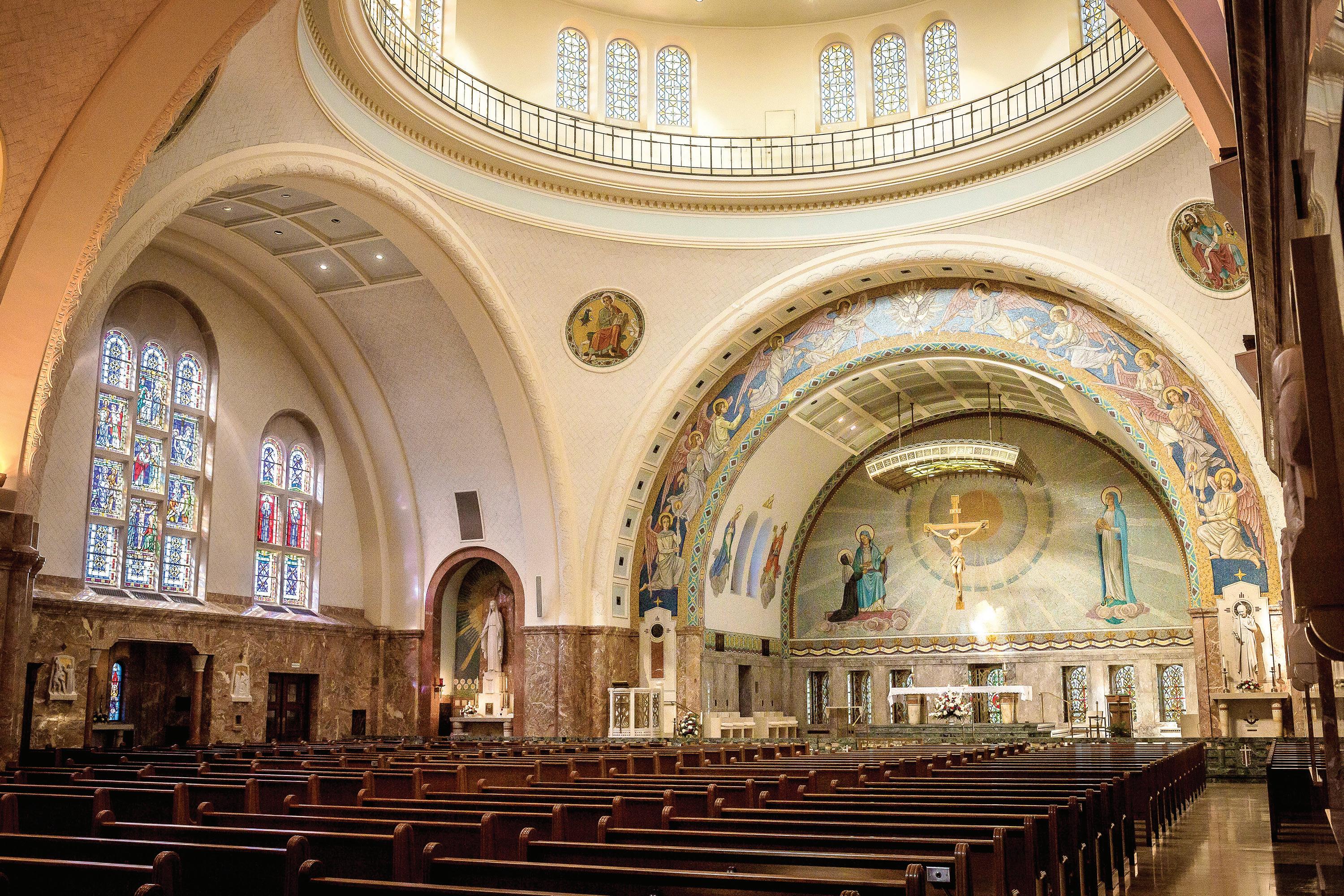
EMMITSBURG, Md. (OSV News) – In a revolutionary year, the spirited cele bration of America’s 250th anniversary throughout 2026, the national shrine dedicated to the first U.S.-born saint is aiming to help patriotic revelers discover the place of “Mother Seton” among the pantheon of iconic nation-builders.
On her Jan. 4 feast day – which this year coincided with the U.S. observance of the Feast of the Epiphany – The National Shrine of St. Elizabeth Ann Seton in Emmitsburg, Maryland, both closed a 50th anniversary commemoration of her canonization and launched a yearlong America250 initiative exploring her life in post-Revolutionary War America and the ongoing impact of the religious communities she founded.
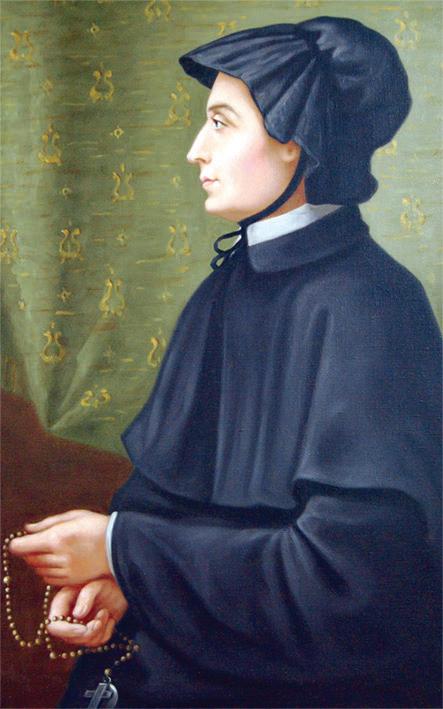
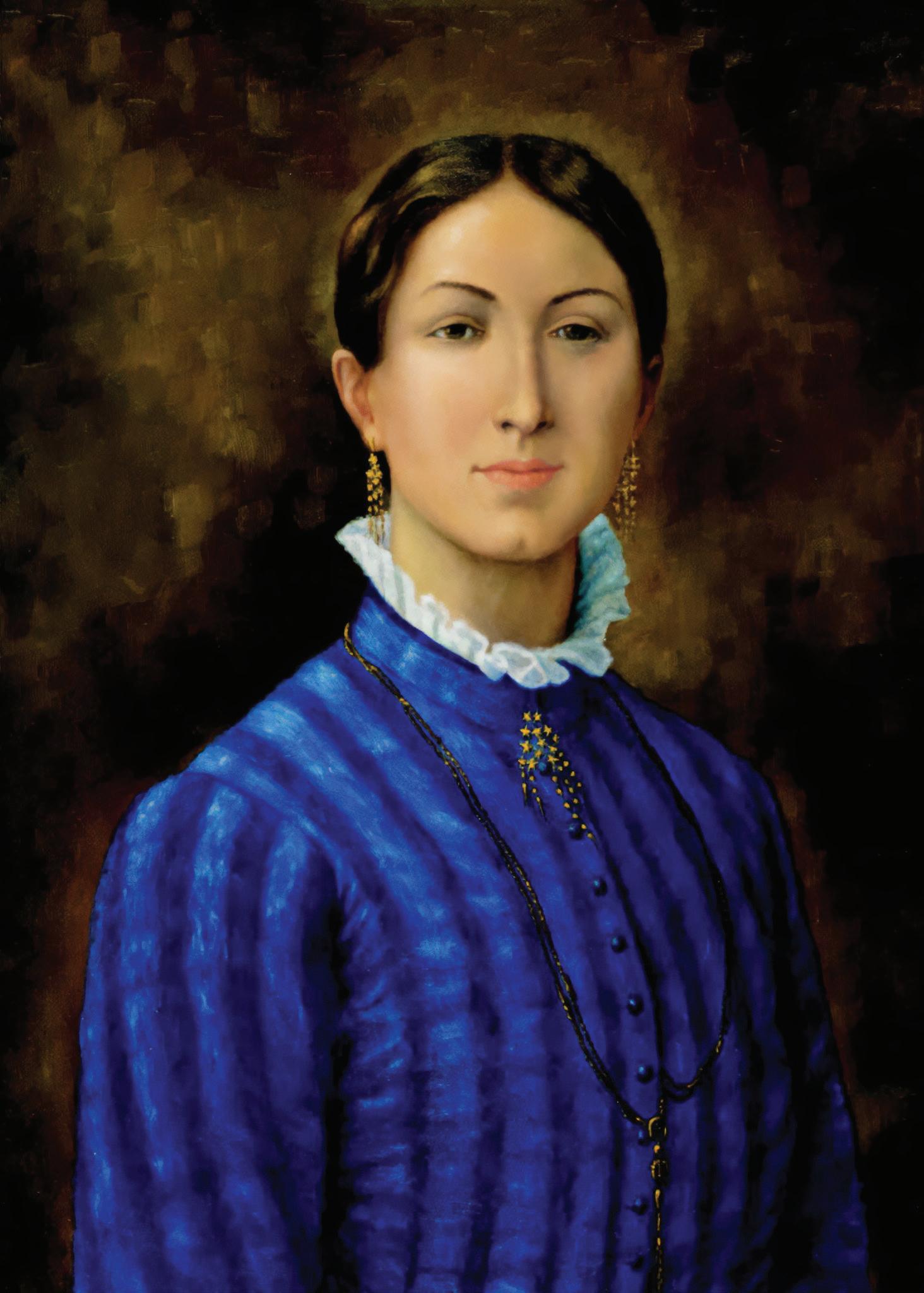
The National Shrine of St. Elizabeth Ann Seton in Emmitsburg, Md., is seen in this undated photo. The historic shrine launched its America 250 programming with a Jan. 4, 2026, Mass celebrating its patron saint and the feast of the Epiphany. —OSV News photo/courtesy The National Shrine of Saint Elizabeth Ann Seton. Below, Portrait of Elizabeth Ann Seton by Amabilia Filicchi
“She’s born in 1774, which puts her inside the founding of the country,” Rob Judge, the Seton Shrine’s executive director, told OSV News.
Born into a prominent New York Episcopalian family, Elizabeth Ann Bayley married William Magee Seton in 1794. She lived the contented life of a wealthy socialite and mother for a few brief years, until the 1799 bankruptcy of her husband’s business and his 1803 death. She came into full communion with the Catholic Church in 1805 – and a courageous and pioneering life followed as Mother Seton founded the first U.S. community for religious women, the Sisters of Charity of St. Joseph’s, and planted the seeds of Catholic education in America.
“We’ve been doing research,” Judge said, “and we’ve discovered there’s over 20,000 religious sisters that stemmed from her congregations – over the next two centuries, they staffed hundreds of parish schools.”
“Her sisters founded some of the first hospitals; some of the first orphanages,” he added. “And literally – as the faith spread in this country – her sisters were there, teaching and taking care of the most vulnerable. So when we celebrate looking back 250 years of our country, it gives us here at the Seton Shrine the chance to really highlight her legacy.”
In addition to the shrine’s regular
programming, special programming in the coming year includes a new exhibit, “Do the Good: The Sisters Who Shaped America” (opening March 19); America250 events and pilgrimages; the Saints on Their Way initiative, highlighting Americans on their way to canonization; and a Seton Shrine endowment opportunity.
Massgoers at one of two Masses offered on Epiphany at the Seton Shrine were young, old, singles, families with children – a cross-section of American Catholic life.
In his homily, Father Harry Arnone, a Vincentian priest and chaplain to the shrine, linked the Epiphany narrative of the travelling Magi who followed the star to Bethlehem with St. Elizabeth Ann Seton’s own religious journey.
“The idea that God could appear in the simple elements of bread and wine really piqued her imagination – and that consecrated bread, the body and blood of our Lord Jesus, could be taken from the church and brought to the homes of those who were sick, had a powerful impact on her. And she discerned becoming Catholic,” Father Arnone said. “But it was a hard decision – and she often talked about following that star; that was the image that she clung to.”
“But guess what she discovered?” he asked. “She discovered – and this was her ‘aha!’ moment – the God that she expected to be experienced in churches and cathedrals could also be experienced in bread and wine, the elements” that become Jesus Christ in his body, blood, soul and divinity while retaining their outward appearances at the consecration of the Eu-
charist. “That the God that’s transcendent and all-powerful could also be experienced in the kindness of friends; people who show love and open their homes in a moment of grief and utter desolation.”
“She found it,” Father Arnone continued, “also in looking back at her family life. She found it in the lives of her children. She found it as she kept her home. And as she converted to Catholicism, she found it in the pews of the Catholic Church in New York City.”
Sister Teresa Daly, a member of the Daughters of Charity of St. Vincent de Paul, who offered a bright smile and ready answers to passersby from behind her visitor’s desk, said Father Arnone’s homily resonated with her.
“She was always seeking. Our museum talks about her as a seeker, a servant, and a saint,” reflected Sister Teresa.
About 70 sisters live at the Seton Shrine, many still working in active ministry while others devote themselves to intercessory prayer.
A small cluster of Missionaries of Charity nuns – St. Teresa of Kolkata’s order – in their striking blue and white sari habits, could be seen touring the state-ofthe-art museum tracing Mother Seton’s life and legacy through artifacts and exhibits. Mother Teresa’s sisters stopped at the case holding Mother Seton’s bonnet and a shawl, a shared heritage of service bridging the distance of centuries between them. Sept. 14, 2025, marked the 50th anniversary of the 1975 canonization of the Shrine’s namesake, when its campus hosted what was dubbed “A Day of Joy” as part of a three-day celebration attracting over 3,000 visitors. Prominent among the festivities was the “Saints on Their Way Village” where guests could discover the canonization causes of more than 20 of the 87 American (hopefully) saints-to-be.
“When we started planning for the 50th, we didn’t want to just have a party for Elizabeth Seton,” Judge explained. “We wanted to really push our mission forward. At the end of the day, a shrine’s mission is to help people encounter Our Lord in this life on their way to the next life, in eternity. And the saints give us examples of that … It’s the mission of her shrine to promote examples of holiness, so that hopefully pilgrims, as they come here, realize it’s not hyperbole – we can actually all become saints.”
Kimberley Heatherington is an OSV News correspondent. She writes from Virginia.
A Brief History of the Catholic Church in Central New Jersey: Part I
By Father Michael G. Krull Special Contributor
In 1905, in commemoration of the 50th anniversary of the (then) Diocese of Newark, Father Joseph M. Flynn, then pastor of the Church of the Assumption in Morristown, undertook the writing and compilation of what is, for Catholic Church historians in New Jersey, the goto book – “The Catholic Church in New Jersey.” After all these years this book is still a starting point for knowing much of the earliest history of Catholicism in New Jersey, despite inconsistencies in the writing, as he relied on other priests to provide histories of those earliest parishes.
As we read in Carl Ganz’s article on Colonial Catholicism, which appeared in the April issue of The Catholic Spirit, there were small scattered groups of Catholics living in New Jersey even before the Revolution. With the conquest of New Amsterdam by the English in 1664, James, Duke of York, gave the territory that is New Jersey to John, Lord Berkeley and Sir John Carteret and was named New Caesaria or New Jersey to honor Carteret for his defense of the Isle of Jersey in the English Civil War.
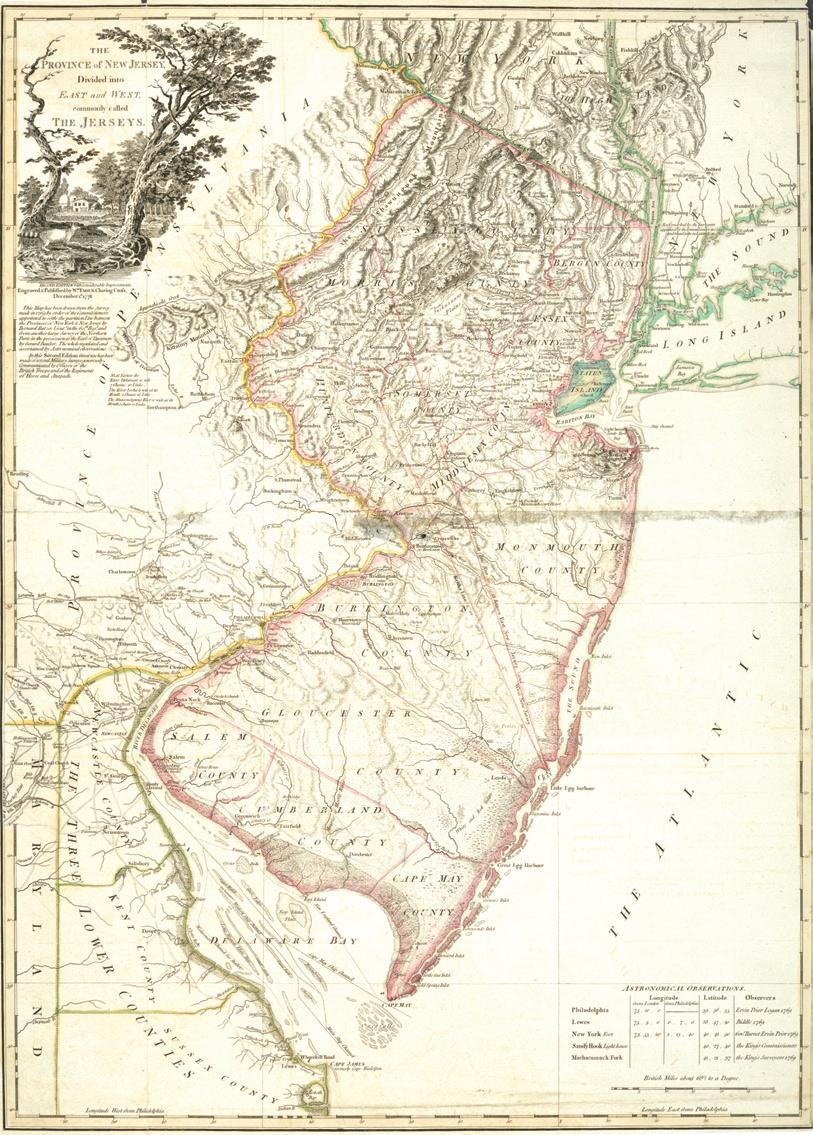
A proprietary colony, the territory was divided roughly from the Delaware Water Gap in the northwest to Egg Harbor Bay in the southeast – a line that would later be roughly used in 1808 for the division of New Jersey between the Dioceses of New York and Philadelphia, and again in 1881 when the Diocese of Newark was divided to create the Diocese of Trenton.
The two areas became known as East Jersey and West Jersey, with separate governments, constitutions and capitols – Burlington in West Jersey and Perth Amboy in East Jersey (The royal governor’s house in Perth Amboy, now known as Proprietary House, is the only original governor’s mansion still standing from pre-Revolutionary times in the United States.)
Flynn points out that during the time when Thomas Dongan, the Catholic Royal governor of New York, Catholic settlers began settling in “East Jersey” as early as 1668 in what is now Woodbridge Township. Dongan, on his arrival in New York, was accompanied by an English Jesuit priest, Father Thomas Harvey, SJ, who was later joined by Fathers Henry Harrison, SJ, and Charles Gage, SJ.
During their time, a small Catholic chapel was opened in New York, and those priests would visit the scattered settlements. Tradition holds that one of these priests offered the first Mass in New Jersey in present day Woodbridge around 1670. In 1683, Father Nicholas Gulick, SJ, came from Maryland to baptize a Robert duPoitiers in Woodbridge. Decades later, on July 30, 1744, Father Theodore Schneider, SJ, baptized Anna, the daughter of Bartholomew Kelsen, in his home near Bound Brook. Father
The Province of New Jersey, Divided into East and West, commonly called The Jerseys, 1777 map by William Faden
Schneider also visited Bavarian Catholic families in the Clinton area who worked in the local iron forges as well as Catholics in southern Hunterdon County nearly twenty years later,
Father Schneider’s successor, Father Ferdinand Steinmeyer, SJ, better known as “Father Farmer,” visited “Basconridge” in Somerset County on two occasions where he celebrated Mass and baptized on April 14, 1766, and again on June 24, 1767, as well as Oxford, Greenwich (near present day Phillipsburg), and Changewater (about three miles from present day Washington) in Warren County.
During the Revolution, a noteworthy event took place during Washington’s famous stay in Morristown in April, 1780, when a Spanish agent, Don Juan de Miralles, who was visiting Washinton there, took ill. Father Seraphim Bandol from Philadelphia was sent for to administer the last Sacraments to de Miralles, who died in the Ford Mansion in Morristown, and where his funeral Mass was celebrated on April 29, 1780, in the presence of General Washington and members of Congress.
As the new nation grew, so did the Catholic Church. On November 6, 1789, the first diocese was created at Baltimore, encompassing the original thirteen colonies along the East Coast. Bishop John Carroll, the cousin of Charles Carroll, the only Catholic to sign the Declaration of Independence, faced the formidable task of organizing the Church in the nascent United States.
St. Joseph’s Church in Philadelphia
and Newark, the Delaware and Raritan Canal linked New Brunswick and Trenton. In addition, the “iron horse” – railroads – were being built throughout the state, starting with the Camden and Amboy Railroad in 1831. As more Catholics settled in the state, the beginnings of parish life began to stir. The oldest parish community, in West Milford in Passaic County, had its origins with the biannual visits of Father Farmer. Trenton, the state capital, saw its first Mass around 1797 and the first church built in 1814, while Catholics in Newark and Paterson were ministered to by priests by 1820, with churches being built in Paterson in 1820 and in Newark in 1829.
By 1815, a sizeable number of Catholics had settled in New Brunswick and the surrounding area. However, it was not until 1825 when the first recorded visit of a Catholic priest, a Father McDonough, occurred there. Traveling to Philadelphia, he encountered two Catholic gentlemen walking on George Street. Seeing them talking, he went over to them, asking them if they were Irish – and they in turn asked if he was a priest. He preached to the local Catholics that night before continuing his travels.
had been in existence since 1733 – with many of the Jesuits stationed there ministering to the scattered Catholics in New Jersey. The small Catholic chapel in New York had closed in 1688 after the “Glorious Revolution” in England had unseated the Catholic King James II and installed William and Mary as the reigning monarchs, and it wasn’t until 1786 that St. Peter’s Church opened on Barclay Street in lower Manhattan.
It was from these two churches: St. Peter’s – the church where St. Elizabeth Seton was received into the Church and Venerable Pierre Touissant was a parishioner – and St. Joseph’s, that priests began visiting the growing Catholic settlements in New Jersey. And in turn, those Catholics would often travel into Philadelphia and New York to attend Mass, usually to fulfill their Easter duty.
On April 8, 1808, Pope Pius VII elevated Baltimore to an archdiocese, and created four new dioceses; Boston, New York, Philadelphia and Bardstown, Kentucky (later transferred to Louisville). The State of New Jersey was divided along the old East/West Jersey line running from the Delaware Water Gap to Great Egg Harbor, with the eastern counties coming under the jurisdiction of the Diocese of New York and the western counties coming under the Diocese of Philadelphia.
That same year, Father John Power, the pastor of St. Peter’s Church in New York, began visiting New Brunswick, celebrating the first Mass in the home of Terence Rice on Albany Street and then in a large room over a wheelwright’s shop. In 1829, Father Joseph Schneller (who a few years later was the first priest to meet a young immigrant seminarian named John Neumann on his arrival in New York) took Father Power’s place, and urged the small congregation to build a church. However, due to prejudice, purchasing land was a problem. A plot of land on Bayard Street was purchased and a small brick church dedicated to Saints Peter and Paul was soon completed and blessed on December 19, 1829.
In 1833, Father Bernard McArdle became the first resident priest in New Brunswick and he began ministering throughout Middlesex and Somerset Counties, as well as Mercer County. Mass was celebrated in the area of Blackwells Mills (present day East Millstone) for Irish laborers building the Delaware and Raritan Canal, as well as Raritan and Princeton. He traveled to Perth Amboy to minister to Catholic families, there, and on occasion would also visit Catholics in South Amboy, with the faithful from Perth Amboy crossing the river in oyster boats to attend Mass there.
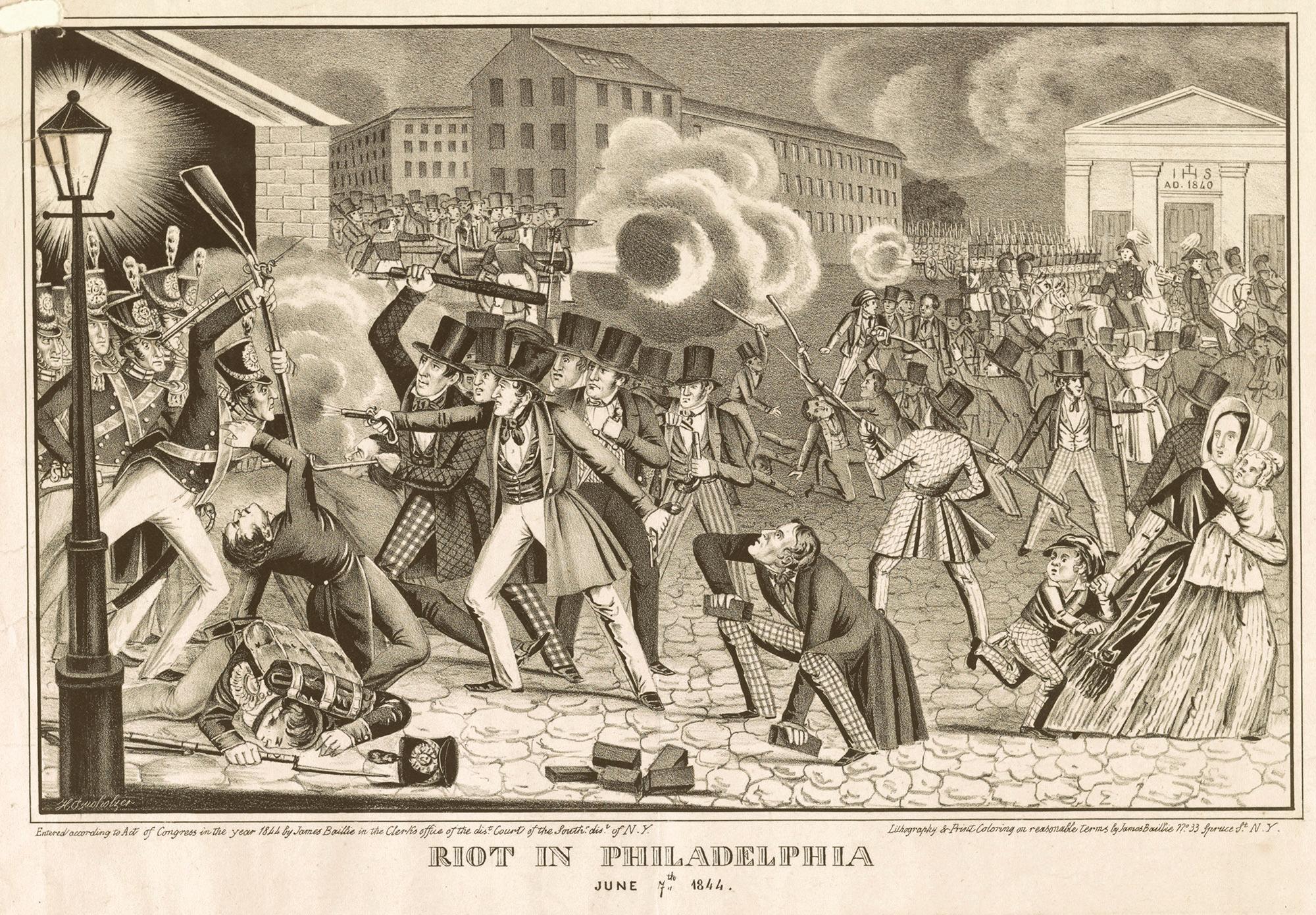
In 1839, Father McArdle was replaced by Father Ydelphonsus Medranno – a Spanish priest – who served at the Quarantine Station on Staten Island. He purchased two lots on Centre Street, and began collecting funds for the erection of a church building. On August 18, 1844, Bishop John Hughes of New York laid
During this time, while the population growth in New Jersey was modest, one area that saw growth in the early nineteenth century was transportation. The Morris Canal linked Phillipsburg Continues on page 20
10 Summer Mission Appeal for vocations relies on generosity, heals children and communities
Our “Summer Mission Appeal” known also as “The Society of St. Peter the Apostle Appeal” is so very important because all donations are used to support those in missionary lands preparing for the Holy Priesthood and Consecrated Life (as religious Brothers and Sisters).
Many of their vocation stories remind me of my journey to the Holy Priesthood. Back then, however, I was told that all expenses associated with priesthood training was the responsibility of the candidate. As such, while studying at the University, I also worked at a government facility for children and young adults with developmental disabilities.
While working, I once witnessed a child being abused by a fellow employee as we were preparing to take the children on a bus trip. Standing outside near the bus I noticed that one of the children (about 5 or 6 years old) was not cooperat-
“Orphans, many of whom are children with disabilities, are left to fend for themselves – some in government institutions, others in the streets of towns and cities. That is why the enthusiasm, energy and deep faith of young vocations is so critical. They are Christ’s answer to child abuse, neglect and evangelization.”
ing, so another male employee picked up a broomstick and began hitting the child.
I was repulsed by this event, confronted the man, and immediately reported it to the administration. Since the workers were unionized, it slowly but surely became a big deal. The child’s interests seemed to almost disappear as the union officials called an emergency meeting and a wildcat strike broke out shortly after.
On the day of the strike I happened to be working the evening shift (4 -12 p.m.), when suddenly and without warning everyone dropped what they were doing (i.e. caring for the children, many of whom were severely disabled and potentially aggressive, especially when left unsupervised) and went outdoors to begin the protest on behalf of the man who had hit the child.
Although I was also a member of the union, I could not in conscience leave 200 innocent children unattended, so I became
the only employee left in the building.
My experience that day is repeated time and again, especially in Missionary countries. Orphans, many of whom are children with disabilities, are left to fend for themselves – some in government institutions, others in the streets of towns and cities. That is why the enthusiasm, energy and deep faith of young vocations is so critical. They are Christ’s answer to child abuse, neglect and evangelization.
Please be generous. The life of a child depends on your contribution through the vocation of young men to the Holy Priesthood, and young men and women to Consecrated Life (as Brothers or Sisters).
Vocations in missionary lands depend heavily on such groups as our Society of St. Peter the Apostle, which is one of the four Pontifical Mission Societies, dedicated exclusively to fostering local clergy and religious vocations in mission
countries, primarily in Africa and Asia.
Founded in 1889 by Jeanne Bigard and her mother Stephanie, it supports over 30,000 seminarians and 10,000 religious novices annually with funds for education, formation, and seminary construction.
Key aspects of the Society of St. Peter the Apostle include:
• Mission: To help local churches become self-sufficient by training their own priests and religious sisters/brothers.
• Support Structure: Provides subsidies for seminary room, board, and tuition, as well as funds for building and maintaining seminaries.
• Funding: Primarily supported through special Summer Appeal collections and donations.
• Part of MISSION: As a Pontifical Society, it works under the Pope to support the evangelization of the Church in missionary lands.
The Society of St. Peter the Apostle was created to address the urgent need for native clergy in new missionary lands. Declining collections for this appeal are significant. Please consider a gift for the missionary priests and Sisters NOW!
In Christ, Reverend John G. Hillier, PhD Director
Father Hillier serves as diocesan director, Office of Pontifical Mission Societies, the Office for Persons with Disabilities and Censor Librorum.
Dear Father Hillier,
I would like to add my prayers and sacrifice so that more young men and women will respond to God’s call as Priests and Sisters and Brothers to serve the suffering poor in the missions. My gift is enclosed.
$ 2,100 provides one-half seminary formation
$ 700 provides one full year of formation for a future priest
$ 250 towards room and board
$ 150 towards books and formation materials
$ 50 for clothing
$ 25 provides one-week of formation
$ ............. to be used where most needed
Please make checks payable to: “PONTIFICAL MISSION SOCIETIES.” Thank you.
Rev. Mr. Miss Mrs.
“…
Jeanne Bigard (1859 - 1934), founder of the Pontifical Society of Saint Peter the Apostle
Remembering our Catholic values as the U.S. marks 250 years
By Adam John Carlisle Secretary for Evangelization and Communication
James G. Blaine once wrote that “The United States is the only country with a known birthday.” This statement was meant to highlight the unique, documented origins of American Independence on July 4, 1776, as opposed to other countries whose history is either shrouded in mystery or developed organically over time.
As we celebrate America’s birthday this July 4, 2026, it is worth reflecting on our nation’s history, as well as the role that the Catholic Church has played in it these past 250 years. I chose to begin this article with a quote from Secretary Blaine for several reasons, perhaps chief among them is the fact that James G. Blaine lived during a period remarkably similar to our own, one filled with controversies over tariffs, immigration, and monetary policy.
James G. Blaine served as Secretary of State during the Garfield administration. For those of you who are not history nerds, like myself, you may have forgotten that James Garfield, the 20th president of the United States, was assassinated by Charles Guiteau on July 2, 1881 at the Baltimore and Potomac Railroad Station in Washington, D.C. Garfield was less than four months into his term as president. Of course, Abraham Lincoln, the 16th president of the United States had been assassinated just sixteen years before.
Despite what Secretary Blaine may have said about our nation’s birthday, the reality is that our origins are far more complex than the opening quote would suggest. It is often said that this country was founded by Protestants. It is certainly true that the vast majority of the early white settlers were Protestants (some 98% in 1776), but it is also true that Catholics predated Protestants in this country by over one hundred years, celebrating the First Mass in 1526.
James G. Blaine may have never become president, but he did play an important role in the events surrounding President Garfield’s election. For those of
you who are curious, I would strongly en courage you to watch Death by Lightning on Netflix. This highly acclaimed series, which is itself based on Candice Millard’s Destiny of the Republic: A Tale of Mad ness, Medicine and the Murder of a Pres ident life and death of James A. Garfield–the only president in American history who was also a preacher–and Charles Guiteau, a man who was not only Garfield’s greatest admirer but also his assassin.
What is unique about this limited series is its story and its setting. While the setting of the series might be 150 years in the past, Death by Lightning feels incredibly relevant. In fact, comparisons of our own age to that of the Gilded Age–a term first coined by Mark Twain in his 1873 novel, The Gilded Age: A Tale of Today–are nothing new. Commenting on another popular TV series, HBO Max’s The Gilded Age, Niall Ferguson, a Hoover Institution fellow and senior faculty member at Harvard, recently suggested that we may be living in a new Gilded Age.
I noted earlier that Protestants founded this country. This is unquestionably true. But it is also true, as many others have argued, that Catholics built this country. I don’t have time to go into all of the details here, but suffice it to say that Catholic immigrants, particularly those who came to this country in the late 19th and early 20th centuries–including my own maternal grandparents who emigrated to the United States from Italy (via Ellis Island) in the 1920s–made this country into the nation it is today (both good and bad, one might say).
There is a lot to discuss here, to be sure, but I would encourage all of you to celebrate our nation’s Semiquincentennial Birthday this July by reflecting on how we can work together to ensure that the first democracy in modern times continues to promote the values that we, as Catholics, hold near and dear to our heart.
“As James Baldwin, renowned American writer, essayist, playwright, and civil rights activist of the twentieth century wrote, ‘A country is only as good ... only as strong as the people who make it up and the country turns into what the people want it to become.’”
In particular, I would encourage you to participate in the USCCB’s We Hold These Truths initiative. As the United States of America commemorates the 250th anniversary of the signing of the Declaration of Independence in 2026, the USCCB joins this celebration by lifting up the contributions of Catholics and the impact of our faith on the history of this country. In a historic moment, the U.S. bishops will consecrate the United States to the Sacred Heart of Jesus on June 11, 2026, and they are inviting all U.S. parishes to join in this consecration.
I would also encourage you to consider participating in the National Eucharistic Pilgrimage’s One Nation Under God campaign. The 2026 National Eucharistic Pilgrimage is an invitation to intercede for unity, healing, and renewal in our country through our Eucharistic faith. While the St. Frances Xavier Cabrini Route will not be passing through our diocese this summer, there are a number of other ways that you can participate.
At its heart, the National Eucharistic Pilgrimage is calling Catholics across the country to participate in a shared act of faith and hope for our nation. Together, we are working toward the offering of 250,000 Holy Hours, each and every prayer a beacon of hope, offered for the renewal and blessing of America.
Given our proximity to Philadelphia, I would urge you to consider participating in the final leg of the pilgrimage, which includes a Eucharistic Procession through downtown Philadelphia from the Cathedral Basilica to the National Shrine of St. John Neumann at St. Peter the Apostle Church. All of the events are free and open to the public.
Despite being one of the “youngest” nations on earth, we are blessed with the world’s oldest active written constitution. Clearly, we have much to celebrate this July 4, 2026. While our nation isn’t perfect, our Lord and Savior Jesus Christ calls
on all of us to be perfect, as our “heavenly Father is perfect” (Matthew 5:48). While this may seem like an impossible standard, it is a reminder to all of us that we should emulate God’s unconditional love by loving our enemies and treating all peoples with dignity and respect.
Charles Carroll, the only Catholic signer of the Declaration of Independence, emphasized that our nation’s survival depends on our moral and Christian foundations, famously warning that, “Without morals a republic cannot subsist any length of time.” If our country is to endure, if it is to live up to its highest aspirations, then we must, in the words of the NEP, “realign our lives, communities, and country under the sovereignty of Christ.”
As James Baldwin, renowned American writer, essayist, playwright, and civil rights activist of the twentieth century wrote, “A country is only as good . . . only as strong as the people who make it up and the country turns into what the people want it to become.” As we look to the 250th anniversary of our nation’s founding this July, let us resolve to be better, to bear witness that Christ is not on the margins of our lives or our nation, but at the center.
To learn more about the USCCB’s We Hold These Truths initiative and/or the National Eucharistic Pilgrimage’s One Nation Under God campaign, including the Frances Xavier Cabrini Route, please scan the following QR codes.
12 Catholics statewide gather to discuss mental health at conference
and developmental elements.
Environmental factors aren’t just natural surroundings, she said. “It’s also social media and peer influence – things that put stress on us and increase our vulnerability to mental illness.”
When it comes to developmental factors, consider: “What was the family environment like growing up? The school and neighborhood environments … because when we’re young, we’re more susceptible to environmental influence than we are when we’re older. … Mental illness is not the result of just any one factor.”
God, she continued, is with every person in times of anxiety, depression, stress and illness, as seen when Jesus prayed in the Garden of Gethsemane. “God enters into the very depths of our suffering, so that even in times of desolation, we believe that God is there.”
“Healing is a movement from isolation toward communion, toward an experience of hope amidst hardship,” she said.
National Initiatives
Ben Wortham, vice president for Behavioral Health Integration at Catholic Charities USA, and Deacon Ed Shoener, founder of the International Association of Catholic Mental Health Ministers, presented a collaborative vision for addressing mental health during their session, “Mental Health Ministries for Our Parishes: National Initiatives and Local Action.” Their presentation emphasized that effective mental health care must extend beyond clinical treatment to include housing, community support, education, and spiritual care.
Wortham stressed that “mental health doesn’t happen in a vacuum,” underscoring the need for collaboration among mental health providers, health care systems, and the social determinants of health — including housing, income, employment, education, family and social support, community safety, and
“One of the hardest truths to face is that a person can be deeply loved but still feel completely alone. That’s why presence matters. Not abstract care, but real encounter.”
Bishop John Dolan
access to food and transportation.
He noted that even when people seek professional mental health care, recovery remains difficult if they return to unstable living conditions or lack essential support systems.
“Especially with the poor and vulnerable populations, we can’t talk about mental health without talking about basic needs being met,” he said, highlighting three initiatives developed through Catholic Charities USA:
• Healthy Housing Initiative – a program currently operating in five major cities that integrates mental health support with housing services, helping reduce chronic homelessness by pairing affordable housing with onsite mental health care.
• “Sister Hope” AI Mental Health Chatbox – a 24/7 faith-aligned support platform that provides coaching programs, referrals to Catholic Charities services, and expanded access for hardto-reach populations.
• “Whole Hearted” – trauma-informed workshops and parish resources designed to integrate spirituality and religious practices with behavioral health education and mental health awareness.
Wortham encouraged attendees to stop viewing mental health as an isolated
Continues from page 5
The Impact of Chronic Loneliness
A 2023 report from the U.S. Surgeon General found that the lack of social connection poses a significant risk for individual health and longevity. Chronic loneliness and isolation can:
• Increase the risk of premature death to a level comparable to smoking up to 15 cigarettes a day
• Raise the risk of dementia in older adults by roughly 50%
• Lead to a 29% increased risk of heart disease and a 32% increased risk of stroke
• Have significant economic costs to individuals, communities and society. Social isolation among older adults alone accounts for an estimated $6.7 billion in excess Medicare spending annually, largely due to increased hospital and nursing facility spending.
In addition:
• Stress-related absenteeism attributed to loneliness costs U.S. employers an estimated $154 billion annually
Source: Our Epidemic of Loneliness and Isolation: The U.S. Surgeon General’s Advisory on the Healing Effects of Social Connection and Community
issue and instead focus on integrated care that addresses both emotional and material needs. He pointed to the importance of Medicaid expansion – noting that 10 states have yet to adopt the program – as well as increasing Medicaid reimbursement rates to help provide competitive salaries for mental health professionals. Above all, he emphasized the importance of continued collaboration among churches, health systems, and community organizations.
Local Action on the Parish Level
For Deacon Shoener, the central mission of parish mental health ministry is simple but profound: “to be a healing presence in our parishes.” His hope, he said, is that one day “the first place someone with mental health challenges would look for understanding and support is the Catholic Church.”
That vision is deeply personal for Shoener. Nearly 10 years ago, he lost his daughter, who struggled with bipolar disorder and died by suicide. Reflecting on the experience, he explained that “a mental health crisis is also a spiritual crisis,” one that must be met with the love of Christ and the promise of hope.
Deacon Shoener shared that the obituary he wrote for his daughter became an unexpected ministry of its own. More than a tribute to her life, it openly addressed the realities of mental illness and the needs of those who suffer in silence. The obituary spread widely online, reaching millions of readers and prompting tens of thousands of people around the world to contact him with their own stories. Again and again, he heard the same concern: many felt the Church offered little support to individuals experiencing mental illness or to their loved ones.
That response ultimately led Deacon Shoener to partner with Bishop Dolan in founding the International Association of Catholic Mental Health Ministers.
Today, the lay association includes more than 7,000 members in over 75 countries and works to reduce stigma surrounding mental illness while equipping parish leaders with resources and support.
“Mental illness is an illness just like all the other illnesses that doctors treat, and it needs to be understood that way,” Deacon Shoener said.
He noted that current efforts focus on integrating mental health ministry into the everyday life of the Church and normalizing conversations around mental wellness in the same way physical health concerns are addressed.
Addressing conference attendees directly, he challenged those interested in mental health ministry to consider their own willingness to be vulnerable. “Those of you who want to get involved in mental health ministry … are you ready to share your story?” he asked, stressing that trust and accompaniment often begin with personal witness.
He also pointed to three major barriers that prevent many people from seeking support within the Church: fear that clergy or parish leaders will not understand their experience, fear of judgment and stigma, and the perception that little support exists within parish communities.
Still, he encouraged participants to see their presence at the conference as a call to action. “If you are here, you are being tapped on the shoulder in some way to bring this mental health ministry to your community,” he said.
To learn more about Catholic mental health ministry resources, visit the International Association of Catholic Mental Health Ministers at https://catholicmhm.org.
Jennifer Mauro is the managing editor of the Catholic Star Herald, the newspaper for the Diocese of Camden. Mary Morrell is the editor-in-chief of The Catholic Spirit, the newspaper for the Diocese of Metuchen.
Cardinal Tobin speaks with one of many religious in attendance at the May 2 Mental Health Conference. —John Batkowski photo
2026 Children’s Choir Summer Camp
August 10-14 & August 16
The Cathedral of Saint Francis of Assisi is pleased to announce its fourth Annual Summer Choir Camp for all high school students, and rising 3rd-8th grade students. Camp runs from Aug. 10-14 and a sing date for Mass on Aug. 16. Students from any parish within or outside of the Diocese are welcome to attend.
Every day, students will participate in choir rehearsals, music theory classes with the Camp’s outstanding music faculty, work on composer projects, and sing for the Cathedral’s daily 12:10 p.m. Mass. There will also be fun outdoor activities (weather permitting), games, and snacks. In addition, each chorister will have an opportunity to play the Cathedral’s pipe organ.
Choristers will reconvene on Sunday, Aug. 16, to sing for the noon Mass at the Cathedral, followed by a BBQ after Mass. Tuition for the week is $250, and need-based scholarships are available. No choristers are turned away. For registration information, please contact Chris Deibert at Music@StFrancisCathedral.org.
Heart of Jesus With Guided Meditations And Sacred Choral Music
In partnership with the Diocesan Office of Youth and Young Adult Ministry
Sunday June 14th, 2026 - 7pm
Saint John Vianney Church 420 Inman Ave, Colonia NJ apostolati.org/adoration
Sung Mass in Latin Tuesday June 9th, 2026 - 7pm
ST FLORIAN
Saint John Vianney Church 420 Inman Ave, Colonia NJ
Sung Mass in Latin
Patron Saint OF Mental Health
Friday June 19th, 2026 - 7pm Veneration of First Class Relic of The Bone of St Dymphna
Saint John Vianney Church 420 Inman Ave, Colonia NJ
apostolati.org/for-healing
Anti-Catholicism in the American Colonies
By Carl Ganz, Special Contributor
Anti-Catholicism in the United States long predates the founding of the country itself. The historian Arthur Schlesinger Sr. called it “the deepest-held bias in the history of the American people.” Even with the variety of Protestant sects in America at the time of the founding, each with their doctrinal differences, they could all agree on one thing – they all hated and feared the Roman Catholic Church.
Since New Jersey was a royal colony, the anti-Catholicism inherent in the British government, which broke with Rome when Henry VIII declared himself head of the Church of England in 1534, carried over to the New World. King George II, for example, instructed New Jersey Governor Francis Bernard “to permit a Liberty of Conscience to all persons (except Papists).”
He further required all civil and military officers to take a rather specific and extensive oath which required them to swear “that in the sacrament of the Lord’s Supper there is not any Transubstantiation of the elements of Bread and Wine into the Body and Blood of Christ” and that the “Adoration of the Virgin Mary, or any other Saint, and the Sacrifice of the Mass … were Superstitious and Idolatrous … ” To this day the Act of Settlement of 1701 forbids Catholics, or those married to Catholics, from ascending to the British throne.
One Catholic New Jersey legislator, William Douglas, elected in 1668, was not allowed to be seated when the other members of the assembly learned of his religion. The New Jersey Constitution that was adopted in July 1776 only guaranteed the right of full political participation specifically for Protestants:
“ … there shall be no establishment of any one religious sect in this Province, in preference to another; and that no Protestant inhabitant of this Colony shall be denied the enjoyment of any civil right, merely on account of his religious principles; but that all persons, professing a belief in the faith of any Protestant sect, who shall demean themselves peaceably under the government … shall be capable of being elected into any office of profit or trust, or being a member of either branch of the Legislature, and shall fully and freely enjoy every privilege and immunity, enjoyed by others their fellow subjects.
The United States Constitution, ratified by New Jersey in 1787, nullified this clause. Article VI states that “no religious Test shall ever be required as a Qualification to any Office or public Trust under the United States.” Though the First Amendment secured religious freedom, the Bill of Rights at the time was thought only to apply to the federal government. The states could do what they wanted, including establishing an official religion. When New Jersey updated its constitution in 1844, it included language that
guaranteed full political participation to everyone, regardless of religion.
During the American Revolution, there were probably less than two hundred Catholics in all of Manhattan. New York had an anti-priest law dating to 1700 which forbade Catholic priests –specifically “Popish Priests and Jesuits” — from even setting foot in the state. During the Revolutionary War, it was not uncommon for New England soldiers especially to shout “No king, no pope” as they charged into battle.
Protestants commonly celebrated Pope’s Day on the anniversary of the execution of Guy Fawkes, a Catholic who attempted to blow up the London Parliament building in 1605. During these
Church in Philadelphia, founded in 1733, was for many years the only place in the British Empire where the Catholic Mass could legally be celebrated publicly.
For most of the latter half of the 17th century, Maryland offered religious toleration. That is, until 1689 when radicals took control of the colonial government and repealed all religious freedom laws. After that, every resident of Maryland was required to recognize the Church of England as the established Church. The new regime effectively outlawed Roman Catholicism, banned Catholic education, and removed children from their parents if they were expected to be raised in the Catholic faith.
The foundation for much anti-Cathol-
Riot in Philadelphia, June [i.e. July] 7th 1844 / H. Bucholzer, Wikimedia Commons
The Philadelphia nativist riots of 1844, also known as the “Bible Riots,” were violent, anti-Catholic, and anti-Irish clashes in May and July 1844 that killed at least 20 people and burned two Catholic churches.
festivities, a straw man dressed in papal vestments and a bishop’s miter was often burned in effigy. With an eye toward avoiding conflict with an ever-increasing number of Catholic soldiers in the ranks, maintenance of military discipline, and the basic standards of good taste, George Washington banned this practice in the Continental Army, calling it a “ridiculous and childish custom.”
As military commander and during his term as America’s first president, Washington made a point of reaching out to all Americans of every religious faith, welcoming them into the fold. Fighting a war and leading a nation were difficult enough challenges without the new country dissolving into sectarian infighting.
What religious toleration did exist was limited to one Protestant sect tolerating another. Catholicism was an exception. Pennsylvania, founded by the Quaker William Penn, a man who believed in religious toleration, allowed the practice of Catholicism. St. Joseph’s
neighboring Italian states. This made many Protestants nervous and led to much speculation that Catholics had divided loyalties between their country of residence and the Papal States. Such a potential for divided loyalties made Catholics suspect as to where their true allegiance lay.
Tensions rose dramatically in 1774 when the British parliament passed the Quebec Act that afforded civil rights to Catholics in Canada. Office holders were no longer required to formally reject the Catholic faith as a prerequisite of service. Catholic clergy were allowed their ecclesiastical rights and a bishop was permitted to oversee the diocese. Such liberties were seen by many Protestants as a promotion of Catholicism over other religions.
The Continental Congress complained that Catholics would thus “be fit instruments in the hands of power, to reduce the ancient free Protestant Colonies to the same state of slavery with themselves.” Catholicism “has deluged your island in blood, and dispersed impiety, bigotry, persecution, murder and rebellion through every part of the world.” For many years the practice of Catholicism had been synonymous with treason against the Crown, and now the Crown had permitted its open practice in nearby Quebec, formally legalizing a Catholic foothold in the New World. The Catholics were now a little too close for comfort.
Form of worship was another area for disagreement. To Protestants, the Catholic Mass was simply a bizarre ritual, completely unlike anything they ever experienced. One Sunday in October 1774, John Adams and George Washington attended a Catholic Mass in Philadelphia. Adams rendered his account of the service. He described:
icism lay in the organization of the Church itself. The Catholic Church is a rigidly hierarchical institution, headquartered in Rome, Italy, and has a clearly defined chain of command. The Vatican is a sovereign nation and the Pope is a head of state.
Today, the Vatican is a sovereign nation comprising some 120 acres, about one-eighth the size of Central Park. It’s been that size since 1929 when the Holy See signed the Lateran Treaty with Mussolini’s government. Many people today are not even aware that the Vatican is a country unto itself. Its sovereign status is why the Pope is afforded full diplomatic courtesies when he visits the United States, including Secret Service protection.
For more than one thousand years, the Pope governed a much larger territory known as the Papal States, comprising about 17,000 square miles of territory. Thus, Catholicism was (and still is) a religion with its own country. That country had an army which in the past had been used by previous popes to wage war on
“… the poor wretches fingering their beads, chanting Latin, not a word of which they understood; their Pater Nosters and Ave Marias, their holy water, their crossing themselves perpetually; their bowing to the name of Jesus, whenever they hear it … The music, consisting of an organ and a choir of singers, went all the afternoon except sermon time, and the assembly chanted most sweetly and exquisitely. Here is everything which can lay hold of the eye, ear and imagination –everything which can charm and bewitch the simple and the ignorant. I wonder how Luther ever broke the spell.”
Anti-Catholicism has been part of the cultural fabric of the United States since the beginning. It has ebbed and flowed over the ensuing centuries, manifesting itself in various forms, and still is with us today.
Carl Ganz Jr. is a member of the New Jersey Catholic Historical Commission and the diocesan Commission for Historical Records. He is a parishioner of Immaculate Conception Parish, Somerville, and the author of several books on American Catholic history.
Supporting the Church’s mission through the Catholic Communication Campaign
Parishes in the Diocese of Metuchen will participate in the annual Catholic Communication Campaign collection the weekend of May 30-31, supporting essential communication efforts that connect the faithful to the life and mission of the Church.
Established by the United States Conference of Catholic Bishops, the campaign helps fund Catholic media initiatives that inform, educate, and inspire Catholics nationwide. A portion of the collection remains within local dioceses to support regional communication ministries, while the remainder assists national projects that use television, radio, print, podcasts, social media, and digital platforms to share the Gospel message.
The collection plays a vital role in helping dioceses and Catholic organizations communicate effectively in an increasingly digital world. Through these efforts, Catholics are able to access livestreamed Masses, faith formation resources, educational programming, news coverage, and pastoral messages that strengthen connections within the Church community.
Fostering Eucharistic Adoration in Children engages youth in the awe of worship, prayer
By Jill Kerekes, Special Contributor
Pope Benedict XVI, in his apostolic exhortation on the Eucharist, Sacramentum Caritatas, recommended that “children be taught the meaning and the beauty of spending time with Jesus, and helped to cultivate a sense of awe before his presence in the Eucharist” (SC, 67).
The recently published work, “Let the Children Come to Me: Eucharistic Adoration for Children” by St. Magdalen de Pazzi committed Eucharistic Adorer Michaele Casey, is an exquisite publication aiming to foster this sense of awe in the hearts of our children. Michaele combined her love of Eucharistic Adoration with her professional experience devoted to childhood literacy to create a guide for children that is both practical and beautiful.
The book begins by directing the reader to enter a church or chapel, make the sign of the cross, kneel and begin with silent prayer. As the text unfolds, the reader is gently prompted through a series of simple silent prayer suggestions as well as the recitation of basic Catholic prayers. Along the way, definitions of various terms and objects specific to Eucharistic Adoration are provided and passages of Sacred Scripture are interwoven into prompts for prayer. The rhythm, the suggested prayers, and the vocabulary used are appropriate for an elementary aged reader, although some very early readers may require some assistance with some words.
In addition to the thoughtful approach to the written word, the artwork found in “Let the Children Come to Me” is wonderfully appealing. Utilizing various digital editing techniques, photographs taken by Michaele and fellow St. Magdalen de Pazzi parishioner Monica Szmul were transformed into images that appear to be hand paintings.
The resulting softness and sense of illumination on various pages skillfully
Funds from the campaign also support outreach to individuals who may be homebound, isolated, or unable to regularly attend parish events. In many communities, Catholic communication ministries provide an important spiritual lifeline, particularly for the elderly, people in rural areas, and those seeking trustworthy Catholic content online.
The Catholic Communication Campaign additionally helps the Church engage younger generations through modern media platforms where many people now receive information and build community. By investing in quality Catholic journalism and digital evangelization, the Church continues its mission of proclaiming the Gospel in contemporary culture.
Parishioners are encouraged to support the collection as they are able, recognizing that strong communication ministries help unite Catholics, share stories of faith and service, and bring the hope of Christ to wider audiences.
You can learn more about the Catholic Communications Campaign and watch a video at https://www.usccb.org/committees/ catholic-communication-campaign.
pairs the visual images with the essence of the text. Anyone familiar with St. Mag dalen de Pazzi Parish in Flemington will quickly recognize the many images from various areas of the church and Adoration chapel. Additionally, those familiar with other churches in the Flemington area will recognize images from St. John the Evan gelist Church in Lambertville and the Shrine Chapel of the Blessed Sacrament in Raritan. The author’s choice to use im ages from these three stunning churches reflects her keen appreciation for the need to pair worship with beauty.
The tone of this publication is wor thy of high praise. Although written for young readers, this is not a book that ap pears childish or silly. Rather, it is writ ten and utilizes artwork in such a manner as to properly elevate the subject matter. In addition, the use of images of families as well as stand-alone images of children throughout serves to lead the young reader to engage with the artwork and text on a personal level. One who peruses “Let the Children Come to Me” will sense reverence for the Eucharist through artwork and text, revealing a dedication to this reverence by the author as well as a desire of the author to prompt this reverence in the young reader.
“Let the Children Come to Me” is a wonderful resource for parents, grandparents, parish religious education programs, Catholic schools, and anyone who seeks to foster a lifelong relationship with Jesus
in the children in their care. Not only will this book nurture the child’s relationship with Jesus, but the adult to child interaction prompted by the sharing of this book will also serve to nourish the intimate, divinely inspired adult to child relationship that is such a critical element in the evangelization of the family and the rebuilding of the Church.
Michaela Casey is a retired youth services librarian, who received her Masters of Library Sciences from Rutgers University in New Jersey.
Jill Kerekes serves as diocesan director of the Office of Discipleship Formation for Children.
“Let the Children Come to Me: Eucharistic Adoration for Children”
Michaele Casey, Good and True Media (2026) 35 pages, $16.95
Michaele Casey —Monika Szmul photo
Among its many effects, the dense population of our state doesn’t invite plentiful opportunities for scenic, relaxed, stress-free driving. For every enjoyable ride in the Pine Barrens, for example, or, in our diocese, peaceable parts of Route 206, there are dozens of counterexamples of maddeningly white-knuckled, senso ry-overloaded and high-pressured travel.
A stretch of Route 22 from Green Brook to the Diocese’s edge in Watchung would be one such illustration of a New Jersey road laden with unpredictability, tension, aggressive drivers, traffic jams and numerous entry/exit points. It may not be the most hated road in our Dio cese; after all, we have lots of worthy candidates – Route 1 in Edison, Route 18 in East Brunswick, vast segments of Route 287, the Garden State Parkway, or the New Jersey Turnpike, to name a few – but Route 22 would be unlikely to be on anyone’s favorite road list.
And yet, just yards from this seg ment of Route 22, lies the only Catholic institution in our Diocese that, to my knowledge, has the word “contempla tion” in its logo. Celebrating 50 years now, the Mount Saint Mary House of Prayer in Watchung has stood as an “oa sis of peace, contemplation and hospital ity,” as its logo proclaims, a logo that also greets you upon visiting msmhope.org.
Tucked into the lowest layer of the Watchung Mountains, and sharing 70 acres of property with Mount Saint Mary Academy High School and the McAuley Health Care Center, the House of Prayer operates out of a converted carriage house which features a chapel that can welcome around 75 people, meeting spaces, a lounge, along with a half-dozen bedrooms for overnight retreats.
Seconds from traffic stress, an ‘oasis of contemplation’
My own sister Eileen, a nurse at Robert Wood Johnson University Hospital Somerset (and a graduate of Mount Saint Mary Academy), often takes the long way to or from work on Route 22 just so she can glimpse the section of Watchung Mountains where the House of Prayer calls home. She admires the beauty and becomes grounded for the rest of her drive.
For those who arrive at the House for an event, they can experience contemplation not merely as a vague descriptor, but as state-of-the-art practice in Catholic circles.
House of Prayer staff member and Mercy Sister Eileen Smith, who has more than 40 years experience as a retreat director and spiritual director, reminds
“The
heart of this sanctuary is the captivating, round window in the chapel. Through it, the world is transformed into a living icon. I gaze out and get lost in the lush greenery of summer, watch the golden leaves of autumn dance down, find peace in the serene sparkling snow of winter, and breathe in the vibrant green of new spring.”
me that, early in the House of Prayer’s life, Father Carl Arico visited Watchung and offered to share his insights from a recent retreat he had with Trappist Father Thomas Keating (1923-2018), who, from his monastery in Spencer, Mass., was one of the developers of the contemplative practice known as Centering Prayer. The House of Prayer’s leaders agreed to Father Arico’s offer and began a six-week prayer series on the history and practice of contemplative prayer. A weekly opportunity for Centering Prayer emerged next, and Father Keating himself visited Watchung in 1986, drawing approximately 250 people.
Sister Eileen observed, “Since that time, the House of Prayer has offered many programs and retreats on contemplative prayer and the need for it in our hectic busy lives. I have had the privilege of offering contemplative retreats and programs many times in English and a few times in Spanish. It is so deeply moving to see how much people appreciate how to learn to be open to God in this way.”
Mary Jo Murphy, current executive director of the House of Prayer, offered this reflection: “For me, Mount Saint Mary House of Prayer is the definition of an oasis of contemplation. It is a necessary stillness in a fast-paced world, a quiet corner where I can pause to hear the quiet whispers of divine love. The heart of this sanctuary is the captivating, round window in the chapel. Through it, the world is transformed into a living icon. I gaze out and get lost in the lush greenery of summer, watch the golden leaves of autumn dance down, find peace in the serene sparkling snow of winter, and breathe in the vibrant green of new spring.”
Testimony to the contemplative nature of the House of Prayer is by no means limited to staff members. Kathy Camporini participates in many activities there, and says, “For me the ultimate experience of this ‘oasis of contemplation’ occurs weekly on Thursday evenings during Holy Hour. This hour combines prayers from the Liturgy of the Hours, Lectio Divina on one of the readings for the upcoming Sunday, and 20 minutes of centering prayer in front of the Blessed Sacrament.”
It’s a spiritual truism that the sacred is often found in unlikely places. The peaceful and contemplative presence of the House of Prayer, juxtaposed with the chaos of Route 22, gives all of us hope that faith-filled peace may not lie far from the chaos in our own lives and world.
Msgr. Kerrigan is pastor of St. Joseph Church, Bound Brook, and an instructor in the Institute of Contemplative Leadership at Mepkin Abbey, SC.
Mount Saint Mary House of Prayer in Watchung —Mary Jo Murphy photo
The Solemn Enthronement of the statue of Saint Sharbel
Blessed by His Holiness Pope Leo XIV at the Vatican. The parishes of Saint Augustine of Canterbury, Kendall Park, and Saint Sharbel Maronite Catholic Church, Somerset, united for this celebration April 26, 2026.
“Dear friends, what does Saint Sharbel teach us today? What is the legacy of this man who wrote nothing, who lived a hidden and silent life, yet whose fame spread throughout the world? … The Holy Spirit formed him so that he could teach those who live without God how to pray, those who live immersed in noise how to be silent, those who live ostentatiously how to be modest, and those who seek riches how to be poor.” Pope Leo XIV
St. Sharbel, pray for us and all who are in need of your healing.
Top right, Knights of St. Sharbel from St. Sharbel Maronite Catholic Church, Somerset, process into St. Augustine Church. Second photo on the right, Diocesan seminarian Jonathan
a reflection during the Mass. Third photo on the right, Presentation of candles to adorn the statue of St. Sharbel by parishioners of St. Augustine Parish and St. Sharbel Maronite Catholic Church. (Mark Lee photos). Bottom right, Pope Leo XIV prays in silence before the tomb of St. Sharbel at the Monastery of St. Maron in Annaya, Lebanon. (CNS photo/Lola Gomez)
St. Augustine of Canterbury Church
45 Henderson Road, Kendall Park, NJ 08824
Abouhayla offers
Jesus’ Ascension marks the Grand Opening of Heaven; remember those who get us there
The Solemnity of the Ascension is all about Jesus returning to the Father – in so, doing, he launches the Grand Opening of Heaven. But today’s question is: “What must we do in order to get into Heaven?”
When I was a little boy at St. John’s School in Dunellen, most of the grades were taught by the Franciscan Sisters of Allegheny, whose motherhouse is in Buffalo. In first grade, my teacher, Sister Theophane Marie, told me and my classmates that “if we wanted to get into Heaven, we would have to do God’s will for us.” At the time, nobody knew what the heck she was saying or why, for that matter. We just wanted to play outside!
It’s funny how Sister’s pearl of wisdom remained with me throughout the years. After all, I was never an altar server. I didn’t sing in the choir! I never played Mass in the basement, like some of my classmates who later became
priests. I only attended Catholic school through fourth grade. When my family moved to Branchburg, the closest Catholic school was seven miles away – so I attended public school. I guess this makes me a “hybrid.”
“If you want to get to Heaven, you have to do God’s will for you.” Some of you are already settled in the vocation God chose for you, and have embraced the Lord’s will for you. Some of you are too young to know God’s will for your vocation – but, with the passage of time and the influx of grace, you will discern the voice of Jesus – calling some of you to marriage, calling others to the priesthood, still others to become permanent deacons, some to religious life as a sister or brother, and some will remain lay and single.
For now, just have an open mind to God’s will and remember, what’s important is not the vocation assigned to you by God – it’s being faithful to that vocation
Sometimes holiness can be overlooked
because everyone, regardless of our state in life, has an important role to play in the life of the Church and the on-going redemption of the world.
It was not until I was in my early twenties that I would discern what God’s will was for me. In fact, only after completing six years of college, and teaching for a few years did I begin to discern that God was calling me to become a priest. I was 24 when I entered the seminary and 29 when I was ordained a priest!
Many years after first grade, I finally understood those words spoken to me by Sister Theophane Marie – “If we want to get to Heaven, we have to do God’s will.”
In my case, Jesus called me to follow him into the priesthood and I said “yes,’ not because I like wearing black or dressing up in fancy vestments – not because I like celibacy better than marriage.
No, I said “yes” because I want to do God’s will for me, in order to get into
“He never did anything to make a stir in the world, did he?” “No.” “He was only good?” “That’s all.”
Louisa May Alcott’s books “Little Women” and its sequel, “Little Men,” are classics of children’s literature. In her writing, Alcott had a gift of bringing to life a variety of people who stepped from her pages into our world as credible and as real as Mr. Sherlock Holmes or the Bastable children. Jo and Amy, Beth and Laurie and Dr. Bhaer stand out in our memories, as well as Demi and Nan and Tommy Bangs. Each one is notable in his or her unique traits and personality.
Alcott’s ability to create unforgettable characters was matched by her ability to create persons who did not stand out in any way and who yet are also totally credible. Marmee, the girls’ mother, and her eldest daughter Meg are quiet, loving women, without the engaging foibles of Jo and Amy and several of Jo’s boys. Yet these two women have an unconscious dignity that enables them to hold their own among the livelier personalities of the other characters. Even Meg’s engagement and marriage that take center stage toward the end of “Little Women” lingers only for a short time before slipping back into a calm, peace-filled existence in the background of the annals of Plumfield.
Meg’s husband, John Brooke, himself plays a secondary role to his son, Demi. John dies quietly off-stage toward the end of “Little Men,” and while his praise is sung, determinedly yet quietly, by many of those who had known him, the final description of him was that “He was only good?” “That’s all.”
Mr. Bhaer tried to emphasize the importance of this final eulogy by saying: “Only good. That is all and everything,” yet somehow, we are left with a feeling of disappointment. Yes, we agree that goodness, in the final analysis, is everything, but it seems so bland. So unnoticeable, so un-outstanding. We feel that goodness should grab our attention, should enliven our imagination, should shake us awake to rise up to greater things.
Heaven. “Does this make me selfish?” Perhaps, until I reveal to you a little secret: I want to get you to Heaven also. Yes, by teaching, preaching and sanctifying, as a priest, I want to get us all into Heaven to be happy with God and our deceased loved ones forever – even if this means sneaking us all in through the back door!
As we recently celebrated Jesus’ Ascension and the Grand Opening of Heaven, let us salute our teachers, religious or lay, as they follow in the steps of Sister Theophane Marie, who did her best to get us, little ones, to “look up to Jesus,” to do God’s will, and to get us all into heaven!
Father Comandini serves as diocesan coordinator of the Office for Ongoing Faith Formation.
When we read the lives of the saints, there are many unforgettable events, many outstanding achievements that show the saints to be larger than life, larger than our everyday, humdrum existence. Their biographies are written in brightly colored inks, brilliant with gold-leaf incidents and trumpet-like speeches. They draw our attention by wonders that we can relive in our minds and enshrine in our churches.
Yet what is most truly wonderful flows with a life beyond our understanding. When we read of Blessed Nicholas Albergati that “his principal characteristic was holiness,” we feel let down. We feel that there should be more to a saint the just goodness.
This is because we don’t realize the wholeness that is expressed in the words “goodness” and “holiness.” I was recently asked if spiritual perfection is possible in this life, and I gave the traditional answer: spiritual perfection is the growing actualization of the Gifts of the Holy Spirit. It is to love with God’s love, know with his knowledge, understand with his wisdom, respond with his kindness, and since God is one, all of these attributes mesh and act together perfectly. As St. Thomas Aquinas teaches, the virtues grow like the fingers of our hand: if you have one virtue perfectly, if you act by one Gift of the Spirit, you have all of them and you act by all of them as the occasion arises.
We are not used to wholeness. We are used to something standing out and putting everything else in the shade. We don’t realize how perfectly God works in his saints simply because everything in them fits together so well. They are like the “daring young man on the flying trapeze; he flies through the air with the greatest of ease” because he has his act together. Holiness and wholeness are related words. The saints have their acts together. They are whole in God, and he makes all that they do seem easy.
Sister Gabriela of the Incarnation is a member of the Discalced Carmelites order in Flemington. Learn more at www.flemingtoncarmel.org.
—George C. photo/unsplash
Memories that live on are often simple apple-gathering moments
As I age, I find that a common concern among my peers is memory – how well, or how poorly, ours is working, and what that will mean for us when it comes to our memories, especially of those we love or those who have been an important influence in our lives.
For me, as a writer, many of my memories are archived already so while I may lose some of my memories, my family will have many of them safe between the pages of little books I’ve written over the years.
I have long encouraged others to take up the pen, or sit down at the computer, and write about their memories. I also encourage them to carry a small notebook and be ready to make notes about the things that touch them or teach them or raise questions – no matter where they are.
We may often find that the most unexpected moments will trigger the most meaningful memories – like when I was attending the first annual memorial lecture for my friend and scholar, Father Lawrence Frizzell, a long-time professor at Seton Hall and director of the Institute for Judeo-Christian Studies. The rabbi who served as moderator aptly recalled Father Frizzell as “small in stature, a giant in humility.”
One of the speakers, a monsignor who had known and worked with Father for many years, shared a memory of him which, very unexpectedly, brought me to tears. He spoke of watching Father Frizzell carrying a basket and gathering apples from trees on the campus grounds. He would then take the apples to others in nearby apartments who had come from another country and were in need.
In that shared memory, I realized that all my most meaningful memories of Father Frizzell did not stem from the fact that he was brilliant, that he read and spoke multiple languages, that he was undeterred by challenges when it came to his passion for building bridges between people of all faiths, but that he was always bringing us apples because we were in need, as students and as human beings.
Perhaps that is what memory ultimately distills – not the long resume of accomplishments, not the titles or accolades, but the small, generous gestures that reveal who someone truly was.
We worry, understandably, about what we might forget as the years go on. Names slip. Dates blur. Entire chapters can grow dim around the edges. But the heart has its own way of keeping record. It holds onto the moments that mattered most, often without our consent or planning – a kindness offered quietly, a word spoken at just the right time, a simple act, like gathering apples, that somehow comes to stand for a whole life.
There is something reassuring in knowing that the essence of the people we’ve loved is not so easily lost. It lives in us – in the way we think, the way we respond to others, the way we carry forward what they taught us, often without even realizing it.
Perhaps that is the deeper invitation. Not just to record our memories, but to live in such a way that we are creating the kind of memories worth keeping. To be mindful that the smallest acts of care, the quiet habits of generosity, may one day be the very stories someone tells about us.
If Father Frizzell had been at the lecture to hear all the scholarly tributes offered in his honor, he would have appreciated them, but I suspect he would have been most pleased to know that what endured, what truly stayed with us, was not only what he knew, but how he lived, basket in hand, thinking of others.
And so, as we face life, perhaps the question is not only what we will remember, but what will be remembered about us.
Pope Leo XIV’s Angelus address
given May 17, 2026
The following is the full text of Pope Leo XIV’s Angelus address given May 17 at St. Peter’s Square.
Dear brothers and sisters, happy Sunday!
In many countries throughout the world, the solemnity of the Ascension of the Lord is celebrated today.
The image of Jesus – lifted up from the earth and ascending toward heaven, as the Bible states (cf. Acts 1:1-11) – may cause us to think about this mystery as a distant event from long ago. Yet this is not so, for we are united to Jesus as the members of one body united to the head. By ascending into heaven, then, he draws us with him toward full communion with the Father. In this regard, St. Augustine said, “the head’s advance is the hope of
Indeed, Christ’s entire life is a movement of ascent. Through his humanity, he embraces and involves the whole world, elevating and redeeming human beings from their sinful condition. He thus brings light, forgiveness and hope where previously there was darkness, injustice and desperation, in order that men and women may attain the definitive Easter victory, in which the Son of God, by dying “has destroyed our death, and by rising, restored our life” (Preface I of Easter).
The Ascension, therefore, does not speak to us of a distant promise, but of a living bond, which draws us also toward heavenly glory, already elevating and expanding our horizon in this life and directing our way of thinking, feeling and acting more closely to the measure of God’s heart.
Moreover, in this path of ascent, we recognize the way (cf. Jn 14:1-6).
Catholicism grew in size, fervor in old N.J.
the cornerstone of the original St. Mary’s Church in Perth Amboy, which was completed the following year.
In 1845, Bishop John Hughes of New York appointed Father John Rogers as pastor of St. Peter’s Church in New Brunswick. He was faced with a formidable task: the church building had been sold under foreclosure, and like many early Catholic churches in the United States, was faced with the challenge of “trusteeism,” where the lay leaders of the churches ran the parish – often coming into conflict with the priests at the parish and often with each other.
Father Rogers attacked both with zeal. He lifted the debt on the church, enlarged the original church which had been damaged in a freak tornado that hit New Brunswick and opened the first parochial school there in 1846. With a growing community, he also purchased
Pope Leo XIV speaks to visitors in St. Peter’s Square at the Vatican as they gather to pray the Angelus prayer on the feast of the Epiphany at the Vatican Jan. 6, 2025. —OSV News photo/ Yara Nardi, Reuters
Indeed, we find it in Jesus – in the gift of his life, his example and his teachings. We also see it marked out for us by the Blessed Virgin Mary and the saints: those whom the Church offers as universal role models. Pope Francis also liked to speak of the saints “next door” (cf. Apostolic Exhortation Gaudete et Exsultate, 7), with whom we live in our daily lives: fathers, mothers, grandparents, people of every age and condition, who, with joy and commitment, make the effort to live sincerely according to the Gospel.
With them, with their support and thanks to their prayer, we too can learn to ascend day by day toward heaven. As St. Paul says, we must focus on whatever is true, just and loveable (cf. Phil. 4:8), and put into practice, with God’s help, all that we have “heard and seen” (v. 9). In this way, the divine life, which we received in Baptism and which constantly draws us to
Continues from page 9
land for a new, larger church – the present day Gothic Revival church begun in 1854 and completed in 1865. He formally established the mission of St. Bernard in Raritan, as well as caring for the spiritual needs of Catholics in Perth Amboy and South Amboy, where he built the original St. Mary’s Church where the current parish cemetery is located.
In 1849, Bishop Hughes appointed Father Stephen Sheridan as the first resident priest in Perth Amboy. From 1851 until 1853, Father Patrick McCarthy served the small parish, as well as the Catholics in Rahway, and it was he who began the first parochial school. Across the area, the Catholic population continued to grow. Missions were established in Lambertville in 1843, in Flemington and Watchung in 1847, Belvidere in 1851 and in Clinton in 1852. These communities were served by priests from St.
the heights, toward the Father, can grow in and around us and spread the precious fruits of communion and peace in the world.
May Mary, the Queen of Heaven, who illuminates and guides us in every moment, support us on our path.
– After the Regina Caeli prayer –
Dear brothers and sisters, In many countries, World Communications Day is being marked today, whose theme this year I have chosen as “Preserving Human Voices and Faces.” In this era of artificial intelligence, I encourage everyone to commit themselves to promoting forms of communication that always respect the truth of the human person, on which every technological innovation should be focused.
From today until next Sunday, Laudato Si’ Week is taking place, dedicated to the care of creation and inspired by Pope Francis’ encyclical. In this jubilee year of St. Francis of Assisi, we recall his message of peace with God, with our brothers and sisters, and with all creatures. Sadly, in recent years, due to wars, progress in this direction has been greatly impeded. Therefore, I encourage the members of the Laudato Si’ Movement and all who promote an integral ecology to renew their commitment. Indeed, caring for peace is caring for life!
I greet all of you, dear faithful of Rome and pilgrims from various countries. In particular, I welcome several marching bands from Germany, the “Sant’Antonu di u Monti” Confraternity from Ajaccio, and the group of students from the University of Montana in the United States of America.
I greet the young people from Oppido Mamertina, the youth leaders from Lorenzaga in the Diocese of Concordia-Pordenone, and the Confirmation candidates from the Archdiocese of Genoa.
I wish all of you a happy Sunday.
John’s in Trenton, St. Vincent’s in Madison, and from Easton, Pennsylvania, as well as New York City. Many of these communities were among the mission stops of the Philadelphia Jesuits during the seventeenth century.
By the early 1850’s, the Catholic Church was growing by leaps and bounds in New Jersey, especially with thousands of new immigrants, especially from Ireland which was plagued with the “Great Hunger” – the potato famines – and warfare in Germany which sent many immigrants to the United States.
Until this time, New Jersey was still divided: the Diocese of New York, led by the formidable Bishop John Hughes covered the eastern portion of the state, and the western portion of the state was under the Diocese of Philadelphia, which was led by the saintly Redemptorist, Bishop John Neumann, CSsR, (who would be
canonized a Saint in 1977.) However, change was coming and the Catholic Church in New Jersey would soon be one diocese under its first bishop.
At the first Plenary Council of Baltimore in May, 1852, the bishops of the United States petitioned the Holy See to create new dioceses across the country to better serve the needs of the growing Catholic population. On July 29, 1853, ten new dioceses were created (still a one-day record) across the United States. The Diocese of Newark was created that day, and Bishop James Roosevelt Bayley, a convert to the Catholic Church and nephew of St. Elizabeth Ann Seton was named the first bishop. The Catholic Church in New Jersey was coming of age.
Father Krull serves as chair of the diocesan Commission for Historical Records and is pastor of Our Lady of Peace Parish, North Brunswick.
Knights assure kids will ‘sleep in heavenly peace’
By Christina Leslie Contributing Editor
Thanks to the philanthropic, handson efforts of the Knights of Columbus Millstone Valley Council #11415, 20 needy children in New Jersey now have a safe, warm, comfortable place to “sleep in heavenly peace.” The Knights, who serve the parish community of St. Joseph, Hillsborough, completed their inaugural “Build-a-Bed” project May 2, learning the far-reaching benefits of their day of hard work and faith-filled action.
“In early 2025, the Millstone Valley Knights of Columbus connected with the Sleep in Heavenly Peace organization to learn more about the Build-a-Bed program,” explained council Grand Knight Peter Ciccotelli. When they learned about the agency’s worthy goals, the council donated funds for the necessary supplies and put out a call for volunteers. “This was the type of event that is in line
with other Knights and parish programs to support those in need, and a great opportunity to pursue,” Ciccotelli said.
Sleep in Heavenly Peace (SHP) is a nonprofit 501(c)(3) organization which builds and delivers beds to children that don’t have them. Created in 2012 by Idaho church youth group leaders Luke and Heidi Mickelson, groups of volunteers joined together to build and deliver single and bunk beds for area needy ages three to 17. By the end of 2024, SHP had grown into a charity with 300-plus chapters in 47 states and built over 250,000 beds. To date, the N.J. chapter of the nonprofit, founded in 2024 in Morris County, has delivered nearly 200 beds.
Bright and early May 2, following a prayer from pastor Father Hank Hilton, the St. Joseph parking lot became the site of a noisy well-oiled, human-andpower-tool machine, blending the highpitched cacophony of squealing power saws, the irregular thudding sound of
hammer-driven nails, and the fine hiss of coarse sandpaper rubbing against rough wood, all wielded by some 75 volunteers ranging in age from their teens to their 80s. An additional group of some 15 Knights and Columbiettes contributed to the project by preparing lunch for the workers and lending a hand.
Once completed, the 20 completed beds and bags of hardware were loaded onto a SHP truck and transported to a storage facility for future distribution. The SHP Morris County chapter would add donated mattresses, pillows and bedding before gifting those awaiting the beds a safe, comfortable place to rest their heads.
Following the event, Ciccotelli shared the “overwhelmingly positive” reaction from those working at the build, saying, “The weather held up, and it turned out to be a great day. Everyone was helping everyone else, and they were having a great time. It was a great benefit
“St. Joseph parking lot became the site of a noisy well-oiled, human-and-powertool machine, blending the high-pitched cacophony of squealing power saws, the irregular thudding sound of hammer-driven nails, and the fine hiss of coarse sandpaper rubbing against rough wood, all wielded by some 75 volunteers ranging in age from their teens to their 80s.”
to do as a council, and there was a broad range of people taking part.”
The Grand Knight continued, “Without a doubt another council could do this. It was great that other men of the parish could see more about what we Knights can do. We are so much about the end result, and we help the broader community. We don’t just do pancake breakfasts.”
Deputy Grand Knight Rob Cappadona, who served as the day’s master of ceremonies, echoed his brother Knight’s assertion that the project was beneficial and within the capabilities of seasoned and novice builders alike.
“Any parish could do this,” Cappadona said. “There were jobs for people of all skills. It went smoothly, and everyone found their niche.”
For further information on Sleep in Heavenly Peace, see shpbeds.org, or call the N.J. Chapter at 844-432-2337 x5977.
—Hal Brown photos
Blessed Journeys: Celebrating decades of diaconal service in the Diocese of Metuchen
50 years
Timothy A. Lawless Retired -2018
45 years
George Coleman Retired
Charles Paolino Retired
30 years
Donald Delorenzo Retired - Florida
Stephen J. Gajewski St. Lawrence, Laurence Harbor
Thomas J. Giacobbe Christ the Redeemer, Manville
Anthony J. Gostkowski St. Bartholomew, East Brunswick
James W. Hendrix Retired
Walter S. Maksimik St. Mary - Stony Hill, Watchung
Andrew J. Strus Retired
25 years
A. Keith Berg Most Holy Redeemer, Old Bridge
Albert Coppola Good Shepherd, Hopelawn
John Craig Unassigned
Enrique Garcia Most Holy Name of Jesus, Perth Amboy
Edward Krupa Transfiguration of the Lord, Highland Park
Rogelio Ladao St. Frances Cabrini, Piscataway
Richard O’Brien St. Mary, South Amboy
Gustavo Sandoval St. Joseph, Bound Brook
Paul Santella Retired -2019
John Van Haute St. Mary, Alpha
The Ministry and Sacrifice of the Deacon
In the life of the Catholic Church, deacons are ordained ministers called to a unique ministry of service, charity, and proclamation of the Gospel. Through the Sacrament of Holy Orders, a man is configured to Christ the Servant and entrusted with sacred responsibilities that strengthen the Church’s mission in the world.
The word “deacon” comes from the Greek diakonia, meaning service. From the earliest days of Christianity, deacons assisted the Apostles in caring for the poor, supporting widows and families, and helping maintain the unity of the Christian community. Their ministry continues today as a liv-
The St Lawrence Knights of Columbus Council 10281 congratulates our brother Deacon Stephen J. Gajewski on the 30th anniversary of his ordination. God bless you for all you do.
St Lawrence Church congratulates Deacon Steve Gajewski on the 30th anniversary of his Ordination. Thank you for your faithful, compassionate ministry. We ask for God’s blessings on you and your family. Ad multos annos!
God’s blessings to Deacon Tom Giacobbe on his 30th Anniversary in the Diaconate. Heartfelt appreciation and congratulations from Christ the Redeemer Parish for his many years of dedicated service.
Congratulations, Deacon Tony, on your 30th anniversary of Ordination to the Diaconate. May God continue to bestow His blessings on you and your ministry in service to the St. Bartholomew Parish Community.
Deacon Roger Ladao, God Bless you for 25 years as deacon to St. Frances Cabrini Parish! We are grateful for your willingness to serve in so many ministries. Thank you!
Deacon Albert (Mickey) Coppola, your spirit, wisdom and service have been a blessing to our Good Shepherd Parish family. We’re grateful for your commitment to God’s call these past 25 years, and pray that your ministry continues to flourish.
In loving gratitude, St. Mary Church, Alpha, honors Deacon John B. Van Haute on his 25th Diaconate Anniversary. We thank him for his faithful, humble and devoted parish service.
St. Mary Star of the Sea, South Amboy, congratulates Deacon Rich O’Brien on his 25 years of Diaconal Ministry. We extend our prayerful best wishes as he retires from full-time ministry. Well done, good & faithful servant!
Congratulations Deacon Edward Krupa on your 25th Anniversary in the Diaconate. From Transfiguration of the Lord Parishioners
ing witness to humble and faithful service.
A deacon may proclaim the Gospel at Mass, preach homilies, baptize, witness marriages, conduct funeral rites, and lead works of charity within parishes and communities. Many serve in hospitals, prisons, schools, and outreach ministries, bringing comfort to those who suffer and hope to those who feel forgotten. Permanent deacons often balance these sacred duties with family life and secular professions, offering their time and energy generously for the good of others.
The ministry of the deacon is not one of prestige or authority for its own sake,
but of self-giving love. By serving the altar, the Word, and the poor, deacons remind the faithful that true greatness is found in humble service. Their vocation reflects Christ Himself, who came “not to be served, but to serve.”
The sacrifices made by deacons and their families are often quiet and unseen, yet deeply valuable to the Church. Through prayer, compassion, and faithful ministry, deacons become visible signs of God’s mercy in the world and faithful servants of the Gospel entrusted to them.
Compiled by Mary Morrell Editorin-Chief
Evangelist John Edwards addresses men’s leadership
By Robert Christie, Correspondent
Men can check all the expected boxes in life, yet still be unhappy and un fulfilled, said John Edwards, a national evangelizer and host of the podcast “Just a Guy in the Pew.”
Men need a place to go for spir itual rejuvenation, to spend time and experience friendship and find support, a place to be seen, loved and heard, and to overcome isolation, said Edwards, who promotes the formation of men’s groups within parishes and seeks to improve their organization.
About 45 men of the Morris Canal Deanery of the Metuchen Diocese gath ered April 24 and 25 in the Father Bulla Parish Center of St. Joseph Church, Washington, to hear Edwards speak on the role of men in today’s culture. The event was organized by the diocesan Of fice of Evangelization.
Edwards told participants that men are broken, struggling, and resorting to self-medication, resulting in isolation and loneliness. All of these factors lead to a host of problems for men: marital breakdowns, various addictions, a pauci ty of friendships, workaholism, and the lack of a relationship with Jesus.
He told the men he learned “the hard way” about this subject, recounting how he went from a six-figure auto parts salesman to losing it all and realizing that he was not living a proper life. After a period of pain and reflection, he slowly began to rebuild his life through the Church.
Using the metaphor of Simba in the 1994 movie “The Lion King,” Edwards urged participants to be like the apostles, not necessarily theologically learned but like lions. Simba lived a life of guilt in exile, devoted to a life of pleasure until challenged by the image of his father, urging him to be who he was called to be. In the same way, Edwards said, God challenges men to live a life of purpose, like Sts. Peter and John.
He asked participants if they were “in the fight”; if it were the right fight, such as being a good father or husband; and if they were in the fight together with Jesus. He told men they must have a personal relationship with Jesus.
A group discussion referred to the decline in church involvement, and at least one participant said this has resulted in the decline of men’s groups, such as the Holy Name Society. However, Paul Messina of Monmouth Junction said when he put out a call to initiate a men’s group, 37 men responded.
Edwards also discussed what he called the “four pillars” of a men’s group: formation, worship, service and fellowship, with the last session outlining some practical suggestions for next steps in forming a successful men’s group.
“No man has to go through struggles alone,” he said.
Men need a place to go for spiritual rejuvenation, asserted podcaster and evangelizer John Edwards (top, center) during the Morris Canal Deanery’s Men’s Leadership Summit held April 24 and 25 in St. Joseph Parish, Washington. Some 45 men from throughout the Metuchen Diocese gathered to learn how they might create and strengthen parish men’s groups, enabling God’s challenge to lead a life of purpose. —Hal Brown photos
How you can love like Jesus
and live as a “gift” to
First Grade
First Place
Richard Meene III “Terzo”
Immaculate Conception School, Somerville
Second Place
Mateo Esteban Leon Church of the Sacred Heart Religious Education, South Amboy
Third Grade Second Grade Fourth Grade
First Place
Daniel Demich Immaculate Conception School, Somerville
Second Place
Alonso Villar Soto St. Helena School, Edison
First Place
Amelia Sophie Elias St. Augustine of Canterbury School, Kendall Park
Second Place
Alexandra Wyka St. Matthias School, Somerset
First Place
Adisha Mehta St. Helena School, Edison
Second Place (tie)
Evangelia Pelechrinis St. Augustine of Canterbury School, Kendall Park
Second Place (tie)
Henry Arias St. Matthias School, Somerset
Richard Amelia
Adisha
Henry
Evangelia
Alexandra
Alonso
Mateo
Daniel
The Office of Human Life & Dignity held its annual Respect Life Poster Contest for Catholic Schools and Religious Education students, grades 1-8. • This year students were asked to reflect on how “Each of Us is a Gift from God.” They were asked, “How can you love like Jesus and live as a ‘gift’ to others?” • There were 150 entries with 16 Catholic Schools and 9 religious education programs participating. The posters were judged by diocesan staff based on creativity, clarity of message and visual appeal. • Once again, the winning posters will be used to make a 2026-2027 calendar. To order a calendar contact Maria at magnese@diometuchen.org or call 732-562-1543. Cost is $7.
Fifth Grade
First Place
Piper Appel
St. Helena School, Edison
Second Place
George Gironella St. Francis Cathedral School, Metuchen
Seventh Grade Sixth Grade Eighth Grade
First Place
Kieren Mgbako
St. John Vianney School,
Second Place
Loraine Angela M. Coloma
St. Matthias School, Somerset
First Place
Maya Nowak
St. Ann Classical Academy, Raritan
Second Place
Janina Bundyra St. Stanislaus Kostka School, Sayreville
First Place
Allyssa Isabelle Palos
Sts.
Second Place
Philip and James School, Phillipsburg
Lucia DeJesus Assumption School, Perth Amboy
Piper Kieren Maya Alyssa
Lucia
Janina
George
Loraine
Poor Families in Guatemala Thwart Hunger and Despair Thanks to Cross Catholic Outreach
In the impoverished village of Laguna Seca, Guatemala, Carmen cooks a meal of Vitafood for her husband and five daughters over an open fire. A small tarp-covered area has served as the family’s outdoor kitchen for 14 years because their small home — made of sheet metal and wood supports cut from the forest — is only big enough for their beds and meager belongings. They eat at a table outside, too, but not before giving heartfelt thanks for the blessings in their lives, including the Vitafood.
This meal traveled quite a distance to help nourish this family — it was packed by parishioners at American Martyrs Church in Manhattan Beach, California, who hosted a volunteer event in support of Cross Catholic Outreach. Thanks to generous donors and volunteers, Cross Catholic Outreach was able to send more than 6.1 million Vitafood meals to ministries in Guatemala last year alone.
Cross Catholic Outreach is an official Catholic ministry with the blessing of the Holy Father, founded specifically to strengthen existing Catholic ministries in developing countries. Compassionate donors in the U.S. give generous support to fuel local outreaches that bring relief and hope to thousands of poor families each year.
“Food programs are a vital outreach because chronic hunger has had a debilitating impact on so many families in countries like Guatemala, and children are especially vulnerable to that suffering,” explained Michele Sagarino, president of Cross Catholic Outreach. “While the needs are very serious, I’m confident we can restore the health and hope of those families
if Catholics in the U.S. continue to support this cause.”
The charity sends food to several ministry partners in Guatemala, notably the Diocese of Santa Rosa de Lima and the Diocese of Suchitepéquez-Retalhuleu, each of which serves impoverished rural communities. Each diocese works hard to bring this essential help to families in need.
“In these remote rural regions, a lack of resources and food production creates the perfect conditions for malnutrition to thrive,” said Sagarino. “Mothers are forced to choose which meals their families must skip, and they watch in despair as their sons and daughters weaken. Chronic hunger creates devastating challenges that would shatter the heart of any parent.”
That’s why consistent feeding programs like the ones in these Guatemalan dioceses are so important. Families can count on vitamin- and protein-packed Vitafood to supplement their diet throughout each month.
“The impact on these families is immense,” Sagarino said. “You can see it in their smiles and feel it in
their hugs of gratitude! Their anxiety over affording their next meal is replaced with the joy of knowing they have a shelf full of nutritious meals each month. Their despair is replaced with hope, and they are freed mentally and emotionally to focus on their families’ many needs — from income-generating activities to school for their children.”
Since the nutrition program was established, the Catholic dioceses have monitored children’s heights and weights and found notable health benefits.
“They’ve made great progress,” Sagarino said, “but with additional support, we can do even more!” Readers interested in supporting Cross Catholic Outreach food programs and other programs to help the poor can contribute through the ministry brochure inserted in this issue or send taxdeductible gifts to: Cross Catholic Outreach, Dept. AC06061, P.O. Box 97168, Washington, DC 20090-7168. The ministry has a special need for partners willing to make gifts on a monthly basis. Use the inserted brochure to become a Mission Partner.
Carmen receives a box of nutritious Vitafood in the Laguna Seca community.
Carmen’s daughter, Melany, loves the taste of the Vitafood her mother cooks.
Catholic Leader Calls for Help in Serving Hungry Guatemalans: ‘You Can See the Pain in Their Eyes’
In rural Guatemala, most poor families rely on farming for survival. Living off the land is so much a part of life that even children find creative ways to participate — instead of lemonade stands, enterprising kids sell young green mangoes, cut and sprinkled with salt as soon as they start to appear in March.
The challenge in these communities is that families are dependent on the success of the local harvest for both food and income.
Families in Guatemala’s rural regions experience far more undernourishment than those in cities. They are particularly sensitive to seasonal hunger from April to August, when stored food and income have been used up and there are fewer opportunities for day labor in the fields.
“When harvests are poor, the situation becomes even worse. Household incomes dry up, causing a critical shortage of food,” explained Michele Sagarino, president of the respected charity Cross Catholic Outreach. “In no time, children start missing more meals, and the signs of malnutrition start to appear. It’s tragic, and you can see the pain in their eyes.”
The impact is shocking: 46.5% of Guatemalan children under 5 are stunted (having a low height for their age), according to the World Food Programme — one of the highest rates in the world.
“Parents dream that their children will be able to receive a good education and find jobs that will help them escape poverty,” said Sagarino. “But hunger prevents growing children from developing properly and focusing in school. It affects their bodies, spirits and minds.”
Thankfully, in the Diocese of Santa Rosa de Lima, Catholic leaders are working with Cross Catholic Outreach to end extreme hunger through an ambitious plan that will also set local families on the path to long-term health through improved nutrition. With support from U.S. Catholics, large shipments of food will be secured and distributed to those who need help most.
“We are committed to providing the food these desperate families
need, and I’m confident Catholics throughout the U.S. will join our cause by helping to sponsor those shipments,” Sagarino said. “This suffering must end.”
Cross Catholic Outreach’s plan is simple but very cost-effective because it relies on obtaining and delivering nutritionally formulated meal packets known as Vitafood. This fortified product is specifically designed to improve the health of malnourished children. According to Sagarino, a single container of Vitafood can make a huge impact.
“Vitafood is extremely flexible. It is rice, potato or lentil based, and it comes in several different varieties. It can be prepared straight from the package or flavored with additional ingredients to suit local tastes,” she explained. “It provides the optimal balance of vitamins, minerals, protein, fiber and carbohydrates that a child’s hungry body needs. What’s more, because these Vitafood meals are donated to us, we only need to cover shipping costs to deliver the food to our partners in developing nations. That means every dollar donated to this project can put 14 nutritious meals in the hands of a family in need.”
In Santa Rosa de Lima, the diocese
also teaches families about good nutrition, cooking techniques and the importance of sanitation and hygiene, contributing to their overall health.
“We help the dioceses with several other important outreach efforts to encourage integral human development in these poor communities. For example, we also fund microenterprise projects and help families grow home gardens, both of which fight malnutrition while empowering long-term success,” Sagarino said.
She also emphasized the importance of this work in countries like Guatemala that lack social safety nets. “If the poor in these developing
How To Help
countries have no food, they risk starvation. If their only source of water is a contaminated river, they have no choice but to drink from it,” she said. “The donors who support Cross Catholic Outreach’s mission realize our involvement is crucial to the health and well-being of our brothers and sisters in need.”
“There’s great joy in knowing you helped end hunger in a community or restored hope to struggling families with no other way to safeguard the security and health of their children. I invite anyone who is interested in living out our call to love our neighbor to join us in these efforts,” Sagarino said.
To fund Cross Catholic Outreach’s effort to help the poor worldwide, use the postage-paid brochure inserted in this newspaper or mail your gift to Cross Catholic Outreach, Dept. AC06061, P.O. Box 97168, Washington, DC 20090-7168. The brochure also includes instructions for becoming a Mission Partner and making a regular monthly donation to this cause. If you identify an aid project, 100% of the donation will be restricted to be used for that specific project. However, if more is raised for the project than needed, funds will be redirected to other urgent needs in the ministry.
The Ramirez family lives in a small dirt-floor shack in rural Guatemala. The father’s work as a day laborer in the fields doesn’t always provide enough income to reliably feed the family.
Piscataway Knights and Columbiettes recognized for pro-life work
The Knights of Columbus Council 11017 of St. Frances Cabrini Parish, Piscataway, along with the Knights’ Columbiettes women’s auxiliary, received the Life Choices Resource Center “Faithful Servant Award” during the organization’s 2026 annual charity banquet held April 29 in the Pines Manor, Edison. With over 300 people in attendance, the event celebrated the ongoing support and collaboration between the LCRC and the Knights/Columbiettes, promoting the sanctity of life through numerous impactful initiatives.
St. Frances Cabrini pastor, Father James F. Considine, accepted the award on behalf of the council, and recognized the important work that LCRC leads for the community, including their Walk for Life fundraiser; the Baby Bottle Drive, which raised some $20,000 over the last three years, as well as an additional $1,800 ASAP bonus donation from the Knights’ national headquarters; assistance with pick-up and delivery of furniture to families in need; delivery of Christmas gifts; volunteering at the center; transportation of baby supplies from FISH of Dunellen to LCRC; organizing baby showers for clients of LCRC, and other crucial tasks to further the center’s pro-life activities.
The proclamation issued to the Knights and Columbiettes by the Life Choices Resource Center Board of Directors read: “Your exceptional contributions and steadfast commitment
Knights continue efforts to support agencies serving those with intellectual disabilities
The fourth annual Drive for Individuals with Intellectual Disabilities campaign, recently held by Mother Seton Council #15540 of the Knights of Columbus, raised $3,050 which was 100 percent allocated to various charitable causes.
This campaign is part of the Knights of Columbus’ national effort to support the Special Olympics and other charitable causes dedicated to helping those with these disabilities. St. Elizabeth Ann Seton Church in Three Bridges and Stop & Shop in Flemington allowed the Council to solicit funds for this campaign outside their respective locations.
The Special Olympics of NJ received a donation of $550. This Special Olympics currently has over 20,000 individuals participating in its athletic programs and over the years has provided over 21,000 free medical screenings to eligible participants.
ARC of Somerset County received $1,000 to help it provide support to children and adults dealing with these disabilities. This ARC chapter provides early intervention services and developmental daycare for infants and toddlers. It also runs a developmental preschool for children through age six.
Young adults and older adolescents
can receive job training, job coaching, travel training and other workplace support services. For older adults, the ARC provides assistance in living accommodations including group homes and supported apartments. Help with supported employment is available. Respite care for those 21 years old and under is also addressed.
Two New Jersey educational institutions, which serve the needs of individuals with intellectual disabilities, each received $750 donations. These were the Midland School and the Center for Educational Advancement (CEA).
The Midland School provides comprehensive special education for its students between the ages of three and 21 years old. Additionally, it has programs for affected adults that focus on job training, employment and residential needs. The residential needs are provided by access to group homes and apartments for its clients. A day habilitation program offers activities and community exploration programs to enrich the lives and foster personal development of its adult clients.
The CEA was founded by family members of disabled individuals. It works with the State of New Jersey to
to the sanctity of shines brightly as we celebrate 250 years of America. In a nation founded on the God-given truth that all are created equal, your devotion to protecting the dignity of every human life – especially the most vulnerable –reflects our highest ideals. Your witness is inspiring and a powerful testament to faith, courage and love, deeply pleasing to God, the creator of life.”
Paul B. Passero, membership director for the Knights of Columbus Council 11017, said they and the Columbiettes council were “thankful and humbled” by the recognition and that both they and the LCRC made a “meaningful difference in our community.”
Compiled by Christina Leslie, contributing editor.
Knights answer Jesus’ call to
‘feed my sheep’
Every year the Knights of Columbus (www.KofC.org), an international fraternal organization of Catholic men, encourages its subordinate councils to support their local food banks with the slogan of: “40 cans for the 40 days of Lent.”
Each member Knight is encouraged to try to meet this goal. Mother Seton Council #15540 has embraced this challenge for over a decade. This year, its member Knights donated 1,472 pounds of canned goods to the Flemington Area Food Pantry (flemingtonfoodpantry.org).
provide job readiness and skills training for its adult clients. A sheltered CEA workplace, encompassing 10,000 square feet in central Hunterdon County, provides commercial packaging for businesses. The CEA also has a school on the campus of South Hunterdon Regional High School to address the academic needs of those affected middle school and high school aged students.
Mother Seton Council meets semi-monthly at St. Elizabeth Ann Seton Church and is actively seeking Catholic men who are interested in joining. The Council is thankful for the generosity of the Stop & Shop customers and the Church’s parishioners.
Contact information for the various agencies:
Mother Seton Council (www.kofc15540.org)
KOC National Council (www.kofc.org)
Special Olympics (www.sonj.org)
Arc (www.thearcofsomerset.org)
Midland School (www.midlandnj.org)
Center for Educational Advancement (www.cea-nj.org)
Articles contributed by Ronald Foster, director, Public Relations, Mother Seton Council #15540
This was similar to the Council’s donation in 2025. The drive was coordinated by Knights Frank Lieto and Jack Sullivan. This food pantry serves all of Hunterdon County. In 2025, there were more than 21,000 visits to it by those in need. In addition, more than 3,000 food packages were delivered to those who could not get to the Pantry’s location at 154 Route 31 North in Flemington.
For those so inclined, food donations can be made at this location during its normal business hours as outlined on its website. Some of the Council’s Knights routinely volunteer at the Pantry and help with the deliveries. The Council meets semi-monthly at St. Elizabeth Ann Seton Church in Three Bridges. Separately, this church also supports the Pantry with a year-round food drive.
The mission of Saint Bartholomew School is to love, educate and inspire our children to live the teachings of Jesus Christ.
St. Bartholomew School fosters close-knit environment of learning, faith formation
By David Karas, Correspondent
Students attending St. Bartholomew School, East Brunswick, are more than just pupils – they are part of the school’s family, and a long-standing legacy and tradition.
“One of the things that makes St. Bartholomew School truly unique are the traditions and the strong sense of family within our community,” said principal Theresa Craig. “We are a close-knit school where each child is known, valued, supported, and challenged to reach and surpass their potential.”
That close-knit environment includes deep involvement by the parish pastor, Father Thomas Walsh, as well as each member of the staff.
“Our pastor, administration and teachers focus on educating the whole child including stellar academics and faith-filled classes while emphasizing creativity, critical thinking, and problem solving,” said Craig.
Teachers share in their faith even before the first student arrives, as faculty and staff gather for morning prayer together. Students then join in a school-wide prayer before hitting the books through their primary subjects as well as specials like art, music, physical education, library, Spanish, technology and STREAM.
This year, the school transitioned to a block schedule, with 85-minute windows for math as well as English and language arts instruction – an extended time that allows students to dive deeper and enhance their understanding of the day’s curricula.
And while project-based learning for the younger students takes place in homeroom classes, the school has built in time in the schedule for students in grades 5 through 8 for “passion projects.”
“These projects emphasize project-based and student-driven learning, giving students the opportunity to explore their interests, think creatively, and take ownership of their learning,” said Craig.
For fifth-grade student Amelia Kulbacki, project-based learning is one of her favorite parts about St. Bartholomew, where she has attended school since Pre-K4.
“I like learning new things, and doing cool projects like our Cereal Box Challenge and our Native Americans Project,” she said, “and we learned about the layers of the atmosphere in science.”
She added that she has made a lot of close friendships at the school.
“I have lots of friends at St. Bart’s,” said Kulbacki. “I met all of my friends here and we are like a family. I really like the teachers, and St. Bart’s is like a sec ond family to me.”
Sixth-grader Mia Gallo also con siders teachers among her favorite parts about the school.
“They try to explain concepts and make it easy for us to learn and under stand the work,” she said, also noting some of the fun activities she gets to take part in there. “We have so many fun events like the Halloween Parties, International Night, and the Sweetheart Dance. At International Night, we get to learn about the cultures and traditions of our friends and classmates.”
For fellow sixth grader Obrempong Amoah-Boakye, he enjoys his classes –math and science, in particular – as well as the chance to be with his friends each day.
“We get to be together during classes, at lunch, and on sports teams like volley ball and basketball,” he shared. “The sports are a good way to learn new skills, get exer cise, and get closer with your teammates.”
Comments like these from students are common, said Craig.
“They know they are part of a sup portive and caring environment where they are valued and encouraged,” she said. “Students also look forward to engaging academic lessons and hands-on activities that make learning meaningful and enjoy able. Just as importantly, they cherish time spent with their friends, growing socially. Their faith is also central, as they have regular opportunities to learn about God and live out Gospel values.”
Another highlight is the teachers, who Craig said also cherish their role in the St. Bartholomew School family.
“Our faculty enjoys the camarade rie, as they are passionate about fostering both the academic and spiritual growth of themselves and their students,” she said. “They take pride in creating dynamic lessons and meaningful experiences that inspire a love of learning each day.”
Adrianna Hart serves as the middle school math teacher – and she is also the parent of two students, one in Pre-K3 and one in Kindergarten.
“Being both a teacher and a parent allows me to bridge the gap between
Catholic education – faith, compassion, respect and service. I want every student in my classroom to feel seen and valued, just as I want that for my daughters.”
Like Craig, Hart said that the St. Bartholomew community is defined by the sense of community that teachers and staff cultivate there, as well as their focus on faith.
“Our school lives its mission to love,
—St. Bartholomew School Facebook photos
educate, and inspire, ensuring that each aged to grow into their fullest potential. We ilies, teachers, and students work together, creating a safe and nurturing place for children to thrive,” she said. “Most importantly, we help shape not only successful students, but compassionate, faith-filled individuals who are prepared to make a meaningful difference in the world.”
To learn more about St. Bartholomew School, visit school.stbartseb.com.
SCRIPTURE SEARCH®
Gospel for May 31, 2026
Exodus 34:4b -6,8-9 / John 3:16 -18
Following is a word search based on the First and Gospel readings for the Solemnity of the Most Holy Trinity, Cycle A: The words can be found in all directions in the puzzle.
EXODUS WENT UP MOUNT SINAI COMMANDED TABLETS CLOUD
HIS NAME LORD MERCIFUL GRACIOUS SLOW TO ANGER MOSES BOWED STIFF-NECKED PEOPLE PARDON GOD SO LOVED WORLD CONDEMN BE SAVED
Let us pray that sports be an instrument of peace, encounter and dialogue among cultures and nations, and that they promote values such as respect, solidarity and personal growth.
Senior Care at Home
Senior Care at Home is the lower cost alternative to nursing homes or assisted living. Family Care Placement, LLC, provides live-in caregivers allowing them the comfort of their own home. We specialize in placing FILIPINO caregivers. All candidates are fluent in English with excellent References. For our personalized placement services, call Karen at 908-377-9375
God’s revelation is reason for our praise on Trinity Sunday
Trinity Sunday (A)
This Sunday we celebrate the Solemnity of the Most Holy Trinity. The Catechism of the Catholic Church itself teaches: “The mystery of the Most Holy Trinity is the central mystery of Christian faith and life. It is the mystery of God in himself … The whole history of salvation is identical with the history of the way and the means by which the one true God, Father, Son and Holy Spirit, reveals himself to men ‘and reconciles and unites with himself those who turn away from sin’ (par. 234).”
Our celebrations this Trinity Sunday are thus specially focused opportunities to render praise and glory to the Three Persons in One God for their divine majesty, even as we offer humble thanks for God’s everlasting mercy and goodness toward us. Although a Mass in honor of the Blessed Trinity was composed by Alcuin of York as early as the year 800, the feast was slow to spread throughout Christendom. This was due in large part because Church teaching and practice stressed that the Trinity should be worshiped every day, not just once a year on a special feast. Pope John XXII overcame this hesitation and finally, in 1334, ordered Trinity Sunday to be celebrated throughout the entire Church.
Our readings this special day all focus on God’s goodness to his people. In fact, in the first reading from the Book of Exodus, God’s goodness can even seem quite startling. This passage occurs right after the terrible scene when Moses descended from Mount Sinai and found his people worshiping a golden calf. Even at the very moment when the Lord was delivering the Ten Commandments, the terms of the covenant, to Moses, the Hebrews had already turned away from the one, true God. Upon seeing his people’s infidelity, Moses smashed the tablets – the covenant was broken, the relationship between God and his people was shattered.
After this terrible scene, Moses asked the Lord, “show me your glory” (Exodus 33:18), basically, “show me what you are really like.” And God did! He revealed himself and his feelings for humanity to Moses in the following words, “The
Lord, the Lord, a merciful and gracious God, slow to anger and rich in kindness and fidelity, he forgives men’s sins” (Exodus 34:6-7a). At a moment when Moses must have been dreading a terrible flare of divine wrath, the Almighty embraced him with a declaration of love. God loves his people; he would forgive their sins and restore the covenant.
It is important that we do not pass over the Lord’s revelation too quickly. Each word contains an insight into God’s relationship with his people. First, the Lord reveals himself as “merciful.” The root of the Hebrew word for mercy describes a mother’s relationship to her children. Just as a mother abounds in caring and devoted love for her offspring, so does God abound in love for his people. The word “gracious” refers to the one-sidedness of God’s goodness; God is good to his people because that is his nature as God. God loves them even when they have done nothing to deserve that love, even in fact when they have proven themselves quite undeserving.
We next learn that God is “slow to anger” and that “he forgives men’s sins.” God knows human weakness and is willing to forgive. This is an Old Testament pre-announcement of the revelation in this Sunday’s Gospel, “God did not send his Son into the world to condemn the world, but that the world might be saved through him” (John 3:17). God wills that all people come to salvation. Finally, “God is rich in kindness and fidelity.” The Hebrew word underlying these sentiments suggests a mutual devotion. The Lord would be faithful to his people and called for similar faithfulness from them. God wants to be a part of the lives of his people.
The beauty of this revelation serves as the perfect foundation for the adoration and praise we lift up to the Trinity on this feast. Throughout salvation history, humanity has been treated to one expression of God’s love after another. The culmination of this gracious goodness is, of course, seen in the cross and resurrection of Jesus: “For God so loved the world, that he gave his only Son, so that everyone who believes in him might not perish, but might have eternal life” (John 3:16).
Through the incarnation of Jesus, we have been lifted into the love of the Father and the Son, permanent and within us through the presence of the Holy Spirit. May we joyfully give thanks that St. Paul’s heartfelt greeting, that the “grace of our Lord Jesus Christ, the love of God, and the fellowship of the Holy Spirit be with you,” (2 Corinthians 13:13) has, in fact, already been fulfilled for us.
Msgr. John N. Fell serves as diocesan director of Priest Personnel.
“I have come that you may have life and have it to the full.” – John 10:10
This was Sr. Mary’s favorite Scripture – a guiding light in her lifelong mission of educating and empowering young women. Her life became a living witness to this Gospel message, poured out in service, compassion, and unwavering dedication.
With deep sorrow, the Emusoi Centre mourns the passing of our beloved Founder and Director, Sr. Mary Vertucci, MM, on April 30, 2026, in Maryknoll, New York.
A Maryknoll Sister, educator, and mentor, Sr. Mary devoted 55 years as a missionary in Tanzania. In 1999, she helped found Emusoi Centre – “A Place of Discovery and Awareness” in Maa, the language of the Maasai people. What began as a vision became a transformative home for learning, especially for girls from pastoralist and hunter-gatherer communities.
For 27 years, Sr. Mary worked tirelessly to educate and empower young Maasai, Hadzabe, Taturo, Ndorobo, Tatoga, and Barbaig girls. Through her vision, her deep sense of justice, and her genuine love for each young woman, she opened doors of opportunity and changed countless lives.
Sr. Mary once shared her hope:
“We hope that Emusoi Centre will be a place where young Maasai women can come, discover their own worth, and become aware of the value of education— not only for themselves, but for their communities and for the whole country of Tanzania.”
Today, that hope continues to live and grow.
Even in our grief, we hold on to this promise: the mission she began will continue. Emusoi Centre remains steadfast in its commitment to be a safe, nurturing, and empowering home for every girl who walks through its doors. With a dedicated team and a renewed vision for sustainability, we will carry forward Sr. Mary’s legacy – faithfully and courageously.
Her spirit lives on in every life she touched, in every young woman who finds her voice, and in every dream made possible because she believed.
From those who loved her at the Emusoi Centre, Arusha, Tanzania.
The Emusoi Centre has been empowering young women who belong to the Pastoralist and Hunter-Gatherer Communities (Maasai, Hadzabe, Barbaig, Tatoga & Taturu) through education since 1999. They may be contacted at emusoicenter@gmail.com.
To place your ad in the directory please call Mary at 732-529-7934
TO THE PUBLISHER AND STAFF OF THE CATHOLIC SPIRIT,
Warm greetings in Christ.
With both heavy hearts and deep gratitude, we wish to share with you the passing of our beloved Founder and Director, Sr. Mary Vertucci, MM of St. Matthias Parish, Somerset on April 30, 2026.
Sr. Mary was more than a leader–she was a guiding light, a mentor, and a steadfast advocate for the dignity and potential of every young woman. For over five decades in Tanzania, she devoted her life to ensuring that girls, especially those from pastoralist and hunter-gatherer communities, could access education and discover their own worth.
Through her vision, Emusoi Centre became a place of hope where young women are nurtured, empowered, and given the opportunity to build a brighter future. Her legacy continues to live on in every life she touched and in every dream she helped make possible.
We are grateful for the feature published in your newspaper on October 16, 2023, through which you beautifully shared the life, and missionary work of Sr. Mary with the wider Diocese. By telling her story, you helped bring greater awareness to the mission of educating and empowering young women. You also highlighted the compassion and faith that guided her service.
As we mourn her passing, we also celebrate a life lived fully in service, love, and faith. We invite you to join us in honoring Sr. Mary by sharing her story and remembering the extraordinary impact of her life and mission.
Thank you for walking with us, for believing in this work, and for continuing the journey she so courageously began.
With gratitude and prayers,
Sr. Jareen Aquino, MM Emusoi Centre Arusha, Tanzania
Saint Peter’s University Hospital’s Adult Emergency Department earns Certified Autism Center™ designation
The Robert and Joan Campbell Adult Emergency Department at Saint Peter’s University Hospital, New Brunswick, has achieved certification as a Certified Autism Center™ (CAC) through the International Board of Credentialing and Continuing Education Standards (IBCCES). This recognition highlights the hospital’s commitment to providing high-quality, inclusive care for adults with autism spectrum disorder (ASD) and sensory sensitivities. The Children’s Hospital at Saint Peter’s University Hospital, which includes the Dorothy B. Hersh Pediatric Emergency Department, is also a Certified Autism Center.
To earn this designation, all adult emergency department clinicians completed a 14-hour autism-specific training course, which includes an exam. IBCCES also conducted an on-site review to create sensory guides and provide additional recommendations to enhance accessibility. The program equips healthcare professionals with the knowl-
edge and skills to better understand the communication styles, sensory needs, and behavioral cues of autistic patients. This training helps staff reduce patient stress and create a more supportive, patient-centered environment in the emergency department.
The adult emergency department has implemented several key features to improve the experience of autistic patients, including:
● Calming Aquarium Display: A tube-shaped aquarium with gently moving plastic fish and soft water sounds provides a soothing visual environment that helps reduce anxiety, support emotional regulation, and manage sensory overload.
● Interactive Sensory Projector: Engaging, movement-based activities offer structured distraction during wait times. Patients can participate independently or with a caregiver, releasing energy in a controlled way while practicing self-regulation and focus.
● Personalized Fidget Menu: A
selection of sensory items allows patients to choose what works best for them. With different sizes, textures, and movement types, this empowers patients to self-regulate and feel more comfortable during their visit.
“Visiting an emergency department can be stressful and scary for both patients and their families. Achieving Certified Autism Center™ status reflects our dedication to providing safe, inclusive, and compassionate care for adults with autism,” said Janine Brys, nurse manager of Adult Emergency Services at Saint Peter’s University Hospital. “We are proud to offer an environment where patients and their families feel understood and supported, even in a high-stress setting.”
“Saint Peter’s University Hospital’s Adult Emergency Department achieving Certified Autism Center™ designation marks a powerful step forward in creating a more inclusive, responsive healthcare environment for all patients,” said Myron Pincomb, IBCCES board
chairman. “This milestone reflects a deep dedication to equipping staff with the training and tools needed to better serve individuals with autism and sensory sensitivities, ultimately enhancing the experience for patients, families, and the broader community.”
For 25 years, IBCCES has been a leader in providing autism, sensory and neurodiversity training, and certification for professionals worldwide, including those in healthcare, education, public safety, travel, and corporate sectors. As the only credentialing board offering these programs, IBCCES provides training from subject matter experts and autistic self-advocates, along with long-term support, continuous learning, onsite reviews, and specific renewal requirements to ensure continued growth and lasting impact.
To further support inclusivity, Saint Peter’s University Hospital participates in the IBCCES Accessibility App, which is free to download. The app provides individuals real-time guidance on certified destinations, sensory-friendly spaces, and tailored recommendations. By connecting users to accessible locations worldwide, the app helps ensure seamless, enjoyable experiences for those with a variety of disabilities. IBCCES also provides access to resources such as AccessibilityCertified.com and AutismTravel.com, which are free online tools for families that list certified locations and professionals. Each organization listed on the site has met IBCCES certification requirements.
To learn more about Saint Peter’s adult emergency department, visit saintpetershcs.com/emergencydept.
Saint Peter’s University Hospital named to Newsweek’s list of America’s Best Hospitals for Maternity for fifth consecutive year
Saint Peter’s University Hospital, New Brunswick, a regional destination for maternal care and comprehensive services for expectant mothers and newborns, has been recognized by “Newsweek” as one of the nation’s Best Maternity Hospitals for 2026. This prestigious award is presented by Newsweek and Statista Inc., the world-leading statistics portal and industry ranking provider. The awards list was announced on April 22 and can currently be viewed on Newsweek’s website.
“Saint Peter’s is known as the place to have your baby because of the comprehensive, compassionate care we offer for expectant women,” said Leslie D. Hirsch, FACHE, president and CEO of Saint Peter’s Healthcare System. “As a state-designated Regional Perinatal Center, we are unique in that we provide highly-specialized maternal-fetal medicine services for those experiencing a high-risk pregnancy
with needs that might require our Level IV Neonatal Intensive Care Unit (NICU). For women experiencing a low-risk pregnancy, we offer midwifery services in both our Labor and Delivery Unit and in our hospital-based Mary V. O’Shea Birth Center. As a result, expectant mothers can have confidence in their chosen destination for delivery and care of their newest
family member.”
Newsweek and Statista developed a complex methodology to ensure the quality and validity of the ranking. Three data sources were used for the evaluation:
• Hospital Quality Metrics: with a focus on indicators relevant to maternity care
• Patient Experience: from public hospital survey data
• Reputation Score: Healthcare professionals and hospital managers with knowledge about maternity processes, e.g., neonatal and perinatal doctors, nurses and midwives were asked to recommend leading maternity hospitals in the U.S.
According to Pam Harmon, director, Women and Children’s Division at Saint Peter’s, “Being named among Newsweek’s Best Maternity Hospitals for five years in a row is a testament to our dedicated team of physicians, nurses, and midwives, who are committed to providing exceptional care. Our priority is keeping mother and baby safe while making sure individual needs and preferences are acknowledged, a likely reason that we often witness multiple generations choosing to give birth at Saint Peter’s.”
Saint Peter’s delivered more than 5,400 babies in 2025.
—Saint Peter’s University Hospital photos
—Saint Peter’s University Hospital photos
WORLD & NATION
With Jesus’ command ‘Follow me’ as theme, Canada’s
National March for Life draws thousands
OTTAWA, Ontario (OSV News) – Thousands of pro-life supporters filled the streets of Ottawa on May 14 for Canada’s annual National March for Life, with crowds taking nearly 25 minutes to move from Parliament Hill into the downtown core. Marchers of all ages and backgrounds – including families, clergy, religious sisters and parish groups – carried signs calling for an end to abortion and euthanasia in Canada. The day opened with liturgies at Notre-Dame Cathedral Basilica, St. Patrick’s Basilica and St. Clement Church. This year’s march coincided with the anniversary of Canada’s 1969 Omnibus Bill, which decriminalized abortion. The event’s theme, “Follow me,” centered on human dignity and solidarity. March for Life organizer Debbie Duval told the crowd, “We march on a Thursday, in Ottawa, because that’s when our legislators are sitting in the House of Commons. We want them to hear us. We want them to know we’re here.” Speaker Aleš Primc urged participants to greet everyone –from unborn children to the elderly – with a simple “hello,” calling it “the start of recognizing our shared humanity.” Primc is co-founder of the Slovenian political party Voice for Children and Families that recently forced a referendum to overturn the country’s assisted suicide law.
‘Technomancers’ and AI worship: Catholic experts warn of spiritual dangers online
ROME (CNS) – Catholic exorcists and occultism experts warned that artificial intelligence is increasingly being used for rituals, divination and even forms of worship, raising concerns that some people are replacing God with technology. At a five-day conference in mid-May on the ministry of exorcism and deliverance prayer hosted by the Pontifical Athenaeum Regina Apostolorum in Rome, some speakers said the rapid rise of AI chatbots and online occult communities has created new pathways for spiritual confusion, isolation and what some described as demonic influence. Auxiliary Bishop Cesare Di Pietro of Messina-Lipari-Santa Lucia del Mela in Italy said social media and artificial intelligence can foster the illusion that freedom comes from distancing oneself from God. “When AI or the internet help us access evil, we are not protected, we are exposed,” he told Catholic News Service May 11, adding that modern culture often lacks the discernment needed to recognize spiritual dangers.
People gather on Parliament Hill in Ottawa, Ontario, the annual National March for Life on May 14, 2026. Thousands carried their pro-life signs and walked the streets of the capital to sound the alarm for an end to abortion and euthanasia in Canada.
—OSV News photo/Peter Stockland, The Catholic Register
Eudist sisters face
possible eviction with prayer, trust in God –and an attorney
SAN DIEGO (OSV News) – A group of women religious serving the imprisoned and impoverished are calling for prayer and assistance, as one of their California members faces eviction from a San Diego residence the community has rented for years. In a May 8 email to supporters, the Eudist Servants of the 11th Hour said Sister Mary Francis had been informed by a mobile home park management company that she was an “unlawful occupant” at a property in the Ocean Bluffs Mobile Home Estates community. The eviction notice had been sent along with the sister’s returned May 1 rent check, said the email. At issue is the fact that Sister Mary Francis, as the property management letter stated, is “not on the title of the mobile home,” the email noted. The community is seeking prayerful and practical support to resolve the matter and has retained an attorney, Sister Anne Marie Maxfield, the community’s secretary, told OSV News, specifying that the home was owned by the family of now-deceased members of the Eudist Servants. As they work to resolve the matter, the sisters continue their ministry, following in the footsteps of founder Mother Antonia Brenner, whose canonization cause was recently launched. Asked by OSV News how Mother Antonia might react to the eviction notice if she were still on earth, Sister Anne Marie said, “Oh, she never worried about anything. She would say, ‘The Lord is going to take care of us. It’s up to us to do our job, and he’ll take care of everything else.’”
Auxiliary Bishop Cesare Di Pietro of MessinaLipari-Santa Lucia del Mela in Italy, poses for a photo at the Ateneo Pontificio Regina Apostolorum in Rome during the “Course on the ministry of exorcism and deliverance prayer” May 11, 2026. —CNS photo/Lola Gomez
New data shows Americans oppose houses of worship endorsing
political candidates
WASHINGTON (OSV News) – Most Americans oppose houses of worship endorsing political candidates, a May 14 report from the Pew Research Center said. The vast majority of Americans – 79% –said churches and other houses of worship should not support specific candidates in elections, the report from the nonpartisan Pew Research Center said. The report also found 66% said houses of worship should keep out of political matters rather than expressing views on day-to-day social and political questions, while 33% said they should express views on these questions. The Pew report said views on these questions have not changed very much in recent years. Large majorities of both Republicans and Democrats, as well as majorities of every major religious group surveyed, including Catholics, said the same. The Trump administration has sought to overturn a federal policy that prevents churches and other houses of worship from endorsing political candidates without losing their tax-exempt status. A federal judge recently dismissed their lawsuit that took aim at the policy. The U.S. Conference of Catholic Bishops has previously indicated the Catholic Church would maintain its policy of not endorsing or opposing political candidates regardless of possible changes to the Johnson Amendment.
A voter walks toward his polling place in Cary, N.C., during his state’s primary election March 3, 2026, to choose candidates for the November midterm elections. —OSV News photo/Jonathan Drake, Reuters
Sister Nelida Molina, of the Eudist Servants of the 11th Hour, talks with inmates during a visit to the La Mesa State Penitentiary on Dec. 1, 2025, in Tijuana, Mexico. In May of 2026, the Eudist sisters are facing a members’ imminent eviction from their longtime San Diego mobile home residence due to a title dispute. —OSV News photo/ David Maung
Stepping forward in charity
Celebrating National Minority Health Month with Unity and wellness
By Tiffany Workman Special Contributor
During the month of April, which happens to be National Minority Health Month, Unity Square demonstrated the power of community by hosting a Minority Health and Wellness Fair that connected residents with essential health resources and supportive services.
Supported by a grant from the Department of Health Office of Minority and Multicultural Health, and through partnerships with more than 40 organizations, Unity Square was able to connect approximately 300 community members with vital health resources, screenings, educational materials, and supportive services during National Minority Health Month. Families received school supplies through their backpack giveaway, children enjoyed activities like face painting, and Elijah’s Promise helped ensure no one left hungry by providing 300 meals through their food truck.
The Minority Health and Wellness
Fair could not have been possible without the support from Unity Square’s recently awarded grant through the Department of Health Office of Minority and Multicultural Health Specific Populations Grant. The grant supports work around the social determinants of health and implemented efforts to reduce health disparities among the Hispanic population.
In addition to events like the health and wellness fair, Unity Square of CCDOM is charged with conducting expanded outreach and education, providing health navigation services, gathering data for a community health assessment, and implementing measurable and impactful health outcomes. CCDOM and Unity Square thank the Department of Health and their team for this opportunity.
“The staff at Unity Square commit so much time and effort into ensuring the services they provide at the center are meeting the residents’ needs,” said Unity Square Vice President Krista Glynn, noting, “with the support of this grant, we are able to not only continue the great work the staff al-
ready do, but even expand services outside of New Brunswick to make a larger impact on improving the health and wellness of local residents and communities.”
Glynn continued, “This additional funding has enabled us to expand the events we have, gain new partnerships, and gather crucial data that will give the program a path forward to reducing health disparities among the most vulnerable and in need aligning with the mission of Catholic Charities.”
“Seeing our community come together in such a powerful way was truly incredible,” said Michele Gil, Director of Community Outreach Unity Square. “Events like this remind us that community health is about more than medical care, it’s about access, support, connection, and making people feel seen and cared for.”
The fair received special recognition with appearances from prominent community leaders such as New Brunswick Mayor James M. Cahill, who said, “The outreach that Unity Square does is absolutely phenomenal.” He continued, “Great
information and great services, that’s what makes Unity Square so unique.”
Unity Square Community Center is located at 81 Remsen Avenue in New Brunswick. Besides addressing food insecurities, Unity Square also focuses on other social concerns in the community and will assist with housing resources, whether you are a tenant or landlord. They encourage you to call at 732-545-0329 or stop by Monday through Friday from 10am-5pm. They can assist those who speak other languages, including Spanish.
Like and Follow Catholic Charities on Facebook, Instagram, and X @ ccdom1 to stay updated on upcoming events and ways CCDOM helps clients get the services and assistance they need.
Tiffany Workman is the communications specialist in the diocesan Office of Communications and Public Relations.
Scan the QR code to view a short highlight video by Marvin Owens.
Left photo, Rosela Roman, (left) Director Mobile Family Success Center, and Sister Sang Nguyen (right) display information about services they offer. Right photo, Michele Gil, Director of Community Outreach, Unity Square, (left) Mayor James M. Cahill, Mayor of New Brunswick (center) and Krista Glynn, Vice President, Unity Square (right) pose for a photo in the middle of a very successful Minority Health Month Fair. —Tiffany Workman photos
I was blessed with parents who truly exemplified sacrificial love in marriage. When my mother left her career as a nurse to tend to the needs of our family, she joyfully embraced her responsibilities as wife and mother. Simple tasks such as cooking, cleaning and ironing were performed with enthusiasm, humil-
ity and grace. It gave her satisfaction to know that my father left for work each day well fed in a freshly ironed shirt. Establishing a cheerful, orderly home was integral to fulfilling what she believed to be her God-given vocation.
My mother’s career as a nurse had afforded her a true appreciation of the mental and physical toll of a physician. While my father worked long hours at the hospital, he would not have had the success he had without my mother’s help. My parents truly lived as one flesh.
Their witness, and that of many others from their day, reveals a change in perspective toward long-established roles once eagerly espoused by husband and wife.
In what is widely regarded as one of his central and most influential theological projects, “Theology of the Body,” St. John Paul II clarifies a critical component of Jesus’ Sermon on the Mount, which is, “[M]an must rediscover the lost fullness of his humanity and want to regain it.” This fullness – which, he says, is “the reciprocal relation of persons, of man and woman” – not only stresses the indissolubility of marriage but also “every other form of shared life of men and women, the shared life that makes up the pure and simple guiding thread of existence.”
He proceeds to say, “Human life is by its nature ‘co-educational’” and its “dignity as well as its balance depend at every moment of history and in every place of geographic longitude and latitude on ‘who’ she shall be for him and he for her” (TOB 43:7).
Throughout the past century it seems the shared life of men and women – the guiding thread of our existence – has been under siege. What was once pure and simple has become tainted and complicated. The prophetic counsel of St. John Paul exhorts us to rediscover the lost fullness of our humanity and want to regain it.
When I left home for college, I developed a worldly understanding of love, which, at the time, was more self-centered than self-sacrificial. It’s an understatement to say that when I got married I did not fully understand what sacrificial love meant.
There is a way for each one of us to regain our “lost fullness of humanity.” What’s helping me is fervent prayer, receiving the sacraments and reading Scripture. St. Jerome said, “Ignorance of Scripture is ignorance of Christ.” And ignorance of Christ is ignorance of the true meaning of love, of being human and of marriage, for Christ is our Bridegroom
A Redemptorist Spiritual Center overlooking the Atlantic Ocean offering preached retreats, days of prayer and use of the facility for outside groups.
LOYOLA JESUIT CENTER
161 James Street • Morristown, NJ 07960 973-539-0740 • Fax: 973-898-9839 www.loyola.org • retreathouse@loyola.org
Retreats for lay men, women, priests, religious; days/evenings of prayer. Groups planning their own programs are welcome.
THE SHRINE OF ST. JOSEPH
1050 Long Hill Road, Stirling, NJ 07980 908-647-0208 • www.stshrine.org Day & Overnight Retreats Gift & Book Shop - open daily
ST. JOSEPH BY THE SEA
400 Route 35 North, S. Mantoloking, NJ 08738
732-892-8494 • sjbsea@comcast.net • sjbsea.org
A Retreat House Sponsored by the Religious Teachers Filippini overlooking the Atlantic Ocean and Barnegat Bay. Offering days of prayer, retreat weekends, spiritual programs, meetings and staff days.
and we, the Church, are his Bride (Eph 5:25).
Today’s egocentric culture often overshadows our fundamental Christian beliefs: that man and woman are a gift to each other (Gen 2:18-24) and called to live for the other (Eph 5:21-33). Since husband and wife are one flesh, it stands to reason that one submitting to the other is not a devaluing of the self, it’s an honoring and elevating of the self – of the new person in Christ that the marital covenant formed with God. St. John Paul taught that man becomes the image of God not only through his own humanity, but also through the communion of persons, which man and woman formed from the very beginning.
Man “cannot fully find himself except through a sincere gift of himself” (“Gaudium et Spes” 24:3). However, man cannot give away what he does not possess. St. John Paul explains, “Self-mastery is indispensable in order for man to be able to ‘give himself.’” In marriage, he calls this “reciprocal gift of self,” which springs forth from an interior freedom, allowing us to live in accordance with the “spousal meaning” of our bodies.
As the new Eve, Mary submitted to her spouse, the Holy Spirit. As the new Adam, Jesus died for his Bride, the Church. They came not to be served but to serve (cf. Mt 20:28). When we strive to model the Holy Family and we live in the fullness of Christ, we will rediscover what it means to be fully human and, thus, will regain the pure and simple guiding thread of existence.
Anna M. Githens is a freelance writer with a career background in finance, teaching and journalism. She holds an MA in Theology, a BA in Economics and a Certification in Theology of the Body.
Located in central New Jersey at the beautiful shoreline in northern Ocean County This Retreat House is a sponsored ministry of the Religious Teachers Filippini.
Programs are offered in an atmosphere of prayer, quiet and solitude. Directed and private retreats, days of prayer for parish groups, school faculties, senior citizens, etc. are conducted by the staff. Twenty-two private rooms with walk-in showers, a chapel, conference room, dining room, and a solarium are available. There is direct access to the ocean and easy access to Barnegat Bay across the highway. We are handicapped accessible with a lift.
To join this retreat guide, email mgregory@diometuchen.org
This month’s featured retreat house
—Salvatore Favata photo/Unsplash
38 Hope Through Education presents Light of Hope Award at spring luncheon
Hope Through Education hosted their Spring Luncheon on April 23 at Hamilton Farm Golf Club, Gladstone. As an indepen dent 501 (c)(3) organization, Hope Through Education provides disadvantaged children in Central New Jersey with scholarships to attend quality, values-based schools.
Dr. Nicole Saphier, New York Times bestselling author and Fox News contributor, chaired the luncheon which included a cocktail reception and student participation. The event was emceed by Lisa Boothe, a Fox News contributor.
The highlight of the afternoon was the presentation of the Light of Hope Award to board member Gloria LaGras sa, who serves as a true beacon of light to the students of Hope Through Education.
For more information visit www. hopethrougheducationusa.org To contact the organization email info@hopethrougheducationusa.org.
Perth Amboy teachers recognized by Knights of Columbus
in Perth Amboy received a special recognition April 25 during the annual Community and Shield Awards hosted by the Knights of Columbus San Salvador Council #299.
Jaimie Bielak of Assumption Catholic School and Michelle Diaz of Perth Amboy Catholic were recognized as Catholic School Teachers of the Year, and were honored at the program alongside community members, police officers and firefighters.
“Both Mrs. Bielak and Ms. Diaz exemplify the true vocation of a Catholic school teacher,” said Lissette Shumny, principal of Assumption Catholic. “Through their dedication, faith, and commitment to excellence, they help form not only strong students, but faithful young people. Their classrooms are places where learning is rooted in Gospel values, and their impact
more than a decade of the Knights recognizing Catholic educators in Perth Amboy, according to Shumny, “honoring educators who demonstrate excellence in teaching, strong faith, and a deep commitment to their students and school communities.”
Shumny described her school’s honoree, fourth-grade teacher Jaimie Bielak, as “a passionate educator who is kind, dedicated, and consistently goes above and beyond for our families.”
Bielak co-founded the school’s softball team along with her husband, and is active in supporting after-school activities. She volunteers her time for school events and dances, supports the Family School Association and has been a key leader in the school’s accreditation process.
“Teaching in a Catholic School is truly a calling, and to see one of our own
recognized in this way is an amazing feeling,” said Shumny. “It fills me with a deep sense of pride and gratitude for the dedication and love our teachers bring to their vocation each day.”
Bielak, who has been part of the school community for the past four years, began there teaching Kindergarten before shifting to the fourth grade. She considers it an honor to be recognized by the Knights, and is grateful to Shumny as well as parish pastor, Father Ivan Turyk, and all of her colleagues for making her feel welcome from the start of her tenure there.
“I love working in a small Catholic school that feels like family and knowing all the students by name and personalities in the whole school,” she said. “Working in a Catholic school comes with a sense of belonging and wanting to help as many students as possible. It has been an honors to be recognized for all my hard work and dedication.”
At Perth Amboy Catholic School, Michelle Diaz teaches language arts to sixth, seventh and eighth graders, in addition to eighth-grade Spanish.
Outside of the classroom, she is responsible for the school’s student council and safety patrol, and coaches eighth graders to serve as lectors at Mass. She produces a Shadow Stations of the Cross program during Lent; prepares girls for a Consecration to Mary each May; leads a summer theater camp, and is also involved in the school’s liturgical dance team – which has performed at galas, nursing homes and special events.
In her introduction at the awards ceremony, principal Anacelis Diaz described Michelle’s commitment and engagement in the school community.
“If there is a party, she decorates. If there is a birthday she bakes,” she said. “She doesn’t wait to be asked to help, with a smile and a hug, and armed with a container of Bustelo coffee. … PACS is so very blessed to have her.”
For Michelle, Catholic education has been a part of her life since she was a student herself.
“As a product of Catholic school education and a former student of Assumption Catholic School, being able to give back to the community that helped shape me is deeply meaningful,” she said. “This recognition is special, but my greatest reward is not only the title of Catholic School Teacher of the Year. My greatest reward is the students I have taught and continue to teach. Seeing each of them grow, thrive in the arts, and flourish in their education brings me so much joy.”
Like Shumny, Michelle sees being a Catholic school teacher as being more than just a job.
“As Catholic school teachers, we are on a mission – a mission to teach as Jesus did and, through the example of our Blessed Mother Mary, to guide our students on a journey to discover themselves through Christ,” she said. “That is what makes Catholic education so special. We are not only teaching lessons from books, but also helping shape hearts, faith, and character.”
Michelle finds great joy in her work, and meaning behind what she does in the classroom each day.
“There is something so special about watching children discover their gifts, build confidence, and grow both academically and spiritually,” she said. “To be part of that journey is one of the greatest blessings of my life.”
Pictured, from left, are Amy Alcantara, grade 7, Perth Amboy Catholic School; Lisa Boothe, Fox News contributor and event emcee; Dr. Nicole Saphier, event chair and Hope Through Education honorary advisory board member; Izabella Wilmer, grade 7, Saints Philip & James School, Phillipsburg, and Adam Sretenovic, grade 8, Saints Philip & James School. —Courtesy photo
Gloria LaGrassa, Light of Hope Award Recipient, is pictured, from left, with Emma Watters, Hope Through Education honorary advisory board member. —Courtesy photo
Pictured from left, Anacelis Diaz, PACS principal; Jaimie Bielak, Assumption Teacher of the Year; Michelle Diaz, PACS Teacher of the Year, and Assumption Principal Lissette Shumny. —Courtesy photo
Elementary students display their academic prowess at diocesan high schools
Where in the Diocese of Metuchen can one find a diocesan-wide academic showcase where Catholic school students present projects integrating multiple subjects that are broad-based and faith-connected? The annual STREAM Fair, this year held April 24. Catholic elementary school students in the Diocese were assigned to one of two high schools to showcase their projects – Immaculata High School, Somerville, or St. Thomas Aquinas High School Edison. Photos from both high school fairs demonstrate a breadth of projects on display
STAHS broadcast journalism students go behind the scenes at NBC Studios
The visit left a strong impression on students and reinforced the connection between classroom learning and real-world journalism practices.
“It was very shocking to see the sets in real time. Since I was a kid, I never thought I would see the people or the places that I would see on TV every day,” said Jonah Fennell-Powell ’26.
Katerina Xon ’26 added, “Touring NBC Studios was an unforgettable experience where I was able to see the professional side of what I learned in the broadcast journalism class. Walking through the studios and having NBC anchors and reporters stop to talk to us gave us a real sense of what it’s like to work in broadcast journalism. This opportunity was inspiring for the class’s future in media.”
and
During these conversations, Price
look at the fast-paced world of professional broadcasting. Throughout the tour, students explored studio spaces and gained insight into the production of major pro-
their roles and career paths. Students met individuals across a range of positions, including an on-field photojournalist, assignment coordinators, and broadcasters
dents are developing in the classroom and encouraged them to recognize how those lessons apply across careers. He also spoke about the responsibility of delivering truth to the public and high-
Edison school celebrates Week of the Young Child
By David Karas, Correspondent
Young students attending St. Helena School, Edison, recently joined peers across the country to celebrate a week dedicated to the importance of early childhood education.
Students in the school’s Pre-K classroom marked the Week of the Young Child from April 13-17, with each day dedicated to a different theme connected with critical areas of learning and growth for the youngsters.
“Throughout the week, the PreK students engaged in fun, hands-on activities that promote creativity, learning, and social development,” said vice principal Lynn Jurcsek, who noted that the Week of the Young Child has been celebrated by schools for more than a half century. “This annual celebration was established 55 years ago and is dedicated to recognizing the importance of early childhood education and celebrating young children, their families, and their learning experiences.”
The initiative was launched by the National Association for the Education of Young Children, which Jurcsek noted “promotes equitable, high-quality learning for children from birth through age eight, aligned with the latest practices, policies, and research.”
St. Helena students enjoyed different activities each day of the week, including “Music Monday,” with exploration of music, rhythm and movement that included singing, dancing and instruments. There was also “Tasty Tuesday,” with a focus on nutrition; “Work Together Wednesday” with teamwork-focused group activities, games and puzzles; “Artsy Thursday” with activities that involved painting, drawing and crafts; and “Family Friday,” during which the students shared photos of their families and talked about those most special in their lives.
“Celebrating the Week of the Young Child allows us to teach our youngest learners skills that will help them learn through play and activities that are fun and engaging,” said the school’s principal, Sister Mary Charles. “It also gives us a chance to affirm each child’s dignity as a gift from God. Additionally, it helps strengthen a bond with families while building a joyful, faith-filled community.”
The idea to join in this annual program came about through Michelle Cuff, the school’s Pre-K teacher.
“I celebrated the Week of the Young Child at my previous school, and I thought I would start it at St. Helena,” said Cuff. “I feel it is a very important week because it shows how young children learn best and
From the classroom to one of the nation’s leading newsrooms, the visit reflects how STA continues to bring learning to life. Experiences like this deepen students’ understanding and help them envision future pathways, a reflection of the One Trojan Family. To learn more about STA’s Academic Career- Drive Pathways, visit https://www.stahs.net/ academics/academic-pathways.
Contributed by Heather Grande, STAHS director of Communications and
Cuff explained that, at the age of her students, activities that are high-interest and kinesthetic, and which encourage collaboration and following direction while building fine motor skills and coordination, can help instill a love of learning that will serve them well in their future educational pursuits. They can also serve to help the young learners start to do things independently.
“The early years are so important for a child’s learning and development, both socially and academically,” said Cuff. “All activities promoted hands-on learning through building, singing, exploring, and creating a sense of community. The
the fun activities we did together.”
Jurcsek emphasized the strength of her school’s Pre-K program, as well as the foundation in Catholic education that it provides to its students.
“St. Helena has a wonderful Pre-K program that encourages young learners to be curious and enthusiastic, yet responsible and kind,” she said. “A Catholic school education program builds foundations in academics, faith, and morals in a caring, structured environment. Students learn they are gifts from God, as are all people, to be treasured. They treat themselves and others with kindness and respect.”
such as weather forecaster Dave Price
—St. Helena School Facebook photo
By Greg Johnson, Correspondent
Thanks to a fateful encounter, Immaculata High School, Somerville, features one of the best high school softball pitchers in the Northeast.
Maddie Falvey had never heard of Immaculata until her grandfather needed plumbing work from Gary Bury, who is also the school’s head softball coach.
By chance, Bury and Falvey both live in Long Hill. And by chance, Bury happened to be wearing an Immaculata softball shirt that day when he struck up a conversation with Falvey’s grandfather.
“He says, ‘You’ve got to come watch my granddaughter pitch,’” Bury recalled. “As they say, the rest is history. I sold the mom and dad on our school and Catholic education and the like. Our softball program at that time was really taking off, and it was just a perfect fit.”
Falvey, now a sophomore, has embraced Immaculata as a whole. In addition to playing softball and basketball, she has made honor roll every marking period and been a member of the Campus Ministry.
“I really like how close-knit all the people are there, and I feel like everyone is friends,” Falvey said. “It has really great academics and also really great sports teams.”
The softball field is where Falvey has gained the most notoriety. As a 5-foot-10 left-handed pitcher, she throws about 60-to-64 miles per hour and has five different pitches: fastball, changeup, curveball, screwball and riseball.
The results, especially as an underclassman, have been extraordinary. As of mid-May, Falvey had already compiled 300 career strikeouts with a 2.37 ERA in
262.1 innings as Immaculata’s primary pitcher for the past two seasons.
“I think the mix of different pitches with my movement, and also the fact that I’m a lefty, kind of throws them off,” said Falvey, who got into softball at age 6 because her mother played. As an 8-year-old she began pitching, which came naturally to her.
Falvey wants to play college softball and is expected to receive scholarship offers once Division I programs are formally permitted to contact her on Sept. 1 of her junior year, which is four months from now.
“She goes to all these camps, she travels up and down the East Coast, all out to Colorado to play softball in these showcase events,” Bury said. “She’s definitely on the radar of a lot of colleges.”
What really impresses Bury is how Falvey pitches entire games while also excelling as a hitter. As of mid-May, Falvey had a team-high 27 hits in 63 at-bats (.429 batting average) with three doubles, two triples and eight RBI.
“You don’t get many pitchers that are also your leading hitter on a team,” said Bury, who is in his eighth year at Immaculata and has also coached travel softball. “Usually they concentrate so much on pitching that their hitting is subpar. But this kid, she does everything. She’s definitely our most valuable player, best hitter, and above all that, she’s a great teammate. Always gives credit to her teammates, even when she pitches good. It’s always about her teammates, too. It’s very rare these days you get a kid like that that you’re able to coach.”
Bury describes Falvey as a quiet leader who sets a great example for her teammates with her competitiveness on the field.
MADDIE FALVEY DEVELOPING AT IMMACULATA AS ELITE HIGH SCHOOL SOFTBALL PITCHER
Even when she isn’t having her best day, or when Immaculata struggles as a team because this year’s group is younger than last year, Falvey never wavers with her effort. She even battles through physical pain at times and refuses to come out of games after getting hit by line drives.
That made it an easy decision for Bury to name her a captain this year alongside two seniors, despite Falvey only being a sophomore.
“It’s been really great,” Falvey said of her captain role. “I love helping out the people who are less experienced and making sure that they have a great year, because I know from playing other sports, it’s hard when you’re not one of the stars on the team to feel like you fit in.”
Immaculata sophomore Maddie Falvey throws a pitch and bats during a game against Watchung Hills on April 30 at Diamond Nation in Flemington.
—Hal Brown photos
Falvey attributes her ability to play through pain and dominate in both pitching and hitting to her winter training.
Bury is excited to see how much better she can perform as a junior and senior as she builds more strength, flexibility and agility. He expects her velocity and pitch movement to improve, which is a scary thought for high schools across New Jersey who already struggle to hit against Immaculata’s historic ace.
“She will go down before she leaves here as the best pitcher at Immaculata since probably the year 2000 – the last 25 years,” Bury said. “That’s a no-brainer.”
Immaculata head coach Gary Bury hits ground balls to his team before a game.
—Hal Brown photo
As a teenager playing softball for St. Thomas Aquinas High School almost 20 years ago, Chelsea Mattis took pride in helping her teammates when she saw that something was wrong. This came naturally to her because as a catcher, she was in the habit of giving feedback to pitchers, and seeing feedback turn into positive results felt immensely gratifying.
Mattis also learned from two highly accomplished head coaches in Stan Domin and then Missy Collazo, who stepped down last year after 17 seasons and more than 300 wins.
So it was a fitting full-circle moment when Mattis got the job last December after returning to the Edison school and assisting
Collazo for one year, and yet she never could have imagined it all those years ago.
“Oh, my God, no. Four thousand percent, no. I never thought that this would have happened,” Mattis recently joked with her first season underway. “I had my eyes set on going to STA – then Bishop Ahr – when I was in like sixth grade. Looking back, if I could tell sixth grade me that I’d be coaching the team that I idolized, it would be insane. I never would have thought that two coaches who I revered so highly – that being Missy and the coach before that, Stan – I never would have expected to be on the same level as them when it comes to role within the program.”
Mattis, though, was a natural choice
Mattis, who is assisted by Scott Veisz, Joe Siecinski and Taylor Maher. “If we learned something from the game yesterday, let’s practice that today, to be a little bit more real time with how we’re improving.”
Mattis wants to teach the St. Thomas Aquinas players how to be good communicators – not just on the field as teammates, but with the coaches as well as teachers and faculty in school.
Another big lesson is being accountable: Own your preparation, own your performance and own your outcome.
“If something about that isn’t going your way, change it,” Mattis said. “I think when we are complacent, that’s when we stagnate and that’s when we see success drop. So my big thing that I was bringing into the program was just, how do we get a
CHELSEA MATTIS RELISHING CHANCE TO COACH SOFTBALL AT HER ALMA MATER ST. THOMAS AQUINAS
By Greg Johnson, Correspondent
for St. Thomas Aquinas given her ties to the school and her coaching experience.
As a player, she helped the Trojans win four division titles, a Non-Public A South sectional title in 2009, and a GMC title as a senior in 2010. After playing Division I softball at George Washington University, she coached at top travel programs such as Jersey Intensity, Central Jersey Lightning and Challenge U. She was also involved in 1-on-1 training with kids.
She now relishes the chance to coach with a different purpose at her alma mater.
“I think what’s really great about coming back to STA is it’s a program that has had a long tradition of success,” Mattis said. “Now I’m able to share (with the girls) you’re playing for the recognition of your team. You’re playing for St. Thomas Aquinas. You’re playing for the name on the front of your jersey, as opposed to travel where you’re playing for the name on the back.”
Mattis’ mission is to keep the light of Collazo alive, while also elevating the program with her own coaching style shaped by her experiences in college and with travel teams.
“I wanted to bring more life into the program with a little bit more novelty to practices, a little bit more dynamic, real-time learning from a game,” said
little bit better every day? Even if we fail, how do we learn from that and get better?”
Mattis can emphasize with the girls given that she knows what it takes to succeed on the same playing field, but she doesn’t want to bore her players with stories from the past. She believes you get the most team commitment when you involve as many girls as possible. So earlier in the season when the team was doing mental exercises, she raised a question.
“I asked them, ‘What is your superpower, or what do you want to be known for?’” Mattis recalled. “Just keeping those in the back of my mind and being able to use their strengths to their best advantage on the field, for us and for the team, has been something that I’ve really prided myself on. When it comes to the team, I’m so happy with how they’ve all stepped onto the field, how they’ve all brought their best.”
Mattis learned from Collazo the importance of being a steadfast support system for the kids: Never get too high and never get too low. Stay even keeled under pressure.
Now she wants to make her predecessor – and everyone else within the community – proud to carry on the legacy of premier softball at St. Thomas Aquinas.
“I’m finally at a point in my life where I’m able to bring both softball experience from things that I’ve learned playing, coaching and ways that I’ve failed before,” Mattis said. “Then also bring in real life experience as well when it comes to being good communicators, being good humans, being good teammates. And finally, bring all that together. Being able to do that for walls that I’ve walked before, for a field that I’ve played on before, for a group of girls that is really hungry to learn – it’s been extraordinarily rewarding.”
Top right, St. Thomas Aquinas head coach Chelsea Mattis talks to senior Olivia Guarino. Top left, Mattis hits ground balls to her team before a game. Above, St. Thomas Aquinas senior Bella Malinconico fields a ground ball during a GMC Tournament game against Edison on May 15 at St. Thomas Aquinas. —Hal Brown photos
Jenna Marie Cooper, who holds a licentiate in canon law, is a consecrated virgin and a canonist whose column appears weekly at OSV News. Send your questions to CatholicQA@osv.com.
QI heard a priest on the radio talking about holy water fonts in church, and he said that as a sacramental, the holy water “absolves us from venial sin.” He actually used the word “absolves.” That doesn’t sound right to me. What does the Church teach about this?
(Rhode Island)
AI can see where this would sound odd to you the way it was phrased, but the priest on the radio was at least broadly correct in noting that there are ways venial sins can be forgiven even outside of the sacrament of penance.
First, let’s recall some basics. The Catechism of the Catholic Church defines a mortal sin as that which “destroys charity in the heart of man by a grave violation of God’s law” (CCC 1855).
As the name implies, a mortal sin leaves us, in a sense, spiritually “dead.” For an act to be a mortal sin, three conditions must be met: The act must be seriously wrong, the one committing it must know it is seriously wrong, and they must commit the sinful act of their own free will.
If any one of these components is missing, the sin is considered “venial” (see CCC 1862). Venial sin is still a problem in our spiritual lives because it “weakens charity,” even if it does not “deprive the sinner of sanctifying grace (and) friendship with God” (CCC 1863).
Baptism frees us from any and all sin, including the original sin we are all born with as well as any actual sins we may have committed prior to baptism. After baptism, the sacrament of penance is the “gold standard” for seeking forgiveness of both mortal and venial sins.
However, we as Catholics believe that our all-powerful God is free to extend his grace beyond what he has already promised through his sacraments.
For instance, a true sorrow for sin that is motivated entirely by a love for God is called “perfect contrition,” and according to the Catechism: “Such contrition remits venial sins; it also obtains forgiveness of mortal sins if it includes the firm resolution to have recourse to sacramental confession as soon as possible” (CCC 1452).
Beyond this, there are a few other ways that merely venial sins might be forgiven outside the confessional.
One is receiving holy Communion. As paragraph 1394 of the catechism tells us: “As bodily nourishment restores lost strength, so the Eucharist strengthens our charity, which tends to be weakened in daily life; and this living charity wipes away venial sins.” (Though it should be kept in mind that this only applies to a worthy – i.e. free from mortal sin – reception of Communion. Receiving holy Communion in a state of mortal sin only compounds that sin.)
Other things that are generally understood in Catholic theology to remit venial sins include the penitential rite at the beginning of Mass, the sacrament of the anointing of the sick and a bishop’s blessing.
With respect to holy water in particular, St. Thomas Aquinas specifically identifies the “sprinkling of holy water” as a means for the remission of venial sin in question 87, article 3 of the “Third Part” of his work the “Summa Theologica.”
Whether or not these extra-confessional sources of forgiveness can be appropriately described as “absolving” venial sins is an interesting question. It does seem that in our modern sacramental theology, the Church generally shies away from using the word “absolution” in contexts other than the sacrament of penance. For instance, as we can see in some of the above-mentioned quotes, the Church in her official teaching documents tends to describe venial sins as being “remitted,” “forgiven,” or “wiped out” by things like perfect contrition or the use of holy water.
Still, while the precise meaning of the word “absolution” would likely make an interesting thesis for a theologian or canon lawyer, I think we accept the basic point the radio priest was trying to make.
Aspersoriums with aspergillums used for sprinkling holy water are seen near a baptismal font during Easter Mass at St. Thomas More Church in Hauppauge, N.Y., in this file photo. —OSV News photo/Gregory A. Shemitz
Books of the Month
In Power Made Perfect: Finding True Strength in Christ, John Edwards takes readers on a journey from the illusion of worldly power to the truth of divine strength. Once trapped in addiction, shame, and the relentless pursuit of control, John discovered what St. Paul meant when he wrote, “My grace is sufficient for you, for my power is made perfect in weakness.” Through raw honesty and hard-won faith, he reveals that true power is not found in achievement or self-reliance- but in surrender to the One who gives it.
About the author
John Edwards is the founder and executive director of Just A Guy in the Pew, a Catholic apostolate that exists to ensure that no man has to walk his faith journey alone. John is an international Catholic evan gelist and the host of the Just a Guy in the Pew Podcast. He currently travels the country giving his Restored Parish Missions and training men to launch groups in their parishes that foster healing, restoration, and accompaniment. He also serves as a presenter of the Redeemed Men’s Retreats for the John Paul II Healing Center. John’s greatest blessing is being the husband to Angela and the father to Jacob, Allison, and Katelyn. He and his family live in Memphis, Tennessee.
“Salve, porta,” declares the ancient Marian antiphon Ave Regina Caelorum. “Hail, Gate of Heaven.” This is just one of the countless titles lavished on Mary, the Mother of Jesus, throughout two thousand years of Catholic tradition: she is the New Eve, the Ark of the Covenant, the Seat of Wisdom, the Morning Star, the Mystical Rose–the list goes on and on.
But is all of this emphasis on Mary unbiblical or unnecessary? What is Marian devotion all about?
Gate of Heaven: Reflections on Mary, the Mother of God offers readers of all backgrounds–Catholic, non-Catholic, and even non-Christian–a meditative summation of the Church’s love for Mary. This unique collection features passages from Scripture, the Catechism of the Catholic Church, and various
saints and spiritual masters; a rich treasury of prayers, poems, and hymns; and a foreword and poetry from Sally Read, the author of The Mary Pages: An Atheist’s Journey to the Mother of God. Structured around the four Marian dogmas, four Marian antiphons, and four key roles of Mary revealed in Scripture–Daughter of Zion, Mother of Jesus, Mother of the Church, and Queen of Heaven–these pages invite us into the Church’s loving gaze, one that always looks through Mary to Christ, and through the gate to the heaven it contained.
This book is available at https://bookstore. wordonfire.org/products /gate-of-heaven or scan this QR code
To join this Business Directory, email mgregory@diometuchen.org
“Power Made Perfect is a raw and honest journey into the heart of a man who ran out of his own strength and finally turned to Christ.”
– Matt Fradd
“This book is a beacon of hope, showing us that no matter how far we fall Jesus is there to save us. I highly endorse it .”
– Fr. Larry Richards
“John’s vulnerable honesty is almost irresistible as he brings you into the gritty details of his own story.”
– Fr. John Burns
While the book is available for preorder on Amazon.com, you can purchase a signed copy of the book today by scanning the following QR code or by going to https://store. justaguyinthepew.com/.
Publisher: Word on Fire • Binding: Imitation Leather • Page count: 304
Dimensions: 5.5 x 7.5 (in) • Thickness: 0.9 (in) • Made in: Italy
Language: English • Release date: Jun 16, 2025 • Ribbon Bookmark: Yes
‘Babe’ meets ‘Knives Out’ in delightful, well-made ‘The Sheep
By Steven D. Greydanus
“I have a question,” says Zora (Bella Ramsey) at the first-act turning point in Kyle Balda’s “The Sheep Detectives.” “The Sheep Detectives” is a cozy murder mystery, so it’s not surprising that characters have questions. Zora, though, is a curious youngster learning for the first time about human mortality, and her questions go beyond typical whodunit riddles: “What is the meaning of human life, if it can all just end in the blink of an eye? In fact, why are humans here at all? And who made them, and who made us?”
Zora is, of course, a sheep, and “The Sheep Detectives” is a kind of movie that Hollywood has all but forgotten how to make, if they ever knew. It’s a family film in the best sense, as distinct from a kids’ movie, and the furthest thing from the something-for-everyone approach mainstreamed by Shrek (frenetic pacing, quippy dialogue, slapstick comedy, crude humor, and pop-culture references, all wrapped in a self-aware, ironic sensibility). It’s a generous, sincere tale that doesn’t shy from difficult subject matter and tricky emotional terrain; a parable of inclusion and overcoming prejudice that avoids the easy clichés that often come with that ubiquitous theme.
And, yes, it’s also a cozy murder mystery. Hugh Jackman stars as an easygoing sheep farmer named George, who leads a solitary, peaceful life in a caravan (or mobile home) outside the British village of Denbrook, living cheek by muzzle with a flock who are like friends and family. He has names for them all, and knows their personalities, gifts, and foibles; he even spends quiet evenings reading aloud to them the detective novels that he loves. This is a playful conceit for George, who, like most humans in stories like this, takes for granted that animals are not anthropomorphic and can’t understand English, let alone follow the plot of a novel. Little does George imagine that, in introducing his flock to the conventions of detective fiction, he’s equipping them to solve an actual murder. And, by “them,” I mean mostly Lily (Louis-Dreyfus), the smartest sheep in the flock, and the quickest to solve the “nighttime stories.”
Loosely adapted by Craig Mazin from German writer Leonie Swann’s “Three Bags Full: A Sheep Detective Story,” “The Sheep Detectives” was pitched to Jackman as “‘Babe’ meets ‘Knives Out’,” the exact phrase that occurred to me halfway through the movie. (I went in cold, not knowing what to expect.) Like Rian Johnson’s Benoit Blanc mysteries, “The Sheep Detectives” is packed with an eminent cast, both playing humans
Detectives’
and voicing sheep. Also like the “Knives Out” movies, the movie has more on its mind than solving a case.
Besides George, the human characters, most of whom are suspects, include an innkeeper with a secret (Hong Chau); a rival sheep farmer (Tosin Cole); a reporter looking for a story (Nicholas Galitzine); a local butcher disliked by George (Conlith Hill); a vicar whom George mysteriously owes money (Kobna Holdbrook-Smith); and George’s lawyer (a hilarious, scene-stealing Emma Thompson). Particularly important characters include the inexperienced village constable (Nicholas Braun, also very funny) and George’s long-lost daughter, Rebecca (Molly Gordon).
Most notable among the supporting sheep voices are Bryan Cranston as Sebastian, an aloof Black Icelandic ram with worldly experience of which Lily and the others have no inkling, and Chris O’Dowd as patient, loyal Mopple, who carries a burden the others have no idea about. Others include Regina Hall, Patrick Stewart, Rhys Darby, and Brett Goldstein (in a dual role as belligerent twin rams).
As a whodunit, “The Sheep Detectives” adroitly manages to have its cake and eat it too, both spelling out and adhering to the genre’s tropes while at the same time confronting the sheep, who learned everything they know about crimes and solving them from escapist fiction, with the hard truth that real life can be more complicated than books.
This is a particularly difficult lesson for sheep in this world, given their unique gift for not learning hard truths. These sheep, it turns out, can literally choose to forget unpleasant things at will. When something bad happens that they don’t want to be reminded of, they simply collectively decide that they want to forget, count to three … and, just like that, life is good again.
Or is it? Two sheep are different in this regard: Cranston’s Sebastian, who chooses not to forget, and O’Dowd’s Mopple, who for some reason was born without the ability to forget. He’s like a reverse Dory from “Finding Nemo,” burdened with memories of shared experiences that no one recalls but him. Lily is a natural leader, though she’s complacent in her cleverness and naive about her naivete. Mopple and Sebastian ideally complement Lily; the three of them make a good team.
The flock’s habit of deliberately shedding unpleasant memories means that, when young Zora is learning for the first time about mortality, so is the whole flock. They have no recollection of any knowledge they may have had of human death, and certainly not of sheep death.
The prevailing belief among sheep is that, at the end of their lives, they float into the sky and become clouds.
“The Sheep Detectives” is, then, partly about the necessity of facing hard realities: about not suppressing painful memories, or pretending that traumatic events didn’t happen. It’s also about recognizing that some of the comforting beliefs we grew up with may not be as true as we thought. The movie is not, though, a debunking of faith or hope.
For one thing, there’s an intimation, as a noble character faces death, that death may mean reunion with loved ones–a moment visually underscored by a faint beam of light from the sky. There are also moments of magical realism that matter-of-factly present the ongoing reality of loved ones; while a couple of lines of dialogue point to the role of memory in “keeping the ones we love alive,” nothing here says that “living on in our memories” is all we can hope for, or all we see here. Even the naive ovine idea about becoming clouds isn’t entirely rejected.
Finally, while the movie never directly answers Zora’s questions about the meaning of human existence and who created humans or sheep, I appreciate that the questions are asked, and that the movie at least obliquely acknowledges the existence of attempts to answer these questions among humans. As the central trio of sheep pass a church, Sebastian explains that “someone called God” lives there. His attempts to explain who God is from snatches of human conversation are simultaneously ridiculous and partly profound. What a welcome contrast to the
institutional secularity of Disney and most Hollywood animation houses, which scrub virtually all acknowledgment of the very existence of religion from their movies.
P.S.: Regarding Hollywood not knowing how to make movies like this, it may or may not be significant that “The Sheep Detectives” is an Amazon Original. (The “Paddington” movies, which have a not dissimilar vibe, are from France’s StudioCanal and the UK’s Heyday Films.) It may be even more significant that the film’s executive producers include Phil Lord and Chris Miller. Currently riding high with the success of “Project Hail Mary,” which they directed, Lord and Miller are co-creators of the “Spider-Verse” films, “The Lego Movie,” and “Cloudy With a Chance of Meatballs.” “Sheep Detectives” writer Mazin has said that the duo’s “entire career has been about taking things that other people might not make good and making them good.” I don’t know how exactly much to credit Lord and Miller for “The Sheep Detectives,” but if anyone in Hollywood today knows how to make a movie like this, it’s them.
Steven D. Greydanus, a deacon for the Archdiocese of Newark, has been writing about film since 2000, when he created Decent Films, for film appreciation and criticism informed by Catholic faith. For 10 years he co-hosted the Gabriel Award–winning cable TV show “Reel Faith” for New Evangelization Television, has appeared frequently on Catholic radio and written for a number of Catholic outlets.
Movie poster from Amazon MGM Studios
Diocesan Events
AROUND THE DIOCESE
Festa de San Antonio, Noon-7 p.m., Msgr. Gambino Hall, Most Holy Rosary Church, 625 Florida Grove Rd., Hopelawn section of Woodbridge. Italian food, desserts, activities and games for children and more. Food tickets may be purchased at the event of by using they QR code on the parish website. Elevator service is available. A classic car show hosted by Raritan Bay Cruisers will take place in the church parking lot, 11:30 a.m.-3:30 p.m. (Rain date June 7, 1-4 p.m.) For Festa info visit goodshepherdpanj.org/festa or call 732-826-4859.
Corpus Christi Procession, Our Lady of Fatima Parish, 3 p.m., 501 New Market Road, Piscataway. Participants will gather at the church by 2:30 p.m. The procession will walk through the parish neighborhood with a guest priest carrying Jesus in the Most Blessed Sacrament in the Monstrance. Those unable to walk the procession route are welcomed into the church where prayers/ hymns will also take place. In case of rain, everything will take place in the church. Light refreshments will be served following the procession. For more information contact Roberta Maurer at 732-245-9124 or at rmaurer@olfparish.org.
Sung traditional Latin Mass, St. Margaret of Scotland, Shrine Chapel of the Blessed Sacrament, 50 W. Somerset St., Raritan, 7 p.m.
Benefit concerts, titled A Heart at Peace, will be presented by the Caritas Chamber Chorale, with Africa. June 12: 7:30 p.m. at the Church of St. Ann, Lawrenceville; June 13, at 7:30 p.m. at St. Vincent DePaul Church, Stirling; June 14, 4 p.m. at Mount St. Mary’s Academy Chapel, Watchung. Visit the chorale’s website at www.caritaschangerchorale.org. Concerts are free and open to the public.
Annual Flea Market held by St. Vincent de Paul Society of Corpus Christi Church, 8 a.m. to 1 p.m. on Saturday, June 13. Rain date June 20. All proceeds help South River residents in need. It will be held in the lower parking lot off Kamm Ave. Many private vendors will be participating. Chick-fil-A will be offering food/ beverages for sale. Spots are $20 each, paid in advance. Cash or checks made out to St. Vincent de Paul Society may be mailed or dropped off at the parish office, 100 James Street, South River, NJ 08882 during office hours. Bring your own table. Any questions may be sent to svdpcorpuschristisrnj@yahoo.com.
Blood Drive – 12:30-6:30 p.m., Most Holy Redeemer Parish (Desmond Hall) 133 Amboy Road, Matawan. New Jersey Blood Services will conduct the blood drive. Blood supply is critically low – please consider donating. Eat, drink and bring your Donor ID or ID with your name and photo.
SAVE-THE-DATE, Women’s Cursillo Weekend at the Blue Army Shrine, Asbury. Interested attendees may contact Metuchen Cursillo at contact@metcursillo.org or refer to their website at www.metcursillo.org.
DIOCESAN PROGRAMS
COURAGE is a ministry for persons who experience unwanted same-sex attraction. For more information please call 908-562-2476 or email couragecnj@gmail.com.
Adoration at Pastoral Center – The faithful are invited to Eucharistic Adoration at the St. John Neumann Pastoral Center, Tuesday mornings from 9 -11:45 a.m. As Pope St. John Paul II noted. “The Church and the world have a great need of Eucharistic adoration.” Anyone interested in signing up should contact Maria Agnese at magnese@diometuchen.org.
Perpetual Adoration – Shrine Chapel of the Blessed Sacrament The Shrine Chapel of the Blessed Sacrament, Raritan, is looking for adorers to sit with the Blessed Sacrament Monday through Friday from 10:00 a.m. to 4:00 p.m. Exposition of the Blessed Sacrament is also being offered the first Saturday of each month (Night Vigil) from 8:00 p.m. to 8:00 a.m. Anyone interested in signing up should visit https://blessedsacramentshrine.com.
Volunteers Needed – Catholic Charities Thrift Store and Food Pantry Catholic Charities needs volunteers for their thrift store and food pantry in Phillipsburg. Your time can directly help those in need. Contact Maria Hunter at 732-387-1315 or mhunter@ccdom.org to learn more about how you can contribute.
SELLING YOUR HOME?
Willing to buy your home or townhouse in as-is condition. Quick 30 day cash closing. I’m a Licensed realtor in the State of NJ. Call or text Eugene “George” Pantozzi 908-392-2677.
Advertise with us and congratulate the 2026 graduates Reserve your space in the June 25 issue by June 1. Call Mary Gregory at 732-529-7934 or email mgregory@diometuchen.org for more details.
Sherlock
Did you see hiding on a page in this issue?
Be among the first three to email mgregory @diometuchen.org with the correct page and receive a $5 Dunkin gift card. Include a suggestion for a story we decide to use from your parish, organization or school, receive a $10 Dunkin gift card. Please include your name, address and parish name.
:
JOB OPENING
Managing Editor of The Monitor
The Monitor, news magazine and website of the Diocese of Trenton, seeks a MANAGING EDITOR to join its editorial and production team.
The Managing Editor will be responsible for the daily operations of news content creation and curation about the Diocese and its local parishes, schools and agencies, as well as the wider Church in the United States and around the globe. He/she will take a leading role in publishing well written and edited news coverage via the monthly magazine (print and digital), the publication website, electronic newsletters and social media sites.
He/she will provide direct supervision of The Monitor’s editorial efforts, working closely with the Associate Editor in arranging assignments, fulfilling coverage plans and ensuring that all work meets the Diocese’s and The Monitor’s needs and standards.
The Managing Editor will also collaborate with the Digital/Social Media Manager; the Production/Design Coordinator and the Associate Publisher to meet the organization’s mission goals.
This is a full-time position. Salary is commensurate with experience and qualifications and has a range of $90K – $97K.
Qualifications/Experience/Attributes
• Minimum of a bachelor’s degree in journalism, professional writing or related field; as well as five years leadership experience with a publishing operation, preferably a newspaper, magazine or news website.
• Exceptional editing and writing skills; clear understanding of journalistic integrity and standards.
• Proficiency with editorial functions of WORD; social media platforms and tools; photography and photojournalism.
• Familiarity with InDesign and Adobe PDF functions; use of AI for research and curation.
• Thorough understanding of Church, national and world news.
• Preferred competency in Spanish language communications and translation.
• Strong organizational skills and ability to stay calm under tight deadlines. Must be flexible and resilient with changing demands and late-breaking news.
• Deep understanding of the Catholic Church; diocesan and parish structures, and the specific needs of a faith-based audience.
• Ability to work nights/weekends and to travel throughout the Diocese or surrounding areas as the work requires.
To Apply
Send resume and links to work samples (articles, photos, digital publications) to: Rayanne Bennett, Executive Director of Communications and Media, Diocese of Trenton at rbenne@dioceseoftrenton.org and Positions@DioceseofTrenton.org.
Feast of St. Anthony June 2 - 6, 2026
Our Lady of Czestochowa
807 Hamilton Blvd., South Plainfield, NJ 07080
908-756-1333 olcsouthplainfield.weconnect.com
Tuesday through Thursday, June 2-4, 5pm-10pm Friday, June 5, 5pm-11pm; Saturday, June 6, 1pm-11pm
Homemade Polish, Italian and Vietnamese food, plus American Classics. Great rides and games.
Carnival Directory
June 2-6
Our Lady of Czestochowa Feast of St. Anthony
807 Hamilton Blvd., South Plainfield, NJ 07080
Tues-Thurs, June 2-4, 5:00 pm-10:00 pm
Fri, June 5, 5:00 pm - 11:00 pm
Sat, June 6, 1:00 pm - 11:00 pm
Traditional Polish, Italian and Vietnamese food, plus American classics! Great games and rides!
908-756-1333 olcsouthplainfield.weconnect.com
June 6
Good Shepherd Parish Festa Di San Antonio
625 Florida Grove Rd., Hopelawn, NJ 08861
Msgr. Gambino Hall, Noon - 7:00 pm
Italian Food & desserts, Eat in or Take out! Activities for kids.
Classic car show 11:30 am-3:30 pm in church parking lot.
732-826-4874 goodshepherdpanj.org
June 12-14
St. Sharbel Church Lebanese Festival 2026 526 Easton Ave., Somerset, NJ 08873 Fri, June 12, 6:00 pm - 10:00 pm Sat, June 13, Noon - 11:00 pm Sun, June 14, Noon – 10:00 pm
Lebanese Food and pastries, live music and dancers. Local NJ bands, Church tours, games and crafts. Free admission & parking! 732-828-2055 saintsharbelnj.org