atholic Spirit C THE
THE OFFICIAL NEWSPAPER OF THE DIOCESE OF METUCHEN
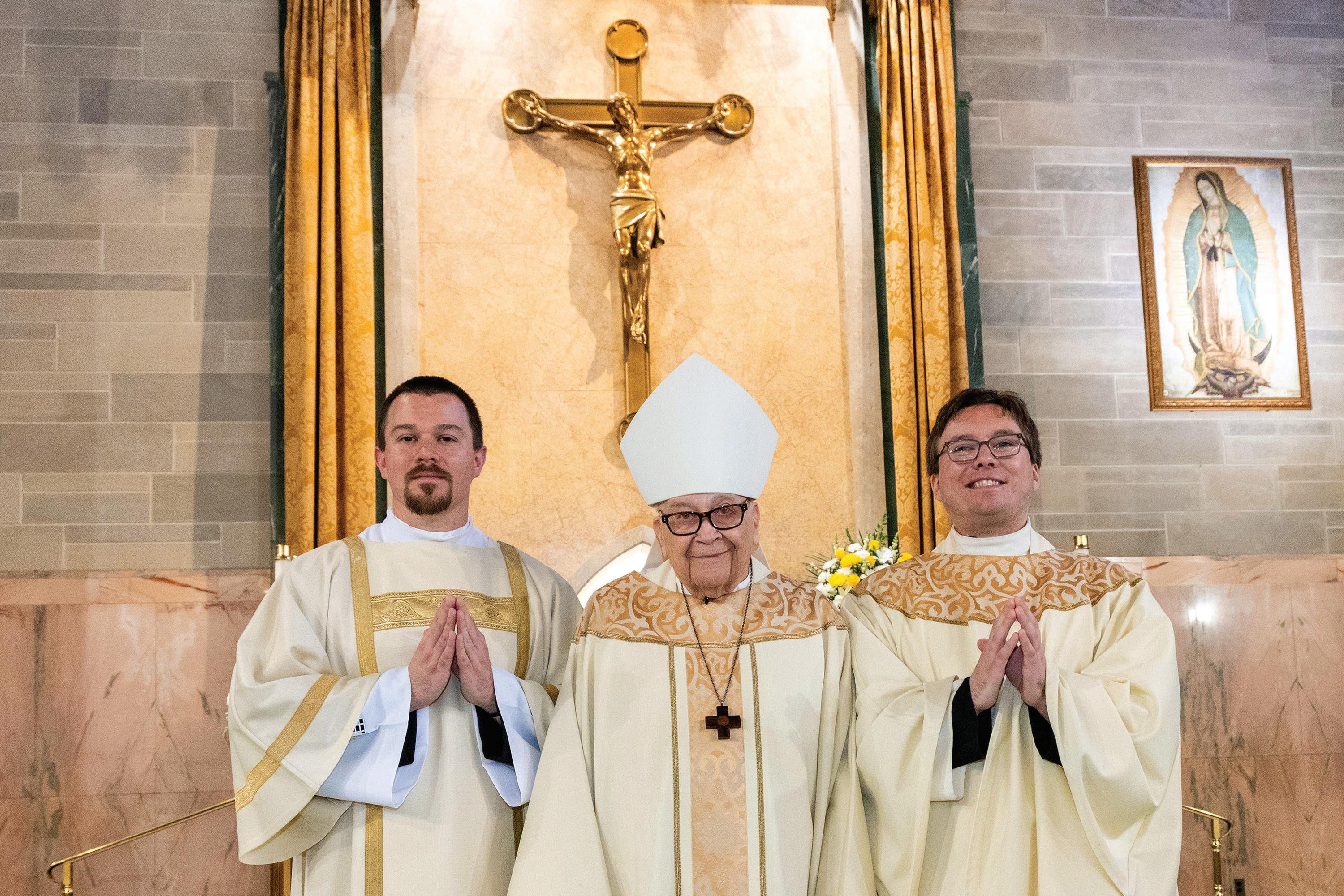
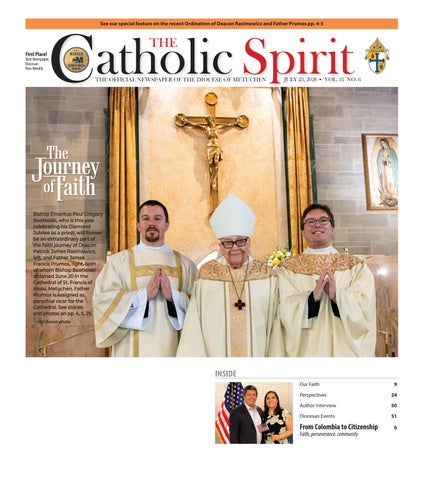
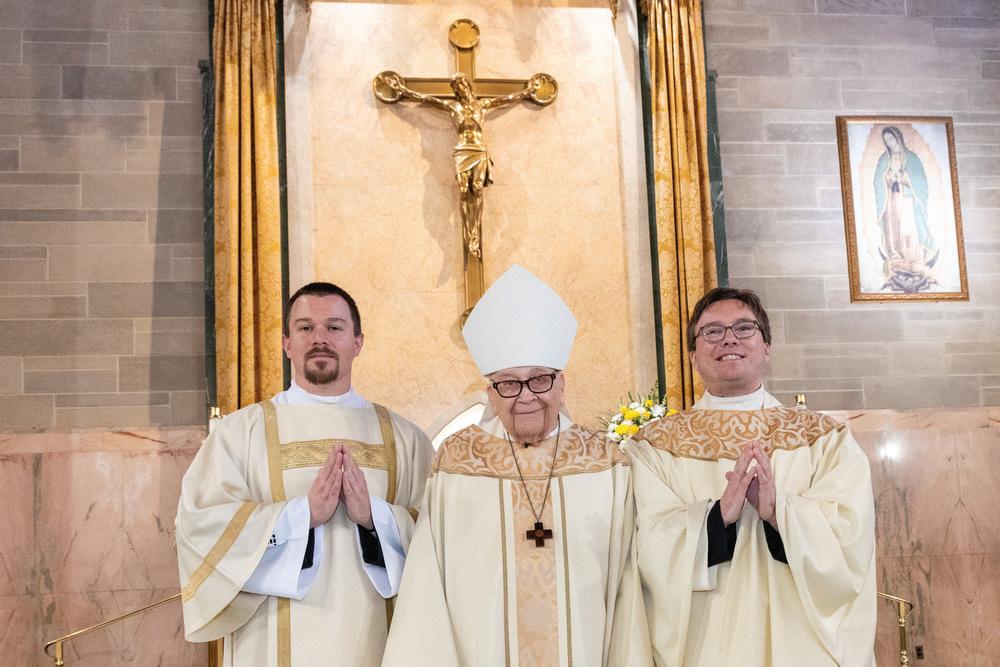
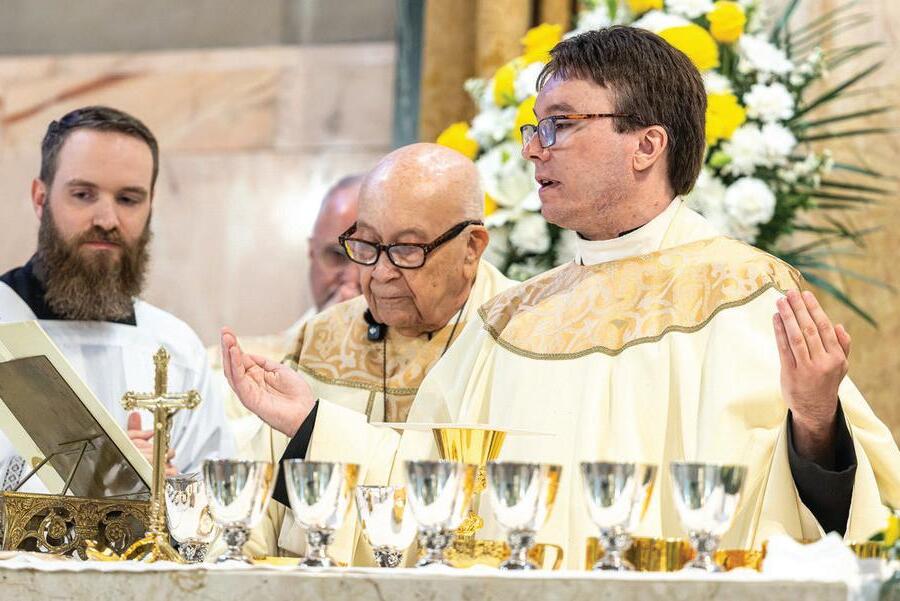
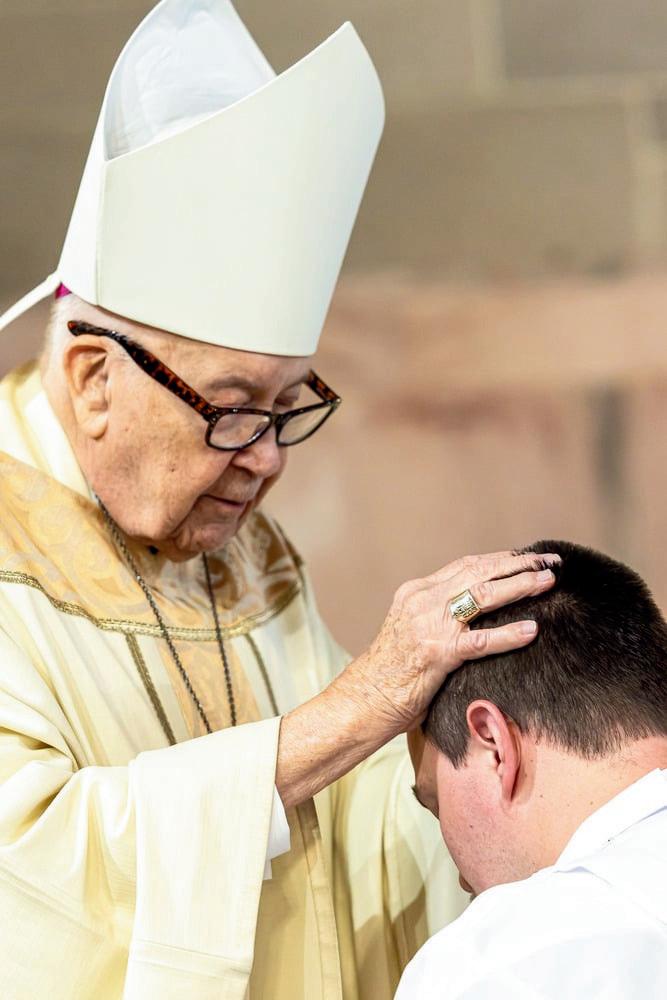
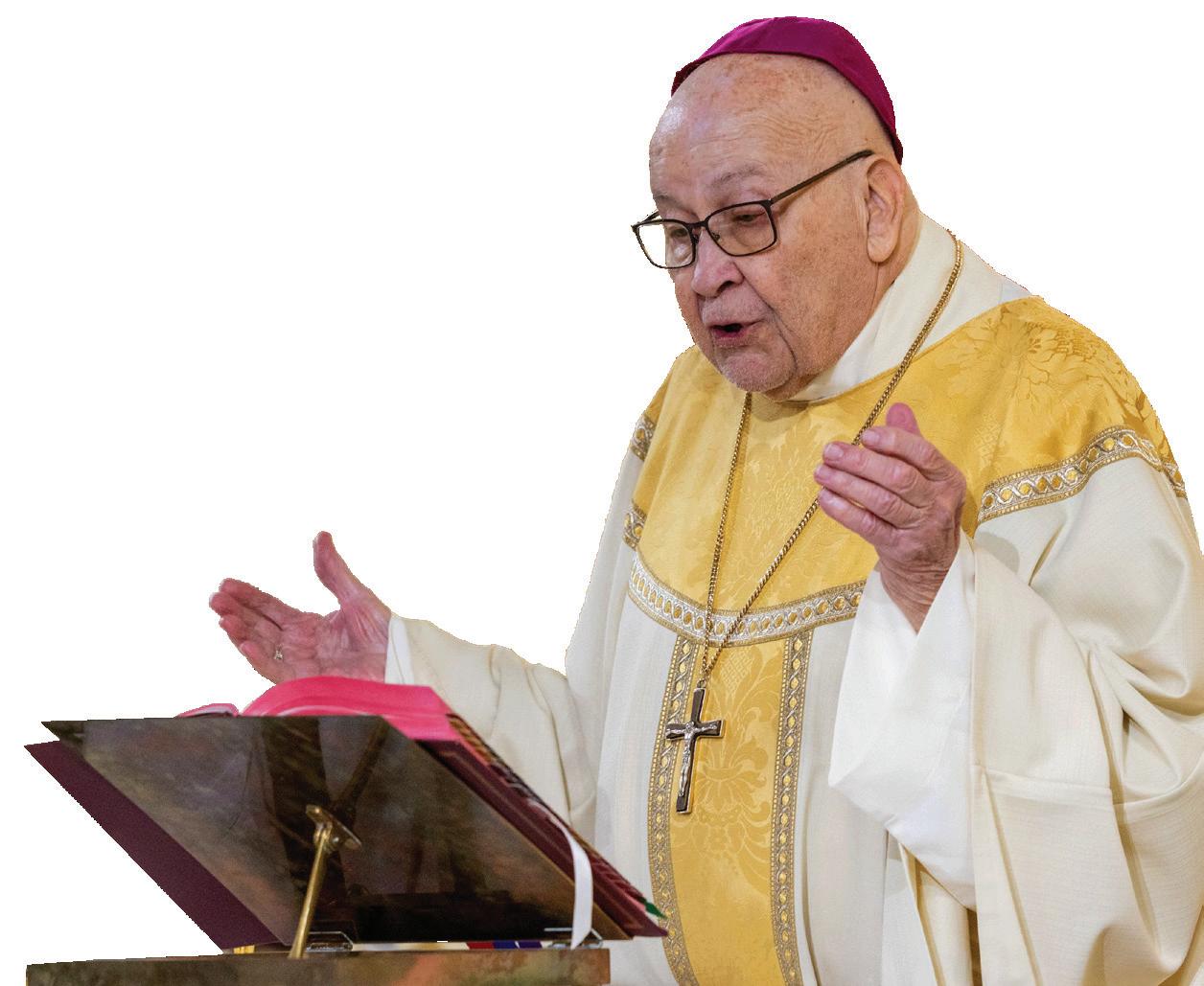
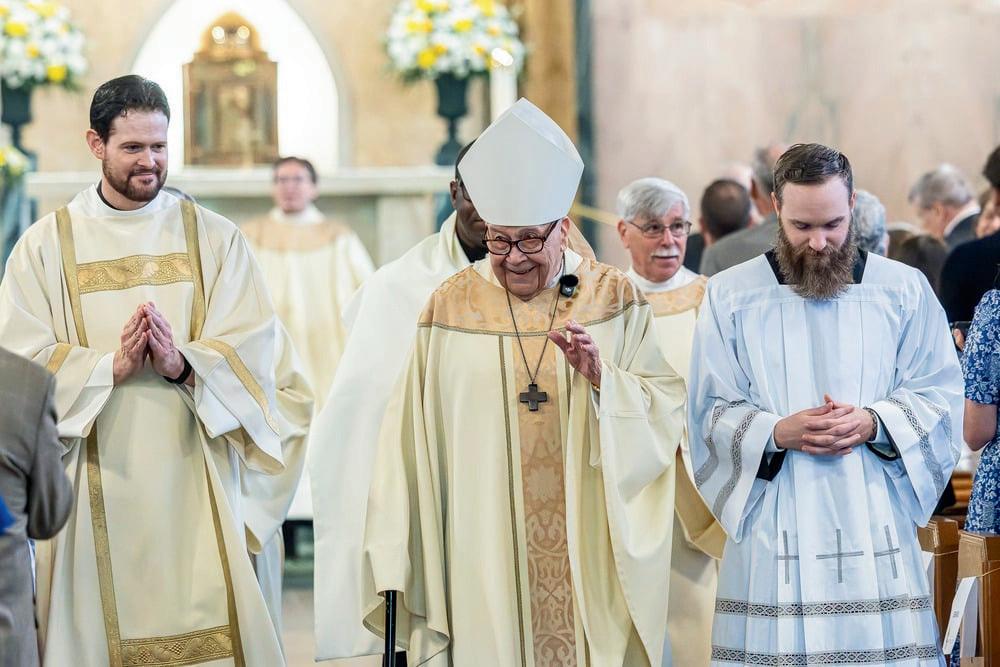
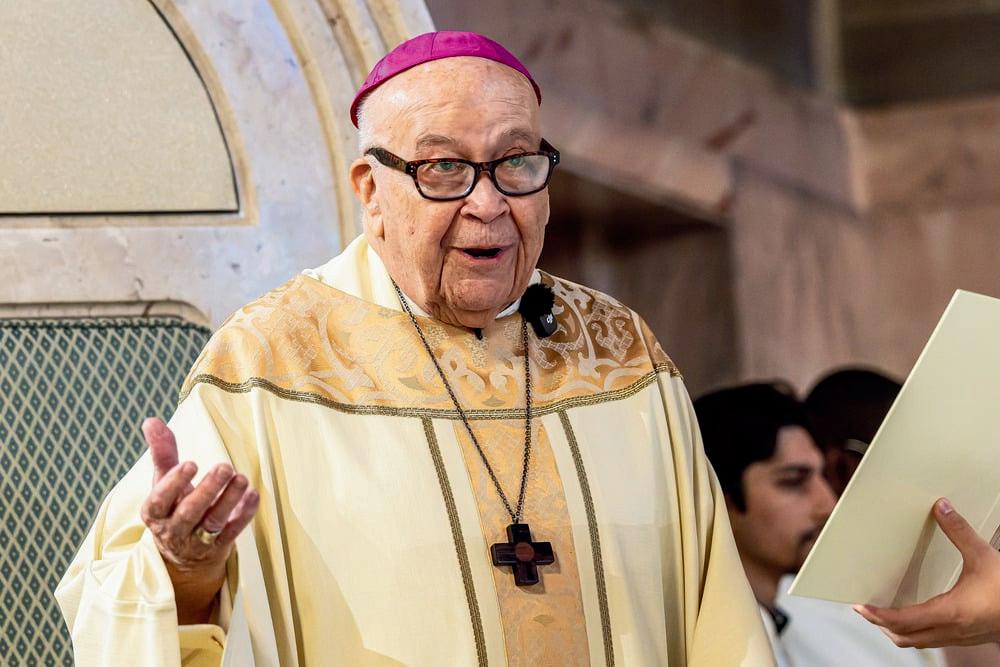
Bishop Emeritus Paul Gregory Bootkoski, who is this year celebrating his Diamond Jubilee as a priest, will forever be an extraordinary part of the faith journey of Deacon Patrick James Rasimowicz, left, and Father James Francis Prumos, right, both of whom Bishop Bootkoski ordained June 20 in the Cathedral of St. Francis of Assisi, Metuchen. Father Prumos is assigned as parochial vicar for the Cathedral. See stories and photos on pp. 4, 5, 25.
—Hal Brown photo
Place!
Newspaper,
Summer is the perfect time for prayer, refocusing spiritual goals
Dear brothers and sisters,
I hope your summer is going well and you’ve either had time (or will soon get some time) to relax a bit. It seems hard to believe we are almost at the end of July and closer to Labor Day than to last Memorial Day. As you enjoy these days of summer, though, remember the advice I heard a long time ago from a priest, “There is no vacation from your vocation!” In fact, summer’s extra little bits of inactivity may be an opportunity to take some time to refocus on our spiritual goals. How do we do that? Glad you asked.
Pray every day. So simple yet so profound. Like advertisements used to say, “No assembly required.” This is the easiest and more efficacious way to establish a personal relationship and stay close to our Lord. What it means is a firm commitment to spending intentional time each day with God (and not just “when I have some free time”). We make lots of appointments in our lives: medical, dental, hair, nails, even an oil change or pet grooming. Make a daily appointment with God to spend 10 minutes in quiet conversation.
If you can, do it without your phone or tablet. You might say you use it to read Scripture or meditation, but I fear the temptation will be too easy at first to wander from prayer to Internet surfing or answering that text message that popped up while you were trying to pray. Eventually, after two weeks of doing it, you might even find your 10 minutes becomes 15 minutes, then 20. The most important thing is that it happens every day, so that it moves from a unique event to becoming a habit.
Mass every week. I once wrote on a parish billboard, “A Catholic needs Mass like a car needs gas.” In our world of battery-operated technology, we know the need to recharge our tech
How
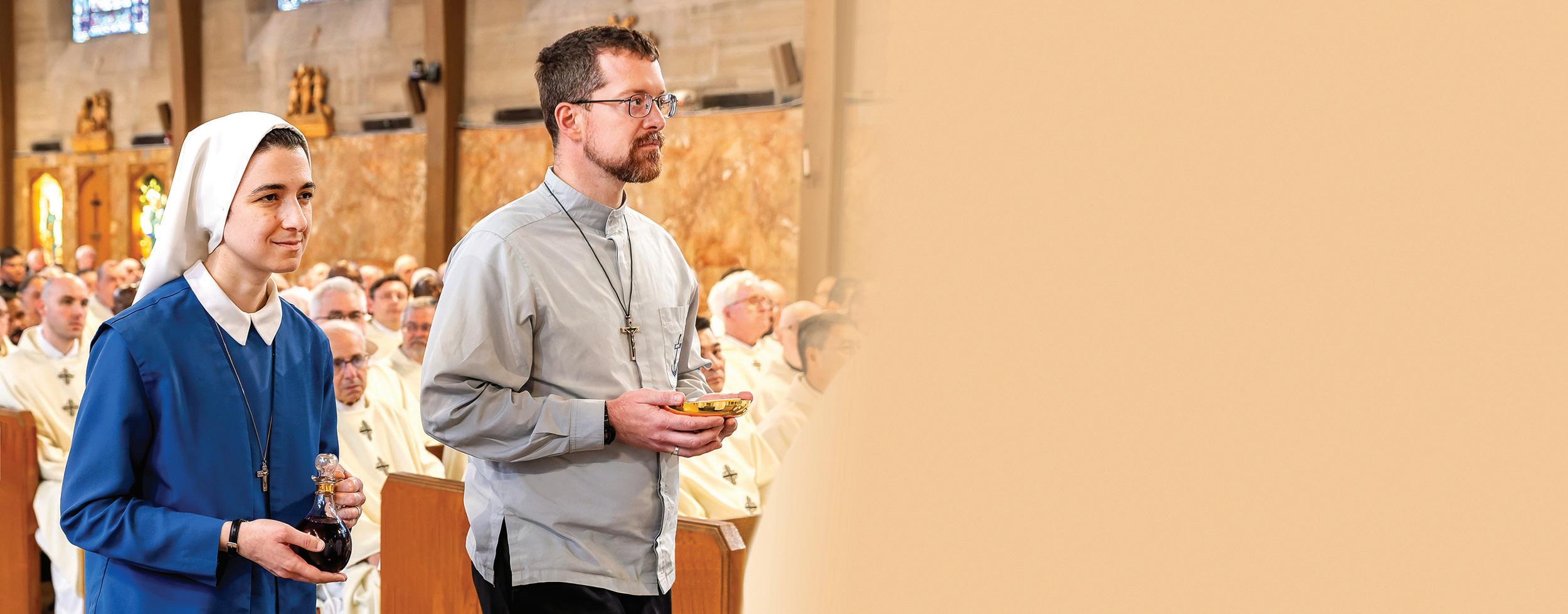
items. Charged up, they can do amazing things; allow them to run out of energy, they are useless for anything other than a paperweight. Mass is our spiritual battery charger. Every day the world slowly wears us down with work and worry. As I wrote above, prayer reminds us that we are connected to our loving God. But Mass fulfills another, necessary role. Mass reminds us that we are not alone, and that we are part of a larger community of the faithful trying to live lives of holiness on our journey to Heaven. Prayer revives our Spirit, and Mass feeds our mind with the word of God and our body with the Holy Eucharist. The processions of Mass are great moments for reflection. As you watch the procession head towards the altar, see yourself on that journey to God. As you watch the bread and wine being brought to the altar at the offertory, intend in your heart to place your needs and worries in those gifts being brought to the priest for consecration. As Mass ends and the procession leaves, remember God is sending you out into the world as His disciple.
Confession
every month. The part of my car that is one of the most helpful while at the same time makes me the most uneasy is the “Check Engine” light. I say, “helpful,” because it can tell me something is wrong before it gets to the point of stopping the car. It makes me uneasy because it almost always requires a visit to a mechanic for a repair. I ignore it at my own risk.
If I’m doing my daily praying and getting to Mass at least weekly, then my conscience is my Check Engine light. A good examination of your conscience leads to a healthy encounter with Christ the just judge. Sure, having to name our faults is humiliating. Be honest in the sacrament, and don’t be afraid. A priest, like a doctor, wants to help you feel better. Unlike a doctor, though, your “bill” afterward will not involve money but just saying a few prayers as a penance. Don’t be afraid of a good Confession.
Retreat every year. Whether it is a day out, a weekend trip, or a week-long break, there is something helpful about getting away to give some undistracted time to God. There are many opportunities in the Catholic world for retreats.
to report abuse
Some people are able to go on pilgrimages to well-known sites around the world: Guadalupe, Rome, Fatima, Lourdes, or the Holy Land. Others make a regular habit of attending parish-run retreats that take place yearly. Many, many places offer Days of Recollection throughout the year (most especially during Advent and/ or Lent). In central New Jersey, we are not far from a number of sites where one could make a holy-day out of a holiday.
Here in our own Diocese, consider a day trip to the Blue Army Shrine in Asbury, or make a trip to go see Sacred Heart Basilica in Newark. In New York, you could make a trip to St. Patrick’s Cathedral, or Old St. Patrick’s Cathedral on Mott Street, or pray before the relics
“As you watch the bread and wine being brought to the altar at the offertory, intend in your heart to place your needs and worries in those gifts being brought to the priest for consecration.”
of Mother Cabrini at her Shrine in upper Manhattan, near the Cloisters Art Museum. Still in a patriotic mood and wish to head for Philadelphia? Visit the Cathedral of Sts. Peter and Paul and pray at the tomb of St. Katherine Drexel, then go across town to pray at the tomb of St. John Neumann. Or if near Independence Hall and the Liberty Bell, stop at two old Catholic Churches, St. Joseph’s and Old St. Mary’s, both of which existed at the time of the signing of the Declaration of Independence.
Finally, in your summertime prayers, remember to continue praying to the Holy Spirit to enlighten and inspire Pope Leo in his task of choosing the next Bishop of Metuchen.
Priest Appointments
Reverend Jonathan S. Toborowsky, Diocesan Administrator, announces the following priestly appointments. Unless otherwise noted, all appointments are effective July 6, 2026.
Newly ordained:
• Reverend James F. Prumos, newly ordained priest, to Parochial Vicar, Cathedral of St. Francis of Assisi, Metuchen.
Parochial Vicars:
• Reverend Jun Joseph Alquiros to Parochial Vicar, Saint Bernard of Clairvaux, Bridgewater.
• Reverend Randy Gamboa Espinoza, from Parochial Vicar, St. Magdalen de Pazzi, Flemington, to Parochial Vicar, Parish of the Visitation, New Brunswick. He remains a part-time Chaplain at Saint Joseph High School.
• Reverend Joseph Ho, from Parochial Vicar, Immaculate Conception, Spotswood, to Parochial Vicar, Saint Philip and Saint James, Phillipsburg.
• Reverend Larrydom Magdasoc, Parochial Vicar, Saint Bernard of Clairvaux, Bridgewater, to Our Lady of Lourdes, Whitehouse Station and Chaplain, Immaculata High School, Somerville.
• Reverend Dawid Malik from Parochial Vicar, Cathedral of Saint Francis of Assisi, Metuchen, to residing at Cathedral of Saint Francis of Assisi, Metuchen and Chaplain of HMH JFK University Medical Center, Edison.
• Reverend Matthew Marinelli, Parochial Vicar, Parish of the Visitation, New Brunswick, to Administrator, Good Shepherd Parish, Hopelawn, effective June 9, 2026.
• Reverend Dawid Wejnerowski, from Parochial Vicar, Blessed Sacrament, Martinsville, to Parochial Vicar, Immaculate Conception, Spotswood.
If you were sexually abused by a member of the clergy or anyone representing the Catholic Church, or you know of someone who was, you are encouraged to report that abuse to local law enforcement, the New Jersey Division of Child Protection and Permanency at 1-877-NJ ABUSE (652-2873) or 1-800-835-5510 (TTY/TDD for the deaf), and also the Diocesan Response Officer at (908) 930-4558 (24 hours/7 days a week).
Archbishops are called to build unity, serve the truth in charity, Pope says
By Carol Glatz/Catholic News Service
VATICAN CITY (CNS) – With bishops leading the way, every Christian should help build unity in the Church and the world by putting Christ at the center and drawing others near while being attentive to their needs, Pope Leo XIV said.
“Communion within the Church is not built by clinging rigidly to one’s own position, but by seeking, in all hearts, points of encounter in the truth, in whose light alone each person becomes a means of growth for another,” he said during his homily at Mass on the feast of Sts. Peter and Paul June 29.
“It is important for us today to look to these two saints – Peter and Paul – to understand how we, in turn, can be apostles and builders of unity, and generous servants of the truth in charity,” he said.
The feast day celebration in St. Peter’s Basilica included the traditional blessing of the pallium, the woolen band adorned with crosses that the heads of archdioceses wear around their shoulders over their Mass vestments and symbolizes an archbishop’s unity with the pope and his authority and responsibility to care for the flock the pope entrusted to him.
The pallium, Pope Leo said, express es “the commitment of every shepherd –and also of every Christian – to take upon their shoulders the brothers and sisters en trusted to them, like so many lambs of the Lord’s flock, and to sacrifice their energy, time, effort and even their lives for them. They do so in order that the Gospel may reach everyone, and the whole world may find in it harmony and concord.”
According to the Vatican, 35 archbish ops from 19 countries who were named over the past 12 months received the pal liums. Four of them were from the United States: Archbishop Mark S. Rivituso of Mobile, Alabama; Archbishop Ronald A. Hicks of New York; Archbishop James R. Golka of Denver; and Archbishop James F. Checchio of New Orleans.
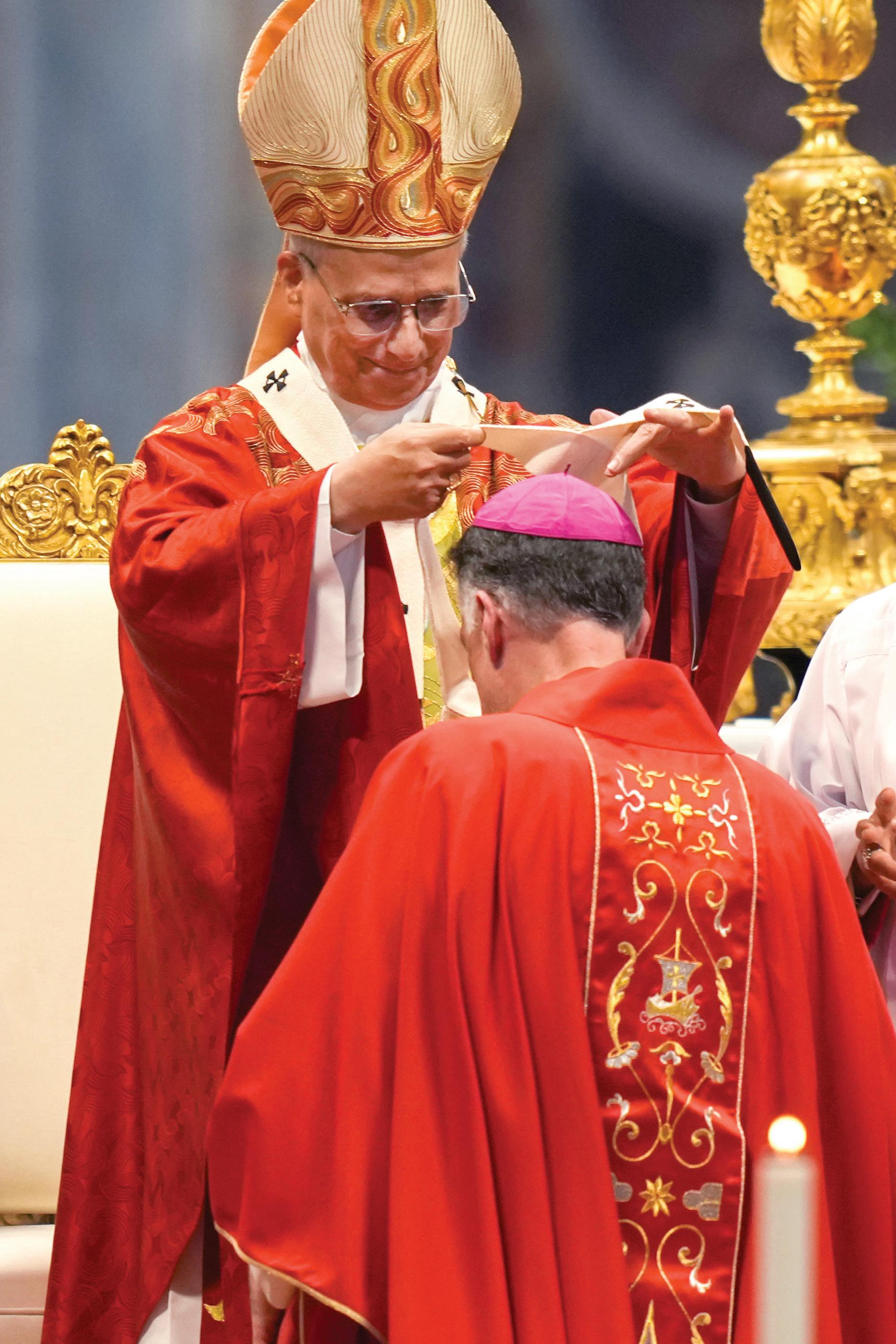
The Pope blessed the palliums after his homily and after they were brought up from the crypt above the tomb of St. Peter. Each archbishop, wearing red vest ments, then approached Pope Leo by the altar and knelt as the Pope placed the pallium over their shoulders. Each shared an embrace with the Pope and a few words.
ples for today’s bishops and all Christians.
St. Peter knew how to “acknowledge his mistakes and repent, without becoming discouraged and without failing in his mission to proclaim the Gospel and gather Christ’s flock, even unto martyrdom,” the Pope said.
When a controversial issue threatened to divide the community, he said, St. Peter listened to his brothers and made a decision, guided by the Holy Spirit, that preserved communion and ushered in a new era for the entire People of God.
St. Peter holding the keys represents his “faithful and patient concern for unity,” he said, because a key doesn’t break down a door, rather it “opens and closes them by finding the proper levers within and guiding their movements, so that locks may release, bolts withdraw, and doors turn freely on their hinges, thereby joining rooms together and transforming many isolated spaces into one welcoming home.”
“In this light, we can interpret the mission entrusted by the Lord to Peter and his successors for the benefit of the entire holy People of God. It is a mission to listen, with his help, to the voice of each person; to discern inspirations; to guide the way; to correct errors; to instruct, encourage, exhort and accompany our brothers and sisters so that, docile to the action of the same Spirit, they may cooperate in the salvation of one another and of all humanity,” he said.
In his homily, the Pope reflected on Sts. Peter and Paul – two very different saints who were martyred on different days and yet share the same feast day.
Pope Leo called them “two pillars of the Church,” who provide important exam-
Top, Archbishop James F. Checchio of New Orleans receives his pallium from Pope Leo XIV during Mass in St. Peter’s Basilica at the Vatican June 29, 2026, the feast of Sts. Peter and Paul. The Pope blessed palliums for 35 new metropolitan archbishops, including four from the United States. —CNS photo/Lola Gomez
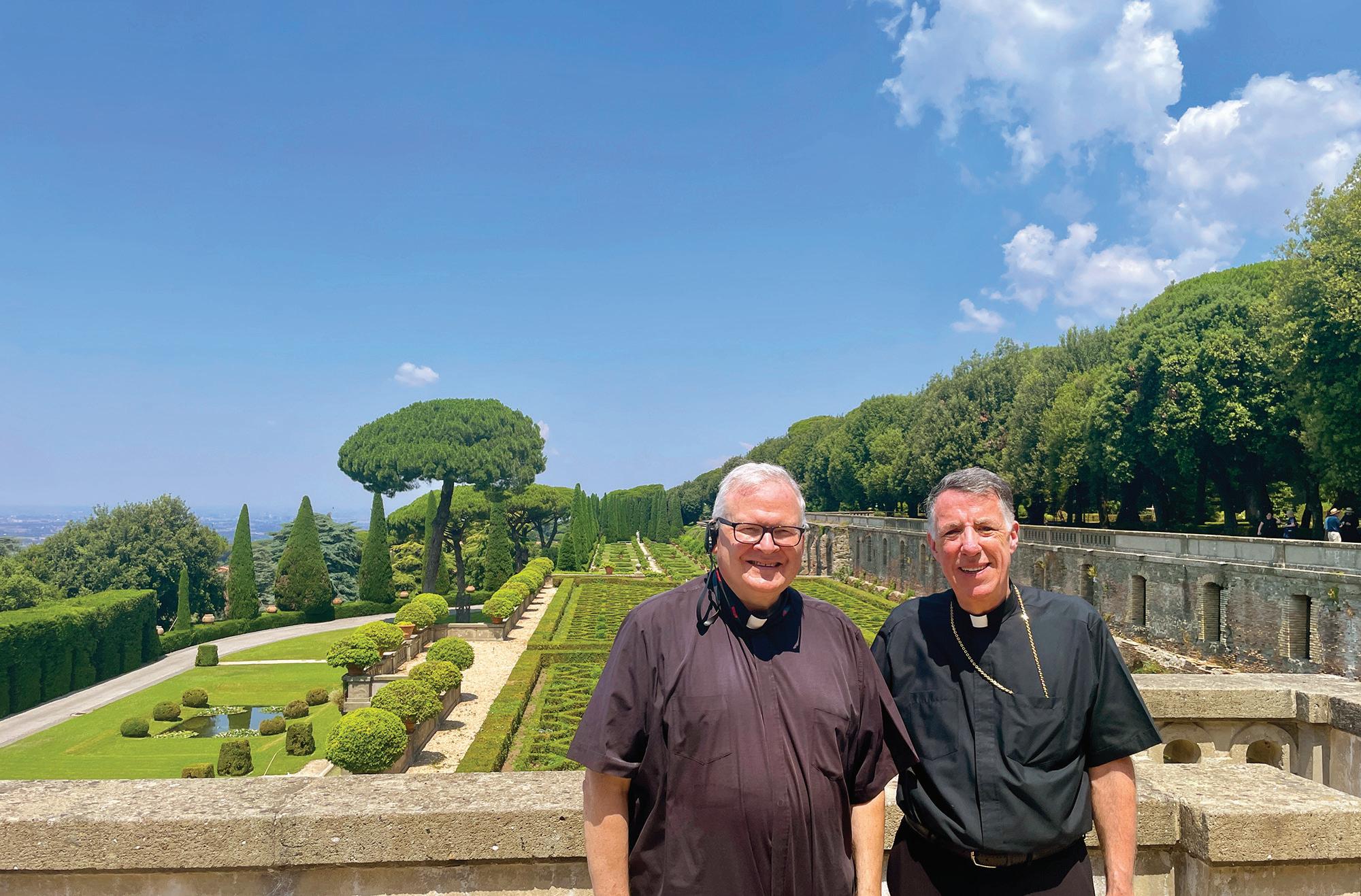
Above, Diocesan Administrator Father Jonathan S. Toborowsky, left, and Archbishop James F. Checchio, Archdiocese of New Orleans, spend some time at Castel Gandolfo June 27 before Archbishop Checchio received the pallium from Pope Leo XIV June 29. —Courtesy photo
St. Peter’s example, therefore, “is an invitation to every Christian to become a builder of unity, placing God at the center of one’s life and drawing close to one’s brothers and sisters, attentive to their circumstances and needs,” he said, so that God’s message “might be fully proclaimed.”
St. Paul, whose symbols are the book and the sword, is the “tireless herald of the Good News,” he said.
The symbols represent the word of God being capable of penetrating and transforming even the hardest of hearts, as was seen with St. Paul’s conversion, who was led away from violence and onto “the path of love,” he said.
“St. Augustine said, ‘God took the persecutor of the Church and made him a messenger of peace. He forgave him all his sins and placed him in a ministry where he could forgive the sins of others,’” Pope Leo added.
“Let us pray to Sts. Peter and Paul that they may sustain us on our journey of communion in the footsteps of the Savior,” he said.
This trip to Rome was special to me. To be there representing the Diocese of Metuchen as our former shepherd received the outward sign of his new office as Archbishop was an experience I’ll treasure. It’s a moving ceremony for many reasons. It took place in the magnificent St. Peter’s Basilica. It was led by our Holy Father, Pope Leo. The 35 new Archbishops had come from all over the world and remind us of the universality of the Church. While I was there, I prayed for the people of our Diocese and asked the Lord to send us a holy and compassionate bishop.
~ Diocesan Administrator Father Jonathan S. Toborowsky
Called by Christ
Two men ordained for service to the Church
By Deacon Patrick Cline Correspondent
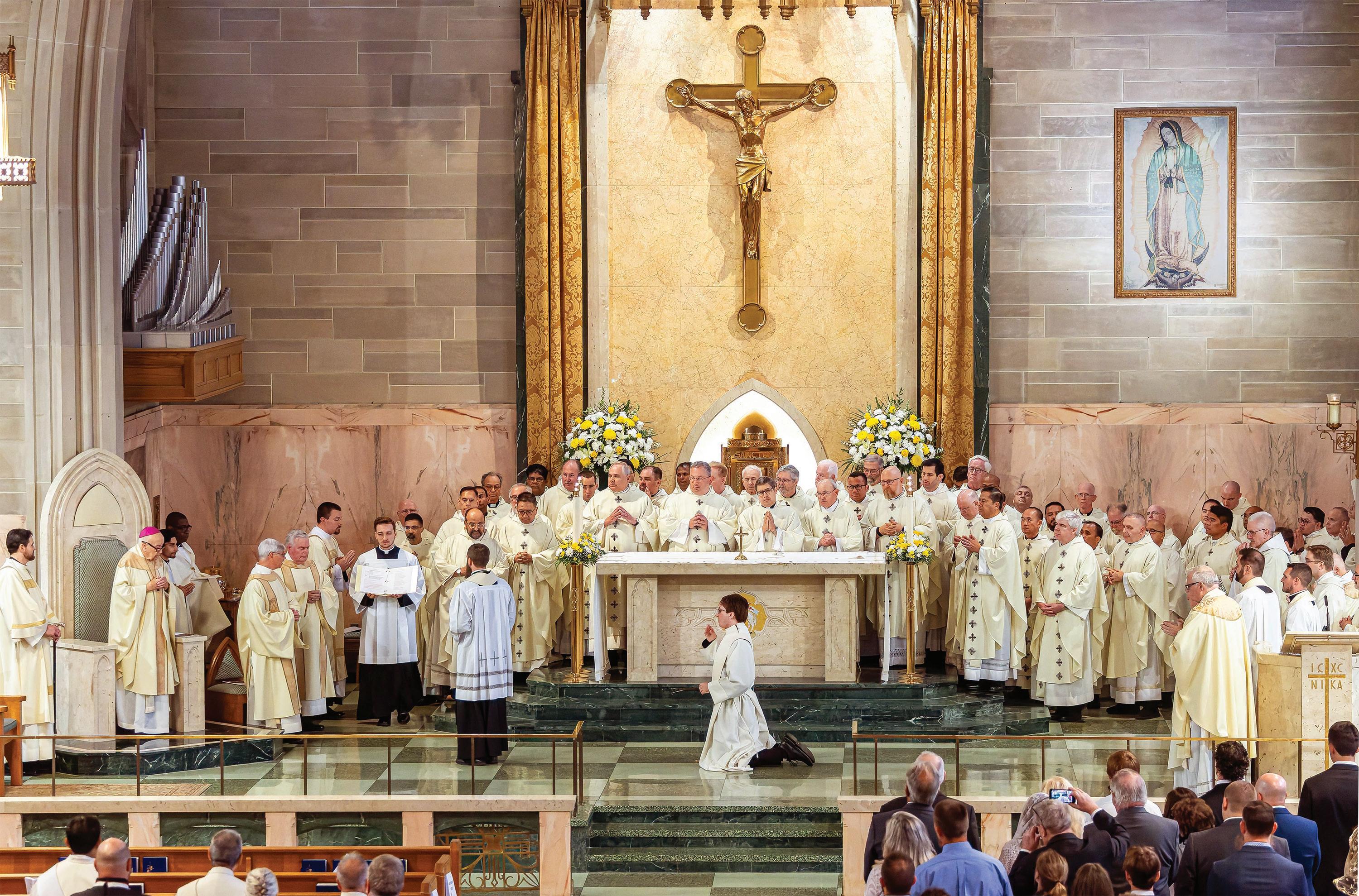
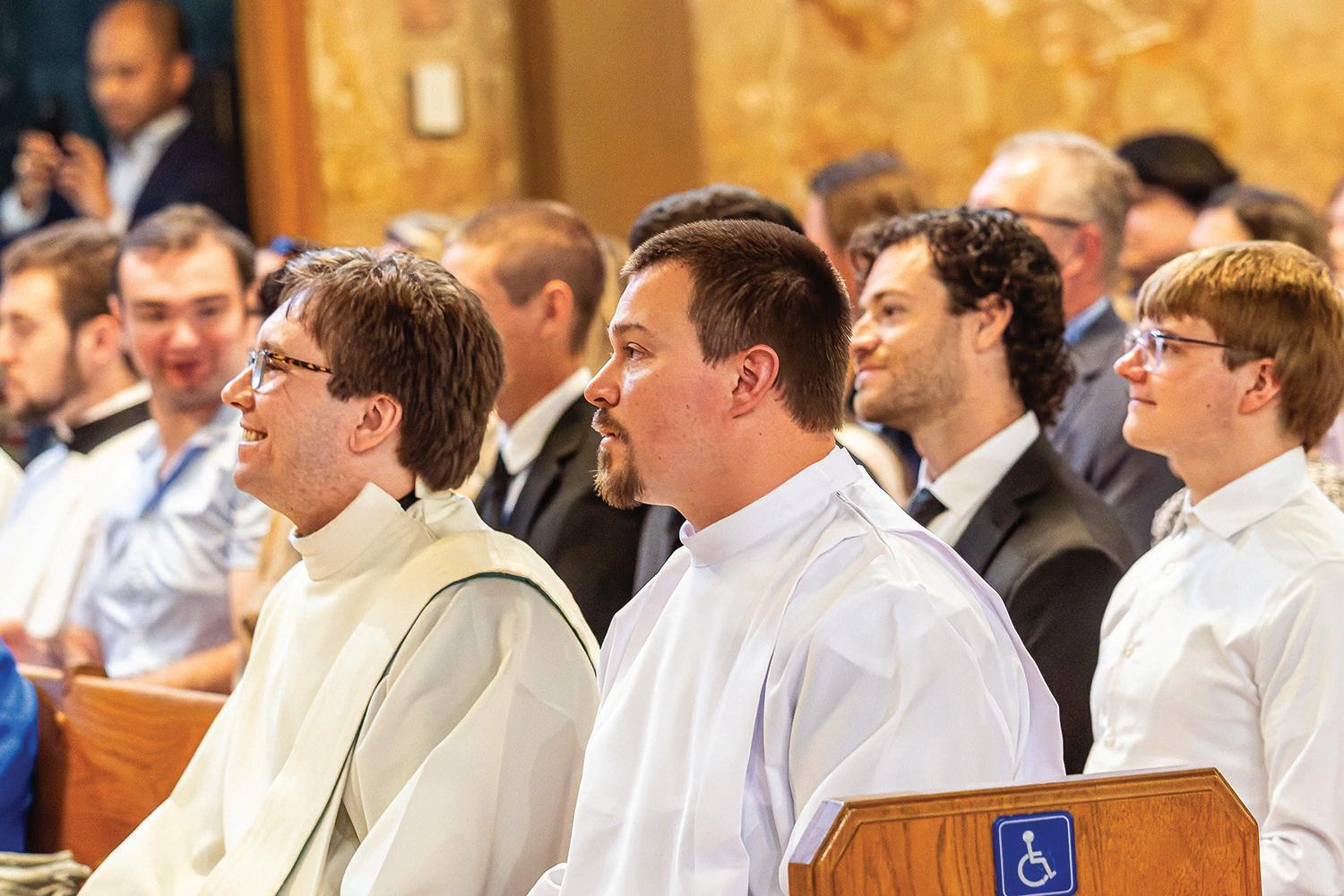
Answering God’s call to ordained ministry, James F. Prumos was ordained to the priesthood and Patrick J. Rasimowicz to the transitional diaconate during a joyful Mass on June 20 at the Cathedral of St. Francis of Assisi.
Surrounded by family, friends, clergy and the faithful, the two men publicly committed themselves to lives of service to Christ and His Church. The Most Rev. Paul G. Bootkoski, Bishop Emeritus of Metuchen, served as principal celebrant and homilist, joined by priests of the Diocese, neighboring dioceses and priest friends of the two men being ordained.
In his homily, Bishop Bootkoski addressed the ordinands directly.
“My dear brothers, Patrick who is to become a deacon and James who is about to become a priest today, Christ calls
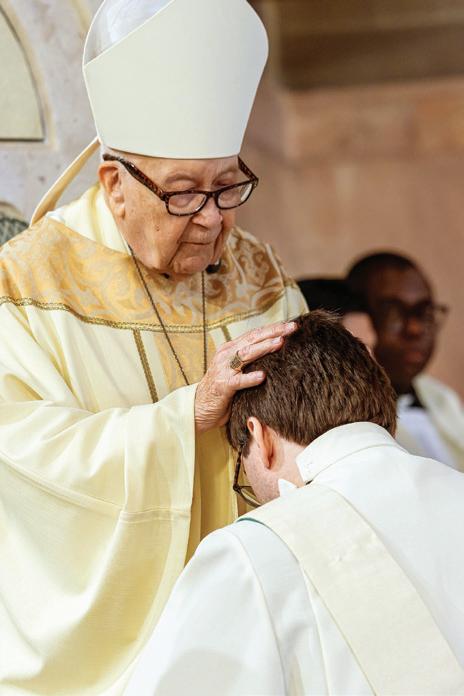
both of you to be the salt of the earth. Just as Christ is always present to his people, you also must be present to the people to whom you are assigned. They are to sense Christ is present in you.”
He encouraged both men to remain rooted in prayer as they embraced the demands of ministry.
“At times this will be very consuming, trying, tiring and annoying. The only way to deal with these demands is to be a man of prayer. Immerse yourself in your parish community.”
Concluding his homily, Bishop Bootkoski expressed gratitude for their response to God’s call.
“Thank you for accepting the wonderful calling to the priesthood. My sisters and brothers today we are so thankful for these two men. After my good years of priesthood I hope you have as good a ride as I have enjoyed. Congratulations!”
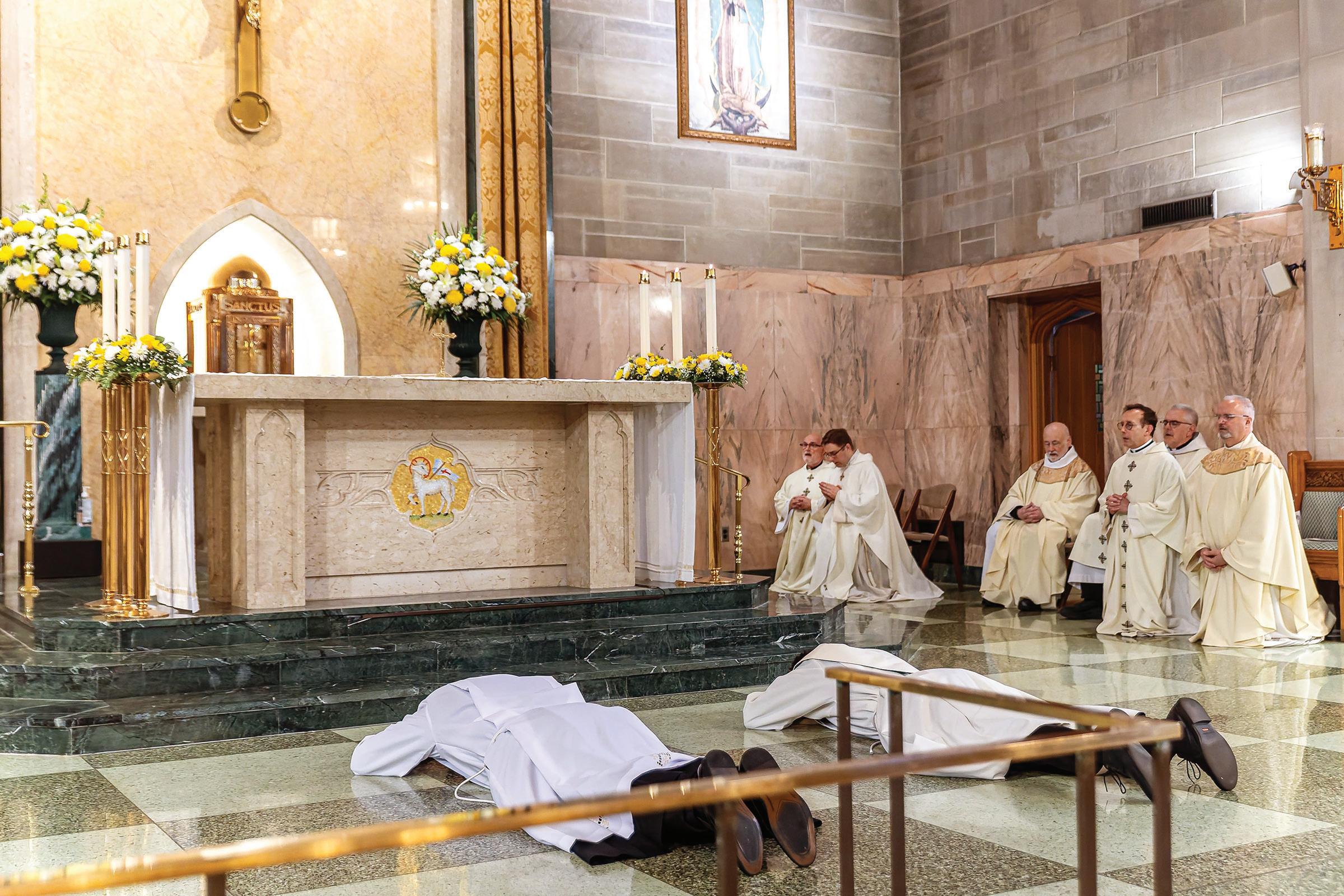
Although celebrated together, the
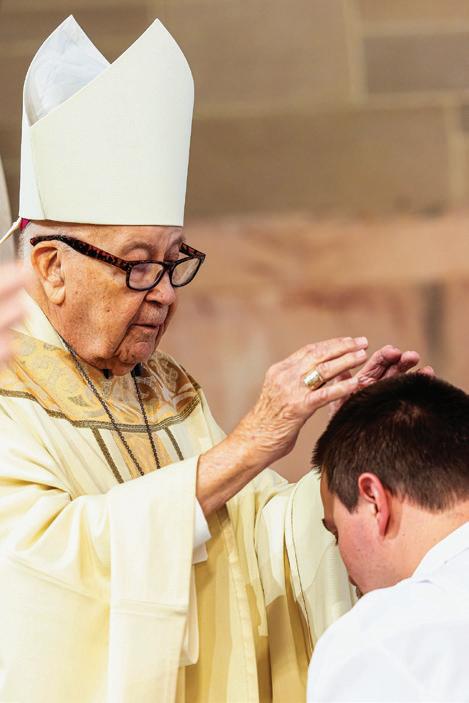
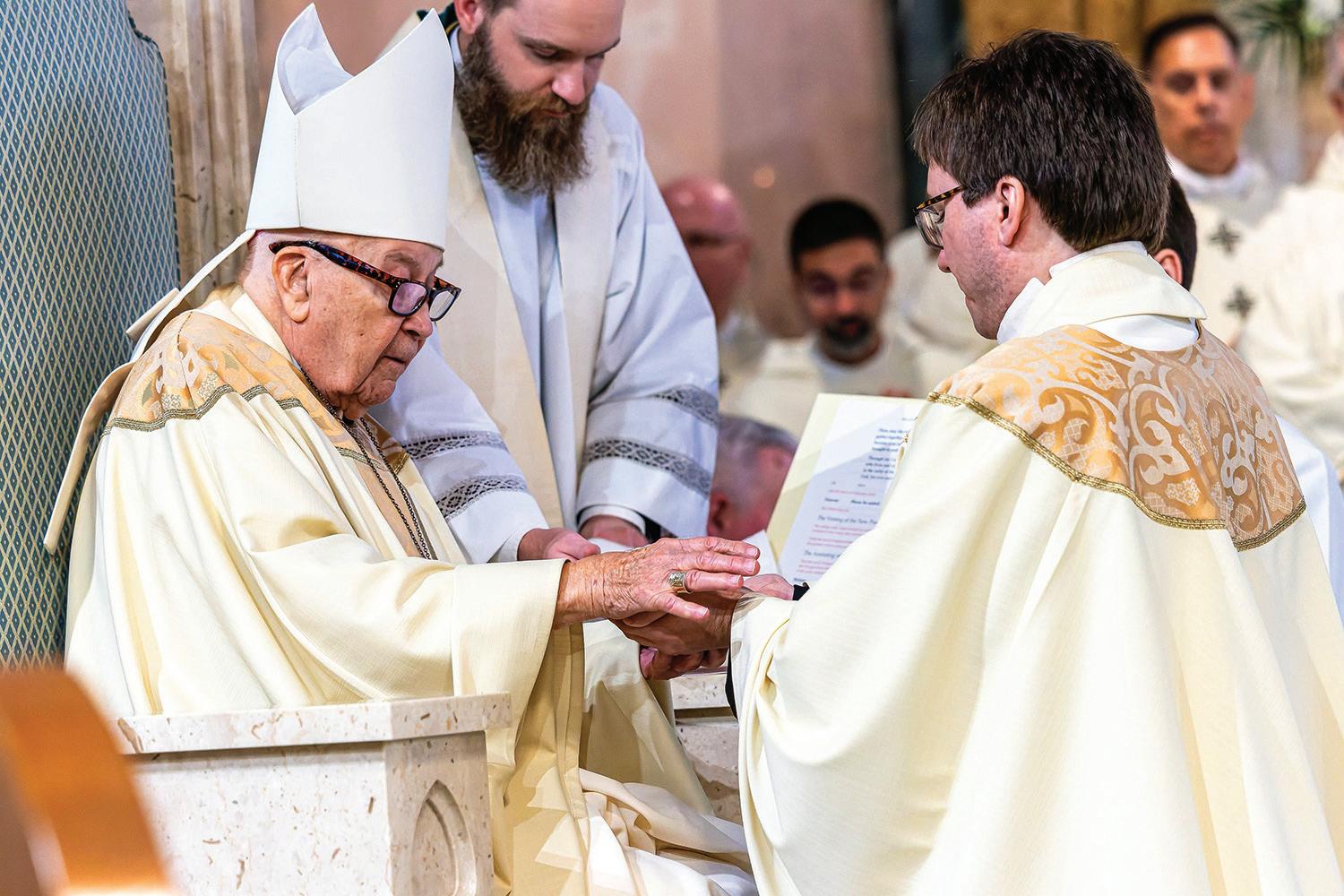
Ordination rites included elements shared by both the priesthood and the diaconate, along with rituals unique to each order.
Common to both Ordinations were the promise of obedience, the Litany of Supplication during which the candidates prostrated themselves in prayer, the laying on of hands and prayer of Ordination by the bishop, and investiture with the vestments proper to each order: the stole and chasuble for the priest and the stole and dalmatic for the deacon.
Other rites reflected the distinct ministries of each vocation. The newly ordained deacon received the Book of the Gospels, symbolizing his call to proclaim the Good News. The new priest’s hands were anointed with Sacred Chrism, and he received a chalice and paten, signifying his sacred responsibility to celebrate the Holy Eucharist and administer the sacraments.
Father Prumos was born and raised in Edison and is the youngest of four children of James and Mary Prumos. He has three older sisters. He attended Our Lady of Peace School in Fords and St. Joseph High School in Metuchen before earning a Bachelor of Science degree in computer science from Seton Hall University.
During his junior year of college, he first felt called to consider the priesthood. While attending World Youth Day in Kraków, Poland, in 2016, he experienced a stronger invitation to deepen his faith. After graduation, he spent two years in Denver serving with Christ in the City.
Upon returning to New Jersey, Father Prumos entered Immaculate Conception Seminary School of Theology at Seton Hall University at the start of the COVID-19 pandemic. Although his first year presented unexpected challenges, his discernment of
Father James F. Prumos
Holy Hour unites Diocese in prayer for vocations and priests
By Deacon Patrick Cline Correspondent
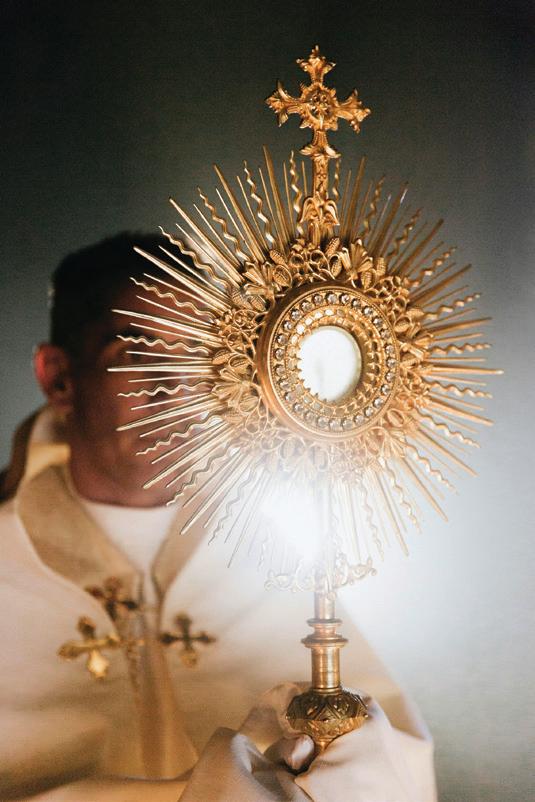
On the eve of Or dinations to the priesthood and diaconate, clergy, religious and faithful from across the Diocese of Metuchen gathered June 19 at the Cathedral of St. Francis of Assisi for an annual Holy Hour for Vocations and the Sanctifi cation of Priests. Rooted in prayer before the Blessed Sacrament, the evening reflected the Church’s enduring commitment to supporting those called to ordained min istry while asking God to raise up future vocations.
The Very Rev. Jonathan S. Toborowsky, diocesan administrator, served as principal celebrant. Father Joseph Illes, parochial vicar of Our Lady of Perpetual Help Parish in Bernardsville, preached the homily.
sacraments. As Christ, we are called each day to lay down our lives in service at the altar to be the body broken and blood outpoured in service to his Church.”
Acknowledging that ministry often brings unexpected challenges, Father Illes said every priest, regardless of assignment, experiences moments that require trust and perseverance.
“We can all identify with the universal struggle of being called to service in ways we do not expect or particularly relish, or in ministries that push us outside of ourselves,” he said.
“But, in the end, our vocation is not about us at all. It is about service, to the best of our ability.”
a vocation to the priesthood grew stronger
consider it.”
Deacon Rasimowicz is the fifth of seven sons born to Jean and Barry Rasimowicz. A native of Old Bridge, he attended St. Ambrose School before graduating from St. Joseph High School in Metuchen. He earned a Bachelor of Science degree in civil engineering from the New Jersey Institute of Technology
Although he was raised in a faith-filled home, Rasimowicz said he never considered the priesthood as a child or teenager.
It was not until his junior year of college that he first sensed God calling him to discern a priestly vocation. Although his faith continued to deepen, he chose to complete his studies first, believing that “if God was still calling me I would
It took two more experiences of God’s call before he seriously began discerning the priesthood. At first, he felt drawn to religious life before eventually considering service as a diocesan priest.
After speaking with Father Mauricio Tabera-Vásquez, then vocation director for the Diocese of Metuchen, Rasimowicz applied to Immaculate Conception Seminary to begin his priestly formation.
Although Rasimowicz said he did not consider the priesthood while growing up, his mother saw signs much earlier.
“The way he served Mass at St. Ambrose seemed to exhibit a call to serve God,” she said.
Reflecting on the Ordination, his parents shared their gratitude for the day.
“Patrick’s ordination was an overwhelming experience for the entire family. We were amazed at the reaction of our extended family and friends to the day.”
The Holy Hour began with exposition of the Blessed Sacrament and included sung Evening Prayer for Friday of the Eleventh Week in Ordinary Time, led by two cantors and Christopher Deibert, diocesan director of liturgical music.
Father Toborowsky stressed that the annual gathering serves as a visible reminder that fostering vocations is the responsibility of the entire diocesan community.
“It is very important for the people of the various parishes of the Diocese to have the opportunity to come together to pray for vocations and for the men who will be ordained,” he said.
Among those gathered were Deacon James F. Prumos, who would be ordained to the priesthood the following day, and Patrick J. Rasimowicz, who would be ordained a transitional deacon. They were joined by priests, seminarians, consecrated religious women and men, and parishioners from throughout the Diocese, all united in prayer for the Church and her future shepherds.
Reflecting on the joys and sacrifices of priestly ministry, Father Illes reminded those present that a vocation is ultimately rooted in self-giving service.
“The priesthood is a beautiful and privileged gift,” he said. “Ask any priest and he can share stories of the highs and the lows, the painful and the joyous moments of ministry. A priest is most a priest when he is engaged in the ministerial acts for which he is ordained: being Christ to other people through service, presence, and, of course, providing the
Turning to the men preparing for Ordination and the priests gathered in prayer, he concluded, “My brothers and soon-to-be brothers, as we pray for those to be ordained, for an increase in vocations, and for the sanctification of the clergy, let us rededicate ourselves to the promises of priestly service that we make or renew tomorrow.”
Following the homily, the congregation remained in silent prayer before the Blessed Sacrament, offering personal petitions for priests and for those discerning God’s call.
For Justin Lang, a seminarian who will begin his Configuration I year in September, prayer is the foundation of every vocation.
“All vocations begin with prayer and that part of the reason for the lack of vocations is that we don’t pray enough,” Lang said. “This afternoon then is very important for that reason.”
Rasimowicz shared a similar conviction, emphasizing the need for continued prayers throughout the Church.
“We need more prayers for vocations in the Church so that good and holy men will answer the Lord’s call to the priesthood,” he said.
He added that seeing parishioners from the communities where he served during his seminary formation attend the Holy Hour was “a wonderful affirmation of support and prayer.”
The evening concluded with Benediction, sending those gathered home after an hour of prayer that looked ahead to the Ordinations while reaffirming the Church’s continuing need to pray for priests, seminarians and future vocations.
See our photo album for this event at Catholicspirit.com. —Hal Brown photos
From Colombia to Citizenship Faith, perseverance and community guide diocesan staff member’s American journey
By Mary Morrell, Editor-in-Chief
For nearly a decade, every step of the journey required faith.
When Luz Escobar stood with some 80 people from around the world to take the Oath of Allegiance and become a United States citizen this spring, the moment represented far more than the conclusion of paperwork. It marked the fulfillment of years of prayer, perseverance and trust in God’s providence.
“It has really been nine years since every step – starting with the visa – was necessary to reach this goal,” she reflected.
Her journey began not in the United States, but in Colombia in late 2015. Her husband, Julián Mahecha, was asked by his employer to travel to the United States to support a finance project. What began as a temporary assignment soon became an offer to relocate permanently.
The opportunity wasn’t something the couple had planned.
Instead of making the decision on practical considerations alone, they first turned to prayer.
“We sought the intercession of Our Lady,” she said. “We prayed, ‘If this opportunity is God’s will, help everything to proceed smoothly.’”
Within six months, they received their visas.
Her husband arrived in October 2016. She remained in Colombia until January 2017, finishing her contract as a lawyer with Colombia’s Ministry of Environment and Sustainable Development, where she worked with the genetic resources access group. Waiting until her contract ended also provided a measure of security should they one day return home.
As the years passed, temporary visas
gave way to permanent residency, thanks in part to the support of her husband’s employer. Yet citizenship remained the final milestone.
“When we first arrived, our visa was only valid for three years, so the future felt very uncertain,” she said. “Citizenship represents the definitive step toward feeling that I am no longer here as a guest, but as a full-fledged member of society.”
Although little changed in her daily routine after taking the oath, the emotional impact has been profound.
“Citizenship has brought me a sense of peace and joy that is hard to put into words.”
She also sees citizenship as carrying responsibility.
“Becoming a citizen is more than just a ceremony,” she said. “It is a responsibility to make your voice heard and to have an impact on the decisions of a country that influences both nationally and internationally.”
Her own immigration story, she acknowledges, has been blessed in many ways. Unlike those forced to flee violence or political instability, her family was able to make the decision to come to the United States willingly and with support.
She recognizes that many immigrants face far greater uncertainty and are sometimes misled by misinformation or fraudulent advice.
For that reason, she encourages anyone pursuing citizenship to rely on trusted sources, seek guidance from organizations such as Catholic Charities or Rutgers, and consult official information through U.S. Citizenship and Immigration Services rather than social media.
The citizenship application itself required months of preparation.
After submitting her application in September 2025, she and her husband received interview notices near the end of the year. Together they found a creative way to study for the civics exam.
Her husband built a PowerPoint quiz that randomly displayed questions from the list of 100 possible citizenship questions. Each evening, they answered 10 to 15 questions together, checking their responses before moving on. She also watched YouTube videos to become familiar with the interview process and spoke with members of the Hispanic community who had recently become citizens.
The couple interviewed in February. Julián became a citizen in March.
Her own journey required one more step.
After immigration officials requested additional documentation, she waited until May to receive approval.
Although the delay was difficult, she found strength in the unwavering support surrounding her.
“My husband’s support has been crucial,” she said. “His prayers and unconditional support give me peace of mind.”
Family members spread across Colombia, Panama and Spain remained close through frequent calls and constant prayers.
“Even though they aren’t here physically, I feel that they are with me every step of the way.”
She also credits the friendships she has built since arriving in the United States.
“Since moving here, we have been blessed to find friends who have become like family to us,” she said. “They have helped me immensely in adapting to a new culture, language and way of doing things.”
Her colleagues at the Diocese, where she serves in the Office of Hispanic Evangelization and Pastoral Ministry, also became an unexpected source of encouragement.
“They may not realize it, but I deeply appreciate the patience they have shown when talking with me,” she said. “They have helped me improve my English communication skills and encouraged me to believe in myself.”
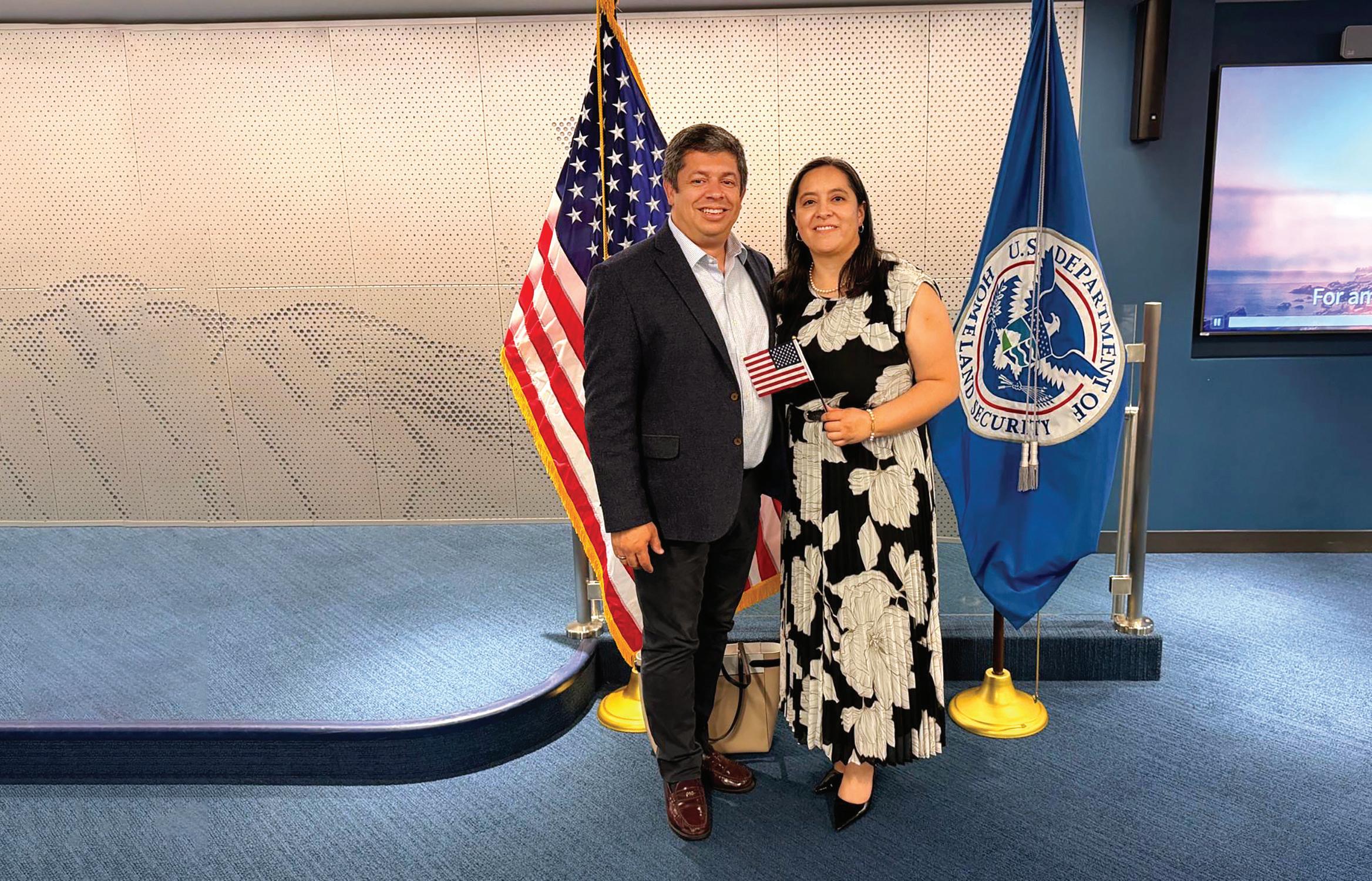
On the day of her naturalization ceremony at the U.S. Citizenship and Immigration Services office in Cranbury, her husband stood beside her, along with a close friend, Father Marco A. Cáceres, a Colombian priest serving in the diocese.
Together, they celebrated not simply the end of an immigration process, but the culmination of years of hope, prayer and God’s faithful guidance.
Looking back, she believes every chapter of her life contributed to that moment.
“Every moment, every decision, and every person I have had the pleasure of meeting have contributed to this outcome and are part of my story in this country.”
And for those still walking the path toward citizenship, her message is one of encouragement rooted in faith.
“Keep your spirits up,” she said. “Every case is different, and every detail of your journey matters. Verify information through trusted sources, seek good advice, and ask the Holy Spirit for guidance in making the best decision for your case.”
For her, the journey to citizenship was never simply about reaching a destination. It became a witness to how faith, community and perseverance can carry a person through uncertainty to a place that finally feels like home.
Luz Escobar and her husband, Julián Mahecha, stand together following the naturalization ceremony which made her a U.S. citizen. —Courtesy photo
a Night Before the l ord: Corpus Christi Vigil unites the faithful
By Adriana Molina Correspondent
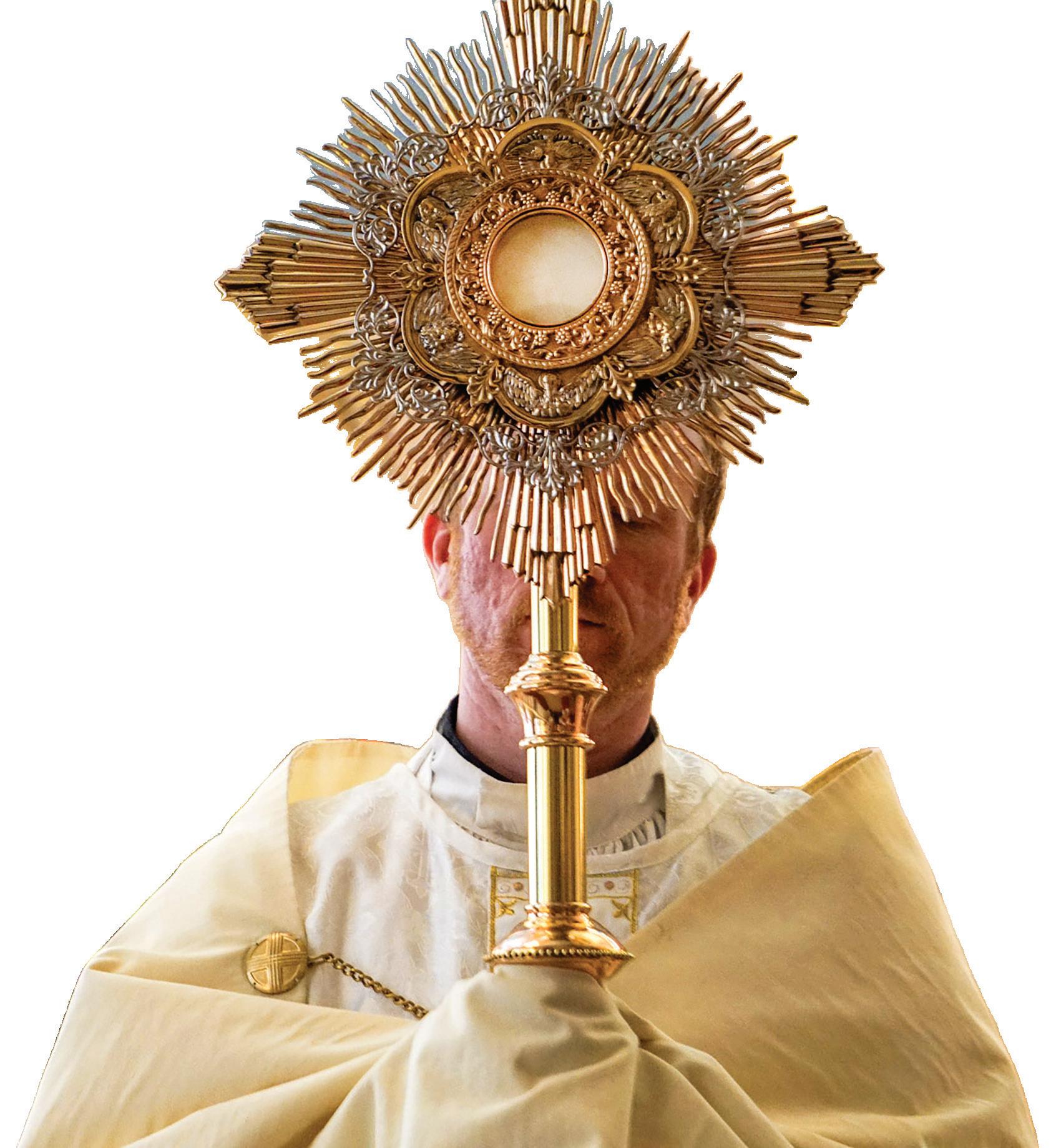
The Corpus Christi Vigil, held June 6 in St. Mary of Mount Virgin Church, Parish of the Visitation, New Brunswick, brought together parishioners and members of neighboring faith communities for an evening of prayer, Eucharistic adoration, and reflection. The warm glow surrounding the altar, beautifully adorned with white flowers and centered on the Blessed Sacrament, created a welcoming atmosphere that invited participants into a deeper spirit of prayer and devotion.
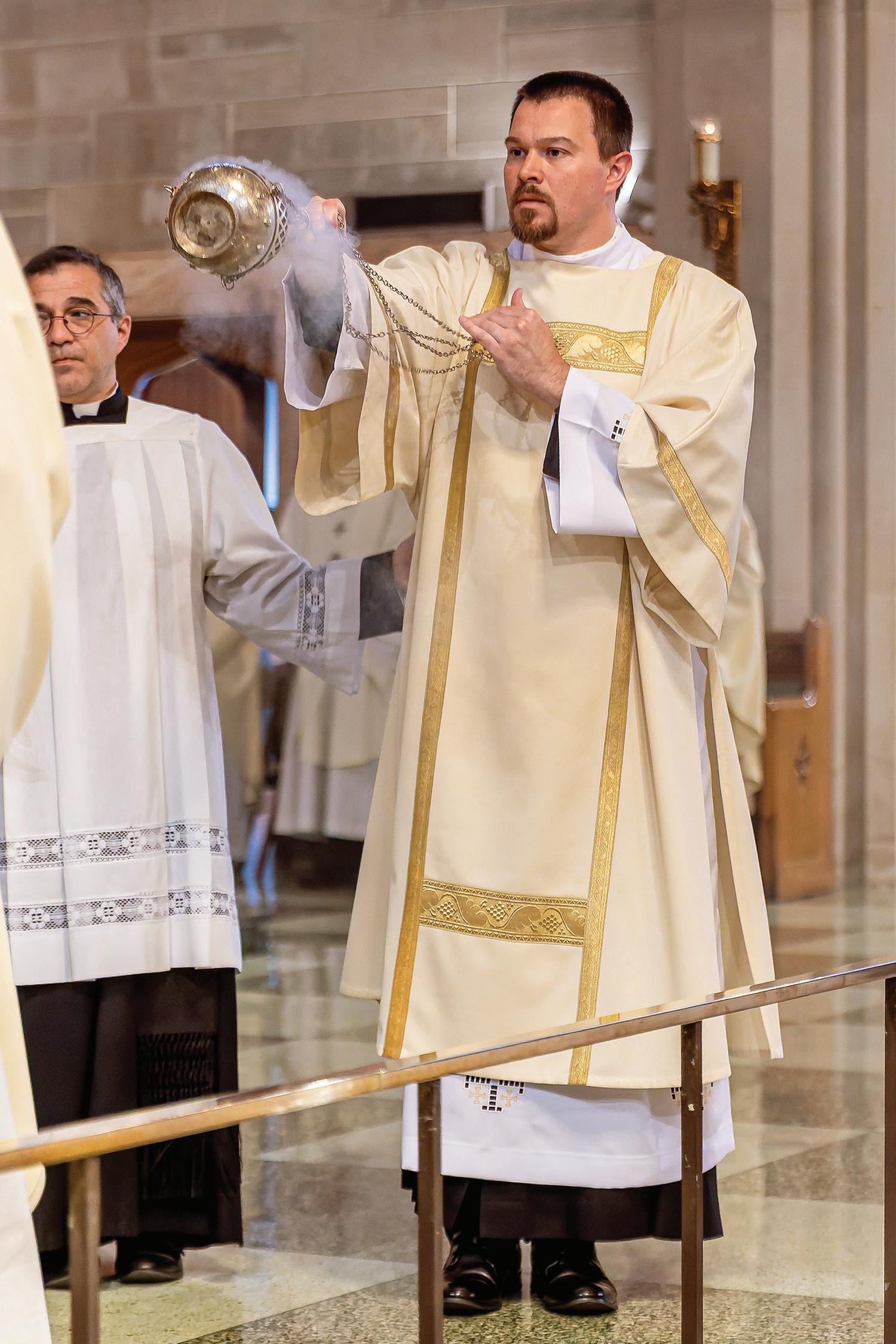
The evening began with Mass celebrated by Father Matteo Marinelli and assisted by Deacons José Miguel Suárez and Ricardo Rivera. As in previous years, the Missionaries of the Blessed Sacrament of the Altar invited the community to gather for the vigil and deepen their encounter with Christ in the Blessed
Sacrament, reflecting the light of His presence to all.
In his homily, Father Marinelli reflected on the gift of the Eucharist and invited those present to renew their love and devotion to Jesus, truly present in the Blessed Sacrament. He reminded the faithful that every celebration of Holy Mass is a miracle in which Christ becomes truly present to nourish His people.
“Every time Holy Mass is celebrated, a miracle takes place,” Father Marinelli said. “The Eucharist is Christ’s gift to each one of us. We must open our hearts to the grace He wishes to pour out upon us and show our love and reverence for Our Eucharistic Lord.”
Throughout the evening, participants gathered for silent prayer, Scripture readings, and music reflecting the themes
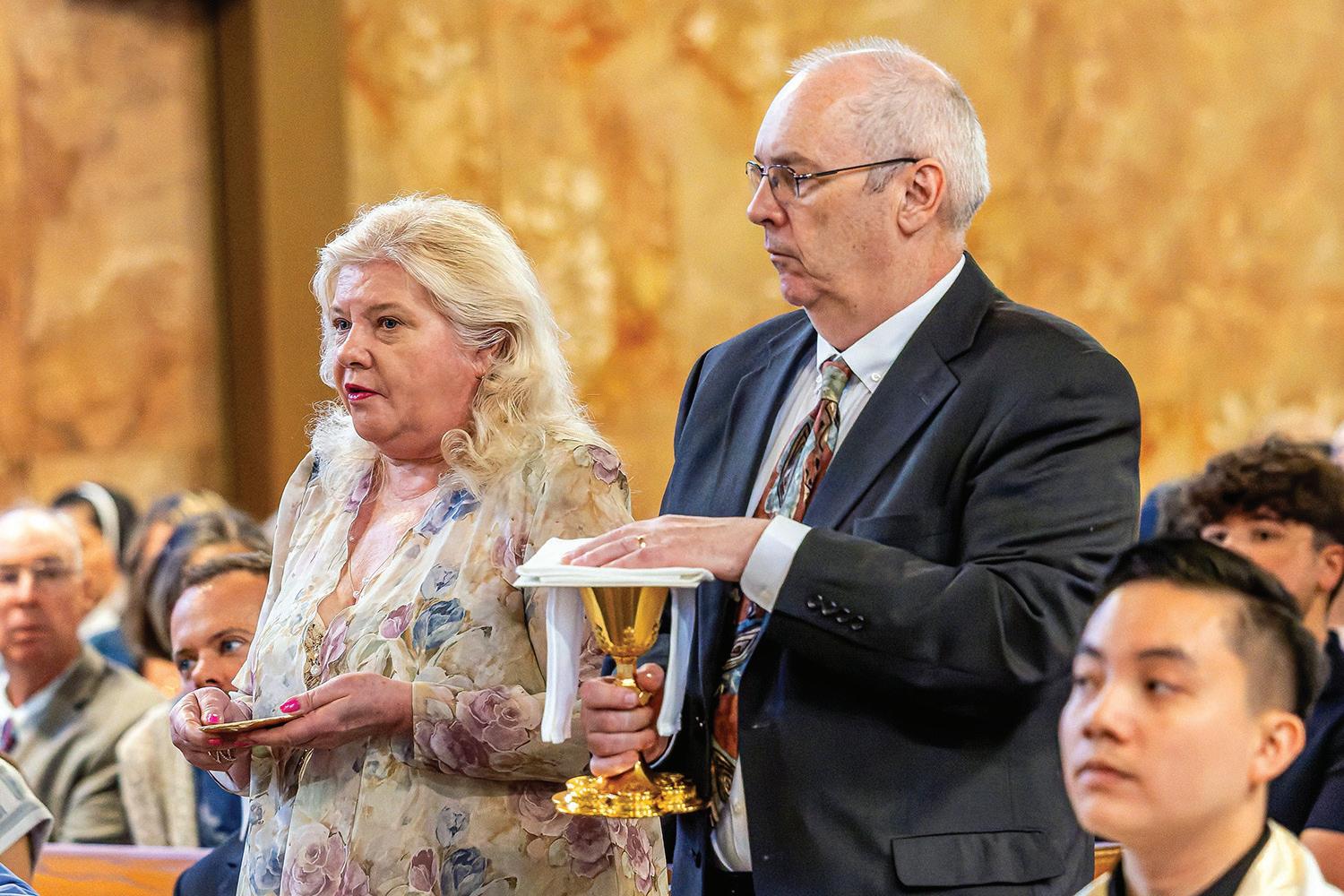
Faithful from the Parish of the Visitation, New Brunswick, and neighboring faith communities gathered in St. Mary of Mount Virgin Church June 6 for the Corpus Christi Vigil, which included Mass, silent prayer, Scripture readings, and music all centered on Eucharistic Adoration. —Adriana Molina photos
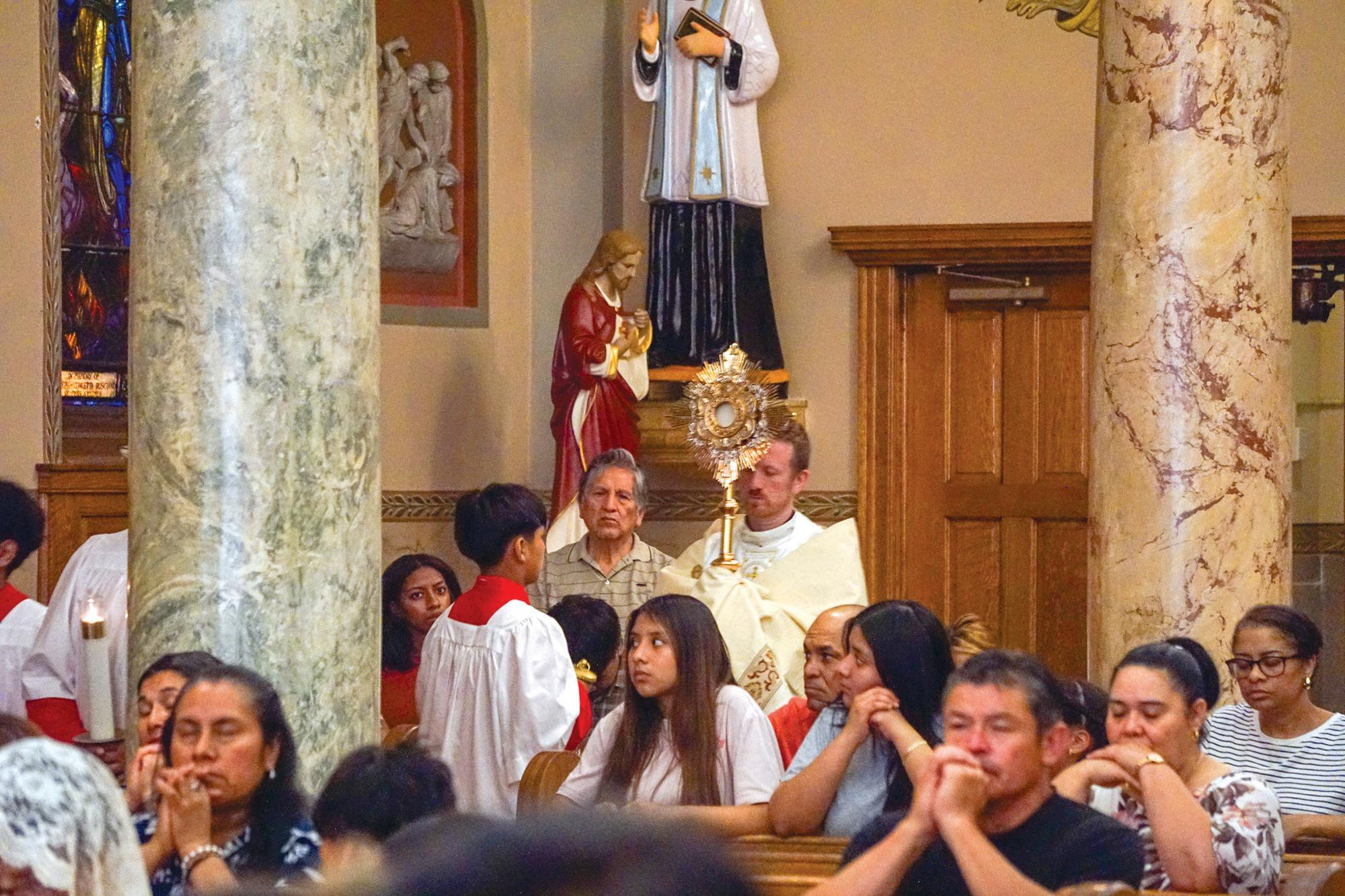
of Sacred Scripture, all centered on Eucharistic adoration. Serving as a lector for the first time, Cindy Vásquez of St. John the Baptist Church reflected on the joy of being in the presence of Christ in the Eucharist. “His infinite love embraces my heart and completes the happiness of being with Him here,” she said.
Roberto Perea, who proclaimed one of the Scripture readings during the vigil, said he felt honored to serve in the presence of Jesus in the Blessed Sacrament. For him, the celebration was a reminder to approach the Eucharist with faith, reverence, and gratitude.
Also sharing her experience was Ramona Marte, who returned to the vigil after several years. Reflecting on the Blessed Sacrament surrounded by flowers, she expressed gratitude for the opportunity to
once again participate in the celebration and for the spiritual nourishment found in Christ’s Eucharistic presence.
The vigil concluded with a Eucharistic procession led by Father Marinelli, as participants renewed their commitment to follow Christ and witness to his presence in their families, parishes, and communities. One of the messages proclaimed throughout the evening captured the spirit of the gathering: “Jesus the Missionary, make me a light of your Gospel.”
The following day, the words of Pope Leo XIV during the Corpus Christi celebration in Madrid echoed the spirit of the vigil, reminding the faithful that “the Eucharist is not merely a tradition or a religious celebration; it is the living presence of Jesus walking with His people.”
Pilgrims flock to Castel Gandolfo for Pope Leo’s first summer Angelus
By OSV News
Pope Leo XIV drew large crowds to Castel Gandolfo for his first summer Angelus at the papal residence July 12, with pilgrims packing trains and buses from Rome to join the gathering. Families from Slovakia, Colombia, Italy, Poland and beyond described the visit as a chance to receive the Pope’s blessing in a more personal setting than St. Peter’s Square.
In his reflection on the parable of the sower, Pope Leo said God never stops sowing the seed of his word, trusting the good that can grow in every heart despite human weakness. He encouraged Catholics to use the summer months to renew their faith through scripture, silence and
prayer, returning to daily life “renewed in body and spirit.”
After praying the Angelus, the Pope greeted pilgrims from a small vehicle be fore appealing for peace amid conflicts in the Middle East, Ukraine and elsewhere. He urged leaders to pursue dialogue and diplomacy, calling them the only path to a just and lasting peace.
“The Holy Father is a caring, open and listening pastor, really focused on the people, and not putting distance, whether you’re a lay person or priest,” Polish Fa ther Michal Miszkurka said of the Amer ican pope. “And here in Castel Gandolfo you can really see that lack of distance in a literal way!” he added.
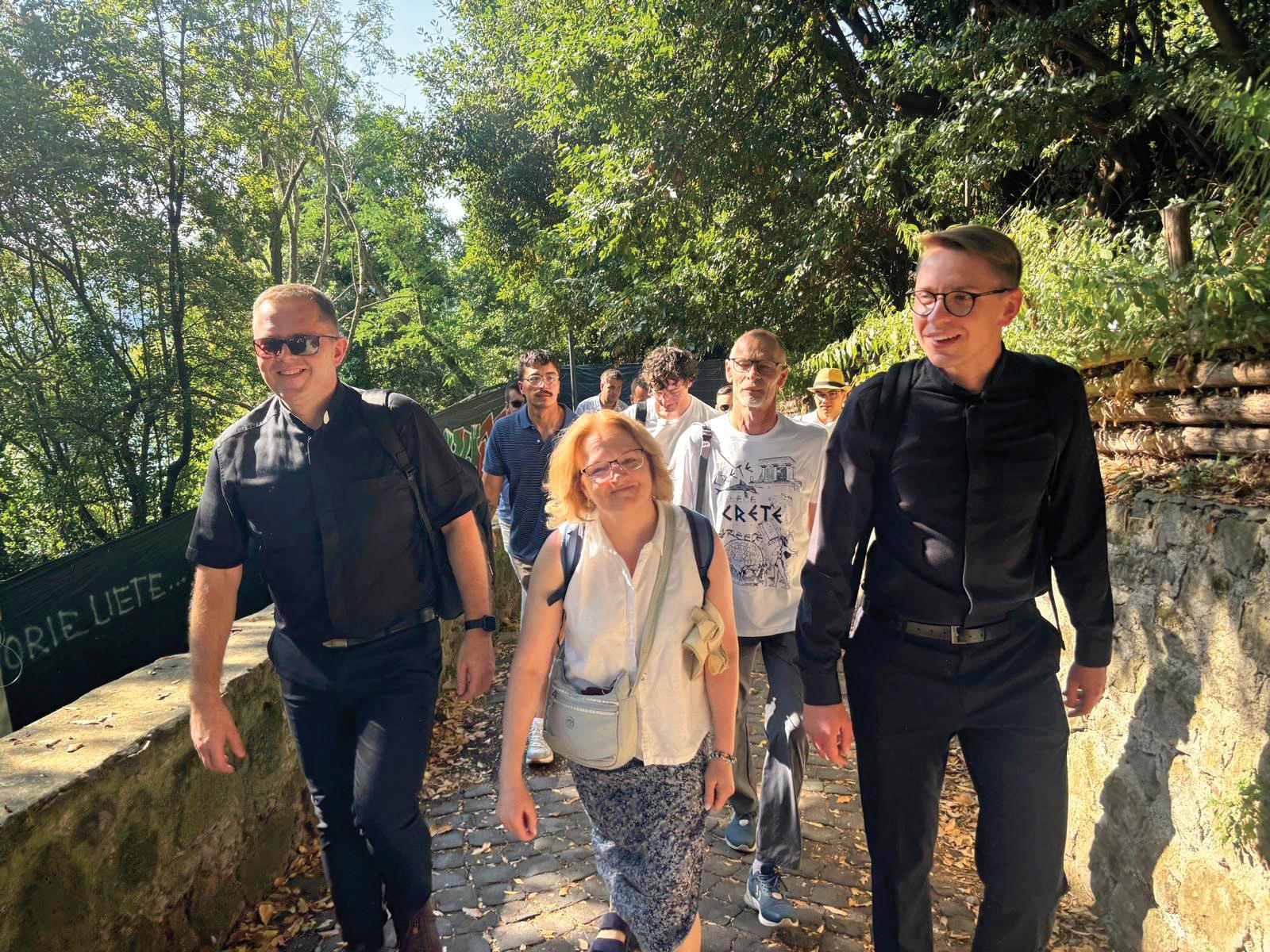
Father Michal Miszkurka, left, is seen with other Polish pilgrims walking up the hill from the train station in Castel Gandolfo, Italy, July 12, 2026, to see Pope Leo XIV and attend the Sunday Angelus in front of the Pope’s summer residence.
—OSV News photo/ Paulina Guzik
18 Awards, 1 Mission: Sharing the faith through Catholic media
June 23, 2026
By Mary Morrell, Editor-in-Chief
We are deeply grateful and honored that our diocesan newspaper The Catholic Spirit, was recognized with 14 awards, and the diocesan Office of Communications with four awards, at the Catholic Media Association’s annual conference and awards banquet held June 16–19 in Atlantic City. These honors reflect not only the dedication and talent of our staff, our freelance writers, photographers, editors, and contributors, but also the support of our readers and the mission we share as a diocesan publication.
Founded in 1911, the Catholic Media Association serves Catholic journalists, communications professionals, and media organizations throughout North America. Through its annual awards program, the CMA recognizes excellence in journalism, storytelling, design, photography, digital media, and communications, encouraging the highest standards of professionalism in service to the Church and the Gospel. The association’s mission is to strengthen Catholic media and support its vital role in communicating truth, fostering faith, and engaging the world through compelling and responsible storytelling.
The awards we received this year are a testament to the commitment of our staff and contributors to informing, inspiring, and connecting the people of our Diocese. We give thanks to God for the opportunity to carry out this ministry and are humbled to have our work recognized alongside some of the finest Catholic publications and communications efforts across the continent.
We are pleased to share the following list of award-winning work and to recognize the individuals whose creativity, professionalism, and dedication made these achievements possible:
AWARDS
Best Newspaper -
Diocesan Non-Weekly First Place, The Catholic Spirit, Diocese of Metuchen, The Catholic Spirit Staff and Freelancers; Mary Morrell, Editor-in-Chief
Most Effective Use of Small Space
Honorable Mention, ‘Let Your Dreams
Soar’ The Catholic Spirit, Peter Nguyen, Graphic Designer
Best Ad Designed by a Publication for a Client Second Place, 2025 Pilgrimage Tours, The Catholic Spirit, Peter Nguyen, Graphic Designer
Honorable Mention, Diocesan Multicultural Fair, The Catholic Spirit, Peter Nguyen, Graphic Designer
Best Layout of Article or Column First Place, Coming to the Manger, The Catholic Spirit, Peter Nguyen, Graphic Designer
Honorable Mention, Religious Jubilarians, The Catholic Spirit, Peter Nguyen, Graphic Designer
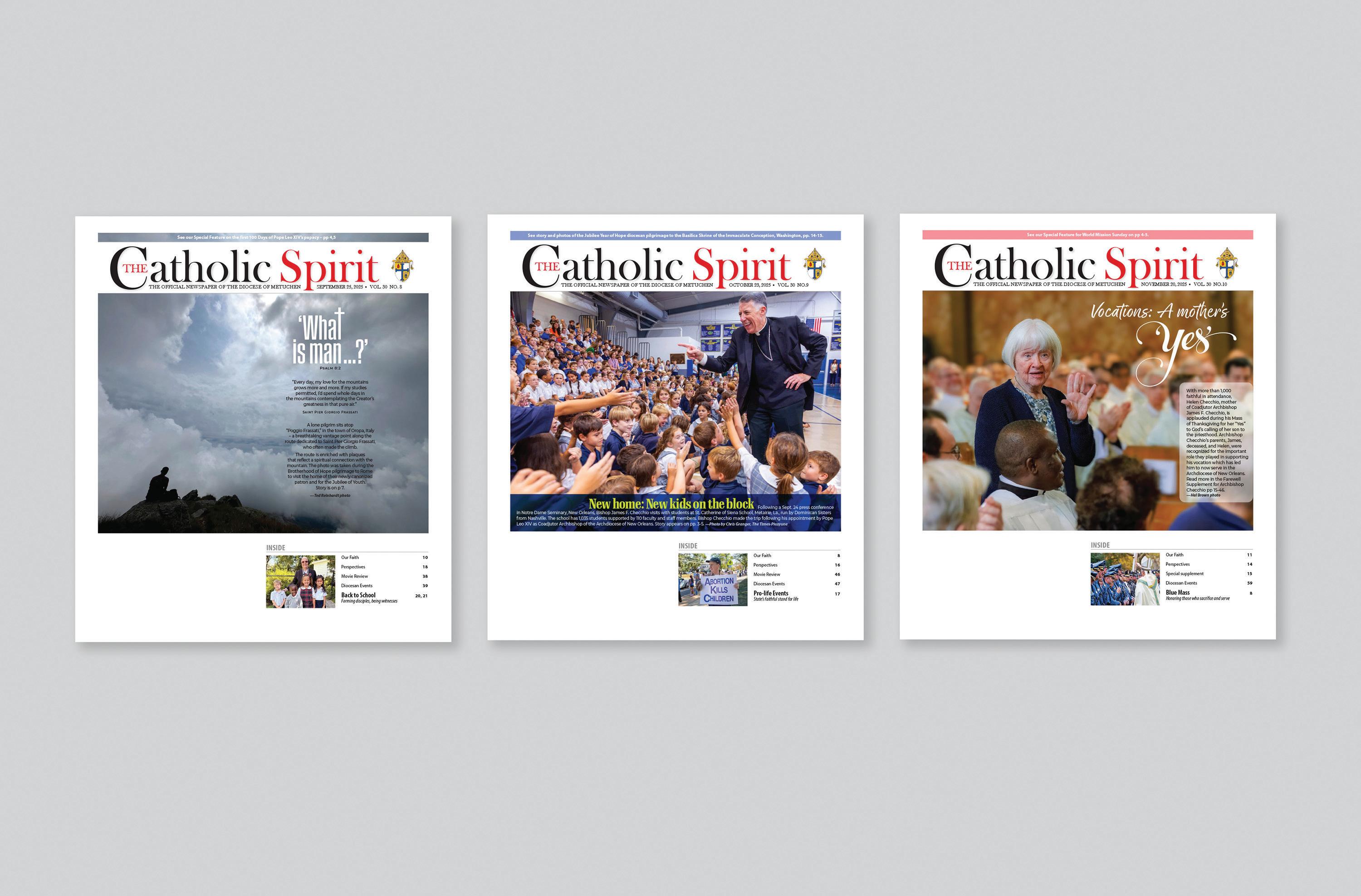
The photos above show the three consecutive issues that were submitted for consideration in the Best Diocesan Non-Weekly Newspaper category – September, October, and November 2025. Cover photos, from left, are credited to Ted Reinhardt, Rutgers Catholic Center; Chris Granger, the Times-Picayune, New Orleans, and Hal Brown, Catholic Spirit freelance photographer. The issues may be read at issuu.com/diometuchen.org.
Hot Topic – The Jubilee Year
Honorable Mention, Diocese Celebrates at Jubilee Year Mass, The Catholic Spirit, Mary Morrell, Editor-in-Chief; Christina Leslie, Contributing Editor; Hal Brown, Photos; Peter Nguyen, Graphic Designer
Best Regular Column – Bishop’s Column in a Diocesan Newspaper Second Place, In This Jubilee Year, Remember God’s Presence, and ‘Be Not Afraid’, The Catholic Spirit, Most Rev. James F. Checchio, JCD, MBA
Best Regular Column – Scripture First Place, Our Sunday Readings: God’s presence continues through his Church, The Catholic Spirit, Msgr. John N. Fell
Best Reporting of Social Justice Issues – Call to Family, Community and Participation
Honorable Mention, Mobile Family Success Center Connects Police and Youth, The Catholic Spirit, Tiffany Workman, Special Contributor
Best Sports Journalism – Sports News First Place, Cole Hayden Becomes Trailblazer with Historic Career at Immaculata, The Catholic Spirit, Greg Johnson, Correspondent
Best Print Special Supplement: Print Only – One-Time Special Issue
Honorable Mention, Harbinger of Hope, Pope Francis 1936-2025,The Catholic Spirit, The Catholic Spirit Staff and Freelancers, Mary Morrell, Editor-inChief; Peter Nguyen, Graphic Designer
Best Photograph – Sports Photo Second Place, Mount Saint Mary Academy Senior Catherine Ritter Swims a Backstroke, The Catholic Spirit, Hal Brown
Best Photograph – Portrait Honorable Mention, Peering from Behind the Program, The Catholic Spirit, Mark Lee
OFFICE OF COMMUNICATIONS
Best Diocesan Video Fundraising Appeal – Produced by Communications Dept. Staff Second Place, Bishop’s Annual Appeal 2025 – Pilgrims of Hope: Journeying Together in Faith, Hope and Charity, Diocese of Metuchen, Nick Falls and Lux Labs
Best Annual Report Honorable Mention, Pilgrims of Hope –Annual Report 2023-2024, Diocese of Metuchen Communications Department from Diocese of Metuchen
Best Text-based Interview (Print or Digital) First Place, “Not I, But God” Interview with “Carlo Acutis: Roadmap to Reality” Director Tim Moriarty, Diocese of Metuchen, Deacon Steven D. Greydanus
Best Use of Video on Social Media Honorable Mention, Bishop Checchio’s Farewell Mass, Diocese of Metuchen, Tiffany Workman
In celebrating America, may we live in a manner worthy of our freedom
When I was in 8th grade we had one chapter in our World History textbook called: “The United States of America.” I became fascinated by the history of this country which, although founded on basic Christian principles, had no official religion recognized by the Government.
I grew up in Canada when it was part of the British Empire. An 1853 proclamation stated that that public worship in Newfoundland (first a British colony; the last to become a Canadian province) would follow the Church of England. Catholics were persecuted for years!
Even as a government worker in the late 1970s and early 80s, I had to take an Oath of Allegiance to the monarch when I worked for the Department of Social Services. The words of the oath: “I________ swear that I will, well and truly, serve Her Majesty Queen Elizabeth the Second, in the office of ________ so help me God.” Years before, as a Catholic school student, we would daily sing “God Save the Queen” after our Catholic Morning Prayers.
Yearning to visit the United States, I was invited to a conference in Washington, D.C., as an older teenager. While there I had a providential encounter with Maria Von Trapp (the famous matriarch of the Von Trapp Family which the Broadway Show and movie “The Sound of Music” was based on).
Maria patiently explained to me “the four freedoms” outlined in a famous speech by President Franklin Roosevelt – the freedom of speech, the freedom of worship, the freedom from want and the freedom from fear. She explained that these were the same freedoms they enjoyed in Austria before the Nazis came and removed these freedoms overnight. Maria insisted: “We need to be vigilant here in the USA, not taking these freedoms for granted.”
A little over 20 years later I became a citizen of the United States. When I stood inside the old State House in Boston and raised my right hand, that day became one that would remain one of the proudest days of my life.
On the 250th anniversary of our country in 2026, allow me to share a few treasures that I discovered as I prepared to become a citizen.
The Declaration of Independence provides the foundation for our country: “We hold these truths to be self-evident that all men are created equal, that they are endowed by their Creator with certain inalienable rights, that among these are Life, Liberty and the pursuit of Happi-
ness.” We have life (from the moment of conception) and liberty and must guard them both, but we are provided only with the opportunity to pursue happiness, not a guarantee. Whether we achieve happiness is up to us and is not the responsibility of the government.
President Abraham Lincoln said it well when he delivered his address in December 1863 at the Dedication of the Soldiers’ National Cemetery at Gettysburg. He was not the main speaker but had been invited as an afterthought.
In his two-minute speech, so short that even the photographer was unable to take a photo of him, he took the audience from the beginnings of our nation and the American Revolution to his own hope for the future of our nation: “Fourscore and seven years ago (84 years ago in 1776) our fathers brought forth on this continent a new nation, conceived in liberty and dedicated to the proposition that all men are created equal. ... this nation, under God, shall have a new birth of freedom, and that government of the people, by the people, for the people, shall not perish from the earth.”
On our 250th anniversary, let us remember the military men and women who made the ultimate sacrifice for our safety and our freedom. Learn about our country’s real history and the giants (both men and women) who helped create this exceptional nation. Help others understand the importance of being an American and living out the American dream. Educate your children about Americans who died so that others could remain free and reach out to veterans who returned home to the country they fought to defend.
Our nation still faces many challenges, especially the latest fascination with socialism. We need to clearly state that socialism is a lie. It has an atheistic foundation and can only lead to greater unrest and deterioration of our culture. True patriots understand how far we have
solution. It is the problem.
Pray for peace .... today and everyday! Fear not. Imitate the greatest family in the history of our world: Jesus, Mary and Joseph!
Pray the Holy Rosary, as individuals or as a family. Remember the children of Fatima and the promises made to them IF we stay the course of our faith. Be that Catholic who will help move the scale in favor of peace and love, life and freedom — all the way to which God intended.
already come and how far we must still go. In the words of Saint Pope John Paul II: We must build a “civilization of love”. There is no country in the world where socialism has been successful. Those who have lived under socialism and communism (in places like Venezuela, Cuba, Poland, Spain and the countries that once formed the Soviet Union) understand, correctly, that socialism is not the
When all is said and done, it is only prayer that will ultimately save us and our great country. In the words of Pope Leo XIV, in receiving the National Constitution Center’s Liberty Medal award on July 3: “I therefore pray that this, the 250th anniversary of the founding of this great nation, may be the occasion of a solemn recommitment to these ideals that have made America a place of peace and prosperity; a country characterized by generosity and nobility of heart … I commend you to the One whose very name is Peace. May God Bless America.”
May Our Lady, the Immaculate Conception, Patroness of our nation, intercede for us that we may live in a manner worthy of our freedom.
Father Hillier serves as diocesan director, Office of Pontifical Mission Societies, the Office for Persons with Disabilities and Censor Librorum.
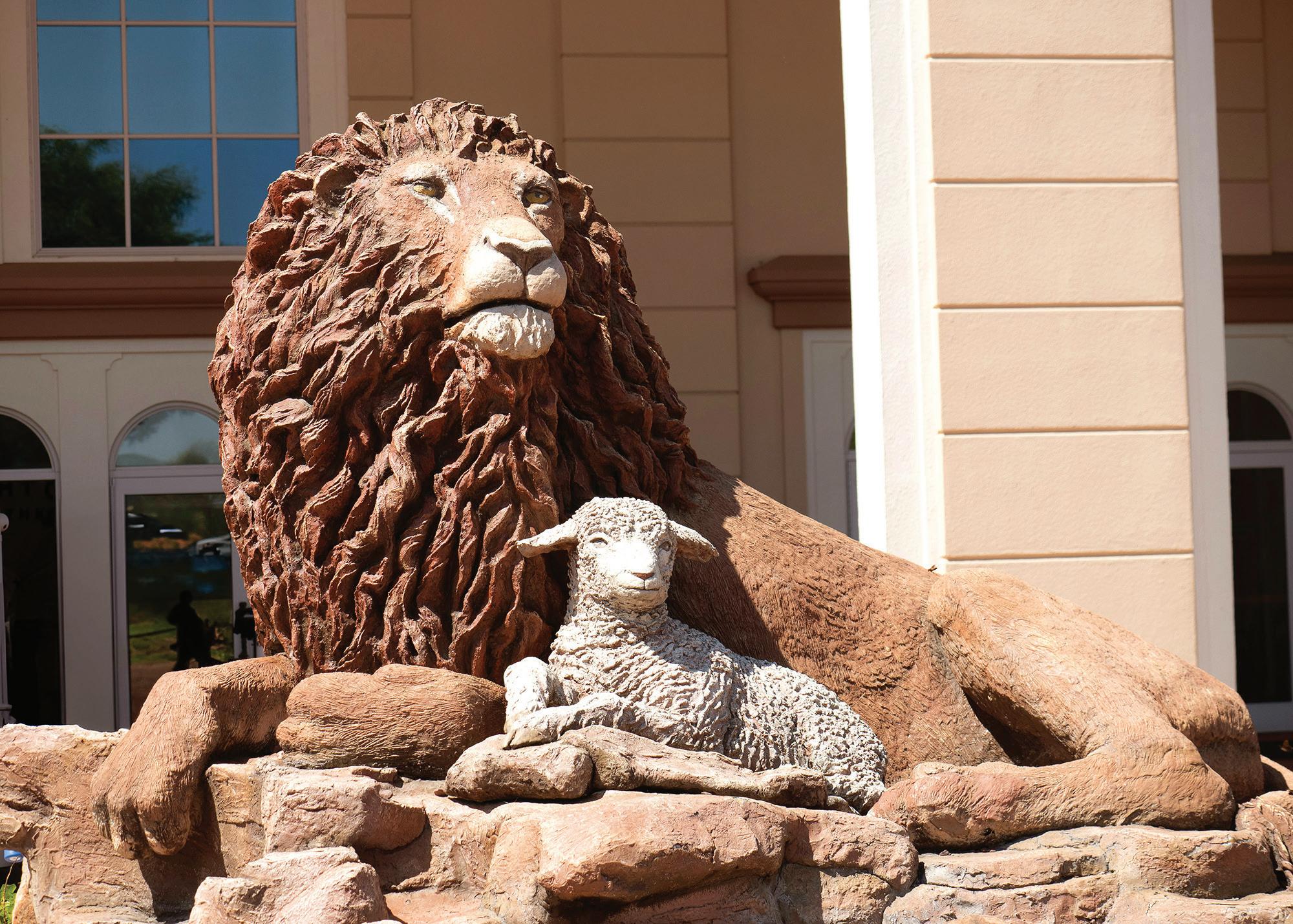
—Alvin David photo/Unsplash
Nigerian Bishop Denis Isizo, Diocese of Aguleri, visits with Office of Pontifical Missions
By Mary Morrell, Editor-in-Chief
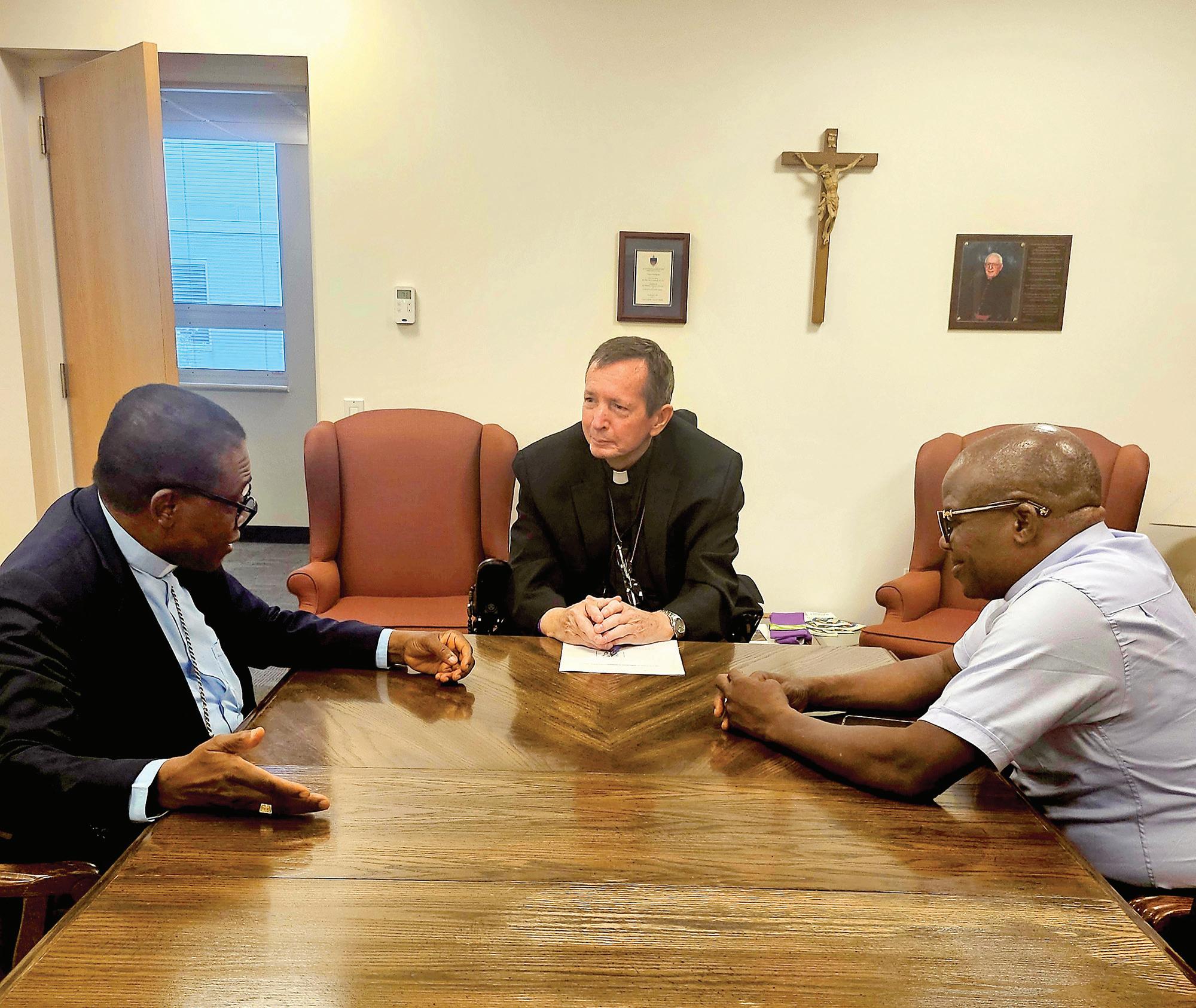
Father John Hillier, diocesan director of Missions, and Mila Dionisio, assistant director, welcomed Bishop Denis Isizo, first bishop of the newly established Diocese of Aguleri, Nigeria, along with Father Innocent Egbunike, Aguleri diocesan chancellor, and Sister Regina Mgbakor from the Maranatha Caring Sisters of Nigeria on June 22 in the Diocese of Metuchen’s St. John Neumann Center, Piscataway.
The visitors gathered to discuss recent projects in Aguleri and how the Missions Office might support and contribute to expanding education and seminary formation, and to discuss the need and challenges of visually impaired patients at the Maranatha Caring Mission.
“I was delighted to meet with Bishop Denis again and Sister Regina. This was my first meeting with Father Innocent. We discussed ways we could help the Diocese of Aguleri with their seminary formation program as well as helping provide sustenance for the priests in their diocese,” said Father Hillier.
As one of Nigeria’s newest Catholic dioceses, established in 2023, Aguleri serves nearly a half-million faithful and is still building its institutions. Many of its priorities involve developing educational infrastructure, strengthening priestly formation and expanding pastoral and charitable outreach.
At the inauguration of the Diocese, the Apostolic Nuncio Antonio Guido
“It is always most humbling to meet with missionaries such as these who do so much with the little that they have, depending on God’s Providence and the charity of other dioceses such as ours who, of course, depend on the generosity of our benefactors from parishes around our diocese who give to our Mission Office on a regular basis.”
Father John Hillier
Filippazi emphasized that Christian formation of priests, religious, and lay faithful should be its primary mission, inspired by the example of Blessed Michael Cyprian Tansi, a native of Aguleri.
For Maranatha Caring Mission, which operates a free medical mission in Umueje, Anambra State, Nigeria, the mission is to provide free health care, feed the hungry, clothe the poor, and respond to other humanitarian needs, especially among impoverished rural communities. Their mission also addresses the needs of vulnerable and abandoned children –to protect, nurture, and empower them by providing secure residential homes where children are shielded from abuse, neglect, and unsafe environments
As a medical mission, Maranatha has treated more than 70,000 patients free of charge, requiring continuous funding for medicines, equipment, laboratory supplies, and staff.
Eye disease is a common problem in rural communities, with cataracts and traumatic eye injuries among the prevalent problems. Also, river blindness, a parasitic disease transmitted through black fly bites, remains common among farming populations, all of which create an ongoing need for ophthalmic services and outreach.
The mission has expanded prenatal and delivery services because many women in rural communities lack access to safe maternal health care and has a need for transportation and personnel that will allow them to serve the elderly and vulnerable populations in isolated villages.
“We are always inspired by the incredible work that Sister Regina and the other Sisters do for the visually impaired as well as the unwanted babies, often with their mothers who are also abandoned by their families,” stressed Father Hillier.
director, Office
Pontifical Mission Societies, and Father Innocent Egbunike, Aguleri Chancellor, meet in the St. John Neumann Pastoral Center to discuss their commitments to service and support for the Diocese of Aguleri.
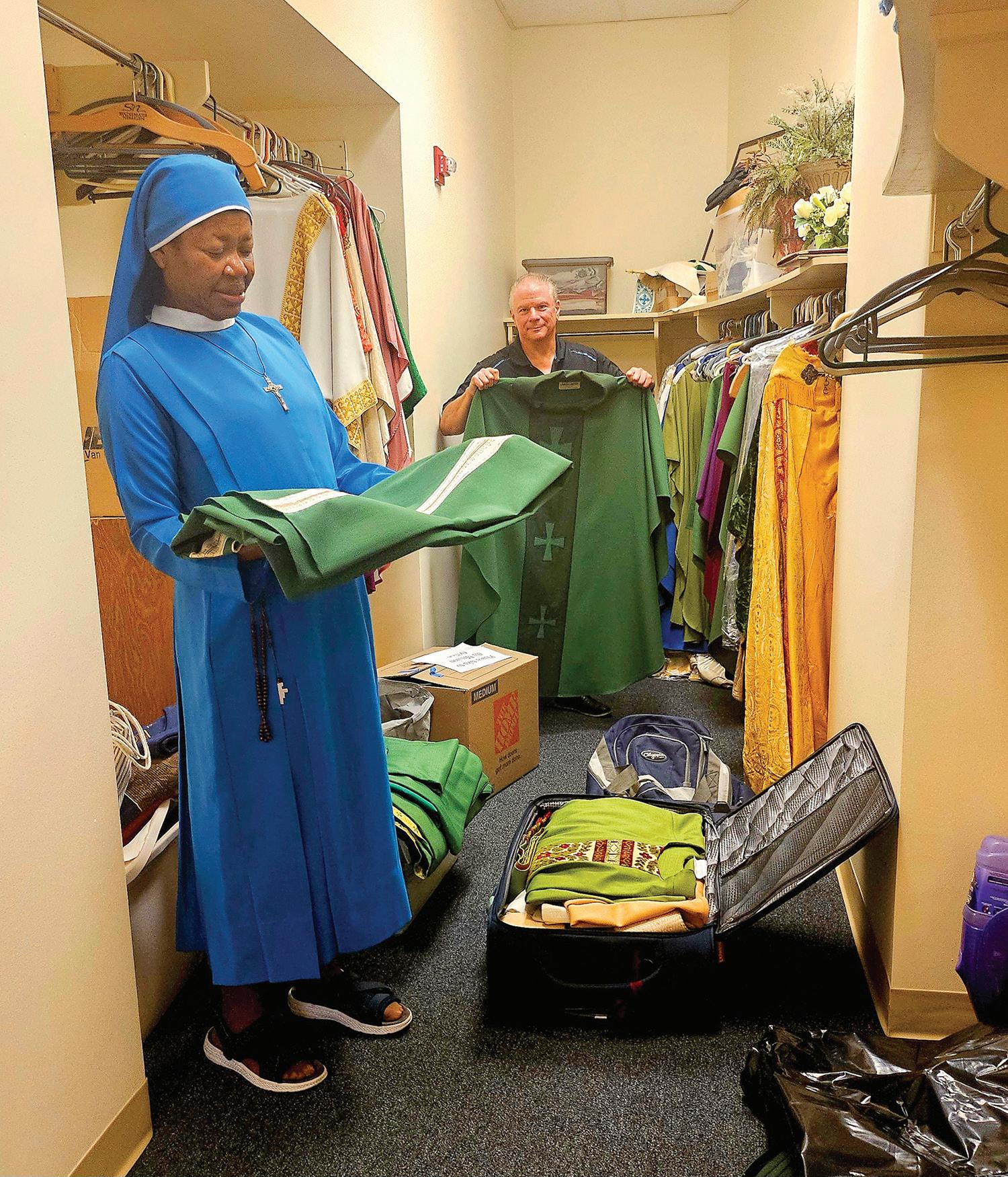
Above right, Sister Regina Mgbakor from Maranatha Caring Sisters, Nigeria, folds used sacramental vestments donated by several priests from the Metuchen Diocese. —Courtesy photos
Both the Diocese of Aguleri and the Maranatha Caring Mission share several long-term priorities which they continue to work toward through the on-going financial support from local Catholics and international partners who ensure that educational, pastoral and medical ministries can continue to grow.
“I am always overjoyed to provide what we can to the missionaries, especially in places like Nigeria where they face cruel Christian persecution (unfortunately) on a daily basis. In the name of our benefactors from the Diocese of Metuchen, we gave what we could to both the Diocese of Aguleri and the Maranatha Caring Mission to sustain the work of God that they do on a daily basis,” Father Hillier said.
To learn more about Maranatha Caring Mission visit https://Maranathacm.org.
To learn more about the Diocese of Aguleri visit https://cadiagapp.com.
Above left, from left, Most Reverend Denis Isizo, first Bishop of Aguleri; Father John Hillier, diocesan
of
CONGRATULATIONS
FATHER JAMES PRUMOS '13 AND DEACON PATRICK RASIMOWICZ '08 ON YOUR ORDINATION TO THE PRIESTHOOD AND TRANSITIONAL DIACONATE.
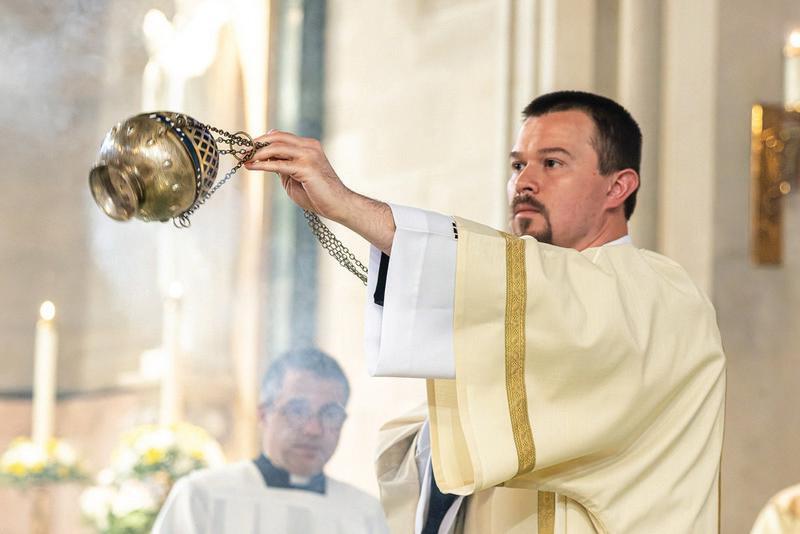
MAY THE LORD BLESS YOU AS YOU ANSWER HIS CALL TO SERVICE.

FROM YOUR FALCON FAMILY AT SAINT JOSEPH HIGH SCHOOL
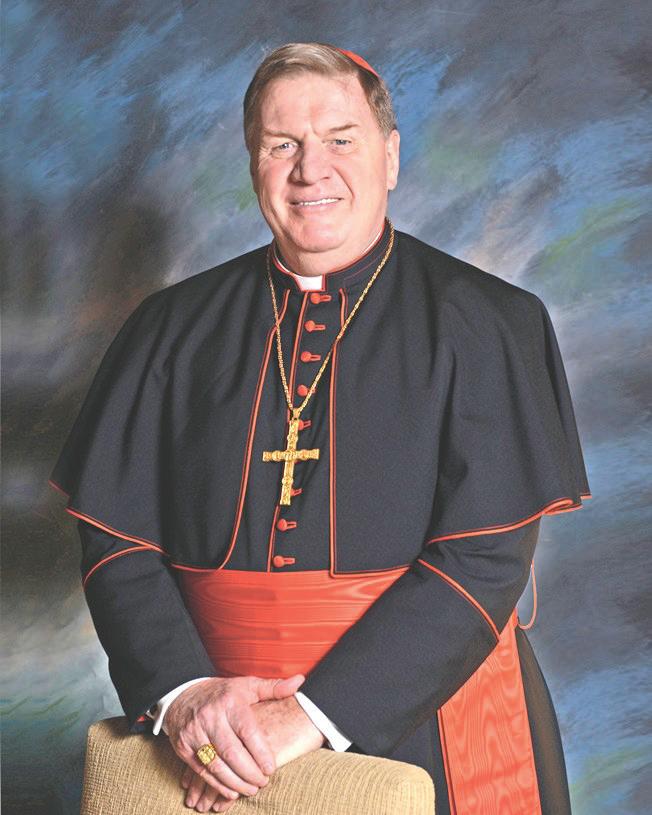
Cardinal Joseph W. Tobin, C.Ss.R. and the clergy, religious and staff of the Archdiocese of Newark extend their heartfelt
Congratulations
Most Reverend Paul Gregory Bootkoski on the 60th anniversary of his priestly ordination.
With gratitude for your faithful priestly ministry, may the Lord continue to bless and guide you in the years ahead.
Ad multos annos!
Cardinal Joseph W. Tobin, C.Ss.R.
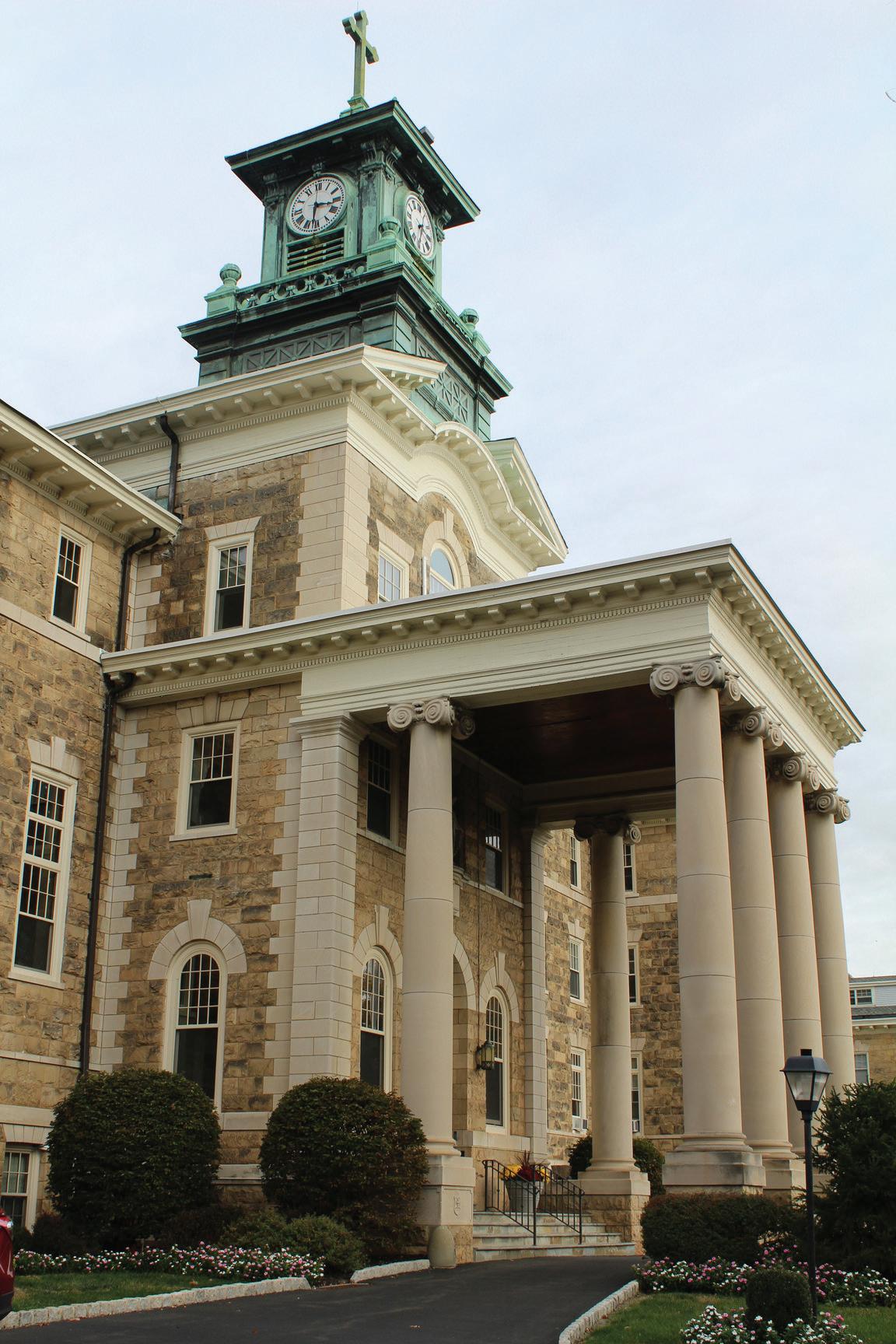
Mount Saint M ary AC ADEMY
Congratul ations
Most Reverend Paul G. Bootkoski, DD Bishop Emeritus of Metuchen
60 Ordination Anniversary th
You have been a loving, kind, and compassionate shepherd to the Mount Saint Mary Academy community for m any years and we are very grateful to you!
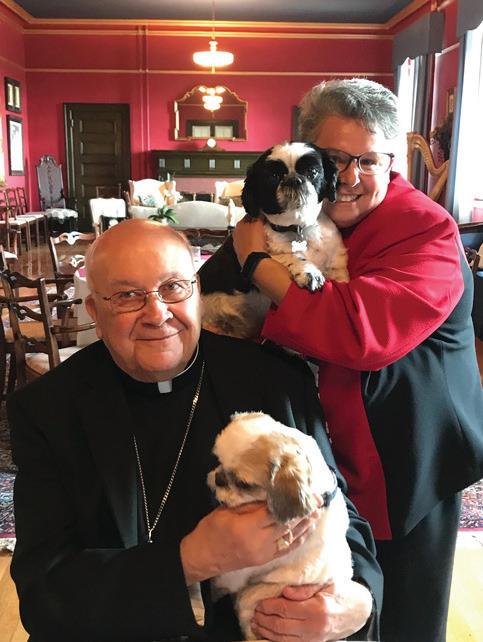
Bishop Emeritus Paul G. Bootkoski
Father Frank Fano, Pastor, and the Parish Family of St. Gabriel the Archangel extend their prayerful congratulations and heartfelt best wishes to on the 60th Anniversary of His Priestly Ordination. We offer our prayers and best wishes as you celebrate this milestone.
“I give thanks to my God always on your account for the grace of God bestowed on you in Christ Jesus.” 1 CORINTHIANS 1:4
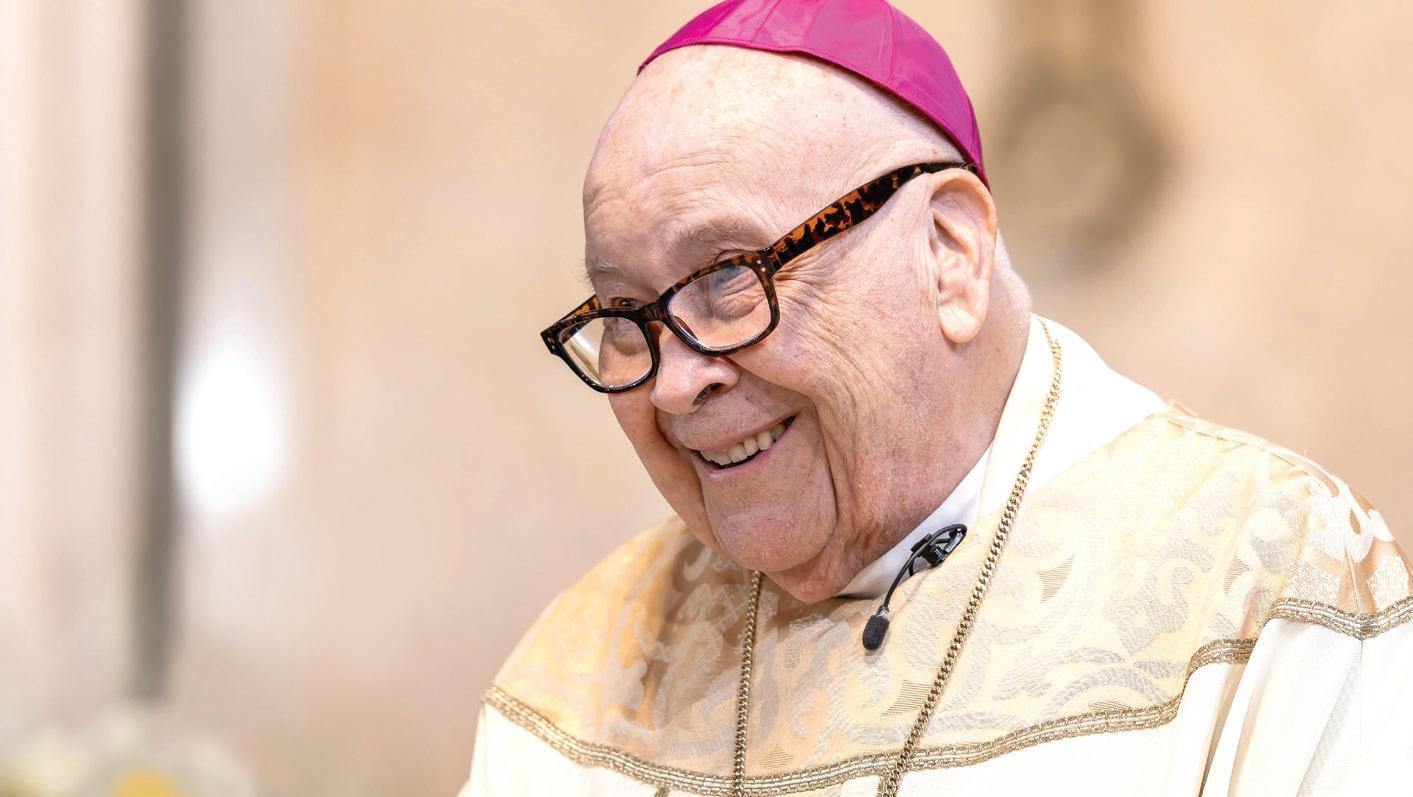
to Bishop Emeritus Congratulations
Paul Gregory Bootkoski
as he celebrates the 60TH ANNIVERSARY of his priestly ordination.
We thank you for your kindness and dedication over the years and assure you of our ongoing prayers.
“With faith and love protect the bride of God, His holy Church.” — Rite of Ordination of a Bishop.
Saint John Vianney Church, Colonia, New Jersey

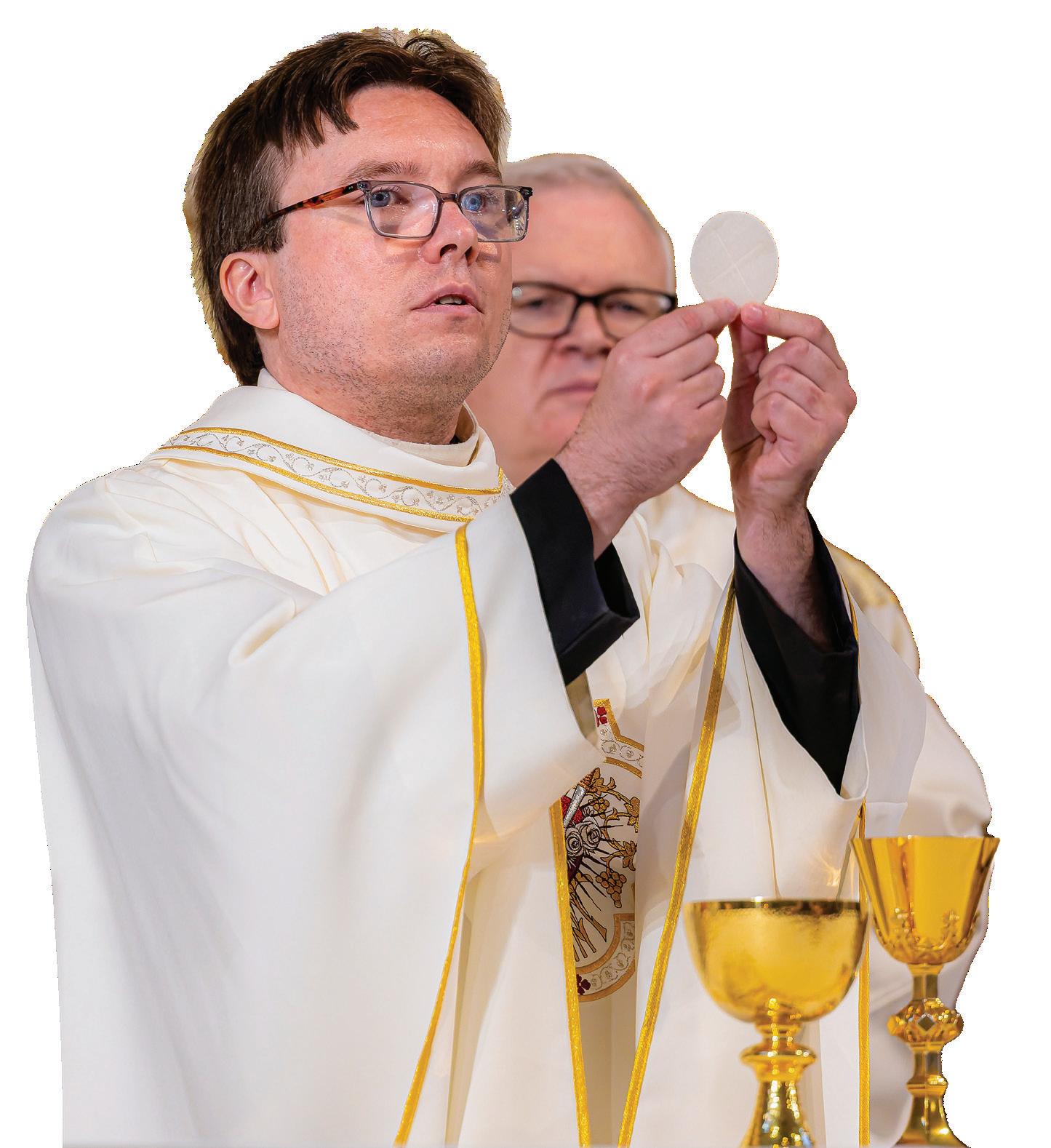
What a joy and honor for Our Lady of Peace Parish to have our parishioner raised to the priesthood! What a blessing for us to host his First Holy Mass here at Our Lady of Peace, his own Parish!
Hearty congratulations and loving support for your priestly life, dear Father James Prumos!
From Father Abraham Orapankal and the Our Lady of Peace Family at Fords.
Saint Gabriel the Archangel 88 East Saddle River Road, Saddle River, NJ 07458
The People of Our Lady of Lourdes in Whitehouse Station wishes to extend our Warmest Congratulations to Bishop Paul Bootkoski on your 60th Anniversary of Ordination.
Congratulations Bishop Emeritus Paul Bootkoski, on your 60th Ordination anniversary to the Priesthood! Your commitment to spreading the Gospel and administering the sacraments has been a true blessing to the Diocese. May your faith continue to be a source of strength, and may you bring abundant grace and blessings
Reverend Leo Salvania, all the Deacons and parishioners of the Church of the Assumption,
Know of our prayers for you, d M ' H l M tl

C ONGRATULATIONS

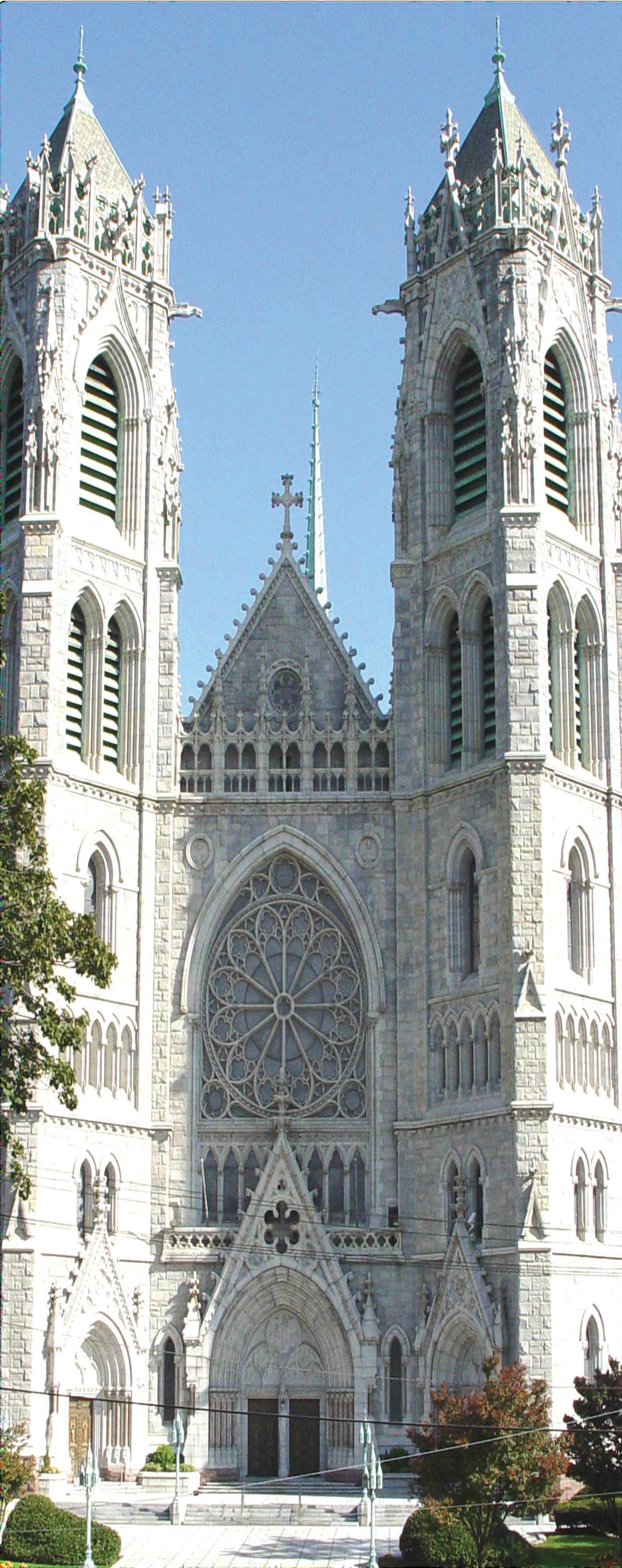
The Cathedral of St. Francis of Assisi joins the Church of Metuchen in congratulating Bishop Paul Bootkoski on the Diamond Anniversary of his Ordination.
With gratitude for his many years of faithful priestly ministry and dedicated service to the Church, we offer our prayers and best wishes as he celebrates this joyful milestone. Ad multos annos!
Hackettstown, New Jersey.
BISHOP PAUL BOOTKOSKI
The South Amboy Knights of Columbus Council 426 extend our prayerful congratulations to Rev. Dennis R. Weezorak on the joyous occasion of the 40th Anniversary of his Ordination to the Priesthood. We thank Father Dennis for his dedication to Christ, His Church, and the people he has so generously served. May the Lord continue to bless him.
“I am grateful to him who has strengthened me, Christ Jesus our Lord, because he considered me trustworthy in appointing me to the ministry.” — 1 TIMOTHY 1:12
Congratulations Bishop Emeritus Paul G. Bootkoski
On the joyous occasion of your 60th Anniversary of Ordination to the Priesthood, the parish families of St. Joseph, High Bridge and St. John Neumann, Califon extends our prayerful best wishes. May the Lord continue to bless you with good health, peace, and abundant joy as you celebrate this remarkable milestone.
Congratulations Bishop Paul Bootkoski on the 60th Anniversary of your Ordination. We offer you our prayers, love and best wishes.
St. Mary Parish Alpha, NJ
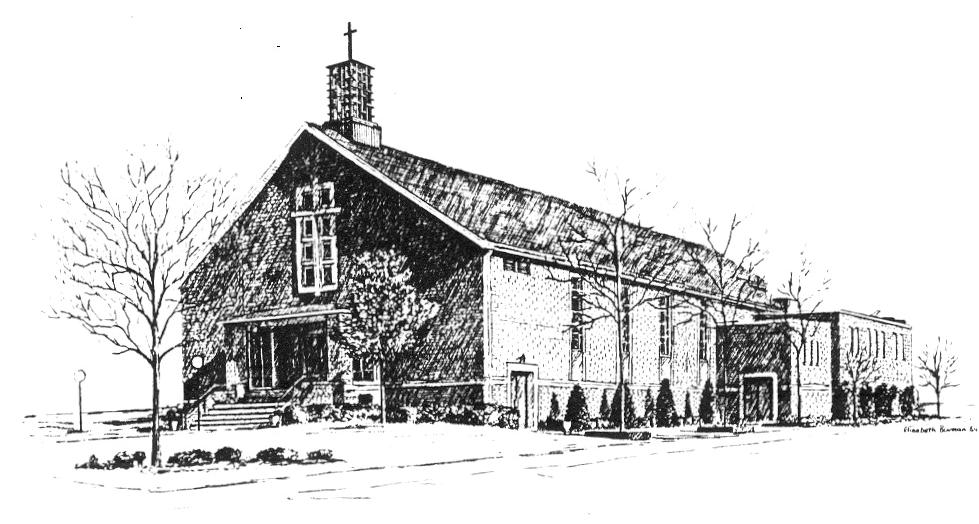
CONGRATULATIONS BISHOP BOOTKOSKI
BEST WISHES, PRAYERS AND LOVE ON YOUR
6OTH ANNIVERSARY FROM
St. Theodore R.C. Church, Port Murray, NJ
Fr. Damian Tomiczek SDS, Pastor , Staff & Parishioners
To our dear friend, Bishop Paul, on your 60th Jubilee,
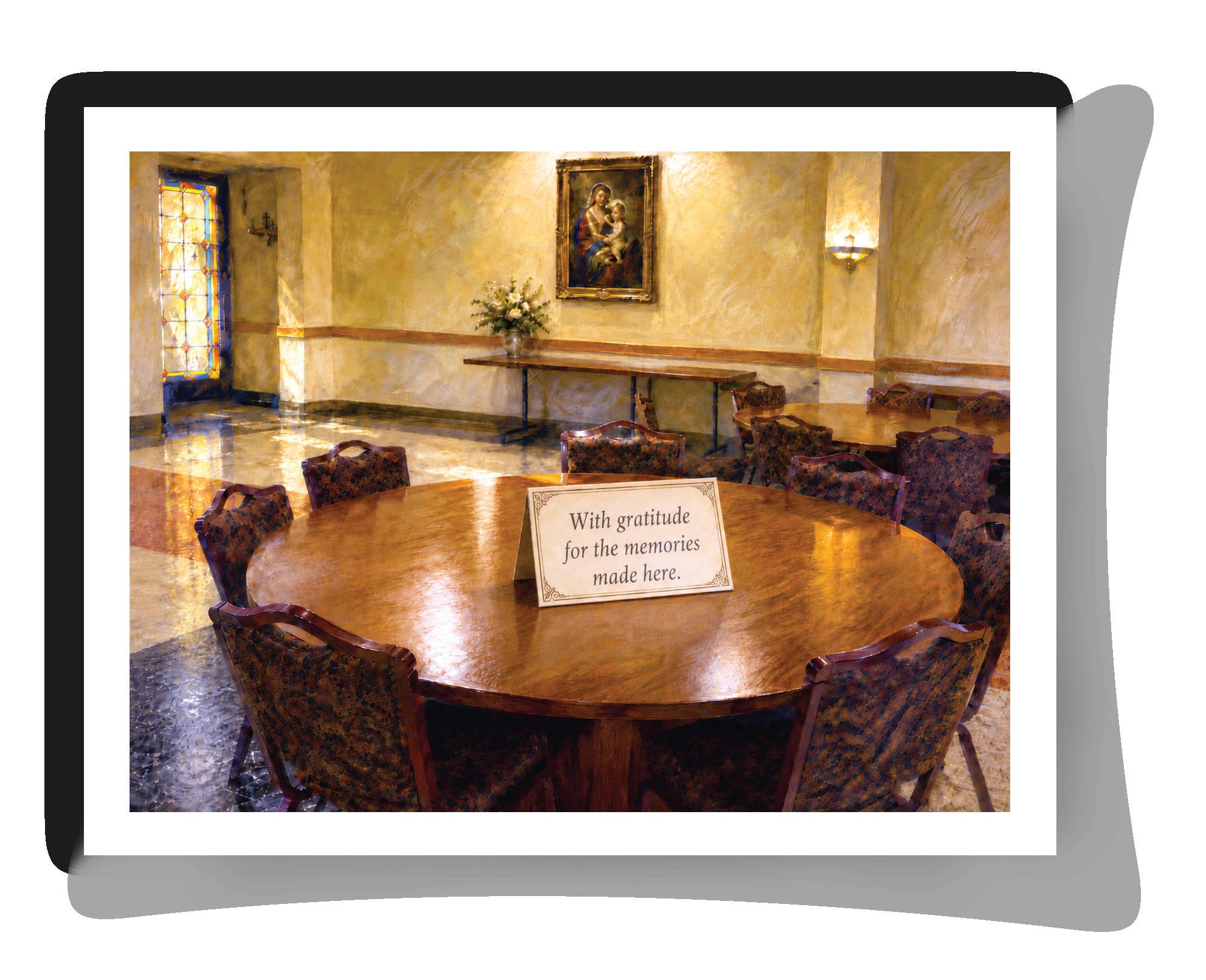
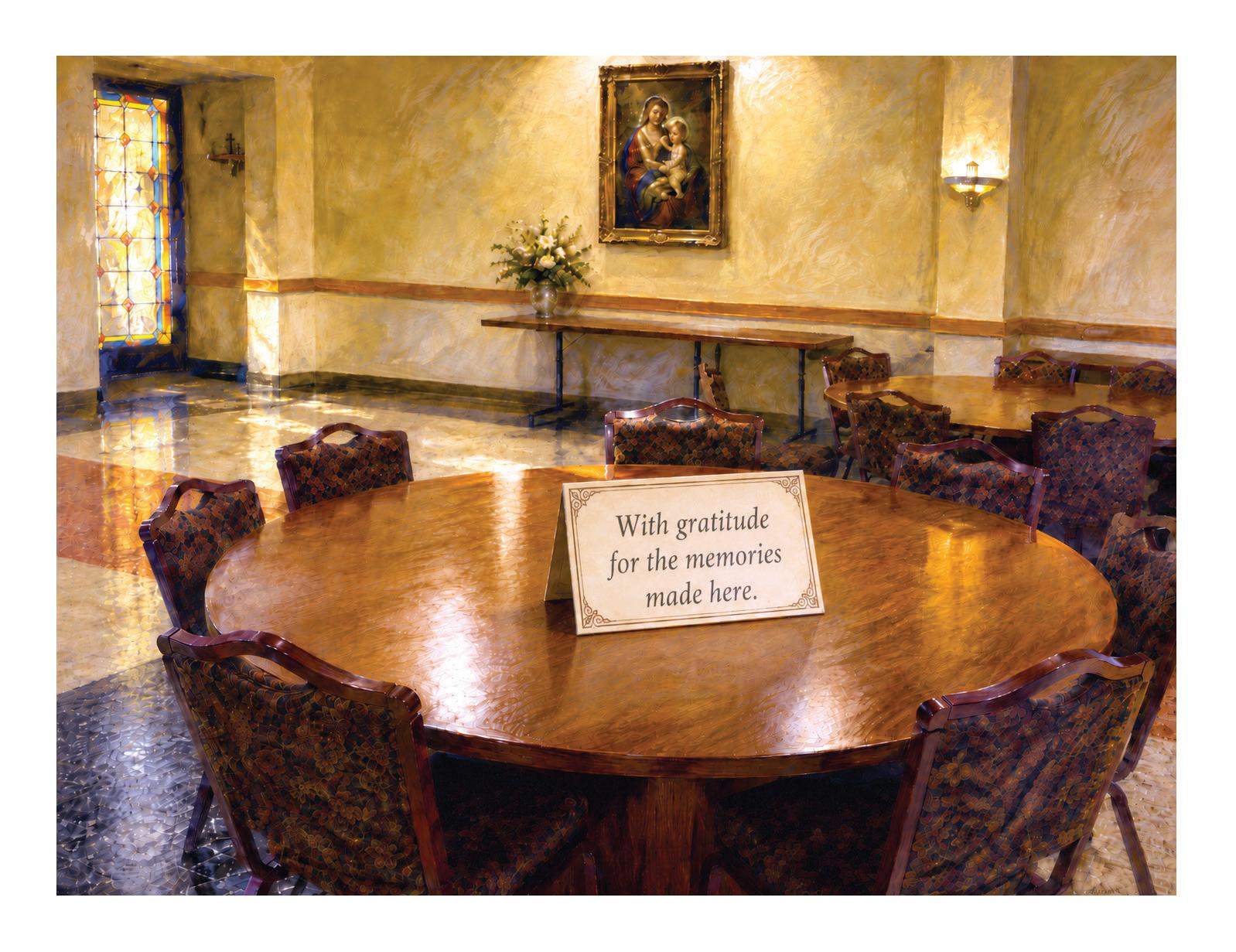
For so many years, in the hustle of the chancery, there was one constant we all looked forward to: the lunch table. It was where we gathered, not as administrators, but as friends. It was where we shared the day’s laughter, celebrated family milestones, and supported each other through life’s sorrows. And, seated among us, sharing in the same joys and sorrows, was you.
As you mark this incredible milestone of 60 years in the priesthood, we are filled with gratitude and affection. Thank you for the friendship, the guidance, and the memories. Ad multos annos!
With all our love and deepest admiration,
Bill, Ron, Lori

Rich),
(and
Larry (and Joanne), Leo (and Peggy), Eric (and Karen), Chris (and Trish)

Celebrating 60 Years of Faithful Service

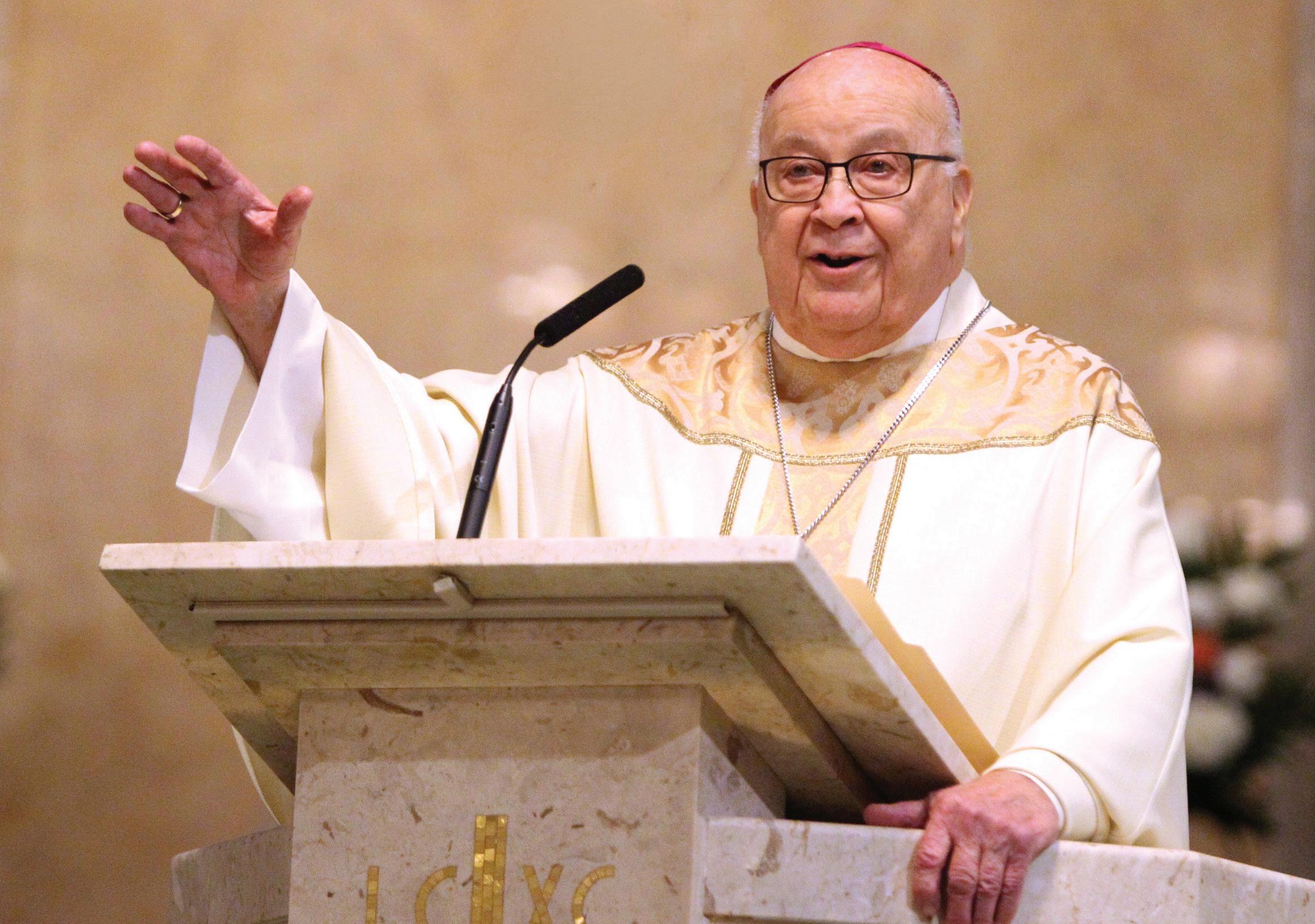
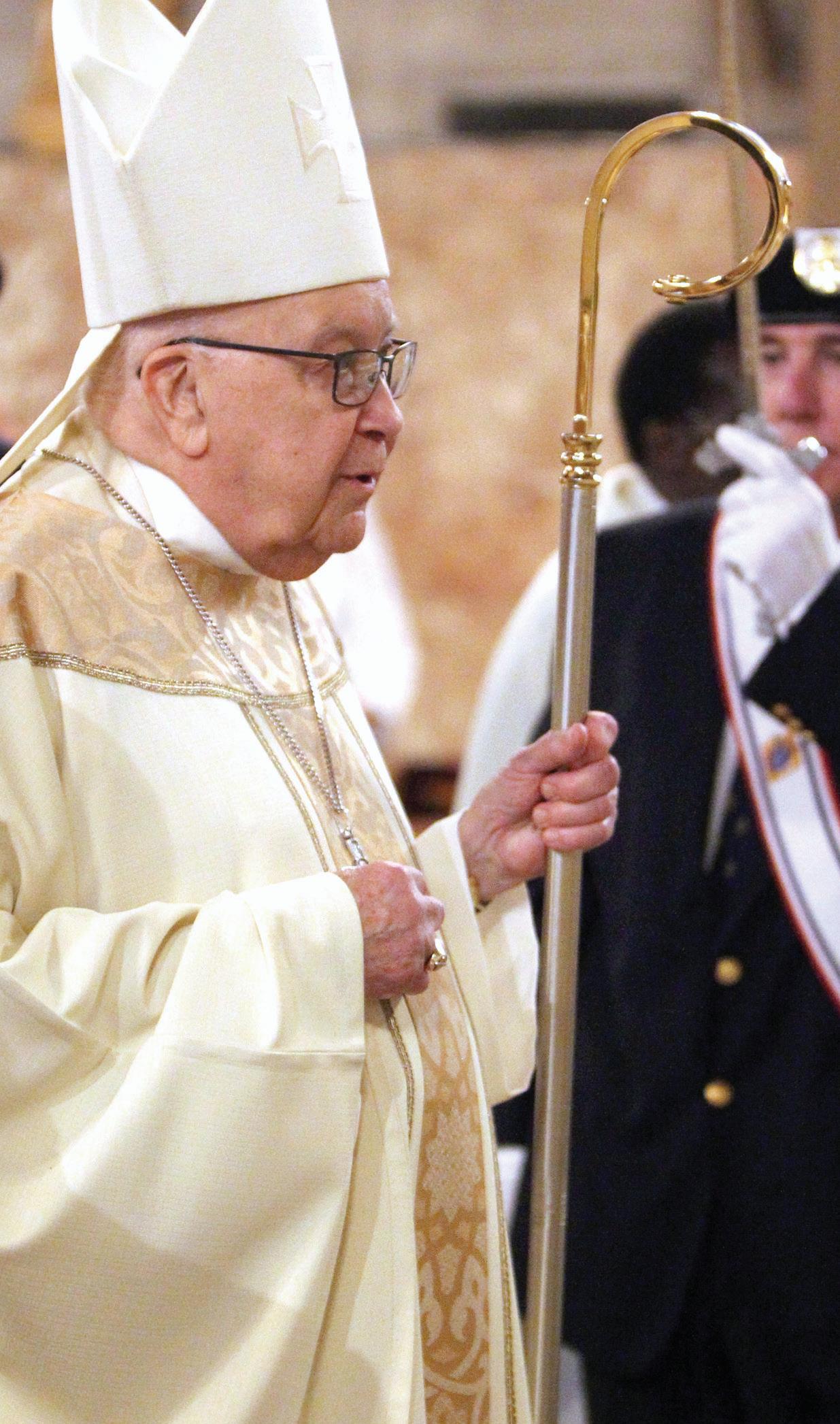
We give thanks for Bishop Emeritus Paul Bootkoski and congratulate him on his six decades of devoted ministry to the Catholic community.
Sponsored by the Roman Catholic Diocese of Metuchen
Magdalen de Pazzi, 105 Mine Street, Flemington, NJ 08822 • stmagdalen.org “Well done, good and faithful servant.” Matthew 25:23
The Parish Family of St. Elizabeth-St. Brigid
Reverend John G. Hillier, PhD
Reverend James Tucker
Offer their Prayers and
Congratulations Bishop Paul on the occasion of your Diamond Anniversary
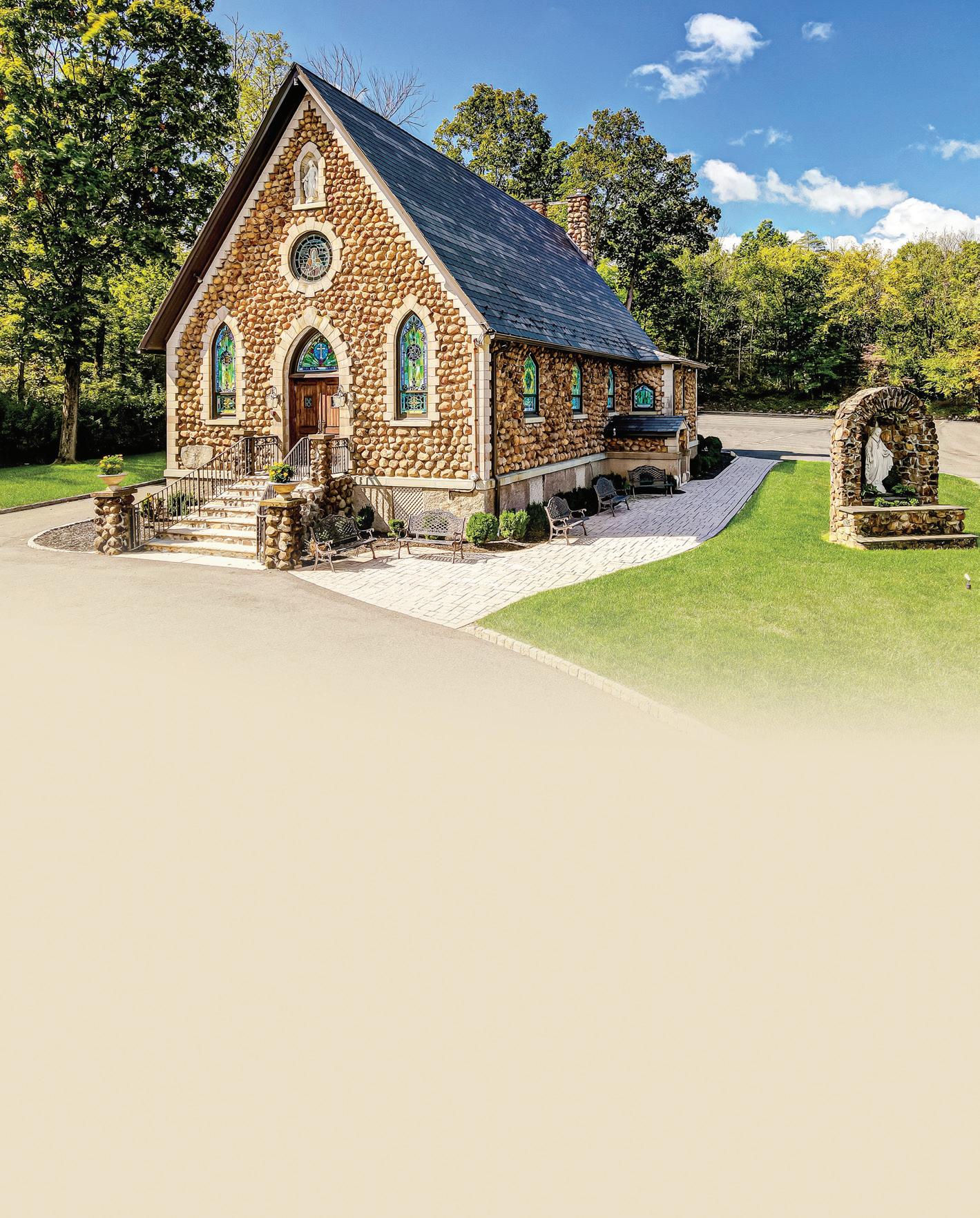
Father Sean W. Kenney, OFS, and the parish family of Our Lady of the Mount, Warren, N.J., congratulate Bishop Emeritus Paul G. Bootkoski on the 60th anniversary of his priestly ordination.
Thank you for your faithful witness and decades of service to the Church. May God continue to bless you with peace, joy and good health.
Ad Multos Annos!
A Brief History of the Catholic Church in Central New Jersey Part III: A Diocese in Trenton
By Father Michael Krull Special Contributor
On November 17, 1880, shortly after Bishop Michael Corrigan moved to New York as Coadjutor Archbishop, John Cardinal McCloskey called a meeting to discuss the selection of a new bishop for Newark, as well as the possible division of the diocese. Two lists of candidates were proposed: one for the Diocese of Newark and one for the proposed Diocese of Trenton. On August 11, 1881, Pope Leo XIII created the new Diocese of Trenton, consisting of the fourteen southernmost counties of New Jersey. But who would be the new bishops? When the “terna”, the list of three names of possible candidates were sent to Rome for approval, the names were switched. Father Winand Wigger, a priest of the Diocese of Newark who had been recommended to lead the new Trenton Diocese, was named bishop of Newark, and Father Michael J. O’Farrell, the pastor of St. Peter’s Church in lower Manhattan, who had been recommended to lead the Diocese of Newark, was named the first bishop of Trenton.
Bishop Michael J. O’Farrell, 1881-94
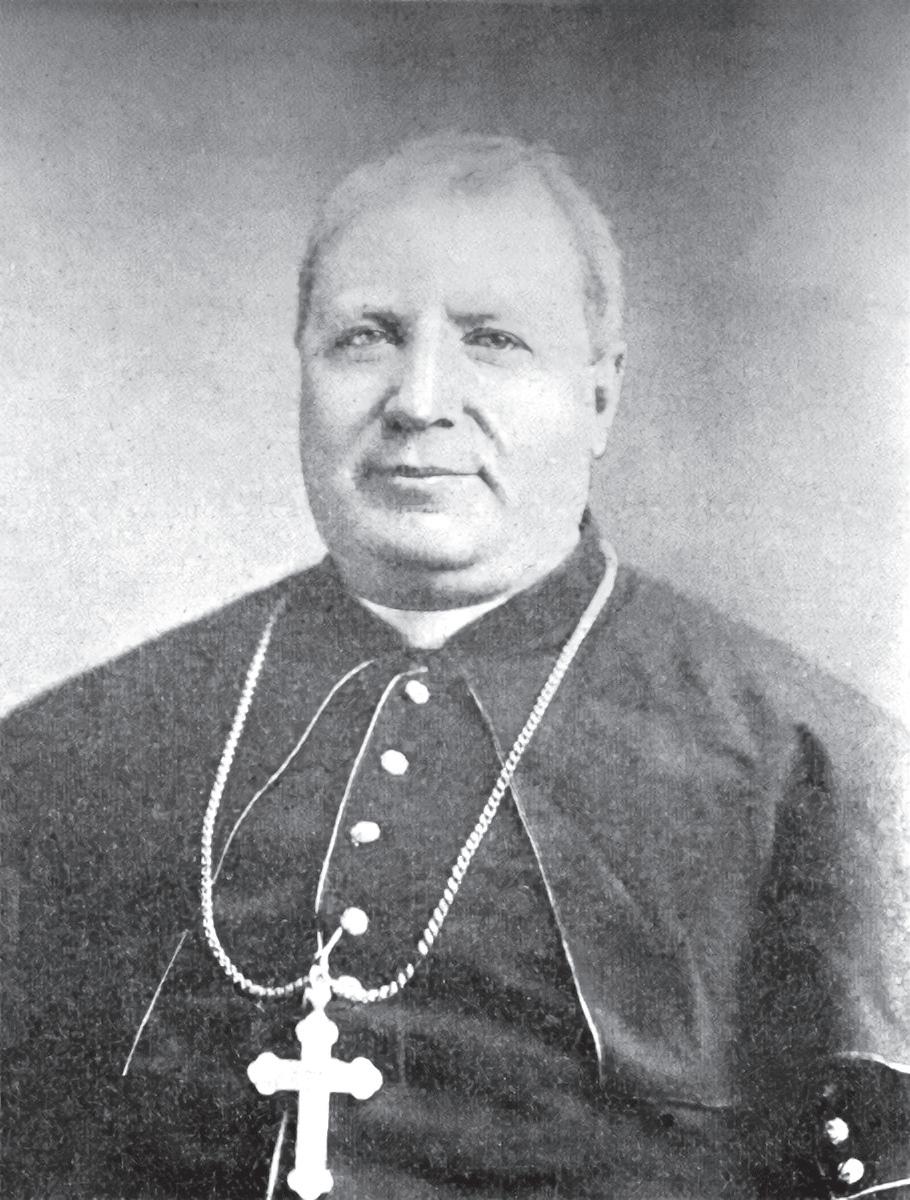
Bishop O’Farrell, a native of Ireland, was born in 1832 and studied for the priesthood at the famous seminary of St. Sulpice in Paris. Ordained in 1855, he taught at the Sulpician seminary in Montreal, leaving the Sulpicians to become a priest in the Archdiocese of New York. Consecrated a bishop at St. Patrick’s Cathedral in New York on All Saints Day, 1881, he arrived in Trenton eight days later, choosing St. Mary’s Church as the new cathedral. The new Diocese consisted of 51 priests, 61 churches, 23 parochial schools and 40,000 Catholics. Women religious were a rarity, serving in only 14 missions. Bishop O’ Farrell, with the support of the priests of the new dio-
cese worked to promote a strong Catholic identity. Seeing anti-Catholic bias in the treatment of Catholic children in state run institutions, Bishop O’Farrell established the Saint Mary’s Union, a forerunner of Catholic Charities. The proceeds of the “St. Mary’s Messenger” magazine supported the St. Mary’s Orphanage in New Brunswick and later the St. Michael’s Children’s Home in Hopewell.
One of the greatest challenges was the growth of parishes, especially as many new ethnic groups emigrated to the United States in these years, settling all across New Jersey. Many English-speaking priests, often from Ireland or of Irish-American descent, were called upon to provide guidance to a largely non-English speaking people whose Catholic spiritual and devotional life had a richness of its own, and which was often as foreign as the language of the new immigrants. It was a dilemma faced by bishops and priests throughout the United States which often led to conflict and sadly even to schism, such as the creation of the Polish National Catholic Church in 1897. Seeing the pastoral need, parishes were created throughout the new Diocese. In Middlesex County, he established St. Joseph’s in Carteret, Our Lady of Victories in Sayreville, Saint James in Woodbridge and Sacred Heart in New Brunswick. Somerset County saw the establishment of St. Joseph’s in North Plainfield and Immaculate Conception in Somerville, and Warren County saw the establishment of St. Patrick in Belvidere. The first Polish parish, St. Stephen’s in Perth Amboy, was founded in 1892.
Bishop O’Farrell was concerned about the moral welfare of his flock, often writing on the issue of temperance and outstanding support of Catholic education. He helped to bring about the amalgamation of two groups of Sisters of Mercy serving in the Diocese, who in time would staff a majority of schools. By the tenth anniversary of the Diocese, there were 80 priests, three religious brothers, 160 religious sisters, 128 churches and missions, seven academies and six convents. Suffering from ill health, Bishop O’Farrell died on April 2, 1894. In death, he moved twice: originally buried in St. Mary’s Cemetery in Trenton, his remains were later moved to the chapel of St. Michael’s Orphanage in Hopewell, a building he only dreamed of – and when the orphanage closed in 1973, his remains were moved back to St. Mary’s Cemetery.
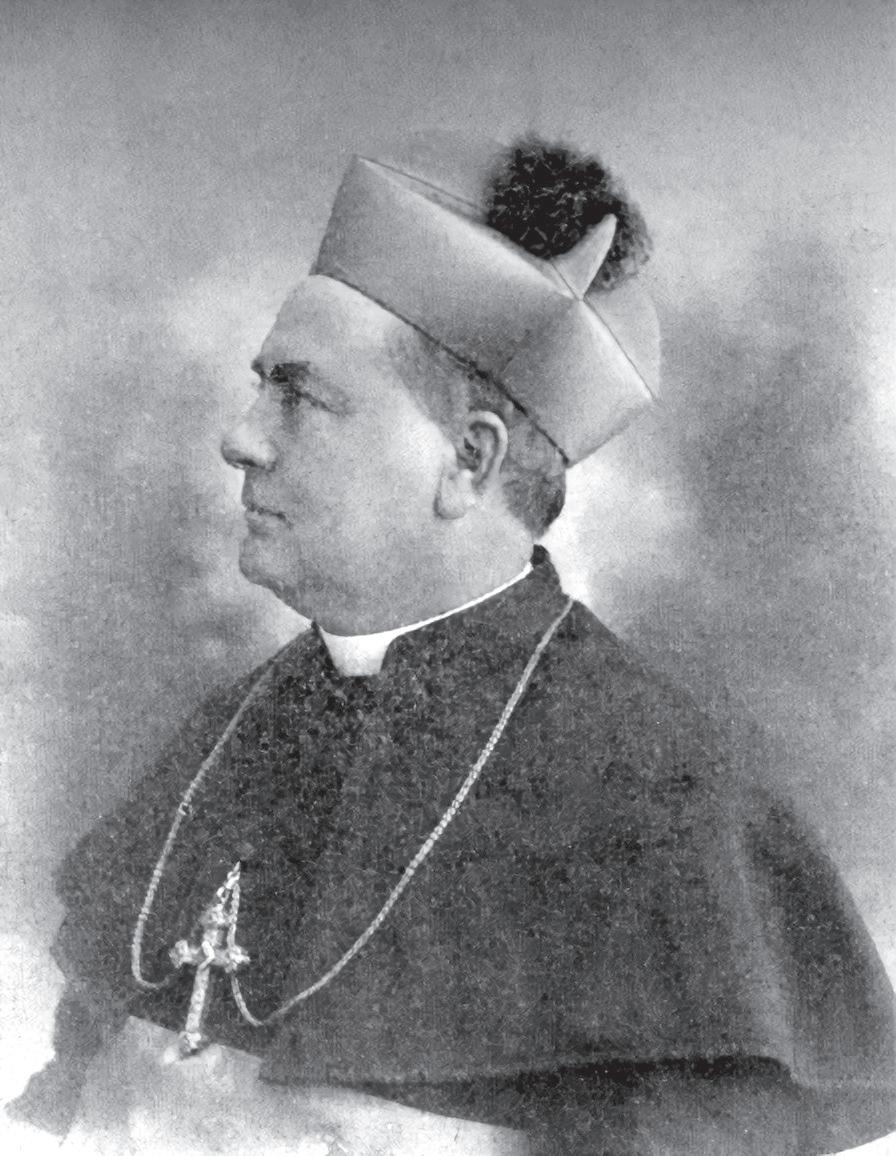
Bishop James Mc Faul, 1894-1917
The years that Bishop James McFaul led the Diocese of Trenton as its second bishop were years of change, as the 19th century gave way to the 20th. Horse drawn carriages began to give way to automobiles, gaslight to electricity. Telephones came into greater use, and the
first powered flight by a man took place. All of these transitions were mirrored in the continued growth of the diocese, with new ethnic groups moving into the area.
James McFaul was born in Ireland in 1850. At the age of four, his family, like so many of their countrymen, emigrated to the United States during the “Great Hunger,” the potato famine. After a brief stay in New York City, the McFaul family moved to a farm near present day Zarephath in Franklin Township in Somerset County. With no local church to attend, the family attended St. Peter’s in New Brunswick where James received his catechesis from Father John Rogers in preparation for his First Communion and Confirmation there by Bishop Bayley.
With the establishment of St. Joseph’s in Bound Brook, the family attended there, where his vocation to the priesthood was nurtured. After attending St. Vincent’s College in Latrobe, Pennsylvania and the seminary at Seton Hall College, he was ordained in the chapel at Seton Hall by Bishop Corrigan in 1877. His first priestly assignment was at St. Patrick’s in Jersey City, before moving to St. Patrick’s Cathedral in Newark, St. John’s in Paterson and St. Peter’s in New Brunswick before being assigned to St. Mary’s in Trenton at the time the Diocese was created.
Under the tutelage of Bishop O’Farrell, Father McFaul served as the bishop’s secretary, then chancellor and finally in 1892, vicar general of the Diocese. Upon Bishop O’Farrell’s death, he became administrator of the Diocese until his appointment as the second bishop of Trenton on July 20, 1894. He was consecrated on October 17th at St. Mary’s Cathedral by Archbishop Michael Corrigan, who had also given him tonsure, minor orders, Subdiaconate, Diaconate and ordained him as a priest.
During the 23 years of Bishop McFaul’s episcopate, the Catholic population of the Trenton Diocese more than doubled. Sixty-three new parishes were
established, of which 24 were designated as “ethnic” parishes. Unlike many places around the United States, Bishop McFaul showed a great concern for the new immigrants and their spiritual needs. Six parishes: St. Stephen in Perth Amboy, St. Mary in South River, Holy Family in Carteret, Holy Trinity in Helmetta, St. Mary in Bound Brook and St. Stanislaus Kostka in Sayreville served the needs of Polish immigrants.
St. Ann in Raritan, Most Holy Rosary in Perth Amboy, St. Anthony in Port Reading and St. Mary of Mount Virgin in New Brunswick served Italian Catholics. Hungarian Catholics were served by Our Lady of Hungary in Perth Amboy, St. Ladislaus in New Brunswick, St. Stephen in South River and St. Elizabeth in Carteret. Three parishes served the needs of Slovak Catholics: Holy Trinity in Perth Amboy, Sacred Heart in Carteret and St. Joseph in Raritan. Other areas of the Diocese saw churches and missions established: St. Mary’s in Alpha, Our Lady of Perpetual Help in Bernardsville, Sacred Heart in South Plainfield, St. Paul in Highland Park, Our Lady of the Mount in Warren and the missions of St. Cecelia in Monmouth Junction and St. James in Rocky Hill were established by Bishop McFaul. Thirty-eight Catholic elementary schools were opened; several parishes such as St. Peter’s in New Brunswick, St. Mary’s in South Amboy and St. Mary’s in Perth Amboy also sponsored high schools.
Bishop McFaul’s concerns were not limited to the erection of new parishes and schools. During his tenure, St. Michael’s Children’s Home was opened in Hopewell and Morris Hall Home for the Aged was built in Lawrenceville. The Sisters of Mercy made a major move in 1908 from their crowded motherhouse and academy in Bordentown to their new academy – and college – at Mount St. Mary’s in Watchung. After a disastrous fire on the morning of Ash Wednesday, 1911, Bishop McFaul arrived later that day and with concern – and a touch of humor – chided the Sisters for their literal observance of that day!
A popular speaker in both Church and civic circles – he left a large number of pastoral letters to the Diocese on numerous topics – Bishop McFaul became ill in early 1916, but remained active until the early part of June, 1917 as the United States became more involved in World War I. He died on June 17, 1917. Following the funeral Mass at St. Mary’s Cathedral, Bishop McFaul was buried at Morris Hall in Lawrenceville. Monsignor John Fox was named the administrator of the Diocese. It would be nearly one year before Bishop McFaul’s successor would be named.
Father Krull serves as chair of the diocesan Commission for Historical Records and is pastor of Our Lady of Peace Parish, North Brunswick.
Bishop James Mc Faul, —Public domain
Bishop Michael J. O’Farrell, —Public domain
20 Catholic Schools in America, Part II
some bishops attempted a compromise.
In 1891, the Catholic schools in the towns of Faribault and Stillwater, Minnesota, made an agreement with the local board of education whereby the school building would be leased to the public school during regular class hours. During this time secular subjects were taught by public school teachers, whether laymen or Catholic Sisters. The Sisters received the same salary as any other public-school teachers, were held to the same standards of professional accreditation, and were permitted to wear their habits during the regular school day.
By Carl Ganz, Special Contributor
In 1874, the New Jersey legislature passed a compulsory education act. Since formal education was now no longer optional, the creation of parochial schools became more important than ever. The pioneers of American Catholic education had the same problems they have today.
One major problem was a chronic shortage of teachers. Diocese of Baltimore Bishop James Bayley, while still Bishop of the newly formed Diocese of Newark, had the foresight to establish a community of the Sisters of Charity that by 1876 had grown to three hundred members. Still, the image of legions of Sisters teaching in 19th and early 20th century Catholic schools is somewhat of a myth.
Though many schools had a predominantly religious teaching staff, 21 schools in the Diocese were staffed solely by lay teachers. By 1880, 26,355 students filled the classrooms of 77 parochial schools. Even then, some classrooms had 70 to 100 or more students in them. Desks were so tightly packed in some classrooms that ample seating depended on at least one student always being absent.
While the Plenary Councils of Baltimore in 1852 and 1866 recommended that each parish open schools, it was the Third Plenary Council in 1884 that mandated them. The 1884 council was so concerned with Catholic education that almost one quarter of the decrees issued by it were related to that subject. Since schools were now mandated, the Church bore the responsibility of bringing them to a quality level on par with the public schools. Dioceses were encouraged to create boards of examiners to assure quality standards were met, teachers needed to be certified, and religious orders were asked to establish training programs for educators. Another major problem was simply funding ongoing operations. Operating a school was a mas-
sive drain on parish finances and some schools ultimately had to shut down for lack of funds.
Protestants objected to state funding of parochial schools on grounds of church-state separation arguing that the sectarian nature of parochial schools precluded them from receiving state funds. This point of constitutional jurisprudence found political support in President Ulysses Grant. Grant proposed a constitutional amendment that would require states to provide funding for free public schools. The president also advocated the taxation of church property with the exception of cemeteries and, with some restrictions, church buildings themselves.
Though this constitutional amendment did not pass, a modified version of it was added to the constitutions of several states at the urging of Congressman James Blaine. Known as “Blaine Amendments,” they precluded any state funding of religious schools. In 1875, New Jersey was one of the few states that tried, but failed, to adopt one. Newark Bishop Michael Corrigan was furious at the attempt and confided his opinion to his diary:
There was a special election in the state to confirm certain constitutional amendments … aimed directly at Catholics, making any division of school funds illegal, and subjecting all property to taxation. The Protestant ministers incited their congregations to oppose us. …
I remember reading … a proclamation … urging all Protestant voters to vote en masse in favor of the amendments. … I wrote a note … calling attention to the taxation of Church property, for which I was much censured, as desiring to interfere in politics.
Because of the prohibitive costs of administering a parochial school and, due to the ongoing complaints of Catholics about double taxation – that is, paying taxes for a public school while making donations to fund a Catholic school –
and lead to mixed marriages. Eventually the Faribault-Stillwater plans were halted throughout the country by both Catholics and Protestants who were unhappy with them for their own separate reasons.
The debate over how much cooperation should exist between the Catholic schools and the state constituted the greatest Catholic liberal-conservative divide of the 1890s. Liberals such as Archbishop John Ireland were perfectly comfortable with a church-state accommodation. Conservatives like McQuaid, Corrigan, and Wigger saw it as dancing with the devil and wanted nothing to do with it.
Catholic students attended Mass in the mornings, and the catechism classes were taught in the afternoons. Both activities took place outside of school hours. Moreover, students at parochial schools were not required to attend the school in their district, and there were no residency requirements that determined which school a student attended. Non-Catholic students were permitted to attend the parochial schools, but were not required to, and always had a public school available to them.
This plan was not completely new and similar arrangements had already been established in Albany, Buffalo and Rochester, New York, and Harrisburg and Erie, Pennsylvania. Several American bishops reviewed the plan with Archbishop Satolli, the Papal Delegate in the United States, who saw no problems with this agreement.
Satolli then presented the plan to Pope Leo XIII. The Pope provided his approval, but not his enthusiastic endorsement. Leo XIII simply said such plans “can be tolerated” (tolerari potest). Since the Democratic Party traditionally had a strong Catholic base, several New Jersey priests took advantage of the Democratic gubernatorial victory of 1892, which also provided Democratic majorities to both houses of the legislature. They drew up a bill similar to the Faribault-Stillwater plan and proposed it to the legislature. Bishop O’Farrell endorsed the plan as well.
Archbishop Corrigan of New York and Bishop Wigger of Newark thought otherwise, so much so that Corrigan declared it was “nothing more than Faribaultism” which, in essence, is exactly what it was. Though Catholic directors would assure that the schools retained a Catholic nature, Bishop Wigger’s greatest concern was his lack of confidence that the students would actually come early for Mass and catechism and that mention of God and Catholic teaching was banned during the school day. In addition, he was not thrilled about non-Catholic students associating with the Catholic children.
As early as 1790, Archbishop John Carroll of Baltimore expressed his concern that Catholic children who did not have their faith instilled in them through Catholic schools would lose their faith through the “unavoidable intercourse with non-Catholics.” McQuaid opposed these plans as well since he felt it would dilute the faith of the Catholic children
Archbishop Ireland was the leading promoter of Americanist ideas. Ireland strove to bend Catholic teaching to conform to American values. Leo XIII made it clear that no such thing would ever occur. Rather, American values were to be brought into conformity with Catholic teaching. The 1899 apostolic letter, Testem Benevolentiae, outlined Rome’s position with unambiguous clarity. The Catholic Church in America was not entitled to any special consideration in light of her minority status in a Protestant majority nation. American Catholics would submit to the pope in matters of faith and morals as Catholics in other countries were expected to.
Even though Ireland’s Faribault-Stillwater plan was not much different than other plans in place before, it was more strongly opposed by conservatives, partially because Ireland himself supported it. Ireland was the leading liberal bishop in the United States and anything he supported was automatically suspect. McQuaid, the leading conservative bishop, was the polar opposite. He so strongly wished to maintain a distance from secular politics that he refused to vote in any elections for the last 40 years of his life.
By the beginning of the 20th century, the Catholic school system was an established fact. Still, the assaults against it continued unabated. In the 1925 case of Pierce v. Society of Sister, the Supreme Court unanimously struck down Oregon's Ku Klux Klan-backed law that required students to attend public schools only. Catholic schools were here to stay.
Catholic schools exploded from about 200 in the first half of the 19th century to 5,000 by the beginning of the 20th. At the peak in 1965, 13,500 schools were educating 5.6 million children. As costs mounted, however, the number of Catholic schools has since dropped to 6,600 with an enrollment of almost 2 million. Some of these schools have restructured as classical schools, teaching via the Socratic method. Here in the Diocese of Metuchen, St. Ann School in Raritan has rebranded itself as St. Ann Classical Academy and educates students in this fashion.
Carl Ganz Jr. is a member of the New Jersey Catholic Historical Commission and the diocesan Commission for Historical Records. He is a parishioner of Immaculate Conception Parish, Somerville, and the author of several books on American Catholic history.
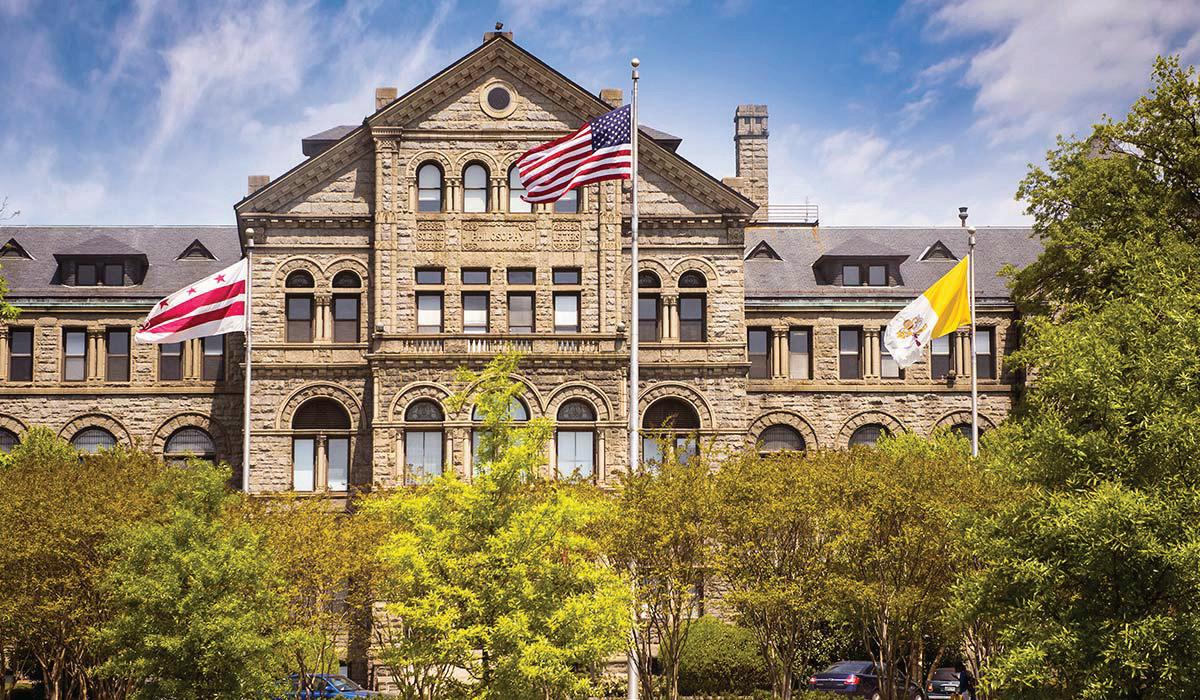
In 1882 Bishop John Lancaster Spalding went to Rome to obtain Pope Leo XIII’s support for a national Catholic university. The result was Catholic University of America, Washington, D.C. —Catholic University of America photo on Wikimedia Commons
Spiritual Book Club offers faith and camaraderie in Peapack parish
By Christina Leslie Contributing Editor
“By reading the scriptures I am so renewed that all nature seems renewed around me and with me… The whole world is charged with the glory of God and I feel fire and music under my feet.” — Thomas Merton
Book clubs which focus upon faith can educate, enervate and enrich the minds and souls of their participants. Through an examination of literature with God at its core, parishes of the Diocese offer their members a touch of that ‘fire and music’ via book clubs such as the one at St. Elizabeth-St. Brigid, Peapack.
The Spiritual Book Club begins anew each fall, meeting Tuesday mornings in the parish library following 9 a.m. Mass in St. Brigid Church. Each session is comprised of prayer, conversation and faith-directed examination of subjects important to the lives of the Church and her people.
Strong leadership is crucial, members agree, and the parish is blessed to have called Sister of Christian Charity Joanne Bednar their spiritual leader. Over the course of her 64 years in religious ministry, Sister Joanne has worked in hospital administration, as a high school mathematics teacher in the Diocese of
Paterson, and as Delegate for Religious for the Archdiocese of Newark.
“Sister Joanne is fabulous,” said group member Carla Mueller. “She played a major role in our continuing spiritual growth and was a great facilitator. She engaged you and made you want to come back. She is knowledgeable and has a sense of humor.”
The diverse slate of authors and books chosen this year included works by Matthew Kelly, Venerable Fulton J. Sheen, Bishop Robert Barron, Scott Hahn, St. Thomas Aquinas, St. Francis DeSales and Father John G. Hillier, the parish’s pastor. They explore topics such as Vatican II, the women of the Bible, Our Lady of Guadalupe, the Crucifixion and the Eucharistic Revival.
Also included were books by women authors, including “The Woman Who Couldn’t Be Stopped,” by Sister Delphine Wedmore (about Blessed Pauline von Mallinckrodt, founder of the Sisters of Christian Charity), “Unforgettable Women of the Gospels,” by Melanie Rigney, among others.
“Book clubs are great for community among women,” asserted member Pat Riedel. “We share deeply with each other through the books.”
Genevieve Virgilio echoed, “If we
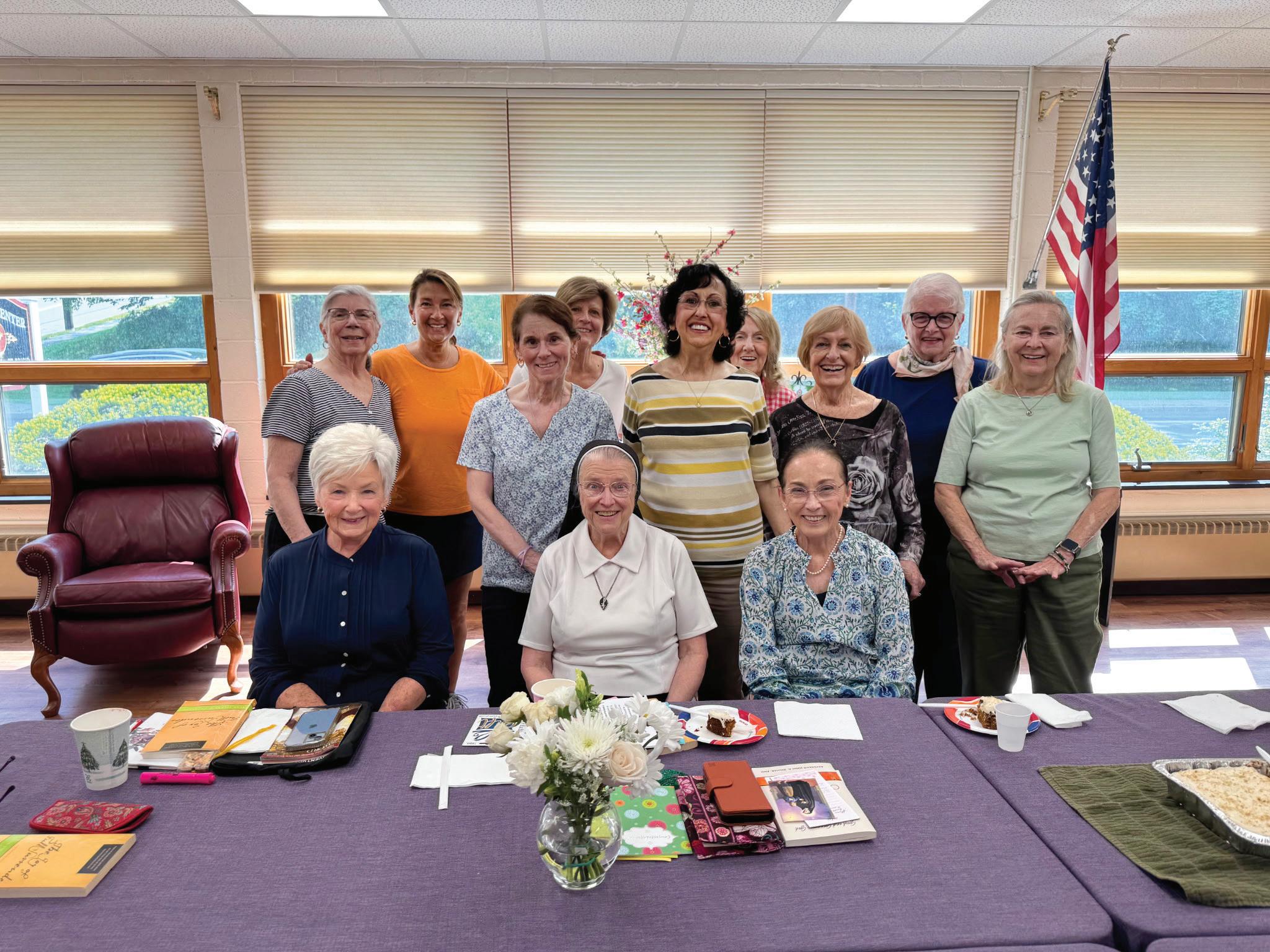
dig deep, it is more than words on a page. It brings out the best in all of us, the Holy Spirit out of us. We go deeper and our faith has grown tremendously. The discussions are so personable and relatable, and Sister Joanne encouraged us to be open-minded and grow in our faith experience.”
Sandy Grantham, a former parishioner of the Peapack parish, didn’t allow distance to prohibit her participation in her beloved book club. She first joined the group in 2012 when she converted to Catholicism, and despite her move to
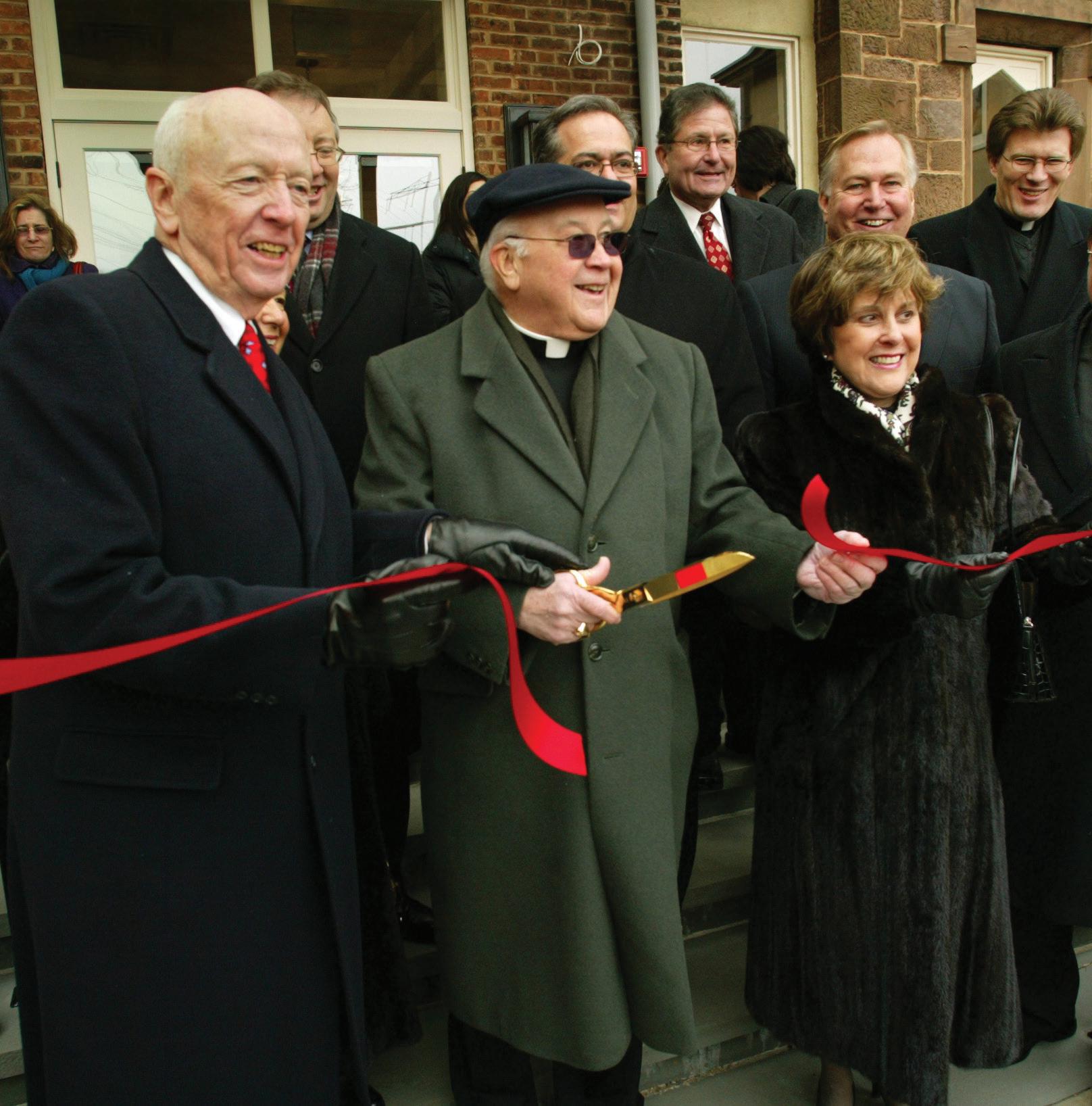
Louisiana six years ago, remains a contributing member via Zoom.
“The group is wonderful, and Sister Joanne was integral,” Grantham stated. “Everyone opens the session with one sentence that talks to them, then the discussion goes from there. It made you look for what touched your heart. I was devouring everything I could find. The group continued to add more to my faith, and find the different ways the Holy Spirit is dwelling in your soul.”
Continues on page 36

Members of the Spiritual Book Club include, front row from left, Ginny Dezio, Sister of Christian Charity Joanne Bednar, and Mary Jacobson; middle row, Dianne May, Gen Virgilio, Eleanor Van Arsdale, and Beverly Woijek; back row, Geri Vesi, Carla Mueller, Pat Reidel, Gretchen Lynch, and Joanne Howe. —Courtesy photo
Lectio Divina: Speak softly and carry the power of the Spirit
Seasons seem to have their own ambient sounds. In our diocesan swath of Central New Jersey, apart from the gentle summer chirping of crickets at night, the occasional calming quiet that accompanies a walk in nature, and a few other similar examples, summer’s sounds tend toward the thunderous and clamorous.
There’s the high-decibel boom of fireworks displays, especially around the Fourth of July, and the jolts of thunder that accompany summer storms. There’s the annoying loudness of lawn mowers and their notorious accomplices, leaf blowers. There are boisterous backyard barbecues and other family gatherings. In the metropolitan areas just outside our territory, there’s the crowd roar of concerts, sporting events and parades. And we can’t forget the omnipresent and at-times grating jingle of ice-cream trucks, which I know of first-hand as a former teen-age summer Good Humor truck driver.
This year’s 250th anniversary of the United States has given us a sort of
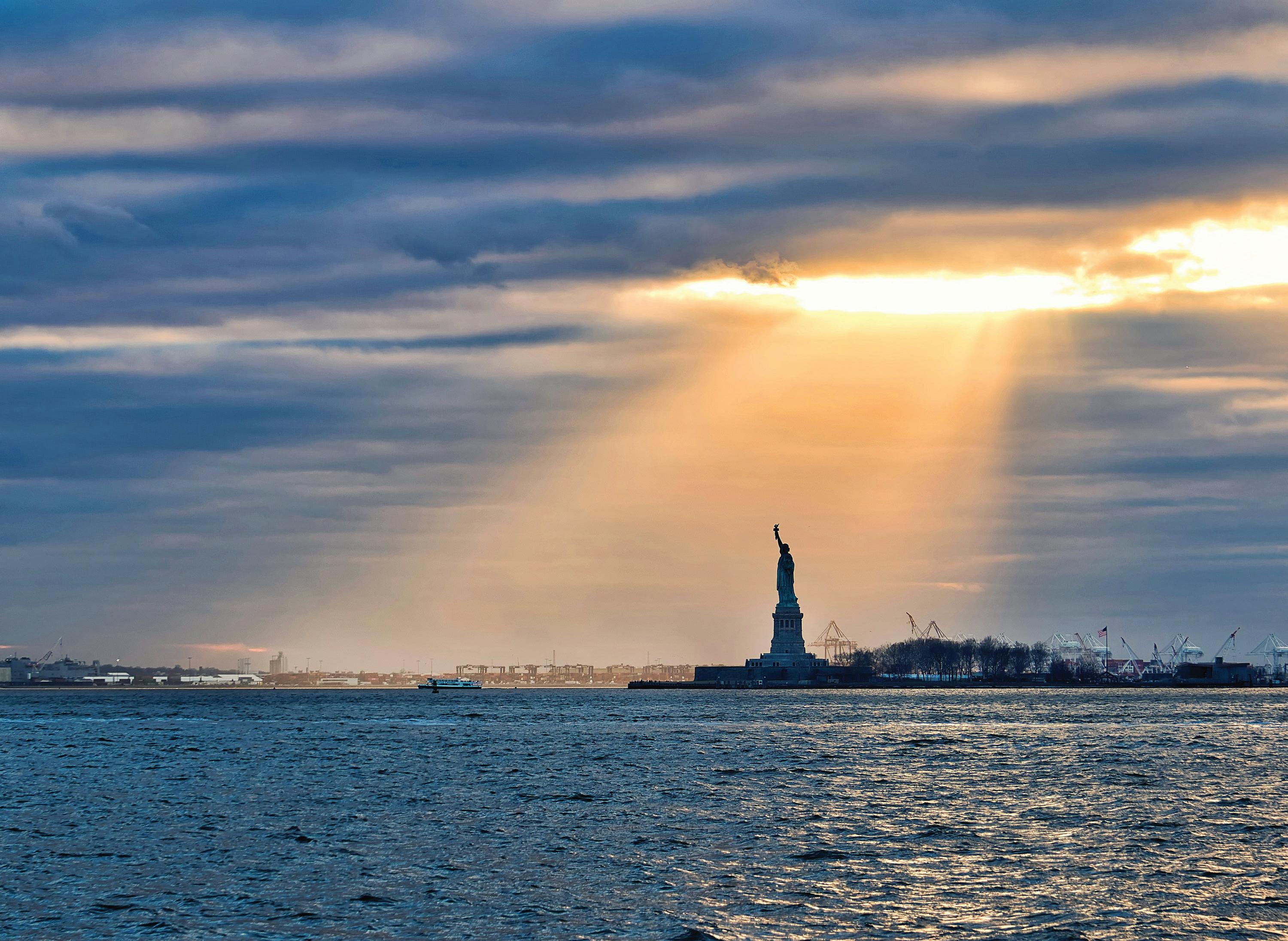
license to pump up the volume of some of these sounds, or to create some new ones. However, there’s no reason not to be cre ative in turning down the volume, as well.
At our parish in Bound Brook, we celebrated the country’s 250th anniversary in a decidedly quiet and contemplative way. We conducted a three-part Lectio Divina series on a sampling of “sacred texts” of the United States: 1) lyrics from the hymn, “America the Beautiful;” 2) the sonnet “A New Colossus” by Emma

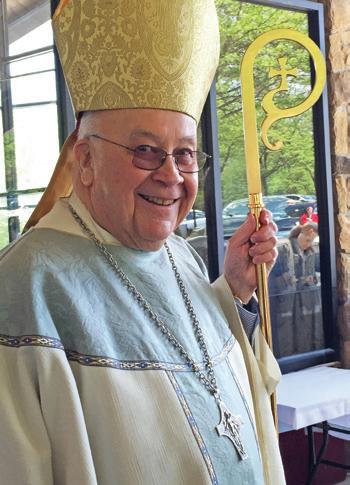
We warmly congratulate Bishop Emeritus Paul G. Bootkoski on the 60th anniversary of his priestly ordination. His decades of faithful service, pastoral care, and dedication to the Church have been a blessing to many in the diocese. With gratitude for his ministry, we pray God continues to grant him health and peace. Ad multos annos!
bluearmyshrine.com
Lectio Divina sessions on each upcoming Sunday’s Gospel: a soft proclamation of the text four times, with a period of fourto-five minutes of silence in between each proclamation; a moment to name the word or phrase that jumps out at each of us at the halfway point of the approximately 30-minute exercise, and a concluding round of comments where participants talk about how their word or phrase resonates with them in a practical way.
As Lectio Divina does with Scripture, this contemplative exercise for our American-themed selections yielded insights and an appreciation for these non-Scriptural texts in a way that may not be easily gained by simply reading.
For example, in our contemplative uplifting of the lyrics of “America the Beautiful,” we discerned a Psalm-like quality of the praise of creation that runs through the song, right from the get-go: “O beautiful for spacious skies, for amber waves of grain, for purple mountain majesties above the fruited plain.” And there’s direct divine attribution to that creative beauty: “God shed his grace on thee.”
Many of our participants in the “America the Beautiful” session were drawn to the moral imperatives that also appear to run through the lyrics. Most notably, the repeated expression: “And crown thy good with brotherhood, from sea to shining sea!” The song’s writer, Katharine Lee Bates, seems to indicate that nationwide human unity is the goal and purpose of the blessings that God has bestowed.
There are also nods to self-control, opposing greed and working for freedom.
When we turned to “The New Colossus,” the famous poem that is inscribed in a plaque on the Statue of Liberty, we did so on the same day that we looked at the upcoming Sunday’s Gospel for the 14th Sunday in Ordinary Time. Since our Lectio Divina enthusiasts tend to come to every session, we noted that
the Mother of Exiles’ invitation in the poem to “give me your tired, your poor, your huddled masses yearning to breathe free” was strikingly akin to Jesus’ Gospel invitation (Mt 11:25-30) to “come to me, all you who labor and are burdened, and I will give you rest.” A discussion of immigration ideals and realities followed, along with reflection on how the poem could or ought to influence government leaders today.
As we tackled an excerpt from the Declaration of Independence, we struggled with, on the one hand, the clarity of the language about the divine and inalienable mandate to have all humanity created as equals and to have the rights to life, liberty and the pursuit of happiness, in contrast to, on the other hand, what seems to be the moral subjectivity of when and how to abolish governments that don’t respect those mandates. Nevertheless, the fact that our country’s founders resolved the clarity of the divine mandate with the murkiness of actual circumstances to declare independence remains inspiring.
While it’s impressive that the United States has now existed for 250 years, it’s no less impressive that Lectio Divina has been around since, approximately, the year 250 AD! The theologian Origen of Alexandria is generally acknowledged as one of the key figures in forming the exercise. When we practice Lectio, we speak softly, but, unlike President Theodore Roosevelt, who called Americans to “speak softly and carry a big stick,” we instead carry within us the power of the Holy Spirit to turn texts into living words.
EDITOR’S NOTE: Msgr. Kerrigan will inaugurate a monthly Lectio Divina exercise with texts similar to those mentioned in this column, at the Mt. St. Mary House of Prayer, Watchung, on Thursday, Aug. 6, at 10 a.m. For more information, go to msmhope.org.
Msgr. Kerrigan is pastor of St. Joseph Church, Bound Brook, and an instructor in the Institute of Contemplative Leadership at Mepkin Abbey, SC.
NATIONAL BLUE ARMY SHRINE OF OUR LADY OF FATIMA
—Partha Narasimhan
Embracing the truth that we stand on someone else’s shoulders
While I was at the Catholic Media Conference and Awards Banquet last month, spending meaningful time with old friends and new acquaintances in the field, I was reminded of a profound and simple truth – we stand on the shoulders of those who came before us. I was also reminded that this truth seems increasingly easy to forget.
Over my lengthy career and my longer life-time, I've watched it happen in many places. A new boss arrives. A new editor takes over. A new school principal takes the helm. A new pastor becomes shepherd of a parish. Sometimes the first order of business seems to be pointing out what was wrong before they arrived.

The previous administration, leadership team or leader either becomes the convenient explanation for every problem, or is, over time, erased from memory.
Certainly, every organization needs fresh ideas, and every leader should bring a new vision. Improvements are healthy, and, the truth is, change is often necessary. But there is a difference between improving something and pretending nothing worthwhile existed before you.
Someone built the organization. Someone sacrificed evenings and weekends to move an initiative forward. Someone weathered difficult years. Someone made decisions with the information available at
time. Someone laid the foundation that made today's opportunities possible.
Good leaders understand that, and they honor that.
For Christians, this principle reaches back to the very beginning of the Church. Jesus did not entrust his mission to perfect people. He chose ordinary men who often misunderstood him, argued among themselves, doubted, fled in fear, and, in Peter's case, even denied knowing him. Yet these same imperfect Apostles became the foundation upon which Christ built his Church.
God did not erase their weaknesses, but neither did he dismiss their faithful-
ness. He transformed imperfect servants into faithful witnesses. If Christ could build his Church through flawed people, perhaps we should be slower to dismiss those who came before us simply because they were imperfect.
Every generation of believers inherits a faith that was preserved, taught, defended and lived by people who were far from flawless. We honor them not because they never failed, but because they remained part of God's unfolding work.
Humility has a way of changing the tone of leadership. Instead of saying, "Now we'll finally do it right," humble leaders are more likely to say, "I'm grateful for those who brought us this far. Here's how we can build on their work."
That approach invites cooperation rather than division.
It also reminds us of an important truth: Someday, someone else will inherit our responsibilities. They will evaluate our decisions with the benefit of hindsight. They will see mistakes we couldn't see. I hope they will extend to us the same grace and appreciation we should offer to those who came before. Leadership is not about erasing another person's legacy. It is about adding faithfully to it.
None of us starts at the beginning. Every achievement rests upon unseen labor, forgotten sacrifices and faithful people whose names may never appear in headlines or on award certificates.
The best leaders never forget to say thank you to those who prepared the way.



the
America: Even in its imperfection, we have reason to be proud of our country
This year, our country celebrated a milestone birthday: 250 to be exact. There were fireworks and parades, special programs on television and performances by artists at stadiums all over the United States. It is remarkable indeed to see our unity in diversity. All of us make up this melting pot of America, coming from lands near and far and calling this place, our home.
As we commemorate the founding of country, the Declaration of Independence, the Revolutionary War, the Liberty Bell and the establishment of our government, let us recall that the hallmark of our land is freedom. With freedom comes rights. The Bill of Rights, those Amendments of our Constitution clearly explain how freedom is applied to daily life of its citizens.
And when Betsy Ross was approached about creating a flag for our country, there was a lot of thought that went into its structure, and symbolism.
The colors of this flag were not chosen arbitrarily. Red is for hardiness, strength and bravery. White is for peace and honesty. The blue stands for vigi-
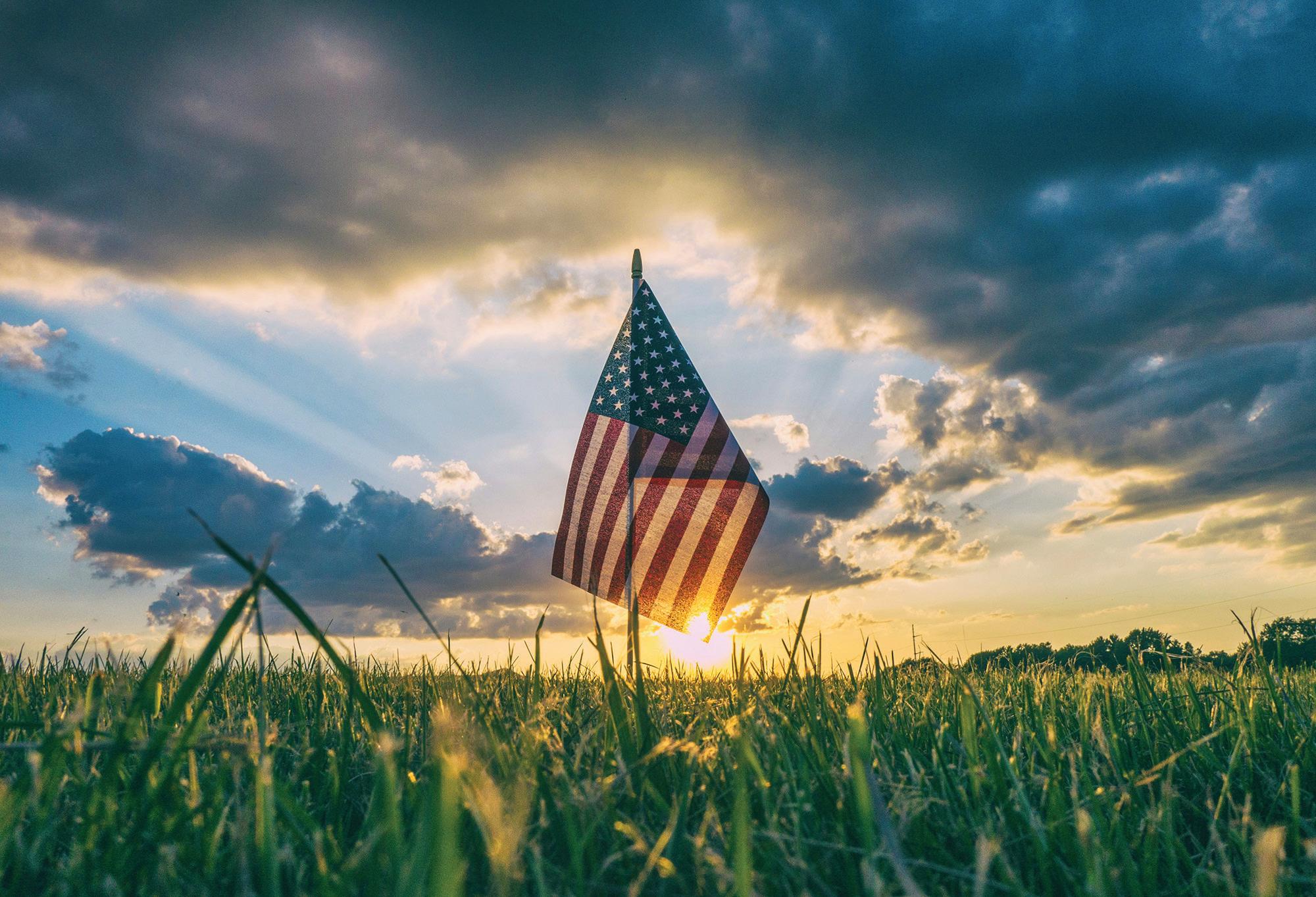
lance. The field of 50 white stars remind us of the states which make up this great union, this republic which boasts of liberty and justice for all.
The American flag is a constant reminder that liberty must be more than a mechanistic power of choice. It must be the means of self-actualization in a nation which guarantees its citizens unalienable rights in quest of realizing the American Dream.
I’ve seen that flag drape the coffin
It has been half a century since I left school, so I trust that not many of my teachers are still around to hear me make this confession. I don’t want to hurt their feelings, but I don’t remember much of what I imbibed during those years. With one exception, the thing I remember best is the multiplication table, and I had to teach that to myself because I couldn’t remember it the way it was given to us.
Sheer memorization, and I couldn’t get that to stick, so I developed my own approach and – incipient writer that I was – I turned it into an adventure story. Seven, of course, was the villain. The 7 table was sheer mental torture! The other numbers, 1 to 9, played different roles and all the numbers, from 1 to 99, were places where exciting encounters happened. This made the multiplication table much easier to remember.
I was in my mid-20s when it occurred to me that probably not everyone sees the multiplication table that way. What a pity. They miss out on the thrilling action when 8 rescues 6 from 7’s machinations! Not surprisingly, I still see the multiplication table that way. After all, I’m a writer.
The one other thing that I remember
when our country mourns. It is this flag which gauges the pulse of our nation, which was established by the people and for the people where the judiciary, executive and legislative branches work in concert with each other to safeguard the democratic model of government of the United States.
of our war dead as they are met by honor guards upon their return to American soil at Dover, Delaware. I’ve seen the sacred fabric of our flag folded meticulously by honor guards of the military at many cemeteries – as a sign of gratitude for the service of the deceased veterans of our great country. And I’ve witnessed the presentation of this flag to the next of kin.
I’ve seen that flag fly proudly at full mast in times of stability and at half-mast
This Independence Day, albeit weeks behind us already, calls us to be grateful for all we have. It is not a perfect country. It is not always the land of the free or the home of the brave, but it is our country. It is here where our ancestors settled. It is here where they came in quest of pursuing a better life, one which promises, in the words of Declaration of Independence: “Life, Liberty and the Pursuit of Happiness.”
As a country, despite our different political philosophies, and our differing perspectives on how things should be done, nobody can deny that we are proud to be Americans.
May God bless the United States of America!
Father Comandini serves as diocesan coordinator of the Office for Ongoing Faith Formation.
Taking the longer way round
clearly from school is a story in my 7th grade reader called, “The Longest Way Round is the Shortest Way Home.” It was about a boy who lived on a farm and who went to visit his grandparents who lived on another farm nearby. The two farms were close to each other on the map, but between them was a very high hill.
The road from one farm to the other skirted the base of the hill, but it was such a long hike to go by the road that, when the boy set out to return home, he decided to go over the hill, which seemed to be a much shorter trip than to go by the round-about road. By the time he reached the top of the hill after an exhausted climb, he realized that a short line of a map was, at least in this case, a very long and tiring hike on foot.
This story came to my mind recently when I was pondering the question of forgiveness. I had made a regrettable remark to someone, and I quickly apologized for it. The person answered immediately, “I forgive you,” but the way it was said showed that, while I may be forgiven, we were not reconciled.
Forgiveness and reconciliation are not synonymous. I think that often we too easily say “I forgive you” and then
we leave out the work that is needed to be reconciled with one another. The word “reconciliation” means to “re-unite,” to bring back to mutual friendship. For a small matter, a little misunderstanding, this is easily done, but when one person has seriously hurt the other, just saying “I’m sorry” and “I forgive you” does not effect reconciliation.
The two persons remain like the two farms in the story – physically close together, but with a great hill separating them. They need to take the long way round so that they can be reconciled. They need to find out why the hurt occurred and then both persons need to be healed. The one who hurt the other needs to be healed of whatever caused the hurtful action so that the wound within will
no longer bring about such hurtful behavior again. Only then can the one who is hurt by the behavior come to healing also.
Reconciliation with one another and reconciliation with God both demand a long way round to heal our wounds, but grace abounds if we only choose to accept it. It calls for honesty – honesty to admit that I am hurt by what you did, and honesty to admit that I hurt you. Such behavior can be healed by God’s grace, unlike the machinations of the 7-times table, which will continue to plague students until time is no more!
Sister Gabriela of the Incarnation is a member of the Discalced Carmelites order in Flemington. Learn more at www.flemingtoncarmel.org.
Celebrating Lives of Faith, Service
Bishop Emeritus Paul G. Bootkoski – 60 Years
Whether it was through his time as a parish priest or ministering to inner-city neighborhoods following the Newark riots, serving as a university chaplain or as Bishop of the Diocese of Metuchen, the Most Reverend Paul G. Bootkoski said that it was his prayer life that helped guide him along the way.
“I could not have been who I am if it wasn’t for a deep prayer life,” he said. “Priests have to be men of prayer, because you deal with so many problems. Sometimes you can get overwhelmed with (how) people are suffering and experiencing, whether in their families or job situations, in the field of education and so on.”
When Bishop Bootkoski recently had the opportunity to ordain two men – one to the deaconate and one to the priesthood – he recalled encouraging them to rely on prayer in their ministries to God’s people.
“I emphasized in my homily to them, that they must be men of prayer,” he said, adding the importance of also investing their time into relationships with their congregations. “They must immerse themselves in the life of the families that comprise their parishes. That is where you find your joy in ministry.”
As Bishop Bootkoski marks the 60th anniversary of his ordination to the priesthood, he still maintains relationships with those he has encountered along his varied ministerial journey. That includes some of his “kids” who he ministered to during his seven-year stint as a campus minister at Rutgers University, New Brunswick. Today, they are parents and even grandparents, and he has had the chance to marry some of the young couples he met while they were on campus.
“I still have friends from my first parish from 60 years ago,” he added. “Of course, they’re dwindling because we are all aging, but I still get together with them and keep in touch.”
Bishop Bootkoski was born in Newark in July 1940 as one of two children to Peter and Antoinette Bootkoski. Attending Our Lady Queen of Peace elementary school, North Arlington, and St. Benedict’s Prep, Newark, helped nourish his desire to become a priest. Following graduation from Seton Hall University, Bootkoski entered Immaculate Conception Seminary, Darlington, N.J. Archbishop Thomas Boland ordained him a priest for service to the Archdiocese of Newark on May 28, 1966.
Then-Father Bootkoski’s first pastoral assignment was as parochial vicar at Sacred Heart Church, Bloomfield. As one of five priests, he recalls learning a great deal from the senior associate, Father Paul.
“He was a marvelous man who was very involved with people,” he recalled,
“and gave me a great example of what it means to be a parish priest.”
His next assignments included serving as parochial vicar in Holy Spirit Church, Orange, and St. Michael’s Church, Cranford. He recalls volunteering to minister to the Black community in the Newark area following the city’s riots and observing not only the tragedy that struck so many families, but how the community rallied together to support one another.
In 1972, his priesthood took him to Rutgers, where he is still proud of the success they had in building out a still-vibrant campus ministry program.
“People were very great and generous to us to revamp this convent that housed 40 nuns, (which is now) the Catholic Center of the university,” he said, noting that the center helps be a home away from home for some of the 60,000 students who can easily get lost on such a large campus. “It is still flourishing today, and I am very proud of that.”
He went on to serve as assistant vice president for Student Affairs at Seton Hall University, West Orange, before returning to parish ministry at St. Mary of the Assumption Church, Elizabeth. He was subsequently appointed pastor of St. Gabriel the Archangel Parish, Saddle River, in 1990.
In 1991, Pope John Paul II named then-Father Bootkoski a prelate of honor, with the title Reverend Monsignor. In 1996, Msgr. Bootkoski assumed additional archdiocesan duties as Vicar for Priests. He was named auxiliary bishop of the archdiocese in 1997, also serving as the vicar general and moderator of the curia, and in 2001 he spent about a year as administrator of the archdiocese.
In January 2002, Pope John Paul II appointed Bishop Bootkoski as the fourth shepherd of the Diocese of Metuchen. He was installed on March 19, 2002, and remained the Bishop of Metuchen until May 3, 2016.
In his retirement, Bishop Bootkoski continues to celebrate Mass one weekend each month in St. Catherine of Siena Parish, Pittstown. He also serves as chaplain to the Veterans of Foreign Wars post in Sparta.
Reflecting on his time leading the Diocese of Metuchen, Bishop Bootkoski highlighted the embrace of a “stewardship attitude” in each of the parishes, and the encouragement of lay leadership in individual parish communities. He also credited the Catholic educators who make diocesan schools so exceptional, as well as the team that surrounded him in his role as Bishop.
“When you are in the position of being the bishop of a diocese, you realize you don’t have all the answers,” he said. “You have to develop a good team.”
—By David Karas, Correspondent
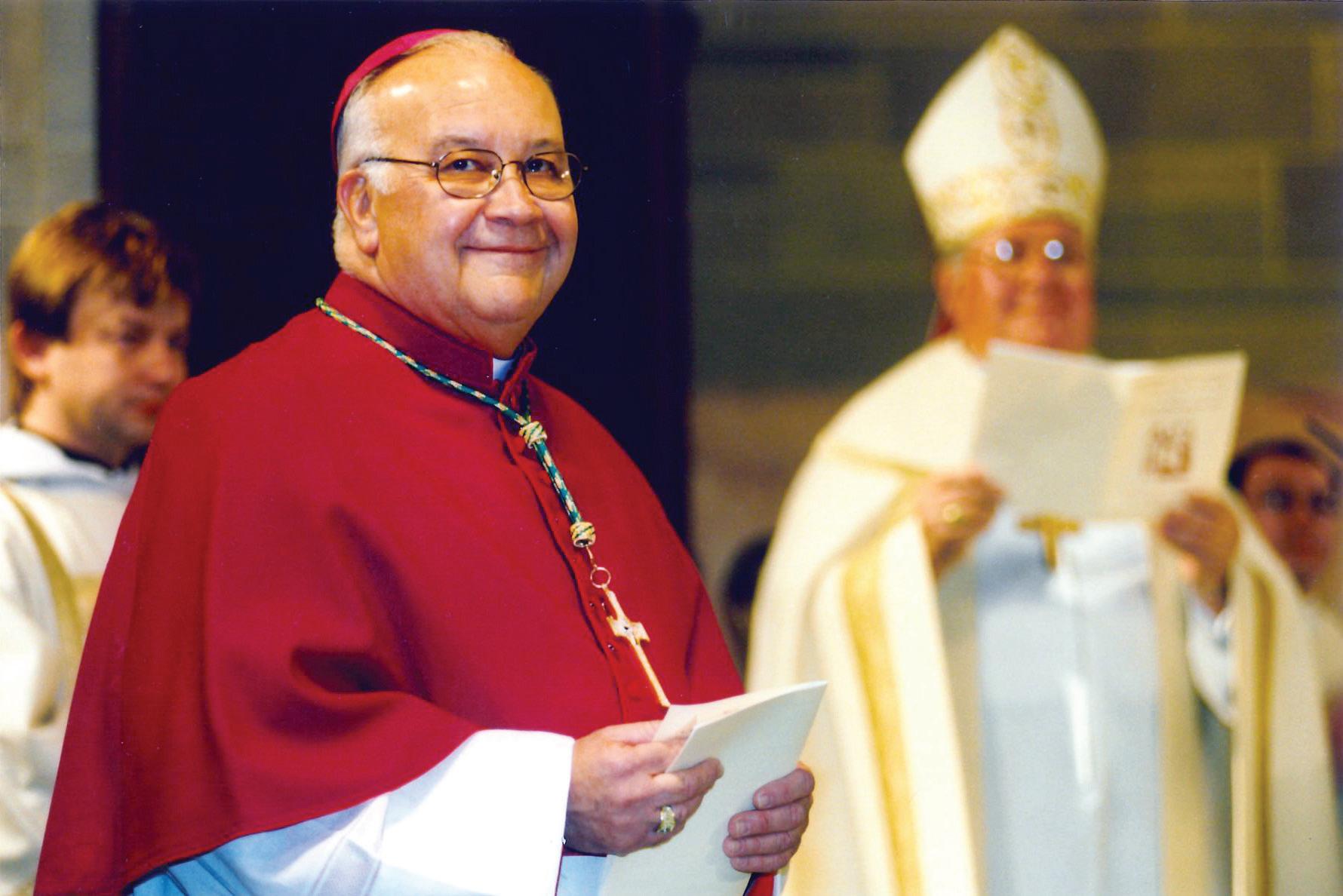
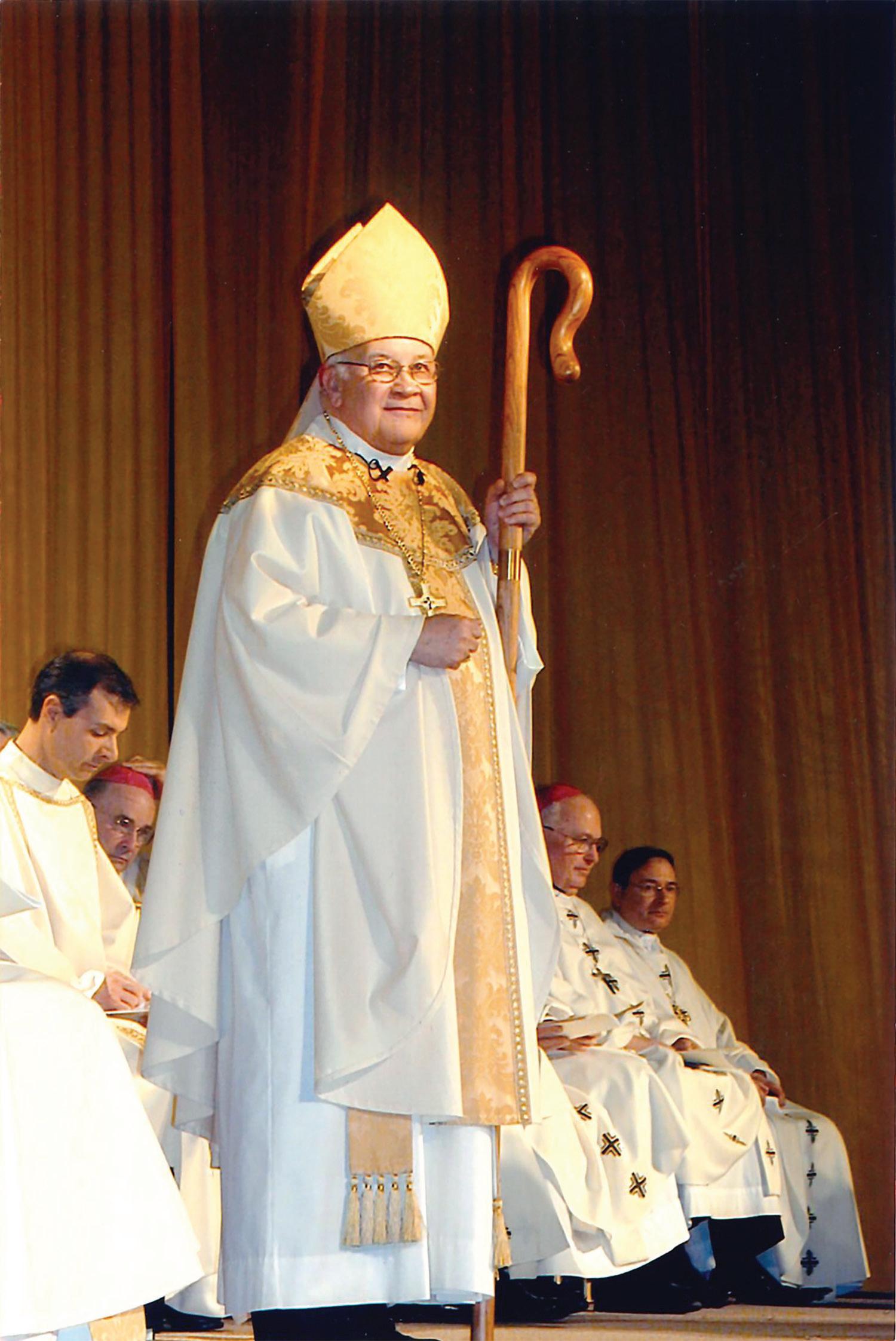
photos, Bishop Paul G. Bootkoski’s installation, Diocese of Metuchen, March 2002.
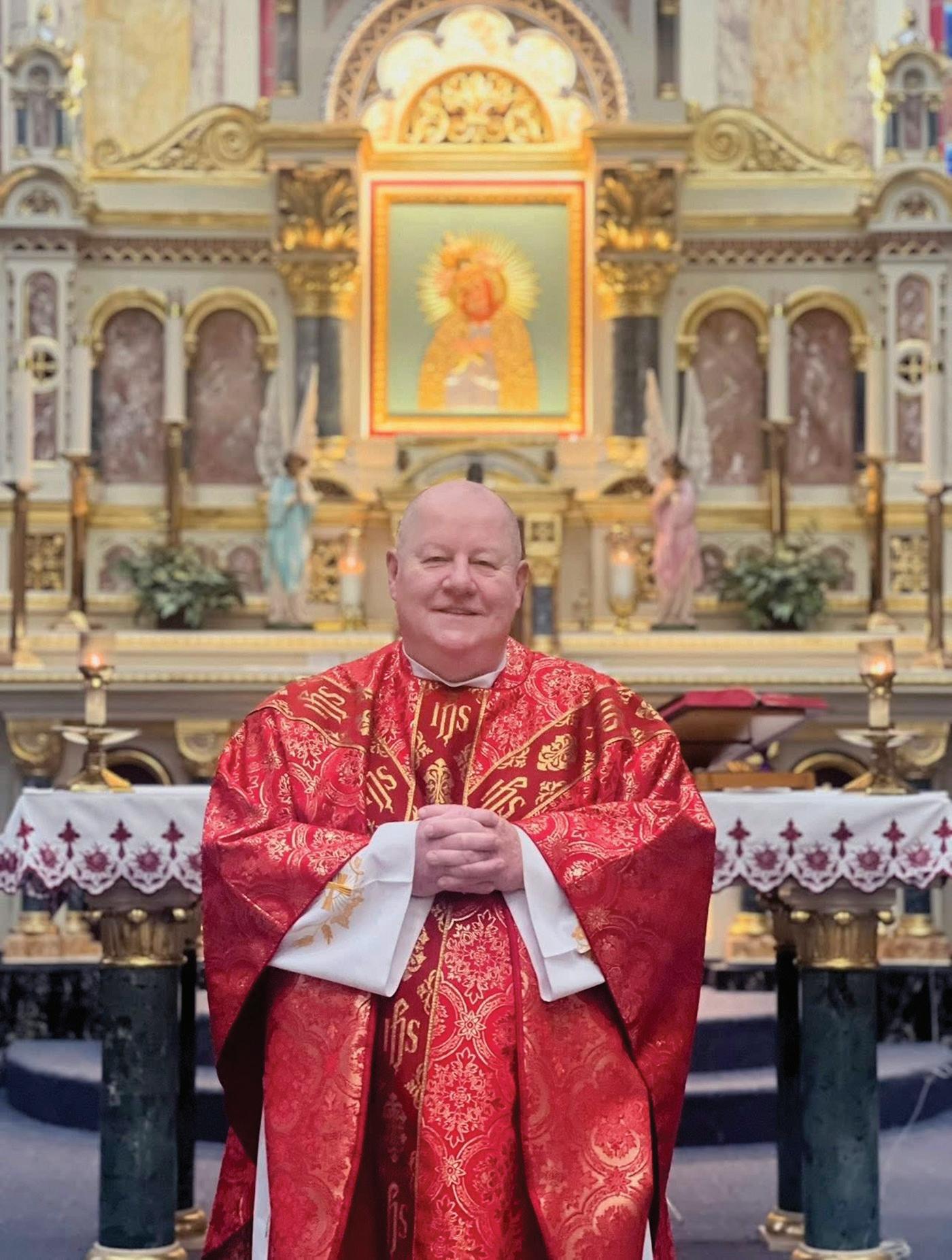
As Father Michael J. Gromadzki celebrates the quarter-century anniversary of his priesthood this year, he is serving as pastor of Saint Mary of Ostrabrama Parish, South River – the very same assignment and role his own brother, Father Stanley, had at the time of his ordination 25 years ago.
“We made our mark on the history of the Diocese of Metuchen,” said Father Gromadzki, “since we are the first two brothers within this Diocese.”
Father Gromadzki was born in 1966 in Zlocieniec, Poland, as one of four sons. He attended St. Stephen School, Perth Amboy, and Perth Amboy High School before earning an associate’s degree in business administration from Middlesex County College, Edison, and studying at Monmouth University, West Long Branch.
Father Gromadzki earned a bachelor’s degree in religious studies from Seton Hall University, and a Master of Divinity degree from Immaculate Conception Seminary, South Orange, in 2001. He was ordained to the priesthood May 26, 2001 by Bishop Vincent De Paul Breen in the Cathedral of St. Francis of Assisi, Metuchen.
During his Ordination, his vesting priest was his brother, who at the time was serving as pastor of St. Mary of Ostrabrama and now serves as pastor of Sacred Heart Church, Perth Amboy. His first assignment was as parochial vicar of St. Bartholomew Parish, East Brunswick. He has also served as parochial vicar at the Cathedral of St. Francis of Assisi; Our Lady of Peace Parish, Fords; St. Ann Parish, Raritan; St. Anthony of Padua Parish, Port Reading, and Our Lady of Mt. Carmel Parish, Woodbridge.
“As a seminarian then as pastor, it has been a very humbling and extremely spiritually rewarding journey,” said Father Gromadzki. “Meeting the children of the parish in 1995 and now being part of their Sacramental Marriage – and now to top it off, baptizing their children – has been a true gift from Heaven.”
When reflecting on his 25-year anniversary of being ordained a priest, Father Gromadzki is full of gratitude.
“Our Blessed Mother and the great, humble and prayerful parishioners of St. Mary of Ostrabrama – Our Lady of Mercy –Parish deserve all the gratitude and recognition,” he said.
He also described the “many silent miracles” that take place in his parish community, which he named “the jewel of South River” when he first arrived there.
“We are an icon parish of which I am very proud to continue the work my brother began in 1998 in repairing Blessed Mother’s beautiful home,” said Father Gromadzki. “She is, after all, 123 years in existence.”
He looks forward to the “fulfillment and peace” that will come on November 16, 2028, when his parish celebrates its 125th anniversary.
—By David Karas, Correspondent
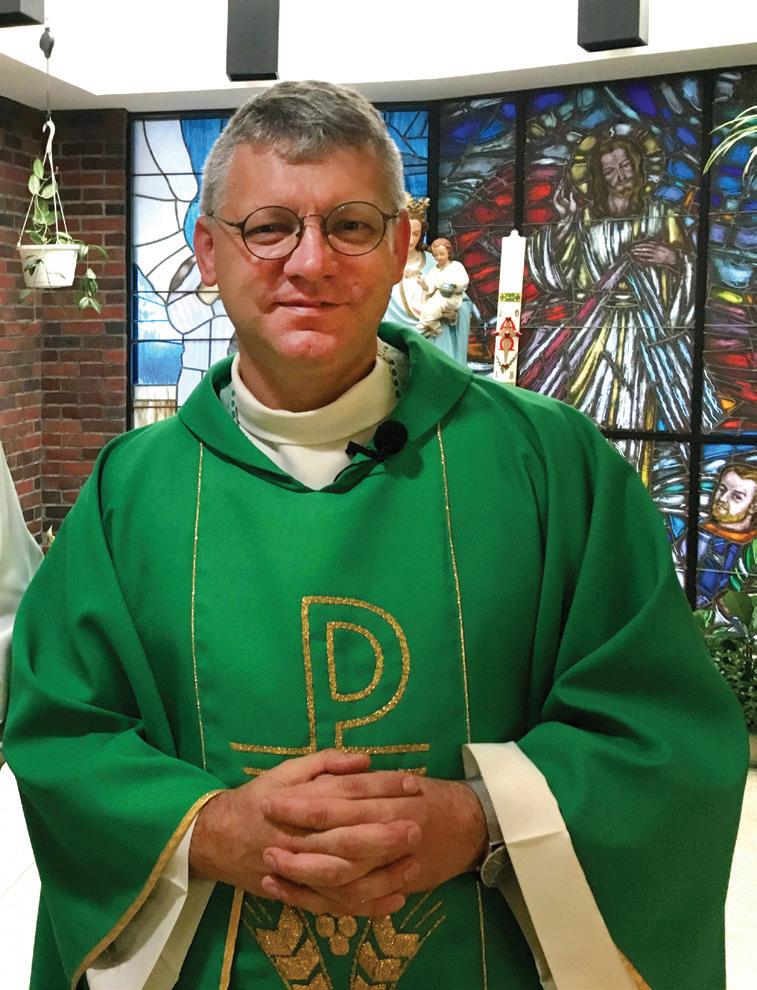
Father Grzegorz Podsiadlo, SDS, who serves as administrator of Saints Peter and Paul Parish, Great Meadows, this year is celebrating the 25-year jubilee anniversary of his Ordination to the priesthood – a ministry that has included assignments both in Poland and New Jersey.
Father Podsiadlo was born and raised in Poland, and was ordained in Bagno on May 26, 2001, by Bishop Jan Tyrawa. His first assignment as a priest was at Swietego Bartlomieja i Swietej Jadwigi Slaskiej (St. Bartholomew and St. Hedwig of Silesia Parish) in Poland, where he spent three years. He went on to spend another three years assigned to Ruch Mlodziezy Salwatorianskiej (the Salvatorian Youth Apostolate) before coming to the United States.
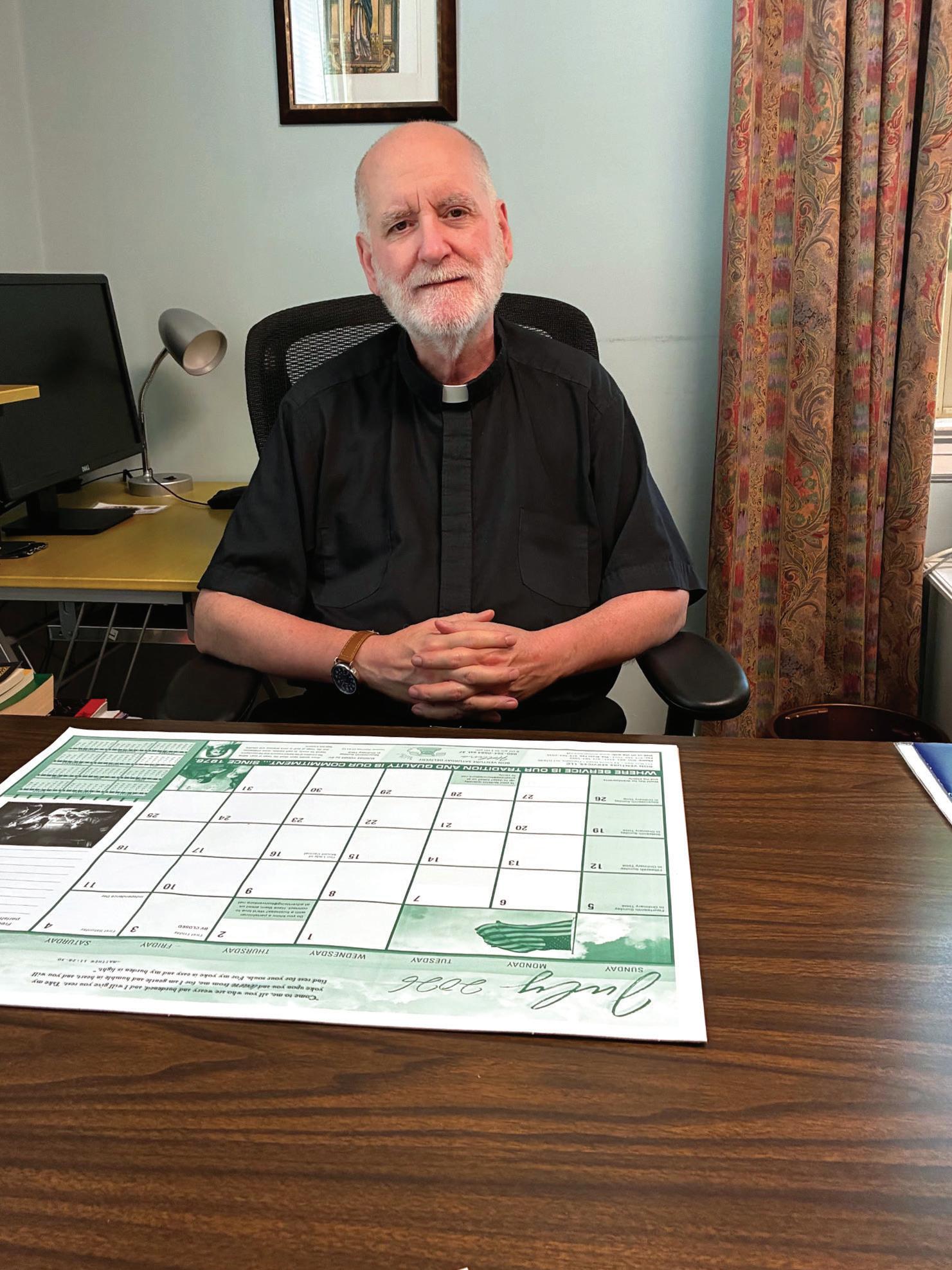
Over the course of his 40 years of ministry, Father Michael E. Crummy has served the faithful of the Diocese of Metuchen in two distinct ways: in parishes where he built long-term relationships, and with hospital patients he may see for just a few minutes.
Father Crummy was born in South Amboy where he attended Our Lady of Victories School, Sayreville, and St. Mary High School, South Amboy. In 1979, he graduated from St. Francis College, Loretto, Pa., with a bachelor’s degree in commerce and modern language, and an award of excellence in French.
The young man soon realized he was unsatisfied with life as a businessman, and came to the realization that working with a parish “was something I could do.” He attended St. Mary Seminary and University, Baltimore, Md. where he received a Master of Divinity degree before his 1986 ordination.
Father Podsiadlo spent six years in the Archdiocese of Newark, during which time he was assigned to Our Lady of Mount Carmel Parish, Bayonne.
He came to the Diocese of Metuchen on September 1, 2013, and has served the parish community of Saints Peter and Paul, Great Meadows, since that time.
—By David Karas, Correspondent
Amongst his parish assignments were Our Lady of Perpetual Help, Bernardsville; Our Lady of the Mount, Warren; Our Lady of Fatima, Piscataway; and three parishes in Perth Amboy. He also served a total of five years as priest secretary for the late Bishop Edward T. Hughes, then became pastor of St. Edward the Confessor, Milford, for 14 years. Following short assignments in three Perth Amboy area parishes and an 8-month sabbatical, he ministered in Mary, Mother of God Parish, Hillsborough, and St. James Parish, Woodbridge.
In 2017, Bishop Checchio requested Father Crummy serve as chaplain in Parker Nursing Home, Somerset; the priest requested to become full-time chaplain in Robert Wood Johnson University Hospital, New Brunswick, where he ministers today. Father Crummy resides at Our Lady of Lourdes Parish, Milltown, where he also assists with celebrating Masses and hearing Confessions.
Work as a chaplain is fulfilling, he stated. “Administering the Sacraments is at the core of my ministry, but more importantly, there is human compassion,” he said. “Patients can see you empathize with their suffering and see someone genuinely cares.”
Despite various faiths, Father Crummy declared, the chaplains in the hospital work as a team. “I realize our common mission is to visit the sick, and we are there to ease their suffering and minister to them,” he said. “We are very much united; as a group, we try to bring love and the compassion of God to the sick.”
—By Christina Leslie, Contributing Editor
Father James W. Hagerman
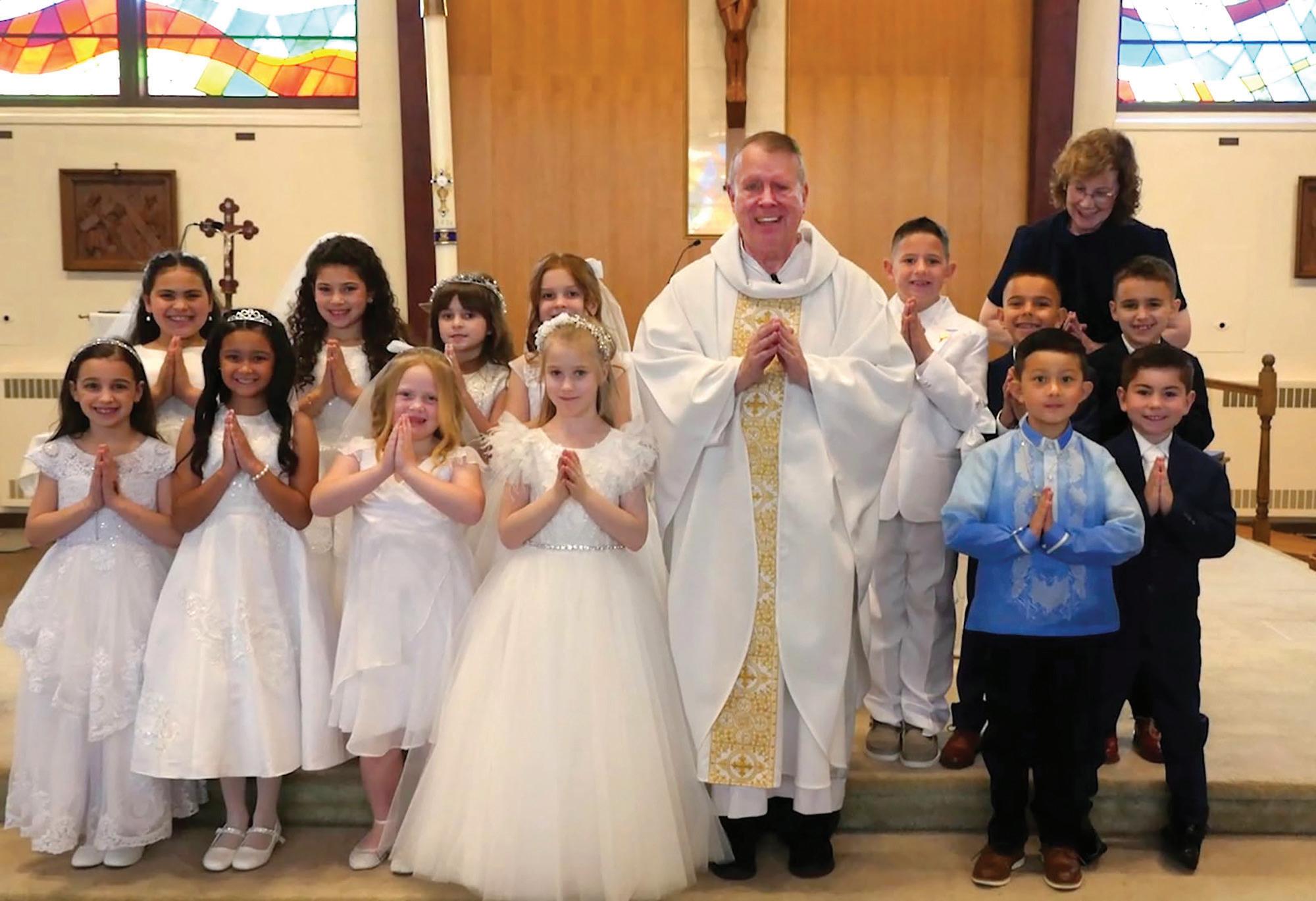
Reflecting upon his priestly service of four decades, Msgr. Joseph M. Curry admitted, “I can’t imagine not doing this. It makes me happy in ways I didn’t even know I could be happy.”
The future priest’s path began with his education in St. Matthew School, Edison, and St. Pius X High School, Piscataway. Msgr. Curry enrolled in the University of Scranton, Pa., to study pre-law, but decided to pursue the priesthood, completing seminary training in Mt. St. Mary Seminary, Emmitsburg, Md., and ordained for the Diocese of Metuchen in 1986.
He spent his first 19 years as a priest in New Brunswick, serving in St. Peter the Apostle Parish, its namesake high school and the Catholic Center at Rutgers University. As diocesan associate director of vocations for elementary schools, he was instrumental in the operations of Camp Christopher, an overnight camp near the Blue Army Shrine designed for boys contemplating the priesthood.
At first, he admitted, “I was not a big outdoors person. I didn’t know the first thing about setting up a tent and had to learn astronomy. We would take the kids to the soccer fields and watch the Perseid meteor showers. It’s like St. Thomas Aquinas wrote in the Summa Theologica; the stars are proofs that God exists.”
Msgr. Curry was named Prelate of Honor with the title of Reverend Monsignor in 2001. He served as pastor of Immaculate Conception Parish, Spotswood, from 2005 to 2019. After a short sabbatical following the death of his father, he was reassigned to St. Matthias Parish, Somerset, then Immaculate Conception, Somerville. He was named pastor of Mary, Mother of God Parish, Hillsborough, in 2022.
In addition to the celebration of Mass, Msgr. Curry finds hearing Confessions one of the most fulfilling parts of his ministry. Service retreats to work with the poor, including to Guatemala for Catholic Relief Services, also bring joy.
The times he spent at Camp Christopher foreshadowed his ministry as a whole. “When I chose the priesthood, I thought I had to pick one star out of the sky, that I was limiting myself,” Msgr. Curry mused. “I continue to be awed how huge the priesthood is. I have done so much; it is such a full life, and I have learned so many diverse things.”
—By Christina Leslie, Contributing Editor
Father James W. Hagerman, who since 2003 has served as pastor of St. Bernadette Parish, Parlin, this year marks the 40th anniversary of his Ordination to the priesthood.
Father Hagerman was born in 1957 in Perth Amboy as one of two children, and attended St. Mary School, South Amboy, and Williamsville North High School, Williamsville, N.Y. He went on to study philosophy and religious studies at Canisius College, Buffalo, N.Y., before completed his seminary training at Immaculate Conception Seminary, Seton Hall University, South Orange, where he received a master of divinity degree.
He was ordained May 31, 1986, in the Cathedral of St. Francis of Assisi, Metuchen, by then-Bishop Theodore E. McCarrick. His priestly assignments have included serving as parochial vicar in St. Philip and St. James Parish, Phillipsburg; St. Bernadette Parish, Parlin; Blessed Sacrament Parish, Martinsville; St. Mary Magdalen Parish, Flemington, and St. Bernard of Clairvaux Parish, Bridgewater. From 1998 to 2003, he was pastor of Annunciation Parish, Bloomsbury, before assuming his current assignment as pastor at St. Bernadette.
After moving more than 20 times as a self-proclaimed “Army brat,” Father Jerome A. Johnson learned to see changing parish assignments over the course of his 40 years of priesthood could turn out to be an asset.
“You can adapt to ministry,” the priest explained. “Your home is where your family is. Put yourself out there, so if you move again and again, it is not the end of the world. Open yourself up and God will do the rest.”
Born in Fort Dix, Father Johnson and his family were transferred to Hawaii, West Virginia, Wisconsin, Georgia, Kansas and Germany, where he was educated in Stuttgart American High School, Germany. He earned dual bachelor degrees in philosophy and Spanish from St. Meinrad College, Ind. Influenced to pursue religious life by his pastor in Germany, Army chaplain Father Malachi Higgiston, he graduated from Mount St. Mary Seminary, Emmitsburg, Md., with a Master of Divinity and a Master of Arts degree in Scripture.
Father Hagerman earned a Master of Business Administration degree from Farleigh Dickinson University, Madison, in 2002, and also completed courses in computer science at Middlesex County College, and evangelization at Steubenville College, Stubenville, Ohio.
His ministry has included serving on committees for pastoral issues, priestly life and ministry of the Presbyteral Council, as well as the council of financial affairs.
—By David Karas, Correspondent
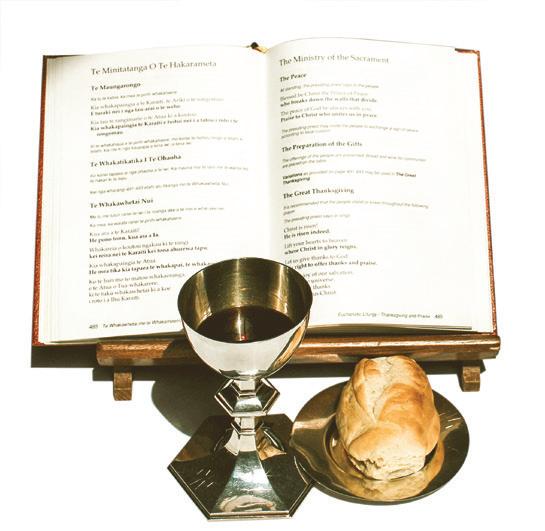
Father Johnson has served as parochial vicar in Immaculate Conception Parish, Somerville, and St. Thomas the Apostle Parish, Old Bridge. He was pastor of Sacred Heart Parish, New Brunswick, until 1999, then returned to Old Bridge as pastor of St. Thomas in 2017.
In addition to his parish assignments, Father Johnson has served as chairman for the Commission for Ecumenical and Interreligious Affairs and a member of the Seminary Education Board.
“I love to celebrate the Mass and the Sacraments with the people,” he said. “It is fulfilling to see the parishioners and be part of their stories.” Father Johnson called the parish of approximately 3,200 families and a school of 400 students “a well-run machine,” and especially loves those learning about the faith via OCIA.
“We help people on their journeys, meet them where they are at, and bring them forward in faith,” the pastor said. “We should be there at the critical times in life. You don’t have to have all the answers. Just walk with them.”
—By Christina Leslie, Contributing Editor
Father Alphonsus Kariuki
– 40 Years
While Father Alphonsus Kariuki’s four decades as a priest have brought him to 20 different assignments and all around the world, he credits the kindness he has received from others with always making him feel at home.
“In these 40 years, I have worked among different people in the world – Kenya, Italy, Canada, Colombia, Ecuador and here in the U.S.,” said Father Kariuki. “People have welcomed me and loved me as one of their own. The hardest thing I have experienced is when I had to say goodbye to move to the next assignment. It was always sad for me and for those people with whom we had become family.”
Father Kariuki, who now serves as pastor of St. John the Evangelist Church, Dunellen, originally grew up in a village in Kenya. While he was not born into a Catholic or even Christian family, he first received God’s call in 1967 when he came across a Christmas Mass. Drawn to what he saw, Father Kariuki continued to attend Mass every time a priest visited his village. He took catechism classes and was baptized at the age of 12.
Father Kariuki found his way to the Consolata Missionaries seminary in Kenya, and was ordained on Feb. 16, 1986. His priesthood included time ministering to nomads in different villages, before he first visited the United States to conduct a missions appeal tour. He went on to spend time living in Pittsburgh, Toronto and Italy before eventually coming to New Jersey. He was incardinated into the Diocese of Metuchen on Oct. 3, 2011.
“I have had interesting assignments as a priest in all those years, and each one of them left a positive mark in me,” he said.
Father Kariuki remarked that he still carries the feeling of being young, and at times it is hard to believe it has been 40 years since his ordination.
“Looking back at all those assignments and how long I spent in each and every one of them, I agree without doubt that I have been ordained that long,” he said. “It feels great that I have been a priest this long and I look forward to adding many more years.”
—By David Karas, Correspondent
Father Michael G. Krull – 40 Years
Encountering an old tome in his high school library set a future priest to offer a guiding hand to people of the Metuchen Diocese interested in learning more about their faith.
“When I was a student at St. Joe’s [High School, Metuchen], I found an old book on Church history written in 1904,” recalled Father Michael G. Krull. “I was fascinated by it, and continued learning about Church history at Seton Hall Seminary.” The New Brunswick native earned a bachelor’s degree in music from the South Orange University, then completed his priestly studies at Mount St. Mary Seminary, Emmitsburg, Md., earning a Master of Divinity degree and a Master of Arts degree in Church history. He was ordained for the Diocese of Metuchen in 1986.
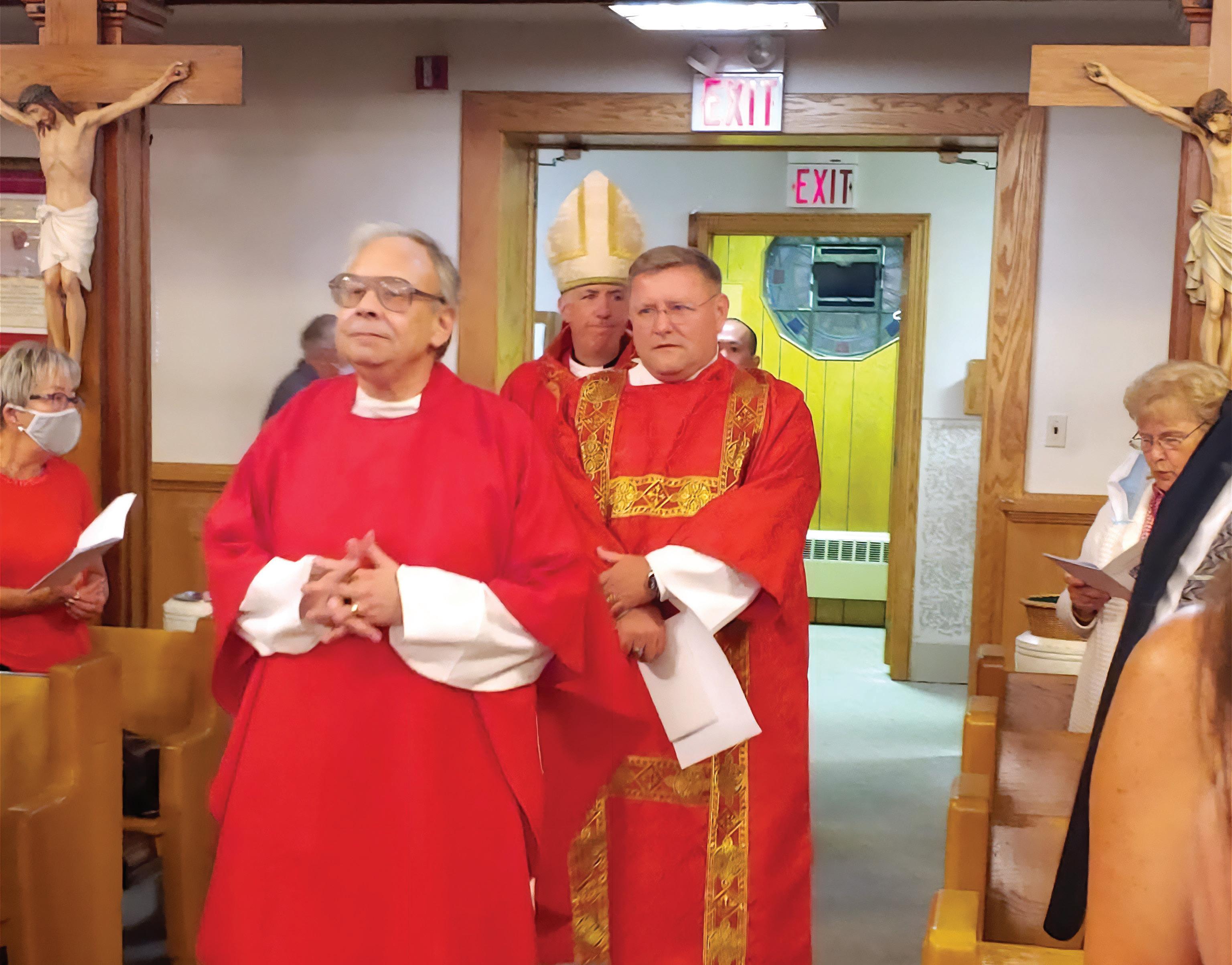
Father Krull has served as parochial vicar at a number of parishes throughout the Metuchen Diocese, including Our Lady of Victories, Sayreville, Good Shepherd, Hopelawn, and St. Anthony of Padua, Port Reading. He assumed his current pastorate in Our Lady of Peace Parish, North Brunswick, in 2019.
Father Krull has continued to enrich the people of the Diocese in their Church’s history, authoring “Of This We Are All Witnesses,” published in 2006, and assuming the role of chair of the diocesan Commission for Historical Records. To honor the nation’s 250th anniversary, he is authoring a monthly column for the Catholic Spirit newspaper entitled “A Brief History of the Catholic Church in Central New Jersey.”
He credits prayer and the support of brother priests to aid him in shepherding his flock. “You are there for the pretty and the ugly, some very challenging moments in peoples’ lives,” he admitted. “In seminary, you are told you have to have a strong prayer life, for you can’t give what you don’t have.”
Father Krull continued, “Parish life is a kaleidoscope of things. You have to be prepared for anything, and we are all always learning.”
—By Christina Leslie, Contributing Editor
Father Kenneth Murphy – 40 Years
Father Kenneth Murphy, who this year marks the 40th anniversary of his Ordination to the priesthood, spent the majority of his ministry – 25 years – as pastor of St. Stanislaus Kostka Parish, Sayreville, before joining the parish of Our Lady of Mercy, South Bound Brook, in 2025.
Father Murphy was born in 1958 in New York City and attended grades one through three at St. Francis Xavier Elementary School, Brooklyn, before enrolling in St. Peter the Apostle Elementary School, New Brunswick. He attended high school at St. Joseph, Metuchen, and earned a Bachelor of Science degree in engineering from Newark College of Engineering of the New Jersey Institute of Technology, Newark.
Before attending seminary, Father Murphy worked as a high school physics and math teacher, and a freelance editor of math textbooks.
He completed his seminary training at Ss. Cyril and Methodius Seminary, Orchard Lake, Mich., and studied in the University of Detroit, as well. He holds a Master of Divinity degree and a Master of Arts degree in religious studies.
Father Murphy was ordained to the priesthood on May 31, 1986, by Bishop Theodore E. McCarrick in the Cathedral of St. Francis of Assisi. His priestly assignments have included serving as parochial vicar at Our Lady of Victories, Sayreville; Saint Mary of Ostrabrama, South River; Immaculate Conception Parish, Spotswood, and Christ the King, Manville, where he also served as temporary administrator. He has also served as assistant chaplain in Somerset Medical Center, Somerville, as well as director of religious education in Christ the King Parish.
Since the conclusion of his 25 years as pastor of Stanislaus Kostka Parish, he has been in residence at Our Lady of Mercy. In addition to assisting there, he has served as chaplain, Parker at Somerset, and Polish Sacramental Minister at Holy Family Parish, New Brunswick.
—By David Karas, Correspondent
Father David J. Pekola – 40 Years
Father Peter G. Suhaka – 40 Years
Father Dennis Robert Weezorak – 40 Years
Father David Pekola describes the feeling as “quite unbelievable” when he considers that he has been a priest for 40 years, not to mention the five years of formation while he was attending St. Mary Seminary and University, Baltimore, Md.
Reflecting on his ministry, a number of moments come to mind.
“Meeting Mother Theresa near my tenth anniversary as a priest is a highlight, (and) also the pilgrimages I have made through the years, celebrating Mass in special places,” said Father Pekola, “but most of all, it is the ability to offer the Mass for the people every day.”
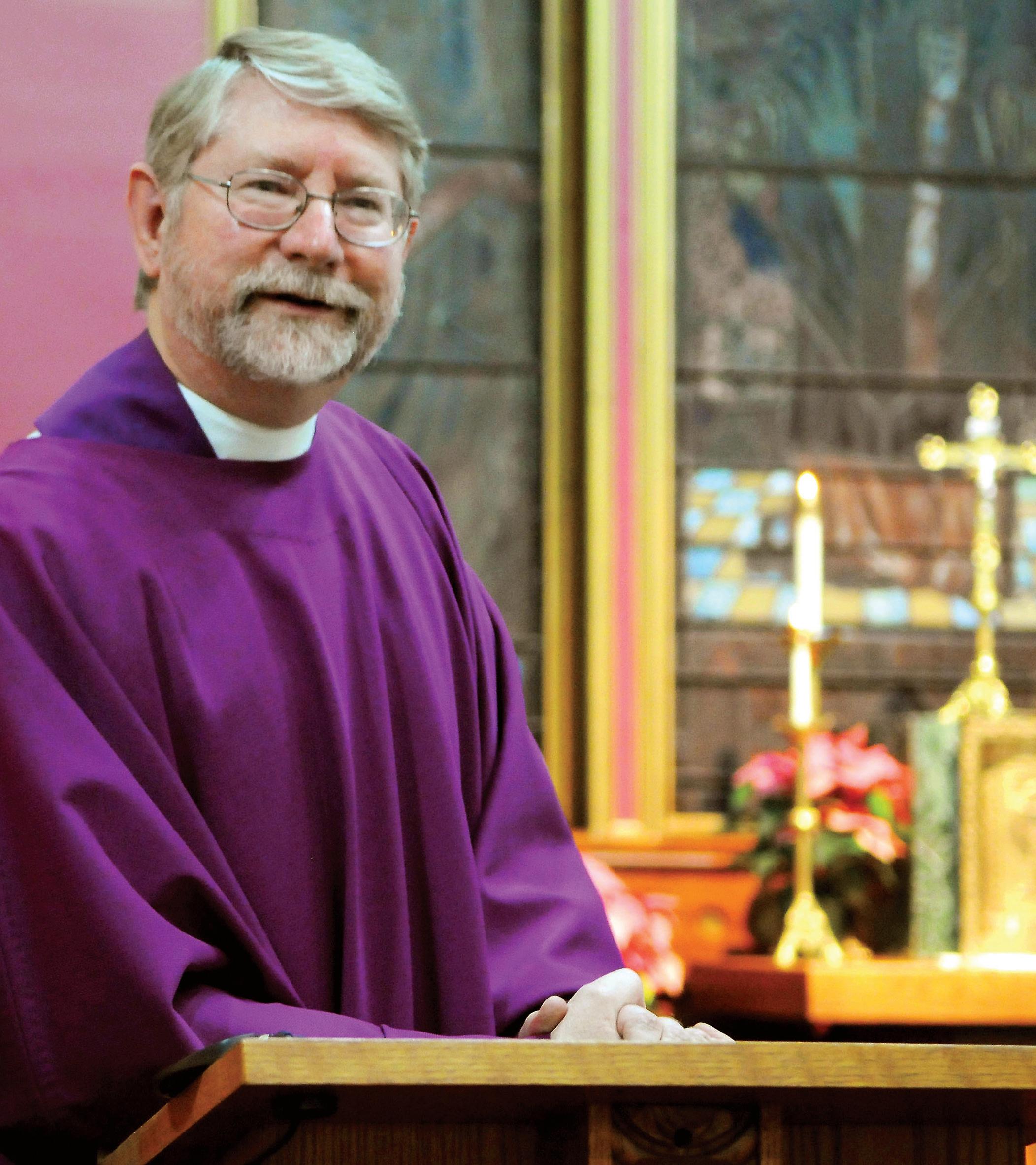
Father Pekola, pastor of Our Lady of Victories Parish, Sayreville, was born in 1958 in Elizabeth with his home parish being Sacred Heart, Carteret. After completing his time in seminary and earning a master of divinity degree, he was ordained to the priesthood on May 31, 1986, in the Cathedral of St. Francis of Assisi by Bishop Theodore E. McCarrick.
His priestly assignments have included St. Elizabeth-St. Brigid Parish, Far Hills; Our Lady of Lourdes Parish, Milltown; St. Cecilia Parish, Iselin; and Assumption of the Blessed Virgin Mary Parish, Hackettstown. He also spent time as temporary administrator of St. Ann Parish, Raritan, as well as chaplain at Roosevelt Hospital.
In each of these assignments, the privilege to celebrate Mass with his congregants has been the most impactful aspect of his priesthood.
“What means most is offering Mass,” he said, “and having God use me as an instrument of his Divine Grace, (and) he ability to communicate the presence of God to others.”
Father Pekola said that, while one of the biggest challenges of his priesthood has been “meeting people where they are” spiritually and ministering to their needs in times of distress, he has found countless blessings when seeing someone do something that inspires or touches the lives of others.
As he continues in his active priesthood, Father Pekola said he looks forward to continuing “what I do, with love, devotion and gratitude.”
—By David Karas, Correspondent
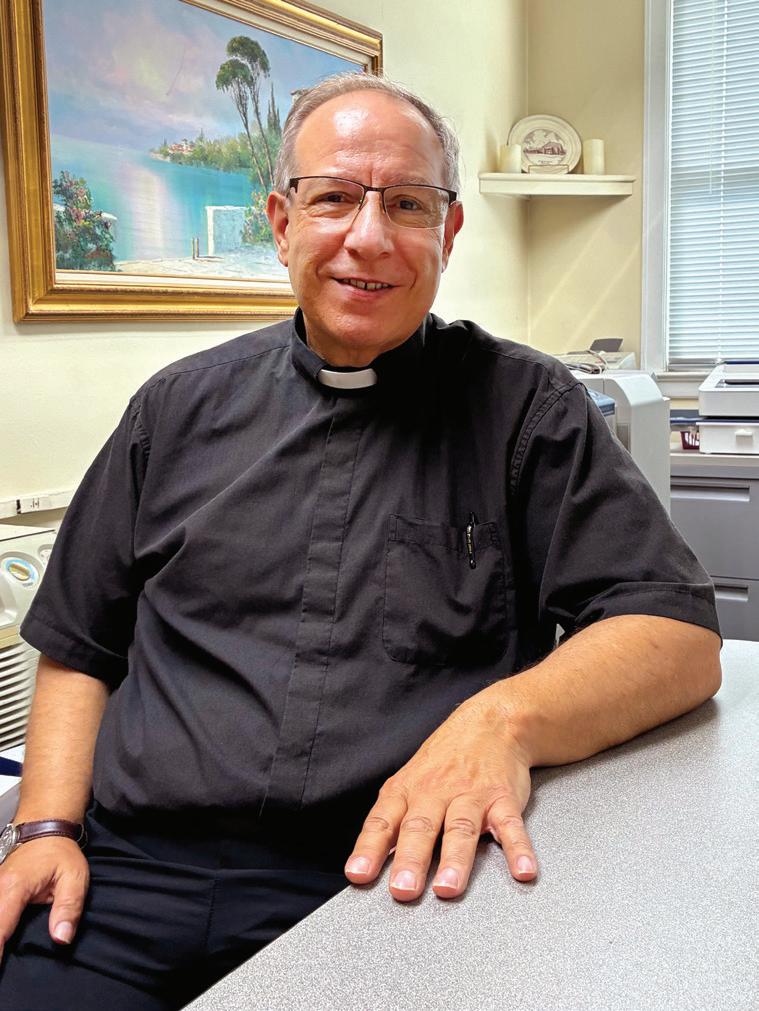
“S
t. Peter’s is one of the biggest blessings of the Diocese,” asserted Father Peter G. Suhaka, who has ministered as chaplain of the New Brunswick Catholic hospital for the past 11 years. “It bolsters my faith to see the faith of the people.”
Born in Somerville, he attended Sacred Heart School, Manville, and St. Mary’s Preparatory School, Orchard Lake, Mich. He earned a bachelor’s degree in philosophy from the University of Scranton, Pa., and St. Mary College, Orchard Lake, and completed his studies in Christ the King Seminary, E. Aurora, N.Y. Father Suhaka was ordained for the Diocese of Metuchen in 1986.
Prior assignments included ministry in Buffalo, N.Y., and service in Washington with Catholic Charities foster care division and the Catholic Campaign for Human Development. Father Suhaka also taught as an adjunct professor in pastoral theology at Seton Hall for 17.5 years. He has also served in the Cathedral of St. Francis of Assisi, Metuchen and the parishes of St. Paul the Apostle, Highland Park; St. Peter, New Brunswick, and Our Lady of Peace, Fords. Previous diocesan appointments include associate director, Office of Family Life Ministry; clinical consultant, Secretariat for Canonical Affairs, and associate director of stewardship.
Reflecting upon his service in St. Peter’s University Hospital, Father Suhaka likened it to the ministry and diversity of Jesus’ ministry as he spread the Good News.
“All I do is walk every day,” he said, noting he takes between 12,000 and 14,000 steps during the course of his hospital travels. “But the Gospel tells us Jesus just wakes up in the morning, dusts himself off and walks. Whatever the situation his disciples bring to him, he brings his Father’s love. We think it is what we do, but we can’t forget about the graces, the unconditional, undeserved love of God.”
“I never expected wanting to be in a hospital,” Father Suhaka said. “When we get out of God’s way, good things happen. Look at the corporal works of mercy: the first is visit the sick. I get more than I give.”
—By
Christina Leslie, Contributing Editor
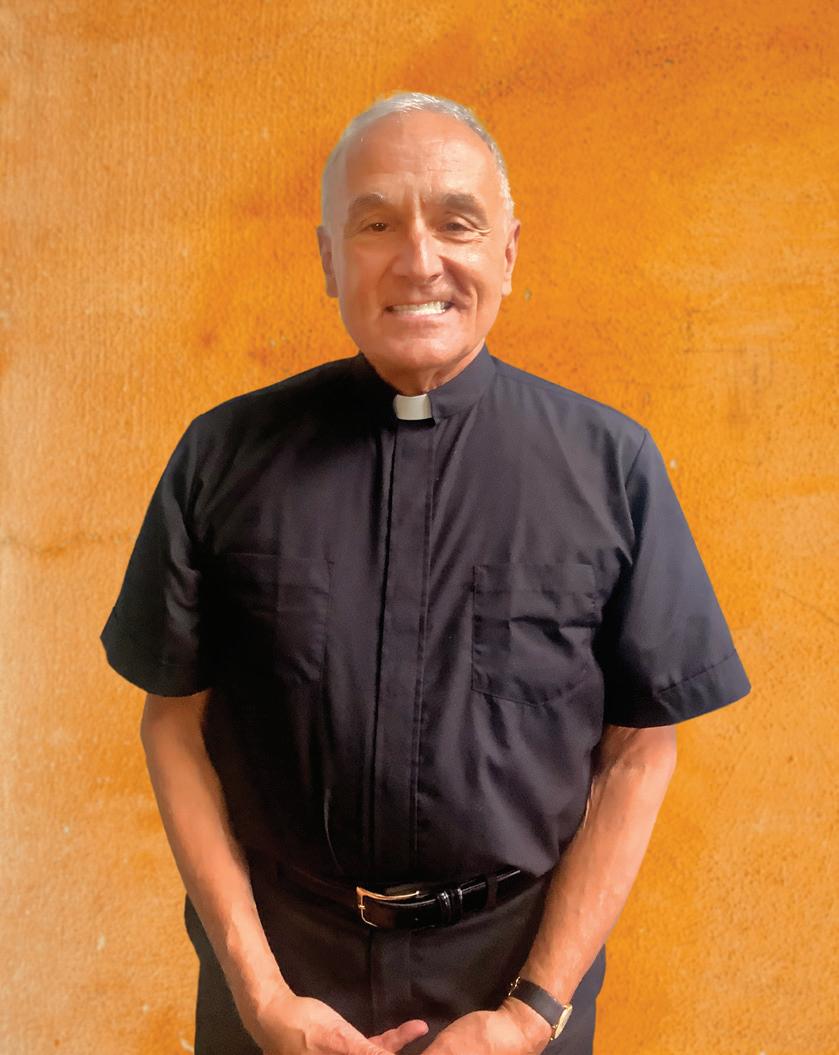
the quiet and routine.”
“Certainly the days of my ordination and first Mass were very special to me, but some of the day-today experiences have touched me greatly,” said Father Weezorak. “When my next-door neighbor asked me to be his Confirmation sponsor, I was touched. When a now-adult former student in our school came to me while on leave from the war in Iraq, fearful that he was losing his faith and trusting me with his innermost feelings, I was overwhelmed.”
Father Weezorak was born in March 1953 in Punxsutawney, Pa. He went on to earn a bachelor’s degree in business from Penn State University, and later a degree in philosophy from Wadhams Hall Seminary College, Ogdensburg, N.Y. He attended St. John Seminary, Boston, where he received a Master of Divinity degree. On May 3, 1986, he was ordained to the priesthood in the Cathedral of St. Mary, Ogdensburg, by Bishop Stanislaus Brzana.
After his ordination, Father Weezorak served a number of New York parishes before relocating to New Jersey to be closer to his parents. He was incardinated into the Diocese of Metuchen on Jan. 10, 1994, and served as parochial vicar in St. Cecelia Parish, Monmouth Junction, and Our Lady of Mount Virgin Parish, Middlesex. He went on to serve as parochial vicar, and later pastor, in St. Mary Parish, South Amboy, leading up to his retirement in 2023. His ministry also included military, hospital and first responder chaplaincy.
“In my active priesthood, I served in six different parishes. The last, of course, was almost 30 years at St. Mary’s in South Amboy,” said Father Weezorak. “Now in retirement, (I am) helping out at St. Mary’s in Barnegat and St. Mary of the Pines in Manahawkin. I sense a pattern!”
In his retirement, Father Weezorak has enjoyed traveling – including trips around the United States and to Australia, with plans to visit South America.
—By David Karas, Correspondent
Vatican unveils agenda for global family summit marking ‘Amoris Laetitia’ anniversary
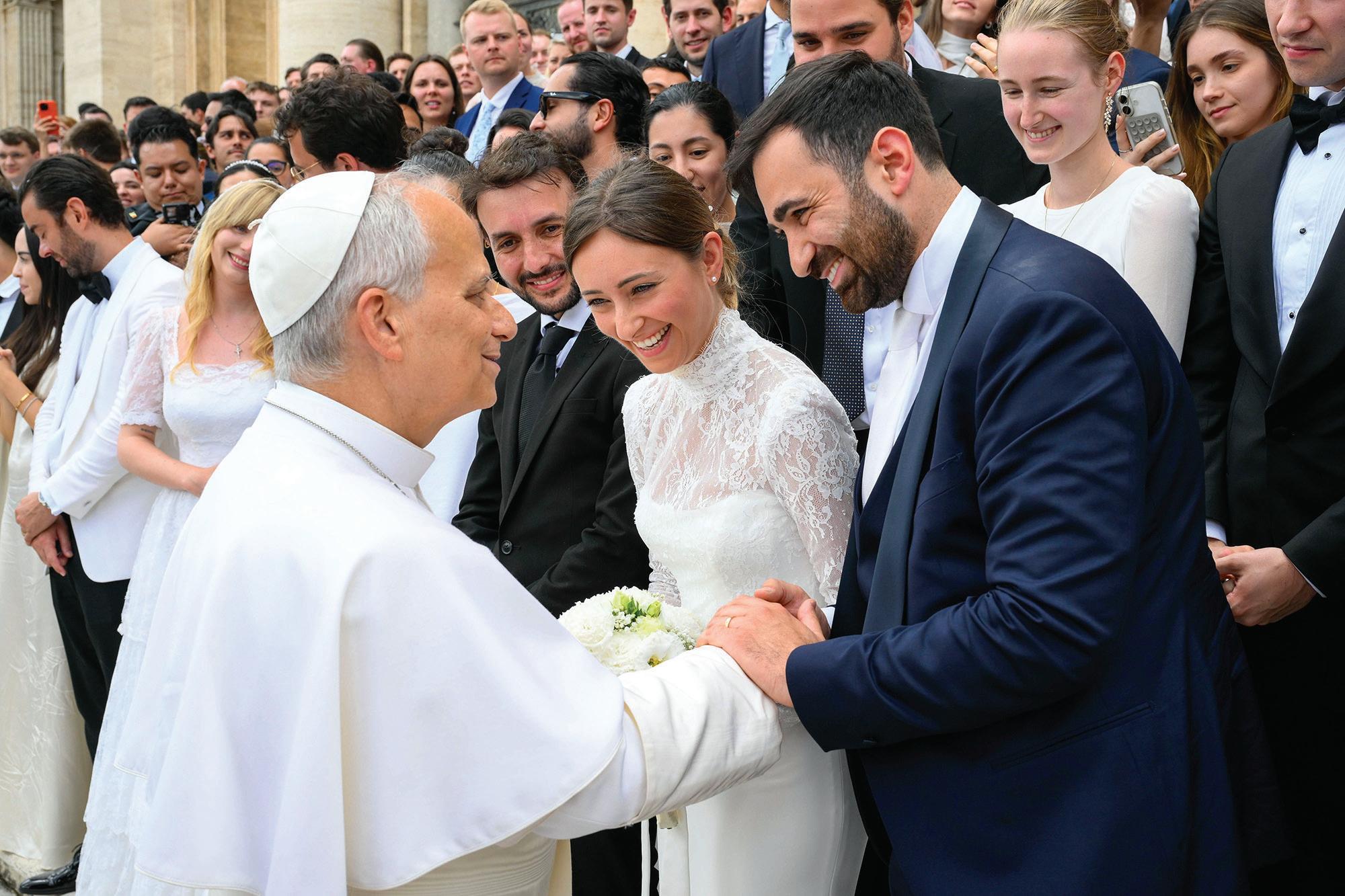
By Paulina Guzik, OSV News
The Vatican has released the framework for a fall meeting with the heads of Eastern Catholic Churches and presidents of bishops’ conferences, marking the 10th anniversary of “Amoris Laetitia” and focusing on the Church’s pastoral approach to families.
Pope Francis’ issued his post-synodal apostolic exhortation on the pastoral care of families. It was published after the 2014 and 2015 Synods on the Family.
The Oct. 7-14 gathering is intended “to proceed, in mutual listening, to a synodal discernment on the steps to be taken in order to proclaim the Gospel to families today,” not only in light of “Amoris Laetitia” but also “taking into account what is currently being done in the local Churches.”
The Vatican described the initiative as part of an ongoing process of “pastoral conversion,” emphasizing renewed evangelization rooted in lived experience.
Participants are expected to reflect on how families themselves contribute to the Church’s mission, not only as recipients of pastoral care but as active agents of evangelization. The framework – dated July 3 and released July 6 by the Vatican – said that families embody the Gospel in “daily relationships, choices, fragility and hope,” and calls for continued openness to renewal, asking for “the courage to persevere on this path,” while “always welcoming the Gospel anew in the joy of being able to proclaim it to all.”
The meeting will include listening sessions, the sharing of concrete pastoral experiences, and dialogue with experts. Its goal is to discern “the direction in which the Holy Spirit is leading us today,” while recognizing and supporting what is already being lived out in families and local Church communities. The themes
eral challenges connected to upbringing of young people in families.
One of them is what “language, experiences, and educational and spiritual pathways help children, adolescents and young people today to recognize the value of marriage?” with the other asking “What witness can couples and families offer?” and how can they contribute to “accompanying young people in their emotional, relational and sexual growth?”
Pope Leo XIV, traveling to Spain June 6-12, encouraged young people to not be afraid to marry.
After one of the young men on the stage mentioned he was a newlywed, Pope Leo went visibly off the cuff to urge young people to “not be afraid of marriage. Do not be afraid of forming a family!”
Married life. The first years of marriage: a decisive time
Listening to and accompanying couples “in the early years of married life and at every stage of life” is a third-day topic of the discussion – titled “Married life. The first years of marriage: a decisive time.”
couples and families who, at every stage of married life, encounter relational, social or spiritual difficulties, situations in which the Gospel is called to draw ever closer,” the July 6 release said.
“Failure, fragility, the gap between the ideal and reality, and the complexity of life situations also become places in which the work of God’s grace may be recognized and where persons can be accompanied with respect, patience and hope,” the Vatican said.
In this fourth day of the family summit designed around “Amoris Laetitia,” participants will be asking “What steps have been taken to support those living in situations of fragility or difficulty?” as well as “What forms of resistance continue to emerge?”
The discussion will also draw on the ways Christian communities can be built “in which those who have experienced suffering, abandonment, separation and divorce may truly feel listened to, involved and co-responsible.”
Christian families as subjects of the Church’s mission
are divided into five daily sessions by the organizers of the family summit.
Families today: reality, beauty and challenges
The first topic discussed will be “Families today: reality, beauty and challenges” – aimed at “discerning the signs of the times through the experience of families and the Church’s pastoral commitment today.”
This part aims at “attentive listening to the concrete lives of families and to the experience of those who accompany them, recognizing together both the beauty of love as it takes shape in daily life and the fragilities that often affect it.”
The Vatican listed “precarious employment and housing, illness, the challenges of raising children, emotional loneliness, and the care of family members with disabilities, the elderly, or those who are not self-sufficient,” as challenges that families face today.
Among questions asked during the session will be: “How do the transformations of our time affect the experience of love between man and woman, generation of life, care, the transmission of the faith, and the mission of the Church?”
Young people and the discovery of the vocation to marriage
The second day will be focused on the young people “and the discovery of the vocation to marriage” and is aimed at “listening to young people and accompanying them in discovering the value of marriage.”
“In many parts of the world, young people live in contexts in which confidence in the possibility of building a stable marital and family project has weakened due to economic, social and cultural factors,” the Vatican said, pointing out that the meeting will address sev-
“The experience of couples in the first years of married life calls for particular attention,” the Vatican said. “This is an especially important phase for strengthening the marital bond and facing together the changes that accompany the beginning of family life, such as the birth of children and the challenge of balancing family and work, while discovering ever new meanings of conjugal and family love.”
The Vatican noted in their preparatory note that “it is during these early years that many of the human and spiritual resources are cultivated that will help spouses navigate the different seasons of family life.”
Looking at this stage of marriage bears weight as according to Pew Research Center, four in 10 divorces occur in the first decade of marriage, with 16% of couples divorcing in the first four years, and 24% between the fifth and ninth year of marriage.
The Vatican announced that in that phase of the discussion, some of the questions asked will be: “What forms of accompaniment are most effective in supporting couples, particularly during the first years of married life?” as well as “How can spouses be helped to recognize and develop their relational, spiritual, generative and parental resources?”and “Which experiences demonstrate the fruitfulness of networks of families capable of supporting one another and, in turn, becoming a source of accompaniment and witness for others?”
In the difficulties of life:
accompanying and supporting
“Walking with families in complex situations” is the fourth stage of discussion, titled “In the difficulties of life: accompanying and supporting.”
“Particular attention is directed to
The last day of the discussions will be focused on “Christian families as subjects of the Church’s mission” and will discuss the theme of “Embracing conjugal and family love as an impetus for mission.”
“Spouses know well that one never ceases to learn the languages of love, day after day,” the Vatican said.
“Within Christian communities, couples have a distinctive way of responding to the common vocation to love. In a rapidly changing world, the contribution of families to the Church’s mission is more necessary than ever in fostering an ‘apprenticeship in enduring love,’ with the benefits this brings to personal, ecclesial and social life.”
The framework said that “Despite the challenges posed by the pace of contemporary life, families remain the primary setting in which the faith is handed on to new generations, therefore participants will ask “How can the experience of couples and families be valued as a place of human, spiritual, ecclesial and social growth?” and “How can the contribution of families to the Church’s evangelizing mission and to the pastoral conversion of Christian communities be recognized and supported?”
The Pope made the announcement about the meeting on the feast of St. Joseph, saying that he was convening the meeting “in light of the changes that continue to impact families … in an effort to proceed, in mutual listening, to a synodal discernment on the steps to be taken in order to proclaim the Gospel to families today, in light of Amoris Laetitia and taking into account what is currently being done in the local Churches.”
“I entrust this journey to the intercession of Saint Joseph, guardian of the Holy Family of Nazareth,” he added.
Paulina Guzik is international editor for OSV News. Follow her on X @ Guzik_Paulina
Pope Leo XIV greets newlywed couples who gathered in St. Peter’s Square at the Vatican to receive his blessing following the general audience on June 3, 2026.

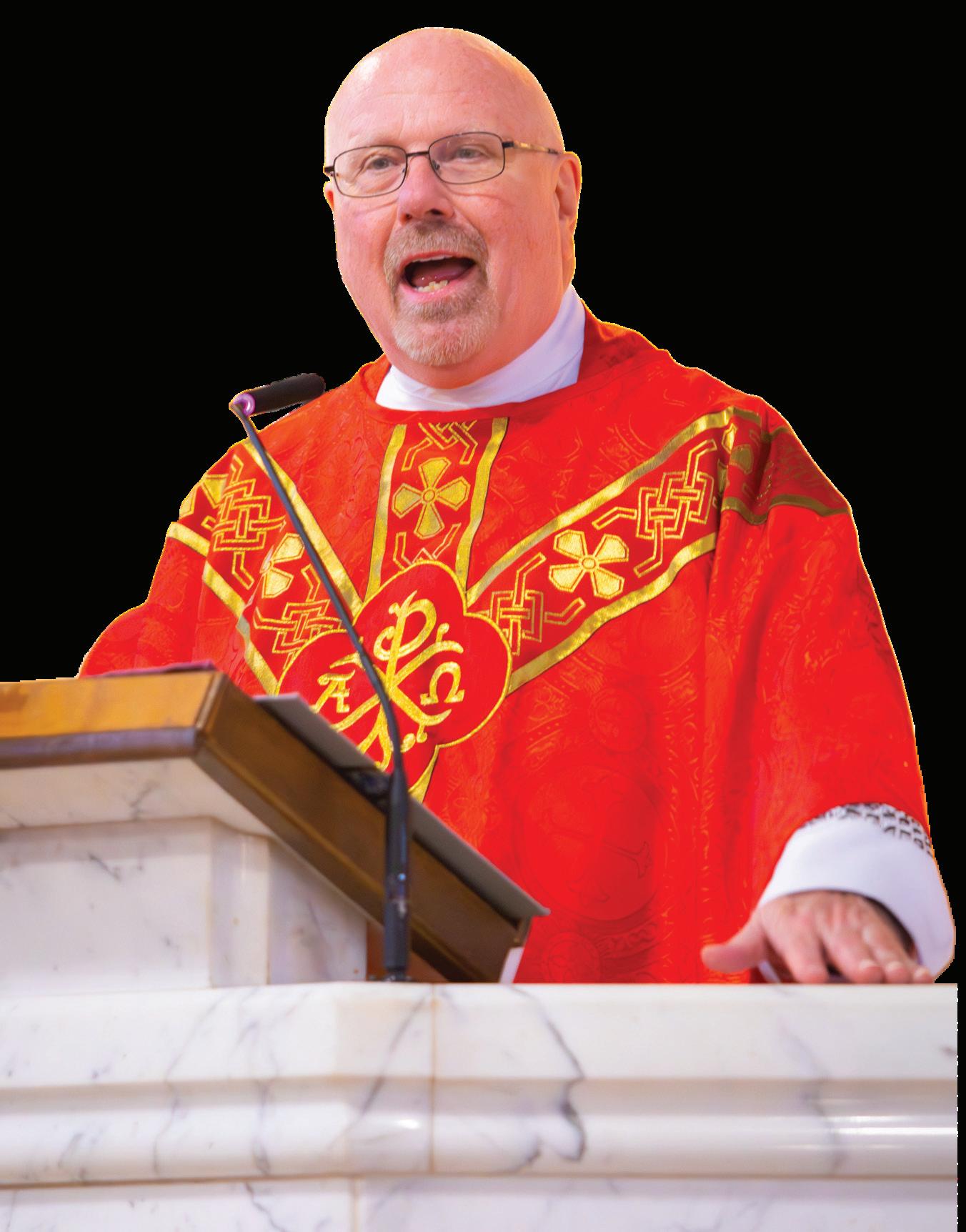
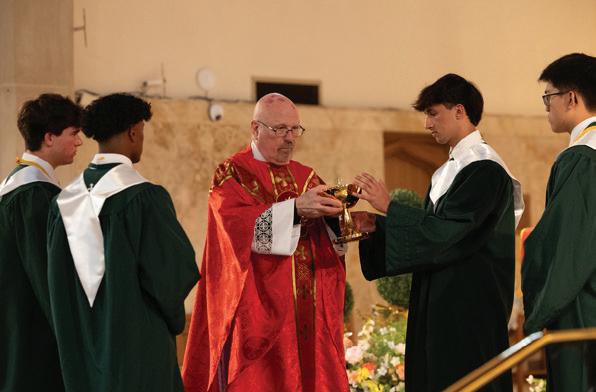
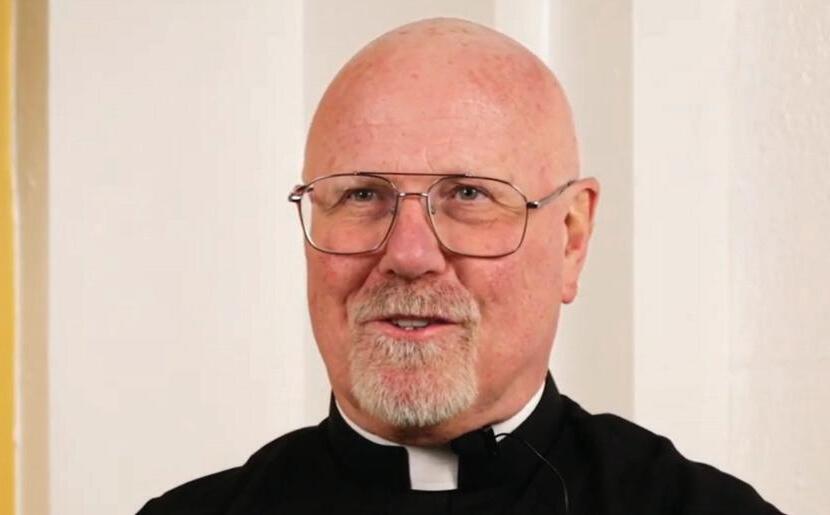
Fr. Jerome (Jay) Johnson
Congratulations on the 40th Anniversary of Your Priestly Ordination
May God continue to bless you always!
From a grateful staff and parish of St. Thomas the Apostle
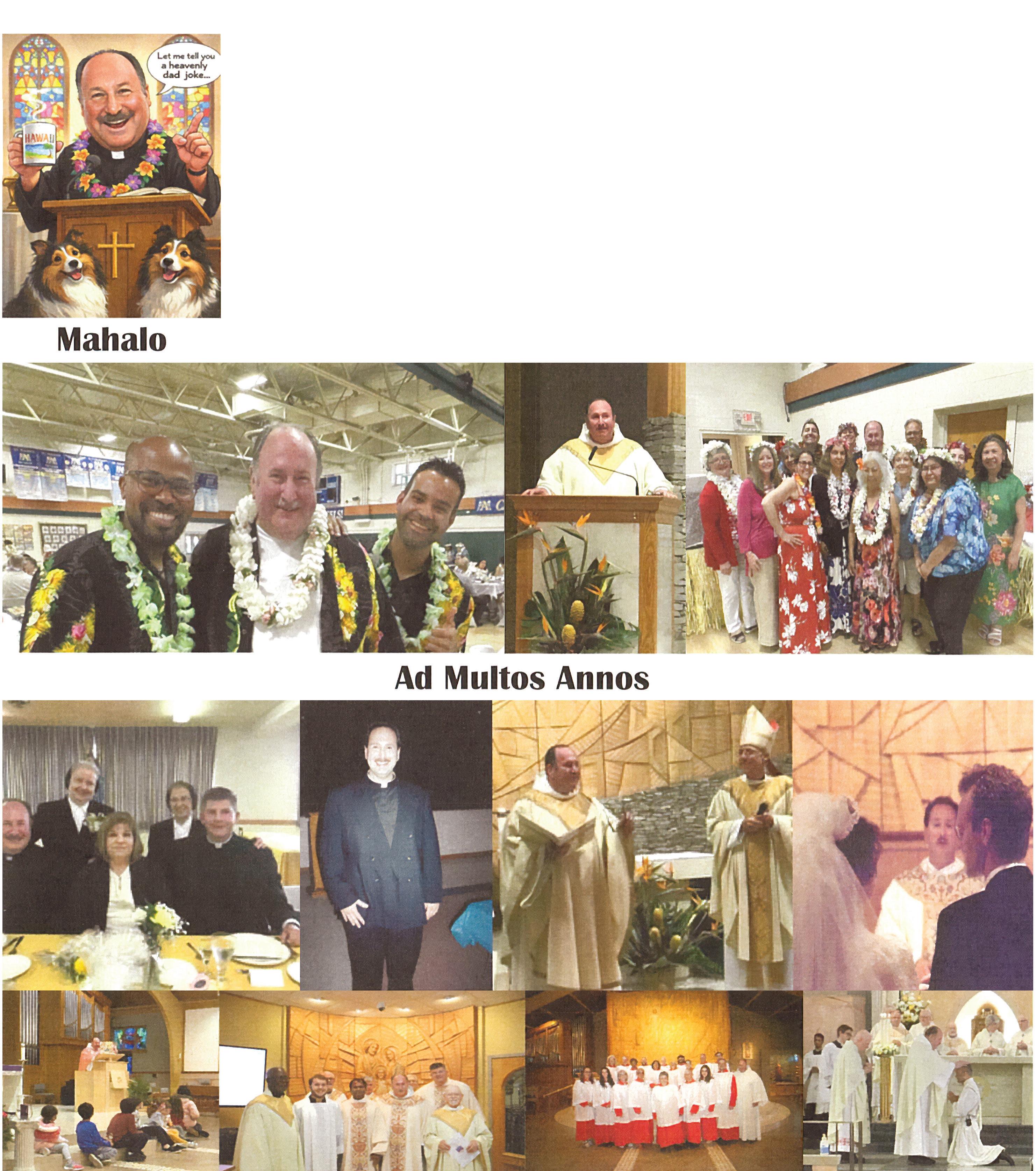
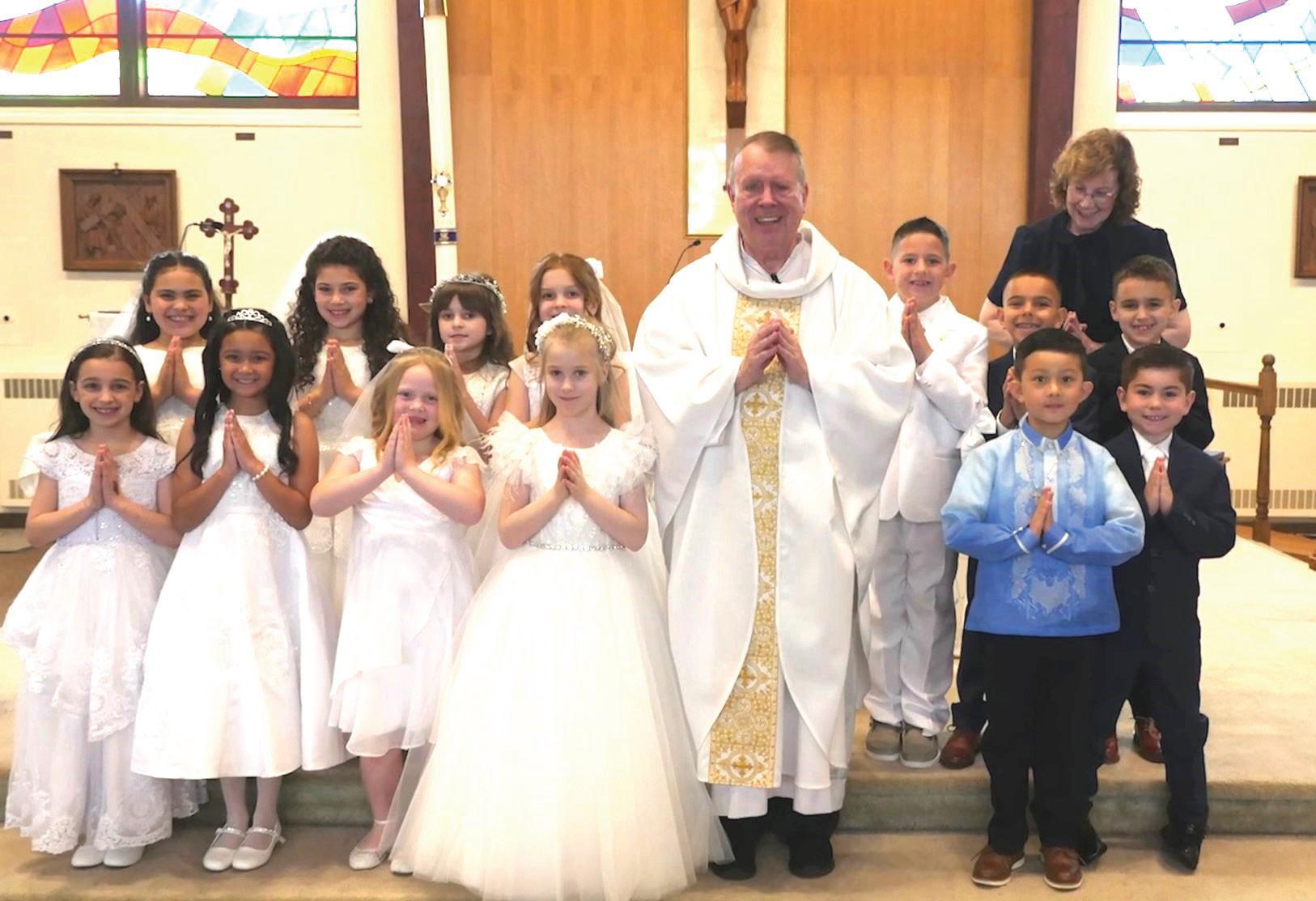
Reverend James W. Hagerman,
Forty years of leading with compassion, teaching with wisdom, and serving with humility. Your ministry is not just a calling - it is a legacy of love and service. We ask God’s continued blessings on you for all that you are and all that you do.
Congratulations on the 40th anniversary of your ordination!
From the Catholic Community of St. Bernadette Church
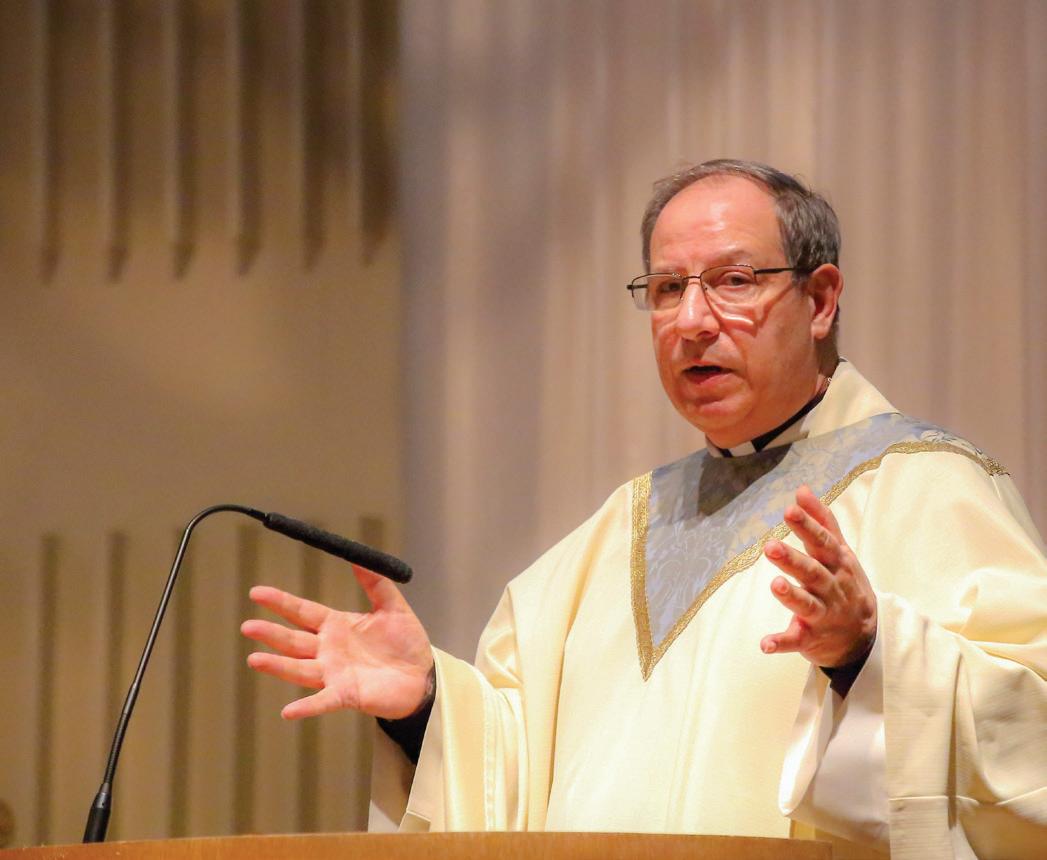
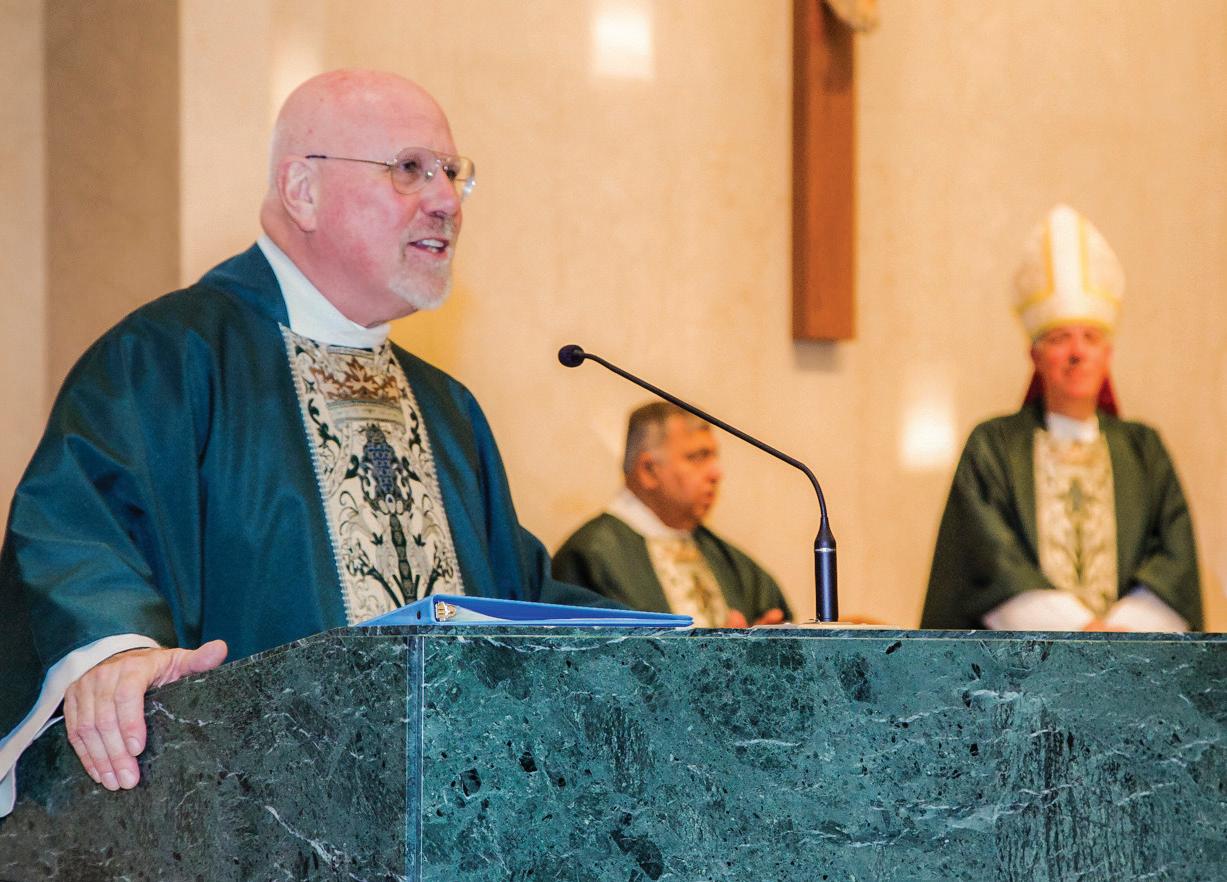
“Go therefore and make disciples of all nations, baptizing them in the name of the Father and of the Son and of the Holy Spirit, and teaching them to obey everything that I have commanded you. And remember, I am with you always, to the end of the age.”
-Matthew 28:19-20
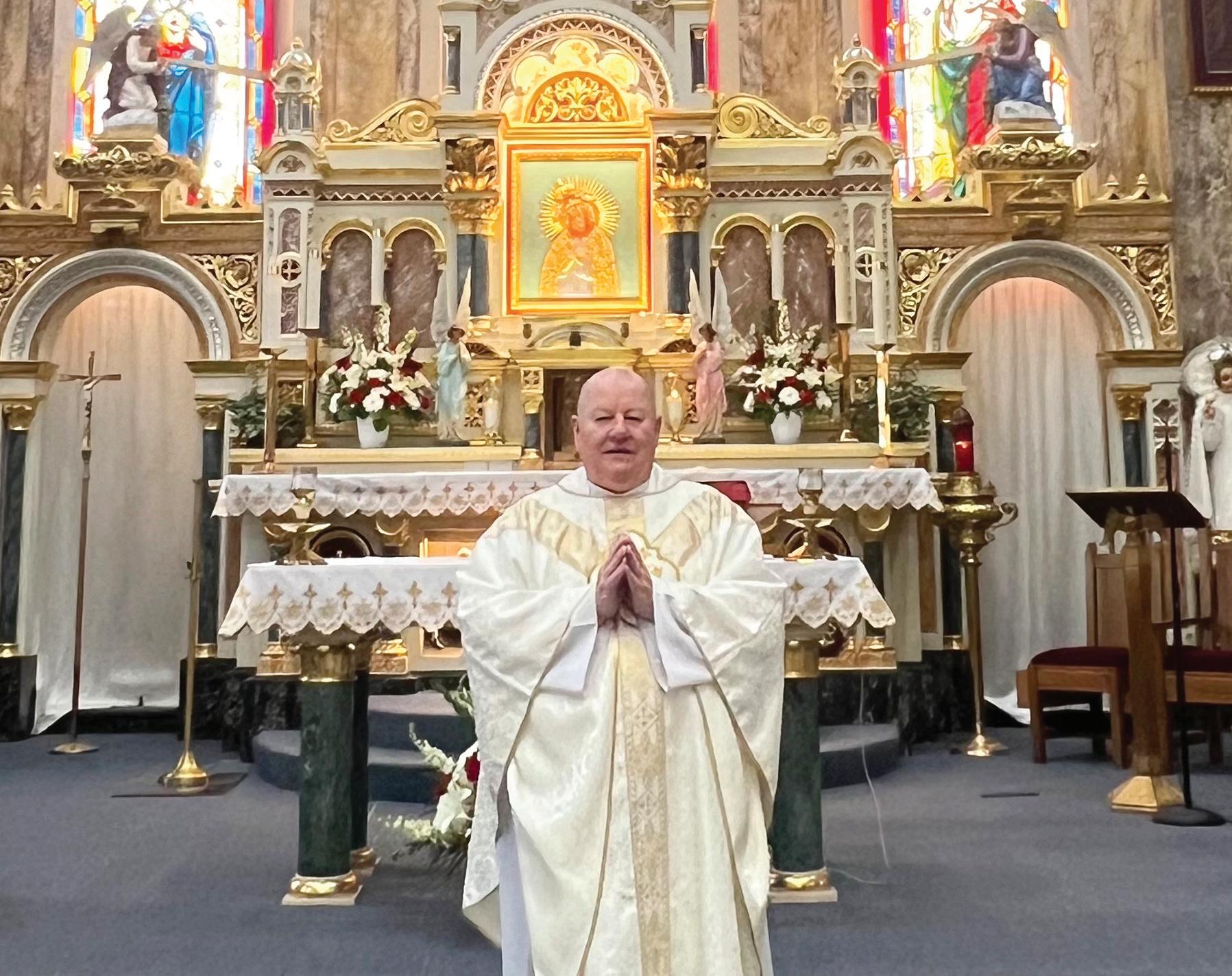
St. Mary of Ostrabrama parish family congratulates
Maryanne, Monica and the kids
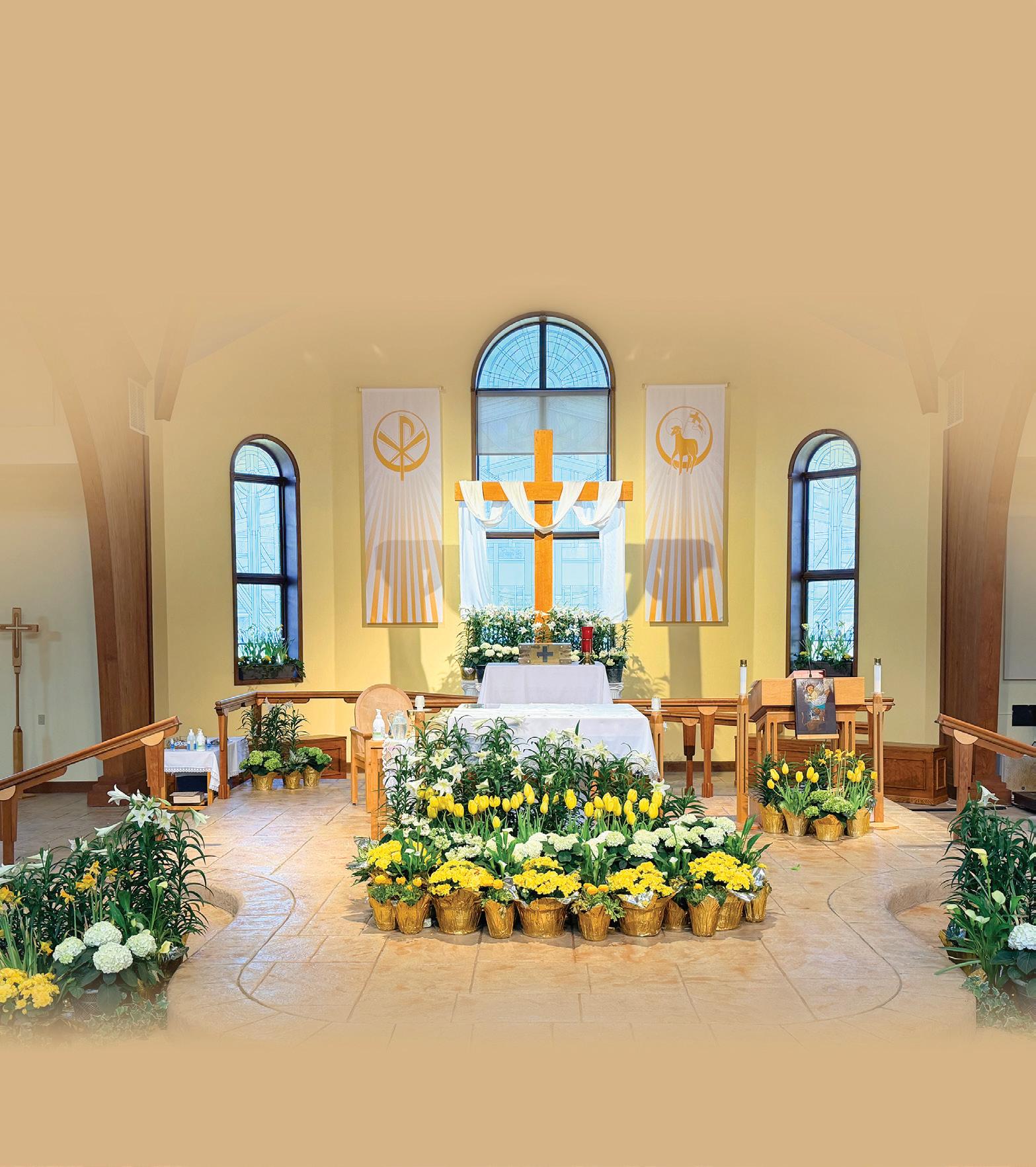
GOD BLESS BISHOP PAUL, NOW
Therefore, I, too, hearing of your faith in the Lord Jesus and of your love for all the holy ones, do not cease giving thanks for you, remembering you in my prayers. – Ephesians 1:15-16
A Mass for the installation of the Saint Juan Diego statue, Blessed by His Holiness Pope Leo XIV at the Vatican on June 17, 2026, will be celebrated August 15 at 5 p.m.. All are invited!
The statue will be placed in St. Augustine of Canterbury Church near the image of Our Lady of Guadalupe which was blessed by Cardinal Norberto Rivera Carrera, Archbishop of Mexico.
Saint Juan Diego, pray for us!
Our Lady of Guadalupe, pray for us!
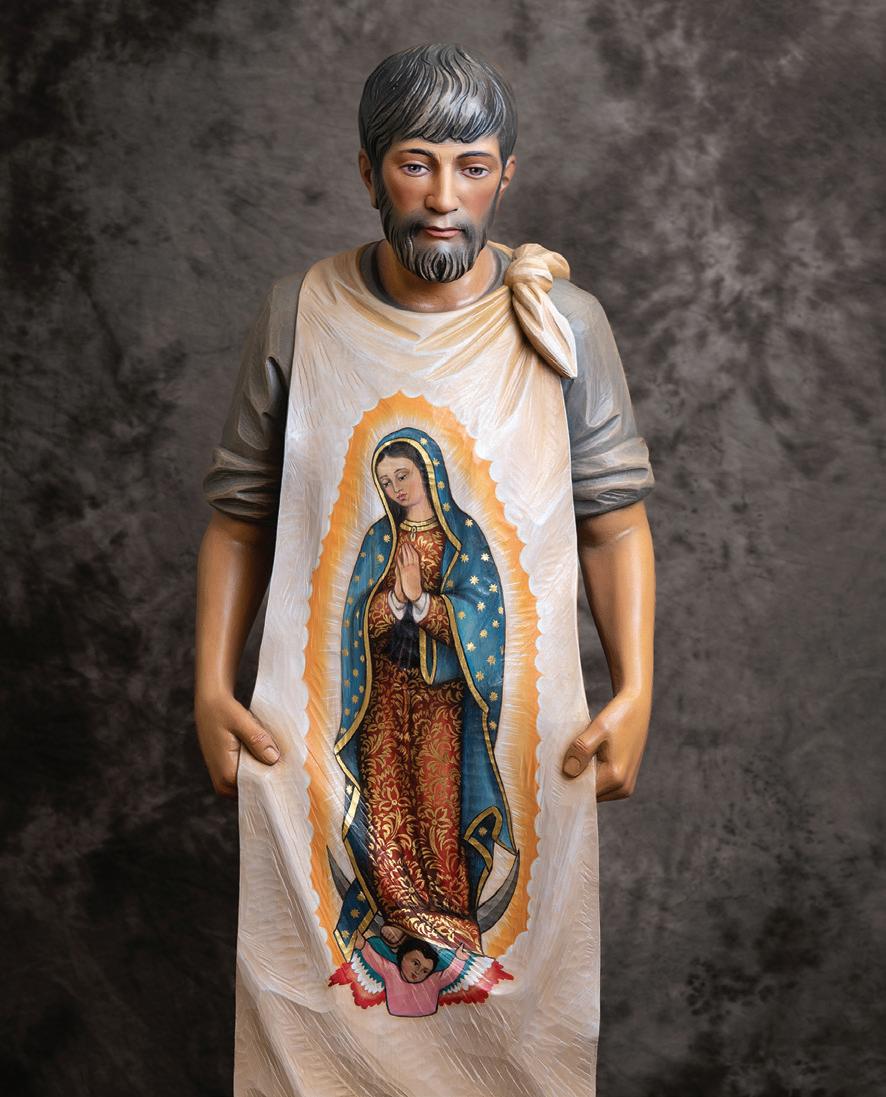
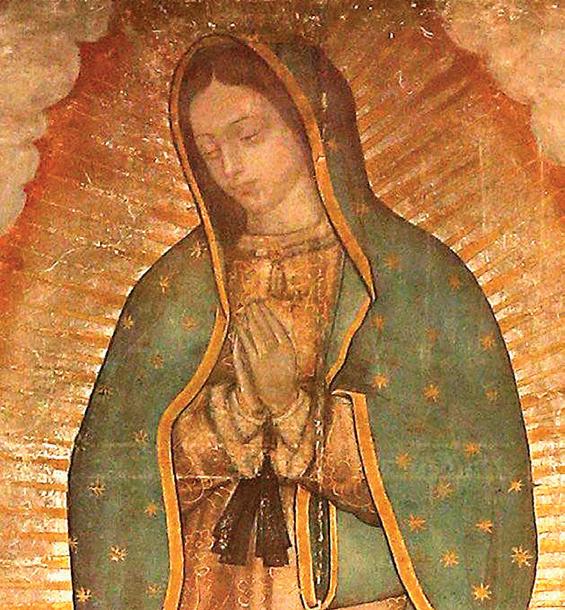
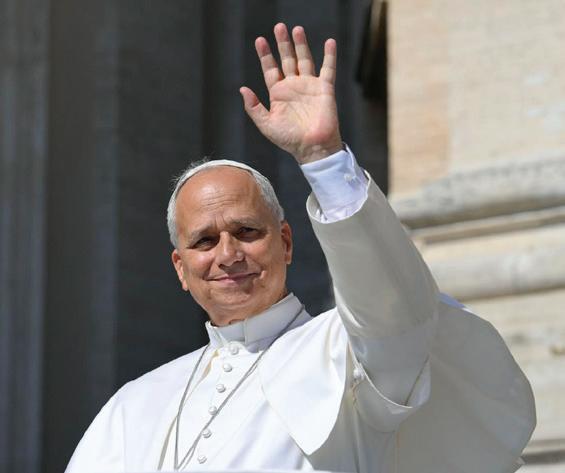
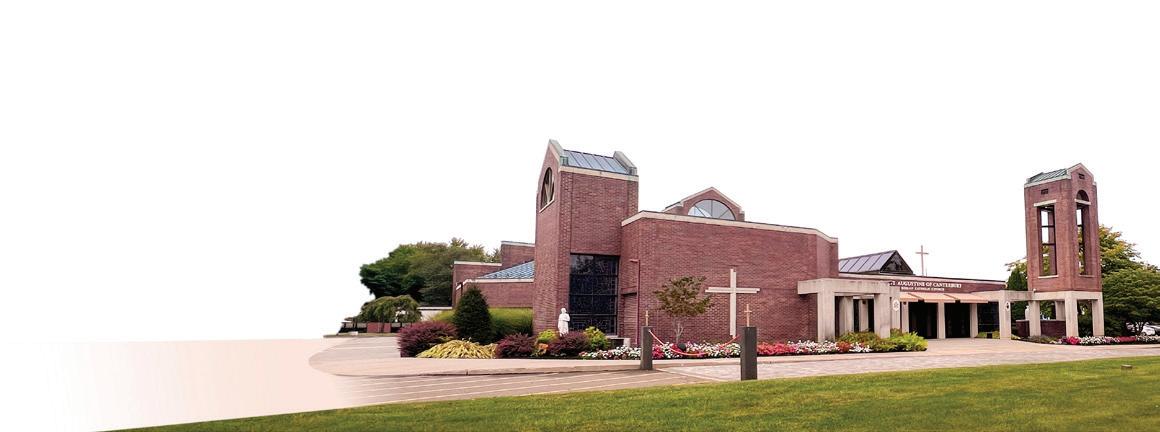
Congratulations, Father Alphonsus Kariuki, on your 40th Anniversary of Priesthood!
Today we rejoice with full hearts as we honor your 40 years of priestly ministry. For so long, you have poured out your life for God and for all of us–walking beside His people with gentleness, strength, and unwavering devotion.
Your priesthood has touched countless lives. In your preaching, your presence, your counsel, and your quiet acts of love, you have shown us the face of Christ. You have lifted burdens, offered hope, and reminded us again and again of God’s nearness.
May the Lord bless you abundantly for every “yes” you have given Him. May He fill your days with renewed joy, deep peace, and the strength to continue the beautiful mission He entrusted to you.
We are grateful for your service, your sacrifice, and your faithful love.
Congratulations on 40 years of priesthood.
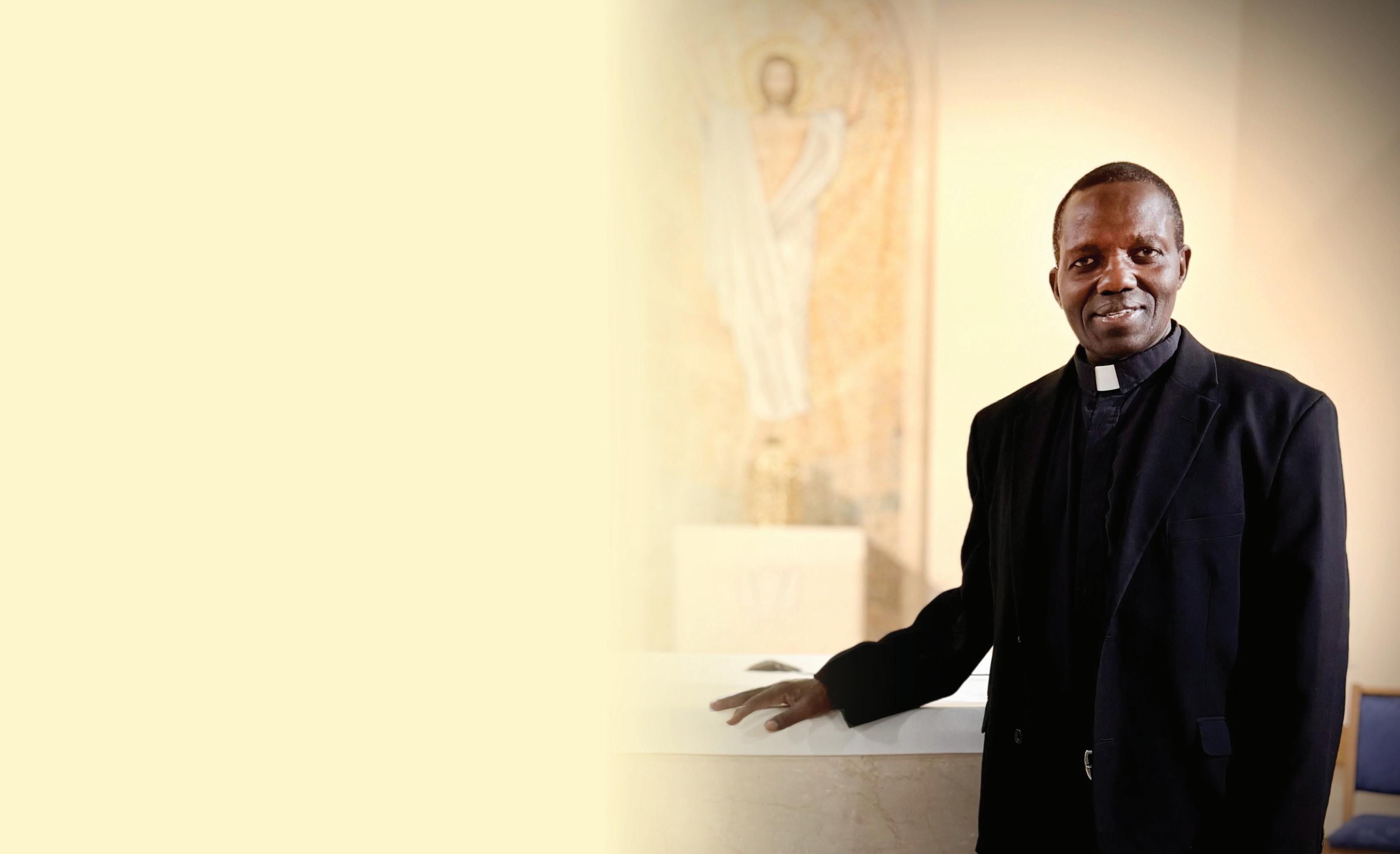

Father David, congratulations on your 40th anniversary to the Priesthood, we offer our heartfelt prayers for your well-being and continued success in your sacred calling. Your words of wisdom and acts of compassion have brought comfort to the weary and hope to the downtrodden. May God’s light always shine upon you, illuminating your path and empowering you to spread
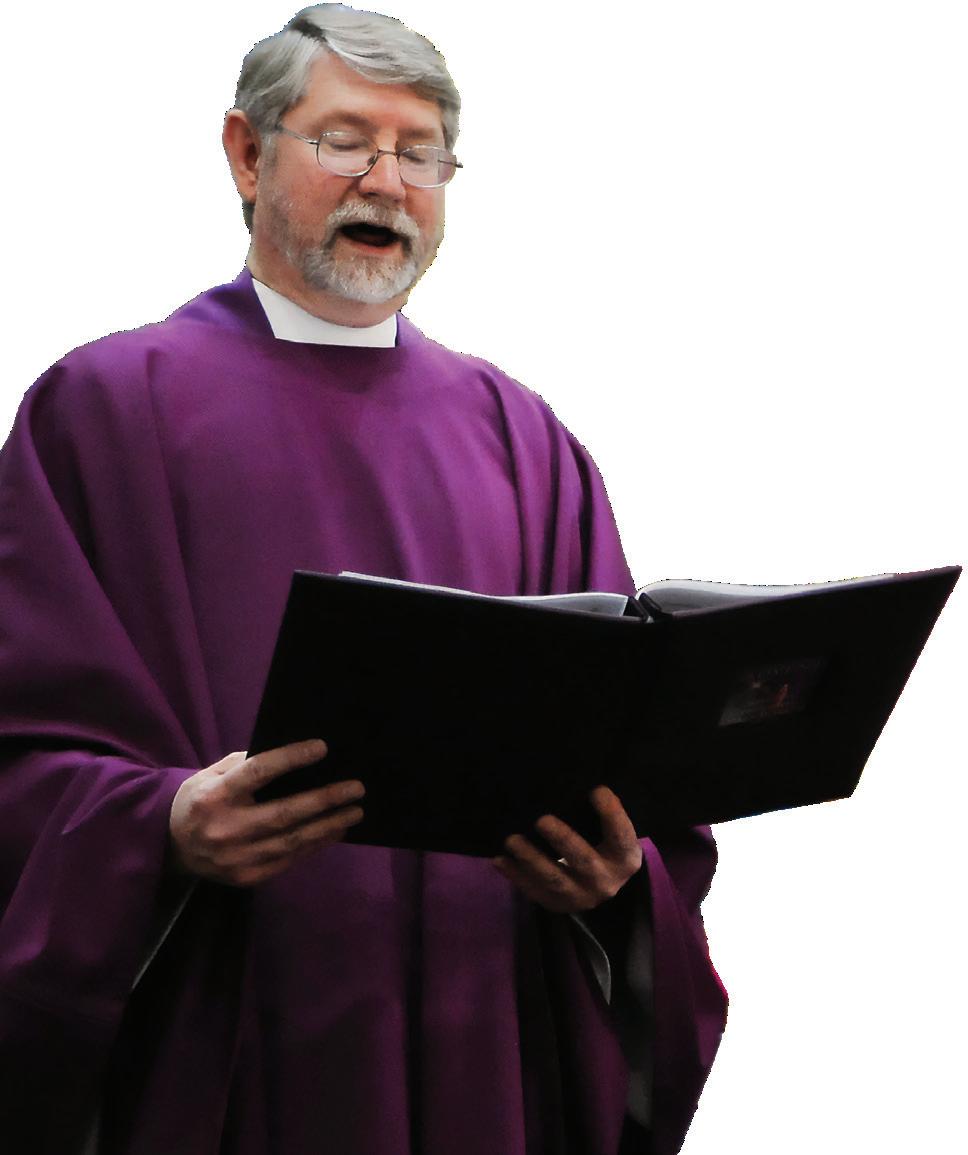
Women’s group nurtures faith with spiritual reading
Continues from page 21
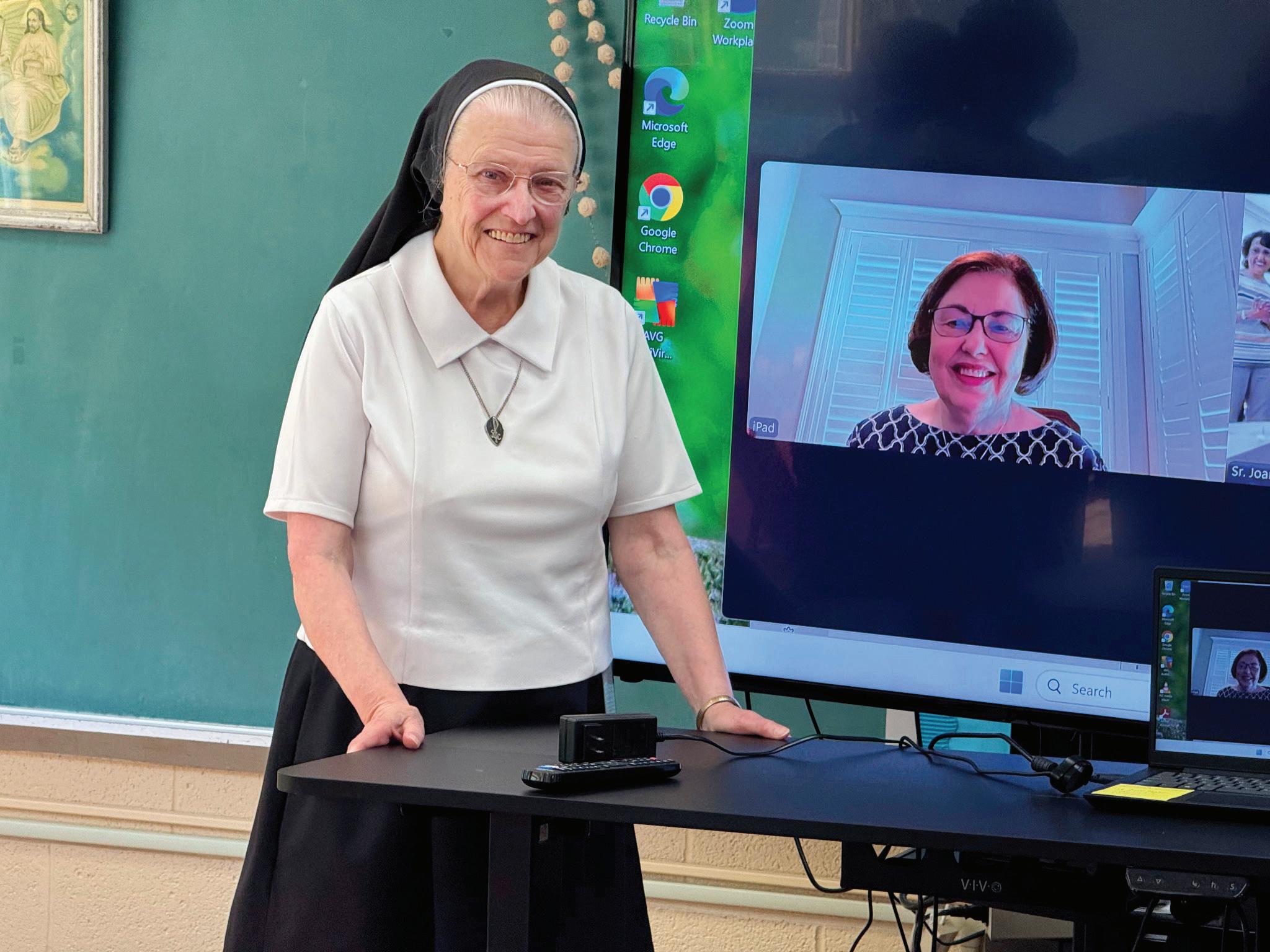
The group bade Sister Joanne a fond farewell in May as she was reassigned to her order’s motherhouse in Pennsylvania. Though the spiritual leader of the group may change, the lessons learned along the way will not.
some insights
Reverend Leo Salvania, all the Deacons and parishioners of the Church of the Assumption, Hackettstown, New Jersey.
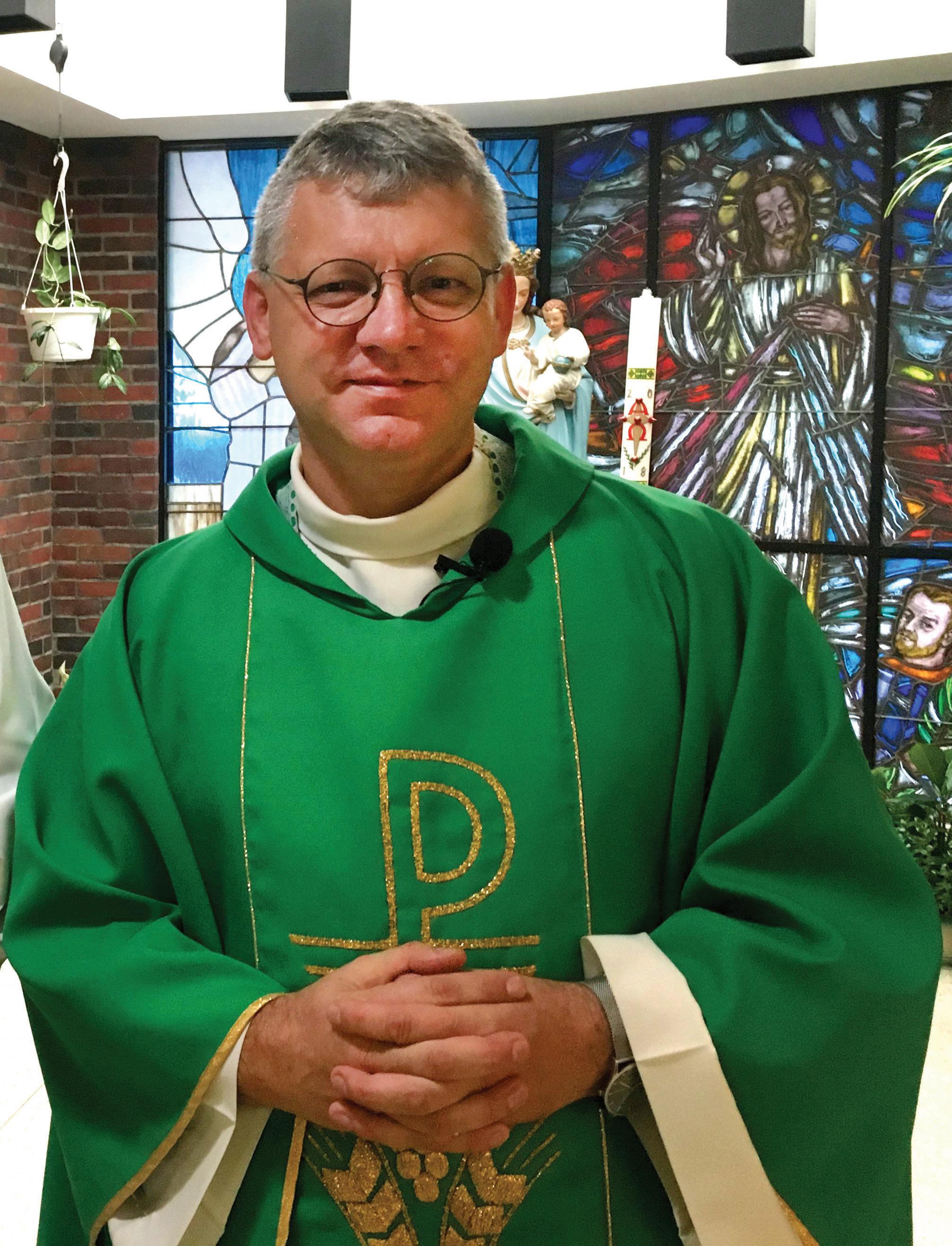
“We have grown spiritually and intellectually under her guidance,” said Joanne Howe. “She is hands-on, filled with joy, and a hard act to follow.”
Sister Joanne admitted, “It might sound trite for me to say this, but I got
more out of this [group] than they did. I am in awe, at the end of the day, how they pray and that their questions made me think more deeply about it and travel the road together.” Her message for the women of the group and her eventual successor as group leader is, “Keep deepening their relationship with Jesus through reading.”
Other parishes in the Metuchen Diocese offer spiritual book clubs; see your parish’s bulletin or website for details.
On behalf of the Parish of Saints Peter and Paul, we extend our heartfelt congratulations and prayerful best wishes to Father Grzegorz Podsiadlo, SDS, on the Silver Jubilee of his Priestly Ordination. Thank you for your dedicated ministry and spiritual leadership. May God continue to bless you.
“You are a priest forever according to the order of Melchizedek.” Psalm 110:4
Sister of Christian Charity Joanne Bednar shares
with the Spiritual Book Club at St. Elizabeth-St. Bridgid Parish, including Sandy Grantham, who joins by Zoom from Louisiana.
—Courtesy photo
Following two earthquakes, thousands are dead and injured, as Venezuala
struggles
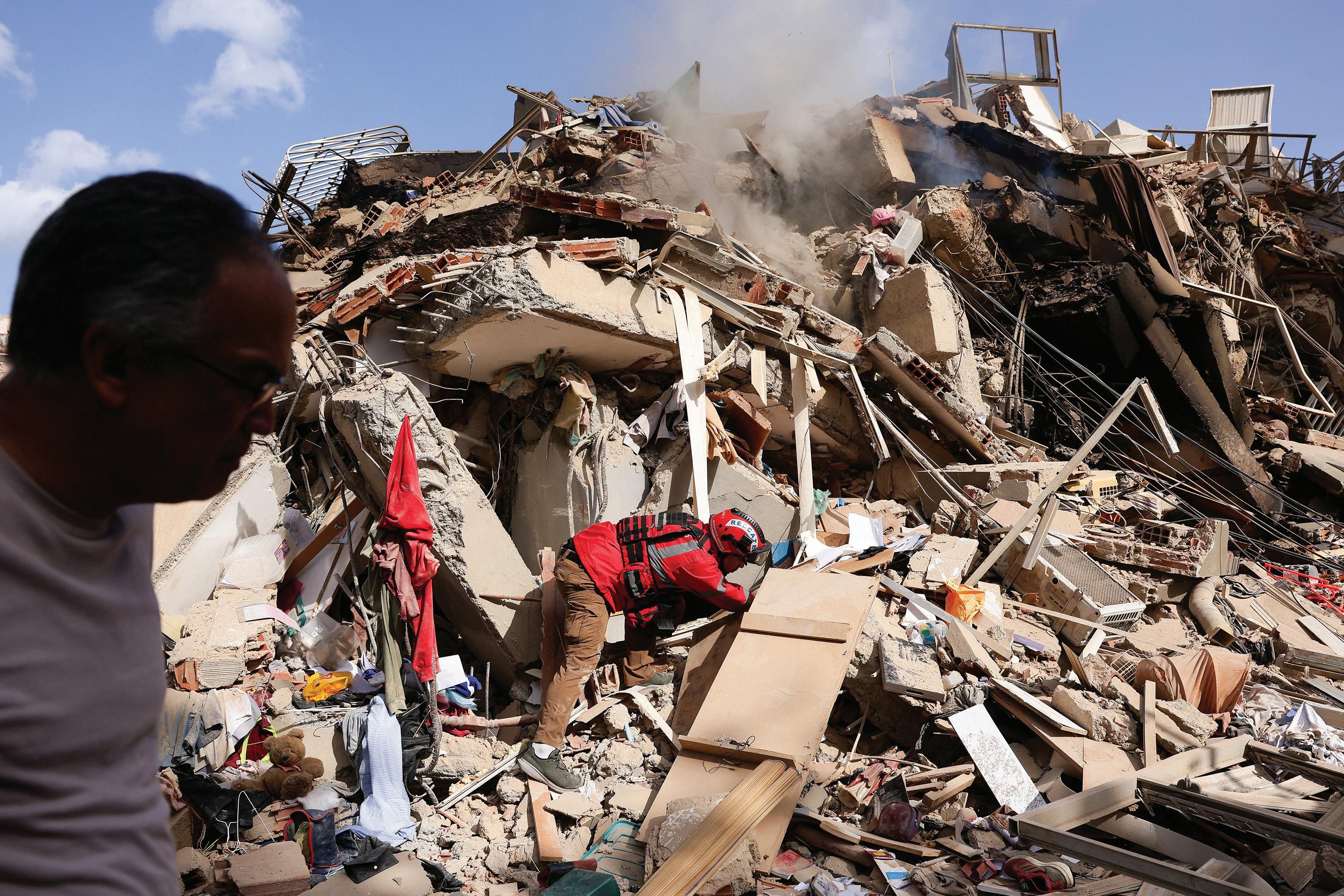
Catholic Relief Services (CRS) is the humanitarian aid agency of the U.S. Catholic community, established by the U.S. Conference of Catholic Bishops (USCCB). In the wake of disasters following two powerful earthquakes that struck northern Venezuela on June 24, leaving more than 3,800 people dead, 16,740 injured and nearly 18,000 homeless, Catholic Relief Services is responding in partnership with Caritas Venezuela. CRS is the humanitarian aid agency of the U.S. Catholic community, established by the U.S. Conference of Catholic Bishops. Together, they are addressing the
most urgent priorities identified on the ground: emergency shelter and essential household items; food assistance; safe water; sanitation and hygiene; emergency healthcare and trauma care; mental health and emotional support; and protection for vulnerable populations – especially children, the elderly, and people with disabilities. Their collaboration with Caritas Venezuela leverages a network of parishes, leaders, health centers, and community organizations, enabling them to establish a presence in both urban and rural areas where aid coverage is often limited.
As Catholics, we stand in solidarity
Hope Through Education gives underserved youth the gift of a values-based education
On June 25, 2026 Hope Through Education hosted their Sporting Clays Classic at Hudson Farm in Andover, NJ. Hope Through Education is an independent 501(c)(3) organization that provides disadvantaged children in Central New Jersey with scholarships to attend quality, values-based schools.
The lovely summer afternoon featured a sporting clays shoot across Hudson Farm’s renowned course, followed by a luncheon and bourbon tasting. The chair of the event was Mr. James Williamson, whose leadership helped make the outing a tremendous success. Guests were welcomed with opening remarks from Jesse Watters, host of “The Five” and “Jesse Watters Primetime.” The highlight of the afternoon was a heartfelt testimonial from a Hope student, who shared the life-changing impact of the organization’s support. For more information visit www.hopethrougheducationusa.org or contact: info@hopethrougheducationusa.org
Global Emergency Update
CRS and Caritas Venezuela Respond to Twin Earthquakes
with the people of Venezuela through prayer – for them and for all the volunteers, health workers, and rescue personnel – as well as through our donations. Every gift is a blessing to a people who must now contend with this disaster on a deepest economic and social crisis they have been facing since 2015.
To learn more about CRS’s work in Venezuela, please visit https://www.crs. org/where-we-work/latin-america-caribbean/venezuela#section-crisis-in-venezuela and consider donating.
Above, a child receives emergency medical attention in a location given as Caracas, Venezuela, after being rescued by a Jordanian team from under rubble. —OSV News photo/Jordan Public Security handout via Reuters
Context
Left, Juan Carlos Gomez, a firefighter from Caracas, looks for his sister, Katiuska Hernandez, and nephew Brett Roude, amid the rubble of a building in La Guaira, Venezuela, June 25, 2026, following 7.2 and 7.5 magnitude earthquakes that rocked the country June 24. Rescuers from around the world have arrived in the country to assist in rescue efforts. OSV News photo/Maxwell Briceno, Reuters
On June 24, 2026, two powerful earthquakes struck northern Venezuela just seconds apart, causing widespread destruction across Caracas and surrounding states. The twin earthquakes—the strongest to strike the South American country in decades—flattened buildings, damaged roads and left families searching for safety. Within the first 12 hours, more than 160 deaths were reported, nearly 1,000 people were injured, and thousands of families were displaced. These numbers are sure to rise as the full extent of the damage becomes clearer. As aftershocks continued, the president
How to Help
Donate online: crs.org/donate/ venezuela-earthquake
Donate by scanning the QR code:
Donate by phone: 1-877-HELP-CRS

Donate by check: CRS/Venezuela Earthquakes P.O. Box 5278, Tipton, IA 52772-0517
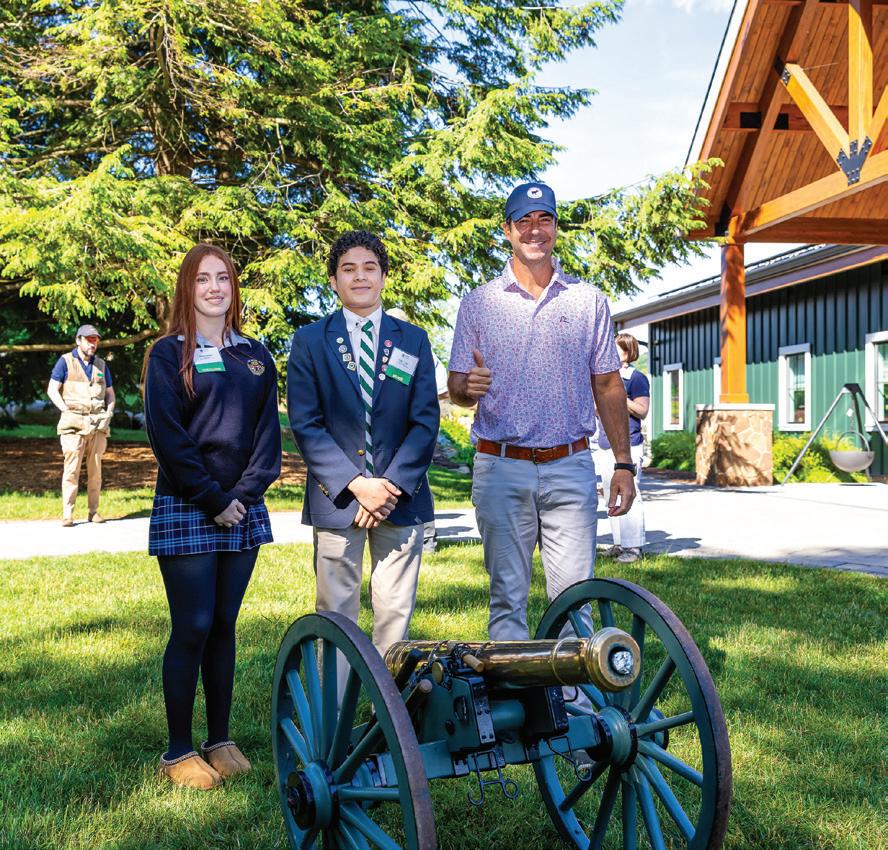
Students Bailey Carfagno and Justin Trivino are joined by Jesse Watters, a prominent American television host and political commentator on the Fox News Channel, for the 2026 Hope Through Education Sporting Clays Classic at Hudson Farm, Andover.
—Courtesy photo
declared a state essential services airport was temporarily heavy damage.
As search and rescue parishes in Venezuela shelter displaced assistance. Through with Caritas Venezuela, assessments and humanitarian workers for people who have sense of security.
The earthquakes needs in a country region’s worst humanitarian 7.9 million people assistance due to insecurity and weakened
SCRIPTURE SEARCH®
Gospel for July 26, 2026
Matthew 13:44-52
Following is a word search based on the Gospel reading for the Seventeenth Sunday in Ordinary Time, Cycle A: parables about the treasure of heaven. Words can be found in all directions.
THE KINGDOM HEAVEN TREASURE FIELD SELLS BUYS MERCHANT PEARLS GREAT FISH EVERY KIND ASHORE THE END OF THE AGE ANGELS SEPARATE THROW THEM FURNACE TEETH SCRIBE HOUSEHOLD
HARVESTS
J O T H E K I N G D O M
O A T R E A S U R E E E
F N S
T
H
E
A
G N F D T A H B S H I H
E O G A H C H O I D N T
C H E E O E D R F R D P
F R S E L L S Y U B C V
G G H O U S E H O L D S © 2026 TRI-C-A Publications; tri-c-a-publications.com
August
For Evangelization In The City
Let us pray that in large cities, often marked by anonymity and loneliness, we find new ways to proclaim the Gospel, discovering creative paths to build community. Pope’s Monthly Prayer Intentions
Senior Care at Home
Senior Care at Home is the lower cost alternative to nursing homes or assisted living. Family Care Placement, LLC, provides live-in caregivers allowing them the comfort of their own home. We specialize in placing FILIPINO caregivers. All candidates are fluent in English with excellent References. For our personalized placement services, call Karen at 908-377-9375
‘The true follower of Jesus cannot seek the Kingdom half-heartedly’
“In the end, true wisdom depends not upon how much we know, but on how well we use our knowledge to build up God’s Kingdom.”
17th
Sunday in Ordinary Time (A)
For the third Sunday in a row, the Gospel reading is chosen from the thirteenth chapter of St. Matthew’s Gospel. In this particular text, St. Matthew presents the last three of seven parables Jesus told describing the Kingdom of God. Both structurally and thematically, this chapter stands at the very heart of Matthew’s Gospel – the Kingdom of God is the focus of everything.
In the first parable, Jesus likens the Kingdom to a man who found a hidden treasure buried in a field. He rejoices at his find, hides the treasure, and then goes off and immediately tries to buy the property. Apparently, this was something of a common event in the ancient world. When threatened by one of the many invasions that swept through the area, householders would bury their material treasures, hoping that they would be left untouched by the invaders.
Even if the invaders remained on the land, the hope was that the householder could secretly return and dig up the treasure without the new occupant discovering him. Of course, many times the original owner failed to return, and so these little treasures were frequently being discovered by lucky farmers plowing their fields. Jesus uses this parable to emphasize the zeal with which his disciples ought to seek after the Kingdom; just as the lucky finder joyfully and zealously tried to make the treasure his own, so ought the faithful disciple do with regard to embracing the Kingdom of God. The true follower of Jesus cannot seek the Kingdom half-heartedly.
In the second parable, Jesus compares the Kingdom to a merchant’s search for really fine pearls. When he happens upon a single pearl of great value, he gladly sells all his inferior goods in order to purchase that which is truly valuable. In this parable, Jesus is emphasizing the sacrifice and self-denial that must often characterize those who seek the Kingdom. The follower of Jesus must
be ready and willing to put everything else aside in order to seek that which is of eternal, inestimable value – namely, the salvation which awaits in the Kingdom of God. Nothing can be allowed to hinder or delay the coming fullness of God’s dynamic Lordship over all; total commitment is demanded.
In the final parable of this chapter, Jesus compares the Kingdom to a large dragnet which is cast into the sea, gathering up all sorts of both valuable and worthless objects. While those in charge of the net dragged the entire catch to the shore, once there they began to separate what was valuable from what was useless. The unwanted refuse was then thrown away, while that material deemed valuable was gathered together and kept by the net-minders.
This parable is similar to last Sunday’s parable of the wheat and the tares. Both are allowed to grow together for a time, but eventually the day will come when the two will be separated and the worthless material destroyed. The point Jesus is making to his disciples is, of course, that Jesus’ company on this earth is made up of both saints and sinners, those who are seeking after the Kingdom and those who are looking in other directions. Both groups will continue to exist for a while, but Jesus warns that the day will arrive when those who have turned away from him will be cast out of the fullness of God’s glory to their everlasting regret.
St. Matthew concludes this important chapter with Jesus asking the crowd whether they understand what he is saying. When they respond that they do, Jesus then remarks that this true understanding will be demonstrated when they show that they can apply the lessons of these parables to the situations of their lives. Jesus tells them that those who are truly learned in the Kingdom of God are those who can apply the message of the Old Testament together with the lessons he teaches so as to appreciate the Gospel as the highest fulfillment of the Law and the Prophets, the Law and the Prophets understood as the preparation and foundation for the Gospel. In the end, true wisdom depends not upon how much we know, but on how well we use our knowledge to build up God’s Kingdom.
Msgr. John N. Fell serves as diocesan director of Priest Personnel.
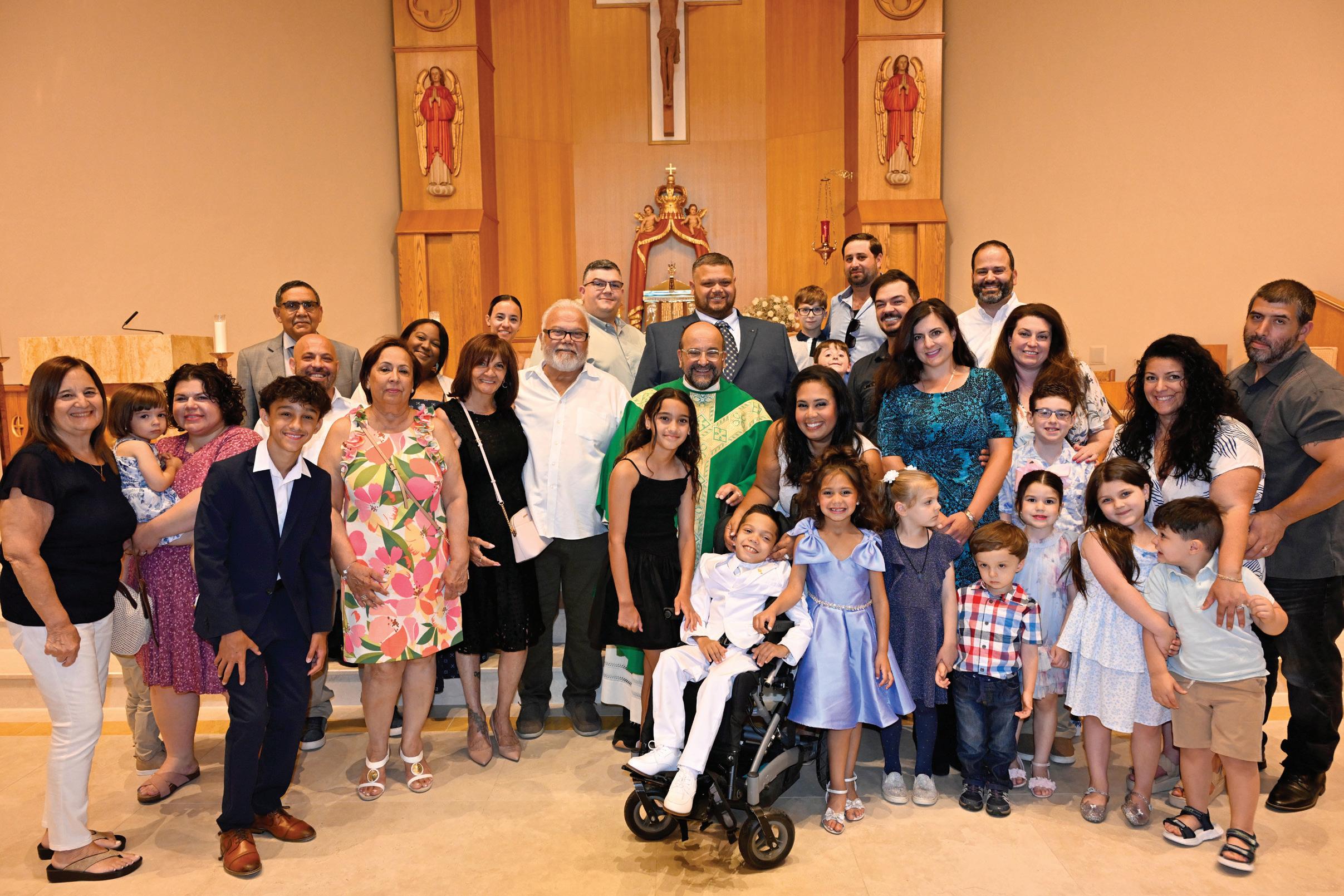
Sunday, June 14, was a special day for St. Helena Parish, Edison, when it hosted seven Catholic families from Lakeview School, a nationally recognized specialized facility operated by the New Jersey Institute for Disabilities serving children and young adults with multiple disabilities.
On this day, seven children with varying needs and challenges received the Sacraments that they needed: four were Baptized, and five received First Communion. The experience, shared with family, friends and a parish community, was one of joy and gratitude best expressed by parents and family members:
“Today was a day that so many of us special needs parents never thought we
An Extra Special Day of Sacraments
would see, and we are overwhelmed with gratitude to St. Helena’s Church.”
“Our children come from different journeys. Some were baptized as infants, while others were able to receive the Sacrament of Baptism alongside their classmates during this special celebration, having missed the opportunity during the pandemic. Seeing all of our children come together to receive these important sacraments was truly a blessing.”
“As parents of children with special needs, there are often moments when we wonder if our children will be able to participate in certain milestones in the same way as their peers. That is why this ceremony meant so much to all of us. It was
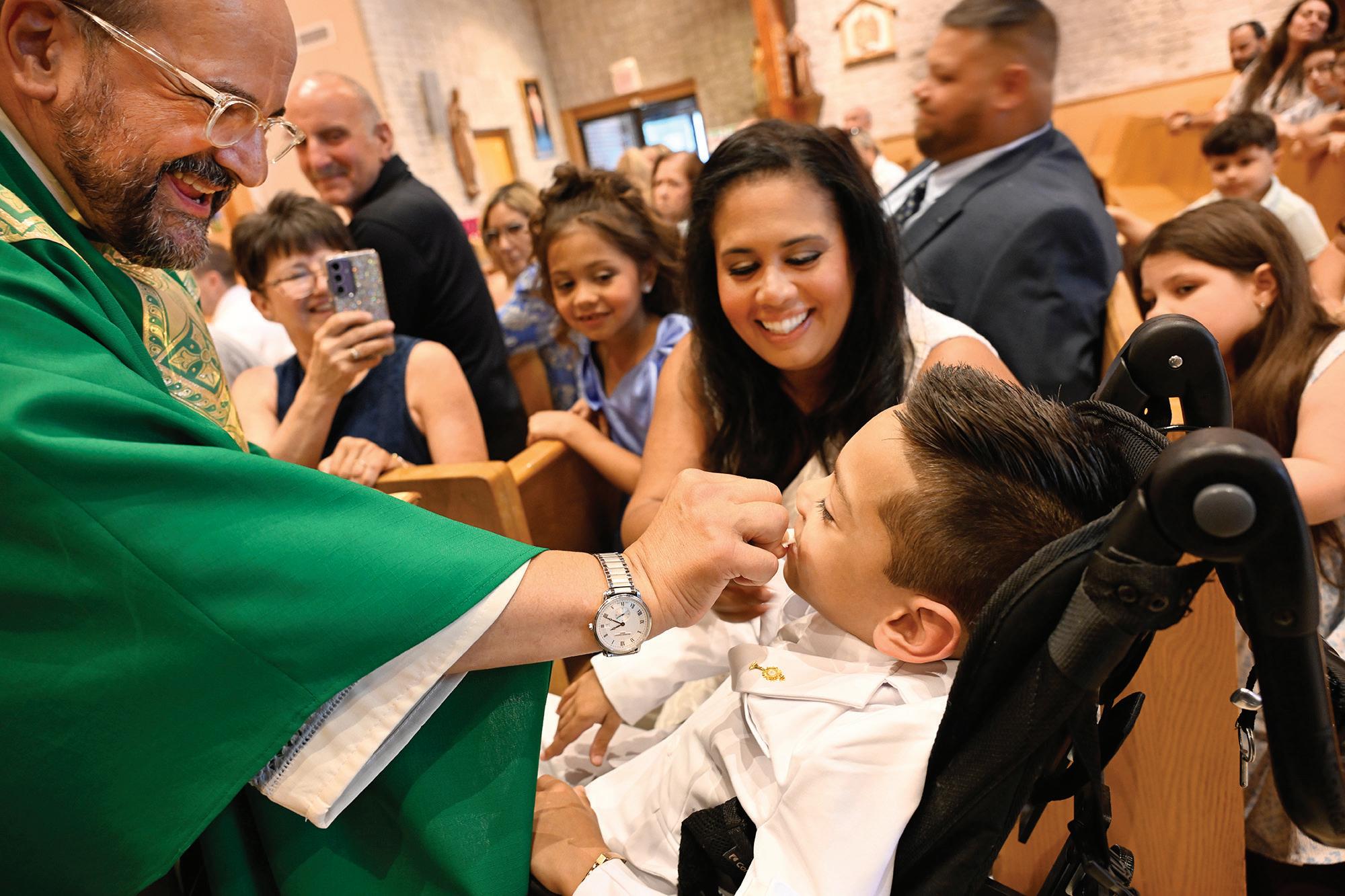
more than a just the reception of a sacrament – it was a reminder that our children are seen, valued, welcomed, and loved.”
“A special thank you to Father Anthony Sirianni for his kindness, compassion, and for helping make this day possible. His support and belief in our children meant so much to our families and helped create a celebration that we will never forget.”
“Thank you to everyone at St. Helena’s for believing in our children and creating a beautiful, inclusive celebration where they could receive their sacraments with dignity, joy, and faith. Watching our children stand proudly together – some receiving Baptism, some
receiving First Holy Communion, and all being celebrated for exactly who they are – was a moment that touched every family in the room.”
“To the clergy, teachers, staff, volunteers, and everyone at St. Helena’s, thank you for your kindness, patience, and dedication. You gave our families a gift that we will never forget.”
“On behalf of all the special needs families who shared in this day, thank you for making our children feel included and for reminding us that God’s love has no limits. The memories made today will stay in our hearts forever.”
Complied and contributed by St. Helena Parish staff.
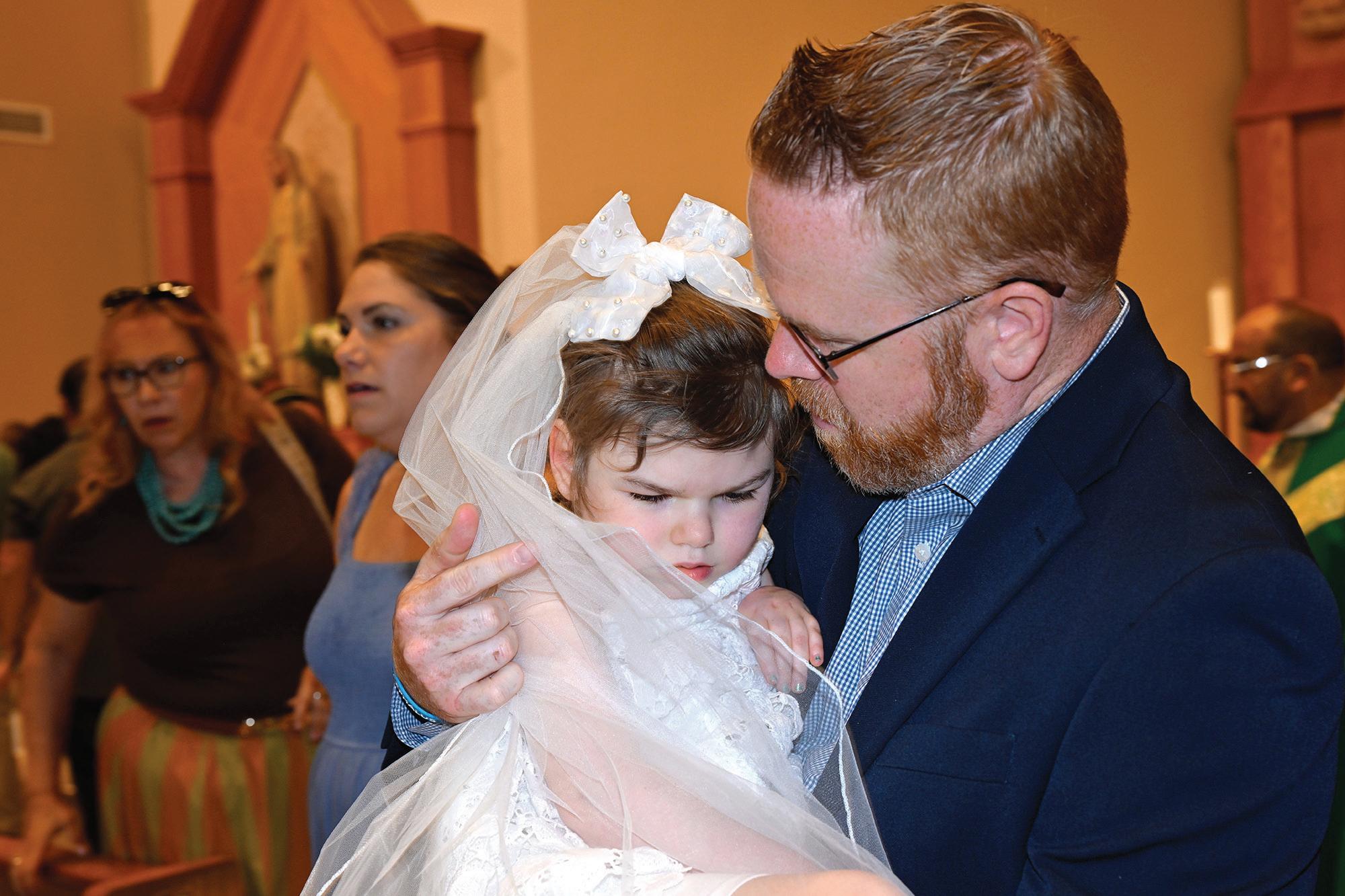
— Mike Guipo photos
A pianist’s return to music after a life-changing wound
Through advanced care and compassionate support at Saint Peter’s Wound Care Center® and Hyperbaric Services, a local pianist reclaimed his life and music.
When a painful wound on the bottom of his foot threatened not only his health but also his passion for music, 67-year-old José Carrasquillo of North Brunswick feared the worst. A professional pianist and retired Newark public school teacher, Carrasquillo was suddenly forced to stop performing.
“I couldn’t walk, and I couldn’t play my gigs,” he recalled. “I thought I might lose my foot.”
What began as a plantar wart led to a serious diabetic foot wound. Despite multiple visits with his podiatrist, the wound would not heal. Eventually, Carrasquillo was referred to the Wound Care Center® and Hyperbaric Services at Saint Peter’s University Hospital, New Brunswick, where a multidisciplinary team stepped in.
Under the care of Dr. Scott Rosen, vascular surgeon and wound care specialist at Saint Peter’s, Carrasquillo underwent a series of treatments beginning in September 2024. These included debridements (a procedure that removes damaged tissue), right femoral bypass surgery, a skin graft, and a toe amputation.
“José had a very complex wound that required multiple medical approaches. It was a long process, but he remained positive and compliant with everything we asked him to do, which made all the difference,” said Dr. Rosen.
Healing with Hyperbaric Oxygen Therapy
A major turning point came when Carrasquillo was prescribed hyperbaric oxygen therapy (HBOT). Over 40 weekday sessions, he spent two hours at a time in the hyperbaric chamber.
During HBOT, patients breathe
pure oxygen while inside a pressurized chamber. Breathing oxygen at a higher pressure increases the amount of oxygen that dissolves more deeply into the blood plasma and bloodstream, thereby promoting the growth of new blood vessels and the formation of collagen. Circulation is increased, aiding in the fight against infection. This therapy also stimulates the body’s natural healing process, making it particularly effective for stubborn, non-healing wounds which are common in people with diabetes.
“At first, I was nervous about entering the chamber,” said Carrasquillo. “But I soon began to look forward to the visits and could feel myself getting better.”
Throughout his care, Carrasquillo formed close connections with the wound care team. Chatting with Saint Peter’s clinicians became part of his weekly routine. He remembers the compassion, humor, and encouragement that helped him through painful dressing changes and difficult recoveries.
“The team works together like a family,” Carrasquillo said. “Everyone, from the doctors and nurses to the front desk staff, played a part. They gave me hope at a time when I was bedridden and discouraged.”
By July 2025, nearly a year after his first surgery, Carrasquillo was officially discharged from HBOT as his wound had fully healed.
“Watching José heal was one of those experiences that stays with you. When he first arrived, you could tell he was carrying a heavy burden. Not being able to play the piano clearly took a toll on him,” said Tracey Juba, a hyperbaric technologist at Saint Peter’s Wound Care Center who cared for Carrasquillo as he was undergoing HBOT. “Seeing him heal, regain his strength, and light up when he talked about the prospect of performing again reminded us why this
work is so meaningful.”
Strength in Spirit
Carrasquillo’s Catholic faith was a source of hope when he felt discouraged. While bedridden, he received weekly visits from Reverend Michael Tabernero from Saint Peter’s Catholic Church in New Brunswick, who brought him communion. Friends and fellow parishioners prayed for him, moments Carrasquillo describes as miraculous.
“Three days after one prayer visit, I was able to walk without a cane,” Carrasquillo said. “My wife even told me my face looked different, like I was glowing. I truly believe God had a hand in my healing.”
Family was also central to his recovery. His wife, Patricia, and three sons, Alexander, Stephen, and José Jr., stood by his side. When he was unable to walk, his sons helped carry equipment to his gigs so he could still perform while using a knee scooter.
“We could all see how José’s faith and his family’s support gave him the strength to keep going, even when days were tough. His HBOT sessions required a significant time commitment, but he was determined to heal,” said Nona Juan, BSN, RNC, a clinical coordinator at Saint Peter’s Wound Care Center who cared for Carrasquillo. “Our whole team feels honored to be a part of his journey.”
A Second Act
Now healed, Carrasquillo has returned to the piano. He is performing in Philadelphia, New York, Niagara Falls, and beyond, sometimes sharing the stage with his sons Stephen and José Jr., who both play the trumpet.
For patients facing long, difficult recoveries, Carrasquillo offers reassurance.
“There were moments I was afraid, but Dr. Rosen saved my leg, and the nurses cared for me with such kindness. Saint
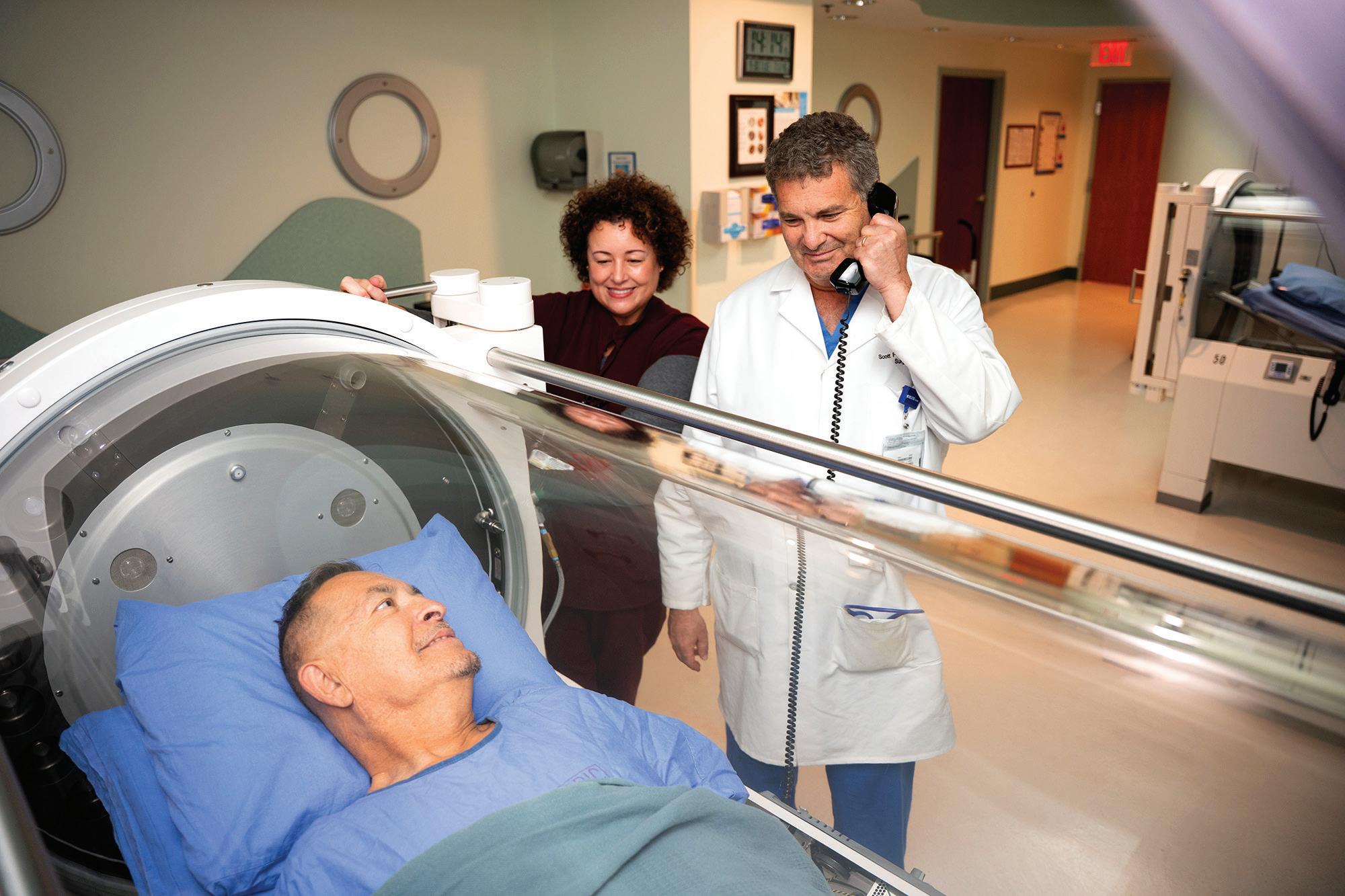
Peter’s gave me back my life,” he said. “It’s like a miracle. I went from being bedridden to walking. I thought I would never play the piano again, but here I am performing in big cities.”
“Healing diabetic wounds takes patience, persistence, and teamwork. With the right care and a committed patient like José, we can accomplish a lot,” Dr. Rosen said.
Nationally Recognized for Excellence
Saint Peter’s Wound Care Center® and Hyperbaric Services in New Brunswick and Monroe Township have received multiple national recognitions for excellence in patient care and clinical outcomes, including the 2025 Healogics Robert A. Warriner III Clinical Excellence Award. This honor is awarded to top-performing wound care centers nationwide for exceptional healing outcomes, patient satisfaction, and clinical performance. In addition, both centers received the 2025 Healogics Center of Distinction Award, recognizing programs that consistently achieve superior patient outcomes over an extended period. Healogics is the nation’s largest provider of advanced wound care services and partners with hospitals and healthcare systems across the country to support specialized wound healing programs.
The program has also achieved its fourth reaccreditation from the Undersea and Hyperbaric Medical Society (UHMS). UHMS accreditation is considered the gold standard for hyperbaric medicine programs and signifies adherence to the highest standards of patient safety, clinical quality, and operational excellence.
To schedule an appointment at The Wound Care Center® and Hyperbaric Services at Saint Peter’s University Hospital in its New Brunswick location, call 732.846.6199. To schedule an appointment at its Monroe location, call 609.860.0008.
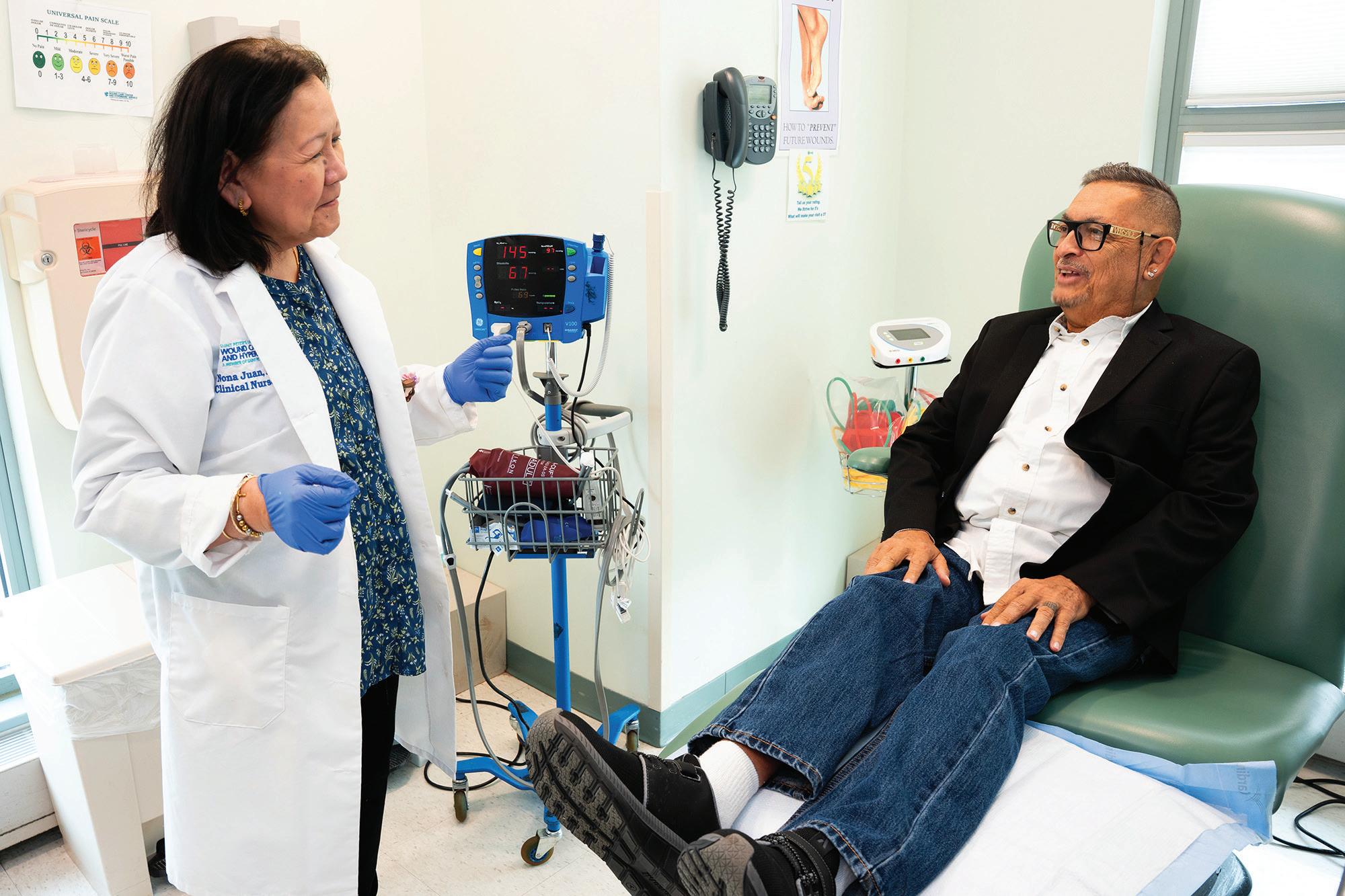
José Carrasquillo underwent a series of hyperbaric oxygen therapy (HBOT) treatments at the Wound Care Center® and Hyperbaric Services at Saint Peter’s University Hospital, under the care of Dr. Scott Rosen, vascular surgeon and wound care specialist, and Tracey Juba, hyperbaric technologist.
Nona Juan, clinical coordinator at the Wound Care Center® and Hyperbaric Services at Saint Peter’s University Hospital, examines José Carrasquillo in a follow-up appointment two months after his last hyperbaric oxygen therapy (HBOT) treatment. — Michael Castronova photos
The shared mission, powerful local impact of
By Tiffany Workman Special Contributor
Catholic Charities, Diocese of Metuchen, provides the highest level of care possible in the many programs the agency offers through efficient and effective use of all available resources. When volunteers step in, they aren’t just “helping out” – they are the actual hands, feet, and voice of Christ operating in the world today.
In addition to the funding received and the excellent staff employed, there are volunteers who contribute their time and talent to assist in the CCDOM mission, many on a “regular schedule” to support programs that benefit by their help, while others come for special events or on an “as needed” basis. Some volunteers say they admire the work of Catholic Charities and want to be involved in some way. They offer their service out of the goodness of their hearts and desire to help others.
The Independent Sector, the national membership organization that connects, strengthens, and advocates for nonprofits and philanthropies, reports that the value of volunteer time in the United States in 2025 is $36.14 an hour. This demonstrates the benefit volunteers offer to an organization. At Catholic Charities, volunteers help to increase the level of service they can offer to those in need. When recruited and placed in a program, they receive program-specific training and orientation, so they feel confident in the service they provide and welcomed by staff.
“A volunteer manual is given to all, so they are aware of the policies and procedures that apply to them,” says Maria Hunter, director, Office of Parish Social Ministry. She continued, “They know that while they are serving in the role of volunteer, the way they present themselves should reflect the mission and
Stepping forward in charity
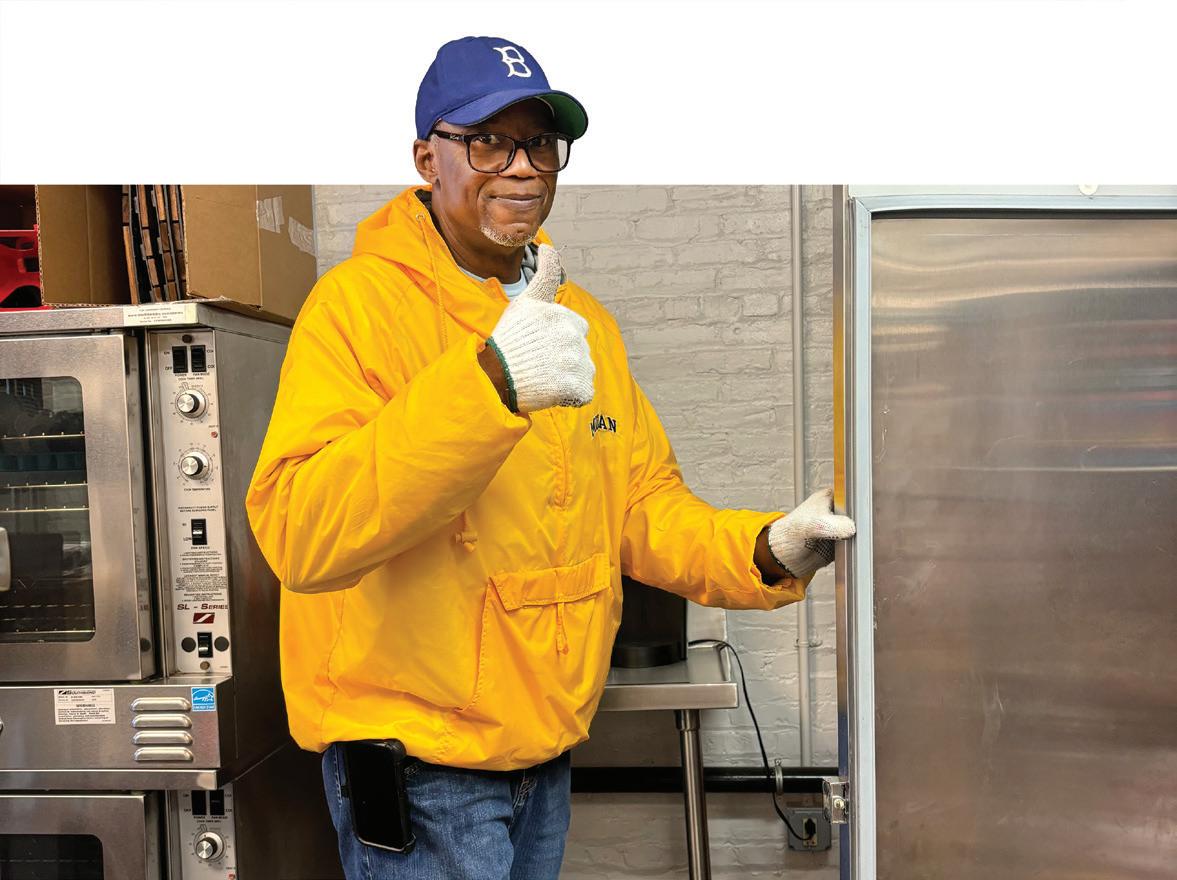
values of Catholic Charities. The dignity and respect of the individuals we help are essential and our volunteers understand how important this is.”
Catholic Charities benefitted by 9,043 hours of service contributed by 302 volunteers. Currently, the thrift store and food pantry are in need of volunteers, especially on Fridays. CCDOM is hopeful that efforts to share this need in parish bulletins, the Catholic Spirit and through social media will reach those who are interested in making a difference in the lives of those in need. Those interested can email Maria Hunter at mhunter@ ccdom.org or call the Office of Parish Social Ministry at 732-387-1315.
“Volunteers are the heart of Unity Square Community Center, playing a vital role in helping us fulfill our mission of serving our neighbors with dignity, compassion, and respect,” says Michelle Gil, director of Community Outreach, Unity Square. She continued, “Their dedication allows us to extend our reach and provide essential services to hundreds of individuals and families each month.”
At Unity Square, volunteers assist with stocking shelves, sorting and packing food, distributing groceries through our Choice Food Resource Center, maintaining our community gardens, assisting with special events, and much more. They also create a welcoming environment for every community member who walks through their doors. By generously giving their time, talents, and compassion, volunteers strengthen programs, foster meaningful connections, and help build a healthier, more resilient community. Those interested in volunteering specifically for Unity Square Community Center should contact Michelle Gil at 732-659-1056.
“Volunteers play a critical role in supporting Mobile Family Success Cen-
Top photos, volunteers at Unity Square stock the pantries for food distribution days and distribute backpacks to children to start the new school year.
—Tiffany Workman photos
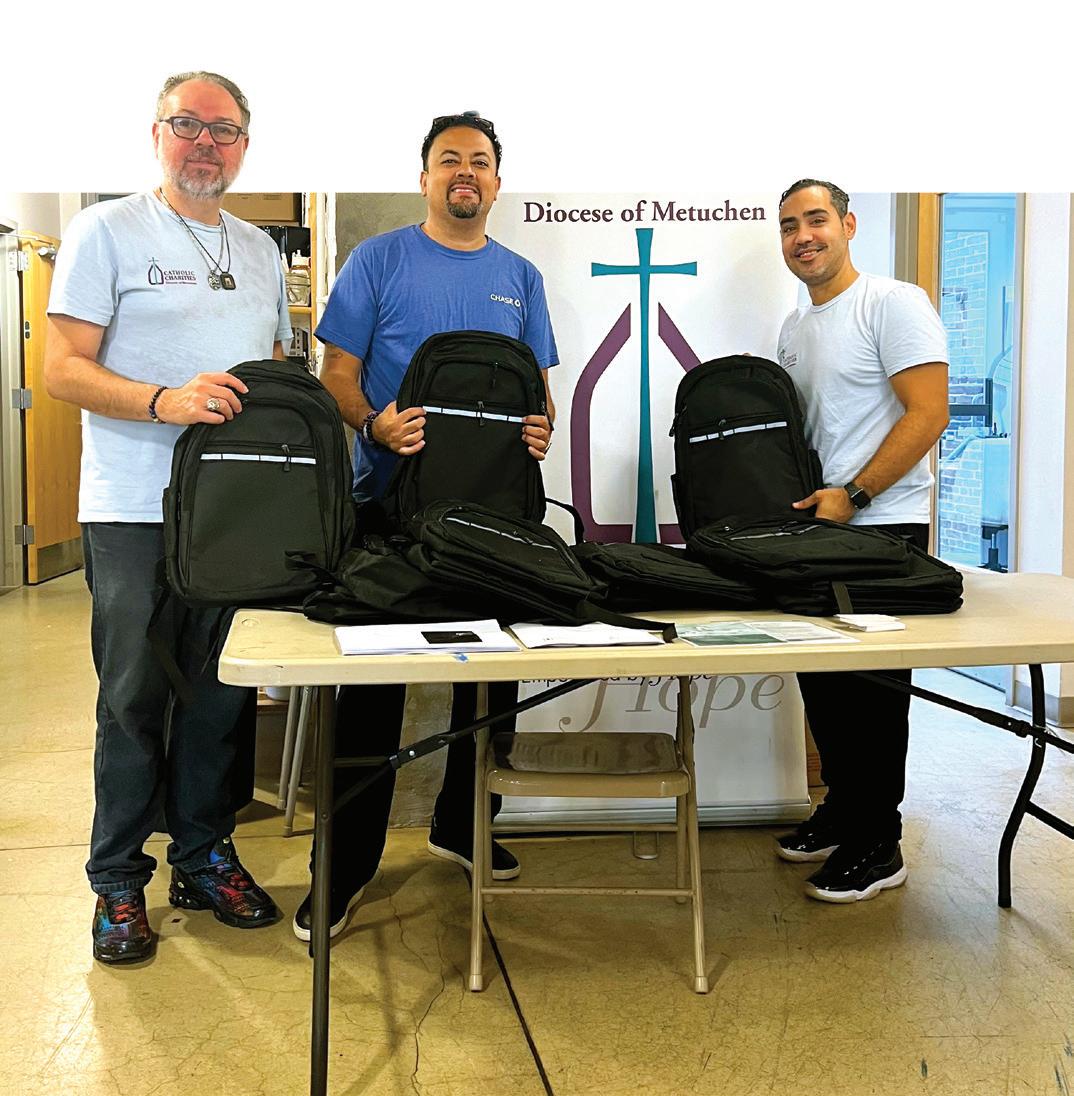
ter’s (MFSC) mission in strengthening families and building community resiliency as they help expand our center’s catchment area along with tapping into the young adult population,” said Rosela Roman, director, Mobile Family Success Center. Roman continued, “Volunteers with diverse backgrounds provide a reflection of the community that the center serves, fostering a culture of civic engagement and community partnerships.”
The collective impact that MFSC volunteers make has increased their direct service expansion and the visibility of numerous family-oriented programs like the annual community bike rodeos, Ice Cream with a Cop, or Family Fun Day and more. “Such visibility has encouraged younger volunteers (accompanied by a parent) to support back to school events and create food distribution bags
for the community” said Roman. What makes MFSC special is that all ages from seven to 60+ are welcome to volunteer at the center and/or event programming. MFSC celebrates Volunteer Awareness Month in April to highlight the contributions that all the volunteers have done throughout the year. Those interested in volunteering with Mobile Family Success Center should contact Michael Albanese at 732-646-4044.
For more information about Catholic Charities Diocese of Metuchen, please visit ccdom.org. LIKE and follow us on Facebook, Instagram, and X@ccdom1 to stay updated on upcoming events and ways we help clients get the services and assistance they need.
Tiffany Workman is the communications specialist in the diocesan Office of Communications and Public Relations.
True peace in America requires dependence on God
During the Civil War a journalist asked Abraham Lincoln if he believed God was on his side. He answered, “Sir, my concern is not whether God is on our side; my greatest concern is to be on God’s side, for God is always right.”
I have always found Lincoln’s answer intriguing. He saw man’s relationship with God in its proper order. God is first, for he is always right and just (Deut 32:4), and man may or may not choose to follow him. Secondly, the fact that Lincoln said it was his “greatest concern” revealed his deep faith and that he, personally, reflected often on that question.
The phrase “God, family, country” originated from the philosophy of Saint Thomas Aquinas, who said that man owes his debt and gratitude to God first, followed by his parents and then his country.
This year’s 250th anniversary of our great nation may prompt us to reflect on the prominence our Founding Fathers gave to Almighty God. They considered it a self-evident truth that our rights of life, liberty and the pursuit of happiness were endowed by our Creator, therefore, obvious to all, and a truth upon which they unanimously agreed. God was first and foremost in the minds and hearts of our Founders when drafting our Declaration of Independence and our Consti-
“Unless souls are saved, nothing is saved; there can be no world peace unless there is soul peace. … World wars are only projections of the conflicts waged inside the souls of men and women, for nothing happens in the external world that has not first happened within a soul.”
Venerable Fulton J. Sheen
tution, which John Adams declared was made “only for a moral and religious people” and “wholly inadequate to the government of any other.”
At Mass Fourth of July weekend Father John Large, parochial vicar at St. Margaret Church in Spring Lake, said he believed our nation’s founding was an undertaking with God at the center. Regarding our country today he asked the congregation, “Is God still in the center?” He referenced a book written by Venerable Fulton Sheen in 1941 titled, “A Declaration of Dependence”, in which Sheen emphasized that true liberty requires dependence on God. Writing on the eve of the United States’ entry into World War II, he asserted our rights are “unalienable” because they are God-given and stressed that piety and patriotism are intertwined.
Piety and patriotism are intertwined because man is a unity of body and soul.
And this unity is so profound that the soul is considered to be the “form” of the body. Our spiritual souls give life to our mortal bodies. They “are not two natures united, but rather their union forms a single nature” (CCC 364-65). We are in the world but we are not of the world, so we must not fear the death of our bodies, but we should fear the death of our souls (cf. Matthew 10:28).
Sometimes we put our desires and beliefs first and then try to fit God into them. But God’s thoughts are not our thoughts and his ways are not our ways. “[F]or as the heavens are higher than the earth, so are my ways higher than your ways and my thoughts than your thoughts, declares the Lord” (Isaiah 55:8-9). Yet do we really believe to the extent that we first seek his will in all that we do? I know I have struggled with determining if something is God’s will or really my will masquerading as his.

BLUE ARMY OF OUR LADY OF FATIMA SHRINE
674 Mountain View Road E., Asbury, NJ 08802 908-689-7330 • retreat@bluearmy.com
Lift Up Your Soul at the tranquil 150-acre Fatima Shrine. Host Your Retreat for Youth, Couples, Parish or Vocational Group.
MOUNT ST. MARY HOUSE OF PRAYER
1651 U.S. Highway 22, Watchung, NJ 07069 908-753-2091 • www.msmhope.org e-mail: msmhope@msmhope.org Retreats, Spiritual Direction, Programs
SAN ALFONSO RETREAT HOUSE
755 Ocean Avenue, Long Branch NJ 07740
732-222-2731 • info@sanalfonsoretreats.org www.sanalfonsoretreats.org
A Redemptorist Spiritual Center overlooking the Atlantic Ocean offering preached retreats, days of prayer and use of the facility for outside groups.
LOYOLA JESUIT CENTER
161 James Street • Morristown, NJ 07960 973-539-0740 • Fax: 973-898-9839 www.loyola.org • retreathouse@loyola.org
Retreats for lay men, women, priests, religious; days/evenings of prayer. Groups planning their own programs are welcome.
THE SHRINE OF ST. JOSEPH
1050 Long Hill Road, Stirling, NJ 07980 908-647-0208 • www.stshrine.org Day & Overnight Retreats Gift & Book Shop - open daily
ST. JOSEPH BY THE SEA
400 Route 35 North, S. Mantoloking, NJ 08738 732-892-8494 • sjbsea@comcast.net • sjbsea.org
A Retreat House Sponsored by the Religious Teachers Filippini overlooking the Atlantic Ocean and Barnegat Bay. Offering days of prayer, retreat weekends, spiritual programs, meetings and staff days.
Please see our website for a full list of upcoming retreats and programs. sanalfonsoretreats.org info@sanalfonsoretreats.org 732-222-2731, x140 755 Ocean Ave., Long Branch, NJ 07740
VILLA PAULINE RETREAT AND SPIRITUAL CENTER 352 Bernardsville Road, Mendham, NJ 07945 Sr. Theresa Marie Tran, SCC 973-543-9058 • villapauline@scceast.org sccus.org • Preached/Directed/Guided & Private Retreats, Spiritual Direction, day & weekend programs
While something may seem right and good, God may not want it for me. In fact, God’s way usually requires patience and discomfort on my part. And although I may not understand I must trust that he knows better. Our view from down here in the world is limited. Prayer raises us up to where he is and enables us to see as he sees.
“Unless souls are saved, nothing is saved; there can be no world peace unless there is soul peace,” said Archbishop Sheen. “World wars are only projections of the conflicts waged inside the souls of men and women, for nothing happens in the external world that has not first happened within a soul.”
Peace begins in the human heart. Every spiritual soul is created by God and is immortal (CCC 366). Elections, although important, are not the only means we have to evoke change. If all faithful Americans knelt in prayer, with contrite hearts, to our God who saved us and formed this great nation, through His mercy and grace we would obtain the peace we are seeking, or we risk losing our souls.
Let us follow the example of our Founding Fathers. When God is in the center of our lives our hearts become moved by God. From him we learn how to love and understand one another, which passes through relationships, takes root in neighborhoods and expands until it embraces the entire city and then spreads throughout the U.S.A. May America, once again, place her dependence on God.
Anna M. Githens, who holds an MA in Theology, is a freelance writer with a career background in finance, teaching and journalism.
Announcing New Retreat Offerings!
Facilitated by Rev. Anthony Michalik, CSSR (as seen on Catholic TV):
A Retreat for Those in the Arts:
A Call to Creativity in God; September 9-11
The Beatitudes: A Call to Holy, Humble Discipleship –In Christ. September 25-27
Programs for the Hispanic Community (conducted in Spanish)
Una Noche de Reflexion Y Oracion, Esta Invitado, Y Es Gratis!, Lunes, 17 de Agosto, de 7pm a 9pm, (Abierto a todos)
Retiro para Mujeres: 21-23 de Agosto
Retreats for Women: August 18-20 (Mid-week) & October 2-4, 9-11
Retreats for Men: September 11-13
Monthly Days Of Prayer: Sept 8, Oct 5, Nov 2, Dec 8
To join this retreat guide, email mgregory@diometuchen.org
Saint James School in Basking Ridge received a major community honor as the Bernards Township Committee issued an official resolution recognizing the school’s designation as a 2024 National Blue Ribbon School and its six decades of service, academic excellence, and faith-based mission.
During the committee meeting, officials commended Saint James for its longstanding impact on Bernards Township, noting that the school’s achievements reflect not only academic strength but also a commitment to developing compassionate, service-oriented young people. Most importantly, for the last six decades, and up through today, St. James School has spread the Good News to countless children and their families due to the dedication shown by the parish and the school’s faculty, staff, and volunteers. Officials extended a thank you to Monsignor Sylvester Cronin, pastor of the Church of Saint James; Principal Suzanne Socha, and all those who have made St. James School into the stellar institution it is today.
The resolution emphasized that the Blue Ribbon status stands as a testament to the dedication of the school’s faculty, staff, families, and parish community, all of whom contribute to a thriving learning environment. Bernards Township Committeeman Andrew J. McNally, stated, “Sixty years ago, members of this community, with inspiration from God, founded St. James School. A treasure of Bernards Township, the school provides children with a Christ-centered education, and the school has been honored as a Blue Ribbon School, in recognition of its high academic achievement.”
The school’s end of year Mass highlighted their commitment to service in the community as Principal Socha acknowledged that, “Receiving this official resolution from Bernards Township is a beautiful testament to the dedication of our faculty, staff, and families. We are incredibly grateful to the Township officials for recognizing Saint James
Basking Ridge school honored for 60
years of living
its mission of faith and education
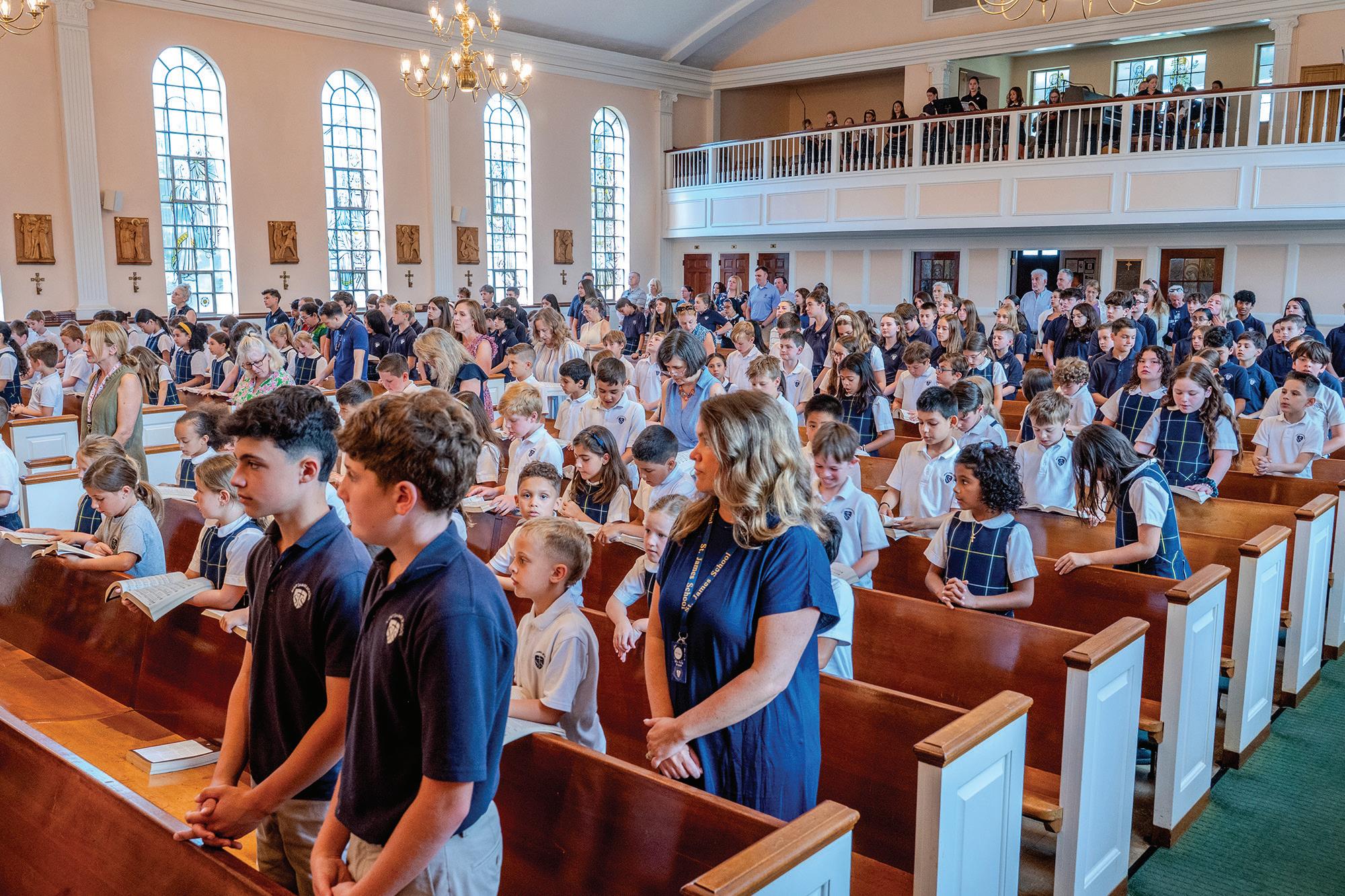
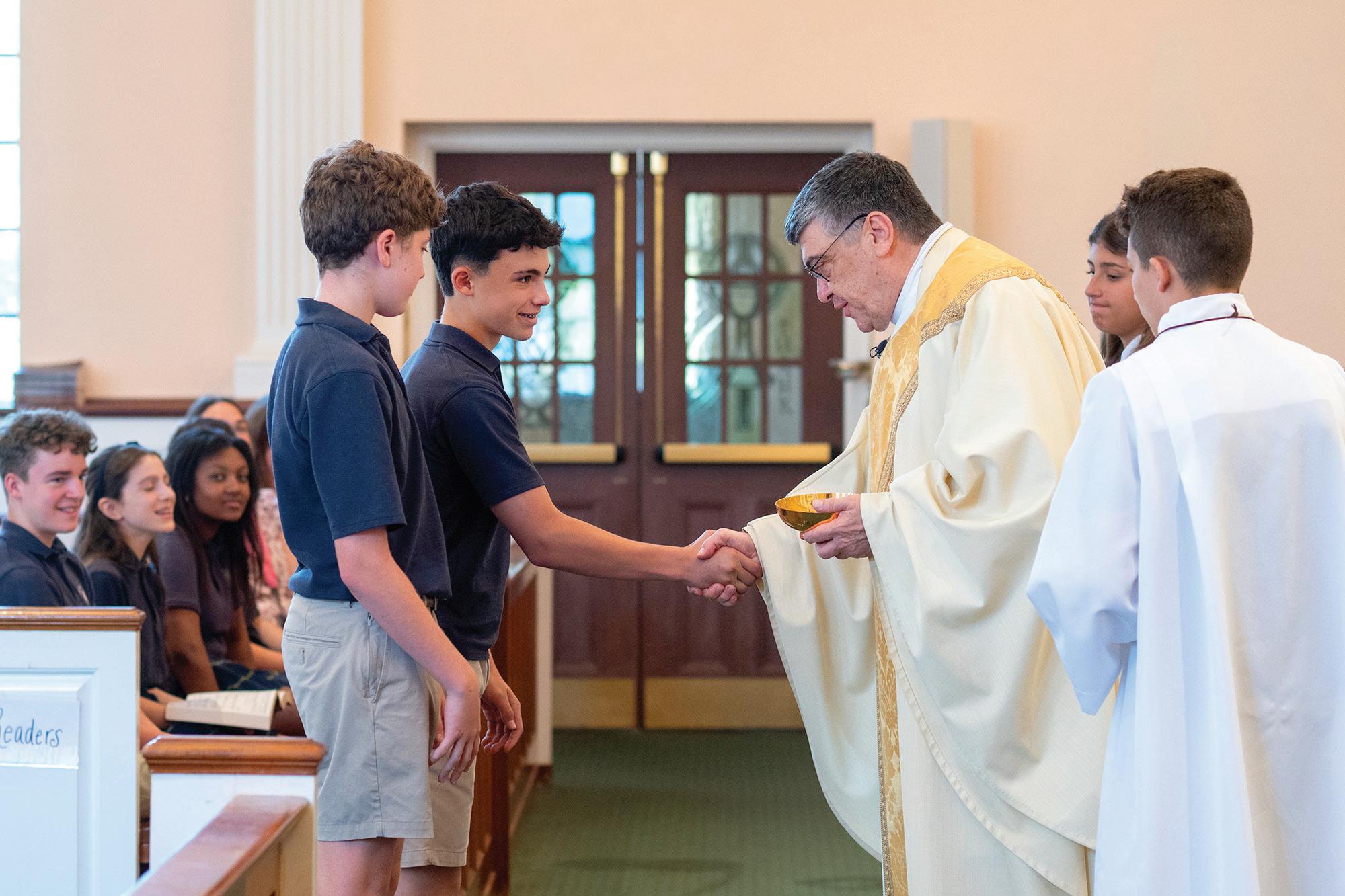
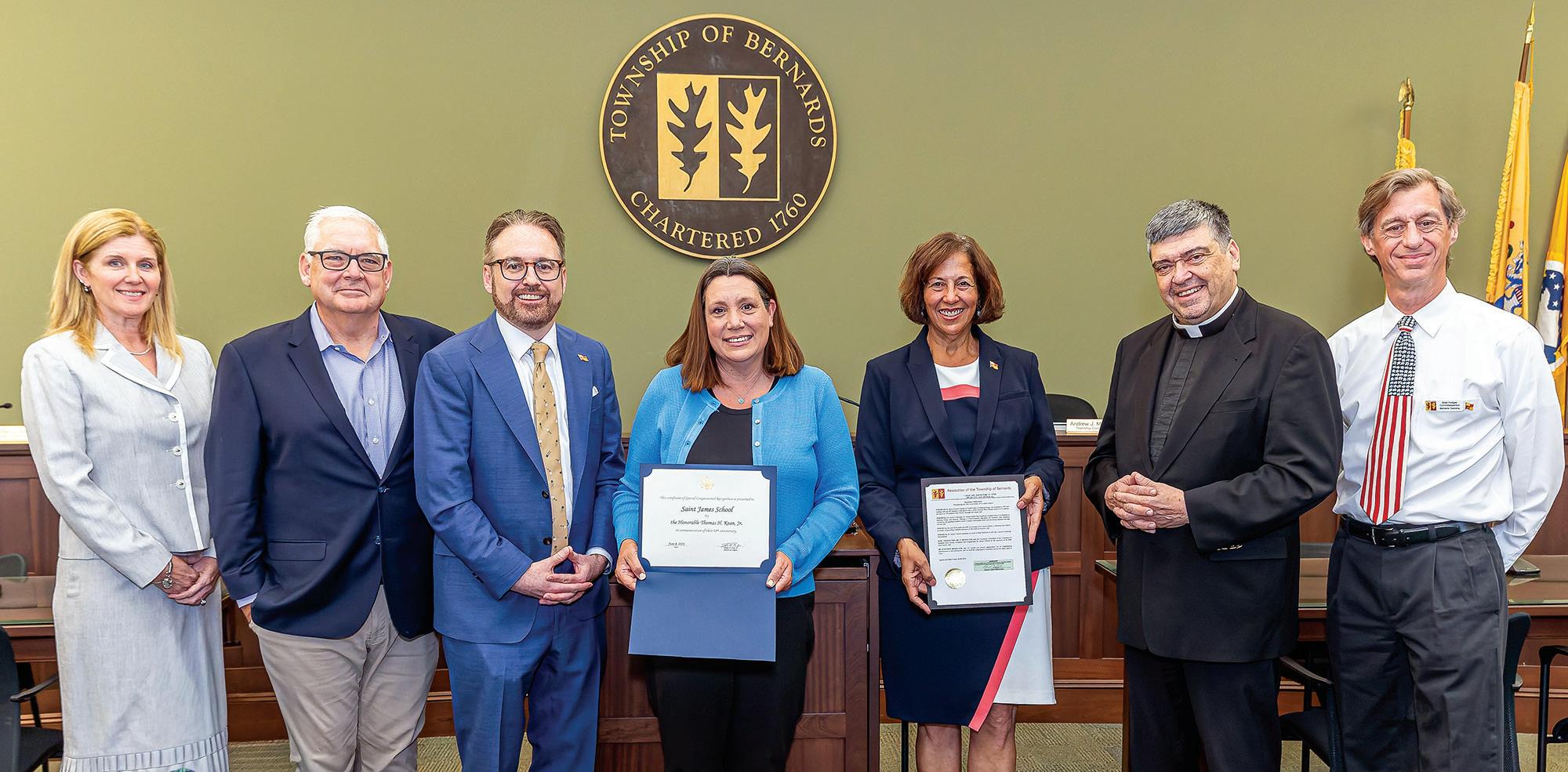
School’s impact. Our commitment to this community runs deep, and we look forward to continuing our legacy of academic excellence infused with strong faith-based values that guide our students every day.”
The official resolution deeply moved both Monsignor Cronin and Principal Socha. Township leaders highlighted the school’s daily commitment to service, noting that just one day prior to the meeting, Saint James students participated in a walk-a-thon to support a local food pantry. Members of the Bernards Township Committee spoke with genuine admiration about Saint James School’s impact on the community, expressing how honored the township is to have a school so dedicated to service and to forming young people who actively contribute to the well-being of Bernards Township.
Tim Caffrey, chairman of the Parish Council Finance Committee and member of the School Advisory Council, spoke about the school’s profound impact on families:
“Our biggest decision as parents was to choose SJS to nurture our family,” Caffrey said. “It was such a spectacular experience that when I was offered the chance to come back and contribute, I wanted to dedicate myself to supporting the next great phase of the school.”
Caffrey emphasized that Saint James School is uniquely positioned for the future:
“My view right now is that SJS has never been better positioned,” he added,” Its core mission is to nurture and develop the next generation of Catholics, which will now include my grandchildren. The school has been thriving due to its commitment to a Christ-centered academic excellence that creates the foundation for the future.”
To learn more about Saint James School or to schedule a tour visit www.sjsbr.org
Contributed by John Falcone, Marketing Director and History teacher. St. James School.
Two top photos are scenes from St. James School closing Mass. Above, from left, are Township Committeewoman Jennifer Asay, Deputy Mayor John Tompkins, Committeeman Andrew J. McNally, Esq., St. James Principal Suzanne Socha, Mayor Ana Duarte McCarthy, Monsignor Cronin and Committeeman Brett Hodges. —Hal Brown photo. Top photos are Mark Lee photos.
By Greg Johnson, Correspondent
Cole Hayden grew up in Hillsborough as the precocious athlete. There was never a question as to whether he would get playing time on his team; sometimes he would even suit up with higher grade levels. His talent and work ethic inevitably carried him through Immaculata High School.
Now playing men’s lacrosse for Richmond University, one of the nation’s premier college teams, Hayden has embraced a new challenge of having to compete for a role.
“College is a completely different story. I understood that, and I took that in a positive way and kind of used that to my advantage,” said Hayden, who recently completed his freshman year. “I don’t need to do every single thing on the field because we have 50 guys that are just really good. It’s just, what’s something you do that you’re best at that can help the team?”
For the midfielder, that meant dodging, winning his matchup and moving the ball. Even though he wasn’t starting or scoring many goals this spring, Hayden made an impact by drawing slides and making smart decisions with the ball to boost Richmond’s offense.
He described it as an intense but fun process to compete with guys whom he loves. He used his outgoing personality to build relationships right away when he arrived on campus last fall.
“You definitely come in with your tail tucked between your legs a little bit
Immaculata’s Cole Hayden adapting to Division I men’s lacrosse at Richmond
because you’re the new guy on the team; you and 11 other guys are the new guy,” Hayden said. “The way I approached it was, ‘These guys have never seen me play before. It’s not like high school where I’ve been there for four years and everybody knows how I play.’ You’ve got to just find a spot where the team needs you the most and where you’re at your best. For me personally, when I came in, I was just like, ‘I want to show these kids how athletic I am.’”
The next step was committing himself to rigorous summer workouts where he lifted weights, ran four days per week and shot three days per week. He understood that he would need to earn every second of his playing time in his rookie season.
“It really just motivated me,” Hayden
said. “I was always taught when I was younger, as a kid, no matter how old you are, when you step on that field, you’ve got to believe that you’re the best player on the field. That’s what I would tell myself every time I stepped on the field: ‘I’m the best player on the field – humbly.’”
At Immaculata, Hayden tied the school record in lacrosse with 272 points while playing all over the field. He also played quarterback in football and scored more than 1,000 points in basketball. In college, he now has the benefit of focusing on one sport and one position.
But college athletics, especially as an underclassman, place a big emphasis on getting stronger. Richmond’s strength coach gives all the men’s lacrosse players individual packets with tailored workout plans and nutrition goals for the summer.
Lifts and runs continue throughout the fall, as well as practices and hourlong workouts on the field after classes with your specific position group. Then the team practices together six days per week in the spring.
Hayden played in all but one game during Richmond’s 14-2 season, which ran from Feb. 7 through May 9. He scored five goals and five assists and grabbed seven ground balls. His favorite game was when he scored his first goal against Delaware on March 14.
“That’s what really helped me gain confidence, I would say, because once you get that first one in the back of the net, it’s like, ‘OK, I finally did it. Now it’s just like, I’ve got to keep doing it,’” Hayden said. “That’s what helped me
score more goals throughout the year and be more of a threat dodging.”
His other favorite games were against Notre Dame in Chicago on April 4 and against Duke at home in the NCAA Tournament on May 9. Even though those were Richmond’s only two losses, Hayden cherished the unbelievable fan atmospheres.
“The amount of support Richmond received from parents and people local and all over the place, it’s just awesome to see,” Hayden said.
Hayden appreciated his support from back home. His parents traveled to Virginia for almost every game, his two brothers (who are currently playing at Immaculata) came out when they could, and he caught up with his high school coach, David Hobson, after the Duke game.
Hayden returned the favor by coming back to Immaculata for a game this spring. He is also at the school about four days per week this summer to run, shoot on the field and play wall ball.
Once he goes back to Richmond’s campus, Hayden is prepared to make sophomore strides. Dan Chemotti, the program’s only head coach since it debuted in 2014, told Hayden during their exit meeting at the end of the spring that he expects him to have a bigger role next season.
“Obviously you want to play, but whether I’m on the sideline supporting the guys or I’m on the field making plays, it’s all the same thing,” Hayden said. “I honestly think I have a good shot (to be a starter). I just need to work for it.”
Right, Cole Hayden scored five goals and five assists for Richmond this season.
Below, Cole Hayden, an Immaculata High graduate, recently finished his freshman year as a midfielder with Richmond men’s lacrosse.
—Courtesy photos
St. Joe’s continues building premier high school lacrosse program
By Greg Johnson, Correspondent
The operative word for the St. Joe’s lacrosse program is development.
Even though they had only a few seniors who were key players this spring, the Falcons took another step forward with a 14-8 record against a more challenging schedule than last season and finished as New Jersey’s 20th-ranked team among about 240 high schools.
They also secured their third straight Greater Middlesex Conference championship during what has been a dramatic turnaround under fifth-year head coach Tony Calandra.
“I think that the program in general is at a really good stage,” Calandra said. “We have some good kids coming in next year as well, so we’ll just continue to keep building and keep getting better.”
St. Joe’s had eight players named to the First Team All-GMC: junior attackman Wayde Smith, freshman attackman Brayden Negvesky, junior midfielder Zach MacDougall, junior midfielder Matt Comer, sophomore midfielder Franco Reinoso, senior defenseman Aidan Paris, senior defenseman AJ Shearer and sophomore faceoff man Sebastian Assuncao.
Paris and Shearer were the team captains as fourth-year varsity players and are committed to playing Division III lacrosse next year at Pace University and Clarkson University, respectively. They provided valuable leadership next to junior goalie Nicky Zaneto, who recorded 227 saves for a stout defense which allowed only 5.9 goals per game.
Zaneto is among several players on the team who aren’t yet seniors but
ing since their freshman year. Another is Assuncao, who has won 71 percent of his faceoffs in two seasons.
“Obviously you need some skill level and some understanding coming in, but I think we do a really good job of developing our players and not really caring what year they’re in,” Calandra said. “Definitely two main parts of lacrosse are the goalie and the faceoff guy, and we’re lucky to have both of them back next year.”
Negvesky, the son of a former Rutgers women’s lacrosse player, led St. Joe’s in scoring with 74 points (35 goals, 39 assists). He scored at least one point in all but one game.
Calandra described the freshman as a “student of the game” and “almost like the quarterback of the offense” while doing much of his play-making from the X position (behind the cage).
“Most freshmen are just trying to get their feet wet and trying to play the game at a much quicker speed, and he started
every game for us all year,” Calandra said. “We played 12 top 20 teams, or something like that, in the state of New Jersey, so we played a good amount of teams throughout the year. He had a great county final, nothing really fazed him. He doesn’t get too high or too low. He just keeps at an even keel and keeps on plugging along.”
St. Joe’s featured a balanced offense overall as Comer netted a team-high 44 goals, while Smith and MacDougall each netted 43. Assuncao added 22 goals and a team-high 135 ground balls.
Calandra praised Comer for successfully transitioning from playing attack to midfield to form a lethal duo with MacDougall in that part of the field this season.
“Really good speed and understanding,” Calandra said of Comer, before touching on MacDougall. “Zach has been a guy who we’ve counted on since his freshman year and is committed to Quinnipiac. He had a great year. He had
some really good games … and it’s great when you could have someone like Zach who can still be an integral part of the team even though (other) teams’ main focus is to stop him.”
St. Joe’s will have to replace Paris, Shearer and defensive midfielder Caleb Ward, but most of the team is expected back next season. The Falcons should be especially potent offensively with seasoned veterans.
The next step is to advance past the second round of the Non-Public State Tournament, where St. Joe’s has met its match in each of the last two springs.
“Keep developing, keep getting our skill work,” Calandra said. “We’ll play a tougher schedule next year, try to go further in the state tournament, try to win the county and the conference for the fourth year in a row. Our goal is to win a state championship, so that’s kind of what the end goal is. Everyone’s got to get better, everyone’s got to improve, and hopefully we can just keep getting better.”
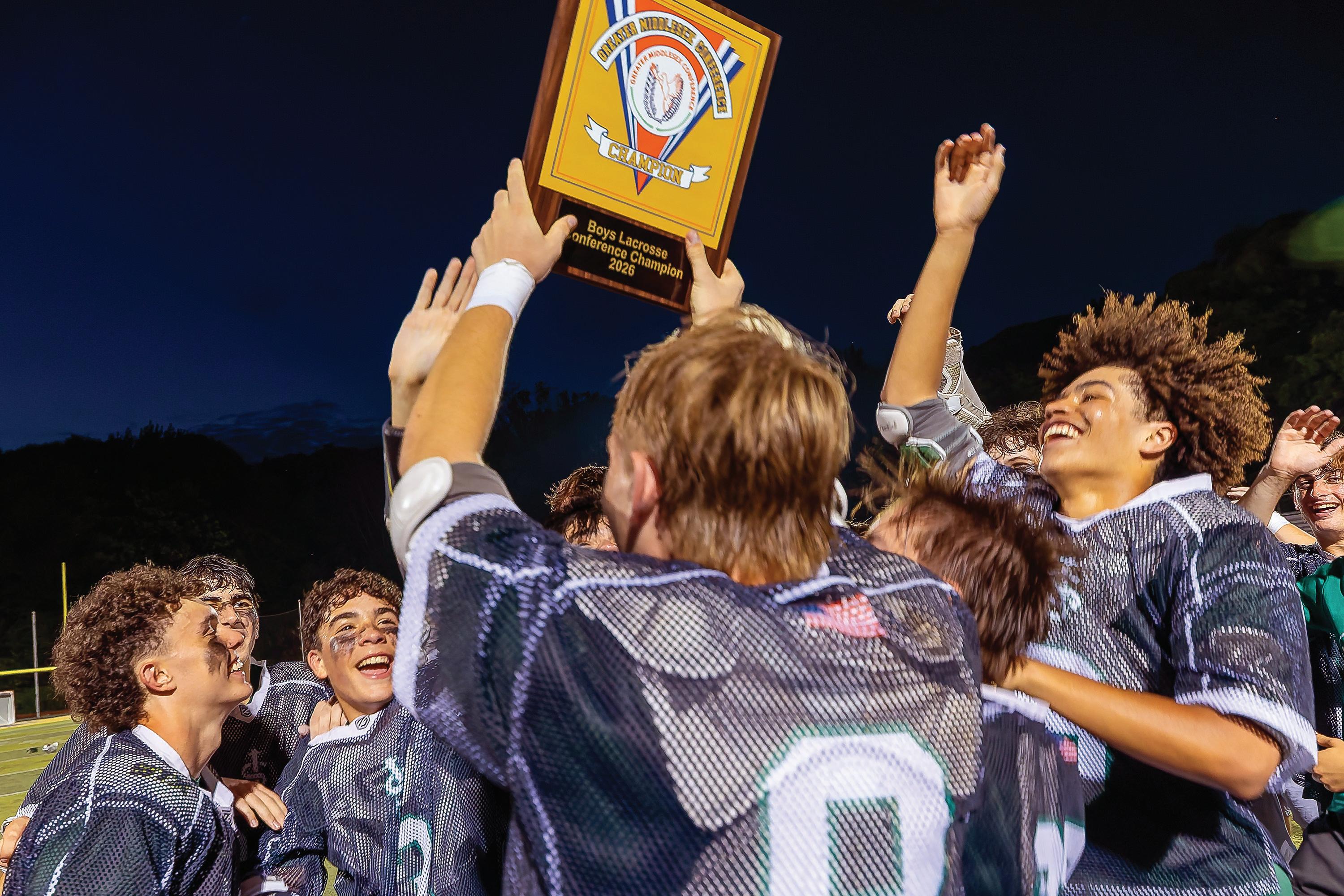

Top, St. Joe’s celebrates after defeating South Brunswick for its third straight GMC championship on May 19 at North Brunswick Twp. High School.
Left, St. Joe’s junior attackman Wayde Smith lines up a shot.
Right, St. Joe’s coach Tony Calandra gives instructions during the GMC final on May 19 at North Brunswick Twp. High School.
—Hal Brown photos
St. Joe’s graduate KarlAnthony Towns helps Knicks win first NBA title in 53 years
By Greg Johnson, Correspondent
One of the most famous alumni in St. Joe’s history continues to make the Metuchen community proud on a national stage.
Karl-Anthony Towns (Class of 2014) helped the New York Knicks win their first NBA championship in 53 years on June 13 when they defeated the San Antonio Spurs, 4-1, in the best-of-seven Finals.
Towns started all 19 games throughout the Knicks’ playoff run, averaging 15.9 points, 10.6 rebounds and 4.9 assists.
While a student at St. Joe’s, Towns was a member of three consecutive NJSIAA Non-Public A state championship teams. As a reclassified senior in 2013-14, he was the Gatorade National Player of the Year as the Falcons finished 30-2 and won New Jersey’s Tournament of Champions.
All five starters from that team went on to play Division I basketball, but
La participación

Towns was among the top recruits in the country and became the No. 1 pick in the 2015 NBA Draft after spending one year at the University of Kentucky.
Towns served as class president while at St. Joe’s, and in October of 2021, he was inducted into the school’s Athletics Hall of Fame.
“St. Joe’s was the best time of my life,” Towns said during his induction speech. “Best time I’ve had in my basketball career and just the best time I’ve had just as a person. St. Joe’s gave me everything. I loved playing flag football after school and doing all the things. I’m just so happy to be here. I’m so honored.
“To the students … never think anything y’all do is too far. Never think your goals and dreams are not attainable. Everything is attainable. You’ve got a bunch of resources here. Use it to your advantage.”
Towns also returned to campus during a basketball game in January of
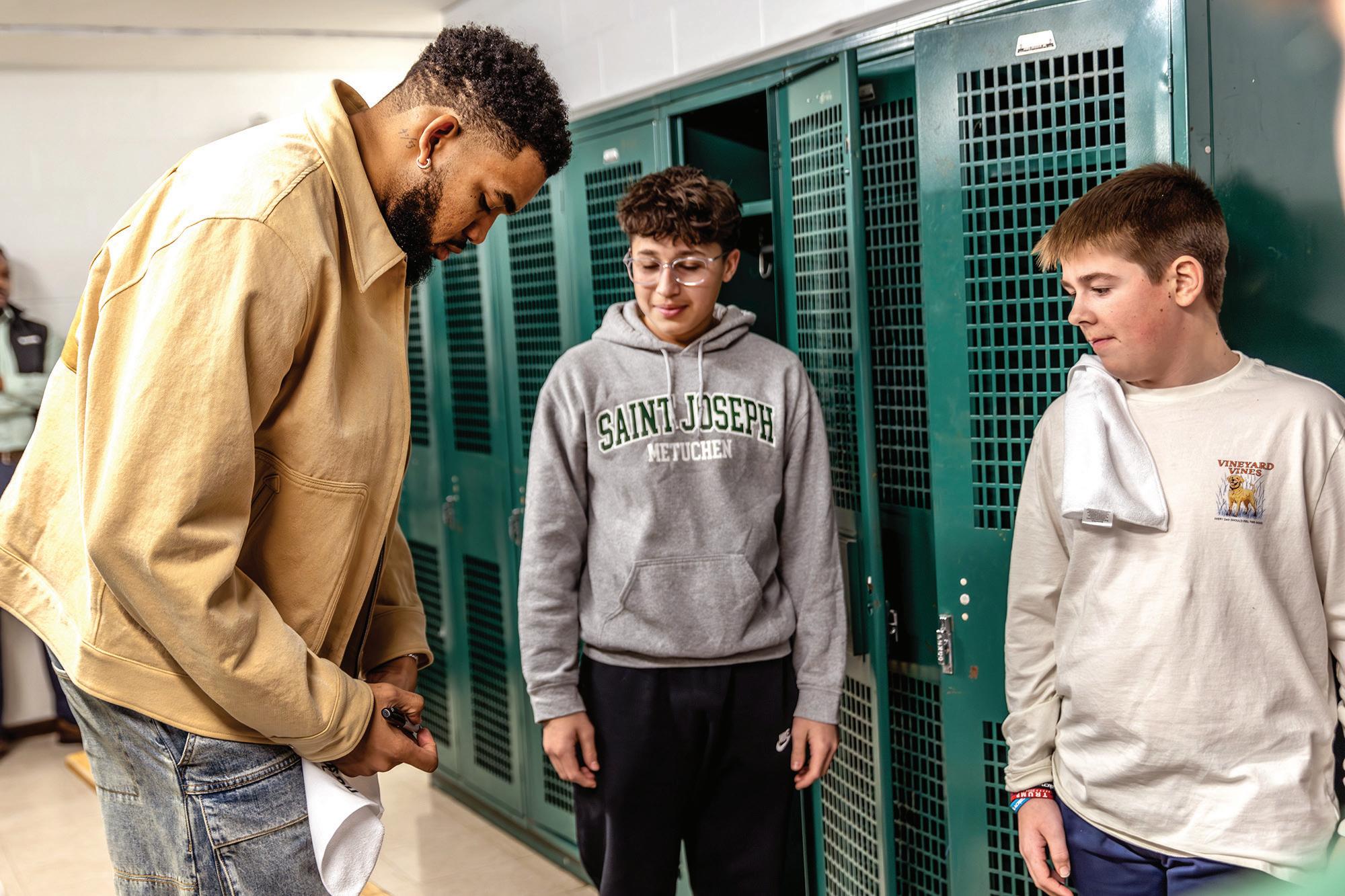
when his father was the head coach. Towns sat courtside, visited his former locker and signed autographs for students.
While about a handful of St. Joe’s alumni have played in the NBA, Towns has had the longest career and earned the most accolades. He played his first nine seasons with the Minnesota Timberwolves and was traded to the Knicks in October of 2024.
Now, he is forever immortalized as one of the leaders of a historic championship that created timeless memories for fans in New York City, the Metuchen area and beyond.
The morning after the Knicks’ Finals-clinching victory, Metuchen Mayor Jonathan M. Busch released a statement on Facebook:
“Congratulations to six-time NBA All-Star, three-time All-NBA selection, and graduate of Metuchen’s own St. Joseph High School, Karl-Anthony Towns,
Above right,
signs autographs for St. Joe’s students during a home game on Jan. 9, 2025.
—Hal Brown photos
on helping lead the New York Knicks to their first NBA Championship since 1973.
“Before becoming one of the NBA’s biggest stars, Karl-Anthony Towns proudly wore the St. Joe’s uniform here in Metuchen. His remarkable journey from St. Joe’s to NBA Champion is a source of pride for the entire Falcon community and for the many residents who have followed his career over the years.
“And to the countless Knicks fans throughout Metuchen: enjoy this one. You’ve waited a long time!”
de México en la Copa del Mundo une la fe y el ‘fútbol’
CIUDAD DE MÉXICO (OSV News) – Mientras México albergaba la Copa del Mundo de 2026 junto con Estados Unidos y Canadá, la fe fue parte de la historia del torneo. Los aficionados abarrotaron la Catedral Metropolitana de la Ciudad de México vistiendo camisetas verdes, rezaron ante una imagen del Niño Jesús vestida con el uniforme de la selección nacional e hicieron “mandas” (o votos sagrados) pidiendo a Dios y a Nuestra Señora de Guadalupe éxito futbolístico. El sueño de México terminó el 5 de julio con una derrota por 3-2 ante Inglaterra en el partido de octavos de final, pero la trayectoria del equipo desató grandes celebraciones y renovó el orgullo nacional. Los líderes de la Iglesia elogiaron la unidad y la esperanza que rodearon al torneo, al tiempo que instaron a los mexicanos a no ignorar problemas más profundos, incluida la violencia y la crisis del país de aproximadamente 135.000 personas desaparecidas.
El padre jesuita Jorge Atilano señaló que la Copa del Mundo ha sido tanto una celebración como una distracción frente a los desafíos de México. Para muchos
católicos, ver al Niño Jesús con los colores de México reflejaba una convicción familiar: la fe y el fútbol a menudo se encuentran en la misma oración.
El padre Alan Camargo, portavoz de la Diócesis de Matamoros-Reynosa, expresó su esperanza de que el entusiasmo de los mexicanos por la participación de su país en el Mundial ayude a la gente a unirse por otras causas positivas, aunque reconoció que “a veces pasa la emoción y seguimos cada quien en nuestro camino” pero “la pregunta es: ¿y luego qué sigue?”.
El padre Manuel Corral Martín, canónigo de la Catedral Metropolitana de la Ciudad de México, acomoda la vestimenta de una figura del Niño Jesús – ataviada con la camiseta de la selección nacional de México – en la catedral el 16 de junio de 2026; allí, los aficionados acudían a rezar para que su equipo avanzara en la Copa Mundial de la FIFA 2026. El 5 de julio, México perdió 3-2 ante Inglaterra en el partido de octavos de final. —Foto OSV News/ Quetzalli Nicte-Ha, Reuters
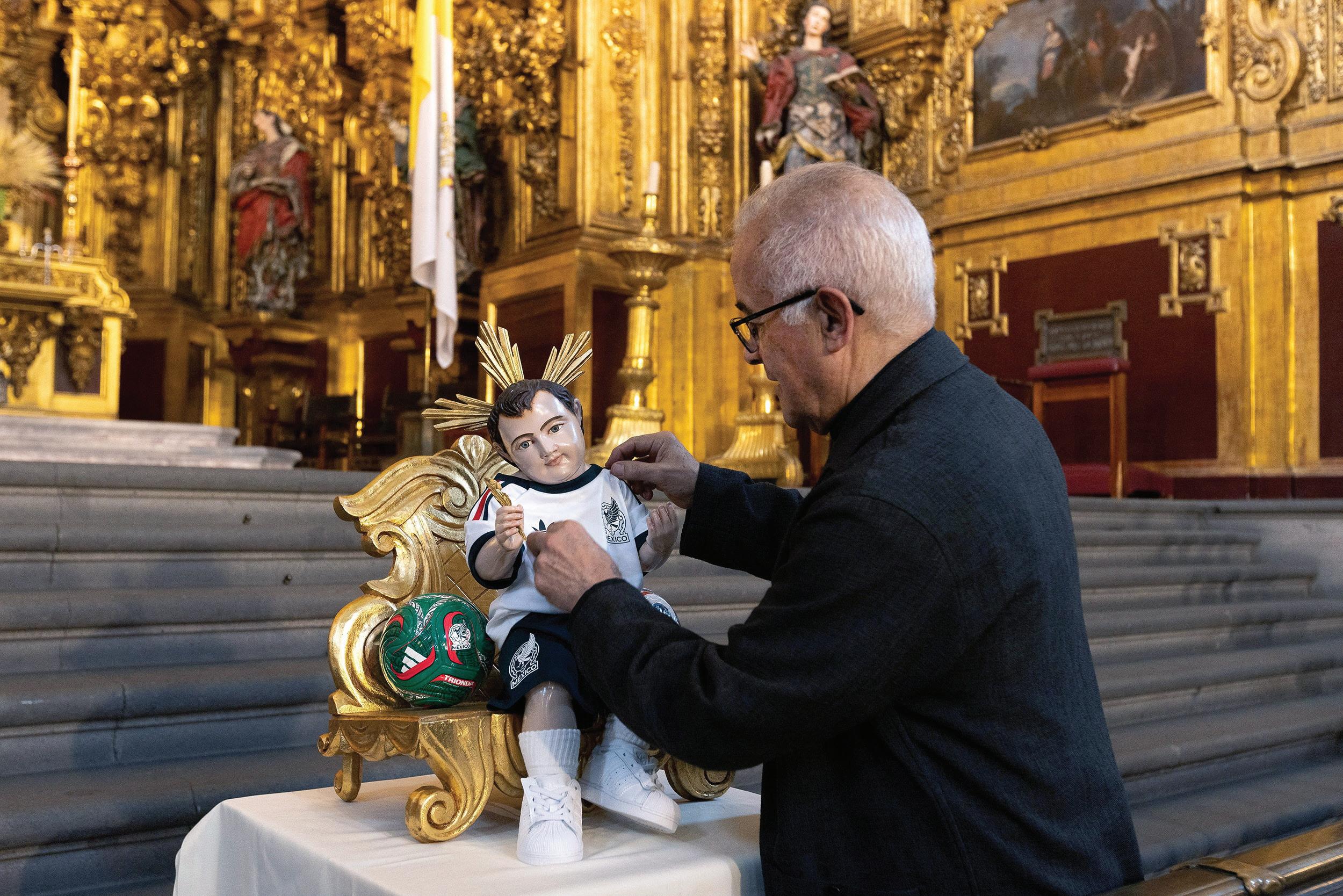
2025
Left, New York Knicks star Karl-Anthony Towns, a St. Joe’s graduate, stands in front of his old high school locker
Karl-Anthony Towns
Exhibit highlights St. John Paul
II’s US visits, esteem for nation’s foundational documents
By OSV News
An exhibit at the St. John Paul II National Shrine in Washington on display through Sept. 9 celebrates St. John Paul II’s esteem for the nation’s foundational documents – the Declaration of Independence, the Constitution and the Bill of Rights.
In his seven visits to America during his papacy, St. John Paul often quoted from those documents. To commemorate the 250th anniversary of the United States, the exhibit includes audio and video, photos and artifacts from his visits, including the future pope’s trip to America for its bicentennial in 1976.
Two years later, Polish Cardinal Karol Wojtyla was elected pope – on Oct. 16, 1978. St. John Paul’s message during his visits, reaffirmed in several ways, was that Americans are blessed to have the freedoms they have. And this merged with the pontiff’s promotion of human rights. Some elements in the exhibit – www.jp2shrine.org – were loaned by the Archdioceses of Miami, Denver, St. Louis, Chicago and Philadelphia as well as Xavier University of Louisiana and The Catholic University of America.
Grattan Brown, director of mission and ministry at the shrine, curated the exhibit, titled “A New Birth of Freedom,” with contributions from Bethany Bromwell, collections curator, and Victoria Gallegos, curatorial assistant.
Top right, Cardinal Karol Wojtyla, archbishop of Kraków, Poland, who later became Pope John Paul II, responds to questions during an interview at The Catholic University of America in Washington July 29, 1976, the United States’ bicentennial year. During his papacy, St. John Paul made seven visits to the United States. —OSV News file/Marvin T. Jones
Bottom right, St. John Paul II addresses a press conference with President Jimmy Carter in the Rose Garden at the White House Oct. 6, 1979. He was the first pope to visit the White House. —OSV News photo/ Chris Sheridan
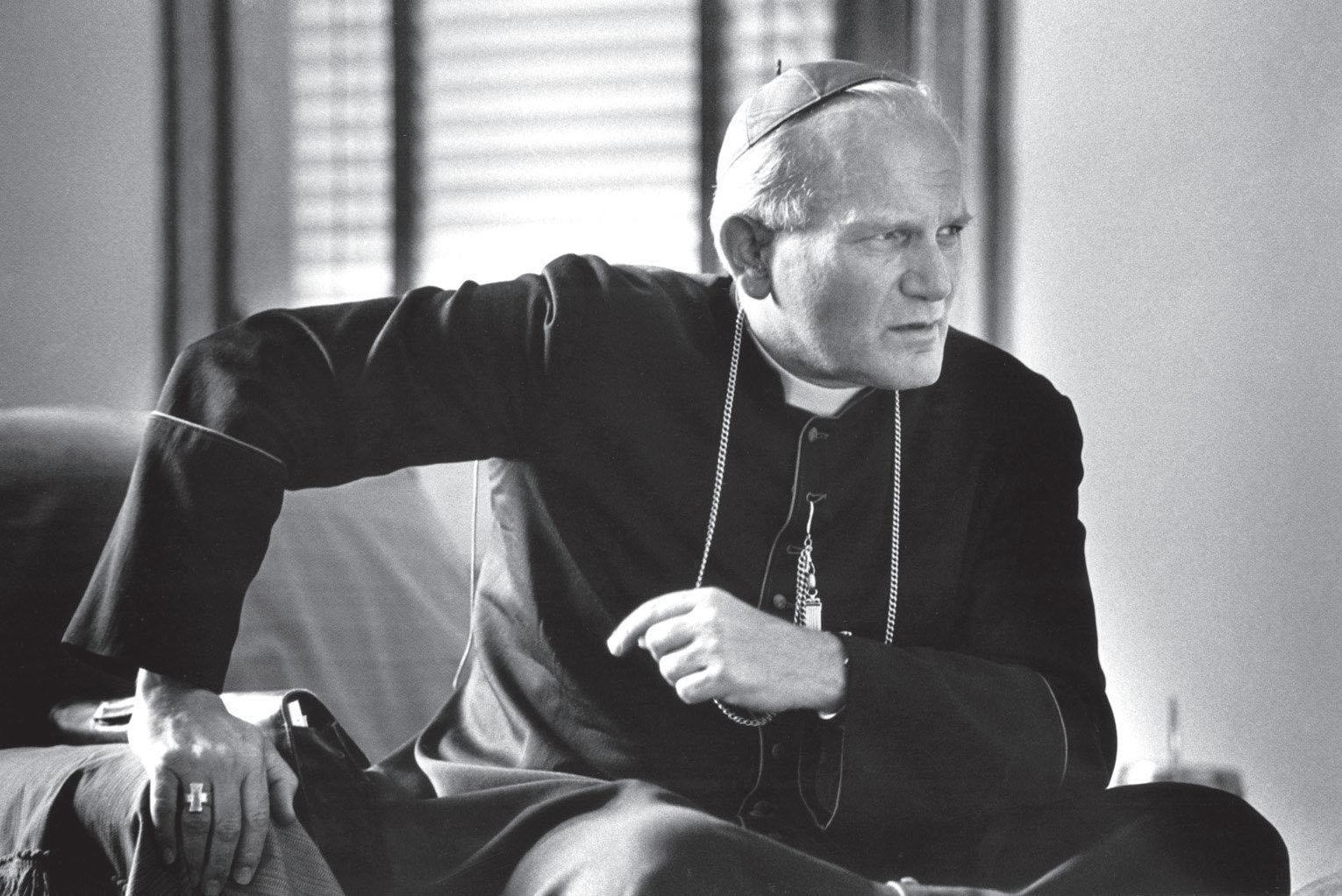
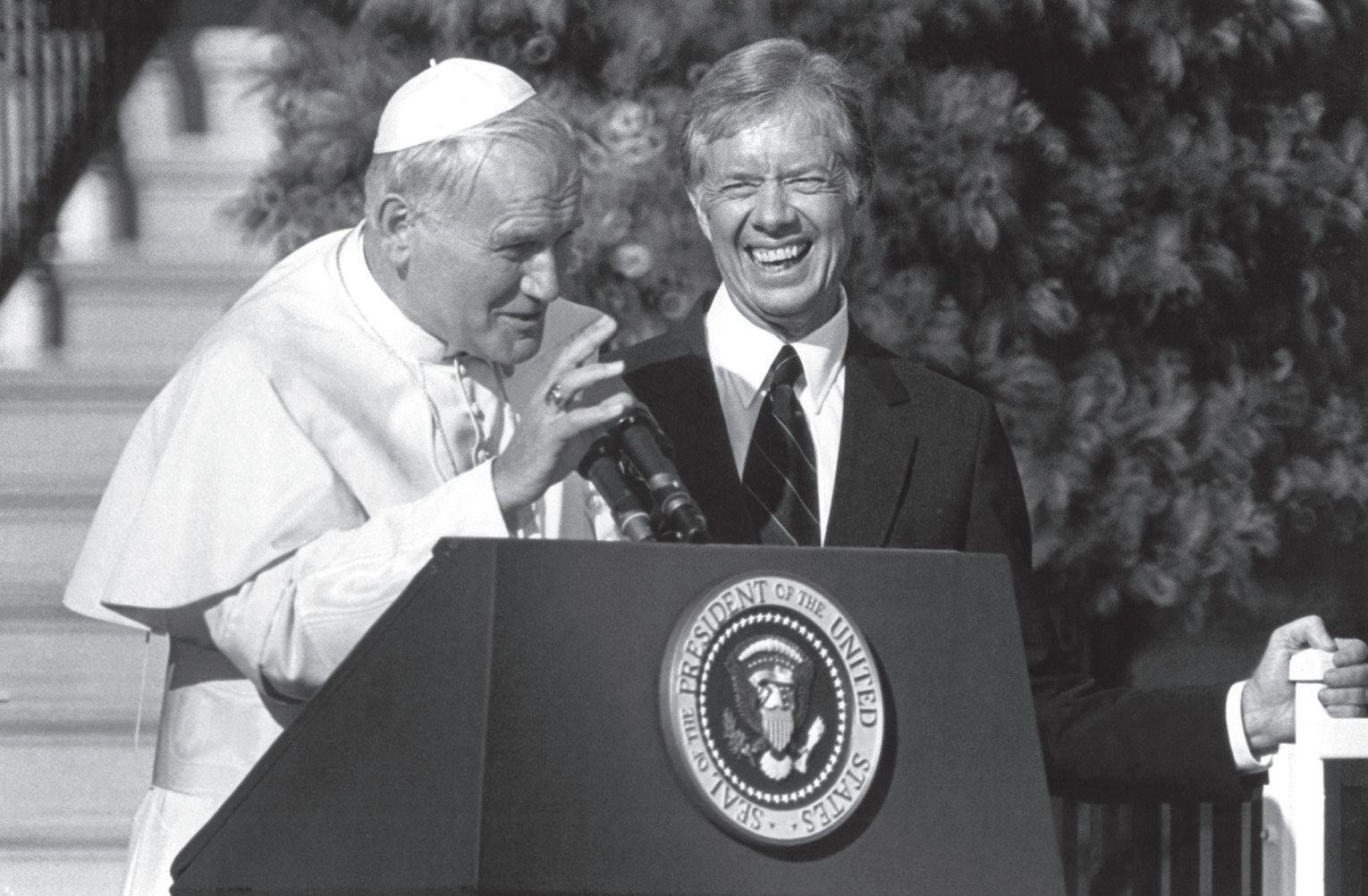
ACROSS
1 St. ___ Diego
5 Celestial being 10 Increases 14 Trial fig.
15 Actor, of “Young Frankenstein” fame, who was a novice in the LaSalle Brothers 16 Group of birds
17 Marcel Marceaux
18 De Valera of Ireland
19 ___ du soleil
20 Overjoyed 22 Occasional
24 Is aware of
26 Gaslight, for one 27 Fiddle-playing, Christianhating ruler
29 Commandment that forbids bearing false witness 34 Word on a cartoon flag 38 Openings 40 Achille-___ 41 Margarine
42 Ahead of the rest
44 The Mass is both a sacrifice and a ___
45 Airplane! for example 47 Trillion (pref.)
48 Catch sight of 49 Chat 51 Yahtzee cubes
53 “When we eat this bread and drink this ___…”
55 Falls found in the Diocese of Saint Catharines
60 The other half of the Archdiocese of Goulburn
65 Meager
66 Musical instrument
67 Exodus mountain
69 Hindu goddess of fire
70 Bk. of the Pentateuch
71 “We praise you, we bless you, we ___ you”
72 Archdiocese in Latvia
73 Actress Lancaster
74 Leases
75 Bambi, for example
1 Only apostle whose martyrdom is recorded in the Bible
2 Beneficial
3 Hindu principle of life
4 Russian negatives
5 One of the young men cast into the furnace
6 “…___ thousand times…”
7 School rooms
8 Quickly form a union?
9 Lost love of “The Raven” 10 Father, in the Bible
11 David asked Saul if he pursued a “___ dog” (1 Sam 24:15)
12 507, to Nero 13 Agreement
21 Aachen article
23 Altar balustrade
25 “___ us peace”
28 Chose (with “for”)
30 Favorite food of Isaac
31 Colors
32 Snare
33 ___ Name Society
34 Pear
35 Fido’s brand?
36 Night light
37 Blunder
39 He established Notre Dame
43 Appeases
46 Moses’ was radiant after he spoke with the Lord
50 Officer of a university
52 “Eye has not seen, ___ has not heard…”
54 One of the seven deadly sins
56 Watch over 57 Texas student
58 A place to be “home, home on”
59 “If anyone says, “I love God,” but hates his brother, he is ___.” (1 Jn 4:20)
60 ___ of Canon Law 61 Son of Eve
I try to have a Mass said for my deceased grandparents every year around the anniversary of their deaths. But this year, my parish said their Mass intention calendar is very full, and people are requesting dates as far as six months out! Then I went to Mass last Sunday, and the priest offered what sounded like a vague intention "for the people of the parish." I guess it's nice that he wants to pray for everyone, but should he really be doing that when there are so many parishioners waiting to request specific intentions?
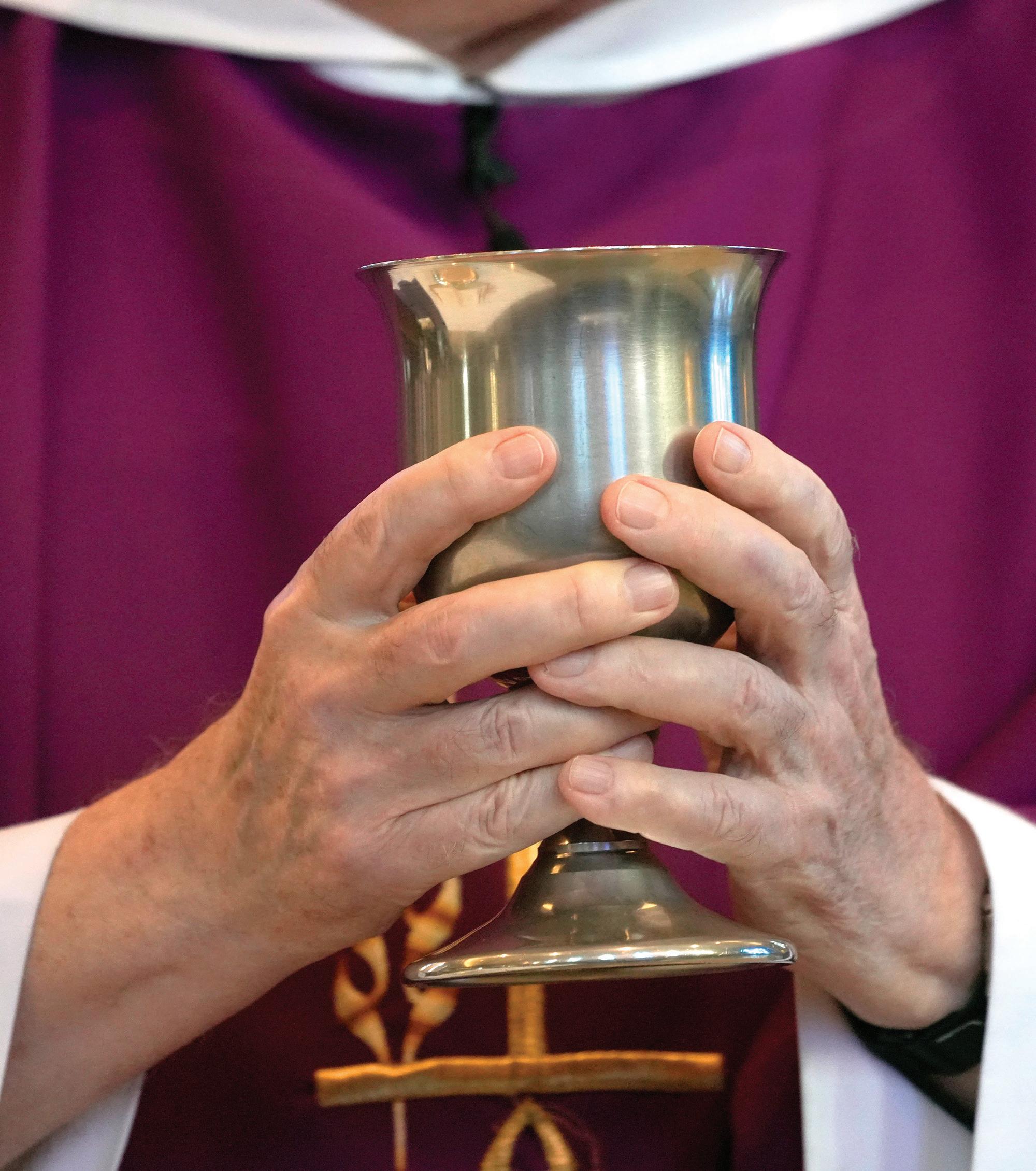
AThe short answer is that your priest isn't offering Mass for the people of the parish because he personally wanted to or because he thought it was a good idea (although he probably is happy to do this and praying for the people of the parish is indeed a good idea)! Rather, he was offering this specific Mass intention because the Church's canon law specifically requires him to do so.
As we read in Canon 534 of the Code of Canon Law: "After a pastor has taken possession of his parish, he is obliged to apply a Mass for the people entrusted to him on each Sunday and holy day of obligation." In more technical canonical contexts, we would refer to this mandatory Mass intention as the "Missa pro populo," which translates literally into English as "Mass for the people."
A parish pastor's requirement to celebrate a weekly "Missa pro populo" closely parallels the similar obligation of a diocesan bishop, noted in the Canon 388 of the Code, to celebrate a Mass for the people of his diocese.
That same canon goes on to state that the "bishop himself must personally celebrate and apply a Mass for the people on the days mentioned," and it's clear from the context in the relevant canon that this is likewise a personal obligation for parish pastors.
That is, while parish pastor can potentially delegate the weekly "pro populo" Mass to another priest "If he is
Jenna Marie Cooper, who holds a licentiate in canon law, is a consecrated virgin and a canonist whose column appears weekly at OSV News. Send your questions to CatholicQA@osv.com.
legitimately impeded from this celebration" (such as, for example, in the case of a sudden illness), the "pro populo" Mass is an obligation that is entrusted to the particular, individual priest who serves the parish in the specific role as pastor. Or in other words, prayerfully providing for the spiritual needs of the people is not a service offered by the parish as an institution, but is rather a duty specifically committed to the person of the priest who serves as the primary shepherd and spiritual father of the parish.
This relatively small detail tells us something important about the nature of the priesthood and of the way authority works in the Church more generally. Although priests are often charged with the practical day-to-day administration of a parish, just as a bishop is charged with the prosaic details of running a diocese, diocesan bishops and parish pastors both have roles that are far more profound than that of a chief executive officer of a merely human organization.
Of course, it is to be hoped that parishes and dioceses are run well and that their relevant organizational and material needs are tended to in a sensible and prudent fashion. But at the end of the day, the Church – and the portions of the Church that we call parishes and dioceses – are far closer to a spiritual family than they are to a secular charity or ordinary non-profit.
St. John Paul II alludes to this reality in his 1992 document "Pastores Dabo Vobis" on priestly formation: "In his spiritual life, therefore, (the priest) is called to live out Christ's spousal love toward the Church, his bride. Therefore, the priest's life ought to radiate this spousal character, which demands that he be a witness to Christ's spousal love and thus be capable of loving people with a heart which is new, generous and pure … with full, constant and faithful dedication."
A priest is seen in a file photo holding a chalice as he celebrates Mass. —OSV News photo/Gregory A. Shemitz
Includes all 3 books in this one volume - The Wreath; The Wife; The Cross.
In her great historical epic Kristin Lavransdatter, set in fourteenth-century Norway, Nobel laureate Sigrid Undset tells the life story of one passionate and headstrong woman. Painting a richly detailed backdrop, Undset immerses readers in the day-to-day life, social conventions, and political and religious undercurrents of the period.
Now in one volume, Tiina Nunnally’s award-winning definitive translation brings this remarkable work to life with clarity and lyrical beauty.
As a young girl, Kristin is deeply devoted to her father, a kind and courageous man. But when as a student in a convent school she meets the charming and impetuous Erlend Nikulauss, she defies her parents in pursuit of her own desires. Her saga continues through her marriage to Erlend, their tumultuous life together raising seven sons as Erlend seeks to strengthen his political influence, and finally their estrangement as the world around them tumbles into uncertainty.

With its captivating heroine and emotional potency, Kristin Lavransdatter is the masterwork of Norway’s most beloved author–one of the twentieth century’s most prodigious and engaged literary minds–and, in Nunnally’s exquisite translation, a story that continues to enthrall.
Includes an introduction by Brad Leithauser and features French flaps and deckle-edged paper.
“The finest historical novel of the 20th century; indeed it dwarfs most of the fiction of any kind that Europe has produced in the last twenty years.”
—Contemporary Movements in European Literature
“No other novelist, past or present, has bodied forth the medieval world with such richness and fullness of indisputable genius ... One of the finest minds in European literature.”
—New York Herald Tribune
“Sigrid Undset’s trilogy embodies more of life, seen understandingly and seriously ... than any novel since Dostoevsky’s Brothers Karamazov. It is also very probably the noblest work of fiction ever to have been inspired by the Catholic art of life.”
—Commonweal

Cause for novelist Sigrid Undset’s canonization expected to open in fall
By OSV News
Sigrid Undset, Nobel laureate in Literature 1928. —Photo from Wikimedia Commons
Preparations are underway in Norway to open a canonization cause for the Nobel Prize-winning novelist Sigrid Undset, Bishop Fredrik Hansen of Oslo announced July 8.
“She is far more than an author and Nobel Prize laureate. For us, she is a model of Christian faith, of a life lived in virtue and of the pursuit of holiness,” Bishop Hansen said of Undset during a Mass where he made the announcement.
“She showed a constant and practical concern for the poor. She gave of herself in caring for her daughter, in her commitment to life and to the sanctity of life. Through her many books she has shaped countless believers, inspired them to live in Christ and borne witness to our medieval saints,” he said, according to a press release.
Born in Denmark in 1882 and raised in Norway, Undset is best known for her novel “Kristin Lavransdatter,” a trilogy tracing its protagonist’s life in the Middle Ages. It earned Undset the Nobel Prize for Literature in 1928 “principally for her powerful descriptions of Northern life during the Middle Ages,” according to the Nobel Prize organization.
Her research into medieval Catholicism led her to become Catholic in 1924, and in 1928 she became a Third Order Dominican. During World War II, she fled to New York City, where she publicly advocated for Norwegian resistance to Nazism. She returned to Norway after
the end of the war in 1945, and she died in 1949 in Lillehammer, Norway.
Prior to publicizing the initiative, Bishop Hansen presented it to the Nordic Bishops’ Conference, which includes the bishops of Denmark, Finland, Iceland, Norway and Sweden, as well as experts on Undset’s life. Her sainthood cause will formally open in the fall, he said.
Bishop Hansen shared the news at a Mass celebrating the feast of St. Sunniva in the ruins of the Benedictine monastery on Selja, an island that is considered the birthplace of Norwegian Christianity and home to its first diocese. According to legend, the 10th-century Christian queen St. Sunniva fled Ireland to escape marriage to a tyrant and ultimately died on Selja, after which miracles were attributed to the site.
“Like St. Sunniva and her companions, Sigrid Undset, too, must be for us a model of life in Christ,” Bishop Hansen said. He encouraged the faithful to pray for the diocese’s work on her cause.
After the cause is formally opened, Undset will be given the title “servant of God.” Should her cause progress, she would receive the title “venerable” from the Pope to recognize her life of heroic Christian virtue. An approved miracle attributed to her intercession would normally then be required for her beatification, with a second approved miracle necessary for her canonization.
book is available at https://ignatius.com/kristin-lavransdatter-klp/
join this Business Directory, email mgregory@diometuchen.org




50 Interview
By Deacon Steven D. Greydanus
Father Stanley Rother’s gift of presence: Interview with María Ruiz Scaperlanda
Catholic writer María Ruiz Scaperlanda is an enthusiastic voice for Blessed Stanley Rother–one you can hear in the documentary American Martyr, which features her prominently.
Scaperlanda served on the Archdiocese of Oklahoma City’s historical commission for Father Stanley’s cause, helping to gather information for the Congregation for the Causes of the Saints of the Roman Curia. She is also the author of the biography “The Shepherd Who Didn’t Run: Fr. Stanley Rother, Martyr from Oklahoma.” She and her husband Michael Scaperlanda, chancellor for the archdiocese, have executive producer credits for the documentary, which is presented by the archdiocese.
I spoke with her recently by phone. Our conversation has been edited for length and clarity.
I understand that you were born in Cuba, grew up in Puerto Rico, and now live in Oklahoma, is that correct?
All of that is correct, yes.
It might seem superfluous to ask a Latina Catholic living in Oklahoma what drew her to an Oklahoma priest martyred in Latin America–but I’d still like your answer!
My kids went to Catholic school here. I credit Oklahoma Catholic school teachers with keeping the story of this man alive. My kids would come home and tell me cool stories about a diocesan priest from Oklahoma who was killed in Guatemala, and my journalistic senses were very interested in all those details!
So the stories from your children–that was the first you heard about Father Stan?
Yes. When the archdiocese opened the cause for Father Stan, they needed people who speak Spanish, which is my first language. The archbishop [Eusebius Beltran] asked me if I would be involved in the historical commission. Later, on a pilgrimage to Guatemala, I met the new archbishop [Paul Coakley], and he said to me, “You know, we need a good biography that people can pick up and get to know him.” So I dove into Father Stan because of assignments! Doing his biography was quite a privilege.
Father Stanley’s shrine in Oklahoma City is understandably popular, but as a martyr and even as a shepherd, Blessed Stanley Rother belongs in a special way to the indigenous people of Guatemala. I wonder whether this cultural dual citizenship, so to speak, shapes how American Catholics perceive his legacy, or his message to us?
That’s interesting, yeah. The Guatemalan Diocese of Sololá included him in a list of 78 people they wanted Pope John Paul II to see when he visited. All these people died for the faith in this horrible civil war. They definitely considered
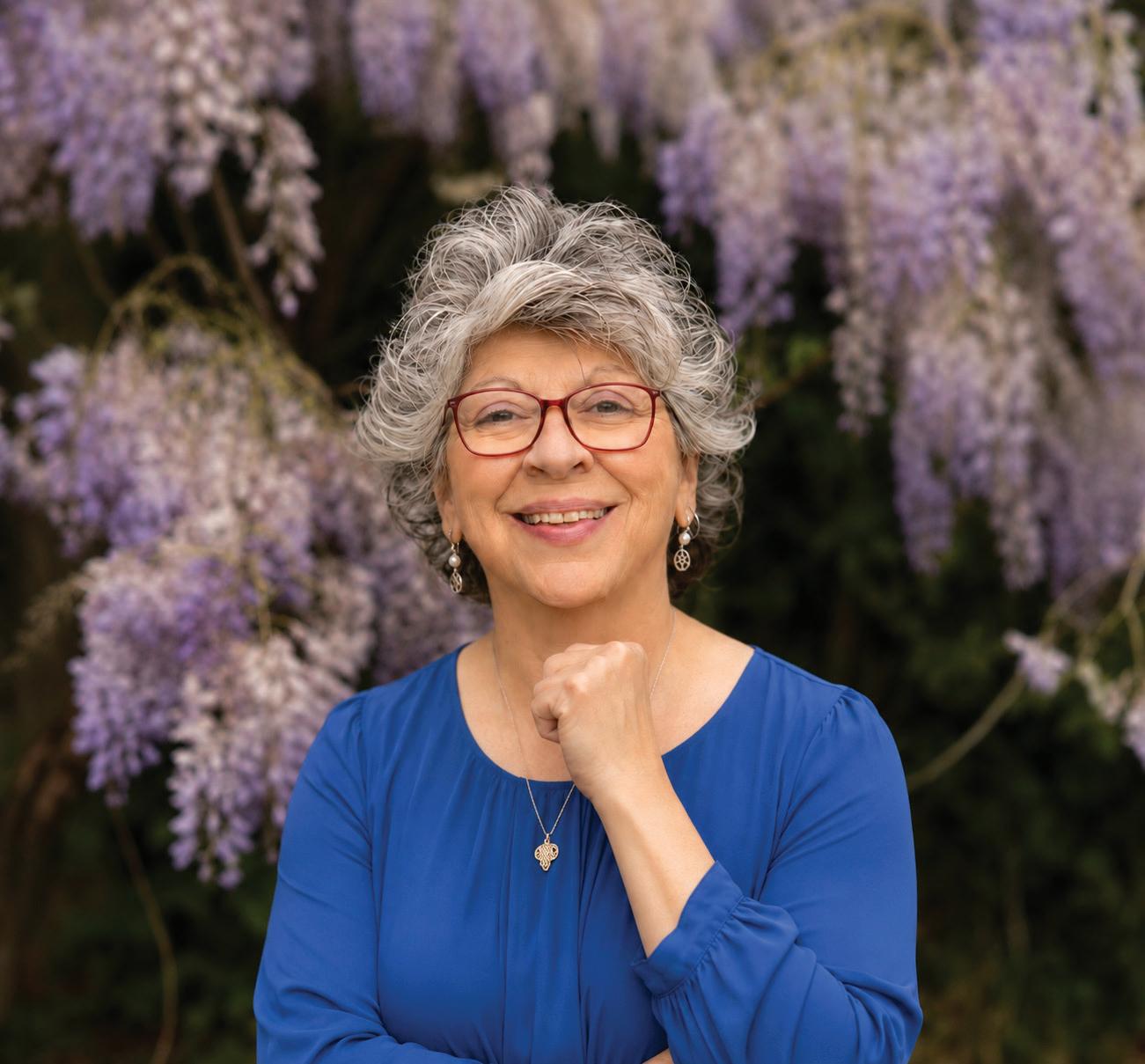
him an important part of the story. Some of the others have also been beatified. Ten indigenous Kʼicheʼ–three priests and seven lay people. Wisconsin native James Miller, FSC, martyred in 1982, was beatified in 2019.
Oklahoma is usually considered, you know, flyover country. People don’t pay attention too much to what’s going on here–but here Father Stan is! He lived life so fully that the Church has already recognized him as someone that we can look up to in learning how to live our own lives. It’s quite touching.
So Father Stan found commonality between his roots in Oklahoma “flyover country” and the overlooked people he ministered to in Guatemala? Is that another connection?
Yes, I agree! God doesn’t waste any details, and that’s certainly visible in the graces he poured on Father Stan, allowing him to connect with his parishioners in an intimate, personal way.
Would you say, then, that Father Stan’s witness calls us to greater awareness of people on the margins?
Particularly those suffering oppression, like immigrants in the U.S. suffering “inhuman treatment,” in the words of Pope Leo?
Since I am an immigrant and a refugee, of course I agree–but, more than awareness, what I’ve been emphasizing is Father Stan’s gift of presence to his people. He was God-in-the-skin for them, and he models how to do that for us: a shepherd who did not run, who returned to be fully with them, especially in their suffering. This is the image of God that Father Stan embodied for them, for us, all the way to his martyrdom.
Many Latinos in the U.S. today are concerned about rising discrimination and hate crimes as well as government policies. Does Father Stan’s witness have anything to say to us in this time?
I’ve always considered my Spanish
culture–my language, my music, and certainly food–part of who I am, and I can turn around and recognize that in other [Hispanic] people. Father Stan, as this white farmer from Okarche, didn’t start with that kind of kinship–but he developed it. At the mission, he found that he and the people could become one through our faith, through the things that really matter. I want to learn how to do that better myself.
That’s beautiful. Father Stanley was one of those people who, as Pope Francis used to say, sought to build bridges between different communities. There are also those who burn bridges–like those who took his life.
Yeah, and by the way, it wasn’t just Guatemala. We know about El Salvador from Archbishop Óscar Romero. All of Central America was kind of on fire during that period. Father Stanley was killed just a year after Romero.
It’s funny you mention St. Óscar Romero, because I was going to ask you to comment on the similarities and differences in their stories! I was definitely reminded of Romero’s story watching the film.
Is that right? I mean, how could you not? They were both reluctant leaders against what was going on at the beginning. Once they realized what their faith and God’s voice inside them were leading them to, they lived that courage to focus on God and not on what could happen. Most of us are not going to be put in that position–but we’re all in the position of figuring out how to live our faith more fully. How am I going to love the people that are prejudiced, the people that try to be demeaning, because you’re not from where they are?
Father Stan wasn’t a national leader like Romero, but he was concerned both with the spiritual well-being of his people and their socioeconomic well-being.
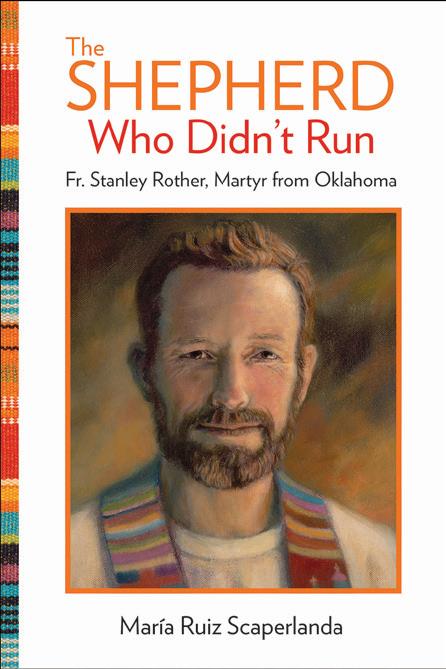
He definitely could see how they could improve. He truly was a farmer. The co-op was one step, so they weren’t just working for whoever owned the land, but for themselves. He would come home to Oklahoma, find out what equipment his neighbors were no longer using, and bring all that back to Guatemala. Can you imagine hauling things like that across Central America?
I personally cannot, I’m afraid! Me either. But I like the vision of it.
I can’t resist asking this: As a seminarian, Stan flunked out of Assumption Seminary in Texas and was asked to leave. Only the support of Bishop Victor Reed led to Stan completing his studies at Mount St. Mary’s and becoming a priest. Has anybody ever gone back to Assumption Seminary and asked whether they have any second thoughts or recriminations about sending him away?
(Laughing) You know, I had to do some research on that! I found it hilarious that they have a list of alumni: how many priests they educated; how many became bishops; how many became … whatever it is; and it ends with … one martyr.
(Laughing) Oh, they’re counting him!
Yes! Even though they sent him packing! I love to point out, just as you did, that Stan did flunk out of first year theology. When I’ve been speaking to seminarians, some will come to me afterwards and go: “Me too! I’m still here, but me too.” I think we all find comfort in that part of him.
Archdiocese of Newark Deacon Steven D. Greydanus is the creator of Decent Films, for film appreciation and criticism informed by Catholic faith. He was co-host for the Gabriel Award–winning cable TV show “Reel Faith” for New Evangelization Television, has appeared frequently on Catholic radio and written for a number of Catholic outlets.
Fathom Entertainment will release “American Martyr: The Stanley Rother Story” exclusively in theaters nationwide for two nights only in English, August 25-26, and one night only in Spanish, August 27. The film is narrated by Academy Award-nominated actor Martin Sheen.
OCT 22-25
Diocesan Events
Children’s Choir Summer Camp, Cathedral of St. Francis of Assisi, Metuchen, for all high school students and rising grade 3-8 students from any parish. Youth will participate daily in choir rehearsals, music theory classes, composer projects, and singing for Cathedral’s 12:10 Mass. There will also be fun outdoor activities (weather permitting), games, and snacks. Plus, each chorister will have an opportunity to play the Cathedral’s pipe organ. On Aug. 16 there will be a barbecue after the noon Mass. Tuition for the week is $250. For registration information, please contact Chris Deibert at Music@StFrancisCathedral.org. AUG 10-14 16
AROUND THE DIOCESE
SAVE-THE-DATE, Women’s Cursillo Weekend at the Blue Army Shrine, Asbury. Interested attendees may contact Metuchen Cursillo at contact@metcursillo.org or refer to their website at www.metcursillo.org.
DIOCESAN PROGRAMS
COURAGE is a ministry for persons who experience unwanted same-sex attraction. For more information please call 908-562-2476 or email couragecnj@gmail.com.
Adoration at Pastoral Center – The faithful are invited to Eucharistic Adoration at the St. John Neumann Pastoral Center, Tuesday mornings from 9 -11:45 a.m. As Pope St. John Paul II noted. “The Church and the world have a great need of Eucharistic adoration.” Anyone interested in signing up should contact Maria Agnese at magnese@diometuchen.org.
Perpetual Adoration – Shrine Chapel of the Blessed Sacrament The Shrine Chapel of the Blessed Sacrament, Raritan, is looking for adorers to sit with the Blessed Sacrament Monday through Friday from 10:00 a.m. to 4:00 p.m. Exposition of the Blessed Sacrament is also being offered the first Saturday of each month (Night Vigil) from 8:00 p.m. to 8:00 a.m. Anyone interested in signing up should visit https://blessedsacramentshrine.com.
Volunteers Needed – Catholic Charities Thrift Store and Food Pantry Catholic Charities needs volunteers for their thrift store and food pantry in Phillipsburg. Your time can directly help those in need. Contact Maria Hunter at 732-387-1315 or mhunter@ccdom.org to learn more about how you can contribute.
To place your ad in the directory please call Mary at 732-529-7934

SELLING YOUR HOME?
Willing to buy your home or townhouse in as-is condition. Quick 30 day cash closing. I’m a Licensed realtor in the State of NJ. Call or text Eugene “George” Pantozzi 908-392-2677.
Did you see hiding on a page in this issue?
Sherlock
Be among the first three to contact Mary Gregory at mgregory@diometuchen.org or 732-529-7934 with correct page and receive a $5 Dunkin’ gift card. Include a suggestion for a parish/school/organization story we may use, receive a $10 Dunkin’ gift card. Please provide your name, address and parish.
In June’s issue, Sherlock was on page 11. And the winners were:
• Grace McDonough, Our Lady of Mount Virgin Parish, Middlesex
• Patricia McCall, St. Jude Parish, Blairstown
• The Coppola Family, St. Charles Borromeo Parish, Skillman
Crossword
The August issue of The Catholic Spirit
• goes to press August 17
• ad space reservation deadline -July 27
• ad artwork deadline - August 3
• late requests considered if space allows


On your Ordination to the Priesthood and Diaconate! May God abundantly bless them as they begin their ministry in service to His Church.
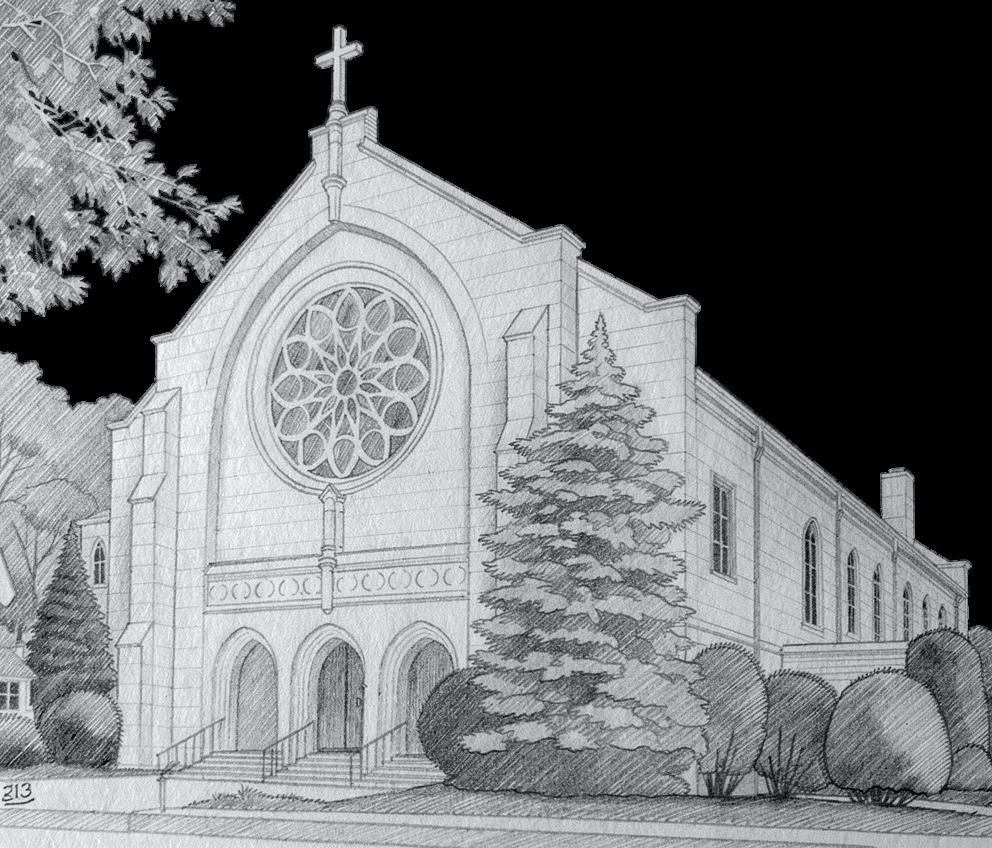
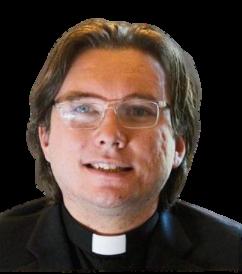
Mr James Prumo to the priesthood
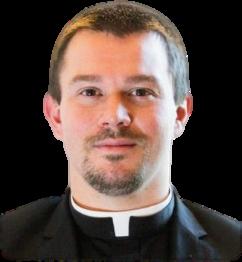
Mr Patrick Rasimowicz to the Diaconate
Cathedral of St. Francis of Assisi
548 Main Street, Metuchen, NJ, 08840