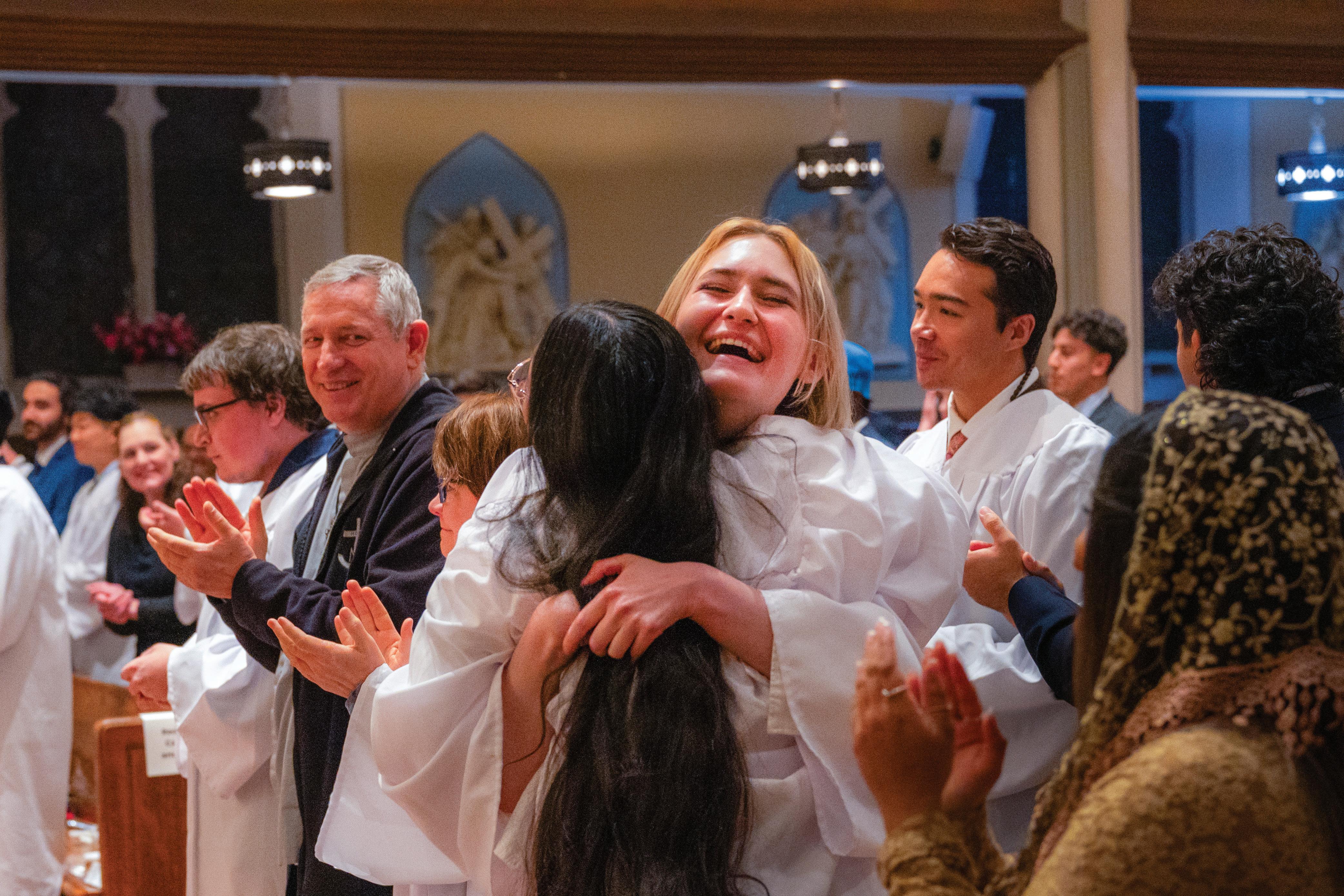
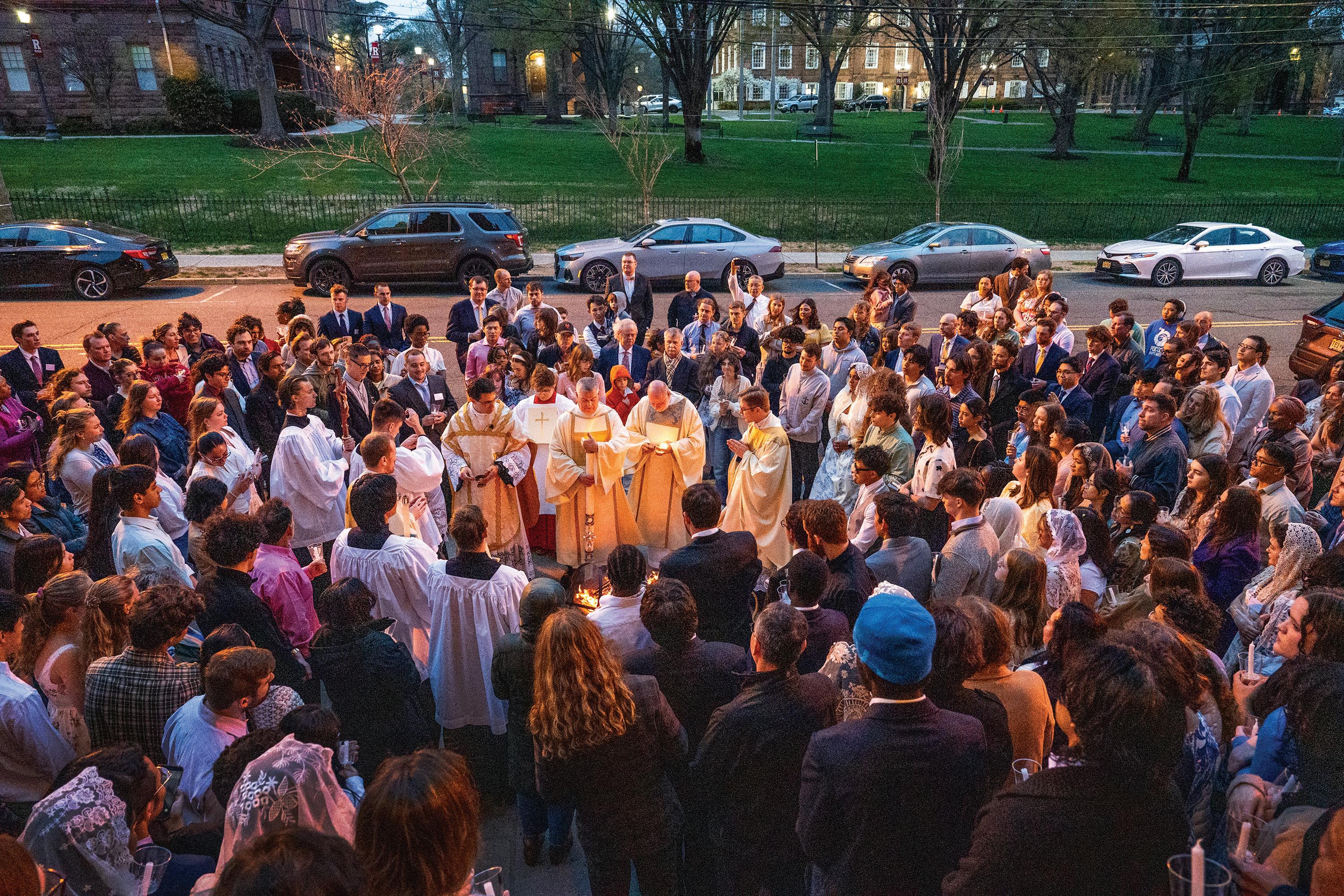
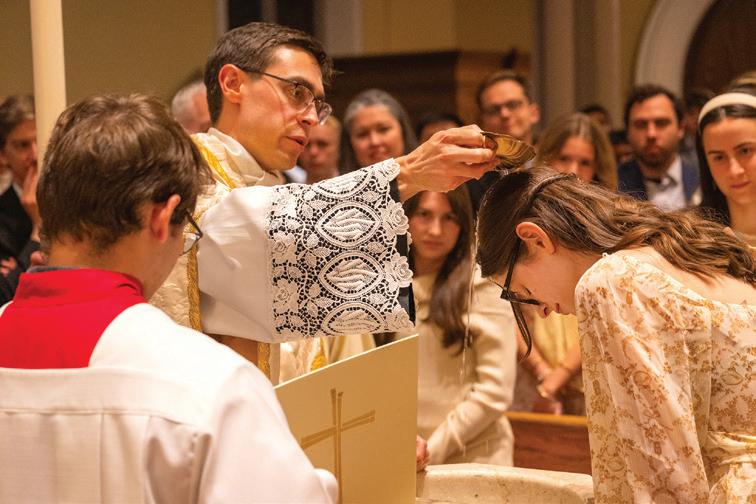
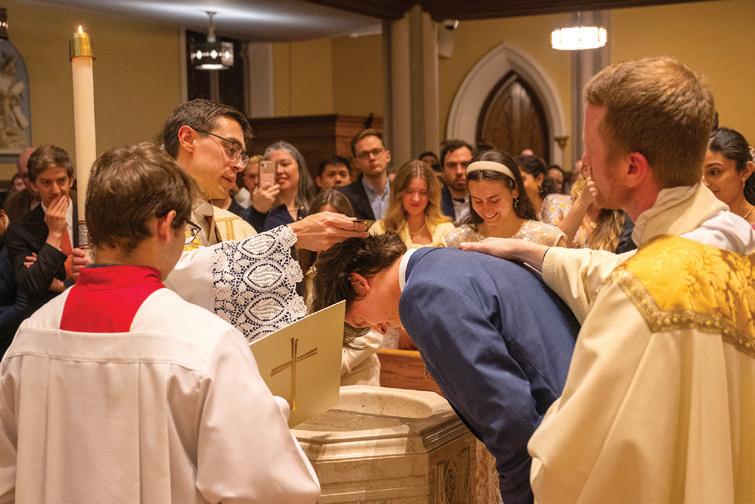
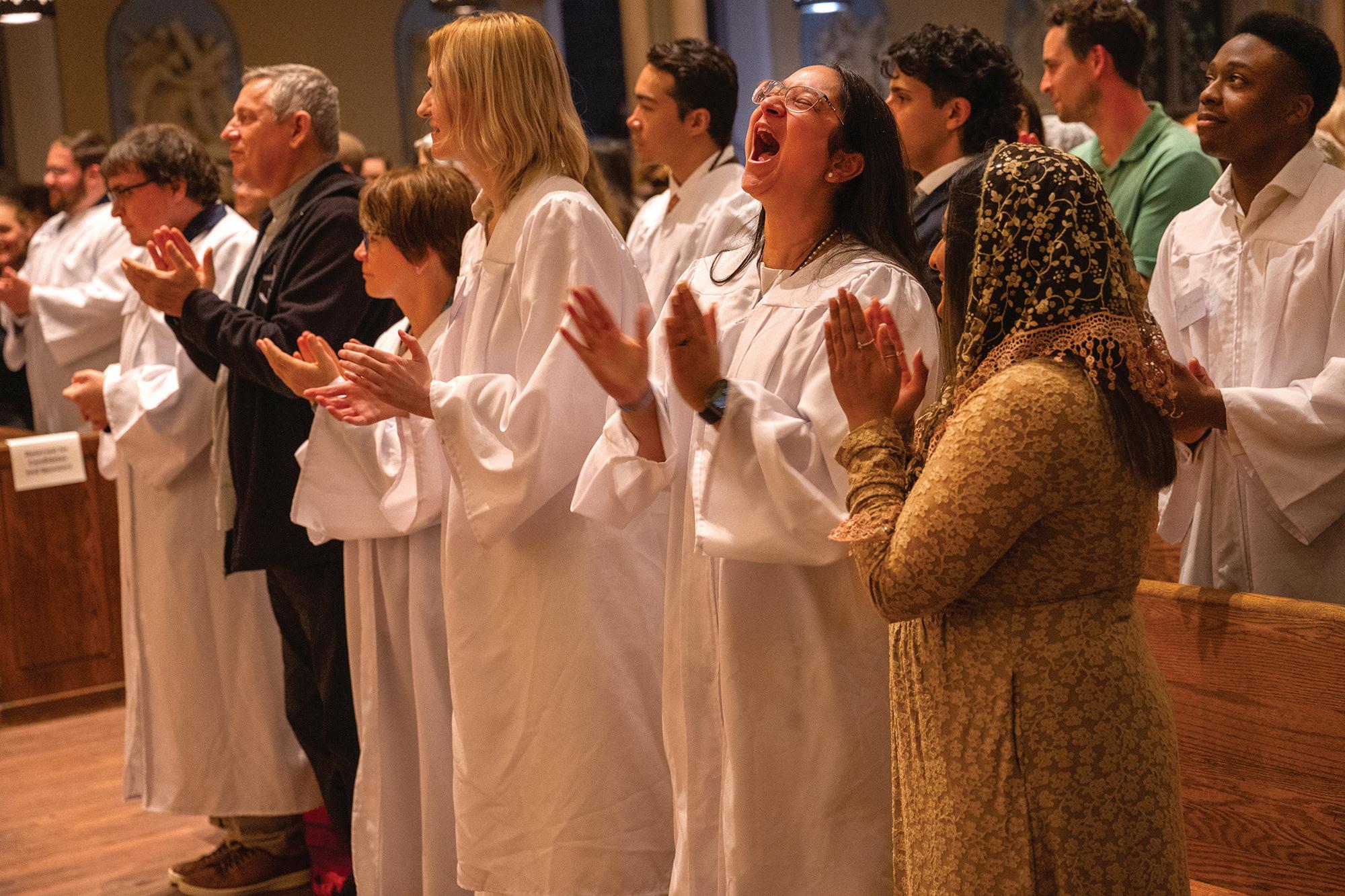
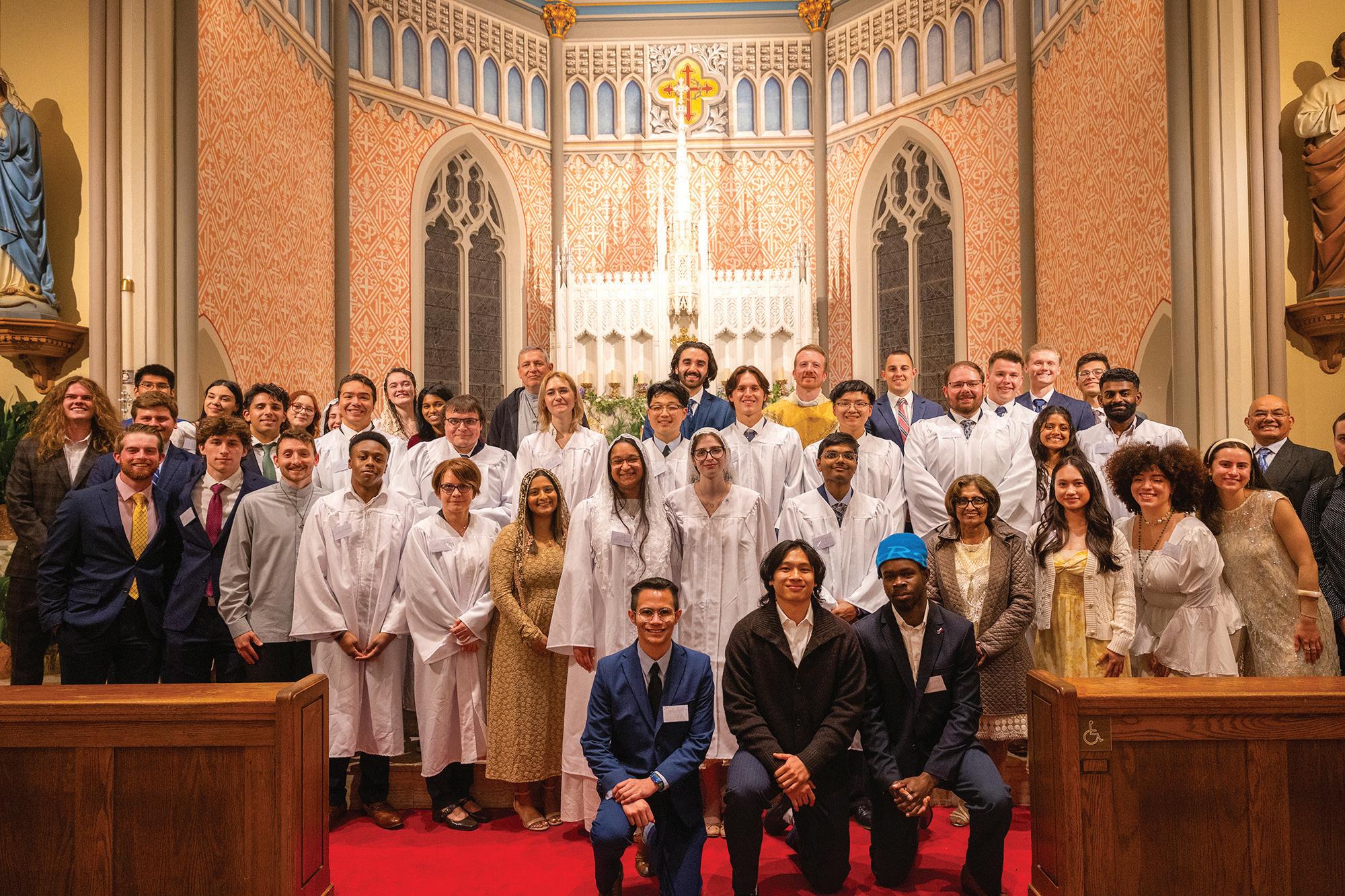
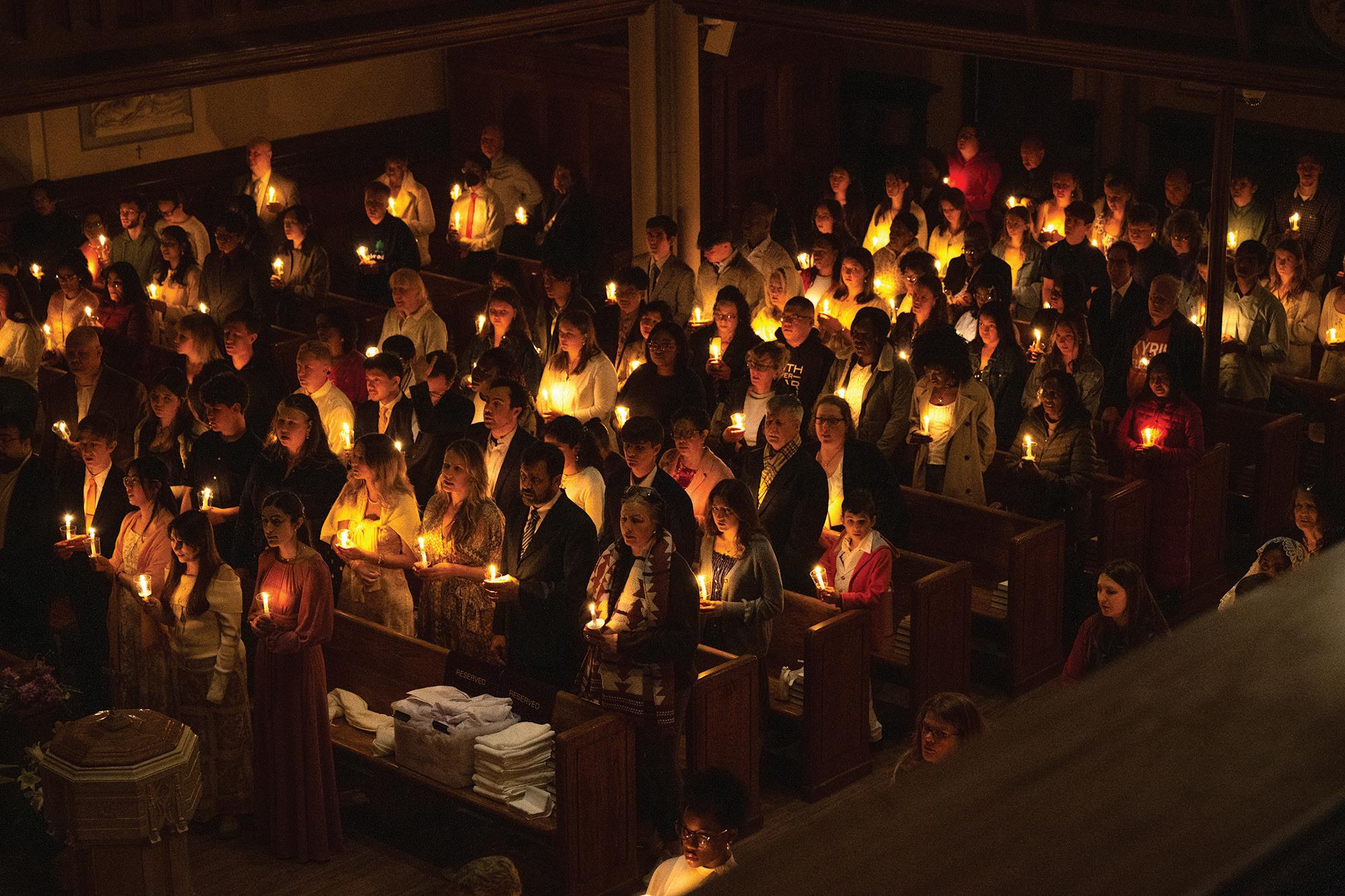
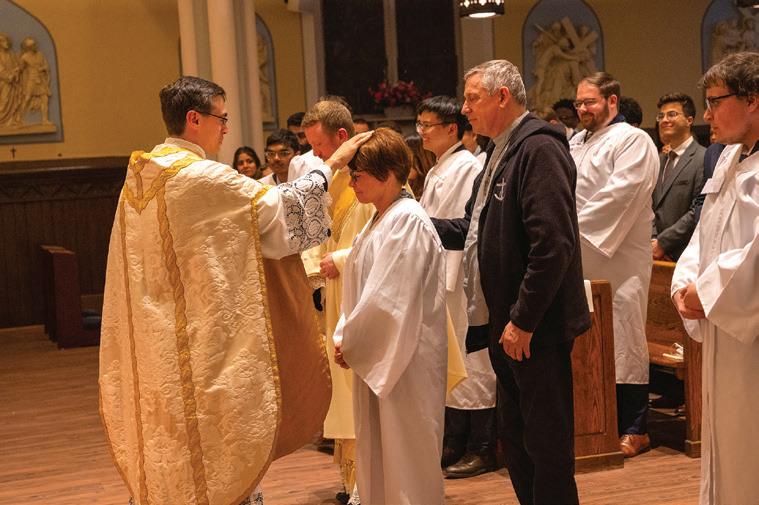
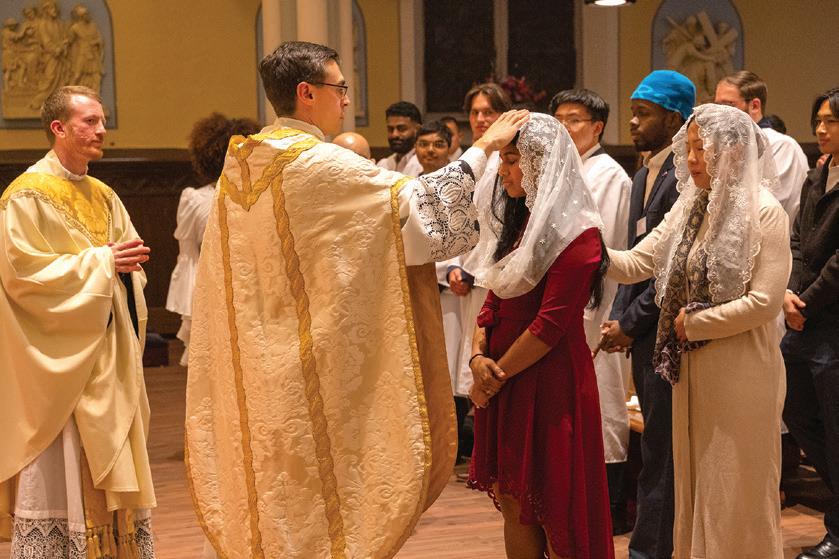
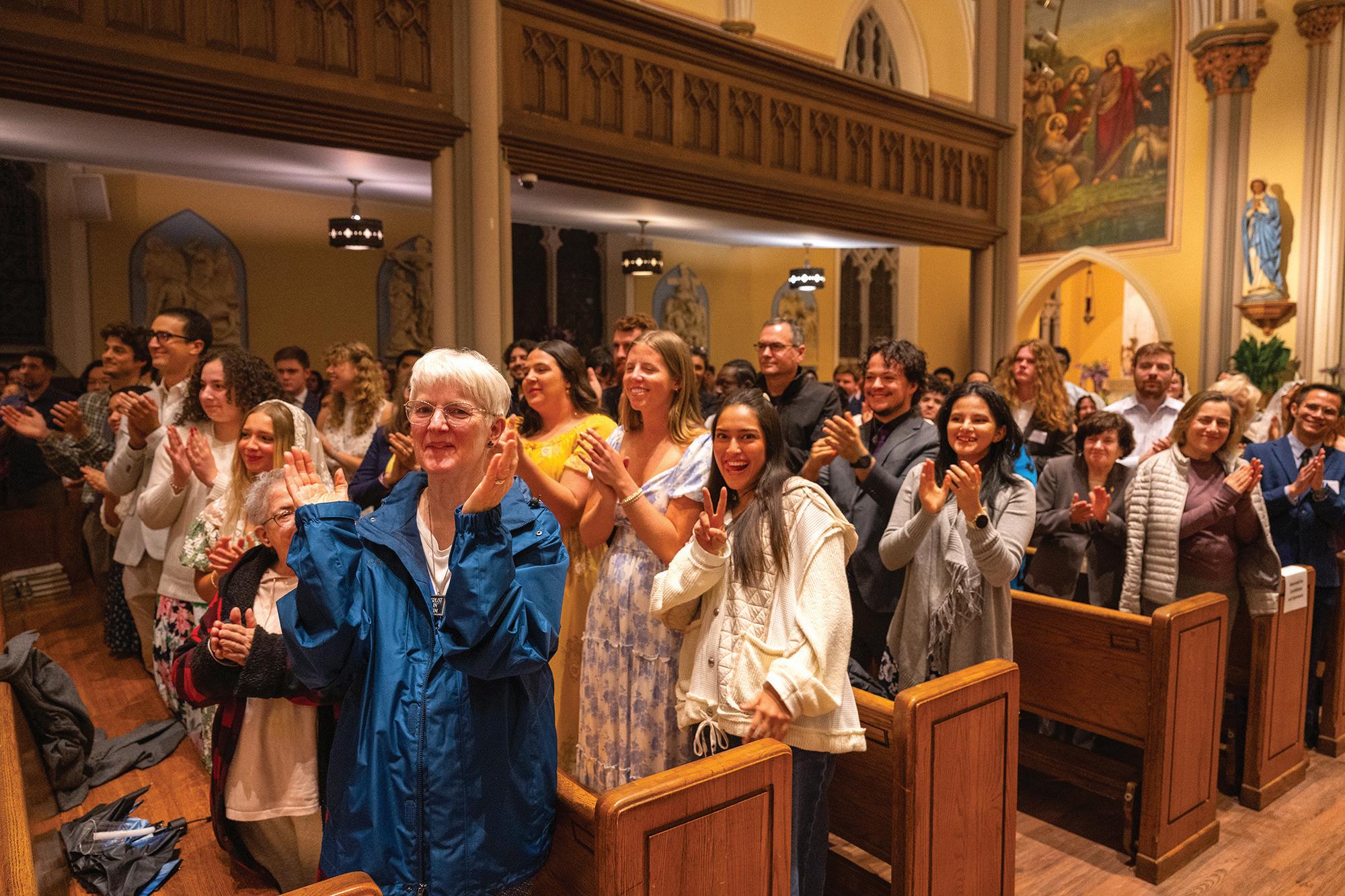
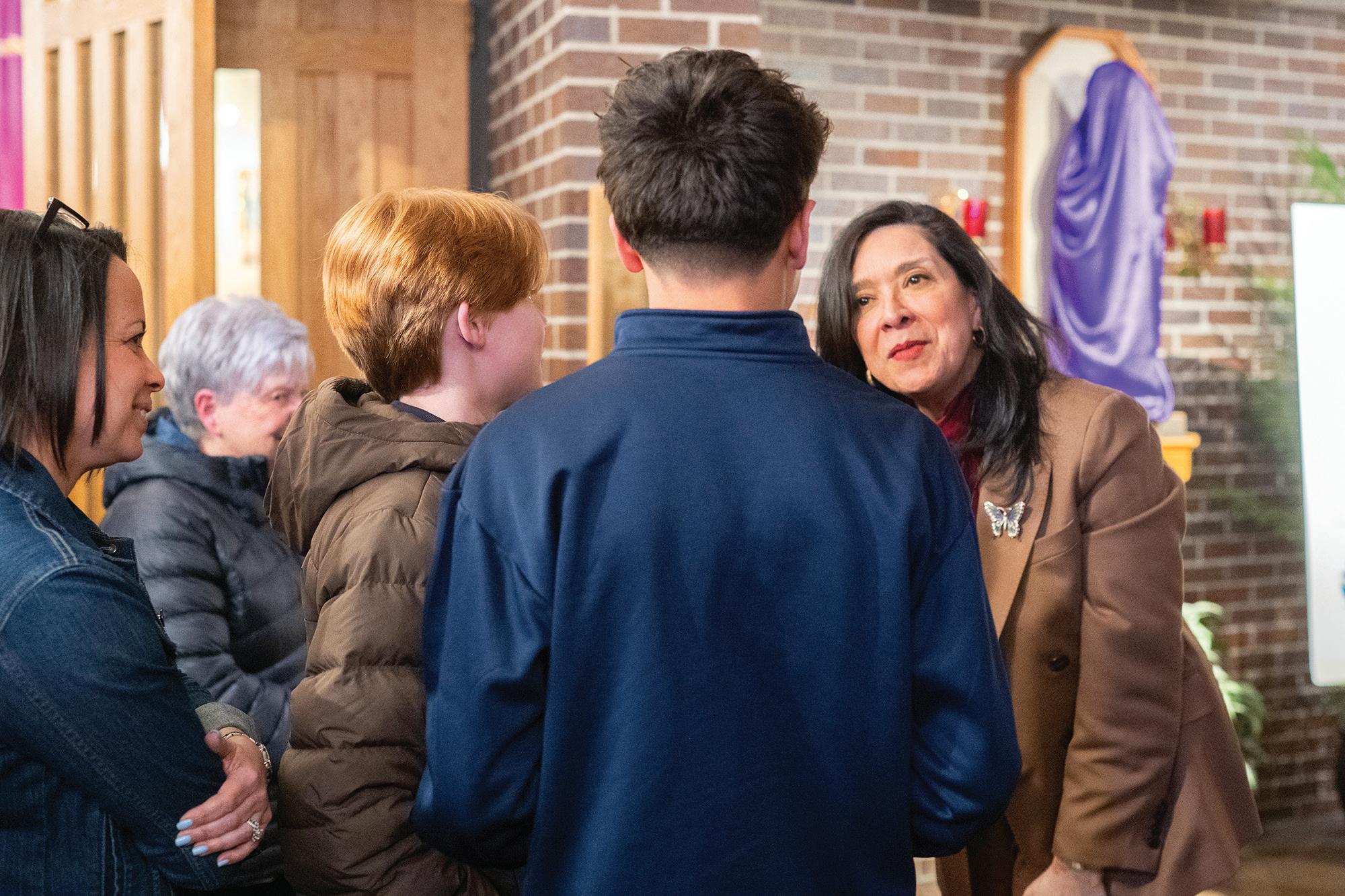
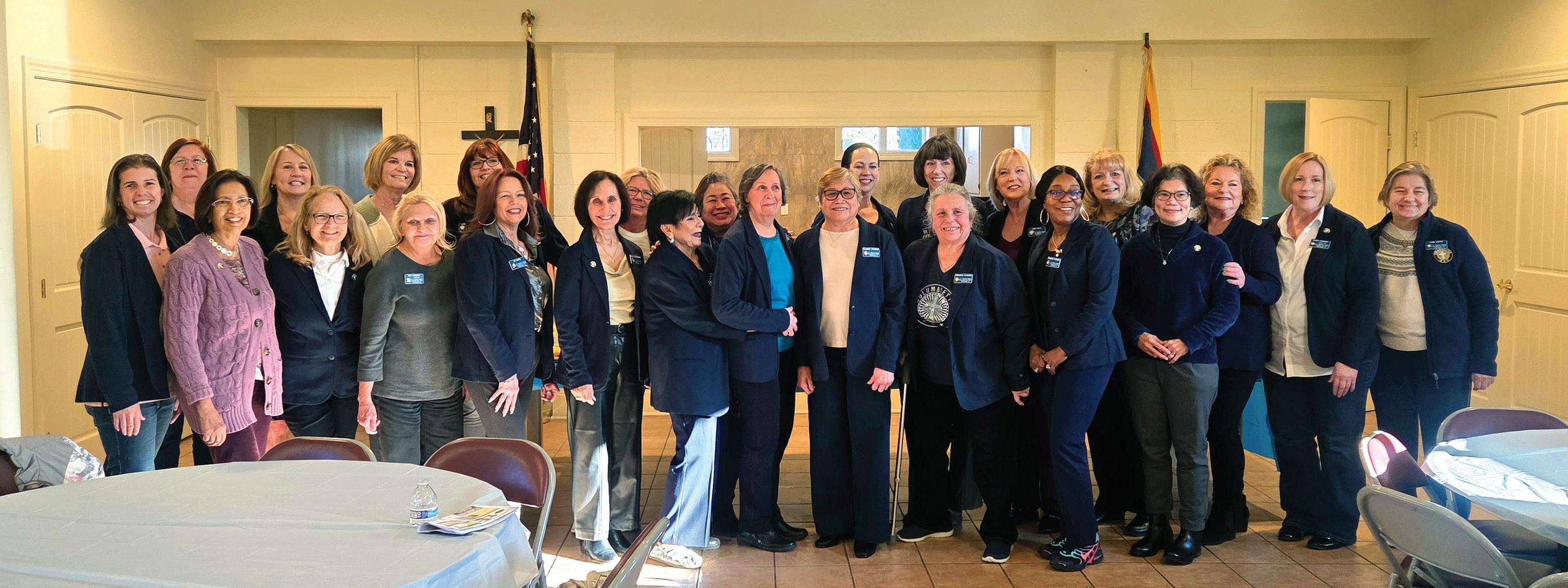
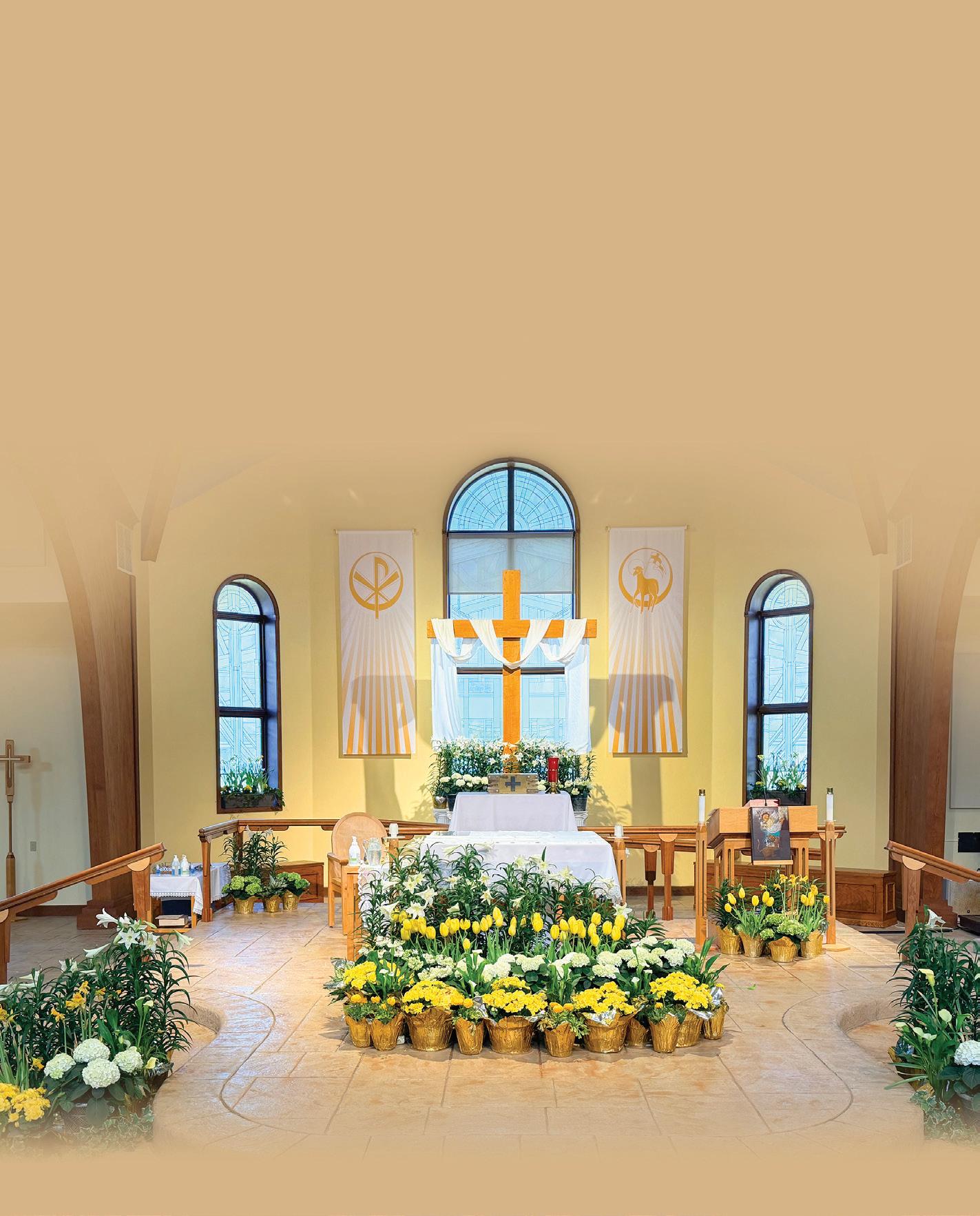
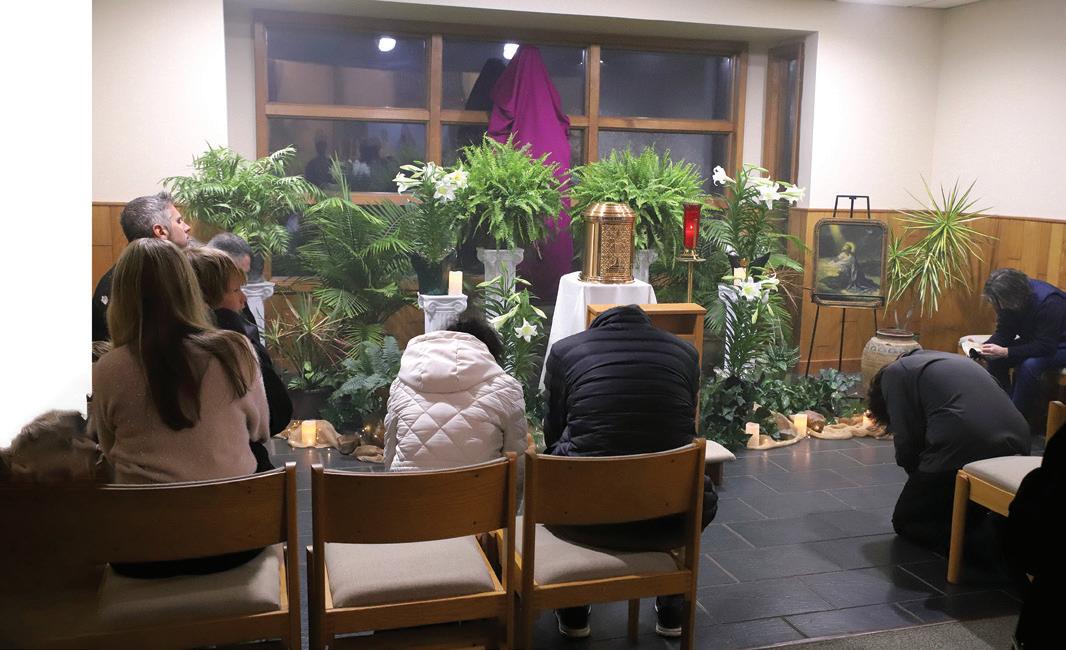
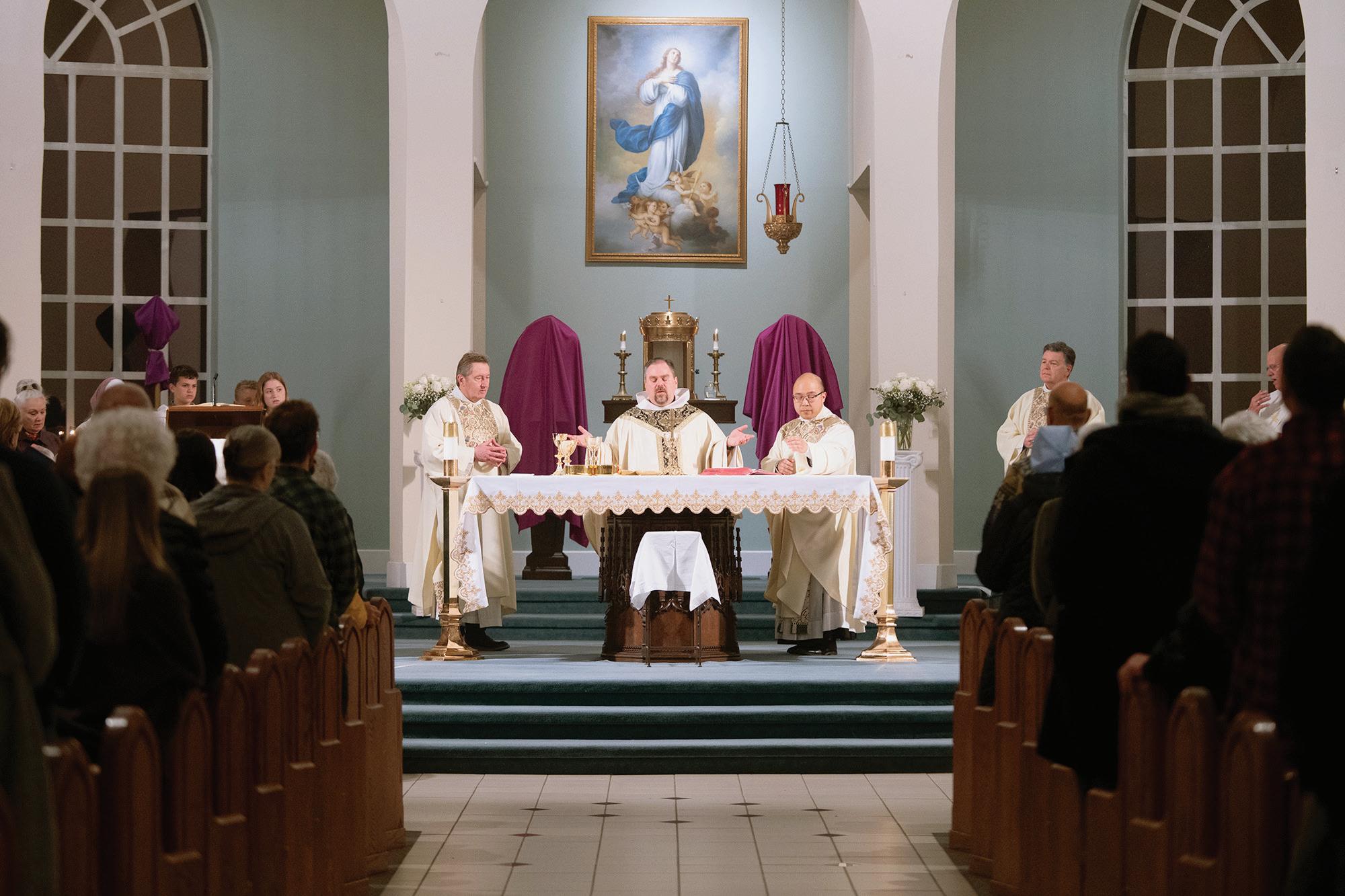
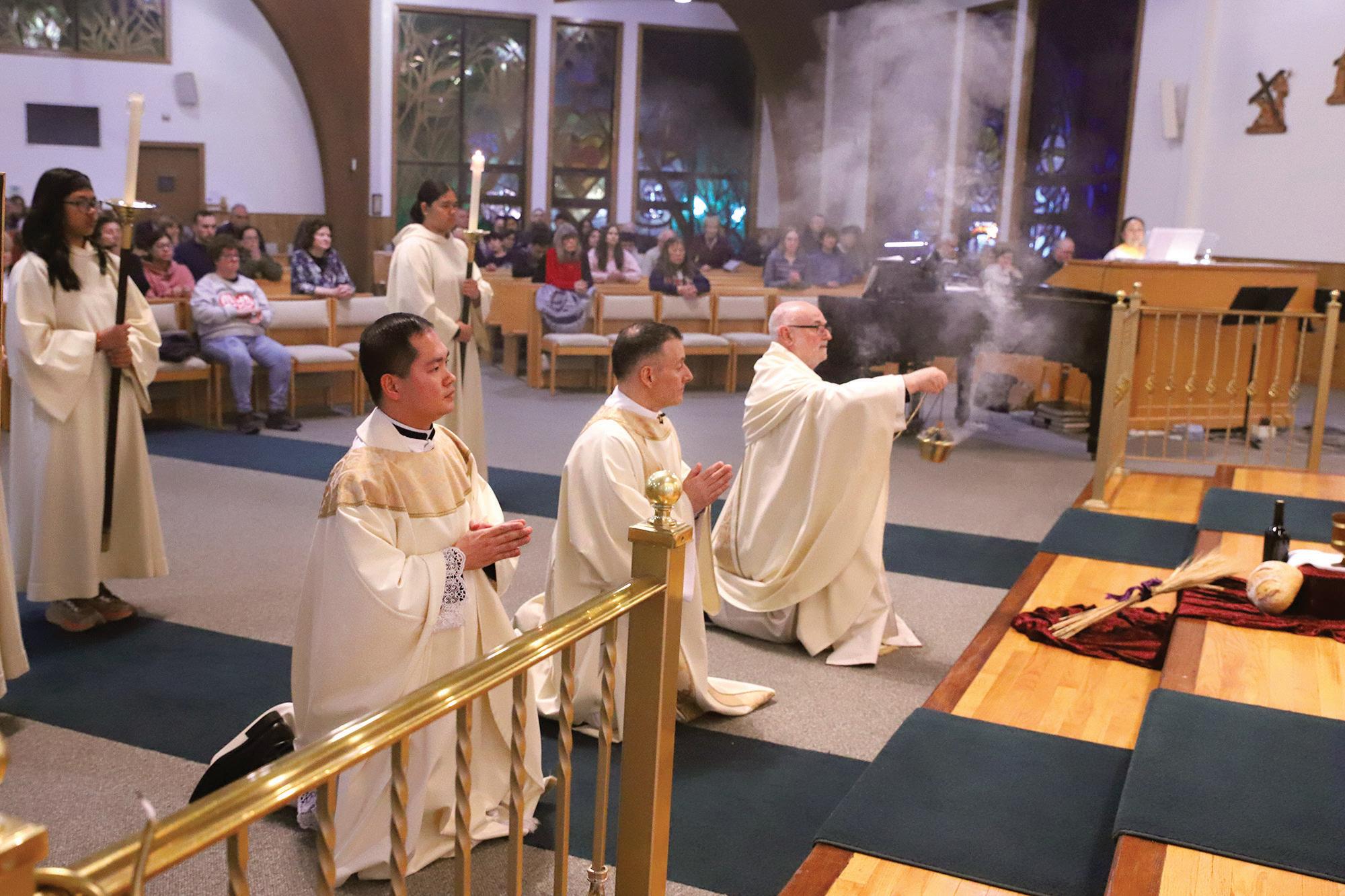
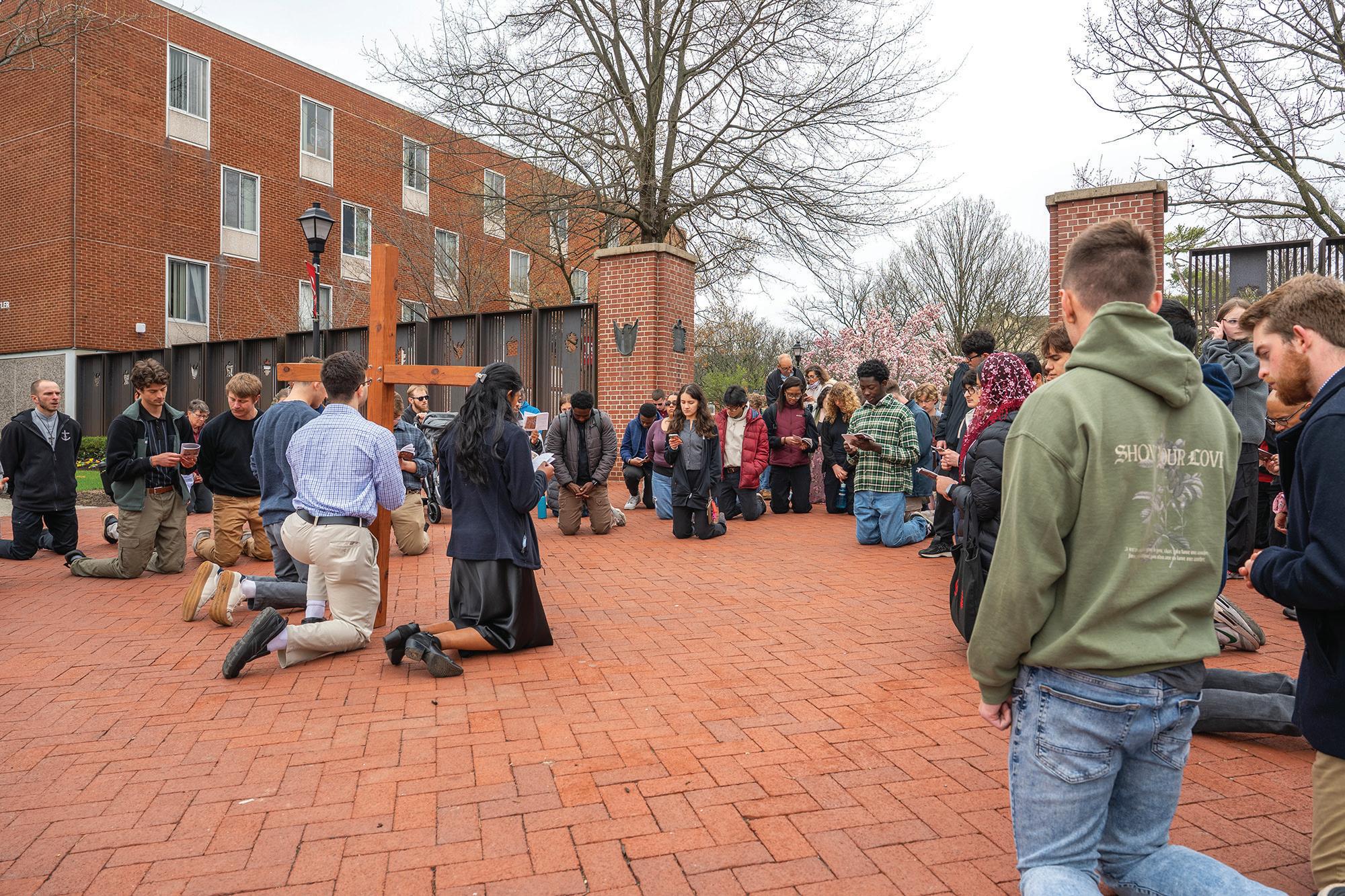
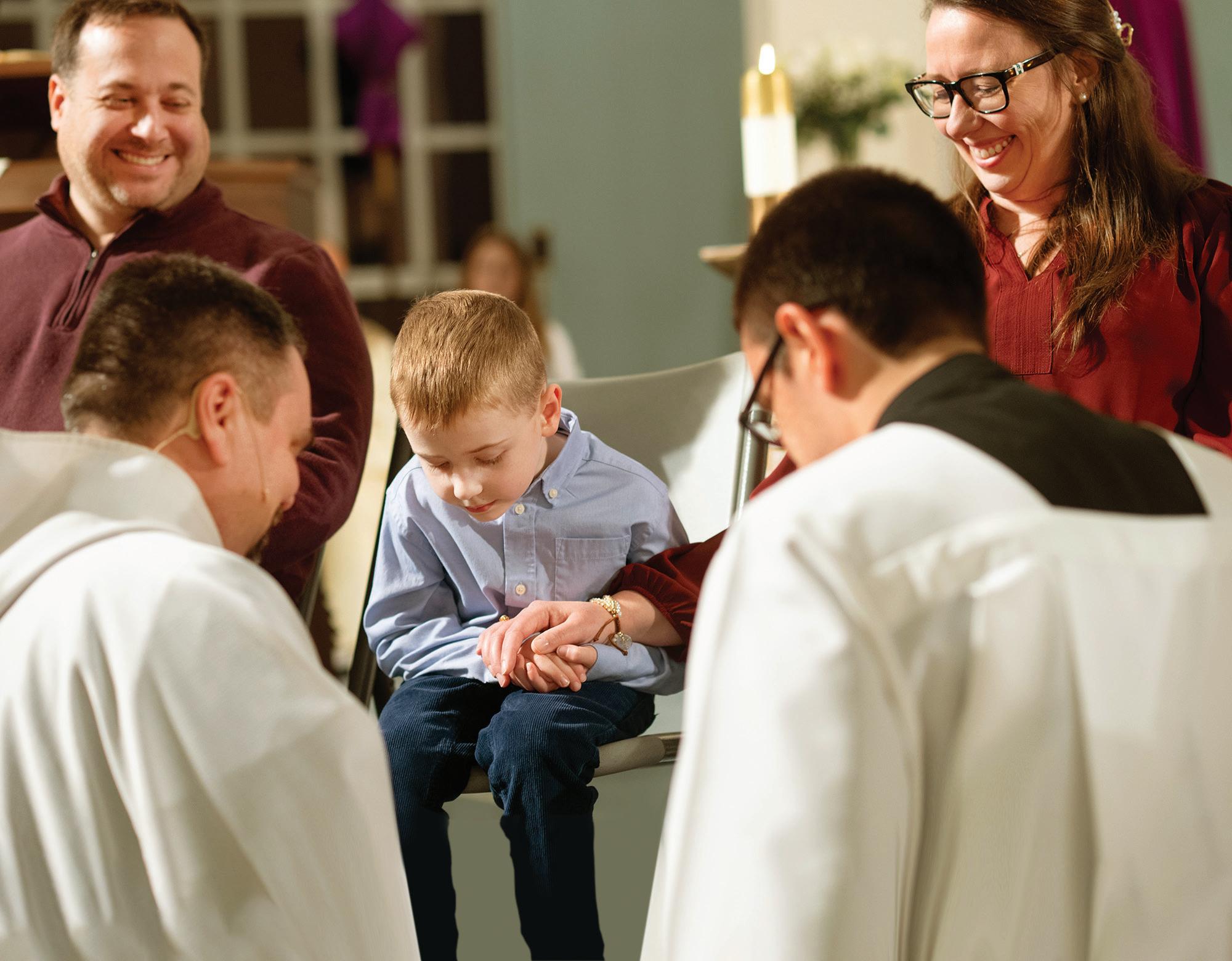
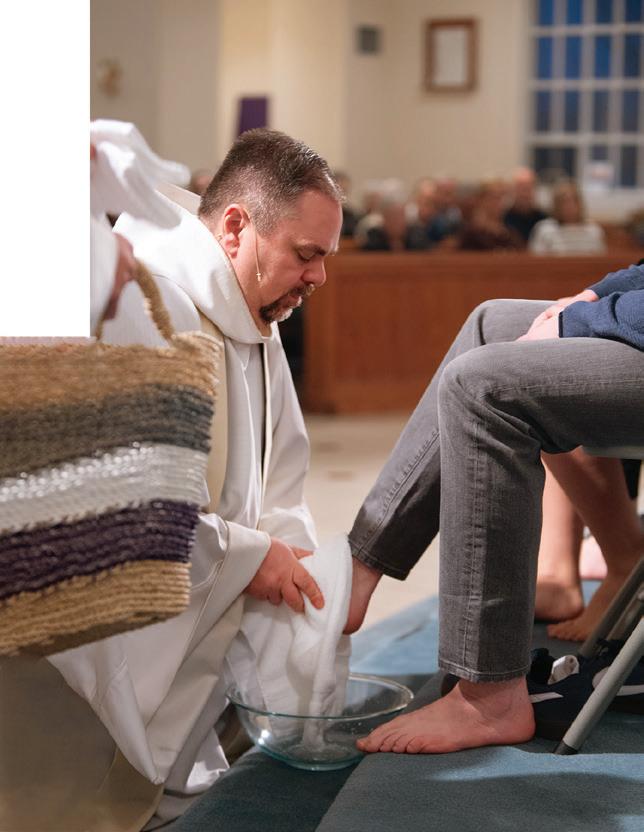
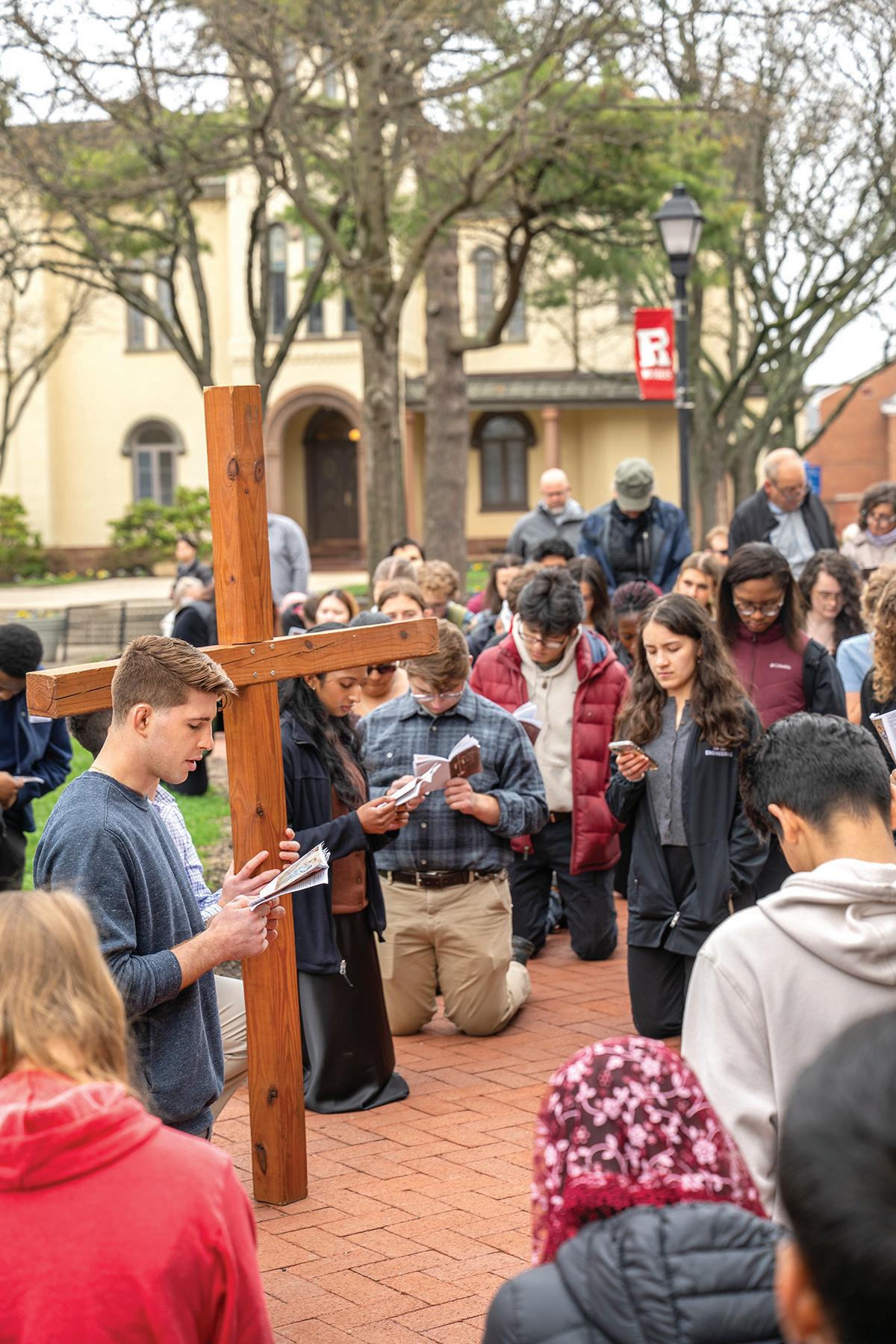
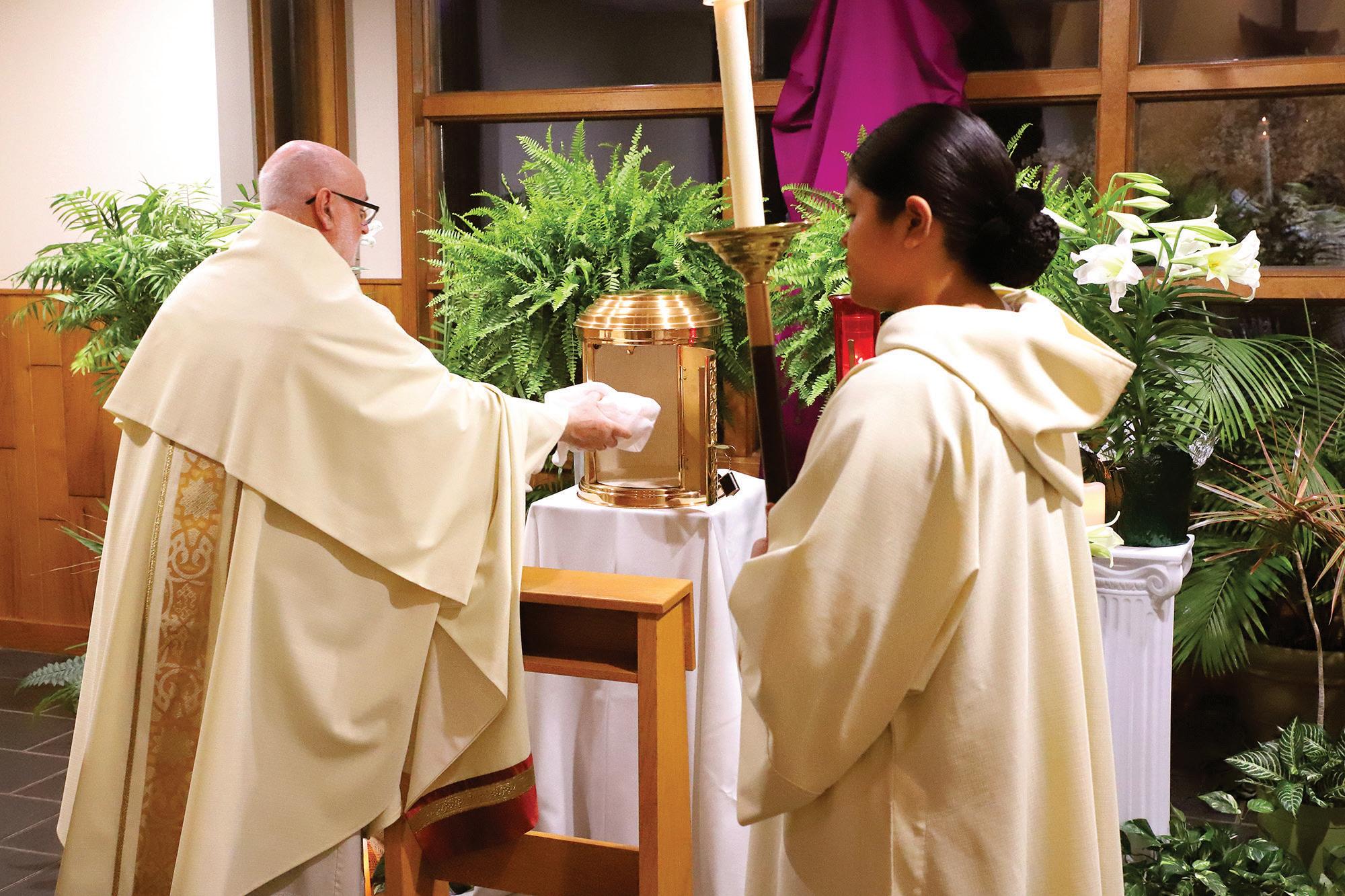
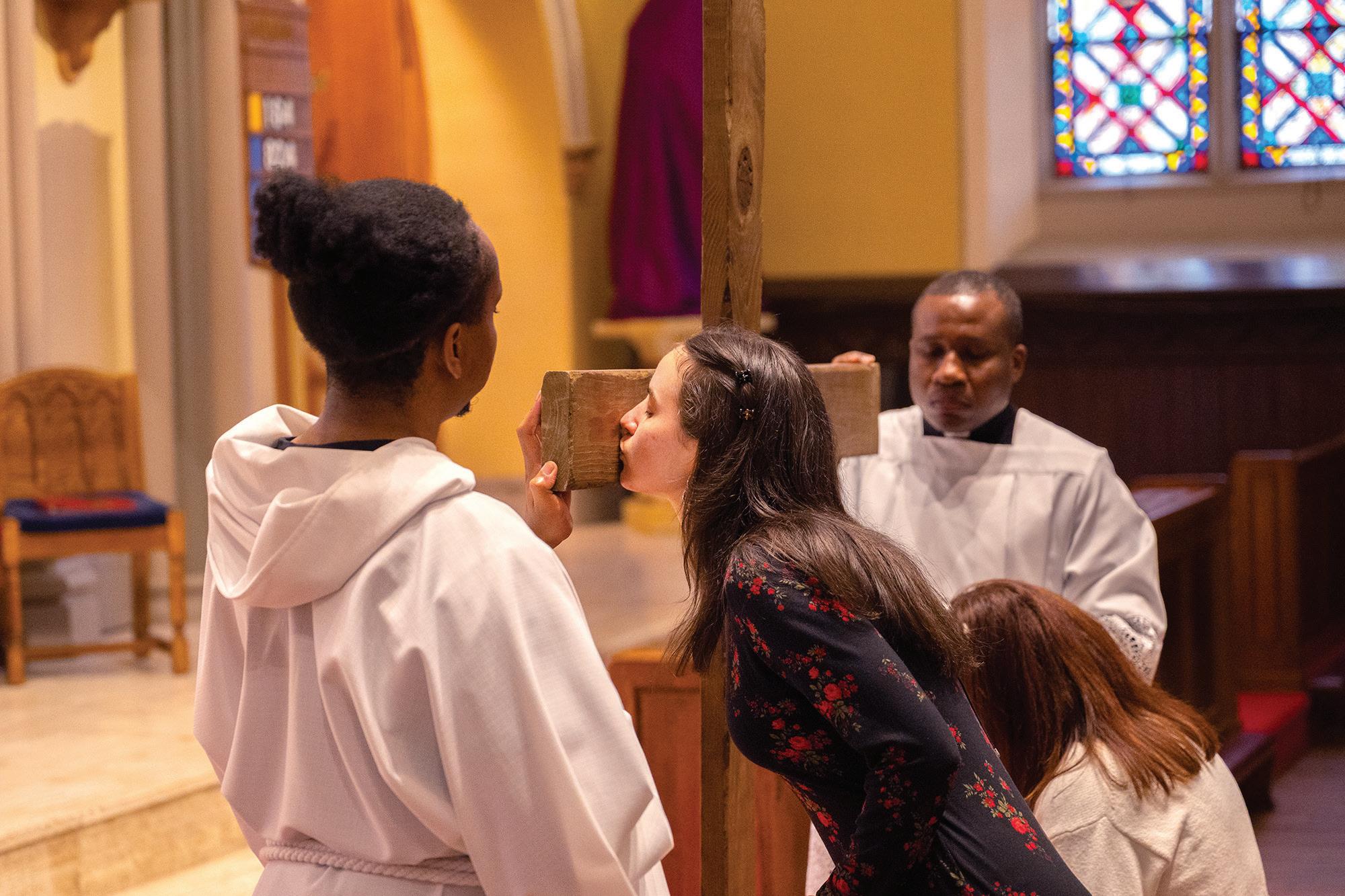
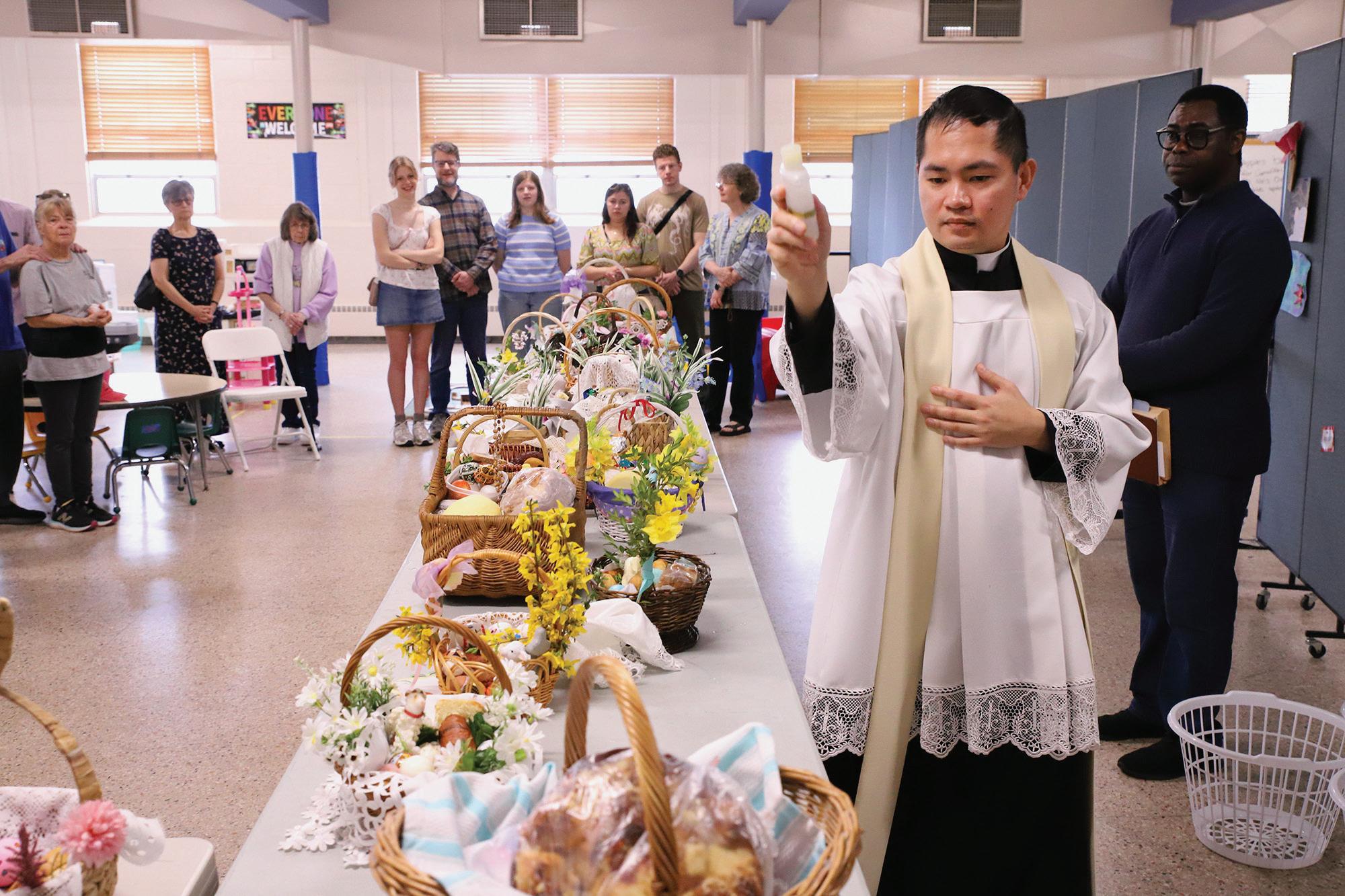
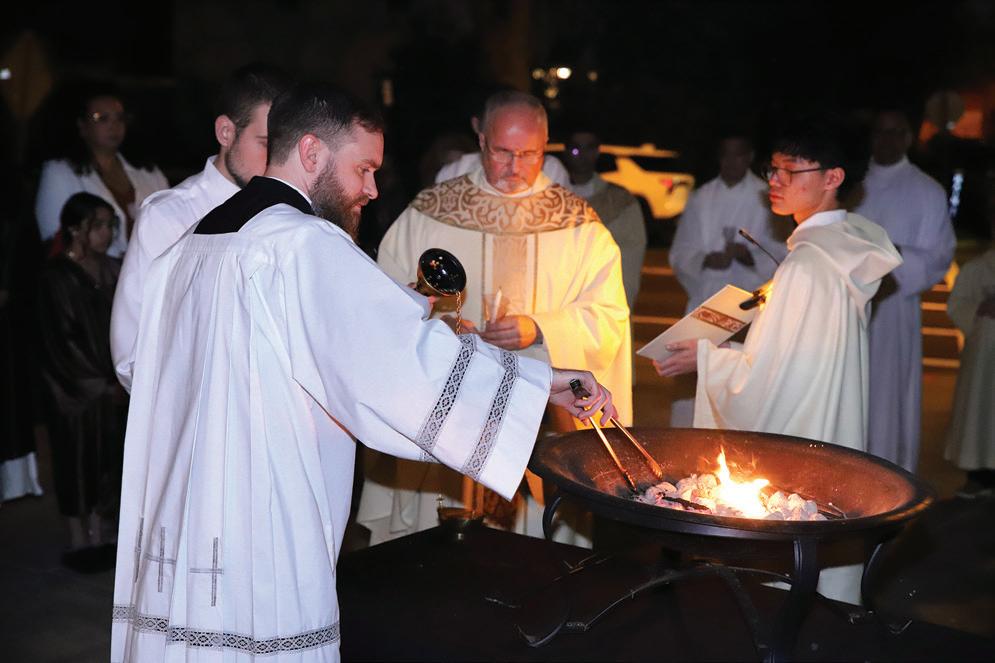
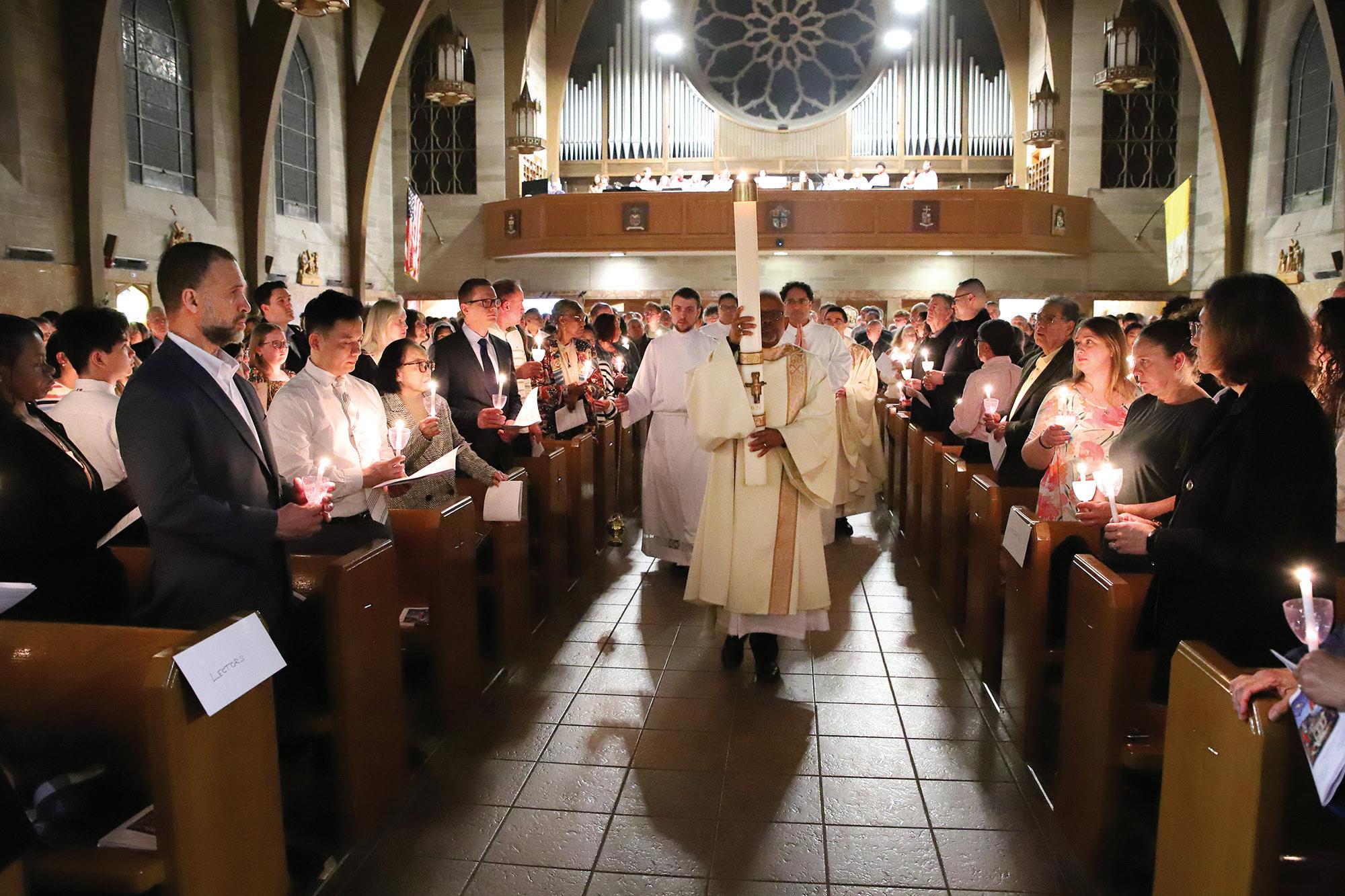
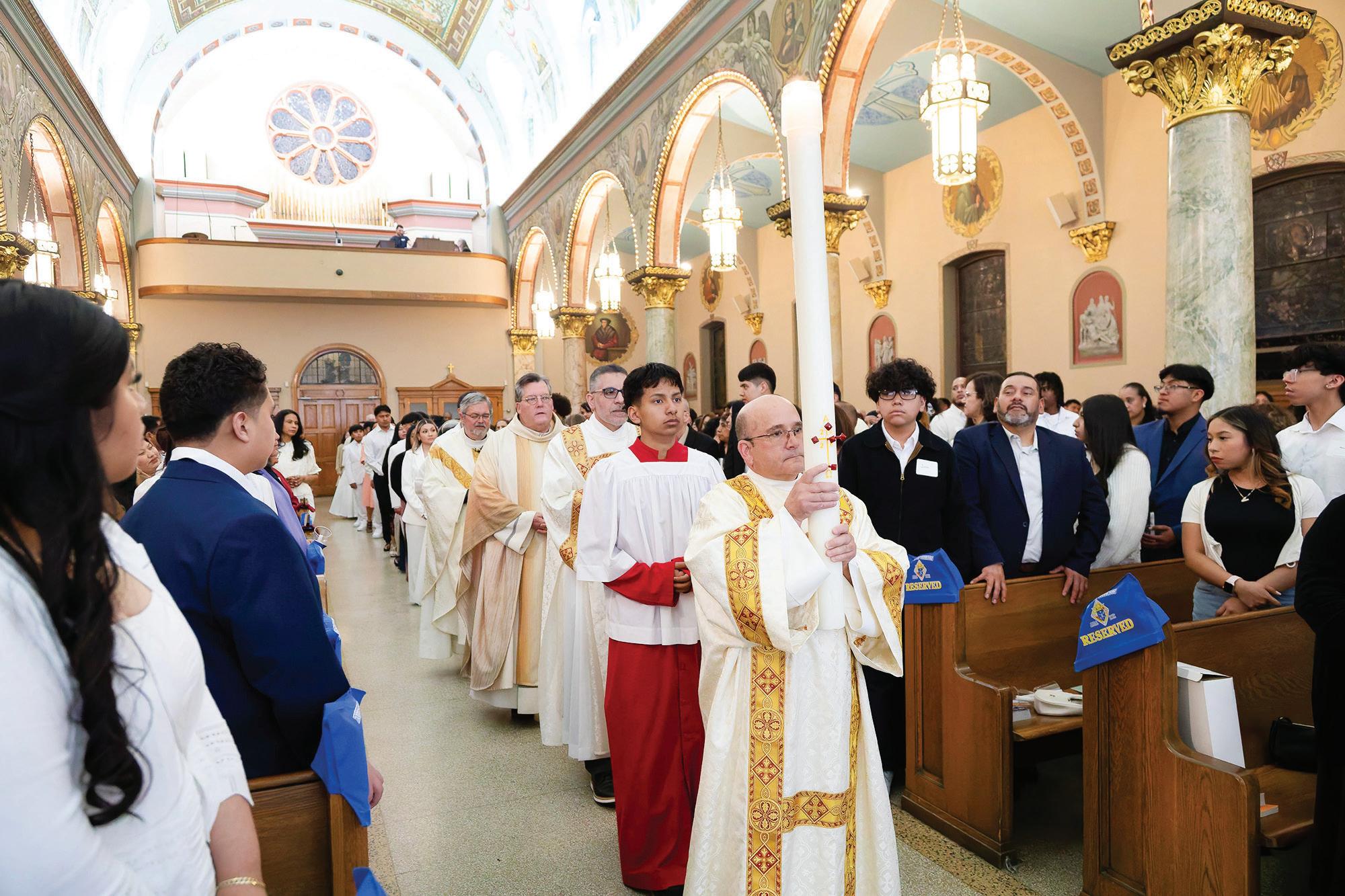
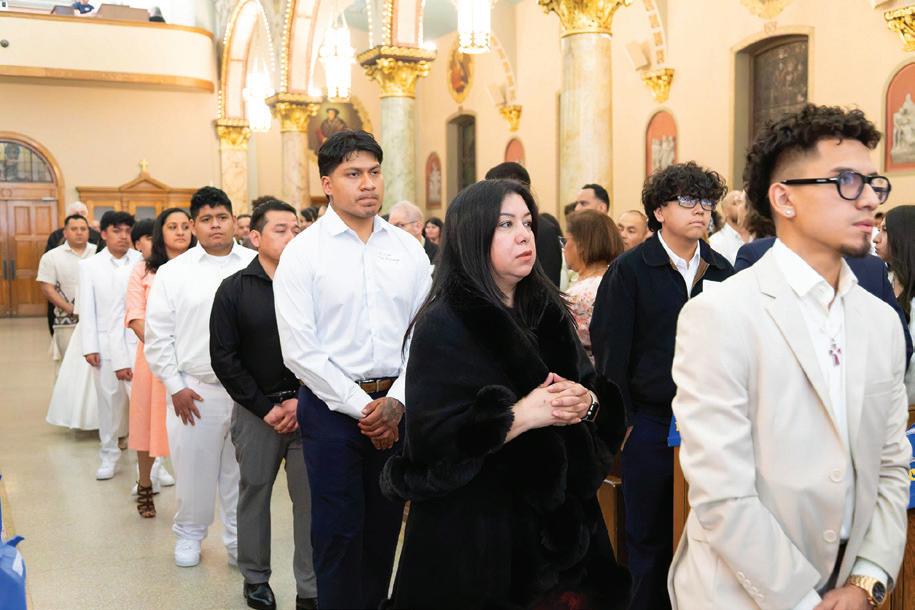
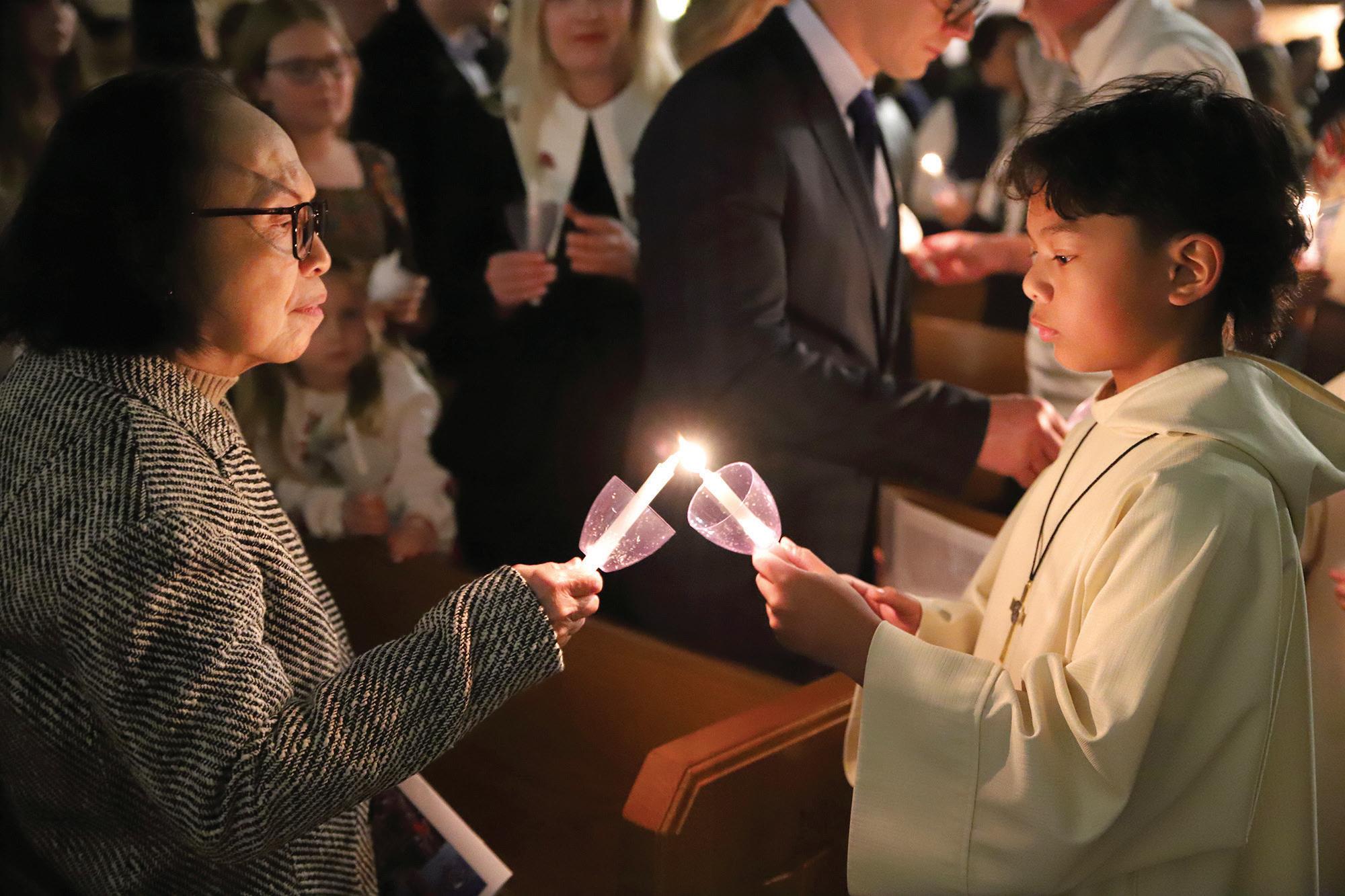
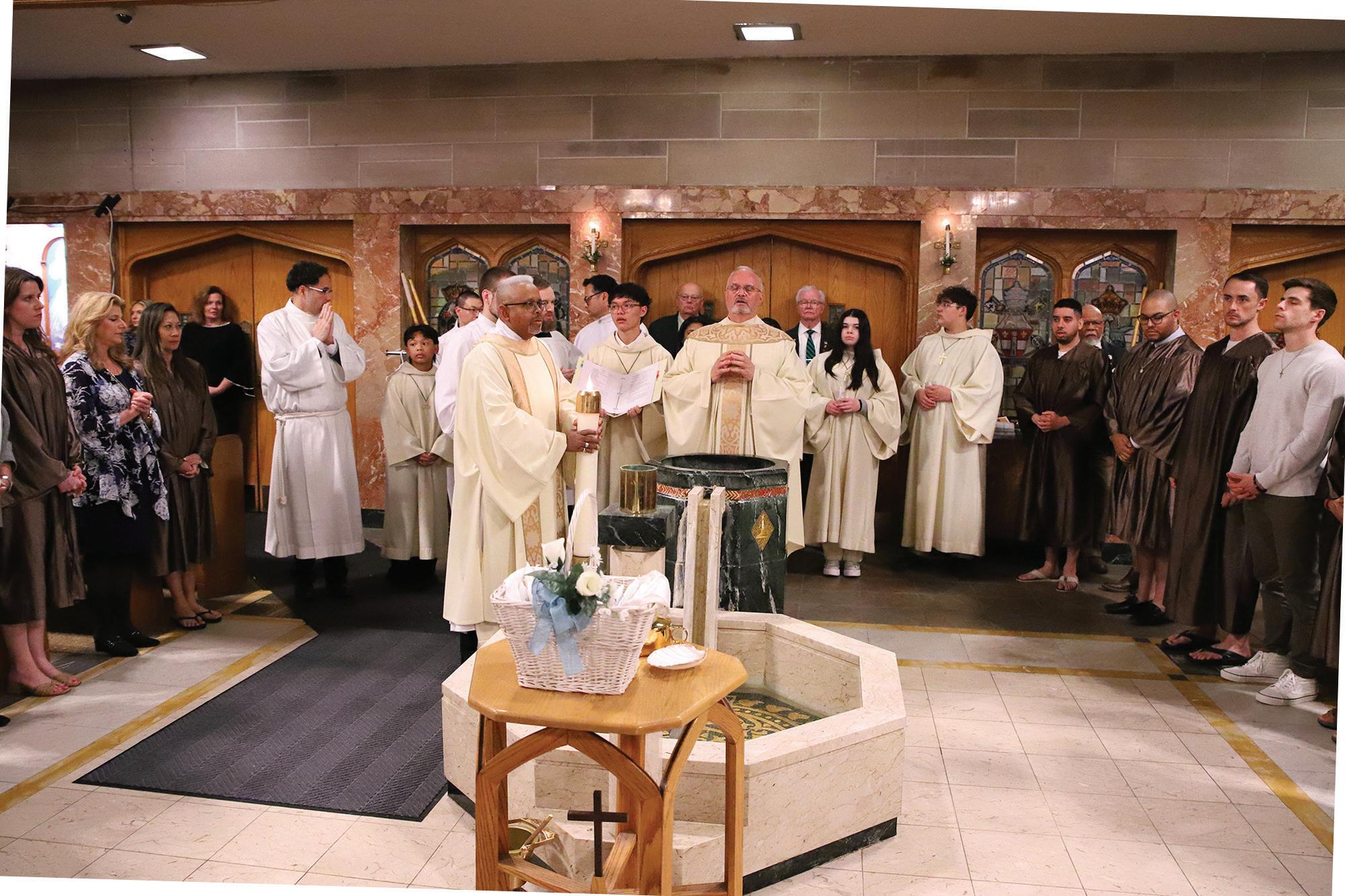
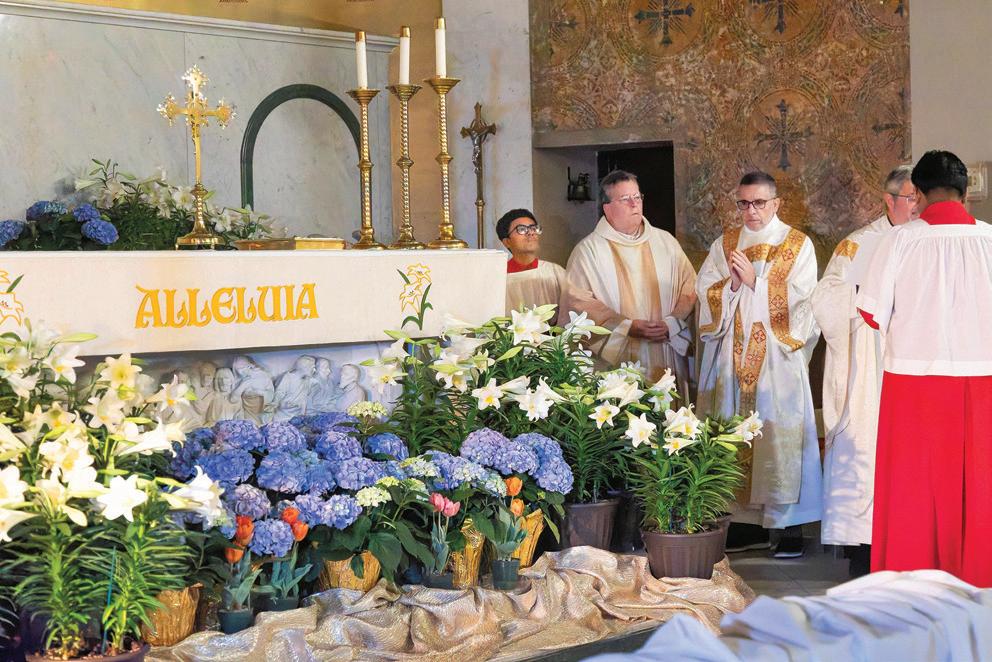
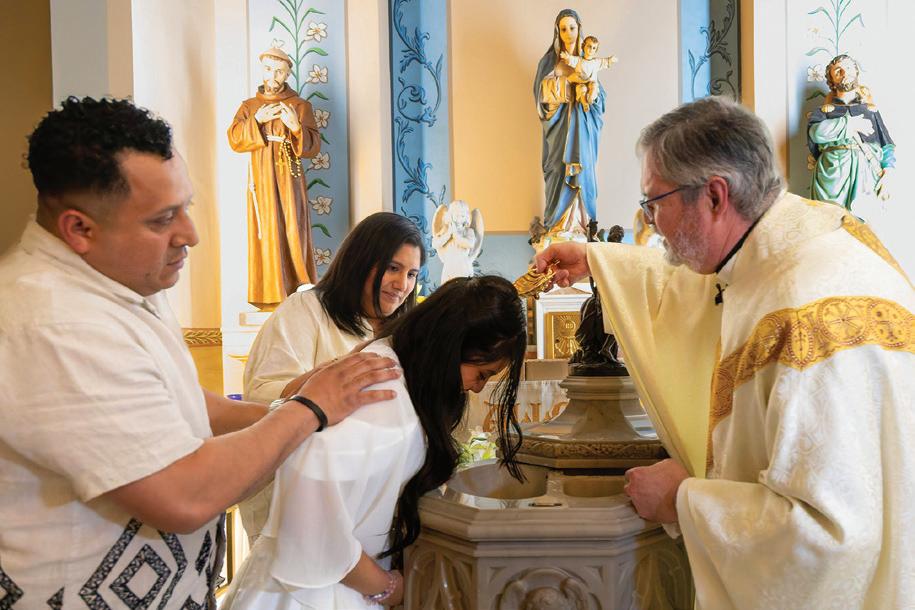
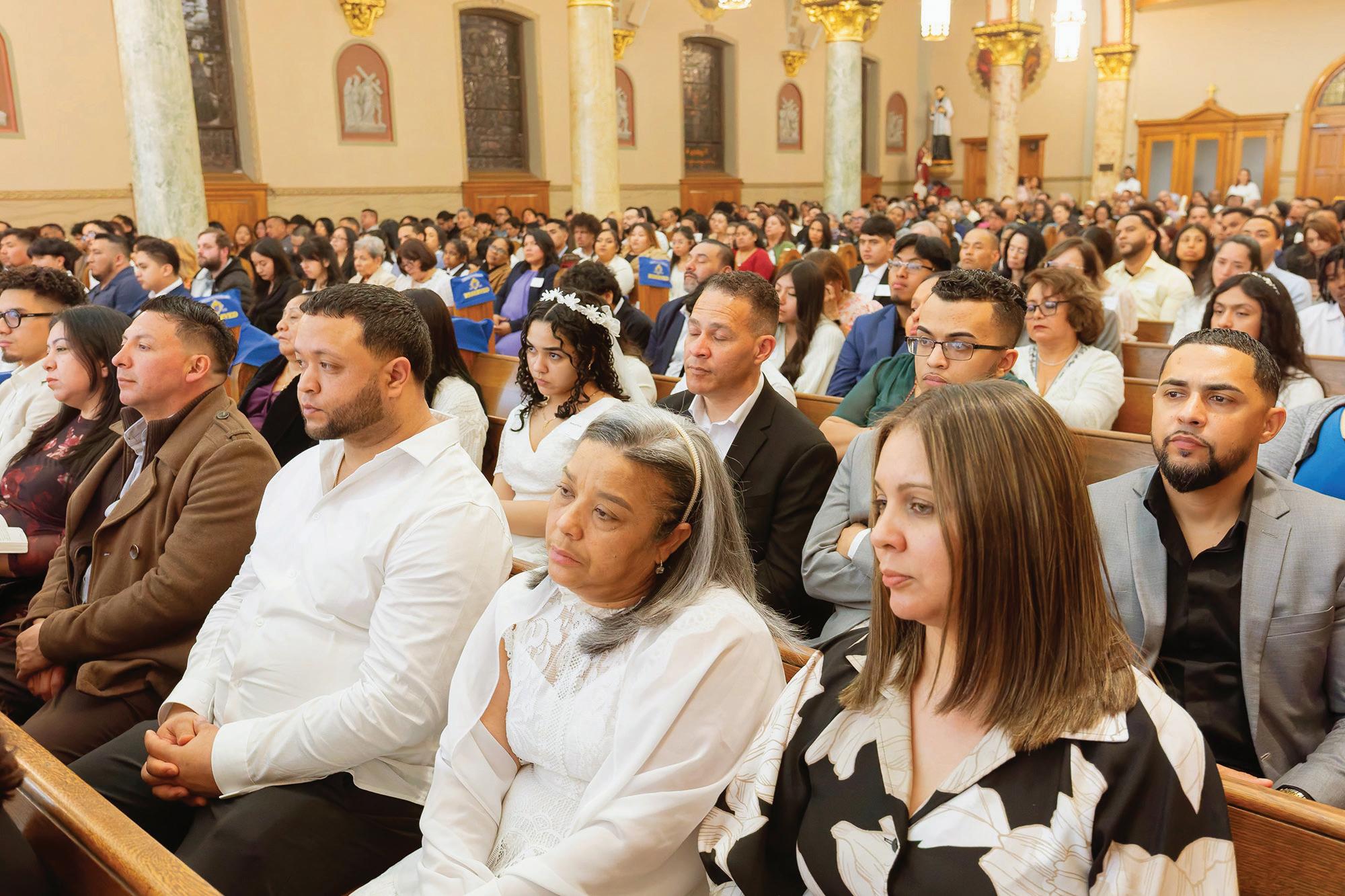
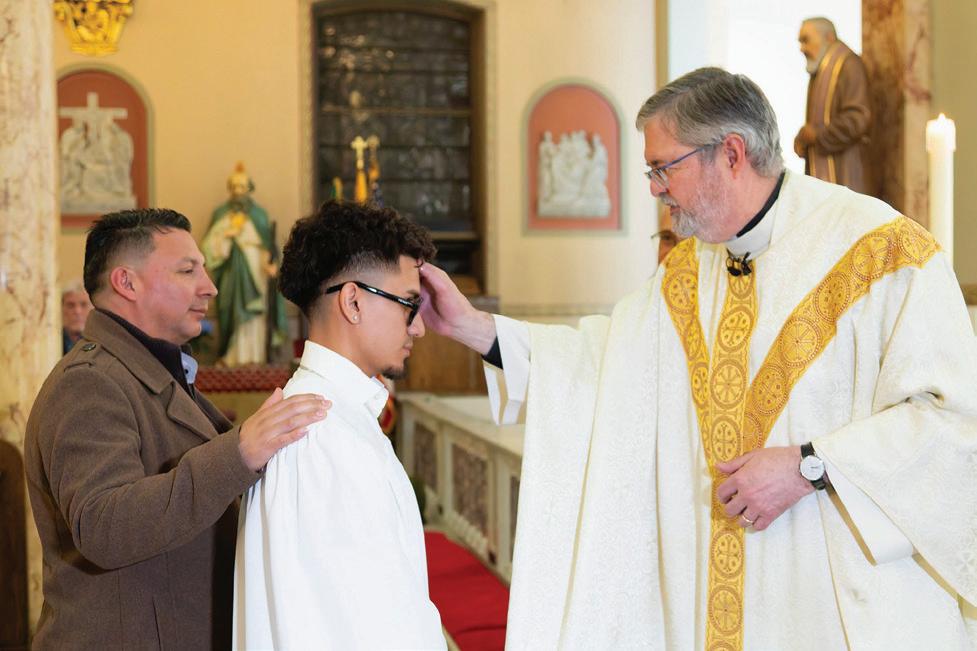
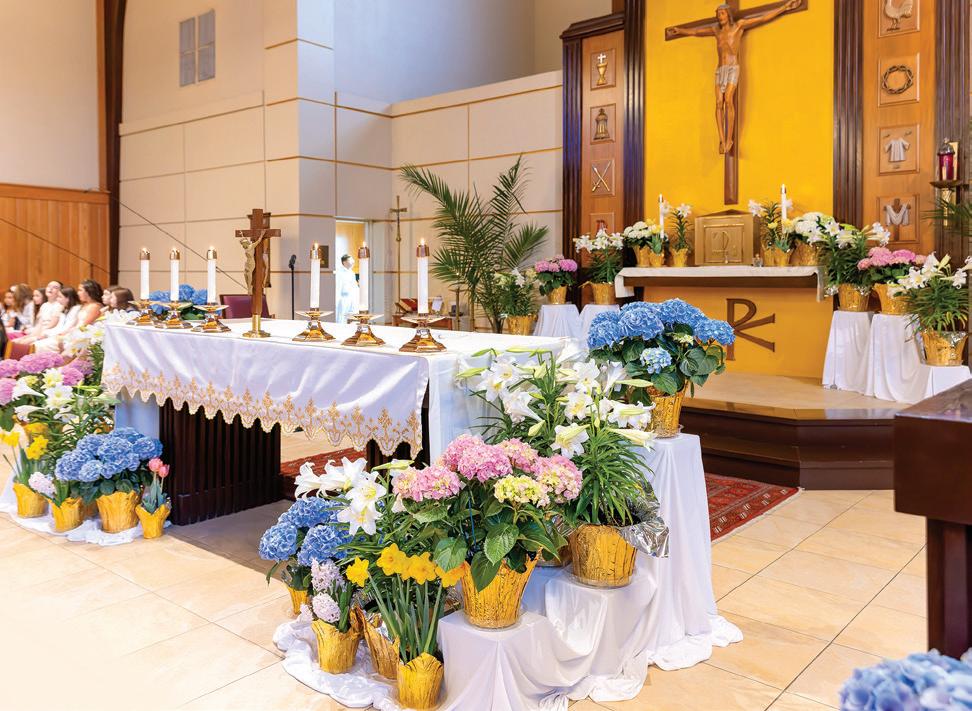
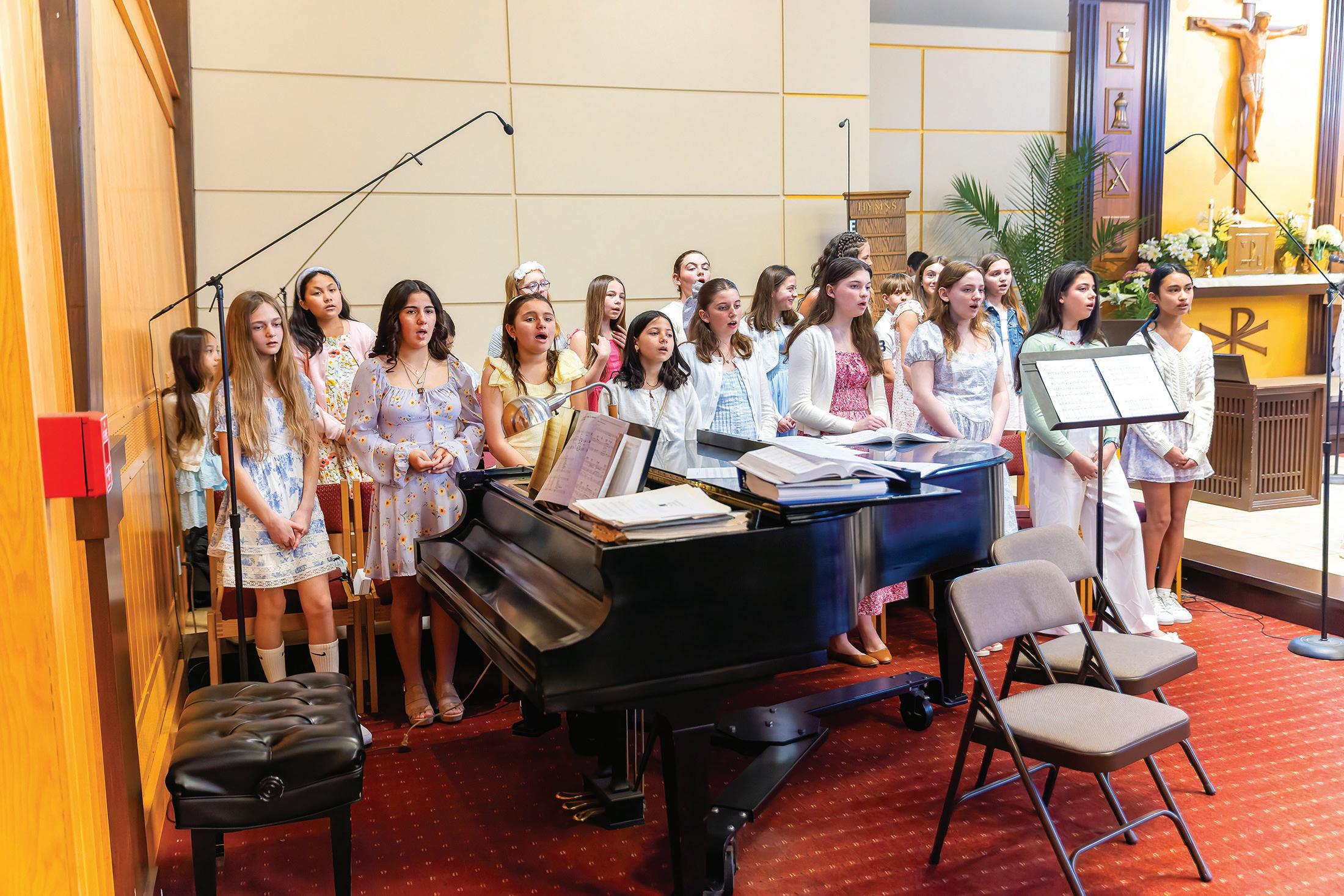
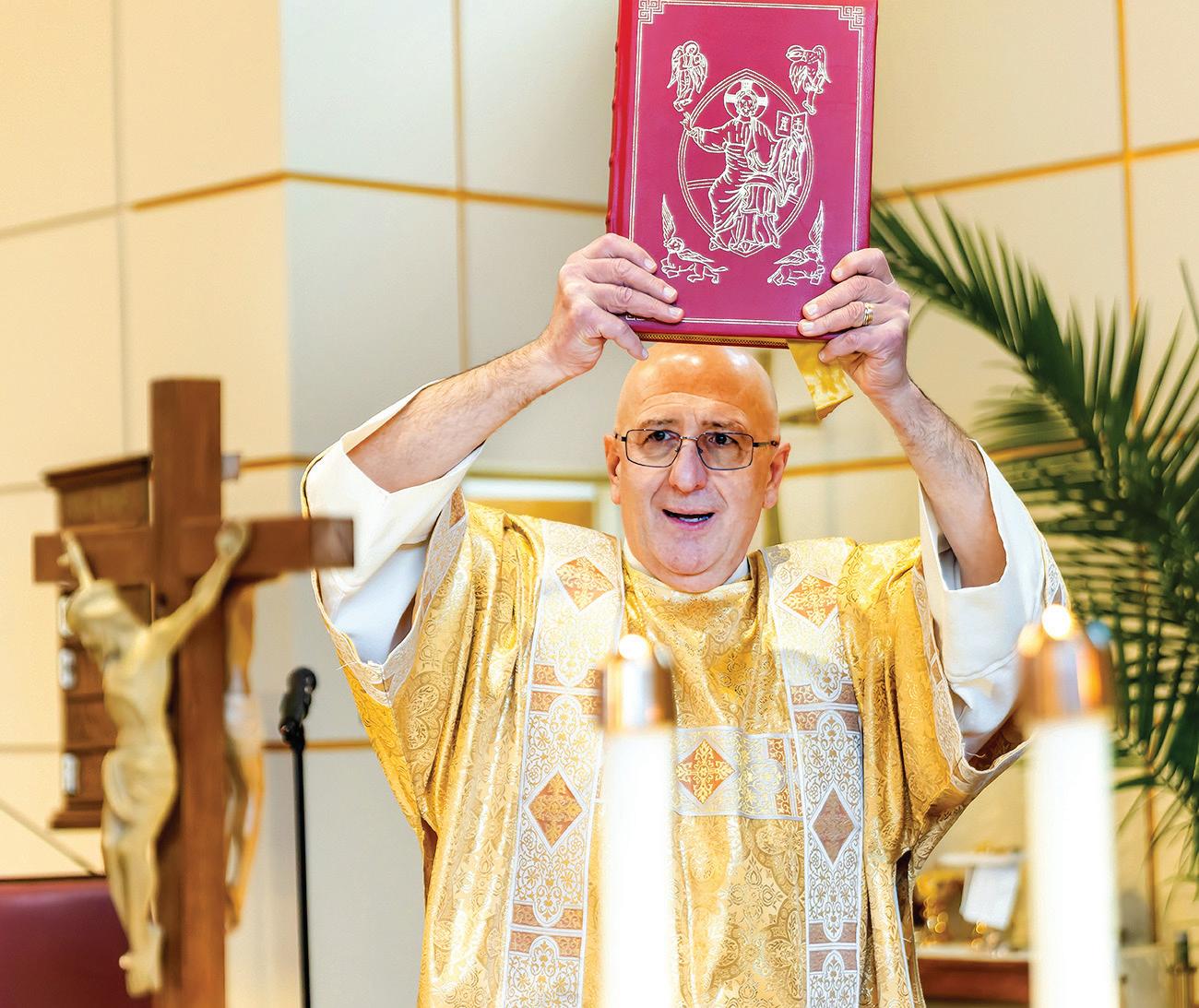
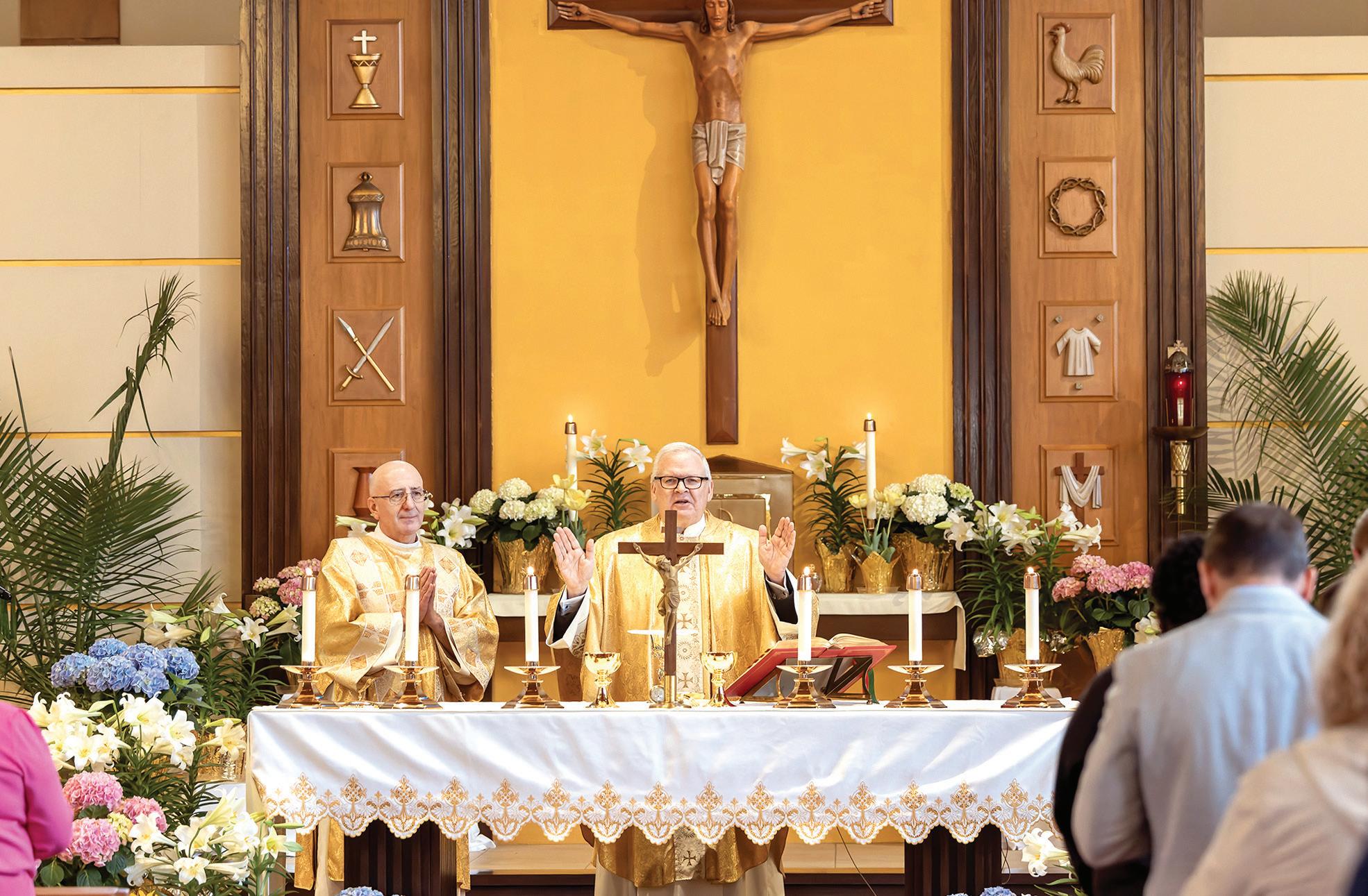
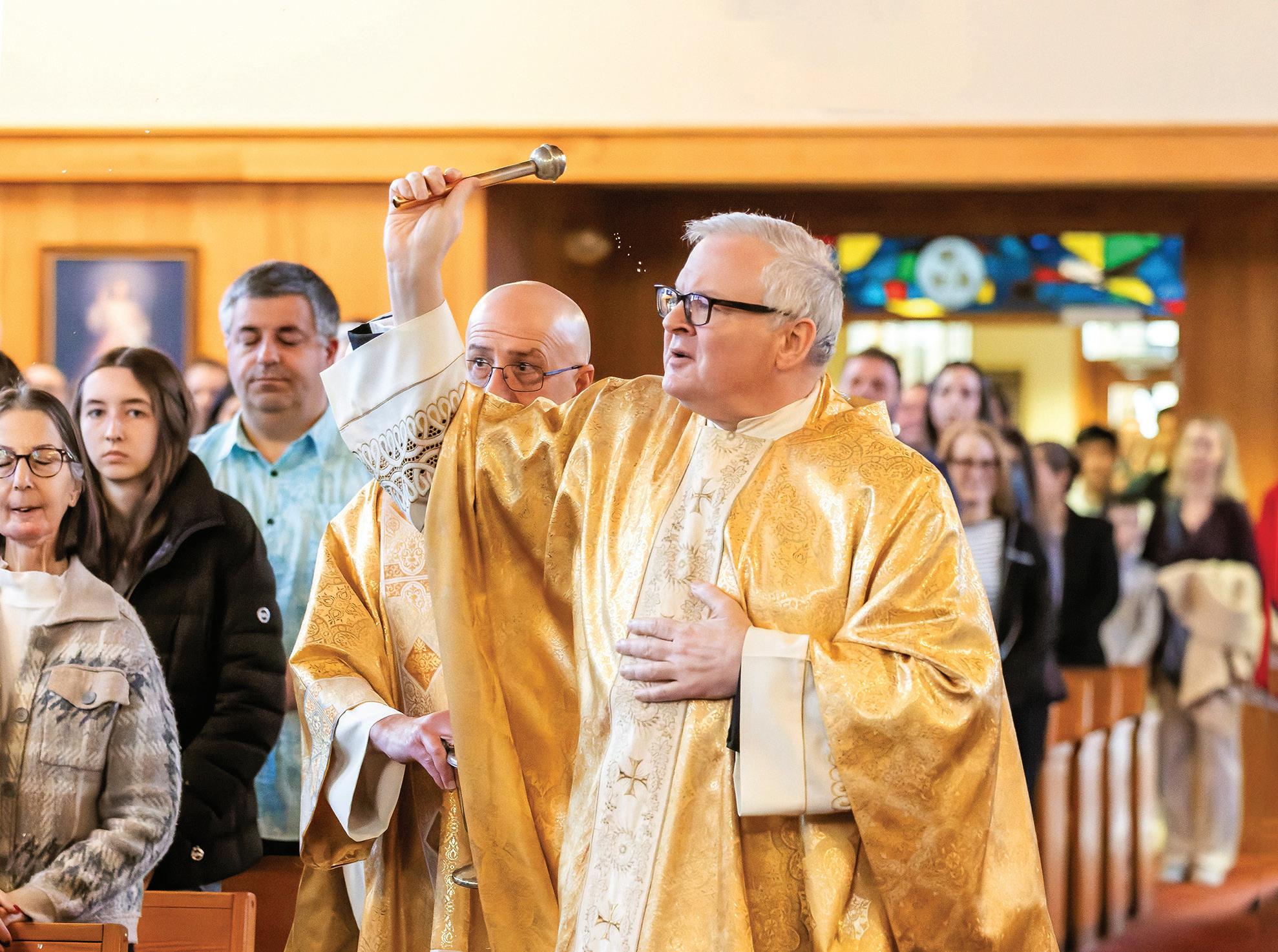
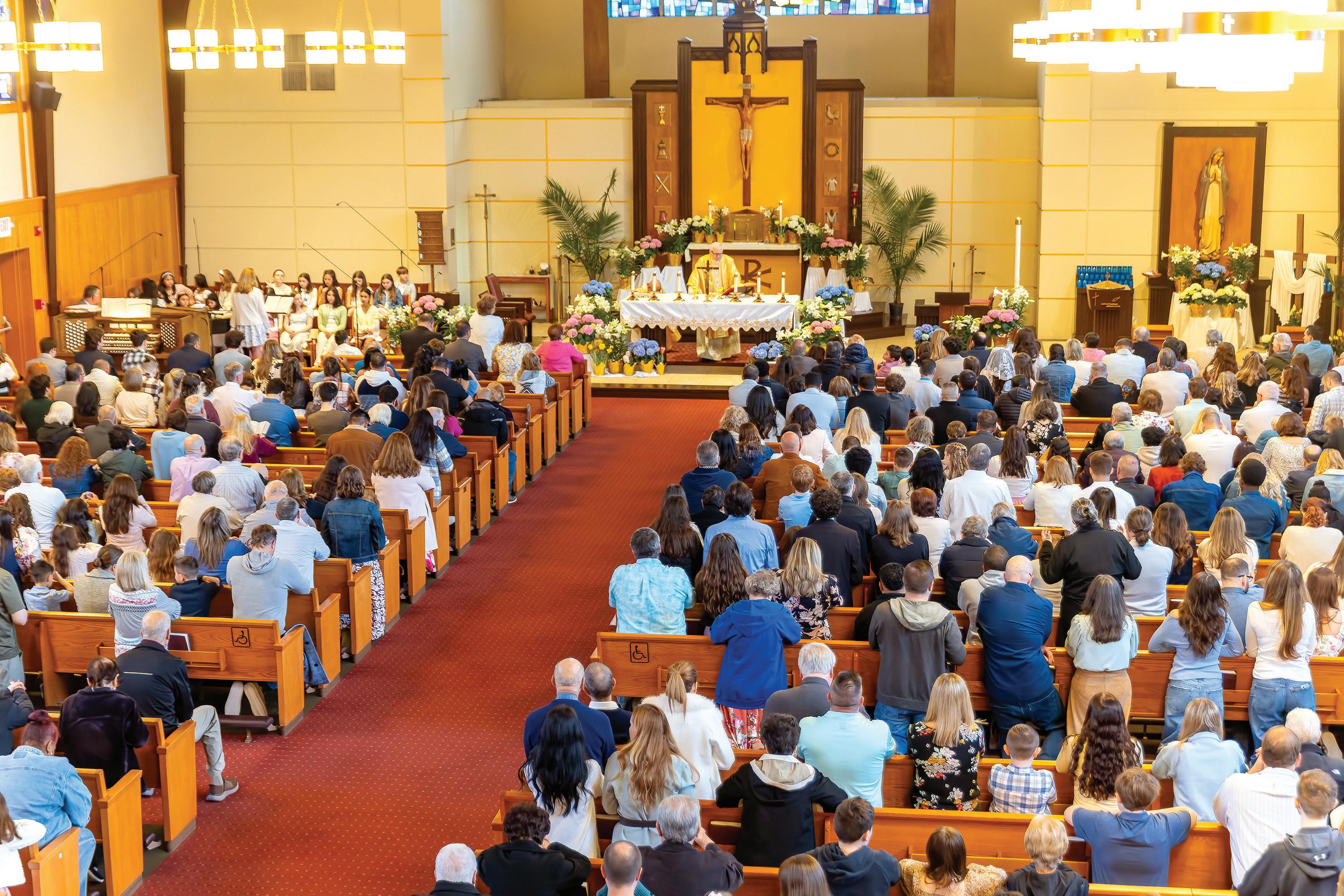
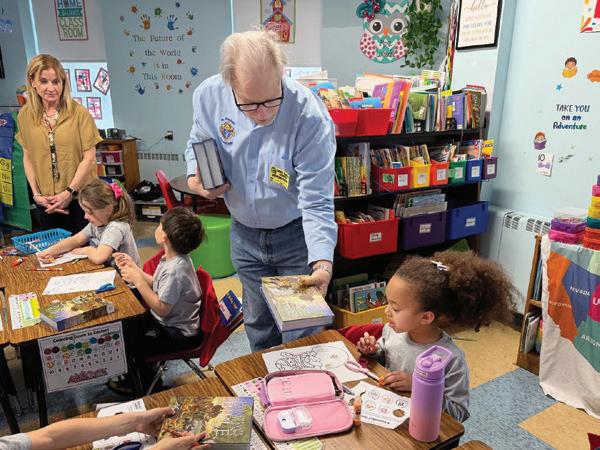
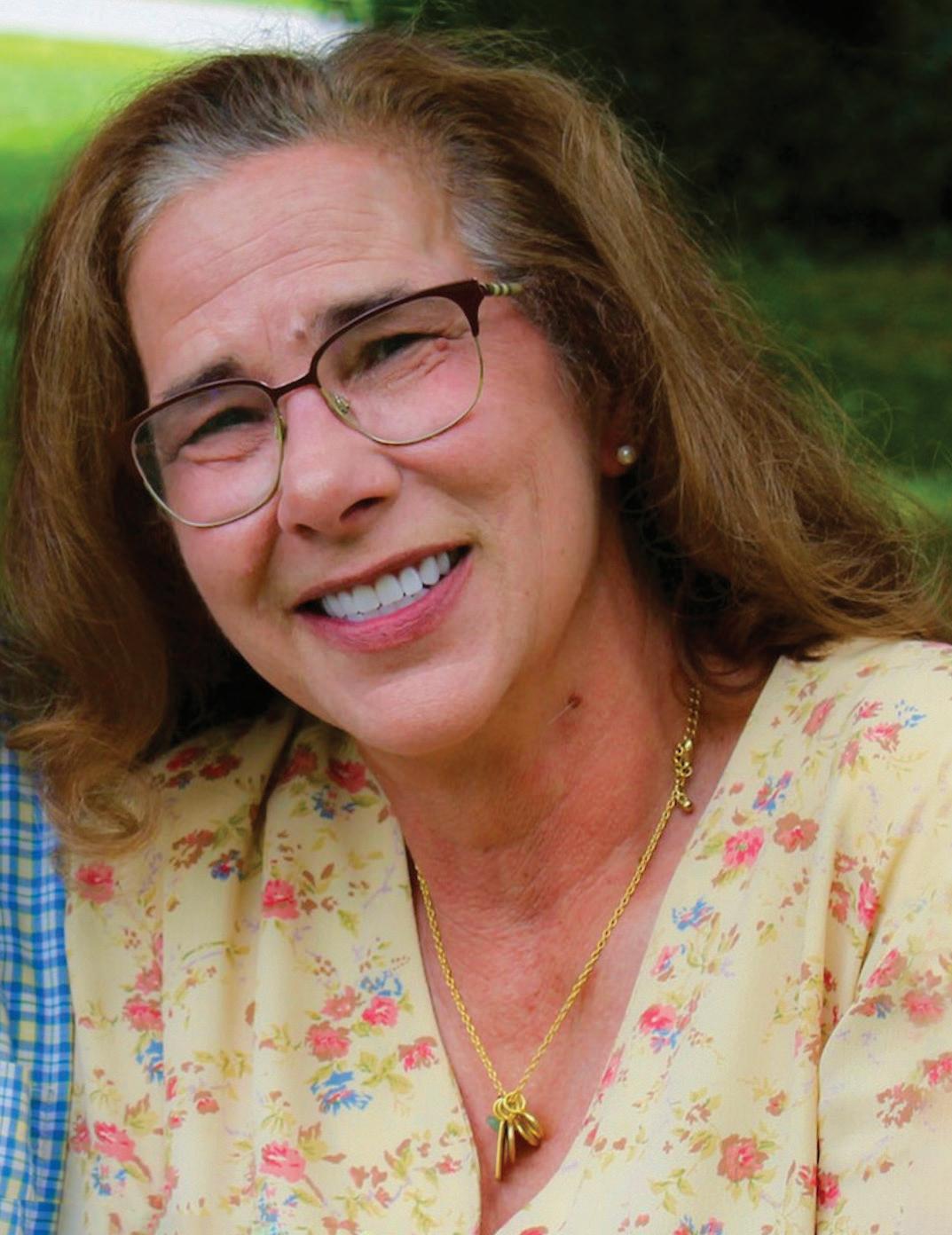
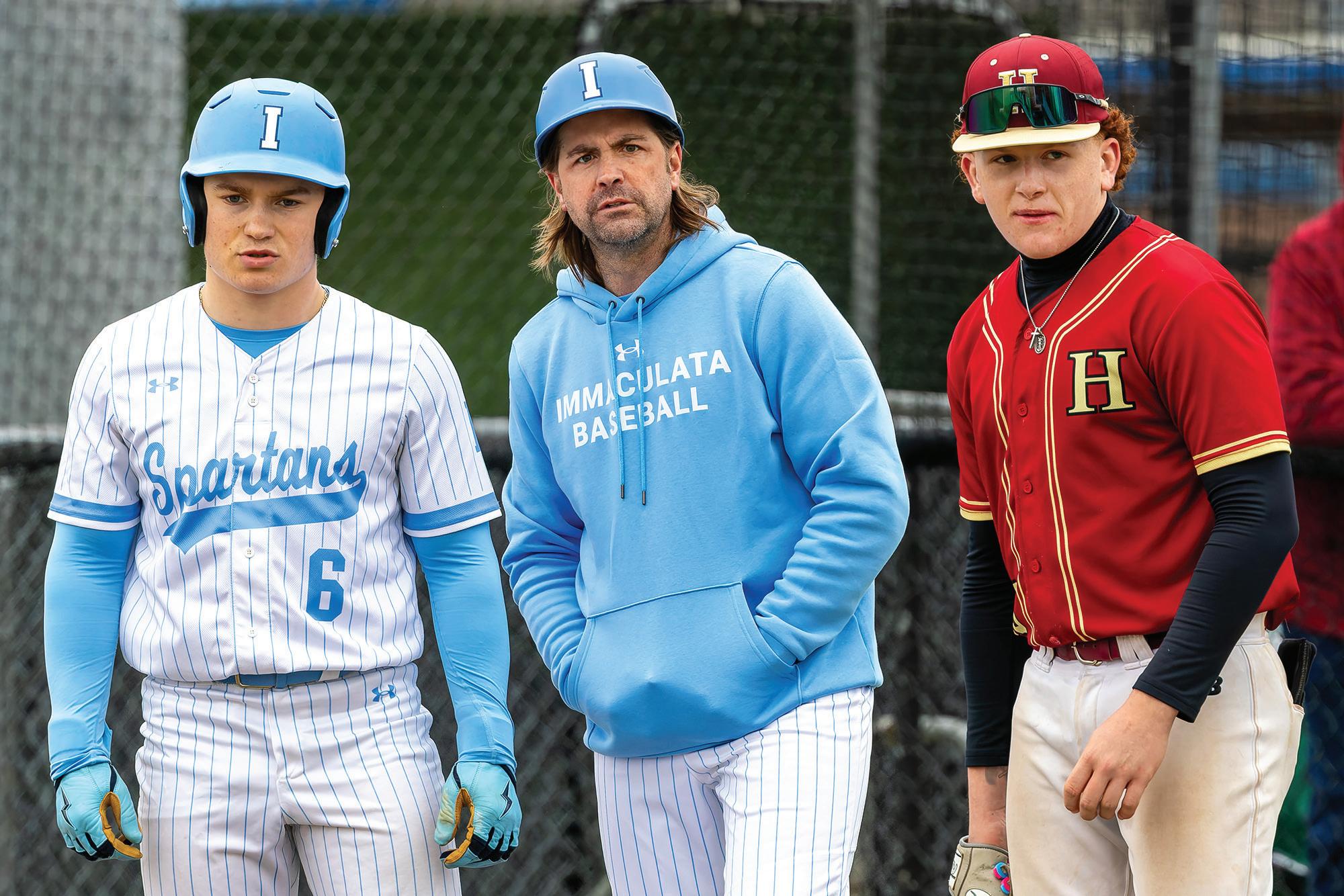
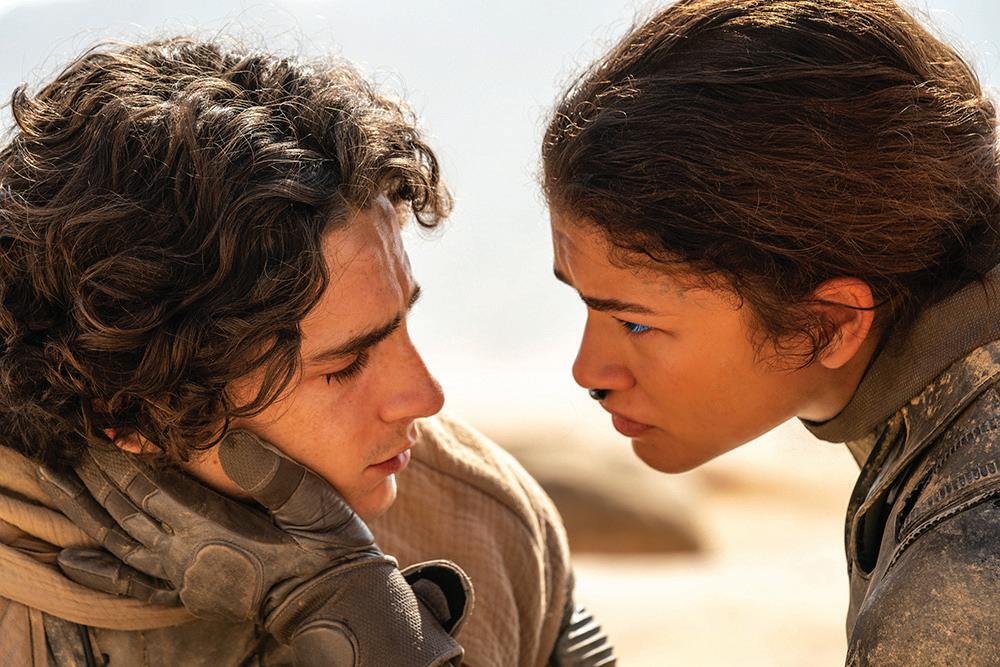
Violet Brett Schneider reacts with joy as one of 40 students and young adults welcomed into the Catholic Church during the Easter Vigil in St. Peter the Apostle University and Community Parish, New Brunswick. Rutgers students are formed through the OCIA process (Order of Christian Initiation for Adults) at Rutgers Catholic, the University’s Catholic Campus Ministry. Read more about the draw of the Church for young people and their desire to grow in their Catholic faith on p 3.
Thomas Corzo photo/The Catholic Center at Rutgers
Now that the Easter season is here, it’s time to take on the ‘Big 4’
Dear brothers and sisters,
I hope you had a wonderful Easter celebration. Like we heard in the Responsorial Psalm on Easter Sunday, I hope you were able to “rejoice and be glad” surrounded by family and friends.
So here we are, about four weeks since Easter Sunday. Most of the Easter flowers in church have blossomed and withered. All the chocolate is gone. Most of the jellybeans are gone (except the white ones, I’m guessing). If there is anything left in the “Easter Clearance” section of the big chain pharmacies, none of it is enticing (even at 80% off). Let’s admit it: This is that time of year when the Easter Season is hard to celebrate, and yet this is when the Church needs us to keep on going.
We all know the battles we face inside of us, when our heart says one thing and
our brain says another. The Will versus the Intellect. Emotionally, our hearts may have moved on from the sights and smells and tastes of Easter, but in our minds we know that the Easter Season still has a few weeks to go. Again I say, keep on going!
You may be asking, how do we keep the Easter Season going? Remember the “Big 3” of Lent: Prayer, Fasting, and Almsgiving? A few weeks ago on the second Sunday of Lent, the Acts of the Apostles (our constant companion for the First Readings at Mass during the Easter Season) told us that the early Christians “devoted themselves to the teaching of the apostles and to the communal life, to the breaking of bread and to the prayers.” I suggest we can take that as the “Big 4” of Easter.
The teaching of the Apostles. We can use the Easter Season to grow in our knowledge of the Church. Pope Leo right now is dedicating his Wednesday Audience catechesis on the documents of the Second Vatican Council. These are only a few paragraphs long and easily available from the Vatican website. Otherwise, consider reading a paragraph or two of the Catechism of the Catholic Church each day, or maybe Pope Leo’s Apostolic Ex-
hortation, on the love for the poor, Dilexi Te.
The communal life. I fear technology is causing all of us to retreat away from human interaction and in on ourselves. We are all becoming hermits who stare endlessly at the screens of our phones and tablets. But we’re also a bit hypocritical. We demand immediate access to all the information and events of the outside world through the Internet while equally demanding no one from the outside world have access to us. Remember when we joined Bob from Sesame Street in asking, “Who are the people in your neighborhood?” Get to know your fellow Catholics. Join a parish Bible Study or book club. Volunteer at a social ministry event. Go to an after-Sunday Mass social event, maybe a coffee and donut event or pancake breakfast.
The breaking of bread. Years ago I had included on my parish’s giveaway calendars, “A Catholic needs Mass like a car needs gas.” The readings at Easter teach us that, from the earliest of days after the Ascension, the Mass (in its varied forms as it evolved through the centuries) has been the fundamental gathering for
believers. Even small children know that their technology needs periodic recharging to work properly. So it is for us as the People of God. Get fed by the Word of God and the Holy Eucharist weekly, and your spiritual batteries will never run out. The prayers. Praying is so simple but profound and powerful. It costs nothing and requires no downloads or advance preparation. What is going on in your life right now that you would like to talk to God about? Do it. You speak and God listens, then God speaks and you listen. Repeat if necessary. How can prayer be boring when we are the ones who decide the topic(s)? A little bit done every day will go a long way in helping remember we are known and loved by a loving Father, and so not alone in this world. Like remembering passwords and PIN numbers, the longer we go without prayer the harder it is to remember how to do it. Take a few minutes for prayer every day and you’ll have no trouble remembering how.
Finally, may I ask you use some of that prayer time to pray for Pope Leo and ask the Holy Spirit to enlighten and inspire him in his choice for our next Bishop of Metuchen.
From searching to belonging: Record Easter Baptisms in France reflect personal journeys of faith
A record surge in adult and teen Baptisms at France’s Easter Vigil is drawing widespread attention, with secular media calling it an “astonishing phenomenon.”
More than 13,200 adults and 8,100 adolescents were baptized on April 4, according to the French bishops – part of over 21,000 total Easter Baptisms nationwide.
Dioceses across the country reported sharp increases, including Paris, Lyon, and Normandy, with some parishes forced outdoors to accommodate large crowds.
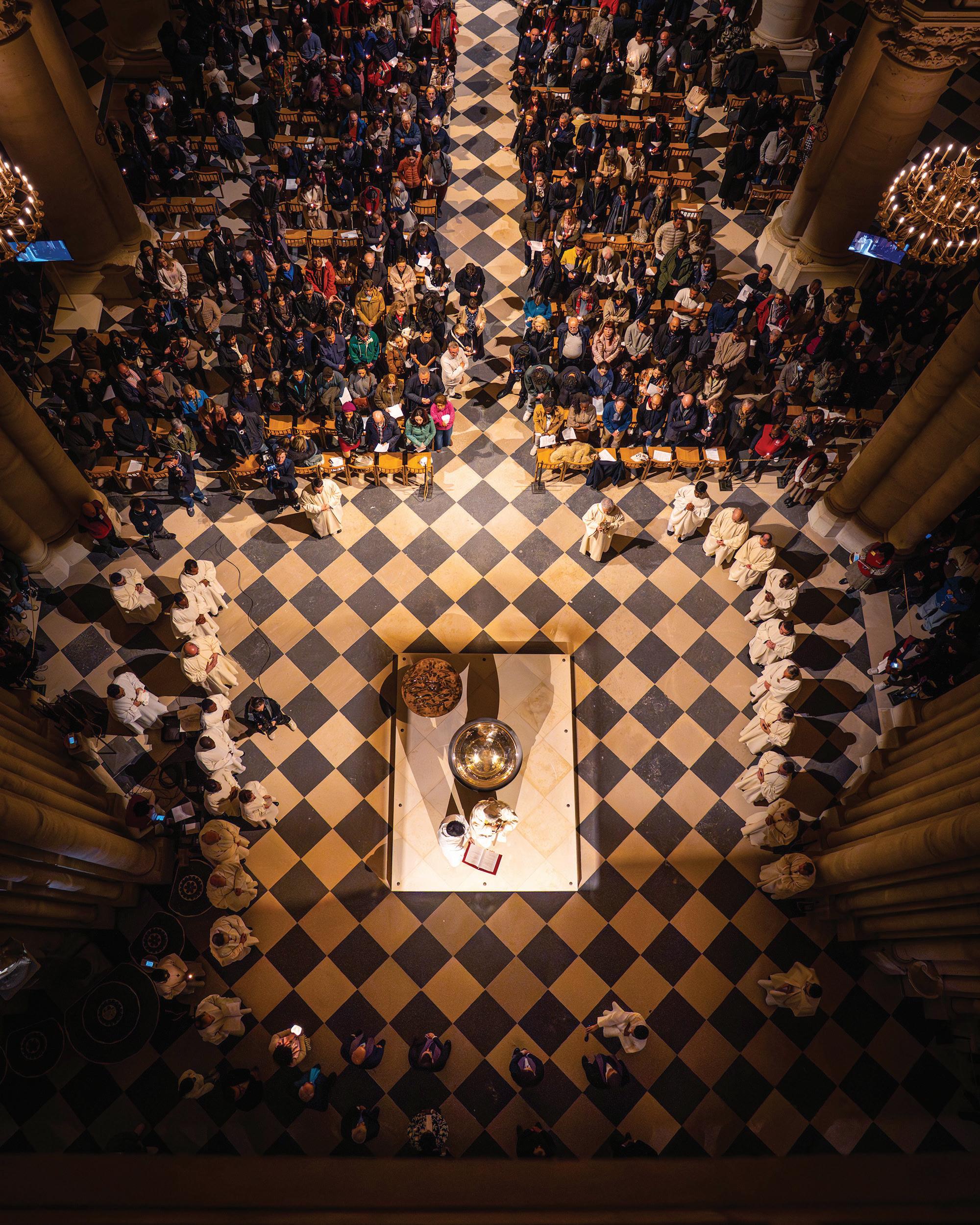
A baptismal font is seen from above in preparation for adult Baptisms in Notre Dame Cathedral in Paris during Easter Vigil April 4, 2026. Over 21,000 people were baptized across France in a record Catholic surge for a country famed for its “laïcité,” or secularity, in 2026. —OSV News photo/Liam Hoarau, courtesy Archdiocese of Paris
While infant Baptisms have declined steeply over the past 25 years, Easter Baptisms have more than tripled in a decade, signaling what some observers describe as a renewal of faith.
Newly baptized Catholics often cite personal struggles, loss or meaningful encounters as catalysts for conversion. Many also point to social media as a key entry point. “It has completely changed my life,” said Anne-Cécile Perrier, baptized in St. Louis Cathedral in Versailles on April 4.
Sharing her personal journey toward Baptism, she added that “since I let Jesus and the Holy Spirit into my heart, I know I am not alone. God is with me every moment, and he loves me just as I am.”
Despite France’s increasingly secular landscape, commentators say this trend reflects a shifting Church – smaller, but newly energized and drawing seekers in search of meaning.
If you were sexually abused by a member of the clergy or anyone representing the Catholic Church, or you know of someone who was, you are encouraged to report that abuse to local law enforcement, the New Jersey Division of Child Protection and Permanency at 1-877-NJ ABUSE (652-2873) or 1-800-835-5510 (TTY/TDD for the deaf), and also the Diocesan Response Officer at (908) 930-4558 (24 hours/7 days a week).
A courageous new generation storms into the Church
By Brother of Hope Kenneth Apuzzo, Special Contributor
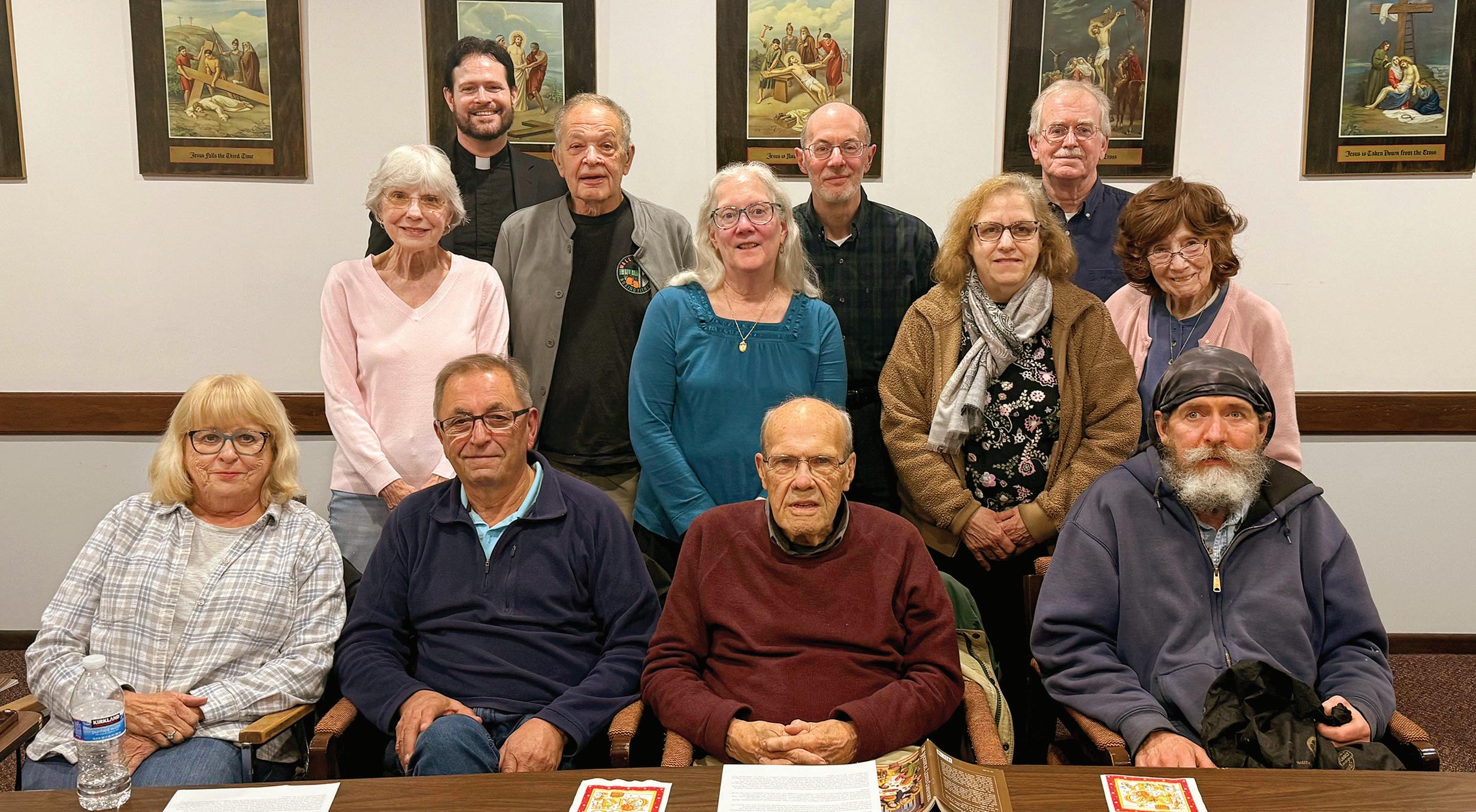
This past Easter 40 young adults and students became adult members of the St. Peter’s University and Community Catholic Church in New Brunswick. We had 15 Baptisms and 25 Confirmations. This was triple the number we had last year.
The young people just kept showing up with an interest in the Catholic Church. Father Matthew Marinelli was the director for the OCIA program the
past two years. He and the rest of the team had many conversations in regards to why, all of the sudden, so much interest in the Catholic Church by students and young adults.
In all humility we have to give the credit to God Himself. We did not do anything different than last year. We did not discover the secret formula to reaching young adults. It just seems like a sovereign act of the Holy Spirit. The religious community that I belong to serves at universities all over the country. The
increased number of seekers was experi enced at all of our campuses.
One of the striking qualities of this OCIA class was how little actual experience these young adults and students had of Catholicism. Another quality was how many of these young people had to face up to close friends and family members who were resistant to their decision to become Catholic.
The class came from quite diverse
asked why they were looking into Catholicism most of the young people described a longing for meaning, security, healing and searching for authentic love.
The Easter vigil was nothing less than explosive with awesome worship music and bombastic responses to the liturgy. At the Baptisms the cheering was more like what happens at the Super Bowl than at church.
Over the past week I have had the opportunity to see and speak with many of the OCIA class. They shared with me that many of their family members were profoundly moved by the Vigil. Some commented, “I have never been to a Mass like that before...”
We finished the night with not one party but two – one at the parish and one at our Brothers house for the classic “after party” that students so love.
Please, pray for these courageous and zealous young adults and students, that this new faith will be grounded in good, rich and deep spiritual soil. Pray also that this new grace of the Holy Spirit will continue to draw people from every generation to “The Father’s house” ... the Church.
Brotherhood of Hope Brother Kenneth Apuzzo serves on the OCIA staff for St. Peter the Apostle University and Community Parish and the Catholic Center.
Choices Matter Conference broaches crucial subject of human trafficking
By Christina Leslie Contributing Editor
Gina Cavallo learned to keep secrets from authority figures when she was just a child, even when her brother broke down the door of the room where she was hiding and cut her with a shower of broken glass. Her mother told the hospital nurses that the girl had fallen down accidentally, but when Gina attempted to tell them the truth, her mother put her index finger on her lips and said, “Shhhh.”
“I learned about secrets, I learned about silence,” said Cavallo, a human trafficking survivor and victims advocate, one of three keynote speakers at the 25th annual diocesan Choices Matter Conference held March 21. “I learned to sweep things under the rug. That became my norm.”
Recognizing the warning signs of human trafficking and learning ways to shine a light on its injustices was the goal of the conference in the St. John Neumann Pastoral Center, Piscataway, and sponsored by the diocesan Office of Human Life and Dignity. The allday conference, themed “Safeguarding Human Dignity… Shining a Light on Human Trafficking,” also included faithbased exhibits, fellowship, Confessions, Eucharistic Adoration, and a Mass celebrated by Father Jonathan Toborowsky, diocesan administrator.
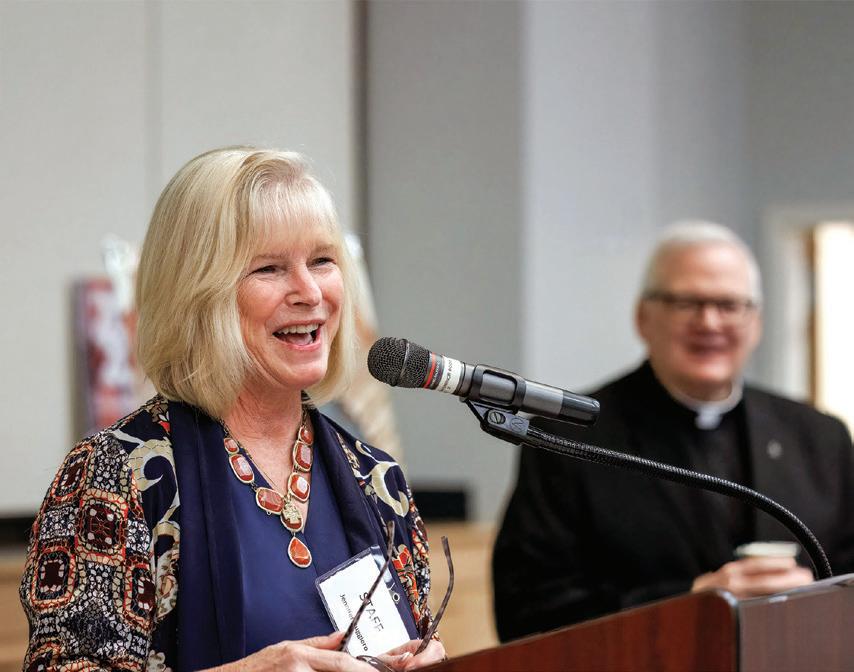
Jennifer Ruggiero, director of the Office of Human Life and Dignity, noted
the topic was selected in light of preparations for the upcoming 2026 FIFA World Cup soccer finals this summer, which are expected to draw over one million people from across the globe to MetLife Stadium in East Rutherford.
“Large-scale events often create opportunities for abuse and exploitation due to large crowds, increased demands and vulnerable workers in construction and hospitality,” Ruggiero said. “Events like these can also serve as major, high-profile platforms to help raise awareness about this heinous crime.”
Father Toborowsky added, “This is not the easiest of topics, or the most pleasant, but a truly necessary one in our defense of the dignity of life.” He urged the 170 attendees from throughout N.J., “Take what you learn to your parishes.”
Catholic Church aims to protect vulnerable
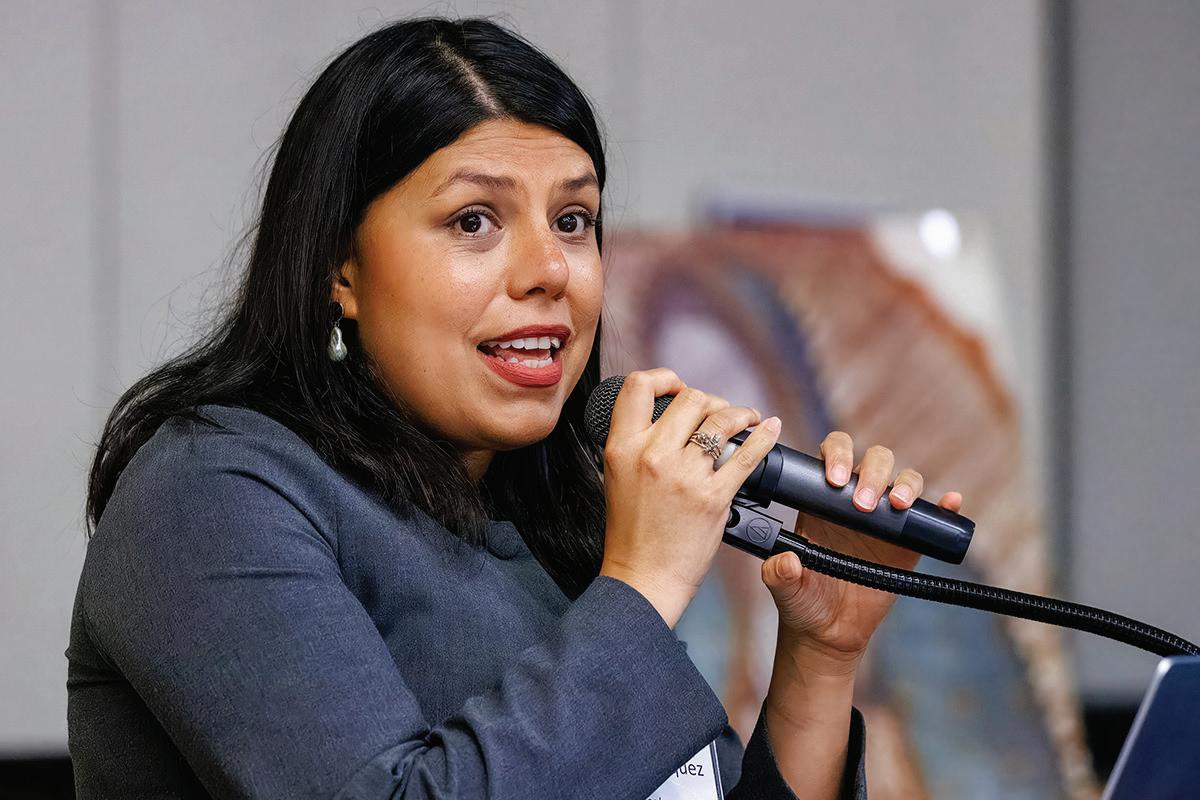
USCCB Outreach and Policy Advisor Celina Márquez Redd informed the attendees of the faith-based steps taken by the Catholic Church in an effort to eradicate this modern-day form of slavery and federal crime: “the use of force, fraud, or coercion to induce someone into labor or sexual exploitation. According to 2023 statistics from the Global Slavery Index, an estimated 49.6 million people live in situations of trafficking at any given moment, around 1.1 million of them in the United States.
The first comprehensive federal law to address human trafficking, the Trafficking Victims Protections Act (TVPA) of 2000 addressed gaps in the legal framework by creating new criminal offenses and establishing victim protections. It created a three-pronged approach to combatting human trafficking – protection, prevention, and prosecution.
“We must work together – Church, state, and community – to eliminate the root causes and markets that permit traffickers to flourish; to make whole the survivors of this crime; and to ensure that, one day soon, trafficking in human persons vanishes from the face of the earth,” said Márquez Redd, quoting from the USCCB statement of 2007.
The Church aims to inform and educate her members by offering those at risk with shelter, medical care, counseling, legal services and immigration reform. The USCCB has partnered with VIRTUS, a nationally recognized training platform, to develop human trafficking prevention trainings; more than 80 of 197 dioceses in the U.S. currently use the platform. “Our goal is not to instill fear, but to build awareness, confidence and preparedness,” said Márquez Redd.
Legal measures, local civilian efforts
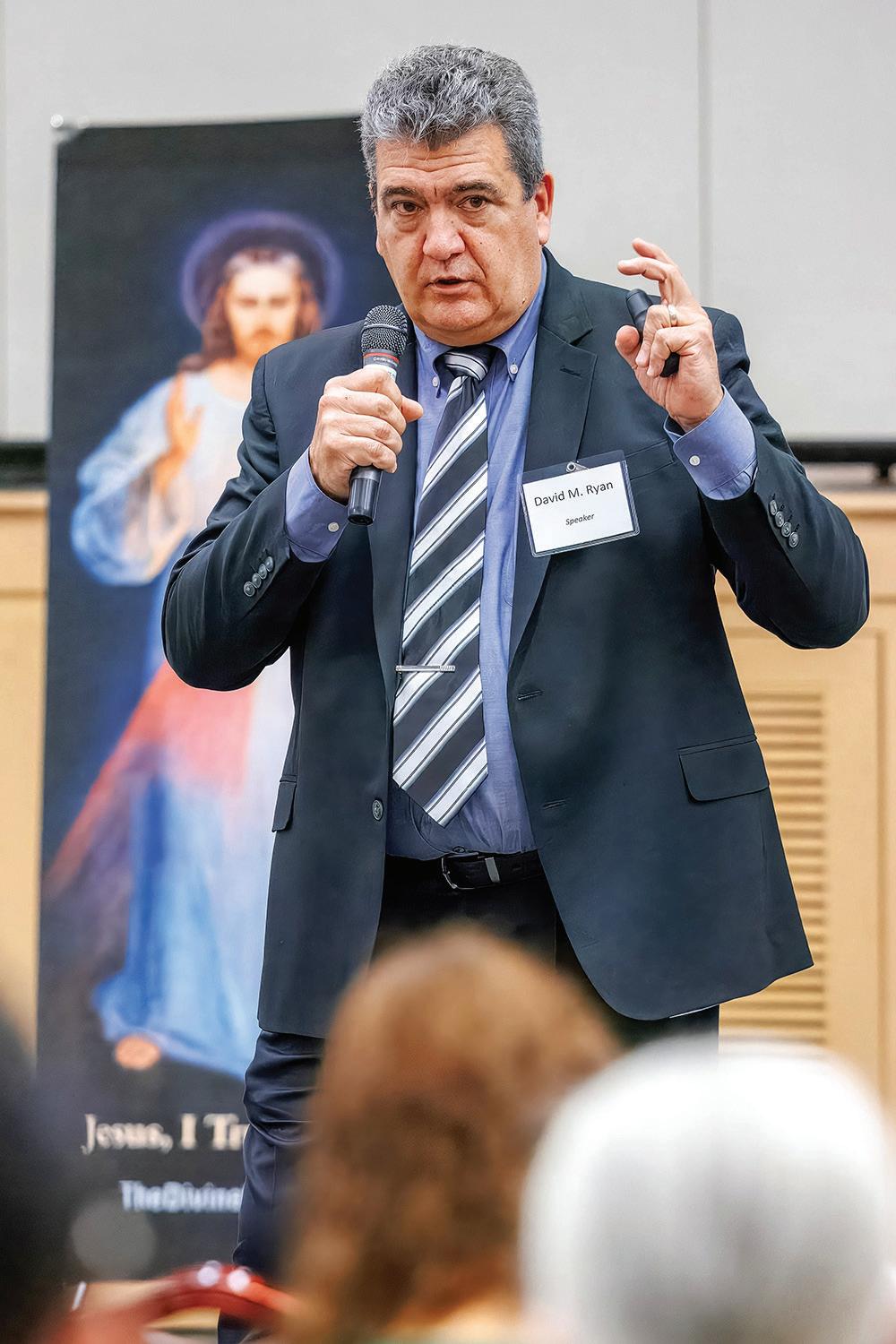
“Trafficking lives in the shadows, but it is a $150 billion industry,” declared David M. Ryan, a member of law
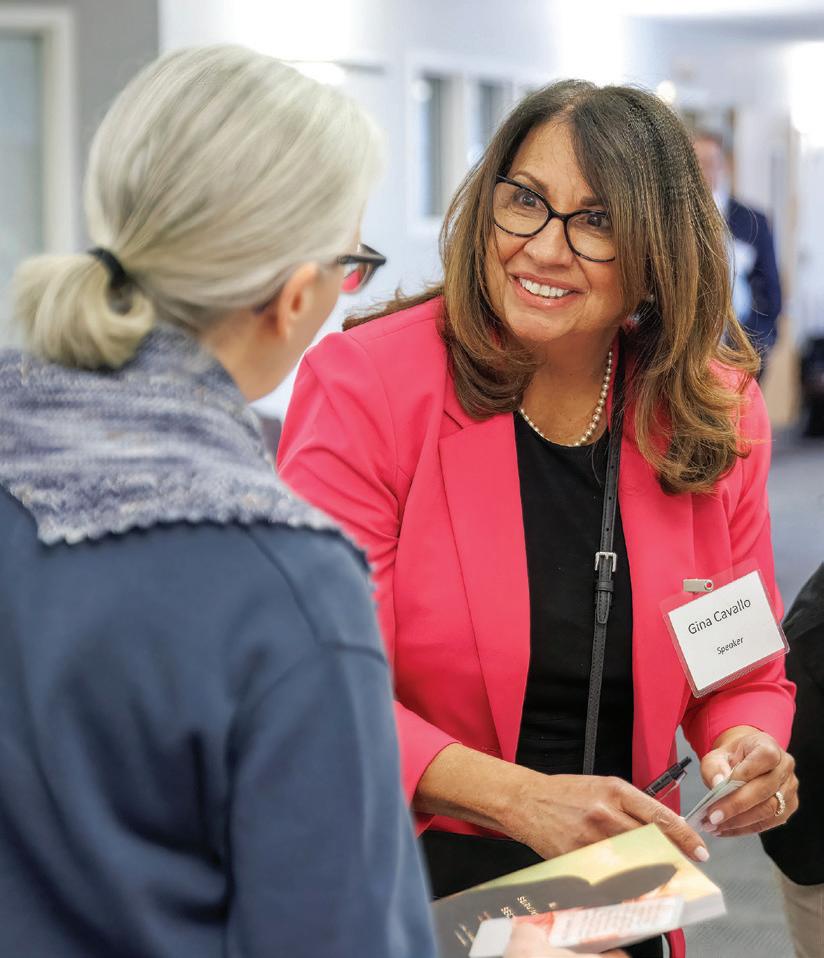
The 25th annual Choices Matter Conference, entitled “Safeguarding Human Dignity – Shining a Light on Human Trafficking,” drew about 170 attendees to the Pastoral Center March 21, including (1) members of the diocesan Diaconate Class of 2027 and Spanish Diaconate Class of 2029.
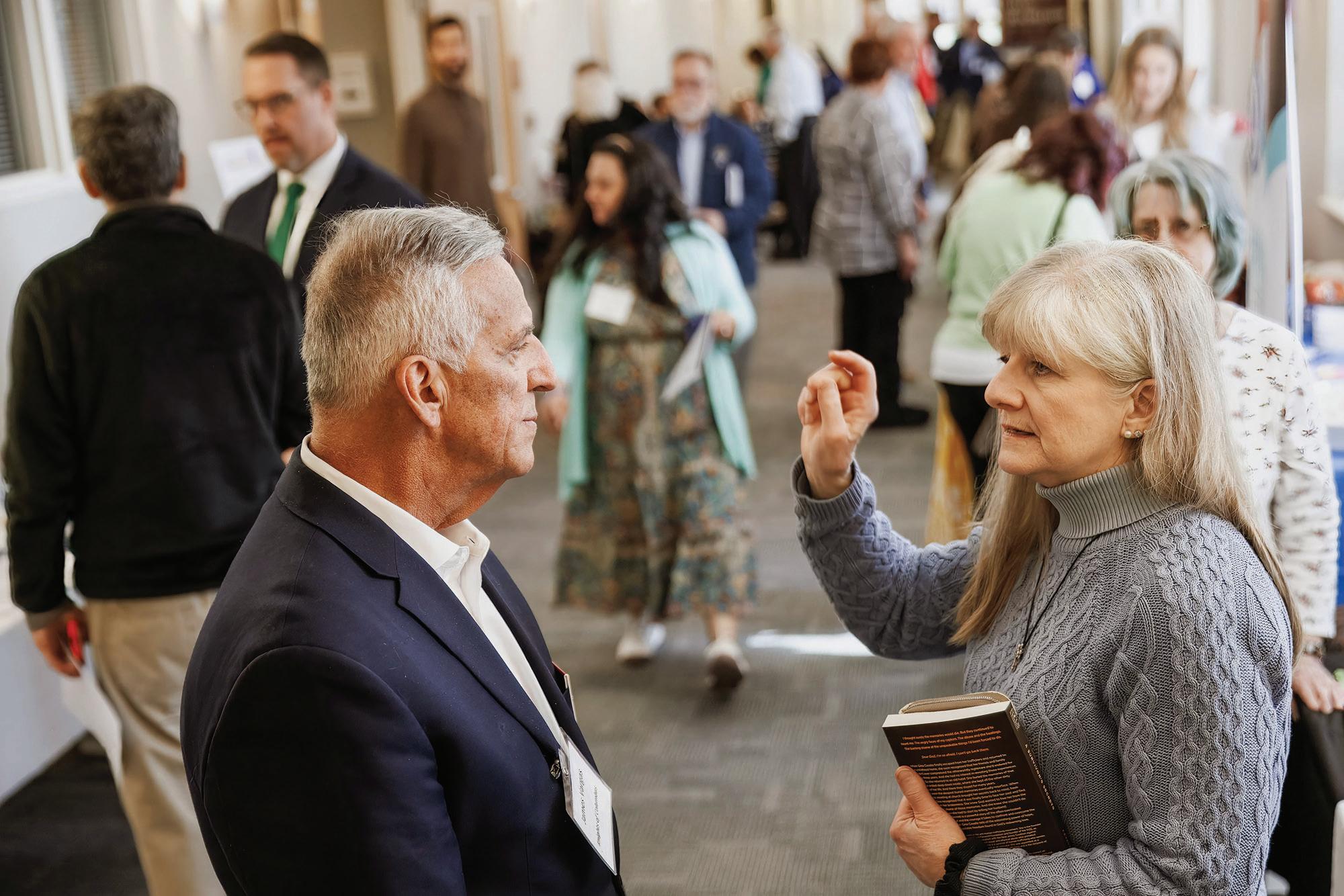
(2) Human trafficking survivor and victims’ advocate, Gina Cavallo, talks with an audience member.
—Hal Brown photos
enforcement for 45 years, including as retired Chief of Police of Pound Ridge, N.Y., and cofounder of the Westchester County Anti-Trafficking Task Force.
“When you hear a survivor’s story, it gives you an awareness I cannot. Words matter, the language you use matters.”
In his presentation entitled “Survivor-Informed Human Trafficking Prevention,” Ryan noted that victims of human trafficking are made vulnerable through trauma and abuse; low self-esteem; cultural, immigration and language barriers; emotional manipulation; blackmail and financial indebtedness; physical isolation, and threats of violence to their family members. The increase in online activity also may lure vulnerable youth into human trafficking and exploitation, Ryan continued, citing social media sites,
dating apps, fraudulent job postings, video games, and smartphone usage.
“Pay attention to what they are doing,” he urged. “These are our kids, and we need to get them educated. We need to educate ourselves too. These kids know it is a new thing. They need to know this is an unsafe place. You secure your houses physically, but you open up the internet and let anyone inside that house. [Perpetrators] can manipulate technology.”
Raising awareness is key, Ryan maintained, and noted that by understanding traffickers’ tactics, communities can take proactive steps to protect vulnerable individuals: educate yourself and others by sharing information about common trafficking tactics with your community; stay aware of your children’s internet use, especially on social media and gaming platforms, and volunteer or donate to organizations that support vulnerable populations such as homeless shelters, youth programs, or immigrant support services.
Ryan recommended those who suspect a case of human trafficking call a national phone number rather than 9-1-1 to assure those personnel on the line are equipped to address the issue properly.
“Call a trafficking hotline [numbers in box], don’t just walk away,” Ryan urged. “The response to trafficking must be a coordinated community response. Be our eyes and ears; you don’t have to be a police officer. It’s going to help us identify this. We are moving in the right direction.”
A Survivor’s Story
Gina Cavallo, author of “A Survivor’s Secrets,” now serves as founder and executive director of the survivor-led nonprofit organization WeRISE USA and Vice President on the Board of Trustees for the NJ Coalition Against Human Trafficking (NJCAHT), but not so long ago was a victim of domestic abuse and human trafficking.
Dressed all in black except for a vibrant pink blazer, she paced before the stage as she detailed her years of abuse and sex trafficking, beginning in childhood as the youngest of five children with abusive parents and progressing through
her teen years filled with sexual abuse, imprisonment, trafficking and drug abuse. The spellbound audience silently hung on her every word, punctuated by sympathetic groans as she described setbacks in her struggle to escape those who trafficked her.
“Human trafficking comes in many forms. The way to learn is to hear from different lived experiences, education brings awareness and awareness brings prevention,” Cavallo said. “It is not a one size fits all; each person has a different story, and it discriminates against no one. My companions were shame, fear and guilt. Without God, I wouldn’t be here today.”
She held up a packet of seeds and continued, “These seeds that we plant become the norm in our life. My father [as a child] was punished all the time. Those seeds were planted in my father, and he taught that to the next generation.”
Turning towards Ruggiero, Cavallo said, “What you are doing here today, Jennifer, is priceless because you need to know the truth about this crime. Do you think any child dreams of being raped? That’s what this crime is. This was not my dream. My life was robbed but I know the Lord is giving me this last home run of a stretch to live my life. He has called me for a time such as this, and I take it very seriously.”
Cavallo was trafficked in Florida and Las Vegas, escaped, suffered through a tumultuous marriage and drug abuse, and was arrested multiple times; “it is a miracle I am here today, for I should have died,” she said frankly. “We have to do better, be better, be approachable. The kids are learning to keep secrets. We are on a healing journey and none of us arrive.”
The survivor concluded, “I surrender everything to God. I am in awe of what He has done and continues to do in my life… Ever since I put the word of God before the word of people, my life has transformed a thousandfold.”
And as for her former captors and abusers, Cavallo said confidently, “I have forgiven them, because for me to have been forgiven, I had to forgive. Let’s remove our bias, our stigmas, and talk about this. It needs to be spoken.”
(3) Jennifer Ruggiero, Director of the Office of Human Life and Dignity, addresses the crowd as Father Jonathan S. Toborowsky, diocesan administrator, looks on.
(4) USCCB Outreach and Policy Advisor, Celina Marquez Redd, explained the steps the Catholic Church is taking to combat the issue.
(5) Ret. Police Chief David Ryan gave practical tips on recognizing victims of human trafficking and contact information of agencies who battle the scourge.
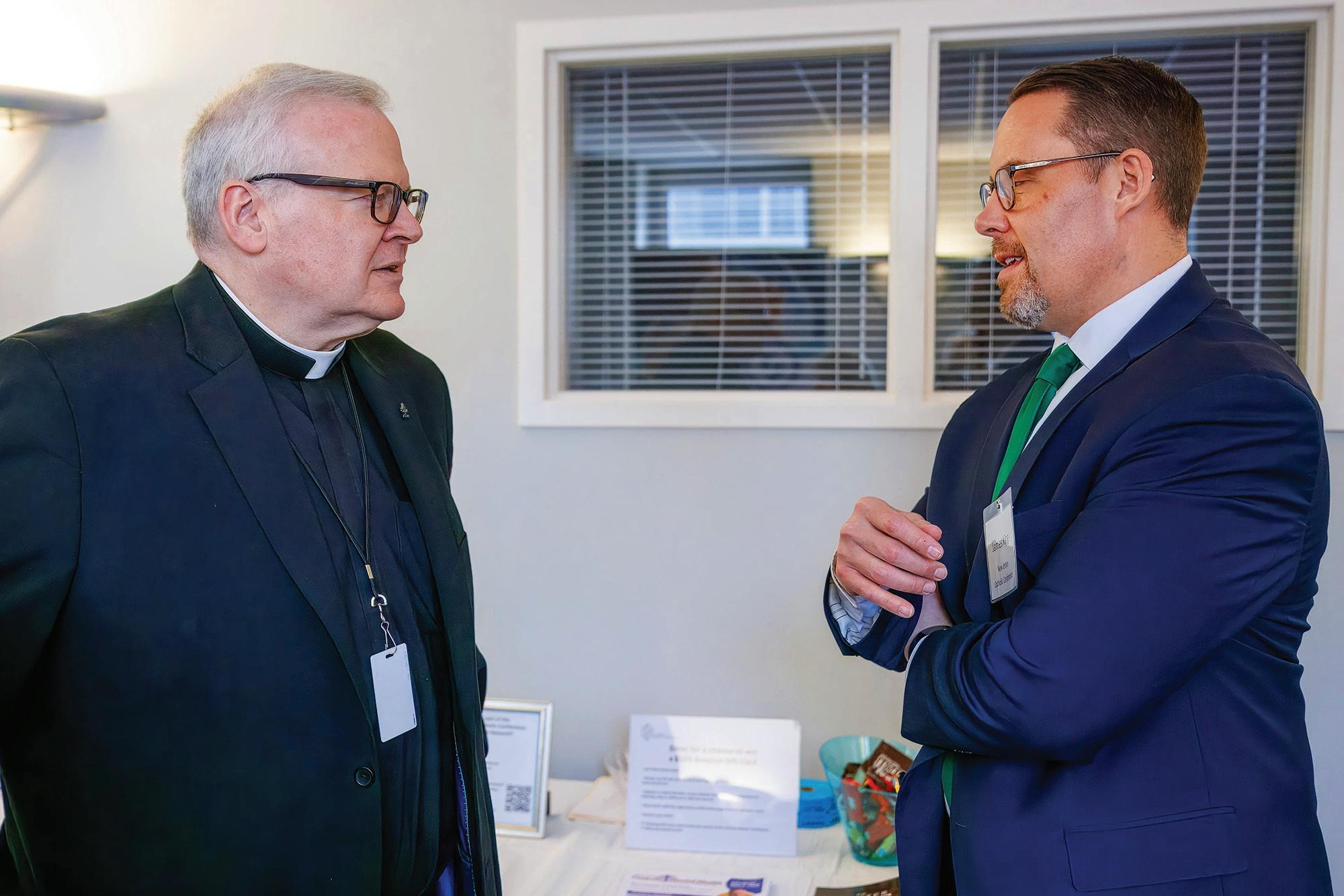
(6, 7) Father Toborowsky speaks with James King, executive director of the NJ Catholic Conference while others visit resource tables during the conference.
—Hal Brown photos
RESOURCES:
To learn more about human trafficking and how to combat it: The Justice for Immigrants Campaign: justiceforimmigrants.org/bakhita N.J. Coalition Against Human Trafficking: safernj.org.
To report a suspected case of human trafficking, or violence against children, call:
Natl. Human Trafficking Hotline: 888-373-7888; Humantraffickinghotline.org (Support 24 hours/ 7 days in 200 languages)
N.J. Human Trafficking Hotline: 855-363-6548
Covenant House NJ Human Trafficking Services: 862-240-2453
Natl. Center for Missing and Exploited Children: 800-843-5678
Pope Leo named one of Time magazine’s ‘100 Most Influential People of 2026’
By Gina Christian, OSV News
Time magazine has named Pope Leo XIV to its “100 Most Influential People of 2026” list.
The accolade was announced April 15, with the first U.S.-born pope joining a diverse group of individuals – some famous, some lesser known – distinguished by their contributions as leaders, innovators, icons, artists and pioneers.
The list, well into its third decade, has “no single metric that defines influence,” stated Time editor-in-chief Sam Jacobs in his overview of the list.
Rather, Jacobs and his team “poll our editors, reporters, and sources around the world, and review the recommendations that are sent to us every day,” with their ultimate selections “led by the stories that are shaping the world each year and the people who write them.”
Each list member was feted on Time’s website with a short reflection from a prominent figure, with filmmaker Martin Scorsese saying in his commentary on Pope Leo that he was “struck by his bravery and his common touch.”
Recalling Pope Francis as “a man I came to know and love as a friend,” Scorsese said Pope Leo “seems to share” the late pope’s “understanding that the church needs to reform itself to retain its
moral and spiritual force.”
Like Pope Francis – “the first Pope born outside of Europe since the Middle Ages and the first Jesuit” – Pope Leo is also a pioneer, being “the first North American–born Pope (with a Chicago accent!) and the first Augustinian in 500 years,” wrote Scorsese.
“For many, the Church has lost a great deal of moral and spiritual credibility,” he wrote. “Revelations of widespread sexual abuse and financial wrongdoing keep coming up, and many Christians have grown more secular over the years. The Church is at a crossroads, and it may once again be remaking itself.”
He noted that “Pope Francis always stressed that the Church was not a building or a symbol but the actual teachings of Jesus,” adding, “I believe that Pope Leo shares that view.”
“Like Francis, he seems to be committed to giving the laity a more active role in the leadership of the faith and the practice of charity,” said Scorsese.
He observed that Pope Leo had penned the introduction to a new edition of “The Practice of the Presence of God,” a short book of spiritual insights by a 17th-century French Carmelite friar whose religious name was Brother Lawrence of the Resurrection.
Pope Leo has called attention to
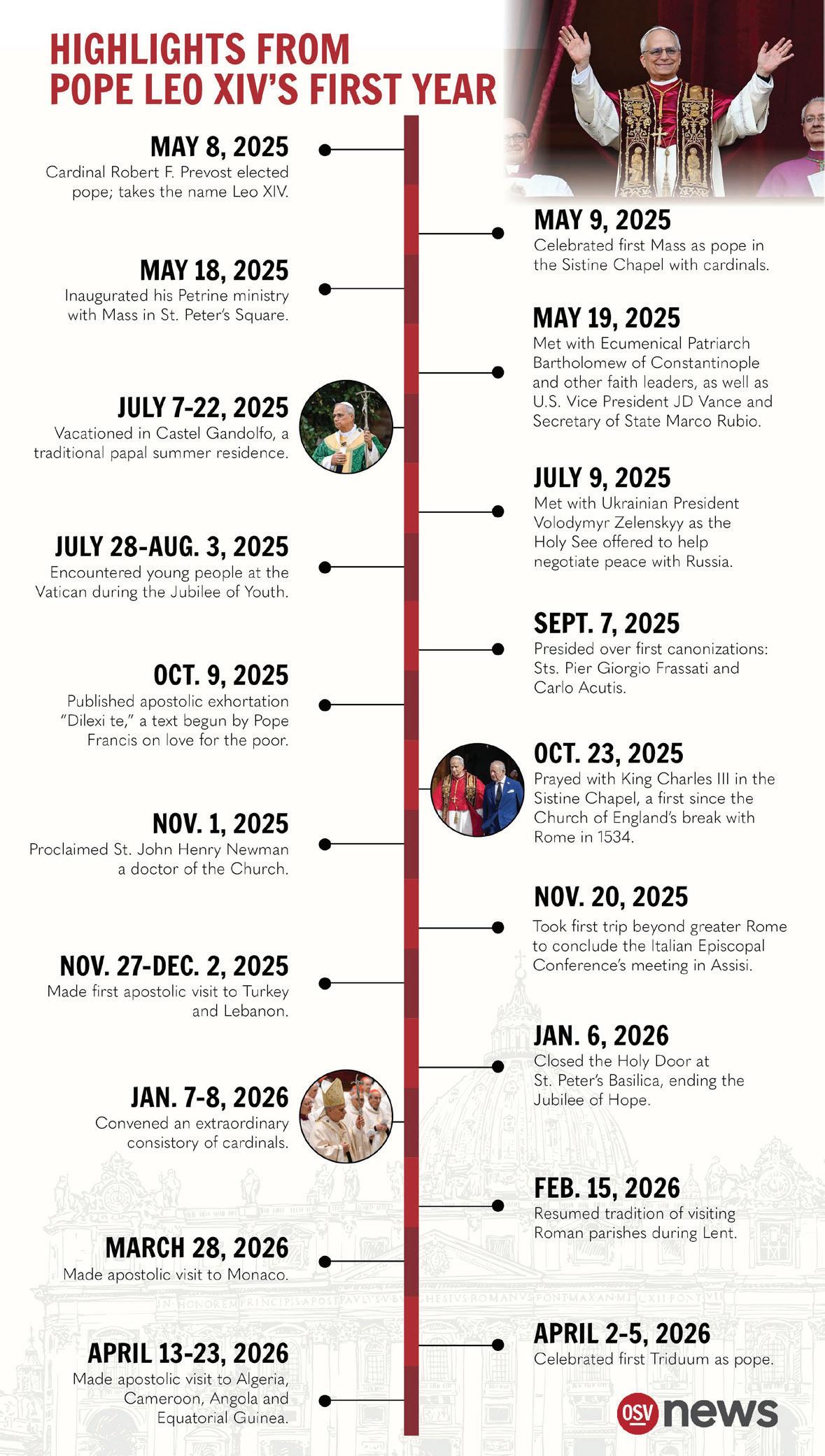
— OSV News graphic/Michelle Hoffschneider
the book on several occasions, writing in December 2025 that the work, along with the writings of St. Augustine and other books, “is one of the texts that have most shaped my spiritual life” and has “formed me in what the path can be for knowing and loving the Lord.”
“I know the book well,” wrote Scorsese. “A friend gave me a copy a few years ago, and I’ve since passed it along to many others. It offers a model for finding God in daily life, and for taking the
Church out of buildings, no matter how majestic, and into everyday existence.”
He quoted Pope Leo’s introduction to the work: “All Christian ethics can truly be summed up in this continual calling to mind the fact that God is present: He is here.”
“I’m encouraged by his words,” wrote Scorsese.
Gina Christian is a multimedia reporter for OSV News. Follow her on X @ GinaJesseReina.
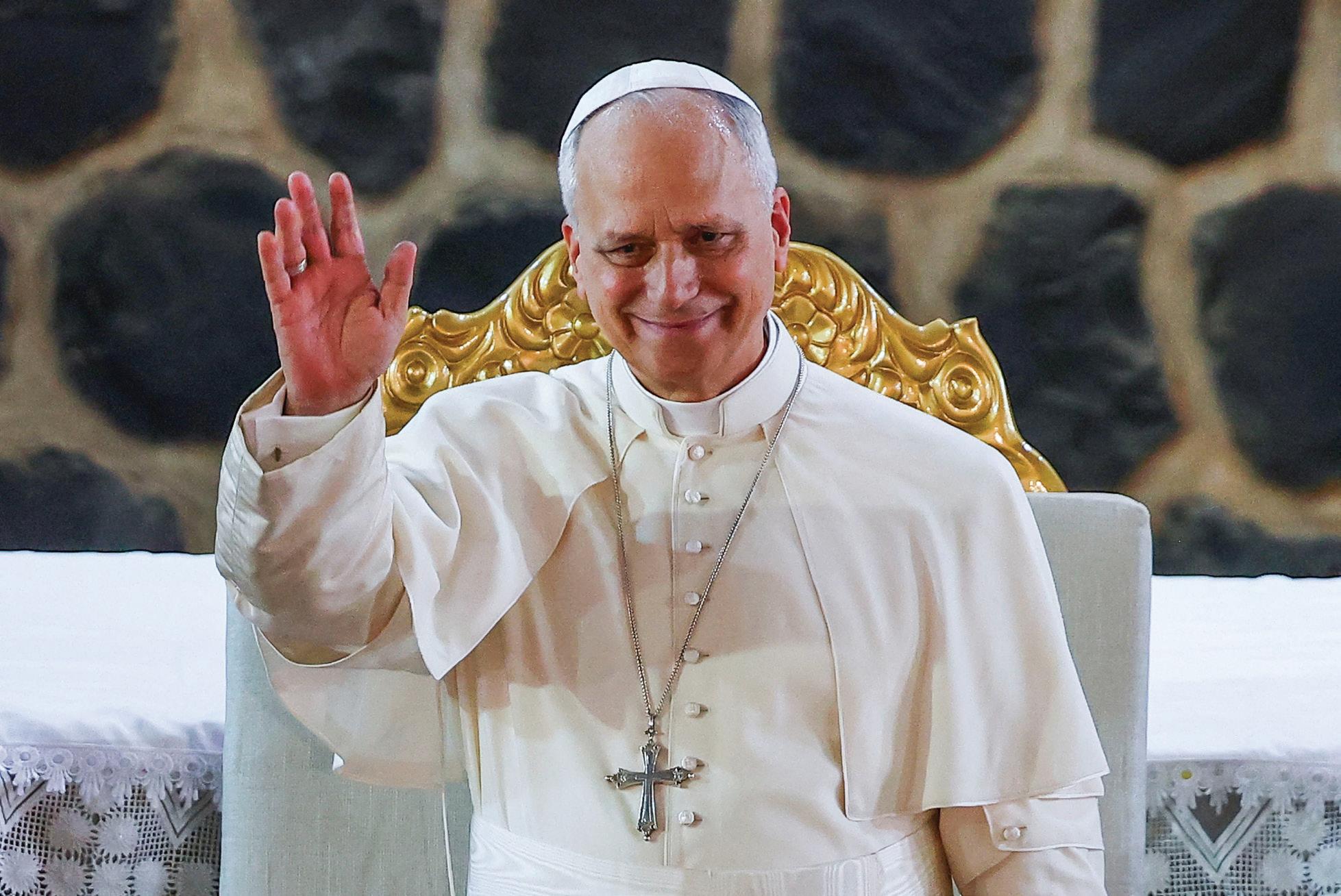
Pope Leo XIV waves as he attends a Meeting for Peace at St. Joseph’s Cathedral in Bamenda, Cameroon, April 16, 2026. —OSV News photo/Guglielmo Mangiapane, Reuters
Our Catholic Call: Resist violence against all life
By Mary Morrell, Editor-in-Chief
“The great need today is for Christians who are active and critical, who don’t accept situations without analyzing them inwardly and deeply.”
~ St. Oscar Romero
There are some news stories that defy explanation. They do not invite commentary so much as they confront us with a kind of moral vertigo. The recent killing in Louisiana of eight children in a domestic mass shooting is one of those moments. The details are almost unbearable – not only because of the ages of the victims, but because the violence came from within the very place where life is meant to be protected and nurtured – the family.
It is tempting, in the aftermath of such horror, to look for explanations. We may point to mental health, social breakdown, access to weapons, or the coarsening of culture. All of them may play a part but none of them, on their own or together, feel sufficient. There remains something unfathomable about an act that turns against children – something that signals not just a failure of systems, but a terrifying collapse of meaning.
Like many others, I often feel that the failure to respect life is spreading like a virus, but, rationally, I realize that the tendency to say, “things have never been this bad” is not really true. History offers too many examples of humans capable of extraordinary cruelty, including toward the most vulnerable.
What may be different now is not the proliferation of violence, but its visibility and its proximity. We encounter it instantly, repeatedly, and often without the buffer of community or context to help us process it. The result is a steady erosion of our own sense of moral stability during this place and time. It begins to feel as though there are no boundaries left, no sense of right and wrong. There seems to be a profound failure to recognize the inviolable dignity of life – something that is at the heart of our Catholic faith.
For us, as Catholics, the sacredness of life is not a slogan or a political position, but a truth. Human life is valuable because it is given to us by God, and that belief makes violence more difficult to bear. If life is truly sacred, then
its destruction is not just tragic – it is a desecration.
The question, then, is not only why such unthinkable acts occur, but how are we to live in their shadow without becoming either numb, cynical or giving in to despair or distancing.
We tell ourselves that such violence belongs to other places, other kinds of people, other circumstances. But the fact that this particular tragedy, like so many others before it, unfolded within a family undermines that illusion. Violence is not only a public phenomenon. It can grow in private spaces – in isolation, in untreated suffering, in relationships marked by control or despair.
And if that is true, then any meaningful response must begin closer to home than we might like to consider.
The response may need to include considering the hidden crises that do not make headlines – the parent overwhelmed beyond endurance, the household where anger is becoming normal, the individual withdrawing into grievance or hopelessness. These situations rarely announce themselves dramatically. They accumulate. They intensify. And, too often, they remain unseen until it is too late.
Communities of faith are not immune to these dynamics, but they are not powerless, either. At their best, they offer something increasingly rare – presence, a sustained attention to one another, the kind of presence that notices when something is wrong and does not look away.
There is also the harder, less comfortable work of forming morality. A
culture does not lose respect for life all at once. It happens gradually, through a thousand small permissions – ways of speaking, ways of dismissing, ways of reducing others to problems or obstacles. To insist, patiently and persistently, that every life is important is not dramatic work. It is repetitive, and it sometimes feels like our efforts make no difference. But they do.
Practical measures matter, as well. Supporting access to mental health care, strengthening family support systems, advocating for responsible policies that reduce the likelihood of lethal violence – these are not substitutes for moral conviction, but expressions of it. A consistent ethic of life is credible only when it embraces both the personal and the structural.
Still, a harder truth to accept is that none of this will eliminate the possibility of violence. There is no policy, no program, no pastoral initiative that can guarantee that such acts will not happen again. What can be shaped, however, is the kind of society in which we live, whether it is one marked by indifference and fragmentation, or one that resists violence, even imperfectly.
In the end, perhaps the most important task is also the simplest to name and the most difficult to sustain – to refuse to become accustomed to the destruction of life. We must allow ourselves to be grieved by it, unsettled by it, even angered by it, rather than allow ourselves to become indifferent.
The deaths of these children can have no rational explanation, but they
can call forth a response – maybe not a loud or performative one, but a steady insistence, lived out in ordinary ways, that life – every life – remains sacred, even in a world that so often contradicts it. We do this work within our communities.
Jesus understood the power of communities, so he created one of his own. Any serious effort to restore a sense of the sacredness of life must be passed on, in a similar way, through our communities – our families, our parishes, our Catholic schools, our Catholic organizations, our ecumenical groups – not as an abstract ideal, but as a lived reality. If we truly live according to Gospel values we will always be blessed with communities where a person is seen, known, and, at times, turned around when they begin to drift toward the wrong path.
Our communities should be the places where the sacredness of life is learned through an encounter with Christ and in relationships where dignity is affirmed, where burdens are shared, and where no one is reduced to their worst moment.
Such communities create a kind of moral ecology in which indifference struggles to take root because people are not invisible to one another. Such communities do not require perfection, but they do require presence – habits of checking in, of noticing, of remaining available, making them not only a support system, but a powerful form of resistance against the forces that diminish life’s value, and reminding us, in concrete and daily ways, that every person belongs and therefore matters.
Pope decries horror, inhumanity that ‘some adults boast of with pride’
By Carol Glatz Catholic News Service
Warning against an increasingly unpredictable and aggressive “delusion of omnipotence” threatening the globe, Pope Leo XIV called on world leaders and individuals to empty their hearts and minds of hatred and violence, and to start serving life.
“Enough of the idolatry of self and money! Enough of the display of power! Enough of war! True strength is shown in serving life,” he said during a special evening prayer vigil for peace in St. Peter’s Basilica April 11.
“Those who pray are aware of their own limitations; they do not kill or threaten with death,” he said. “Instead, death enslaves those who have turned their backs on the living God, turning themselves and their own power into a mute, blind and deaf idol, to which they sacrifice every
value, demanding that the whole world bend its knee.”
“Let us listen to the voices of children,” who write to him all the time, recounting “all the horror and inhumanity of actions that some adults boast of with pride,” he said.
The vigil, which drew thousands of people inside and outside the basilica, featured the recitation of the glorious mysteries of the rosary. Before each mystery was recited, women wearing traditional dress from countries representing the different continents of the world lit small lamps from a flame from the Lamp of Peace from Assisi that was placed below a statue of Our Lady Queen of Peace. Prayer can move mountains, he said in his remarks in Italian. “War divides; hope unites. Arrogance tramples upon others; love lifts up. Idolatry blinds us; the living God enlightens.”
News From New Orleans
Archbishop James F. Checchio of the Archdiocese of New Orleans had the opportunity to meet with Pope Leo XIV on March 23 in the Pope’s private library in the Apostolic Palace. During the 35-minute meeting there was a discussion on a number of issues relevant to the Archdiocese, including the work being done to promote the causes of Servant of God Henriette DeLille and Blessed Francis Xavier Seelos.
Archbishop Checchio also presented the Pope with a spiritual bouquet representing thousands of prayers from Catholic school children, priests and deacons of the archdiocese.
According to the Clarion Herald, official newspaper of the Archdiocese, Archbishop Checchio also received Pope Leo’s permission to name the upcoming renovation of St. Louis Cathedral rectory into the Pope Leo XIV Center for Evangelization in honor of the Holy Father and his family “who lived in New Orleans for nearly 300 years and attended Mass at the Cathedral, a gesture that moved the Holy Father deeply.”
Pope Leo XIV prays in St. Peter’s Basilica at the Vatican April 11, 2026, during a prayer vigil and the recitation of the rosary for peace. —CNS photo/Vatican Media
It just takes a tiny bit of faith “to face this dramatic hour in history together,” he said.
For a people of faith in the risen Lord who conquered death with love, he said, “nothing can confine us to a predetermined fate, not even in this world where there never seem to be enough graves, for people continue to crucify one another and eliminate life, with no regard to justice and mercy.”
While the Pope did not mention any one current conflict in his remarks, he did recall St. John Paul II’s fervent efforts and calls for peace during the 2003 invasion of Iraq conducted by the U.S. with the assistance of a multi-national coalition.
“I make his appeal my own this evening, relevant as it is today,” Pope Leo said, referring to his predecessors’ calls for “No more war.”
“The Church is a great people at the service of reconciliation and peace,” he said. “She advances without hesitation, even when rejecting the logic of war may lead to misunderstanding and scorn.”
The Church “proclaims the Gospel of peace and instills obedience to God rather than any human authority, especially when the inherent dignity of other human beings is threatened by continuous violations of international law,” Pope Leo said.
With the help of prayer and God, people can help “break the demonic cycle of evil” and be at the service of the Kingdom of God, where there is “no sword, no drone, no vengeance, no trivialization of evil, no unjust profit, but only dignity, understanding and forgiveness,” Pope Leo said.
“It is here that we find a bulwark against that delusion of omnipotence that surrounds us and is becoming increasingly unpredictable and aggressive,” he added.
He criticized the use of God’s name in justifying violence, saying “even the holy name of God, the God of life, is being dragged into discourses of death.”
Those invoking God’s name in such a way erase a world made up of brothers and sisters with one heavenly Father and instead create a “nightmare” where the world is made up of enemies and threats, rather
‘Enough of the idolatry of self and money! Enough of the display of power! Enough of war! True strength is shown in serving life.’
than calls to listen and to come together.
Speaking to the world’s leaders, the Pope said, “Stop! It is time for peace! Sit at the table of dialogue and mediation, not at the table where rearmament is planned, and deadly actions are decided!”
However, all the world’s people also have a duty to reject the violence in their own hearts and minds and help build a kingdom of peace each and every day in one’s own home, school and community, he said.
“Let us believe once again in love, moderation and good politics,” he said, urging people to learn more and “get personally involved” in being part of “the mosaic of peace!”
“Dear brothers and sisters, let us return home having made a commitment to pray without ceasing and without growing weary, a commitment to a profound conversion of heart,” the Pope said.
Before entering the basilica, Pope Leo greeted the faithful gathered in St. Peter’s Square, thanking them for their presence. He explained his reason for calling for the prayer vigil, which was also being joined by countless others around the world, either online or in their own parishes.
By praying the rosary together, he said, “we want to tell the whole world that it is possible to build peace, a new peace, that it is possible for all people, of all religions, of all ethnicities, to live together, and that we want to be disciples of Jesus Christ, united as brothers and sisters, all united in a world of peace.”
Where do Bishops come from?
The divinely appointed overseer
This last year, the world watched as the cardinals gathered in Rome for the election of a new pope, the 267th bishop of Rome. New York recently received a new archbishop, and Denver is preparing for one as well. We are witnessing apostolic succession in action, extending an unbroken chain of bishops back to the apostles, who were appointed directly by Our Lord. Jesus established the Church, literally the “assembly,” as a relational network to draw the nations to himself.
But his Church, founded on the rock of Peter, like a good family, must maintain order, with a father, dubbed an “overseer,” placed over each local church. The role of bishop, which is how the Greek word for “overseer,” episkopos, came into English, is not equivalent to a secular manager or corporate head, because it is a divinely appointed office, given a share in Christ’s own authority over his Church.
Jesus, who worked as a builder with his adoptive father Joseph, clearly built a Church with a visible structure and leadership. He formed twelve apostles as the heads of twelve tribes that would constitute a new Israel gathered from throughout the nations. He gave his own authority to the twelve, as we see in a number of passages from the Gospel:
“And he called the twelve together and gave them power and authority over all demons and to cure diseases” (Luke 9:1).
“The one who hears you hears me, and the one who rejects you rejects me, and the one who rejects me rejects him who sent me. … Behold, I have given you authority to tread upon serpents and scorpions, and over all the power of the enemy; and nothing shall hurt you” (Luke 10:16, 19).
“As the Father has sent me, even so I am sending you. … If you forgive the sins of any, they are forgiven them; if you withhold forgiveness from any, it is withheld” (John 20:21, 23).
Although a bishop needs skills for governance, the leadership of the Church depends first and foremost upon the grace of Christ poured out on those he has chosen to lead his Church. It would make no sense for Jesus to establish order in his Church for one generation, only to let it slide into chaos later. If we pay attention, we can witness apostolic succession in action right within the New Testament. In the first chapter of Acts of the Apostles, Peter, the head of the twelve, directs the raising up of
who contradict it” (Titus 1:9).
The bishop preserves order, ensuring that the faithful live in communion with Christ and do not go astray through erroneous belief or immoral action. One of the oldest Christian documents we possess, the Didache, bears witness to the dangers posed by false teachers and the need to maintain order within the Church, following the roles of bishop, priest and deacon. Around the year 108, St. Ignatius of Antioch, a disciple of St. John the Apostle, offered a strong exposition of the necessity of the office of the overseer, repeatedly stating that Christians should do nothing apart from their bishop.
The bishop is the bond of unity in faith and charity, who assures that the faithful of the “Catholic Church” adhere in communion with Christ. Therefore, we must “run together in accordance with the will of [the] bishop” and “be careful, then, not to set ourselves in opposition to the bishop, in order that we may be subject to God,” he wrote.
a successor to take the place of Judas, saying that one who was with them from the beginning “must become with us a witness to his resurrection” (Acts 1:22).
Although Jesus himself called Paul to become an apostle, he still “went up to Jerusalem to visit Cephas,” that is Peter, and later had his mission to the Gentiles approved by the pillars of Peter, James and John (Galatians 1:18, 2:9).
Paul, in turn, shows us how he appointed Timothy as an overseer of Ephesus and Titus in Crete, a role which he describes as “God’s steward” (Titus 1:7). Paul writes to Timothy, reminding him “to fan into flame the gift of God, which is in you through the laying on of my hands,” which is the way one receives the authority to act as bishop (2 Timothy 1:6). He gave them instructions for appointing other overseers and elders (the Greek work used by the Church for “priest”), showing the Lord’s plan for continuing the governance of his Church.
As a link in the great chain stretching from Christ to today, the bishop, as steward, must receive all that has been handed down in the Church and pass it on faithfully. Paul states that “he must hold firm to the trustworthy word as taught, so that he may be able to give instruction in sound doctrine and also to rebuke those
The modern world bristles at such authority. Immanuel Kant, for instance, in his essay, “What Is Enlightenment?” accused believers of immaturely placing themselves under the care of guardians who prohibited them from the free use of reason. The modern world has created a counter-structure to the Church, not one unified by faith and charity but a democratic collection of individuals bent on fulfilling their own whims.
The visible communion of the Church, the rock built on Peter, necessarily checks our freedom so that we cannot simply build our own church based on our own thoughts and desires, a church of one. We do not obey the bishop because we like him, or because he’s always right in his decisions, but because he is the one who has received the care of the Church and acts on behalf of Christ in our diocese.
To obey God, we must obey all those placed in lawful authority over us. The communion of the Church continues in the world because God has placed a head over it, maintaining its integrity through its teaching, sacraments and governance. To those who abide in this communion, who observe all that Christ has commanded, he gives the assurance: “lo, I am with you always, to the end of the age” (Matthew 28:20).
Dr. Staudt’s column is syndicated by the Denver Catholic, the official publication of the Archdiocese of Denver.
—Gerald Wutkowski photo
Cardinal Raymond Burke, a friend to the Diocese of Metuchen and frequent visitor to our Blue Army Shrine in Washington, N.J., recently wrote the following:
“As we approach the 250th anniversary of the founding of our nation, may these reflections encourage us to renew a rightly ordered love of our homeland. Let us continue to pray fervently for our country, asking that the Heart of Jesus may bless and renew our nation, guiding it always in the paths of truth, justice, and peace. Invoking upon you the blessing of Almighty God, I remain Yours in the Sacred Heart of Jesus and the Immaculate Heart of Mary, and in the Purest Heart of Saint Joseph!”
Sacred Heart and Patriotism
Cardinal Burke’s message reminded me of two important things that I cherish. The first is how blessed I’ve been to be in love with the heart of Jesus through the hearts of His Mother, Mary, and foster-father Joseph, since the days of my youth. The second is how blessed I am to be an American citizen, not by birth but by privilege.
As a teenager, it was not popular for young people to engage in devotionals like the holy rosary or be involved in special Catholic associations like the League of the Sacred Heart. In fact, priests that I knew discouraged me from actively pursuing these “out of date” devotionals “of the past”. Yet, Divine Providence would have it that I began praying holy rosary in high school, partly because I stumbled upon a group of elder parishioners who invited me to join their Legion of Mary. There was also a gentleman whom I met at daily Mass…Although 20 years my senior, he gave me a Sacred Heart badge and introduced me to the League of the Sacred Heart and the Apostleship of Prayer. Since then I’ve been praying the Daily Offering (a key aspect of the Apostleship) each and every morning.
Founded in 1844, the Apostleship of Prayer promotes a Daily Offering of prayers, works, joys, and sufferings in union with the Sacred Heart of Jesus.
In addition to the Daily Offering, members pray for specific monthly intentions announced by the Pope, which focus on challenges facing humanity and the mis-
sion of the Church.
As I grew older and entered college, I discovered that the Apostleship promoted three practices which constitute three degrees of membership. The first consists of a daily offering of one’s prayers, good works, and sufferings; the second, of a daily recitation of a decade of the rosary for the special intentions of the Holy Father recommended to the members every month; and the third, of the reception of Holy Communion with the motive of reparation. The members are also urged to observe the practice of a Holy Hour, spent in meditation on the Passion.
The Daily Offering (which I placed on my bathroom mirror throughout my college years and beyond to remind me to pray each morning) is as follows:
“O Jesus, through the Immaculate Heart of Mary, I offer you my prayers, works, joys, and sufferings of this day for all the intentions of your Sacred Heart in union with the Holy Sacrifice of the Mass throughout the world, for the salvation of souls, the reparation of sins, the reunion of all Christians, and in particular for the intentions of the Holy Father this month. Amen.”
As I began my priestly studies, I also began writing articles for the Sacred Heart Messenger, the monthly magazine published by the League of the Sacred Heart. I guess that is how I started my “writing career”!
Upon completing my priestly studies, I applied for the so-called “green card” (really salmon in color!). Holding this permanent residency for several years, I finally applied for, and was granted, American citizenship. This took place in the Old State House in Boston where the first public reading of the Declaration of Independence in Boston took place on July 18, 1776. All these years later, I stood there and took the Oath of Allegiance, the final, mandatory step in the U.S. naturalization process, and became a naturalized citizen. It is there where I pledged loyalty to the United States, and promised to support the Constitution and laws of our great country. Waiting to raise my hand and “be sworn in”, I
stood with fellow patriots including my friends who came to celebrate the great day. (My classmate and priest friend, Msgr. Edward Puleo, was also present for this special event. And, following the ceremony, he gave me an array of items with the American flag emblem and bald eagle attached!)
Over the years, like all Americans, there have been some elected officials I liked and others I disliked. I felt blessed to be an American on June 24, 2022, (the Feast of the Nativity of John the Baptist, and that same month celebrating the Solemnity of the Most Sacred Heart of Jesus), when, after hundreds of thousands of Catholics and others prayed for 50 years at the March for Life in Washington, Roe vs Wade was finally overturned by the Supreme Court. And, I feel equally blessed that we have pro-life members of the current administration.
I am most grateful to be an American, especially as our country celebrates 250 years of Independence. The Declaration of Independence references God as Creator and Supreme Judge. In fact, the second sentence of our Declaration, “We hold these truths to be self-evident, that all men are created equal, that they are endowed by their Creator with certain unalienable Rights, that among these are Life, Liberty and the pursuit of Happiness,” is considered one of the most significant and famed lines in the history of the world.
We pray, in the words of Cardinal Burke, for the renewal of “a rightly ordered love of our homeland…always in the paths of truth, justice, and peace”. I am grateful to live in a country where life and liberty are celebrated, and recognized as gifts, not from the government, but as God’s gifts to us.
Father Hillier serves as diocesan director, Office of Pontifical Mission Societies, the Office for Persons with Disabilities and Censor Librorum.
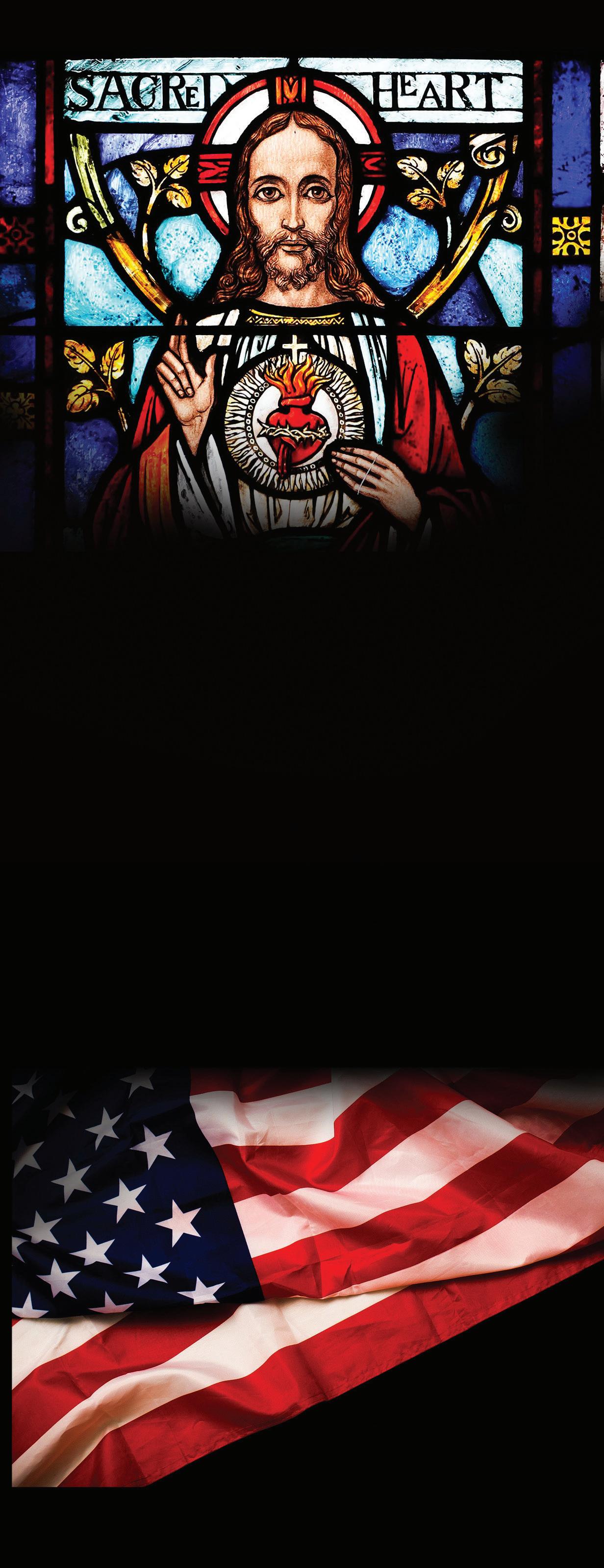
The Sacred Heart of Jesus at Our Lady Queen of Martyrs Church, Queens, New York —OSV News photo/ Gregory A. Shemitz American flag — Angelov photo
St. Peter’s CEO to be honored at American Cancer Society Gala
For nearly four decades, the American Cancer Society’s Night of Wine and Roses Gala has honored trailblazers who lead with heart and courage – individuals whose compassion is reflected in the lives of the patients they serve and inspire each day. Every year, the community comes together to build a legacy that advances progress against cancer.
The event, planned for May 1, commemorates the 40th anniversary of this extraordinary gala and celebrates its enduring impact on cancer research, patient care, and survivorship.
This year’s Medical Honoree is Leslie D. Hirsch, FACHE, president and chief executive officer of Saint Peter’s Healthcare System. Hirsch is a seasoned
healthcare executive whose career spans over 45 years. He has served as president and CEO of Saint Peter’s since 2017, having initially joined the organization as president in 2015.
“We are proud to provide access to highly specialized clinical services, as well as research and clinical trials, at Saint Peter’s Cancer Center,” he said. “Our goal is to always help ease the emotional, physical, and financial burdens often felt by patients with cancer who thought the only option was to travel far from home – or even out of state – to receive what is often perceived as a higher level of care. We collaborate with some of the most experienced cancer specialists in the state, especially
those with Astera Cancer Care. Together, we’re delivering high-quality, coordinated, and patient-centered cancer care for improved outcomes.”
Hosted by Dr. and Mrs. Michael Nissenblatt and the American Cancer Society, the Night of Wine and Roses is a powerful and inspiring event that unites New Jersey in the fight against cancer. Over the past decade alone, the gala has raised over $5 million to support cancer research and provide free patient programs and services.
This year, more than 60,740 New Jersey residents will be diagnosed with cancer. Because of the progress made against cancer, for the first time, the fiveyear relative survival rate for all cancers combined has reached 70%- a milestone that shows real progress driven by advances in research and patient care.
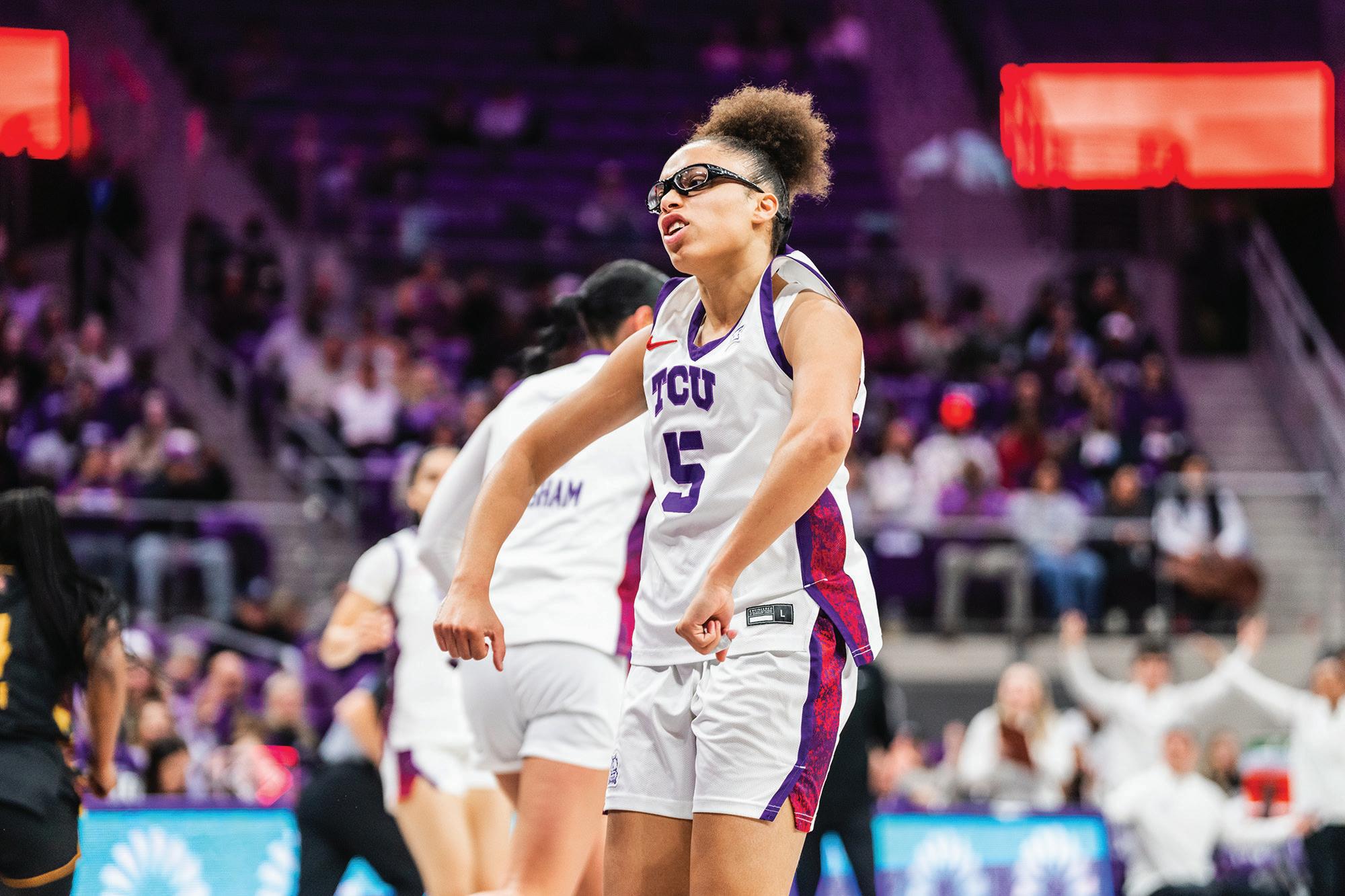
Sts. Philip and James School alum Olivia Miles heads to WNBA as No. 2 draft pick
By Greg Johnson, Correspondent
Anything is possible when you work hard and treat others the right way.
That continues to be the message that Olivia Miles shines on her native Phillipsburg and the Sts. Philip and James School, where she spent her formative years in education from first through eighth grade.
Nine years later, she is one of the best women’s basketball players in the nation.
The Minnesota Lynx selected Miles with the No. 2 overall pick in the WNBA Draft on April 13, signaling the start of a potentially prosperous career in the sport.
When speaking at the draft at Hudson Yards in New York City, Miles thanked her parents, Yakubu and Maria, and her brother, Isaiah, for supporting her in the journey from Phillipsburg.
“I had my parents’ names and my brother’s name stitched into my suit top, if you will, and the date of course, just to pay homage to people who have been in my life and my career and supported me through so many ups and downs and the adversity that we were just talking about,” Miles said during the ESPN broadcast. “I love them very much.”
Miles was one of the nation’s top high school basketball players at Blair Academy in the Class of 2021. She then enrolled at the University of Notre Dame for five years and played four seasons with the Irish. She missed the entire 2023-24 season because of ACL surgery.
After coming back stronger than ever during the 2024-25 season, she discussed in an interview with The Catholic Spirit how her Catholic faith guided her through the severe injury.
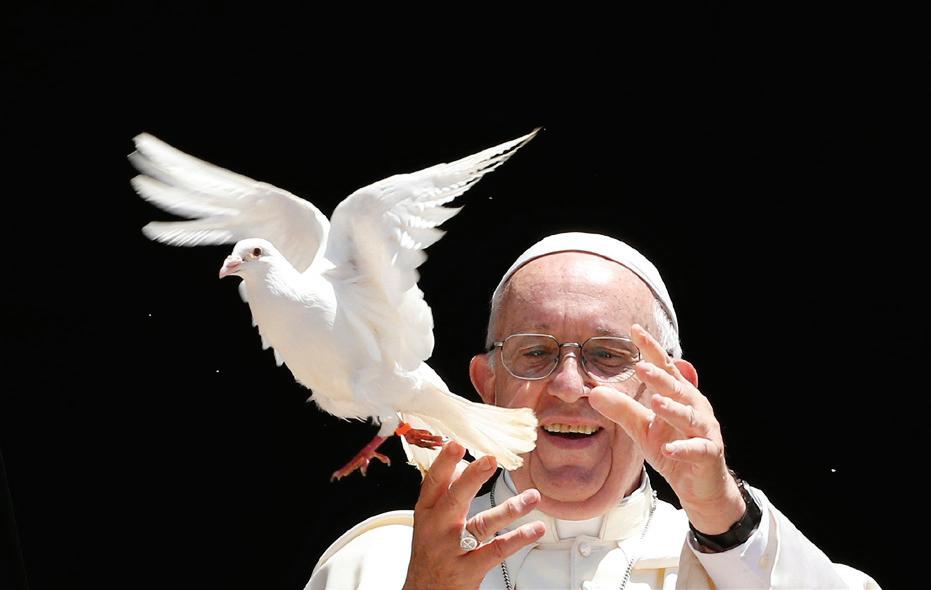
Pope Francis releases a dove outside the Basilica of St. Nicholas after meeting with the leaders of Christian churches in Bari, Italy, July 7.
The pope met Christian leaders for an ecumenical day of prayer for peace in the Middle East. Pope Francis, formerly Argentine Cardinal Jorge Mario Bergoglio, died April 21, 2025, at age 88. —CNS photo/Paul Haring
One year ago: The pope from the peripheries died on Easter Monday
By Catholic News Service
“Faith is very important – keeps you grounded, helps you to realize everything’s happening for a bigger purpose,” Miles said. “God’s never going to put you in a position to be hurt, but to only prosper and succeed. So although it was pretty difficult, I learned a lot during that time. It was the hardest moment of my young life, my 22 years. It was tough, but I made it positive at the end of the day.”
With one more year of college basketball eligibility, she transferred to Texas Christian University for the 2025-26 season and had her best campaign yet. Miles averaged 19.6 points, 7.2 rebounds and 6.6 assists per game and was named the Big 12 Conference Player of the Year.
Miles also graduated from TCU with a Master of Liberal Arts degree after completing her Bachelor of Science in Political Science and Master’s in Nonprofit Administration at Notre Dame.
Miles is now joining a Lynx franchise that was founded in 1999 and has won four WNBA championships (2011, 2013, 2015, 2017).
It is an achievement that reflects strongly on her hometown roots. She noted last year how she owes so much of her development to the Sts. Philip and James School.
“It was a good place to build my foundation,” Miles said. “I learned a lot of good qualities about myself, I have a great friend group that we still talk every now and then, and I got to learn all the educational stuff, all the different subjects through the years. But then I also got to grow in my faith, which was important to me.”
VATICAN CITY (CNS) – One year ago today, Pope Francis died at 7:35 a.m., April 21, 2025. It came the day after Easter, when – barely able to raise his hands – he gave his blessing “urbi et orbi” (to the city and the world). Looking drawn and worn, the 88-year-old pope from Argentina took his final ride in the popemobile, spending about 15 minutes among the crowd. Elected March 13, 2013, Pope Francis was the first pope in history to come from the Southern Hemisphere, the first non-European to be elected in
almost 1,300 years and the first Jesuit to serve as successor to St. Peter. Following in the footsteps of his predecessors, Pope Francis was an untiring voice for peace, urging an end to armed conflict, supporting dialogue and encouraging reconciliation. “Go out” was Pope Francis’ constant plea to every Catholic, from curial cardinals to the people in the pews. More than once, he told people that while the Bible presents Jesus as knocking at the door of people’s hearts to get in, today Jesus is knocking at the doors of parish churches trying to get out and among the people.
Olivia Miles was named the Big 12 Conference Player of the Year in her final season of college basketball at Texas Christian University (TCU). —Photo courtesy of TCU Athletics
Sts. Joseph and Luke parishioners take time weekly for Lenten reflection
By Robert Christie, Correspondent
A small group of parishioners of Sts. Joseph and Luke in North Plainfield took six hours during Lent to pray and reflect on the season’s three spiritual pillars: prayer, fasting, and almsgiving.
They gathered at the St. Luke parish center for the merged parishes’ Weekly Lenten Reflection Series, which included essays based on that day’s Gospel and a recommended penance for each day.
Jean and Dottie Koszulinski from St. Luke’s Church said the Lenten series gave them a deeper appreciation of Christ’s sacrifices and the need to reflect on them.
Deacon Thomas Pluhar, a member of the parish staff who is in his final year before ordination to the priesthood, said the series “helped me see my parish not just as a place I go, but as a community that supports me in growing closer to God.”
The group followed the Magnificat Lenten Guide for its weekly devotions and discussed issues designed to examine participants’ Lenten experiences more deeply.
About 10 people attended each session.
At the initial session Feb. 25, participants discussed the history of Lent, set at the Council of Nicaea in A.D. 325, with its strict regulations of fast, and why the Church decided on the period of 40 days. This period – beginning on Ash Wednesday and concluding on the Wednesday before Holy Thursday, excluding Sundays – commemorated Jesus’ time spent in prayer and fasting in the desert, and other periods of 40 days or years in biblical history.
Participants reflected upon relationships of affection and warmth as well as those of sadness, brokenness, and loneliness, including one’s relationship with God and separation from him. Group discussion included seeing others as stepping stones back to God.
Subsequent sessions included recommendations for taking devotions to the next level, such as praying the rosary once or more during the week, attending weekday Mass, going to confession,
attending Stations of the Cross and Adoration of the Blessed Sacrament, and practicing one or more of the small penances accompanying the daily essays in the Lenten Guide.
The parish also held a Lenten retreat Feb. 28 and a separate retreat for altar servers March 21.
“Attending the Lenten retreat was a deeply renewing experience for my heart and spirit,” said St. Joseph parishioner Joseph Castro.
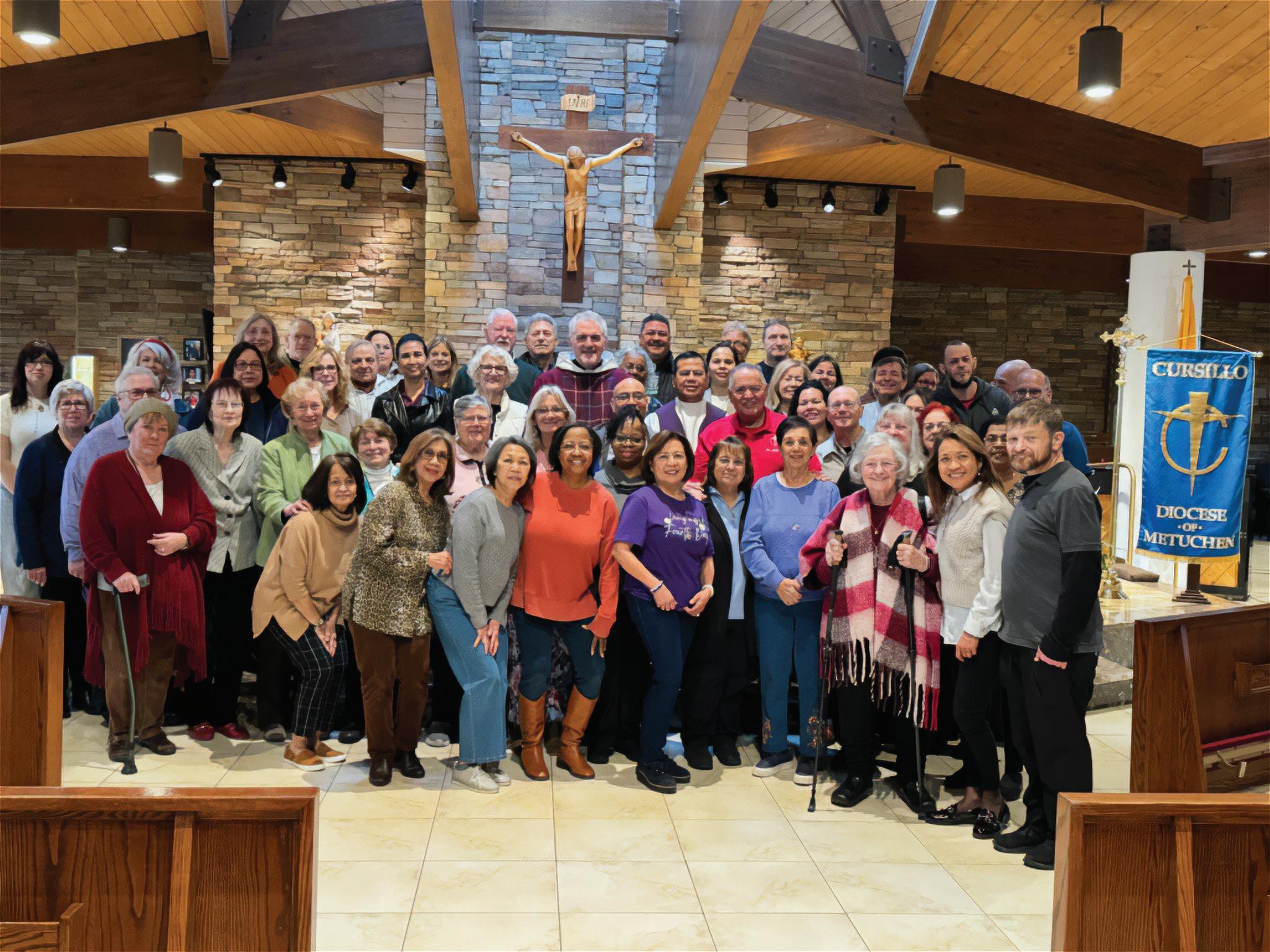
Metuchen Cursillo Movement holds annual Lenten Encounter
By David Karas, Correspondent
For the 16th year in a row, the Metuchen Cursillo Movement brought together members for the organization’s annual Lenten Encounter on March 21. The program was held in Mary, Mother of God Church, Hillsborough, and began with Mass celebrated by Msgr. Joseph Curry, pastor, as well as Father
Ramos, SSS, parochial
in
Parish, Somerset – and a Cursillista himself.
Following Mass, more than 80 participants gathered for breakfast and engaged in a conversation about God’s Divine Mercy led by Father Gregory Zannetti, parochial vicar of St. John Vianney Parish, Colonia, and Deacon Sal Bonfiglio, OFS, from Mary, Mother of God.
The Cursillo Movement, which is named after the Spanish word for “short course,” is primarily a lay movement that invites Catholics to join and work towards spiritual renewal. Members participate in a Cursillo weekend, a three-day program that includes talks on the Gospel led by clergy and lay persons, followed by small group discussions along with music, skits and fellowship.
“It awakens in a person a deeper understanding of what it means to be fully Catholic and Christian,” said Emile Capuno, one of the leaders of the group in the Diocese of Metuchen – which was organized in 2009. “What a blessing it is that I lived my Cursillo weekend with four women from my parish. They became my accountability partners.”
Capuno said they continue to meet weekly following the 8 a.m. Mass to share their journey, discuss what they have read around their faith, and what they have done to bring about positive change in themselves and their environments.
“What better way than to have a community of believers that meet once a week to discuss their prayer, study, and life in our Catholic Faith,” she said, “and also meet once a month with other Cursillistas from the Diocese of Metuchen.”
Bill Grippo, diocesan coordinator for the movement in Metuchen, noted
that it is “a charism of the Holy Spirit,” and an experience that far transcends the weekend immersion.
“The experience of a three-day Cursillo weekend is only the beginning of a progressive conversion in one’s spiritual life, living out what is fundamental to being a Christian,” he said. “During the enlightening Cursillo weekend one learns the basics of the Cursillo method which is a life of Piety, Study and Action. This becomes the roadmap a person follows after living a Cursillo weekend.”
He continued, “the goal of the Cursillo weekend as the founders planned it, is to live an apostolic life with an eye on evangelization.”
One of the gifts that comes with being part of the movement, Grippo said, is the encouragement that members meet in small groups – like those that Capuno described – to share their growth in their spiritual lives with one another.
“The Cursillo Movement has been successfully working worldwide for millions of Cursillistas since the 1940’s,” he said, “(and) I am proud to say that Pope Leo is a Cursillista.”
To learn more about the Metuchen Cursillo Movement, as well as the Women’s Cursillo Weekend scheduled for Oct. 22-25, visit https://metcursillo.org/ or contact contact@metcursillo.org.
—Robert Christie photo
Choy
vicar
St. Matthias
—Courtesy photo
The grieving yet hope-filled mother named Esther addressing the sons’ murders, drew upon their love of the Father to emerge from their unimag
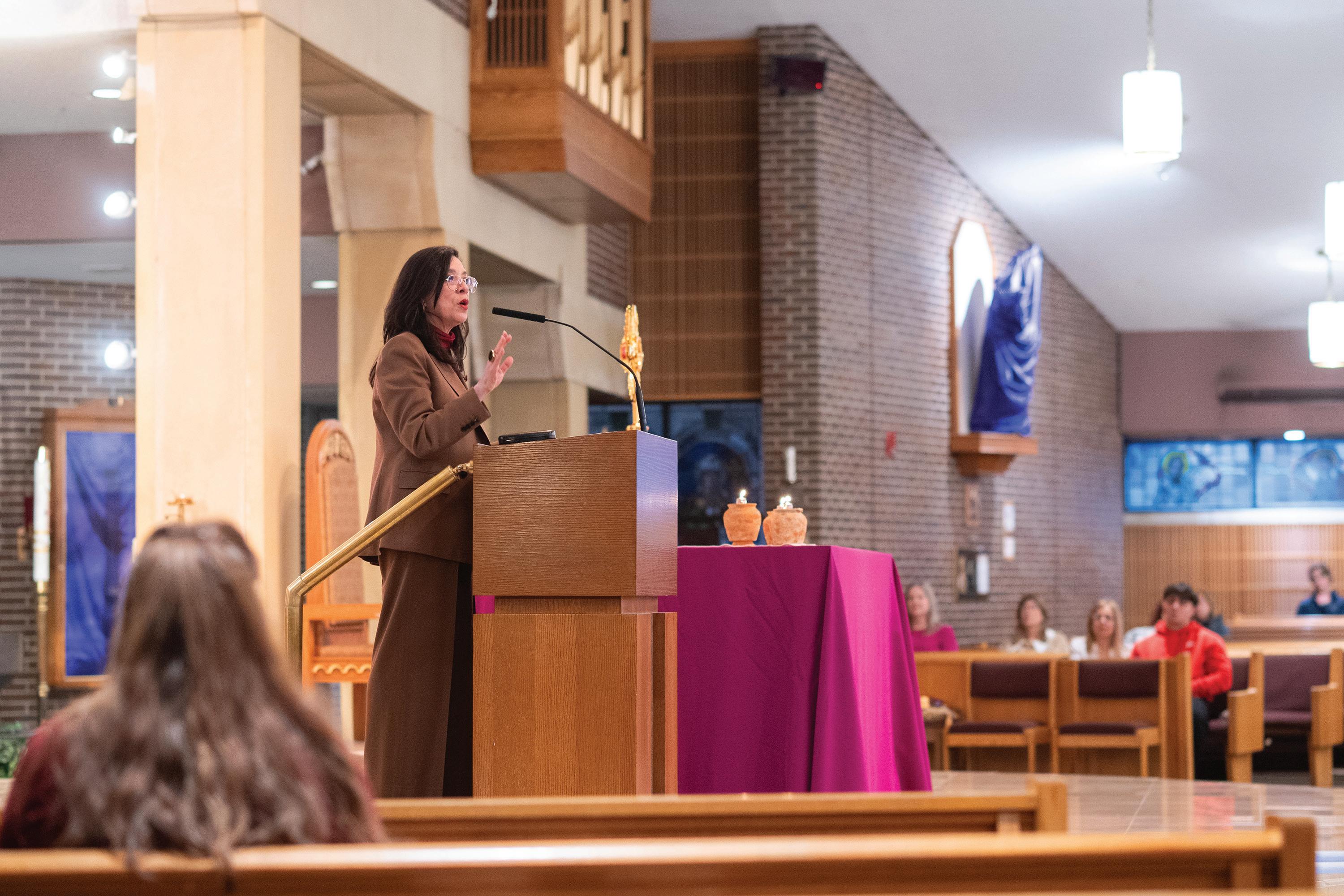
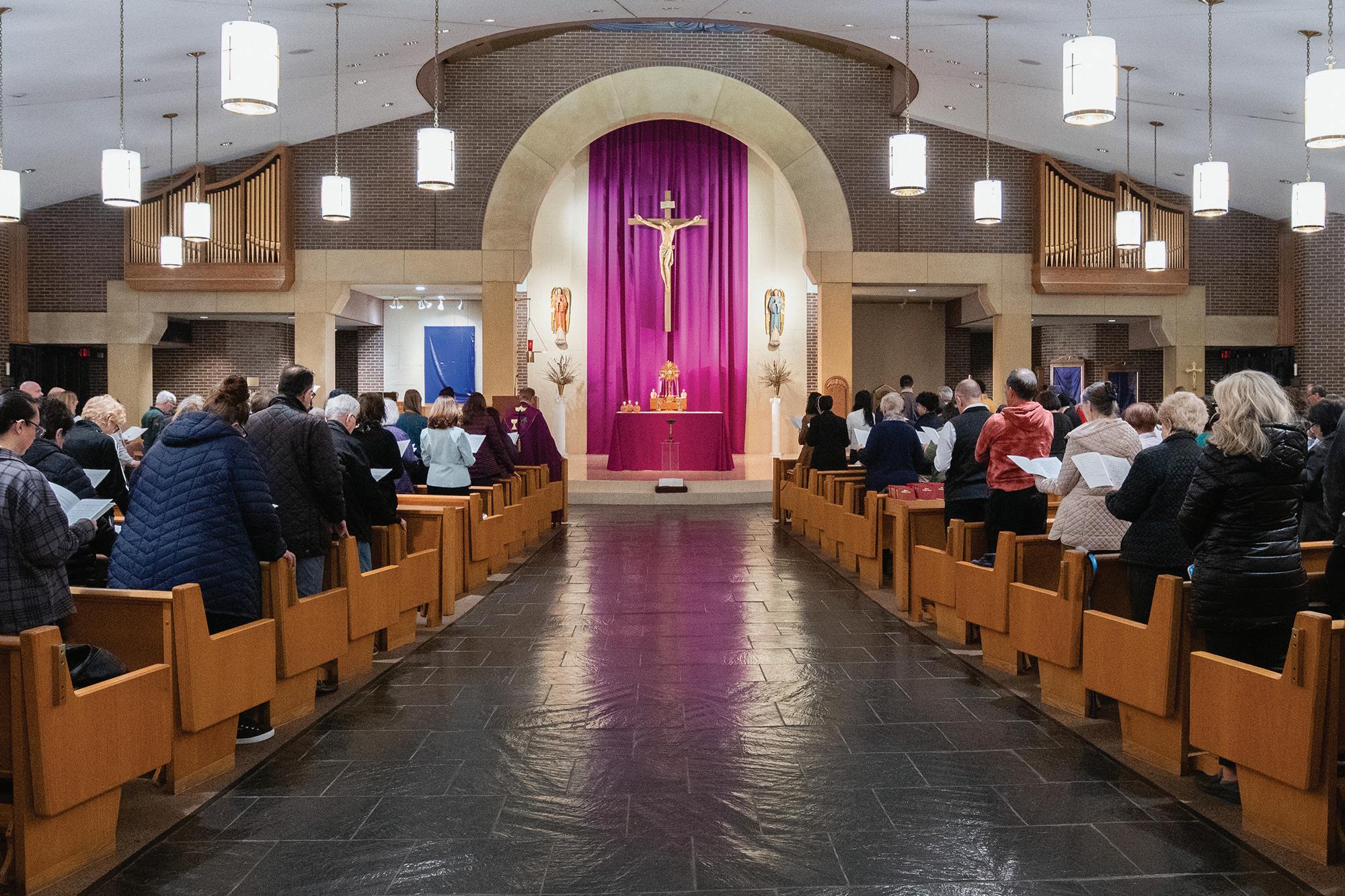
Kendall Park parish’s Lenten Eucharistic Adoration March 23. Judge Salas and her husband, Mark Anderl, are parents to Daniel, who was killed at his home in July, 2020.
Reading a passage from the Book of Matthew which described Jesus’ visit to the Garden of Gethsemane before his arrest and crucifixion, Judge Salas reminded the assembly, “Jesus knew the torture that awaited him; he was fully God and fully human. He walked with God, accepted his will, and was able to completely surrender to God’s plan.”
The judge admitted she, too, needed to learn humility, trust and acceptance. “I struggled to understand why this happened to us,” she said of her son’s murder in front of his parents. “I began the slow, personal awakening to what life was and not what I hoped it would be. The struggle for control was exhausting, and surrendering took a personal, seismic earthquake to get me to where I am today.”
Parish hosts Lenten reflection on faith and forgiveness
By Christina Leslie, Contributing Editor
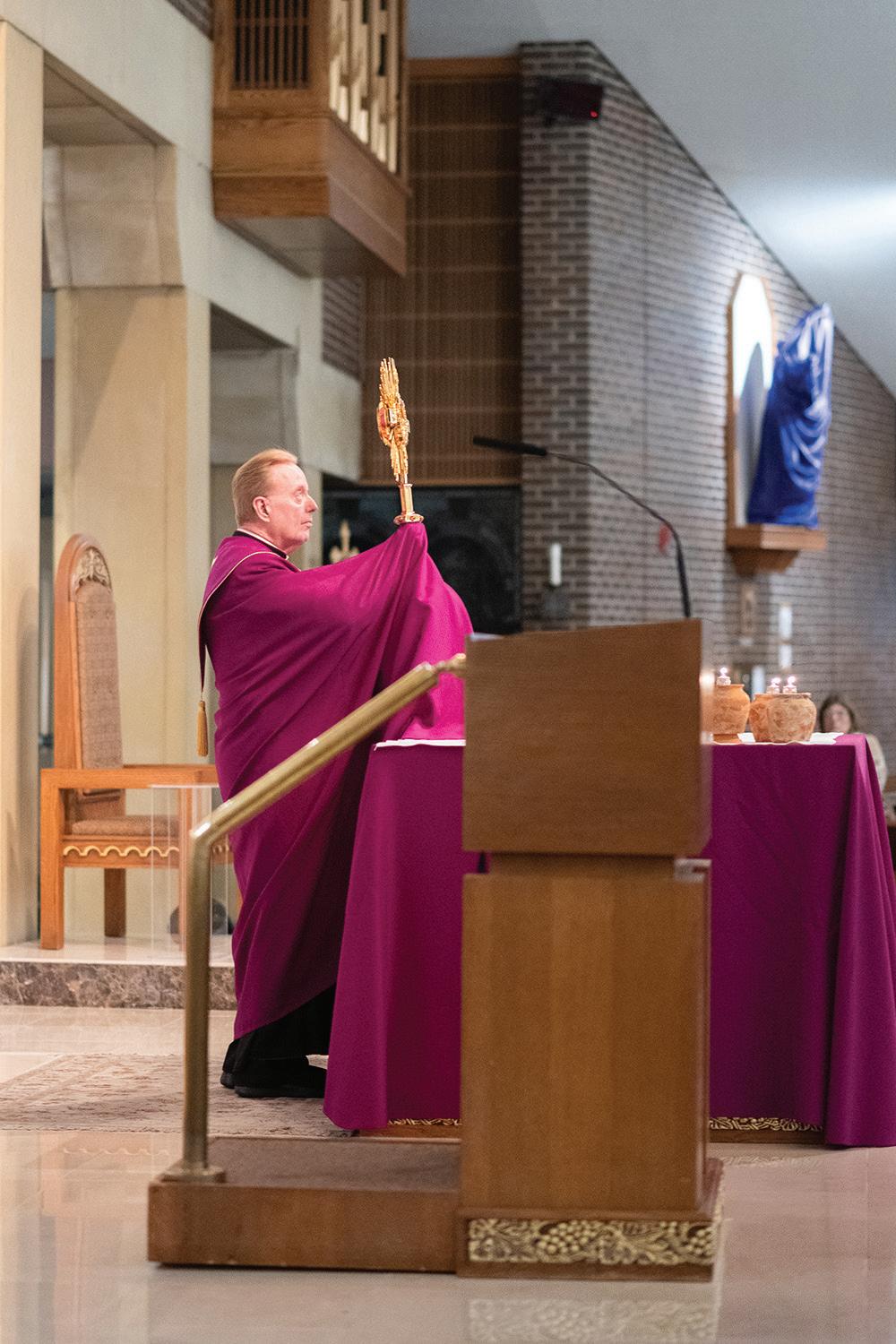
St. Augustine of Canterbury Parish learned the power of trust in Mother Mary as U.S. District Judge Esther Salas (top) addressed congregants March 23 at the Kendall Park church’s Lenten Eucharistic Adoration. Judge Salas “looked to Jesus and Mary for inspiration … [to] stay fully grounded in love,” as she grew to accept God’s plan unfolding in her life after the murder of her son, Daniel, in July, 2020. Middle left, St. Augustine pastor Father Robert G. Lynam lifts the monstrance as worshippers pray. Bottom, Judge Salas speaks with fellow parishioners after the service.
—Mark Lee photos
Prayer to God and Mother Mary led the way to her healing after her son’s murder, she recalled. “Today, it is much easier to surrender to God’s will,” the judge said. “I begin and end every day thankful for the blessings of the day. Starting and ending the day with God is critical, but it is the time in between that really matters.”
Once again, Judge Salas held up Mary’s strength in adversity as her guidepost. She continued, “Saying you are a faithful person is one thing, but practicing that faith in every aspect of your life is another and a lot harder to do. I think about Mary, who had to stand there and witness her own child being tortured and humiliated and beaten and hung from a cross.
“Mary trusted in God and surrendered to his will,” she asserted. “As we all weather the difficult times, we need to look for Jesus and Mary for inspiration. We need to stay fully grounded in love and trust, no matter what tornado might be swirling around us.”
The judge and mother of faith concluded her reflection with words from a poem she had been inspired to write three years ago in the middle of the night – words of trust, of suffering, of triumph over pain with the help of her Creator and Mother Mary.
“When all hope is lost, you are what I see in the distance,” she said. “It dawns on me that I am never alone. It is clear He has brought me to you. With his gentle guidance and loving support, there will always be an after. No matter what happens in our lives, always remember: one day the clouds will part, the winds will die down. We will emerge on the other side of our storm… broken yet stronger versions of ourselves.”
America is now, and has always been, a Protestant-majority nation. In the 18th and 19th centuries, Catholics were a distinct minority and often feared for many reasons. However, due to their numbers – some 1% of the population – Catholics were never perceived as a significant threat until mass immigration began in the 1840s.
Each of the 13 colonies had its own laws regulating religion, and these laws were generally not favorable to Catholics. Anti-Catholicism will be the subject of an upcoming article.
In 1785, Father (later Bishop) John Carroll – his cousin Charles Carroll of Carrollton, Maryland, was the only Roman Catholic to sign the Declaration of Independence – estimated that out of a population of 2.5 million, some 25,000 Catholics lived in the 13 colonies. Almost 16,000 of these lived in Maryland, and 7,000 lived in Pennsylvania. It’s estimated that 600 Catholics resided in all of New England. The rest were found in scattered communities throughout the remainder of the colonies. All were served by 25 priests.
Father Carroll worried about the scarcity of clergy. He noted that “the Catholics in the Jersies, N.Y, [and] the great Western country … are entirely destitute of spiritual succours. The Catholics in some of these settlements have been at the expense of paying some Irish Franciscans and providing for their subsistence. These men have brought good testimonials; but I am precluded from giving them any spiritual powers.”
At this time Father Carroll’s title was Superior of the Mission in the 13 United States of North America, since this country was still considered missionary territory. In 1790, Father Carroll became Bishop Carroll of the Diocese of Baltimore, the first diocese in America, which then included the entire United States.
Unless a Catholic lived in one of the enclaves like Maryland, New York City, or Philadelphia where a priest was in full-time residence, interaction with a priest happened at most twice a year.
The first known missionary priest in the State of New Jersey was Jesuit Father Theodore Schneider, who ministered to the people of New Jersey and eastern Pennsylvania from 1744 until his death in 1764. Father Schneider studied medicine in Europe and often traveled under the guise of a physician, offering the Catholics of New Jersey both spiritual and medical relief. He traveled throughout Salem County and, in July 1774, his ministry took him as far as Bound Brook.
Jesuit Father Ferdinand Steinmeyer – popularly known as “Father Farmer,” the Anglicized name he took upon coming to America – was the most well-known of the priests who succeeded Father Schneider. Dressed in lay attire for his own safety, he ministered to the Catholics in New Jersey from 1758 un-
Catholicism in Colonial America
First in a series of articles related to Catholicism and the celebration of 250 years of independence in America
By Carl Ganz, Special Contributor
til his death in 1786. No portrait exists of Father Farmer, nor do we even know the exact location of his burial plot at St. Joseph’s in Philadelphia. He is described as “tall and upright, of ruddy pleasing countenance, graceful in manners and fluent in conversation; full of bonhomie and anecdotes.”
Father Farmer traveled on horseback from Philadelphia to New York, ministering to Catholics along the way.
Still, he managed to establish the first permanent Catholic congregation in the city. Bishop Carroll gave Father Farmer the faculties to perform confirmations, which a priest may validly do when authorized by a bishop.
Father Farmer made semi-annual visits to New Jersey for over a quarter century, with the exception of September 1777 through June 1778, during the British occupation of Philadelphia. A British colonel even offered him the chaplaincy of a Catholic regiment he planned to raise. Father Farmer did not accept, but his true sympathies to the rebel cause were indicated when he presided at a Thanksgiving service in November 1781 to celebrate the American victory at Yorktown, which effectively ended the Revolutionary War.
In October 1787, Father Farmer was succeeded by 34-year-old Father Lawrence Graessel, who continued the
home, he puts the Blessed Sacrament in some decent place, and also the Holy Oils. … On the following morning he rides to the church. ... The whole morning is spent in hearing confessions: meanwhile, the people from distances of four, six, ten miles, and even more, are coming in on horseback, so that often the church is entirely surrounded with horses. Mass begins towards noon. … The sermon comes after the Gospel, and it is preceded by the Gospel read in the vernacular. The preacher either reads or delivers his sermon … and sometimes it is deferred until after Mass, to enable the priest to take some refreshment, which the faithful never fail to supply. … When Mass is over, the children recite the catechism, infants are baptized … prayers for the dead are recited or the funeral services are performed over those who have been buried in the churchyard during the absence of the priest.”
Due to the scarcity of clergy, spiritual practices were necessarily a do-ityourself exercise. The bishop of Boston, writing in 1823, told a group of Catholics in Connecticut that when priests were not available, they should “procure a room and meet every Sunday to perform together your devotions. Let one who reads well and has a clear voice, read the prayers of the Mass, a sermon, or some instruction out of Catholic book.”
ministry to New Jersey. Father Graessel’s ministry was cut short with his death in the Philadelphia yellow fever epidemic of 1793. News traveled much slower in those days, so Pope Pius VI was completely unaware of Father Graessel’s death when he named him the coadjutor bishop of Baltimore to assist Bishop Carroll.
The Philadelphia-based missionary priests would typically ride a circuit along the Delaware River to Trenton and Salem, up to Basking Ridge, and from there to the Paterson area and on to New York City. When the priest received word of a Catholic family he never met before, he would deviate from this route, track them down, and introduce himself.
The priests often celebrated Mass in rented halls or private homes, staying there overnight before moving on to other isolated Catholic communities. The rare Sunday Mass was an all-day affair, as Mass times depended on when the priest happened to arrive. Often, he would be delayed hours while hearing the confessions of the faithful who frequently traveled many miles from the surrounding towns.
Writing in 1818, Jesuit Father John Grassi described a typical visit:
“The missionary … goes to take up his lodging with some Catholic living near the church. Having arrived at the
Colonial Catholics, most of whom favored the patriot cause, served with distinction in the continental military. Most of the French soldiers and sailors were Catholic. Some notables included Gen. Stephen Moylan, the first muster master-general of the Continental Army; Capt. John Barry, a naval commander whom some dubbed the Father of the American Navy, an informal title shared with John Paul Jones; John Fitzgerald, who served as George Washington’s secretary and aide-de-camp; as well as foreign officers like Casimir Pulaski, Tadeusz Kościuszko, and the Marquis de Lafayette.
Washington addressed American Catholics after the war when he wrote, “I presume that your fellow-citizens will not forget the patriotic part which you took in the accomplishment of their Revolution, and the establishment of their government; or the important assistance which they received from a nation in which the Roman Catholic faith is professed.”
This was life for Catholics in the 13 colonies. The Church in America started small, expanding from 1% of the population to 20%, growing into what is today the single largest religious denomination in the United States.
Carl Ganz Jr. is a member of the New Jersey Catholic Historical Commission and the Diocese of Metuchen Historical Commission. A parishioner of Immaculate Conception Parish in Somerville, he is the author of several books on American Catholic history.
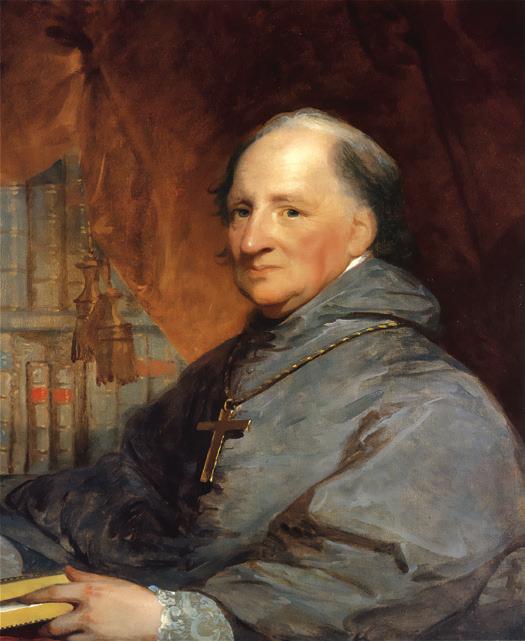
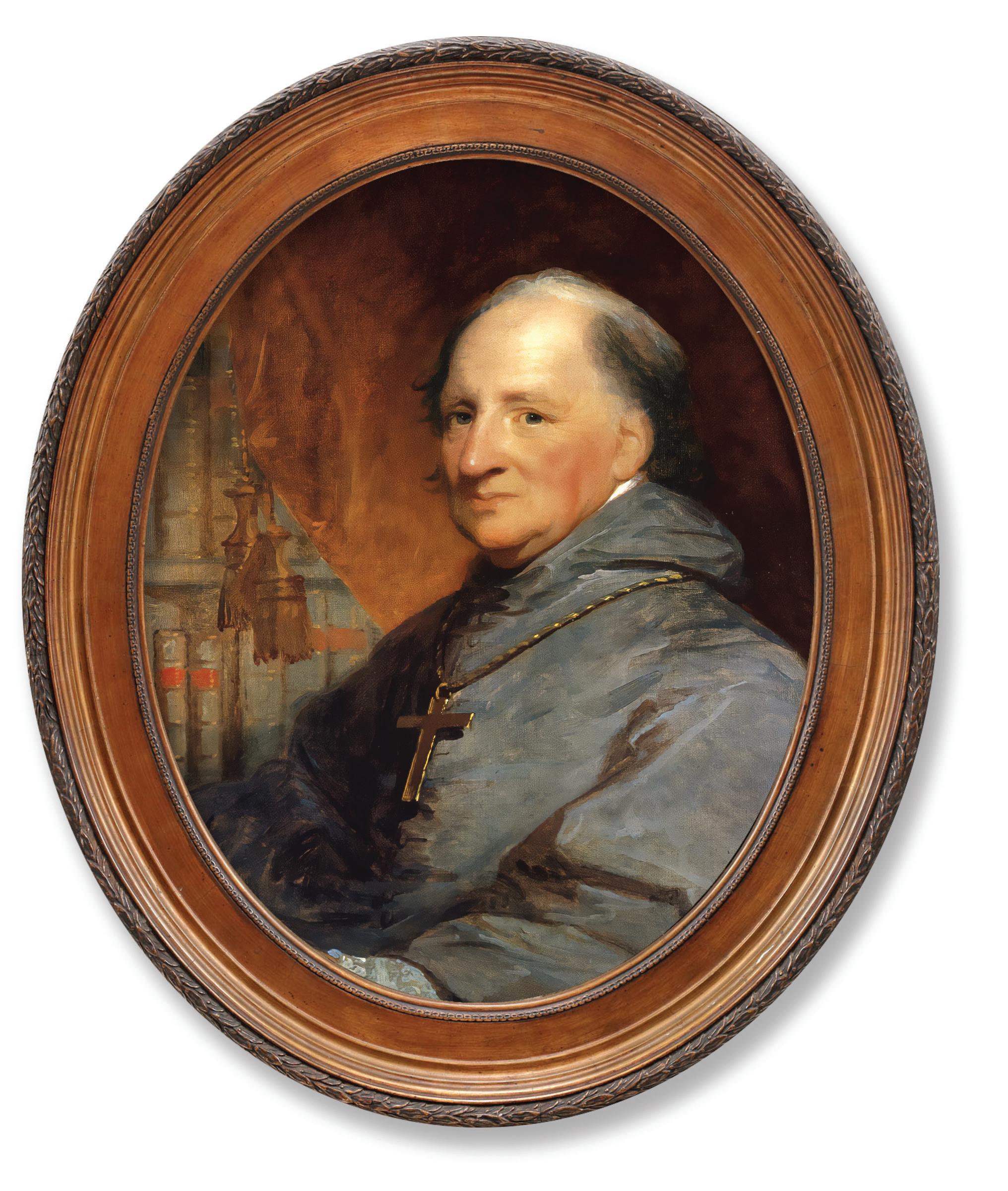
Portrait of Bishop John Carroll (1735-1815), circa 1806, by Gilbert Stuart. —wikimedia.org
Faith, Food, and Family The spirituality and cuisine of Morocco
By Dr. Carol Funk, Special Contributor
INGREDIENTS
Marinade:
• 6 medium chicken thighs. Keep bone in for flavor and trim off excess fat
• Salt and pepper as to your taste
• One half teaspoon of fresh ginger, minced. One medium knob peeled will be sufficient
• One teaspoon of minced garlic, use fresh garlic only
• One teaspoon of ground cumin
• One teaspoon of smoked paprika
Chicken tagine:
• Two tablespoons of olive oil
• One medium onion, chopped coarse
• Three teaspoons of garlic
• One teaspoon of fresh ginger grated
• One teaspoon of ground coriander
• One half tablespoon of smoked paprika
• One teaspoon of ground cumin
• Two small bay leaves
• One half tablespoon of cayenne pepper
• One fourteen ounce can of chickpeas, drained and rinsed twice in cold water
• One half cup of dried apricots
• One cup of chicken stock
• One large, preserved lemon or zest and juice from one lemon
Garnish:
• One tablespoon of fresh, chopped Italian parsley
• One thinly sliced wedge of lemon
METHOD
• Place thighs in a bowl and season with seasoning ingredients specified for the marinade. Mix well with hands until all the chicken is nicely coated. Set aside in the refrigerator until ready to use.
Preparing the tagine:
This process is for making this dish without a tagine. If a tagine is available, make sure it is well seasoned with oil ahead of time or the tagine will crack on top of the stove or oven. Prepare also with a metal diffuser that is available on Amazon to place under the tagine so it does not crack from direct heat. Prepare the dish as described below:
• Brown chicken in a frying pan in 2 tablespoons of olive oil, brown on both sides
The Maghreb is an area of north Africa that stretches from the western Mediterranean coastlands to the Persian Gulf to the east. Miles of peaks rivaling the Alps called the Atlas with a northern plateau called the Rif defines the border of a vast desert, intense in harshness and tenacious in a type of holiness few have come to understand.
The geography shaped the people who live here. They are hardy, resilient, creative, protective, long-suffering and deeply spiritual. Centuries of wars, colonization, and acculturation have not diminished the bonds that hold these people together by allegiance to tribal communities.
The French, Spanish, English, Ottoman, and Arabs all have played a role influencing commerce and especially cuisine. Out of the barren desert, nomadic tribes cleverly invented irrigation systems, flourishing oases, villages, and cities from practically nothing. Their art and language acknowledge the presence of God in everything; offering hospitality to strangers is a holy responsibility. A deep spirituality thrives there from the human need to survive.
Western culture as far back as the Romans called these people Berbers, a slur term elided from the Latin word Barbarossa, “barbarian.” With their flowing robes (daraas), and protective head scarves (tagelmust) sparing desert travelers from the sun and the sand, these nomadic people were strange to European culture. In recent times, these people have come to be known by their actual name, Amazigh, meaning “people of freedom.” They have taken back their
Continues on page 48
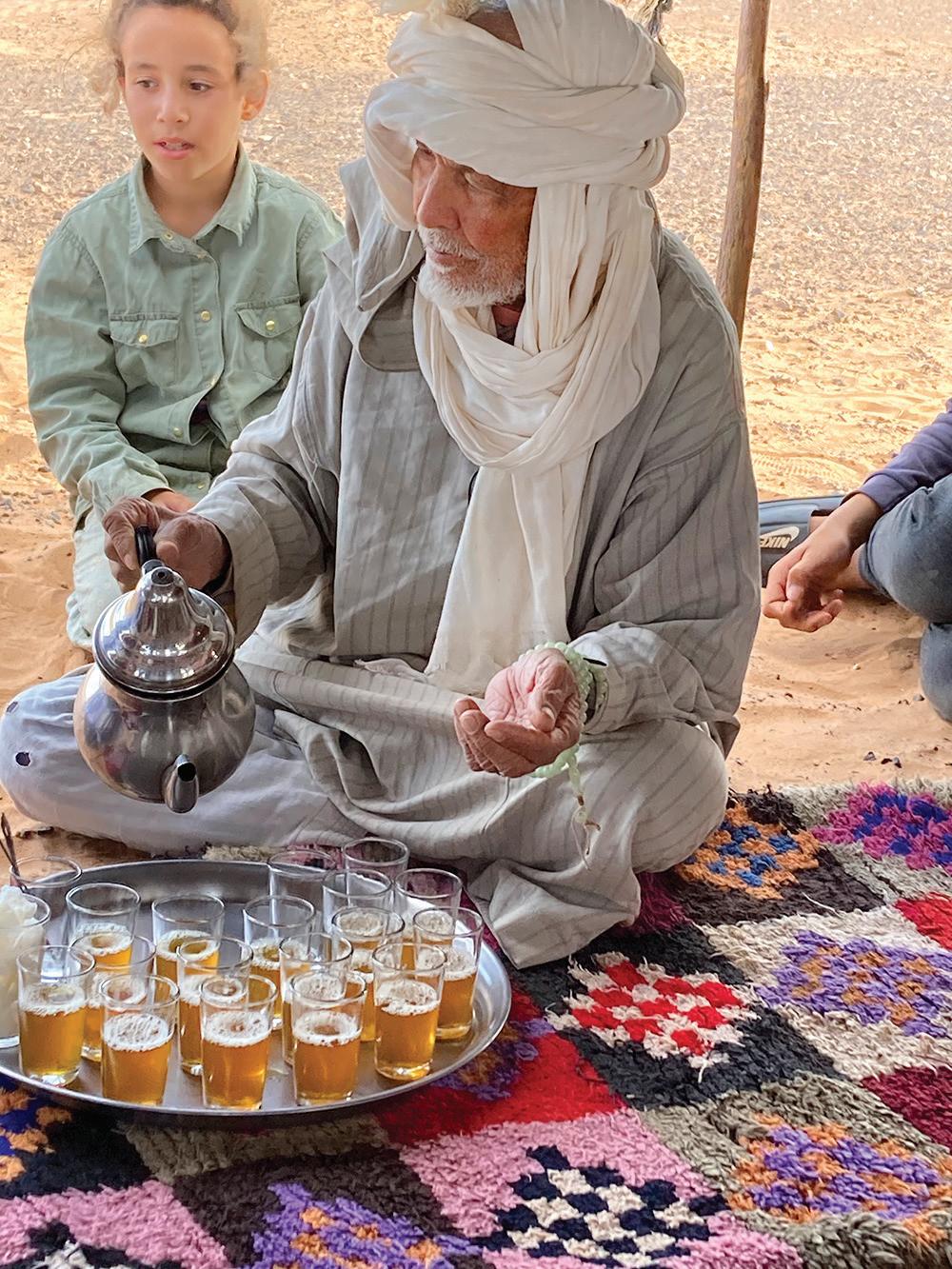
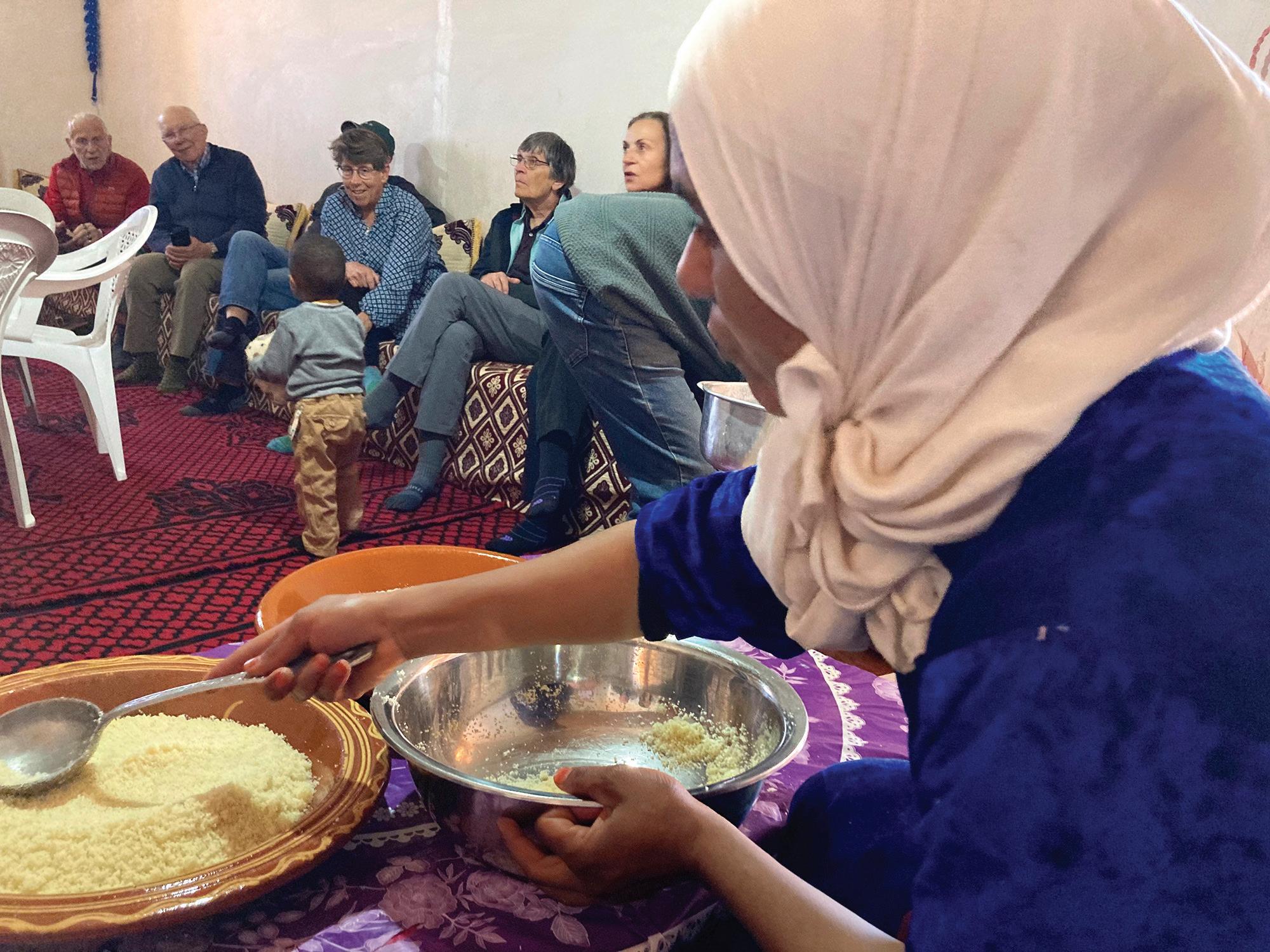
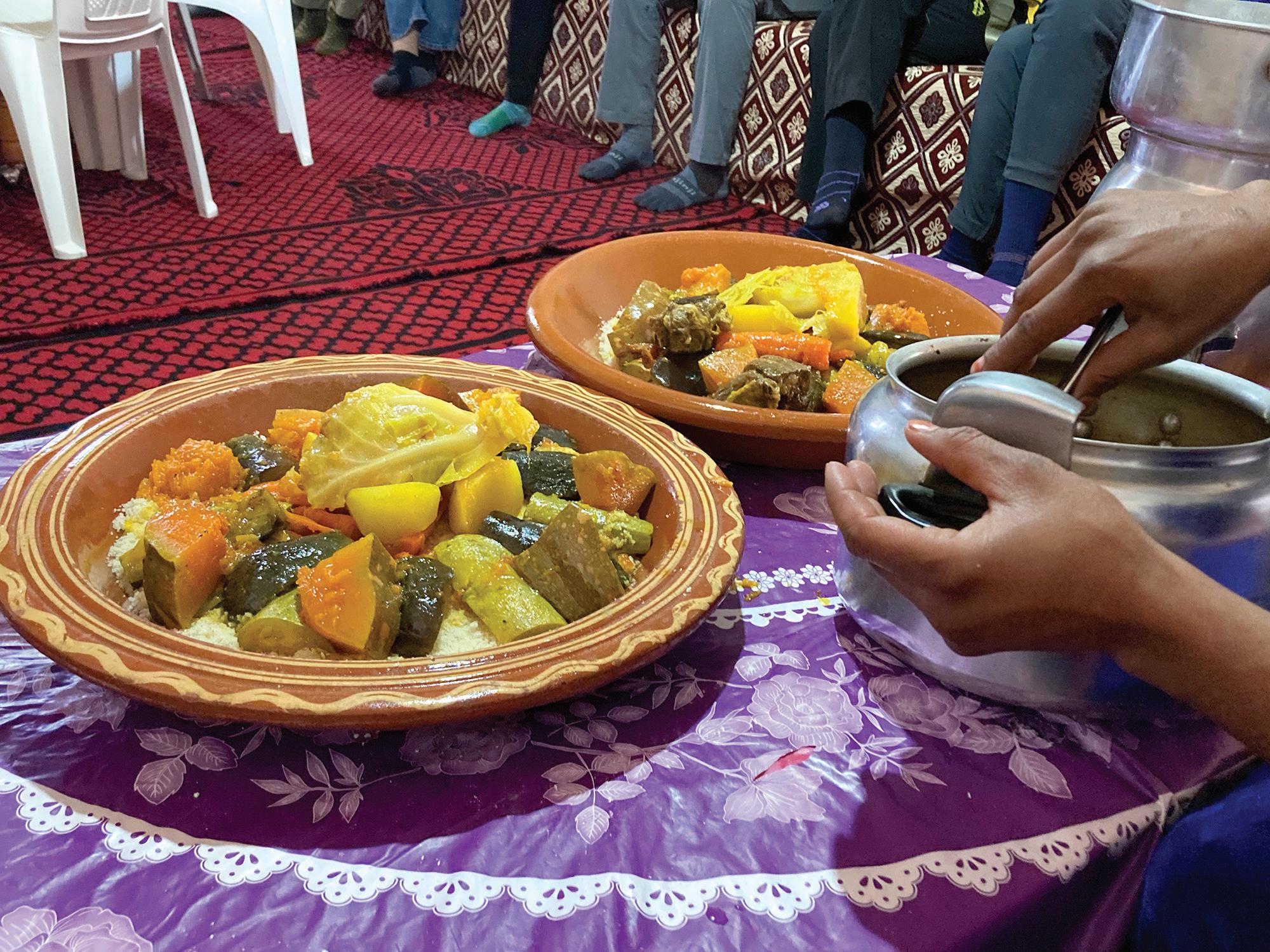
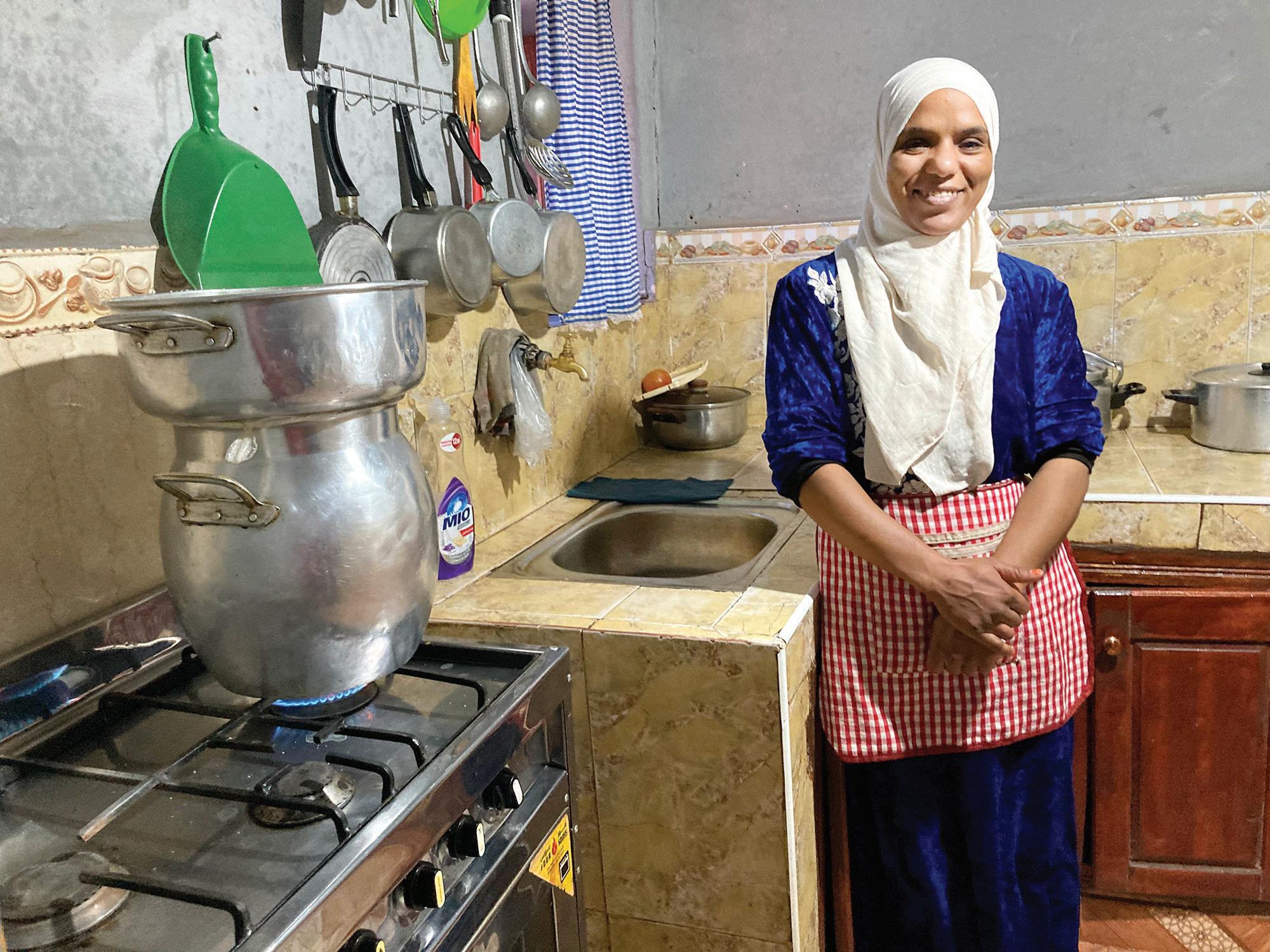
Sunrise over the Sahara desert, at top, finds travelers making their way across the sands. Middle left, Omar, the patriarch of a nomadic family, serves as host for tea in his tent in the Sahara, while a woman, middle right, makes couscous with a sieve. Above, a vegetable tagine is laid out for guests. —Courtesy photos
for 3-5 minutes until it is golden. Remove and set aside. Drain off excess oil and sauté onions, garlic, ginger, coriander, smoked paprika, cumin, bay leaves, cayenne pepper, and salt. Cook over medium heat and let the flavors marry. Onions should “sweat” and become wilted. Next, add chickpeas and apricots. Pour chicken stock over the vegetables and season lightly with salt and pepper. Last, add the chicken to the pan with the juice from the chicken and sliced lemons.
• Serve with couscous. Look at package directions. Most supermarkets sell couscous. Garnish with parsley and lemon wedges.
This recipe is for “top of the stove” preparation. You can use a Dutch oven and prepare the tagine as described in the steps above and bake at 350 degrees F. for 30 minutes. Be sure to use extra stock in the pan before baking so the tagine does not get dried out.
Recipe for Chicken Tagine
Religion and Ecology, and an advisor to the Ecological Leadership and Ministry certificate program at Yale Divinity School.
The narthex of our church in Bound Brook, even though it doesn’t have windows, serves as an informal “weather station” of sorts for me. Invariably, and somewhat inexplicably, numerous incoming worshippers have a habit of making comments to me about the weather every time they arrive for liturgy.
Had I somehow never looked or stepped outside this past winter, that collective anecdotal parishioner witness told me that we had a rather rough season in central New Jersey. Of course, my own eyes and personal experience confirmed this.
And so did the numbers. The winter of 2025-26 in New Jersey was marked by stretches of cold temperatures, several major snowstorms and extended snow cover. According to the office of the state climatologist, the average winter temperature in New Jersey was 29.7 degrees Fahrenheit, which was the coldest in 11 years and the 36th coldest winter over the last 130 years. Some areas had cold snaps in late January and early February that were the coldest in decades. The average winter snowfall registered 37.8 inches statewide, which ranks as the 12th snowiest winter amount in recorded state history.
Now, to no surprise, folks seem especially renewed and rejuvenated by the early weeks of springtime 2026, marked as it has been already by some beautifully sunny and warm days.
One of the fruits of a contemplative perspective is that it can extend well beyond our prayer cushions or places in a church pew. No matter what the season or the particular conditions, we can all contemplatively encounter not just the weather, but all of God’s creation.
For several years, I’ve been in a monthly spiritual discussion group, and one fellow participant is Samuel King. Sam is a researcher with the Yale Forum on
So, in light of this column, I couldn’t think of anyone better than Sam to ask how our ecology can be described as contemplative. “Ecology is contemplative insofar as it lifts us out of human exceptionalism, our species loneliness, into the innate beauty and goodness of creation in which every being is a unique revelation of the Divine,” he told me. “This is to experience the world as what the late Passionate Father Thomas Berry called ‘a communion of subjects, not a collection of objects.’ The world comes alive with a childlike wonder, ablaze with a cosmic mystery that all is connected, and all is communicative, if we have the ears to listen.”
There are several things the everyday Catholic can do to experience our environment contemplatively. Sam recommends the practice of Lectio Terra, which is the outdoors equivalent of Lectio Divina. “Lectio Terra is a transformative practice of listening to the land as sacred text, modeled on the ancient practice of Lectio Divina,” he said. “When we let ourselves wander and open our hearts to the natural world, we step into a mystery that is animate, alive, and constantly speaking to us, offering a bridge into the deeper mysteries of Divine life.”
As with Lectio Divina, Lectio Terra can be practiced individually or communally. For example, at our parish in Bound Brook, when we do Lectio Terra, parishioners wander attentively on an area of land to experience nature for about 20-30 minutes, and then return to meet together and share what resonated with each of them.
Sam also recommends being mindful when we eat, aware of what we eat, “embracing plant-based meals and ensuring that our nourishment arrives to plates with justice and dignity.” He also suggests pausing in prayer before meals. “To eat is a eucharistic act,” he said, “that brings us into deep relationship with creation.”
This contemplative approach to creation can prompt us to action, to bear
witness to the signs of the time evidenced in creation. “A throwaway culture has resulted in the widespread pollution of air, water and soil, most often burdening vulnerable communities,” Sam said. “To contemplate the crucified Christ in our time is to contemplate this garden Earth laid waste by greed and industrial ruin. It is an invitation to undergo what Pope Francis called an ‘ecological conversion,’ to turn around and participate, creatively, in the resurrection of creaturely life on the one planetary home we share.”
As Psalm 19 begins, “The heavens
Immaculate Conception Church and grounds in Annandale.
—Peter Nguyen photo
declare the glory of God; the firmament proclaims the works of his hands.” The spring season, infused as it is with Easter joy and hope inside our churches, is also ripe for spiritual fruits and inspiration in the great and God-given outdoors.
Msgr. Kerrigan is pastor of St. Joseph Church, Bound Brook, and an instructor in the Institute of Contemplative Leadership at Mepkin Abbey, SC.
Immaculate Conception School pays tribute to law enforcement at annual Blue Mass
The entire student body of Immaculate Conception School stood with hands on hearts as a procession of dozens of members of the law enforcement community joined them April 17 for the school’s annual Blue Mass at Church of the Immaculate Conception, Somerville. Many of the federal, county and local law enforcement community members present were parents and family members of the school’s students.
In his homily, Monsignor Joseph Celano, pastor and director of schools at Immaculate Conception Parish, spoke of the “tightrope” we walk between faith and fear, and how, like the Disciples, our limits of trust are tested daily. “You know what it means to face a situation that is beyond you,” he said to the law enforcement officers. “You know the cost of your professions, the sacrifices you and your family make so that you can serve and protect, and you bear the scars not visible to many.”
He continued, “But let me suggest that faithfulness matters, and God is always at work. What sometimes seems insufficient can become abundant in the hands of God. We all feel sometimes that what we bring is not enough, but God
never asks any of us to be everything to everyone, but to place it in His hands.”
The school’s Blue Mass tradition was begun in 2015 by school music teacher Ceil Cullen and her son-in-law, Detective Matthew Tarentino of the Summit Police Department, who ended his watch in the line of duty on May 30, 2017. Both felt the need to model respect for the law enforcement community. Mrs. Cullen continued the tradition after Detective Tarentino died. Her grandsons, Raymond and Robert Tarentino-Proctor, her granddaughter, Annie Tarentino-Proctor, and her daughter, Dean of Students Vickie Proctor, all participated in the Mass.
In his closing prayer, Monsignor Celano asked God’s blessing on “these your servants, who so generously devote themselves to helping others. Grant them courage when they are afraid, wisdom when they must make quick decisions, strength when they are weary, and compassion in all their work.”
Submitted by Stacey Mezzacca Geary, IHS ‘91, Immaculate Conception Parish marketing and communications assistant.
—Courtesy photos
SHRINE EVENTS 2026
WEDNESDAY, MAY 13
First Apparition of Our Lady of Fatima Speaker: David M. Carollo
Celebrant: Most Rev. Kevin J. Sweeney
FRIDAY, MAY 22 - May Crowning Celebrant: Rev. Luke Mary Fletcher, CFR
SUNDAY, MAY 24 - Pentecost
Celebrant: Rev. Luke Mary Fletcher, CFR
MONDAY, MAY 25 - Annual Portuguese Day Pilgrimage
SATURDAY, MAY 30
Hispanic Ministry Pilgrimage - Diocese of Metuchen
FIRST FRIDAY, JUNE 5 & FIRST SATURDAY, JUNE 6
Celebrant: Rev. John Anthony Boughton, CFR
SUNDAY, JUNE 7
Corpus Christi Mass and Procession
Blue Army Young Adult Event
SATURDAY, JUNE 13
Second Apparition of Our Lady of Fatima Celebrant & Speaker: Rev. Msgr. Roger J. Landry
SATURDAY, JUNE 20
Tamil Catholic Association
FIRST FRIDAY, JULY 3 & FIRST SATURDAY, JULY 4
Celebrant: Rev. Luke Mary Fletcher, CFR
MONDAY, JULY 13
Third Apparition of Our Lady of Fatima Speaker: Very Rev. Joshua S. Caswell, SJC Celebrant: His Eminence Raymond Leo Cardinal Burke
FRIDAY, JULY 17 - SUNDAY, JULY 19
Eucharistic Reparation Weekend
SATURDAY, JULY 25
National Center of the Haitian Apostolate
FIRST SATURDAY, AUGUST 1 & FIRST FRIDAY, AUGUST 7
Celebrant: Rev. Luke Mary Fletcher, CFR
THURSDAY, AUGUST 13
Fourth Apparition of Our Lady of Fatima Speaker: Br. Pius Marie Gagne, CFR Celebrant: Very Rev. Jonathan S. Toborowsky
SUNDAY, AUGUST 16
Spanish Cursillo Movement from New York
SATURDAY, AUGUST 29
47th Annual Padre Pio Festival
Speaker: Br. Pius Marie Gagne, CFR
Celebrant: Most Rev. Nicholas A. DiMarzio
FIRST FRIDAY, SEPTEMBER 4
Celebrant: Rev. Luke Mary Fletcher, CFR
FIRST SATURDAY, SEPTEMBER 5
Marian Festival for Mary’s Birthday
SUNDAY, SEPTEMBER 13
Fifth Apparition of Our Lady of Fatima Speaker: Special Guest Speaker Celebrant: Most Rev. Frank J. Caggiano
SUNDAY, SEPTEMBER 27
Tenth Annual Appreciation Mass for First Responders
FIRST FRIDAY, OCTOBER 2 & FIRST SATURDAY, OCTOBER 3
Celebrant: Rev. Luke Mary Fletcher, CFR
SUNDAY, OCTOBER 4
Barangay of the Virgin
TUESDAY, OCTOBER 13
Sixth Apparition of Our Lady of Fatima
Speaker: Rev. Mr. James V. Coffey
Celebrant: His Eminence Timothy Michael Cardinal Dolan
Connect with us on online to confirm our schedule of events. Daily Mass & Events are livestreamed on our social media.
National Blue Army Shrine of Our Lady of Fatima WORLD APOSTOLATE OF FATIMA USA
Anniversary of the Apparitions of Our Lady of Fatima
“One day these seeds, with the infusion of grace, will bud and bear fruit.”
—Wolfgang
As part of my formation class, our novices and I recently watched Xavier Beauvois’ superb film, “Of Gods and Men.” It tells the life of the Trappist monks of Tibhirine, Algeria, who were taken hostage in 1996 and subsequently killed. They were beatified on Dec. 8, 2018, together with 12 other priests and men and women religious who were killed during the Algerian Civil War.
I had a devotion to the Tibhirine Trappists long before I first saw the film. I share their belief in what has been called “the prophecy of presence,” the witness of a life given to Jesus Christ quietly lived out in the setting of ordinary situations. I remember various incidents in the life of the monks that are similar to events in our community life. One incident, not shown in the film, is the request of the elderly Brother Luc, the gruff and tender-hearted doctor who ministered to the bodies, the souls and even the hearts of the people south of Algiers.
At his 80th birthday celebration, Brother Luc gave directions on what he wanted his confreres to do when he was dying. “In the case of a violent death, there was ‘nothing to be done.’ In the
It’s never too late for the seeds of faith to bloom
We are told in the Scriptures that Paul, by the zeal of his preaching, led 3,000 to be baptized that day. But, make no bones about it, there were those who said: “No, thanks!” Paul’s evangelical enthusiasm, however, has struck on a point that has stymied the Church for centuries. “How do we make someone believe what we believe, or, better, how do we get others to be Church?”
The truth is, preaching is only efficacious if the seeds of faith are open to conversion – which, by the way, is something which only God can affect. Preaching may dispose one to be “open” but only God can animate these dormant seeds of faith which, universally, all receive at the moment of conception, a unique chemistry to our species, often described as the common vocation to justification.
But then, there are those anomalies, right in our own families. Many of us have adult children or siblings or a spouse who do not go to church, who do not wish to wed in the Church. Some of our adult children no longer have interest in baptizing their babies. They do not believe in original sin, and do not see Baptism as the sacrament of salvation. And this pains us because we can’t force them to attend Mass, nor can we under-
stand why they show no interest in being Church.
Here are some plausible reasons. Maybe they cannot reconcile a supposedly omnipotent God with the tragedies which occur in our imperfect world. It’s possible that they have been “turned off” by bad preaching, by scandals in the Church or what they perceive as a dichotomy between how we behave here and how we act in the parking lot. There are those who distance themselves from Church because they disagree with the official teaching of the Magisterium on one or numerous issues.
Still, there is one other hypothesis for this ecclesiastical malaise – this “spleen” toward organized religion. It’s possible that the seeds of faith received in conception have not yet germinated.
Mysteriously, in some people, the seeds of faith don’t automatically shoot roots in Baptism. In the case of non-Christians, these seeds may remain dormant until they connaturally say “yes” to Jesus’ appeal to salvation, sensed as the movement of desire or the call of Love with a capital “L.”
For cradle Catholics, this awakening can happen at any time, from gestation to Baptism, from First Communion to Confirmation, from a firehouse rally to their
Living life without regrets
Michael Lonsdale, right, played Brother Luc, and Jacques Herlin, left, played Brother Amédée in “Of Gods and Men (2011) —Sony Pictures Classic
case of a slow one, he wanted his friends to gather around his bed and read the parable of the prodigal son, say the Lord’s prayer, and open a bottle of champagne.”
Luc’s faith was simple, but he was far from simple-minded. He read widely and had too much experience of the suffering of war to be naïve about its horrors.
Shortly before the abduction of the monks, he wrote to an old friend, “The violence here has not abated, although the government censors would like to cover it up. How can we get out of this mess?”
Yet human horrors could not corrupt divine grace, for he goes on: “Violence will not cure violence. We can only exist as humans by becoming symbols of love, as manifested in Christ, who, though him-
first retreat experience such as Antioch or Cursillo, to a quiet retreat in a monastery. Sometimes, the seeds are aroused as their owners experience what they perceive to be unconditional love – be this in romance, marriage or parenthood.
Sometimes, after hitting bottom, tackling Step Three of the Twelve-Step spirituality in the recovery process directs a soul to recognize the existence of a Higher Being, and this Being may be identified as “Jesus” who, in turn, inspires the seeker to become Church.
Easter is a time of hope. It’s a time to ratify our belief in miracles, yes, even the conversion of the religiously disinterested adult child, sibling or spouse! It’s an annual reminder that if Jesus can rise from the dead – conquer sin, free the captives from Shaol, he can do anything. So, for those who have loved ones who prefer not to be Church – don’t give up. One day these seeds, with the infusion of grace, will bud and bear fruit. And when this happens, the Communion of Saints, who have been praying for those non-practicing Catholics in our families, will rejoice! And for that matter, so will we! Happy Easter!
Father Comandini serves as diocesan coordinator of the Office for Ongoing Faith Formation.
self just, submitted himself to injustice.”
(All quotes are from John W. Kiser’s book, “The Monks of Tibhirine.”)
The Trappists lived surrounded by war. Death was all around them and would soon swallow them up. Yet for Luc, death was “to bathe in the infinite tenderness of God.” Besides giving directions about his dying, Luc also said that, at his burial, he wanted his friends to play the well-known song “Non, Je ne Regrette Rien” by the famous French singer, Edith Piaf.
“No, nothing at all, No, I regret nothing. Neither the good that was done to me, Nor the evil, I couldn’t care less… It’s paid for, swept away, forgotten, I don’t care about the past!.. No, nothing at
all, No, I don’t regret anything! Because my life, because my joys, Today it all starts with you!”
Edith Piaf was a well-known cabaret singer of the 1950s and 60s, and her song was not meant to be sung in church. Yet Brother Luc understood that the desire for love and the longing of lovers are both part of our longing for perfect love. Luc had found the perfect Lover, Jesus, and in him, all other loves find their rightful place. In the movie, there is an unforgettable scene when Brother Luc goes to a picture of Jesus and lays his cheek against the heart of his Beloved and rests there in peace.
For Luc, the greatest sin for a Christian was not to believe in the Resurrection. We have recently celebrated the Resurrection, that instant when “things of heaven are wed to those of earth,” as we sing in the Exultet. The power of Jesus’ Resurrection “dispels wickedness, washes faults away, restores innocence to the fallen, and joy to mourners.” With Brother Luc, we too can sing that the past is “paid for, swept away, forgotten!” With him, we can begin each moment in total newness of life with Jesus who turns all our sins into “happy faults” if only we let him do so.
Sister Gabriela of the Incarnation is a member of the Discalced Carmelites order in Flemington. Learn more at www. flemingtoncarmel.org.
Hasselmann photo/Unsplash
What do you bring to the table?
I remember the first time I really allowed myself to enter into the Mass of the Lord’s Supper on Holy Thursday. With my eyes closed, I envisioned the Lord sitting at a rough-hewn table surrounded by his apostles. The table was set. Bread was broken. What I saw seated at the table, embodied in some very different men, was love, ambition, insecurity, loyalty, betrayal, doubt, and passion.
The image could have been any of our tables – a kitchen table, a conference or board room table, a study table, or a negotiation table. The most important question is not whether we have been given a seat, but what is it we actually bring to the table?
It’s a question that follows us far beyond that sacred meal. We seem to spend so much of our lives trying to secure a seat – hoping to be invited, recognized, included, or even elevated to the head of the table – that we often fail to consider what we carry with us when we finally arrive.
There’s a quiet truth about tables. Just ask any parent who has tried to change a child’s seat at the dinner table. Position feels important, but presence is what transforms the space. The head of the table may suggest authority, but it doesn’t guarantee wisdom. A seat at the center might imply influence, but it doesn’t ensure integrity. What matters most is less about where we sit and more about who we are when we sit down.
Every one of us brings something, whether we are aware of it or not. Some bring generosity – an ability to listen deeply, to make space for others, to offer patience when tensions rise. Some bring insecurity, cloaked in control or defensiveness. Others bring ambition that can either inspire a shared vision or crowd
out the voices around them. And sometimes, without intending to, we bring our wounds – old hurts that shape how we hear, respond, and relate.
The table reveals us.
I’ve seen it in family meals when my six sons get together. Sometimes, now that they are men, what began as a lovely gathering changes. A conversation shifts, the room feels heavier, emotions take over. Those shifts don’t come from titles or seating arrangements. They come from tone, from body language, from whether someone chooses humility over pride, curiosity over certainty, or grace over judgment. I imagine most families can relate.
Even in professional spaces, where hierarchy is often emphasized, the same principle holds true. The most effective leaders are not those who simply occupy the head of the table, but those who bring clarity, steadiness, and a willingness to lift up others. And the most valued contributors are not always the loudest voices, but those who bring thoughtfulness and respect for shared goals.
There is also a deeper, more challenging layer to this question. One that asks us to take responsibility, because it’s easier to critique the table – to point out who shouldn’t be there, who is sitting in the wrong place, or how the table should be arranged – than it is to examine what we ourselves are contributing. But growth begins when we turn that lens inward.
Every table, every gathering – sacred or ordinary – is made up of imperfect people. Yet it is precisely in that imperfection that something meaningful can happen. Just think of what happened because of the Lord’s Supper.
We may not always control where we sit. We may not always be recognized or heard, even within our own families. We may never be given the position we think we deserve. But we always have a say in what we bring – to our families, our marriages, our friendships or our work.
And in the end, that is what lingers long after the table is cleared – not where we sat, but how we showed up, and what we placed before others through our presence.
Prayer for fruitful seasons
Almighty God, Lord of heaven and earth –
We humbly pray that thy gracious providence may give and preserve to our use the harvests of the land and of the seas, and may prosper all who labor to gather them, that we, who constantly receive good things from your hand, may always give you thanks; through Jesus Christ our Lord, who lives and reigns with you and the Holy Spirit, one God, for ever and ever. Amen.
~ Prayer for Rogation Days, Rogation Days, days of prayer, fasting and processions held in the spring to seek God’s blessing on crops and the land, are no longer part of the Church’s official liturgical calendar, but they are still observed in some communities, especially in rural areas. Traditionally, the major Rogation Day was April 25, and the minor Rogations on Monday, Tuesday and Wednesday before Ascension Thursday. Read more about Rogation Days at https://aleteia.org/2017/04/24/the-beautiful-and-ancient-custom-of-blessing-fields-on-rogation-days/
— Kouji Tsuru photo/Unsplash
By Christine Kiliany and Pat Kaszyk Special Contributors
In 1939, Monsignor J. Francis McIntyre, then Chaplain of the New York State Council of the Knights of Columbus, saw a large number of women leaving a Madison Square Garden rally, inspiring him to start an organization of women to work with the Knights of Columbus. This organization became the Columbiettes, today an international organization of Catholic
For the Columbiettes of St. Francis Cabrini Parish, Piscataway, March marked the second anniversary of their formation as an auxiliary of the parish’s Knights of Columbus Council #11017, and served as an opportunity to celebrate the Columbiettes mission to serve God, their parishes, and communities through charitable, social, and spiritual activities.
These past two years the Columbiettes have volunteered to work with Fish,
a local organization dedicated to community service; local veteran organizations; Life Choices, which provides support and resources to individuals and families facing unplanned pregnancies, and many other events supporting both the Church and local communities.
They have also started a monthly Rosary Group at the parish.
The St. Francis Cabrini Parish Columbiettes, volunteers offering the gifts of time and dedication, are supported and
FORMATION EVENT FOR POLICE OFFICERS
guided by Father James Considine, pastor, and strive for the virtues of faith, hope and charity.
Patronesses of the order include the Blessed Virgin Mary, Saint Therese of the Little Flower, and St. Joan of Arc. Membership is open to Catholic women aged 18 and older and in good standing with the Church.
Christine Kiliany and Pat Kaszyk are members of St. Francis Cabrini Parish Columbiettes, Piscataway.
‘Through Mary to Jesus’
Little Servant Sisters of the Immaculate Conception mark 100 years of ministry, service in the United States
By David Karas, Correspondent
Over the course of the past century, members of the Little Servant Sisters of the Immaculate Conception have ministered in the United States – serving children, the elderly and parish communities all while embodying their motto –“Through Mary to Jesus.”
On March 19, Bishop Emeritus Paul Bootkoski was joined by concelebrants, dignitaries, and members of the order for a Mass held in the chapel of St. Joseph Senior Center, Woodbridge, celebrating the 100th jubilee anniversary of the Sisters’ presence in the United States. Guests included the provincial’s superior, Mother Elzbieta Lopatka, and sisters from Poland and Zambia, in addition to clergy from St. John Paul II Parish, Perth Amboy; Woodbridge Township Mayor John McCormac; and those who work alongside the sisters in their ministries each day.
“The impact of their works with young children and older adults in the United States across New Jersey, Pennsylvania, Ohio and others has been beyond human estimation,” said Sister Anna Nguyen, SCC, diocesan religious delegate. “Their sole aim was, and still is, to love God and to serve others.”
The Little Servant Sisters of the Immaculate Conception was founded as a religious order by Blessed Edmund Bojanowski in Poland in 1850. According to the order, “the main goal of the congregation is to love God and imitate Christ by serving the neighbors who are most in need of the spiritual and material help, especially children, the poor and the sick.”
Sisters first arrived in the United States in 1926, and their provincial house
Little Sister Servants of the Immaculate Conception gathered in the Chapel of St. Joseph Nursing Home, Woodbridge, for Mass in celebration of their 100th Jubilee, marking 100 years of devoted service in America, and giving thanks for a century of God’s faithful care. The Sisters were honored by the presence of Bishop Emeritus Paul Bootkoski, Mayor John E. McCormac, Sisters from Poland and Zambia, priests from St. John Paul II Parish in Perth Amboy, as well as their residents, staff, doctors, friends, and volunteers.
is in Cherry Hill. Members of the order work in education, religious formation and nursing, with a presence as religious educators and pastoral staff in the Dioceses of Camden and Metuchen, as well as the Archdioceses of Newark and Philadelphia, and the Dioceses of Columbus, Ohio, and Palm Beach, Florida. In New Jersey, sisters operate a number of sites, including the Blessed Edmund Early Childhood Education Center, Cherry Hill, and St. Joseph’s Senior Home, Woodbridge.
Sister Anna emphasized how members of the order have spread and cultivated the faith of others in each of their ministries.
“The children receive their faith in Jesus, and the seniors receive loving care,” she said, “all to show how they are embraced by God’s love on this life as well as in eternal life.”
The centennial celebration comes just a year after the 175th anniversary of the congregation’s founding, which took place on May 3, 1850 by Blessed Edmund in Poland.
According to the congregation, “a remarkable lay apostle of the landed gentry, with great love of God and the Blessed Virgin Mary, Blessed Edmund became a guardian of orphaned and needy children, the poor and the sick. His vision was that his works of mercy would extend God’s kingdom through the Little Servant Sisters, in active service and ministry supported by prayer and their spiritual gifts.”
In his lifetime, and leading up to his death in 1871, Blessed Edmund worked to feed the hungry; open libraries and provide books to fight illiteracy; open a hospital to care for the sick; open a home to pro-
vide for orphans; and established nursery schools to serve neglected children.
“To ensure future care for the children, the sick, and the needy, he founded a congregation of sisters entrusted to the patronage of the Immaculate Conception,” according to the order. “The constitution of this new congregation contained the very rule for the time that the sisters were to work to support themselves financially.”
In the course of their century of ministry in the United States, members of the Little Servant Sisters of the Immaculate Conception have had a presence in several states, as well as through international ministries. Their first home in Reading, Pa. operated from 1926 through 1938, and included a kindergarten that served as many as 70 children.
Ministries and pastoral care and support assignments have included Mater Admirabilis Orphanage in Wilmington, Del. (1928 – 1930); the Bishop’s Residence in the Diocese of Camden (19461956); Visitation Elementary School in Buffalo, NY (1954-1970); St. Matthew Regional School, Milltown (1956-2017); St. John Retreat House, Atlantic City (1961-2024); Strawberry Hill Senior Citizen Daycare, Woodbridge (19722004); St. Peter and Paul Parish in Three Rivers, Mass. (1973-1990); Our Lady of Lourdes School, Milltown (1973-2013); the Cardinal’s Residence in Philadelphia (1988-1996); Sacred Heart Nursery School in Clifton Heights, Penn. (19882008); St. Hedwig Parish, Philadelphia (1989-1991); St. Hedwig School, Elizabeth (1991-1999); and St. Stanislaus Kostka School, Sayreville (1994-1996). Members also served in St. Joseph Parish in Ensenada, Mexico, as well as through
—Facebook photos
missions to the Philippines and Jamaica.
clude St. Joseph’s Convent, Woodbridge; St. Mary’s Catholic Home, Cherry Hill; Immaculate Conception Novitiate, Cher ry Hill; the Mount Carmel Home Nursing Service, Woodbridge; St. Joseph Senior Home, Woodbridge; the Provincialate of the Holy Trinity Province, Cherry Hill; Blessed Edmund Early Childhood Education Center, Cherry Hill; St. Vincent Ferrer School, Delray Beach, FL; and the Saint John Paul II Preschool and Immaculata House, both in Columbus, Ohio.
According to the order, “today, the Sisters participate in the Church’s mission and advance together, as the spiritual daughters of Blessed Edmund Bojanowski, by being missionaries in discipleship, as in their humble beginnings.”
Sister Anna reflected on the significant milestone being celebrated this year, and of the continued powerful ministry of the Little Servant Sisters of the Immaculate Conception.
“This centennial milestone cements the fact that they are living and implementing God’s holy will in showing His love to His people, one person at a time,” said Sister Anna. “They are flourishing not only in the United States of America, but also across continents such as Europe, Asia and Africa. May what God has begun in the original Sisters a hundred years ago be brought to completion in grace and gratitude as the LSIC express continuously and always.”
As the order continues to celebrate its anniversary of ministry in the United States, a Mass is planned for June 21 at the Provincialate Chapel, Cherry Hill, with a picnic reception to follow.
God, love your neighbor,”
Bishop Emeritus Paul G. Bootkoski recommended to those filling the Cathedral of St. Francis of Assisi for the annual Metuchen Diocesan Chrism Mass. “It’s a simple, beautiful message.”
That simple, but profound message permeated the Metuchen cathedral March 31 as hundreds joyfully witnessed the clergy renew their priestly promises and sacramental oils are blessed and distributed. Scores of religious, deacons, seminarians and clergy, united with members of the Knights of Columbus, Order of the Holy Sepulchre, & Order of Malta, walked in procession towards the sanctuary where the bishop stood, beaming.
Alluding to the fact that 10 years had elapsed since he last served as the principal celebrant of the Chrism Mass, Bishop Bootkoski quipped, “‘One of the seminarians said to me, ‘I smell camphor.’ I said, ‘Sorry, I took my vestments out of the closet.’”
His homily expressed gratitude for the many integral duties and sacrifices performed by the diocese’s clergy and laity alike, and he lifted up in prayer the life of Patricia Murtha, diocesan controller, who had died March 22. “Thanks for all you do,” he said to representatives of diocesan staff, then admitted to the re-
mainder of the congregation that “if they don’t show up, we are in trouble.”
Bishop Bootkoski noted he would soon bless the oils to be used throughout the Diocese to anoint believers as well as new statues and structures in their churches. He gestured toward the cathedral’s two small shrines – one honoring St. John Paul II, who had founded the Diocese of Metuchen on Nov. 19, 1981, the other of St. Francis of Assisi, the cathedral parish’s patron saint – and asked for their heavenly intercession.
“We are celebrating 800th anniversary of the death of St. Francis,” he said. “He is asking for peace from each and every one of us … My friends, we have to pray to our patron Francis for world peace. There is so much unrest, so much hate …”
Bishop Bootkoski concluded, “Thank you for your presence. Especially, let us love God, it is a simple message, a beautiful message.”
Addressing the scores of priests vested in white and seated in the front pews – some new to the fold, others more seasoned – the Bishop invited them to stand and reaffirm the vows they first uttered at their Ordination. The retired Bishop will mark 60 years as a priest this May.
Asking the clergy if they were “resolved to be more united with the Lord Jesus and closely conformed to him … to be
faithful stewards of the mysteries of God … to discharge faithfully the sacred office of teaching … moved only by zeal for souls,” the priests replied as one, “I am.”
Then addressing the congregation, Bishop Bootkoski asked they “pray for your priests that the Lord may pour out his gifts abundantly upon them and keep them faithful as ministers of Christ, the High Priest, so that they may lead you to him, the source of salvation. Pray also for me,” the Bishop continued, “that I may be faithful to the apostolic office entrusted to me in my lowliness.”
“Christ, hear us, Christ, graciously hear us,” the faithful responded.
Traditionally scheduled at the start of Holy Week, the annual Chrism Mass
is the occasion when three vessels of oils are blessed and consecrated: the Oil of the Sick, to be used during the Sacrament of the Anointing of the Sick; the Oil of Catechumens, used to baptize new Catholics, and the oil with which the addition of fragrance becomes Sacred Chrism. That Chrism will be used to anoint the heads of the newly baptized and confirmed, the hands of a priest at his ordination, and the altar and walls of new churches. The large vessels of oils and Chrism blessed at the Cathedral are divided into smaller jars and distributed to all the parishes of the Diocese for use during the year.
By Christina Leslie, Contributing Editor
—Hal Brown photos
Hundreds of faithful filled the Cathedral of St. Francis of Assisi, Metuchen, March 31 for the annual Chrism Mass. Clergy vested in white renewed their priestly promises, while seminarians and lay faithful carried forward the three jars of oils due to be blessed by principal celebrant, Bishop Emeritus Paul G. Bootkoski, for use throughout the liturgical year. Above, Bishop Emeritus Bootkoski is joined at the altar by Father Jonathan Toborowsky, diocesan administrator, center, and Cathedral rector, Father Timothy Christy.
Holy Thursday, 1, 5, 6, St. Bartholomew, East Brunswick —John Batkowski photos
Good Friday, 7, 8, The Catholic Center at Rutgers —Brother Parker Jordan, BH, photos 9, Veneration of the Cross at St. Peter —Brother Parker Jordan, BH, photo 10, Blessing of the Food at St. Bartholomew, East Brunswick —John Batkowski photo
Scenes from Easter Vigil at The Cathedral of St. Francis of Assisi, Metuchen (1, 2, 3, 4)
—John Batkowski photos and Parish of the Visitation, New Brunswick (5, 6, 7, 8, 9, 10) —Hal Brown photos
The beauty and meaning of Easter days
By Christina Leslie, Contributing Editor
The Easter Triduum
Thesummit of the liturgical year, the Easter Triduum draws an end to the Lenten season and leads faithful through the celebration of Christ’s sacrifice of his body and blood on Holy Thursday, the utter sorrow of his crucifixion and death on Good Friday, and the boundless, redemptive joy of the Mass of his Resurrection on Saturday’s Easter Vigil.
The three days of distinctly different services include outward signs of faith such as the washing of the feet, veneration of the Cross, Eucharistic professions and adoration of the Blessed Sacrament, blessing of food, all uniting to tell the story of Christ’s never-ending love for his people.
“Let us allow ourselves to be touched by this love, to be transformed, so that the resurrection may really be realized in us. I invite you, therefore, to live the Paschal Triduum intensely …”
Pope Benedict XVI
The Easter Vigil
Thesights, sounds and scents of the Catholic Church are melded into a reverential mix during the Easter Vigil. Begun in near darkness, the flickering Paschal candle shares its flame with tapers held by congregants, each one serving as a symbol of Christ’s victorious resurrection from the dead.
Central to the beauty and life of the Church at the Easter Vigil are the reception of catechumens and candidates into the parish faith communities. Instructed in the faith through the OCIA (Order of Christian Initiation of Adults) process, they are enriched, nurtured and supported in their journey by sponsors, godparents and catechists as well as by their families, friends and fellow members of the parish community.
Catechumens are unbaptized individuals preparing for all three Sacraments of Initiation (Baptism, Confirmation, Eucharist); they are often referred to as “the Elect” after the Rite of Election. Candidates were already baptized into another Christian tradition, or into Catholicism but not catechized, made a profession of faith, and received full Communion and Confirmation.
These men and women, robed in white, are formally and publicly welcomed at the Easter Vigil as they join the ranks of the faithful of the Diocese of Metuchen and the worldwide Church.
Catechumens for the Rite of Election
Catechumens, guided in their knowledge of the faith via the Order of Christian Initiation for Adults (OCIA) process, were undeterred by the inclement weather interrupting the singular, traditional diocesan celebration planned for February at the Cathedral. Instead, congregations celebrated the Rite of Election in numerous separate, parish-based celebrations in March.
Church of the Sacred Heart, South Plainfield
Sarah Forgione, Jessica Vasquez
Cathedral of St. Francis of Assisi, Metuchen
Sarah Agliata, Laura Bing, Julia Bing, Bogie
Boscha, Emily K. Choy, Solomon Stephen Ciao, Emma Van Der Heide, Scarlett Hidalgo, Ryan Josell, Austin Minaya, Michael Parilla, Michael Rainey, Avery Rijos, Isaiah Rogers
Corpus Christi, South River
Andrew Deitch, Celine Torres Guarino, Yazmine Hernandez, Jose Gustavo Costa Machado, Monique Melo
Andre Pinto Guzman, Alejandra Moreano Jerez, Lepold Silverman, Pablo Zumbana
St. Mary Church, South Amboy
Eli Gonzalez, Samantha Kenyon
St. Matthias, Somerset
Donald Litchfield, Andy Maharaj, Andrew Wilson
Transfiguration of the Lord, Highland Park
Ashley Lauren Morris
Easteris often celebrated as a single, joyful day marked by sunrise services, music, and the proclamation that Christ is risen. Yet its meaning runs far deeper than one moment on the calendar. At its heart, Easter is the celebration of Jesus’ Resurrection as well as our own potential for resurrection – the triumph of life over death, hope over despair, and love over sin. It affirms that suffering and loss do not have the final word. For us, it is the clearest sign that God’s promises are not only spoken but fulfilled, even in ways that surpass our human expectation.
However, Easter is not meant to be understood as an end. In our liturgical tradition, Easter Sunday marks the beginning of a 50-day season which culminates in Pentecost. This extended celebration invites us to dwell in the reality of the Resurrection, rather than treating it as a passing event. Just as the early disciples needed time to encounter and understand the risen Christ, so too do we need this season to reflect, rejoice, and grow into the meaning of Easter.
Seeing Easter as a beginning rather than a conclusion changes how it shapes daily life. It suggests that resurrection is not just something to celebrate but something to live. The risen life calls us to embody hope in a world often marked by fear, to practice forgiveness in the face of hurt, and to choose love even when it is costly. It means carrying the light of Easter into ordinary days – into work, relationships, and moments of struggle –
trusting that renewal is always possible. The 50 days of Easter also remind us that transformation is a process. Just as the disciples moved from confusion to courage and doubt to faith, we are invited to grow into a deeper understanding of God’s presence and power. This season encourages patience with oneself and others, recognizing that resurrection life unfolds over time.
Easter is an invitation to step into a new way of being – one marked by joy, courage, and enduring hope. By embracing the full Easter season, we are reminded that the story does not end at the empty tomb. It is only just beginning.
Photos are of Easter Mass celebrated at St. John Vianney Parish, Colonia, with Father Jonathan S. Toborowsky, diocesan administrator, serving as celebrant. —Hal Brown photos
By Mary Morrell, Editor-in-Chief
Religious education took a step back in time for
Church in Monroe Township was trans formed into a scene from another time, when more than 200 students and their parents filled Father Congdon Hall during their religious education faith for mation for an emotional reenactment of The Last Supper.
The play, presented March 17 and 18, brought the familiar biblical moment to life with striking simplicity and sincerity. A long table, modest costumes, and carefully delivered lines created an atmosphere that invited the audience to reflect on the significance of the moment.
The Apostles were represented by
support the religious education program. It was clear to all present that these men meant the words they said and spoke from their hearts.” said JoLynn Krempecki, Order of Christian Initiation for Adults (OCIA) ministry leader.
What made the performance especially memorable was its closing scene. After depicting the traditional elements of the Last Supper, the volunteers portraying the Apostles remained at the ta-
ble and, one by one, spoke about Jesus’ legacy – what He meant to them, how He changed their lives, and how they wanted
flection, sharing themes of love, sacrifice, forgiveness, and service. The students connected these ideas not only to the historical figure of Jesus, but also to their own lives, expressing the kind of legacy they hope to leave behind. Some spoke of kindness and compassion, others of standing up for what is right, and many emphasized the faith and helping those in need.
Joe Blythe stated, “It was a privilege to play the role of Peter in our presen-
tation of The Last Supper. Speaking to Jesus, and on his behalf to the other Apostles, stirred a deep and genuine emotion. For a moment, it felt as though we were truly present with him in those final hours, witnessing the weight and meaning of his words. It was a moving experience that brought the reality of His sacrifice closer to the heart.”
Our Catechists were happy that the reenactment took place during regular class hours, allowing all students and their families to participate either in the play or as part of the audience. Parents who attended described the experience as both educational and deeply meaningful. “It was more than a play,” one parent said. “It really made you think about how we live our lives and what we pass on to others.”
Tara Vigario, parish catechetical leader, said, “The goal of the event was to make the story of the Last Supper more tangible for students while encouraging families to reflect on its message in a personal way. Judging by the attentive audience I believe that goal was clearly achieved.”
“Watching the children watch this reenactment of the Last Supper was inspiring. From the littlest to the teens, their eyes were glued to the story unfolding before them. This wasn’t something in a book or on a screen. These were real people of faith telling a real story of love and belief – and that made all the difference,” said Krempecki.
As the lights dimmed and the apostles’ reflections came to a close, the room remained quiet for a moment – an indication that the message had resonated. For many in attendance, the reenactment was not just a retelling of a familiar story, but a reminder of the enduring impact of its lessons and the importance of the legacy each person leaves behind.
Contributed by Nativity Parish religious education staff. —Courtesy photo
What the Easter Scriptures teach us about how to live as family
By Laura Kelly Fanucci, OSV News
Family life is hard. In case no one has affirmed that for you lately, let me be the one. Whether you’re in the stage of diapers and bottles, wiping faces and losing sleep or whether you’re worrying about the children who have grown, the now-adults making their stumbling way through a suffering world, families will always be holy, hard and humbling schools of love.
Sometimes we look to Scripture and ask, “Does anything here speak to my life today?” Especially when biblical times, societies and structures differ sharply from our own, we may be more likely to seek support, advice or models for our daily struggles from more contemporary sources. But the Gospels surrounding Easter offer refreshing, realistic and surprisingly relevant stories for the struggles we face as families.
Take Mary Magdalene, the first to encounter the Risen Christ. In the Gospel
of John she stands weeping at the empty tomb – but because she is willing to enter fully into her grief, she alone is there to meet the Lord (Jn 20:1-18). Her witness reminds us that God is always making a way to meet us in grief and loss, even after deep trauma, as Jesus did for Mary whom he freed from seven demons (Lk 8:2).
Or take the story of Peter sitting on the shore with the friend he denied. What searing regret he must have felt – and what a shocking twist for Jesus to offer nothing but mercy, extending the greatest second chance of all time: “Simon, son of John, do you love me?” (Jn 21:15-19). Peter teaches us that forgiveness after deep hurt is the way of the Christian life. Like Jesus, we must keep offering forgiveness. Like Peter, we must keep answering yes to love.
The struggles of families – and the ordinary work that keeps us going – are all over the Easter Gospels. Thomas reminds us how often we feel confused, left out or misunderstood, even among those
who know us best. Sometimes it takes time, humility and a willingness to show up again to see the truth before us.
The Myrrhbearers (the men and women who cared for Jesus’ body after
his death) underscore the quiet holiness of tasks of care. Like Nicodemus and Joseph of Arimathea, we can carry our heavy burdens together. Like the women who Continues on page 47
Food Shipments Funded by US Catholics Are Bringing Relief to Families at Risk of Malnutrition
To combat hunger in developing countries, one Catholic ministry has a simple but effective plan: Send Vitafood.
Vitafood is a fortified rice- or potato-based product specifically designed to improve the health of malnourished children, and it can be packed in large shipping containers and cost-effectively sent to Catholic schools, orphanages and other local partners serving those in need. A single container can keep crucial feeding programs running or provide immediate relief when disasters strike.
“Parishes and schools love helping us send these meals to Catholic missions around the globe,” said Michele Sagarino, president of Cross Catholic Outreach, a Vatican-recognized charity serving missionaries in the developing world.
“Our Catholic brothers and sisters in developing countries want desperately to relieve the poverty in their midst, but they lack the resources on their own. These Vitafood meals are critical to their programs. In the most serious situations, these meals can even save lives.”
According to Sagarino, Vitafood is also an extremely flexible resource. It comes in multiple varieties and can be prepared with additional spices and ingredients to suit local tastes.
Vitafood provides the optimal balance of vitamins, minerals, protein, fiber and carbohydrates that a child’s hungry body needs. These meals are also important to the health and physical well-being of children and adults who are healthy but at risk of
becoming malnourished.
What’s more, because Vitafood meals are donated by faith-based organizations, Cross Catholic Outreach only needs to cover the cost to ship the meals to hungry families. This means that for every dollar donated, 14 nutritious meals can be sent to a community in need.
“When you see the enormous numbers of meals reaching the communities and you realize your donation made that happen, it’s such a powerful moment,” Sagarino said.
“Some of our donors are so impressed with the impact that they sponsor the shipment of an entire 40-foot container filled with food, effectively supplying the poor with tens of thousands of meals.”
Support for this outreach has become even more important now that the war in Ukraine and widespread inflation have made obtaining food much harder for overseas missions.
“Our goal is to support the priests, religious sisters and lay workers serving the poor and vulnerable by sending the food they need,” Sagarino said. “These meals are such a beautiful way to illuminate the mercy of Christ, to truly love our neighbors as ourselves, and to do so in a way that meets an urgent need and makes a measurable difference. It’s also an act of worship of our Lord, who said, ‘Just as you did it to one of the least of these who are members of my family, you did it to me.’”
Readers interested in supporting Cross Catholic Outreach food programs and other outreaches to the poor can contribute through
the ministry brochure inserted in this issue or send tax-deductible gifts to: Cross Catholic Outreach, Dept. AC06060, PO Box 97168, Washington, DC 20090-7168. The
ministry has a special need for partners willing to make gifts on a monthly basis. Use the inserted brochure to become a Mission Partner
Dedicated Catholics Make Major Impact on Poverty as ‘Mission Partners’
Consistency and reliability have always been recognized as important character traits in American culture, and most of us try to raise our children to uphold those values in every area of life, including the workplace. We do that because we know consistency and reliability produce stability and help us weather unexpected storms in life.
The same is true when it comes to charity, according to Jim Cavnar, co-founder and CEO of Cross Catholic Outreach. That is why his ministry cherishes its Mission Partners —
donors who have committed to monthly giving.
“Mission Partners represent the foundation of our ministry,” he said.
“Their commitment to helping the poor monthly gives us a steady, reliable way to serve. Without them, the missions we support in the developing world would never know whether they could rely on us to help with long-term projects, and it would be much more difficult for us to respond to disaster situations. When we can depend on the support of Mission Partners, we can
move forward confidently and take on every challenge that’s put before us.”
Because monthly giving is so important to Cross Catholic Outreach’s work overseas, the ministry makes it as easy as possible for its donors to become Mission Partners. That option is included in appeals, on the charity’s website and in the brochures it distributes at Catholic parishes and in Catholic newspapers.
“Ultimately, we ask people to become Mission Partners because monthly giving has a huge impact
on the priests, religious sisters and Catholic lay leaders working in the trenches, fighting to end hunger and alleviate poverty,” Cavnar said.
“When they face an unexpected crisis or a natural disaster strikes, the missions know they can come to us for help because our Mission Partners have provided the resources needed to overcome those immediate challenges. We can make decisions in a matter of hours and send help within days — and the poor are blessed as a result.”
In Malawi, a young boy eats a bowl of Vitafood his family received through the Diocese of Karonga. Cross Catholic Outreach and its U.S. benefactors play a critical role in making sure dioceses around the world are able to meet nutritional needs.
Catholic Missions Use School Lunch Programs to Feed Hungry Children in Poor Communities
As hunger remains a critical issue — in part due to armed conflicts — the UN’s World Food Programme and Food and Agriculture Organization have issued a joint report warning of a “shrinking window to prevent millions more people from facing acute food insecurity.”
UNICEF similarly warned in its 2025 State of Food Security and Nutrition report that persistently high food price inflation has made it harder for families to afford healthy diets.
Standing between at-risk children and extreme hunger are Catholic school lunch programs that ensure needy boys and girls in the poorest communities receive at least one nutritious meal.
Sadly, for some of the participating children, that school lunch is the only food they will eat all day.
“We once met a poor father who grieved every time the weekend approached because he had no money and no food to offer his children on those days. He knew his kids would eat when they went to the Catholic school on weekdays, but when his kids were home on the weekends, they often went hungry,” said Cross Catholic Outreach president Michele Sagarino. “Of course we made sure to get food to his community, but his story indicates just how critical Catholic school lunch programs are to children in developing countries like Haiti, Guatemala and Nicaragua.”
Sagarino explained that the struggle for food can be especially challenging to the poor who live in rural areas where a weak rainy season can so easily disrupt their incomes and their lives.
“Most rural families are subsistence farmers,” Sagarino explained. “That means all their hard labor can be undone by a weak rainy season or by pests that invade their farms. When their crops fail, their children go hungry — and some become chronically malnourished. When that happens, you’ve got to act quickly because of the risk of long-term mental and physical impairments. Hunger also weakens immune systems, which then puts families in the position of frequently needing medical care while having no money to pay for it. It is so heartbreaking to see what these poor families go through.”
To prevent nutritional catastrophe,
Cross Catholic Outreach supports locally run feeding programs in developing countries.
“Catholic schools have the infrastructure to reliably host feeding programs, so we make it a priority to support them. We have other methods of getting food out to hungry families, but school lunches are our primary means of putting healthy meals in the hands of needy boys and girls, Sagarino said. “Most of those meals are Vitafood, not just because of the cost-effectiveness but also because they are so nutritious and readily adaptable to local cultural preferences.” (See related story on the opposite page.)
Beyond satisfying the hunger of children, the program also has an important educational impact, according to Sagarino.
“Hungry children struggle to concentrate in school, and eventually they fall behind. When a family finds it hard to make ends meet and their children don’t seem to be progressing
in their studies, those parents are tempted to pull their sons and daughters out of school altogether. We can’t let that happen,” she said. “We need to ensure these children are able to succeed in school so they can eventually break free from the poverty that has plagued their families for generations.”
While Sagarino believes the schoolbased feeding programs currently underway are successful, she believes
Change a Life!
even more can be done if Catholics in the United States remain committed to the cause and generously support the Church’s efforts.
“We have to ensure these feeding programs continue. Struggling families depend on them,” she said.
“Every meal we send to a child in need is a message of God’s love and an affirmation of the sanctity of all human life. This is the Gospel in action.”
To fund Cross Catholic Outreach’s effort to help those in need this season, use the Easter catalog inserted in this newspaper, or mail your gift to Cross Catholic Outreach, Dept. AC06060, PO Box 97168, Washington, DC 20090-7168. You can also scan the code with your phone to purchase your gifts online. The catalog also includes instructions on becoming a Mission Partner and making a regular monthly donation to this cause.
If you identify an aid project, 100% of the donation will be restricted to be used for that specific project. However, if more is raised for the project than is needed, funds will be redirected to other urgent needs in the ministry.
Kenyan students receive a healthy lunch at Edmund Rice Catholic School, run by the Congregation of Christian Brothers of East Africa. Cross Catholic Outreach connects this and similar programs with U.S. Catholic donors.
Saturday, May 16, 2026 Saturday, May 16, 2026 OUTDOOR MASS AT 5 PM
MASS AT 5 PM
St Andrew Church Pilgrimage to Southern Italy November 9
- 19, 2026
Including Shrine of St. Padre Pio. Visit Amalfi, Pompeii, Naples Capaccio, Paestum, Bari, Matera, Monopoli and more!
$4,900 includes airfare from Newark, most meals, superior hotels, guides … For brochure, call 732-895-6607, email jerrysur80@gmail.com or visit www.standrewparish.com
There is a unique beauty as you move south of Rome. You are invited to experience the slower pulse and soulful journey where history is as deep as the Mediterranean and the hospitality is legendary. This journey will capture the vibrant contrasts of the region, sundrenched beaches, ancient stone streets of Matera, and you will lose yourself in the citrus scented breezes of the Amalfi Coast. Along the way, enjoy pizzas and delicious seafood dishes, homemade pastas and regional wines. You’ll love every minute. Fr. Dave
St. James School marks six decades of Catholic education
By David Karas
Between celebrating its status as a National Blue Ribbon School and marking six decades of high-quality academic and faith-filled education, there is a lot to be excited about this year at St. James School, Basking Ridge.
“Our days are vibrant and active, whether students are practicing for the Stations of the Cross or our ‘Spartan’ athletes are training in the gym or the field outside of school hours,” said principal Suzanne Socha. “It is a place where academic challenge meets a nurturing, joyful environment.”
Each day at St. James includes a blend of “rigorous academics and active faith,” Socha shared, with prayer to start the day and a variety of classroom activities to enrich students – ranging from frog dissections with seventh graders to the youngest children spending time with their prayer buddies and learning about their faith.
“Our mission is to ‘develop Christcentered academic excellence in all of our students’,” said Socha. “We live this by ensuring faith isn’t just a subject, but the lens through which we see the world.”
That involves teaching students that academic success can also be a tool they can use to serve others.
The Basking Ridge school is also innovating. Technology spaces are being transitioned into a dynamic Innovation and Problem-Solving Studio, and the school is investing in an Inquiry-Based Scientific Literacy curriculum to bolster understanding of scientific concepts. In addition to a new Spirit of Truth religion curriculum, teachers are also empowering middle schoolers as servant leaders and mentors for their younger peers.
Students are excited to come to school each day, Socha said.
“Our students are excited because they feel seen, known, and loved within a community that celebrates them,” she said, “They take great pride in our virtue-based culture, where we focus on a ‘Virtue of the Month’ like kindness, patience, and self-control, and recognize our ‘Disciples of the Month.’ This creates a safe, positive environment where they can thrive.”
Third-grader Annabelle Romano shared that she enjoys all of the different things she learns as a student at St. James.
“Learning can be fun,” she said. “The teachers are very nice to me and I am nice to them. Seeing all my friends and teachers and doing things like making Palms in religion make me very excited.”
Fifth-grade student Warren Pasmore also mentioned seeing friends at school, in addition to learning and participating in special days like Field Day and Catholic Schools Week activities.
For eighth-grader Augustin Kavanagh, it is the faith-based education and the community of St. James that makes school special.
“My favorite thing about Saint James School is incorporating faith, prayer and friendship,” said Kavanagh. “The opportunity to learn new skills for life and also seeing friends and teachers is exciting every day.”
Fourth-grade teacher Heather Leyhan also highlighted the sense of community that permeates the hallways and classrooms.
“St. James is special for students because of the family atmosphere we have created,” she said. “We have teachers who were once students here, and generations of families send their children. This is my 23rd year at St. James and I have been blessed to know students from when they were born and watch them go off to college and beyond.”
Fellow educator Jess Hess teaches middle school religion and serves as the school’s religion coordinator. She highlighted the personalized experience each student has there.
“What makes St. James special for students is that each student matters. No student is just a number, but rather a family member,” she said, adding that she has now been part of the school community for 31 years as a student, volunteer teacher and parent. “I have watched the school grow and change. Now more than ever, we value each student’s unique gifts. We encourage their academic excellence but also value their well-being and connection to God.”
Socha said that her teachers are committed to what they do.
“For them, teaching at Saint James is a vocation,” she said. “They are energized by the partnership with the community and the opportunity to help students discover their God-given potential through both academic discovery and spiritual growth.”
Socha encourages parents to consider St. James for their child’s education, and to ensure a solid foundation for their future education.
“We offer a ‘small school’ feel with ‘big school’ opportunities,” she said. “We focus on the whole child, ensuring they are not only prepared for the area’s most respected high schools but are also formed as compassionate, ethical leaders who lead with integrity.”
— St. James School Facebook photos
SCRIPTURE SEARCH®
Gospel for May 3, 2026
John 14:1 -12
Following is a word search based on the Gospel reading for the Fifth Sunday of Easter, Cycle A: Jesus prepares for his Ascension . The words can be found in all directions in the puzzle.
HEARTS BE TROUBLED IN ME
FATHER’S HOUSE MANY A PLACE IF I GO AGAIN TO MYSELF MAY BE YOU KNOW THE WAY THOMAS WE KNOW JESUS THE TRUTH LIFE NO ONE COMES EXCEPT THROUGH ME
That Everyone Might Have Food Let us pray that everyone, from large producers to small consumers, be committed to avoid wasting food, and to ensure that everyone has access to quality food. Pope’s Monthly Prayer Intentions
Senior Care at Home
Senior Care at Home is the lower cost alternative to nursing homes or assisted living. Family Care Placement, LLC, provides live-in caregivers allowing them the comfort of their own home. We specialize in placing FILIPINO caregivers. All candidates are fluent in English with excellent References. For our personalized placement services, call Karen at 908-377-9375
As heirs to the Apostles, we are a people Jesus claims as his own
Fifth Sunday of Easter (A)
Already five weeks into our Easter celebrations, this Sunday’s Gospel reading prepares us to carry our Paschal faith into the Ordinary Time of the liturgical year. Vibrantly alive with the presence of our Risen Savior during this festival season, the Church now gradually shifts our gaze from the Risen Jesus radiantly present to us to the Risen Jesus hopefully radiantly present through us.
The setting for this Sunday’s Gospel is the evening of the Last Supper. Jesus has just finished washing his disciples’ feet. The atmosphere must have been one of love and intimacy. In the midst of this, Jesus begins to speak again of his imminent departure, bringing grief to the apostles. Although they would subsequently prove how little they understood about Jesus and his ministry, he was still their teacher, leader, and friend. They feared that life without him would be terribly impoverished.
It is in the midst of all this that Jesus begins speaking to them in the words described in this Sunday’s gospel. First, he encouraged them not to be troubled. He called for faith both in his Father and in himself. He then explained that his departure would be an opportunity for him to prepare places for them in his Father’s house.
Scripture scholars point to two possible interpretations of this; first, Jesus may have been indicating that he was going to heaven to prepare a place for them there. A second, perhaps less eschatological interpretation, is that Jesus, through his glorification and sending of the Spirit was going to bestow a mission upon each disciple; it would be that mission that would be their tie to Jesus – they would make him known by the way they lived out their calling, and he would dwell in them through the Spirit. In either event, Jesus told them that they already knew how to remain close with him (that is, by following and imitating him).
Thomas objected, saying that they have no idea where Jesus was going; how could they know the way to get there? Jesus responds with one of his most profound revelations, “I am the Way, and the Truth, and the Life.” In saying that he is the Way, Jesus was revealing that he is much more than a simple moral guide or leader. Jesus is claiming that he is the means of salvation.
His statement that “no one comes to the Father except though me,” echoes his statement in last Sunday’s Gospel that he was the only gate to the sheepfold. Jesus is the Way precisely because he is also the Truth, that is, Jesus is the only route to salvation because he himself is the fullest revelation of the Father. In Jesus, we have perceptible access to the Godhead; there is no longer a need to ask what God is like, because in Jesus, our God has made himself visible.
Jesus possesses and is the fullness of divinity, he is therefore also the source of Life. Further, Jesus is called the Life because that is his mission – to bring life to the world. Thus, life comes from the Truth, that is, from the presence and power of God.
Philip next enters the dialogue, asking Jesus for even more proof about his relationship with the Father. Jesus becomes a bit exasperated at this level of misunderstanding and challenges both Philip and the others to understand what he has been saying and doing. He makes it as plain for them as possible, “Whoever has seen me has seen the Father!” Jesus calls for them to believe that he shares equally in the Father’s divinity. He asks them to believe based upon their experience of him; if this is still insufficient, he then asks them to believe because of the signs and wonders they have seen him perform.
Whatever their motive, they must believe; it is essential to the continuation of Jesus’ mission, for he states that “the man who has faith in me will do the works I do, and greater far than these.” Perhaps Jesus is saying that while his mission has been successful in reaching a small number of followers in the restricted area of ancient Palestine, his disciples will be responsible for spreading his message to increasingly greater numbers of people throughout the world.The Spirit sent by Jesus will empower them to do so.
The fact that these disciples, and their spiritual heirs, continued to believe is evidenced in the First Reading this Sunday taken from the Act of the Apostles; both the circle of believers and the tasks of ministry are expanding in this account of the selection of the first seven deacons. The Second Reading from the First Letter of Peter then testifies to the dignity of those believers sent forth by the Spirit to further build up the Kingdom of God; those believers, then and now, are “a chosen race, a royal priesthood, a consecrated nation, a people [Jesus] claims for his own . . .” (1 Peter 2:9) – far from being those rejected or disdained by the world, they/we are really heavenly royalty – the chosen instruments of God’s own revelation through the ages.
Msgr. John N. Fell serves as diocesan director of Priest Personnel.
“Wherever a beautiful soul has been, there is a trail of beautiful memories. Always in our thoughts, forever in our hearts! You always had the best stories to share! We will miss the laughs and smiles.” Jill Kirk
In a message to diocesan staff, diocesan Administrator Father Jay Toborowsky described Patty as “a steady, trusted presence for many years. She kept things running behind the scenes and was someone we all relied on daily. More importantly, she truly cared about the Diocese and its people, and that came through in everything she did. For those who are newer and didn’t have the opportunity to know her, please know she was a foundational part of this Diocese. Her work touches so much of what we do, and she will be deeply missed.”
Born in 1964 in New Brunswick, Patty was preceded in death by her parents Patrick Kirk and Gertrude (Bailey). She is greatly missed by her husband Deacon Michael, daughter Margaret, sons James (Michele), Michael (Katelyn), Thomas (Laura), and granddaughter Kelly.
She is also mourned by her brother Shawn (Jill), nephews Christopher, Patrick, Brandon and a large extended family.
Patty graduated from Sayreville War Memorial High School and earned a bachelor degree at Rutgers University. She was employed as Controller for the Diocese of Metuchen. Patty previously held positions at Prudential Financial and Hilton Corp.
Patty was a devoted wife and loving mother. She was an avid baker and enjoyed sewing, crafting, and cooking, and she loved to entertain family and friends at home.
A Mass of Christian Burial was held March 27 at Saint Joseph Church, Downingtown, Pa., with interment following at Saint Joseph Cemetery.
Among those who mourned her loss were priests of the Diocese, among them Father Michael Krull, pastor, Our Lady of Peace Church, North Brunswick, who
wrote to her family, “I was so stunned to hear about Patty’s passing this past weekend. We always kept up whenever I had some financial questions that I’d email to her, often talking about mutual friends ... Please know you’re all in my thoughts and prayers, and that everyone on my finance council and office staff who had contact with her send their condolences and prayers as well, and that a Mass will be said here in North Brunswick for her.”
Addressing Patty’s family, Father Michael Crummy, pastor, Our Lady of Lourdes Parish, Milltown, wrote, “My heartfelt condolences to Deacon Michael, Margaret, Mick, Jimmy, Tommy, and all Patty’s family. She and they are all in my prayers. I will offer a Mass for Patty at Our Lady of Lourdes … May she rest in peace in the loving embrace of Jesus Christ, the Resurrection and the Life.”
Mrs. Ngoc Lan Nguyen, 78, of York, passed away Monday, April 6, 2026, at her residence in West Manchester Township, Pa. She was the wife of Hung Huu Nguyen, to whom she was married for 56 years.
A Funeral Mass was held April 25 at St. Joseph Catholic Church, York, Pa.
Ngoc Lan was born on Nov. 24, 1947, in Pakse, Laos, and was the daughter of the late Thuc Van Nguyen and Thuoc Thi Nguyen. She was also the sister of Sister of Christian Charity Anna
To place your ad in the directory please call Mary at 732-529-7934
Nguyen, who served as diocesan Delegate for Religious.
She was a proud and dedicated entrepreneur who owned and operated her own beauty salon in Philadelphia for many years.
Her greatest joy in life was caring for her family, especially her beloved grandchildren, whom she cherished deeply. Gifted in creating beautiful artificial flower arrangements, she also took pride in dressing elegantly and always presenting herself at her very best. She was
also a member of the St. Joseph Catholic Vietnamese community and was part of the Vietnamese choir for many years.
In addition to her husband, Mrs. Nguyen is survived by four sons, Hieu Nguyen, Trung Nguyen, Nghia Nguyen, and Tin Nguyen; one daughter, Duyen Vu; thirteen grandchildren; one brother; four sisters; and numerous nieces and nephews. She was preceded in death by two elder brothers.
Condolences may be sent at HeffnerCare.com.
34 Renowned pediatric interventional cardiologist leads new Division of Pediatric Cardiology/Fetal and Adult Congenital Heart Center
Saint Peter’s Children’s Hospital, New Brunswick, part of Saint Peter’s Healthcare System, announces the appointment of renowned pediatric interventional cardiologist Dr. Rajiv Verma, to lead its new Division of Pediatric Cardiology/Fetal and Adult Congenital Heart Center, offering comprehensive congenital heart care close to home.
Dr. Verma has an outstanding, decades-long record of clinical excellence and compassionate patient care and is a proven visionary with exceptional leadership qualities. He has consistently demonstrated a deep commitment to improving outcomes for children and families throughout New Jersey. He comes to Saint Peter’s Children’s Hospital with a wide range of experience in treating congenital heart diseases affecting children and adults.
Dr. Verma’s expertise and leadership not only expands regional access to highly specialized care, but his approach includes collaboration with existing specialists at Saint Peter’s including those from Maternal-Fetal Medicine, Neonatology, Pediatric Critical Care, and other pediatric specialties. A pediatric interventional cardiologist, Dr. Verma is board-certified in pediatric cardiology and adult congenital heart disease. He completed his fellowship at New York University Medical Center and senior clinical fellowship in Interventional Cardiac Catheterization at Boston Children’s Hospital.
“Congenital heart disease refers to conditions present at birth and can affect patients of all ages,” said Dr. Verma. “At
Saint Peter’s, we are focused on quality of care while leveraging new technologies to provide advanced treatments for congenital heart disease close to home without open-heart surgery, when possible.”
Treatment for congenital heart disease depends on the type and severity of the condition. Some children require only careful monitoring with regular checkups and imaging. Others may need medication to support heart function or control their symptoms. For more complex conditions, interventional procedures or surgery may be necessary.
The program is designed to provide coordinated heart care for patients at every stage of life – from before birth to adulthood – with services that include:
• Fetal echocardiography for expectant mothers who may be at increased risk of having a baby with a heart condition. If a concern is identified before birth, the care team works closely with obstetricians and maternal-fetal medicine specialists to plan a safe delivery and immediate follow-up. When a fetal heart concern is detected, early diagnosis helps families and physicians prepare for delivery and any care the baby may need after birth.
• Newborn and pediatric consultations to evaluate, diagnose, and manage all forms of congenital heart disease, no matter how complex. The program also provides cardiac consultation for children with suspected or confirmed acquired heart conditions such as Kawasaki disease, myocarditis, pulmonary hypertension, and recurrent fainting.
• Adult congenital heart care for
individuals who were born with heart defects and continue to need specialized follow-up care into adulthood. More than half of Dr. Verma’s patients are adults living with congenital heart disease, a population that often struggles to find ongoing specialized cardiac care.
• Cardiac evaluation during pregnancy for women who themselves had congenital heart disease as children. These women require additional cardiac evaluation during pregnancy to ensure their heart function is stable and to help guide their delivery. This is an important aspect of care for adults with congenital heart disease that will be introduced for the first time at Saint Peter’s.
• Exercise testing and pulmonary function testing to provide additional assessment of the cardiac functional state of children and adults with congenital heart disease.
Saint Peter’s pediatric cardiology team cares for patients in both outpatient and hospital settings, allowing for evaluation, treatment, and follow-up within a single program. Patients may be referred for a variety of reasons, including heart murmurs, abnormal screening results, symptoms such as chest pain or fainting, or known congenital heart conditions
that require ongoing management.
“Dr. Verma’s career has been defined by a commitment to high-quality care for all patients,” said Dr. Siva Jonna, chair, Department of Pediatrics, and physician-in-chief of Saint Peter’s Children’s Hospital. “He cares for families from diverse communities and believes that every child deserves the same level of attention and expertise. By combining experience, access, and a patient-centered approach, Saint Peter’s Children’s Hospital is expanding its role as a trusted resource for heart care in New Jersey.”
According to Leslie D. Hirsch, FACHE, president and CEO of Saint Peter’s Healthcare System, “Dr. Verma’s presence at Saint Peter’s will enhance access to highly specialized services, improve quality, and provide an elevated experience for families and communities served by Saint Peter’s Children’s Hospital. To better serve the growing demand for critical care services in New Jersey, I’m proud to announce we are near completion of our expanded and modernized Pediatric Intensive Care Unit (PICU), which consistently is one of the busiest in the state.”
To schedule an appointment with Dr. Verma, call 732.339.7460.
Father-Son vascular surgery team offer state-of-the-art diagnosis, treatment
Saint Peter’s Healthcare System, New Brunswick, is proud to announce the relocation of its general and vascular surgery practice to 75 Veronica Avenue, Suite 207 in Somerset. At the helm of this Saint Peter’s Physicians Associates practice are two highly experienced vascular surgeons, the father-son team of Dr. Niranjan Rao, and his son, Dr. Nakul Rao. Andrew Camerota, a general and thyroid surgeon, is also a member of the practice and provides care at both the Somerset location and in North Brunswick at 215B North Centre Drive.
The senior Dr. Rao has a long-standing reputation in New Jersey where he is responsible for establishing Saint Peter’s as a leader in advanced vascular techniques. For the past 40 years, he has pioneered advances in the field including atherectomy, laparoscopic cholecystectomy, endovenous ablation and endovascular aneurysm repair, among others. Dr. Rao trained in general surgery at Albert Einstein in Philadelphia, PA, and completed a fellowship in vascular surgery at Cleveland Clinic in Ohio. During his
career, he has focused on non-invasive vascular procedures, including those that are essential for managing conditions such as peripheral artery disease (PAD) and crucial in preventing limb loss and improving quality of life. Some of the procedures performed by Dr. Rao include carotid endarterectomies, aortic aneurysm repair, stents, angioplasty, and occlusive disorders of the legs, among others.
“I am extremely honored to have my son, Nakul (known as Nick), working alongside me since he entered the practice almost one year ago,” said Dr. Niranjan Rao, who is also the vice president and chief medical officer at Saint Peter’s Healthcare System. “Nick brings expanded expertise to the practice with the latest techniques and vascular procedures including carotid stenting, fenestrated
branched endovascular aortic repair (F/BEVAR), and visceral artery interventions.”
Dr. Nakul Rao has been trained in FEVAR, a minimally invasive procedure that uses a stent with cuffs or branches to repair complex aortic aneurysms. An aortic aneurysm is a bulge in the wall of the aorta, the main artery from the heart. Aortic aneurysms form in a weak area in the artery wall and may rupture or split, which can cause life-threatening internal bleeding or block the flow of blood from the heart to various organs. This can lead to heart attack, kidney damage, stroke, and even death. The FEVAR procedure allows for the redirecting of blood flow to vital organs and offers an alternative to open surgery for those with specific conditions that make surgery a higher risk. A stent is inserted via the groin and allows for faster recovery than open surgery. Other advanced procedures being introduced by Dr. Nakul Rao include TCAR (TransCarotid Artery Revascularization), a procedure that is quickly becoming the standard of care. The
Dr. Niranjan Rao, left; Dr. Nakul Rao, right — St. Peter’s Michael Castronova photos
WORLD & NATION
Catholic groups slam Trump’s attacks on Pope Leo, a ‘shepherd’ of souls, not a politician
WASHINGTON (OSV News) – Catholic leaders across the U.S. are rallying in support of Pope Leo XIV after renewed criticism from Donald Trump and comments from Vice President JD Vance. The dispute follows the Pope’s remarks on the U.S.-Israel war in Iran, with Vance, a Catholic convert, suggesting the Holy Father should be “careful” when addressing theological matters. In a statement April 15, Supreme Knight Patrick Kelly of the Knights of Columbus said, “Many Catholics and other people of goodwill have been deeply disappointed by the disparaging comments” Trump has directed at the Pope, who is “not a politician” but “the Vicar of Christ,
Pope Leo XIV, described by Supreme Knight Patrick Kelly of the Knights of Columbus as a ‘shepherd of souls,’ arrives to hold a Mass near Japoma Stadium in Douala, Cameroon, April 17, 2026. —OSV News photo/Guglielmo Mangiapane, Reuters
Faithful attend a Mass celebrated by Pope Leo XIV near the Japoma Stadium in Douala, Cameroon, April 17, 2026. —OSV News photo/Guglielmo Mangiapane, Reuters
entrusted with proclaiming the Gospel and shepherding souls.” The Ancient Order of Hibernians, the nation’s oldest and largest Irish Catholic lay organization, called on Trump to retract his comments and apologize, adding: “No Catholic should be asked to accept language that treats the Holy Father as though he were a partisan figure.” Meanwhile, the Josephites stressed that “our first allegiance is not to political frameworks, but to the person of Jesus Christ.” The Leadership Conference of Women Religious also voiced “strong support for Pope Leo as he continues to speak with clarity and conviction as a moral voice in our world.”
Compiled from Our Sunday Visitor
Pope Leo donates $100K to CRS clean water
project in El Salvador
BALTIMORE (OSV News) – Pope Leo XIV has personally donated $100,000 to provide access to clean water in El Salvador, supporting a program launched by the papal nuncio to that nation and by Catholic Relief Services, the official humanitarian and development agency of the U.S. Conference of Catholic Bishops. The gift was announced in an April 20 press release issued by CRS and the apostolic nunciature in El Salvador. The funds will help expand the clean water project “Agua Segura” (“Safe Water”) to four of the eight dioceses in El Salvador – Chalatenango, Santa Ana, San Miguel and Sonsonate – through the installation of chlorination devices and the construction of water treatment plants. “Clean
Pope Leo XIV celebrates Mass with 120,000 people in Cameroon: ‘Bring the bread of life to your neighbors’
DOUALA, Cameroon (OSV News) –Pope Leo XIV celebrated Mass for more than 120,000 people in Cameroon’s largest city April 17, urging the “beloved children of the African continent” to respond to hunger with both charity and faith, sharing material food and “the bread of life.” Held in a parking area near Douala’s Japoma Stadium due to large crowds, the liturgy drew faithful who waited overnight. Remerit Ngwe, 28, said, “Since yesterday 7 p.m. we slept here on the stone waiting for the Pope. We are so happy we finally saw the Pope, Pope Leo, a once in a lifetime experience.
Long live the Pope!” In his homily, the Pope asked, “where is God in the face of people’s hunger?” Citing the Gospel, he said, “A serious problem was solved by blessing the little food that was present and sharing it with all who were hungry.”
“There is bread for everyone if it is given to everyone,” he said, adding the Eucharist is “the source of renewed faith.” In an interview with OSV News, Father Gabriel Abega Owona of the Diocese of Sangmélima said that for priests in Cameroon, “our daily challenge is to nurture faith within a context of material poverty, yet of immense spiritual richness.”
water is life,” said CRS president and CEO Sean Callahan, noting he and the agency were “deeply honored” by Pope Leo’s donation. An estimated 50,000 living in rural areas are ultimately expected to benefit from the Agua Segura initiative, with about 7,500 directly impacted by the papal contribution. Archbishop Luigi Roberto Cona, apostolic nuncio to El Salvador, launched Agua Segura in December 2025 with his own $35,000 in seed money, having seen firsthand the devastating effects of water insecurity on human health. Archbishop Cona said that Agua Segura quickly produced results after its launch. Now, more families will benefit, thanks to some significant help from the first U.S. born pope, who spent more than two decades ministering in Peru. “This gift demonstrates the Holy Father’s personal experience with families and communities struggling to keep themselves healthy,” Callahan said.
In El Salvador, Bishop Constantino Barrera of Sonsonate, Archbishop Luigi Roberto Cona, apostolic nuncio to the country, and John Briggs, Catholic Relief Services country representative for El Salvador, smile in front of a water tank in the El Nance hamlet in Metalío canton, Sonsonate, during a visit March 13, 2026. —OSV News photo/Fernando Gómez, courtesy of CRS
The U.S. Supreme Court is pictured in Washington March 14, 2026. The nation’s highest court has taken up the St. Mary Catholic Parish v. Roy case that could decide whether Colorado can exclude Catholic families from a “universal” preschool program. —OSV News photo/ Will Dunham, Reuters
Supreme Court to hear clash between Catholic preschools, Colorado over ‘universal’ program
WASHINGTON (OSV News) – The U.S. Supreme Court April 20 agreed to hear a case over a clash between Catholic preschools and the state of Colorado over whether those schools can participate in the state’s universal preschool program. Two Catholic parishes with preschools in the Archdiocese of Denver have alleged the state of Colorado excluded the religious preschools from participating in the program due to their religious beliefs. The program provides funds – up to about $6,000 – to parents to send their child to the preschool of their choice, public or private, including faith-based schools. Colorado has argued the Catholic preschools ran afoul of a nondiscrimination rule in the program that
prohibits participating schools from refusing admission on the basis of sexual orientation and gender identity of the child or the child’s family. Dan and Lisa Sheley, Catholic parents of seven and Becket clients in the case, said in an April 20 statement, “All we want is the freedom to choose the best preschool for our kids without being punished for our faith.” “Colorado promised families a universal preschool program, then cut out families like ours because we chose a Catholic education,” the couple said. “We pray the Supreme Court will remind Colorado that universal means everyone.” The Supreme Court is expected to hear the case in the fall, Becket said.
Stepping forward in charity
Catholic Charities showcases vital services at diocesan event
By Tiffany Workman Special Contributor
Some 170 attendees gathered March 21 in the St. John Neumann Pastoral Center, Piscataway, for Choices Matter – A Critical Life Conference. The theme and focus of the conference, “Safeguarding Human Dignity … Shining a Light on Human Trafficking,” was designed to provide accurate information about threats to human life. One of these hidden, yet pervasive and growing threats is human trafficking.
Among the attendees from Catholic Charities Diocese of Metuchen were Mental Health Navigator Esther Iannetta and Project Rachel Clinician Carla Mueller who manned an information table, handing out resource information for mental health counseling, as well as information about Catholic Charities services.
“Victims and survivors of human trafficking often suffer from PTSD, anxiety, major depression or substance abuse as a result of the trauma induced by their trafficker,” said Jennifer Ruggiero, diocesan Secretary for the Secretariate of Family and Pastoral Life and diocesan director, Office of Human Life and Dignity.
She continued, “With this in mind, representatives from Catholic Charities were invited to be exhibitors at the conference to help raise awareness about
the local services and resources that are available, including the Mental Health Navigator, a free service to empower those in need to navigate common barriers to mental health services.”
Executive Director of CCDOM Julio Coto, shared, “Since the pandemic, we have seen an overwhelming number of those in need of mental health services. The Mental Health Navigator is designed to really help those in our Diocese who are struggling with their mental health and need some guidance on where to start.
“Those who serve as Mental Health Navigators assist with educating residents in our Diocese on how to find out if their health insurance will cover mental health services. It will also make recom mendations for resources that are near a resident’s home or work, and what to expect when they call for services. The Mental Health Navigators will advocate for the rights of those who call within a challenging mental health system.”
“There is a national mental health crisis and it’s happening right here in our Diocese,” said Anthony Kearns, CEO and chairman of the board of CCDOM. “Whether people are facing depression, isolation, loss of employment, substance abuse history, or a state of desperation, we need to be able to help those who need it.”
The Mental Health Navigator is a free service available to all residents, regardless of faith or background, within the four counties of the Diocese of Metuchen – Middlesex, Somerset, Hunterdon, and Warren – and will empower individuals to navigate the complexities of common barriers to care.
The Mental Health Navigator can be accessed by contacting a confidential voicemail line where leaving your name, number, and a brief description will prompt a call back from a Navigator within 24 hours.
With services provided in both English and Spanish, residents in Middle-
sex County seeking support through the Mental Health Navigator can access the program by calling 732-857-3811 or 908333-2282 for those residents of Somerset, Hunterdon, and Warren counties. Participants are encouraged to leave a message on a confidential voicemail line, ensuring prompt assistance within 24 hours.
Like and Follow Catholic Charities on Facebook, Instagram, and X @ ccdom1 to stay updated on upcoming events and ways CCDOM helps clients get the services and assistance they need.
Tiffany Workman is the communications specialist in the diocesan Office of Communications and Public Relations.
Catholic Charities’ Mental Health Navigator, Esther Iannetta (left) and their Project Rachel Clinician, Carla Mueller (right) handed out information and resources for Mental Health Counseling and other Catholic Charities services. —Photos courtesy of Catholic Charities
Saint Joseph High School celebrates seven Ivy League acceptances
Seven seniors from Metuchen’s Saint Joseph High School Class of 2026 are headed to the Ivy League, earning spots at some of the most selective colleges in the country and marking a standout year for the school’s graduating class.
Titus Solomon ‘26 (Dartmouth College), Justin Trivino ‘26 (Cornell University) and Saahir Vazirani ‘26 (Princeton University) were accepted during the early decision period last fall, while Aiden DaSilva ‘26 (Brown University), Giovanni Fighera ‘26 (Yale University), Thomas Leuszkiewicz ‘26 (Cornell Uni-
time at Saint Joseph,” Principal Anne Rivera said. “They’ve challenged themselves in the classroom, supported one another, and represented Saint Joe’s the right way every day. They are, in their own way, true Saint Joseph Falcons.”
Admission to Ivy League schools comes amid one of the most competitive admissions cycles in the country. According to Crimson Education, a leading Ivy League admissions consulting firm, acceptance rates typically fall between three percent and nine percent, with several institutions admitting fewer than five percent of applicants. Ivy League schools routinely receive tens of thousands of applications
mission to any Ivy League institution an
Life Saving by the Pint
Knights of Columbus Council 6571 conducted a blood donation drive on March 29th in the parking lot at Saint John Vianney Parish, Colonia. Twenty-one pints of blood were collected, an amount which helps save 61 lives. The council expressed thanks to all who helped in the endeavor and also expressed their hope to improve on the achievement in the fall. Pictured in front of the Vitalant blood mobile are, from left, Louis M. Leiggi, Joe Marson, Frank DiCiccio, Andy Cianfano, Dan McNamara and James Carr. —Courtesy photo
ognition reflects years of preparation, persistence, and support from the Saint Joseph community.
“Saint Joe’s has prepared me in multiple ways to take on an Ivy League school,” Vazirani said. “Through a strong community, extracurricular activities like Youth & Government, and something as simple as spending time with classmates outside of school, Saint Joe’s taught me how to make the most of that support system.”
Their success extends beyond the classroom. Each student has engaged in opportunities across academics, activities and leadership, reflecting a commitment to growth rooted in Saint Joseph’s mission.
“One of the things that sets Saint Joe’s apart is its brotherhood,” Fighera said. “It’s a tight-knit community where students and Partners in Mission build real connections. Over the past four years, I’ve grown as a communicator and learned how to form those relationships. That’s something I’ll carry with me to Yale.”
A Redemptorist Spiritual Center overlooking the Atlantic Ocean offering preached retreats, days of prayer and use of the facility for outside groups.
LOYOLA JESUIT CENTER
161 James Street • Morristown, NJ 07960 973-539-0740 • Fax: 973-898-9839 www.loyola.org • retreathouse@loyola.org Retreats for lay men, women, priests, religious; days/evenings of prayer. Groups planning their own programs are welcome.
THE SHRINE OF ST. JOSEPH 1050 Long Hill Road, Stirling, NJ 07980 908-647-0208 • www.stshrine.org Day & Overnight Retreats Gift & Book Shop - open daily
A Retreat House Sponsored by the Religious Teachers Filippini overlooking the Atlantic Ocean and Barnegat Bay. Offering days of prayer, retreat weekends, spiritual programs, meetings and staff days.
As acceptance rates continue to
Experience Renewal at The Shrine of St. Joseph
decline across Ivy League institutions, achievements like these highlight the importance of a strong academic foundation paired with personal development. Saint Joseph’s emphasis on faith, formation and brotherhood plays a critical role in preparing students to stand out in an increasingly selective process.
“Saint Joe’s pushed me to challenge myself and take ownership of my education experience,” DaSilva said. “Through AP and honors courses, along with clubs and extracurricular activities, I developed the discipline to handle a rigorous workload while learning to think critically, ask questions and engage in discussion. Those are skills I’ll carry with me to Brown.”
As these seven seniors prepare to begin the next chapter of their academic journeys, they carry with them the lessons, relationships and experiences that define the Saint Joseph experience.
Contributed by Tim LeCras, Saint Joseph High School director of communication and marketing.
Discover a place of peace, reflection, and spiritual renewal at The Shrine of St. Joseph. Nestled on 35 acres of serene beauty, the Shrine welcomes individuals and groups for a day of renewal, private retreats, pilgrimages, or overnight stays. Services in English & Spanish.
Experience God’s presence daily through Adoration, Confession, and Mass, participate in special devotions to St. Joseph at 3:00 pm on Sundays, and enjoy our beautiful grottos for prayerful reflection.
Browse our Gift Shop for meaningful devotional items to deepen your faith or take home a memento of your visit. Come, step away from the busyness of life, and be renewed. Schedule your visit today!
1050 Long Hill Road, Stirling, NJ 07980 908.647.0208 | shrineofsaintjoseph.com
VILLA PAULINE RETREAT AND SPIRITUAL CENTER 352 Bernardsville Road, Mendham, NJ 07945
Sr. Theresa Marie Tran, SCC 973-543-9058 • villapauline@scceast.org sccus.org • Preached/Directed/Guided & Private Retreats, Spiritual Direction, day & weekend programs
To join this retreat guide, email mgregory@diometuchen.org
The Sky Is the Limit
Mount Saint Mary Academy’s NASA HUNCH teams qualify for final design reviews in Houston this spring
Astronauts savoring shrimp tacos while enjoying a few rounds of chess in space? Thanks to the NASA HUNCH Prototype & Design and Culinary Teams at Mount Saint Mary Academy, Watchung, this may be a possibility that defies gravity!
After competing extensively this year among regional teams, the Mount teams have been invited to the Final Design Reviews at NASA Johnson Space Center in Houston, Texas on April 28 where they will present their designs to NASA scientists and engineers. They will also receive special letters of recognition from NASA for achieving the designation as finalists.
The Prototype & Design Team, which consists of sophomores Olivia Assuncao, Natalia Rogers, Michaela Vendiola, and Gabriella Volpicelli, was challenged to use recycled materials available to astronauts in space to create a chess board that can be used on the moon or Mars. The board had to meet strict design requirements including a method to attach pieces to the board during play and storage. They were not allowed to use Velcro or magnets in their design.
Dr. Dorothea Kominos, science department chairperson and NASA Hunch advisor, said, “The team designed a board that could be 3D printed using recycled filament. They developed a joint between the board pieces that allows the board to roll up and an innovative ball and socket connector for the pieces to the chess board. Their creation, αστέρι σκάκι (Greek for star chess), was presented to NASA reviewers at a Critical Design Review at Rutgers University on February 27.”
Dr. Florence Gold, NASA HUNCH Academy project manager, who covers the northeast U.S. and other regions, oversees all the high schools participating in any HUNCH project in their region. There are challenges in culinary arts, software, hardware, video and media, biomedical, flight configuration and design and prototype. The Mount participated in two challenges: Culinary, and Design and Prototype.
“Within the Design and Prototype challenge, there are eight design challenges, one of which is the chess from trash group,” explained Dr. Kominos “The students have Preliminary Design Review in November by ZOOM and a Critical Design Review in February where all of the teams are evaluated across the country and the top teams get invited to Houston.
Dr. Gold had over 90 teams participating in the Design and Prototype Challenge. Of those, 14 made the finals in all the different categories.
Dr. Kominos noted that the team was assisted by Kristin Camera, a 2017 alumna and math and computer science teacher, in their design and 3D printing
Top, Mount Saint Mary’s Prototype and Design Team, pictured from left, are: Gabriella Volpicelli, ’28, of Short Hills, Michaela Vendiola, ’28, of Colonia, Olivia Assuncao, ’28, of Scotch Plains, and Natalia Rogers, ’28, of Manville.
Above, Mount Saint Mary’s Culinary Team, pictured, from left, are: (front row) Erica Anselmo’27 of Scotch Plains, Sabrina Cialdella ‘27 of Branchburg, and Makena Muchiri ’27 of Gillette and (back row) Isabella Biunno ‘26, of Piscataway, Shani Muchiri ’26 of Gillette, Isabella Vitorino ‘26 of Green Brook, Sabrina Tse ‘26 of Warren, Gabrielle Cialdella ’26 of Branchburg, Ava Bonczek ‘26 of Scotch Plains, and Clara Notopradono ’29 of Livingston. Not pictured are: Catherine Nolan ‘27 of South Orange, Celia Carnesi-Silberstein ’27 of Clark, Maria Pasqua ’26 of Whippany, and Sara Mangal ‘27 of Westfield.
of their pieces, and Kathleen Burke, a 2004 Mount alumna and director of the Kennedy Library Media Center, for research on plastics in space.
In a collective statement, Olivia, Natalia, Michaela and Gabriella said, “Being a part of the NASA HUNCH Design and Prototype Team has been an enormous honor for us all. Our challenge pushed us to think like engineers and focus on innovation and practical design. We are incredibly honored to be selected for finalists and excited for the opportu-
nos, Ms. Camera, and Mrs. Burke, who contributed immensely to making our chess building venture a reality.”
“As their mentor, I was so impressed with this team,” said Dr. Kominos. “They brainstormed ideas, organized tasks and used the engineering design process to continually improve their creative design. They worked together effectively and efficiently.”
The Culinary Team developed two separate recipes that were submitted to the Food Lab at the Johnson Space Center – a Bulgogi taco with kimchi and a shrimp taco with pineapple salsa and cabbage slaw. The Food Lab selected the shrimp taco recipe to continue to pursue.
The students competed at Passaic County Technical Institute on Feb. 2 where they received excellent scores for the shrimp taco recipe. Their scores were then compared to other teams participating in the challenge from around the world and they were selected as one of the top 10 scoring teams.
Shani Muchiri said, “Being my second and final year in this program, I couldn’t have imagined a better way to finish. It’s been so meaningful to be part of such a skilled culinary team and to work alongside such smart and talented girls. We’ve all put in so much time, effort, and dedication to get to this point, and I couldn’t be more proud of what we’ve accomplished together. Making it to the finals honestly feels like a dream come true, and having the opportunity to go to Houston is truly once in a lifetime.”
Isabella Biunno added, “I never thought we’d come this far, but the journey has been just as incredible as the destination, collaborating, sharing ideas, and building something special together. The energy, the teamwork, the passion… it all shows in the food. And honestly, when you’re eating good, you’re winning.”
nity to present our design to an esteemed panel of NASA scientists.”
They added, “At the final Design Review, our team looks forward to interacting with Design and Prototyping students from other schools who share our creative and technical prowess. Alongside these students, we hope to learn and help others explore methods of creating influential projects within the NASA HUNCH program. As a team, we greatly appreciate the support from our school and from our teachers Dr. Komi-
“NASA HUNCH has been such a great club at Mount and has helped me build stronger connections with my peers, teachers, and has challenged my critical thinking skills and culinary skills,” said Sara Mangal. “Making it this far in the competition was something unexpected to all of us, but we are so thankful for the opportunity we’ve been given. It wouldn’t have been possible without the hard work of our seniors, our cooks, Dr. Kominos, and everyone in our community that has devoted their time and energy into making this club the great community it is.”
Clara Notopradono ’29 concluded, “Developing a recipe and cooking it has been fun! I am so happy that we got into the finals and am excited to see how the team will do.”
Contributed by Mount Saint Mary Academy staff. — Courtesy photos
75th Pueri Cantores celebration features
School
of Saint Elizabeth’s liturgical choir
By Heather Angelastro Special Contributor
Beneath the beautiful vaulted ceilings and stained-glass windows of Assumption of the Blessed Virgin Mary Church, 14 students from the School of Saint Elizabeth’s liturgical choir joyfully raised their voices in harmony with a dozen other schools to celebrate the 75th anniversary of Pueri Cantores in Morristown.
The event, led by Diocese of Paterson Bishop Kevin J. Sweeney, drew hundreds of attendees last month who packed the pews. Pueri Cantores, which translates to “singing children” in Latin, was founded in France in 1907 and became recognized by the Vatican in 1953.
Today, it includes national federations in 43 countries and approximately 70,000 young singers worldwide. According to the official American Federation of Pueri Cantores website, its mission is to “evangelize and catechize choristers through the medium of sacred music, aiding them in growing in their faith and rooting them ever deeper in the Church.”
It’s an event that the School of Saint Elizabeth liturgical choir, led by Music Director Bill Alford, has participated in for the past four years and for good reason. “First of all, it is an opportunity for them to see that there are other people like them in other schools doing what they are doing,” Alford explained.
“Second, I think it is an affirmation of their devotion to music and the liturgy that they have become really passionate
recognized,” Alford revealed.
“He has very high standards for how he wants them to sing and how they express themselves in the liturgy, all the way down to instructing them how to greet each other at the Passing of the Peace.”
Reflecting on the experience, eighth-grader Victoria shared, “It’s definitely one of the most memorable events because it brings our choir out of our comfort zone. It brings us to a new church with new music. At this point, it is almost like a Saint E’s choir tradition, and I think it also brings us closer as a choir.”
Alford is always proud of his highly-accomplished choir, but the way his students demonstrate their musical talent and dedication at the Vatican-approved Pueri Cantores truly touches his heart.
“It’s a big deal. And it’s something that helps you feel connected not only in the Tri-State area, but globally to people who are doing the same thing,” he concluded.
“I’m going to tear up, but the number of times people said to me, ‘You should be so proud of your kids,’ is just a testament to their upbringing, their connection to each other, their love of the school, and their understanding of their faith, because it just seems effortless to them. Whenever a question was asked by the conductor, our kids’ hands went up first. It’s a long day, and their ability to stay focused, attentive, and constantly participating was really magical,” he said.
Heather Angelastro is a member of the School of St. Elizabeth, Bernardsville, marketing staff. — Maria Kordell photo
Maeve O’Connor of Somerset selected to attend New York Times Summer Academy
about. Pueri Cantores also offers a level of musical accomplishment that would be hard to create in an individual parish like ours. So, it’s their parish experience but amplified and elevated,” he said.
School of Saint Elizabeth choir students eagerly look forward to Pueri Cantores every year. Sixth-grade student Klari points out, “It is important to me because we are a Catholic school and we want to show our faith by doing what we love by singing and making new friends.”
Bella, an eighth-grade student, echoes similar sentiments. “It is such a great opportunity not only to be with your choir and all of your friends, but you get to meet other people and have a really cool experience. Not only do you improve vocally, but it is also a really great spiritual opportunity,” she said.
In the weeks leading up to the festival, choir students from fourth through eighth grade rehearse at their home schools, preparing the Pueri Cantores music program, which includes Gregorian chants, traditional hymns, and newly composed anthems. On the day of the event, students have three hours to rehearse together with the other participating school choirs under the direction of a guest conductor.
This year, Pueri Cantores welcomed conductor Dr. Alfred Calabrese, who added to Alford’s excitement. “Dr. Alfred Calabrese is a very well-known musician not only in the U.S. in Catholic church music and in college and university music, but is also internationally
Mount Saint Mary Academy, Watchung, sophomore, Maeve O’Connor ’28, has been selected to attend the New York Times Summer Academy in N.Y.C. from July 5 -17.
Judith Furnari, English teacher, shared, “Maeve will hone her craft in writing arts reviews and cultural features, interview artists, and performers, and examine how culture is covered in the media. She’ll also attend cultural events across the city and report on them with guidance from professional journalists. Maeve’s curiosity, sharp eye, and love of storytelling make this an exciting next step in her journalism journey. The Mount Saint Mary community proudly celebrates her achievement and wishes her a summer full of great stories.”
Maeve, who selected the “Arts and Culture” reporting track, said, “I’m especially interested in how journalism can explore literature, film, and other forms
of storytelling while maintaining strong reporting and interview techniques.”
“I have been interested in writing for many years, but journalism is more of a recent pursuit. A career in journalism would be exciting, and I’m definitely viewing it as a possibility for the future,” said. Maeve. “While I attend the New York Times Summer Academy, I hope to gain polished pieces for my portfolio, develop stronger interview strategies, and learn ways to incorporate journalism more actively into my everyday life.”
At Mount Saint Mary Academy, Maeve is responsible for writing a new column in the Peeks newspaper which is dedicated to book recommendations. She has also written articles covering school events and activities. Her work is also published in several small literary magazines, and she has recently begun exploring freelance opportunities.
When asked about a specific journalist that she looks up to, Maeve responded, “I admire journalists like Christiane Amanpour for her intentional reporting. Anyone willing to put themselves into dangerous situations to shed light on stories often kept in the dark is incredibly admirable to me.”
Annika Jeena, Mount Saint Mary Academy
sophomore, selected to attend national FBLA Competition in June
Annika Jeena, a sophomore at Mount Saint Mary Academy in Watchung, represented the Mount with incredible skill at the New Jersey FBLA (Future Business Leaders of America) State Leadership Conference (SLC) which took place from March 9 to 11. Her hard work in marketing, customer service, and retail strategy truly paid off, and we couldn’t be prouder of her dedication.
“FBLA has given me an incredible
opportunity to grow by strengthening my confidence and leadership skills,” said Annika, a resident of Edison. “This achievement has inspired me to continue exploring business and pursuing future opportunities in the field.”
The next stop for Annika is San Antonio, Texas, where she will participate in the National Competition in June! We wish Annika the best of luck as she takes her talents to the national stage.
STAHS welding club provides atypical experiences as students discover new interests
On a typical Tuesday afternoon, sparks fly quietly in the STEM Learning Lab at St. Thomas Aquinas High School. Bent over metal plates, students focus intently, adjusting their technique, watching closely as each movement produces an immediate result. It is not a typical classroom, and that is exactly the point.
What began just over a year ago as a small after-school welding club has quickly grown into one of the school’s most impactful hands-on learning opportunities, giving students a chance to explore both STEM pathways and skilled trades in a real-world setting.
Karen & Joseph Amabile to receive Maxwell Award for service to Immaculata High School
Karen Riehman Amabile, Immaculata High School, Somerville, Class of 1990 and daughter of lifelong supporters of Church of the Immaculate Conception, will be honored with her husband, Joseph, with the J. Brandon Maxwell Award for their longstanding service and dedication to the high school and parish at the Spartan Golf Classic dinner to be held on May 4 at Raritan Valley Country Club in Bridgewater.
The daughter of Barbara and Hugh Riehman, Karen follows in the footsteps of her parents, who volunteered years of their lives to Immaculate Conception School, where Karen also graduated, Church of the Immaculate Conception and Immaculata High School.
At 88 years old, Hugh Riehmann still serves on the parish offertory counting team. Karen, an engineering program manager and engineering graduate of Rutgers University’s undergraduate and graduate programs, currently works at L3Harris Technologies in Cincinnati, Ohio, as a business Strategy Development Principal, after a successful career as a research and development program manager for the U.S. Army at Picatinny Arsenal and aerospace engineer at Smiths Aerospace.
Joe served in the United States Marine Corps and currently serves as an executive vice president at Foley Caterpillar in Piscataway. Karen has been a part of parish life at Immaculate Conception for more than 50 years, first as a student and later as a parent, supporting fundraising efforts and currently serving as secretary
on the board of the parent organization, further fostering school spirit and community engagement. She has played leadership roles in Immaculata alumni events including the annual Spartan 5K and the Spartan Golf Classic.
Joe has also supported the school community as a volunteer in athletics, fundraising and talent shows. He and Karen have made significant contributions to enhance school safety and technology, providing for a comprehensive security system, donating flatscreen TVs for early elementary classrooms, and providing desk partitions during the COVID 19 pandemic.
They have been quick to step in when the need arises, supplying a rental generator during a sudden power outage, and most recently donating an aerial lift to the Immaculata football program. Karen and Joe are parents of Joseph, a 2022 graduate of Immaculate Conception School and now a senior at Immaculata High School, and Ashli, a graduate of Holy Family Academy in Bayonne.
“We believe in the value of Catholic education,” Karen said, “and we are honored to be recognized for sharing that commitment with others.” Joe noted that the couple hopes their continued service, advocacy and legacy of giving inspires others to help ensure that future generations can benefit from faith based education. Friends and family are invited to join in honoring the Amabiles at the Spartan Golf Classic. Information is available at https://boostmyschool. com/2026Spartangolfclassic.
one who can just tell you what to do and someone who can show you and explain it,” he said. “When he demonstrated it, it made a lot more sense.”
While Gutauskas still plans to pursue college and continue playing baseball, he now sees welding as both a practical skill and a potential long-term opportunity.
“I definitely want to have this as a backup skill,” he said. “Having this under my belt is an asset.”
More importantly, he said, the experience opened his eyes to possibilities he had not previously considered.
Launched in January 2025, the program is taught by James “Wes” Warden, a welding professional at Frazier Industrial Co., which also donated the industrial-grade equipment used by students. Twice a week, on Tuesdays and Thursdays, Warden leads sessions that now include both introductory and advanced tracks, reflecting the program’s rapid growth.
The idea behind the program was simple: give students access to experiences they would not typically find in a traditional high school setting and allow them to discover new interests before making decisions about their futures.
“This is about giving students exposure,” STA President Kevin Sacco said. “We want them to explore what they enjoy and where their strengths are, whether that leads to a STEM degree, a trade, or a combination of both.”
For Christopher Gutauskas, a junior, honors student and member of the baseball team, that exposure started with a simple announcement.
“It was pretty much out of the blue,” Gutauskas said. “After Mass, they said we were going to have a welding club, and I thought, we’ve never done that before, so I might as well try it.”
What began as curiosity quickly became something more. Gutauskas found a personal connection through his grandfather, who worked in oil refineries managing welders, and a growing interest in the hands-on nature of the work.
“With welding, whatever technique you use really affects the outcome, and you can see it almost immediately,” he said.
That immediate feedback, paired with instruction from someone actively working in the field, changed how he saw his own abilities.
“It made me think my abilities were a lot higher than I thought. It was a big confidence boost,” he said.
Under Warden’s guidance, Gutauskas progressed quickly, ultimately earning a welding qualification record, a credential that can provide a meaningful advantage in the workforce.
“There’s a difference between some-
“If I didn’t try something like this, I probably wouldn’t have thought about it as a career path,” he said.
That kind of early discovery is exactly what school leaders are aiming to replicate on a larger scale.
Beginning in fall 2026, St. Thomas Aquinas will significantly expand its career-driven academic pathways, introducing structured programs in business, clinical health sciences, law, engineering, education and behavioral sciences, and nursing.
The goal is to give students the opportunity to explore potential careers earlier, helping them move beyond the pressure of deciding on a college major without real-world context. By aligning high school experiences with future career pathways, administrators say students can make more informed decisions about their college and professional journeys. Programs like welding serve as a model for what that exploration can look like. Instead of asking students to define their future in abstract terms, the school is creating opportunities for them to experience it firsthand.
Continues on page 47
Christopher Gutauskas — Photo courtesy of Lillian Chadwick ‘26
—Courtesy photo
REESE HANNON USES LESSONS FROM MOUNT SAINT MARY AS GOLFER AT LEHIGH
By Greg Johnson, Correspondent
As she plays college golf all around the country, Reese Hannon taps into what she learned at Mount Saint Mary Academy.
When the Lehigh sophomore is mentally struggling on the green, she prays the Hail Mary in Latin because she took Latin at the Mount. Sometimes she gets back on campus at midnight after a tournament and is still prepared for early-morning weight-lifting and an exam the next day, thanks to her time management skills developed at the Mount.
“An all-girls school really made me feel comfortable, and especially being that with continuing my faith,” said Hannon, who remembers being a quieter, more reserved person before high school. “All of the teachers there were super supportive. They always wanted you to have conversations with them. Also, because it was a smaller school, having those relationships with your teachers, I could go to them for anything, and they’d always be there to support me. So I think that kind of formed how I am as a person.”
Hannon is now a Division I golfer while studying in an honors program for a dual degree in IBE Management/Materials Science and Engineering.
Although she “caught the bug” for golfing about six years ago, as she describes it, she never imagined playing golf at a higher level than high school. It was initially just something to do during the COVID-19 pandemic because other
contact sports were shut down. Her parents are golfers and encouraged her to play. She was then introduced to other golfers and a swing coach.
“Being able to golf competitively at the Mount was really helpful because that kind of started my competitive stuff, and then I started doing the junior tour tournaments over the summer,” Hannon said. “I’ve always liked competing and everything, so just being able to do that was really enjoyable, and I found I was good at it and was like, ‘OK, let’s just see where it kind of goes.’ And it took me here, which is awesome.”
When she was a Mount Saint Mary golfer, Hannon set the school scoring record for one round by shooting a 72 at the Somerset County Tournament in 2023. She was named to the Skyland Conference Raritan Division First Team in 2023 and 2024.
This school year in Lehigh’s fall and spring seasons, Hannon posted the second-best stroke average (77.9) on the women’s team and led the Mountain Hawks in four of 11 tournaments. They traveled to places like California and Bermuda, and from April 11-12 they competed at the Rutgers Invitational in Piscataway, giving Reese’s family a chance to watch her in action.
“I knew it was going to be really hard to balance everything academically and golf-wise, but I was just excited to see what playing on a (college) team was like, and traveling to tournaments and everything,” Hannon said. “In high
school, our team was great. It was super fun, but we obviously only stayed in New Jersey, so being able to travel all over the country was really exciting to me.”
Facilities are another advantage of college golf, as Lehigh features its own driving range and chipping area at the Mulvihill Golf Learning Center. The campus also has three indoor hitting bays and an indoor putting green, which help the golfers stay sharp over the winter.
The women’s team has three coaches to advise on the logistics of college golf, but the golfers are encouraged to work on their mechanics with their swing coaches from back home.
“Our coaches do a fantastic job of course management,” Hannon said. “I really feel like my course management has grown tremendously just listening to them during our practice rounds, or even we’ll come out and a lot of times our team has our coaches stay on the par 3s. When you get through everybody, they’re like, ‘OK, this person hit this club. Here is a great shot. I suggest you do this.’ And it’s nice being able to have that thought process and hear that.”
Hannon began seeing Lehigh’s sports psychologist at the end of last school year to help her stay even-keeled mentally. She has also developed close friendships with her teammates, including one who is also Catholic, so they attend church together.
After she graduates from Lehigh, Hannon wants to work as a material science engineer and design safety equipment for various sports.
“I just love sports in general and I want to stay around it, but I also want to be able to help people because professional athletes and college athletes go through so much and get injured all the time,” Hannon said. “Being able to help them live normal lives after they do their professional or college careers would be awesome.”
As she reflects on her journey, Hannon is certain she wouldn’t be as successful without her four years at Mount Saint Mary.
“I definitely have a lot to owe to Mount: all the support that I have from a lot of people there and the continued support that they’ve given me throughout my college career, and just checking in on me and everything,” Hannon said. “I’m glad that I chose to go there. I couldn’t imagine life any other way.”
Reese Hannon, a former Mount Saint Mary student, poses with her father, Larry. Right, Reese Hannon putts during the Rutgers Invitational in Piscataway on April 11.
—Hal Brown photos
By Greg Johnson, Correspondent
Kevin Cust is a firm believer in staying connected to your roots and giving back to the community that raised you.
Immaculata High’s head baseball coach has been offered other jobs in the sport, and with good reason. He was inducted into Immaculata’s Hall of Fame as one of the best players in state history. He was drafted into Major League Baseball in 2000. And he is also the director of Diamond Nation, which his father founded in 2009 and is among the country’s premier baseball facilities.
But Cust does want to leave Immaculata because he has too much appreciation for molding students into not just successful baseball players, but impactful young men and strong Catholics.
IMMACULATA BASEBALL COACH KEVIN CUST MOLDING
PLAYERS INTO STRONG CATHOLICS
“My heart is with Immaculata, my heart is with the high school student. I really enjoy developing the 15-to-18-yearold young male because I was that at one time, and it resonates so well with me,” said Cust, now in his 14th year as head coach of the Somerville school.
“Just being able to give back and keep it at Immaculata has been very fulfilling. The wins are great. I obviously appreciate those and love that, but I feel like it’s a byproduct of doing things the right way and spreading your message and getting the kids to buy into something that they understand … to believe in themselves, to do the right thing, and to buy into that ‘we’ is greater than ‘me’,” he said.
Cust’s goal is to teach life skills through baseball for moments like job interviews or raising a family. He preaches that attention to detail matters on the diamond because it matters in the real world.
And in the real world, just like in team sports, it’s important to help the person next to you rather than being consumed with serving yourself.
“That’s what Catholicism is all about … trying to find something that’s not self-
ish,” Cust said. “We’re giving ourselves to a purpose that’s greater than ‘I.’ That’s why baseball, and all sports in general really, are just so good because they do that in a way where we can focus on, ‘What are we doing for the team right now to be successful?’ If you can answer that, you’re doing something good for the team, for the entity, for the organization, for something else. It’s no different in life.”
When that also translates into a stellar baseball team, it’s the perfect formula.
Immaculata is trending toward its third consecutive season with at least 17 wins. Last season the Spartans captured their first Somerset County Tournament title in six years, and this season they were ranked 12th overall in New Jersey as of mid-April.
Cust feels the program is having a breakthrough because there is “a lot more interest in the school.” They have a freshman baseball team this spring for the first time in 10 years, and top pitchers Ryan Auten and Jackson Trego transferred to Immaculata from other high schools last year, so there has been more depth of talent.
“I think that the people in place at the
coach Kevin Cust, middle, looks on during a game against Hillsborough on April 2 at Diamond Nation in Flemington.
Top left, Immaculata junior Justin Labrador fields a ground ball. Above right, Immaculata senior Ryan Auten throws a pitch during a game.
—Hal Brown photos
school right now are doing a great job advertising, getting people out, and I’ve just had a lot more people ask me about Immaculata than in the past,” Cust said, referencing key figures Rev. Msgr. Joseph G. Celano, principal Ed Webber and athletic director Tom Gambino. “We’re in a good spot.”
What makes Immaculata a unique baseball destination for high schoolers is that it plays many of its home games in Flemington at Diamond Nation, a 65acre complex with seven fields, six of which got new turf last year.
Several players on the team are part of the Diamond Jacks, which is an 18U travel baseball organization, and train year-round at Diamond Nation’s facility featuring one of the country’s largest amateur sports domes with five indoor batting cages with pitching mounds and L-screens.
Cust has recently adjusted his coaching style to teach players to embrace the difference because high school baseball and travel baseball, as the latter is more focused on developing individual skill sets than winning games as a team.
“I feel like if we can stay focused in the moment, then the future outcomes
will take care of themselves,” Cust said. “Over the last three years, I’ve had really good buy-in with that. If there’s one thing that’s different, I would say it’s that: I have a bunch of young men that are hearing my message and buying into that. And when you add all the other elements, good players from travel programs –wherever they’re from – and they have pretty good consistency, you’re gonna get a good outcome.”
Cust’s long-term vision is for Immaculata to be as good as possible on the field and compete for non-public state championships, but with the understanding that losing some games is inevitable. It’s all about growing as a family and persevering through life’s hardships.
Cust learned that in his four years at Immaculata, and he wants to pass it down for as long as possible.
“God has a plan for all of us, right? And his plan for me is to teach and to coach,” Cust said. “I know that’s my calling and that’s my gift. To be able to do it at Immaculata is tremendous. I love being there, and I love being around the people that are associated with Immaculata.”
Left, Immaculata head
QOne thing about which I’ve always been curious, especially this time of the year, is why in the various Gospel accounts of Jesus before Pilate, Jesus never directly answered, “Are you the king of the Jews?” Instead of simply saying “Yes,” full stop, Jesus gave what many consider to be sidestep answers like “If you say so” or “Is that what you heard?” Could you comment? Is there a greater understanding of this exchange that I’m missing? (Indiana)
AOf course, I personally don’t know exactly what Jesus was thinking, nor do I think this is something that anyone can absolutely know for sure this side of heaven.
That being said, I think we can gain some insight by looking at the specific scriptural passage you seem to be referencing. In Chapter 18 of St. John’s Gospel we read the exchange between Jesus and Pontius Pilate:
“Pilate went back into the praetorium and summoned Jesus and said to him, ‘Are you the King of the Jews?’ Jesus answered, ‘Do you say this on your own or have others told you about me?’ Pilate answered, ‘I am not a Jew, am I? Your own nation and the chief priests handed you over to me. What have you done?’ Jesus answered, ‘My kingdom does not belong to this world. If my kingdom did belong to this world, my attendants [would] be fighting to keep me from being handed over to the Jews. But as it is, my kingdom is not here.’ So Pilate said to him, ‘Then you are a king?’ Jesus answered, ‘You say I am a king. For this I was born and for this I came into the world, to testify to the truth. Everyone who belongs to the truth listens to my voice’” (Jn 18:33-37).
On a straightforward surface level –albeit a level that is still meaningful – it looks like Jesus and Pilate are essentially talking past each other.
Pilate, as a pagan Roman, was asking questions from a very prosaic and earth-bound perspective. Jesus, on the other hand, had full supernatural insight into the great cosmic, spiritual scope of what was actually occurring.
Vatican foundation announces global events to honor Benedict XVI ahead of 2027 centenary
ROME (OSV News) – The Joseph Ratzinger-Benedict XVI Vatican Foundation has announced a global slate of events in 2026 to mark the centenary of the birth of Pope Benedict XVI. His 100th birthday is April 16, 2027. According to an April 14 statement, initiatives will span Europe, Asia, Africa and the Americas, featuring lectures, symposiums, exhibitions and concerts exploring the life and thought of Cardinal Joseph Ratzinger. A new international committee of scholars will guide research, publications and outreach efforts, with a strong focus on engaging younger generations. Foundation president Father Roberto Regoli said the goal is not only to revisit Pope Benedict’s theology but to place it in dialogue with today’s cultural and social debates. He highlighted the late pope’s Christ-centered approach and emphasis on the harmony of faith and reason. Placing “everything in the light of the encounter with Christ,” particularly one’s personal experience, he explained, makes his writings and teachings “easily understandable for younger generations,” the priest said. Alongside academic programs, the foundation plans digital and pastoral initiatives to broaden access, with major commemorations continuing into 2027. Dates for the 2027 events will be announced later, the foundation said.
Pope Benedict XVI waves as he arrives for his general audience in St. Peter’s Square at the Vatican Sept. 29, 2010. Pope Benedict, formerly Cardinal Joseph Ratzinger of Munich and Freising, died Dec. 31, 2022, at the age of 95 in his residence at the Vatican. —CNS photo/Paul Haring
Jenna Marie Cooper, who holds a licentiate in canon law, is a consecrated virgin and a canonist whose column appears weekly at OSV News. Send your questions to CatholicQA@osv.com.
Pilate was asking Jesus if he was an earthly king in a political sense, whereas Jesus was communicating that his kingship went far beyond this, in the sense that Jesus is ruler and Lord of all time and creation. Jesus’ answer was simply too big to fit into the limited question Pilate understood himself to be asking.
My own impression is that when Jesus at first responds with what might be seen as a dodge (i.e., “Do you say this on your own…?”), this might actually be Jesus’ attempt to clarify the question with Pilate or even, in a manner of speaking, to “catechize” him.
That is, Jesus may have been asking Pilate the equivalent of “Are you asking if I am a ‘king’ according to your secular definition?” And Jesus may have meant to ask this in such a way so as to introduce the idea that there is indeed a spiritual level of authority that transcends the visible world and its merely human
governing structures.
I suppose in theory Jesus could have spelled all this out even more explicitly, but one thing that always strikes me about the broader dialogue with Pilate in St. John’s Passion narrative is how Pilate does seem to have an inkling that something more profoundly spiritual is playing out before him (for example, see Jn 19:7-8).
Perhaps Pilate was in that moment given sufficient grace to realize to whom exactly he was speaking. And Jesus, knowing this, might have concluded that more detailed answers to Pilate’s questions would not have benefited the reluctant Pilate any further.
So one of the many insights we might take away from this passage of the Gospel is the importance of being sensitive to the voice of the Lord however He comes to us in our own lives.
A statue of Jesus with Pilate is seen at the Pontifical Sanctuary of the Holy Stairs in Rome Oct. 8, 2020. —CNS photo/Paul Haring
How holy curiosity can build trust and restore relationships
In a world increasingly divided between rigid judgment and moral confusion, Dr. Greg Bottaro offers a revolutionary but deeply Catholic solution: listening with love.
When conversations about faith, morality, or identity turn tense – or when loved ones question Church teaching or drift away – how can we respond with both conviction and compassion?
Drawing on his experience as a Catholic psychologist and his years of formation as a Franciscan under Fr. Benedict Groeschel, Dr. Bottaro unveils a path modeled by Christ Himself, a way of accompanying others through curiosity, honesty, and hope, without ever compromising truth.
This is not about softening doctrine or sidestepping hard topics. It’s about learning to see every person as God sees him or her – beloved, wounded, and worth listening to.
With warmth, candor, and practical skill, Dr. Bottaro provides a framework for transforming strained relationships and reclaiming conversations that have gone silent or sour. Each chapter weaves together Scripture, Church teaching, and real-life stories to reveal how holy listening can lead to deep healing and renewed trust. Inside you’ll find:
• Seven principles for cultivating holy listening that transform even the most difficult conversations
• Six ways to acknowledge pain and turn despair into healing
• Five practical strategies for parents navigating difficult questions with children
• Steps for moving from crisis management to growth and reconciliation
• How Our Lady and St. Monica teach us to hold on to hope when hearts seem lost
From discussions on sexuality and mental health to doubt, grief, and disconnection, Bottaro applies his groundbreaking CatholicPsych Model of Applied Personalism (CPMAP) to show how faith and psychology together can heal families and renew faith.
More than a book on communication, The Power of Listening Well is a road map for living love in truth. It will teach you how to move from reactive judgment to responsive charity, build authentic connection without fear of compromise, and practice accompaniment that evangelizes hearts, one honest, grace-filled conversation at a time.
Discover how listening like Christ can transform not just your relationships – but your entire way of seeing others and living the Gospel.
“This is a calm, thoughtful book for anxious times. For parents, pastors, and anyone navigating strained relationships, this book offers tremendous help and consolation.”
Brandon Vogt
Author,
Return: How to Draw Your Child Back to the Church
To join this Business Directory, email mgregory@diometuchen.org
“Once again Dr. Gregory Bottaro has something important and useful to say. I strongly recommend that all those in the helping professions read this book and reflect on it.”
Paul C. Vitz, Ph.D. Professor of Psychology Emeritus, New York University and Divine Mercy University
“To purchase a copy of the book, or to check out a preview, please scan the following QR Code or click on the following link: https://sophiainstitute.com/product/ the-power-of-listening-well/.”
Project Hail Mary
By Kurt Jensen, OSV News
NEW YORK (OSV News) – A lack of originality, treacly sentiment and a wholly unjustified two-hour, 36-minute running time combine to weigh down the sci-fi adventure “Project Hail Mary” (Amazon MGM).
While it does include themes that might prove too frightening for little kids, the film is nonetheless sufficiently free of objectionable content to make it appropriate for teens as well as grownups. Whether young adults will be any more convinced by the rather hackneyed proceedings than their elders, however, is another question.
This adaptation of Andy Weir’s 2021 novel, directed by Phil Lord and Christopher Miller from a screenplay by Drew Goddard, tells a pleasing story about an altruistic effort to save the earth from impending extinction. Yet some elements of the plot feel overly familiar.
The movie’s central character, for instance, plucky molecular biologist Ryland Grace (Ryan Gosling), is that oft-seen figure, the stranded astronaut. The mechanical sidekick he eventually acquires, moreover, is a cute alien he names Rocky (voice of James Ortiz).
Grace awakens from a 12-year induced coma as the film opens to find that the pilot and engineer, the only other crew members on his craft, are dead. Since he’s suffering from temporary amnesia, he’s not initially sure what he’s doing there and the details only come back to him gradually. So we get exposition by way of flashbacks.
As Grace’s memory clears, he understands that it’s now his job to complete the last-ditch, hail-mary-pass mission on which he and the others had embarked. For reasons that eventually become clear, it amounts to a harrowing quest.
Scientists back on Earth, we learn, had discovered a dim line of infrared radiation from the sun to Venus, which they dubbed the Petrova Line. This line is dimming the sun at a rate that guarantees a new ice age in 30 years, thus spelling doom for humanity.
IN CASE YOU MISSED IT
In response to the crisis, Eva Stratt (Sandra Huller), a former administrator of the European Space Agency, recruited Grace to investigate the situation. It was a somewhat surprising choice.
Grace, it turns out, is a maverick with a lengthy history of not getting along with other scientists. In fact, by the time Stratt contacted him, he’d abandoned research in favor of teaching middle school.
The solution Grace eventually came up with involved traveling to a distant star, Tau Ceti. So, by the time he comes to, he’s light years from Earth. Yet that’s not the worst aspect of his situation.
There’s only enough of the rare fuel powering his ship to collect the space material Grace hopes will stop the fatal phenomenon and send a cargo of it back to Earth. He and the others knew from the start that they would not be returning from their expedition but would instead be left to perish in space.
Fortunately, the unexpected presence of Rocky – who’s also out to save his home planet by journeying to Tau Ceti – offers hope for better things. As the movie showcases the value of communication and cooperation, Grace also undergoes a gradual conversion in the direction of greater compassion.
Dune: Part Two
By OSV News
The military and the mystical continue to blend as the youthful protagonist (Timothée Chalamet) of the 2021 original, now an exile, fights for the desert dwellers (led by Javier Bardem) among whom he’s taken refuge on the titular planet while falling for one of their warriors (Zendaya). Although she advocates a purely secular role for her new love, the lad’s priestess mother
Ultimately, the audience is bombarded by more morals of the story than a long-ago Afterschool Special might have boasted. Yet Gosling’s charisma – he’s in virtually every scene – goes a long way toward making Grace’s feel-good story at least somewhat enjoyable.
(Rebecca Ferguson) continues to insist that he is the messiah figure foretold in various prophecies. As he extends his adaptation of Frank Herbert’s celebrated 1965 sci-fi novel, director and co-writer Denis Villeneuve enthralls with sweeping visuals, appealing central characters and an absorbing plot. The religious elements, which seem to be borrowed more from Islam than Christianity, are unlikely to lead to any real-life confusion. But vengeance seeking and sexual content suggest a mature viewership. Nonscriptural religious beliefs, mostly stylized but sometimes harsh violence with
94%
The film contains intense action sequences and fleeting grim imagery. The OSV News classification is A-II – adults and adolescents. The Motion Picture Association rating is PG-13 – parents strongly cautioned. Some material may be inappropriate for children under 13.
slight gore, acts of revenge, cohabitation, an immediately post-coital bedroom scene, an implied casual encounter, a couple of instances each of crude and crass language. The OSV News classification is A-III –adults. The Motion Picture Association rating is PG-13 – parents strongly cautioned. Some material may be inappropriate for children under 13.
Top, Ryan Gosling, stars with Sandra Hüller, below, in a scene from the movie “Project Hail Mary.” —OSV News photos/Jonathan Olley, Amazon
Left, Timothée Chalamet and Zendaya star in a scene from the movie “Dune: Part Two.” —OSV News photo/Niko Tavernise, Warner Bros.
Diocesan Events
AROUND THE DIOCESE
KOC Adoration Chapel - The Knights of Columbus State Convention will feature an Adoration Chapel which will be open to the public. In Wildwood Convention Hall, 4501 Boardwalk, Wildwood. Hours are 12:30 - 4 p.m. May 15 and 9 a.m. - 2 p.m. May 16.
Father Alphonse’s Orchestra of St Peter by the Sea Concert at Piscataway HS Performing Arts Center, 100 Behmer Rd., Piscataway, to benefit renovations at Our Lady of Fatima Church, Piscataway. Adults $50; Veterans/Active Military $40. Children 12 and under $40. For information/tickets call 732968-5555 or visit www.olfparish.org
Annual Flea Market held by St. Vincent de Paul Society of Corpus Christi Church, 8 a.m. to 1 p.m. on Saturday, June 13. Rain date June 20. All proceeds help South River residents in need. It will be held in the lower parking lot off Kamm Ave. Many private vendors will be participating. Chick-fil-A will be offering food/ beverages for sale. Spots are $20 each, paid in advance. Cash or checks made out to St. Vincent de Paul Society may be mailed or dropped off at the parish office, 100 James Street, South River, NJ 08882 during office hours. Bring your own table. Any questions may be sent to svdpcorpuschristisrnj@yahoo.com.
SAVE-THE-DATE, Women’s Cursillo Weekend at the Blue Army Shrine, Asbury. Interested attendees may contact Metuchen Cursillo at contact@metcursillo.org or refer to their website at www. metcursillo.org.
DIOCESAN PROGRAMS
COURAGE is a ministry for persons who experience unwanted same-sex attraction. For more information please call 908-562-2476 or email couragecnj@gmail.com.
Adoration at Pastoral Center – The faithful are invited to Eucharistic Adoration at the St. John Neumann Pastoral Center, Monday through Friday, from 9 -11:45 a.m. As Pope St. John Paul II noted. “The Church and the world have a great need of Eucharistic adoration.” Anyone interested in signing up should contact Maria Agnese at magnese@diometuchen.org.
Perpetual Adoration – Shrine Chapel of the Blessed Sacrament The Shrine Chapel of the Blessed Sacrament, Raritan, is looking for adorers to sit with the Blessed Sacrament Monday through Friday from 10:00 a.m. to 4:00 p.m. Exposition of the Blessed Sacrament is also being offered the first Saturday of each month (Night Vigil) from 8:00 p.m. to 8:00 a.m. Anyone interested in signing up should visit https://blessedsacramentshrine.com.
Volunteers Needed – Catholic Charities Thrift Store and Food Pantry Catholic Charities needs volunteers for their thrift store and food pantry in Phillipsburg. Your time can directly help those in need. Contact Maria Hunter at 732-387-1315 or mhunter@ccdom.org to learn more about how you can contribute.
STAHS welding club ...
“We are building opportunities for students to discover what they enjoy before they get to college,” Kevin Sacco said. “That clarity helps them move forward with confidence, while also saving time and money by allowing them to make more informed decisions about their college path and future career.”
Back in the lab, the work continues, steady and focused. For students like Gutauskas, what started as a spark of
Continues from page 40
curiosity has become something far more lasting: a skill, a confidence, and a clearer sense of what comes next.
To learn more about St. Thomas Aquinas High School’s Career-Driven Academic Pathways in business, clinical health sciences, law, engineering, education and behavioral sciences, and nursing, visit www.stahs.net/visit to schedule a tour or experience a day on campus as a student.
Advertise with us and congratulate Diocesan Deacons on their Jubilee Anniversaries. Reserve your space in the May 28 issue by May 1. Call Mary Gregory at 732-529-7934 or email mgregory@diometuchen.org for more details.
SELLING YOUR HOME?
Willing to buy your home or townhouse in as-is condition. Quick 30 day cash closing. I’m a Licensed realtor in the State of NJ. Call or text Eugene “George” Pantozzi 908-392-2677.
Even on hard days, God gives us the gifts we need to be present
brought oil and spices to anoint Jesus’ body, we learn how the smallest offerings let us care for Christ in each other.
Notice where Jesus meets his disciples after the Resurrection. In a house in Emmaus, breaking bread over dinner. On the lakeshore, after a long night of fishing. On the road, when his friends were grieving and aimless. In locked rooms, where they huddled together in terror. God will meet us in the same places. Over ordinary meals, in daily work, on the road. In the midst of grief, loss and fear.
The gritty humanity of the first disciples ranks among the greatest gifts that God gave us. We do not have ancestors in faith who got everything right, whose families always flourished, whose faith never wavered or whose witness was perfect. Instead, we got sisters and brothers just like us: longing, loving but losing
Continues from page 27
their way and stumbling back to God, over and over again.
Much like pregnancy, fostering or adoption, Easter takes a long stretch of time, much longer than we might have realized when we first set out. Far from a single Sunday, Easter is a gift of 50 days –because the sacred mysteries that we recall and relive during this season are so great that we need plenty of time every year to pray through the Resurrection again.
What goodness of God, to give the gifts we need: extra time, real companions, rich stories and relentless grace. In the family of faith, even in our hardest days, we are never alone on the road.
Laura Kelly Fanucci is an author, speaker and founder of Mothering Spirit. Her latest book is “Living Easter: 50 Days to Practice Resurrection.”
Sherlock
Our news hound, will be visiting the pages of The Catholic Spirit in May.
• If you are among the first three readers to find Sherlock and email mgregory@ diometuchen.org, you will receive a $5 Dunkin gift card.
• If you also include a suggestion for a story about an event or person from your parish or Catholic organization, and we agree to include it in an upcoming issue, you will receive a $10 Dunkin gift card.
• Don’t forget to include your address in the email!
Faith, Food and Family – Finding God in the desert and the people
Continues from page 15
My odyssey to Morocco began as a curious fascination with the conversion story of Charles de Foucauld. A 19th century French army officer, Charles de Foucauld, a bon vivant who squandered a huge inheritance, was an unlikely candidate to turn from that life.
After a stint in the French Foreign Legion he found himself inextricably drawn to the African desert. He implored his family to financially support his project to chart the geography of this unexplored region, assuring the French of a strategic presence in northern Africa. All of that did happen; as God would have it, however, his life changed.
A strange thing happened. Charles de Foucauld had a conversion experience in the desert. While meditating on his life while stationed on the vast plain of the Rif in the High Atlas Mountains, Charles de Foucauld, playboy, disenfranchised heir to a fortune, found God. He chose to live in extreme poverty and prayer among the poor nomads, the orphaned children of war, and slaves from the Sub-Sahara. I was amazed that in this harsh geographical region of Africa, alone without a brother priest or acolyte, Charles
celebrated Mass in the desert, seeing the joy of creation viewed as God must have viewed it, from its nothingness.
He built himself a spare hermitage from sand and mud, a makeshift altar, and a small space to pray and sleep. In that region, he was the only Catholic presence. Most people were followers of Islam that came with the invasion of the Arabs in the seventh century. Abu Bakr, the disciple of Mohammed, helped unite the disparate tribes of Africa by teaching the precepts of Islam.
The five pillars of Islam are the same as the pillars of piety of our Christian faith except for one: faith in one God, prayer, fasting, charity, and last –the hadj – a pilgrimage to the holy site of Mecca. The simplicity of the faith of these nomadic people was the impetus for his tenacity. Mingling among the poor, he came to realize his vocation was to live like the Holy Family of Nazareth in simplicity, humility, and praise.
This commission-to live like the Holy Family of Nazareth was a pivotable insight for Catholic leaders who would come later and learn Foucauld’s story. In the 1970’s spiritual leaders, Francisco (Kiko) Aguello
and Carmen Hernandez, innovated an adult formation program based on understanding the graces of the Holy Family, living in simplicity, humility and praise.
He said, “I want all Christians, Muslims, Jews, and non-believers to see me as their universal brother.” Foucauld’s spirituality was the source to develop a way to re-Christianize and re-catechize adult Catholics called the Neocatechumenal Way. His literal separation from the world taught him a way to regain hold on to the true meaning of his life. Simply, to love God and his neighbor as himself.
A phrase attributed to him stuck with me. “The desert is for adoration and the oasis is for charity.” I wanted to know and feel what Charles de Foucauld meant. It was one of my reasons for wanting to go to Morocco.
The color, the culture, and fabulous cuisine recognized by chefs like Gordon Ramsey and Anthony Bourdain also whetted my interest and my appetite. From trained chefs to family cooks, the same rules applied; use what is available, fresh, and simple to prepare.
The addition of herbs and spices, borne from across Asia and Africa’s portion of the Silk Road inhabited every meal. Ras El Hanout is the seasoning liberally used that is Morocco’s signature spice mix.
Like herb de Provence is to French cooking, Ras El Hanout is to Moroccan kitchens. It is a blend of nutmeg, ginger, cinnamon, turmeric, coriander, black pepper, allspice, cloves, and cardamon. Sweet and savory are commonly paired with meat, fish, or vegetables. I was delightfully surprised to sample chicken flavored with Ras El Hanout sultana raisins and crispy fried onions.
Every family table had North Africa’s signature dish, the tagine. An earthenware cooking pot made with a conical cover describes the tagine. In ancient days, even today in the desert camps, the tagine is used to bake and steam a flavorful stew in an oven carved from the sand floor of the desert and slow-cooked for hours.
It is filled with couscous, meats, vegetables, and sweet fruits, sometimes
Father-son vascular team includes multidisciplinary approach
procedure treats narrowed carotid arteries by entering the artery just above the clavicle versus a typical groin approach. The procedure is especially useful for treating sicker vascular patients because it only requires a small incision in the neck. It also utilizes a filter that reverses blood flow before stenting the affected artery, thereby reducing the risk of stroke for the patient.
Dr. Nakul Rao will also employ the use of TEVAR (thoracic endovascular aortic repair), another minimally invasive procedure that allows for aortic repair using a stent graft and once again, providing the benefit of faster recovery for patients.
“One of the aspects of our vascular
services I’m most excited about is the ability to establish a Pulmonary Embolism Response Team (PERT) at Saint Peter’s,” said Dr. Nakul Rao. “PERT is a multidisciplinary approach that assesses and treats pulmonary embolisms, blood clots in the lungs. The medical team involved in PERT includes experts from cardiology, pulmonology, interventional radiology and vascular surgery, to determine the best course of treatment from medical management, clot dissolving lysis, to mechanically removing the clot.”
Dr. Nakul Rao earned his medical degree from Ross University School of Medicine in Dominica, West Indies. He
nuts, olives and lemon. Variations include lamb, beef, chicken, fish and vegetarian options. Couscous is used rather than rice. Couscous is a type of quasi-pasta made from semolina grain mixed with water rubbed through a sieve. I was so fortunate to observe our farm family hosts making fresh couscous.
Experiencing the hospitality offered by a family at Asfalou village at the border of the Sahara was a highpoint of my trip. Without understanding either of our native languages, our hostess, Jamaia welcomed me to her kitchen.
She greeted me with the phrase, “sabah al-khayr,” good morning translated into English. However, our guide explained the phrase meant more than simply “good morning.” He said it literally means, “May God make your morning delightful.”
I came to understand a deeper layer of civility and, most of all, spirituality expressed in a simple greeting. It is a part of their desert culture and practice of worshiping God as taught in the Koran. I see why Charles de Foucauld was captivated by these desert people and the deep roots of spirituality that grew from another great Abrahamic religion, Islam. It was an honor for me to be taught by the matriarch of the family. Firsthand I learned how to make bread in an earth oven and prepare a chicken tagine. A sturdy stewing pot, such as a Dutch oven can be substituted for a tagine. My trip was rich in experiences, beauty, and renewed awareness of silence. My trip ended with a hot air balloon ride above the Red Desert near Marrakech. As we ascended in the dark of the early morning, the lines of divisions among roads, lands, mountains, aggression, strife, politics – all of it disappeared. All that was left was silence. God.
I understand now what Foucauld meant when he said, “The desert is for adoration.”
Dr. Carol Funk, a member of St. Cecilia Parish, Monmouth Junction, is a former psychologist who has found a new vocation as a writer. Spirituality and culture are the focus of her writing ministry.
Continues from page 35
completed his residency in general surgery at the Drexel University College of Medicine in Philadelphia, Pa, and his fellowship in vascular surgery at Englewood Health Medical Center. He was also a post-doctoral research fellow at the Institute of Reconstructive Plastic Surgery at the New York University School of Medicine.
In addition to Drs. Rao, who will be treating patients at the Veronica Avenue location in Somerset, Saint Peter’s vascular surgery team includes physicians practicing at 215B North Center Drive in North Brunswick and 298 Applegarth Road, Suite F, in Monroe. Dr. Steven Curtiss, and Dr. Scott Rosen, vascular surgeons, see
patients at both the North Brunswick and Monroe locations and provide a wide range of services, including vascular surgical care and wound care. They treat a variety of conditions such as aneurysms, carotid artery disease and deep vein thrombosis (DVT) and are also recognized for their expertise in dialysis access. Charles Franco, MD, FACS, a general and vascular surgeon, sees patients at the Monroe location, where he offers expertise in vascular surgery, wound care, and minimally invasive laparoscopic and robotic procedures.
For more information on Saint Peter’s vascular surgery offerings, visit saintpetershcs.com/vascular.
Fatima, the daughter-in-law of the matriarch of the family, Jamaia who welcomed guests into the family kitchen and offered lessons on cooking local foods. —Courtesy photo