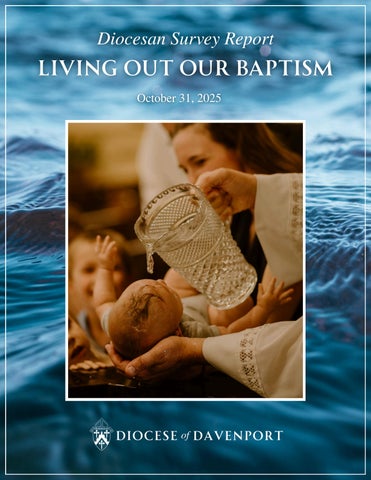
Diocesan Survey Report
Living out our baptism October 31, 2025
Contents Diocesan Report.............................................................................................................1 Appendices.....................................................................................................................9 Synthesis Committee...................................................................................................19
Instruction from the USCCB “The objective of this nationwide consultation is to assist the U.S. bishops as they discover how the People of God understand the baptismal identity and co-responsible mission of the laity within Church and society.” Document Structure To be reader-friendly, as opposed to interspersing tables throughout this report, the narrative includes parenthetical references to tables that can be found in the appendix of this document. A note on the survey data As we did not want any given question to be a barrier to survey participation, most of the questions in the survey were not “required” to be answered. While most respondents responded to most of the questions, some questions were skipped with greater frequency than others. Additionally, when percentages are listed in the narrative we rounded to the nearest whole number.
Diocesan Report 1. The Diocese of Davenport undertook the task of consulting the Baptized about their perception and living of their Baptismal Identity through an on-line survey that was available during the month of September. Our survey has several shortcomings in that there is no opportunity for either the listener or the sharer to clarify what is being said. Being on-line, it prioritizes those with preferences, access, and fluency with digital technology. Even though the “people of God” refers to all the baptized and, indeed, to all people, most people who responded to the survey were Roman Catholic as no formal effort was made to reach out ecumenically. We bear responsibility for all the souls in a given territory and our efforts did not meet this vision of the Church. 2. The 3,684 lay respondents to the survey amounts to 15% of the 2024 census of Mass attendees, which was 24,478. Participation by parish ranged from just over 40% in two parishes to less than 5% from 10 parishes (Table A). Among respondents, 84% attend Mass at least weekly, indicating that they are active members of the parish (Chart A). Responses varied by age range, with 62% of respondents being age 55+ (Chart B). 72 clerics responded to the survey for clergy. During October, a small group of parish and diocesan leaders reviewed the survey results and reflected on what they revealed (see Synthesis Committee). All agreed that we have a great deal of work to do and that the survey points to significant areas for growth, calling us to discern the best ways to stimulate and support the progress we would like to see. Understanding of Baptismal Identity 3. A major area for growth is in people’s understanding of their Baptismal identity, for if we don’t know who we are, we won’t grasp the mission to which we are called. Open ended responses to the question of Baptismal identity drew a noticeable number of responses indicating that those taking the survey did not understand the term. Those reflecting on the data also reported that people said the same thing to them informally. Nevertheless, it is encouraging that among lay respondents, 49% said that they always consider their Baptism core to their identity while another 35% said they often do so (Table B). Sadly, the tendency to consider Baptism as core to one’s identity drops off among younger people (Table C). 1
4. Over half of those who provided a narrative comment on their Baptismal identity focused on personal growth in faith, commitment to attending Mass and participating in the other sacraments, and a constant or growing spiritual life. A significant number did mention the call to service. Most of those referred to serving the church; only a few mentioned going out to the margins in service to those in need. 5. Survey data indicates that 88% of lay respondents said that they always or often feel that they are co-responsible with the ordained for the life of the parish. 100% of the clergy responding said they always or often think in terms of co-responsibility with the laity (Table D). On the other hand, in comments, very few lay respondents indicated that they felt called to share in the church’s mission, to spread the faith, or to bear witness to others. Being anointed as priest, prophet, and king received only one mention. Comfort in Sharing Faith 6. The idea that laity in general need more encouragement and support for thinking of themselves as called to mission is borne out by the data concerning people’s comfort in sharing their faith. While, as noted above, most are attending Mass regularly, 30% indicated that they are not sharing their faith with others, a statistic that is largely consistent across age, gender, and ethnicity (Chart C). Even a few members of the clergy indicated a lack of comfort in sharing personal faith stories. Nearly 6% of laity said they have no faith story to tell and 22% indicated a lack of interest 2
in sharing their faith story. On the other hand, 40% of laity said they did feel comfortable telling their faith story, 17% said they would like to have the courage to do so and 22% said they would like to understand their story better (Table E). 7. To the question with whom they feel comfortable sharing their faith, 53% said family, 47% said friends, 33% anyone, 30% extended family, 26% other Christians, and nearly 6% said nobody (Chart D). As to sharing faith with someone who is not a practicing Christian, fewer than 4% said they have done so weekly within the past year, 42% said one or a few times, and nearly 30% could not recall having done so (Chart C). 8. When asked what they feel comfortable sharing, the majority of lay respondents rated the beauty of creation highest and the identity of the church as a community of disciples last, nearly tied with Jesus of Nazareth being the fullest expression of God’s love. Members of the clergy, by contrast, put the beauty of creation last and ranked the identity of Jesus as the full revelation of God’s love at the top (Table F). These statistics clearly indicate that we need to work at creating an atmosphere in which people are encouraged to recognize and reflect on their own faith journey and become comfortable sharing it with others, even within their own families. Recognition of Gifts/Charisms 9. A closely and perhaps causally related area of concern is lay people’s sense of their own gifts, especially in regard to gifts related to the mission to which our Baptism calls us. Given a list of 23 gifts or charisms and encouraged to check all that they saw in themselves, fewer than 2% of responded selected the gift of prophecy, fewer than 4% missionary, just over 5% apostle, and just under 7% evangelist. Even the numbers for those gifts most frequently chosen seem low: 53% for faith, 47% generosity, 45% service. Regarding the exercise of their gifts within the parish, just over 31% of laity said that their gifts were utilized, although nearly half thought that their gifts were
3
valued. Sadly, 18% said that their gifts were not recognized in the parish. Concerning the gifts of others, responses were somewhat more optimistic. Over half said that the gifts of others were valued, 34% that they were utilized, and only 8% that they were not recognized. By far the majority of clergy responding to the survey expressed the belief that gifts of others are at least valued (66%) and in many cases utilized (48%). The differences as well as the numbers certainly bear further examination as to the reasons behind them and ways to improve them (Table G) Participation in Parish activities 10. Survey questions regarding participation in the activities of the Parish were built around the four areas of parish life outlined in OCIA #75. Participation in parish activities outside of Mass also seems surprisingly low given that the lay people responding are faithful Mass attendees. Only 12% said they attended catechetical programs weekly, while 41% said they couldn’t recall having attended even one during the year. Responses regarding community events and parish witness activities such as service or social action showed similar patterns. In each case, fewer than 3% said they had attended such events weekly and around 14% said they had attended one during the last year. Regarding witness or social action, nearly 50% said they had been to no such events in the last year. Some, in comments, stated that they didn’t think any such events took place in the parish. Worship outside of Mass garnered a slightly higher numbers of engagement. Nearly 27% said they had taken part in such experiences weekly and just over 24% said they had not done so at all (Table H). Preparation for lay ministry 11. A large number of respondents to the survey (1,287) described themselves as having a formal role within the parish, with 545 indicating that they belonged to leadership groups such as the pastoral council, finance council or school board. Reflecting on their responses we recognized that another urgent task facing us is providing formation for those filling designated roles within the parish whether full or
part time, volunteer or paid. Responses to open-ended questions revealed a wide spread desire among lay ministers for help in developing skills for specific ministries. Most of the clergy also indicated that various lay ministers need more training.
May the Lord Jesus, who made the deaf to hear and the mute to speak, grant that you may soon receive his word with your ears and profess the faith with your lips, to the glory and praise of God the Father.
12. Those who indicated that they have a designated role within the parish were given the following options for describing their preparation for that ministry: graduate level education, undergraduate level education, The Rite of Baptism certificate level training, conferences or workshops, professional reading, webinars, or no formal training. In reflections, it was suggested that the survey should have included mentorship as an option. The largest number of responders chose between professional reading and conferences or workshops. Fewer than 10% indicated having a certificate relevant to their ministry. Fully half indicated that they had no formal training at all (Table I). 13. Survey questions about training further distinguished between the four dimensions of formation provided for by the USCCB’s Co-workers in the Vineyard of the Lord: human, spiritual, intellectual and pastoral dimensions. Numbers were about even across all areas, with somewhat more negative results for pastoral skills (Table J). Surprisingly in light of the numbers regarding training, nearly 45% of those involved in lay ministry say they feel generally equipped while 23% say they feel somewhat equipped but would like more training. Just over 11% say they feel fully prepared and over 20% say they feel unequipped or only somewhat equipped (Table K). 14. Clergy were asked to select the perceived level of preparation for lay minister in 23 different areas of parish life. Most of the clergy who responded to the survey indicated that some of the parish staff or volunteers need additional training. The three most highly rated areas of ministry were Safe Environment, sacramental prep, and financial management. Nearly all clerics indicated that a lay person in the parish is responsible for these three areas of ministry. 5
15. On the other hand, a large percent of the clergy indicated that there was no lay person responsible for certain areas of ministry. The top five such areas were addiction recovery (81%), wellness or mental health (65%), ethnic/cultural ministry (65%), Pastoral associate (64%), and bereavement ministry (46%). Also notable were a lack of lay ministers in areas of marriage ministry (39%), family life (36%), communications and/or digital communication (29%), and evangelization and outreach (25%). Concerns about the church 16. Open-ended comments showed that there are important concerns related to people’s eagerness to participate in the church’s mission. A special area of concern was a lack of participation by younger people. It is notable that a large number of those filling roles within a parish are retired people, with nearly half being age 65-74 or 75+ (Chart E). While some people may feel weary of hearing about the sex scandal, for many, and especially for those directly affected, the effects remain prominent and lifealtering. There are divisions concerning the liturgical and pastoral life of the church with some saying we are “too liberal” while others say we are “too conservative.” Respondents in general did not specify what put the church into a specific category, although there were a couple mentions of the Tridentine Mass and some objections to synodality. Concerns about the political stance of the church came from both some who say the church is too involved and from others who say the church should take a stronger stance on some issues. Conclusions 17. Despite having concerns about the church, many of those who responded to the survey said in their open-ended responses that they are grateful for their Baptism and their faith. That gratitude keeps them attached to the church as a source for lifedirection. 18. We recognize that any survey and the data it yields has certain weaknesses. The data does not provide the reasoning behind responses. People may have different understandings of the questions. And the numbers certainly don’t tell us exactly what we need to do. 6
19. What the survey can and did reveal is important areas of opportunity for growth. We know that we need to discover how we can continue to journey together as people who understand our Baptism not just as a single event but as an entrance into a community in which we have a vocation to mission. As a community, we need to develop skills in listening to one another across all boundaries: age, ethnic identity, political leanings, and more. 20. We understand that our work involves all of us learning to see and appreciate our gifts and the gifts of others. We need to call one another to offer those gifts within and beyond the church as members of the Body of Christ, anointed as priest, prophet, and king. And we need to support one another by offering ways to develop the skills that are necessary for the ministries to which we are called. At Baptism, we are given a candle and told to keep the light burning. Light burns not for its own sake, but for the sake of all who need it.
Go, therefore, and make disciples of all nations, baptizing them in the name of the Father, and of the Son, and of the Holy Spirit. Matthew 28:19
21. We trust in the guidance of the Holy Spirit as we discern how to use the information that the survey has provided. In responses to the survey, a large percent of both clergy and laity indicated that their parish often has organized discussions about where the Spirit is leading (Table L). We hope such discussions grow into prayerful discernment in each parish and in the diocese as such. 7
8
appendices The following are included to support the above report: Table A - Parish participation levels Chart A - Frequency of Mass attendance Chart B - Responses by age range Table B - Baptism as core to identity Table C - Baptism as core to identity by age group Table D - Co-responsibility between lay and ordained persons Chart C - Frequency of sharing faith Table E - Confidence in sharing faith story Chart D - Comfort sharing faith with Table F - Comfort inviting people to notice about faith Table G - Gifts being put at the service of the church Table H - Participation in parish life (OCIA #75) Table I - Level of training for ministry Table J - Four dimensions of formation Table K - Feeling adequately supported by one’s training Chart E - Age range of staff/volunteers Table L - Community conversations to discern mission
9
Table A
Parish participation levels We are able to determine parish-level participation based on the November 2024 Mass Counts. Participation varied greatly from parish to parish. The highest participation percentage was 40.3% while the lowest was 2.5%. The following table reflects the range of participation:
% participation
# of parishes
40%+
2 parishes
30-39%
6 parishes
20-29%
16 parishes
10-19%
24 parishes
5-9%
14 parishes
0-4%
10 parishes
Chart A
Frequency of Mass Attendance More than 1x/week
27.1%
1x/week
57.3%
A couple times a month
6.9%
Once a month
1.6%
Once every couples of months
1.8%
A couple times a year
1.9%
I don't go to Mass
3.4% 0%
10%
20%
30% % of respondents
10
40%
50%
60%
Chart B
Responses by Age Range
1000 800 600 400 200
Ag e7
-9 Ag e1 013 Ag e1 4Ag 17 e1 824 Ag e2 534 Ag e3 544 Ag e4 554 Ag e5 564 Ag e6 574 Ag e7 5+
0
Age
7-9
10-13
14-17
18-24
25-34
35-44
45-54
55-64 65-74
75+
Respondents
5
67
114
83
193
483
459
656
921
703
%
<1%
2%
3%
2%
5%
13%
12%
18%
25%
19%
Table B Baptism as core to identity Responses to the question: “Do you feel that your baptism is core to your identity?” Mostly not
Often no
Often yes
Yes, always
Laity
7%
9%
35%
49%
Clergy
3%
0%
27%
70%
11
Table C Baptism as core to identity by age range Responses to the question: “Do you feel that your baptism is core to your identity?” Responses to this question
Mostly not
Often no
Often yes
Yes, always
Age 7-9
3
33%
0%
67%
0%
Age 10-13
64
17%
23%
47%
13%
Age 14-17
108
19%
21%
37%
22%
Age 18-24
60
7%
10%
38%
45%
Age 25-34
151
4%
13%
38%
45%
Age 35-44
413
6%
13%
43%
38%
Age 45-54
383
5%
10%
39%
46%
Age 55-64
575
4%
9%
33%
54%
Age 65-74
824
7%
6%
33%
55%
Age 75+
623
7%
6%
31%
56%
Table D
Co-responsibility between lay and ordained persons Responses to the question: “As a lay/ordained person, do you feel that you share responsibility for the work and mission of the Church with ordained ministers/the laity?” Mostly not
Often no
Often yes
Yes, always
Laity
8%
15%
47%
31%
Clergy
0%
0%
25%
75%
12
Chart C
Frequency of sharing faith Responses to the question: “About how many times in the last year have you explicitly shared your faith with someone who is not a practicing Christian?” 52+ times (weekly+)
3.7%
26 times (every other week)
4.0%
12 times (monthly)
9.5%
6 times (every other month)
11.0%
3 times (a few times a year)
31.1%
1 time (once in the last year)
11.0%
Not any that I can think of
29.7% 0%
5%
10%
15%
20%
25%
30%
35%
% of respondents
Table E
Confidence in sharing faith story Responses to the question: “How confident do you feel in telling the story of your faith journey?” % I have no faith story to tell
6%
I’m not interested in sharing my faith story
22%
I would like to understand my faith story better
22%
I would like to gain the courage to tell my faith story
17%
I feel confident telling my faith story
38%
13
Chart D
Comfort in sharing faith with Responses to the question: “Who are you comfortable sharing your faith with? (select all that apply)” Nobody
5.8%
Immediate family/household
53.4%
Extended family
30.3%
Friends
46.6%
Fellow parishioners
35.5%
Other Christians
26.4%
Anyone
32.5% 0%
10%
20%
30%
40%
50%
60%
% of respondents
Table F
Comfort inviting people to notice about faith Responses to the question: “When it comes to sharing faith, what are you most comfortable inviting people to notice?” The table below reflects a weighted average on the following scale: Mostly not (1), Often no (2), Often yes (3), Yes, always (4). The highest and lowest categories for the laity and clergy are highlighted. Laity
Clergy
The beauty in all creation
3.12
3.15
That God is the source of all the beauty in creation
3.13
3.38
The God of creation loves them personally
3.04
3.55
Jesus of Nazareth is the fullest expression of God's love
2.97
3.65
The Church is a community of disciples supportive of a faith journey, nourished by Word and Sacrament
2.89
3.39
Growing in the moral life is challenging, gradual, and rewarding
2.99
3.42
Lifelong learning brings together the moral, spiritual, intellectual, and historical dimensions of faith
3.01
3.27
How God has worked and is working in my life
3.16
3.59
14
Table G
Gifts being put at the service of the church Responses to the question: “Select all that apply...” Laity
Clergy
Not Not Noticed Valued Utilized Noticed Valued Utilized noticed noticed My gifts...
18%
42%
45%
31%
5%
37%
62%
54%
The gifts of others...
8%
44%
56%
34%
3%
48%
66%
48%
Table H
Participation in parish life (OCIA #75) Responses to the question: “Participation in parish opportunities outside of Mass in the last year that are for your enrichment:” Not any 52+ times 26 12 6 3 1 that I can (weekly+) times times times times time think of Catechesis / faith formation (e.g. bible study, book club, theology on tap, theological presentation, CCD, Vacation Bible School, etc.)
12%
10%
9%
7%
12% 10%
41%
Community (e.g. soup supper, card game night, mom's night out, fall festival, back to school celebration, etc.)
2%
4%
13%
14%
30% 14%
21%
Worship (e.g. Liturgy of the Word, Liturgy of the Hours, Adoration, lectio divina, group rosary, retreats, etc.)
27%
7%
9%
8%
16% 10%
24%
Witness (e.g. parish neighborhood clean up, group service trip, door-todoor invitation to faith community, social action etc.)
3%
3%
6%
8%
16% 15%
49%
15
Table I
Level of training for ministry Responses to the question: “Select the highest level of training that most resembles what you have received for your service within the Church. % no formal training for my sphere of ministry
51%
webinars
7%
professional reading
5%
conference or workshops
18%
certificate level training for my sphere of ministry
10%
undergraduate level training for my sphere of ministry
4%
graduate level training for my sphere of ministry
6%
Table J
Four dimensions of formation Responses to the question: “Please indicate the primary areas you’ve received training in:” None
Some
Comprehensive
Human (e.g. long-term planning, knowledge of ones own gifts, collaboration across personalities, generations, and cultures)
50%
8%
18%
6%
7%
Spiritual (e.g. spiritual direction, exposure to different forms of personal and communal prayer)
41%
9%
35%
8%
7%
Intellectual (e.g. coursework on evangelization, church history, scripture, sacraments, ecclesiology)
46%
9%
39%
8%
9%
Pastoral (e.g. supervised ministry placements and theological reflection on experiences, role playing, practica)
69%
11%
12%
4%
4%
16
Table K
Feeling adequately supported by one’s training Responses to the question: “Do you feel adequately supported by the training you have received for your ministry?” % No, I need more training
9%
Sort of, but not usually
12%
Somewhat, but I would like more training or education
23%
I feel generally equipped
45%
I feel thoroughly equipped
11%
Chart E
Age range of staff/volunteer Age 7-9 Age 10-13 Age 14-17 Age 18-24 Age 25-34 Age 35-44 Age 45-54 Age 55-64 Age 65-74 Age 75+
0.5% 2.3% 2.1% 4.6% 15.0% 12.4% 17.8% 27.7% 16.9% 0%
5%
10%
15%
20%
25%
30%
% of respondents
Table L
Community conversations to discern mission Responses to the question: “Does your parish have organized conversation about how the Holy Spirit is calling the community to mission?” Mostly not
Often no
Often yes
Yes, always
Laity
16%
23%
48%
14%
Clergy
17%
29%
42%
12%
17
18
Synthesis committee Marianne Agnoli Anna Maria Billy Dcn. Ryan Burchett Sarah Callahan Fr. Jason Crossen Lynne Devaney Fr. Dane Dickinson Dan Ebener Kevin Effron Fr. James Flattery Fr. Charles Fladung Luke Greene Jacob Heit Lourdes Hernandez Michelle Herrington Maggie McMahon Miguel Moreno Tammy Norcross-Reitzler Jennifer Praet Patrick Schmadeke Jessica Warnke Corinne Winter
19