September 2026
The
COURIER
Official Newspaper of the Roman Catholic Diocese of Winona-Rochester, MN | dowr.org
Seeking the Presence Welcome Back! of Christ in Vacation By DEACON SEAN COSTELLO
By LAURA MILLER
�
� few weeks ago, several friends and I participated
in the Communion and Liberation (CL) Summer Vacation for the Upper Midwest region, which takes place every year around that time. Marcie, a participant, shared, “Ever since attending my first CL Summer Vacation I have looked forward to it. Every year. It’s a joyful, fun-filled, meaningful and faithfilled time. Many ages, lots of families who follow what the Communion and Liberation movement proposes: Christ is something that happens to me now. There I join others who are seeking the presence of Christ in one another and in the reality of every day. There’s sharing amongst ourselves of our experiences and encounters with Christ. I am filled!” This year was different because we went to a new place, the Upper Peninsula of Michigan in the Porcupine Mountains. It was a beautiful place, even though we couldn't fully appreciate it due to lots of wildfire smoke. But for one perfect day it cleared up enough to see the sun, blue sky, the mountains, and a spectacular sunset. Even with all the smoke, the organizers had prepared a variety of ways to encounter beauty in nature and in our companionship. One day, we drove to Black River Harbor for a hike and swimming in Lake Superior. Although you couldn't see much of the view, the water in the lake was crystal clear and delightfully cold.
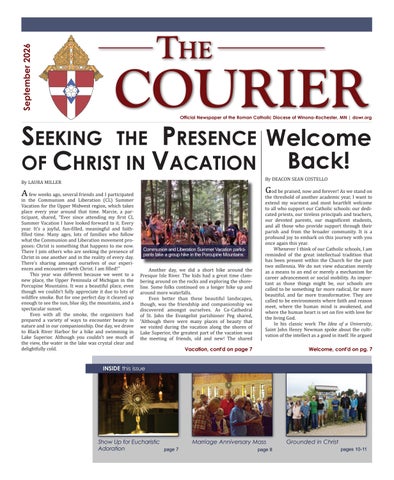
Communion and Liberation Summer Vacation participants take a group hike in the Porcupine Mountains.
Another day, we did a short hike around the Presque Isle River. The kids had a great time clambering around on the rocks and exploring the shoreline. Some folks continued on a longer hike up and around more waterfalls. Even better than these beautiful landscapes, though, was the friendship and companionship we discovered amongst ourselves. As Co-Cathedral of St. John the Evangelist parishioner Peg shared, “Although there were many places of beauty that we visited during the vacation along the shores of Lake Superior, the greatest part of the vacation was the meeting of friends, old and new! The shared
Vacation, cont'd on page 7
od be praised, now and forever! As we stand on the threshold of another academic year, I want to extend my warmest and most heartfelt welcome to all who support our Catholic schools: our dedicated priests, our tireless principals and teachers, our devoted parents, our magnificent students, and all those who provide support through their parish and from the broader community. It is a profound joy to embark on this journey with you once again this year. Whenever I think of our Catholic schools, I am reminded of the great intellectual tradition that has been present within the Church for the past two millennia. We do not view education merely as a means to an end or merely a mechanism for career advancement or social mobility. As important as those things might be, our schools are called to be something far more radical, far more beautiful, and far more transformative. They are called to be environments where faith and reason meet, where the human mind is awakened, and where the human heart is set on fire with love for the living God. In his classic work The Idea of a University, Saint John Henry Newman spoke about the cultivation of the intellect as a good in itself. He argued
Welcome, cont'd on pg. 7
INSIDE this issue
Show Up for Eucharistic Adoration page 7
Marriage Anniversary Mass page 8
Grounded in Christ pages 10-11
The Courier Insider
2
Pope to Catholic Legislators: Promote AI Policies that Protect Families
Articles of Interest
From the Bishop_________________________4-5 Seminary News____________________________6 Show Up for Eucharistic Adoration_________7 Life, Marriage & Family News____________8-9 Grounded in Christ___________________10-11 Diamonds in the Rough__________________12 NCCW CRS Partnership___________________13 Donor Advised Funds Are Surging________14 The
VATICAN CITY, August 21, 2026 - Pope Leo XIV has urged Catholic legislators to promote policies that protect families from the dangers of artificial intelligence (AI). The pontiff delivered his remarks on Aug. 21 in an audience at the Vatican with participants of the 17th annual meeting of the International Catholic Legislators Network (ICLN), taking place in Rome from Aug. 20-23. Cardinals Christoph Schönborn, Béchara Boutros Raï, and Charles Maung Bo were also present at the audience as patrons of the network.
AI Must Not Be Allowed to Weaken Families In his address, Leo reflected on the theme chosen for the meeting, “Human Dignity and Artificial Intelligence: Challenges, Chances, and Control.” “Artificial intelligence must never be allowed to erode this primary cell of society whether by reducing persons and relationships to data and simulations, by flooding young
Vol 117 - 9
Most Reverend Robert E. Barron, Publisher Nick Reller, Associate Editor Telephone: 507-361-3068 E-mail: nreller@dowr.org Publishing Schedule: Monthly - Deadline for advertising & articles is the 10th of the month prior. (ISSN 0744-5490) September 2026 w The Courier w dowr.org
Didn't
Expect_________16
The Praying Family Toolbox________________20
minds with content that distorts desire, or by economic models that make family life economically precarious,” Leo explained. “For this reason, I encourage you to promote policies that strengthen marriage and families, support parents in their educational mission, and enable young people to look to the future with confidence.” The pope then reminded those present that their responsibility is not to hinder development but to promote the common good. “Responsible for providing policies for the administration of technology for the common good, your task is not to hinder innovation but to guide it wisely,” Leo said. “[Sound legislation] should protect users from exploitation, preserve personal privacy, ensure transparency in the use of emerging technologies, and guarantee that they strengthen democratic institutions.” The ICLN was founded in 2010 in Austria to serve as a network for Catholic legislators worldwide. Since then, its annual meetings have been held in Rome. During their 2025 meeting, Pope Leo urged members to look to
The Courier is the official publication of the Diocese of Winona-Rochester 2907 Jeremiah Lane NW, Rochester, MN, 55901
We
Parish Events / Obituaries_______________17-19
Pope Leo XIV blesses a family after a private audience with a delegation from the International Catholic Legislators Network at the Apostolic Palace in the Vatican on Aug. 21, 2026. Credit: Vatican Media
By ISHMAEL ADIBUAH, EWTN News
Burden
Where to Find The Courier •
Hard copies are distributed at DOW-R parishes on the first or second weekend of each month.
•
An online version may be viewed at www.dowr.org/the-courier
•
To be added to the home delivery list free of charge, readers should send their names and addresses to: Diocese of Winona-Rochester The Courier 2907 Jeremiah Lane NW Rochester, MN 55901 or nreller@dowr.org
St. Augustine’s “City of God” for inspiration. After its 17th annual meeting concludes, the ICLN will host a peace summit in Assisi on Aug. 24, themed “The Urgent Call for Christian Leaders to Be Effective Peacemakers.” The summit will feature Mass, keynote addresses, and fraternal visits as the city continues to celebrate the 800th anniversary of the death of St. Francis of Assisi.
Child Abuse Policy Information
The Diocese of Winona-Rochester will provide a prompt, appropriate and compassionate response to reporters of sexual abuse of a child by any diocesan agent (employees, volunteers, vendors, religious or clergy). Anyone wishing to make a report of an allegation of sexual abuse should call the Victim Assistance Coordinator at 507-454-2270, Extension 255. A caller will be asked to provide his or her name and telephone number. Individuals are also encouraged to take their reports directly to civil authorities. The Diocese of Winona-Rochester is committed to protecting children, young people and other vulnerable people in our schools, parishes and ministries. The diocesan policy is available on the diocesan web site at www.dow.org under the Safe Environment Program. If you have any questions about the Diocese of Winona-Rochester’s implementation of the Charter for the Protection of Children and Young People, please contact Michael Gerard at 507-361-3377, or mgerard@dowr.org.
September Saint
St. Maurice and Companions
Feast Day: September 22 from EWTN
�t. Maurice and his companions are honored as
one of the most remarkable groups of martyrs in the early Church. According to ancient tradition, Maurice was an officer in the Roman army and leader of the Theban Legion, a unit composed entirely of Christian soldiers from Egypt. At a time when Christianity was still illegal within the Roman Empire, these soldiers served faithfully in the imperial army. However, when they were ordered to participate in actions that involved the persecution of fellow Christians, they faced a profound moral crisis. Choosing fidelity to Christ above obedience to human authority, Maurice and his companions refused to comply.
Their refusal was not an act of rebellion against military service itself, but a declaration that no earthly command can override the law of God. According to tradition, they were first punished through decimation, where one out of every ten men was beheaded. Still, they did not obey. After continued rounds of decimation did not deter them, the emperor ordered all of them executed. While historical details vary and some aspects of the account come from later tradition, the witness of the Theban Legion became widely venerated throughout the Church, especially in Gaul and Switzerland. Over time, Maurice became a symbol of Christian courage within military life and a patron of soldiers called to serve with integrity of conscience. Churches, monasteries, and military institutions across Europe were dedicated to him, and his legacy continues today. St. Maurice and his companions are venerated across Europe and beyond. They are honored as patron saints of soldiers, armies, and the Pontifical Swiss Guard. What Was the Theban Legion?
According to tradition, the Theban Legion was a Roman military unit composed of Christian soldiers recruited from Thebes in Egypt.
The Holy Father's Intention for
September 2026 For the Care of Water
Let us pray for a just and sustainable management of water, a vital resource, so that everyone may have equal access to it.
They were stationed in the Roman Empire and were known for their discipline and loyalty. The account holds that the entire legion shared the Christian Faith, which made them unique in the Roman army during a time when Christianity was still illegal. While historical details are debated, the tradition emphasizes their unity in faith and collective witness to Christ.
3
Why Did St. Maurice and His Companions Refuse Military Orders?
Maurice’s Theban Legion is said to have refused orders that required participation in the persecution of fellow Christians. For them, obedience to Christ came before obedience to imperial authority. Their decision reflects an early Christian understanding that faithfulness to God can, in certain circumstances, require refusal of unjust commands. Their witness highlights the tension early Christians sometimes faced between civic duty and religious conviction. When commanded to comply with the emperor’s command to kill fellow Christians, one account attributed this response to Maurice: “We have arms in our hands, but we do not resist, because we would rather die innocent than live by any sin.” With Which Military-Related Groups Is St. Maurice Associated?
St. Maurice has historically been associated with several military-related groups as a patron saint or in recognition for contributions. The U.S. Army Infantry’s National Infantry Association (NIA) and the U.S. Army Chief of Infantry give the prestigious Order of Saint Maurice award to recognize significant contributions to the infantry community. In Italy, Pope Pius XII named St. Maurice the patron saint of the Alpini, an elite mountain infantry corps of the Italian Army. And in France, St. Maurice is also celebrated as the patron saint of the French infantry, honoring his legacy as a courageous, steadfast leader. He is also the patron saint of the Pontifical Swiss Guard, the military force responsible for protecting the pope and the Vatican.
This Month in The Courier Archives
---------------------------------25, 50 & 75 Years Ago----------------------------------
Bishop Bernard Harrington, testifying [at a U.S. Senate hearing on federal farm policy held at Stewartville's American Legion post on August 20], presents the positions of the Minnesota Catholic Conference and the U.S. Bishops regarding the plight of agriculture, calling the production of food "a moral issue."
Mankato - The Chapel of Our Lady of Good Counsel here has a new pipe organ. Correction. It's an old pipe organ. [...] The organ was built in 1877 as the showcase for the William A. Johnson & Son Co. of Westfield, Mass., and was installed in St. Mary's Church, Boston, Mass. [The School Sisters of Notre Dame recently purchased the organ.] Now they had to take it apart, move it 1,500 miles and put it back together again. [Pictured above, Sr. Germaine Dallmann cleans a wooden pipe.]
Winona - 2,000 people - clergy, religious and laity - from the Province of St. Paul and the Diocese of La Crosse attended sessions of the second regional Congress of the Confraternity of Christian Doctine here August 26-28. His Excellency, the Most Rev. Edward A. Fitzgerald, D.D., LL.D., Bishop of Winona, was host to the congress. [He appears far left in this photo of the opening procession into St. Stanislaus Church.]
Reprinted from September 2001.
Reprinted from September 17, 1976.
Reprinted from September 9, 1951. September 2026 w The Courier w dowr.org
Why Fulton Sheen Matters Today
4
Sheen’s Holiness 1940s and subsequently humbly admit that I learned �lthough well- the on television in the 1950s, the practice from my students I should like to explore Fulton
From the Bishop
known and influential in the m i d - t we n t i e t h c e n t u r y , Archbishop Fulton Sheen was not, sadly, a major figure for my generation of Catholics. However, he was thankfully re-discovered by the successor generation, and I will confess that my interest in Sheen was generated very much from the students that I taught at Mundelein Seminary. I think that Sheen is remarkably relevant for our time, and I should like, in the course of this very brief column, to make that argument. Sheen’s Intelligence
I have often lamented the fact that, after Vatican II, the Church dramatically dumbeddown its message. While youth were given Shakespeare, Einstein, and Virgil to read in other classes, they were given comic books for religion. And this has proven to be a pastoral disaster. Fulton Sheen was a very smart man. He was educated at St. Paul’s Seminary in the Twin Cities, at Catholic University of America, and at Louvain in Belgium. For some twenty years, he taught at Catholic University in Washington and published books and articles. When he commenced his more popular work, first on radio in
Bishop's Calendar
*indicates event open to public September 1, Tuesday Minnesota Catholic Conference Study Day and Board Meeting St. Paul
September 4-5, FridaySaturday Good News Conference Nashville, TN September 8, Tuesday 12:00 p.m. - Presbyteral Council - The Chancery, Rochester
he did not dumb-down his message. One mark of Sheen’s intelligence is the care with which he prepared his famous talks. Sheen made what he did look easy, as though he were simply conversing informally with his audience. But hours and hours of preparation went into every presentation. For his TV lectures, he would write out the speech long-hand in French and then in Latin; then he would basically commit the text to memory. Sheen’s Joyfulness
The second quality of Fulton Sheen that is much needed today is joy. Sheen could be sharply critical when he thought it was appropriate. But harsh polemics were not his typical modus operandi. One of my favorite images is Sheen standing in full regalia and with a wide smile on his face on a street corner in the deep south. Next to him is a sign that reads: “Questions Cheerfully Answered.” His use of humor was deeply admired by some of the leading comedians of the age. He famously quipped, “I would like to thank my writers, Matthew, Mark, Luke, and John.” He utilized humor as turning over the soil of the heart so as to plant the seed of the Gospel. How needed this is today when so much of the religious space on the Internet is dominated by screaming, scolding, and accusing. I’ve often lamented that anyone coming on the typical Catholic website seeking evangelization would find so much vitriol. We need Fulton Sheen’s joy in a big way.
September 9, Wednesday Ribbon Cutting and Blessing of Crucifixion Early Learning Center - Crucifixion, La Crescent September 10, Thursday 12:00 p.m. - Deans Meeting The Chancery, Rochester September 11, Friday Word on Fire Board Meeting Rochester
September 2026 w The Courier w dowr.org
Sheen’s holiness in terms of a tripartite template. Let us look first at the breakthrough of grace. He sensed the providence of God when he heard that remarkable prophecy from Bishop Spaulding in the sanctuary of the cathedral as an eight-yearold altar server: “Tell your mother, that when you are big you will go to Louvain and you will be as I am.” He tasted it as a seminarian at St. Paul’s Seminary while listening to a conference given by the spiritual director. And Sheen knew the holiness of God every time he had an audience with the Pope; Sheen saw each of his encounters with popes as practically a mystical experience. Under this great rubric of grace, how could we not speak of Fulton Sheen’s relationship with the woman whom the Scriptures describe as “full of grace?” Mary, as it were, haunts the spiritual life of Fulton Sheen, from his baptism in the Church of St. Mary, to his ordination in the Peoria Cathedral dedicated to Mary, to his deep devotion to the rosary, and finally to his thirty or more journeys to Lourdes to visit the “woman he loved.” Nowhere was Fulton Sheen’s rootedness in Christ more apparent than in his dedication to the Holy Hour: the daily, hour-long prayer in the presence of the Blessed Sacrament. These times of prayer were an opportunity to bask in the presence of the Lord Jesus. Though it took some time, Fulton Sheen’s encouragement of the daily Holy Hour has now taken deep root in the lives of priests, seminarians, and lay faithful across the world. I will
September 12, Saturday Seven Sisters Gathering - St. Theodore, Albert Lea September 13, Sunday *9:30 a.m. - Mass - Co-Cathedral of St. John the Evangelist, Rochester
September 15, Tuesday 10:30 a.m. - College of Consultors - The Chancery, Rochester
at Mundelein Seminary, who witnessed powerfully to the efficaciousness of the hour before the Lord. I now savor the Holy Hour that I do in my private chapel every morning before commencing my work day. The second great path of the spiritual journey is the frank acknowledgement of sin. In Sheen’s great autobiography, he readily admitted to his failures, bad judgments, and personal weaknesses. So Fulton Sheen appreciated the sufferings that came to him from both inside the Church and outside - as the harsh, burning work of the angel of purification. Like St. John Paul II, he never saw suffering as dumb or meaningless. Through pain, he would become more thoroughly conformed to Christ Jesus. The third path in the spiritual journey is that of mission. Once bathed in grace, once purified, the follower of Christ is sent. After his confession of sin, St. Peter hears the Lord say, “Do not be afraid! From now on you will be catching people.” This is indeed the path that involves response, our true cooperation with grace - and was there anyone in the twentieth century who walked this path more effectively, joyfully, and enthusiastically than Fulton J. Sheen? He enthusiastically responded to the invitation to be a principal speaker during the Catholic Hour radio broadcast, for he knew that this would expand the walls of his classroom exponentially. He seized the opportunity to address the entire nation through television. From 1950-1966, the great
September 19, Saturday *4:30 p.m. - Mass and Installation of Fr. Michael Churchill as Pastor - Holy Trinity, Rollingstone September 20, Sunday *8:00 a.m. - Mass - St. Patrick, Brownsville
September 23, Wednesday 5:00 p.m. - Vespers on the Occasion of Archbishop Fulton Sheen's Beatification - St. Louis, MO
Non Nisi Te Domine Bishop Robert Barron
evangelist was also national director of the Society for the Propagation of the Faith, and in this capacity, he was drawn into the missionary activity of the Church all over the world. All his life long, and all over the world, Sheen spoke, preached, and offered retreats. I was absolutely staggered when I came across the statistic that, for the bulk of his public career, he traveled three times a week in order to speak. That’s a hundred and fifty trips a year for decades. People tell me that I travel a lot; I’ve got nothing on Fulton Sheen! No one in the twentieth century walked the great path of mission with more enthusiasm and dedication. Conclusion
We need the example of Fulton Sheen today. We need his deep intelligence; we need his joy; and, above all, we need his holiness. For at the end of the day, it is the saint who most effectively evangelizes. September 24, Thursday 2:00 p.m. - Archbishop Fulton Sheen's Beatification - St. Louis, MO
September 25, Friday 3:00 p.m. - Mass of Thanksgiving on the Occasion of Archbishop Fulton Sheen's Beatification - Peoria, IL 5:00 p.m. - Sheen Gala - Peoria, IL
Por qué Fulton Sheen importa hoy en día por EL OBISPO ROBERT BARRON
�
unque era muy conocido e influyente a mediados del siglo XX, el arzobispo Fulton Sheen no fue, lamentablemente, una figura destacada para mi generación de católicos. Sin embargo, afortunadamente fue redescubierto por la generación siguiente, y debo confesar que mi interés por Sheen surgió en gran medida gracias a los alumnos a los que impartí clase en Mundelein. Creo que Sheen es extraordinariamente relevante para nuestra época, y me gustaría, en el transcurso de esta breve columna, exponer ese argumento. La inteligencia de Sheen
A menudo he lamentado el hecho de que, tras el Concilio Vaticano II, la Iglesia simplificara drásticamente su mensaje. Mientras que en otras asignaturas se les daba a los jóvenes obras de Shakespeare, Einstein y Virgilio para leer, en religión se les daban cómics. Y esto ha resultado ser un desastre pastoral. Fulton Sheen era un hombre muy inteligente. Se formó en el Seminario de San Pablo, en Minnesota; en la Universidad Católica de América y en Lovaina, Bélgica. Durante unos veinte años, impartió clases en la Universidad Católica de Washington y publicó libros y artículos. Cuando comenzó su labor más popular, primero en la radio en la década de 1940 y posteriormente en la televisión en la de 1950, no simplificó su mensaje. Una muestra de la inteligencia de Sheen es el esmero con el que preparaba sus famosas charlas. Sheen hacía que lo que hacía pareciera fácil, como si simplemente estuviera conversando de manera informal con su público. Pero cada presentación requería horas y horas de preparación. Para sus conferencias televisivas, escribía el discurso a mano primero en francés y luego en latín; después, básicamente, se aprendía el texto de memoria. La alegría de Sheen
La segunda cualidad de Fulton Sheen que tanto se necesita hoy en día es la alegría. Sheen podía mostrarse muy crítico cuando lo consideraba oportuno. Pero las polémicas duras no eran su forma habitual de actuar. Una de mis imágenes favoritas es la de Sheen de pie, vestido con sus insignias episcopales y con una amplia sonrisa en el rostro, en una esquina del extremo sur. Junto a él hay un cartel que dice: «Preguntas alegremente respondidas».
Su uso del humor era profundamente admirado por algunos de los principales cómicos de la época. Es famosa su broma: «Me gustaría dar las gracias a mis guionistas: Mateo, Marcos, Lucas y Juan». Utilizaba el humor para remover la tierra del corazón con el fin de plantar la semilla del Evangelio. ¡Qué necesario es esto hoy en día, cuando gran parte del espacio religioso en Internet está dominado por gritos, reprimendas y acusaciones! A menudo he lamentado que cualquiera que visite una página web católica típica en busca de evangelización se encuentre con tanta virulencia. Necesitamos la alegría de Fulton Sheen más que nunca. La santidad de Sheen
Me gustaría analizar la santidad de Fulton Sheen a través de un esquema tripartito. Veamos primero el momento decisivo de la gracia. Intuyó la providencia de Dios cuando, siendo un monaguillo de ocho años, escuchó aquella extraordinaria profecía del obispo Spaulding en el santuario de la catedral: «Dile a tu madre que, cuando seas mayor, irás a Lovaina y serás como yo». La saboreó como seminarista en el Seminario de San Pablo mientras escuchaba una conferencia impartida por el director espiritual. Y Sheen experimentaba la santidad de Dios cada vez que tenía una audiencia con el Papa; Sheen consideraba cada uno de sus encuentros con los papas prácticamente como una experiencia mística. Bajo este gran título de la gracia, ¿cómo no hablar de la relación de Fulton Sheen con la mujer a la que las Escrituras describen como «llena de gracia»? María, por así decirlo, impregna la vida espiritual de Fulton Sheen, desde su bautismo en la iglesia de Santa María, pasando por su ordenación en la catedral de Peoria, dedicada a María, hasta su profunda devoción por el rosario y, finalmente, sus más de treinta viajes a Lourdes para visitar a la «mujer a la que amaba». En ningún otro ámbito se manifestaba más claramente el arraigo de Fulton Sheen en Cristo que en su dedicación a la Hora Santa: la oración diaria de una hora de duración en presencia del Santísimo Sacramento. Estos momentos de oración eran una oportunidad para deleitarse en la presencia del Señor Jesús. Aunque llevó algún tiempo, el fomento de la Hora Santa diaria por parte de Fulton Sheen ha echado ahora profundas raíces en las vidas de sacerdotes, seminaristas y fieles laicos de todo el mundo.
On August 14, Bishop barron visited St. Teresa Church in Mapleton to install as lectors seven candidates for the diaconate of the Diocese of Winona-Rochester. By taking this step in their formation, the candidates formally express their willingness to study and proclaim Sacred Scripture for the good of the Church. The Ministry of Lector is the second of three formal steps leading to diaconal ordination, following the Rite of Candidacy and preceding the Ministry of Acolyte. Please pray for these men as they continue their formation. Pictured from left to right are: Joseph Mytych with his wife, Tina Mytych; Timothy Gossman; Brian Zogg with his wife, Deanne Zogg; Bishop Robert Barron; Timothy Clements; Mark Engesser with his wife, Tanya Engesser; Steven Breiter with his wife, Peg Breiter; and Arlo Drees with his wife, Beth Drees.
Admito con humildad que aprendí esta práctica de mis alumnos del Seminario de Mundelein, quienes dieron un poderoso testimonio de la eficacia de esa hora ante el Señor. Ahora disfruto de la Hora Santa que celebro en mi capilla privada cada mañana antes de comenzar mi jornada laboral. El segundo gran camino del itinerario espiritual es el reconocimiento sincero del pecado. En su magnífica autobiografía, Sheen admitió sin reparos sus fracasos, sus errores de juicio y sus debilidades personales. Así, Fulton Sheen apreciaba los sufrimientos que le sobrevenían - tanto desde dentro de la Iglesia como desde fuera - como la dura y ardiente obra del ángel de la purificación. Al igual que san Juan Pablo II, nunca consideró el sufrimiento como algo absurdo o sin sentido. A través del dolor, se conformaba cada vez más a Cristo Jesús. El tercer camino del itinerario espiritual es el de la misión. Una vez bañado en la gracia, una vez purificado, el seguidor de Cristo es enviado. Tras su confesión de los pecados, San Pedro oye al Señor decir: «¡No temas! De ahora en adelante serás pescador de hombres». Este es, en efecto, el camino que implica una respuesta, nuestra verdadera cooperación con la gracia; ¿y hubo alguien en el siglo XX que recorriera este camino de forma más eficaz, alegre y entusiasta que Fulton J. Sheen? Respondió con entusiasmo a la invitación para ser el ponente principal en el programa de radio «La Hora Católica», pues sabía que esto ampliaría exponencialmente los límites de su aula. Aprovechó la oportunidad para dirigirse a toda la nación a través de la televisión. Entre 1950 y 1966, el gran evangelizador fue también director nacional de la Sociedad para la Propagación de la Fe y, en esta función, se vio inmerso en la actividad misionera de la Iglesia en todo el mundo. A lo largo de toda su vida, y por todo el mundo, Sheen habló, predicó y ofreció retiros. Me quedé absolutamente atónito cuando me topé con la estadística de que, durante la mayor parte de su carrera pública, viajaba tres veces por semana para dar charlas. Eso son ciento cincuenta viajes al año durante décadas. La gente me dice que viajo mucho; ¡pero no le llego ni a los talones a Fulton Sheen! Nadie en el siglo XX recorrió el gran camino de la misión con más entusiasmo y dedicación.
5
Conclusión
Hoy necesitamos el ejemplo de Fulton Sheen. Necesitamos su profunda inteligencia; necesitamos su alegría; y, sobre todo, necesitamos su santidad. Porque, al fin y al cabo, es el santo quien evangeliza con mayor eficacia.
September 2026 w The Courier w dowr.org
Walk With Them 6 Help Form the Priests of Tomorrow By NICOLE WENINGER
�
very priest begins with a vocation: a call from Christ that must be prayerfully discerned, nurtured, and formed. At Immaculate Heart of Mary Seminary,
our seminarians are responding generously to that call, preparing for a lifetime of serving God and his people. This fall, our seminarians will participate in a historic pilgrimage surrounding the beatification of
Archbishop Fulton J. Sheen. From September 15–26, faithful from across the Midwest will gather in Peoria and St. Louis for prayer, reflection, fellowship, and celebration. For our seminarians, this pilgrimage is an opportunity to learn from Catholic leaders whose lives and ministries speak directly to the vocation they are discerning. Featured speakers include Bishop Robert Barron, Bishop Andrew Cozzens, Bishop Louis Tylka, Cardinal Luis Antonio Tagle, and more. Through Holy Hours, talks, prayer, and fellowship, the seminarians will reflect on themes central to priestly formation, including prayer, the Eucharist, priesthood, evangelization, and the call to holiness. The experience will culminate in the historic beatification of Archbishop Fulton J. Sheen in St. Louis. We invite the IHMS community to walk with our seminarians by helping offset the cost of this pilgrimage. Your gift is more than a contribution toward travel. It is an investment in the formation of future priests, giving our seminarians an opportunity to pray, learn, deepen their fraternity, and grow in their commitment to Christ and his Church. To s u p p o r t o u r s e m i n a r i a n s , v i s i t catholicfsmn.org/donate/ihms-retreat or send donations to the Catholic Foundation, PO Box 30098, attention: IHMS Retreat, Winona, MN 55987. Walk with them. Pray for them. Invest in their vocation.
Nicole Weninger is the coordinator of donor relations and marketing for Immaculate Heart of Mary Seminary in Winona.
Born of Fire and Water At Whitewater State Park
By WILLIAM HEINY
�wo weeks after arriving at Immaculate Heart of
Mary Seminary, the 26 propaedeutic (first-year) men, three mentors, and two formators went on a week-long adventure to Whitewater State Park. Over the last few years, the camping trip has become an integral part of the propaedeutic summer, allowing the new men to take a step away from the modern world and form authentic relationships with each other. It is loosely structured around the “Born of
Fire and Water” retreat, asking the men to reflect on their baptismal identities in Christ, but there is an abundance of unstructured recreation time. In the past three years, this retreat has taken place on a true wilderness adventure in the Boundary Waters Canoe Area, but wildfires this year forced us to make a last-minute pivot to Whitewater State Park, about half an hour northwest of the seminary. There was some disappointment, but, for the most part, everyone was excited to explore this new location with its 2,700 acres of forests, meadows, bluffs, and river valley.
In Boundary Waters spirit, we began the week with a five-mile canoe trip down the Mississippi River on Sunday, July 26. We then had a brief rest back at the seminary before driving out to the state park that evening. While at the state park our days were pretty well structured. The men were divided into five camping groups, each with a mentor or a priest. We were too late to reserve a group campsite, so each group had a normal site in the campground. We began each day with Morning Prayer, breakfast, and a reflection in our campsites and then all drove to St. Charles Borromeo Church in St. Charles for a holy Hour and Mass. The afternoons were open for the men to do as they pleased until Evening Prayer and dinner. The first couple days were very hot, so we learned to adapt by spending time swimming in the Whitewater River, which flowed by our campsites. Those who were motivated also took a few early morning hikes to see the sunrise and avoid the worst of the heat. The rest of the week was cooler, so men were able to go fishing, play volleyball, and generally relax. We intended to stay until Friday morning, but we decided to return Thursday night to avoid taking down tents in the rain that was coming the next morning. Overall, the trip was a good bonding experience that taught us flexibility and resilience. While we did not endure the full wilderness hardships of the Boundary Waters, many of the new men had opportunities to step outside of their comfort zones and grow in confidence. I am very excited to see what else awaits us in this formation year. William Heiny is a seminarian for the Diocese of Marquette, studying at Immaculate Heart of Mary Seminary in Winona.
September 2026 w The Courier w dowr.org
Show Up
for Eucharistic Adoration Spiritual Campaigns Announced for 2027 By BRIAN KUSEK
�ince his arrival in the Diocese, Bishop Barron
has drawn on an encyclical by Pope Saint John Paul II, Ecclesia de Eucharistia. In the 25th year of his pontificate, during the Year of the Rosary, John Paul II sought to lay a vision for the third millennium. He wrote that his aim was to rekindle “Eucharistic amazement” by helping the faithful remember that the Eucharist “stands at the center of the Church’s life.” The encyclical’s theme and, in effect, its thesis, is captured in its title: “the Church comes from the Eucharist.” Bishop Barron frequently reiterates the plain fact that the Eucharist comes from priests, so we need vocations. But vocations come from the Eucharist! It is the “source and summit of our faith” (Lumen
Welcome,
cont'd from pg. 1 that the mind is broadened and deepened when it is exposed to the fullness of truth, beauty, and goodness. This is precisely what happens within the walls of our Catholic schools. When a student learns the laws of physics, he or she is peering into the intelligible structure of the universe, which reflects the mind of our Creator. When youth study the great works of literature, they explore the depths of the human soul and the drama of human freedom. When our students study history, art, and philosophy, they are not just absorbing facts; they are learning to see the world as a place charged with the grandeur of God. We must consider that the intellect alone is not enough, though. As the great Dominican philosopher Saint Thomas Aquinas reminds us, grace does not destroy nature, but perfects it. In our Catholic schools, academic excellence is absolutely linked
Vacation,
Gentium, 11). Without the Eucharist, we are deprived of our evangelical power, because it is the Eucharist that re-presents the sacrifice of Calvary. Adoration of the Blessed Sacrament outside of Mass is a kind of worship that is directly linked to this sacrifice, and it gives us the grace to receive Christ more deeply in faith, hope, and love. In adoration, the Church teaches her children to spend time with the One whom she has received and to let that encounter shape daily life, drawing people back again and again to the liturgy where the Eucharist is truly “given” to us. It is for this reason that John Paul II says, quoting Saint Alphonsus Liguori, “Of all devotions, that of adoring Jesus in the Blessed Sacrament is the greatest after the sacraments, the one dearest to God and the one most helpful to us,” and “it is the responsibility of Pastors to encourage, also by their personal witness, the practice of Eucharistic adoration, and exposition of the Blessed Sacrament in particular, as well as prayer of adoration before Christ present under the Eucharistic species” (Ecclesia de Echaristia, 25). The Bishop has asked for two things related to this devotion in his exhortation, namely: 1.) that each deanery work to reestablish at least one location for perpetual adoration, and 2.) that every parish hold a day of Adoration, with Exposition to spiritual formation. Christ is the center of everything we do. He is the light that illuminates every discipline. We want our students to know Christ, to love Him, and to encounter Him in the Sacraments, in Sacred Scripture, and in one another. Our ultimate goal is not just to form good citizens, but to form saints. We prepare them to become the men and women who will go out into a dark world with the light of the Gospel for others. Our vision of Catholic education does not happen by accident. It is a monumental collective effort that requires all of us. To our pastors and all priests who support this mission: thank you for your pastoral care and constant prayer. To our parents, who are the primary educators of their children: thank you for your profound trust and your daily sacrifices. To our teachers and administrators, who are on the front lines of this evangelizing mission: thank you for your passion, your patience, and your vocation. You are not just doing a job; you are participating in the teaching ministry of Jesus Christ Himself. Let us move forward into this new academic year
and Benediction, at least monthly. To that end, we have partnered with the Adoratio Foundation, a Midwest apostolate dedicated to helping parishes revive a culture of encounter with our Eucharistic Lord through spiritual campaigns. Through this initiative, each parish will be tasked with identifying a lay leader to build a team and coordinate logistics of this effort. Campaigns will begin on Ash Wednesday, February 10, 2027, and conclude on the Feast of Corpus Christi, May 30, 2027. We will be hosting regional trainings throughout the Diocese in November to prepare parishioners for this movement towards greater participation in Eucharistic devotion. In short, what we’re proposing is neither magic nor rocket science. By making moments of encounter with the Risen Lord more possible, he will do the work. Christ, who is present Body, Blood, Soul, and Divinity on our altars, can change lives. He will increase our flock and call more men to serve him as shepherds. All we need to do is show up.
7
Brian Kusek is the director of evangelization for the Diocese of Winona-Rochester.
with great confidence, high spirits, and a renewed sense of purpose. Let us shake off any cynicism or discouragement, knowing that the Holy Spirit is actively at work in our schools, drawing our young people closer to the heart of the Father. Thank you, first and foremost, for your prayers. We recognize the need for our Lord’s blessing in this most important apostolate of the Church. Thank you also for the other ways you support our schools day in and day out. Please know of my daily prayers for each of you, for your families, and for our entire school community. Please continue to pray for the success of our schools as they continue to strive toward their mission of forming our next generation of saints who will set the world ablaze with the fire of the Holy Spirit. May Mary, our dear Mother, place us under the mantle of her protection, and intercede for us to her beloved son, our Lord, Jesus Christ. St. Thomas Aquinas, Patron of Catholic Schools, Pray for us. Deacon Sean Costello is the superintendent of Catholic schools for the Diocese of Winona-Rochester.
Other leaders organized complicated, competitive team games. That‘s not really my thing, but those who participated had a blast! It was thoughtful of the organizers to plan the games at a location with a playevents of Morning Prayer, daily Mass, and ground for kids and shaded picnic tables community sing-a-longs were especially for folks who needed a break. One person moving and great symbols of our unity in brought supplies for the kids to make huge Christ.” Several folks from the region had bubbles! prepared to share their experiences of In all of these ways, I really felt like I School of Community (the weekly meetwas part of a community of friends (even ing of Communion and Liberation), charithough I didn't know all of them) who care table and missionary work, and the ways about each other and want the good for that CL is encountering and transforming Communion and Liberation Summer Vacation participants join in a sing-along. everyone. We might disagree about what everyday culture. Still others had prepared the best good is in any given situation or to lead singing nights of secular music how to accomplish it, but underneath it all unison on a single pitch. It takes some getting used (including the Backstreet Boys, a throwis a clear desire to help one another and accompany to if you're not familiar with this singing style, but it back to my own 90's childhood) as well as music each other even through challenging circumstances. can lead to a deeper contemplation of scripture. from CL and sacred music. One of the priests even If this sounds like a companionship that you There were volunteers who brought along activiplayed the saxophone! would like to be part of, I encourage you to "come ties for children of different ages and took turns Several priests from the movement celebrated and see" our Rochester Area School of Community accompanying the kids so the adults could focus on Mass each day; Sebastian Modarelli, director of when it begins again in September and consider the presentations. I brought some painting supplies music and liturgy at the Co-Cathedral, conducted a and invited the children to paint the view we might coming with us to the Summer Vacation next year! volunteer choir for one of them and other musicians have seen if it hadn't been so smoky. They were parled or accompanied the congregation in singing. ticularly inspired by the idea of wildfires, although Laura Miller is the director of K-8 formation for the Each day we prayed Morning Prayer together in we were completely safe and no fires were visible Co-Cathedral of St. John the Evangelist in Rochester. recto tono, which is a way of chanting the prayers in where we were.
cont'd from pg. 1
September 2026 w The Courier w dowr.org
8
Marriage Anniversary Mass a Huge Success By PETER MARTIN
�ach year the Bishop celebrates a
special Mass to recognize faithful marriages throughout the Diocese. This year we had a record crowd of more than 80 couples who came to Holy Family Catholic Church in Lake Crystal. Couples of all ages came to thank God for the gift of marriage, to have their marriage blessed, and to publicly renew their marital commitment. Bishop Barron reminded the couples that the Lord Jesus Christ brought each couple together that they might find salvation in each other: “Husband helping a wife toward heaven and wife helping a husband toward heaven.” Marriage is not just some human institution that people enter into for their own sakes. Marriage is the greatest symbol the Bible uses to describe God’s love for his people. Marriage is not just a gift for the spouses; it is a gift for the world. A faithful marriage reminds us of God’s faithfulness to his people and so it is right to rejoice in that love. “That is why
we gather to celebrate your marriages, but we’re doing it precisely in this little place that is meant to remind us of heaven.”
WASHINGTON, August 18, 2026 - The U.S Conference of Catholic Bishops’ (USCCB) Committee on ProLife Activities is inviting Catholics to join a focused effort of prayer and action to stop the spread of abortion pills. The initiative will take place August 18 through October 31, which includes the month-long commemoration of Respect Life Month observed each October by the Catholic Church in the United States.
“Every abortion involves the death of a child and harm to the mother,” said Archbishop Paul S. Coakley, president of the USCCB, and Bishop Daniel E. Thomas, chairman of the USCCB’s Committee on Pro-Life Activities, in a joint invitation announcing the initiative. “Now with easier access to abortion pills, the abortion rate is tragically climbing, along with increased health risks.”
U.S. Bishops’ Initiative to Inform Communities on the Danger of Abortion Pills Includes Prayer, Education, and Advocacy
September 2026 w The Courier w dowr.org
Peter Martin is the director of life, marriage & family for the Diocese of Winona-Rochester. In addition to invoking the intercession of St. Joseph, Defender of Life, participants can learn about the danger of abortion pills which have become accessible through telehealth appointments and at pharmacies, leading to increased risks to women, and the abortion rate tragically climbing. Participants of the initiative are encouraged to share information about the dangers of abortion pills, and sign up to send messages to pharmacies, distributors, and pharmaceutical companies at Respect Life Prayer and Action.
9
September 2026 w The Courier w dowr.org
10
Grounded in Christ
The Catholic Worker Farm Thrives in Southern Minnesota
By BRIAN KUSEK
�
n the Holy Father’s first encyclical, Magnifica Humanitas, he recognizes a new industrial revolution, beginning a conversation about retaining our humanity in the face of increasingly impersonalized technological innovation: In the era of artificial intelligence, when human dignity is threatened by new forms of dehumanization, ours is the pressing duty to remain profoundly human. We must lovingly safeguard the grandeur of humanity bestowed upon us and revealed in its fullness in Christ, the splendor of which no machine can ever replace (Magnifica Humanitas, 15).
Surely, we can recognize how this kind of dehumanization characterizes every technological innovation since the first industrial revolution. Each new advancement, intended to make life more efficient
September 2026 w The Courier
and bring humanity closer together, has often produced unintended consequences. The automobile was invented to reduce the distances between us, yet it also contributed to the decline of close-knit urban neighborhoods and the rise of the suburbs. The internet was supposed to revolutionize communication, yet no generation has been more isolated and anxious. This inadvertent subversion of the good continues to draw people away from reality, creating a world that is needlessly divided, distressed and agitated. It was precisely this dehumanizing revolution that great thinkers of the 20th Century opposed. G.K. Chesterton, Hillaire Belloc, and Fr. Vincent McNabb championed distributism and subsidiarity through their writings, critiquing the industrial capitalism and state socialism that remain prevalent today. Their thought gave rise to Catholic Land Associations, which encourage resettlement, shared learning, and proper worship.
In the 1970’s, John Senior’s Integrated Humanities Program became famous for taking hyper-intellectualized, politically charged students and grounding them in real-world, tactile experiences. This same spirit animated Paul Maurin, the oft-forgotten co-founder of Servant of God Dorothy Day’s Catholic Worker Movement. He dreamed of “agronomic universities,” where scholars could become workers and workers would become scholars through manual labor and shared study. Built on the three pillars of cult (religion), culture (learning), and cultivation (agriculture), Maurin founded places of radical hospitality and sustainability known as Catholic Worker Farms. In our own diocese, the Freid family has taken up Maurin’s torch in Lake City. In the early 2000’s, Paul and Sara felt called to leave their urban life, inspired by their participation in the Catholic Worker movement in St. Paul and Winona. With almost no practical knowledge of how to live off the land, the Freid’s transformed a 52-acre parcel into an impressive sustainable farm and home. I was privileged to accompany Bishop Barron and others to visit this apostolate in late August. The Freid’s priorities are immediately evident. They welcomed us with a familial hospitality that recognized no divisions and displayed no defensiveness.
11
It was as if we could have moved in on the day of our first visit, no questions asked. Every guest is treated as a brother or sister. This hospitality is reflected in the farm’s community life. Two of our guides were men who had found the Catholic Worker Farm during moments of need, moved in and eventually became foundational leaders in its work. The relationship between the workers and the land is just as intimate. They clearly live the words of Peter Maurin, “It is impossible to have a healthy and sound society without a proper respect for the soil.” Using perennial, regenerative methods, they grow food that is nutrient dense while increasing biodiversity. Almost three acres of the property is dedicated to growing produce, much of which is used in their business, John the Baptist Brewing Company, which sells home-fermented kombucha. Eating and drinking for them is treated as a moral act.
Paul and Sara’s daughters were on hand, too, taking an active part in the work of the Farm, especially in educating their peers. It thus becomes an intergenerational endeavor, focused on exposing younger generations to the land. Since 2021, the Farm has hosted over 1,400 students to teach them the connection between healthy soil and healthy brains. There’s a lot for students to take interest in. The farm is home to llamas, chickens, and goats. Visitors are always treated to delicious food and beverages. The community life is remarkably disarming and enduring. Yet, impressively, none of that ranks as high in follow-up surveys as the opportunity to spend quiet time in nature. This may be the greatest testament to the Farm’s success: that a generation inundated with social media and constant technological change is willing to retreat to the land and receive it as a teacher. In an age of artificial intelligence and artificial relationships, people are being brought back to something real. Thanks be to God, the apostolate continues to grow. Bishop Barron closed our time at the Farm by blessing the land that will one day soon be home to a new 4,000 square foot facility for brewing kombucha and expanding learning opportunities. We pray that God continues to bless this good work, which no industrial revolution can replace. To learn more about the Catholic Worker Farm and the John the Baptist Brewing Company, and how you can support this work, visit www.lakecitycw.com Brian Kusek is the director of evangelization for the Diocese of Winona-Rochester.
September 2026 w The Courier
Diamonds in the Rough 12 By DEACON ROBERT T. YERHOT, MSW
�here was a farmer who worked the same field for
years. Each spring he picked many rocks from that field. It was tiring and wearisome work and the pile of rock grew steadily higher. One year, he read about land on which someone had discovered diamonds, so he sold his rocky field and bought a piece of that land. After about two years, the farmer had not discovered any diamonds in his new field, and he was dejected and forlorn, and broke. So he got into his pickup and drove past his former field and saw that a new house had been built, a new barn erected, silos, and so much more. When he drove into the yard, the owner came out. The farmer asked, “How did that field I sold you enable you to build all this?” The owner replied, “You know that pile of rock? They all were diamonds in the rough. Yes, diamonds all.” You see, there is treasure in every field that God gives you. I am talking about your life, whatever your circumstances. Can you accept the field he gives you, for it is a very valuable field. What looks like rocks might be diamonds in the rough. Yes, God offers every human being an abundance of what that person needs to get home. An abundance that may look like field stones, not diamonds. In your life, you will find Jesus Christ, and him crucified. That is the pearl of great price that is buried in your field. You live in him who is the Truth, Jesus. You possess, in hope, a fullness of life. In your field you will find the road map to your destination union with God in heaven. God is never stingy. He is abundance. Every moment is a moment when God chooses to love you and wills what is best for you.
Calling a New Class of Deacon Aspirants Is God calling you to the diaconate? A new class of deacon aspirants will begin formation next year. Recruitment begins this fall. The Office of the Diaconate will be holding Inquiry meetings where men (and their wives, if married) can come and begin to explore the possibility of the diaconate by receiving information about the vocation, the formation process, requirements, and getting their initial questions answered. If you are a practicing Catholic man currently between the age of 30 and 59, with a proven history of service to your parish and community, you are welcome to attend one of these three meetings: O, how I wish we all were poorer in the things of this world, because then we all would have more space for the abundance of God’s spiritual gifts, more space for his love. One closing thought. We have to be careful not to insult God by saying we have no diamonds in our fields because each day God takes rocks and transforms them into diamonds. He abundantly and lavishly blesses us with what we really need. For example, perhaps the greatest insult we can utter against God is to say, “I got nothing out of Mass!” because at every Mass God is given to us. We may be poor in the ways of the world, but we
Thursday, October 22, 2026 at St Mary’s Parish, Worthington. Friday, October 23, 2026 at St. Peter and St. Paul Parish, Mankato Sunday, November 8, 2026 at the Chancery, Rochester All sessions begin at 5:30 p.m. and will last approximately an hour. No pre-registration is required. Contact Deacon Robert Yerhot, director of the diaconate, ryerhot@dowr.org, if you have any questions prior to these sessions. are richly blessed beyond imagination in the ways of God, when we receive the real Body and Blood of Jesus Christ, who makes himself so small, so poor, that we can receive him and reside with him. Look at your field today. Maybe, just maybe, the fieldstones you detest are diamonds in the rough. Deacon Robert Yerhot is the director of the diaconate for the Diocese of Winona-Rochester.
The Televised Mass Is Offered Every Sunday
Sioux Falls - ODLT Channel 7 at 7 a.m. Mankato - KEYC Channel 12 at 7:30 a.m. Digital Channel 12.2 or Charter Channel 19 NEYC at 9:30 a.m. Digital Channel 7 (DirecTV) or Channel 11 (DISH) KMNF at 9 a.m. Rochester/Austin/Mason City KIMT Channel 3 at 7:30 a.m. MyTV 3.2 at 9 a.m. Twin Cities - WFTC Digital Channel 29 or Channel 9.2 at 11:30 a.m. Southeastern MN - HBC Channel 20 at 3 p.m. (repeated Wed. at 3:30 p.m.) Winona/La Crosse/Eau Claire - WLAX/WEUX Channel 25/48 at 7:30 a.m. and on our website, dowr.org September 2026 w The Courier w dowr.org
NCCW and CRS Partnership 13 Celebrates 80 Years By DIANNE VANGNESS
�ith 80 years of partnership, the National
Conference of Catholic Women was the first organization to partner with Catholic Relief Services (CRS) in 1946. The Madonna Plan (est. 1958) supports mother and child survival projects. Walking with Moms in Need connects international aid with local support for pregnancy and family centers here at home. CRS Water for Life focuses on clean water as a basic human right, providing clean water & hygiene training for families in developing nations. Our Diocese of Winona-Rochester will continue to support these two projects of Catholic Relief Services, which are noted on our individual and parish dues sheets. During the past year, our diocesan, area and parish councils have focused on women and children. We have raised money for Catholic Relief Services and Catholic Charities through our collections at our meetings, the Lenten Retreat, Diaper Drives and will continue through our Fall Convention in Albert Lea on October 10. There will be a truck for items for Rochester Medical Missions. Please be generous! The list of items we are collecting includes: • • • • • •
•
Infant clothing
•
School supplies, paper
• • • • • • •
Good work shoes Britches for boys 5-gallon buckets
Medical supplies, such as crutches, walkers, rolled bandages, first aid supplies, gauze dressings, band-aids, etc. Skin lotion, bar soap
Toothpaste, toothbrushes, etc.
•
Clean sheets, quilts (no larger than twin size), new or gently used blankets
•
Small mechanic or carpenter tools
• •
Working sewing machines with or without cabinets Scissors and other small tools
Dianne Vangness is a member of the education committee and director of the St. Paul & Minneapolis Province for the National Conference of Catholic Women.
Rubber back drapes, sheer curtains
Monetary donations, which are used by the missions solely for transportation/shipping items to the areas in need Diapers, wipes
Nursing aprons Fabric totes Pillowcase Dresses
A Prayer
Lord of all charity, awaken us. Teach us the endless blessings of sacrifice so we may rejoice more fully in our giving. Amen.
September 2026 w The Courier w dowr.org
14
Donor-Advised Funds Are Surging and Here's How Catholic Parishes Can Benefit Part 3: in Our Long-Term Stability Series
By ELIZABETH WILLIAMS
�onor‑advised funds (DAFs) have quietly become
one of the most powerful forces in American philanthropy. They are also one of the most misunderstood. For Catholic parishes, schools, and cemeteries, DAFs represent a major opportunity to strengthen ministry, support mission, and connect with donors who want their giving to reflect their faith. To seize that opportunity, we first need to understand what is happening. DAFs Are Growing Faster Than Any Other Giving Vehicle
At a recent Giving USA panel, Maggie McCracken of the Minneapolis Foundation shared a striking statistic: “There are three and a half million donor advised funds in the country, and they hold $325 billion in assets.” That’s hundreds of billions of charitable dollars set aside for good but largely untapped. And that number is just 2025 data. DAFs continue to grow. Most DAF Dollars Sit Idle at Commercial Providers
More than 90 percent of DAFs are held at commercial institutions such as Fidelity Charitable, Schwab Charitable and the National Philanthropic Trust. These organizations excel at investment management, but they are not Catholic, not mission‑driven, and not connected to the needs of Southern Minnesota parishes. Because donors can watch their balances grow, many unintentionally treat their DAF like a second investment account instead of a charitable tool. As Maggie noted: “DAFs are meant to be granted out.” National payout rates remain uneven, which means billions intended for charity are not yet reaching ministries. Where the Church Fits In
With this landscape in mind, parish leaders should ask two simple questions.
1. For parishioners who already have a DAF: have you invited them to recommend a grant to your parish? 2. For parishioners who may benefit from a tax deduction: have you explained that a DAF is an option for supporting the parish? Behind Every DAF Is a Donor Who Wants to Give
One of the most important reminders from Maggie on the panel was this: “Behind every donor advised fund is an individual giver.” DAFs are not faceless accounts. They are generous people often looking for meaningful, valuesaligned giving opportunities. They simply need a clear invitation. They are people who simply need guidance, connection, and confidence that their giving will make a meaningful impact. September 2026 w The Courier w dowr.org
Accessing the funds we know are sitting in donor advised funds might just be as simple as: 1. Are you telling your parish stories well? 2. Are you asking for the gift?
Share one clear, relatable example. For instance: “Some parishioners choose to open a donor advised fund when they have a higher income year. They receive the tax benefit right away Catholic parishes have a natural advantage: real and then recommend grants to the parish as ministry, real people, real impact. You do not need needs arise.” A single, concrete examto be a communications professional ple helps people understand how a to share that; you just have to be your- • Donor Advised DAF works. Funds are the self. • Connect DAFs to mission, not fastest growing A few practical approaches: charitable vehicle mechanics. Explain that a DAF allows • Tell a brief story about a minisfamilies to support the parish in a way in the country try success. People respond when that reflects their faith and long term with billions of they see real impact. A brief examhopes for their community. When peodollars waiting to ple followed by an invitation to ple see that a DAF is simply another be granted. support that work can encourage way to fuel ministry, they are more Take Action to Inspire Existing DAF Giving Through Storytelling
•
•
•
parishioners to recommend a DAF • grant. Use multiple communication channels. Ask your pastor to include a short update in the bulletin, announcements, your website, social media, or email newsletter.
Frame giving as participation in • a shared mission: “Our parish thrives because we build it together. Your gift, whether through a DAF or another method, helps us serve families, celebrate the sacraments, and care for those in need.”
Your parishioners who have DAFs would likely welcome Catholicaligned giving options. Parishes that talk about DAFs regularly are better positioned to benefit from one of the largest philanthropic opportunities of our time.
Provide choices instead of a single path. Let parishioners decide what resonates with them: online giving, a DAF grant, the building fund, or a legacy gift to the endowment.
Reminder: Different generations respond to different messages. Millennials and Gen Z want to be engaged in the mission, expect transparency, and visible impact. Gen X values clarity and competence. Boomers and the Silent Generation give out of trust, their identity, and long standing commitment. A mix of storytelling styles ensures your story will resonate with everyone. Take Action to Create New DAF Gift Sources
The other side of inspiring generosity is simply helping parishioners understand their giving options. Many Catholics already use donor‑advised funds, and others may benefit from learning that a DAF can provide a tax deduction while supporting the parish they love. Sharing this information does not need to feel awkward. It can be simple, clear, and pastoral. Here are a few practical ways to invite DAF giving and help parishioners understand DAFs as a charitable tax planning tool: •
•
parishioners may give through cash, online giving, or a donor advised fund. This is a natural place to mention that contributions to a DAF provide an immediate tax deduction and can be granted to the parish later.
Offer a brief annual explanation of giving options. A short bulletin note can highlight that
likely to explore it.
Get more ideas in our full blog post at: CatholicFSMN.org/DAF-Ask Community Foundations Are Built for This Moment
Commercial DAF providers cannot offer Catholic values screening, local ministry knowledge, or parish‑level impact stories. The Catholic Foundation can. As Maggie shared: “Our job is to help fund holders get more resources out into community. The more we can build a relationship and understand what is happening in your organization, the more we can be a connector.” This is exactly what the Catholic Foundation of Southern Minnesota does. We add Catholic‑aligned investing, local ministry expertise, and deep relationships with parishes across the diocese. We regularly meet with parish leaders and ministry teams to understand their projects so we can connect donors with missions they care about. Would You Like Some Help?
We’re here to make funding simpler so you can focus on mission, not money. Contact us today if you’d like help with: •
Catholic-aligned donor advised funds
•
Support for parishes seeking DAF gifts, including communications help and personalized donor guidance
•
Education for pastors, trustees, and finance councils
If your parish would like to unlock more DAF giving at your parish or you would like to open your own Catholic values DAF, we’re ready to help. Reach out anytime at info@catholicfsmn.org. Elizabeth Williams is the executive director of the Catholic Foundation of Southern Minnesota.
September 2026 w The Courier w dowr.org
16
The Burden We Didn't Expect Being a Catholic Bookkeeper in a Skeptical World
By BREANNE SCHEID
�hen most people hear the word "bookkeeper,"
they picture spreadsheets, bank reconciliations, payroll, and financial statements. They don't picture someone defending the Catholic Church over coffee with friends, at family gatherings, or even during conversations with other accounting professionals. Yet that's exactly where many of us find ourselves. Working in Catholic parish finance often means carrying a burden that has nothing to do with debits and credits. The moment people learn where we work, the conversation can quickly shift. "How can you work for the Catholic Church after everything that's happened?" "Isn't the Church corrupt?" "I could never support an organization like that." The assumption is often that because we work for the Church, we somehow represent every headline that has ever been written. Corruption Isn't Exclusive to the Church
Here's the reality that rarely gets acknowledged: every profession has corruption. Corporate America has embezzlement. Banks have fraud. Nonprofits misuse donations. Governments have scandals. Schools have abuse of authority. Hospitals have billing fraud. Public companies manipulate financial statements. No industry is immune from human failure because no industry is immune from humanity itself. That doesn't excuse wrongdoing anywhere, including within the Church. Wrong is wrong. But it does raise an interesting question: why is it that people can recognize corruption in nearly every profession as the failure of individuals, yet so often view corruption in the Catholic Church as proof that the entire institution is beyond redemption? The Harder Conversation
For those of us who work inside parish finance, the frustration runs even deeper. We know that the overwhelming majority of priests, parish staff, volunteers, and finance councils are good, faithful people trying to serve their communities. We also know that sometimes there are situations that shouldn't happen. Sometimes financial controls are ignored. Sometimes policies aren't followed. Sometimes decisions leave staff questioning what happened. And yes, sometimes people who should face greater accountability appear to simply move on. That reality is difficult. It's difficult because our profession is built on accountability. It's difficult because every accountant knows that internal
September 2026 w The Courier w dowr.org
controls only work when they apply to everyone. Watching consequences seem inconsistent can be discouraging, not only professionally but spiritually. Loving the Church Doesn't Mean Ignoring Its Problems
One misconception is that working for the Church means pretending everything is perfect. It doesn't. Many Catholic financial professionals are among the strongest advocates for transparency, internal controls, independent financial reviews, segregation of duties, and ethical leadership. Not because we distrust the Church. Because we love it. Protecting parishioners' generosity is part of our vocation. Every donation placed in a collection basket represents someone's sacrifice. Every financial report represents trust. Every policy exists to protect both the Church and those who serve it. Good financial stewardship isn't contrary to faith. It is an expression of faith. We Stay Because We Believe
People sometimes ask why we stay. The answer is simple. We don't work for headlines. We stay for the farmers who prioritize their church before buying something for themselves. We stay for the grandparents who have sat in the same pew for decades and quietly keep the parish going. We stay for the smalltown parish that isn't just a building, but a place where generations have been baptized, married, and laid to rest. Most of all, we stay because we know the Catholic Church is far greater than the failures of a few individuals. Every day, we witness countless acts of generosity, faith, and quiet service that never make the news but define our rural communities. Those are the people we work for. Those are the people whose trust we are committed to protecting every single day. Grace and Accountability Can Coexist
As Catholics, we believe in mercy. As accountants, we believe in accountability. Those two ideas are not enemies. Forgiveness doesn't eliminate responsibility.
My name is BreAnne Scheid, and I live on a farm outside of Easton with my husband Nate and our four children. I’m the owner of Veritas F i n a n c i a l Solutions, a business dedicated to helping Catholic parishes, schools, and cemeteries strengthen their financial management and stewardship. In addition to my work with Veritas, I also write articles on my LinkedIn page that highlight the bookkeeping and accounting topics I most often see within our parishes. My goal is to make these articles both educational and relatable sometimes even adding a little humor to the dayto-day realities of parish financial life.
Grace doesn't replace transparency. Mercy doesn't mean ignoring policies designed to protect people. The healthiest organizations, whether businesses, nonprofits, or churches, are those willing to acknowledge mistakes, correct them, and strengthen their systems so they don't happen again. More Than Just Bookkeepers
At the end of the day, we're more than people balancing parish checkbooks. We're often counselors, educators, policy interpreters, compliance officers, technology troubleshooters, and sometimes reluctant defenders of an institution we deeply love. We celebrate the good that rarely makes the news. We wrestle with the failures that do. And we continue showing up every day because we know the mission of the Church is worth protecting, even when the people within it sometimes fall short. After all, accountants know better than anyone that every organization has imperfections. The real measure isn't whether mistakes occur. It's whether there is the courage to acknowledge them, the integrity to address them, and the commitment to do better moving forward.
September 2026 w The Courier w dowr.org
18
September 2026 w The Courier w dowr.org
Parish Events
September 12, Saturday
September 26, Saturday
St. Theodore Parish, Albert Lea, will host Seven Sisters Apostolate for The Father's Blessing, a gathering and time of reflection at the church (315 E Clark St. in Albert Lea) from 8:30 a.m. - 1:30 p.m. Mass, light breakfast, program, Q+A, lunch, and various speakers including Seven Sisters Foundress Janette Howe. RSVP and register by August 30 to Seven Sisters Diocesan Coordinator Lola Baxter at 507-525-4053 or rcmauris@bevcomm.net. Free-will offerings are welcome on the day of the event.
Church of the Resurrection, Rochester, will host the Society of St. Vincent de Paul's 13th annual 5k Friends of the Poor Walk/ Run & Pancake Breakfast (free-will donation). 100% of donations serve our friends in need. Registration 8:15 a.m. Walk/Run starts at 9 a.m. at the church (1600 11th Ave SE in Rochester). Register online at svdp-rochmn. org/fop-walk-2026. Contact: Rick Fishbune, rfishbune@charter.net.
September 13, Sunday
St. Anthony Parish, Lismore, will hold its Bazaar and Live Auction. Dinner served 11 a.m. - 1 p.m. Turkey, dressing, mashed potatoes, glazed carrots, tea rolls, cranberries, desserts and a beverage. Live auction starts at 1:30 p.m. with Big Ticket drawing throughout the auction. Live auction features homemade crafts, home decor, pork and beef bundles, and themed baskets. Baked goods available at the Country Store. Adults' and kids' games 11:30 a.m. - 1:15 p.m. Nachos and beverages sold during auction. St. John the Baptist Parish, Johnsburg, will serve its fall dinner from 3:30-6:30 p.m. Join us for turkey, ham, dressing, mashed potatoes & gravy, green beans and bars. Free-will offering. Drive thru only. We welcome you to eat your take-out dinner in the hall. St. Mary of the Lake Parish, Lake City, will hold its fall festival at the church (419 W Lyon Ave in Lake City), featuring its famous grilled chicken dinner, served 11 a.m. to 1 p.m. or until gone. Dine in or take out. Also, available, from 11 a.m. to 2 p.m., is a farmers market, silent auction, bake sale, silent & KC raffles, and kids' games. Something for the whole family! Handicap accessible. Ss. Peter & Paul Parish, Mazeppa, will hold its Fall Bazaar, featuring a ham & turkey dinner served 11 a.m. to 1:30 p.m. $15 each. Also featured are a raffle and country store. September 20, Sunday
St. Adrian Parish, Adrian, will serve its annual fall dinner from 11:30 a.m. to 1:30 p.m. at the church. Roast beef, real mashed potatoes, corn, coleslaw, buns, pies & other desserts, and a beverage. Children's menu is mac & cheese, hot dogs and chips. Cost is a free-will offering. Events include big ticket, raffles, country store and children's fair. Use the north entrance after 10:30 a.m. Mass. St. Ignatius Parish, Spring Valley, will host its 50th Annual Fall Festival, featuring a BBQ chicken dinner served 11 a.m. to 1 p.m. at the church. Served with baked potato, homemade coleslaw, dinner roll and homemade pie. Drivethrough or dine-in for $15. Music by Ravens Fire in the church hall. $5 raffle tickets for a 1 p.m. drawing. Also, ice cream and a bounce house.
St. John Baptist de la Salle Parish, Dodge Center will serve its annual turkey dinner from 11 a.m. - 1 p.m. at the church (20 2nd St NE in Dodge Center). $15 adults. $6 kids 6-12. Free 5 & younger. Raffle tickets $5 each. All dine-in and take-out meal tickets sold at the door. Handicap accessible.
October 3, Saturday
St. Joseph the Worker Parish, Mankato, will hold its Fall Festival from 5-7:30 p.m. at the church (423 W 7th St. in Mankato), following 4 p.m. Mass. Hot beef commercial dinner $15. Also, jar, red ticket & basket raffles; gift card roulette; Bingo; farmers market; kids' corn pit; games; crafts. Invite your friends! October 4, Sunday
St. Francis of Assisi Parish, Rochester will host its fall festival. Save the date! October 10, Saturday
Holy Spirit Parish, Rochester, invites you to its Fall Fellowship Gathering, an autumn celebration centered on faith, fellowship, family and community. Save the date!
St. Augustine & St. Edward Parishes, Austin, will host their two-day Shamrocktoberfest event on Saturday and Sunday at St. Augustine Church, under the tent and in Jennings Hall. A German-inspired celebration of community. Saturday 5-10 p.m. is live music and food under the tent. Sunday 11 a.m. - 4 p.m. is food, live music and watching the Vikings game. Food features German favorites: brats / hot dogs, sauerkraut, German potato salad, coleslaw and homemade pie. Beer from Pundit Beer Company. Adults $15. Kids under 12 $8. Family maximum $40. October 11, Sunday
St. Columban Parish, Preston, will serve its annual pork dinner at the church (408 Preston St. NW in Preston) from 11 a.m. to 1 p.m. or until gone. Carryout only. $15 each. Natural pork loin, mashed potatoes, gravy, dressing, corn, coleslaw, applesauce, dinner roll and pie.
St. Rose of Lima Parish, Lewiston, will celebrate 150 years as a parish with a special 10:30 a.m. Mass with Bishop Barron and music by world-renowned musician Tony Melendez. Lunch follows from 12-1:30 p.m. in the church, followed by a family fun day from 12-3 p.m. at the adjoining Crossings Center. Family/kid games, inflatables, and a Tony Melendez concert (concert at 2 p.m.). Free-will offerings accepted. All are invited! 180 S Fremont Street in Lewiston. October 25, Sunday
St. Mary Parish, Caledonia, will hold its 60th Annual Holiday Bazaar in the school (308 E South Street in Caledonia), beginning at 11 a.m. Roast beef dinner served in Holy Family Hall from 11 a.m. - 1 p.m. or until gone. Roast beef, mashed potatoes, gravy, corn, dinner roll, dessert and beverage. $15 adults. $10 kids 12 & younger. Dine in or carry out. Also, kids' games, chance tables, sweet shop, stage raffle, snack walk, luncheon, and live & silent auctions. Live auction starts at 2 p.m. in the gym. Big Ticket raffle drawn at 4 p.m. $20/ticket. Grand prize $5,000. Second place $2,500. Third $1,000. 4th-16th $500. 17th-30th $100. Faith, family, fun!
Obituaries Sister Lorraine Stanton, SSND, 82, died August 4, 2026, in Shakopee. Her funeral Mass was celebrated August 10 at the Windermere chapel in Shakopee with Fr. John Kunz as presider. Burial followed in the Good Counsel Cemetery, Mankato. Sister Loriann was born near Hazelton. She attended St. Dominic Elementary School in Northfield, where she was taught by School Sisters of Notre Dame. After one year of high school at Northfield Public School, she transferred to Good Counsel Academy and graduated from there in 1961. She entered the School Sisters of Notre Dame postulate in Mankato that same year and professed First Vows in 1963. A lifelong educator, she taught students ranging from primary grades to adults in schools in Minnesota, Washington State and California, including St. Stanislaus in Winona (1967-72). While teaching in Fresno, CA, she received the Region 11 National Catholic Education Association (NCEA) Miriam Joseph Farrell Award for distinguished service to Catholic elementary school education in 1988. She was one of 12 nationwide recipients of this award, which was presented at the annual convention in New York City. Cultural diversity was a key element in her high school and adult educational experiences, as she taught at the Guadalupe Alternative High School (GAP) in St. Paul, helped establish the Mexica Multicultural Education Charter School, also in St. Paul, and instructed adult immigrants desiring to learn English language skills at Learning in Style in Minneapolis. In 2018, she returned to Good Counsel Hill in Mankato, and moved with other School Sisters of Notre Dame to Shakopee in 2022. Sister Lorainne is survived by her sisters in community, the School Sisters of Notre Dame and SSND Associates; her sisters JoAnne (Ken) Egger, Monica (Kevin) Lynch, Patricia Nelson, Colleen (Leo) Skluzacek, Mary Ellen (Jerry) Jirik and Michelle (Patrick) Fox; her brothers Bill (Jan) and Tim (Christine); her sister-in-law Marcia Stanton; her brotherin-law Val Zweber; and nieces and nephews. She was preceded in death by her parents, William and Loretta (Ryan) Stanton; her sister Loretta Zweber; and her brothers Donald, Mark and David. A longer obituary and a recording of her funeral are available at ssndcp.org/obituaries Memorials may be directed to the School Sisters of Notre Dame; 11 Civic Center Plaza, Suite 310; Mankato, MN 56001. Sister Audrey Goldschmidt, OSF, 89, a Franciscan Sister of the Congregation of Our Lady of Lourdes, Rochester, died at Assisi Heights on August 24, 2026. Audrey Helen Goldschmidt was born on July 22, 1937, in Sleepy Eye, to Leo and Elizabeth (Wildschutz) Goldschmidt. She entered the Sisters of St. Francis in 1955, received the name of Sister Roderic, and made perpetual vows in 1961. S. Audrey’s ministry was centered on education, service, and community. From 1958-65, she taught primary education at St. Wenceslaus School in Jackson. She then served at St. Francis School in Rochester (1965-83), and at St. Mary School in Sleepy Eye (1983-97). Through her years of teaching, Sr. Audrey shared in the Franciscan mission of serving others and supporting the growth and development of those in her care. In October 2015, Sr. Audrey moved to Assisi Heights, where she continued to contribute through volunteer service and participation in Assisi Heights ministries. Her years of ministry reflected the Franciscan spirit of service, community, and a commitment to sharing her gifts wherever they were needed. Survivors of Sister Audrey include her Franciscan Sisters, with whom she shared life for 71 years; sister, Carol Hengel; nieces, nephews, and friends. She was preceded in death by her parents; brothers, Gerald, Marvin, James, and Milo Goldschmidt; and sisters, Delores Bernker, Roslyn Jungers, and Darleen Haas. A Resurrection Liturgy was held at Assisi Heights at 11 a.m. on September 4, 2026, followed by burial at Calvary Cemetery. To view the funeral via live stream, go to www.rochesterfrancisan.org. Online condolences are welcome at mackenfuneralhome.com. Memorials are suggested to the Sisters of St. Francis, Office of Donor Relations, Assisi Heights, 1001 14th St. NW, Rochester, MN 55901 September 2026 w The Courier w dowr.org
September 2026
•
The Courier