November 2026
The
COURIER
Official Newspaper of the Roman Catholic Diocese of Winona-Rochester, MN | dowr.org
Winona A Season of Remembrance The Via Part I Tending Love, Memory, and Sacred Rest
By FR. MATT WAGNER
Fr. Matt Wagner, a priest of the Diocese of WinonaRochester, spent 27 days, over four months, walking across the Diocese while praying specifically for vocations. This is the first in a three-part series about his journey.
�
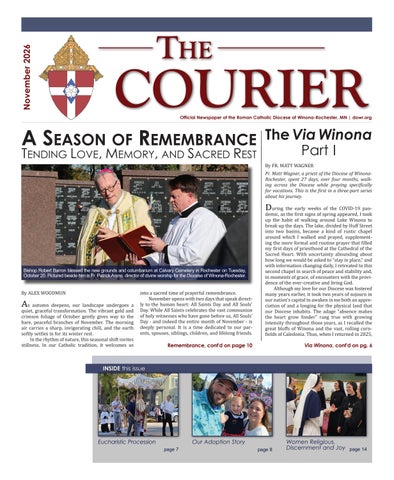
Bishop Robert Barron blessed the new grounds and columbarium at Calvary Cemetery in Rochester on Tuesday, October 20. Pictured beside him is Fr. Patrick Arens, director of divine worship for the Diocese of Winona-Rochester.
By ALEX WOODMUN
�
s autumn deepens, our landscape undergoes a quiet, graceful transformation. The vibrant gold and crimson foliage of October gently gives way to the bare, peaceful branches of November. The morning air carries a sharp, invigorating chill, and the earth softly settles in for its winter rest. In the rhythm of nature, this seasonal shift invites stillness. In our Catholic tradition, it welcomes us
into a sacred time of prayerful remembrance. November opens with two days that speak directly to the human heart: All Saints Day and All Souls’ Day. While All Saints celebrates the vast communion of holy witnesses who have gone before us, All Souls’ Day - and indeed the entire month of November - is deeply personal. It is a time dedicated to our parents, spouses, siblings, children, and lifelong friends.
Remembrance, cont'd on page 10
uring the early weeks of the COVID-19 pandemic, as the first signs of spring appeared, I took up the habit of walking around Lake Winona to break up the days. The lake, divided by Huff Street into two basins, became a kind of rustic chapel around which I walked and prayed, supplementing the more formal and routine prayer that filled my first days of priesthood at the Cathedral of the Sacred Heart. With uncertainty abounding about how long we would be asked to “stay in place,” and with information changing daily, I retreated to this second chapel in search of peace and stability and, in moments of grace, of encounters with the providence of the ever-creative and living God. Although my love for our Diocese was fostered many years earlier, it took two years of sojourn in our nation’s capital to awaken in me both an appreciation of and a longing for the physical land that our Diocese inhabits. The adage “absence makes the heart grow fonder” rang true with growing intensity throughout those years, as I recalled the great bluffs of Winona and the vast, rolling cornfields of Caledonia. Thus, when I returned in 2025,
Via Winona, cont'd on pg. 6
INSIDE this issue
Eucharistic Procession
Our Adoption Story page 7
page 8
Women Religious, Discernment and Joy page 14
The Courier Insider
2
Pope: Help Students Encounter Christ Amid 'Merciless' Treatment by Culture By VICTORIA CARDIEL, EWTN News
VATICAN, Oct. 22, 2026 - Pope Leo XIV on Thursday encouraged those involved in Catholic school and university pastoral ministry to respond to a “merciless” culture, which constantly compares and ranks young people, with the trust of Christ, capable of transforming lives just as it transformed the Twelve Apostles. “Jesus did not choose the Twelve because they were already courageous; he called them and, through his trust, made them capable. To our young people we must be able to repeat the words the disciples addressed to the blind Bartimaeus: ‘Take heart; get up, he is calling you,’” the pontiff said in a message addressed to participants in the International Congress on School and University Pastoral Ministry, which concludes Friday, Oct. 23, in the Paul VI Audience Hall. The gathering, organized by the Vatican’s Dicastery for Culture and Education, brings together 1,200 participants from 60 countries and is inspired by the apostolic letter “Charting New Maps of Hope,” the first apostolic letter of Pope Leo XIV. In it, he proposes a new phase of education built on three pillars: cultivating interiority, promoting a humane and rational use of digital technologies, and educating for peace. “Help the young people you encounter become protagonists of a new way of inhabiting the world, builders of fraternity and of a more just society. Courage is born from a covenant of trust: from the experience of someone believing in you before you believe in yourself,” the Holy Father said. Digital Loneliness and Feelings of Inadequacy
Leo XIV warned that many students today face situations of suffering marked by “wounded families, digital loneliness, feelings of inadequacy, or fear of a future that seems uncertain.” “We live in a culture of performance that constantly compares and ranks, sometimes mercilessly. A misunderstood meritocracy ends up
Our Adoption Story_______________________8 A Student's Reflection on Four Works of Mercy_9 Works of Mercy__________________________10
Among those taking part in the Vatican gathering is Carina Rossa, a member of the coordinating committee of the Global Compact on Education. According to Rossa, who is from Argentina, one of the most significant aspects of the congress is the renewed attention the Holy See is giving to educational pastoral ministry, an area that, she explained, until now did not have a dedicated structure within the Dicastery for Culture and Education. “Educational pastoral ministry is experiencing a revival driven by Leo XIV,” she said. “It is an
Most Reverend Robert E. Barron, Publisher Nick Reller, Associate Editor Telephone: 507-361-3068 E-mail: nreller@dowr.org Publishing Schedule: Monthly - Deadline for advertising & articles is the
November 2026 w The Courier w dowr.org
Eucharistic Procession_____________________7
‘Revival Driven by Leo XIV’
Vol 117 - 11
(ISSN 0744-5490)
From the Bishop_________________________4-5
failing to respect the dignity of persons,” he warned. For this reason, he stressed the importance of educational institutions being, above all, “a home, a familiar place where one is expected.” The pope also emphasized that the proper mission of education is the shared search for truth and encouraged educators to value young people’s questions and foster an encounter between faith and reason: “May your passion be to help young people experience the beauty of an encounter with Christ, as well as the fruitfulness of the synergy between faith and reason.” Leo XIV also invited participants to focus their efforts on the integral formation of young people, especially in educating their emotional life and interior life. “School and university pastoral ministry will be all the more fruitful the more it is centered on the education of the heart,” he said. In this regard, he encouraged the promotion of compassion, gratitude, sensitivity to the suffering of others, and openness to God, recalling that “charity and prayer are inseparable.” In closing, the pope compared the educational mission to Jesus’ accompaniment of the disciples on the road to Emmaus and urged teachers, chaplains, and pastoral workers to walk alongside young people and help them discover the gifts God has placed within them. “You have chosen to do something much greater: to walk with them along the way until they discover the gifts God has already placed within them,” he concluded.
The Courier is the official publication of the Diocese of Winona-Rochester 2907 Jeremiah Lane NW, Rochester, MN, 55901
10th of the month prior.
Articles of Interest
The Mystery of Death / Obituaries___________11 Catholic Schools News_________________12-13 Women Religious, Discernment and Joy___14-15 From the Catholic Foundation___________16 Dec. 31 Notification / A Legacy that Lives___17 Parish News & Events________________18-19 The Praying Family Toolbox________________20 Where to Find The Courier •
Hard copies are distributed at DOW-R parishes on the first or second weekend of each month.
•
An online version may be viewed at www.dowr.org/the-courier
•
To be added to the home delivery list free of charge, readers should send their names and addresses to: Diocese of Winona-Rochester The Courier 2907 Jeremiah Lane NW Rochester, MN 55901 or nreller@dowr.org
area that is the heart of the university and the heart of the school.” She recalled that the Global Compact on Education was launched by Pope Francis in 2020 and highlighted the importance of Leo XIV’s decision to take it up again and relaunch it during the Jubilee of the World of Education in 2025. “The fact that Pope Leo relaunched the Global Compact on Education has been very important in revitalizing this proposal,” she said. According to Rossa, universities and educational institutions in different parts of the world have shown renewed interest ever since. “There is a need for, and a new enthusiasm about, this project.” Three Priorities for Catholic Education
Rossa noted that the congress is centered on three major goals identified by Leo XIV: cultivating interior life, promoting a humane
Help Students, cont'd on pg. 9
Child Abuse Policy Information
The Diocese of Winona-Rochester will provide a prompt, appropriate and compassionate response to reporters of sexual abuse of a child by any diocesan agent (employees, volunteers, vendors, religious or clergy). Anyone wishing to make a report of an allegation of sexual abuse should call the Victim Assistance Coordinator at 507-454-2270, Extension 255. A caller will be asked to provide his or her name and telephone number. Individuals are also encouraged to take their reports directly to civil authorities. The Diocese of Winona-Rochester is committed to protecting children, young people and other vulnerable people in our schools, parishes and ministries. The diocesan policy is available on the diocesan web site at www.dow.org under the Safe Environment Program. If you have any questions about the Diocese of Winona-Rochester’s implementation of the Charter for the Protection of Children and Young People, please contact Michael Gerard at 507-361-3377, or mgerard@dowr.org.
November Saint
St. Martin of Tours
Feast Day: November 11 From EWTN
�
“ am a soldier of Christ. It is not lawful for me to fight.” St. Martin of Tours said these words at a point in his life when he chose to leave his military service and follow Christ. St. Martin de Tours (316–397) is one of the most beloved saints of the early church, remembered as a soldier, monk, bishop, and champion of the poor. Born in Savaria in modern-day Hungary to pagan parents, St. Martin’s family lived in northern Italy, where his father served as a Roman military officer. St. Martin felt drawn to Christ from a young age. At the age of 10, he attended a Christian church against his parents’ wishes and became a catechumen in preparation for becoming a Christian. At fifteen, like his father, he was enlisted into the Roman army. While serving the military in Gaul, St. Martin
The Holy Father's Intention for
November 2026
For the Proper Use of Wealth Let us pray for the proper use of wealth, that, not succumbing to the temptation of selfishness, it may always be put at the service of the common good and solidarity of those who have less.
experienced the moment that defined his conversion. Encountering a beggar shivering in the cold, St. Martin cut his soldier’s cloak in half and gave it to the man. That night, St. Martin dreamed of Christ wearing the same cloak and heard Him say, “Martin, still a catechumen, has clothed Me with this garment.” Understanding that Christ was calling him to become a Christian, he was baptized at the age of 18. St. Martin was charged as a coward and jailed when he told army officers that his Christian faith did not allow him to fight. He offered to go into battle without a weapon, but the battle did not take place because the enemy withdrew, so he was released from duty. After leaving the army, St. Martin dedicated himself to Christ, studying under St. Hilary of Poitiers. He founded one of the first monasteries in Gaul, which became a center of missionary activity. In 371, despite his reluctance, he was chosen bishop of Tours. According to tradition, he tried to hide to avoid the election, but the cackling of geese gave away his hiding place, so he accepted the bishopric. As bishop, St. Martin traveled the countryside on foot or on a donkey, preaching the Gospel and combating pagan practices. He founded parishes and monastic communities across Gaul, earning the love of his people. Many miracles were attributed to him, such as healings, exorcisms, and raising the dead. St. Martin died in 397 at Candes and was buried in Tours. His shrine quickly became one of the most popular pilgrimage sites in medieval Europe. In some areas, his feast day, November 11, became so widely celebrated that it marked the beginning of Advent preparations, known as St. Martin’s Lent. St. Martin was one of the earliest saints venerated by the Church who did not die a martyr. The Church canonized him by the popular acclaim of the people.
Why Was St. Martin of Tours Regarded as a Gifted Evangelist? St. Martin of Tours was a known evangelist who tirelessly spread Christianity throughout the countryside of Gaul by preaching, performing miracles, and converting pagans to Christianity. He traveled constantly, sharing the Gospel and performing miracles, such as casting out demons and curing the sick, to convert people in the countryside. He converted his mother and other people from his hometown, but his father did not convert. He visited parishes on foot or by donkey and preferred being among the people he served. His leadership was grounded in humility, accessibility, and a deep connection with the people.
3
What Happened to St. Martin's Cloak After He Shared It with the Beggar?
The half-cloak became a treasured relic known as the cappa. It was preserved in a shrine by the Frankish kings at the Marmoutier Abbey near Tours and was carried into battle. The small oratory built to house it was called a cappella—the origin of our word “chapel.” St. Martin’s act of caring for a beggar embodies the Christian call to love one’s neighbor. Did St. Martin of Tours Raise Someone from the Dead?
This Month in The Courier Archives
Yes, early accounts credit him with several miracles, including bringing a catechumen back to life through prayer. Stories of his healing abilities included accounts of St. Martin curing a woman of palsy and a person with leprosy. He cast out demons and raised a child and a slave back to life. He healed a boy in a pagan village, leading to the conversion of the entire community
---------------------------------25, 50 & 75 Years Ago----------------------------------
These members of the Knights of Columbus in Medford helped load a semi trailer with quilts and mission goods for the Salvatorian Missions based in New Holstein, Wisconsin. The goods were made and donated by the Winona Diocesan Council of Catholic Women. In the photo, from left to right, are Frank Conley, Greg Salmonsen, Greg Evans, John Ankrum, Mark Nelson and Al Sammon, who owns the loaded trailer in the background. Reprinted from November 2001.
Teresa Walter, secretary in the Diocesan Pastoral Center in Winona, puts together "The Church in the Diocese of Winona," an official document published and released by Bishop Loras J. Watters last week. The document is the most significant pastoral directive published by Bishop Watters since he was appointed to the Winona Diocese in March, 1969. Teresa herself marked an important date last week - 33 years as a secretary in the diocesan administrative offices.
CANTON - Pictured above is Mrs. George F. Snyder, Sr., of The Assumption Parish here receiving the papal honor of the Pro Ecclesia Et Pontifice medal from his Excellency the Most Reverend Edward A. Fitzgerald, D.D., LL. D., Bishop of Winona. The bestowal of the honor from His Holiness Pope Pius XII took place last Thursday evening, November 1, in the home of Mrs. Snyder. The recipient of the papal honor is the mother of 15 children, 10 living and five deceased. [...She] has been an examplary member of The Assumption Parish for 53 years and is a daily communicant. [...] The honor represents the highest conferred upon women by the Holy Father in recognition of stalwart Catholic leadership and exemplary Catholic living.
Reprinted from November 26, 1976.
Reprinted from November 4, 1951. November 2026 w The Courier w dowr.org
Two Weeks of Grace
4
� he
a massive television audience. The burden of my homily was to show the holiness of Archbishop Sheen, precisely what made him a friend of Jesus Christ. You can watch it on YouTube if you so desire. The next day, I concelebrated the Mass of Beatification for Sheen in a colossal sports arena in St. Louis. The estimated crowd was approximately 70,000. The procession of 1,000 priests into the venue took a full 45 minutes! For me, the single most moving moment in the ceremony occurred when the boy whose life was saved through the intercession of Fulton Sheen carried the relic of the Blessed through the congregation and into the sanctuary. Do you know his story? Just after his birth, he stopped breathing and remained without respiration for a full 61 minutes. After his parents and the parish priest invoked Sheen and placed a relic on the child’s chest, he began to breathe. The doctors were astounded, but they told the boy’s parents that he would be profoundly disabled. Well, I saw him walking up the aisle that day in St. Louis as a happy and healthy teenager. Don’t tell me miracles never happen. After briefly visiting the new Blessed’s grave at the Cathedral in Peoria, Illinois, I made my way, with a small team from Word on Fire, to Rome. My first happy responsibility there was to give a paper at
the US Embassy to the Vatican in celebration of America’s 250th anniversary. I met, just before the presentation, with Brian Burch, the United States ambassador to the Holy See, and we spoke about a number of issues pertaining to relations between the Church and the present administration. Then the ambassador escorted me to a sumptuous room where several hundred people, largely from the diplomatic corps and the world of academe, had gathered. The topic of my speech was the deep compatibility between the ideals articulated by our Founding Fathers and several key motifs from Catholic social teaching. Toward the end of my talk, I developed a theme that has long fascinated me, namely, how the tripartite, carefully balanced, arrangement inaugurated by Madison, Hamilton, Washington, and company was anticipated by Thomas Aquinas in some of his principal political writings from the 13th century. The next day I had the incomparable privilege of a private audience with the successor of Peter. I arrived at the Vatican and was brought to an elevator that took me to the floor of the Apostolic Palace where the Pope has his personal residence. After a brief wait, I was ushered into the library where stood Leo XIV. He extended his hand to me and said, “Well, two guys from Chicago!” From that moment, I felt perfectly relaxed in his
presence. We spoke for a half hour and covered a number of topics, including the work of Word on Fire, my year with the President’s religious liberty commission, our time together as delegates to the Synod of Synodality, and, finally, where I think the Church in America is particularly vibrant. In a lovely pastoral touch at the conclusion of our visit, the Pope looked at me and said, “I have one more question: how are you doing?” When I told him I was doing well but that I felt at times overextended, he said, “Yes, I can see that. Please take care of yourself.” As if a meeting with the Pope wasn’t spiritually powerful enough, that very evening, I celebrated the diaconate ordination Mass for 18 young men from the North American College, including Ryan Saltness from our own diocese. The music, the architectural setting, the palpable sense of history, the presence of 1500 people around the altar of the chair, the delight in the faces of the new deacons - all of it made for an unforgettable experience. A few times during the ceremony, I consciously paused to remind myself that I was celebrating Mass in the greatest ecclesiastical building in the world, built above the tomb of the Galilean fisherman to whom Jesus himself said, “You are Peter and upon this rock I will build my church." As a sort of coda to the trip, our team made a brief
The Most Rev. Robert Barron, Bishop of the Diocese of Winona-Rochester, announces the following:
Directors, effective October 1, 2026.
Catholic Charities Board of Directors, effective October 1, 2026.
Ms. Karina Velazquez Rowles: Appointed to a three-year term on the Catholic Charities Board of Directors, effective October 1, 2026.
Board of Trustees, effective November 15, 2026.
Clergy - Co-Cathedral of St. John the Evangelist, Rochester
November 22, Sunday *10:00 a.m. - Christ the King Mass- Cathedral of the Sacred Heart, Winona
From the Bishop
closing weeks of this past September were among the most graced of my life. I had the opportunity, first, to assist at the events surrounding the beatification of one of my spiritual heroes, Fulton J. Sheen; and then I travelled to Rome to ordain 18 men to the diaconate at St. Peter’s Basilica and to enjoy a private audience with Pope Leo. It all made for a pretty heady experience. The Sheen extravaganza commenced with a Vespers service at the magnificent Cathedral Basilica of St. Louis, at which I had been invited to deliver the homily. That stunning basilica has one of those old-fashioned pulpits that must be mounted by stairs and that seem to hover over the crowd. Though I am a pretty experienced public speaker, I will confess to feeling a little trepidation as I climbed to my lofty perch and prepared to speak to a congregation of cardinals, archbishops, bishops, hundreds of priests and religious, roughly 1700 lay people - not to mention
Officials
Catholic Charities
Mr. Mike Ludvik: Reappointed to a three-year term on the Catholic Charities Board of
Bishop's Calendar
*indicates event open to public November 1, Sunday *10:45 a.m. - All Saints Day Mass and St. Carlo Acutis Celebration - Pax Christi, Rochester
November 2, Monday *6:30 p.m. - Requiem Mass with Cardinal Koch - St. Agnes, St. Paul
Mr. Patrick Marek: Appointed to a three-year term on the Catholic Charities Board of Directors, effective October 1, 2026.
Ms. Teresa Speck: Reappointed to a three-year term on the
November 3, Tuesday *7:30 a.m. - Mass with Archbishop Hebda - Cathedral of St. Paul, St. Paul Beauty Will Save Us Benedict XVI Conference - St. Mary's University, Minneapolis, MN November 4-6, WednesdayFriday The New Ressourcement Conference - Rochester
November 2026 w The Courier w dowr.org
Mr. Robertolino Vargas Guerrero: Appointed to a three-year term on the Catholic Charities Board of Directors, effective October 15, 2026.
November 7, Saturday Women's Conference - Lourdes High School, Rochester
November 8, Sunday *10 a.m. - Mass - Ss. Peter & Paul, Mazeppa November 10, Tuesday 10:30 a.m. - College of Consultors - The Chancery, Rochester November 13, Friday *12:10 p.m. - Mass for Deceased
Hermits of St. Mary of Carmel
Ms. Tammy Palubicki: reappointed to a two-year term on the Mount Carmel Hermitage November 14, Saturday American Catholic Philosophical Association - Washington, D.C. November 15, Sunday *10:30 a.m. - Mass - Baltimore Basilica, Baltimore, MD
November 16 -19, MondayThursday USCCB Plenary Assembly Baltimore, MD
Non Nisi Te Domine Bishop Robert Barron overnight visit to Naples. There, I prayed at the tomb of Don Dolindo Ruotolo, the holy man responsible for the famous Surrender Novena (look up his story online if you don’t know much about him). I also had the marvelous opportunity to celebrate Mass in the side chapel of the church of San Domenico Maggiore, where St. Thomas Aquinas had his mystical conversation with Jesus. When the Lord asked him what he wanted as a reward for his great work, Thomas said, simply, non nisi te, Domine (nothing but you, Lord). As you probably know, I chose that response as my episcopal motto. So, a wonderful two weeks of grace. But it’s also nice to be home!
Pension Plan for Priests
Rev. James Berning: elected to a three-year term as the age 51-70 Representative on the Pension Plan for Priests Board of Trustees, effective July 1, 2026.
November 30 - December 1, Monday-Tuesday Catholic University of America Board of Trustees Meeting Washington, D.C.
Dos semanas de gracia por EL OBISPO ROBERT BARRON
�fueron as últimas semanas del pasado mes de septiembre de las más bendecidas de mi vida. En primer
lugar, tuve la oportunidad de asistir a los actos relacionados con la beatificación de uno de mis héroes espirituales, Fulton J. Sheen; y después viajé a Roma para ordenar a 18 hombres al diaconado en la Basílica de San Pedro y disfrutar de una audiencia privada con el papa León. Todo ello supuso una experiencia realmente embriagadora. La gran celebración en honor a Sheen comenzó con un oficio de vísperas en la magnífica Catedral Basílica de San Luis, al que me habían invitado a pronunciar la homilía. Esa impresionante basílica cuenta con uno de esos púlpitos antiguos a los que hay que subir por unas escaleras y que parecen flotar sobre la multitud. Aunque tengo bastante experiencia como orador público, confieso que sentí un poco de nerviosismo al subir a mi elevada tribuna y prepararme para dirigirme a una congregación formada por cardenales, arzobispos, obispos, cientos de sacerdotes y religiosos, unos 1.700 laicos - por no hablar de una enorme audiencia televisiva. El objetivo principal de mi homilía era mostrar la santidad del arzobispo Sheen, precisamente lo que le convertía en amigo de Jesucristo. Pueden verla en YouTube si así lo desean. Al día siguiente, concelebré la misa de beatificación de Sheen en un colosal pabellón deportivo de San Luis. Se calcula que la multitud ascendía a unas 70.000 personas. ¡La procesión de 1.000 sacerdotes hasta el recinto tardó cuarenta y cinco minutos! Para mí, el momento más conmovedor de la ceremonia se produjo cuando el niño cuya vida se salvó gracias a la intercesión de Fulton Sheen llevó la reliquia del Beato entre la congregación hasta el santuario. ¿Conocen su historia? Justo después de nacer, dejó de respirar y permaneció sin respiración durante sesenta y un minutos completos. Después de que sus padres y el párroco invocaran
a Sheen y colocaran una reliquia sobre el pecho del niño, este comenzó a respirar. Los médicos quedaron asombrados, pero les dijeron a los padres del niño que quedaría gravemente discapacitado. Pues bien, ese día en San Luis lo vi caminar por el pasillo como un adolescente feliz y sano. No me digan que los milagros nunca ocurren. Tras visitar brevemente la tumba del nuevo Beato en la catedral de Peoria, Illinois, me dirigí, junto con un pequeño equipo de Word on Fire, a Roma. Mi primera y grata responsabilidad allí fue presentar una ponencia en la Embajada de Estados Unidos ante el Vaticano con motivo de la celebración del 250º aniversario de Estados Unidos. Justo antes de la presentación, me reuní con Brian Burch, embajador de Estados Unidos ante la Santa Sede, y hablamos de una serie de cuestiones relacionadas con las relaciones entre la Iglesia y la actual administración. A continuación, el embajador me acompañó a una suntuosa sala donde se habían reunido varios cientos de personas, en su mayoría pertenecientes al cuerpo diplomático y al mundo académico. El tema de mi discurso fue la profunda compatibilidad entre los ideales articulados por nuestros Padres Fundadores y varios motivos clave de la doctrina social católica. Hacia el final de mi intervención, desarrollé un tema que me ha fascinado desde hace tiempo, a saber, cómo el ordenamiento tripartito y cuidadosamente equilibrado inaugurado por Madison, Hamilton, Washington y compañía ya había sido anticipado por Tomás de Aquino en algunos de sus principales escritos políticos del siglo XIII. Al día siguiente tuve el privilegio incomparable de una audiencia privada con el sucesor de Pedro. Llegué al Vaticano y me llevaron a un ascensor que me trasladó a la planta del Palacio Apostólico donde el Papa tiene su residencia personal. Tras una breve espera, me hicieron pasar a la biblioteca, donde se encontraba León XIV. Me tendió la mano y dijo: «¡Vaya, dos hombres de Chicago!». Desde ese momento, me sentí perfectamente relajado en su presencia. Hablamos durante media hora
On September 25, at the Inaugural Sheen Awards that followed the Beatification of Archbishop Fulton Sheen, Bishop Barron received the Evangelization Impact Award for preaching writing and speaking. Photo by Laurie Archbold.
y abordamos varios temas, entre ellos la labor de Word on Fire, mi año en la comisión presidencial para la libertad religiosa, el tiempo que pasamos juntos como delegados en el Sínodo sobre la sinodalidad y, por último, los aspectos en los que, en mi opinión, la Iglesia en Estados Unidos se muestra especialmente dinámica. En un precioso gesto pastoral al concluir nuestra visita, el Papa me miró y me dijo: «Tengo una pregunta más: ¿cómo estás tú?». Cuando le dije que estaba bien, pero que a veces me sentía desbordado, me respondió: «Sí, ya lo veo. Por favor, cuídate». Por si un encuentro con el Papa no fuera ya lo suficientemente intenso espiritualmente, esa misma tarde celebré la misa de ordenación diaconal de 18 jóvenes del Colegio Norteamericano, entre ellos Ryan Saltness, de nuestra propia diócesis. La música, el entorno arquitectónico, la sensación palpable de historia, la presencia de 1.500 personas alrededor del altar de la cátedra, la alegría en los rostros de los nuevos diáconos… Todo ello contribuyó a que fuera una experiencia inolvidable. En varias ocasiones durante la ceremonia, hice una pausa consciente para recordarme a mí mismo que estaba celebrando la misa en el edificio eclesiástico más grandioso del mundo, construido sobre la tumba del pescador galileo a quien el propio Jesús dijo: «Tú eres Pedro y sobre esta piedra edificaré mi Iglesia». A modo de colofón del viaje, nuestro equipo hizo una breve visita de una noche a Nápoles. Allí recé ante la tumba de Don Dolindo Ruotolo, el santo responsable de la famosa Novena de la Rendición (busquen su historia en Internet si no saben mucho sobre él). También tuve la maravillosa oportunidad de celebrar la misa en la capilla lateral de la iglesia de San Domenico Maggiore, donde santo Tomás de Aquino mantuvo su conversación mística con Jesús. Cuando el Señor le preguntó qué quería como recompensa por su gran obra, Tomás respondió, sencillamente: «non nisi te, Domine» (nada más que a ti, Señor). Como probablemente saben, elegí esa respuesta como mi lema episcopal. Así pues, han sido dos semanas maravillosas llenas de gracia. ¡Pero también es estupendo estar de vuelta en casa!
5
On October 1, in the Vatican, Bishop Barron ordained 18 seminarians from the Pontifical North American College - including the Diocese of Winona-Rochester's own Ryan Saltness - to the transitional diaconate. Photo by Word on Fire.
On October 7, Bishop Barron visited Immaculate Heart of Mary Seminary in Winona for Vespers, Mass, dinner and conversation with the seminarians. Photo by Nick Reller. On October 17, at St. Marys Hospital in Rochester, Bishop Barron celebrated the White Mass for healthcare professionals. Photo by Word on Fire.
On October 20, Bishop Barron joined the 40 Days for Life Prayer Vigil held outside Planned Parenthood in Rochester. Photo by Emily Smithley.
November 2026 w The Courier w dowr.org
6
Via Winona, cont'd from pg. 1
several of my brother priests can attest to car rides across the Diocese in which I would spontaneously cry out in disbelief, captivated by the beauty and sheer expanse of this place, the Diocese of WinonaRochester. To this day I frequently consider the words of Psalm 8: When I look at your heavens, the work of your fingers, the moon and the stars, which you have set in place, what is man that you are mindful of him, and the son of man that you care for him? . . . O Lord, our Lord, how majestic is your name in all the earth!
My return coincided with a historic occasion for the Diocese: its first diocesan synod since the mid1900s. In late August 2025, Bishop Barron convened more than 200 of the faithful to discern where and in what ways the Holy Spirit is moving, and how we might assist the Bishop in his governance of the Diocese. From this synod emerged a clearly articulated focus, one the Bishop has prioritized since his first days in office: evangelization and vocations. Shortly after the synod, I began both of my present assignments: working directly with vocations to the priesthood as a formator at Immaculate Heart of Mary Seminary, and serving two days per week in the Diocesan Tribunal in Rochester. Although neither role is confined to “office work,” much of my time is spent at a desk, a circumstance that might seem antithetical to the life of an ordinary parish priest. From this place of apparent hiddenness at both the tribunal and the seminary, and hoping to heed the Bishop’s call to pray and act upon the twofold focus of evangelization and vocations, I found my mind and heart returning one day in prayer to the lakes of Winona, and to the desire to be in God’s creation, in the particular place that is our Diocese. Within weeks, I began proposing an idea to my brother priests: “What if we walked across the Diocese, praying for vocations?” The response was unenthusiastic, though I can hardly blame those I consulted, since the prospect of trekking from the Mississippi River to the plains of Pipestone is rather absurd. I have had the privilege of driving our two previous bishops, John Quinn and the late Bernard Harrington, across the southern 20 counties of the Diocese on numerous occasions, and from these trips of happy memory I came to know this geographic fact by heart: the Diocese is “about four and a half hours long, and about an hour to an hour and
a half top to bottom, depending on where you are.” Yet my mind kept returning to the idea of walking its full length. After continued prayer and discernment about whether the undertaking was feasible, I decided, somewhat on a whim, to begin on May 4, 2026. I drove to the Cathedral of the Sacred Heart in Winona, where my priestly ministry began, and walked from there to the Mississippi River. I blessed myself with its waters (after all, they had been blessed by Bishop Andrew Cozzens of the Diocese of Crookston a year earlier at Lake Itasca, and surely that water had reached Winona by then) and set out for Rollingstone. After walking nearly eleven miles over a few hours, I gratefully reached my first stop, Holy Trinity Catholic Church in Rollingstone, where I prayed and then drove back to Winona. I was somewhat disheartened at the thought of repeating the process twenty-six more times, but from that first day I adopted a simple resolve: “Well, Lord, if you get me through this one, I’ll keep going.” Four months and more than three hundred miles later, I can say that this attitude was crucial to completing the Via Winona. Perhaps there is something to be gleaned there about the pilgrimage of life as well. In the days that followed, I walked from Rollingstone to Lewiston, then to St. Charles, Eyota, Rochester, and, farther still, west. I scheduled the walks as my calendar permitted, typically covering ten to twelve miles every three to five days. The early stages were fairly easy; the greatest obstacle was imposing on the good Samaritans who would either position my car at the final destination or pick me up upon arrival. Happily, the generosity of my brother priests, our seminarians, and countless others along
The South Dakota border, west of Pipestone, marks the end of the Via Winona. November 2026 w The Courier w dowr.org
the way made this possible. Since the earliest centuries, Christians have made pilgrimages to holy sites such as Jerusalem and Rome and, from the Middle Ages onward, to the increasingly renowned Camino de Santiago de Compostela in Spain. Such pilgrimages “evoke our earthly journey toward heaven” and are traditional occasions for renewal in prayer (CCC 2691). They also teach countless lessons that form us as human persons. In permitting us to endure unexpected difficulty, setbacks, and adversity, God allows us to be tested, not out of cruel curiosity about the limits of our endurance, but out of a desire to instruct us in the school of his providence and to draw out of us strength and character we may not have known we possessed. While the lessons I learned along the Via Winona are not quite so dramatic, God’s creation is replete with them, and I hope to share a few in the next two editions of The Courier. In the meantime, I ask of you what I asked of each person I encountered along the way: please join me in prayer, asking our supremely good God to raise up an abundance of priests for our Diocese, men who will both hear and answer the call to lay down their lives in service of God and his Church. Please pray also for religious sisters and brothers, and for holy marriages. Vocations are not born in a silo or a vacuum, but in ordinary places: a family farm in Chatfield, the bustling streets of Rochester, the lakes of Winona, St. James, or Fairmont, and all the way to the plains of Luverne. Fr. Matt Wagner is the judicial vicar for the Diocese of Winona-Rochester.
Look for parts II and III of Fr. Wagner's Via Winona in upcoming editions of The Courier.
The Mississippi River at Winona's Levee Park.
Eucharistic Procession Begins Push for Perpetual Adoration in Winona By EMILY LOFY
The following article first appeared in the Winona Post.
�
f you happened to be driving on the east end of Broadway in Winona on Sunday morning, October 11, you may have noticed quite the sight: nearly 200 people - young, elderly, and everyone in between - walking in procession from the Basilica of St. Stanislaus to the Cathedral of the Sacred Heart. The occasion? A Eucharistic Procession. Eucharistic Processions are a long-held tradition by the Catholic Church, dating back to the 13th century. Their purpose is quite simple and yet profound: to accompany the King. Regarded as the “source and summit” of the Catholic faith, the Eucharist is a consecrated host of unleavened bread that has been transubstantiated into the body of Jesus Christ, and is made present at every Catholic Mass. The host is then placed in a gold stand, called a “monstrance”. The monstrance is held up for all to see by a priest or deacon, and accompanied by servers bearing candles, bells, and incense. The faithful are then invited to process or walk behind the monstrance while singing hymns or praying. Its feel has a sort of “spiritual pilgrimage”, in which the
graces of the Eucharistic Jesus, accompanied by the prayers said along the way, leave a path of grace in its wake. Spanning the one-mile distance between the two churches, Sunday’s procession lasted nearly 45 minutes, a distance that would take a walker just 22 minutes at a normal pace. As the pilgrims walked along, beautiful melodies were heard from a cacophony of voices, while young children scattered rose petals along the way. Its overall effect was both peaceful and joy-filled. The procession, flowing from the conclusion of the regular 8 a.m. Sunday Mass at the Basilica, ended inside the Cathedral with a short period of worship, followed by the scheduled 10 a.m. Sunday Mass. Attendees were able to ride a shuttle bus from the Cathedral to the Basilica either before or after the procession to minimize the need for a round-trip walk. While Eucharistic Processions can be held for any reason, this particular event marked the launching of a robust campaign for the Winona Area Adoration Chapel. In partnership with the Cathedral of the Sacred Heart and the Basilica of St. Stanislaus, the Adoration Chapel, housed in the Cathedral, is attempting to grow its operating hours to 24/7, or perpetual adoration. A staple in the Winona Catholic community for over 30 years,
the Eucharistic Adoration Chapel is a place to encounter Jesus in silence and reverence, as a type of extension of the Holy Mass. The Winona Area Adoration Chapel is currently open from Mondays at 7 a.m. through Fridays at 6 p.m., with one or more people present at all hours of the day and night to accompany and encounter Jesus. Through the “In His Presence” campaign, powered by the Adoratio Foundation, the Winona Adoration Chapel seeks to add enough “adorers” or scheduled persons to remain open perpetually. The campaign will run four months from September through December, with a goal for the perpetual schedule to begin at the start of January. In order to achieve this, an estimated 70 new adorers will need to sign up for a weekly adoration hour. The Cathedral’s parochial vicar, Fr. Brian Klein, commented after the procession: “Jesus’s last words to his disciples were, ‘Behold, I am with you always, even to the end of the age.’ The Eucharist is a fulfillment of that promise that God will be with us through thick and thin, and it was incredibly moving to walk through the very streets of our city with him. Making time to pray in Eucharistic Adoration has transformed my life, and I’m so excited to see how God works through this campaign to form a heartbeat of continuous prayer right here in Winona!”
7
Emily Lofy is a parishioner at the Cathedral of the Sacred Heart in Winona. Photos by Mary Farrell.
November 2026 w The Courier w dowr.org
8
Our Adoption Story
The Family We Were Waiting For
Submitted by KRISTINA HAMMELL
In celebration of National Adoption Month, we share the story of Mark and Kelly, who welcomed their daughter Amelia to their family with the help of Catholic Charities of Southern Minnesota, and who wrote the following reflection.
�
or a long time, Kelly and I wondered how our family would grow. We had built a life together, gotten married, made a home, and shared countless adventures. We always hoped that children would eventually be part of that life. When we began our adoption journey, we didn't know exactly how our story would unfold or how long we would be waiting. We simply knew that we were ready to become parents. As we prepared for adoption, we created an adoption book to introduce ourselves to a birth mother who might someday choose us. We filled its pages with pictures of our lives, our family, our dogs, our interests, and the kind of home we hoped to provide. We wrote about the adventures we wanted to share, the traditions we wanted to create, and, most importantly, the love we hoped to give our future child. At the time, it was a book about a child we hadn't met yet. Then, in November 2023, our lives changed. We learned that we had been chosen to be parents to a baby on the way. We were overwhelmed with excitement. Our families had been waiting and hoping right alongside us, so telling them that they were going to become grandparents was incredibly special. We already knew the answer, but watching our families discover that we were expecting a child made it a moment we will always remember. We were having a little girl. Her name would be Amelia Rose. One of the most meaningful parts of our adoption journey was the relationship we began building with Amelia's birth mother. From our first meeting, we connected immediately. We knew that an open adoption was important to
November 2026 w The Courier w dowr.org
everyone involved, and we wanted to approach the relationship with honesty, respect, and a shared commitment to what would be best for Amelia. That meant our adoption journey didn't feel like simply waiting for a baby. We were able to be part of the journey leading up to her birth. We shared conversations, hopes, plans, and excitement as we prepared to welcome Amelia into the world. In January 2024, Amelia was born. After so much waiting, hoping, planning, and wondering, we finally got to meet the little girl who would change our lives forever. The days surrounding her birth are some of the most meaningful of our lives. We were able to be nearby, and Amelia spent time with both her birth mother and us in the hospital. When she was cleared to leave, she went home with us. It was the beginning of our life together as a family. Our adoption was finalized in April. We celebrated - surrounded by the people who had supported us throughout the journey - and it was an incredibly special day. We were finally able to officially celebrate what we already knew in our hearts: we were Amelia's parents, and she was our daughter. But our adoption story didn't end on adoption day. One of the things we are most grateful for is that our open adoption has allowed Amelia's birth mother to remain part of her life. We have been able to spend time together, share pictures and videos, celebrate milestones, and create memories. We hope that as Amelia grows, she will understand how many people loved her from the very beginning and that she will always know the story of where she came from. That relationship is something we treasure. Adoption brought us together in a very unique way, and over time, that relationship has become something much bigger than the circumstances that first brought us together. Today, our family looks a little different from what we once imagined. We are a family of three, or five if you count our two dogs, Leia and Raya. And
life with Amelia has been better than we could have imagined. She has brought so much light, laughter, and adventure into our lives. We have celebrated holidays together, traveled to see family, taken her on her first beach trip, explored new places, and made countless memories along the way. Sometimes the moments that mean the most are the simplest ones, like watching her hold hands with a friend as they walk to the car or seeing her experience something for the very first time. Our extended family has become an important part of Amelia's life, too. She has grandparents, cousins, aunts, uncles, and friends who love her tremendously. Watching those relationships develop has been one of the most rewarding parts of becoming parents. When we look back at the adoption book we created before Amelia was born, it is hard not to smile. We can see two people who were hoping, dreaming, and wondering who would eventually become part of their family. We had no idea what the future would hold. We didn't know her name. We didn't know what she would look like. We didn't know what her laugh would sound like or what would make her smile. We didn't know that the little girl we were waiting for would eventually fill our home with laughter, toys, stories, adventures, and a love that is hard to put into words. But God knew. He knew we weren't simply waiting for a child. We were waiting for the right child, the right birthmother, and the right moment for our family to come together. He knew who would choose us, and He knew that one day we would look back and understand why the waiting was worth it. We feel incredibly blessed that our adoption journey brought us to Amelia. We are grateful for her birth mother and the trust she placed in us, grateful for the family and friends who supported us throughout the process, and grateful for everyone who continues to be part of Amelia's life. Our adoption book ended with the idea that the story didn't end there. It turns out that was the most important part. The book was only the beginning. The real story started when Amelia came into our lives, and we are grateful that we get to keep writing it together.
As we recognize National Adoption Month this November, we are grateful to this family for sharing their story and giving us a glimpse into their adoption journey. Their experience is a beautiful reminder of the love, hope, and joy that can come with growing a family through adoption. Every adoption journey is unique, and each family has its own story of how they come together. At Catholic Charities of Southern Minnesota, we are grateful to be part of these journeys and to help families navigate the path to adoption. If adoption is something you have been thinking about, we would be happy to talk with you, answer your questions, and help you learn more about what the journey might look like for your family. Visit ccsomn.org or contact our office at 507-287-2047 to learn more. Kristina Hammell is the development and outreach director for Catholic Charities of Southern Minnesota.
A Student's Reflection on Four Works of Mercy An Example of Work Meeting the New Diocesan Confirmation Guidelines Submitted by ANNA THERNEAU
In June of 2025, the Diocese of Winona-Rochester released updated confirmation guidelines. Rather than complete a required number of service hours, each confirmand is now asked to "read through the Works of Mercy, pick at least four to try out/ practice, and write a two-page reflection or prepare a presentation" on the experience. Anna Therneau, director of lifelong faith formation at the Cathedral of the Sacred Heart, received a student reflection demonstrating the level of thought and engagement that the new guidelines are meant to inspire. The author's name has been withheld for privacy. Bury the Dead For the work of mercy “burying the dead,” I chose to focus on the importance of supporting a close friend and their family after the passing of a loved one. When I learned that my friend’s family was grieving, I knew that simply offering words of sympathy wasn’t enough; I wanted to be present in a way that eased their burden. I spent time at their home helping with the practical tasks that often become overwhelming during a time of loss, such as preparing meals, organizing the house for guests, and running errands so the family could focus on each other. I also attended the funeral service to stand by my friend’s side, offering my presence as a sign of solidarity. This experience taught me that “burying the dead” is a deeply communal act. It is about honoring the life of the person who has passed while ensuring that those left behind do not have to walk through their grief in isolation. By helping my friend’s family, I realized that mercy is often found in the quiet, humble tasks that allow others to mourn with dignity. It reminded me that we are called to be the hands and feet of Christ, providing comfort and stability when the world feels like it is falling apart. This experience deepened my understanding of the sanctity of life and the importance of being a faithful, supportive friend who reflects God’s love during the most difficult transitions of life. Giving Drink to the Thirsty
For this work of mercy, I chose to focus on “giving drink to the thirsty” by addressing the needs of
Help Students, cont'd from pg. 2
use of digital technologies, and educating for peace. In particular, she emphasized the importance of recovering the spiritual dimension of education in a context marked by a crisis of meaning and mental health challenges among young people. “What is emerging strongly is a great desire for meaning, interiority, spirituality, and silence,” she said. “We appreciate that Pope Leo speaks about this from his Augustinian charism, but above all because he does so in light of listening to young people,” the Global Compact on Education representative said. She explained that in recent years the initiative has gathered testimonies and concerns from young people in different countries. While she sees among them a strong social commitment and a desire for an integral education, she
those working outdoors in my community. During a particularly hot week, I noticed that the landscaping crew working in our neighborhood and the mail carrier were constantly exposed to the heat. I decided to set up a small cooler on our porch filled with cold water bottles and a sign that said, “Please take one if you are thirsty.” It was a simple gesture, but it changed the way I looked at my daily routine. I started to pay attention to the people who are often overlooked - the workers who keep our community running while dealing with the elements. One day, I saw the mail carrier stop, take a bottle, and wave a thank you toward the house. That small interaction made me realize that “giving drink to the thirsty” is about recognizing the basic human needs of others and acting on them without needing to be asked. It taught me that mercy doesn’t always have to be a grand, public gesture; sometimes, it is a quiet act of thoughtfulness that provides relief to someone who is working hard. This experience helped me understand that we are called to be “living water” for other, providing comfort and refreshment whenever we see a need. It reminded me that even a small bottle of water can be a sign of respect and care, reflecting the love that Christ calls us to show to every person we encounter. Visiting the Sick
For this work of mercy, I chose to “visit the sick” by spending time with a relative who has been recovering from a long-term illness at home. I knew that being confined to a room for weeks can be incredibly isolating, so I decided to bring some cheer to their day. I didn’t go with a grand agenda; instead, I brought a small puzzle and some magazines, thinking that we could work on them together. When I arrived, I could see how much they appreciated the company, as they had been feeling quite lonely and disconnected from the outside world. We spent the afternoon talking, and I made sure to listen more than I spoke, allowing them to share their frustrations and hopes for recovery. This experience
believes there is an even deeper need. “St. Augustine reflects today’s young person very well, searching everywhere until discovering that God was within him all along,” she said. A Pastoral Ministry that Transforms Academic Life
For Rossa, educational pastoral ministry should not be understood as a parallel activity or one limited to religious celebrations but as a dimension capable of transforming the entire life of an academic institution. “It is not something isolated, nor is it only about celebrations,” she explained. “It can revitalize the way we teach, the way we relate to students, the way the university connects with its local community, or how it approaches questions such as care for creation, the search for truth, beauty, and culture.” After only the first day of the congress, the Argentine highlighted the high quality of the presentations and the atmosphere among participants.
9
taught me that “visiting the sick” is not just about checking a box or fulfilling a requirement; it is about recognizing the humanity of someone who is suffering. It reminded me that when people are ill, they often feel forgotten or like a burden, and my presence served as a reminder that they are loved and valued. I realized that by simply sitting with them, I was participating in the healing ministry of Jesus, who always made time for those who were suffering. This act of mercy helped me grow in patience and empathy, and it deepened my understanding of how important it is to be a source of comfort to those who are physically or emotionally vulnerable. Feeding the Hungry
For the work of mercy “feeding the hungry,” I chose to reach out directly to a person experiencing homelessness in my city. I had noticed this individual sitting near a local park on my way home from school several times, and I felt a strong call to do something more than just walk by. I decided to prepare a bag with a nutritious meal, a bottle of water, and a few essential items, and I brought it to them. When I approached, I was nervous, but I made sure to introduce myself and ask if they would like the meal. We ended up talking for a few minutes, and I learned their name and a little bit about their story. This experience completely changed my perspective; it moved the concept of “hunger” from a statistic I read about to a real person with a name, a history, and a dignity that deserves to be recognized. It taught me that “feeding the hungry” is not just about the physical act of providing food, but about acknowledging the humanity of someone who is often ignored by society. It reminded me of the Gospel teaching that whatever we do for the least of our brothers and sisters, we do for Christ. This encounter helped me realize that mercy is about breaking down the barriers of indifference. By simply stopping to share a meal and a conversation, I was able to offer a moment of connection and respect, which I realized was just as important as the food itself.
“There is a lot of enthusiasm,” she said. “The 1,200 people gathered here are not only listening but are creating a true community among pastoral workers from different parts of the world.” Unexpected Encounter With the Pope
One of the most moving moments of the congress was the encounter with Leo XIV, which had been on the schedule for weeks but had been thrown into doubt because of his recent lung cancer surgery, from which he is gradually recovering. “It was very moving because we were not expecting it,” Rossa recounted. “Given his health situation, it seemed to me a very generous gesture on his part.” After his address, Leo XIV personally greeted several of the speakers and participants.
This story was first published by EWTN News Español, the Spanish-language sister service of EWTN News. It has been translated and adapted by EWTN News English. November 2026 w The Courier w dowr.org
8
Remembrance,
cont'd from pg. 1
Through the Communion of Saints, we are reminded that death does not break the bonds of Christian love; it merely changes form. The Sacredness of Bodily Rest
In an increasingly fast-paced world, it can be easy to view remembrance as an abstract, purely internal exercise. Yet our faith has always been grounded in the tangible and the sacramental. We believe that our earthly bodies are not mere shells, but sacred gifts - temples of the Holy Spirit, cherished in life, and destined for something greater. When we lay our loved ones to rest in a cemetery, mausoleum, or columbarium, we are participating in an ancient and beautiful promise: the hope of bodily resurrection. Just as Christ was laid with reverence in the tomb, our deceased are committed to consecrated ground, awaiting the dawn of eternal life. Cemeteries have historically been known as God’s acre or dormitories - a word derived from the Greek koimeterion, meaning a place of peaceful sleep. There is profound spiritual dignity in preserving this resting place. Keeping our loved ones together in a dedicated, sacred location provides an enduring home where generations can visit, kneel, and pray. When family members rest side by side or are entombed together under holy protection, it honors their shared journey in this life and marks
a permanent witness to their eternal bond. It gives future generations an anchor - a sacred coordinate on this earth where memory, gratitude, and prayer intersect. Tending the Memorial: Practical Care for the Coming Freeze
Caring for a loved one’s final resting place is a tender extension of our call to bury the dead and pray for their souls. As we prepare for the winter frost and the quiet blanket of snow, a seasonal visit to tidy and prepare the memorial is a meaningful way to honor their memory. Here are a few gentle suggestions as you visit throughout November: •
•
•
Tidying the Grounds: Before the ground freezes, take a moment to clear away fallen leaves, faded summer annuals, and brittle stems. Returning the surrounding grass and stone to a clean, restful state brings a sense of order and peace. Monument and Plaque Care: Late autumn is an ideal time to give stone memorials a gentle wash. Use clean water and a soft-bristled brush (avoid wire brushes, power washers, or harsh household chemicals, which can erode granite, marble, or bronze patinas). Clearing away light surface grime or lichen before freezing temperatures arrive helps protect the stone and preserve engraving.
Winter Greens and Wreaths: While delicate fresh flowers cannot survive November frost,
Confirmation Students Offer Corporal & Spiritual Works of Mercy for the Dead By LISA ROTHENBERGER
�n Sunday, September 13, 2026, from 1-4 p.m.,
confirmation students, parents, and sponsors gathered at St. Francis Xavier Cemetery in Windom to clean headstones and graves. Afterwards we gathered around the altar at the cemetery. We reflected on why it is important to pray for the dead. In conclusion we prayed the Rosary and Prayer of the Faithful for all buried at the cemetery and special intentions for family members and friends buried in other cemeteries. It was a beautiful work of mercy by many hands and hearts. One of the spiritual works of mercy is to pray for the living and the dead. Sharing in the communion of saints demands that we pray for everyone. This is a great means of spreading the fires of love to others, whether in this world or in purgatory. Prayers for the dead at a cemetery carry special graces. One of the corporal works of mercy is to bury the dead. It is an act of love to show respect for the bodies of the dead, since during life, they were temples of the Holy Spirit and received the Body and Blood of Christ in Holy Communion. Going to funerals and wakes; treating cemeteries with respect; cutting the grass on a grave or putting flowers on a grave are works of mercy. Lisa Rothenberger is a confirmation catechist for St. Francis Xavier Parish in Windom. Photos by Lisa Rothenberger and Sherri Zimmerman, St Francis Xavier faith formation director.
November 2026 w The Courier
Fr. John Sauer, pastor of Pax Christi Parish in Rochester, read the Gospel at the October 20 blessing in Calvary Cemetery.
•
evergreens offer a classic, resilient tribute. Evergreen boughs and circular balsam wreaths carry deep Christian symbolism: the enduring green represents everlasting life, while the unbroken circle mirrors God’s eternal love. When placing a wreath or winter basket, ensure it is secured with an approved stand or easel so it remains upright against winter winds. (Please consult your cemetery office guidelines regarding approved wreath sizes and placement dates.)
Removing Fragile Keepsakes: Cold weather and repeated freeze-thaw cycles can easily crack glass vases, ceramic statues, and brittle plastics. Taking these cherished keepsakes home for the winter ensures they remain protected until the warmth of spring returns. A Sanctuary of Peace
If you find yourself carrying the quiet ache of an empty chair at the table this season, please know that you do not walk alone. Grief does not follow a calendar, and the transition into the holidays can stir tender emotions. Our cemeteries are designed not simply as a place of burial, but as a sanctuary for the living - a place where silence is welcomed, tears are honored, and prayers rise like incense into the autumn sky. During this month of remembrance, we invite you to take a peaceful walk along our paths, pause at your family’s resting place, or step inside our chapel to light a candle. As we commend all our departed brothers and sisters to the gentle mercy of God, we rest in the abiding hope that those who sleep in Christ will rise with him in glory. Alex Woodmun is the director of cemeteries for the Diocese of WinonaRochester.
The Mystery of Death By DEACON ROBERT T. YERHOT, MSW
�
n the days leading up to a Catholic funeral, our minds are often filled with questions to be asked and decisions that must be made. We mourn. We wonder. We grieve. At times like that, we have many questions that beg for answers. Why does a good man or woman have to die? Why did they have to suffer? It all seems rather unfair and unnecessary. Without our faith, we would be without answers. We would be tempted to conclude that it is all so unfair and unneeded, and maybe death is the last stop, the end of it all, and our final destination. We live in a world that does not see the deeper mystery. What is that mystery? That God uses everything in life - even the tough stuff - to reveal his presence and plan for us and for the whole world. Every moment speaks of God. Yes, even the hardest things, even illness, even death. He takes all of what happens and transforms it into something good and beautiful. But this cannot be seen without faith.
Obituaries
Sister Cerella (Consuela) Baumgartner, SSND, 95, Sister Cerella Baumgartner, SSND, 95, died October 7, 2026, at Benedictine Living Community - Windermere, in Shakopee. Funeral services were held October 16, with Father Joe Fogal as presider. Sister Cerella was born in Strasburg, ND, in 1930. She attended Catholic grade and high school in Strasburg, graduating in 1949. She entered the School Sisters of Notre Dame in Mankato in 1950 and professed first vows in 1952. Sister Cerella’s teaching ministry was focused on primary grade students. She taught at Catholic schools in Minnesota, North Dakota, South Dakota, Washington State, and Wisconsin. In the Diocese of Winona-Rochester, she taught at Ss. Peter & Paul, Mankato (1969-71); Crucifixion, La Crescent (1971-72); and St. Stanislaus, Winona (1976-83). In addition to the basics of education, Sister Cerella also emphasized the importance of music and art during the school day. Sister Cerella began a second ministry of service on Good Counsel Hill in 1996. As transportation coordinator, she scheduled and often provided rides for sisters to appointments and other destinations. As a receptionist, she was a welcoming presence to those who called or visited. She moved to Shakopee with other School Sisters of Notre Dame in 2022. Sister Cerella is survived by her sisters in community, the School Sisters of Notre Dame and SSND Associates; her sisters Virginia Draeger, Nyla Schwab and Helen Kraft; and nieces and nephews. She was preceded in death by her parents, John and Martina (Scherr) Baumgartner; her sisters Lucy Sunshine and Dolores Baumgartner; and her brothers, Elmer, Bill, Leroy, John and Harvey. A longer obituary and a recording of her funeral is available at ssndcp.org/obituaries Memorials may be directed to the School Sisters of Notre Dame; 11 Civic Center Plaza, Suite 310; Mankato, MN 56001.
We know, in faith, that death never has the last say on anything. No, death is not the final stop. Death is a mere portal, a passageway, a door into a new life and a new home. It is but a moment. You see, God never takes back his gifts. God is not the author of death. No, once he has given someone life, he preserves that life for eternity. He takes death and transforms it into a new life forever. My mother taught me early on that God, at every moment of every day, holds our lives in his hands and, over and over again, he wills us into life. Every moment of every day, without ceasing, He is saying, “I want you to live. I will you into life. I love you.” Over and over again. Should he ever stop, we would cease to exist. Yes, God is the author of life, not death, and he has known every detail of our lives from all eternity. There is no doubt that sickness and pain and death have entered the world. There is no doubt that suffering is part of life, for some more than others. But sin, sickness, pain and suffering were not a part of God’s original plan. They are stains on God’s plan
Sister Wanda Scherer, OSF, 98, a Franciscan Sister of the Congregation of Our Lady of Lourdes, Rochester, died at Assisi Heights on Saturday, September 26, 2026. Wanda Rita Scherer was born on January 11, 1928, in Ironton, OH, to Fred and Mary (Melcher) Scherer. She entered the Sisters of St. Francis in 1951, received the name of Sister Viterbo, and made perpetual vows in 1957. Sister Wanda’s life of ministry was rooted in the Franciscan spirit of service, compassion, and care for others. She began her ministry in 1954 as a teacher at St. Mary’s School in Owatonna, and continued in Catholic education for more than 25 years. From 1954–80, she served as an educator in Minnesota, Nebraska, and Ohio, including at St. Joseph High School in Ironton, OH (1969–70), the community where she was born, and Lourdes High School in Rochester, sharing her love of learning and her faith with generations of young people. In 1980, Sister Wanda began a new chapter of ministry with the Diocese of Columbus, OH, serving in the marriage tribunal. From 1980–87, she served as a notary; from 1987–89, as an auditor, assessor, and advocate; and from 1989–2010, as defender of the bond. Even after retiring in 2010, she continued to offer her gifts through volunteer service with the tribunal. In October 2018, Sister Wanda moved to Assisi Heights in Rochester, returning to the community where her Franciscan journey had begun. There, through her prayer, presence, and quiet service, she continued to live the Franciscan call to love, serve, and be a compassionate presence to others. Survivors of Sister Wanda include her Franciscan Sisters, with whom she shared life for 75 years; nieces; nephews; extended family; and friends. She was preceded in death by her parents, Fred and Mayme Scherer; brother, Wilfred (Bud) Scherer; and sisters, Mary Smith and Eileen Unger. A Resurrection Liturgy was held at Assisi Heights in Rochester on October 15, 2026, followed by burial at Calvary Cemetery.
for us. God has redeemed it. Good comes from it, though we may not readily see it. Death does not have the last say! No! God has said to death, “Stop here and go no farther. You do not have the last say. I have given them life, and it will never end. They will have the last say. I have given them the ability to choose. They will decide their destiny because I have given them the choice. They have free will and can choose. I offer them life, beauty, happiness, and peace forever. You, death offer only pain, darkness, confusion and eternal loneliness.” Yes, we make the choice. We decide. Which do we choose? Which do we want? There is one thing about which I am totally persuaded and to which I testify: Jesus has destroyed the power of death. Something beautiful is offered to each man and woman in life, and especially at the moment of death, and that beautiful thing is eternal life in heaven. Choose well. In heaven you will be known perfectly. Every tear will be wiped away, every pain relieved, and every question answered. May God bless you all! Deacon Robert Yerhot is the director of the diaconate for the Diocese of Winona-Rochester. Online condolences are welcome at mackenfuneralhome.com. Memorials are suggested to the Sisters of St. Francis, Office of Donor Relations, Assisi Heights, 1001 14th St. NW, Rochester, MN 55901.
Sister Therese Collison, SSND, 85, died October 14, 2026, at Benedictine Living Community - Windermere, in Shakopee. Funeral services were held Thursday, October 29, with Father John Kunz as presider. Sister Therese was born in Blue Earth in 1941. She attended Ss. Peter & Paul School in Blue Earth for grades 5-9 and graduated from Blue Earth High School in 1959. She entered the Sisters of Notre Dame in Mankato in 1970 and professed first vows in 1974. Sister Therese wrote in her autobiography: “Education has always been the most significant aspect of my ministry.” This was evident as she served as teacher or principal in several Minnesota Catholic elementary schools, including these in the Diocese of Winona-Rochester: St. Casimir, Wells; Fitzgerald Middle School, Mankato; St. John Vianney, Fairmont; and Our Lady of Mount Carmel, Easton. In addition to school administration, she also served as a pastoral associate in two of her New Ulm diocesan parishes. Sister Therese retired from active ministry in 2014 and returned to Good Counsel Hill. She moved to Shakopee with other School Sisters of Notre Dame in 2022. Sister Therese is survived by her sisters in community, the School Sisters of Notre Dame and SSND Associates; her brothers James and John; her sister Gennie (Mike) Rantz; and her nieces and nephews. She was preceded in death by her parents, Elliott and Rose (Whitcomb) Collison; her sisters Mary Schock, Dolores Engesser, Catherine Simons-Becker and Rose Collison; and her brothers Vincent, Robert Emmanuel, Robert John, Thomas, Lawrence and Joseph. A longer obituary and a recording of her funeral is available at ssndcp.org/obituaries. Memorials may be directed to the School Sisters of Notre Dame; 11 Civic Center Plaza, Suite 310; Mankato, MN 56001.
November 2026 w The Courier
Community in Catholic Schools 12
By DAVE JENSON
�
n order to fulfill our mission as a Catholic school, we want to build a school culture that values every member of our school community. We do this through celebrating Mass together, calling each other by name, and hosting community events where our families get to
know each other. We have students from age two in our Early Preschool all the way through 5th grade at our school, meaning families have the opportunity of dedicating nine years of their child(ren)’s life to be educated here! At St. Pius X School in Rochester, we have an annual fall “Fun Run” put on by our HSA that carries on the tradition of Catholic school marathons from days gone by. Our Home and School Association is a dedicated group of parents who volunteer countless hours planning and hosting memorable events for our students and families, from fundraisers and family fun night dinners to ice skating and bingo. This year, we did a bubble theme for our Fun Run and had a ½ mile loop that surrounded our school grounds. Students were able to choose how many laps they wanted to run, and we had participants in strollers all the way up to grandparents. As a father of two students at St. Pius X School and serving as the principal, I have a unique perspective during these events. I get to see all of the behind the scenes work being done by our HSA members, along with the planning and coordination of the event with the parish or other venues. Afterwards, I reap the benefits of hearing what my children experienced, from who they played with, how much they loved the food, or how many laps they ran (somewhere
between 2 and 8, depending on the source). I’m sure each of the Catholic schools in our diocese have different traditions and community building events like this, and they certainly add value to the worthwhile experience of Catholic education. As we come toward the end of our first quarter of the school year, please keep all of our Catholic schools in your prayers. Dave Jenson is the principal of St. Pius X School in Rochester.
Sacred Heart School, Adams, Pedals Past Goal By KATIE SCHAEFER
�amp skies and gray clouds couldn’t cool the
spirits or slow down the wheels of Sacred Heart School students as they took to the Shooting Star Trail for their annual Bike Marathon fundraiser on Thursday, September 17, 2026! Entering the event with an ambitious school-wide goal of $30,000, the Saints community rallied together with overwhelming generosity, smashing their target and raising an incredible $33,836 to support educational programming and school operations. Determination on Display
Leading the pack in fundraising was the Schmitz family, who raised a staggering $3,050 through teamwork, grit, and family and local support. Their journey began when third-grader Eli Schmitz set out in Kindergarten to raise $1,000 for Sacred Heart.
Two years later, his younger brother Lucas joined the cause, setting his own $1,000 target. Now, with their younger sister Aubrey enrolled in Sacred Start Preschool, these Schmitz children - with the guidance of parents Andrew and Tonya - set a grand family goal of $3,000. By knocking on doors and making dozens of phone calls, they collected over 60 individual pledges to surpass their goal! Rounding out the top fundraising families were the Wiste family, children of Dustin and Jessica Wiste, in second place and the Koenigs family, children of Charles and Jessica Koenigs, in third place. Silly Spray & Pizza Celebrations
November 2026 w The Courier w dowr.org
To add a bit of playful motivation, a special reward was promised to the top pledge-earners in each classroom - the chance to Silly Spray their teachers! With Principal Katie Schaefer cheering from the sidelines while recovering from surgery, teachers stepped up on campus to take the hit, filling the air
with laughter and stringy colorful foam. Following the trail ride, the school celebrated exceeding their overall target with a well-deserved Papa Murphy’s Pizza Party for the entire student body and staff. Grateful Hearts
An event of this scale relies on a strong network of support. Sacred Heart School extends a heartfelt thank-you to the local Knights of Columbus for ensuring trail safety and support, as well as our event volunteers, staff members, and community donors who pledged their support. As Sacred Heart School embraces its annual theme to "Plant seeds of faith, trusting God for growth," this year’s marathon stands as a beautiful testament to what happens when a faithful community comes together in joyful service for its youth! Katie Schaefer is the principal of Sacred Heart School in Adams.
Notre Dame Scholarship Fund Available to DOW-R Students By JOE STILES
�
was privileged to be a personal representative for the estate of Fr. Edward Mountain, who served as a Winona-Rochester diocesan priest for 74 years. People who knew him will recall that he had a great affection for the University of Notre Dame. High school students and parents take note: Fr. Mountain established a scholarship fund at the University earmarked specifically for students from our diocese. Each year the University can grant an annually renewable scholarship to one incoming freshman from our diocese. Previous recipients have received awards in the $10,000-$20,000 range, and this is in addition to other financial aid the University might provide. Fr. Mountain specified that a candidate for the scholarship must have demonstrated “a strong love for Jesus Christ, his Mother Mary, and his Church.” Preference is given to students with the greatest financial need. The student must first be accepted into the University; no additional paperwork is required to be considered for the scholarship. This scholarship fund is scheduled to be in place for 20 years from the time of Fr. Mountain’s death (2021).
Cotter Celebrates Naming of Assisi Chapel, Return of Statue 13
By JANA KORDER
�
otter Schools celebrated the renaming of the chapel in St. Teresa Hall and the blessing of the St. Teresa of Avila statue on Monday, October 19, 2026. The gathering brought together College of St. Teresa (CST) alumnae, Franciscan Sisters, and members of the Cotter community to celebrate the faith and traditions that continue to shape the school today. For many, the College of St. Teresa was more than a place to learn. It was a community built on faith, relationships, and a shared commitment to service. The chapel and the statue of St. Teresa of Avila are reminders of that legacy and of the generations of women whose lives were shaped by the college and the Franciscan Sisters who guided it. Recently relocated to the third floor of St. Teresa Hall, from the first floor, where it had been called the St. Joseph Chapel, the chapel was formally renamed Assisi Chapel. Following the renaming ceremony, attendees gathered on the lawn of St. Teresa Hall for the blessing of the St. Teresa of Avila statue, which was returned to the Cotter campus after spending time at Assisi Heights in Rochester, Minnesota. The statue once stood on the College of St. Teresa campus, making its return a special moment for those who remember the college and the role it played in their lives. Its presence on campus reconnects Cotter with an important part of its
history and serves as a reminder that the faith nurtured at the College of St. Teresa continues to be part of the community today. “We are bridging generations by sharing our Teresan legacy with the Cotter community. It’s a natural fit because these students share our Franciscan and Teresan values and will carry that legacy forward by living lives of service,” says Colleen Peplinski, former executive director of the College of St. Teresa Alumnae Association, who now serves on the Cotter Schools Advancement Alumni Relations team. Following the statue blessing, Father Russ Scepaniak celebrated Mass at the Chapel of Saint Mary of the Angels. The day concluded with lunch and a premiere screening of a CST documentary film by Mary Farrell in the HBP Theater. Cotter Schools extends its heartfelt gratitude to the Franciscan Sisters and CST alumnae who have helped preserve and carry forward this rich legacy of faith. Their dedication, along with the memories and traditions shared by generations of the Saint Teresa community, remains an important part of Cotter’s story. As the school looks to the future, Assisi Chapel and the statue of St. Teresa of Avila stand as lasting reminders of the faith, love and service at the heart of this community. Jana Korder is the director of communications, marketing & brand identity for Cotter Schools in Winona.
Joe Stiles is a member of Sacred Heart Parish in Owatonna.
For more information on the scholarship fund established by Fr. Mountain, please contact Superintendent of Catholic Schools Deacon Sean Costello at 507-361-3370 or scostello@dowr.org.
Franciscan Sisters stand with the newly returned statue of St. Teresa of Avila.
Cotter Begins Fieldhouse Construction By JANA KORDER
�
otter Schools has begun construction on a new indoor athletic fieldhouse, marking the next step in a project that will expand opportunities for Cotter students and the greater Winona community. With construction now underway, the project is moving from planning to reality. The Cotter Schools Athletic Fieldhouse will transform campus, with completion expected in the summer of 2027. Designed to support student-athletes, teams, and the broader Cotter community, the fieldhouse will provide modern, versatile spaces for training, competition, physical education, and community activities. Planned amenities include three multi-use courts with an indoor 200-meter track, an 80-yard turf field, a multipurpose gathering space, a dedicated training facility, team rooms, locker and changing
rooms, and convenient on-site parking. Together, these spaces will provide opportunities for athletics, wellness, school activities, and community recreation throughout the year, while creating a facility that will serve Cotter students and the broader community for generations to come. The new facility will help address the growing need for indoor athletic space as Cotter’s enrollment continues to grow, while also providing additional opportunities for youth programs, local teams, and community members to stay active regardless of the season. Cotter has continued to invest in its campus and facilities to meet the needs of today’s learners while respecting the history and character of its campus. The new indoor athletic fieldhouse represents another significant investment in Cotter’s students and mission. Cotter Schools President Mary Eileen Fitch said,
“As a Catholic learning community, we recognize and value the importance of nurturing the whole personbody, mind, and spirit. We are incredibly grateful for the opportunities this new space will provide to support the health, wellness, and development of our students, staff, and wider community. We are truly blessed to see this vision become a reality and look forward to the many ways this facility will bring people together and foster a strong sense of community.” The fieldhouse is being built through generous donations designated specifically for the project. As construction continues, Cotter is grateful to the donors who made the project possible and welcomes continued support to help complete and equip the facility for generations of students. For more information and renderings, visit: www.cotterschools.org/fieldhouse Jana Korder is the director of communications, marketing & brand identity for Cotter Schools in Winona.
November 2026 w The Courier w dowr.org
14
Women Religious, Discernment and Joy By PAULA HARRIGAN
�iscernment - what does it mean? A
quick search on the web yields “the ability to judge, perceive, and understand things clearly, accurately and wisely.” Etymologically, the word comes from the Latin discernere meaning “to separate” or “to cut apart.” Discernment thus includes looking at something beyond the surface and going deeper into it to “cut apart” that which doesn’t belong. Discerning is an action word; it’s not just sitting and thinking about something. Certainly, thinking is part of the task but that should lead to action and choices, or prudent eliminations. How would a young woman discern religious life? First, she must know what religious life is. In our time of limited exposure to visible women religious, some young women have never knowingly encountered a religious sister other than on a computer. One must encounter something in order to discern it. Once a woman has begun wondering about religious life and perhaps done some searching on the web, the discernment task takes a dizzying turn. Dominican, Cistercian, Salesian, Franciscan Sisters of the Renewal, Sisters of Life, Missionaries of Charity… the orders seem endless. How does one discern hundreds of communities? To discern is to eliminate that which is not right to find the order that fits. That was the insight which gave rise to Open Hearts, a young women’s discernment day. The Diocese offers this event inviting orders to meet our young women in a day of encounter. Three years ago, with the assistance of St. Mary’s University’s Campus Ministry and the
November 2026 w The Courier w dowr.org
Religious Sisters of Mercy, the Vocations Office offered Open Hearts 2024 and thirty women bravely registered for an unknown event. Ten different religious orders joined them for the day and the response was electric. One of the excited young participants expressed that it was the first time she had ever seen a real sister in a habit. One element not anticipated was the joy of the sisters to not only spend the day with young women, but to spend the day with each other. That first year Open Hearts was thrilled to welcome the Sisters of Life from the Bronx, an order which now has a sister from this diocese in perpetual vows, Sr. Ann Immaculee. The following year, 2025, Open Hearts moved to Mankato where the Servants of the Lord and the Virgin of Matara helped St. Thomas More Catholic Newman Center host the day and welcomed the Franciscan Sisters of the Renewal and the Missionaries of Charity as well as seven other orders. To keep the momentum going the Diocese moved the women’s vocations event to Rochester in 2026 where Lourdes High School helped host. Sister Mary Emmauel of the Society of Our Lady of the Most Holy Trinity, the Provincial Superior who hails from Plainview, spoke on The Beauty of Religious Life: A Journey of the Heart. It was an excellent day with twelve religious orders and 53 participants, both young women and chaperones.
On February 27, 2027, the diocese will again offer young women the opportunity to encounter religious sisters, hear from them how fulfilling religious life is, and experience the joy of the day. This year’s event returns to Winona and will be held at the Alverna Center, 1160 West Wabasha Street. The day includes Morning and Evening Prayer with the sisters, a light breakfast, lunch, Mass and adoration, as well as talks from and conversations with the sisters. Registration is now open to all young women from high school age through women in their thirties. See the QR code in the poster on the next page of this issue or visit dowr.org to register. Questions may be directed to openhearts@dowr.org. If you or someone you love would like to discern, to look deeply into women’s consecrated life, come join us. During this day of active discernment, a woman may go back to that concept of discernere and with holy joy “cut out” one vocation or another. Should she spend the day and decide religious life is not her calling, she will discern fruitfully. If she feels drawn into religious life, she might just be on her way to an exciting relationship with the Ultimate Bridegroom. Paula Harrigan is the administrative assistant for the vocations office in the Diocese of Winona-Rochester.
15
November 2026 w The Courier w dowr.org
The Power of Forming Missionary Disciples a Qualified in Southern Minnesota 16 Charitable Distribution � By ELIZABETH WILLIAMS
By ELIZABETH WILLIAMS
�
f you’re 70½ or older, a Qualified Charitable Distribution (QCD) is one of the simplest and most tax efficient ways to support your parish or favorite Catholic ministry. A QCD lets you give directly from your IRA to a qualified charity, and the amount is excluded from your taxable income - not deducted later. Key Facts You Need to Know
•
Eligibility: You must be 70½ or older on the date of the transfer.
•
Eligible accounts: Must come from a traditional IRA (not a 401(k) or donor advised fund). Aside: If you need help setting up a Donor Advised Fund, contact the Catholic Foundation 507-218-4098.
•
• •
Annual limit: Up to $111,000 per person in 2026, indexed for inflation.
Tax benefit: The gift is excluded from income, which can help reduce Medicare premiums and Social Security taxation. RMD friendly: A QCD can satisfy your Required Minimum Distribution for the year. Why QCDs Matter
Most retirees take the standard deduction, which means traditional charitable deductions may not lower taxes. A QCD avoids that issue entirely: the distribution never becomes taxable income in the first place. And every little bit matters! Whether you’d like to use your gift as a part of your annual offertory or direct it as a lasting contribution toward your parish or school's endowment, know that your gift with be appreciated and used well. For many Catholics, this makes a QCD the most tax efficient way to give. Take the next step: we always recommend you speak with your tax advisor or financial planner about your unique situation. My name is Elizabeth Williams, and I have been the executive director at the Catholic Foundation of Southern Minnesota since April 2025. I love providing parishes with practical help for their unique stewardship situations. My husband and I have three children, ages 12 to 5. We stay busy with faith formation, volleyball, Girl Scouts, book clubs, and showing dairy cattle, and we love a good board or card game.
November 2026 w The Courier w dowr.org
cross the Diocese of Winona Rochester (DOW-R), more lay Catholics are stepping forward to deepen their faith and serve the Church with confidence. At the heart of this movement is the Institute of Lay Formation (ILF): a three year formation program designed to help lay people become missionary disciples of Jesus Christ. The Catholic Foundation of Southern Minnesota is honored to support this work through Seeds of Faith - Faith Formation Endowment grants each year, helping ensure ILF can continue forming lay missionary disciples who strengthen parish life across Southern Minnesota. A Three Year Journey of Formation
The ILF is built around a simple but powerful mission: to form a lay person into a missionary disciple who is capable of confidently preaching the Gospel, drawing others into relationship with Jesus, and discipling them in the Christian life. The program unfolds over three years:
Year One: "Encounter & Trust in the Lord”Encountering Christ During this first year, ILF participants receive formation on prayer and communing with the Lord. The ILF teaches lay people, through the practice of habitual prayer how to foster a personal relationship with Jesus Christ. That personal relationship will be the catalyst that motivates them to follow Jesus and undergo discipleship transformation. “Year One helps participants recognize their desire for God and begin building the habits of prayer and reflection that sustain discipleship.” - ILF Coordinator Brian Hansen.
Year Two: “Follow & Listen to the Lord” - Growing as Disciples In year two, ILF participants receive formation on discipleship, the Lord’s teachings, and the ability to know, understand, and articulate the Kerygma. At this stage of formation, the ILF will challenge these lay disciples to cultivate and embody specific virtues while articulating to them the Gospel to condition them to comprehend, recall, and communicate it. “Year Two is where participants really begin to grow in confidence. They learn to hear the Lord and understand how He is calling them to preach the Good News.” - Brian Hansen. Year Three: “Witness & Remain in the Lord” Living Mission
The final year offers ILF participants formation on witnessing the Gospel, intentionally discipling another, long-term accompaniment, and knowing Jesus Christ’s identity and way in the face of secular and religious distortions. The ILF equips its participants with evangelization skills and techniques that they will then integrate into their daily life to witness the Catholic faith and bring the light of Christ to those living in darkness. “Year Three prepares lay people to go forth, to share the Gospel, walk with others, and strengthen parish life by making disciples of all nations.” - Brian Hansen Why ILF Matters for Our Diocese
Parishes across Southern Minnesota increasingly rely on lay leaders to support catechesis, evangelization, pastoral care, and parish administration. ILF alumni serve in roles such as:
The current ILF cohort •
Catechists
•
Parish evangelization teams
• • • • •
OCIA leaders
Small group facilitators Ministry coordinators Retreat leaders
Pastoral council members
ILF alumni bring deeper prayer lives, stronger theological grounding, and a clearer sense of mission: exactly what our DOW-R parishes need to thrive. “ILF is forming lay people who strengthen the Church from within. Their impact is felt in every parish they serve.” - Brian Hansen Seeds of Faith Grants Make This Formation Possible
The ILF is a robust program with retreats, formation days, materials, keynote speakers, and spiritual direction. Seeds of Faith - Faith Formation grants help cover: •
Retreat expenses
•
Meals and lodging
• • •
Formation materials
Speaker and formator stipends Program development
This support ensures that ILF participants can access high quality formation without financial barriers and that the program can continue growing to meet the needs of the diocese. “The Seeds of Faith grants allow us to offer a level of formation that would otherwise be out of reach. They make this mission possible.” - Brian Hansen A Partnership for the Future of the Church
The ILF is raising up lay Catholics who pray deeply, serve generously, and evangelize with confidence. Their formation strengthens parishes, enriches communities, and builds a culture of missionary discipleship across Southern Minnesota. The Catholic Foundation is grateful to accompany this work through Seeds of Faith grants, and deeply thankful for the parishioners who sacrificed to establish the Seeds of Faith endowments in the early 2000s, as well as the memorial and estate gifts that continue to grow our endowments today. Together, we are forming disciples who will serve Christ and his Church for generations.
The December 31 Notification A Bookkeeper's New Year's Nightmare
By BREANNE SCHEID
�
h, January. A fresh start, a new calendar, new resolutions, and for parish bookkeepers everywhere, the beginning of one of the most dreaded times of the year. The arrival of the December 31 contribution check... on January 5. You know the one. It's dated December 31, but somehow doesn't make its grand appearance at the parish office until the first week of January. Maybe it was sitting on someone's kitchen counter. Maybe it was riding around in their vehicle. Or maybe someone simply forgot to drop it off before ringing in the New Year. And then comes the innocent little request: "Can you make sure this goes toward last year's contributions?" Oh, absolutely! Let me just grab my magic accounting wand and see if I can turn back time! Just so we are clear, a date on a check is not a time machine. Here's where things get interesting. There's a common misconception that writing December 31 on a check automatically makes it a December 31 contribution.
Unfortunately, the IRS doesn't operate on the honor system of "Well, I meant to!" If you mailed your contribution through the U.S. Postal Service and it was properly postmarked by December 31, it generally qualifies for that tax year, even if the parish receives it in January. But if you wrote the check December 31, left it on your kitchen counter next to the Christmas cookies, and hand-delivered it January 5? Congratulations! You've made your first charitable contribution of the NEW year! Meanwhile, Back in the Bookkeeper's Office... Picture this. We've spent the first week of January reconciling accounts, closing December, preparing contribution statements, and making sure everything balances. The coffee is hot. The reports match. Life is beautiful. Then the phone rings. "Hey, we had someone drop off a check today, but it's dated December 31. Can we just put it in last year?" And just like that, my blood pressure has entered a new tax bracket. Now we're investigating postmarks, delivery dates, and whether the donation actually qualifies for the previous year. Because here's the thing: as parish bookkeepers, we don't get to choose the contribution year based on which one makes everyone happiest. And no, "We've always done it that way" isn't an IRS-approved accounting method either. Dear Parishioners, We Love You. But PLEASE...
We genuinely appreciate every contribution made to our parishes. Your generosity supports our ministries, our employees, and the mission of the Church. But could we ask one tiny favor? If you want your donation counted for the current year, PLEASE get it to us before December 31!
My name is BreAnne Scheid, and I live on a farm outside of Easton with my husband Nate and our four children. I’m the owner of Veritas F i n a n c i a l Solutions, a business dedicated to helping Catholic parishes, schools, and cemeteries strengthen their financial management and stewardship. In addition to my work with Veritas, I also write articles on my LinkedIn page that highlight the bookkeeping and accounting topics I most often see within our parishes. My goal is to make these articles both educational and relatable sometimes even adding a little humor to the dayto-day realities of parish financial life.
Drop it off during parish office hours, place it in the collection basket before year-end, or mail it in time for a December 31 postmark. Don't make your bookkeeper investigate a check's whereabouts like a mom trying to figure out which kid broke the lamp. We know somebody knows the truth, and we're not leaving until we get answers! We're bookkeepers, not detectives. And definitely not magicians. So this year, let's make a New Year's resolution we can all agree on. No more January surprises disguised as December donations! Your parish secretary will thank you. Your bookkeeper will thank you. And somewhere, a bookkeeper might actually get to finish their coffee while it's still hot. Now THAT would be a New Year's miracle! Happy fast approaching New Year from Veritas Financial Solutions, where we occasionally question our career choices during contribution statement season.
A Legacy that Lives Beyond Us By NICOLE WENINGER
�
s November brings the Church’s annual remembrance of the faithful departed, we are reminded that the influence of a life does not end when that life does. The faith we receive from those who came before us can become a gift we pass on to generations yet to come. All Souls’ Day, observed on November 2, gives Catholics an opportunity to pray for those who have died and to entrust them to God’s mercy. Throughout the Diocese of Winona-Rochester, families and parishes mark the occasion through Masses, prayers, and visits to cemeteries. These traditions give us time to remember those we love while renewing our hope in the promise of eternal life. This season of remembrance also offers an opportunity to consider our own spiritual legacy. Beyond the memories held by family and friends, our lives can continue to bear fruit through the faith, values and causes we choose to support. For more than 75 years, the Immaculate Heart of Mary Seminary (IHMS) has helped young men
discern and prepare for a vocation to the priesthood. The generosity and prayers of the faithful have played an important role in making that mission possible.
Planned giving is a meaningful way to help sustain the Seminary’s mission. Including IHMS in your estate plans, whether through a bequest, a percentage of your estate or another form of legacy gift, can provide lasting support for the formation of future priests. Such a gift can connect your generosity today with the spiritual needs of Catholics for years to come. As we remember the faithful departed this November, we can also give thanks for the legacy of faith they entrusted to us. A legacy gift to IHMS can help ensure that this gift of faith continues to be shared with future generations. To learn more about making a legacy gift to IHMS, contact IHMS Director of Mission Advancement Joe Bakken at jbakken@ihmseminary.org. Additional information about estate planning is available at catholicfsmn.org/estate-planning. Nicole Weninger is the donor relations and marketing coordinator for Immaculate Heart of Mary Seminary in Winona.
November 2026 w The Courier w dowr.org
St. John Vianney Center 18 Raises Suicide Awareness at Rochester Session By FR. WILLIAM THOMPSON
Center in Pennsylvania has been travelling the country to provide workshops to Church leaders on suicide prevention and awareness. In October, they came to Rochester for a daylong session. While the attendance was small, the presentation was rich and the discussion helped to lower the fear of working with someone who is considering suicide. Two significant points stood out at the workshop. The first is the need to reduce stigma around
mental health concerns and suicide. Even though much good work has been done in this regard, more is yet needed. In particular, it is important to remind people that seeking mental health care is a sign of strength, not of weaknes. The second significant point came from a survey of those who survived their attempt at suicide. In this study, 44% of respondents indicated that they attempted suicide within 10 minutes of making the decision to do so. The same study showed that if they were talking to somebody beyond those first ten minutes, they were significantly less likely to attempt suicide. Through
By SIDNA TULLEDGE-SCHEITEL
•
�he Equestrian Order of the Holy Sepluchre of
•
�ver the past several months, the St. John Vianney
a role-play exercise, we learned how to spend those ten minutes if we are ever working with someone who is considering taking their own life, namely: keep them talking. There is no need in that moment to provide solutions; there is only a need to talk, listen, and delay so that the moment can pass. This workshop adds to the efforts that the Church is making in southern Minnesota to reduce stigma and increase mental health care assistance. Over the past two years, Bishop Barron has planned and taken part in mental health care roundtables - both nationally and locally. The Diocese has also worked to provide a directory of counselors to pastors who can offer mental health care from a Catholic perspective. Many of these counselors are available not only in person, but through telehealth as well. See your pastor to get connected with a mental health care professional. Fr. William Thompson is the vicar general of the Diocese of Winona-Rochester.
Equestrian Order of the Holy Sepluchre of Jerusalem Holds Annual Meeting The following is an expanded version of an article that appeared in the October 2026 issue of The Courier.
Jerusalem held its annual meeting in Kansas City, MO, on September 18-21. This year the theme was Mary, Mother of the Church. The Diocese of WinonaRochester currently has 94 members in the Order. Father William Thompson is the chaplain, and Sir Joseph Wick and Dame Paula Wick are the presidents for the Order in the Diocese. At the annual meeting, Dame Debra McManimon, Ph.D., was promoted to Dame Commander in recognition of her contributions to the Order, the Diocese and her parish. The following members were invested into the order:
November 2026 w The Courier w dowr.org
• •
Sir David and Dame Tiffany Berg, Pax Christi Parish, Rochester (pictured left in small group photo). Sir Robert and Dame Jennifer Soland, Holy Family Parish, Kasson (pictured center in small group photo).
Sir Michael and Dame Jacyln Walters, Co-Cathedral of St. John the Evangelist, Rochester (pictured right in small group photo). The Order’s aims are:
To strengthen in its members the practice of Christian life, in absolute fidelity to the Supreme Pontiff and according to the teachings of the Church, observing as its foundation the principles of charity which make the Order a fundamental means of assistance to the Holy Land; •
To sustain and aid the charitable, cultural and social works and institutions of the Catholic Church in the Holy Land, particularly those of and in the Latin Patriarchate of Jerusalem, with which the Order maintains traditional ties;
• To support the preservation and propagation of the Faith in those lands, and promote interest in this work not only among Catholics scattered throughout the world, who are united in charity by the symbol of the Order, but also among all other Christians;
•
To uphold the rights of the Catholic Church in the Holy Land.
The Equestrian Order of the Holy Sepulchre of Jerusalem is the only lay institution of the Vatican State charged with the task of providing for the needs of the Latin Patriarchate of Jerusalem and of all the activities and initiatives to support the Christian presence in the Holy Land. The contributions made by its members are therefore the Patriarchal institutions’ main source of funding. In 2025, the Northern Lieutenancy (comprising Minnesota, North and South Dakota, Iowa, Missouri, Kansas and Colorado) donated $1.2 Million to support Christians in the Holy Land. Dame Sidna Tulledge-Scheitel, with Sir Mark Scheitel, served as section president for the Equestrian Order of the Holy Sepulchre of Jerusalem in the Diocese of Winona-Rochester, recently passing those responsibilities on to Sir Joseph and Dame Paula Wick.
Owatonna Area Great Promise Award Recipients Announced By JOANN EICHTEN
November 8, Sunday
�he Great Promise Award is given annually by
the Serra Club of the Owatonna Area to selected Catholic youth in the Owatonna area who, through their example of service, generosity and leadership show Great Promise as future Catholic leaders. All recipients have completed the sixth grade at St. Mary's School in Owatonna or are faith formation students in Owatonna or Medford. They are nominated by their sixth grade teachers. Each youth is given a certificate, a "YouCat" Catechism for Youth, and a Rosary. The Great Promise Award recipients from Sacred Heart, Owatonna, are faith formation student Grace Klecker and St. Mary's student Elizabeth (Izzy) Schultz, pictured here with Msgr. Tom Cook. St. Joseph, Owatonna, recipients are St. Mary's students (pictured from left to right inside St. Mary's School): Rylan Hodgman, Shelby Skala, Macey Ginskey, Mila Ziegler, Philip Hall, and Carson Skala.
Parish Events Holy Family Parish, Kasson, will serve its Fall Harvest Dinner from 11 a.m. to 1 p.m. at the church (1904 North Mantorville Ave. in Kasson). Grilled pork loin, mashed potatoes, gravy, squash, coleslaw, beverage and dessert. Adults $15. Kids 6-12 $6. 5 & younger free. Event includes silent auction and bake sale as well. Regular 8:30 a.m. Mass to be moved to 10:30 a.m. on this day! November 14, Saturday
Christ the King, Medford, recipients are faith formation students Cecelia Jones and Emily Prondzinski, pictured here with Father Miguel Proanos. Holy Trinity, Litomysl, recipients are faith formation students Lila Schiller and Allison Wencl, pictured here with Father William Becker. JoaAnn Eichten is a member of the Serra Club of the Owatonna Area.
Christ the King Parish, Byron, will hold its 16th annual Fall Expo at the church (202 4th St. NW in Byron), from 9 a.m. to 2 p.m. Get a jump start on your holiday shopping, with arts/crafts & home-based businesses. Baked goods, beverages and Arby's lunch available for purchase. November 17, Tuesday
Crucifixion Parish, La Crescent, will host the Catholic Foundation of Southern Minnesota for an Estate Planning Seminar in the church at 6:15 p.m. The seminar features the following speakers: Ryan Hennessy, financial planner for Edward Jones; and Kelly Iverson, estate attorney for Wieser Law Office. December 5, Saturday
St. Mary's Parish, Lake City, will hold its Christmas Market from 8 a.m. to 1 p.m. at the church (419 W Lyon Ave in Lake City). Join in the popular cookie walk, silent auction, bucket raffle, sweet shoppe, used-a-bit Christmas area, mission sewing/quilting, and area vendors. Serving fresh caramel & cinnamon rolls, hot chocolate and coffee. Handicap accessible.
The Televised Mass Is Offered Every Sunday
Sioux Falls - ODLT Channel 7 at 7 a.m. Mankato - KEYC Channel 12 at 7:30 a.m. Digital Channel 12.2 or Charter Channel 19 NEYC at 9:30 a.m. Digital Channel 7 (DirecTV) or Channel 11 (DISH) KMNF at 9 a.m. Rochester/Austin/Mason City KIMT Channel 3 at 7:30 a.m. MyTV 3.2 at 9 a.m. Twin Cities - WFTC Digital Channel 29 or Channel 9.2 at 11:30 a.m. Winona/La Crosse/Eau Claire - WLAX/WEUX Channel 25/48 at 7:30 a.m. and on our website, dowr.org
The National Life Chain drew participation in Winona on Respect Life Sunday, October 4, from 2-3:15 p.m. at Central Park. This marked the 39th year of the Life
Chain, a peaceful and prayerful public witness to the sanctity of life, a time of prayer for our nation, and a call for an end to abortion.
November 2026 w The Courier w dowr.org
November 2026
•
The Courier