January 2026
The
COURIER
Official Newspaper of the Roman Catholic Diocese of Winona-Rochester, MN | dowr.org
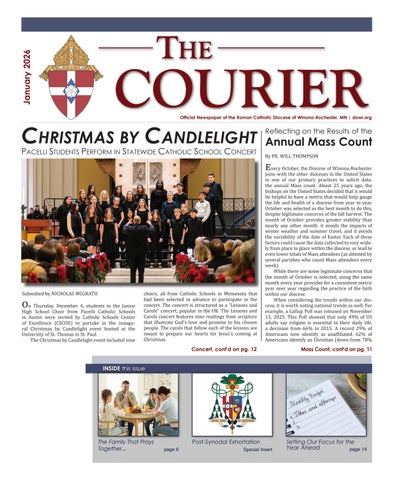
Christmas by Candlelight Annual Mass Count
Reflecting on the Results of the
Pacelli Students Perform in Statewide Catholic School Concert
By FR. WILL THOMPSON
�
Submitted by NICHOLAS MCGRATH
�n Thursday, December 4, students in the Junior
High School Choir from Pacelli Catholic Schools in Austin were invited by Catholic Schools Center of Excellence (CSCOE) to partake in the inaugural Christmas by Candlelight event hosted at the University of St. Thomas in St. Paul. The Christmas by Candlelight event included nine
choirs, all from Catholic Schools in Minnesota that had been selected in advance to participate in the concert. The concert is structured as a “Lessons and Carols” concert, popular in the UK. The Lessons and Carols concert features nine readings from scripture that illustrate God’s love and promise to his chosen people. The carols that follow each of the lessons are meant to prepare our hearts for Jesus’s coming at Christmas.
Concert, cont'd on pg. 12
very October, the Diocese of Winona-Rochester joins with the other dioceses in the United States in one of our primary practices to solicit data: the annual Mass count. About 25 years ago, the bishops on the United States decided that it would be helpful to have a metric that would help gauge the life and health of a diocese from year to year. October was selected as the best month to do this, despite legitimate concerns of the fall harvest. The month of October provides greater stability than nearly any other month: it avoids the impacts of winter weather and summer travel, and it avoids the variability of the date of Easter. Each of these factors could cause the data collected to vary widely from place to place within the diocese, or lead to even lower totals of Mass attendees (as attested by several parishes who count Mass attendees every week). While there are some legitimate concerns that the month of October is selected, using the same month every year provides for a consistent metric year over year regarding the practice of the faith within our diocese. When considering the trends within our diocese, it is worth noting national trends as well. For example, a Gallup Poll was released on November 13, 2025. This Poll showed that only 49% of US adults say religion is essential to their daily life, a decrease from 66% in 2015. A record 29% of Americans now identify as unaffiliated. 62% of Americans identify as Christian (down from 78%
Mass Count, cont'd on pg. 11
INSIDE this issue
The Family That Prays Together...
Post-Synodal Exhortation page 6
Special Insert
Setting Our Focus for the Year Ahead page 14
On First Trip, Pope Highlights Paths to Peace
From the Bishop_________________________4-5 The Family That Prays Together...____________6 Post-Synodal Exhortation__special center insert
The Courier Insider
2
Unity, Dialogue, Respect
Articles of Interest
To Those Who Are Leaving______________11 From Finals to Festivities / Called to Serve____12 Inside the Capitol / W-RDCCW______________13 Setting Our Focus for the Year Ahead_______14 A Bookkeeper Who Understands___________15 Pope Leo XIV kneels to speak to a boy holding a photo of a loved one lost in the deadly explosion in 2020 at the port in Beirut Dec. 2, 2025. (CNS photo / Vatican Media)
By CINDY WOODEN, Catholic News Service
VATICAN CITY, Dec. 3, 2025 (CNS) - Visiting two countries over six days on his first foreign papal trip, Pope Leo XIV preached unity, dialogue and respect for differences as the only paths to peace. Spending time with Catholics, other Christian leaders and top Muslim clerics in Turkey Nov. 27-Nov. 30 and Lebanon Nov. 30-Dec. 2, the pope made formal speeches about how believing in God as the father of all means recognizing one another as brothers and sisters. But he also set aside time in a packed schedule for private talks, lunches and late evening meetings with the leaders. "The more we can promote authentic unity and understanding, respect and human relationships of friendship and dialogue in the world, the greater possibility there is that we will put aside the arms of war, that we will leave aside the distrust, the hatred, the animosity that has so often been built up and that we will find ways to come together and be able to promote authentic peace and justice throughout the world," he told reporters flying back to Rome with him Dec. 2. The three iconic moments of the trip were his prayer with top Christian leaders Nov. 28 at the site
of the Council of Nicaea, his visit to the Blue Mosque in Istanbul Nov. 29 and his prayer Dec. 2 amid the rubble of the Beirut port explosion in 2020. The whole trip was planned to commemorate the 1,700th anniversary of the Council of Nicaea and its drafting of the Creed that mainline Christian communities still recite today. Orthodox Ecumenical Patriarch Bartholomew of Constantinople hosted the ecumenical prayer service and the common recitation of the Creed on a platform overlooking the ruins of a Christian basilica in Iznik, site of the ancient Nicaea, about 80 miles southeast of Istanbul. With the Greek Orthodox patriarchs of Antioch, Alexandria and Jerusalem or their representatives and with representatives of other Orthodox, Anglican and Protestant churches, Pope Leo said that at a time when humanity is "afflicted by violence and conflict," the world "is crying out for reconciliation." "The desire for full communion among all believers in Jesus Christ is always accompanied by the search for fraternity among all human beings," he said. "In the Nicene Creed, we profess our faith 'in one God, the Father.' Yet, it would not be possible to invoke God as Father if we refused to recognize as brothers and sisters all other men and women, who are created in the image of God."
The Courier is the official publication of the Diocese of Winona-Rochester 2907 Jeremiah Lane NW, Rochester, MN, 55901 Vol 117 - 1
Most Reverend Robert E. Barron, Publisher Nick Reller, Associate Editor Telephone: 507-361-3068 E-mail: nreller@dowr.org Publishing Schedule: Monthly - Deadline for advertising & articles is the 10th of the month prior. (ISSN 0744-5490) January 2026 w The Courier w dowr.org
Obituaries and Events___________________16
Where to Find The Courier
•
Hard copies are distributed at DOW-R parishes on the first or second weekend of each month.
•
An online version may be viewed at www.dowr.org/offices/courier/index.html
•
To be added to the home delivery list free of charge, readers should send their names and addresses to: Diocese of Winona-Rochester The Courier 2907 Jeremiah Lane NW Rochester, MN 55901 or nreller@dowr.org
The desire to reach out and form relationships with others also was on display when Pope Leo, like his two immediate predecessors, removed his shoes and entered the so-called Blue Mosque in Turkey's
Unity, Dialogue, Respect, cont'd on pg. 15
Child Abuse Policy Information
The Diocese of Winona-Rochester will provide a prompt, appropriate and compassionate response to reporters of sexual abuse of a child by any diocesan agent (employees, volunteers, vendors, religious or clergy). Anyone wishing to make a report of an allegation of sexual abuse should call the Victim Assistance Coordinator at 507-454-2270, Extension 255. A caller will be asked to provide his or her name and telephone number. Individuals are also encouraged to take their reports directly to civil authorities. The Diocese of Winona-Rochester is committed to protecting children, young people and other vulnerable people in our schools, parishes and ministries. The diocesan policy is available on the diocesan web site at www.dow.org under the Safe Environment Program. If you have any questions about the Diocese of Winona-Rochester’s implementation of the Charter for the Protection of Children and Young People, please contact Michael Gerard at 507-361-3377, or mgerard@dowr.org.
January Saint St. Marguerite Bourgeoys
Feast Day: January 12 From Catholic News Agency
On Jan. 12, Roman Catholics remember Saint Marguerite Bourgeoys, who not only founded a religious congregation, but was also instrumental in establishing the Canadian city of Montreal. Marguerite Bourgeoys was born on Good Friday of 1620 during a period of both colonial expansion and religious strife for Europe. She was the seventh of thirteen children born into the middle-class household of Abraham Bourgeoys, a candle-maker, and Guillemette Gamier, in the northeastern province of Champagne in France. By her own account, Marguerite had been “very light-hearted and well-liked by the other girls” while growing up. Her turn toward God's calling began in 1640, not long after her mother's death. On Oct. 7 of that year, during a procession honoring Our Lady of the Rosary, Marguerite had a mystical experience involving a statue of the Virgin Mary at Notre-Dame Abbey. “We passed again in front of the portal of NotreDame, where there was a stone image above the door,” Marguerite later recounted. “When I looked up
The Holy Father's Intention for
January 2026
For Prayer with the Word of God Let us pray that praying with the Word of God be nourishment for our lives and a source of hope in our communities, helping us to build a more fraternal and missionary Church.
and saw it I thought it was very beautiful, and at the same time I found myself so touched and so changed that I no longer knew myself, and on my return to the house everybody noticed the change.” In later life, Marguerite would live out a profound imitation of the Virgin Mary – who was, as she noted, “not cloistered,” but “everywhere preserved an internal solitude” and “never refused to be where charity or necessity required help.” During the 17th century, it was unusual for consecrated women to have an active apostolate outside the cloister as Marguerite would go on to do. From 1640 to 1652, she belonged to the noncloistered “external” branch of the Congregation of Notre-Dame at Troyes, consisting of women trained as teachers in association with the order. She also sought admission to several religious orders, including the Carmelites, but was rejected. Being turned down, the teacher from Troyes was free to volunteer for a 1653 voyage to the Canadian colony of Quebec. Life in the colony was physically very difficult. When Marguerite arrived, she found that children were not likely to survive to an age suitable for attending school. Nevertheless, she began to work with the nurse in charge of Montreal’s hospital, and eventually established her first school in a stable in 1658. She traveled back to France that year, and returned to Montreal with three more teachers and an assistant. Because of their association with the original French Congregation of Notre-Dame, these women were called the the “Daughters of the Congregation.” They would eventually become a religious order in their own right: the Congregation of Notre-Dame de Montreal, whose sisters sacrificed comfort and
security to teach religion and other subjects to the children of the territory then known as “New France.” They would live in poverty and travel wherever they were needed, offering education and performing the works of mercy. The founding of the order involved two further trips to France in 1670 and 1680. During the first, Marguerite's project received approval under civil law from King Louis XIV. The church hierarchy, however, showed reluctance toward a women's order with no cloistered nuns. Their rule of life would not receive final approval until 1698, though the Bishop of Quebec had authorized their work in 1676. Meanwhile, Marguerite and her companions persisted in their mission of teaching and charity. This work proved so integral to life in Quebec, that Marguerite became known as the “Mother of the Colony.” Though the teaching sisters often lived in huts and suffered other hardships, the order grew. They did not dedicate themselves solely to teaching children, but also set up schools where they taught new immigrants how to survive in their surroundings. As the order expanded, Marguerite passed leadership on to one of the sisters. During the last two years of her life, the foundress – known by then as Sister Marguerite of the Blessed Sacrament – retired to pray in solitude. On the last day of 1699, after a young member of the community became sick, Sister Marguerite prayed to God to suffer in her place. The young woman recovered, while the aged foundress suffered for twelve days and died Jan. 12, 1700. St. Pope John Paul II canonized St. Marguerite Bourgeoys in 1982, as the first woman saint of the Catholic Church in Canada.
3
This Month in The Courier Archives
---------------------------------25, 50 & 75 Years Ago----------------------------------
Children of St. Mary's Parish, Worthington, perform a traditional Mexican dance while Mariachis play in the background. The entertainment followed the Deanery Jubilee Mass in Worthington on November 19, 2000. Reprinted from January 2001.
Original Christmas decoration at St. Francis Church, Rochester, is the creation of Father Eugene Stenzel. He lights the candles for the Christmas liturgy. [Post-Bulletin photo]
Winona -The family number of the Andrew Schlink family is seven! Pictured above, seated, are Mr. and Mrs. Andrew Schlink, members of St. Joseph's Parish here. Surrounding them are their seven daughters, seven sons-in-law, seven grandsons and seven granddaughters.
Reprinted from January 16, 1976.
Reprinted from January 14, 1951. January 2026 w The Courier w dowr.org
4
Battling the Dragon: The Fourth Christmas Account Mary and Joseph were Chapter 12 of Revelation war between good and evil that �here are three commences compelled to go to Bethlehem as follows: “A great manifests itself both visibly
From the Bishop
well-known accounts of Christmas in the Scriptures. We have St. John’s metaphysical version (“the Word became flesh and dwelt among us”). We have the more narrative tellings in the Gospels of Matthew and Luke. Matthew uniquely contains the reference to the Bethlehem Star, the massacre of the Holy Innocents, and the visit of the Magi. In Luke we find the census, stable, swaddling clothes, shepherds and angels. Most of us, when we imagine or depict Christmas, envision a conglomeration of Luke’s and Matthew’s renderings. But there is a fourth Christmas story in the New Testament, though it is rarely appreciated as such. Found in the book of Revelation, it makes no reference to shepherds, Magi, or swaddling clothes. Revelation’s depiction of Christmas is not abstractly metaphysical but it is not a straightforward narrative either; rather, it is highly symbolic and apocalyptic. One might say that it is the view of Christmas from God’s perspective.
Bishop's Calendar
portent appeared in heaven: a woman clothed with the sun, with the moon under her feet, and on her head a crown of twelve stars.” Catholic interpreters have consistently read this figure as the Virgin Mary, and this is confirmed by what comes next: “She was pregnant and was crying out in birth pangs, in the agony of giving birth.” Here is the Blessed Mother, summing up in her person the whole history of Israel (hence the 12 stars, suggestive of Israel’s 12 tribes), about to deliver the long-awaited Messiah. But then we hear of an opposing party: “Another portent appeared in heaven, a great red dragon, with seven heads and ten horns.” The purpose of this fearsome beast was entirely malevolent: “the dragon stood before the woman who was about to bear a child, so that he might devour her child as soon as it was born.” We are meant to see something of extraordinary significance in this awful threat, namely, that the arrival of the Son of God is met with enormous resistance by dark spiritual powers. Jesus represents God’s rescue operation, his attempt to set right his fallen creation. In a word, the Christmas tale is not a charming children’s story; instead, it is redolent of the great spiritual struggle, the
and invisibly in our hearts and in our world. Does this leave us frightened or discouraged? Absolutely not - and the account of the Incarnation from Revelation makes this clear. We hear that the woman clothed with the sun gave birth to “a male child, who is to rule all the nations with a rod of iron.” However, instead of being consumed by the dragon, he is snatched away and brought to throne of God. Thus, despite the malevolent efforts of the powers of the world, this child will win the great war; through him, God will restore his creation; by him, God will establish his rule in the world. We are then told that after the baby is taken away, “war broke out in heaven; Michael and his angels fought against the dragon and his angels fought back but they were defeated.” The baby king masters the dark powers. In Luke’s account, the evangelist tells us that an angel appeared the night of Jesus’ birth to shepherds keeping watch in the field. As is normal when people encounter angels in the Scriptures, the reaction to this other-worldly being is fear. But appearing with this fearsome reality is “a multitude of the heavenly host, praising God and saying Glory to God in the highest heaven.” The Greek term rendered here as “host” is “stratias,” which means “army.”
1 p.m. - Clergy Personnel January 28, Wednesday Committee - The Chancery, 8:40 a.m. - School Mass - Holy January 1, Thursday Spirit, Rochester *10 a.m. - Holy Day Mass - All Rochester January 14, Wednesday 2 p.m. - Finance Council - The Saints, Madison Lake 9:15 a.m. School Mass St. Chancery, Rochester January 2, Friday Augustine, Austin *11 a.m. - Funeral Mass for January 29, Thursday Fr. Steve Peterson - Queen of 10:15 a.m. - Q&A with 10 a.m. - School Mass - St. Upperclassmen Pacelli Angels, Austin Theodore, Albert Lea Catholic Schools, Austin January 3-9, Saturday7:15 p.m. - Newman Night January 15, Thursday Friday St. Thomas Aquinas Newman Region VIII Bishops Retreat - *4:30 p.m. - Homeschool Mass Center, Winona St. Pius X, Rochester Florida January 17, Saturday January 30, Friday January 11, Sunday *5 p.m. Mass St. Mary, Lake 10 a.m. - School Mass *10 a.m. - Mass - St. Joseph, City Crucifixion, La Crescent Rushford January 25, Sunday January 31, Saturday January 13, Tuesday *8:30 a.m. - Staff Mass - The *8:30 a.m. - Mass for Life - St. 9:30 a.m. - Diocesan Pastoral Finbarr, Grand Meadow Chancery, Rochester Council - The Chancery, 10:30 a.m. - College of January 27, Tuesday Rochester Consultors - The Chancery, 10 a.m. - School Mass - St. John Vianney, Fairmont Rochester *indicates event open to public
January 2026 w The Courier w dowr.org
because of an order given by the man with the biggest army in the world, but the heavenly army of the baby king is far greater, far stronger. C.S. Lewis understood this dynamic very well, which is why he commented in his classic apologetic work Mere Christianity that God came into the world quietly as a helpless child because “he had to sneak clandestinely behind enemy lines.” We all feel threatened by the dragon. The good news of Christmas is that the victorious king has arrived, and so we don’t have to be afraid.
Non Nisi Te Domine Bishop Robert Barron
Saturday, December 20, at Sacred Heart Church in Waseca, Bill Fitzsimmons was honored with the Bishop’s Medal, presented by Bishop Robert Barron, in gratitude for a lifetime of faithful service to the Church and community. Born in 1934, Bill was baptized at Sacred Heart, graduated from Sacred Heart High School in 1952, and has remained deeply rooted in the parish ever since - having known nearly every pastor to serve there. Known as humble, dependable, and faith-filled, many say, “If you need to get something done, ask Bill.” For decades, Bill has served Sacred Heart as a sacristan, altar server, usher (for more than 65 years), Eucharistic Adorer at 5:00 a.m. every Monday for over 20 years, and a steady presence at daily Masses and funerals. He has also given generously of his time and talents to parish administration, finances, and campus improvement projects, while quietly encouraging others to return to the faith. Beyond the parish, Bill has served the wider Waseca community, including 40 years as head of the Minnesota Valley Action Council, supporting individuals and families in need. Bill has been married to his wife, Sandy, for more than 65 years. Congratulations, Bill, and thank you for your extraordinary witness of faithful, humble service! Photo and caption by Emily Smithley, media specialist for the Diocese of Winona-Rochester.
Luchando contra el dragón: El cuarto relato de la Navidad Por EL BARRON
ROBERT más bien, es muy simbólica y apocalíptica. Se podría decir que es la visión de la Navidad ay tres relatos muy con- desde la perspectiva de Dios. ocidos de la Navidad en las El capítulo 12 del Escrituras. Tenemos la versión Apocalipsis comienza así: «Se metafísica de San Juan («el apareció en el cielo un gran Verbo se hizo carne y habitó signo: una mujer vestida del entre nosotros»). Tenemos sol, con la luna bajo sus pies y los relatos más narrativos una corona de doce estrellas de los Evangelios de Mateo sobre su cabeza». Los intéry Lucas. Mateo contiene de pretes católicos han interforma única la referencia a la pretado sistemáticamente esta estrella de Belén, la matanza figura como la Virgen María, de los Santos Inocentes y la y esto se confirma con lo que visita de los Reyes Magos. En viene a continuación: «Estaba Lucas encontramos el censo, el embarazada y gritaba con los establo, los paños con los que dolores del parto, en la agonía envolvían al niño, los pastores de dar a luz». y los ángeles. La mayoría de Aquí está la Santísima nosotros, cuando imaginamos Madre, resumiendo en su pero representamos la Navidad, sona toda la historia de Israel visualizamos una conglomer- (de ahí las doce estrellas, que ación de las interpretaciones sugieren las doce tribus de de Lucas y Mateo. Israel), a punto de dar a luz Pero hay una cuarta his- al tan esperado Mesías. Pero toria de Navidad en el Nuevo entonces oímos hablar de una Testamento, aunque rara vez parte contraria: «Apareció se aprecia como tal. Se encuen- otro signo en el cielo: un tra en el libro del Apocalipsis gran dragón rojo, con siete y no hace referencia a los pas- cabezas y diez cuernos». El tores, los Reyes Magos ni los propósito de esta temible bespaños que envolvían al niño. tia era totalmente maléfico: La descripción de la Navidad «El dragón se paró frente a la en el Apocalipsis no es abstrac- mujer que estaba a punto de tamente metafísica, pero tam- dar a luz, para devorar a su poco es una narración sencilla; hijo tan pronto como naciera».
�
OBISPO
Debemos ver algo de extraordinaria importancia en esta terrible amenaza, a saber, que la llegada del Hijo de Dios se encuentra con una enorme resistencia por parte de los poderes espirituales oscuros. Jesús representa la operación de rescate de Dios, su intento de enderezar su creación caída. En una palabra, el relato de la Navidad no es un cuento infantil encantador, sino que evoca la gran lucha espiritual, la guerra entre el bien y el mal que se manifiesta de forma visible e invisible en nuestros corazones y en nuestro mundo. ¿Nos deja esto asustados o desanimados? Por supuesto que no, y el relato de la Encarnación del Apocalipsis lo deja claro. Oímos que la mujer vestida de sol dio a luz a «un hijo varón, que gobernará todas las naciones con vara de hierro». Sin embargo, en lugar de ser devorado por el dragón, es arrebatado y llevado al trono de Dios. Así, a pesar de los malévolos esfuerzos de los poderes del mundo, este niño ganará la gran guerra; a través de él, Dios restaurará su creación; por él, Dios establecerá su dominio en el mundo. Luego se nos dice que después de que
el bebé es llevado, «estalló una guerra en el cielo; Miguel y sus ángeles lucharon contra el dragón, y los ángeles del dragón lucharon, pero fueron derrotados». El bebé rey domina los poderes oscuros. En el relato de Lucas, el evangelista nos dice que un ángel se apareció la noche del nacimiento de Jesús a los pastores que velaban en el campo. Como es normal cuando las personas se encuentran con ángeles en las Escrituras, la reacción ante este ser de otro mundo es el miedo. Pero junto a esta aterradora realidad aparece «una multitud de huestes celestiales, alabando a Dios y diciendo: Gloria a Dios en las alturas». El término griego traducido aquí como «hueste» es «stratias», que significa «ejército».
5
María y José se vieron obligados a ir a Belén por una orden dada por el hombre con el ejército más grande del mundo, pero el ejército celestial del niño rey es mucho mayor, mucho más fuerte. C. S. Lewis entendió muy bien esta dinámica, por lo que comentó en su clásica obra apologética Mere Christianity (Mero cristianismo) que Dios vino al mundo silenciosamente como un niño indefenso porque «tenía que colarse clandestinamente tras las líneas enemigas». Todos nos sentimos amenazados por el dragón. La buena noticia de la Navidad es que el rey victorioso ha llegado, por lo que no tenemos que tener miedo.
On December 8, the Solemnity of the Immaculate Conception, Bishop Barron celebrated Mass at the Cathedral of the Sacred Heart in Winona, followed by dinner, as a part of its Advent Parish Mission (near right). On December 13, he visited Sacred Heart Parish in Hayfield for Mass, followed by a nativity pageant and the parish's 90th anniversary dinner (top far right). On December 21, he made his first visit to St. Rose of Lima Parish in Lewiston, where he celebrated Mass, with pastor Fr. Chinnappa Pothireddy and native parishioner Fr. Gilbert Thesing, OP, concelebrating, followed by brunch (bottom far right). January 2026 w The Courier w dowr.org
6
The Family That Prays Together... By PETER MARTIN
�
raise God for Venerable Patrick Peyton, C.S.C. who devoted his priestly life to spreading the devotion to Mary and encouraging family prayer, especially the Rosary. It is thanks to him that most of us can finish the saying he made popular: “The family that prays together stays together!” In our busy lives, it can be difficult to schedule time to pray as a family, but what if we just started small by gathering for a family meal more frequently? The prayer before meals should be a common way that we all pray together: “Bless us, O Lord! and these Thy gifts, which we are about to receive from Thy bounty, through Christ our Lord. Amen.”
January 2026 w The Courier w dowr.org
Let the meal time be a time for discussion about the day, but let us also use that time to talk about our faith! Liturgical Seasons of the year allow us ample opportunity for discussion. Some families prepare for the upcoming Lord’s Day by reading the Sunday Gospel and reflecting on what Christ has to say to each of us. Other families allow time for each person to share how they recognize God’s action in their lives. Did you know that among the priests who were ordained in 2025, most of them began considering the priesthood at the age of 16, while more than a third of them began to consid-
er the seminary between the ages of 6 and 13? The annual report prepared by the Center for Applied Research in the Apostolate (CARA) found that family life played a pivotal role in the newly ordained men’s path to the priesthood. When prayer life is lived out and modeled by the parents (and grandparents), children not only learn their faith, but they begin to live it out on their own. We look forward to offering a monthly article in The Courier and invite you to check out www.dowr.org for more resources from “The Praying Family”. Peter Martin is the director of life, marriage & family for the Diocese of Winona-Rochester.
More People in Our Pews; More Priests at Our Altars A Post-Synodal Exhortation
By BISHOP ROBERT BARRON
I. The Reason for a Synod
I was privileged to participate in both sessions of the Synod on Synodality in Rome, and one of the strong recommendations of that international gathering of Church leadership was that individual dioceses ought to undertake a synod to address concerns at the local level. I returned from Rome, therefore, filled with enthusiasm to celebrate a synod here in WinonaRochester. But I didn’t want this to be an open-ended affair during which we would debate a variety of matters of controversy within the Church. I felt such an exercise would be beyond the authority of a local synod and hence finally fruitless. Therefore, as the Shepherd of the Diocese, I proposed two matters for consideration, which I felt were of paramount importance to the flourishing of our local Church. These were evangelization (getting more people in our pews) and vocations (getting more priests at the altar). Why these two? Why Evangelization?
Evangelization has been the principal preoccupation of the Church universal from the time of the Second Vatican Council until today. One could argue that the master theme of the documents of Vatican II is evangelization, which is to say, the carrying of the light of Christ to the nations. Cardinal Francis George of Chicago consistently taught that Vatican II is best construed as a “missionary Council” whose purpose was to bring the Good News to the modern world. Accordingly, it was not so much about “modernizing” the Church as “Christifying” modern society. Pope Paul VI, in his great document Evangelii Nuntiandi, said that the Church doesn’t so much have a mission to evangelize; rather, it is a mission to evangelize. Pope John Paul II famously made the “new evangelization” - new in ardor, new in expression, new in method - the central theme of his papacy. And Pope Francis declared that his encyclical Evangelii Gaudium, a sustained reflection on the joy of proclaiming the Gospel, was the key to understanding his entire Petrine ministry. There was also an impetus coming, as it were, from below. Numbers of Catholics attending Mass on a regular basis have been in steep decline for the past 50 years. At the beginning of the 1960’s, upwards of 60% of baptized Catholics attended Mass weekly - and the Fathers of Vatican II thought that number was too low! But in the years following the Council, that figure declined, in our country, to around 25%, and even lower in Europe and Australia. The COVID pandemic made matters worse. When I arrived in this diocese three years ago, our October count of parishioners attending Mass yielded the figure of only 18% of baptized Catholics in the pews on Sunday. Last year, the number had improved to 21%, but may I say that this percentage is still pathetic.
Jesus told us to reach out to all nations and announce the Gospel. Vatican II reminded us that the Eucharist is the “source and summit,” the beginning and end, of the Christian life. Yet 80% of our own Catholic brothers and sisters in our diocese are not attending Mass. This simply should be unacceptable to all of us. Hence, we need to evangelize! Why Priestly Vocations?
Some of you may recall that when I was delivering the homily at my Mass of installation three years ago, I invited the seminarians of our diocese to stand and they did so, 20 strong. Spontaneously, and, frankly, not knowing that much about the Diocese, I more or less blurted out, “Let’s double their number!” This cry was met with sustained applause—and I see my intervention now as under the inspiration of the Holy Spirit. For since coming here, I have realized how much we need priests. We have around 100 priests in Winona-Rochester, but that number includes 29 retired men, 7 religious, and 17 from other dioceses currently serving here with the agreement of their bishop. In all, we have around 65 active priests to serve 88 parishes; hospital, high school, college, and military chaplaincies; the chancery office, and IHM Seminary. If all of those not belonging to our diocese suddenly had to leave, we would be in dire straits. Moreover, a number of these active priests are scheduled to retire in the next five years. Now we do indeed have encouraging news. Since I have arrived here as bishop, I have had the joy of ordaining six men to the priesthood, and, please God, I will ordain three more this coming June. It is worth noting that this represents more ordinations than many large archdioceses have had in recent years. And though we have not reached my desired goal of 40 seminarians, we have 24 studying at our own IHM Seminary, St. Paul Seminary in St. Paul, Mundelein Seminary outside Chicago, and the North American College in Rome. Still, given pastoral demand and the number of our elderly men still in ministry, we need more priests. Additionally, a deep desire of my heart is that we might find more Hispanic vocations in our diocese. There is an ever-increasing number of recent immigrants, many Spanish-speaking, and we need priests of their own culture to serve them. If I might put this in a wider theological context, Pope John Paul II famously said ecclesia de eucharistia (the Church comes from the Eucharist). But eucharistia de sacerdotibus (the Eucharist comes from priests). Therefore, by an inescapable logic, no priests, no church. The Synodal Process
So, in order to address these two great concerns, I summoned a synod into existence, only the second completed synod in the 136-year history of our diocese. Initially, an organizing committee was formed, with representatives from different parts of our diocese and with different areas of More People in Our Pews; More Priests at Our Altars - 1
interest and expertise. They laid out a program according to which a number of regional gatherings would take place throughout the Diocese, in preparation for a grand synod assembly in Mankato in August of 2025, concluding on the Queenship of Mary. Accordingly, prepatory synodal meetings took place in the spring of 2025 and the task placed before the participants was a practical one, namely, how to get more people in our pews and how to get more priests at our altars. I instructed them that the nature of their discussions should be pragmatic rather than theoretical. They were not to speculate about the whys and wherefores of evangelization or about the theology of the priesthood; they were to come up with realistic and practical means by which both evangelization and vocational recruitment would be best fostered. The various gatherings produced literally hundreds of proposals - all of them interesting, all of them born of a real passion for the Church. But in a follow-up process, these hundreds of suggestions were distilled down to about 30, which then became the subject of discussion at the Synod in Mankato. That gathering included 226 lay people, consecrated men and women, and clergy from Winona to Pipestone, from Mankato to Albert Lea. The Synod commenced with a beautiful Mass at Sts. Peter and Paul Church in Mankato and proceeded through a day and a half of intense table conversations and wider discussions among all of the participants. At the close of the dialogues, a vote was taken to determine which of the 30 or so proposals had the greatest support of the entire Synod. Finally, these tallies were presented to me in the anticipation that I would write a letter summarizing them and giving my final recommendations. Subsequently, the results of the votes were presented to the Presbyteral Council and then to all of the active priests at our yearly gathering at Lake Okoboji, and finally to the Synodal Prepatory Commission for their reaction and advice. What I would like to do in the remainder of this letter is to present my own assessment of the synodal results, to put them in a somewhat wider framework, and to make some very practical suggestions and recommendations in regard to our two central issues. II. Evangelization
Let us look at evangelization first. I have been studying this matter for years in connection with my Word on Fire work. I have concentrated especially on the problem of disaffiliation: why so many people, especially the young, are leaving the Catholic Church. When I was a young man in the 1970’s, roughly 3% of our country would have identified as religiously unaffiliated. But today, that number has risen to 26% and it’s even higher among those under 30.
Faith and Reason
Welcoming Communities
There are, obviously, many reasons for this, but numerous studies have been conducted in recent years, which involve asking the disaffiliated themselves why they left. The first thing they tell us, in survey after survey, is that they no longer believe in Christian doctrine, they didn’t find answers to their questions when they were going through Catholic school or religious education, and, perhaps above all, that religion and science are in conflict with one another. To illustrate this last point, I’d like to draw our attention to two Pew Research Center studies, the first from 2016 and the second from 2018. When asked in the first survey why they left the Church, one half of the respondents said “lack of belief in religious teachings.”¹ And when asked the same question in the second survey, 60% said the same thing.² Also in both cases, respondents correlated their lack of belief to the challenges posed by the sciences. It’s important to note that this was, in both surveys, clearly the number one reason given. Christian Smith, a sociologist of religion at Notre Dame, has produced research that strongly confirms this.³ For the overwhelming majority of his interviewees, the reason they left the Church was that religion seems illogical and repugnant to science. Across the religious groups, 59% agree with the statement that religion and science conflict with one another. And guess which wins in their minds. Though it is clearly not the only cause of disaffiliation, bad or inadequate catechesis is a major contributing factor. We must get better at forming our young people (and our adults) intellectually. This is also borne out strongly in the findings of our local Synod. One of the most voted for propositions is the following: “Build the Domestic Church by providing a resource toolbox for families to integrate faith. This could include, but is not limited to: encouragement to tell Bible and Saint stories; how to talk to children about how faith is expressed in parents’ lives; how to pray at home; ideas for Catholic art and decor; list of online resources, apps; ways to celebrate feast days and liturgical seasons at home; how to have difficult conversations about the faith (marriage, gender, science, etc.).” Other popular propositions were “Expand catechesis for children and adults” and “Provide ongoing formation for the newly initiated (OCIA, Confirmandi, etc.), including small groups and digital content.”⁴ Our people indicate that better education, clearer catechesis, and convincing apologetics are essential to the task of evangelization, both in drawing people to the faith and in preventing them from disaffiliating from the Church. A very strong suggestion from our Synod is that the Diocese provide training in concrete methods and practices of evangelization. It furthermore stated that companies of evangelizers should be organized in every parish: “Form parish evangelization teams with monthly gatherings to practice and share experiences.” In sum, many feel the desire to evangelize but lack the confidence to engage in it.
A second theme that emerges strongly in the research on disaffiliation is the absence of welcoming communities. It appears that many people have left and are reluctant to return because they don’t feel that Catholic parishes are inviting and attractive. They also speak of clericalism, mistreatment by church personnel, and the sexual abuse scandals of the past several decades. One of the more heartbreaking themes that I have come across in the course of my research is that many who have left say that, when they stopped showing up for Mass, no one reached out to them, no one expressed concern, no one wondered where they had gone. Not surprisingly, we find recommendations of our Synod addressing this aspect of evangelization: “Ensure that all parish entryways and gathering spaces are welcoming and intentionally designed for fellowship.” “Explore strategic consolidations of resources and collaboration among parishes to foster vibrant communities and better stewardship.” The faithful of our diocese realize that the friendliness and spiritual vibrancy of our parishes are indispensable to inviting new people to join us and preventing our own from leaving. Important are opportunities for new parishioners to meet one another, to get to know the pastor, and to hear about the work of the parish. Given the sad statistic mentioned above, I would also urge a conscious and compassionate outreach to those who have stopped attending Mass. Relatedly, I am a great believer in the virtue of a parish census. When I was a young deacon, my very wise pastor suggested that a good pastoral exercise for me would be to call or visit all those still on the parish registers but who had not been to church for a long time. My contact would simply be one of friendly invitation. I know the practice bore fruit in my own spiritual life, and I think it was beneficial to the parish as well. Beauty
A third motif that arises frequently in the research around evangelization is the importance of beauty, especially in relation to the Mass. I have long argued that the “third transcendental” is of particular significance today. When I speak of the transcendentals, I’m referring to the famous triplet of the good, the true, and the beautiful. At a time when appeals to truth and goodness are often met with resistance - “who are you to tell me what to think or how to behave?”- appeals to the beautiful are less threatening, and more winsome. Stephen Bullivant, a theologian and researcher from the UK, has delved into issues of disaffiliation and he has asked the disaffiliated themselves whether there are any values they still remember and cherish from their time in the Church. In Bullivant’s studies, time and again those who have disaffiliated remember with fondness the beauty of the Church that they left.⁵ Here are some representative quotations: •
“The Catholic Church has been a major cultural force in European history. It has, at times, supplied a necessary spiritual discipline. I respect it for that.”
•
“The Church has a fine artistic and liturgical tradition.”
•
“Much of the great music and art was brought about by the patronage of the Church.”
•
“I love Catholic theology, liturgy, devotion, art, and music.”
I can testify that at my discussion table during the Synod gathering in Mankato, this issue of beauty inspired a good deal of passion and energy. Several expressed the sentiment that many of our churches have become too drab, too bland, frankly, too ugly, and that, accordingly, they don’t have evangelical attractiveness. Now I fully realize that when we turn to the topic of beauty, there can be philosophical differences regarding what qualifies as beautiful. I certainly don’t hold that only one or two styles of, say, ecclesial architecture or sanctuary design could be considered beautiful. In the course of the great Catholic tradition, Roman basilicas, Romanesque churches, Gothic cathedrals, and Baroque chapels have certainly all qualified as beautiful, though they represent radically different styles. On the other hand, beauty is not simply, as the cliché has it, “in the eye of the beholder,” making aesthetic judgments just a matter of subjective taste. St. Thomas Aquinas held that beauty is as objective as the other transcendentals of truth and goodness. It occurs, he said, at the intersection of integritas (wholeness), consonantia (harmony), and claritas (radiance). When something coheres as one integrated thing (wholeness), when its parts hold together in a symmetrical and balanced way (harmony), and when its form shines forth so that we say, “that’s what that thing is supposed to be” (radiance), we call it “beautiful.” This is true of a human face, a golf swing, a strategic plan, or the Mona Lisa. When assessing the beauty of our churches, sanctuaries, and chapels, might we apply Aquinas’s categories? And might we ask even more pointed questions about whether our structures and buildings can bear the weight of Christian revelation, whether they can adequately express the great truths of the faith? An architectural design might be aligned to contemporary sensibilities, but does it articulately speak the language of Catholicism? I think that this theme, so stressed at the Synod, should be the subject of ongoing conversations at both the parish and diocesan levels. As I hinted above, much of the concern about beauty focuses upon the Mass, the Eucharistic liturgy, and those practices and sacramentals related to the Mass. Once again, Stephen Bullivant’s work is helpful.⁶ He shows that many of the disaffiliated still retain positive memories of the Mass. Here are a few quotations: • •
“I enjoy the ritual of Mass and the tradition. I like the fact that it is the same wherever I go.”
“The Mass will always be a comfort and no matter where I am it feels like coming home when I go to Mass.”
This instinct is clearly ratified by the testimony of those who participated in our Synod. Here is a characteristic quote: “Promote catechesis on Mass etiquette, emphasizing preparation, sacred silence, and proper reception of Holy Communion.”
¹ Pew Research Center, “Why America’s ‘nones’ left religion behind,” August 24, 2016, https://www.pewresearch.org/short-reads/2016/08/24/why-americas-nones-left-religion-behind/. ² Pew Research Center, “Why America’s ‘nones’ don’t identify with a religion,” August 8, 2018, https://www.pewresearch.org/short-reads/2018/08/08/why-americas-nones-dont-identify-with-a-religion/. ³ Nicolette Manglos-Weber and Christian Smith, Understanding Former Young Catholics: Findings from a National Study of American Emerging Adults (University of Notre Dame Press, 2014). ⁴ Frequently mentioned programs include Catechesis of the Good Shepherd, the Neocatechumenal Way, programs from FORMED, the Augustine Institute, Word on Fire, etc., or other small group opportunities. ⁵ Stephen Bullivant, Catherine Knowles, Hannah Vaughan-Spruce, and Bernadette Durcan, Why Catholics Leave, What They Miss, and How They Might Return (Paulist, 2019). ⁶ Stephen Bullivant, Catherine Knowles, Hannah Vaughan-Spruce, and Bernadette Durcan, Why Catholics Leave, What They Miss, and How They Might Return (Paulist, 2019). More People in Our Pews; More Priests at Our Altars - 2
Other Recommendations One theme that surfaced in our local Synod and that figures prominently in the studies of disaffiliation is the role of the family, especially fathers, in preventing young Catholics from departing the Church. Christian Smith has said that one of the clearest indicators that a young person will stay connected to the Church is that his or her family discussed religious matters in the casual environment of the home.⁷ If a child’s considerations of religion were sequestered to Sunday morning Mass and perhaps religious education, he or she would tend toward disaffiliation. But if the faith was the subject of conversations around the table, children tended to stay close to the Church. To make this even more pointed, study after study has shown that the father’s role is of particular importance. If Dad prays and goes to church, kids typically pray and go to church. This pointed recommendation received a number of votes at our Synod: “Form and mentor fathers in leadership roles in home and parish life.” I would imagine that there are many fathers of families who would like to play a more active role in the religious formation of their children but don’t have the requisite instruction and encouragement. We should work hard at the parish level to provide both.⁸ One suggestion that was made by our Synod, which figures prominently in the studies on evangelization, is to use the new media in a creative way. There is no question that the emergence of social media has been a boon to the mission of the Church. At a time when fewer and fewer young people spontaneously come to our parish programs or to Mass, we have the means to reach out to them, precisely where they “live.” In many ways, we are experiencing a springtime of apologetics and evangelization through various social media ministries. Accordingly, we find this suggestion from our Synod proceedings: “Expand diocesan digital outreach through social media, podcasts, and curated Catholic resources.” I have proposed, both at the USCCB meetings and at the international Synod in Rome, that every diocese in the country should identify a bright, articulate, and technologically savvy person to lead and coordinate a social media outreach for evangelization. And I would encourage every pastor in our diocese to do the same at the parochial level. III. Vocations
It is no secret that the priesthood has been passing through a painful season. The scandals of the past many years have harmed the people of God, weakened the Church in its evangelical mission, and undermined confidence in the priesthood. At the height of the troubles, some twenty years ago, many priests were ashamed even to appear in public wearing the Roman collar. Given the passage of time and the massive institutional reforms put in place to address this problem, the worst of that season is behind us. I believe in fact that a time of renewal is upon us. It is fascinating to note that the number of seminarians during the time of scandals really did not go down significantly. And as a former seminary professor and rector, I can testify that those young men discerning a vocation during that time had a
keen sense that they were called upon to contribute to the spiritual renewal of the priesthood. There is something else afoot in the wider culture, namely, a growing interest among young men for the spiritual life. Raised on the speculations of the new atheists that the world comes from nothing and returns to nothing, and that there is, accordingly, no purpose to life, no meaning to existence, they are hungry for what will satisfy their souls. And so, in increasing numbers, they are willing to listen to the voice of God. The Church should be ahead of this curve, inviting young men to the radical selfgift of a priestly vocation. Many commentators on the scene today stress that the Church has made things too easy, especially on young men, who enjoy a challenge. Pope John Paul II in particular proved that the young respond when they are summoned to spiritual and moral heroism. A first proposal that I would make is to assure that the seminarians in our diocese are visible to our people. When I was coming of age in the Archdiocese of Chicago, I am quite sure that I never saw a seminarian, either in my Catholic school or at Mass. And so, when I began to feel the stirrings of a vocation, I had very little idea what the life of a seminarian was like. I had no model to emulate. I love the fact that in our diocese, the seminarians, both from IHM Seminary and St. Paul’s Seminary, are frequently present for liturgies and other public events. I cannot think of a better way to recruit candidates for the priesthood than to show that young men like themselves have already begun to walk the path toward ordination. I regularly see our seminarians, not only at the grand festive liturgies, but also at Totus Tuus, Camp Summit, prayer services at abortion clinics, fundraisers, parish activities, etc. An excellent and related suggestion that emerged from our Synod conversations was to produce “day in the life” videos about our seminarians. We could easily have a film crew follow some of our seminarians as they make their way through the day: praying, playing, studying, ministering, etc. This might serve to clear up some misconceptions that people have and to demonstrate how beautiful and healthy seminary life can be. And this film could be propagated widely through social media. Another very concrete proposal that the Synod made was to encourage social interaction between priests and laity. Inviting priests to meals and to share in family activities is a way to normalize the priesthood in the minds of lay folk. This also means that priests need not be expected to attend every single parish meeting or activity, allowing them the time and energy to engage with parishioners in social settings. Some years ago, Time Magazine did a cover story on the level of satisfaction experienced by people in a variety of fields of endeavor. To the surprise of many, the vocation with the highest degree of job satisfaction was clergy person. Studies done within the Catholic Church on the lives of priests also bear this out. Time and again, and despite the recent difficulties, priests report very high levels of contentment in their work. I wonder how many people know this? I wonder how many Catholics fall into the trap of believing that the priesthood is a sad and lonely life, one that parents wouldn’t wish for their children. Bringing priests and laity together is a good way to dispel these myths and misconceptions.
Still another intriguing proposal from our Synod is that lay people should “adopt” a seminarian. This means that they would commit themselves to supporting a seminarian financially, spiritually, and through friendship. They might offer novenas, make spiritual sacrifices, invite the young man to family events and activities, regularly communicate with him - all of which would be greatly beneficial not only to the seminarian but to the supportive family as well. The Synod participants made mention too of vocational support groups, who pray, fast, and support priests or seminarians. ⁹ One vocation-related topic that generated a good deal of energy at the Synod was altar serving. Many Synod participants shared that numerous studies over the years have indicated that there is a tight correlation between serving at Mass and the discovery of a vocation to the priesthood. Not every young man who serves becomes a priest, of course, but many seminarians testify that their years of serving at the altar played a significant role in their discernment. Therefore, if we are interested in more seminarians, we should perhaps put a renewed emphasis on the role of the altar server and especially encourage young men to this ministry. Do we have specialized and on-going training for them? Do we take them on spiritual retreats in order to enhance their experience of the Mass? Do we cultivate among them a camaraderie, a sort of esprit de corps? Do altar servers themselves actively recruit other young men to join them? Some years ago, when I was serving as Rector of Mundelein Seminary in the Archdiocese of Chicago, I heard a story about one of our older priests. On the eve of his departure from the parish to take up residence in an assisted living center, he celebrated Sunday Mass. At the conclusion of the liturgy, he took off his shoes and placed them at the foot of the altar. Then he turned to the congregation and asked, “Who will fill these shoes?” It was a beautiful challenge to the parishioners to raise up from among their community a future priest. I was so impressed by this narrative that I sponsored a program at the seminary called “Who Will Fill These Shoes?” The structure was simple. I invited every pastor in the Archdiocese to find one young man in his parish who would make a good priest and to accompany him to a day of reflection at the seminary. We filled the main chapel at Mundelein, which seats about 800, with eager candidates and proud pastors. I spoke to them about the priesthood, seminarians were on hand to respond to their questions, and Cardinal George celebrated Mass for them. Afterwards, we had a festive lunch. I would like to do something very similar in our diocese. The gathering could be in Winona or Rochester or Mankato. The locale would matter less than the participation of the pastors and their candidates. Along with this major event, we should revive the practice of “Andrew Dinners” around the diocese. These are named for St. Andrew, the erstwhile disciple of John the Baptist, who asked Jesus, “Where do you stay?” to which the Lord responded, “Come and see.” In each of the regions of our diocese, pastors would invite young men who are interested in the priesthood to dine together, to talk about the priesthood, to “come and see” whether the life of the priest might be for them.
⁷ Amy Adamczyk and Christian Smith, Handing Down the Faith: How Parents Pass Their Religion on to the Next Generation (Oxford University Press, 2019), 53–54. ⁸ Men’s groups already securely established in our diocese consist of Troops of Saint George, Knights of Columbus (specifically their initiative Cor), and That Man is You. Other programs parishes may want to consider include The Men of St. Joseph, Fraternus, and Men’s Holy Hours. ⁹ Examples of these include the Serra Club, Seven Sisters, and Six Fasting Brothers. More People in Our Pews; More Priests at Our Altars - 3
IV. Conclusion and Challenge I would like to conclude this letter on a note of challenge and encouragement. Those who participated in the Synod were men and women of great faith and their work has produced a plethora of valuable insights and proposals. But I do not want this Synod to be forgotten or its conclusions summed up in a document that gathers dust on a shelf. Thus, I ask the Diocesan Curia, the Presbyteral Council and the Diocesan Pastoral Council to supervise the implementation of the Synod’s findings. Furthermore, I am appointing a diocesan Synodal Implementation Committee to facilitate this process in the individual parishes. Furthermore, I want us to come to terms with the fact that progress in both evangelization and vocations is measurable. This doesn’t mean that we don’t care about quality, but that we can quantify the progress of our endeavors in some way. At the end of the day, I want the number of seminarians to increase, and I want the October Mass count to go up. To this end, I am asking – challenging – the people of the Diocese of Winona-Rochester to take the following concrete steps: Bring One Person Back to Mass
In my travels around our diocese, I tell my people that each of them should become an evangelist, and I have made the following simple suggestion: bring one person back to Mass during the coming year. Everyone, myself included, knows someone who ought to be coming to Mass but isn’t. It might be a family member, a friend, a co-worker. Take the time to invite that person to return to the source and summit of the Christian life. You might even find that this invitation functions as a conversation-starter, an opportunity to elicit and respond to questions, to clear up misconceptions, to assuage fears, etc. If successful, we would double our October count in one year! ¹⁰ Beautiful Liturgical Celebrations
The stress upon the via pulchritudinis (way of beauty) is massively present in the testimony of our Synod participants. Here are just a few of the propositions that received much conversation and support: “Restore and universalize sacred art and sacred music within parishes aligned with Church teaching and tradition;” “Promote truth and beauty by displaying Catholic art, sacramentals, and other signs of faith in homes, workplaces, and parishes so that they are recognizably Catholic;” “Encourage public expressions of faith through prayer, processions, and sacramentals in daily life.” To this end, I would encourage every parish to consider both the environment of the church, and also the way in which liturgical celebrations are carried out. I ask that our priests pay careful attention to the prayers and gestures of the Mass, avoiding succumbing to “going through the motions” out of habit, but rather prioritizing the study of the rubrics.¹¹ It is of paramount importance that we pray with the mind of the Church, carrying out the prescribed rites in a faithful and reverent manner that will heighten the transcendent quality of the parishioner’s experience of Mass. It is incumbent upon the laity to come prepared for Mass and actively participate spiritually in
the source and summit of our Catholic life. Families and individuals should be encouraged to pray with the readings before Mass, observe a respectful silence in church to allow for prayer before and after Mass, and highlight the Mass as a place of meeting of heaven and earth. Invite Men to Consider the Priesthood
Every major study of priestly vocations that I have read emphasizes the following: the single greatest factor in bringing a young man to the seminary is the encouragement that came from someone that he loved and trusted. When a parent, a relative, an older friend, a confidant said, “you would make a good priest,” a powerful seed was planted in the young man’s soul. So, I would encourage everyone in our diocese: when you notice a person who has the gifts - intelligence, kindness, prayerfulness, devotion to the liturgy, care for the suffering and the poor - tell him that he should think about the priesthood. Don’t assume that someone else is doing it; you do it! When I was a senior in high school, I took a course in advanced English. The professor was Mr. White, a wonderful man and a deeply inspiring teacher. One of the requirements of his class was that we keep a daily journal. It didn’t matter particularly what was in it. It could be poetry, a diary, essays, or stories, but we were to write something every day. In the spring of that year, I received my journal back from Mr. White and it was filled with comments, some praising my writing, some constructively critical of it. But alongside one of my entries, there was the simple remark, “Have you ever considered the priesthood?” The piece that he was commenting upon was not on a religious topic and it had nothing to do with vocational discernment, but he saw something in it that prompted him to make that remark. Well, it had a deep impact on me, and I remember it to this day. What I would love to see is every one of us undertaking the challenge to notice and encourage those in our parishes whom we think may have a priestly vocation. My goal is to have the priests and people of each deanery raise up one vocation every year. With five deaneries, that would mean at least five new seminarians each year! Vocations Prayer
Christ Jesus explicitly told us to pray for workers in the harvest and none of our programs or efforts will be successful unless they are informed at every step by prayer. In order to unite our efforts in praying for priestly vocations, I am asking that the following prayer be offered after the General Intercessions at every Mass in our diocese: Heavenly Father, Giver of all good things, Your Son told us to beg You to send workers into Your rich harvest, and so we have the confidence to ask You to raise up an abundance of priests in the Diocese of Winona-Rochester. Send us good and holy men to respond to your call to lay down their lives in service to Your people. We know that the Church comes from the Eucharist and that the Eucharist comes from priests. Therefore, Gracious God, send us priests to build up Your Church, through Jesus who is High Priest and Lord forever and ever. Amen.
Eucharistic Adoration I would make a final suggestion in regard to this central concern of the Church universal and of our particular Church: pray! In the Bible, nothing great is ever accomplished apart from prayer. When we raise our minds and hearts to God, we join ourselves to God’s will and we tap into God’s power. Furthermore, evangelization is not so much about finding the right program to implement, but rather it is about seeking holiness and letting that holiness - the presence of God within us - radiate to those around us. In this way, we not only speak of God, but we first and foremost bear witness to Jesus Christ in our daily lives. In this vein, one of the strongly supported recommendations from the Synod was: “Establish frequent, consistent, and regionally accessible opportunities for Eucharistic Adoration in every deanery.” It is worth emphasizing that young people have proven remarkably responsive to the practice of Eucharistic Adoration. I feel that this might have something to do with the need for simplicity and focus, given the prevalence of the constant buzz and distraction of social media and electronic devices. Many young priests and religious credit their vocation to spending time in Eucharistic Adoration and this practice is known to revitalize parishes and attract non-Catholics to the Faith. At one time, each deanery of our diocese had one designated parish with a Perpetual Adoration chapel, where the faithful adored our Lord in the Blessed Sacrament 24/7. In order to make Eucharistic Adoration more accessible to our people, I am asking that deaneries once again make the effort to recruit more adorers in order to return to this reality. Additionally, since not everyone will be able to easily travel to a Perpetual Adoration chapel, I would like to see every parish hold a day of Adoration at least on a monthly, if not a weekly, basis. The parishes that have this practice can attest to the fruits of this prayer, and those who have yet to do so can take this opportunity to catechize their parishioners on the beauty and importance of Eucharistic Adoration. It is one of the signal privileges of my life to be the shepherd of the Winona-Rochester diocese. My own faith has been extraordinarily strengthened as I move about our sprawling diocese and experience your vibrant commitment to the Lord. I look forward with great enthusiasm to working with you to raise up more priests for our altars and to bring more people to Christ Jesus. I place all of these efforts under the maternal protection and care of Mary, the Mother of God, patroness of our diocese, Queen of the Clergy, and Star of the New Evangelization. Sincerely in Christ,
Most Rev. Robert Barron Bishop of Winona-Rochester
¹⁰ In accord with this instinct, the Year of Mission for the Eucharistic Revival produced free, accessible resources for bringing people back to Mass. “Walk with One” (www.eucharisticrevival.org/walk-with-one) was the initiative aimed at identifying and accompanying one person in exploring their faith and drawing closer to Jesus. Similar outreach initiatives are available from Ascension Press and the Augustine Institute. ¹¹ Found in the Roman Missal, General Instruction of the Roman Missal, and other pertinent ritual books. More People in Our Pews; More Priests at Our Altars - 4
To Those Who Are Leaving 11 By DEACON ROBERT YERHOT, MSW
�
e are experiencing a mass exodus from the Church, especially among young adults. One piece of research I read said that by age 12 or 13 years, many young people have already decided in their own minds to abandon the faith! (www. ncronline.org/node/172264) Indeed, many have lost faith in God and his Church. When I ask individuals why they left, I typically hear one of three things. First, they are not being “fed” in the Church, which invariably means they no longer believe in the Real Presence of Jesus in the Eucharist or experience his presence in our parishes.
Second, they no longer believe there is a discoverable universal truth common for all humanity. “What is truth?” they ask. For them, the answer usually lies within their personal preferences or philosophy of life. Third, they say that too many priests and bishops have abandoned Christ and his people with all the sexual abuse scandals. They want no association with that. How can we, the Church, respond to each of these points? Each of us faithful Catholics must respond, for we all know someone who has left the Faith. This is how I will answer them. For those who do not believe in the Real Presence in the Eucharist and do not experience God in our parishes, I will say, “I am willing to accompany you to a Catholic church and sit with you before the Blessed Sacrament for 30 minutes, and together we will pray silently. After that time, we can talk, and then you can decide.” For those who leave because they no longer believe in a truth beyond their personal preferences, I will ask, “Who is Jesus Christ to you? What images do you have of him?” I will say to them that my image of
Jesus Christ is as a man right next to me. I imagine him as someone who pierces my very being with love. I imagine him as my friend, my comforter, my master and my Lord. I will say to them I find Jesus Christ very credible and convincing. I will say I have come to know him in many ways, and he has never betrayed me, and, most of all, he is a real person. He is God, and not just an idea or way of life, and, because of that, I can love him and believe him when he says, “I am the way, the truth and the life.” I wilI say I know there is a truth outside of myself for he has been revealed to me and has drawn me out of my own way of thinking into a vision of life and of truth founded on him, a real person, not an idea. For those who leave because of the sexual abuse scandals, I will quote J.R. Tolkien’s words to his son: “Our love may be chilled and our will eroded by the spectacle of the shortcomings, folly, and even sins of the Church and its ministers…. I think I am as sensitive as you (or any other Christian) to the scandals, both of the clergy and laity....” (Letter 250, The Letters of J.R.Tolkien).
I will say to them that I promise to examine myself, to better know myself, Christ, and his people. I will pledge to not deviate from the truth. I will promise to do penance for the crimes of others and resolve to embrace the truth taught by St. Ignatius of Loyola that to follow Christ will bring me dishonor, poverty, and humility. I will promise to reject the ways of privilege, riches, and pride which are the ways of Satan. I will promise to never abandon the truth and his ways, for God demands an accounting from me. Yes, that is how I will respond to them. How will you? Deacon Robert Yerhot is the director of the diaconate for the Diocese of Winona-Rochester.
Mass Count, cont'd from pg. 1
in 2007). The average attendance in our diocese this year was 26,106, a 4.87% increase from last year (24,894). This means that 22.81% of the estimated Catholic population in the diocese attends Mass each Sunday (an increase from 21.78% last year). For even finer detail, it is worth noting that we have 43 parish clusters (i.e. pastors) and that 30 of these parish clusters saw increased attendance this year as compared to last year. We have now seen increased Mass attendance every year since 2020. However, we are still down 11.22% since 2019. We have work to do – not only to recover and increase our numbers, but to invite more people into the salvific mission of Jesus Christ. To that end, Bishop Barron is asking that every Catholic work to invite one person back to Mass by
next October. Inviting someone to Mass may require one invitation or seven; it will be different for every person. Some may fail to invite another back, and other’s may be abundantly successful by bringing several families back. Regardless, this is a shared opportunity to live our faith and invite others into a real relationship with God through the Church by entering into a spiritual companionship with those in need of God’s grace and mercy. The Eucharistic Revival ended with the year of mission. While that calendar year is technically ended, the work of the Revival continues. If you go to the website (https://www.eucharisticrevival.org/ walk-with-one), you will find the following encouragement: We are all called to evangelize, and thanks to the gift of the Holy Spirit, we are well-equipped for this mission. It may not mean spreading the Gospel in a foreign land or going door-to-door with the Good News - and it may require overcoming some fears - but the Lord is asking
each of us to step out of our comfort zone and evangelize one-on-one. There is someone in your life right now whom Jesus longs to call to himself. He wants to spark a relationship with them and bless them with his sacraments. In this Year of Mission, Catholics across the U.S. are saying “yes” to a special form of heart-to-heart accompaniment called the Walk With One initiative. This is your opportunity to be God’s instrument in the life of another person. Imagine how our families, neighborhoods, and country will be transformed if every active Catholic answers this call! Some are supernaturally gifted evangelizers, others need a little nudge, support and encouragement. Go to the website for guides and suggestions on how you can more fully live your faith by sharing it with another. Fr. Will Thompson is the vicar general of the Diocese of Winona-Rochester. January 2026 w The Courier w dowr.org
From Finals to Festivities 12 Seminarians Embrace the Joy of Christmas
By NICOLE WENINGER
�ach December, the Immaculate Heart of Mary
seminarians bustle to complete their studies for finals as they prepare to depart home for winter break. However, amidst their busy schedules, they always find ways to celebrate the Christmas season together. Early in the month, the seminarians got together to decorate the seminary for the holidays. From the tree and lights to Christmas baking, everyone got into the festive mood before their fall semester exams. Senior seminarian Zachariah Steffes from the Diocese of Sioux City shares more about the festivities:
This year at IHMS, we gathered with an abundance of festive spirit to celebrate the coming of Jesus Christ at Christmas! First, we had an optional snow football game, which is always a blast. Then the propaedeutic (freshman) class baked sugar cookies for any of the seminarians to decorate and eat! The senior class hosted Christmas themed music trivia. For those who had time and a cooking talent, these seminarians spent the day (and day before) preparing for our Feliz Navidad dinner in honor of Our Lady of Guadalupe. After dinner we had a secret St. Nick gift exchange which then turned into a white elephant gift exchange. The night finished off with a Christmas movie. It is always a great joy for us to celebrate the liturgical seasons of the Catholic Church! It was also a fun break from our regular studies to enter into fraternity, competition, and Christmas spirit with each other!”
Nicole Weninger is a marketing and communications associate for Immaculate Heart of Mary Seminary.
Called to Serve
How Cotter's CNA Program Shapes Compassionate Caregivers By JANA KORDER
�
t Cotter Schools, forming young people to use their lives in service to others is at the heart of our mission. That commitment comes to life in a unique way through Cotter’s Certified Nursing Assistant (CNA) program. Inspired by saints like St. Teresa of Calcutta, who devoted her life to caring for the sick and most vulnerable, Cotter students learn that service is not just an action, but a calling. Under the guidance of Cotter’s CNA instructor, Rachel Kanz (Kohner ‘02), students gain hands-on experience that extends far beyond the classroom. They learn essential skills such as patient care, communication, and professionalism, while also discovering the dignity of serving others at their most vulnerable moments. “The CNA program allows our students to put their faith into action,” said Cotter President Mary Eileen Fitch. “Through compassionate care, they
Concert,
cont'd from pg. 1 Pacelli’s Junior High Choir was invited as one of nine elementary and junior high school aged choirs selected to perform at the concert. Pacelli was the second to last to perform. Akeera Oman was selected to be the student reader and presented a selection from the first chapter of John’s Gospel. After the conclusion of the reading, the choir delivered a piece titled Soli Deo Gloria, a Latin piece which translates to “to God alone be the Glory.” The Pacelli choir, under the direction of Dr. David Kassler, sang to a packed house at the Thomas
January 2026 w The Courier w dowr.org
learn how their gifts can truly make a difference in the lives of others, living out our mission to serve.” This experience also responds to the high need for CNAs in our community and throughout the state, and our students are helping to meet that need. This program is strengthened through the support of generous partners like Winona Health, who provide medical equipment, training tools, and classroom resources that allow students to learn in an environment mirroring real clinical practice. Rod Baker, Associate VP of Development at Winona Health, shared, “We value our CNA Training Lab partnership with Cotter and the work the school is doing to provide learning opportunities for its students to serve others with compassion. This aligns closely with our Winona Health mission to inspire, recognize, and empower the caregiver in all of us.” Students describe the program as eye-opening and inspiring. Many say their hands-on experience helped them discover new confidence, new career Aquinas Chapel at the University of St. Thomas. More than 400 tickets were sold out prior to the event, and a livestream option had to be set up. Also in attendance was the Archbishop, Bernard Hebda, from the Archdiocese of St. Paul & Minneapolis. In his closing remarks, he said, “Christmas is the season where we come to recognize how it is that God’s love is revealed in the smile of a child, an infant.” Later in his remarks he gave a particular shoutout to the Pacelli Choir for their song and how that can be a source of inspiration for all of us and for all Catholic Schools: to give God glory. CSCOE, located in Edina, was the host of this new event. CSCOE is the charitable foundation that works to support enrollment and excellence in all 151 Catholic Schools across the State of Minnesota.
goals, and a deeper sense of purpose. For some, the CNA program is their first step toward nursing or other medical professions. For others, it strengthens their desire to serve in everyday life, guided by faith and compassion. Through programs like the CNA program, Cotter students learn not only the skills for future careers, but also the enduring call to use their lives in service to others, bringing Christ’s light to everyone they encounter. Jana Korder is the director of marketing and communications for Cotter Schools in Winona.
The funding for CSCOE principally came from the Richard M. Schultze Foundation in 2015, and this year they have celebrated their 10th year serving the schools of Minnesota and helping to reignite the glory days of Catholic Education in Minnesota. Each of the nine schools were able to participate in the Christmas by Candlelight event free of charge, and had all related meal and transportation costs covered for the event. Additionally, CSCOE provided each of the nine schools with a $1,000 donation to support the music department in each school. A recording of the entire concert can be found on YouTube, courtesy of CSCOE: https://www.youtube.com/watch?v=bZ8AixVMLJw. Nicholas McGrath is the director of advancement and alumni relations for Pacelli Schools in Austin.
Minnesota Catholic Conference
Inside the Capitol
13
Your Corner of the Vineyard: Two Ways to Get Involved in Local Politics By MINNESOTA CATHOLIC CONFERENCE
�mericans spend lots of time following national or
international politics, but often cannot tell you who their mayor is or who represents them at the state Capitol. Yet, some of the most important issues related to our communities are decided at the state and local levels. The call to faithful citizenship is not limited to voting once every four years in the presidential election. God has planted us in a particular corner of his vineyard, and he invites us to take the principles of Catholic social teaching and build the city of God in our state and local communities. Fortunately, there are many opportunities to be part of the solution, and not just complain about the problems. So, how do we till the corner of our local vineyard? Here are two practical ways:
1. Get Curious About Your Own Community (Using Your Eyes) First, we need to get in the habit of viewing politics primarily as a local endeavor. “Seek the welfare of the city to which I have exiled you; pray for it to the LORD, for upon its welfare your own depends.” (Jeremiah 29:7). One helpful tip is to spend less time on social media and start asking questions about your daily life and the politics involved. “Why haven’t these potholes been filled yet on Main Street?” “Who is on the school board?” “What are they teaching about gender in our high schools?” By using our eyes, a whole new realm of opportunities opens for us to make a difference in the place where we live. We know the problems impacting our community, and we are best positioned to work with neighbors to do something about them.
from the W-RDCCW!
�ear Sisters (and brothers) in Christ:
Merry Christmas! It is the Christmas season and the Year of Jubilee until we celebrate Epiphany on January 6. Then we head into Ordinary Time for a few weeks until Ash Wednesday and the season of Lent! It does not matter what your women call themselves; as Catholic women, we are at the direction of the United States Bishops, mandated to work together. There should never be any competition to do God's ordained mission of spreading the good news of Jesus Christ! As our national president-elect, Jane Schiszik from Wisconsin, said in the latest issue of Catholic Woman magazine, we need to share the "secret of Council!" We are women with God-given gifts, talents and charisms, and we are meant to share our "gifts to infuse love and kindness into our world!" We get and give joy in the sharing.
Once we have this proper shift in vision, we need to take action. One benefit of everyone being glued to the national conversation is that it leaves local opportunities ripe for the plucking. Right now, there are more than 700 vacant board and commission seats in Minnesota. These positions play an important role in helping shape policy. If you look in your own county, there are likely dozens of openings as well. Scott County, for example, has over 30 board and committee positions that need to be filled. If your first thought is, “I wouldn’t be qualified” or “it sounds too confusing,” give it a shot, as anyone in the public is more than welcome to apply to these roles. If you feel even a slight calling, fill a vacancy spot and see what fruit the Lord might have prepared for you there. Visit commissionsandappointments.sos.mn.gov/ to learn more about the state-level openings and apply. For even more local opportunities, such as town boards and municipal commission seats, visit your specific county website. The Minnesota Catholic Conference has been the public policy voice of the Catholic Church in Minnesota since 1967. The voting members of the MCC's board of directors are Minnesota's Catholic bishops.
Happy New Year By SHELLY HOLT
2. Identify Local Role Openings and Apply
As chair of the NCCW nominating committee, I co-wrote the following with the Nominating Committee Secretary, ALYCIA LAURETI, for an NCCW publication: A New Year, A New Yes
A new year invites reflection, renewal, and hope. For Catholic women, it is a sacred moment of discernment, asking where God calls us to serve. Catholic women bring wisdom shaped by faith and compassion rooted in lived experiences. When women step forward to serve, especially in leadership roles, they help ensure that decisions are guided by prayer, integrity, and hope. The New Year is a sacred moment to ask: How is God inviting me to serve? We invite you to consider offering your gifts by running for NCCW Treasurer. Imagine what God can do through your yes! We also are looking for a treasurer on the dioc-
esan level. Our past treasurer, Dianne Vangness, who served us faithfully, is now the St. Paul and Minneapolis Province Director. I know there is a well-qualified woman to carry on this position by saying “yes!” We will train you. Call me! We have an informative Diocesan Quarterly gathering on Saturday, January 10, 2026 at Holy Family, 1904 N Mantorville Ave, Kasson MN from 9:00 - 3:00 p.m. This day includes breakfast, lunch, and Mass with two in-depth speakers: • •
Legislative - Cathy Blaeser, Co-Executive Director of Minnesota Citizens Concerned for Life (MCCL), will talk about precinct caucuses and prolife objectives for 2026. Respect Life - Father Raymond de Souza is the delegate for International Missions for Human Life International (HLI) and regularly travels world-wide to represent HLI in mission activities to refute the Culture of Death and promote the Gospel of Life.
On Saturday, March 21, we host a Lenten Retreat at St. Theodore in Albert Lea with Elizabeth Leon as we go deeper on the Journey of the Beloved! In 2026, let us WALK TOGETHER IN HOPE. May Our Lady of Good Counsel pray for us! Shelly Holt is the president of the Winona-Rochester Diocesan Council of Catholic Women. She can be reached at 507-381-2842.
January 2026 w The Courier w dowr.org
14
Catholic Stewardship
and Setting Our Focus for the Year Ahead
By ELIZABETH WILLIAMS
�s we continue in the Christmas season, many
of us use this time to reflect and plan for the year ahead. In my own family, my husband and I have developed a tradition: each year we choose a word or phrase to guide us. It keeps us focused on the bigger picture - even when life feels overwhelming. Whether it’s a four-year-old demanding “Bear Bear” instead of clothes on a Monday morning, or juggling speech practice and Scouts around dinner, that focus reminds us of what matters most. Have you thought about what your family’s focus will be for the year ahead? Whether you are widowed, a single adult, newly married, an empty nester, or in the throes of raising children like we are, we all can benefit from a focus. And as I’ve toured the diocese, meeting parishioners, clergy, and parish leaders, I’ve noticed a common theme that is worth surfacing as we enter a new year: stewardship itself has shifted over the years. As a general observation, older generations often give consistently - through tithing or regular contributions - to sustain their parishes. Younger generations, meanwhile, tend to give as they are
able, but not always with the same rhythm or regularity. Of course, this is a broad generalization and doesn’t apply to everyone. But it raises an important question: what does this mean for the future of our parishes as older generations pass the torch? There’s no easy answer. If there were, it would have been solved already. But at the Catholic Foundation, we believe the path forward begins with reflection on the spirituality of stewardship. The Church teaches that stewardship is a gift of time, talent, and treasure. Not everyone can afford to give hundreds of dollars each month to cover parish expenses. Yet almost everyone can give a percentage of their income, and almost everyone can offer time and talent. The deeper question is: are you giving as the Lord is calling you to give? Parish-Level Initiatives for 2025
To support parishes and individuals in this discernment, the Catholic Foundation is offering two new initiatives for parish leaders to consider: 1. Stewardship Educational Series
We will work with the priest and other leaders to map out a series of 2-4 messages on tithing and stewardship that can be incorporated into homilies or parish announcements. These will include testimonials from local parishioners who have found joy and growth through stewardship. We will pair the messages during Mass with 1-2 onsite seminars to guide parishioners through practical workshops on integrating stewardship into their daily lives. An educational toolkit with articles, bulletin blurbs, images and social messages will also be included. This service will be offered at a very low cost, just to cover our time and printing materials.
2. Collective Parish Endowment We will help parishes create simple campaigns to establish a collective parish endowment. The idea is straightforward: any size gift can contribute to the fund, and together these donations will build an endowment that can help sustain the parish indefinitely. You don’t need hundreds of thousands of dollars to participate; the collective generosity of the parish family makes it possible. When you set up your endowment through the Foundation, this program will be available at no cost to parishes. If you’d like to learn more about how your parish can participate in one of these programs, please reach out to us today at info@catholicfsmn.org. Conclusion: A Call to Christ
As you set you or your family’s focus for the new year, consider making stewardship part of that vision. Stewardship is not about pressure, it’s about our identity in Christ. It’s about recognizing that everything we have is a gift from God, and that we are called to return those gifts in love and service. Whether through time, talent, or treasure, each of us has a role to play in sustaining our parishes and ministries for generations to come. At the Catholic Foundation of Southern Minnesota, we are here to walk with you. Together, we can ensure that our parishes remain vibrant, our ministries remain strong, and our communities remain rooted in Christ. Elizabeth Williams is the executive director of the Catholic Foundation of Southern Minnesota.
Congratulations to the following parishes, which met their goals for the 2025 CMA!
Lyle Queen of Peace
Adams Sacred Heart
Currie Immaculate Heart of Mary
Jackson Good Shepherd
Austin St. Edward
Dodge Center St. John Baptist de la Salle
Janesville St. Ann
Mankato St. Joseph the Worker St. Thomas More Newman Center
Blooming Prairie St. Columbanus
Easton Our Lady of Mount Carmel
Johnsburg St. John
Blue Earth Ss. Peter & Paul
Fairmont St. John Vianney
Kasson Holy Family
Brewster Sacred Heart
Fulda St. Gabriel
Kellogg Immaculate Conception
Brownsville St. Patrick
Good Thunder St. Joseph
La Crescent Crucifixion
Byron Christ the King
Grand Meadow St. Finbarr
Caledonia St. Mary
Every dollar given beyond the parish’s goal is returned to the parish to address local needs!
Mabel St. Olaf
Mazeppa Ss. Peter & Paul Medford Christ the King Minnesota Lake St. John the Baptist New Richland All Saints
Holy Spirit Pax Christi Resurrection St. Francis of Assisi St. Pius X Rollingstone Holy Trinity Rose Creek St. Peter Sherburn St. Luke Simpson St. Bridget Slayton St. Ann Spring Valley St. Ignatius
Lake Crystal Holy Family
Owatonna Sacred Heart St. Joseph
Hayfield Sacred Heart
Lakefield St. Joseph
St. Clair Immaculate Conception
Pipestone St. Leo
Canton Assumption
Heron Lake Sacred Heart
Stewartville St. Bernard
LeRoy St. Patrick
Preston St. Columban
Chatfield St. Mary
Hokah St. Peter
Wells St. Casimir
Litomysl Holy Trinity
Rochester Co-Cath. of St. John the Evangelist
Westbrook St. Anthony
January 2026 w The Courier w dowr.org
Why Your Parish Needs a Bookkeeper Who
Understands Nonprofit Fund Accounting 15 and Why Willingness Alone Isn't Enough
By BREANNE SCHEID
�arishes run on generosity. Week after week, faith-
ful people give their time, their prayer, their resources, and their hearts to the Church. So when a parish needs help in the office, it feels natural to turn to someone who loves the parish and wants to serve. That willingness is beautiful, and essential to parish life. But when it comes to bookkeeping, willingness alone is not enough. Managing parish finances is not simply a matter of “helping out.” It is a specialized responsibility that requires a solid understanding of nonprofit fund accounting, Church financial practices, and the unique stewardship expectations placed on Catholic parishes. Without that knowledge, even the most loyal and well-intentioned parishioner can unintentionally place the parish in a vulnerable position. Parishes do not operate like businesses, nor do they follow the same accounting rules as a family checkbook. Nonprofit fund accounting involves tracking money by purpose, donor intention, and restriction. It requires knowing the difference between unrestricted operating funds, restricted or designated gifts, capital campaign revenue, cemetery or school funds, and assets held for specific ministries. When these categories are misunderstood or mixed together, reports become unreliable and the parish’s true financial picture becomes unclear. This is how problems begin, not with dishonesty, but with misunderstanding. Payroll, tax filings, diocesan reporting requirements, internal controls, reconciliation processes, and year-end procedures all require skill and train-
ing. These tasks become even more complex when using diocesan-mandated software, which only works well when used properly and consistently. A parishioner with a generous heart but no accounting background may not know how to navigate these requirements, even with the best intentions. Over time, small errors compound. Accounts fall behind. Reports stop matching bank statements. Restricted gifts get mixed with general operating funds. Then, one day, the parish discovers that the financials are no longer accurate, and the cost to correct the situation is far greater than the cost of doing it well from the beginning. This is not a failure of character. It is simply the predictable outcome of placing someone into a specialized role without the training needed to succeed. Hiring a qualified bookkeeper, whether as an employee or through an outside vendor, is an act of stewardship. It protects the parish’s financial integrity, supports the priest, and honors the trust parishioners place in their Church. Proper accounting provides clarity for decision-making and ensures that parish resources are used exactly as donors intended. It also protects the person serving as bookkeeper. No one wants to feel overwhelmed, confused, or responsible for mistakes they were never truly equipped to prevent. Placing a willing but untrained parishioner in this role can create stress, strain relationships, and unintentionally set them up for failure. Parishes thrive when people serve according to their gifts. A faithful parishioner with a generous heart may be perfect for hospitality, liturgy, or pastoral outreach. But managing the books requires a
Unity, Dialogue, Respect, cont'd from pg. 2
capital; he spent about 20 minutes inside but did not appear to pause for prayer as Pope Benedict XVI and Pope Francis had done. Instead, he listened to Askin Musa Tunca, the mosque's muezzin who calls people to prayer five times a day, explain the building, its construction and how Muslims pray. And the pope asked questions. The Vatican press office said afterward that Pope Leo visited the mosque "in a spirit of reflection and attentive listening, with deep respect for the place and for the faith of those who gather there in prayer." On his last morning in Beirut, he laid a wreath, lighted a candle and prayed silently at a memorial to the more than 200 people killed when improperly stored chemicals exploded at the port; the blast also injured some 7,000 people and left an estimated 300,000 people without homes. Standing amid mountains of rubble, piles of burnt-out cars and heaps of tattered clothing and cloth, the pope was joined by family members of those killed and by people still bearing the scars of injuries they suffered that day.
They carried photos of the loved ones they lost and signs appealing for the government to seriously investigate who was at fault for allowing the chemicals to be stored there. A young woman, crying, asked Pope Leo for a hug, which the pope gave her before putting his hand on her head and blessing her. At Mass afterward, he said, "I prayed for all the victims, and I carry with me the pain, and the thirst for truth and justice, of so many families, of an entire country." And after Mass, before heading to the airport, he told the people, "During these days of my first apostolic journey, undertaken during this Jubilee Year, I wanted to come as a pilgrim of hope to the Middle East, imploring God for the gift of peace for this beloved land, marked by instability, wars and suffering." Even when it seems peace is far off, Pope Leo said, "I invite you to lift your gaze to the Lord who is coming! Let us look to him with hope and courage, inviting everyone to set out on the path of coexistence, fraternity and peace. Be artisans of peace, heralds of peace, witnesses of peace!"
My name is BreAnne Scheid, and I live on a farm outside of Easton with my husband Nate and our four children. I’m the owner of Veritas Financial Solutions, a business dedicated to helping Catholic parishes, schools, and cemeteries strengthen their financial management and stewardship. In addition to my work with Veritas, I also write articles on my LinkedIn page that highlight the bookkeeping and accounting topics I most often see within our parishes. My goal is to make these articles both educational and relatable - sometimes even adding a little humor to the day-to-day realities of parish financial life. different set of gifts, technical skill, financial understanding, and professional competence. When parishes entrust their finances to someone who truly understands nonprofit fund accounting, they gain stability, transparency, and peace of mind. They protect their mission and ensure that parish resources are cared for with excellence, not just good intentions. In the end, the best way to serve the Church is to place the right people in the right roles, especially when the role involves safeguarding the financial future of the parish.
The Televised Mass Is Offered Every Sunday
Sioux Falls - ODLT Channel 7 at 7 a.m. Mankato - KEYC Channel 12 at 7:30 a.m. Digital Channel 12.2 or Charter Channel 19 NEYC at 9:30 a.m. Digital Channel 7 (DirecTV) or Channel 11 (DISH) KMNF at 9 a.m. Rochester/Austin/Mason City KIMT Channel 3 at 7:30 a.m. MyTV 3.2 at 9 a.m. Twin Cities - WFTC Digital Channel 29 or Channel 9.2 at 11:30 a.m. Southeastern MN - HBC Channel 20 at 3 p.m. (repeated Wed. at 3:30 p.m.) Winona/La Crosse/Eau Claire - WLAX/WEUX Channel 25/48 at 7:30 a.m. and on our website, dowr.org (click "Weekly Mass")
January 2026 w The Courier w dowr.org
Obituaries Sister Rosaleen Krebs, SSND, 91, died December 3, 2025, in Mankato. Her life of service as a School Sister of Notre Dame encompassed the roles of primary school educator, daycare provider, leadership for Good Counsel Hill sisters and Loyola High School
receptionist. Sister Rosaleen (Viola Krebs) was born in New England, ND. She entered the School Sisters of Notre Dame in Mankato in 1952 and professed First Vows in 1954. She taught primary grades in several Catholic schools in Minnesota and North and South Dakota until 1988. At that time she came to Mankato and filled a number of roles on Good Counsel Hill and the Mankato Area Catholic School System. She served as a provincial house pastoral and community leader (1988-96); daycare worker and later lead teacher in the infant room at MACS Care (1997-2002); nursing assistant in Good Counsel Health Care (2002-03); and receptionist in the Loyola High School office (200308). Beginning in 2008 she provided community service at Good Counsel, including creative work in the Hill’s Craft Room (and her homemade noodles were a popular item at the annual Good Counsel Craft Fair). Sister Rosaleen is survived by her sisters in community, the School Sisters of Notre Dame, including her two SSND sisters, Rose Marie Krebs, SSND, and Rose Anthony Krebs, SSND; and her two SSND nieces,
Events February 14, Saturday Resurrection Parish, Rochester, parishioners, with the support of their pastor, Fr. Jim Steffes, will host a 30+ Catholic Singles Event from 5:30 p.m. to 9 p.m. at the Hilton Hotel in downtown Rochester. For more information, contact Mary (mrm.runnergirl@gmail.com / 507-269-2979) or Regina (rboehmke@yahoo. com / 507-398-7059).
January 2026 Annette Dobitz, SSND, and Lavonne Krebs, SSND, as well as SSND Associates; and her nieces and nephews and their families. She was preceded in death by her parents, Anton and Rosie (Schmidt) Krebs; her sisters, Susan Schroeder, Elizabeth Grundhauser and Violet Dobitz; and her brothers, John, Nick, Joseph, Adam, Anton and Elmer. Her funeral Mass was celebrated December 10 at St. John the Baptist Church in Mankato with Father Joe Fogal as the presider and Fathers Mark McNea and John Kunz as co-presiders. Burial followed in the Good Counsel Cemetery, Mankato. A longer obituary and a recording of her funeral are available at www.ssndcp.org/obituaries Memorials may be directed to the School Sisters of Notre Dame; 11 Civic Center Plaza, Suite 310; Mankato, MN 56001.
Sister Joyce Stemper, 86, a Franciscan Sister of the Congregation of Our Lady of Lourdes, Rochester, and resident of Assisi Heights, died at the Mayo Clinic Hospital, Methodist Campus on Sunday, December 21, 2025. Joyce Elaine Stemper was born on March 23, 1939, in Caledonia, to John and Marie (Hurley) Stemper. She entered the Sisters of St. Francis in 1957, received the name Sister John, and made perpetual vows in 1963. Sister Joyce devoted more than 60 years to education, formation, and compassionate service. From 1960-74, she served as an elementary teacher and librarian in parish schools throughout Minnesota, including Rochester, Adams, Austin, and Winona, while also engaging in parish ministry. From 1974-78, she ministered at Assisi Heights in Rochester as directress of novices, providing leadership in formation, retreats, and spiritual direction. She completed graduate studies at Loyola University, Chicago (1978-79). Between 1979-88, Sister Joyce served in Chicago as an elementary teacher and assistant principal, with a strong commitment to social justice. From 1988-91, she taught and served as a librarian in Minneapolis while participating in AIDS outreach. Her ministry expanded to healthcare and outreach in St. Paul (19912004), including home health care, Clare Housing, and service as a school librarian and media coordinator. From 2004-13, she continued in public education as a tutor, substitute teacher, and GED teacher in Community Corrections until her retirement. When Sister Joyce moved to Assisi Heights, she shared in volunteer work and Assisi Heights ministries. Survivors of Sister Joyce Stemper include her Franciscan Sisters, with whom she shared life for 68 years; one brother, Larry Stemper; three sisters, Jackie Pitel, JoAnn Ingvalson, and Mariette Vieth; and nieces and nephews. She was preceded in death by her parents; and two brothers, Gene Stemper and James Stemper. Sister Joyce made the gift of an anatomical bequest to Mayo Clinic. A Memorial Mass was held at Assisi Heights on Saturday, January 10, 2026. Burial will take place at a later date. Memorials are suggested to the Sisters of St. Francis, Office of Donor Relations, Assisi Heights, 1001 14th St. NW, Rochester, MN 55901. Online condolences are welcome at www. mackenfuneralhome.com. Father Steven J. Peterson, a devoted priest of the Diocese of Winona‑Rochester, was born on January 8, 1946, to Raymond Joseph Peterson and Hildegarde Marie Peterson. He entered eternal life on December 22, 2025, leaving behind a legacy of faith, service, and steadfast pastoral care. Before discerning his call to the priesthood, Father Peterson
•
The Courier
lived a full and industrious professional life as an entrepreneur, real estate agent, and manager - roles in which he developed the leadership, interpersonal skills, and work ethic that later enriched his ministry. He also proudly served his country as a member of the United States Navy from October 1, 1965, to July 10, 1967, receiving an honorable discharge. Father Peterson’s path to the priesthood was shaped not only by his academic and spiritual formation but also by a profound pilgrimage to Medjugorje. That journey deepened his devotion and left him with a lifelong, tender affection for Mother Mary, who held a special place in his heart throughout his ministry. His formal preparation for priesthood included years of study at Mankato State University from 197276, followed by theological formation at the University of Saint Thomas and the Saint Paul Seminary in St. Paul from 1990-94. He was ordained a deacon on December 8, 1993, at Immaculate Heart of Mary Seminary in Winona, and was ordained to the priesthood on June 15, 1994, at the Cathedral of the Sacred Heart by the Most Rev. John G. Vlazny. Throughout his ministry, Father Peterson served with humility and dedication across numerous parishes in southern Minnesota. His early assignments included St. John’s in Rochester, followed by pastoral leadership in Heron Lake, Brewster, Lakefield, Harmony, Canton, Mabel, Spring Valley, Grand Meadow, LeRoy, Blooming Prairie, and Hayfield. In addition to parish ministry, he offered his gifts to the wider Church through service on the Bishop’s Advisory Council, the Priests’ Pension Board, the Presbyteral Council, and as Dean of the Austin/Albert Lea Deanery. He also supported the work of the Council of Catholic Women in multiple regions. Even after entering retirement on July 1, 2015, Father Peterson continued to assist parishes and later served at Saint Mary Magdalene Parish in Gilbert, AZ. Father Peterson found great joy in traveling, especially when guiding pilgrims on journeys of faith. Over the years, he led countless groups to Israel and the Holy Land, as well as to Italy, Ireland, and many other sacred and historic destinations. These pilgrimages were among his greatest passions, allowing him to share his deep love for Scripture, history, and spiritual discovery with those who traveled alongside him. Beyond his ministry, Father Peterson was known for his warm humor and playful spirit. He loved to laugh, tell jokes, and gently tease the people he cared about. He enjoyed staying active, often running or walking up to five miles a day, and he never underestimated the restorative power of a good nap. An adventurous eater, he delighted in trying new foods wherever he traveled - but his favorite treat of all was pistachio gelato, which he savored with childlike joy. Father Peterson was preceded in death by his parents, Raymond Joseph and Hildegarde Marie Peterson; his brother, Raymond Michael Peterson; his daughter prior to ordination, Jennifer Bredehoeft of Emma, MO; his brother‑in‑law, David Norris; and one niece, Lori Sue. He is survived by his sister, Suzanne Norris of Rochester; his grandchildren, Kendra Mueller‑Hemme of Concordia, MO, and Kullen Mueller of Britton, SD; his great‑grandchildren; and several beloved nieces and nephews. His life was marked by compassion, quiet strength, humor, and unwavering commitment to the people he served. His ministry touched countless lives, and his memory will remain a blessing to all who knew him. A Mass of Christian Burial was held on Friday, January 2, 2026, at Queen of Angels Catholic Church in Austin. Interment will be at a later date in Calvary Cemetery, Austin. In lieu of flowers, memorials are preferred to the Diocese of Winona-Rochester Pension Plan for Priests, Immaculate Heart of Mary Seminary in Winona, or Food for the Poor. WorleinHoff Funeral Homes of Austin are assisting the family with arrangements.